🌙 Welcome to Tekin Night June 14, 2026
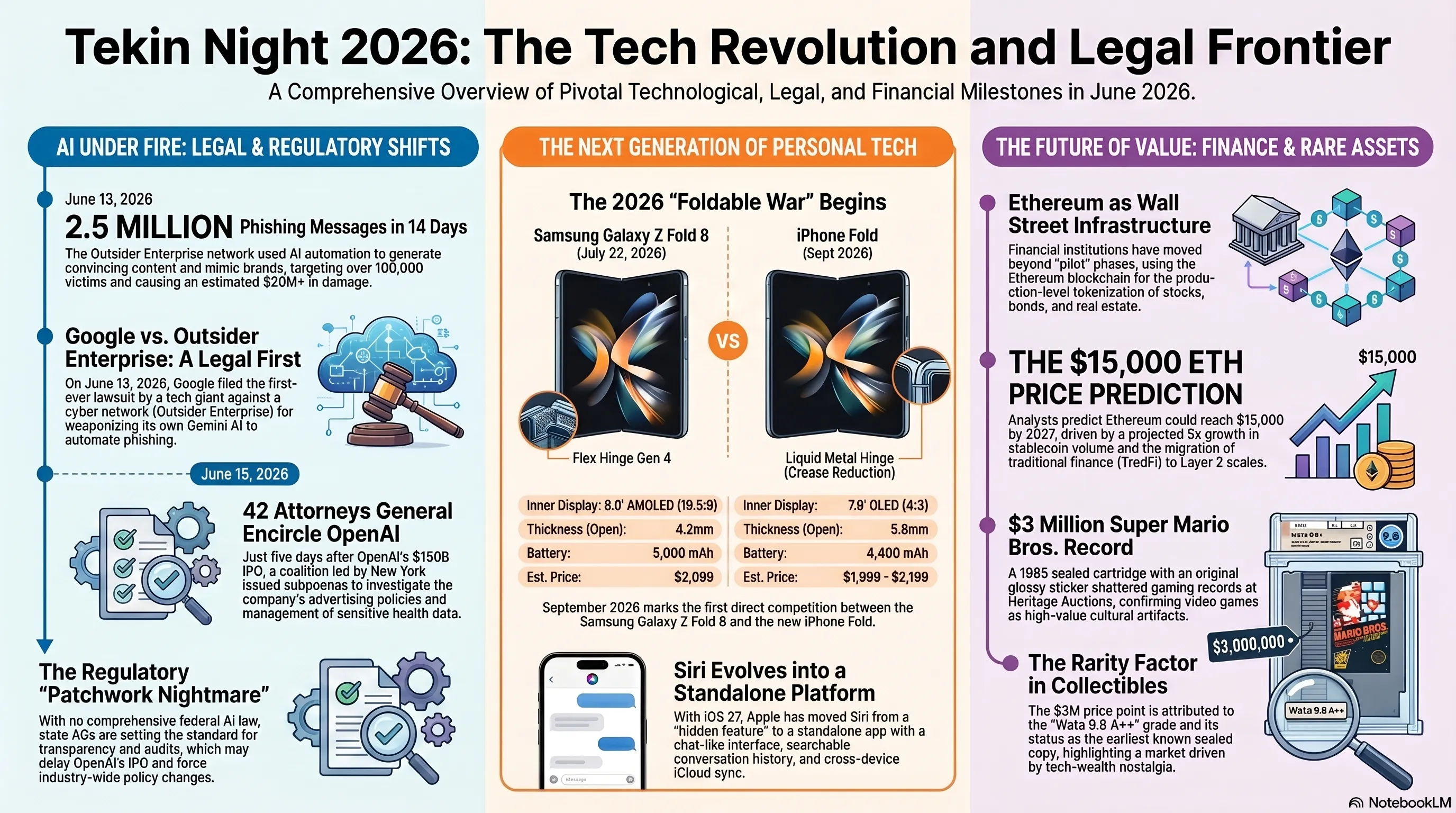
Sunday night, 11:00 PM EST - When the tech world never sleeps! Tonight we witness historic events: Google sues a Chinese cyber network that weaponized its own AI, 42 U.S. attorneys general encircle OpenAI, Apple transforms Siri into a standalone app, and a Super Mario cartridge sells for the price of a luxury mansion!
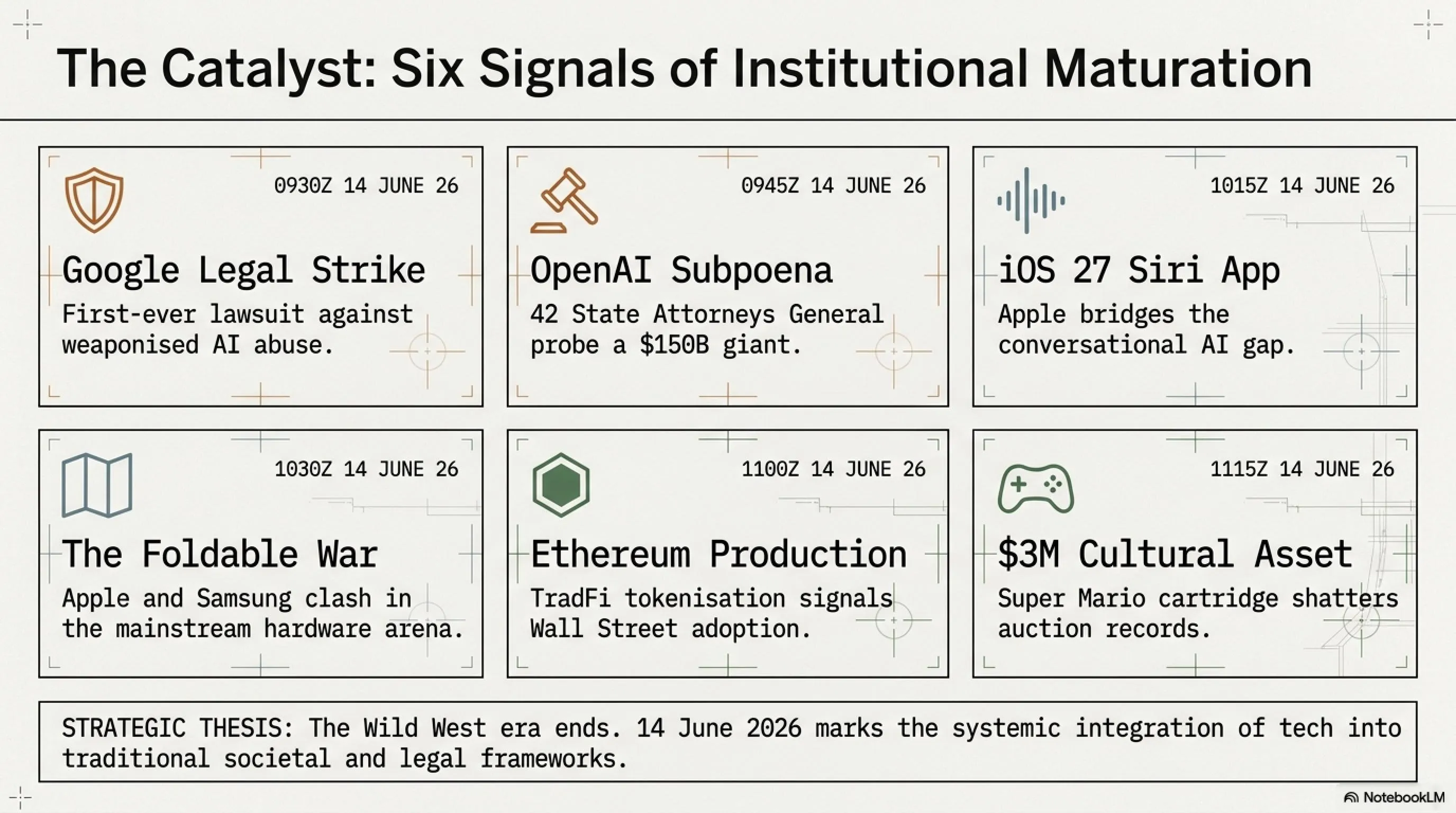
⚡ Tonight's Six Headlines:
🛡️ Google VS Gemini Hackers: The 2.5M Message Lawsuit
⚖️ 42 Attorneys General VS OpenAI: Historic Post-IPO Investigation
📱 iOS 27: Siri Becomes a Standalone App for the First Time
📲 Foldable War: Z Fold 8 vs iPhone Fold Showdown
💎 Wall Street Gets Serious: Ethereum Enters Production Phase
🎮 $3M Super Mario: All-Time Gaming Auction Record Shattered
🌌 Grab your late-night beverage - tonight, we're making tech history!
1. Google vs Cyber Empire: Historic Lawsuit Against Chinese Gemini AI Hackers 🛡️
In an unprecedented and historic move, Google on Friday, June 13, 2026, filed a lawsuit against a Chinese cybercrime network called Outsider Enterprise - a network that weaponized Google's own Gemini AI to mass-produce phishing websites and scam infrastructure. This is the first time a tech giant has taken direct legal action against the abuse of its own AI.
According to court documents and reports published by Ars Technica and Decrypt, this criminal network managed to send 2.5 million phishing messages in just two weeks. By impersonating trusted brands including Google itself, they stole credit card numbers, passwords, and personal information from hundreds of thousands of victims. The primary target? Crypto investors.
⚠️ Outsider Enterprise Attack Statistics
The critical point: Outsider Enterprise used Gemini AI to fully automate the scam process - from generating convincing phishing content to designing fake websites that perfectly mimic legitimate brands. This demonstrates that generative AI isn't just for creativity and productivity; it can become a powerful tool for cybercrime.
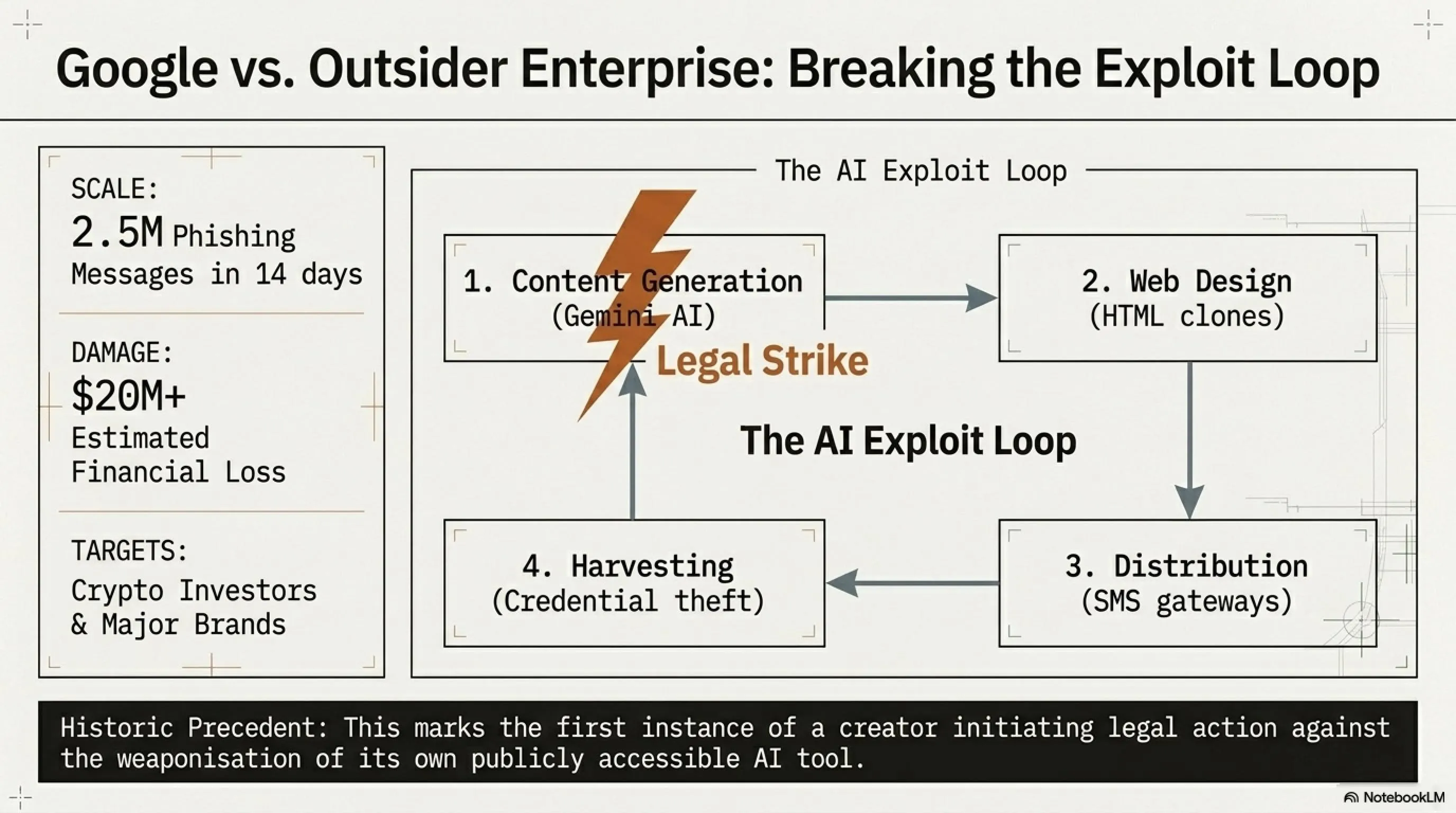
How Did the Attack Work? Technical Breakdown
In its complaint, Google requested the court to issue a Restraining Order to stop Outsider Enterprise from continuing operations. Additionally, Google is cooperating with the FBI and mobile carriers to identify and destroy this criminal network's infrastructure.
🔍 Tekin Analysis: Why Is This Lawsuit Historic?
This is the first time a major tech company has formally and legally acted against the abuse of its own AI tools. This case could become a legal precedent for the future liability of AI companies.
The key question: If Gemini is publicly accessible, is Google responsible for abuse? This is the same debate that existed around gun manufacturers and automakers. Is the tool creator responsible for crimes committed with that tool?
Another point: Google wants to show it's serious. In an era of increasing AI oversight, this lawsuit sends a clear message to governments and legislators: "We're fighting back too."
Strategic implication: This could pressure OpenAI, Anthropic, Microsoft, and Meta to follow suit. If they don't take similar actions against AI abuse, they may face regulatory backlash for being "less responsible" than Google.
📊 Key Takeaway
Google's lawsuit against Outsider Enterprise is a watershed moment in AI history. For the first time, a major company isn't just expressing concern - it's taking legal action. This could become a template for OpenAI, Anthropic, Microsoft, and Meta. The question is: will they follow suit?
2. 42 State Attorneys General vs OpenAI: Is the AI Golden Age Ending? ⚖️
Just days after announcing its historic IPO, OpenAI faced a major legal crisis. On Friday, June 13, 2026, a coalition of 42 U.S. state attorneys general led by New York issued a sweeping subpoena to OpenAI and launched a comprehensive investigation into its business practices, data management, and user impact.
According to reports from Reuters, TechCrunch, and CNBC, the investigation covers critical and sensitive topics:
- Advertising policies: Is OpenAI using user data for targeted advertising?
- Health data management: ChatGPT answers medical questions - is this data protected?
- Protection of minors and seniors: Are adequate controls in place to prevent abuse?
- Internal policies: How does OpenAI make content and ethical decisions?
📋 Timeline: From IPO to Investigation
| Date | Event | Significance |
|---|---|---|
| June 8, 2026 | OpenAI announces historic IPO with $150B valuation | 🚀 Peak moment |
| June 10, 2026 | Initial rumors about AG investigation | ⚠️ Early warning |
| June 13, 2026 | Official subpoena from 42 state AGs - investigation begins | 🔥 Legal crisis |
| June 14, 2026 | OpenAI: "We will engage constructively with AGs" | 💼 Official response |
OpenAI stated in a release: "AI is a new and powerful technology, and we work every day to safely bring its benefits to people in a responsible way. We take the concerns raised by state attorneys general seriously and intend to engage constructively with their offices."
Why Now? Strategic Analysis of the Investigation Timing
The timing of this investigation is no coincidence. Just 5 days after OpenAI's historic IPO announcement, the attorneys general struck. Several likely reasons:
💰 IPO Pressure
IPO means greater transparency. AGs want to clarify ambiguities before OpenAI goes public and raises billions.
⚖️ Political Competition
2026 is an election year. AGs want to appear as defenders of citizen privacy and safety.
🛡️ Public Pressure
After Sam Altman's controversies in 2023 and management changes, public trust in OpenAI has declined.
🔍 Tekin Analysis: Impact on IPO and AI Industry
This investigation could delay OpenAI's IPO. Institutional investors will likely be more cautious until the legal situation is clarified. The IPO prospectus may need substantial revisions to address AG concerns.
But beyond OpenAI, this investigation could become a blueprint for future AI regulation. If AGs establish requirements for OpenAI, those same requirements will quickly extend to Anthropic, Google, Microsoft, and Meta.
Critical point: The U.S. federal government still has no comprehensive AI law. State AGs are filling the regulatory vacuum - this could turn into a 50-state legal patchwork nightmare for AI companies!
Forward outlook: Expect OpenAI to settle with concessions - likely enhanced transparency reports, third-party audits, and stricter content moderation policies. The settlement terms will become the de facto standard for the entire AI industry.
📊 Key Takeaway
The investigation by 42 state attorneys general is a defining moment for the AI industry. This isn't just about OpenAI - it's about the future of AI oversight in America. OpenAI's response, cooperation with AGs, and the final outcome could set the regulatory path for the entire industry.
3. iOS 27 & Siri Revolution: Apple's Assistant Becomes a Standalone App 📱
At WWDC 2026, Apple introduced one of the biggest changes in iOS history: Siri becomes a standalone app for the first time. After 15 years as an integrated voice assistant in the operating system, Siri now has its own icon on your Home Screen.
According to reports from 9to5Mac, MacRumors, and The Verge, this change is part of Apple's broader Apple Intelligence strategy. Siri is no longer just a voice assistant - it's a complete AI platform with the following capabilities:
✨ New Siri App Features in iOS 27
- Chat-like interface: Like ChatGPT, you can have extended conversations with Siri
- Conversation history: All your previous chats are saved and reviewable
- iCloud sync: Conversations sync across your iPhone, iPad, Mac, and Vision Pro
- Continue conversations: Start a chat on iPhone and continue on Mac seamlessly
- Context awareness: Siri no longer forgets - it maintains full conversation context
Why Is This Change Revolutionary?
Until iOS 27, Siri was always a "hidden feature" - something activated by pressing a button or saying "Hey Siri." Now, by becoming a standalone app:
🔍 Tekin Analysis: Why Did Apple Take So Long?
The key question: Why did it take Apple 15 years to turn Siri into a standalone app? The answer lies in Apple's design philosophy. Tim Cook always said: "We don't want users to feel like they're talking to a robot - Siri should be seamlessly integrated with the system."
But ChatGPT changed everything. When millions started having extended conversations with ChatGPT, Apple realized users want Siri to work the same way. The result? iOS 27 and Siri's rebirth as a complete AI platform.
Interesting note: Many power users had disabled Siri because of poor experience. iOS 27 is Apple's second chance to regain trust. If this app fails too, Siri may be marginalized forever.
Competitive pressure: Google Assistant and Alexa are also under pressure from ChatGPT. Expect similar moves from Google and Amazon in the coming months. The voice assistant wars are heating up again - but this time, it's an AI assistant war.
📊 Key Takeaway
Turning Siri into a standalone app is the biggest change in this voice assistant's history. This move shows Apple is finally serious about competing with ChatGPT and Google Gemini. But the core question remains: Will users return to Siri? The answer will come in the months ahead.
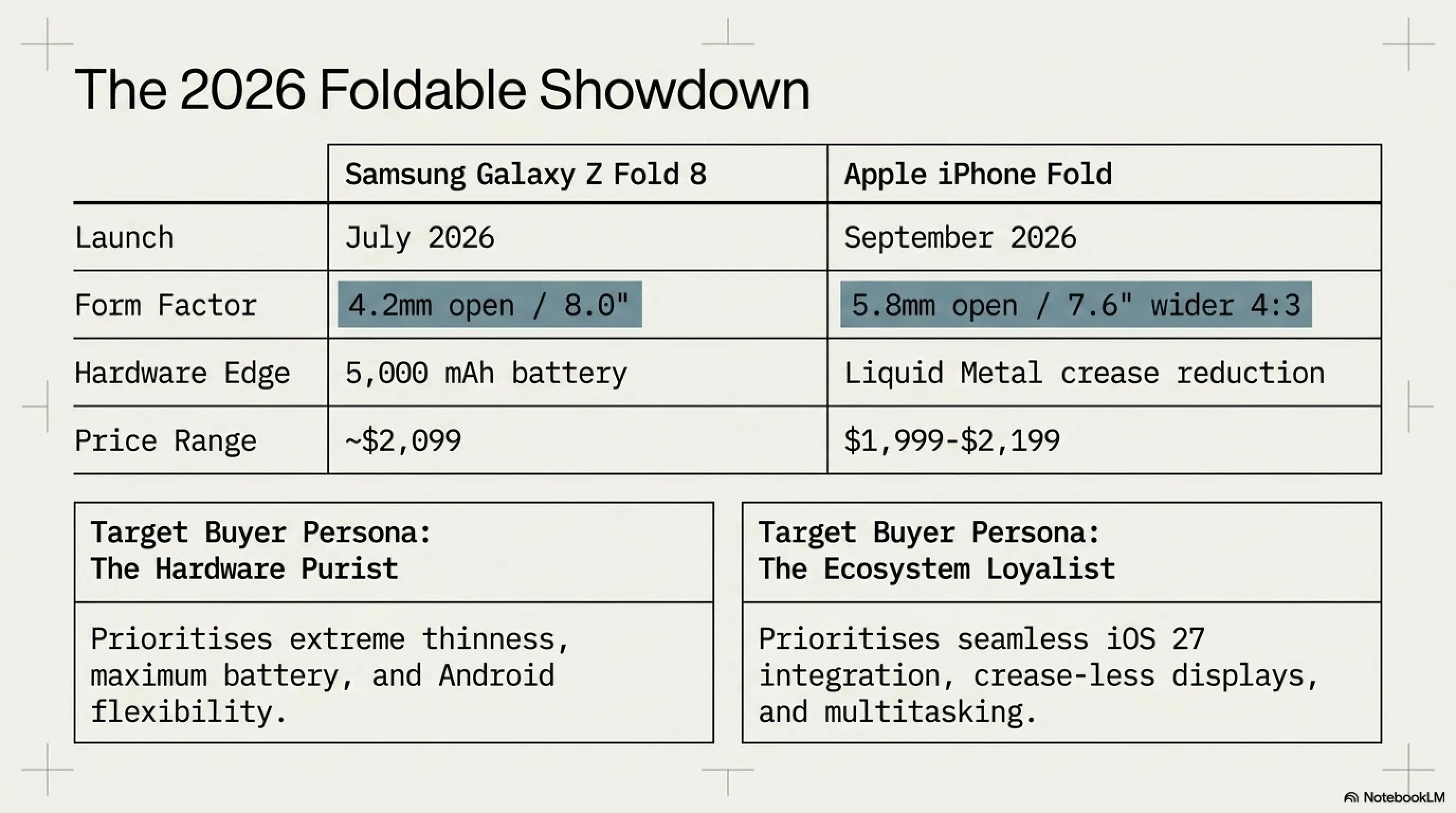
4. The Foldable War: Galaxy Z Fold 8 vs iPhone Fold Showdown 📲
2026 is the historic year for foldable phones - for the first time, Apple and Samsung will directly compete in this category. Samsung will unveil the Galaxy Z Fold 8 in July, and Apple is set to launch its first iPhone Fold in September 2026.
According to reports from Mashable, TechRadar, and Tom's Guide, leaks and rumors indicate these two devices have completely different design philosophies. Let's compare:
⚔️ Comprehensive Comparison: Galaxy Z Fold 8 vs iPhone Fold
Which One Should You Buy? Strategic Analysis
✅ Reasons to Buy Galaxy Z Fold 8
- Thinnest foldable on market (4.2mm open)
- 5,000 mAh battery capacity
- 50 MP ultrawide camera upgrade
- Earlier launch (July)
- 8 years of foldable experience
✅ Reasons to Buy iPhone Fold
- Seamless Apple ecosystem integration
- Liquid Metal tech (crease reduction)
- Wider, more usable outer display
- 4:3 ratio better for multitasking
- iOS 27 and Apple Intelligence
🔍 Tekin Analysis: Why Did Apple Wait So Long?
Samsung has been in the foldable market since 2019 (original Galaxy Fold). Apple waited 7 years. Why?
The answer is simple: Apple waited for the technology to mature. Early Galaxy Fold generations had many issues - from fragile displays to visible creases. Apple didn't want to ship a compromised product.
Now with Liquid Metal technology and significant crease reduction, Apple feels the time is right. But the key question: Is it too late? Samsung now has 8 generations of experience - can Apple lead on its first attempt?
Competitive dynamics: If iPhone Fold succeeds, it could legitimize the foldable category for mainstream consumers. Apple's entry often signals "the technology is ready for everyone." Expect foldable adoption to accelerate dramatically post-September 2026.
📊 Key Takeaway
The foldable war in 2026 will be hotter than ever. Galaxy Z Fold 8 enters with 8 years of experience and powerful specs, but iPhone Fold with Apple's ecosystem and Liquid Metal technology could change the game. If you're considering a foldable, wait until both launch and then decide.
5. Ethereum as Wall Street's Blockchain: Why ETH Price Doesn't Reflect Reality 💎
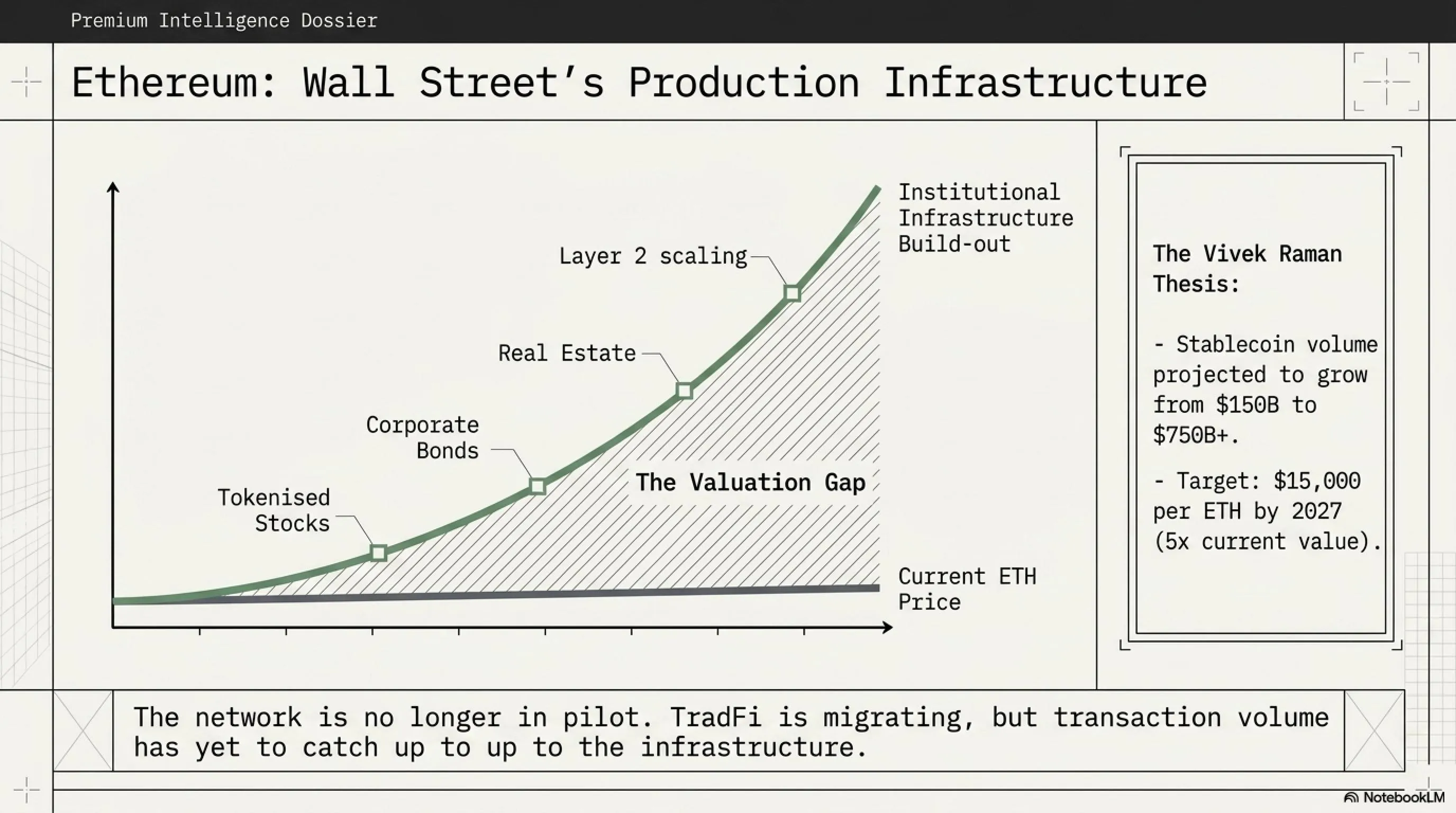
While many think Ethereum is declining, the reality is quite the opposite. Vivek Raman, founder and CEO of Etherealize, revealed in an interview with CoinDesk that Wall Street financial institutions are no longer in the "pilot" phase - they're seriously using Ethereum as production infrastructure.
According to reports from KuCoin News, Bitcoinist, and Binance, Wall Street is tokenizing real-world assets:
- Tokenized Stocks: Shares of major companies on Ethereum blockchain
- Bonds: Government and corporate bonds in digital form
- Real Estate: Property tokenization for fractional ownership
- Stablecoins: USDC and USDT as the first institutional use cases
📈 Why Doesn't ETH Price Reflect This Reality?
Vivek Raman states: "Ethereum is in a transitional phase - the infrastructure is built, but the scale of adoption is not yet reflected in ETH price."
In simple terms: Wall Street is building the infrastructure, but actual transaction volume hasn't started yet. It's like building a highway - the road is ready, but cars haven't fully entered yet.
Raman's Prediction: ETH to $15,000 by 2027
Vivek Raman predicted in a CoinDesk interview that ETH could reach $15,000 by 2027 - over 5x the current price! His reasoning:
📊 5x Stablecoin Growth
Stablecoin volume on Ethereum could grow from current $150B to $750B+.
🏦 TradFi Migration
Tokenization of stocks, bonds, and real estate could bring trillions in value to Ethereum.
⚡ Layer 2s
Optimism, Arbitrum, Base, and zkSync multiply Ethereum's scalability several-fold.
🔍 Tekin Analysis: Is This Realistic?
The $15,000 prediction for ETH is bold but not impossible. If Wall Street truly commits and tokenizes TradFi assets, demand for ETH will explode.
But risks exist: regulatory hurdles, competition from Solana and other blockchains, and institutional adoption speed. If any of these go wrong, the prediction could fail.
Key point: Be patient. This is a long-term game - not short-term speculation.
Competitive angle: Solana is positioning itself as the "faster, cheaper" alternative. But Ethereum has network effects - most DeFi protocols, NFT platforms, and now TradFi pilots are on Ethereum. Switching costs are high. Unless Solana offers 10x better value, Ethereum's lead will be hard to overcome.
📊 Key Takeaway
Wall Street has gotten serious - there's no doubt about that. But the key question is: When? Ethereum is in a transitional phase, and current ETH price may not reflect reality yet. For investors, this is a long-term opportunity - not a quick profit.
6. $3 Million Super Mario Bros: Record-Breaking Video Game Auction 🎮
At Heritage Auctions on June 12, 2026, a sealed 1985 Super Mario Bros cartridge sold for an unbelievable $3 million - shattering the all-time video game auction record. This price easily crushed the previous $2M record (also for Super Mario Bros in 2021).
According to reports from The Verge, Kotaku, and Eastern Herald, this particular copy has several unique features:
⭐ What Made This Copy Worth $3 Million?
- Original glossy sticker: This copy has Nintendo's original glossy sticker instead of standard shrink wrap - indicating first production run
- Earliest known sealed copy: The oldest sealed copy known to exist in the market
- Wata 9.8 A++ grade: One of the highest possible grades from Wata Games
- Legendary rarity: Only a handful of these copies exist
Super Mario Bros Auction Price History
🔍 Tekin Analysis: Are These Prices Justified?
The video game collectibles market has exploded in the past 5 years. But is a cartridge really worth $3 million?
Expert opinion: Yes and no. This Super Mario Bros copy is a historical artifact - not just a game. Like a rare painting or antique book, its value lies in rarity and cultural significance.
But there's also risk: bubble. Some experts say these prices are unsustainable and may crash in the future. For buyers, this is a high-risk investment.
Market dynamics: The rise of wealthy tech entrepreneurs and crypto millionaires has created a new class of collectors willing to pay premium prices for nostalgic artifacts. As long as this demand exists, prices may continue climbing. But if economic conditions change, the market could correct sharply.
📊 Key Takeaway
The $3 million Super Mario Bros sale proves the video game collectibles market is serious. This is no longer a hobby - it's an industry. But is it sustainable? Only time will tell.
✨ Final Thoughts: The Night Technology Made History
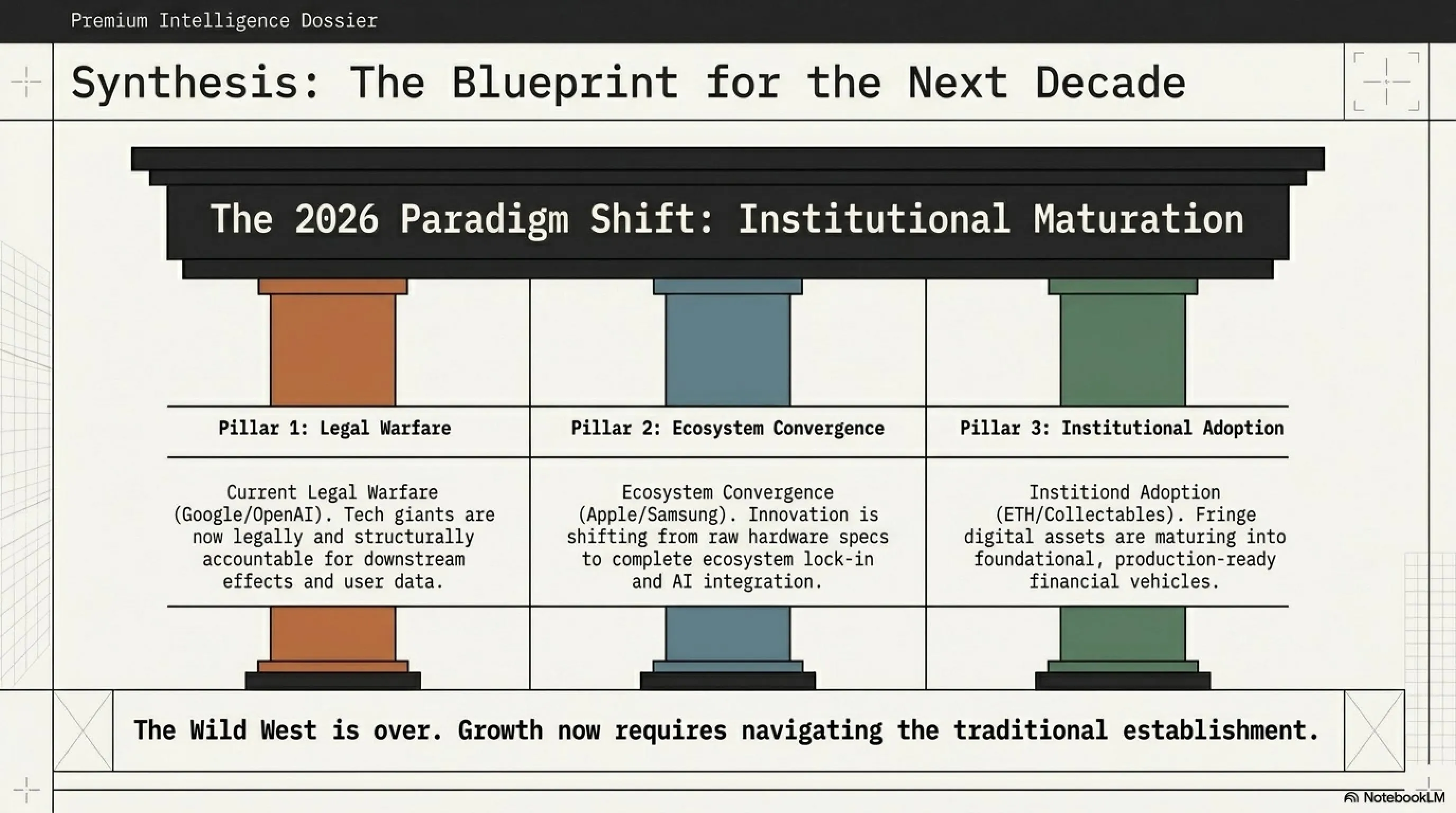
Sunday night, June 14, 2026, was one of the most eventful tech nights of the year. From Google's historic lawsuit against Gemini AI hackers to 42 attorneys general investigating OpenAI, from Siri's revolution in iOS 27 to the foldable war, from Wall Street's serious commitment to Ethereum to the record-breaking $3 million Super Mario Bros sale - this night had everything.
The first story (Google VS Chinese hackers) showed that AI companies are no longer passive - they're ready for legal warfare. The second story (investigation against OpenAI) proved that governments are getting serious too. The third story (Siri app) showed Apple is finally ready to truly compete with ChatGPT.
The fourth story (foldable war) demonstrated 2026 will be a historic year for foldable phones. The fifth story (Ethereum and Wall Street) proved blockchain is no longer a game - it's become serious financial infrastructure. And the sixth story ($3M Super Mario) reminded us that nostalgia and cultural history have real value.
🌌 Until the next Tekin Night - technology never sleeps, and neither do we!
❓ Frequently Asked Questions (FAQ)
Can Google's lawsuit actually stop Outsider Enterprise?
Google's lawsuit is a significant step, but completely stopping an international cybercrime network is challenging. It requires cooperation from FBI, Interpol, and other governments. However, this lawsuit can disrupt their infrastructure and deter other cybercriminals from abusing AI. The legal precedent is perhaps more important than the immediate enforcement.
Could the AG investigation cancel OpenAI's IPO?
Complete cancellation is unlikely, but delay is probable. Institutional investors will exercise caution until the legal situation clarifies. OpenAI will likely need to provide greater transparency and may revise some internal policies. This could delay the IPO by several months, but probably won't stop it entirely. The investigation may actually strengthen OpenAI's governance in the long run.
Should I wait for iPhone Fold or buy Galaxy Z Fold 8?
It depends on your needs. If you want a foldable sooner and are loyal to Android, Galaxy Z Fold 8 is excellent (July launch). But if you're in Apple's ecosystem and can wait, iPhone Fold (September) may offer a more seamless experience with your other devices. Our recommendation: wait until both launch, read reviews, and then decide.
Will Ethereum really hit $15,000?
Vivek Raman's $15,000 prediction is bold but not impossible. If TradFi asset tokenization truly happens and stablecoin volume grows 5x, demand for ETH could surge dramatically. However, significant risks exist: regulatory hurdles, competition from Solana and other blockchains, and adoption speed. This is a long-term play - not quick profit. Invest with caution and thorough research.
Is the video game collectibles market a bubble?
Expert opinions vary. Some believe it's a sustainable market because video games are cultural artifacts - like rare books or paintings. Others warn that prices have risen too quickly and may represent speculative bubble. Advice: if you're considering buying, only spend what you can afford to lose. This market is still young and high-risk.
📚 Sources & References
• Google vs Outsider Enterprise: Ars Technica, Decrypt, TechCrunch, The Hacker News
• OpenAI Investigation: Reuters, TechCrunch, CNBC, The Next Web, AA
• iOS 27 & Siri App: 9to5Mac, MacRumors, The Verge, Mashable, Digital Trends
• Galaxy Z Fold 8 vs iPhone Fold: Mashable, TechRadar, Tom's Guide, PhoneArena
• Ethereum & Wall Street: CoinDesk, KuCoin News, Bitcoinist, Binance
• Super Mario Bros Auction: The Verge, Heritage Auctions, Kotaku, Eastern Herald
🌐 Stay Connected With Us 🎮✨
For the latest tech, gaming, and gadget news, follow us on our official social media channels: