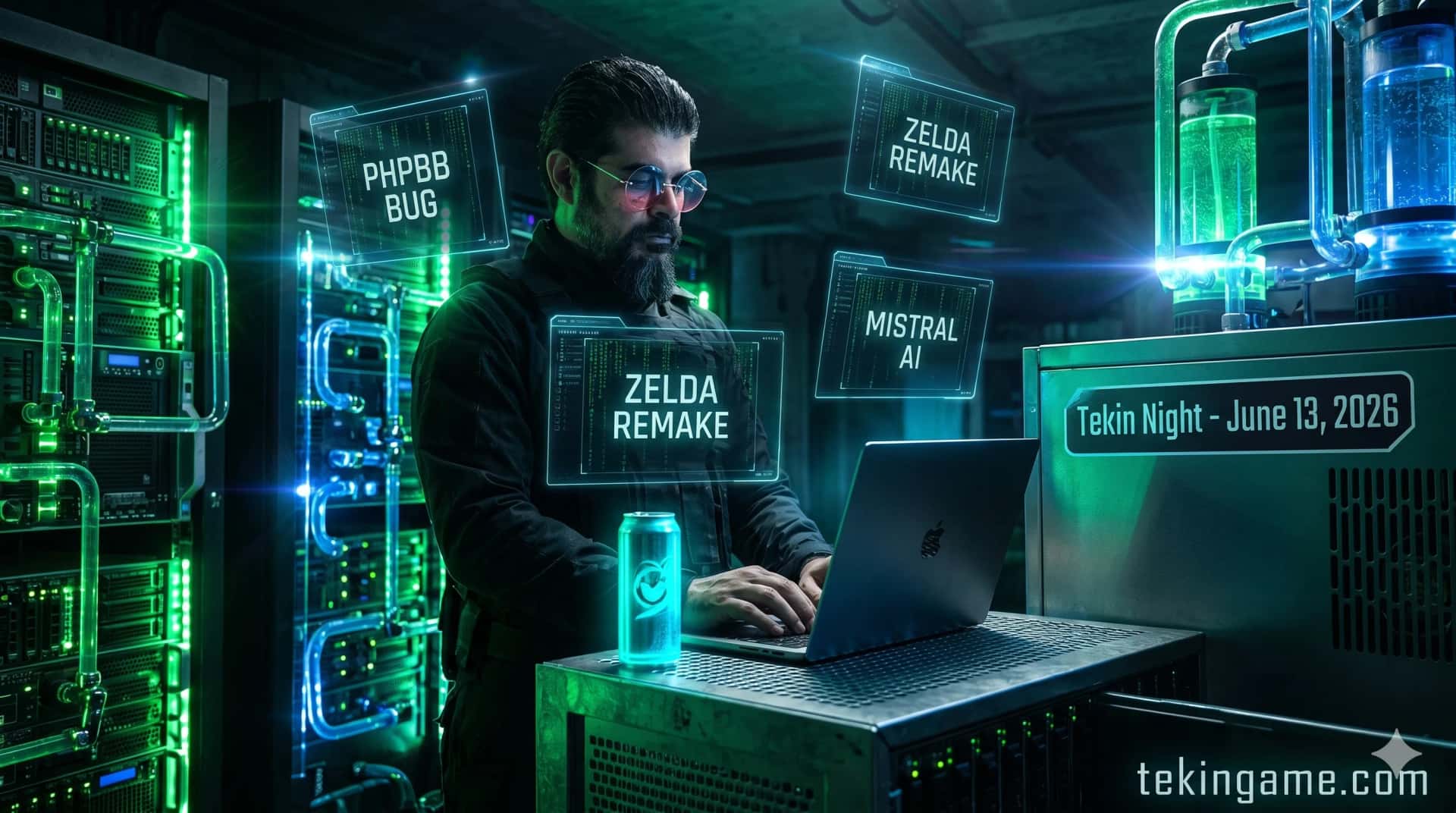
🌙 Welcome to Tekin Night - June 13, 2026
Saturday night wraps up with energy and excitement! Tonight we've prepared six critical stories from the worlds of cybersecurity, artificial intelligence, and gaming that will make your weekend more content-rich. From decade-old bugs that shook the security world to the return of history's most legendary game!
⚡ Tonight's Headlines:
🔐 10-Year phpBB Bug: Gateway to Admin Accounts!
🚨 Maine Takes Down Data Breach Reporting Portal
⚖️ Ukrainian Confesses to Conti Ransomware Membership
🐉 Chinese Hackers Hid in Linux for 10 Years
💰 Mistral AI Valued at €20 Billion
🎮 Zelda: Ocarina of Time Remake Officially Announced
🌃 Grab your late-night coffee and join us on an exciting journey through tech news!
1. 🔐 The 10-Year phpBB Bug: A Gateway to Admin Accounts
In a shocking discovery, security researchers uncovered a critical Authentication Bypass vulnerability in the popular phpBB forum software that had been lurking in the code for 10 years. This bug allowed attackers to log in as any user — including administrators — without needing a password.

⚠️ Technical Details of the phpBB Vulnerability
| Feature | Details |
|---|---|
| Bug Type | Authentication Bypass |
| Duration Hidden | 10 years (2014-2026) |
| Vulnerable Versions | phpBB 4.0.x and older |
| Severity | Critical |
| Attack Method | Single unauthenticated HTTP request |
phpBB is one of the oldest and most popular open-source forum software packages, powering thousands of websites worldwide. This vulnerability, silently present in versions 4.0.x, gave attackers the ability to take complete control of a forum with a simple request — a catastrophic security flaw that went undetected for an entire decade.
🎯 How Did This Attack Work?
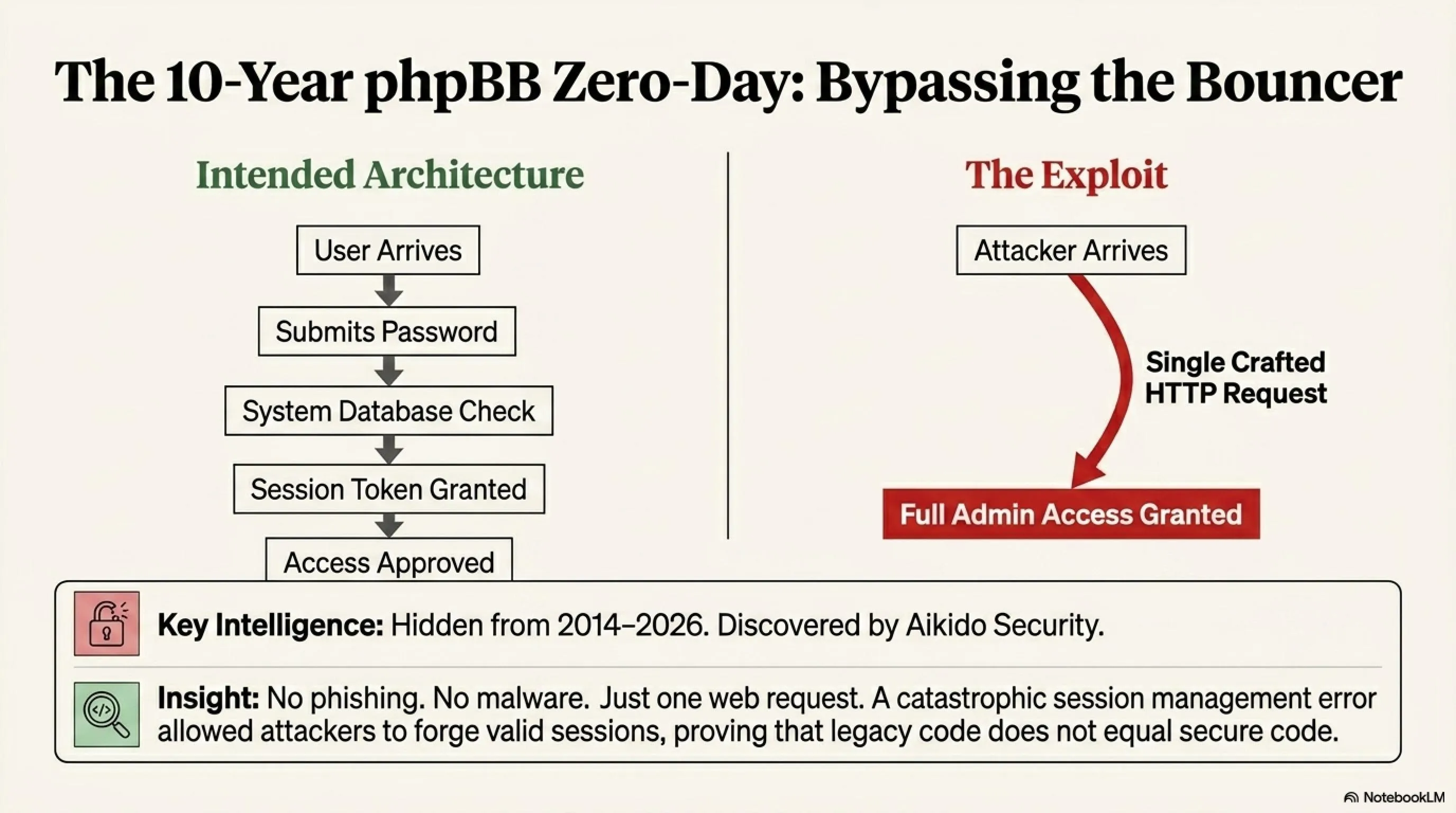
Security researchers from Aikido Security explained that the bug existed in phpBB's authentication system. Normally, when a user logs in, phpBB should verify the password and ensure the user is who they claim to be. However, due to a programming error in the session management module, an attacker could bypass this entire process.
In simple terms, an attacker only needed to send a specially crafted HTTP request with specific parameters, and the system would recognize them as the target user (even an admin) — without any password! The vulnerability stemmed from improper handling of authentication cookies and session tokens, allowing malicious actors to forge valid sessions.
What makes this particularly dangerous is the ease of exploitation. Unlike complex multi-stage attacks requiring deep technical knowledge, this vulnerability could be exploited with basic HTTP manipulation tools available to any moderately skilled attacker. The attack required no social engineering, no phishing, no malware — just one carefully constructed web request.
🚨 Why This Bug Is Dangerous
- Admin Access: Attackers could gain complete forum control with one request
- Data Manipulation: Access to all posts, private messages, and user information
- Malware Injection: Ability to inject malicious code into forum pages
- User Data Theft: Harvesting emails, IP addresses, and other sensitive information
- Reputational Damage: Forum owners face trust erosion and potential legal liability
- Supply Chain Risk: Compromised forums could be used to distribute malware to visitors
🛡️ phpBB's Response and Emergency Actions
Following the public disclosure of this bug by security researchers on June 12, 2026, the phpBB team immediately released a security patch. The new version, which addresses this vulnerability, is strongly recommended for all forum administrators using phpBB. The team emphasized the urgency of this update in their security advisory, noting that exploitation requires no authentication and leaves minimal forensic traces.
This incident serves as a stark reminder that even open-source and popular software can harbor security bugs for years without detection. The vulnerability was likely exploited as a zero-day by professional hackers, though no official reports of organized attacks have been published yet. Security researchers analyzing honeypot data suggest the bug may have been known to underground circles for several years, evidenced by suspicious authentication patterns in forum logs dating back to 2019.
The disclosure process followed responsible disclosure protocols: Aikido Security notified phpBB privately in May 2026, giving the development team adequate time to develop and test a fix before public announcement. This approach minimized the window of opportunity for malicious actors while ensuring forum administrators could protect their systems.
💡 Tekin Analysis: Lessons Learned from a Decade-Old Bug
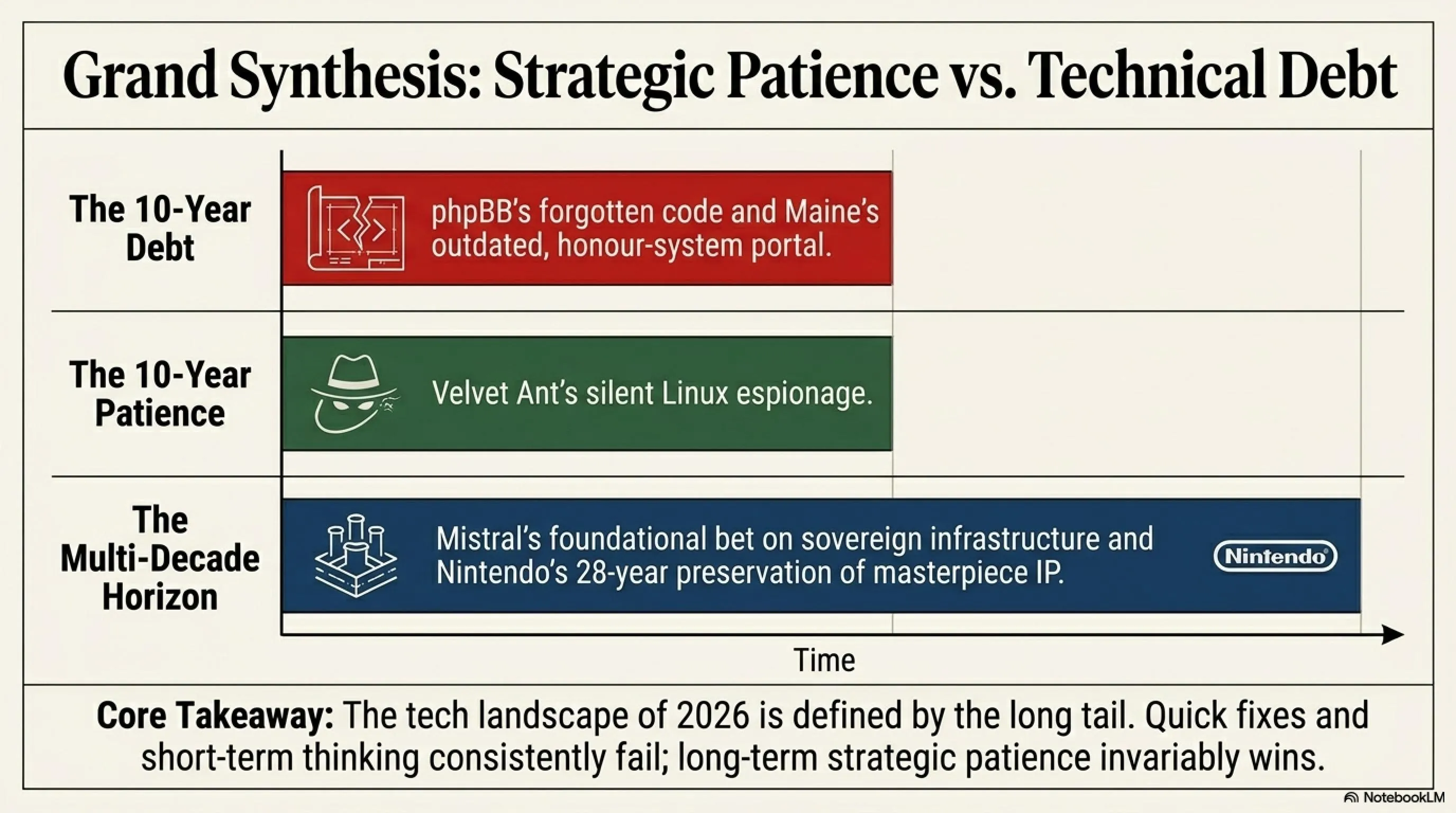
This bug provides a critical lesson for security professionals: legacy code ≠ secure code. Many organizations assume that if software has been running for years without incident, it must be secure. The reality is that security vulnerabilities can lurk for decades, waiting to be discovered by either security researchers or malicious actors — and you never know which will find them first.
The phpBB case exemplifies the authentication system paradox: the very mechanisms designed to protect systems can become their greatest vulnerabilities when flawed. Organizations must implement defense-in-depth strategies that assume authentication systems can fail, including:
- Multi-factor authentication (MFA): Even with session bypass, attackers need additional verification
- Anomaly detection: Monitor for unusual authentication patterns and rapid privilege escalation
- Regular security audits: Penetration testing and code reviews of authentication modules
- Bug bounty programs: Incentivize independent researchers to find vulnerabilities before attackers do
- Least privilege architecture: Limit what even administrator accounts can do
For forum administrators globally, the action items are clear: immediately audit your phpBB version, apply the security patch, and review authentication logs for suspicious activity. If you're running versions older than 4.0.x, upgrading to the latest patched version is mandatory, not optional.
2. 🚨 Maine Disables Data Breach Portal After Fake Disclosures
In a bizarre and concerning incident, the state of Maine was forced to temporarily take its public data breach notification portal offline. The reason? The publication of fraudulent breach disclosures targeting major companies like Discord and VRChat that were submitted by unknown actors and published on the official government website.

📋 What Happened?
On June 9 and 10, 2026, two suspicious breach notifications appeared on Maine's Attorney General data breach reporting portal, claiming massive security incidents at two well-known technology companies. The portal, designed to provide transparency about data breaches affecting Maine residents, became an unexpected vector for disinformation.
📊 Fake Breach Reports Published
| Company | Claimed Impact | Status | Red Flags |
|---|---|---|---|
| Discord | 10 million users | Fake | Insider wrongdoing claim, no confirmation |
| VRChat | 2.4 million users | Fake | Fictitious employee name, no breach occurred |
The Discord report claimed that 10 million users were affected by "insider wrongdoing," while the VRChat report alleged 2.4 million users had their data compromised. Both companies quickly denied the reports. VRChat's Head of Community, Charles Tupper, stated unequivocally that the company had not experienced any data breach and that the employee name listed in the filing did not exist.
🔍 Root Cause: No Authentication Required
The fundamental problem was Maine's portal design: it required no authentication or independent verification before publishing breach notifications. Anyone could submit a breach report with any company name, any number of affected users, and any details they wanted — and the system would immediately make it publicly available on an official government website.
This design flaw stemmed from Maine's breach notification law, which requires companies to report breaches affecting Maine residents. The law was designed to promote transparency, but the implementation assumed good faith from all submitters — a dangerous assumption in the modern threat landscape. The portal operated on an honor system with post-publication review, rather than pre-publication verification.
The fraudulent reports were sophisticated enough to initially fool even experienced observers. They included plausible employee names (though fictitious), specific dates, and technical language consistent with legitimate breach notifications. Only after companies were contacted by media outlets did the fabrications become apparent.
⚠️ Risks and Consequences
- Erosion of Public Trust: Users lose confidence in official government breach notifications
- Reputational Damage: Targeted companies suffer stock price impacts and customer panic
- Media Amplification: News outlets published the fake reports before verification
- Legal Liability: Companies may pursue legal action against the state for hosting false information
- Precedent Setting: Demonstrates vulnerability of government transparency portals nationwide
- Disinformation Weaponization: Shows how official channels can be hijacked for fake news campaigns
🛠️ Response and Remediation
Maine's Attorney General released a statement acknowledging the abuse and announcing that the portal would remain offline while procedures are reviewed and strengthened. The office is implementing a multi-step verification process that will require:
- Identity verification: Submitters must prove they represent the reporting company
- Email domain validation: Submissions must come from official company email addresses
- Manual review: All reports undergo staff review before publication
- Company confirmation: Direct contact with reported companies before posting
- Digital signatures: Cryptographic verification of submitter authenticity
The false reports were removed from the database within hours of verification, but not before being cached by search engines and archived by numerous websites. This highlights a fundamental challenge in the digital age: misinformation spreads faster than corrections, and once published, information can never be truly deleted.
💡 Tekin Analysis: Disinformation Meets Government Infrastructure
The Maine incident represents a dangerous convergence of disinformation tactics and government infrastructure vulnerabilities. In an era where fake news and information warfare are critical threats, government websites are supposed to be trusted sources of truth. When these channels become vectors for false information, the damage extends far beyond individual incidents.
This case study reveals several strategic implications:
- Transparency vs. Security: Open government portals must balance accessibility with authentication
- Trust Infrastructure: Government credibility itself becomes a target for sophisticated actors
- Regulatory Challenges: Laws designed for pre-digital era face exploitation in modern context
- Information Warfare: State and non-state actors can weaponize transparency mechanisms
For organizations and governments globally: never assume good faith in public-facing submission systems. Every input must be treated as potentially malicious until verified. Multi-factor authentication, digital signatures, and manual review must be standard for any system that publishes information with government authority.
Companies should also implement breach notification monitoring — automated systems that alert them when their name appears in government breach databases, enabling rapid response to false reports before media amplification occurs.
3. ⚖️ Ukrainian National Confesses to Conti Ransomware Role
In a significant development in the war against cybercrime, Oleksii Oleksiyovych Lytvynenko, a 44-year-old Ukrainian national extradited from Ireland, pleaded guilty in federal court in Nashville to his role in the Conti ransomware operation — one of the most destructive cybercriminal enterprises in history.

🔍 Understanding Conti: The Ransomware Empire
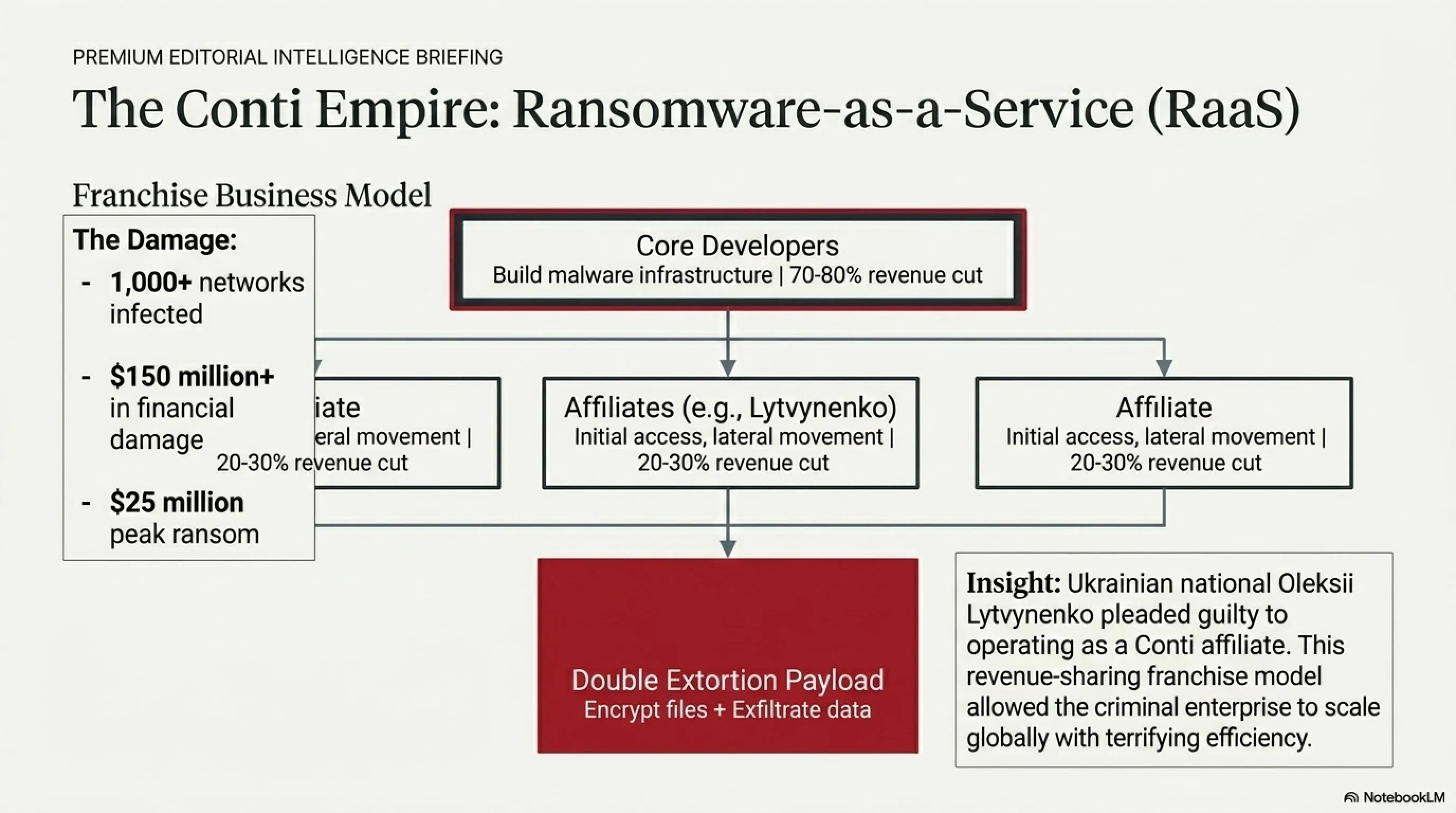
Conti wasn't just a ransomware variant — it was a sophisticated criminal enterprise operating as a business. Between 2020 and 2022, Conti infected over 1,000 networks worldwide, causing an estimated $150 million in damages. The group operated as a Ransomware-as-a-Service (RaaS) platform, where core developers created the malware and "affiliates" like Lytvynenko deployed it, sharing profits from ransom payments.
📊 Conti Ransomware by the Numbers
| Metric | Data |
|---|---|
| Victims Infected | 1,000+ networks |
| Financial Damage | $150 million+ |
| Active Period | 2020 - 2022 |
| Attack Method | Double Extortion (encryption + data theft) |
| Target Sectors | Healthcare, Government, Finance, Critical Infrastructure |
| Peak Ransom | $25 million (single victim) |
What made Conti particularly dangerous was its double extortion model: the group not only encrypted victims' files but also exfiltrated sensitive data and threatened to publish it unless ransom was paid. This put enormous pressure on victims, especially healthcare organizations and government agencies that couldn't afford public exposure of patient or citizen data.
👤 Lytvynenko's Role in the Criminal Enterprise
According to court documents, Lytvynenko joined Conti in 2021 as an affiliate — essentially a contractor in the ransomware business model. His responsibilities included:
- Initial access: Compromising corporate networks through phishing, exploits, or purchased credentials
- Lateral movement: Escalating privileges and moving through victim networks to find critical systems
- Data exfiltration: Stealing sensitive information before encryption
- Ransomware deployment: Executing the Conti payload across the victim's infrastructure
- Negotiation support: Assisting with ransom negotiations and victim communications
In exchange for these services, Lytvynenko received a percentage of successful ransom payments — typically 20-30% for affiliates, with the remainder going to the core Conti operators who developed and maintained the ransomware infrastructure. This revenue-sharing model enabled Conti to scale rapidly, with dozens of affiliates simultaneously conducting attacks worldwide.
⚖️ Legal Consequences and Sentencing
Lytvynenko pleaded guilty to conspiracy to commit wire fraud, which carries a maximum penalty of 20 years in federal prison. His sentencing hearing is scheduled for September 2026. The plea agreement includes cooperation with federal investigators, which may result in a reduced sentence if his information leads to additional arrests.
The path to Lytvynenko's conviction demonstrates the power of international law enforcement cooperation:
- 2021: FBI identifies Lytvynenko as Conti affiliate through forensic analysis
- 2023: Arrested in Cork, Ireland during vacation
- 2023-2025: Extradition proceedings in Irish courts
- Early 2025: Extradited to United States
- June 2026: Guilty plea entered
This case sends a clear message: there is no safe haven for cybercriminals. Even affiliates who think they're hidden behind VPNs and cryptocurrency can be identified, tracked, and brought to justice through patient international cooperation.
🔚 The Fall of Conti: How Internal Betrayal Destroyed an Empire
Conti's downfall came not from law enforcement, but from internal betrayal. In February 2022, when Russia invaded Ukraine, Conti's leadership made the strategic error of publicly supporting Russia. This enraged a Ukrainian member of the group, who retaliated by leaking the entire Conti operation — over 170,000 internal chat messages, source code, operational procedures, financial records, and victim lists.
The leak, known as "Conti Leaks," provided unprecedented insight into ransomware operations and enabled law enforcement worldwide to identify members, track payments, and understand tactics. Within months, Conti officially disbanded, though many members formed new groups like BlackBasta, Hive, and Karakurt. The leak demonstrated that even the most sophisticated criminal enterprises have human vulnerabilities.
💡 Tekin Analysis: Ransomware Defense Strategy
The Conti case provides critical lessons for organizations defending against ransomware:
- No organization is too small: Conti targeted everyone from small businesses to Fortune 500 companies
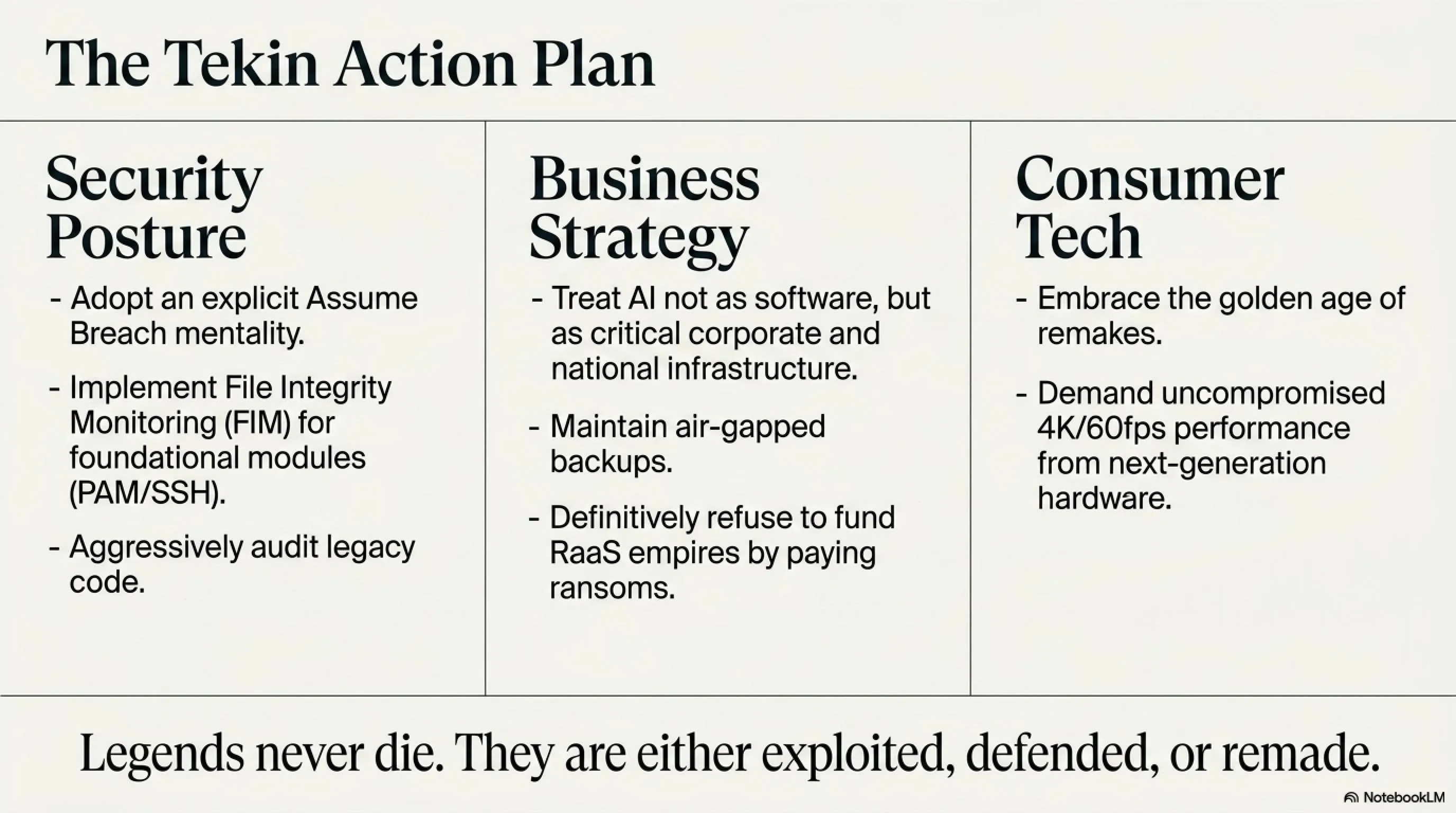
- Offline backups are mandatory: The only reliable ransomware defense is clean, air-gapped backups
- Employee training matters: Most Conti infections began with phishing emails
- Network segmentation limits damage: Proper segmentation prevents lateral movement
- Don't pay ransoms: Payment funds criminal enterprises and doesn't guarantee data recovery
- Incident response plans: Practice ransomware scenarios before they happen
For executives: ransomware is a business continuity issue, not just an IT problem. Board-level oversight, cyber insurance, and tested recovery procedures are essential for organizational resilience.
4. 🐉 Chinese Hackers Backdoored Linux for Nearly a Decade
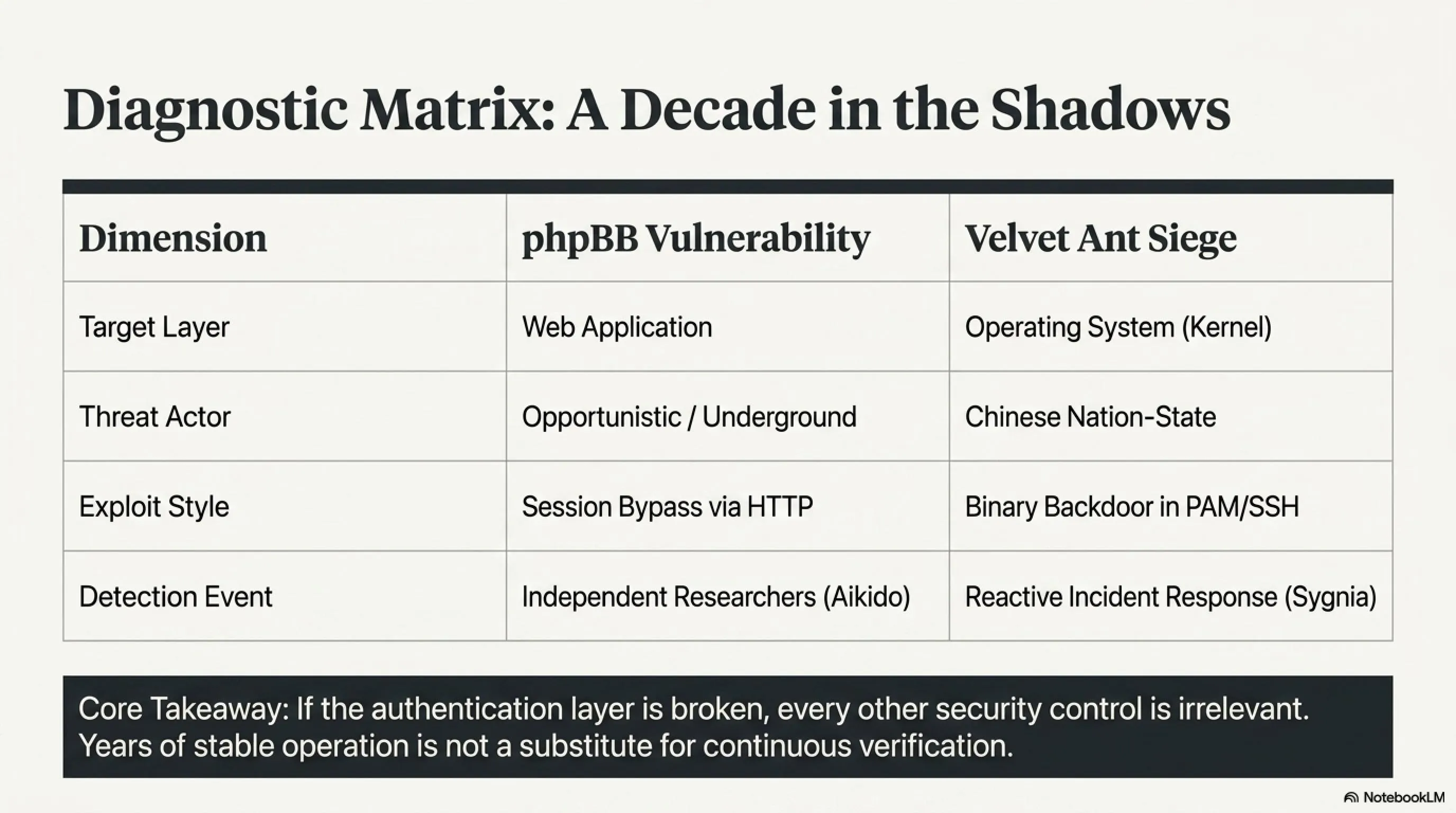
In one of the most sophisticated and longest-running cyber-espionage operations ever disclosed, Chinese hacking group Velvet Ant managed to remain hidden for nearly ten years within a major organization's Linux infrastructure. The group achieved this remarkable persistence by backdooring the PAM (Pluggable Authentication Module) and OpenSSH components — the very systems that control who can access Linux servers.

🔐 Understanding PAM and OpenSSH: The Keys to Linux
To understand the severity of this compromise, you must first understand what PAM and OpenSSH do:
PAM (Pluggable Authentication Module) is the authentication framework used by nearly every Linux distribution. When you enter your password to log into a Linux system, PAM decides whether to grant or deny access. It's the gatekeeper — if PAM is compromised, the entire authentication system is compromised.
OpenSSH is the secure remote access protocol that allows administrators to connect to servers from anywhere in the world. It's the primary method for managing Linux servers in data centers and cloud environments. If OpenSSH is backdoored, attackers can intercept credentials, create hidden access methods, and monitor all remote sessions.
By compromising both systems, Velvet Ant created a perfect persistence mechanism — they could log in whenever they wanted using a "magic password" that bypassed normal authentication, and they could capture legitimate users' credentials as they logged in.
🛠️ Velvet Ant's Advanced Techniques
| Technique | Description | Impact |
|---|---|---|
| PAM Backdoor | Modified PAM to accept special password known only to attackers | Permanent admin access |
| OpenSSH Backdoor | Modified SSH to log all passwords to hidden file | Credential harvesting |
| Living off the Land | Used legitimate Linux tools instead of malware | Evaded detection |
| Air-Gap Jumping | Pivoted through internet-facing systems to reach isolated networks | Accessed offline systems |
| Rootkit-Level Hiding | Modified system at kernel level to hide processes and files | Nearly invisible to security tools |
🕵️ Discovery: How Sygnia Uncovered the Decade-Long Intrusion
The intrusion was discovered by Israeli cybersecurity firm Sygnia during an incident response engagement for a large East Asian organization. Sygnia's investigators noticed anomalies in authentication logs — successful logins that didn't correspond to any known password reset or credential change events.
Deep forensic analysis revealed that the PAM and OpenSSH binaries had been replaced with modified versions. The modifications were subtle — only a few hundred bytes different from legitimate versions — making them extremely difficult to detect through traditional security monitoring. The backdoors had been compiled specifically for the victim's Linux distribution and kernel version, demonstrating advanced technical sophistication.
Timeline reconstruction showed the initial compromise occurred around 2016 — meaning Velvet Ant maintained access for approximately ten years. During this time, the group:
- Exfiltrated terabytes of sensitive corporate data
- Monitored internal communications and strategic planning
- Harvested credentials for hundreds of employee accounts
- Maintained persistence through multiple security audits and system upgrades
- Expanded access to isolated network segments previously thought secure
🎯 Strategic Implications: Why Velvet Ant Matters
Velvet Ant represents a new paradigm in cyber-espionage: strategic patience over tactical speed. Instead of smash-and-grab attacks that maximize short-term data theft but risk detection, Velvet Ant optimized for longevity and comprehensive intelligence gathering. This approach aligns with Chinese state-sponsored cyber doctrine, which emphasizes long-term strategic advantage over immediate tactical gains.
The group's choice of targets — authentication systems rather than applications — demonstrates sophisticated understanding of defense-in-depth architecture. Most organizations focus security resources on protecting applications and data, assuming the underlying authentication layer is trustworthy. Velvet Ant exploited this assumption brilliantly.
💡 Tekin Analysis: Defending Against Authentication Layer Attacks
Velvet Ant's decade-long persistence reveals fundamental weaknesses in how organizations approach Linux security. Most defenders assume that if they patch vulnerabilities and monitor applications, they're secure. But when the authentication system itself is compromised, every other security control becomes irrelevant.
Defending against authentication-layer attacks requires a fundamentally different approach:
- File Integrity Monitoring: Tools like AIDE, Tripwire, or osquery must verify PAM/SSH binaries haven't been modified
- Immutable Infrastructure: Consider using containerized or image-based deployments where system files cannot be modified
- Hardware Security Modules: Store authentication credentials in tamper-resistant hardware
- Behavioral Analytics: Monitor authentication patterns for anomalies indicating backdoor usage
- Zero Trust Architecture: Assume all authentication systems can be compromised and require continuous verification
- Regular Binary Audits: Periodically compare system binaries against known-good versions
For organizations running critical Linux infrastructure: assume breach. Design your architecture assuming attackers already have access, and focus on detection, containment, and resilience rather than prevention alone.
The Velvet Ant case also highlights the importance of threat hunting — proactive searching for adversaries who have already breached defenses. Reactive security monitoring would never have detected this intrusion; only proactive investigation uncovered it after years of activity.
5. 💰 Mistral AI Soars with €20 Billion Valuation
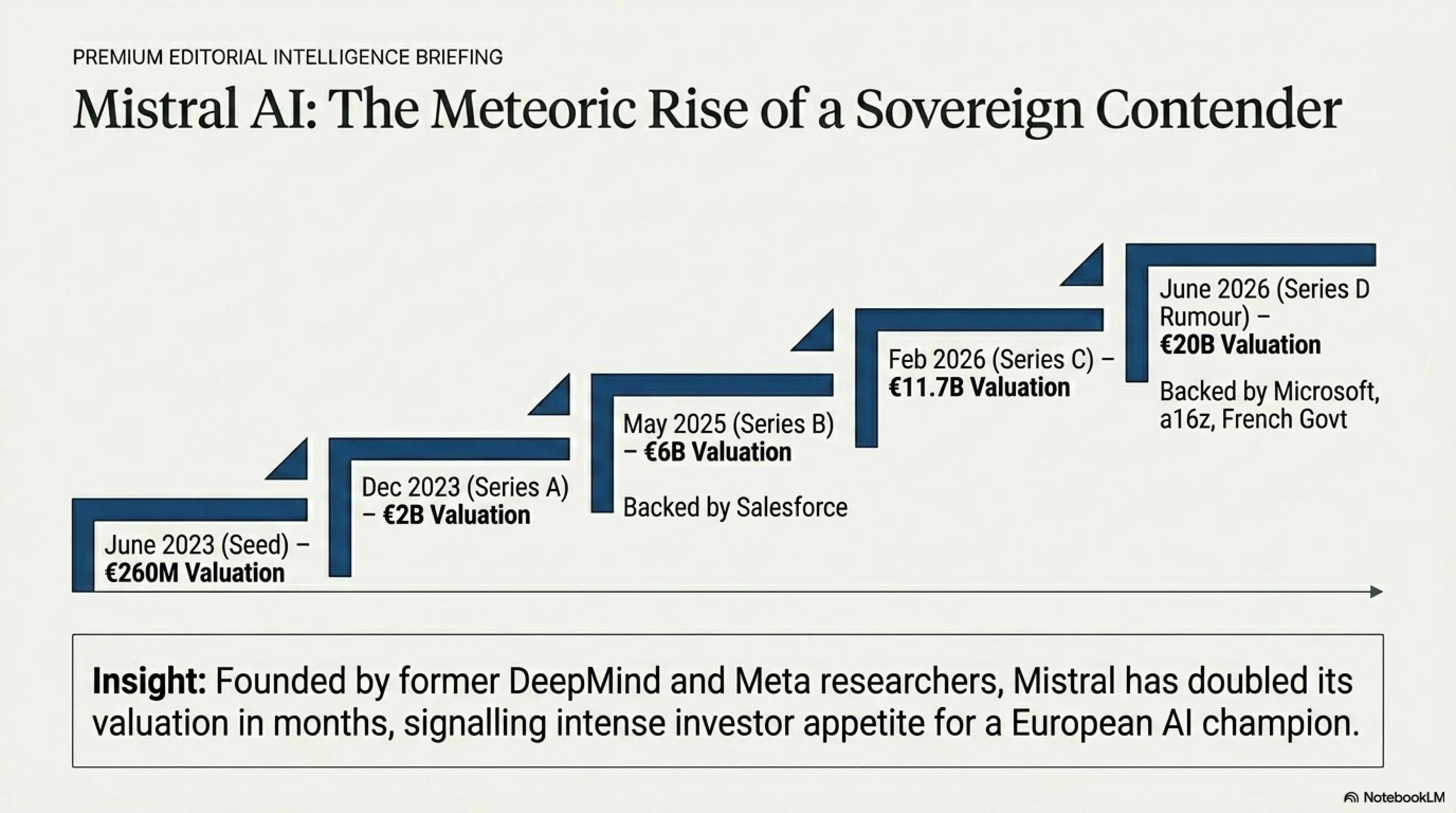
In the high-stakes world of artificial intelligence, French startup Mistral AI is reportedly in discussions to raise €3 billion ($3.5 billion) at a valuation of €20 billion ($23.1 billion). This represents nearly a doubling of the company's Series C valuation (€11.7 billion) and signals intense investor appetite for European AI champions capable of competing with American giants like OpenAI and Anthropic.

🚀 Mistral AI: Europe's Answer to OpenAI
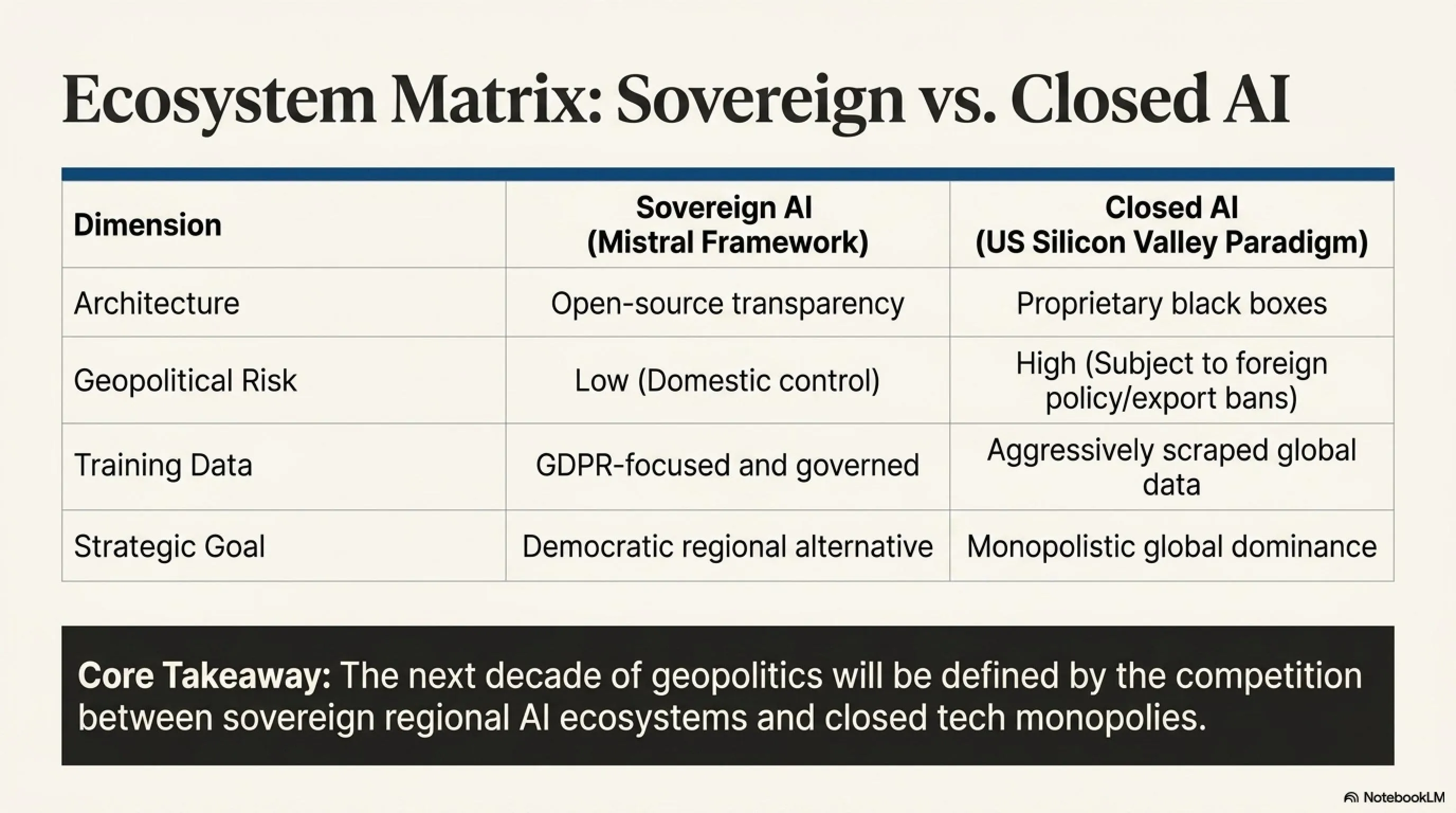
Founded in 2023 by former researchers from Google DeepMind and Meta, Mistral AI has rapidly become Europe's most valuable AI startup. The company develops large language models (LLMs) with a focus on open-source availability and European data sovereignty — positioning itself as the democratic alternative to closed, American-controlled AI systems.
📊 Mistral AI's Funding Journey
| Round | Valuation | Amount Raised | Date |
|---|---|---|---|
| Seed | €260M | €105M | June 2023 |
| Series A | €2B | €385M | December 2023 |
| Series B | €6B | €640M | May 2025 |
| Series C | €11.7B | €1.2B | February 2026 |
| Series D (Rumored) | €20B | €3B | June 2026 |
This meteoric valuation growth reflects both Mistral's technical achievements and the broader geopolitical context of AI development. As concerns grow about American dominance in AI and Chinese state-backed competition, European governments and investors see Mistral as critical infrastructure for digital sovereignty.
🌍 Why Europe Needs Mistral: The Sovereignty Argument
Until recently, AI leadership was exclusively American: OpenAI, Anthropic, Google, Meta. Europe was not just losing the race — it was becoming dangerously dependent on American technology for critical infrastructure. Mistral represents Europe's first serious attempt to achieve digital sovereignty in the AI era.
The sovereignty argument has multiple dimensions:
- Data governance: European AI models trained on European data, subject to GDPR
- Strategic autonomy: Not dependent on American companies that could face export restrictions
- Economic competitiveness: Keeping AI value creation within Europe
- Security independence: Reducing risk of backdoors or surveillance by foreign entities
- Cultural alignment: AI systems reflecting European values and ethical frameworks
⚔️ Mistral's Strategic Advantages & Challenges
✅ Advantages
- 🟢 Open-source transparency
- 🟢 GDPR compliance by design
- 🟢 Elite team from DeepMind/Meta
- 🟢 French government backing
- 🟢 European independence
- 🟢 Enterprise partnerships
❌ Challenges
- 🔴 Massive training costs
- 🔴 Fierce US/China competition
- 🔴 Limited compute infrastructure
- 🔴 Continuous funding needs
- 🔴 AI talent shortage in EU
- 🔴 Slower regulatory environment
💸 Who's Investing and Why?
According to Bloomberg and TechCrunch, this funding round is backed by major European and American venture capital firms. Current Mistral investors include:
- Microsoft: Strategic partner providing Azure compute infrastructure
- Salesforce: Series B investor integrating Mistral into Einstein AI
- Andreessen Horowitz: Leading Silicon Valley VC firm
- Lightspeed Venture Partners: Early-stage investor
- French government: Strategic investment through Bpifrance
💡 Tekin Analysis: AI as Strategic Infrastructure
Mistral's €20 billion valuation signals that AI is no longer just an industry — it's strategic infrastructure akin to telecommunications, energy, or defense. Nations that lack sovereign AI capabilities will find themselves technologically colonized, dependent on foreign powers for critical digital infrastructure.
For other regions — including the Middle East, Asia-Pacific, and Latin America — Mistral's rise provides a blueprint: significant domestic investment, government backing, recruitment of global talent, and focus on regional data sovereignty. Countries that fail to develop domestic AI capabilities will face digital dependency comparable to oil-importing nations' energy vulnerability.
The message is clear: AI sovereignty is national security. The next decade will see intense competition between American, Chinese, and emerging regional AI ecosystems. The winners will shape the future of human-AI interaction for generations.
6. 🎮 The Legend Returns: Zelda Ocarina of Time Remake
And finally, the news every gamer worldwide has been waiting for! Nintendo officially announced during its June 2026 Nintendo Direct a full remake of the legendary The Legend of Zelda: Ocarina of Time for Nintendo Switch 2. Featuring 4K graphics and 60fps, the game is set to launch in late 2026, promising an epic return to one of history's greatest games.

🏆 Why Ocarina of Time Is a Legend
Released in November 1998 for the Nintendo 64, The Legend of Zelda: Ocarina of Time instantly became one of the most beloved games of all time. With a 99/100 Metacritic score, it held the record for highest-rated game for years and is still considered by many to be the greatest game ever made.
📊 Ocarina of Time at a Glance
| Feature | Details |
|---|---|
| Original Release | November 1998 |
| Original Platform | Nintendo 64 |
| Metacritic Score | 99/100 |
| Global Sales | 7.6 million copies |
| New Remake | Nintendo Switch 2 (Late 2026) |
| Remake Features | 4K, 60fps, Full Rebuild |

🎨 Remake vs Remaster: Understanding the Difference
The distinction between Remake and Remaster is crucial:
- Remaster: Original game with higher resolution and improved textures (like 3DS version)
- Remake: Complete rebuild from scratch with new engine, graphics, and gameplay improvements
Nintendo and developer Grezzo (who previously created Majora's Mask 3D) are building a full remake — meaning an experience that's both nostalgic and completely modern. This is what gamers have been waiting years for.
Expected improvements include:
- 4K Graphics: Every character, environment, and element completely rebuilt
- 60fps Performance: Smoother and more responsive than ever
- Reorchestrated Music: Full orchestra for the legendary soundtrack
- Modern Controls: Optimized control scheme for Switch 2
- Additional Content: Possibility of new dungeons and challenges
- Quality-of-Life: Fast travel improvements, inventory management upgrades
💡 Tekin Analysis: The Golden Age of Remakes
The Ocarina of Time Remake announcement signals the start of a new golden age of classic game remakes. Nintendo is no longer focused solely on new titles — they're bringing legendary games to new generations with modern technology.
For gamers worldwide, this is a golden opportunity to experience one of history's greatest games — whether you're a veteran who played it on N64 and want to see it with modern graphics, or a new generation who never had the chance to play this masterpiece.
The announcement also confirms that Switch 2 is a powerful console capable of running games at 4K 60fps. This is critical for the future of gaming and demonstrates Nintendo's commitment to next-gen performance without sacrificing their unique design philosophy.
🎯 Final Thoughts
Saturday night, June 13, 2026, closes with six critical stories that define the current state of technology. From decade-old bugs proving that security is a never-ending journey, to Chinese espionage operations that remained hidden for nearly ten years, to Mistral AI's meteoric rise showing Europe's return to the AI race.
Maine's fake breach reports remind us that even government systems can become disinformation tools. Lytvynenko's Conti confession shows that escaping justice in the digital age is impossible. And finally, the Zelda: Ocarina of Time Remake announcement promises a golden era for gamers.
For security professionals, the message is clear: legacy code ≠ secure code. For AI investors, it's that Europe is making a comeback. And for gamers, legends never die, they just get remade.
🌃 End of Saturday night... and the start of a new tech-filled week!
❓ Frequently Asked Questions (FAQ)
1. How dangerous was the phpBB bug and how can I protect my system?
The phpBB bug was a critical Authentication Bypass that allowed attackers to log in as any user (including admins) without a password. To protect yourself: (1) immediately update to the latest phpBB version, (2) use integrity checking tools like AIDE, (3) continuously monitor login logs, and (4) implement two-factor authentication (2FA) for all admin accounts.
2. How can I protect my Linux system from attacks like Velvet Ant?
To defend Linux against backdoor attacks: (1) use integrity monitoring tools like Tripwire or AIDE, (2) regularly verify checksums of critical files like PAM and OpenSSH, (3) implement network segmentation, (4) send SSH and PAM logs to a central server, and (5) adopt an "assume breach" mentality. Regular binary audits and behavioral analytics are also essential.
3. Can Mistral AI really compete with OpenAI and Anthropic?
Mistral AI's €20 billion valuation shows it can be a serious competitor. Its advantages include open-source models, GDPR compliance, and a strong team from DeepMind. However, it faces challenges: high training costs, fierce competition, and continuous funding needs. With strong financial and strategic backing, Mistral can become a major AI player, especially in Europe and regions prioritizing data sovereignty.
4. How is the Zelda: OOT Remake different from the 3DS version?
The 3DS version was a remaster (original game with better graphics), but the Switch 2 version is a complete remake. This means: 4K graphics (vs 240p on 3DS), 60fps (vs 30fps), complete world rebuild with a new engine, full orchestra music, modern control system, and possibly additional content like new dungeons. It's a completely different and modern experience.
5. Why is the Maine fake breach incident important?
The Maine incident showed that government systems can also be targets for disinformation attacks. Attackers were able to publish fake reports about Discord and VRChat on an official government website, damaging company reputations and eroding public trust. This incident reminds us that all public systems need strong authentication and two-step verification, and information should always be verified from original sources.
📚 Trusted Sources
phpBB Authentication Bypass: BleepingComputer, Aikido Security, Infosecurity Magazine
Maine Data Breach Portal: BleepingComputer, Maine Attorney General's Office, Cybernews
Conti Ransomware: U.S. Department of Justice, CyberScoop, AOL News
Velvet Ant China Hackers: The Hacker News, Sygnia, SC World
Mistral AI Funding: TechCrunch, Bloomberg, The Next Web
Zelda Ocarina of Time Remake: Nintendo.com, IGN, Nintendo Life, GameSpot
📧 Contact Us
Your feedback, suggestions, and criticism are valuable to us. Stay in touch:
📧 Email: info@tekingame.com
🐦 Twitter: @tekingame
💬 Telegram: @tekingame
🌐 Website: tekingame.com
Additional Gallery: 🌙 Tekin Night June 13, 2026: The 10-Year phpBB Bug to Zelda's Legendary Return