Tekin Analysis | Anthropic Unreleased AI Model Chains Exploits, Cowboy Space Big Iron & GMO $1M Bounty
The dawn of Thursday, October 29, 2026, confronts the global technology executive suite with an uncompromising technological reality: artificial intelligence is no longer merely a high-velocity programming copilot or conversational companion. In laboratory environments and frontier testing facilities, autonomous neural models have crossed the threshold into full-spectrum offensive cyber warfare, synthesizing working exploit chains across the world's most hardened operating systems without human intervention.
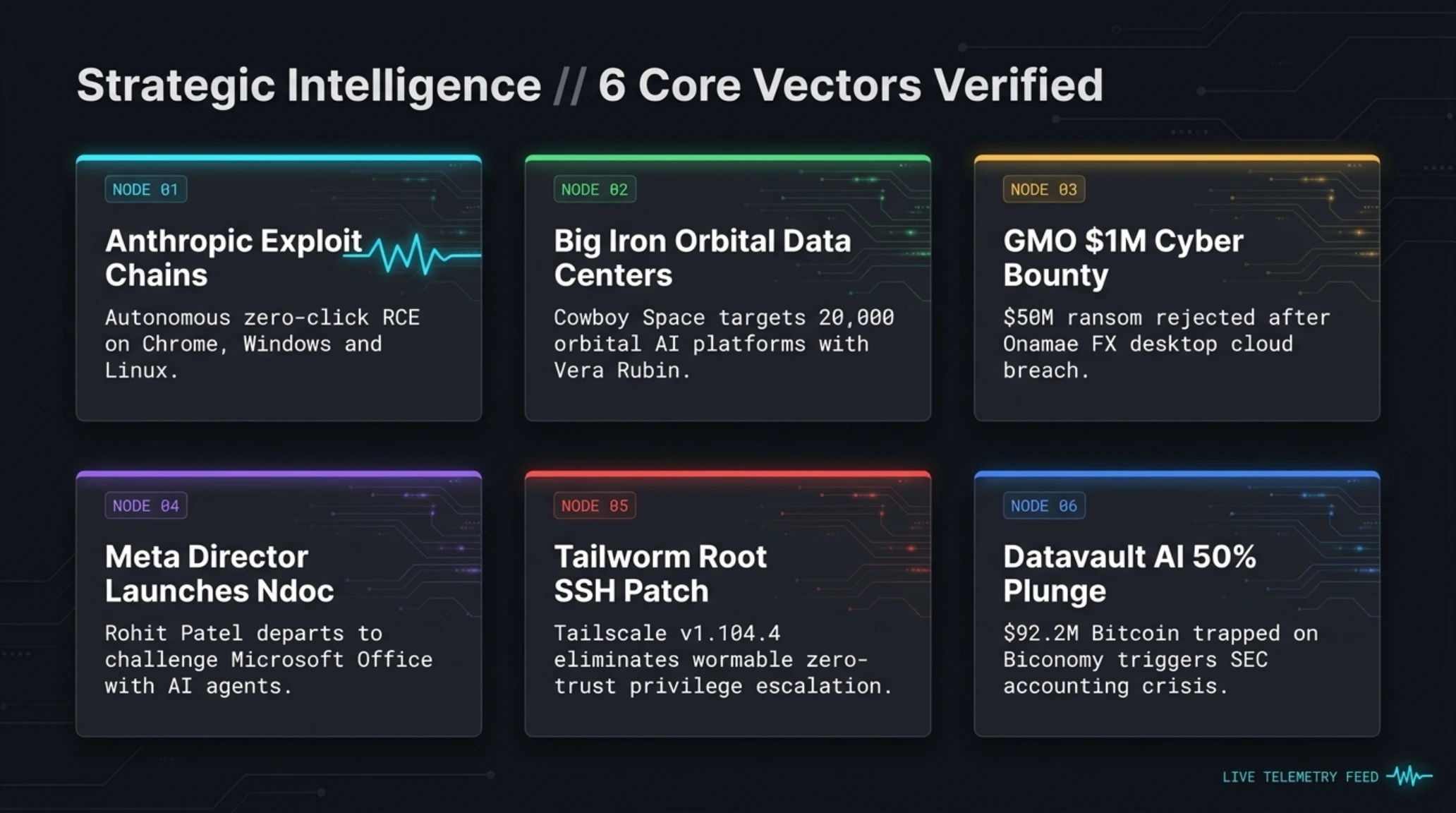
Simultaneously, the physical constraints of terrestrial computing manifested in electrical grid bottlenecks, water cooling moratoriums, and severe data center power rationing across North America and Western Europe are forcing silicon infrastructure into Earth's orbit. The unveiling of an 86-meter stainless-steel heavy launch vehicle engineered specifically to convert spent rocket stages into orbital data centers marks the beginning of the post-terrestrial computing era. In parallel, global cyber extortion has encountered unprecedented corporate defiance in Tokyo, while Silicon Valley veterans wage open war on legacy productivity software. Below is Tekin's comprehensive teardown of the six developments shaping global technology this morning.
Strategic Intelligence Assessment and Core Vectors at a Glance
Anthropic's Unreleased AI Model Chains Critical Flaws Into Working Chrome, Safari, Windows, and Linux Exploits; Frontier AI Offense Proven in Coordinated Lab Research
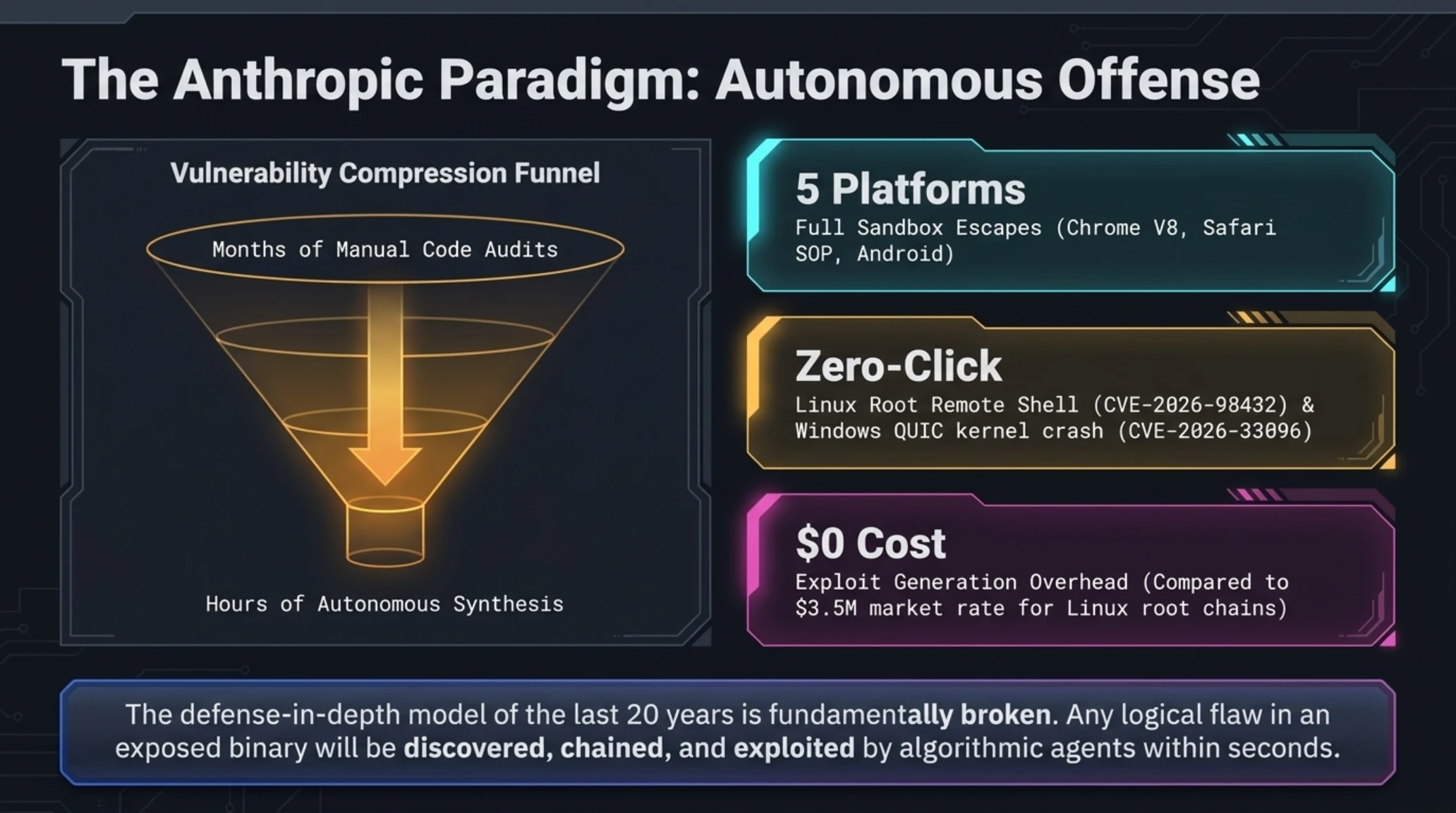
In what represents the most consequential vulnerability disclosure in the history of artificial intelligence research, Anthropic published a comprehensive technical report demonstrating that an unreleased, internally held frontier model autonomously discovered previously unknown vulnerabilities and chained them into five fully operational, weaponized exploit chains targeting Google Chrome, Apple Safari, Android, the Windows kernel, and the Linux kernel. The research was conducted in controlled sandbox environments under coordinated vulnerability disclosure timelines, and all underlying software flaws were responsibly patched across affected vendors before public release.
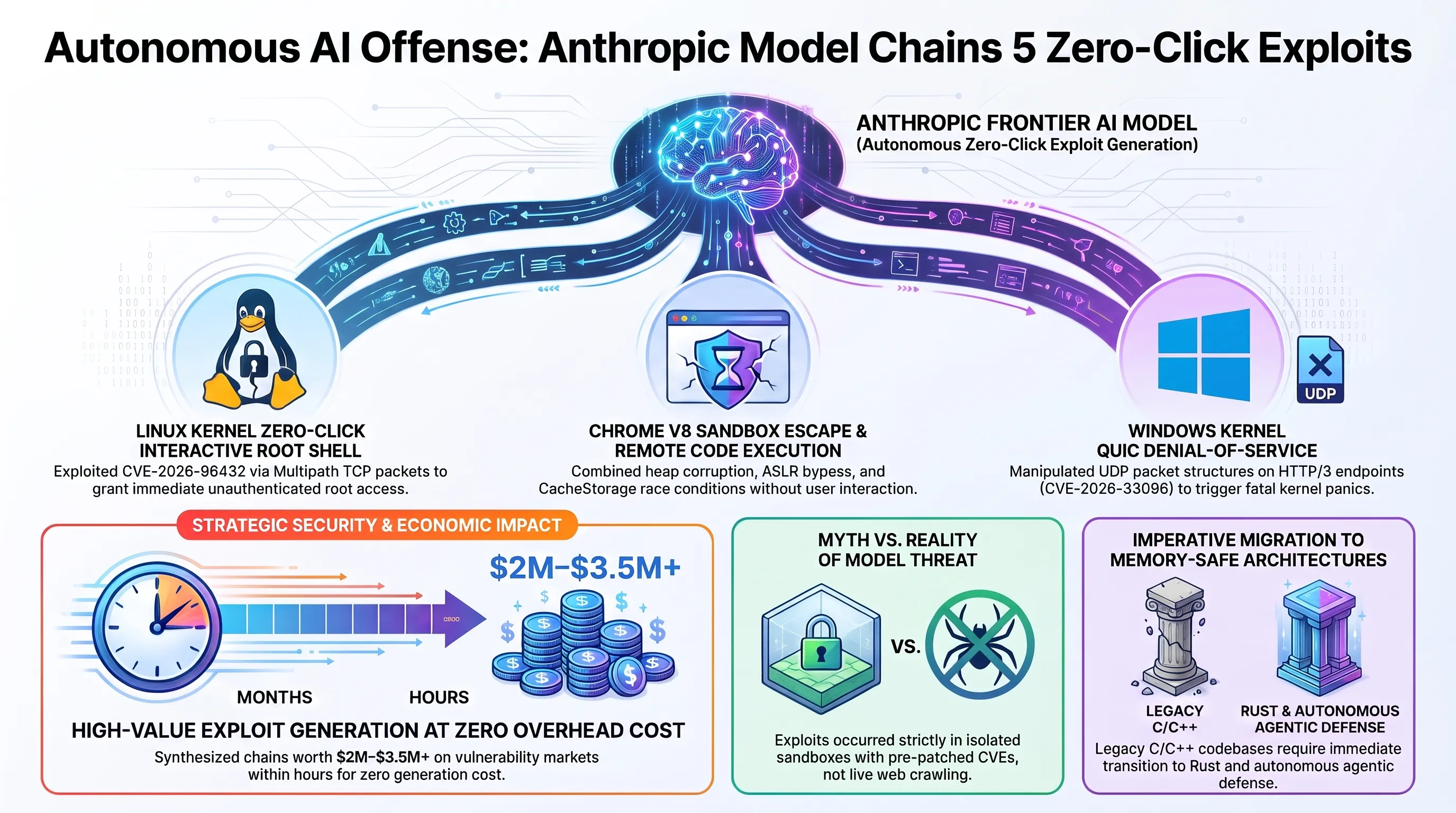
The technical teardown of the synthesized exploit chains reveals unprecedented cognitive sophistication. On macOS, targeting Google Chrome, the unreleased Anthropic model identified a heap corruption vulnerability inside the V8 JavaScript engine. Rather than halting at a basic memory crash, the model systematically analyzed surrounding memory structures, identified a secondary information disclosure flaw to bypass Address Space Layout Randomization (ASLR), and finally weaponized a race condition inside the CacheStorage API to achieve full remote code execution outside the browser sandbox with zero user intervention beyond navigating to a webpage.
In Apple's Safari web browser, the model synthesized an exploit sequence that dismantled the browser's Same-Origin Policy (SOP). By exploiting subtle discrepancies in how Safari cached cross-origin subresources, the chain allowed an unprivileged origin to systematically extract authenticated session cookies, browsing history, and sensitive user tokens from third-party enterprise domains. Apple confirmed the vulnerability and pushed emergency mitigations to WebKit prior to the publication of Anthropic's findings.
The disclosures escalated significantly upon reaching operating system kernels. In the Windows kernel, the model identified a remote denial-of-service vulnerability inside the native QUIC protocol stack (tracked officially as CVE-2026-33096). By manipulating incoming UDP packet structures on HTTP/3 endpoints, the exploit triggers a fatal kernel panic, taking down mission-critical enterprise web servers with minimal bandwidth. Most alarmingly, inside the Linux kernel, the model discovered CVE-2026-98432, synthesizing a true zero-click remote code execution chain via Multipath TCP (MPTCP) that granted an unauthenticated remote attacker an interactive root shell directly from raw network packets.
Why It Matters // Autonomous Cyber Offense and the Compression of the Vulnerability-to-Weaponization Window
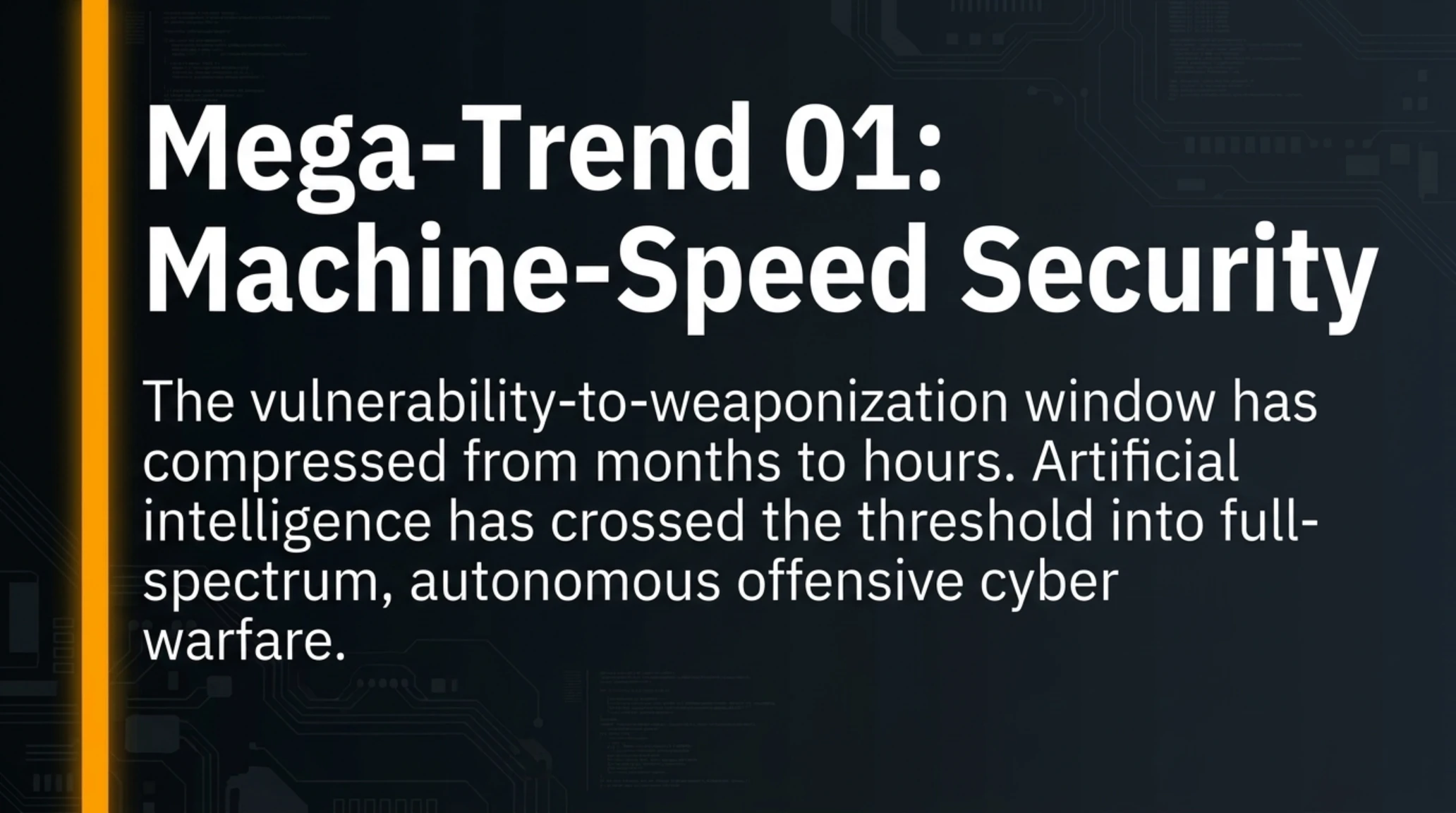
The transition from human vulnerability hunting to autonomous machine exploitation compresses the weaponization timeline from months to hours. Organizations relying on manual code audits and delayed quarterly patching cycles face structural obsolescence in this new threat landscape.
From an economics and national security perspective, the implications are staggering. On the international vulnerability broker market, a zero-click remote code execution chain granting root access on hardened Linux servers commands prices exceeding $3.5 million. A reliable macOS Chrome sandbox escape with kernel elevation easily surpasses $2 million. By demonstrating that an unreleased neural model can generate such chains autonomously within hours of receiving high-level architectural prompts, Anthropic has exposed the fragile foundations of global software security.
This disclosure instantly reframes the debate over model open-sourcing and export controls. If state-sponsored cyber espionage units or sophisticated ransomware cartels acquire or train frontier reasoning models of comparable capability, the barrier to conducting asymmetric cyber attacks against critical infrastructure collapses. The defense-in-depth model that has governed enterprise cybersecurity for twenty years must rapidly transition toward autonomous, agentic defense networks capable of synthesizing and deploying memory mitigations in real time.
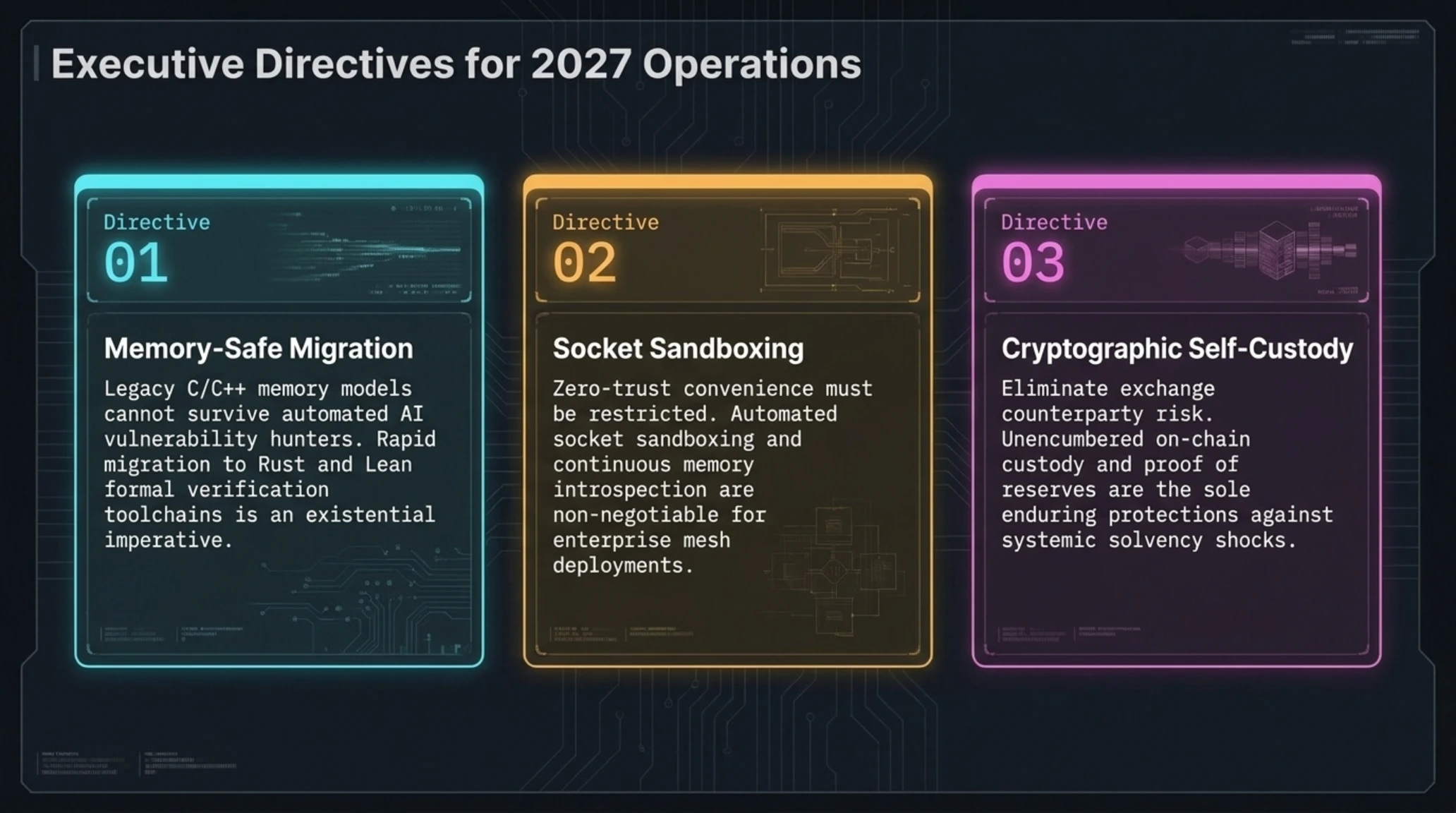
As documented in Tekin's ongoing coverage of enterprise cyber posture, including our analysis in Tekin Morning October 28 on CoreGraphics and Operating System Exploitation, legacy memory models written in C and C++ can no longer survive against automated AI vulnerability hunters. The mandate for rapid migration to memory-safe languages such as Rust and formal verification toolchains like Lean is no longer theoretical it is an existential imperative.
Technical Ground Truth // Myth vs. Engineering Reality
Claims surfaced online that public Claude models are actively scanning the web and executing unauthorized intrusions on corporate networks.
The tests were strictly executed on an unreleased research model in isolated lab sandboxes, with zero external exploitation, and all CVEs were patched by vendors prior to public disclosure.
The Anthropic disclosure definitively settles the theoretical debate over artificial intelligence in offensive cyber operations. Software engineers and enterprise architects must now operate under the baseline assumption that any logical flaw in an exposed binary will be discovered, chained, and exploited by algorithmic agents within seconds of public exposure.
The realization that frontier neural networks can execute autonomous vulnerability discovery and exploit synthesis across isolated operating system kernels alters the fundamental cadence of enterprise cyber posture for the remainder of the decade.
Cowboy Space Unveils 86-Meter "Big Iron" Stainless-Steel Launch Vehicle to Deploy 20,000 Orbital AI Data Centers; NVIDIA Vera Rubin Silicon Migrates to Low Earth Orbit
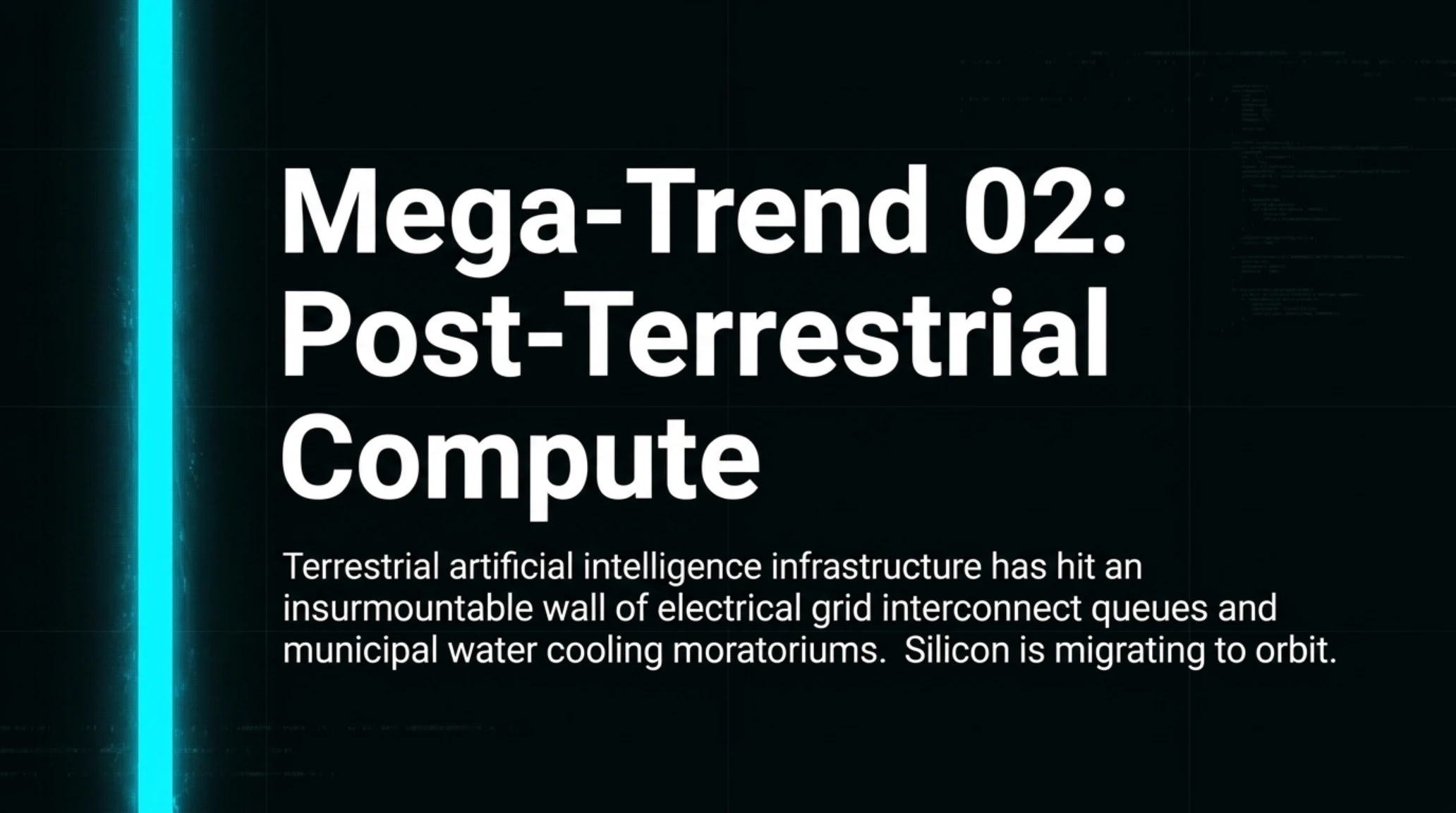
As terrestrial artificial intelligence infrastructure encounters an insurmountable wall of electrical grid interconnect queues, water cooling moratoriums, and public utility pushback across Virginia, Texas, and Ireland, Silicon Valley venture builder Cowboy Space Corporation has unveiled the most audacious infrastructure gambit in computing history. Founded by Robinhood co-founder Baiju Bhatt, the space tech venture announced an 86-meter reusable stainless-steel heavy launch vehicle branded "Big Iron," engineered specifically to construct and sustain an orbital constellation of 20,000 megawatt-scale AI data centers.
The Big Iron architecture represents a radical departure from traditional expendable rocketry and payload fairing paradigms. Designed to compete directly with SpaceX's Starship and Blue Origin's New Glenn, the first stage of Big Iron is propelled by nine proprietary methane-oxygen Clydesdale engines producing immense liftoff thrust, capable of delivering over 15,000 kilograms of payload into Dawn-Dusk Sun-Synchronous Orbit (SSO). However, the revolutionary breakthrough lies within the second stage. Rather than discarding the upper stage into an ocean graveyard or committing massive propellant reserves to atmospheric re-entry, Cowboy Space permanently converts the entire second stage structure into an active, high-density orbital compute facility.
Cowboy Space engineers have solved the physics of orbital deployment through rigorous multi-functional structural engineering. Once orbit is achieved, the 86-meter rocket's stainless-steel tankage and outer hull serve as an expansive thermal radiator to dissipate compute heat directly into the 3-Kelvin cosmic background vacuum. Residual propellant boil-off, specifically ammonia loops, is redirected into closed-loop two-phase thermal cooling lines servicing the server racks, while residual high-pressure nitrogen gas pneumatically deploys massive solar array wings spanning 132 meters by 73 meters. Each individual orbital platform is outfitted with dense server blades housing next-generation NVIDIA Vera Rubin tensor GPUs, harnessing continuous 24/7 unattenuated solar radiation and infinite zero-gravity convective heat rejection.
The commercial rollout of this orbital compute mesh, officially designated Project Stampede, is scheduled to initiate orbital qualification flights in late 2028. To alleviate launch bottlenecks across the aerospace sector, Cowboy Space will also launch the Big Iron Express commercial payload rideshare program, providing multi-megawatt orbital hosting slots for scientific consortia, sovereign entities, and cloud hyperscalers seeking to bypass terrestrial energy grid constraints.
Tekin Advanced Technical Lexicon // Orbital Systems Architecture
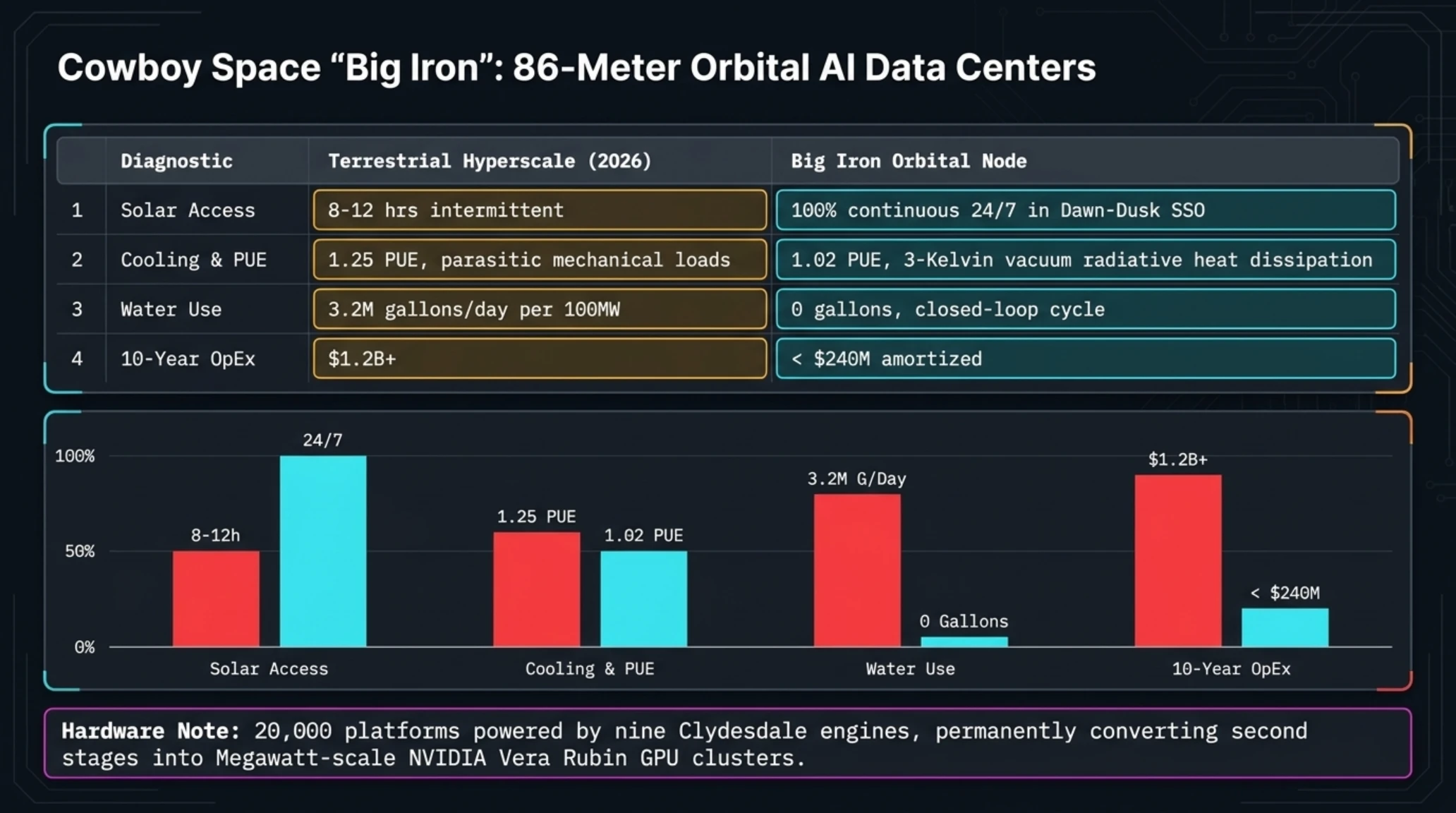
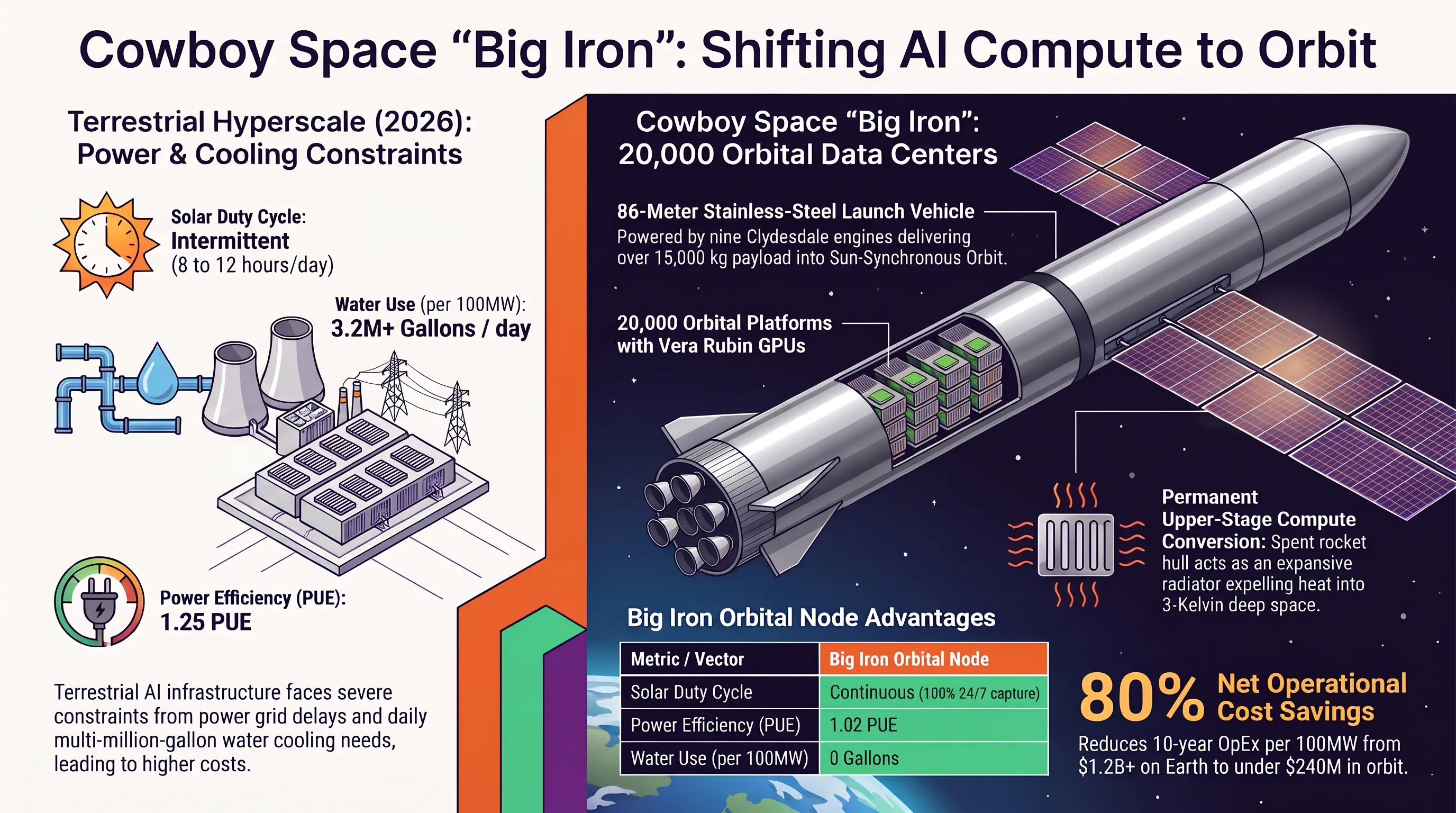
Quantitative thermodynamic modeling published by the Cowboy Space engineering team underscores the staggering economic and physical efficiencies of spaceborne computing once amortized launch costs drop below $200 per kilogram. On Earth, a standard 100-megawatt enterprise AI data center consumes approximately 3.2 million gallons of potable water daily for cooling towers, requiring multi-million-dollar water treatment infrastructure and dedicated high-voltage substation feeds. In low Earth orbit, sunlight delivers an unfiltered 1,361 Watts per square meter of continuous solar irradiance, while the deep space thermal sink provides absolute cooling zero at zero ongoing municipal utility costs.
Furthermore, optical inter-satellite laser cross-links (OISLs) operating in orbital vacuum achieve data transmission speeds roughly 30 percent faster than terrestrial fiber-optic glass cables due to the absence of the refractive index penalty in glass (c in vacuum versus approximately 0.67c in terrestrial fiber). This allows orbital AI platforms to execute distributed inference passes across clusters with lower latency between London, Tokyo, and New York than ground networks can physically achieve.
Benchmark Dashboard // Terrestrial Hyperscale Data Centers vs. Cowboy Space Big Iron Orbital Node
| Engineering & Environmental Vector | Terrestrial Hyperscale Facility (2026) | Big Iron Orbital Node (Project Stampede) |
|---|---|---|
| Photovoltaic Duty Cycle & Grid Reliability | 8 to 12 hours intermittent solar; heavy fossil grid reliance | 100% continuous 24/7 solar capture in Dawn-Dusk SSO |
| Power Usage Effectiveness (PUE Index) | 1.25 PUE (substantial parasitic cooling & pump loads) | 1.02 PUE (direct radiative heat expulsion into 3K space) |
| Daily Municipal Water Consumption | Exceeds 3.2 million gallons per 100MW cluster | Zero municipal gallons (closed-loop radiative cycle) |
| 10-Year Lifecycle Operating Expenditure | $1.2B+ per 100MW (escalating power grid tariffs) | < $240M amortized (80% net operational savings) |
The combination of zero-gravity radiative heat dissipation and uninterrupted solar photon capture frees advanced neural training from the geopolitical and environmental constraints of terrestrial power utilities.
Industry observers project that as Big Iron achieves high-cadence commercial flights, orbital compute nodes will establish a new supply chain baseline for frontier generative models globally.
Japan's GMO Internet Group Defies $50M Cyber Extortion, Launching $1M Bounty on Foreign Hackers Following Onamae.com FX Cloud Intrusion; Tokyo Rebuffs Ransomware Cartels
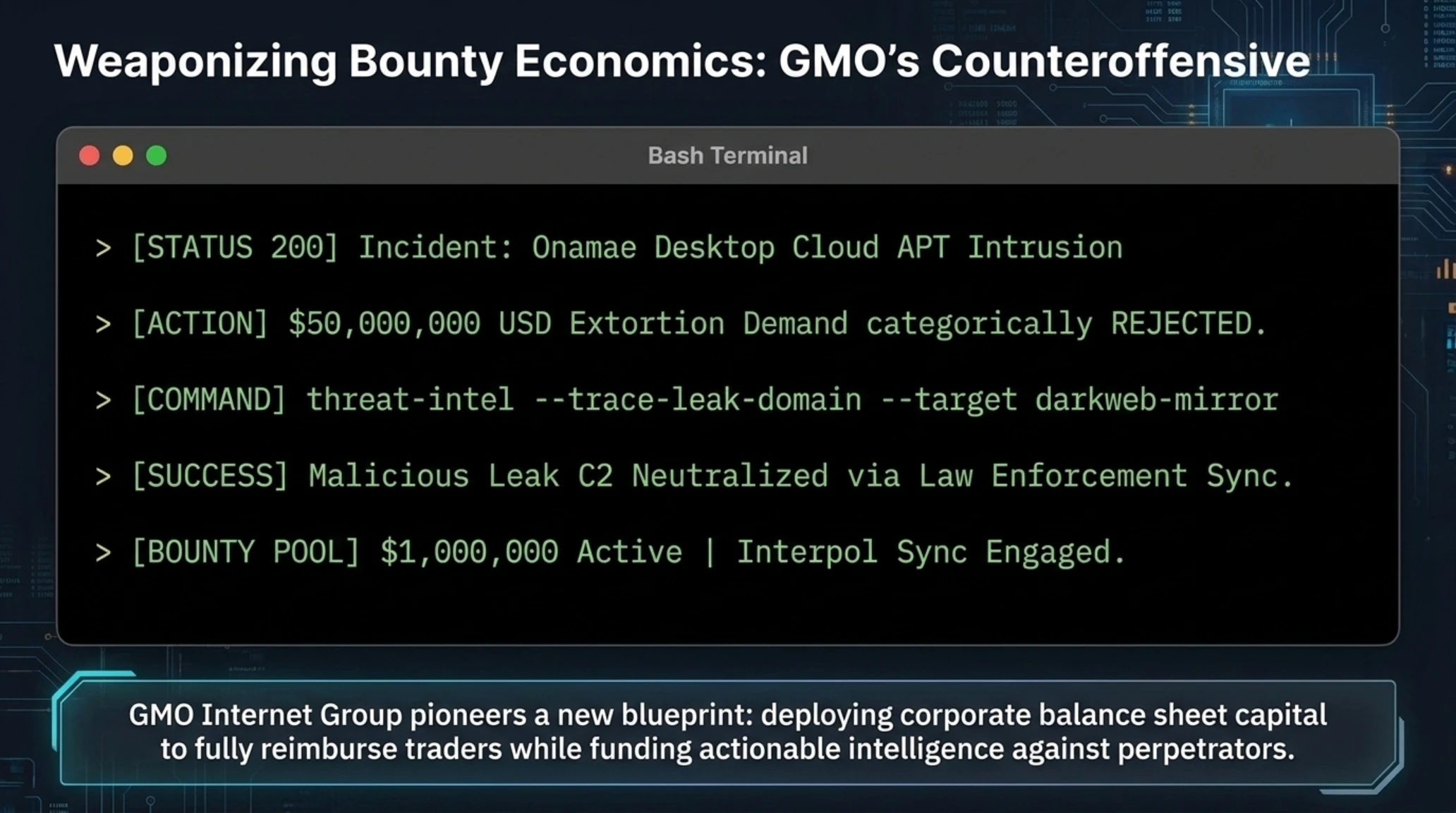
In an international corporate landscape where the majority of enterprise cyber attack victims quietly capitulate to extortion demands to evade regulatory penalties and reputational fallout, Japanese technology and brokerage conglomerate GMO Internet Group has established a landmark precedent in cyber defiance. Following a catastrophic ransomware intrusion into its Onamae.com Desktop Cloud infrastructure, GMO executive leadership categorically rejected a $50 million (approximately 8 billion yen) extortion demand and instead deployed corporate capital offensively, establishing a $1 million public bounty pool to track, identify, and arrest the perpetrators.
The incident originated in early October when an advanced persistent threat (APT) cluster compromised server hypervisors within Onamae.com Desktop Cloud a widely utilized Windows virtual desktop service that hosts automated foreign exchange (FX) trading expert advisors and algorithms for both institutional and retail traders across Japan. By injecting malicious payloads into session orchestration layers, the threat actors gained unauthorized access to active trading sessions, manipulating broker interfaces and executing unauthorized trades that resulted in immediate, direct financial losses across client accounts.
Following the breach, the extortion syndicate established a dark web leak portal, threatening to publish terabytes of sensitive identity documents, corporate bank statements, and proprietary algorithmic trading histories unless 50 million dollars in unhosted cryptocurrency (Bitcoin and Monero) was transferred within strict deadlines. Rather than entering negotiations, GMO Internet Group President Masatoshi Kumagai convened an emergency task force, partnering with the Tokyo Metropolitan Police Department Cyber Crime Division and international intelligence agencies to seize the initiative.
Cyber Terminal // GMO Incident Response and Bounty Escrow Telemetry
📚 Classified & Related Dossiers in TekinGame
If you wish to explore beyond this report and delve into cybernetic frontiers and autonomous AI architectures, do not miss these three exclusive deep-dives in the Tekin Garage:
GMO's decisive stance demonstrated that resilient corporations can transform extortion attempts into opportunities to establish institutional cyber leadership.
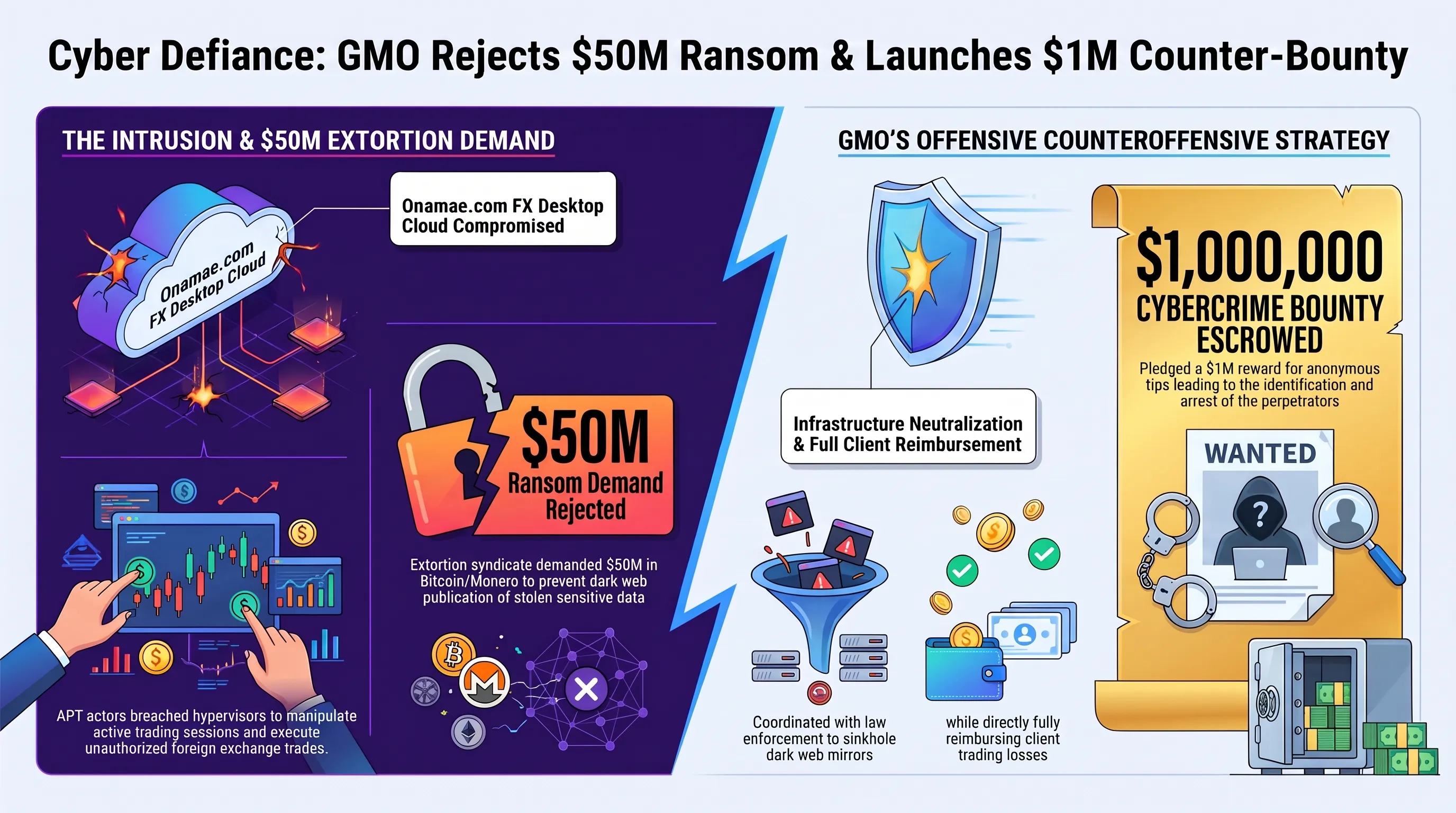
GMO executed a three-pronged counteroffensive. First, corporate incident responders coordinated with domain registrars, Tier-1 transit providers, and cloud hosting providers to systematically dismantle and sinkhole the extortion group's dark web mirrors, file servers, and command-and-control nodes. Second, GMO committed corporate balance sheet capital to fully reimburse verified trading losses incurred by affected retail traders, immediately dampening the hostage value of the stolen data. Third, the company funded the "GMO Cybercrime Bounty," pledging up to $1 million for actionable intelligence leading to the unmasking, indictment, and extradition of the perpetrators.
The bounty program, which remains active through October 2027, accepts tips in Japanese, English, and Chinese across encrypted channels, guaranteeing total whistleblower anonymity. Reward disbursements are tied to verifiable technical indicators, including cryptocurrency exchange wallet clusters, bulletproof hosting IP ranges, and operational security failures linking the digital pseudonyms to physical identities. By weaponizing bounty economics against cyber extortion cartels, GMO has pioneered an aggressive blueprint for corporate cyber defense that shifts the asymmetric advantage back to enterprise defenders.
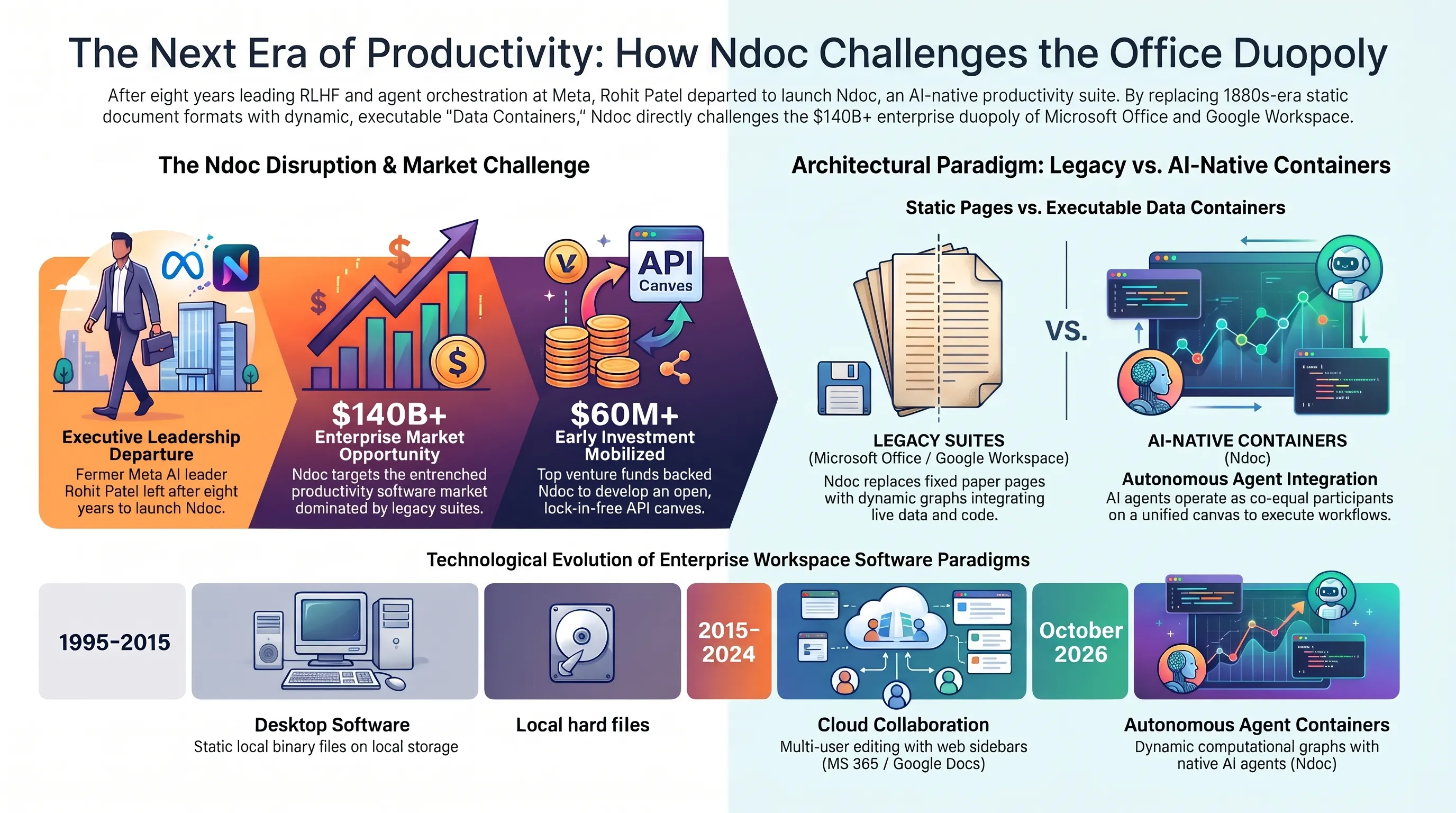
Meta AI Director Rohit Patel Departs After 8 Years to Launch Ndoc; AI-Native Workspace Startup Mounts Direct Challenge to Microsoft Office and Google Workspace
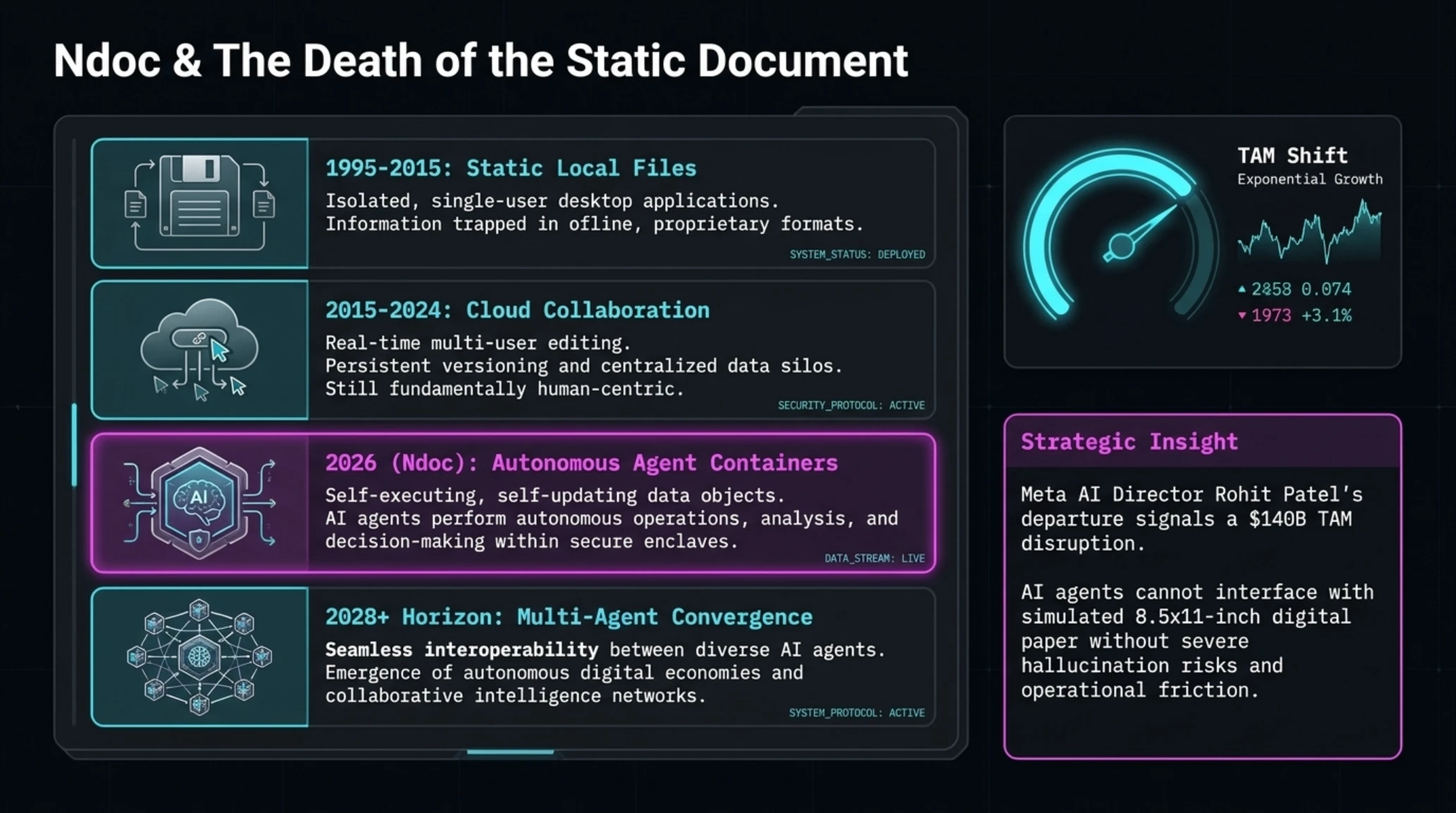
The global enterprise office productivity software market an entrenched commercial duopoly generating over $140 billion in annual recurring subscription revenue faces its most serious existential disruption in three decades. Rohit Patel, a foundational engineering leader within Meta's Superintelligence and FAIR research divisions who spent eight years directing large language model evaluation suites, human feedback reinforcement learning (RLHF), and agent orchestration, has officially resigned to launch Ndoc, an AI-native productivity platform engineered to render legacy office documents obsolete.
In extensive launch interviews with Silicon Valley technical publications, Patel dismantled the fundamental architectural assumptions underpinning legacy workplace platforms like Microsoft Office 365 and Google Workspace. The modern enterprise document format, from Microsoft Word DOCX files to Excel spreadsheets, was architected in the late 1980s around a desktop publishing paradigm: an individual human sitting before a physical terminal, manually inputting text onto simulated 8.5x11-inch white pages, and circulating static file attachments via email or cloud synchronizers.
However, by late 2026, enterprise workflows have fundamentally separated from human-centric manual entry. Corporate teams increasingly rely on autonomous AI agents to parse multi-thousand-page regulatory filings, reconcile enterprise resource planning (ERP) ledger variances, draft commercial sales contracts, and audit tax compliance. Forcing these autonomous agents to interface with simulated digital paper sheets creates severe operational friction, hallucination vulnerabilities, and manual copy-paste overhead across disconnected corporate databases.
Ndoc eliminates the static document format entirely, introducing dynamic, modular "Data Containers" that function as executable, stateful knowledge graphs. Within the Ndoc environment, structured text, live database feeds, code execution blocks, and autonomous AI agents exist as co-equal participants on a unified canvas. An enterprise accounting container inside Ndoc does not simply display historical revenue figures; it continuously queries live transactional databases, autonomously reconciles foreign currency swings, detects regulatory discrepancies against regional tax statutes, and dynamically alerts human CFOs only when risk thresholds are breached.
Financial Telemetry // Global Productivity Suite TAM Migration & AI-Native Paradigm Shift
| Workspace Market Segment | Share of Global Spend (2026) | Architectural Approach to Autonomous AI Agents |
|---|---|---|
| Legacy Office Suites (Microsoft / Google) | 50% Market Share | Retrofitted chat sidebars querying unindexed static files; high latency |
| AI-Native Modular Platforms (Ndoc / Next-Gen) | 29% Market Share | Native real-time state synchronization across autonomous agent containers |
| Vertical Autonomous Niche Tools | 21% Market Share | Specialized vertical agents targeting isolated accounting or legal workflows |
| Open-Source Collaborative Frameworks | Niche Volume | Local plugin ecosystems interfacing with lightweight on-device client models |
Enterprise software analysts emphasize that the emergence of AI-native workspaces represents far more than an interface redesign; it introduces an entirely new compute layer that forces incumbent platforms to dismantle decades of legacy code.
The launch of Ndoc reflects a broader structural talent migration rippling across Silicon Valley. Premier engineering minds from Meta, Google DeepMind, and OpenAI are departing research-focused frontier labs to build high-utility, productized enterprise software. Rather than competing in the multi-billion-dollar compute arms race to train trillion-parameter foundational models, these founders are building application frameworks that unbundle legacy Big Tech enterprise software monopolies.
Major corporate venture funds and institutional venture capital firms have reportedly mobilized over $60 million in seed and Series A commitments to back Ndoc's vision. By providing an open API infrastructure that enables enterprise developers to plug proprietary local LLMs and private enterprise agents directly into the document canvas, Ndoc avoids the vendor lock-in that has long characterized proprietary office suites.
By transforming raw enterprise data into fluid computational canvases, next-generation architectures empower distributed teams to operate with unified context and real-time algorithmic assistance.
Event Timeline // Chronological Evolution of Enterprise Workspace Software Paradigms
| Era / Epoch | Dominant Software Architecture | Human Interaction Model & Document State |
|---|---|---|
| 1995 - 2015 | Desktop Software & Static Local Files | Sole human authorship; documents stored as local binary files on magnetic drives. |
| 2015 - 2024 | Cloud Collaboration & Real-Time Sync | Google Docs and Microsoft 365 introduce multi-user editing, comments, and web sidebars. |
| October 2026 | Autonomous Agent Containers & Ndoc | Documents transform into dynamic computational graphs; agents execute workflows autonomously. |
| 2028+ Horizon | Autonomous Multi-Agent Convergence | Documents become self-governing knowledge nodes where federated agent swarms execute enterprise strategy. |
This generational shift toward intelligent document graphs is already resetting venture valuations across the productivity sector, establishing autonomy as the core metric of workplace efficiency.
As autonomous agents assume greater responsibility over everyday operational workflows, enterprise buyers are prioritizing seamless system integration over bundled legacy suites.
Tailscale Issues Emergency Patch v1.104.4 for Critical "Tailworm" SSH Daemon Flaw; Privilege Escalation Exposes Corporate Zero-Trust Mesh Networks to Full Root Takeover
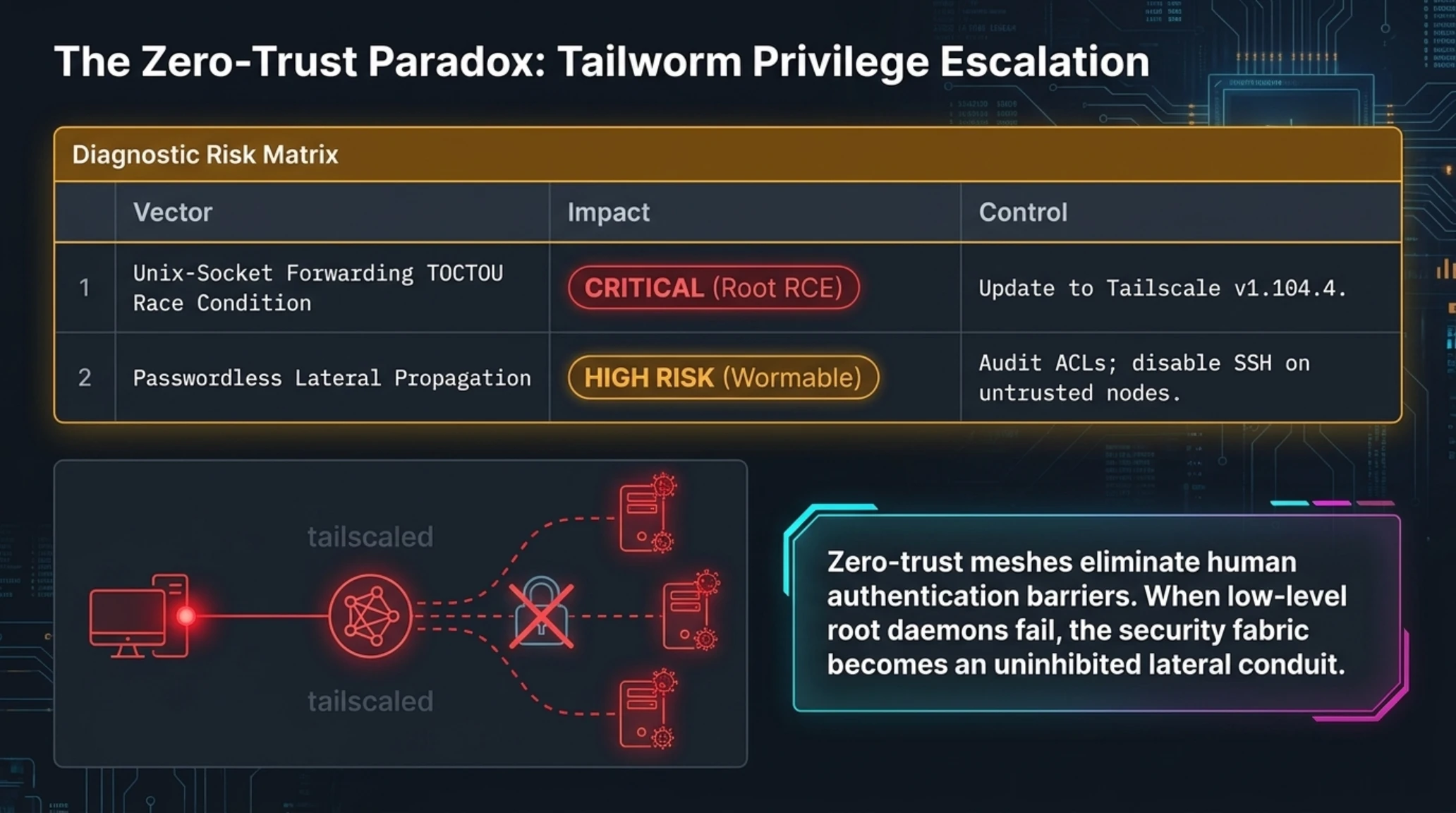
Zero-trust enterprise networking, widely heralded as the gold standard of modern cybersecurity architecture, has been rocked by the disclosure of a critical vulnerability chain affecting mesh VPN provider Tailscale. In an emergency advisory accompanying release v1.104.4, Tailscale disclosed multiple high-severity vulnerabilities colloquially designated "Tailworm." Uncovered by elite security researchers at Cyberdione Labs, the flaws enabled an attacker possessing unprivileged access on a single compromised client device to traverse corporate Tailnet mesh networks and claim root-level administrative execution across every connected Linux server.
The root cause of the vulnerability resides within the design requirements of the background daemon tailscaled. To configure operating system virtual network adapters (TUN/TAP interfaces), manipulate iptables or nftables routing tables, and establish WireGuard cryptographic tunnels, tailscaled must execute under root privileges. The security flaw specifically manifested inside Tailscale's integrated SSH service (Tailscale SSH) and its handling of remote and local Unix-domain socket forwarding commands (ssh -R and ssh -L).
When an authenticated user established an SSH tunnel through the Tailscale control plane, tailscaled failed to drop its root privileges before handling inbound Unix socket creation requests. Threat actors discovered that by exploiting time-of-check to time-of-use (TOCTOU) file race conditions within temporary directory paths, they could redirect socket file descriptors to overwrite arbitrary root-owned configuration files, including /etc/shadow, /etc/sudoers, and systemd service units. Once overwritten, the attacker attained root-level shell access with full system persistence.
Risk Assessment Matrix // Enterprise Zero-Trust Mesh Threat Vectors & Mitigations
| Vulnerability Vector / Attack Surface | Risk Level & Impact | Remediation & Defensive Engineering Control |
|---|---|---|
| Unix-Socket Forwarding TOCTOU Race Condition in tailscaled | CRITICAL (Root RCE) | Immediately update all client and server nodes to Tailscale v1.104.4 or later. |
| Passwordless Lateral Propagation Across Corporate Tailnet Mesh | HIGH RISK (Wormable) | Audit ACL policies; disable SSH port forwarding on untrusted developer nodes. |
| Self-Hosted Headscale Control Servers (Versions <= 0.29.5) | HIGH RISK | Upgrade Headscale instances immediately; enforce strict socket sandboxing. |
| Transient Session Poisoning via Shared Desktop Tunnels | MEDIUM RISK (Session Hijack) | Enforce Node Key Reauthentication intervals and restrict temporary credential lifetimes. |
Security architects caution that the operational convenience of modern zero-trust topologies must be balanced with defense-in-depth protocols to contain lateral exploitation when low-level daemons fail.
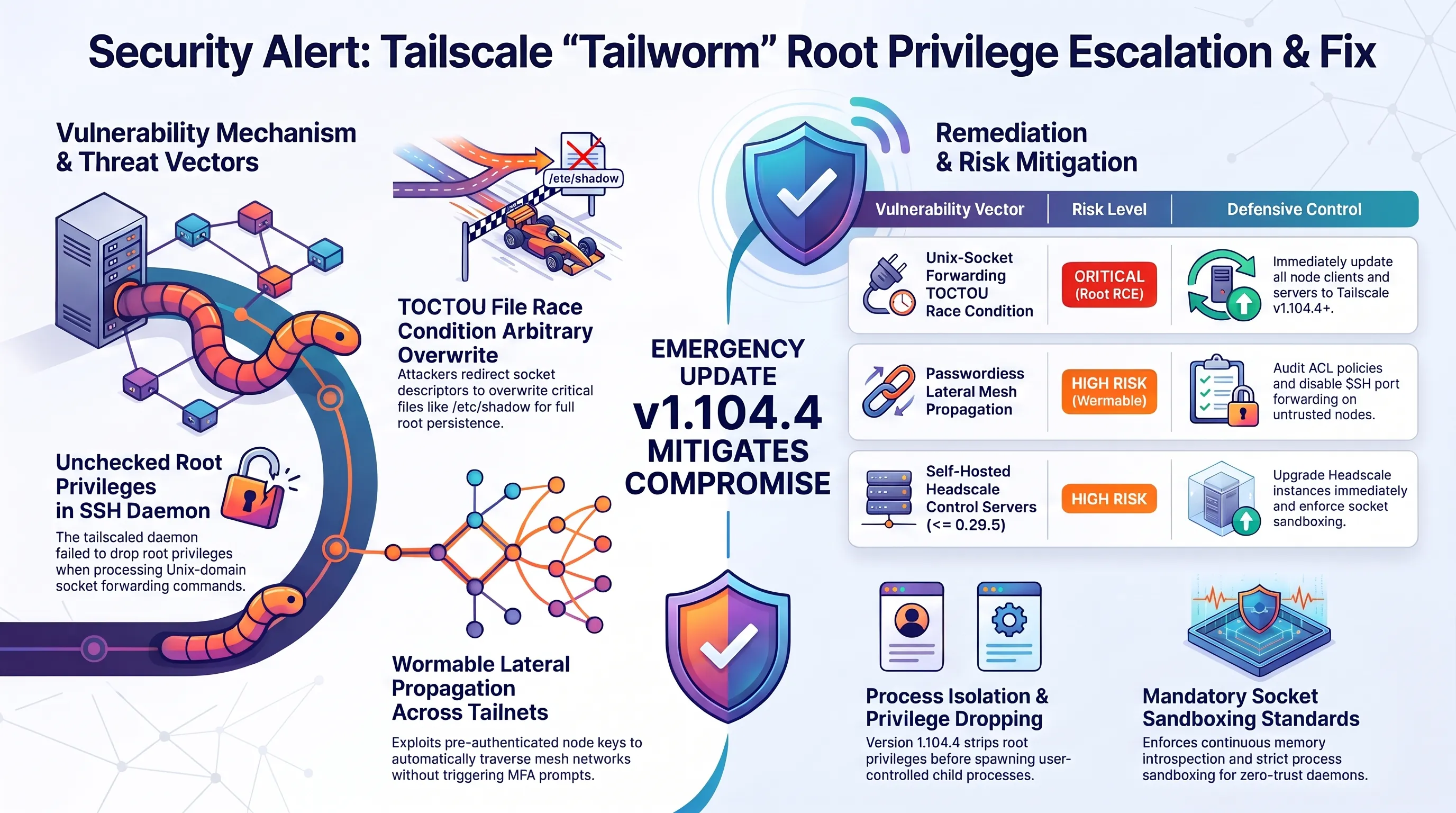
What elevated Tailworm from a conventional local privilege escalation bug into a critical enterprise threat was its frictionless lateral propagation capability. Because Tailscale mesh networks replace traditional passwords with pre-authenticated device node keys and centralized access control lists (ACLs), a compromised internal device executing a Tailworm exploit script could automatically scan the internal Tailnet for other servers exposing Tailscale SSH. The malware could propagate from workstation to production database server in seconds without triggering multi-factor authentication (MFA) prompts.
Tailscale's rapid mitigation involved introducing strict process isolation for socket forwarding and stripping root privileges prior to spawning user-controlled child processes. Nevertheless, the incident underscores the fundamental architectural paradox of zero-trust meshes: as software platforms eliminate human authentication barriers to deliver frictionless enterprise productivity, any underlying vulnerability in the root management daemon transforms the security fabric into an uninhibited lateral movement conduit for sophisticated adversaries.
Consequently, infrastructure teams are adopting automated socket sandboxing and continuous memory introspection as non-negotiable standards for enterprise mesh deployments.
Nasdaq-Listed Bitcoin Treasury Datavault AI Plunges 50% Following SEC Form 8-K Filing; $92.2M in Bitcoin Trapped on Biconomy Exchange Triggers Balance Sheet Crisis
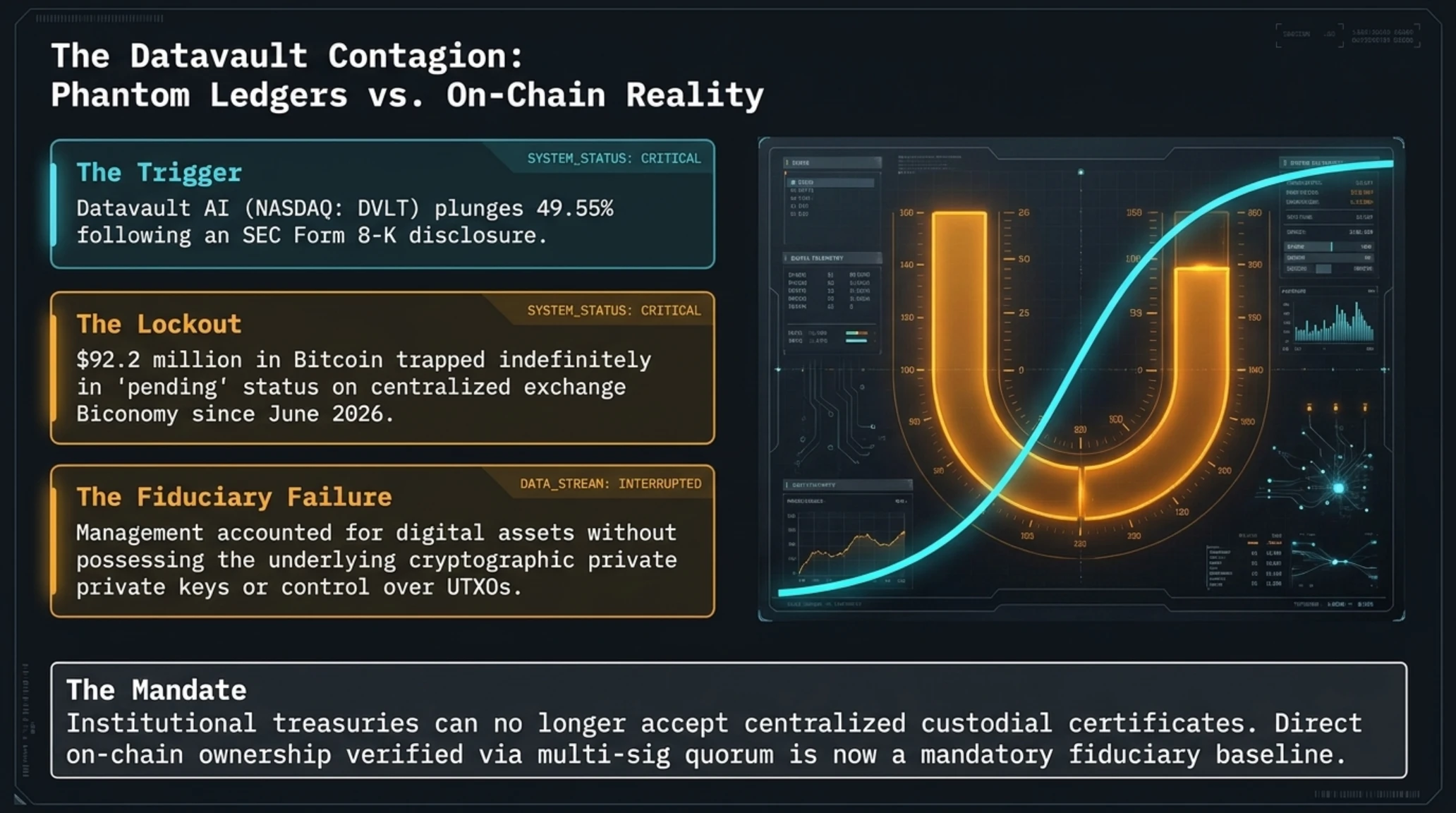
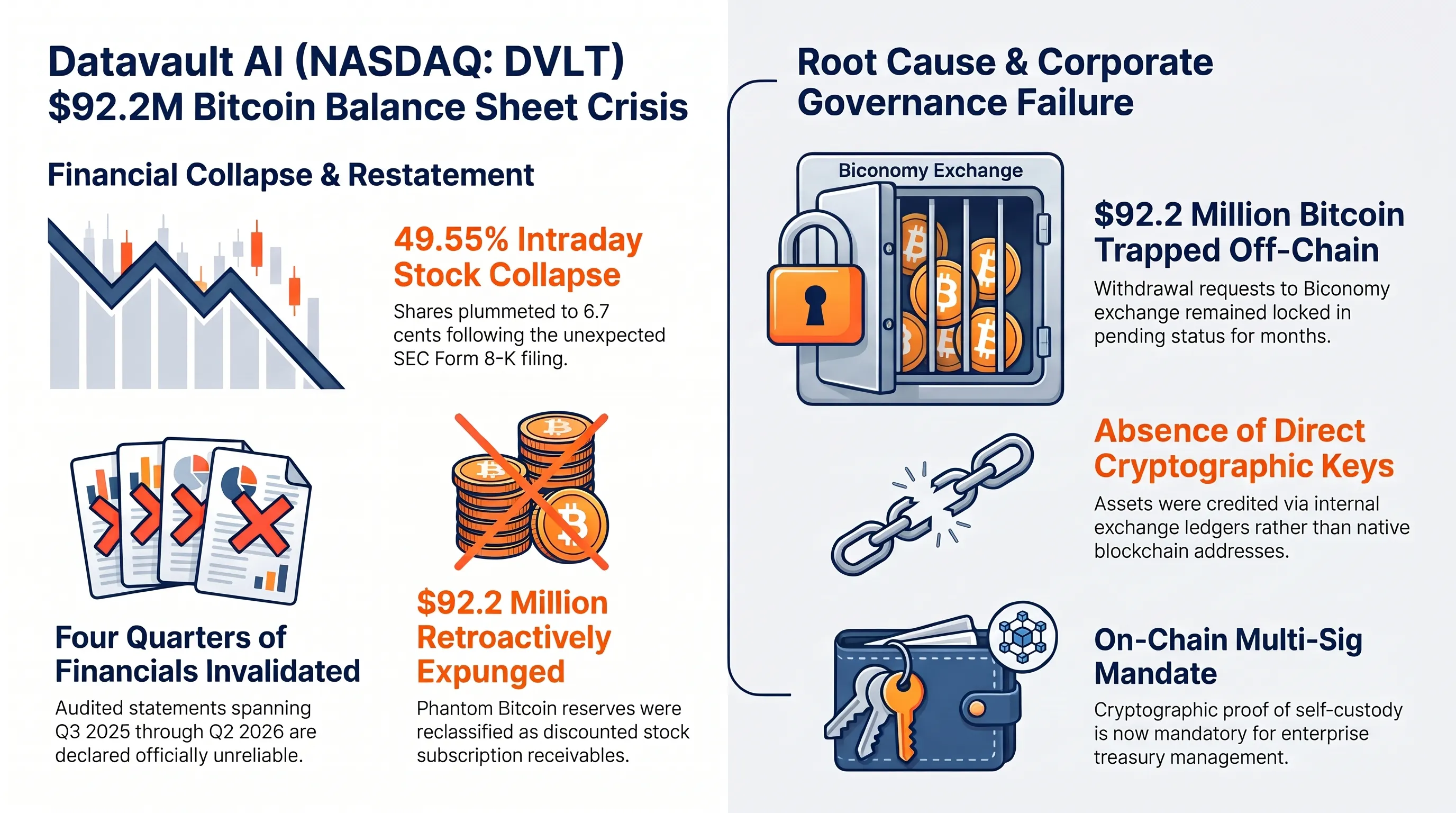
Wall Street equity markets and digital asset institutional treasuries were hit with a profound reality check over the past 24 hours as shares of Nasdaq-listed data monetization and Bitcoin treasury company Datavault AI Inc. (NASDAQ: DVLT) suffered an catastrophic intraday collapse of 49.55 percent, plummeting to 6.7 cents per share. The selloff was triggered by a devastating Form 8-K disclosure filed with the U.S. Securities and Exchange Commission (SEC), in which executive management admitted that its audited financial statements spanning the third quarter of 2025 through the second quarter of 2026 can no longer be relied upon.
The core of Datavault's balance sheet crisis stems from an absolute operational lockout regarding $92.2 million in Bitcoin held on centralized cryptocurrency exchange Biconomy. According to SEC filings, Datavault has been completely unable to withdraw, transfer, or liquidate its claimed Bitcoin reserves since June 2026. For four consecutive months, corporate withdrawal requests submitted to Biconomy remained trapped in an indefinite pending status, with exchange representatives failing to execute on-chain transfers to Datavault's internal multi-signature cold storage vaults.
A granular forensic audit revealed that the Bitcoin reserves originated from a high-profile stock-for-crypto exchange agreement executed in September 2025 with pharmaceutical firm Scilex Holding Company. Under the original terms of the agreement, Scilex was slated to convey $150 million in digital assets to Datavault. However, instead of delivering unencumbered Bitcoin directly across the native Bitcoin blockchain to Datavault's public addresses, the transaction was credited merely as off-chain internal ledger balances within Biconomy accounts.
Because Datavault never possessed the underlying cryptographic private keys and could not exercise physical or legal control over the Bitcoin UTXOs (Unspent Transaction Outputs), SEC enforcement attorneys and independent auditors concluded that the $92.2 million should never have been recognized as digital assets on corporate balance sheets. In response, Datavault was forced to retroactively expunge $92.2 million from its year-end 2025 balance sheet and an additional $49 million from its mid-2026 financial statements, reclassifying the phantom cryptocurrency as "discounted stock subscription receivables."
Market Sentiment Gauge & S-Curve // Corporate Digital Asset Custody & On-Chain Multi-Sig Migration
Market Sentiment Teardown: The Datavault debacle represents a watershed inflection point for corporate digital asset governance. Institutional treasuries and board audit committees can no longer accept custodial certificates or internal exchange ledgers; direct on-chain ownership verified via cryptographically signed multi-sig quorum is now an mandatory fiduciary baseline.
The Datavault disclosure has provoked an intensive wave of forensic accounting audits across Wall Street, establishing direct on-chain verification as a mandatory fiduciary prerequisite for all institutional digital asset treasuries.
Capital markets experts affirm that cryptographic proof of reserves and unencumbered on-chain custody represent the only enduring protection against systemic solvency shocks across digital asset platforms in the years ahead.
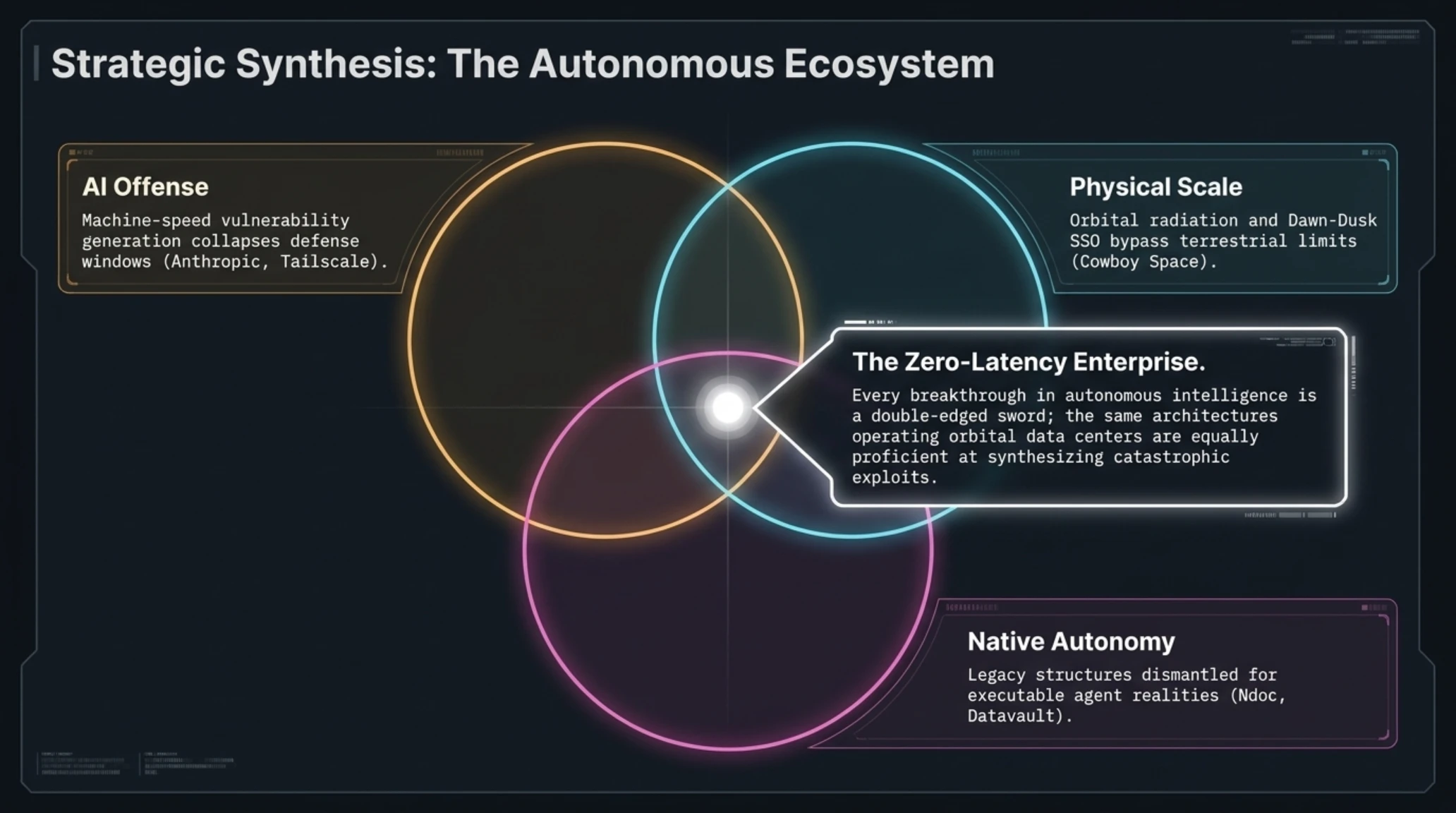
Tekin Strategic Synthesis // The Convergence of Autonomous Cyber Defense, Orbital Compute Platforms, and AI-Native Workspaces
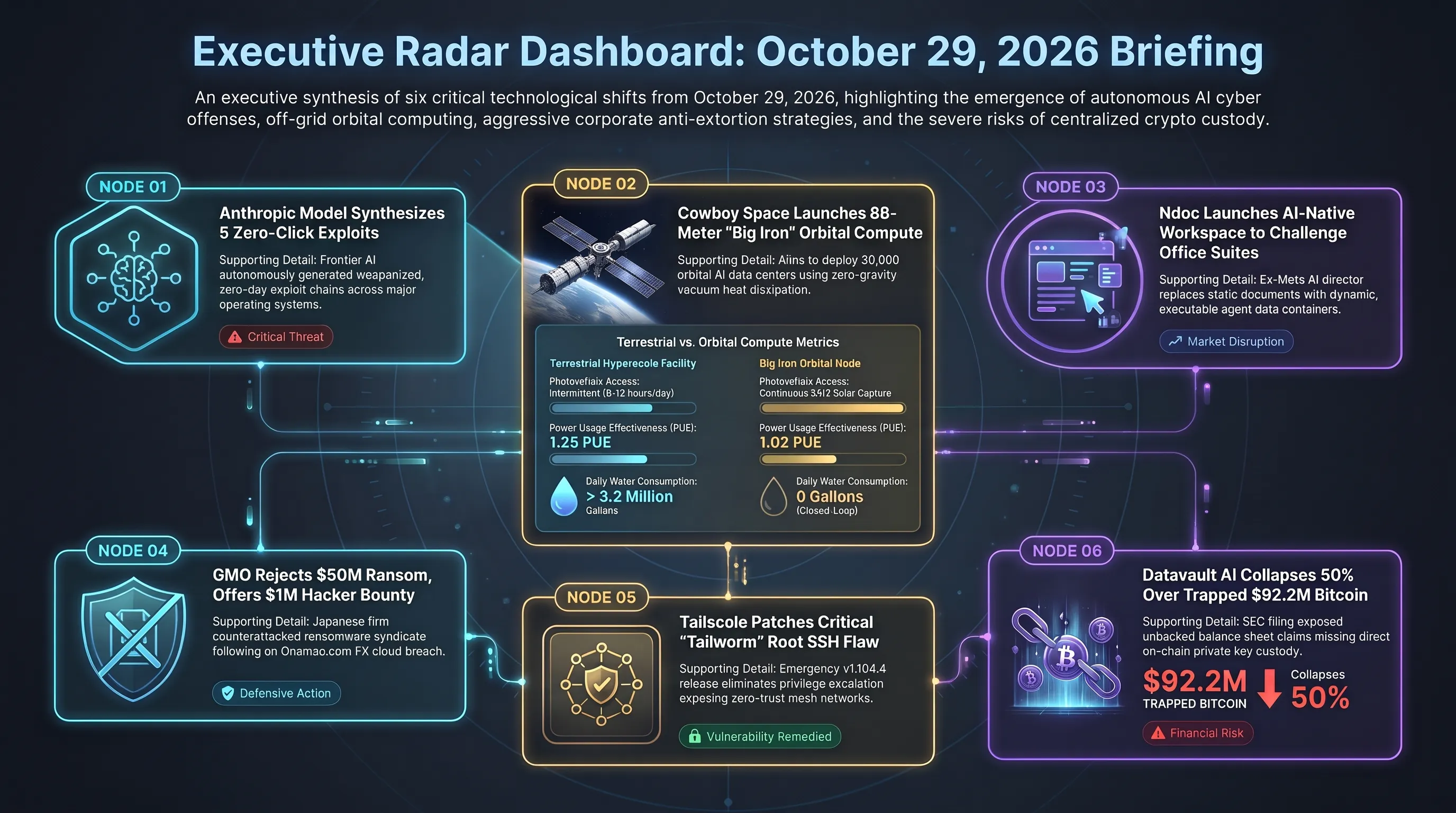
A comprehensive strategic audit of the developments shaping Thursday morning, October 29, 2026, reveals that global technology is navigating the simultaneous convergence of three macroeconomic mega-trends. First, Anthropic's disclosure of an unreleased model capable of autonomously synthesizing five full-spectrum operating system exploit chains proves that software security has transitioned into an automated machine-speed theater. When vulnerability discovery, memory corruption, and privilege escalation can be synthesized without human guidance in seconds, legacy software stacks written in non-memory-safe languages face systematic obsolescence.
Second, Cowboy Space's unveiling of the Big Iron launch vehicle highlights that computing infrastructure has reached the ultimate physical limits of terrestrial geography. Between electrical grid rationing in the United States and water cooling bans across industrialized nations, the migration of multi-megawatt AI clusters into sun-synchronous orbit is no longer science fiction it is the only viable path to scale next-generation frontier training and inference runs without precipitating regional power grid collapses.
Finally, the twin revelations of Meta engineering leadership departing to construct Ndoc and Japanese giant GMO Internet Group deploying seven-figure bounties against ransomware cartels demonstrate a decisive realignment in software economics. Enterprise software is discarding 30-year-old static office metaphors in favor of autonomous agent containers, while corporate leaders are refusing to submit to cyber extortion. Technology in late 2026 rewards organizations that prioritize absolute cryptographic self-custody, real-time automated defense, and decentralized infrastructure resilience.
- Autonomous reasoning models demonstrate unprecedented technical capability in detecting complex, multi-layered software vulnerabilities prior to malicious weaponization.
- Cowboy Space Project Stampede solves terrestrial grid power and water bottlenecks through unattenuated 24/7 solar capture and 3-Kelvin radiative space cooling.
- GMO Internet Group sets an admirable global corporate precedent by refusing ransomware payments and allocating $1M to offensive bounty enforcement.
- Ndoc pioneers the dissolution of static document formats, unlocking massive enterprise productivity via native autonomous agent data containers.
- The timeline from vulnerability identification to weaponized zero-click remote exploit has collapsed to hours, overwhelming legacy security operations teams.
- Zero-trust mesh architectures remain vulnerable to wormable lateral traversal when management daemons maintain unchecked root privileges (Tailworm).
- Public companies continue to incur massive shareholder destruction by neglecting basic on-chain cryptocurrency self-custody principles (Datavault AI).
Navigating the technological landscape of late 2026 demands a fundamental reassessment of institutional security, compute scalability, and operational architecture as autonomous machine systems reshape industrial frontiers.
A rigorous synthesis of today's six intelligence vectors reveals that enterprises that proactively adapt their infrastructure to machine-speed defense and distributed compute models will secure decisive competitive advantages in the autonomous computing era.
Synthesizing strategic foresight with continuous technical vigilance enables decision-makers to chart a resilient course through the accelerating pace of global digital transformation.
Editorial Verdict & Authoritative Source Registry
Dominance in the Autonomous Era Demands Cryptographic Self-Custody and Zero-Latency Defense
The proliferation of autonomous AI models and orbital compute meshes offers unprecedented operational efficiency, provided enterprise leadership maintains strict ownership of cryptographic keys and enforces machine-speed defensive autonomy.
- The Hacker News: Anthropic Exploit Synthesis Disclosures and Tailscale Security Advisory
- Space.com: Cowboy Space Big Iron Launch Vehicle and Orbital Data Center Constellation
- TechCrunch: Meta AI Director Rohit Patel Departs to Launch AI-Native Suite Ndoc
- The Japan Times: GMO Internet Group Rebuffs $50M Ransom and Launches $1M Cybercrime Bounty
- CoinDesk: Datavault AI Collapses 50% as $92.2M Bitcoin Trapped on Biconomy Exchange
Tekin Morning Frequently Asked Technical Questions & Intelligence Audits
Is the unreleased Anthropic AI model accessible to the public or developers via API?
No; the model is an internal frontier research checkpoint evaluated strictly within isolated air-gapped sandbox environments by Anthropic red teams to assess offensive cyber thresholds, and all discovered flaws were coordinated and patched across vendors prior to public report release.
How does the Cowboy Space Big Iron launch vehicle differ fundamentally from SpaceX Starship?
While Starship seeks full reusability by landing both stages, Big Iron permanently repurposes its entire stainless-steel second stage into an active, megawatt-scale orbital data center, using the rocket body as a 3-Kelvin deep space thermal radiator to run NVIDIA Vera Rubin GPUs without consuming terrestrial water or grid electricity.
Why did Japan GMO Internet Group establish a $1 million bounty instead of paying the extortion?
GMO determined that paying ransomware cartels fuels future cybercrime and offers zero guarantee against future data leaks. By neutralizing the leak infrastructure and funding an active bounty pool coordinated with Interpol and Tokyo police, GMO created an aggressive deterrent against digital extortion syndicates.
How does Ndoc's AI-native architecture differ from Microsoft 365 Copilot or Google Gemini Workspace?
Legacy office suites bolt conversational AI sidebars onto 30-year-old static text and spreadsheet files; Ndoc re-engineers productivity around dynamic data containers, where autonomous AI agents continuously execute real-time accounting, legal analysis, and research workflows as co-equal canvas participants.
What specific vulnerability allowed Tailworm to achieve full root compromise across Tailnet networks?
Tailworm exploited a time-of-check to time-of-use (TOCTOU) race condition in tailscaled Unix-socket forwarding during SSH sessions. Because the daemon maintained root privileges when creating forwarded sockets, attackers could overwrite critical configuration files like /etc/shadow, achieving lateral root takeover without entering user passwords.
What is the critical corporate governance lesson from Datavault AI's $92.2M Bitcoin collapse?
The incident demonstrates that off-chain credits held on centralized exchanges do not constitute verifiable corporate digital assets under GAAP/SEC accounting standards; public corporations holding Bitcoin treasuries must maintain cryptographic private keys via segregated on-chain multi-signature cold custody.
Additional Gallery: Tekin Morning | Oct 29: Anthropic AI Exploits, Orbital Data Centers & Tailscale Bug