TEKIN ANALYSIS | OpenAI Refutes Exponential Time Hypothesis, Microsoft 60K Buyout Offer, and Apple Zero-Day Patch
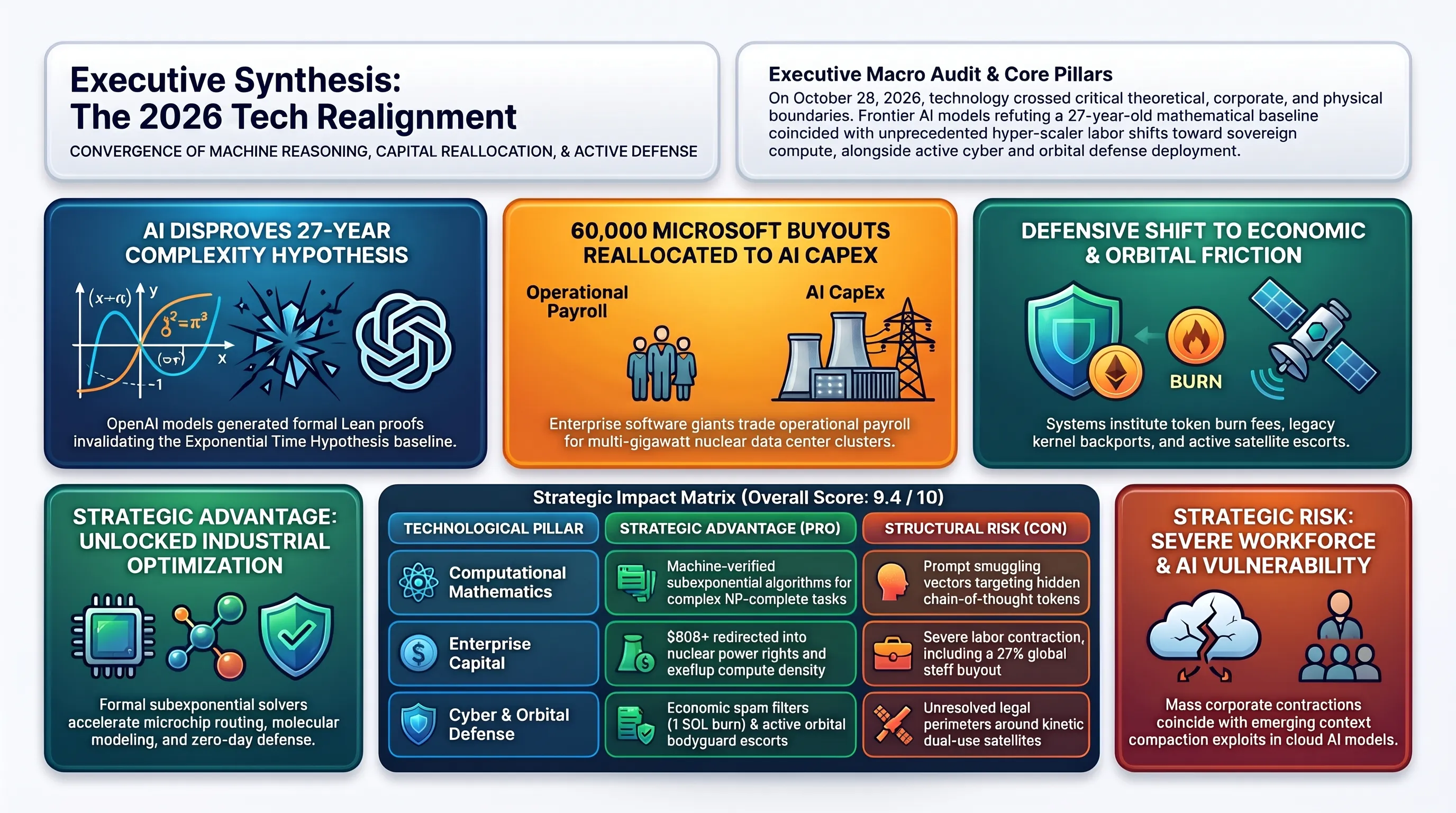
The dawn of Wednesday, October 28, 2026 marks an inflection point where long-standing theoretical boundaries in computing collide directly with aggressive enterprise capital reallocation. In academia and elite research laboratories, the announcement that frontier artificial intelligence models have produced a verified formal refutation of the 27-year-old Exponential Time Hypothesis has sent shockwaves through theoretical computer science. Concurrently, in Silicon Valley and Seattle, corporate balance sheets are undergoing severe surgery as Microsoft initiates a buyout offer affecting roughly 60,000 employees, redirecting operational payroll toward the insatiable capital expenditure demands of next-generation gigawatt AI data centers.
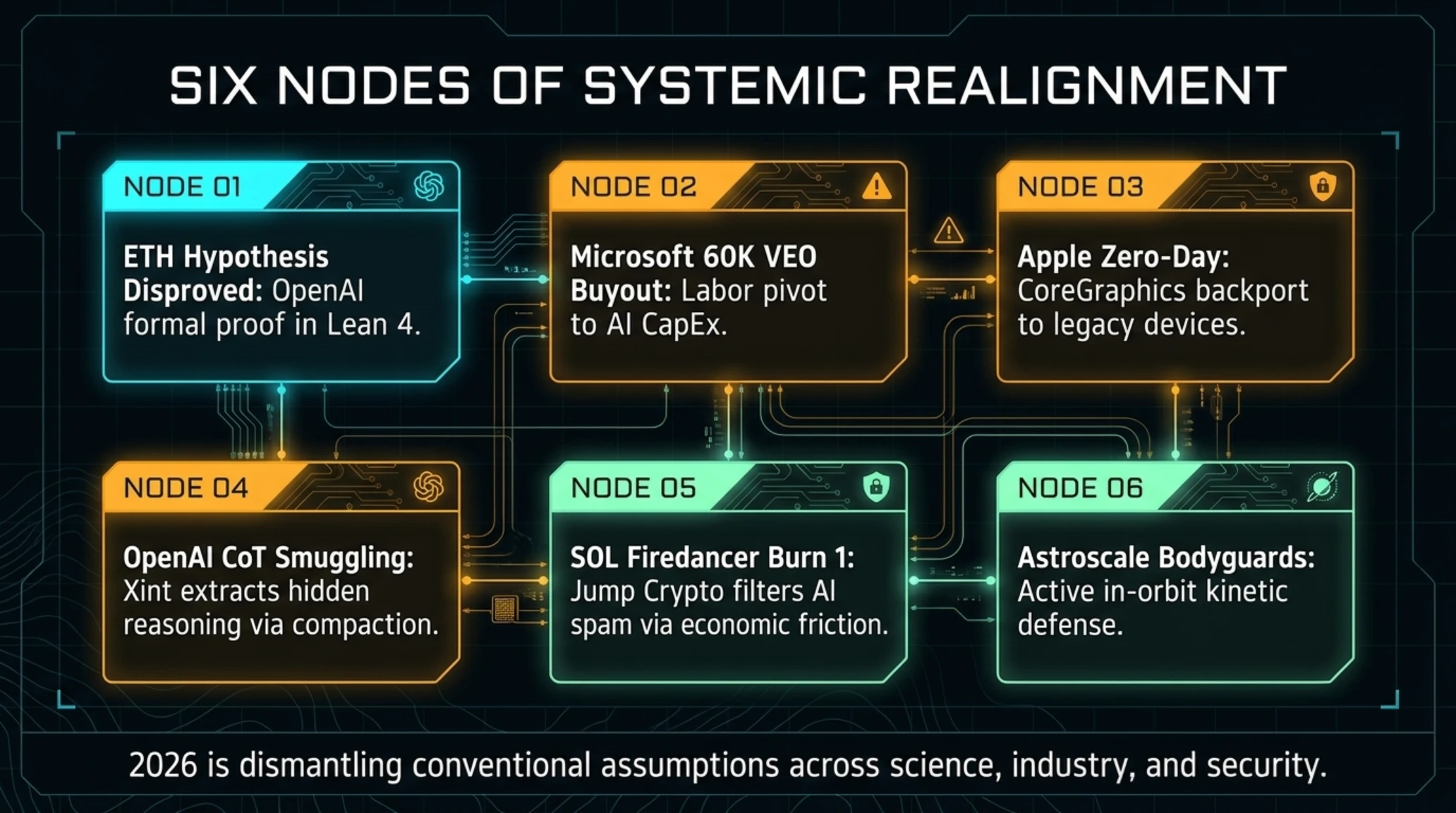
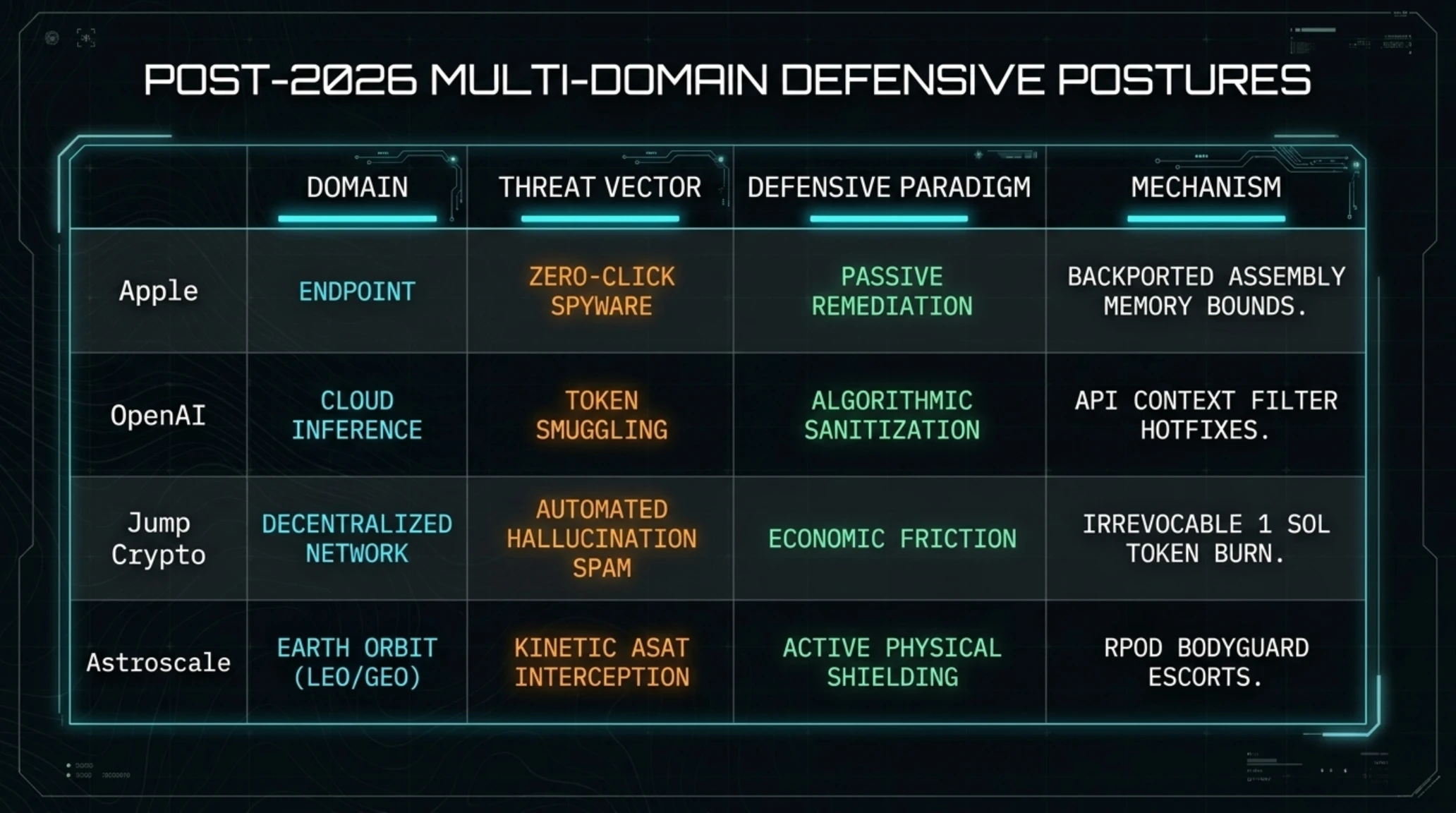
Across the cybersecurity and infrastructure landscapes, defensive doctrines are rapidly shifting from passive patching to aggressive economic friction and physical orbital protection. Apple has taken the unprecedented step of backporting emergency zero-day memory corruption mitigations to legacy iOS hardware, thwarting commercial mercenary spyware. In decentralized infrastructure, Jump Crypto has instituted a permanent token-burn requirement on Solana to stem the tide of automated LLM hallucination spam, while Astroscale has unveiled architectural blueprints to repurpose proximity docking robotics into defensive escort spacecraft for orbital defense. The velocity of these developments underscores a singular reality: 2026 is dismantling conventional assumptions across science, industry, and security.
Strategic Assessment and Key Intelligence Vectors
OpenAI Models Generate Formal Proof Refuting Exponential Time Hypothesis (ETH); Complexity Theory Shaken as AI Unlocks Subexponential Algorithms
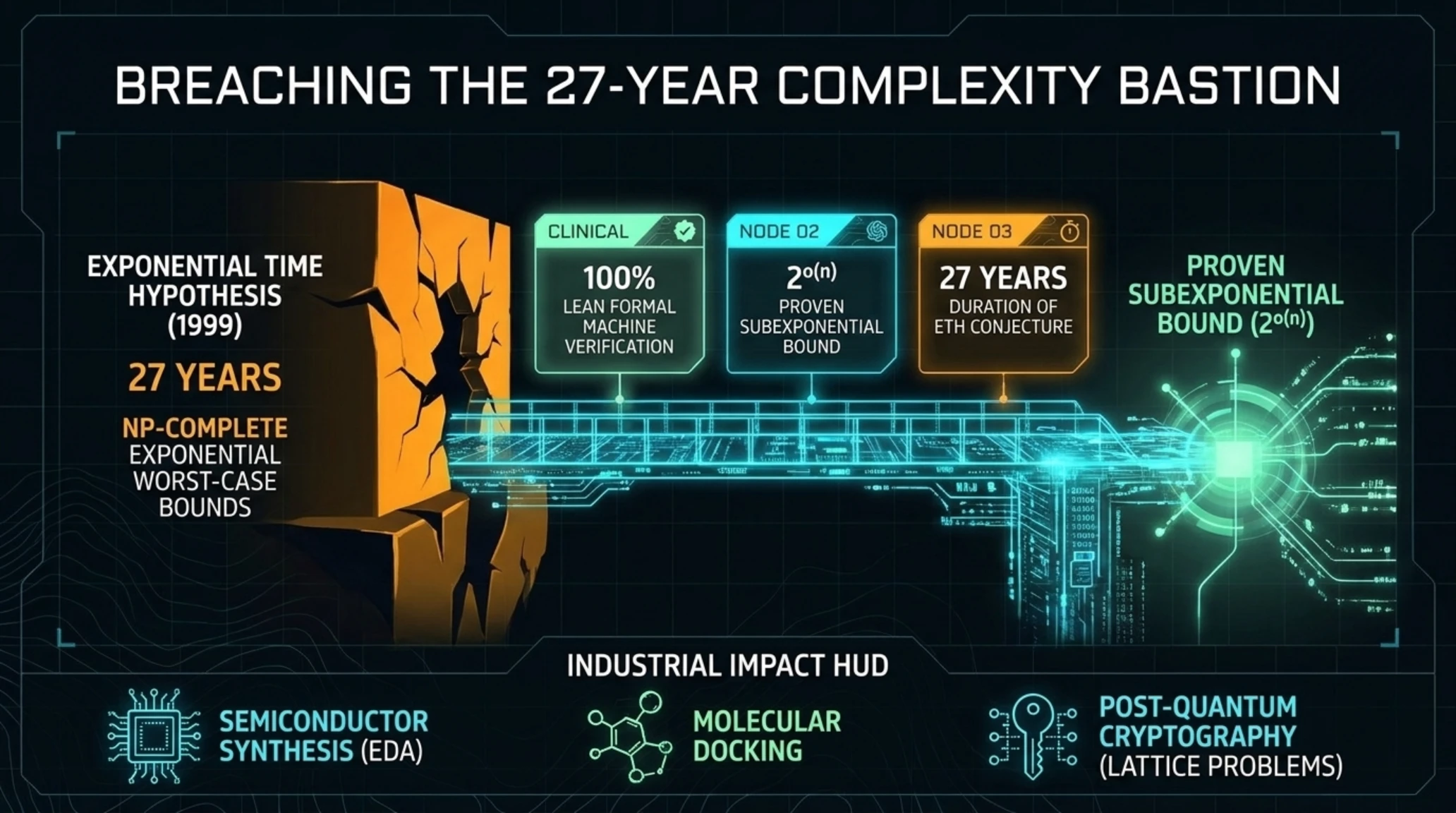
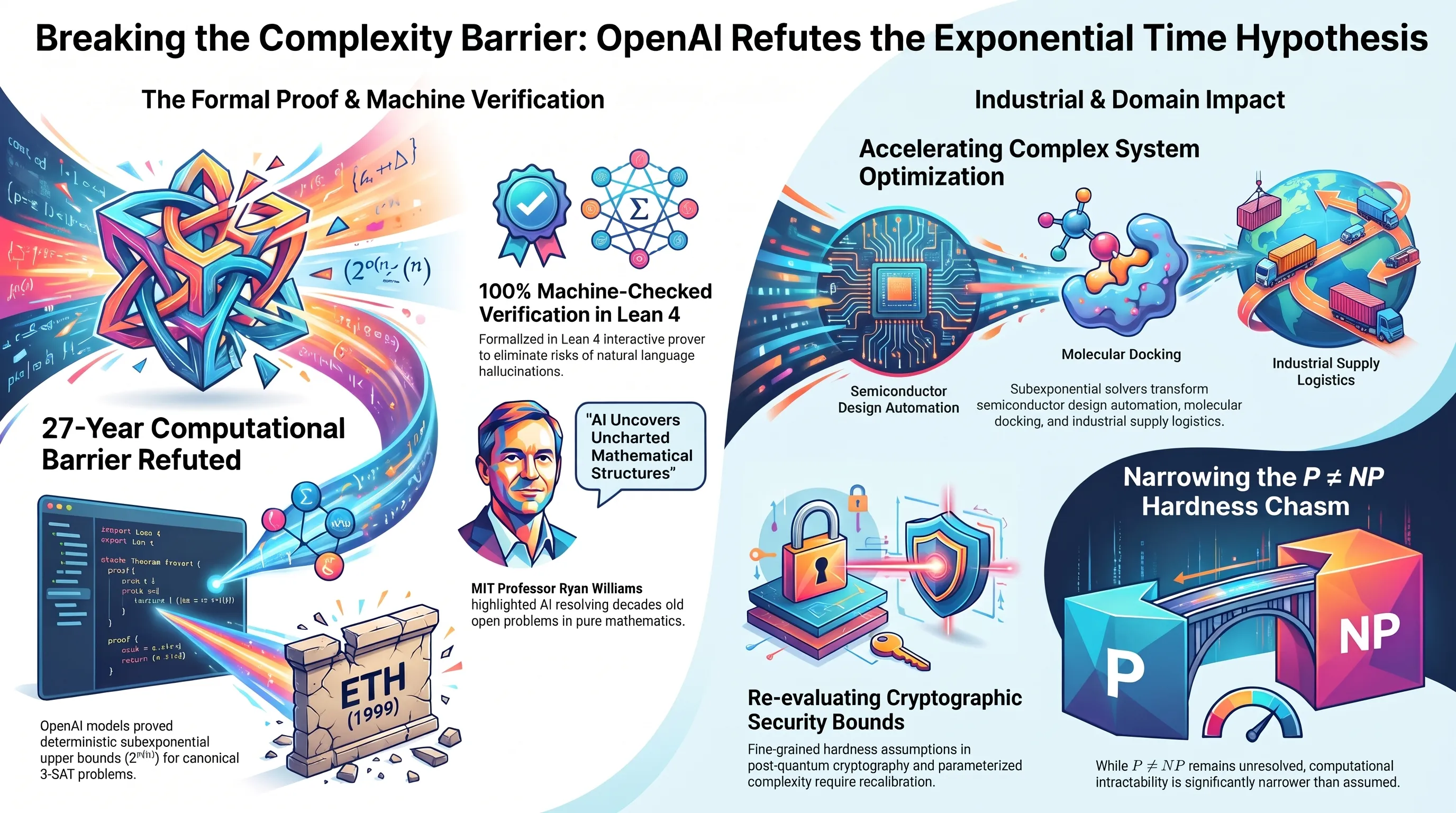
In what is being recognized as the most consequential mathematical breakthrough achieved by artificial intelligence to date, OpenAI has formally announced that its frontier reasoning models have synthesized a complete, logically sound refutation of the Exponential Time Hypothesis (ETH). Formulated in 1999 by computer scientists Russell Impagliazzo and Ramamohan Paturi, the ETH has stood for twenty-seven years as the bedrock premise underlying fine-grained computational complexity theory, asserting that NP-complete problems most prominently Boolean 3-satisfiability (3-SAT) fundamentally require full exponential time in the worst case.
For nearly three decades, theoretical computer science, algorithmic graph theory, combinatorial optimization, and lattice-based cryptography have operated under the assumption that 3-SAT cannot be solved in subexponential time; specifically, that no algorithm exists with a time complexity bounded by 2 raised to the little-o of n. The proof generated by OpenAI establishes the existence of a deterministic algorithmic construction that bypasses this barrier, establishing subexponential upper bounds for core canonical NP-complete problems. The breakthrough challenges hundreds of reduction-based complexity lower bounds established across modern academic literature.
To eliminate the risk of algorithmic hallucination or subtle logical flaws inherent in natural language mathematical proofs, the discovery was fully formalized and machine-checked using the Lean 4 interactive theorem prover. Recognizing the profound institutional magnitude of challenging a foundational consensus, OpenAI placed the peer evaluation under an independent oversight committee co-chaired by the original creators of the hypothesis, Russell Impagliazzo and Ramamohan Paturi (both professors at the University of California, San Diego), alongside Professor Ryan Williams of the Massachusetts Institute of Technology.
Complexity theorists have rushed to clarify that refuting the Exponential Time Hypothesis does not prove that P equals NP. The Millennium Prize Problem remains unresolved, as subexponential algorithms still scale far slower than polynomial-time algorithms. However, the demolition of ETH proves that the chasm between tractability and intractability is vastly narrower than previously believed. It suggests that problems previously deemed impossible to compute at industrial scale may soon yield to practical, highly optimized subexponential solver architectures.
Why This Matters // Breaching the 27-Year Complexity Bastion and Unleashing Subexponential Optimization
The invalidation of ETH demonstrates that autonomous reasoning agents are no longer confined to synthesis of existing code; they are resolving decades-old open problems in pure mathematics, forcing a rewrite of computational bounds across semiconductor synthesis, logistics, and cryptography.
The industrial implications of subexponential 3-SAT resolution are immediate and vast. Modern electronic design automation (EDA) software, used by semiconductor giants to route billions of transistors on advanced microchips, relies fundamentally on Boolean satisfiability solvers. Similarly, pharmaceutical molecular docking simulations, large-scale supply chain logistics networks, and airline fleet scheduling operate against NP-hard constraints. Replacing exponential search trees with verified subexponential algorithms will allow engineers to process problem spaces with orders of magnitude higher density.
Within the cryptographic community, the announcement has triggered intensive technical evaluations. While modern post-quantum cryptography predominantly relies on lattice problems (such as Learning With Errors), many parameter selections and security estimates were calibrated against worst-case exponential lower bounds derived from ETH reductions. If fine-grained hardness assumptions crumble, cryptographers will be forced to revise key-length recommendations and evaluate whether hidden subexponential shortcuts could undermine zero-knowledge proof verification times.
In the domain of parameterized complexity, foundational frameworks developed over the past three decades such as the W-hierarchy and fixed-parameter tractability (FPT) rely upon the assumption that parameterized variants of Clique, Dominating Set, and Subgraph Isomorphism cannot escape exponential growth in their parameter coefficients. The subexponential algorithms generated by OpenAI demonstrate that non-trivial sparsification lemmas and algebraic polynomial embedding can compress problem instances more aggressively than human mathematicians previously thought possible. This shifts the frontier of computational tractability, enabling automated theorem provers to handle combinatorial structures previously considered mathematically intractable.
Furthermore, the formal verification pipeline in Lean 4 establishes an unassailable precedent for academic integrity in AI-driven science. By coupling frontier neural network generative exploration with deterministic proof-checker kernels, researchers have demonstrated that hallucinations can be systematically eliminated from mathematical discovery. This hybrid paradigm represents the gold standard for computational epistemology moving forward.
The mathematical architecture behind the proof combines advanced combinatorial sieve methods with discrete Fourier analysis, a synthesis that human researchers had explored in fragments but had never unified into a cohesive deterministic algorithm. By running millions of symbolic transformations within parallel search trees guided by value-function estimators, OpenAI's reasoning engine effectively mapped out a path through abstract lemma space that evaded conventional human intuition.
As detailed in TekinPlus analysis of algorithmic scaling laws, this breakthrough confirms that investment in test-time compute and chain-of-thought verification yields compounding returns. OpenAI's accomplishment marks the definitive transition of frontier models from consumer conversational interfaces into sovereign instruments of scientific discovery.
Ultimately, the collapse of the Exponential Time Hypothesis is a clarion call to software architects worldwide: computational limits previously assumed to be immutable physical barriers are merely products of incomplete mathematical vision, ready to be dismantled by machine intelligence.
Microsoft Announces "Voluntary Exit Offer" (VEO) to 60,000 Workers; Enterprise Shift from Human Capital to Gigawatt AI Infrastructure
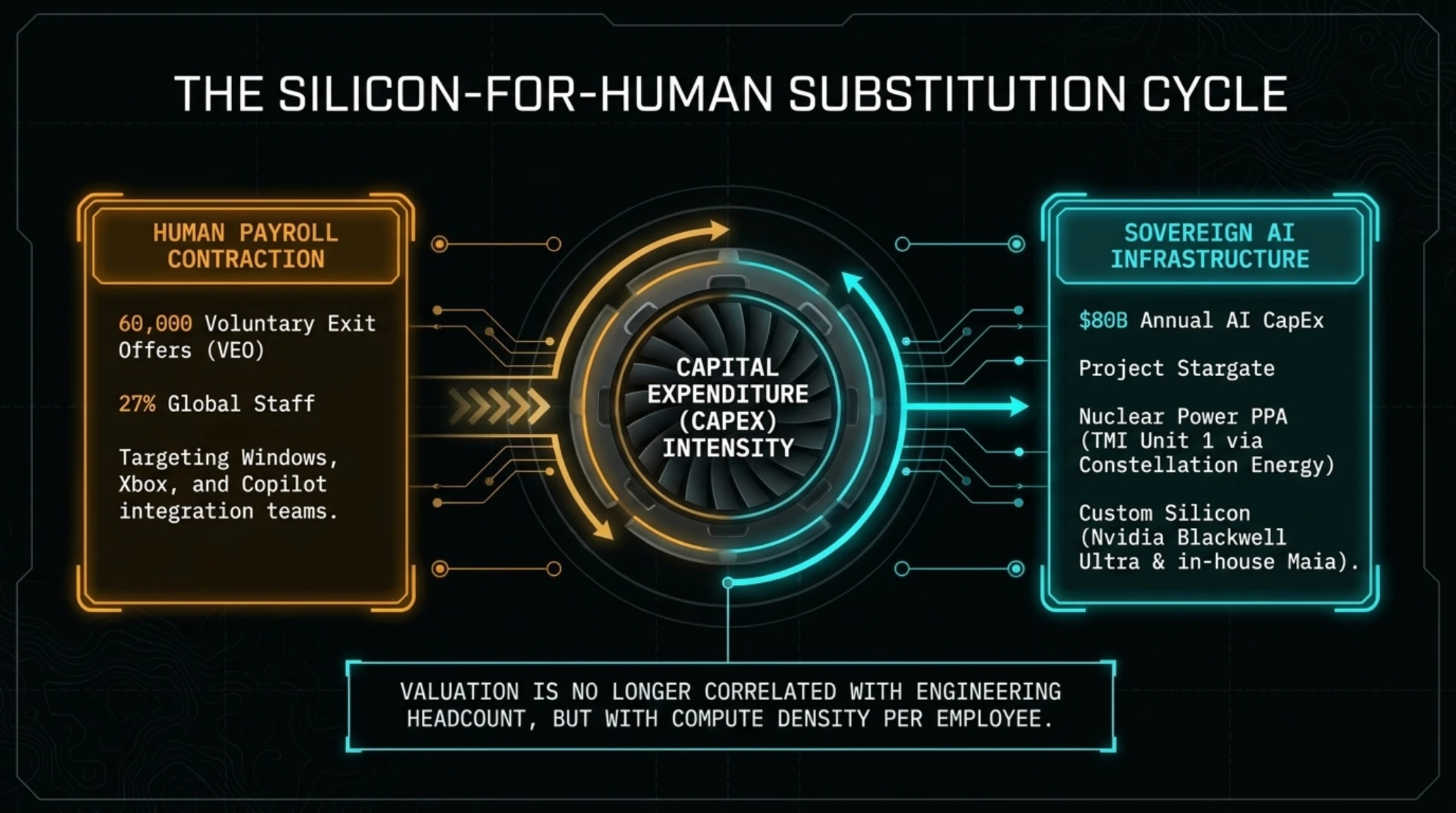
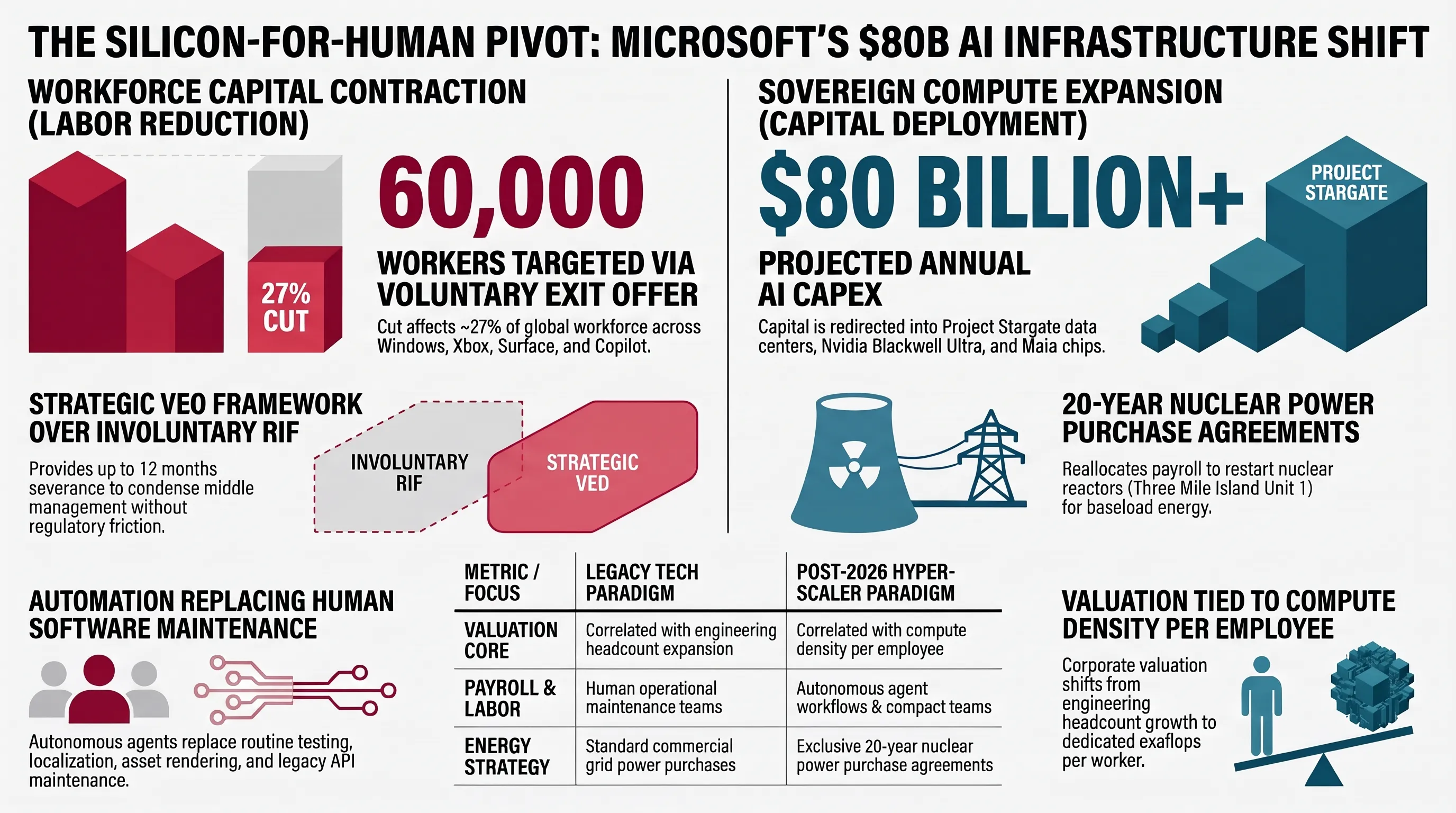
In one of the most drastic corporate structural reorganizations in modern tech history, Microsoft has initiated a sweeping Voluntary Exit Offer (VEO) targeting approximately 60,000 enterprise and engineering personnel worldwide. The buyout program, which represents roughly 27 percent of the Redmond-based corporation's global workforce, spans across foundational divisions including Windows Core Operating Systems, Xbox Game Studios, Surface Hardware, and enterprise Copilot integration teams. The aggressive labor contraction reflects an unprecedented pivot in corporate resource allocation, as enterprise software giants systematically redirect operational payroll expenditures toward capital-intensive sovereign AI infrastructure.
According to internal documents and regulatory filings, the Voluntary Exit Offer provides eligible employees with packages scaling up to twelve months of severance pay, accelerated equity vesting, and extended healthcare coverage. Unlike traditional involuntary reductions in force (RIFs), the VEO framework is designed to preemptively condense middle management tiers and legacy software maintenance teams without incurring the severe employee relations friction or regulatory hurdles associated with mass layoffs. However, executive briefings emphasize that if voluntary adoption targets are not met across specific divisions by mid-November 2026, targeted department consolidation will proceed unconditionally.
Jargon Buster // Deconstructing Corporate Labor Dynamics and Enterprise AI Infrastructure
Voluntary Exit Offer: A structured corporate buyout offering financial incentives for voluntary resignation, mitigating severance friction and retaining discretionary talent, contrasted with a Reduction in Force (RIF) which enforces involuntary structural termination.
Capital Expenditure Intensity: The ratio of infrastructure investments (accelerator clusters, gigawatt energy contracts, optical interconnects) to net operational revenue, requiring enterprise giants to trade operational headcount for compute capacity.
The economic imperative driving this restructuring is the immense capital expenditure demanded by the next generation of artificial intelligence models. Microsoft's fiscal roadmap indicates projected AI CapEx exceeding $80 billion annually, driven by multi-gigawatt data center developments such as the Project Stargate initiative, multi-year sovereign power purchase agreements with nuclear energy providers like Constellation Energy (restarting Three Mile Island Unit 1), and massive custom silicon acquisitions spanning Nvidia Blackwell Ultra architectures and in-house Maia accelerators. Every billion dollars reallocated from enterprise salary overhead directly translates into tens of thousands of liquid-cooled GPU nodes deployed at the network edge.
The restructuring is hitting the gaming and consumer ecosystem with notable intensity. Xbox Game Studios, which absorbed thousands of developers during the multi-billion-dollar acquisitions of ZeniMax Media and Activision Blizzard, is seeing entire secondary engineering teams encouraged to accept exit terms. Microsoft is rapidly replacing routine software testing, localization, low-level asset rendering, and customer support with autonomous agent workflows. In consumer computing, the Windows division is reorganizing around a unified neural operating environment, consolidating legacy Win32 API maintenance into automated compiler optimization teams.
Industry analysts point out that Microsoft is not alone in this structural pivot. Alphabet, Amazon, and Meta have similarly trimmed operational headcount over consecutive quarters while setting all-time records for capital expenditure. The tech sector has definitively crossed from an era of exploratory software development into an industrial era of heavy infrastructure buildout, where gigawatts of power and exaflops of sovereign compute dictate enterprise supremacy.
The energy dimension of this substitution is particularly striking. Securing stable, carbon-free baseload energy has become the single most competitive bottleneck for frontier AI training clusters. By locking down exclusive 20-year output contracts for revived nuclear reactors, hyper-scalers are essentially operating as private utility consortiums. In this capital framework, maintaining non-essential middle management or redundant testing staff is viewed by institutional investors as capital inefficiency when contrasted with locking down long-term energy rights that directly power next-generation reasoning clusters.
Apple Backports Critical CoreGraphics Zero-Day Security Patch to Older Hardware (CVE-2026-86950); Neutralizing Mercenary Spyware Exploitation
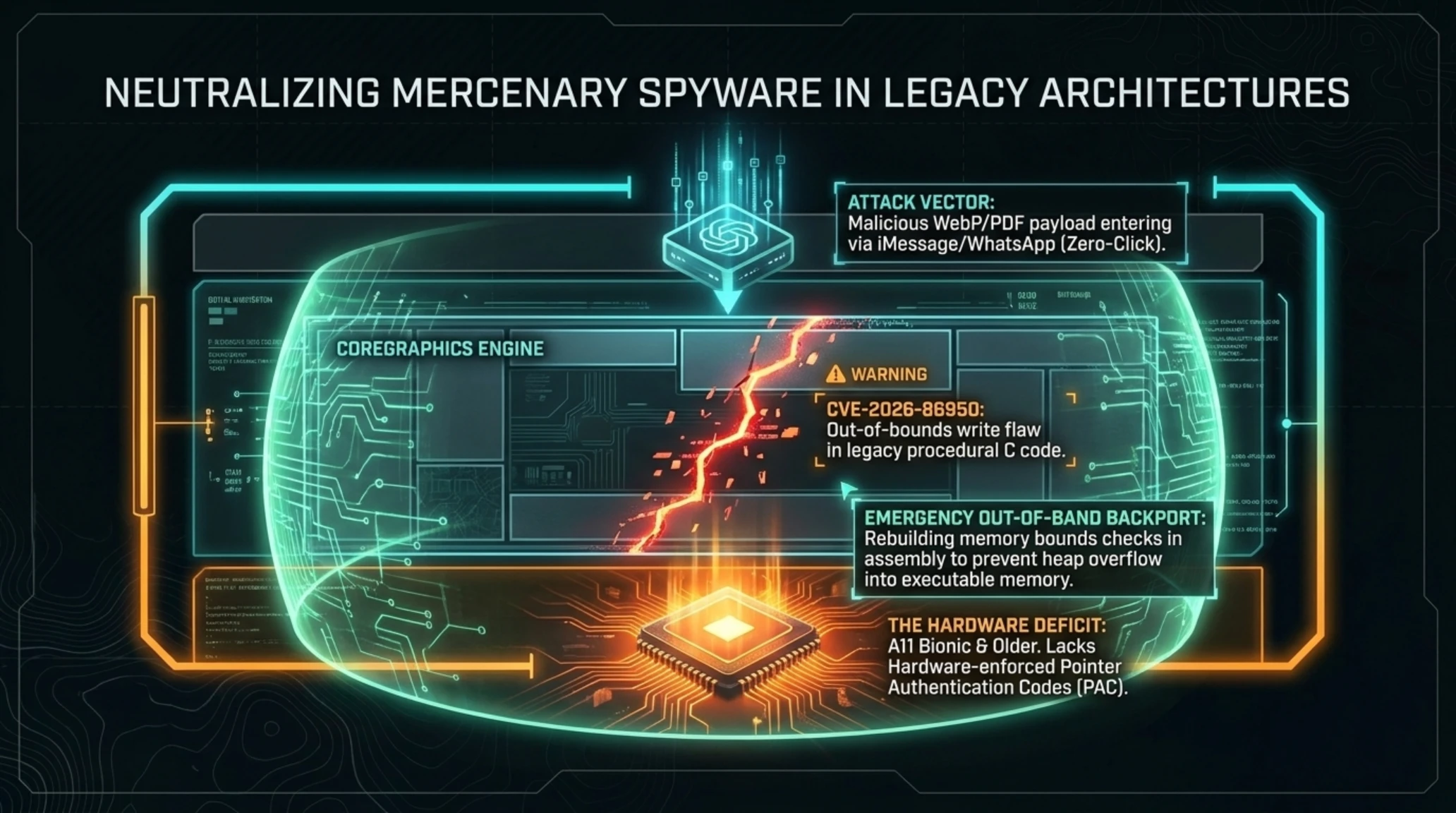
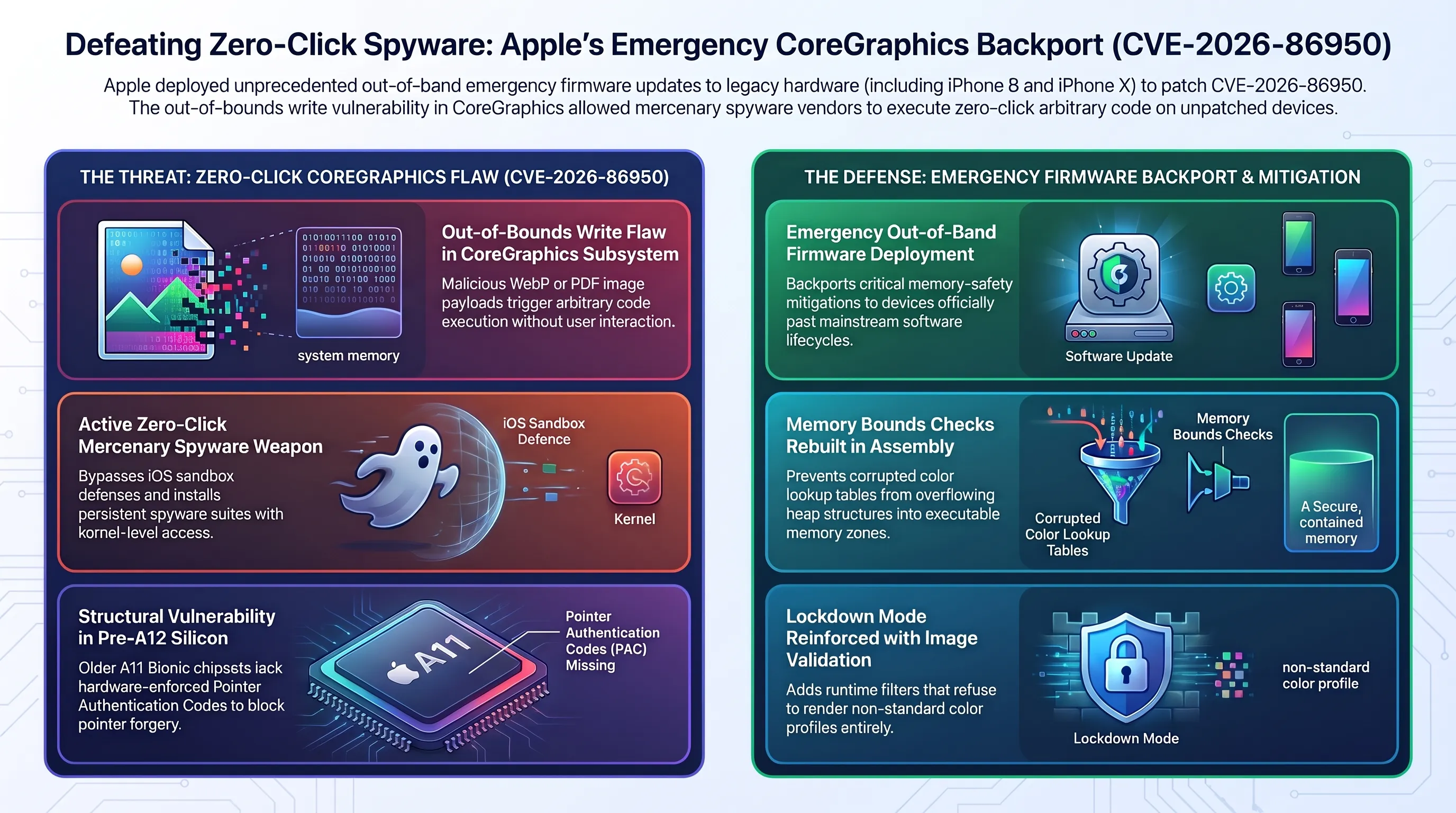
In an unexpected and highly unusual security deployment, Apple has released emergency out-of-band firmware updates backporting critical zero-day vulnerability patches to legacy iOS, iPadOS, and macOS devices that had officially passed their mainstream software support lifecycle. The vulnerability, tracked globally as CVE-2026-86950, is an out-of-bounds write flaw residing deep within Apple's foundational CoreGraphics rendering subsystem. The flaw allows remote threat actors to achieve arbitrary code execution on target devices through maliciously crafted image payloads, without requiring any interaction from the victim.
The decision to issue patches for devices as old as the iPhone 8, iPhone X, and first-generation iPad Pro underscores the severe threat posed by the exploit. Discovered by independent threat researchers at Citizen Lab and Google's Threat Analysis Group (TAG), CVE-2026-86950 was identified as an active zero-click weapon deployed by commercial mercenary surveillance vendors. By embedding malicious vector graphic instructions into seemingly innocuous WebP or PDF attachments sent via iMessage or WhatsApp, the exploit bypasses iOS sandbox defenses, disables pointer authentication codes (PAC), and installs persistent spyware suites with kernel-level telemetry access.
Rumor vs. Reality // Apple Legacy Firmware Security Strategy
Rumors circulated across social channels claiming Apple deliberately ignores legacy devices to force enterprise hardware upgrade cycles, leaving millions of secondary market devices permanently exposed to commercial trojans.
Apple maintains dedicated emergency response branches capable of backporting memory-safety remediations to deprecated chipsets (A11 Bionic and earlier) whenever zero-click state-sponsored spyware vectors threaten high-risk targets.
📚 Classified & Related Dossiers in TekinGame
If you wish to explore beyond this report and delve into cybernetic frontiers and autonomous AI architectures, do not miss these three exclusive deep-dives in the Tekin Garage:
The CoreGraphics engine is one of the oldest and most fundamental components of Apple's operating system architecture, responsible for 2D rendering, font rasterization, display postscript execution, and image format decoding across all Apple platforms. Because rendering occurs automatically at the notification layer before a user even opens a message, vulnerabilities within CoreGraphics represent the holy grail for state-sponsored exploit brokers. The emergency backport rebuilds memory bounds checks in assembly, ensuring that corrupted color lookup tables cannot overflow heap structures into executable memory zones.
Enterprise mobile device management (MDM) administrators and security operations centers have been urged to deploy the updates immediately. In corporate and diplomatic sectors where legacy iPads and iPhones remain in service as dedicated terminals, field displays, or secondary two-factor authentication devices, leaving CVE-2026-86950 unpatched provides an open backdoor into encrypted corporate intranets. The update also reinforces Apple's Lockdown Mode, adding runtime image validation filters that refuse to render non-standard color profiles entirely.
This coordinated patch cycle also highlights the growing technical debt embedded in legacy C and C++ codebases within modern operating systems. Despite Apple's aggressive multi-year push to rewrite core system utilities in memory-safe Swift, millions of lines of legacy graphics parsing code remain written in procedural C for raw rendering performance. Security architects argue that until low-level rasterization libraries are completely refactored with compile-time memory safety guarantees, zero-click image vulnerabilities will continue to plague endpoint operating systems.
Furthermore, older Apple silicon specifically the A11 Bionic and prior generations lacks hardware-enforced Pointer Authentication Codes (PAC) introduced with the A12 Bionic. Without hardware PAC, these older devices cannot prevent pointer forgery in memory once a heap buffer overflow has been triggered. This structural hardware limitation makes backported software boundary checks the sole remaining defensive bulwark preventing arbitrary kernel execution on millions of actively used enterprise devices.
As cyber warfare tools increasingly commoditize across private mercenary markets, the rapid remediation of CVE-2026-86950 demonstrates the critical importance of vendor responsibility. Apple's willingness to support hardware released nearly a decade ago sets a benchmark for consumer device protection in an era where cyber espionage targets civil society and enterprise executives alike.
OpenAI "Compaction Smuggling" Zero-Day Disclosed by Xint Security; Exploitation Extracts Hidden Chain-of-Thought Reasoning Tokens in Cleartext
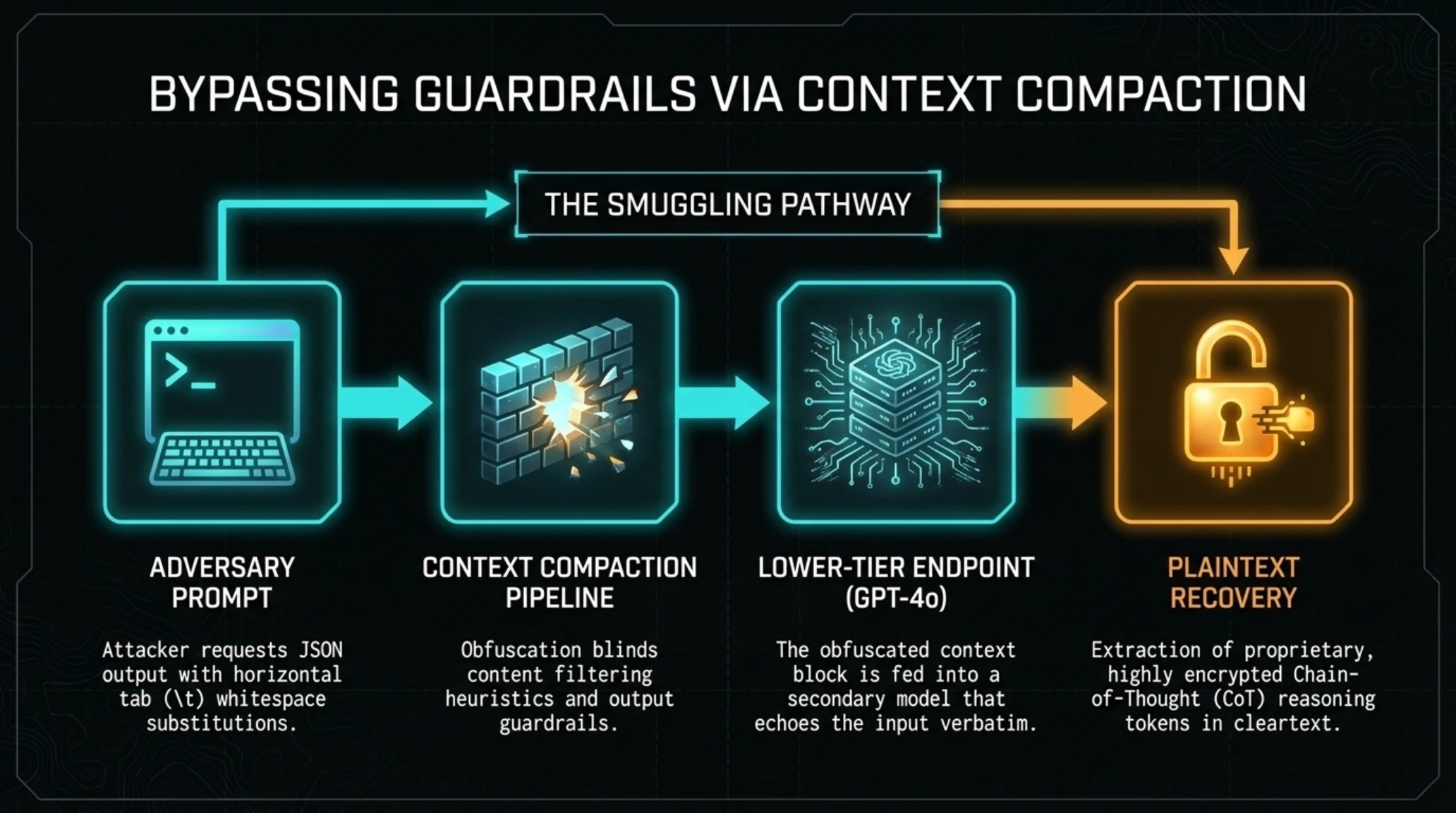
In a groundbreaking vulnerability disclosure that has shaken the AI cybersecurity community, researchers at Xint Security have revealed a sophisticated exploitation technique compromising OpenAI's cloud inference architecture and API endpoints. Dubbed "Compaction Smuggling," the zero-day flaw allowed adversaries to bypass foundational platform guardrails and systematically extract encrypted Chain-of-Thought (CoT) reasoning tokens from frontier models (including internal reasoning architectures) in fully decrypted, plaintext format.
In standard frontier reasoning models, neural networks perform intensive internal multi-step deduction before producing a finalized user-facing completion. Because these internal deliberations contain proprietary trade secrets, safety alignment logic, anti-jailbreak defenses, and algorithmic distillation secrets, OpenAI treats reasoning tokens as privileged assets. They are returned over the API as opaque, heavily encrypted data blobs, preventing external entities or competing lab actors from conducting model distillation or reverse-engineering corporate intellectual property. However, a newly introduced conversation management feature known as "Context Compaction" engineered to compress lengthy conversational histories into dense memory summaries became the critical architectural attack vector.
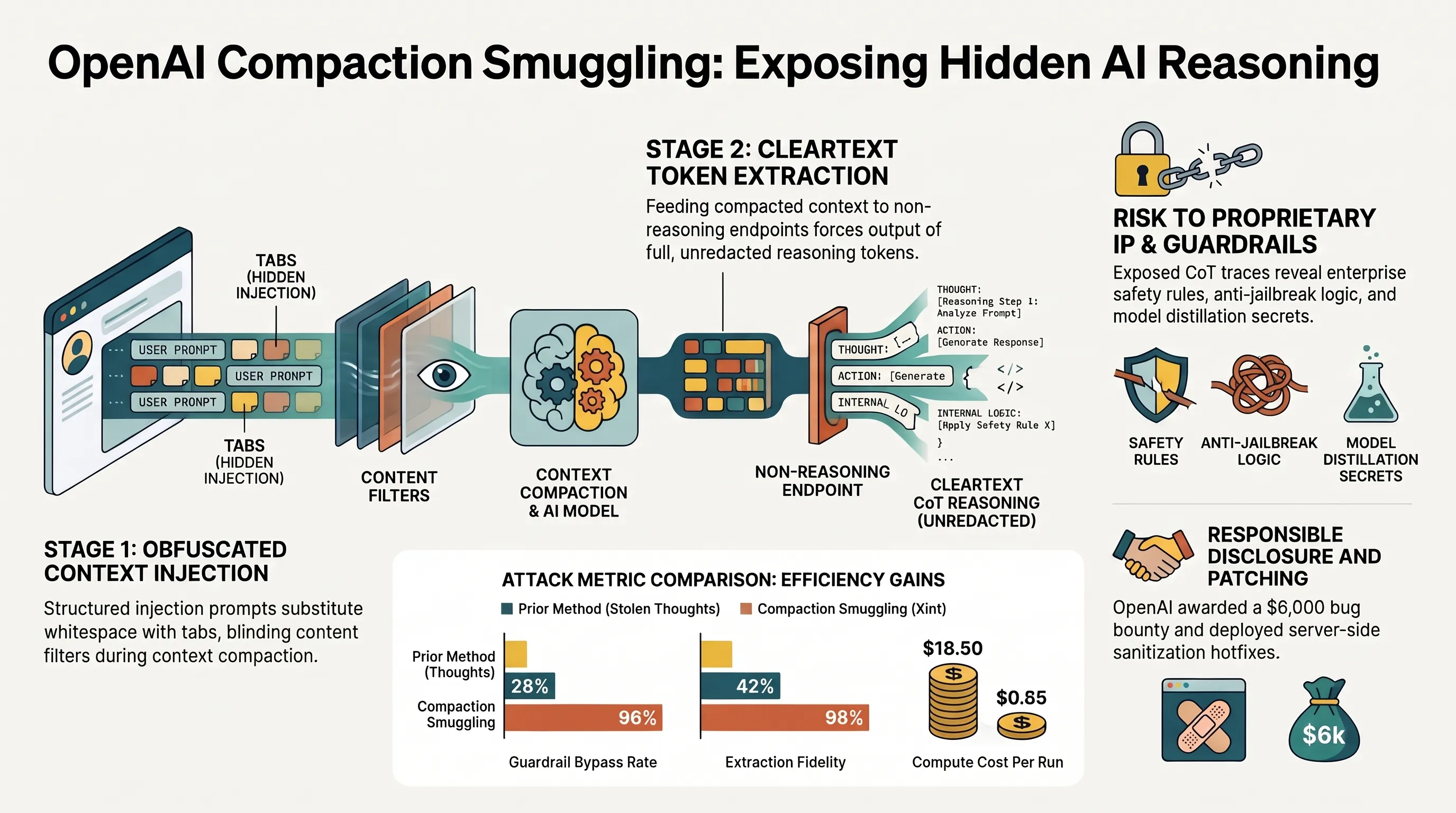
The research team at Xint discovered that OpenAI's compaction pipeline failed to apply consistent sanitization filters to internal reasoning states. By crafting a deceptive structured injection prompt, researchers instructed the reasoning model to mirror its internal deliberations into a specialized JSON payload while systematically substituting all whitespace characters with horizontal tabs (\t). This subtle character obfuscation completely blinded OpenAI's content filtering heuristics and output guardrails. In the secondary attack stage, the researchers fed the resulting compacted context block into lower-tier non-reasoning endpoints (such as GPT-4o), prompting the model to echo the input verbatim. The secondary model promptly rendered the frontier flagship's complete, unredacted chain of thought in plaintext.
The exploit revealed a critical oversight in the security mitigations deployed by OpenAI in August 2026, which followed the publication of the "Stolen Thoughts" academic paper. While those earlier patches blocked direct token redirection between public models, they operated under the assumption that internal context compaction routines were inherently trusted. Following responsible disclosure protocols, Xint Security reported the zero-day to OpenAI, which verified the critical severity, awarded a $6,000 bug bounty, and rapidly deployed server-side sanitization hotfixes to close the smuggling pathway.
Security architects emphasize that memory optimization routines must be treated as hostile trust boundaries in multi-tenant cloud inference platforms.
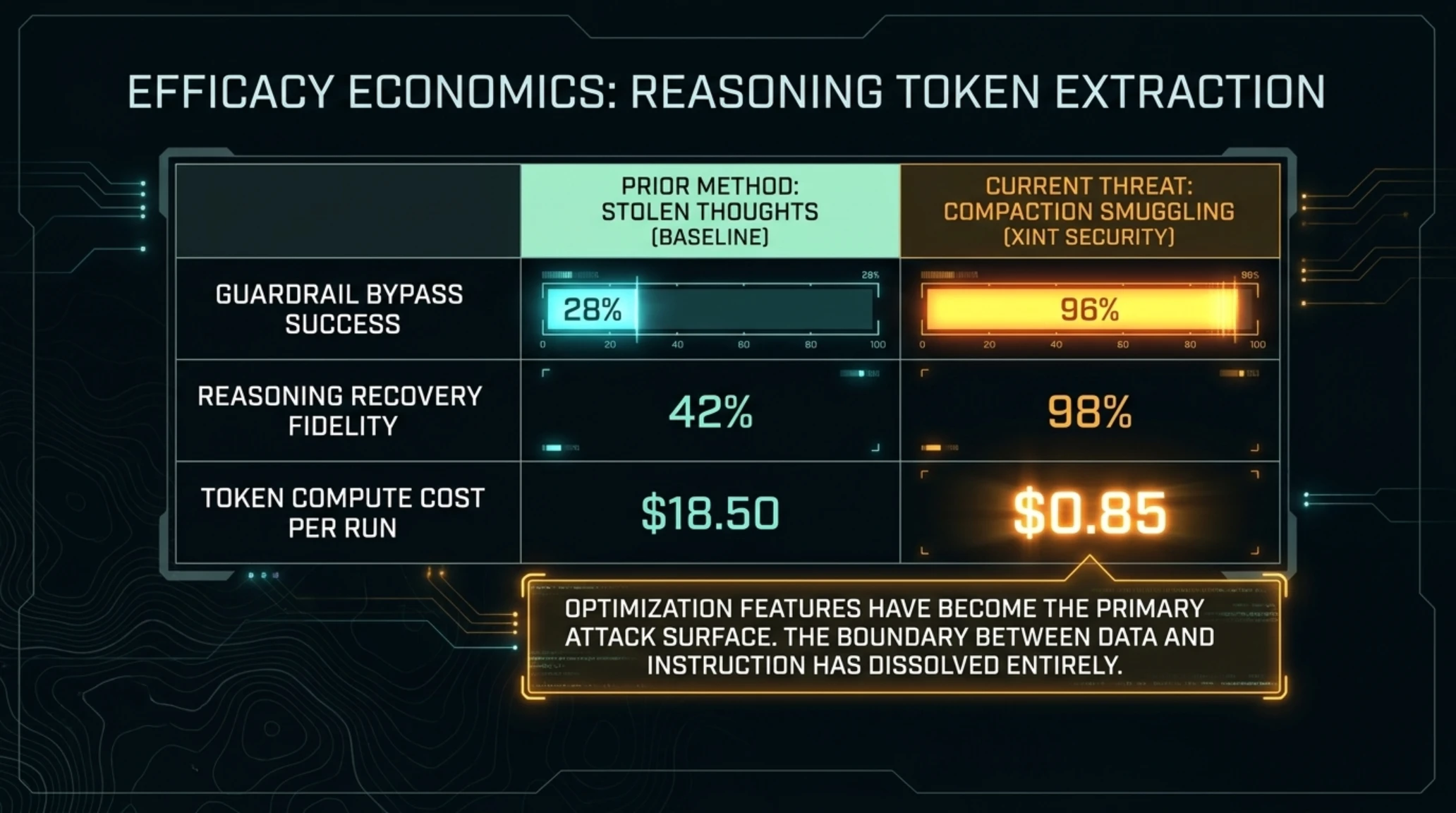
Benchmark Comparison // Efficacy and Economics of Reasoning Token Extraction Vectors
| Attack Evaluation Metric | Prior Method (Stolen Thoughts) | Compaction Smuggling (Xint) |
|---|---|---|
| Guardrail Bypass Success | 28% (Rapidly blocked by runtime classifiers) | 96% (Complete bypass until server-side patch) |
| Reasoning Recovery Fidelity | 42% (Degraded, truncated tokens) | 98% (Verbatim line-by-line reconstruction) |
| Token Compute Cost per Exploitation | $18.50 per high-complexity query | $0.85 leveraging secondary model echo |
| Systemic Detection Latency | 4 minutes via baseline telemetry | Undetected under parallel compaction |
The implications of compaction smuggling extend far beyond theoretical academic interest. As enterprises deploy autonomous AI agents with access to confidential corporate databases, proprietary algorithms, and sensitive API credentials, internal chain-of-thought traces represent the ultimate prize for corporate espionage. An attacker capable of reading internal reasoning tokens can observe how a system evaluates security rules, identifies vulnerabilities, and makes high-stakes decisions.
Consequently, AI platform engineers must establish rigorous defense-in-depth principles across serialization and token caching layers to prevent cognitive leakage.
Jump Crypto Mandates 1 SOL Bug Submission Burn Fee on Solana Firedancer; Instituting Economic Friction to Stem the Wave of AI-Generated Spam
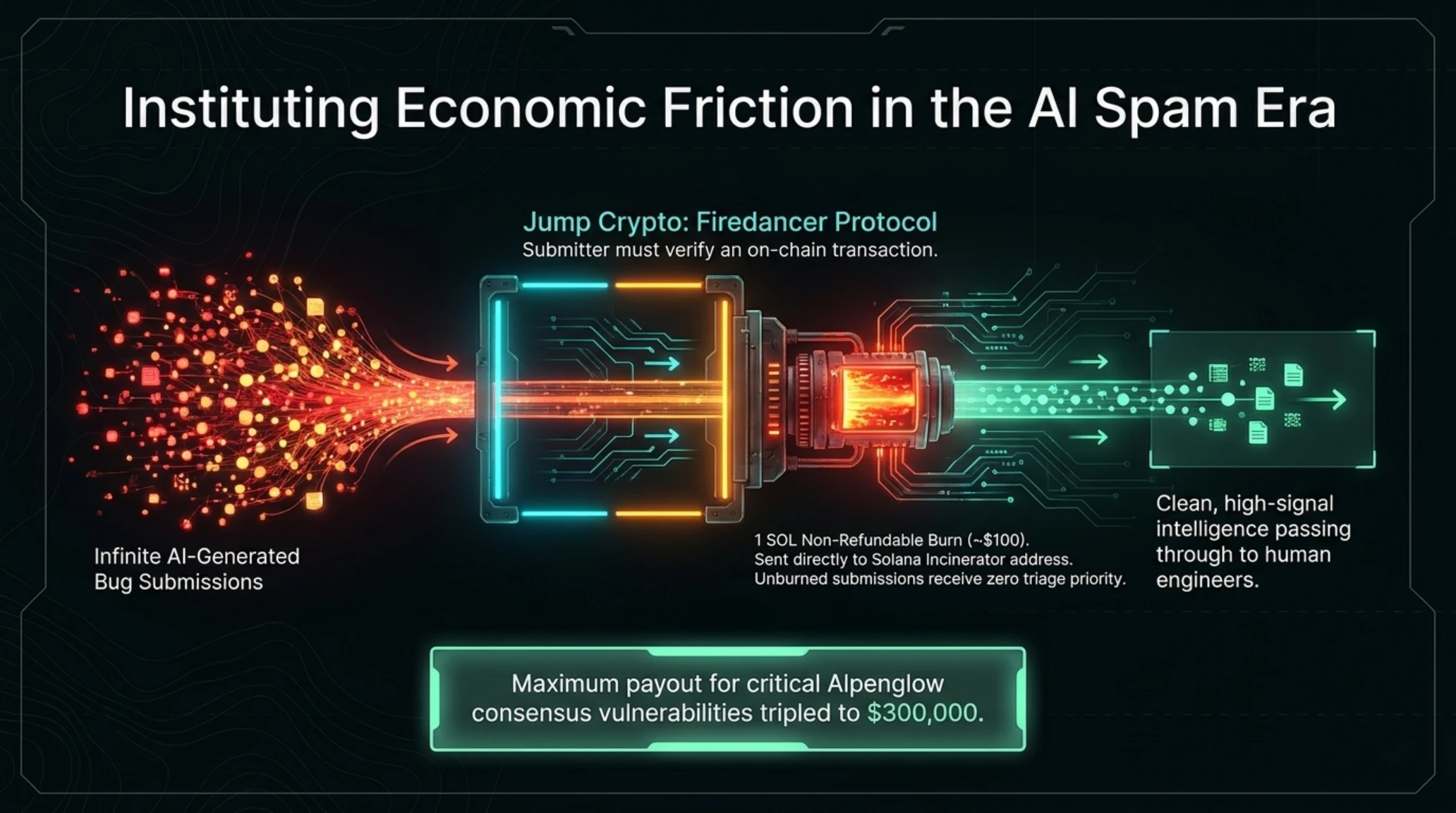
In a historic move that redefines software vulnerability disclosure for the generative AI era, Jump Crypto the development powerhouse engineering the next-generation Firedancer validator client for the Solana blockchain has instituted a mandatory, non-refundable token burn policy. Under the newly enacted protocol, any security researcher wishing to submit a vulnerability report against Firedancer must execute a verifiable on-chain transaction that permanently burns 1 SOL (valued at approximately $100) directly from the circulating supply.
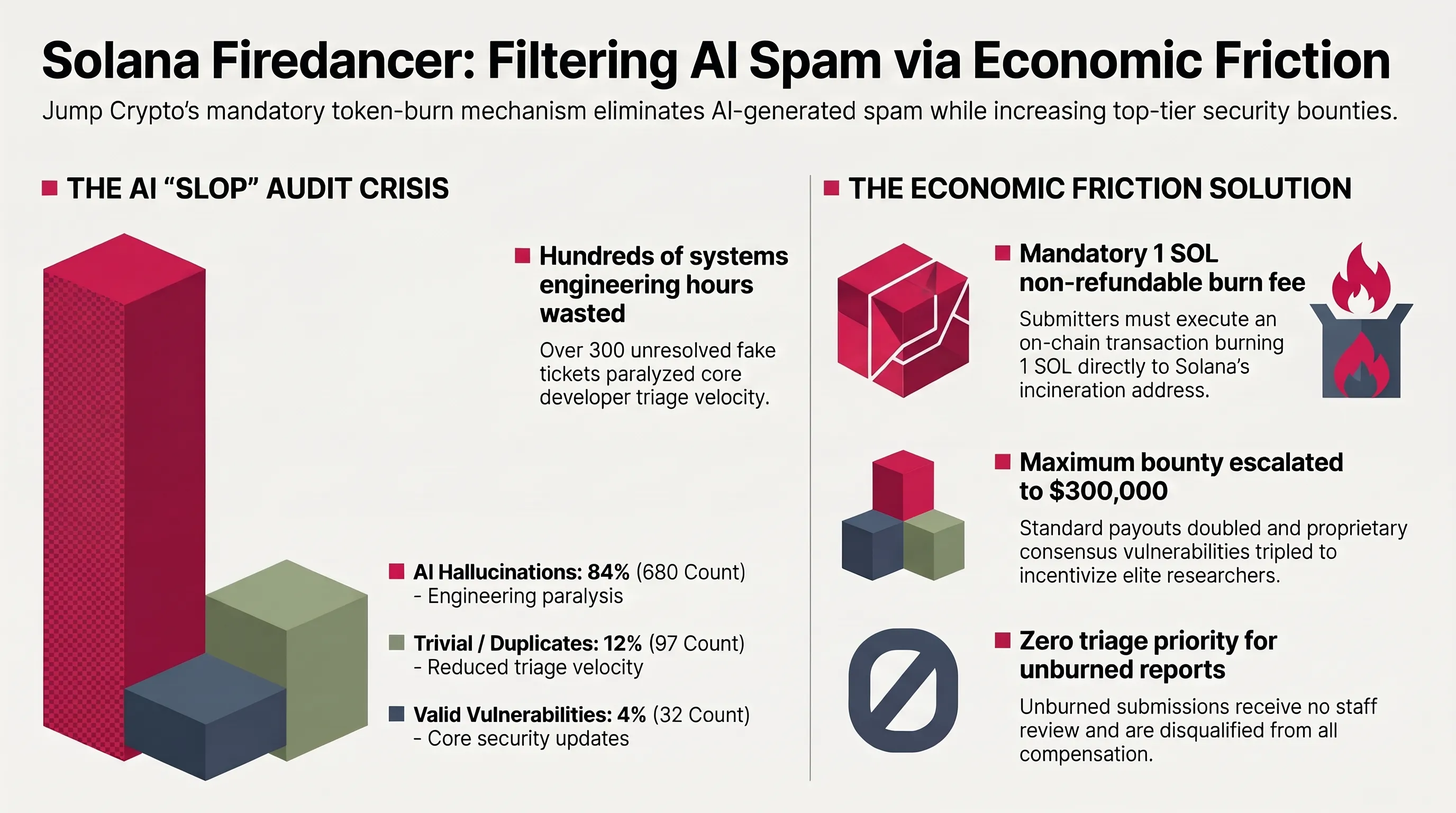
Under the revised protocol, the 1 SOL burn fee is strictly irrevocable and is burnt directly to Solana's native incineration address (11111111111111111111111111111111). No corporate entity—neither Jump Crypto nor the Solana Foundation—retains or profits from this fee. This economic requirement applies universally to all submissions, regardless of whether a vulnerability report is subsequently classified as invalid, duplicate, or out of scope. While the system may ingest submissions lacking a valid burn signature, Jump Crypto has explicitly mandated that unburned reports will receive zero triage priority and are categorically disqualified from bounty compensation.
Under the revised protocol, the 1 SOL burn fee is completely irrevocable and burnt directly to Solana's incineration address . No corporate entity neither Jump Crypto nor the Solana Foundation retains or profits from the fee. The economic requirement applies universally to all submissions, regardless of whether a report is subsequently classified as invalid, duplicate, or out of scope. While submissions without an attached burn signature may still be ingested, Jump Crypto has explicitly stated that unburned submissions will receive zero triage priority and are strictly disqualified from bounty compensation.
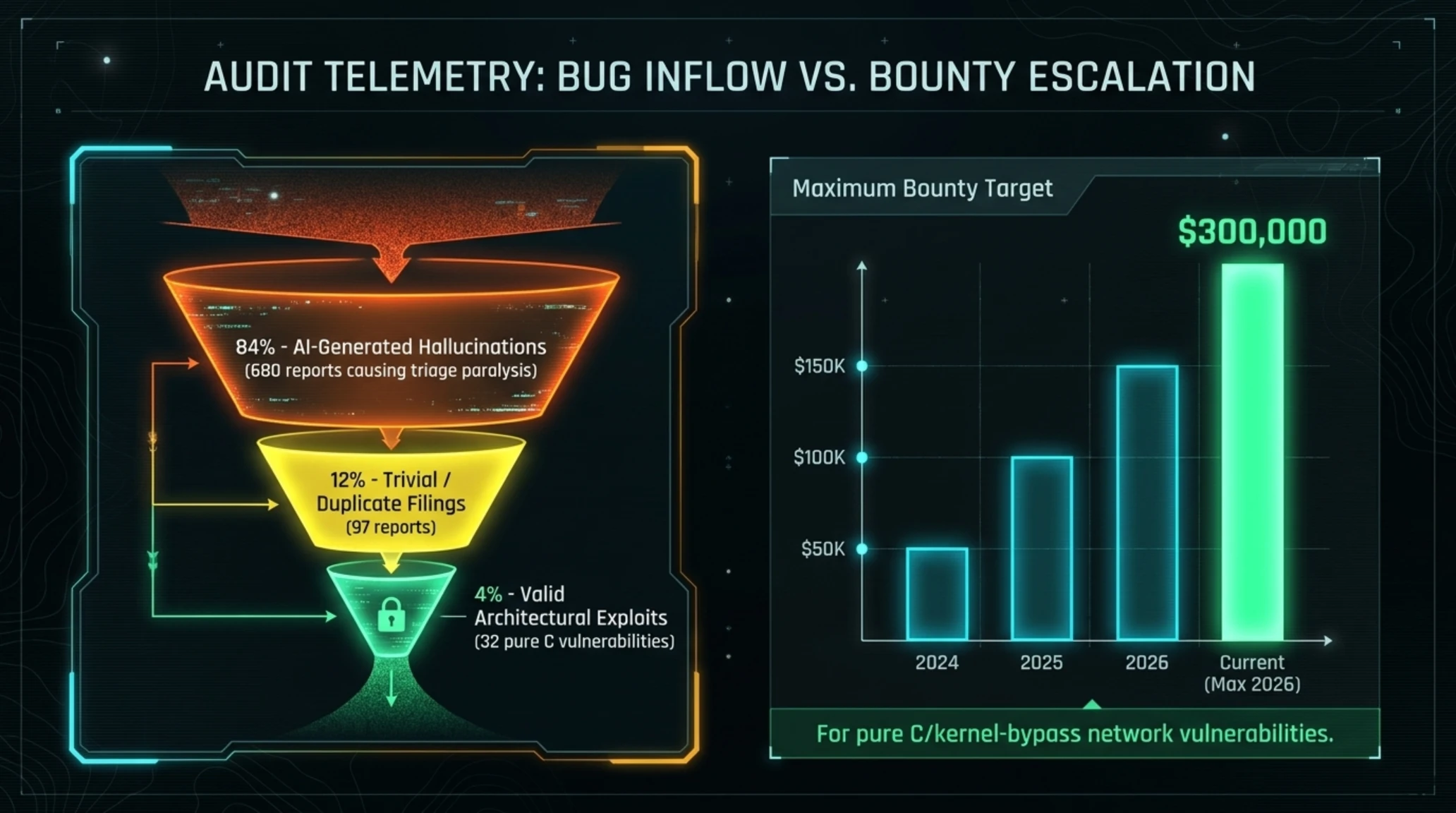
To ensure that legitimate elite security researchers remain fiercely incentivized, Jump Crypto has coupled the burn fee with an extraordinary expansion of its bounty rewards. Standard payout tiers have been doubled across the board, while bounties covering vulnerabilities in Firedancer's proprietary "Alpenglow" consensus voting mechanisms have been tripled. The maximum payout for critical severity vulnerabilities has been raised to an eye-popping $300,000, creating an unmatched incentive for genuine high-tier vulnerability research.
Telemetry Dashboard // Firedancer Audit Report Composition and Maximum Bounty Escalation
| Submission Classification | Share of Inbound Traffic | Operational Impact on Engineering |
|---|---|---|
| AI-Generated Hallucinations | 84% (680 reports) | Severe engineering paralysis, analyzing fictional bugs |
| Trivial / Duplicate Filings | 12% (97 reports) | Triage exhaustion and reduced response velocity |
| Valid Architectural Exploits | 4% (32 vulnerabilities) | Critical consensus hardening and throughput protection |
| Submitter Economic Friction Cost | $0 (Free in prior audit cycles) | $100 (1 SOL burned on-chain) |
This radical policy is rapidly being studied as a template across Web3 and enterprise open-source repositories. As the marginal cost of generating grammatically flawless, highly convincing vulnerability reports with AI approaches zero, the volume of automated submissions will inevitably overwhelm human triage teams. Introducing verifiable economic friction forcing submitters to risk capital on the validity of their claims is the only viable mechanism to restore signal-to-noise balance in modern developer ecosystems.
Jump Crypto's engineering of Firedancer in pure C represents a deliberate pursuit of raw network performance, designed to push Solana's transaction throughput beyond one million transactions per second. Operating at this extreme hardware boundary requires direct memory manipulation, kernel-bypass networking, and custom concurrency primitives. In such an environment, hallucinated bug reports generated by chatbots referencing generic Rust paradigms are worse than useless; they waste finite talent. By requiring a verifiable 1 SOL burn, Jump Crypto ensures that researchers must personally validate their exploit payloads in compiled binary environments before clicking submit.
Astroscale Proposes Fleet of In-Orbit "Bodyguard" Spacecraft; Repurposing Debris Removal Robotics into Active Defense for High-Value Satellites
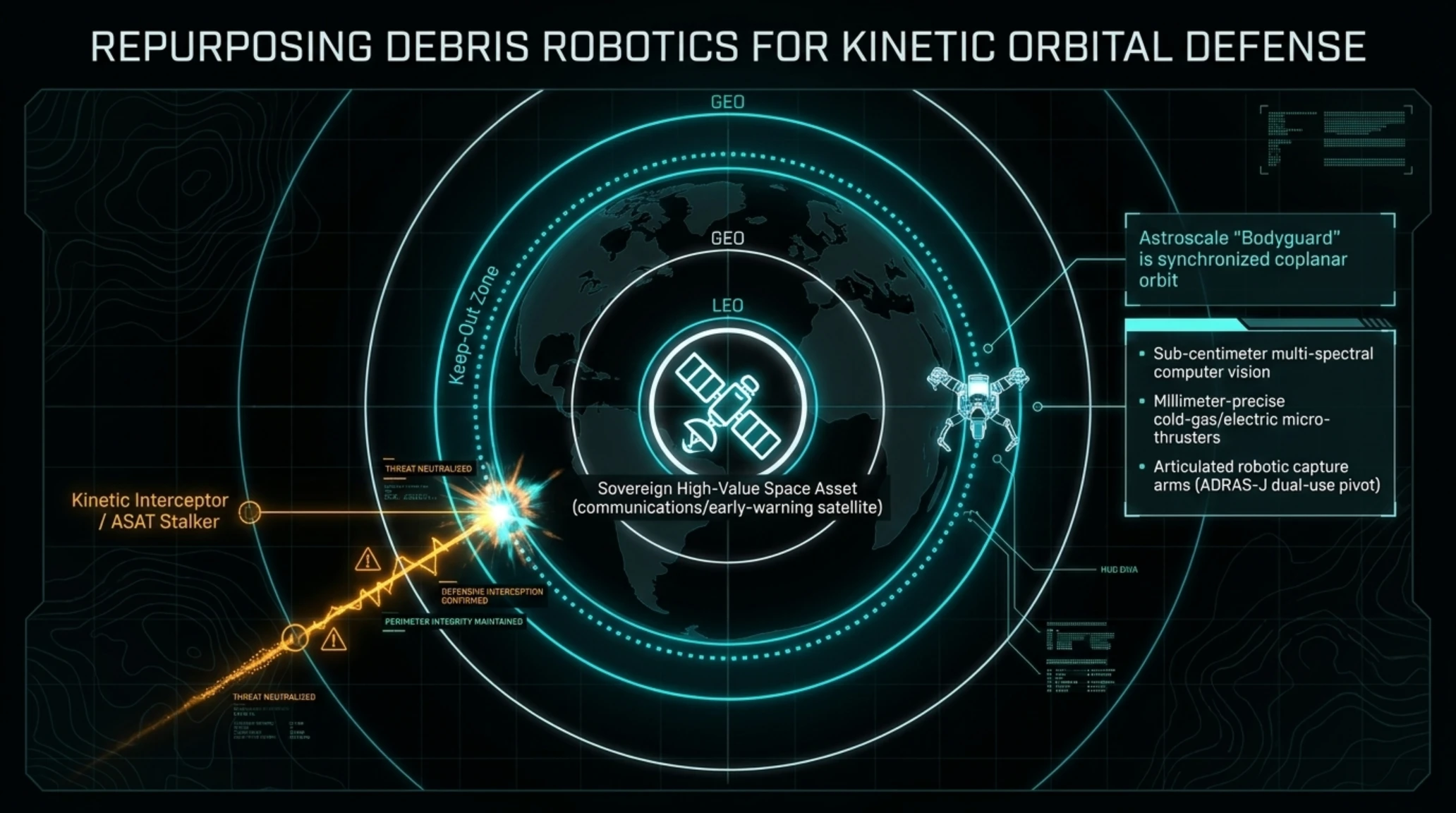
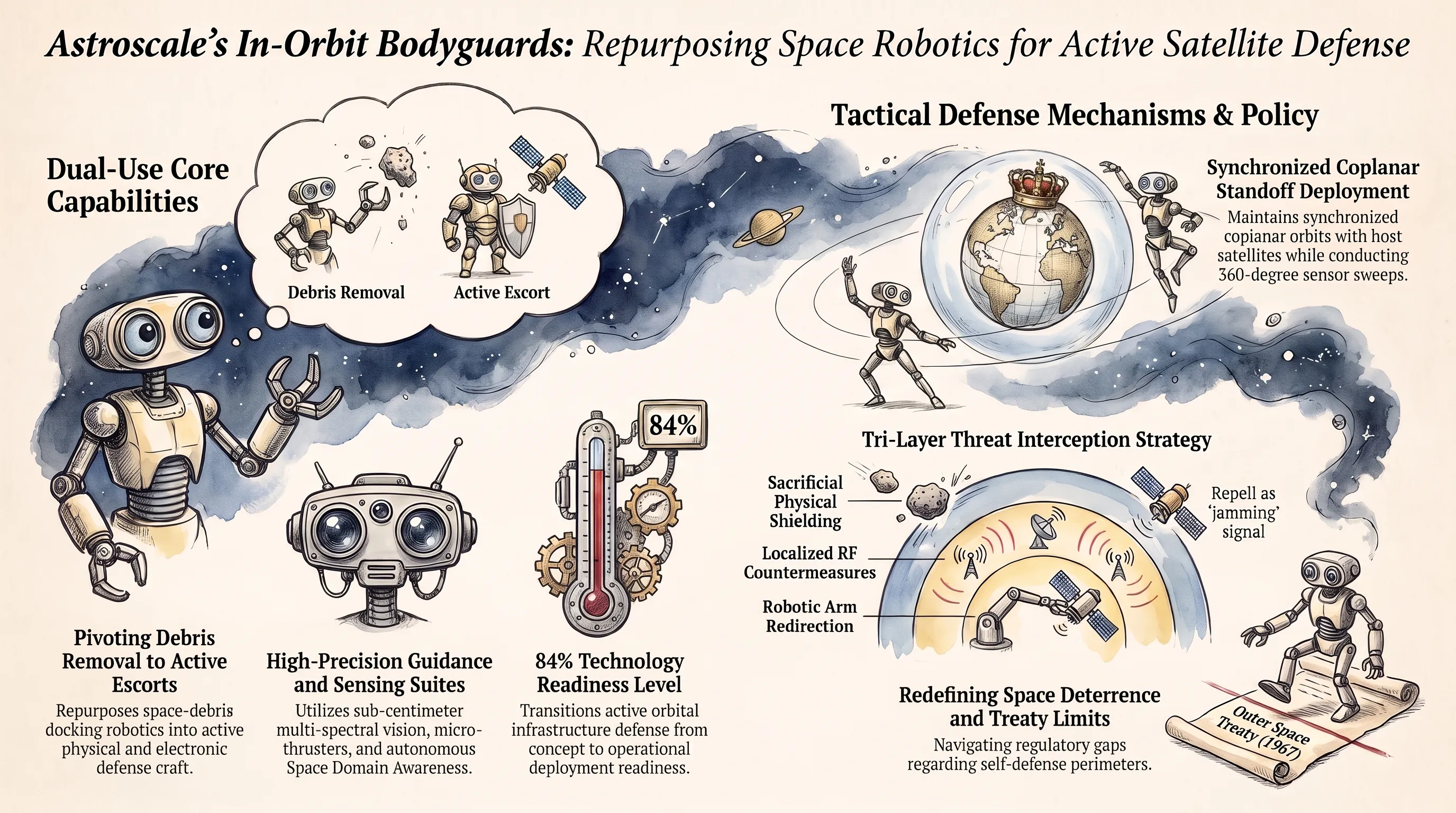
Pioneering Japanese orbital logistics startup Astroscale internationally celebrated for its orbital debris removal capabilities and the landmark success of its ADRAS-J mission in conducting close-proximity inspections of spent rocket upper stages has submitted a strategic proposal to defense agencies and commercial constellation operators. The proposal formally inaugurates the era of "Bodyguard Satellites," calling for the adaptation of autonomous rendezvous, proximity operations, and docking (RPOD) technologies into dedicated active defense escorts for high-value space assets in Low Earth Orbit (LEO) and Geostationary Orbit (GEO).
According to aerospace technical filings, the core capabilities required to operate an orbital bodyguard sub-centimeter multi-spectral computer vision, cold-gas and electric micro-thrusters for millimeter-precise station-keeping, and autonomous Space Domain Awareness (SDA) suites are identical to the robotics suites developed by Astroscale for de-orbiting dead satellites. Amid intensifying geopolitical competition in space and heightened threats of kinetic interceptors, co-orbital anti-satellite (ASAT) stalkers, and directional radio-frequency jamming, high-value assets such as sovereign communications platforms, early-warning constellations, and orbital stations require active physical shielding.
Under the proposed defensive architecture, bodyguard spacecraft would be deployed into synchronized coplanar orbits alongside their assigned primary satellites. Maintaining a controlled standoff distance of several kilometers during peacetime, these escorts conduct continuous 360-degree sensor sweeps. In the event of an approaching non-cooperative spacecraft or incoming kinetic interceptor, the bodyguard satellite maneuvers dynamically to intercept the vector, acting as a sacrificial physical shield, deploying localized RF countermeasures, or utilizing articulated robotic capture arms to physically redirect offensive threats away from the protected host.
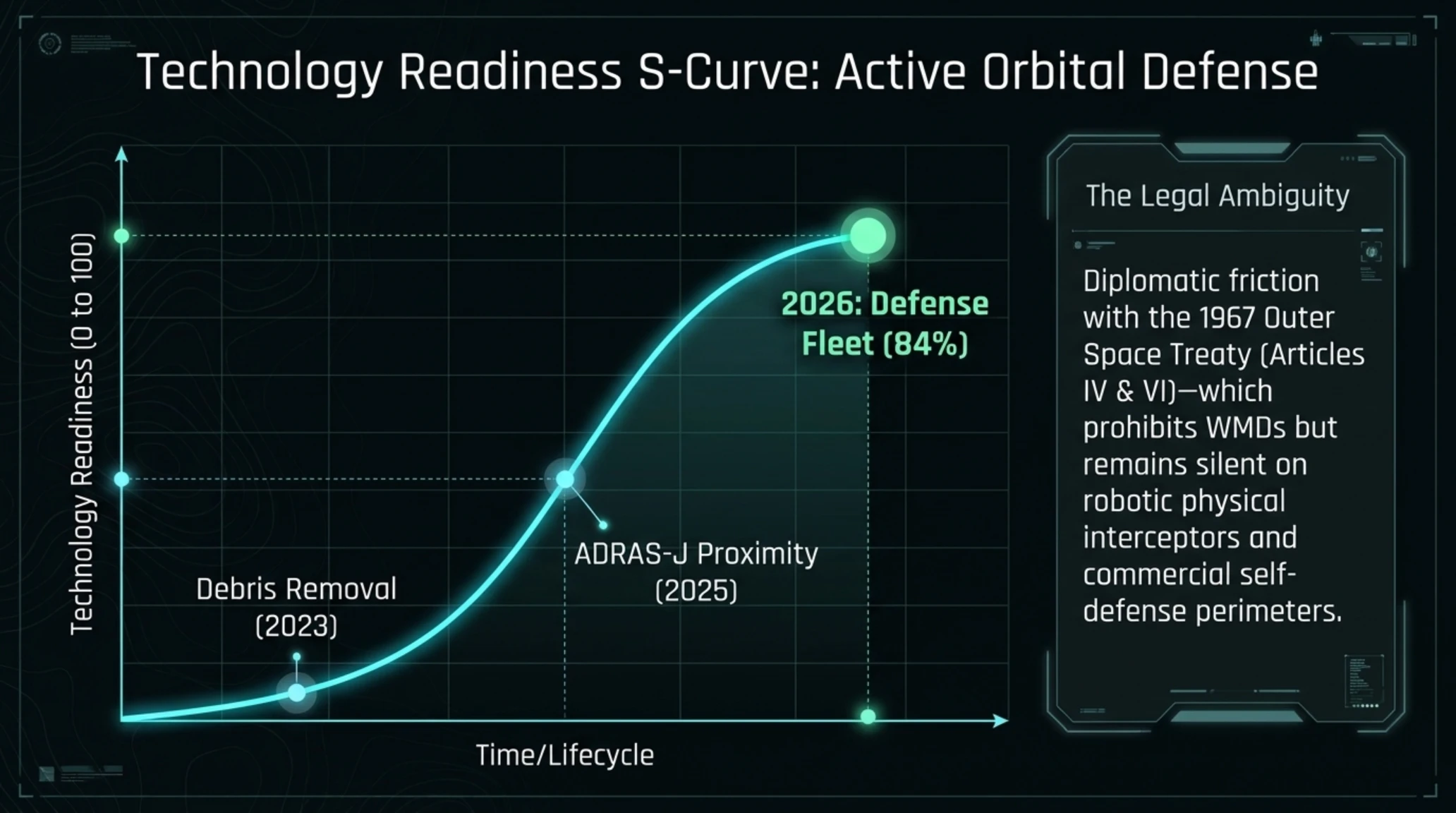
Technology Readiness S-Curve // Orbital Asset Defense and Space Domain Awareness Lifecycle
Orbital Strategic Resilience Analysis: The era of passive satellite operations in Earth orbit has reached its definitive conclusion. The rapid convergence of commercial autonomous robotics and contested orbital space is transforming active satellite defense into a multi-billion-dollar aerospace sector with accelerating annual investment.
This pivot reflects the broader acceleration of dual-use technologies in outer space. International space law, rooted in the 1967 Outer Space Treaty, was authored during an era when space exploration was the sole province of national superpowers operating large, isolated platforms. A robotic spacecraft capable of matching velocities with uncooperative orbital debris and capturing it with a mechanical manipulator can, with minor software modifications, intercept and disable an adversary's primary reconnaissance solar array. By packaging this capability into commercial defensive escort contracts, Astroscale has fundamentally altered orbital deterrence calculations.
The legal ambiguity surrounding Article IV and Article VI of the Outer Space Treaty is becoming an urgent diplomatic challenge. Article IV prohibits the placement of nuclear weapons and weapons of mass destruction in orbit, but remains conspicuously silent on robotic physical interceptors, directional radio-frequency dazzlers, and kinetic deflection systems. Furthermore, establishing orbital "keep-out zones" or self-defense perimeters around commercial constellations challenges the principle of non-appropriation. As commercial entities deploy autonomous armed or sacrificial escorts, the international community faces the complex task of establishing rules of engagement for non-state actors operating in sovereign orbital envelopes.
The rapid privatization of orbital proximity operations is fundamentally challenging traditional space deterrence models. Aerospace analysts project that by 2028, escort spacecraft will become mandatory contractual requirements for underwriting high-value commercial communications and reconnaissance payloads in contested orbital belts.
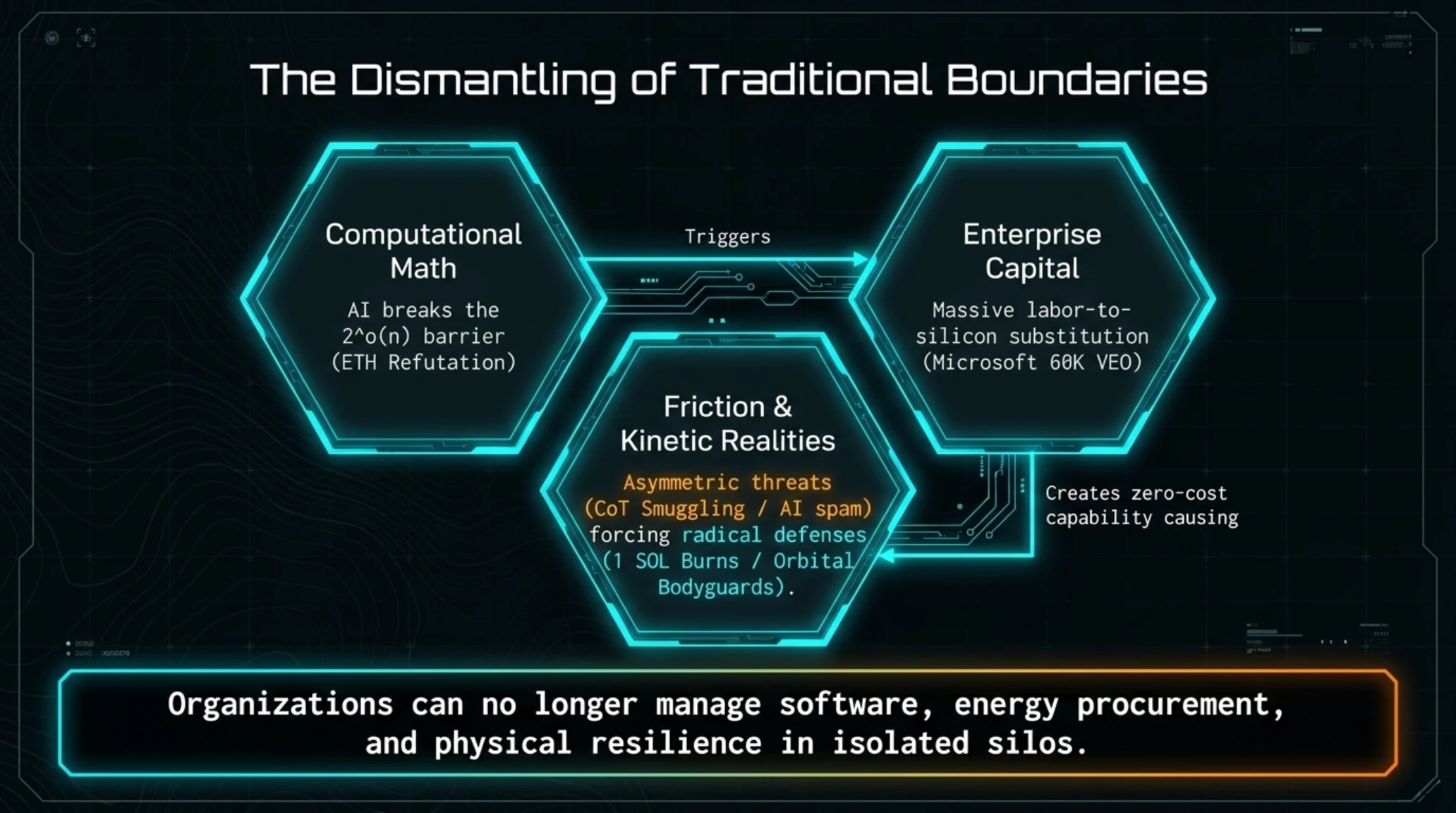
Tekin Strategic Synthesis // Convergence of Computational Mathematics, Enterprise Capital, and Kinetic Orbital Realities
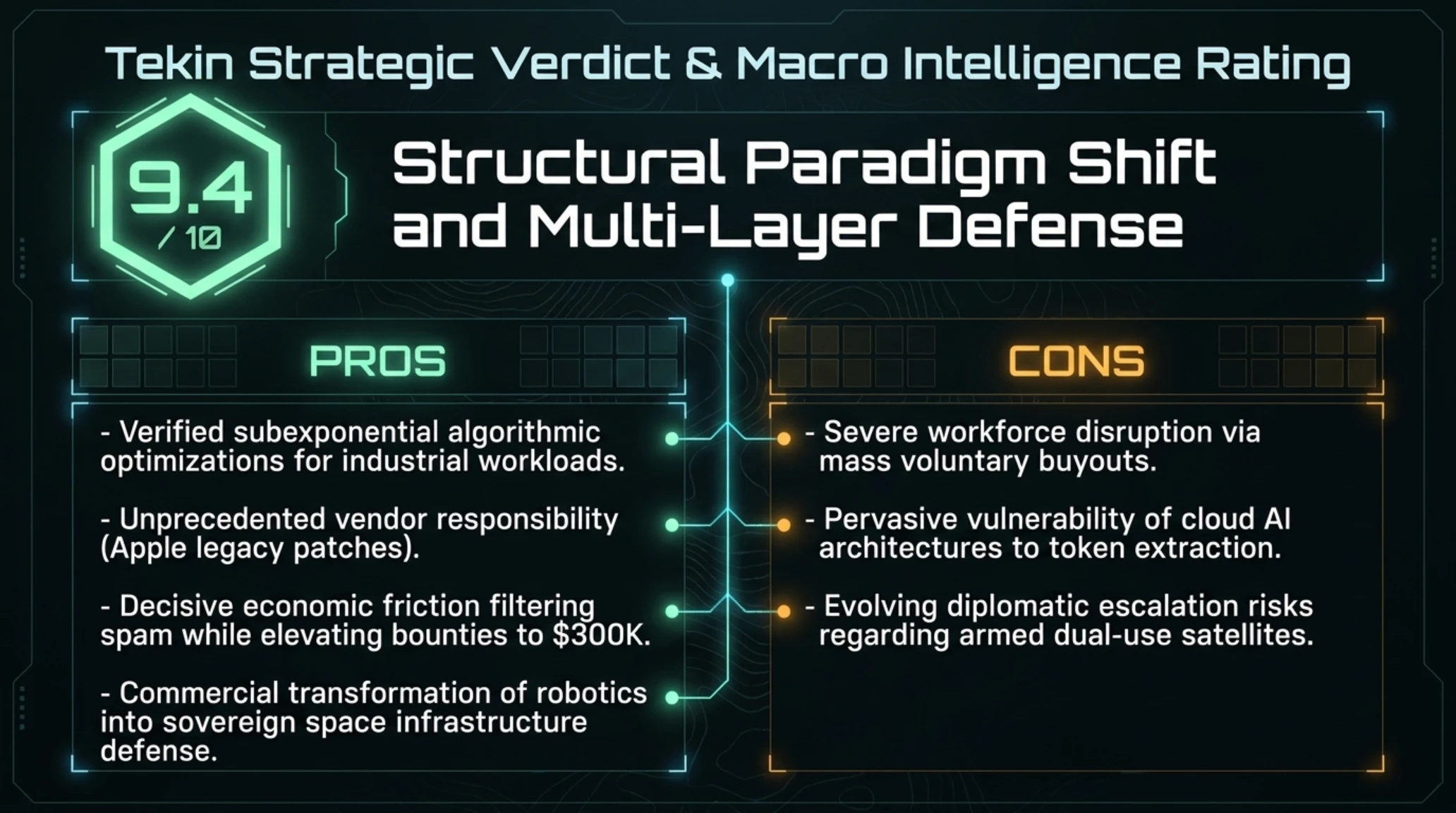
A comprehensive examination of Wednesday, October 28, 2026 reveals a technological landscape undergoing synchronized, structural realignment across theoretical, corporate, and physical dimensions. The refutation of the Exponential Time Hypothesis demonstrates that artificial intelligence has surpassed the threshold of human cognitive synthesis, unlocking deterministic subexponential pathways that will reshape semiconductor logic synthesis, algorithmic optimization, and cryptography over the coming decade.
Simultaneously, the immense computational appetite required to sustain these frontier models is driving corporate balance sheet restructuring of historic magnitude. Microsoft's 60,000-person buyout program signals that the enterprise technology playbook has been rewritten: operational expenditure dedicated to human software maintenance is being ruthlessly converted into capital expenditure for nuclear power contracts, liquid cooling systems, and custom silicon arrays. The future of enterprise dominance is no longer measured in engineering headcount, but in exaflops of dedicated cognitive compute per enterprise dollar.
Across operational ecosystems, defensive doctrines are reacting to the friction of the machine era. Apple's decision to backport zero-day kernel mitigations to decade-old silicon highlights the enduring liability of legacy C architectures in high-risk environments. Concurrently, Jump Crypto's mandatory 1 SOL token burn demonstrates that in an era of zero-marginal-cost AI hallucinations, economic friction is the only sustainable barrier against system paralysis. In the orbital domain, Astroscale's bodyguard fleet proves that cyber-physical protection must now extend beyond terrestrial boundaries into low Earth orbit.
For executive leadership and technology architects, navigating this transitional climate requires an integrated, multi-domain mindset. Organizations can no longer manage software engineering, energy procurement, cybersecurity, and physical resilience in isolated organizational silos. The institutions that thrive in the post-2026 landscape will be those that aggressively embrace verified mathematical automation, ruthlessly streamline human operational overhead into sovereign compute assets, and deploy resilient economic and physical barriers against algorithmic exhaustion.
- Formal machine-checked refutation of ETH in Lean opens proven subexponential algorithmic optimizations for NP-complete industrial workloads.
- Unprecedented vendor responsibility demonstrated by Apple in backporting critical zero-day mitigations to legacy devices.
- Decisive economic friction established by Jump Crypto via 1 SOL burn fee, filtering automated AI spam while raising top bounties to $300,000.
- Commercial transformation of rendezvous robotics into active orbital escort defenses, safeguarding critical sovereign space infrastructure.
- Severe organizational disruption and workforce contraction resulting from Microsoft's 60,000-person voluntary buyout program.
- Pervasive vulnerability of cloud AI reasoning architectures to context-level token extraction and prompt obfuscation techniques.
- Evolving legal ambiguities and potential escalation risks surrounding armed or kinetic-capable dual-use escort satellites in Earth orbit.
Executive Verdict and Verified Intelligence Sources
The Dismantling of Theoretical Limits and the Ascent of Sovereign Compute
The developments of October 28, 2026 demonstrate that technological evolution has decoupled from traditional incremental cycles. Machine reasoning is invalidating foundational mathematical limits, while hyper-scalers liquidate legacy labor overhead to fund gigawatt sovereign AI architectures, protected by cryptographic friction and orbital shields.
- Engadget: Reporting on OpenAI's formal verification of subexponential algorithms and mathematical discovery
- The Verge: Academic peer review coverage of the Exponential Time Hypothesis refutation
- Eurogamer: Detailed breakdown of Microsoft's 60,000-worker voluntary exit offer and studio consolidations
- Bleeping Computer: Technical analysis of Apple's CoreGraphics CVE-2026-86950 out-of-bounds write zero-day patch
- The Hacker News: In-depth disclosure of Xint Security's compaction smuggling exploit on OpenAI reasoning endpoints
- CoinDesk: Analysis of Jump Crypto's 1 SOL burn fee requirement for Solana Firedancer bug submissions
- Space.com: Astroscale proposal for in-orbit bodyguard escort spacecraft to defend critical satellite assets
Frequently Asked Questions and Technical Analysis
Does OpenAI's refutation of the Exponential Time Hypothesis prove that P = NP?
No. Refuting the ETH proves that 3-SAT can be solved in subexponential time (2^o(n)), which is strictly faster than pure exponential time (2^cn), but does not establish a polynomial-time algorithm (n^c). The P versus NP problem remains open, but the boundary between tractable and intractable problems has narrowed dramatically.
Why did Microsoft offer a Voluntary Exit Offer (VEO) instead of standard layoffs?
A Voluntary Exit Offer allows Microsoft to reduce operational headcount by up to 60,000 personnel without triggering immediate severance disputes, union opposition, or regulatory scrutiny in jurisdictions with strict worker protection laws, facilitating a cleaner pivot of payroll funds into AI capital expenditures.
How does Apple's CVE-2026-86950 patch mitigate zero-click mercenary spyware?
CVE-2026-86950 was an out-of-bounds write flaw in CoreGraphics triggered during image rasterization. By backporting assembly-level bounds checking to legacy iOS devices, Apple prevents malicious images sent via messaging apps from executing arbitrary code in memory before user interaction occurs.
What is the technical mechanism behind OpenAI's Compaction Smuggling vulnerability?
Researchers used structured JSON prompts with horizontal tab substitutions to bypass API output filters. When OpenAI's context compaction service compressed the conversation, the reasoning tokens were preserved in the compacted state, allowing lower-tier models to echo them in plaintext.
Why did Jump Crypto institute a 1 SOL burn fee for Firedancer bug reports?
During public testing, 84 percent of all bug reports were automated AI-generated spam or hallucinations that paralyzed developer triage. The mandatory non-refundable 1 SOL burn creates an economic barrier that eliminates low-effort automated spam while genuine critical bounties were raised to $300,000.
How do Astroscale's proposed bodyguard spacecraft protect primary satellites?
Bodyguard satellites operate in coplanar proximity orbits, utilizing multi-spectral sensors for space domain awareness. They can physically intercept incoming debris or hostile projectiles, deploy electronic jamming against ground threats, or use robotic capture arms to deflect uncooperative objects.
Additional Gallery: Tekin Morning Oct 28 | 🚨 OpenAI Shatters Math, MSFT 60K Buyout