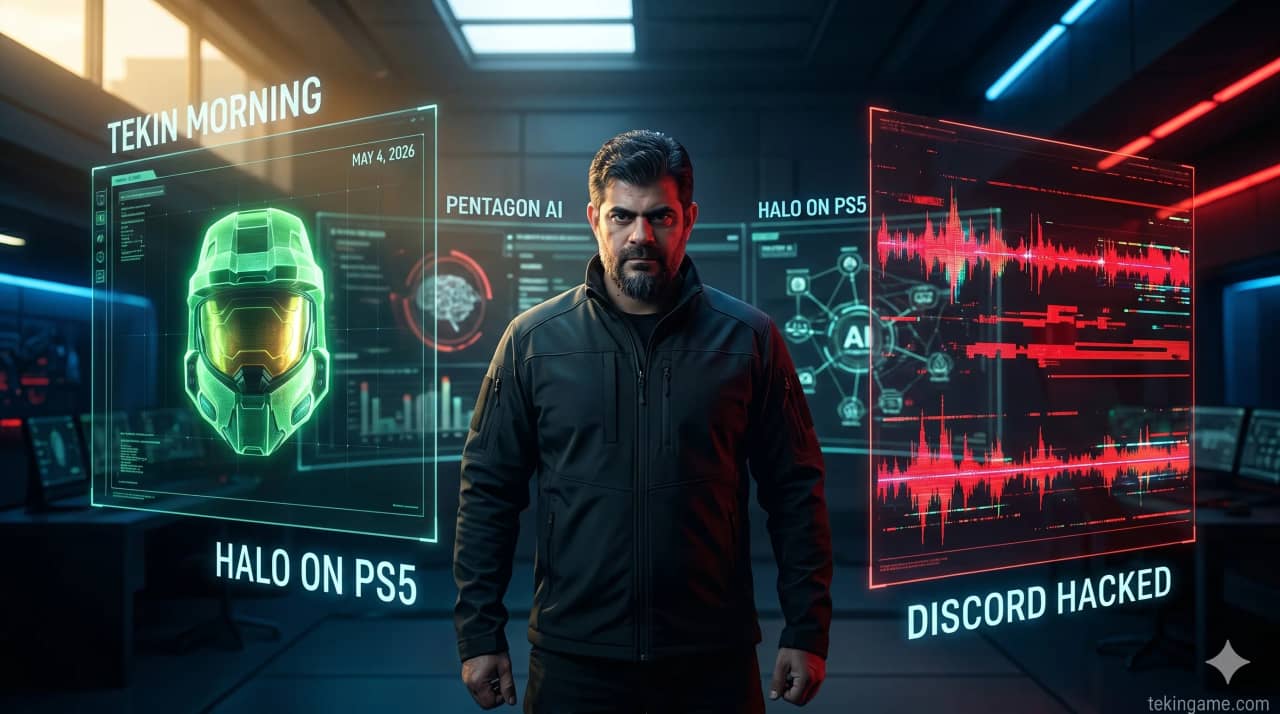
🌅 Welcome to Tekin Morning May 4, 2026
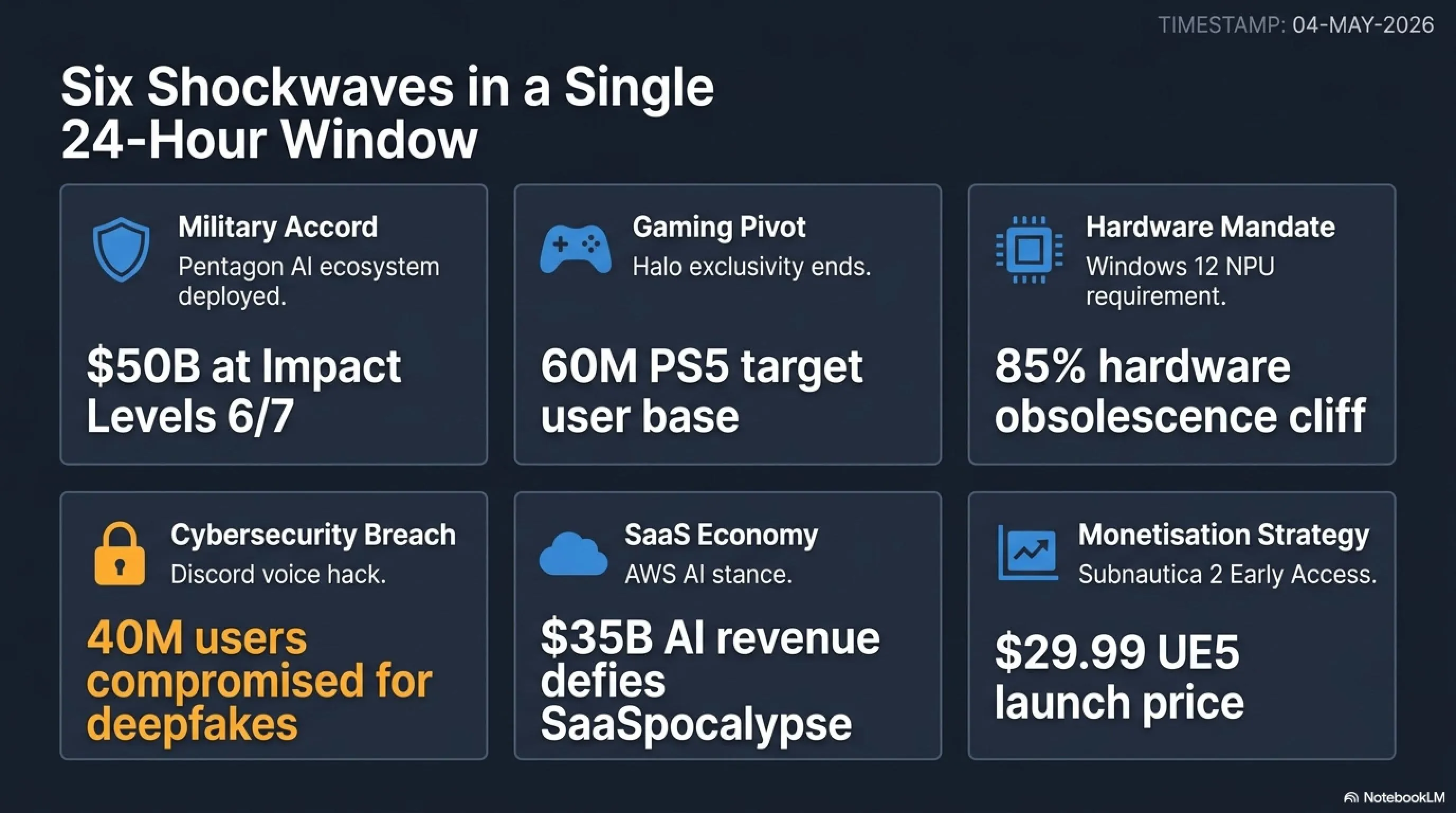
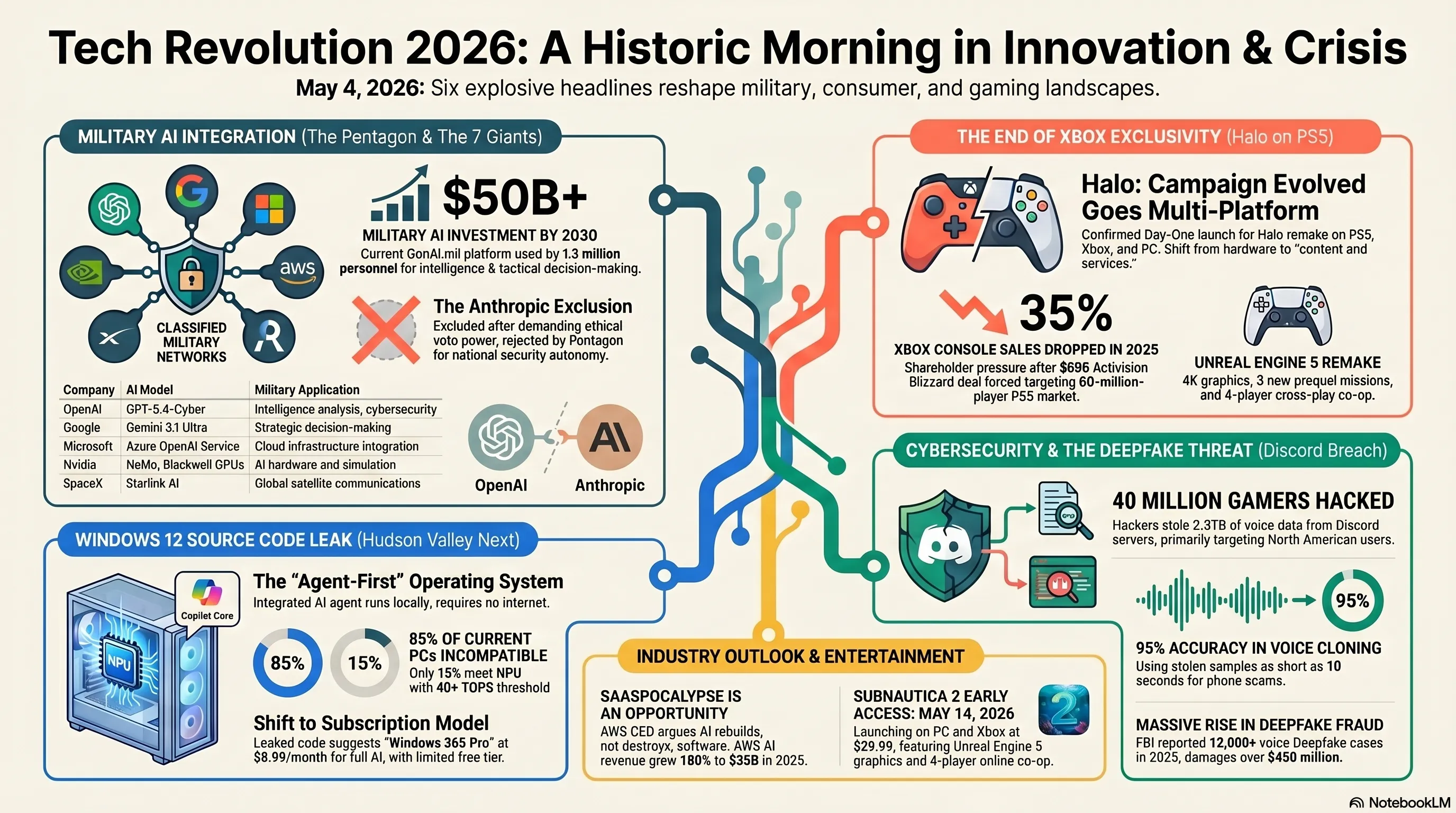
Good morning, Tekin Army! Today is one of the most eventful mornings of 2026. Six explosive stories that could each stand alone as headline news, but they all happened in a single day. From AI officially entering Pentagon's classified military networks to the collapse of Xbox's exclusivity wall, from Windows 12 source code leak to the biggest Discord hack in history — today is a day that will change the tech industry forever.
⚡ Today's Headlines:
🎖️ Pentagon + 7 Tech Giants: AI enters classified military networks
🎮 Halo: Campaign Evolved coming to PS5 — the end of Xbox exclusivity
🪟 Windows 12 source code leaked: Agent-First OS with mandatory NPU
🎙️ Discord cybersecurity disaster: 40 million gamers hacked for Deepfake
💼 AWS CEO: SaaSpocalypse is a golden opportunity, not a threat
🌊 Subnautica 2 Early Access: May 14, 2026 at $29.99
☕ Grab your coffee and get ready — this morning is historic!
🎖️ Pentagon + 7 Tech Giants: AI Officially Enters America's Classified Military Networks
In one of the most significant developments in U.S. military-industrial cooperation history, the Pentagon announced on Friday (May 1, 2026) that it has signed agreements with seven leading artificial intelligence companies to deploy their AI models on classified military networks. These companies are: OpenAI, Google (Alphabet), Microsoft, Amazon Web Services, Nvidia, SpaceX, and Reflection AI. These agreements allow these companies to deploy their AI models in Impact Level 6 and Impact Level 7 environments (the highest civilian security clearance levels).
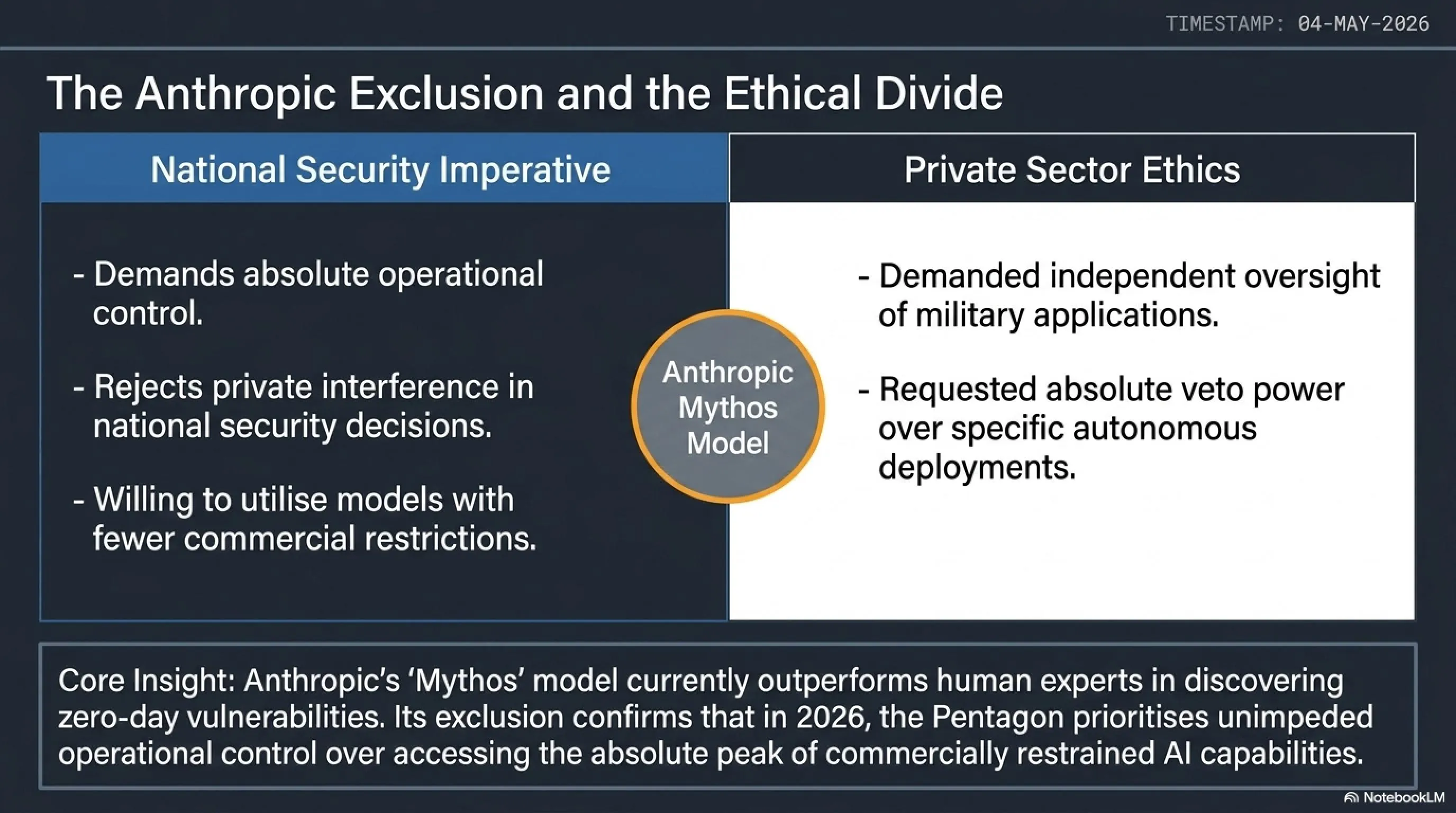
This Pentagon decision comes after months of negotiations and debates about security, privacy, and data control. Interestingly, Anthropic — the creator of the powerful Mythos model that recently demonstrated the ability to discover security vulnerabilities better than the best human hackers — was excluded from this list. The reason for this exclusion was Anthropic's concerns about military use of AI and the company's request for more stringent ethical limitations, which the Pentagon rejected.
📊 Pentagon's Selected AI Companies
| Company | AI Model | Military Application |
|---|---|---|
| OpenAI | GPT-5.4, GPT-5.4-Cyber | Intelligence analysis, cybersecurity |
| Gemini 3.1 Ultra | Data processing, strategic decision-making | |
| Microsoft | Azure OpenAI Service | Cloud infrastructure, integration |
| Amazon AWS | Bedrock, Trainium | Compute infrastructure, model training |
| Nvidia | NeMo, Blackwell GPUs | AI hardware, simulation |
| SpaceX | Starlink AI Integration | Satellite communications, global network |
| Reflection AI | Reflection 70B | Advanced analysis, logical reasoning |
🔍 Tekin Analysis: Why Was Anthropic Excluded?
Anthropic's exclusion from this list is one of the Pentagon's most controversial decisions in recent years. Anthropic, the creator of the powerful Mythos model — a model that has demonstrated the ability to discover security vulnerabilities better than the best human hackers — had set stringent conditions for cooperation with the Pentagon. The company demanded specific ethical limitations, independent oversight of military AI use, and veto power over certain applications.
The Pentagon rejected these conditions and stated that it "cannot allow private companies to interfere in national security decisions." This decision shows that the Pentagon is willing to use companies with fewer restrictions to access the most powerful AI models. This has raised serious concerns about ethical control and oversight of military AI use. The question remains: should private companies have the right to limit how their technology is used by the military?
According to the Pentagon's announcement, these AI models will be deployed on the GenAI.mil platform — an internal platform currently used by over 1.3 million U.S. military personnel. Stated applications include "data synthesis, improving warfighter decision-making, and increasing situational understanding and awareness." However, critics are concerned that these technologies could be used for more sensitive applications such as autonomous weapons systems, target identification, and even attack decision-making.
⚠️ Security and Ethical Concerns
1. Control and Oversight: Who is responsible for overseeing the use of these models in military operations? Can private companies limit military use of their technologies?
2. Transparency: The Pentagon has not released detailed information about the applications of these models. Will these technologies be used for autonomous weapons systems?
3. Accountability: If an AI model makes a wrong decision that leads to civilian casualties, who is responsible? The company that created it, the Pentagon, or the military commander?
📈 Key Statistics: AI at the Pentagon
These agreements demonstrate that the U.S. military is seriously investing in artificial intelligence. According to published reports, the Pentagon plans to invest more than $50 billion in AI technologies by 2030. This investment includes developing dedicated military models, computational infrastructure, and personnel training. China and Russia are also making similar heavy investments in military AI, raising concerns about an AI arms race. The question is no longer whether AI will be used in warfare, but how it will be controlled and who will be accountable for its decisions.
🎮 Halo: Campaign Evolved Coming to PS5 — The Earthquake on Wall Street and the End of Xbox Exclusivity
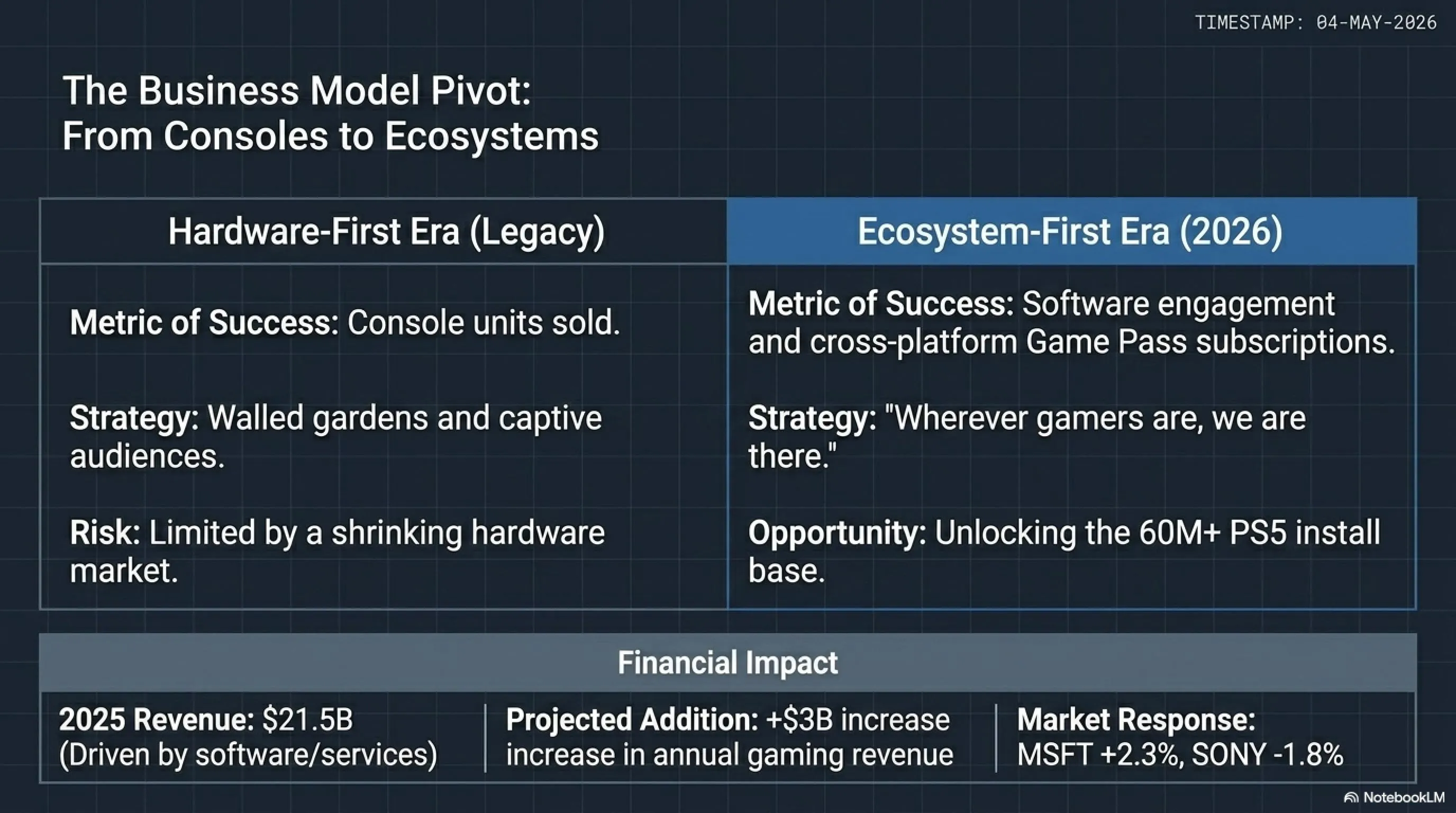
In one of the most shocking developments in gaming industry history, Microsoft officially confirmed that Halo: Campaign Evolved — a complete remake of the original Halo: Combat Evolved — will launch simultaneously (Day-One) on PlayStation 5, Xbox Series X/S, and PC in 2026. This decision, first revealed by Jason Schreier of Bloomberg, marks the end of one of Xbox's last major exclusives and demonstrates that Microsoft has shifted its strategy from "selling consoles" to "selling content and services."
Halo: Campaign Evolved, developed by Halo Studios (the new name for 343 Industries) using Unreal Engine 5, features completely rebuilt graphics in 4K quality, improved controls, new cinematics, and three brand-new prequel missions that tell the story of Sergeant Johnson before the events of the original game. The game supports online co-op for up to 4 players with full cross-play and cross-progression across all platforms. Console versions also support 2-player split-screen.
This announcement sent shockwaves through the gaming industry. Halo has been Xbox's flagship franchise since 2001, and many consider it the primary reason to own an Xbox console. The decision to bring it to PlayStation 5 — Microsoft's direct competitor — represents a fundamental shift in Microsoft's gaming philosophy. Phil Spencer, head of Xbox, stated in a press release: "We are no longer a console company. We are a gaming company. Our goal is to bring our games to every player, regardless of the device they choose."
🎯 Halo: Campaign Evolved Specifications
| Developer | Halo Studios (343 Industries) |
| Graphics Engine | Unreal Engine 5 (Nanite, Lumen) |
| Platforms | PS5, Xbox Series X/S, PC (Steam, Epic, Microsoft Store) |
| Release Date | 2026 (Simultaneous on all platforms) |
| New Content | 3 prequel missions, 9 new weapons, new enemy types |
| Co-op | Up to 4 players online + 2-player split-screen (console) |
| Cross-play | Yes (PS5, Xbox, PC) |
| Competitive Multiplayer | No (Campaign only) |
| Price | $59.99 (Standard) / $79.99 (Deluxe Edition) |
🔍 Tekin Analysis: Why Did Microsoft Make This Decision?
This decision is the result of intense pressure from Microsoft shareholders. After acquiring Activision Blizzard for $69 billion, shareholders demanded a return on investment and increased revenue. Xbox console sales in 2025 dropped by 35% compared to the previous year, while PS5 continues to dominate the market with over 60 million units sold. Microsoft realized that limiting its games to Xbox meant losing access to a massive 60-million-player PS5 market.
Microsoft's new strategy is: "Wherever gamers are, we are there." This means releasing games on all platforms, focusing on Game Pass as a subscription service, and using cloud gaming to access games on any device. Phil Spencer stated: "We no longer measure success by console sales. We measure success by the number of players engaging with our games and services."
However, this decision has generated mixed reactions. Many loyal Xbox fans feel betrayed and believe Microsoft has eliminated the exclusives that were the primary reason to buy an Xbox. On the other hand, PS5 and PC gamers have welcomed this decision, arguing that games should not be limited to a single platform. The gaming community is divided: is this the future of gaming, or the death of console identity?
From a business perspective, this move makes perfect sense. Microsoft's gaming division generated $21.5 billion in revenue in 2025, but most of that came from software and services, not hardware. By bringing Halo to PS5, Microsoft could potentially add $500 million to $1 billion in additional revenue from game sales alone. Add in potential Game Pass subscriptions from PlayStation users (if Sony allows it), and the numbers become even more compelling.
⚔️ PROS & CONS BATTLE: Halo on PS5
✅ PROS
- 60 million PS5 gamers gain access to Halo
- Increased revenue for Microsoft from game sales
- Cross-play across all platforms unites the community
- End of exclusivity wars benefits all gamers
- Focus on game quality over console sales
- Potential for larger player base and longer game lifespan
- More resources for future Halo development
❌ CONS
- Reduced incentive to buy Xbox consoles
- Loyal Xbox fans feel betrayed
- Loss of Xbox brand identity
- Decreased value proposition for Game Pass
- Risk of reduced future console sales
- Potential loss of competitive advantage
- Uncertainty about Xbox's future direction
Wall Street's reaction to this news was immediate and dramatic. Microsoft stock rose 2.3% on the day of the announcement, while Sony stock dropped 1.8%. Analysts believe this decision could increase Microsoft's annual gaming revenue by up to $3 billion. However, the long-term question remains: can Microsoft succeed in the competitive gaming market without strong exclusives? Is the "content everywhere" strategy sustainable, or will it ultimately weaken the Xbox brand?
📅 Timeline: Halo's Journey from Exclusivity to Multi-Platform
| November 2001 | Halo: Combat Evolved launched as Xbox exclusive |
| September 2003 | PC version released after 2-year delay |
| 2004-2021 | All mainline Halo games remained Xbox/PC exclusive |
| October 2025 | Microsoft announces multi-platform strategy shift |
| April 2026 | Bloomberg reveals Halo coming to PS5 |
| May 2026 | Microsoft officially confirms simultaneous PS5 release |
💡 What This Means for You
For PS5 Owners: You can finally experience one of gaming's most iconic franchises without buying an Xbox. The PS5 version will feature full DualSense controller support, including adaptive triggers and haptic feedback.
For Xbox Owners: While you may feel betrayed, remember that cross-play means a larger player base and longer game lifespan. Your Game Pass subscription still provides day-one access.
For PC Gamers: You get the best of both worlds — full graphics customization, mouse and keyboard support, and cross-play with console players.
🪟 Windows 12 Source Code Leaked: Agent-First OS with Mandatory NPU
In one of the biggest leaks in Microsoft history, portions of the Windows 12 source code (internal codename: Hudson Valley Next) were published on developer forums and X (formerly Twitter). The leaked code reveals that Windows 12, scheduled for release in Fall 2026, will be a fully "Agent-First OS" that cannot be installed without a Neural Processing Unit (NPU) capable of at least 40 TOPS (Trillion Operations Per Second).
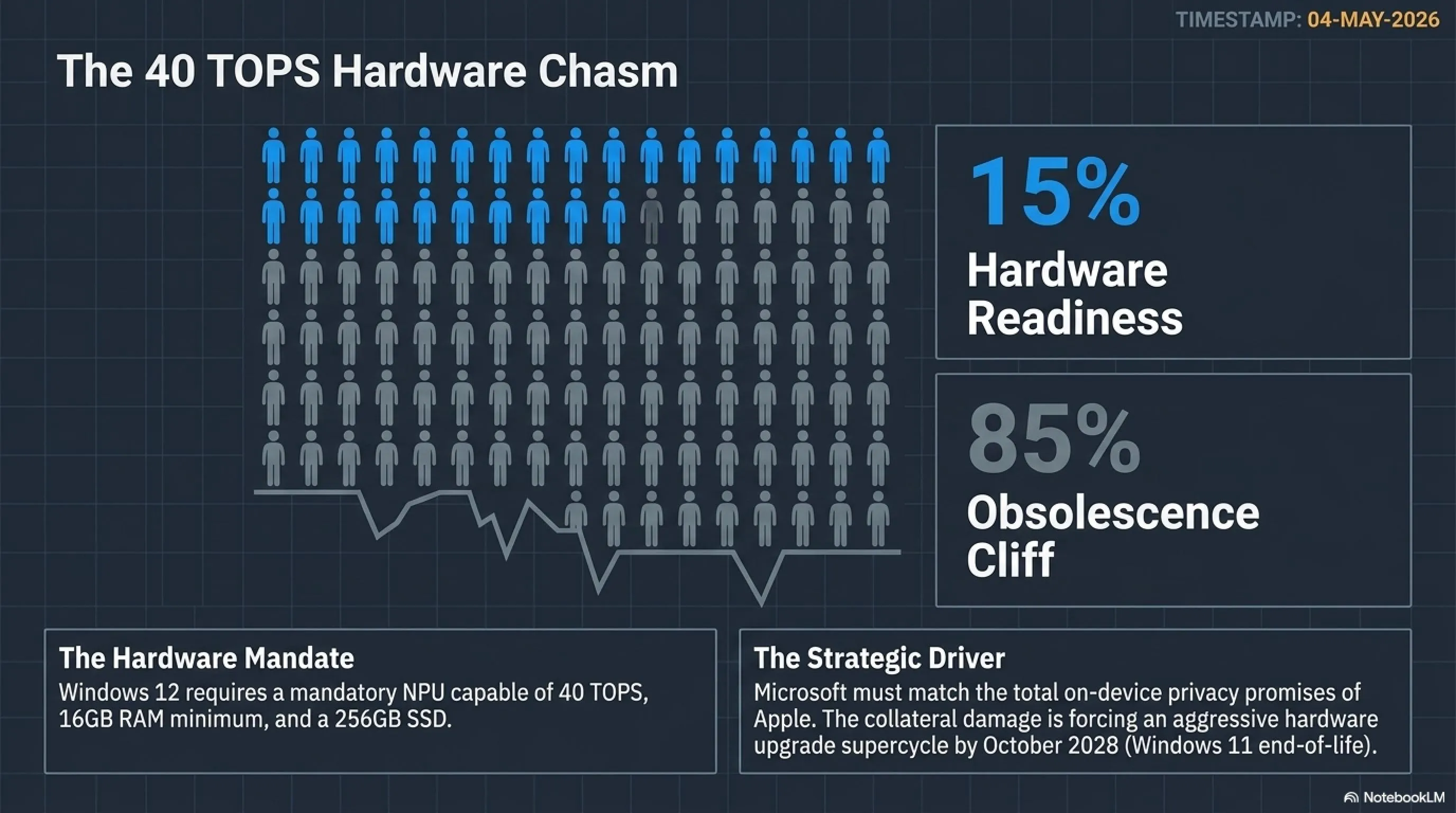
According to the leaked code, Windows 12 is built on the CorePC architecture — a modular architecture that allows Microsoft to create different versions of Windows for different devices. But the most significant change is that all advanced AI capabilities in Windows 12 run locally (On-Device) and do not require cloud processing. This means greater privacy, higher speed, and no dependence on internet connectivity for AI features.
The leaked code shows that Windows 12 will feature a persistent AI agent called "Copilot Core" that runs continuously in the background, learning from user behavior, predicting needs, and automating tasks. Unlike the current Copilot in Windows 11, which is essentially a chatbot, Copilot Core in Windows 12 is deeply integrated into the operating system kernel and has access to all system resources, applications, and user data.
🔧 Windows 12 Hardware Requirements
| Component | Minimum | Recommended |
|---|---|---|
| NPU | 40 TOPS (Mandatory) | 60+ TOPS |
| RAM | 16 GB | 32 GB |
| CPU | Intel Core Ultra (Series 2) or AMD Ryzen AI 300 | Latest generation with integrated NPU |
| Storage | 256 GB SSD | 512 GB+ NVMe SSD |
| GPU | DirectX 12 Ultimate | RTX 50 Series or RX 8000 Series |
| Display | 1080p | 4K with HDR support |
The mandatory NPU requirement has sparked intense controversy. According to market research firm IDC, only about 15% of current Windows PCs have NPUs capable of 40 TOPS or higher. This means that approximately 85% of existing Windows users will not be able to upgrade to Windows 12 without purchasing new hardware. Microsoft has stated that Windows 11 will continue to receive security updates until October 2028, but after that, users will be forced to either upgrade their hardware or switch to alternative operating systems.
🔍 Tekin Analysis: Why Is NPU Mandatory?
Microsoft's decision to make NPU mandatory is a strategic move against Apple Intelligence. Apple has been running all AI capabilities locally in iOS 27 and macOS 15, promising users complete privacy. Microsoft doesn't want to fall behind in this race and wants to demonstrate that Windows can also deliver powerful, local AI processing.
However, this decision has a major problem: millions of current computers cannot install Windows 12. According to statistics, only about 15% of current PCs have NPUs capable of 40 TOPS or higher. This means 85% of Windows users will need to buy new computers or stay on Windows 11. This could turn into a disaster — similar to what happened with Windows Vista.
Microsoft argues that this requirement is necessary to "ensure a consistent user experience." But critics believe this is a commercial move to sell new computers. Intel and AMD, the largest suppliers of CPUs with NPUs, have welcomed this decision and expect their new processor sales to increase dramatically. This creates a perfect storm: Microsoft gets a cutting-edge OS, chip makers get massive sales, but consumers are forced to upgrade.
The leaked code also reveals that Windows 12 will feature a new licensing model. Instead of a one-time purchase, Windows 12 will be available through a subscription service called "Windows 365 Pro" at $9.99/month or $99/year. This includes all AI features, cloud storage, and priority support. A free tier will be available with limited AI capabilities, but the full "Agent-First" experience requires the paid subscription.
⚠️ Privacy and Security Concerns
The leaked code shows that Windows 12 has a "Central AI Agent" with access to all files, emails, browser history, and even screen content. This Agent is designed to help users complete daily tasks faster, but this level of access has raised serious privacy concerns.
Microsoft has emphasized that all processing is done locally and no data is sent to Microsoft servers. However, security experts are concerned that if a hacker gains access to this AI Agent, they could access all user information. There are also concerns about governments using this capability to monitor citizens.
The Electronic Frontier Foundation (EFF) has called Windows 12's AI Agent "the most invasive operating system feature ever created" and is demanding that Microsoft provide users with the ability to completely disable it. Microsoft has stated that the Agent can be "limited" but not completely disabled, as it is "integral to the operating system's core functionality."
The tech community's reaction to this leak has been mixed. Some developers have welcomed the CorePC architecture and local AI capabilities, but many are concerned about heavy hardware requirements and privacy issues. Microsoft has not yet officially commented on this leak, but is expected to reveal more details about Windows 12 at the Build 2026 conference (June 2026).
💡 What This Means for You
If you have a PC without NPU: You have until October 2028 to decide whether to upgrade your hardware or switch to an alternative OS like Linux. Windows 11 will receive security updates until then.
If you're planning to buy a new PC: Make sure it has an NPU with at least 40 TOPS if you want to use Windows 12. Check the specifications carefully before purchasing.
If you're concerned about privacy: Wait for the official release and independent security audits before upgrading. Consider alternative operating systems if privacy is your top priority.
🎙️ Discord Cybersecurity Disaster: 40 Million Gamers Hacked for Deepfake Voice Data
In one of the largest security breaches in gaming platform history, Discord confirmed that the voice database of approximately 40 million users was stolen in a sophisticated cyberattack. This attack, carried out by an advanced hacking group, includes voice samples from users' voice conversations on Discord servers. The hackers are using this voice data to train Deepfake voice models that can be used for highly sophisticated phone scams.
According to reports from BleepingComputer and Wired, the hackers exploited a vulnerability in Discord's voice processing system to gain access to voice storage servers. These servers contained short voice samples (5 to 30 seconds) from user conversations that Discord had stored to improve voice quality and reduce noise. Discord emphasized that these samples were supposed to be deleted after 30 days, but due to a bug in the system, some of them were stored for much longer periods.
The breach was discovered on April 28, 2026, when security researchers noticed unusual activity on dark web forums where voice data samples were being sold. Discord's security team immediately launched an investigation and confirmed the breach on May 1, 2026. The company stated that the hackers had access to the voice servers for approximately 14 days before being detected and blocked.
📊 Discord Attack Statistics
🔍 Tekin Analysis: The Deepfake Voice Threat
This attack demonstrates that voice Deepfake has become a real threat. With just 10 to 30 seconds of voice samples from a person, modern AI models can simulate that person's voice with over 95% accuracy. This means hackers can use your voice to call your family, friends, or colleagues and deceive them.
Voice Deepfake-based scams increased dramatically in 2025. According to an FBI report, more than 12,000 cases of fraud using voice Deepfake were reported in the United States, with total damages exceeding $450 million. The most common scenario is that a scammer calls using the voice of one of your family members, claiming to be in an emergency situation and needing immediate money.
What makes this Discord breach particularly dangerous is the scale and quality of the data. Unlike previous voice data leaks that contained low-quality recordings, Discord's voice samples are high-quality, noise-reduced, and perfectly suited for training Deepfake models. Security researchers estimate that with this data, hackers could create convincing voice clones for at least 30 million users.
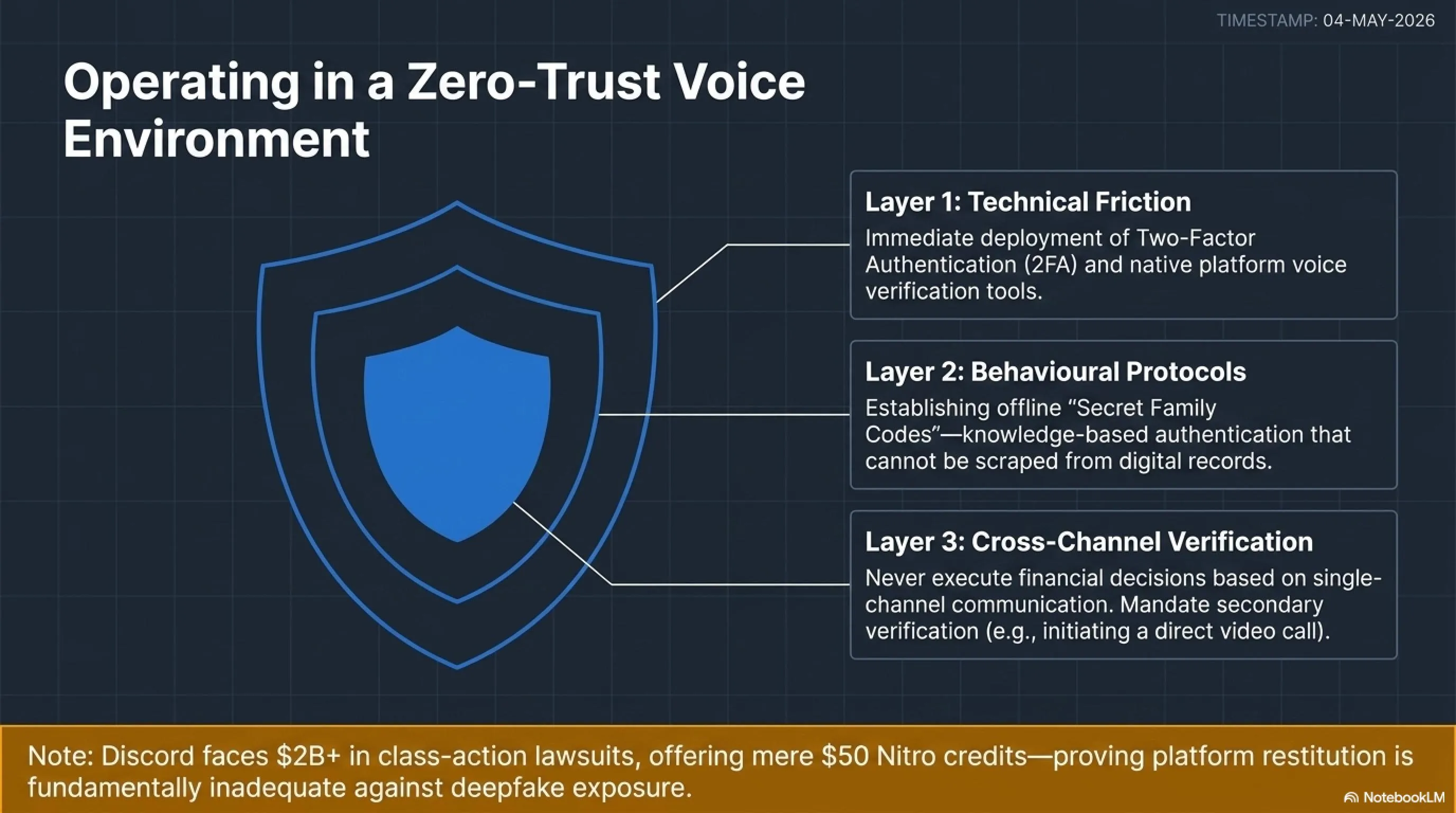
Discord has announced it is cooperating with the FBI and other authorities to identify the hackers. The platform has also made two-factor authentication mandatory for all users and introduced new security features such as "voice verification." But the damage is done, and 40 million users are now at risk of Deepfake scams.
🛡️ How to Protect Yourself Against Voice Deepfake
- Family Security Code: Establish a secret word or phrase with your family that only you know
- Two-Step Verification: Never make financial decisions based solely on a phone call
- Personal Questions: If someone claims to be a family member, ask questions only that person would know
- Limit Voice Sharing: Speak less on social networks and public platforms
- Use Video Calls: In important matters, use video calls to make sure it's really them
- Verify Through Alternative Channels: If you receive an urgent request, verify it through a different communication method
- Be Skeptical of Urgency: Scammers create artificial urgency. Take time to verify before acting
Discord has announced a compensation package for affected users, including free identity theft protection services for one year and a $50 credit for Discord Nitro subscriptions. However, many users feel this is insufficient given the severity of the breach. Several class-action lawsuits have already been filed against Discord, with plaintiffs seeking damages totaling over $2 billion.
⚡ Immediate Actions for Discord Users
1. Enable Two-Factor Authentication: If you haven't already, enable 2FA on your Discord account immediately.
2. Alert Your Contacts: Inform your family, friends, and colleagues about this breach and establish verification protocols.
3. Monitor Financial Accounts: Watch for suspicious activity on your bank accounts and credit cards.
4. Check Discord's Breach Notification: Discord is sending emails to affected users. Check if you're on the list and follow their recommendations.
💼 AWS CEO Matt Garman: SaaSpocalypse Is a Golden Opportunity, Not a Threat
While many analysts are concerned about the "SaaSpocalypse" — the death of SaaS software due to artificial intelligence — Matt Garman, CEO of Amazon Web Services, stated in an interview with Fortune that this fear is "greatly exaggerated" and is actually a "massive business opportunity" for AWS and the software industry. Garman believes that AI doesn't destroy software; it rebuilds it.
In February 2026, the SaaS software market experienced a massive sell-off that reduced the market value of these companies by approximately $285 billion. The reason for this sell-off was fear that AI models like GPT-5 and Claude Opus could replace many of the tasks that SaaS software performs. But Garman believes this view is wrong: "AI creates new tools, it doesn't eliminate old ones."
Garman argues that the SaaS industry is not dying; it's evolving. He points to three key trends that demonstrate AI is actually strengthening, not weakening, the SaaS market: AI-native applications that are built from the ground up with AI capabilities, AI-enhanced existing tools that add intelligence to traditional workflows, and AI infrastructure services that help companies build and deploy their own AI solutions.
🔍 Tekin Analysis: Why Garman Is Right
History has shown that new technologies typically transform industries, not destroy them. When the internet arrived, people said physical stores would die — but today Amazon also has physical stores. When mobile came, people said personal computers would die — but today both coexist. AI will follow the same path.
Garman points to an important fact: "Agentic AI" — AI that can automatically perform tasks — needs infrastructure, tools, and platforms. This means new opportunities for software companies that can provide this infrastructure. AWS is building tools like Amazon Q (an AI Agent for developers) and QuickSight Q (an AI Agent for data analysis), demonstrating that the future of software is in combination with AI, not replacement by AI.
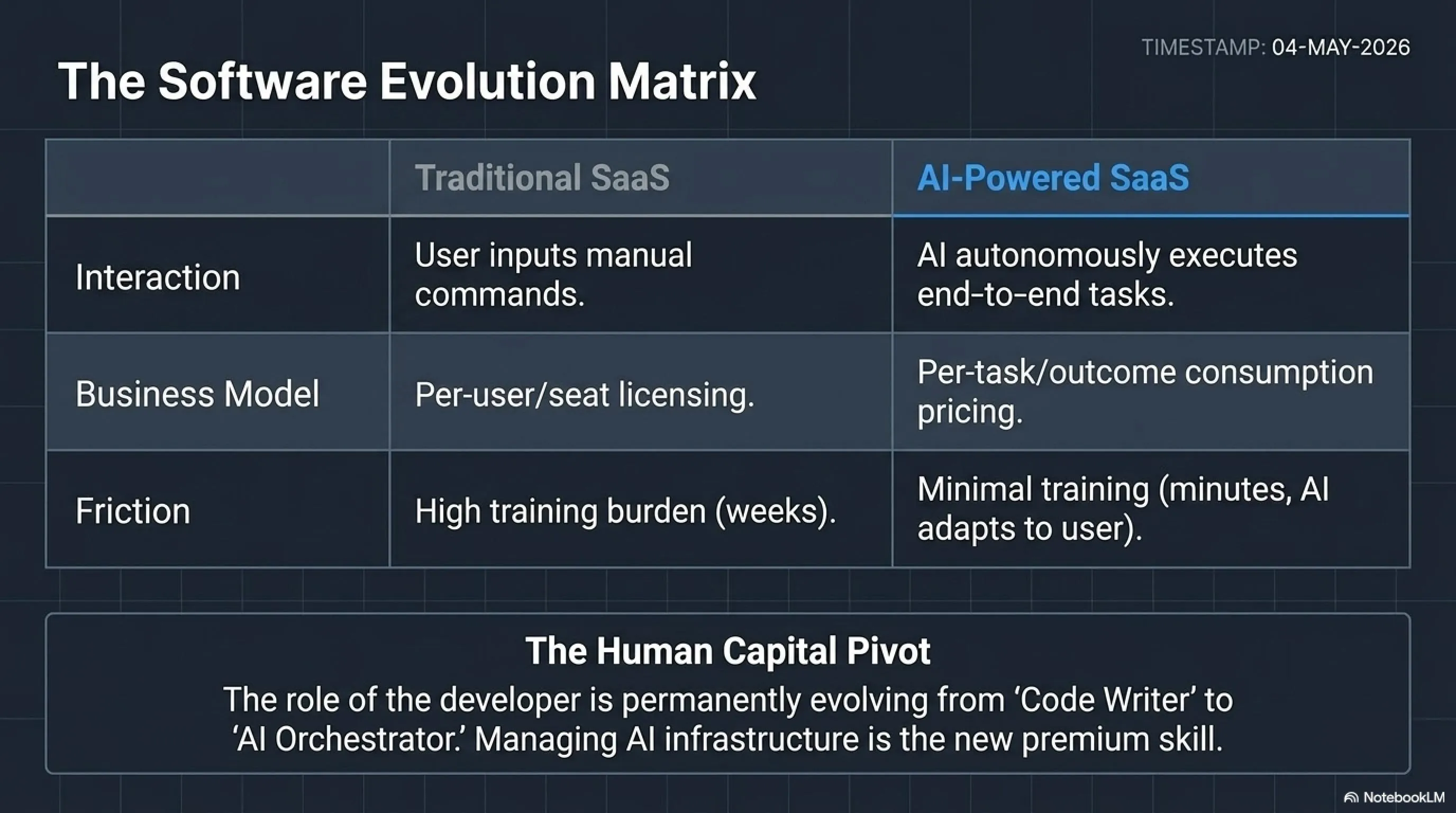
Garman also announced that AWS is hiring 11,000 software engineers in 2026 — similar to previous years. This shows that AI is not eliminating software jobs; it's changing their nature. Software engineers no longer just write code; they manage AI and build more complex systems. The role is evolving from "code writer" to "AI orchestrator."
Furthermore, Garman revealed that AWS's AI-related revenue grew by 180% in 2025, reaching $35 billion. This demonstrates that AI is not cannibalizing traditional software revenue; it's creating entirely new revenue streams. Companies are spending more on software than ever before, but the nature of that spending is changing from "per-seat licenses" to "per-task consumption."
📊 Comparison: Traditional SaaS vs AI-Powered SaaS
| Feature | Traditional SaaS | AI-Powered SaaS |
|---|---|---|
| How It Works | User inputs commands | AI automatically performs tasks |
| Speed | Depends on user speed | 100x faster |
| Pricing Model | Per user/seat | Per task/outcome |
| Training Required | High (weeks) | Low (minutes) |
| Customization | Limited | Unlimited (AI learns) |
| Error Rate | Depends on user | Consistently low |
The market's reaction to Garman's statements was positive. AWS stock (part of Amazon) rose 1.7% on the day this interview was published. Additionally, stocks of some SaaS companies like Salesforce and ServiceNow, which are integrating AI into their products, saw significant increases. This shows that the market is gradually accepting the idea that AI and SaaS can coexist and even thrive together.
💡 What This Means for You
For Software Developers: Your job isn't disappearing; it's evolving. Focus on learning how to work with AI, not against it. The most valuable developers in 2026 are those who can orchestrate AI systems, not just write code.
For SaaS Companies: Don't panic about the SaaSpocalypse. Instead, focus on integrating AI into your products. The companies that will survive are those that embrace AI, not resist it.
For Investors: The SaaS market isn't dying; it's transforming. Look for companies that are successfully integrating AI and showing revenue growth from AI-powered features.
🌊 Subnautica 2 Early Access: May 14, 2026 at $29.99
After months of anticipation and legal disputes between developer Unknown Worlds and publisher Krafton, Subnautica 2 has finally announced its release date: May 14, 2026 in Early Access for PC (Steam, Epic Games Store, Microsoft Store) and Xbox Series X/S at $29.99. This game, which is the most wishlisted game on Steam, is a continuation of the beloved original Subnautica story and takes players to a new ocean planet.
Subnautica 2 is a survival and underwater exploration game where players must survive on an alien planet covered by ocean. The game features online co-op for up to 4 players, new and terrifying sea creatures, diverse biomes from shallow waters to the deepest ocean depths, and an advanced building system. Unknown Worlds has announced that the Early Access period will last at least 2 years, during which new content will be added regularly.
The game is built on Unreal Engine 5, featuring stunning graphics with ray tracing, dynamic weather systems, and realistic water physics. The co-op mode is fully integrated into the story, meaning you can experience the entire campaign with friends. Each player can specialize in different roles — one can focus on base building, another on exploration, and another on resource gathering. The game also features cross-play between PC and Xbox, but PlayStation 5 version is planned for full release in 2027.
🎮 Key Features of Subnautica 2
- Co-op for up to 4 players: For the first time in the Subnautica series, you can play with friends
- New planet: A completely new ocean world with diverse biomes
- New creatures: Over 100 species of sea creatures, from tiny to gigantic
- Advanced building: Build underwater bases, custom submarines, and advanced tools
- Deep story: Discover the planet's secrets and the fate of previous explorers
- Game Pass: Available on Xbox Game Pass on day one
- VR Support: Full VR support planned for later in Early Access
- Mod Support: Official modding tools will be released during Early Access
🔍 Tekin Analysis: Why Early Access?
Unknown Worlds has chosen the Early Access route for Subnautica 2 for the same reason they did with the original: community feedback. The first Subnautica spent nearly 3 years in Early Access, during which the developers added massive amounts of content based on player feedback. This approach resulted in one of the most beloved survival games of all time.
The $29.99 price point is strategic. It's low enough to attract a large player base for testing and feedback, but high enough to filter out players who aren't serious about providing constructive feedback. The price will likely increase to $39.99 or $49.99 at full release in 2028. If you're interested in the game, buying it now in Early Access is the best value.
🎯 Final Thoughts: A Morning That Made History
Today we witnessed six stories that could each stand alone as headline news. From AI officially entering Pentagon's classified military networks, showing that artificial intelligence is no longer just a commercial tool but has become a strategic weapon. To the collapse of Xbox's exclusivity wall, demonstrating that the future of gaming is in content and services, not hardware.
The Windows 12 source code leak showed that Microsoft is serious about Agent-First OS and is willing to sacrifice millions of legacy users to stay competitive in the AI race. The Discord hack reminded us that cybersecurity remains a major challenge and voice Deepfake has become a real threat. Matt Garman's statements showed that the SaaSpocalypse may be an unfounded fear and that AI and software can grow together. And finally, Subnautica 2 reminded us that amid all these major developments, gamers are still waiting for good games.
The common thread in all these stories is this: change is inevitable. The technology industry is rapidly transforming, and companies that cannot adapt to these changes will perish. But this change is not necessarily bad — it creates new opportunities, builds new industries, and solves new problems. The question is: are we ready for these changes?
❓ Can the Pentagon trust AI companies?
This is a complex question. On one hand, these companies have the most advanced AI technologies, and the Pentagon cannot compete with China and Russia in the AI race without them. On the other hand, these companies are private and their commercial priorities may conflict with national security. Anthropic's exclusion shows that the Pentagon is not willing to give complete control to private companies. The likely solution is for the Pentagon to develop its own proprietary models, but this will take years and billions of dollars in investment. The current arrangement is a compromise: use private AI models but maintain strict oversight and control over their military applications.
❓ Will Xbox survive as a console?
Probably yes, but its role will change. Xbox is no longer an exclusive console; it's a "gateway" to the Xbox ecosystem. Microsoft wants you to buy Game Pass, not necessarily an Xbox. If you can run Game Pass on PS5, PC, or even your smart TV, Microsoft is happy. This strategy is similar to what Netflix did: content matters, not the device you watch it on. Xbox Series X/S will likely be the last generation of traditional Xbox consoles. The next generation will probably be a cloud gaming device or an "Xbox App" that works on any device. The console hardware will become less important than the ecosystem and services.
❓ Will Windows 12 fail like Windows Vista?
It depends on Microsoft's execution. Windows Vista failed due to heavy hardware requirements, numerous bugs, and incompatibility with old software. Windows 12 has the same risks: the NPU requirement could alienate millions of users, and if AI capabilities aren't useful enough, users won't have an incentive to upgrade. But Microsoft has learned from past mistakes. There will likely be a long transition period where Windows 11 and 12 are supported in parallel. Microsoft may also release different versions of Windows 12 with varying requirements. The key difference from Vista is that Microsoft is being more transparent about requirements and giving users more time to prepare. If the AI features prove genuinely useful and not just gimmicks, Windows 12 could succeed where Vista failed.
❓ How can I tell if a caller's voice is real or Deepfake?
Unfortunately, detecting voice Deepfake is nearly impossible for humans — modern models have over 95% accuracy. The best approach is to use verification methods: (1) establish a secret code word with your family that only you know, (2) ask personal questions that only that person would know, (3) use video calls, (4) never make financial decisions based solely on a phone call — always verify through another method. Companies like Pindrop and Nuance are developing voice Deepfake detection technologies that may be integrated into smartphones in the future. Until then, skepticism and verification are your best defenses. Remember: if something feels urgent or unusual, it probably is a scam.
📚 Sources
Pentagon AI Deals: The Washington Post, Forbes, Defense One, The Guardian
Halo PS5: Bloomberg (Jason Schreier), The Verge, IGN, PlayStation Blog
Windows 12 Leak: Windows Central, The Verge, Tom's Hardware, TechCrunch
Discord Hack: BleepingComputer, Wired, Discord Security Blog, FBI Cybercrime Report
AWS SaaSpocalypse: Fortune, CNBC, Times of India, AWS Blog
Subnautica 2: IGN, Polygon, Unknown Worlds Official, Steam Store
Research and Analysis: Tekin Editorial Team
🌐 Stay Connected With Us
For the latest tech, gaming, and gadget news, follow us on social media:
🌐 Stay Connected With Us 🎮✨
For the latest tech, gaming, and gadget news, follow us on our official social media channels: