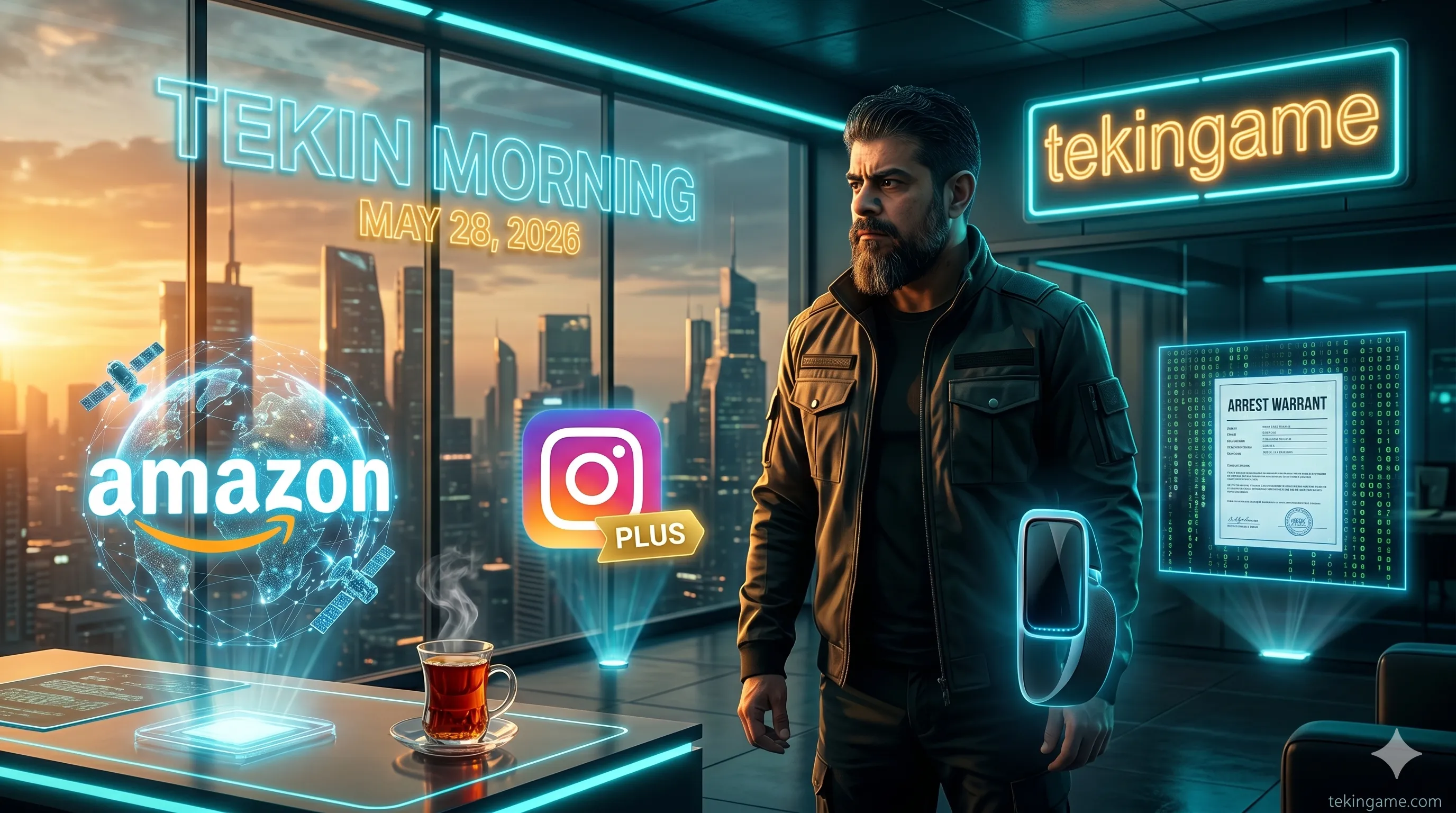
🌅 Welcome to Tekin Morning May 28, 2026
Good morning, tech enthusiasts! Thursday kicks off with six strategic and transformative stories from the technology world. Today we witness an $11 billion satellite deal, a social media revenue revolution, and a Google security scandal that could reshape the industry's future.
⚡ Today's Headlines:
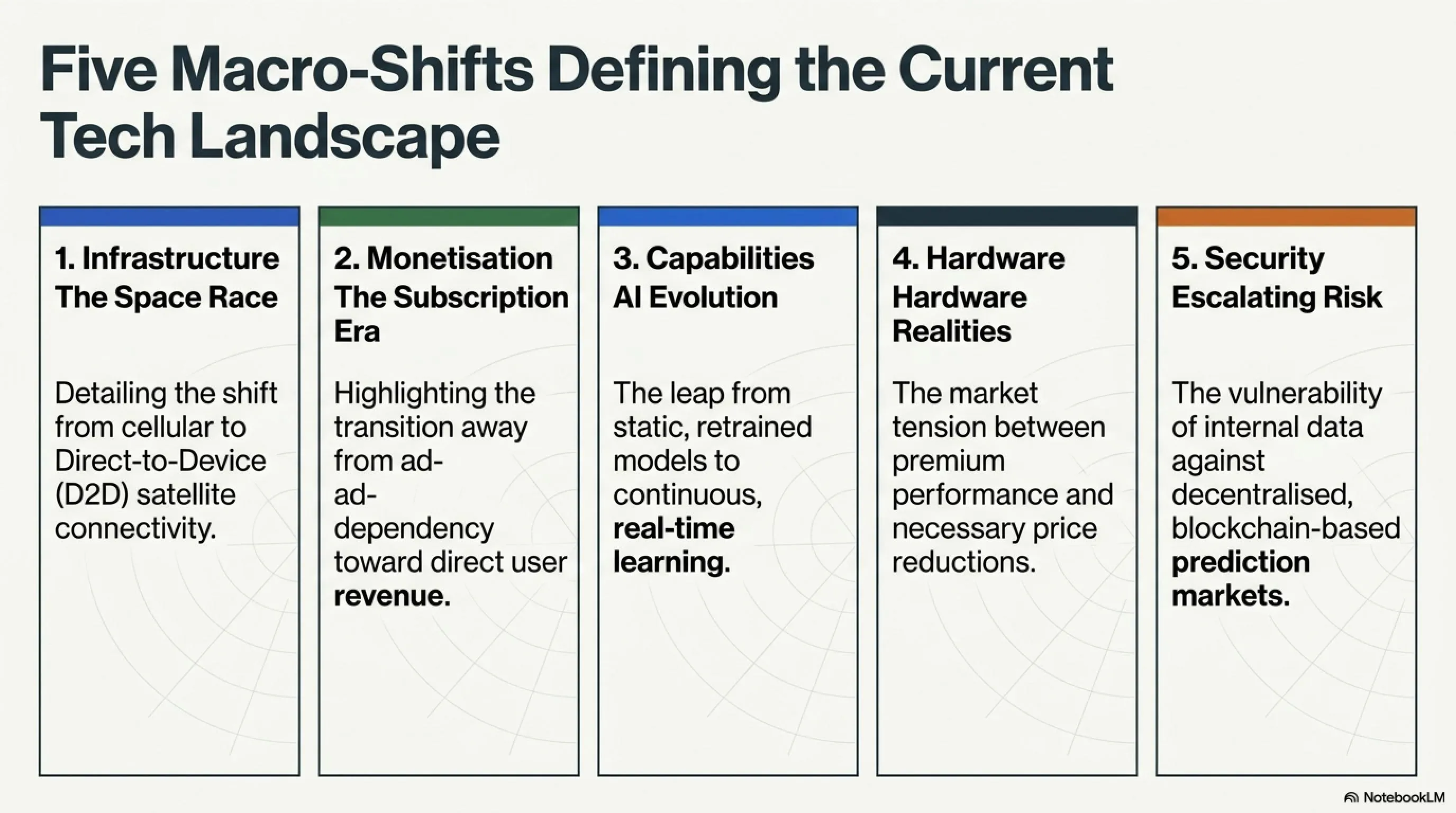
🛰️ Amazon Acquires Apple's 20% Globalstar Stake - The Satellite Wars
💰 Meta Launches Instagram Plus & Facebook Plus Subscriptions
🤖 Trajectory Startup: Continuous Learning AI from Google & Apple
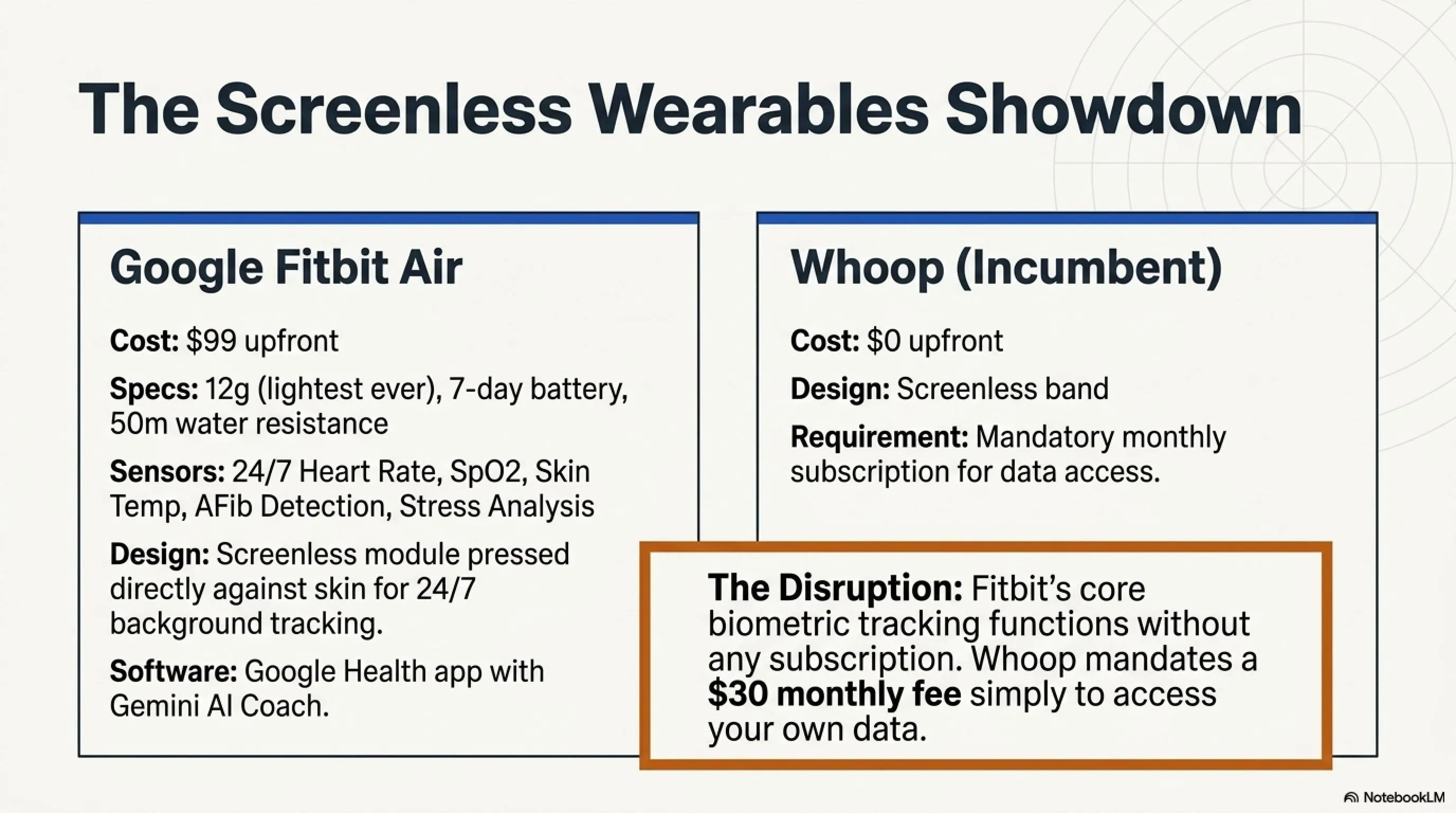
⌚ Google Fitbit Air: $99 Whoop Competitor Without Screen
📱 Historic iPad Air M4 Discount Up to $100
⚖️ Google Engineer Charged with $1.2M Polymarket Insider Trading
☕ Grab your coffee and get ready for a comprehensive journey through the tech world!
🛰️ Amazon Acquires Apple's 20% Globalstar Stake: Satellite Wars Enter New Phase
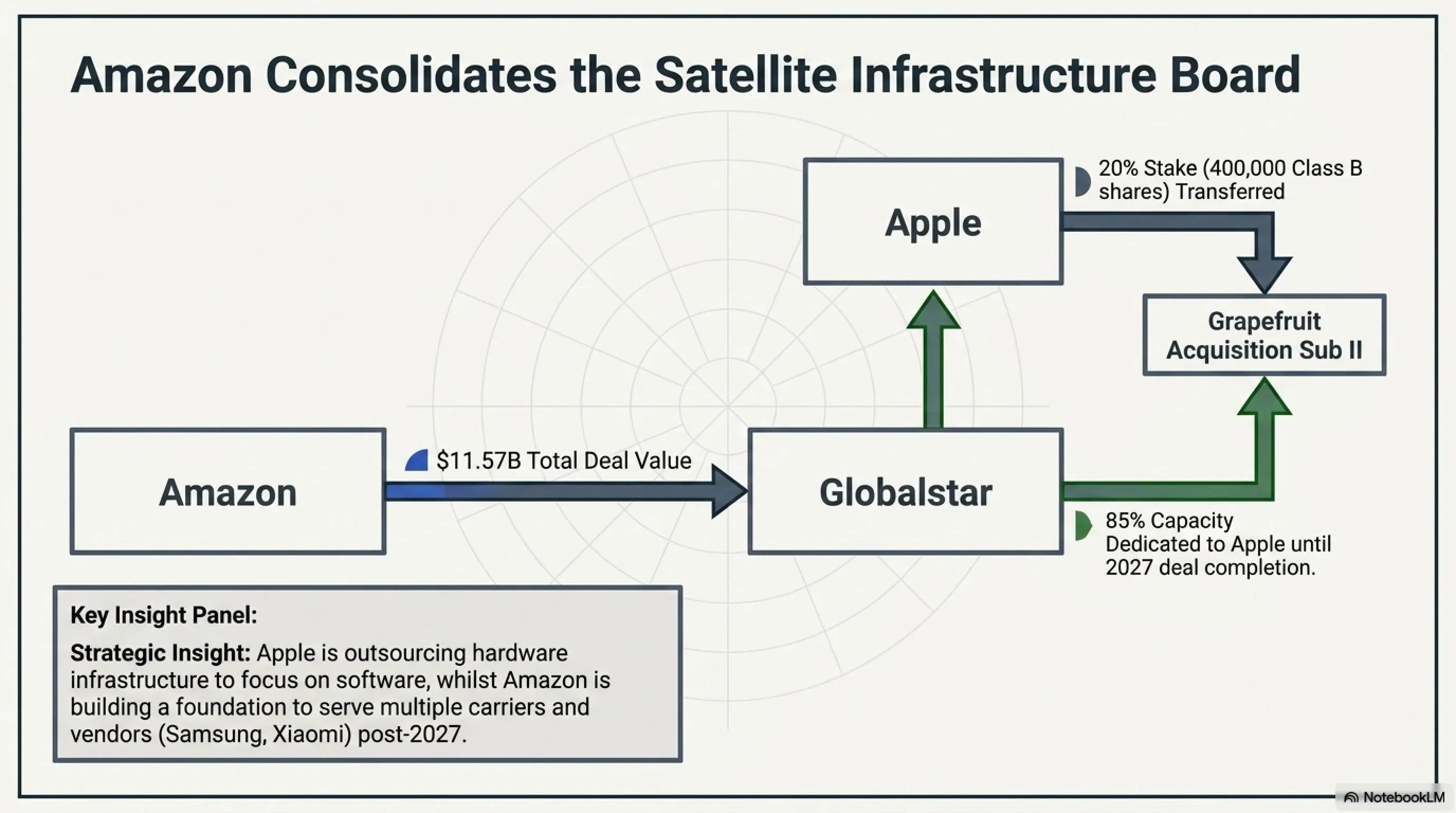
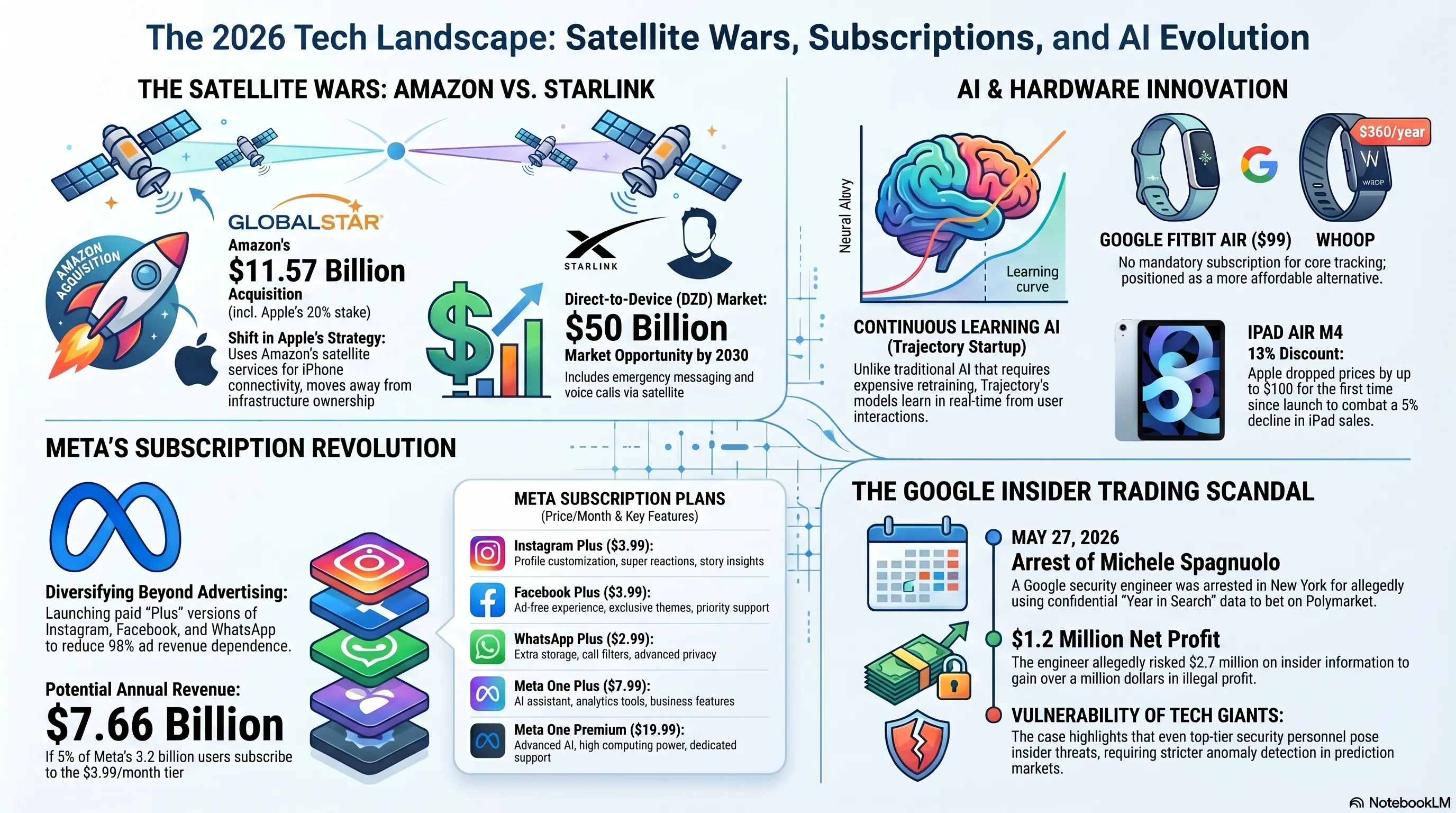
In one of 2026's biggest strategic deals, Amazon announced that in addition to its $11.57 billion acquisition of Globalstar, it will also acquire Apple's 20% stake in the satellite communications company. This news, revealed through FCC filings, demonstrates that competition in the smartphone satellite communications market has entered a critical and defining phase.
Apple invested $1.1 billion in 2024 and purchased 400,000 Class B shares to own 20% of Globalstar, enabling Emergency SOS and satellite messaging services for iPhone and Apple Watch. Under the agreement, Globalstar dedicated 85% of its satellite capacity to Apple. But now with Amazon entering the equation, these shares and voting rights will transfer to a subsidiary called Grapefruit Acquisition Sub II, which will manage Globalstar's operations.
📊 Amazon-Globalstar Deal Key Statistics
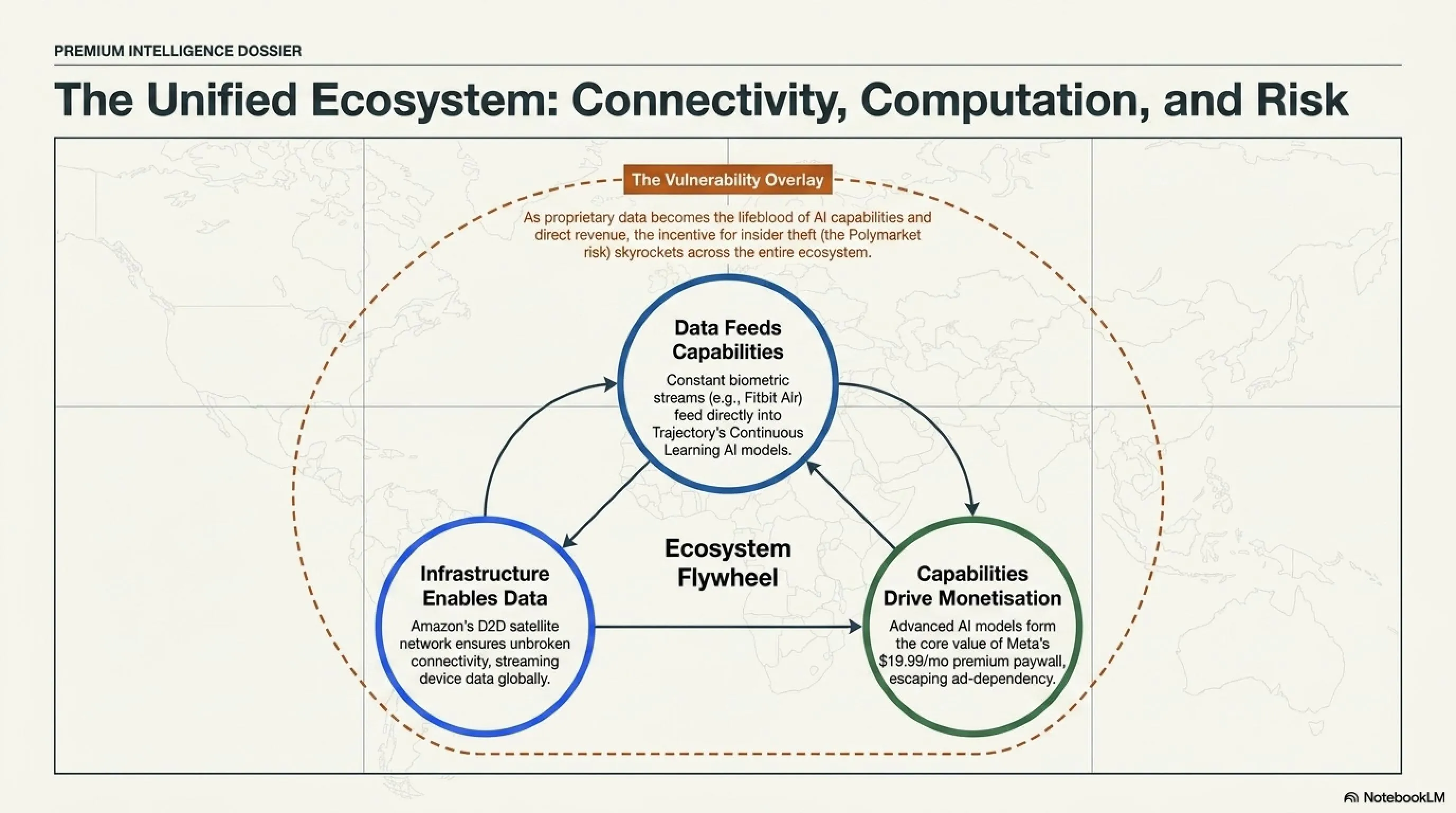
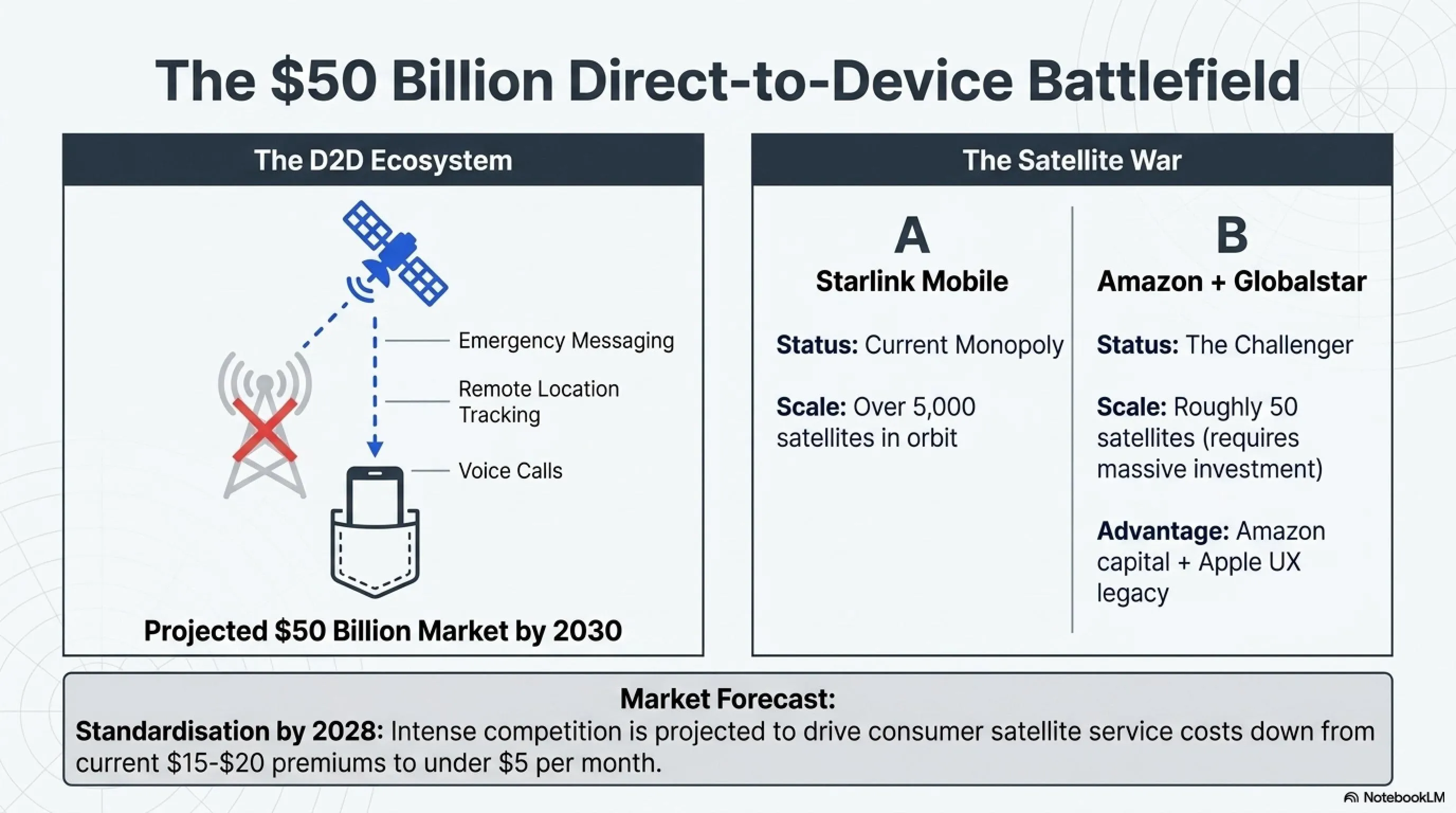
The critical point is that Amazon plans to use Globalstar to provide satellite services to "smartphones and other mobile devices across multiple carriers and vendors"—not just Apple. This means Amazon wants to become a direct competitor to Elon Musk's Starlink Mobile and AST SpaceMobile, offering satellite services to all smartphone brands. In essence, the satellite wars have moved from space into consumers' pockets.
According to FCC documents, Amazon emphasized that Globalstar's spectrum is essential for competing in the Direct-to-Device (D2D) market. This market, projected to reach $50 billion by 2030, includes services like emergency messaging, location tracking in areas without cellular coverage, and even voice calls via satellite. With this acquisition, Amazon not only enters this market but can move faster than competitors by leveraging Globalstar's existing infrastructure and Apple's experience.
🎯 Tekin Analysis: Why This Deal Is a Game-Changer
This deal shows Amazon has a long-term strategy to become a satellite communications giant. By acquiring Globalstar and Apple's stake, Amazon gains not only satellite infrastructure but also benefits from Apple's years of experience delivering Emergency SOS services. This move could signal the end of Starlink's monopoly in consumer satellite communications.
On the other hand, Apple's sale of its stake shows it prefers using Amazon's services rather than directly investing in satellite infrastructure. This strategic decision could mean Apple is focusing more on software and user experience while outsourcing hardware infrastructure to external partners. For American consumers, this means potentially cheaper and more widespread satellite services in the near future, with competition driving innovation and affordability.
🔮 Market Forecast: What's Coming Next?
- Intensified Competition: With Amazon's entry, Starlink and AST SpaceMobile will be forced to lower prices and improve services
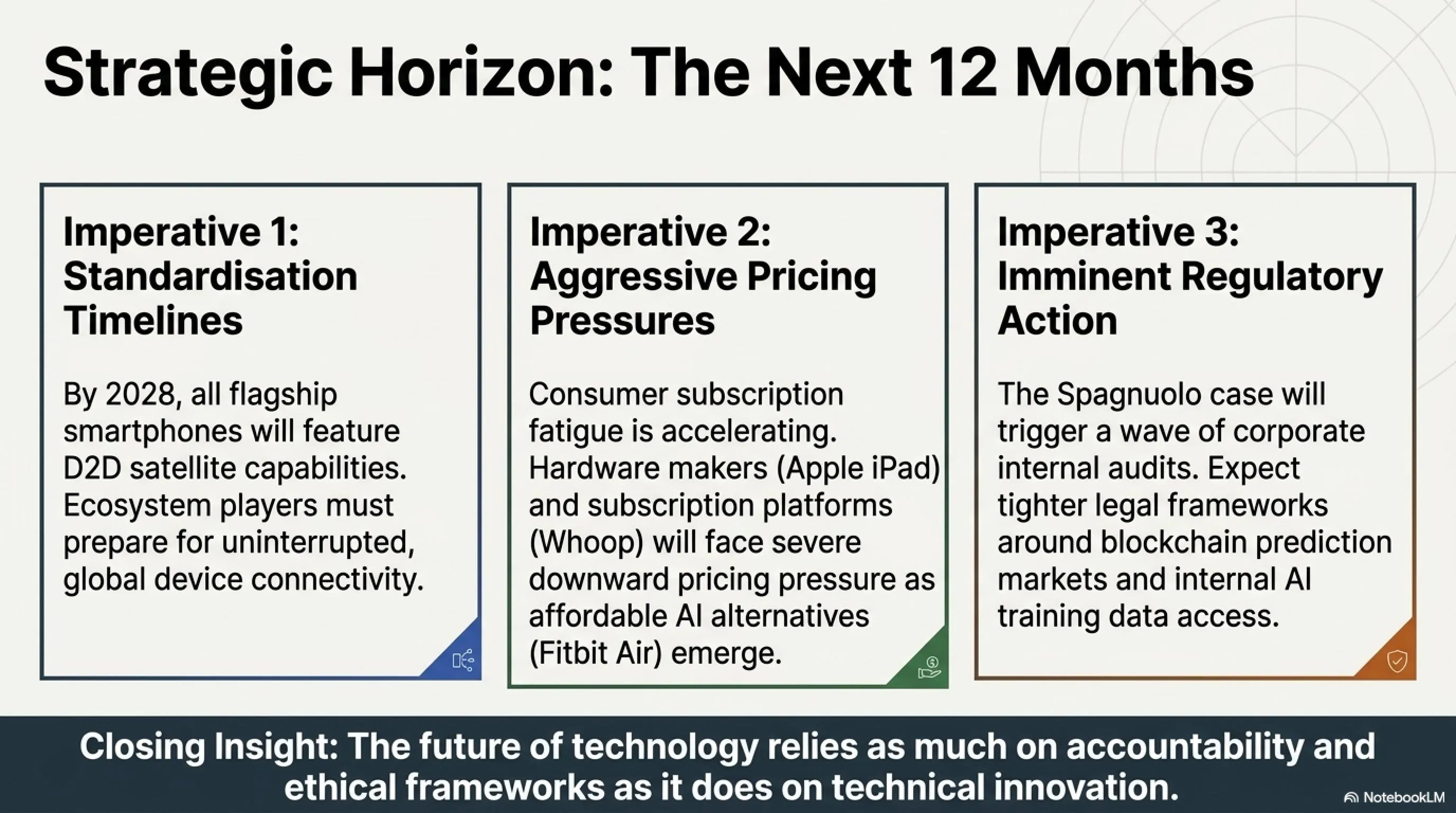
- Standardization: By 2028, all flagship smartphones will likely have satellite communication capabilities
- Price Reduction: Competition could reduce satellite service costs from $15-20 to under $5 per month
- New Applications: From agricultural IoT to transportation tracking in remote areas
The Amazon-Globalstar deal is expected to close in 2027 after receiving final regulatory approvals. Until then, Apple will continue using Globalstar services for iPhone and Apple Watch, but Amazon plans to expand its services to other smartphone manufacturers. This could mean Samsung, Xiaomi, and even Chinese brands gaining access to satellite services—something that has been Apple's exclusive domain until now.
💰 Meta's Subscription Revolution: Instagram Plus, Facebook Plus & WhatsApp Plus
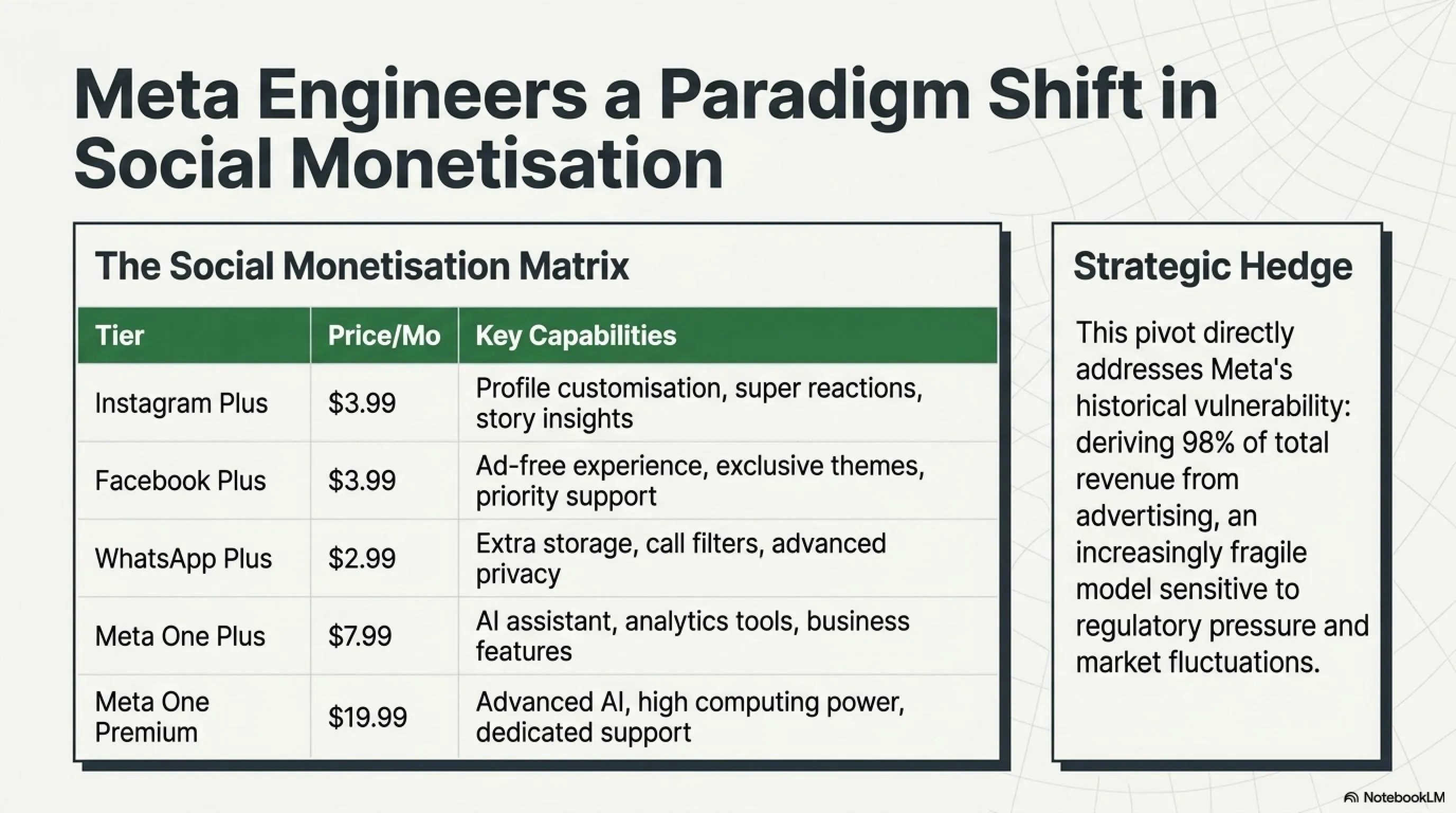
In one of the biggest shifts in social media revenue models, Meta officially launched paid subscriptions for Instagram Plus, Facebook Plus, and WhatsApp Plus worldwide. This strategic move, which has been in testing for months, shows Meta wants to reduce its dependence on advertising revenue and create direct revenue streams from users. The pricing is as follows: Instagram Plus and Facebook Plus each cost $3.99 per month, while WhatsApp Plus is just $2.99 per month.
But Meta doesn't stop there. The company is also testing new subscription bundles under the "Meta One" brand, including AI services, business tools, and creator features. According to CNBC and TechCrunch reports, Meta One Plus will cost $7.99 per month and Meta One Premium will cost $19.99 per month. The Premium version offers additional computing power for more comprehensive responses and advanced AI features.
💎 Meta Subscription Plans Comparison
| Subscription Plan | Price/Month | Key Features |
|---|---|---|
| Instagram Plus | $3.99 | Profile customization, super reactions, story insights |
| Facebook Plus | $3.99 | Ad-free experience, exclusive themes, priority support |
| WhatsApp Plus | $2.99 | Extra storage, call filters, advanced privacy |
| Meta One Plus | $7.99 | AI assistant, analytics tools, business features |
| Meta One Premium | $19.99 | Advanced AI, high computing power, dedicated support |
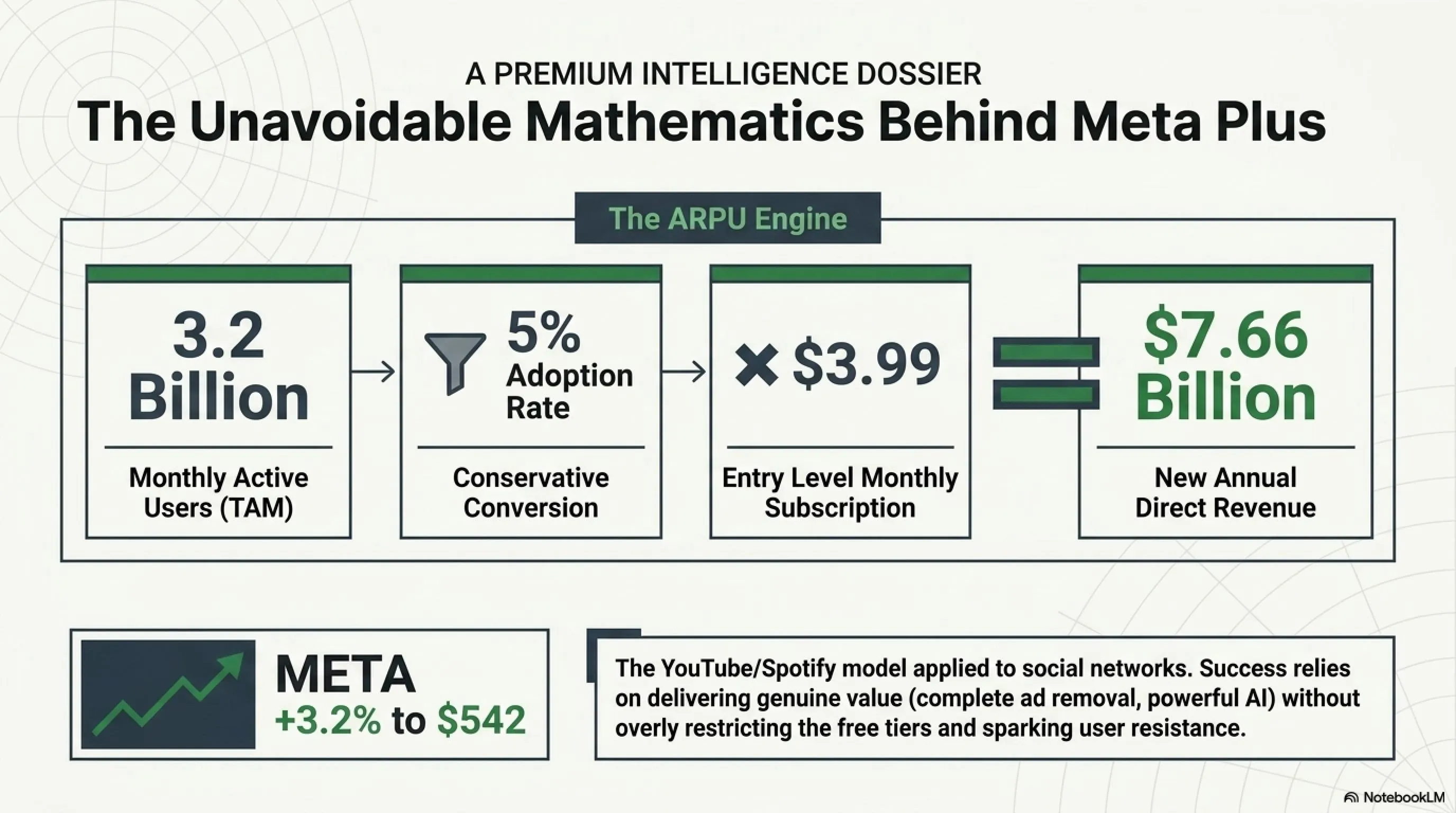
This Meta move represents a paradigm shift in social media revenue models. Until now, Meta derived approximately 98% of its revenue from advertising—a model with many vulnerabilities: dependence on the advertising market, privacy concerns, and regulatory pressures. By launching subscriptions, Meta can create more stable and predictable revenue streams. If just 5% of Meta's 3.2 billion monthly active users buy the $3.99 subscription, that translates to $7.66 billion in annual revenue—a figure that cannot be ignored.
According to Forbes, Meta's stock rose 3.2% after this announcement, reaching $542. Wall Street analysts believe this move could set a template for other social networks like X (formerly Twitter), TikTok, and even LinkedIn. In fact, Meta is testing a model that could determine the entire social media industry's future: a combination of advertising revenue and direct user subscriptions.
🎯 Tekin Analysis: Will Users Pay for Social Media?
The key question is: will users pay for services that have been free until now? YouTube Premium and Spotify Premium's experience shows yes—if real value is provided. Ad removal, exclusive features, and better user experience can be sufficient motivation for payment. But Meta must be careful not to limit the free version so much that it loses users.
For American consumers, this represents a choice: continue with ads or pay for a cleaner experience. The pricing is competitive—$3.99 is less than a Starbucks coffee. If Meta can deliver genuine value (complete ad removal, powerful analytics tools, and advanced AI assistant), users will be willing to pay. But if Meta over-restricts the free version or doesn't provide enough value, it may face user resistance. The next 6-12 months will be critical in determining whether this model succeeds.
✅ Pros
- ✓ Stable and predictable revenue
- ✓ Reduced advertising dependence
- ✓ Better user experience for subscribers
- ✓ Incentive for more innovation
- ✓ Better privacy for paying users
⚠️ Cons
- ✗ Risk of losing users
- ✗ Creating class divide in social network
- ✗ Competition with free services
- ✗ Complexity of managing two versions
- ✗ Criticism of over-commercialization
🤖 Trajectory Startup: Continuous Learning AI from Google & Apple Veterans
📚 Classified & Related Dossiers in TekinGame
If you wish to explore beyond this report and delve into cybernetic frontiers and autonomous AI architectures, do not miss these three exclusive deep-dives in the Tekin Garage:
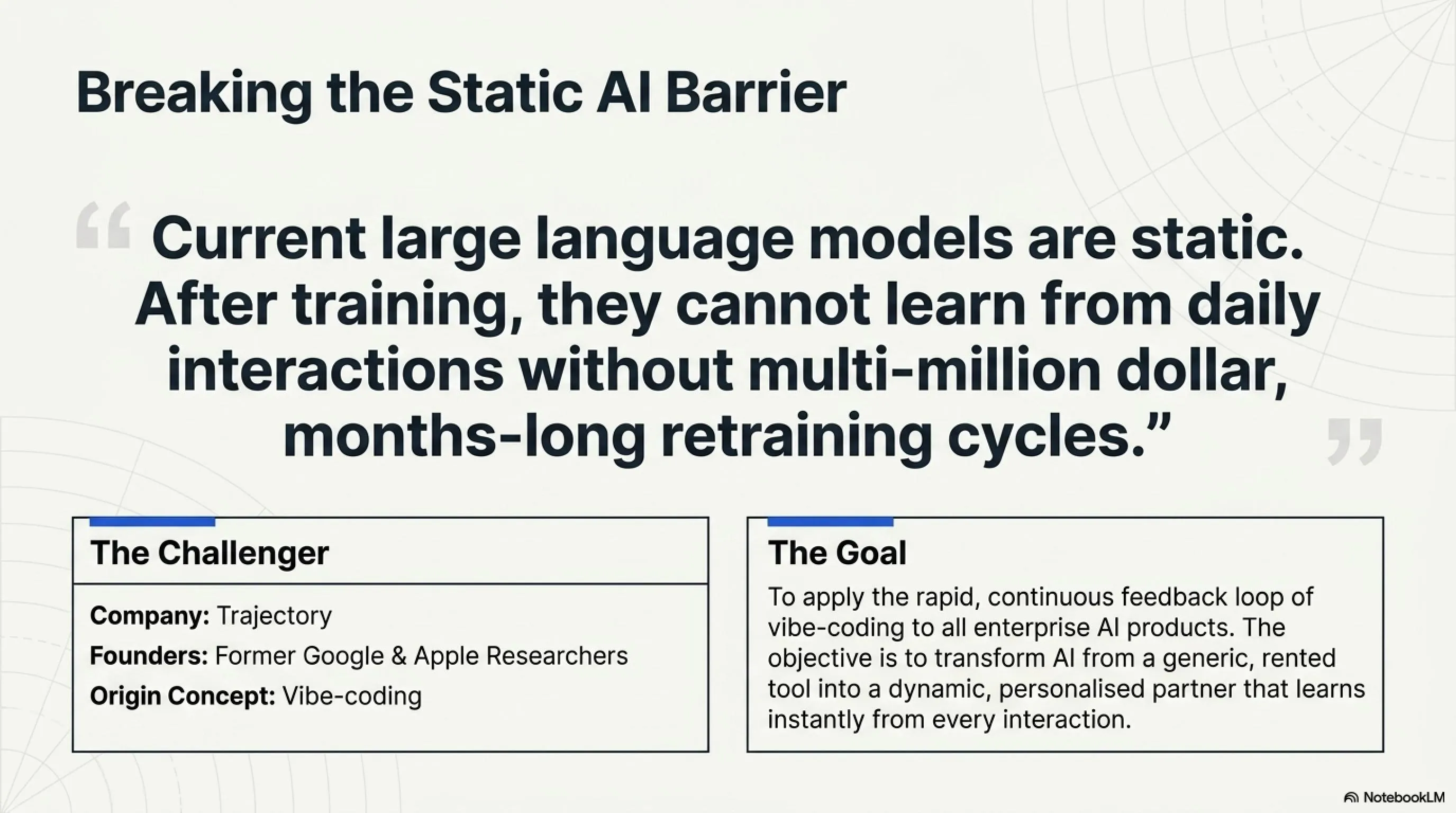
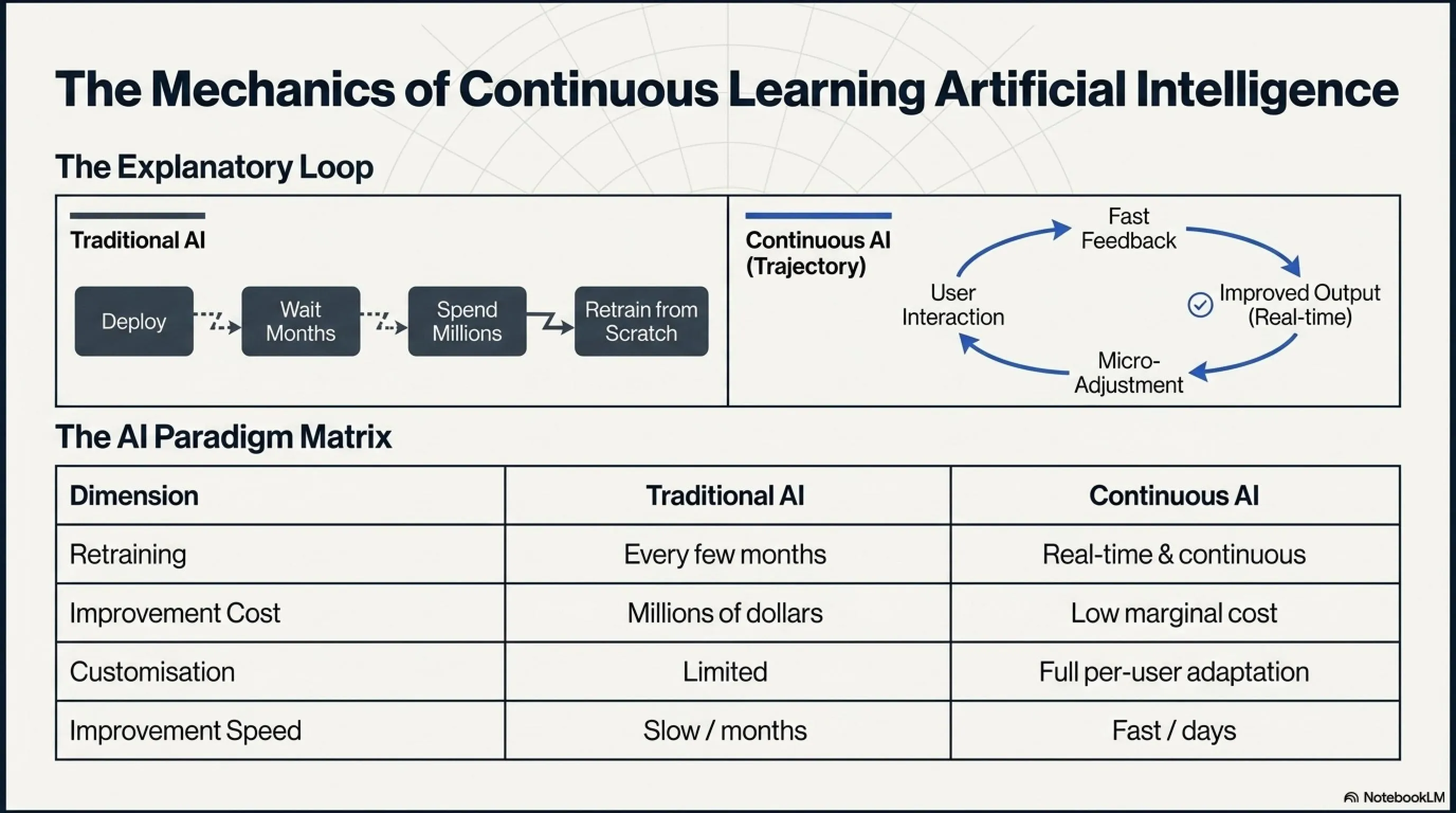
In one of the most exciting AI news stories, a group of former Google and Apple researchers launched Trajectory startup to solve one of AI's biggest challenges: continuous learning. This capability, which researchers have long identified as a major barrier to further AI progress, allows AI models to learn from user feedback and improve continuously—without needing complete retraining.
According to Wired, Trajectory is betting that the rapid iteration cycle that supercharged vibe-coding can help all kinds of companies build AI products that learn continuously. Vibe-coding—where developers rapidly write code with AI assistance, test it, get feedback, and improve—has shown that fast feedback loops can dramatically increase development quality and speed.
The main problem with current AI models is that after training, they remain static. OpenAI, Google, and Anthropic have succeeded in building increasingly capable versions of AI models, especially for domains like coding, math, and science. But these models cannot learn from daily interactions with users. Every time you want to improve the model, you must retrain it from scratch—a process that costs millions of dollars and takes months.
⚡ Traditional AI vs Continuous Learning AI Comparison
| Feature | Traditional AI | Continuous Learning AI |
|---|---|---|
| Retraining | Every few months | Real-time & continuous |
| Improvement Cost | Millions of dollars | Low marginal cost |
| Customization | Limited | Full per-user adaptation |
| Improvement Speed | Slow (months) | Fast (days) |
Trajectory wants to solve this problem by building a platform that allows companies to create AI models that learn from every user interaction. Imagine an AI assistant that gets better every time you use it—not just for you, but for all users. This means a model that can adapt itself to the specific needs of each industry, each company, and even each user.
🎯 Tekin Analysis: Why Continuous Learning Is a Game-Changer
Continuous learning could transform AI from a static tool into a dynamic partner. Imagine an AI model used in a hospital that learns daily from physicians' diagnoses, or a coding assistant that better understands your team's style and preferences with each project. This is exactly what Trajectory promises to deliver.
For the American tech industry, this technology could be revolutionary. Instead of relying on models trained on generic data, companies can build models that learn with their specific culture, language, and needs. This means democratizing AI—giving everyone access to customized artificial intelligence without million-dollar budgets. It's the difference between renting a generic tool and owning a personalized assistant that grows with you.
⌚ Google Fitbit Air: $99 Whoop Competitor Without Screen
Google enters the screenless fitness tracker market with Fitbit Air at $99, directly challenging Whoop. This device, announced May 7 and available since May 26, weighs just 12 grams—the lightest Fitbit ever. Google's strategy is simple: background tracking without any distractions, focus on health data, and Gemini AI coaching.
Fitbit Air is a compact module that fits into various bands with sensors pressed directly against the skin. No screen, no notifications, no taps—just pure tracking. This means you can wear it 24/7, even while sleeping, without feeling like you have something on your wrist. Seven-day battery life and water resistance up to 50 meters make it an ideal companion for serious athletes.
📊 Fitbit Air Technical Specifications
Available Sensors:
- 24/7 Heart Rate
- Blood Oxygen (SpO2)
- Skin Temperature
- AFib Detection
- Advanced Sleep Tracking
- Stress & Recovery Analysis
But the key to Fitbit Air is in its software. Google launched a new app called Google Health that replaces the Fitbit app. This app, powered by Gemini AI, provides personalized health coaching that can build workout programs, answer health questions, and even analyze your sleep and stress patterns. Of course, this AI coach comes with an additional cost of $9.99 per month or $99.99 per year.
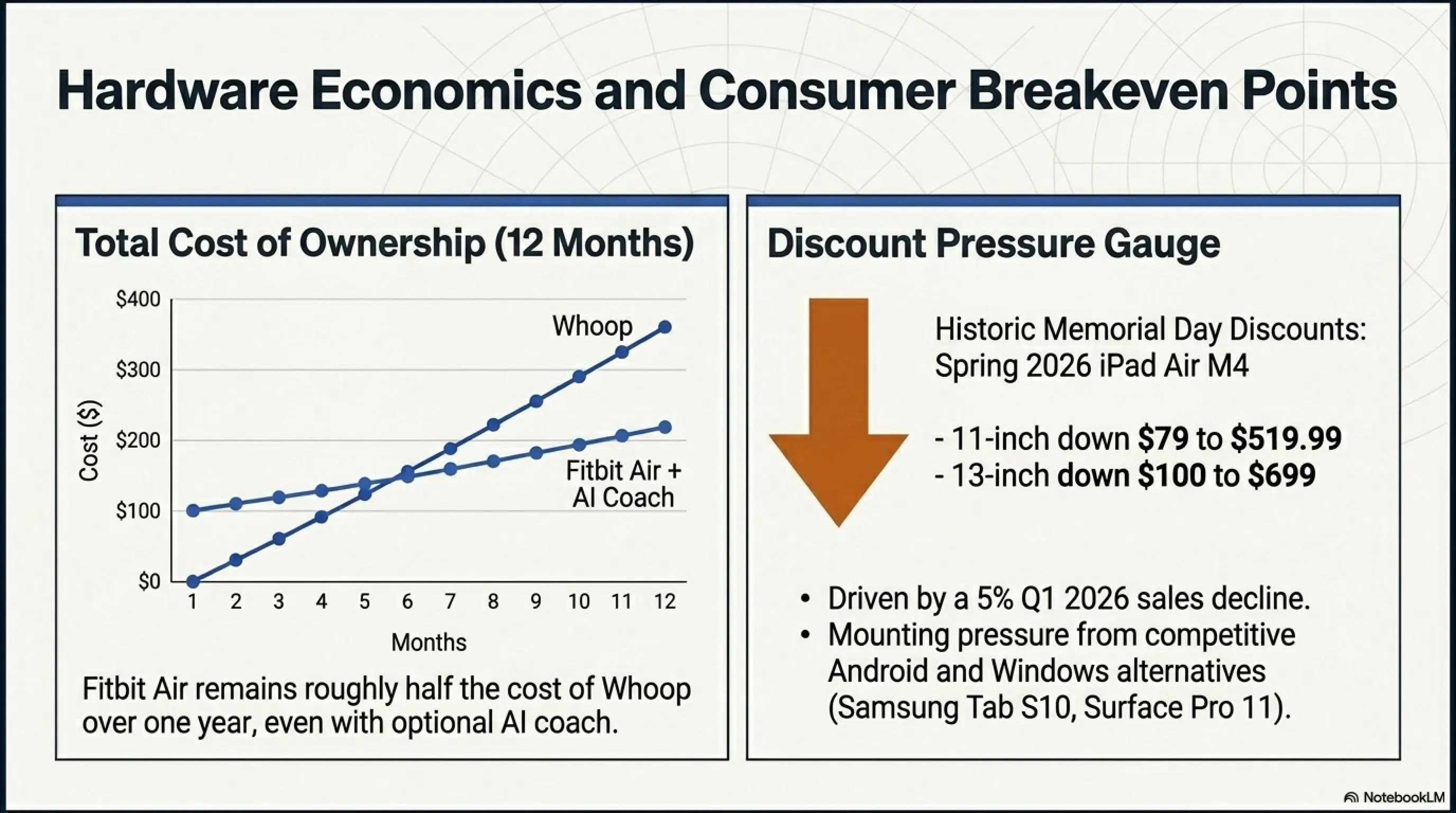
The comparison with Whoop is interesting: Whoop has no upfront cost but requires a $30 monthly subscription. Fitbit Air starts at $99 and core tracking works without subscription—you only pay for the AI coach. This means in one year, Fitbit Air with subscription ($99 + 12×$9.99 = $218) is roughly half the price of Whoop (12×$30 = $360). For those who want tracking without subscription, Fitbit Air is a much more affordable option.
🎯 Tekin Analysis: Can Fitbit Air Beat Whoop?
Whoop leads the screenless tracker market, but its high subscription price is a major barrier for many users. Fitbit Air with lower pricing and optional subscription can target a much broader market. But the question is: is Google's AI coach powerful enough to convince users to subscribe?
Based on early reviews from Wired and TechAdvisor, the Gemini coach is genuinely impressive—it can build personalized workout programs, answer complex health questions, and even discover hidden patterns in your data. If Google can improve this experience and deliver real value, Fitbit Air could be a serious threat to Whoop. The next 12 months will determine whether Google can capture significant market share in this growing segment.
📱 Historic iPad Air M4 Discount: Up to $100 Off
For the first time since launch, iPad Air M4 is available with significant discounts on Amazon. The 11-inch model with 128GB storage, originally priced at $599, is now available for $519.99 ($79 off). The 13-inch model has also dropped from $799 to $699 ($100 off). These discounts, offered ahead of Memorial Day weekend, show Apple is under competitive pressure in the premium tablet market.
iPad Air M4, introduced in spring 2026, features the powerful M4 chip, Liquid Retina display with ProMotion technology, and Apple Pencil Pro support, making it one of the best mid-range tablets on the market. The M4 chip, the same one used in iPad Pro, delivers exceptional performance for heavy tasks like 4K video editing, graphic design, and even AAA gaming. In fact, iPad Air M4 has nearly reached iPad Pro's power, but at a much lower price point.
💰 iPad Air M4 Pricing Table
| Model | Original Price | Current Price | Discount |
|---|---|---|---|
| 11" / 128GB | $599 | $519.99 | -$79 (13%) |
| 13" / 128GB | $799 | $699 | -$100 (13%) |
| 11" / 256GB | $699 | $609.99 | -$89 (13%) |
These discounts show Apple is under competitive pressure. Android tablets like Samsung Galaxy Tab S10 and Windows tablets like Surface Pro 11 with competitive pricing and powerful features have challenged the market. Additionally, iPad sales declined 5% in Q1 2026, showing demand has slightly decreased. Apple is offering early discounts to stimulate sales and maintain market share.
⚖️ Google Engineer Charged with $1.2M Polymarket Insider Trading
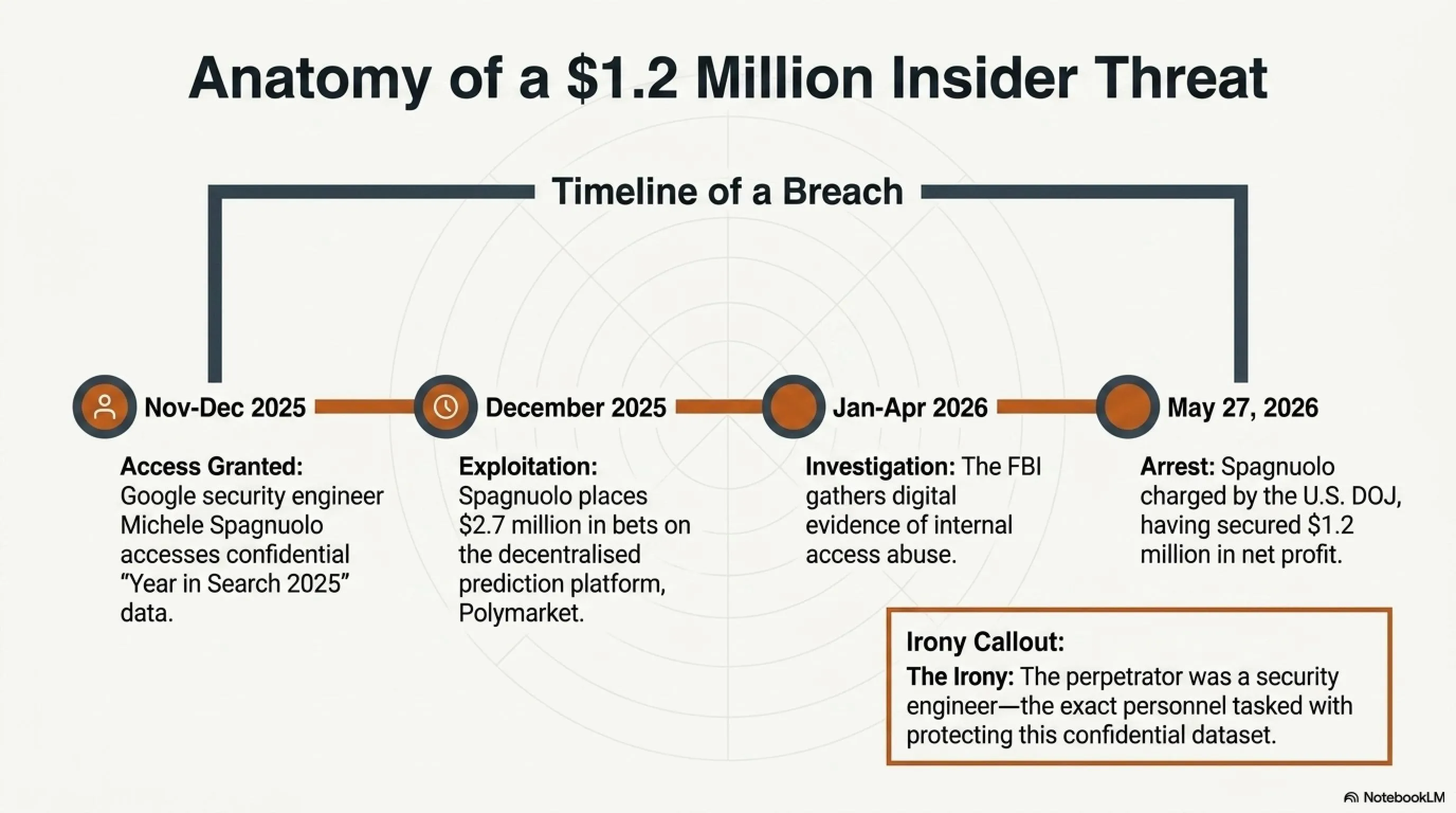
In one of the year's most shocking security news stories, the U.S. Department of Justice charged Michele Spagnuolo, a 36-year-old Google security engineer, with using confidential internal information to earn $1.2 million from Polymarket bets. Spagnuolo, an Italian citizen based in Switzerland, was arrested Wednesday morning, May 27, in New York. This is the second known criminal case linked to lucrative Polymarket trades and raises serious questions about internal information security at major tech companies.
According to the complaint from the U.S. Attorney for the Southern District of New York, Spagnuolo had access to confidential internal Google information about the Year in Search 2025 campaign—a list of the year's most-searched terms published every December. Using this information, he risked over $2.7 million on bets related to these terms on Polymarket and ultimately earned $1.2 million in net profit. This is a classic case of insider trading—using non-public information for financial gain.
⚠️ Michele Spagnuolo Case Timeline
| Date | Event |
|---|---|
| Nov-Dec 2025 | Access to confidential Year in Search information |
| December 2025 | $2.7 million in Polymarket bets placed |
| Jan-Apr 2026 | FBI investigation and evidence gathering |
| May 27, 2026 | Arrest in New York and charges announced |
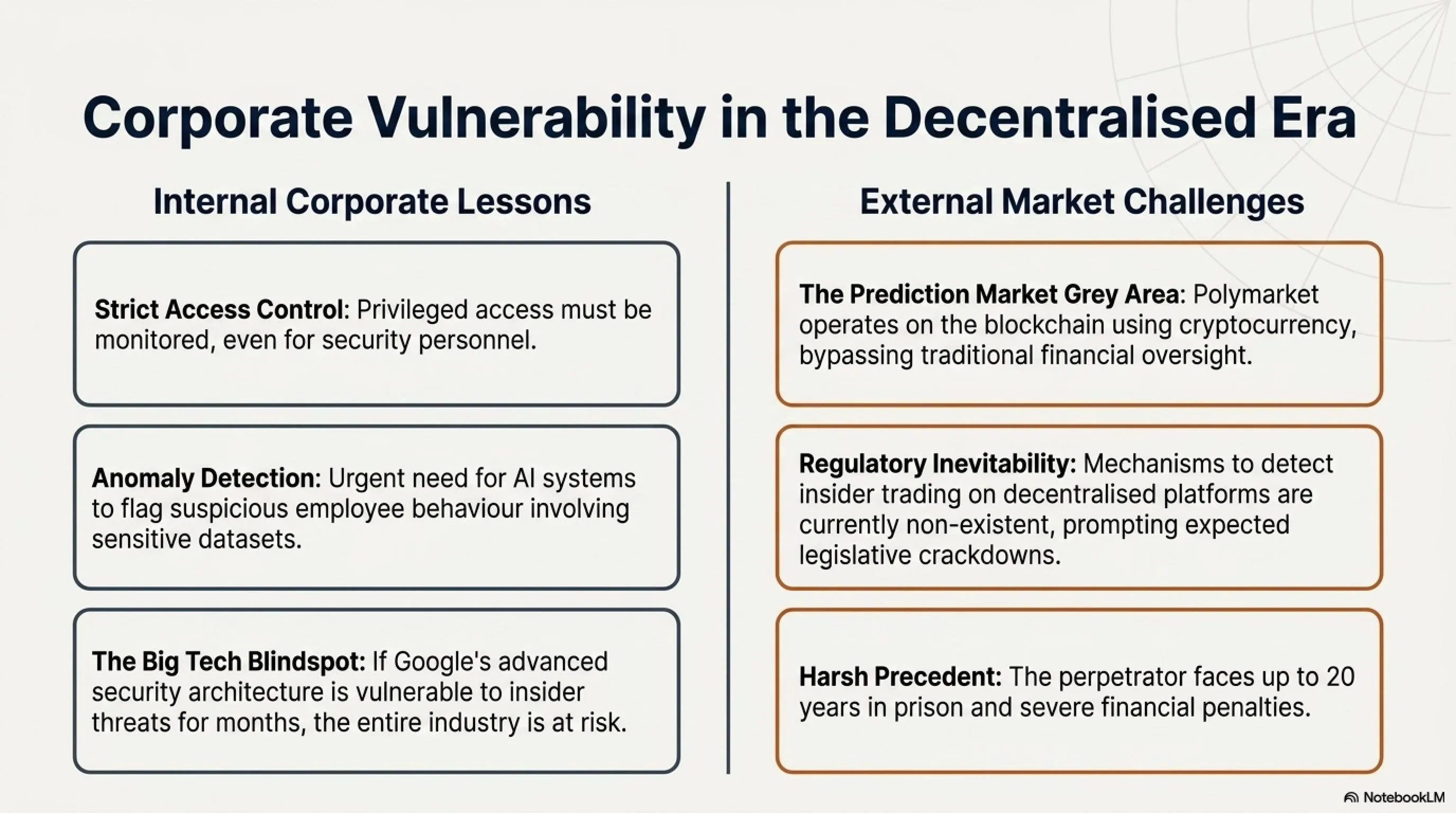
Polymarket is a blockchain-based prediction market platform where users can bet on real-world event outcomes—from political elections to Google's most-searched terms. This platform, which has gained significant popularity in recent years, exists in a legal gray area due to its decentralized nature and use of cryptocurrencies. But using insider information for profit is a crime regardless of the platform.
The interesting point is that Spagnuolo was a security engineer—someone who was supposed to protect Google's confidential information, not exploit it. This case shows that even large companies with advanced security systems are vulnerable to insider threats. According to NPR and CNBC reports, the FBI worked on this case for months and collected strong digital evidence showing how Spagnuolo abused his internal access.
🎯 Tekin Analysis: Security Lessons for Major Companies
This case offers several important lessons for the tech industry. First, access to confidential information must be strictly controlled and monitored—even for security employees. Second, companies need anomaly detection systems that can identify suspicious employee behavior. Third, prediction markets like Polymarket need better mechanisms to detect insider trading.
For Google, this is a major credibility blow. How could a security engineer exploit confidential information for months without anyone noticing? This question shows that even tech giants are vulnerable to insider threats. Google will likely need to review its internal security policies and implement stricter controls. The case also highlights the need for better regulation of prediction markets and clearer legal frameworks for these emerging platforms.
🔍 Legal and Industry Implications
- For Spagnuolo: Up to 20 years in prison and severe financial penalties
- For Google: Review of security policies and access controls
- For Polymarket: Increased regulatory pressure and potential new legislation
- For the industry: Warning to all tech companies about insider threats
💭 Final Thoughts
Thursday morning, May 28, 2026, showed that the tech industry is passing through important inflection points. Amazon's acquisition of Globalstar and Apple's stake demonstrates that the satellite wars have entered a new phase and satellite communications access for all smartphones is on the way. Meta's launch of Instagram Plus and Facebook Plus subscriptions transforms the social media revenue model and shows that the future lies in combining advertising and direct user subscriptions.
Trajectory startup, focusing on continuous learning, promises to transform AI from a static tool into a dynamic partner—a transformation that could accelerate AI democratization. Google's Fitbit Air shows the wearables market is moving toward simpler, lighter, data-focused devices. And Apple's iPad Air M4 discount shows even tech giants must be flexible under competitive pressure.
But the Michele Spagnuolo case reminds us that with rapid technology growth, security and ethical challenges also grow. Insider threats, confidential information abuse, and the legal gray area of prediction markets all show that the tech industry needs stronger legal and ethical frameworks. The future of technology depends not only on technical innovation but also on accountability and transparency.
❓ Can Amazon compete with Starlink?
Yes, Amazon with Globalstar's acquisition and access to spectrum and satellite infrastructure can become a serious Starlink competitor. But the main challenge is satellite count—Starlink has over 5,000 satellites in orbit, while Globalstar has only about 50. Amazon must make massive investments to launch new satellites to provide global coverage. But given Amazon's financial resources and Apple's experience, this competition could be very exciting.
❓ Will Meta's subscriptions succeed?
Meta's subscription success depends on two factors: real value provided and appropriate pricing. If Meta can offer genuinely useful and unique features (like complete ad removal, powerful analytics tools, and advanced AI assistant), users will be willing to pay. YouTube Premium and Spotify Premium's experience shows the subscription model can succeed. But if Meta over-restricts the free version or doesn't provide enough value, it may face user resistance.
❓ Why is continuous learning important in AI?
Continuous learning allows AI models to learn from daily user interactions and improve without needing complete retraining. This means models that can adapt themselves to the specific needs of each industry, company, and even user. For example, a medical AI that learns daily from physicians' diagnoses, or a coding coach that better understands your team's style with each project. This capability could transform AI from a generic tool into a personalized partner.
❓ Is Fitbit Air better than Whoop?
It depends on your needs. Whoop is better for professional athletes and those who want deep recovery and stress analysis—but at $30 per month. Fitbit Air is a more affordable option for general users who want basic tracking without subscription. If you add Google's AI coach ($9.99/month), it's still cheaper than Whoop. Overall, Fitbit Air is the better choice for most users unless you're a professional athlete.
❓ What lessons can be learned from the Google case?
The Michele Spagnuolo case offers several important lessons: First, access to confidential information must be strictly controlled—even for security employees. Second, companies need anomaly detection systems that identify suspicious behavior. Third, prediction markets like Polymarket need better mechanisms to prevent insider trading. And fourth, even tech giants are vulnerable to insider threats and must be vigilant.
📚 Sources & References
Primary Sources: 9to5Mac, TechCrunch, Wired, The Verge, CNBC, Forbes, NPR, USA Today, MacRumors, PCMag, Android Central, IGN, TechAdvisor, Mashable, Al Jazeera
Research & Analysis: Tekin Editorial Team
Publication Date: May 28, 2026
🌐 Stay Connected With Us 🎮✨
For the latest tech, gaming, and gadget news, follow us on our official social media channels:
Additional Gallery: 🌅 Tekin Morning May 28, 2026: Amazon's Globalstar Deal & Meta's Subscription Revolution 💰