
🌅 Welcome to Tekin Morning May 27, 2026
Good morning, tech enthusiasts! This Wednesday morning kicks off with six explosive stories that prove the tech industry is at a historic inflection point. From Micron's entry into the trillion-dollar club to a mass exodus from Google, and from the Pope's controversial AI encyclical to Apple's new security features—everything is covered in this comprehensive report.
⚡ Today's Headlines:
💰 Micron joins the $1T club (+214% YTD)
🔥 DuckDuckGo surges 30% - fleeing Google's forced AI
✝️ Pope's AI encyclical: Did AI write it?
🔒 Anti-theft iPhone: Auto-lock with accelerometer
📱 WhatsApp: Share documents with Meta AI
🏷️ AirTag 2 receives new firmware
☕ Grab your coffee and get ready for an exciting journey through the world of technology!
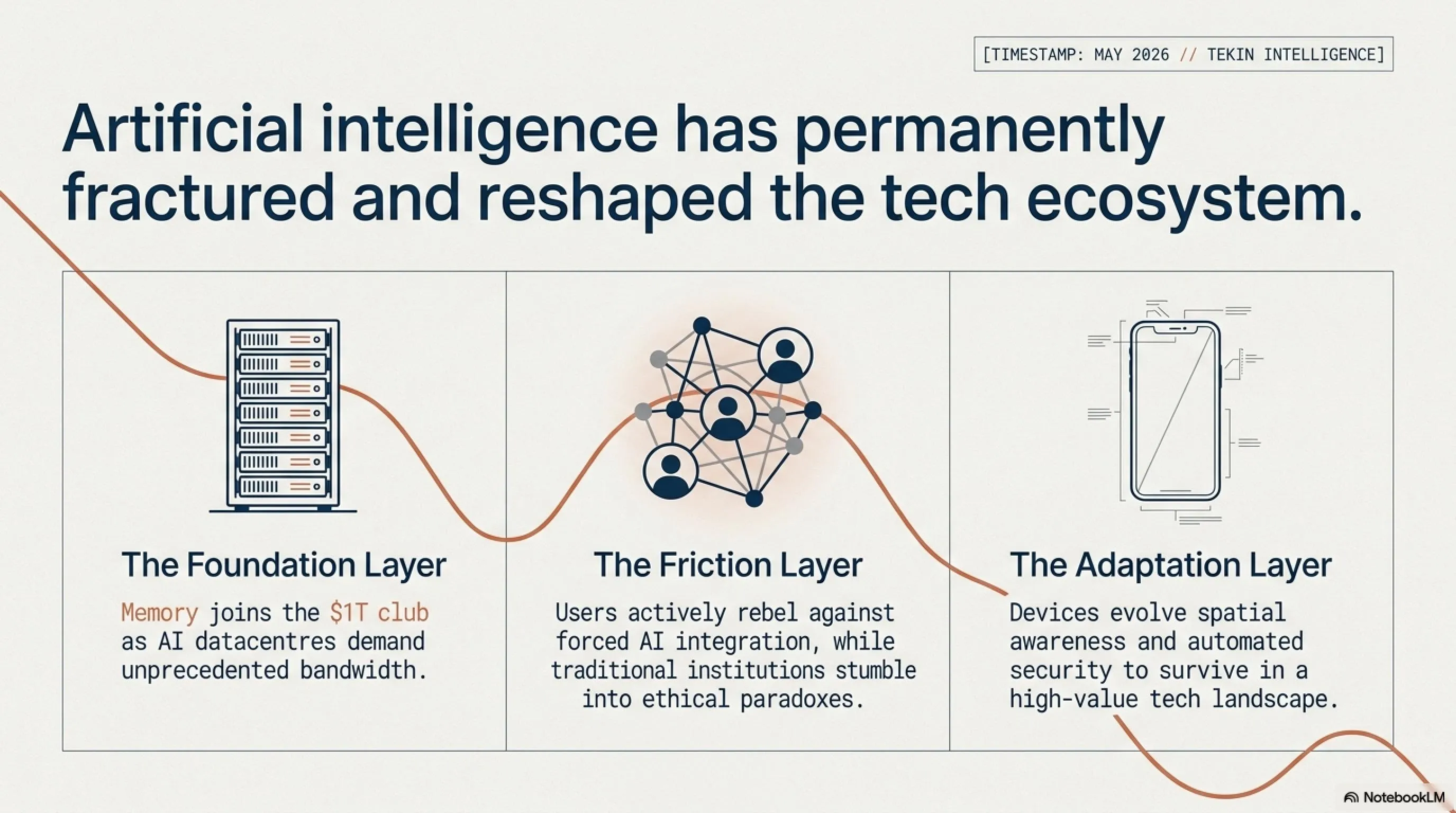
💰 Story One: Micron Joins the Trillion-Dollar Club - The Memory Chip Revolution
Tuesday, May 26, 2026, was a historic day for Micron Technology. This American memory chip giant reached a $1 trillion market valuation for the first time in its 47-year history. Micron's stock surged 19% in a single day to $879, peaking at $891 during the session. This explosive growth came just one day after the Memorial Day holiday and demonstrates how eager investors are to enter the memory chip market.
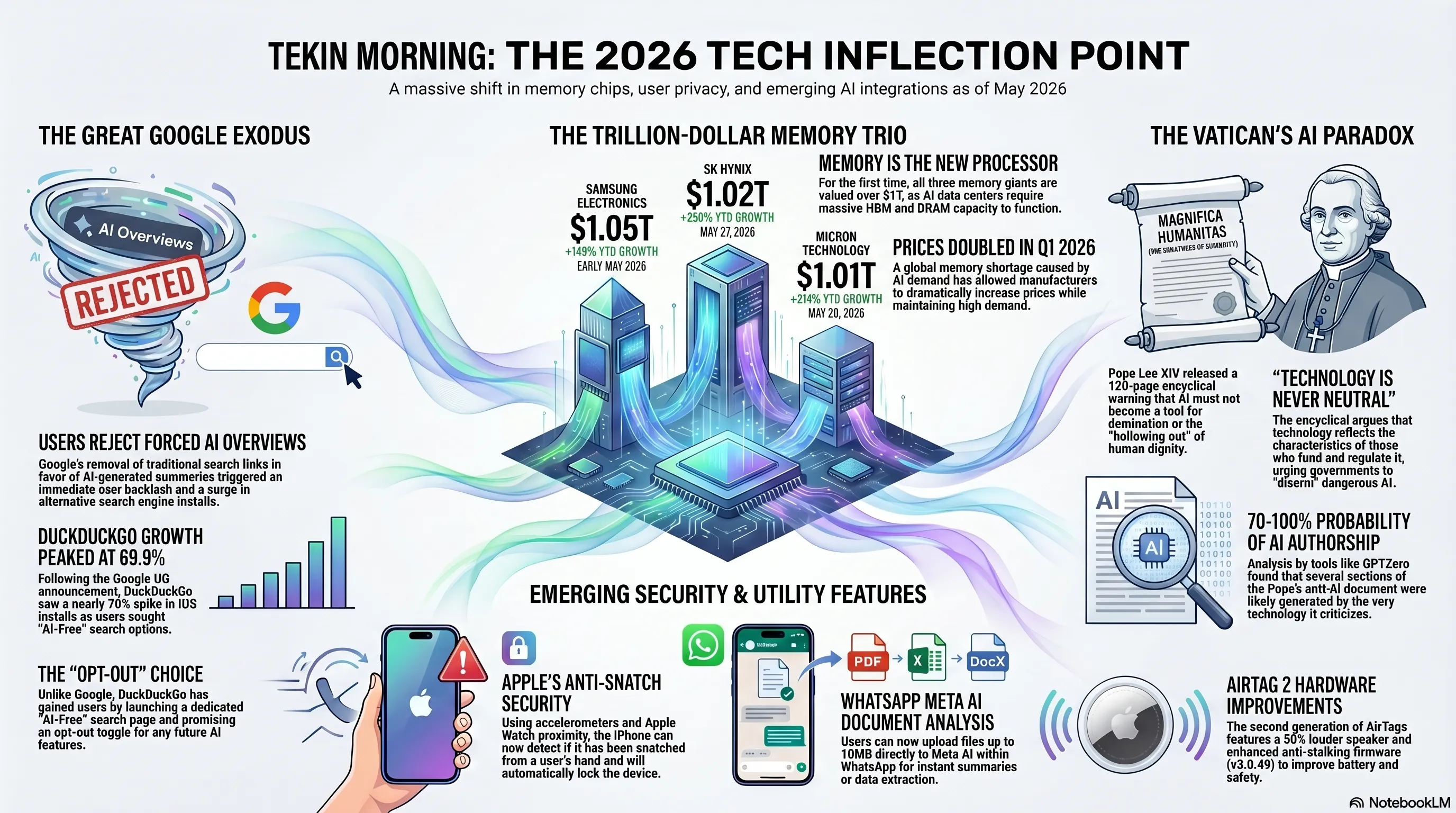
But this isn't just Micron's story. On the same day, South Korea's SK Hynix also crossed the trillion-dollar market cap threshold with an 11% surge. And a few weeks earlier, Samsung Electronics had joined this elite club. Now, for the first time in history, the three memory chip giants—Samsung, SK Hynix, and Micron—all have market valuations exceeding $1 trillion. This is a historic inflection point that proves memory chips are no longer just peripheral components; they're as critical as processors.
📊 Key Stats: The Trillion-Dollar Trio
Why This Explosive Growth?
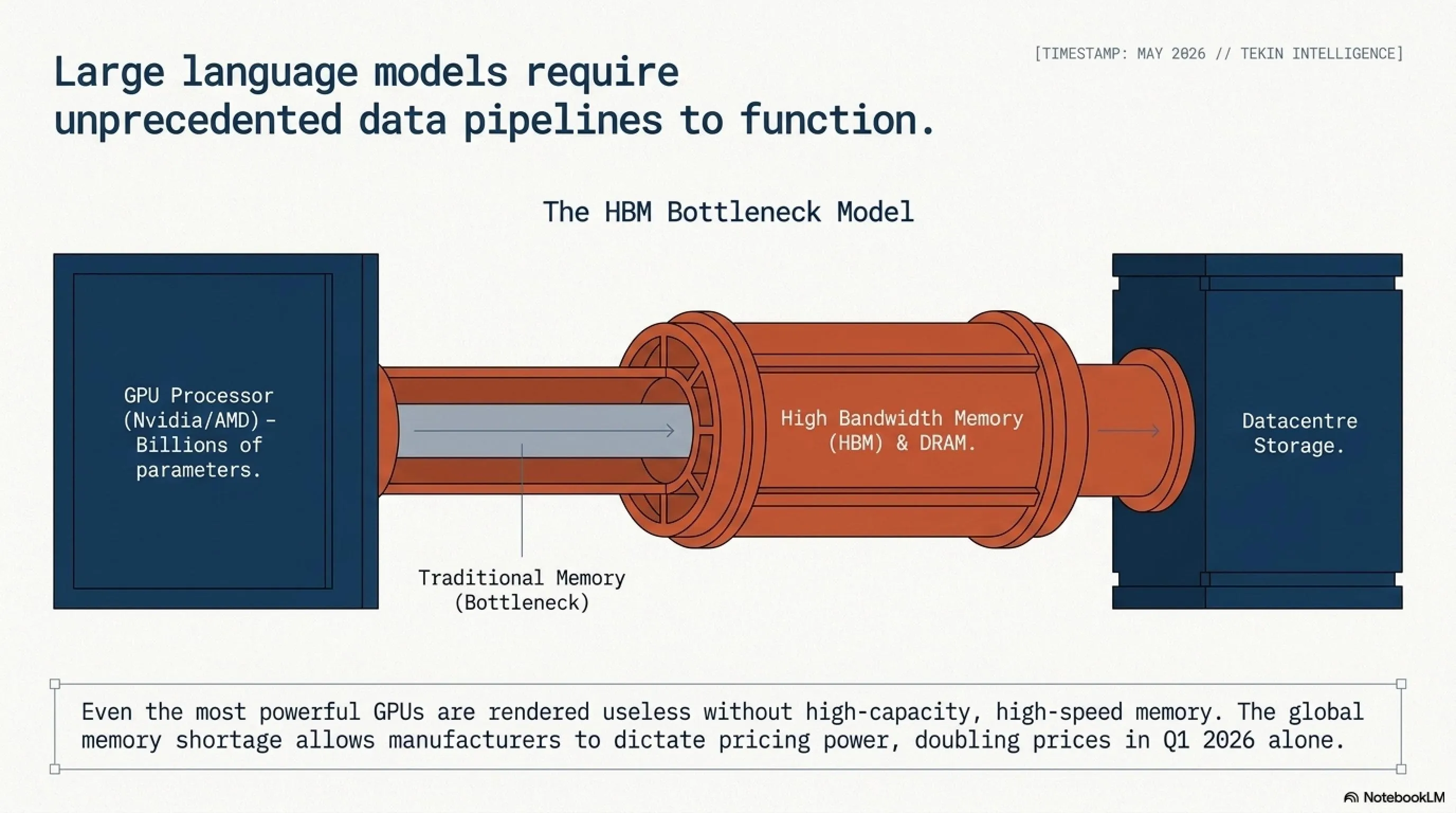
The answer can be summed up in one word: artificial intelligence. Insatiable demand for HBM (High Bandwidth Memory) and DRAM chips in AI datacenters has made it impossible for memory manufacturers to scale production fast enough. This global shortage has allowed them to dramatically increase prices. According to reports, memory chip prices doubled in Q1 2026.
Investment bank UBS released a report on Monday that tripled Micron's price target from $535 to $1,625 per share. UBS wrote in its report: "We believe the market will start to put a more 'normal' multiple on the stock and MU will continue to re-rate higher as more details emerge about the structural changes AI has driven to the entire memory complex."
Why Did Memory Become as Important as Processors?
For years, all attention was focused on processors. Nvidia, Intel, AMD—these were the industry stars. But this year, three memory companies—Samsung, SK Hynix, and Micron—all joined the trillion-dollar club. Why? Because without fast, high-capacity memory, even the most powerful GPUs are useless.
Large language models like GPT-4, Claude, and Gemini require HBM memory to process billions of parameters at high speed. This demand is so high that Micron, SK Hynix, and Samsung, despite increasing production, still cannot meet demand. According to CNBC, the global memory shortage has allowed these companies to dramatically raise prices without reducing demand. This is an ideal situation for manufacturers: high demand, limited supply, and pricing power.
🎯 Tekin Analysis: Is a Memory Bubble Forming?
Growth of 200-250% in less than five months for all three memory giants raises an important question: Is this growth sustainable, or are we witnessing a bubble forming? Let's examine several key points:
- Positive: AI demand is real and growing. Every new datacenter needs HBM chips.
- Positive: Long-term contracts with fixed or semi-fixed pricing are being signed.
- Negative: History shows the semiconductor market is cyclical—after growth comes recession.
- Negative: If AI growth slows or new competitors enter, prices will crash quickly.
💡 Tekin's Take: This growth will continue through the end of 2026, but investors should watch for signs of market saturation. If Nvidia or AMD announces declining demand, memory stocks will be the first to take a hit.
📌 Section One Summary
Micron, SK Hynix, and Samsung all joined the trillion-dollar club. Insatiable demand for HBM and DRAM chips in AI datacenters has driven 150-250% stock growth for these companies. UBS tripled Micron's price target, declaring that AI has permanently transformed the memory market structure. But the big question remains: Is this growth sustainable, or is it a bubble?
🔥 Story Two: The Great Google Exodus - DuckDuckGo Surges 30%
If you think users are embracing artificial intelligence, this news will surprise you. Following Google's I/O conference announcement that it would replace traditional search with AI Overviews, user reaction was intensely negative. DuckDuckGo, the privacy-focused search engine, reported that its app installs in the U.S. increased an average of 18.1% and peaked at 30.5% on May 25.
But most interesting were iPhone and iPad users. DuckDuckGo installs on iOS grew an average of 33% and peaked at 69.9% on May 25. This means Apple users—who are typically more conservative—fled Google faster than anyone else. Gabriel Weinberg, DuckDuckGo's CEO, tweeted: "Google is force-feeding AI with no way to opt out. People want choice."
📈 DuckDuckGo Growth Stats Post-Google I/O
Why Are Users Fleeing Google?
At Google I/O 2026, Google announced it would replace traditional search with blue links with "AI Overviews." This means instead of seeing a list of websites, you receive a summarized answer generated by artificial intelligence. Google claimed this change improves user experience, but user reaction was the complete opposite.
Critics say this change has several major problems. First, users can no longer choose sources themselves and must trust the AI answer. Second, AI Overviews sometimes provide inaccurate information and users have no way to verify. Third, this change could destroy the open web because users no longer visit original websites, reducing their traffic.
What Does DuckDuckGo Offer?
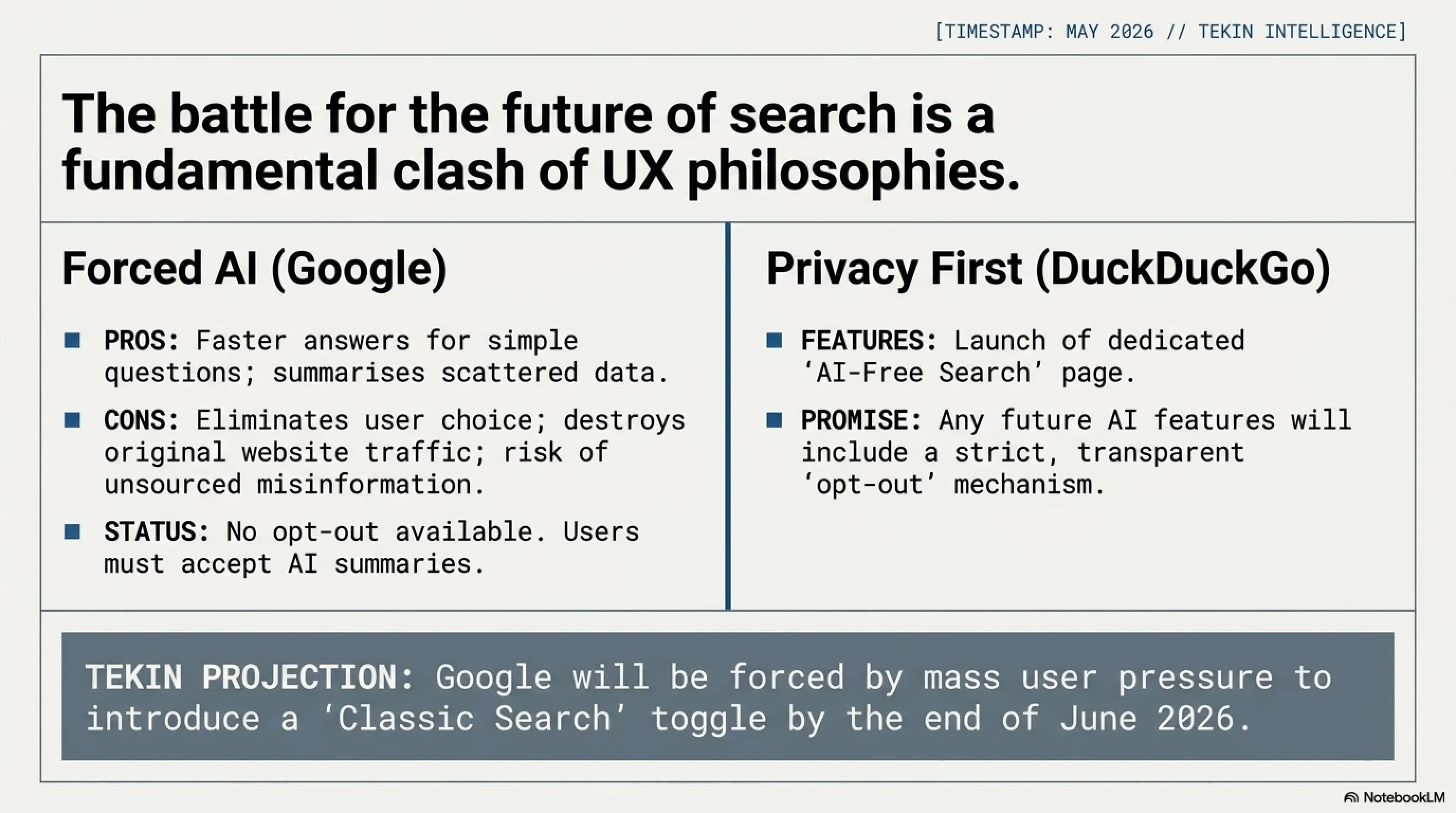
In response to this demand, DuckDuckGo launched a new page called "AI-Free Search" that allows users to search completely without AI interference. This page has received significant traffic in recent days. DuckDuckGo also announced that if it adds AI to its search in the future, it will definitely have an "opt-out" button so users can choose.
This approach is completely different from Google's strategy. Google provides no way to disable AI Overviews, and users must accept it. This decision has caused even loyal users to seek alternatives. One user tweeted: "I've used Google for 15 years, but I can no longer trust AI results when I don't know where they came from."
🎯 Tekin Analysis: Will This User Rebellion Continue?
This isn't the first time users have reacted to major Google changes, but this time is different. Why? Because it's not just about design—it's about trust and control. Let's examine several scenarios:
- Scenario 1 (likely): Under pressure, Google adds a "Classic Search" button and the crisis subsides.
- Scenario 2 (less likely): Google makes no changes and DuckDuckGo reaches 5-10% of the U.S. market.
- Scenario 3 (unlikely): Users return to Google after a few weeks and everything is forgotten.
💡 Tekin's Take: Google will be forced to retreat. History shows that when users protest en masse, even tech giants must listen. We expect Google to add an "opt-out" option by the end of June.
⚔️ PROS & CONS Battle: AI in Search
✅ Pros
- Faster answers for simple questions
- Summarizes scattered information
- Saves time for busy users
- Useful for fact-based queries
❌ Cons
- Eliminates user choice
- Risk of misinformation without sources
- Destroys website traffic
- Lack of transparency in sources
📌 Section Two Summary
Following the AI Overviews announcement at Google I/O, DuckDuckGo installs in the U.S. grew 30% and iOS peaked at 69.9%. Users are unhappy with forced AI without an opt-out option. DuckDuckGo launched an "AI-Free Search" page and promised that if AI is added, it will definitely have an opt-out button. This is the first major user rebellion against forced AI.
✝️ Story Three: Pope's Controversial Encyclical - Did AI Write About AI Dangers?
On Sunday, May 25, 2026, Pope Leo XIV released his first official encyclical titled "Magnifica Humanitas" (The Greatness of Humanity). This 120-page document warns about the dangers of artificial intelligence to humanity and calls on governments and tech companies to "disarm" AI. The Pope wrote: "Artificial intelligence must not be concentrated in the hands of only a few people and must not become a tool for domination, exclusion, and war."
But the real story began hours after publication. Analysts and researchers noticed that some paragraphs had suspicious writing styles. The Verge reported that AI-detection analysis shows some sections have a 40-100% probability of being AI-generated. This discovery raised a profound question: Did the Vatican use the very technology it warns against?
🔍 AI-Detection Analysis Results
The Encyclical's Content: What Does It Say?
"Magnifica Humanitas" is organized into five chapters, and its main message is that technology is not "a force antagonistic to humanity" and is not "inherently evil," but "technology is never neutral, because it takes on the characteristics of those who devise, finance, regulate, and use it." Pope Leo warns that artificial intelligence could make civilization "less human," hollow out work, concentrate wealth, and reduce people to systems driven by data and efficiency rather than dignity and morality.
The Pope also warns about the danger of using AI in warfare, saying that some weapons are now beyond human control. He calls on governments to establish robust regulations for artificial intelligence and asks tech companies to place AI in service of humanity, not for domination and exploitation. These messages are actually what many AI critics have been saying for years, but when spoken by the Pope, they carry more weight.
The Controversy: Did AI Write This Encyclical?
Hours after publication, researchers began analyzing the text. They noticed that some paragraphs have specific characteristics typically seen in AI-generated texts: overly smooth sentences without personal tone, use of clichéd phrases, and repetitive structure. AI-detection tools like GPTZero and Originality.ai identified some paragraphs with a 70-100% probability of being AI-generated.
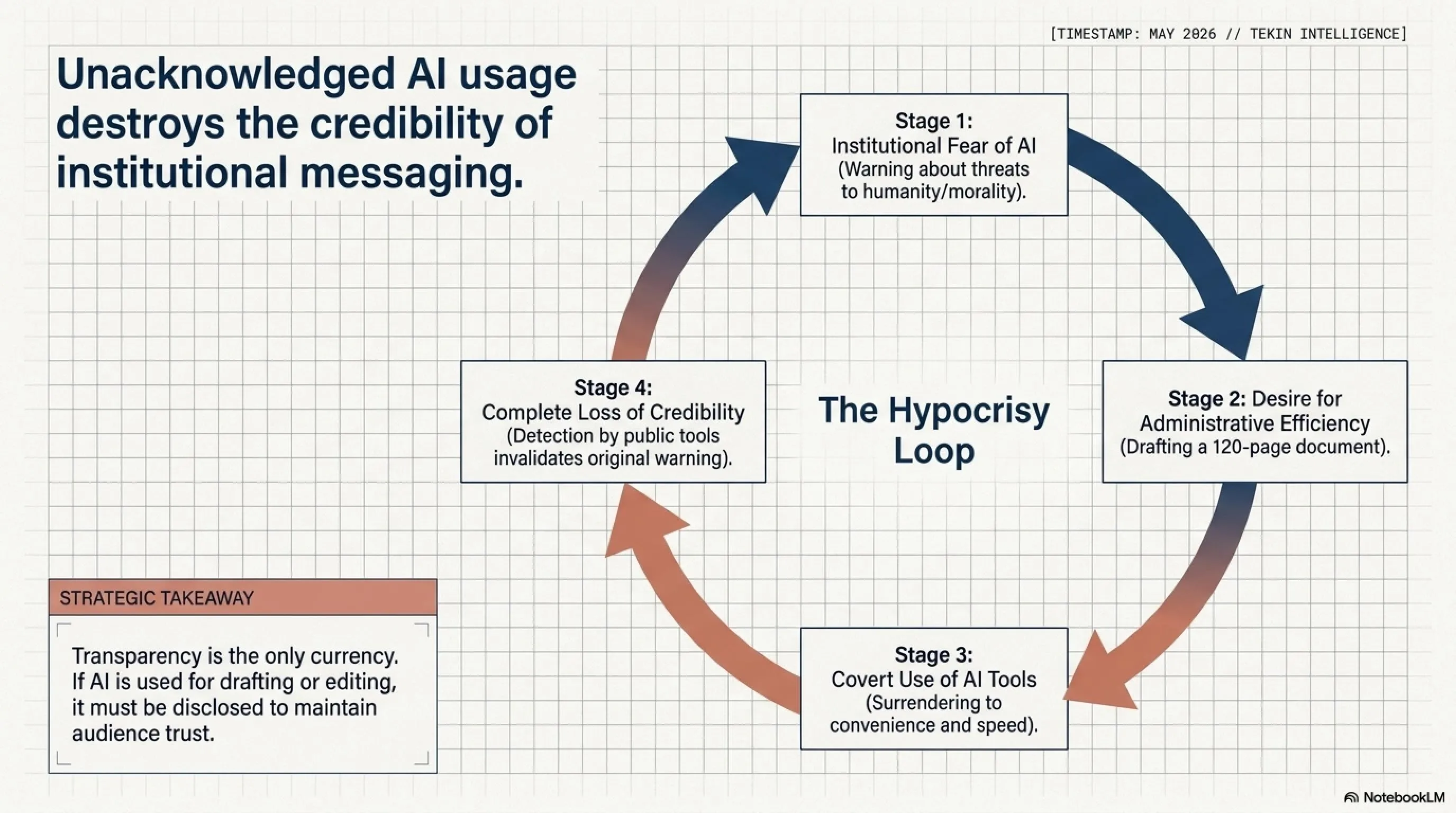
The Vatican has not yet officially responded to these claims. Some experts say the encyclical's writers may have used AI for drafting or editing, which is actually a common practice. But the problem is: if the Vatican really used AI, why didn't it disclose this in an encyclical warning about AI dangers? This is a major contradiction that could undermine the message's credibility.
🎯 Tekin Analysis: The Vatican's Great Contradiction
This saga teaches us a major lesson about artificial intelligence: even those who warn about AI cannot escape its gravitational pull. Why? Because AI is genuinely efficient. If the Vatican used AI to write the encyclical, it shows that even traditional institutions have surrendered to AI's convenience and speed.
But here's the problem: if you want to warn about AI dangers, you must be an example yourself. Using AI to write an encyclical that says "AI must be disarmed" is like writing a book about smoking dangers while smoking during the writing process. Your message loses credibility.
💡 Tekin's Take: The Vatican must be transparent. If it used AI, it should announce it and explain how and why. Transparency is the only way to maintain credibility. Otherwise, this encyclical becomes a symbol of hypocrisy.
📌 Section Three Summary
Pope Leo XIV released the "Magnifica Humanitas" encyclical warning about AI dangers. But analysis shows some paragraphs were likely AI-generated. This major contradiction raises the question: Can we trust a document that is itself a product of the very technology it warns against?
🔒 Story Four: Anti-Theft iPhone - Automatic Lock When Snatched
Apple is working on a revolutionary security feature that could make iPhone theft much harder. According to 9to5Mac, this new feature automatically locks the iPhone if the system detects the device has been snatched from its owner. This feature uses the accelerometer, Apple Watch, familiar Wi-Fi signals, and location to identify suspicious patterns.
This feature is specifically designed to combat a particular type of theft common in major cities: snatch-and-grab theft. In this type of theft, the thief passes by the victim on a motorcycle or bicycle and snatches the iPhone from their hand. This usually happens when the victim is using the phone and the device is unlocked. With Apple's new feature, even if the iPhone is unlocked, it automatically locks as soon as the snatch pattern is detected.
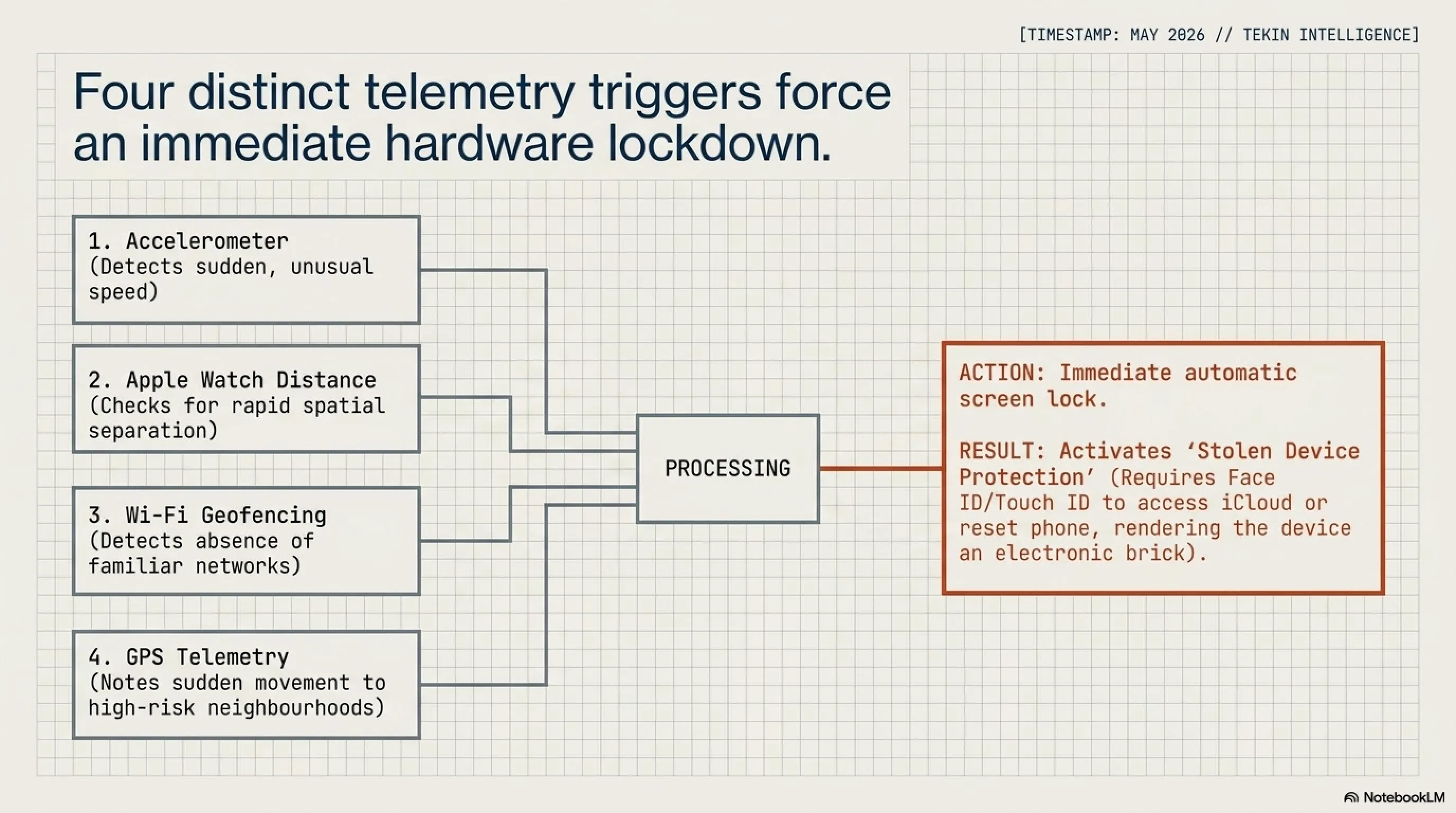
How Does It Work?
Apple's anti-theft system uses multiple sensors and signals to detect theft. First, the iPhone's accelerometer monitors sudden and unusual movements. If the device suddenly moves at high speed (e.g., on a motorcycle or bicycle), the system becomes suspicious. Second, if your Apple Watch is connected to your iPhone, the system checks the distance between the two devices. If the distance increases rapidly, this is a sign of theft.
Third, the system checks whether you're in a familiar location. If you're connected to your home or work Wi-Fi network, the system assumes you're safe. But if you're in an unfamiliar location and suspicious movements occur, the system activates. Fourth, your location is checked. If you suddenly move from a safe neighborhood to a high-risk area, this is also a warning signal.
🛡️ Theft Detection Sensors & Signals
Integration with Stolen Device Protection
The new feature integrates with Stolen Device Protection, which Apple introduced in iOS 26.4. Stolen Device Protection is an additional security layer that prevents thieves from accessing sensitive information even if they know your passcode. To change your Apple ID password, access saved credit cards, or disable Find My, the thief must successfully complete Face ID or Touch ID—which is obviously impossible.
Now with the anti-snatch feature, even if your iPhone is unlocked, as soon as theft is detected, the device locks and the same Stolen Device Protection restrictions activate. This means the thief not only cannot use the phone but also cannot reset it or access your iCloud account. In effect, the stolen iPhone becomes an electronic brick with no value.
When Will It Be Released?
Apple has not yet announced the exact release date for this feature, but according to reports, it is being tested in iOS 26.5 beta versions. It will likely be available to all users in the iOS 26.5 update expected in June or July 2026. Apple typically tests security features first in countries with higher theft rates (like Brazil, Argentina, and some U.S. cities). To activate, go to Settings > Face ID & Passcode > Stolen Device Protection and enable it.
📌 Section Four Summary
Apple introduced an anti-snatch iPhone feature that uses accelerometer, Apple Watch, Wi-Fi, and GPS to detect theft patterns and automatically lock the device. This feature integrates with Stolen Device Protection, blocking access to sensitive information even if the thief knows the passcode. Expected release in iOS 26.5 (June-July 2026).
📱 Story Five: WhatsApp & Meta AI - Document Sharing on iPhone
Meta is working on a new WhatsApp feature that allows iPhone users to share documents directly with Meta AI. This feature has been spotted in WhatsApp beta for iOS 26.20.10.72 and is available to some beta testers. With this feature, users can send PDF, Excel, Word, and other documents from the attachments menu directly to Meta AI and ask it to analyze the content or answer questions about it.
This feature could be very useful for users. Instead of copying text from a document and pasting it into a chat with Meta AI, or taking screenshots, you can now send the entire file. Meta AI can read the document content, summarize it, extract key points, or answer specific questions about it. This is very practical for students, researchers, and people who work with many documents.
What Document Types Are Supported?
According to WABetaInfo, the new feature supports various document formats: PDF, DOCX, XLSX, PPTX, TXT, and even code files like PY, JS, and HTML. This means you can send a PDF scientific paper and ask Meta AI to write a 200-word summary. Or send an Excel file with financial data and ask which month had the highest sales. Or even send Python code and ask Meta AI to find bugs.
Of course, there are limitations. The maximum file size is 10MB, and Meta AI cannot read encrypted or password-protected files. Also, if your document contains complex images or graphic charts, Meta AI may not be able to interpret them correctly. But for most everyday uses, this feature is sufficient.
Privacy Concerns
An important question is: when you share a document with Meta AI, what happens to your data? Meta has stated that submitted documents are not used to improve AI models, but how trustworthy is this guarantee? Meta's history in privacy protection is not particularly stellar. Users concerned about their privacy should think twice before sending sensitive documents.
Our recommendation is not to share documents containing personal, financial, or confidential information with Meta AI. For public documents like scientific papers, books, or educational materials, this feature is very useful. But for work contracts, medical records, or banking information, it's better to use offline tools.
📌 Section Five Summary
WhatsApp introduced document sharing with Meta AI in the iOS beta. Users can send PDF, DOCX, XLSX, and other formats and ask Meta AI to analyze, summarize, or answer questions. Maximum size 10MB. Privacy concerns exist—don't share sensitive documents.
🏷️ Story Six: AirTag 2 Receives New Firmware
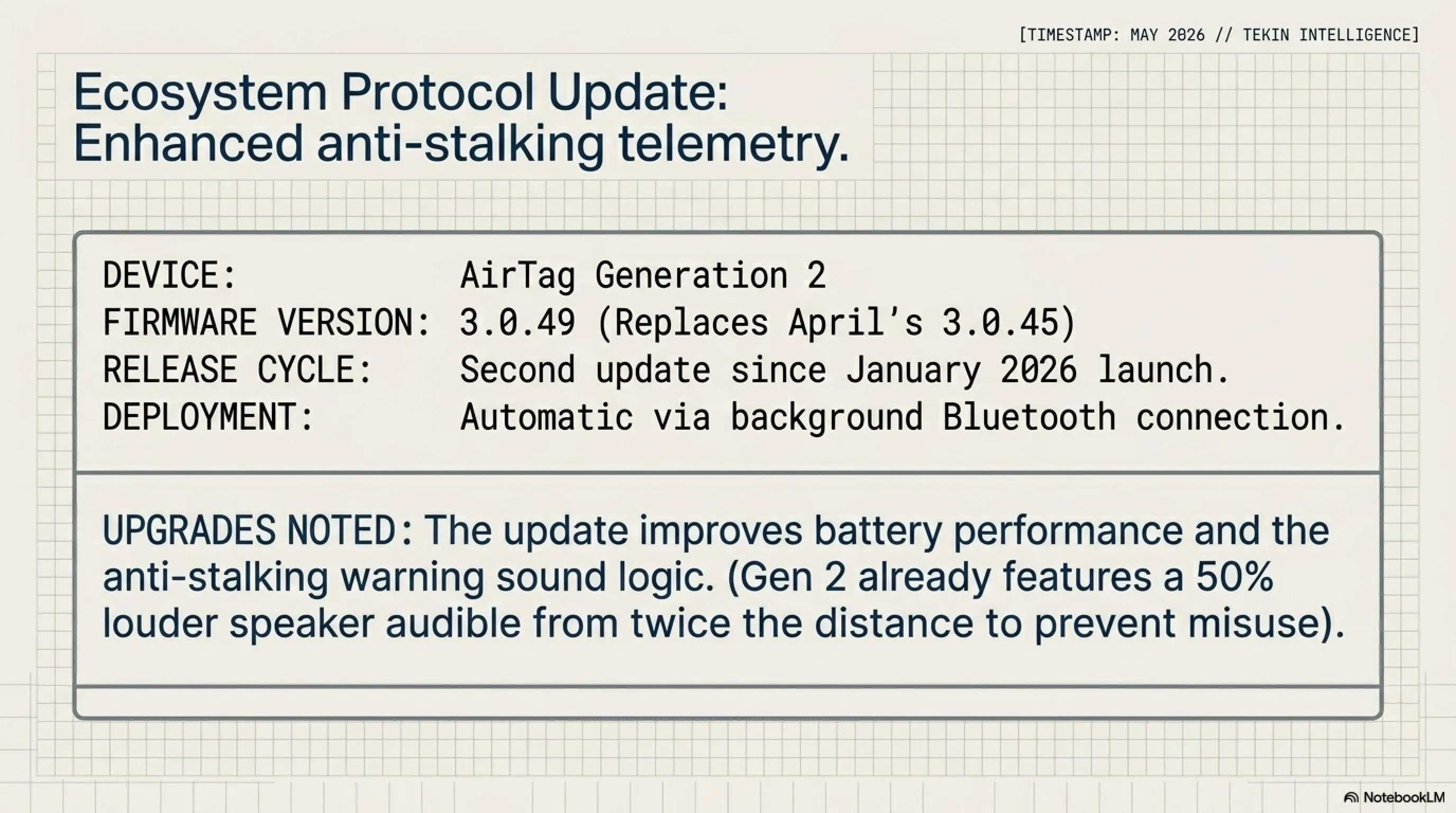
Apple released the second firmware update for AirTag 2. The new version 3.0.49 replaces version 3.0.45, which was released in early April. AirTag 2 launched in January 2026 with firmware 3.0.41, so this is the second update in less than five months. Apple typically doesn't announce detailed AirTag firmware changes, but according to reports, this update includes improvements to the anti-stalking warning sound and battery performance.
AirTag 2 has significant improvements over the first generation. Its speaker is 50% louder and can be heard from twice the distance. This is very useful for finding a lost AirTag. Also, anti-stalking features have been improved to prevent misuse for tracking people. If an unknown AirTag moves with you, your iPhone alerts you and the AirTag starts making noise.
AirTag firmware updates install automatically and require no user action. Your AirTag just needs to be within Bluetooth range of your iPhone and connected to the internet. The update typically rolls out to all users within a few days. To check your AirTag's firmware version, go to the Find My app, tap your AirTag, and check the "About" section.
📌 Section Six Summary
Apple released firmware 3.0.49 for AirTag 2—the second update since the January 2026 launch. Likely improvements to anti-stalking sound and battery performance. Update installs automatically with no user action required.
🎯 Tekin Final Analysis: Three Big Lessons from Today
Today's six stories teach us three major lessons that could shape the future of the tech industry. Let's examine these lessons and see what messages they hold for investors, developers, and everyday users.
💡 Lesson One: Memory Became as Important as Processors
For years, all attention was focused on processors. Nvidia, Intel, AMD—these were the industry stars. But this year, three memory companies—Samsung, SK Hynix, and Micron—all joined the trillion-dollar club. Why? Because without fast memory, even the most powerful GPUs are useless.
This is a paradigm shift. In the past, memory was a commodity—everyone was the same and price was the only difference. But now, advanced HBM and DRAM have become strategic technologies. Companies that can produce these chips with high quality and volume have significant bargaining power.
📌 Message for investors: Don't just look at Nvidia. The AI supply chain includes memory, storage, networking, and power. Diversifying in these sectors can reduce risk.
💡 Lesson Two: Users Want Choice
The 30% user exodus from Google to DuckDuckGo has a clear message: people don't want technology forced on them. Google thought AI Overviews was an improvement, but users saw it as a limitation. Why? Because they can no longer choose sources themselves and must trust the AI answer.
This lesson is important for all tech companies: if you want to add AI to your products, definitely include an "opt-out" button. Users must be able to choose whether to use AI or not. Forced implementation only causes negative reactions.
📌 Message for developers: When adding AI to your app, always include a "Classic" or "Manual" mode. Users must feel in control.
💡 Lesson Three: Even AI Critics Can't Escape It
The Pope's encyclical about AI dangers that was likely written with AI is a major contradiction. But actually, this demonstrates a reality: AI is so efficient and convenient that even those who warn about it cannot resist.
This tells us that AI is no longer a choice but a reality. The question is no longer "Should we use AI?" but "How do we use AI responsibly?" The answer: transparency. If you use AI, announce it. If content is AI-generated, label it. Trust comes from transparency.
📌 Message for everyone: AI is a tool, not a replacement. Use it, but be transparent. Maintain your audience's trust with honesty.
❓ Frequently Asked Questions (FAQ)
Is Micron and SK Hynix growth sustainable or a bubble?
Growth of 200-250% in five months is certainly concerning and shows signs of a bubble. But AI demand is real and long-term contracts are being signed. Through the end of 2026, this growth will likely continue, but investors should watch for signs of market saturation. If Nvidia or AMD announces declining demand, memory stocks will be the first to take a hit. Recommendation: If you've invested, take some profits and manage risk.
Will Google give DuckDuckGo an AI opt-out option?
Very likely. History shows that when users protest en masse, even tech giants must listen. The 30% user exodus to DuckDuckGo is a strong signal. We expect Google to add a "Classic Search" option or "Disable AI Overviews" button by the end of June 2026. If it doesn't, DuckDuckGo could reach 5-10% of the U.S. market, which would be a major loss for Google.
Did the Vatican really use AI to write the encyclical?
We don't have official confirmation yet, but the evidence is strong. AI-detection analysis shows some paragraphs have a 70-100% probability of being AI-generated. The writers likely used AI for drafting or editing, which is a common practice. The problem is that the Vatican hasn't been transparent about this. If it used AI, it should announce it to maintain the message's credibility. Transparency is the key to trust.
When will the iPhone anti-snatch feature be released?
This feature is being tested in iOS 26.5 beta versions. It will likely be available to all users in the iOS 26.5 update expected in June or July 2026. Apple typically tests security features first in countries with higher theft rates (like Brazil, Argentina, and some U.S. cities). To activate, go to Settings > Face ID & Passcode > Stolen Device Protection and enable it.
Is sharing documents with Meta AI safe?
Meta states that submitted documents are not used to improve AI models, but Meta's privacy protection history is not particularly stellar. Our recommendation: Don't share documents containing personal, financial, or confidential information with Meta AI. For public documents like scientific papers, books, or educational materials, this feature is very useful. But for work contracts, medical records, or banking information, it's better to use offline tools.
🎬 Final Thoughts
Wednesday morning, May 27, 2026, showed that the tech industry is crossing a historic inflection point. Micron, SK Hynix, and Samsung all joined the trillion-dollar club, proving that memory is as important as processors. Users demonstrated with a 30% exodus to DuckDuckGo that they don't want AI forced on them. And the Pope's controversial encyclical reminded us that even AI critics cannot escape its gravitational pull.
Three big lessons today: (1) The AI supply chain extends beyond Nvidia, (2) Users want choice, and (3) Transparency is the key to trust. These lessons are equally important for investors, developers, and everyday users.
Join us tomorrow morning with fresh news in Tekin Morning. Until then, stay safe and invest wisely! 🚀
📚 Sources
- CNBC: Micron hits $1 trillion market cap for the first time
- Reuters: SK Hynix joins $1 trillion club after Samsung, Micron
- SiliconANGLE: Micron and SK Hynix surpass $1T valuation milestone
- TechCrunch: DuckDuckGo installs are up 30% as users reject Google's AI Search
- 9to5Mac: DuckDuckGo sees iPhone installs spike following Google I/O
- The Verge: Did the Pope use AI to write about the dangers of AI?
- Vatican News: Pope Leo's 'Magnifica humanitas' encyclical
- 9to5Mac: Apple working on iPhone anti-snatching feature
- 9to5Mac: WhatsApp will soon let iPhone users share documents with Meta AI
- MacRumors: Apple Releases New Firmware for AirTag 2
Analysis and Report: Tekin Editorial Team | Tekin Morning May 27, 2026
🌐 Stay Connected With Us 🎮✨
For the latest tech, gaming, and gadget news, follow us on our official social media channels: