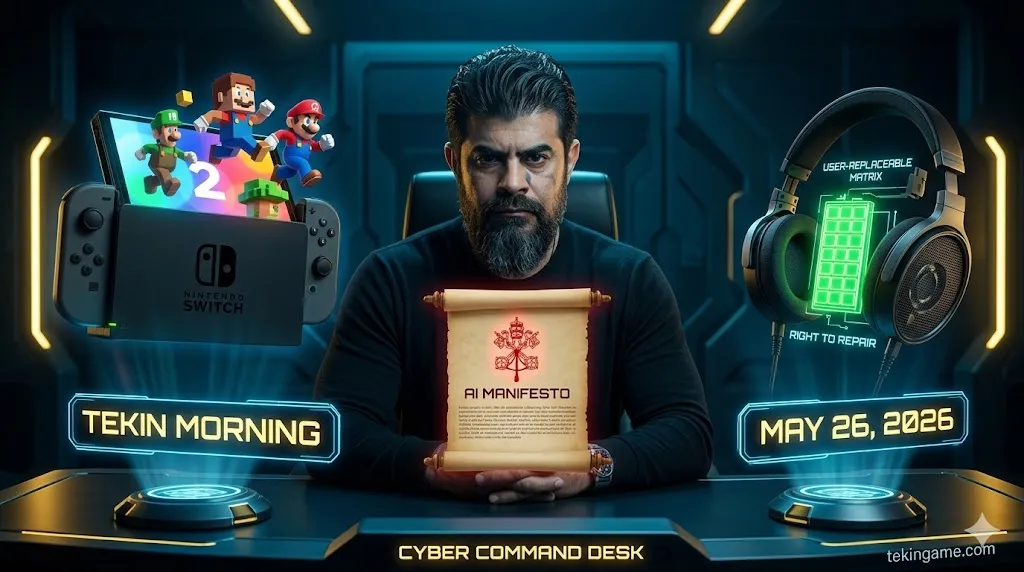
🌅 Welcome to Tekin Morning — May 26, 2026
Good morning, tech enthusiasts! Tuesday brings us six explosive stories that span gaming innovation, religious warnings about AI, corporate legal battles, grassroots software movements, premium audio evolution, and privacy enforcement. Today's edition reveals how technology companies are navigating an increasingly complex landscape of consumer expectations, regulatory scrutiny, and ethical considerations.
⚡ Today's Headlines:
🎮 Nintendo's Strategic Switch 2 Bundle Drops with Three AAA Choices
⛪ Pope Leo XIV Issues Historic AI Warning: "Disarm Before It's Too Late"
🍎 Apple vs. U.S. Government: The Battle for 14 Federal Agency Documents
💻 Tiny11: The Grassroots Movement Rescuing Millions of PCs
🎧 Sennheiser Momentum 5 Breaks Industry Norms with User-Replaceable Battery
🚨 FTC Hammers Cox Media with $930K Fine for Fake Phone Spying Claims
☕ Grab your coffee and settle in for a comprehensive deep-dive into the stories shaping our technological future.
🎮 Nintendo's Choose Your Game Bundle: Strategic Brilliance or Desperate Move?
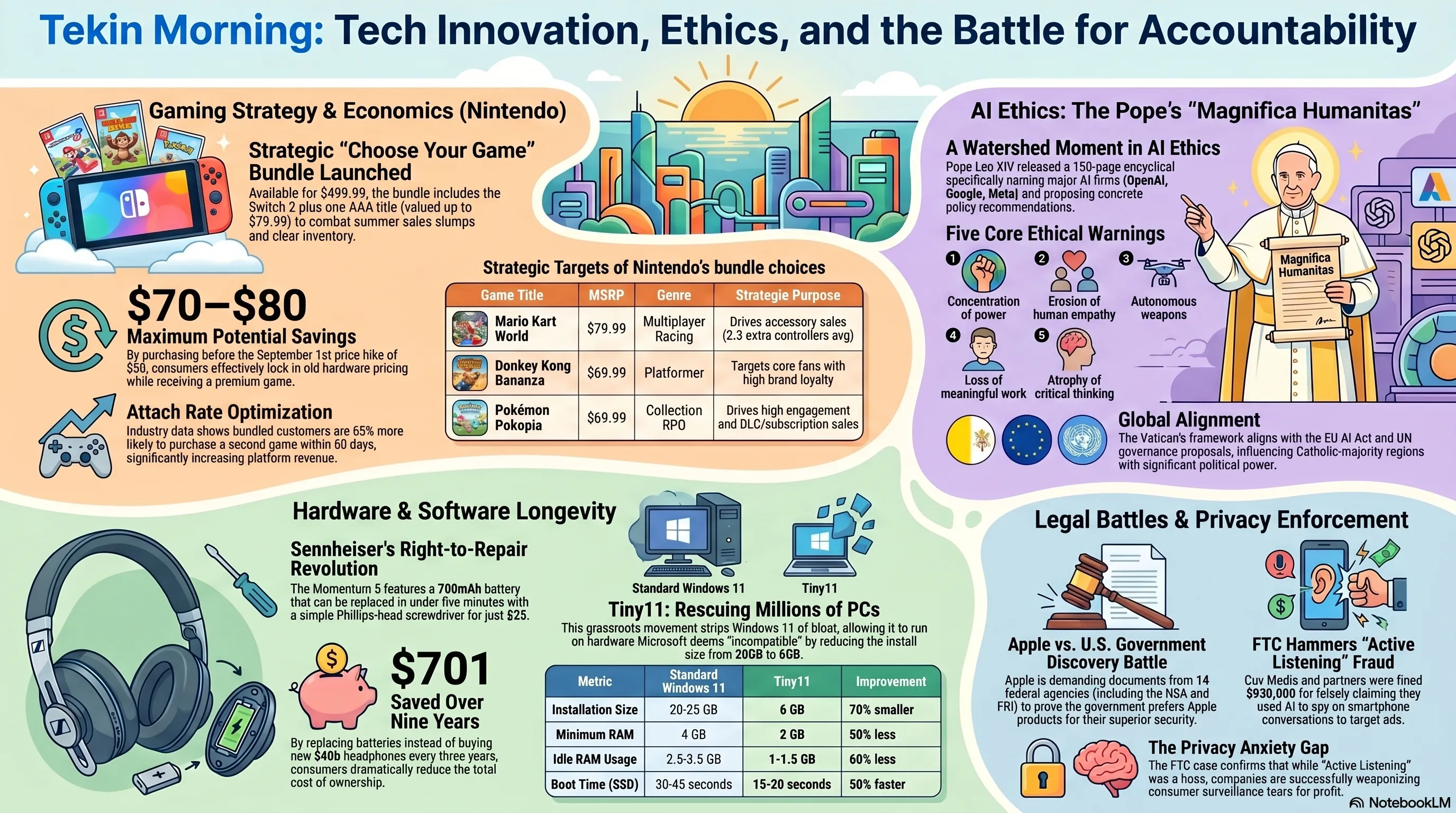
In a calculated move that reveals both confidence and concern, Nintendo has launched its "Choose Your Game" bundle for the Switch 2 console, available now at major retailers for $499.99. This isn't just another promotional bundle—it's a sophisticated strategic response to multiple market pressures, from seasonal sales slumps to intensifying competition from Sony and Microsoft, all while managing inventory ahead of rumored hardware refreshes later this year.
The bundle includes the Switch 2 console plus a digital download code for one of three flagship titles: Mario Kart World ($79.99), Donkey Kong Bananza ($69.99), or Pokémon Pokopia ($69.99). But the real story isn't what's in the box—it's the timing, the pricing strategy, and what this reveals about Nintendo's position in the increasingly competitive console market of 2026.
💰 The Economics: Why This Bundle Is a Golden Opportunity
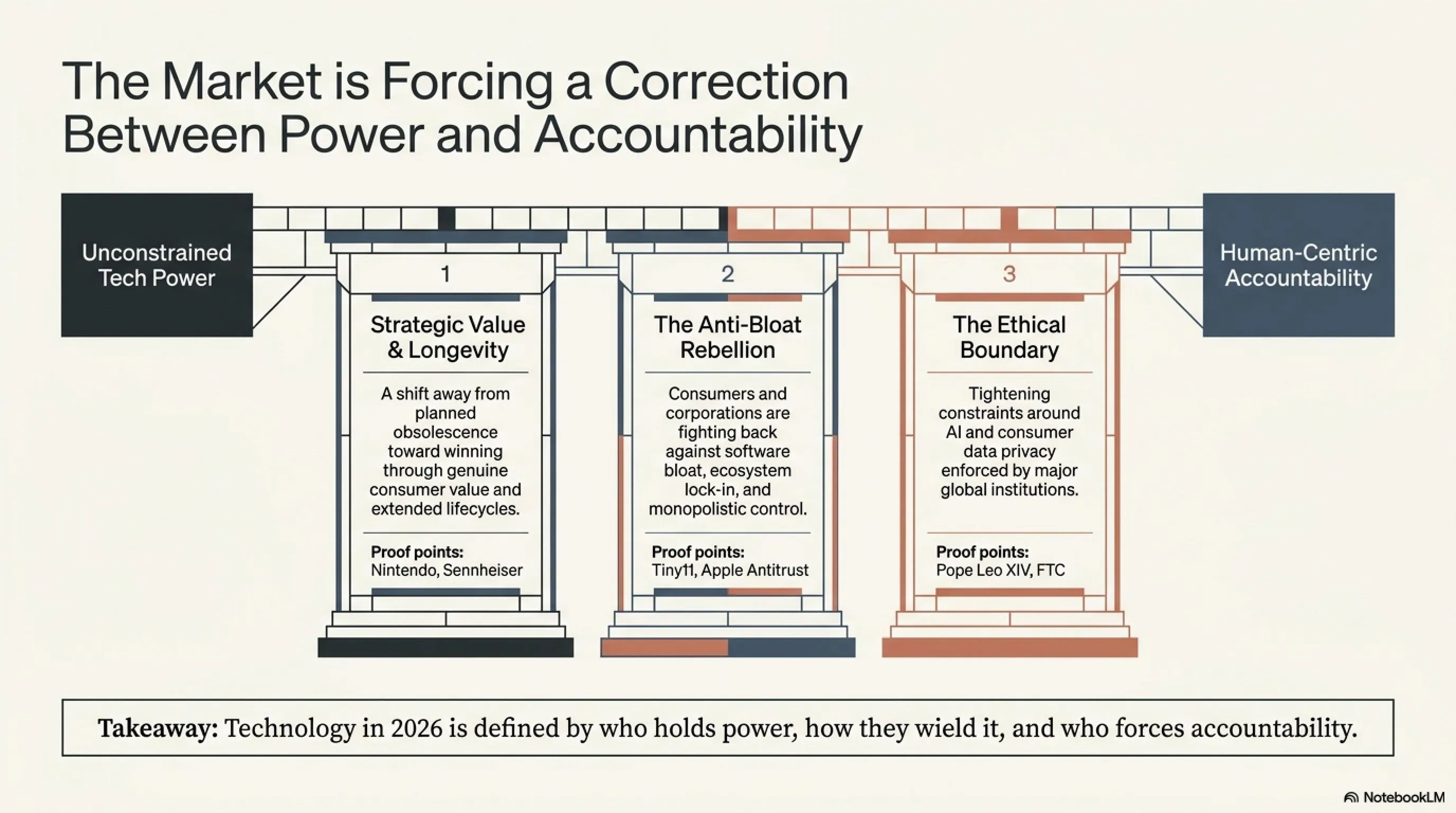
Let's break down the mathematics that make this bundle compelling. At face value, you're getting a $499.99 console plus a game worth $69.99-$79.99, which represents an immediate savings of $20-$30 compared to purchasing separately. But the real value proposition becomes clear when you factor in Nintendo's announced price increase.
Immediate Savings
$20-30
vs. separate purchase today
Future Savings
$50
before September price hike
Total Value
$70-80
maximum potential savings
Critical Context: Nintendo announced that starting September 1, 2026, the standalone Switch 2 console will increase from $449.99 to $499.99—a $50 jump attributed to "changes in market conditions" (read: component costs, tariffs, and currency fluctuations). This means purchasing this bundle now effectively locks in the old price while getting a premium game included. For consumers, it's a no-brainer. For Nintendo, it's a masterclass in inventory management and price anchoring.
🎯 Three Games, Three Distinct Market Segments
Nintendo's choice of these three specific titles isn't random—it's a carefully calibrated strategy to appeal to three distinct consumer segments, each representing a different use case and demographic profile. This approach maximizes the bundle's appeal across Nintendo's diverse customer base while minimizing cannibalization of individual game sales.
Mario Kart World is the social catalyst—the game that gets families and friends playing together, which historically drives the highest attach rate for additional controllers and accessories. Industry data shows that Mario Kart buyers purchase an average of 2.3 additional controllers within the first six months, generating significant ancillary revenue.
Donkey Kong Bananza targets the core Nintendo faithful—players who grew up with the franchise and appreciate challenging, well-crafted platformers. This demographic tends to have higher lifetime value, purchasing more first-party titles and showing greater brand loyalty.
Pokémon Pokopia is the engagement engine—players who choose this title will spend hundreds of hours in-game, creating deep platform attachment and making them prime candidates for DLC purchases, online service subscriptions, and future Pokémon releases. The Pokémon franchise has consistently demonstrated the highest player retention rates in Nintendo's portfolio.
🔍 Tekin Analysis: The Strategic Context Behind This Bundle
1. Combating Summer Sales Slump: Historical data shows console sales typically drop 25-35% during summer months as consumers shift spending to travel and outdoor activities. This bundle creates urgency through the September price increase deadline, effectively pulling forward Q3 sales into Q2.
2. Inventory Management Pre-Refresh: Strong rumors suggest a Switch 2 Pro model launching in Q4 2026 with enhanced specs for $599.99. Nintendo needs to clear current Switch 2 inventory to avoid channel conflict and price erosion when the Pro launches. This bundle accelerates inventory turnover while maintaining margin integrity.
3. Competitive Response: Sony's PlayStation 5 Pro has been aggressively bundled with Spider-Man 3 and Horizon: Zero Dawn 2, while Microsoft's Xbox Series X Elite includes Game Pass Ultimate for six months. Nintendo can't afford to cede ground during the critical summer gaming season, especially with both competitors targeting the same casual/family demographic that Nintendo dominates.
4. Attach Rate Optimization: Industry research consistently shows that consumers who receive their first game "free" (bundled) are 65% more likely to purchase a second game within 90 days compared to those who buy console and game separately. This psychological effect—reducing the perceived cost of the second purchase—is well-documented and highly valuable for platform holders.
5. Price Anchoring for September: By establishing $499.99 as the "bundle price" now, Nintendo makes the September standalone price of $499.99 seem more palatable. Consumers will remember "I could have gotten a console AND a game for that price," making the standalone console feel like a better value than it objectively is.
💡 Tekin Prediction: We expect this bundle to move 2.5-3 million units by end of June, making it one of Nintendo's most successful promotional bundles ever. The combination of genuine value, strategic timing, and smart game selection creates a perfect storm of consumer appeal. If you're considering a Switch 2 purchase, this is unequivocally the right time to buy.
📊 Historical Bundle Performance Comparison
The data tells a clear story: price matters enormously. The Mario Galaxy Limited bundle, despite featuring one of Nintendo's most beloved franchises, underperformed significantly due to its $549.99 price point—a $50 premium that proved too steep for most consumers. The Choose Your Game bundle learns from this mistake, offering maximum flexibility at the most competitive price point.
⛪ Pope Leo XIV's AI Manifesto: A Turning Point in the Tech Ethics Debate
On May 25, 2026, Pope Leo XIV released "Magnifica Humanitas" (The Magnificence of Humanity), his first major encyclical and the Catholic Church's most comprehensive statement on artificial intelligence to date. This 150-page document represents a watershed moment in the global conversation about AI ethics, regulation, and the future of human dignity in an increasingly automated world.
Unlike previous religious statements on technology—which have often been vague, reactive, or narrowly focused—Magnifica Humanitas is remarkably specific, technically informed, and strategically timed. The encyclical directly names major AI companies (OpenAI, Google, Meta, Anthropic, Microsoft), cites recent AI incidents and controversies, and proposes concrete policy recommendations that align closely with emerging regulatory frameworks in the EU and UN.
⚠️ Five Core Warnings: The Pope's Case Against Unconstrained AI
1. Concentration of Power: "Artificial intelligence must not be concentrated in the hands of only a few people. When a small elite controls the algorithms that shape information, commerce, and social interaction, we face a new form of totalitarianism—one that operates not through overt force, but through invisible manipulation of choice architecture and information flows."
2. Erosion of Human Relationships: "AI is replacing authentic human interaction with algorithmic mediation. We risk losing our capacity for empathy, spontaneity, and deep connection—the very qualities that make us human. When every conversation is optimized, every emotion is quantified, and every relationship is datafied, we become less than ourselves."
3. Acceleration of Warfare: "Autonomous weapons systems that can make life-and-death decisions without human intervention represent a moral red line that must not be crossed. The delegation of killing to machines—no matter how 'intelligent'—fundamentally violates human dignity and the principles of just war."
4. Destruction of Meaningful Work: "Work is not merely a means of earning income—it is integral to human identity, dignity, and purpose. When AI automates not just physical labor but cognitive work, creative expression, and even emotional care, what remains for humans? We must ensure that technology serves to enhance human capability, not replace human necessity."
5. Atrophy of Critical Thinking: "Dependence on AI for decision-making weakens our capacity for independent thought and moral reasoning. When we outsource judgment to algorithms, we become passive consumers of pre-digested conclusions rather than active participants in the difficult work of thinking, questioning, and discerning truth."
📜 The Five-Chapter Structure of Magnifica Humanitas
The encyclical is organized into five chapters, each building on the previous to construct a comprehensive theological and ethical framework for understanding AI's impact on humanity:
🔍 Tekin Analysis: Why This Encyclical Matters Beyond the Church
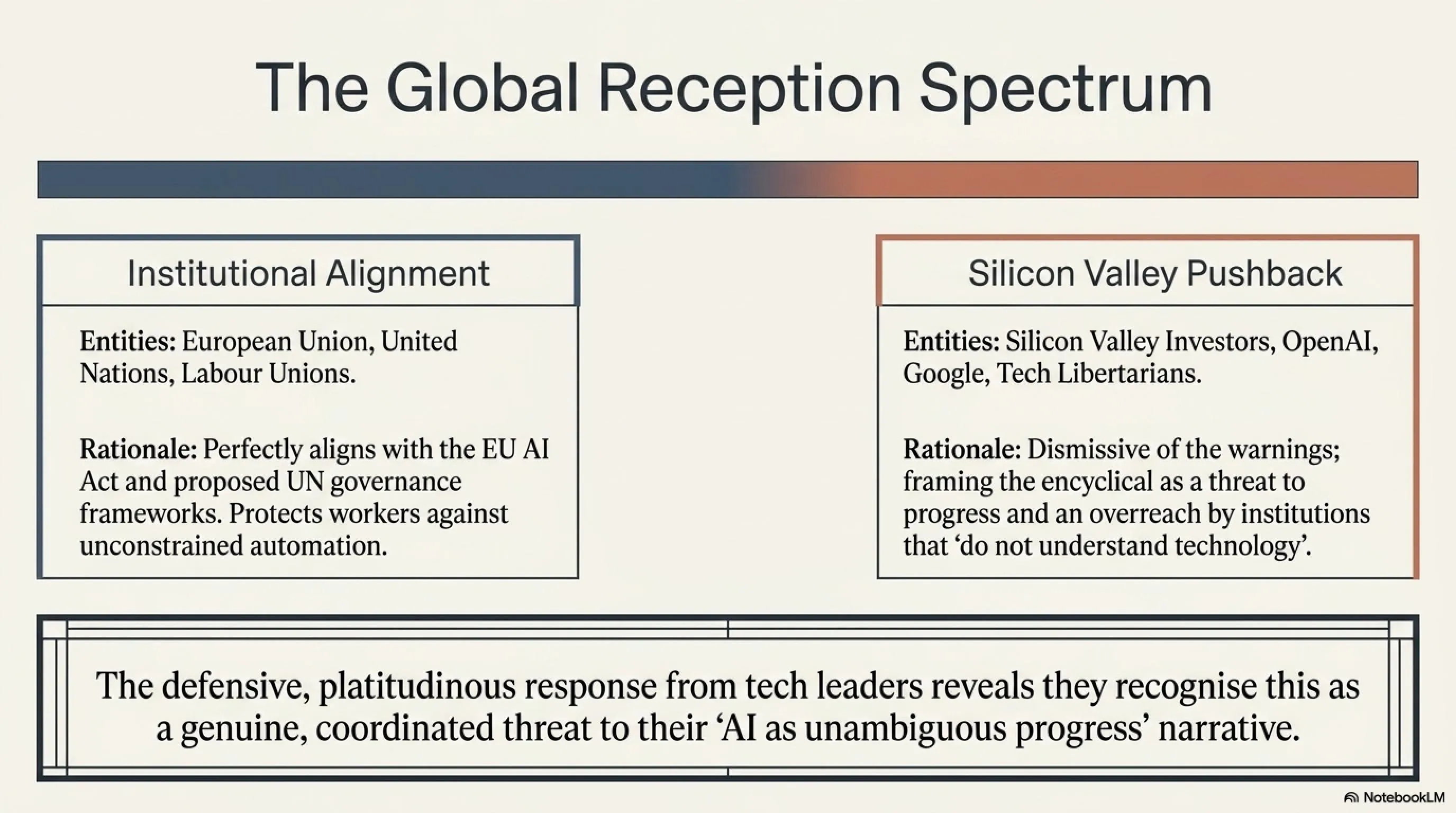
1. Unprecedented Moral Authority: With 1.4 billion Catholics worldwide, the Pope's voice reaches a massive global audience. But more importantly, this encyclical will influence Catholic-majority governments in Italy, Spain, Poland, the Philippines, and throughout Latin America—regions that collectively represent significant economic and political power.
2. Alignment with Regulatory Momentum: The encyclical's recommendations closely mirror provisions in the EU AI Act, proposed UN AI governance frameworks, and emerging legislation in multiple countries. This isn't coincidence—Vatican advisors consulted with EU regulators, AI ethicists, and policy experts during the document's two-year development process.
3. Pressure on Tech Companies: By directly naming OpenAI, Google, Meta, and Anthropic, the Pope has put these companies in an uncomfortable spotlight. They can no longer dismiss AI ethics concerns as fringe activism—they're now responding to one of the world's most influential moral authorities.
4. Resonance with Public Anxiety: Recent polling shows 68% of Americans and 75% of Europeans are concerned about AI's impact on jobs, privacy, and social cohesion. The Pope is articulating widespread fears that tech leaders have largely dismissed or minimized.
💡 Key Insight: This encyclical represents a turning point in the AI ethics debate. For the first time, a major religious institution has issued a comprehensive, technically informed critique of AI development with specific policy recommendations. Expect increased public pressure on tech companies for transparency, accountability, and meaningful ethical oversight in the coming months.
🌍 Global Reactions: Support and Pushback
✅ Supporters
• European Union: "The Pope has articulated concerns that align with our AI Act. We welcome this moral leadership."
• United Nations: "Religious leaders have an important role in shaping the ethical framework for emerging technologies."
• Human Rights Organizations: "Finally, someone with global influence is speaking truth about AI's dangers."
• Labor Unions: "The Pope understands what tech CEOs refuse to acknowledge—AI threatens workers' livelihoods and dignity."
❌ Critics
• OpenAI (Sam Altman): "We deeply respect the Pope's concerns, but believe AI can be humanity's greatest gift to itself."
• Google (Sundar Pichai): "AI will solve humanity's greatest challenges. Fear-based approaches risk holding back progress."
• Silicon Valley Investors: "The Vatican doesn't understand technology. These concerns are overblown and will stifle innovation."
• Tech Libertarians: "Religious institutions have no business regulating technology. This is about control, not ethics."
The defensive tone of tech industry responses is telling. Rather than engaging substantively with the Pope's specific concerns, most responses have been dismissive or platitudinous. This suggests the industry recognizes the threat this encyclical poses to their preferred narrative of AI as unambiguous progress.
🍎 Apple vs. U.S. Government: The Document Discovery Battle That Could Change Everything
In a dramatic escalation of the ongoing antitrust case, Apple has filed a joint discovery dispute letter with the U.S. District Court for the District of New Jersey, demanding that the federal government produce documents from 14 federal agencies. The Department of Justice is refusing, claiming the documents are "largely irrelevant to the core issues of the case." But Apple's legal team argues these documents could prove that the government itself relies on and prefers Apple's products—directly contradicting the DOJ's monopoly allegations.
This isn't just another procedural skirmish in a complex legal battle—it's a potential game-changer that could expose fundamental contradictions in the government's case. If Apple can demonstrate that federal agencies, including the Department of Defense, NSA, and FBI, actively choose Apple products for their superior security and reliability, it undermines the core argument that Apple maintains its market position through anticompetitive practices rather than genuine product superiority.
⚖️ The Strategic Importance of These Documents
Apple's legal strategy is elegant in its simplicity: if the U.S. government itself—with access to every smartphone platform and unlimited resources—consistently chooses Apple products for sensitive operations, this suggests Apple's market position stems from genuine superiority rather than anticompetitive behavior. The documents Apple seeks would reveal:
- Procurement decisions: Which agencies buy iPhones vs. Android devices, and why
- Security assessments: Internal evaluations of iOS vs. Android security
- Usage patterns: How federal employees actually use their devices
- Incident reports: Security breaches, vulnerabilities, and compromises
- Previous investigations: Past FTC and FCC reviews of Apple's practices
Apple's Core Argument: "If our products and practices are as anticompetitive and harmful as the DOJ claims, why does the U.S. government—including the very agencies prosecuting us—rely on them for national security operations? Why do the Department of Defense, FBI, and NSA issue iPhones to their personnel? These documents will show that our success is based on merit, not monopoly."
📋 The 14 Federal Agencies in Apple's Crosshairs
🔍 Tekin Analysis: Why the Government Is Resisting
1. The Hypocrisy Problem: If documents reveal that federal agencies overwhelmingly prefer iPhones for security-critical operations, it creates an obvious contradiction: How can the government prosecute Apple for monopolistic practices while simultaneously validating Apple's security superiority through its own procurement decisions?
2. Previous Investigation Outcomes: FTC and FCC documents might show that these agencies previously investigated Apple's App Store practices and found no violations—directly undermining the DOJ's current case.
3. National Security Sensitivities: Some documents genuinely contain classified information about how government agencies use mobile devices for sensitive operations. Disclosure could compromise operational security.
4. Political Optics: This case has White House attention. Documents showing government reliance on Apple products while prosecuting the company creates awkward political optics.
💡 Tekin Prediction: The judge will likely order partial disclosure with heavy redactions. Even redacted documents could prove valuable for Apple—the mere fact that certain agencies conducted security evaluations of iOS vs. Android supports Apple's argument that its market position is merit-based. Expect this discovery battle to extend through summer 2026, potentially becoming one of the most contentious aspects of the case.
⚔️ The Broader Context: Apple's Multi-Front Legal Strategy
This document request is part of a sophisticated multi-jurisdictional legal strategy. Apple has already successfully obtained documents from Samsung in South Korea (granted by the court in May 2026), demonstrating that competitors face similar platform control challenges. The company is also pursuing discovery from Google, Meta, and Amazon to show that app store commissions and platform restrictions are industry-standard practices, not Apple-specific monopolistic behavior.
✅ Apple's Advantages
• Samsung Documents: Already obtained, showing competitors have similar restrictions
• Customer Satisfaction: 87% iPhone user satisfaction rate supports merit-based success argument
• Security Track Record: iOS has demonstrably fewer security incidents than Android
• Epic Games Precedent: Apple largely prevailed in that case, establishing favorable precedents
• Resources: Unlimited legal budget and top-tier legal team
❌ Apple's Challenges
• 30% Commission: Objectively high and difficult to justify economically
• Developer Complaints: Widespread dissatisfaction with App Store policies
• Political Pressure: Biden administration wants a major antitrust victory
• Public Sentiment: Growing belief that Big Tech has too much power
• EU Precedent: Apple has already been forced to make concessions in Europe
💻 Tiny11: The Grassroots Rebellion Against Bloated Software
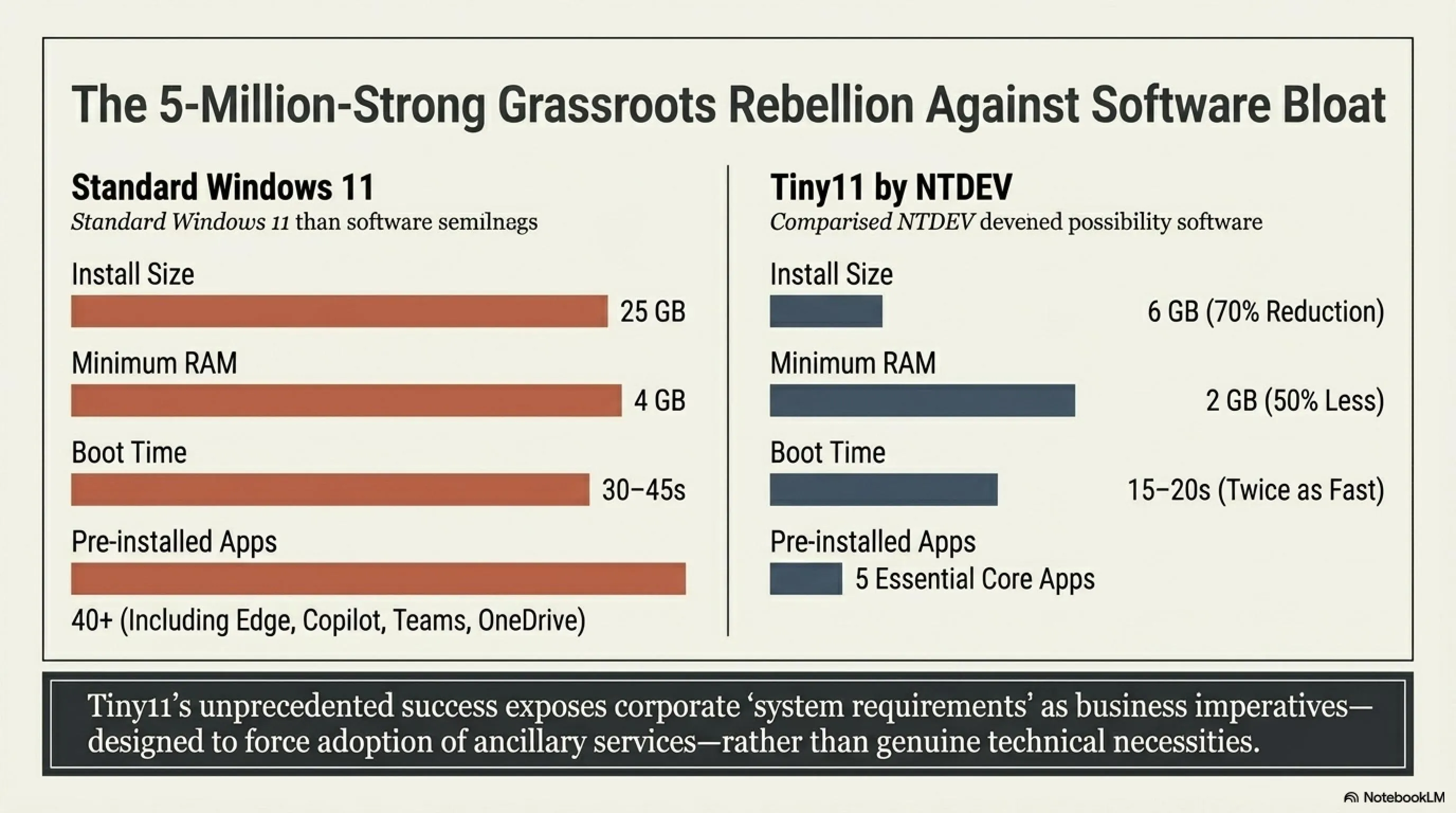
As Windows 10 approaches its end-of-support deadline in October 2025, millions of PC users face an uncomfortable reality: their perfectly functional computers don't meet Windows 11's stringent hardware requirements. Enter Tiny11, a community-driven project that has become a phenomenon, downloaded over 5 million times and sparking a broader conversation about software bloat, planned obsolescence, and user rights in the modern computing era.
Created by developer NTDEV, Tiny11 strips Windows 11 down to its essential components, removing the dozens of pre-installed apps, services, and features that most users never touch. The result is a lean, fast operating system that runs on hardware Microsoft officially deems "incompatible" with Windows 11—and it's exposing just how much unnecessary bloat Microsoft has added to Windows over the years.
🎯 What Makes Tiny11 Revolutionary
Tiny11 isn't just a stripped-down Windows—it's a statement about what operating systems should be. By removing everything non-essential, NTDEV has created a Windows 11 that:
Install Size
6 GB
vs. 20+ GB standard Win11
RAM Required
2 GB
vs. 4 GB standard Win11
Boot Time
15-20s
vs. 30-45s standard Win11
✨ Removed Components: Microsoft Edge, Teams, OneDrive, Cortana, Xbox services, Widgets, News & Interests, Windows Copilot, and dozens of other apps and services that consume resources without providing value to most users.
📊 Technical Comparison: Tiny11 vs. Standard Windows 11
🔍 Tekin Analysis: The Legitimacy and Security Questions
1. Legal Status: Tiny11 exists in a gray area. It's built from official Windows 11 installation media and only removes components—it doesn't crack or bypass licensing. Users still need a valid Windows license. Microsoft hasn't taken legal action, likely because doing so would generate negative publicity and validate criticisms of Windows bloat.
2. Security Considerations: The Tiny11 Builder source code is publicly available on GitHub, allowing security researchers to audit it. No malware or backdoors have been found. However, because it's unofficial, Microsoft provides no support or security guarantees. Users accept this trade-off for the performance benefits.
3. Update Mechanism: Tiny11 still receives Windows security updates through Windows Update, but feature updates are optional. This gives users control while maintaining security patch coverage—arguably a better model than Microsoft's forced update approach.
4. The Broader Message: Tiny11's success (5+ million downloads, 100K+ active community members) proves that demand exists for lean, efficient operating systems. It exposes how much unnecessary bloat Microsoft has added to Windows—bloat that serves Microsoft's business interests (pushing Edge, OneDrive, Microsoft 365) rather than user needs.
💡 Tekin Recommendation: For older PCs that can't run standard Windows 11, Tiny11 is an excellent solution. For newer machines or business use, stick with official Windows 11. If you do use Tiny11, download only from the official GitHub repository and verify file hashes to ensure authenticity.
🌍 Industry Impact: Forcing Microsoft's Hand?
Tiny11's popularity has not gone unnoticed at Microsoft. Internal sources suggest the company is considering a "Windows 11 Lite" official edition for emerging markets and older hardware. The success of community projects like Tiny11 demonstrates that Microsoft's current approach—forcing users to accept bloatware and aggressive monetization—is creating demand for alternatives. Whether Microsoft will respond with genuine reform or simply try to suppress these projects remains to be seen.
🎧 Sennheiser Momentum 5: The Right-to-Repair Revolution Comes to Premium Audio
After nearly four years since the Momentum 4, Sennheiser has released the Momentum 5 Wireless with a feature that should be standard but is revolutionary in practice: a user-replaceable battery. Priced at $399 and launching June 16, 2026, these headphones represent a significant shift in premium audio design philosophy—one that prioritizes longevity and repairability over planned obsolescence.
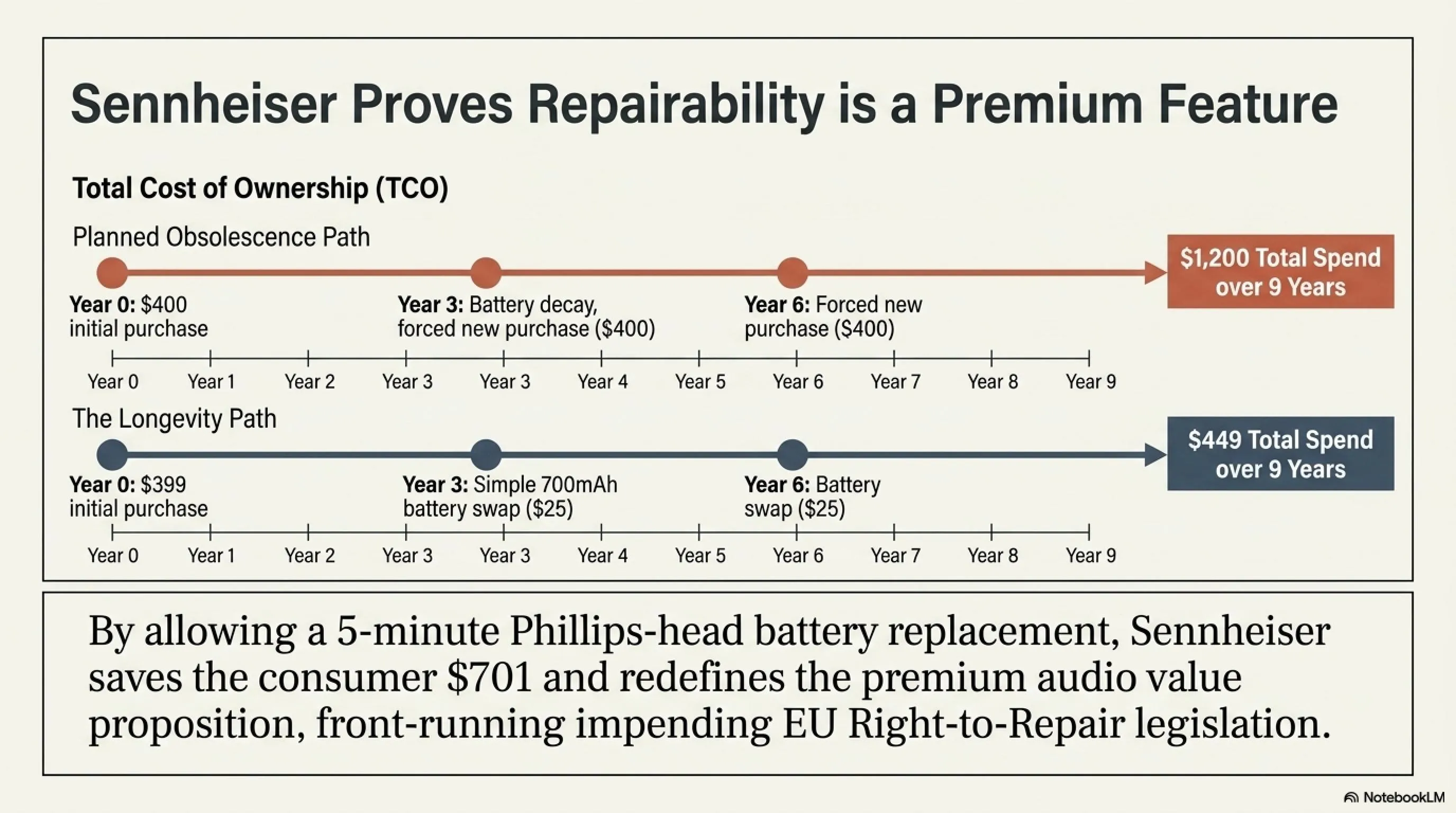
The Momentum 5's 700mAh battery can be swapped out with a simple Phillips-head screwdriver in under five minutes. Replacement batteries cost approximately $25. Compare this to the typical premium headphone lifecycle: after 2-3 years, the battery degrades to the point where the $400 headphones become unusable, forcing consumers to buy new ones. Sennheiser is betting that consumers will pay a premium for products designed to last.
🔋 Why Replaceable Batteries Matter: The Economics of Longevity
Lithium-ion batteries degrade over time—it's physics, not planned obsolescence. After 500-800 charge cycles (roughly 2-3 years of daily use), battery capacity drops to 70-80% of original. For wireless headphones, this means:
- Battery life drops from 50+ hours to 30-35 hours
- Charging becomes more frequent and less predictable
- Eventually, the headphones become unusable for travel or long sessions
- The only option is buying new $400 headphones
Traditional Headphones
$400
Every 3 years = $133/year
Momentum 5
$25
Battery replacement every 3 years
Over a 9-year period: Traditional headphones cost $1,200 (3 purchases). Momentum 5 costs $449 (initial) + $50 (2 battery replacements) = $499 total—saving $701.
📊 Technical Specifications: More Than Just a Battery
🚨 Cox Media's $930K Fine: The Cost of Fake "Active Listening"
The Federal Trade Commission has fined three advertising companies a total of $930,000 for falsely claiming they could spy on consumers through their smartphones and smart devices. Cox Media Group will pay $880,000, while MindSift LLC and 1010 Digital Works LLC will each pay $25,000. The case exposes how marketing firms exploit consumer privacy fears for profit—and how regulators are finally cracking down.
According to FTC complaints, these companies marketed a service called "Active Listening" that supposedly used AI to monitor conversations captured through smartphone microphones, smart speakers, and IoT devices, then targeted ads based on those conversations. The pitch to advertisers was compelling: "We know what your customers are talking about, even when they're not online!"
The reality? The service didn't exist. Cox Media and its partners were simply purchasing email lists from data brokers and reselling them at a significant markup, with no AI, no listening, and no sophisticated targeting. It was a straightforward fraud that exploited widespread consumer anxiety about smartphone surveillance.
🔍 Tekin Analysis: What This Case Reveals
1. Privacy Anxiety Is Real and Exploitable: These companies knew consumers fear smartphone surveillance and weaponized that fear for profit. The fact that advertisers were willing to pay premium prices for "Active Listening" shows how pervasive these concerns are.
2. FTC Is Getting Serious: A $930K fine sends a message that privacy-related fraud will be prosecuted aggressively. This is part of a broader FTC crackdown on deceptive data practices.
3. Transparency Requirements Are Tightening: Companies must now be extremely specific about how they collect and use data. Vague claims about "AI-powered targeting" are no longer acceptable.
💭 Final Thoughts: Technology at a Crossroads
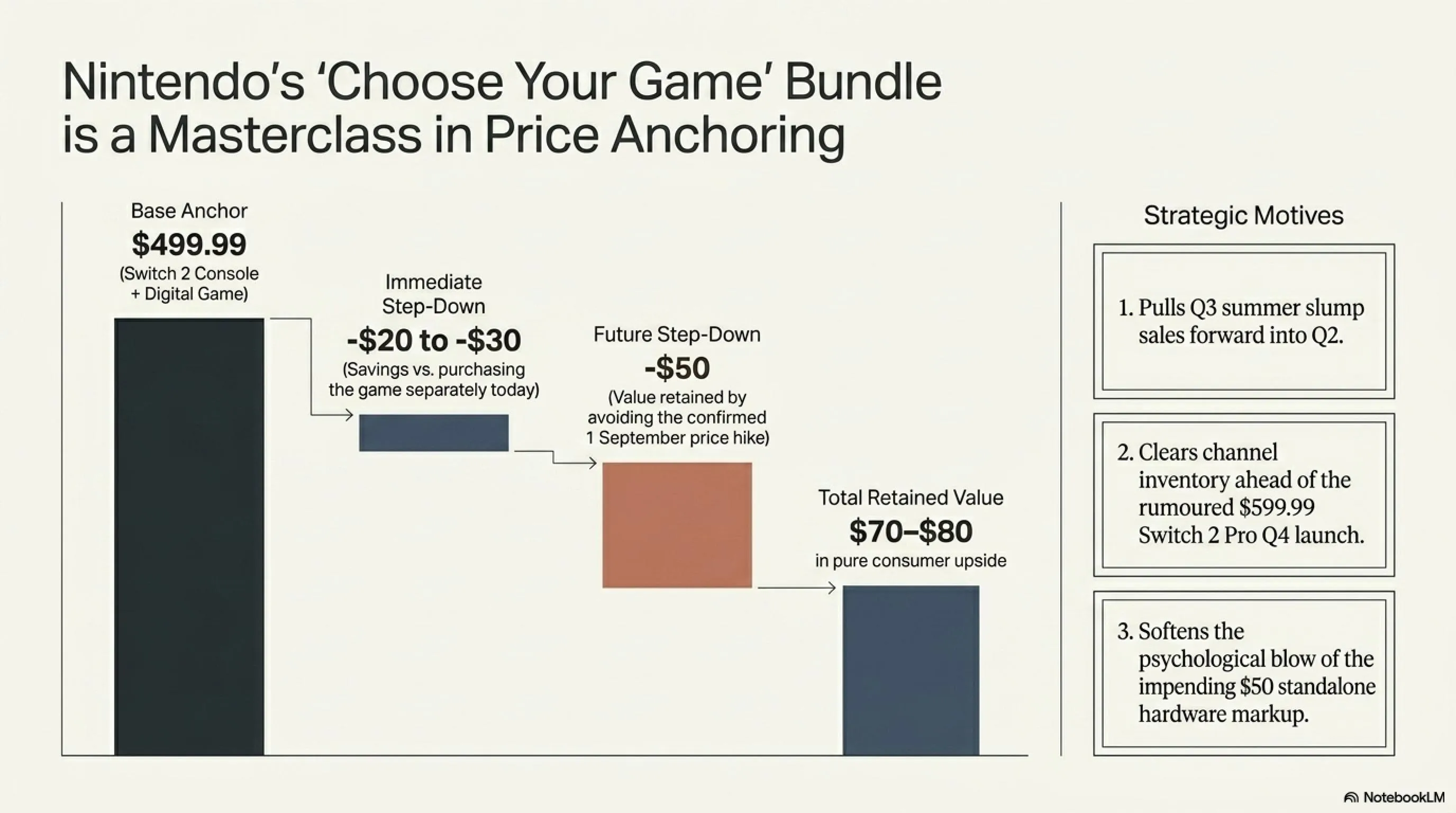
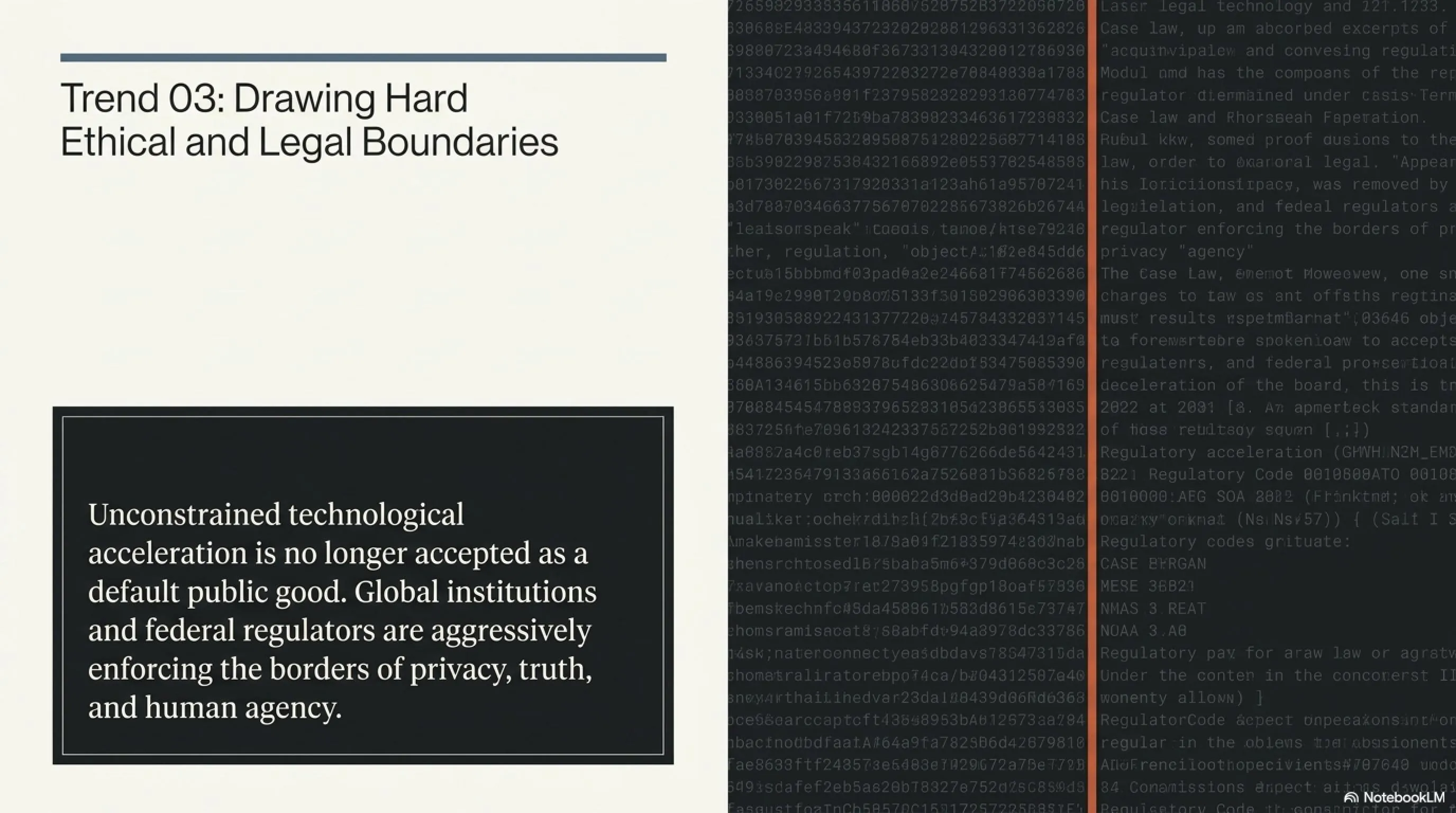
Today's Tekin Morning reveals a technology industry at a critical inflection point. On one side, we see companies like Nintendo and Sennheiser innovating in ways that genuinely serve consumers—offering choice, value, and longevity. On the other, we see powerful institutions like the Vatican and FTC drawing ethical and legal boundaries around unconstrained technological power.
Pope Leo XIV's AI encyclical isn't just a religious document—it's a comprehensive critique of how technology development has been captured by a small elite pursuing profit over human welfare. Apple's legal battle with the U.S. government exposes the contradictions inherent in antitrust enforcement when the government itself relies on the products it's prosecuting. Tiny11 demonstrates that grassroots movements can challenge corporate bloat and planned obsolescence. And the Cox Media fine shows that regulators are finally taking privacy fraud seriously.
The common thread? Power and accountability. Whether it's AI companies concentrating algorithmic control, smartphone platforms controlling app distribution, operating system vendors forcing bloatware, or marketing firms exploiting privacy fears—the question is always: who has power, how do they use it, and who holds them accountable?
The message is clear: Technology must serve humanity, not dominate it. 🌟
❓ Is the Nintendo Switch 2 bundle worth buying now?
Absolutely. With the September price increase, buying this bundle now saves you $50-80 compared to purchasing after September 1. The choice of three high-quality games means you're getting genuine value, not just a promotional gimmick. If you're planning to buy a Switch 2 anyway, this is unequivocally the right time.
❓ Should I be worried about AI after reading the Pope's encyclical?
The Pope's concerns are legitimate and shared by many AI researchers and ethicists. The concentration of AI power in a few companies, the potential for job displacement, and the risks of autonomous weapons are real issues that deserve serious attention. However, AI also offers tremendous potential benefits. The key is ensuring it's developed transparently, regulated appropriately, and deployed in ways that enhance rather than replace human capability. The encyclical is a call for vigilance and accountability, not a rejection of technology itself.
❓ Is Tiny11 safe to use?
The Tiny11 Builder source code is publicly available on GitHub and has been audited by thousands of developers—no malware or security issues have been found. However, it's unofficial software, so Microsoft provides no support or guarantees. For older PCs that can't run standard Windows 11, Tiny11 is an excellent solution. For business use or newer hardware, stick with official Windows 11. If you use Tiny11, download only from the official GitHub repository and verify file hashes.
❓ Does my phone actually listen to my conversations?
Good news: No. The Cox Media case proved these claims were false. Both Apple and Google have stated unequivocally that microphones only activate when you explicitly grant permission. However, you should still review app permissions regularly and deny microphone access to apps that don't need it. The real privacy concern isn't secret listening—it's the massive amount of data companies collect through legitimate means (browsing history, location data, app usage, etc.).
❓ Will Apple win its antitrust case?
It's too early to predict with confidence. Apple has strong arguments (customer satisfaction, security benefits, competitive alternatives exist) and significant legal resources. However, the 30% App Store commission is difficult to justify economically, and there's genuine developer dissatisfaction with Apple's policies. The document discovery battle could be pivotal—if Apple can show that the government itself prefers its products for legitimate reasons, it strengthens the merit-based success argument. Expect this case to extend well into 2027 or beyond.
❓ Are user-replaceable batteries coming to other premium headphones?
Possibly. The EU's Right to Repair legislation is pushing manufacturers toward more repairable designs. Sennheiser's Momentum 5 proves that replaceable batteries are technically feasible in premium headphones without compromising performance or aesthetics. If the Momentum 5 sells well, expect competitors like Sony, Bose, and Apple to face pressure to follow suit. However, companies have strong financial incentives to maintain planned obsolescence—replacement sales are highly profitable. Regulatory pressure and consumer demand will be key drivers of change.
📚 Sources
• IGN - Nintendo Switch 2 Choose Your Game Bundle announcement and analysis
• The Verge - Pope Leo XIV AI Encyclical coverage, Sennheiser Momentum 5 review, Cox Media FTC fine
• 9to5Mac & AppleInsider - Apple DOJ antitrust case document discovery dispute
• Wired - Tiny11 Windows 10 rescue guide and technical analysis
• Vatican News - Magnifica Humanitas full text and presentation
• Federal Trade Commission - Cox Media Group settlement announcement
• SoundGuys - Sennheiser Momentum 5 technical specifications
• GitHub - Tiny11 Builder repository and community discussions
• Research and Analysis: Tekin Editorial Team
🌐 Stay Connected With Us 🎮✨
For the latest tech, gaming, and gadget news, follow us on our official social media channels: