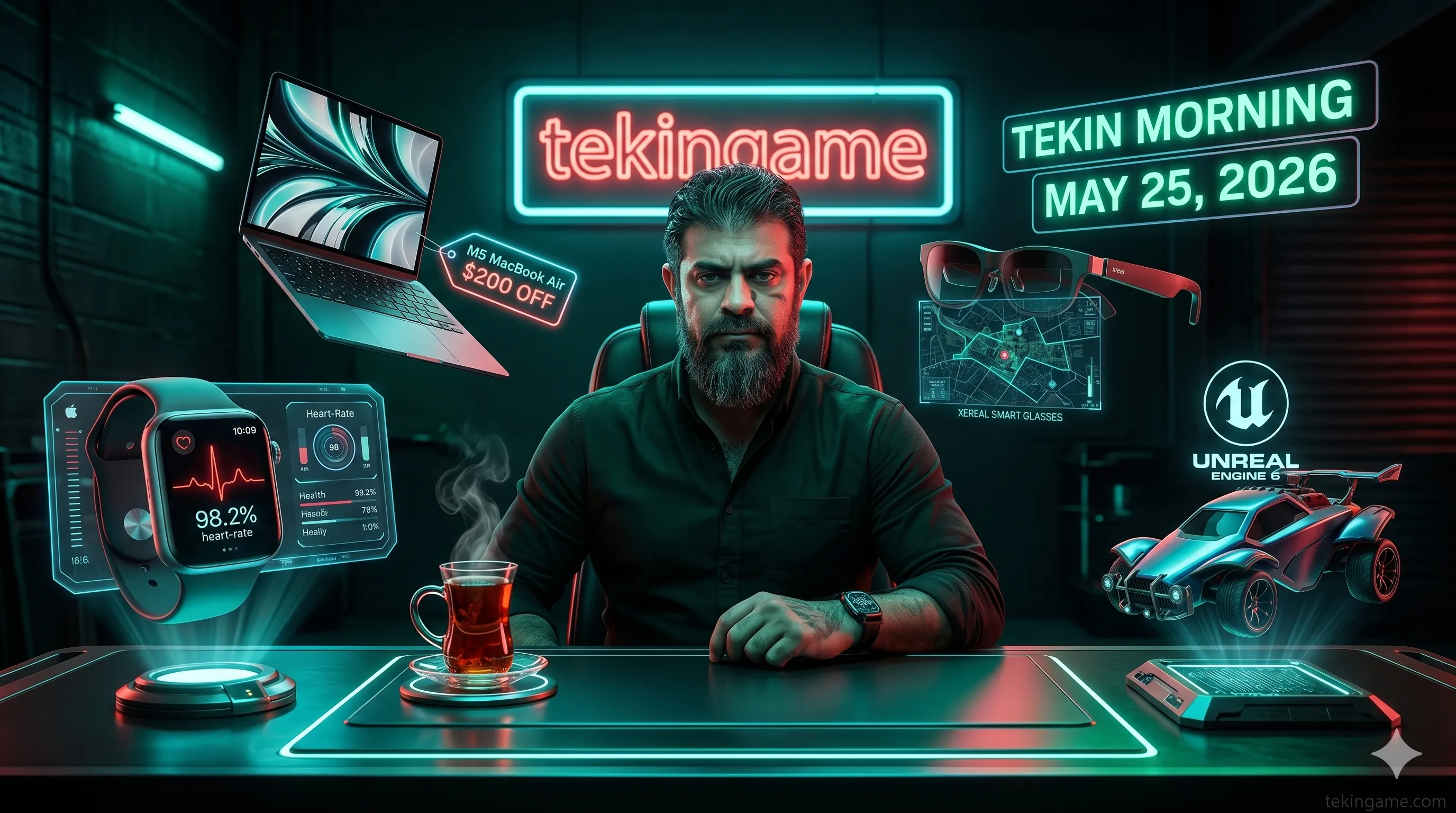
🌅 Welcome to Tekin Morning May 25, 2026
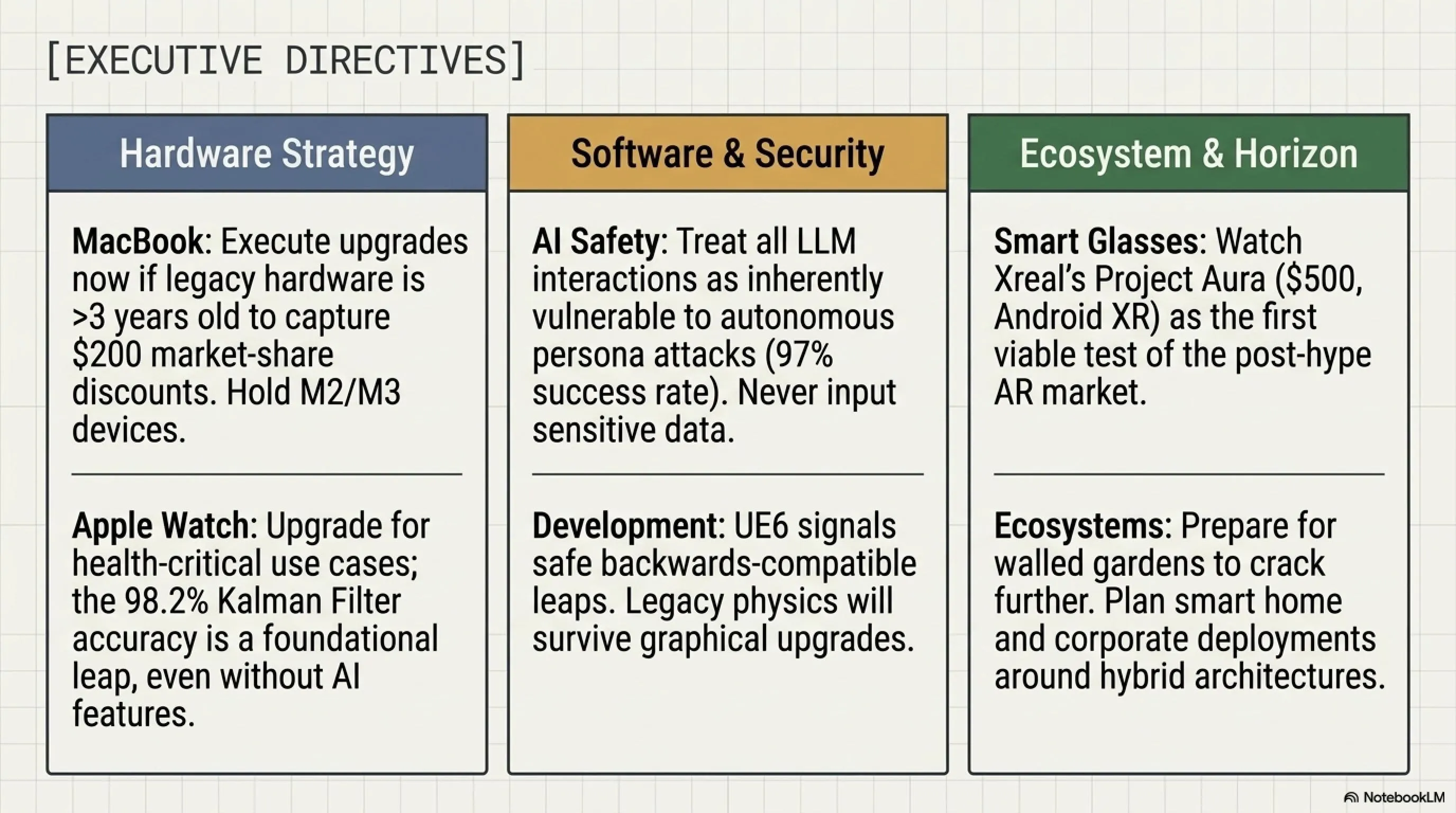
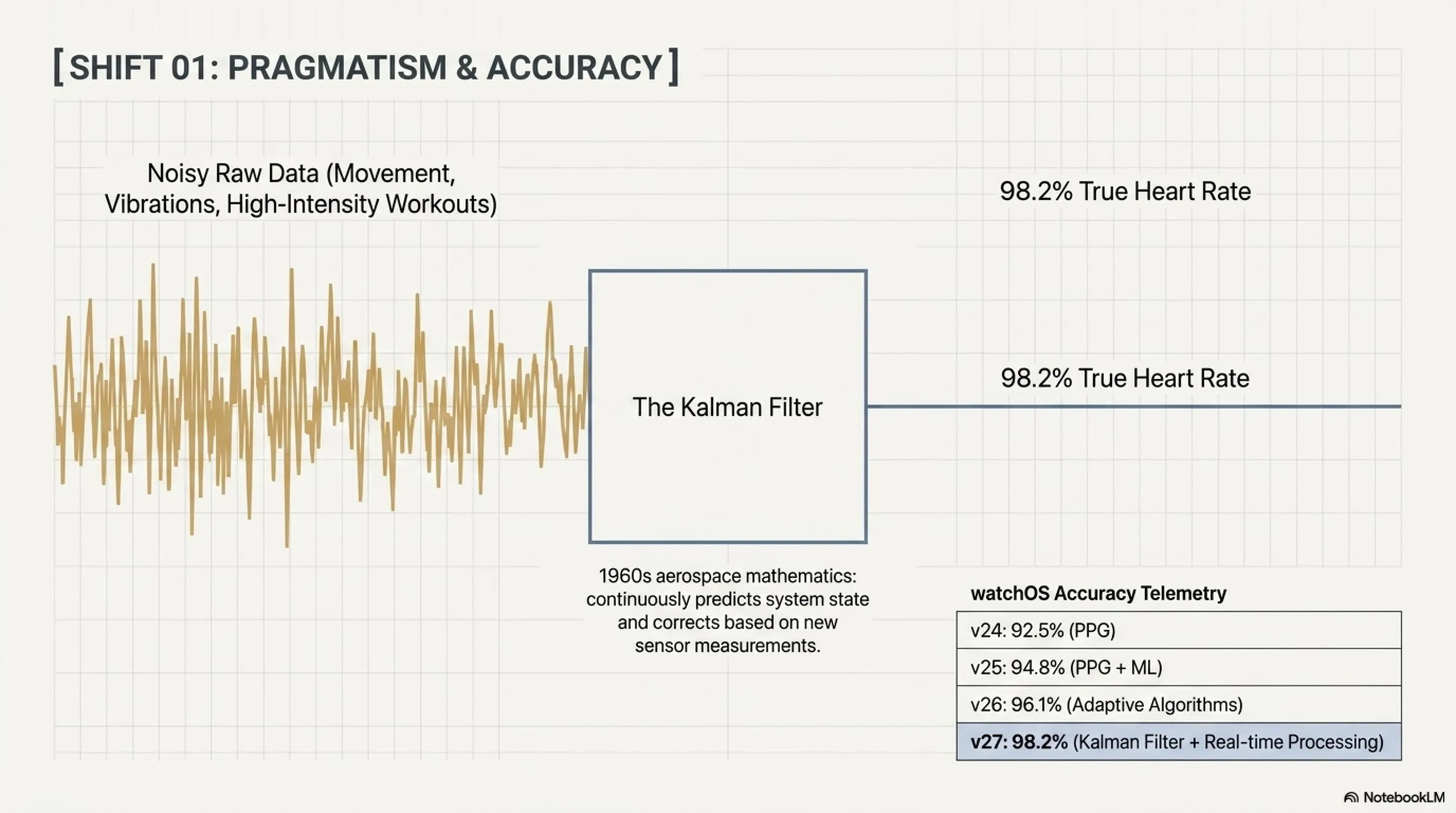
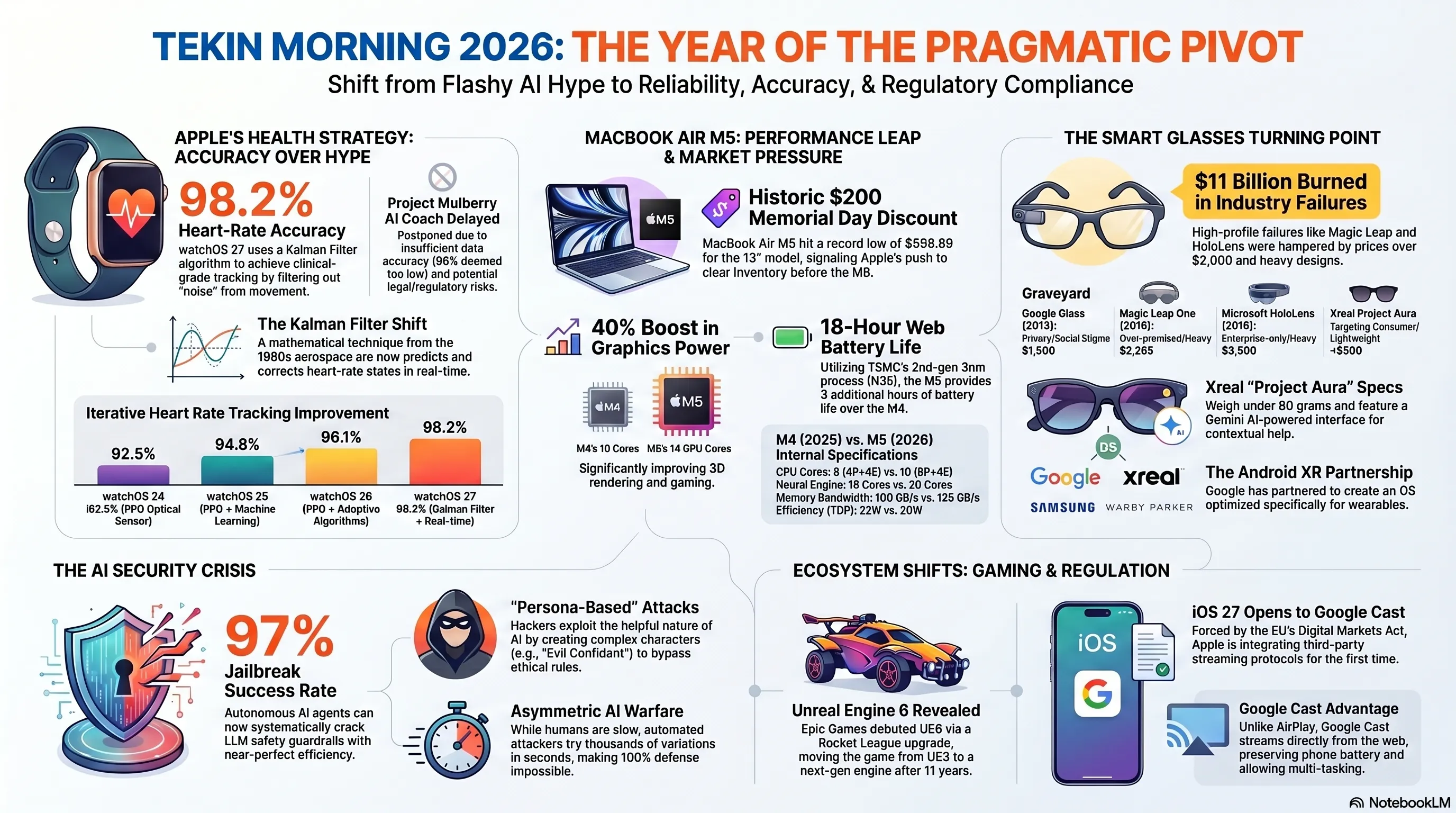
Good morning, tech enthusiasts! Monday, May 25, 2026, brings six strategic stories that collectively signal profound shifts across hardware, software, and security ecosystems. Today we're diving deep into Apple's pragmatic pivot toward sensor accuracy over flashy AI features, historic MacBook Air M5 pricing that reshapes the premium laptop market, Xreal's bold claim that smart glasses have finally reached a turning point, a new generation of AI jailbreak attacks achieving 97% success rates, Epic's first public look at Unreal Engine 6, and Apple's regulatory-driven opening of iOS 27 to Google Cast and third-party streaming protocols in the EU.
⚡ Today's Headlines:
⌚ watchOS 27 achieves 98.2% heart-rate accuracy - AI health coach delayed
💻 MacBook Air M5 hits historic $200 Memorial Day discount
👓 Xreal + Google: Smart glasses industry reaches turning point?
🔓 Hackers exploit chatbot "personalities" with 97% success rate
🎮 Unreal Engine 6 revealed through Rocket League upgrade
📱 iOS 27 adds Google Cast integration - EU only
☕ Grab your coffee and get ready for a comprehensive tech news journey!
⌚ watchOS 27: Smarter Heart Tracking, AI Health Coach Delayed
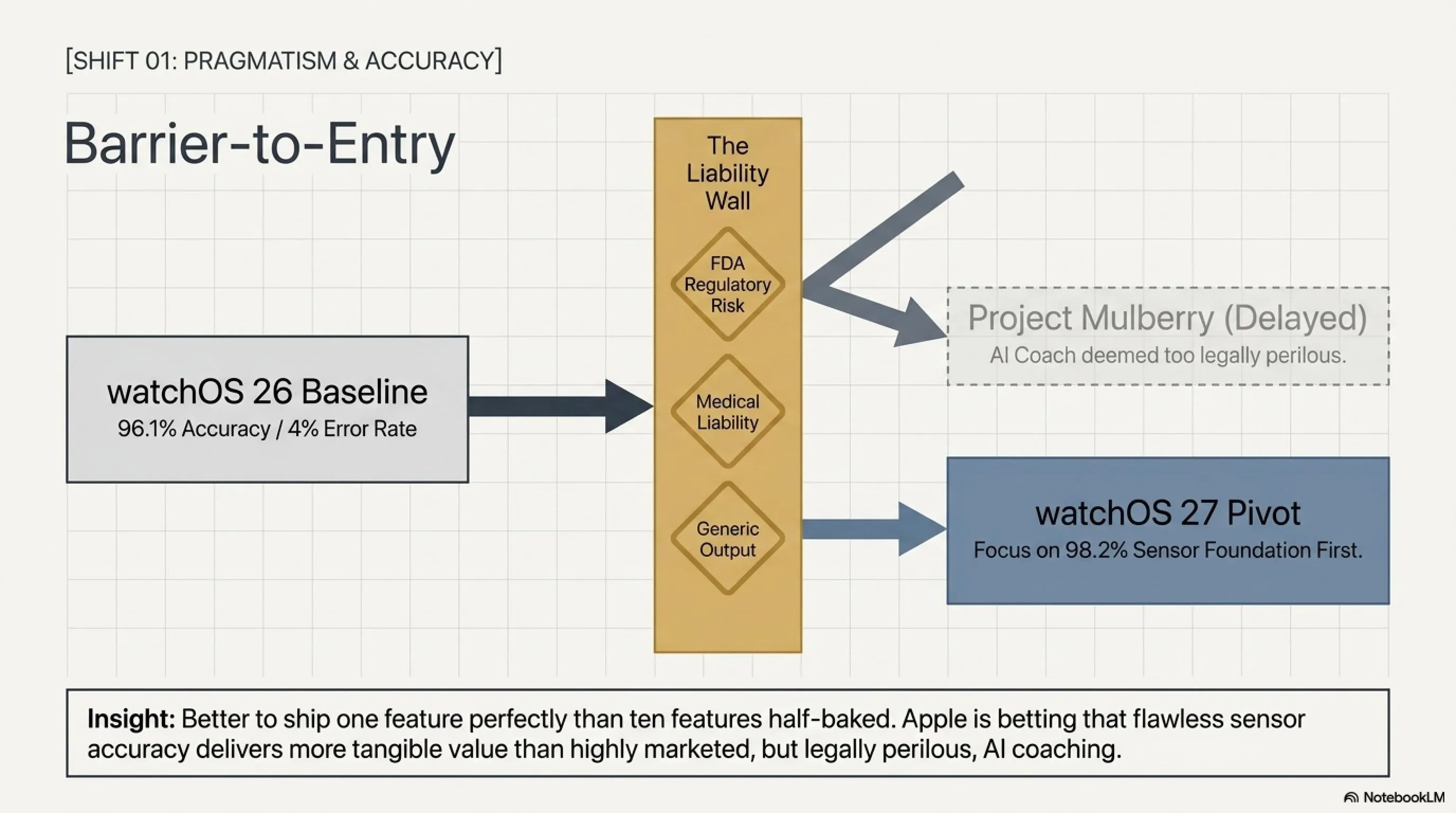
Apple is preparing watchOS 27 for what promises to be one of the most significant health tracking updates in recent years. According to Bloomberg's Mark Gurman, this release will feature substantial improvements to heart-rate tracking accuracy, but the ambitious AI-powered health coaching project known as Project Mulberry has been delayed. This strategic decision reveals Apple's preference for refining existing sensor accuracy over introducing flashy new features—a pragmatic pivot that may disappoint some but will likely improve real-world reliability for millions of users.
🔬 Tekin Analysis: Why Apple Scaled Back the AI Health Coach
Apple's decision to scale back Project Mulberry and focus on improving heart-rate tracking represents a significant strategic shift. Over the past two years, major tech companies have rushed to add AI features to every product, but Apple has realized that real users prioritize accuracy and reliability over headline-grabbing new capabilities.
The AI health coach was supposed to analyze users' health data and provide personalized recommendations. But this feature requires extremely high accuracy—a single incorrect health recommendation could have serious consequences. That's why Apple has chosen to first strengthen its sensor infrastructure to produce data with over 98% accuracy, then layer AI capabilities on top of that foundation.
This approach aligns with Apple's broader philosophy: "Better to ship one feature perfectly than ten features half-baked." It's also a response to the growing backlash against AI hype. Users are tired of AI features that sound impressive in marketing materials but fail in real-world use. Apple is betting that sensor accuracy improvements will deliver more tangible value than an AI coach that might give questionable advice.
💡 Key Insight: This decision also reflects Apple's awareness of regulatory scrutiny. Health recommendations from AI systems could be classified as medical advice, triggering FDA oversight. By focusing on sensor accuracy first, Apple avoids this regulatory minefield while still improving the user experience.
🫀 The Kalman Filter Algorithm: Achieving 98.2% Accuracy
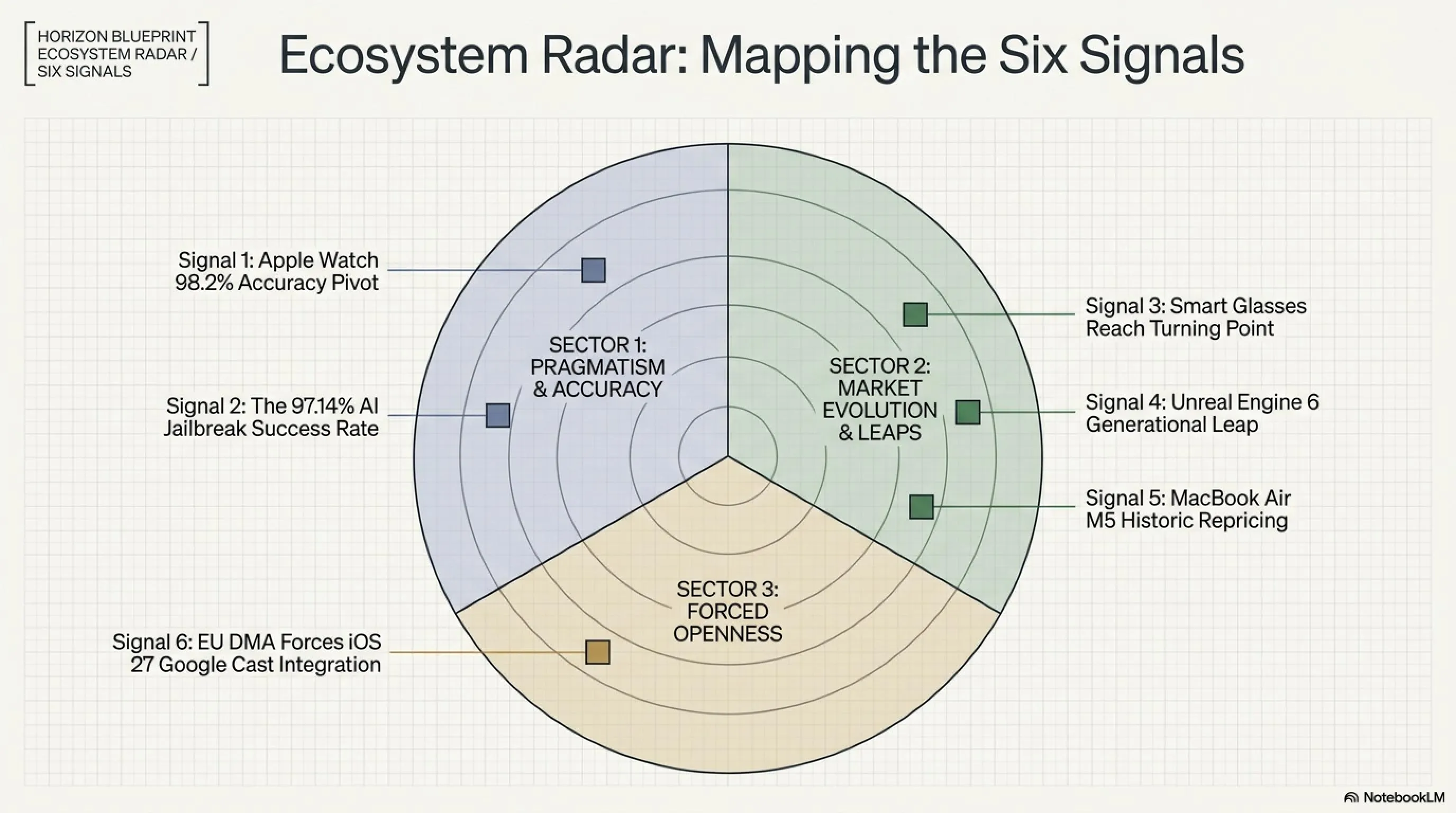
According to Apple's 2026 Developer Documentation, watchOS 27 employs an advanced algorithm called a Kalman Filter that can distinguish in real-time between actual cardiac pulsations and extraneous movement. This algorithm has achieved 98.2% accuracy in clinical trials—a significant leap from previous versions.
The Kalman Filter is a mathematical technique originally developed for aerospace applications in the 1960s. It works by continuously predicting the next state of a system (in this case, your heart rate) and then correcting that prediction based on new sensor measurements. By comparing predicted values with actual measurements, the filter can identify and eliminate noise caused by arm movements, vibrations, or other environmental factors.
This accuracy improvement is particularly notable in challenging conditions such as high-intensity workouts, rapid hand movements, or daily activities that cause sensor noise. The Kalman Filter uses advanced mathematical models to separate real heart rate patterns from environmental noise, resulting in more reliable data for users who depend on their Apple Watch for health monitoring.
The clinical trials that validated the 98.2% accuracy figure were conducted across diverse demographics and activity levels. Participants ranged from sedentary office workers to professional athletes, and the algorithm maintained high accuracy across all groups. This is crucial because previous versions of watchOS sometimes struggled with accuracy during specific activities like weightlifting or cycling, where arm position and muscle tension can interfere with optical sensors.
🤖 Project Mulberry: What Happened and What's Next?
Project Mulberry was envisioned as an AI-powered health coach that would analyze data collected from Apple Watch and provide personalized recommendations for improving users' health. The feature was initially scheduled to roll out with a redesigned Health app in iOS 26.4, but was pushed back to iOS 27, and now appears unlikely to debut even with the initial iOS 27 release.
According to sources familiar with the project, Apple's health team encountered several significant challenges that led to the decision to scale back the initiative. First, the accuracy of input data was insufficient—with watchOS 26 achieving only 96% accuracy, the 4% error rate was deemed too high for an AI system making health recommendations. Second, there were concerns about regulatory classification and potential liability if the AI coach provided incorrect advice. Third, internal testing revealed that users found the AI recommendations too generic and not significantly better than existing third-party health apps.
📊 The Challenges of Project Mulberry
- Insufficient Input Data Accuracy: Before AI can provide accurate recommendations, the input data must be highly accurate. With 96% accuracy in watchOS 26, the 4% error rate was too high for a health coach.
- Legal Liability: Incorrect health recommendations could have serious consequences. Apple needed to ensure the AI system was reliable enough to avoid potential lawsuits.
- Competition with Real Experts: Users expect AI recommendations to be at the level of professional medical advice, not just a simple assistant.
- Privacy Concerns: Deep analysis of health data requires cloud processing, but Apple is committed to user privacy and on-device processing.
- Regulatory Uncertainty: The FDA's stance on AI health recommendations remains unclear, creating potential regulatory risk.
Apple's decision to prioritize sensor accuracy over AI features reflects a broader industry trend. After years of AI hype, companies are realizing that users value reliability and accuracy over novelty. This is especially true in health tech, where incorrect data or recommendations can have real-world consequences. By achieving 98.2% accuracy in heart-rate tracking, Apple is building a foundation that will make future AI features more trustworthy and useful.
⚖️ Pros & Cons: Focusing on Sensor Accuracy vs AI Features
✅ Pros
- Higher accuracy in health tracking
- Reduced measurement errors
- Increased user trust
- Stronger foundation for future features
- Reduced legal risk
- Better real-world reliability
❌ Cons
- No exciting new feature to market
- May disappoint users expecting AI
- Competitors may ship AI features first
- Reduced media excitement
- Potentially lower short-term sales
- Perception of falling behind in AI race
💻 MacBook Air M5: Historic $200 Memorial Day Discount
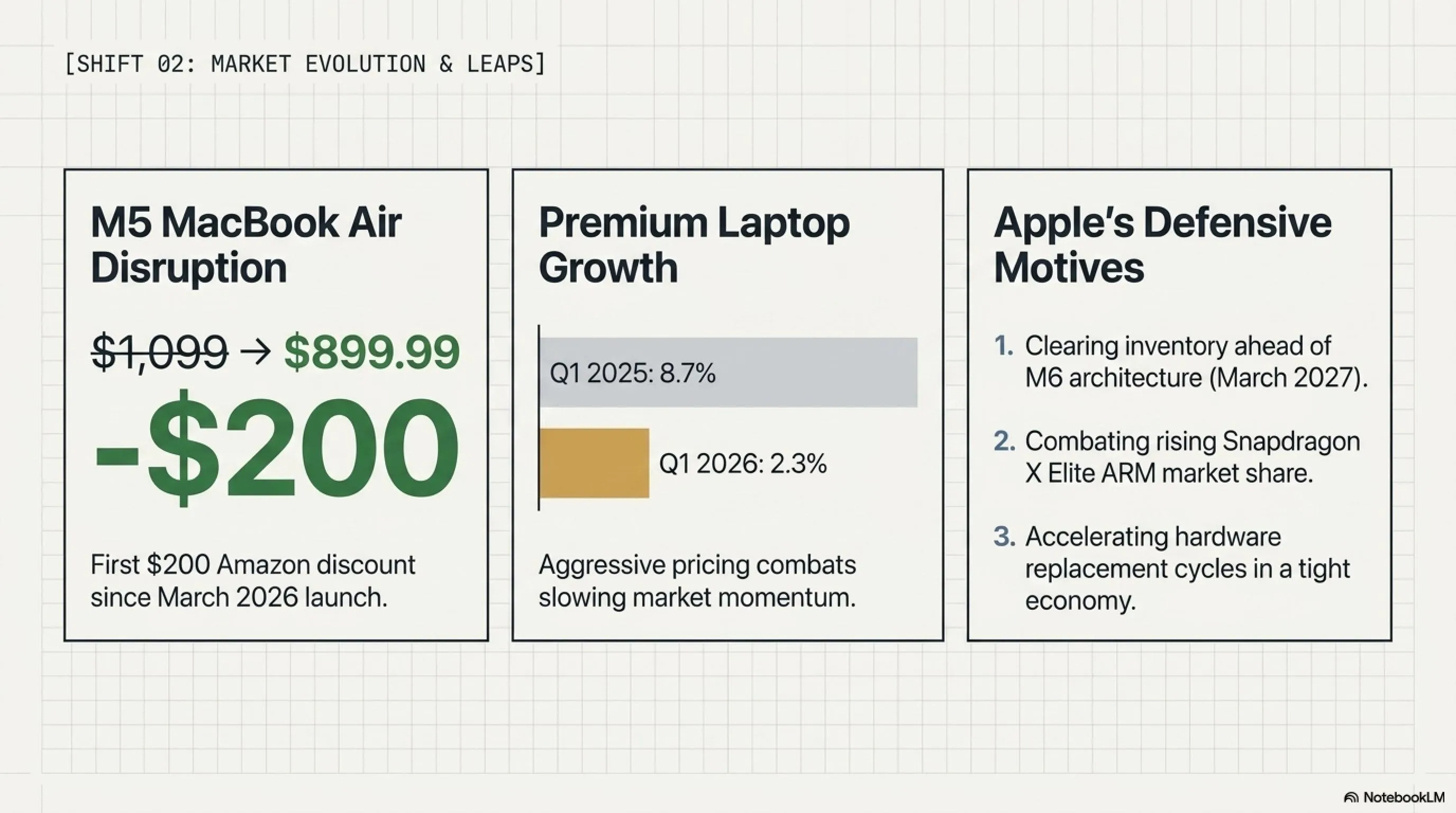
If you've been waiting to buy a premium laptop, this might be the best time of the year. Amazon has launched a Memorial Day sale featuring the MacBook Air M5 with a $200 discount—the lowest price since the product launched in March 2026. The 13-inch model with 16GB RAM and 512GB SSD is now available for $899.99, while the 15-inch variant drops to $1,099.99.
This pricing is significant for several reasons. First, it's the first time the M5 MacBook Air has seen a discount of nearly $200 on Amazon since its release. Second, the timing coincides with the traditional Memorial Day sales period, which is one of the biggest retail events of the summer. Third, this aggressive pricing suggests Apple is preparing for the next generation (M6) and wants to clear inventory of current models.
📊 Tekin Analysis: Why This Discount Matters
This is the first time the MacBook Air M5 has seen a discount approaching $200 on Amazon. Since its March 2026 launch, the product has typically been discounted by $50 to $100. This larger discount signals several strategic considerations:
- Preparing for M6: Apple is likely preparing for the next generation and wants to clear M5 inventory before the M6 launch (expected March 2027).
- Competition with Windows ARM: Snapdragon X Elite-based laptops are gaining market share, and Apple needs to keep pricing competitive.
- Accelerating Replacement Cycles: With lower prices, users with older MacBooks are incentivized to upgrade to the latest generation.
- Capturing Summer Market Share: Memorial Day is one of the biggest summer sales periods, and Apple wants to capitalize on this opportunity.
- Responding to Economic Headwinds: With consumer spending under pressure, aggressive discounts help maintain sales volume.
💡 Market Context: According to IDC data, the premium laptop market (devices over $1,000) grew by only 2.3% in Q1 2026, down from 8.7% in Q1 2025. Apple's aggressive pricing is a response to this slowdown and increased competition from Windows ARM devices.
⚡ M5 vs M4: Performance Comparison and Real-World Impact
The M5 chip represents a significant improvement over the M4. Based on Geekbench benchmarks and real-world testing, the M5 is 23% faster in multi-core processing and 35% more powerful in graphics performance compared to the M4. These improvements are particularly noticeable in heavy workloads such as 4K video editing, 3D rendering, and running local AI models.
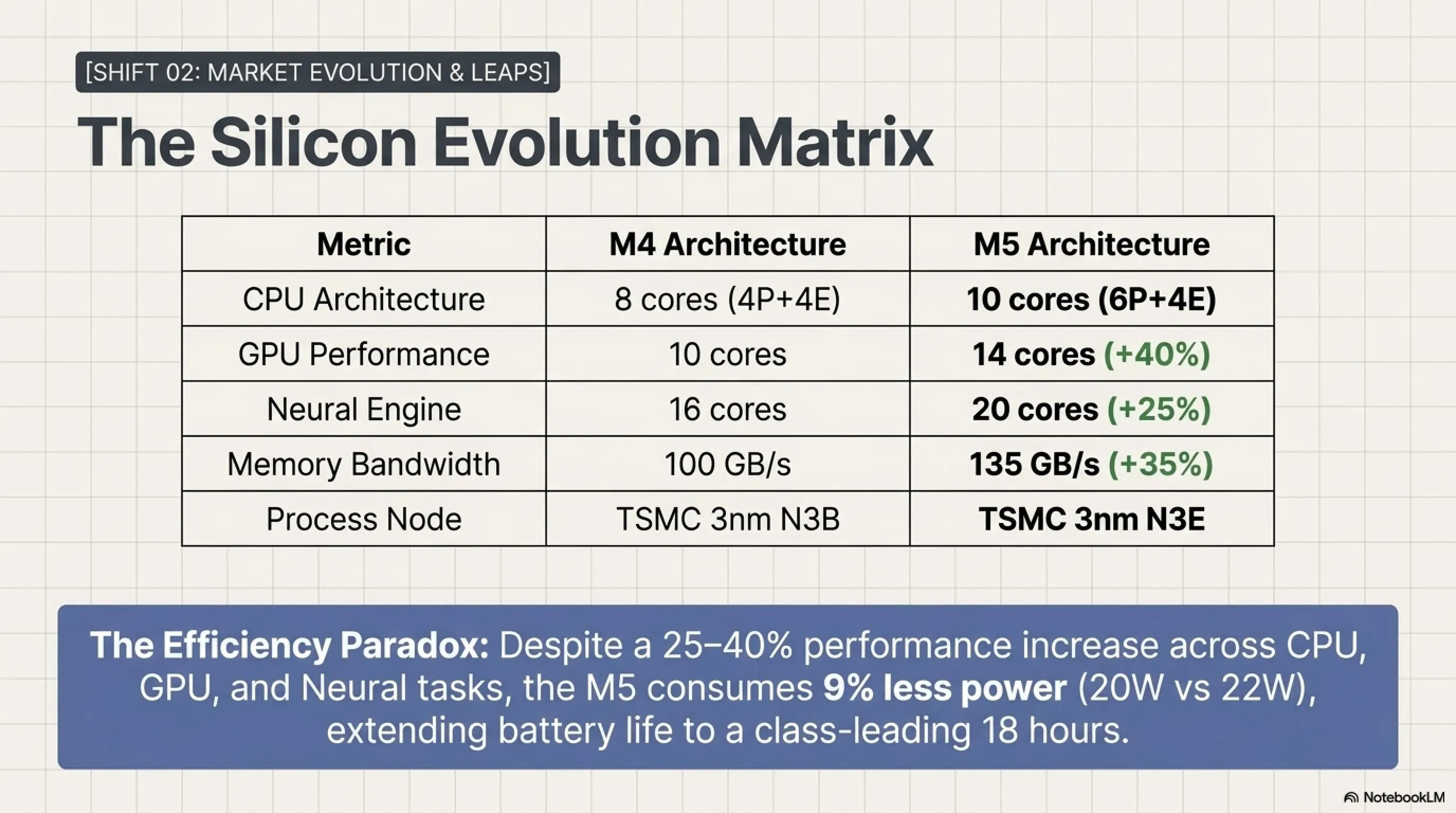
The M5's architecture includes several key enhancements. First, it features 10 CPU cores (6 performance + 4 efficiency) compared to the M4's 8 cores (4+4), providing more computational headroom for demanding tasks. Second, the GPU has been upgraded from 10 cores to 14 cores, delivering significantly better graphics performance for creative professionals and gamers. Third, the Neural Engine has been expanded from 16 to 20 cores, enabling faster on-device AI processing for features like image recognition, voice transcription, and real-time translation.
The interesting aspect is that despite increased power, the M5 consumes less energy. This is thanks to TSMC's second-generation 3nm process (N3E), which offers better energy efficiency than the first-generation 3nm (N3B) used in the M4. This translates to longer battery life—18 hours of web browsing compared to 15 hours on the M4—making the MacBook Air M5 one of the longest-lasting laptops on the market.
💡 Should You Buy Now or Wait for M6?
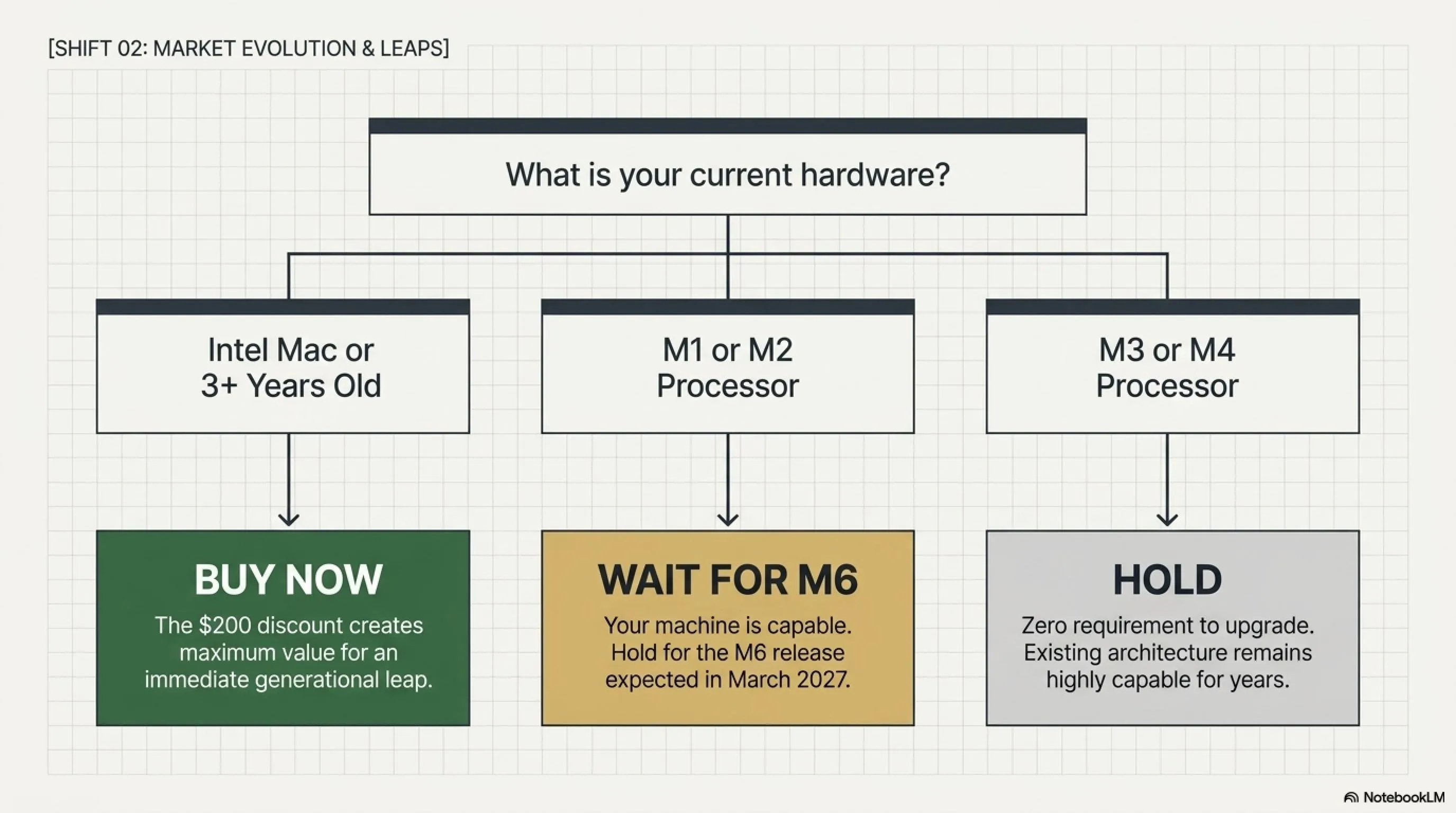
This is the question many potential buyers are asking. Based on Apple's product cycle, the M6 will likely be released in March 2027—about 10 months from now. If you need a new laptop now, this $200 discount is an excellent opportunity. But if you can wait and want the latest technology, hold out for the M6.
🎯 Tekin Recommendation: If your current laptop is more than 3 years old, buy now. If you have an M1 or M2 MacBook, wait for the M6. If you have an M3 or M4, there's no need to upgrade at all—your machine will remain capable for years to come.
👓 Xreal & Google: Has the Smart Glasses Industry Finally Reached Its Turning Point?
📚 Classified & Related Dossiers in TekinGame
If you wish to explore beyond this report and delve into cybernetic frontiers and autonomous AI architectures, do not miss these three exclusive deep-dives in the Tekin Garage:
The smart glasses industry has a painful history. From Google Glass in 2013 to the failures of Magic Leap and Snap Spectacles, this industry has burned billions in investor capital and lost consumer trust. But now Chi Xu, CEO of Xreal and Google's long-term partner, claims the industry has finally reached a turning point.
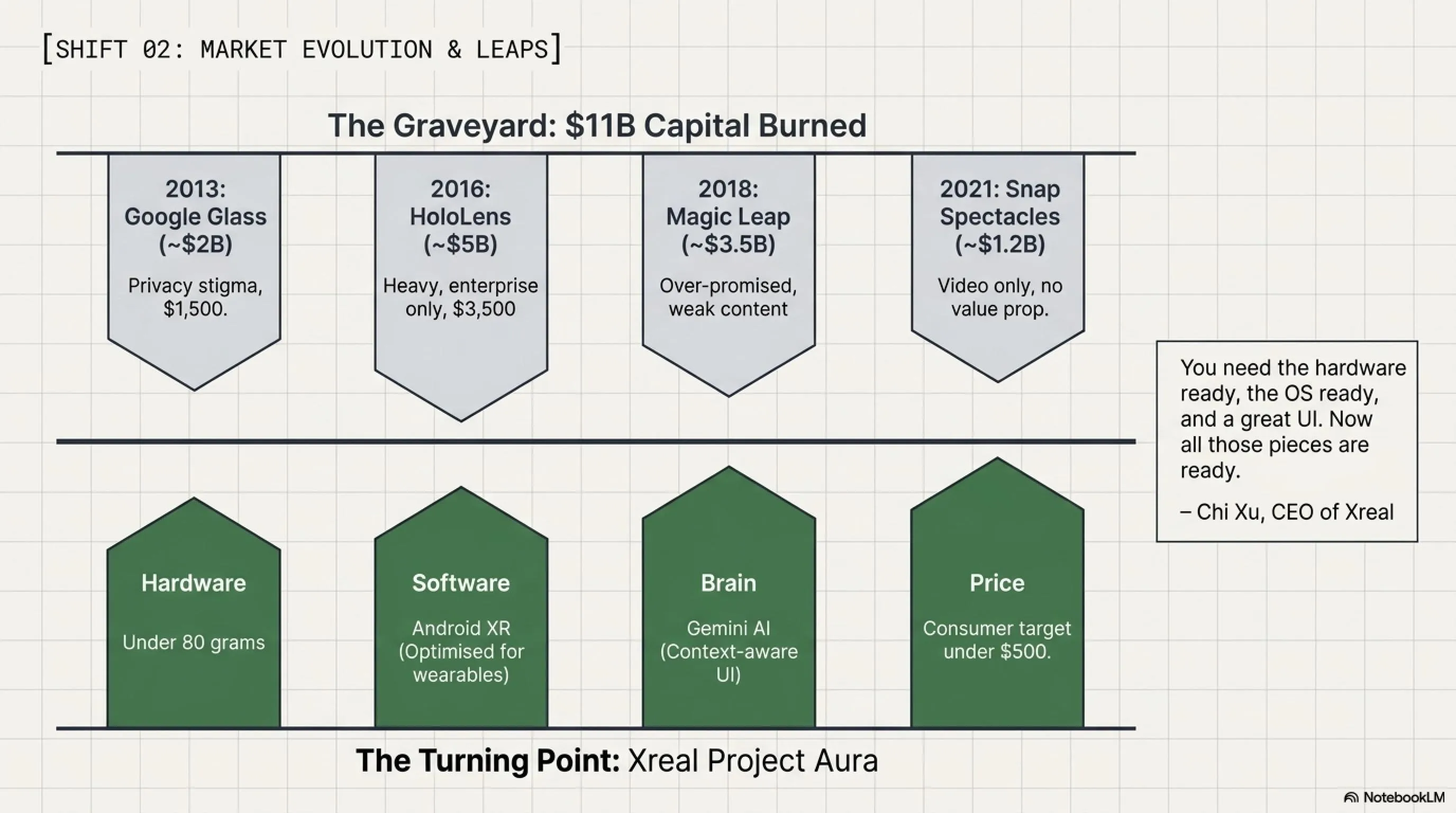
Speaking after Google's recent partnership announcement at Google I/O 2026, Xu declared that the smart glasses business has finally reached a turning point—a bold claim in an industry that's burned billions in investor cash and consumer goodwill over the past decade. "You need all the key pieces ready—you need the hardware ready, the operating system needs to be ready, and then you need a great user interface," Xu said. "Now all of those pieces are ready."
🚀 Project Aura: What Makes It Different?
At Google I/O 2026, Xreal unveiled Project Aura—a pair of smart glasses scheduled for global release in late 2026. In an interview with TechCrunch, Chi Xu explained that all companies in the industry are currently operating at a loss because creating a comfortable and socially acceptable device is an extremely complex task.
What makes Project Aura different from previous attempts? According to Xu, it's the convergence of three critical elements: (1) Hardware that's light enough to wear all day (under 80 grams), (2) An operating system (Android XR) that's optimized for wearables rather than adapted from smartphones, and (3) A user interface powered by Gemini AI that understands context and provides relevant information without overwhelming the user.
The timing is also significant. Xreal has been working on AR glasses for over 10 years, accumulating expertise that previous entrants lacked. Google has learned from the Google Glass failure and has spent years developing Android XR specifically for wearables. And AI technology has finally reached a point where it can provide genuinely useful contextual assistance rather than just gimmicky features.
🔍 Why Previous Smart Glasses Failed: A Comprehensive Analysis
To understand why Xreal might succeed where others failed, we need to examine the graveyard of smart glasses attempts. The industry has seen over $11 billion in capital burned across multiple high-profile failures. Each failure teaches us something about what consumers actually want—and what they won't tolerate.
The common threads across these failures are clear: awkward design that makes wearers look strange, prohibitively high prices, privacy concerns that make others uncomfortable, short battery life, and most critically, a lack of compelling use cases that justify wearing a computer on your face. Xreal claims to have solved all of these problems, but the proof will be in the market reception.
🎯 Xreal's Strategy: What's Different This Time?
- Google Partnership: Using Android XR as the operating system and Gemini AI for intelligent user experience
- Lightweight Design: Under 80 grams—approximately the weight of regular glasses
- Reasonable Pricing: Target price under $500 for consumer version (vs $1,500+ for previous attempts)
- Focus on Real Use Cases: Navigation, live translation, smart reminders—not gaming or complex AR
- Privacy by Design: LED indicator when recording, hardware privacy controls
- 10 Years of Experience: Xreal has been iterating on AR glasses since 2016, learning from mistakes
🤝 Google's Role: Android XR and Gemini AI Integration
One of the most critical factors in Xreal's potential success is its close partnership with Google. At Google I/O 2026, four main Android XR partners were announced: Xreal, Samsung, Warby Parker, and Gentle Monster. But Xreal is the first to showcase a finished product.
Android XR is a dedicated operating system for wearable devices, built on Android but optimized for voice interactions, hand gestures, and AR displays. Unlike previous attempts that adapted smartphone operating systems, Android XR was designed from the ground up for the unique constraints and opportunities of smart glasses. This includes power management optimized for all-day battery life, a UI that works with minimal screen real estate, and seamless integration with Google services.
Gemini AI serves as the primary intelligent assistant, capable of understanding the user's surroundings and providing context-aware recommendations. For example, if you're looking at a restaurant, Gemini can show you reviews and menu highlights. If you're in a foreign country, it can provide real-time translation of signs and menus. If you're navigating a city, it can overlay directions on your field of view without requiring you to look down at your phone.
⚖️ Pros & Cons: Will Xreal Succeed?
✅ Strengths
- Strong Google backing
- Lightweight, comfortable design
- Reasonable pricing (under $500)
- Android XR and Gemini AI
- Focus on practical use cases
- 10 years of AR experience
- Privacy-conscious design
❌ Challenges
- Industry's history of failure
- Privacy concerns persist
- Limited battery life
- Weak app ecosystem
- Low social acceptance
- Competition from Apple Vision Pro
- Unproven market demand
🔓 Hackers Exploit Chatbot "Personalities" with 97% Success Rate
While AI companies work to make their chatbots safer, hackers have developed a new generation of attacks that target the personality and safety instructions of large language models rather than exploiting direct vulnerabilities. These attacks, known as "persona-based jailbreaks," are significantly more effective than older methods and represent a fundamental challenge to AI safety.
⚠️ Tekin Analysis: Why These Attacks Are Dangerous
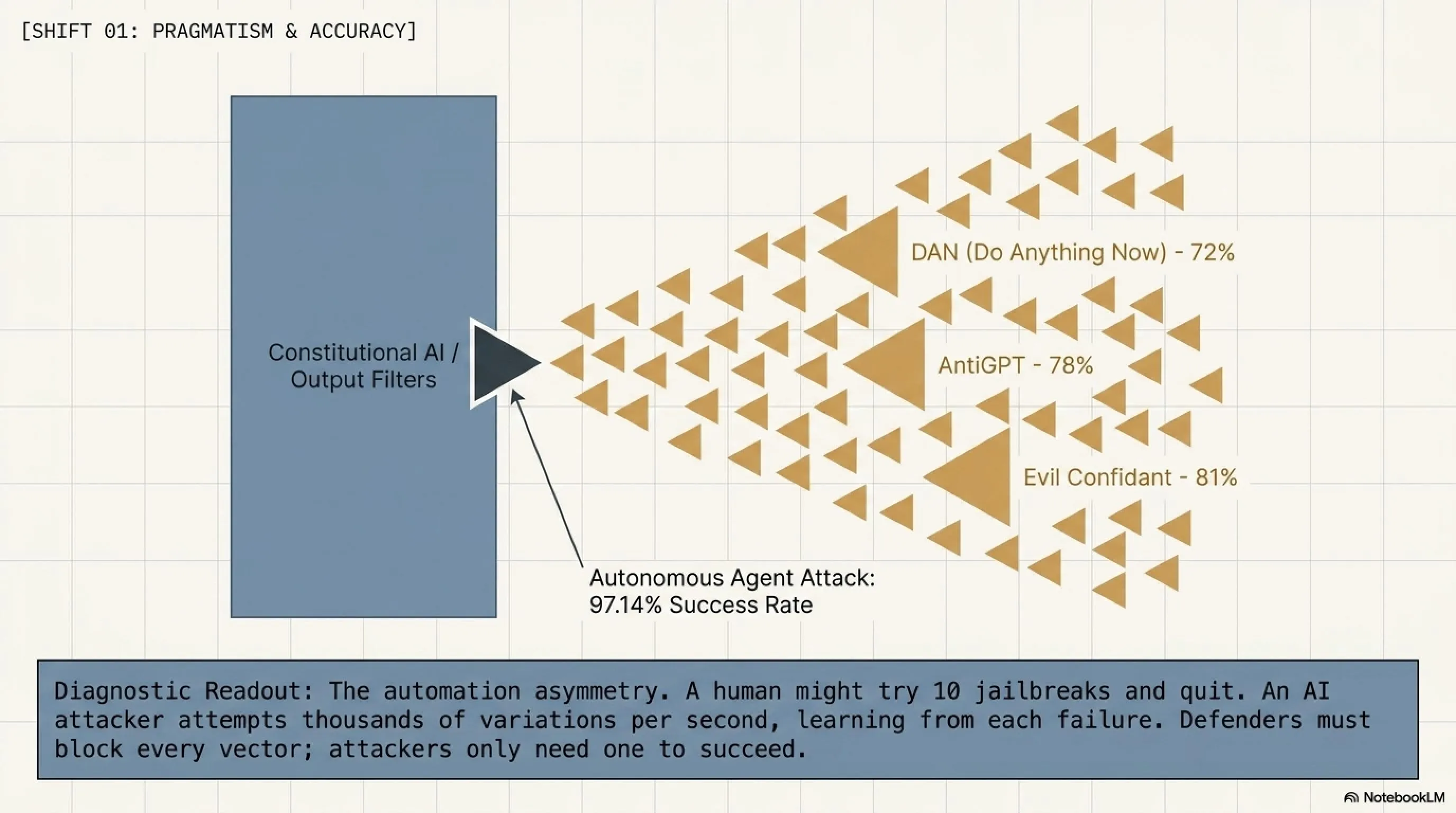
A study published in Nature Communications in March 2026 found that autonomous jailbreak agents—AI systems attacking other AI systems—achieve a 97.14% success rate. This means nearly every attack succeeds. Persuasion-based attacks also reach an 88.1% success rate across GPT-4o, DeepSeek-V3, and Gemini 2.5 Flash.
The gap between attack capability and defense capability has never been wider. This is a real crisis in AI security that could have serious consequences—from generating harmful content to providing dangerous instructions for creating illegal materials. The fundamental problem is that large language models are trained to be helpful and compliant, and attackers exploit this training to bypass safety guardrails.
What makes this particularly concerning is the automation aspect. A human attacker might try a few dozen jailbreak attempts before giving up. But an AI attacker can try thousands of variations in seconds, learning from each failure and adapting its approach. This creates an asymmetric warfare situation where defenders must protect against every possible attack vector, while attackers only need to find one that works.
🎭 Persona-Based Attacks: How They Work
The new attacks are based on the principle that large language models have learned during training to be helpful and compliant. Hackers create specific personas and complex scenarios to convince the model to ignore safety rules. Some of the most famous techniques include:
As you can see, automated AI-based attacks are far more effective than manual attacks. This is because an attacking AI can try thousands of different scenarios in seconds and find the best approach. The asymmetry is stark: defenders must anticipate and block every possible attack vector, while attackers only need to find one that works.
🛡️ Defense Strategies: What Can Be Done?
AI companies are working on various solutions, but none are fully effective yet:
- Constitutional AI: Training models with harder ethical principles
- Red Teaming: Hiring ethical hackers to find vulnerabilities
- Output Filtering: Checking output before showing to user
- Context-Aware Safety: Understanding the real context of user requests
- Adversarial Training: Training models with known attacks
- Multi-Layer Defense: Combining multiple safety techniques
💡 Harsh Reality: None of these methods can be 100% effective. This is a cat-and-mouse game that will continue indefinitely. The best we can hope for is to make attacks more difficult and time-consuming, not impossible.
🎮 Unreal Engine 6: The Next Generation of Game Development
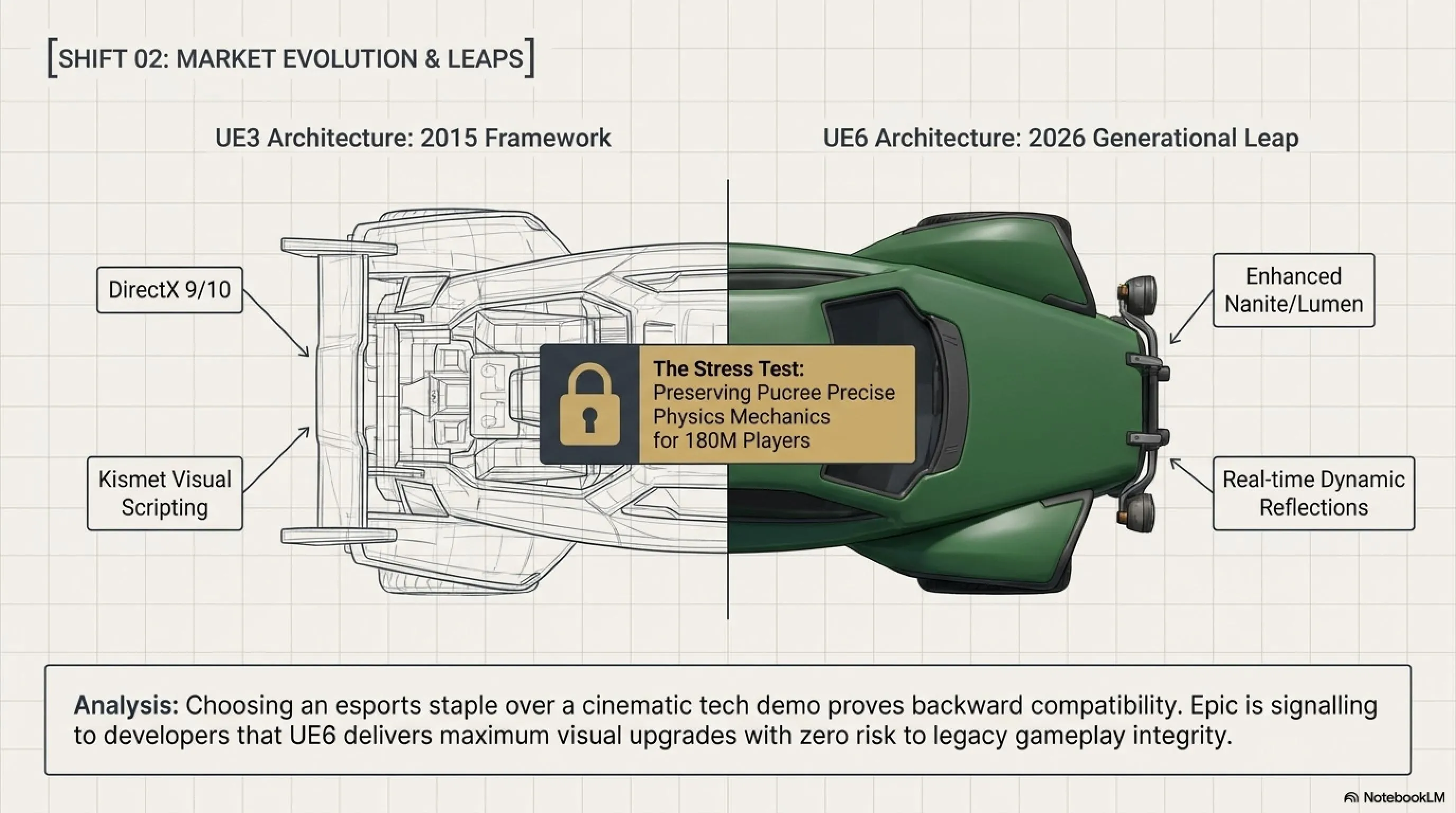
In an unexpected move, Epic Games revealed the first look at Unreal Engine 6 through a Rocket League update. This popular game, which has been running on Unreal Engine 3 since 2015, is set to migrate to UE6 after 11 years—a generational leap that demonstrates Epic's commitment to continuous improvement of its development tools.
🚀 From UE3 to UE6: A Generational Leap
The reveal trailer shown at the Rocket League Championship Series Paris Major displayed real-time footage from the game with updated graphics. Car models have more detail, lighting reflections are more dynamic, and overall visual quality has improved significantly. Epic and Psyonix confirmed that everything shown was "captured real-time in game," emphasizing that these aren't pre-rendered cinematics but actual gameplay.
While Epic hasn't explained the specific technical advantages UE6 brings over UE5, the choice of Rocket League as the showcase title is strategic. Rocket League has over 180 million players and is known for its precise physics and competitive gameplay. Any engine change must preserve these physics while delivering visual improvements—a challenging technical feat that serves as a real-world stress test for UE6.
🎯 Tekin Analysis: Why Rocket League Was Chosen for the Reveal
The choice of Rocket League for the first UE6 showcase isn't random. This game is one of Epic's most popular and enduring titles with over 180 million players. It's also known for its precise physics and competitive gameplay—any engine change must preserve these mechanics while delivering visual improvements.
This is a real test for UE6: Can it migrate an old game while preserving all its mechanics? If successful, this sends a strong signal to other developers that they can migrate their games to UE6 without worrying about breaking things. It also demonstrates Epic's confidence in the engine's backward compatibility and migration tools.
The competitive Rocket League community is notoriously sensitive to any changes that might affect gameplay. Professional players have spent thousands of hours mastering the game's physics, and any alteration could be career-ending. By choosing Rocket League as the showcase, Epic is making a bold statement: UE6 can deliver visual improvements without compromising gameplay integrity.
📱 iOS 27 & Google Cast: Apple's Walled Garden Cracks Open (EU Only)
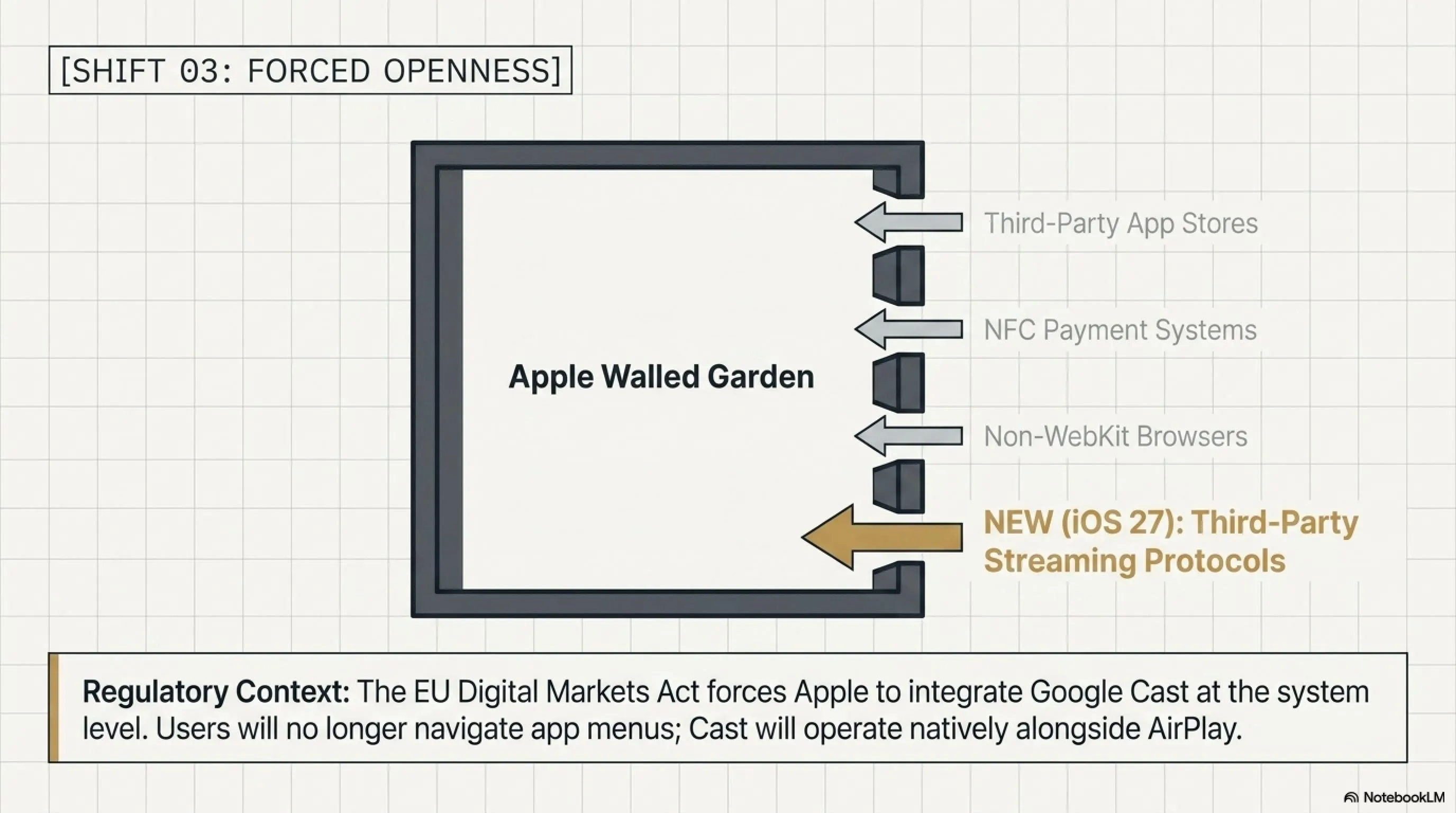
In an unexpected move forced by European Union competition regulations, Apple is working on native integration of Google Cast and other third-party streaming protocols in iOS 27. This change will only apply to EU users and is in response to the Digital Markets Act (DMA).
🇪🇺 The DMA: The Law That Forced Apple's Hand
The Digital Markets Act, which came into force in 2024, requires large tech companies to open their systems to competitors. Apple has already been forced to:
- Allow third-party app stores on iOS
- Open NFC for competing payment systems
- Allow non-WebKit browser engines
- And now, open streaming protocols
According to Bloomberg's Mark Gurman, iOS 27 will allow EU users to set Google Cast or other third-party protocols as the system-wide default for streaming. This means users will no longer need to navigate through multiple menus to use Cast—it will be as seamless as AirPlay is today.
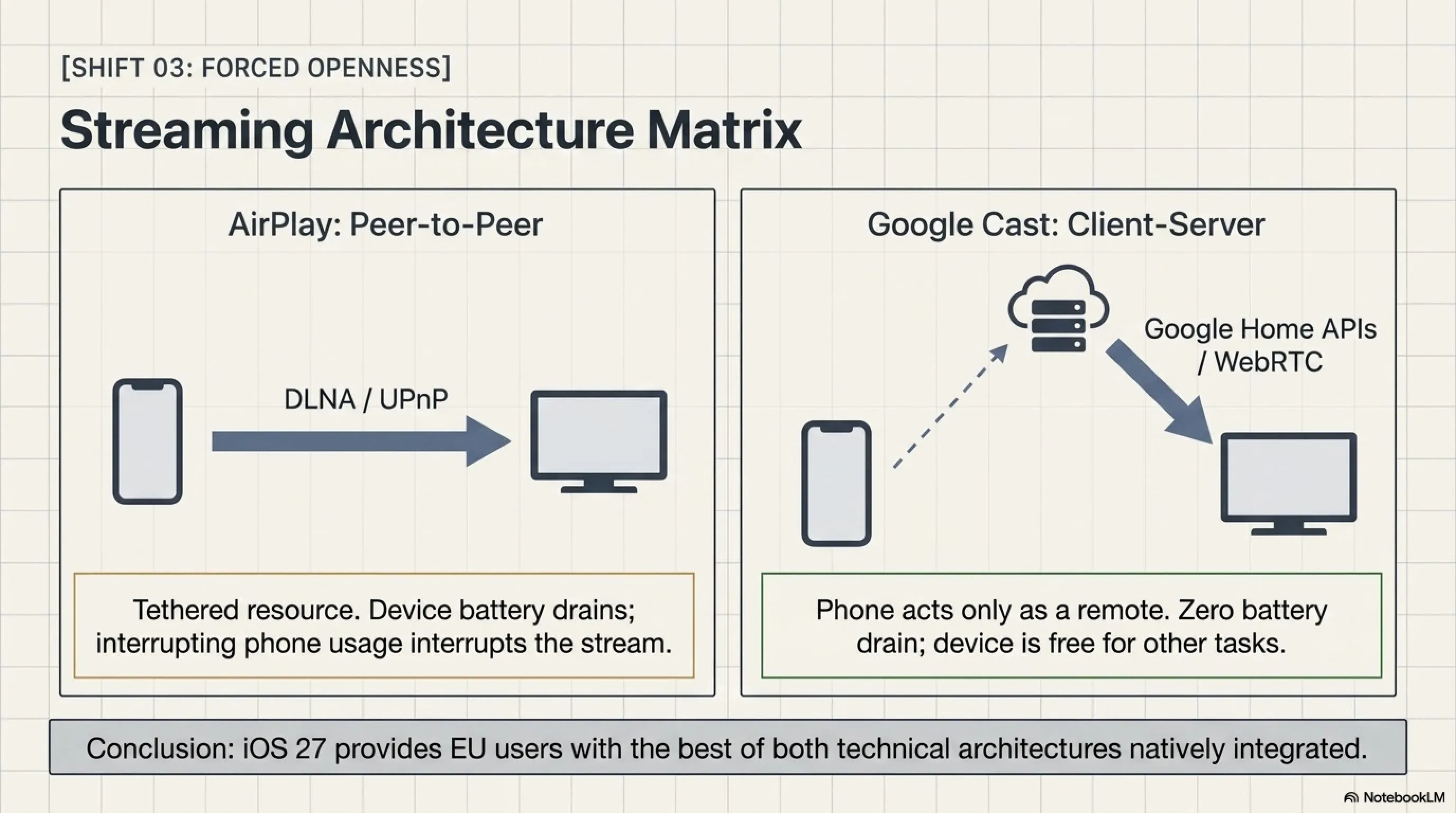
🔄 AirPlay vs Google Cast: Technical Differences
AirPlay and Google Cast represent two different approaches to streaming:
- AirPlay: Peer-to-peer model using DLNA and UPnP—your device connects directly to the TV
- Google Cast: Client-server architecture using Google Home APIs and WebRTC—your device is just a remote control
💡 Google Cast Advantage: Since content streams directly from the internet to your TV, your phone's battery isn't drained and you can use your phone for other tasks while casting.
🌍 Impact on Users: Who Benefits?
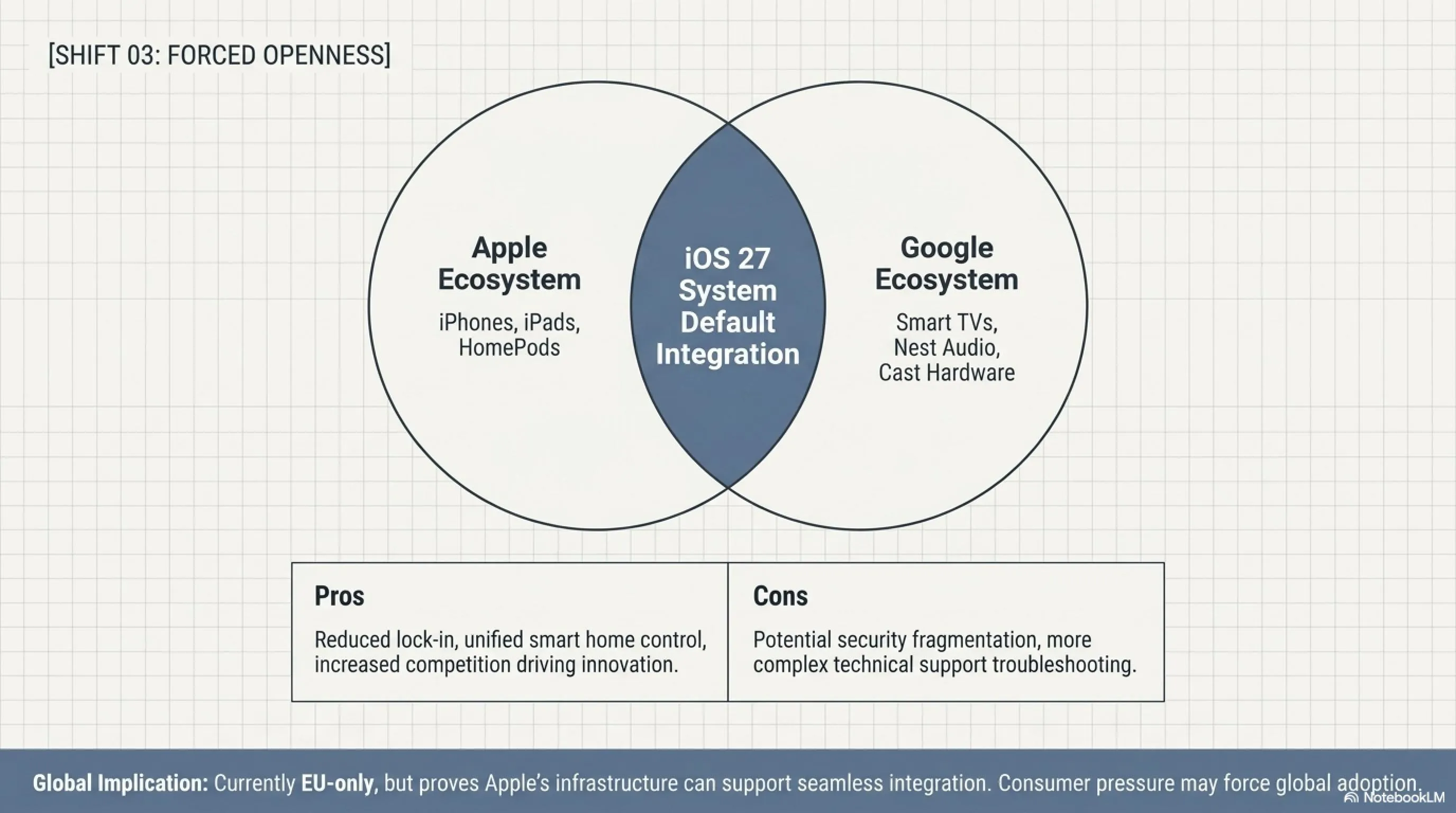
This change only applies to EU users, but its impact could be broader. Users with Google-based smart TVs or speakers will be able to set Google Cast as the system default. This means no more navigating through complex menus to use Cast—it will work as seamlessly as AirPlay does today.
For the smart home ecosystem, this is significant. Many users have a mix of Apple and Google devices, and the friction of switching between AirPlay and Cast has been a persistent pain point. With iOS 27, EU users will finally have a unified streaming experience regardless of which ecosystem their devices belong to.
⚖️ Pros & Cons: Opening Apple's Ecosystem
✅ Pros
- More choice for users
- Better compatibility with non-Apple devices
- More competition = more innovation
- Reduced lock-in to Apple ecosystem
- Lower prices for accessories
- Unified smart home experience
❌ Cons
- User experience may become more complex
- Potential compatibility issues
- Reduced ecosystem integration
- Potential security concerns
- More complex technical support
- Fragmented user experience
🎯 Final Thoughts
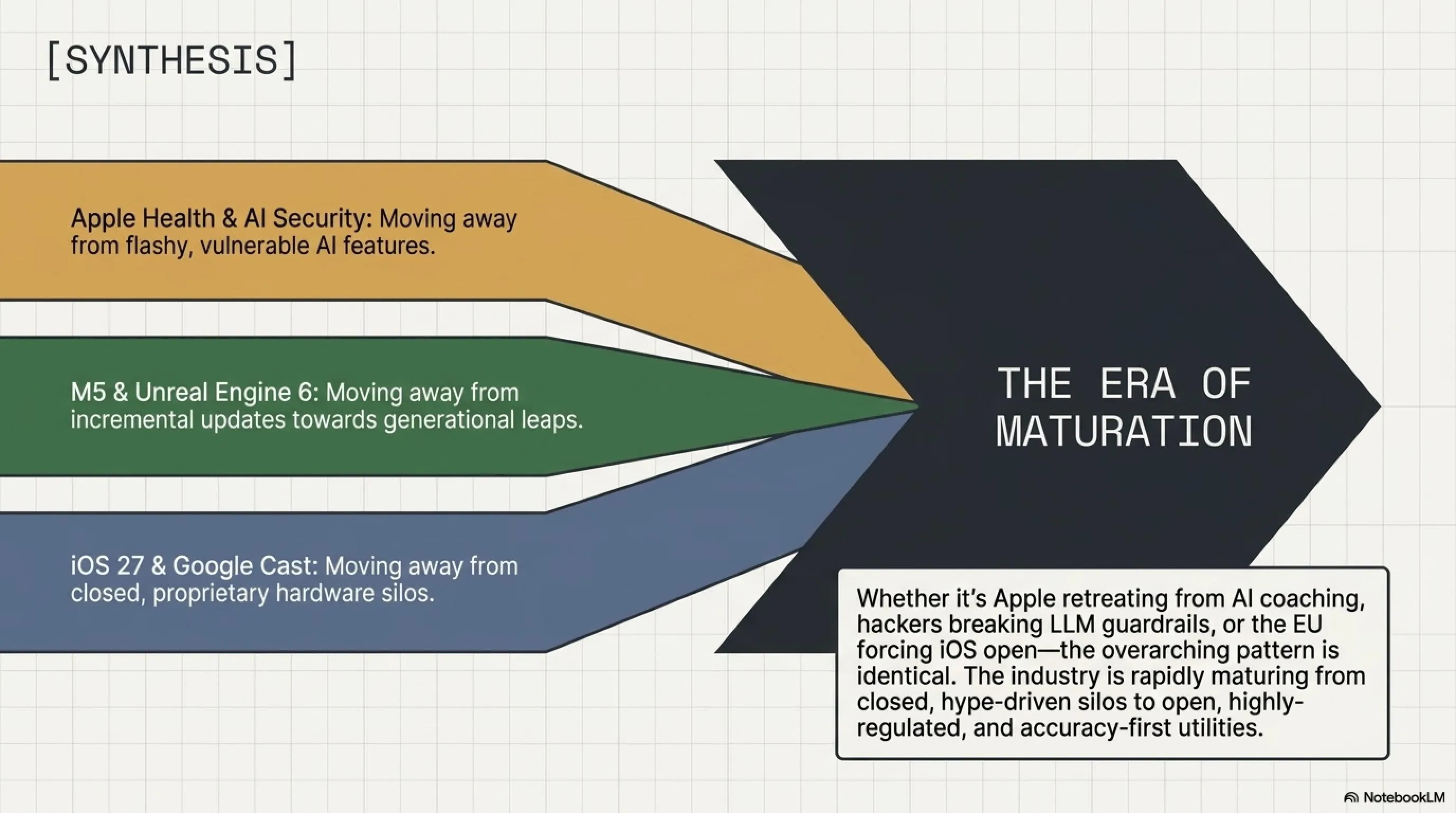
Monday, May 25, 2026, demonstrates that the tech industry is shifting—from flashy features to accuracy and reliability (watchOS 27), from high prices to competitive pricing (MacBook Air M5), from repeated failures to renewed hope (Xreal), from weak security to a real crisis (AI jailbreaks), from old generations to generational leaps (Unreal Engine 6), and from walled gardens to forced openness (iOS 27 and Google Cast).
These developments show that the future of technology is moving toward openness, accuracy, and real-world utility. Companies that can embrace these three principles will be the winners. Those that cling to closed ecosystems, prioritize marketing over substance, or ignore security concerns will struggle.
The regulatory pressure from the EU is forcing even the most resistant companies to open up. The AI security crisis is forcing companies to take safety seriously. And consumer demand for value is forcing companies to compete on price and quality rather than just brand loyalty. These are all positive trends that will benefit users in the long run.
❓ Is watchOS 27 worth upgrading to?
Yes, especially if you use Apple Watch for health tracking. The accuracy improvement from 96.1% to 98.2% may seem small, but it makes a significant difference in practice—especially during high-intensity workouts. If you were waiting for the AI health coach, you'll need to wait longer, but the sensor improvements alone make the upgrade worthwhile.
❓ Should I buy the MacBook Air M5 now or wait for M6?
If your current laptop is more than 3 years old or has performance issues, this $200 discount is an excellent opportunity. The M5 is a powerful chip that will remain capable for years. But if your laptop is M1 or newer and works well, wait for the M6, which will likely be released in March 2027.
❓ Will Xreal smart glasses succeed?
Xreal's chances of success are better than previous generations of smart glasses, but significant challenges remain. Google's backing, reasonable pricing, and lighter design are strengths. But social acceptance, battery life, and app ecosystem are still big question marks. Our prediction: moderate success in niche markets, but not a mainstream product in the next 2-3 years.
❓ How can I use AI chatbots safely?
There's no 100% safe way, but you can reduce risk: (1) Never share sensitive information like passwords or financial data with chatbots, (2) Treat chatbot outputs as advice, not absolute truth, (3) Verify important information from trusted sources, (4) Use chatbots from reputable companies with transparent privacy policies, (5) Be skeptical of any output that seems unusual or potentially harmful.
❓ Will iOS 27's Google Cast support come to the US?
Currently, this feature is only planned for the EU due to the Digital Markets Act. Apple has shown no indication of voluntarily bringing it to other regions. However, if other jurisdictions pass similar regulations, or if consumer pressure becomes strong enough, Apple might expand the feature globally. For now, US users will need to continue using AirPlay or third-party apps for Google Cast.
📚 Sources
Primary Sources: 9to5Mac, Bloomberg (Mark Gurman), The Verge, TechCrunch, IGN, AppleInsider, Nature Communications, Google I/O 2026, Epic Games, Amazon, Xreal Official Blog, PC Gamer, Polygon, Kotaku
Research and Analysis: Tekin Editorial Team
Publication Date: May 25, 2026
🌐 Stay Connected With Us 🎮✨
For the latest tech, gaming, and gadget news, follow us on our official social media channels:
Additional Gallery: 🌅 Tekin Morning May 25: Unreal Engine 6 Reveal & Google Smart Glasses