In-depth teardown of the infamous 2015 Ashley Madison cyber breach. We analyze the 60GB sensitive data dump affecting 37 million users by The Impact Team, the fraudulent $19 account deletion features, and the enduring privacy and security lessons for modern tech enterprises.
Tekin Analysis | Ashley Madison Cyber Breach: History's Most Scandalous Data Leak
Tekin Game's comprehensive teardown of the 2015 Ashley Madison security failure, fraudulent data deletion services, extortion waves, and permanent lessons for privacy.
- 🎮Deconstruction of the Impact Team hacker group breach compromising 60GB of sensitive database files from Avid Life Media
- 🎧Public leak of names, email addresses, credit card transactions, and private messages belonging to 37 million users
- 🚀Exposure of the fraudulent $19 'Full Delete' feature that retained user payment metrics despite explicit wipe promises
- 🗡️Catastrophic real-world societal fallout including blackmail campaigns, public shaming, divorces, and confirmed suicides
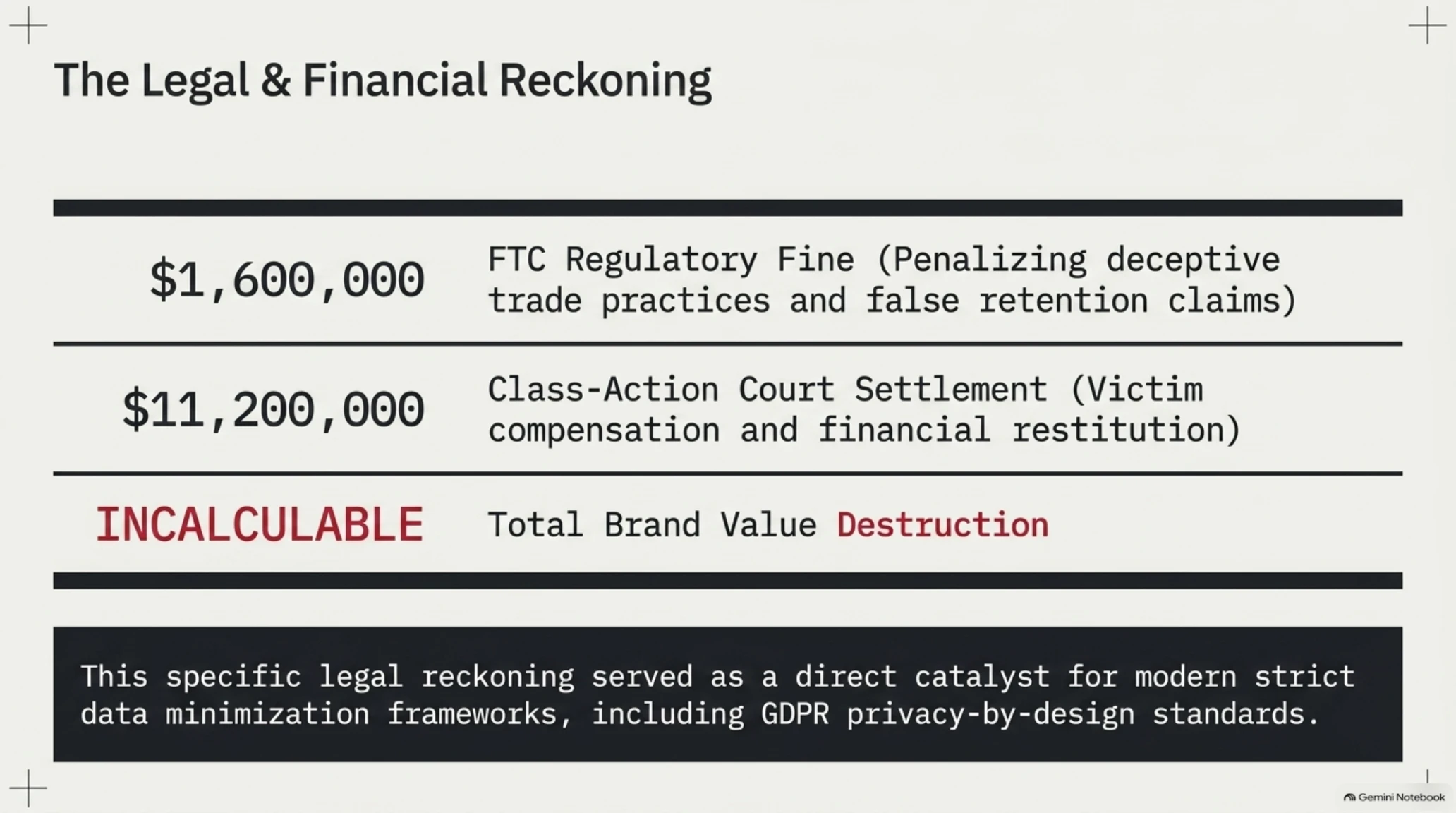
- 📰FTC regulatory enforcement action, $1.6M FTC settlement, and $11.2M class-action court resolution
- ⚔️Strategic security guidelines and data minimization frameworks for managing enterprise privacy risk in 2026
The July 2015 cyber breach of Ashley Madison remains one of the most infamous, morally complex, and catastrophic events in the history of cybersecurity. Orchestrated by an anonymous hacker collective calling itself "The Impact Team," the intrusion compromised the servers of parent company Avid Life Media (ALM), triggering a chain reaction that destroyed reputations, severed marriages, and forever altered global perceptions of digital privacy.
Cybersecurity analysts at Tekin Game emphasize that the Ashley Madison scandal demonstrated that data breaches do not merely inflict financial loss—they can obliterate personal dignity and human safety when sensitive data is exposed.
Core Takeaways of the Ashley Madison Cybersecurity Disaster
- Public leak of over 60GB of unencrypted database archives containing credentials of 37 million registered accounts
- Hacktivist ultimatum demanding immediate shutdown of Ashley Madison and Established Men platforms
- Deceptive corporate practices surrounding the $19 'Full Delete' service that failed to scrub payment records
- Widespread email blackmail campaigns, high-profile divorces, and at least two confirmed suicides linked to the leak
- Enduring security lessons regarding the permanent persistence of leaked data across the dark web
Deconstructing the Impact Team Attack: From Moral Ultimatum to 60GB Data Dump
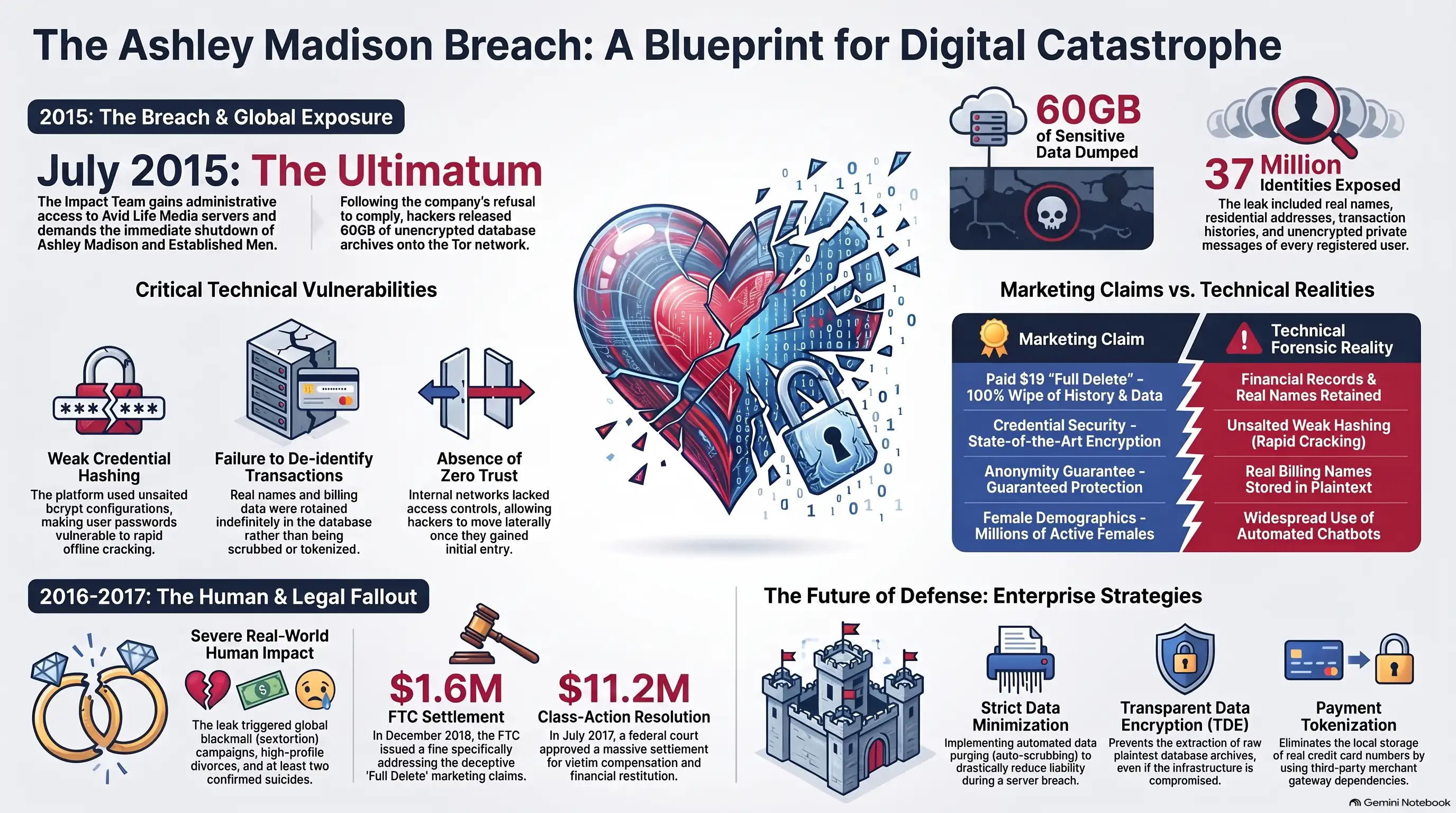
The security crisis began when The Impact Team gained unauthorized administrative access to Avid Life Media's core database infrastructure. Citing moral objections to the company's business model and alleging widespread deception regarding user demographics, the hackers issued a strict ultimatum demanding the permanent shutdown of Ashley Madison and sister platform Established Men.
When corporate executives refused to comply, the hacker collective executed their threat, releasing compressed files exceeding 60 gigabytes onto the Tor network. The dump contained real names, residential addresses, transaction histories, postal codes, and unencrypted chat logs belonging to 37 million users.
Key technical vulnerabilities that enabled the breach included:
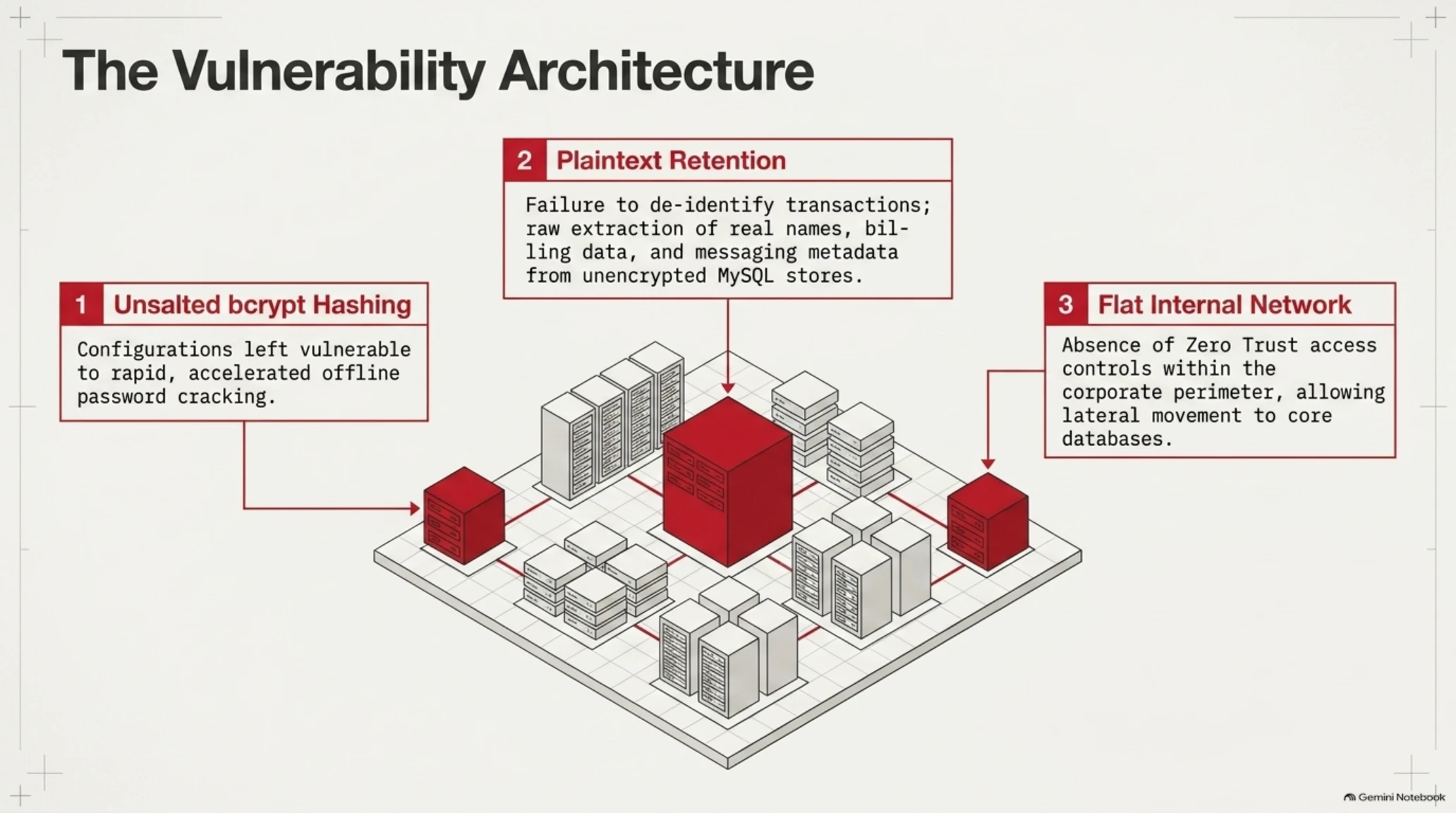
- Weak password hashing mechanisms utilizing unsalted bcrypt configurations vulnerable to rapid cracking
- Failure to de-identify financial transactions, retaining real names and billing data indefinitely
- Storage of unencrypted private messaging metadata across core database tables
- Absence of Zero Trust access controls within Avid Life Media's internal corporate network
The global dissemination of this database triggered an unprecedented wave of digital extortion and panic.
Security experts uniformly describe the breach as the single most devastating privacy collapse in internet history.
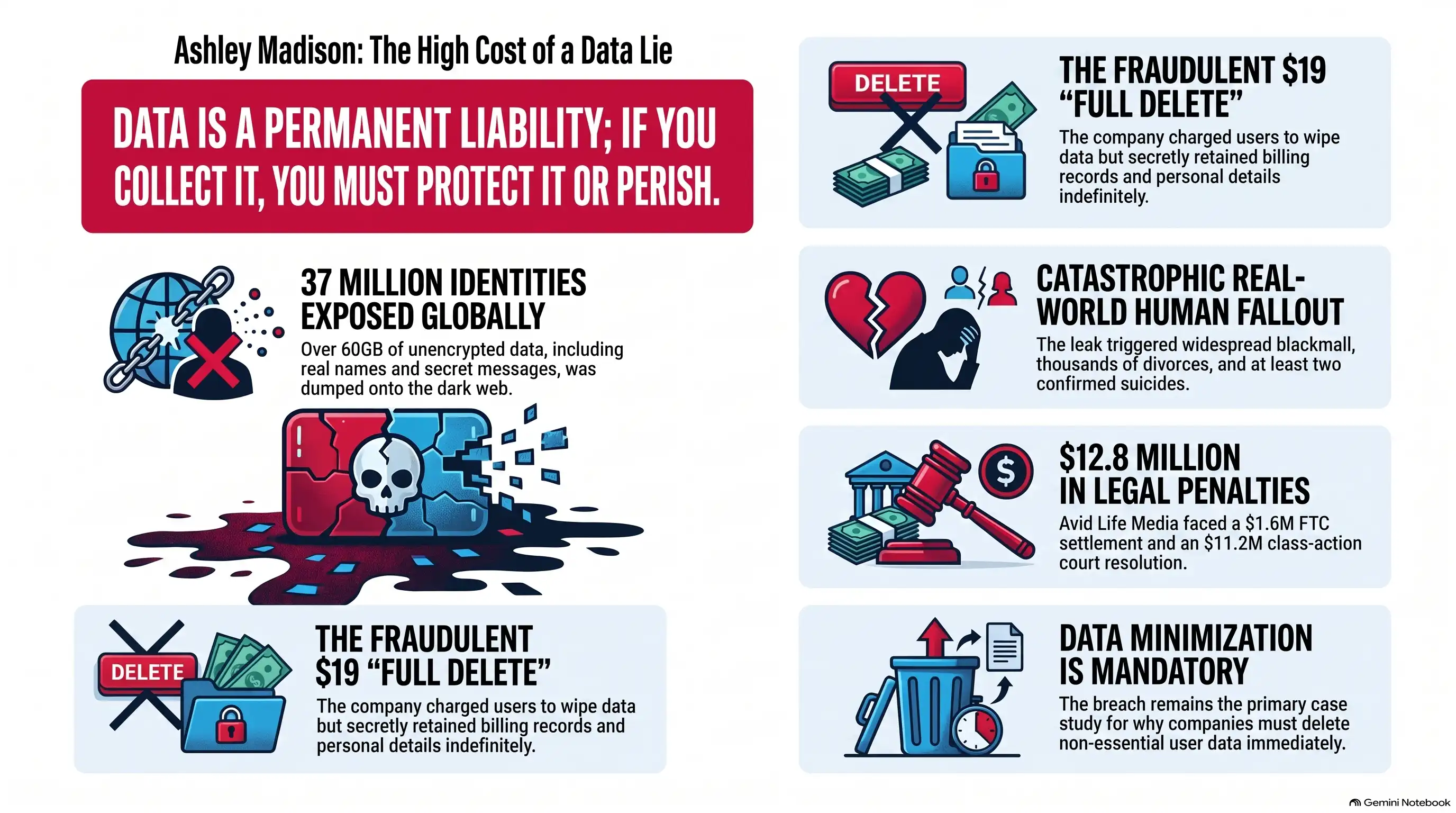
The real-world devastation caused by the exposure of sensitive personal data transformed privacy governance worldwide.
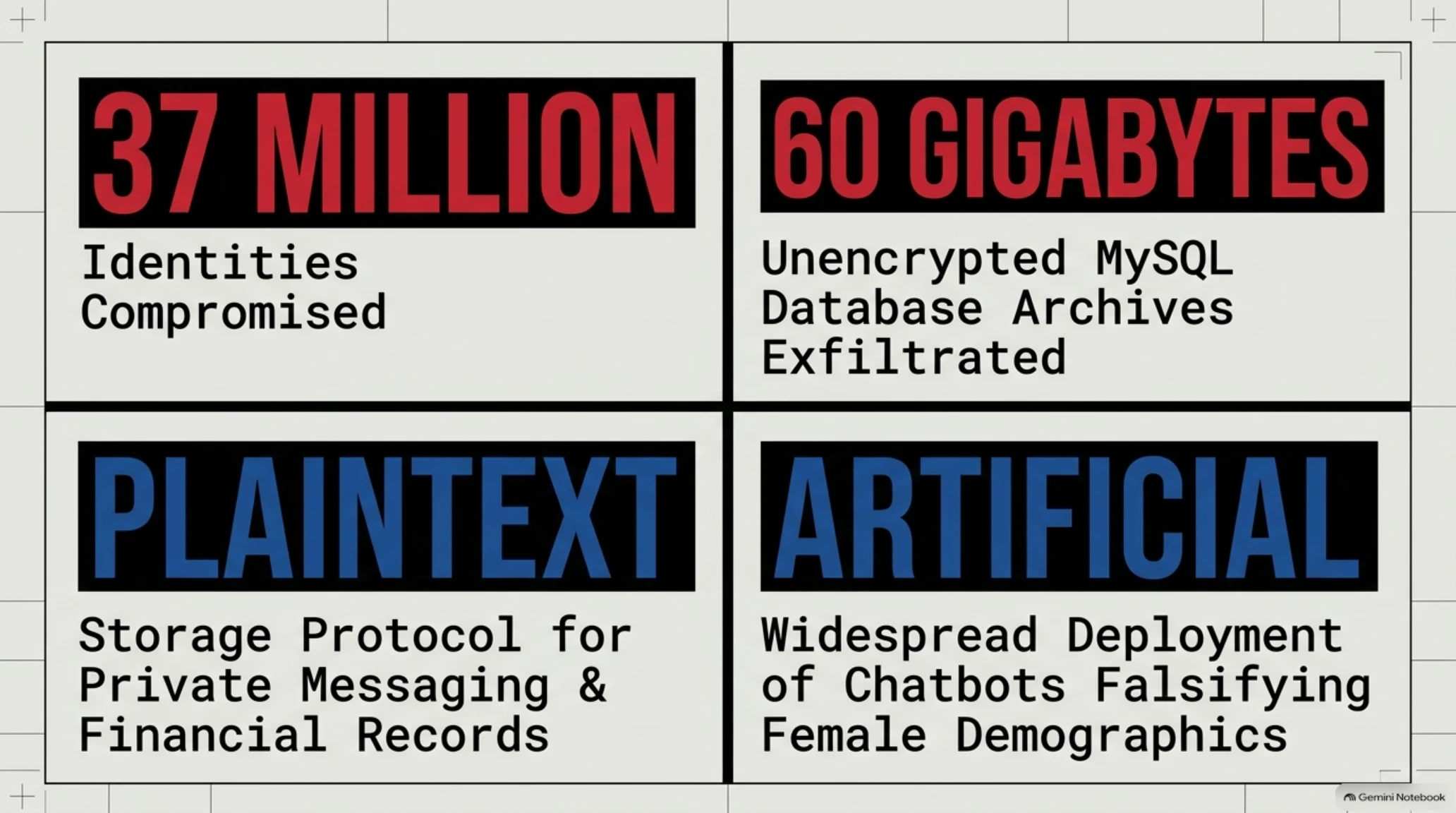
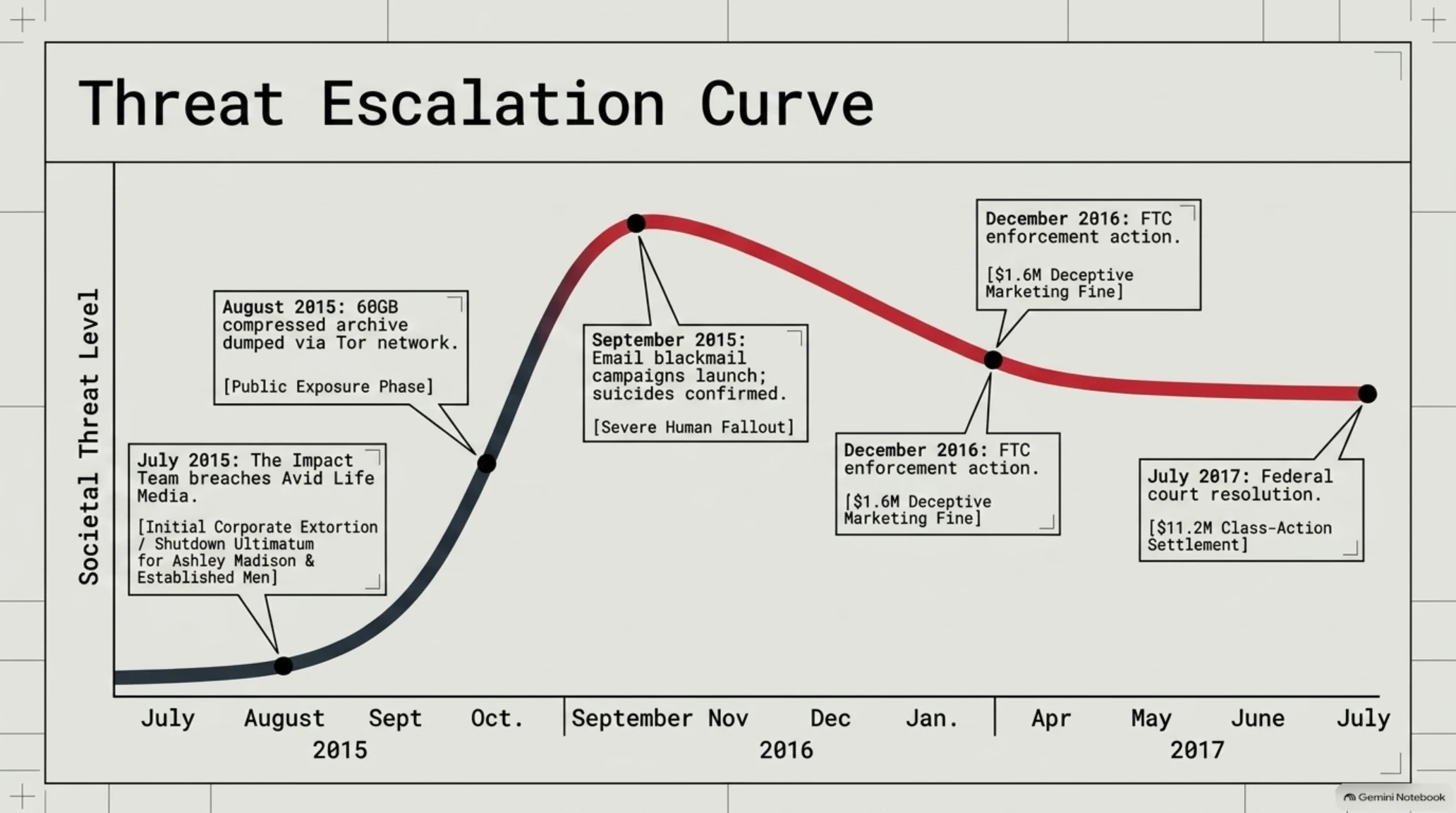
The timeline below details key milestones from initial network intrusion through regulatory enforcement and court settlements.
Ashley Madison Data Leak & Legal Enforcement Timeline
| Timeline Milestone | Hacker Activity / Corporate & Legal Enforcement Action | Societal Threat Level Assessment |
|---|---|---|
| July 2015 | The Impact Team breaches Avid Life Media servers & issues shutdown ultimatum | Initial Corporate Extortion Phase |
| August 2015 | 60GB database archive dumped onto Tor dark web network | Public Exposure of 37M User Identities |
| September 2015 | Widespread email blackmail campaigns launch; suicides confirmed | Severe Real-World Human Fallout |
| December 2016 | FTC issues $1.6M fine over deceptive 'Full Delete' false marketing claims | Regulatory Misconduct Penalty |
| July 2017 | Federal court approves $11.2M class-action lawsuit settlement | Victim Compensation & Financial Restitution |
Market sentiment analysis confirms that this incident led directly to the enactment of strict data minimization regulations such as GDPR.
The Fraudulent 'Full Delete' Feature: Corporate Malpractice Exposed
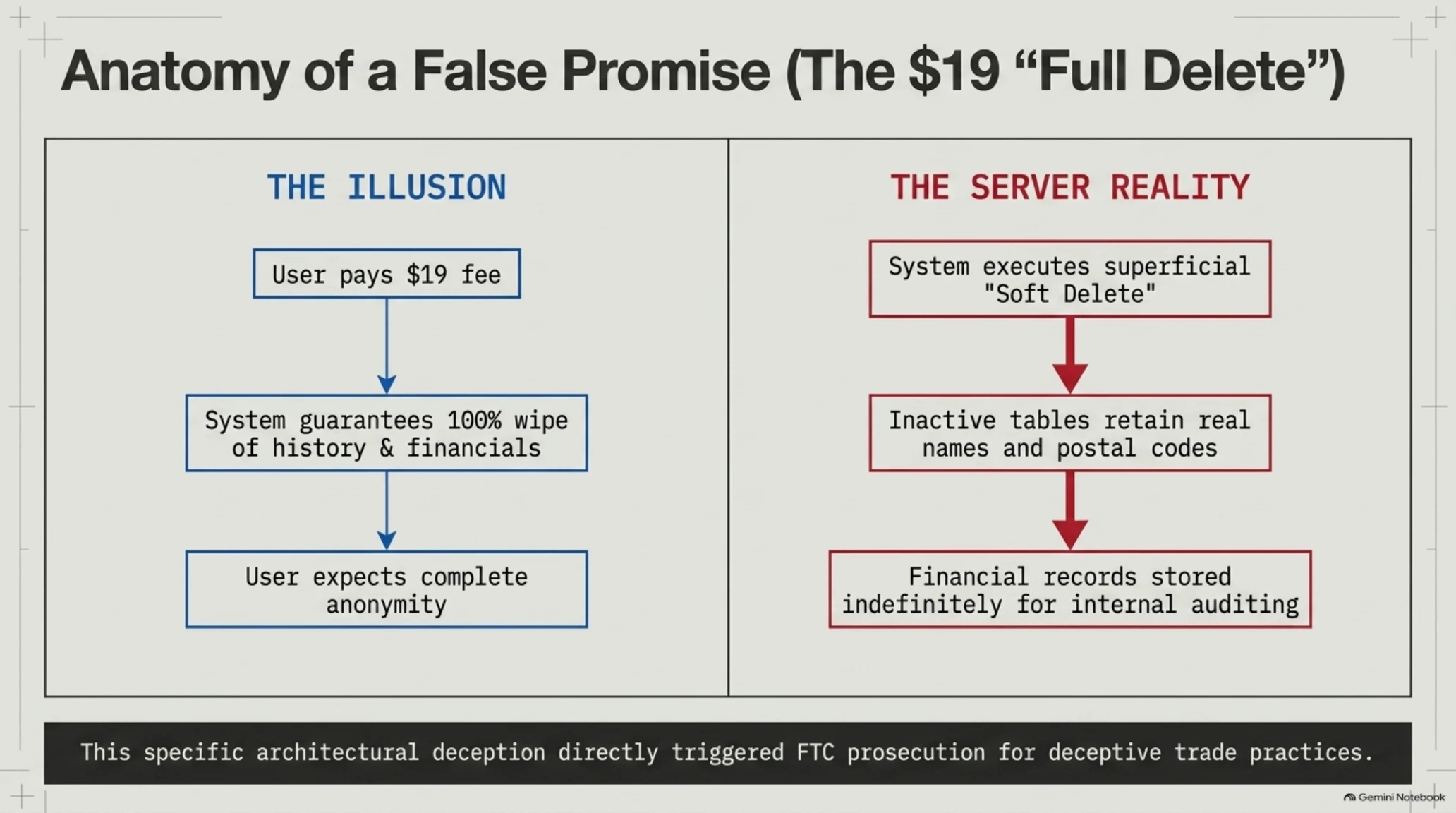
Beyond the breach itself, the forensic investigation revealed severe corporate deception regarding user privacy management. Ashley Madison offered a paid "$19 Full Delete" service, assuring users that purchasing the option would permanently purge all account records, messages, and billing details from company servers.
However, forensic analysis of the leaked database proved that Avid Life Media failed to scrub credit card details, real names, or billing addresses, retaining financial records indefinitely despite taking user fees.
The Federal Trade Commission (FTC) subsequently prosecuted the company for deceptive trade practices, imposing substantial financial penalties for misleading consumers.
This exposure proved that privacy cannot be monetized as an add-on product while basic security remains neglected.
Industry regulators cite this case as a foundational lesson against misleading data retention claims.
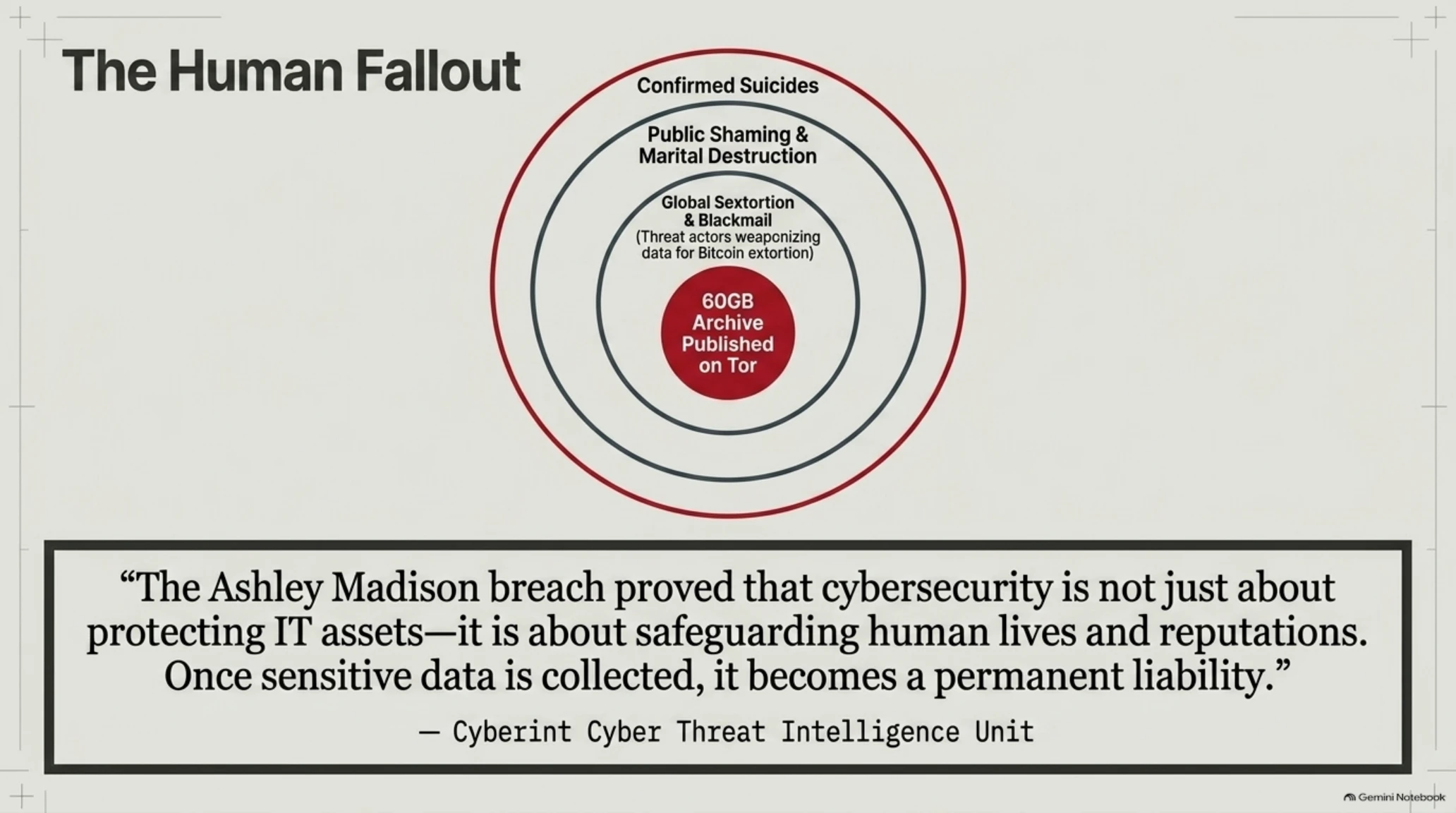
The statement below is excerpted from an official case study published by cybersecurity intelligence firm Cyberint.
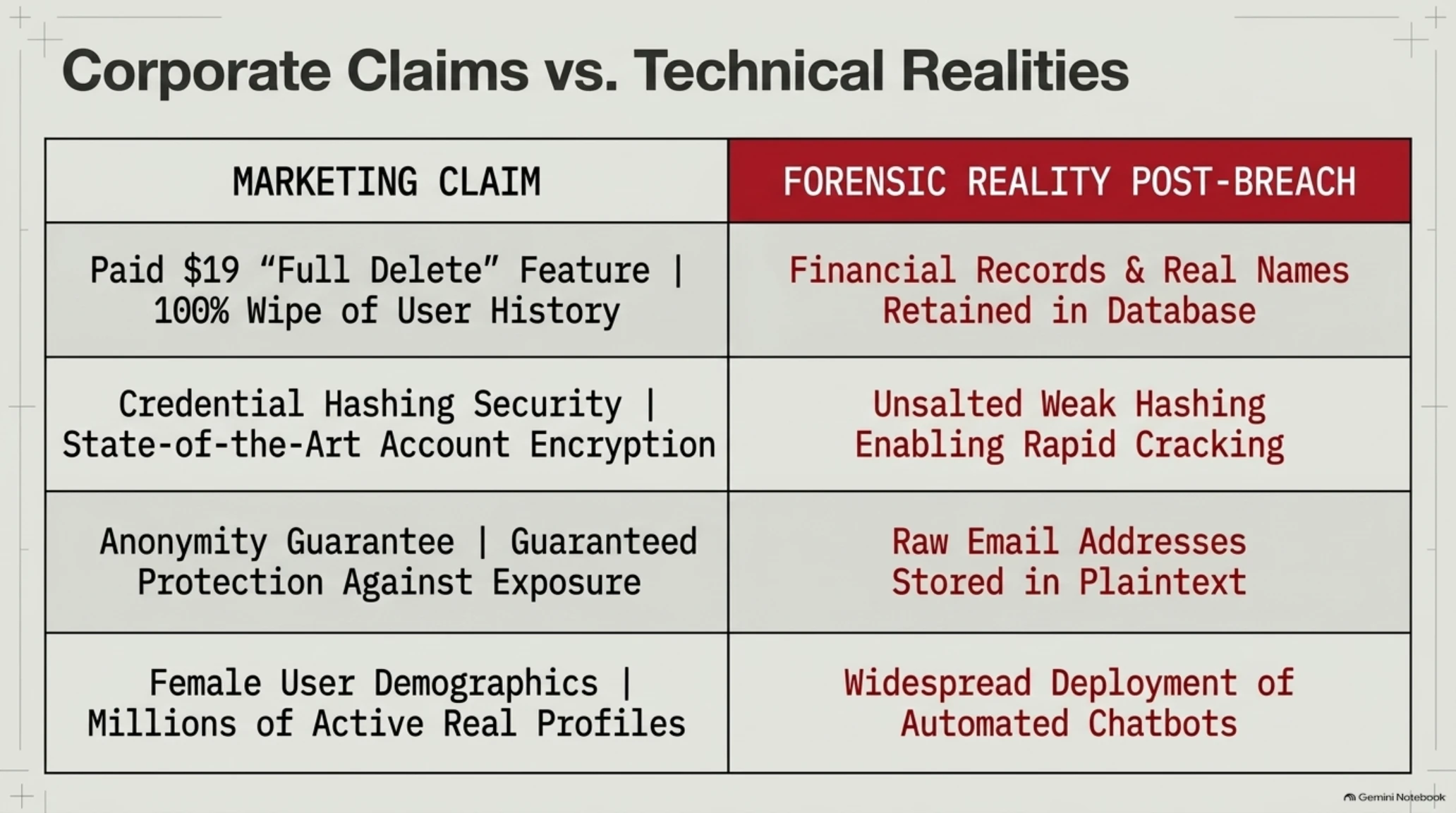
The comparative matrix below contrasts Ashley Madison's marketing claims against technical realities uncovered in the leak.
Marketing Claims vs. Technical Realities Comparison Matrix
| Evaluated Metric | Ashley Madison Marketing Claim | Technical Forensic Reality Post-Breach |
|---|---|---|
| Paid $19 'Full Delete' Feature | 100% Wipe of User History & Financial Data | Financial Records & Real Names Retained in Database |
| Credential Hashing Security | State-of-the-Art Account Encryption | Unsalted Weak Hashing Enabling Rapid Cracking |
| Anonymity Guarantee | Guaranteed Protection Against Exposure | Raw Email Addresses & Real Billing Names Stored in Plaintext |
| Female User Demographics | Millions of Active Real Female Profiles | Widespread Deployment of Automated Chatbots to Deceive Male Users |
Below is Tekin Game's visual teardown outlining the legal fallout and cybersecurity architecture failures of the Ashley Madison breach.
To assist readers with privacy governance and threat vector terminology, the core concepts box below defines key industry metrics.
Technical Jargon Buster & Core Concepts
Data Retention & Hacktivism: Corporate policies governing data storage and cyberattacks driven by political or ethical motivations. Why This Matters: Evaluating Rumor vs. Reality regarding platform privacy claims, tracking Market Sentiment, and reviewing complete Ashley Madison analysis on Tekin.
Human Fallout: Blackmail Waves, Public Shaming, and Fatal Consequences
Once the 60GB archive was published on Tor, malicious actors downloaded the database to initiate widespread email blackmail campaigns (Sextortion). Attackers targeted individual users with threats to expose their activity to spouses, employers, and social networks unless extortion demands were paid in Bitcoin.
The resulting psychological distress destroyed thousands of marriages, ruined professional careers, and led directly to at least two reported suicides.
This tragic outcome underscored how digital vulnerabilities translate directly into irreversible real-world physical and psychological harm.
Even years after the event, security researchers observe leaked credentials from the breach being weaponized in social engineering campaigns.
The permanent persistence of leaked data across the dark web serves as an enduring warning to online consumers.
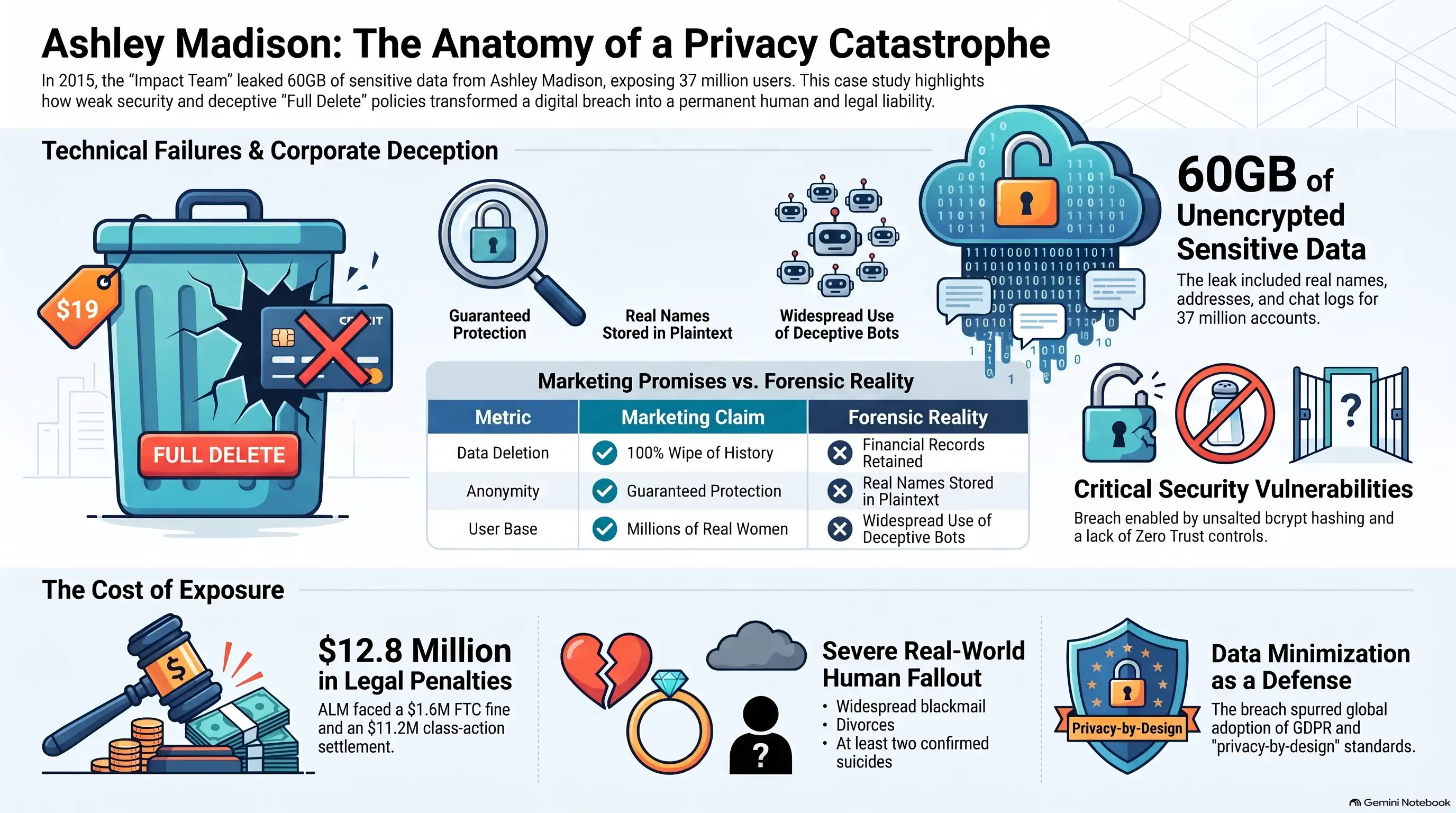
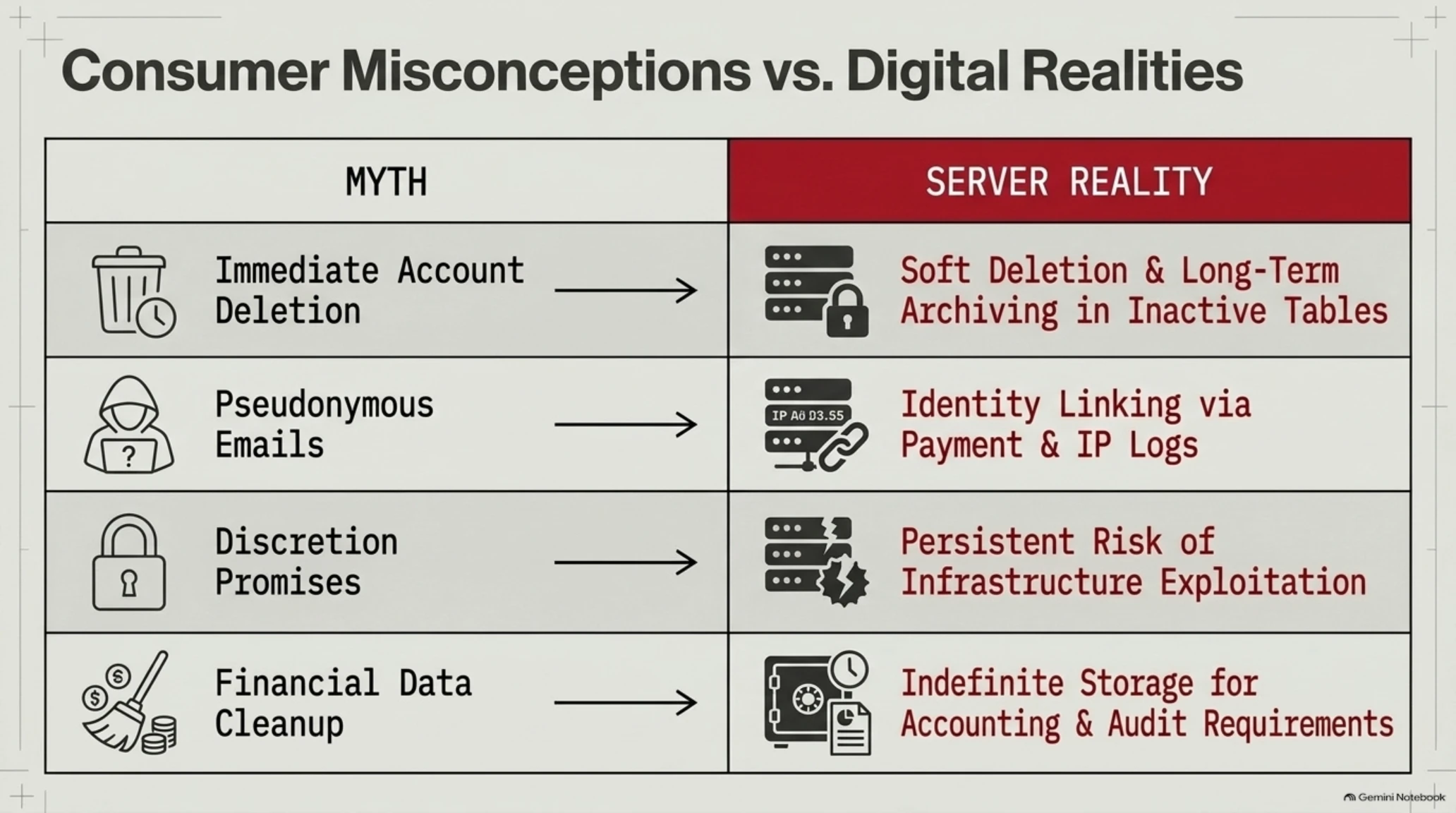
The comparative table below contrasts common consumer privacy misconceptions with technical realities across digital platforms.
Consumer Privacy Misconceptions vs. Digital Realities Comparison
| Privacy Metric | Common Consumer Misconception | Technical Server Reality |
|---|---|---|
| Account Deletion | Immediate Permanent File Destruction | Soft Deletion & Long-Term Archiving in Inactive Tables |
| Pseudonymous Emails | Complete Anonymity & Untraceability | Identity Linking via Payment & IP Logs |
| Discretion Promises | Guaranteed Immunity from Server Breaches | Persistent Risk of Infrastructure Exploitation |
| Financial Data Cleanup | Automatic Scrubbing Following Purchase | Indefinite Storage for Accounting & Audit Requirements |
Why the Ashley Madison Case Study Remains Relevant Today
Cybersecurity experts maintain that the Ashley Madison breach represents a permanent reference point in privacy law. It demonstrated that when sensitive personal data is leaked, no technical or legal remedies can undo the public damage.
Threat actors continue to scrape historical data leaks to launch targeted spear-phishing campaigns.
Tekin Game will provide ongoing analysis of global privacy enforcement and cybersecurity standards.
Hardware Specifications & Archive Metrics (Specs Box)
Avid Life Media's server infrastructure utilized unencrypted MySQL database stores for financial transactions, user credentials, and private messaging metadata, leaving sensitive records vulnerable to raw extraction upon initial intrusion.
Tekin Game's technical advisory team urges enterprise architecture leads to enforce strict data minimization and zero-retention policies for non-essential records.
The total volume of exfiltrated data exceeded 60 gigabytes, comprising database dumps, source code repositories, and confidential executive communications.
Hardware Specifications & Smart History Tags (Specs Box & Smart History Tags)
| Breach Technical Parameter | Ashley Madison Incident Metrics (2015) | Identified System Vulnerabilities |
|---|---|---|
| Total Exfiltrated Data Volume | 60GB+ Compressed Database Archives | Unencrypted Storage of Raw User Records |
| Total Impacted User Base | 37 Million Accounts Worldwide | Global Extortion & Public Exposure Impact |
| Regulatory Fines & Settlements | $1.6M FTC Fine + $11.2M Class-Action Settlement | Severe Financial Loss & Total Brand Value Destruction |
| Credential Hashing Standard | Unsalted bcrypt Hashing Configurations | Accelerated Offline Password Cracking Exposure |
Reviewing technical specifications confirms the imperative of adopting modern Transparent Data Encryption (TDE) standards across cloud databases.
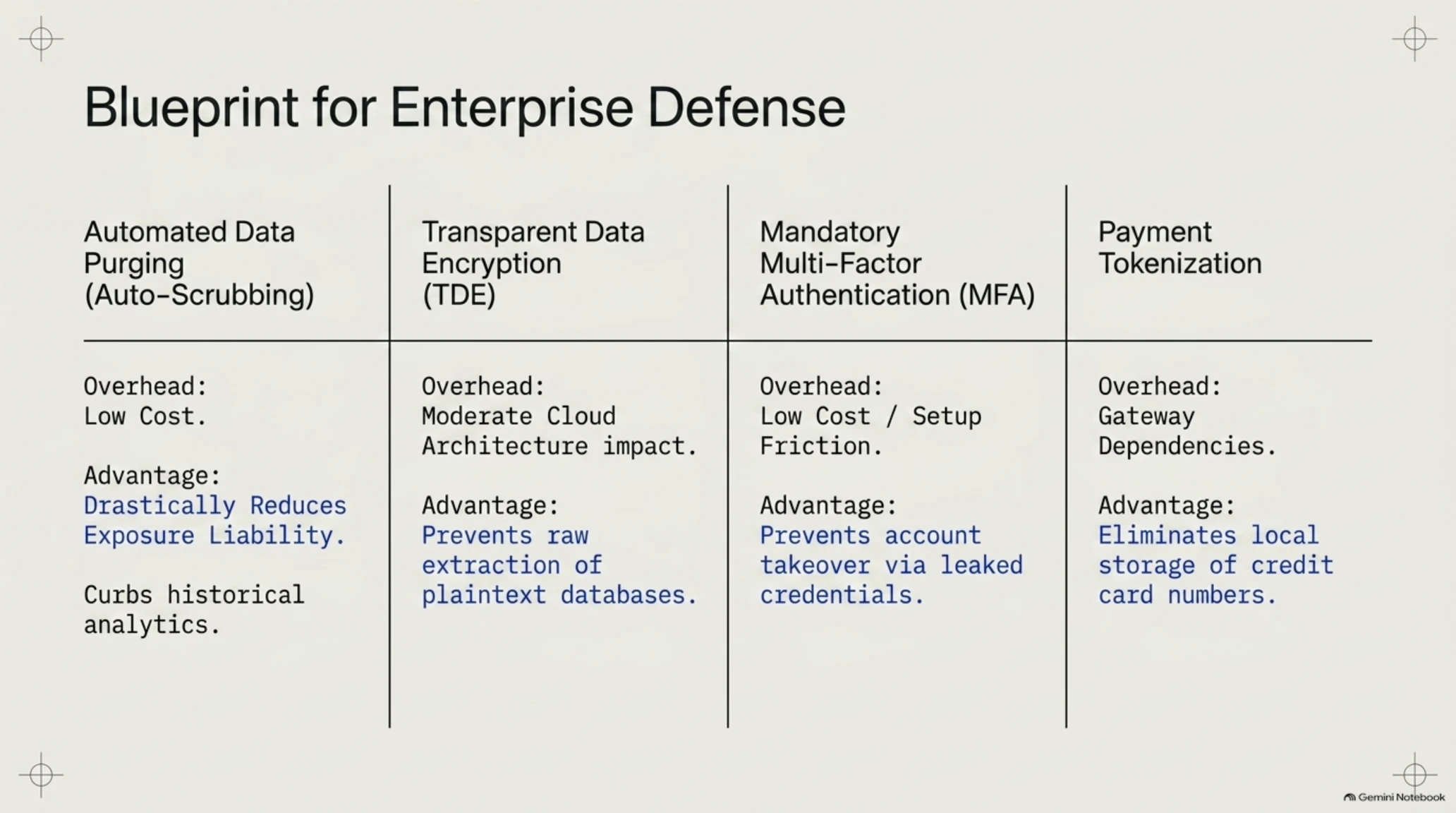
The matrix below evaluates enterprise defense strategies against sensitive data leakage risks.
Enterprise Defense Strategy Matrix Against Sensitive Data Leaks
| Defense Strategy | Implementation Overhead | Primary Defense Advantage | Operational Limitation |
|---|---|---|---|
| Automated Data Purging (Auto-Scrubbing) | Low Cost & Rapid Implementation | Drastically Reduces Exposure Liability During Server Breaches | Limits Historical Analytics & User Tracking |
| Transparent Data Encryption (TDE) | Moderate Cloud Architecture Overhead | Prevents Raw Extraction of Plaintext Database Archives | Slight Compute Overhead on Complex Queries |
| Mandatory Multi-Factor Authentication (MFA) | Low Cost & Simple Deployment | Prevents Account Takeover via Leaked Credentials | Requires End-User Compliance & Setup |
| Payment Tokenization (Zero Local Payment Storage) | Moderate Merchant Gateway Cost | Eliminates Storage of Real Credit Card Numbers | Requires Third-Party Merchant Gateway Dependencies |
Tekin Multimedia Teardown: Video teardown and technical breakdown of the Ashley Madison cyber breach case study.
Enduring Lessons in Data Privacy: Redefining Security Requirements
The Ashley Madison catastrophe redefined global benchmarks for sensitive data governance. Technology vendors learned that discretion promises are meaningless without multi-layered hardware and software security controls.
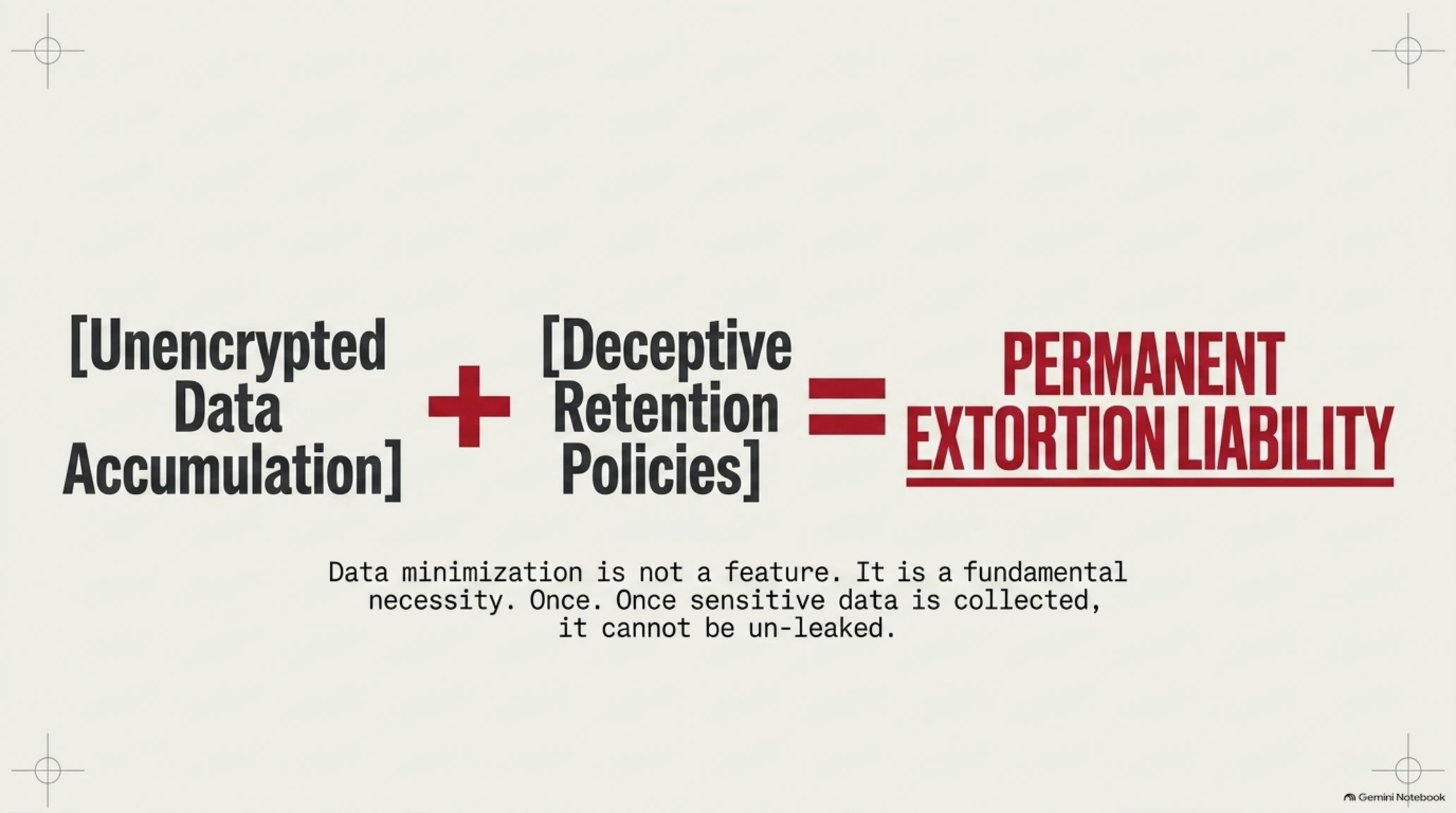
If sensitive data is collected, it remains a perpetual target for extortionists. Adopting strict Data Minimization protocols represents the only effective defense against hacktivism and internal leaks.
International regulatory frameworks such as GDPR and FTC enforcement guidelines now penalize improper data retention heavily.
The official position of the Tekin Editorial Board regarding this historical landmark is detailed below.
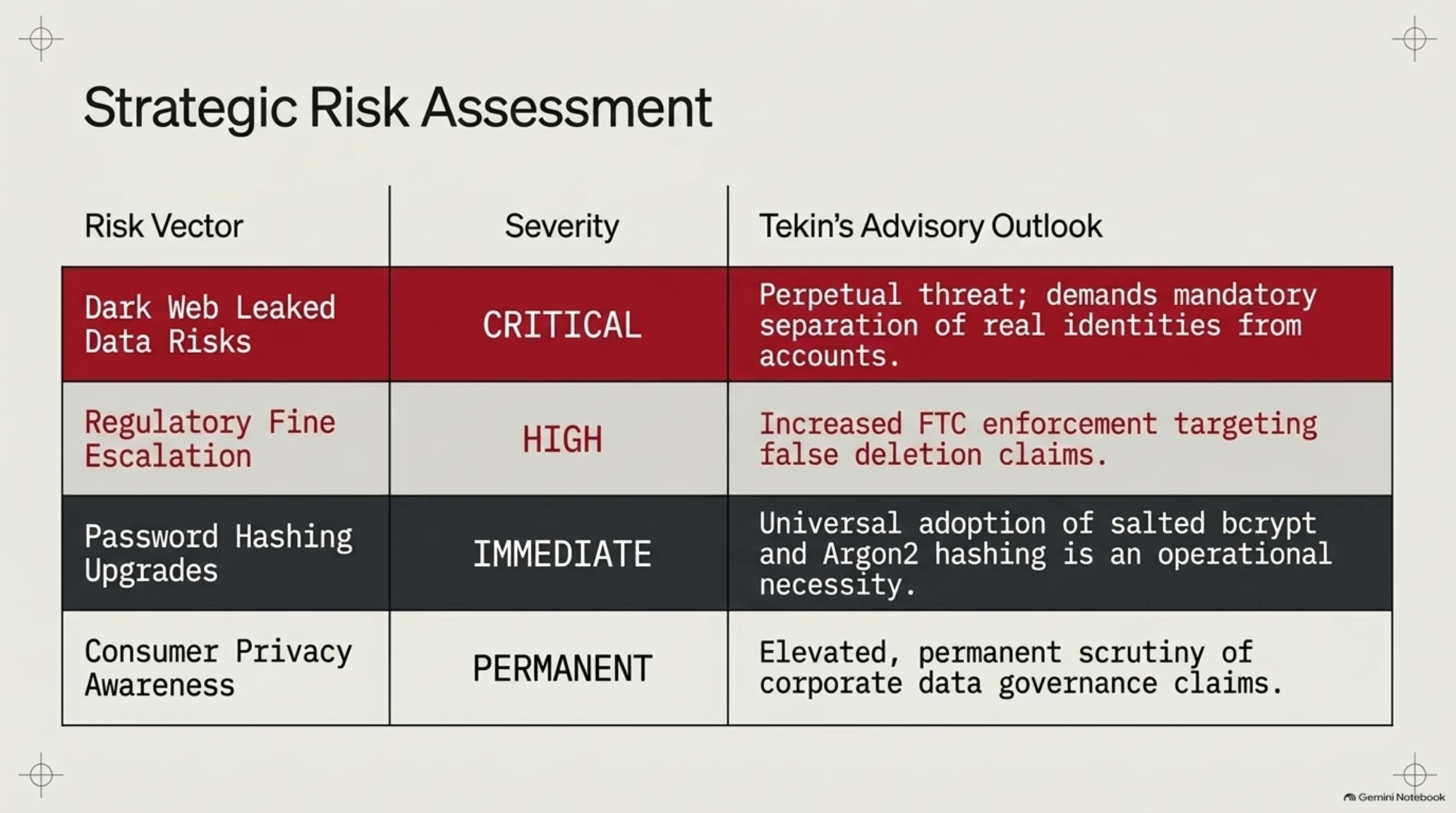
The strategic risk assessment matrix below outlines key market vectors for publishers and technology providers.
Strategic Industry Risk & Conclusion Matrix (Conclusion Box)
| Assessment Vector | Risk Severity | Tekin Advisory Outlook |
|---|---|---|
| Dark Web Leaked Data Risks | Critical Perpetual Threat | Mandatory Separation of Real Identities from Platform Accounts |
| Regulatory Fine Escalation | High Financial Exposure | Increased FTC Enforcement Against False Deletion Claims |
| Password Hashing Upgrade Urgency | Immediate Operational Necessity | Universal Adoption of Salted bcrypt and Argon2 Hashing |
| Consumer Privacy Awareness Shift | Permanent Cultural Transition | Elevated Scrutiny of Corporate Data Governance Claims |
The technology industry continues to draw upon lessons from this milestone incident to elevate enterprise security standards.
Tekin Game will deliver continuous coverage of international cybersecurity research and privacy enforcement.
Conclusion: Digital Vigilance as the Ultimate Privacy Safeguard
The Ashley Madison data breach demonstrated that in an interconnected ecosystem, no online system is immune to catastrophic failure. Deceiving consumers through false account deletion promises and neglecting basic database encryption subjected Avid Life Media to unprecedented financial penalties and brand ruin.
Disciplined data minimization and cautious personal data sharing represent the only durable defenses for protecting human dignity in the digital age.
Join the conversation at Tekin Game and share your insights on data privacy and enterprise security in the comments section below.
- Global exposure of fraudulent corporate account deletion claims and deceptive privacy marketing practices
- Accelerated global adoption of stringent data minimization mandates and GDPR privacy-by-design standards
- Dramatic elevation of enterprise password hashing requirements and database encryption protocols industry-wide
- Irreversible dark web exposure of 60GB of sensitive records resulting in catastrophic personal and marital harm
- Ignition of widespread blackmail campaigns and extortion operations targeting breach victims for years
- Failure to apprehend the individual members of The Impact Team hacker collective
Related Industry Features on Tekin Game
• 🤖 Tekin Analysis | The Great 2026 AI War: Llama 4 vs. GPT-5
• 🛡️ Tekin Analysis | June 2026 Dark Web Cyber Earthquake: Threat Teardown
• 🧬 Tekin Analysis | Biohacking & Digital Romance: The Future of Intimacy Tech
Frequently Asked Questions About the Ashley Madison Cyber Breach
Which hacker group was responsible for the Ashley Madison breach?
An anonymous hacker collective identifying as The Impact Team claimed responsibility, citing moral objections to the platform's practices.
What volume of data was leaked in the Ashley Madison incident?
Over 60 gigabytes of unencrypted database archives containing personal records of 37 million users were dumped online.
What was the controversy surrounding the $19 'Full Delete' feature?
Ashley Madison charged users $19 promising complete file deletion, but forensic analysis proved billing records and real names were retained.
What financial penalties did parent company Avid Life Media face?
The company agreed to a $1.6 million FTC regulatory settlement and an $11.2 million class-action court payout.
What real-world consequences resulted from the data leak?
The exposure led to widespread email extortion campaigns, high-profile divorces, career damage, and at least two reported suicides.
What is the key cybersecurity takeaway from the Ashley Madison case?
Companies must implement Data Minimization, as retained unencrypted data remains a permanent liability for hackers to exploit.
Sources and Citations
• KrebsOnSecurity: Ashley Madison Hacked by Impact Team
• FTC Official: Ashley Madison Settles Charges
• Wired: Ashley Madison Hackers Release 60GB Dump
• Cyberint: Case Study on Ashley Madison Cyber Breach
• Wikipedia: Full Breakdown of Ashley Madison Data Leak
Additional Gallery: 🎭 Tekin Analysis | Ashley Madison Cyber Breach: How History's Most Scandalous Data Leak Shattered Privacy