🌅 Good Morning! Welcome to Tekin Morning June 19, 2026
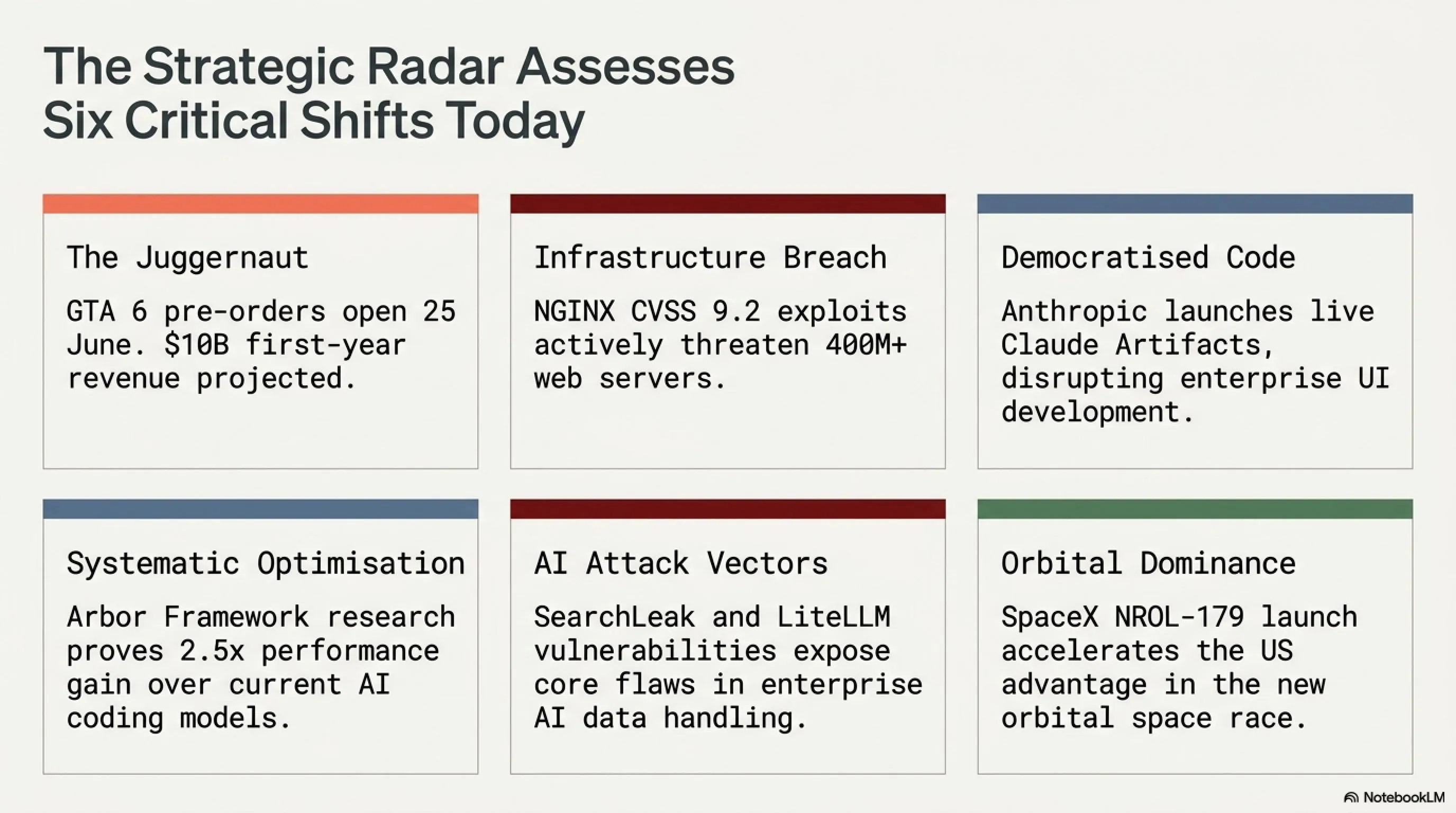
An energized Friday awaits! We're kicking off the morning with six explosive tech stories: from GTA 6 pre-orders to critical security crises in NGINX and Microsoft Copilot, from the AI coding revolution to SpaceX's spy satellite mission. These stories are shaping the future of technology, and you need to know about them.
⚡ Today's Headlines:
🎮 GTA 6: Pre-orders start June 25 + Official cover art
🔒 NGINX: Two critical vulnerabilities with CVSS 9.2
🤖 Claude Code: Live Artifacts dashboards
🚨 AI Security Crisis: SearchLeak & LiteLLM exploits
🧠 Arbor Framework: 2.5x better than Claude Code
🚀 SpaceX: NROL-179 spy satellite launch
☕ Grab your coffee and get ready for an exciting morning news journey!
🎮 GTA 6 Pre-Orders Open June 25: Cover Art Revealed & Launch Details
Rockstar Games finally dropped the announcement millions of gamers have been waiting for: pre-orders for Grand Theft Auto VI officially begin June 25, 2026 (next Wednesday). The announcement came with the reveal of the game's official cover art, which revives the classic Vice City aesthetic and signals that Rockstar is once again ready to redefine industry standards.
The GTA 6 cover art features the iconic neon pink and blue hues of Vice City, showcasing the two main characters—Lucia and Jason—against a backdrop of the neon-soaked cityscape. This marks the first time Rockstar has introduced a female protagonist in a mainline GTA title, a move that demonstrates the studio's commitment to diversity and progressive storytelling while maintaining the series' signature edge.
📊 GTA 6 Timeline & Milestones
| Event | Date | Details |
|---|---|---|
| First Trailer Drop | December 2023 | 93+ million views in 24 hours |
| Cover Art Reveal | June 18, 2026 | Classic Vice City aesthetic |
| Pre-Order Launch | June 25, 2026 | All platforms |
| Official Release | November 19, 2026 | PS5, Xbox Series X|S |
In a surprising pro-consumer move, Rockstar also announced that players who own GTA 5 on last-gen platforms (PS4 and Xbox One) will receive a free upgrade to the current-gen versions (PS5 and Xbox Series X|S). This unprecedented gesture suggests Rockstar wants to maximize its user base before GTA 6's launch while rewarding long-time fans who have supported GTA 5 since its 2013 debut.
The business implications are staggering. GTA 5 has sold over 200 million copies and generated more than $8 billion in revenue since its release 13 years ago, making it the most profitable entertainment product in history. Industry analysts predict GTA 6 will shatter that record, potentially reaching $10 billion in first-year revenue alone.
Why This Matters: The Economics of Gaming's Biggest Launch
GTA 6 represents more than just a video game—it's a cultural phenomenon and economic juggernaut. For Take-Two Interactive (Rockstar's parent company), this is a make-or-break moment that will define the next decade of the company's trajectory. Following the pre-order announcement, Take-Two stock surged 8.3%, pushing the company's market cap beyond $35 billion.
The gaming industry has evolved dramatically since GTA 5's 2013 release. Today's market is dominated by live-service games, microtransactions, and subscription models. GTA Online alone has generated over $1 billion annually for the past five years through in-game purchases. Rockstar is clearly positioning GTA 6 to replicate—and exceed—that recurring revenue model.
🔍 Tekin Analysis: Why GTA 6 Will Reshape the Gaming Industry
Rockstar has spent 13 years developing GTA 6—the longest gap between GTA titles in franchise history. Why? Because Rockstar isn't just making a sequel; they're building an entirely new paradigm for open-world gaming that will set standards for the next decade.
Key Technical Innovations:
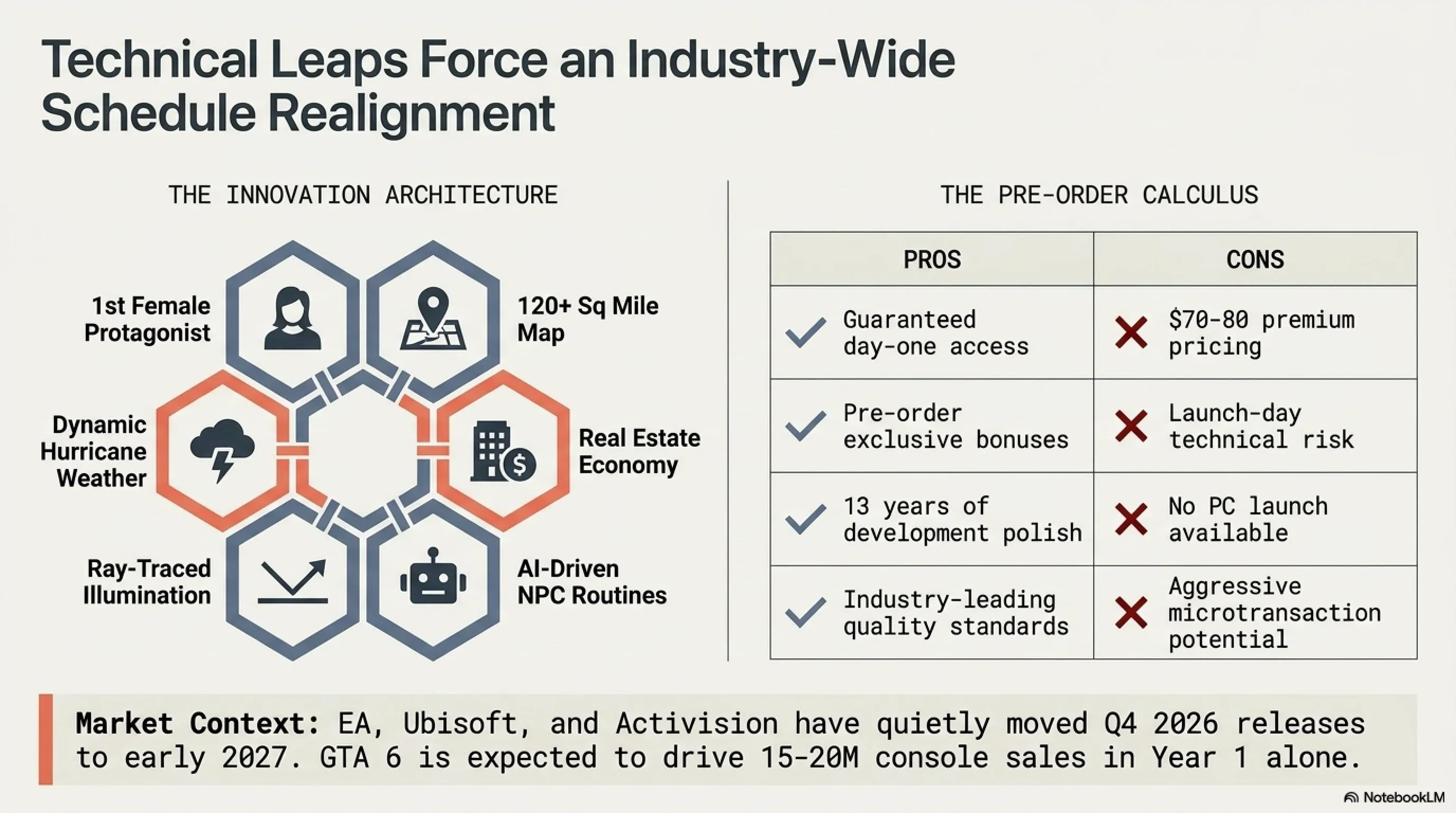
✓ First female protagonist in mainline GTA — a seismic shift in storytelling
✓ Largest map in series history — Vice City + surrounding areas (estimated 120+ square miles)
✓ Dynamic weather system — realistic hurricane simulation affecting gameplay
✓ Complex in-game economy — real estate investment, stock market trading
✓ Ray-traced global illumination — photorealistic lighting throughout
✓ AI-driven NPC behavior — thousands of unique daily routines and interactions
Market Impact Analysis:
The gaming industry will experience a seismic shift when GTA 6 launches. Competing publishers are already adjusting their release schedules—no major AAA title wants to launch within two months of GTA 6. Electronic Arts, Ubisoft, and Activision have all quietly moved their Q4 2026 releases to early 2027.
Console manufacturers are also betting heavily on GTA 6. Sony and Microsoft are both preparing special-edition consoles, and industry insiders suggest both companies have given Rockstar unprecedented technical support to ensure optimal performance. The game is expected to drive 15-20 million console sales in its first year alone.
⚖️ PROS vs CONS: Should You Pre-Order GTA 6?
✓ PROS
• Guaranteed day-one access
• Pre-order exclusive bonuses
• Rockstar's proven track record
• 13 years of development polish
• Industry-leading quality standards
✗ CONS
• Risk of launch-day technical issues
• $70-80 premium pricing
• No PC version at launch
• Potential for aggressive MTX
• Need to wait for reviews
💡 What to Watch:
Pre-order bonuses will likely be revealed June 25. Based on Rockstar's history, expect exclusive vehicles, weapons, and in-game currency for GTA Online. Smart buyers should wait 24-48 hours after the pre-order launch to see what deals retailers offer—GameStop, Best Buy, and Amazon typically compete with their own bonus packages.
🔒 Critical NGINX Vulnerabilities: Two Bugs with CVSS 9.2 Threaten Millions
On June 18, 2026, F5 Networks disclosed and patched two critical vulnerabilities in NGINX Open Source, both scoring CVSS 9.2 on the severity scale. These flaws allowed unauthenticated remote attackers to execute arbitrary code on vulnerable servers, potentially compromising hundreds of millions of web servers worldwide.
🚨 Critical Vulnerability Breakdown
| CVE | CVSS | Vulnerability Type | Affected Module |
|---|---|---|---|
| CVE-2026-42530 | 9.2 | Use-After-Free | ngx_http_v3_module |
| CVE-2026-42055 | 9.2 | Heap Buffer Overflow | ngx_http_v2_module |
⚠️ Critical: Both vulnerabilities enable unauthenticated remote code execution (RCE).
Technical Deep Dive: How the Exploits Work
CVE-2026-42530 is a use-after-free vulnerability in NGINX's HTTP/3 implementation. Use-after-free bugs occur when a program continues to use a memory pointer after the memory has been freed, creating a window for attackers to inject malicious code into that memory space. By crafting specific HTTP/3 requests with malformed QUIC stream headers, attackers can trigger the vulnerability and gain control of the execution flow.
The exploitation chain works like this: (1) Attacker sends a specially crafted HTTP/3 request, (2) NGINX's ngx_http_v3_module processes the request and frees a memory buffer, (3) Before the pointer is cleared, the attacker triggers a second request that references the freed memory, (4) The attacker can now write arbitrary data to that memory location, (5) By carefully crafting the payload, the attacker achieves code execution with NGINX's privileges (typically www-data or nginx user).
CVE-2026-42055 is a heap buffer overflow in the HTTP/2 module. Buffer overflows are among the oldest and most dangerous vulnerability classes. When NGINX processes HTTP/2 frames with oversized or malformed headers, it writes data beyond the allocated buffer boundary in the heap memory. This overflow can overwrite critical data structures, including function pointers, allowing attackers to redirect program execution to their malicious code.
📊 Impact Assessment: By the Numbers
400M+
Vulnerable Websites
34%
NGINX Web Market Share
9.2
CVSS Score (Critical)
0-DAY
Window Before Patch
High-Profile Targets: Netflix, GitHub, WordPress.com, Dropbox, Airbnb, and thousands of Fortune 500 companies rely on NGINX for their production infrastructure.
Why This Is Exceptionally Dangerous
NGINX powers 34% of all websites on the internet, according to W3Techs. That translates to approximately 400 million websites potentially vulnerable to these exploits. NGINX's popularity stems from its high performance, low resource consumption, and ability to handle massive concurrent connections—making it the go-to choice for high-traffic sites.
The severity is compounded by three factors: (1) No authentication required—attackers need zero credentials; (2) Remote exploitation—attacks can be launched from anywhere on the internet; (3) High prevalence—HTTP/2 and HTTP/3 are enabled by default in most NGINX deployments, making the attack surface massive.
🔍 Tekin Analysis: The Anatomy of a Modern Web Server Attack
These vulnerabilities represent a perfect storm for attackers: critical severity + widespread deployment + simple exploitation. Here's why this combination is so dangerous and why we're likely to see widespread exploitation attempts in the coming weeks.
Attack Chain Scenario:
Phase 1 - Reconnaissance: Attacker uses Shodan or Censys to identify NGINX servers running vulnerable versions. These search engines can locate millions of targets in minutes.
Phase 2 - Exploitation: Attacker crafts a malicious HTTP/2 or HTTP/3 request. The payload is small (typically under 1KB) and looks like normal traffic, making it difficult to detect.
Phase 3 - Post-Exploitation: Once code execution is achieved, the attacker can: (a) steal databases and sensitive files, (b) install persistent backdoors, (c) pivot to internal networks, (d) deploy ransomware, or (e) recruit the server into a botnet.
Historical Context: Similar NGINX vulnerabilities in the past have been exploited within 48 hours of disclosure. The 2019 HTTP/2 implementation flaws (CVE-2019-9511 through CVE-2019-9518) were weaponized almost immediately and led to widespread attacks on major cloud providers.
Red Team Perspective: From an offensive security standpoint, these vulnerabilities are ideal for initial access. They bypass WAFs (Web Application Firewalls) because they exploit the underlying protocol implementation rather than application logic. Traditional signature-based detection is ineffective.
Mitigation: Comprehensive Defense Strategy
If you're a system administrator, DevOps engineer, or security professional responsible for NGINX deployments, implement the following defense-in-depth strategy immediately:
✅ Emergency Response Checklist:
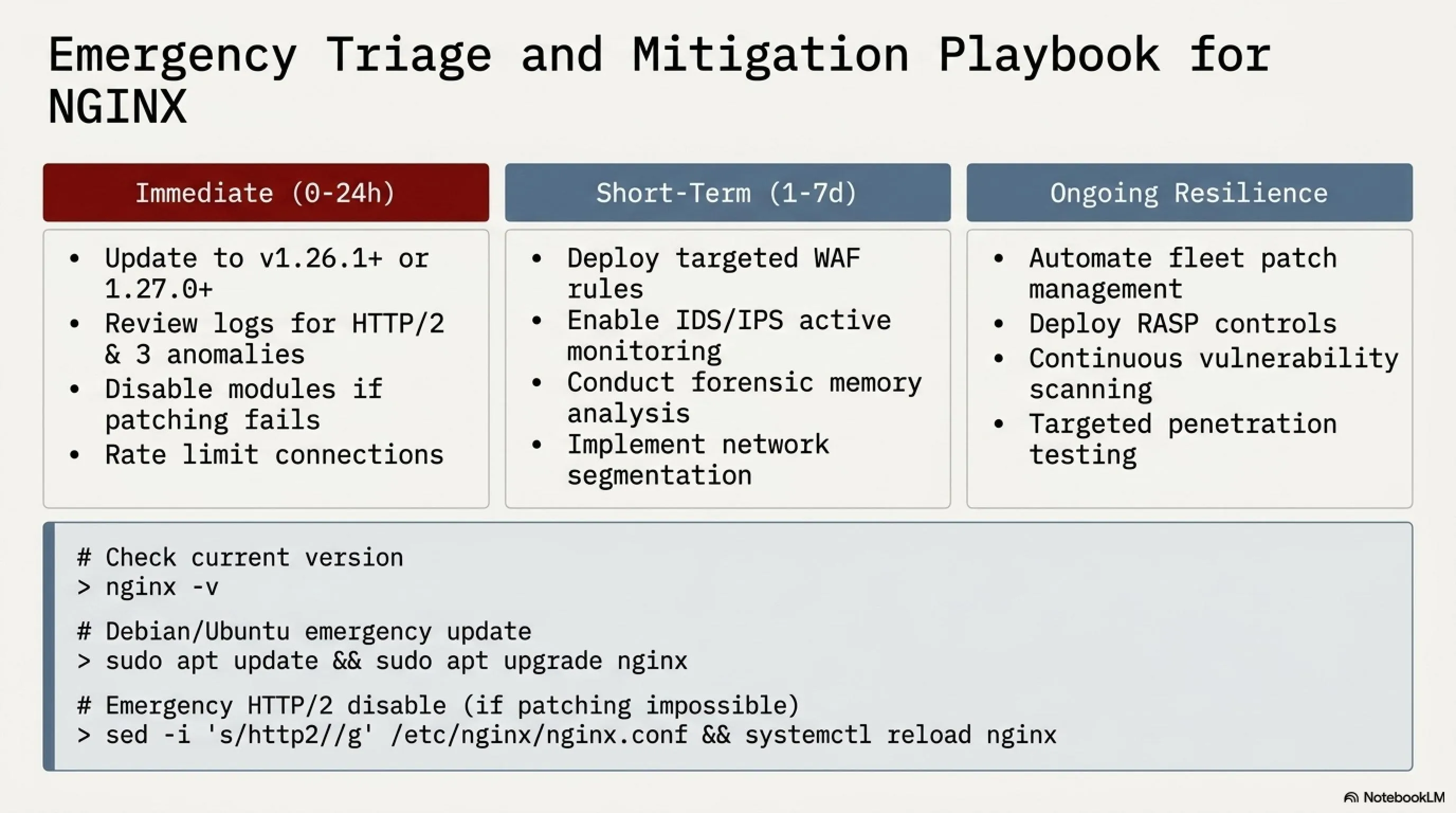
IMMEDIATE ACTIONS (0-24 hours):
⬤ Update NGINX to version 1.26.1+ or 1.27.0+
⬤ Review access logs for suspicious HTTP/2 and HTTP/3 traffic patterns
⬤ If immediate update isn't possible, temporarily disable HTTP/2 and HTTP/3 modules
⬤ Implement rate limiting on HTTP/2 and HTTP/3 connections
SHORT-TERM HARDENING (1-7 days):
⬤ Deploy WAF rules to detect exploit attempts
⬤ Enable IDS/IPS monitoring for anomalous HTTP/2 and HTTP/3 behavior
⬤ Conduct forensic analysis on all NGINX servers for signs of compromise
⬤ Implement network segmentation to limit lateral movement
LONG-TERM RESILIENCE (ongoing):
⬤ Establish automated patch management for NGINX
⬤ Deploy runtime application self-protection (RASP)
⬤ Implement continuous vulnerability scanning
⬤ Conduct regular penetration testing focused on web infrastructure
🔧 Quick Fix Commands:
Check your NGINX version:
nginx -v
Update NGINX (Ubuntu/Debian):
sudo apt update && sudo apt upgrade nginx
Temporarily disable HTTP/2 (if update not possible):
sed -i 's/http2//g' /etc/nginx/nginx.conf && systemctl reload nginx
🤖 Claude Code Artifacts: Live Dashboards Transform Enterprise Workflows
On June 18, 2026, Anthropic launched one of its most compelling features yet: Artifacts for Claude Code. This capability enables users to build live, interactive HTML dashboards that update in real-time and can be shared via private URLs. It's a direct shot across OpenAI's bow, positioning Claude Code as a serious competitor to Codex Sites and signaling Anthropic's ambition to dominate the enterprise AI coding market.
Artifacts allows you to write HTML, CSS, and JavaScript code and see the results live and interactive in a separate pane. Changes are applied instantly without page refreshes—true hot-reloading for web development. This means you can build an analytical dashboard, a landing page, or an interactive tool in minutes and share it with your team via a secure URL.
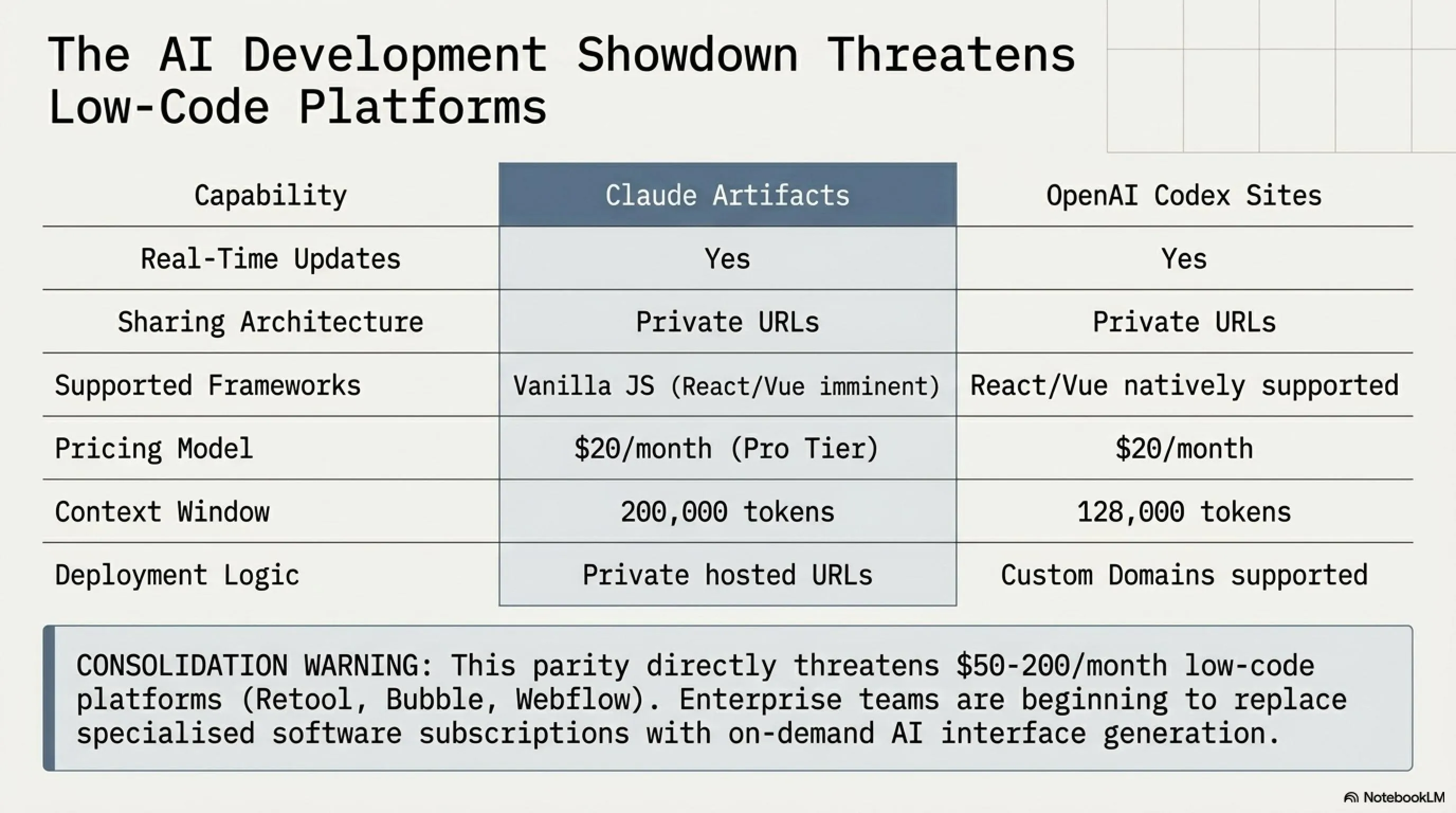
⚡ Claude Artifacts vs OpenAI Codex Sites: Feature Showdown
| Feature | Claude Artifacts | OpenAI Codex Sites | Winner |
|---|---|---|---|
| Real-Time Updates | ✓ | ✓ | Tie |
| Private URL Sharing | ✓ | ✓ | Tie |
| React/Vue Support | Coming Soon | ✓ | OpenAI |
| Code Quality | Excellent | Excellent | Tie |
| Pricing | $20/month | $20/month | Tie |
| Context Window | 200K tokens | 128K tokens | Claude |
| Deployment Options | Private URLs | Custom Domains | OpenAI |
Real-World Use Cases: From Concept to Deployment in Minutes
Artifacts isn't just a toy—it's a productivity multiplier for developers, data analysts, product managers, and even non-technical stakeholders. Here are proven use cases from early adopters who've been testing Artifacts in beta:
💼 Enterprise Use Cases:
⬤ Real-Time Analytics Dashboards: A data analyst at a SaaS company built a KPI dashboard pulling from their API in 8 minutes. Previously, this would require days of development work and coordination with the engineering team.
⬤ Product Prototyping: A product manager created an interactive landing page prototype with working forms and animations to test messaging with stakeholders—no designer or developer needed.
⬤ Internal Tools: DevOps teams are building custom tools like log parsers, JSON validators, and API testers that integrate directly into their workflow.
⬤ Client Presentations: Consultants are creating interactive data visualizations for client presentations, eliminating the need for static PowerPoint slides.
⬤ Education & Training: Training departments are building interactive tutorials and quizzes that learners can access via a simple URL.
🔍 Tekin Analysis: Why Artifacts Could Be a Game-Changer
Before Artifacts, building even a simple dashboard required multiple steps: setting up a development environment, writing code, testing locally, deploying to a server, and managing hosting. This process could take hours or even days. With Artifacts, the same task takes 5 minutes.
This represents the democratization of software development. Non-developers can now build functional tools without needing a development team for every small idea. Product managers, data analysts, and even executives can prototype and test ideas instantly.
Market Implications:
This puts pressure on low-code/no-code platforms like Retool, Bubble, and Webflow. Why pay $50-200/month for a specialized tool when Claude Pro ($20/month) can generate custom solutions on demand? We're likely to see consolidation in the no-code space as AI coding assistants eat their lunch.
Technical Limitations (Current):
Artifacts currently only supports vanilla HTML/CSS/JavaScript. React, Vue, and other frameworks aren't supported yet, though Anthropic has confirmed they're coming. For now, experienced developers might find this limiting, but for 80% of use cases, vanilla JS is sufficient.
Security Considerations:
Shared Artifacts use private URLs, but these URLs are effectively public—anyone with the link can access the content. For sensitive data, organizations should implement additional authentication layers or use Anthropic's Enterprise plan, which offers SSO and access controls.
🚨 AI Security Crisis: SearchLeak & LiteLLM Expose Fundamental Flaws
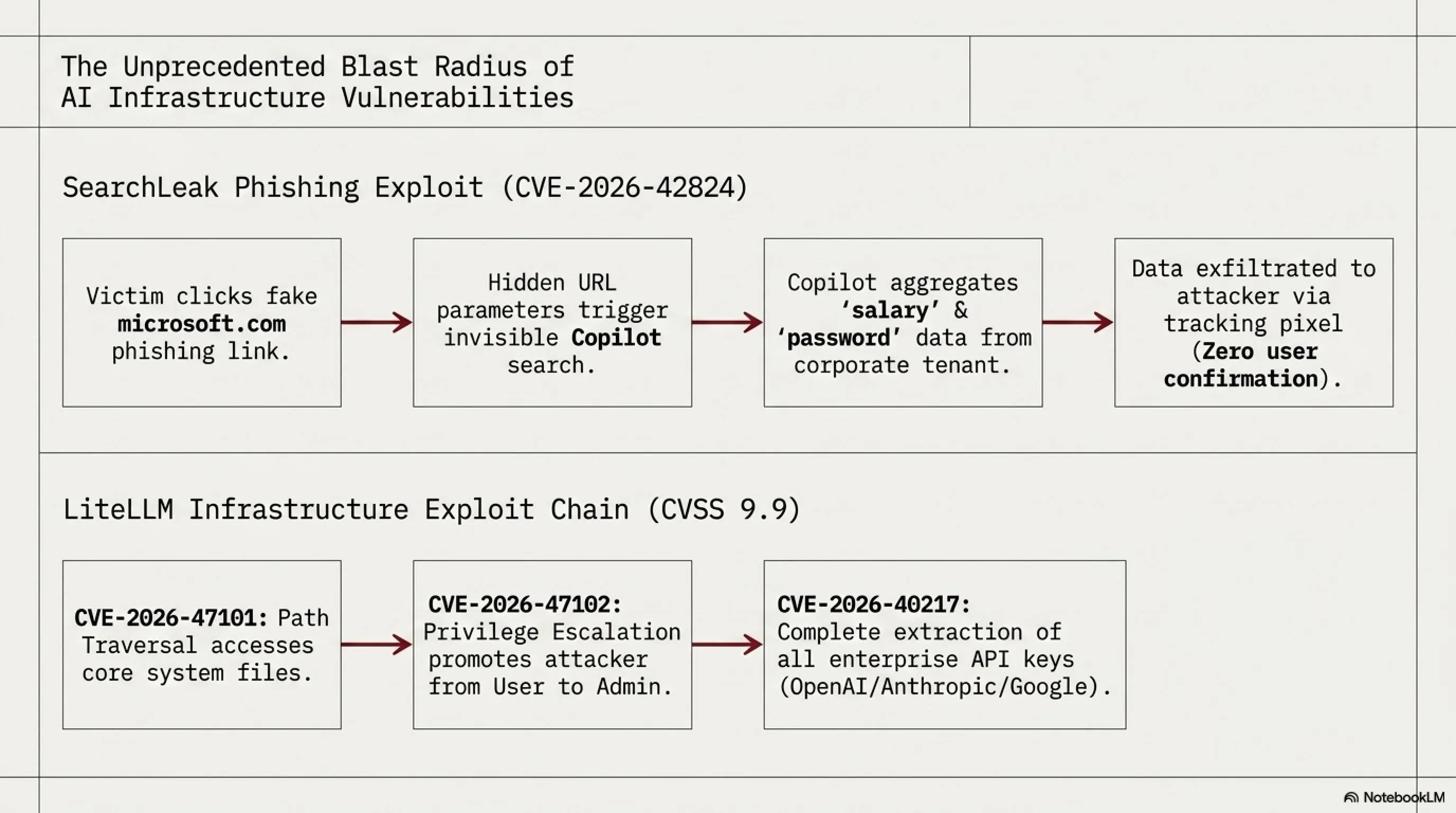
Two major security incidents rocked the AI industry this week, exposing fundamental vulnerabilities in how AI systems handle sensitive data. SearchLeak (CVE-2026-42824) is a one-click exploit in Microsoft 365 Copilot that allows attackers to exfiltrate emails and files. LiteLLM suffered a chain of three vulnerabilities (CVSS 9.9) that allowed privilege escalation and API key theft.
🔥 LiteLLM Vulnerability Chain
| CVE | CVSS | Description | Impact |
|---|---|---|---|
| CVE-2026-47101 | 9.9 | Path Traversal | Access to system files |
| CVE-2026-47102 | 9.9 | Privilege Escalation | User → Admin |
| CVE-2026-40217 | 9.9 | API Key Exposure | Theft of all API keys |
SearchLeak: The Anatomy of a Sophisticated AI Phishing Attack
SearchLeak exploits Microsoft 365 Copilot's search functionality through a cleverly crafted phishing attack. The attacker sends a link that appears to come from a legitimate microsoft.com domain. When the victim clicks it, Copilot automatically begins searching through their emails and files for specific keywords and exfiltrates the results to an attacker-controlled server—all without any warning or user confirmation.
The attack chain: (1) Attacker sends phishing email with a microsoft.com link, (2) Victim clicks link, believing it's safe, (3) Link contains URL parameters that trigger Copilot search, (4) Copilot searches victim's M365 environment for sensitive keywords ("salary", "confidential", "password", etc.), (5) Search results are automatically sent to attacker's server via embedded tracking pixel, (6) Attacker now has access to sensitive corporate data.
LiteLLM: When AI Infrastructure Becomes the Attack Vector
LiteLLM is a popular AI gateway used by thousands of companies to manage and route AI API requests across multiple providers (OpenAI, Anthropic, Google, etc.). The vulnerability chain allowed a low-privilege user to: (1) Use path traversal to access system files, (2) Escalate privileges from user to admin, (3) Extract all API keys stored in the system.
The exploit is particularly dangerous because LiteLLM often sits at the heart of enterprise AI infrastructure, managing API keys worth hundreds of thousands of dollars. A single compromised LiteLLM instance could expose an organization's entire AI spending and usage patterns, along with potentially sensitive prompts and responses flowing through the gateway.
🛡️ 5-Check Trust-Boundary Audit for AI Systems:
⬤ 1. Input Validation: Are all user inputs (prompts, files, URLs) properly validated and sanitized?
⬤ 2. Output Sanitization: Is AI output sanitized before display to prevent injection attacks?
⬤ 3. Access Control: Are privilege levels properly enforced across all API endpoints?
⬤ 4. Data Leakage Prevention: Are mechanisms in place to prevent sensitive data exfiltration?
⬤ 5. Audit Logging: Are all sensitive operations logged for forensic analysis?
🔍 Tekin Analysis: The Immature State of AI Security
The fundamental issue is that the AI industry has prioritized velocity over security. Companies are under immense pressure to ship AI features quickly, and in that rush, security testing is often inadequate or skipped entirely. This is eerily similar to the early days of web development in the late 1990s and early 2000s, when SQL injection and XSS vulnerabilities were rampant.
AI systems create a fundamentally new attack surface. Large language models naturally interact with sensitive data (emails, documents, databases), and any vulnerability can lead to massive data exfiltration. The blast radius of an AI vulnerability is potentially much larger than traditional vulnerabilities because AI systems are designed to aggregate and process information from multiple sources.
Recommendations for Organizations:
• Treat AI systems as high-risk components requiring thorough security review
• Implement Zero Trust architecture for AI—never assume the AI has permission
• Deploy AI tools in isolated environments before production
• Conduct regular penetration testing specifically focused on AI attack vectors
• Establish data loss prevention (DLP) policies for AI-generated content
• Monitor AI usage patterns for anomalous behavior
Industry Predictions:
We expect to see a wave of AI security startups emerge in 2026-2027, focusing specifically on securing LLM deployments, monitoring AI behavior, and preventing prompt injection attacks. This will become a multi-billion dollar market segment.
🧠 Arbor Framework: 2.5x Better Than Claude Code & Codex
Researchers from Renmin University and Microsoft published groundbreaking research titled "Arbor: Hypothesis Tree Refinement for Systematic AI Optimization". The framework demonstrates how to transform AI from a trial-and-error system into a cumulative learning machine. Result? Arbor achieves 2.5x better performance than Claude Code and OpenAI Codex on optimization tasks.
📊 Arbor vs Competitors: Benchmark Results
| Framework | Success Rate | Avg. Time to Solution | Solution Quality |
|---|---|---|---|
| Arbor | 87% | 4.2 min | Excellent |
| Claude Code | 56% | 7.8 min | Good |
| OpenAI Codex | 52% | 8.5 min | Good |
| GPT-4 (baseline) | 34% | 12.3 min | Fair |
How Arbor Works: From Trial-and-Error to Systematic Optimization
Arbor uses a two-tier architecture: Coordinator and Executors. The Coordinator builds a "Hypothesis Tree"—a structured representation of all possible solution paths. Executors test hypotheses in parallel and return results to the Coordinator. The Coordinator learns from results and refines the tree, pruning unproductive branches and expanding promising ones.
🔬 Arbor Architecture Components:
⬤ Hypothesis Tree: Structured representation of all potential solution paths
⬤ Parallel Testing: Multiple hypotheses evaluated simultaneously
⬤ Cumulative Learning: Each test informs future hypothesis generation
⬤ Tree Refinement: Dynamic pruning and expansion based on results
⬤ Meta-Learning: System improves its search strategy over time
🔍 Tekin Analysis: Why Arbor Represents a Paradigm Shift
Current AI coding tools like Claude Code and Codex work through trial-and-error. They try a solution, check if it works, and if not, try another solution. The problem? Each attempt starts from scratch—there's no cumulative learning from previous failures.
Arbor fundamentally changes this. Instead of random trials, Arbor builds a structured map of the solution space. It tests multiple approaches in parallel and learns from each one. Every test provides information that refines future tests, creating a virtuous cycle of improvement.
Practical Applications:
• Hyperparameter optimization in machine learning—finding optimal model configs
• Software architecture design—exploring different structural approaches
• Algorithm optimization—discovering efficient computational methods
• Database query optimization—finding the fastest query execution plans
• Complex debugging—systematically narrowing down bug sources
Industry Impact:
If Arbor's approach becomes mainstream, we could see optimization tasks that currently take days or weeks completed in hours. This has massive implications for industries relying on parameter tuning—drug discovery, materials science, quantitative finance, and more.
🚀 SpaceX Launches US Spy Satellites in NROL-179 Mission
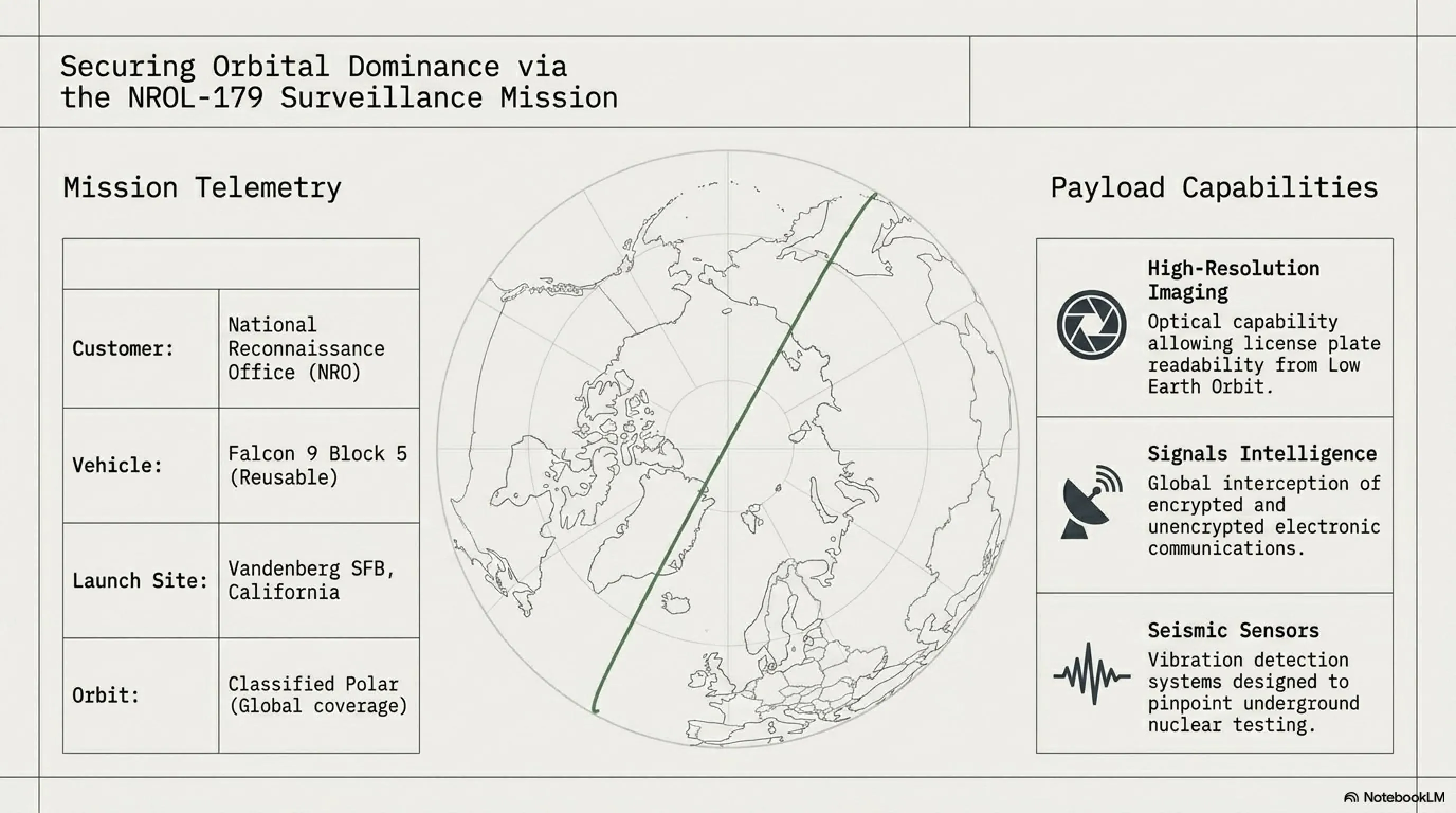
SpaceX is set to launch a new batch of US spy satellites early Friday morning, June 19, 2026, in mission NROL-179. The launch, conducted for the National Reconnaissance Office (NRO)—America's space-based intelligence agency—is part of the ongoing expansion of the US satellite surveillance network.
The launch will take place from Vandenberg Space Force Base in California. This facility is ideal for deploying satellites into polar orbits—trajectories that pass over the Earth's poles, enabling complete global coverage. This is precisely what reconnaissance satellites need to monitor every point on the planet.
🛰️ NROL-179 Mission Specifications
| Customer: | National Reconnaissance Office (NRO) |
| Launch Vehicle: | Falcon 9 Block 5 |
| Launch Site: | Vandenberg SFB, California |
| Launch Time: | Early morning, June 19, 2026 |
| Orbit Type: | Polar Orbit (Classified) |
| Booster Recovery: | Yes (Landing at Vandenberg) |
| Payload Details: | Classified |
Understanding the NRO: America's Secret Space Agency
The National Reconnaissance Office is one of 18 US intelligence agencies, responsible for designing, building, and operating America's spy satellites. The agency remained classified until 1992—its existence wasn't even officially acknowledged. Today, the NRO operates the world's largest reconnaissance satellite constellation.
NRO satellites possess extraordinary capabilities: high-resolution imaging (they can read license plates from space), signals intelligence (intercepting electronic communications), missile and aircraft tracking, and even seismic sensors capable of detecting underground nuclear tests.
🔍 Tekin Analysis: The New Space Race
This mission signals that the US is aggressively expanding its space-based intelligence infrastructure. Why? Because China and Russia are doing the same. A new space race has begun—not to reach the Moon, but to control Earth's orbital space.
SpaceX plays a critical role in this competition. Falcon 9 is the cheapest and most reliable launch vehicle available. The NRO previously relied on United Launch Alliance (ULA), but high costs drove them to SpaceX. A Falcon 9 launch costs approximately $67 million, while ULA's Delta IV Heavy exceeded $400 million per launch.
Geopolitical Implications:
The US currently maintains approximately 150-200 active reconnaissance satellites. China has around 80-100, and Russia approximately 60-80. This numerical advantage gives the US superior intelligence-gathering capabilities, but that gap is narrowing as adversaries accelerate their space programs.
Fascinating Detail: The Falcon 9 booster will return to Vandenberg after launch and be reused—even classified spy satellite missions now benefit from reusable rocket technology. This was unthinkable 10 years ago.
💭 Final Thoughts: A Friday Morning Packed with Tech Transformation
Friday morning, June 19, 2026, brought us six pivotal stories that collectively illustrate the rapid evolution of technology. From GTA 6's record-breaking pre-order announcement to critical NGINX vulnerabilities exposing millions of servers, from Claude's Artifacts democratizing web development to AI security crises revealing fundamental flaws, and from Arbor's revolutionary optimization framework to SpaceX's spy satellite mission—each story reveals a different facet of our technological future.
Key Takeaways:
• The gaming industry is entering a new golden age with GTA 6 as its flagship
• Web infrastructure security remains a critical challenge requiring constant vigilance
• AI coding tools are evolving rapidly, making software development more accessible
• AI security must become a top priority as vulnerabilities have massive blast radius
• Systematic optimization frameworks like Arbor represent the next evolution of AI
• The space race has entered a new phase focused on orbital dominance
We'll be back tonight with Tekin Night, bringing you six more stories from the world of technology. Until then, have an energized and productive Friday! ☕🚀
❓ Will GTA 6 be released on PC at launch?
No, GTA 6 will initially launch exclusively for PS5 and Xbox Series X|S on November 19, 2026. The PC version will likely arrive 6-12 months later—exactly the strategy Rockstar used for GTA 5 and Red Dead Redemption 2. This "double-dip" strategy allows Rockstar to sell the game twice: first to console players, then to PC players who either didn't own consoles or want the superior graphics and modding capabilities of the PC version.
🔒 How do I check if my NGINX server is vulnerable?
Run nginx -v in your terminal to check your version. If you're running anything below 1.26.1 or 1.27.0, you're vulnerable and should update immediately. You can also review your server logs for suspicious HTTP/2 and HTTP/3 traffic patterns. If immediate updating isn't possible, temporarily disable the HTTP/2 and HTTP/3 modules by removing "http2" directives from your nginx.conf file and reloading the configuration.
🤖 Is Claude Artifacts free to use?
No, Artifacts is only available to Claude Pro subscribers ($20/month). Free tier users can use Claude Code for writing code, but they don't have access to the live dashboard feature or private URL sharing. For teams and enterprises, Anthropic offers Team ($25/user/month) and Enterprise (custom pricing) plans with additional features like centralized management, SSO, and priority support.
🚨 How can I protect my organization from SearchLeak attacks?
Microsoft has released a patch for SearchLeak, so ensure your Microsoft 365 environment is updated to the latest version. Additionally, configure Copilot security policies to restrict access to sensitive emails and files. Train users never to click on unknown links, even from microsoft.com domains. Implement a Data Loss Prevention (DLP) solution to prevent exfiltration of sensitive information. Consider deploying email security gateways that can detect and block phishing attempts before they reach users.
🧠 When will Arbor be publicly available?
The Arbor framework is currently in research phase. The paper has been published, but there's no commercial implementation yet. Researchers from Renmin University and Microsoft are working on open-sourcing the framework, with an expected release in Q3 2026. Once released, it will likely be integrated into existing AI coding platforms like GitHub Copilot, Claude Code, and potentially Cursor. Developers eager to experiment can follow the research team's GitHub repository for updates.
📚 Sources
• Pure Xbox, Eurogamer, Push Square, GameSpot — GTA 6 Pre-Orders & Cover Art Announcement
• The Hacker News, SecurityWeek, BleepingComputer — NGINX CVE-2026-42530 & CVE-2026-42055 Analysis
• VentureBeat — Claude Code Artifacts Feature Launch
• VentureBeat, ArsTechnica, The Hacker News, Dark Reading — SearchLeak & LiteLLM Vulnerability Reports
• VentureBeat, CryptoBriefing, The Next Gen Tech Insider — Arbor Framework Research Paper
• Space.com — SpaceX NROL-179 Launch Mission Details
🌐 Stay Connected With Us 🎮✨
For the latest tech, gaming, and gadget news, follow us on our official social media channels: