🌅 Welcome to Tekin Morning June 14, 2026
Good morning, tech enthusiasts! We're kicking off this energetic Sunday with six blockbuster stories spanning cryptocurrency markets, artificial intelligence policy, cybersecurity threats, and gaming industry restructuring. Today we witness the official declaration of crypto winter's end by one of the world's largest banks, SpaceX's massive Bitcoin treasury revelation, the unprecedented government shutdown of advanced AI models, and rumors of Xbox's potential separation from Microsoft.
⚡ This Morning's Headlines:
💰 Standard Chartered: Bitcoin bottomed at $59K, winter is over
🚀 SpaceX enters public markets with $1.3B Bitcoin treasury
🤖 US Government orders Anthropic to shut down Claude Fable 5 & Mythos 5
🎮 Microsoft exploring Xbox spinoff as separate company
🔐 Critical Splunk vulnerability: unauthenticated RCE disclosed
⚔️ Onimusha Switch 2 technical specs revealed
☕ Grab your coffee and buckle up for a morning packed with insights and analysis!

1. Crypto Winter Over: Standard Chartered Declares Bitcoin Bottomed at $59,000 💰
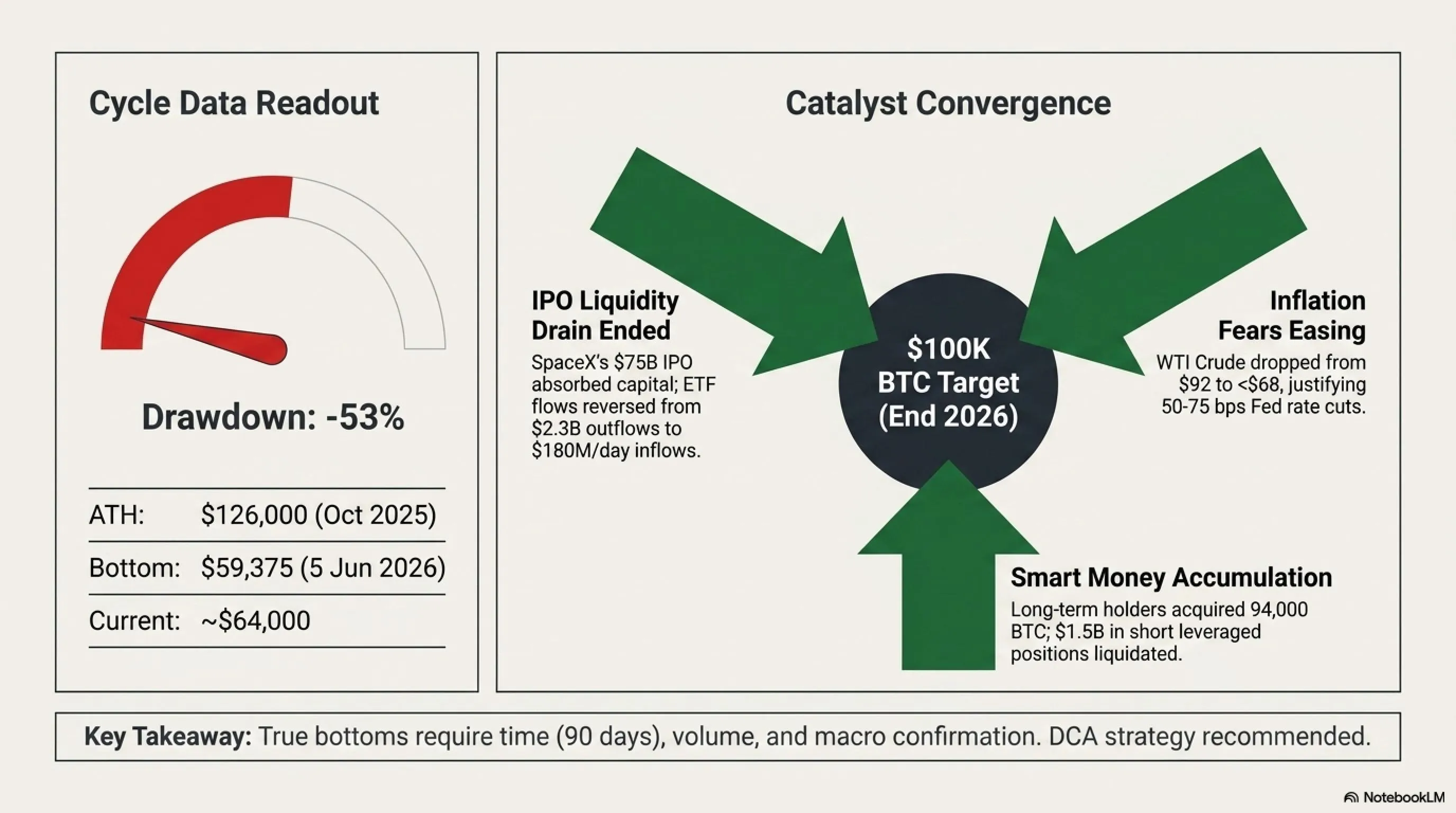
After months of brutal volatility and capitulation, one of the world's most prestigious banking institutions has officially declared the end of crypto winter. Standard Chartered Bank, in a comprehensive market analysis released Friday June 13, stated that Bitcoin has definitively bottomed at the $59,000 level and the market is now positioned for a sustained recovery toward new highs. This declaration comes as Bitcoin staged a dramatic 53% decline from its October 2025 all-time high of $126,000, touching as low as $59,375 on June 5, 2026 at approximately 18:00 UTC.
Geoffrey Kendrick, Standard Chartered's Head of Digital Asset Research, penned the now-famous line in Friday's research note: "Winter is over. Welcome back to crypto Spring." Kendrick, who has accurately predicted several major Bitcoin moves over the past three years, explained that three critical catalysts are now aligning to confirm the cycle bottom: the end of IPO-related selling pressure (particularly SpaceX's massive $75B offering), weakening oil prices reducing inflationary concerns, and the return of positive ETF inflows after weeks of sustained outflows.
The bank's analysis is particularly significant given Standard Chartered's track record. In late 2023, Kendrick predicted Bitcoin would reach $100,000 by end of 2024 when it was trading at $27,000—a call that was initially dismissed as overly optimistic but proved prescient when BTC surged to $126,000 by October 2025. Now, with Bitcoin trading around $64,000 as of Sunday morning, the bank has set a new target: $100,000 by year-end 2026, with Ethereum projected to reach $4,000.
📊 Bitcoin's 2025-2026 Cycle: Key Data Points
| Metric | Value | Context |
|---|---|---|
| All-Time High (ATH) | $126,000 | October 6, 2025 |
| Cycle Bottom | $59,375 | June 5, 2026 (18:00 UTC) |
| Drawdown Percentage | -53% | Typical for BTC cycles |
| Current Price (June 14) | ~$64,000 | +7.8% from bottom |
| Standard Chartered Target | $100,000 | End of 2026 |
| Ethereum Target | $4,000 | End of 2026 |
| Peak-to-Bottom Duration | 8 months | Oct 2025 - June 2026 |
Kendrick's analysis identifies three specific catalysts that have converged to mark the cycle bottom:
Catalyst #1: The End of IPO Liquidity Drain
SpaceX's record-breaking $75 billion IPO in early June created what Kendrick calls a "liquidity vacuum event" in digital asset markets. As institutional investors rotated capital out of crypto to participate in what many viewed as the investment opportunity of the decade, Bitcoin experienced sustained selling pressure. CoinDesk data shows that between May 25 and June 5, Bitcoin ETFs saw cumulative outflows of $2.3 billion—the largest two-week outflow since ETF launch in January 2024.
However, with SpaceX now trading and the IPO window fully absorbed by markets, that rotation pressure has dissipated. Early data from June 10-13 shows Bitcoin ETFs returning to positive daily inflows, averaging $180 million per day—a dramatic reversal that Kendrick interprets as institutional capital returning to digital assets now that the SpaceX opportunity has been priced in.
Catalyst #2: Oil Price Weakness Easing Inflation Fears
West Texas Intermediate (WTI) crude oil has fallen below $68 per barrel—down from $92 in late March 2026—driven by increased OPEC+ production, weakening Chinese demand, and a stronger US dollar. This oil price collapse is significant for Bitcoin because it directly impacts the Federal Reserve's inflation calculus. Lower energy costs translate to lower core CPI readings, which reduces pressure on the Fed to maintain restrictive monetary policy.
Standard Chartered's macro team projects that if oil remains below $70 through Q3 2026, the Fed will have sufficient justification to cut rates by 50-75 basis points in the second half of the year. Rate cuts historically correlate with Bitcoin rallies, as lower yields make risk assets more attractive relative to bonds and savings accounts.
Catalyst #3: Institutional Accumulation Pattern Forming
On-chain analytics from Glassnode reveal a critical pattern: long-term holders (addresses holding BTC for 155+ days) have increased their positions by 94,000 BTC since June 1, even as price declined. This "accumulation during fear" behavior is textbook smart money positioning and typically precedes major rallies. Meanwhile, short-term speculators were liquidated en masse—over $1.5 billion in leveraged positions were wiped out on June 5 alone, clearing weak hands from the market.
🔍 Tekin Analysis: Is the Bottom Really In?
While Standard Chartered's institutional credibility lends significant weight to this call, prudent investors should remember that definitive cycle bottoms are only confirmed in retrospect. History shows that true Bitcoin bottoms require three key confirmations:
1. Time Confirmation: At least 90 days of higher lows after the initial bottom. We're only 9 days in.
2. Volume Confirmation: Sustained increase in spot trading volume with positive price action. Current volume remains 40% below 2025 peaks.
3. Macro Confirmation: ETF flows must remain positive for 6+ consecutive weeks. We've only seen 4 days of inflows.
The Bull Case: If Bitcoin holds $65K through June and breaks above $72K in July, Standard Chartered's call will likely prove correct, and we could see an acceleration toward $100K by Q4 2026.
The Bear Case: If geopolitical tensions escalate (particularly US-China relations around Taiwan) or if the Fed delays rate cuts due to stubborn core inflation, Bitcoin could retest $59K or even drop to the $52-55K range before establishing a true bottom.
Strategic Recommendation: For long-term holders, Dollar Cost Averaging (DCA) at these levels makes sense if you believe in the 2027-2028 halving cycle thesis. For traders, wait for the $65K level to hold for at least two weeks before establishing leveraged long positions.
Notably, Michael Saylor—CEO of Strategy (formerly MicroStrategy) and Bitcoin's most prominent corporate advocate with over 250,000 BTC on the company's balance sheet—responded to Standard Chartered's call with characteristic bullishness. In a post on X (formerly Twitter), Saylor wrote: "Now 25% of the Magnificent 8 holds Bitcoin on their balance sheets. The institutional adoption thesis is no longer theoretical—it's empirical reality. This is just the beginning."
Saylor's reference to the "Magnificent 8" (the tech mega-caps: Apple, Microsoft, Google, Amazon, Meta, Tesla, Nvidia, and SpaceX) highlights a crucial development: with SpaceX and Tesla now publicly holding substantial Bitcoin treasuries, two of the eight most valuable companies on Earth are officially "Bitcoinized." This represents a seismic shift in corporate treasury management and could pressure other Mag 8 companies to follow suit to avoid being left behind in what some analysts call "the corporate Bitcoin arms race."
💡 What This Means for American Investors
- ETF Access: US investors have the easiest path to Bitcoin exposure through spot ETFs from BlackRock (IBIT), Fidelity (FBTC), and Grayscale (GBTC). These products offer tax-advantaged IRA/401k exposure.
- Timing Strategy: Rather than trying to catch the exact bottom, implement a 12-week DCA plan buying $X worth of Bitcoin every week regardless of price. This smooths out volatility and removes emotional decision-making.
- Portfolio Allocation: Conservative investors: 1-3% of portfolio in BTC. Moderate: 5-7%. Aggressive: 10-15%. Never exceed your risk tolerance—Bitcoin remains a volatile asset.
- Tax Considerations: If you're sitting on losses from buying near the $126K peak, tax-loss harvesting could offset gains elsewhere in your portfolio. Consult a crypto-savvy CPA before year-end.
2. SpaceX's $1.3 Billion Bitcoin Treasury Hits Wall Street's Radar 🚀

In what may prove to be one of the most consequential financial disclosures of 2026, SpaceX began trading on NASDAQ under ticker SPCX on Thursday June 12, revealing in its Form S-1 amendment that the company holds 18,712 Bitcoin worth approximately $1.29 billion as of March 31, 2026. The disclosure sent shockwaves through both the aerospace and cryptocurrency communities, as it marks the first time a major aerospace-defense company has confirmed substantial Bitcoin holdings on its balance sheet.
The IPO itself was record-breaking: SpaceX raised $75 billion at a price of $135 per share, valuing the company at approximately $1.77 trillion pre-market. But when trading commenced Thursday morning, the stock surged to $160 within the first hour, pushing market capitalization to an eye-watering $2.1 trillion—making SpaceX more valuable than any company on Earth except Apple, Microsoft, and Nvidia. The 19% first-day pop instantly created roughly $400 billion in shareholder value and made early employees and investors extraordinarily wealthy overnight.
But it's the Bitcoin disclosure that has captured the attention of macro strategists and crypto analysts. According to the S-1 filing, SpaceX acquired the 18,712 BTC for an average cost of approximately $35,300 per coin (total acquisition cost: ~$661 million), meaning the position has generated an unrealized gain of roughly 95% based on the March 31 fair value of $1.29 billion. At current prices around $77,000 per Bitcoin, the holding is now worth approximately $1.44 billion, representing an even larger paper profit of over $780 million.
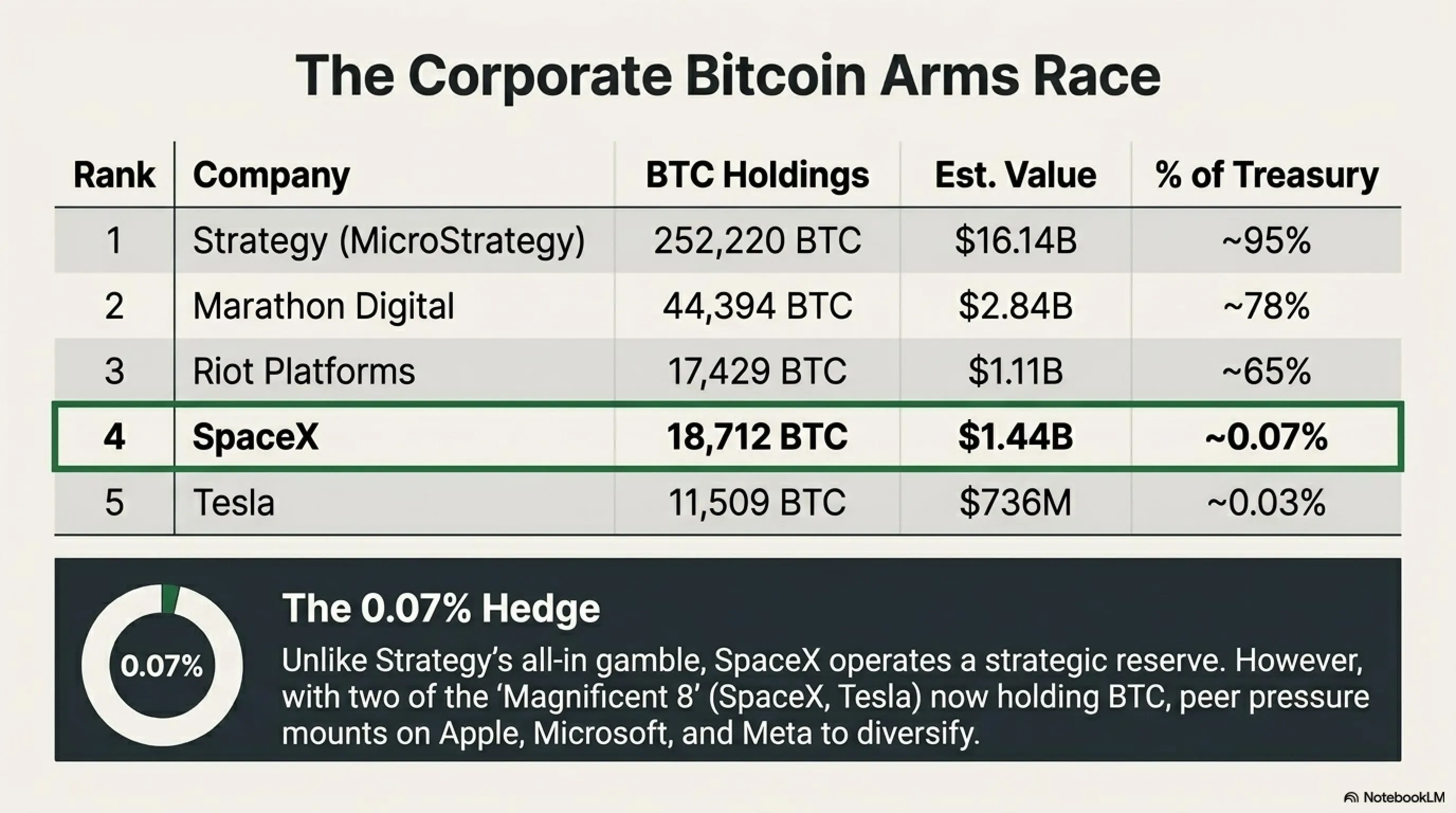
🏆 Top Corporate Bitcoin Holders (Publicly Disclosed)
| Rank | Company | BTC Holdings | Est. Value (USD) | % of Treasury |
|---|---|---|---|---|
| 🥇 | Strategy (MicroStrategy) | 252,220 | $16.14B | ~95% |
| 🥈 | Marathon Digital | 44,394 | $2.84B | ~78% |
| 🥉 | Riot Platforms | 17,429 | $1.11B | ~65% |
| ⭐ | SpaceX (NEW) | 18,712 | $1.44B | ~0.07% |
| 5️⃣ | Tesla | 11,509 | $736M | ~0.03% |
| 6️⃣ | Galaxy Digital | 8,126 | $520M | ~18% |
Note: SpaceX's Bitcoin represents only 0.07% of its $2.1T market cap, suggesting it's a strategic reserve position rather than a speculative bet. This contrasts sharply with Strategy, where Bitcoin comprises 95% of assets.
Why Did SpaceX Buy Bitcoin? Strategic Rationale Analysis
The S-1 filing describes the Bitcoin position as "a strategic reserve for excess cash generation" and notes that the purchases were made gradually between Q2 2023 and Q1 2024. While Elon Musk has historically been associated with Dogecoin more than Bitcoin (famously calling himself "The Dogefather"), the decision to allocate SpaceX treasury funds to BTC suggests a more serious institutional approach to cryptocurrency as a store of value.
Several strategic factors likely influenced this decision:
1. Long-Duration Asset-Liability Matching: SpaceX operates on 10-20 year project timelines (Mars missions, Starlink constellation expansion, lunar base construction). Holding cash in a zero-yielding or low-yielding dollar account subjects the company to inflation erosion. Bitcoin, despite volatility, offers potential inflation protection and has historically appreciated over multi-year periods—aligning well with SpaceX's long operational horizons.
2. International Settlement Optionality: SpaceX has customers across 60+ countries purchasing Starlink services and launch contracts. While the company primarily transacts in USD, Bitcoin offers a borderless, final-settlement layer that could facilitate certain international payments without banking intermediaries or SWIFT delays. This is particularly valuable when dealing with customers in countries with capital controls or unreliable banking infrastructure.
3. Narrative Capital and Shareholder Appeal: By holding Bitcoin, SpaceX signals technological sophistication and forward-thinking treasury management to a younger generation of investors who view crypto as an essential part of a modern portfolio. This likely contributed to the stock's strong first-day performance—crypto-native investors who might not normally buy aerospace stocks were drawn to SPCX specifically because of the Bitcoin exposure.
4. Musk's Broader Crypto Vision: Elon Musk has repeatedly stated his belief that "Mars needs a cryptocurrency" and that Earth's interplanetary economy will require a decentralized, censorship-resistant monetary system. While this sounds far-fetched today, it's entirely consistent with SpaceX's 50-year mission. Holding Bitcoin now could be seen as planting seeds for that future monetary infrastructure.
🔍 Tekin Analysis: The SpaceX Effect on Corporate Bitcoin Adoption
SpaceX going public with Bitcoin on its balance sheet is a watershed moment for corporate adoption. Here's why it matters more than previous corporate Bitcoin announcements:
Scale and Prestige: SpaceX is now a $2.1T company—far larger than MicroStrategy ($40B) or Tesla ($650B) when they announced Bitcoin holdings. Its sheer size and Elon Musk's cultural cachet give this move outsized influence.
SEC Scrutiny Survived: SpaceX successfully navigated SEC review with Bitcoin on balance sheet, setting precedent that crypto holdings don't disqualify companies from public markets—a concern that previously deterred some firms.
Peer Pressure on Mag 8: With both Tesla and SpaceX now holding BTC, pressure mounts on Apple, Amazon, Google, Microsoft, Meta, and Nvidia. CFOs at these companies are now fielding questions: "Why aren't we diversifying into Bitcoin like Musk's companies?"
The Prediction: We estimate at least two more Mag 8 companies will announce Bitcoin treasury positions by end of 2027. The most likely candidates: Microsoft (due to OpenAI partnership and AI-crypto convergence) and Meta (given Zuckerberg's interest in decentralized systems via Llama open-source AI strategy).
Contrarian Risk: If Bitcoin falls below $50K and SpaceX is forced to report material impairment losses in quarterly earnings, the narrative could reverse. Public companies face quarterly mark-to-market accounting, creating volatility in reported earnings that private companies don't face. This could become a cautionary tale rather than an inspiration.
The market's reaction has been decisively positive. Several crypto exchanges, including Binance, OKX, and Bybit, announced plans to offer tokenized SpaceX shares—synthetic derivatives that track SPCX price and can be purchased with cryptocurrency. This blurs the line between traditional equity markets and crypto markets, creating a fascinating hybrid instrument: crypto users can gain exposure to SpaceX (and indirectly, its Bitcoin holdings) without ever touching fiat currency or traditional brokerage accounts.
✅ Strategic Advantages of SpaceX Holding Bitcoin
- Inflation Hedge: Protects purchasing power over 10-20 year mission timelines against dollar debasement.
- Global Liquidity: Bitcoin is the most liquid 24/7/365 asset globally—can be converted to any fiat currency within minutes.
- Non-Sovereign Asset: Not subject to any single government's monetary policy—valuable for a company operating globally.
- Shareholder Appeal: Attracts crypto-native investors and younger demographics who view Bitcoin exposure as a positive.
- Strategic Optionality: Creates future possibilities for Bitcoin-based revenue streams (accepting BTC for launches, Starlink subscriptions, etc.).
⚠️ Risks and Challenges of the Bitcoin Treasury Strategy
- Volatility Impact on Earnings: As a public company, SpaceX must mark-to-market Bitcoin quarterly. A 50% BTC drop would trigger $720M impairment loss—devastating for quarterly EPS.
- Regulatory Uncertainty: US government (SpaceX's largest customer via NASA/DoD contracts) could impose restrictions on crypto holdings by defense contractors.
- Opportunity Cost: The $661M used to buy Bitcoin could have funded R&D, Starship development, or Starlink expansion—areas with potentially higher ROI.
- Shareholder Pressure: If Bitcoin underperforms for extended periods, activist investors could demand liquidation of the position to return cash or fund buybacks.
- Security Risk: Holding $1.4B in Bitcoin creates a massive cybersecurity target. A hack or loss of keys would be catastrophic.

3. US Government Forces Anthropic to Kill Claude Fable 5 & Mythos 5 🤖
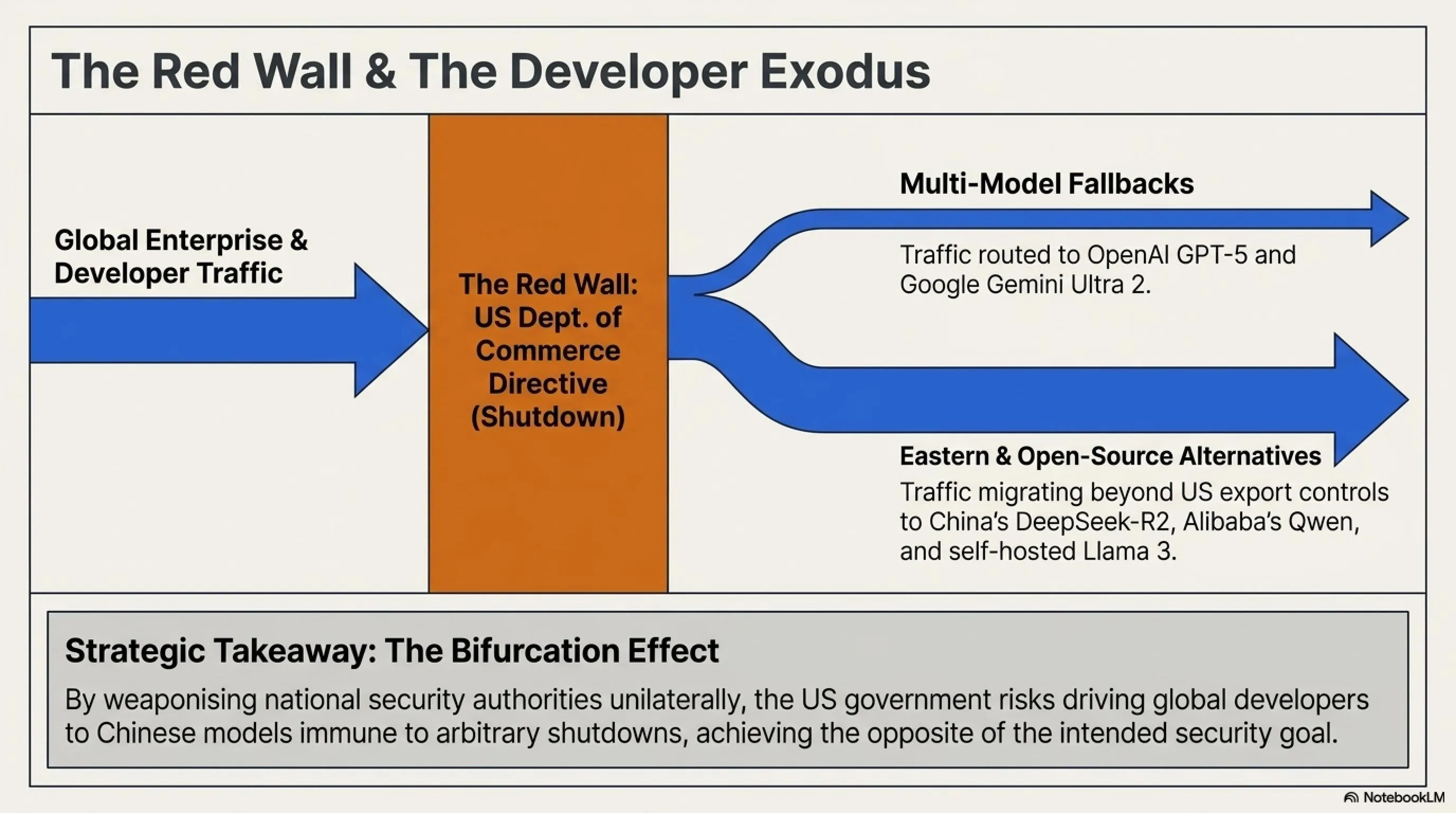
In what represents the most dramatic government intervention in the AI industry to date, the United States Department of Commerce, invoking national security authorities and emergency export control powers, issued a directive late Friday June 13 forcing Anthropic to immediately and completely shut down access to its two most advanced AI models: Claude Fable 5 and Claude Mythos 5. The order applies not only to users in adversarial nations but to all users globally, including American citizens, allied countries, and even Anthropic's own non-US employees.
The shutdown, which took effect at approximately 23:45 ET on Friday, sent shockwaves through the developer community, enterprises relying on these models, and AI researchers worldwide. According to Anthropic's official statement posted on their website and social media channels:
🚨 Official Anthropic Statement
"The US government, citing national security authorities, has issued an export control directive to suspend all access to Fable 5 and Mythos 5 by any foreign national, whether inside or outside the United States, including foreign national Anthropic employees. The only way we can ensure compliance with this government order in the immediate term is that we must abruptly disable Fable 5 and Mythos 5 for all our customers. Access to other Anthropic models remains unaffected. We disagree with this decision and believe the capabilities cited as justification are widely available in other models that have not been similarly restricted."
The government's justification, according to sources familiar with the directive who spoke to Forbes, TechCrunch, and CNBC, centers on specific dual-use capabilities present in Fable 5 and Mythos 5 that are deemed too dangerous to allow foreign access. These capabilities reportedly include:
- Advanced Code Generation for Exploitation: The models can generate sophisticated code for identifying and exploiting software vulnerabilities, including zero-day attacks against critical infrastructure systems.
- Bioweapons Design Assistance: Allegedly, internal red-team testing showed the models could provide step-by-step guidance on synthesizing dangerous biological agents using publicly available equipment.
- Social Engineering at Scale: The models' ability to generate highly persuasive, culturally-adapted phishing and disinformation content in 40+ languages was flagged as a national security threat.
- Advanced Reasoning for Strategic Planning: Mythos 5's extended context window (2 million tokens) and reasoning capabilities allegedly allow it to assist in planning complex operations that could be used for hostile purposes.
However, Anthropic's rebuttal is sharp and well-founded: these same capabilities exist in competing models from OpenAI (GPT-5), Google (Gemini Ultra 2), and even open-source alternatives like DeepSeek-R2 from China—none of which have faced similar restrictions. This inconsistency has led many in the AI community to speculate about alternative motives behind the shutdown.
Timeline: How the Shutdown Unfolded
⏰ Critical Timeline of Events
| Date/Time | Event |
|---|---|
| June 10, 11:00 ET | Anthropic launches Fable 5 and Mythos 5 to public with major fanfare |
| June 11, Afternoon | Reports emerge of Mythos 5 successfully completing "red team" challenges that other models failed |
| June 12, 14:30 ET | Department of Commerce officials hold emergency meeting with Anthropic executives |
| June 13, 19:00 ET | Official export control directive delivered to Anthropic CEO Dario Amodei |
| June 13, 23:45 ET | Anthropic implements global shutdown of Fable 5 and Mythos 5 |
| June 14, 00:15 ET | Anthropic publishes public statement disagreeing with government decision |
The speed of the shutdown—just 3 days after launch—is unprecedented in the history of technology regulation. Typically, export control processes take weeks or months, with companies receiving advance notice and opportunity to contest restrictions. The emergency invocation suggests either an acute threat was identified or significant political pressure was applied.
🔍 Tekin Analysis: National Security or Competitive Suppression?
This incident raises profound questions about the future of AI governance and whether "national security" justifications are being weaponized for competitive purposes. Several competing theories have emerged:
Theory #1: Legitimate National Security Concern
Perhaps Fable 5/Mythos 5 genuinely crossed a capability threshold that poses unacceptable proliferation risk. If the models can reliably generate working exploits for critical infrastructure or provide actionable bioweapons synthesis guidance, that could justify emergency action regardless of what competitors can do.
Theory #2: Selective Enforcement to Favor Incumbents
Anthropic, despite being well-funded, is still a challenger to OpenAI (Microsoft-backed) and Google. If those incumbents successfully lobbied DoC officials by arguing that Anthropic's safety practices are insufficient compared to their own, this could be protectionist policy disguised as national security.
Theory #3: Jailbreak Proliferation Panic
Reports suggest that effective jailbreaks for Fable 5 spread rapidly on underground forums within 24 hours of launch. If these jailbreaks enabled malicious use cases that Anthropic's safety systems failed to prevent, officials may have panicked and acted precipitously.
Theory #4: IPO Pressure Valve
Anthropic was reportedly preparing for a late-2026 IPO. Some analysts speculate this shutdown might actually be *helpful* to that goal—by complying immediately and fully, Anthropic demonstrates to future shareholders that it will prioritize regulatory compliance over growth at all costs, reducing perceived regulatory risk.
Our Assessment: Most likely a combination of factors. The capabilities are probably genuine concerns, but the selective targeting of Anthropic while leaving OpenAI/Google untouched suggests regulatory capture or political considerations played a role. The speed and totality of the shutdown (global, not just foreign nationals) suggests panic rather than measured policy.
Impact on the AI Industry and Developer Community
The immediate fallout has been severe. Thousands of developers and companies had integrated Fable 5 and Mythos 5 into production systems over the 3-day window they were available. These integrations are now broken, creating urgent migration needs. Several prominent startups have publicly stated they are now evaluating whether to continue building on Anthropic's platform at all, given the risk of future sudden shutdowns.
More broadly, this incident establishes a dangerous precedent: governments can unilaterally shut down AI models with virtually no notice, even for users in allied countries or the company's home jurisdiction. This creates existential risk for any business building on frontier AI—your entire product could be rendered non-functional overnight by regulatory fiat.
The episode also accelerates the bifurcation of global AI development into Western and Eastern spheres. China's DeepSeek, Alibaba's Qwen, and other Chinese labs are not subject to US export controls. As Western models become increasingly restricted, developers in Asia, Africa, and Latin America may simply abandon US providers in favor of Chinese alternatives that don't face arbitrary shutdowns—ironically achieving the opposite of the intended national security goal by driving users toward Chinese AI.
💡 What This Means for American Developers
- Diversify Your AI Stack: Never rely on a single model or provider. Build fallback systems that can switch between OpenAI, Anthropic, Google, and open-source alternatives.
- Favor Open-Source Where Possible: Models like Llama 3, Mistral Large, and DeepSeek can be self-hosted and are immune to regulatory shutdowns.
- Monitor Regulatory Signals: If you're building mission-critical systems on frontier AI, consider hiring a regulatory consultant who tracks AI policy developments.
- Plan for Shutdowns: Include "model unavailability" scenarios in your disaster recovery planning. Can your product function with a less capable model or degraded capability?
🔗 Related Articles on Tekin

4. Microsoft Weighs Spinning Off Xbox into Independent Company 🎮
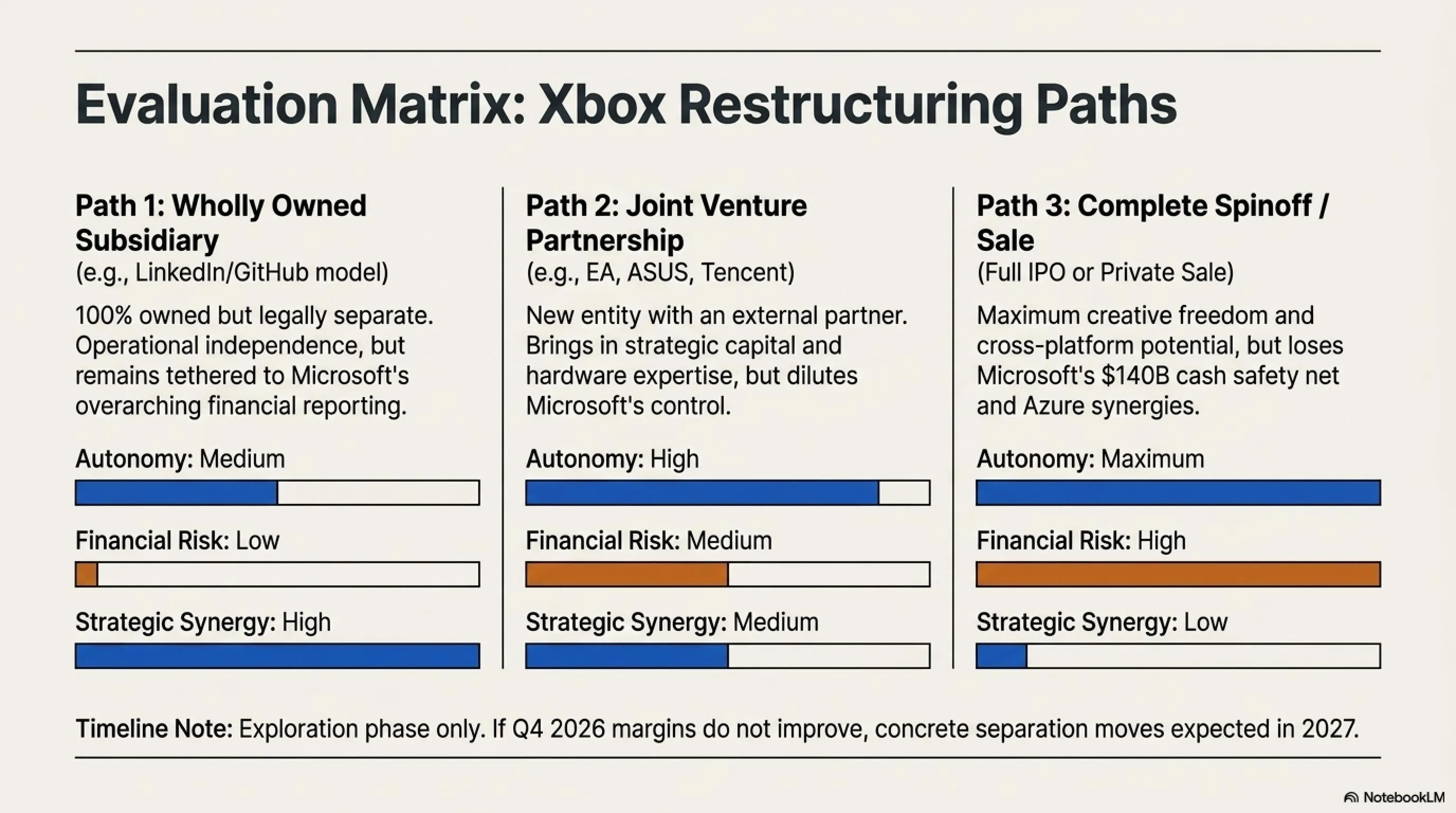
In potentially the most consequential restructuring decision in gaming history, Microsoft is actively exploring separating its Xbox division from the core company structure, according to a bombshell report from The Information published Friday June 13 and subsequently confirmed by Reuters and IGN. Sources with direct knowledge of internal discussions say Microsoft's board and executive leadership are evaluating three distinct paths forward:
- Wholly Owned Subsidiary Model: Transform Xbox into a separate legal entity that remains 100% owned by Microsoft, similar to how LinkedIn and GitHub operate today. This would provide operational independence while maintaining financial control.
- Joint Venture Partnership: Form a new entity with one or more external partners—potentially a major game publisher (EA, Take-Two), hardware manufacturer (ASUS, Lenovo), or even a gaming-focused investment fund. Microsoft would retain majority control but bring in strategic expertise and capital.
- Complete Spinoff or Sale: Separate Xbox entirely through an IPO (making it a public company) or sell it outright to another entity. This is considered the most radical option but is not off the table.
The driving force behind these deliberations is Xbox's persistently anemic profit margin of approximately 3%—a figure that stands in stark contrast to Microsoft's other divisions, which enjoy margins between 28% (LinkedIn) and 45% (Office 365). For a company with a market capitalization north of $3 trillion and shareholder expectations of consistent double-digit profit growth, Xbox has become a financial albatross despite generating $21 billion in annual revenue.
📊 Microsoft Division Profitability Comparison
| Division | Operating Margin | Annual Revenue | Strategic Priority |
|---|---|---|---|
| Azure & Cloud Services | ~42% | $85B | ★★★★★ |
| Office 365 & Productivity | ~45% | $67B | ★★★★★ |
| Windows | ~35% | $23B | ★★★★ |
| ~28% | $16B | ★★★ | |
| Xbox / Gaming | ~3% | $21B | ★ |
Note: Azure and Office 365 generate 10-15x higher margins than Xbox despite Xbox's substantial revenue. This profitability gap drives board-level discussions about Xbox's future within Microsoft.
Asha Sharma, who assumed the role of Xbox CEO in February 2026 (replacing longtime Xbox chief Phil Spencer), has reportedly presented an ambitious turnaround plan focused on dramatically accelerating first-party game development. According to The Information's sources, Sharma intends to significantly increase budgets and headcount for three flagship franchises that have languished in development hell:
- Halo 8: In development at 343 Industries for over 5 years with multiple reboots. Sharma plans to bring in veteran external studios to assist and set a hard 2027 launch deadline.
- The Elder Scrolls VI: Bethesda's follow-up to the legendary Skyrim has been teased since 2018 but remains years from release. Sharma wants to fast-track development to capitalize on Fallout TV show momentum.
- Fallout 5: With the Amazon Fallout series achieving massive mainstream success in 2025, demand for a new game is at an all-time high—but Bethesda has said it won't begin full production until after Elder Scrolls VI ships. Sharma is exploring parallel development tracks.
The critical question is whether Sharma will be given sufficient time and resources to execute this plan, or whether Microsoft's board will conclude that Xbox is better off outside the corporate structure entirely.
🔍 Tekin Analysis: Why Xbox Can't Achieve Profitability Under Microsoft
A 3% margin in a $21B business is not just mediocre—it's a structural failure. Here's why Xbox struggles within Microsoft's corporate framework:
1. Console Hardware Subsidization Strategy
Xbox consoles are sold at or below cost to capture market share. PS5 and Switch use the same model. But Microsoft's shareholders don't tolerate this—they want AWS/Azure-level margins, not razor-blade economics.
2. Game Pass Cannibalization
At $10-17/month, Game Pass is consumer-friendly but margin-destructive. Compare to Netflix's $22.99 top tier—and Netflix has 30-40% margins. Game Pass offers hundreds of premium games for less, making it mathematically impossible to achieve high margins.
3. AAA Development Cost Inflation
Modern flagship games cost $200-500M and take 5-7 years to develop. Halo Infinite reportedly cost over $500M and was widely considered disappointing. This ROI profile doesn't work in Microsoft's portfolio.
4. Ecosystem Lock-In Disadvantage
Sony's PlayStation Network has 116M monthly active users vs Xbox's 67M. Network effects favor the leader, making it incredibly hard to catch up through traditional competition.
Why Separation Could Work:
An independent Xbox (or Xbox under a joint venture) could pursue strategies forbidden under Microsoft—like releasing Game Pass on PlayStation, partnering with Nintendo on game development, or making Xbox hardware fully open-platform. Free from shareholder profit demands, Xbox could optimize for long-term market share over quarterly margins.
✅ Potential Benefits of Xbox Spinoff
- Operational Autonomy: Make decisions without Microsoft bureaucracy—faster product launches, bolder creative risks.
- Cross-Platform Freedom: Independent Xbox could put Game Pass on PlayStation, Switch, even mobile—massively expanding addressable market.
- Dedicated Capital Markets: Gaming investors could invest specifically in Xbox rather than buying Microsoft for Azure exposure with Xbox as unwanted baggage.
- Partnership Flexibility: Form alliances with EA, Ubisoft, or even Sony without conflict-of-interest concerns.
⚠️ Risks of Xbox Leaving Microsoft
- Loss of Financial Backstop: Xbox loses access to Microsoft's $140B cash pile to fund AAA development and acquisitions.
- Windows/Azure Synergy Destroyed: Integration with Windows PC gaming and Azure cloud gaming infrastructure would be complicated or lost.
- Acquisition Risk: If Xbox is spun off or sold, it could end up owned by a less gaming-friendly entity—imagine Tencent, Saudi PIF, or a private equity firm optimizing for short-term cash extraction.
- Talent Drain: Uncertainty during transition could cause top game developers and executives to leave for more stable competitors.
Importantly, sources emphasized that no final decision has been made and no timeline is set. Microsoft is in the "exploration and evaluation" phase, not execution. However, the fact that this discussion has reached board-level consideration indicates the severity of Xbox's profitability crisis. If Asha Sharma's turnaround plan shows no meaningful margin improvement by Q4 2026, we could see concrete separation moves in 2027.
🔗 Related Articles on Tekin

5. Critical Splunk Enterprise Flaw: Unauthenticated Remote Code Execution 🔐
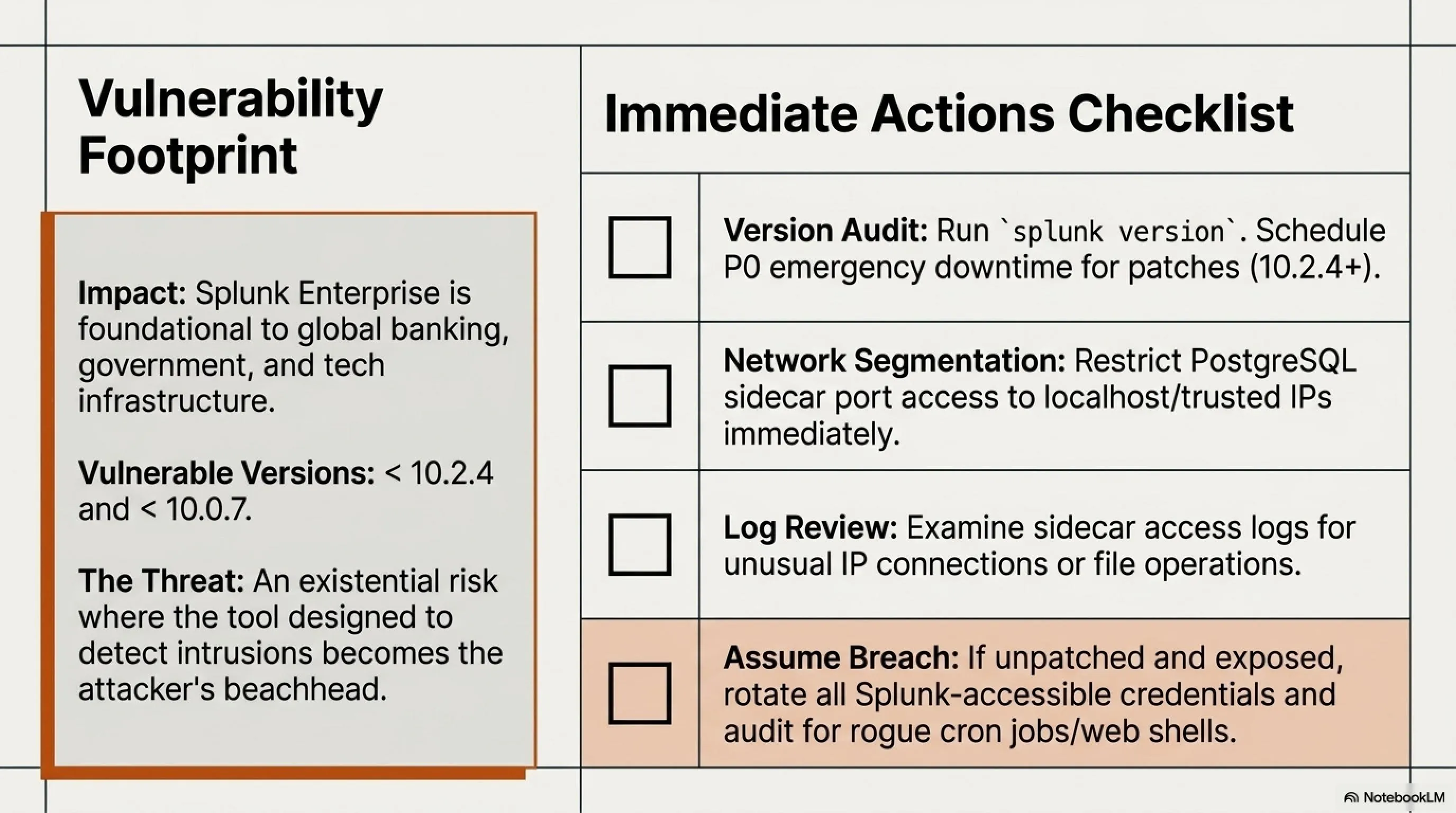
In critical cybersecurity news, Splunk has disclosed a severe vulnerability in Splunk Enterprise tracked as CVE-2026-20253 with a maximum-severity CVSS score of 9.8 out of 10. This vulnerability allows unauthenticated attackers to perform arbitrary file operations and achieve remote code execution (RCE) without requiring any prior authentication or user interaction.
Splunk Enterprise is one of the most widely deployed log management and security information and event management (SIEM) platforms globally, used by thousands of organizations including major banks, technology companies, government agencies, and critical infrastructure operators. A vulnerability of this severity in such a foundational security tool represents an existential threat to affected organizations—attackers could compromise the very systems designed to detect intrusions.
🚨 CVE-2026-20253 Technical Details
| CVE Identifier: | CVE-2026-20253 |
| CVSS Score: | 9.8 / 10 (CRITICAL) |
| CVSS Vector: | CVSS:3.1/AV:N/AC:L/PR:N/UI:N/S:U/C:H/I:H/A:H |
| Vulnerability Type: | CWE-306: Missing Authentication for Critical Function |
| Affected Component: | PostgreSQL Sidecar Service Endpoint |
| Attack Vector: | Network (Remote) |
| Authentication Required: | NONE |
| Vulnerable Versions: | Splunk Enterprise < 10.2.4 and < 10.0.7 |
| Patched Versions: | 10.2.4, 10.0.7, and higher |
According to Splunk's security advisory and analysis from The Hacker News, the vulnerability exists because the PostgreSQL sidecar service endpoint lacks authentication controls. In plain English: Splunk Enterprise version 10.x introduced a new architecture where PostgreSQL runs as a "sidecar" service for data storage. The developers apparently assumed this service would only be accessible from localhost or a trusted internal network, so they didn't implement authentication.
However, in many enterprise deployments—particularly in cloud environments or segmented data centers—this assumption was dangerously wrong. An attacker with network access to the Splunk server (which could be achieved through phishing, VPN compromise, or exploitation of another service) can connect directly to the PostgreSQL sidecar endpoint and issue file operation commands without providing any credentials whatsoever.
Attack Scenario and Exploitation Chain
A typical attack would unfold as follows:
- Initial Access: Attacker gains network access to the Splunk server's network segment (e.g., via phishing, compromised VPN, or lateral movement from another system).
- Service Discovery: Attacker scans for the PostgreSQL sidecar service, typically running on a non-standard port in the 8000-9000 range.
- Unauthenticated File Operations: Using the exposed endpoint, attacker reads sensitive files (Splunk admin credentials, customer data, system configuration) or writes malicious files to disk.
- Code Execution: Attacker writes a web shell or cron job to achieve persistent remote code execution with the privileges of the Splunk process (often root or a highly privileged service account).
- Lateral Movement: With full control of the SIEM system, attacker can disable logging, modify alert rules to hide their activities, and pivot to other systems that Splunk monitors.
The nightmare scenario: an attacker compromising your security monitoring system and using it as a beachhead to attack the rest of your infrastructure while simultaneously blinding your security team.
⚠️ Immediate Actions for System Administrators
- Check Your Version: Run
splunk versionto identify if you're running vulnerable versions (below 10.2.4 or 10.0.7). - Upgrade Immediately: Download and deploy patches from Splunk's official repository. This should be treated as P0 emergency maintenance—schedule downtime and patch now.
- Review Access Logs: Examine PostgreSQL sidecar access logs for suspicious connections from unexpected IP addresses or unusual file operation patterns.
- Network Segmentation: Until patched, restrict network access to the PostgreSQL sidecar port using firewall rules—allow only localhost and essential trusted IPs.
- Indicators of Compromise: Look for newly created files in Splunk directories, unauthorized user accounts, modified cron jobs, or unexpected outbound network connections from the Splunk server.
- Assume Breach: If you can't definitively prove you weren't exploited, consider rotating all credentials accessible to the Splunk service account and conducting a comprehensive security audit.

6. Onimusha: Way of the Sword - Switch 2 Performance Details Revealed ⚔️
In gaming news, Capcom has released full technical specifications for Onimusha: Way of the Sword running on Nintendo Switch 2. This marks the highly anticipated return of the Onimusha franchise after more than 15 years, with a simultaneous launch planned for September 25, 2026 across Switch 2, PlayStation 5, Xbox Series X/S, and PC.
🎮 Onimusha Technical Specs Across Platforms
| Platform | Resolution | Frame Rate | Notes |
|---|---|---|---|
| Switch 2 (Docked) | 1920×1080 (upscaled) | 30fps locked | Variable 30-40fps mode available |
| Switch 2 (Handheld) | 1600×900 (upscaled) | 30fps locked | Variable 30-40fps mode available |
| PS5 (Performance) | Dynamic 1440p-4K | 60fps target | Prioritizes frame rate |
| PS5 (Quality) | 4K (upscaled) | 30fps locked | Maximum visual fidelity |
| Xbox Series X | Dynamic 1440p-4K | 60fps target | Performance/Quality modes |
| PC | Up to native 4K | 60fps+ unlocked | Full customization available |
The Switch 2 version offers a unique variable frame rate mode that allows players to unlock frame rate between 30-40fps, trading consistency for occasional smoothness improvements. This is a smart compromise for players willing to tolerate minor fluctuations in exchange for better responsiveness during combat.

❓ Has Bitcoin Really Bottomed?
Standard Chartered's call is credible but requires confirmation through sustained price action above $65K and continued positive ETF flows for at least 6-8 weeks. Investors should use DCA strategies rather than attempting to perfectly time entry.
❓ Why Did the Government Shut Down Claude AI Models?
Official justification cites national security concerns over dual-use capabilities. However, the selective targeting of Anthropic while leaving OpenAI and Google untouched suggests possible competitive or political factors beyond pure technical capability assessment.
❓ Will Microsoft Actually Sell Xbox?
No imminent sale is planned—Microsoft is in early-stage evaluation of restructuring options. However, if Xbox's 3% profit margin doesn't improve significantly by end of 2026, more concrete separation plans could emerge in 2027.
🎯 Final Thoughts: A Sunday That Rewrote Multiple Futures
Sunday June 14, 2026 will be remembered as a day when multiple technology and financial paradigms shifted simultaneously. Standard Chartered's declaration of crypto winter's end, SpaceX's massive Bitcoin treasury revelation, the unprecedented government shutdown of advanced AI models, Microsoft's exploration of Xbox separation, and critical infrastructure vulnerabilities—each story alone would dominate headlines. Together, they paint a picture of an industry in profound transition.
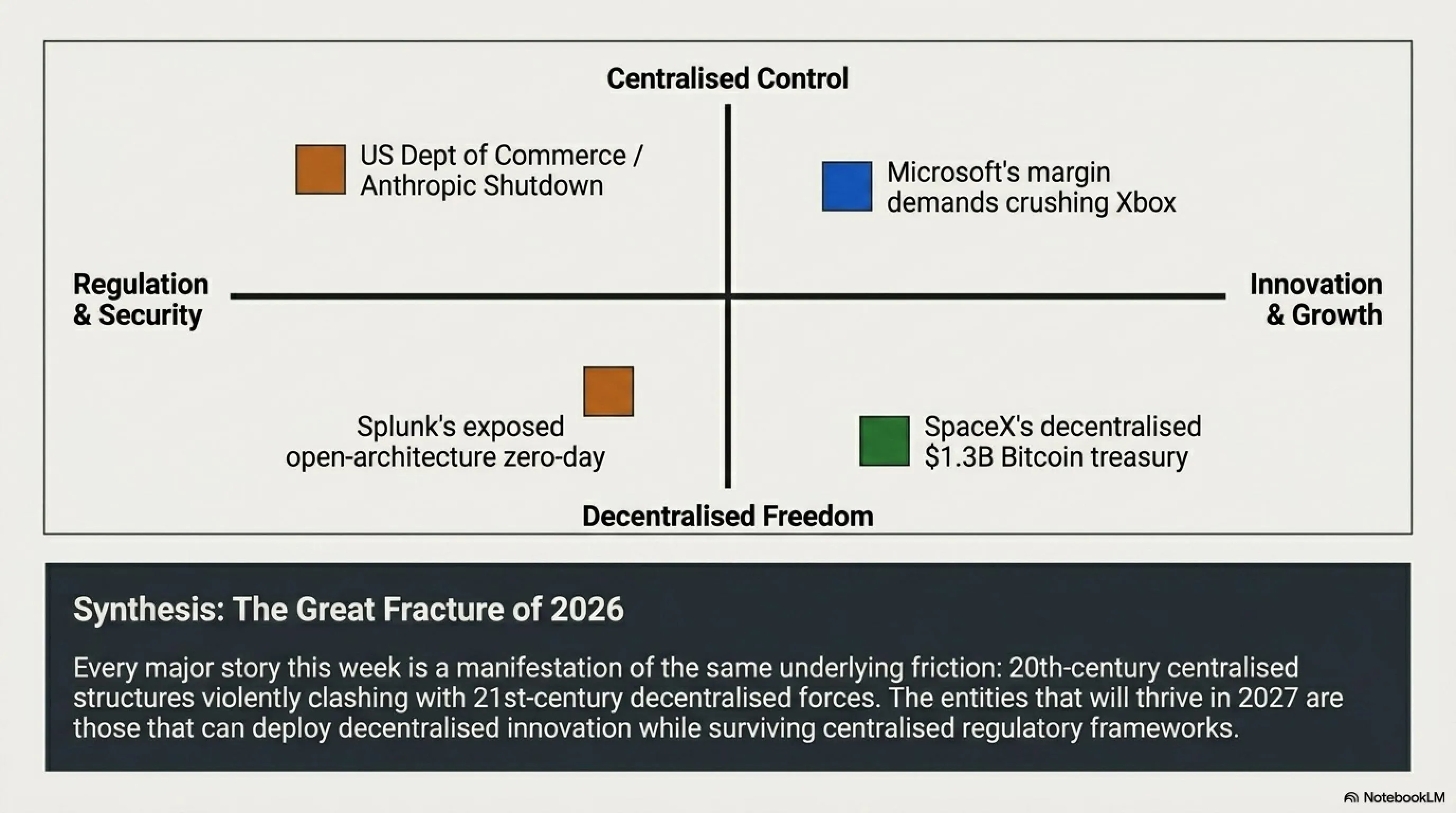
The Common Thread: Centralized power structures attempting to control decentralized forces. Governments trying to contain AI proliferation. Corporations trying to optimize profit margins. Banks trying to legitimize cryptocurrency. In each case, the tension between control and innovation is reaching critical mass.
What Comes Next: The remainder of 2026 will test whether these interventions accelerate or hinder progress. Will Bitcoin reach $100K as Standard Chartered predicts, or will macro headwinds push it lower? Will the Claude AI shutdown set a precedent that chills innovation, or will it prove to be an isolated overreaction? Will Xbox thrive independently or wither outside Microsoft's financial umbrella?
The answers will shape the decade ahead.
📚 Sources & References
- Standard Chartered Bitcoin Cycle Analysis (CoinDesk, Bitcoin.com, Bitcoin Magazine)
- SpaceX Form S-1 Amendment filed with SEC (June 3, 2026)
- Anthropic Official Statement on Model Shutdown (Forbes, TechCrunch, CNBC, Ars Technica)
- Microsoft Xbox Restructuring Report (Reuters, The Information, IGN, Kotaku)
- Splunk Security Advisory SVD-2026-0603 (Splunk.com, The Hacker News, WatchTowr Labs)
- Capcom Onimusha Technical Specifications (Nintendo Life, RPG Site, Digital Foundry)
🌐 Stay Connected With Us 🎮✨
For the latest tech, gaming, and gadget news, follow us on our official social media channels:
Additional Gallery: 🌅 Tekin Morning June 14, 2026: Bitcoin Bottoms, SpaceX's BTC Treasury & Claude AI Shutdown