Good Evening Tekin! Tech Night Thursday, July 30, 2026
Six breaking stories shaking the digital world: From Pavel Durov's international manhunt to ChatGPT approaching 1 billion users
- 🎮Durov- Russia charges Telegram founder with aiding terrorism, issues international warrant
- 🎧Microsoft & Meta- Azure surges 43% but AI spending tops $100 billion annually
- 🚀DeepSeek V4- Exits preview to GA with 93.5% score on LiveCodeBench
- 🗡️Kentucky- $100 billion AI campus with 4.6 gigawatts of dedicated power
- 📰ChatGPT- Approaching 1 billion weekly active users milestone
- ⚔️Monster Hunter- Prologue demo August 5 with save transfer capability
Thursday evening, July 30, 2026 (9 Mordad 1405) closes with six stories that paint a complex picture of technology's current state. From geopolitical tensions threatening the future of encrypted messaging platforms, to the astronomical costs companies are paying to dominate AI's future, to technical breakthroughs pushing the boundaries of what's computationally possible. Let's unpack these stories and understand what lies beneath the headlines.

Pavel Durov and Telegram: When Privacy Rights Collide with National Security
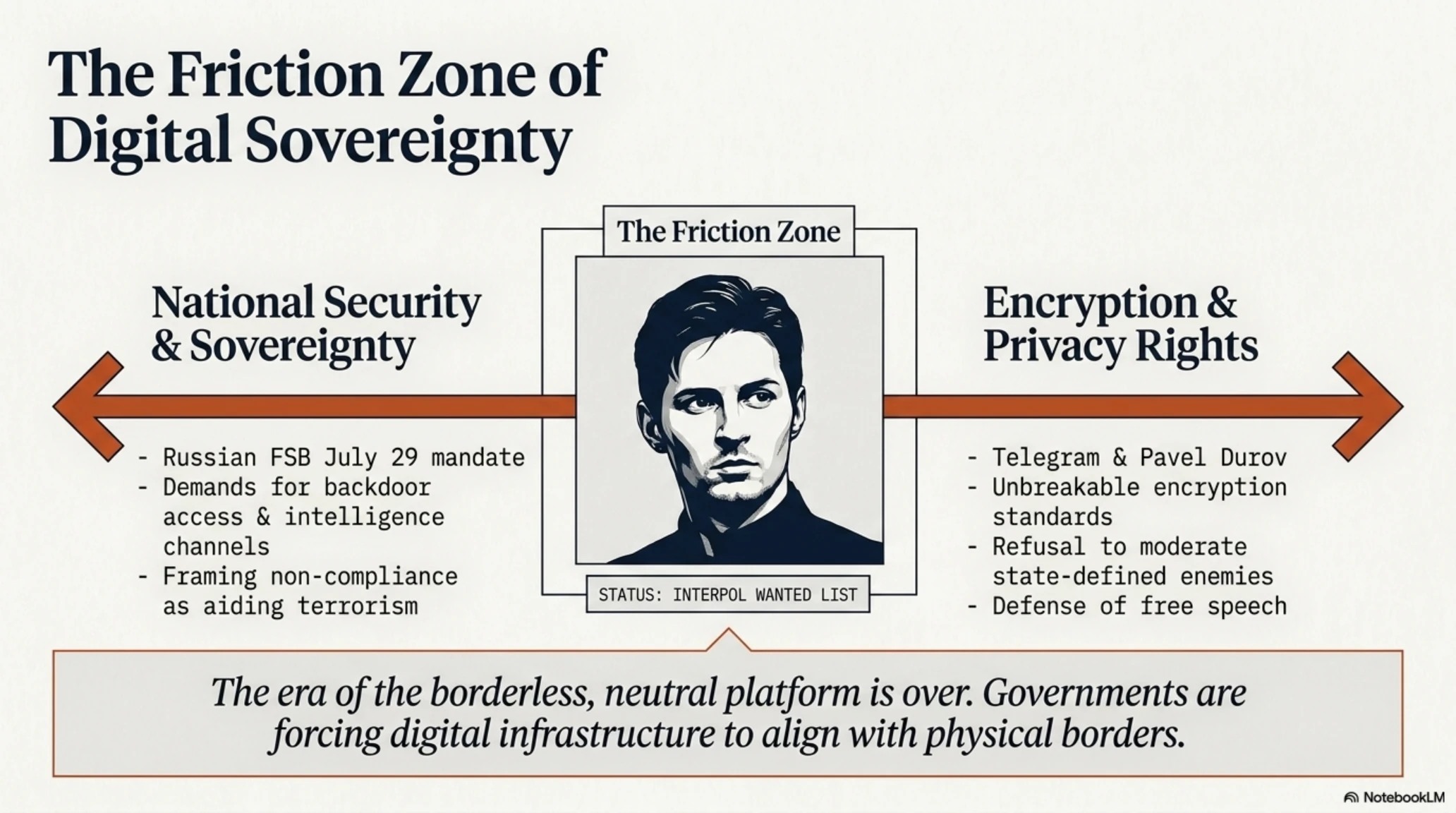
In one of 2026's most controversial political-technological moves, Russia's Federal Security Service (FSB) formally charged Pavel Durov, founder and CEO of Telegram, with "facilitating terrorist activities" on July 29 and placed his name on an international wanted list. These charges emerge as tensions between Russia and Ukraine continue, with Telegram serving as one of the primary communication channels in both countries.
The FSB claims Telegram failed to adequately remove channels, chats, and bots allegedly used by Ukrainian intelligence services and groups designated by Russia as terrorist or extremist organizations to coordinate attacks, sabotage operations, and cyber fraud. In simpler terms, Moscow asserts that Durov and Telegram have allowed "enemies" of the state to use the platform for planning and executing operations against Russia.
At a Glance: The Charges Against Durov
- Charge Date: July 29, 2026 - FSB formally accuses Durov of aiding terrorism
- Legal Status: Durov's name added to Interpol's international wanted list
- FSB Allegation: Telegram delayed removing content linked to Ukrainian intelligence services and terrorist groups
- Durov's Response: He denies charges, calling them an attack on privacy rights and free speech
- Background: Criminal investigation against Durov began earlier in 2026
- International Implications: Charges could restrict Durov's travel to countries with extradition treaties with Russia
Durov, who is Russian by birth but left Russia years ago and now holds citizenship in countries including France and the United Arab Emirates, has strongly denied these allegations. In a statement released earlier in 2026, he declared that Russian authorities are fabricating pretexts to restrict access to Telegram, with their real goal being "suppression of the right to privacy and free speech."
Why Telegram Poses a Challenge for Russia
To understand this conflict, we need to examine the history of Durov and Telegram's relationship with Russian authorities. Telegram enjoys tremendous popularity in Russia - millions of Russians use it for daily communication, work, and even political activities. But this popularity, combined with Durov's commitment to strong encryption and refusal to cooperate with government surveillance requests, has made Telegram a challenge for Moscow.
In 2018, the Russian government formally ordered Telegram blocked, but this attempt essentially failed. Russian users continued accessing Telegram through VPNs and proxies, and many Russian government officials themselves secretly used the platform. Eventually, in 2020, the Russian government officially lifted the ban - an admission of practical defeat.
But now in 2026, with ongoing military conflicts with Ukraine, Moscow has once again targeted Telegram. This time the strategy is different: instead of filtering the platform, they're directly targeting Durov personally. If Durov cannot travel to many countries or faces the risk of arrest and extradition, it could place significant pressure on his decision-making and Telegram's management.
Global Implications of These Charges
The charges against Durov extend beyond a personal conflict - this is an example of growing tension between global technology companies and national governments over information control and privacy. In recent years, various governments - from China and Russia to India and even European countries - have attempted to impose stricter regulations on messaging platforms and social networks.
Some of these laws are designed to combat genuine crimes like terrorism, child exploitation, and organized crime. But critics argue these laws are often used as cover for mass surveillance and suppression of political dissidents. Durov and Telegram sit at the center of this debate because they have consistently defended strong encryption and refused to cooperate with government requests for access to user content.
The key question is: Should a messaging platform be responsible for content users exchange through it? And if so, to what extent? This is a question facing not just Telegram, but WhatsApp, Signal, iMessage, and other encrypted platforms as well.
Microsoft and Meta: A Tale of Two Companies in the AI Spending Race
On the evening of July 29, two tech giants - Microsoft and Meta - released their Q2 2026 financial reports, each telling an interesting but vastly different story about the AI spending race. While both companies are investing billions in AI infrastructure, the returns on these investments have been dramatically different - and this difference could determine the winners and losers of this competition.

Microsoft vs Meta: Two Divergent Paths in the AI Race
Microsoft:
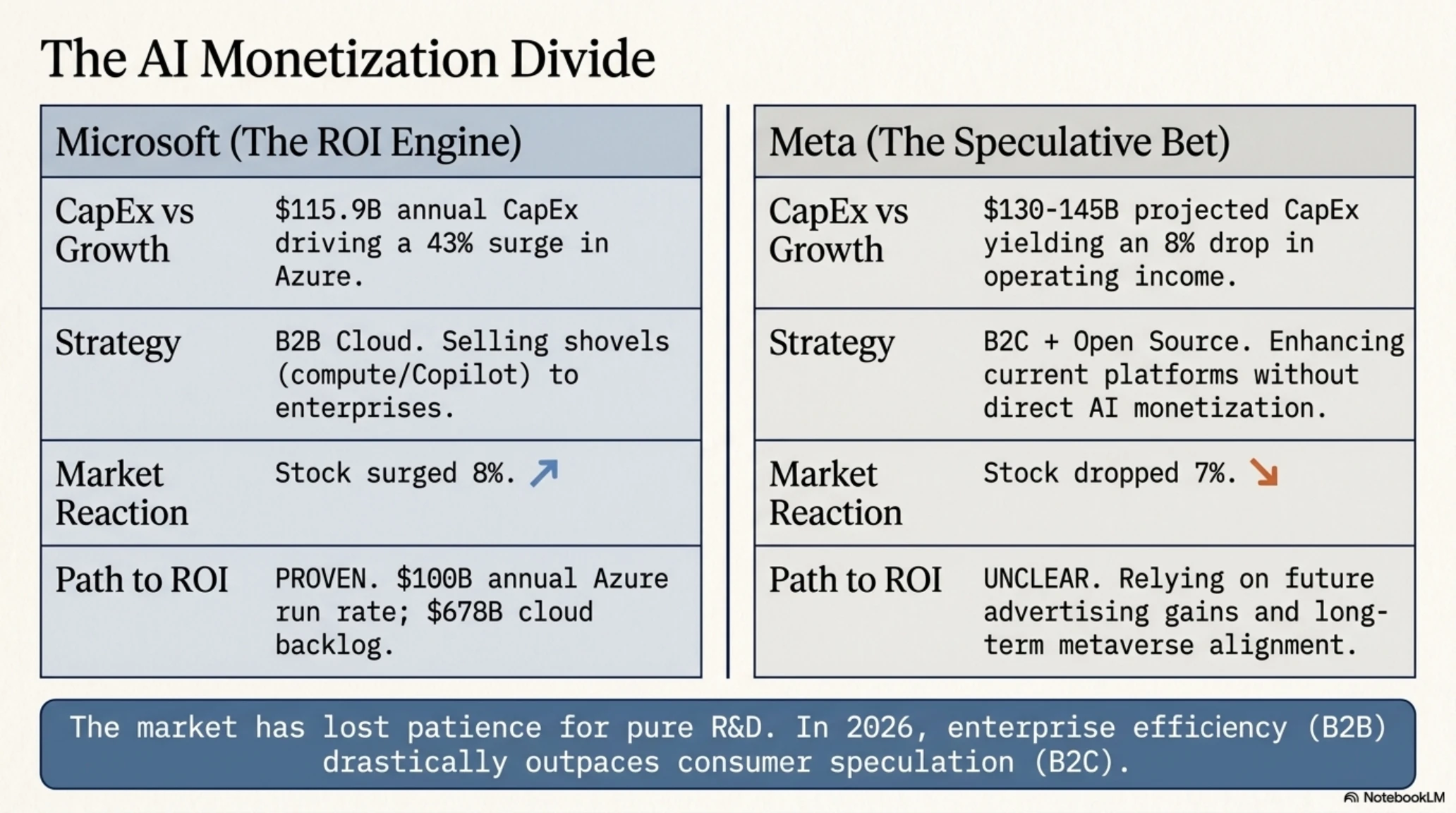
- Quarterly Revenue: $90 billion (18% YoY growth)
- Azure: 43% growth, crossing $100B annual revenue threshold
- Annual Capital Expenditure: $115.9 billion
- Net Income: $35.77 billion (significant increase)
- Market Reaction: Stock surged 8%
- Strategy: Focus on selling AI services to enterprises
Meta:
- Quarterly Revenue: 28% YoY growth
- Operating Income: Down 8%
- Net Income: Down 14%
- 2026 Capex Forecast: $130-145 billion
- Market Reaction: Stock initially dropped 7% (later recovered)
- Strategy: Long-term investment in metaverse and AI
Microsoft: The Successful Model of Converting AI Costs to Revenue
Microsoft told a success story that investors love to hear: massive expenses, but tangible returns. Azure, Microsoft's cloud service, achieved 43% growth this quarter and for the first time crossed the $100 billion annual revenue threshold. This is a significant milestone - it demonstrates that Microsoft's massive investments in AI infrastructure and data centers are converting into actual revenue.
But this success has come at considerable cost. Microsoft announced its annual capital expenditure has reached $115.9 billion - a staggering figure exceeding many countries' entire budgets. These expenses primarily went toward building new data centers, purchasing GPU chips from NVIDIA, and developing network infrastructure to support AI workloads.
But here's the key point: investors accept these costs because they see real customers willing to pay for AI services. Microsoft's Azure AI and Copilot services are becoming significant revenue sources. Companies pay substantial fees to access GPT-4 and other advanced models through Azure, ultimately contributing to Microsoft's profitability.
Amy Hood, Microsoft's CFO, emphasized during the earnings call that "Microsoft Cloud revenue crossed $50 billion this quarter, reflecting the strong demand for our portfolio of services." The company also announced a cloud backlog of $678 billion - essentially future committed revenue - giving investors confidence that current spending will translate into long-term profitability.
Meta: Investing for the Future, But Without Immediate Returns
Meta, on the other hand, told a different story. While company revenue grew 28% - a good figure by any standard - operating profit fell 8% and net income dropped 14%. The reason? Massive AI investment costs that haven't yet converted into observable revenue.

Analysis: Why Investors Are Frustrated with AI Spending
The difference in market reaction to Microsoft and Meta's reports is highly instructive. Microsoft with $115.9 billion in capital expenditure saw stock surge 8%, while Meta with similar spending ($130-145 billion projected) saw stock drop 7% initially. Why?
The answer lies in Return on Investment (ROI). Investors want to see massive AI costs converting to revenue. Microsoft demonstrated this with Azure's 43% growth - companies are willing to pay for Microsoft's AI services. But Meta hasn't yet shown how billions invested in Llama, AI services for Instagram and Facebook, and the metaverse will convert to observable revenue.
The problem is this: Meta's revenue model remains unclear. Microsoft knows how to monetize AI - by selling Azure AI to enterprises and Copilot services to users. But Meta is investing in tools it doesn't yet know how to monetize.
Meta announced it raised the lower bound of its 2026 capital expenditure forecast from $125-145 billion to $130-145 billion. This means at least $5 billion more than the previous projection. Mark Zuckerberg, Meta's CEO, tried to explain during the investor call that these costs are necessary for building the company's future, but some analysts showed signs of impatience and frustration.
One analyst asked during Meta's earnings call with a tone containing disappointment: "Do we just need to be a bit more patient?" This question encapsulates investors' primary concern: Meta is spending like an AI giant, but without showing a clear path to converting these expenses into profit.
Of course, Meta argues these investments are long-term. The company is building Llama models (which are open-source and don't directly generate revenue), developing AI tools to improve advertising (which could generate more revenue in the future), and continuing work on the metaverse (which remains far from profitability). But the market has limited patience, and if Meta can't demonstrate convincing ROI soon, it may face increased pressure.
DeepSeek V4: When a Chinese Model Changes Coding Standards
Amid all the buzz about GPT-5, Claude 3.5, and Gemini 2.0, a significant development in the world of large language models occurred that garnered less media attention but will have profound long-term impact: DeepSeek V4 officially exited preview status and reached General Availability (GA).
DeepSeek, a Chinese company operating in the AI space, released the preview version of its V4 model on April 24, 2026. Now, after approximately three months of testing and refinement, on July 20, 2026, this model officially reached GA - meaning it's ready for production use by companies and developers worldwide.
But why does this matter? Because DeepSeek V4 Pro achieved a 93.5% score on one of the toughest coding benchmarks - LiveCodeBench - representing one of the highest public scores among mid-2026 models. For comparison, this model scores 80.6% on SWE-bench Verified - higher than many more heavily promoted Western models.
DeepSeek V4 Technical Achievements
Architecture: Mixture-of-Experts (MoE) with 1.6 trillion total parameters and 49 billion active parameters
Context Window: 1 million tokens - one of the longest context windows available
KV-Cache Memory: 90% reduction compared to V3 using Hybrid Attention architecture
License: MIT - meaning open-source and commercially usable
API Pricing: Significantly cheaper than GPT-4 and Claude - approximately half the price
Benchmarks: LiveCodeBench: 93.5% | SWE-bench Verified: 80.6% | GPQA Diamond: 90.1%
Why DeepSeek Matters for the Industry
DeepSeek V4 has several important reasons deserving attention. First, it demonstrates that China is approaching - and in some areas surpassing - American models. For years, the narrative was that OpenAI, Anthropic, and Google led in model quality. But DeepSeek V4 shows this gap is closing, at least in the coding domain.
Second, pricing. DeepSeek offers its API at approximately half the price of GPT-4. This is highly attractive for startups and small companies with limited budgets. They can access a high-quality model without exhausting their budget on expensive OpenAI APIs.
Third, being open-source. DeepSeek V4 is released under the MIT license, meaning anyone can download it, run it on their own servers, fine-tune it, and even use it for commercial purposes - without paying any fees. This is extremely valuable for companies concerned about data privacy or wanting complete control over their model.
- <strong>DeepSeek V4 Strengths:</strong> Excellent performance in coding (93.5% LiveCodeBench)
- Very affordable pricing - half of GPT-4
- Open-source with MIT license - complete control
- 1 million token context window
- 90% less memory consumption with Hybrid Attention
- <strong>DeepSeek V4 Weaknesses:</strong> Falls behind GPT-4 in some general tasks
- Less support and documentation compared to OpenAI
- Potential access restrictions in some countries
- Requires expertise to deploy and fine-tune self-hosted version
API Changes: End of Legacy Names
Four days after the GA release (July 24), DeepSeek made an important decision: the old API names - deepseek-chat and deepseek-reasoner - were officially deprecated. This meant developers using these old endpoints had to migrate to deepseek-v4-pro or deepseek-v4-flash.
This decision makes sense - DeepSeek wanted to clarify its API structure and distance itself from ambiguous old naming patterns. But for some developers with production systems, this was a short-term headache. Fortunately, migration was relatively simple - just requiring a change to the model parameter in the code.
Kentucky's $100 Billion AI Campus: The Infrastructure Race at Its Peak
If you thought Microsoft and Meta's AI spending was substantial, consider the latest mega-project in this space: a $100 billion AI campus in Kentucky.

On July 29, Brookfield Asset Management and NextEra Energy proposed building an AI campus exceeding $100 billion at the U.S. Department of Energy's former uranium enrichment site in Paducah, Kentucky. This project, which will be one of the largest private investments in American technology history, includes constructing a data center with over 1.2 gigawatts of compute capacity and dedicated power generation with 4.6 gigawatts capacity.
Yes, you read that correctly: 4.6 gigawatts. For comparison, a typical nuclear power plant generates about 1 gigawatt of electricity. This project will generate as much power as four nuclear plants - solely to power AI data centers.
Kentucky AI Campus Project Details
- Total Investment: Over $100 billion (private funding)
- Location: Former Paducah Gaseous Diffusion Plant site
- Compute Capacity: Over 1.2 gigawatts
- Power Generation: Up to 2 GW natural gas + 2.6 GW battery energy storage
- Completion Target: 2032 for full buildout
- Partners: Brookfield (data center development), NextEra (power generation), Big Rivers Electric
- Land Lease: From U.S. Department of Energy
Why Is This Project So Massive?
The answer is simple: training and inference for AI models consume enormous amounts of electricity. A large model like GPT-4 or Claude might consume several megawatts of power for months during training. And when these models enter production and process millions of daily requests, power needs increase exponentially.
The problem is that America's existing power grid wasn't designed for this level of concentrated consumption. A typical data center might consume 50 to 100 megawatts. But modern AI data centers might consume 500 megawatts or more. This means you can't simply connect to the existing grid - you need dedicated power.
This is why NextEra is building a 2-gigawatt natural gas plant and a 2.6-gigawatt battery storage system. This power will go directly to Brookfield's data center without straining the public grid. This represents a new model for AI data centers: building dedicated power generation alongside compute.
Repurposing a Cold War Site
One fascinating aspect of this project is its location. The Paducah site was a Cold War-era uranium enrichment facility used to produce nuclear fuel for power plants and nuclear weapons. This facility closed in 2013, and since then, over $1 billion has been spent on site cleanup and restoration.
Now, more than a decade later, this site is transforming into a technology innovation hub. This is a powerful symbol of America's economic transformation: from Cold War-era nuclear energy production to 21st-century AI computing. It also demonstrates the federal government is taking AI competition seriously and willing to make its land available to the private sector for critical infrastructure development.

ChatGPT Approaches 1 Billion Users: Slow But Steady Growth
OpenAI announced on July 29 news that was both encouraging and slightly concerning: ChatGPT is approaching 1 billion weekly active users. This is an enormous milestone for any technology product - only a handful of platforms in history have reached this level (Facebook, YouTube, WhatsApp, and now ChatGPT on the verge of joining this short list).
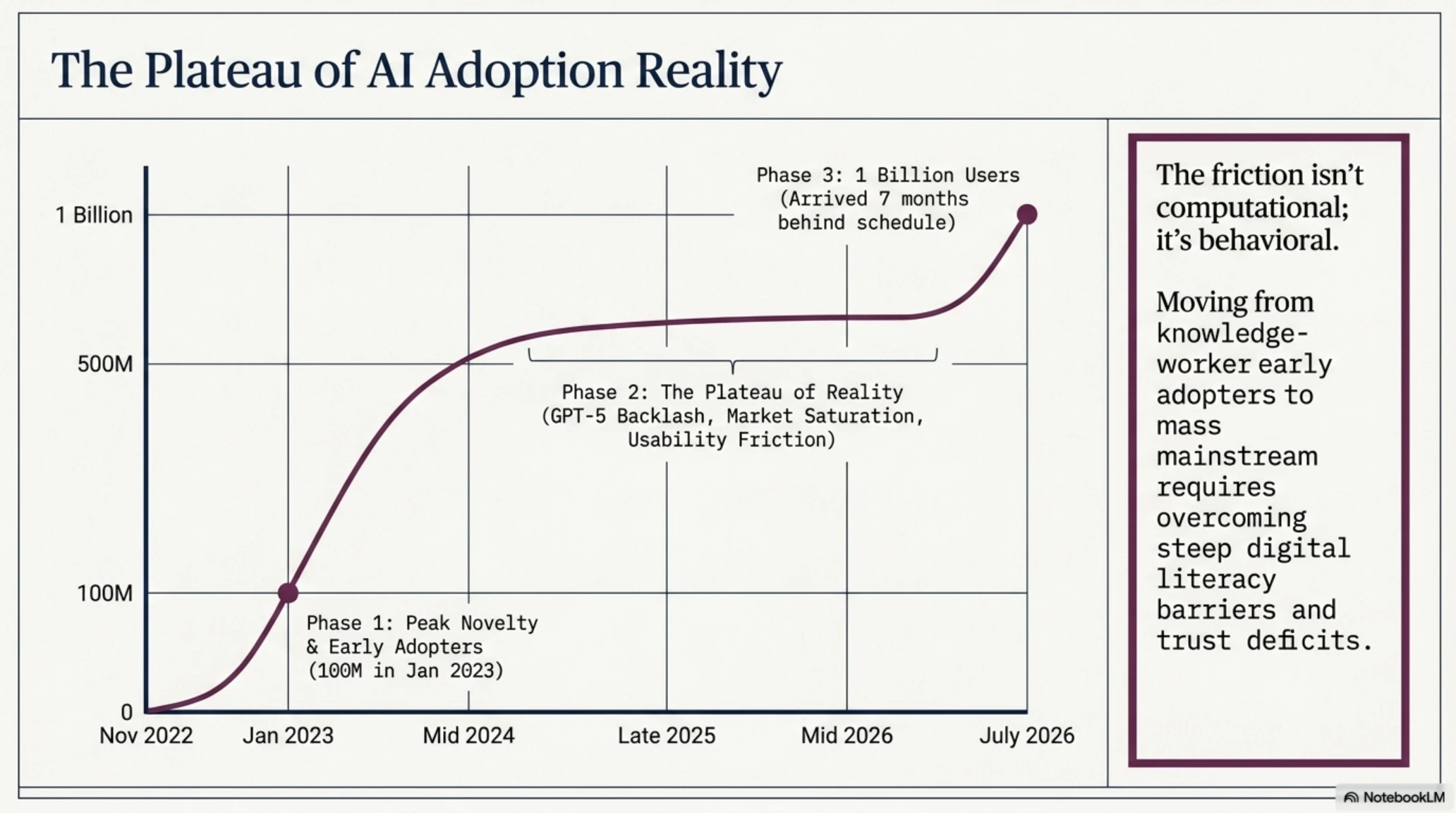
But here's the interesting part: OpenAI originally expected to hit this metric by the end of 2025. Now, nearly seven months behind schedule, it's approaching this goal. This is the first real sign that even the AI market leader faces its own growth constraints.
ChatGPT's Journey to 1 Billion Users
November 2022: ChatGPT launched - 1 million users in 5 days
January 2023: 100 million monthly users - fastest product to this milestone
Late 2024: Over 500 million weekly users
February 2026: 900 million weekly users announced
July 2026: Approaching 1 billion - 7 months after initial target
Challenges: Negative reaction to GPT-5, intense competition, growth slowdown in Fall 2025
Why Has Growth Slowed?
Several reasons explain ChatGPT's growth deceleration. First, the market is approaching saturation. Most people interested in or using AI have likely already tried ChatGPT. Growth from here must come through attracting new users still skeptical of or unfamiliar with AI - harder than attracting early adopters.
Second, competition has intensified. Claude from Anthropic, Gemini from Google, and even open-source models like Llama and DeepSeek are all attracting users. Users are no longer limited to ChatGPT - they can choose among several high-quality options.
Third, the GPT-5 incident. OpenAI released the initial version of GPT-5 in Fall 2025, but user reaction wasn't positive. Many complained the new model had become "too cautious," had "less creativity," and didn't properly handle some tasks GPT-4 performed well. This triggered a wave of criticism on social media, with some users migrating to Claude or other alternatives.
OpenAI has since addressed many of GPT-5's issues, but that initial wave of negative reaction slowed growth. Regaining user trust takes time.
What Lies Ahead?
Despite these challenges, ChatGPT remains in a strong position. Approaching 1 billion weekly users, it's becoming one of the largest internet platforms in history. And with over 50 million paying subscribers, OpenAI has substantial revenue to invest in developing better models.
But the key question is: Can OpenAI accelerate its growth and return to unchallenged market leadership, or will competitors gradually capture more market share? The second half of 2026 will answer this question.

Monster Hunter Wilds: Demo, Update, and Offline Event Quests
Finally, let's shift from pure technology to gaming. Capcom announced that Monster Hunter Wilds - one of 2026's biggest AAA titles - will receive update 1.042 on August 4, accompanied by the Prologue demo launching August 5.
If you're unfamiliar with the Monster Hunter series, here's a brief explanation: it's a Japanese action-RPG series where you hunt massive monsters, gather materials from them, and craft better equipment to hunt bigger, more dangerous monsters. The game has an addictive loop of hunting, crafting, and upgrading that attracts dedicated fans.
What's New in Update 1.042?
Two major changes in this update. First, support for save transfer from the Prologue demo to the full game. This means if you play the demo and make progress, when you purchase the full game, you won't need to restart - your progress transfers. This is an excellent feature for newcomers wanting to try the game without worrying about losing hours of progress.
Second, all 26 Event Quests in the game will now be accessible offline. Before this update, Event Quests were only playable online - meaning you needed an active internet connection. But many players complained about this restriction, especially those without stable internet or preferring solo play. Capcom listened and has now made all these quests playable offline.
Update 1.042 and Prologue Demo Details
- Update Date: August 4, 2026 for PS5, Xbox Series X|S, and PC (Steam)
- Prologue Demo: August 5, 2026 - free for everyone
- Save Transfer: Demo progress transfers to full game (if no existing save file)
- Offline Event Quests: All 26 Event Quests now playable without internet
- Permanent Quest: 'Just What the Doctor Ordered' removed from time restriction
- Platforms: All versions (PlayStation, Xbox, PC) update simultaneously
Why This Matters to the Monster Hunter Community
Monster Hunter has a highly active and loyal community, and many players are deeply sensitive about offline access. Some live in areas without high-speed, stable internet. Some prefer playing only with local friends (in the same room) and don't need to connect to online servers. And some worry that if Capcom's servers shut down in the future, parts of the game content will be lost forever.
By making Event Quests offline, Capcom demonstrates it's listening to these concerns. This also means Monster Hunter Wilds will have a longer lifespan - even if online servers eventually close, players can still access all content.
The Bigger Picture: Three Key Technology Trends
Having examined tonight's six stories, let's step back and identify the larger patterns emerging from these developments. Three main trends are observable:
First, escalating tension between governments and technology platforms. The Durov and Telegram saga is just the latest chapter in a long-running story. Governments worldwide - from Russia and China to Europe and America - are attempting to exert greater control over platforms used by billions. The fundamental question is: Who should have decision-making power over content, privacy, and security - private companies or elected governments? There's no simple answer.
Second, the AI infrastructure race has reached its peak. From Microsoft and Meta's hundred-billion-dollar spending to Kentucky's hundred-billion-dollar campus, it's clear this game is only for players with deep pockets. Smaller companies and startups must find ways to compete with more limited budgets - perhaps through using open-source models like DeepSeek V4 or partnering with cloud providers that share costs.
Third, AI growth is slowing - but not stopping. ChatGPT is approaching 1 billion users seven months behind schedule. This shows even the best AI products face growth limitations. Initial expectations about exponential growth may have been overly optimistic. But this doesn't mean the end of AI - just greater market maturity.
Deep Dive: The Economics of AI Infrastructure
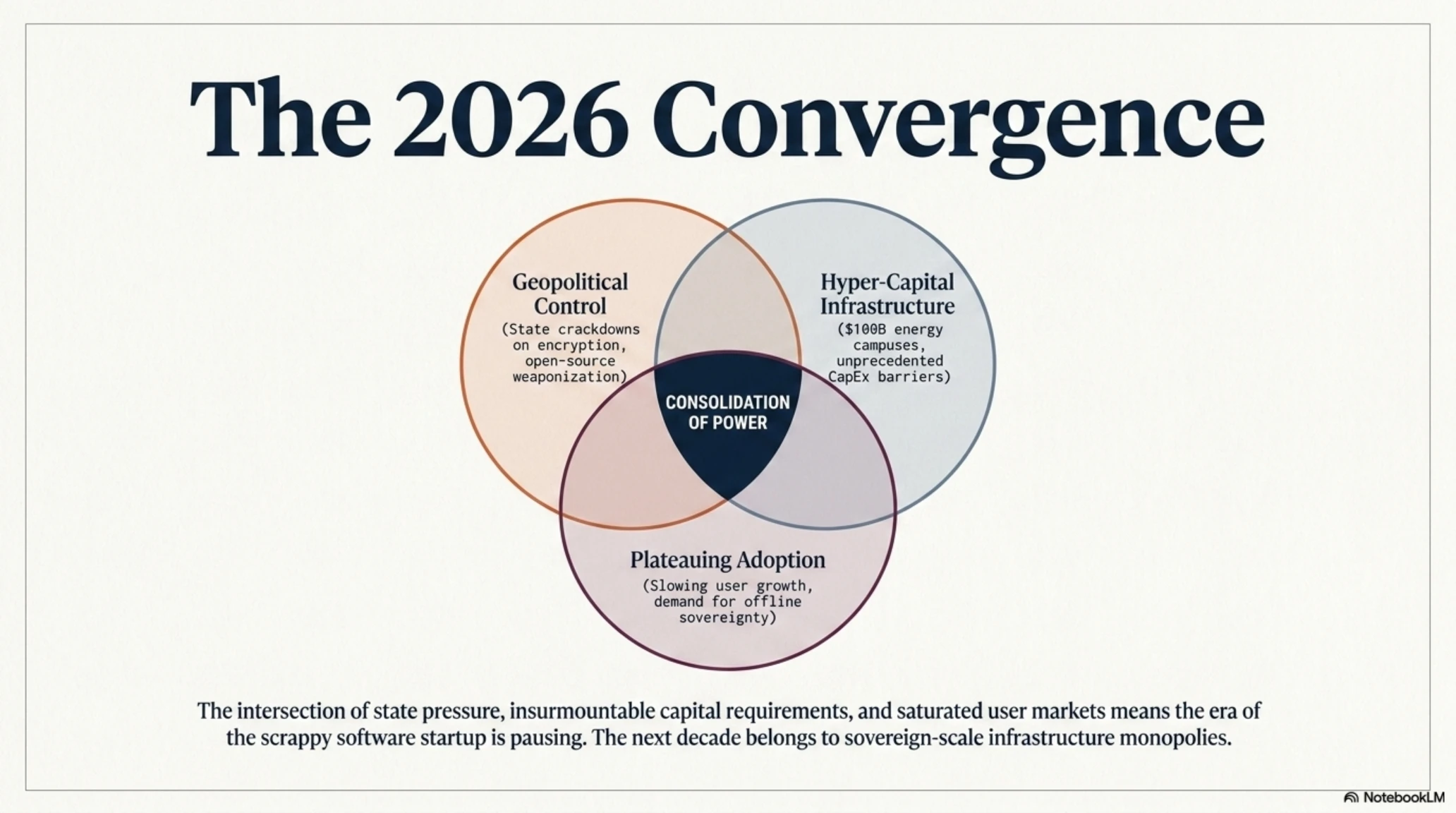
The Kentucky project and the earnings reports from Microsoft and Meta highlight a fundamental economic reality about artificial intelligence in 2026: the barrier to entry has become extraordinarily high. Building competitive AI capabilities now requires not just brilliant algorithms or talented researchers, but access to massive amounts of capital and physical infrastructure that only a handful of organizations can afford.
Consider the math: training a state-of-the-art large language model in 2026 requires thousands of high-end GPUs running for weeks or months. A single NVIDIA H100 GPU, the current standard for AI training, costs approximately $30,000 and consumes about 700 watts of power continuously. A training cluster with 10,000 H100s - not unusual for frontier model training - represents $300 million in hardware alone, plus the ongoing electricity costs of 7 megawatts.
But the costs extend far beyond the GPUs themselves. You need data center space engineered to handle enormous power densities and cooling requirements. You need high-bandwidth networking to allow GPUs to communicate efficiently during distributed training. You need storage systems capable of feeding data to thousands of GPUs simultaneously. And you need the specialized expertise to design, build, and operate these systems.
This is why we're seeing consolidation around a small number of players who can afford to play this game. Microsoft, Google, Amazon, Meta, and a handful of others have the resources to build data centers at the scale AI requires. Smaller companies must either partner with these infrastructure providers, use their cloud services, or find ways to achieve competitive results with far less compute - as DeepSeek has attempted to do with more efficient model architectures.
The Environmental Question Nobody Wants to Answer
The elephant in the room that rarely gets discussed in AI earnings calls or product announcements is the environmental impact of this infrastructure buildout. The Kentucky project alone will generate 4.6 gigawatts of power, much of it from natural gas - a fossil fuel that produces carbon emissions. While the project includes substantial battery storage for grid balancing, the fundamental energy source is non-renewable.
Multiply this across all the planned AI data centers globally, and the carbon footprint becomes staggering. Some estimates suggest that training and running AI models could account for several percent of global electricity consumption by 2030 if current trends continue. This raises uncomfortable questions about whether the benefits of AI justify its environmental costs - questions the industry has largely avoided addressing seriously.
There are promising developments in renewable energy for data centers, and some companies are making genuine efforts to power their AI operations with solar, wind, and nuclear power. But the reality is that much of the AI infrastructure being built in 2026 still relies on fossil fuels, and the industry's environmental record remains mixed at best.
The Geopolitical Dimension: Technology as National Power
The Durov charges and the DeepSeek V4 release both highlight another crucial dimension of technology in 2026: the extent to which digital infrastructure and AI capabilities have become instruments of geopolitical competition and national power.
Russia's charges against Durov aren't just about one individual or one company - they're part of a broader pattern of governments attempting to assert sovereignty over digital communications within their borders. The same dynamic plays out in different forms around the world. China requires tech companies to store data within Chinese borders and comply with government content moderation requirements. The European Union imposes strict data privacy regulations through GDPR. India has repeatedly banned Chinese apps over national security concerns.
Each of these actions reflects a government's desire to control the digital infrastructure that its citizens depend on. And platforms like Telegram that operate across borders and resist government control pose a fundamental challenge to this desire for digital sovereignty.
Similarly, DeepSeek V4's impressive performance represents more than just a technical achievement - it's evidence of China's growing capabilities in AI despite U.S. export controls on advanced semiconductors. The United States has attempted to maintain its lead in AI partly through restricting China's access to cutting-edge chips. But if Chinese companies can achieve competitive results with less advanced hardware through algorithmic innovations, these export controls become less effective.
This technological competition between the United States and China is likely to be one of the defining features of the next decade. Both countries see AI as crucial to future economic competitiveness and military capability. The country that leads in AI will have significant advantages in everything from autonomous weapons systems to economic productivity to surveillance and social control.
What the Microsoft-Meta Divergence Tells Us About AI's Future
The stark difference in how investors responded to Microsoft and Meta's earnings reports provides valuable insights into what the market believes about AI's near-term trajectory. Microsoft is winning because it has a clear, proven model for monetizing AI: sell cloud computing services and AI tools to businesses willing to pay for productivity gains. This is a straightforward B2B model that enterprises understand and value.
Meta's struggle, by contrast, reflects uncertainty about how consumer-facing AI translates into revenue. The company is spending enormously on AI infrastructure and model development, but the path from "better Instagram recommendations" or "AI chat in WhatsApp" to "increased revenue" remains unclear. Advertising revenue might improve as AI enables better targeting, but will that improvement justify the massive investment? The market isn't convinced yet.
This divergence suggests that in the near term, enterprise AI will be more profitable than consumer AI. Companies will pay for AI that demonstrably improves productivity, reduces costs, or enables new revenue streams. Consumers, accustomed to free internet services supported by advertising, are more reluctant to pay directly for AI features.
But this doesn't mean consumer AI lacks potential - it just means the monetization models haven't fully emerged yet. WhatsApp took years to monetize after achieving massive user adoption. Instagram similarly didn't generate significant revenue initially. Meta is betting that by building AI capabilities into its platforms now, it will eventually discover profitable use cases. Whether that bet pays off remains to be seen.
The Open Source Paradox: DeepSeek's Strategic Choice
DeepSeek's decision to release V4 as open source under an MIT license deserves closer examination because it represents a fundamentally different approach to AI commercialization than the one pursued by Western companies.
OpenAI, Anthropic, and Google keep their frontier models closed and proprietary. They monetize through API access - you pay per token to use their models, but you never get to see how they work or run them on your own infrastructure. This creates a lucrative recurring revenue stream and maintains competitive advantage through secrecy.
DeepSeek, by contrast, gives away the model weights for free. Anyone can download V4, examine its architecture, modify it, and run it locally without paying anything. So how does this make economic sense?
Several factors likely motivate this choice. First, releasing open-source models builds reputation and attracts talent. Researchers worldwide can experiment with V4, publish papers about it, and contribute improvements - essentially providing free R&D. Second, while the model itself is free, DeepSeek can still charge for API access for users who prefer convenience over control. Third, and perhaps most importantly, demonstrating technical competence through open releases can attract lucrative partnerships and consulting opportunities.
There's also a geopolitical dimension: by releasing competitive open-source models, Chinese AI companies undermine the market position of proprietary American models. If DeepSeek V4 achieves 80% of GPT-4's performance at zero cost, many users will choose the free option, reducing OpenAI's revenue and ability to fund future development.
Whether this open-source strategy proves sustainable remains uncertain. Training frontier models is extremely expensive, and giving them away for free requires alternative revenue sources. But in the short term, it's proving effective at challenging the dominance of closed, proprietary AI.

Monster Hunter Wilds and the Preservation Question
The decision to make Monster Hunter Wilds' Event Quests playable offline might seem like a minor quality-of-life improvement, but it touches on a larger issue that the gaming industry has been grappling with: preservation and long-term accessibility.
Modern games increasingly rely on online services - not just for multiplayer features, but for core single-player content. When servers eventually shut down, portions of these games become permanently inaccessible. This has already happened to numerous games over the past decade, where content that players paid for simply ceases to exist when the publisher decides maintaining servers is no longer economically viable.
By making Event Quests available offline, Capcom is ensuring that Monster Hunter Wilds will remain fully playable decades from now, even if the company no longer operates online servers for it. This respects the principle that when players purchase a game, they should own access to its content permanently, not just for as long as it's profitable for the publisher to maintain online infrastructure.
This principle becomes increasingly important as games become more expensive to produce and purchase. When a game costs $70 or more, players reasonably expect that their investment will retain value over time. A game that becomes partially or completely unplayable when servers shut down feels like a betrayal of that expectation.
The industry would benefit from more companies following Capcom's example and ensuring that their games remain accessible long-term. But economic pressures often push in the opposite direction - live service games with ongoing server costs can generate recurring revenue through microtransactions and subscriptions, making them more profitable than traditional premium games with offline functionality.
ChatGPT's Plateau and What It Means for AI Adoption
ChatGPT's slower-than-expected growth to 1 billion weekly users provides important insights into the realistic pace of AI adoption. The technology industry has a tendency toward hyperbolic predictions about exponential growth, and AI has been no exception. In late 2023 and early 2024, predictions that ChatGPT would reach billions of users within months were common.
Reality has proven more complex. While ChatGPT did achieve unprecedented initial adoption speed, growth has slowed significantly as it approaches the billion-user mark. Several factors contribute to this deceleration beyond those already mentioned.
First, there are genuine usability barriers that prevent widespread adoption. ChatGPT requires a level of digital literacy and comfort with AI that not everyone possesses. Older users, people with limited education, and those in regions with poor internet infrastructure face obstacles to adoption that enthusiastic tech commentators often overlook.
Second, many people who tried ChatGPT didn't find it compelling enough to become regular users. The initial novelty of conversing with an AI wears off quickly if you don't have specific use cases where it provides genuine value. For knowledge workers who write code or produce written content professionally, ChatGPT can be transformative. For someone who primarily uses technology for social media and entertainment, its utility is less obvious.
Third, concerns about accuracy, bias, and appropriate use have made some potential users cautious. High-profile cases of AI hallucinations, biased outputs, and academic cheating scandals have created negative associations that discourage adoption.
These factors suggest that while AI will undoubtedly continue expanding its reach, the pace may be slower and more uneven than early predictions suggested. Reaching truly universal adoption comparable to smartphones or social media will require not just better technology, but better interfaces, clearer value propositions, and solutions to the trust and usability challenges that currently limit adoption.
Thursday Evening Wrap-Up
Thursday evening, July 30, closes with six stories that paint a complex picture of technology's current trajectory. From geopolitical conflicts threatening the freedom of messaging platforms, to enormous spending competitions for AI dominance, to technical advances pushing the boundaries of what's possible.
The key takeaway: Technology is becoming an arena of global competition - not just between companies, but between nations. Those with infrastructure, computational power, and advanced models will hold the economic and geopolitical power of the 21st century. The question is: Who will win this race, and at what cost?
We'll return tomorrow evening with fresh technology news and analysis. Until then, stay secure and stay informed.
Frequently Asked Questions
Is Pavel Durov genuinely at risk of arrest?
Yes, but with conditions. Being placed on Interpol's wanted list means that if Durov travels to a country with an extradition treaty with Russia, he could be arrested and turned over to Moscow.
Why can't Telegram just comply with Russia's demands?
If Telegram hands over encryption keys or creates backdoor access, it can no longer claim to be a secure, private platform, losing the trust of millions of users worldwide.
Is Microsoft actually profiting from AI?
Yes. Azure AI and Microsoft's Copilot services are becoming significant revenue sources, with Azure's 43% growth reflecting strong enterprise demand.
Why is Meta underperforming compared to Microsoft?
Microsoft sells AI services directly to enterprises (clear B2B model), whereas Meta is still discovering how to monetize consumer AI, causing investor skepticism over ROI.
How much cheaper is DeepSeek V4 than GPT-4?
Generally, DeepSeek costs approximately half of GPT-4's API pricing, saving thousands of dollars monthly for high-volume applications.
Is DeepSeek V4 really as good as GPT-4?
For coding, yes—even better in some benchmarks. DeepSeek V4 Pro scores 93.5% on LiveCodeBench, outperforming many Western models.
Why does the Kentucky campus need so much power?
Training and inference consume extraordinary energy. The Kentucky project targeting 1.2 gigawatts of compute requires 4.6 gigawatts of dedicated power generation.
Why is ChatGPT reaching 1 billion users late?
Market saturation, intensified competition from Claude and Gemini, negative initial reactions to GPT-5, and security concerns contributed to the slowdown.
Does Monster Hunter Wilds require internet?
No. After update 1.042, all 26 Event Quests are fully playable offline without an internet connection.
Does progress from the Prologue demo transfer to the full game?
Yes, provided there is no existing full-game save file on your system, all character and quest progress will carry over.
Sources & Official References
- CBS News - Russia charges Telegram founder Pavel Durov with aiding terrorism
- Fortune - Microsoft's cloud just hit a new milestone—Azure crosses $100 billion
- Tech Insider - DeepSeek V4 General Availability 2026
- Morningstar - Brookfield, NextEra to Develop $100B Data Center Campus in Kentucky
- TNW - ChatGPT nears 1bn weekly users, seven months late
- Twisted Voxel - Monster Hunter Wilds Update 1.042 Adds Offline Event Quests
Author's Note: This article is based on news published on July 29 and 30, 2026. All information has been sourced from credible outlets including CBS News, Al Jazeera, Fortune, Axios, and other established publications. For the most current information, please refer to the original sources. Technology moves rapidly, and readers should independently verify time-sensitive details.
Additional Gallery: Tekin Night Thursday July 30 | Durov Wanted, Azure Grows 43%, DeepSeek V4 Arrives