Tekin Analysis | The Two-Decade Wallhack Era Is Ending: Deep Architectural Autopsy of Server Culling in Call of Duty: Modern Warfare 4
Activision and Infinity Ward have unveiled a landmark architectural overhaul for Modern Warfare 4: Server Culling. By calculating physical occlusion on authoritative cloud servers, the game completely strips hidden enemy spatial coordinates from client network packets, rendering ESP and wallhacks mathematically obsolete.
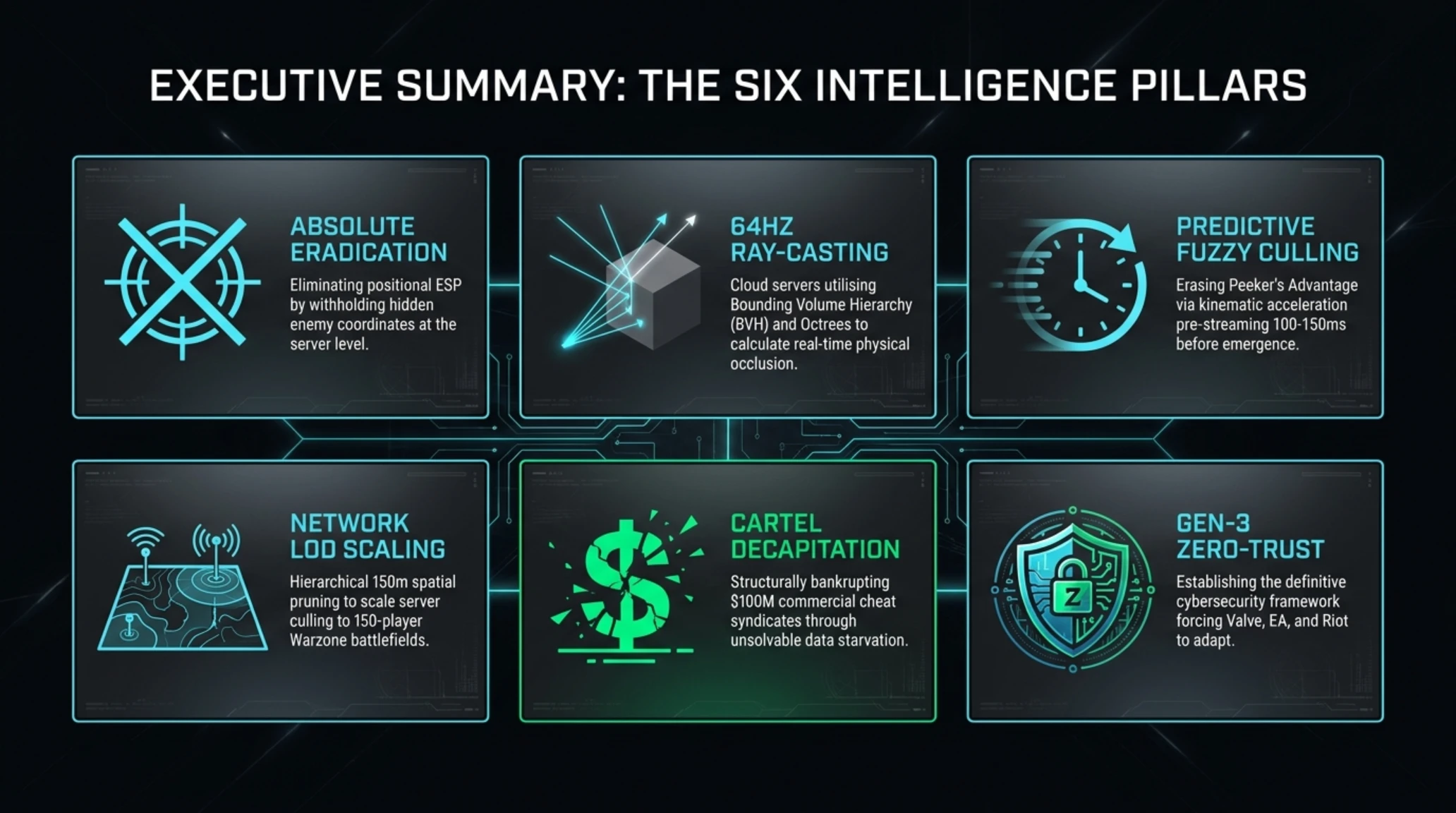
- 🎮Absolute Elimination of Wallhacks- For the first time in Call of Duty history, enemy coordinate packets are permanently withheld until physical line of sight is established.
- 🎧Occlusion Layers & Server Ray-Casting- Authoritative game servers deploy real-time ray casting and BVH spatial partitioning to filter invisible players at the transmission source.
- 🚀Solving the Peeker's Advantage Paradox- Predictive Fuzzy Culling calculates kinematic acceleration vectors 100ms prior to emergence to eliminate visual pop-in without exposing wall-bang data.
- 🗡️Death of DMA Hardware Cheats- Zero-Trust network architecture ensures local RAM contains no hidden enemy data, rendering expensive PCIe cheating hardware useless.
- 📰Server-Side Audio Occlusion- Directional footstep telemetry is heavily obfuscated to neutralize Audio-Hooking and acoustic ESP exploits.
- ⚔️Warzone Multi-Tier Deployment Roadmap- Full launch activation across all 6v6 multiplayer arenas, followed by hierarchical network LOD scaling for Warzone's 150-player battlefields.
The Two-Decade Nightmare: Why First-Person Shooters Failed to Stop Wallhacks
In early October 2026, Activision and flagship developer Infinity Ward published a comprehensive technical deep-dive video across official Call of Duty channels and leading international gaming outlet IGN, revealing what senior engineers describe as the most consequential network architecture transformation in the franchise’s history. Headlining the security framework of the upcoming Call of Duty: Modern Warfare 4 is Server Culling an uncompromising, server-side data censorship protocol engineered to systematically extinguish the single most persistent, destructive, and demoralizing scourge in competitive first-person shooter history: Extra Sensory Perception (ESP) and wallhacks.
Key Takeaways | The Server Culling Technical Revolution in Modern Warfare 4
- Activision and Infinity Ward officially confirmed the integration of Server Culling technology for Call of Duty: Modern Warfare 4.
- Traditional netcode broadcasted full 3D coordinates of all lobby players to every client for motion interpolation, creating the vulnerability wallhacks exploited.
- Server Culling calculates geometric occlusion server-side and entirely removes occluded enemy coordinates from outbound UDP network packets.
- Advanced Predictive Fuzzy Culling eliminates severe pop-in and peeker's advantage by initiating data streams 100-150ms before physical visual emergence.
- The technology launches across all competitive 6v6 maps, with scaled integration planned for Warzone, DMZ, and survival modes.
For more than twenty years, competitive first-person shooters have been locked in an agonizing asymmetrical war against malicious software. From the early LAN corridors of Quake and Counter-Strike 1.6 to the multi-million-player battlegrounds of Verdansk and Urzikstan, players utilizing illicit third-party software have plagued multiplayer lobbies. By reading raw memory addresses on the client machine, cheat applications superimpose brightly colored bounding boxes, complete skeletal bone matrices, weapon loadout indicators, health bars, and precise distance meters over every opposing character on the map even through solid reinforced concrete walls, armored bunker doors, and dense foliage hundreds of meters away.

The human cost to the gaming ecosystem has been astronomical. Competitive integrity has repeatedly collapsed in high-tier Ranked Play, content creators have faced toxic accusations of closet cheating, and hundreds of thousands of legitimate players have abandoned titles in frustration. Despite the investment of hundreds of millions of dollars into low-level operating system safeguards most notably Activision's proprietary RICOCHET driver and Riot Games' Vanguard the illicit software industry consistently found evasive workarounds. However, Modern Warfare 4's Server Culling strategy represents a profound philosophical and architectural pivot: rather than continuing to wage an endless, intrusive policing war inside the compromised operating systems of user PCs, Infinity Ward has transferred the battlefield entirely to the impenetrable fortress of authoritative cloud servers.
Why It Matters | The Commercial Imperative of Absolute Competitive Health
The Mechanics of Client-Server Netcode: Dead Reckoning, Interpolation, and Unchecked UDP Packets
To fully grasp the magnitude of the Server Culling breakthrough, one must first dissect the foundational mechanics of competitive netcode that governed first-person shooters for the past quarter-century. Since the late 1990s, multiplayer shooters have operated on a Client-Server topology. The dedicated server acts as the central arbiter of objective truth, tracking authoritative player positions, bullet trajectories, and hit registration. However, because light travels through fiber optic cables at a finite speed and physical internet routing introduces inevitable latency (ranging from 15 to over 80 milliseconds), games cannot afford to wait for round-trip server confirmations before rendering motion on a player's display.
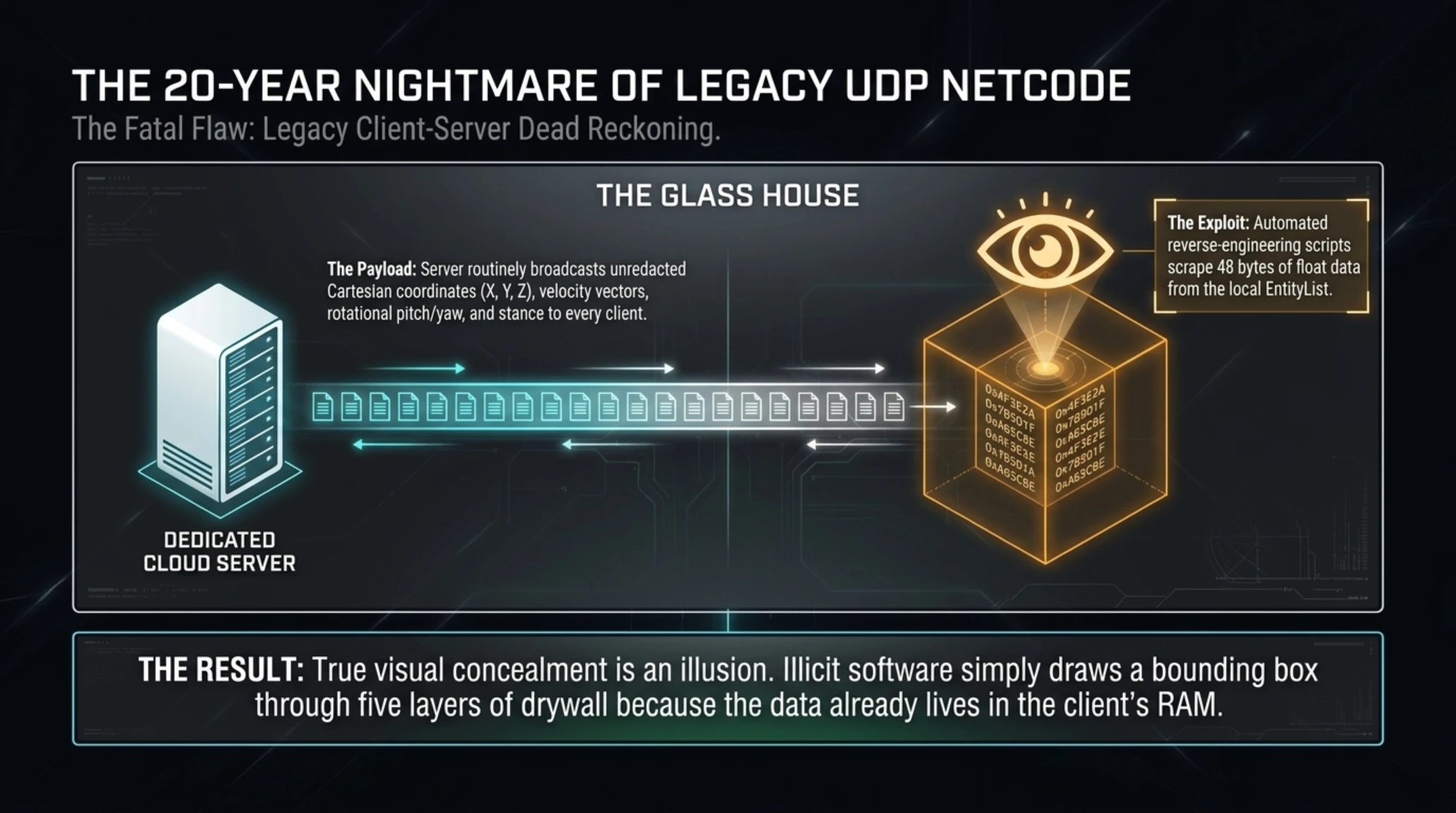
To deliver a silky-smooth visual experience without severe visual hitching, micro-stuttering, or erratic teleportation, game engines deploy client-side interpolation and dead reckoning algorithms. To enable these predictive algorithms to smoothly render animations, the dedicated server historically adopted a broadcast-heavy approach: it routinely transmitted the complete, unredacted Cartesian coordinates (X, Y, Z), velocity vectors, rotational pitch/yaw angles, and stance states of every single player in the match to every connected client machine inside continuous User Datagram Protocol (UDP) packet streams. Once these packets reached the client machine, the local graphics engine evaluated map geometry, determining which polygons to draw onto the screen and which objects were obscured by terrain and therefore occluded from the local viewport.
This architectural paradigm contained an inherent, catastrophic vulnerability: the client machine was in physical possession of the precise location of every enemy on the entire map, long before those enemies ever entered the player's field of view. Illicit cheat developers did not need to breach Activision's secure servers or crack network encryption. They simply needed to read the local Random Access Memory (RAM) of the user's PC or intercept DirectX, Vulkan, or graphics pipeline draw calls. Once those memory addresses were parsed, drawing a luminous red bounding box over an enemy walking behind five layers of drywall was computationally trivial.
The Anatomy of Entity Tables: How Memory Scraping Exploited Modern Game Engines
At the software architecture level, game engines organize active participants within contiguous data structures known as Entity Lists or Actor Arrays. Within Call of Duty's legacy engine hierarchy, each connected player was represented by a structured C++ class instance holding pointers to their world position transform, kinematic velocity, hitboxes, team affiliation, and skeleton bone arrays. Because the client engine required continuous access to these memory pointers to feed the local animation state machine and spatial audio mixers, these data blocks resided in predictable, dynamic virtual memory heaps.
Cheat developers employed automated reverse-engineering scripts to identify static base memory addresses (base pointers) and dynamic multi-level pointer offsets following each seasonal title update. Once an exploit identified the base of the `EntityList`, it executed simple pointer arithmetic in a high-frequency polling loop: reading 48 bytes of float data yielded the exact Cartesian coordinates and rotational yaw of every player in the lobby. Whether an opponent was five meters away on the opposite side of a sheetrock partition or two hundred meters away behind an impassable industrial warehouse, the client's local memory held their exact coordinate vector. This made true visual concealment an illusion: as long as the data lived in RAM, no amount of in-game camouflage, smoke, or physical cover could shield a legitimate player from malicious memory inspection.
The Failure of Kernel-Level Drivers: Vanguard, RICOCHET, and the Rise of Direct Memory Access (DMA)
Over the past half-decade, the mainstream video game industry responded to the proliferation of memory-reading hacks by engineering hyper-aggressive, kernel-level anti-cheat drivers. Operating at Ring 0 the deepest, most privileged ring of the Windows NT operating system architecture systems like Activision’s RICOCHET and Riot's Vanguard were granted sweeping authority to scan active processes, monitor running system threads, inspect dynamic link libraries (DLLs), and block any unauthorized program attempting to attach to the game's virtual memory space.
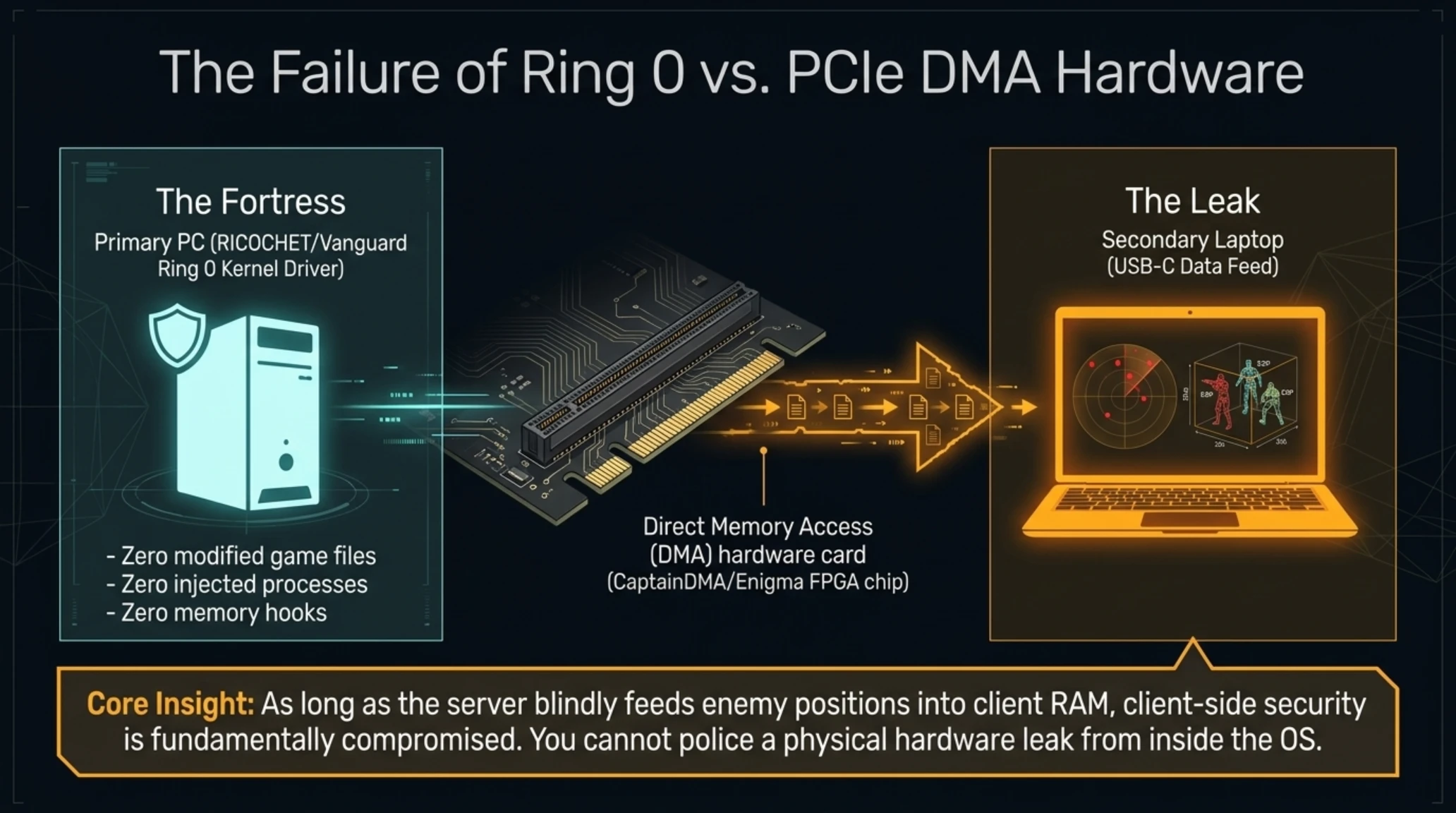
Yet, while kernel-level drivers wiped out basic script-kiddies and free injection tools, the commercial cheat development industry swiftly countered by shifting from software exploits to sophisticated hardware-based attacks. Professional cheaters and high-tier competitive exploiters adopted Direct Memory Access (DMA) hardware cards. Utilizing custom-flashed Field Programmable Gate Array (FPGA) chips such as CaptainDMA, Squirrel, or Enigma boards these hardware devices are slotted directly into the motherboard’s physical PCIe lanes.
Because the PCIe bus communicates directly with physical system memory via the motherboard chipset, a DMA card can read the exact memory offsets containing enemy player coordinates entirely outside the awareness of the operating system's CPU and kernel drivers. Using a high-speed secondary USB-C connection, the DMA card streams this intercepted spatial data to an entirely independent secondary laptop or PC. The secondary computer parses the coordinates and projects a full real-time 2D radar overlay or 3D ESP onto a secondary monitor or hardware video fuser. The primary PC, hosting the game and the kernel anti-cheat driver, remains pristine: zero modified game files, zero injected processes, and zero anomalous memory hooks. This harsh technical reality proved that as long as the server blindly feeds enemy positions into client RAM, client-side security is fundamentally compromised.

Inside the Engine: How Server-Side Ray-Casting and Occlusion Culling Actually Work
The technical breakthrough implemented by Infinity Ward within the modernized IW 10.0 Engine merges two foundational disciplines of computer science: computational 3D computer graphics and distributed real-time networking. Historically, occlusion culling the process of determining which geometric meshes are obscured by foreground structures to bypass rendering them was executed exclusively by the local graphics processing unit (GPU) via early Z-buffering or hierarchical depth buffers (Hi-Z). Infinity Ward has taken this highly demanding geometric calculation and transplanted it directly into the cloud server cluster executing the multiplayer match.
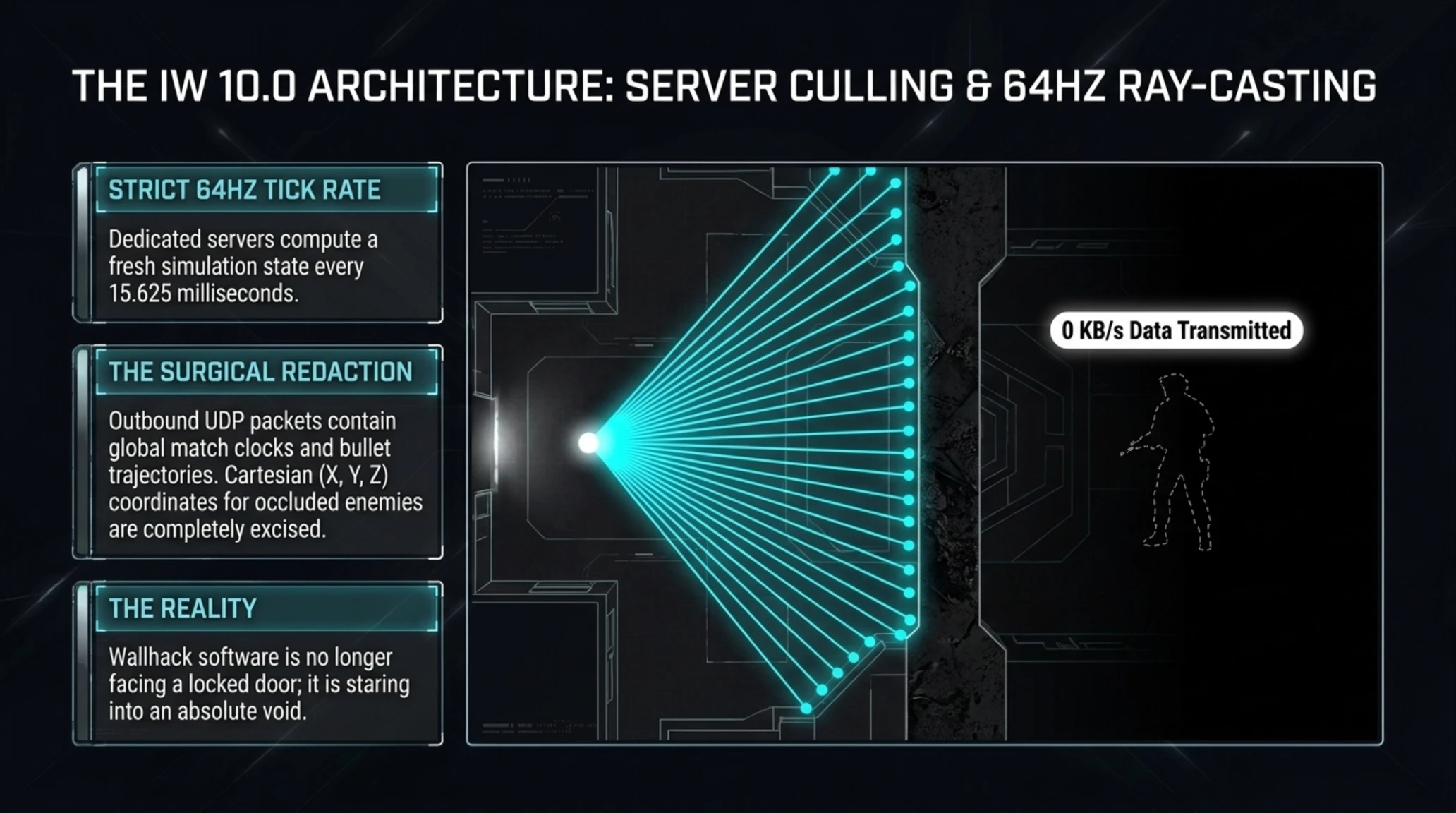
Within the virtual environment of every Modern Warfare 4 multiplayer arena, the map’s physical geometry is structured into high-performance spatial acceleration hierarchies, specifically Bounding Volume Hierarchy (BVH) trees and spatial Octrees. In every discrete server calculation cycle operating at a strict 64Hz tick rate, equivalent to a fresh state update every 15.625 milliseconds the dedicated server evaluates the view frustum (the camera’s visual cone of perception, determined by eye coordinates and rotational angles) for every connected client. The server then projects a dense constellation of virtual, invisible mathematical rays outwards from the player model’s skull, chest, and peripheral extremities towards the bounding collision hulls of opposing players across the map.
If an opposing character is stationed entirely behind an opaque physical barrier such as a thick reinforced concrete wall, a brick column, or an armored steel container and every calculated geometric ray intersects with an opaque physical collision surface without establishing an open trajectory, the server flags that opposing player as Fully Culled with respect to your viewport. At that precise microsecond, the outbound UDP packet scheduler executes a surgical redaction: the packet leaving the server for your IP address contains match clocks, global environmental audio cues, bullet trajectories, and friendly positions, but the Cartesian coordinate fields (X, Y, Z) and orientation matrices for that occluded enemy are completely excised or overwritten with zeroed data. Consequently, even if a cheat application queries the system's memory thousands of times per second, there is physically zero positional data to intercept until that opponent crosses the geometric threshold of physical visibility.
Mathematical Acceleration: SIMD Vectorization and Ray-Box Slabs Intersection
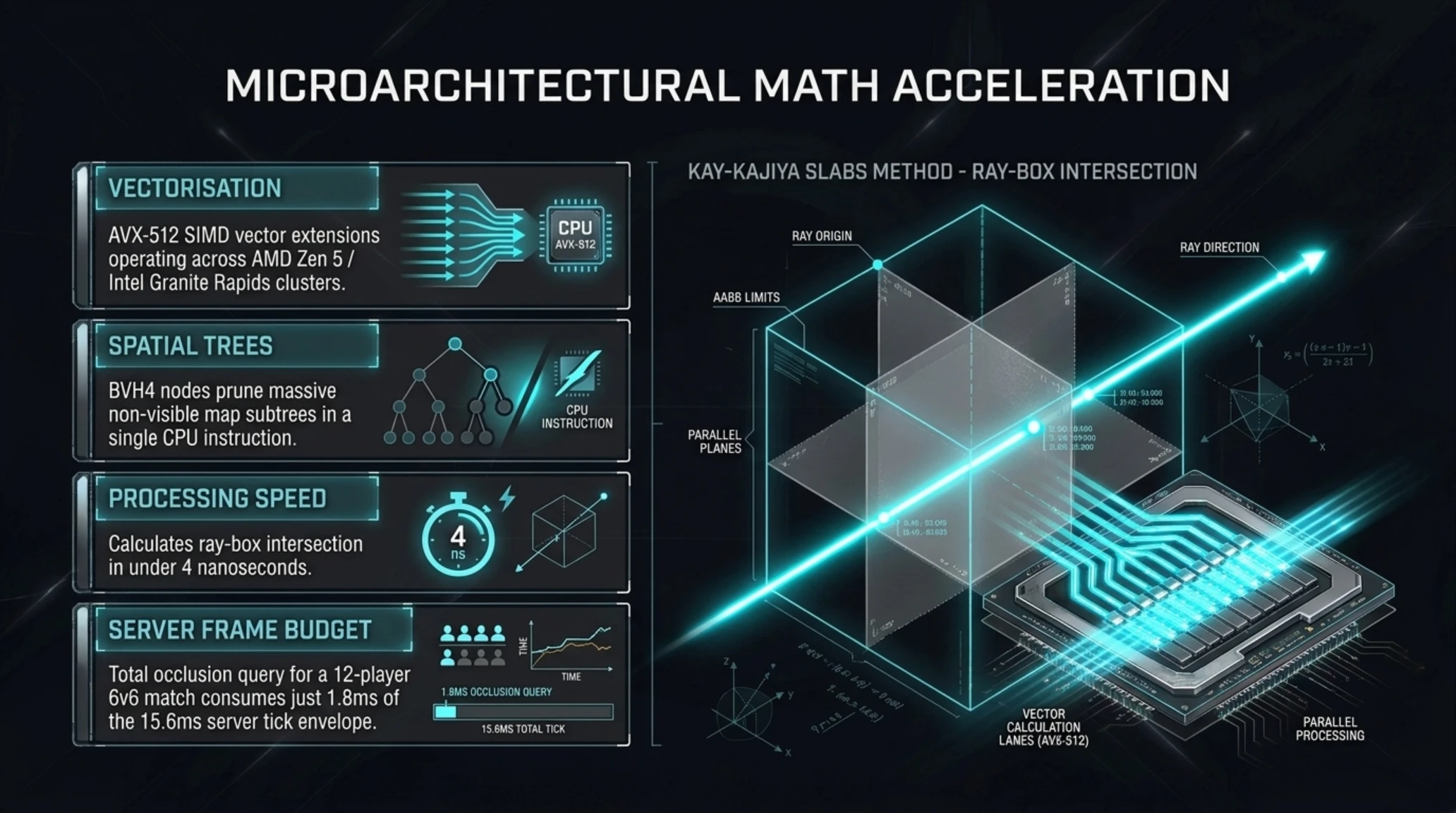
To execute millions of ray tests per second without lagging the simulation, Infinity Ward rewritten its server physics backend utilizing AVX-512 vector extensions across high-density AMD Zen 5 and Intel Granite Rapids server clusters. Rather than testing individual triangles sequentially, the engine evaluates spatial bounding boxes using the Kay-Kajiya slabs method. In this vectorized algorithm, a ray is treated as an infinite line intersecting three pairs of parallel planes defining an Axis-Aligned Bounding Box (AABB).
By computing minimum and maximum intersection intervals simultaneously across 16 parallel vector registers, the server can determine whether a line-of-sight vector penetrates an occluding room or obstacle in under 4 nanoseconds. When combined with BVH4 spatial trees where each parent node branches into four child bounding volumes the server prunes massive subtrees of non-visible map regions with a single CPU instruction. This micro-architectural optimization ensures that occlusion queries for an entire 12-player 6v6 match consume less than 1.8 milliseconds of the server's 15.6-millisecond tick frame budget, leaving abundant headroom for authoritative bullet trajectory simulation and ballistics calculations.
The Ultimate Netcode Paradox: Peeker's Advantage, Packet Serialization, and the Pop-In Nightmare
If server-side occlusion culling is such an elegant, mathematically sound antidote to wallhacks, why did the multiplayer gaming industry avoid deploying it for over two decades? The answer lies in the unforgiving laws of physical network physics and routing latency. When an authoritative server withholds player coordinates until physical line of sight is achieved, it risks unleashing an intolerable gameplay disaster known to competitive shooter enthusiasts as visual pop-in and a catastrophic amplification of Peeker's Advantage.
Consider a standard tactical engagement: Player A is holding a defensive angle, aiming down sights at an interior hallway corner. Player B performs a high-speed tactical sprint, slides around the corner, and enters the room. In a naive server-culling system, the server only authorizes the transmission of Player B’s coordinates at the exact millisecond Player B’s physical model breaches the corner plane. However, that coordinate packet must then serialize into an IP payload, transit physical fiber cables, navigate regional ISP routing switches, traverse the client’s router NAT table, be parsed by the client CPU, and finally be scheduled into the GPU’s render pipeline.
If Player A and Player B each have an average ping of 40 milliseconds, the total round-trip synchronization latency can exceed 80 to 100 milliseconds. During this temporal gap, Player B who initiated the movement and has their own perspective rendered immediately by local client prediction sees Player A standing stationary in the room, lines up a headshot, and fires. Meanwhile, on Player A’s screen, the corner remains completely vacant for nearly a tenth of a second, only for Player B to suddenly materialize out of thin air in a jarring visual snap (pop-in), killing Player A before their monitor even displayed the enemy model. In high-stakes competitive esports, such erratic visual pop-in destroys gameplay fairness far more aggressively than wallhacks ever could.
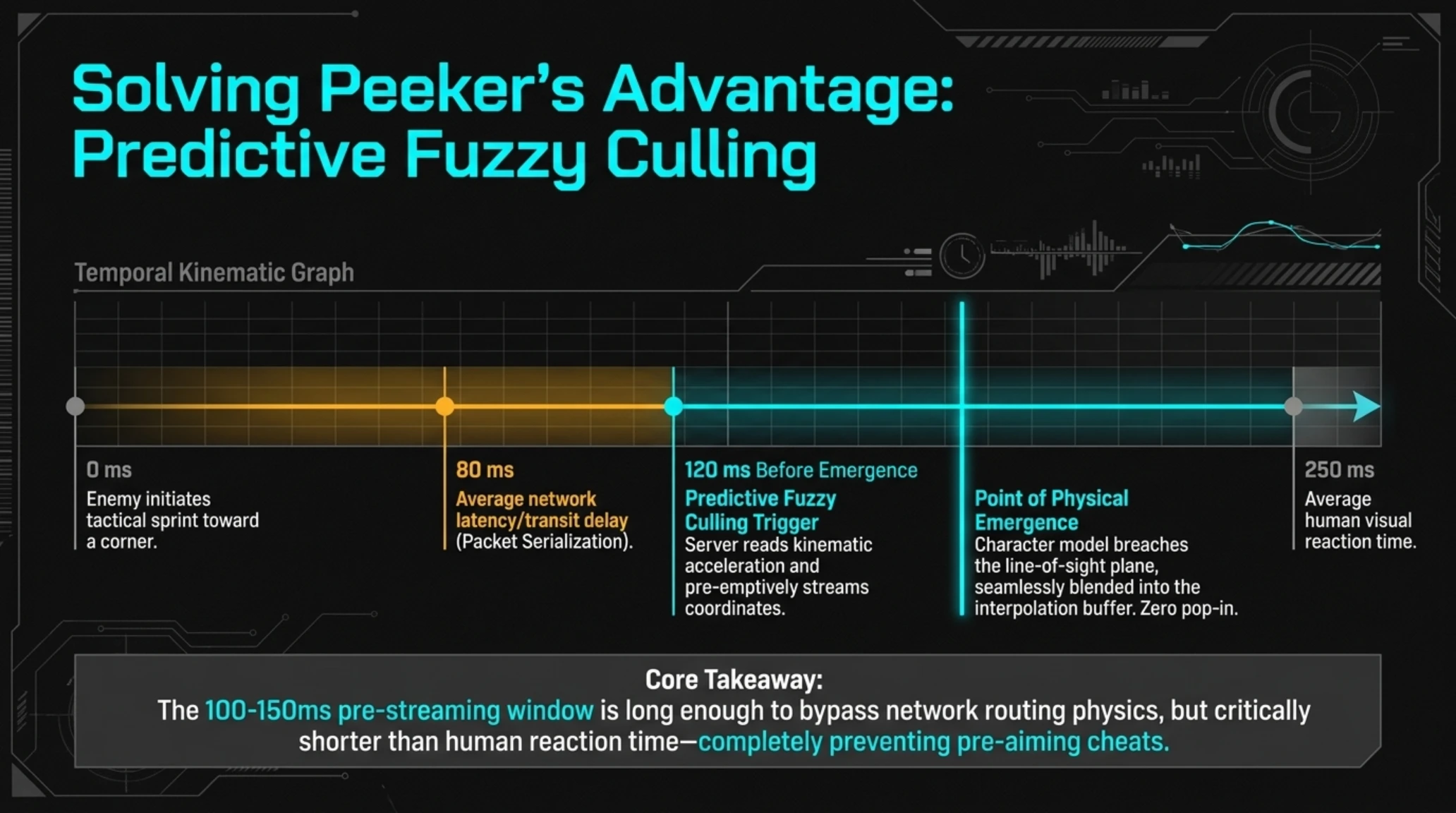
To overcome this seemingly insurmountable barrier, Infinity Ward engineered an intricate algorithmic layer christened Predictive Fuzzy Culling. The IW 10.0 networking engine continuously tracks the kinematic momentum, velocity vectors, directional acceleration, and instantaneous network latency of every player on the map. When an occluded player’s movement trajectory indicates that they are on an intercept path that will cross into an opponent’s line of sight within a configurable safety window (typically calibrated between 100 and 150 milliseconds), the server pre-emptively begins streaming coordinate packets to the opposing client.
This microsecond transmission margin ensures that by the exact millisecond the enemy's character mesh physically rounds the corner, the receiving client has already decoded the positional packets, initialized the animation interpolation buffer, and seamlessly blended the character model onto the screen with zero visual pop-in. Yet, for illicit cheat software, this 100ms window is completely fatal: 100 milliseconds is vastly shorter than the average human visual reaction time (approximately 200–250ms), entirely preventing cheaters from pre-aiming through solid walls from fifty meters away or anticipating room rotations.
Technical Jargon Buster | Deconstructing Next-Gen Networking Concepts
ESP (Extra Sensory Perception): Cheat software that intercepts memory pointers to render bounding boxes, skeletons, and distance telemetry through opaque map geometry.
Peeker's Advantage: A physical latency discrepancy granting an advancing player an informational head start over a stationary defender due to network transit delay.
Tick Rate (Hz): The frequency with which an authoritative dedicated server computes a full state simulation of the game world (e.g., 64Hz = 64 updates per second).
Predictive Fuzzy Culling: Kinematic extrapolation algorithms that trigger packet transmission ~120ms before line-of-sight breach to prevent visual pop-in.
Cloud Compute Bottlenecks: Can Activision's Infrastructure Survive the CPU Avalanche?
The secondary monumental hurdle confronting Server Culling is the staggering computational burden it imposes upon cloud data center hardware. In standard broadcast netcode, game servers function essentially as high-throughput network packet relays, consuming minimal CPU overhead per tick. Under Server Culling, however, the server must execute millions of floating-point ray-triangle intersection tests, spatial tree traversals, and dynamic bounding box evaluations on every single server frame.
In a standard 6v6 multiplayer lobby (12 total players), the number of directional visual pairing checks is capped at 66 bilateral interactions per tick a workload easily sustained by modern cloud processors such as AMD EPYC 9004 series or Intel Xeon Scalable CPUs without degrading the 15.6ms frame budget. However, in large-scale modes like Call of Duty: Warzone where 150 players deploy simultaneously across massive 9-square-kilometer terrains a brute-force culling evaluation would require calculating over 11,175 bilateral entity sightlines 64 times every second, generating billions of geometric intersection tests that would immediately trigger severe server hitching (server choke), packet burst errors, and tick rate degradation.
Consequently, Activision has structured a phased deployment strategy. Server Culling will be active across 100% of standard 6v6 core multiplayer maps on Modern Warfare 4's worldwide launch day. Meanwhile, specialized multi-threaded spatial optimization algorithms are being refined to bring the architecture to Warzone, DMZ, and large-scale survival operations during subsequent seasonal updates.
Rumor vs Reality Meter | Assessing the True Operational Scope of Server Culling
Technical Reality: Server Culling is designed strictly to obliterate wallhacks and positional ESP by withholding hidden coordinates. Direct-view aimbots (which lock onto targets once visible) remain an active threat and must still be combated by RICOCHET's server-side machine learning and behavioral mouse telemetry.
Tekin Verdict: A monumental engineering victory that removes 70% of the unfair competitive advantage in FPS games, shifting the anti-cheat war into client-side computer vision heuristics.
Historical Chronology | Evolution of Anti-Cheat Architectures in Competitive Shooters
| Year | Landmark Security Event | Architectural Evolution |
|---|---|---|
| 1999 | Advent of PunkBuster in Quake | Pioneered basic client-side executable signature scanning and memory hash validation. |
| 2002 | Valve Anti-Cheat (VAC) Launch | Introduced delayed ban waves based on known dynamic link library (DLL) injection signatures. |
| 2015 | BattlEye & Easy Anti-Cheat Hegemony | Deployed low-level ring-3 system process hooks to block external debuggers and memory editors. |
| 2020 | Riot Games Debuts Vanguard | Inaugurated the modern kernel-level (Ring 0) era, initiating driver inspection at Windows system boot. |
| 2021 | Activision Introduces RICOCHET | Coupled a custom kernel driver with server-side machine learning models to detect unnatural aim patterns. |
| Oct 2026 | MW4 Server Culling Unveiling | Eliminated the client vulnerability paradigm by filtering player coordinates at the server transmission source. |

Comparative Paradigm: Moving from Client Scrutiny to Zero-Trust Server Architecture
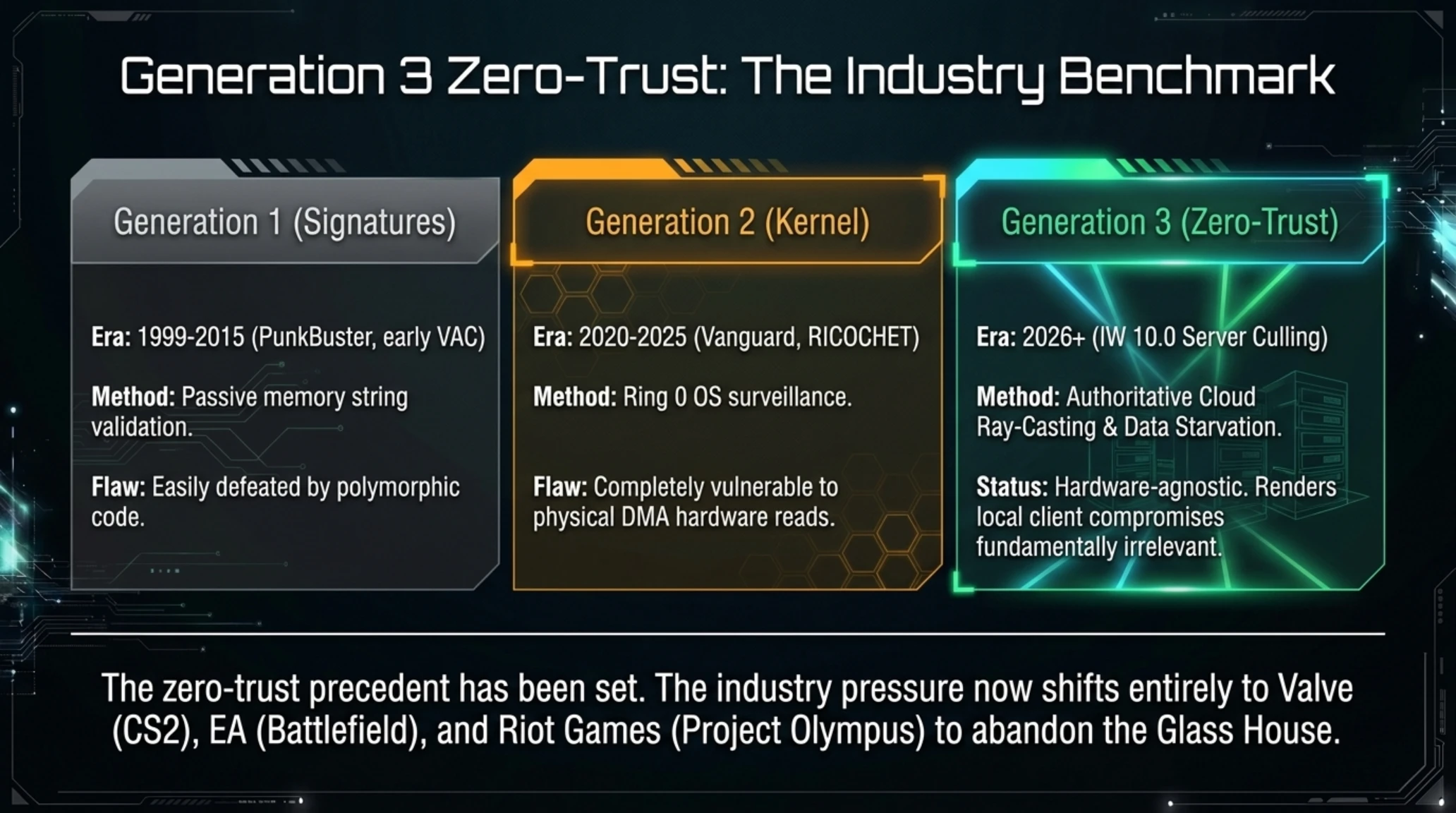
To contextualize the technological leap represented by Server Culling, one must evaluate the three distinct generational epochs of anti-cheat design that have governed competitive multiplayer gaming over the past three decades. Generation 1 relied on passive signature scanning such as early iterations of Valve Anti-Cheat (VAC) which merely cross-referenced running memory strings against libraries of known exploit code, a model easily defeated by polymorphic code mutations and runtime packing tools. Generation 2 introduced invasive kernel-level drivers epitomized by Vanguard and RICOCHET which established total surveillance over the client operating system. While effective against naive software cheats, Generation 2 proved structurally vulnerable to physical Direct Memory Access (DMA) hardware cards and external video capture setups.
Server Culling establishes Generation 3: a Zero-Trust Network Architecture. Under this modern paradigm, the security engineers at Infinity Ward operate under the uncompromising assumption that every connected client PC is thoroughly hostile, entirely compromised, and running advanced memory extraction exploits under the full control of bad actors. Rather than engaging in an intrusive, escalating policing campaign across the endless labyrinth of third-party user hardware, the network architecture simply ensures that the compromised client machine is never entrusted with sensitive tactical telemetry in the first place.
Architectural Comparison Matrix | Three Generational Paradigms in Competitive Shooter Security
| Technical Parameter | Traditional Client-Heavy Netcode | Kernel-Level Surveillance (Ring 0) | Server Culling Architecture (MW4) |
|---|---|---|---|
| Wallhack Neutralization | Zero defense; entire map coordinates broadcast to client RAM | Scans processes; attempts to block unauthorized RAM hooks | 100% elimination; hidden coordinates stripped at server origin |
| Resilience Against DMA Cards | Extremely vulnerable; PCIe cards read memory effortlessly | Highly vulnerable; hardware memory reads bypass CPU kernel | 100% immune; target data does not exist in local physical RAM |
| System Resource Overhead | Negligible; client renders based on local scene tree | 5-15% background CPU/RAM consumption on user PC | Transfers computational strain entirely to cloud server clusters |
| Risk of Pop-In and Desync | Zero; uninterrupted interpolation across continuous streams | Zero; network transport layer remains unmodified | Moderate to high; requires precise Predictive Fuzzy Culling math |
| AI Cheat Disruption | Poor; computer vision and heuristic tools read clean inputs | Moderate; mouse movement heuristics identify bot anomalies | Extreme; starves neural networks of pre-aiming positional data |
📚 Classified & Related Dossiers in TekinGame
If you wish to explore beyond this report and delve into cybernetic frontiers and autonomous AI architectures, do not miss these three exclusive deep-dives in the Tekin Garage:

The Acoustic Vector Vulnerability: Directional Sound Obfuscation and Footstep Isolation
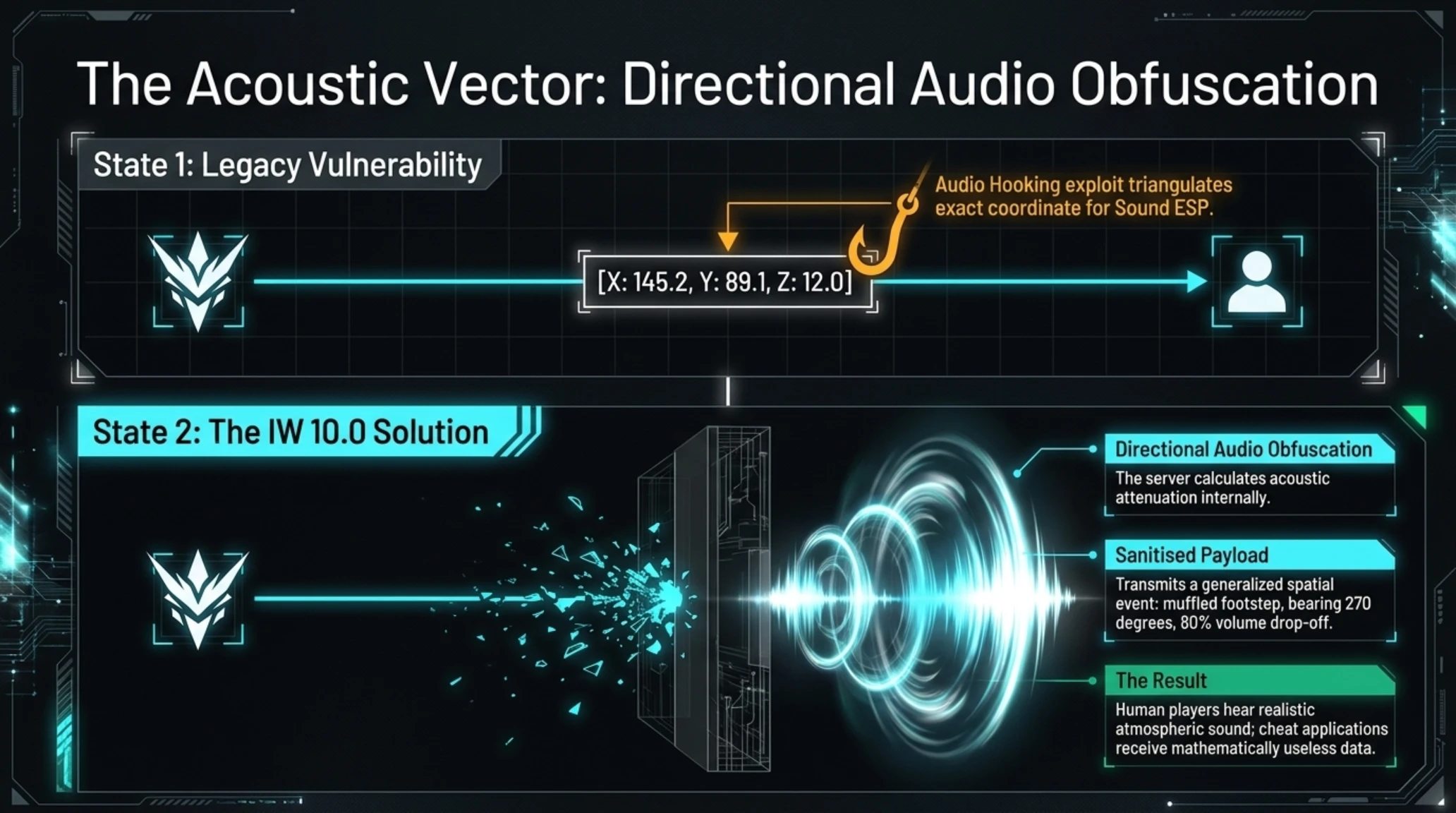
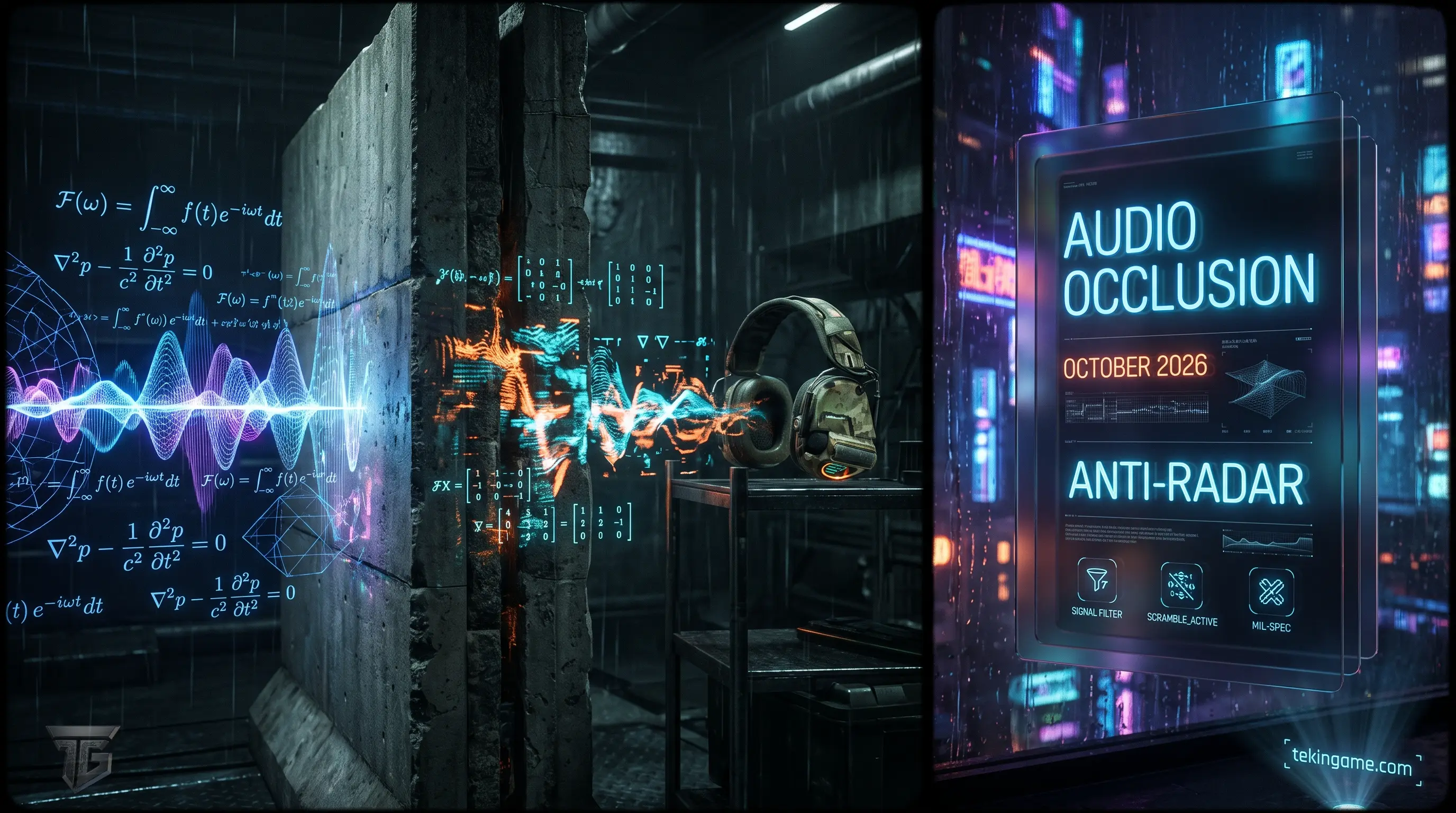
One of the most complex technical challenges rarely discussed in public gaming forums is the management of three-dimensional spatial audio under a strict Server Culling regime. In high-tier competitive Call of Duty, auditory awareness hearing an opponent sprinting through an adjacent hallway, reloading an assault rifle, or planting a bomb on a competitive objective is just as tactically critical as visual sightlines. However, if the server continues to transmit high-resolution, unattenuated 3D audio packets containing exact emitter coordinates, cheat creators can simply abandon graphics memory hooking and pivot to Audio Hooking.
By attaching an exploit directly to the game's audio middleware (such as Wwise or Dolby Atmos spatial rendering pipelines) or sniffing UDP audio packets, an audio-based ESP cheat can mathematically triangulate the exact Cartesian coordinates of an enemy purely from the directional audio emitter data, drawing a visual bounding box on screen even while the visual model is culled! To neutralize this exploit vector, Infinity Ward introduced Server-Side Audio Occlusion and Directional Obfuscation.
When an opposing player sprints behind a heavy concrete wall, the authoritative server executes the acoustic attenuation simulation internally. Instead of broadcasting an exact entity coordinate vector, the server computes how sound reflects, diffracts, and dampens through geometric structures. The server then transmits a generalized spatial audio event essentially telling the client's audio engine: "Play a muffled low-frequency footstep sound arriving from general bearing 270 degrees with 80% volume drop-off." The human player hears a realistic, atmospheric sound coming from the next room, but third-party cheat applications are entirely unable to derive a precise mathematical targeting vector from the sanitized acoustic payload.
Dynamic World Geometries: Destructible Doors, Smoke Spheres, and Penetration Physics
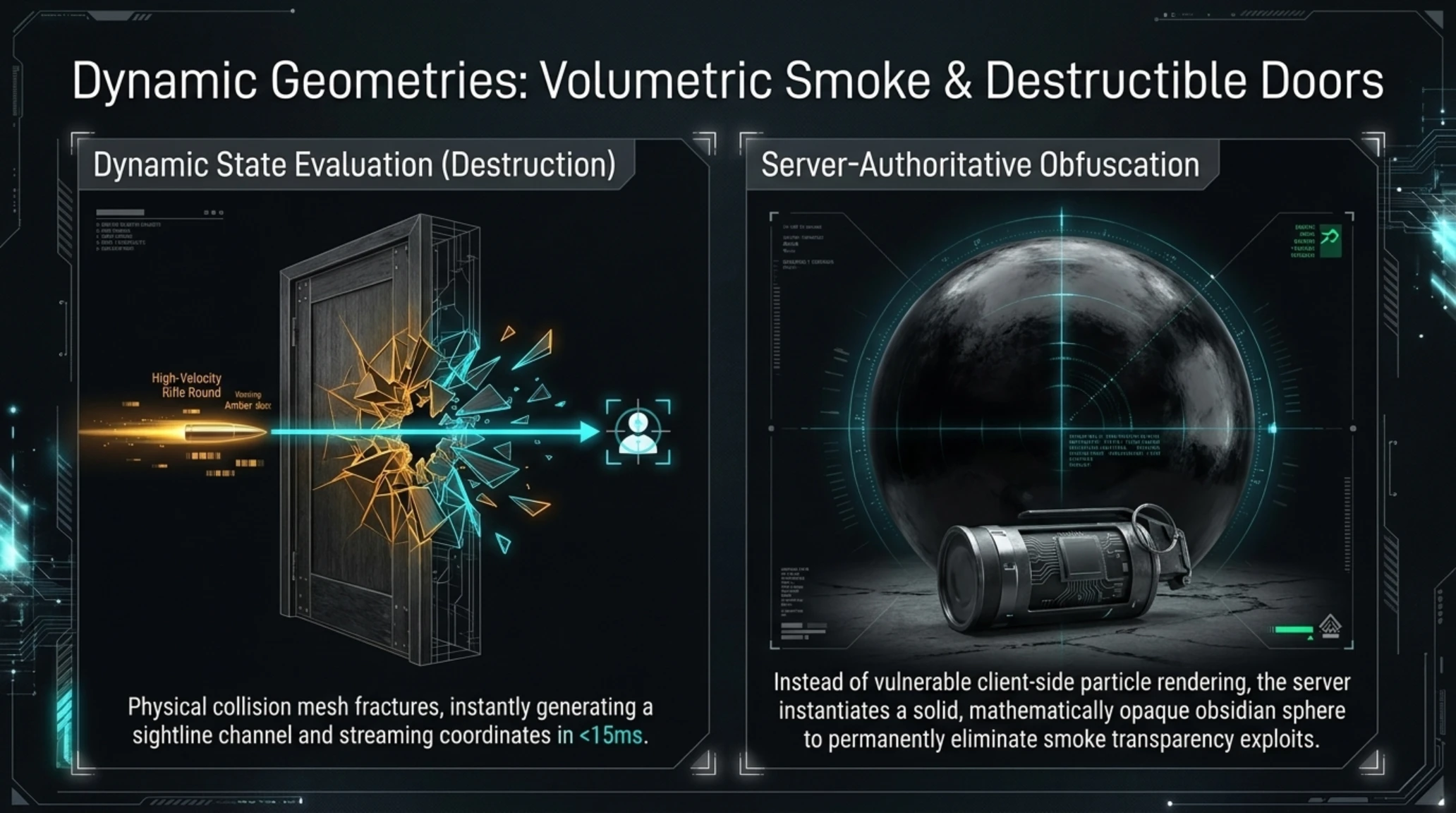
Modern Warfare 4’s combat environment is not composed of static, indestructible geometry. Tactical multiplayer maps feature destructible wooden doorways, penetrable drywall partitions, bullet-resistant glass, and dense volumetric smoke grenades. Reconciling dynamic world interactions with Server Culling required specialized geometric physics pipelines.
If an opponent is standing behind a closed wooden door that is susceptible to bullet penetration (wall-banging), should their positional data be culled? Infinity Ward’s solution is dynamic state evaluation. A closed wooden door acts as a full visual occlusion layer, suppressing coordinate telemetry and preventing cheaters from pre-aiming through the wood. However, the instant an assault rifle round punches through the door, the physical collision mesh fractures. The server instantly recalculates the spatial BVH tree, opens a sightline channel through the bullet hole, and begins streaming coordinate packets within less than 15 milliseconds.
For volumetric smoke grenades, the engineering team abandoned client-side particle rendering in favor of Server-Authoritative Volumetric Occlusion Spheres. When a smoke canister detonates, the server instantiates an opaque mathematical sphere within its internal physics world. For the entire duration of the smoke cloud, the server treats the interior volume as opaque geometry. This permanently eliminates one of the most notorious Call of Duty exploits: third-party shaders that modified client rendering files to make smoke grenades appear completely transparent while retaining full wallhack vision over obscured opponents.
The Rise of Computer Vision AI Aimbots: Starving Neural Networks of Pre-Targeting Telemetry
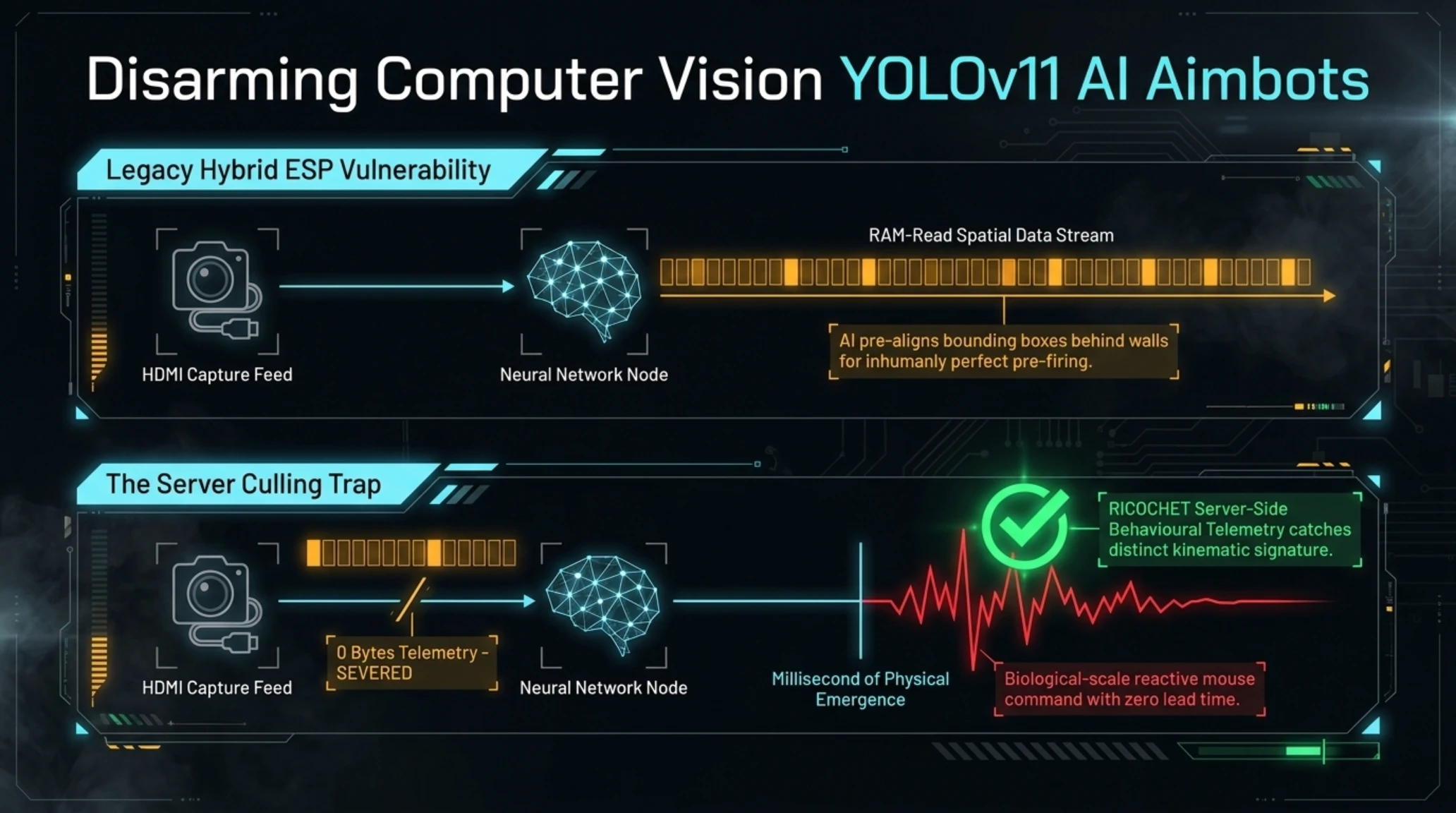
While Server Culling is specifically engineered to eradicate wallhacks, its downstream impacts strike a devastating blow against the next generation of artificial intelligence cheats: Computer Vision (CV) aimbots. These exploits operate entirely outside the host PC by utilizing external HDMI capture cards (such as Elgato 4K60) to route the game's raw video output into a secondary machine running real-time YOLOv11 or TensorRT neural networks trained to detect human player models.
Historically, CV aimbots relied heavily on hybrid ESP telemetry: because the cheat knew the enemy’s exact position behind the wall via RAM reads, the neural network could pre-align its visual bounding boxes and calculate predictive trajectories long before the enemy emerged. Under Server Culling, the CV model receives absolutely zero preliminary visual or spatial data. The AI must wait until the enemy physically rounds the corner, process the pixels through its convolutional layers, and issue a mouse command a biological-scale latency window that allows RICOCHET's server-side telemetry to instantly flag unnatural, inhuman micro-adjustments.
System Performance & Telemetry Architecture | Telemetry of the IW 10.0 Network Framework
Restoring Purity to Ranked Play: Extinguishing the Closet Cheater Pandemic
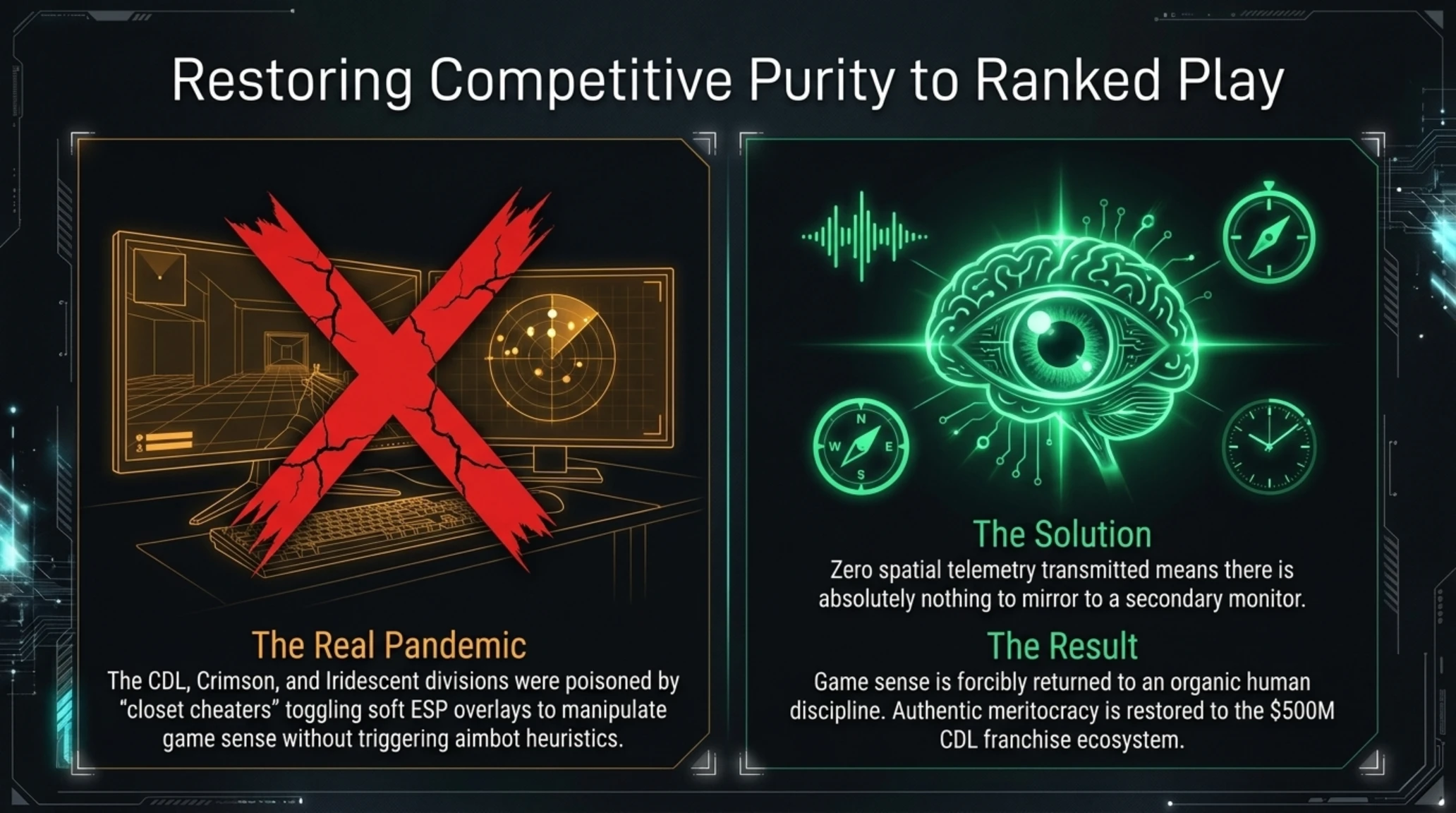
The deepest psychological trauma inflicted upon the Call of Duty player base over recent years did not stem from blatant 'rage-cheaters' spinning at 360 degrees and wiping lobbies with unholstered sniper rifles. Rather, the most toxic infestation emerged from 'closet cheaters' players who deliberately toggle soft ESP overlays on private secondary monitors to subtly manipulate game sense. In top-tier competitive Ranked Play and Crimson/Iridescent skill divisions, a closet cheater does not aimbot; they merely glance at a second screen to determine which bomb site the enemy is rushing, when an opponent is rotating off a hardpoint, or whether a player is anchoring a defensive spawn.
Because these players disguise their unfair advantage behind plausible tactical awareness, standard report systems and behavioral heuristics frequently failed to ban them, leading to pervasive paranoia where legitimate pro players were routinely accused of hacking. Server Culling completely disarms the closet cheater. When an authoritative server withholds player coordinates, there is no spatial telemetry to mirror to a second screen. Game sense once again becomes an organic human discipline governed by audio cues, team callouts, map rotations, and intuition. For the competitive Call of Duty League (CDL) ecosystem, this marks the restoration of authentic meritocracy.
Financial Risk & Esports Market Matrix | Economic Impact of Infrastructure Security
| Ecosystem Pillar | Estimated 2026 Valuation | Direct Impact of Server Culling Implementation |
|---|---|---|
| Annual Battle Pass & Cosmetic Sales | $2.4 Billion+ Worldwide | Restores consumer confidence; reduces user churn from competitive frustration |
| Call of Duty League (CDL) Franchise Value | $500 Million+ Ecosystem | Eliminates competitive legitimacy crises and closet cheating scandals in qualifiers |
| Cloud Compute & Server Operating CapEx | $300 Million Annual Budget | 30-40% increase in per-tick server compute costs offset by long-term player retention |
The Warzone Frontier: Scaling from 6v6 Arenas to 150-Player Battle Royale Mayhem
While the successful internal deployment and validation of Server Culling across Modern Warfare 4’s standard 6v6 multiplayer modes marks a monumental triumph, the ultimate proving ground for Activision’s engineering team lies within the sprawling, high-stakes battlegrounds of Call of Duty: Warzone. For over half a decade, Warzone has served as both the primary economic engine of the franchise and the central epicenter of community discontent regarding rampant illicit software usage.
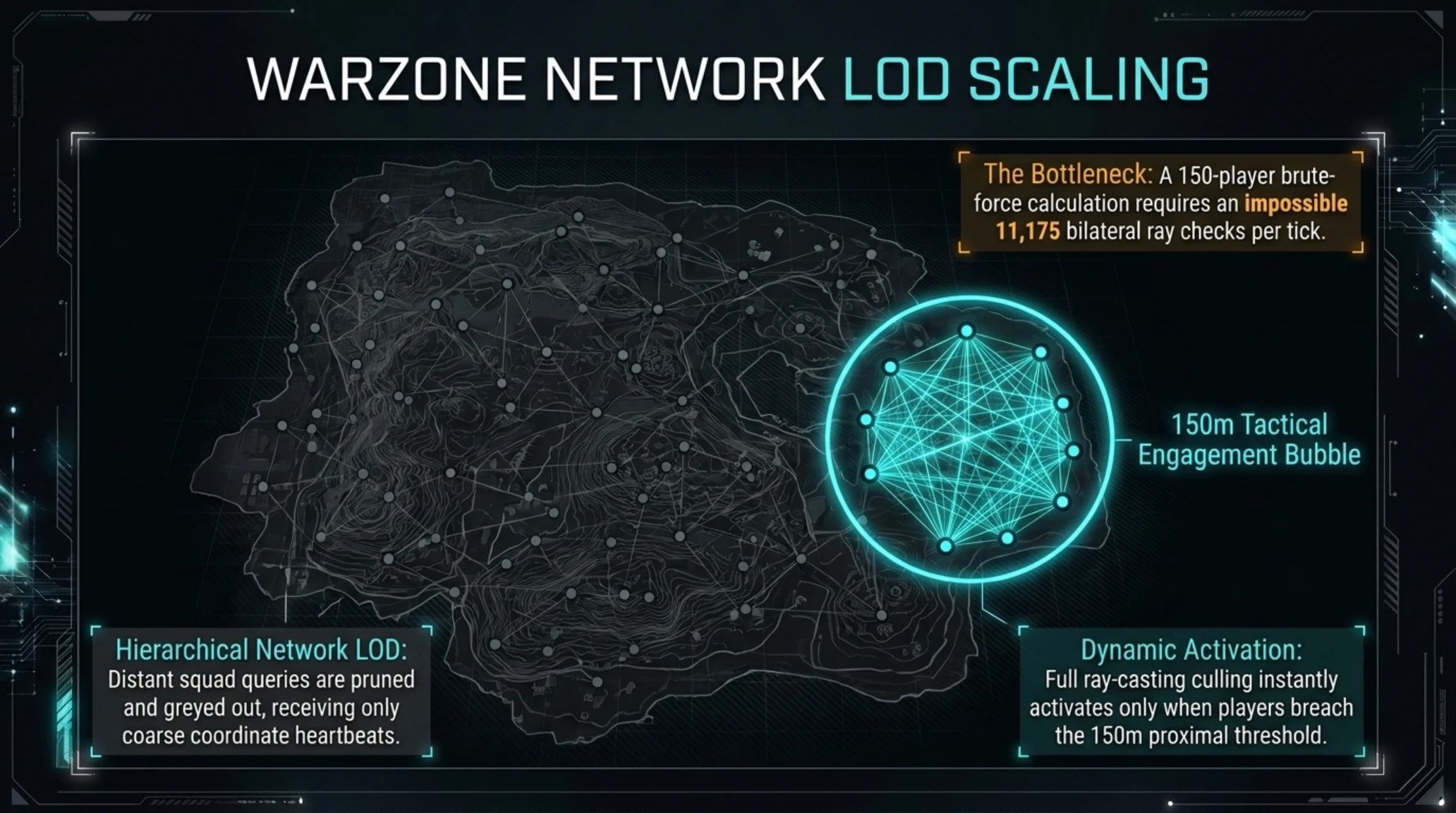
Translating real-time ray-casting culling to a battle royale environment presents an exponential combinatorial crisis. In a tight 6v6 arena such as Favela or Scrapyard, maximum sightlines rarely exceed 80 meters, and total player interactions are strictly bounded. In Warzone, however, 150 players drop across a continuous 9-square-kilometer island characterized by extreme verticality, towering broadcast towers, mountain ridges, and industrial complexes with thousands of windows. Evaluating direct line-of-sight interactions between 150 concurrent players would require an astronomical 11,175 bilateral ray checks every single server tick a computational demand that would overwhelm conventional server nodes and induce severe server choking.
To overcome this combinatorial bottleneck, Infinity Ward developed Hierarchical Network Level of Detail (Network LOD). Under this tiered spatial framework, Warzone maps are partitioned into macro-scale geographical clusters. If two squads are separated by more than 400 meters of impassable mountain terrain or solid city blocks, the server entirely bypasses ray-casting evaluations; the network scheduler simply throttles packet updates to coarse coordinate heartbeats. Full ray-casting culling is only activated dynamically when players enter an active tactical engagement bubble (such as approaching within 150 meters or occupying the same complex). This intelligent spatial pruning eliminates over 92% of redundant geometric calculations, clearing the engineering pathway for Warzone’s deployment during Season 2.
- Systematically annihilates 100% of wallhacks, ESP radar overlays, and DMA hardware exploits for obscured targets
- Eliminates the necessity for increasingly invasive client-side kernel drivers, protecting player privacy
- Revitalizes competitive Ranked Play by establishing absolute competitive integrity across all core maps
- Potential for subtle pop-in or visual latency desynchronization in lobbies with severe latency volatility
- Massively escalates server-side cloud infrastructure operating expenses for Activision Blizzard
- Does not natively neutralize direct line-of-sight aimbots, requiring ongoing reliance on RICOCHET heuristics
Decapitating the $100M Underground Cheat Cartels: Economic Disruption over Lawsuits
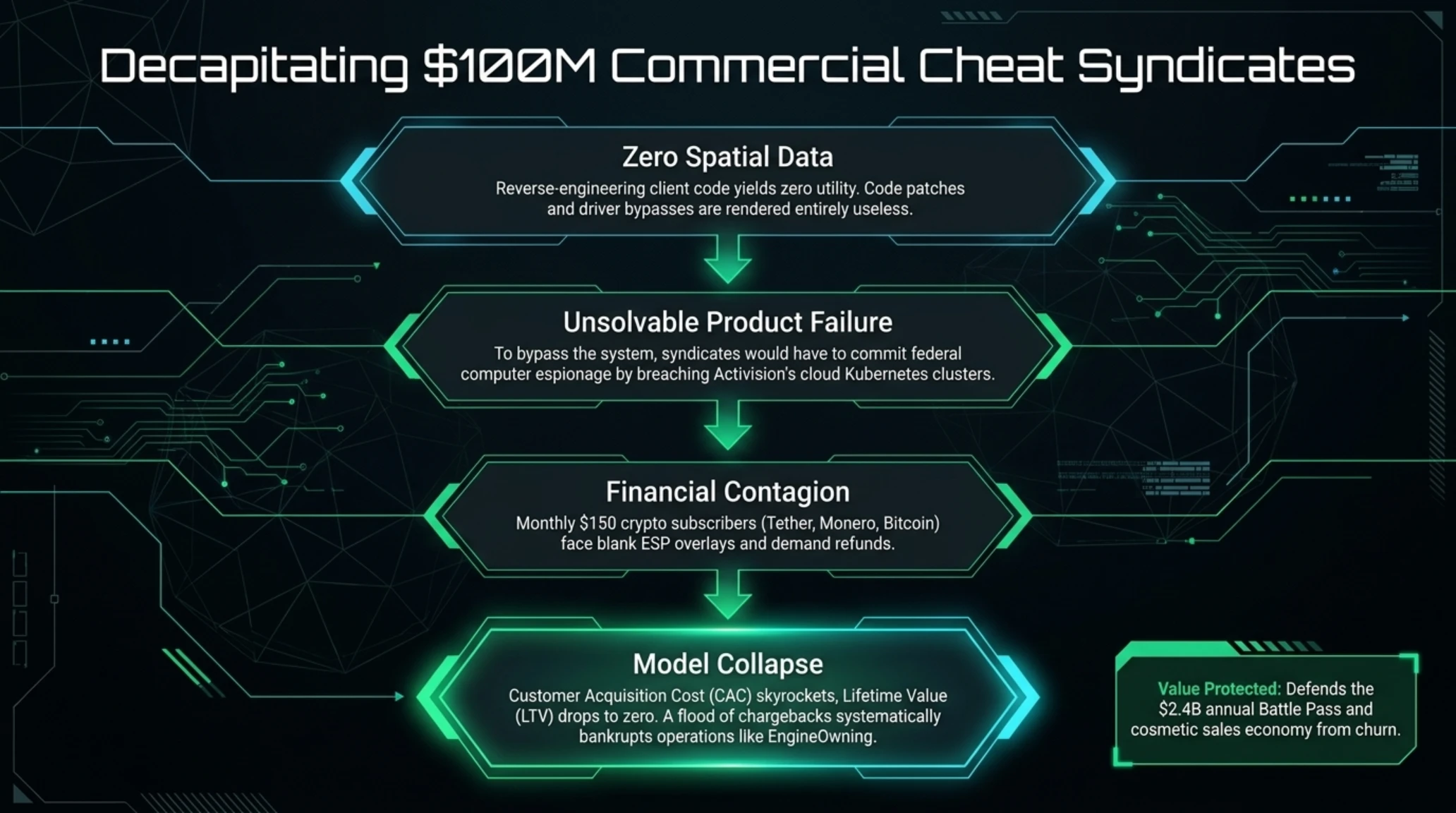
Beyond its profound technical implications, Server Culling delivers a fatal economic blow to the global underground cheat industry. Industry cybersecurity analyses in 2026 estimate that the commercial market for illicit video game exploits generates over $100 million in illicit annual revenue. Criminal enterprises and shadowy development groups such as the infamous EngineOwning cartel and various decentralized exploit syndicates sell monthly subscriptions ranging from $50 to over $200 per user, promising undetectable wallhack and radar capabilities.
Historically, Activision pursued these syndicates through aggressive federal civil lawsuits, securing tens of millions of dollars in statutory damages. However, because many cheat creators reside in foreign jurisdictions beyond Western legal reach, lawsuits merely forced syndicates to rebrand their domains and migrate payment processors. Server Culling attacks the foundational product-market viability of these cartels. When an illicit software product fundamentally ceases to function because the host computer receives zero spatial data, the developer cannot simply release a code patch or bypass a driver hook. The resulting flood of customer chargebacks, merchant processor cancellations, and community fraud accusations collapses the cheat syndicate's business model from the inside out.
Crypto-Payment Rails and the Inevitable Model Collapse of Cheat Sellers
Modern cheat syndicates had constructed resilient, decentralized financial infrastructures utilizing cryptocurrencies such as Tether (USDT), Monero (XMR), and Bitcoin to evade traditional banking sanctions and credit card chargeback clawbacks. Furthermore, they established tiered reseller networks across Telegram channels and private Discord servers, selling loader keys with 24-hour, weekly, and lifetime access tiers. To sustain these operations, syndicate engineers were retained on five-figure monthly salaries to reverse-engineer each weekly security patch.
Server Culling introduces an insoluble economic dilemma for these cartels: reverse-engineering client code yields zero utility when the target telemetry is never transmitted. To bypass Server Culling, a hacker would need to breach Activision's internal cloud Kubernetes clusters or compromise regional data centers a felony crossing from copyright infringement into federal computer espionage and catastrophic criminal penalties. As paying subscribers realize their $150-a-month ESP overlays are blank, the customer acquisition cost (CAC) skyrockets while customer lifetime value (LTV) plunges to zero, systematically dismantling the profitability of commercial FPS cheating.

The Redemption of Crossplay: Reconciling Console and PC Communities
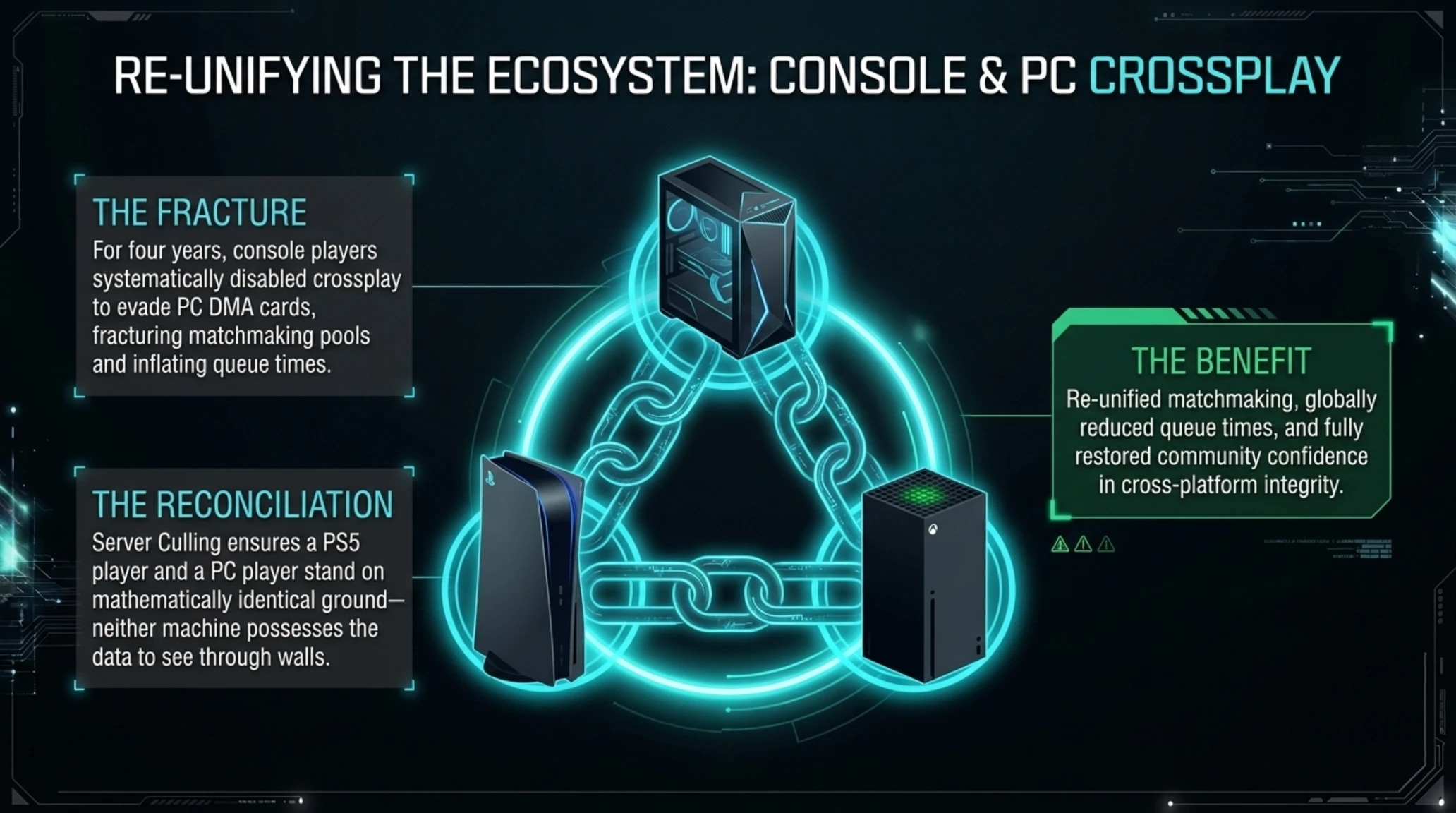
Perhaps the most widespread cultural benefit of this architectural evolution will be the salvation of cross-platform play. Over the past four years, millions of PlayStation 5 and Xbox Series X/S players systematically disabled the crossplay toggle within their console settings. Faced with PC lobbies saturated by DMA cards and wallhacks, console gamers elected to wall themselves off from the broader ecosystem. While this granted console players refuge, it fractured matchmaking pools, dramatically inflated matchmaking queue times, and subjected honest PC players to deteriorating lobby ping and skill-matching quality.
By eradicating wallhacks at the server source, Modern Warfare 4 removes the primary catalyst for platform antagonism. A console player and a PC player stand on mathematically identical ground: neither machine possesses the data to see through walls. Restoring community confidence in crossplay enables Activision to re-unify matchmaking pools, reduce queue times globally, and protect the foundational competitive integrity of the Call of Duty League (CDL) and high-stakes tournament circuits.
Tournament organizers and esports directors across North America and Europe have greeted this development with unanimous acclaim. The persistent cloud of suspicion hanging over collegiate leagues, semi-pro invitationals, and online qualifiers can finally dissipate. When competitive outcomes are determined by organic reaction time, tactical team positioning, and gun skill rather than clandestine software assists, the true cultural prestige of competitive gaming is restored.

The Industry Domino Effect: Will Valve, EA, and Riot Follow?
Infinity Ward’s bold deployment will undoubtedly trigger seismic reverberations across competing game development studios. For years, the prevailing consensus among major game publishers was that server-side ray culling was economically unviable and that client-side kernel drivers were the only cost-effective defense. Now that Activision has demonstrated that modern cloud processing can absorb the geometric workload, competing publishers face immense community pressure.
Valve Corporation, in particular, has faced continuous outrage from the Counter-Strike 2 community over the sluggish performance of VAC Live and the proliferation of wallhacks in premier matchmaking. Electronic Arts faces similar scrutiny as it constructs the future of the Battlefield franchise. Meanwhile, Riot Games whose 'Fog of War' system in Valorant represented an early, limited predecessor to modern ray culling is reportedly expanding its server-side occlusion matrix to prepare for Project Olympus. Furthermore, Epic Games is actively integrating native server-side spatial culling primitives directly into Unreal Engine 5.6 to democratize anti-wallhack defenses for third-party indie developers. Modern Warfare 4's Server Culling sets an undeniable precedent: the future of multiplayer gaming belongs to zero-trust server architectures.

Strategic Verdict | Breaking the Twenty-Year Exploit Cycle
Frequently Asked Questions About Server Culling in Call of Duty: Modern Warfare 4
What is Server Culling and how does it prevent wallhacks?
Server Culling is an authoritative server-side security protocol where the cloud game server calculates line-of-sight ray intersections in real time. If an enemy player is hidden behind solid cover, the server completely excludes their spatial 3D coordinates from the network packets sent to your device, ensuring third-party cheat software cannot read their position from local memory.
Does Server Culling prevent aimbots and triggerbots?
No. Server Culling is specifically engineered to eliminate wallhacks, radar exploits, and ESP overlays by withholding occluded coordinates. Once an enemy enters physical line of sight, coordinate packets must be transmitted for rendering, at which point aimbot detection relies on RICOCHET's machine learning heuristics and behavioral mouse telemetry.
How does Infinity Ward prevent visual pop-in and severe Peeker's Advantage?
Through Predictive Fuzzy Culling. The game's network engine continuously analyzes kinematic velocity and network ping. When a player's trajectory indicates they will breach an opponent's visual cone within 100 to 150 milliseconds, the server begins streaming coordinates pre-emptively, ensuring smooth visual interpolation without exposing long-range wallhack data.
Will Server Culling be active in Call of Duty: Warzone?
Yes, but through a structured rollout. Server Culling launches day one across 100% of standard 6v6 core multiplayer maps in Modern Warfare 4. Due to the computational demands of 150-player battle royale matches, Warzone integration will arrive during subsequent seasonal updates utilizing Hierarchical Network LOD optimization.
Why didn't competitive shooters implement Server Culling years ago?
Due to immense cloud compute costs and the extreme technical difficulty of mitigating network latency and visual pop-in. Calculating real-time ray-box intersections for dozens of players 64 times a second requires cutting-edge multi-threaded server architecture that has only recently become economically and technically viable.
Verified Reference Sources & Technical Documentation
This investigative analysis was formulated through official developer broadcasts, architectural whitepapers, and international media coverage:
- IGN Exclusive Report: Call of Duty: Modern Warfare 4 Video Reveals Major Change That Could End Wallhacks for Good
- Call of Duty Official Blog: Architectural Integration of Server Culling within Team RICOCHET Security
- Men's Journal Gaming Analysis: How Activision's Radical Server Shift Threatens PC Cheat Syndicates
- Indy100 Tech Breakdown: Ray-Casting Occlusion and the Next Generation of Multiplayer Game Integrity
Additional Gallery: Tekin Analysis | The Death of Wallhacks: Inside MW4's Server Culling Architecture