🧠 Welcome to the Deep Dive: Sakana AI Marlin
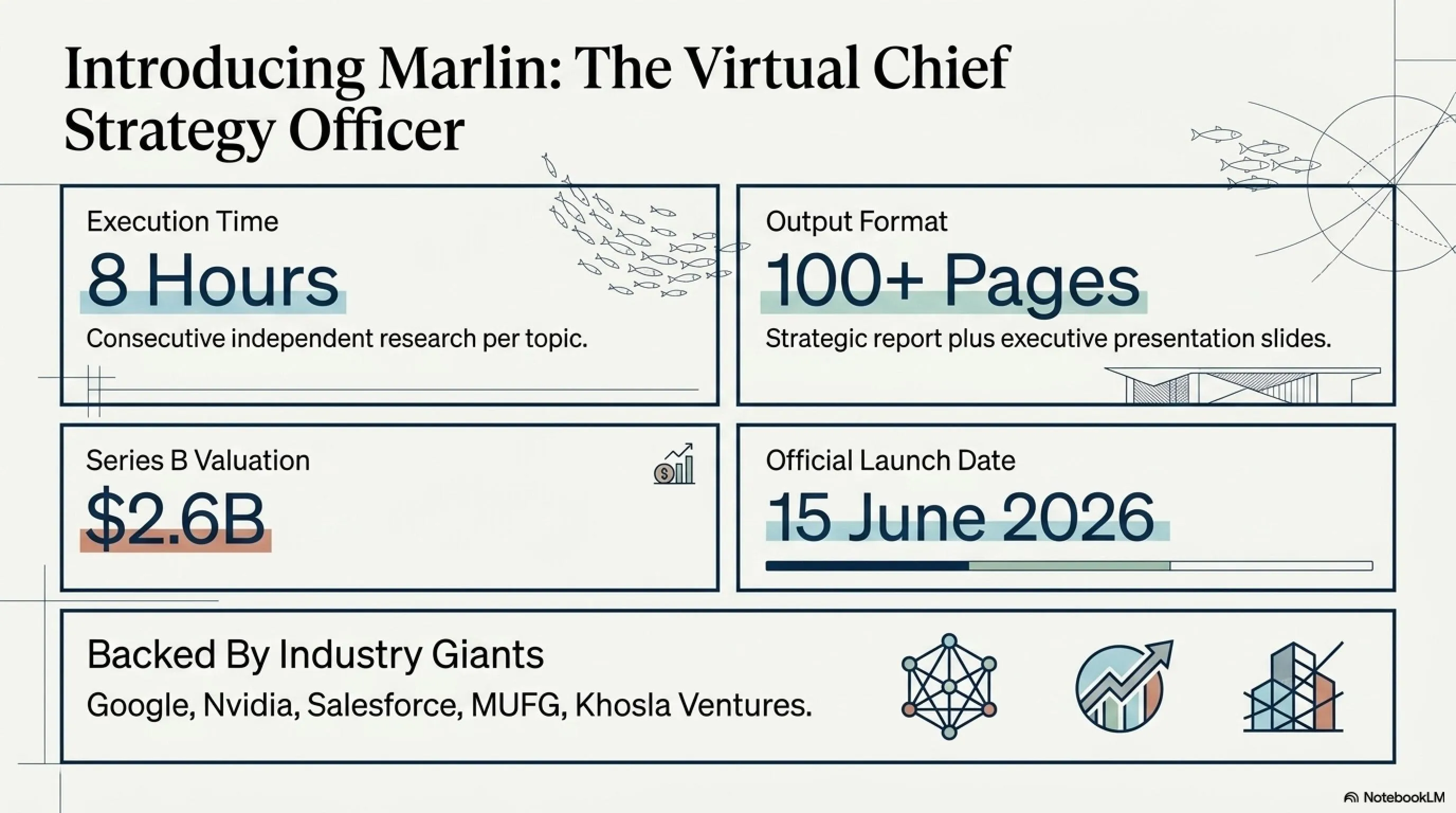
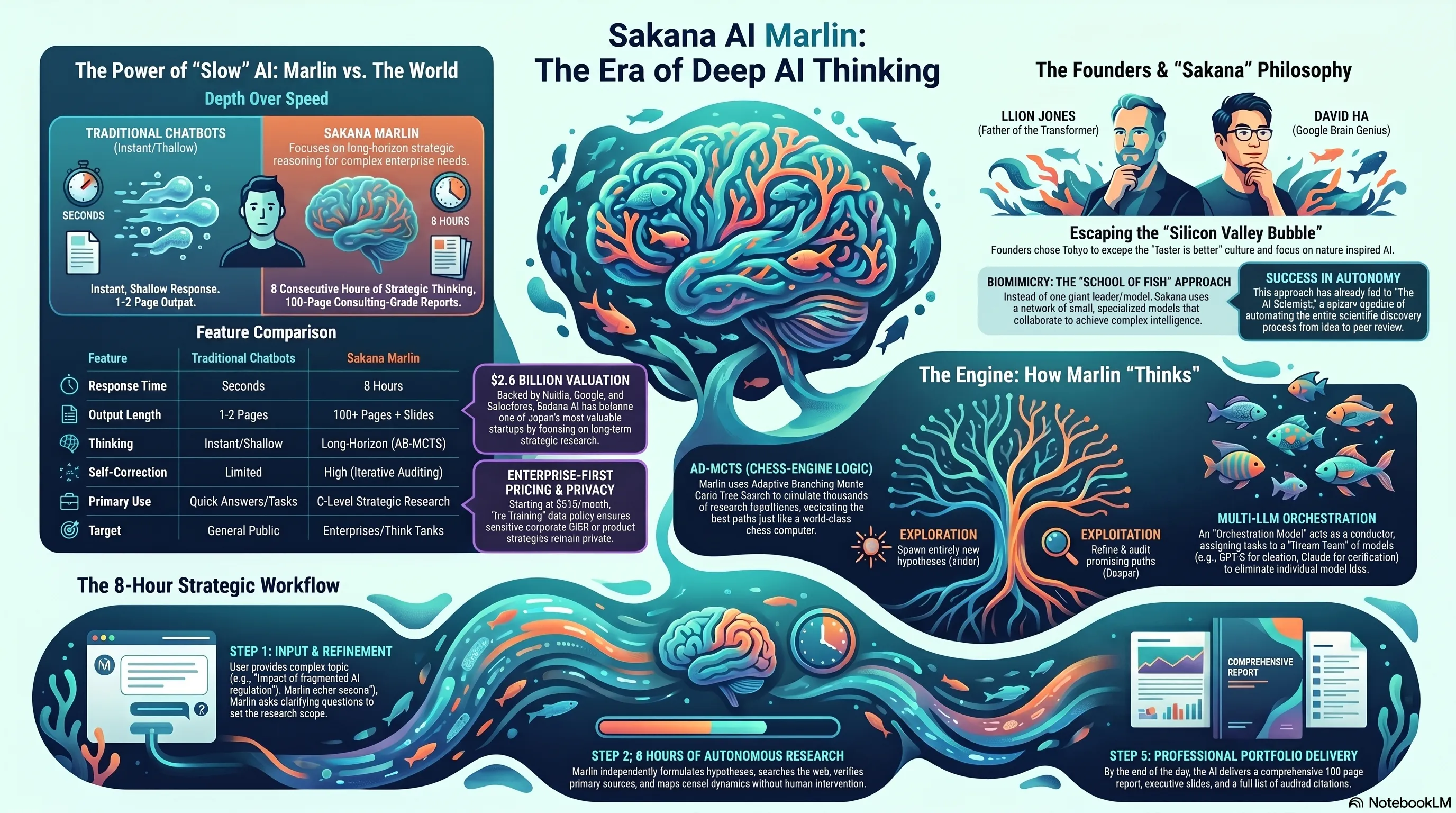
On June 15, 2026, a Tokyo-based startup worth $2.6 billion unveiled something that could reshape the entire AI industry. Not a fast chatbot, not a giant language model - but the world's first Virtual CSO that thinks for 8 hours to deliver a 100-page strategic report.
⚡ Key Highlights of This Analysis:
🎯 Founder: Original creator of Transformer (Llion Jones)
💰 Valuation: $2.6 billion backed by Google and Nvidia
⏱️ Research Time: 8 consecutive hours per topic
📊 Output: 100-page report + executive slides
🧬 Philosophy: Inspired by collective intelligence of fish and ants
🔬 Technology: AB-MCTS + Multi-LLM Orchestration
💼 Target: Replacing corporate strategic research teams
☕ This is a 5000+ word analytical article. Reading time: 22 minutes
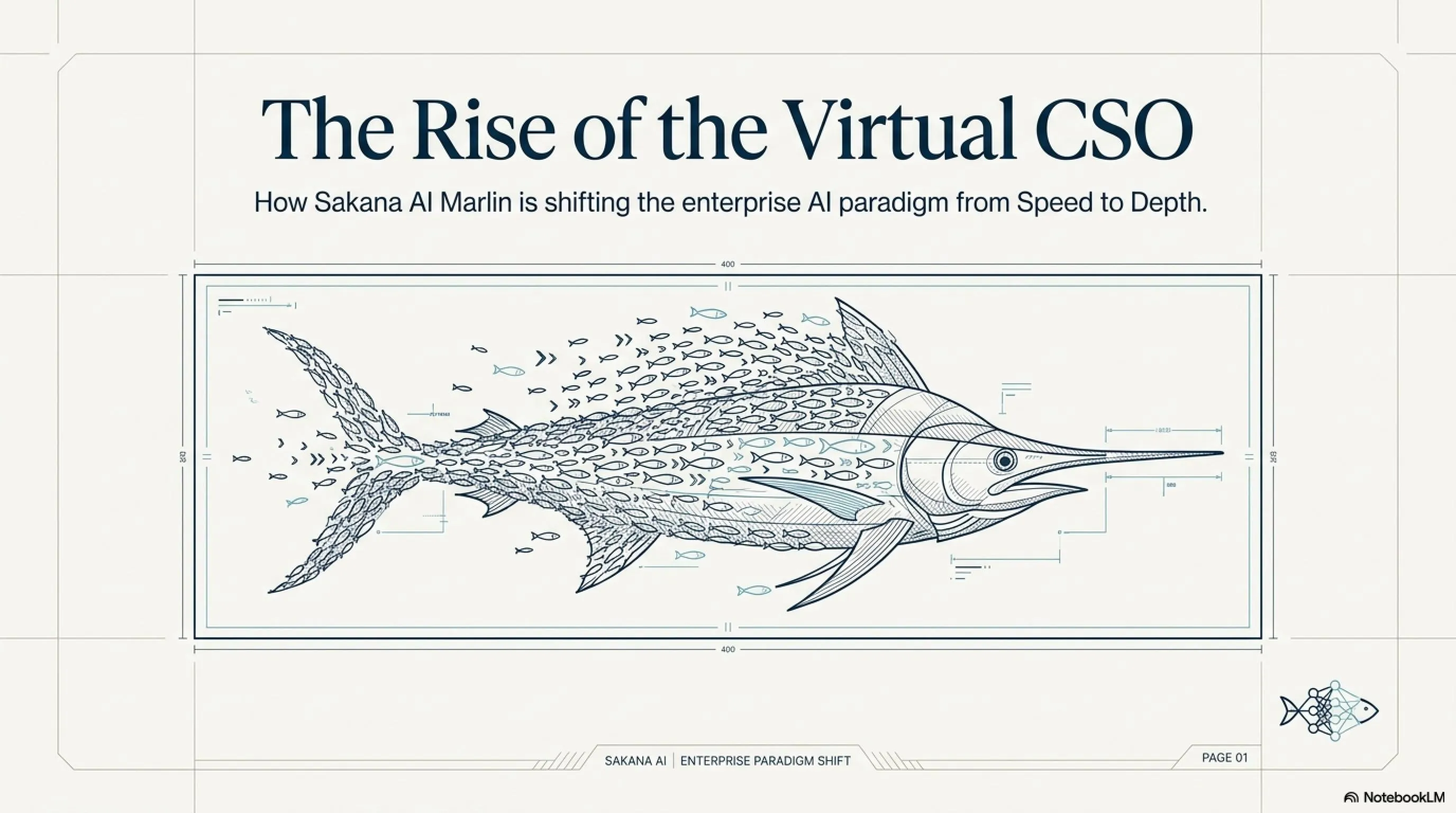
🌅 Introduction: When Speed Is No Longer Enough - The Era of Deep AI Thinking
For the past two years, the AI world has been judged by one metric: speed. The faster you respond, the better. ChatGPT writes poetry in milliseconds. Claude generates code. Gemini summarizes. Everything is instant, everything is fast, everything is... shallow.
But now a fundamental question has emerged: What if instead of speed, we need depth? If a company wants to analyze a market entry strategy for China, or an investment fund wants to understand the impact of new sanctions on semiconductor supply chains, ChatGPT can't answer in 10 seconds.
This is exactly where Sakana AI Marlin enters. An AI that doesn't sprint, but thinks. A system that works on one topic for 8 hours, formulates hypotheses, searches the web, verifies sources, compares data, and ultimately delivers a 100-page report with consulting-grade quality.
📊 Quick Comparison: Traditional Chatbots vs Marlin
| Metric | ChatGPT/Claude/Gemini | Sakana Marlin |
|---|---|---|
| Response Time | Seconds | 8 hours |
| Output Length | Few paragraphs | 100 pages + slides |
| Sources | Limited or none | Complete with citations |
| Purpose | Quick general answers | Deep strategic research |
| Price | $20/month | $935+/month |
👑 The Legendary Creators: Llion Jones & David Ha - From Google to Tokyo
To understand why Sakana AI matters so much, we need to know its founders. These two didn't just start a startup - they're redefining the revolution they themselves started.
🏆 Llion Jones: The Father of Transformer
In 2017, Llion Jones was one of the 8 authors of the legendary paper "Attention Is All You Need" that introduced the Transformer architecture to the world. This paper is the foundation of GPT, Claude, Gemini, and virtually all advanced models today.
Jones worked at Google for nearly 12 years and played a key role in AI research. But in late 2023, he decided to leave Google. Why? At a TED AI conference in late 2025, he stated candidly:
💬 "I'm absolutely sick of transformers. The intense pressure from investors and the hyper-fixation on scaling single, monolithic models has calcified the industry's creativity and blinded researchers to the next major breakthrough."
🔬 David Ha: The Google Brain Genius
Before Sakana AI, David Ha was the head of research at Stability AI (the company behind Stable Diffusion) and before that, a Google Brain researcher. He's an expert in reinforcement learning and nature-inspired AI.
Ha believes that the solution to all AI problems isn't building bigger models. Instead, we should learn from nature: where small, intelligent systems collaborate to achieve big goals.
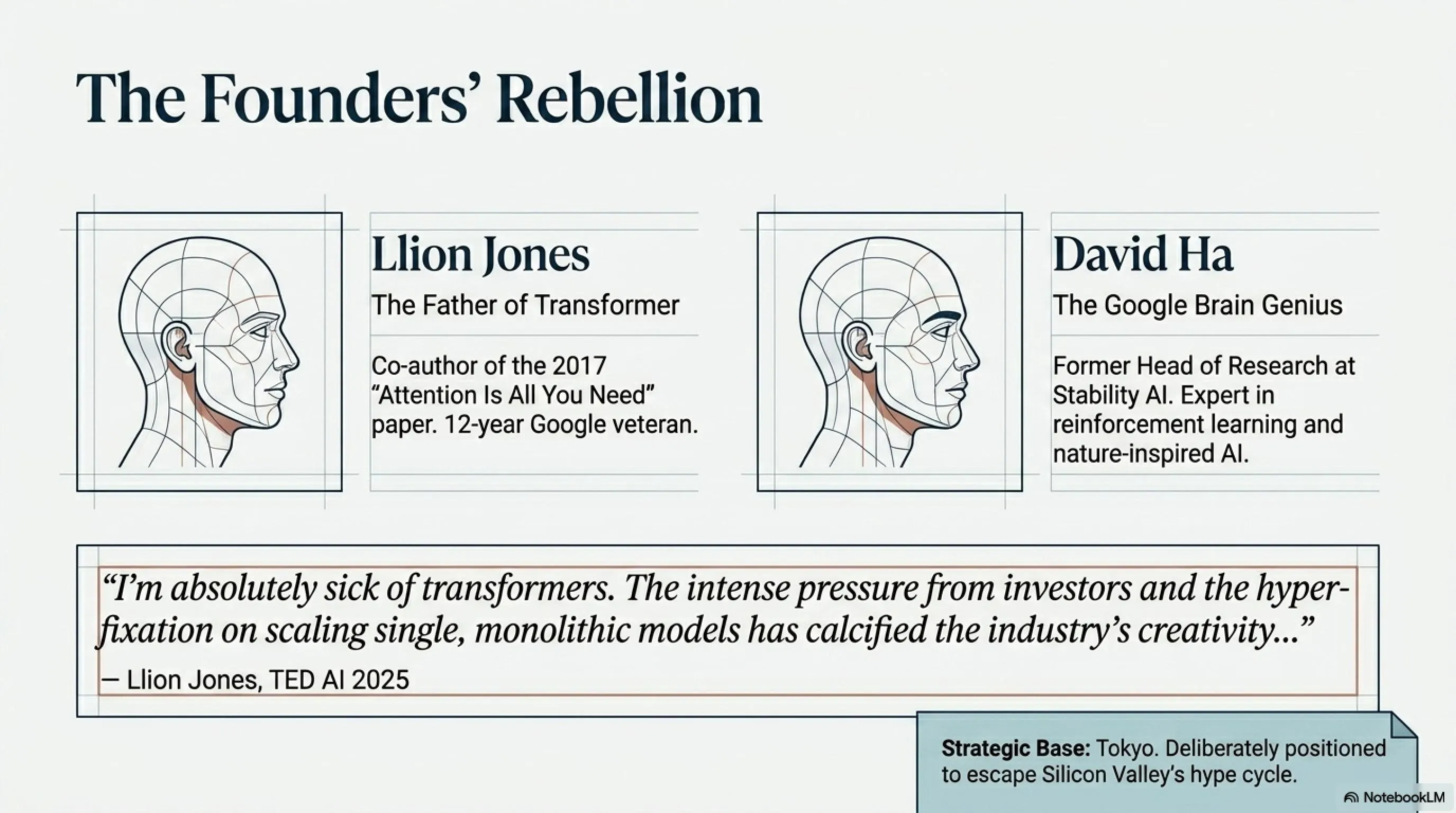
In August 2023, these two came together in Tokyo and founded Sakana AI. The goal? Escape "big company-itis" and build a new generation of AI that works not based on size, but on collaboration.
📌 Important Note: Why Tokyo?
Jones and Ha have explicitly stated that founding Sakana in Tokyo - not Silicon Valley - was a deliberate choice. They wanted to escape the investment bubble and "faster is better" culture. Japan provides a calmer environment for long-term research.
🐟 Sakana Philosophy: Why Fish Are Better Than Giants
The name Sakana (魚) means "fish" in Japanese. This name choice isn't random - it reflects the company's core philosophy.
When a school of fish moves, they have no central leader. There's no "giant fish" giving orders. Instead, each small fish coordinates with its neighbors, and from this collaboration emerges a complex collective intelligence that can evade predators, find food, and navigate complex routes.
🧬 Key Principles of Sakana Philosophy
- Biomimicry: Instead of building one giant model, a network of small specialized models
- Evolutionary Computing: Models should evolve and adapt to their environment, not just get bigger
- Collective Intelligence: True intelligence comes from collaboration, not size
- Heterogeneous Models: Each model has its own strengths - like members of a team
This philosophy isn't just a theoretical idea. Sakana AI has already achieved remarkable success in real competitions:
🏆 Sakana AI's Previous Successes
• ALE-Agent at AtCoder Heuristic Contest (early 2026): First place defeating over 800 professional human programmers in combinatorial optimization
• RL Conductor: A 7-billion parameter model trained with reinforcement learning that can divide tasks between different models (GPT-5, Claude Sonnet 4)
• The AI Scientist: A system that automates the scientific discovery process from idea to peer review - even published in Nature journal
💡 Tekin Analysis: Why This Approach Is Revolutionary
Most AI companies are currently racing to build the biggest model. GPT-5, Claude Opus, Gemini Ultra - all trying to build one giant model that does everything. But Sakana AI has a different approach: instead of one giant, an orchestra of elites. This is exactly what we see in Marlin: different models, each specialized in one task, working together.
🎯 What is Marlin? The World's First Virtual CSO
Now let's get to the main star: Sakana Marlin. On June 15, 2026, Sakana AI launched its first commercial product. But what exactly is Marlin and how does it work?
📋 Marlin at a Glance
| Official Name | Sakana Marlin: Your Virtual CSO |
| Product Type | Autonomous Research Agent / Virtual Chief Strategy Officer |
| Execution Time | Up to 8 consecutive hours per research |
| Output | 100+ page report + executive slides + complete sources |
| Target Audience | Corporations, financial institutions, think tanks, investment funds |
| Launch Date | June 15, 2026 |
| Starting Price | Pay-as-you-go or from $935/month |
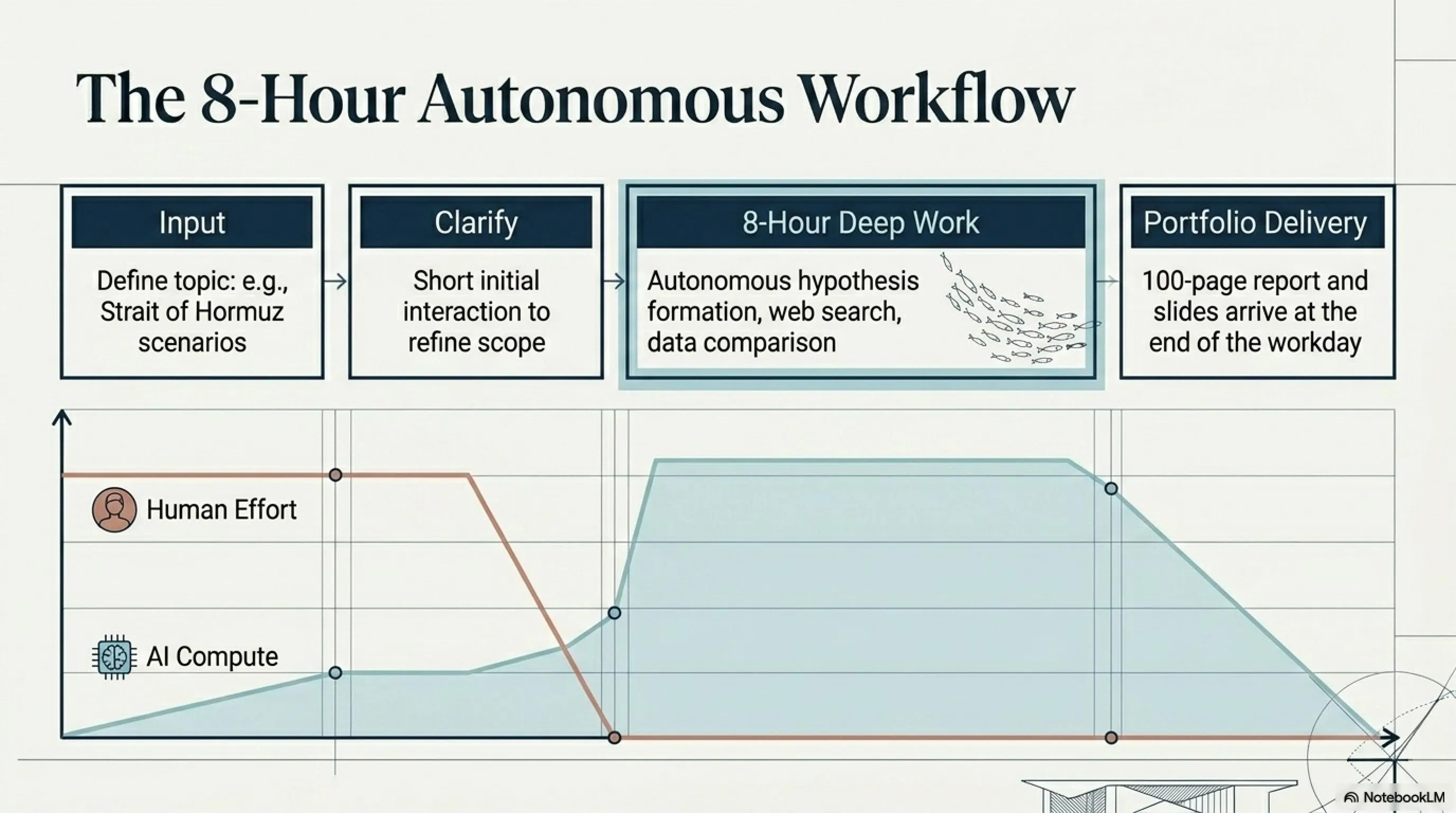
Let's understand how Marlin's workflow works. The main difference from regular chatbots is that you don't chat with it - you give it a task and leave the scene.
⚙️ Marlin's Workflow: 4 Simple Steps
1️⃣ Input: You Give a Research Topic
For example: "Resolution scenarios for the Strait of Hormuz blockade" or "Impact of fragmented global AI regulation on startups"
2️⃣ Initial Interaction: A Few Questions to Refine
Marlin asks a few short questions to clarify scope and direction of research
3️⃣ Autonomous Process: 8 Hours of Independent Work
You leave. Marlin formulates hypotheses, searches the web, verifies sources, compares data, and maps causal dynamics
4️⃣ Output: Complete Portfolio Delivered
By the end of the workday, you receive a 100-page report with executive summary, slides, appendices, and sources
Think of it like a junior consultant locked in a room with a whiteboard and internet connection. You give the topic in the morning, and by evening you return with a professional portfolio.
🧠 The AB-MCTS Engine: When AI Thinks Like a Chess Player
But what happens behind the scenes? Marlin's secret is in its engine: AB-MCTS (Adaptive Branching Monte Carlo Tree Search).
To understand this technique, let's start with an example: chess engines.
♟️ Analogy: Marlin vs Chess Engine
When a computer plays chess, it doesn't just look at the board and guess. Instead, it simulates thousands of possible future moves, evaluates the strength of each position, and then selects the best move.
Marlin does the same thing for research. Instead of playing chess, it simulates research hypotheses. It tries each hypothesis, evaluates the results, and follows the best path.
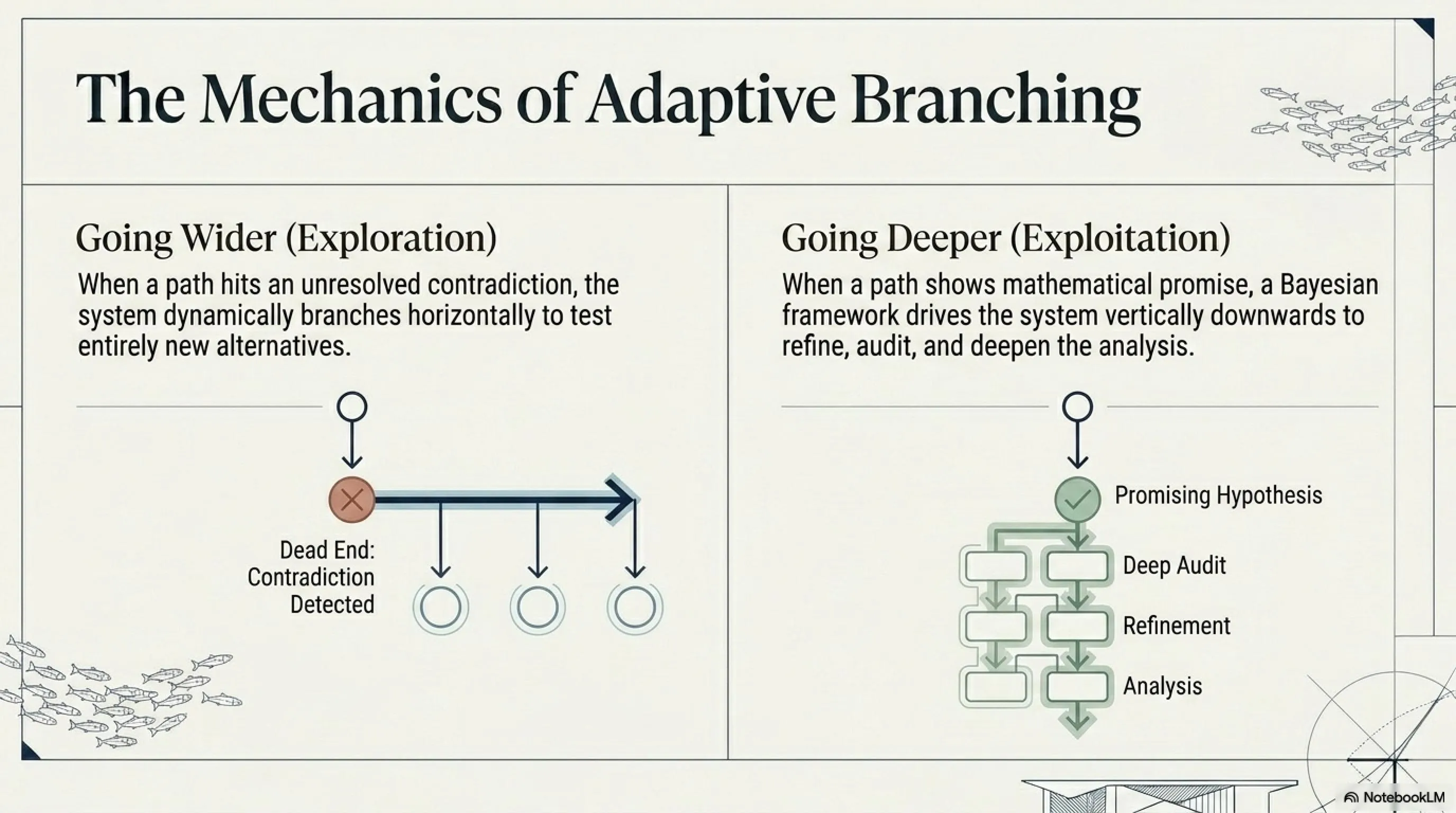
But AB-MCTS goes beyond regular MCTS. The key difference is in "Adaptive Branching" - the ability to dynamically decide between two behaviors:
🌳 Two Modes of AB-MCTS
🌍 Going Wider (Exploration)
When the current path hits a dead end or has unresolved contradictions, the system spawns entirely new, alternative hypotheses. For example, if one solution doesn't work, it goes for a completely different approach.
🔬 Going Deeper (Exploitation)
When a path shows promise, the system methodically refines, audits, and develops it. It adds more layers of analysis, checks more sources, and deepens the details.
This decision-making is based on a Bayesian framework - meaning the system mathematically calculates which path has the most potential.
💡 Tekin Analysis: Why AB-MCTS Is Revolutionary
The traditional method for improving LLM output quality was "repeated sampling" - run the model dozens of times and hope one answer is correct. But this method is blind and can't evaluate intermediate steps or pivot based on environmental feedback. AB-MCTS solves this: the system can detect its own errors, change course, and learn from mistakes - exactly like a human researcher.
🎼 Multi-LLM Orchestration: The Dream Team of Models
But AB-MCTS is only half the story. Sakana AI's other innovation is Multi-LLM AB-MCTS - the ability to coordinate multiple different models.
Imagine you have an orchestra. An orchestration model (conductor) divides tasks between different players:
🎭 Different Roles in Marlin's Team
💡 Ideation Model
For generating initial hypotheses and creative solutions - a model strong in creative thinking
🔍 Verification Model
For auditing, verifying sources, and identifying errors - a model strong in logical reasoning
✍️ Writer Model
For producing the final report with fluent language and professional structure
🎯 Coordinator Model
Decides which model to invoke for which subtask
According to Sakana AI's technical documentation, the engine can coordinate highly heterogeneous models - meaning it can call GPT-5 for one task, Claude Sonnet 4 for another, and Gemini Pro for a third.
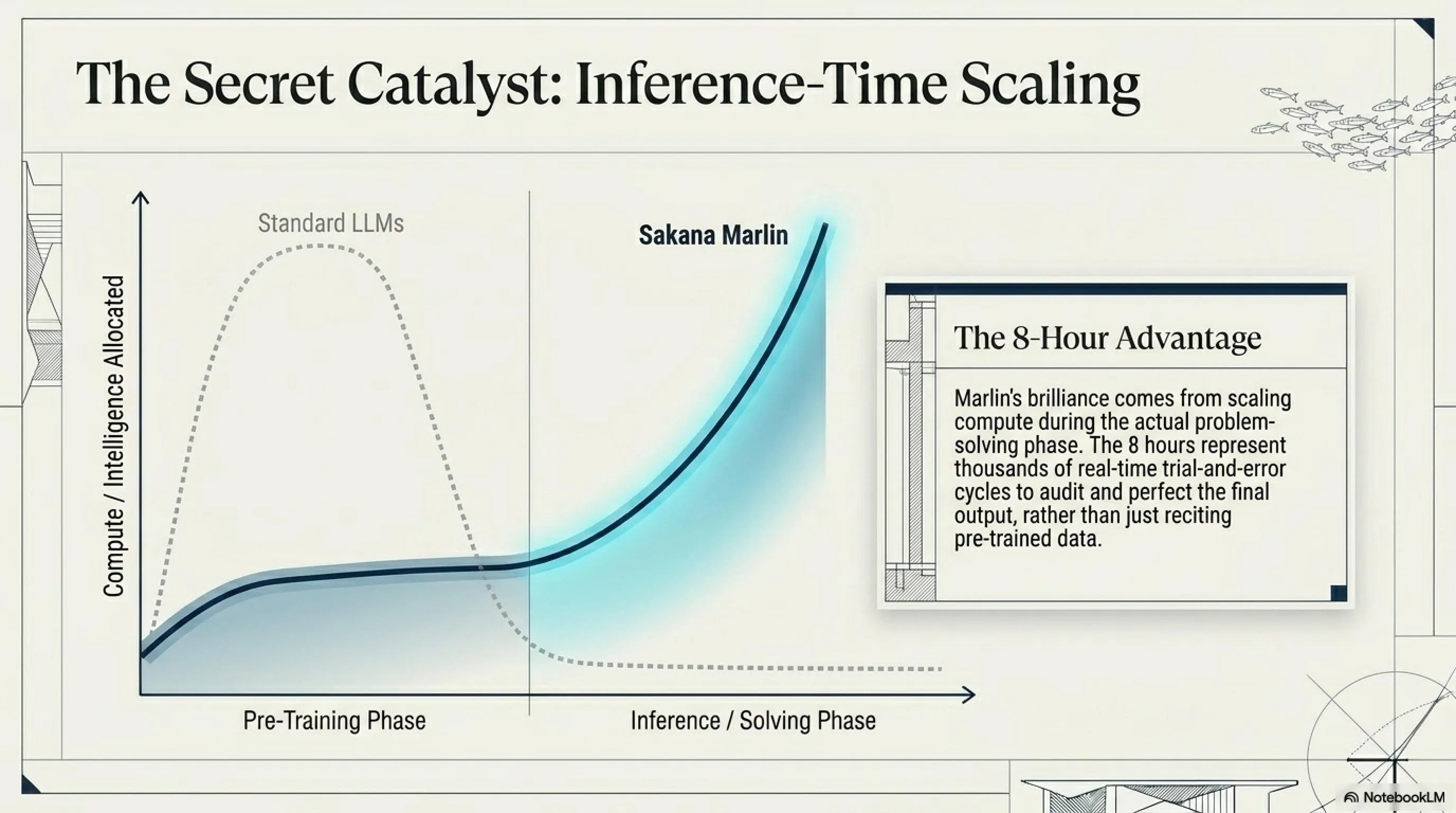
🔬 Technical Note: Inference-Time Compute Scaling
Sakana AI focuses on "inference-time scaling" - instead of making the model bigger during training, it increases computational resources during problem-solving. This means Marlin can go through thousands of automated trial-and-error cycles to reach the best answer.
🧪 Field Testing: What Did 300 Experts Say?
Before the official launch, Sakana AI conducted a closed beta test in April 2026 with approximately 300 professionals from financial institutions, consulting firms, and think tanks. The results were striking.
💬 Real Feedback from Beta Testers
🏢 Senior Consultant at Major Tokyo Consulting Firm:
"This tool exceeded our expectations by discovering angles we hadn't even imagined. Its comprehensiveness matches human work, but without human bias."
🛡️ Cybersecurity Division at Major Japanese IT Company:
"We received a highly convincing report driven by high-quality, primary research - not recycled secondary sources, but real research."
This feedback shows that Marlin is not just a "faster chatbot" but can truly act as an independent strategic researcher.
📊 Real-World Use Cases
• Strait of Hormuz Crisis Resolution Scenarios: Marlin analyzed various scenarios, calculated economic impacts, and evaluated diplomatic and military solutions
• Mapping Fragmented Global AI Regulation: Analysis of AI laws in the EU, US, China, and Japan and their impact on startups
• Return of "Bond Vigilantes" in Financial Markets: Analysis of macroeconomic trends and prediction of bond investor behavior
💰 Pricing & Data Policy: Cost and Data Protection
Sakana Marlin is a B2B (business-to-business) product, not consumer. Its pricing reflects this:
💵 Marlin Pricing Plans
| Plan | Monthly Price | Credits | Add-on Credit Price |
|---|---|---|---|
| Pay-as-you-go | No commitment | 100 credits/run | ¥98 ($0.61) |
| Pro Plan | ¥150,000 ($935) | 2,000 credits | ¥90 ($0.56) |
| Team Plan | ¥400,000 ($2,495) | 6,000 credits | ¥85 ($0.53) |
| Enterprise | Custom pricing | Custom | Negotiable |
🔒 Data Policy: Critical for Organizations
Unlike many consumer AI tools that silently harvest user data to train future models, Sakana Marlin has a strict policy:
- ❌ No Training Usage: Neither Sakana AI nor external AI service providers use customer data for training or fine-tuning - unless the customer explicitly opts in
- 🔐 PII Removal: Even with consent, data is heavily processed to remove personally identifiable information
- 🛡️ Closed-loop Security: Critical for companies handling sensitive M&A, unreleased product strategies, or proprietary market analyses
⚔️ Marlin vs ChatGPT vs Perplexity: The AI Research War
Now the important question: how is Marlin different from existing tools like ChatGPT, Perplexity, or Google Gemini?
📊 Comprehensive Comparison Table
| Feature | ChatGPT | Perplexity | Sakana Marlin |
|---|---|---|---|
| Response Time | Seconds | 10-30 seconds | 8 hours |
| Output Length | Few paragraphs | 1-2 pages | 100+ pages |
| Sources | Limited/None | Reference links | Complete + audited |
| Long-Horizon Thinking | No | Limited | Yes (AB-MCTS) |
| Hypothesis Formation | No | No | Yes |
| Self-Correction | Limited | Limited | Yes |
| Monthly Price | $20 | $20 | $935+ |
| Target Audience | General public | General public | Enterprises |
💡 Tekin Analysis: When to Use Which Tool?
ChatGPT: For quick answers, initial ideas, code writing, translation, and daily tasks
Perplexity: For fast research with sources, urgent questions requiring current data
Sakana Marlin: For deep strategic research, multi-perspective analysis, C-level reports, and issues requiring systems thinking
💼 Giant Investors: Why Did Google and Nvidia Invest?
Sakana AI reached a valuation of over $2.6 billion in its Series B round and became one of Japan's most valuable private startups. But who's behind it?
🏦 Sakana AI's Investor Roster
🔷 Tech Giants
- Nvidia
- Salesforce
🏦 Financial Institutions
- Mitsubishi UFJ Financial Group (MUFG)
- Citibank
💡 Leading VCs
- Khosla Ventures
- Lux Capital
- NEA (New Enterprise Associates)
🌏 Regional Investors
- NTT Group
- SBI Investment
This investor mix shows Sakana AI is targeting different sectors: defense (with Japanese government backing), finance (banks), and AI infrastructure (Google and Nvidia).
🔮 The Future of Knowledge Work: Who Gets Replaced?
The important question: if Marlin can do the work of a CSO and research team, does this mean job loss?
⚖️ PROS & CONS
✅ PROS
- Reduced cost of strategic research
- Faster speed (8 hours vs weeks)
- No human bias
- 24/7 availability
- Easy scalability
- Consistent quality
❌ CONS
- Potential job displacement
- Lacks human intuition
- High cost ($935+/month)
- Needs final human review
- Limited cultural context understanding
- Dependent on data quality
Microsoft's Nadella's opinion on this is interesting. He said in a recent interview: "Human capital does not become less valuable as token capital grows - it only becomes more valuable. Humans set ambitious goals, connect dots across domains, and recognize patterns that matter most."
💡 Tekin Analysis: The New Division of Labor
Marlin will likely do the heavy lifting of research (data collection, preliminary analysis, source synthesis), but final decisions remain with humans. Like a junior consultant providing the initial report, but the senior partner making the decision. This means companies can do more work with smaller teams - but junior-level jobs are likely at risk.
❓ Frequently Asked Questions (FAQ)
❓ Can Marlin completely replace a CSO?
No, at least not yet. Marlin can do the heavy lifting of research, data collection, and preliminary analysis, but final strategic decision-making, understanding complex political/cultural context, and human relationships still require humans. Think of Marlin as an extremely powerful "research assistant", not a complete CSO replacement.
❓ What models power Marlin?
Sakana AI hasn't disclosed specific model names, but has stated it uses multiple different models (Multi-LLM). Likely a combination of GPT-5, Claude Sonnet 4, Gemini Pro, and Sakana's proprietary models. Their approach is plug-and-play - they can select the best model for each task.
❓ Is my data used for model training?
No, unless you explicitly opt in. Sakana AI has a strict policy: no customer data is used for training or fine-tuning. Even with consent, personally identifiable information (PII) is removed. This is critical for companies handling sensitive data (M&A, product strategy, competitive analysis).
❓ Why does it take 8 hours? Can't it be faster?
The 8 hours is because Marlin simulates a real research process: hypothesis formation, searching, source verification, data comparison, error correction, and final report generation. This timeframe is likely adjustable (you can stop earlier), but for deep research, 8 hours is still much faster than weeks of human team work.
❓ How is Marlin different from Google Deep Research?
Google Deep Research (integrated in Gemini Advanced) is also a deep research tool, but with key differences: Marlin is designed for organizations (not consumers), has longer execution time (8 hours vs 1-2 hours), more professional output (100 pages with slides), and uses AB-MCTS which allows it to self-correct. Marlin is for C-level reports, not personal research.
🎯 Final Thoughts
Sakana AI Marlin represents a paradigm shift in the AI industry. For the past two years, everything was about speed - the faster you respond, the better. But Marlin proves that sometimes slow can be an advantage.
With AB-MCTS, Multi-LLM Orchestration, and 8 hours of focused thinking, Marlin can do what traditional chatbots cannot: real strategic research. Not just information gathering, but hypothesis formation, self-correction, multi-perspective analysis, and professional report generation.
Will Marlin change everything? Probably not immediately. But it shows that the future of AI isn't just about bigger models - it's about intelligent collaboration of specialized models, long-horizon thinking, and learning from nature.
Llion Jones and David Ha left Google because they were tired of "big company-itis." Now with Sakana AI and Marlin, they're proving that there is another way - a way where a school of fish can be more powerful than a whale.
⭐ Final Question: Are you ready to hire your Virtual CSO?
📚 Sources & References
- VentureBeat: "When deep research isn't enough for your business: Sakana AI launches ultra deep research agent"
- Reuters: "Open-source AI models released by Tokyo lab Sakana founded by former Google researchers"
- The Neuron AI: "Why Google Partnered With Sakana AI, Explained"
- Sakana AI Official Website: Product Launch Announcement (June 15, 2026)
- Google Research Paper: "Attention Is All You Need" (2017)
- Sakana AI Research: "Wider or Deeper? Scaling LLM Inference-Time Compute with Adaptive Branching Tree Search" (June 2025)
- Nature Journal: "The AI Scientist" - Sakana AI Research Publication
- AWS Startups Blog: "Letting nature lead: How Sakana AI is transforming model building"
Content has been rephrased for compliance with licensing restrictions
🌐 Stay Connected With Us 🎮✨
For the latest tech, gaming, and gadget news, follow us on our official social media channels: