Tekin Garage's night analysis: Google officially confirmed the Pixel 11 will cost more due to AI-driven RAM shortages. Monday.com laid off 20% of its workforce under the pretext of pivoting to AI. Warner Bros launched a major lawsuit against Amazon for talent poaching, while Binance revealed its employee phishing tests.
🌙 Good Night, Tekin Nighters! Sunday, July 26, 2026
Fuel your late-night energy with six hot stories from the worlds of technology, crypto, and gaming!
- 🎮Google Pixel 11- Official price increase confirmed due to RAM shortage
- 🎧Monday.com- 630 employees laid off under AI focus excuse
- 🚀Warner Bros vs Amazon- Lawsuit over alleged illegal employee poaching
- 🗡️Binance Red Team- Monthly phishing tests for all staff
Sunday night is the perfect time for a deeper look at events that unfolded in the day's shadows. Tonight we bring you six stories, each narrating a tale of major shifts in the tech industry. From Google's official confirmation of Pixel 11 price increases to Warner Bros' contentious lawsuit against Amazon, from Monday.com's massive layoffs under the AI banner to a responsible approach to crypto adoption in Africa. These stories demonstrate that the tech world is undergoing profound transformation affecting not just products but human lives as well.
At a Glance: Tekin Night Brief
- Google officially confirmed Pixel 11 will be more expensive than Pixel 10
- Monday.com laid off 20% of its workforce, citing AI as the reason
- Warner Bros sued Amazon for allegedly illegally recruiting contracted employees
- Binance tests its employees monthly with phishing attacks
- Antony Mlelwa promotes a responsible approach to crypto adoption in Africa
- Bethesda confirmed Elder Scrolls 6 remains unaffected by Xbox layoffs
Google Pixel 11: When AI Steals Your Phone's Memory
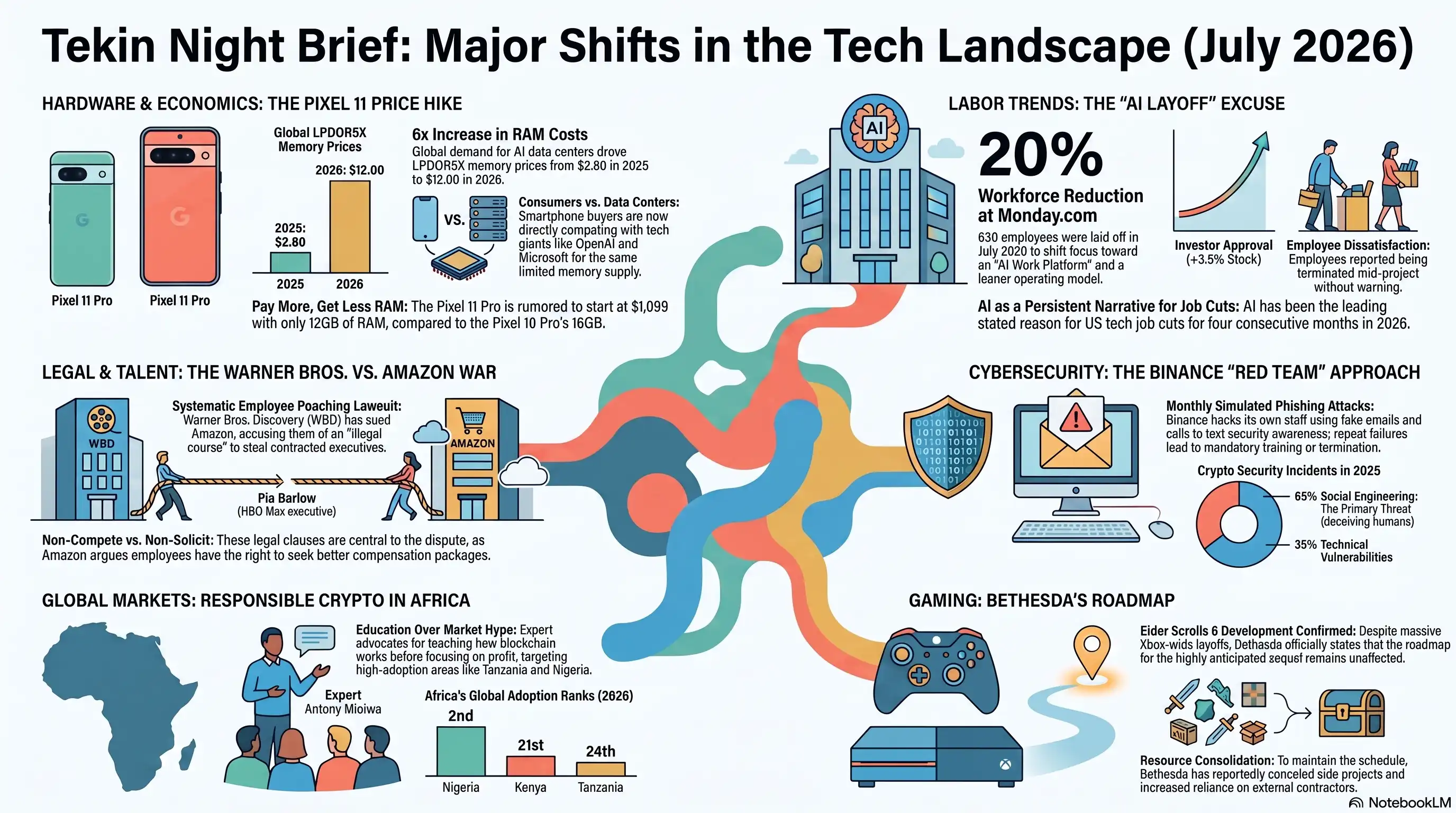
Shakil Barkat, Google's VP of devices, in an exclusive interview with 9to5Google, officially confirmed what everyone already knew: Pixel 11 will be more expensive than Pixel 10. But the reason behind this price increase tells a more interesting story. The global RAM shortage caused by the explosion of AI data centers has driven LPDDR5X memory prices from $2.8 in 2025 to $12 in 2026—nearly a sixfold increase in less than a year.
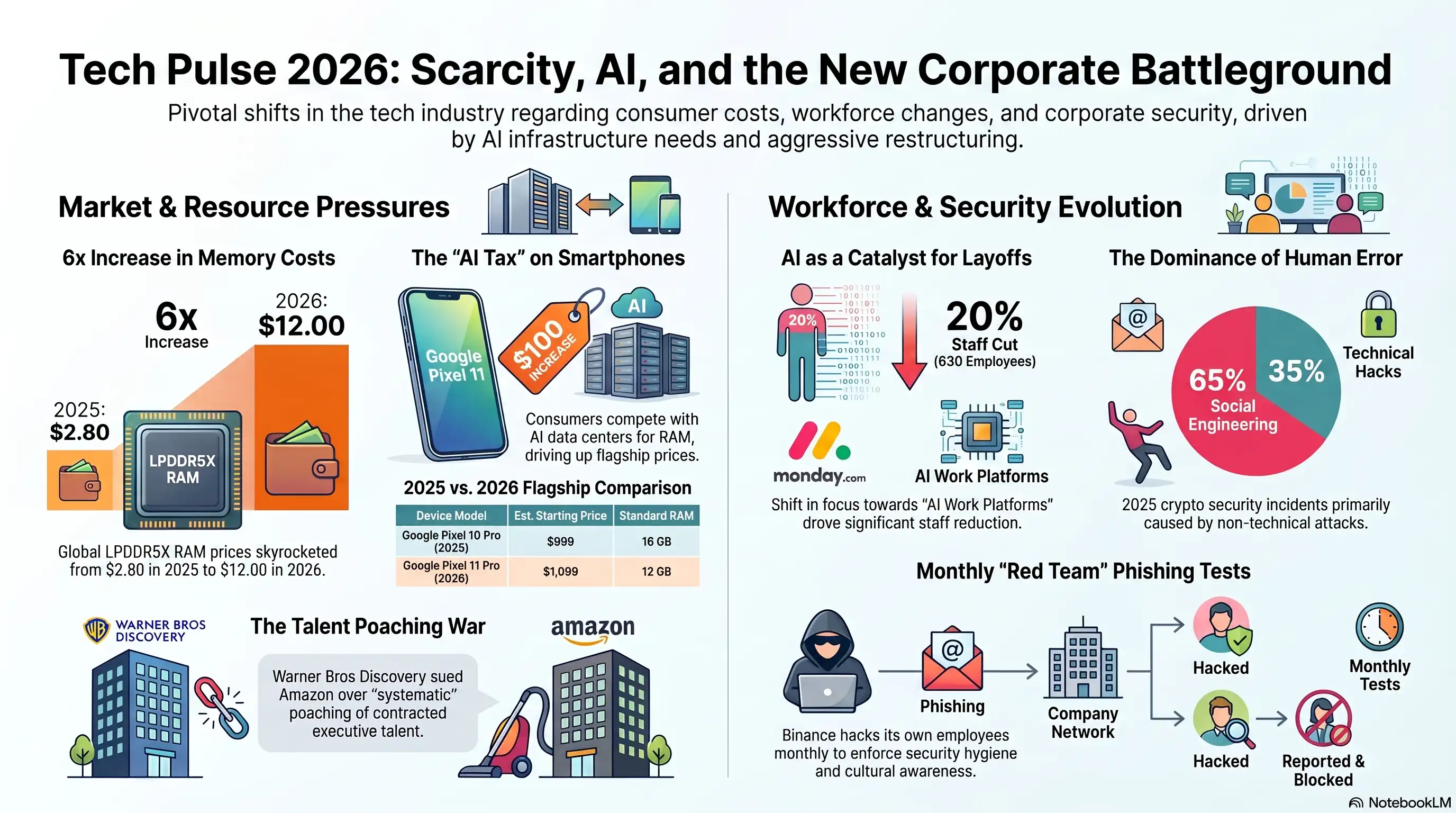
What does this mean? It means when you buy a new phone, you're actually competing with AI data centers for access to the same memory. Companies like OpenAI, Google, Microsoft, and Amazon are building new data centers so rapidly that memory suppliers cannot keep up with demand. The result? Memory prices skyrocket, and this cost transfers directly to consumers.
How Much More Will We Pay?
According to rumors, the base Pixel 11 will start at $899 with a $100 price increase (compared to Pixel 10's $799). Pixel 11 Pro will also start at $1,099 (compared to Pixel 10 Pro's $999). Interestingly, some reports indicate that Pixel 11 Pro will likely have only 12GB of RAM, while Pixel 10 Pro always shipped with 16GB. Pay more, get less RAM!
Jargon Buster: What is LPDDR5X?
Barkat mentioned in the interview that Google is working on optimizing Android to perform smoothly even with less memory. According to him, the engineering team is redesigning parts of the operating system to reduce RAM dependency. But the question remains: can software optimization truly replace more powerful hardware?
AI is the Main Culprit
This problem isn't limited to Google. Apple, Samsung, Xiaomi, and all major smartphone manufacturers face the same challenge. Even gaming companies like Nintendo and console makers have been impacted by this shortage. When NVIDIA, AMD, and Intel need HBM (High Bandwidth Memory) for AI chips and data centers require DDR5 for AI servers, suppliers like Samsung, SK Hynix, and Micron cannot simultaneously meet demand from all sectors.
Tekin Analysis: The Future of Pricing
Monday.com: 630 Layoffs Under AI Pretense
Monday.com, the project management platform recognized until recently as one of Israel's most successful startups, announced on July 22 that it's laying off 630 employees (20% of its 3,000-person workforce). The reason? "Supporting a leaner, more focused operating model" concentrating on AI Work Platform. But reality is more complex than this official statement.
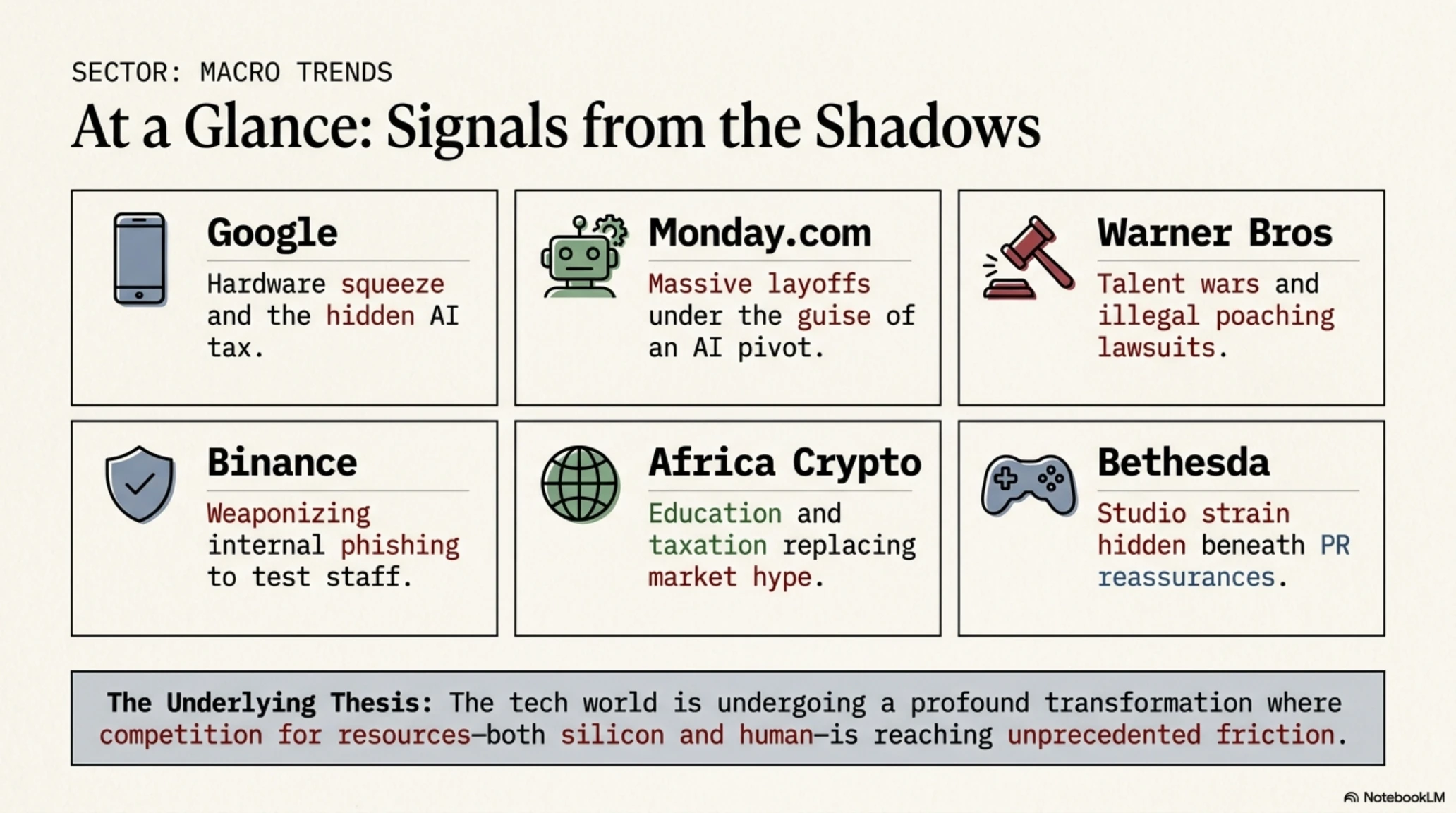
Roy Mann and Eran Zinman, Monday.com's co-founders and co-CEOs, called this decision "the most painful decision since founding the company" but emphasized they're "confident it's the right decision." They said the goal is building "a flatter organization built around AI agents, autonomous teams, and deeper customer engagement." But critics say this is just an excuse for cost-cutting.
Is AI Really to Blame?
According to the SEC (Securities and Exchange Commission) filing, Monday.com estimates these layoffs will cost between $45-55 million (including severance, benefits, and legal costs). The company has also maintained its revenue growth forecast of 19-20% annually for 2026. This means the company expects to maintain the same growth with 20% fewer employees. The question is: where does this growth come from? From AI or from greater pressure on remaining staff?
Monday.com is the latest company to cite AI as the reason for layoffs. In 2026, dozens of tech companies from Google to Meta, from Salesforce to IBM have had massive layoffs, and many have cited AI as the reason. But has AI truly replaced these jobs, or is it simply a convenient excuse for cost reduction?
Employee and Investor Reactions
Employee reactions on social networks and Glassdoor reveal deep dissatisfaction. Many laid-off employees say they were terminated without prior warning and in the middle of important projects. Some note that entire teams were eliminated and projects worked on for months were abandoned mid-way. In contrast, investors reacted positively; Monday.com stock rose 3.5% after the announcement. The stock market clearly rewards cost-cutting, even at the expense of losing human talent.
Why It Matters: New Layoff Trends
Warner Bros vs Amazon: The Talent War
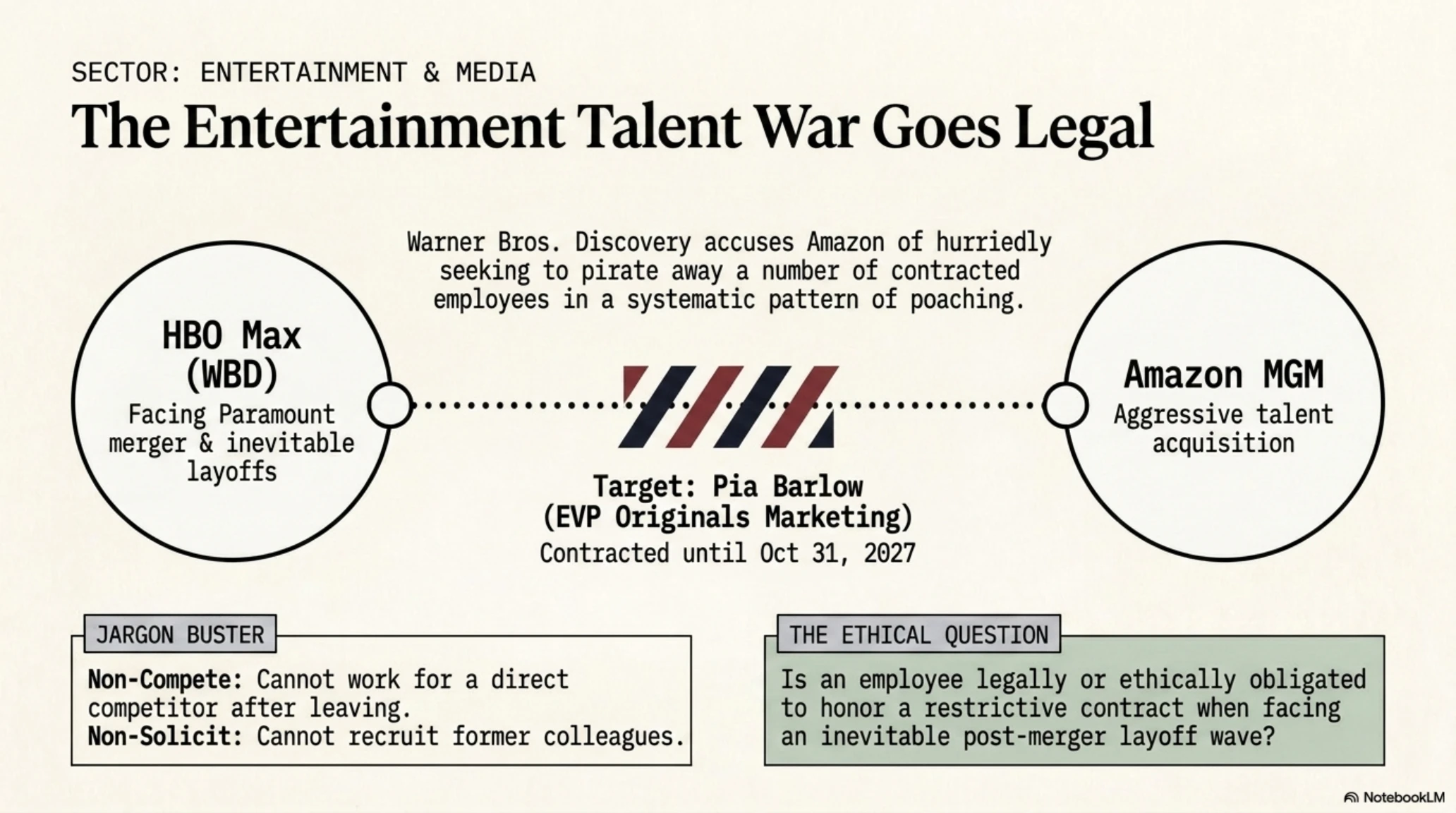
Warner Bros Discovery filed a lawsuit against Amazon in California Superior Court on July 21 that could mark a turning point in how hiring works in the entertainment industry. The lawsuit accuses Amazon of "hurriedly seeking to pirate away a number of contracted employees" and says Amazon has "patently embarked on an illegal course" attempting to "steal" employees from various WBD divisions.
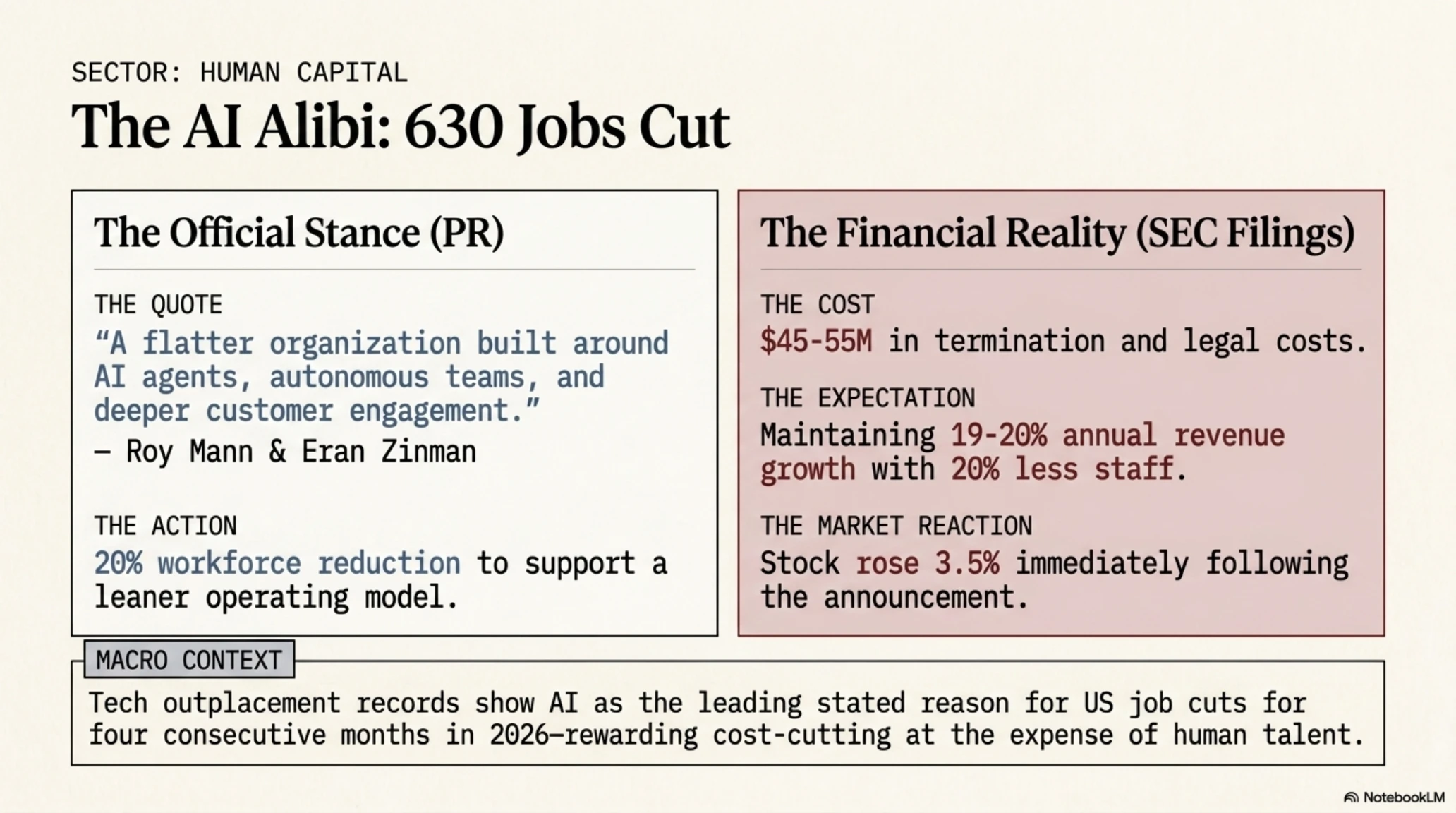
The lawsuit's focal point is Pia Barlow, EVP of Originals Marketing for HBO Max, who was contracted to remain at WBD until October 31, 2027. According to the lawsuit, Barlow had committed to staying with the company until her contract expired, but when Amazon offered a better compensation package, she "promptly discarded these commitments" and joined Amazon MGM Studios as VP and Head of Series Marketing.
Why This Lawsuit Matters
This isn't the first time two major entertainment companies have clashed over employee hiring, but the tone and forcefulness of this lawsuit are unusual. Warner Bros isn't just seeking to prevent Barlow's hiring but claims Amazon is following a "systematic pattern" of illegal employee poaching. The lawsuit indicates Amazon has approached several other WBD employees and in some cases successfully recruited them.
Jargon Buster: Non-Compete and Non-Solicit
Amazon hasn't yet officially responded to the lawsuit, but sources close to the company say Amazon believes WBD's overly restrictive Non-Compete agreements aren't legal and that employees have the right to work for employers offering better packages. This argument could have widespread implications for the entire industry.
Broader Context: WBD-Paramount Merger
This lawsuit comes as Warner Bros Discovery is negotiating a merger with Paramount. If this deal closes, HBO Max and Paramount+ will merge, which typically means massive workforce reductions. Barlow likely knew this reality and decided to move before getting caught in post-merger layoff waves. This raises an interesting ethical question: is an employee obligated to remain at a company that may soon lay them off?
Binance Red Team: Monthly Employee Security Testing
In a world where cyberattacks grow more sophisticated daily, Binance has adopted a unique approach: it hacks its own employees monthly. Jimmy Su, Binance's Chief Security Officer, told Cointelegraph that the exchange regularly runs simulated phishing attacks against its employees to assess their security awareness levels.
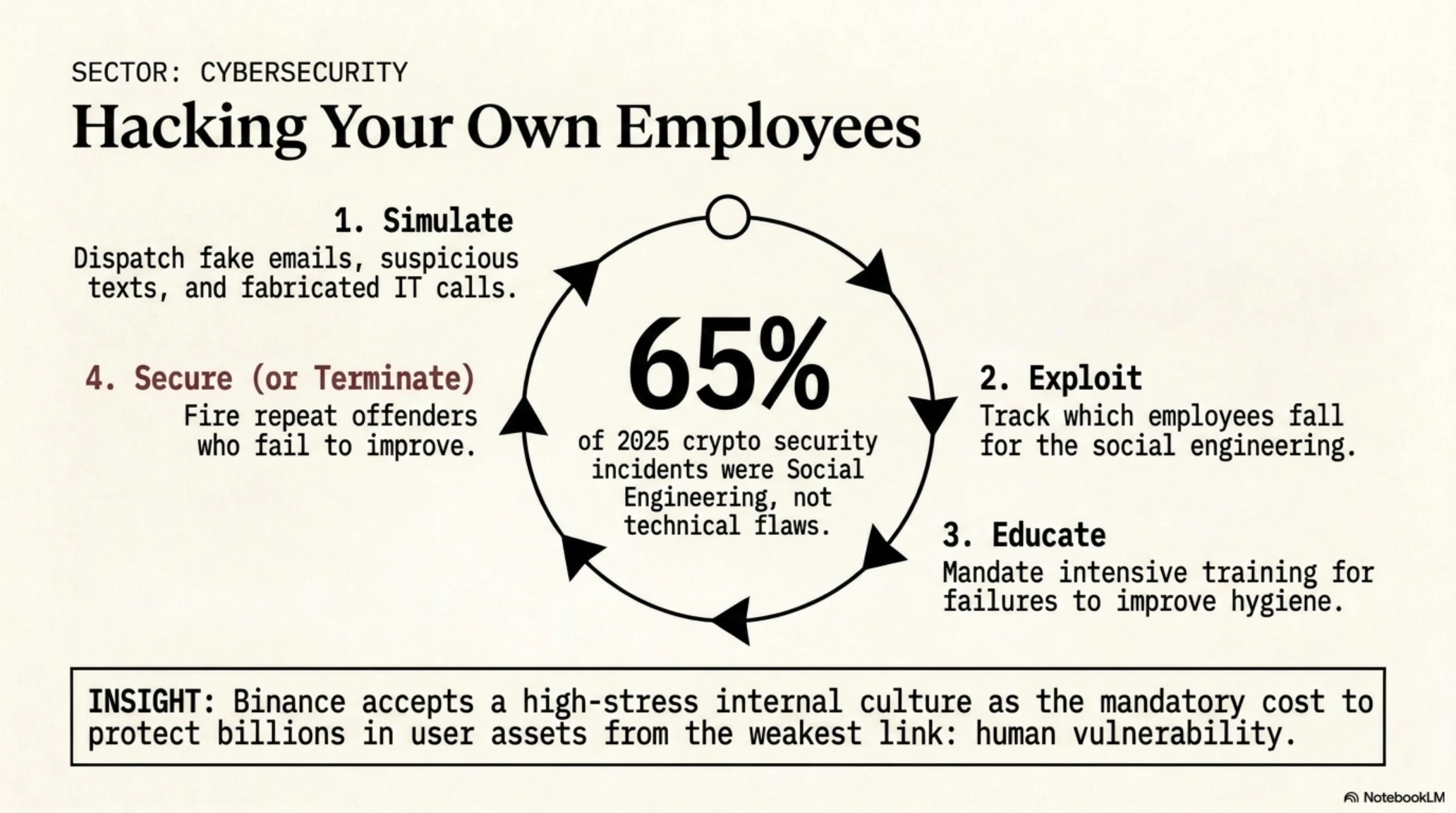
This program, called "Red Team," has been running for 3 to 4 years. Binance's security team sends fake phishing emails, suspicious messages, and even fabricated phone calls to employees to see who falls for them. Those who repeatedly fail these tests must complete training courses and may be terminated if they don't improve.
Why This Approach is Necessary
According to security reports, 65% of security incidents in the crypto industry in 2025 resulted from social engineering attacks—not technical vulnerabilities. This means hackers, rather than trying to break security systems, attempt to deceive humans. One employee clicking on a suspicious link can provide access to systems that would take months to crack.
Jargon Buster: What is Social Engineering?
Su noted that initially, employee failure rates were high, but with ongoing training over time, they've improved significantly. He said: "We do phishing attacks on our own employees on a monthly basis just so we understand if our security hygiene is improving." The Red Team tests various scenarios, from fake job offer emails to fabricated emergency messages.
Is This Approach Ethical?
Some employees find this approach invasive and stressful. Imagine every day you check your emails, not knowing which are real and which are security tests. This can create a tense work environment. But Binance argues this minor stress is nothing compared to the risk of losing billions of dollars in user assets. The exchange also emphasizes the goal isn't punishment but education and improvement.
Antony Mlelwa: Responsible Approach to Crypto in Africa
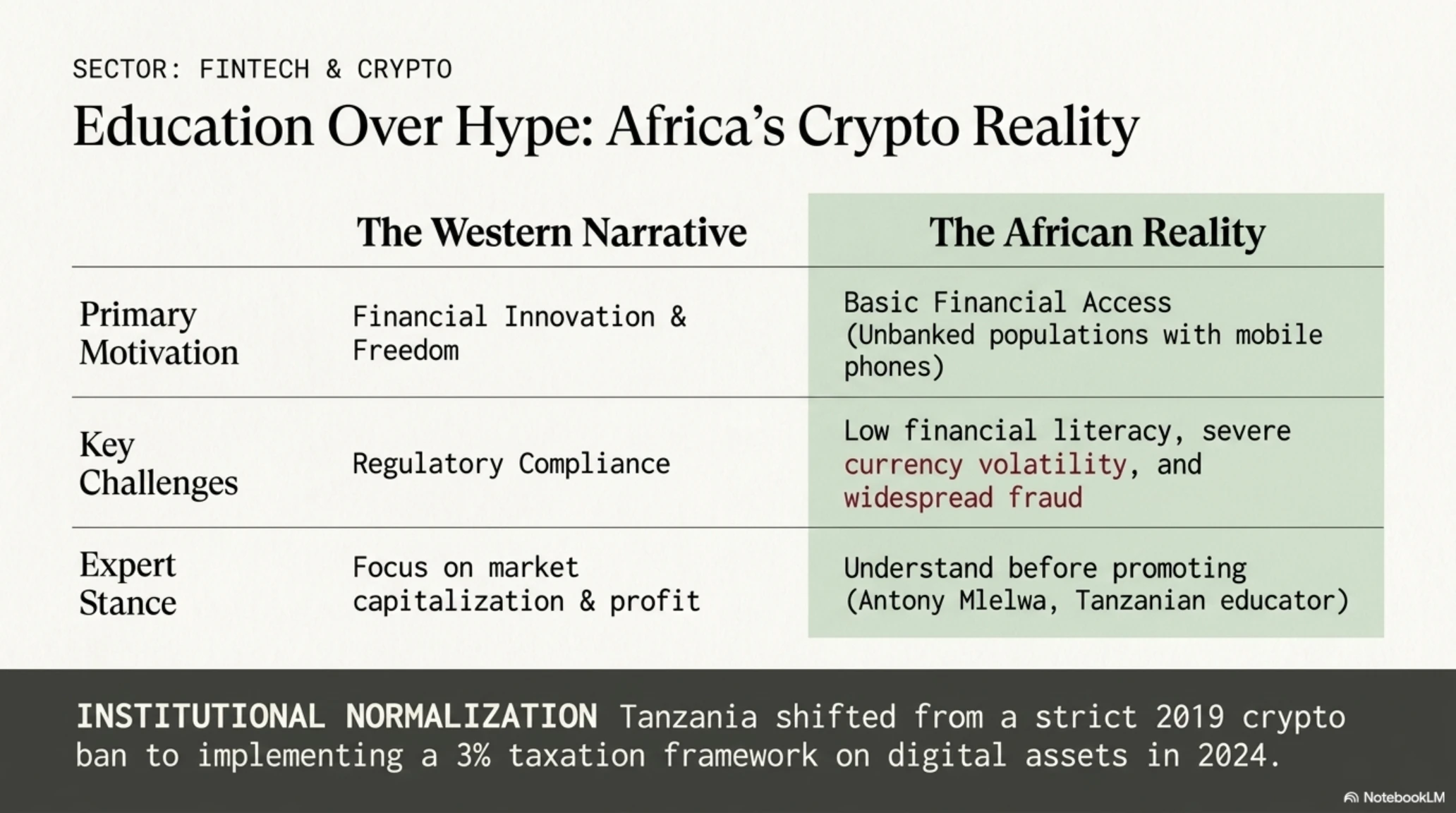
Amid the noise of crypto bull runs and market crashes, Antony Mlelwa, a Tanzanian blockchain expert, promotes a different message: technology should be understood before it is promoted; financial risks should be explained before opportunities are celebrated; and education must remain stronger than market hype. He spreads this philosophy from educational workshops in East Africa to Crypto Expo Dubai.
Mlelwa, who is also a Certified Financial Educator, runs an academy in Dar es Salaam (Tanzania) and speaks at various conferences. He believes many crypto "adoption" campaigns in Africa focus too much on profits and ignore risks. He says: "We need to teach people how Bitcoin works, not how much they can profit."
Africa's Unique Challenges
Africa is one of the fastest-growing markets for crypto adoption. According to Chainalysis, Nigeria ranks 2nd, Kenya 21st, Tanzania 24th, and Ghana 29th globally. But this growth comes with serious challenges: low financial literacy rates, weak banking infrastructure, severe currency volatility, and widespread fraud.
Tekin Analysis: Two Different Approaches
Mlelwa also emphasizes the importance of cooperating with governments. Tanzania, which took a strong anti-crypto stance in 2019, is now drafting a regulatory framework. Tanzania's Central Bank imposed a 3% tax on digital asset transactions in 2024, showing the government views crypto as a taxable reality rather than a threat to suppress.
Bethesda: Elder Scrolls 6 Unaffected by Layoffs
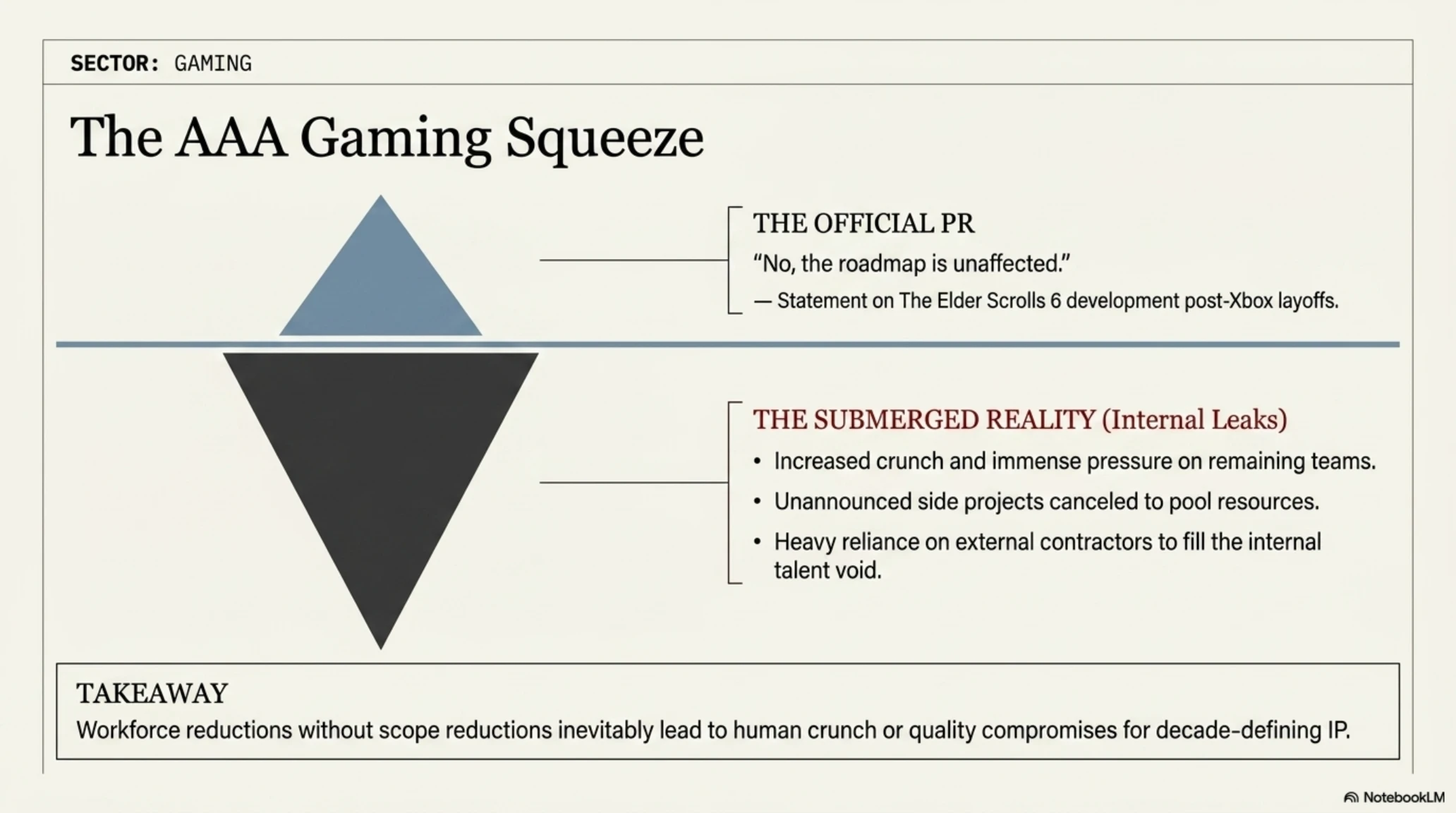
Following widespread Xbox layoffs affecting hundreds of employees from Bethesda Game Studios, ZeniMax, and other subsidiaries, concerns arose about these layoffs' impact on The Elder Scrolls 6 development. Some internal developers told IGN these layoffs would have a "substantial and cascading effect" on the game's development and feared delays and crunch.
But Bethesda officially stated in response to MrMattyPlays, a popular gaming YouTuber: "No, the roadmap is unaffected." This brief but firm statement aimed to calm fans' concerns. However, Bethesda provided no further details and didn't explain how it maintained plans unchanged with a reduced workforce.
The Truth Behind Official Statements
Internal sources who spoke with IGN paint a more complex picture. They say that while the official roadmap hasn't changed, pressure on remaining teams has increased with fewer staff. Some side projects have been canceled to concentrate resources on Elder Scrolls 6. It's also reported that Bethesda is increasingly using external contractors to fill the talent void.
Why It Matters: The Future of AAA Games
Looking Ahead: Patterns Taking Shape
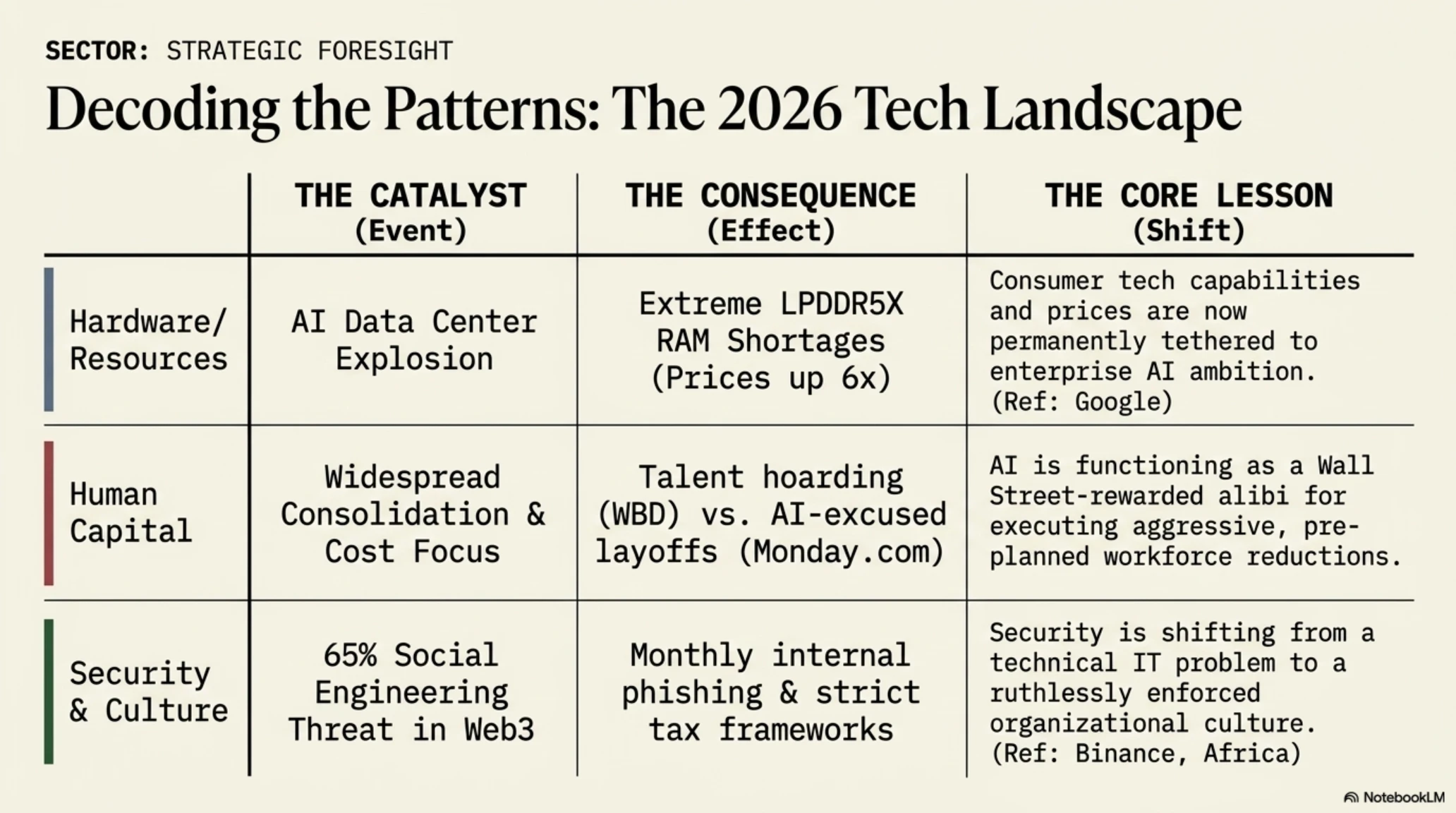
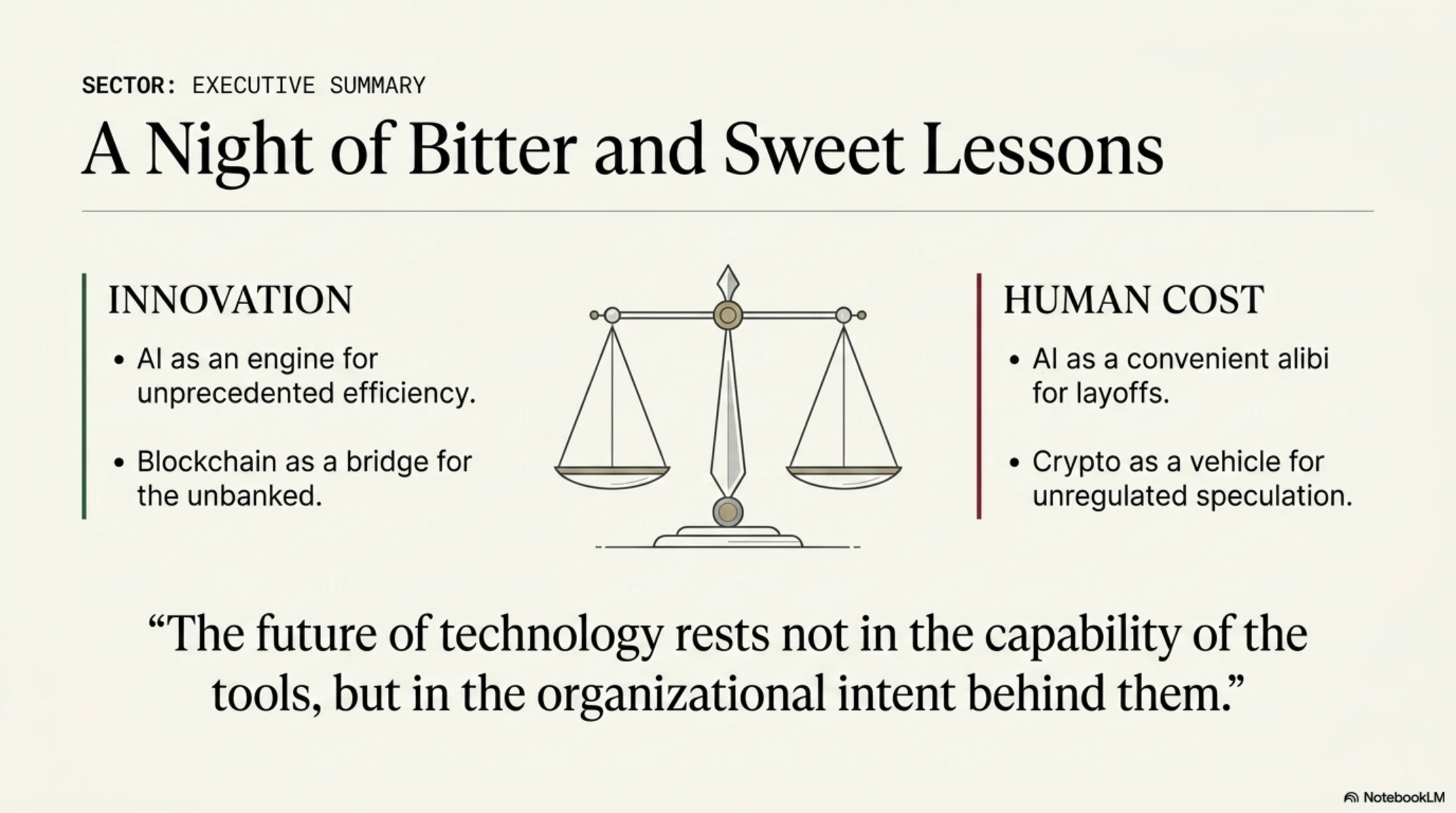
The six stories we examined tonight share common patterns revealing deeper transformations in the tech industry. The Pixel 11 price increase demonstrates how competition for limited resources (in this case, RAM) transfers to the end consumer. Monday.com's layoffs exemplify a new trend where AI is presented not as a supporting tool but as a human workforce replacement.
Warner Bros' lawsuit against Amazon shows that the talent war in the entertainment industry has reached a new phase. Simply offering higher salaries is no longer enough; companies must now use legal tools to retain key employees. Binance's approach to employee security testing demonstrates that cybersecurity is no longer just a technical matter; it's an organizational culture that must be institutionalized at all company levels.
Antony Mlelwa's responsible approach in Africa reminds us that technology without education and cultural groundwork can be dangerous. And finally, Bethesda's stance on Elder Scrolls 6 shows that even the biggest studios struggle to balance cost reduction with quality maintenance.
Key Patterns from Tonight
- Resource scarcity (RAM) leads to product price increases
- AI has become an excuse for massive layoffs
- The talent war in entertainment is intensifying
- Cybersecurity is becoming an organizational culture
- Responsible education matters more than technology adoption speed
Tonight's Lessons: What We Learn from These Stories
Each of these six stories carries lessons for us that transcend their own headlines. The Pixel 11 issue reminds us that every technological choice has wide-ranging economic consequences. When major companies decide to allocate resources to AI, this decision impacts the daily lives of millions. Now we must pay more for a smartphone because AI data centers consume the same memory we need.
The Monday.com story offers a bitter lesson about how hard decisions are justified. Using AI as an excuse for layoffs creates a dangerous pattern. If this trend continues, we may witness a wave of "AI-related" layoffs that are actually just simple cost reductions. This damages public trust in AI technology and makes employees pessimistic about their job futures.
- Increased public awareness of resource limitations
- Greater corporate transparency in announcing price increase reasons
- Focus on cybersecurity at organizational level
- Responsible approaches to technology adoption
- Rising electronic product prices
- Instrumental use of AI to justify layoffs
- Increased job stress in tech industry
- Talent war and job instability
Our Role as Consumers and Citizens
As consumers, we can influence market direction through informed choices. When Google raises Pixel 11 prices, we can seek alternative options or postpone purchases until the market balances. When companies like Monday.com lay off employees under AI pretenses, we can show through our choices that this behavior is unacceptable.
As citizens, we can support legislators working to protect employee rights and implement reasonable AI regulations. We can appreciate companies like Binance that invest in cybersecurity. And we can support people like Antony Mlelwa who prioritize responsible education over short-term profits.
Practical Actions for Readers
- Research and compare options before purchasing new products
- Support companies that respect their employees
- Stay aware and educated about your cybersecurity
- Use credible educational resources for learning new technologies
- Make your voice heard on technology policies
The Week Ahead Outlook
As this Sunday night ends, we look toward a new week that will likely be full of new developments. Google is scheduled to announce more Pixel 11 details in coming weeks, and we'll see how the market reacts to price increases. Monday.com must prove it can deliver the same service level with 20% fewer employees. Warner Bros and Amazon must prove in court who has the right to recruit employees.
In the crypto world, eyes are on Tanzania and other African countries drafting regulatory frameworks. How these countries handle crypto could model other emerging markets. And in the gaming world, Elder Scrolls 6 fans will closely monitor Bethesda's behavior to see if the company can truly advance the project without delays or quality reduction.
Important Events Next Week
- Monday, July 27: Google quarterly earnings report
- Tuesday, July 28: Federal Reserve monetary policy meeting (impact on crypto market)
- Wednesday, July 29: Binance Developer Conference
- Thursday, July 30: Warner Bros vs Amazon court hearing
- Friday, July 31: US employment report (including tech industry data)
Final Message: Good Night with Hope for a Better Tomorrow
As night ends and we prepare to rest, it's worthwhile to take a moment for reflection. The tech world is changing at an astonishing pace, and we are all part of this transformation. Our choices, whether as consumers, employees, or citizens, play a role in shaping this future.
Tekin Night Wrap-Up
Sunday night, July 26, 2026, brought us stories each narrating tales of challenges and opportunities in the tech industry. On one hand, technological advances like AI are changing the world. On the other hand, these advances come with costs, such as rising hardware prices and organizational layoffs.
But amid these challenges, signs of hope and responsibility also exist. The future of technology rests in the hands of those who decide how to use these tools; the choice is ours.
Frequently Asked Questions
Why is Google Pixel 11's price increasing?
Due to global RAM shortage caused by AI data center explosion, LPDDR5X memory prices have risen from $2.8 in 2025 to $12 in 2026 (a sixfold increase). This cost transfers directly to consumers, and the base Pixel 11 is predicted to start at $899 with a $100 price increase.
Why did Monday.com lay off 630 employees?
Monday.com announced it's laying off 20% of its workforce to support a leaner operating model focused on AI Work Platform. But critics believe this is just an excuse for cost reduction. The company expects to maintain the same revenue growth with 20% fewer employees.
Why did Warner Bros sue Amazon?
Warner Bros Discovery sued Amazon for allegedly illegally recruiting contracted employees. The lawsuit's focal point is Pia Barlow, EVP of HBO Max Marketing, whose contract was valid until October 2027 but joined Amazon MGM Studios. WBD claims Amazon follows a systematic pattern of illegal employee poaching.
How does Binance test employee security?
Binance runs simulated phishing attacks against its employees monthly. The Red Team sends fake emails, suspicious messages, and fabricated calls to employees. Those who repeatedly fail must complete training courses and may be terminated if they don't improve.
What is Antony Mlelwa's approach to crypto adoption in Africa?
Mlelwa believes technology should be understood before promotion, financial risks should be explained before opportunities, and education must be stronger than market hype. He promotes this philosophy through educational workshops and international speaking engagements, emphasizing cooperation with governments.
Have Xbox layoffs affected Elder Scrolls 6?
Bethesda officially stated Elder Scrolls 6's roadmap remains unaffected. However, internal sources say pressure on remaining teams has increased and some side projects were canceled to concentrate resources on TES6.
Additional Gallery: 🌙 Tekin Night Sunday July 26: Price Revelations, AI Layoffs & The Talent War Heats Up