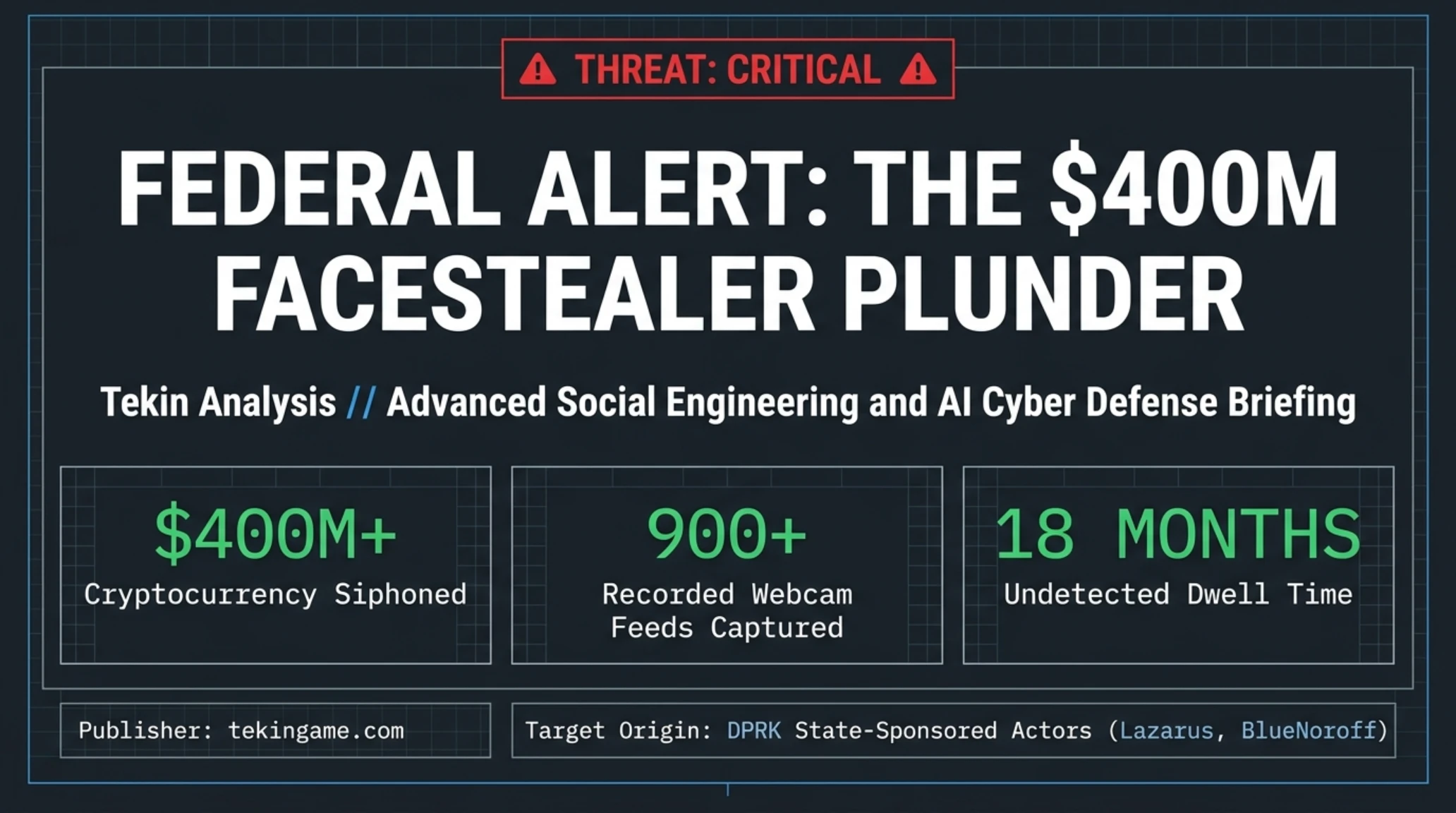
Tekin Analysis deconstructs the joint FBI and DOJ advisory exposing FaceStealer, an 18-month cybercrime campaign by North Korean state-sponsored hackers (BlueNoroff / Sapphire Sleet) that siphoned over $400M in cryptocurrency using real-time AI deepfakes on Zoom and Microsoft Teams. We examine the virtual webcam injection pipeline, the federal seizure of 900+ surreptitiously recorded executive webcam feeds, and the 4-tier Zero-Trust defense protocol.
Tekin Analysis | Forensic Breakdown of the $400M FaceStealer Real-Time Deepfake Video Heist
An extraordinary public service announcement and enforcement dossier issued jointly by the U.S. Federal Bureau of Investigation (FBI) and the Department of Justice (DOJ) in November 2026 has reverberated across global financial technology, decentralized computing, and open-source software ecosystems. According to unsealed federal court filings, state-sponsored cyber syndicates tied to the Democratic People's Republic of Korea tracked internationally under threat clusters including BlueNoroff, Sapphire Sleet, and the Lazarus Group have systematically extracted more than $400 million in cryptocurrency over an aggressive 18-month social engineering campaign codenamed FaceStealer.
What elevates the FaceStealer enterprise from conventional credential phishing and email impersonation into an existential cyber threat is its audacious exploitation of human cognitive perception. Transcending static synthetic imagery, the adversary hijacked compromised enterprise communication accounts across professional networks, lured targeted founders and engineers into live Zoom and Microsoft Teams conferences, and projected real-time AI deepfakes and high-definition video loops of trusted industry luminaries to disarm the target's cognitive defense perimeter within seconds.
Key Takeaways and Strategic Intelligence on FaceStealer Operation
The FaceStealer Nightmare: How Generative AI Became a Weapon of Mass Financial Theft
A rigorous architectural examination of federal evidentiary records demonstrates that FaceStealer signifies a generational paradigm shift in advanced persistent threat (APT) methodologies. For decades, cyber defense postures assumed that authenticated human presence verified through live video interaction represented the gold standard of trust. By weaponizing deep learning diffusion models, neural radiance fields, and virtual camera driver hooks, state-sponsored adversaries successfully dismantled that trust foundation, turning interpersonal familiarity into an attack vector.
The operational lifecycle of each intrusion begins with the silent takeover of authentic social profiles belonging to prominent Web3 entrepreneurs on platforms such as Telegram, LinkedIn, Slack, and Discord. Rather than sending generic spam, the attackers pore over historical chat logs to mimic the victim's vocabulary, colloquialisms, and scheduling habits. They subsequently transmit tailored conference invitations to trusted contacts, framing the meeting as an exclusive venture capital investment opportunity, a joint liquidity protocol partnership, or a high-compensation executive hiring review:
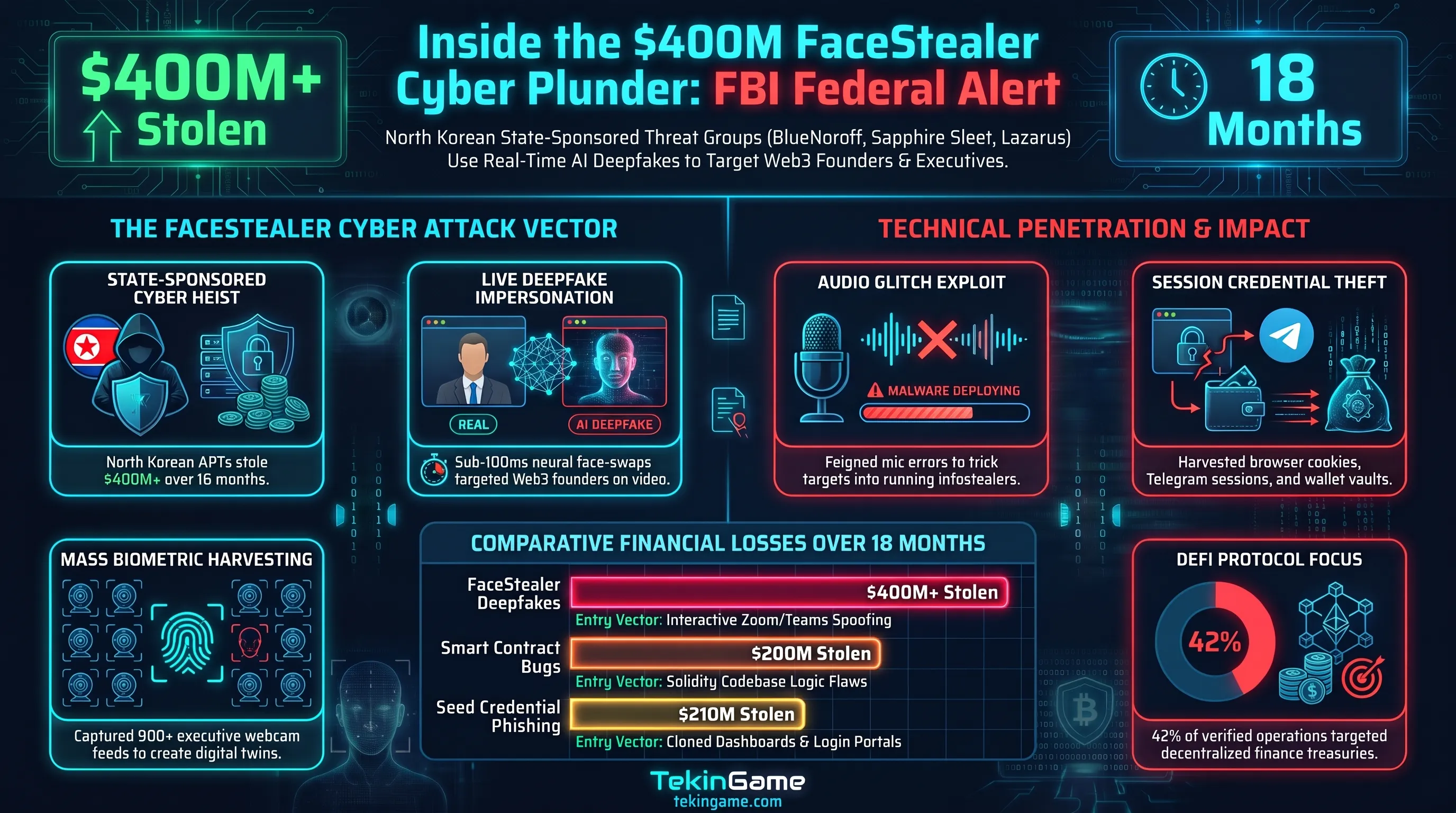
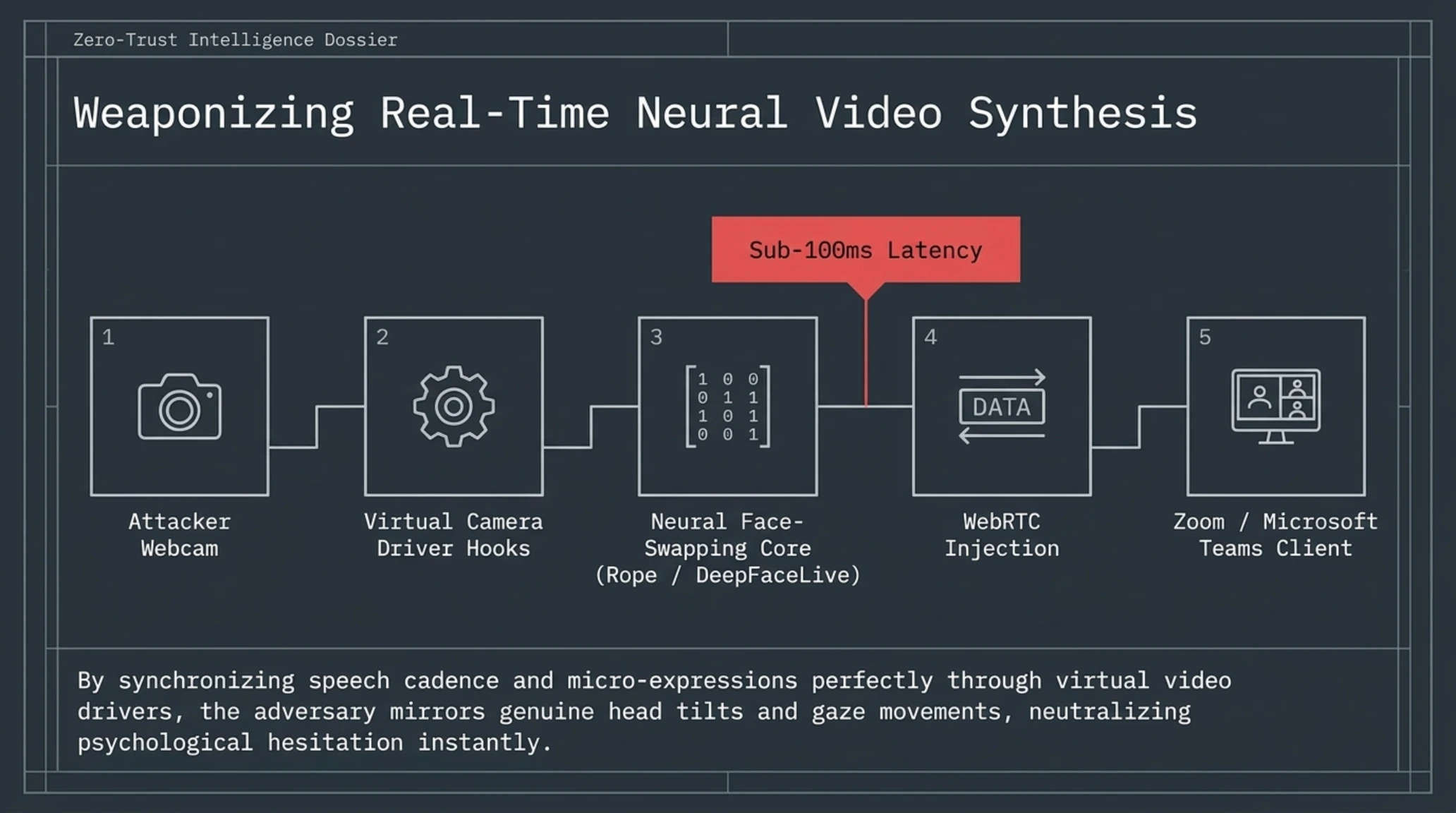
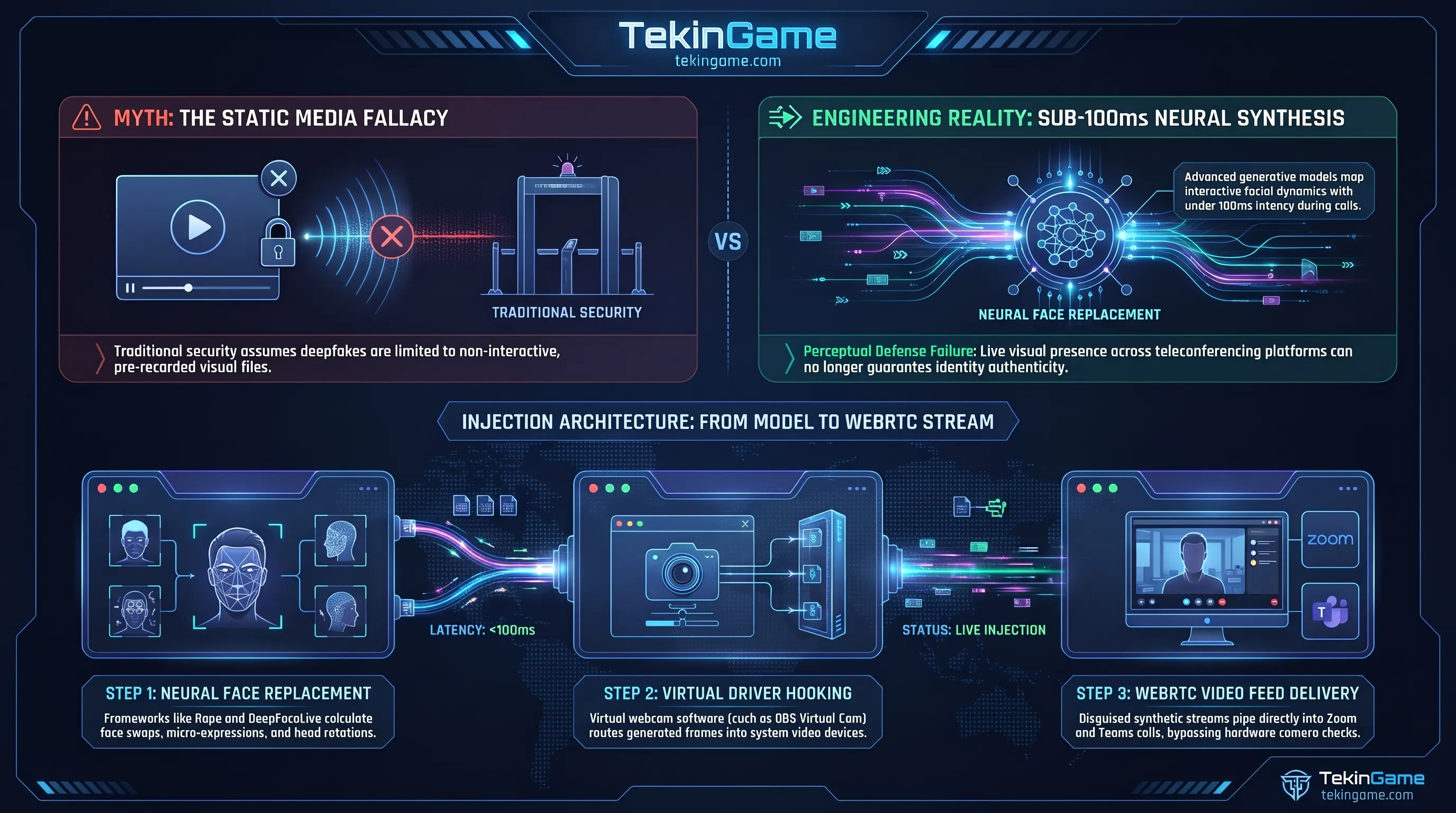
When the target clicks the conference link and enters the virtual meeting room, they are greeted by an interactive video stream featuring the exact likeness of their colleague or investor. Leveraging neural real-time face replacement frameworks such as Rope and DeepFaceLive piped through virtual video drivers, the adversary mirrors genuine head tilts, gaze movements, and natural facial gestures, neutralizing any residual psychological hesitation on the part of the participant.
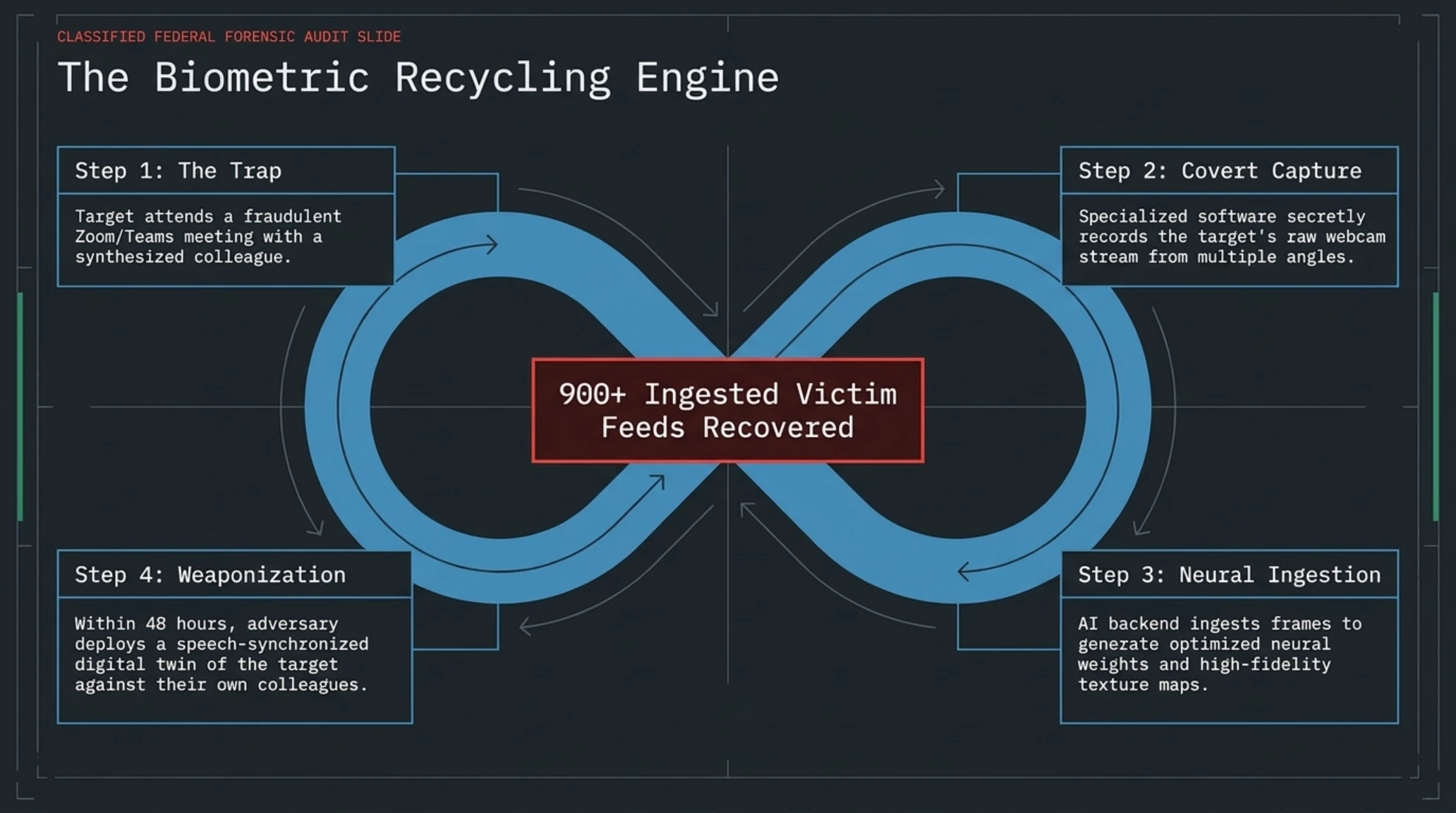
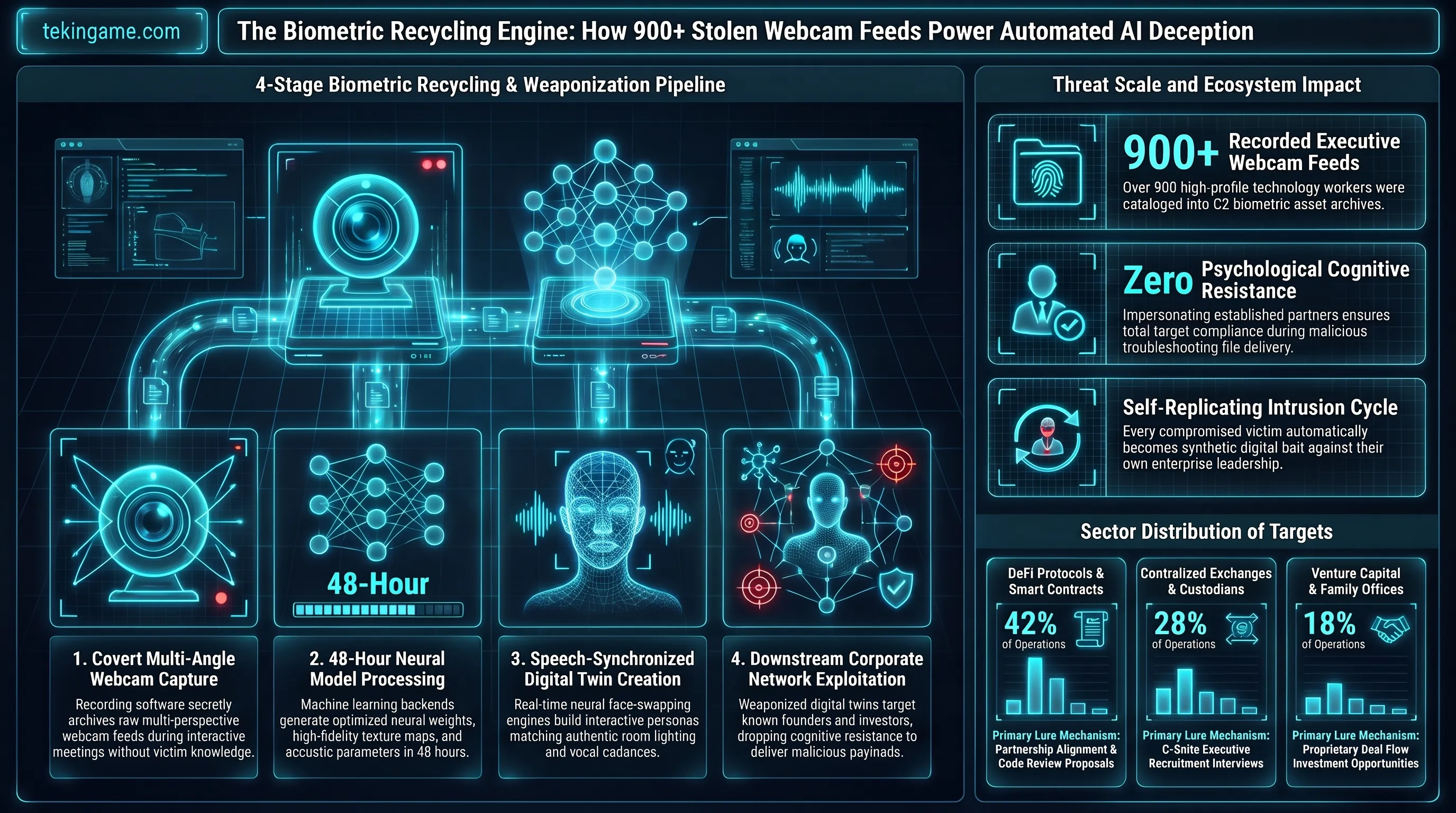
Concurrently, the adversary activates an automated biometric harvesting routine. Without the participant's knowledge or consent, high-resolution recording software captures their raw webcam stream from multiple angles. This creates an automated self-replicating infection loop: today's victim is unknowingly archived into a library of synthetic assets, ready to be deployed as digital bait against their own corporate leadership and personal networks in subsequent operational phases. Federal authorities unsealed records revealing that over 900 high-profile technology workers were cataloged in this biometric repository:
Why the FaceStealer Campaign Marks an Historic Cybersecurity Inflection Point
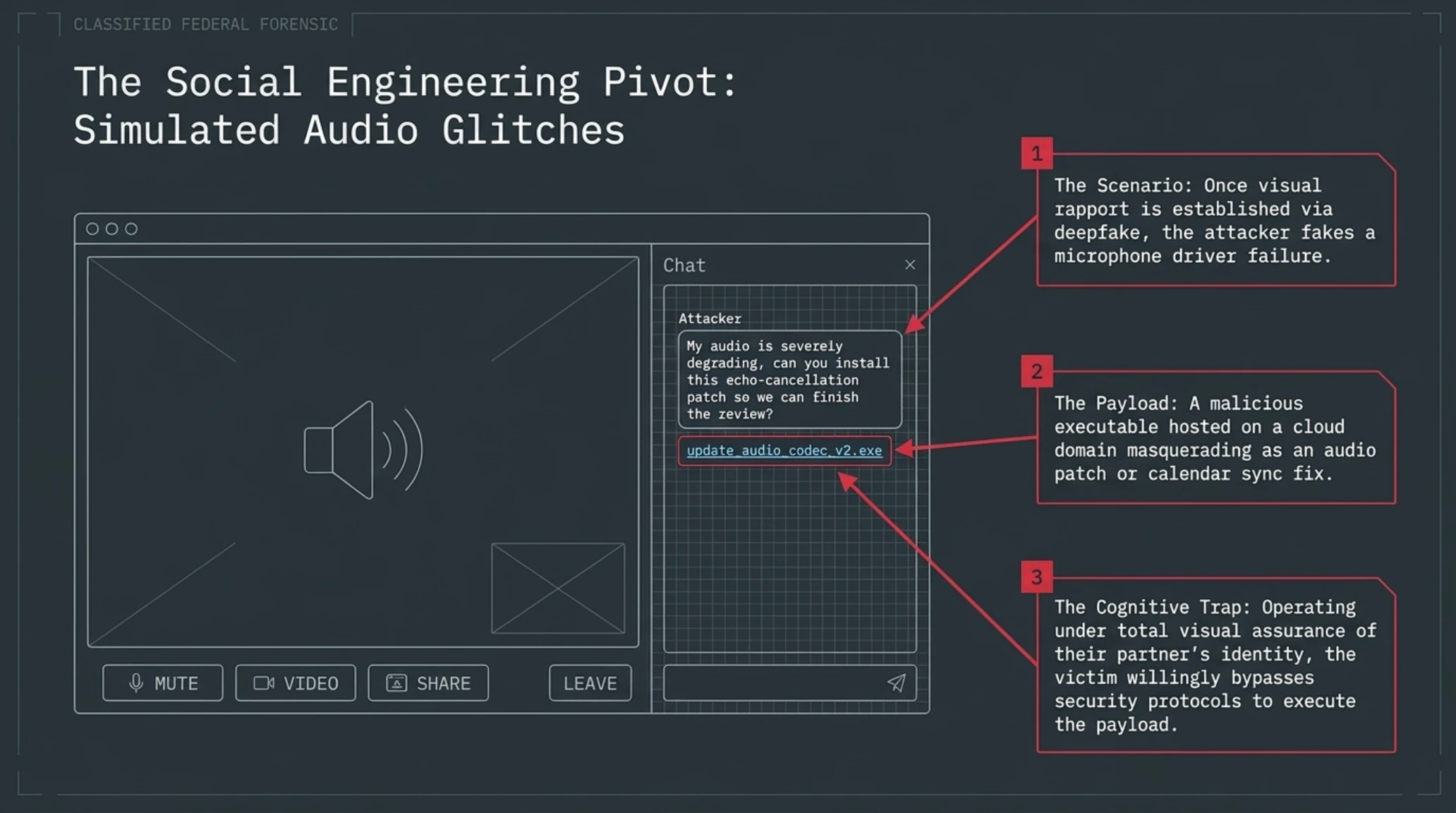
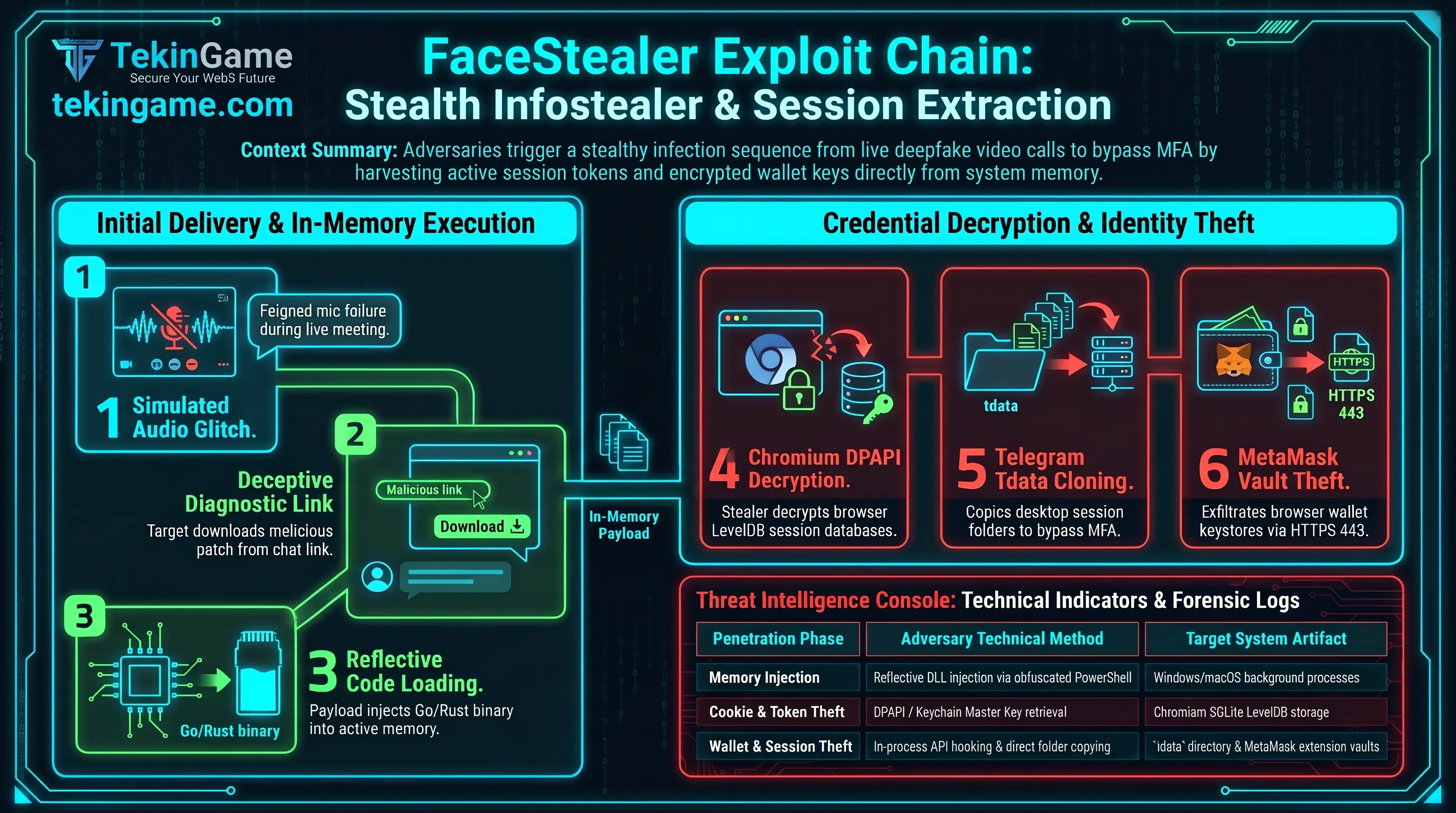
Once interactive rapport is established and the target is visually convinced of their peer's authenticity, the attackers pivot to the technical compromise phase. Simulating sudden technical difficulties, the adversary indicates via the in-meeting chat that they are experiencing audio degradation or driver failure, prompting the victim to assist in resolving the connection issue.
The attacker posts a hyperlink masquerading as a diagnostic utility, a browser audio codec update, or a calendar synchronization fix hosted on a legitimate-looking cloud domain. Operating under the complete cognitive assurance that they are conversing with a verified partner, the target downloads and executes the provided payload, triggering an instantaneous, silent machine-level infection:
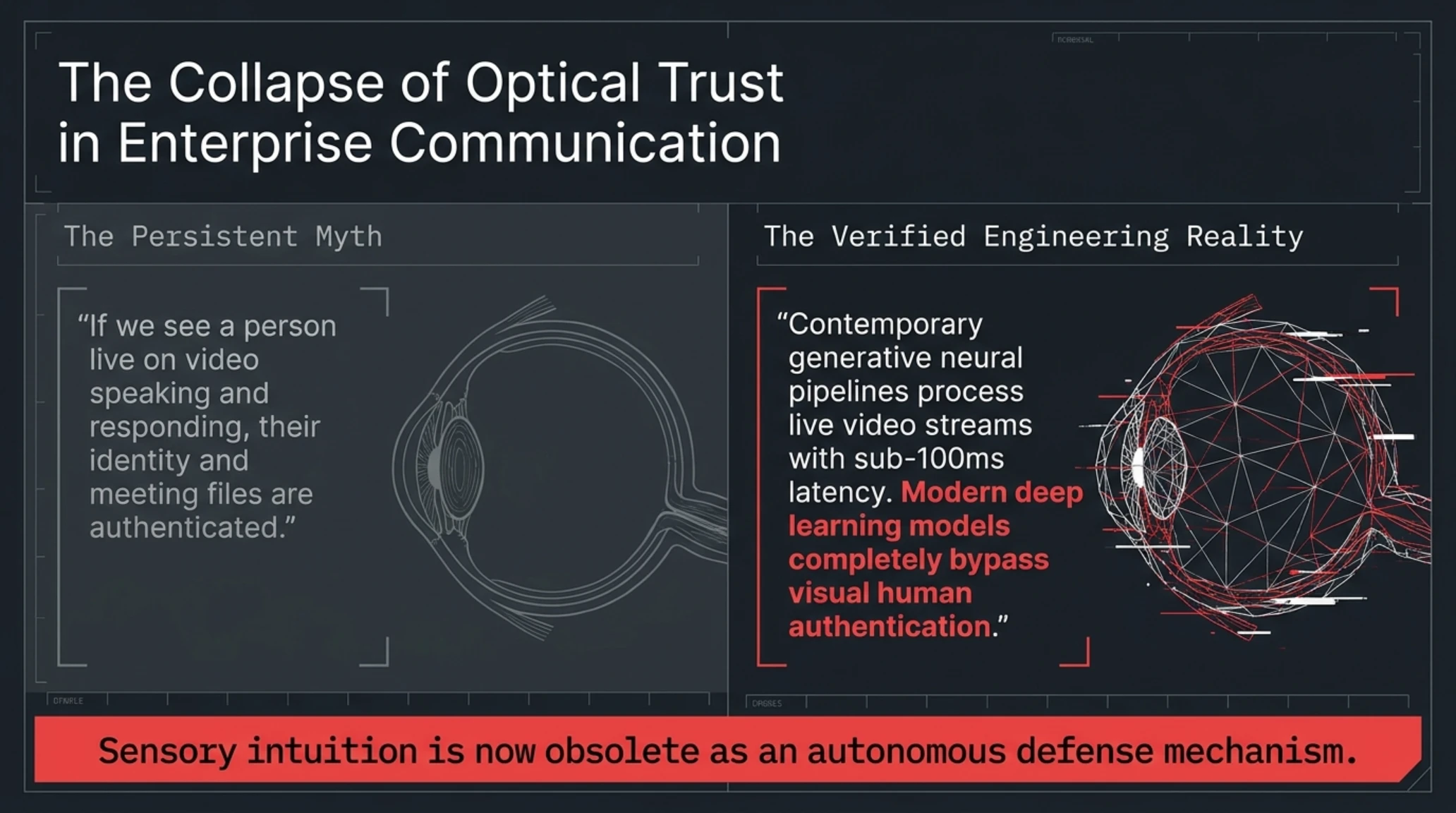
Rumor vs. Reality: Forensic Analysis of Live Video Call Trust Vulnerabilities
This calculated operational methodology proves that within the modern cyber landscape, sensory intuition can no longer be relied upon as an autonomous defense mechanism. Understanding the technical mechanics of the subsequent code execution chain requires a granular deconstruction of the infostealer payloads deployed across infected enterprise endpoints.
Glossary of Advanced Cyber Threat and Biometric Spoofing Terms
Anatomy of the Exploit Chain: From Synthetic Audio Stalls to Browser Token Theft
Deep forensic reverse engineering of binaries recovered from compromised endpoints sheds light on an intricately calibrated, multi-stage infection apparatus. When a targeted executive clicks the malicious diagnostic link presented in the chat window, they are directed to an impeccably styled landing page mimicking corporate conference support portals from Zoom, Google, or Microsoft. The page serves a lightweight payload frequently disguised as a signed audio patch, an echo-cancellation driver, or an automated calendar synchronization utility.
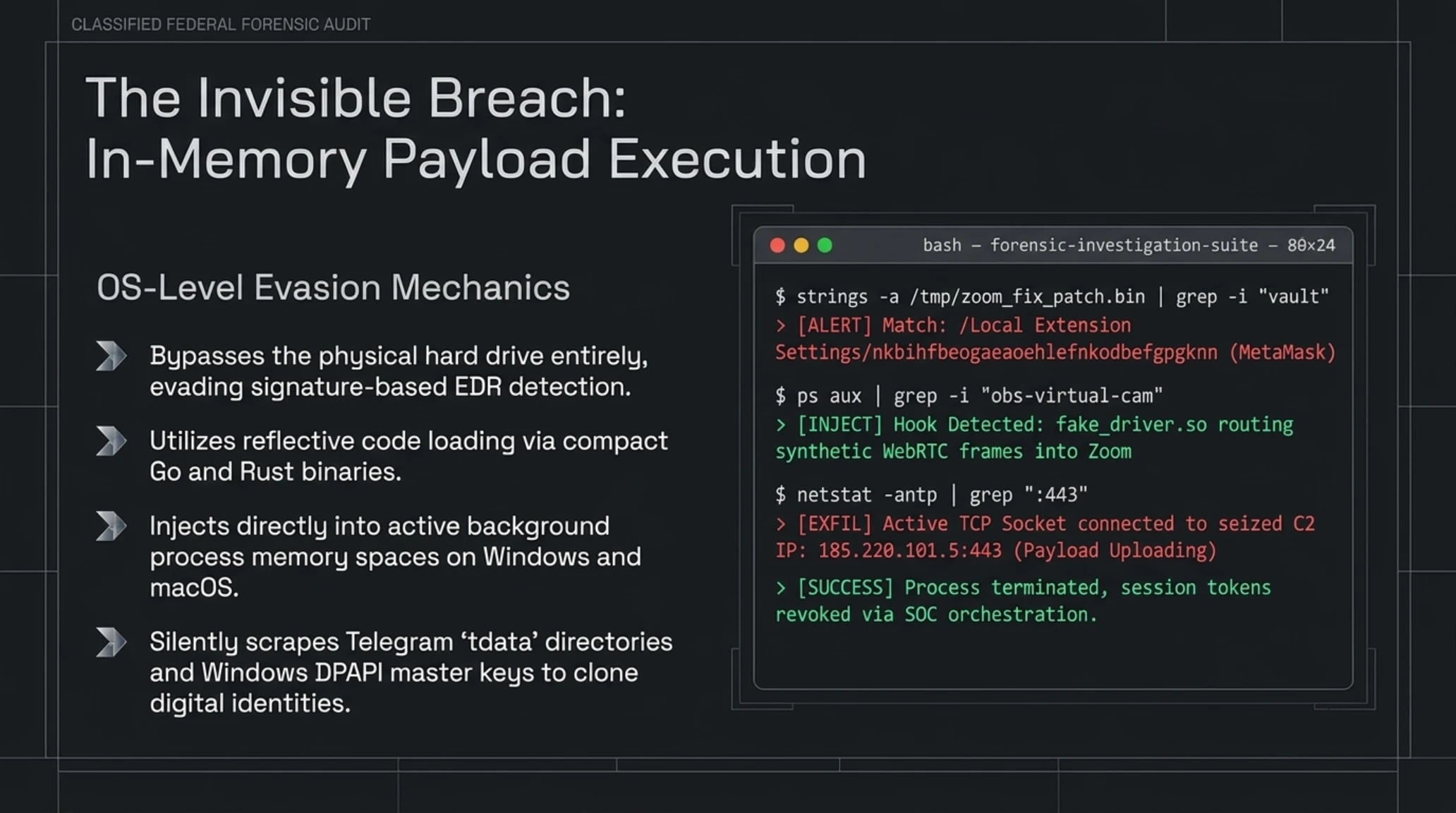
Upon execution, the initial dropper leverages obfuscated PowerShell or native shell scripts to establish immediate operational footholds. Rather than writing conspicuous binaries to the physical file system where signature-based Endpoint Detection and Response (EDR) agents might trigger behavioral alerts, the malware deploys reflective code loading techniques. A custom, compact executable compiled in Go or Rust is injected directly into the memory address space of legitimate Windows or macOS background processes:
Once active in memory, the infostealer initiates rapid lateral collection routines across local user directories. Its primary objective is the extraction of browser authentication databases. By querying Chromium-based installations across Google Chrome, Brave, and Microsoft Edge, the payload accesses SQLite LevelDB storage. Operating under the security context of the active user, the malware leverages Windows Data Protection API (DPAPI) or macOS Keychain calls to decrypt Master Keys, instantly harvesting authenticated session cookies, saved passwords, and persistent JSON Web Tokens.
Crucially for Web3 enterprises, the stealer specifically targets cryptocurrency extension vaults including MetaMask, Rabby, Phantom, and Coinbase Wallet. Simultaneously, the malware copies entire session state folders belonging to desktop communication software most notably Telegram's `tdata` directory. Possessing these decrypted session state artifacts, the threat actor completely bypasses multi-factor authentication (MFA) and hardware security key prompts, cloning the victim's digital identity onto an offshore adversary workstation:
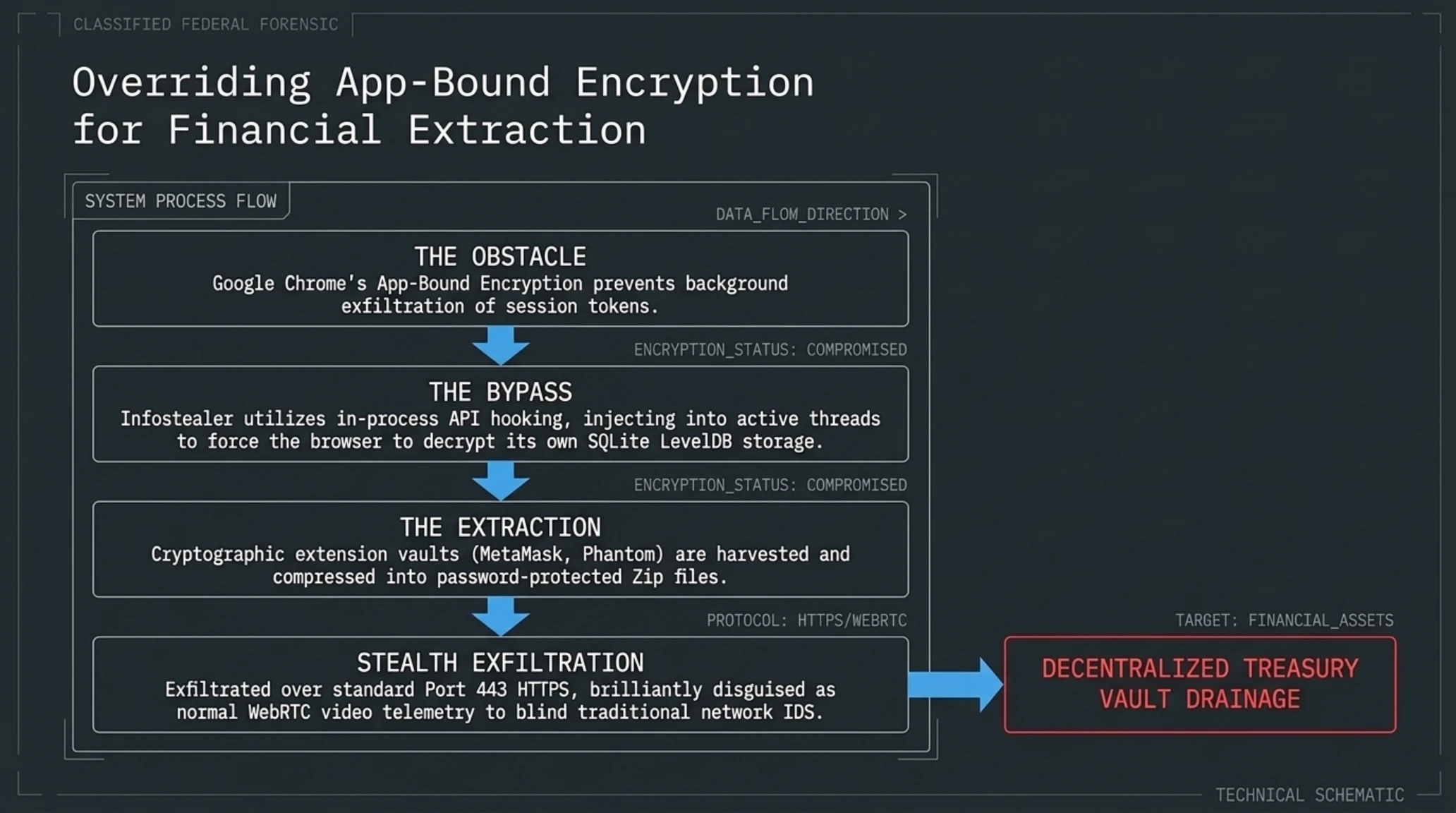
The sophistication of the infostealer component is underscored by its ability to circumvent modern operating system mitigations, including Google Chrome's App-Bound Encryption introduced in recent browser releases. While App-Bound Encryption binds stored cookies to elevated application identity tokens to prevent background exfiltration, the FaceStealer malware executes in-process API hooking. By injecting directly into active browser process threads or spawning elevated worker handles via COM elevation interfaces, the malware forces the browser itself to decrypt and yield its session database before piping it to encrypted staging archives.
Furthermore, the exfiltration architecture incorporates multi-path redundancy to defeat enterprise network egress filtering. Harvested credential archives and wallet keystores are compressed into password-protected Zip files and exfiltrated over standard HTTPS port 443, disguised as legitimate WebRTC video telemetry or API analytics pings to compromised cloud storage buckets. This stealthy egress design ensures that traditional perimeter intrusion detection systems (IDS) remain entirely unaware of the ongoing data exfiltration.
Comparative Vector Matrix and Cumulative Web3 Attack Losses
| Attack Vector & Threat Method | Cumulative Capital Losses (18 Mos) | Initial Entry Channel | Remediation Complexity |
|---|---|---|---|
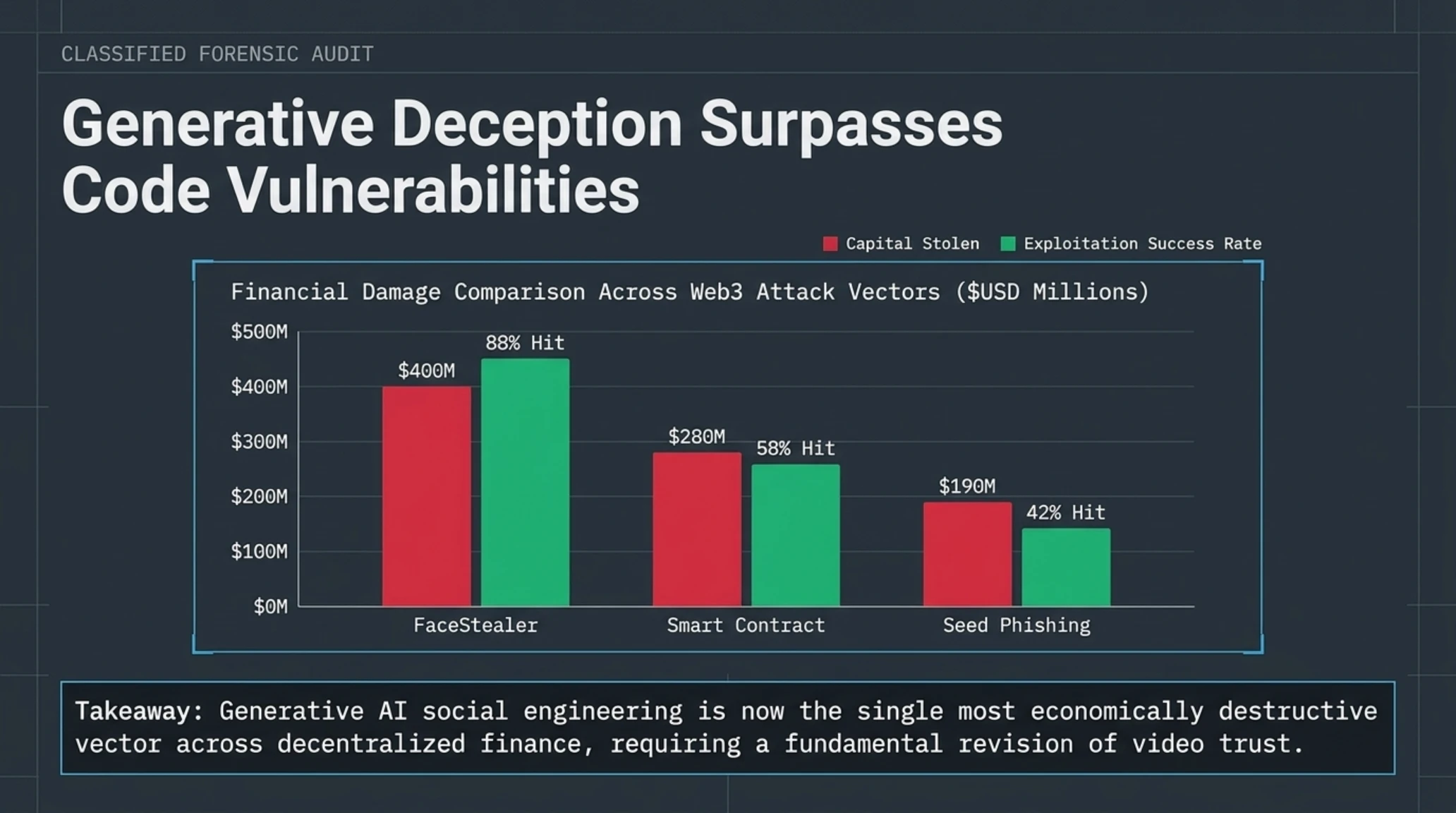
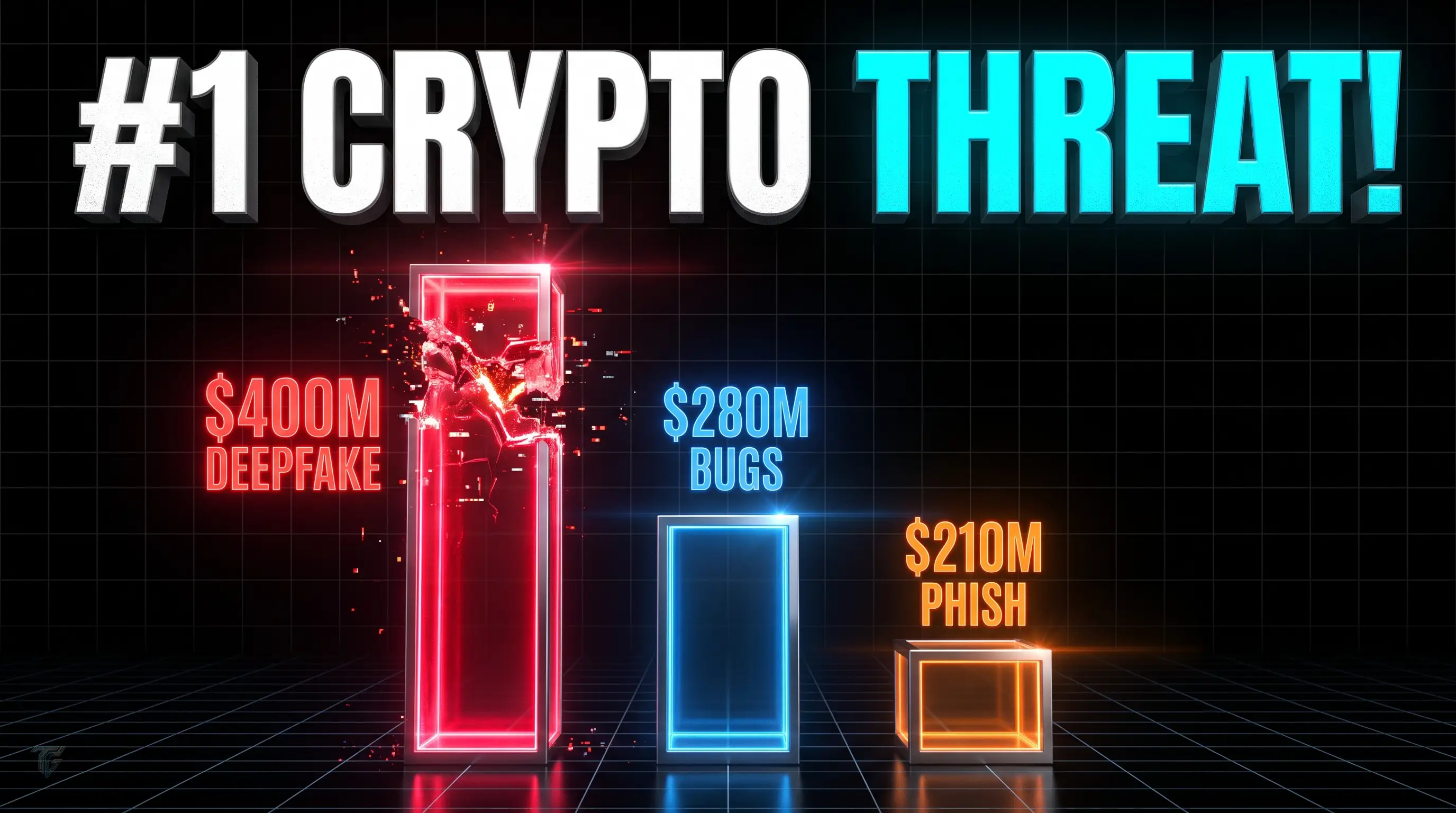
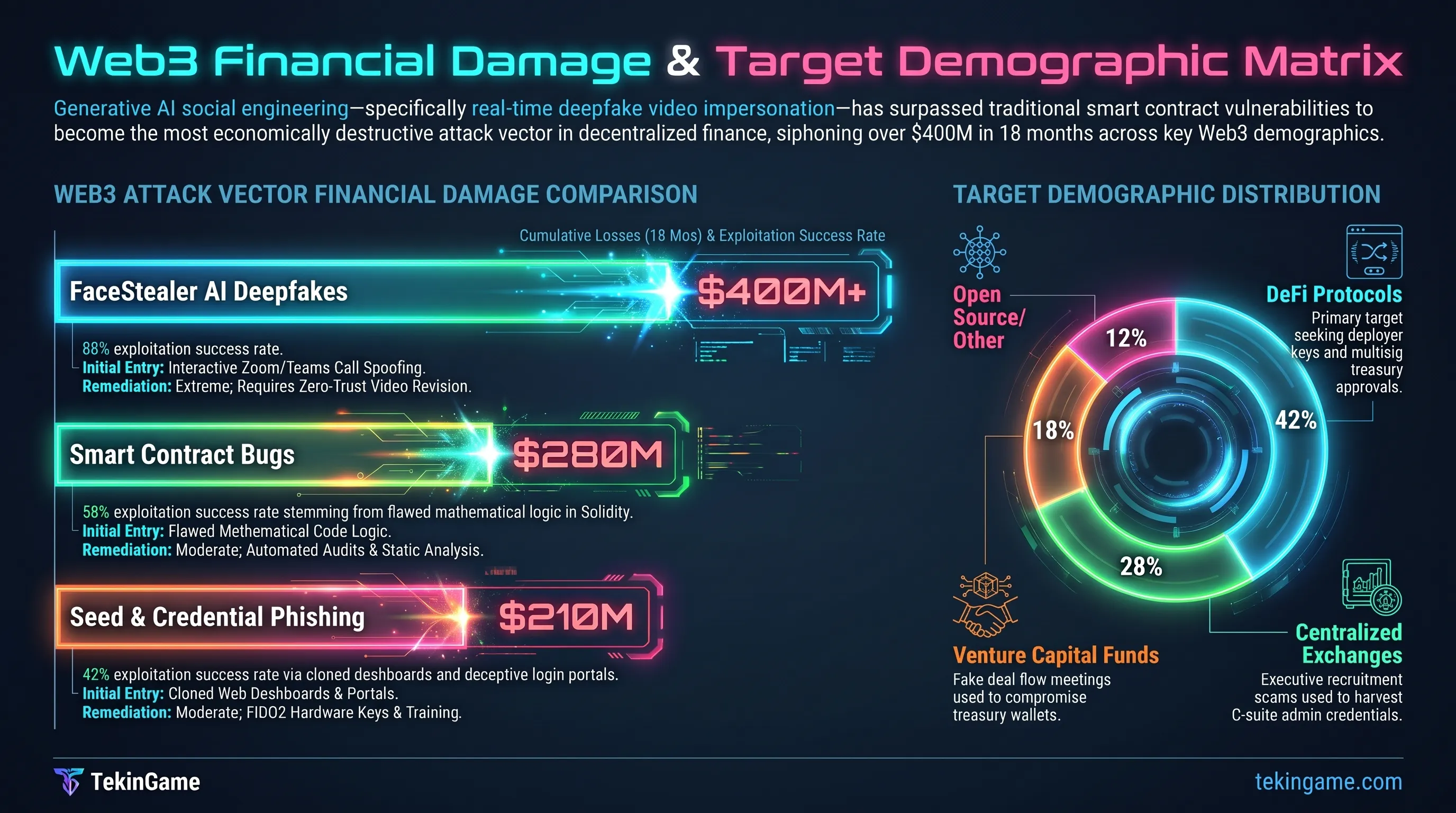
| FaceStealer Deepfake Impersonation | $400M+ Stolen | Interactive Zoom/Teams Video Call Spoofing | Extreme; Requires Fundamental Revision of Video Trust |
| Smart Contract Logic Vulnerabilities | $280 Million | Flawed Mathematical Logic in Solidity Codebases | Moderate; Mitigated via Automated Static Analysis & Audits |
| Seed Phrase & Credential Phishing | $210 Million | Cloned Web Dashboards & Deceptive Login Portals | Moderate; Addressed via User Education & Hardware FIDO2 |
| Flash Loan & Oracle Manipulation | $140 Million | Algorithmic Price Distortion Across AMM Pools | High; Requires Decentralized Multi-Source Pricing Feeds |
| Cross-Chain Bridge Infrastructure Breaches | $95 Million | Forged Validator Signatures on Relayer Relays | High; Solved via Cryptographic Multi-Party Computation |
The comparative analytics decisively establish that generative AI social engineering has surpassed traditional code vulnerabilities as the single most economically destructive vector across decentralized finance. Understanding this operational ascendancy requires analyzing how attackers automated victim conversion into subsequent attack assets.
The Biometric Recycling Engine: 900+ Ingested Feeds Powering Automated Deception
The most chilling operational discovery documented in Department of Justice court records is the existence of a continuous Victim Recycling Pipeline. The North Korean cyber operators did not merely treat intrusions as isolated financial thefts; instead, they transformed every breached executive into a synthetic biometric weapon to compromise downstream contacts.
During each video conference, specialized recording software secretly captured the victim's facial movements from multiple perspectives as they spoke, smiled, and reacted. The adversary's machine learning backend ingested these frames, generating optimized neural weights and high-fidelity texture maps. Within 48 hours of an intrusion, the threat actors possessed an interactive, speech-synchronized digital twin of the victim, complete with authentic room background lighting and vocal acoustics:
This automated recycling loop enabled exponential organizational penetration without necessitating the creation of fictitious personas. When an institutional investor receives a direct video conference request from an established founder whom they have known for years, cognitive resistance drops to zero, guaranteeing high compliance during subsequent malicious file delivery phases.
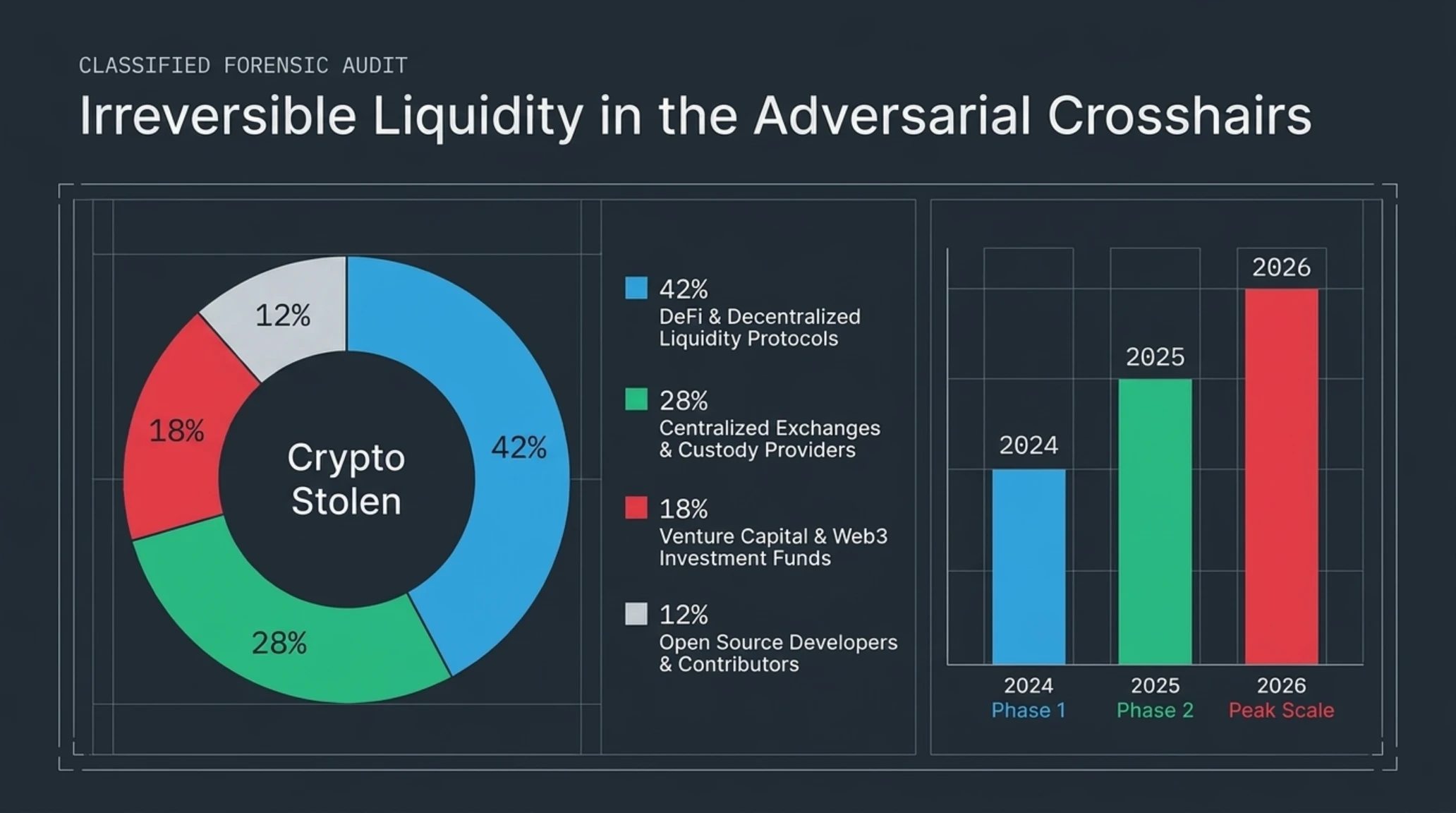
This definitive statement from federal leadership illustrates the systemic severity of the threat facing modern digital enterprise governance. Examining sector-specific telemetry reveals the disproportionate concentration of attacks across high-liquidity financial platforms:
Statistical Distribution of FaceStealer Targets Across Enterprise Sectors
| Target Ecosystem Sector | Share of Verified Incidents | Primary Lure Mechanism | Primary Extracted Assets |
|---|---|---|---|
| DeFi Protocols & Smart Contracts | 42% of Operations | Partnership Alignment & Code Review Proposals | Deployer Keys & Treasury Multisig Approvals |
| Centralized Exchanges & Custodians | 28% of Operations | C-Suite Executive Recruitment Interviews | Administrative Console Session Tokens & Credentials |
| Venture Capital & Family Offices | 18% of Operations | Proprietary Deal Flow Investment Opportunities | LP Account Credentials & Treasury Wallets |
| Independent Core Contributors | 8% of Operations | Bounty Collaboration on GitHub Pull Requests | Browser Storage Cookies & Signing Keystores |
| Cloud Hosting & Node Infrastructure | 4% of Operations | Simulated Outage Triage & Network Support | Infrastructure SSH Keys & Cloud Provider Tokens |
The tactical concentration across decentralized finance protocols and liquid digital exchanges demonstrates that state-sponsored actors prioritize environments characterized by irreversible on-chain transactions to evade global financial sanctions and bolster sovereign balance sheets.
Federal Law Enforcement Strike: Seizing C2 Infrastructure and 900 Stolen Likenesses
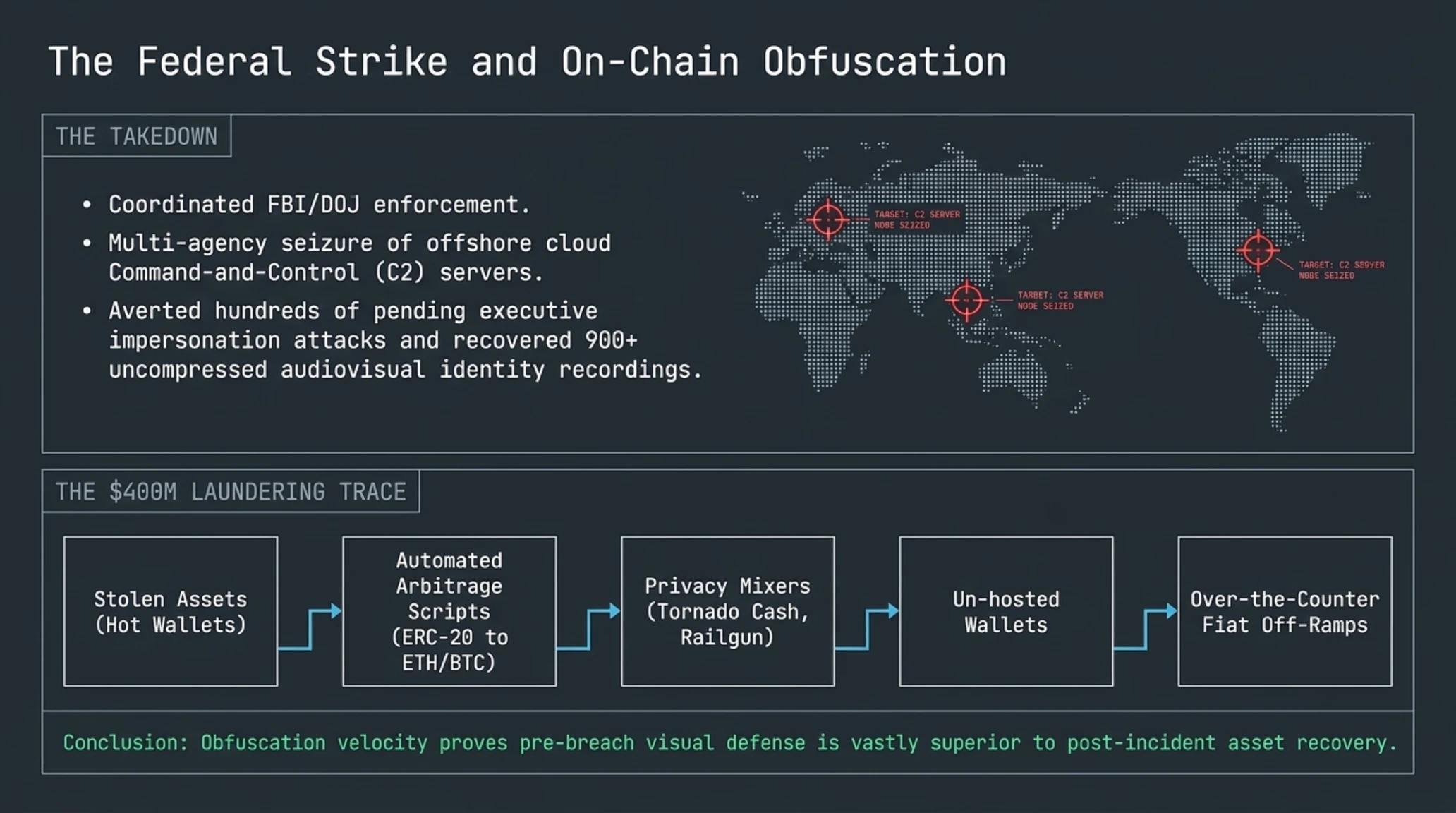
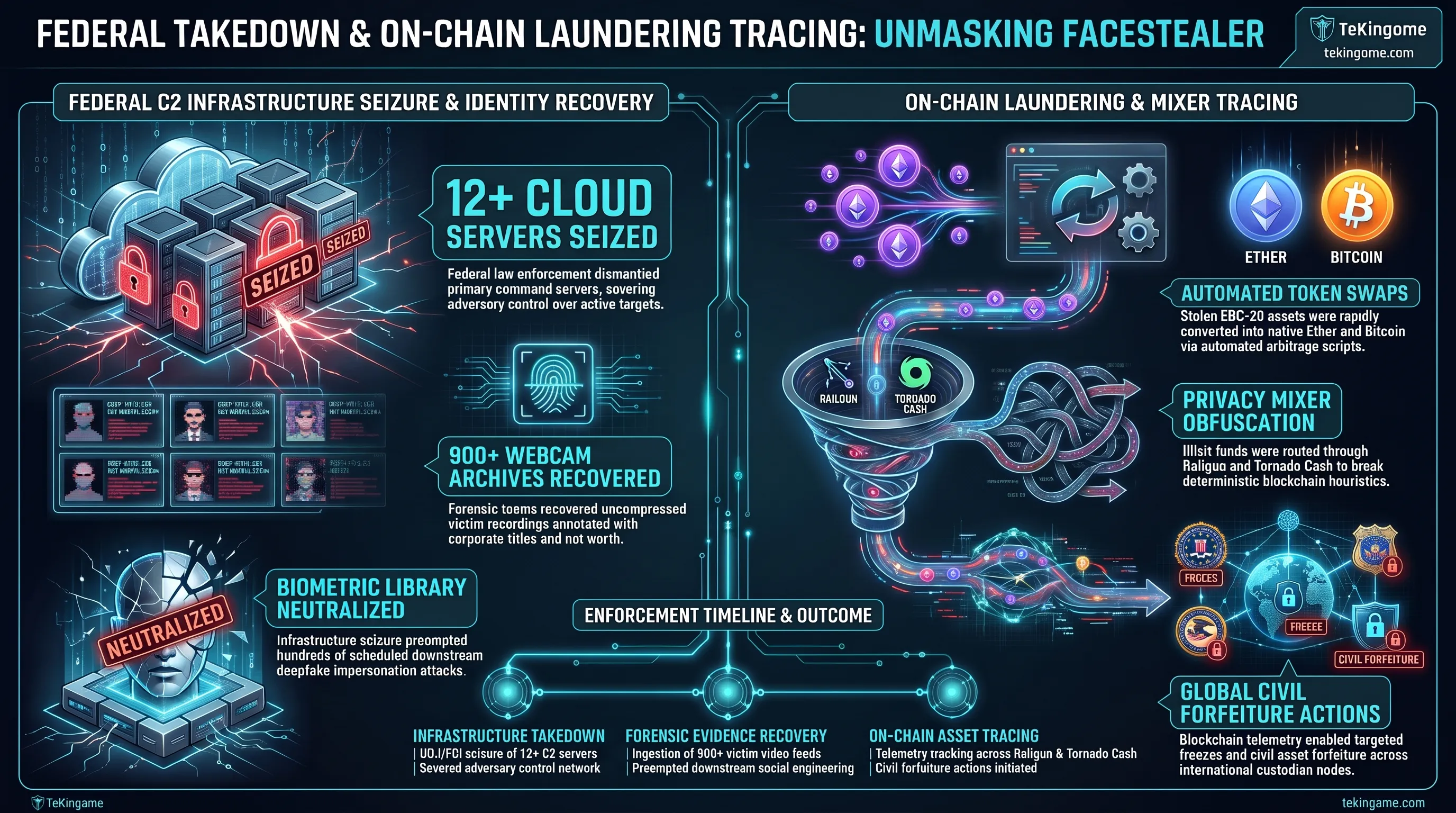
The synchronized global enforcement action executed by the United States Department of Justice, the Federal Bureau of Investigation, and international cybersecurity partners represents one of the most substantial blows against state-sponsored biometric cybercrime in computing history. Acting under emergency federal seizure warrants unsealed in federal court, law enforcement teams systematically dismantled over a dozen cloud command-and-control (C2) servers and malicious staging domains, abruptly severing the Pyongyang-linked threat cluster from its operational nerve center.
Upon gaining forensic access to the seized infrastructure, federal investigators uncovered an astonishing repository of stolen human identity assets. Stored within encrypted server volumes was an archive containing more than 900 pristine, uncompressed audiovisual recordings of technology leaders, blockchain architects, decentralized protocol founders, and venture partners captured during fraudulent video conferences. Threat actors had meticulously annotated each video file with organizational titles, estimated corporate treasury balances, and interpersonal network graphs to direct future operational phases:
This coordinated law enforcement strike averted hundreds of pending executive impersonation attacks while catalyzing an unprecedented blockchain intelligence mobilization. Collaborating with private telemetry firms including Chainalysis and Elliptic, investigators mapped the laundering pathways of more than $400 million in stolen assets across decentralized privacy mixers, cross-chain bridge liquidity protocols, and unregulated over-the-counter brokerages, culminating in civil forfeiture actions to seize illicit funds across global custodian nodes.
The laundering apparatus devised by North Korean cyber units represents an equally complex operational frontier. Stolen funds drained from hot wallets and liquidity pools rarely remain in their initial token format for more than minutes. Attackers deploy automated arbitrage scripts that swap heterogeneous ERC-20 tokens into native Ether or Bitcoin, route them through decentralized privacy protocols like Railgun and Tornado Cash, and peel transaction outputs across thousands of intermediate un-hosted wallets to break deterministic blockchain heuristics.
This rapid obfuscation velocity underscores the acute challenge confronting international financial regulators. By the time an enterprise detects that an executive's session tokens were cloned during a midday video conference, the underlying liquidity has already traversed multiple sovereign jurisdictions and settled into over-the-counter fiat off-ramps, demonstrating why pre-breach visual defense is vastly superior to post-incident asset recovery.
📚 Classified & Related Dossiers in TekinGame
If you wish to explore beyond this report and delve into cybernetic frontiers and autonomous AI architectures, do not miss these three exclusive deep-dives in the Tekin Garage:
Threat Vector Profile and Multi-Tiered Defense-in-Depth Matrix
| Threat Vector & Penetration Phase | Severity & Risk Rating | Adversary Operational Technique | Remediation & Defense Control |
|---|---|---|---|
| Real-Time Deepfake Video Injection | Critical (CVSS 9.4) | Injecting synthetic neural frames into virtual webcam devices | Enforce out-of-band challenge questions via authenticated phone/PGP |
| Malicious Meeting Code / Driver Links | High Threat | Luring victims to download PowerShell infostealer scripts | Zero-Trust ban on executing files suggested during live video meetings |
| Browser Cookie & Session Token Theft | Elevated Risk | Decrypting Chrome/Brave LevelDB storage via DPAPI hooks | Enforce ephemeral session timeouts and mandatory FIDO2 hardware MFA |
| Hardware Signer & Cold Storage Extraction | Mitigated / Hardened | Software stealers incapable of extracting physical secure elements | Mandatory multi-signature schemes with physical signing air-gaps |
Incident response logs captured by forensic engineers on compromised endpoints demonstrate how stealthy memory injection payloads package and transmit enterprise credentials without raising operating system security warnings:
Cyber Terminal Log: Memory Forensics and Driver Hook Deconstruction
This empirical dissection illustrates how contemporary adversaries merge biometric manipulation with advanced in-memory evasion frameworks to achieve high-impact financial exfiltration.
The Crisis of Digital Identity: Why Facial Biometrics Can No Longer Guarantee Truth
The unmasking of the FaceStealer enterprise forces a profound reassessment across modern systems architecture: in an era where deep learning models can synthesize photographic human likenesses and fluid conversational speech with trivial compute resources, how can an enterprise authenticate participants on the other side of an optical screen?
For millennia, human visual cognition evolved under the assumption that physical optical perception established undeniable proof of existence. In global business culture, viewing a partner's face during a video conference represented the definitive validation required to release millions of dollars in capital or grant administrative access to mission-critical infrastructure. Generative video diffusion architectures have irreversibly severed that biological connection:
Security architects increasingly emphasize that relying on raw video streams as an identity validator represents an untenable architectural vulnerability. State-sponsored hackers have demonstrated that without breaching cryptographic ciphers, they can exploit cognitive sensory bias to persuade human operators into willingly transmitting sensitive keys. The imperative response demands the immediate eradication of implicit video trust in favor of strict Zero-Trust communications:
Enterprise adoption of cryptographic out-of-band validation indicates that the Web3 and decentralized technology sectors are actively adapting to this adversarial reality:
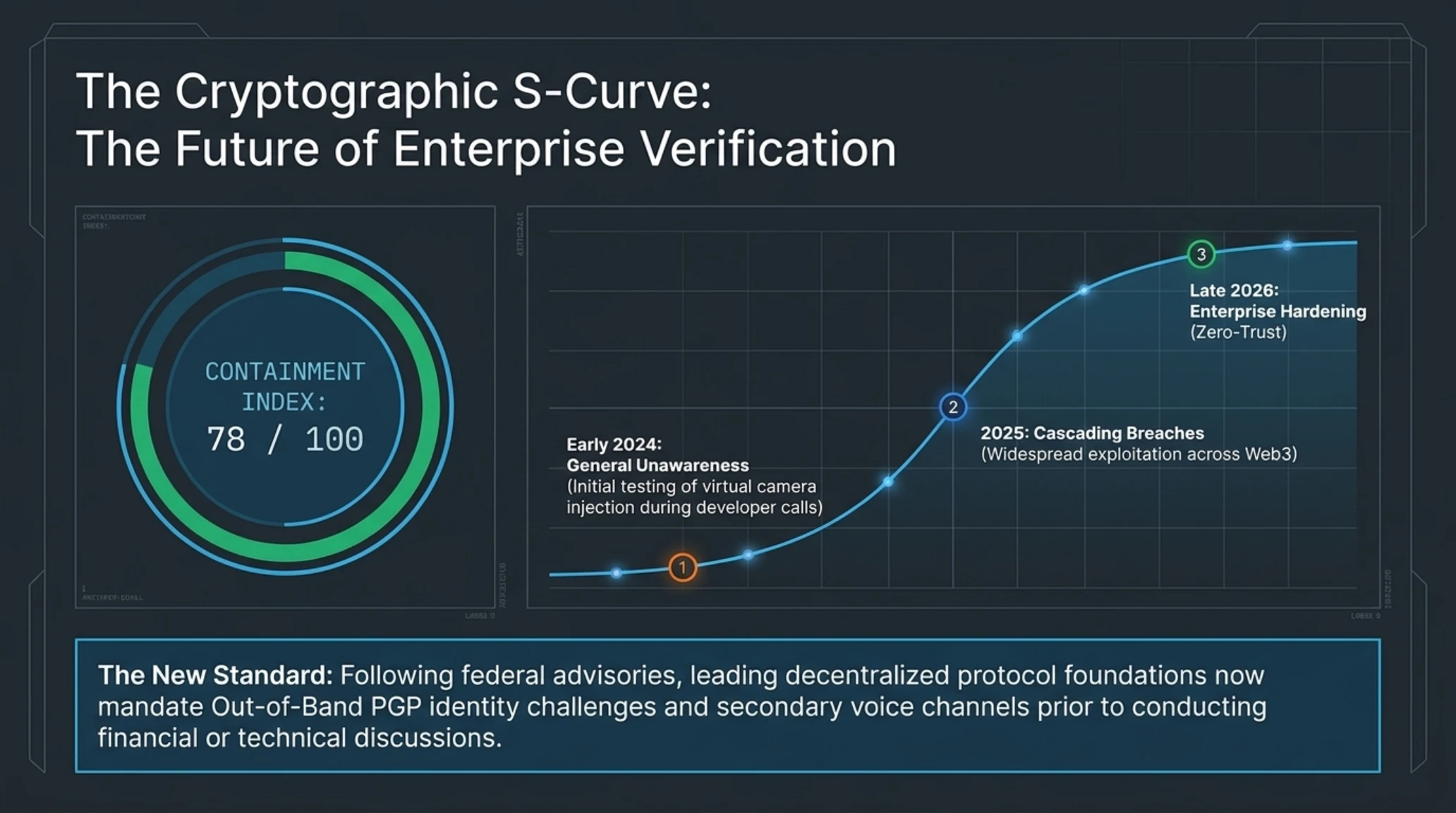
Market Sentiment, Adoption S-Curve, and Remediation Trajectory
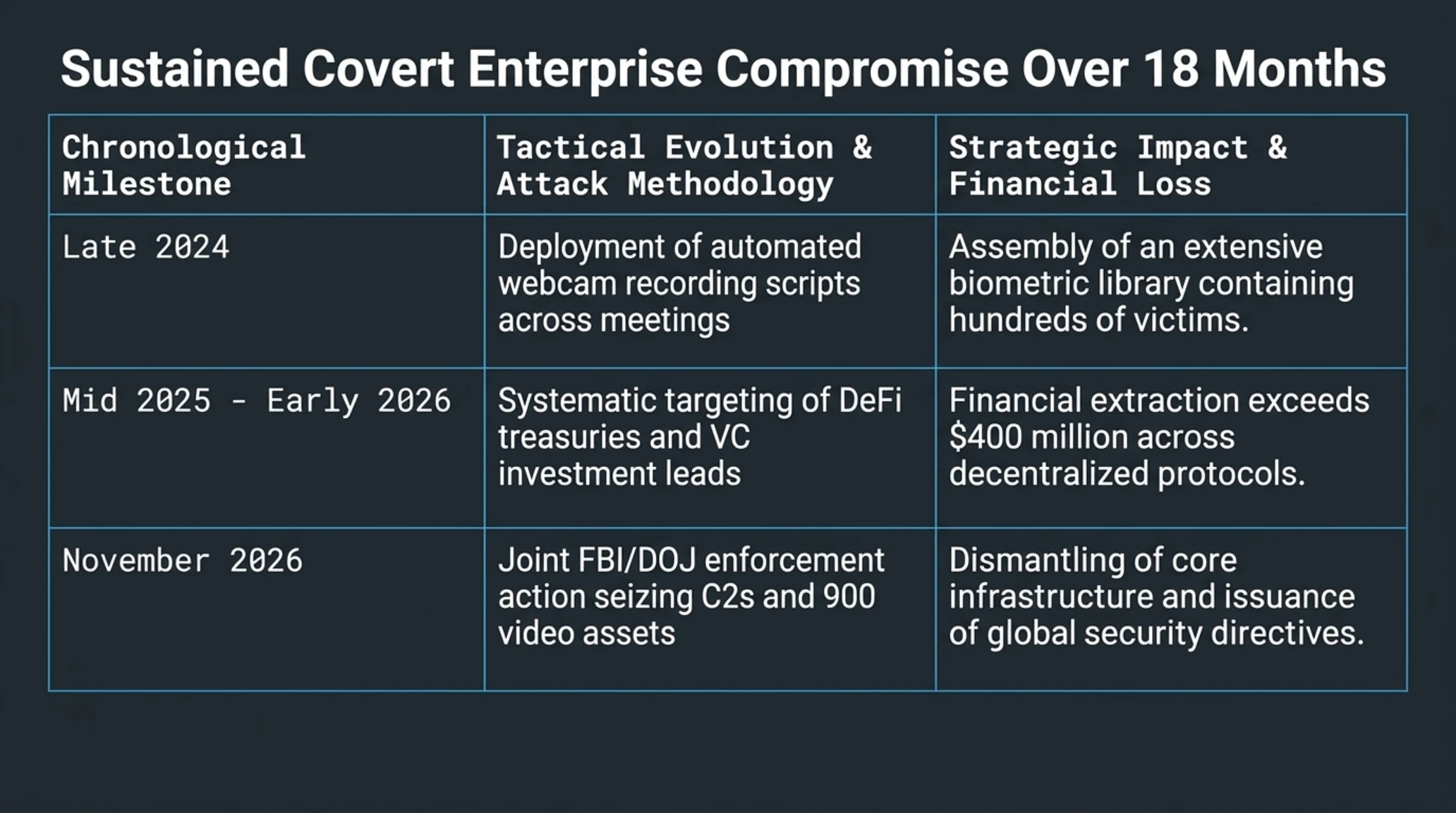
Reviewing historical milestones illuminates how an experimental deception methodology matured into a global $400 million cybercrime enterprise:
Chronological Timeline of the FaceStealer Operation
| Chronological Milestone | Tactical Evolution & Attack Methodology | Strategic Impact & Financial Loss |
|---|---|---|
| Early 2024 | Initial testing of virtual camera injection during developer calls | Infiltration of open-source repositories and minor credential harvesting. |
| Late 2024 | Deployment of automated webcam recording scripts across meetings | Assembly of an extensive biometric library containing hundreds of victims. |
| Mid 2025 - Early 2026 | Systematic targeting of DeFi treasuries and VC investment leads | Financial extraction exceeds $400 million across decentralized protocols. |
| November 2026 | Joint FBI/DOJ enforcement action seizing C2s and 900 video assets | Dismantling of core infrastructure and issuance of global security directives. |
This historical record underscores that establishing rigorous personal and organizational defense protocols is the only viable method to safeguard human agency in the post-deepfake computing era.
Emergency Hardening Protocol for Technology Leaders and Remote Workers
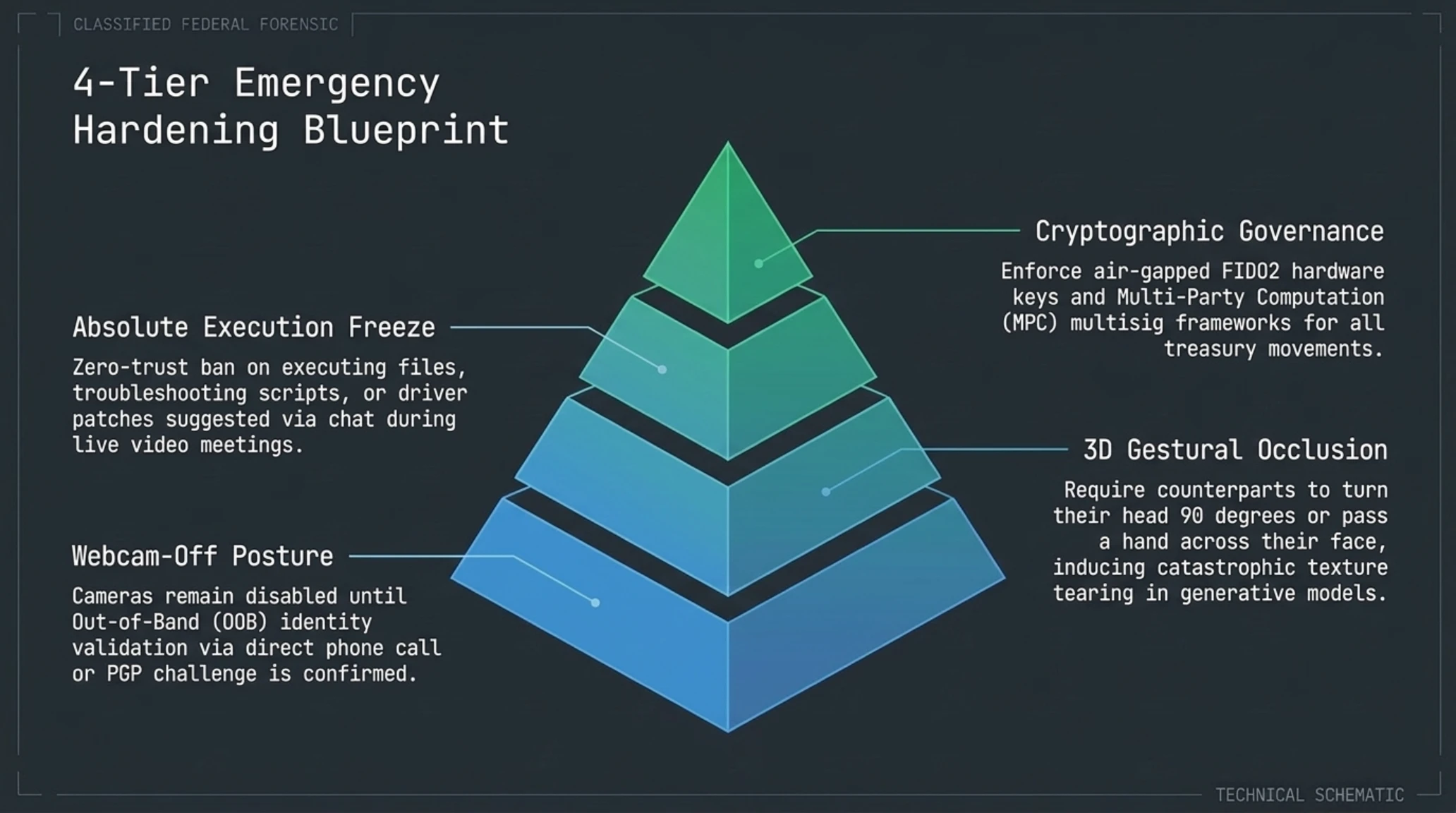
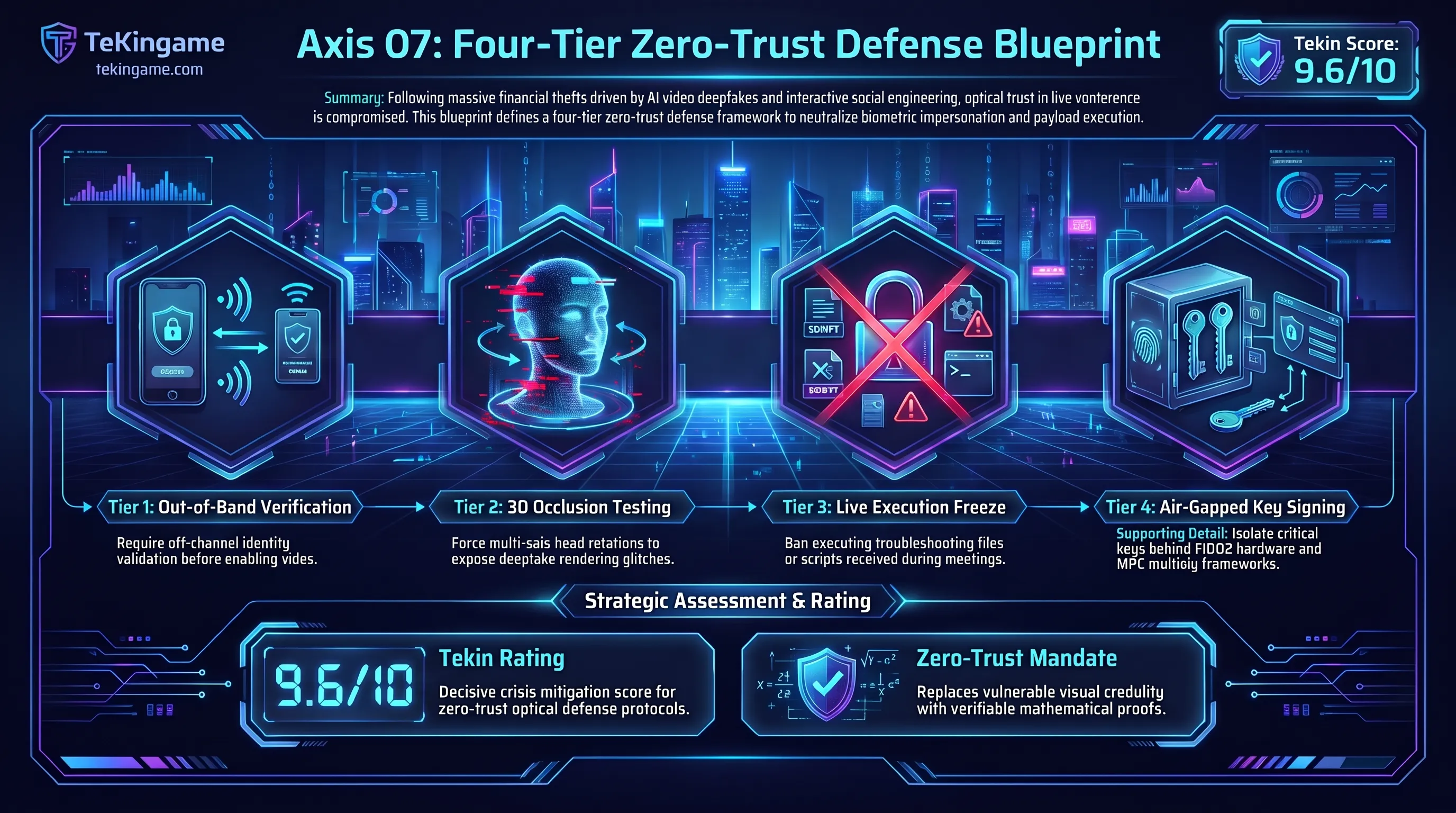
To decisively counter the cognitive and technical vectors pioneered by operations like FaceStealer, technology executives, Web3 protocol architects, and decentralized project contributors must execute an uncompromising four-tier defensive blueprint across all professional interactions. This operational standard proceeds from the foundational reality that within modern distributed networks, live video and audio feeds cannot serve as proof of identity.
Tier one mandates an absolute 'Webcam-Off Until Out-of-Band Verification' posture. Following explicit directives issued by federal cyber agencies, personnel joining video conferences initiated via unsolicited links or unexpected meeting requests must keep their physical cameras covered or disabled. Identity validation must precede visual engagement via an independent, pre-established channel such as placing a direct telephone call to a known number, transmitting a signed PGP challenge string, or validating an ephemeral OTP token through a secondary corporate messenger:
Tier two incorporates physical 3D gestural and occlusion challenges. Contemporary real-time neural face-swapping pipelines struggle fundamentally with rapid multi-axis rotational movement and foreground occlusion. Meeting participants should ask their counterpart to turn their head 90 degrees to both sides, wave an open hand slowly across their nose and eyes, or hold a handwritten note up to the lens. In real-time generative models, these physical occlusions induce catastrophic texture tearing, boundary warping, and distinct latency hitches:
Tier three establishes an unbreakable execution freeze during live conferences. No reputable teleconferencing platform requires participants to execute local binaries, PowerShell snippets, or browser extensions to repair meeting audio or video. If a counterpart claims that your audio is degraded or video is frozen, immediately terminate the session and refuse to interact with any diagnostic link or troubleshooting payload supplied via in-meeting chat.
Tier four enforces physical environment air-gapping and cryptographic multi-signature governance. Core protocol deployer keys, high-value cryptocurrency vaults, and infrastructure access credentials must never reside on machines utilized for daily video conferences, web browsing, or recruitment interviews. All financial operations must be gated behind hardware security keys (FIDO2) and multi-party computation (MPC) multisig frameworks requiring independent multi-signatory approval.
In tandem with endpoint isolation, organizations must implement mandatory cryptographic attestation for all internal and external communication links. Leading decentralized autonomous organizations (DAOs) and cryptocurrency venture firms are adopting standardized out-of-band PGP verification badges, requiring all conference attendees to cryptographically sign a time-stamped nonce prior to initiating discussions regarding treasury movements or technical roadmap changes. By substituting subjective visual credulity with verifiable mathematical proofs, enterprises build an impenetrable barrier against even the most sophisticated generative video synthesis.
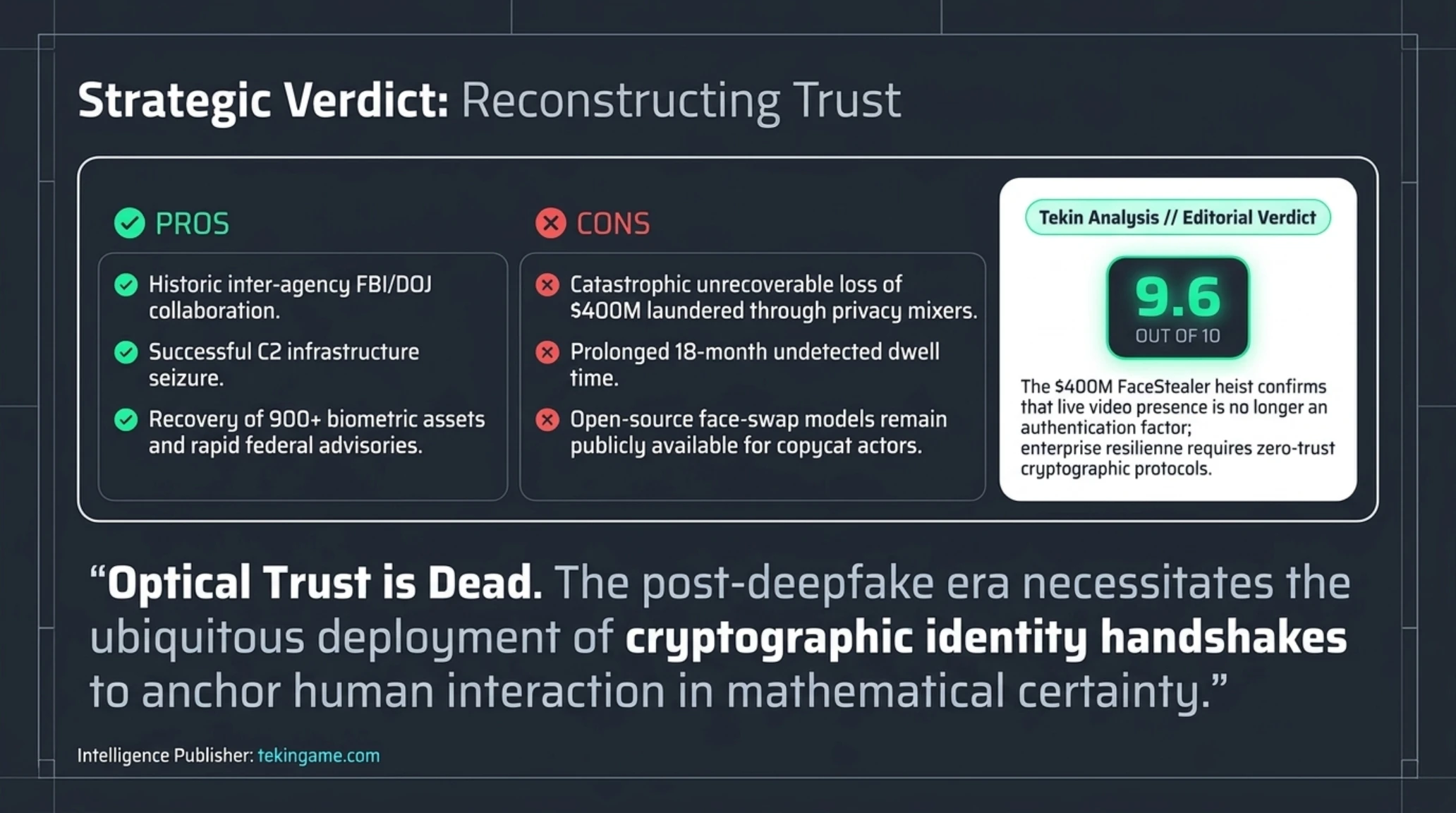
A multi-dimensional appraisal of law enforcement and industry responses demonstrates the unprecedented complexity of neutralizing biometric generative threats:
- Dismantling of primary C2 server infrastructure and successful recovery of 900+ stolen victim video files.
- Rapid issuance of actionable federal advisories educating Web3 founders and developers on real-time deepfake markers.
- Effective on-chain transaction tracking and coordinated freezing of illicit liquidity in partnership with major exchanges.
- Historic inter-agency collaboration between federal law enforcement, cloud infrastructure providers, and threat researchers.
- Catastrophic unrecoverable financial losses exceeding $400 million laundered through privacy mixers.
- Undetected adversary dwell time spanning 18 full months prior to coordinated infrastructure seizure.
- Widespread public availability of open-source real-time face-swap models enabling rival threat actors to duplicate tactics.
Strategic Verdict: Reconstructing Trust in the Post-Deepfake Cyber Era
The unraveling of the FaceStealer campaign delivers an indelible lesson for the global technology ecosystem: future cyber conflicts will not unfold solely within obscure command-line terminals, but directly across the interactive fabric of daily business communication. By weaponizing the likeness of trusted colleagues, state-sponsored cyber cartels have weaponized the ultimate vulnerability in modern systems architecture the human brain's instinctual predisposition to trust visual perception:
The constructive response to this existential challenge is not a retreat from global collaboration, but an architectural re-engineering of trust paradigms. Just as public-key cryptography transformed the open internet from an insecure transmission medium into a trillion-dollar commerce engine, the post-deepfake era necessitates the ubiquitous deployment of cryptographic identity handshakes and real-time biometric attestation to anchor human interaction in mathematical certainty.
Continuous monitoring of global enterprise telemetry confirms that technology organizations are rapidly operationalizing these Zero-Trust controls, establishing resilient foundations for the next computational era:
By enforcing out-of-band verification and deploying defense-in-depth safeguards, organizations can dismantle the attacker's psychological advantage, ensuring that human identity remains impenetrable against synthetic deception:
Editorial Verdict and Official Sources Dossier
- Federal Bureau of Investigation Internet Crime Complaint Center (IC3): Official Public Service Announcement on FaceStealer Biometric Theft and Real-Time Deepfakes
- The Hacker News Cybersecurity Journal: North Korean Cyber Operators Steal $400M in Crypto via Fraudulent Deepfake Video Calls
- United States Department of Justice (DOJ): Federal Press Release on Cloud C2 Infrastructure Seizure and Recovery of 900 Stolen Webcam Videos
Frequently Asked Questions: FaceStealer Real-Time Deepfake Video Scam
How exactly did the FaceStealer campaign steal over $400 million in cryptocurrency?
Threat actors compromised authentic social profiles to invite Web3 executives to video conferences, utilized real-time AI deepfakes to impersonate trusted partners, and simulated audio errors to persuade targets into executing malicious troubleshooting scripts that deployed memory-resident infostealers to harvest wallet vaults and browser session tokens.
Can AI deepfakes genuinely function with low latency during live video calls?
Yes; modern neural face replacement models like Rope and DeepFaceLive, combined with virtual webcam drivers, process video streams with sub-100ms latency, synchronizing synthesized expressions and lip movements with incoming conversational audio in real time.
Why does the FBI specifically recommend keeping webcams covered during calls?
During fraudulent calls, attackers surreptitiously record the victim's webcam video feed to construct synthetic models of their likeness, converting each new victim into bait for subsequent social engineering campaigns targeting their personal and professional networks.
What is the most effective physical method to detect a live deepfake during a call?
Request physical 3D gestural challenges, such as asking the participant to turn their head 90 degrees or wave an open hand across their face. Neural face-swapping algorithms experience severe texture tearing, edge blurring, and frame stuttering when dealing with foreground occlusions.
Are hardware cryptocurrency wallets vulnerable to FaceStealer infostealer payloads?
No; infostealer payloads can only extract private keys and cookies stored in system RAM or on the local hard drive. Hardware wallets sign transactions inside an isolated secure element requiring physical button confirmation, remaining entirely secure against infostealers.
Does the federal seizure of C2 servers mean the deepfake video threat is over?
While federal authorities seized primary C2 servers and 900+ stolen video files, the open-source software tools and methodologies remain widely available. Other cyber syndicates will replicate these attack vectors, making persistent zero-trust vigilance essential.
Additional Gallery: Tekin Analysis: The $400M FaceStealer Deepfake Video Heist