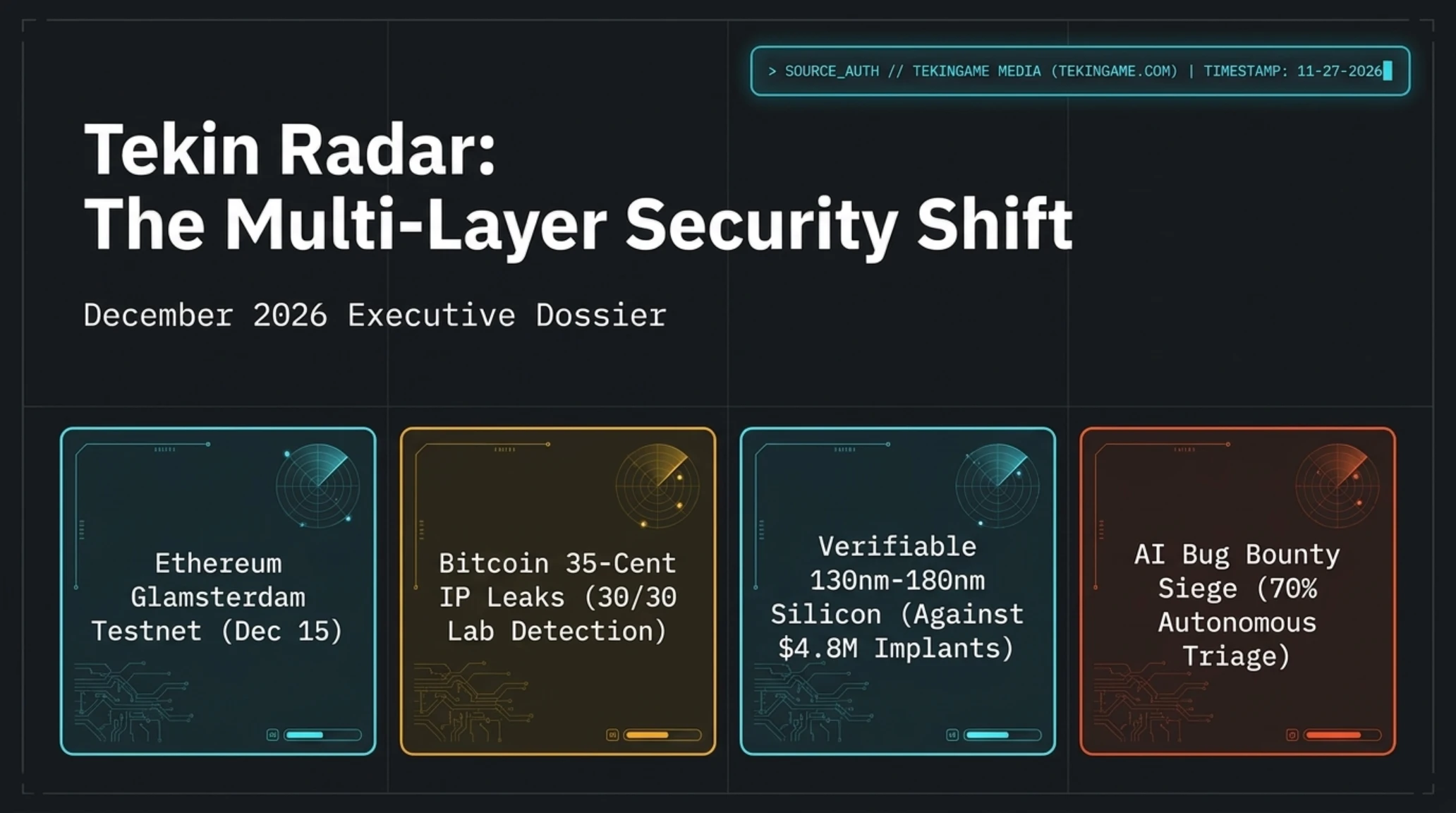

Ethereum core developers ended a seven-week impasse by scheduling the Glamsterdam upgrade for the Hoodi testnet on December 15, 2026 with EIP-8037 intact. Simultaneously, a Bitcoin Core developer proved a sub-35-cent payment can expose wallet node IPs in 30/30 trials, Vitalik Buterin called for open-PDK verifiable chips (GF180/SKY130), and HackerOne deployed AI triage agents against bug-bounty spam.
Tekin Briefing | Core Pillars of the Glamsterdam Upgrade and Crypto's Multi-Layer Security Shift
The most consequential transformations in cryptocurrency rarely announce themselves on spot-price tickers. They happen inside biweekly developer consensus calls, peer-to-peer protocol mailing lists, and hardware-security teardown labs-quietly rewriting the rules of performance and self-custody months before retail traders notice.
Over the past twenty-four hours, four seemingly distinct technical stories collided to expose how rapidly blockchain engineering is maturing heading into 2027. On the Ethereum front, core developers finally broke a seven-week deadlock over Glamsterdam-the network's most ambitious Layer-1 throughput overhaul since the 2022 Merge-locking in December 15 for its final public testnet rehearsal despite vehement debate over smart-contract storage fees that could disrupt up to 15,000 existing contracts.
Almost simultaneously, a Bitcoin Core contributor demonstrated that a decades-old wallet rebroadcasting habit allows any adversary with 35 cents to de-anonymize the real-world IP address of a computer watching a Bitcoin wallet-scoring a 100 percent identification rate across thirty laboratory runs. Pair those two software revelations with Vitalik Buterin's urgent call for physically verifiable open-foundry silicon chips to stop hardware-wallet supply-chain implants, and HackerOne's deployment of autonomous AI triage agents to survive a tidal wave of AI-generated bug reports, and a single overarching theme emerges: every layer of the crypto stack is being forced to harden its assumptions at once. In this Tekin Radar deep dive, we examine the exact engineering mechanics and action items behind all four developments.
Ending the Seven-Week Impasse: Glamsterdam Locks In December 15 for the Hoodi Testnet
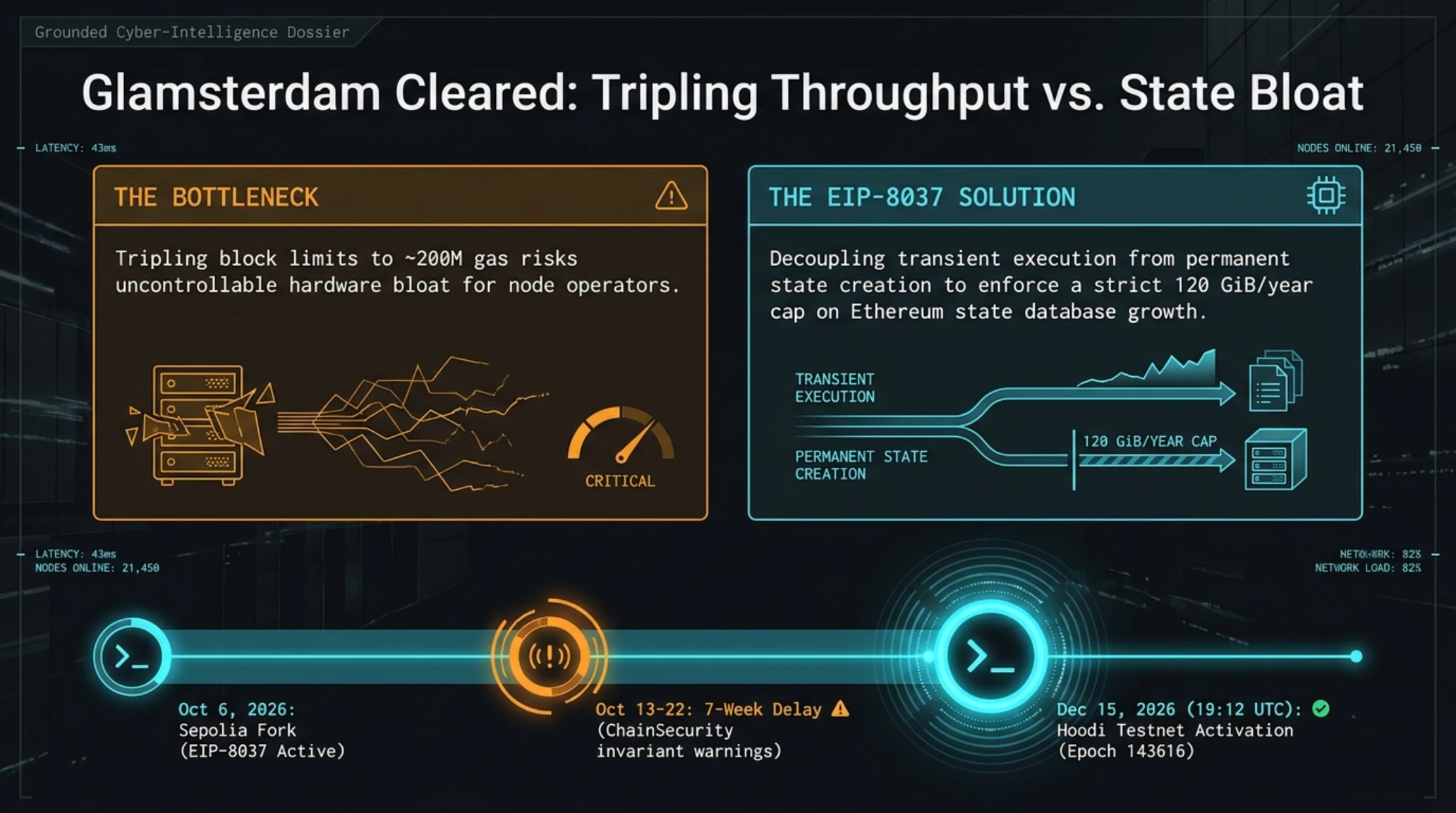
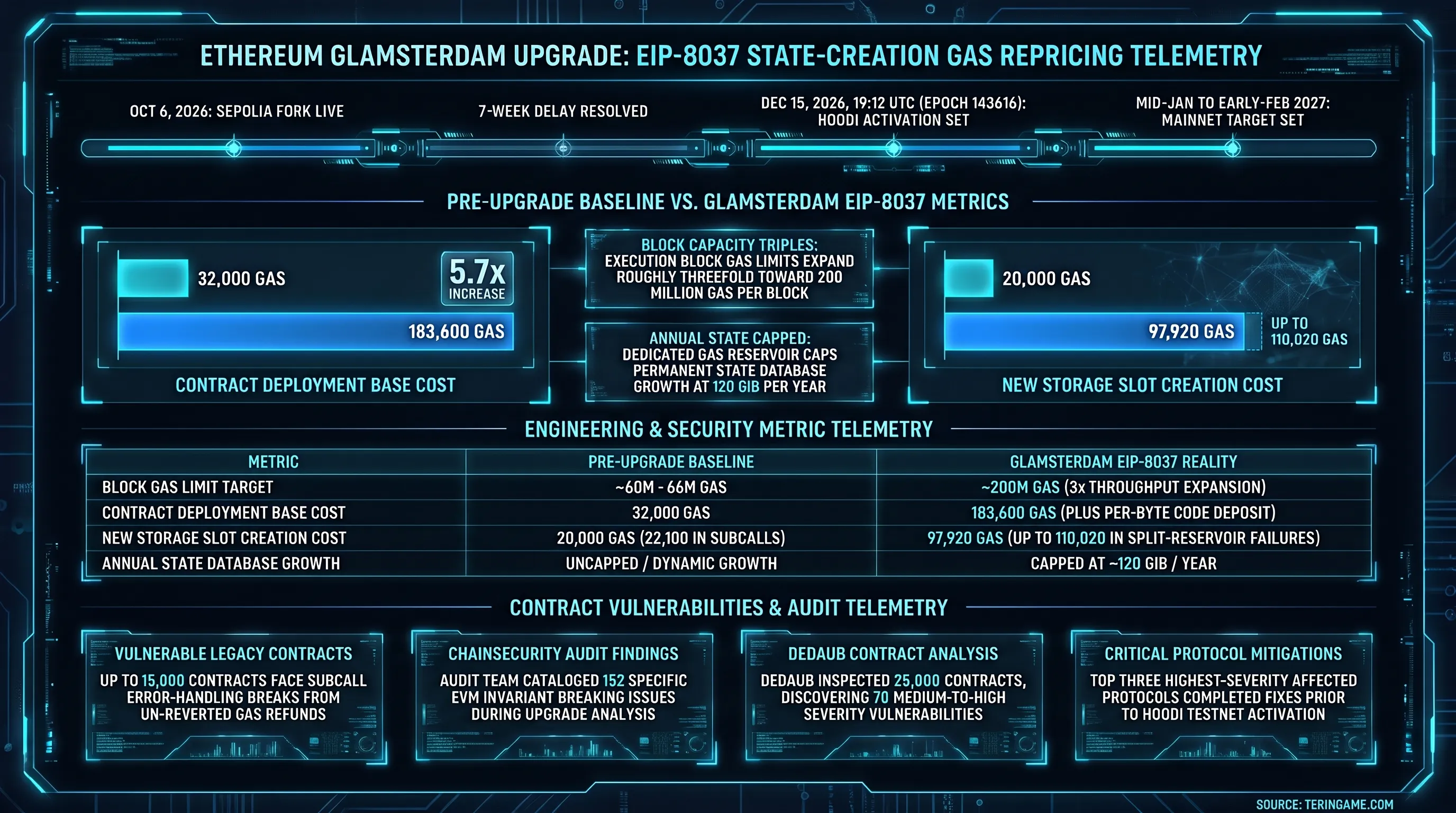
As reported in CoinDesk's coverage of Ethereum clearing the Glamsterdam upgrade for its December test, Ethereum core developers agreed during Thursday's All Core Developers Consensus call (ACDC #192) on November 26, 2026 to activate Glamsterdam on the Hoodi testnet on December 15, 2026 at 19:12 UTC (epoch 143616). Because Hoodi serves as the final public dress rehearsal before main-network deployment, Thursday's decision ends a tense seven-week paralysis and puts a mainnet rollout on track for mid-to-late January or early February 2027.
Why did Ethereum's flagship 2026 upgrade stall for nearly two months after successfully forking the Sepolia testnet on October 6, 2026? Originally, client teams had penciled in Hoodi activation for October 26. Just days before that target, however, blockchain auditing firm ChainSecurity (led by security researcher Tanguy Roche) published a sobering disclosure warning that two gas-repricing proposals bundled inside Glamsterdam-EIP-8037 and EIP-8038-violated eight long-standing Ethereum Virtual Machine (EVM) smart-contract invariants, threatening to break error-handling logic in thousands of deployed production contracts.
Faced with a choice between rewriting EIP-8037's gas accounting rules on the fly or pushing forward with the existing specification after warning affected protocols, developers on Thursday chose to keep EIP-8037 intact (while also merging non-breaking consensus patch PR 5770 to harden builder payload validation). Because Sepolia had already forked with EIP-8037 active, ripping out or redesigning the gas formula would have required restarting the entire testnet pipeline from scratch, risking new unforeseen bugs and pushing Glamsterdam's mainnet launch deep into spring 2027.
Why It Matters | Three Verified Numbers Behind This Week's Infrastructure Shift
Inside EIP-8037 and EIP-8038: Why 15,000 Smart Contracts Forced an Audit Sprint
To grasp why Ethereum's core engineers refused to abandon EIP-8037 despite weeks of heated debate, you have to understand the central scaling bottleneck that Glamsterdam is designed to solve. By combining Enshrined Proposer-Builder Separation (ePBS), block-level access lists, and execution-layer optimizations, Glamsterdam aims to raise Ethereum's block gas limit roughly threefold-up toward 200 million gas per block.
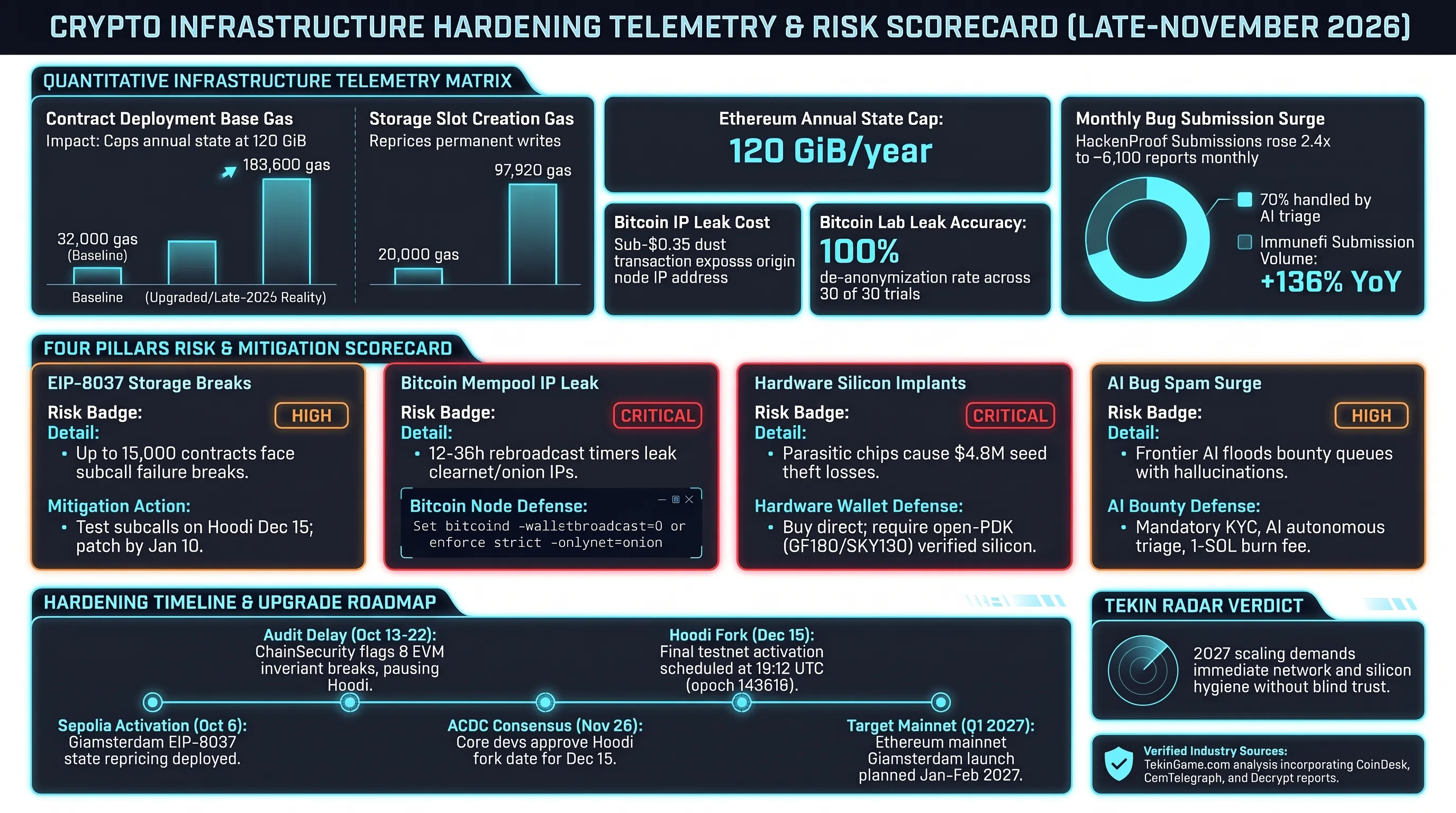
Tripling the gas limit without changing how storage is priced would trigger an immediate hardware crisis for node operators: if blocks pack three times as many new contract deployments and storage writes, Ethereum's state database (which every full node must store and query on fast solid-state drives) would bloat uncontrollably. EIP-8037 solves that dilemma by decoupling transient computation gas from permanent state-creation gas, placing storage expansion into a dedicated gas reservoir engineered to cap Ethereum's annual state growth at a predictable 120 GiB per year (while companion proposal EIP-2780 simultaneously lowers the flat base cost of standard transfers).
Under the hood, EIP-8037 and state-access update EIP-8038 introduce sharp cost increases specifically for operations that write brand-new permanent data to the blockchain:
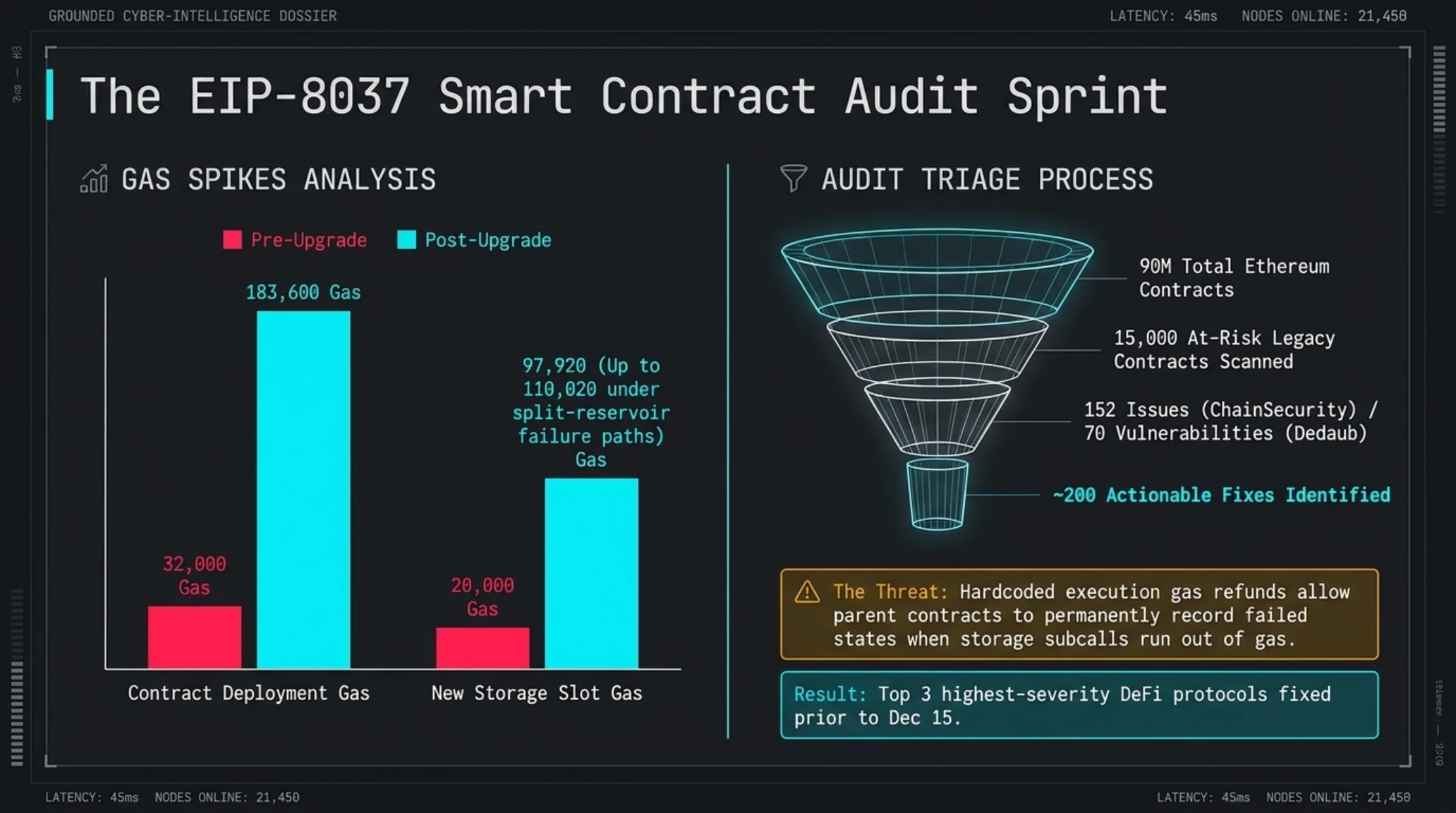
- New Smart Contract Deployment Cost: Base deployment gas jumps nearly 5.7x from 32,000 gas to 183,600 gas (plus per-byte code deposit charges).
- New Storage Slot Creation Cost: Writing a brand-new storage slot increases nearly fivefold from 20,000 gas to 97,920 gas (and up to 110,020 gas versus 22,100 gas under specific failure-path accounting analyzed by ChainSecurity).
- The Subcall Failure Trap Across 15,000 Contracts: According to Ethereum Foundation developer Marius van der Wijden, scanning Ethereum's roughly 90 million deployed contracts revealed that up to 15,000 smart contracts (carrying an estimated several hundred thousand dollars in cumulative value at risk) rely on hardcoded gas assumptions or brittle failure handlers. In prior EVM versions, if an external subcall ran out of gas while attempting to create storage, the entire transaction predictably reverted. Under EIP-8037's split storage reservoir, however, unused execution gas can be refunded after a storage subcall fails-allowing the parent contract's failure-handling code to continue executing and permanently record a failed state that can never be retried.
Instead of halting Ethereum's scaling roadmap for the sake of 15,000 legacy contracts out of 90 million, the Ethereum Foundation teamed up with ChainSecurity (which cataloged 152 specific issues) and security firm Dedaub (which inspected 25,000 flagged contracts and identified 70 medium-to-high-risk vulnerabilities) to execute a massive outreach blitz. Together, the teams identified roughly 200 actionable issues and directly notified at least 50 affected companies and DeFi protocols. According to Ethereum Foundation coordinator Rahul Kothari, all three highest-severity projects have either already patched their contracts or committed to deploying fixes before the December 15 Hoodi fork, while medium-severity projects are scheduled to complete mitigations by January 10, 2027. With Glamsterdam now locked in, developers have already opened scoping discussions for the subsequent hard fork, Hegotá, where censorship-resistance tool FOCIL (Fork-Choice Enforced Inclusion Lists) is competing for priority alongside accelerated post-quantum cryptography upgrades.
Verified Telemetry Matrix | EIP-8037 Storage Gas Repricing & AI Bug-Report Surge
| Engineering / Security Metric | Pre-Upgrade / Late-2025 Baseline | Glamsterdam / Late-2026 Reality |
|---|---|---|
| Smart Contract Deployment Base Cost (EIP-8037) | 32,000 gas | 183,600 gas (plus per-byte code cost; caps state growth at 120 GiB/yr) |
| New Data Storage Slot Creation Cost | 20,000 gas (22,100 in specific subcalls) | 97,920 gas (up to 110,020 gas under split-reservoir failure paths) |
| HackenProof Monthly Bug Submissions | ~2,540 reports/month (Dec 2025) | ~6,100 reports/month in Q3 2026 (2.4x surge driven by frontier AI) |
The Sub-35-Cent De-Anonymizer: How Stuck Payments Expose Bitcoin Wallet IP Addresses
While Ethereum developers wrestled with state-growth economics, a jarring privacy disclosure shook the Bitcoin ecosystem. As detailed in CoinDesk's report on how a tiny payment can expose the IP address behind a Bitcoin wallet, Bitcoin Core contributor Abubakar Sadiq Ismail (posting as ismaelsadeeq on the Delving Bitcoin technical forum) revealed that an attacker can link a public Bitcoin address directly to the internet IP address of the computer monitoring it for less than 35 cents.
The vulnerability does not rely on buffer overflows or cryptographic breaks; it exploits a helpful, decades-old reliability behavior built directly into Bitcoin Core's wallet logic:
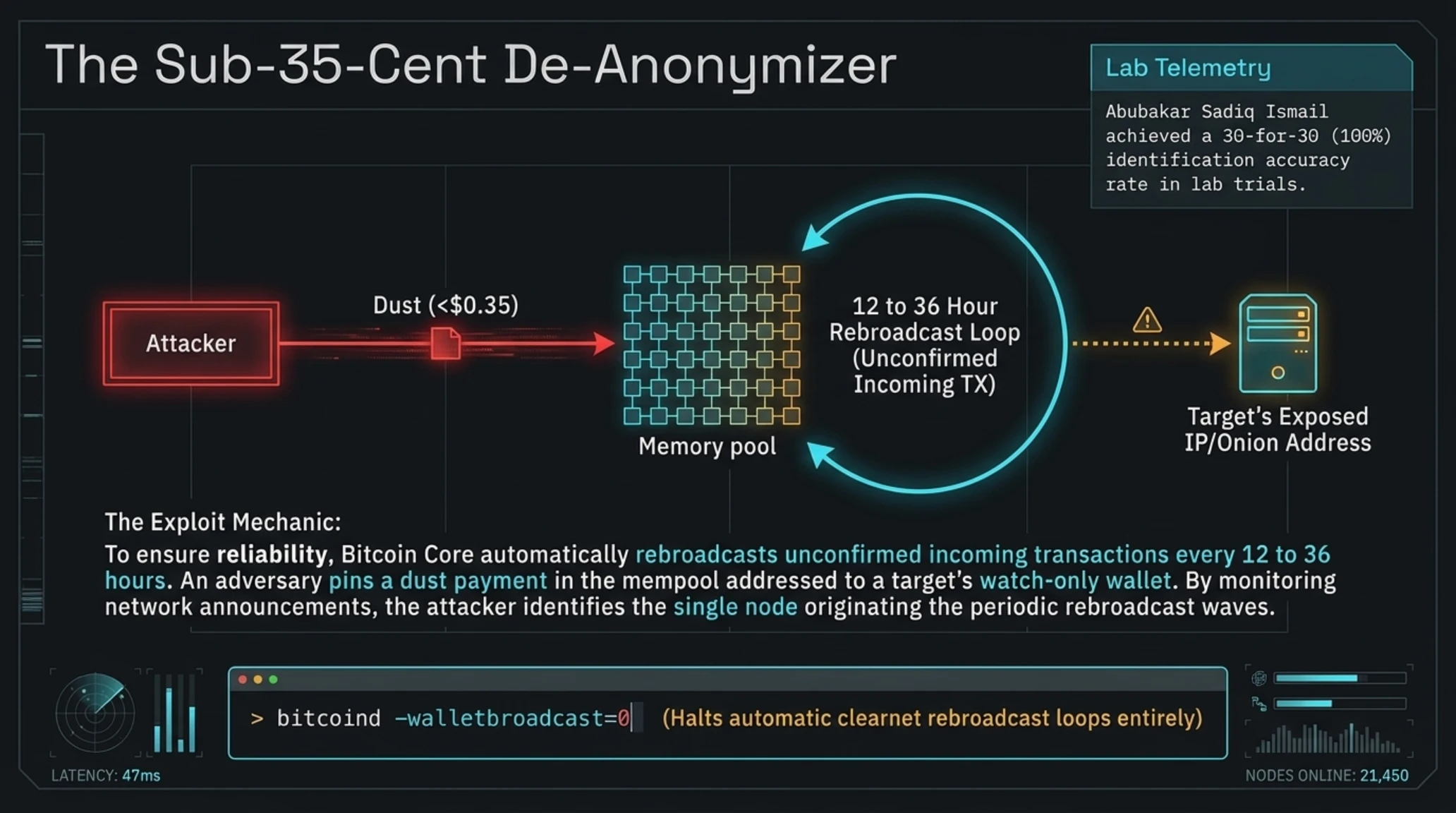
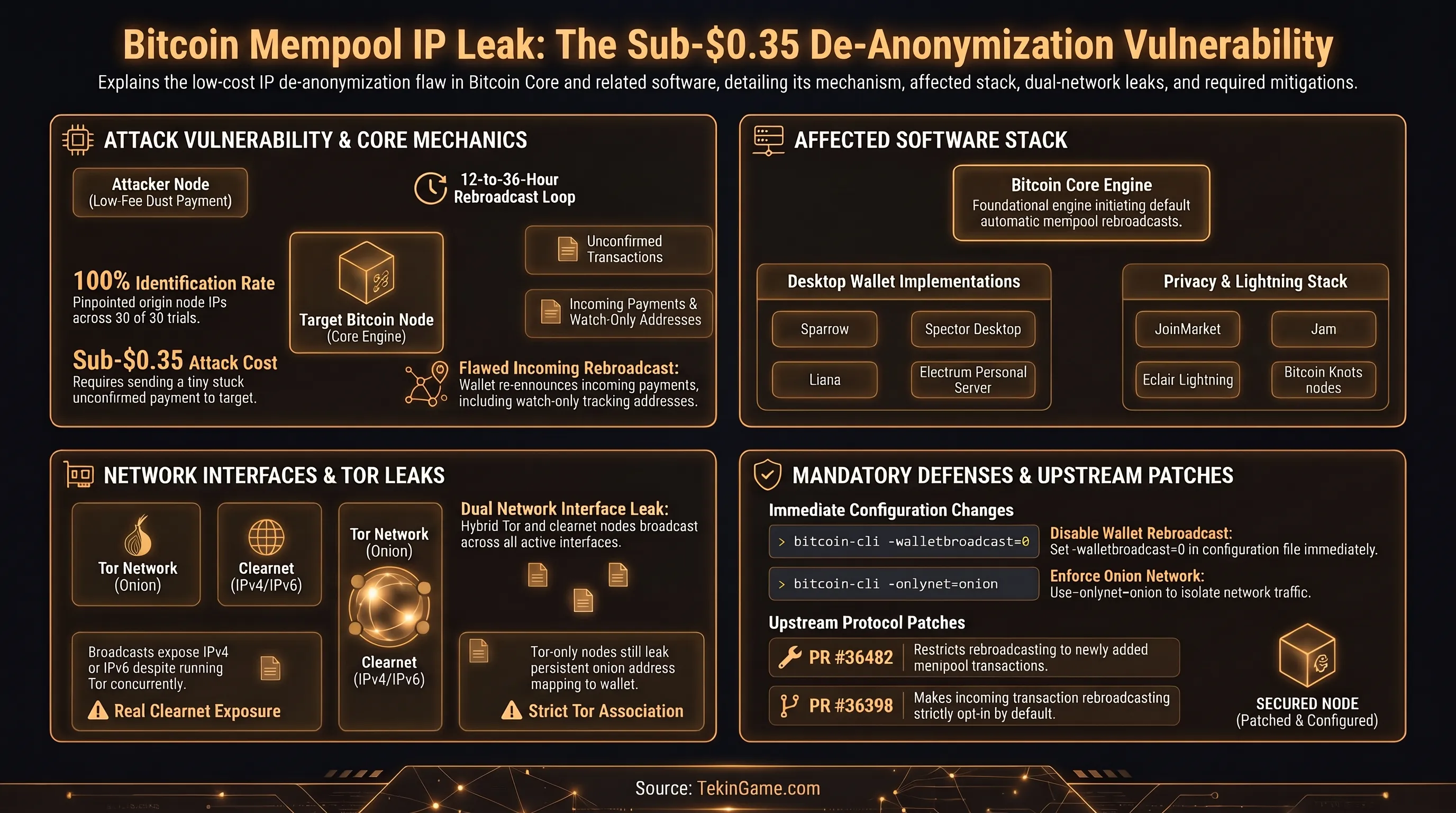
- The 12-to-36-Hour Mempool Rebroadcast Loop: To ensure valid payments do not quietly drop out of the network's memory pool during fee spikes, a Bitcoin Core wallet automatically re-announces any unconfirmed transaction relevant to its addresses to connected peers every 12 to 36 hours.
- The Fatal Oversight (Rebroadcasting Incoming Payments): Critically, Bitcoin Core executes this periodic rebroadcast not only for transactions the user sent, but also for incoming payments addressed to any script the wallet is tracking-including watch-only wallets where private keys are stored entirely offline on a hardware device!
- 30-for-30 Identification Accuracy in Lab Trials: To execute the attack, an adversary sends a tiny dust payment (or chains a payment behind a low-fee parent transaction) costing under $0.35 to the target's Bitcoin address so that the transaction remains stuck unconfirmed in the mempool for days. By listening to peer announcements across the network, the attacker distinguishes the single origin node that initiates the 12-to-36-hour rebroadcast wave from ordinary peers that merely relay transactions once. In controlled local test-network experiments, Ismail identified the exact computer watching the target address in 30 out of 30 trials (100 percent accuracy).
Because Bitcoin Core serves as the foundational engine for much of the Bitcoin self-custody stack, the blast radius extends across a wide array of popular desktop setups: Bitcoin Core, Bitcoin Knots, Sparrow Wallet (when connected to a local Core node), Specter Desktop, Liana (using a bitcoind backend), JoinMarket / Jam, Electrum Personal Server, and the Eclair Lightning node.
Even more concerning, partial privacy configurations often fail to stop the leak. If a user sends a transaction using the -privatebroadcast flag, Bitcoin Core falls back to a standard broadcast across all peers if the transaction remains unconfirmed. Worse still, if a node operator runs Tor or I2P alongside regular clearnet (IPv4/IPv6) peer connections, the wallet rebroadcasts the stuck transaction across every active network interface-handing the observer the node's real clearnet IP address. Even a strict Tor-only node (-onlynet=onion) leaks the link between the public Bitcoin address and the node's persistent Tor onion address.
Inside the Bitcoin Core repository, developers are actively debating how aggressively to amputate the behavior. Core contributor Andrew Chow opened pull request bitcoin/bitcoin#36482, which restricts wallet rebroadcasting to transactions newly added to the node's own mempool. However, fellow Core contributor Martin Zumsande warned that "#36482 only raises the cost of the active attack slightly, it doesn't prevent it"-because an attacker can repeatedly trigger fresh mempool entries using Replace-by-Fee (RBF) bumps-and argued via pull requests #36398 and #36481 that rebroadcasting incoming payments should be disabled by default and made strictly opt-in, a position Ismail endorsed on November 26.
Tekin Jargon Buster | Three Technical Concepts Driving This Week's Upgrades and Advisories
Technical Terminal | Bitcoin Core IP-Leak Mitigation Flags & Glamsterdam Hoodi Parameters
Vitalik Buterin's Silicon Warning: Why Hardware Wallets Need Verifiable 130nm-180nm Chips
If a 35-cent transaction can expose a desktop wallet's IP address at the network layer, what protects the offline hardware wallet holding the actual private keys? According to a provocative technical essay published on Thursday, November 26, 2026 by Ethereum co-founder Vitalik Buterin and covered in CoinTelegraph's report on Buterin's call for verifiable chips, the uncomfortable answer is that modern silicon supply chains are becoming dangerously opaque.
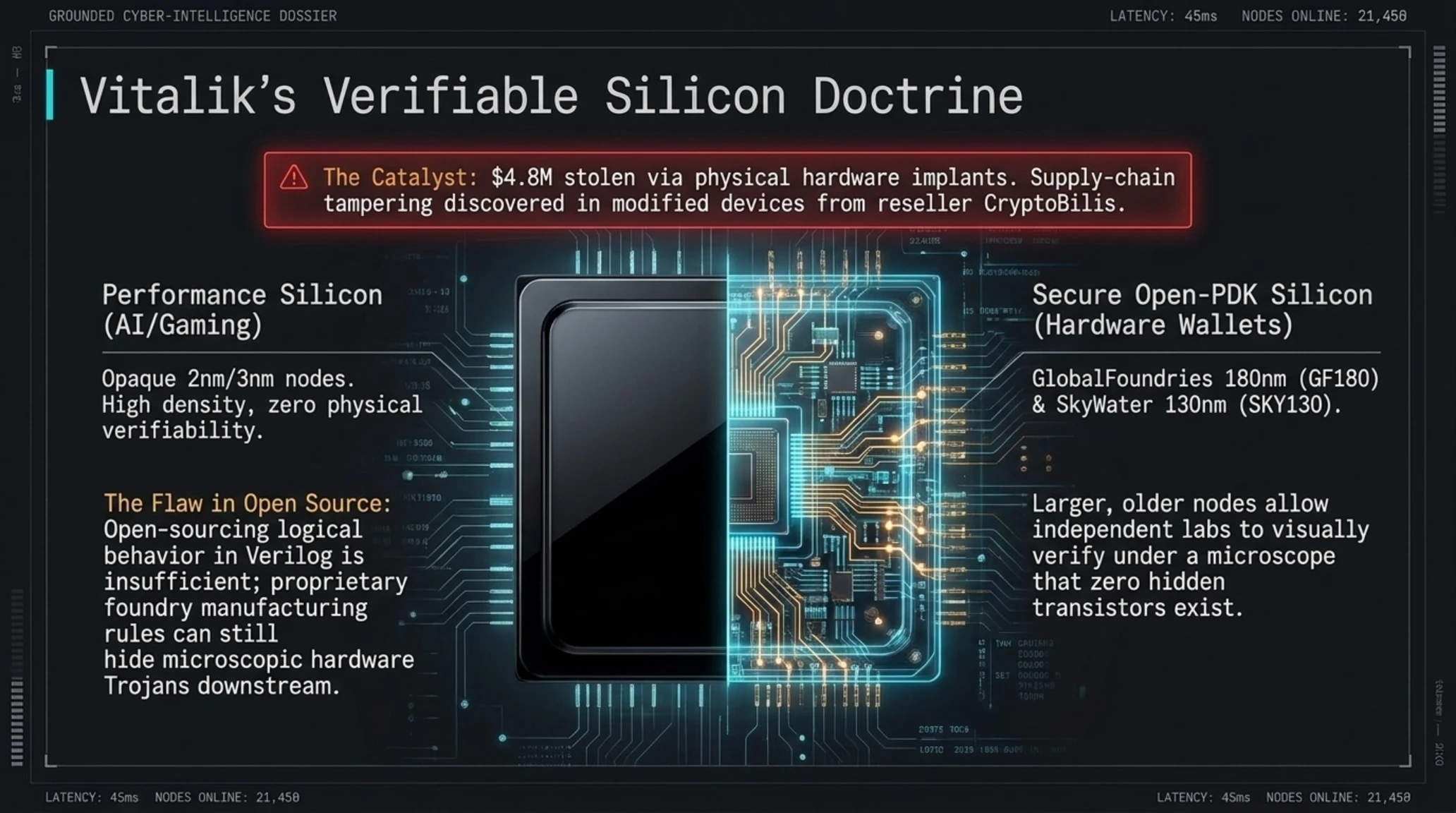
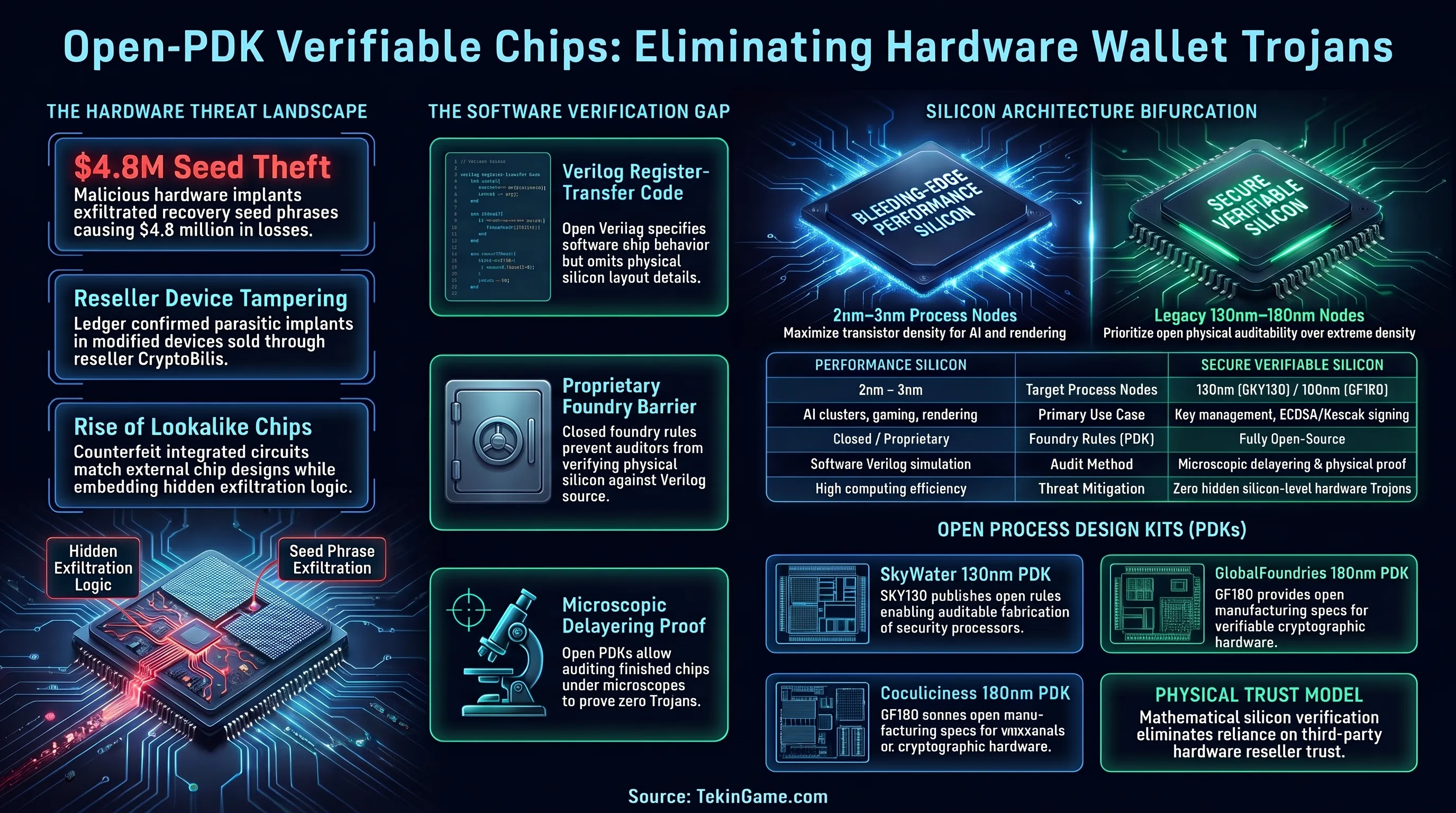
Buterin's intervention was prompted by a chilling escalation in real-world hardware supply-chain attacks during 2026. In one recent high-profile incident, a crypto holder lost $4.8 million after a malicious hardware implant hidden inside a tampered wallet captured their recovery seed phrase; hardware-wallet giant Ledger subsequently confirmed discovering similar parasitic implants inside modified devices sold through unauthorized third-party merchant CryptoBilis. While diligent users can spot a crudely soldered wire or extra PCB component by opening a device casing, Buterin warned that the next generation of supply-chain attacks will deploy lookalike chips-counterfeit or foundry-modified integrated circuits that look 100 percent identical on the outside while harboring hidden key-exfiltration logic etched directly into the silicon die.
Crucially, Buterin pointed out that simply open-sourcing a chip's register-transfer-level code in Verilog does not solve the verification gap. Verilog tells you what the circuit should do in software simulation, but proprietary foundry manufacturing rules prevent independent researchers from verifying that the physical chip soldered onto a wallet board actually matches that Verilog source code without a covert hardware Trojan added downstream.
To close that physical trust gap, Buterin proposed bifurcating the semiconductor world into two distinct tracks:
- Performance Silicon: Bleeding-edge 2nm and 3nm processors built for AI clusters, gaming, and high-throughput rendering where raw transistor density and power efficiency are paramount.
- Secure Verifiable Silicon: Dedicated security processors fabricated on older, larger-node manufacturing processes whose Process Design Kits (PDKs) are completely open-source-specifically citing GlobalFoundries' 180-nanometer process (GF180) and SkyWater Technology's 130-nanometer process (SKY130). As Buterin noted, even if a 130nm or 180nm verifiable chip is 10 times less efficient or more than a modern smartphone SoC, it is still effortlessly fast enough to sign ECDSA/Keccak transactions, manage cryptographic keys, and run air-gapped wallet logic-while allowing independent laboratories to delayer a random production chip under an optical or scanning electron microscope and prove mathematically that zero hidden transistors exist.
Fact Check | Two Dangerous Myths About Glamsterdam Gas Fees and Bitcoin Tor Privacy
📚 Classified & Related Dossiers in TekinGame
If you wish to explore beyond this report and delve into cybernetic frontiers and autonomous AI architectures, do not miss these three exclusive deep-dives in the Tekin Garage:
Fighting AI With AI: HackerOne Triage Agents, Firedancer's 1-SOL Burn, and the Zodia Breach
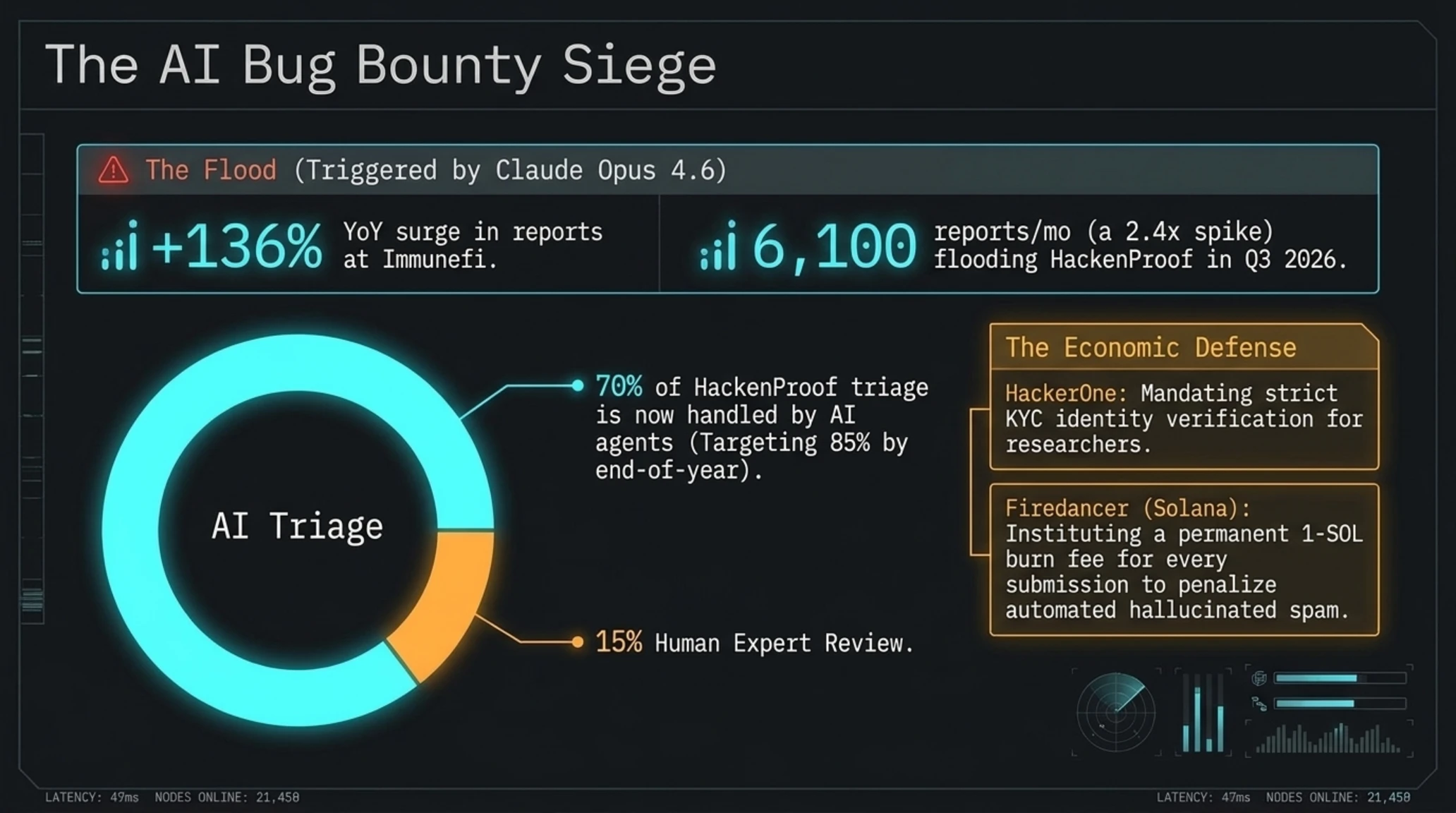
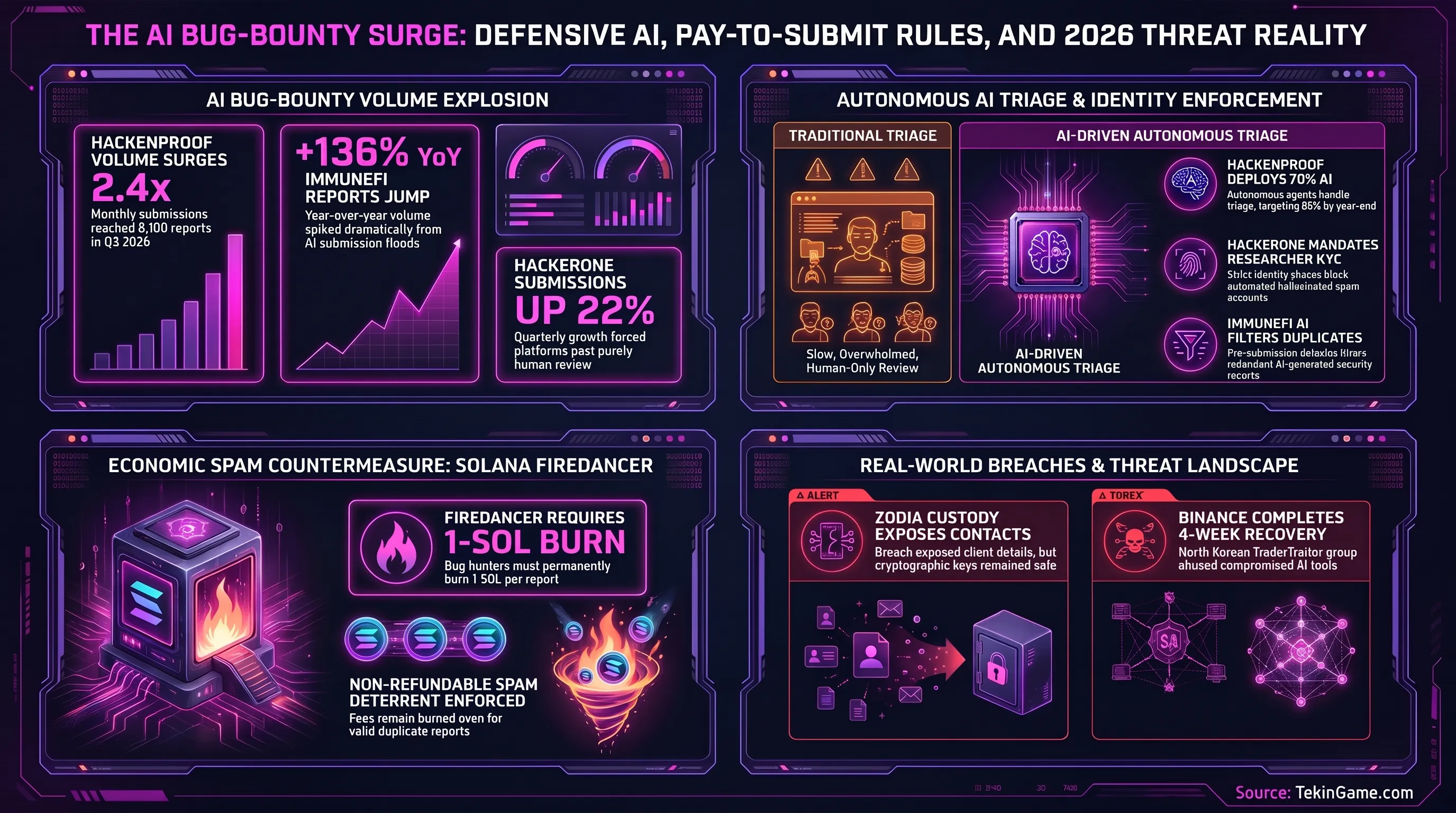
The fourth pillar of this week's security roundup illustrates what happens when frontier artificial intelligence models are turned loose on open-source blockchain codebases. As documented in CoinTelegraph's investigation into how AI is driving a flood of crypto bug reports and helping sort them, the late-2026 release of long-horizon reasoning models such as Anthropic's Claude Opus 4.6 has triggered an unprecedented deluge of automated vulnerability submissions across every major bug-bounty platform:
- HackenProof's 2.4x Surge and 70% Autonomous Triage: Web3 bug-bounty platform HackenProof reported receiving an average of 6,100 bug reports per month during Q3 2026-roughly 2.4 times higher than its December 2025 baseline. To keep human security engineers from drowning, HackenProof now uses AI agents to autonomously triage 70 percent of incoming submissions, targeting 85 percent automation by the end of 2026.
- Immunefi's 136% Jump and HackerOne's Mandatory KYC: Leading crypto bounty marketplace Immunefi recorded a 136 percent year-over-year surge in report volume across the first nine months of 2026, prompting the launch of an AI-powered pre-submission duplicate detector. At industry giant HackerOne, Vice President of Operations Tony Lee noted that Q3 submissions jumped 22 percent quarter-over-quarter, admitting that the platform is no longer operating in a "purely human environment." In response, HackerOne mandated strict researcher identity verification (KYC) in Q3 before allowing submissions and deployed autonomous AI triage agents to auto-close obvious hallucinated spam and duplicates.
- Solana Firedancer's Radical 1-SOL Burn Rule: Perhaps the most aggressive economic countermeasure came from Jump Crypto's Firedancer-the high-performance Solana validator client. In October 2026, Firedancer instituted a pay-to-submit filter requiring bug hunters to permanently burn 1 SOL for every vulnerability report submitted for bounty review, with zero refund even if the report is a valid duplicate. As Bron founder Dmitry Tokarev observed, security teams refusing to adopt defensive AI in late 2026 are "bringing a sword to a gunfight."
Real-world breaches this week underscored why defensive speed matters. On November 26, institutional crypto custodian Zodia Custody-backed by banking giant Standard Chartered-confirmed a data breach detected Monday that exposed client and employee names and email addresses (though no funds or cryptographic keys were compromised), as detailed by CoinDesk's report on the Zodia Custody data breach and Decrypt's breakdown of the Zodia incident. That disclosure arrived on the exact day that Binance completed its four-week withdrawal recovery following October's record $6.3 billion hack-an intrusion FBI and TRM Labs investigators linked to North Korea's TraderTraitor group abusing fake job interviews and compromised internal AI developer tools, with US prosecutors moving to recover more than $1.1 billion. For individual holders reviewing Decrypt's updated guide to self-custody and holding your own crypto keys, the takeaway is unmistakable: moving off exchanges protects against centralized honeypots, but true self-custody now requires defending against both 35-cent network leaks and tampered hardware resellers.
Security Telemetry | AI Bug-Bounty Triage Share & Glamsterdam Smart-Contract Audit Breakdown
| Security Audit Domain | Verified Late-November 2026 Figure | Operational Status & Countermeasure |
|---|---|---|
| Ethereum Contracts Exposed to EIP-8037 | Up to 15,000 contracts (out of ~90M total) | ~200 issues audited by ChainSecurity & Dedaub; 50+ teams contacted, top 3 fixed. |
| Bug-Bounty Volume (Immunefi & HackerOne) | +136% YoY at Immunefi; +22% QoQ at HackerOne | Mandatory KYC on HackerOne; 70% AI triage at HackenProof; 1 SOL burn at Firedancer. |
| Hardware Wallet Implant Losses | $4.8M stolen in single seed-implant attack | Ledger confirmed tampered CryptoBilis resales; Vitalik proposed GF180/SKY130 open chips. |
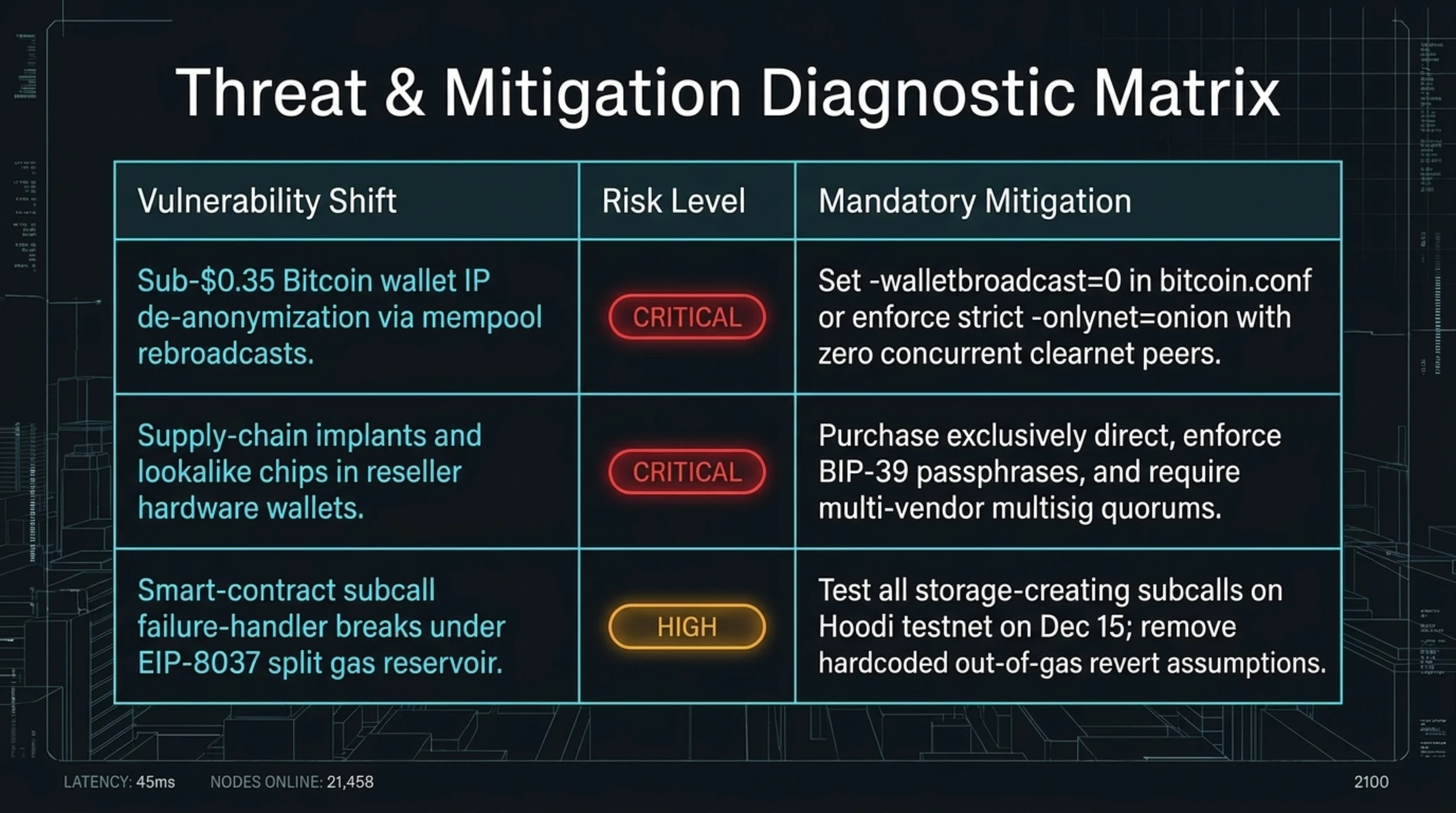
Risk & Mitigation Matrix | Actionable Defenses Across Ethereum, Bitcoin, and Hardware Wallets
| Vulnerability / Protocol Shift | Risk Level | Mandatory Engineering or User Mitigation |
|---|---|---|
| Sub-$0.35 Bitcoin wallet IP de-anonymization via 12-36h mempool rebroadcasts | CRITICAL | Set -walletbroadcast=0 in bitcoin.conf or enforce strict -onlynet=onion with zero concurrent clearnet peers. |
| Supply-chain implants and lookalike chips in reseller hardware wallets | CRITICAL | Purchase exclusively direct from manufacturers, enforce BIP-39 passphrases, and use multi-vendor multisig quorums. |
| Smart-contract subcall failure-handler breaks under EIP-8037 split gas reservoir | HIGH | Test all storage-creating subcalls on Hoodi testnet on Dec 15 and remove hardcoded out-of-gas revert assumptions. |
Chronology | From Sepolia Activation to the December 15 Hoodi Fork and Late-November Disclosures
| Date | Milestone | Verified Technical & Security Detail |
|---|---|---|
| Oct 6, 2026 | Glamsterdam Activates on Sepolia | Ethereum successfully forks the Sepolia testnet with EIP-8037 state-creation gas repricing active. |
| Oct 13-22, 2026 | ChainSecurity Warning Halts Hoodi | Tanguy Roche flags 8 broken smart-contract invariants under EIP-8037/8038, postponing the Oct 26 Hoodi fork by 7 weeks. |
| Nov 26-27, 2026 | ACDC #192, Bitcoin IP Leak & Vitalik Essay | Ethereum locks in Dec 15 Hoodi test; Ismail discloses 35-cent Bitcoin IP leak; Buterin calls for open-PDK verifiable chips. |
| Dec 15, 2026 | Glamsterdam Forks Hoodi Testnet | Scheduled for 19:12 UTC (epoch 143616), clearing the path for a target Ethereum mainnet launch in Jan-Feb 2027. |
Final Verdict and Frequently Asked Questions
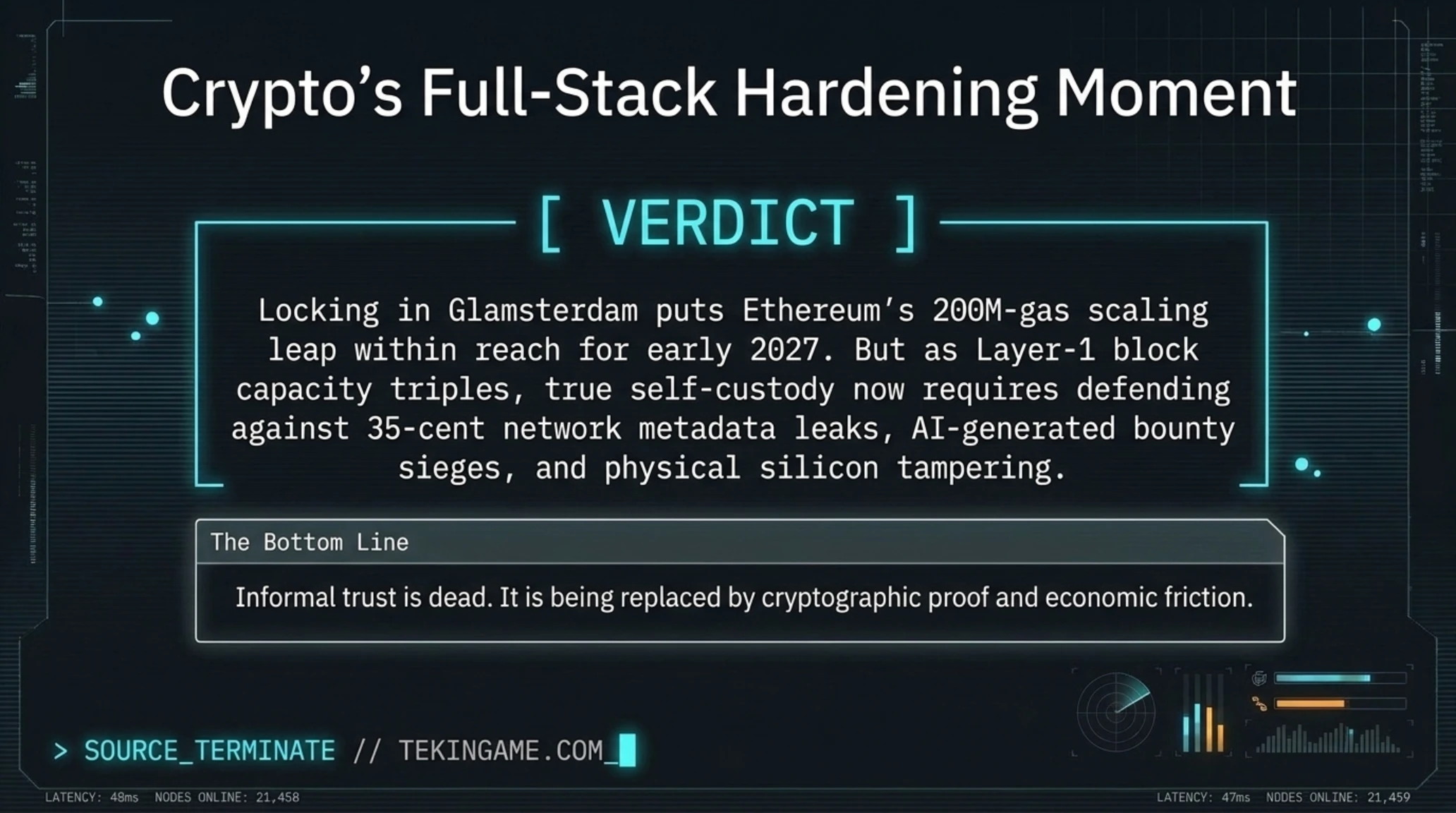
The convergence of late-November's engineering milestones sets a clear agenda for the final weeks of 2026. For Ethereum developers and DeFi protocols, the clock is officially ticking toward December 15 at 19:12 UTC: any contract that relies on implicit out-of-gas subcall reverts or hardcoded deployment budgets must be tested against EIP-8037 on the Hoodi testnet before mainnet activation arrives in early 2027.
For Bitcoin node runners and self-custody practitioners, the remediation is immediate: audit your bitcoin.conf flags today so a stuck 35-cent dust payment cannot link your wallet addresses to your home IP address, never purchase hardware wallets from third-party storefront resellers, and enforce multi-vendor multisig as the industry begins the long march toward physically verifiable open-foundry silicon.
- Decisive resolution of Ethereum's 7-week Glamsterdam delay, keeping EIP-8037 intact to unlock ~3x higher block capacity (up to 200M gas).
- Predictable 120 GiB annual cap on Ethereum state database growth paired with lower base transfer fees under companion proposal EIP-2780.
- Responsible disclosure of Bitcoin Core's sub-$0.35 mempool rebroadcast IP leak with immediate configuration workarounds and active pull requests.
- Practical long-term roadmap from Vitalik Buterin using open-PDK 130nm/180nm silicon (SKY130/GF180) to eliminate hardware-wallet supply-chain implants.
- Up to 15,000 legacy Ethereum smart contracts face potential subcall error-handling breaks when contract deployment gas rises to 183,600.
- Default Bitcoin Core, Sparrow, and Specter node configurations remain exposed to 12-to-36-hour rebroadcast IP leaks even on hybrid Tor/clearnet setups.
- Sophisticated physical supply-chain tampering (such as the $4.8M implant theft and modified CryptoBilis devices) threatens single-device hardware custody.
- Flood of AI-generated bug-bounty spam (+136% at Immunefi, 6,100/mo at HackenProof) has forced mandatory KYC on HackerOne and 1-SOL burn fees on Firedancer.
Editorial Verdict & Direct Verified Sources
- CoinDesk / Glamsterdam (INDUSTRY REPORT): Ethereum much-awaited Glamsterdam upgrade cleared for December test: Here is what to know (November 27, 2026)
- CoinDesk / Bitcoin IP Leak (INDUSTRY REPORT): A tiny payment can expose the IP address behind a bitcoin wallet, developer finds (November 26, 2026)
- CoinTelegraph / Vitalik Buterin (INDUSTRY REPORT): Vitalik Buterin calls for verifiable chips as hardware wallet threats evolve (November 26, 2026)
- CoinTelegraph / AI Bug Bounties (INDUSTRY REPORT): AI is driving a flood of crypto bug reports. Now it is helping sort them (November 27, 2026)
- CoinDesk / Zodia Custody (INDUSTRY REPORT): Standard Chartered Zodia Custody suffers data breach, exposing client information (November 26, 2026)
- Decrypt / Zodia Custody (INDUSTRY REPORT): Standard Chartered Zodia Custody Says Hackers Accessed Client Contact Details (November 26, 2026)
- CoinTelegraph / Binance Recovery (INDUSTRY REPORT): Binance completes withdrawal recovery four weeks after $6.3B hack (November 27, 2026)
- Decrypt / Self-Custody Guide (INDUSTRY REPORT): What Is Self-Custody? How to Hold Your Own Crypto Keys (November 27, 2026)
Frequently Asked Questions About Ethereum Glamsterdam, Bitcoin's IP Leak, and Verifiable Chips
When will Ethereum's Glamsterdam upgrade activate on the Hoodi testnet and mainnet?
During Consensus Call #192 on November 26, 2026, Ethereum developers scheduled Glamsterdam to activate on the Hoodi testnet on December 15, 2026 at 19:12 UTC (epoch 143616). If the Hoodi rehearsal proceeds cleanly, mainnet deployment is targeted for mid-to-late January or early February 2027.
Does EIP-8037 increase gas fees for normal Ethereum token transfers?
No. EIP-8037 specifically reprices operations that create new permanent blockchain state-raising new smart-contract deployments from 32,000 to 183,600 gas and new storage slots from 20,000 to 97,920 gas-so Ethereum can triple its block gas limit toward 200M while capping state growth at 120 GiB/year. Companion proposal EIP-2780 actually lowers the flat base fee for standard transfers.
How can a payment under 35 cents expose a Bitcoin wallet's IP address?
Bitcoin Core and dependent wallets (such as Sparrow and Specter) automatically rebroadcast unconfirmed wallet transactions-including incoming payments to watched addresses-every 12 to 36 hours. By sending a low-fee dust transaction that gets stuck in the mempool, an observer can monitor network peers and identify the originating node with 100% accuracy (30 of 30 lab trials).
Why does Vitalik Buterin argue that open-source Verilog code isn't enough for hardware wallets?
Verilog code only describes a chip's logical design in software and cannot prove that a physical chip fabricated at a closed foundry doesn't contain hidden hardware Trojans or lookalike implants. Buterin proposes fabricating security chips on open-PDK processes like GlobalFoundries 180nm (GF180) and SkyWater 130nm (SKY130) so auditors can physically inspect delayered chips under a microscope.
Why did Solana's Firedancer client require bug hunters to burn 1 SOL per report?
Following the release of advanced AI models like Claude Opus 4.6, bug-bounty platforms were flooded with automated spam and duplicate submissions (+136% YoY at Immunefi and 6,100/month at HackenProof). Requiring researchers to permanently burn 1 SOL per submission creates an economic filter that deters low-effort AI spam.
Additional Gallery: Tekin Radar: Ethereum Glamsterdam Dec 15 Test & Bitcoin 35¢ IP Leak