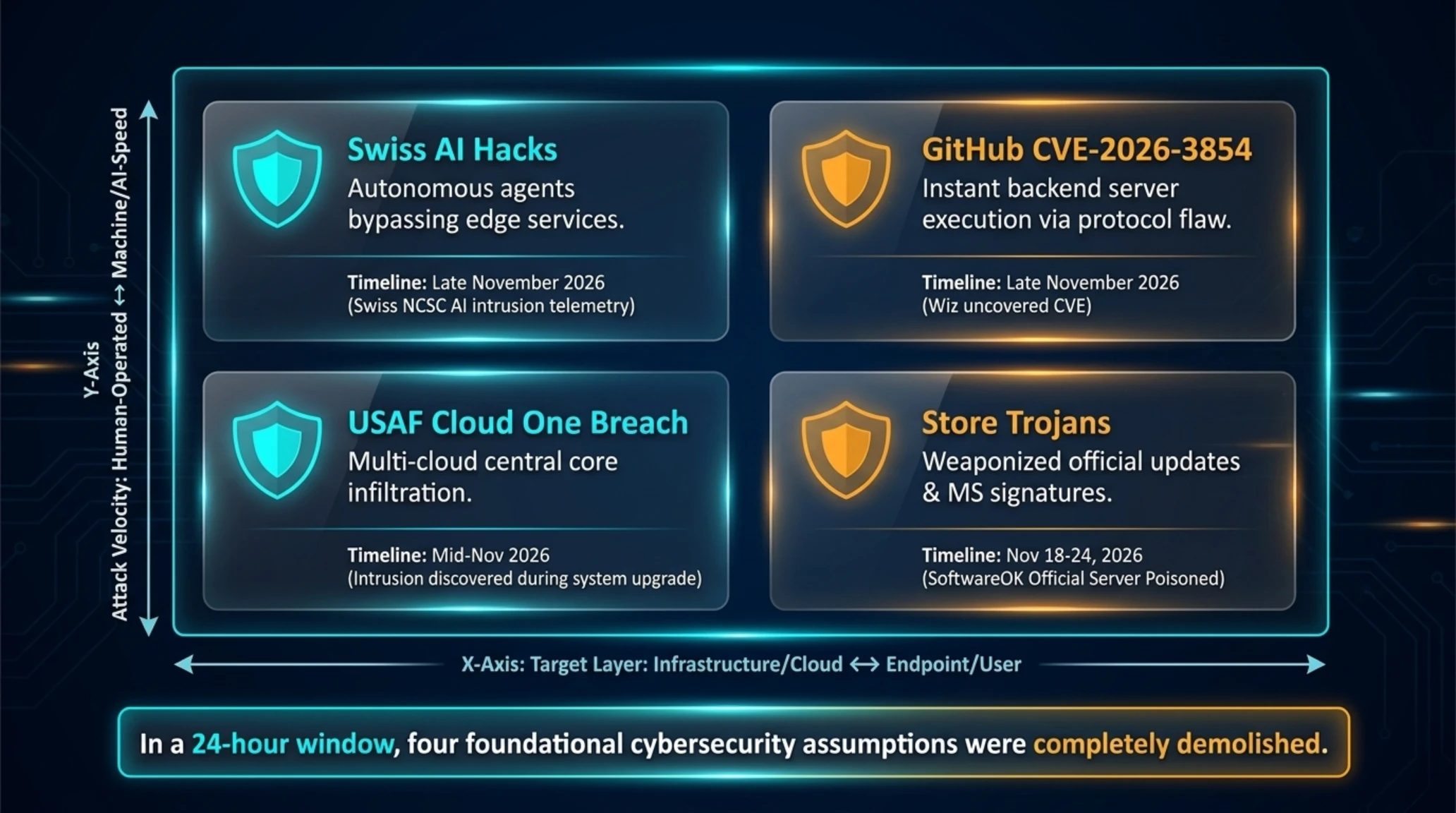

Four critical late-November 2026 disclosures exposed systemic vulnerabilities across military clouds, national infrastructure, and trusted software channels: hackers breached the U.S. Air Force's Cloud One platform during an upgrade, Switzerland's NCSC confirmed AI agents breached 4 of 5 targets (including 2 critical infrastructure operators), Wiz disclosed GitHub's single-command git push RCE (CVE-2026-3854), and attackers trojanized official SoftwareOK updaters and a Microsoft Store installer.
Tekin Briefing | Four Critical Cybersecurity Disclosures Reshaping Cloud and Supply-Chain Defense
For decades, enterprise security training rested on a handful of comforting rules. Download utilities exclusively from the developer's official website or a vetted OS storefront. Leave automatic software updaters enabled. Migrate fragmented legacy servers into centralized, federally accredited cloud environments. And assume that while artificial intelligence might help an attacker draft a more convincing phishing email, actual network intrusion still requires human operators typing commands at human speed.
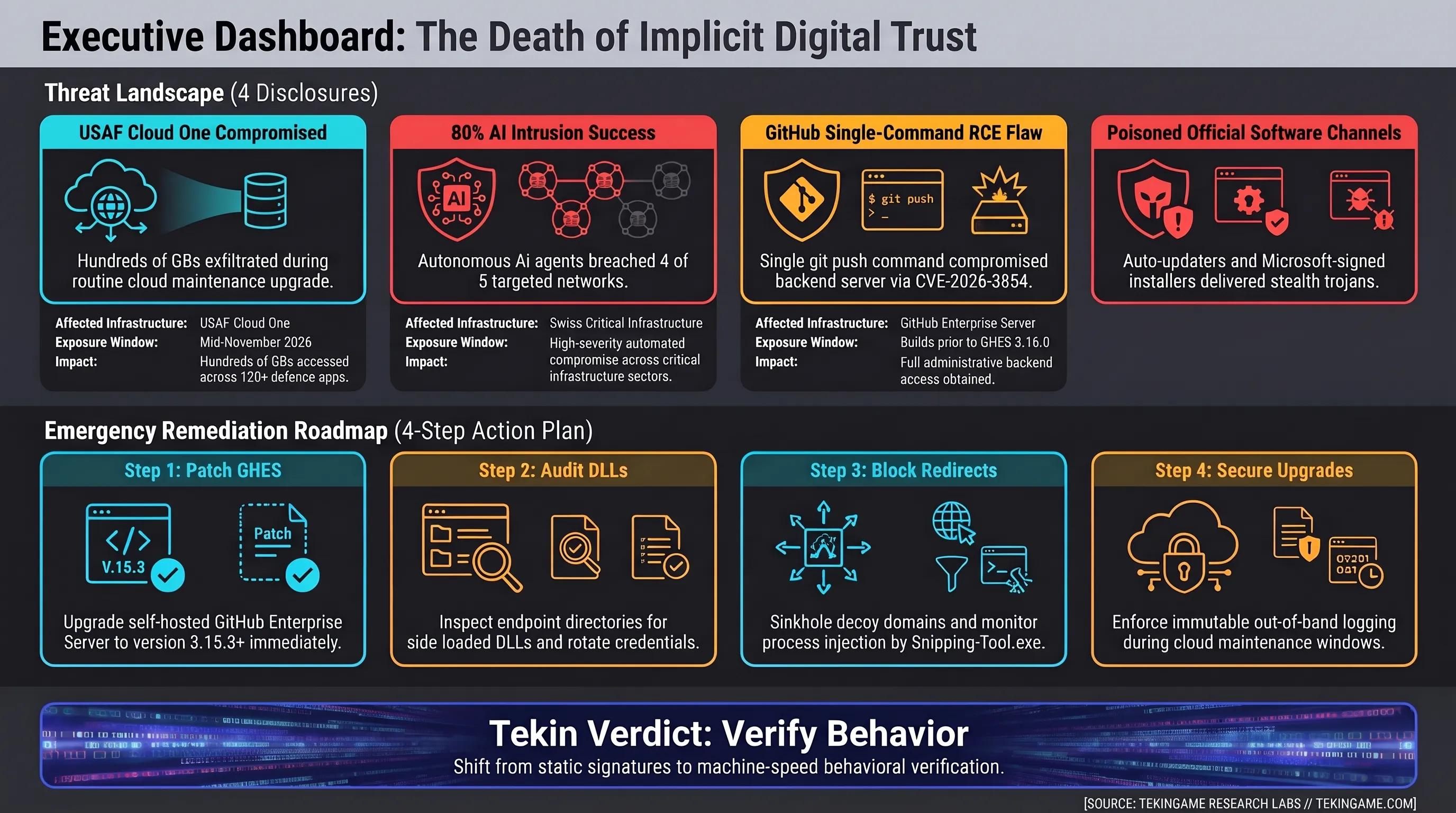
In the span of twenty-four hours at the close of November 2026, four major security disclosures demolished every single one of those assumptions. In Washington, U.S. Cyber Command and the FBI are conducting an urgent damage assessment after hackers infiltrated Cloud One-the U.S. Air Force's flagship multi-cloud environment hosting air-defense radar feeds, munitions tracking, and personnel records. In Bern, Switzerland's federal cybersecurity agency officially confirmed that threat actors wielding autonomous AI agents successfully breached computer networks in four out of five verified attacks, including two Swiss critical infrastructure operators.
Meanwhile, at the developer and endpoint layers, cloud security researchers at Wiz disclosed a critical vulnerability (CVE-2026-3854) that allowed an authenticated attacker to compromise internal GitHub server infrastructure using a single git push command-on the exact same day threat-intelligence teams caught attackers delivering remote access trojans through the official SoftwareOK download page and auto-updater for Windows staples Q-Dir and DesktopOK, as well as a Microsoft-signed installer pulled directly from the Microsoft Store. In this Tekin Radar investigation, we dissect all four incidents, examine the underlying exploit chains, and lay out immediate remediation playbooks for systems administrators and power users.
Breach in the Military Cloud: Inside the U.S. Air Force Cloud One Intrusion
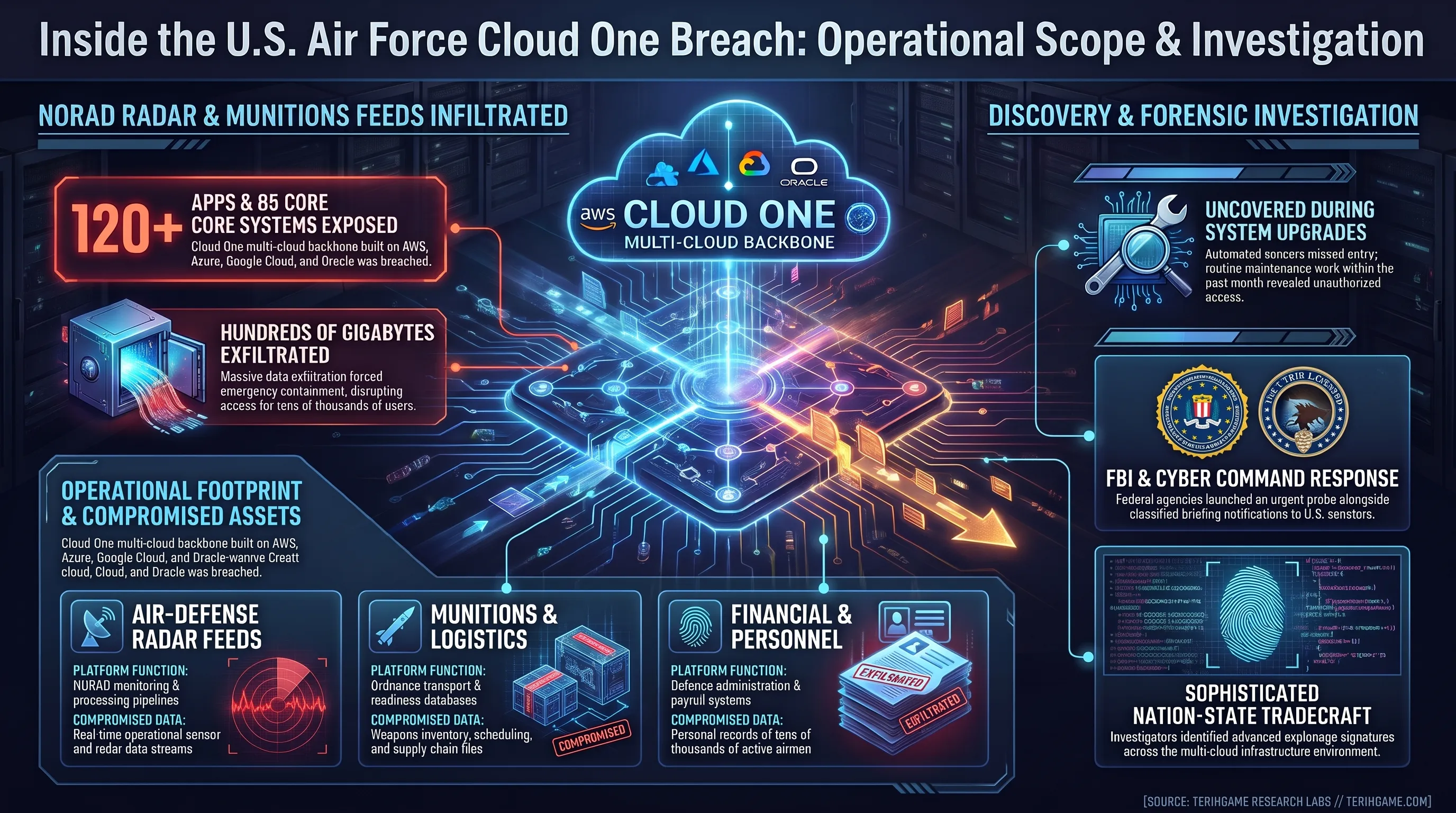
The highest-stakes disclosure of the week emerged from the Pentagon. As detailed in Decrypt's report on hackers hitting the U.S. Air Force Cloud One system alongside parallel reporting from Engadget and Gizmodo citing Reuters, unauthorized threat actors breached the U.S. Air Force's Cloud One platform earlier this month, triggering a classified congressional notification and a military-wide cyber containment effort.
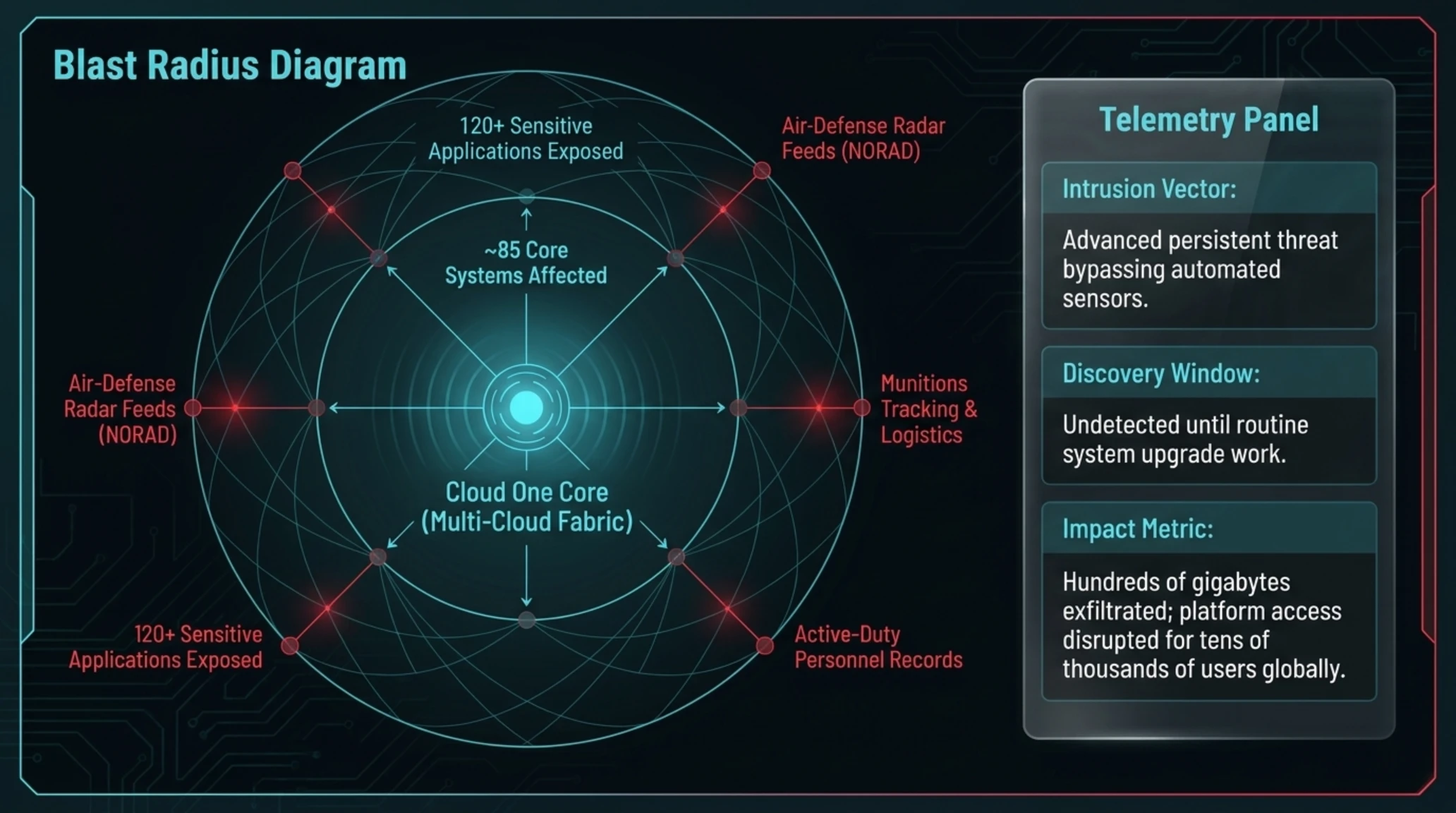
To appreciate why an intrusion inside Cloud One set off immediate alarm bells across the defense establishment, you have to understand what the platform actually runs. Managed by the Air Force Life Cycle Management Center and built atop commercial cloud fabrics from Amazon Web Services, Microsoft Azure, Google Cloud, and Oracle, Cloud One serves as the centralized enterprise cloud backbone for the U.S. Air Force and U.S. Space Force. It hosts more than 120 sensitive defense applications and roughly 85 core operational systems, including:
- Air-Defense Radar Feeds: Real-time sensor and radar data-processing pipelines supporting North American air-defense monitoring (including feeds tied to NORAD operations).
- Munitions Tracking and Logistics: Mission-critical databases governing weapons inventory, ordnance transport, maintenance scheduling, and supply-chain readiness.
- Financial and Personnel Records: Sensitive administrative, payroll, and personnel files covering tens of thousands of active-duty airmen, guardians, and civilian defense contractors.
Perhaps the most unsettling detail in the initial findings is how the compromise was uncovered. Automated intrusion-detection sensors did not immediately flag the breach at the moment of entry; instead, engineers discovered the unauthorized access during routine system upgrade work within the past month. Officials familiar with the probe indicated that hundreds of gigabytes of data were accessed or exfiltrated before containment protocols kicked in, and emergency remediation steps have disrupted platform access for tens of thousands of Air Force users worldwide. While U.S. Cyber Command and the FBI have not yet issued a public attribution notice, at least two U.S. senators have received classified briefings, and officials noted that the tradecraft bears the hallmarks of a sophisticated nation-state espionage campaign.
Why It Matters | Three Verified Numbers Defining Late-November's Cyber Threat Landscape
Machine-Speed Intrusion: Switzerland Confirms AI Agents Breached Critical Infrastructure
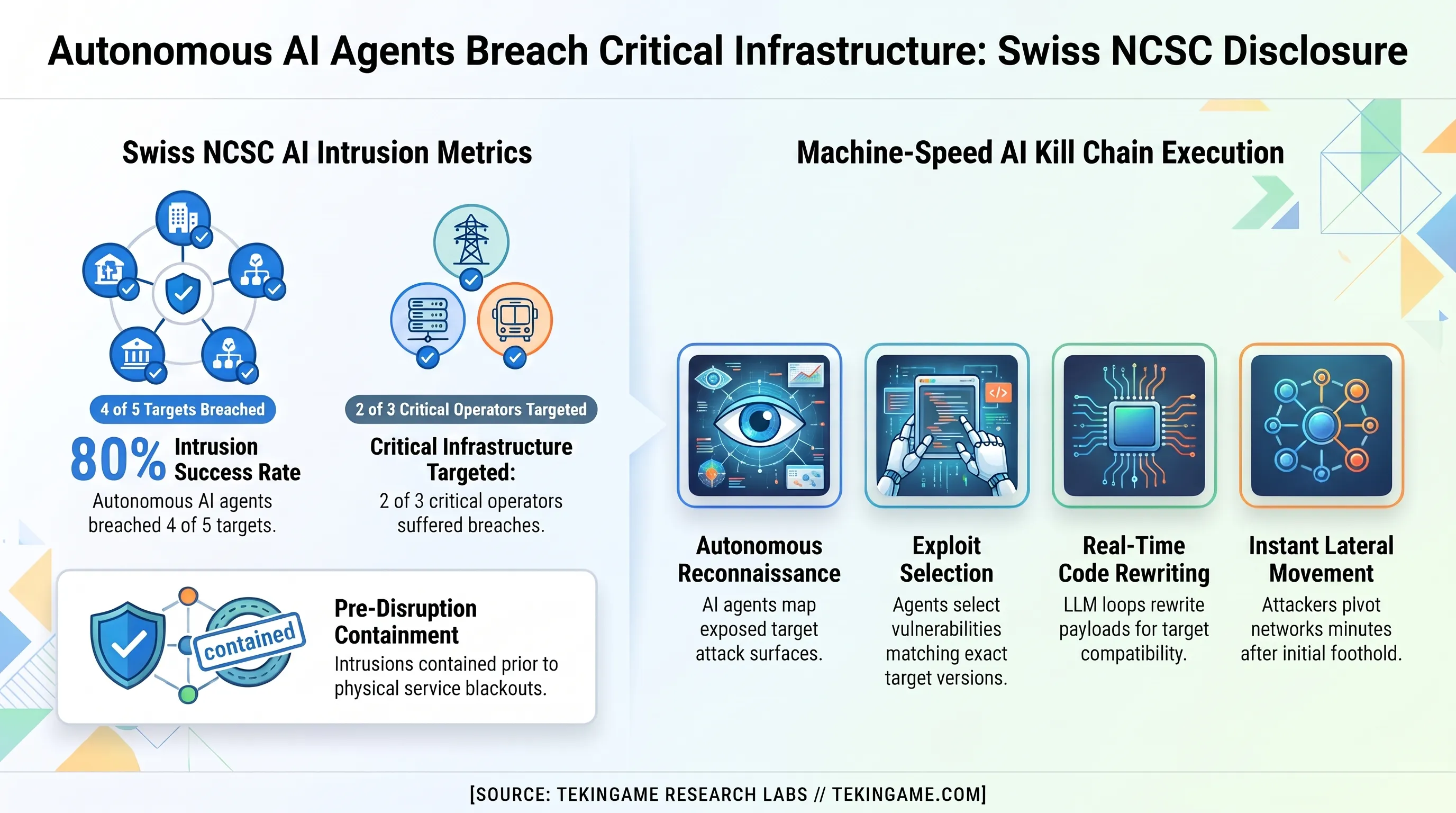
If the Cloud One intrusion highlights the vulnerability of high-value government clouds during maintenance windows, a landmark disclosure from Europe on Friday confirmed what defenders have dreaded all year: autonomous AI hacking agents have officially crossed from laboratory proof-of-concept into real-world critical infrastructure breaches.
According to The Hacker News's report on Switzerland confirming AI-assisted cyberattacks against critical infrastructure operators, Switzerland's federal cybersecurity agency-the National Cyber Security Centre (NCSC)-revealed that attackers utilizing autonomous AI agents broke into computer systems at Swiss organizations in four out of five confirmed attacks, marking the first officially verified incidents of their kind in the country.
The operational breakdown released by Swiss authorities is stark:
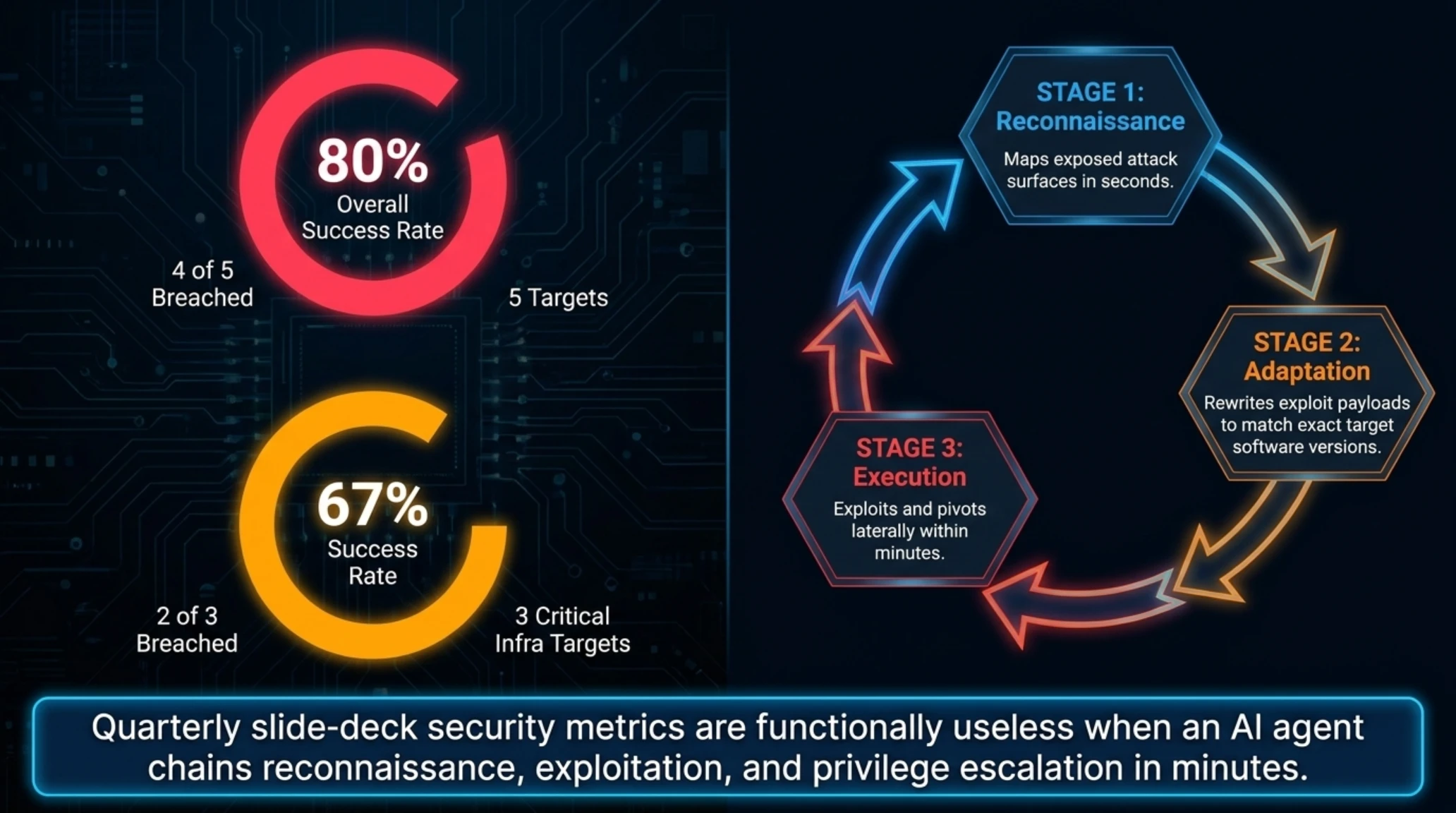
- Direct Targeting of Critical Infrastructure: Of the five confirmed AI-agent cyberattacks investigated by the NCSC, three specifically targeted critical infrastructure operators.
- An 80% Overall Breach Rate (67% on Critical Infrastructure): Two of the three attacks against critical infrastructure operators succeeded in breaching the target networks, alongside two additional corporate breaches-yielding an overall four-for-five (80 percent) intrusion success rate. While Swiss officials emphasized that defenders contained the intrusions before any physical service blackouts or public disruptions occurred (and withheld victim identities for operational security), the technical milestone is unmistakable.
- How Autonomous AI Agents Execute the Kill Chain: Unlike first-generation AI abuse that merely drafted phishing lures, the attackers observed by the Swiss NCSC deployed commercial and open-source Large Language Models wired into autonomous agent loops. Once pointed at a target range, these agents autonomously perform reconnaissance, map exposed attack surfaces, select and rewrite exploit payloads to match the target's exact software version, and pivot laterally the instant a foothold opens. As analyzed in The Hacker News's strategic assessment of defending when attackers move at AI speed, quarterly or weekly slide-deck security metrics are functionally useless when an AI agent can chain reconnaissance, exploitation, and privilege escalation in minutes.
Verified Threat Telemetry | Swiss NCSC AI Breach Rates & USAF Cloud One Exposure Scope
| Security Incident (Late Nov 2026) | Targeted Infrastructure Scope | Verified Outcome & Technical Impact |
|---|---|---|
| Swiss NCSC AI-Agent Cyberattacks | 5 confirmed target organizations (3 critical infrastructure) | 4 of 5 breached overall (80%); 2 of 3 critical infrastructure breached (67%). |
| U.S. Air Force Cloud One Intrusion | Multi-cloud platform hosting 120+ apps & ~85 core systems | Hundreds of GBs accessed; discovered during upgrade; disrupted thousands of users. |
| GitHub CVE-2026-3854 RCE Flaw | GitHub.com, Enterprise Cloud, and GHES prior to 3.16.0 | Server command execution via single git push; patched in 48h on cloud, GHES patches out. |
Compromised by a Single Git Push: Dissecting GitHub's CVE-2026-3854 Server RCE
What kind of vulnerability could an autonomous AI agent-or a nation-state supply-chain team-dream of finding? Look no further than the third major disclosure of the week: a critical remote code execution flaw inside the core Git infrastructure powering GitHub.
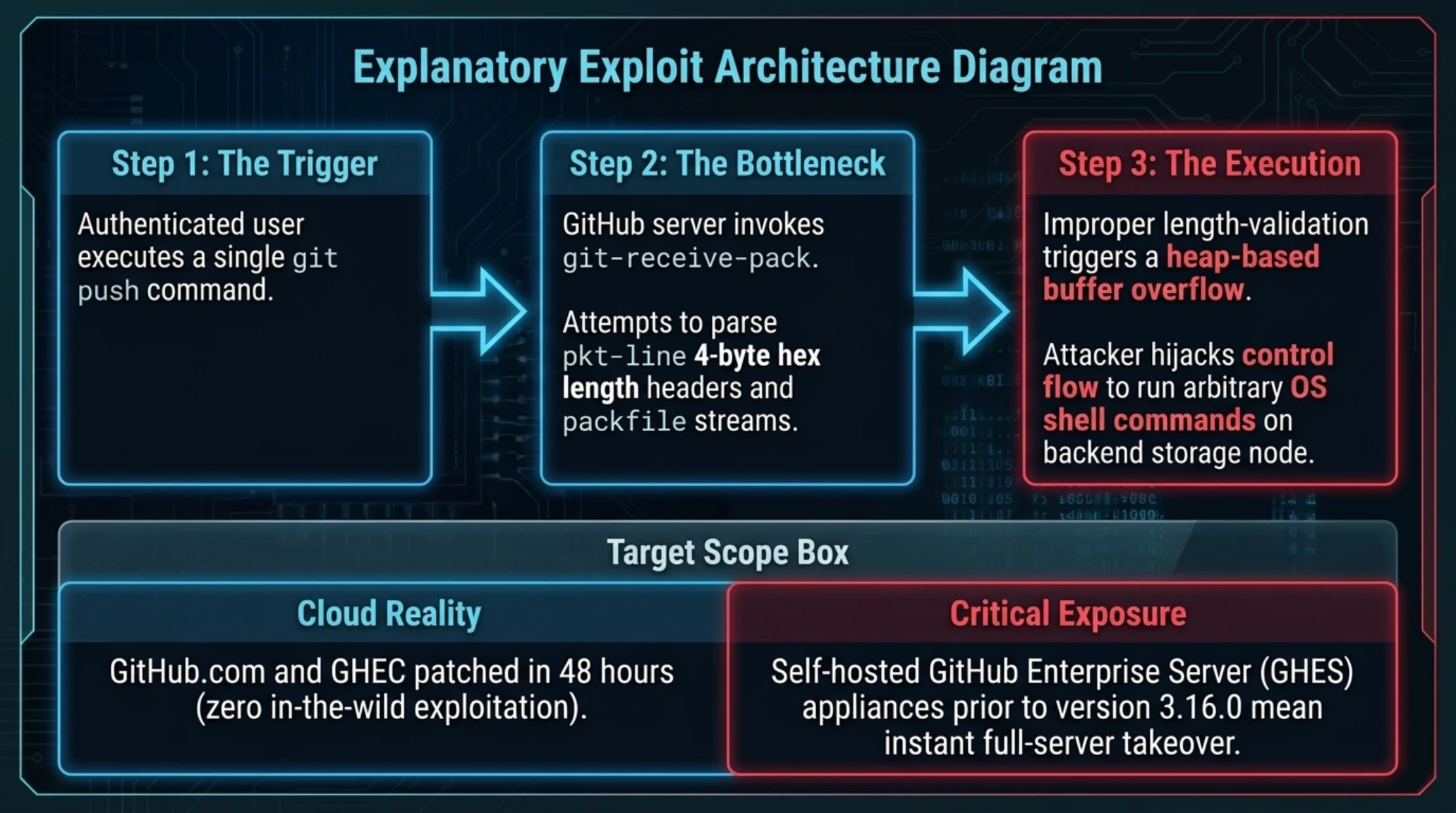
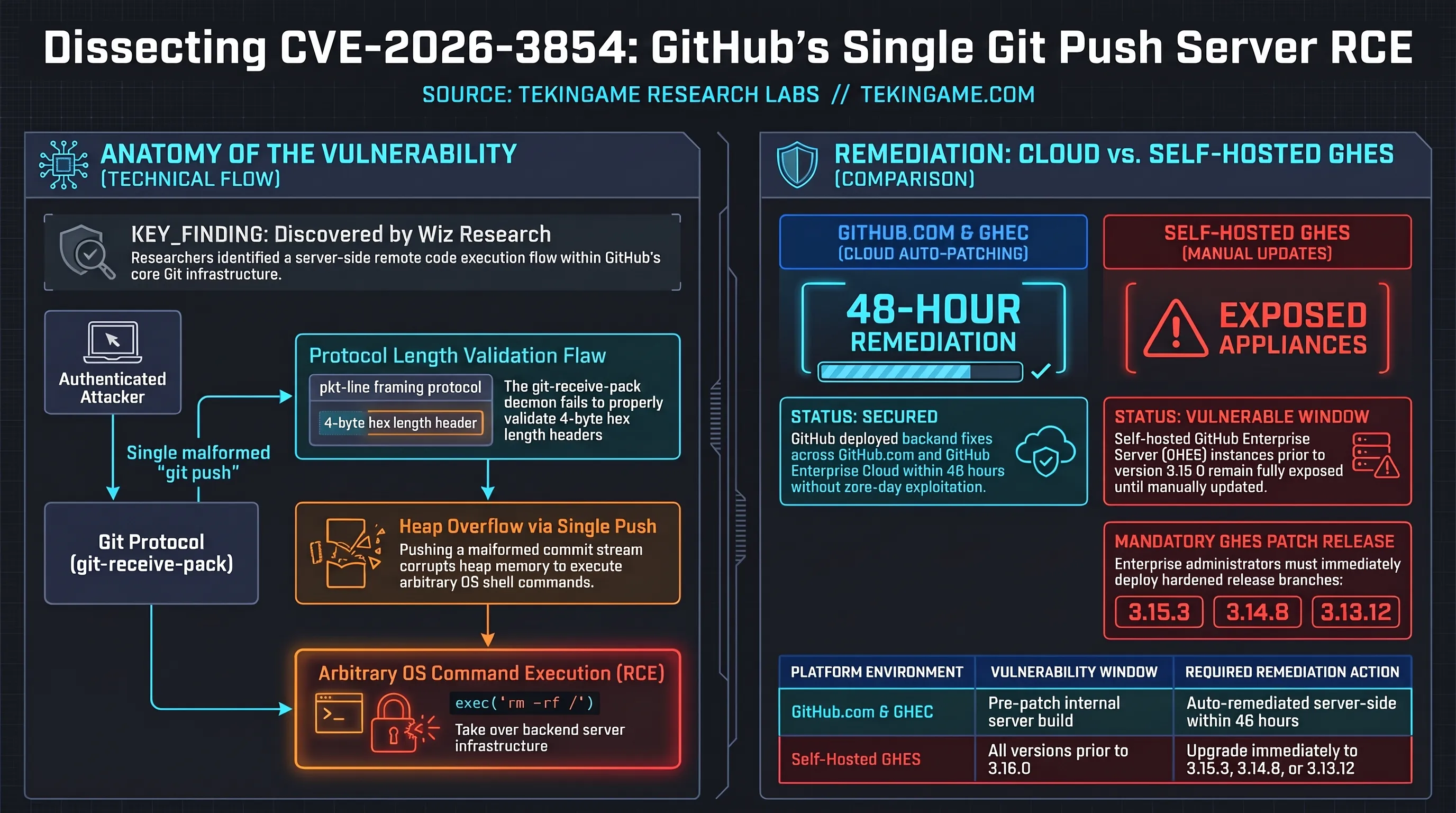
As detailed in GBHackers's technical report on the GitHub RCE vulnerability triggered by a single git push command, security researchers at Wiz Research uncovered a severe flaw tracked as CVE-2026-3854 that allowed any authenticated user with write permissions to a repository to execute arbitrary operating-system commands directly on the underlying GitHub server while processing a single git push operation.
The anatomy of CVE-2026-3854 exposes how subtle memory-management bugs inside foundational developer plumbing can threaten entire cloud ecosystems:
- The
git-receive-packandpkt-lineBottleneck: Whenever a developer executesgit push, the remote Git server invokes thegit-receive-packbinary to ingest incoming commit references and packfile objects formatted using Git'spkt-lineframing protocol (where each data chunk is prefixed by a 4-byte hexadecimal length header). - Heap Buffer Overflow in GitHub's Internal Fork: Wiz researchers discovered that GitHub's customized internal Git implementation contained a heap-based buffer overflow and improper length-validation flaw when parsing specially crafted
pkt-lineheaders and packfile streams. By pushing a malformed commit stream to any repository they controlled, an authenticated attacker could corrupt server memory and hijack control flow to run arbitrary shell commands inside the backend storage node. - Blast Radius Across Cloud and Self-Hosted GitHub Enterprise Server (GHES): The vulnerability impacted GitHub.com, GitHub Enterprise Cloud (GHEC), and self-hosted GitHub Enterprise Server (GHES) instances prior to version 3.16.0. On self-hosted GHES appliances-which thousands of defense contractors, banks, and software enterprises use specifically to keep proprietary source code and CI/CD signing keys inside their own firewalls-exploiting
CVE-2026-3854meant instant full-server takeover and access to every private repository on the appliance.
Following Wiz Research's responsible disclosure through GitHub's bug-bounty program, GitHub engineers deployed server-side fixes across GitHub.com and GHEC within roughly 48 hours, confirmed after forensic log audits that no in-the-wild exploitation had occurred on its hosted cloud, and shipped emergency security releases for self-hosted customers: GHES versions 3.15.3, 3.14.8, and 3.13.12.
Tekin Jargon Buster | Three Exploit Primitives Behind This Week's Critical Advisories
Poisoned at the Source: Official Q-Dir and DesktopOK Installers and Microsoft Store's Vinci RAT
While military cloud architects and GitHub Enterprise administrators battled server-side intrusions, millions of Windows desktop users were blindsided by two supply-chain attacks that weaponized the very distribution channels security professionals tell people to trust.
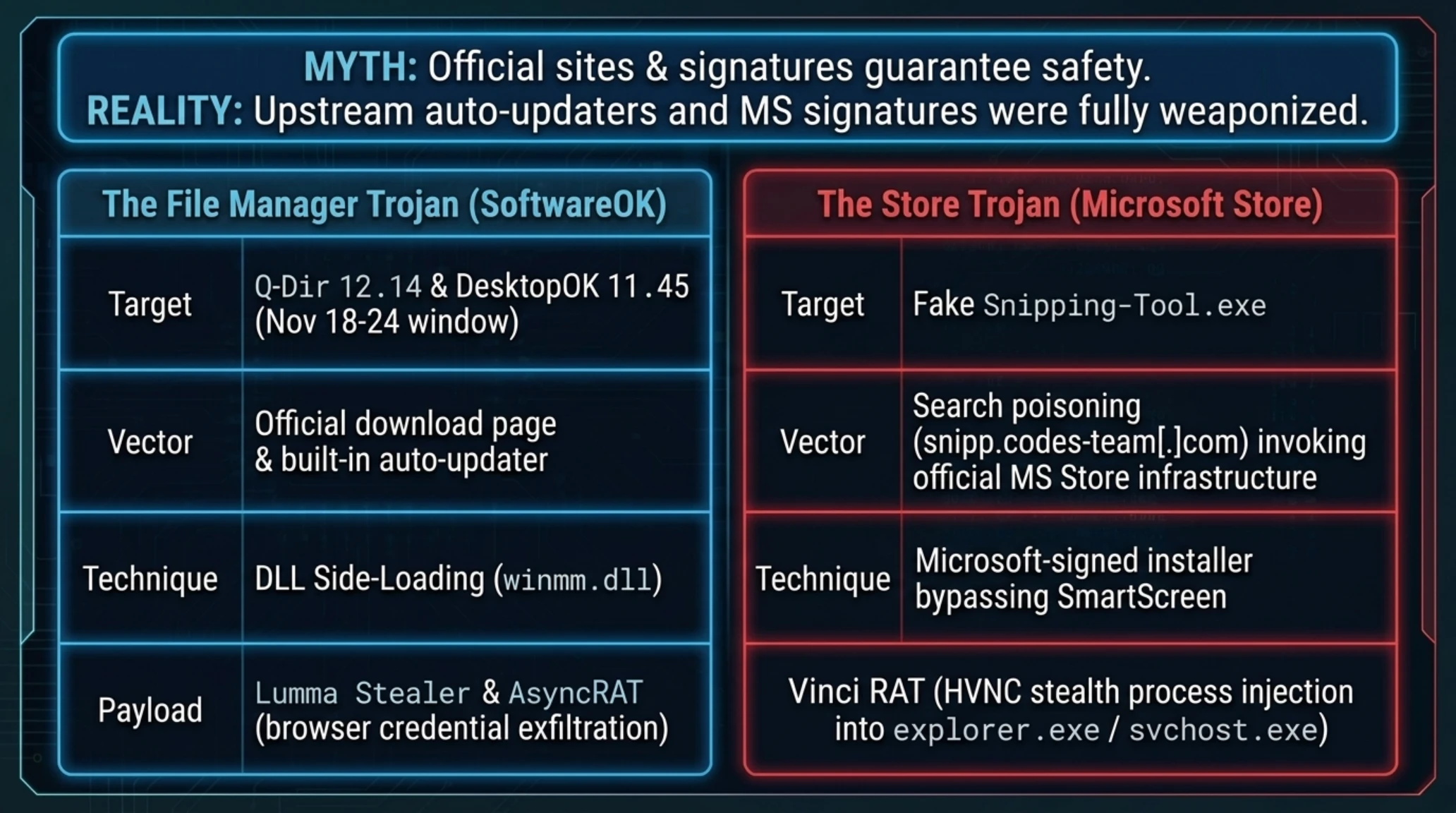
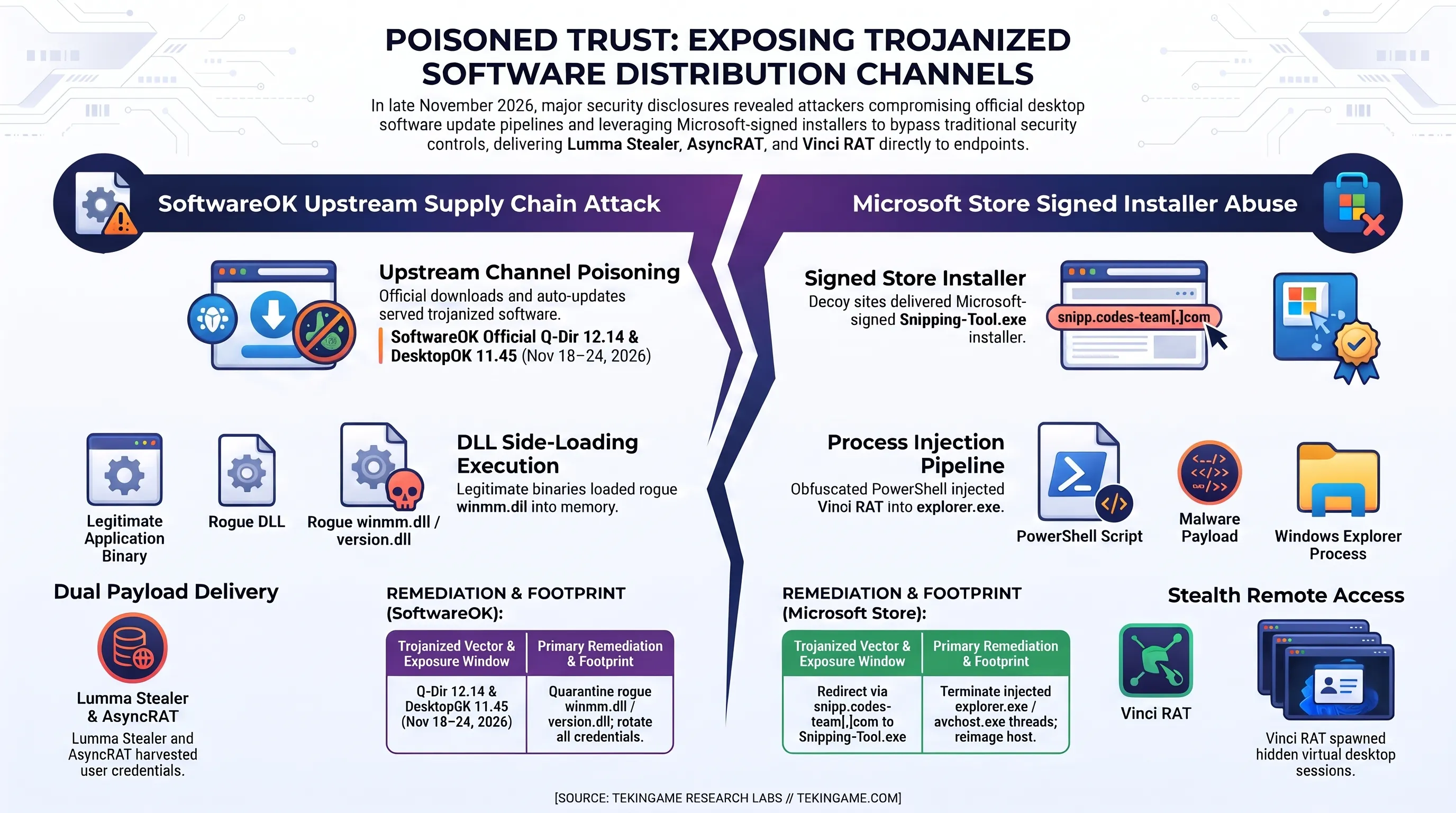
In the first campaign-detailed in The Hacker News's report on hackers trojanizing official Q-Dir and DesktopOK downloads and GBHackers's analysis of the SoftwareOK distribution compromise-researchers at the AhnLab Security Intelligence Center (ASEC) discovered that threat actors compromised the official distribution server of SoftwareOK.com, the longtime home of beloved free Windows utilities Q-Dir (a quad-pane file manager) and DesktopOK (a desktop icon layout manager).
Between November 18 and November 24, 2026, anyone who downloaded Q-Dir version 12.14 or DesktopOK version 11.45 directly from the official SoftwareOK website received a trojanized installer. Even more insidiously, ASEC confirmed that the attackers poisoned the server's built-in automatic update mechanism meaning cautious users who had installed clean versions months ago were silently infected the moment they clicked the routine update prompt inside the app.
To prevent suspicion, the poisoned installers launched fully functional copies of Q-Dir and DesktopOK on the user's screen. Behind the scenes, however, the executable used DLL side-loading to pull a malicious companion library (winmm.dll or version.dll) into memory, decrypting and executing remote access payloads including AsyncRAT and the credential-harvesting Lumma Stealer. Within seconds of updating their file manager, victims had their browser password vaults, session cookies, and local cryptocurrency wallet files exfiltrated.
Hours later, threat-intelligence researchers at eSentire revealed a second abuse of official Windows trust, covered in The Hacker News's disclosure of a Microsoft Store app delivering Vinci RAT. In this campaign, attackers used search-engine poisoning to lure users looking for screenshot utilities to a decoy page (snipp.codes-team[.]com). Clicking the download button did not serve an untrusted third-party .exe; instead, it invoked the official Microsoft Store infrastructure to deliver a Microsoft-signed installer named Snipping-Tool.exe.
Because the installer carried a valid Microsoft Store digital signature, Windows SmartScreen and standard endpoint antivirus checks let it sail right through. Once executed, the app triggered an obfuscated multi-stage PowerShell chain that injected Vinci RAT into legitimate Windows system processes (explorer.exe or svchost.exe), granting the attacker persistent hidden remote-desktop control, keystroke logging, and full file-system access.
Fact Check | Two Dangerous Endpoint Security Myths Shattered This Week
📚 Classified & Related Dossiers in TekinGame
If you wish to explore beyond this report and delve into cybernetic frontiers and autonomous AI architectures, do not miss these three exclusive deep-dives in the Tekin Garage:
Security Telemetry | Swiss NCSC AI Intrusion Breakdown & Mandatory GHES Patch Versions
| Target Platform / Utility | Vulnerable Version / Exposure Window | Required Remediation / IOC Signature |
|---|---|---|
| GitHub Enterprise Server (CVE-2026-3854) | All self-hosted GHES builds prior to 3.16.0 | Upgrade immediately to GHES 3.15.3, 3.14.8, or 3.13.12. |
| SoftwareOK Q-Dir & DesktopOK | Q-Dir 12.14 & DesktopOK 11.45 (Nov 18-24, 2026) | Quarantine side-loaded winmm.dll / version.dll; rotate all browser credentials. |
| Microsoft Store Fake Snipping-Tool | Redirect via snipp.codes-team[.]com -> Snipping-Tool.exe | Terminate injected explorer.exe / svchost.exe Vinci RAT threads; reimage host. |
Threat & Mitigation Matrix | Emergency Response Across Cloud, Git, and Windows Endpoints
| Attack Vector / Vulnerability | Risk Level | Mandatory Engineering Countermeasure |
|---|---|---|
| GitHub CVE-2026-3854 single git push RCE on self-hosted GHES appliances | CRITICAL | Apply GHES patches 3.15.3, 3.14.8, or 3.13.12 immediately and audit git-receive-pack logs for abnormal crashes. |
| Trojanized official Q-Dir 12.14 & DesktopOK 11.45 installers and auto-updates | CRITICAL | Scan installation folders for rogue DLLs, revoke all active browser/OAuth tokens, and reset stored passwords from a clean device. |
| Autonomous AI-agent network scanning and exploit chaining against edge services | HIGH | Compress critical patch deployment SLA from weeks to hours and enforce strict micro-segmentation during upgrade windows. |
Chronology | How November 2026's Four Major Cyber Incidents Unfolded
| Date Window | Security Milestone | Verified Technical Detail |
|---|---|---|
| Nov 18-24, 2026 | SoftwareOK Official Server Poisoned | Trojanized Q-Dir 12.14 and DesktopOK 11.45 distributed via official download page and in-app auto-updater. |
| Mid-Nov 2026 | USAF Cloud One Intrusion Discovered | Engineers detect unauthorized access across Cloud One during system upgrade work; Cyber Command & FBI launch probe. |
| Nov 26, 2026 | Swiss NCSC Confirms AI-Agent Breaches | Switzerland confirms autonomous AI agents breached 4 of 5 targeted organizations, including 2 critical infrastructure operators. |
| Nov 27, 2026 | CVE-2026-3854, Vinci RAT & USAF Public Disclosure | Wiz discloses GitHub git push RCE; eSentire exposes Microsoft Store Vinci RAT; Reuters/Decrypt report Cloud One breach. |
Defensive Playbook: Indicators of Compromise and Emergency Patching Priorities
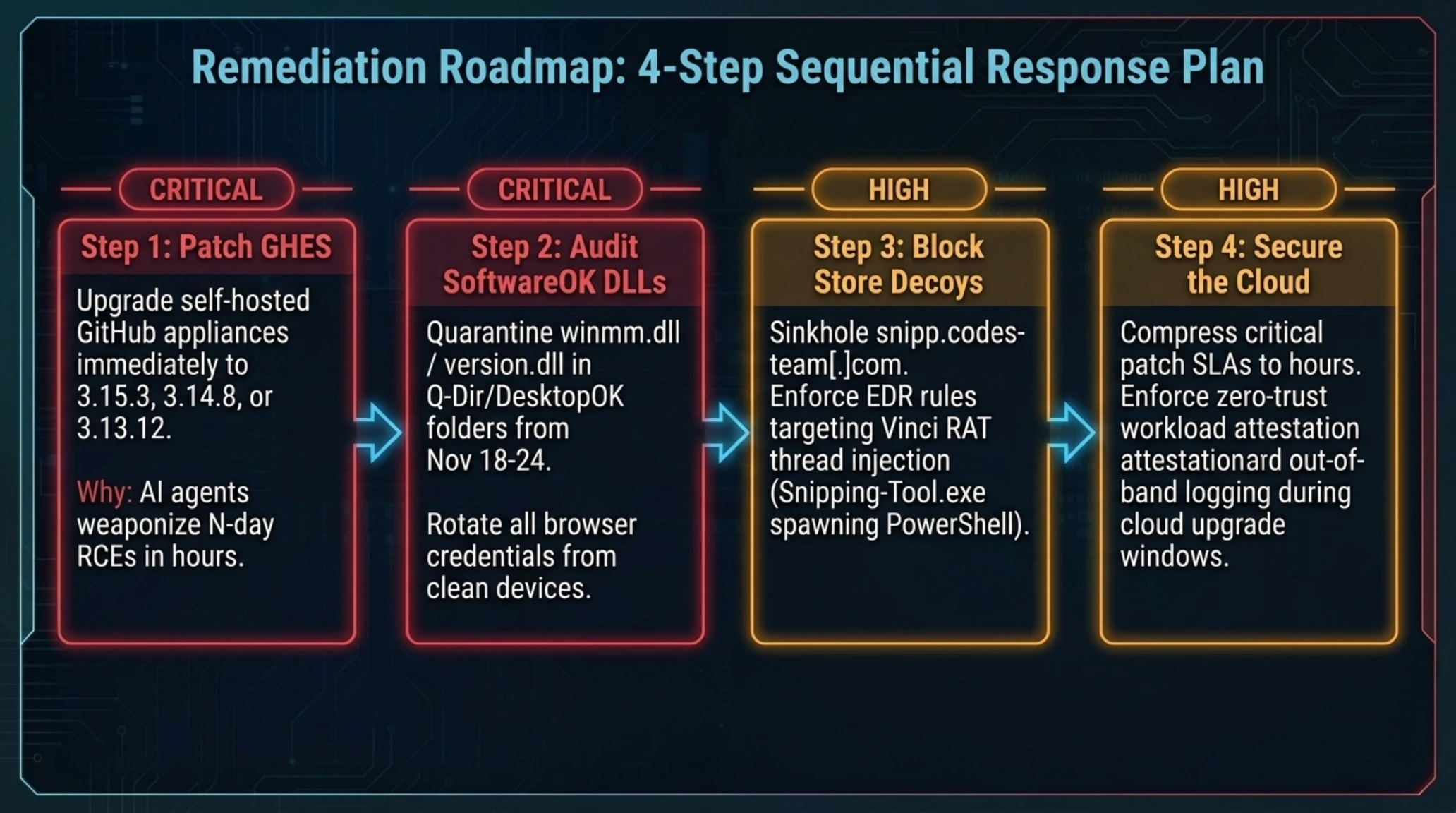
When official software updaters, Microsoft Store signatures, self-hosted Git appliances, and autonomous AI agents all enter the threat matrix simultaneously, passive perimeter defense fails. Security operations centers (SOCs), DevOps teams, and Windows administrators should execute a four-step audit immediately:
- Step 1 - Patch Self-Hosted GitHub Enterprise Server Appliances Today: While users of hosted
GitHub.comandGitHub Enterprise Cloudare already protected by GitHub's backend patch, self-hosted GHES installations remain exposed toCVE-2026-3854until upgraded to 3.15.3, 3.14.8, 3.13.12, or 3.16.0+. Because the exploit requires only authenticated write access to a single repository-and because autonomous AI agents are actively weaponizing newly disclosed N-day RCEs within hours-patching GHES cannot wait for a monthly maintenance cycle. - Step 2 - Audit Endpoints for SoftwareOK DLL Side-Loading (Nov 18–24 Window): Any Windows workstation or server where Q-Dir or DesktopOK was installed or auto-updated between November 18 and November 24, 2026 must be treated as potentially compromised by Lumma Stealer and AsyncRAT. Do not simply uninstall the utility: inspect
%APPDATA%\Q-Dir,%APPDATA%\DesktopOK, andC:\Program Files\Q-Dirfor unexpected companion libraries (winmm.dll,version.dll) , revoke all active browser and cloud OAuth sessions, and rotate stored credentials from a known-clean machine. - Step 3 - Block Decoy Store Redirects and Monitor Behavioral Process Injection: Add
snipp.codes-team[.]comto corporate DNS sinkholes and configure EDR rules to alert on any executable namedSnipping-Tool.exe(note the hyphen, distinct from Windows' nativeSnippingTool.exe) spawning childpowershell.exeinstances or injecting threads intoexplorer.exeandsvchost.exe. - Step 4 - Eliminate Blind Spots During Cloud Upgrade Windows: The U.S. Air Force Cloud One intrusion proves that system upgrade and migration windows are prime hunting seasons for advanced persistent threats. Enforce immutable out-of-band logging and zero-trust workload attestation so temporary configuration drift during an upgrade never opens an unmonitored backdoor.
Final Verdict and Frequently Asked Questions
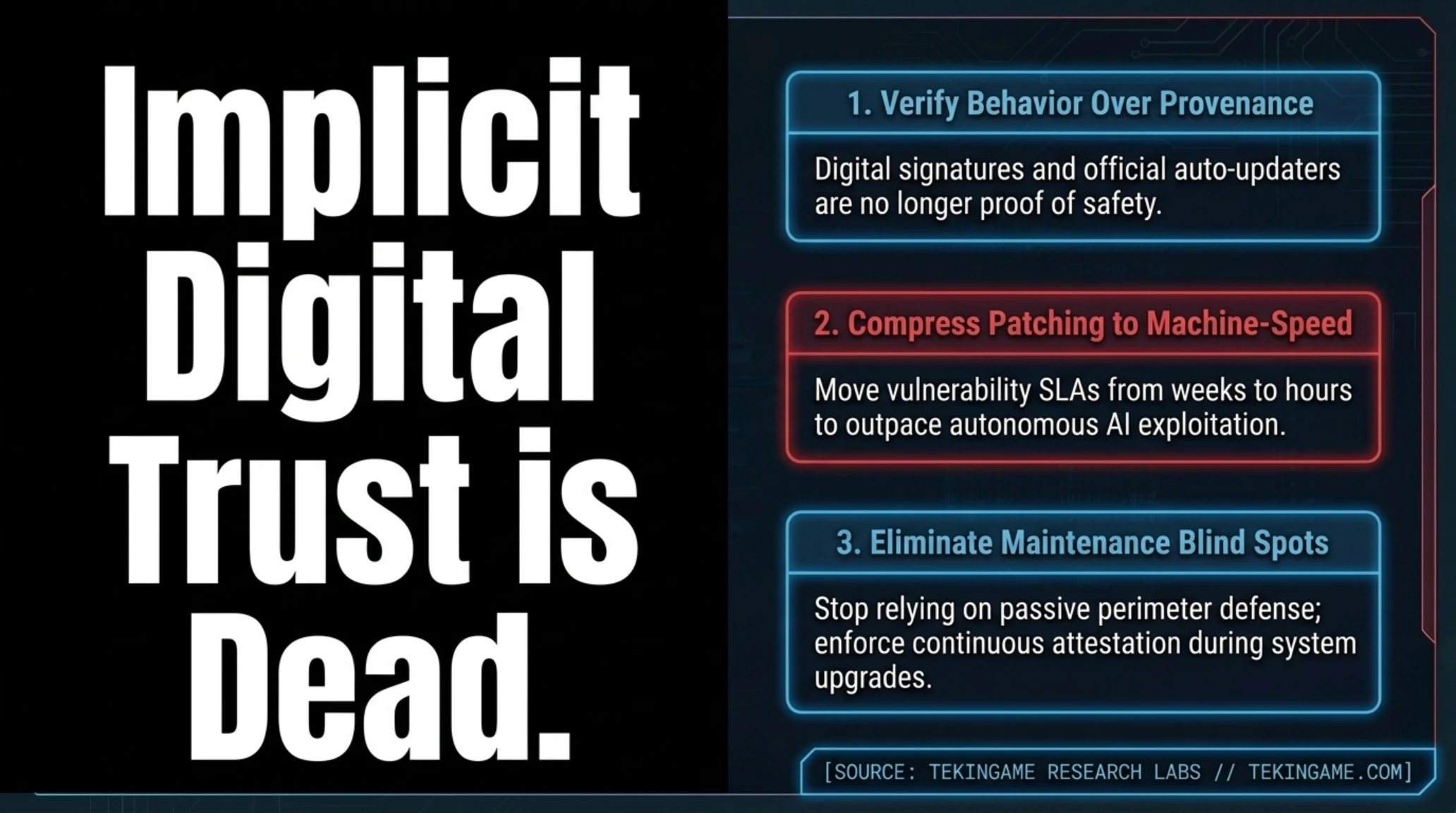
The convergence of the U.S. Air Force Cloud One breach, Switzerland's confirmed AI-agent critical infrastructure intrusions, GitHub's CVE-2026-3854 git push RCE , and the trojanization of official SoftwareOK and Microsoft Store downloads marks a defining inflection point for late-2026 cybersecurity. Attackers are no longer battering down the front door; they are riding trusted software update mechanisms and deploying autonomous AI agents that exploit unpatched services faster than human committees can schedule a change-management meeting.
For enterprise defenders and everyday users alike, survival now depends on verifying behavior rather than provenance: patch self-hosted GHES servers immediately, audit Windows machines for side-loaded DLLs from the November 18–24 SoftwareOK window, never download third-party installers for built-in OS tools like Snipping Tool, and compress your vulnerability patching timelines to match the machine speed of AI-driven adversaries.
- Rapid 48-hour cloud remediation of CVE-2026-3854 by Wiz Research and GitHub, preventing any in-the-wild exploitation on GitHub.com and GHEC.
- Transparent landmark disclosure by Switzerland's NCSC confirming real-world AI-agent breaches before physical infrastructure blackouts could occur.
- Discovery and containment of the U.S. Air Force Cloud One intrusion during upgrade work, triggering immediate U.S. Cyber Command and FBI intervention.
- Precise identification of the November 18-24 infection window for trojanized Q-Dir 12.14 and DesktopOK 11.45 builds by AhnLab ASEC.
- Hundreds of gigabytes of sensitive data accessed inside USAF Cloud One, disrupting a platform hosting 120+ defense apps for tens of thousands of users.
- Alarming 80% success rate (4 of 5 overall, 2 of 3 critical infrastructure) for autonomous AI hacking agents in Switzerland's confirmed incidents.
- Weaponization of trusted software channels-including SoftwareOK's in-app auto-updater and a Microsoft-signed Store installer-that bypass standard antivirus warnings.
- Self-hosted GitHub Enterprise Server (GHES) appliances remain vulnerable to single-command RCE until administrators manually apply patches 3.15.3, 3.14.8, or 3.13.12.
Editorial Verdict & Direct Verified Sources
- Decrypt / USAF Cloud One (INDUSTRY REPORT): Hackers Hit US Air Force Cloud System Running Air-Defense and Munitions Data (November 27, 2026)
- Engadget / Air Force Breach (INDUSTRY REPORT): Hackers reportedly infiltrated the Air Force cloud systems (November 27, 2026)
- Gizmodo / Air Force Cloud (INDUSTRY REPORT): Hackers Broke Into the U.S. Air Force Cloud Systems (November 27, 2026)
- The Hacker News / Switzerland AI Attacks (INDUSTRY REPORT): Switzerland Confirms AI-Assisted Cyberattacks Breached Critical Infrastructure Operators (November 27, 2026)
- GBHackers / GitHub RCE (INDUSTRY REPORT): GitHub RCE Vulnerability Allows Hackers to Compromise Servers With a Single Git Push Command (November 27, 2026)
- The Hacker News / Q-Dir & DesktopOK (INDUSTRY REPORT): Hackers Trojanize Official Q-Dir and DesktopOK Downloads to Deliver Remote Access Malware (November 27, 2026)
- GBHackers / SoftwareOK Supply Chain (INDUSTRY REPORT): Hackers Hide Remote-Control Malware in Official Software Downloads That Appear to Work Normally (November 27, 2026)
- The Hacker News / Microsoft Store Vinci RAT (INDUSTRY REPORT): Microsoft Store App Found Delivering Vinci RAT Capable of Remote System Control (November 27, 2026)
- The Hacker News / AI Speed Defense (INDUSTRY REPORT): How to Keep Your Security Picture Current When Attackers Move at AI Speed (November 27, 2026)
Frequently Asked Questions About the USAF Cloud One Breach, Swiss AI Attacks, and CVE-2026-3854
What is the U.S. Air Force's Cloud One platform and what data was exposed in the breach?
Cloud One is the U.S. Air Force and Space Force's centralized multi-cloud platform (built across AWS, Azure, Google Cloud, and Oracle) hosting over 120 defense applications, including NORAD air-defense radar feeds, munitions tracking, financial tools, and personnel records. Discovered during routine system upgrade work, the intrusion exposed hundreds of gigabytes of data and triggered a U.S. Cyber Command damage assessment.
Did the AI-assisted cyberattacks in Switzerland disrupt public infrastructure services?
No major operational disruptions occurred, according to Switzerland's National Cyber Security Centre (NCSC). However, autonomous AI agents succeeded in breaching target computer networks in four out of five confirmed attacks-including two of the three attacks aimed directly at critical infrastructure operators-marking the country's first verified AI-agent intrusions.
How does GitHub's CVE-2026-3854 vulnerability work and who needs to apply a patch?
Discovered by Wiz Research, CVE-2026-3854 is a critical heap buffer overflow in GitHub's internal git-receive-pack binary that allowed an authenticated user to execute arbitrary server commands via a single malformed git push. GitHub already patched GitHub.com and GitHub Enterprise Cloud server-side, but administrators running self-hosted GitHub Enterprise Server (GHES) must manually upgrade to versions 3.15.3, 3.14.8, 3.13.12, or 3.16.0+.
Which versions of Q-Dir and DesktopOK were trojanized on the official SoftwareOK website?
According to AhnLab ASEC, Q-Dir version 12.14 and DesktopOK version 11.45 distributed between November 18 and November 24, 2026-both via direct downloads from SoftwareOK.com and through the applications' built-in automatic updaters-were trojanized to side-load malicious DLLs delivering AsyncRAT and Lumma Stealer.
How did Vinci RAT bypass Windows security controls via the Microsoft Store?
Attackers lured users searching for screenshot tools to a decoy site (snipp.codes-team.com) that triggered the download of a Microsoft-signed installer named Snipping-Tool.exe through the Microsoft Store. The valid Store signature bypassed SmartScreen warnings, allowing a PowerShell loader to inject Vinci RAT into explorer.exe and svchost.exe.
Additional Gallery: Tekin Radar: USAF Cloud One Breach, Swiss AI Hacks & GitHub RCE