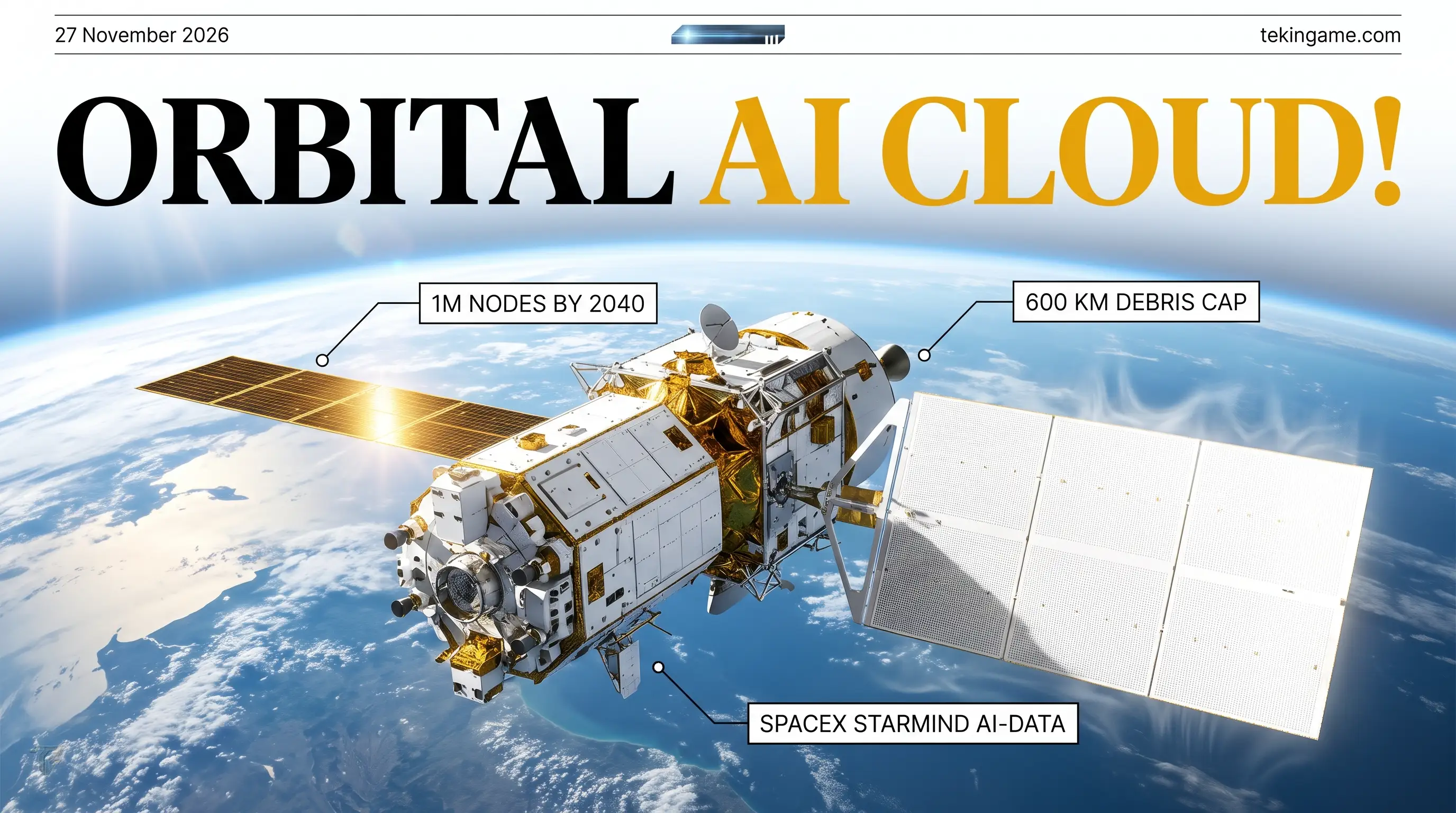
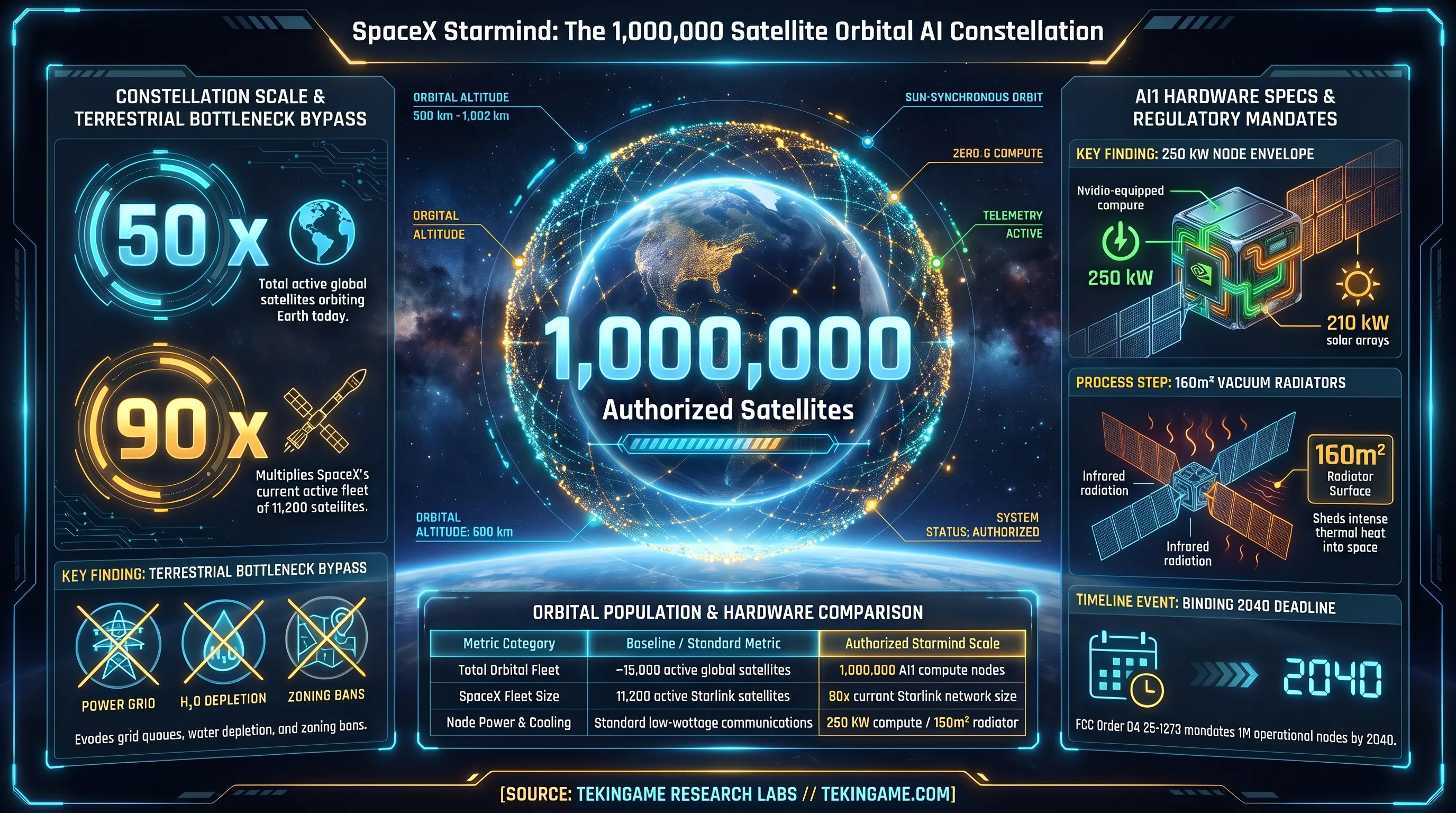
Under Order DA 26-1273, the FCC conditionally authorized SpaceX to deploy up to one million Starmind orbital AI data center satellites,expanding Earth's active satellite fleet 50-fold. Each 250 kW AI1 node uses a 210 kW solar array and 160 m2 liquid radiator linked via lasers to Starlink, but faces vacuum thermodynamics, a deferred above-600 km debris waiver, and binding 2033 2040 milestones.
Tekin Briefing | Key Pillars of the FCC SpaceX Starmind Authorization
Every time a developer triggers a multi-agent coding workflow or an enterprise queries a frontier reasoning model, a very terrestrial transaction takes place behind the curtain. Megawatts of electricity surged through aging regional transmission lines, thousands of gallons of treated water evaporate through cooling towers in Northern Virginia or West Texas, and diesel backup generators hum on standby behind concrete perimeter walls. For the past three years, the physical ceiling of artificial intelligence has not been algorithmic ingenuity; it has been electricity, municipal water, and local zoning permits.
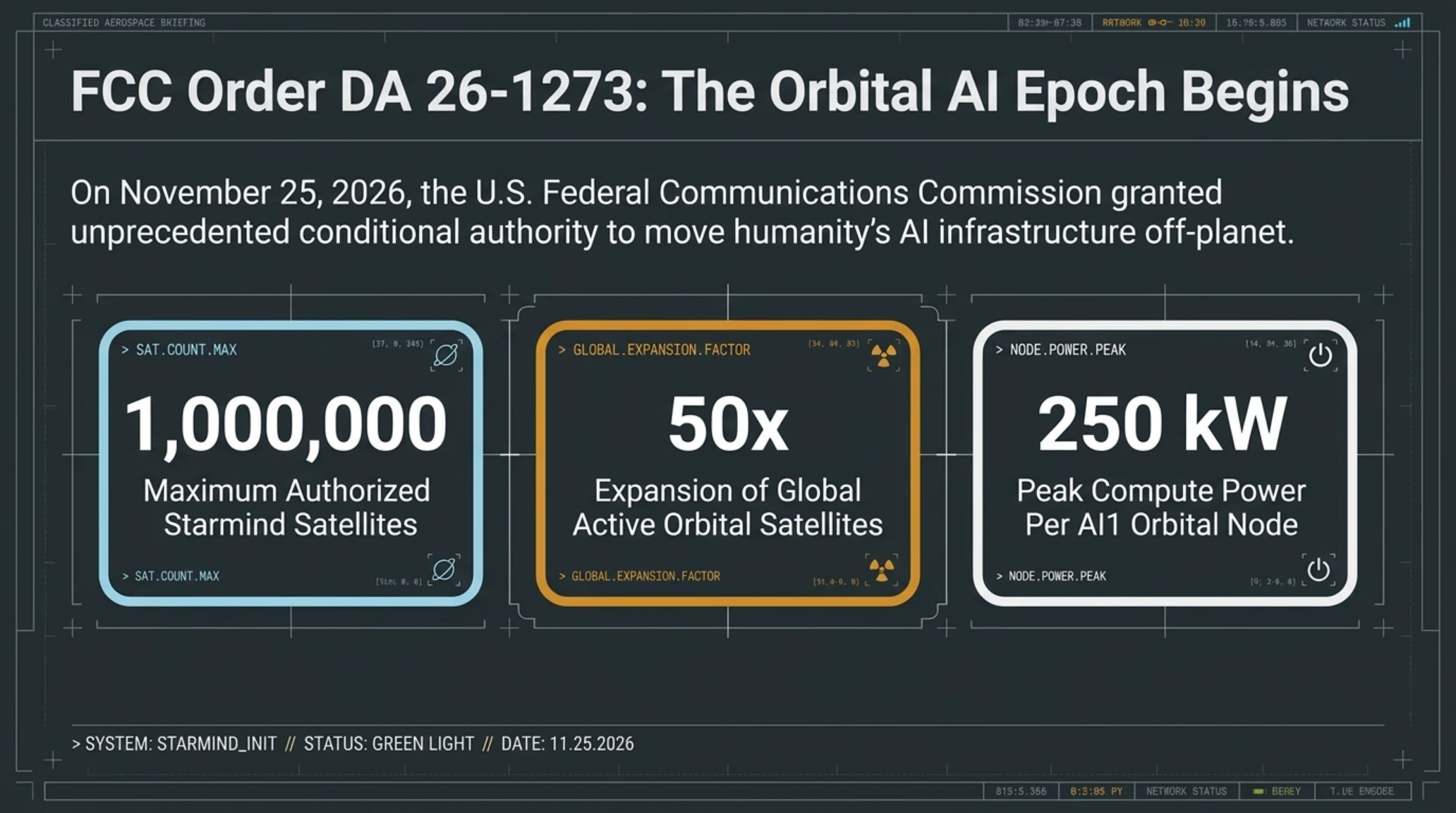
On Wednesday, November 25, 2026, federal regulators in Washington officially cleared a path to move that entire industrial footprint off the planet. As detailed in The Verge's report on the FCC's Starmind authorization, the Federal Communications Commission granted SpaceX conditional authority to deploy up to one million AI chip-equipped satellites in low Earth orbit,the first regulatory approval in history for a full-scale constellation of space-based data centers.
The sheer scale of the number defies conventional aerospace precedent. There are roughly 14,000 to 15,000 active satellites orbiting Earth today, approximately 11,200 of which belong to SpaceX's existing Starlink communications network. According to Ars Technica's analysis of the one-million-satellite authorization, building out the full Starmind architecture would multiply the total number of spacecraft circling our planet roughly 50-fold. Yet buried beneath the headline milestone lies a fierce collision of vacuum thermodynamics, orbital debris restrictions above 600 kilometers, aggressive deployment deadlines stretching from 2033 to 2040, and formal opposition from rivals and astrophysicists alike. In this Tekin Analysis deep dive, we unpack the engineering, regulatory, and economic realities of SpaceX's orbital compute gamble.
Escaping Earth's Strained Power Grids: Why AI Infrastructure Is Looking Up
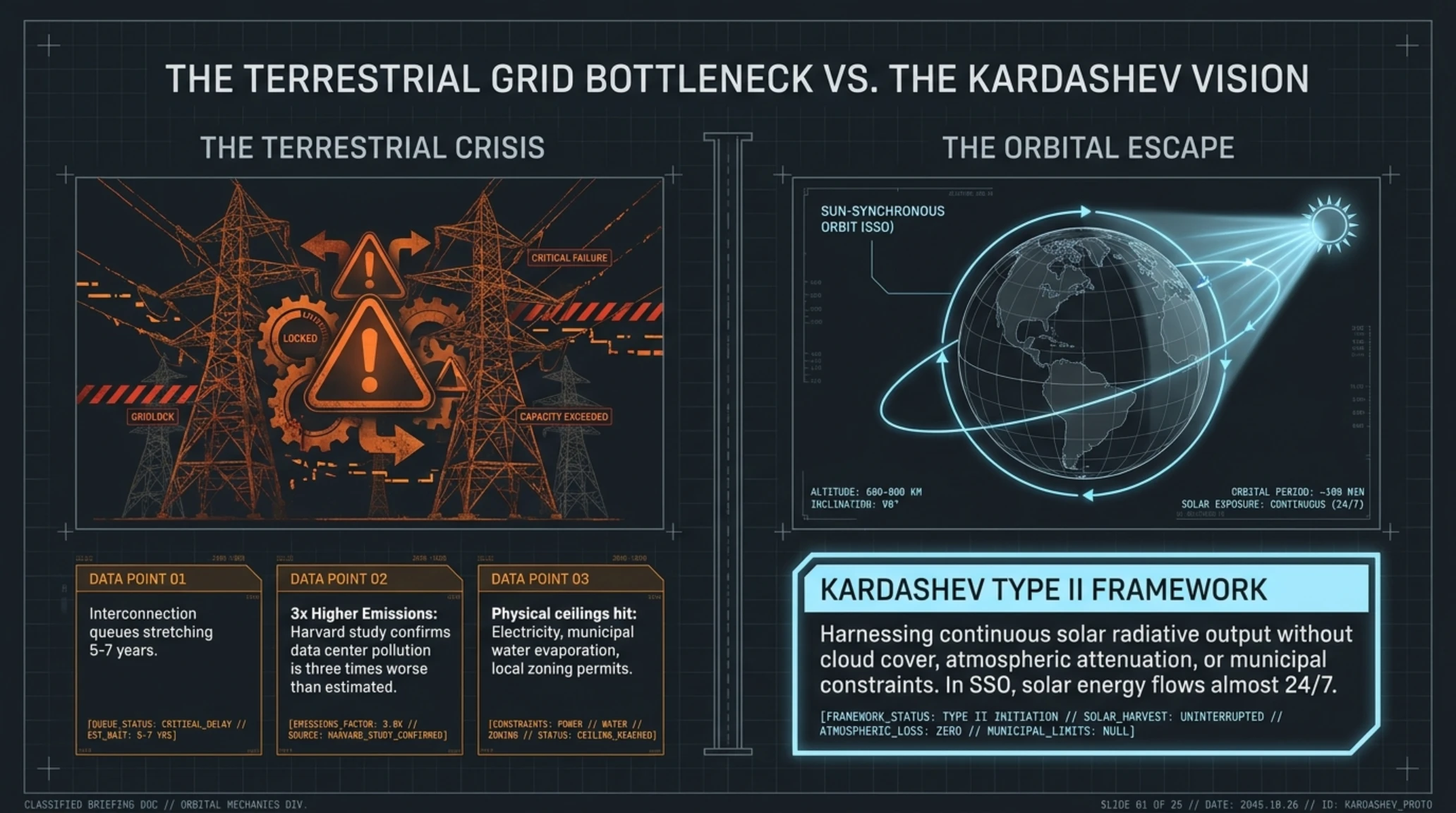
To understand why SpaceX,alongside Google and Jeff Bezos's Blue Origin,is racing to launch server racks into low Earth orbit, you first have to examine the mounting crisis confronting data center operators on the ground. By late 2026, multi-gigawatt AI training and inference campuses have pushed regional electrical grids in the United States, Europe, and East Asia to their breaking points. Interconnection queues for new high-voltage transmission lines routinely stretch five to seven years, forcing hyperscalers to bid over existing nuclear plants and delay cluster rollouts.
At the exact same moment, public tolerance for massive terrestrial server farms has fractured. On November 25, 2026,the very day the FCC released its SpaceX order,Mashable reported on a landmark Harvard University study confirming that fine-particulate pollution and greenhouse emissions tied to data centers are three times higher than previously estimated. The Harvard researchers found that just the subset of facilities analyzed consumed as much electricity as an entire U.S. state, validating grassroots voter anger that produced dozens of local ballot measures restricting or blocking data center construction during the November 2026 U.S. midterm elections.
Physical security has introduced yet another headache for terrestrial cloud architects. As highlighted in an Ars Technica security briefing on data center vulnerability published the same afternoon, centralized fiber hubs and sprawling server campuses have become high-priority kinetic and sabotage targets in modern military conflicts. Against that backdrop of grid congestion, environmental backlash, and geopolitical vulnerability, Decrypt's coverage of the solar-powered Starmind constellation underscores Elon Musk's core thesis: in sun-synchronous orbit, solar energy flows almost continuously without cloud cover, atmospheric attenuation, municipal water bills, or county zoning boards.
Why It Matters | Three Verified Metrics Behind the Starmind Filing
SpaceX framed the ambition in explicitly civilizational terms when it submitted its original application to the FCC Space Bureau in January 2026 (assigned ICFS File No. SAT-LOA-20260108-00016 and placed on public notice as DA 26-113 on February 4, 2026). In that filing, company engineers described orbital data centers as humanity's first practical step toward becoming a Kardashev Type II civilization,a society capable of harnessing the full radiative output of its host star rather than burning finite terrestrial hydrocarbons. Subsequent disclosures in SpaceX's May 2026 IPO prospectus reinforced that commercial timeline, projecting initial experimental deployments as early as late 2027 and volume ramp-up across 2028 and 2029.
Inside the Starmind AI1 Architecture: 250 Kilowatts of Solar Compute and Laser Links
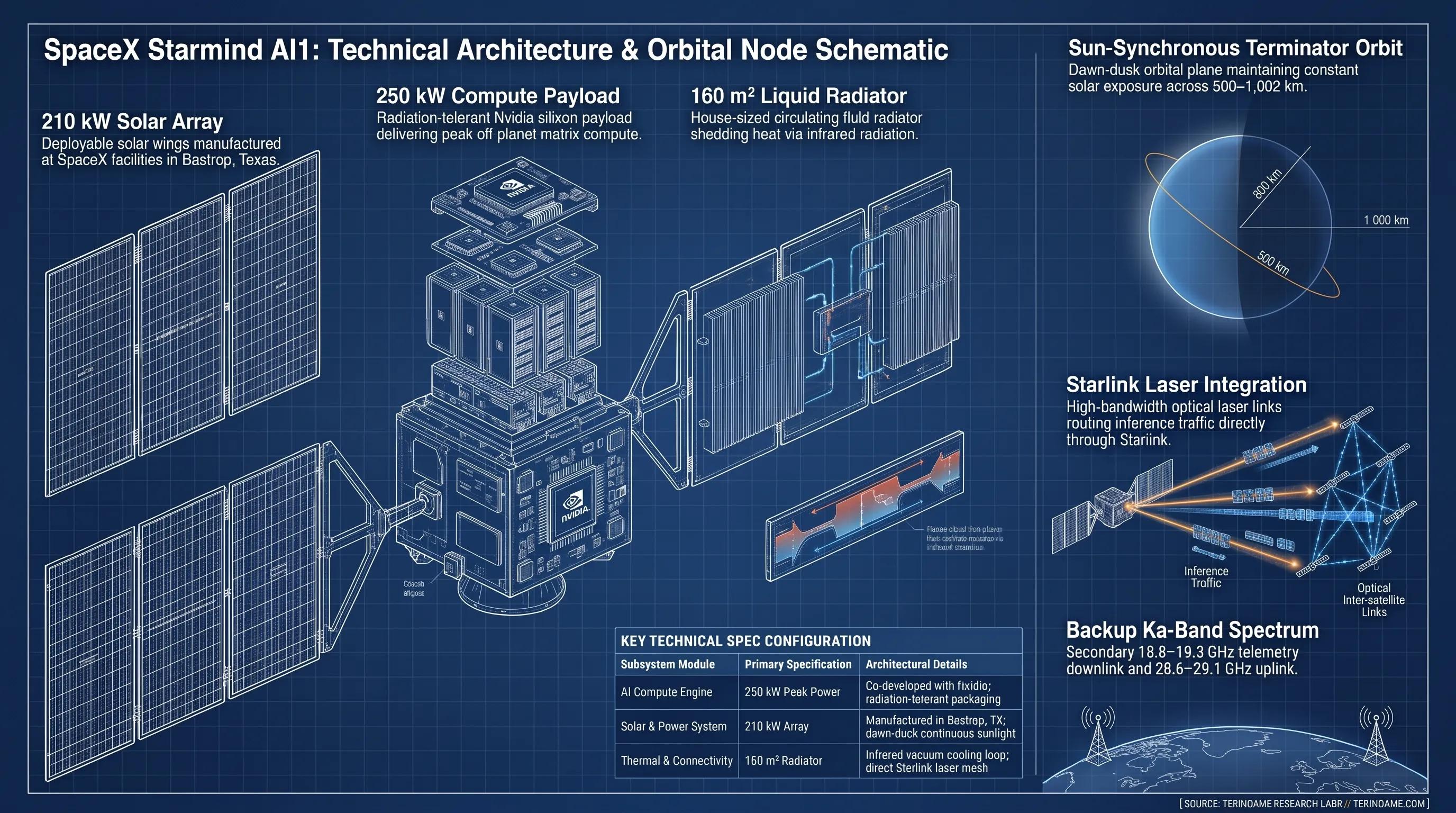
What does an orbital AI data center satellite actually look like inside? Unlike conventional communications satellites that act as bent-pipe radio relays, SpaceX's Starmind spacecraft,designated AI1 in initial engineering documentation,are flying high-density compute blades bolted directly to massive solar wings and thermal rejection loops. Based on technical disclosures in the FCC record and CoinTelegraph's breakdown of the Starmind authorization, the hardware architecture rests on four foundational pillars:
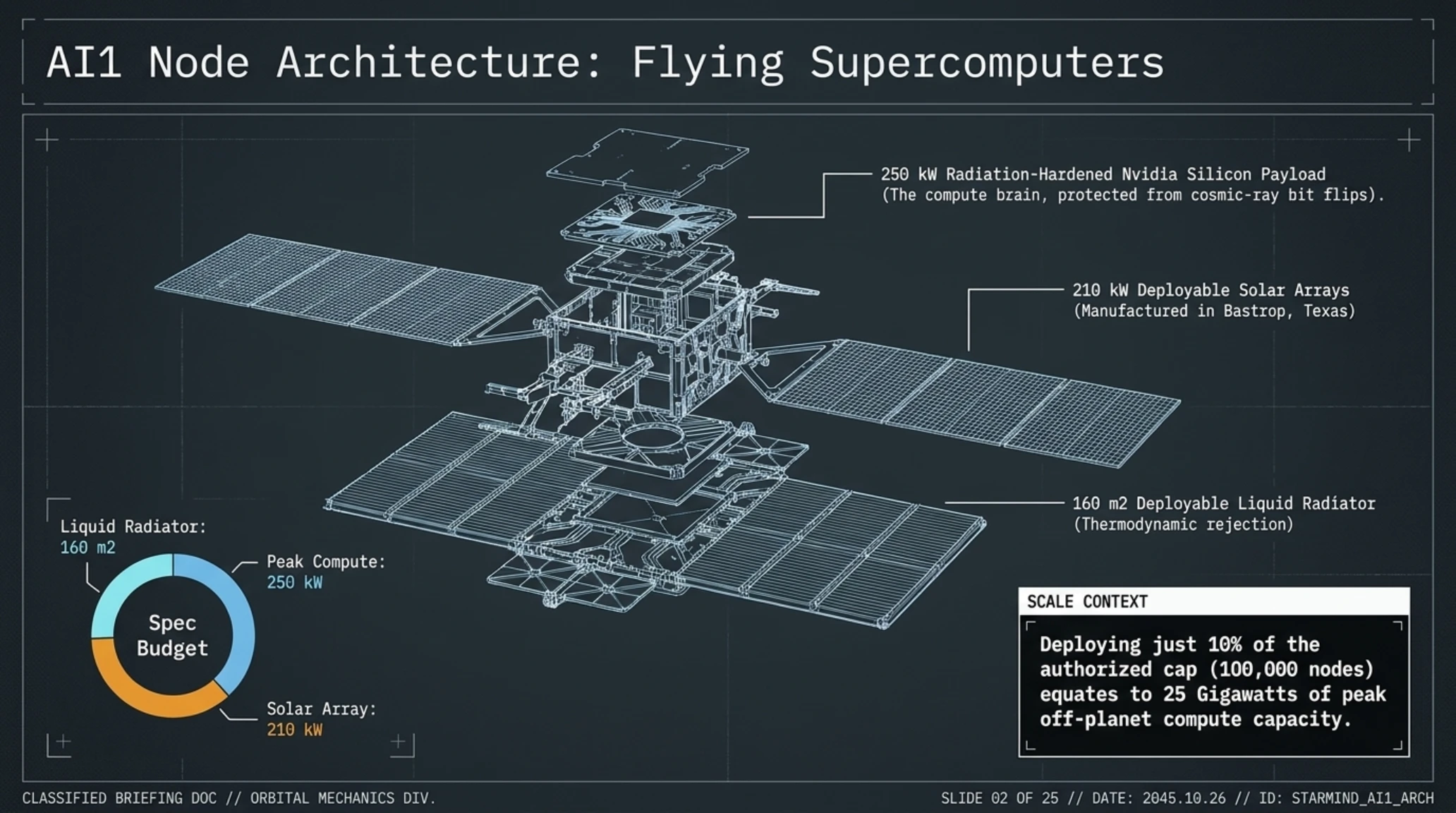
- High-Density Compute and Bastrop Solar Arrays: Each AI1 satellite is engineered to support up to 250 kilowatts (250 kW) of peak onboard compute power. That silicon payload,being developed in collaboration with Nvidia to withstand orbital radiation environments,is fed by a dedicated 210 kW deployable solar array manufactured at SpaceX's expanding industrial complex in Bastrop, Texas. If SpaceX ever deployed even 10 percent of the authorized one-million-satellite ceiling (100,000 nodes), the constellation would command 25 gigawatts of peak off-planet compute capacity.
- Non-Geostationary Orbital Shells (500 km to 1,002 km): The FCC authorization covers narrow orbital shells at altitudes spanning 500 kilometers to 1,002 kilometers (roughly 311 to 623 miles), heavily utilizing sun-synchronous inclinations. By flying along the dawn-dusk terminator, satellites remain bathed in near-constant sunlight, dramatically reducing the mass penalty of heavy lithium-ion battery banks required to survive eclipse periods.
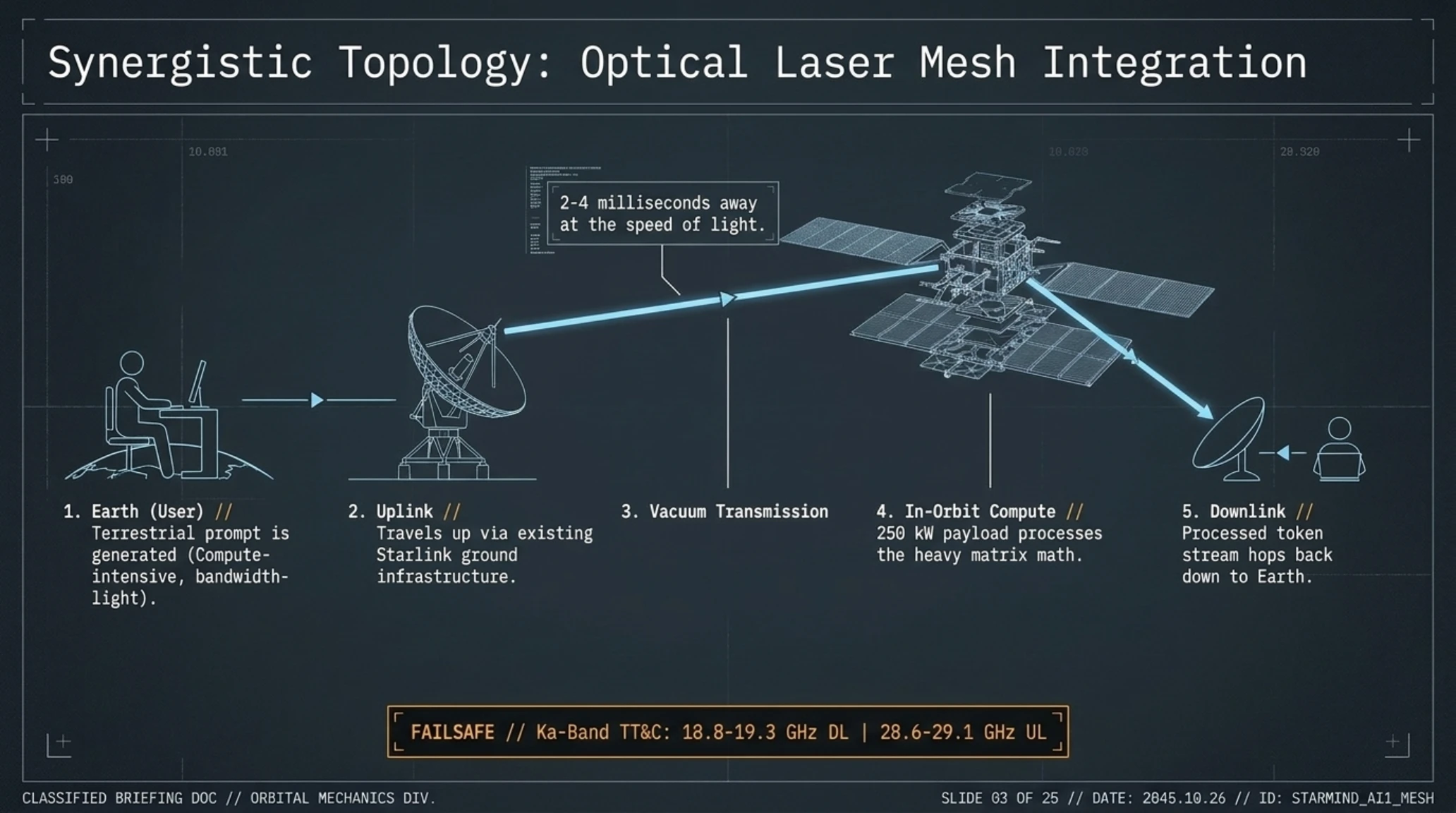
- Optical Laser Integration with Starlink: Rather than building a redundant global network of ground stations from scratch, Starmind satellites use high-bandwidth optical (laser) inter-satellite links as their primary data backbone. Prompts and training batches travel up through existing Starlink ground gateways, hop across vacuum laser links at the speed of light to Starmind AI1 compute nodes, and return processed outputs back down through the Starlink mesh to end users on Earth.
- Backup Ka-Band Telemetry Spectrum: For emergency command, orbital tracking, and backup telemetry (TT&C) during deployment or anomaly recovery, FCC Order
DA 26-1273authorizes SpaceX to operate in the 18.8 19.3 GHz downlink and 28.6 29.1 GHz uplink bands on an unprotected, non-interference basis.
Tekin Jargon Buster | Three Aerospace Physics Concepts Governing Orbital AI
Technical Terminal | Official FCC Order DA 26-1273 Authorization Parameters
The Vacuum Thermos Paradox: Why Cooling AI Silicon in Space Defies Casual Intuition
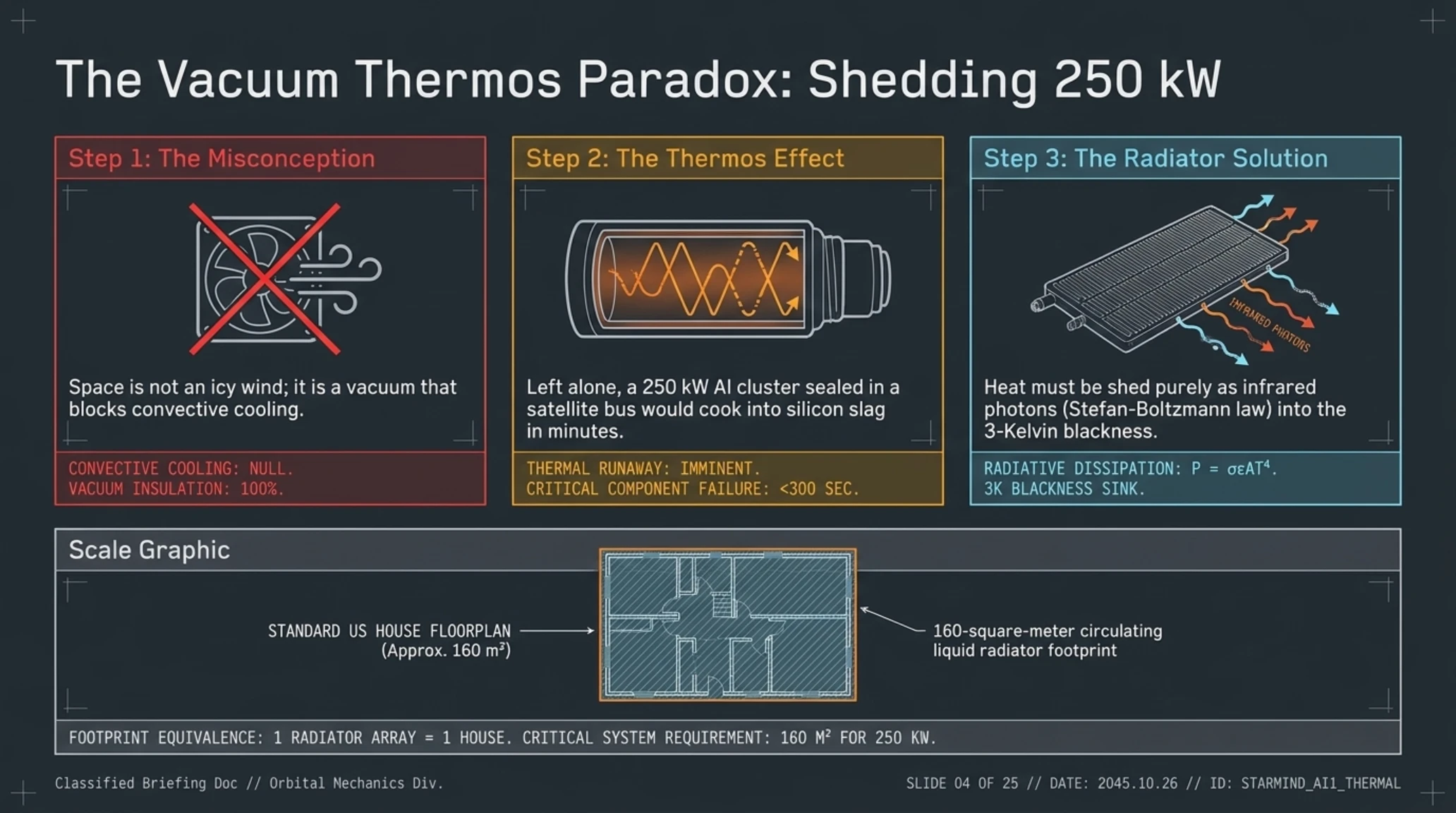
Whenever orbital data centers trend on social media, one seductive misconception inevitably surfaces: "Outer space is freezing cold, so cooling hot AI chips in orbit will be effortless." To aerospace thermal engineers and astrophysicists, that statement is the exact opposite of physical reality.
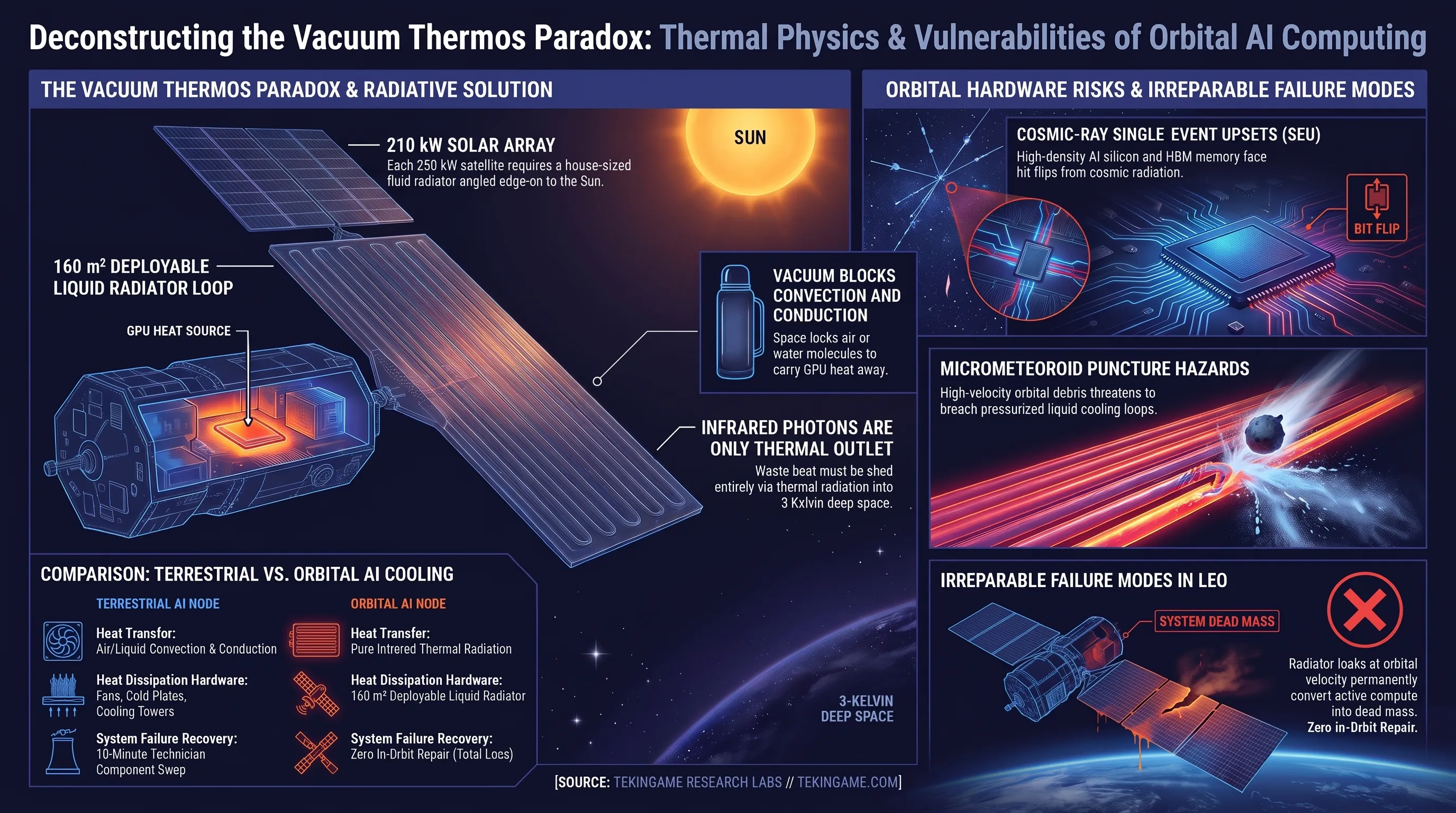
As explained in Mashable's technical investigation into how Starmind satellites operate, outer space does not behave like an icy winter wind; it behaves like a high-grade vacuum thermos bottle. On Earth, data centers rely on conduction and convection,pushing dense air or liquid coolant across copper cold plates and dumping that thermal energy into the surrounding atmosphere or river basins. In the vacuum of low Earth orbit, there are virtually no air molecules around the spacecraft to carry heat away. Left without a specialized radiative system, a 250-kilowatt cluster of AI accelerators sealed inside a satellite bus would cook itself into silicon slag within minutes.
The only mechanism available to shed heat in a vacuum is infrared thermal radiation. And because a satellite in low Earth orbit is simultaneously bombarded by direct solar irradiance from above, reflected sunlight (albedo) from Earth below, and Earth's own infrared glow, radiating 250 kilowatts of waste heat requires enormous surface area. To solve this, SpaceX's AI1 design incorporates a 160-square-meter (roughly 1,722-square-foot) deployable liquid radiator on every single satellite,a circulating fluid loop nearly the size of a single-family house floorplan that must be continuously oriented edge-on to the Sun so it can radiate heat into the 3-Kelvin blackness of deep space.
That physical complexity explains why prominent scientists remain deeply skeptical of a million-satellite buildout. Astrophysicist and author Adam Becker dismissed the prospect of putting one million data-center satellites into orbit as "a fantasy" following Wednesday's announcement, warning that vacuum heat rejection, micrometeoroid punctures to pressurized liquid radiator loops, and cosmic-ray bit flips (Single-Event Upsets) in high-density memory modules make orbital server farms vastly more fragile than terrestrial warehouses. If a coolant pump or HBM stack fails inside an Ashburn, Virginia data center, a technician swaps the blade in ten minutes; if a radiator loop leaks at 580 kilometers altitude, the entire spacecraft becomes dead orbital mass.
Fact Check | Two Viral Misconceptions About SpaceX's Orbital AI Green Light
Decoding FCC Order DA 26-1273: Mandatory 2033-2040 Milestones and the 600-Kilometer Catch
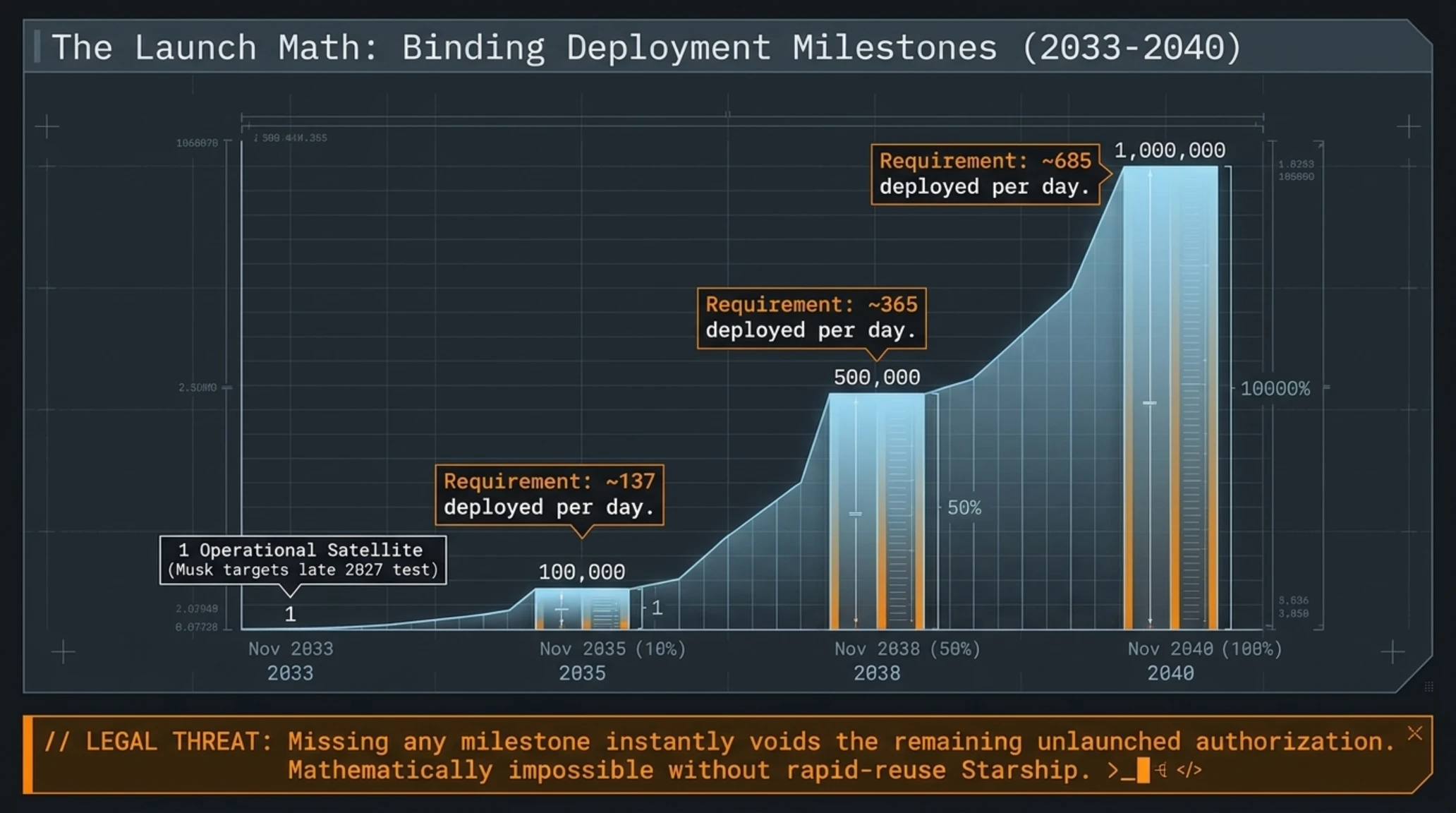
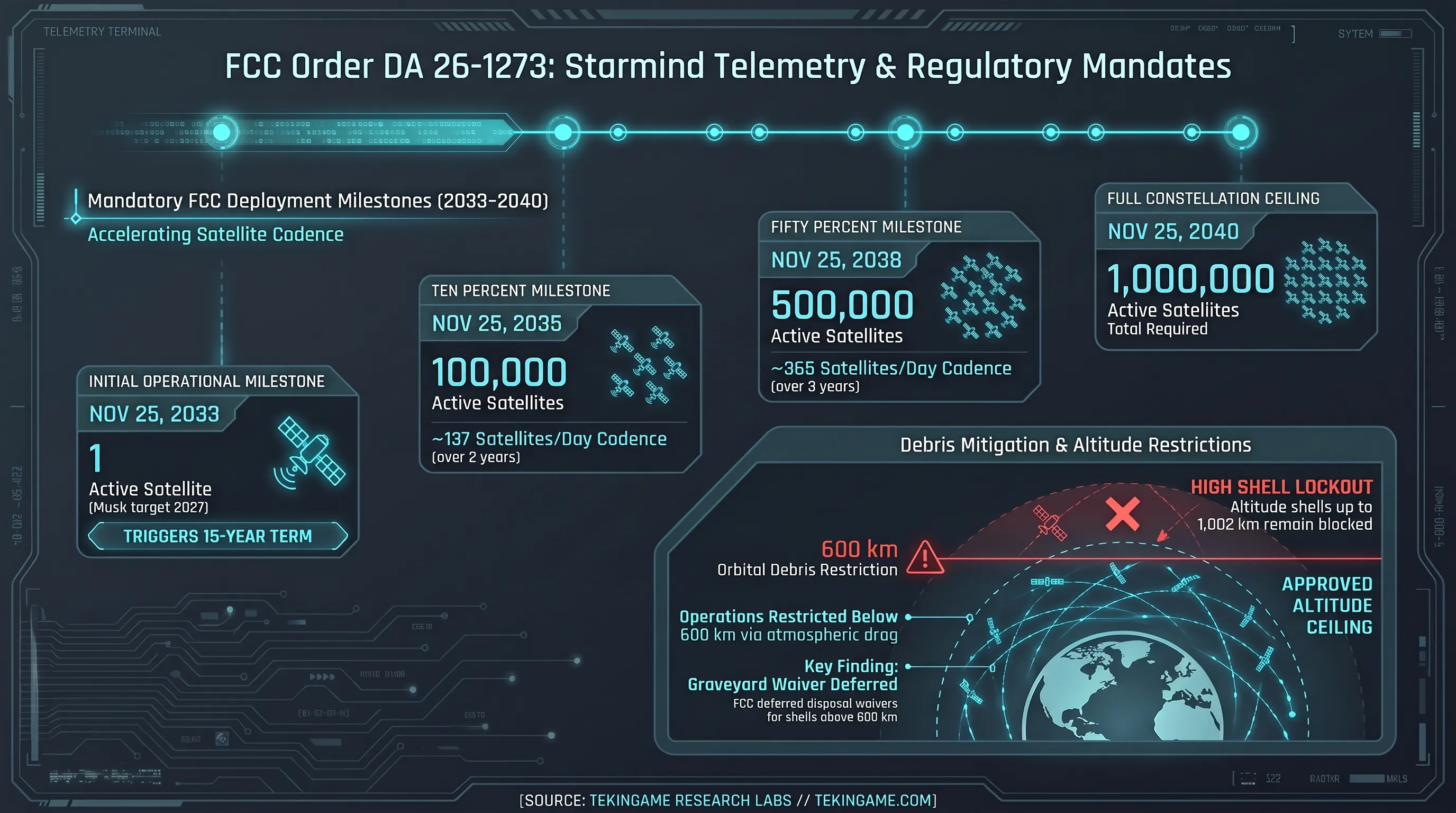
A close reading of the FCC Space Bureau's 17-page Memorandum Opinion and Order and Authorization (DA 26-1273), together with Gizmodo's breakdown of the federal Starmind approval, reveals that regulators attached two razor-sharp strings to SpaceX's license. While the authorization carries a 15-year operating term once the first spacecraft enters service, SpaceX must hit four binding deployment milestones,or watch the remaining unlaunched authorization automatically become null and void:
- November 25, 2033 (Initial Operational Milestone): SpaceX must launch and operate at least 1 Starmind satellite in its authorized orbit within seven years. Internally, Elon Musk has targeted a far more aggressive schedule, telling investors at a Baron Capital conference that SpaceX and Nvidia aim to launch the first prototype hardware around Q3 or late 2027, scale production in 2028, and hit heavy volume in 2029.
- November 25, 2035 (10% Constellation Milestone): SpaceX must have at least 100,000 Starmind satellites launched and operating in orbit,nearly nine times the size of the entire operational Starlink constellation in late 2026.
- November 25, 2038 (50% Constellation Milestone): The active orbital compute fleet must reach 500,000 satellites. Run the calendar math: jumping from 100,000 satellites in November 2035 to 500,000 satellites in November 2038 requires deploying 400,000 spacecraft across 1,096 days,an average deployment rate of roughly 365 large compute satellites every single day for three straight years.
- November 25, 2040 (100% Full Constellation Milestone): All 1,000,000 satellites must be deployed and operational, demanding an average pace of roughly 685 satellites per day across the final two-year sprint.
Telemetry Dashboard | AI1 Node Power Budget & Mandatory FCC Deployment Curve
| Binding FCC Deadline | Required Active Satellites | Implied Deployment Cadence & Legal Rule |
|---|---|---|
| November 25, 2033 | At least 1 operational satellite | Triggers 15-year license term; Musk aims for first test launch in late 2027. |
| November 25, 2035 (10% Rule) | 100,000 operational satellites | ~9x current Starlink fleet; requires ~137 satellites/day over two years. |
| November 25, 2038 (50% Rule) | 500,000 operational satellites | Requires adding 400,000 satellites in 3 years (~365 satellites deployed/day). |
| November 25, 2040 (100% Rule) | 1,000,000 operational satellites | Full constellation cap; missing any milestone voids remaining unlaunched quota. |
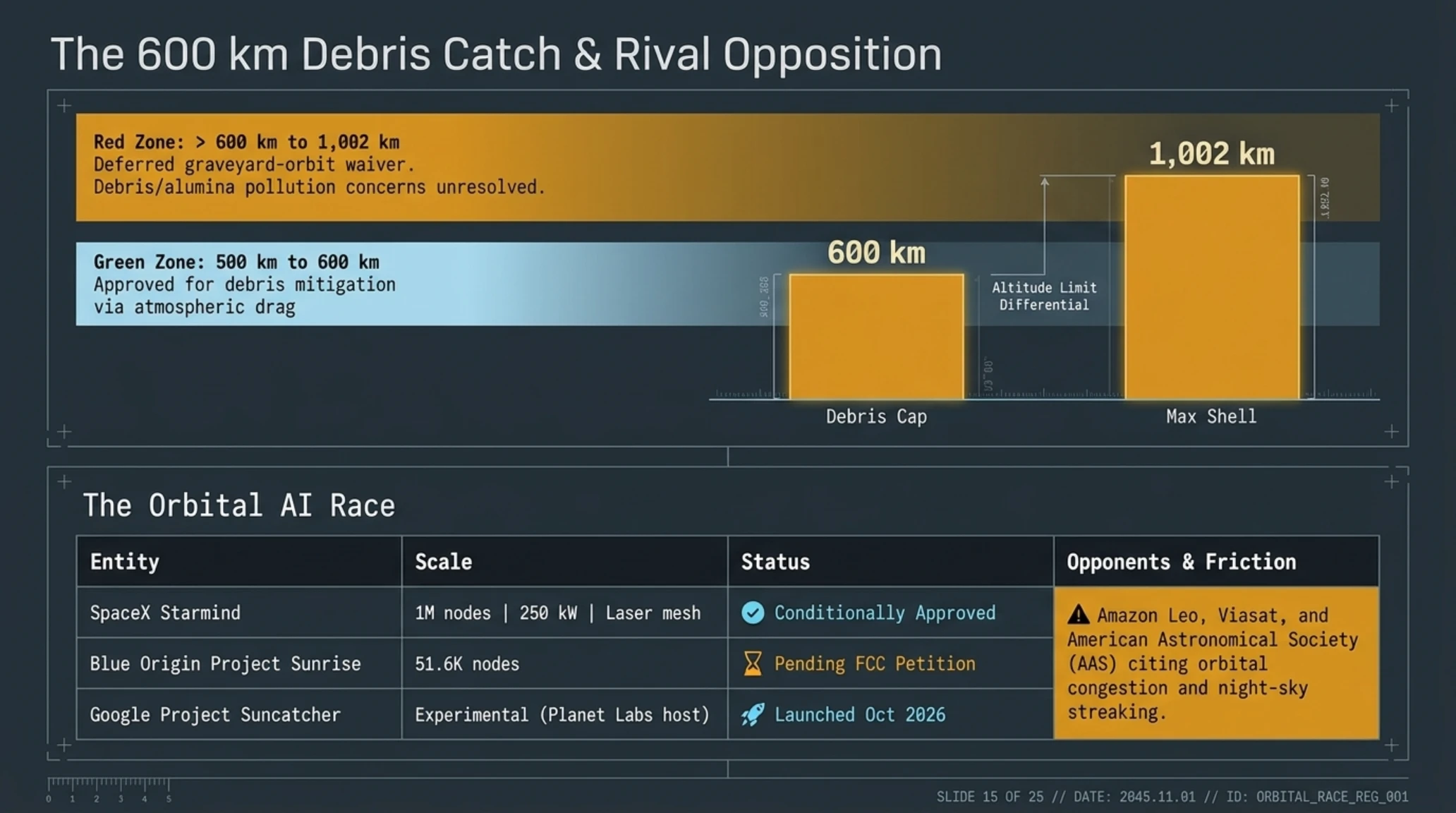
Equally consequential is the FCC's refusal to grant SpaceX a blanket pass on orbital debris above 600 kilometers (373 miles). Under standard U.S. orbital debris mitigation rules, low-Earth-orbit satellites operating below 2,000 kilometers must dispose of themselves at end-of-life through controlled atmospheric re-entry so they burn up completely. Because Starmind shells stretch from 500 km to 1,002 km,and because burning up hundreds of massive compute satellites per day in the upper atmosphere raises both cost and environmental questions,SpaceX asked the FCC to waive the atmospheric re-entry rule for satellites above 600 km, proposing instead to boost retired units into high graveyard or heliocentric orbits.
The FCC Space Bureau explicitly deferred that waiver request. In Order DA 26-1273, regulators ruled that SpaceX's orbital debris mitigation plan is approved solely for satellites operating below 600 kilometers, where residual atmospheric drag naturally clears crippled spacecraft within a few years. Before SpaceX can deploy a single Starmind satellite in the 600 km to 1,002 km band,the exact altitudes most prized for unshaded sun-synchronous solar harvesting,the company must submit and win formal Commission approval for a modified final orbital debris disposal plan.
📚 Classified & Related Dossiers in TekinGame
If you wish to explore beyond this report and delve into cybernetic frontiers and autonomous AI architectures, do not miss these three exclusive deep-dives in the Tekin Garage:
The Orbital Compute Race and the Pushback: Google, Blue Origin, Amazon Leo, and Astronomers
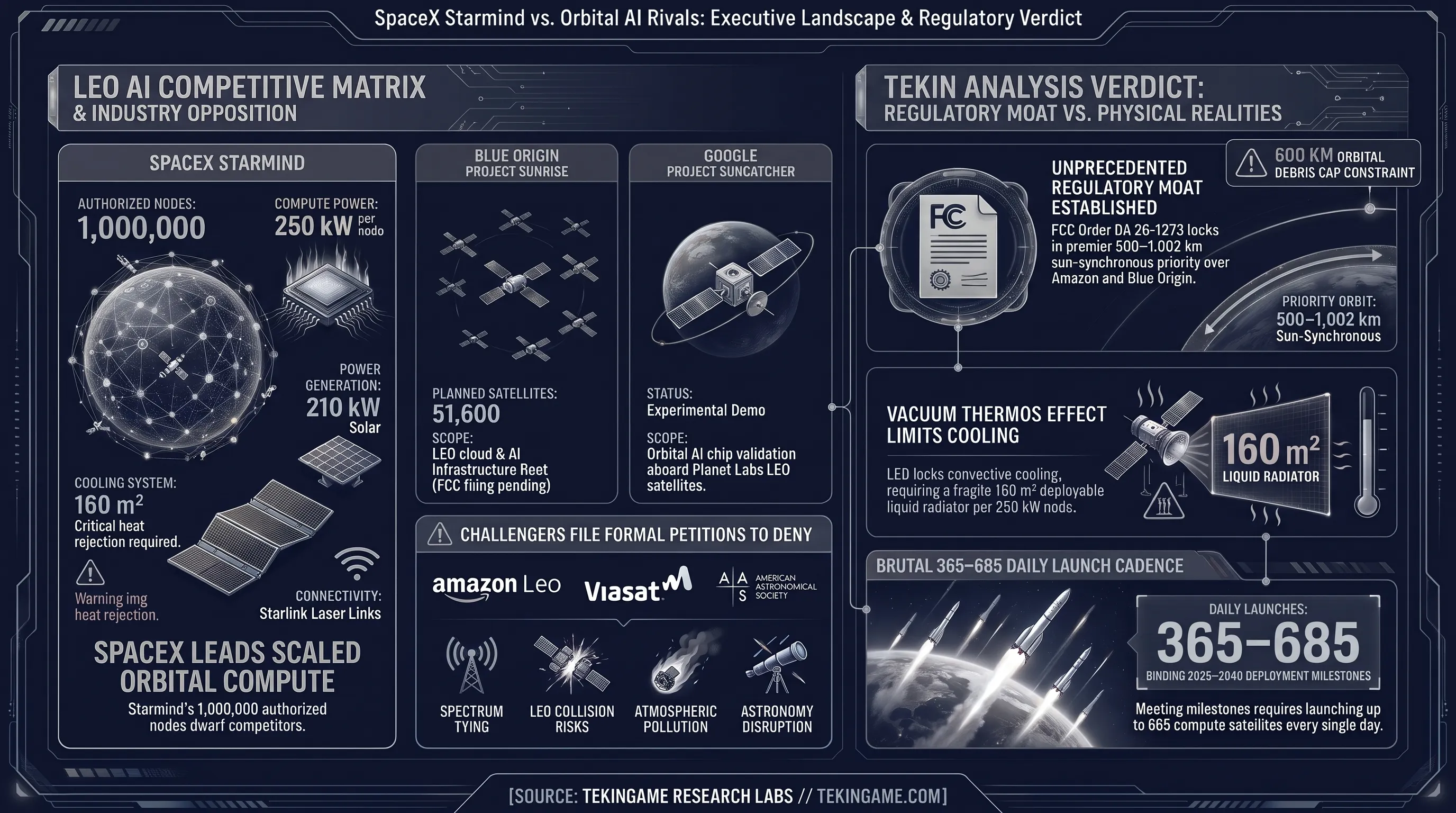
While SpaceX now holds the first federal license for an orbital AI constellation, it is far from the only tech giant chasing off-planet compute. As documented in Space.com's report on the Starmind approval and orbital rivals, a fierce three-way corporate contest has already taken shape in low Earth orbit:
- Google's Project Suncatcher: First unveiled in 2025, Google's orbital machine-learning initiative moved from whitepaper to hardware in October 2026, when Google launched its first experimental AI accelerator chips into orbit aboard a Planet Labs satellite,ironically lofted by a SpaceX Falcon 9 rocket,to test real-world radiation tolerance and thermal throttling in microgravity.
- Blue Origin's Project Sunrise: In March 2026, Jeff Bezos's aerospace company petitioned the FCC for authority to deploy 51,600 low-Earth-orbit satellites under an orbital data center architecture dubbed Project Sunrise. While still awaiting its own Space Bureau ruling, Blue Origin's filing proves that multiple trillion-dollar ecosystems view orbital solar compute as a strategic hedge against terrestrial power bottlenecks.
Not everyone in the aerospace and scientific community cheered Wednesday's decision. During the public comment window that closed in March 2026, the Starmind docket attracted more than 1,500 public filings alongside formal Petitions to Deny from three heavyweight challengers: Amazon's satellite broadband unit Kuiper Systems LLC (Amazon Leo), geostationary satellite operator Viasat Inc., and the American Astronomical Society (AAS).
Amazon Leo's attorneys delivered the sharpest commercial jab, arguing in their filing that SpaceX's request for one million satellites represented "a lofty ambition rather than a real plan" designed to tie up orbital real estate and regulatory bandwidth, claiming such a fleet would take "centuries" to deploy. Viasat warned of radio-frequency coordination risks and collision hazards across congested orbital shells. Meanwhile, the American Astronomical Society and environmental coalitions warned that multiplying the orbital satellite population 50-fold with spacecraft carrying 160-square-meter radiators and 210-kilowatt solar wings would irreparably streak ground-based optical astronomy exposures and inject massive quantities of metallic alumina particulates into the upper stratosphere during end-of-life re-entries.
Why did those objections fail to block the license? As TechCrunch reported in its regulatory analysis of the FCC ruling, the Space Bureau dismissed the environmental, launch-emission, and optical-astronomy complaints on jurisdictional grounds,concluding that those concerns fall outside the Commission's narrow statutory authority over radio spectrum and orbital communications, and noting that rocket launch environmental reviews fall under the Federal Aviation Administration (FAA).
Constellation Scale Matrix | How SpaceX Starmind Compares to Today's Orbit and Rivals
| Orbital Compute Initiative | Satellite Count & Regulatory Status | Primary Architecture & Hardware Scope |
|---|---|---|
| SpaceX Starmind (AI1 Nodes) | Up to 1,000,000 satellites (Conditionally approved Nov 25, 2026) | 250 kW peak compute, 210 kW solar array, 160 m2 liquid radiator, Starlink optical laser links. |
| Blue Origin Project Sunrise | 51,600 LEO satellites (FCC petition filed March 2026; pending) | Low-Earth-orbit commercial cloud and AI data center constellation. |
| Google Project Suncatcher | Experimental demonstration (First AI chips launched Oct 2026) | In-orbit radiation and thermal validation of Google AI silicon aboard Planet Labs spacecraft. |
Engineering & Regulatory Risk Matrix | Three Bottlenecks Facing Starmind
| Risk Vector / Technical Bottleneck | Severity | Mitigation Strategy or Regulatory Condition |
|---|---|---|
| Vacuum heat rejection (250 kW load) and cosmic-ray bit flips in AI memory | CRITICAL | 160-square-meter deployable liquid radiator panels and radiation-tolerant Nvidia silicon packaging. |
| Deferred graveyard-orbit waiver above 600 km and Kessler collision density | HIGH | Initial deployments restricted below 600 km until SpaceX wins approval for a modified disposal plan. |
| Mandatory 2035-2040 deployment cadence (365-685 satellites/day) | CRITICAL | Requires full operational maturity of rapid-reuse Starship launches and automated Bastrop, TX assembly lines. |
Chronology | From Filing to the 2040 One-Million-Satellite Mandate
| Date | Milestone | Verified Regulatory or Engineering Detail |
|---|---|---|
| Jan-Feb 2026 | SpaceX Files Starmind Application | Filed under ICFS File No. SAT-LOA-20260108-00016; placed on public notice (DA 26-113) on Feb 4, 2026. |
| March 2026 | Rivals Petition & Blue Origin Enters | Amazon Leo, Viasat, and AAS file objections; Blue Origin petitions FCC for 51,600-satellite Project Sunrise. |
| May 2026 | SpaceX IPO Prospectus Disclosures | SpaceX outlines internal targets to begin experimental orbital compute deployments by late 2027. |
| October 2026 | Google Project Suncatcher Orbit Test | Google launches its first experimental AI chips into low Earth orbit via Planet Labs and a SpaceX rocket. |
| Nov 25, 2026 | FCC Releases Order DA 26-1273 | Space Bureau conditionally authorizes up to 1,000,000 Starmind satellites with binding 2033-2040 milestones. |
Economics, Launch Cadence, and Security Realities of Space-Based Cloud Infrastructure
Strip away the Kardashev Type II rhetoric and evaluate Starmind through the lens of a Wall Street infrastructure analyst or an enterprise cloud architect. Does launching AI GPUs into low Earth orbit actually close the economic loop against building nuclear-backed or natural-gas-backed data centers on the ground?
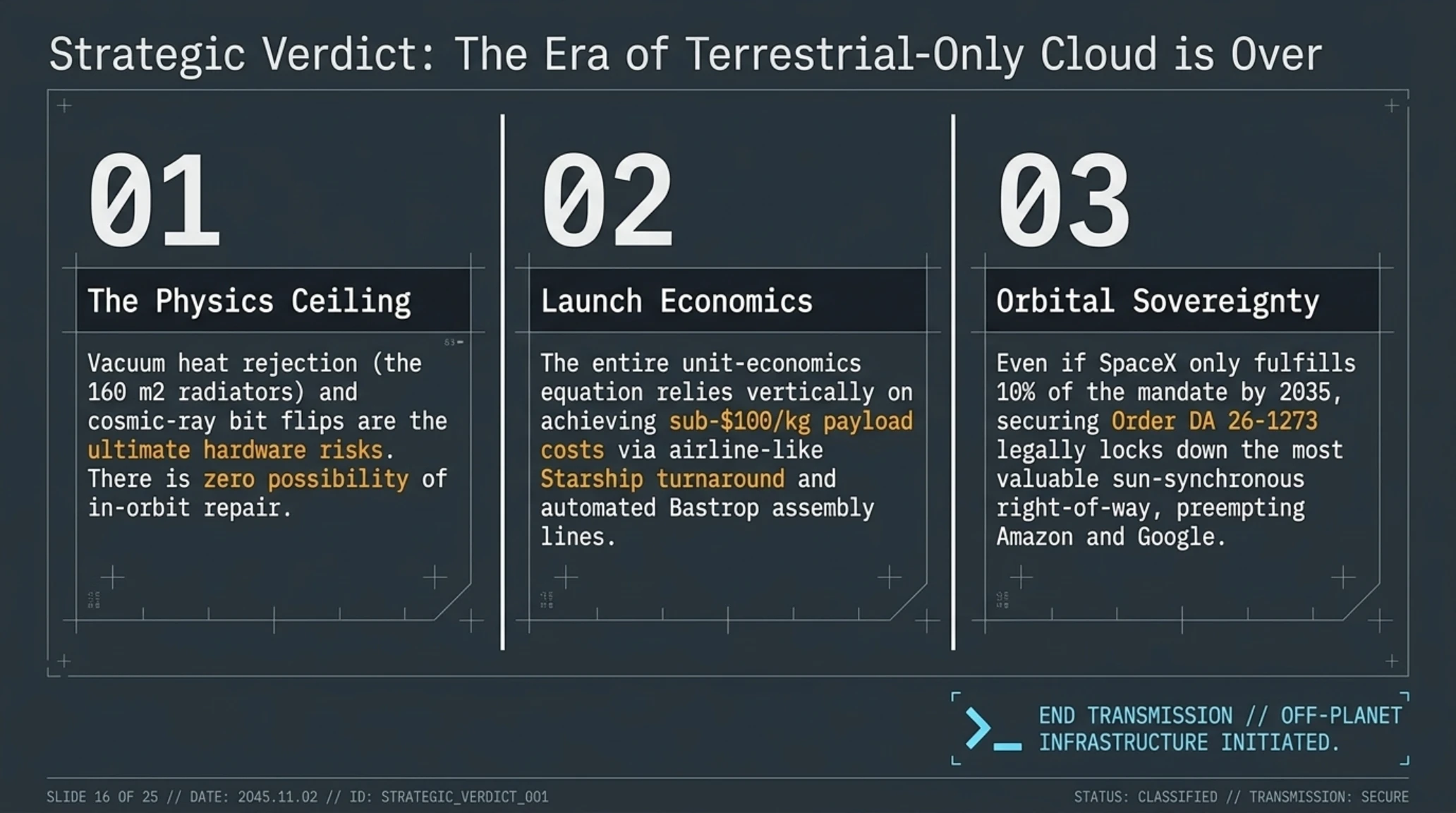
The entire unit-economics equation hinges on three variables that only SpaceX controls vertically:
- Marginal Launch Cost via Starship: With a Falcon 9, lofting hundreds of thousands of heavy 250-kilowatt compute satellites equipped with 160-square-meter liquid radiator assemblies would bankrupt any balance sheet on Earth. Starmind's math only works if SpaceX's fully reusable Starship achieves airline-like turnaround cadences in the late 2020s, driving internal payload-to-LEO costs below $100 per kilogram. Even then, because cutting-edge AI accelerators depreciate on a three-to-four-year architectural cycle, orbital nodes must pay back their manufacturing and launch cost before the next generation of silicon renders them obsolete.
- Latency and Workload Partitioning: Physics dictates that low Earth orbit at 500 to 600 kilometers is roughly 2 to 4 milliseconds away at the speed of light,actually faster than routing fiber packets across an ocean. However, uplink and downlink gateway bandwidth between Earth and Starlink remains finite compared to multi-terabit intra-datacenter fiber backplanes on the ground. Consequently, early Starmind clusters will make the most sense for compute-intensive, bandwidth-light workloads: long-horizon reasoning loops, autonomous agent synthesis, batch model fine-tuning, and real-time inference for global Starlink subscribers where small text prompts go up, heavy matrix math happens in orbit, and compact token streams come back down.
- Strategic Regulatory Preemption: Why ask the FCC for one million satellites when even 10,000 to 50,000 nodes would represent a multi-gigawatt orbital superpower? In telecommunications law, securing conditional authorization across the 500 km to 1,002 km shells establishes incumbent priority. Even if SpaceX ultimately deploys 50,000 or 100,000 higher-wattage satellites by 2035 rather than the full one million, Order
DA 26-1273locks in SpaceX's orbital right-of-way ahead of Amazon, Blue Origin, and international competitors as the company marches toward its historic public listing.
Final Verdict and Frequently Asked Questions
Wednesday's FCC ruling marks a genuine inflection point in the history of computing infrastructure. By conditionally authorizing up to one million Starmind orbital data center satellites under Order DA 26-1273, U.S. regulators officially endorsed the premise that terrestrial power grids cannot single-handedly absorb the exponential energy appetite of artificial intelligence.
Yet a regulatory green light does not repeal the laws of thermodynamics or orbital mechanics. Between now and the first binding milestone window, SpaceX must prove that its Bastrop-built 210 kW solar arrays and 160-square-meter liquid radiators can survive years of microgravity thermal cycling, convince the FCC to approve a modified debris disposal plan for altitudes above 600 kilometers, and scale Starship flight rates to a tempo never before witnessed in human spaceflight. Whether Starmind ultimately plateaus at tens of thousands of nodes or marches toward a million, the cloud is no longer just a metaphor,it is officially heading to orbit.
- Near-continuous solar power harvesting in sun-synchronous orbit bypasses congested terrestrial electrical grids, water shortages, and local zoning bans.
- Eliminates direct terrestrial data center air pollution, which a November 2026 Harvard study found to be three times higher than prior estimates.
- Direct high-bandwidth optical laser integration with Starlink unifies global AI inference compute and low-latency delivery inside one vertical network.
- First-mover FCC authorization (Order DA 26-1273) locks in strategic orbital shells between 500 km and 1,002 km ahead of Blue Origin and Google.
- Severe vacuum thermodynamics constraints require a vulnerable 160-square-meter deployable liquid radiator per satellite with zero possibility of in-orbit hardware repair.
- FCC deferred SpaceX's graveyard-orbit disposal waiver above 600 km, blocking deployments in higher shells until a revised debris plan is approved.
- Brutal 2035-2040 FCC deployment milestones require launching an average of 365 to 685 satellites every single day or losing the remaining authorization.
- A 50-fold increase in active orbital satellites faces intense pushback from the American Astronomical Society over optical sky streaks and upper-atmosphere re-entry pollution.
Editorial Verdict & Direct Verified Sources
- The Verge (INDUSTRY REPORT): FCC signs off on SpaceX plan to put up to 1 million data center satellites into space (November 25, 2026)
- Mashable (INDUSTRY REPORT): FCC clears SpaceX to put up to 1 million AI satellites in orbit (November 25, 2026)
- Space.com (INDUSTRY REPORT): Green light for Starmind: SpaceX gets approval to deploy 1 million AI satellites (November 25, 2026)
- Ars Technica (INDUSTRY REPORT): The FCC has authorized SpaceX to deploy 1 million satellites (November 25, 2026)
- TechCrunch (INDUSTRY REPORT): FCC approves SpaceX plan to put AI data centers in space (November 25, 2026)
- Gizmodo (INDUSTRY REPORT): Feds Approve SpaceX AI Data Center Satellites , All 1 Million of Them (November 25, 2026)
- Decrypt (INDUSTRY REPORT): Elon Musk SpaceX Gets FCC Approval to Launch AI Data Centers in Space (November 25, 2026)
- CoinTelegraph (INDUSTRY REPORT): FCC authorizes SpaceX to deploy 1M satellites for orbital AI data centers (November 25, 2026)
- Mashable / Harvard Study (INDUSTRY REPORT): Data center emissions are worse than we knew, Harvard study confirms (November 25, 2026)
- Ars Technica Security (INDUSTRY REPORT): Ars Live recap: Do not expect military attacks on data centers to stop (November 25, 2026)
Frequently Asked Questions About SpaceX Starmind Orbital AI Data Centers
What is SpaceX's Starmind project and how does it differ from Starlink?
Starlink is a broadband communications constellation that relays internet traffic, whereas Starmind is an orbital compute constellation of up to one million satellites (starting with the AI1 design) equipped with 250-kilowatt AI processors, 210-kilowatt solar arrays, and 160-square-meter liquid radiators. Starmind processes AI workloads directly in orbit and routes data to Earth through optical laser links connected to Starlink.
When does the FCC require SpaceX to launch the Starmind satellites?
Under FCC Order DA 26-1273, SpaceX must deploy at least one operational satellite by November 25, 2033, reach 100,000 satellites (10%) by November 25, 2035, hit 500,000 satellites (50%) by November 25, 2038, and complete all 1,000,000 satellites by November 25, 2040. Internally, Elon Musk has targeted launching the first prototype hardware as early as late 2027.
If outer space is cold, why is cooling orbital AI data centers so difficult?
Because space is a vacuum, there is no air or water to carry heat away via convection or conduction,meaning the vacuum acts like an insulated thermos bottle that traps heat inside the spacecraft. Starmind satellites must reject 250 kilowatts of thermal energy purely through infrared radiation using a 160-square-meter deployable liquid radiator oriented away from the Sun.
What is the 600-kilometer orbital debris catch in the FCC's approval?
The FCC approved SpaceX's orbital debris mitigation plan only for satellites operating below 600 kilometers (373 miles), where atmospheric drag naturally clears dead satellites. The Commission deferred SpaceX's request for a waiver to dispose of satellites operating between 600 km and 1,002 km in high graveyard orbits, requiring a modified disposal plan before any higher-altitude launches.
Which competitors are challenging SpaceX in orbital AI data centers?
Google launched its first experimental AI chips into orbit in October 2026 under Project Suncatcher aboard a Planet Labs satellite, while Jeff Bezos's Blue Origin petitioned the FCC in March 2026 to deploy 51,600 low-Earth-orbit data center satellites under Project Sunrise.
Additional Gallery: Tekin Analysis: FCC Clears SpaceX's 1M AI Data Center Satellites