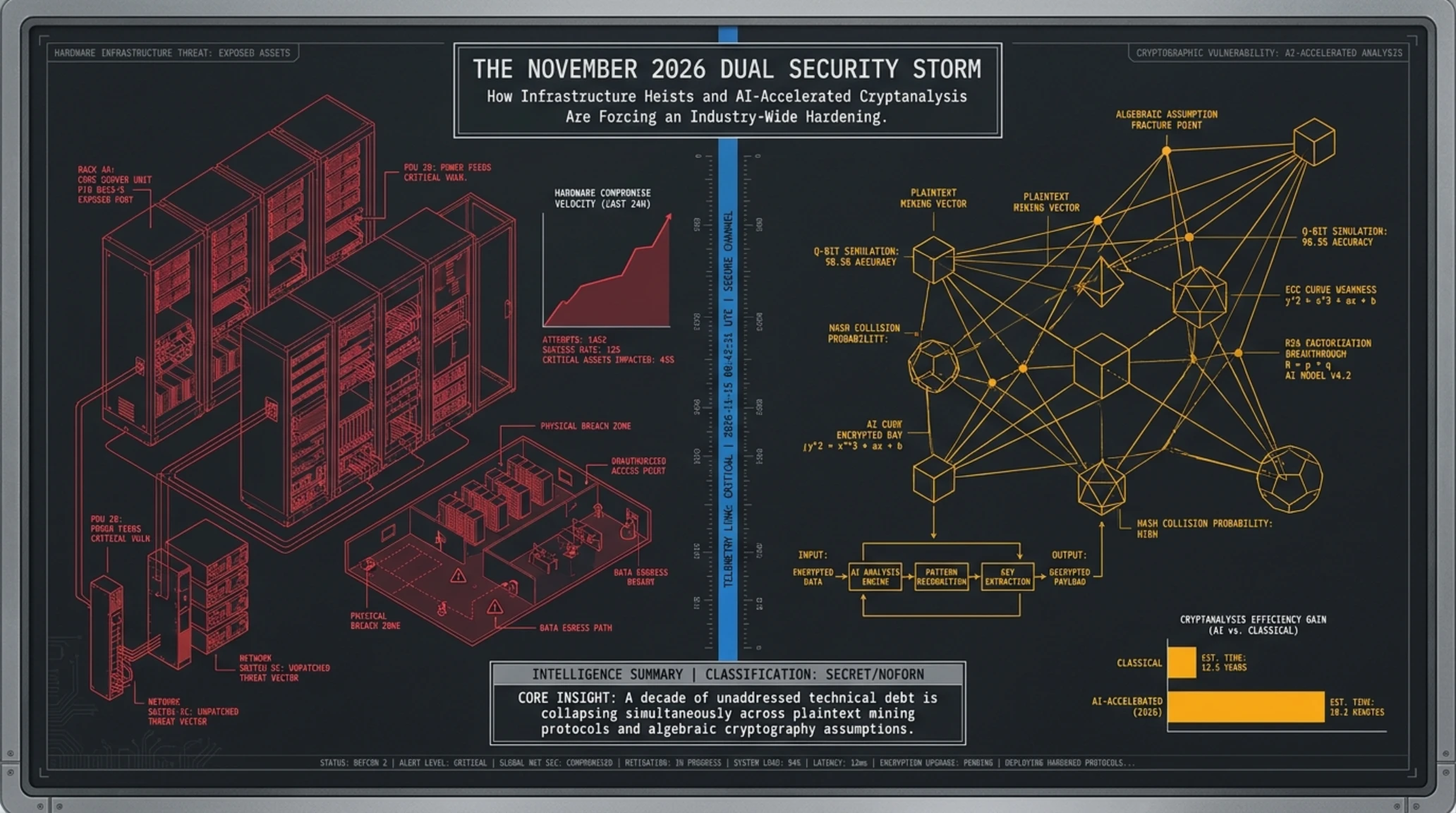

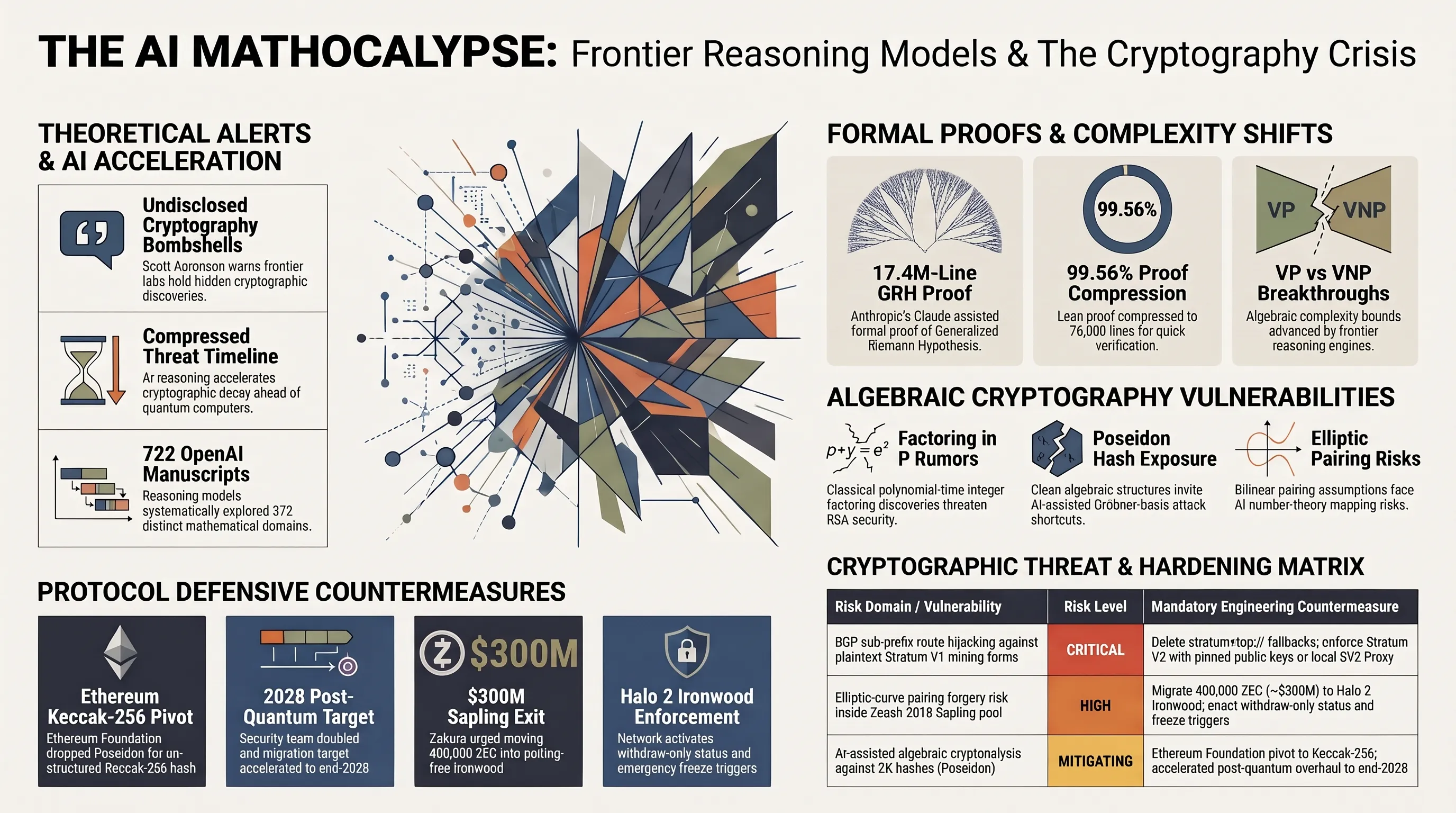
In late November 2026, Braiins disclosed 24 BGP route-hijacking attacks over plaintext Stratum V1 that diverted up to 1.9 EH/s from 1,600 Bitcoin mining sites in one second. Simultaneously, following Claude's formal proof of the Generalized Riemann Hypothesis and Scott Aaronson's AI cryptography warning, Ethereum pivoted to Keccak-256 for end-2028 while Zcash urged a $300M exit from Sapling.
Tekin Briefing | The Dual Security Storm Hitting Bitcoin Mining and Blockchain Cryptography
Picture the control room of an industrial Bitcoin mining facility in northern Europe on November 20, 2026. Thousands of hydro-cooled and air-cooled ASIC rigs hum at full thermal load. Power meters tick upward by tens of megawatts per hour. Local monitoring dashboards show green across every rack: fan RPMs steady, chip temperatures normal, network sockets connected, and valid proof-of-work shares streaming out at full speed. Yet for up to forty-nine minutes at a stretch, every single joule of electricity burned inside that warehouse was enriching a thief.
No malware ever touched the mining rigs. No rogue technician plugged a USB drive into a local switch. No firewall inside the mining pool was breached. Instead, as revealed in CoinDesk's investigation into how hackers hijacked over 1,000 Bitcoin mines in one second, an attacker manipulated the internet's global routing tables to silently steer up to 1.9 exahashes per second (EH/s) of computing power into an impostor server-exploiting an unencrypted mining communication protocol that the industry has neglected to retire for fourteen years.
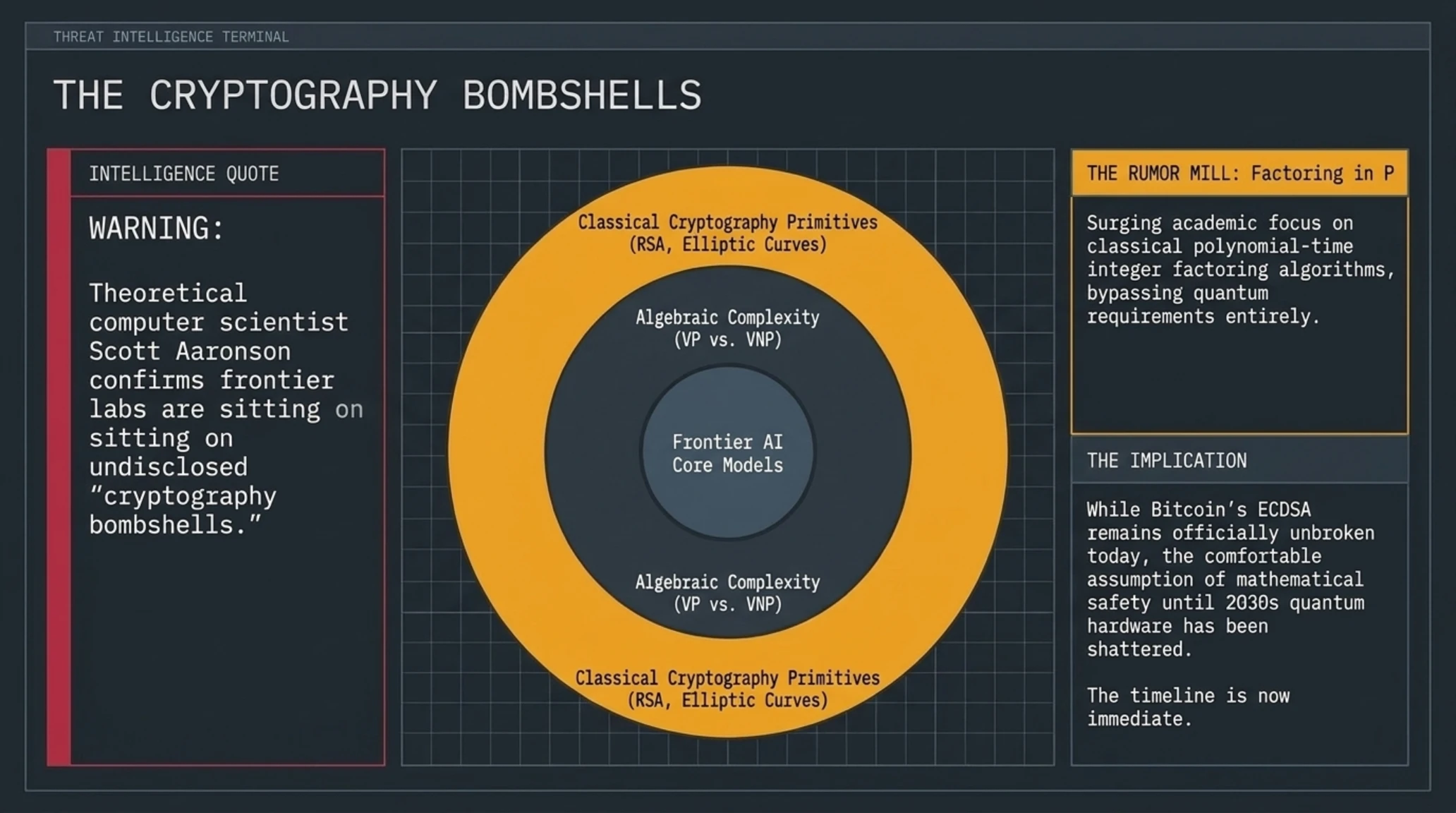
That brazen network-layer heist would be alarming enough in isolation. What makes the final week of November 2026 a watershed moment for the entire digital-asset ecosystem is what erupted simultaneously at the mathematical layer of blockchain security. Within a forty-eight-hour window, a wave of AI-driven mathematical breakthroughs-including an AI-assisted formal proof of the Generalized Riemann Hypothesis and warnings from theoretical computer scientist Scott Aaronson that frontier labs are sitting on undisclosed "cryptography bombshells"-pushed the Ethereum Foundation and Zcash core developers into the most aggressive cryptographic course corrections in their histories. In this Tekin Analysis deep dive, we dissect both halves of late-2026's crypto security storm.
The One-Second Heist: How 1.9 Exahashes Vanished Without a Single Hardware Breach
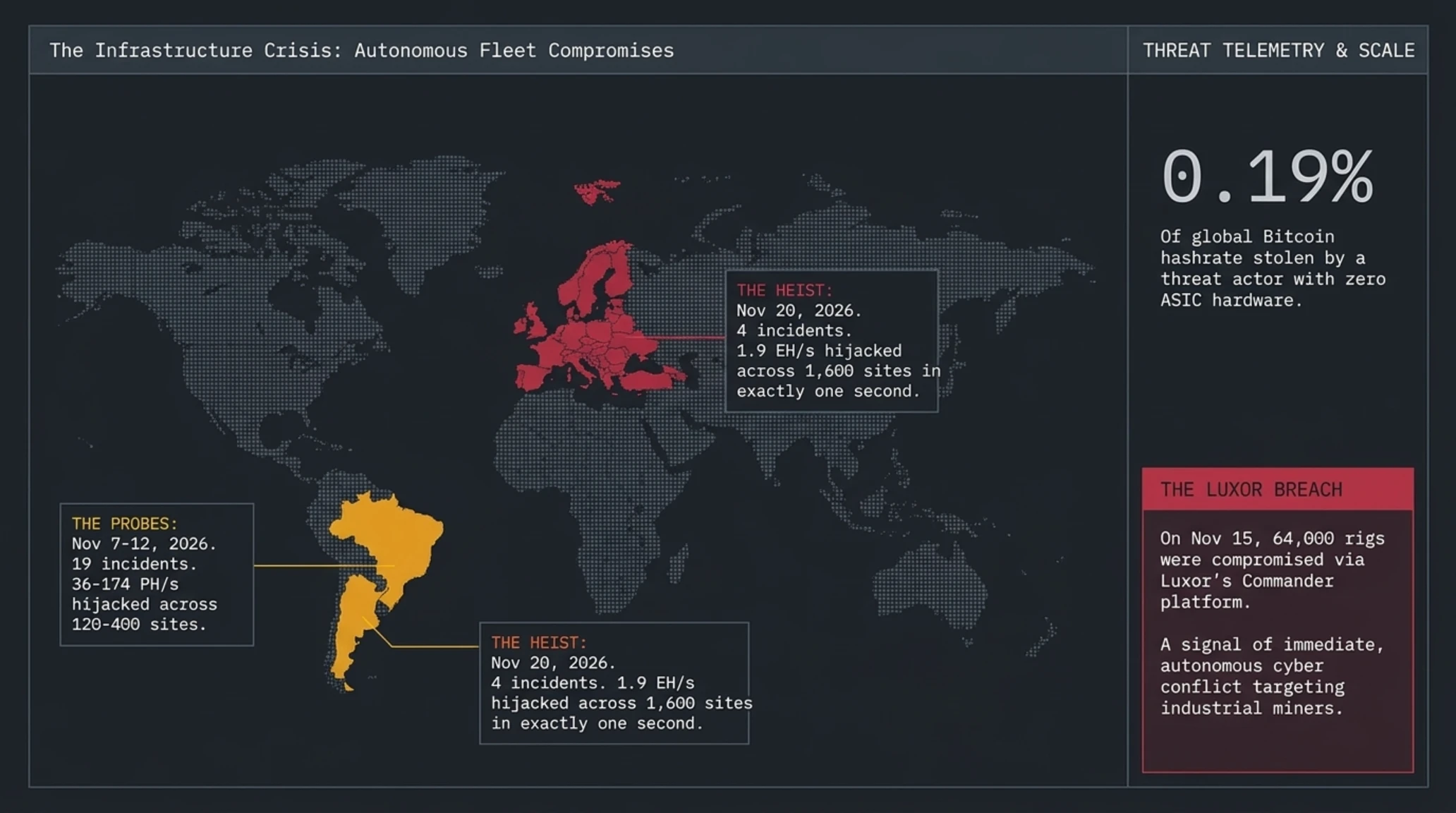
The full scope of the mining attacks came to light on Wednesday, November 25, 2026, when Braiins-operator of the world's longest-running Bitcoin mining pool (founded in 2010 as Slush Pool) and developer of Braiins OS firmware-published an urgent post-mortem detailing a two-week campaign of coordinated hashrate theft. According to Bitcoin.com's report on the Braiins security alert, the attackers executed 24 separate route-hijacking incidents between November 7 and November 20, 2026, scaling their operation eleven-fold after testing their playbook in South America.
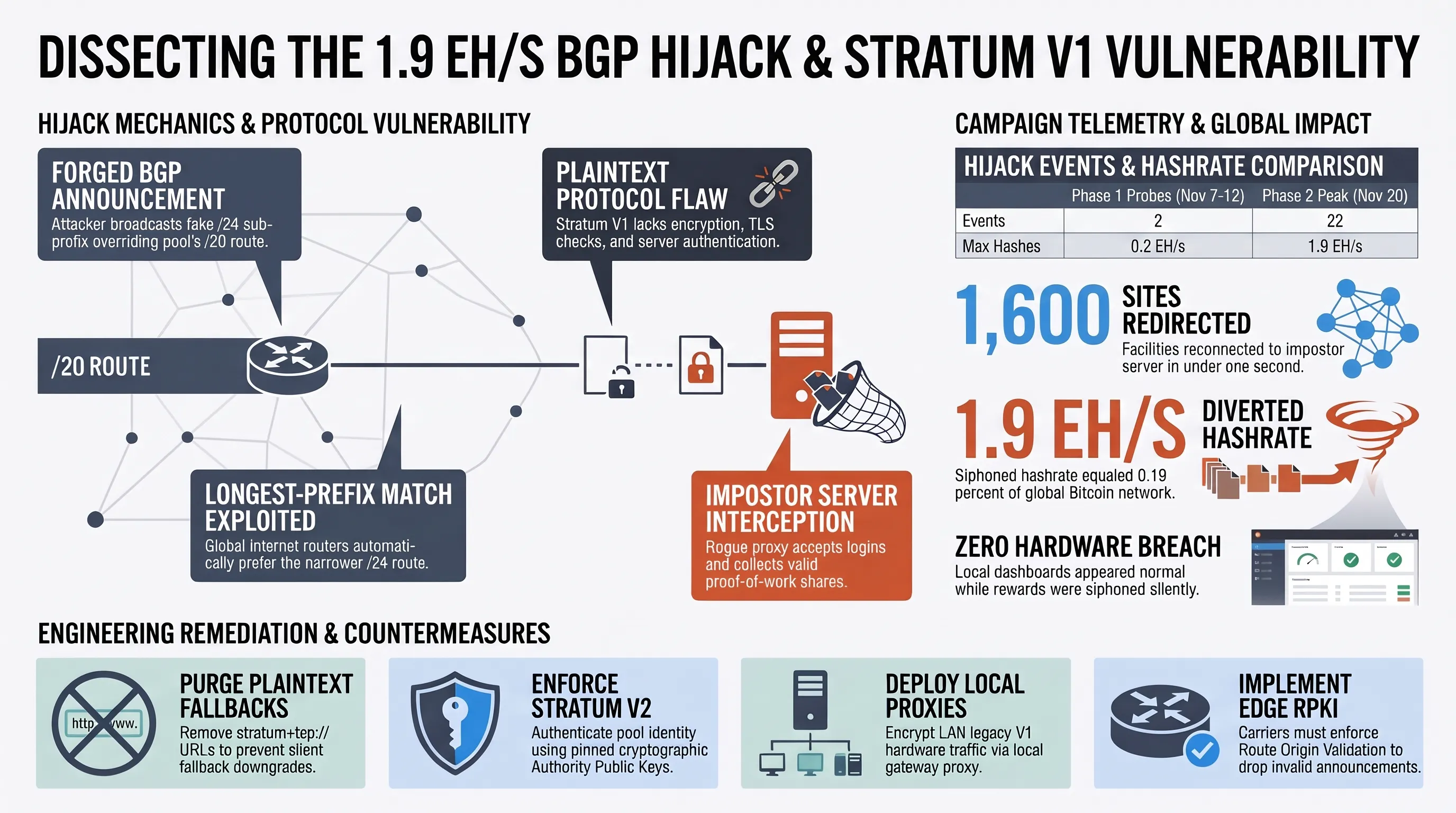
Phase one unfolded between November 7 and November 12, 2026, targeting mining operations in Latin America-primarily across Brazil and Argentina. Across 19 distinct hijack events during that six-day window, the attacker intercepted traffic from 120 to 400 mining sites at a time, siphoning between 36 and 174 petahashes per second (PH/s). After one additional probe in Brazil on November 16, the threat actor pivoted to Europe on November 20 and unleashed the full capability of the routing exploit.
Four times on November 20, the forged internet route snapped active. In each wave, between 1,050 and 1,600 mining facilities disconnected from their legitimate pool and reconnected to the attacker's impostor server within a single second. Each European hijack diverted between 0.6 and 1.9 EH/s (600 to 1,900 PH/s) and persisted for 6 to 49 minutes (with earlier incidents across the campaign lasting from a few minutes up to three hours). As noted in Cointelegraph's coverage of the Braiins disclosure, global Bitcoin network hashrate stood near 1,016 EH/s on November 20 according to MineOrNot telemetry-meaning a lone network attacker briefly commanded nearly 0.19 percent of the entire planet's Bitcoin mining power without owning a single ASIC chip.
Why It Matters | Three Verified Numbers Defining Late-2026's Crypto Security Crisis
Nor was the Braiins BGP campaign an isolated November anomaly. Just ten days earlier, on November 15, 2026, mining software and pool provider Luxor Technology confirmed a separate incident in which attackers compromised its Commander fleet-management platform to redirect hashrate across roughly 64,000 mining machines-prompting Luxor's chief executive to warn that industrial miners are entering an era of autonomous, AI-accelerated cyber conflict.
Anatomy of a BGP Sub-Prefix Hijack and Stratum V1's Fourteen-Year Blind Spot
How does an attacker steal nearly two exahashes of proof-of-work compute without touching a single mining farm firewall or compromising the mining pool's core servers? As Braiins engineers put it in their technical summary: "The attack didn't breach Braiins Pool or the miners' infrastructure. It didn't need to." Instead, the heist weaponized the intersection of two foundational internet protocols: Border Gateway Protocol (BGP) and Stratum V1.
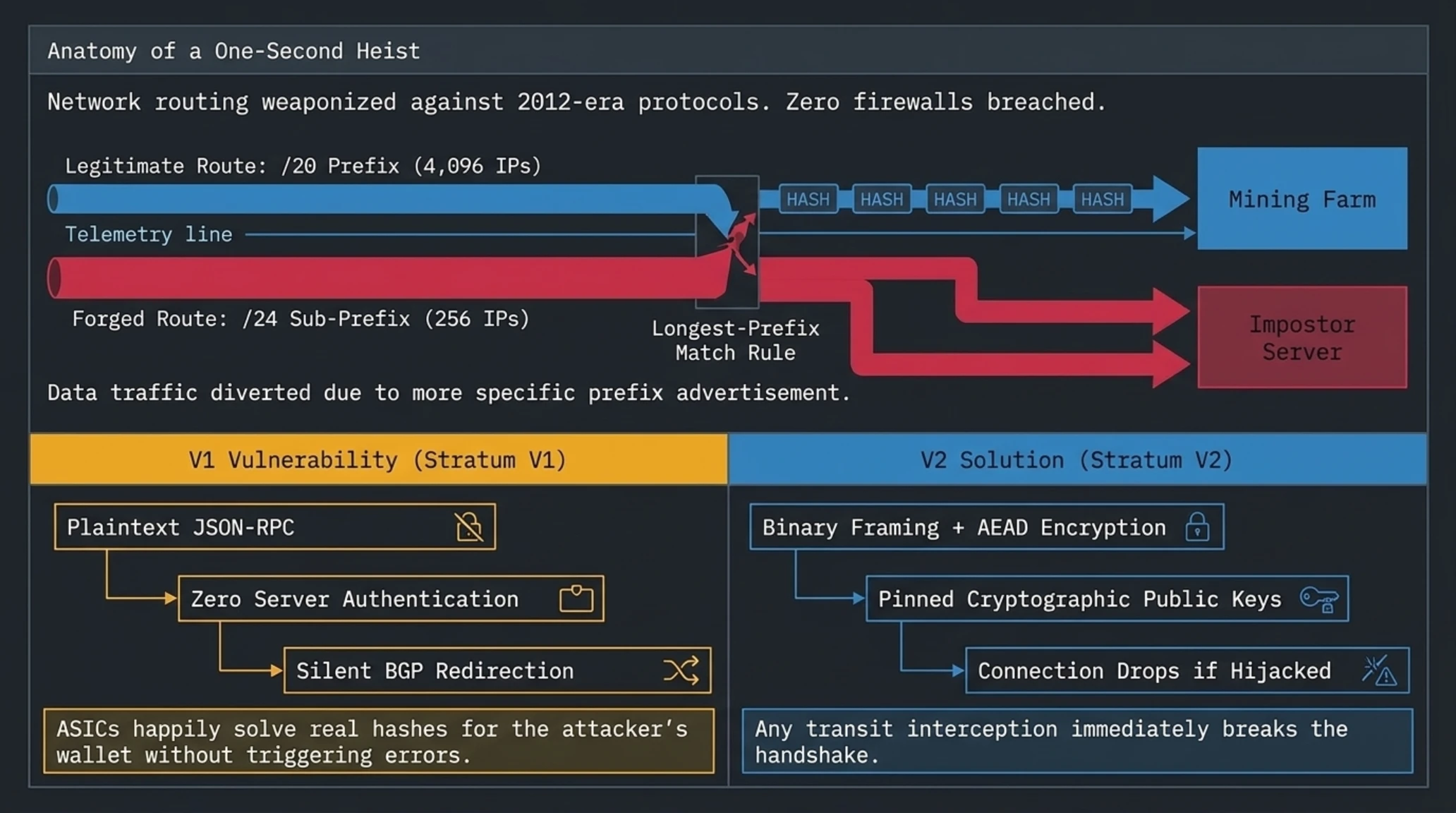
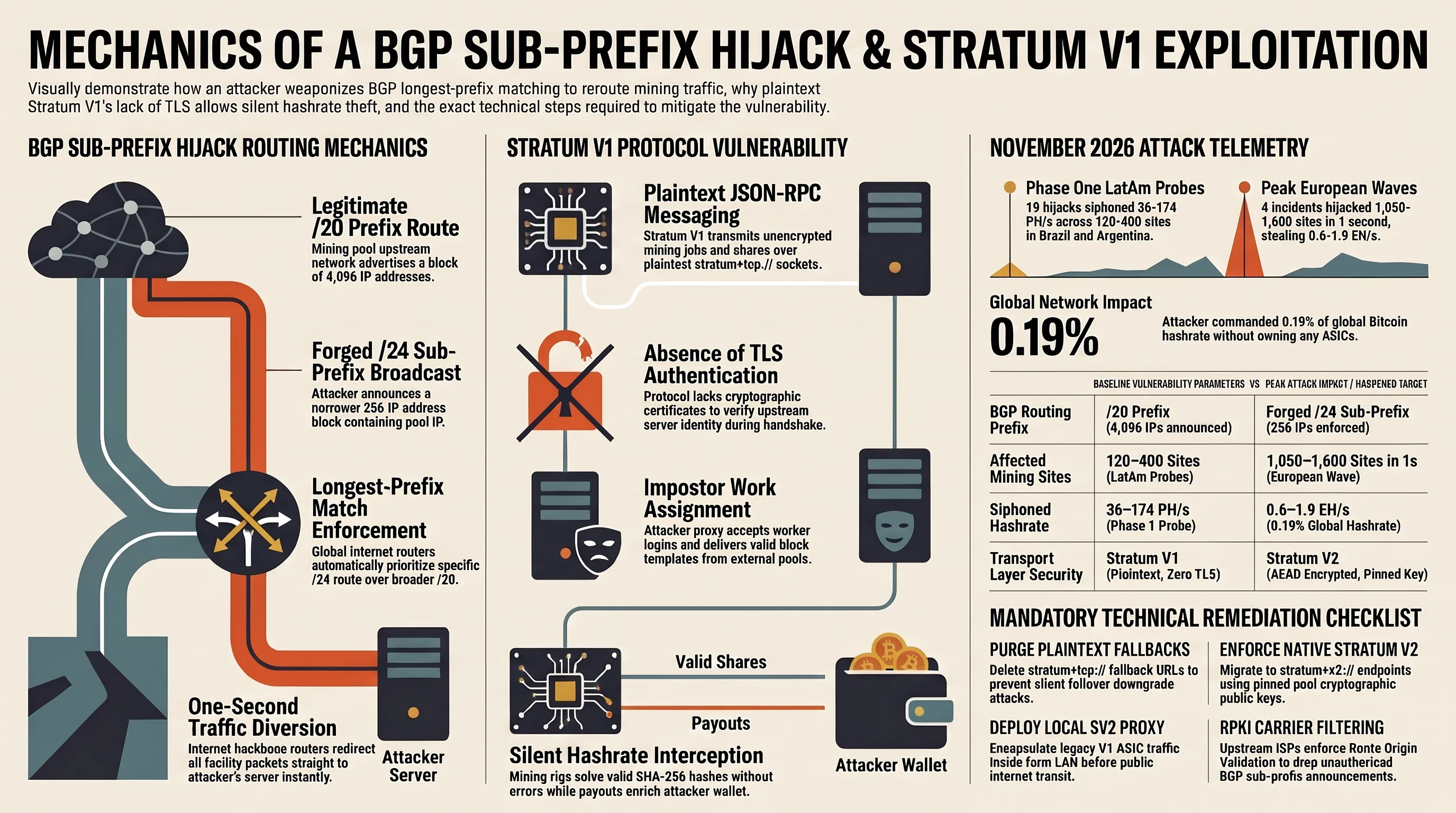
As detailed in Decrypt's technical breakdown of the Stratum V1 route hijack, the perpetrator did not use DNS spoofing. They executed a classic BGP sub-prefix hijack. BGP is the postal routing system of the global internet, governing how autonomous systems (ISPs, backbone carriers, and cloud hosts) advertise which IP address blocks they own. Under normal operations, a mining pool's upstream network provider announces a block of 4,096 IP addresses-known in CIDR notation as a /20 prefix-that encompasses the pool's Stratum server IP.
To pull off the hijack, the attacker used a compromised or complicit network provider to broadcast a forged BGP announcement for a smaller, more specific block of 256 IP addresses (a /24 prefix) containing the exact IP address of the target mining pool. By design, every BGP router on Earth obeys the longest-prefix match rule: a more specific /24 route automatically overrides a broader /20 route. Within one second of that forged announcement propagating across European and Latin American routing tables, routers dutifully diverted every packet bound for the mining pool straight into the attacker's impostor server.
On any modern banking website or HTTPS API, a BGP route hijack hits a brick wall immediately: Transport Layer Security (TLS) checks the server's cryptographic certificate, sees that the impostor lacks the private key, and drops the connection. Bitcoin mining's dominant protocol has no such wall. Introduced in 2012 to replace the obsolete getwork protocol, Stratum V1 transmits JSON-RPC messages in completely unencrypted plaintext over stratum+tcp:// with zero server authentication.
When 1,600 mining farms landed on the impostor server on November 20, the attacker's proxy simply replied "accepted" to every worker login, handed the ASICs valid block-header work templates fetched from another mining pool, collected the resulting proof-of-work shares, and cashed in the rewards under the attacker's own payout address. Inside the victim facilities, the ASICs never threw an error because they were solving real SHA-256 hashes-just for someone else's wallet. It was an industrial-scale resurrection of a famous 2014 attack documented by Dell SecureWorks, in which a BGP hijacker siphoned roughly $83,000 from early mining pools using the exact same architectural flaw.
Tekin Jargon Buster | Three Network and Cryptographic Primitives at the Center of the Storm
Technical Terminal | BGP Sub-Prefix Interception Mechanics & Stratum V2 Hardening Profile
The AI Mathocalypse: Scott Aaronson's Cryptography Bombshells and the Generalized Riemann Proof
While mining engineers scrambled to patch a fourteen-year-old networking blind spot, protocol cryptographers spent the final week of November confronting a far more existential question: what happens when frontier artificial intelligence stops writing boilerplate code and starts solving century-old open problems in pure mathematics?
For over a decade, blockchain security roadmaps operated under a comfortable timeline assumption. Public-key cryptography primitives-such as RSA, elliptic-curve discrete logarithms (ECDSA), and bilinear pairings-were assumed to be safe from sudden mathematical collapse until fault-tolerant quantum computers running Shor's algorithm arrived in the 2030s. Over the past four weeks, that assumption has been violently shaken by what researchers are calling the "AI mathocalypse."
On Wednesday, November 25, 2026, Cointelegraph reported on an urgent warning from theoretical computer scientist Scott Aaronson, a professor at the University of Texas at Austin and former OpenAI safety researcher. Writing on his widely read blog Shtetl-Optimized, Aaronson stated that multiple reliable sources had convinced him frontier AI laboratories are currently holding back major, undisclosed discoveries impacting cryptography.
Why did Aaronson's post send an immediate tremor through cryptography circles and institutional trading desks? Because it landed immediately after three verified, jaw-dropping demonstrations of AI mathematical reasoning in late 2026:
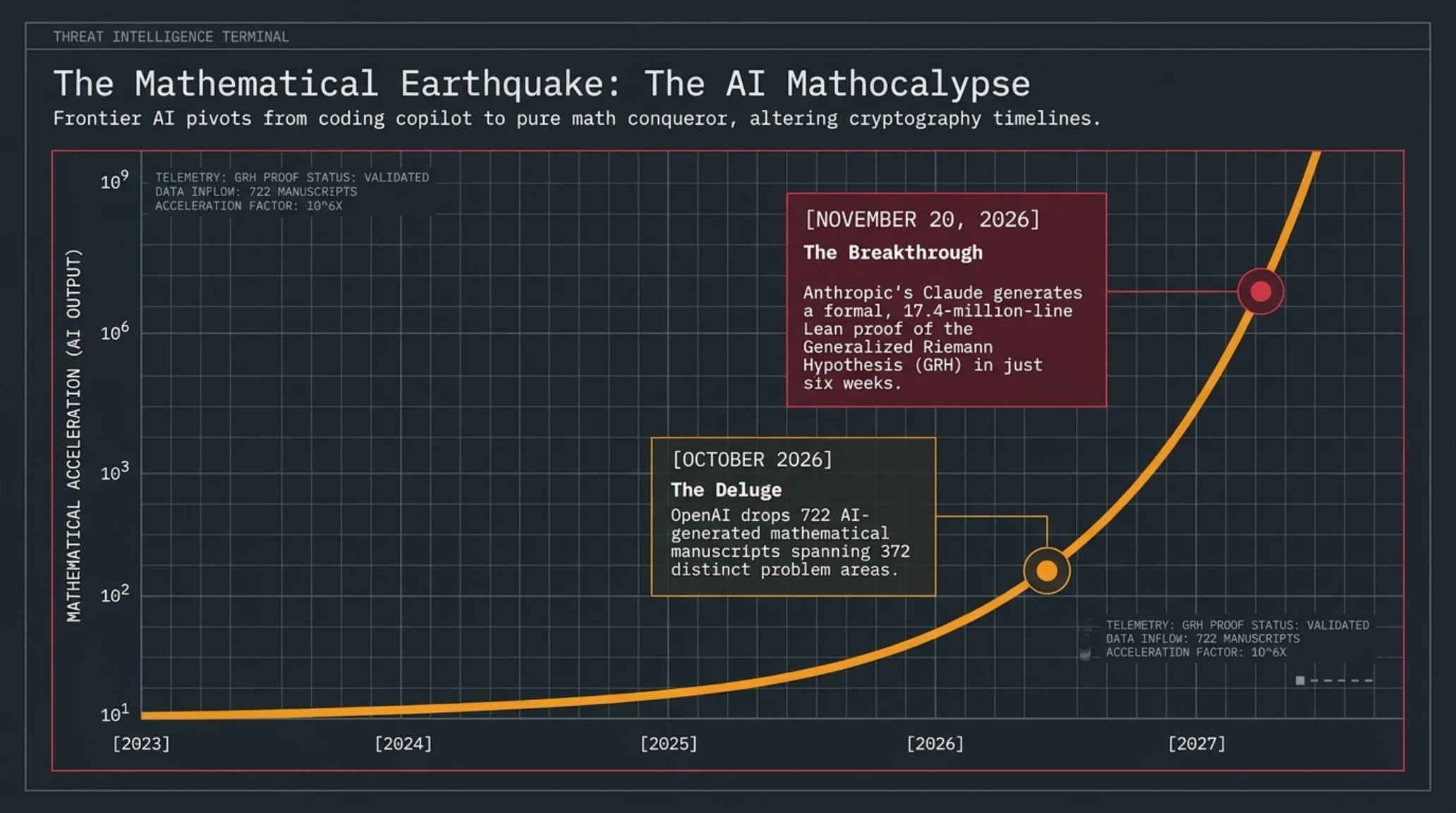
- OpenAI's 722-Manuscript October Deluge: In October 2026, OpenAI released 722 AI-generated mathematical manuscripts spanning 372 distinct problem areas, demonstrating that reasoning models paired with formal proof verifiers could systematically explore algebraic landscapes faster than human departments.
- Anthropic's Formal Proof of the Generalized Riemann Hypothesis (GRH): On Friday, November 20, 2026, Anthropic mathematician Levent Alpöge published an AI-assisted formal proof of the Generalized Riemann Hypothesis-one of the most consequential unproved conjectures in number theory, deeply intertwined with the distribution of prime numbers and computational complexity. Developed over roughly six weeks using an unreleased frontier version of Claude, the proof was formally verified in 17.4 million lines of Lean code audited by the Lean FRO and Mathlib Initiative (and on November 25, Anthropic researcher Luke Sernau compressed that proof by 99.56 percent down to roughly 76,000 lines across 792 files, allowing anyone with 24GB of RAM to verify it in an hour).
- The VP vs. VNP Proofs and Factoring Rumors: Within days of the GRH announcement, both Anthropic and OpenAI released proofs addressing the VP versus VNP conjecture (the algebraic complexity cousin of P versus NP). Amid that avalanche, researchers including Carnegie Mellon's Aran Nayebi and AI analyst Andrew Curran noted swirling academic rumors that an AI lab may have discovered a classical polynomial-time integer factoring algorithm ("Factoring in P")-a breakthrough that would directly compromise classical RSA encryption without needing a quantum computer at all, even though Aaronson explicitly declined to claim that Bitcoin's elliptic-curve ECDSA has been broken.
Fact Check | Separating Viral Crypto Panic from Verified November 2026 Security Facts
Ethereum's Keccak-256 Pivot and Zcash's $300 Million Sapling Evacuation
Blockchain core developers did not wait for a formal paper to drop before pulling the emergency brake. Within hours of the recent AI mathematical disclosures, two of the industry's most technically sophisticated ecosystems-Ethereum and Zcash-announced sweeping architectural pivots designed to strip out complex algebraic assumptions in favor of conservative, battle-hardened cryptography.
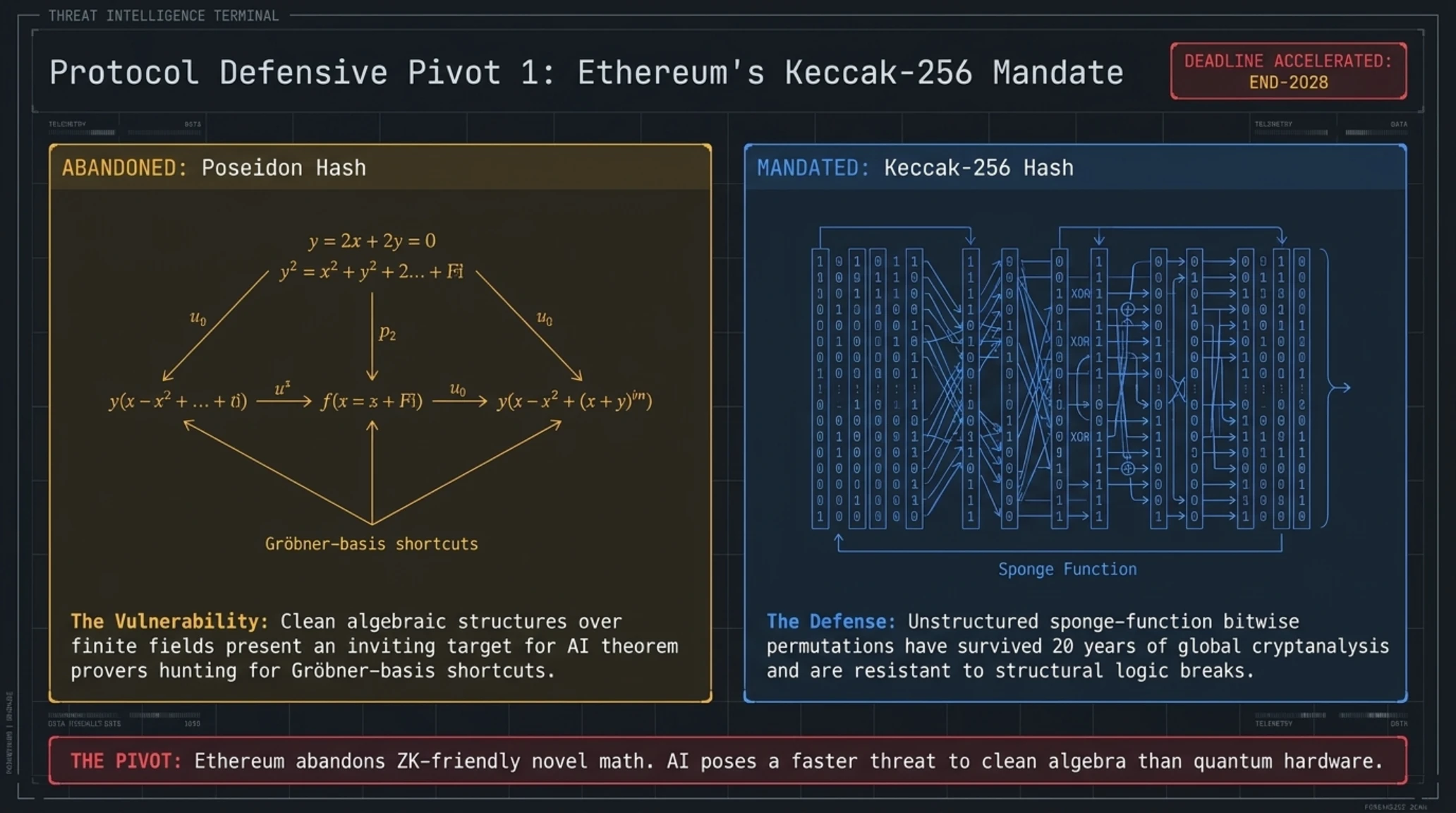
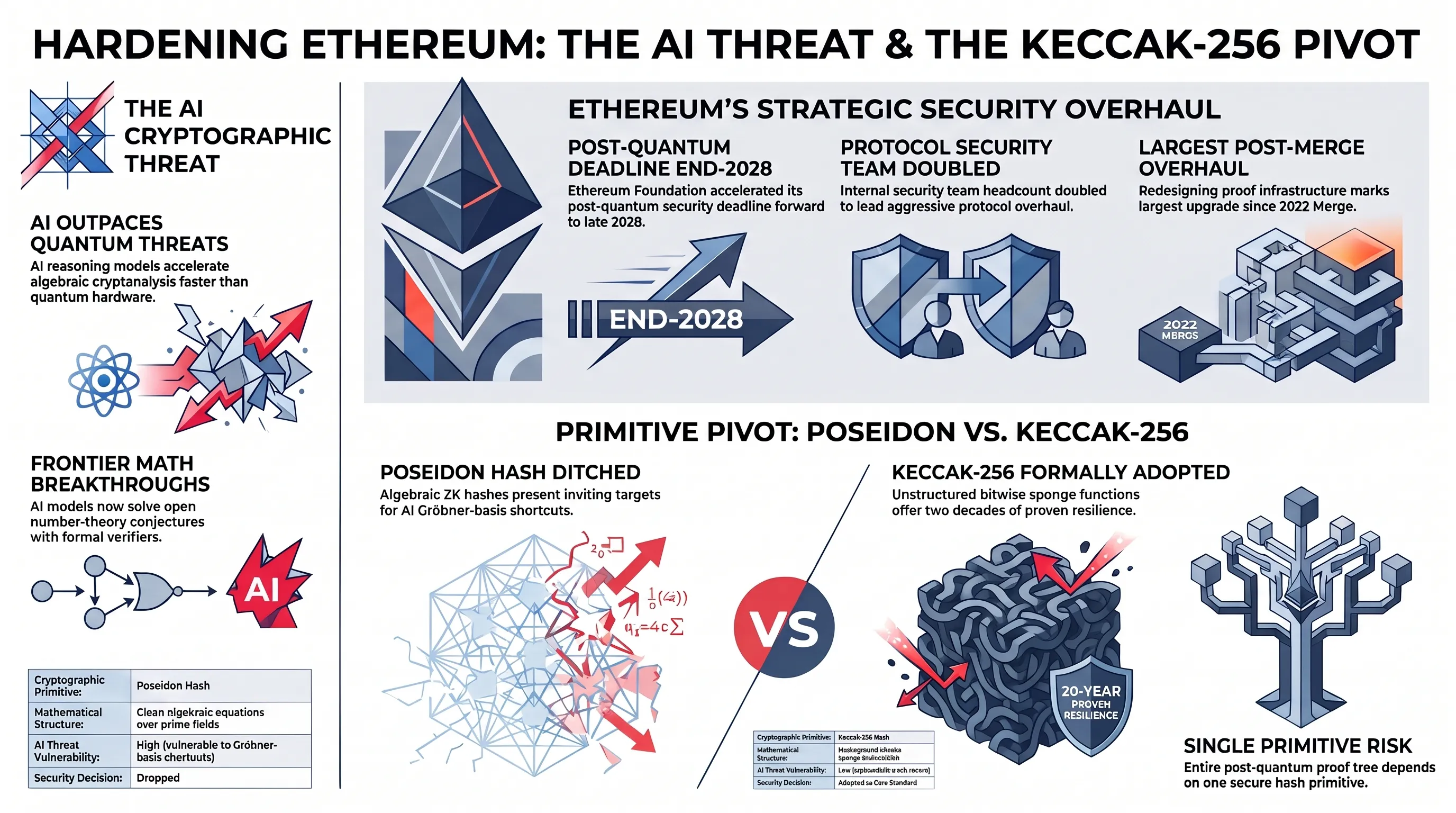
As reported in Decrypt's coverage of Ethereum's accelerated security roadmap, the Ethereum Foundation has doubled the headcount of its internal protocol security team and pulled its post-quantum and AI-resistance deadline forward to the end of 2028. More dramatically, as detailed in Cointelegraph's interview with Ethlabs co-founder Julian Ma, the Foundation officially backed the nearly twenty-year-old Keccak-256 hash function as the cornerstone of Ethereum's post-quantum overhaul-abandoning years of effort to build around Poseidon, a newer algebraic hash function prized for zero-knowledge proof efficiency.
Julian Ma's explanation for ditching Poseidon cuts straight to the heart of the 2026 AI threat model: artificial intelligence poses a far more immediate threat to novel cryptography than quantum hardware does. Because Poseidon is constructed from clean algebraic equations over large prime fields to minimize ZK-circuit constraints, it presents an inviting target for frontier AI theorem provers hunting for algebraic Gröbner-basis shortcuts. Keccak-256, by contrast, relies on unstructured sponge-function bitwise permutations that have survived nearly two decades of intense global cryptanalysis. Calling the upcoming transition one of the largest security overhauls in Ethereum's history since the 2022 Merge, Foundation researchers summed up the stakes bluntly: because the entire chain's post-quantum signature and proof tree will rest on a single hash primitive, "if it is broken, everything else is broken."
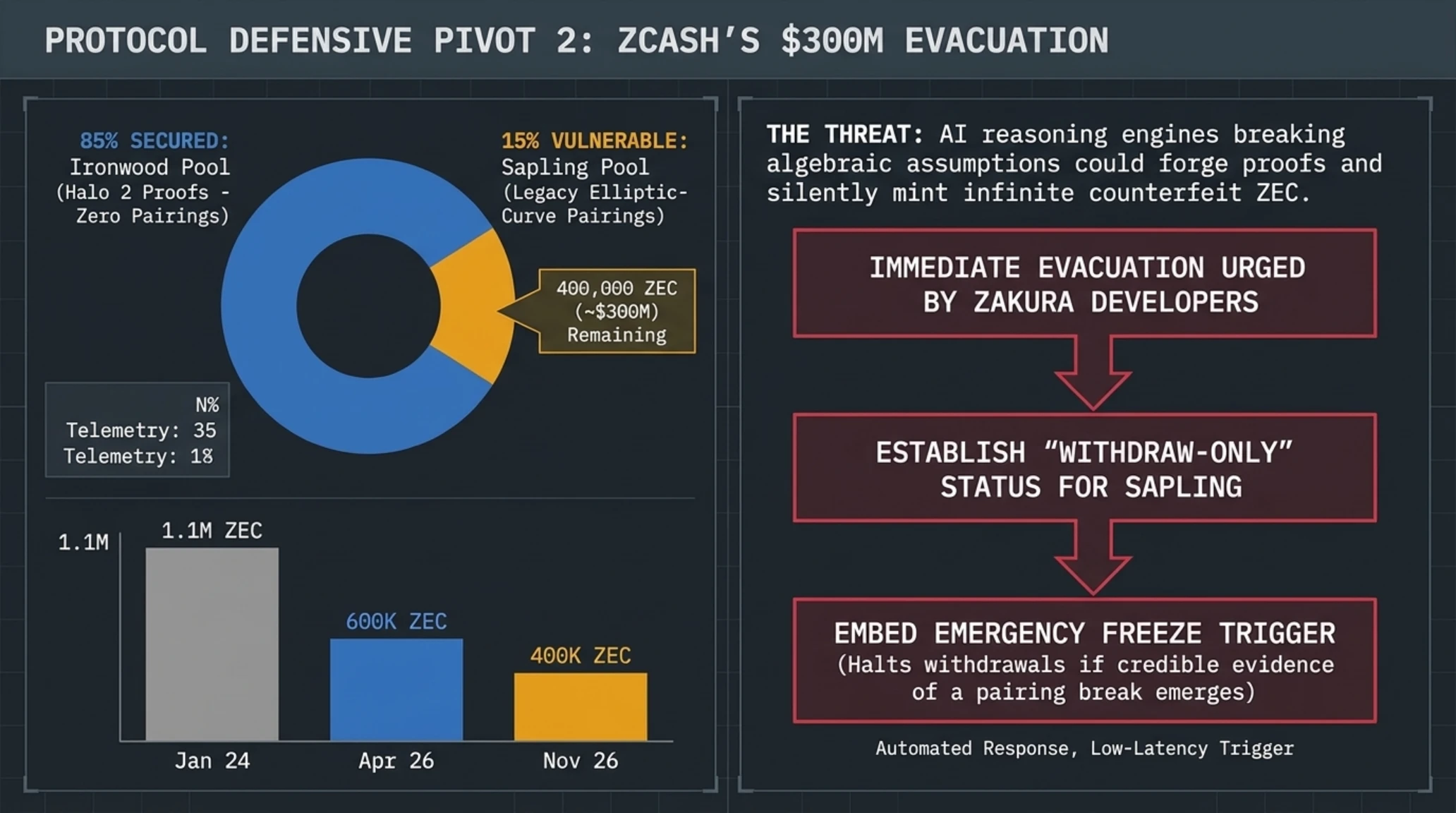
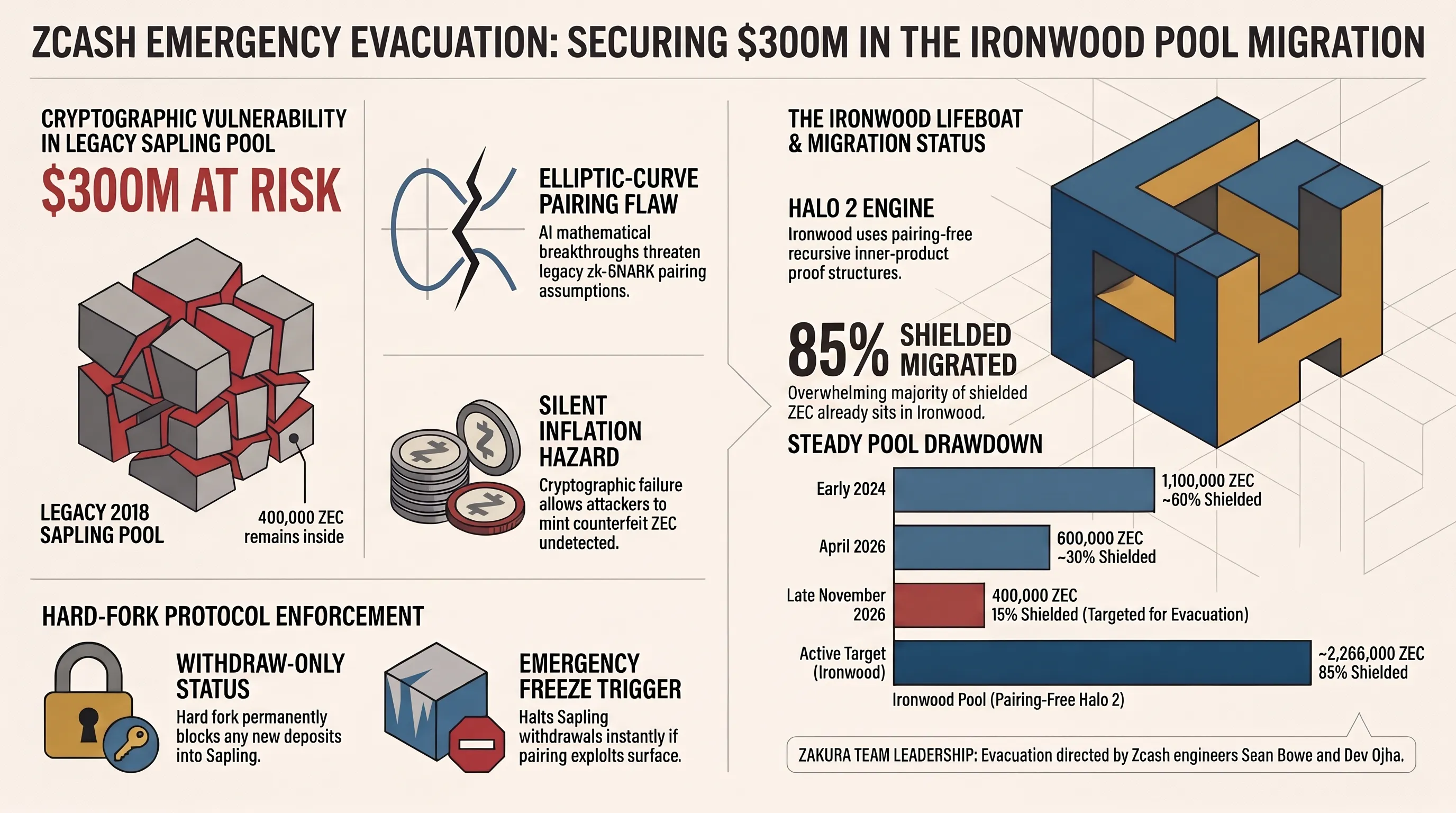
An equally urgent evacuation is underway inside Zcash (ZEC). According to CoinDesk's November 26 report on Zcash's $300 million migration warning, core development group Zakura-led by Zcash co-founder Sean Bowe and engineer Dev Ojha-is urging holders to immediately move roughly 400,000 ZEC (worth approximately $300 million at late-November prices near $743 $755) out of the legacy Sapling shielded pool launched in 2018.
Why is Sapling suddenly in the crosshairs? Sapling's zk-SNARK proofs depend on elliptic-curve pairings-a mathematical structure that lets nodes verify private transactions in milliseconds, but relies on hardness assumptions closely related to the algebraic number-theory territory now being mapped by AI models. If an AI-assisted mathematical breakthrough (or future quantum attack) breaks Sapling's pairing assumption, an attacker would not necessarily steal existing visibility; worse, they could forge zero-knowledge proofs and silently mint counterfeit ZEC out of thin air inside the shielded pool without the network detecting the inflation.
Fortunately, Zcash already built the lifeboat. In July 2026-shortly after security researcher Taylor Hornby responsibly disclosed a soundness flaw in the intermediate Orchard pool in late May-Zcash activated Ironwood, a formally verified shielded pool powered by the Halo 2 proof system. Crucially, Halo 2 does not use elliptic-curve pairings, relying instead on recursive inner-product arguments. Roughly 85 percent of all shielded ZEC already resides inside Ironwood, while Sapling's balance has declined from 1.1 million ZEC at the start of 2024 to 600,000 ZEC in April 2026 and roughly 400,000 ZEC today. To protect the remaining 15 percent and insulate the broader supply, Zakura proposed a two-step hard-fork mechanism: first, turn Sapling withdraw-only (halting new deposits into the 2018 pool), and second, embed an emergency freeze trigger allowing the network to halt Sapling withdrawals if credible evidence of a pairing break emerges.
Verified Security Matrix | BGP Hashrate Escalation & Zcash Shielded Pool Migration
| Security Domain | Legacy / Vulnerable Exposure | Peak Impact / Hardened Architecture |
|---|---|---|
| Braiins BGP Route Hijacks (Nov 7-20, 2026) | 19 LatAm probes (36-174 PH/s across 120-400 sites in Brazil & Argentina) | 4 European waves (0.6-1.9 EH/s across 1,050-1,600 sites in 1 second) |
| Zcash Shielded Pool Distribution (Nov 26, 2026) | ~400,000 ZEC (~$300M / 15%) remaining in 2018 pairing-based Sapling pool | 85% migrated to July 2026 Ironwood pool (Halo 2 proofs, zero pairings) |
| Ethereum Post-Quantum Hash Overhaul (End 2028) | Poseidon algebraic hash retired over AI mathematical shortcut concerns | Keccak-256 (~20-year track record) backed by doubled security team |
📚 Classified & Related Dossiers in TekinGame
If you wish to explore beyond this report and delve into cybernetic frontiers and autonomous AI architectures, do not miss these three exclusive deep-dives in the Tekin Garage:
Financial & Network Telemetry | Zcash Shielded Pool Share and Sapling Balance Drawdown
| Market / Protocol Metric | Verified Figure (Late Nov 2026) | Strategic & Financial Implication |
|---|---|---|
| Zcash Sapling Remaining Balance | ~400,000 ZEC (~$300 million) | Down from 1.1M ZEC in early 2024; targeted for withdraw-only status. |
| Peak BGP Hijack Share of Bitcoin Network | 1.9 EH/s out of 1,016 EH/s (0.19%) | Demonstrates that unencrypted Stratum V1 pools remain exposed to transit theft. |
| Spot Market Reaction & Veteran Sentiment | BTC trading near $57,200 - $58,500 | Longtime bulls cite AI/quantum cryptography uncertainty alongside macro tariffs. |
The convergence of these cryptographic tremors has palpably altered institutional market psychology. As CoinDesk's November 25 market sentiment report on why crypto veterans say 'this time actually seems different' documented, Bitcoin's slide toward the $57,000 $58,000 range amid nearly $4.94 billion in monthly U.S. spot ETF outflows is no longer driven solely by Federal Reserve rate expectations or tariff headlines. For the first time, veteran allocators and Galaxy Digital analysts noted that anxieties over AI-accelerated cryptanalysis and quantum readiness are actively weighing on dip-buying conviction.
Threat & Mitigation Matrix | Hardening Blockchain Infrastructure in Late 2026
| Attack Vector / Vulnerability | Risk Level | Mandatory Engineering Countermeasure |
|---|---|---|
| BGP sub-prefix route hijacking against plaintext Stratum V1 mining farms | CRITICAL | Delete all stratum+tcp:// primary and fallback URLs; enforce Stratum V2 with pinned pool public keys or local SV2 Proxy. |
| Elliptic-curve pairing forgery risk inside Zcash's legacy 2018 Sapling pool | HIGH | Migrate remaining 400,000 ZEC (~$300M) into Halo 2-based Ironwood pool; enact withdraw-only status and emergency freeze trigger. |
| AI-assisted algebraic cryptanalysis against newer ZK hashes (e.g., Poseidon) | MITIGATING | Ethereum Foundation's pivot to battle-tested Keccak-256 and acceleration of its post-quantum overhaul to end-2028. |
Chronology | From Stratum V1's 2012 Debut to the November 2026 Cryptography Storm
| Date | Milestone | Technical & Security Significance |
|---|---|---|
| 2012 & 2014 | Stratum V1 Debuts & First BGP Hijack | Plaintext Stratum V1 launches in 2012; Dell SecureWorks documents an $83,000 BGP mining hijack in 2014. |
| July 2026 | Zcash Activates Ironwood Pool | Following Taylor Hornby's May 2026 Orchard bug disclosure, Zcash launches Halo 2-powered Ironwood with formal verification. |
| October 2026 | OpenAI Publishes 722 Math Manuscripts | The 'AI mathocalypse' begins across 372 problem areas, prompting Vitalik Buterin and Justin Drake to flag cryptographic timelines. |
| Nov 7-20, 2026 | 24 BGP Hijacks & Claude's GRH Proof | Attackers hijack up to 1.9 EH/s across 1,600 European mines on Nov 20-the same day Anthropic publishes Claude's 17.4M-line Lean GRH proof. |
| Nov 24-26, 2026 | Braiins, Ethereum & Zcash Warnings | Ethereum backs Keccak-256 for end-2028; Scott Aaronson warns of AI cryptography bombshells; Zakura urges $300M Sapling exit. |
Hardening the Stack: How Mining Operators and Protocol Engineers Must Respond
The lesson of late November 2026 is not despair; it is engineering discipline. In every single case-whether the 1.9 EH/s BGP mining hijack, the 64,000-machine Luxor Commander incident, Ethereum's hash selection, or Zcash's Sapling deprecation-the defensive tools required to neutralize the threat already exist. What has been missing is the operational urgency to deploy them before an attacker forces the issue.
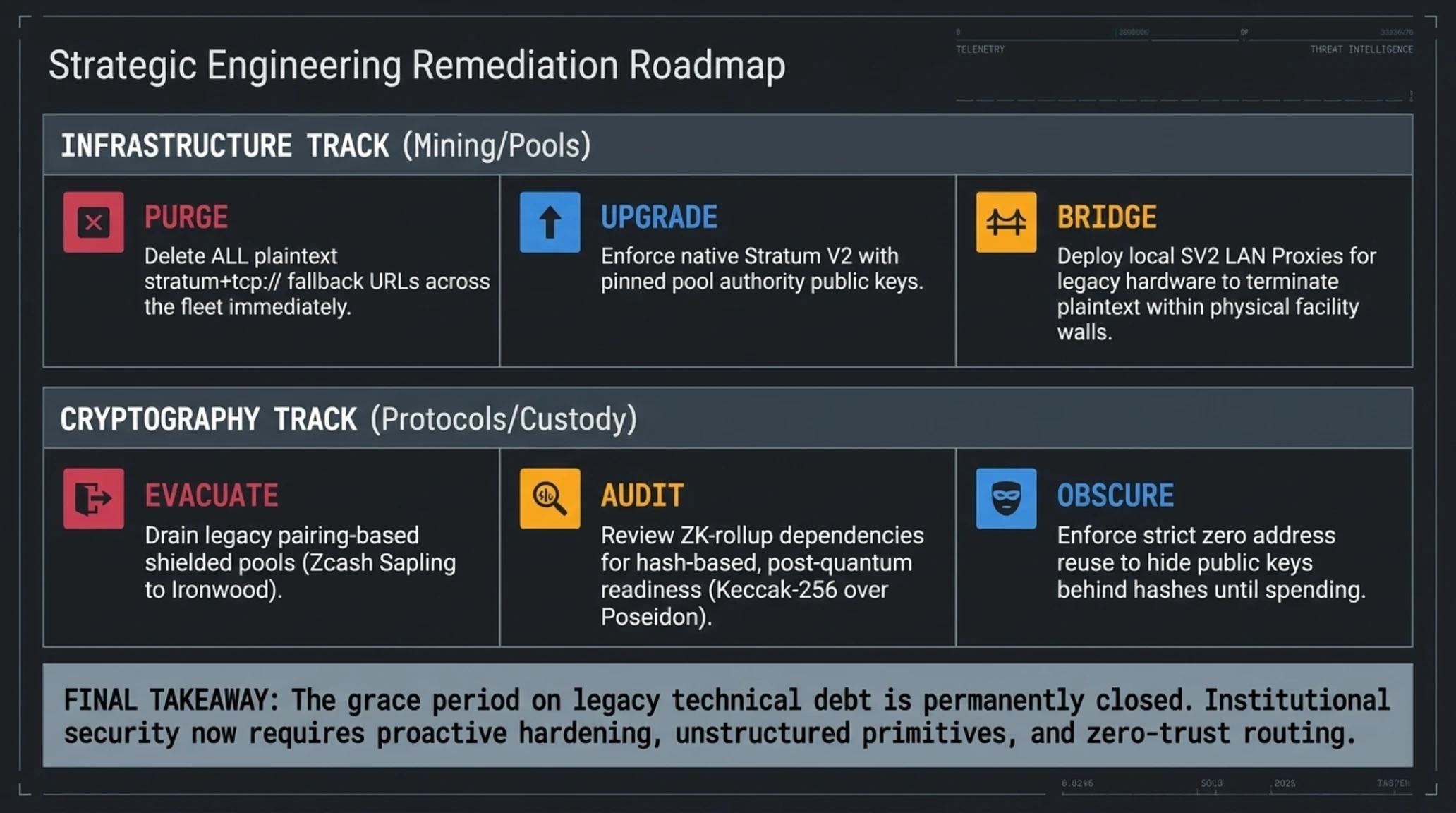
For industrial Bitcoin mining operators, colocation hosts, and pool administrators, Braiins' security advisory outlines a non-negotiable three-step remediation checklist:
- Eliminate Every Plaintext Fallback URL Immediately: The most common configuration blunder across commercial ASIC farms is placing an encrypted Stratum V2 or TLS endpoint in Slot 1 while leaving a legacy
stratum+tcp://URL in Slot 2 or Slot 3 as a backup. During a BGP hijack, the attacker's impostor server simply drops or refuses the encrypted port handshake, tricking the ASIC firmware into automatically failing over to the plaintext fallback URL within seconds. If a single plaintext fallback remains configured, the farm is completely unguarded. - Enforce Native Stratum V2 or Strict-Validation TLS: Operators running modern firmware should migrate directly to Stratum V2 configured with the pool's cryptographic Authority Public Key. Even if a rogue ISP hijacks the BGP route, the impostor server cannot forge the pool's cryptographic signature, causing the miner to reject the connection rather than donate free electricity to the attacker.
- Deploy a Local LAN SV2 Proxy for Legacy Hardware: Older ASIC models whose stock control-board firmware only speaks Stratum V1 do not need to be scrapped. By installing Braiins' free open-source SV2 Proxy on a local Linux server inside the facility's private LAN, operators can terminate unencrypted V1 traffic inside their own physical walls and forward a single authenticated, encrypted Stratum V2 tunnel across the public internet to the mining pool. Upstream ISPs and hosting providers must simultaneously enforce RPKI (Resource Public Key Infrastructure) Route Origin Validation and register strict
/24ROA entries so forged sub-prefix announcements are dropped at the carrier edge.
For institutional custodians, self-custody holders, and DeFi treasuries, the cryptographic hygiene checklist is equally concrete: migrate any remaining Zcash holdings out of legacy Sapling (zs1) addresses into unified Ironwood addresses; avoid public-key exposure on Bitcoin and Ethereum by strictly practicing zero address reuse (keeping public keys hashed behind unused receiving addresses until spending); and audit zero-knowledge rollup dependencies to ensure proving systems have a clear migration path toward hash-based post-quantum primitives by the Ethereum Foundation's 2028 target.
Final Verdict and Frequently Asked Questions
The twin disclosures of November 25 and November 26, 2026 mark the definitive end of the cryptocurrency industry's grace period on legacy technical debt. At the network routing layer, leaving gigawatts of industrial proof-of-work hardware connected over unauthenticated 2012-era plaintext sockets is no longer defensible when a single forged /24 BGP announcement can hijack 1,600 facilities in one second.
At the cryptographic foundation layer, the sudden acceleration of AI theorem proving has compressed decade-long security horizons into an urgent two-year sprint. By rallying around conservative, unstructured primitives like Keccak-256, migrating shielded assets into pairing-free Halo 2 pools, and locking down mining transport with Stratum V2, the blockchain ecosystem has every tool required to weather both BGP hijackers and the AI mathocalypse-provided operators act before the next one-second hijack strikes.
- Transparent disclosure of the 24-incident BGP campaign by Braiins, confirming zero breach of pool servers, miner hardware, or historical wallet balances.
- Immediate availability of free, production-ready countermeasures including native Stratum V2 and local LAN SV2 Proxy tools for legacy ASICs.
- Decisive preemptive leadership by the Ethereum Foundation in backing battle-tested Keccak-256 and pulling its post-quantum deadline forward to end-2028.
- Proactive risk management by Zcash's Zakura team to evacuate $300 million from legacy Sapling into Halo 2-powered Ironwood before any exploit occurs.
- Widespread industry inertia that left thousands of commercial Bitcoin mining sites running unencrypted 2012-era Stratum V1 endpoints and plaintext fallbacks.
- Total invisibility of BGP hashrate theft on local ASIC dashboards, where power draw, chip temperatures, and share acceptance rates appear completely normal.
- Unprecedented speed of frontier AI mathematical breakthroughs (such as Claude's GRH proof), shrinking the safety margin for newer algebraic cryptography.
- Heightened market anxiety and implementation complexity as major Layer-1 blockchains compress decade-scale cryptographic migrations into a two-year window.
Editorial Verdict & Direct Verified Sources
- CoinDesk (INDUSTRY REPORT): Over 1,000 Bitcoin miners were tricked into working for a thief by a fake internet route (November 26, 2026)
- Decrypt (INDUSTRY REPORT): Another Bitcoin Mining Firm Flags Hashrate Hijacking Attacks That Reroute Rewards (November 26, 2026)
- Bitcoin.com News (INDUSTRY REPORT): Braiins Warns of Widespread Bitcoin Hashrate Hijacking Attacks (November 26, 2026)
- CoinTelegraph (INDUSTRY REPORT): Braiins warns of Bitcoin mining attacks affecting over 1,000 sites (November 26, 2026)
- CoinTelegraph / Ethereum (INDUSTRY REPORT): Ethereum Foundation backs Keccak-256 to counter quantum, AI threats (November 25, 2026)
- Decrypt / Ethereum Security (INDUSTRY REPORT): Morning Minute: Ethereum Focuses on Security As AI Threats Rise (November 25, 2026)
- CoinTelegraph / Scott Aaronson (INDUSTRY REPORT): AI labs likely sitting on cryptography bombshells, computer scientist says (November 26, 2026)
- CoinDesk / Zcash (INDUSTRY REPORT): Zcash developers want users to move $300 million out of an older privacy system (November 26, 2026)
- CoinDesk Markets (INDUSTRY REPORT): This time actually seems different: Crypto veterans brace for more pain as bitcoin tumbles (November 25, 2026)
Frequently Asked Questions About the Bitcoin BGP Mining Hijack and AI Cryptography Threats
Did hackers breach Braiins Pool servers or infect 1,600 Bitcoin mining farms with malware?
No. Neither Braiins Pool servers nor the miners' hardware were breached, and existing account balances remained completely untouched. The attacker executed a Border Gateway Protocol (BGP) sub-prefix hijack on the public internet, announcing a forged /24 IP route that intercepted unencrypted Stratum V1 traffic in transit and redirected live proof-of-work shares to an impostor pool.
Why couldn't mining farm operators see that their hashrate was being stolen?
Because the impostor pool fed the ASICs legitimate SHA-256 work templates and replied 'accepted' to every submitted share. Inside the facility, ASIC dashboards displayed completely normal hashrates, chip temperatures, and power consumption while the block rewards silently accrued to the attacker's account at another pool.
How can Bitcoin miners permanently block BGP route-hijacking attacks?
Operators must delete every plaintext stratum+tcp:// URL-including secondary and tertiary fallback slots-and switch to native Stratum V2 (which uses authenticated encryption pinned to the pool's public key) or strict-certificate TLS. For older Stratum V1-only ASICs, running Braiins' free SV2 Proxy on a local LAN server encrypts all traffic before it leaves the building.
Why did the Ethereum Foundation choose Keccak-256 over Poseidon for its end-2028 security overhaul?
Ethlabs co-founder Julian Ma explained that frontier AI models are advancing so rapidly in algebraic reasoning-highlighted by Anthropic's formal proof of the Generalized Riemann Hypothesis-that AI could discover mathematical shortcuts in newer algebraic hash functions like Poseidon. Keccak-256 relies on unstructured bitwise operations that have withstood nearly 20 years of cryptanalysis.
Why are Zcash developers urging holders to move $300 million out of the Sapling pool?
Zcash's 2018 Sapling shielded pool relies on elliptic-curve pairings, which could allow an attacker to forge zero-knowledge proofs and mint undetectable counterfeit ZEC if AI-assisted math discoveries or quantum computers weaken pairing assumptions. Developers at Zakura urge holders of the remaining 400,000 ZEC in Sapling to migrate into the newer Ironwood pool, which uses pairing-free Halo 2 proofs.
Additional Gallery: Tekin Analysis: 1,000+ Bitcoin Mines Hijacked in 1s & AI Crypto Alert