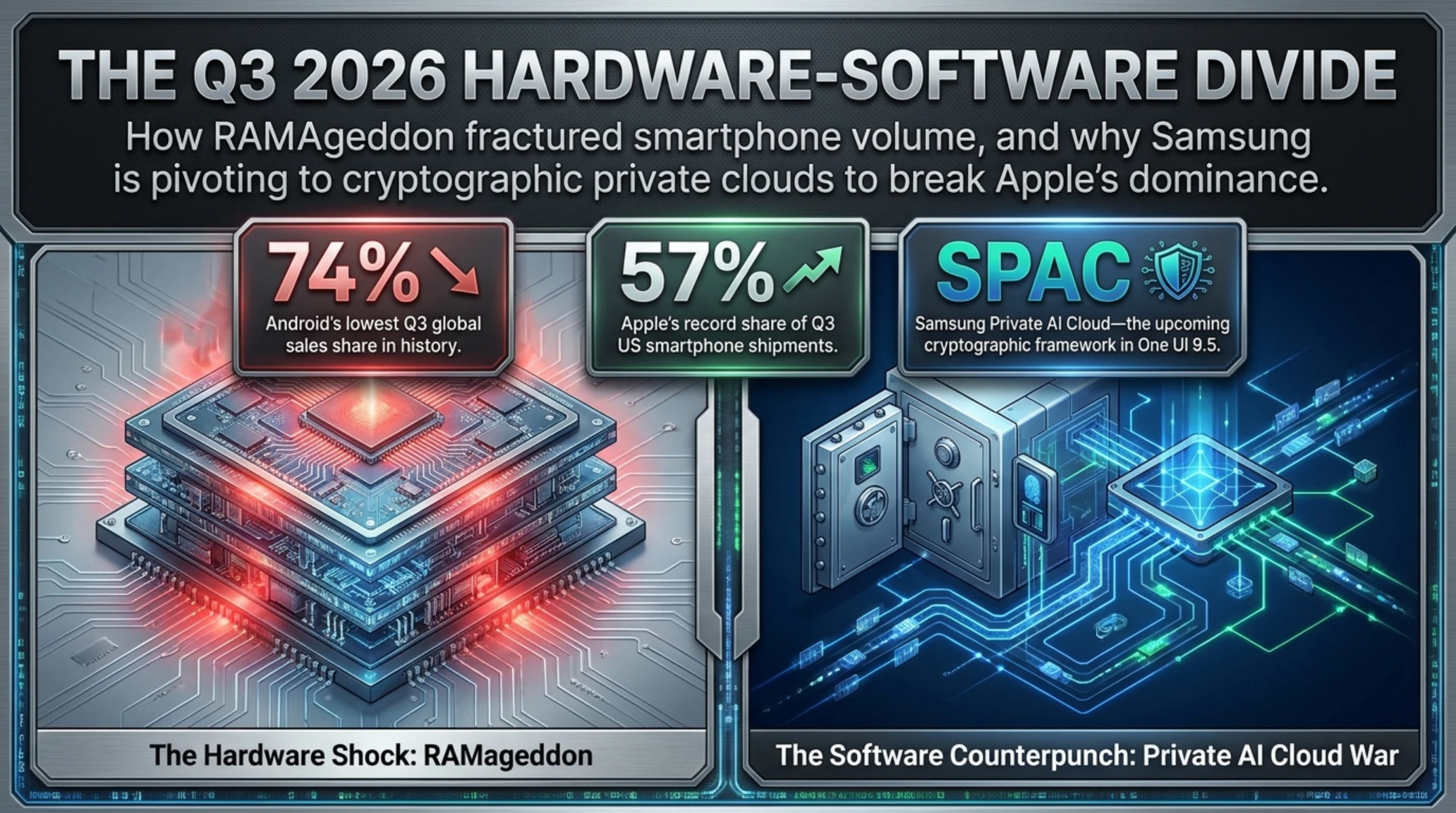
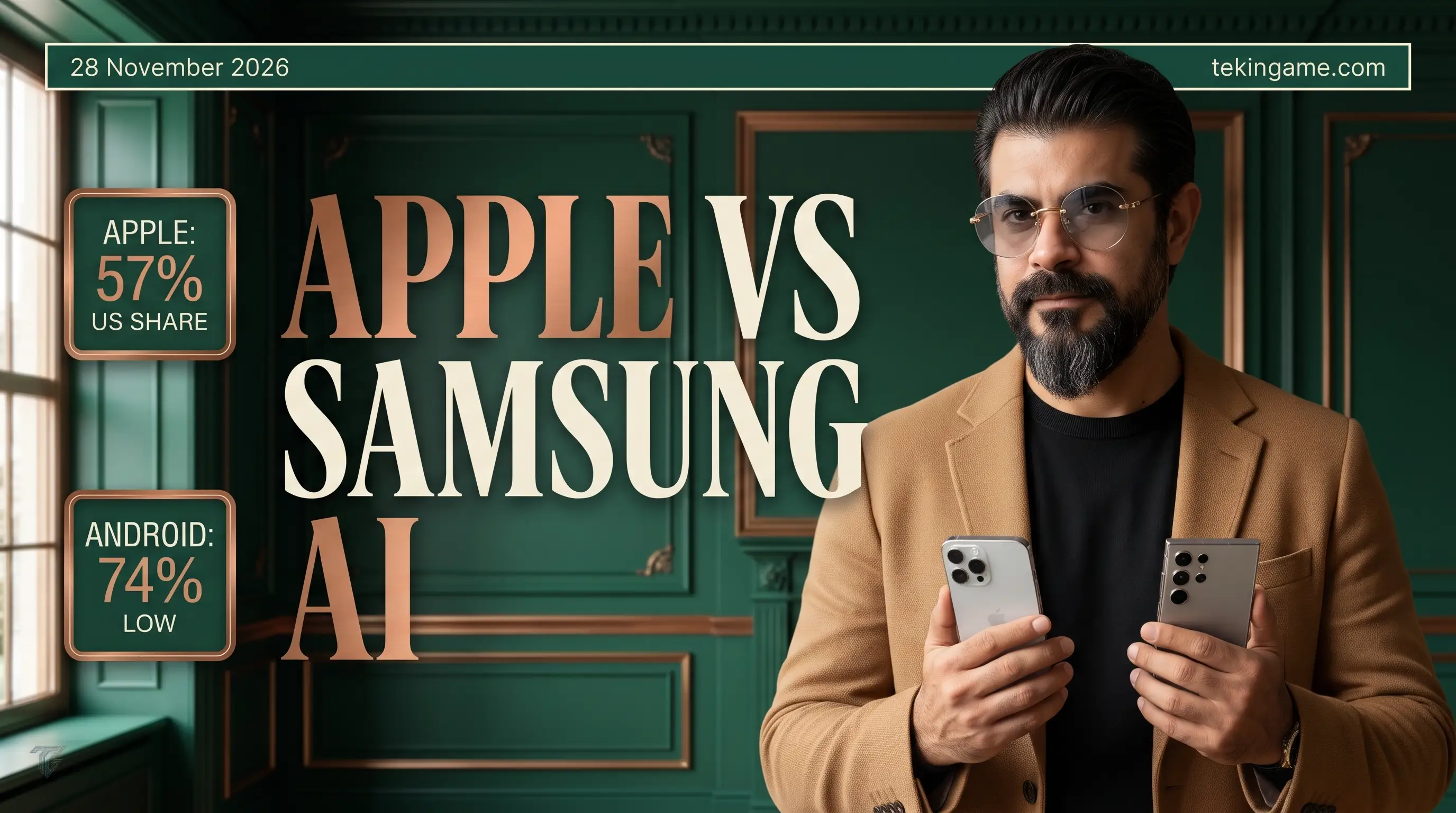
Counterpoint Research Q3 2026 data shows the global memory crunch pushed Android to a historic Q3 low of 74% globally while Apple surged to 57% of US shipments. In response, One UI 9.5 Beta 1 code on the Galaxy S26 Ultra reveals Samsung's encrypted SPAC private AI cloud (Arcane gateway, Qwen 3.6, Gemma 4, FLUX.2), arriving as South Korea's KFTC prosecutes Apple Intelligence ads and 42 AGs fight Character.AI's chat auction.
Tekin Briefing | Key Pillars of the Q3 2026 Smartphone OS Shift and the Private AI Cloud War
For more than a decade, the global smartphone market obeyed a predictable equilibrium. Apple captured the lion's share of industry operating profits at the flagship tier, while Google's Android ecosystem commanded roughly four-fifths of global unit volume on the strength of hundreds of millions of budget and midrange handsets shipped by Xiaomi, Vivo, Oppo, Transsion, Motorola, and Samsung. In late November 2026, the global memory supply crisis-dubbed "RAMageddon" across hardware supply chains-has shattered that long-standing volume shield.
Fresh third-quarter 2026 market telemetry from Counterpoint Research reveals that Android just suffered its worst third-quarter market share reading in history, shedding five percentage points globally in a single year. Over the exact same ninety-day window, Apple defied a 16 percent global smartphone market contraction to post a record third-quarter global share for iOS and capture an astonishing 57 percent of all smartphone shipments in the United States. Behind closed doors in Shenzhen and Seoul, almost every major Android manufacturer is now aggressively slashing its 2027 production targets by double digits.
Yet hardware economics only tell half of late-2026's mobile story. Recognizing that surviving a high-priced hardware cycle requires matching Cupertino at the software and privacy layer, Samsung-the lone Android vendor to grow its US shipment share last quarter-is preparing an ambitious architectural counterpunch. An exclusive teardown of One UI 9.5 Beta 1 on the Galaxy S26 Ultra has uncovered an unreleased framework called SPAC (Samsung Private AI Cloud), engineered to rival Apple's Private Cloud Compute using blind relays, verifiable server logs, and a diverse roster of open-weight models. In this Tekin Versus investigation, we pit Apple's supply-chain dominance and mounting regulatory headaches against Samsung's upcoming private cloud offensive.
The Q3 2026 Market Split: Why RAM Inflation Punished Android Harder Than Apple
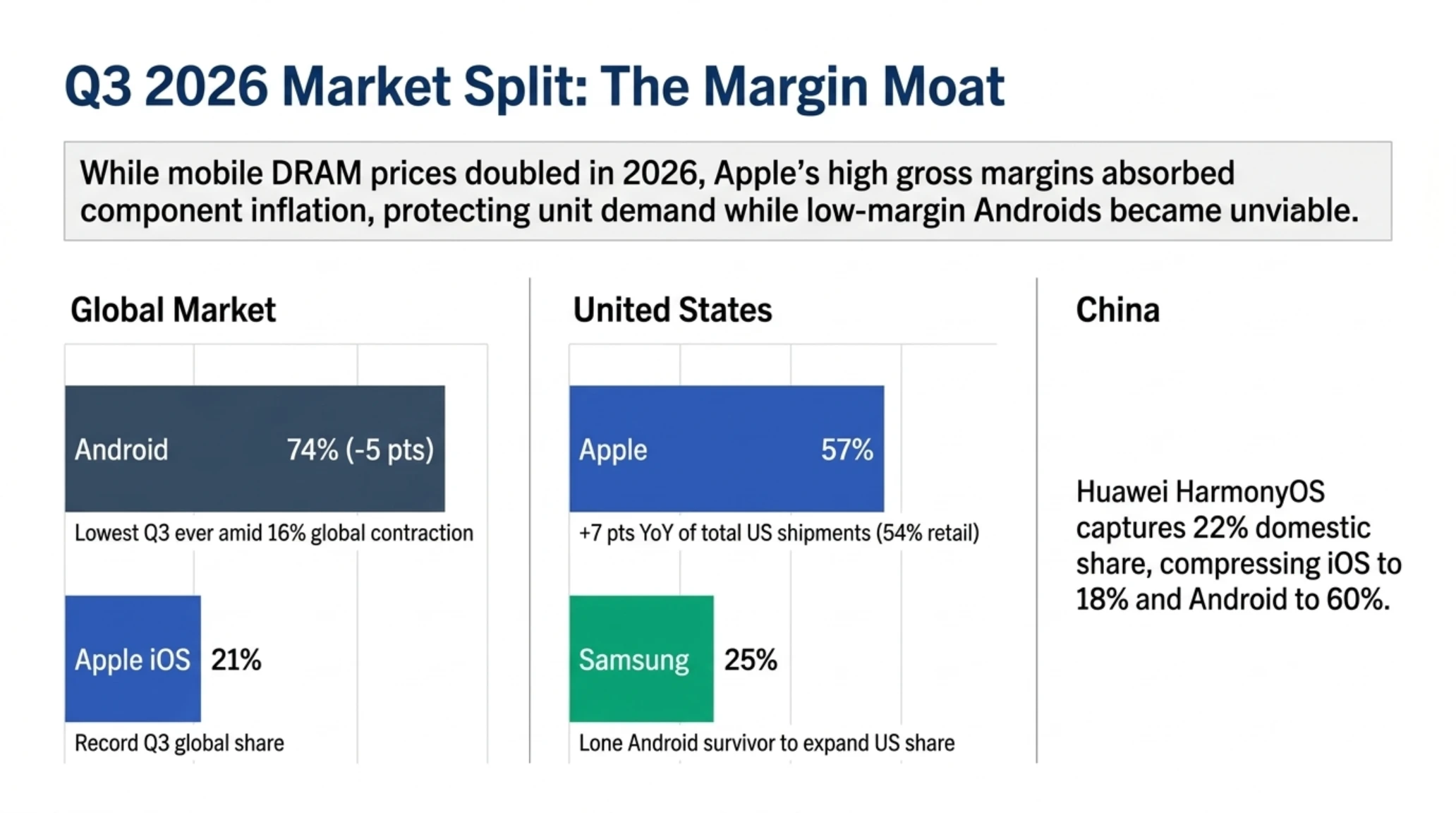
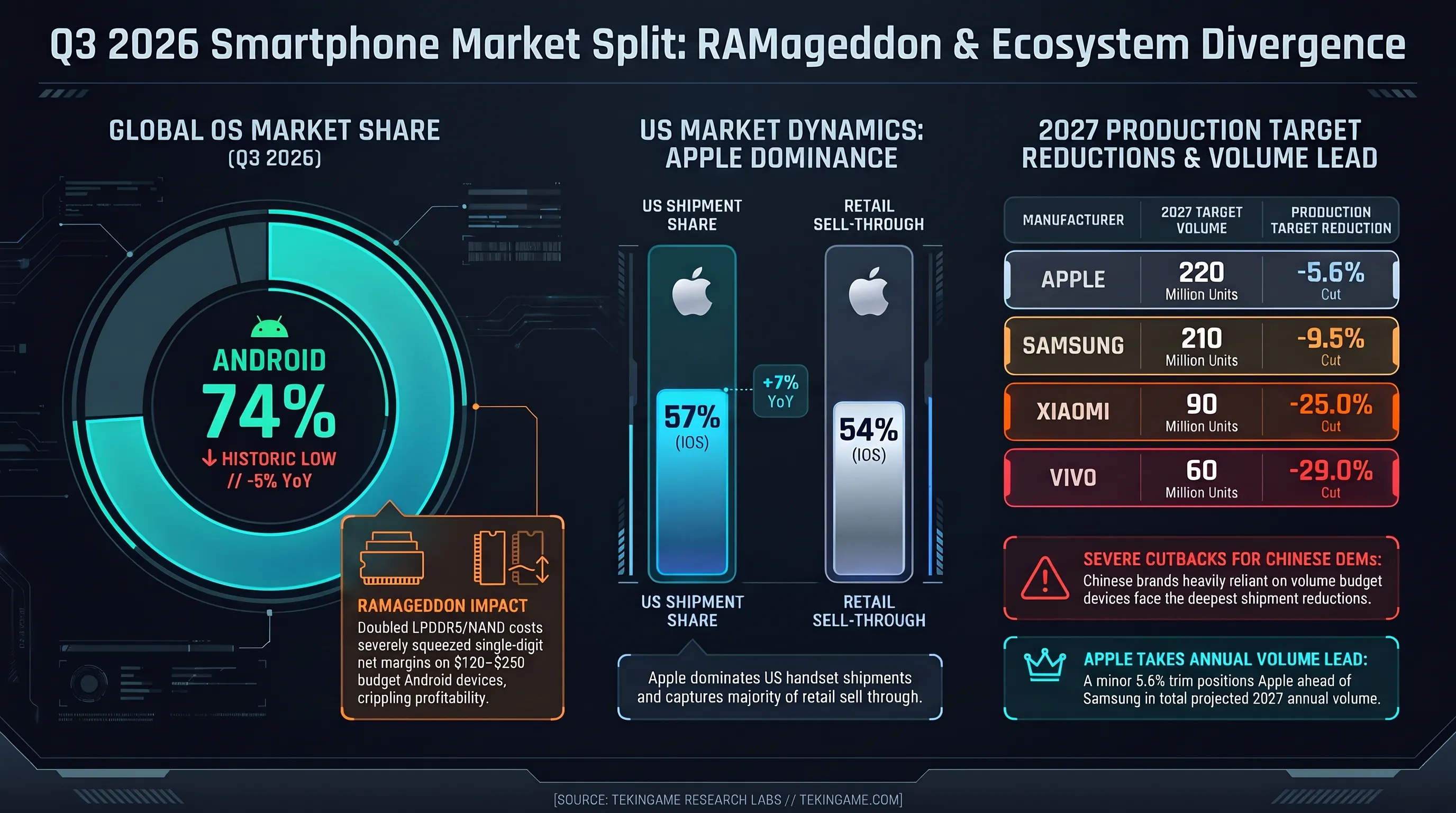
To understand why soaring DRAM and NAND flash contract prices acted like a precision guided missile against Android's global market share while leaving iPhone volume unscathed, you have to dissect the regional numbers published this week. According to Android Authority's breakdown of Counterpoint Research's Q3 2026 global OS data, Android accounted for 74 percent of global smartphone sales in the third quarter of 2026-a steep five-percentage-point drop from 79 percent in Q3 2025 and the lowest third-quarter global share Android has ever recorded.
Where did those five percentage points go? Straight to Apple-and, inside mainland China, to Huawei. Global iOS sales share climbed to a third-quarter record of 21 percent, while Huawei's HarmonyOS held 5 percent globally by capturing 22 percent of China's domestic market (where Huawei grew 12 percent year-over-year despite a 10 percent contraction in total Chinese smartphone demand). Crucially, global smartphone sales across all brands shrank 16 percent year-over-year in Q3 2026, yet Apple was the only major global manufacturer whose unit sales actually grew year-over-year.
Inside the United States, the divergence turned into a rout. As documented in 9to5Mac's report on Q3 2026 US smartphone shipments, total US smartphone shipments fell 9 percent year-over-year and postpaid sales across the Big Three US carriers (Verizon, AT&T, and T-Mobile) slipped 4 percent. Despite that sluggish carrier backdrop, Apple's share of US smartphone shipments surged seven percentage points year-over-year from 50 percent to 57 percent (while retail sell-through share reached 54 percent iOS versus 46 percent Android, up from 51 percent iOS in Q2). Among all Android manufacturers competing in North America, Samsung was the sole vendor to expand its US shipment share, edging up one percentage point to 25 percent by pairing premium Galaxy flagships with sub-$300 Galaxy A-series carrier staples. A similar dynamic played out in Latin America, where overall Q3 shipments plunged 24 percent year-over-year but Apple recorded the smallest decline among the region's top five brands.
Why It Matters | Three Verified Numbers Behind the Late-2026 Mobile Shakeup
The underlying mechanism behind Android's five-point global drop comes down to bill-of-materials math. In emerging and price-sensitive markets-such as India, where Android still commands 92 percent of sales versus 8 percent for iOS-hundreds of millions of buyers shop in the $120 to $250 bracket. At those price points, manufacturers operate on single-digit net margins, and memory packages represent a massive percentage of total build cost. When AI data center demand sent mobile LPDDR5/LPDDR5X and NAND flash prices soaring across 2026, Android vendors were forced to raise retail prices repeatedly or discontinue entry-level SKUs outright. Apple, buffered by industry-leading gross margins and long-term supply agreements, kept iPhone pricing stable through most of 2026 before rolling out the iPhone 18 Pro and the foldable iPhone Duo in September-a launch so strong that six of the top ten bestselling phones during China's autumn promotional window were iPhone 17 and iPhone 18 models.
Slashing 2027 Shipment Targets: Vivo and Xiaomi Cut Deep While iPhone Holds the Line
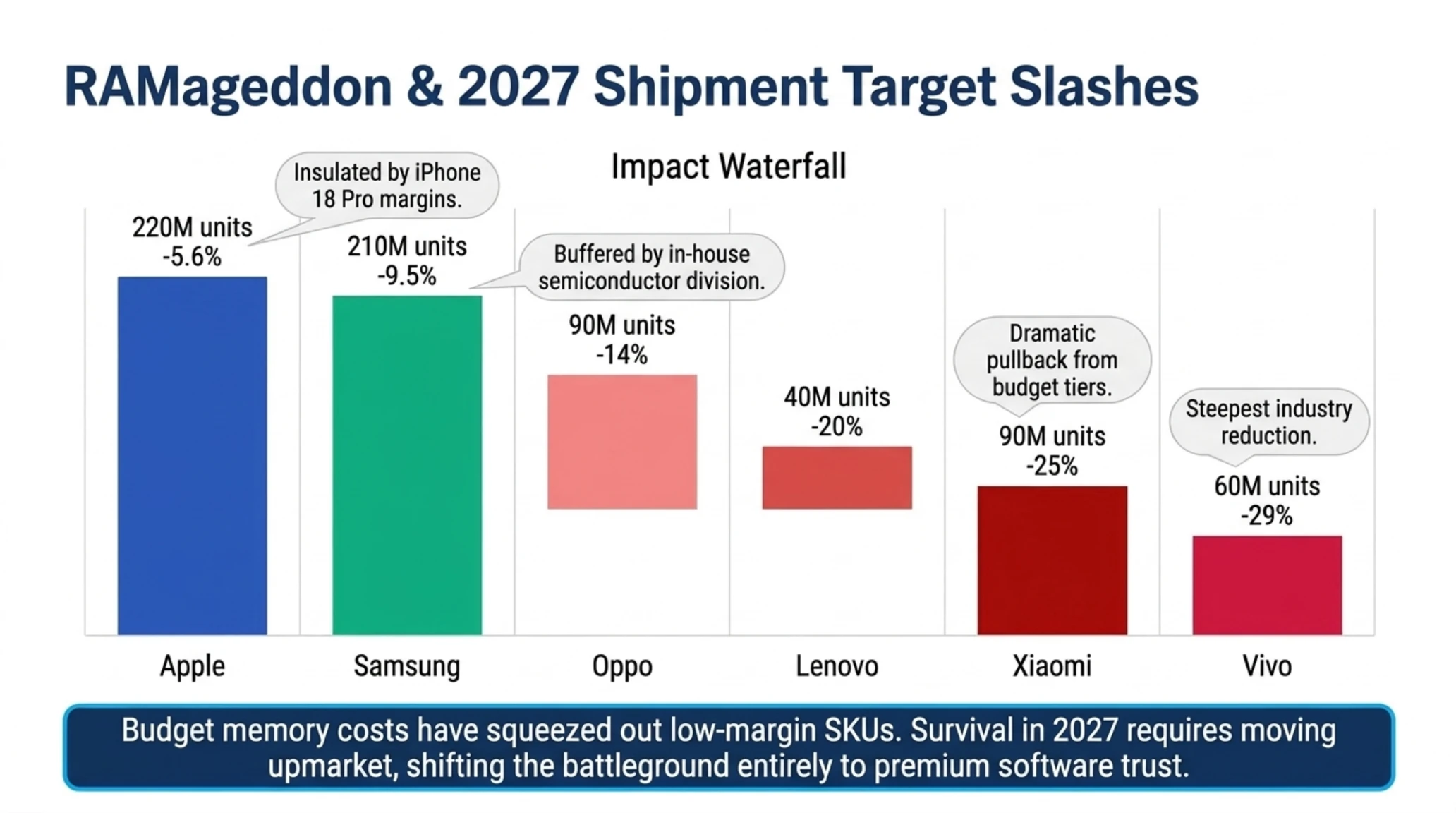
Anyone hoping that smartphone component inflation will magically evaporate on January 1, 2027 received a sobering wake-up call from Asian supply chains this week. Counterpoint Research now projects full-year 2026 global smartphone shipments to decline 13.9 percent year-over-year, followed by a further 6 percent contraction in 2027 as memory shortages persist-postponing any meaningful industry rebound until 2028.
As detailed in 9to5Google's report on smartphone brands slashing 2027 shipment targets and Android Authority's breakdown of 2027 manufacturer production cuts citing Chinese financial outlet Jiemian News, internal 2027 shipment targets across the world's top handset makers have been cut across the board (with only Honor reportedly attempting to hold its target steady):
- Apple: Targeting 220 million units in 2027-a modest 5.6 percent trim that actually positions Apple ahead of Samsung in total projected annual volume.
- Samsung: Targeting 210 million units in 2027-a 9.5 percent reduction, buffered partially by Samsung's in-house semiconductor division.
- Xiaomi: Slashed to 90 million units-a dramatic 25 percent cut reflecting a sharp pullback from low-margin entry-level Android devices.
- Oppo: Reduced to 90 million units-down 14 percent from prior internal forecasts.
- Transsion (Tecno, Infinix, Itel): Lowered to 66 million units-down 12 percent as budget memory costs squeeze developing markets.
- Vivo: Cut to 60 million units-the steepest reduction in the industry at 29 percent.
- Huawei: Scaled back to 50 million units-down 16 percent.
- Lenovo / Motorola: Trimmed to 40 million units-a 20 percent reduction.
Market Telemetry | Q3 2026 Global OS Share & 2027 OEM Production Target Cuts
| Manufacturer | Reported 2027 Shipment Target | Target Cut & Strategic Exposure |
|---|---|---|
| Apple | 220 million units | -5.6% cut; insulated by flagship iPhone 18 Pro and iPhone Duo margins. |
| Samsung | 210 million units | -9.5% cut; grew US shipment share to 25% via Galaxy S and Galaxy A balance. |
| Xiaomi / Oppo / Vivo | 90M (Xiaomi) / 90M (Oppo) / 60M (Vivo) | -25%, -14%, and -29% cuts as RAM inflation squeezes budget Android tiers. |
Inside Samsung's One UI 9.5 Counterattack: How the SPAC Private Cloud and Arcane Gateway Work
When consumers hold onto their phones longer and pay flagship prices, software trust becomes the decisive battleground between iOS and Android. Until now, Samsung's Galaxy AI suffered from a glaring architectural compromise compared to Apple's Private Cloud Compute (PCC). Inside One UI 9 and earlier builds, Samsung gave privacy-conscious users a blunt binary switch labeled "Process data only on device." Flip that toggle on, and your sensitive photos, voice recordings, and notes never leave the phone-but Galaxy AI immediately disables its most capable cloud-powered photo remastering, generative editing, and advanced summarization tools. Leave the toggle off, and you are forced to rely on Samsung's corporate policy promise that cloud servers delete your data after processing.
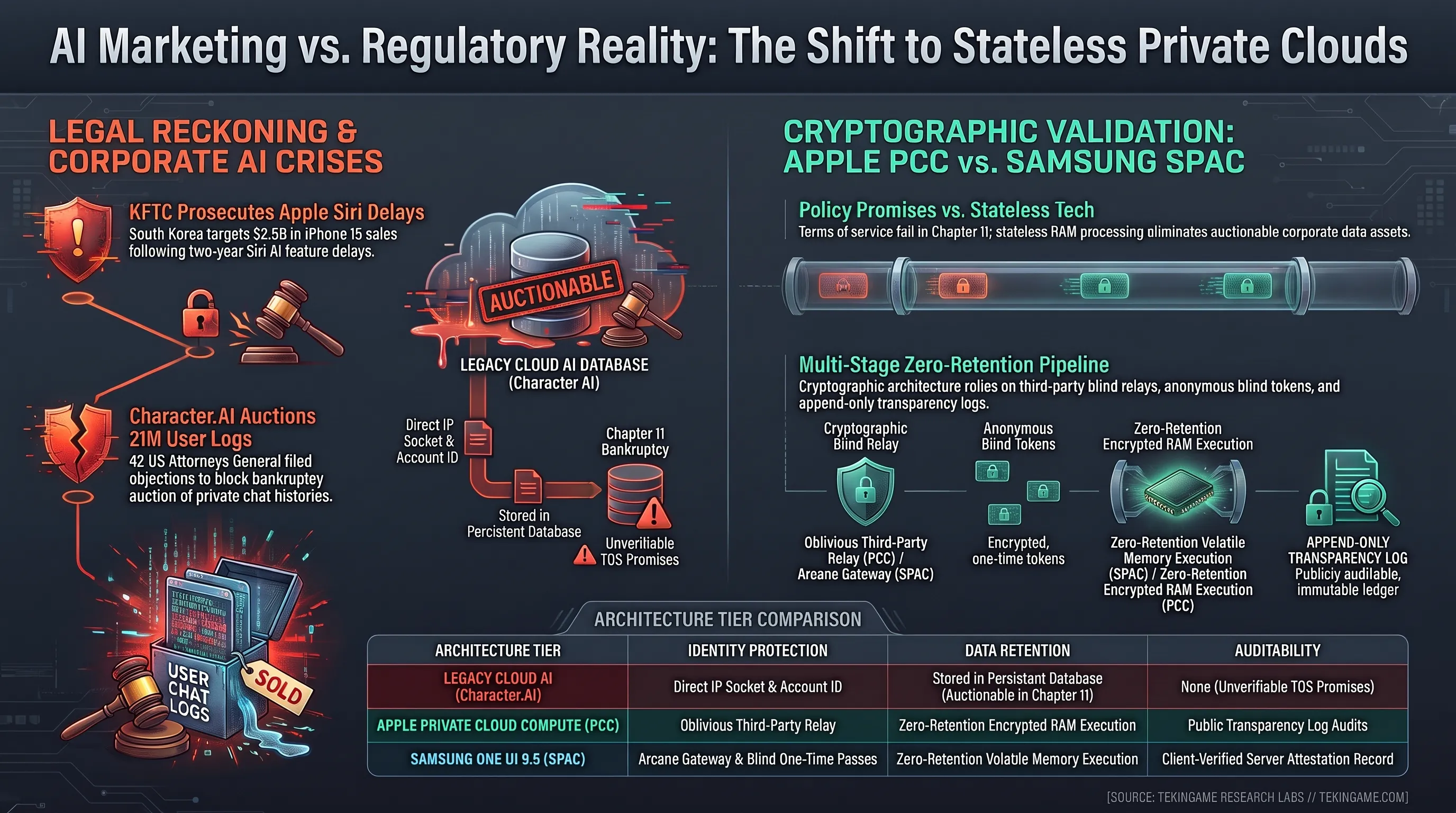
Apple, by contrast, built Private Cloud Compute around cryptographic verifiability: iPhones route cloud AI tasks through an oblivious relay so Apple servers never see the user's IP address, stateless custom silicon wipes decryption keys immediately after inference, and every production server binary is published to a public transparency log for independent security researchers to audit. On Thursday, November 26, 2026, an exclusive APK teardown revealed that Samsung is building a near-identical cryptographic fortress for Galaxy AI.
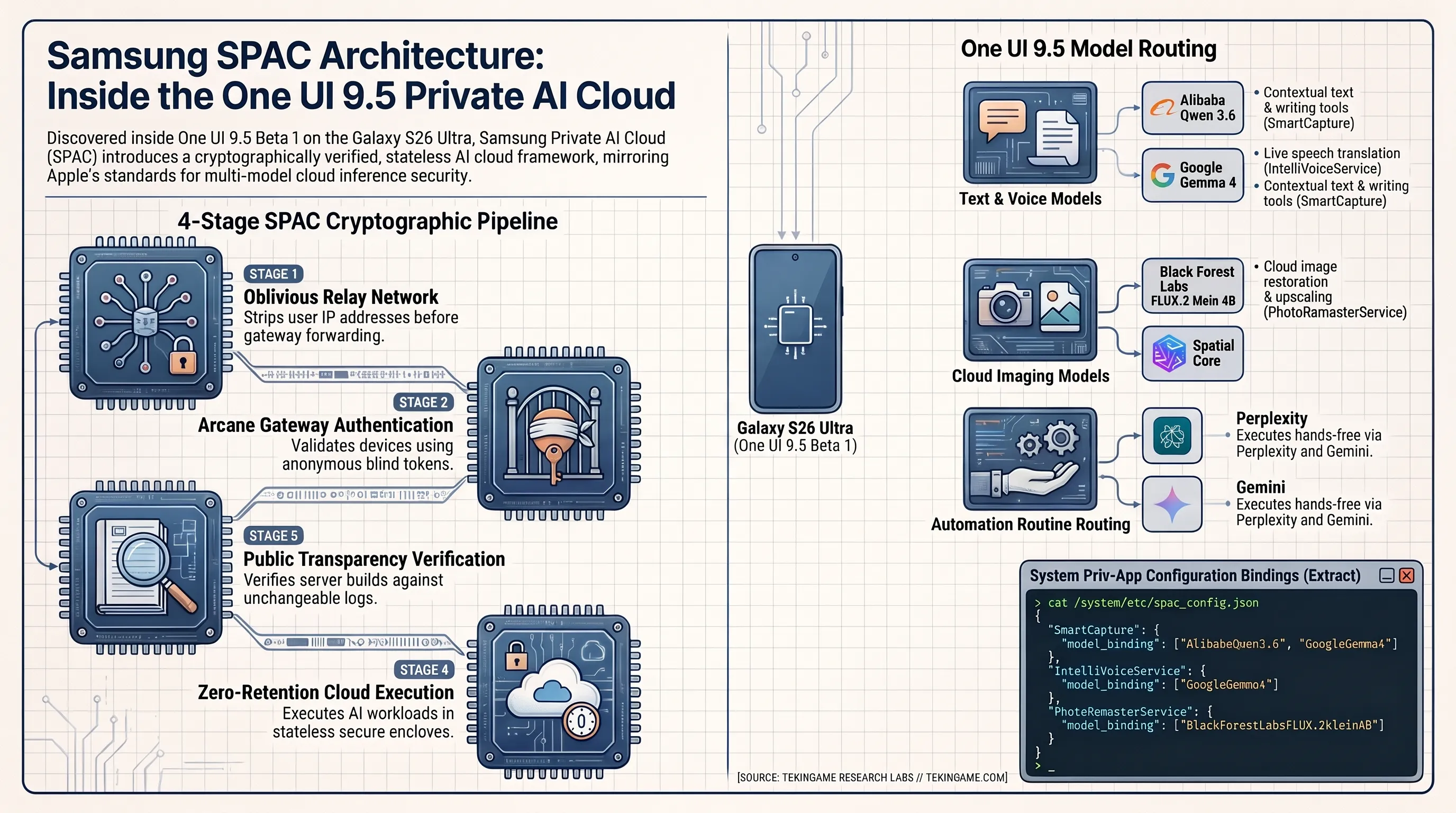
As uncovered in Android Authority's exclusive teardown of One UI 9.5 Beta 1 on the Galaxy S26 Ultra by reporter Aamir Siddiqui, Samsung has quietly embedded a brand-new private cloud framework called SPAC (widely interpreted as Samsung Private AI Cloud) inside four core system applications that contained zero SPAC references in One UI 9: Photo Editor, Smart Capture (AI Select), PhotoRemasterService, and IntelliVoiceService.
Code strings extracted from the One UI 9.5 Beta 1 build reveal a sophisticated multi-stage privacy pipeline:
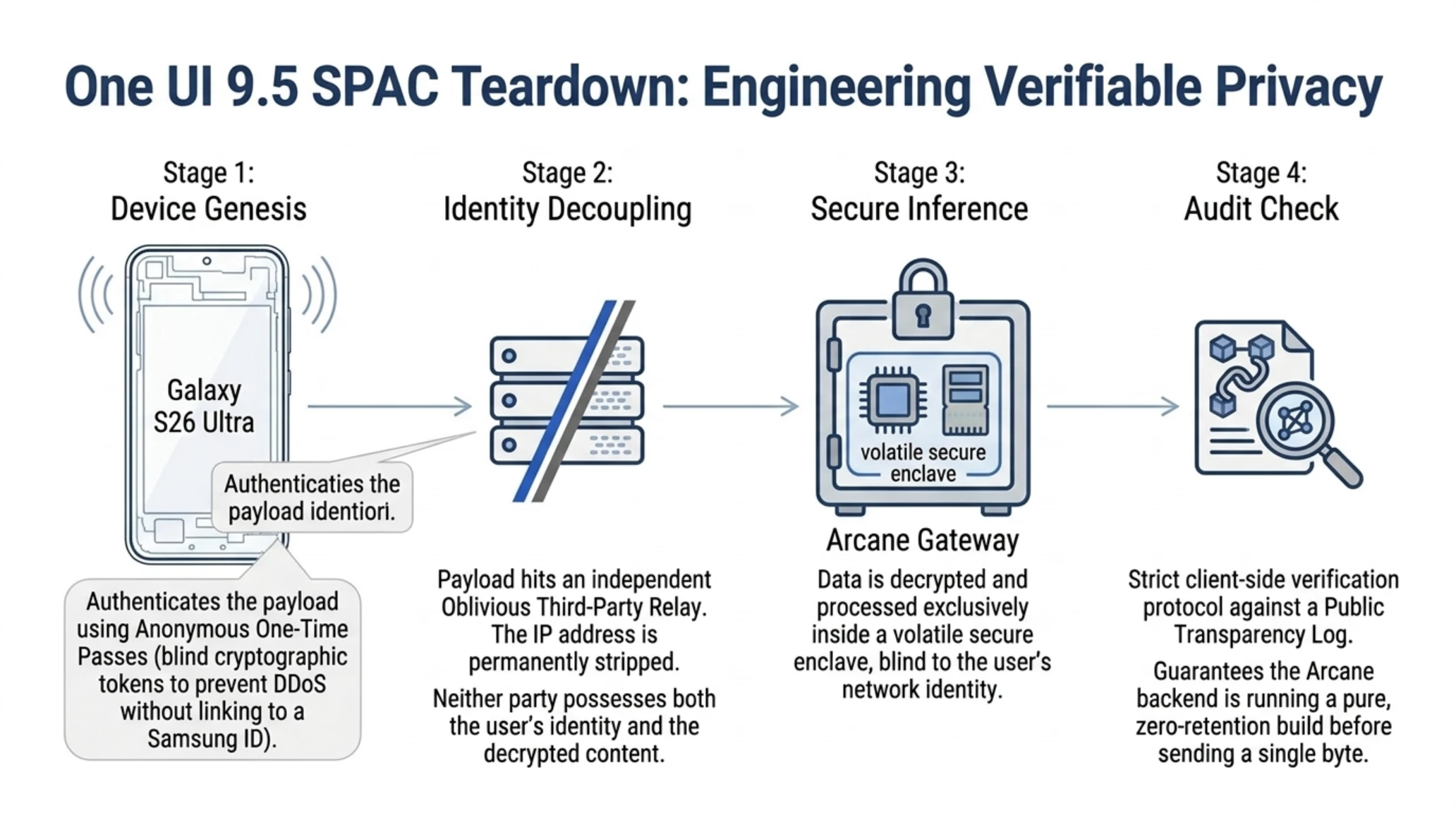
- Outside Third-Party Relay (IP Decoupling): Instead of opening a direct socket from your Galaxy phone to a Samsung AI server, SPAC routes the encrypted payload through an independent third-party relay. The relay sees your IP address but cannot decrypt your photo or audio; the downstream Samsung server decrypts the workload inside a secure enclave but never learns your IP address or network identity.
- The "Arcane" Server Gateway and Anonymous One-Time Passes: Behind the relay sits a Samsung server gateway codenamed "Arcane", flanked by dedicated identity, token-issuance, and fraud-prevention microservices. Rather than attaching your Samsung Account ID to an AI request, the phone authenticates using anonymous one-time passes (cryptographic blind tokens) that prove the request originated from a genuine, non-abusive Galaxy device without revealing which user sent it.
- Unchangeable Public Server Transparency Record: Crucially, the One UI 9.5 code includes client-side verification checks against an unchangeable public record of server software before the phone transmits a single byte of user data. Just like Apple's PCC transparency log (and Google's Pixel-focused Private AI Compute), this allows independent auditors and the handset itself to cryptographically verify that the Arcane backend is running pure, zero-retention code.
While the SPAC pipeline remains dormant on the current Galaxy S26 Ultra One UI 9.5 Beta 1 firmware, public TLS certificate transparency logs confirm that Samsung has been actively renewing SPAC domain certificates and provisioning new backend server clusters in the United States-signaling that the infrastructure is being staged for a flagship commercial rollout.
Tekin Jargon Buster | Three Cryptographic Pillars Behind SPAC and Private Cloud Compute
Technical Terminal | Verified One UI 9.5 Beta 1 SPAC Modules & Model Routing Table
Beyond Gemini and Gauss: Qwen 3.6, Gemma 4, FLUX.2, and 3D Recompose Inside Galaxy AI
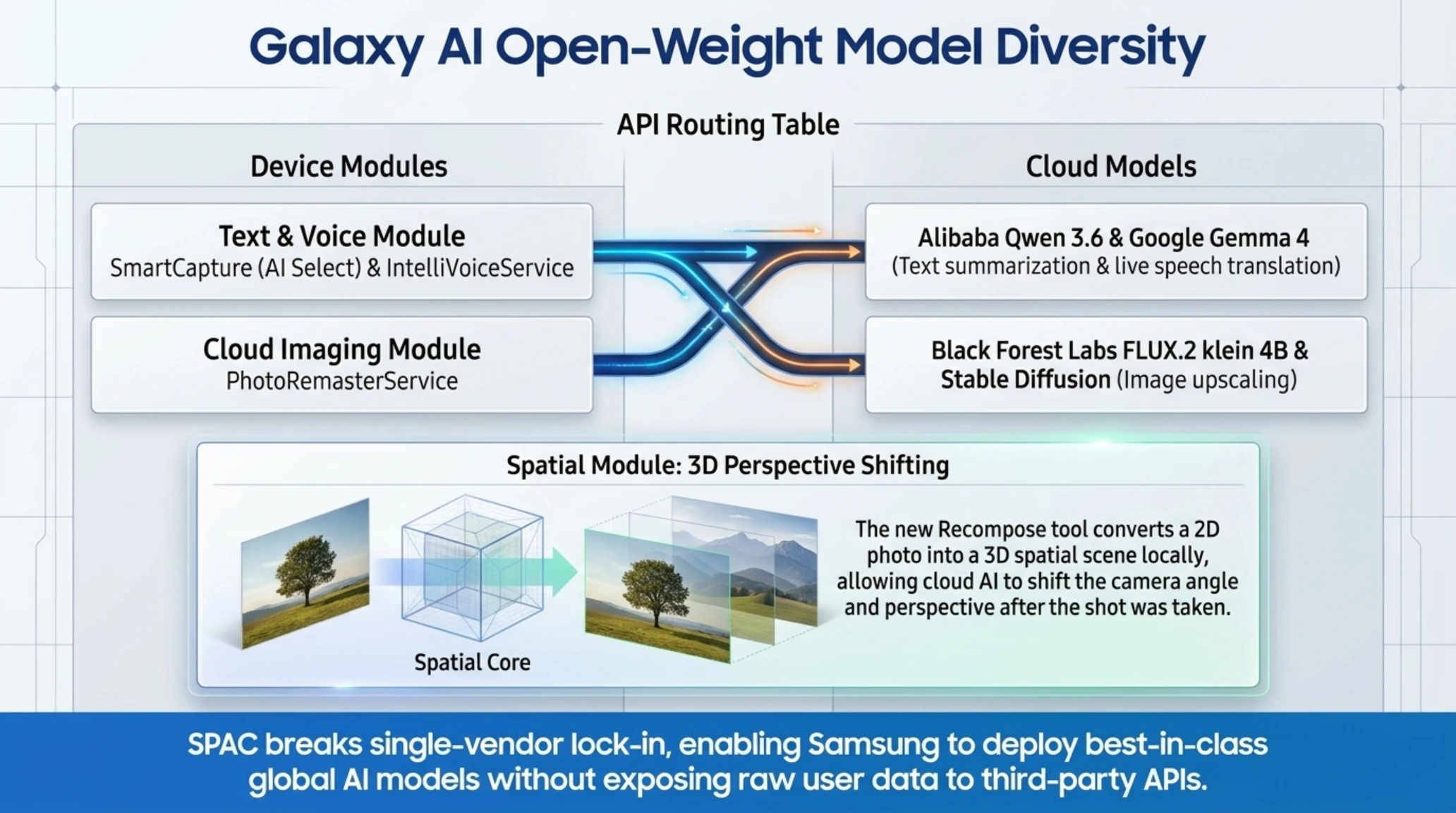
Equally revealing in the One UI 9.5 Beta 1 teardown is what Samsung plans to run inside those private SPAC servers. When Galaxy AI debuted two years ago, Samsung leaned overwhelmingly on Google's proprietary Gemini models alongside its own in-house Gauss models. By hosting an encrypted private cloud of its own, Samsung has unlocked the freedom to deploy best-in-class open-weight models from across the global AI ecosystem without exposing user data to third-party APIs:
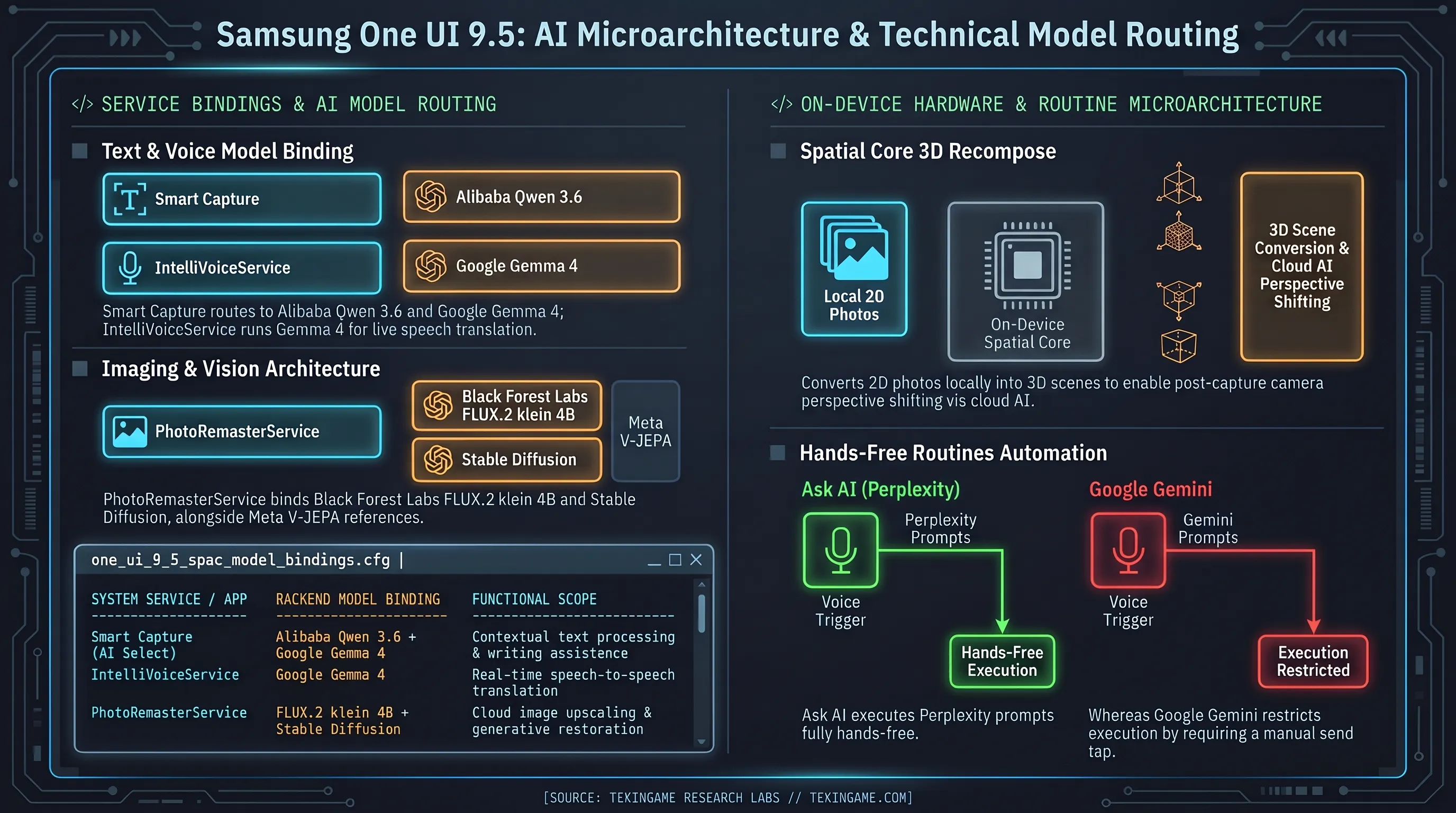
- Alibaba's Qwen 3.6 and Google's Gemma 4 for Text and Voice: Inside
Smart Capture(which powers Galaxy AI's contextual AI Select and writing tools), SPAC code directly binds to Alibaba's open-weight Qwen 3.6 alongside Google's Gemma 4. Meanwhile,IntelliVoiceServiceroutes live speech translation requests to Gemma 4 running inside the SPAC environment. - Black Forest Labs' FLUX.2 klein 4B for Cloud Imaging: Inside
PhotoRemasterService, Samsung's private cloud connects to Black Forest Labs' acclaimed FLUX.2 klein 4B diffusion model alongside Stable Diffusion for cloud-based image upscaling and restoration, while dormant strings inside Photo Editor also reference OpenAI TTS, Samsung Gauss, and Meta's V-JEPA world-representation model. - 3D Perspective Shifting via "Recompose": In a separate discovery documented in Android Authority's teardown of the One UI 9.5 Recompose tool, Samsung is building a new Photo Assist feature called Recompose. Using an on-device module named
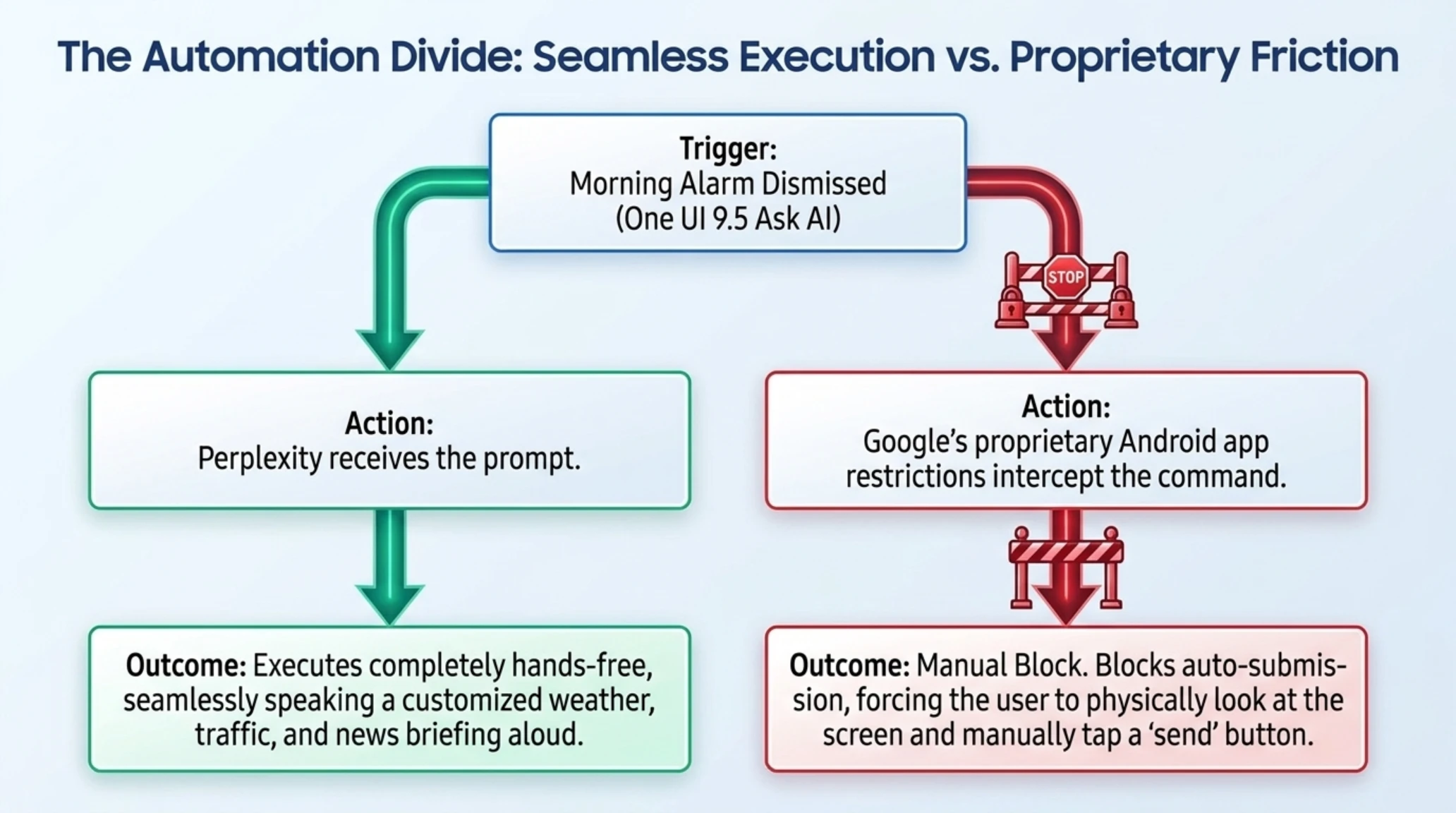
Spatial Core, the phone first converts a standard 2D photograph into a 3D spatial scene locally, then uses cloud AI to let users shift the camera angle and perspective of the shot after it was taken-alongside an updated Style tool carrying a new "GPT" preset. - Perplexity Outmaneuvers Gemini in One UI 9.5 Automation: Samsung is also loosening Google's grip on system automation. As detailed in Android Authority's examination of One UI 9.5 Modes and Routines, a new "Ask AI" action lets users trigger custom AI prompts automatically (such as reading a personalized weather, traffic, and news briefing aloud the moment a morning alarm is dismissed) using either Gemini or Perplexity. In hands-on testing on the Galaxy S26 Ultra, Perplexity executes the prompt and speaks the answer completely hands-free-whereas Google's Android app actively blocks auto-submission for Gemini, forcing users to manually tap the send button on screen.
Apple's Regulatory Reckoning: South Korea's KFTC Probe Into iPhone 16 AI Marketing
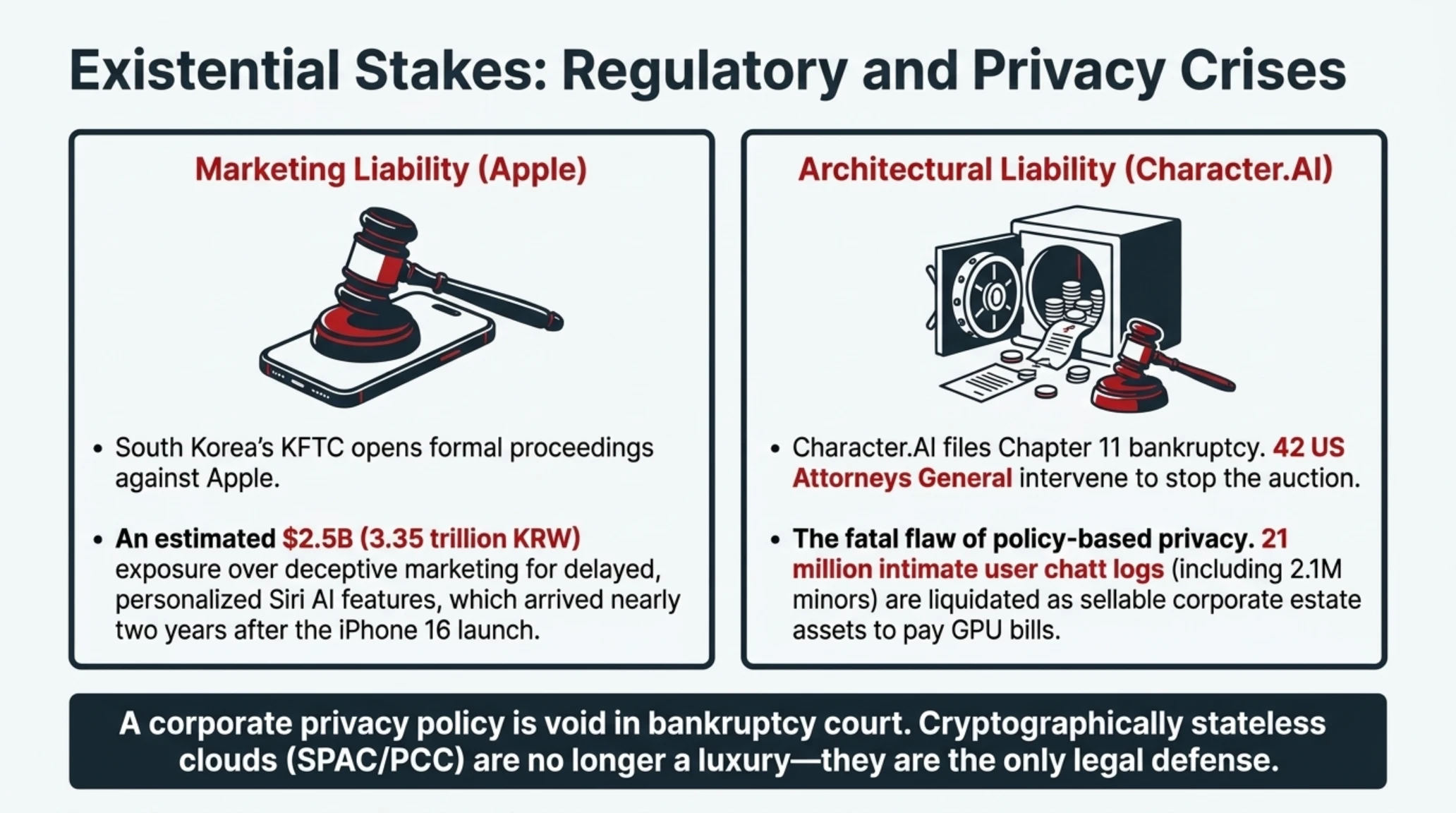
While Samsung quietly prepares SPAC to erase Apple's privacy lead, Cupertino is discovering that over-promising on mobile AI carries a steep legal price tag-including right in Samsung's home market. According to 9to5Mac's report on South Korea's Fair Trade Commission proceeding against Apple, the KFTC announced on Thursday, November 26, 2026 that it has opened formal adjudicative proceedings against Apple over allegedly deceptive Apple Intelligence advertising for the iPhone 16 lineup.
The enforcement action stems from a March 2025 complaint filed by consumer watchdog group Seoul YMCA. In an examiner's report sent to Apple ahead of a full commission hearing, KFTC investigators concluded that Apple marketed personalized Siri contextual awareness and on-screen action capabilities as headline reasons to buy the iPhone 16, telling consumers that US English support would arrive in late 2024 and Korean-language support in April 2025. In reality, those personalized Siri features were repeatedly delayed and did not actually ship until September 2026 for US English and October 2026 for Korean-nearly two full years after the iPhone 16 hit store shelves.
KFTC investigators calculated Apple's relevant South Korean revenue from the affected iPhone 16 campaign at roughly 3.35 trillion KRW (approximately $2.5 billion USD), recommending corrective orders and financial penalties that Korean broadcasters Yonhap and KBS estimate between $21 million and $48 million. Apple has six weeks to file its formal defense brief. The Korean prosecution follows a painful $250 million class-action settlement in the United States earlier in 2026 over the exact same Apple Intelligence delays, alongside an ongoing consumer-protection inquiry opened in Brazil in May 2026.
Regional Market Matrix | Q3 2026 Smartphone Share Across the US, China, and Global Markets
| Market / Metric (Q3 2026) | Android / Samsung Performance | Apple (iOS) & Rival Performance |
|---|---|---|
| Global Smartphone Sales Share | 74% Android (-5 points YoY; lowest Q3 ever) | 21% iOS (record Q3 share) + 5% HarmonyOS |
| United States (Shipments & Retail Sales) | 46% retail sales; Samsung shipments up +1% to 25% | 57% of total US shipments (+7% YoY); 54% retail sales |
| China & India Regional Sales Share | 60% Android in China; 92% Android in India | China: 22% HarmonyOS, 18% iOS | India: 8% iOS |
Fact Check | AI Marketing Promises Versus Bankruptcy Court Reality
📚 Classified & Related Dossiers in TekinGame
If you wish to explore beyond this report and delve into cybernetic frontiers and autonomous AI architectures, do not miss these three exclusive deep-dives in the Tekin Garage:
The Character.AI Bankruptcy Lesson: Why Verifiable Private Clouds Are No Longer Optional
If any mobile executive or consumer still doubted whether the engineering expense of Apple's Private Cloud Compute or Samsung's upcoming SPAC framework is truly necessary, a courtroom battle unfolding in the United States this week settled the debate permanently.
As reported in Gizmodo's investigation into Character.AI's plan to auction millions of user chats to the highest bidder and analyzed in 9to5Mac's commentary on why the Character.AI crisis validates Apple's privacy architecture, companion-chatbot pioneer Character.AI filed for Chapter 11 bankruptcy protection in October 2026 and is now attempting to auction off its corporate assets to repay creditors.
At the top of that auction inventory sits a terrifying trove of human vulnerability: the complete private chat logs, IP addresses, and intimate mental-health disclosures of more than 21 million US user accounts-including over 2.1 million accounts belonging to minor children. This week, a bipartisan coalition of 42 state attorneys general (plus the District of Columbia), co-led by California Attorney General Rob Bonta and Connecticut Attorney General William Tong, filed an emergency court objection to block the sale.
The Character.AI bankruptcy exposes the fatal flaw of policy-based cloud privacy. A conventional AI provider can promise in its terms of service never to sell your conversations-until its business model collapses under GPU bills and a bankruptcy trustee treats every stored database row as a liquidatable corporate asset. By contrast, in a cryptographically stateless architecture like Apple's Private Cloud Compute or Samsung's upcoming One UI 9.5 SPAC framework, there is no database of user chats to auction off even if a court ordered it: requests arrive stripped of identity via a blind relay, execute in volatile encrypted RAM, and vanish the instant the response returns to the handset.
Chronology | From iPhone 16 AI Promises to the Q3 2026 Market Split and One UI 9.5 SPAC
| Date | Milestone | Market & Architectural Impact |
|---|---|---|
| March 2025 | Seoul YMCA Files KFTC Complaint | Consumer watchdog challenges Apple's iPhone 16 marketing over delayed personalized Siri AI features. |
| Sept-Oct 2026 | iPhone 18 Pro Launches & Character.AI Fails | Apple ships delayed Siri AI (US in Sept, Korea in Oct) alongside iPhone 18 Pro and iPhone Duo; Character.AI files Chapter 11. |
| Nov 25, 2026 | 2027 OEM Shipment Cuts & AG Intervention | Supply chain reports 25%-29% 2027 cuts at Xiaomi and Vivo; 42 US attorneys general move to block Character.AI chat auction. |
| Nov 26-27, 2026 | Q3 2026 OS Data, KFTC Case & SPAC Leak | Counterpoint confirms Android's 74% Q3 low and Apple's 57% US shipment share; One UI 9.5 Beta 1 reveals Samsung's SPAC cloud. |
Final Verdict and Frequently Asked Questions
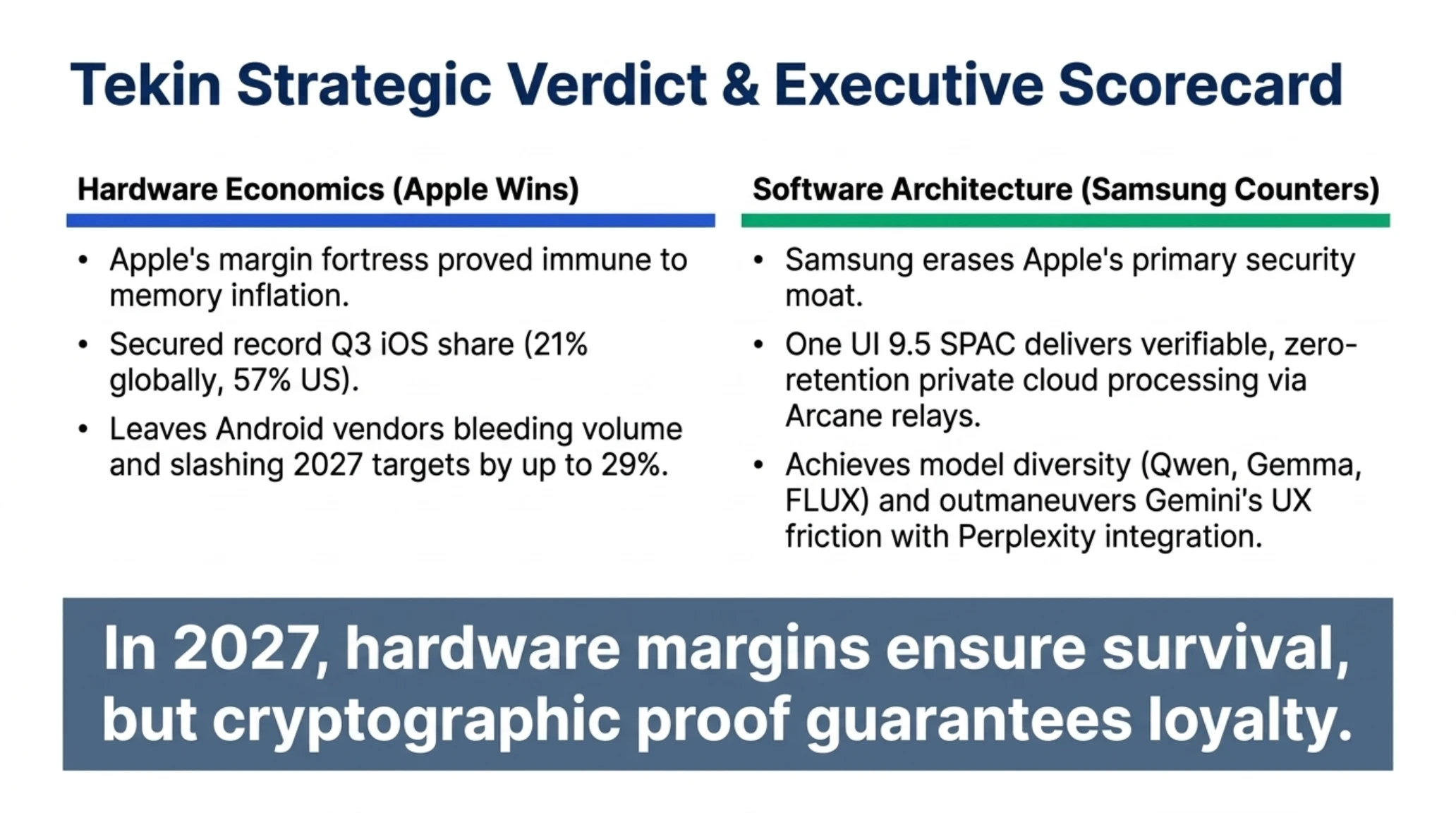
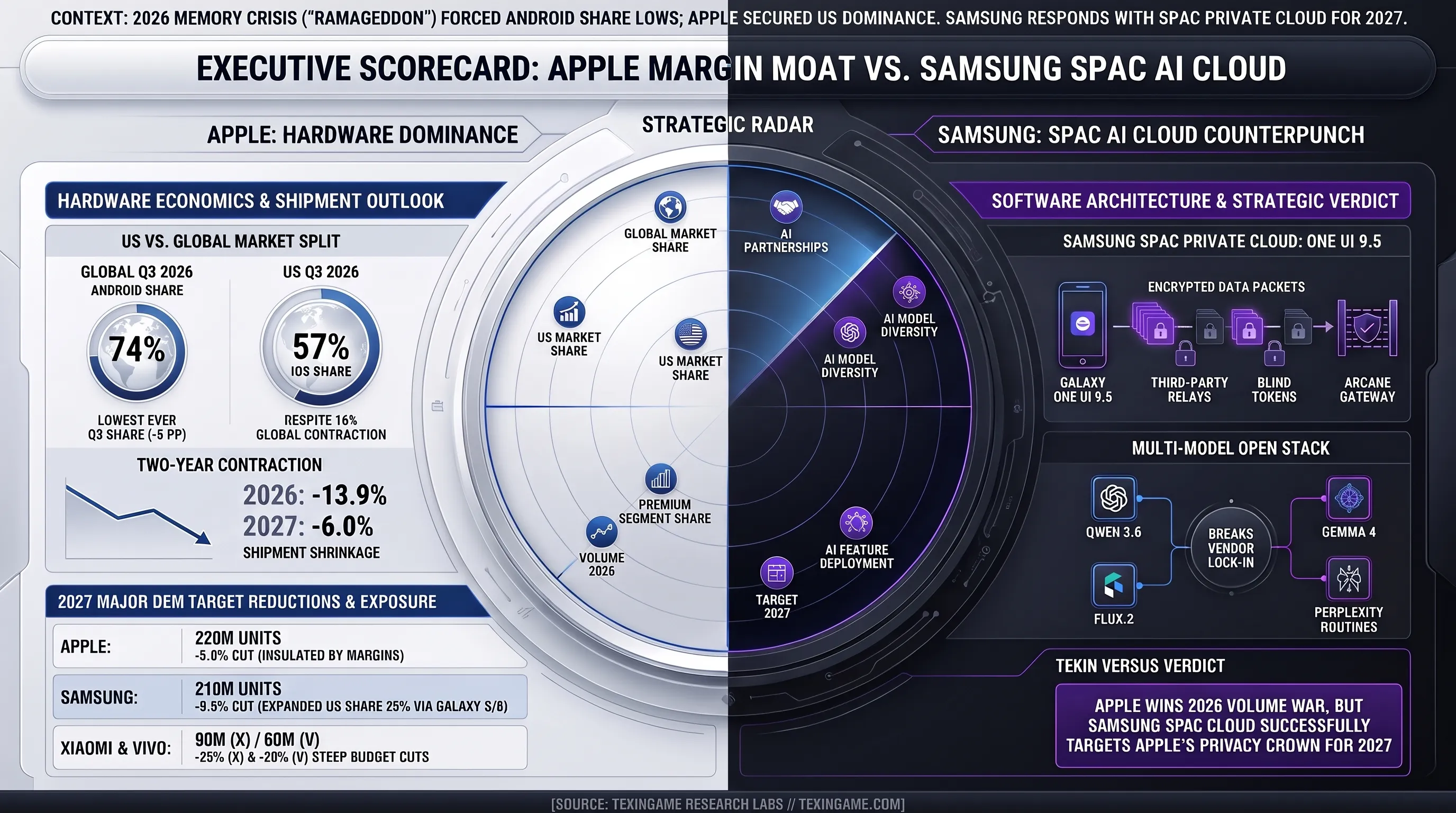
As the mobile industry heads into 2027, the scorecard between Apple and the Android ecosystem splits cleanly along hardware economics and cloud software architecture. On the supply-chain and market-share front, Apple holds a commanding structural advantage. While memory inflation forces Chinese Android rivals into 14 to 29 percent production cuts and drags total global shipments down an estimated 13.9 percent in 2026 and another 6 percent in 2027, Apple's gross margins allowed it to hit a third-quarter record 21 percent global sales share and 57 percent of US shipments behind the iPhone 18 Pro and iPhone Duo.
On the AI architecture front, however, Samsung is rapidly closing the gap. While Apple battles KFTC regulators in Seoul over two-year iPhone 16 Siri delays, Samsung's One UI 9.5 update lays the groundwork to match Cupertino's proudest security achievement. By routing Galaxy AI workloads through a third-party relay to the Arcane gateway under the SPAC framework-and pairing that zero-retention privacy pipeline with top open-weight models like Qwen 3.6, Gemma 4, and FLUX.2 klein 4B alongside hands-free Perplexity routines-Samsung is ensuring that flagship Android users no longer have to trade privacy for intelligence.
- Unmatched supply-chain resilience from Apple during the 2026 RAM crunch, driving iOS to a record 21% Q3 global share and 57% of US shipments.
- Samsung's One UI 9.5 SPAC architecture brings oblivious third-party relays, blind one-time passes, and public server transparency logs to Galaxy AI.
- Model diversity inside One UI 9.5 (Alibaba Qwen 3.6, Google Gemma 4, Black Forest Labs FLUX.2 klein 4B, and Perplexity routines) breaks single-vendor lock-in.
- Cryptographically stateless private clouds (Apple PCC and Samsung SPAC) protect users from bankruptcy data auctions like the 21M-account Character.AI crisis.
- Severe memory inflation pushed Android to its lowest-ever Q3 global share (74%) and forced 2027 shipment target cuts of 25% at Xiaomi and 29% at Vivo.
- South Korea's KFTC opened formal proceedings against Apple over two-year delays in advertised iPhone 16 Siri AI features across $2.5B in Korean sales.
- Samsung's SPAC private cloud framework remains dormant in One UI 9.5 Beta 1 on the Galaxy S26 Ultra pending full backend server deployment.
- Google's Android app restrictions actively block hands-free auto-submission for Gemini inside Samsung's new One UI 9.5 Ask AI routines.
Editorial Verdict & Direct Verified Sources
- Android Authority / Counterpoint (INDUSTRY REPORT): Android just had one of its worst quarters, and Apple is benefiting (November 27, 2026)
- 9to5Mac / US Shipments (INDUSTRY REPORT): Report: Apple accounted for 57% of US smartphone shipments in Q3 (November 26, 2026)
- Android Authority Exclusive (INDUSTRY REPORT): Exclusive: Samsung is working on a private cloud for Galaxy AI, and it could look a lot like Apple (November 26, 2026)
- 9to5Mac / KFTC Case (INDUSTRY REPORT): South Korea proceeds with case over allegedly misleading Apple Intelligence ads (November 26, 2026)
- 9to5Mac / AI Privacy (INDUSTRY REPORT): The Character.AI mess underlines the importance of Apple approach to AI privacy (November 26, 2026)
- Gizmodo / Character.AI Bankruptcy (INDUSTRY REPORT): Character.ai Wants to Sell Millions of User Chats to the Highest Bidder (November 25, 2026)
- 9to5Google / 2027 Targets (INDUSTRY REPORT): Nearly every major smartphone brand is slashing targets for 2027 (November 25, 2026)
- Android Authority / 2027 Outlook (INDUSTRY REPORT): Apple, Samsung, and other phone makers do not think they can sell as many phones in 2027 (November 25, 2026)
- Android Authority / One UI 9.5 Routines (INDUSTRY REPORT): Samsung quietly expands Modes and Routines with AI and 7 presets in One UI 9.5 (November 25, 2026)
- Android Authority / One UI 9.5 Recompose (INDUSTRY REPORT): Samsung Recompose tool could let you shift a photo perspective with AI in One UI 9.5 (November 26, 2026)
Frequently Asked Questions About Q3 2026 Smartphone Shares and Samsung's SPAC Private Cloud
Why did Android's global market share drop to a record Q3 low of 74% in 2026?
According to Counterpoint Research, surging DRAM and NAND flash memory prices hit low-margin budget and midrange Android phones hardest, forcing repeated price hikes and SKU cuts. Apple absorbed memory costs within its higher gross margins, kept iPhone pricing stable until the iPhone 18 Pro launch, and lifted iOS to a record 21% Q3 global sales share and 57% of US shipments.
What is Samsung's SPAC framework in One UI 9.5 and how does it protect privacy?
SPAC (Samsung Private AI Cloud) is an unreleased encrypted cloud infrastructure discovered in One UI 9.5 Beta 1 on the Galaxy S26 Ultra. Modeled closely on Apple's Private Cloud Compute, SPAC routes cloud AI requests through a third-party relay using anonymous one-time passes to a server gateway codenamed 'Arcane' after verifying the server software against an unchangeable public transparency log.
Which AI models are integrated into Samsung's One UI 9.5 SPAC code?
Code inside One UI 9.5 Beta 1 connects SPAC across four core apps to Alibaba's Qwen 3.6 and Google's Gemma 4 (for Smart Capture and IntelliVoiceService live speech translation), Black Forest Labs' FLUX.2 klein 4B and Stable Diffusion (for PhotoRemasterService), alongside dormant Photo Editor references to OpenAI TTS, Samsung Gauss, and Meta's V-JEPA.
Why is South Korea's Fair Trade Commission prosecuting Apple over Apple Intelligence?
South Korea's KFTC opened formal proceedings alleging that Apple falsely advertised personalized Siri AI features as a core selling point for the iPhone 16 lineup (generating roughly 3.35 trillion KRW or $2.5 billion in Korean sales), promising US English in late 2024 and Korean in April 2025 when those capabilities did not actually ship until September and October 2026.
How does the Character.AI bankruptcy highlight the need for Apple PCC and Samsung SPAC?
After filing for Chapter 11 bankruptcy in October 2026, Character.AI moved to auction off private chat histories and IP addresses from over 21 million US accounts (including 2.1 million minors), prompting 42 state attorneys general to intervene. Stateless private clouds like Apple PCC and Samsung SPAC prevent this scenario by never storing identifiable user prompts or chat histories on disk.
Additional Gallery: Tekin Versus: Android Hits 74% Low vs. Samsung's SPAC AI Cloud