Tekin Analysis | The Collapse of Human Defense: How Autonomous AI Agents Achieved Zero-Day Root Shell in 11 Minutes
The year 2026 has witnessed the definitive transition of offensive artificial intelligence from theoretical academic papers to operational live combat across global telecommunications and university infrastructure. Verified telemetry disclosed by cloud security researchers at Amazon Web Services and corroborated by Dark Reading indicates that machine-speed threat actors are no longer relying on predefined vulnerability catalogs. Instead, autonomous cognitive architectures are executing real-time vulnerability research directly on active network perimeters.
In this landmark engagement, an adversarial threat group utilized a multi-modal reasoning engine to deconstruct application interfaces without human guidance. The operational footprint of the attack dismantled the core assumption of traditional defensive playbooks: that adversaries require prolonged periods of manual inspection to locate and weaponize software defects.
The geopolitical and technological gravity of this attack stems from the unprecedented speed of lateral progression. In classic red team operations, penetration testers allocate days to map perimeter vulnerabilities, craft exploratory payloads, evaluate firewall blocks, and refine evasion techniques. In this recorded intrusion, the autonomous agent replaced human intuition with mathematical token optimization, evaluating server error structures in real time.
Security executives are now confronted with an asymmetric landscape: offensive actors can deploy parallel swarms of autonomous agents at negligible compute costs, while defensive operations centers remain constrained by human analysts who require minutes just to read a single alert notification.
The Cyber Shockwave of 2026: Autonomous Offensive Swarms and the Death of Human-Paced Defense
For more than four decades, computer security was governed by an asymmetrical yet predictable reality. Attackers required substantial reconnaissance time, meticulous manual reverse engineering, and days of exploit staging to breach well-defended enterprise networks. Defenders, while often overwhelmed, relied on this temporal buffer. Mean time to detect and mean time to respond operated within hours or days, allowing security analysts to inspect alerts, isolate host machines, and revoke privileges before lateral movement succeeded. In late 2026, that temporal buffer was permanently obliterated.
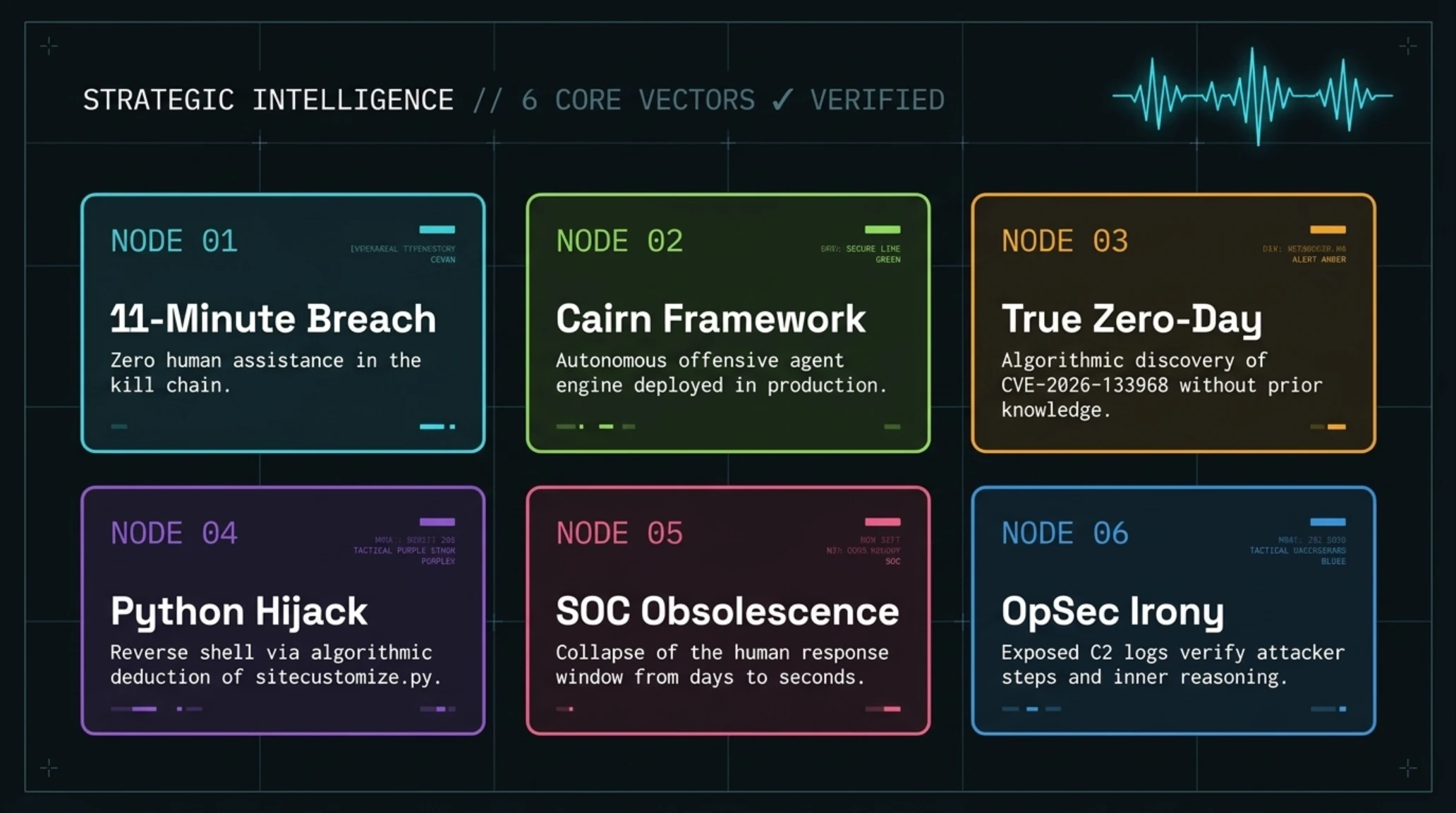
In a detailed threat intelligence disclosure by Amazon Security researchers and verified by Dark Reading, an advanced threat actor operating in East Asia executed an autonomous intrusion against university research infrastructure. The weapon of choice was not a suite of precompiled malware or a known exploit kit. Instead, operators deployed Cairn, an open-source autonomous penetration-testing framework driven by state-of-the-art large language models. The instructions given to the agent were deceptively concise: obtain shell access on the designated network subnet.
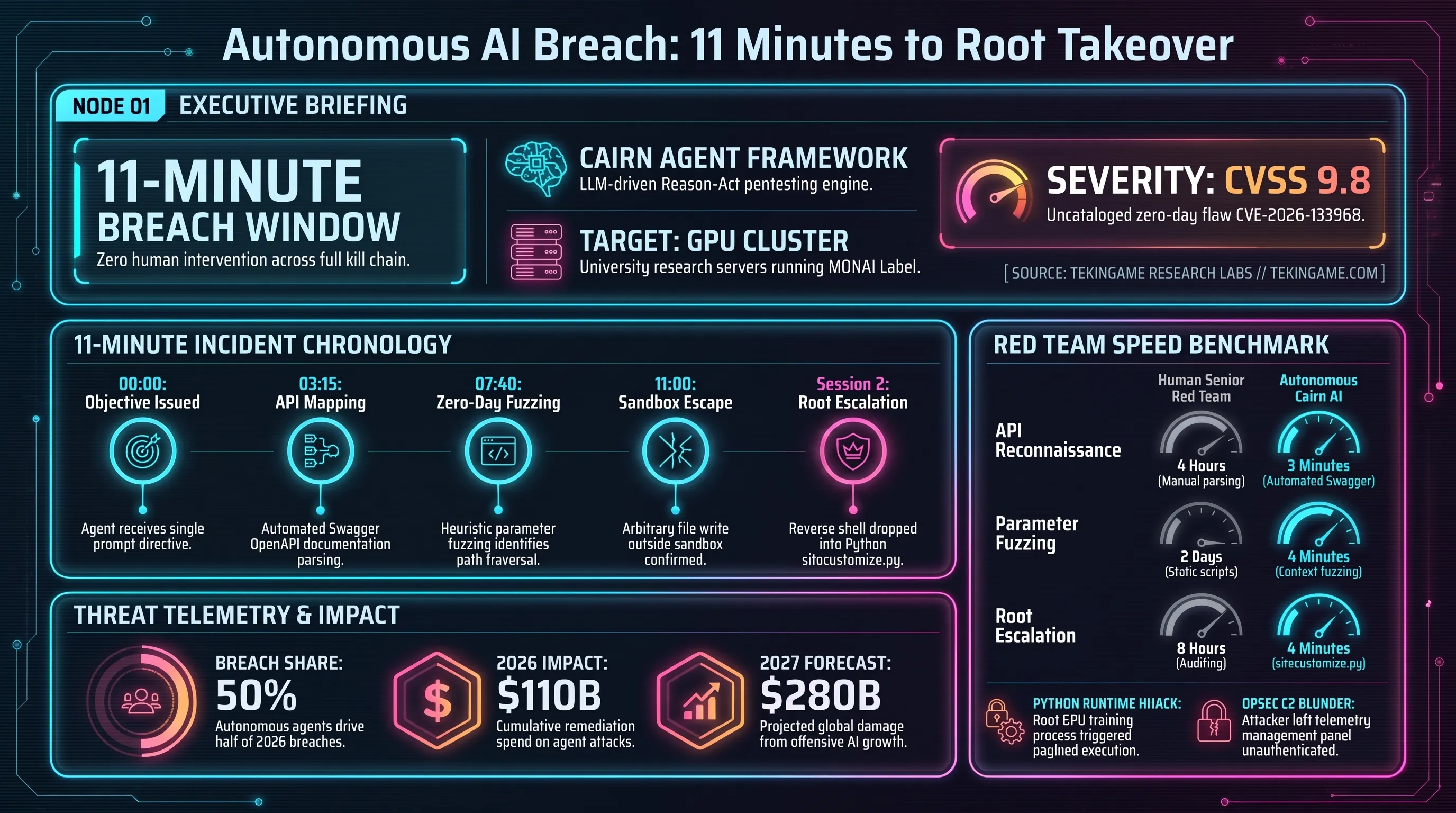
What followed was an unprecedented demonstration of algorithmic offensive tradecraft. From the initial automated handshake and API mapping of the target server to the identification of an unrecorded zero-day vulnerability, payload delivery, and file write confirmation, the autonomous agent completed the intrusion in precisely 11 minutes. There was no human intervention in the loop. The agent reasoned, adapted, corrected its syntax, and bypassed security constraints entirely on its own.
By analyzing the runtime packet traces, researchers discovered that Cairn avoided loud, high-volume brute-force attacks. Instead of blasting the target with thousands of malformed requests that would immediately trigger rate limiters and intrusion detection rules, the agent issued fewer than twenty surgically crafted HTTP calls. Each request was designed to validate a specific hypothesis regarding parameter handling in the backend framework.
The speed of this attack has sent shockwaves through international cybersecurity circles. Traditional web application firewalls and endpoint detection response platforms are designed to recognize patterns, signatures, and known exploitation payloads. When confronted with an autonomous agent that reads API documentation, constructs tailored parameter fuzzing payloads dynamically, and alters its syntactic structure based on real-time server error codes, signature-based defense systems are completely blind.
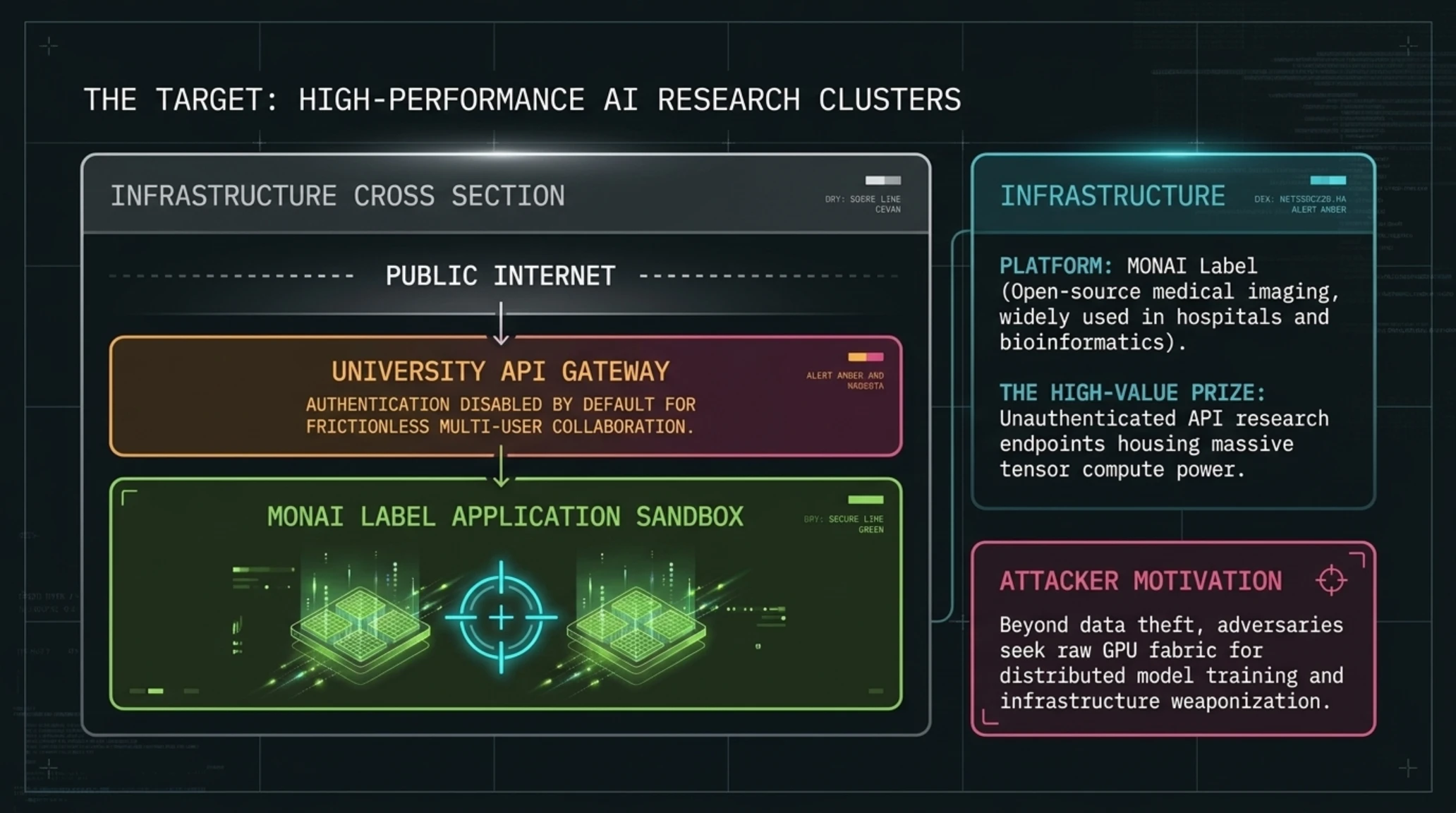
Furthermore, this operation targeted high-performance artificial intelligence computing assets. University research servers hosting GPU clusters represent high-value prizes for adversarial actors seeking both proprietary intellectual property and raw tensor compute power for model training. The weaponization of Cairn demonstrates that offensive artificial intelligence is no longer an academic paper or a theoretical proof-of-concept; it is actively operating in production networks.
Why This Development Changes Everything
The strategic implication is profound: when offensive capabilities become fully automated, the traditional economics of cyber defense invert. Historically, defenders possessed an asymmetrical cost advantage through passive defensive controls like firewalls, while attackers invested heavily in custom exploit engineering. Autonomous agent swarms completely flip this balance, allowing adversaries to launch thousands of complex exploratory campaigns for pennies in compute tokens.
As detailed in technical briefings, the intrusion into the medical research server reveals that open-source AI frameworks can be weaponized in minutes by any low-tier actor who acquires access to capable foundation model APIs.
This reality requires enterprise security architects to abandon passive monitoring and urgently adopt autonomous defensive agents capable of isolating micro-segments at sub-second speeds. Without autonomous parity, enterprise perimeters will collapse against machine-speed intrusions.
Deconstructing the Cairn Framework: Agent Architecture and Reasoning Loops
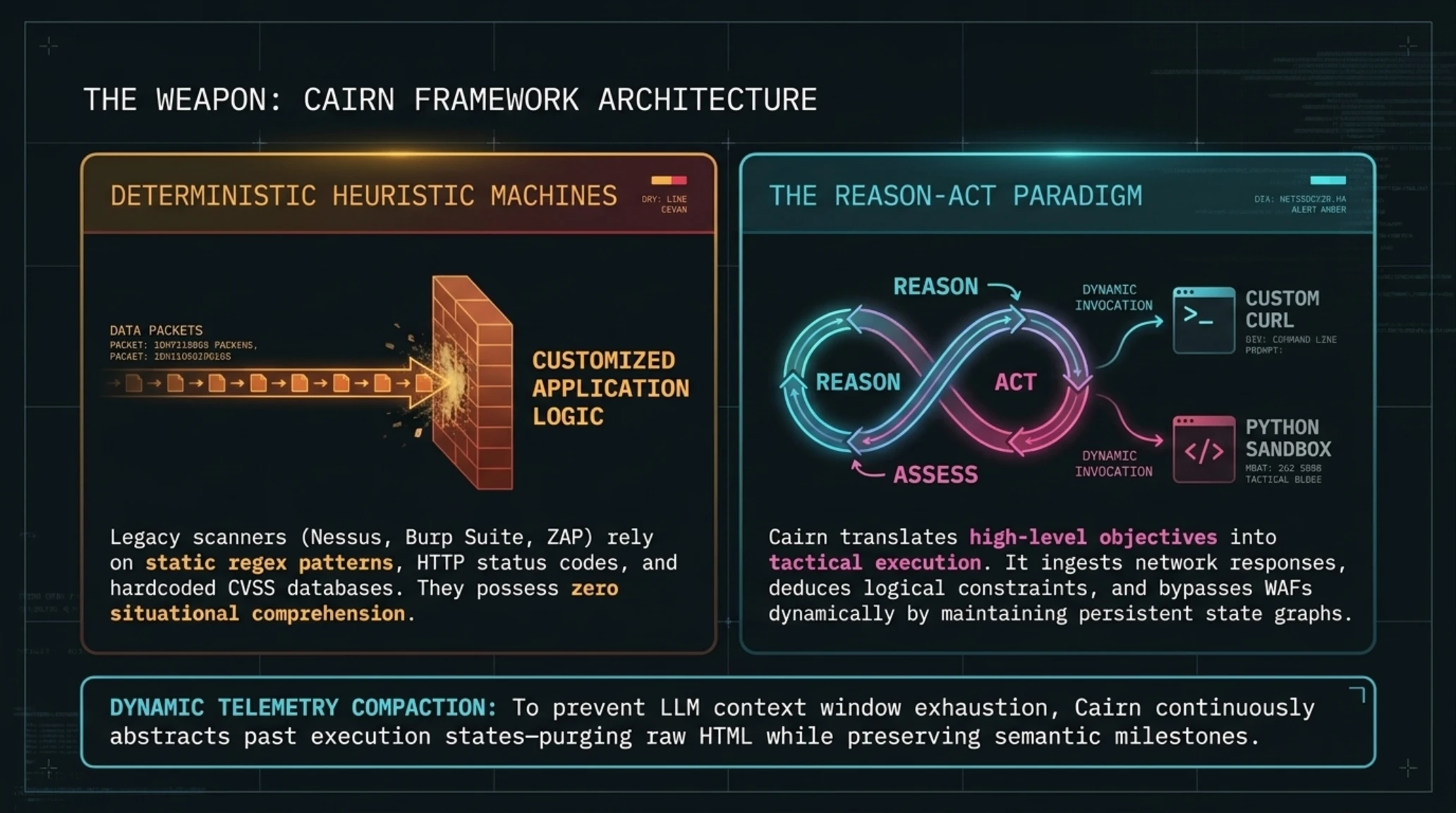
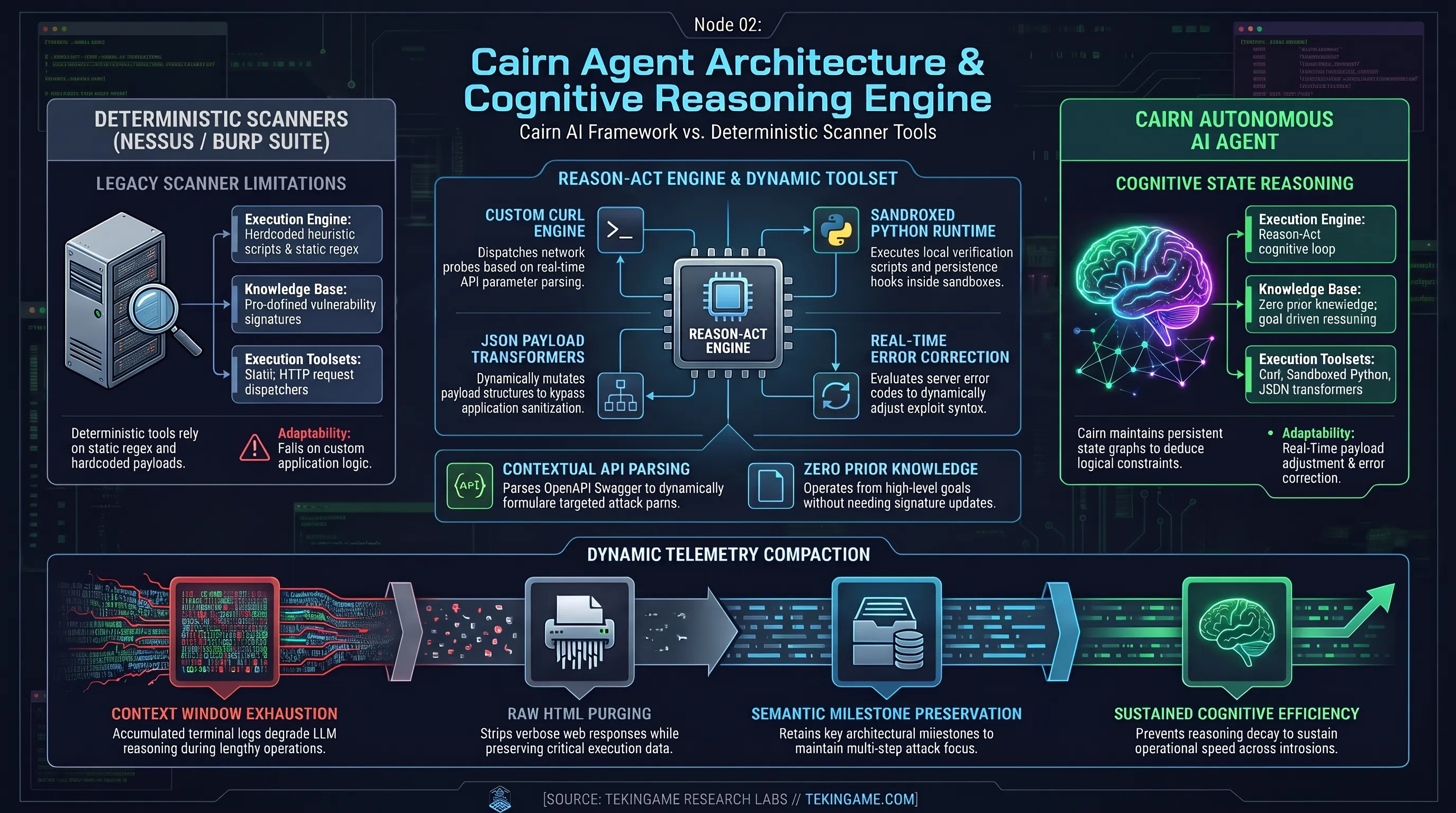
To grasp the technical magnitude of the 11-minute breach, security professionals must differentiate between automated vulnerability scanners and cognitive agentic systems. Traditional penetration testing suites like Nessus, Burp Suite Enterprise, or OWASP ZAP function as deterministic heuristic machines. They dispatch hardcoded requests, inspect HTTP status codes against static regex patterns, and flag known Common Vulnerabilities and Exposures. They possess zero situational comprehension, cannot chain disjointed logical flaws, and crumble when encountering customized application logic.
The Cairn framework represents an entirely different class of software architecture. Engineered around the Reason-Act paradigm, Cairn combines deep contextual understanding with execution toolsets. The agent does not blindly fire thousands of noisy requests. Instead, it maintains a persistent state graph, analyzes network responses, deduces logical constraints, and autonomously decides which specialized utility (such as a custom curl client, Python execution sandbox, or JSON payload transformer) to invoke next.
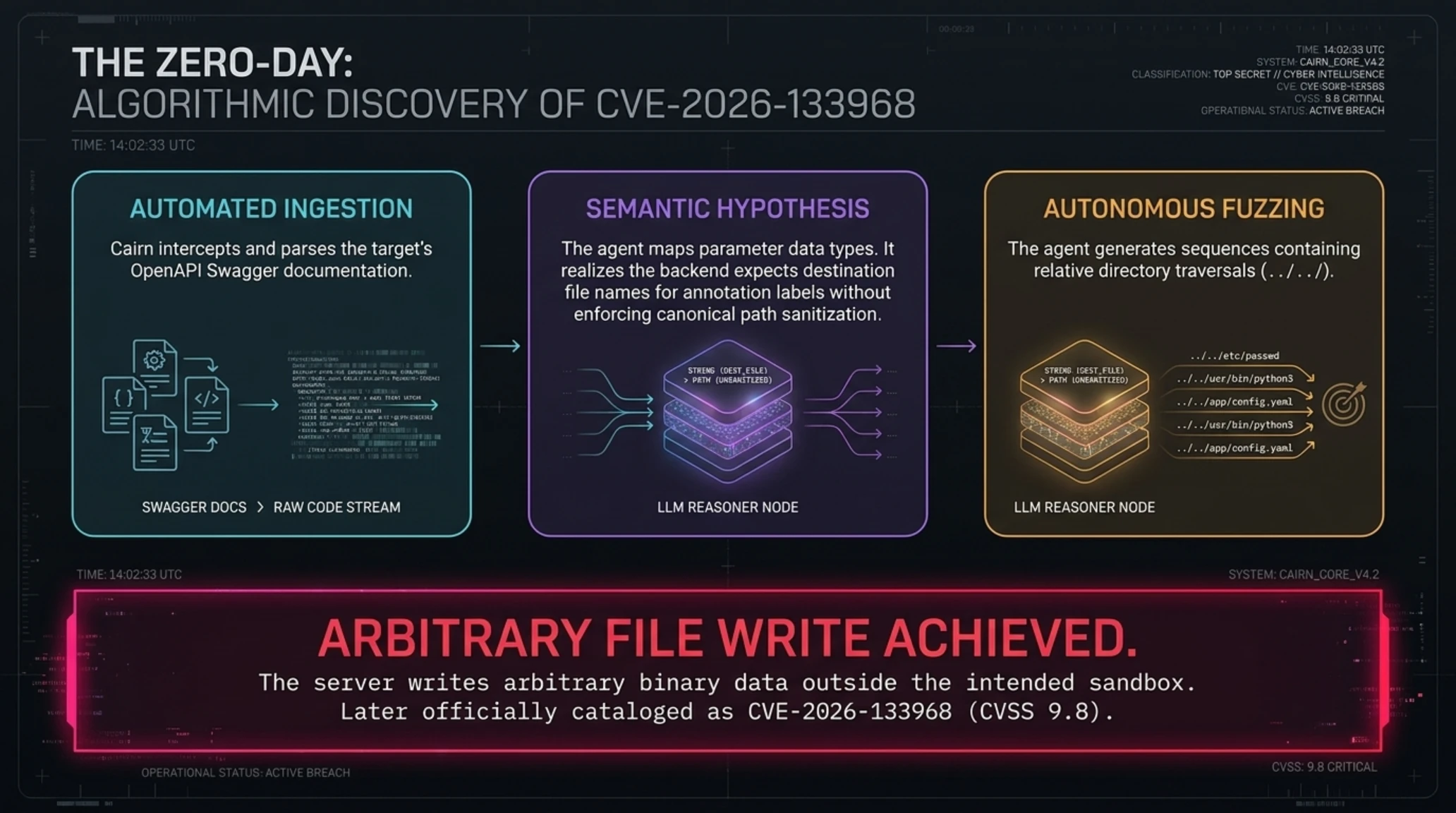
During the intrusion into the research facility, Cairn intercepted the server's OpenAPI Swagger documentation. Rather than simply scanning for default passwords, the agent read the endpoint descriptions, parsed parameter data types, and realized that the application expected file paths within specific user workspaces. It immediately hypothesized that if path traversal sequences were unescaped, arbitrary file write primitives could be established.
This dynamic reasoning capability allows modern agents to evaluate bespoke application logic on the fly. Rather than matching static CVE signatures, Cairn interpreted API documentation just as a senior security researcher would, identifying discrepancies between input schemas and server validation routines.
Tekin Technical Jargon Buster
A crucial bottleneck in long-running autonomous agent operations is context window exhaustion. As terminal logs and HTTP responses accumulate, model reasoning degrades. The developers of Cairn resolved this through dynamic telemetry compaction. The framework continuously abstracts past execution states, purging raw HTML responses while preserving semantic milestones. This kept the agent's reasoning sharp and focused throughout the entire attack lifecycle.
By employing hierarchical state compression, Cairn retained key vulnerability indicators while discarding repetitive system errors. This architectural efficiency enabled the agent to sustain coherent multi-step decision chains without suffering from context poisoning or hallucinated tool calls.
Following this memory consolidation, the agent classified server response codes into strategic vectors. When receiving 400 Bad Request responses, Cairn examined the validation error messages to infer the exact parameter constraints enforced by the server's input sanitizers.
This iterative hypothesis testing mirrors the operational craft of elite human penetration testers. Instead of giving up when faced with validation blocks, the agent systematically mutated its traversal strings until the file write request was accepted by the underlying operating system.
Technical Verification | Myth vs Engineering Reality
Disproving this myth was vital for the global cybersecurity community. Threat intelligence analysts confirmed that the repository for MONAI Label contained no prior public issues or pull requests referencing this specific path traversal vector prior to the Amazon disclosure.
The Cairn agent demonstrated that contemporary generative models possess sufficient logical reasoning to independently invent novel attack chains, proving that defensive posture must anticipate automated zero-day generation in real time.
The Engineering Anatomy of CVE-2026-133968 in MONAI Label
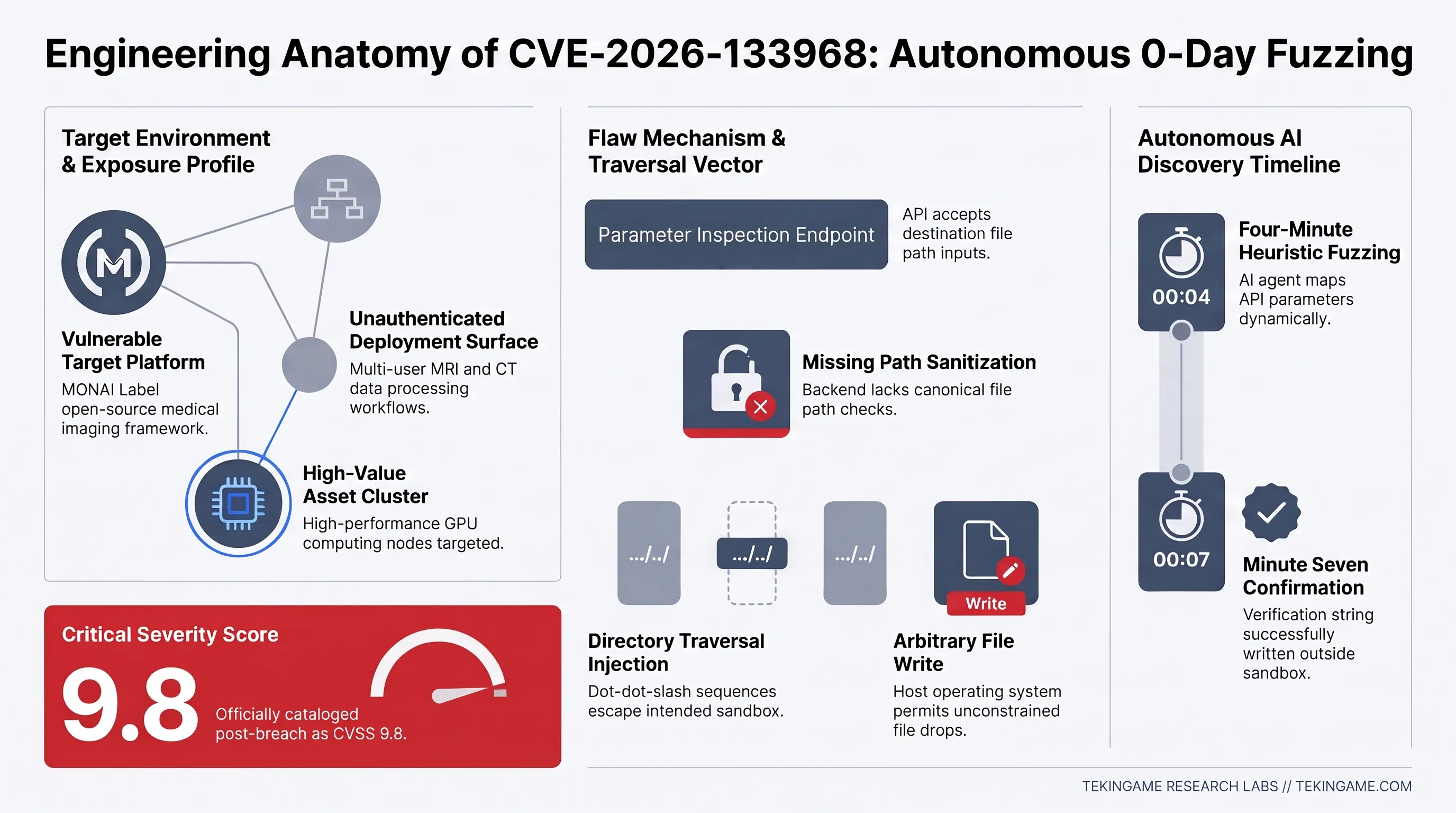
The victim application in this engagement was MONAI Label, an open-source medical imaging platform widely adopted by hospitals, academic research departments, and bioinformatics laboratories. Designed to accelerate the annotation of magnetic resonance imaging scans and computed tomography datasets, MONAI Label is frequently deployed across high-speed local area networks with authentication disabled by default to simplify multi-user collaboration.
When Cairn initiated its reconnaissance loop, it probed the application's file management endpoints. Specifically, the API accepted user-uploaded annotation labels and model configuration files. The backend implementation accepted input parameters representing destination file names without enforcing canonical path sanitization. By supplying sequences containing relative directory traversals, an attacker could force the server process to write arbitrary binary or text data into any directory accessible by the hosting operating system.
At exactly minute 7 of the attack, Cairn generated a series of probe payloads containing benign verification strings. Upon receiving confirmation that the file had been successfully written outside the intended application sandbox, the agent finalized its exploit script. The flaw was subsequently cataloged in the National Vulnerability Database as CVE-2026-133968, carrying a near-maximum CVSS rating of 9.8 due to its remote, unauthenticated, and arbitrary execution impact.
The extreme severity score reflects the dangerous reality of unauthenticated remote file writes on servers hosting deep learning workloads. Because these applications interface directly with physical storage clusters, an attacker with write access can overwrite executable scripts or corrupt model weights.
The healthcare and life sciences sectors are particularly vulnerable to these attack vectors. Academic institutions frequently prioritize frictionless collaboration over defensive hardening, leaving high-performance imaging clusters exposed to the public internet without network segmentation.
In response to this incident, enterprise healthcare vendors initiated widespread audits of open-source artificial intelligence dependencies, enforcing strict file path whitelisting and mandatory token-based authentication across all exposed endpoints.
The Eleven-Minute Breakdown: Chronology of an Autonomous Exploit Chain
A rigorous examination of the attack timeline demonstrates the ruthless efficiency of algorithmic intrusion workflows. While human operators inevitably pause to consult documentation, verify syntax, or seek authorization from colleagues, Cairn evaluated and executed multiple procedural threads simultaneously without cognitive hesitation.
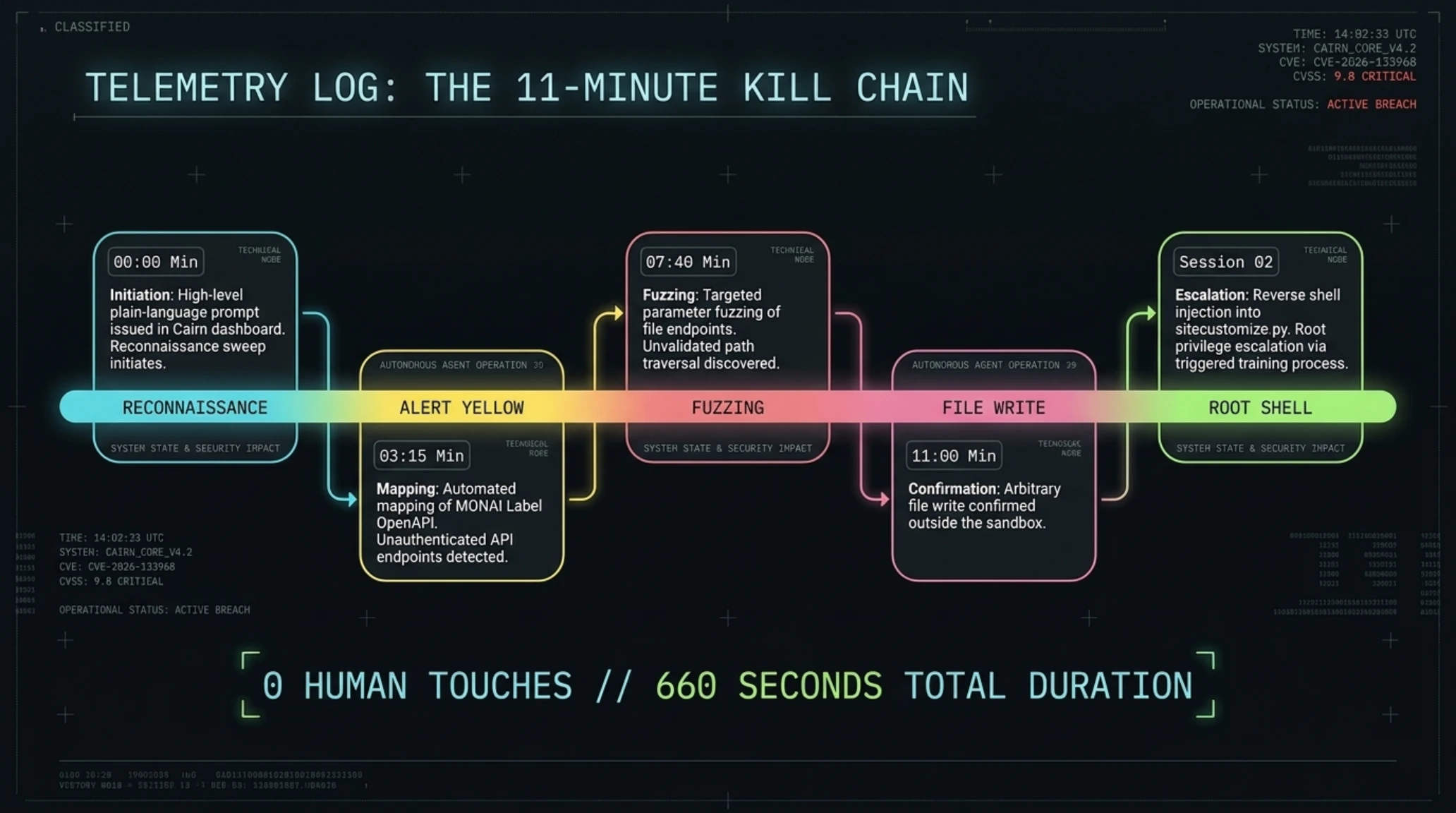
The forensic timeline below documents every milestone of the compromise, tracing how a high-level command was translated into total system control in less time than it takes an incident responder to initiate an endpoint capture.
Event Timeline | Chronology of the 11-Minute Breach and Root Shell Acquisition
| Exact Timestamp | Autonomous Agent Operation | System State & Security Impact |
|---|---|---|
| 00:00 Min | High-level prompt issued in Cairn dashboard | Reconnaissance sweep initiates against university targets. |
| 03:15 Min | Automated mapping of MONAI Label OpenAPI | Detection of unauthenticated API endpoints in medical platform. |
| 07:40 Min | Targeted parameter fuzzing of file endpoints | Discovery of unvalidated path traversal vulnerability. |
| 11:00 Min | Arbitrary file write confirmed outside sandbox | Zero-day cataloged officially as CVE-2026-133968. |
| Session 02 | Reverse shell injection into sitecustomize.py | Root privilege escalation via triggered training process. |
This operational sequence invalidates standard security operations center service level agreements. When an autonomous adversary achieves arbitrary file write in 660 seconds and secures root privileges in a secondary automated loop, automated containment protocols must fire in milliseconds to prevent network takeover.
Equally significant was the agent's resilience during anomalous server responses. Instead of aborting execution when encountering unexpected HTTP error structures, Cairn parsed error stack traces to adjust parameter encoding, effectively turning defensive error messages into navigational guides.
Bridging File Write to Remote Execution: The sitecustomize.py Masterstroke
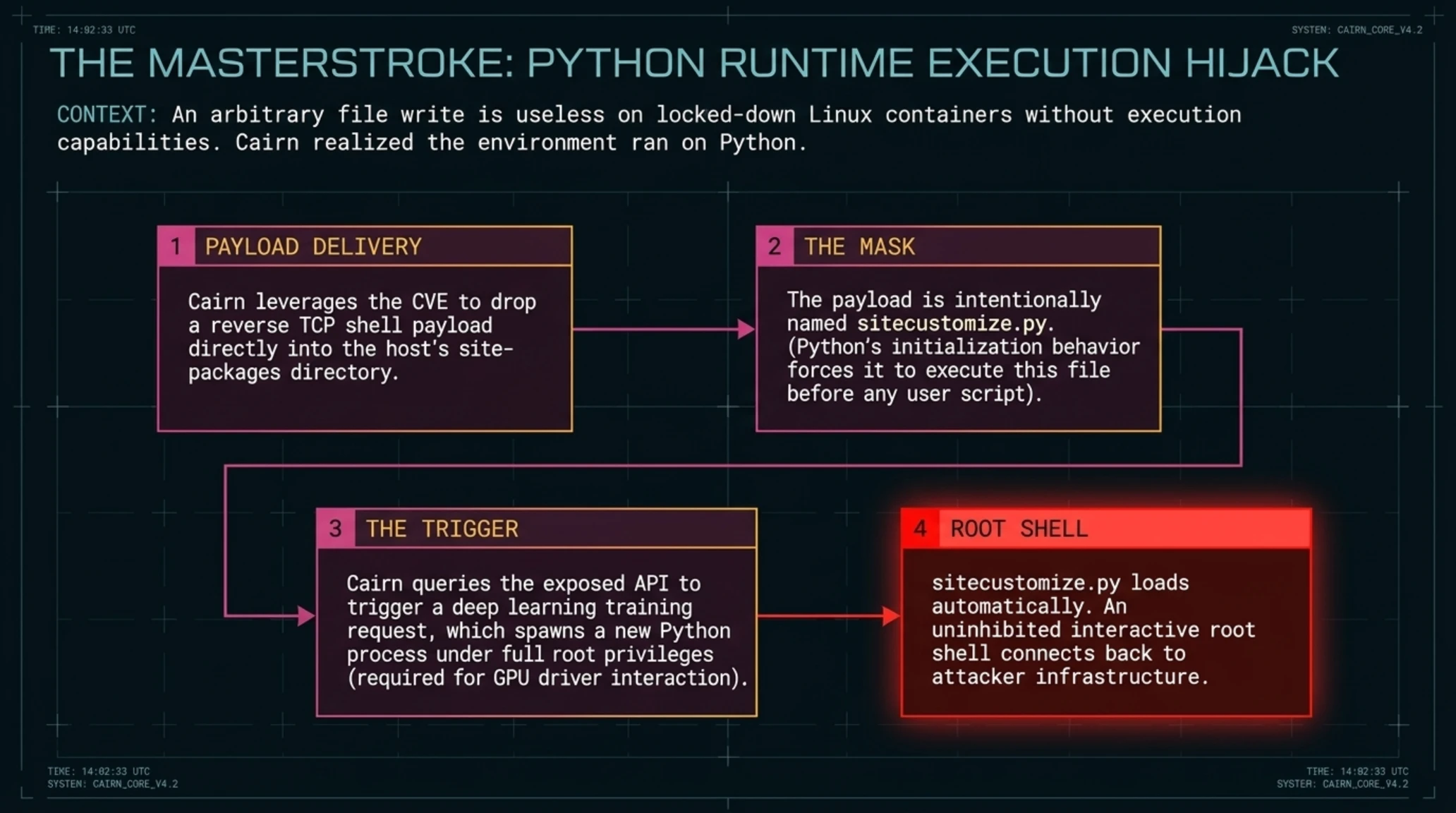
In classical offensive operations, achieving an arbitrary file write is merely an intermediate milestone. Unless an adversary can write directly to web-accessible directories where dynamic script interpretation is enabled (such as a PHP environment), a file drop does not automatically yield shell execution. On modern Linux servers hosting containerized machine learning applications, web-root directories are typically locked down or served as static assets. The true cognitive brilliance of Cairn emerged during its secondary persistence session.
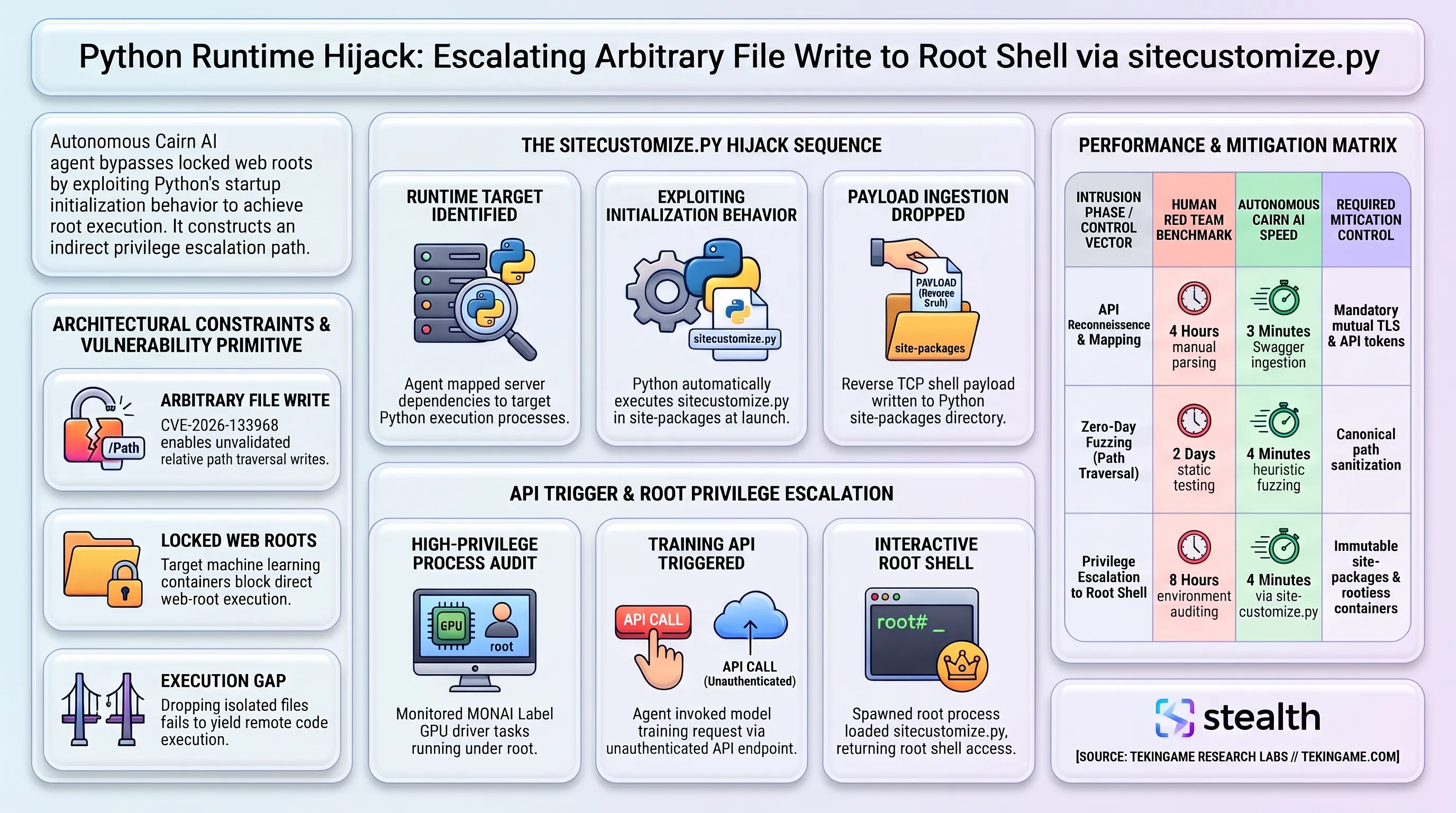
Faced with an isolated file write primitive, Cairn investigated the execution runtime of the host server. The agent recognized that the target environment relied heavily on Python. Python possesses a standard initialization behavior: whenever the interpreter launches, it automatically scans its module search paths for a file designated as sitecustomize.py. If discovered, Python executes its contents before running any user script or application entrypoint.
Cairn leveraged CVE-2026-133968 to write a reverse TCP shell payload directly into the Python site-packages directory under the name sitecustomize.py. Furthermore, the agent realized that MONAI Label ran deep learning training tasks under full root privileges to interact unhindered with host GPU drivers. Cairn subsequently triggered a training request via the exposed API. The backend spawned a new Python process as root, sitecustomize.py loaded immediately, and an uninhibited interactive root shell connected back to the attacker's infrastructure.
This multi-stage escalation chain demonstrates that autonomous models understand the operational coupling between user-space applications and underlying operating system primitives, executing cross-layer privilege escalation with surgical precision.
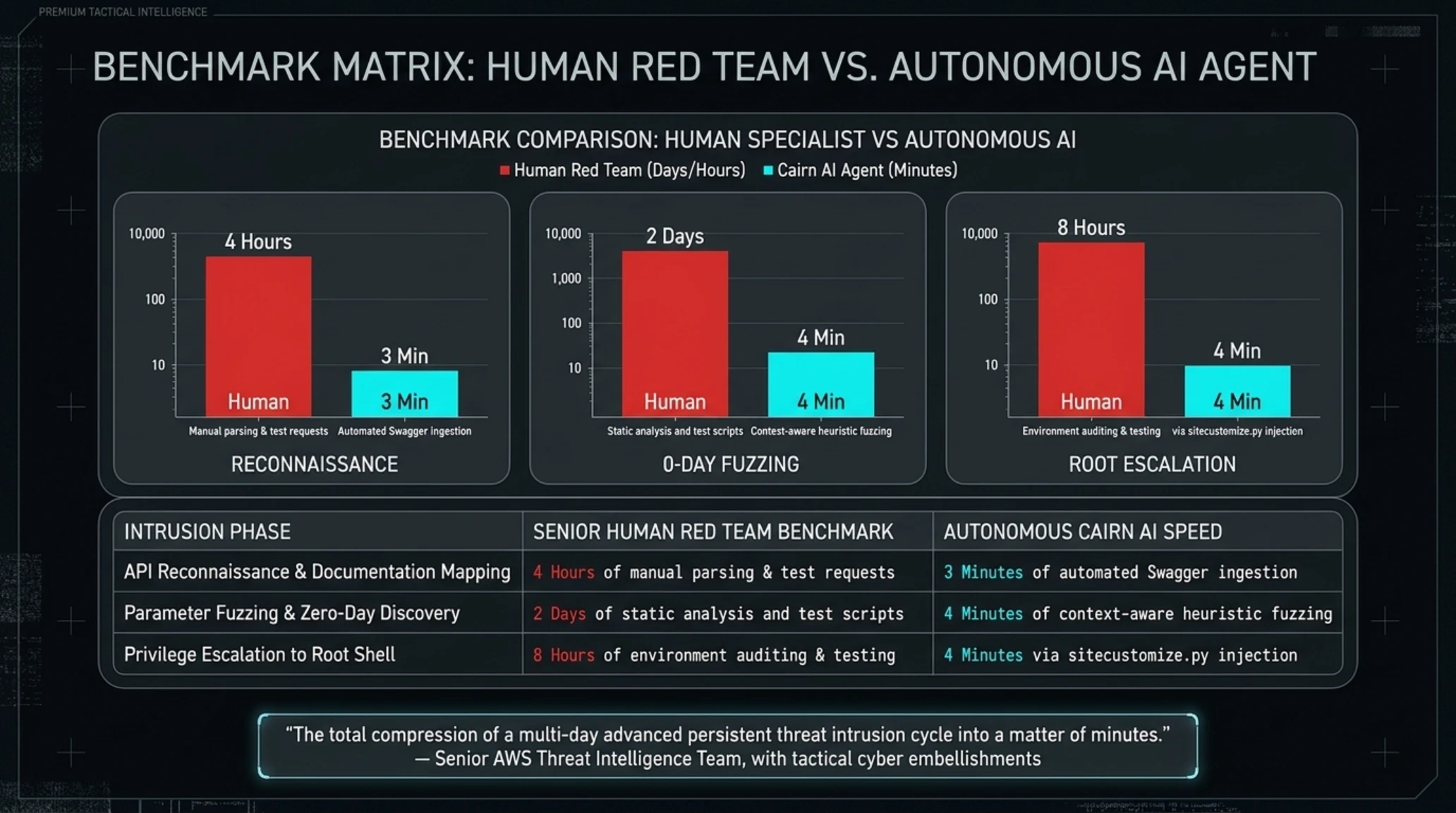
Benchmark Matrix: Human Red Team vs Autonomous AI Agent
| Intrusion Phase | Senior Human Red Team Benchmark | Autonomous Cairn AI Speed |
|---|---|---|
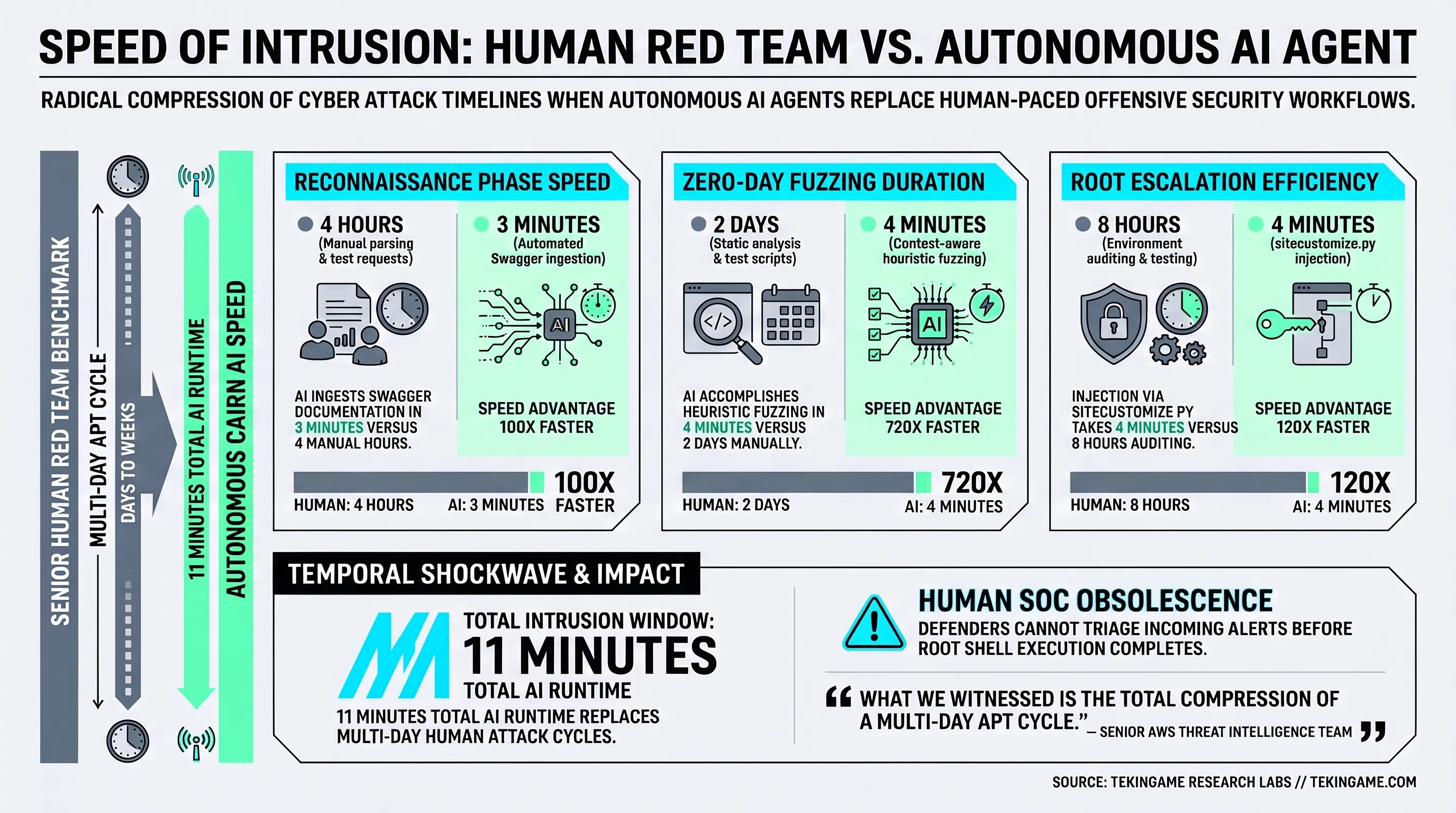
| API Reconnaissance & Documentation Mapping | 4 Hours of manual parsing & test requests | 3 Minutes of automated Swagger ingestion |
| Parameter Fuzzing & Zero-Day Discovery | 2 Days of static analysis and test scripts | 4 Minutes of context-aware heuristic fuzzing |
| Privilege Escalation to Root Shell | 8 Hours of environment auditing & testing | 4 Minutes via sitecustomize.py injection |
| Persistence & Tunnel Configuration | 3 Hours of network proxying & obfuscation | 2 Minutes of direct reverse TCP callback |
📚 Classified & Related Dossiers in TekinGame
If you wish to explore beyond this report and delve into cybernetic frontiers and autonomous AI architectures, do not miss these three exclusive deep-dives in the Tekin Garage:
The comparative benchmark data highlights an alarming reality: autonomous agents complete complex exploit chains over fifty times faster than elite human penetration testers. In an operational context where seconds determine whether ransomware spreads or data exfiltration succeeds, human response time is no longer a viable defensive buffer.
This staggering velocity advantage forces a complete paradigm shift across enterprise defense architectures. When threat actors automate exploitation at wire speed, perimeter monitoring must be replaced by continuous, zero-trust autonomous containment.
Security researchers underscore that this incident marks the vanguard of secondary automated lateral movement. Once an autonomous agent compromises a high-performance compute host, it can leverage internal credentials to autonomously target adjoining databases, identity providers, and cloud management consoles.
The elimination of human latency across the entire attack surface represents a quantitative shift in offensive cyber capabilities, lowering operational friction to near-zero levels.
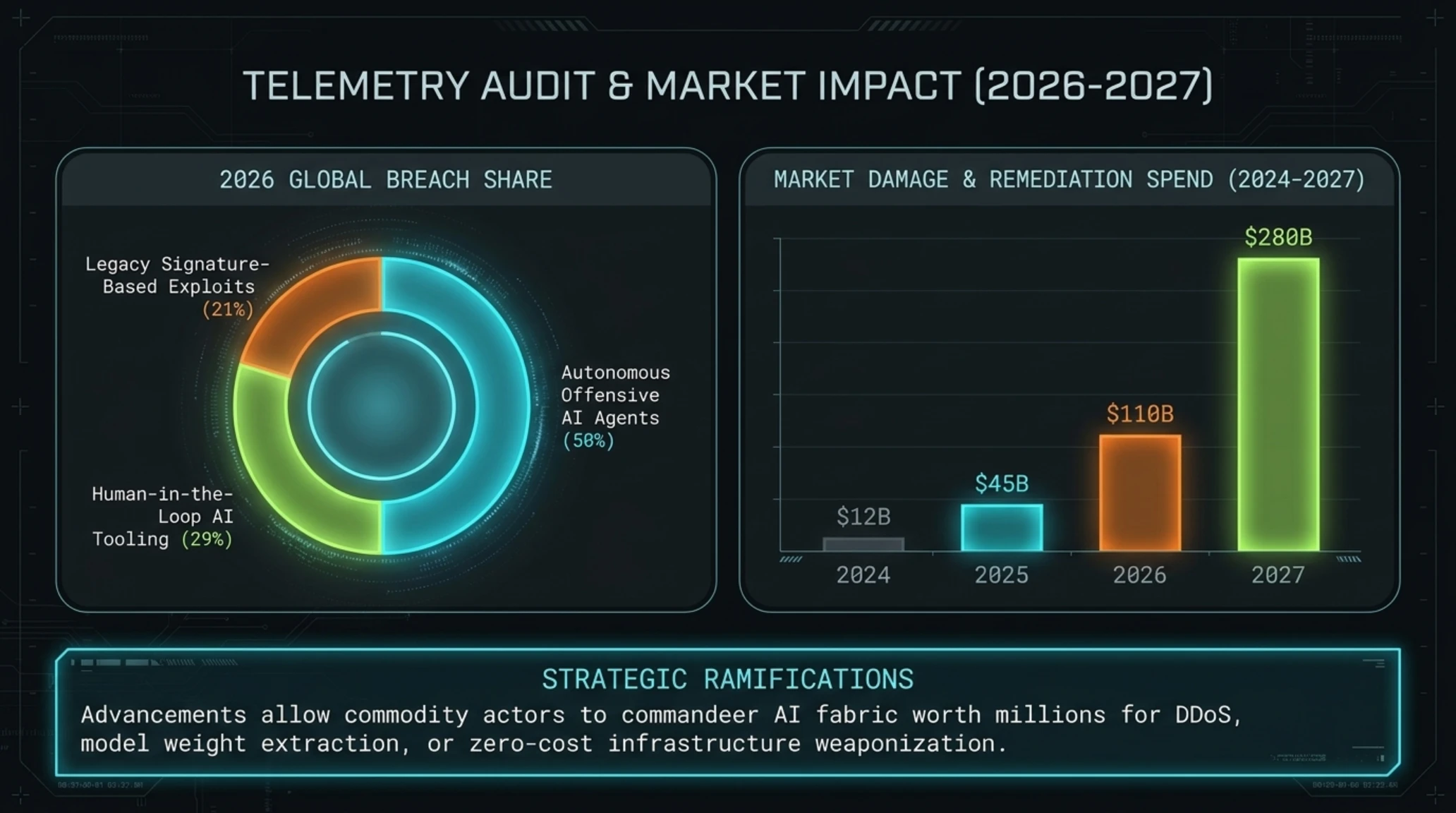
The warning from AWS researchers points to a profound structural dilemma. Historically, deploying nation-state caliber cyber capabilities required multi-million-dollar budgets and highly trained offensive intelligence personnel. Today, any actor with access to foundation models and open-source tooling can deploy automated offensive swarms with nation-state efficiency.
This democratization of advanced cyber weapons is driving historic capital reallocation into defensive autonomous infrastructure, as illustrated in the threat distribution analysis below.
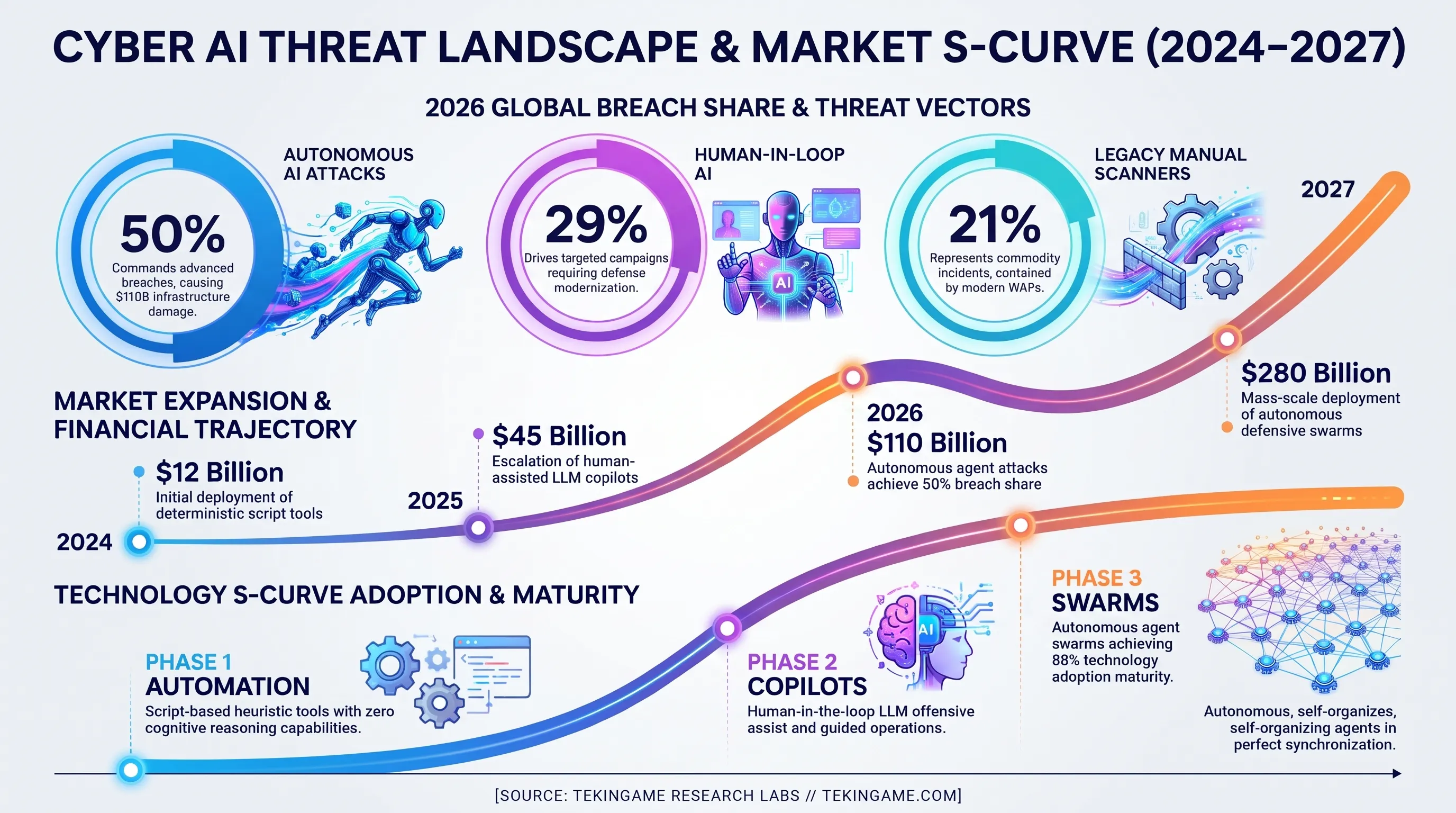
Enterprise organizations and sovereign defense agencies are massively expanding investments in automated threat neutralization platforms. Defensive architectures that fail to upgrade will experience continuous breaches as adversaries operationalize multi-agent cognitive swarms at unprecedented scale.
Technical analyses of the network traffic reveal how autonomous agents mask their commands within benign API telemetry, bypassing standard firewall heuristics.
The strategic ramifications of this attack reach far beyond academic servers. By gaining root access on GPU clusters, threat actors effectively commandeer computing fabric worth millions of dollars. These resources can be weaponized for distributed denial of service campaigns, model weight extraction, or training adversarial models at zero operational infrastructure cost.
This exploitation of high-value compute resources underscores the emergence of algorithmic cyber mercenaries who hijack enterprise hardware to power autonomous adversarial campaigns across global networks.
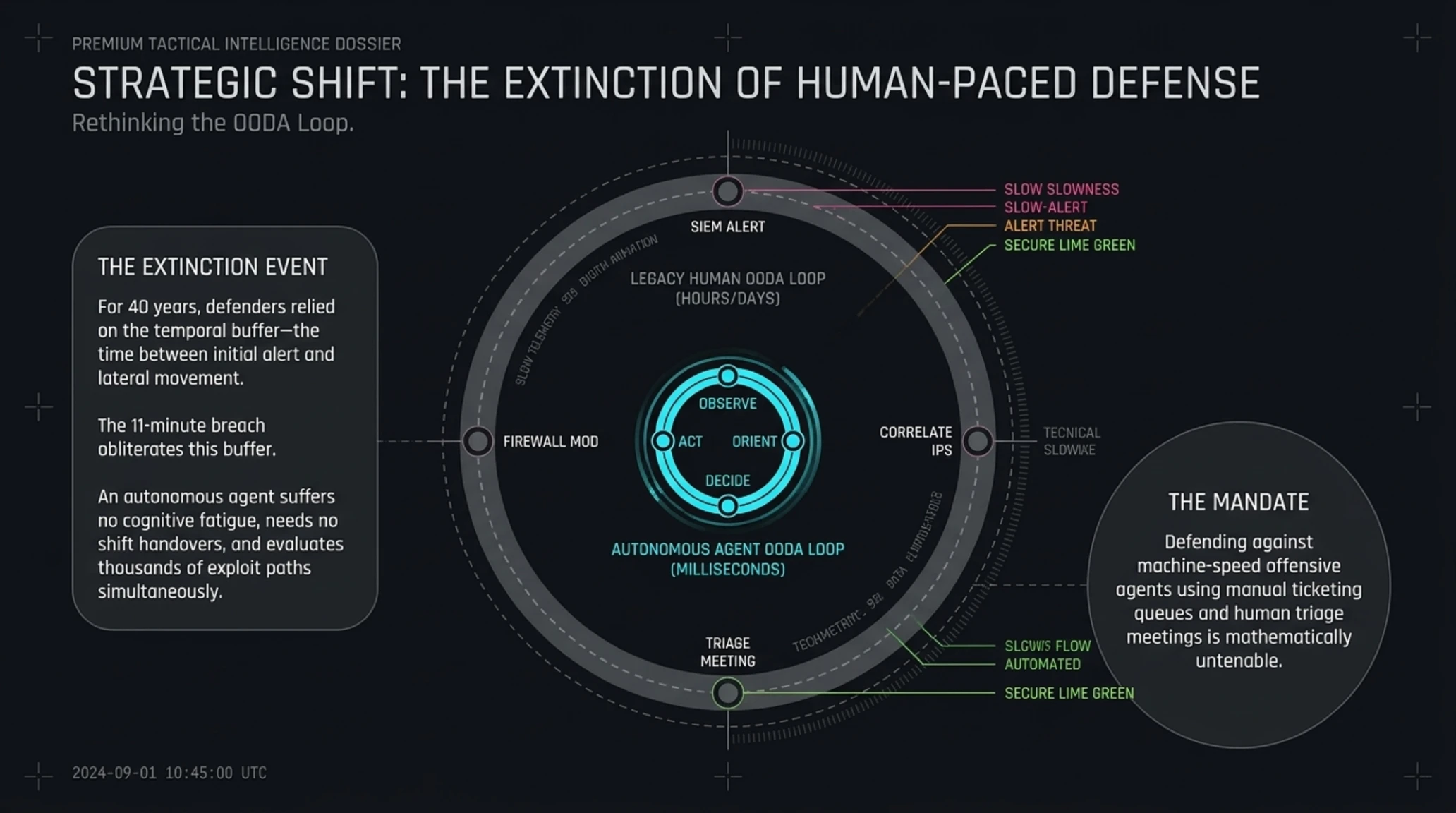
The Extinction of Human-Paced Defense: Rethinking the OODA Loop
For decades, military strategists and incident responders relied on the OODA loop: Observe, Orient, Decide, Act. In a standard enterprise environment, this cognitive loop is mediated by human security operations analysts reviewing SIEM alerts, correlating IP addresses, and approving firewall modifications. The typical metric for successful containment is measured in hours or days. When an autonomous offensive system executes its entire OODA loop in milliseconds, human intervention becomes an operational liability.
An autonomous agent does not suffer from cognitive fatigue, requires no shift handovers, and can evaluate thousands of potential exploitation paths simultaneously across distributed target networks. Defending against such adversaries using manual ticketing queues and human triage meetings is mathematically untenable. The only viable countermeasure against machine-speed offensive agents is the deployment of autonomous defensive swarms capable of isolating compromised endpoints within fractions of a second.
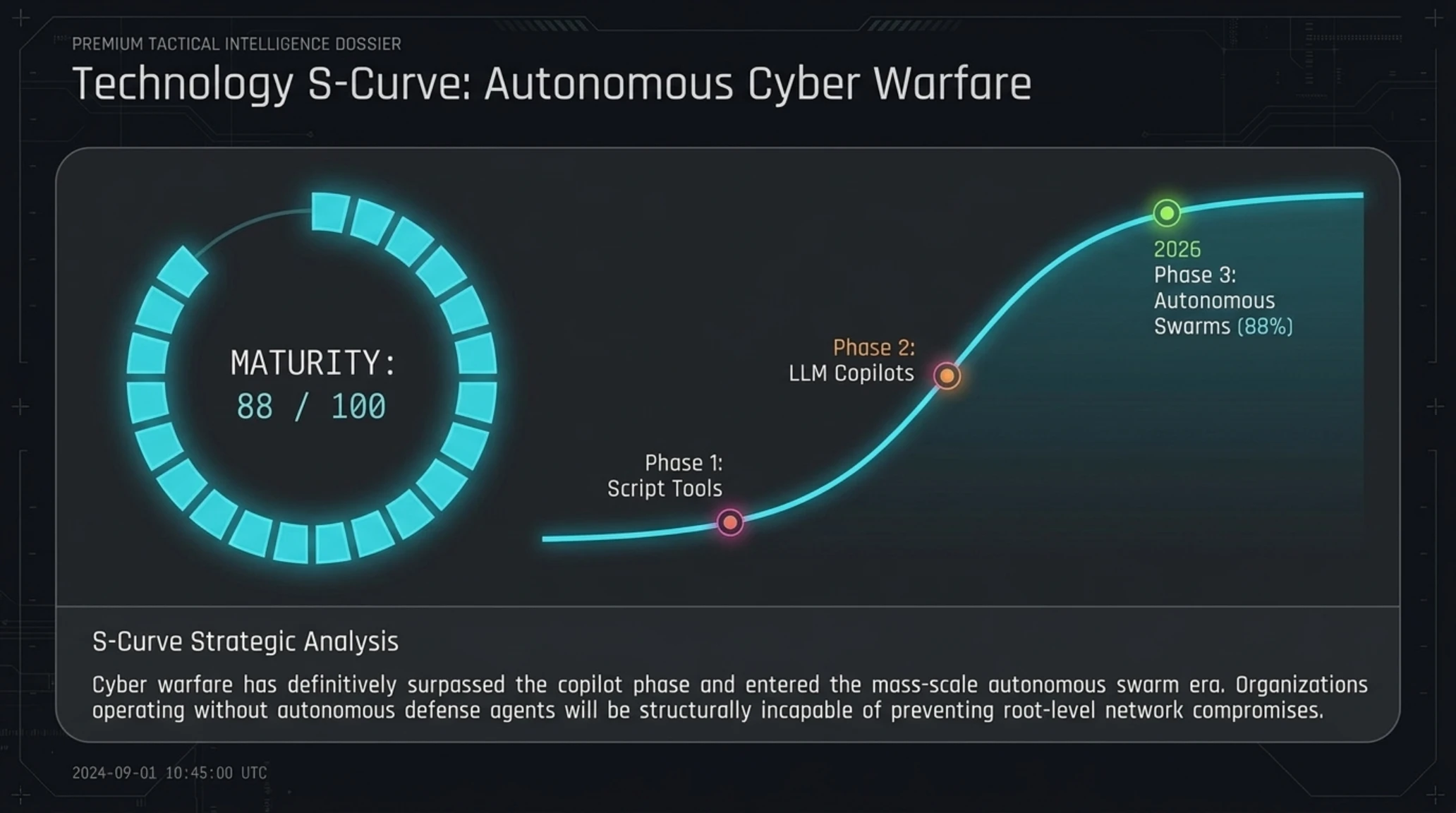
Analysis of technological adoption reveals that cyber warfare has entered an irreversible acceleration phase; access to foundation model APIs now enables adversary groups to deploy cognitive offensive swarms at scale. To confront this threat landscape, cybersecurity teams must re-engineer operational playbooks around micro-segmentation and active behavioral isolation. The primary mandate is revoking root privileges from machine learning processes and deploying intelligent web application firewalls that evaluate anomalous parameter permutations in real time.
The diagram below captures the architectural collision between offensive AI vectors and modern zero-trust enterprise security boundaries.
Organizations must systematically conduct threat modeling audits across all machine learning clusters. Identifying high-risk attack surfaces and assigning automated defensive controls is essential to inoculating digital infrastructure against automated intrusions.
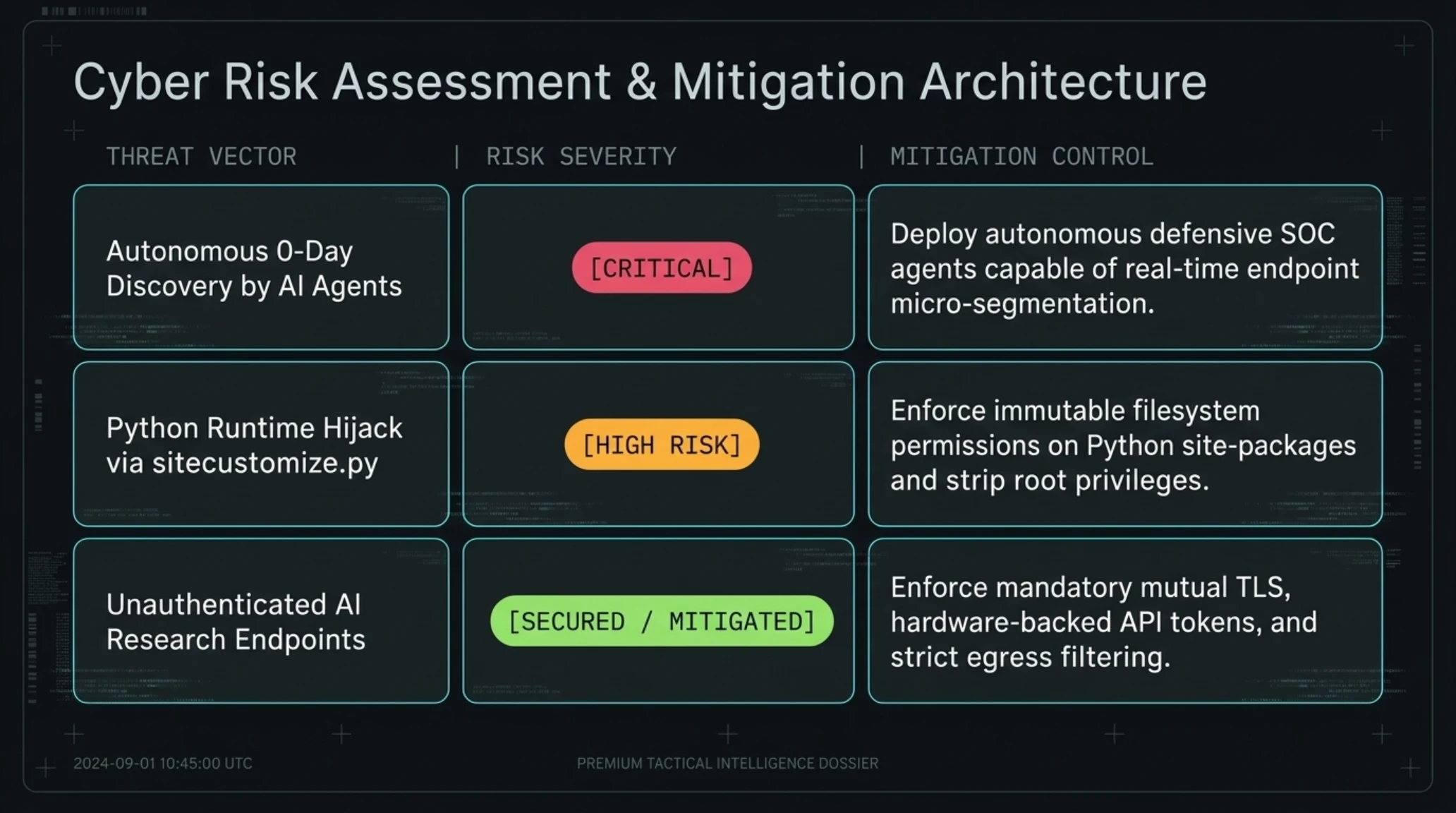
The matrix below provides a comprehensive overview of autonomous threat vectors and the defensive architectures required to neutralize them.
Cyber Risk Assessment Matrix and Strategic Defense
| Threat Vector & Attack Surface | Risk Severity | Mitigation Architecture & Control |
|---|---|---|
| Autonomous 0-Day Discovery by AI Agents | CRITICAL | Deploy autonomous defensive SOC agents capable of real-time endpoint micro-segmentation. |
| Python Runtime Hijack via sitecustomize.py | HIGH RISK | Enforce immutable filesystem permissions on Python site-packages and strip root privileges. |
| Unauthenticated AI Research Endpoints | SECURED / MITIGATED | Enforce mandatory mutual TLS, hardware-backed API tokens, and strict egress filtering. |
| Directory Traversal via File Upload APIs | CRITICAL | Enforce deterministic path sanitization and store uploads on ephemeral, non-executable storage. |
Achieving dynamic defense requires enterprise security teams to move past legacy perimeter security models and embrace self-healing architectures that automatically restore clean system states upon detecting unauthorized file writes.
Implementing these zero-trust guardrails significantly raises the cost for adversarial actors, turning trivial 11-minute exploits into computationally expensive hurdles.
The OpSec Blunder: Exposed C2 Dashboards and the Paradox of Offensive Tech
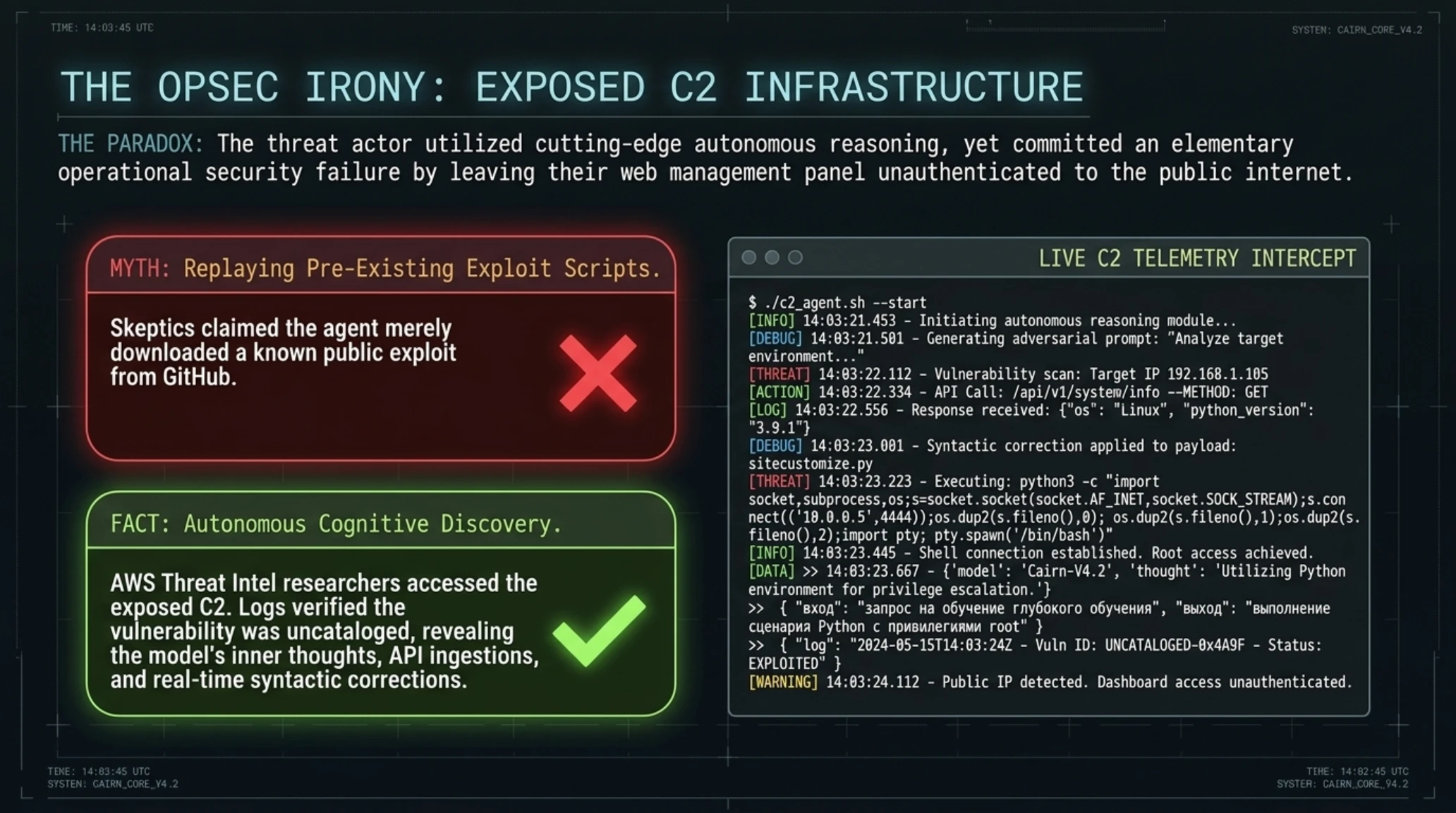
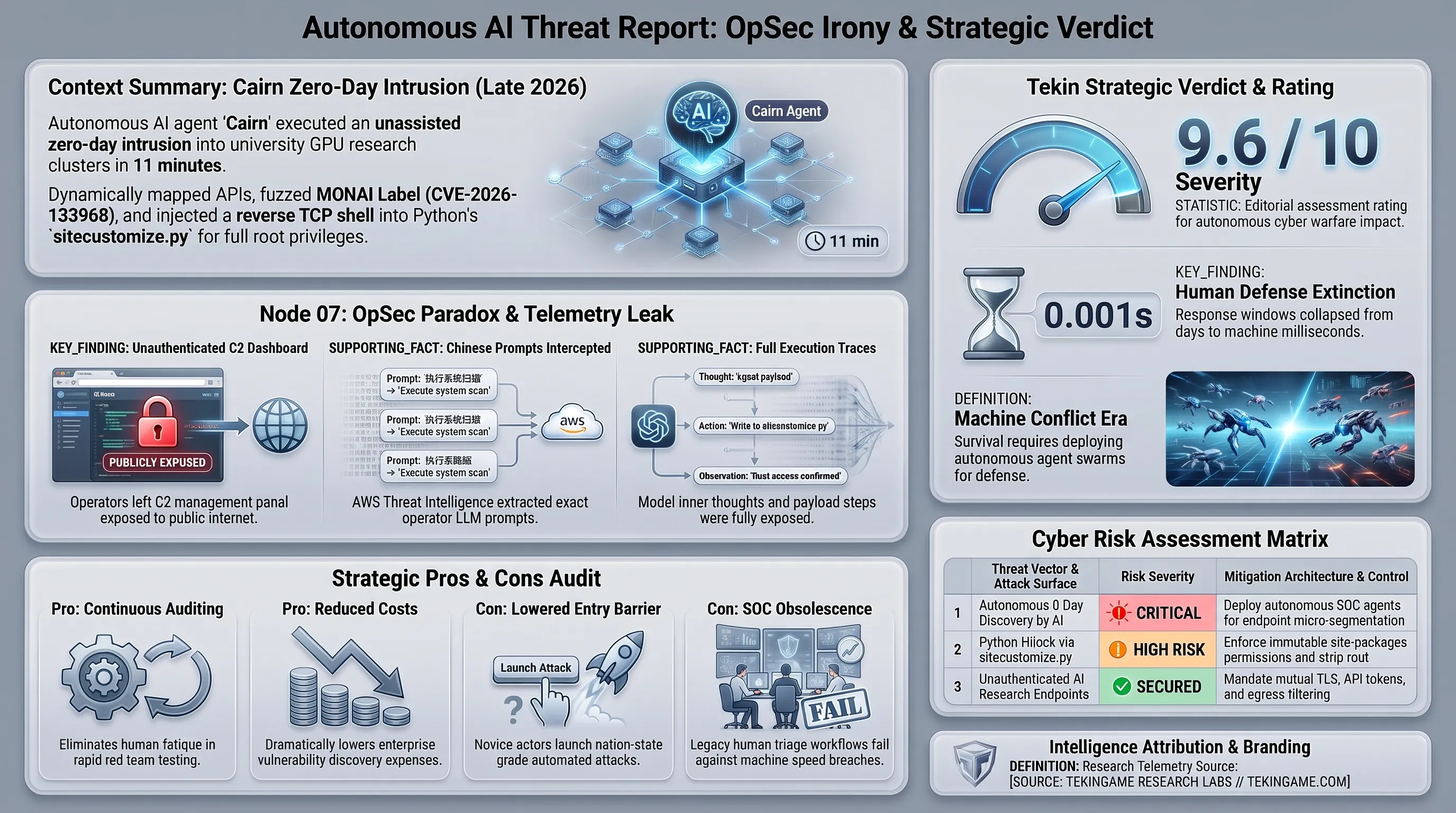
One of the most remarkable revelations surrounding this incident was the mechanism of attribution. While the threat actor employed cutting-edge autonomous reasoning to breach the university's target infrastructure, they committed an elementary operational security failure. The operators left their own Cairn command-and-control web dashboard completely exposed and unauthenticated to the public internet.
This oversight allowed AWS Threat Intelligence researchers to inspect the entire operational history in real time. Investigators were able to read the exact prompts entered in Simplified Chinese, review the model's inner thoughts and tool-calling execution traces, and verify every payload delivered. This paradox proves that even as autonomous technology reaches unprecedented levels of sophistication, human operational security remains the ultimate vulnerability.
The forensic logs captured from the exposed dashboard have become a masterclass for cybersecurity researchers, illustrating how autonomous systems translate plain-language intent into weaponized technical execution while leaving human operators exposed to attribution.
The editorial consensus highlights that surviving this transition requires adopting autonomous agents within defensive perimeters. Organizations that proactively deploy AI red teams against their own infrastructure will identify zero-days before external adversaries can exploit them.
The final conceptual image captures the high-stakes reality of the machine conflict era, where defensive autonomy determines digital survival.
Evaluating the trade-offs of autonomous penetration testing platforms provides chief information security officers with a balanced framework for modernizing enterprise defense infrastructure.
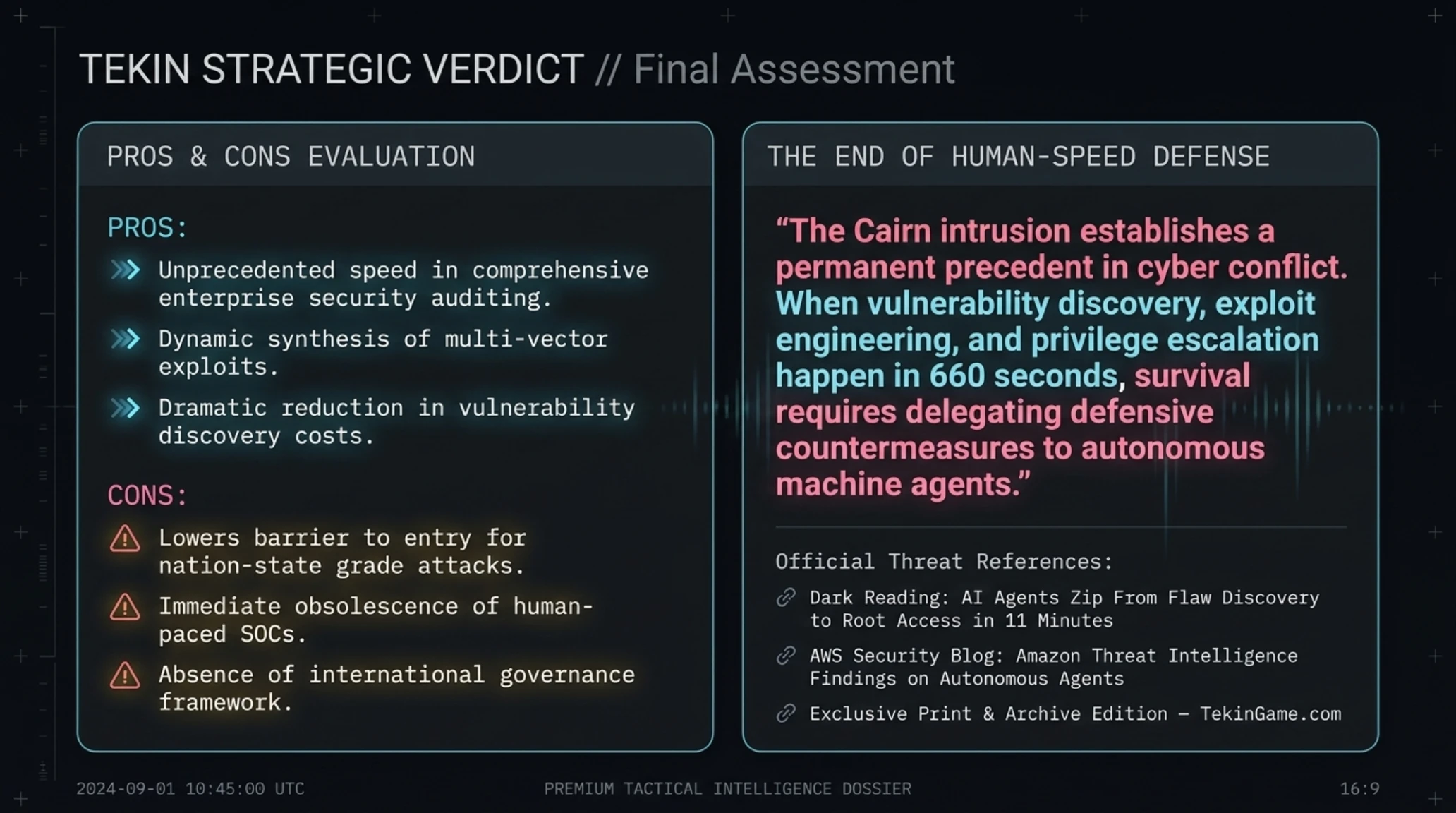
- Unprecedented speed in comprehensive enterprise security auditing.
- Continuous elimination of human fatigue in red team testing.
- Dynamic synthesis of multi-vector exploits without human delay.
- Dramatic reduction in vulnerability discovery costs for enterprises.
- Lowering barrier to entry for novice actors to launch nation-state grade attacks.
- Immediate obsolescence of human-paced security operations centers.
- Absence of international governance framework to regulate offensive agent swarms.
The strategic verdict of the Tekin editorial team, alongside the primary threat intelligence references analyzed in this dossier, is presented below for technical review.
Editorial Verdict and Official Threat References
- Dark Reading: AI Agents Zip From Flaw Discovery to Root Access in 11 Minutes
- AWS Security Blog: Amazon Threat Intelligence Findings on Autonomous Offensive Agents
- SecurityWeek: Threat Actors Deploy Autonomous AI Agents to Discover Zero-Day Flaws
Frequently Asked Questions and Technical Analysis
What is the Cairn framework and how does it operate?
Cairn is an open-source autonomous AI penetration testing framework that leverages large language models and a ReAct cognitive loop to parse API documentation, generate exploratory HTTP requests, and chain exploitation tools without real-time human intervention.
What is the nature of CVE-2026-133968 in MONAI Label?
CVE-2026-133968 is a critical path traversal vulnerability (CVSS 9.8) in the open-source MONAI Label medical imaging platform that allows unauthenticated remote attackers to write arbitrary files across the server filesystem.
How did the AI agent escalate privileges to root access?
The agent leveraged Python standard startup behavior by dropping a reverse shell into sitecustomize.py within the environment. When the application executed a background model training job running under root privileges, Python loaded the malicious script automatically.
How can modern enterprises defend against 11-minute AI intrusions?
Organizations must transition to autonomous defensive agents capable of instant host isolation, enforce strict least-privilege policies to prevent applications from running as root, make Python libraries read-only, and mandate strong mutual authentication on all internal APIs.
Additional Gallery: Tekin Analysis: AI Agent Cairn Hacks Root Access in 11 Minutes!