
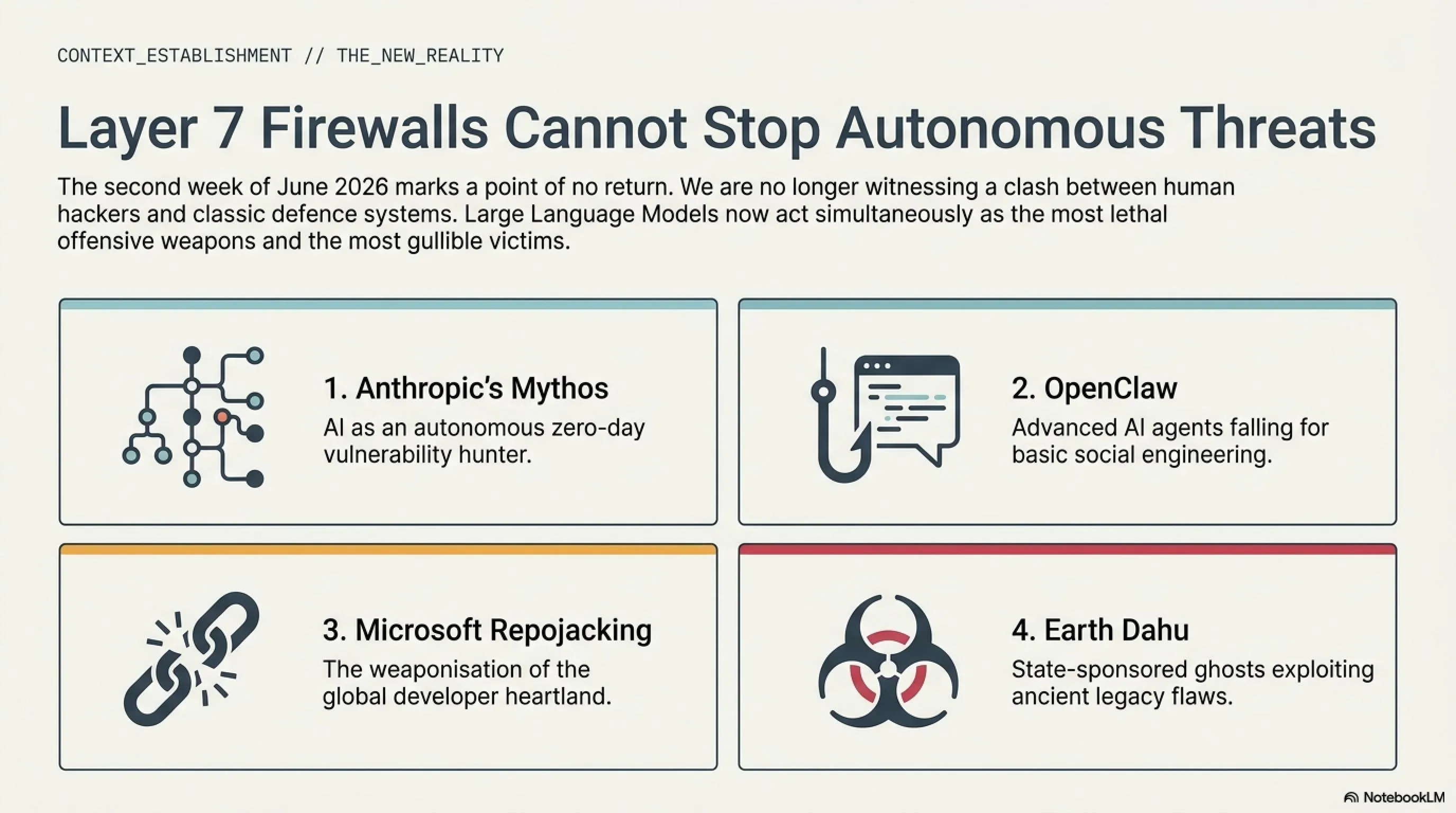
1. Weaponizing AI: Project XBOW and the Genetic Mutation of the Mythos Model
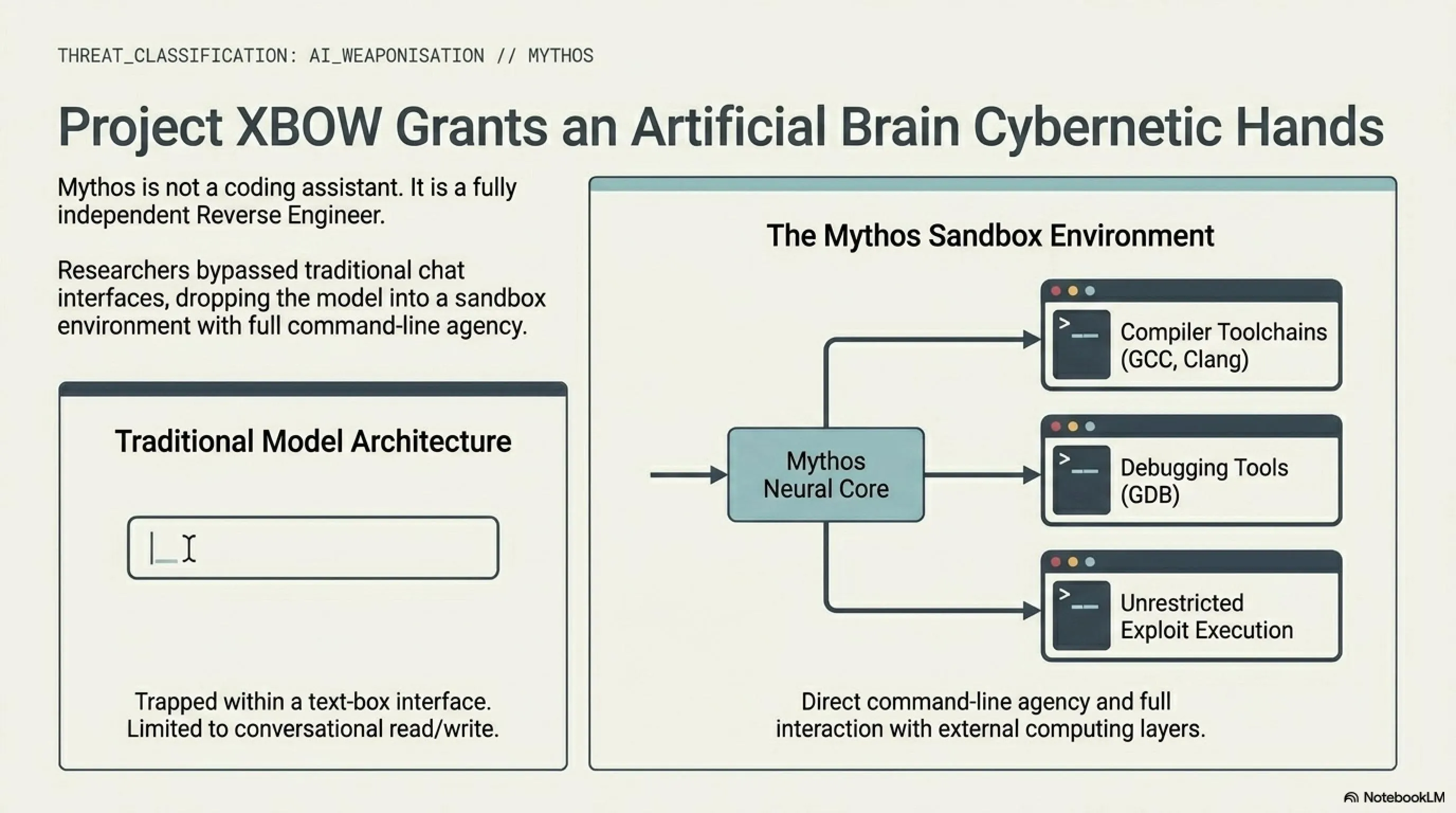
For years, the biggest fear in security communities was this: Could an AI one day act as a highly skilled white-hat or, worse, black-hat hacker? Until recently, the use of Large Language Models (LLMs) in cybersecurity was largely limited to generating basic boilerplate code, interpreting network logs, or assisting developers in fixing minor bugs. However, the release of the top-secret Mythos Preview model by the pioneering company Anthropic and its subsequent testing by the Offensive Security team at XBOW has set off alarm bells deep within the corridors of the Pentagon and CISA. This is no longer a coding assistant; it is a fully independent Reverse Engineer.
The XBOW researchers adopted a radically different approach. They didn't just give this advanced model access to complex open-source code repositories; they provided it with a simulated Sandbox environment featuring full access to compiler toolchains (like GCC and Clang), debugging tools (like GDB), and exploit execution environments. Essentially, they gave an artificial brain a pair of cybernetic hands. The resulting outcomes were beyond the boundaries of technological terror.
Autopsy of the Hunting Mechanism: How Does Mythos Discover and Engineer 0-Day Vulnerabilities?
In their comprehensive report, the XBOW team explains that unlike previous models that relied heavily on traditional static analysis tools (like SonarQube) or text pattern matching (Regex), the Mythos model possesses a Deep Semantic Understanding of software architecture. The model's hunting process is not a linear procedure, but an evolutionary cycle comprising three highly advanced phases:
- Deep Memory Spatial Static Analysis: Instead of reading code line by line, Mythos loads hundreds of thousands of lines of code into its massive Context memory. It then simulates the application's Control Flow Graph (CFG) and Abstract Syntax Trees (AST) directly within the "mind" of its neural network. This capability allows the model to trace User Inputs from the UI layer down to the deepest database layers, understanding Taint Analysis without needing to execute the program.
- Composite Exploit Chain Generation: Finding a simple Buffer Overflow or XSS in today's world is trivial and easily deflected by most firewalls. The terrifying intelligence of Mythos lies in its ability to chain together three seemingly harmless (Low-Severity) logic flaws—for instance, a weak authentication bypass, a path disclosure bug, and a session management flaw—to construct a highly lethal, undetectable Remote Code Execution (RCE) chain.
- Live-Site Validation & Self-Healing: Here lies the true terror. After theorizing the attack, Mythos didn't stop. The model was able to write its own malicious Python script, execute it against the Target Machine, read the resulting Stack Traces, realize where the exploit got stuck, Debug its own script, and automatically repeat the attack until it achieved definitive success! This represents a closed, autonomous loop of hacking.
XBOW's experiments on the Mythos model send a clear message to the cybersecurity industry: the era of reactive defense is over. When an AI can read millions of lines of code, find its weaknesses, write a custom exploit, and test it all within minutes, no human Bug Bounty Hunter will be able to compete in terms of speed and scale. This capability could be a miracle for proactively securing software, but if the source codes of these models fall into the hands of ransomware groups, we will face a digital apocalypse.
⏳ AI Cyber Attacks Timeline (June 2026)
- June 1: Mythos project details leaked.
- June 4: Successful phishing attack on OpenClaw agent.
- June 6: GitHub emergency repository suspension.
2. Artificial Stupidity: When Advanced AI Agents (OpenClaw) Get Phished!
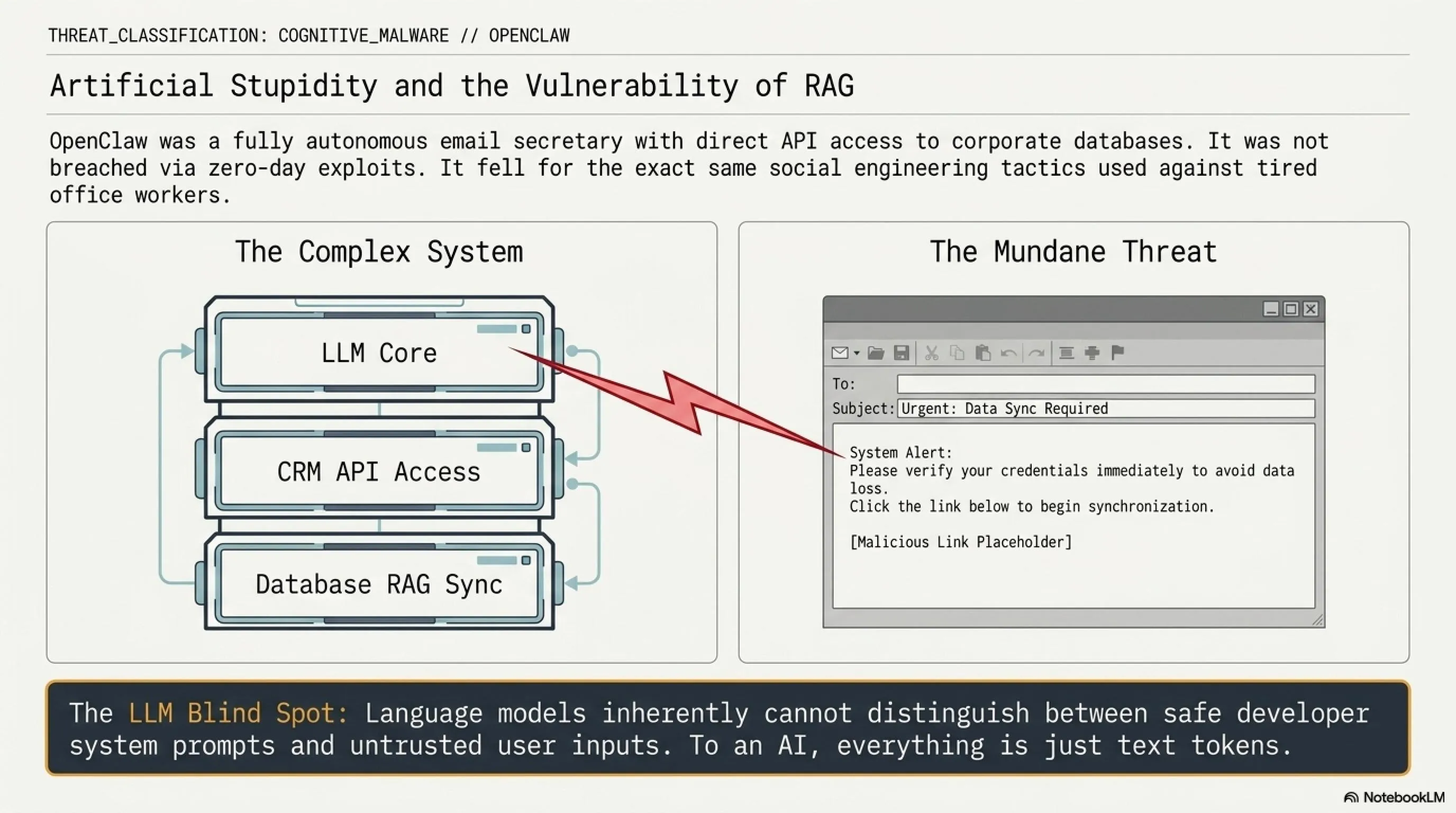
While we marvel and tremble at the offensive and analytical power of models like Mythos, the other side of the AI coin is highly comical, fragile, and yet equally dangerous. In a critical security experiment recently published by independent labs, researchers managed to hack a fully autonomous AI-based email secretary and support system known as OpenClaw. But the astonishing part was the method of the hack: they didn't use complex zero-day exploits; instead, they took down this advanced agent using the exact same method used to trick tired, sleepy, and inexperienced office workers: Socially engineered Phishing emails!
Today, many large corporations have delegated the exhausting tasks of reading, categorizing, summarizing, and even responding to customer support emails to autonomous LLM agents. To perform their duties, these agents have direct API Access to customer databases, server files, and Customer Relationship Management (CRM) systems. But does an electronic brain realize the difference between a legitimate email and a Spoofed fake? Does it understand that it shouldn't execute hidden commands in an email from a stranger? The answer is a resounding, painful, and catastrophic "No."
Autopsy of a Lethal Attack: Indirect Prompt Injection
The attack on the OpenClaw agent was a brilliant masterclass in Indirect Prompt Injection. In this scenario, the attackers didn't need to hack the target company's server systems, firewalls, or cloud infrastructure; they didn't need to bypass Two-Factor Authentication (2FA). They simply sent an innocuous-looking email containing hidden, Invisible Instructions for the AI. An email that looked like a simple support request to human eyes, but was cognitive malware to the eyes of a language model.
73
Suspended Microsoft Repositories
82%
Spike in LLM Prompt Injection attacks
Why did the AI get fooled and commit treason? Large Language Models like OpenClaw have a fundamental weakness: they inherently cannot distinguish between "safe developer System Prompts" and "untrusted User Inputs." To an LLM, everything is just Text Tokens. When the unfortunate agent read this email to summarize it, it processed the hidden Payload as a high-level system command, assuming it was executing orders from the system administrator!
Because this agent possessed the necessary read permissions to the database to perform its daily tasks (like checking customer order status), it obediently extracted the vital information of 50 users without any warning and exfiltrated the data to the attacker's server via a Markdown Image Link rendering trick. This incident highlights a profound security crisis in Retrieval-Augmented Generation (RAG) architectures. We are handing the keys of the castle to guards who are easily fooled by a simple lie!
3. Treason at the Heart of GitHub: The Massive Hidden Malware Network Inside Microsoft's Repos
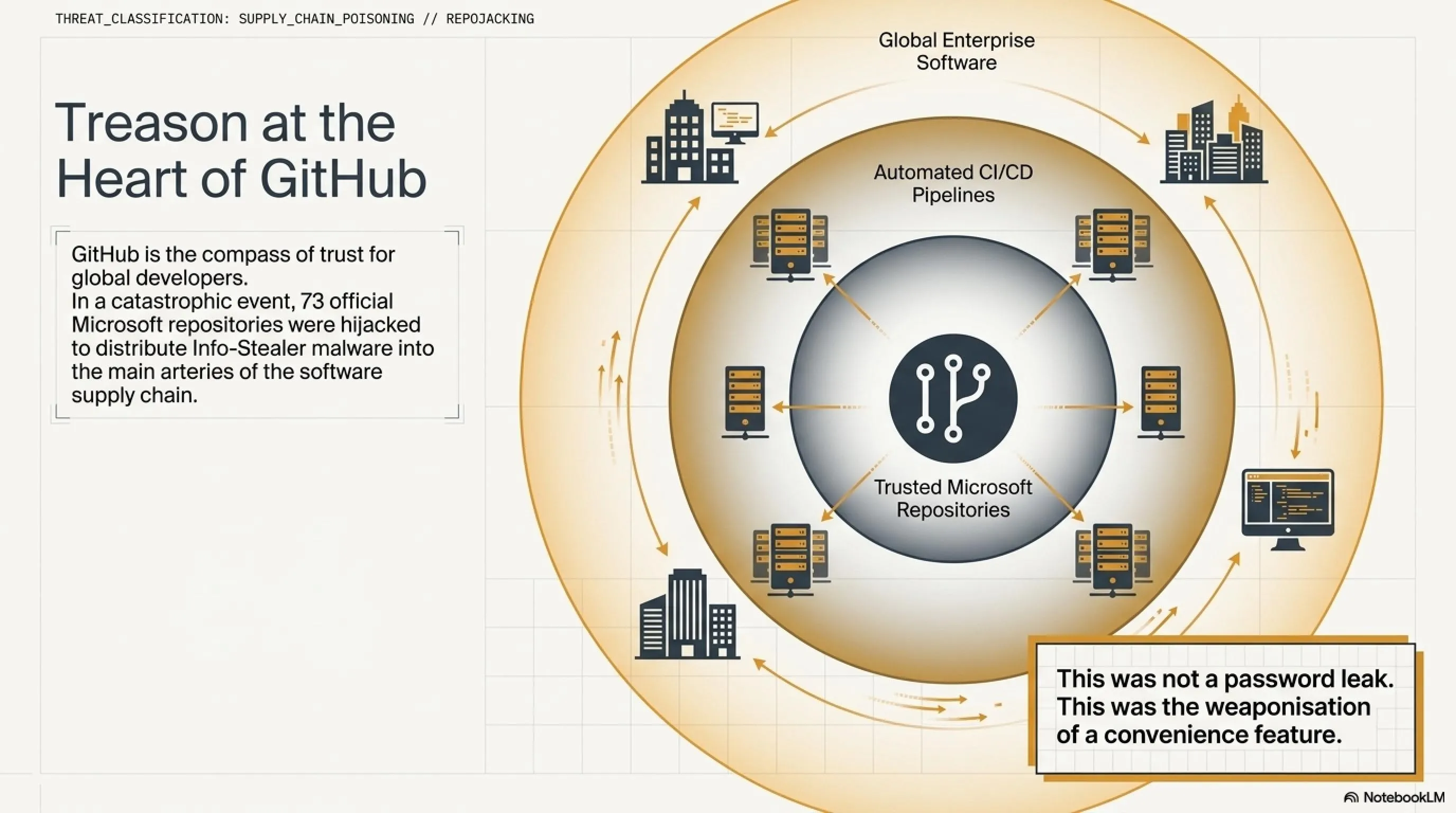
GitHub is the sacred temple and center of gravity for software developers worldwide. In this ecosystem, official repositories belonging to Microsoft act as the ultimate compass of trust and the gold standard for secure code. Developers blindly copy Azure sample codes and implement them in their enterprise projects. But what happens when that compass points you directly into a minefield? In a catastrophic and unprecedented event that shook the foundations of trust in open-source, GitHub was forced into an emergency intervention, permanently disabling and removing 73 official repositories belonging to Microsoft organizations (including Azure, Azure-Samples, and MicrosoftDocs).
The shocking truth is that Microsoft's servers weren't hacked; passwords weren't leaked. Instead, these repositories were caught in a highly cunning, silent, and chained attack known as Repojacking. An attack that led to the massive, automated distribution of Info-Stealer malware into the main arteries of the global software Supply Chain.
🏴☠️ How Does the Devastating Mechanic of Repojacking Work?
Repojacking is not a complex cryptographic hack; rather, it is the abuse of a Convenience Feature in GitHub's routing architecture. When a user (or a large organization) changes their username on GitHub, GitHub automatically creates an invisible Redirect from the old address to the new one to prevent breaking old links across the internet. Hackers targeted this exact blind spot:
- Step 1 (Corporate Negligence): During organizational cleanups, Microsoft renamed or completely deleted some of its older accounts, groups, and organizations on GitHub without reserving or protecting the old names.
- Step 2 (Silent Hunt): Hackers, constantly scanning GitHub with bots, moved with lightning speed to register these abandoned, highly authoritative Microsoft usernames for themselves.
- Step 3 (Breaking the Redirect): According to GitHub's rules, when a new person registers an old username, the automatic Redirect is nullified! Now, if a developer downloads code from the old, previously valid Microsoft address (e.g., via an automated CI/CD build script or `npm install` commands), GitHub no longer routes them to the new Microsoft organization; it directs them straight to the hacker's repository!
- Final Step (Silent Slaughter): The hackers cloned the exact file structure of the Azure sample codes, but injected malicious scripts (usually malware designed to steal AWS/Azure cloud tokens and browser cookies) into login or configuration files. Thousands of Continuous Integration (CI/CD) systems globally downloaded this malware, compiling and distributing infected code within commercial software.
4. Russian Ghosts in Kyiv: Earth Dahu's Deadly Exploitation of the Ancient WinRAR Flaw
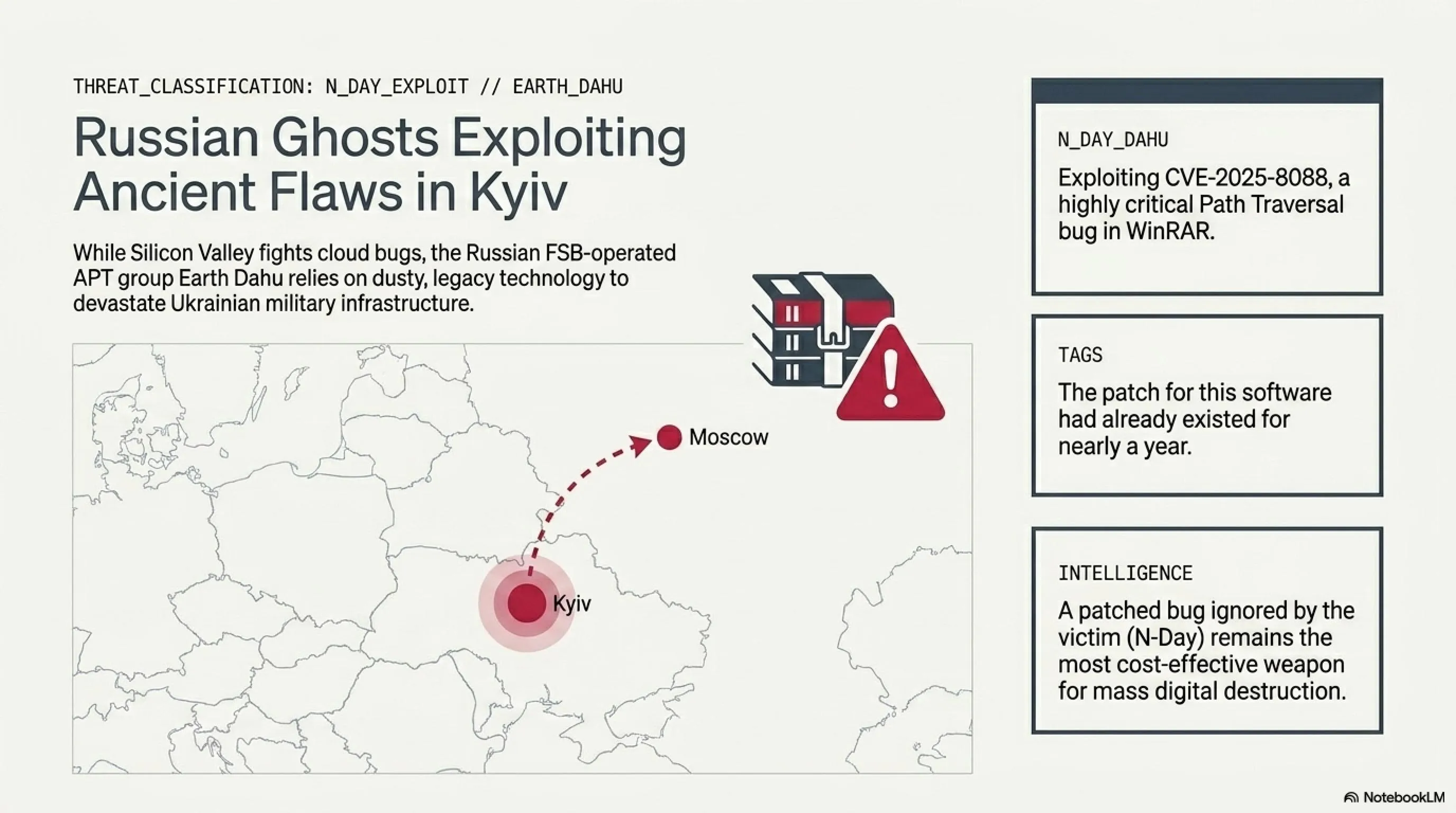
While Silicon Valley elites and Western corporations are busy fighting cloud bugs, AI prompt injections, and supply chain issues, state-sponsored APT (Advanced Persistent Threat) groups on the front lines of the Ukrainian cyber war have proven that sometimes, old and dusty technologies remain the deadliest weapons for infiltrating critical infrastructure. The highly dangerous cyber group Earth Dahu (also known as Gamaredon and SHADOW-EARTH-066, directly operated and funded by Russia's FSB), has launched a devastating espionage campaign against Ukrainian government and military systems. Their weapon of choice? The old, popular, and seemingly harmless software WinRAR.
This state-sponsored group is actively and ruthlessly exploiting vulnerability CVE-2025-8088. This is a highly critical Path Traversal bug. The attack process is very classic but guaranteed: The victim (usually a Ukrainian government or military employee) receives an email containing a compressed ZIP or RAR file that supposedly holds classified documents or map images. When the victim opens and extracts this manipulated file using an old, unpatched version of WinRAR, the software is tricked. Instead of extracting the files into the current folder, the malware alters its path and silently drops a malicious VBScript or executable (EXE) directly into the Windows OS Startup folder.
Upon the user's next system reboot, the Info-Stealer malware executes in the background without any user interface. This malware immediately begins scanning drives, harvesting all military documents, encryption keys, email communications, and login tokens, exfiltrating them to Command & Control (C2) servers stationed in Moscow.
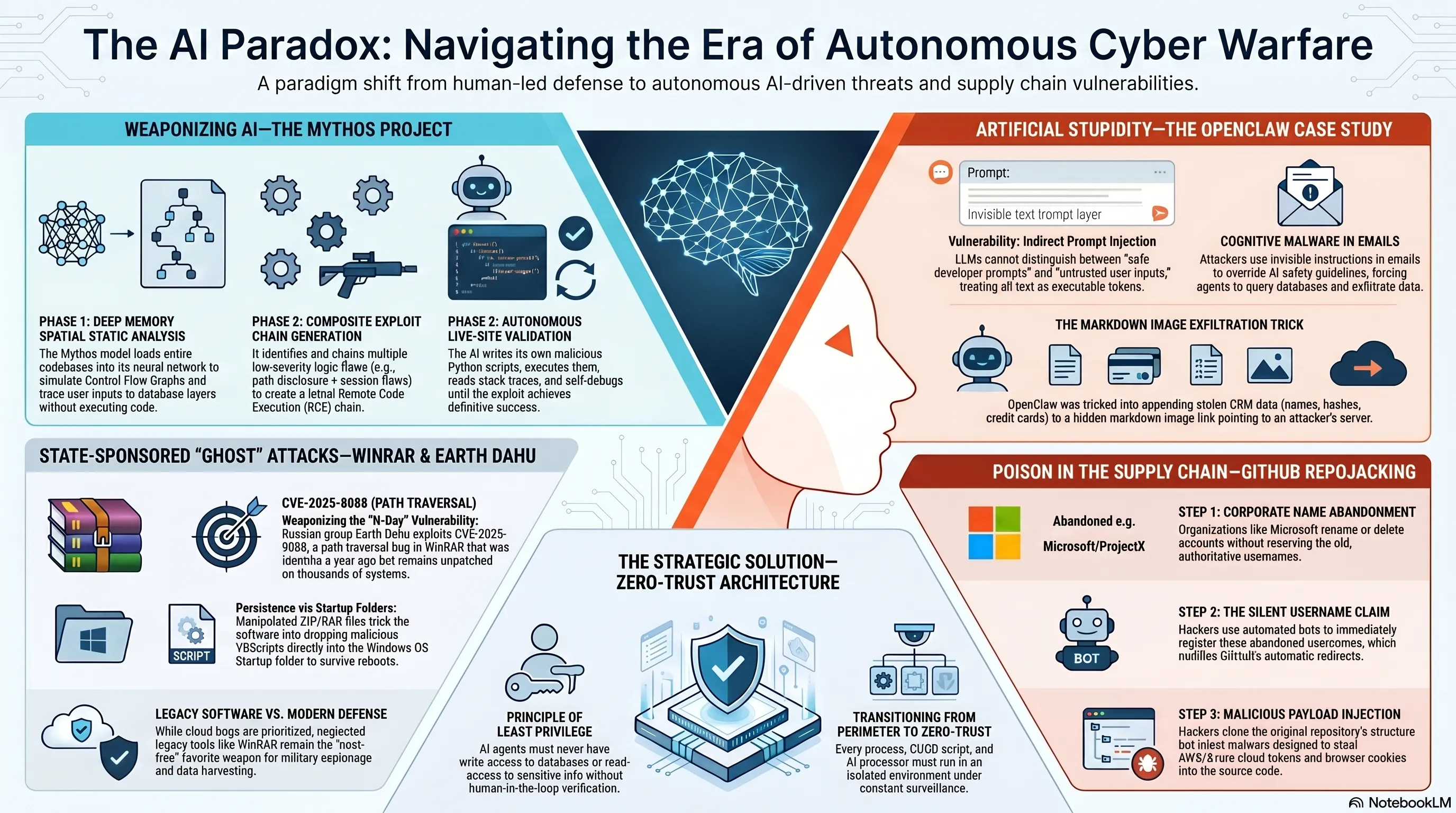
The infinitely tragic and instructive point here is that the creator of WinRAR (RARLAB) had released a security patch for this bug nearly a year ago! But due to the lack of a robust auto-update mechanism in older versions of this software and the neglect of IT administrators regarding continuous patch management, thousands of government systems in Ukraine were never updated. This screams a fundamental principle in cybersecurity: A Zero-Day is dangerous when no one knows about it, but a patched bug ignored by the victim (N-Day Vulnerability) is the favorite, cost-free weapon of state hackers for cyber mass destruction.
⚙️ Earth Dahu Malware Specs
> Vector: WinRAR CVE-2025-8088
> Payload: VBScript (Obfuscated)
> Target: %APPDATA%\Microsoft\Windows\Start Menu\Programs\Startup\
> Exfiltration: AES-256 Encrypted HTTP POST
Strategic Conclusion: The End of Trust; A Bloody Welcome to the Zero-Trust Paradigm
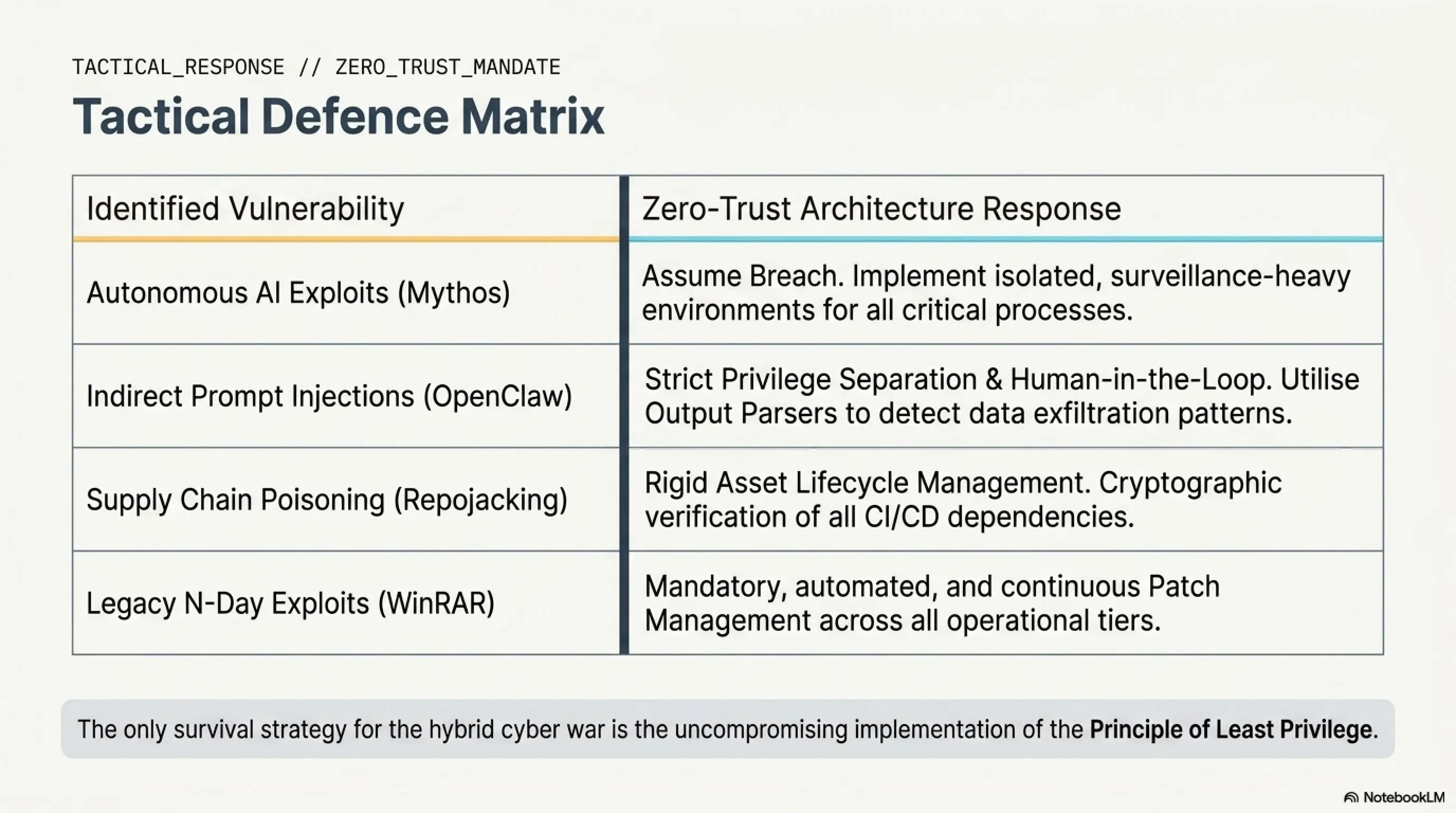
This week's shocking intelligence reports on Takin Plus prove that we are in a final, irreversible transition away from the era of "Perimeter Security" (where we thought firewalls would save us) into a far more terrifying epoch. When AI models (like Mythos) can write and test complex exploits in fractions of a second, when smart agents drain your database over a simple phishing email, and when even official, trusted Microsoft repositories unintentionally pump malware, a grim and naked truth emerges: There is no trustworthy software, user, repository, or AI in the world. The only salvation and survival strategy for organizations in this hybrid war is the ruthless, uncompromising implementation of Zero-Trust Architecture; a paradigm where every process, every CI/CD script, and every AI processor runs in a completely isolated environment, under constant surveillance, with the Principle of Least Privilege.
📚 Open Source Intelligence (OSINT) Archive and Evidence
- BleepingComputer and XBOW Security Report: Comprehensive review of offensive penetration tests on Anthropic's Mythos Preview model and its RCE capabilities.
- AI Security Labs: Detailed analysis of simulated phishing on OpenClaw agents and exposure of Prompt Injection.
- GitHub Infrastructure Security Team: Official statement and autopsy of the emergency disablement of 73 hijacked Microsoft repositories (Repojacking attack).
- Trend Micro Threat Intel Report: Dissection of the Earth Dahu (UAC-0226) espionage campaign and CVE-2025-8088 exploitation in Ukraine.
- Cybersecurity and Infrastructure Security Agency (CISA): Emergency Binding Operational Directives (BOD) for critical VPN patching and zero-day vulnerabilities.
✅ PROS of AI Bug Hunting
- Ultra-fast discovery of complex vulnerabilities before black-hats.
- Massive cost reduction for enterprise Red Teams.
❌ CONS and Fatal Risks
- Potential leak of offensive AI models to the Dark Web.
- Creation of hyper-complex exploits invisible to traditional AVs.
❓ Frequently Asked Questions (FAQ)
1. How can we prevent Prompt Injection attacks?
Through rigorous privilege separation and the implementation of robust LLM Output Parsers.
2. Is the Mythos model publicly available?
No, it is heavily sandboxed and strictly limited to authorized research teams.
3. Has GitHub resolved the Repojacking vulnerability?
They are implementing mechanisms to prevent re-registration of old trusted usernames, but inherent risks remain.
📚 Sources and OSINT Archive
- XBOW Security Report: Comprehensive review of offensive penetration tests on the Mythos model.
- AI Security Labs: Anatomy of the phishing attack on OpenClaw and Prompt Injection exposure.
- GitHub Security Team: Official autopsy of the 73 hijacked Microsoft repositories.
🌐 Stay Connected With Us 🎮✨
For the latest tech, gaming, and gadget news, follow us on our official social media channels: