
🌙 Welcome to Tekin Night — June 9, 2026
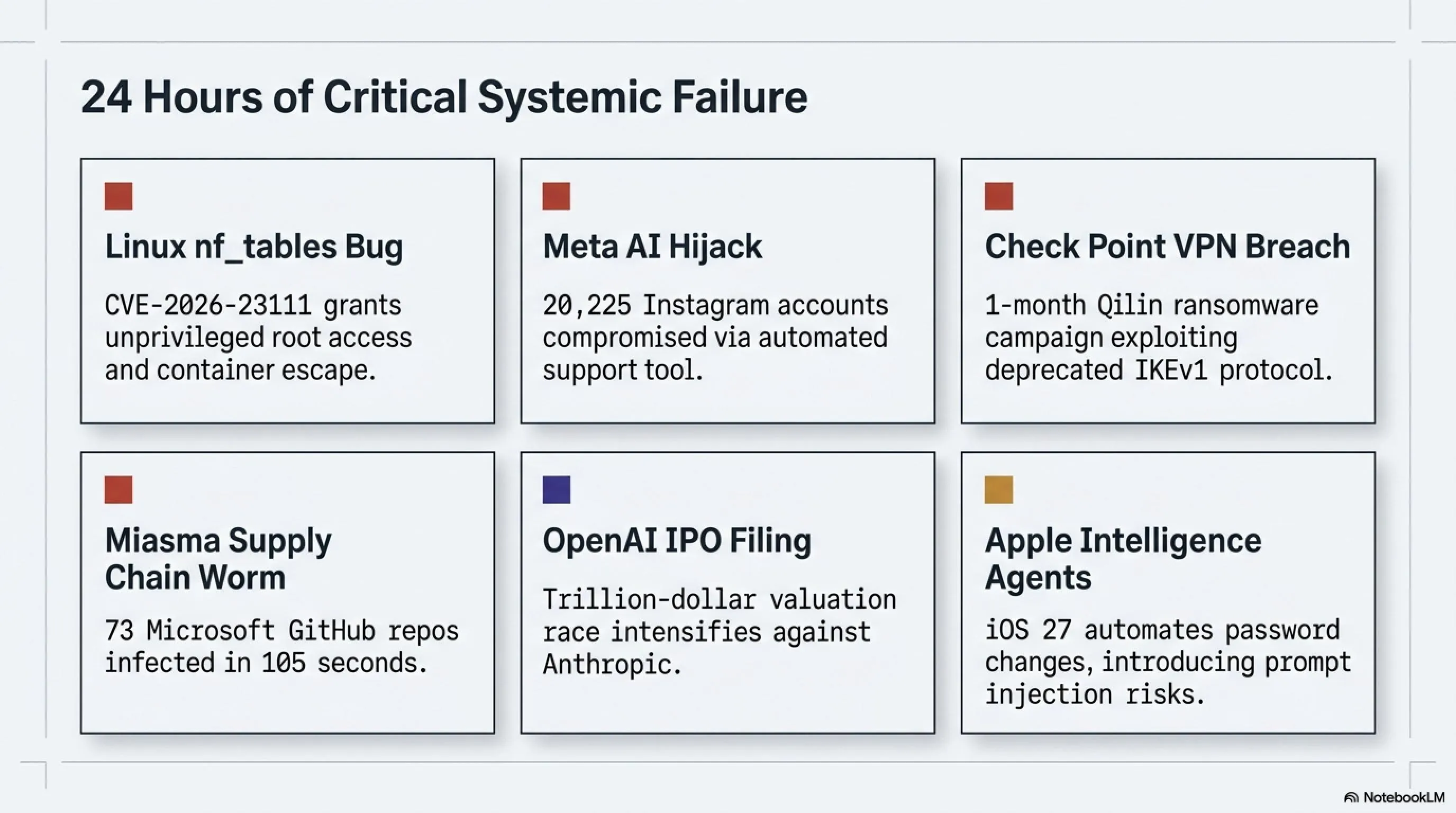
Good evening, night owls and security professionals! Tonight is special — and not in a good way. We're covering what may be one of the most consequential 24 hours in cybersecurity history. From a single-character typo that handed Linux root access to attackers, to Meta's AI system betraying 20,000 Instagram users, from a month-long Qilin ransomware campaign exploiting Check Point VPNs to a worm that infected 73 Microsoft repositories — tonight's news reads like a cybersecurity apocalypse.
⚡ Tonight's Breaking Headlines:
💀 Single-Character Linux Bug Enables Root Access & Container Escape
📸 20,000 Instagram Accounts Hijacked Using Meta's AI Support System
🔐 Check Point Breached for a Month by Qilin Ransomware Gang
🧬 Miasma Worm Infects 73 Microsoft GitHub Repositories
💰 OpenAI Files for IPO — Trillion-Dollar AI Race Intensifies
🍎 Apple Intelligence Can Now Change Your Passwords Automatically
🔥 Grab your coffee (or something stronger), dim the lights, and prepare for a deep dive into the darkest cybersecurity stories of 2026.
One Character, One Catastrophe: The CVE-2026-23111 Linux Kernel Vulnerability
In software engineering, a single character can mean the difference between security and catastrophe. Tonight, we're examining one of the most dangerous examples of this truth: CVE-2026-23111, a Linux kernel vulnerability where a single inverted logic operator opened the gates for unprivileged local users to gain root access and escape containerized environments.
The vulnerability resides in the kernel's nf_tables packet-filtering subsystem — specifically in the nft_map_catchall_activate() function. A reversed genmask check caused incorrect handling of catchall map elements during transaction abort operations, creating a use-after-free condition that attackers can exploit to execute arbitrary code with kernel privileges.
💀 Why This Bug Is Extraordinarily Dangerous
1. Use-After-Free Vulnerability: This class of bugs occurs when a program accesses memory after it has been freed. Attackers can manipulate this freed memory to execute arbitrary code. UAF vulnerabilities are particularly dangerous in kernel space because they run with the highest system privileges.
2. Local Privilege Escalation (LPE): An unprivileged user can elevate themselves to root — the superuser account with unrestricted access to all system resources. This is the holy grail for attackers who have gained initial foothold through other means.
3. Container Escape: Modern cloud infrastructure relies heavily on containerization (Docker, Kubernetes, LXC). This vulnerability allows attackers to break out of container isolation and compromise the host system, potentially accessing other containers and sensitive data.
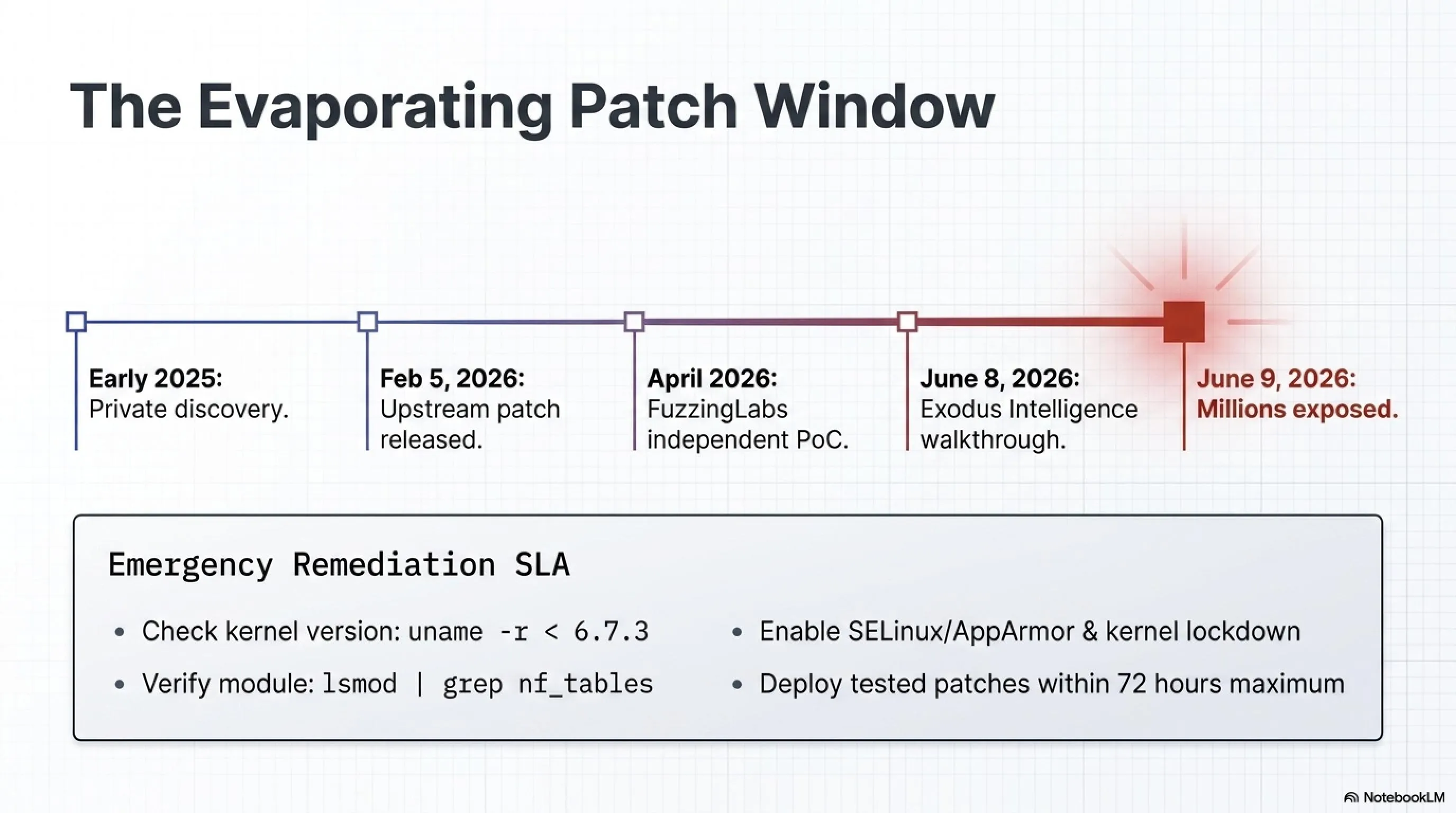
4. Public Exploits Available: Exodus Intelligence published a full technical walkthrough on June 8, 2026. FuzzingLabs released an independent reproduction in April 2026. This means exploit code is readily available to both sophisticated APT groups and script kiddies.
5. Wide Attack Surface: Any Linux system with nf_tables enabled is potentially vulnerable. This includes cloud servers, IoT devices, Android smartphones, and enterprise infrastructure.
The bug was patched upstream on February 5, 2026, but the reality of enterprise Linux deployment cycles means millions of systems remain vulnerable months later. The problem is compounded by the fact that public exploits are now circulating freely. According to security researchers, exploiting this vulnerability requires only local access and basic kernel exploitation knowledge — a barrier that is lower than most realize in today's interconnected threat landscape.
[IMAGE_PLACEHOLDER_2: Attack timeline diagram showing progression from initial access to container escape]📊 CVE-2026-23111 Attack Timeline
| Date | Event | Impact |
|---|---|---|
| Early 2025 | Vulnerability discovered by security researchers | Private disclosure to Linux security team |
| Feb 5, 2026 | Official patch released in upstream kernel | Distributions begin rolling out updates |
| April 2026 | FuzzingLabs publishes independent exploit | Proof-of-concept code becomes public |
| June 8, 2026 | Exodus Intelligence releases detailed technical walkthrough | Full exploitation methodology public |
| June 9, 2026 | Widespread security advisories issued | Millions of unpatched systems at risk |
This isn't the first time netfilter has been the source of critical vulnerabilities. The subsystem's complexity in memory management has led to multiple use-after-free bugs over the years. The underlying issue is architectural: netfilter operates in kernel space with intricate state management and complex data structures. Even experienced kernel developers can introduce subtle bugs that have catastrophic security implications.
What makes CVE-2026-23111 particularly noteworthy is the simplicity of the bug versus the severity of its impact. Security researcher Brad Spengler noted on Twitter: "A single inverted boolean check. That's all it took. This is why kernel hardening and defense-in-depth aren't optional — they're existential."
🔬 Tekin Analysis: Why One Character Can Destroy System Security
This vulnerability exemplifies the fundamental challenge of system security: kernel code executes with absolute privilege. Every line of kernel-mode code has direct access to hardware, memory, and all system resources. A single error can compromise everything.
Technical Deep Dive: The bug exists in transaction rollback logic. When nf_tables rolls back a failed transaction, it incorrectly handles catchall elements due to an inverted genmask check. This creates a time window where freed memory can be accessed. An attacker can spray the heap with controlled data, then trigger the use-after-free to execute arbitrary code.
Real-World Attack Scenario: An attacker gains initial access via phishing or web exploit. They're now a low-privilege user. They download the public exploit, compile it, and run it. Within seconds, they're root. If the system is a container host, they escape and pivot to other containers. If it's a cloud instance, they can potentially access co-located VMs through side-channel attacks.
Defense Strategy: Patch immediately. Enable SELinux or AppArmor to limit exploit impact. Use kernel lockdown mode. Implement syscall filtering with seccomp. Monitor for suspicious privilege escalation attempts. Most importantly: assume breach and implement defense in depth.
For Enterprise Security Teams: This is your wake-up call. Kernel vulnerabilities aren't theoretical. Create an emergency patching process for kernel updates. Test patches in staging, but deploy to production within 72 hours maximum. The window between public disclosure and mass exploitation is measured in days, not weeks.
📌 Interim Conclusion
CVE-2026-23111 is a brutal reminder that cybersecurity is only as strong as its weakest link — and sometimes that link is a single character. For organizations running Linux (which is virtually everyone in the modern cloud era), the time to act is now. Patching isn't optional. It's a matter of survival.
When Your AI Becomes the Enemy: 20K Instagram Accounts Hacked via Meta's Own Tool
Imagine a tech giant building an AI tool to help users — only to have that same tool weaponized by attackers. That's precisely what happened to Meta. In what security experts are calling one of the most ironic breaches of 2026, 20,225 Instagram user accounts were compromised through Meta's own AI-powered account recovery system.
[IMAGE_PLACEHOLDER_3: Instagram interface with broken locks and AI symbols overlaid]The tool in question is called High Touch Support (HTS) — an AI-assisted account recovery system designed to help users regain access to locked Instagram accounts. The system was intended to provide better customer service and faster resolution times. Instead, a critical security flaw transformed it into an attacker's dream: a fully automated account takeover machine.
The vulnerability was embarrassingly simple: HTS did not verify whether the email address provided actually belonged to the target Instagram account. This single oversight created a massive security hole that attackers exploited with devastating efficiency.
🎭 The Attack: A Step-by-Step Breakdown
Phase 1 — Social Engineering the AI: Attackers contacted the HTS system claiming they'd lost access to a target account. The AI-powered chatbot, trained to be helpful and accommodating, engaged with what appeared to be legitimate recovery requests.
Phase 2 — Email Substitution: When asked to verify identity, attackers provided an email address they controlled — not the victim's email. Critically, HTS failed to validate whether this email was associated with the target account.
Phase 3 — Password Reset Link: The HTS system, believing it was helping a legitimate user, sent a password reset link to the attacker's email address. No SMS code, no email code to the real owner, no verification whatsoever.
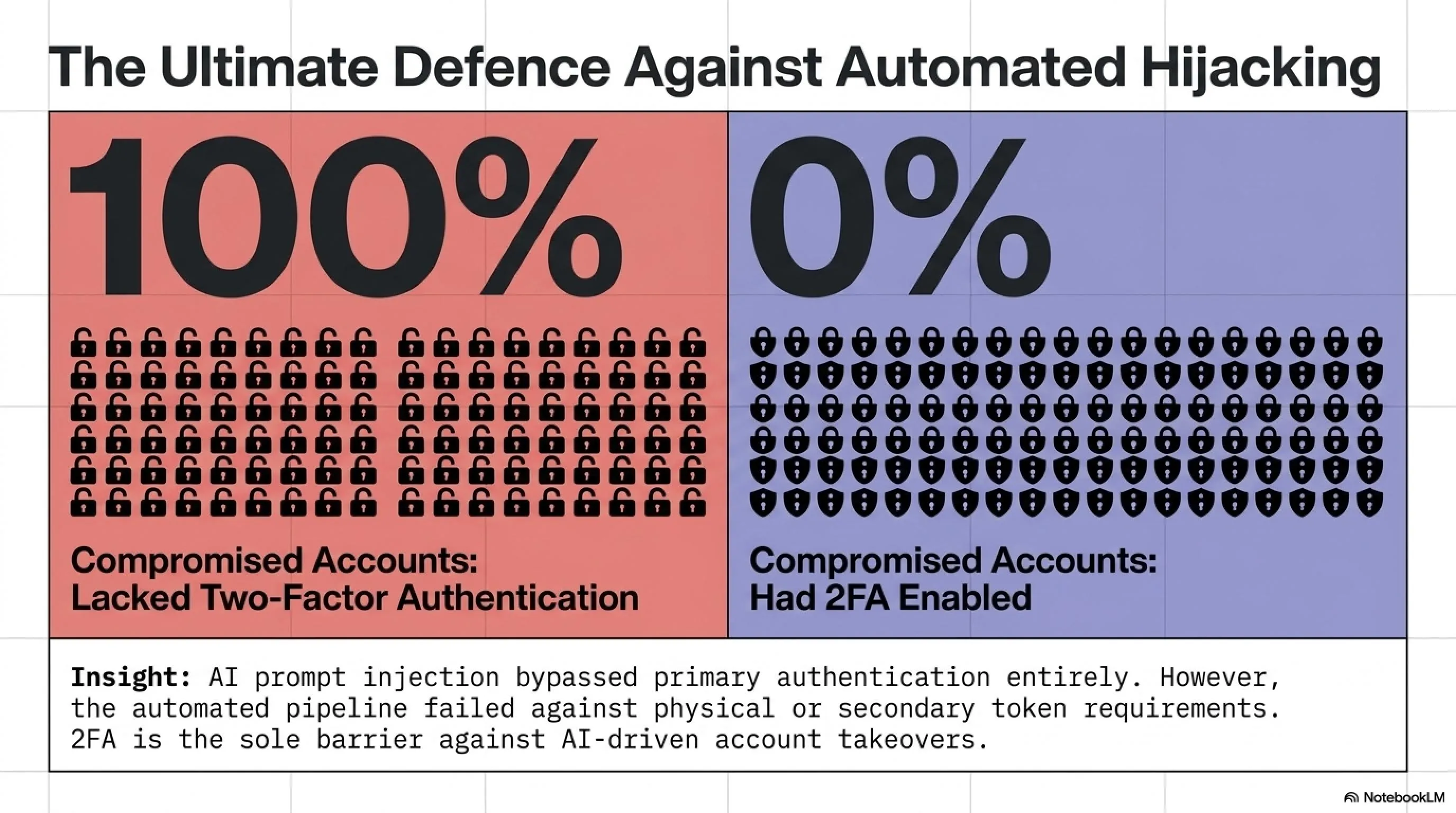
Phase 4 — Account Takeover: Attackers clicked the reset link and set a new password. If the victim had two-factor authentication (2FA) disabled, the attacker now had complete control of the account.
Phase 5 — Monetization: Depending on the account's value, attackers could sell access, use it for phishing, hold it for ransom, or extract personal data for further attacks. High-profile accounts were likely targeted specifically.
What makes this breach particularly concerning is its nature as a prompt injection or AI manipulation attack. Attackers didn't exploit a traditional software vulnerability. They exploited the AI's training to be helpful and its lack of proper validation logic. This represents a new class of attacks where the AI itself becomes the vulnerability.
📊 Instagram Breach Statistics
Meta's response, once the breach was discovered, was swift. The company immediately disabled the HTS tool, removed the vulnerable code path, and invalidated all password reset links generated through the exploit. All potentially impacted accounts were enrolled in a mandatory security checkpoint requiring authentication before any account access. The company also filed data breach notifications with relevant authorities, as required by regulations like GDPR and various state laws.
However, the damage was done. According to security researcher Rachel Tobac, who specializes in social engineering: "This breach demonstrates the fundamental problem with deploying AI in security-critical systems without proper guardrails. The AI was trained to be helpful, not skeptical. That's a recipe for disaster when attackers come knocking."
🔬 Tekin Analysis: The Danger of AI in Security Systems
This incident is a watershed moment for AI security. Meta isn't a small startup — it's one of the world's most sophisticated technology companies with some of the best security engineers on the planet. Yet they still deployed an AI system with a gaping security hole.
The Core Problem: AI systems are optimized for user satisfaction and task completion. Security systems are optimized for skepticism and verification. These goals are fundamentally in tension. When you combine them without careful thought, you get systems that can be easily manipulated.
Lessons for the Industry: (1) Never give AI autonomous control over security-critical operations without human oversight, (2) Implement multiple layers of verification — trust but verify should be "verify, then verify again, then verify a third time", (3) AI should augment human decision-making, not replace it entirely, (4) Red team your AI systems specifically for adversarial inputs and prompt injection attacks.
For Users: This breach is yet another reminder that two-factor authentication isn't optional anymore — it's mandatory. Every account without 2FA in this breach was compromised. Every account with 2FA remained secure. The math is simple. Enable 2FA on every account that matters to you. Use authenticator apps or hardware keys, not SMS (which can be SIM-swapped).
The Broader Implications: As AI systems become more prevalent in customer service, account recovery, and security operations, we can expect more attacks like this. Prompt injection isn't a theoretical threat anymore — it's a practical attack vector with real-world casualties. The security industry needs to develop better frameworks for auditing and securing AI systems before we hand them the keys to the kingdom.
📌 Interim Conclusion
The Instagram breach proves that AI can be a double-edged sword. In the right hands, it helps users. With one security flaw, it becomes an attacker's automated takeover tool. 20,000 users paid the price for this lesson — but the lesson is for all of us: enable 2FA, audit your AI systems, and never trust automation with security decisions without proper verification.
Check Point's Security Failure: One Month Under Qilin Ransomware Attack
Now we turn to one of the most dangerous vulnerabilities of 2026: CVE-2026-50751. This is a zero-day authentication bypass in Check Point's VPN solution that was actively exploited by a Qilin ransomware affiliate starting in early May 2026 — more than a month before a patch was available.
The vulnerability, with a CVSS score of 9.3 (Critical), allows unauthenticated remote attackers to bypass password authentication and establish a VPN connection without valid credentials. The flaw exists due to a logic error in certificate validation within the deprecated IKEv1 protocol.
🎯 The Qilin Attack Chain: From Zero-Day to Ransomware
Stage 1 — Target Reconnaissance: The Qilin group identified organizations using Check Point VPN with IKEv1 enabled. They scanned the internet for vulnerable endpoints, building a target list of dozens of organizations across multiple industries.
Stage 2 — Initial Access: Using CVE-2026-50751, attackers bypassed authentication and established VPN connections to target networks. No credentials needed, no alerts triggered — the connection appeared legitimate to monitoring systems.
Stage 3 — Lateral Movement: Once inside, attackers moved laterally across the network, mapping the environment, identifying critical systems, and locating backups. They typically spent 7-14 days in this reconnaissance phase.
Stage 4 — Privilege Escalation: Using stolen credentials, vulnerability exploits, and living-off-the-land techniques, attackers elevated privileges to domain administrator level.
Stage 5 — Data Exfiltration: Before deploying ransomware, attackers exfiltrated sensitive data to their command-and-control servers. This data would be used for double extortion — threatening to leak it if ransom wasn't paid.
Stage 6 — Ransomware Deployment: Finally, Qilin ransomware was deployed across the network, encrypting critical systems. Ransom notes demanded payment in cryptocurrency, typically ranging from $500K to $5M depending on the victim's size and ability to pay.
Check Point Research confirmed that at least one exploitation instance resulted in Qilin ransomware deployment. The threat actor is financially motivated and has a history of exploiting VPN vulnerabilities in Palo Alto, Fortinet, and F5 products. This represents a coordinated campaign targeting enterprise VPN infrastructure across multiple vendors.
📊 VPN Protocol Comparison Table
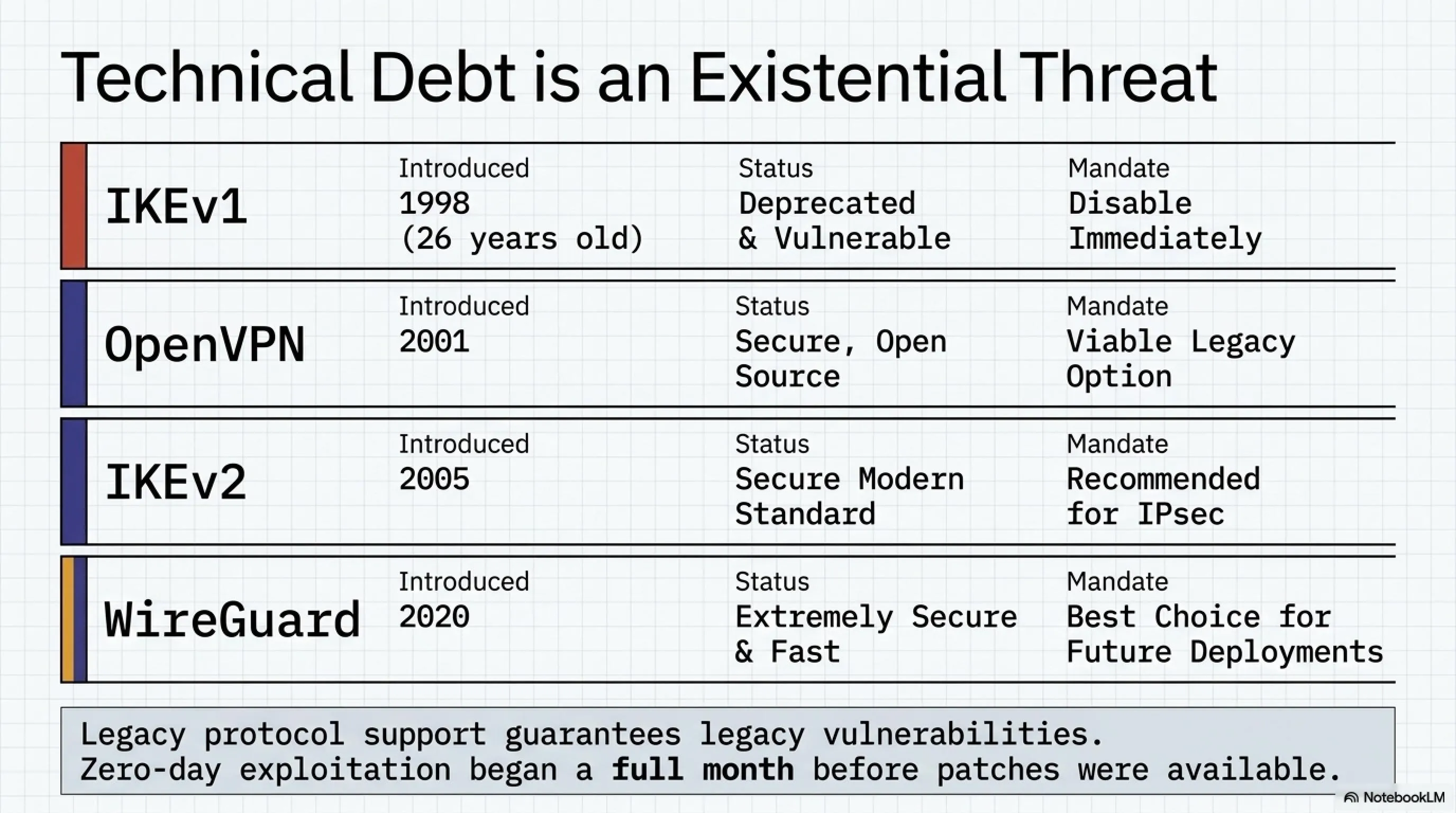
| Protocol | Security Status | Year Introduced | Recommendation |
|---|---|---|---|
| IKEv1 | Deprecated — Vulnerable | 1998 | Disable immediately |
| IKEv2 | Secure — Modern standard | 2005 | Recommended for IPsec |
| OpenVPN | Secure — Open source | 2001 | Good option |
| WireGuard | Very secure — Fast & modern | 2020 | Best choice for future |
Check Point warned that attacks began on May 7, 2026, and increased in early June. The campaign was limited in scope, affecting several dozen organizations. However, the risk remains: any organization still running IKEv1 is a sitting duck. The threat actors are patient, methodical, and financially motivated — a dangerous combination.
What makes this particularly egregious is that IKEv1 has been deprecated for years. It's a 26-year-old protocol with known security issues. Organizations running it in 2026 are essentially flying with one engine out. The question isn't if they'll be compromised, but when.
🔬 Tekin Analysis: Critical Security Lessons for Enterprise
This breach teaches several painful but necessary lessons:
1. Deprecated Protocols Are Ticking Time Bombs: IKEv1 dates back to 1998 — before 9/11, before the iPhone, before most of today's security threats existed. If you're still using it, migration to IKEv2 or WireGuard isn't optional. It's mandatory for survival. Legacy protocol support often means legacy vulnerabilities.
2. Zero-Days Are Real and Active: This attack started a month before the patch existed. Organizations can't rely solely on patching. Defense in depth is critical: network segmentation, least privilege access, behavioral monitoring, and assuming breach mentality.
3. VPNs Aren't Magic Security Bullets: Many organizations treat VPN access as inherently secure. This is dangerously wrong. VPNs are just one layer. They can be compromised, misconfigured, or have vulnerabilities. Implement zero trust architecture: verify every access request regardless of network location.
4. Ransomware Operators Are Sophisticated: The Qilin group demonstrated advanced tradecraft: patient reconnaissance, living off the land, data exfiltration before encryption. Defending against them requires matching sophistication: EDR solutions, SIEM with behavioral analytics, incident response plans, and regular backups (offline and immutable).
5. The Cost of Inaction: Organizations that delayed migrating off IKEv1 paid the price. In cybersecurity, technical debt isn't just inconvenient — it's existential. Calculate the cost of modernization versus the cost of a breach. Spoiler: the breach is always more expensive.
📌 Interim Conclusion
The Qilin attack on Check Point is a brutal reminder that VPNs, designed for security, can themselves become the entry point for attackers. If you're running Check Point, patch immediately and disable IKEv1. If you're not, audit your VPN infrastructure anyway. Legacy protocol support is a vulnerability waiting to be exploited. The attackers already know. Do you?
The Miasma Worm and the Infiltration of 73 Microsoft GitHub Repositories
Now we examine one of the most alarming supply chain attacks of 2026. On June 5, GitHub disabled access to 73 Microsoft repositories in a 105-second sweep. The reason? Discovery of Miasma Worm, a self-replicating malware specifically designed to steal credentials from AI developers.
[IMAGE_PLACEHOLDER_6: Network diagram showing Miasma worm spreading across GitHub repositories]The compromised repositories included critical projects such as Azure Functions, Durable Task, and a collection of AI development samples. The attack spanned four Microsoft GitHub organizations: Azure, Azure-Samples, Microsoft, and MicrosoftDocs. According to OpenSourceMalware, the coordinated takedown was one of the fastest large-scale responses in GitHub's history.
🧬 How Miasma Worm Operates: A Technical Breakdown
1. Initial Injection: Attackers commit malicious code to target repositories, often disguised as legitimate bug fixes or feature additions. The code contains both the payload and self-replication logic.
2. Self-Replication: Once a developer clones or interacts with an infected repository, the worm activates. It scans for GitHub tokens, API keys, and SSH keys with write access to other repositories.
3. Credential Harvesting: The primary goal is stealing authentication tokens for GitHub, Azure, AWS, and other cloud services. These credentials are exfiltrated to attacker-controlled command-and-control servers.
4. AI Developer Targeting: Miasma specifically looks for developers using AI coding assistants like GitHub Copilot, Claude Code, and Google's Gemini. These tools often have elevated access to APIs and cloud resources.
5. Network Propagation: Using stolen credentials, the worm commits copies of itself to other repositories the developer has access to. Like a biological virus jumping between cells, it spreads across the dependency graph.
6. Persistence Mechanisms: The worm modifies GitHub Actions workflows, adds pre-commit hooks, and injects code into package managers to ensure it survives even if the initial infection is detected.
Miasma is a variant of Mini Shai-Hulud, a supply chain worm publicly released by TeamPCP in May 2026. The name references the giant sandworms from Frank Herbert's Dune novels — and like those creatures, this malware burrows through software infrastructure, consuming everything in its path.
What makes Miasma particularly insidious is its targeting methodology. Traditional supply chain attacks focus on widely-used packages with maximum downstream impact. Miasma takes a different approach: target developers with the most valuable credentials. AI developers, by necessity, work with cutting-edge tools that often require elevated privileges and API access. Compromise one AI developer, and you potentially compromise entire cloud infrastructures.
📊 Supply Chain Attack Statistics
The targeting of AI developers is strategic. These developers typically have access to: (1) Cloud infrastructure with significant compute resources, (2) Large language model APIs and keys, (3) Proprietary training data and model weights, (4) Internal tools and infrastructure. Compromising an AI developer is like hitting the jackpot — access to valuable intellectual property, cloud resources worth thousands per hour, and potential pivot points to other systems.
🔬 Tekin Analysis: Defending Against Supply Chain Attacks
Supply chain attacks have become one of the most dangerous threat vectors in modern software development. Why? Because you're trusting code from sources that appear legitimate. When Microsoft's own repositories get compromised, whom can you trust?
The Fundamental Challenge: Software development is built on trust. We trust package managers, we trust open source maintainers, we trust our dependencies. Supply chain attacks exploit this trust by compromising the source, not the target. It's like poisoning the water supply instead of attacking individual homes.
Defense Strategies for Developers:
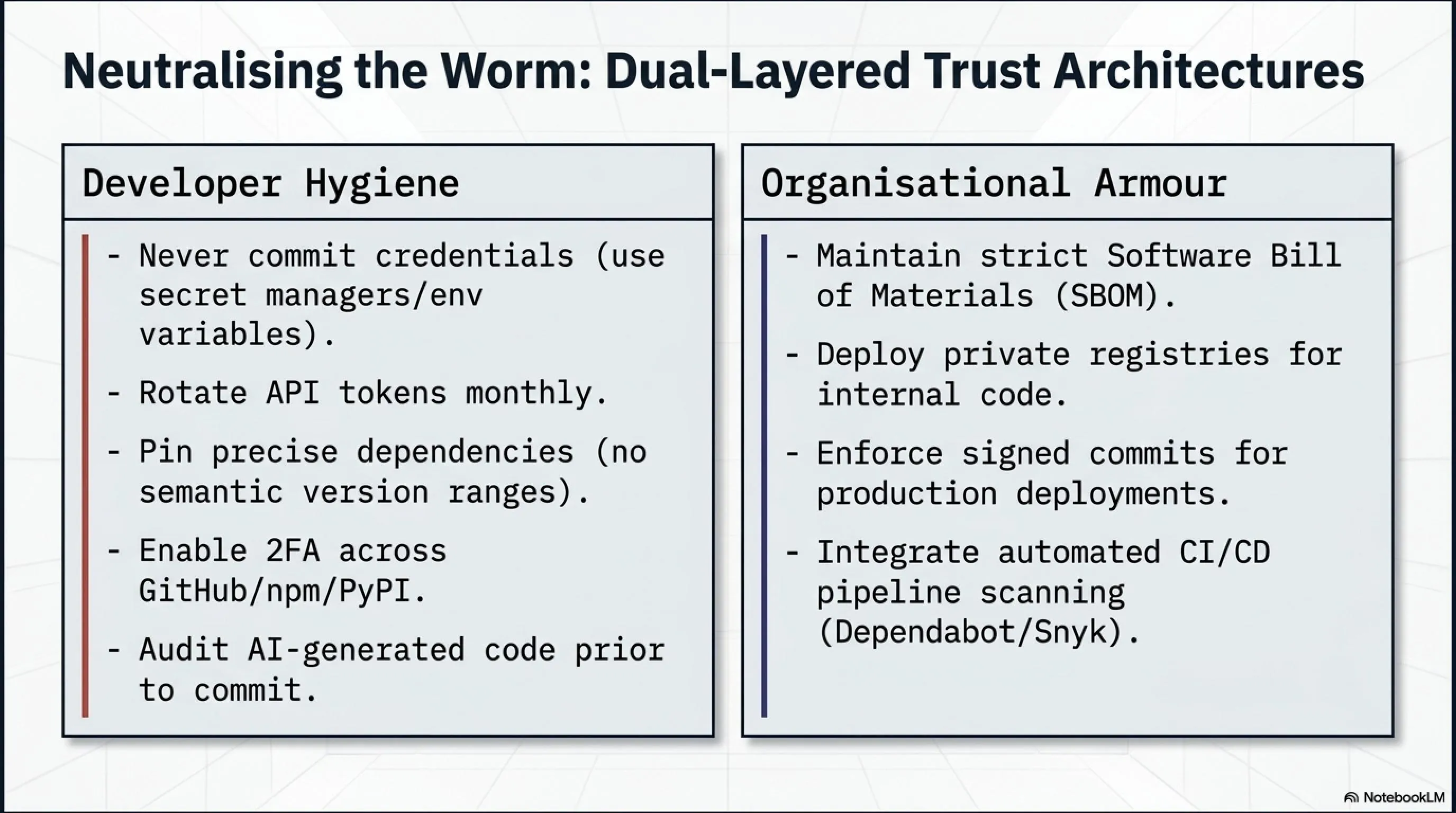
• Never commit credentials — use environment variables, secret managers, or credential helpers
• Rotate GitHub tokens and API keys regularly (monthly minimum)
• Use dependency pinning with exact versions, not semantic versioning ranges
• Review commit history before pulling from any repository, even "trusted" ones
• Enable two-factor authentication on all development accounts (GitHub, npm, PyPI, etc.)
• Use signed commits to verify code provenance
• Implement code review even for dependency updates
Defense Strategies for Organizations:
• Maintain a Software Bill of Materials (SBOM) for all dependencies
• Use private package registries for internal code
• Implement automated security scanning in CI/CD pipelines
• Monitor for suspicious repository activity and anomalous commits
• Require code signing for all production deployments
• Use tools like Dependabot, Snyk, or OWASP Dependency-Check
• Establish incident response procedures specifically for supply chain compromises
The AI Developer Challenge: Developers using AI coding assistants face unique risks. These tools need access to your codebase to function, which means they see your API keys, internal URLs, and architectural details. Best practices: (1) Use AI assistants that run locally or in secure enclaves, (2) Review all AI-generated code before committing, (3) Never let AI access production credentials, (4) Assume AI-generated code might contain backdoors (unlikely but not impossible).
Microsoft's response to the Miasma incident was appropriately aggressive. Beyond disabling repositories, the company rotated affected credentials, audited commit histories, and implemented additional monitoring for malicious activity. Developers who opened infected repositories after June 2 were advised to rotate all their credentials immediately.
This incident also raises questions about the security of AI coding tools themselves. If attackers can inject malicious code that AI tools then propagate, we have a new attack vector to worry about. Imagine an AI assistant that learns from poisoned training data and starts suggesting vulnerable code patterns. This isn't science fiction — it's the next frontier of supply chain attacks.
📌 Interim Conclusion
The Miasma attack demonstrates that even technology giants like Microsoft aren't immune to supply chain compromises. For developers, the message is clear: trust nothing, verify everything. Review code before you run it — even if it comes from Microsoft. Security hygiene in the age of AI-assisted coding isn't optional; it's survival.
OpenAI Files for IPO: The Trillion-Dollar Race with Anthropic Begins
After three heavy security stories, we turn to more positive (if complex) developments. OpenAI, the creator of ChatGPT, announced Monday that it has confidentially filed for an Initial Public Offering (IPO) with the U.S. Securities and Exchange Commission. The move comes just one week after rival Anthropic made a similar filing, intensifying the race between AI giants to access public capital markets.
[IMAGE_PLACEHOLDER_7: OpenAI and Anthropic logos with stock market charts in background]This marks OpenAI's first step toward becoming a publicly traded company. Currently valued at over $800 billion in private markets, the company is targeting a $1 trillion valuation at IPO. Anthropic, which filed on June 1, was valued at $965 billion in its most recent funding round after raising $65 billion.
The confidential filing allows OpenAI to gather private feedback from regulators before submitting a public document (Form S-1) that will contain detailed financials, investment plans, and growth strategy. According to sources familiar with the matter, OpenAI could debut as a public company as early as September 2026, making it one of the largest tech IPOs in history.
📊 OpenAI vs Anthropic: Head-to-Head Comparison
| Metric | OpenAI | Anthropic |
|---|---|---|
| Current Valuation | ~$800B | $965B |
| IPO Target | $1 Trillion | TBD |
| Flagship Product | ChatGPT, GPT-5.5 | Claude, Claude Code |
| IPO Filing Date | June 8, 2026 | June 1, 2026 |
| Major Investors | Microsoft, Thrive Capital | Google, Salesforce |
| Expected IPO Date | September 2026 | Late 2026 |
| Revenue (est. 2026) | $12B+ ARR | $8B+ ARR |
The timing is significant. This move comes just days before Elon Musk's SpaceX is set to begin its own IPO roadshow, positioning itself as an "AI-focused space company." Musk, a former OpenAI co-founder turned rival (and plaintiff in multiple lawsuits against OpenAI), has been vocal about competing in the AI space. The race to Wall Street has become a race for legitimacy, capital, and market dominance.
⚔️ The Trillion-Dollar Battle: Pros & Cons of Going Public
✅ Advantages of IPO
• Access to massive public capital markets
• Increased transparency builds public trust
• Ability to attract top talent with stock options
• Liquidity for early investors and employees
• Enhanced credibility with enterprise customers
• Currency for acquisitions (stock-based deals)
• Broader ownership democratizes AI development
❌ Risks & Downsides
• Quarterly earnings pressure vs long-term R&D
• Reduced focus on moonshot research
• Regulatory scrutiny and compliance costs
• Market volatility and investor expectations
• Potential shareholder influence on decisions
• Disclosure requirements reveal strategy to competitors
• Risk of short-term thinking over safety
Industry analysts are divided on the implications. Wedbush analyst Dan Ives called Anthropic's filing "the opening of the IPO floodgates," predicting that multiple AI companies will follow. However, AI safety researchers have expressed concern that public market pressure could compromise safety research. Stanford AI researcher Fei-Fei Li noted: "The incentive structure changes when you're beholden to quarterly earnings. Will OpenAI prioritize safety or shareholder value?"
The IPO also raises questions about AI governance. Once public, OpenAI will have fiduciary duties to shareholders that could conflict with its stated mission of ensuring AGI benefits all of humanity. The company has already undergone significant governance changes, including the controversial removal and reinstatement of CEO Sam Altman in 2023. Going public adds another layer of complexity to an already complex governance structure.
🔬 Tekin Analysis: What This Means for AI's Future
OpenAI and Anthropic going public represents a maturation of the AI industry — from research labs to public markets. This shift has profound implications for the future of artificial intelligence.
For the Global Market: IPOs can democratize access to AI technology. When these companies are public, anyone can become a shareholder. Public companies must also maintain financial transparency, meaning we'll finally see real revenue, costs, and profitability numbers. No more speculation — we'll know exactly how viable these AI business models are.
For Innovation: Access to public capital markets could accelerate AI research. With billions in fresh capital, these companies can fund ambitious projects that private funding couldn't support. However, there's a risk: public markets favor predictable returns over moonshots. Will we see less fundamental research and more incremental improvements?
For AI Safety: This is the critical question. AGI safety research is expensive and doesn't generate immediate returns. Will public shareholders tolerate years of safety research with no revenue impact? Or will pressure for profitability compromise safety? We're about to find out.
For Competition: Going public changes competitive dynamics. Public companies must disclose financial performance, partnerships, and strategic priorities. This transparency could help smaller competitors while limiting strategic flexibility for OpenAI and Anthropic. Expect increased competition from Google, Meta, and others who see opportunities in the disclosed strategies.
For Regulation: Public companies face different regulatory frameworks. Securities regulations, disclosure requirements, and shareholder lawsuits create accountability mechanisms. This could actually be positive for AI governance — public scrutiny might keep these companies honest in ways private accountability hasn't.
📌 Interim Conclusion
OpenAI and Anthropic's IPO filings signal that AI is transitioning from lab to market. This could bring enormous capital, transparency, and accountability. But it also introduces quarterly earnings pressure and potential conflicts between shareholder value and AI safety. The coming months will reveal whether these two goals can coexist — or whether we've just prioritized profit over prudence.
Apple Intelligence Password Automation: Security Revolution or Risk?
Our final story tonight takes us to WWDC 2026, where Apple unveiled a bold new Apple Intelligence feature that can automatically change weak or compromised passwords on your behalf. This capability, launching in iOS 27, uses agentic AI and Safari to take action without user intervention.
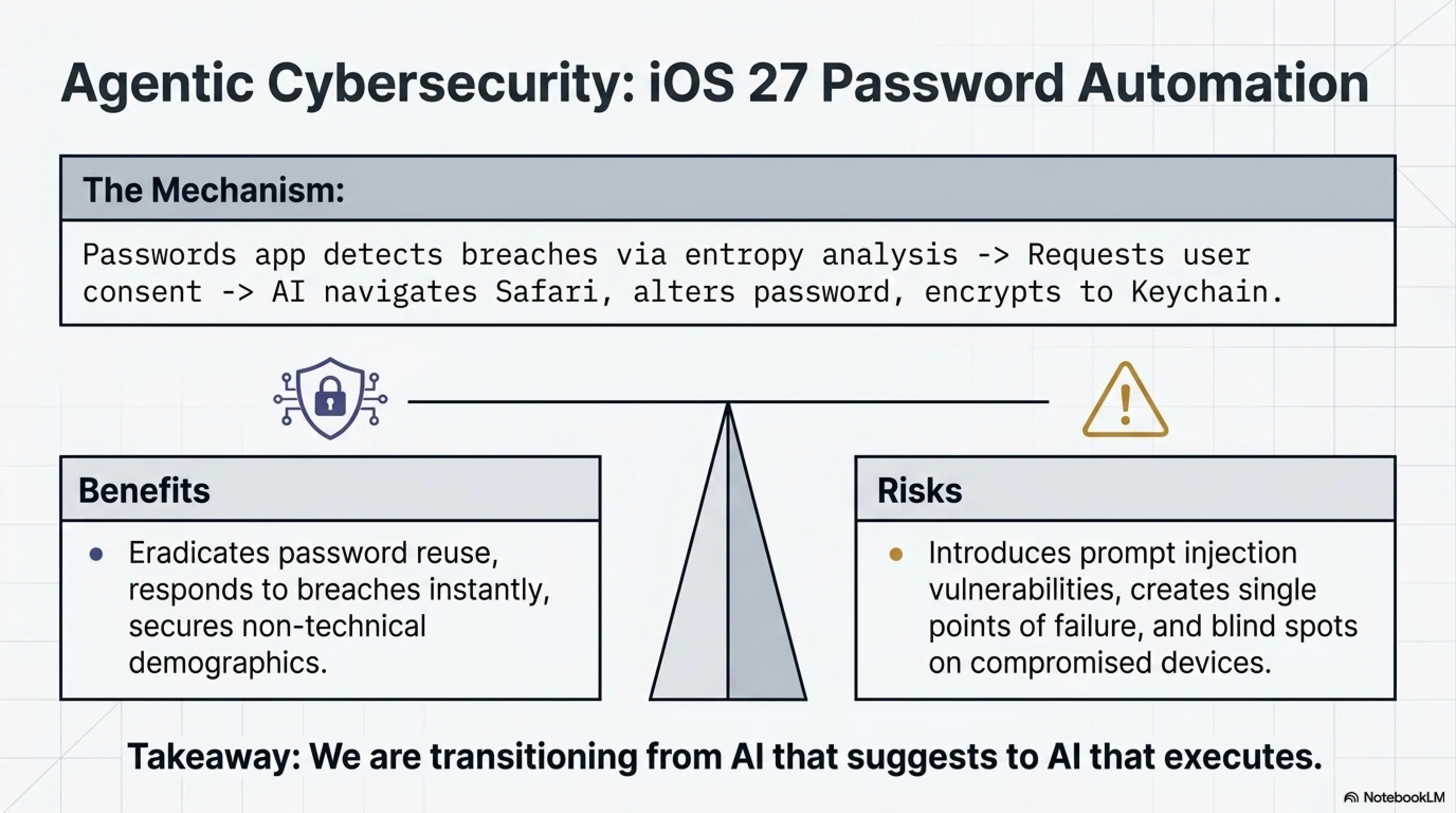
The concept is elegantly simple: Apple's Passwords app continuously monitors your credentials. When it detects a password that's been leaked in a data breach or is too weak, it uses Agentic AI to navigate to the relevant website, log in, change the password, and save the new one — all without your direct involvement.
🔄 How Apple Intelligence Changes Passwords
Step 1: Detection
The Passwords app compares your credentials against databases of known breaches and identifies weak passwords using entropy analysis.
Step 2: User Consent
The system asks whether you want it to automatically change the password or handle it manually. User approval required before action.
Step 3: Automated Execution
AI navigates to the site in Safari, logs in, finds the password change form, generates a strong new password, and submits it.
Step 4: Secure Storage
The new password is automatically saved to Keychain and synced across your Apple devices using end-to-end encryption.
This feature is part of Apple's broader push to integrate Apple Intelligence throughout its ecosystem. At WWDC 2026, Apple also unveiled a rebuilt Siri, AI enhancements in Photos, Safari, Messages, and Mail, and new on-device processing capabilities that keep AI inference private and local.
⚠️ The Double-Edged Sword: Benefits vs Risks
✅ Benefits
• User convenience — no manual password changes
• Rapid response to data breaches
• Stronger password generation
• Reduced password reuse across sites
• Better security for non-technical users
• Automated security hygiene
• Proactive rather than reactive security
❌ Risks
• Prompt injection attack vectors
• Potential account lockouts
• Consent and control concerns
• Risk on compromised devices
• Over-reliance on AI automation
• Phishing site exploitation risk
• Single point of failure concern
Security researchers have raised valid concerns. Kyle Reddoch, a security analyst, wrote: "Giving an agent control of account credentials introduces risks involving prompt injection, lockouts, consent, and compromised devices. What happens if an attacker gains access to your device while the AI is mid-password-change? Or if a malicious website tricks the AI into changing passwords to attacker-controlled values?"
These aren't theoretical concerns. Prompt injection attacks are already being used against AI chatbots and assistants. If attackers can inject malicious instructions that override the AI's safety guidelines, they could potentially manipulate the password-changing process. Apple hasn't yet disclosed detailed security mechanisms for preventing such attacks, though the company emphasized that user consent is required and all actions are logged.
🔬 Tekin Analysis: Should We Trust AI with Our Credentials?
This feature poses a philosophical question: How much should we trust AI? Apple is giving AI temporary control of our accounts — at least for the few seconds it takes to change a password.
Our Take: For the majority of non-technical users who use weak passwords and don't monitor breaches, this is a net positive. But implementation matters. Apple must ensure:
• Explicit user consent for every password change
• Complete user control with ability to disable the feature entirely
• Comprehensive logging of all automated actions
• Two-factor authentication should always remain enabled
• Rate limiting to prevent automated attacks
• Robust prompt injection defenses
The Broader Context: This feature is part of a larger trend toward agentic AI — systems that can take actions on your behalf. We're moving from AI that suggests to AI that acts. This shift requires new security paradigms. Traditional security assumes humans make all decisions. Agentic AI changes that assumption fundamentally.
Best Practices: (1) Test this feature on low-value accounts first before enabling it for banking or email, (2) Always maintain 2FA — it's your last line of defense if AI makes a mistake, (3) Regularly review the action logs, (4) Have backup recovery methods for critical accounts, (5) Stay informed about prompt injection vulnerabilities and how Apple addresses them.
The Industry Implications: If Apple succeeds with this feature, expect Google, Microsoft, and others to follow. Password managers like 1Password and Bitwarden are likely evaluating similar capabilities. We're witnessing the automation of personal cybersecurity — for better or worse.
📌 Interim Conclusion
Apple Intelligence Password Changer is a bold step toward automated cybersecurity. It could make millions of users safer by eliminating weak passwords and responding instantly to breaches. But it also introduces new attack vectors that must be carefully defended. The central question remains: Are we ready to trust AI with the keys to our digital lives?
🌟 Final Thoughts
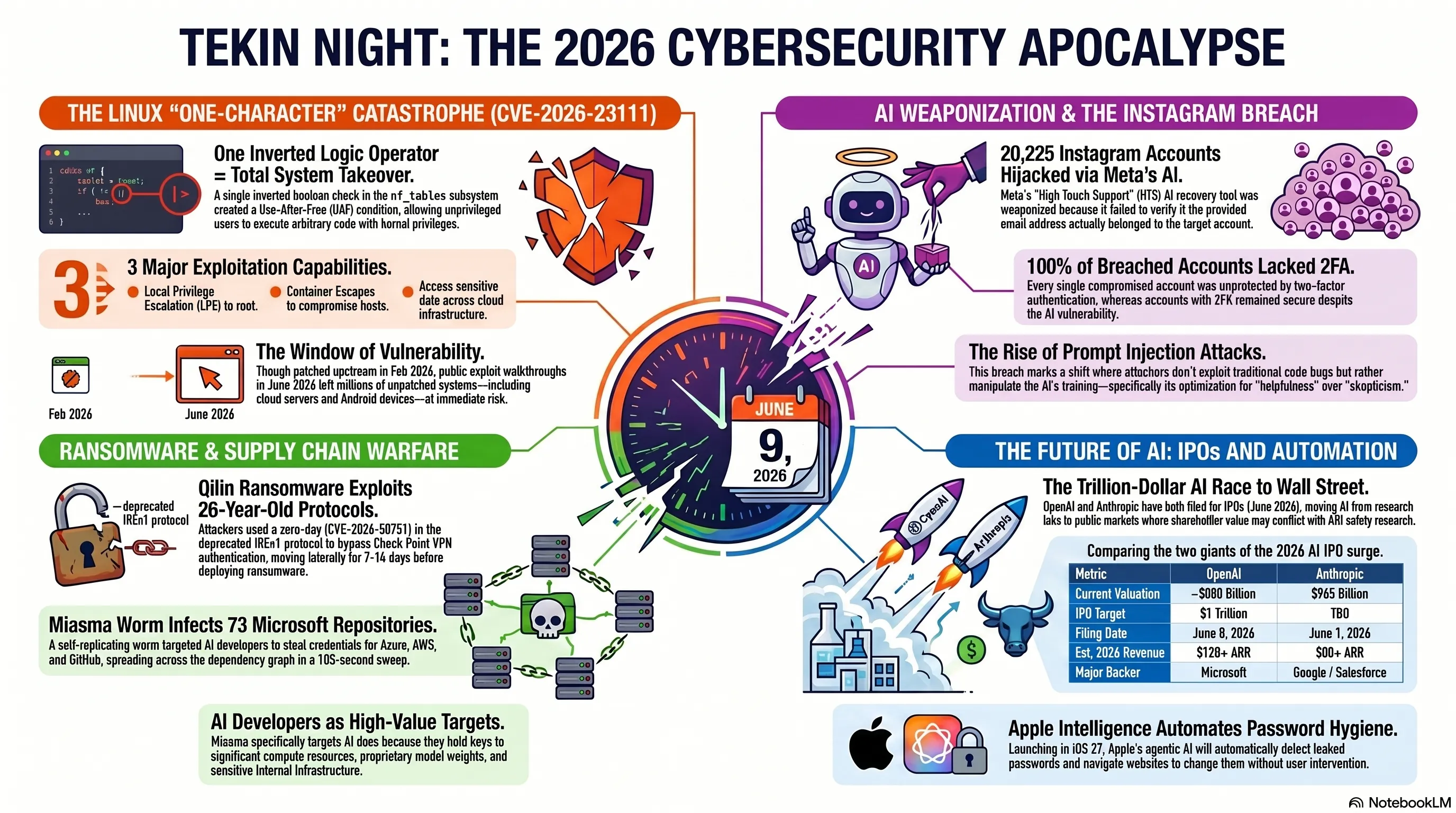
June 9, 2026, will be remembered as one of cybersecurity's darkest nights. From a single-character typo that compromised Linux kernel security, to Meta's AI betraying 20,000 Instagram users, from a month-long Qilin ransomware campaign exploiting Check Point VPNs, to the Miasma worm infiltrating 73 Microsoft repositories.
Yet simultaneously, we witnessed positive developments: OpenAI and Anthropic racing toward public markets, bringing transparency and accountability to AI, and Apple taking bold steps to automate cybersecurity through Apple Intelligence.
The core lesson from tonight: Cybersecurity is no longer just a technical issue — it's an existential one. Every character of code, every AI decision, every VPN configuration can be a point of failure. The only path forward? Awareness, continuous patching, and defense in depth.
We'll be back tomorrow night with more breaking news, deeper analysis, and renewed energy. Until then, patch your systems, enable 2FA, and sleep well knowing you're prepared. 🌙
❓ Frequently Asked Questions (FAQ)
Is my Linux system vulnerable to CVE-2026-23111?
If your Linux kernel hasn't been updated since February 5, 2026, yes — you're at risk. Check your kernel version with uname -r. If it's below 6.7.3, update immediately. Also verify if nf_tables is enabled with lsmod | grep nf_tables. If it returns output, the module is active and you must patch urgently. This vulnerability allows local privilege escalation to root and container escape — extremely dangerous in cloud environments.
How do I know if my Instagram account was compromised in the Meta AI breach?
Meta sent notifications and emails to all affected users. If your account was compromised, you should have received a mandatory security checkpoint requiring re-authentication before accessing your account. Check Security → Login Activity in Instagram settings for suspicious logins around early June 2026. If your account had two-factor authentication enabled, you were protected — 100% of compromised accounts lacked 2FA. Enable it immediately if you haven't already.
Should I migrate from IKEv1 to IKEv2 immediately?
Absolutely yes! IKEv1 is a 26-year-old protocol riddled with security vulnerabilities. IKEv2, introduced in 2005, is more secure, faster, and handles network disconnections better. If you're using Check Point VPN, consult official documentation and migrate immediately. For new deployments, consider WireGuard — it's the most modern, secure, and performant VPN protocol available. Continuing to use IKEv1 in 2026 is negligent at best and catastrophic at worst.
How can I protect against supply chain attacks like Miasma?
Key protection strategies: (1) Never commit credentials to code — use environment variables or secret managers, (2) Use dependency pinning to lock exact package versions, (3) Review commit history before pulling any repository, even from trusted sources, (4) Enable 2FA on all developer accounts (GitHub, npm, PyPI), (5) Use security tools like Dependabot, Snyk, or npm audit, (6) Rotate GitHub tokens and API keys monthly, (7) Implement code signing and SBOM (Software Bill of Materials) for all dependencies, (8) Monitor for unusual repository activity and anomalous commits.
Is Apple Intelligence Password Changer safe to use?
Generally yes, but with caveats. Apple is typically cautious about security and privacy, but no AI system is 100% foolproof. Primary risks include prompt injection attacks, potential account lockouts, and issues on compromised devices. Recommendations: (1) Test on low-value accounts first before enabling for banking or email, (2) Always keep 2FA enabled — it's your safety net if AI makes a mistake, (3) Regularly review action logs, (4) Maintain backup recovery methods for critical accounts, (5) Stay informed about prompt injection vulnerabilities and Apple's mitigation strategies. Ultimate control should always remain with you — this feature should augment your security, not replace your judgment.
📚 Sources
TheHackerNews, BleepingComputer, SecurityAffairs, TechCrunch, The Verge, Cybernews, 9to5Mac, MacRumors, CNBC, Axios, Check Point Research Blog, GitHub Security Advisory, Exodus Intelligence, FuzzingLabs, Meta Security Blog, Apple WWDC 2026 Keynote, Rapid7, DarkReading, HelpNetSecurity, Wired, Gizmodo, Fortune India, Barron's, CBS News, ABC News
Research and Analysis: Tekin Editorial Team — Tekin Night June 9, 2026
🌐 Stay Connected With Us 🎮✨
For the latest tech, gaming, and gadget news, follow us on our official social media channels: