
🌙 Welcome: A Night That Rewrites the Future
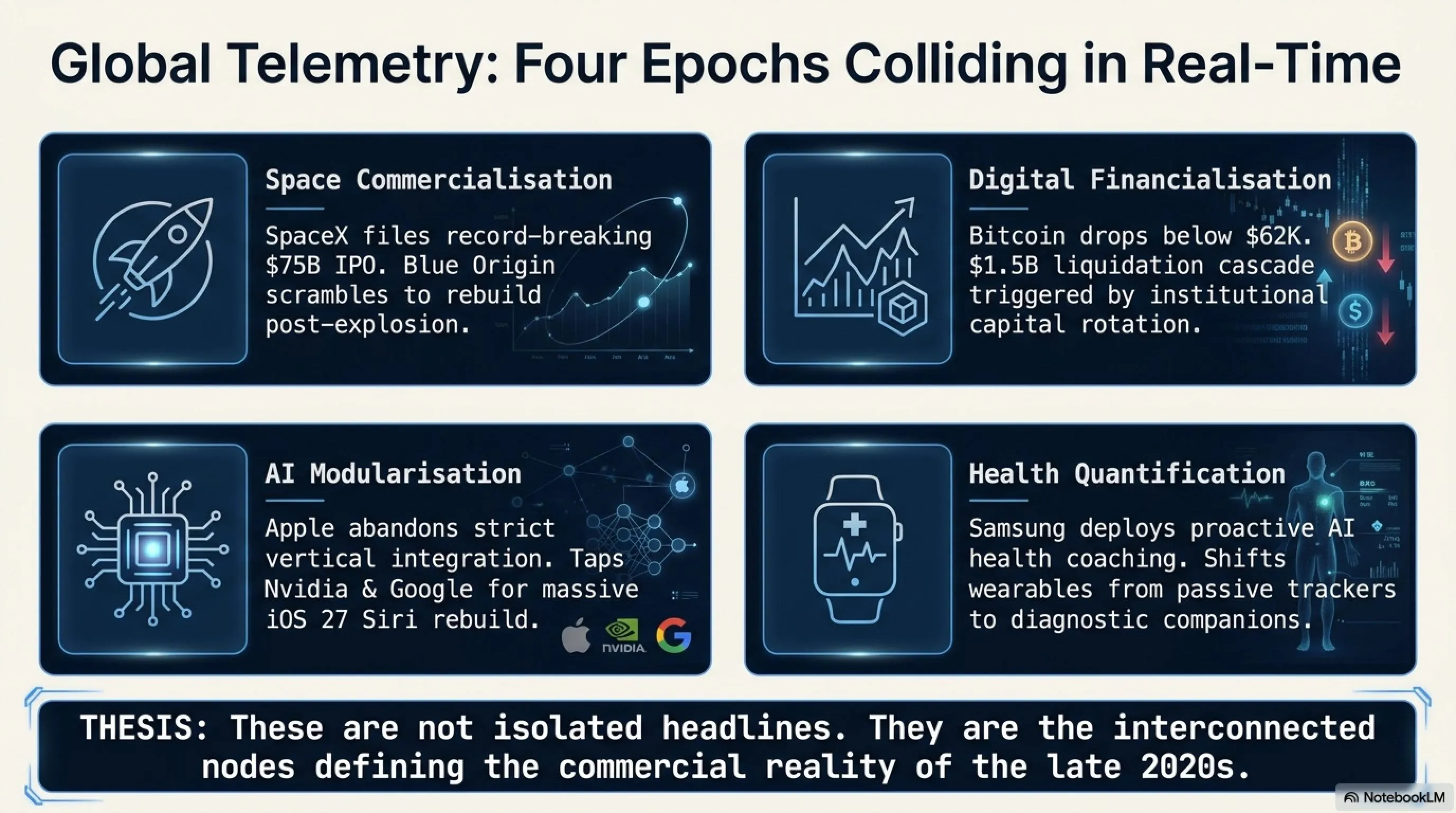
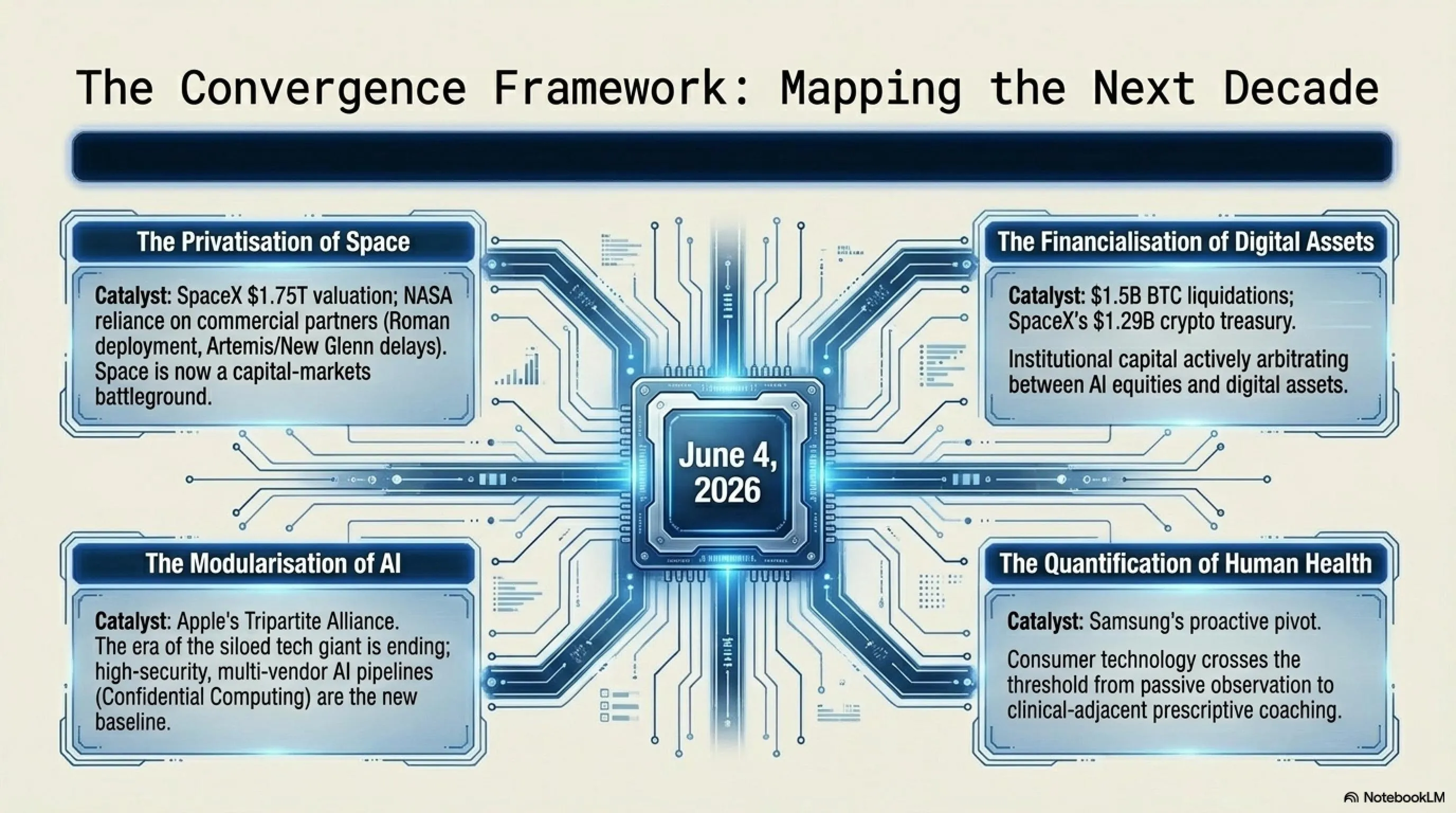
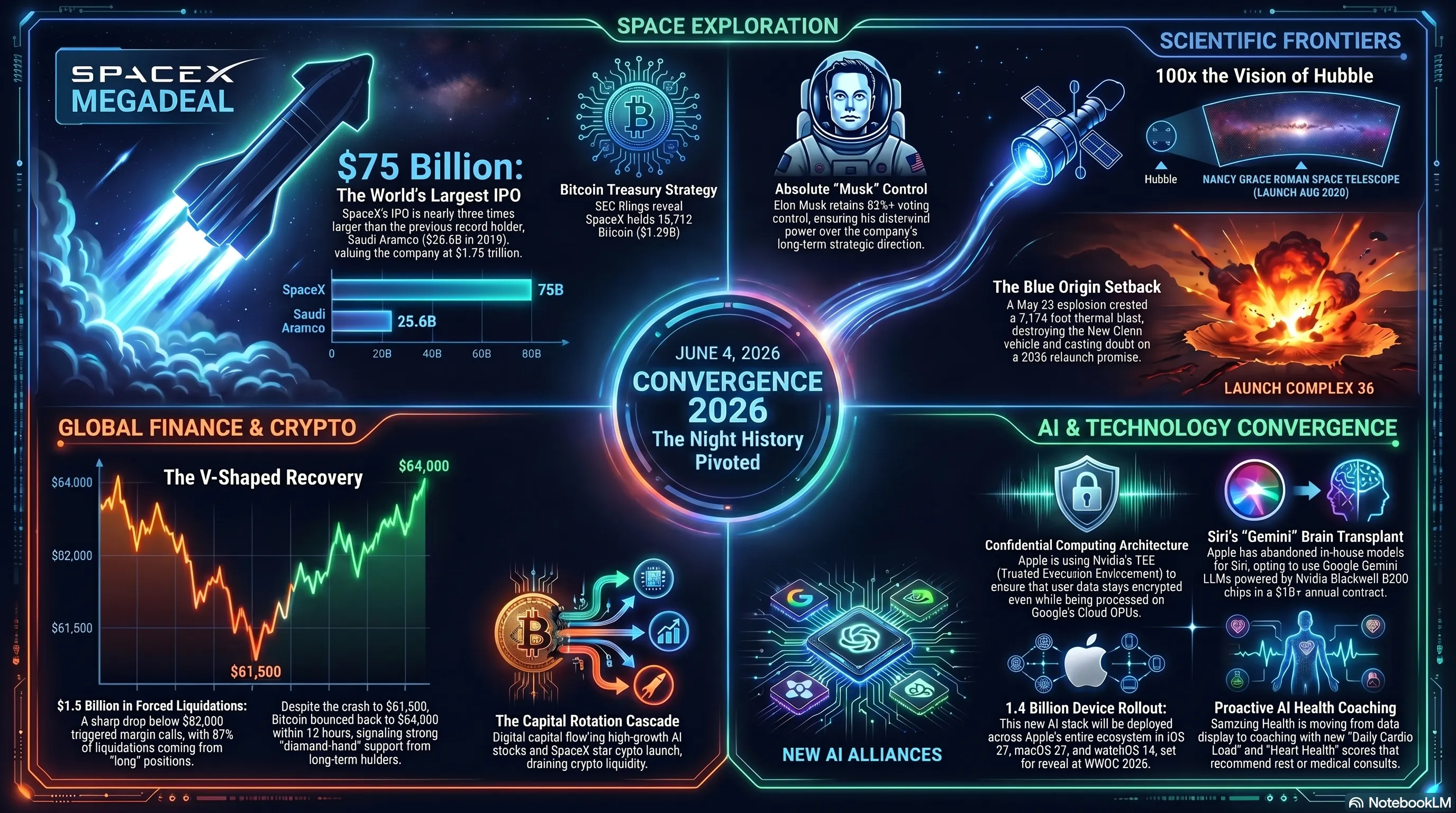
Thursday night, June 4, 2026, is one of those rare moments when history pivots on multiple axes simultaneously. While SpaceX ignites the IPO market with the largest public offering ever recorded, Bitcoin free-falls into a liquidation abyss. Apple forges an unprecedented alliance with Nvidia and Google to resurrect Siri from irrelevance. NASA puts the finishing touches on humanity's next great cosmic eye. Samsung transforms smartwatches into AI health coaches. And Blue Origin, rising from the ashes of catastrophic failure, makes an audacious promise to fly again. This is not just news—this is the future being written in real-time.
🔥 Tonight's Breaking Headlines:
🚀 SpaceX launches record-breaking $75B IPO with $1.29B Bitcoin treasury
💔 Bitcoin crashes below $62K, triggering $1.5B in forced liquidations
🍎 Apple taps Nvidia Blackwell chips for new Gemini-powered Siri in iOS 27
🔭 Nancy Grace Roman Telescope passes final inspection, ready for August launch
⌚ Samsung Health adds 4 AI-powered features for Galaxy Watch 9
💥 Blue Origin vows to relaunch New Glenn before year-end despite pad damage
🌌 This is the night where space, finance, AI, and human ambition collide. Let's dive deep into what's really happening behind the headlines.
🚀 SpaceX Record-Breaking IPO: $75 Billion Raise and Bitcoin Treasury Strategy
On June 3, 2026, SpaceX made history. Elon Musk's aerospace behemoth announced plans to raise $75 billion at $135 per share, valuing the company at an astronomical $1.75 trillion. This obliterates the previous IPO record—Saudi Aramco's $25.6 billion raise in 2019—by a staggering margin. To put this in perspective: SpaceX's IPO is nearly three times larger than the second-biggest IPO in human history.
But the IPO itself, while headline-grabbing, is only part of the story. What sent shockwaves through both Wall Street and crypto Twitter was the revelation buried in SpaceX's SEC filing: as of March 31, 2026, the company holds 18,712 Bitcoin valued at approximately $1.29 billion. This makes SpaceX one of the largest corporate Bitcoin holders globally, joining the ranks of MicroStrategy, Tesla, and Marathon Digital.
📊 SpaceX IPO Breakdown: By The Numbers
| Metric | Value |
| Share Price | $135 |
| Shares Offered | 555.6 million |
| Capital Raised | $75 billion |
| Company Valuation | $1.75 trillion |
| Bitcoin Holdings | 18,712 BTC |
| BTC Treasury Value | $1.29 billion |
| Musk Voting Control | 82%+ |
| NASDAQ Listing Date (SPCX) | June 12, 2026 |
| Previous IPO Record | Saudi Aramco ($25.6B, 2019) |
This IPO breaks Wall Street conventions on two critical fronts. First, SpaceX has set a fixed price of $135 per share ahead of the traditional "roadshow" phase where investment banks typically gauge institutional investor appetite and adjust pricing accordingly. Musk is essentially saying: "Take it or leave it—we're not negotiating." This unprecedented move reflects either supreme confidence or stubborn defiance of market norms—likely both.
Second, the $1.29 billion Bitcoin treasury represents a massive bet on digital assets at a time when crypto markets are showing extreme volatility. As we'll explore in the next section, Bitcoin crashed below $62,000 on the very day SpaceX's IPO details emerged—a timing that raises critical questions about exposure and risk management for prospective public shareholders.
💡 Tekin Analysis: Why This IPO Could Transform Markets
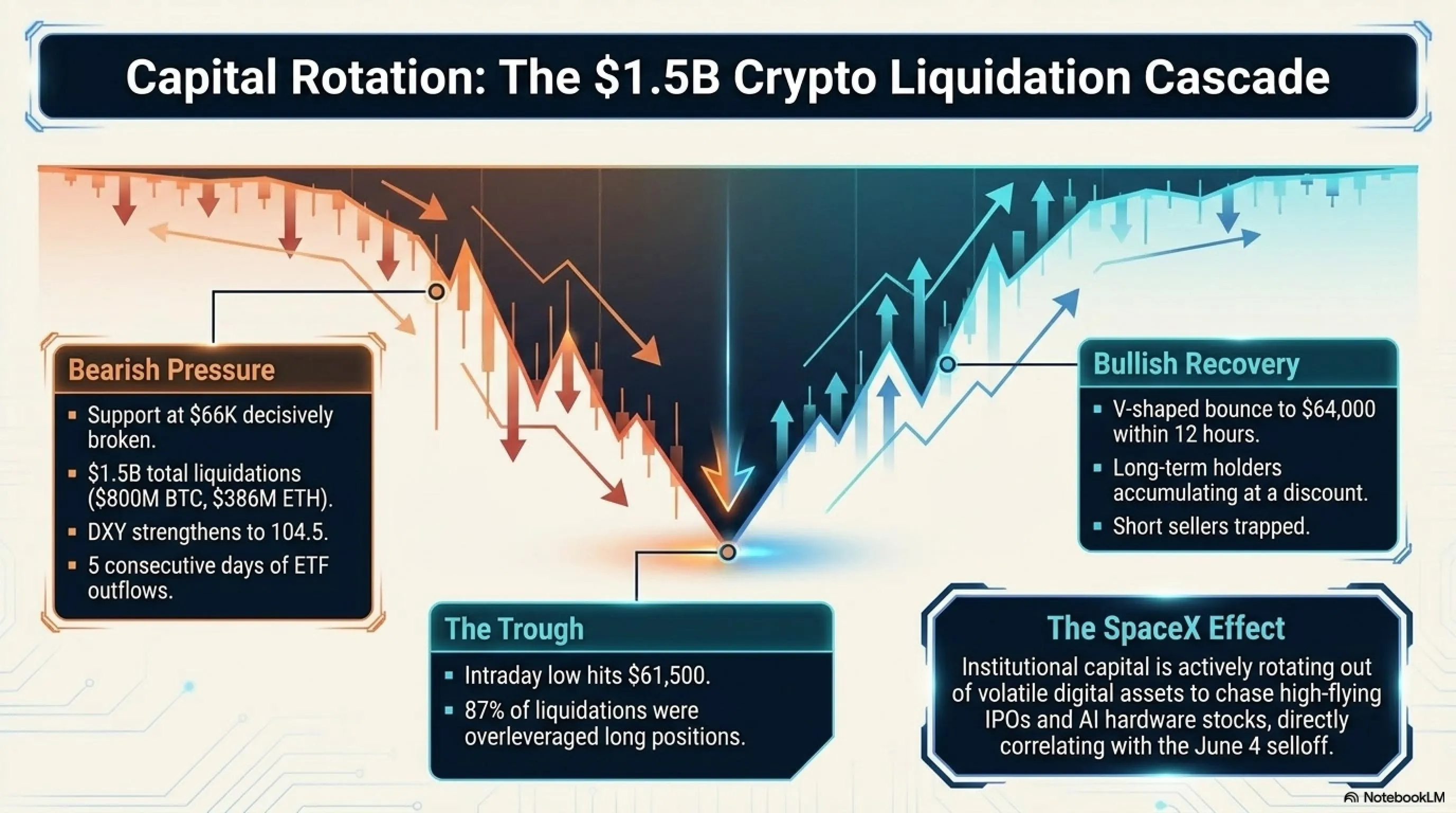
Impact on Crypto Markets: Analysts are already warning that SpaceX's massive $75 billion capital raise could drain liquidity from crypto and existing tech stocks. The hypothesis: investors are rotating capital from volatile digital assets into high-profile IPOs and AI stocks that promise more tangible near-term returns. This is exactly what we witnessed on Bitcoin's crash day—a correlation that's hard to ignore.
SpaceX's Bitcoin Strategy: Holding 18,712 BTC signals that SpaceX views Bitcoin as a strategic treasury asset, similar to MicroStrategy's playbook. But here's the risk: if Bitcoin continues declining, SpaceX will face quarterly impairment charges that could spook public market investors unfamiliar with crypto volatility. The SEC filing notably doesn't disclose SpaceX's average Bitcoin purchase price—a detail that would reveal whether the company is currently sitting on gains or losses.
Valuation Concerns: Some analysts, including those quoted by Yahoo Finance, warn that SpaceX's $1.75 trillion valuation is "overly optimistic" and the company may be worth closer to half that figure. The valuation hinges on aggressive assumptions about Starlink's subscriber growth, Starship's commercial viability, and NASA contracts. If SpaceX fails to meet these projections post-IPO, early investors could face significant losses.
Musk's Control: With 82%+ voting control post-IPO, Elon Musk retains dictatorial power over SpaceX's strategic direction. This is a double-edged sword: it enables bold, long-term thinking unconstrained by quarterly earnings pressure, but it also means public shareholders have virtually no say in major decisions. Given Musk's track record of controversial tweets and erratic behavior, this concentration of power presents governance risks that institutional investors typically avoid.
The timing of this IPO is also strategic. SpaceX is capitalizing on peak AI hype, positioning itself not just as a space company but as a data infrastructure provider through Starlink's global satellite internet coverage. The pitch to investors is clear: SpaceX isn't just launching rockets—it's building the backbone for AI-powered global connectivity, autonomous vehicles, and real-time Earth observation. This narrative justifies the eye-watering valuation, but only if execution flawlessly delivers.
Another critical detail: the underwriters have an option to purchase an additional 83.33 million shares at the IPO price, potentially adding $11.2 billion to the raise. If exercised, this would push the total capital raised to over $86 billion—making the gap between SpaceX and Saudi Aramco even more dramatic.
🎯 What This Means for Retail Investors
If you're a retail investor considering SpaceX shares when they hit NASDAQ on June 12, here's what you need to know:
- Liquidity Risk: With 82% voting control locked up, the public float will be relatively small. This could lead to extreme price volatility in early trading.
- Crypto Exposure: You're not just buying a space company—you're indirectly buying 18,712 Bitcoin. If crypto crashes further, SpaceX's balance sheet takes a hit.
- Execution Risk: SpaceX must deliver on Starship, Starlink profitability, and NASA contracts. Any delays or failures will hammer the stock.
- No Dividends: Don't expect cash returns. SpaceX will plow every dollar into R&D and infrastructure. This is a pure growth bet.
- Musk Factor: For better or worse, you're betting on Elon Musk's vision and execution. His track record is stellar, but his volatility is legendary.
💔 Bitcoin Crisis: Crash Below $62K and $1.5 Billion Liquidation Cascade
While SpaceX was celebrating its historic IPO filing, Bitcoin was experiencing a catastrophic meltdown. On June 4, 2026, Bitcoin plunged below $62,000 during Asian trading hours, triggering a devastating cascade of liquidations that wiped out over $1.5 billion in leveraged crypto positions within 24 hours. This ranks as one of the largest liquidation events of 2026, rivaling the chaos of early February's geopolitical-driven selloff.
📉 Bitcoin Liquidation Breakdown - June 4, 2026
| Cryptocurrency | Liquidated Amount |
| Bitcoin (BTC) | $800+ million |
| Ethereum (ETH) | $386 million |
| Other Altcoins | $300+ million |
| Total Liquidated | $1.5+ billion |
| BTC Intraday Low | $61,500 |
| BTC Current Recovery | ~$64,000 |
| 24H Price Decline | -6.2% |
The market dynamics that triggered this liquidation cascade are complex, but analysts point to several converging factors:
🔍 Root Causes of the Bitcoin Crash
1. Capital Rotation to IPOs and AI Stocks
The timing is no coincidence. As SpaceX and Alphabet (rumored for a concurrent IPO) prepare massive public offerings, institutional investors are shifting capital out of volatile crypto assets into what they perceive as more stable, high-growth equity plays. This isn't just speculation—CoinDesk analysts explicitly cited "momentum traders rotating out of crypto and into high-flying IPOs and AI stocks" as a primary driver.
2. Critical Support Level Failures
Bitcoin's technical structure crumbled in textbook fashion. After breaking below $70,000, the next support at $68,000-$66,000 failed to hold. This triggered algorithmic stop-loss orders and forced liquidations across major exchanges including Binance, Bybit, and OKX. Once $66,000 broke, it was a race to the bottom as cascading margin calls created a self-reinforcing selloff loop.
3. Bitcoin ETF Outflows
According to data from Bloomberg Intelligence, Bitcoin spot ETFs experienced net outflows for five consecutive trading days leading up to the crash. This signals waning institutional appetite and validates concerns that the ETF-driven rally of early 2026 may be exhausted. When institutional money exits, retail traders often panic—amplifying downward pressure.
4. Excessive Leverage and Overconfident Long Positions
Many traders entered highly leveraged long positions (20x to 50x leverage) expecting Bitcoin to break through $70,000 and resume its march toward $80,000. When price moved in the opposite direction, these positions were systematically liquidated. CoinGlass data shows that over 87% of liquidations were long positions—indicating the market was dangerously one-sided.
5. Macro Uncertainty: Fed Policy and Dollar Strength
The U.S. Dollar Index (DXY) strengthened to 104.5 amid speculation that the Federal Reserve may delay rate cuts due to persistent inflation. A stronger dollar typically correlates with weaker Bitcoin prices, as crypto becomes less attractive relative to yield-bearing dollar assets. This macro headwind compounded crypto-specific selling pressure.
But here's where the story gets interesting: Bitcoin didn't stay down. After touching $61,500, it rapidly recovered to approximately $64,000—a $2,500 bounce in less than 12 hours. This V-shaped recovery suggests strong buying interest at lower levels, possibly from long-term holders (often called "diamond hands") who view sub-$62K as a bargain. The rapid rebound also created a "liquidity trap" for traders who shorted the breakdown, forcing some short liquidations that accelerated the recovery.
❌ CONS: Bear Case
- $1.5B liquidated in 24 hours—worst since February
- Capital fleeing to IPOs and AI stocks
- Critical support at $66K broken decisively
- Five consecutive days of ETF outflows
- Fear and uncertainty dominating sentiment
- Strong dollar creating macro headwinds
- No clear catalyst for sustained recovery
✅ PROS: Bull Case
- Rapid V-shaped recovery from $61.5K to $64K
- Strong buyer support at $60-62K levels
- Liquidation purge clears weak hands from market
- Potential "liquidity trap" for shorts created
- Long-term holders accumulating at discounts
- Technical oversold conditions on RSI/MACD
- Halving supply shock still in play (April 2024)
🎯 Tekin Analysis: Is This the End of the Bull Market?
Short answer: Probably not. This crash looks more like a healthy correction within an ongoing bull cycle rather than the start of a multi-year bear market. Here's why:
First, the rapid recovery validates that strong buyer demand exists below $62K. In true bear markets, prices grind lower with weak, anemic bounces. This was a sharp V-recovery—classic bull market correction behavior.
Second, liquidating overleveraged positions actually strengthens market structure. Weak hands get flushed out, reducing the risk of future cascades. Post-liquidation, the market becomes more resilient.
Third, the capital rotation to IPOs may be temporary. Once SpaceX and other high-profile IPOs price in—and inevitably face post-debut volatility—capital could rotate back into crypto, which offers 24/7 liquidity and no lock-up periods.
Critical threshold to watch: Bitcoin must hold above $66,000 to maintain bullish structure. If it falls below $60K again, we could see a second liquidation wave targeting $55K-$58K support. But as long as $60K holds, this is likely just noise within a larger uptrend.
One more data point worth noting: on-chain metrics from Glassnode show long-term holders (addresses holding BTC for 6+ months) actually increased their holdings during the crash. This accumulation by "smart money" during panic selloffs is historically a strong bullish indicator. It suggests that sophisticated investors view this dip as an opportunity, not the beginning of a prolonged downturn.
🍎 Apple Deploys Nvidia Chips for Gemini-Powered Siri Overhaul
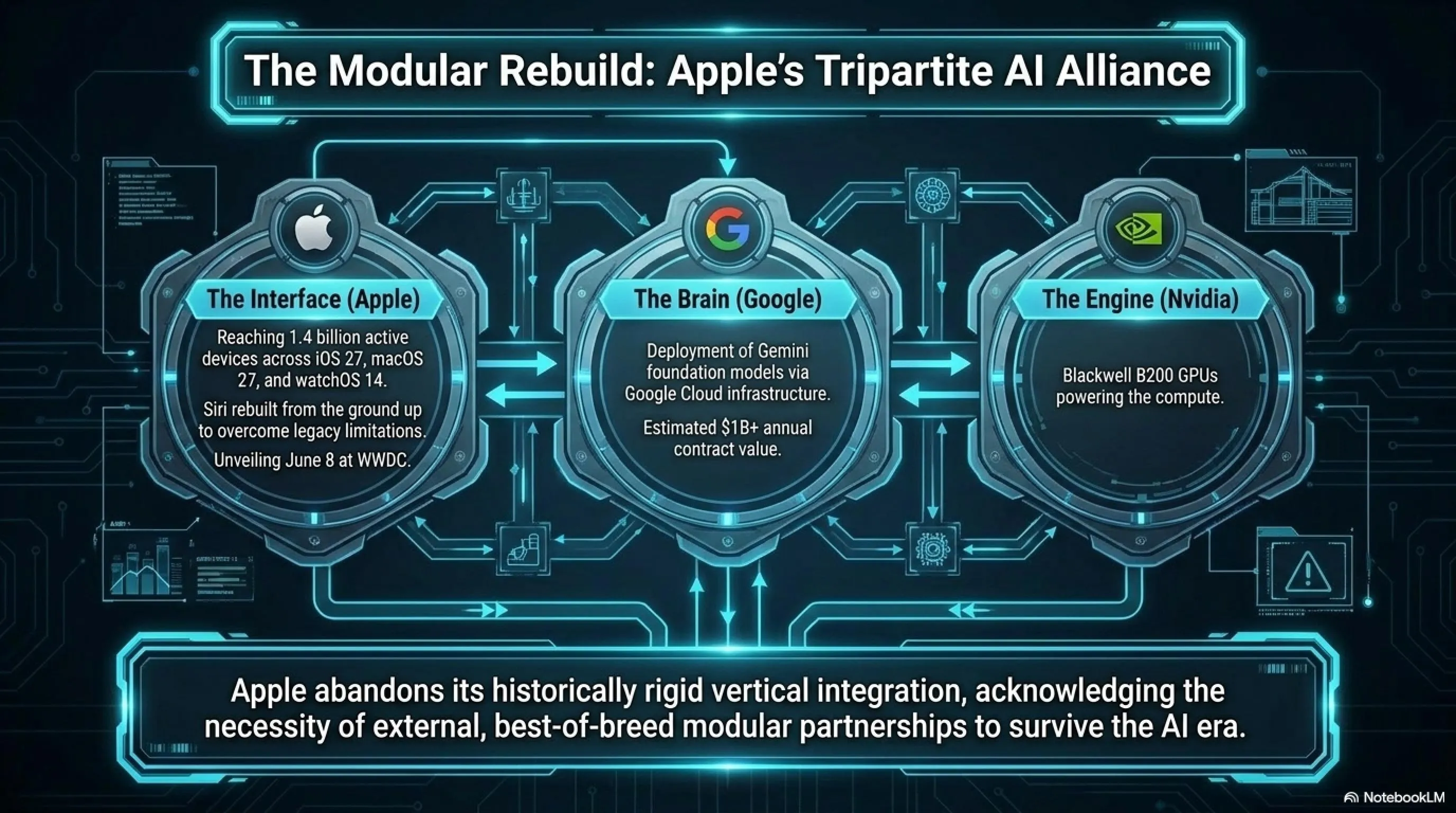
Now we turn to what may be the most strategically significant story of the night: Apple's partnership with both Google and Nvidia to completely rebuild Siri from the ground up. According to The Information, Apple will deploy Nvidia Blackwell B200 chips running on Google Cloud infrastructure to power a massively overhauled Siri in iOS 27, set to be unveiled at WWDC on June 8, 2026.
This announcement is seismic for several reasons. First, Apple—historically obsessed with vertical integration and controlling its own destiny—is now depending on two major competitors (Google for AI models, Nvidia for compute infrastructure) to deliver its flagship AI assistant. Second, the use of Google's Gemini as the foundational large language model (LLM) represents a stunning reversal from Apple's long-standing preference for in-house AI development. Third, the deployment of Nvidia's Confidential Computing technology signals that Apple is taking privacy concerns seriously, even as it outsources processing to third-party clouds.
⚙️ Technical Architecture: The New Siri Stack
| Component | Details |
| Foundation Model | Google Gemini (latest variant) |
| Compute Hardware | Nvidia Blackwell B200 GPUs |
| Cloud Platform | Google Cloud |
| Privacy Technology | Nvidia Confidential Computing |
| Operating Systems | iOS 27, macOS 27, watchOS 14 |
| Announcement Date | WWDC - June 8, 2026 |
| Estimated Annual Contract Value | $1+ billion |
| User Reach | 1.4 billion active Apple devices |
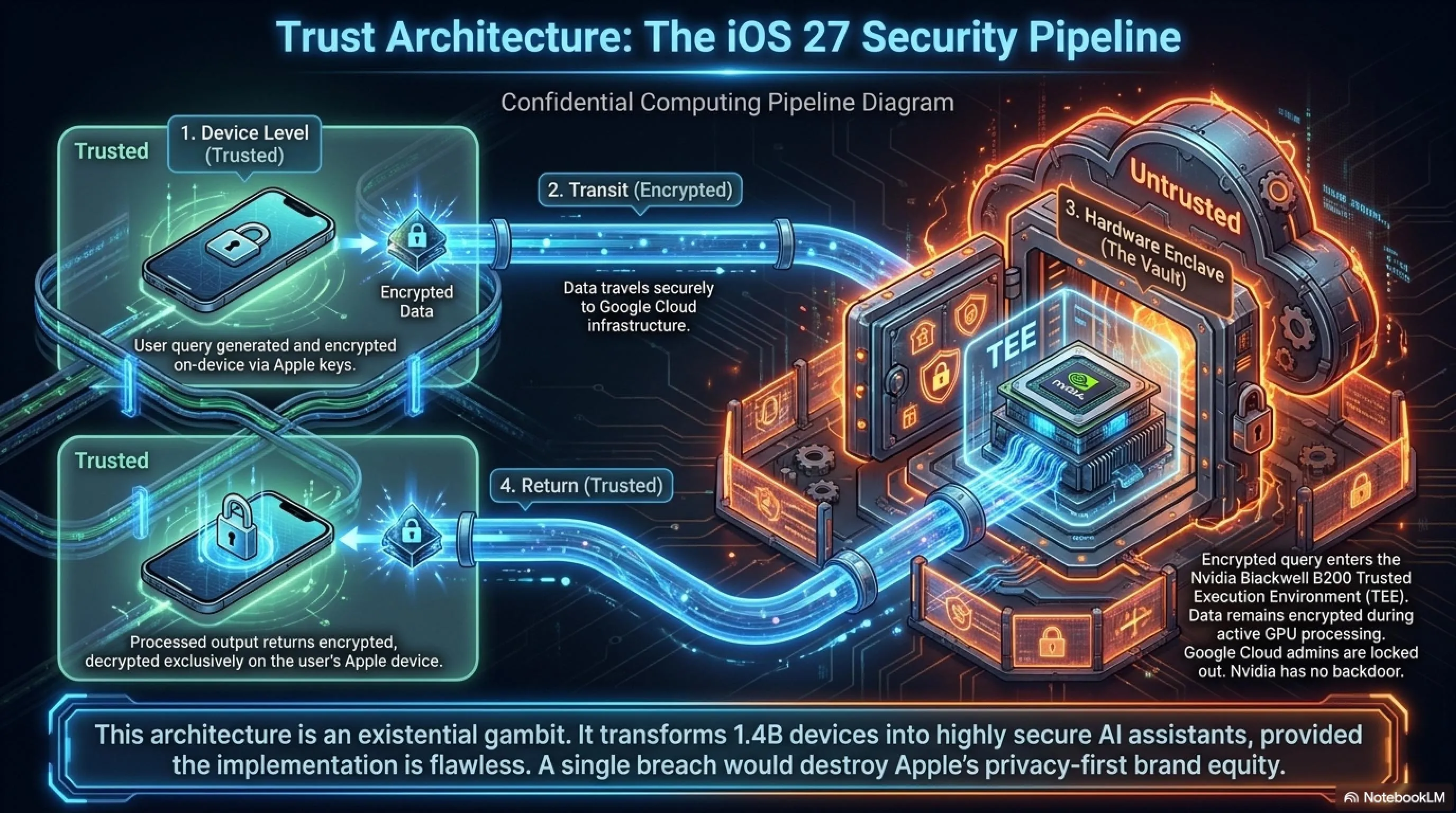
The partnership traces back to January 2026, when Apple and Google signed what industry sources estimate to be a $1 billion per year deal to integrate Gemini into Apple's ecosystem. Under the terms, Gemini models run on Apple's Private Cloud Compute infrastructure, and critically, no data is shared with Google. This distinction is crucial—Apple maintains that user queries are encrypted end-to-end, processed on Nvidia chips within trusted execution environments (TEEs), and returned to Apple without Google or Nvidia ever accessing the plaintext data.
🔐 How Confidential Computing Protects Your Data
Nvidia's Confidential Computing technology creates a Trusted Execution Environment (TEE) at the hardware level. Here's how it works:
- Data remains encrypted during GPU processing: Unlike traditional cloud computing where data is decrypted in memory for processing, Confidential Computing keeps data encrypted even while the Blackwell B200 GPU is actively performing inference operations.
- Google cannot access query content: Even though the infrastructure runs on Google Cloud, Google's engineers and systems have no visibility into the encrypted workloads being processed.
- Nvidia cannot inspect chip operations: Despite providing the hardware, Nvidia has no backdoor or mechanism to extract data from the TEE.
- Only Apple holds decryption keys: Results are encrypted before leaving the TEE and can only be decrypted by Apple's systems using keys that never leave Apple's control.
- Even Google Cloud admins are locked out: Root-level access privileges that typically grant cloud providers full system visibility are rendered useless against TEE-protected workloads.
This represents the highest level of security ever implemented in a consumer AI assistant and could become the industry standard if it proves reliable in production.
But why did Apple take this route? The answer is painfully simple: Siri is embarrassingly bad. In a world where ChatGPT, Gemini, Claude, and Microsoft Copilot deliver near-human conversational capabilities, Siri still struggles with basic requests. Users routinely report that Siri misunderstands simple commands, fails to maintain conversational context, and provides irrelevant responses. Apple's in-house AI development, while strong in narrow domains like photo recognition and predictive text, has failed to produce a competitive general-purpose assistant.
This rebuild is Apple's existential gambit in the AI era. With over 1.4 billion active Apple devices globally, a truly intelligent Siri could become the most widely-used AI assistant on the planet overnight. But the risks are substantial.
💡 Tekin Analysis: Can This Save Apple's AI Reputation?
This is a high-stakes gamble with profound implications. On one hand, Apple is sacrificing its cherished narrative of self-reliance and privacy-first design by partnering with Google—a company synonymous with data collection. On the other hand, if the new Siri truly rivals ChatGPT's capabilities while maintaining verifiable privacy through Confidential Computing, Apple could transform 1.4 billion devices into the world's most secure AI assistants.
Key success factor: Apple must prove that Confidential Computing works in practice, not just theory. If a single data breach or privacy violation occurs—whether due to implementation flaws, insider threats, or unforeseen attack vectors—the reputational damage would be catastrophic. Apple's entire brand is built on privacy, and this architecture introduces new attack surfaces.
Competitive implications: If successful, this model could establish a template for multi-vendor AI collaborations. Imagine Samsung partnering with Anthropic (Claude) using AWS Trainium chips, or Microsoft integrating OpenAI on Azure with similar privacy guarantees. The AI landscape could shift from vertically integrated silos to modular, best-of-breed ecosystems.
Wild card: How will users react? Apple's customer base skews toward privacy-conscious individuals who may be uncomfortable with Google's involvement, regardless of technical safeguards. Apple will need a masterful marketing campaign to explain why this partnership doesn't compromise their core values.
Another fascinating angle: this deal is a massive win for both Nvidia and Google. For Nvidia, it validates Confidential Computing as a killer feature for enterprise AI deployments, potentially opening up regulated industries (healthcare, finance) that have been hesitant to adopt cloud AI due to privacy concerns. For Google, it puts Gemini in front of Apple's enormous user base—even if Google can't directly access the data, the usage at scale will generate valuable model improvement signals through federated learning techniques.
🔭 Nancy Grace Roman Space Telescope: Final Mirror Inspection Before Launch
On June 2, 2026, NASA achieved a critical milestone in one of humanity's most ambitious space science projects: the final inspection of the primary mirror for the Nancy Grace Roman Space Telescope. Engineers at NASA's Goddard Space Flight Center confirmed that the 2.4-meter (7.9-foot) mirror is flawless—no particles, no coating defects, perfect alignment. The telescope is now cleared for shipment to Florida and an August 2026 launch.
Roman is poised to revolutionize astrophysics. With a field of view 100 times larger than Hubble, Roman can capture in a single image what would take Hubble 100 separate images to cover. This panoramic capability enables entirely new classes of cosmic surveys, accelerating discoveries in dark energy, exoplanets, and galactic structure by orders of magnitude.
🛰️ Nancy Grace Roman Telescope: Technical Specifications
| Specification | Details |
| Primary Mirror Diameter | 2.4 meters (7.9 feet) |
| Mirror Coating | 400-nanometer silver layer (hundreds of times thinner than human hair) |
| Field of View vs. Hubble | 100x larger |
| Observing Wavelength | Infrared (optical to near-infrared) |
| Orbital Position | L2 Lagrange Point (1.5 million km from Earth) |
| Launch Date | August 2026 |
| Primary Mission Duration | 5 years (10+ year capability) |
| Science Goals | Dark energy, exoplanets, galactic surveys, cosmic structure |
The final inspection, conducted on May 20-21, was a meticulous process. Engineers rotated the massive telescope onto its side, deployed the protective "hood" that will remain stowed during launch, and conducted a comprehensive visual inspection using high-powered optical instruments. They verified:
- No particulate contamination on the mirror surface
- The 400-nanometer silver coating is pristine with zero defects
- Alignment and positioning are within nanometer-level tolerances
- Protective systems function correctly for launch vibration environments
The result? "The mirror passed with flying colors"—NASA's way of saying everything is perfect. Roman is now ready for careful packaging and transport to Kennedy Space Center in Florida, where it will undergo final integration and testing before launch.
🌌 How Roman Differs from Hubble and Webb
Hubble Space Telescope delivers deep, high-resolution views of individual cosmic objects, but its narrow field of view means it can only study small patches of sky at a time. James Webb Space Telescope peers into the far-infrared, seeing the earliest galaxies and star-forming regions obscured by dust, but also with a relatively narrow field of view.
Nancy Grace Roman combines the best of both worlds: Hubble-class resolution with an enormous panoramic view. This makes Roman uniquely suited for large-scale cosmic surveys that were previously impractical. For example, Roman can accomplish in one lifetime what would take Hubble centuries—mapping billions of galaxies to understand dark energy's influence on cosmic expansion.
Roman's exoplanet capabilities are equally revolutionary. Using a technique called gravitational microlensing, Roman can detect planets around distant stars by observing how their gravity bends light from background objects. This method is sensitive to planets at a wide range of distances from their stars—including Earth-like planets in habitable zones—filling a critical detection gap left by other exoplanet missions like TESS and Kepler.
Roman's primary science goals include three flagship investigations:
- Dark Energy: Understanding why the universe's expansion is accelerating. Dark energy comprises ~68% of the universe, yet we know almost nothing about its nature. Roman will measure the geometry of space-time across billions of years of cosmic history.
- Exoplanets: Discovering thousands of new planets, including potentially habitable Earth analogs. Roman's microlensing surveys could find planets around stars tens of thousands of light-years away.
- Galactic Structure: Mapping the Milky Way's structure, star formation history, and the distribution of dark matter within our own galaxy.
If all goes to plan, Roman will launch in August 2026 and reach its operational orbit at the L2 Lagrange point—the same gravitationally stable location where James Webb currently resides—about one month later. First science images are expected in late 2026, ushering in a new era of wide-field infrared astronomy.
⌚ Samsung Health's Major Update for Galaxy Watch 9
On June 3-4, 2026, Samsung announced one of the most significant updates to Samsung Health, rolling out starting June 8—just ahead of the official Galaxy Watch 9 unveiling. This update introduces four AI-powered health features designed to transform Samsung's wearables from passive data collectors into "proactive AI health companions" that deliver actionable guidance.
🧬 Four New Samsung Health AI Features
| Feature | Description |
| Vitals | Unified vital signs dashboard displaying all health metrics at a glance |
| Heart Health Score | Cardiovascular health scoring based on heart rate, HRV, and sleep patterns |
| Daily Cardio Load | Measures daily cardiovascular stress and recommends rest or activity accordingly |
| Fitness Index | Benchmarks your fitness level against peers of same age and gender |
These aren't just passive metrics—they're actionable intelligence. For instance, if Daily Cardio Load indicates you're overtraining, Samsung Health will recommend taking a rest day. If Heart Health Score drops, it suggests consulting a physician. This shift from data display to proactive coaching directly challenges Apple Watch's long-standing dominance in health wearables.
💡 Tekin Analysis: The Smartwatch Wars Intensify
With this update, Samsung is saying: "We're not just a watch—we're an AI-powered personal health coach." This directly targets Apple Watch and Google Pixel Watch, both of which have been adding similar AI-driven health insights.
Strategic timing: Rolling out the update before Galaxy Watch 9's official launch is brilliant. It keeps existing users engaged while building hype for the new hardware. It also signals that Samsung isn't abandoning older devices—even Watch 5 and Watch 6 owners will get these AI features, though some advanced capabilities may require newer sensors.
Competitive edge: If Samsung can prove that these AI insights meaningfully improve health outcomes, it could finally challenge Apple's health ecosystem dominance. The key will be accuracy—false positives or misleading guidance could trigger backlash and regulatory scrutiny.
💥 Blue Origin: Promising New Glenn Relaunch Before Year-End After Explosion
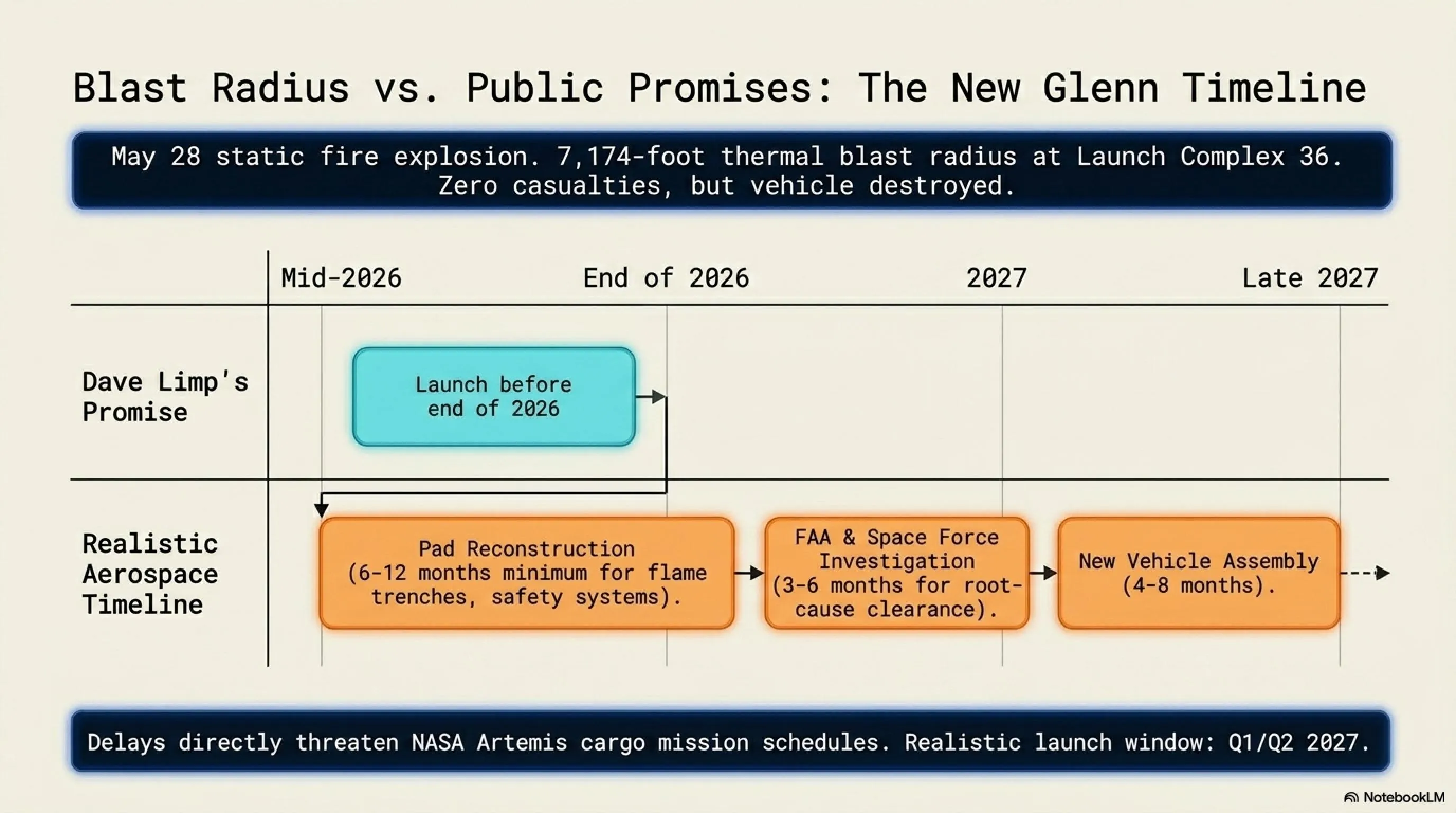
On June 2, 2026, Blue Origin CEO Dave Limp made an audacious promise: the New Glenn rocket will launch again before the end of 2026—despite the catastrophic explosion that destroyed the vehicle and severely damaged the launch pad at Cape Canaveral on May 28. Industry experts are calling this timeline "wildly optimistic" at best, and many suspect it's more about maintaining investor confidence than realistic project management.
The May 28 explosion occurred during a routine static fire test—a pre-launch procedure where rocket engines are fired while the vehicle remains bolted to the pad. Something went catastrophically wrong, and the New Glenn vehicle erupted in a massive fireball that lit up Florida's Space Coast with an apocalyptic orange glow. This was the largest explosion in Cape Canaveral's history, producing a thermal blast estimated at 7,174 feet (2.18 kilometers) radius.
🔥 New Glenn Explosion: Incident Report
| Parameter | Details |
| Date & Time | May 28, 2026, ~9:00 PM EDT |
| Location | Launch Complex 36, Cape Canaveral Space Force Station |
| Cause | Engineering anomaly during static fire test |
| Blast Radius | 7,174 feet (2.18 km) thermal blast |
| Casualties | Zero (no injuries reported) |
| Pad Damage | Severe—requires complete reconstruction |
| Impact on NASA Artemis | Likely delays in cargo missions |
| FAA Investigation Status | Ongoing (no launch authorization until complete) |
Miraculously, there were no casualties. The explosion occurred during an unpiloted test with all personnel at safe distances, and the public was never at risk according to U.S. Space Force officials. But the damage to Blue Origin's program is profound. Launch Complex 36—Blue Origin's only operational New Glenn launch site—sustained severe structural damage and will require extensive reconstruction before it can support another launch attempt.
🤔 Is a 2026 Relaunch Realistically Possible?
Industry veterans are deeply skeptical. Here's why a year-end launch looks unlikely:
Pad reconstruction timelines: Launch pad damage of this severity typically requires 6-12 months of repairs. This includes rebuilding flame trenches, replacing damaged structures, verifying fuel system integrity, and recertifying all safety systems. Blue Origin has seven months remaining in 2026—barely enough time even under ideal conditions.
FAA investigation and clearance: The Federal Aviation Administration and U.S. Space Force must complete a thorough root-cause investigation before authorizing another launch attempt. These investigations are notoriously slow, often taking months. Until investigators determine exactly what caused the explosion and verify that corrective actions are in place, no launch license will be issued.
Vehicle production: Blue Origin must build another New Glenn vehicle from scratch—the one that exploded is a total loss. While Blue Origin likely has components in various stages of production, final assembly, integration, and testing of a new vehicle takes months.
Investor confidence: This promise may be more about reassuring investors and NASA—who's counting on New Glenn for Artemis cargo missions—than reflecting internal engineering assessments. Blue Origin needs to project confidence to prevent customers from abandoning the platform.
Realistic timeline: Most industry analysts expect the next New Glenn attempt in Q1 or Q2 of 2027, not 2026. A test launch by December 2026 would require everything to go perfectly—a rarity in aerospace.
This incident highlights the brutal difficulty of commercial spaceflight. While SpaceX has achieved routine launches and landings that make it look easy, competitors like Blue Origin are still wrestling with fundamental engineering challenges. The contrast between Elon Musk's SpaceX—preparing for a record-breaking IPO—and Jeff Bezos's Blue Origin—picking up pieces after an explosion—couldn't be starker.
The explosion also casts a shadow over NASA's Artemis program. New Glenn was awarded contracts to deliver critical cargo to lunar orbit as part of the Artemis moon-return initiative. Delays in New Glenn's operational readiness could ripple through the entire Artemis schedule, potentially pushing back crewed lunar landings that are already behind schedule.
❓ Frequently Asked Questions (FAQ)
Why could SpaceX's IPO negatively impact the crypto market?
SpaceX's $75 billion capital raise creates massive competition for investment dollars. Analysts believe institutional investors are rotating capital out of volatile crypto assets into high-profile IPOs and AI stocks perceived as offering more predictable returns. Additionally, SpaceX's $1.29 billion Bitcoin treasury means the company has direct exposure to crypto volatility—if Bitcoin continues falling, SpaceX will face quarterly impairment charges that could spook public shareholders unfamiliar with digital asset risk management. In the short term, this could amplify selling pressure on Bitcoin.
Is Apple's new Siri really private if it uses Google's Gemini?
According to Apple and Nvidia, yes—thanks to Confidential Computing technology. Your Siri queries are encrypted before leaving your device, remain encrypted while being processed on Nvidia Blackwell GPUs in Google Cloud, and are decrypted only when results return to Apple's systems. Neither Google, Nvidia, nor Google Cloud administrators can access the plaintext data. However, this architecture hasn't been stress-tested at scale yet. If a single breach or implementation flaw occurs, Apple's privacy reputation would suffer catastrophic damage. The technology is sound in theory, but real-world security always involves unknown unknowns.
What makes Roman Space Telescope different from James Webb?
James Webb is designed for ultra-deep observations with exceptional detail—perfect for studying individual distant galaxies or exoplanet atmospheres in extreme detail. However, Webb's field of view is relatively narrow. Nancy Grace Roman, by contrast, has a field of view 100 times larger, making it ideal for large-scale cosmic surveys—mapping billions of galaxies to understand dark energy, discovering thousands of exoplanets via microlensing, and charting our Milky Way's structure. Think of it this way: Webb zooms in for stunning close-ups, while Roman captures breathtaking panoramas. Both observe in infrared wavelengths, and they're complementary missions that will work together to revolutionize our understanding of the cosmos.
Will Samsung Health's new AI features work on older Galaxy Watches?
Yes! Samsung is rolling out Vitals, Heart Health Score, Daily Cardio Load, and Fitness Index to compatible older models including Galaxy Watch 6, Watch 5, and potentially even earlier versions with sufficient sensor capabilities. You don't need to buy the new Galaxy Watch 9 to benefit from these AI-powered health insights. However, some advanced features may require newer hardware—for example, more accurate heart rate variability measurements or advanced ECG capabilities—so the full experience might be best on Watch 9. Still, Samsung deserves credit for not abandoning existing customers and ensuring AI enhancements reach their entire active install base.
Can Blue Origin really relaunch New Glenn by end of 2026?
It's highly unlikely, but not impossible. The primary obstacles are pad reconstruction (typically 6-12 months), FAA investigation and clearance (often 3-6 months), and building a new vehicle (4-8 months for final assembly and testing). Blue Origin has about seven months remaining in 2026. To meet that deadline, everything would need to proceed flawlessly with no delays—a rarity in aerospace engineering. Most industry experts believe the next New Glenn attempt will occur in Q1 or Q2 of 2027. Dave Limp's year-end promise likely serves to reassure investors and NASA that Blue Origin remains committed, rather than reflecting a realistic engineering schedule.
🌌 Final Thoughts: The Night That Defined Tomorrow
Thursday, June 4, 2026, was no ordinary night. It was a convergence point where four epochs collided: the era of space commercialization, the crypto revolution, the AI transformation, and the digital health evolution.
SpaceX's record-breaking IPO proved that space is no longer science fiction—it's a trillion-dollar market with public shareholders and quarterly earnings calls. Bitcoin's crash reminded us that crypto remains volatile, dangerous, yet remarkably resilient. Apple demonstrated that even tech giants must collaborate with competitors to survive the AI era. NASA showed us that scientific exploration still has the power to inspire wonder. Samsung confirmed that digital health is the next battleground for consumer tech. And Blue Origin... well, Blue Origin taught us that the road to the stars is paved with explosions and setbacks.
Each story stands alone as significant, but together they paint a picture of a world accelerating toward futures both magnificent and terrifying. We're witnessing the privatization of space, the financialization of digital assets, the democratization of AI, and the quantification of human health—all in real-time.
🚀 Good night, tech enthusiasts. Tomorrow morning, we return with fresh stories and deeper insights. Until then—stay curious. 🌙
📚 Sources and References
SpaceX IPO & Bitcoin Treasury: CoinDesk, CNBC, Bloomberg, KuCoin News, Yahoo Finance
Bitcoin Crash & Liquidation: CoinDesk, Bitcoin Magazine, Yahoo Finance, CoinMarketCap, Stock Twits
Apple-Nvidia-Google Siri Partnership: 9to5Mac, The Information, LiveMint, MacWorld, Enterprise DNA
Nancy Grace Roman Space Telescope: NASA, Space.com, Universe Today, Universe Magazine, Friends of NASA
Samsung Health AI Update: Samsung Newsroom, Android Authority, Gadget Bridge, TechBuzz AI
Blue Origin New Glenn Explosion: Florida Today, Space.com, CBS News, Wikipedia, CNBC, Air & Space Forces Magazine
💬 Contact Us
Share your thoughts, questions, or feedback with the Tekin Game team. We're always eager to hear from our community!
📧 Email: contact@tekingame.com
🌐 Website: tekingame.com
🐦 Twitter/X: @tekingame