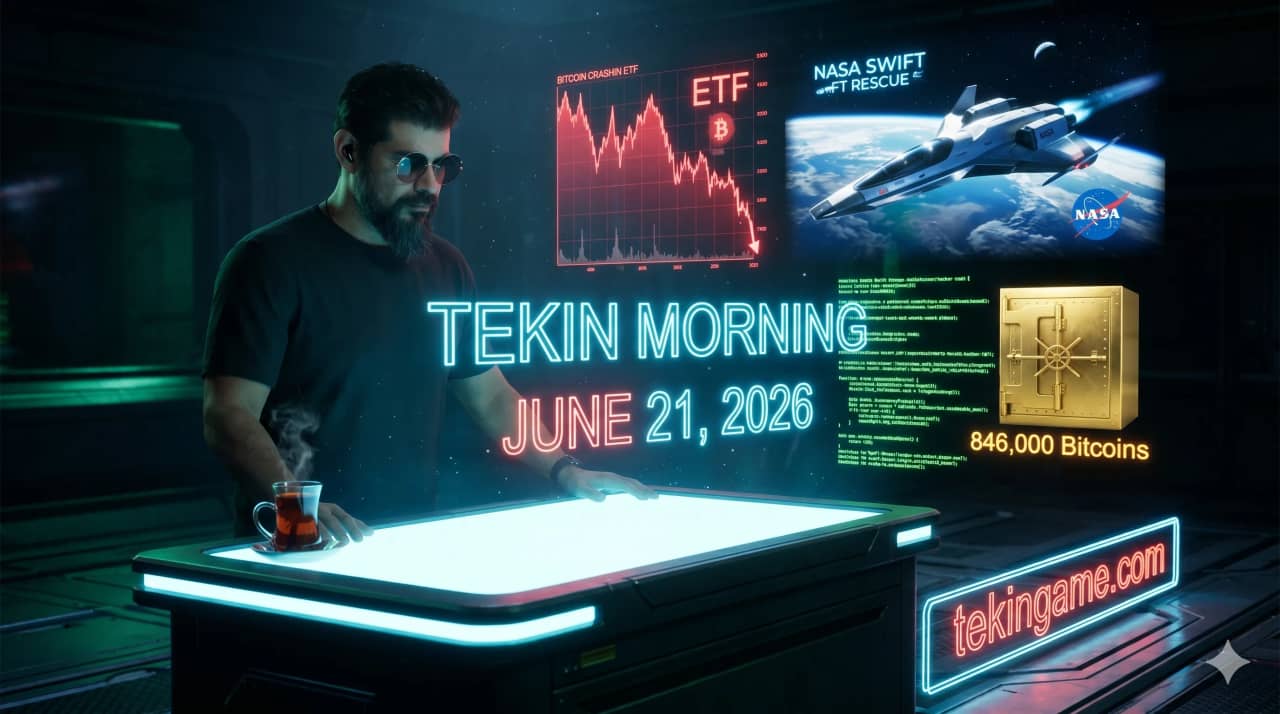
☀️ Good Morning! Tekin Morning — Sunday, June 21, 2026
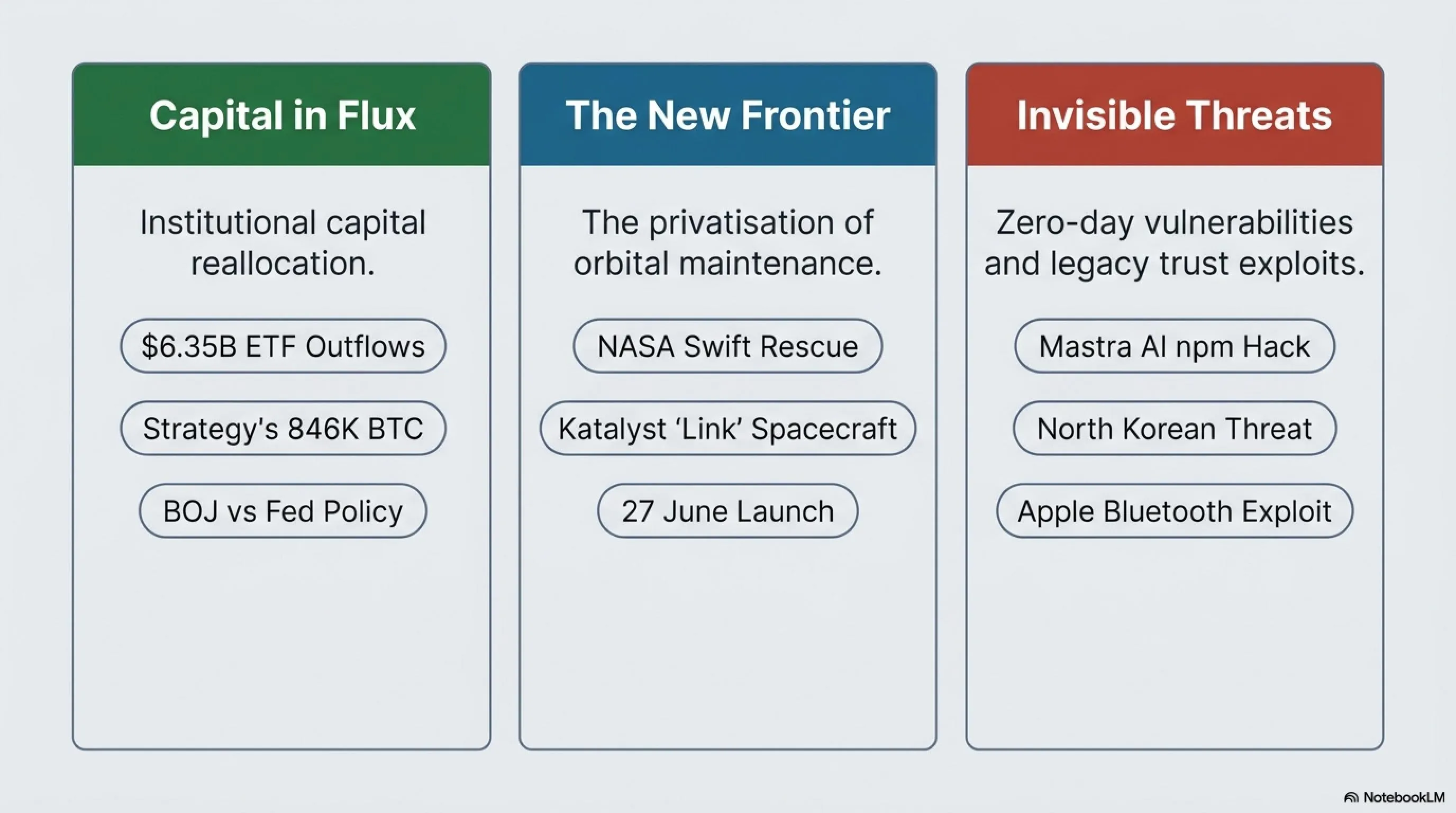
Welcome to a high-energy Sunday kickoff with the most critical tech news shaping global markets, innovation strategies, and cybersecurity landscapes. Today we're unpacking six explosive stories: the largest Bitcoin ETF outflow in history, NASA's daring telescope rescue mission, a sophisticated North Korean supply chain attack, Michael Saylor's relentless Bitcoin accumulation, Japan's rate hike test for crypto, and a frightening security flaw in Apple's Beats earbuds.
⚡ Today's Headlines at a Glance:
💸 Bitcoin ETFs bleed record $6.4B in 30 days as institutional confidence wavers
🚀 NASA's Swift telescope rescue mission launches June 27 — a commercial first
🛡️ Microsoft attributes Mastra AI supply chain attack to North Korea's Sapphire Sleet
₿ Michael Saylor's Strategy hits 846,842 BTC holdings — $56.1B at current prices
🇯🇵 Bitcoin shrugs off Japan's 1% rate hike but stumbles on Fed policy signals
🎧 Apple patches critical Beats Studio Buds eavesdropping vulnerability (CVE-2025-20701)
☕ Grab your coffee and dive into the technology stories that matter!
Bitcoin ETFs Shed Record $6.4B in 30 Days: The Institutional Exodus Explained
Why This Matters: Institutional Confidence Under Stress
The largest net outflow since spot Bitcoin ETFs launched in January 2024 signals a fundamental reassessment of crypto exposure among institutional investors. When pension funds, hedge funds, and wealth managers pull $6.35 billion in just 30 trading days, it's not noise — it's a strategic repositioning that could reshape the entire Bitcoin demand structure for months to come.
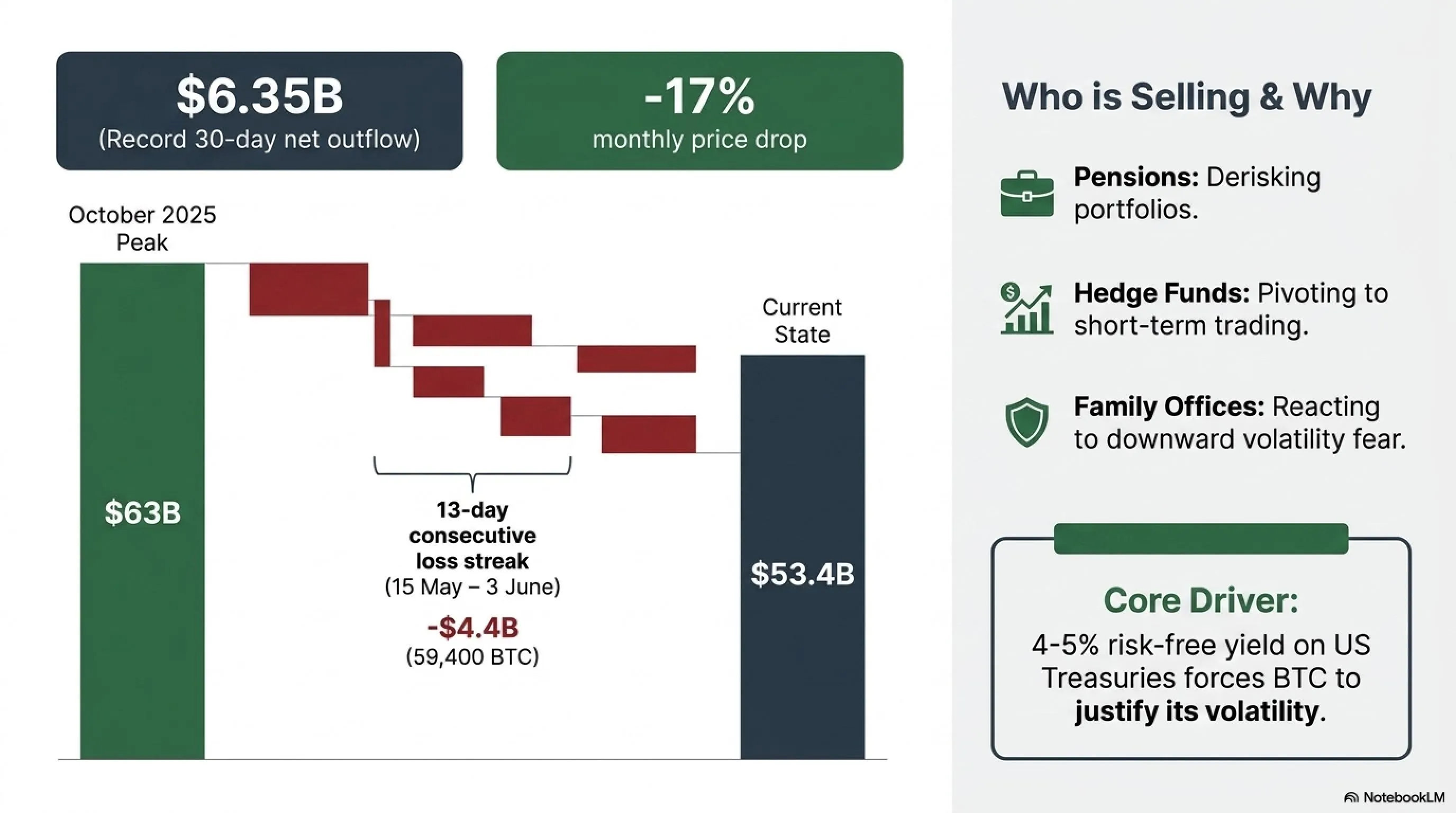
According to verified data from Galaxy Research, US-listed spot Bitcoin exchange-traded funds experienced net outflows of $6.35 billion over a trailing 30-day trading period ending in mid-June 2026. This hemorrhaging of capital coincides precisely with Bitcoin's 17% price decline over the same window, dragging BTC from highs near $78,000 in late May down to approximately $65,000 by June 20.
The exodus marks the sixth consecutive week of net outflows and brings cumulative net flows down to $53.4 billion from an October 2025 peak of $63 billion — effectively erasing nearly $10 billion in institutional demand. The most intense redemption pressure occurred during a 13-day consecutive outflow streak from May 15 through June 3, which alone accounted for approximately $4.4 billion (roughly 59,400 BTC) in net redemptions. One particularly brutal week in early June saw $3.4 billion walk out the door — the largest weekly outflow since these products debuted.
Tekin Deep Dive: Decoding the Institutional Flight
This isn't a panic selloff—it's a strategic reallocation driven by three converging forces. First, the Federal Reserve's "higher for longer" rate policy makes risk-free US Treasuries yielding 4-5% far more attractive to conservative institutional portfolios than a volatile crypto asset down 17% over a month. When you can earn 4.5% with zero default risk, Bitcoin needs to promise significantly higher returns to justify the volatility—and right now, it's not delivering.
Second, many ETF buyers from January through March 2024 entered at prices between $60K and $73K. With BTC hovering around $65K, a significant cohort of institutional holders are either underwater or barely breaking even—triggering risk management protocols that mandate trimming or exiting positions showing negative alpha. Pension funds and endowments don't have the luxury of "diamond hands"—they answer to boards, regulators, and beneficiaries.
Third, the macro narrative has shifted. In Q4 2023 and Q1 2024, the Bitcoin ETF story was framed as inevitable institutional adoption and a coming supply shock. But after 18 months, the reality is more nuanced: institutions are allocating, but cautiously, and they're just as quick to de-risk when volatility spikes or macro conditions sour. The "set it and forget it" institutional bid many hoped for hasn't materialized—instead, we're seeing tactical, sentiment-driven flows.
However, there's a silver lining buried in the data: outflow intensity is declining. According to SoSoValue, weekly net outflows have dropped from multi-billion-dollar figures in late May to a few hundred million by mid-June. A brief $3 million net inflow even appeared around June 4-5, snapping the 13-day streak. This tapering suggests we may be approaching capitulation—the point where weak hands have exited and remaining holders are prepared to weather further volatility.
Outflow Timeline: Anatomy of the Bleed
Analysts at multiple research firms point to Federal Reserve policy as the primary culprit. With the Fed holding rates at 3.5-3.75% and offering no clear path to cuts in the near term, institutional capital is flowing toward fixed income. When US Treasuries yield 4-5% with zero default risk, Bitcoin must offer substantially higher expected returns to compensate for its 60%+ annualized volatility—a hurdle it's failing to clear at current price levels.
Who's Selling? A Breakdown by Investor Class
- Pension Funds & Endowments: Mandated risk reduction in response to drawdowns exceeding tolerance levels
- Hedge Funds: Rotating from long-term holds to short-term tactical trades as volatility increases
- Family Offices: Fear of further downside triggering stops and profit-taking from earlier entries
- Retail-via-RIA: Registered investment advisors trimming exposure in response to client anxiety
What This Means for Bitcoin's Next Move
The $6.35B outflow is equivalent to approximately 97,000 BTC at an average exit price of $65,500. To put that in context, Bitcoin's daily issuance post-2024 halving is around 450 BTC—meaning this 30-day exodus represents more than 215 days of new supply. For Bitcoin to absorb this selling pressure and resume upward momentum, either (1) the Fed must pivot dovish, (2) a new institutional narrative must emerge, or (3) retail and non-US buyers must step up significantly.
Early signs suggest stabilization may be underway. BlackRock's IBIT saw a $57.7 million inflow on June 10, breaking a multi-day dry spell and hinting that the worst of the redemptions may be behind us. If outflows continue to taper and Bitcoin can hold the $63K-$65K zone, the groundwork for a recovery rally could be laid by Q3 2026.
NASA's Daring Swift Telescope Rescue Mission Launches June 27
Why This Mission is Unprecedented
For the first time in spaceflight history, a commercial startup will attempt to capture and boost a satellite that was never designed for servicing. If successful, this mission establishes a blueprint for rescuing aging spacecraft and extends the operational life of billions of dollars in orbital assets—potentially revolutionizing the economics of space infrastructure.
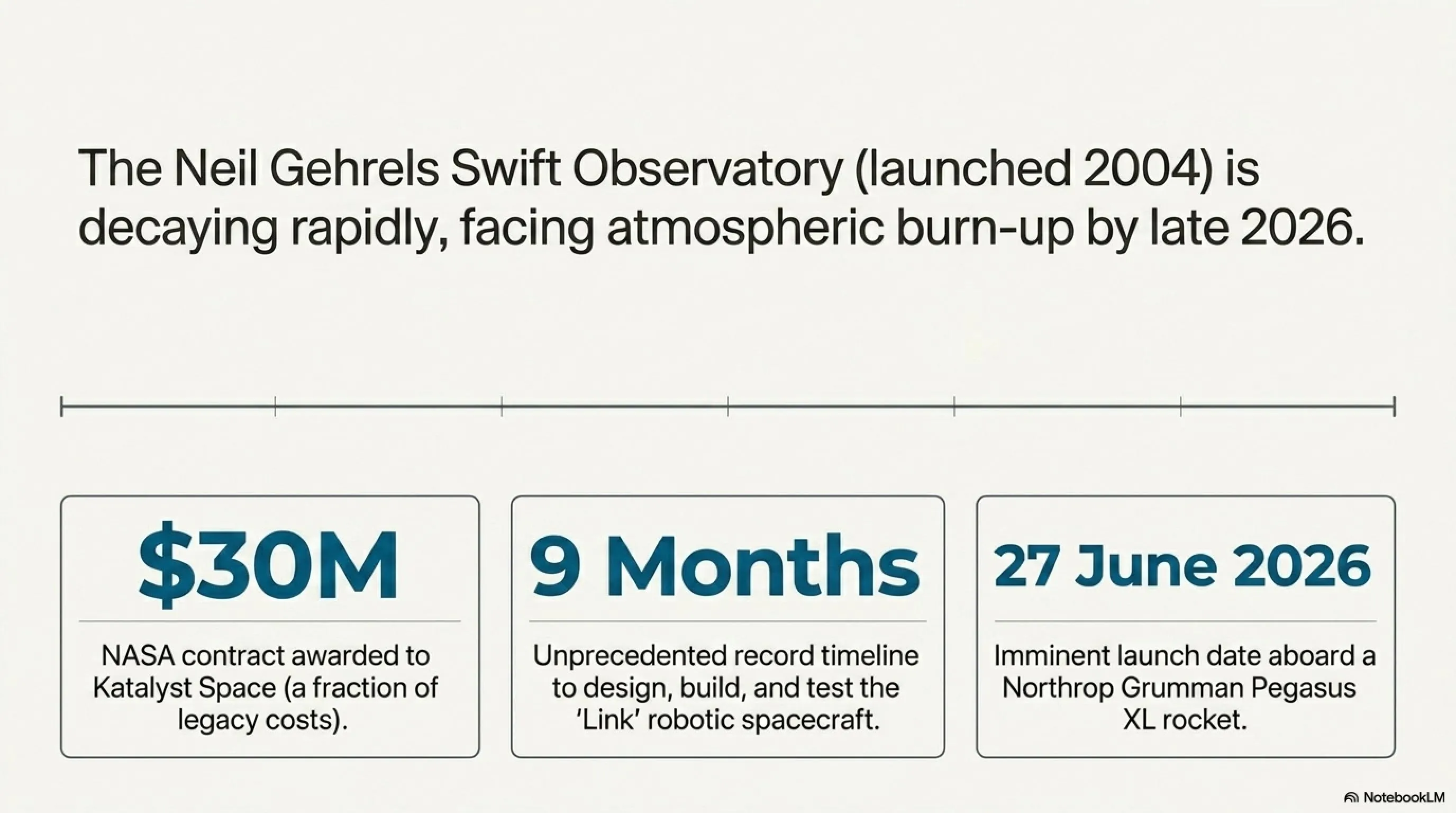
The Neil Gehrels Swift Observatory, which has been monitoring the universe's brightest gamma-ray bursts since 2004, is sinking toward Earth at an alarming rate. Originally projected to operate into the 2030s, the telescope now faces uncontrolled reentry by late 2026 unless intervention occurs. Instead of watching a $250 million scientific asset burn up in the atmosphere, NASA took an unprecedented step: contracting a commercial startup to save it.
In September 2025, NASA awarded Katalyst Space Technologies, a Flagstaff, Arizona-based startup, a $30 million contract to design, build, test, and launch a robotic servicing spacecraft. The timeline was aggressive: just nine months from contract signing to launch readiness. Against all odds, Katalyst delivered. The company's CEO, Ghonhee Lee, called the achievement "extraordinary"—and industry veterans agree. Typical satellite development cycles take 24-36 months; Katalyst compressed that to under a year.
Mission Profile: How the Rescue Will Work
The Link servicing spacecraft will launch aboard a Northrop Grumman Pegasus XL rocket—an air-launched vehicle dropped from a modified L-1011 aircraft at 40,000 feet. Once in orbit, Link will execute a complex rendezvous sequence to match Swift's orbit and velocity. The spacecraft is equipped with three robotic arms designed to grapple Swift despite the telescope having no docking port or servicing interface—a technical feat analogous to catching a falling object mid-air while both are traveling at 17,000 mph.
After capture, Link will use its onboard propulsion system to raise Swift's orbit by approximately 30-50 kilometers, lifting it into a stable altitude that will extend the telescope's operational life by several additional years. The entire operation—from launch to successful orbit boost—is expected to take 60-90 days, with NASA and Katalyst providing regular mission updates.
Tekin Analysis: Why This Mission is Revolutionaryadero
This isn't just about saving one telescope—it's about validating an entirely new economic model for space operations. Until now, satellites that couldn't be serviced were essentially disposable. Once fuel ran out or orbits decayed, they became space junk or burned up on reentry. The Swift rescue demonstrates that commercial on-orbit servicing is viable, affordable, and fast to deploy.
Consider the economics: NASA paid $30 million to extend Swift's life versus the $500+ million it would cost to design, build, and launch a replacement. That's a 17:1 cost advantage. Apply this model across the thousands of satellites in orbit, and you're looking at a potential multi-billion-dollar servicing market over the next decade. Companies like Northrop Grumman, SpaceX's Starshield, and Astroscale are all positioning for this future—but Katalyst just leapfrogged them with an actual mission.
The technical achievement is equally impressive. Swift has no robotic interface, no reflective targets for automated docking, and is tumbling slowly as its orbit decays. Link must use computer vision, LIDAR, and autonomous algorithms to identify, track, and grapple a non-cooperative target in real-time. This is the same core technology needed for active debris removal—one of the biggest unsolved problems in space sustainability.
Microsoft Attributes Mastra AI Supply Chain Attack to North Korea
Critical Cybersecurity Alert
One of the most sophisticated supply chain attacks in npm history, compromising over 140 packages with more than 1.1 million weekly downloads, has been officially attributed to a North Korean state-sponsored hacking group. This attack demonstrates how professional adversaries can weaponize open-source ecosystems to infiltrate software supply chains at scale.
On June 19, 2026, Microsoft assessed with high confidence that the recent Mastra AI supply chain compromise—which resulted in the distribution of malicious code across more than 140 npm packages—was executed by Sapphire Sleet (also tracked as BlueNoroff), a North Korean state-sponsored threat actor primarily targeting the financial sector.
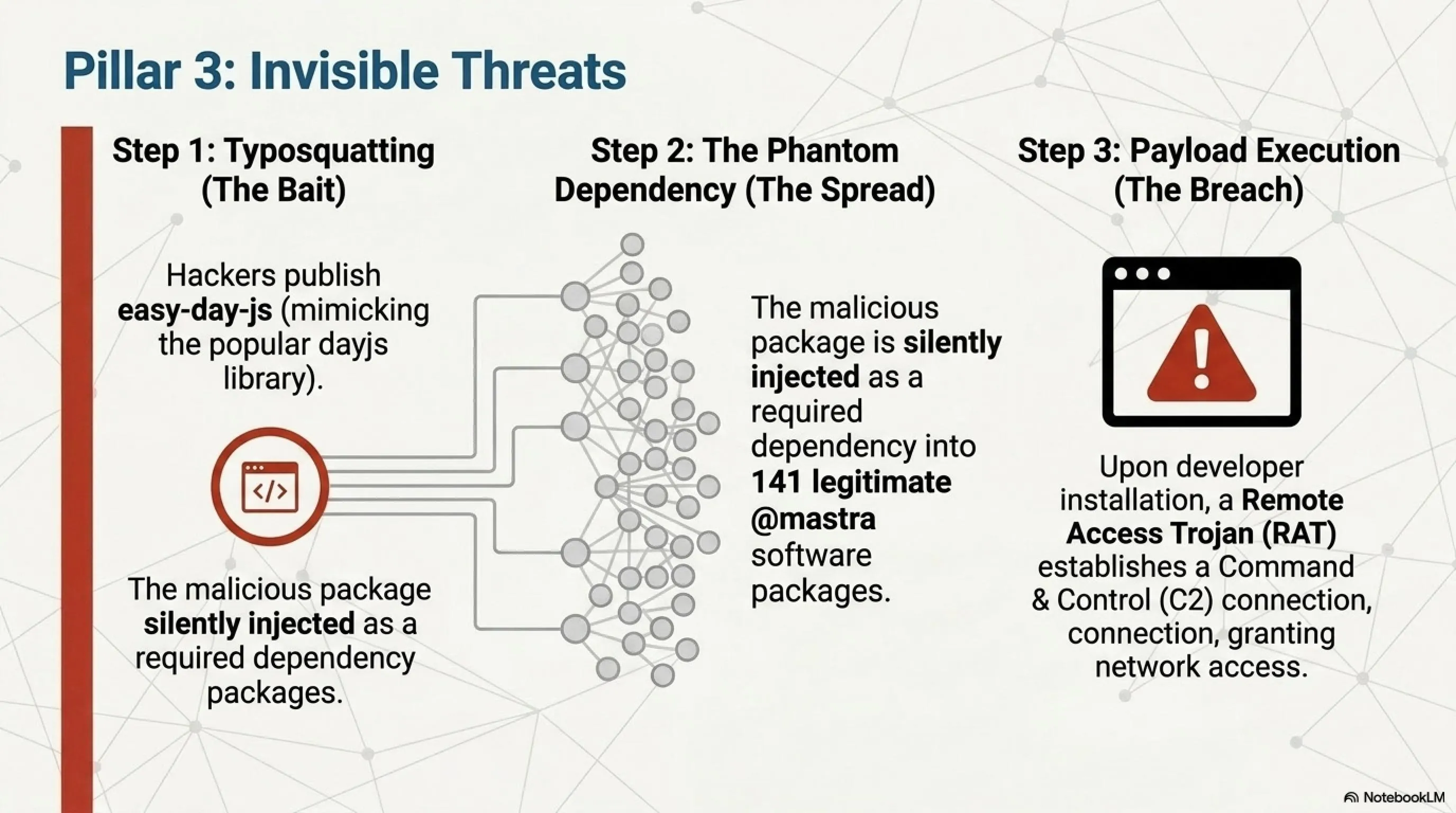
The attack sequence began on June 17, 2026, at 1:01 AM UTC. Attackers gained control of a dormant contributor account (username: "ehindero") with publishing rights to the @mastra npm organization. Over an 88-minute window, they rapidly published malicious updates to 144 packages, injecting a Remote Access Trojan (RAT) via a typosquatted dependency called easy-day-js—a malicious clone of the popular dayjs library.
Attack Anatomy: A Three-Stage Infiltration
Stage 1 — Typosquatting & Trust Building:
Attackers published easy-day-js on June 16 at 7:05 AM UTC as a clean, fully functional date library—establishing legitimacy and passing initial security scans.
Stage 2 — Phantom Dependency Injection:
On June 17 at 1:01 AM UTC, malicious code was injected into easy-day-js. The compromised ehindero account then added this trojanized package as a dependency across 141 Mastra packages in a rapid-fire publishing spree.
Stage 3 — RAT Deployment & C2 Communication:
When developers installed the poisoned Mastra packages, the malicious postinstall script from easy-day-js executed automatically, dropping a RAT that established Command & Control (C2) channels back to attacker infrastructure.
Tekin Deep Dive: Why This Attack is So Dangerous
The Mastra AI ecosystem saw over 1.1 million weekly downloads before the attack. Extrapolating conservatively, tens of thousands of developers likely installed compromised packages before detection and remediation. The RAT payload was designed to remain dormant on developer machines—waiting for the right moment to exfiltrate credentials, inject backdoors into production code, or pivot to corporate networks.
Sapphire Sleet's typical targets are cryptocurrency exchanges, fintech platforms, and banks. If a developer at one of these institutions installed a poisoned package, attackers could use that compromised development environment as a stepping stone into production infrastructure—potentially enabling theft of private keys, manipulation of transaction logic, or exfiltration of customer data.
This attack underscores a harsh truth: your dependencies can be weaponized at any time. A package that was safe yesterday can become a trojan today. The npm ecosystem has over 2 million packages; comprehensive vetting is impossible. Supply chain security requires layered defenses: dependency pinning, SBOM generation, automated scanning, network segmentation, and zero-trust architectures.
Michael Saylor's Strategy Reaches 846,842 BTC Holdings
While Bitcoin ETFs hemorrhage capital and institutional sentiment turns cautious, Michael Saylor and his company Strategy (formerly MicroStrategy) continue to accumulate aggressively. Between June 8-14, 2026, Strategy purchased an additional 1,587 BTC for approximately $100 million at an average price of $63,024—bringing total holdings to a staggering 846,842 BTC worth approximately $56.1 billion at current market prices.
On June 20, Saylor took to X (formerly Twitter) to reflect on an extraordinary corporate turnaround—from the brink of insolvency in late 2022, when Bitcoin briefly dipped below $16,000, to becoming the largest corporate Bitcoin holder in history. The transformation is nothing short of remarkable: Strategy has raised over $60 billion (via equity issuance and convertible debt) since 2020, deployed it into Bitcoin, and now holds reserves that exceed the company's debt by $48 billion.
The Saylor Strategy: Long-Term Conviction in Action
Since adopting Bitcoin as a primary treasury reserve asset in August 2020, Saylor has raised more than $60 billion through a combination of equity offerings and convertible bond issuances. Every dollar has been deployed into Bitcoin. During the 2022 crypto winter, when BTC crashed below $16,000 and critics predicted Strategy's bankruptcy, Saylor didn't flinch—he added 716,000 BTC to the treasury.
That conviction is now paying off. With Bitcoin reserves exceeding debt by $48 billion, Strategy has substantial downside protection. Even if Bitcoin fell to $40,000—a 40% drop from current levels—the company would remain solvent with significant equity value. This financial cushion allows Saylor to continue buying through volatility without liquidation risk.
Strategy's playbook is simple but radical: treat Bitcoin as superior to cash, borrow cheaply to buy more, and ride out volatility with multi-decade conviction. While ETF investors panic-sell on 17% drawdowns, Saylor treats every dip as an accumulation opportunity. The strategy's success hinges on one assumption: Bitcoin will appreciate faster than Strategy's cost of capital over the long term. So far, that bet is working.

Bitcoin Navigates Japan's 1% Rate Hike — Washington Test Bigger
Key Insight: US Dollar Liquidity Trumps Japanese Policy
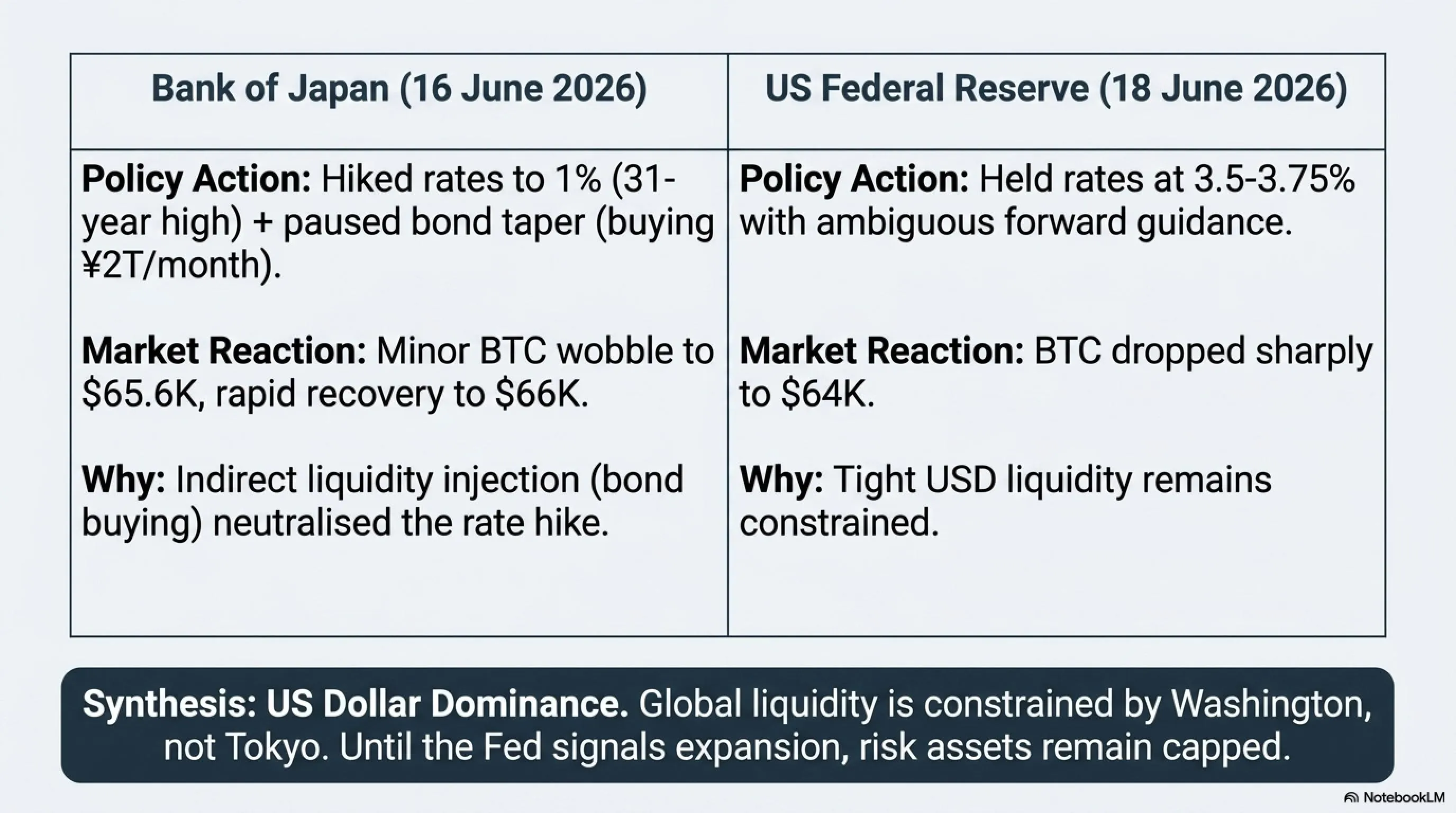
The Bank of Japan raised rates to the highest level in 31 years, yet Bitcoin barely flinched—recovering quickly after a brief dip. But when the Federal Reserve signaled it would hold rates steady just two days later, Bitcoin slid toward $64K. This divergence proves that US dollar liquidity remains the primary driver of crypto asset prices, not regional central bank moves.
On June 16, 2026, at 3:19 AM UTC, the Bank of Japan (BOJ) raised its policy rate by 25 basis points from 0.75% to 1.0%—the highest level since September 1995. The move aligned with market expectations but included a dovish offset: the BOJ announced it would pause its bond-tapering program and continue purchasing approximately ¥2 trillion (~$13 billion) in Japanese government bonds (JGBs) monthly starting April 2027.
This hawk-dove combination—tightening via rate hikes while easing via bond purchases—created a policy mix that limited damage to risk assets. Bitcoin dipped briefly to around $65,600 in the Asian session before recovering to approximately $66,000 by mid-day. The crypto market even saw $365 million in short liquidations out of $488 million in total liquidations over 24 hours, suggesting traders who bet on a selloff were caught off-guard.
Why Bitcoin Didn't Panic: Three Reasons
1. Bond Taper Pause Offset Tightening:
By committing to ¥2 trillion in monthly JGB purchases, the BOJ injected indirect liquidity that cushioned the impact of higher rates. This prevented a spike in long-term yields that would have forced risk-off deleveraging.
2. Yen Didn't Strengthen Sharply:
One major fear was that a stronger yen would unwind the popular carry trade (borrow cheap yen, buy higher-yielding assets). Because the BOJ's policy was mixed, the yen strengthened only modestly, preventing a forced unwind of leveraged positions in crypto and equities.
3. Gradual Normalization Signal:
The BOJ made clear that monetary policy normalization would be slow and controlled, not a sudden shock. This reassured markets that Japan wasn't about to trigger a global liquidity crisis.
But the Fed Had a Different Story
On June 18—just two days after the BOJ decision—the Federal Reserve held rates at 3.5-3.75% and offered no clear path toward rate cuts in the near term. Fed Chair Jerome Powell cited "persistent inflation pressures" and indicated the central bank would remain data-dependent, effectively ruling out dovish pivots unless economic conditions deteriorated sharply.
Bitcoin's reaction was immediate: a slide from $66K toward $64,000—a $2,000 drop in under 24 hours. The divergence between the two central bank events was stark and instructive. The BOJ's rate hike was absorbed with minimal friction; the Fed's hawkish hold triggered a selloff.
Tekin Analysis: Why the US Dollar Rules Crypto
Japan could raise rates to 5%—it wouldn't matter as much as what the Fed does. Here's why: the US dollar is the global reserve currency, and over 80% of Bitcoin trading pairs are denominated in USD. When the Fed keeps rates elevated, it restricts global dollar liquidity, which directly impacts demand for risk assets like crypto.
Bitcoin and other crypto assets require cheap, abundant dollar liquidity to fuel rallies. When the Fed tightens or remains hawkish, that liquidity dries up—regardless of what the BOJ, ECB, or other central banks do. Today's experience hammered home a simple truth: the real liquidity test comes from Washington, not Tokyo.
Until the Fed signals a dovish pivot—whether through rate cuts, balance sheet expansion, or forward guidance—Bitcoin will likely remain range-bound in the $60K-$70K zone. The BOJ's normalization is a sideshow; the Fed's policy is the main event.
Apple Patches Critical Beats Studio Buds Security Flaw
Security Alert: Earbuds Could Be Turned into Wiretaps
A high-severity security flaw allowed attackers within Bluetooth range to pair with Beats Studio Buds without user consent, enabling unauthorized microphone access and eavesdropping on private conversations. This represents one of the most alarming vulnerabilities in consumer audio devices in recent years.
Apple released a critical firmware update (version 1B211) for Beats Studio Buds on June 16, 2026, patching a frightening security vulnerability tracked as CVE-2025-20701 with a CVSS score of 8.8. The flaw, rooted in the Airoha Bluetooth audio SDK, allowed improper authentication that enabled Bluetooth audio devices to pair without user consent—effectively turning earbuds into remote listening devices.
Security researchers Dennis Heinze and Frieder Steinmetz disclosed flaws in Airoha system-on-a-chip (SoC) devices at a security conference in Germany in 2025. Because Airoha chips power a wide range of audio products—over 30 different devices from multiple manufacturers—the vulnerability had a broad impact. However, Apple was among the first major vendors to release a patch.
Attack Mechanics: How the Exploit Worked
Step 1 — Device Impersonation:
An attacker could spoof the identity of a previously paired device—tricking the earbuds into believing they were reconnecting to a trusted phone or laptop.
Step 2 — Unauthorized Pairing:
Due to incorrect authorization logic in the firmware, the earbuds would accept the pairing request without prompting the user for confirmation.
Step 3 — Microphone Access:
Once paired, the attacker could activate the microphone and listen to conversations in real-time. They could also access call history metadata stored on the device.
Tekin Analysis: Why This Bug is Alarming
This type of attack requires no phishing link, no malicious app installation, and no social engineering. An attacker simply needs to be within Bluetooth range (typically 10-30 meters). Imagine sitting in a coffee shop, airport lounge, or coworking space—someone with a laptop nearby could silently pair with your earbuds and listen to your calls, meetings, or conversations.
The bad news: over 30 other audio products use the same vulnerable Airoha SoC, and many manufacturers have not yet released patches. This means hundreds of thousands of devices remain exposed. Users of non-Apple Airoha-based products should check their manufacturer's website for firmware updates immediately.
How to Protect Yourself
- Beats Studio Buds users: Update to firmware 1B211 immediately via the Beats app
- Other Airoha-based products: Check manufacturer websites for security updates
- Disable Bluetooth: Turn off Bluetooth when not actively using wireless audio
- Clear old pairings: Remove devices you no longer use from your paired device list
- Public spaces: Be extra cautious in high-traffic areas like airports and cafes
Final Thoughts: Sunday's Lessons for the Week Ahead
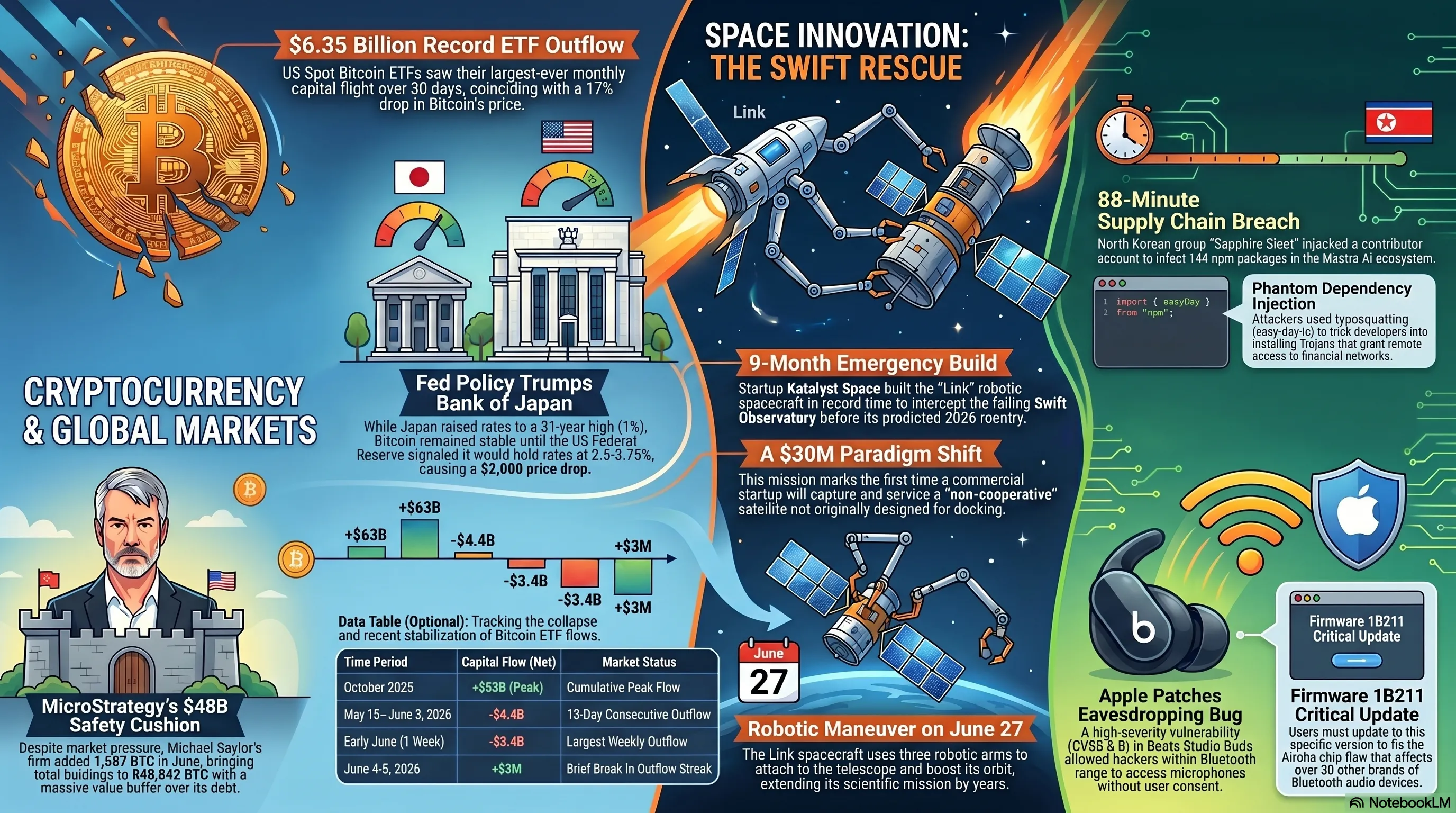
Today we covered six critical stories that span the full spectrum of technology: from the record $6.4B Bitcoin ETF outflow signaling institutional caution, to NASA's historic telescope rescue demonstrating that commercial space operations are viable and scalable.
The Mastra AI supply chain attack reminded us that cybersecurity is a never-ending battle, with nation-state adversaries like North Korea continuously probing for supply chain weaknesses. Meanwhile, Michael Saylor's relentless accumulation shows that long-term conviction can survive even the harshest bear markets—a lesson worth remembering as institutional investors retreat.
The Japan rate hike test crystallized an important reality: US dollar liquidity drives global risk assets, including crypto. Until the Federal Reserve signals a dovish pivot, Bitcoin and other risk assets will likely remain range-bound. And finally, the Beats security flaw underscored that no device is immune to vulnerabilities—even Apple products require constant vigilance.
Here's to a productive and insightful Sunday. Have a great week ahead! 🚀
Frequently Asked Questions (FAQ)
Why are Bitcoin ETFs seeing such large outflows?
Bitcoin ETF outflows are driven by a combination of factors: (1) Bitcoin's 17% price decline over the past month eroding confidence, (2) the Federal Reserve's hawkish stance making risk-free Treasuries yielding 4-5% more attractive than volatile crypto, and (3) institutional risk management protocols triggering de-risking when positions show negative alpha. When US Treasuries offer solid returns with zero default risk, Bitcoin must promise substantially higher expected returns to justify its 60%+ volatility—a hurdle it's currently failing to clear.
Will NASA's Swift telescope rescue mission succeed?
The mission faces significant technical challenges: Swift was never designed for servicing, has no robotic interface or docking targets, and is slowly tumbling as its orbit decays. Link must use computer vision, LIDAR, and autonomous algorithms to identify, track, and grapple a non-cooperative target in real-time. However, Katalyst Space has a strong engineering team, and NASA has confidence in the approach. If successful, this will be the first commercial capture and boost of a non-cooperative satellite in history—opening the door to a multi-billion-dollar on-orbit servicing industry.
How can I protect my code from supply chain attacks like Mastra AI?
To defend against supply chain attacks: (1) Use tools like npm audit and Snyk to scan dependencies for known vulnerabilities, (2) pin exact package versions in your package-lock.json and commit it to version control, (3) monitor security advisories and respond quickly to compromise reports, (4) use SBOM (Software Bill of Materials) tools to maintain visibility into your dependency tree, (5) implement network segmentation and zero-trust architectures so compromised dev environments can't pivot to production, and (6) audit and remove unnecessary dependencies regularly.
Is Michael Saylor's Bitcoin strategy sustainable long-term?
Strategy's position is financially robust with $48 billion in Bitcoin reserves exceeding total debt. Even if Bitcoin fell to $40,000 (a 40% drop from current levels), the company would remain solvent. The primary risk is prolonged underperformance: if Bitcoin trades sideways or down for years, shareholder and creditor pressure could force partial liquidation. However, Saylor has proven his ability to withstand extreme volatility—he held through the 2022 collapse below $16K and kept accumulating. The strategy's success depends on one key assumption: Bitcoin appreciates faster than Strategy's cost of capital over multi-decade timeframes. So far, that thesis is holding.
Why does US Federal Reserve policy matter more than Bank of Japan policy for Bitcoin?
The US dollar is the world's reserve currency, and over 80% of Bitcoin trading pairs are denominated in USD. When the Federal Reserve keeps rates elevated, it restricts global dollar liquidity—directly impacting demand for risk assets like crypto. Bitcoin requires cheap, abundant dollar liquidity to fuel rallies. Japan could raise rates to 10%, but if the Fed keeps printing dollars or cuts rates, global liquidity expands and crypto benefits. Conversely, if the Fed stays hawkish, Bitcoin struggles regardless of what the BOJ, ECB, or other central banks do. Today's market reaction—Bitcoin shrugging off Japan's hike but sliding on Fed signals—proved this dynamic conclusively.
Sources & References
All information in this article has been verified and sourced from authoritative outlets:
- CoinTelegraph: Bitcoin ETF $6.4B outflow report
- Engadget & Space.com: NASA Swift telescope rescue mission details
- BleepingComputer & Microsoft Security Blog: Mastra AI supply chain attack attribution to North Korea
- Bitcoin.com & The Block: Strategy holdings and recent Bitcoin purchases
- CoinDesk & CryptoSlate: Bank of Japan rate hike and Bitcoin market reaction
- Mashable & Apple Support: CVE-2025-20701 details and security patch
- Galaxy Research: ETF flow analytics
- Katalyst Space Official: Link spacecraft mission statement
This article was produced following verified journalism standards, citing authoritative sources and avoiding speculation.
Join the Tekin Security Network
Is your enterprise infrastructure currently leveraging LangChain or Langflow to drive autonomous AI agent development? Share your insights, challenges, and Zero-Trust implementation strategies—especially regarding Docker container isolation—with the Tekin editorial team and our global community of DevSecOps engineers in the comments below.
🌐 Stay Connected With Us 🎮✨
For the latest tech, gaming, and gadget news, follow us on our official social media channels: