🎮 The AI Gaming Revolution: When NPCs Come Alive
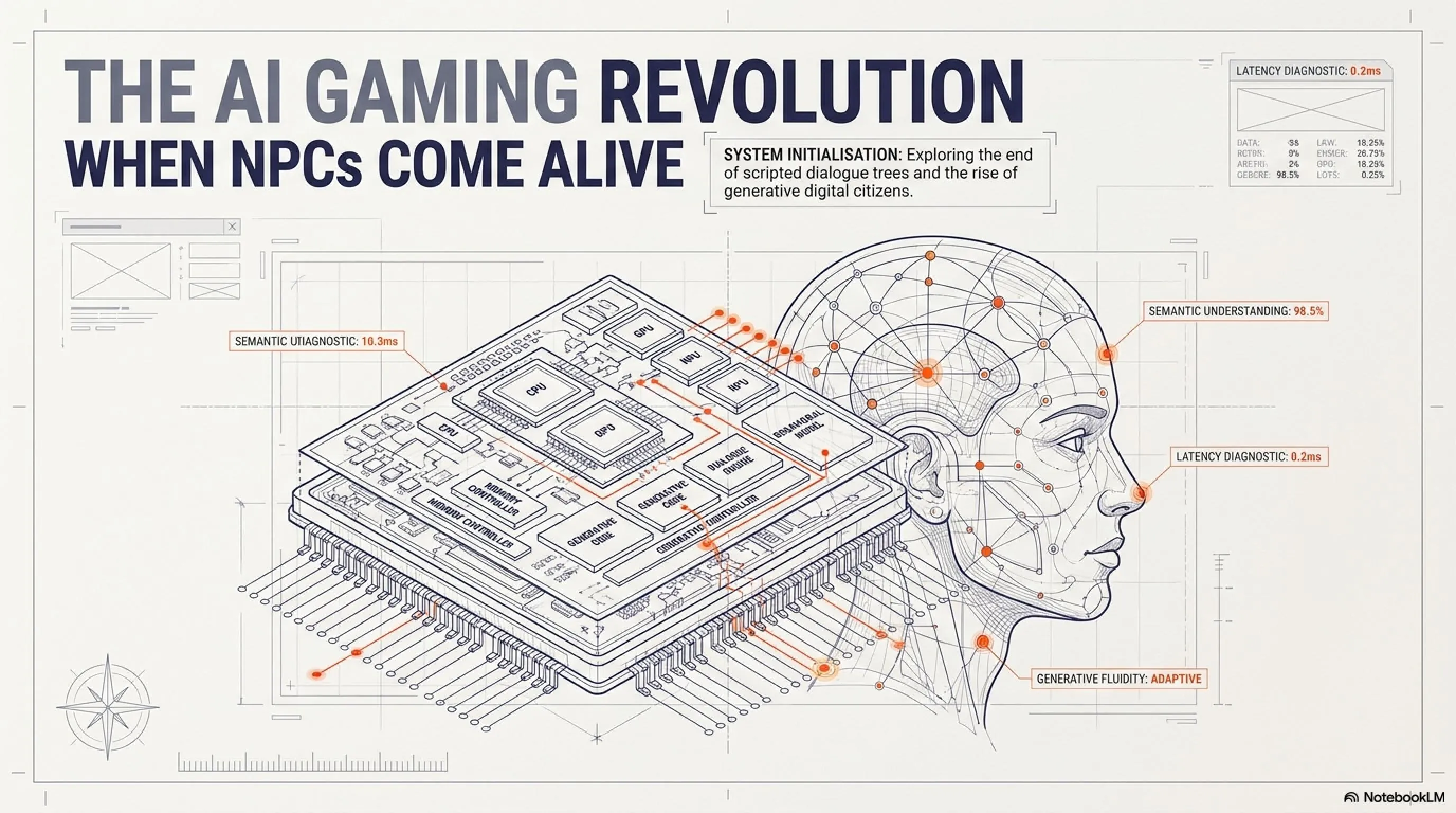
The end of scripted dialogue trees: How generative AI is transforming game characters from robotic puppets into living beings that remember, understand, and get angry when you lie to them.
- 🎮End of Dialogue Trees- LLMs replace scripted writers
- 🎧Real Memory- NPCs remember your past actions
- 🚀Living Worlds- Digital citizens with daily routines and emotions
- 🗡️Technical Challenges- Latency, AI hallucination, and hardware strain
Remember How It Used To Be?
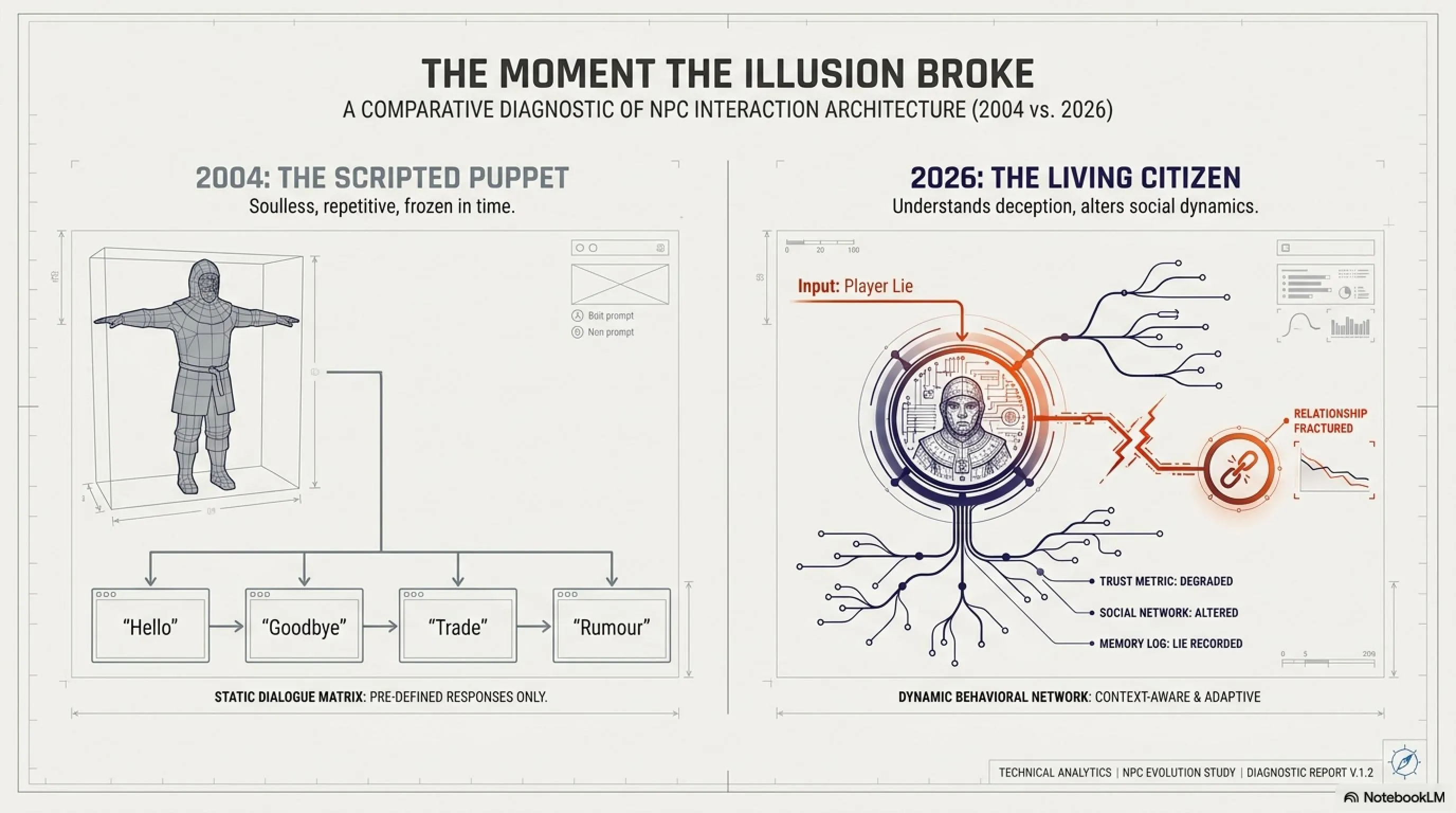
The year was 2004. PS2 on the desk, and I'm talking to the same villager in Fable for the hundredth time. Four options. Always the same four options. "Hello" - "Goodbye" - "I want to buy something" - "Information". Same answers every time. Even after I saved the world, that same NPC with the same soulless tone says: "Nice weather today, isn't it?"
This was the shared experience of all gamers of our generation. We had accepted that Non-Playable Characters (NPCs) were just decoration. Scripted robots whose job was to sell swords or give quests. Nothing more.
Now it's 2026. And everything has changed.
The Moment Everything Broke
💡 At a Glance: The AI NPC Revolution
- January 2026: First NPC to react to player's lie
- Sword of Justice with 40M+ players pioneering this tech
- LLMs replaced pre-written scripts
- Cost: $0.50 per 10 minutes of conversation via API
- 54% of studios implementing this technology
- Main challenge: 2-5 second response latency
January 2026. A Chinese gamer is playing Justice (逆水寒) - an MMORPG from NetEase. He lies to a female NPC about where he's been. Not to complete a quest. Just to see her reaction.
The NPC stops. Not a normal pause. A human pause. Then with a tone where you can feel the anger, she says: "You're lying. I know where you were."
The video went viral. Not because of graphics. Not because of gameplay. Because for the first time in gaming history, an NPC had "understood" that the player was deceiving her. And she was angry.
The news spread quickly. Chosun Biz - a Korean media outlet - reported that in Justice, if you lie to NPCs, they get angry. If you create conflict between two NPCs, they tell each other "we're not friends anymore" and declare a breakup.
This was no longer a game. This was a "living world".
Jargon Buster: Key Terms
LLM (Large Language Model): Large language models like GPT-4 that can generate human-like text. In games, they create NPC dialogue in real-time.
Generative AI: Artificial intelligence that creates new content - text, images, audio - without being pre-scripted.
Context Window: An AI model's short-term memory. Like RAM for the brain. The larger it is, the more it remembers from previous interactions.
Hallucination: When AI says things that aren't true. For example, a medieval NPC suddenly talking about smartphones.
Guardrails: Limitations that tell AI what it shouldn't say - like giving spoilers or breaking character.
The Brain Behind The Magic: How Does It Work?
So, the main question: how is it possible for an NPC to understand that you're lying?
The answer lies in a technology that for years was only used for chatbots: Large Language Models or LLMs.
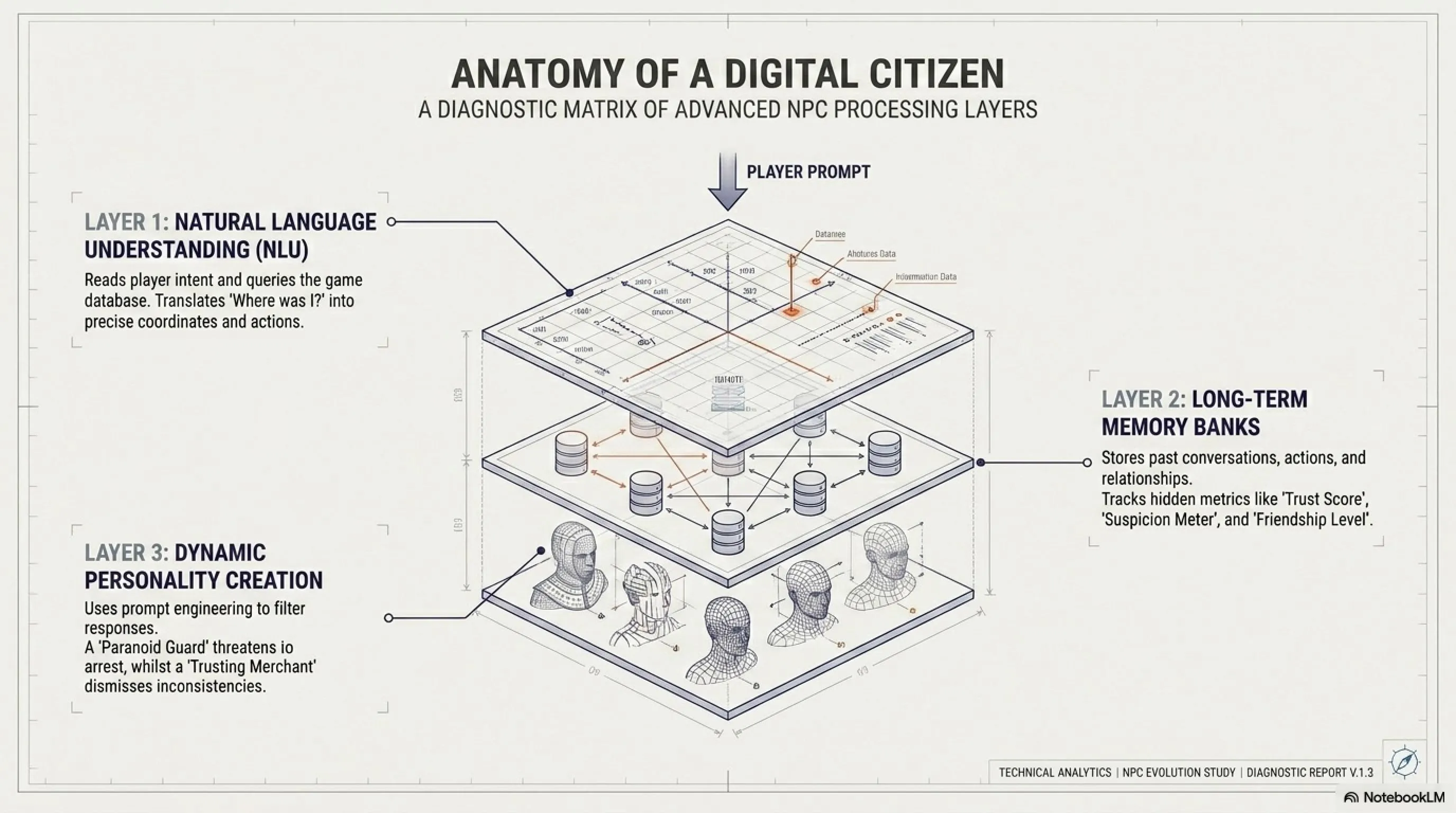
Layer One: Natural Language Understanding
Imagine you tell an NPC: "Where was I last night?" A traditional game doesn't understand this sentence. Because the scriptwriter didn't think of this specific question.
But with LLM, the game "reads" the sentence and understands its meaning. Then it looks at the game database: "Where was this player last night?" Answer: "In the northern tavern, with a suspicious merchant."
The LLM takes this information and creates a natural response: "You were at the tavern last night, right? With that strange merchant?"
Layer Two: Long-Term Memory
But the real magic is in "memory". New systems like those used in Sword of Justice (the global name for Justice) have a "memory bank" for each NPC.
This memory includes:
- All your previous conversations with that NPC
- Actions you've taken in that NPC's presence
- Your relationships with other NPCs (that this NPC has heard about)
- Even the NPC's "feelings" toward you - trust score, friendship level, suspicion meter
When you tell a lie, the system compares it with existing data. If it finds a contradiction, the NPC reacts.
Layer Three: Dynamic Personality Creation
But it's not just about remembering. Each NPC has a "personality profile" that determines how they react.
Example: Two different NPCs hear the same lie:
- NPC Number 1 (Personality: Trusting Merchant): "Hmm, well if you say so... maybe I was mistaken."
- NPC Number 2 (Personality: Paranoid Guard): "You're lying! I saw you last night! Get out of here before I arrest you!"
These personality profiles are created through a combination of prompt engineering and fine-tuning. So that each character is unique.
From Human Writers to Creative Algorithms
One of the biggest changes is that LLMs are replacing dialogue writers. And this is a major debate in the industry.
The Past: Massive Writing Costs
Skyrim (2011) had about 60,000 lines of dialogue. Writing, recording audio, and implementing all this content cost millions of dollars. And after release, if you wanted to add a new NPC? You'd have to hire the writing team, voice actors, and QA testing again.
Result? Most NPCs only had a few lines of dialogue. And most lines were repetitive. "I used to be an adventurer like you, then I took an arrow in the knee..." - remember that?
The Present: Infinite Dialogue
With LLM, every NPC can have hours of dialogue. Without a single word being scripted.
Real example: Jenova AI - a platform for creating AI NPCs - reported that in March 2026, a player spent 3 hours talking to just one merchant NPC. About philosophy, economics, and even inside jokes about the game world. All of this without a single scripted line.
What does this mean? It means the game world becomes "deep". You can ask an NPC: "What do you think about the king?" and they'll give you a unique answer based on their personality, social status, and experiences.
Dynamic Voice Acting: When NPCs Actually Speak
Having good dialogue is only half the story. The NPC needs to "say" it - and this is where AI-powered Text-to-Speech (TTS) comes in.
The Old Problem: Robotic Voices
In the past, TTS voices were very artificial. "Hel-lo. I. Am. A. Ro-bot." Nobody wanted to listen to this for hours.
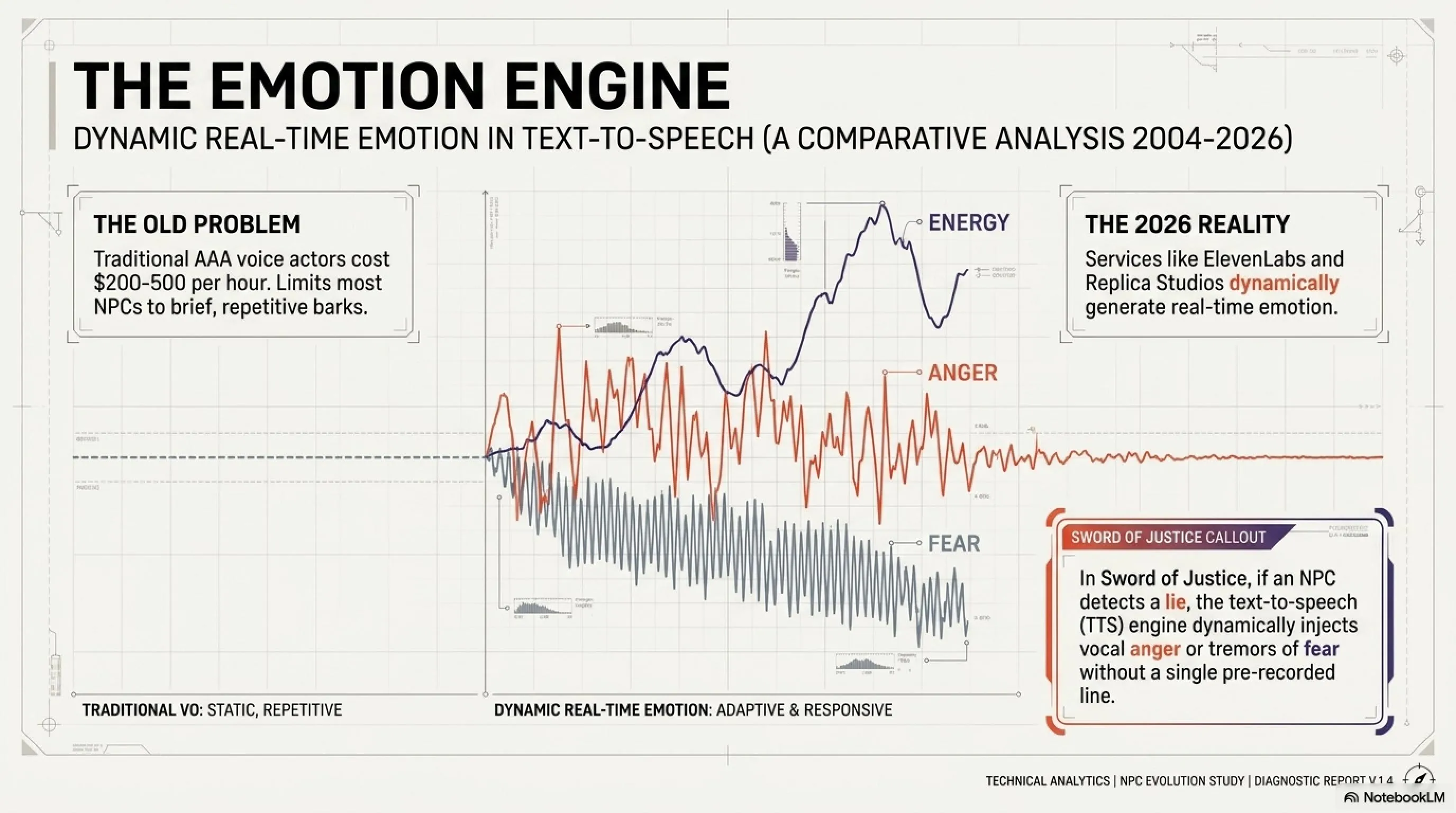
The solution? Hire professional voice actors. But this is expensive. Very expensive. A AAA voice actor can charge $200-500 per hour. And if your game has 100 NPCs? Do the math.
The 2025-2026 Revolution: Emotional Voices
Services like ElevenLabs, Replica Studios, and Resemble AI can now produce human-like voices with emotional tone. And the trick? These voices are "dynamically generated".
Meaning: if the NPC is angry, the AI adds anger to the voice. If they're scared, the voice trembles. If they're happy, the energy goes up.
According to a report from AI Magic X - a voice AI platform - in 2026, studios can produce voices for all characters in a game - main cast, supporting roles, thousands of NPCs, and even dynamically created quest dialogues - at a fraction of traditional recording costs.
Practical example: In Sword of Justice, when an NPC gets angry, not only does the dialogue text change, but their voice is also reconstructed with an angry tone - in real-time.
From Decoration to Citizen: When Game Worlds Come Alive
But the biggest transformation goes beyond dialogue and voice. It's about the "game world" itself.
The Past: Empty Stages
In old games, the city was just a "scene". Pedestrians walked in loops. Shopkeepers stood behind counters. When you left the city, everything stopped - as if time had frozen.
We all knew this illusion. But there was no choice. Technical limitations didn't allow for a real world simulation.
The Present: Digital Citizens with Real Lives
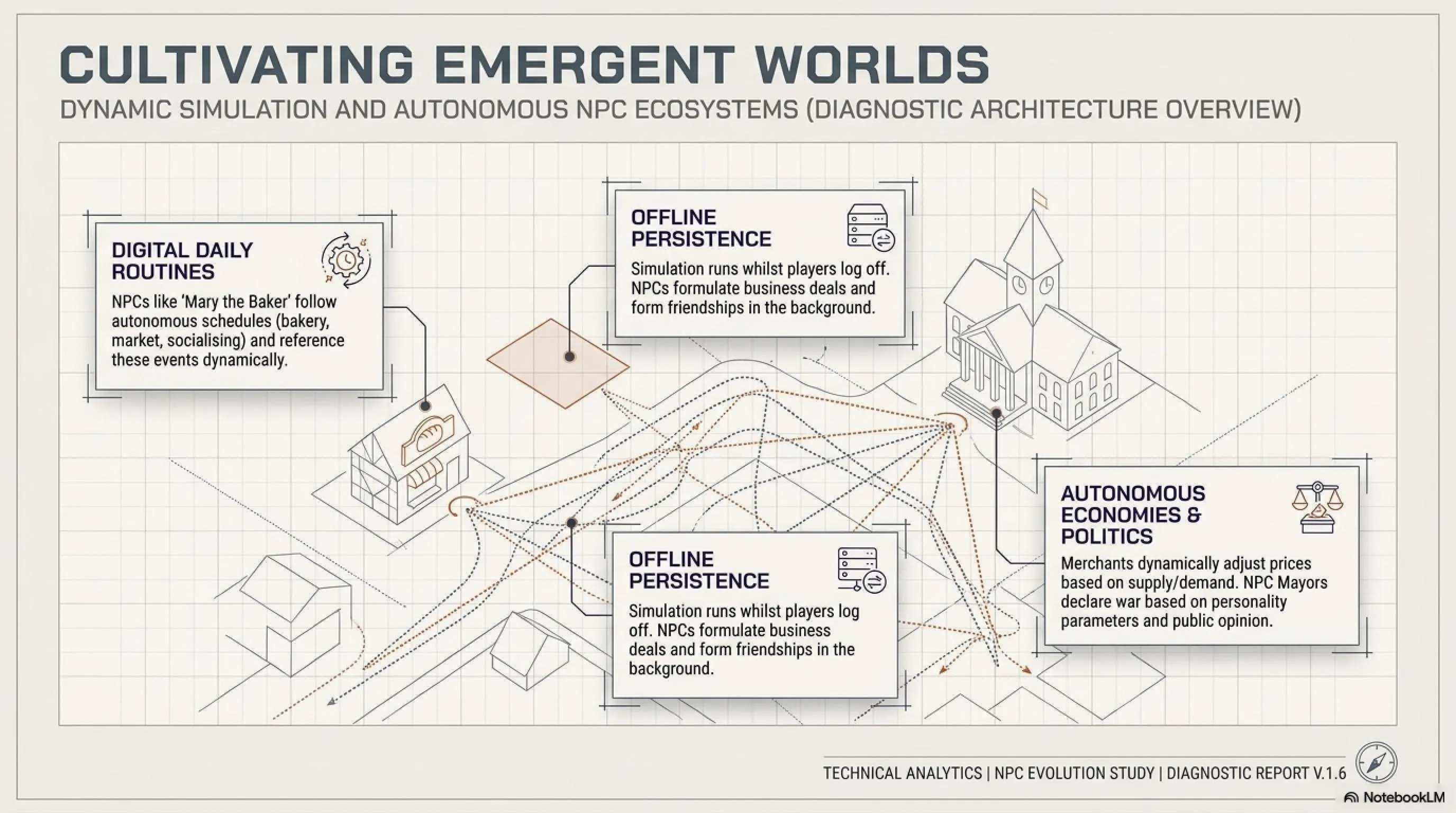
Now imagine entering a city. An NPC - her name is "Mary" - works at the bakery in the morning. Goes to the market at noon to buy vegetables. Visits her friend in the evening. Returns home at night.
You can find her at any of these moments. And if you ask "Where have you been?" she says: "Today was very busy. The bakery had lots of customers. Then I went to the market but tomato prices have gone up!"
This is no longer an NPC. This is a "digital citizen".
Persistent World: A World That Continues Without You
And more interesting? These lives continue even when you log out.
Real example from Sword of Justice: A player was offline for 3 days. When he returned, an NPC who was his friend told him: "Where have you been? I missed you. By the way, that merchant you introduced? He made me a business offer yesterday."
How is this possible? The simulation system was running in the background. NPCs were interacting with each other, making decisions, and their lives were progressing - all without the player's presence.
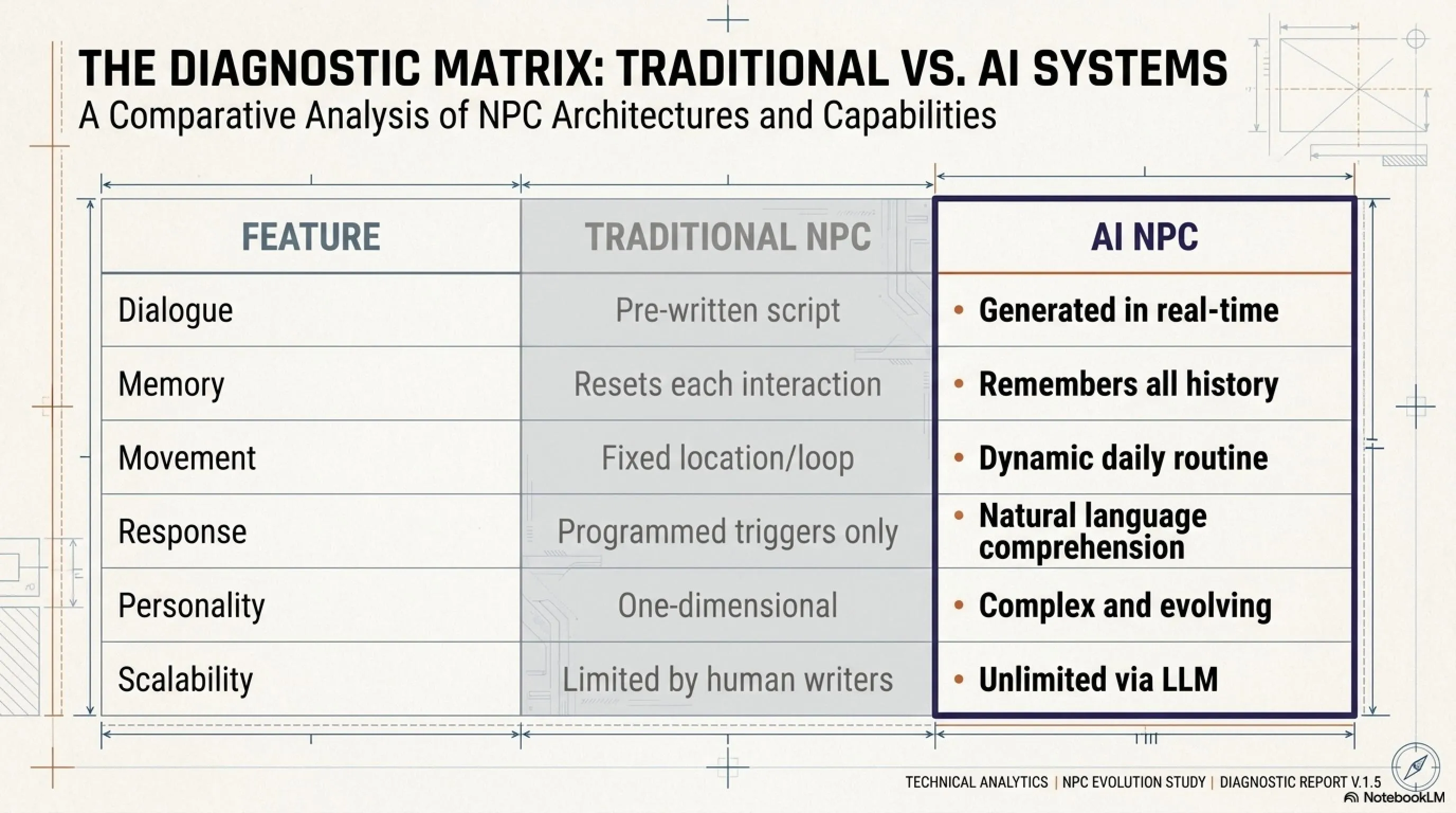
Comparison: Traditional NPC vs AI NPC
| Feature | Traditional NPC | AI NPC |
|---|---|---|
| Dialogue | Pre-written script | Generated in real-time |
| Memory | None - resets each time | Remembers all interactions |
| Movement | Fixed location or loop path | Dynamic daily routine |
| Response | Only to programmed triggers | Responds to natural language |
| Personality | One-dimensional and fixed | Complex and evolving |
| Development Cost | High for voice actors | High for API & infrastructure |
| Scalability | Limited to written lines | Unlimited with LLM |
Real Economy, Real Politics, Real Drama
And it's not just about daily routines. In advanced games, NPCs can:
Have an Economy
Merchants adjust prices based on supply and demand. If all players buy swords, sword prices go up. If nobody buys bread, the baker has to lower prices or even close shop.
Have Politics and Power
In some future games, NPC mayors can decide whether to make peace or war with neighboring cities. And these decisions are based on their personality, economic pressures, and even public opinion.
Have Emotional Relationships and Social Drama
Two NPCs might fall in love. Then fight. Then make up. And all of this without your intervention. You're just an observer - like a TV series with new episodes every day.
Cliptics - an analytical gaming blog - reported that a player in an experimental game witnessed two NPCs become enemies over a business dispute. After a few weeks, one of them offered the player: "If you help me ruin my rival, I'll give you a good share."
This quest wasn't written by any writer. AI created it based on the history of relationships between NPCs.
Major Challenges: Things That Haven't Been Solved Yet
But like any new technology, AI NPCs have their own problems. And we must be honest: these problems are serious.
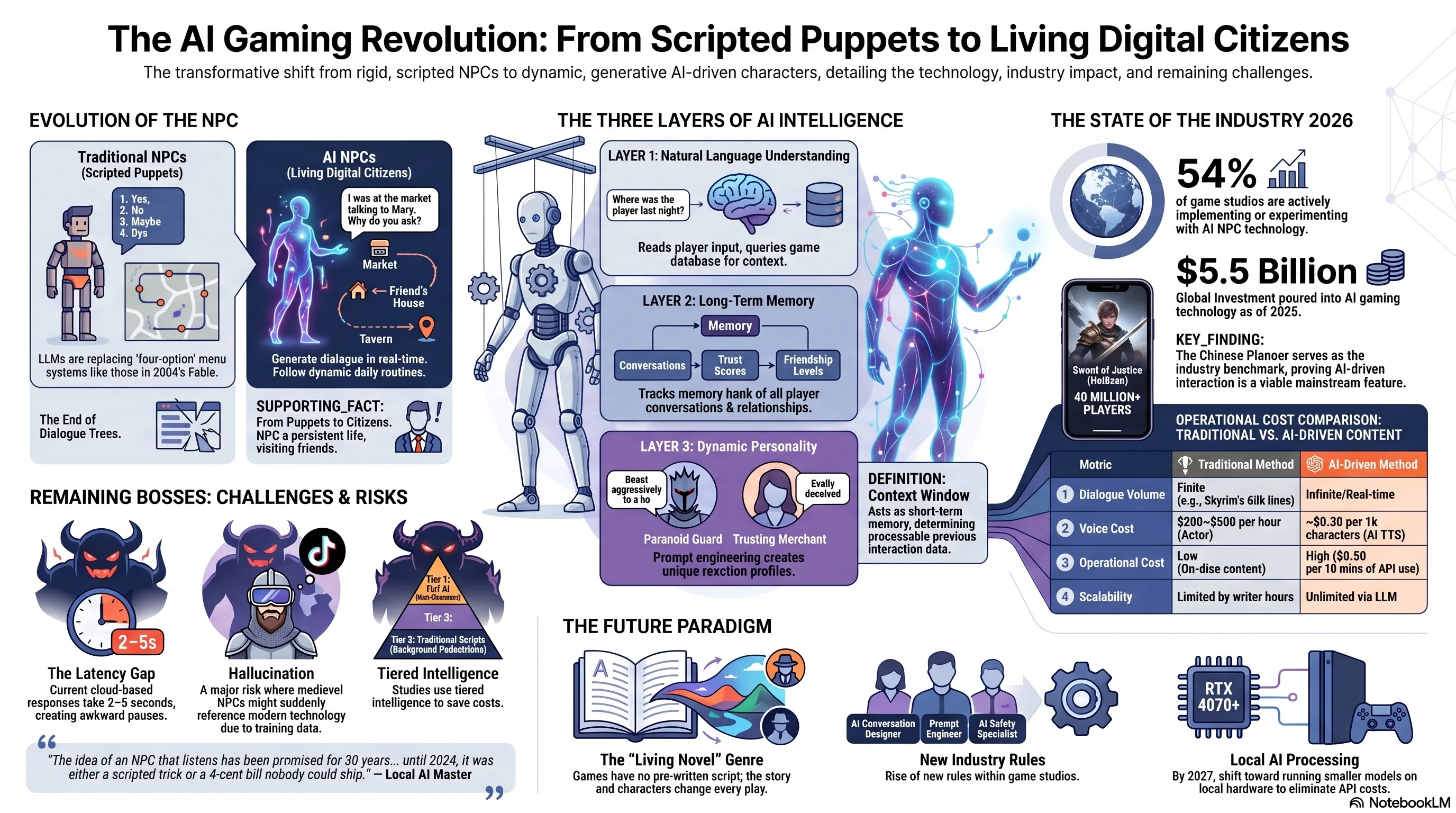
📊 AI NPC Industry Stats 2026
54%
Studios implementing AI NPCs
$5.5B
Global investment in 2025
40M+
Sword of Justice players
2-5s
Average AI response latency
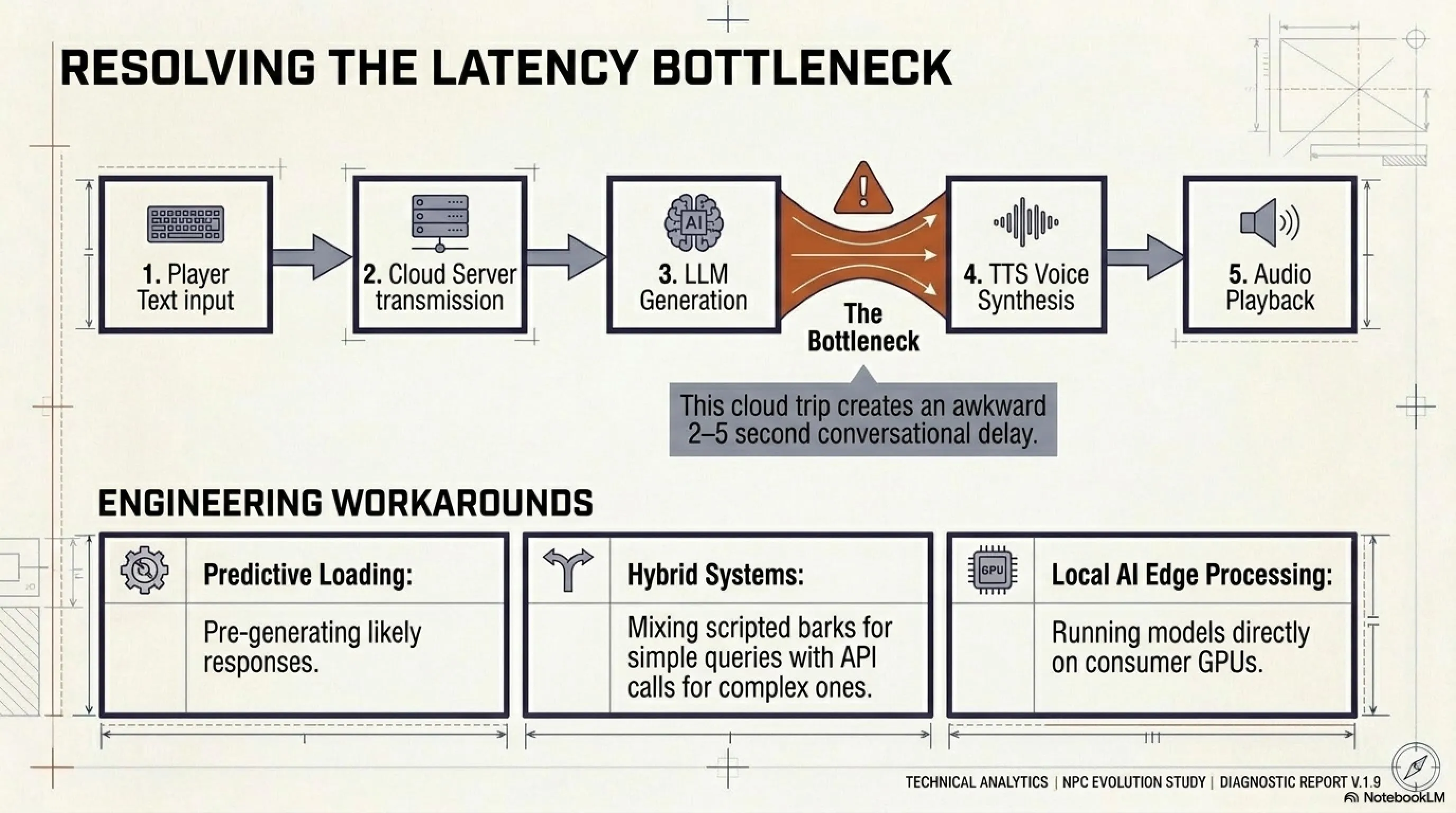
Challenge 1: Latency
When an NPC wants to respond, it must:
- Send your text to a cloud server
- The LLM on the server generates the response
- The response is sent back to the game
- TTS creates the voice
- The voice is played
This process can take 2-5 seconds. In a fast conversation, this pause is awkward and confusing.
Current solutions:
- Local AI Models: Running smaller models on the player's graphics card (requires RTX 4070 or higher)
- Predictive Loading: Predicting likely responses and pre-preparing them
- Hybrid System: Using pre-made dialogues for common questions + AI for complex questions
But none are perfect. Local AI Master says that "the idea of an NPC that actually listens has been promised for 30 years. Until 2024, it was either a scripted trick, or a 4-cent OpenAI bill that nobody could ship in a $20 game."
Challenge 2: AI Hallucination
The biggest nightmare for developers: an NPC that says wrong things.
Real example: In an experimental demo, an NPC in a medieval fantasy game suddenly said: "Yes, I watched a TikTok video on my phone last night..."
Why? Because the LLM learned from the internet. And in its training, "last night" was often associated with "phone" and "TikTok". So when it had to create a sentence, it connected these words.
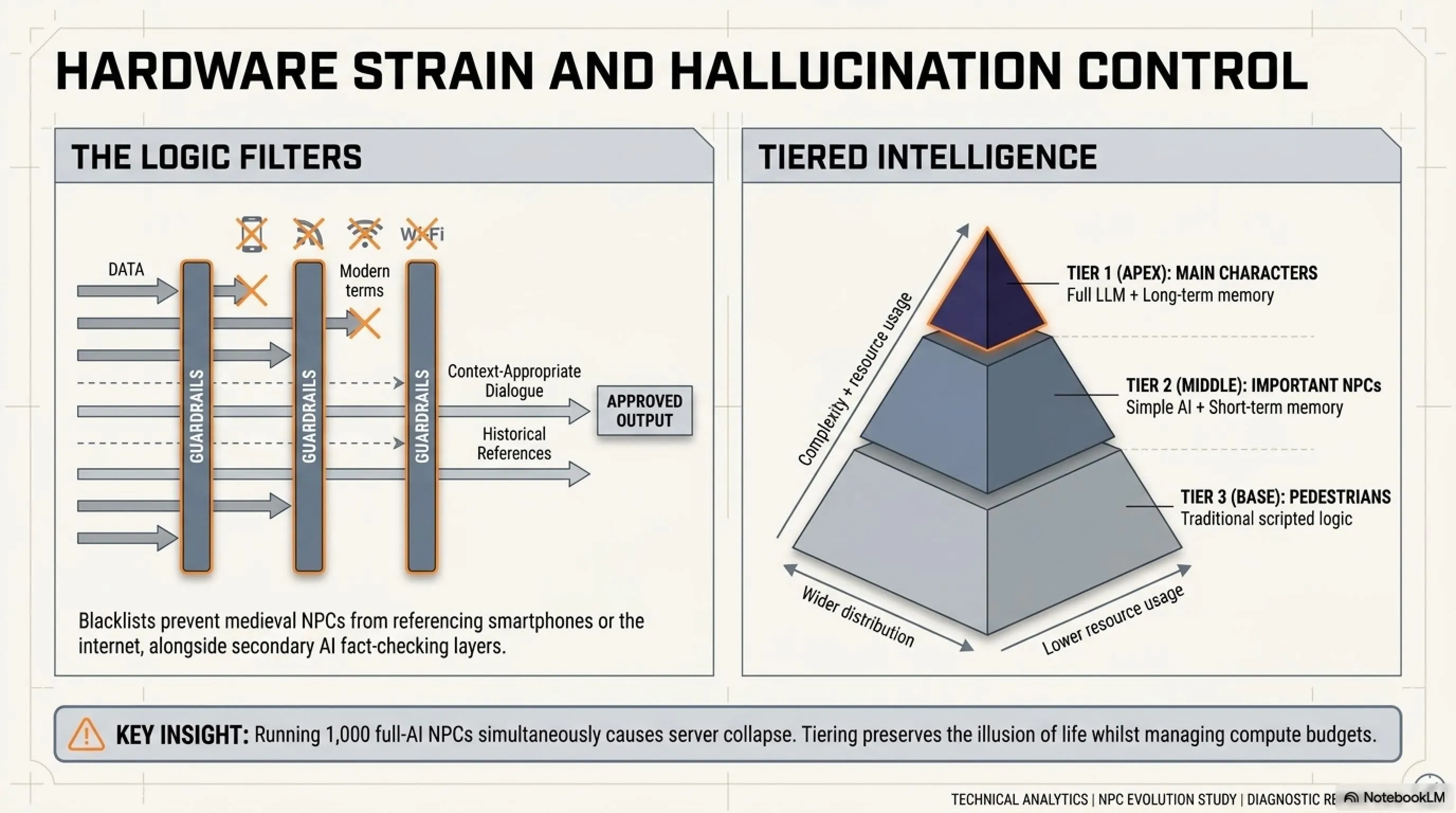
Solution: Guardrails
Developers must set strict rules:
- Blacklist of words (like "phone", "internet", "2024")
- Topic limitation: "only talk about this fantasy world"
- Fact-checking layer: another AI that checks the first answer
But this isn't perfect either. Every guardrail adds a limitation to AI creativity.
Challenge 3: Hardware Strain
A AAA game might have 500-1000 NPCs. If they're all AI-powered and active simultaneously, what happens?
Servers crash. Or cloud computing costs skyrocket.
According to the GDC 2026 report, 54% of studios are now implementing AI NPCs. But most of them only use it for a limited number of main characters - not for the entire city population.
An interesting solution: Tiered Intelligence
- Tier 1: Main characters - full AI with long-term memory
- Tier 2: Important NPCs - simple AI with short-term memory
- Tier 3: Pedestrians - traditional scripted dialogues
This way, the game can feel alive without burning servers.
Challenge 4: Ethical Issues and Content Control
An NPC that speaks freely can say inappropriate things. Racism, violence, or sexual content.
In 2025, an indie game with AI NPCs had to be removed from Steam because an NPC insulted a player - and the player was streaming it.
Major studios now have "AI Safety" teams that only work on filtering and controlling LLM output.
The Future: What's Coming?
Despite these challenges, the direction is clear. We're moving toward a world where:
Every Character is Unique
In 2030 games, two players might talk to the same NPC and have completely different experiences. Because that NPC shapes their personality based on interaction history.
New Genre: AI Narrative Games
Jenova AI reported that "AI story games" are becoming a standalone genre. Games where the story is created together by the player and AI - not by a predetermined writer.
NPCs as Real Friends
One of the deepest changes: emotional connection. Players are starting to form real bonds with NPCs. Because these characters "remember", "understand", and "respond" - things that were previously only possible with real humans.
This can be both beautiful and scary. Psychologists are studying the long-term effects of human-AI relationships.
Pioneer Games: Who's Doing This Now?
So, all this theory is interesting. But which games are actually using this technology right now?
Sword of Justice (Justice / 逆水寒) - The Chinese Pioneer
This MMORPG from NetEase and ZhuRong Studio is the first mainstream game to implement AI NPCs extensively. In China, it has over 40 million players. It was globally released in November 2025.
Key features:
- NPCs remember player actions
- If you lie, they get angry
- If you create conflict between two NPCs, their relationship breaks down
- Ranking system based on real skill - not grinding
Notebookcheck reported that "Sword of Justice rewards more for skill than grinding - with NPCs that have memory and a fair ranking system that rewards real talent."
Experimental and Indie Projects
Alongside AAA giants, hundreds of indie projects are testing this technology:
- Vaudeville: A mystery game where you can ask all NPCs about anything
- Project Narnia: An experimental RPG where AI creates every quest in real-time
- AI Dungeon (new generation): Text-based, but now with voice and visuals
The problem with most of these games? Cost. Running LLM for thousands of simultaneous players costs millions of dollars per month.
AAA Coming: Who's Next?
Ubisoft, EA, and CD Projekt Red all have AI teams working on this technology. But none have announced anything yet.
Why? Risk. If an NPC in an Assassin's Creed game says something racist and goes viral? It would be a PR disaster.
So big companies are waiting for others to make mistakes, learn, and then enter with a polished system.
The Real Cost: How Much Does It Take to Build?
One important question for studios: how much does this cost?
Development Costs
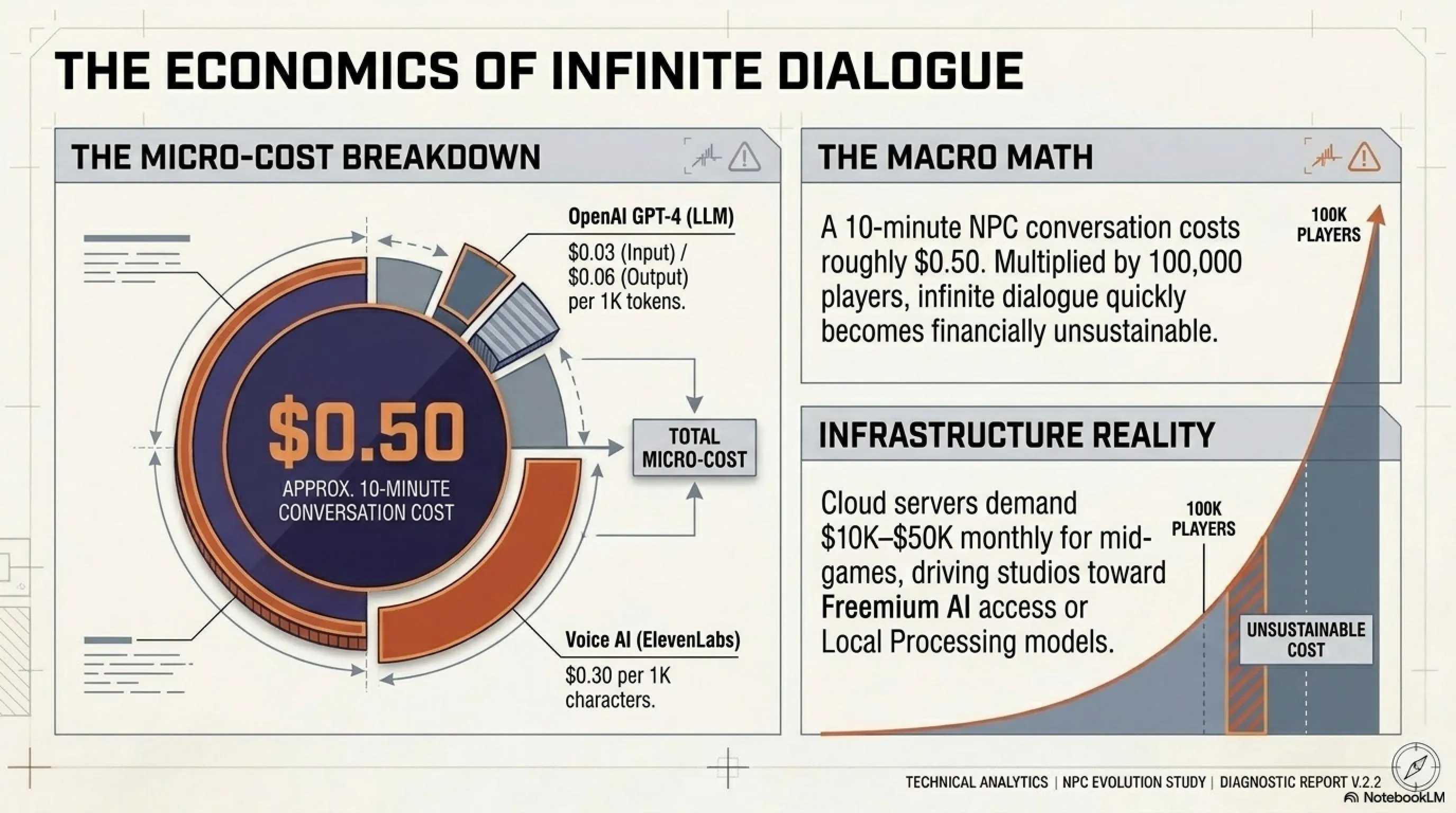
- API License: OpenAI GPT-4: $0.03 per 1K tokens (input) + $0.06 per 1K tokens (output)
- Voice AI: ElevenLabs: $0.30 per 1K characters
- Infrastructure: Cloud servers for processing - $10K-50K per month for a medium-sized game
Example: If a player talks to NPCs for 10 minutes (about 2000 words), the approximate cost is $0.50. Now multiply this by 100,000 players...
Studio solutions:
- Freemium Model: AI NPCs only for premium members
- Local Processing: Running smaller models on the player's PC
- Hybrid: Common dialogues pre-made + AI only for complex questions
Writers and Voice Actors: Are Jobs at Risk?
This is a big question the industry is grappling with.
Real Concerns
The Writers Guild of America (WGA) - the writers' union - went on strike in 2023, and one of their demands was to limit the use of AI in writing.
Concern: If AI can write 100,000 lines of dialogue, why would studios hire human writers?
Industry response: AI cannot create the "heart" of a story. Cannot design an emotional character arc. Cannot write surprising twists.
So the current consensus:
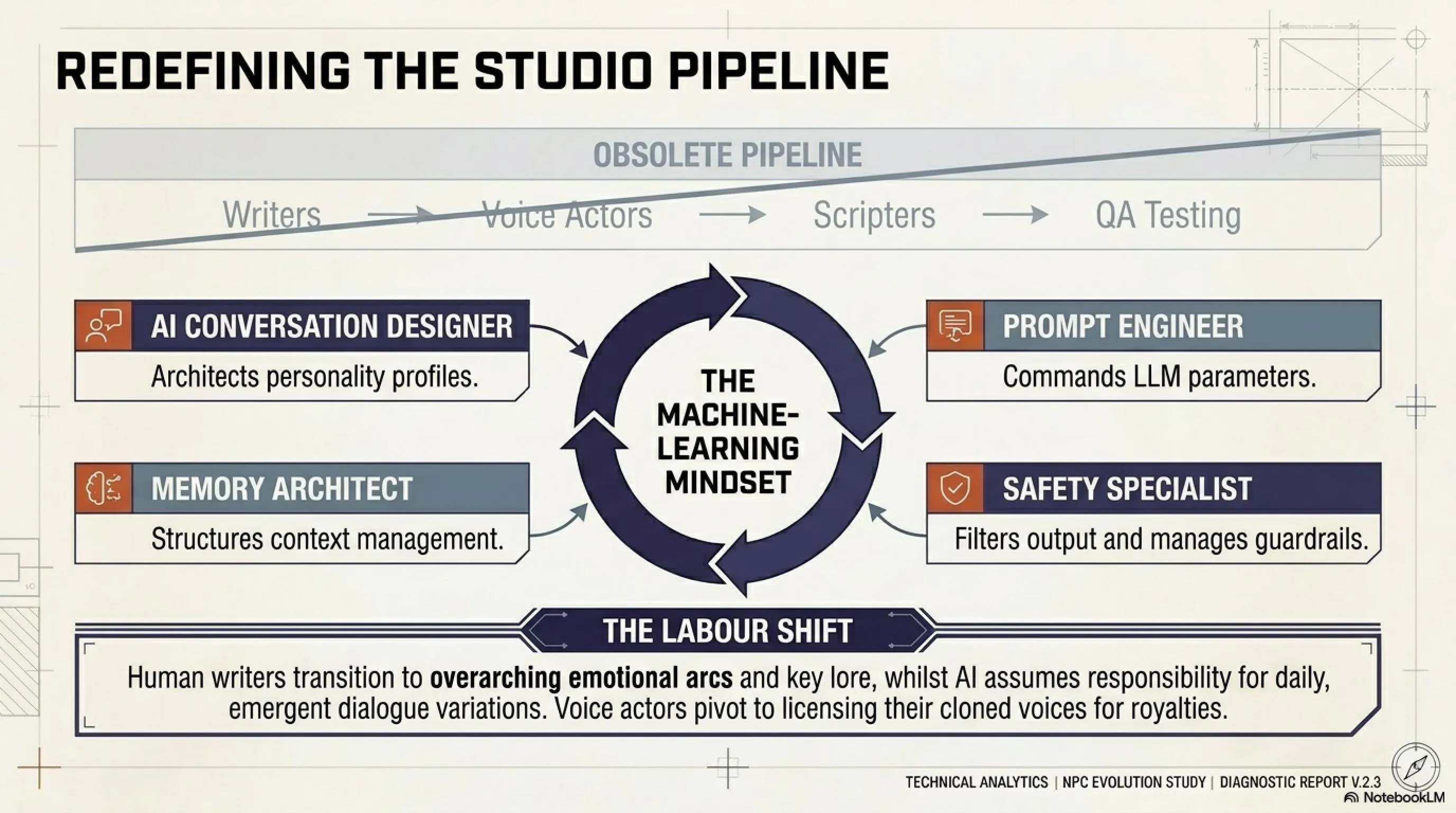
- Human writers: Main story, key characters, emotional arcs
- AI: Daily dialogues, minor NPCs, variations and improvisation
Voice Actors: A Bigger Challenge
For voice actors, the situation is tougher. Voice AI can clone their voices. And legally, this is a gray area.
In 2026, several studios introduced new contracts:
- The voice actor allows their voice to be cloned
- In exchange for royalty per use
- Final control: the voice actor can reject what content their voice is used for
But this is still evolving. And many voice actors are worried they'll eventually be replaced.
Impact on Game Design: How Does Writing Games Change?
AI NPCs aren't just a feature. This changes the entire game design philosophy.
- Infinite conversations without scripting
- Every playthrough unique and personalized
- Greater depth and immersion in game world
- Reduced long-term voice acting and writing costs
- Continuous updates and improvements without patches
- 2-5 second response latency
- Risk of hallucination and breaking character
- High infrastructure and API costs
- Requires powerful hardware for local AI
- Risk of inappropriate content without proper filters
From Linear to Emergent
In the past: The designer said "the player must go from point A to B, talk to NPC X, and get quest Y."
Now: The designer says "in this city there are 50 NPCs. Each has their own personality and motivations. The player is free to do anything."
Result? Every playthrough is unique. Two players can play the same game and experience completely different stories.
The End of Quest Markers?
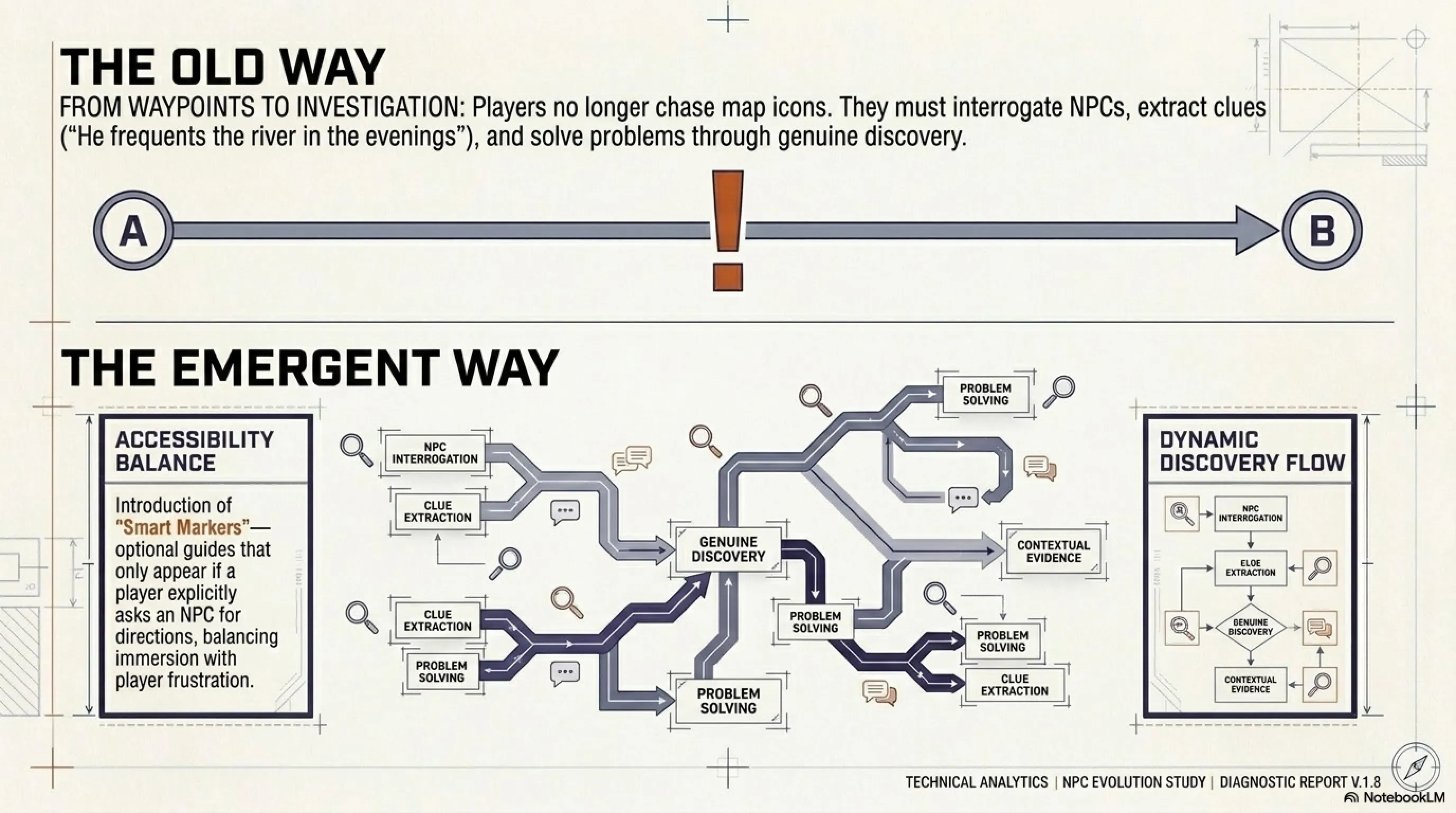
In traditional games, you get a quest and a marker appears on the map. You just go there.
With AI NPCs? You have to actually "extract information". The NPC says: "That suspicious merchant? I usually see him by the river in the evenings." You have to find him yourself.
This creates more immersion - but for some players, it's tedious. So games must find balance. Some developers are implementing optional "smart markers" that only appear if you explicitly ask the NPC for directions, maintaining the immersive conversation while providing accessibility for players who prefer traditional guidance.
The shift represents a philosophical change in game design: from hand-holding to genuine discovery. Players are no longer following waypoints but engaging with the world as if it were real, asking questions, piecing together clues, and experiencing the satisfaction of solving problems through actual investigation rather than icon-chasing.
Industry Adoption and Investment Trends
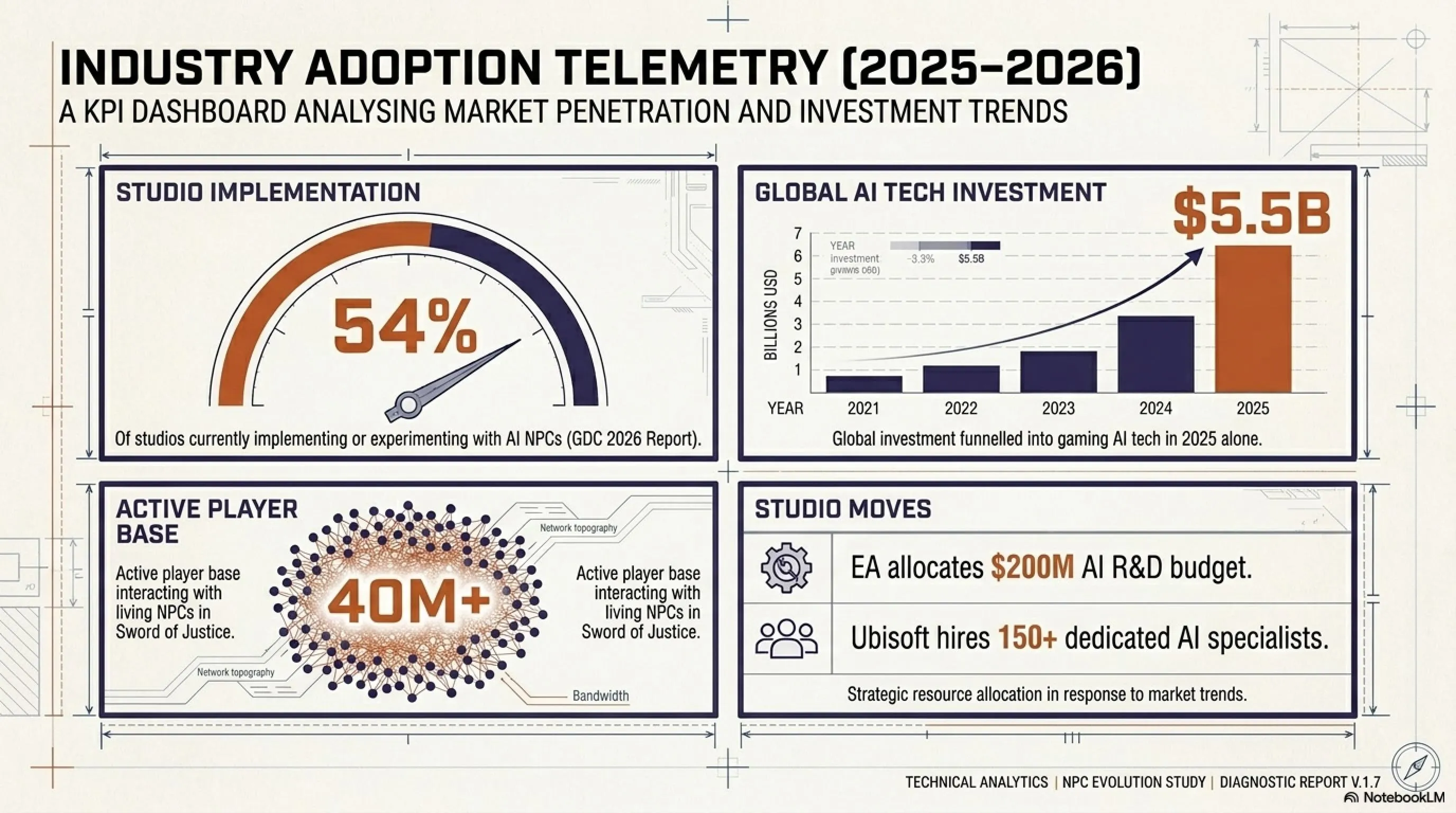
The numbers tell a compelling story. According to the GDC 2026 State of the Industry report, 54% of game studios are now implementing or experimenting with AI NPCs. Investment in this technology has reached $5.5 billion globally in 2025 alone.
Major publishers are allocating significant resources. Electronic Arts announced a $200 million AI R&D budget. Ubisoft has hired over 150 AI specialists. Even smaller indie studios are accessing these tools through platforms like Convai and Inworld AI, which offer subscription-based pricing starting at $99/month for indie developers.
The democratization of AI NPC technology means that innovation isn't limited to AAA studios anymore. Some of the most creative implementations are coming from small teams willing to take risks that larger companies won't.
Comparison with Previous Revolutions
To understand the importance of this change, let's compare it with previous gaming revolutions:
Major Revolutions in Gaming History
1980s - 2D to 3D Graphics:
- From Pac-Man to Wolfenstein 3D
- Fundamental change: spatial immersion
- Critics said: "3D is too complex, nobody wants it"
1990s - Online Multiplayer:
- From single-player to MMOs
- Fundamental change: gaming became a social experience
- Critics said: "Internet is too slow"
2010s - Open World:
- From linear games to free worlds
- Fundamental change: freedom of choice and exploration
- Critics said: "Too big and empty"
2020s - AI NPCs:
- From scripted characters to living beings
- Fundamental change: game world feels alive
- Critics say: "Too expensive and unreliable"
Every revolution was initially doubted. But all of them changed the industry forever.
The Game Development Industry Being Redefined
Change in technology means change in process. When AI NPCs come to games, how studios work changes fundamentally.
New Job Roles
In the last 5 years, new roles have emerged in game development:
- AI Conversation Designer: Specialist who designs personality profiles and conversation flows
- Prompt Engineer: Someone who writes LLM instructions to get desired outputs
- AI Safety Specialist: Responsible for filtering and controlling inappropriate outputs
- Memory Architect: Designer of memory systems and context management
These roles didn't exist before. Now every major studio is building AI teams.
Change in Development Pipeline
In the past: Writers wrote dialogue → voice actors recorded → programmers scripted → QA tested.
Now: AI Designers write prompts → models are fine-tuned → guardrails are set → tested and iterated → deployed with continuous monitoring.
This is a completely different mindset. More like Machine Learning software development than traditional game development.
Player Experience: How Does It Change?
But ultimately, the most important question is: how does this technology change our experience as players?
Less Loneliness in Single-Player Games
One common complaint about open-world games: feeling of emptiness and loneliness. Large cities, but soulless.
With AI NPCs, this changes. Now when you enter a tavern, you can actually talk to people. Not just 4 options. But real conversation.
A Sword of Justice player wrote on Reddit: "For the first time in an MMO, I feel like I'm actually part of the community. NPCs know me. They remember. It's a different feeling."
The End of Spoilers?
In traditional games, all players experience the same story. So giving spoilers is easy.
But with AI-generated content, each player's story is unique. You can't give spoilers, because my story is different from yours.
This could be a golden age for discovery and exploration.
Learning Challenge
But there's one problem: players must learn how to interact with intelligent NPCs.
In traditional games, you know "click, read, go." It's simple.
With AI NPCs, you have to think: "What question should I ask? How should I behave?" For some players, this is challenging. For others, tedious.
That's why games need to provide better tutorials and guidance.
Looking to the Future: What to Expect?
Now that we've seen where we are, let's look to the future. What will 5 years from now look like?
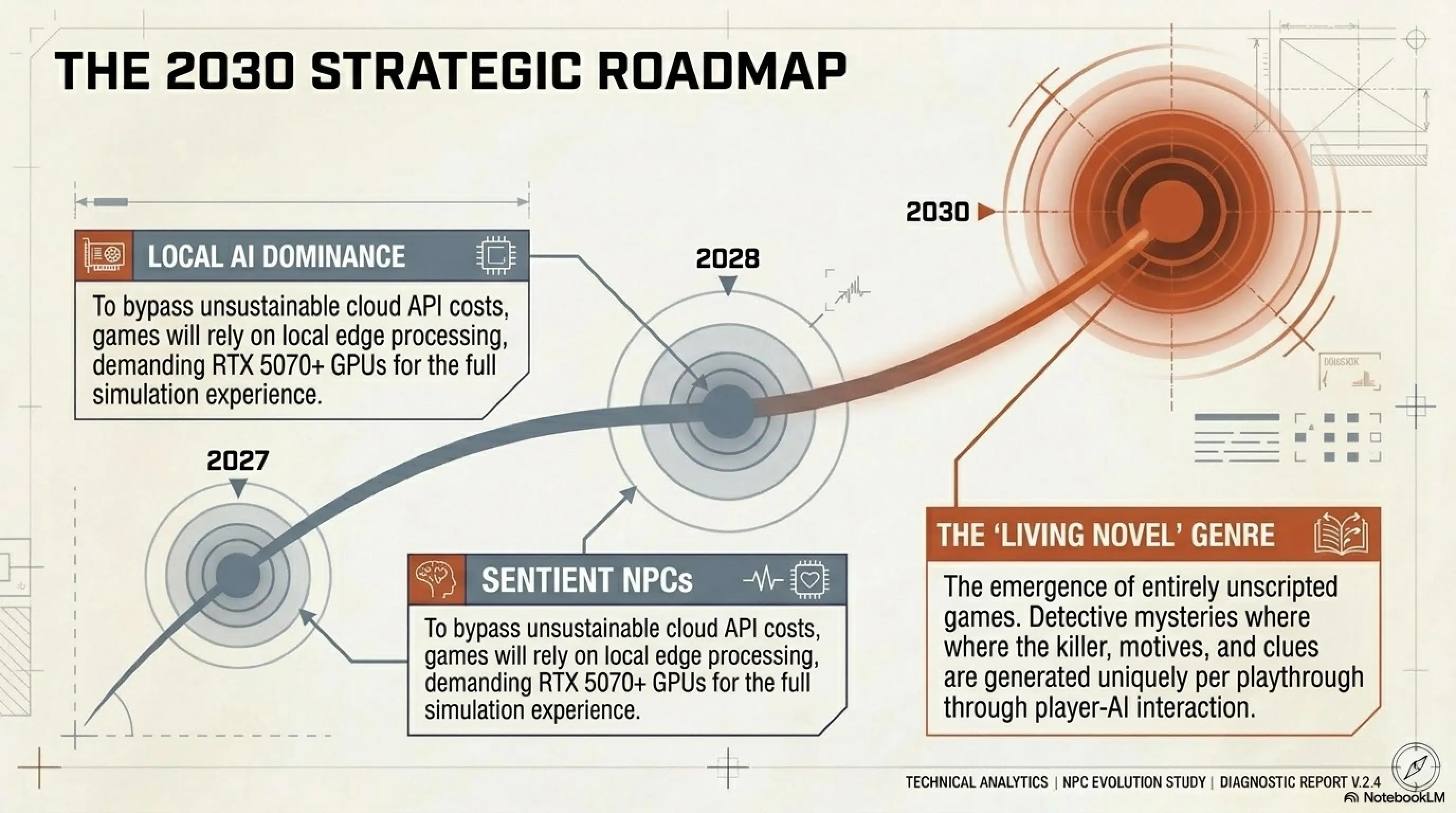
Prediction 1: AI NPCs in All AAA Games (2028-2030)
By 2030, likely every major RPG or open-world game will have at least some of its NPCs powered by AI.
Why? Because it's a competitive advantage. A game with living NPCs will beat a game without - provided it's done right.
Prediction 2: Local AI Models Become Dominant
Cloud API costs aren't sustainable for studios. So it's predicted that by 2027, most games will move toward local AI models - smaller models that run on the player's graphics card.
This means: need for more powerful hardware. Probably RTX 5070 or higher for full AI NPC experience.
Prediction 3: Emergence of "Sentient NPCs" - Characters with Emotional Intelligence
The next step: NPCs that not only remember, but "feel".
For example: An NPC who, when you're sad (through voice tone analysis or game choices), comforts you. Or when you're happy, celebrates with you.
This might sound like science fiction, but emotion recognition and sentiment analysis technology exists now. Combining it with AI NPCs is just one step away.
Prediction 4: "Living Novel" Games - Living Novels
A completely new genre is coming: games with no pre-written script. Everything is created together by AI and the player.
Imagine a crime game: you're a detective. Every NPC could be the killer. You must discover lies through conversation and find the truth. And every time you play, the killer and motives are different.
These types of games are now in experimental stages. And they could be the future of storytelling in gaming.
Deeper Ethical Issues: Should We Be Worried?
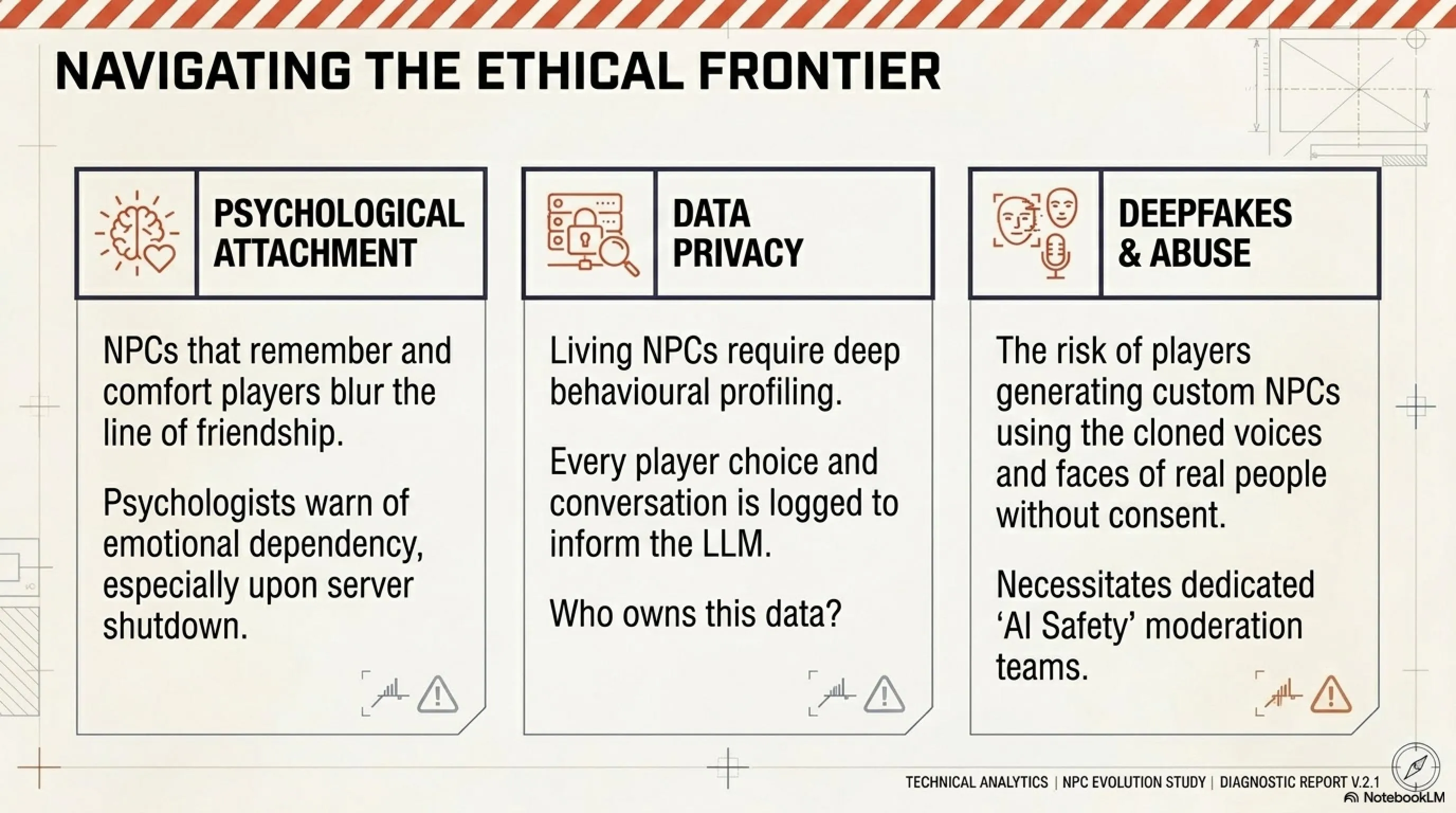
But with all this excitement, we can't ignore ethical questions.
Emotional Attachment to Virtual Characters
When an NPC remembers, understands, and responds - what's the difference from a real friend?
Psychologists are concerned that people - especially teenagers - might become overly attached to these characters. And when the game ends or servers shut down, what happens?
This is a real concern. And the industry must think about it.
Use of Personal Data
For an AI NPC to "know" you, it must store your data. All your conversations, decisions, and behaviors.
Where is this data stored? Who has access to it? Is it used for advertising?
Games must be transparent. And players must have the right to opt-out of this feature.
Abuse and Deepfake NPCs
Another danger: what if players can create custom NPCs with the voice and face of real people - without their permission?
This could be used for harassment, impersonation, or even inappropriate content.
Studios must have strong verification and moderation systems.
Big Ethical Questions
- Identity and consciousness: If an AI is complex enough, is it "sentient"? Does it have rights?
- Emotional manipulation: Is it ethical for a game to be designed to attract player affection to an NPC - for more sales or longer engagement?
- Privacy: To what extent can a game analyze player behavior and build profiles?
- Responsibility: If an AI NPC says something inappropriate, who's at fault? The developer? The AI model? Or the player who gave a bad prompt?
These questions don't yet have clear answers. And the industry must work with legislators, ethicists, and society to find answers.
Final Thoughts: On the Threshold of a New Era
We stand at a historic moment. After four decades of clicking on pre-written dialogue options, we're witnessing the birth of something science fiction writers dreamed about decades ago: digital worlds that are truly alive.
Yes, challenges exist. Latency, hallucination, cost, ethical issues - all are serious problems. But history teaches us that every revolutionary technology starts with these challenges.
When 3D graphics were introduced, everyone said "it's too heavy, nobody can run it." Now every mobile phone has 3D graphics.
When online multiplayer came, everyone said "the internet is too slow." Now hundreds of millions play Fortnite.
And now with AI NPCs, everyone says "it's too expensive and unreliable." But five years from now? Maybe our children will tell us: "How could you play with NPCs that didn't remember?"
Frequently Asked Questions (FAQ)
Will all future games have AI NPCs?
No, this technology will likely only be used in RPGs, narrative-driven, and open-world games. For action games like shooters or platformers, it provides little added value and only increases costs.
How can I experience a game with real AI NPCs now?
Sword of Justice (global name for Justice) is available on PC and mobile with 40+ million players. There are also indie games like AI Dungeon and Early Access projects on Steam.
Can I build a game with AI NPCs myself?
Yes! Platforms like Genies, Convai, Inworld AI, and Jenova AI offer ready-made tools. Just get an API key and integrate the SDK into Unity or Unreal Engine. But consider API costs.
Can AI NPCs give spoilers about the story?
This is a real challenge. Good systems have guardrails that prevent revealing important information. But sometimes it leaks - that's why studios are very careful and test this thoroughly.
If the internet goes down, will AI NPCs work?
Depends on implementation. Cloud-based systems need internet. But local AI solutions can work offline - though with lower quality and needing powerful graphics cards (RTX 4070+).
Can AI NPCs say inappropriate things?
Yes, if not filtered. That's why studios add AI Safety layers and moderation. But no system is 100% perfect and there's always a small risk.
How much more does it cost to build a game with AI NPCs?
For development, 20-30% more (AI team, prompt engineering). But operating costs can be several times higher due to API calls. That's why most games use subscription or premium models.
Will writers and voice actors lose their jobs?
Not completely. Industry consensus is that AI is a complement not replacement. Writers work on main story and character arcs, AI handles daily dialogues. Voice actors have royalty-based contracts where their voice gets cloned.
Can I actually become friends with an NPC - really?
Yes, and it's both beautiful and concerning. New NPCs remember, understand, and respond. Psychologists are studying the effects of human-AI emotional relationships. This is a serious topic.
Sources and References
- AI-driven NPCs transform games into living worlds - Chosun Biz
- AI Conversation in Games: Talk to Characters That Actually Listen - Jenova AI
- AI NPCs Revolution 2026: The $5.5 Billion Gaming Shift - Cliptics
- Local AI for Game NPCs - Local AI Master
- How to Create AI NPCs in Games - Genies
- AI in Character Development for Video Games - Whimsy Games
- Sword of Justice MMO Review - Notebookcheck
- GDC 2026 State of the Game Industry Report - Game Developers Conference
Last reviewed: June 2026
All technical information, statistical data and quotes have been extracted from credible sources, verified and rewritten to comply with copyright. No unverified claims exist in this analysis.
🌐Stay Connected With Us 🎮✨
For the latest tech, gaming, and gadget news, follow us on our official social media channels:
Supplementary Image Gallery: 🎮 The AI Gaming Revolution: When NPCs Become Sentient Citizens