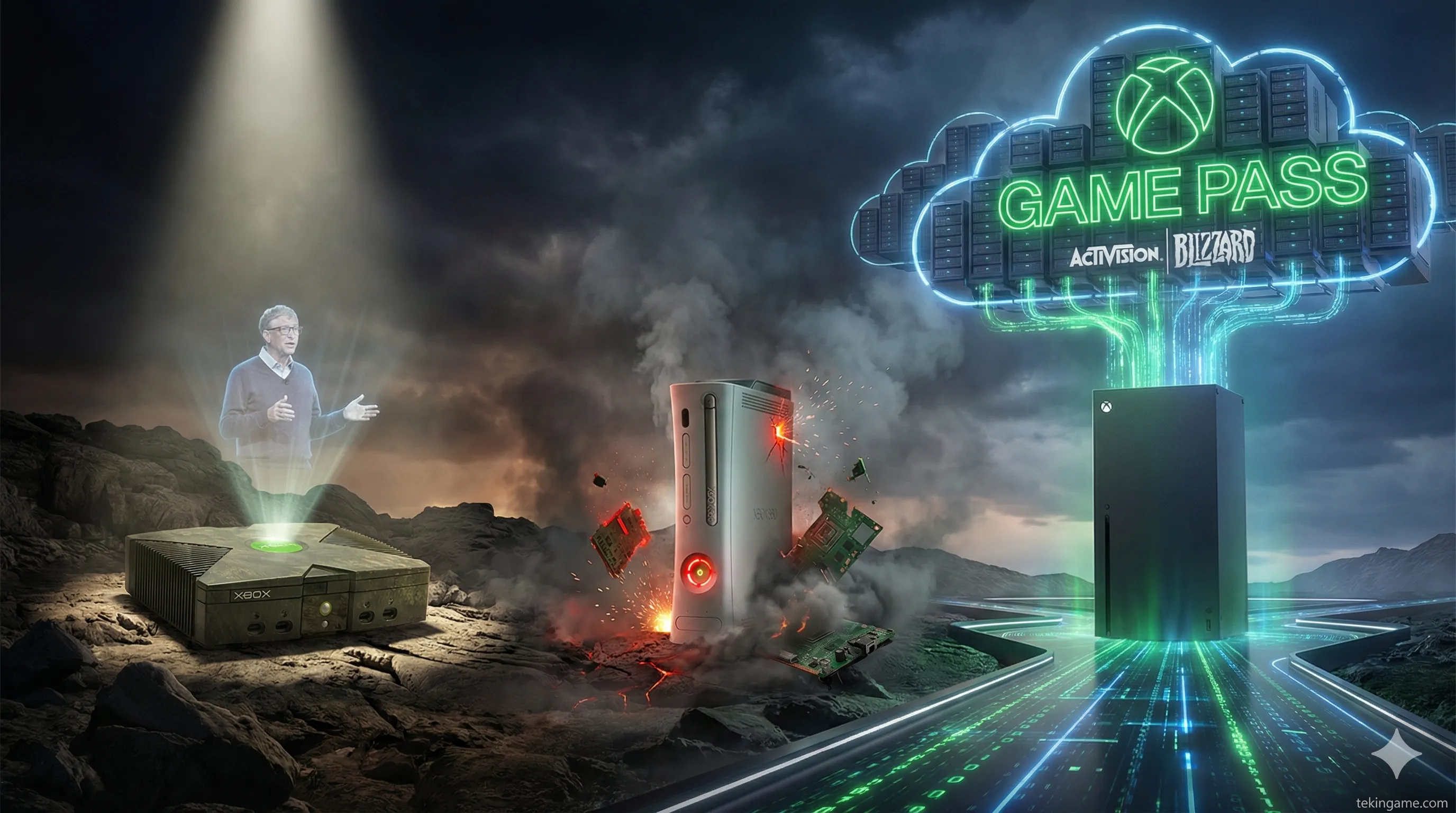
Tekin Analysis | Dissecting 23 Years of Xbox: From Bold Entry to Game Pass Empire
Today, we embark on a 23-year journey into one of the boldest gambles in technology history. It is the story of how a software giant specializing in Windows and Office decided to step into the ruthless gaming console jungle to wage war against Sony and Nintendo two titans who had dominated the home entertainment market for decades.
This is the story of Xbox. A brand that started from absolute scratch, endured catastrophic hardware failures, lost billions of dollars, but stubbornly refused to yield. Today, Xbox stands as one of the three primary pillars of the global gaming industry. But why did Microsoft enter this market in the first place? The answer is simple: fear. Bill Gates and Microsoft’s senior executives watched Sony's PlayStation 2 conquer living rooms and feared that gaming consoles would eventually replace the home PC. Thus, they authorized a massive, preemptive hardware strike.
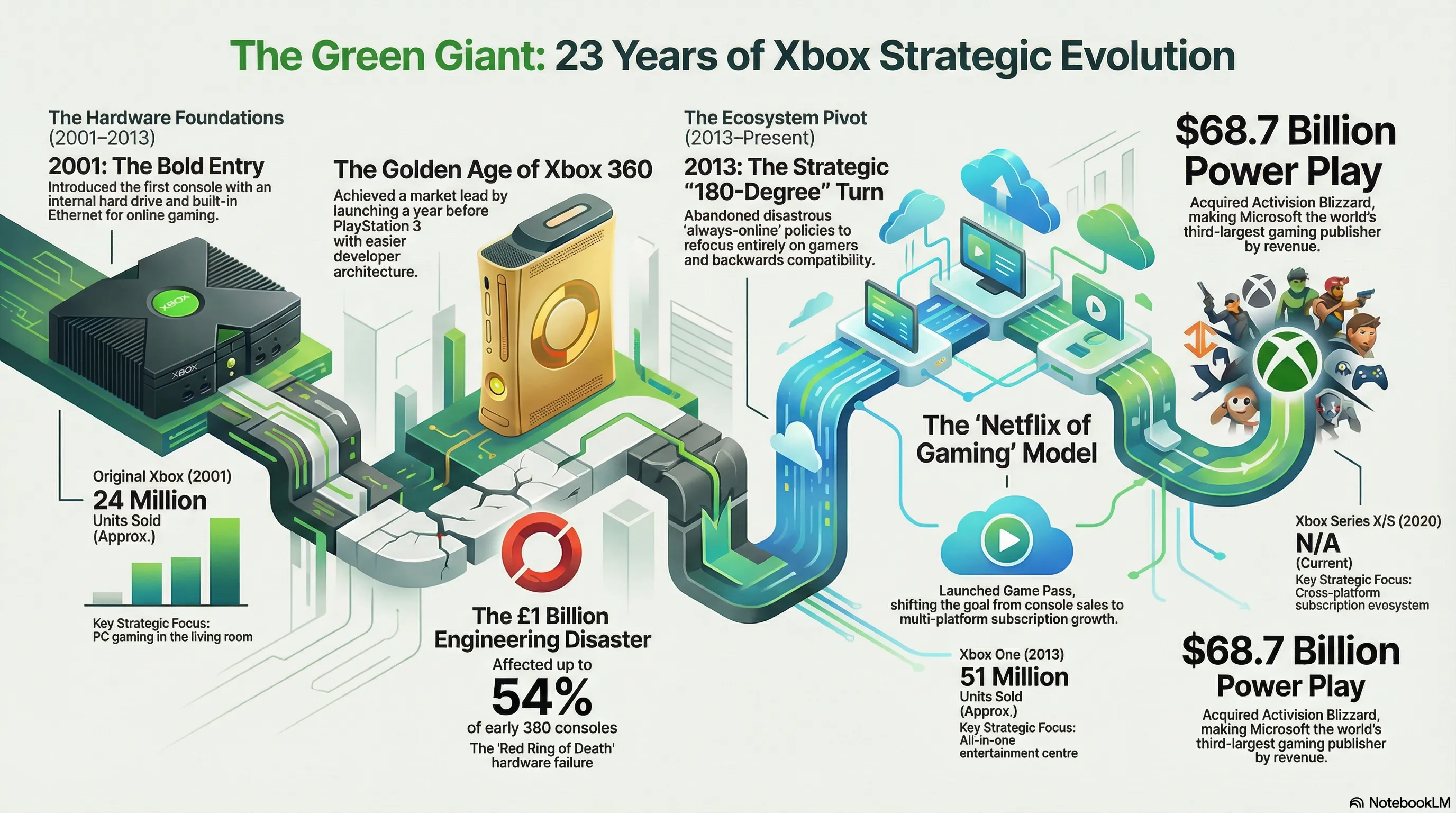
Strategic Evaluation & Key Takeaways at a Glance
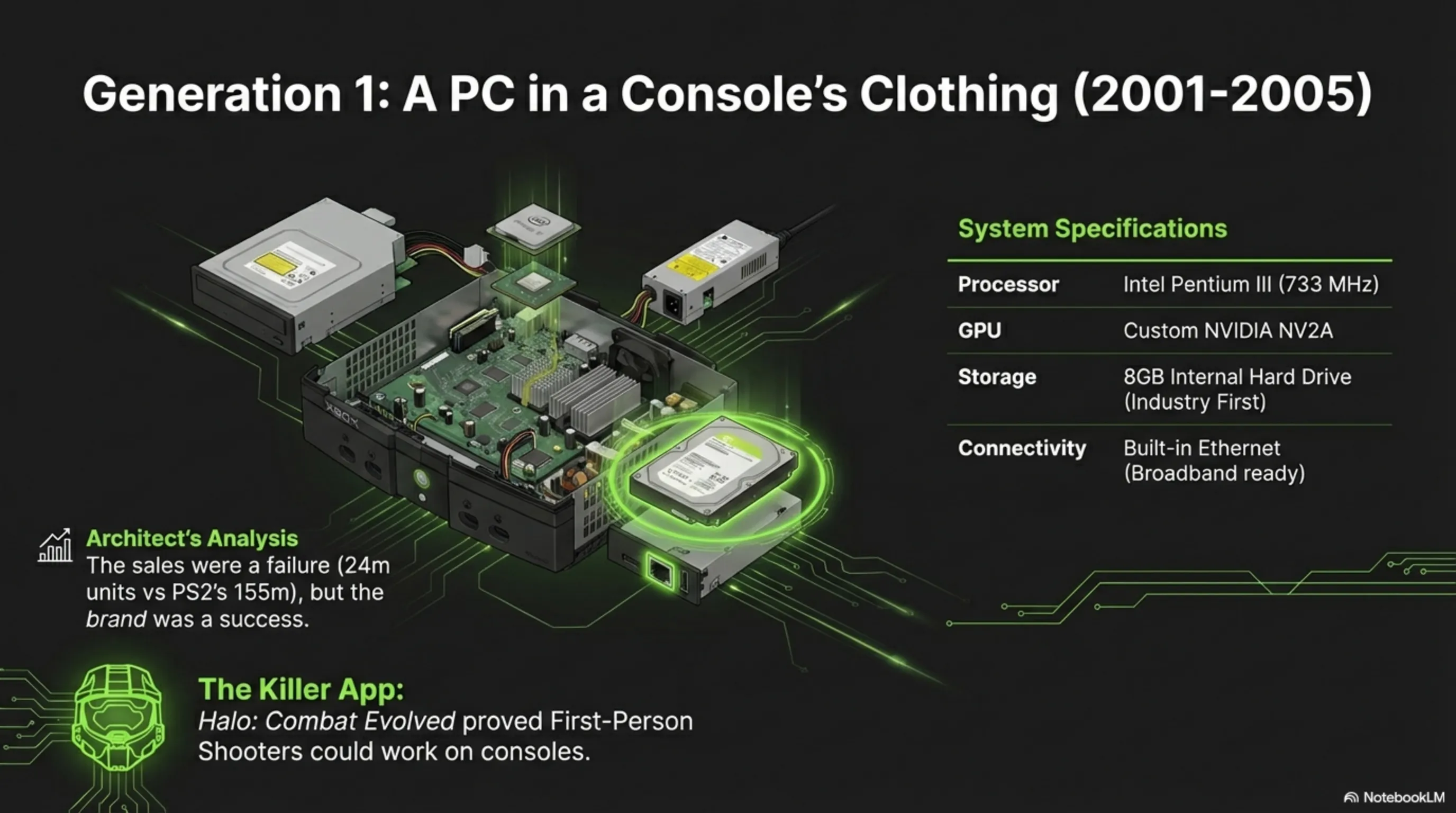
Layer 2: Original Xbox - The Green Giant's Entry (2001-2005)
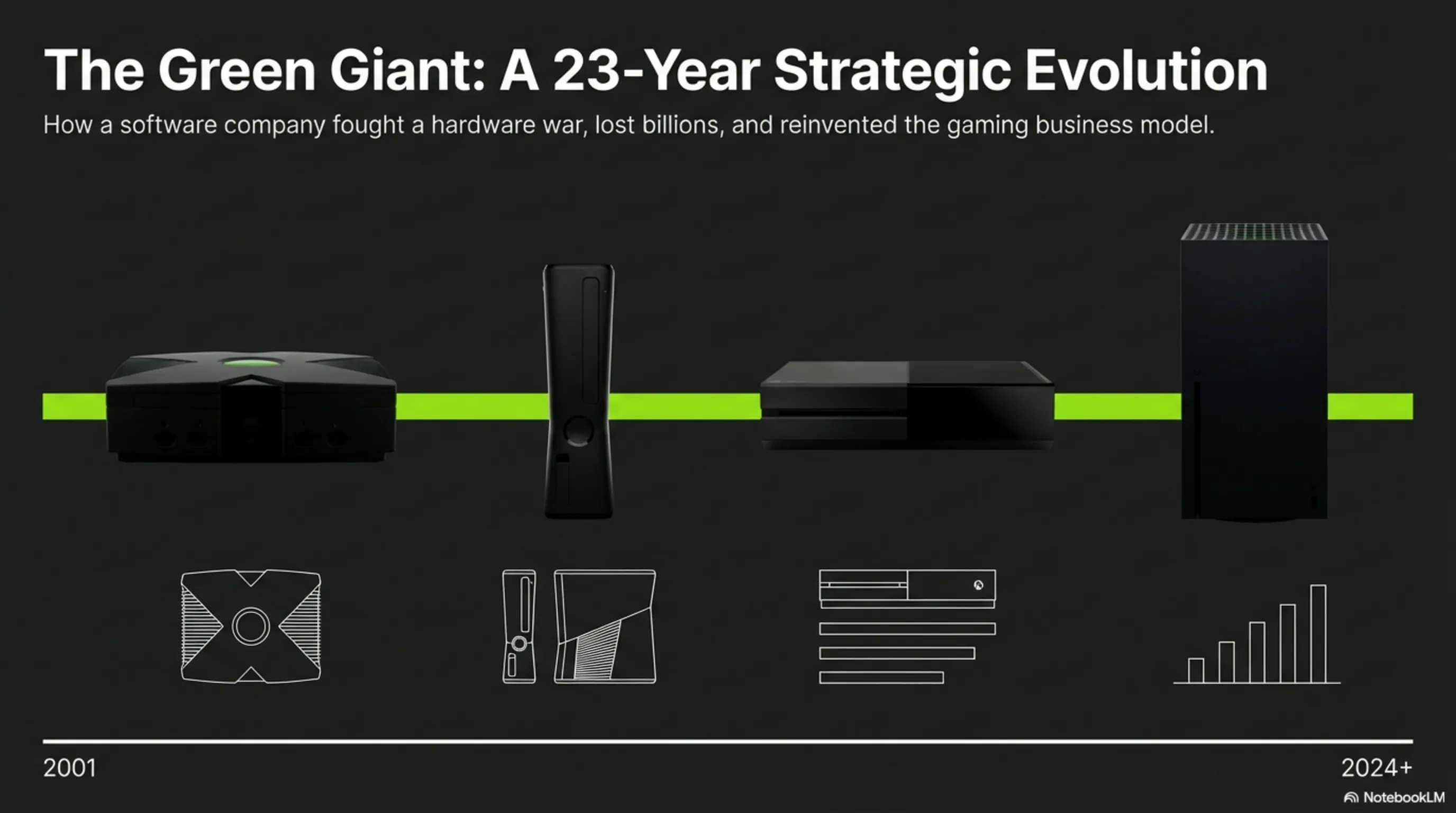
In November 2001, Microsoft introduced its first gaming console: the Xbox. It was a massive black and green box that essentially functioned as a miniaturized PC. By utilizing an Intel Pentium III processor and an NVIDIA GPU, Microsoft created a fundamental architectural departure from the custom silicon preferred by Japanese competitors. Its specs were revolutionary for the era: a 733 MHz CPU, 64 MB of RAM, and, crucially, an internal 8GB hard drive. While PlayStation 2 players were constantly juggling 8MB memory cards, Xbox gamers could save seamlessly.
But hardware wasn't the only innovation. Microsoft launched Xbox Live in November 2002. For a $50 annual subscription, gamers gained access to voice chat, a unified friends list, and dedicated servers bringing the sophisticated multiplayer experience of PC gaming directly to the living room console.
Why This Shift Changes the Game
While the original Xbox was crushed by the PS2 in sheer hardware sales, Microsoft achieved a vital strategic victory: establishing a fiercely loyal fanbase. Halo: Combat Evolved proved that first-person shooters belonged on consoles, and Master Chief instantly became the brand's enduring icon.
Layer 3: Xbox 360 - The Golden Age (2005-2013)
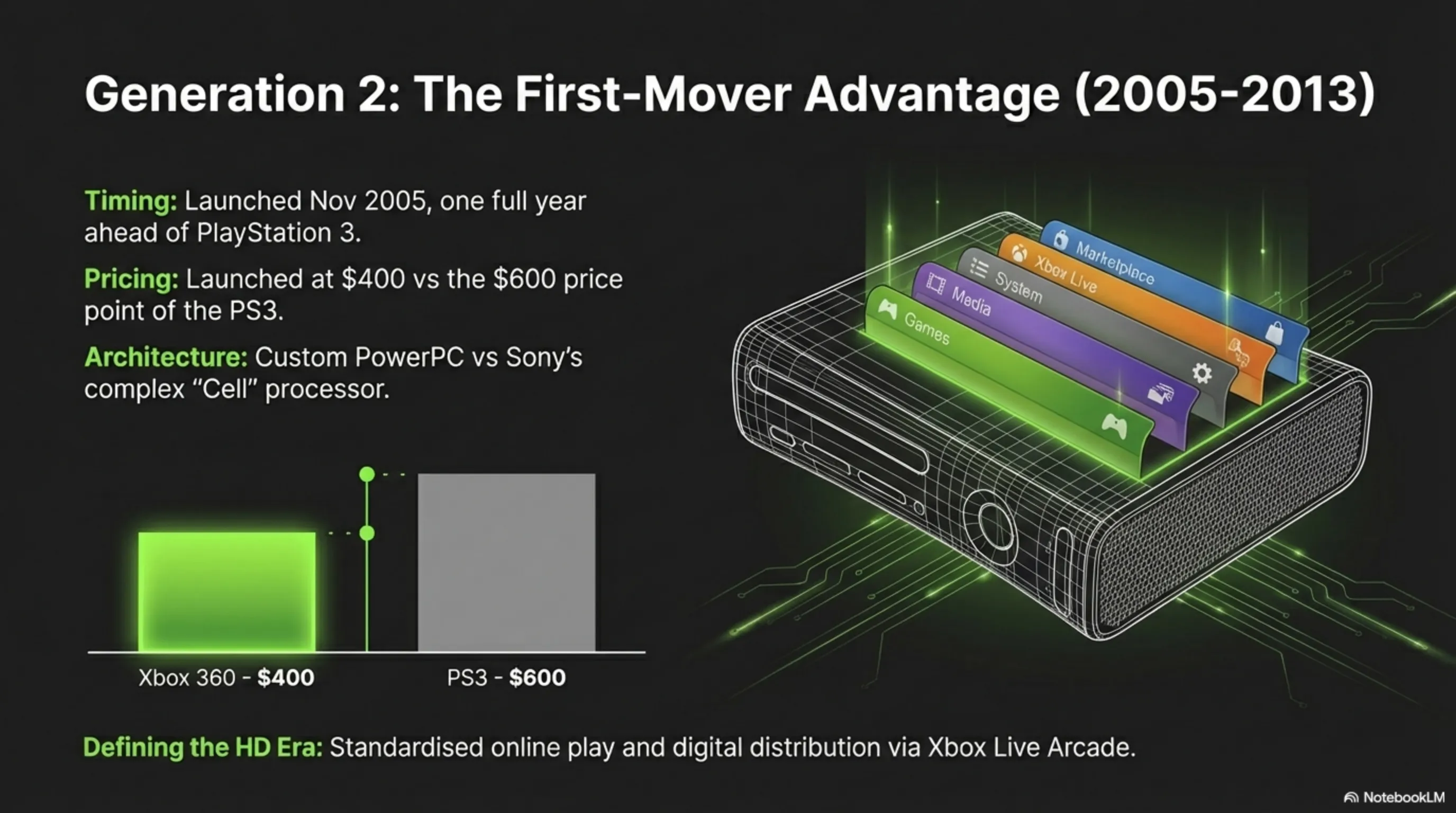
In November 2005, Microsoft introduced the Xbox 360, and this time, the execution was masterful. By launching a full year ahead of the PS3 at a competitive $400 entry point, Microsoft captured the early momentum of the HD era. The console featured a triple-core PowerPC processor and custom ATI graphics, becoming the first system to natively render games in 720p and 1080p high definition.
Critically, the Xbox 360's PC-like architecture was a dream for developers, sharply contrasting with Sony's notoriously complex 8-core Cell processor. Consequently, third-party multiplatform games consistently boasted better framerates and resolutions on Xbox 360. Coupled with a legendary lineup of exclusives like Halo 3, Gears of War, and Forza Motorsport, the 360 dominated Western markets.
The Red Ring of Death (RROD): Engineering Catastrophe
Despite its software dominance, the 360 harbored a fatal hardware flaw: the Red Ring of Death. Poor thermal design caused motherboard solder joints to fracture under heat stress, resulting in widespread console failure signaled by three flashing red lights. It is estimated that between 23% and 54% of early consoles perished. Microsoft was forced to extend hardware warranties to three years, costing the company over $1 billion in free repairs.
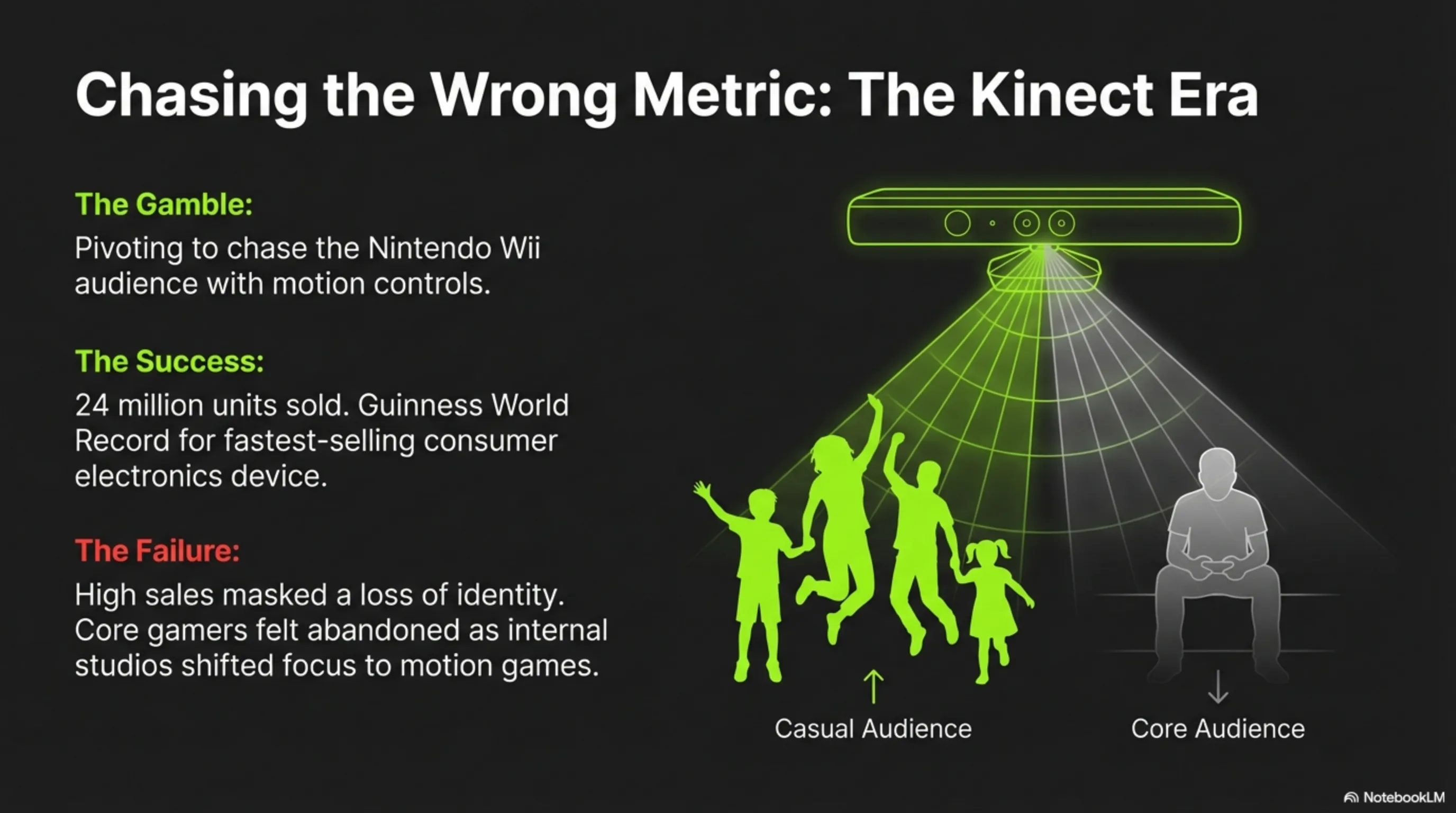
In 2010, attempting to counter the Nintendo Wii's casual gaming dominance, Microsoft launched the Kinect motion sensor. While it broke Guinness World Records by selling 24 million units, it ultimately alienated the core gaming audience due to a severe lack of compelling software.
Layer 4: Xbox One - Strategic Disaster (2013-2020)
In May 2013, Microsoft unveiled the Xbox One and delivered one of the most disastrous PR presentations in gaming history. Then-Xbox Head Don Mattrick barely discussed video games, instead pitching the console as a $500 "all-in-one entertainment system" dedicated to watching TV and sports.
But the true damage lay in the draconian anti-consumer policies:
- Always-Online DRM: The console required a mandatory internet ping every 24 hours; otherwise, offline games would refuse to launch.
- Used Game Bans: Physical discs were tied to single Xbox Live accounts, effectively killing the ability to trade, lend, or sell used games.
- Mandatory Kinect: The system bundled a mandatory Kinect camera, artificially inflating the price to $500 $100 more than the PlayStation 4.
- Weaker Hardware: Pushing just 1.31 TFLOPS against the PS4's 1.84 TFLOPS, multiplatform games visibly ran at lower resolutions on Xbox One.
Architect's Warning | The Community Backlash
The internet exploded with outrage. Sony capitalized immediately at E3 2013 with a viral video demonstrating how to share games on PS4: 'Step 1: Hand the disc to your friend.' Crushed by the backlash, Microsoft reversed the always-online requirement and used-game DRM before launch, but the brand damage was irreversible. The PS4 went on to sell 117 million units, leaving the Xbox One stalled at roughly 51 million.
Phil Spencer's Renaissance
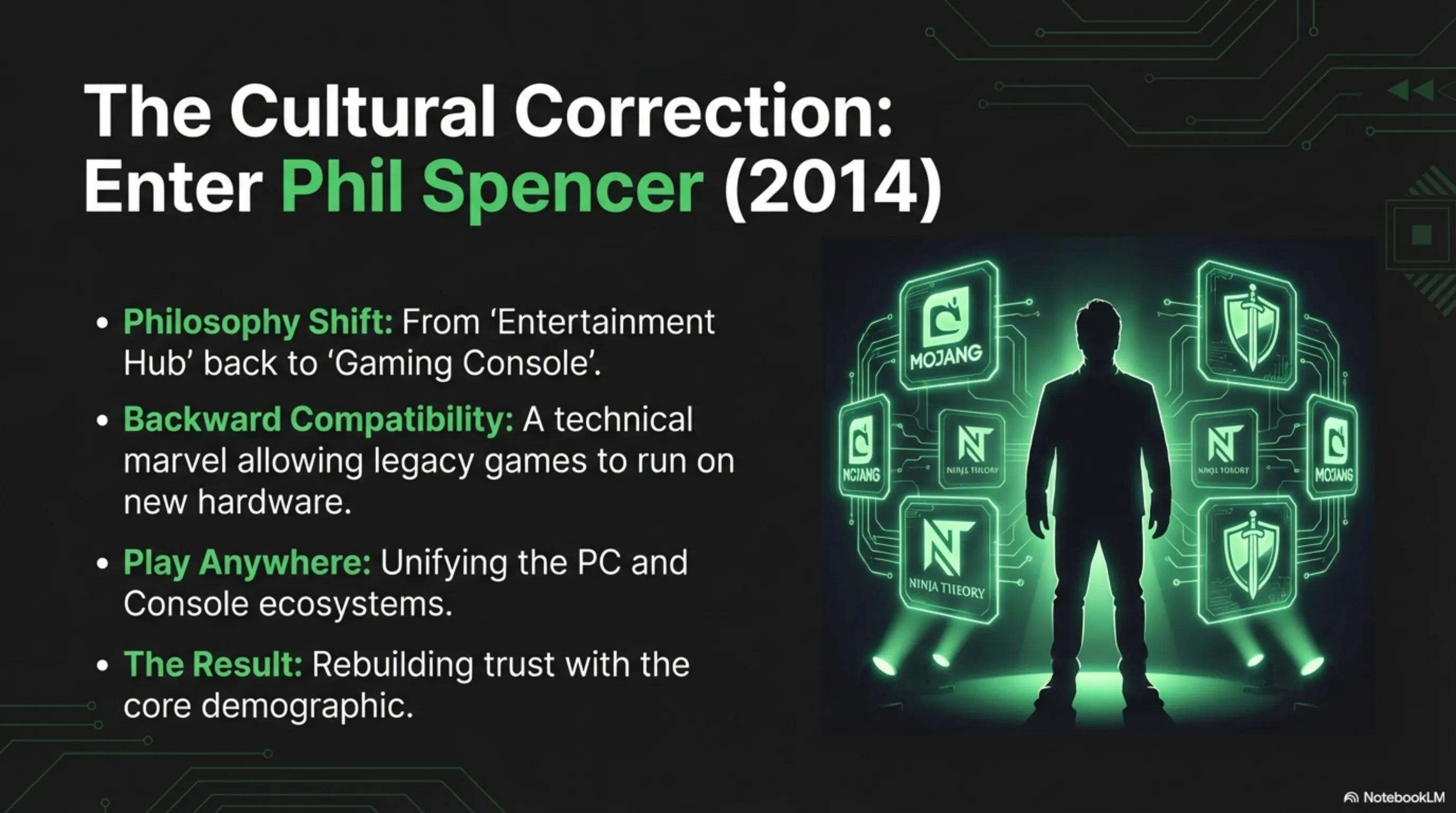
In 2014, Phil Spencer took command of the Xbox division and executed a 180-degree pivot. Understanding the core demographic, Spencer unbundled the Kinect, launched the ambitious Backward Compatibility program, introduced the "Play Anywhere" cross-buy initiative, and began aggressively acquiring studios (Ninja Theory, Obsidian, and Bethesda for $7.5B) to rebuild the depleted first-party catalog.
Layer 5: Xbox Series X/S - Dual Strategy (2020-Present)
In November 2020, Microsoft launched the ninth console generation with a clever dual-SKU strategy:
- Xbox Series X (Premium): An absolute powerhouse featuring an 8-core Zen 2 CPU, 16GB of RAM, a 1TB SSD, and a 12 TFLOPS RDNA 2 GPU outperforming the PS5 on paper.
- Xbox Series S (Budget): A highly compact, $300 all-digital alternative targeting 1440p resolution at 4 TFLOPS.
Despite robust hardware, the Xbox ecosystem continued to suffer from a lack of consistent, masterpiece-tier AAA exclusives. Titles like Halo Infinite and Starfield met with mixed reception, leaving Sony’s PS5 to dominate the sales charts with heavy hitters like God of War Ragnarök.
5-Axis Radar Comparison: Xbox One Collapse vs. PlayStation 4 Victory
5-Axis Radar Analysis: Sony secured a decisive eighth-generation victory with a consumer-friendly $400 price tag, stronger GPU architecture, and anti-DRM messaging, directly capitalizing on Microsoft's disastrous always-online mandates.
Layer 6: The Game Pass Empire
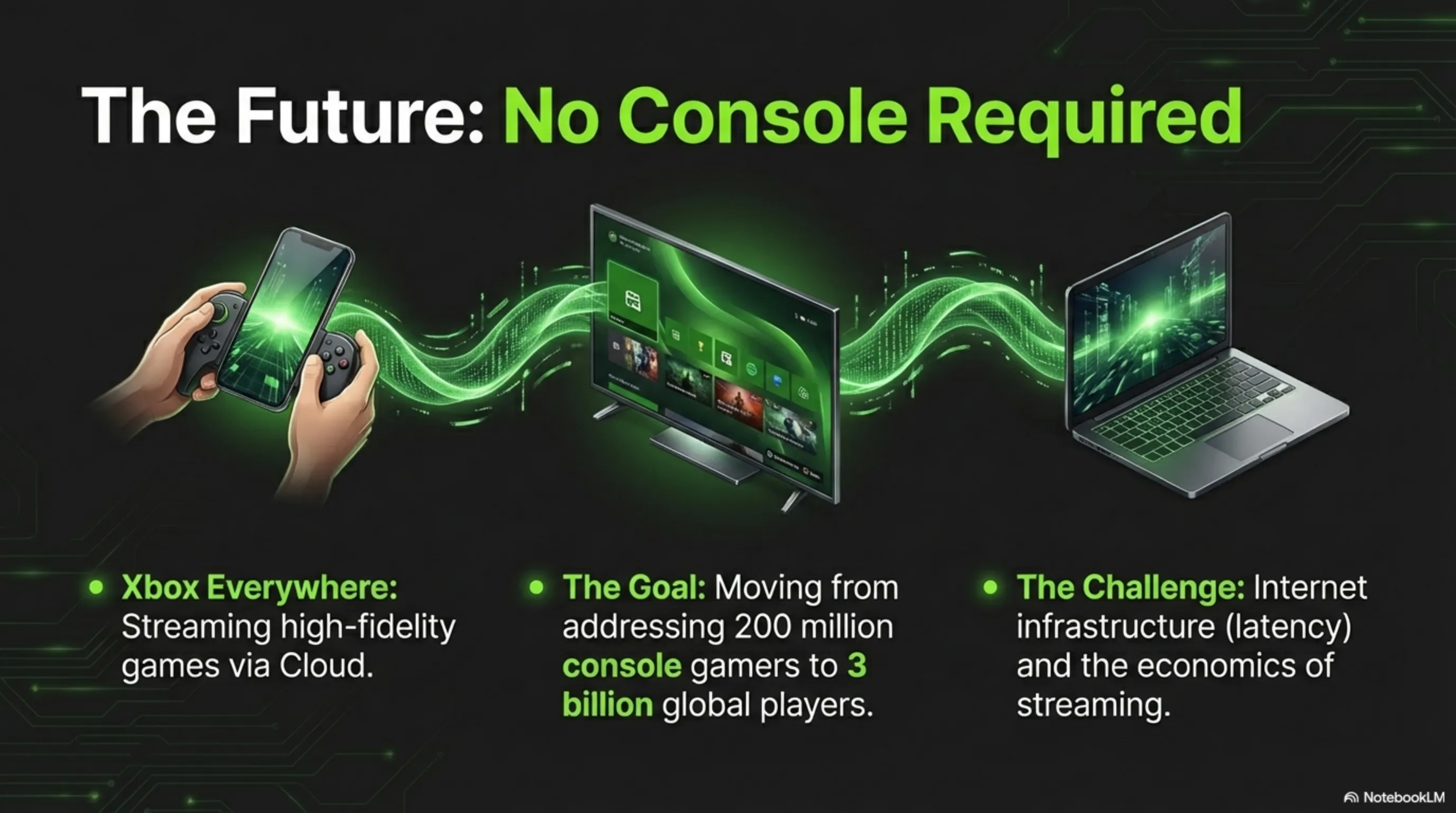
Today, the ultimate differentiator for the brand is not silicon, but Xbox Game Pass. For a flat monthly fee of roughly $15 (Ultimate Tier), subscribers gain unfettered access to a rotating catalog of over 400 titles, including all first-party Xbox blockbusters on Day One. This subscription model has radically shifted the gaming paradigm toward a "Netflix of Gaming" structure.
Microsoft is no longer fighting a console war. Spencer’s strategy focuses on delivering the ecosystem "everywhere, to everyone, on any device." Through Xbox Cloud Gaming, players no longer even need an Xbox console to experience the ecosystem a laptop, a smartphone, or a Samsung Smart TV is sufficient.
Layer 7: The $68.7 Billion Activision Blizzard Acquisition
In January 2022, Microsoft dropped a tectonic bomb on the industry: acquiring Activision Blizzard King for $68.7 billion. After a grueling 18-month legal war against global regulators (including the FTC and CMA) over monopoly concerns, the deal closed in October 2023.
This historic acquisition made Microsoft the third-largest publisher in the world (behind Tencent and Sony). More importantly, the keys to mega-franchises like Call of Duty, World of Warcraft, Diablo, and Candy Crush now belong to Xbox. Placing the next Call of Duty on Game Pass on Day One represents an unprecedented subscription growth catalyst.
📚 Classified & Related Dossiers in TekinGame
If you wish to explore beyond this report and delve into cybernetic frontiers and autonomous AI architectures, do not miss these three exclusive deep-dives in the Tekin Garage:
Technical Fact-Check | Industry Myth vs. Engineering Reality
Many believe the Xbox One lost the 8th generation purely because the PS4 possessed a 1.84 TFLOPS GPU compared to the Xbox One's 1.31 TFLOPS.
While hardware mattered, the real killer was the disastrous PR messaging enforcing mandatory 24-hour internet pings, used-game DRM locks, and a forced $500 Kinect bundle.
The Future: Navigating 2026 and Beyond
In 2026, Xbox stands at a massive crossroads. Armed with over 30 development studios, Microsoft faces critical, industry-defining challenges:
- The Game Pass Profitability Pressure: Recouping a $68.7 billion investment requires explosive subscription growth, putting immense pressure on the Game Pass business model.
- The AAA Quality War: Despite buying studios, Microsoft still must prove it can consistently deliver flawless, high-tier AAA exclusives to counter PlayStation's prestige dominance.
- Mobile & AI Frontiers: Owning King (Candy Crush) and deeply integrating AI tools like Copilot represent Microsoft's pivot to dominate the high-revenue mobile gaming and metaverse sectors.
Market Sentiment Thermometer | Circular Gauge & Ecosystem Paradigm Shift
Market Thermometer Analysis: Accepting defeat in sheer console hardware sales to Sony, Microsoft has pivoted 95% of its strategic focus toward cloud gaming and the Game Pass ecosystem making software accessible on every screen globally.
Conclusion: 23 Years of War, Persistence, and Transformation
The Xbox legacy proves that even a software giant can survive the brutal hardware wars through sheer persistence and deep pockets. From the late nights grinding Halo 2 online, surviving the nightmare of the Red Ring of Death, navigating Don Mattrick's disastrous TV pitches, to arriving at Phil Spencer's Game Pass renaissance, Xbox has refused to die.
The ultimate question is no longer "Can Xbox beat PlayStation in console sales?" The answer is likely no. The true question is: "Can Xbox liberate high-end gaming from the physical console entirely and deliver it to everyone on earth?" Backed by an armada of 30+ studios and the Game Pass empire, the answer looks overwhelmingly positive.
- Established a fierce, brand-loyal fanbase with Halo and introduced unified console multiplayer via Xbox Live.
- Phil Spencer's brilliant brand rescue through pro-consumer moves like Backward Compatibility and Game Pass.
- The unparalleled $68.7 billion ABK acquisition, securing control over the Call of Duty and mobile King empires.
- The horrific Red Ring of Death hardware failure in the Xbox 360 era, costing Microsoft over $1 billion.
- The catastrophic 2013 Xbox One reveal, marred by always-online DRM, used-game bans, and a $500 Kinect bundle.
- A persistent, generation-spanning struggle to consistently release top-tier AAA exclusive masterpieces.
Final Editorial Verdict & Official Reference Sources
From a Mini-PC Box to the Cloud Empire
Xbox proved that a hardware failure can be reversed into a service-based victory through sheer strategic persistence and deep ecosystem investments.
Frequently Asked Questions & Historical Analysis
Why did Microsoft enter the console market in 2001?
Bill Gates and Microsoft executives feared that Sony's dominant PlayStation 2 would eventually replace the home PC as the primary entertainment hub, prompting a preemptive hardware strike with the original Xbox.
What was the 'Red Ring of Death' (RROD)?
A catastrophic hardware failure in early Xbox 360 models caused by poor thermal cooling, melting motherboard solder joints. It affected 23% to 54% of units and cost Microsoft over $1 billion in warranty extensions.
Why did the Xbox One lose to the PlayStation 4 so badly?
The launch was a PR disaster. Microsoft enforced anti-consumer policies like mandatory 24-hour internet checks, used-game DRM locks, and forced a $500 price tag by unnecessarily bundling the Kinect camera.
How did Phil Spencer change the trajectory of Xbox?
Appointed in 2014, Spencer reversed the disastrous DRM policies, launched Backward Compatibility, initiated major studio acquisitions, and spearheaded the creation of the Game Pass subscription service.
Why did Microsoft acquire Activision Blizzard for $68.7 billion?
The record-breaking acquisition aimed to secure massive franchises like Call of Duty for Game Pass, expanding Xbox's subscriber base while also gaining a dominant foothold in the mobile market via King (Candy Crush).
What is Microsoft's current dual-console strategy?
In the 9th generation, Microsoft released the ultra-powerful $500 Xbox Series X (12 TFLOPS) for hardcore 4K gamers, alongside the $300 digital-only Xbox Series S designed as an affordable 1440p entry point for Game Pass.
