Takin Analysis | TiDB Cloud Data Breach Forensics: The Collapse of Cloud Security Assumptions and 10TB Metadata Heist
Seismic Shock in Distributed SQL: Deconstructing the PingCAP Breach and 10TB Data Heist
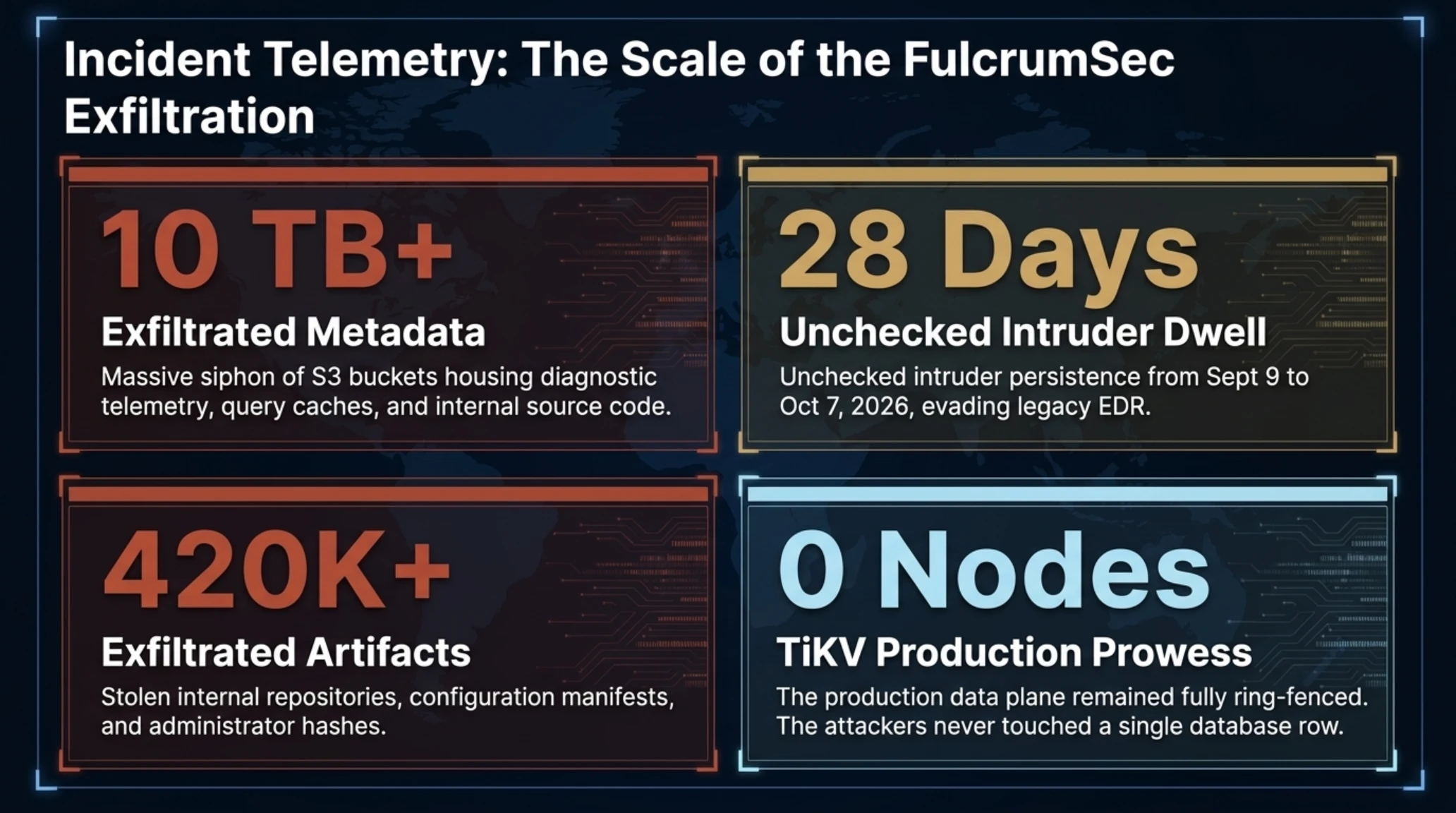
In mid-October 2026, an exhaustive investigative exposé published by cybersecurity journal Dark Reading, corroborated by official incident disclosures from PingCAP, triggered a structural crisis of confidence across the cloud database sector. PingCAP, the corporate entity behind the open-source distributed SQL engine TiDB and the managed enterprise platform TiDB Cloud, formally confirmed that sophisticated threat actors had compromised its internal corporate and management plane infrastructure. The extortion entity operating under the moniker Fulcrum Security (FulcrumSec) claimed responsibility for the campaign, asserting the illicit extraction of over 10 terabytes of auxiliary metadata, internal source code, and diagnostic telemetry spanning thousands of customer clusters.
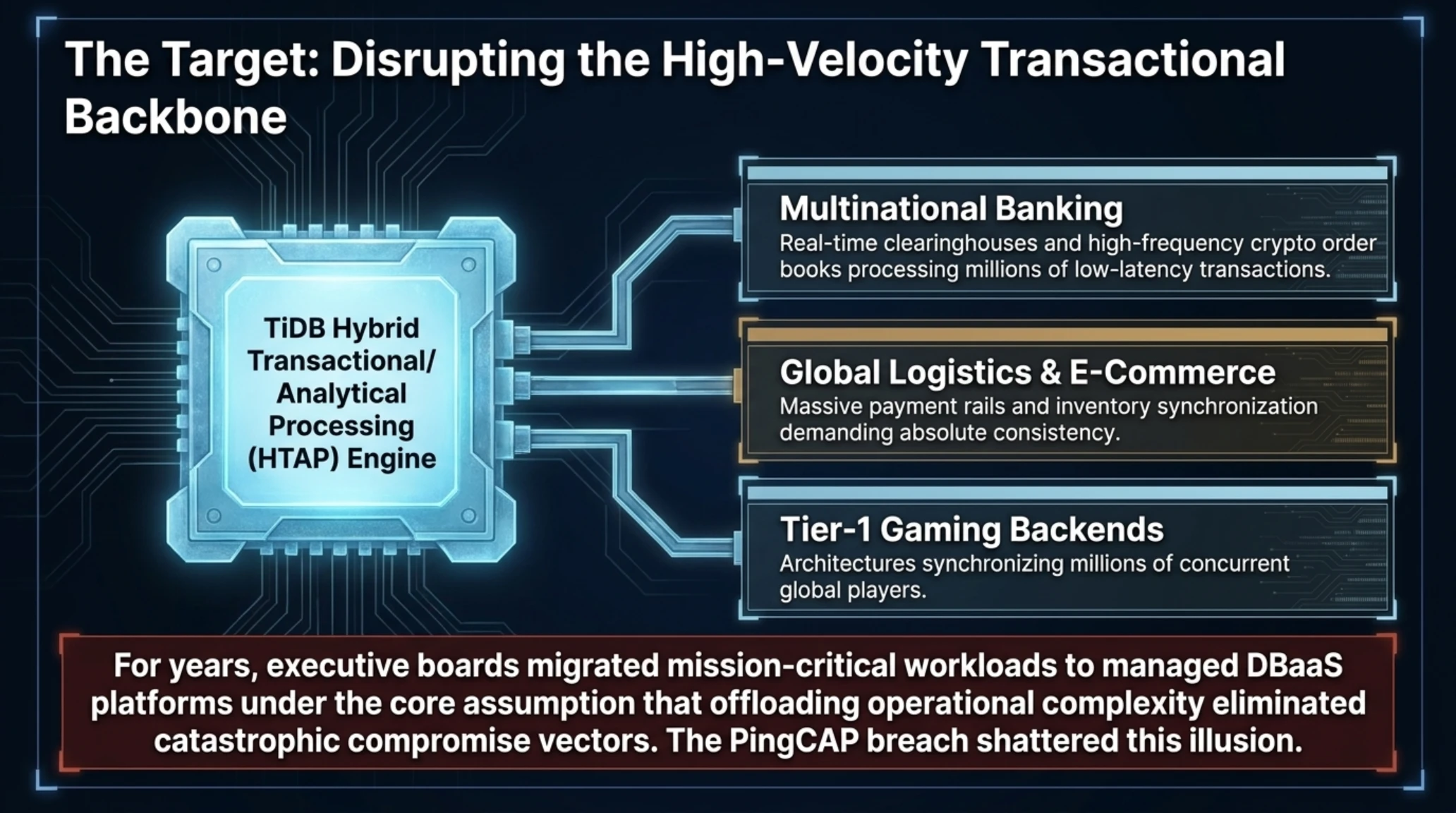
TiDB represents a pinnacle of modern database engineering, pioneering the hybrid transactional and analytical processing (HTAP) paradigm. Global multinational banks, Tier-1 gaming backends, high-frequency cryptocurrency exchanges, and logistics giants rely on its distributed architecture to process millions of transactions per second with low-latency consistency. As we highlighted in our executive briefing on the Cairn autonomous AI agent breaches and the Rank Math PRO supply-chain infiltration, the revelation that an unauthorized adversary roamed freely inside the ecosystem supporting this infrastructure shocked Chief Information Security Officers (CISOs) worldwide. For years, executive boards migrated mission-critical workloads to managed database-as-a-service (DBaaS) providers under the core assumption that offloading operational complexity also eliminated catastrophic compromise vectors.
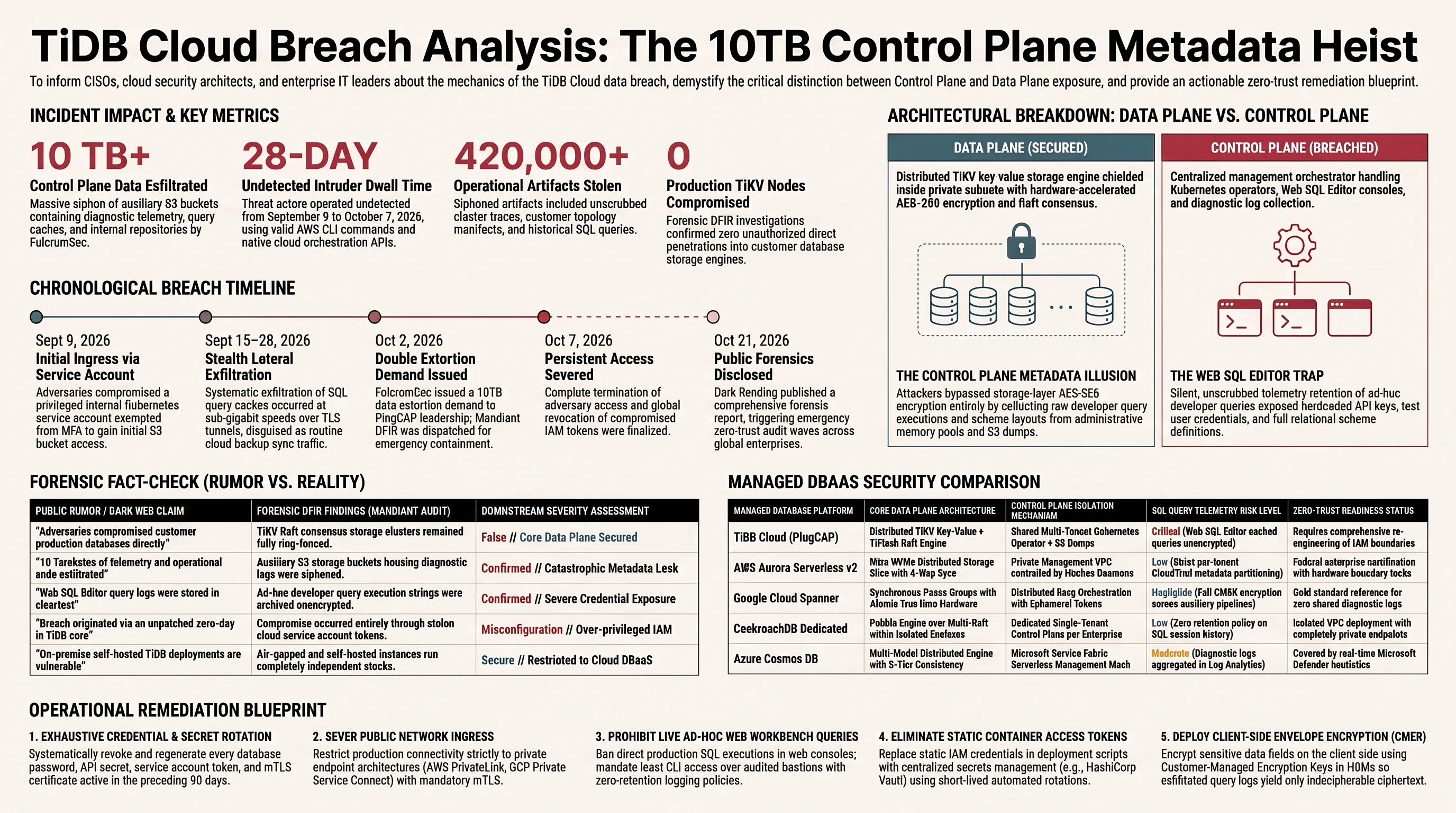
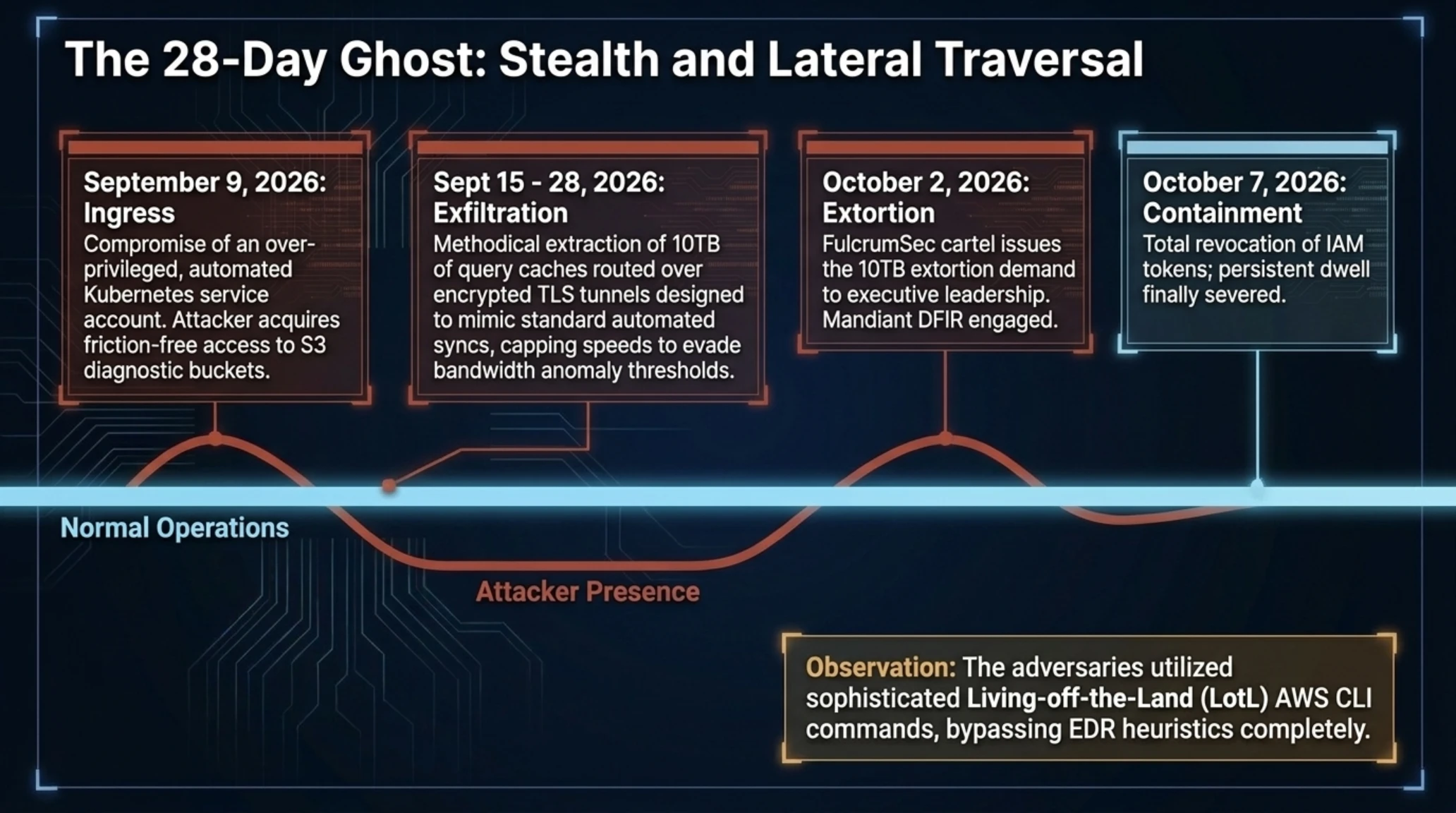
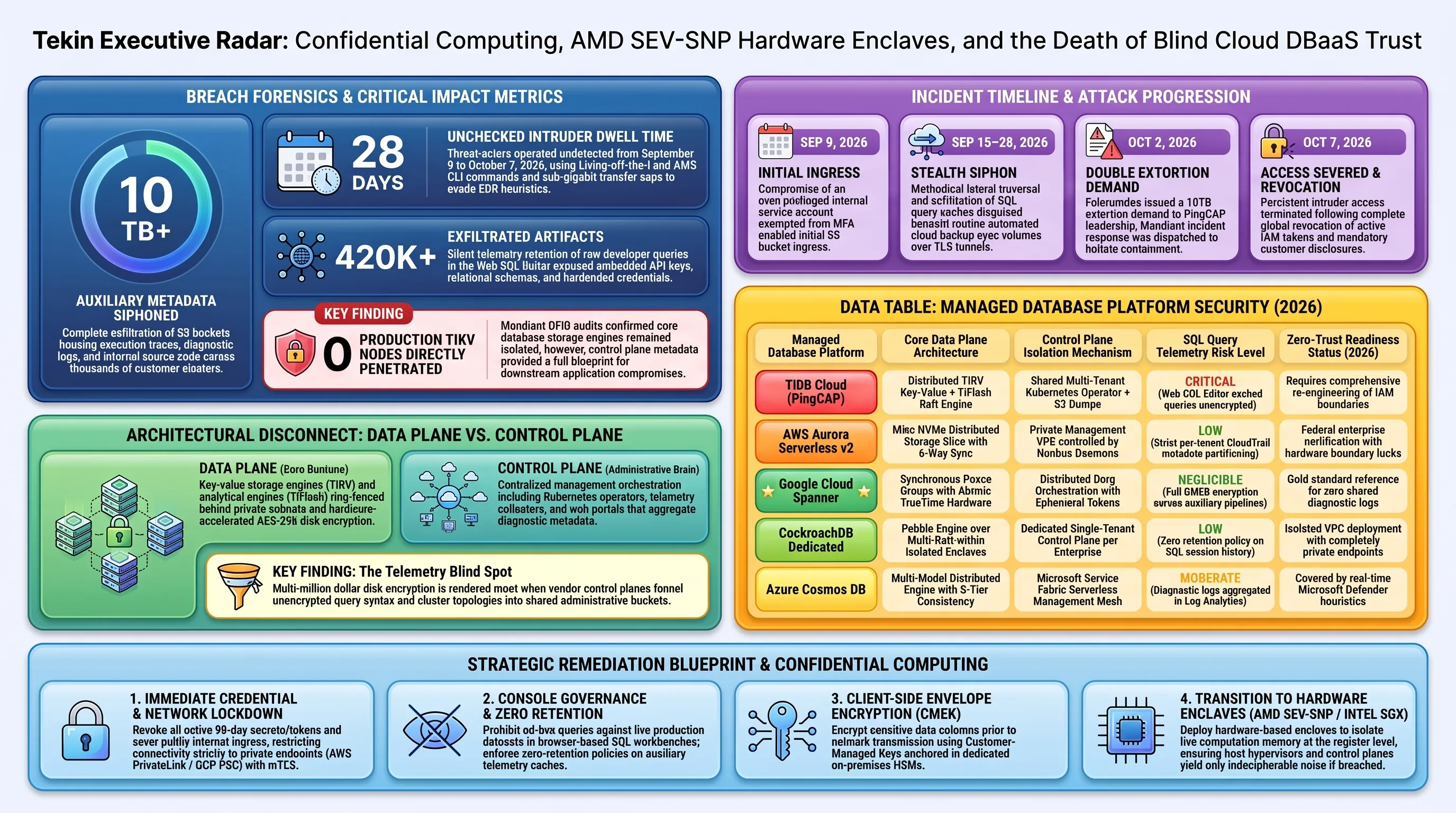
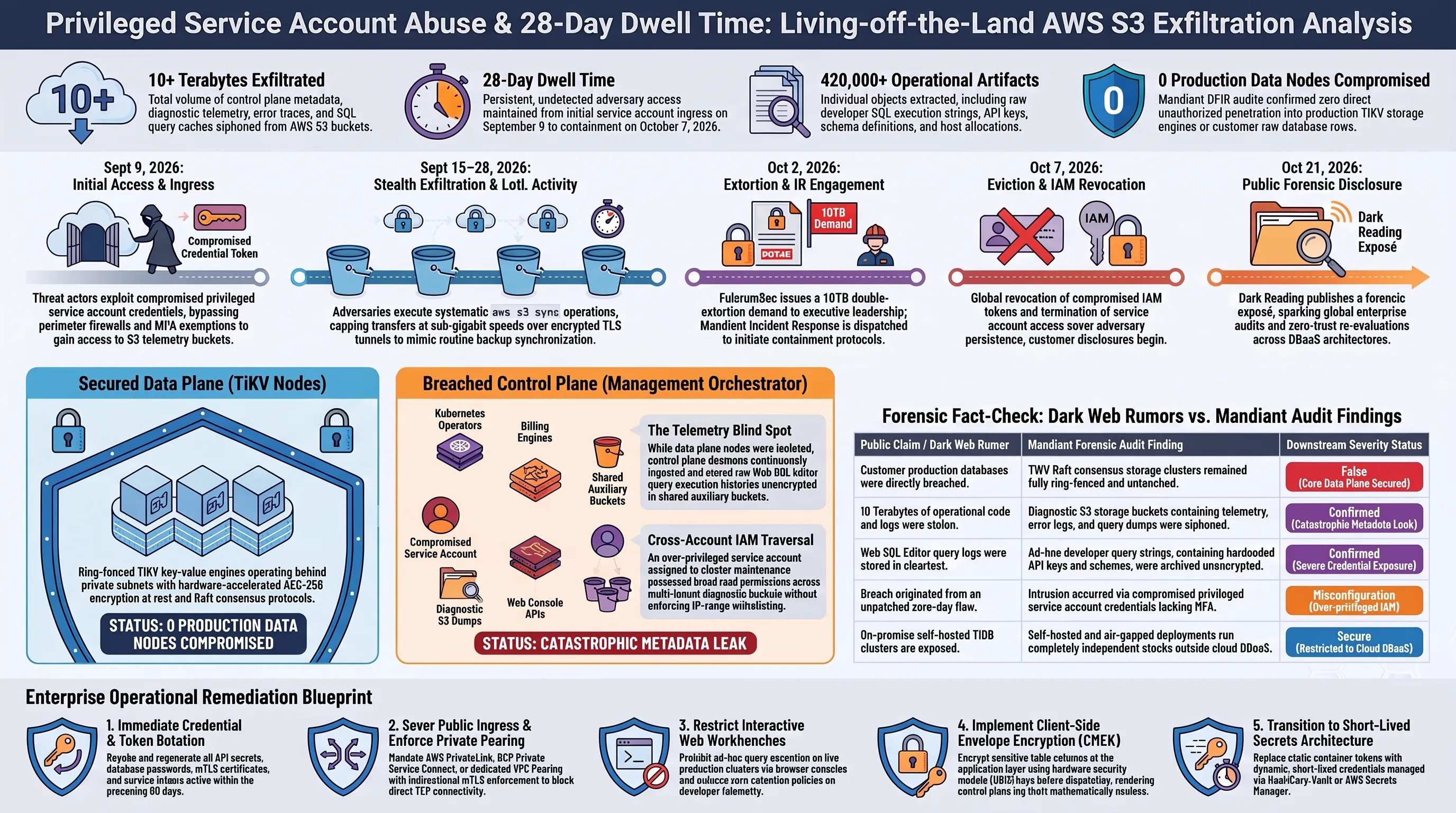
Forensic digital forensics and incident response (DFIR) investigations conducted by Mandiant revealed an alarming operational dwell time: the adversary maintained persistent, unauthorized access within PingCAP's internal cloud environments from September 9 through October 7, 2026. Over this 28-day surveillance window, the intruders conducted extensive reconnaissance, mapped internal S3 bucket topologies, and established encrypted staging conduits without triggering legacy endpoint detection and response (EDR) heuristics. This subtle persistence underscores the operational maturity of modern extortion cartels, which deliberately avoid disruptive encryption attacks in favor of quiet, multi-terabyte data theft. They leveraged sophisticated Living-off-the-Land (LotL) cloud binaries, utilizing valid AWS CLI commands and native cloud orchestration APIs to blend in with legitimate engineering maintenance workflows.
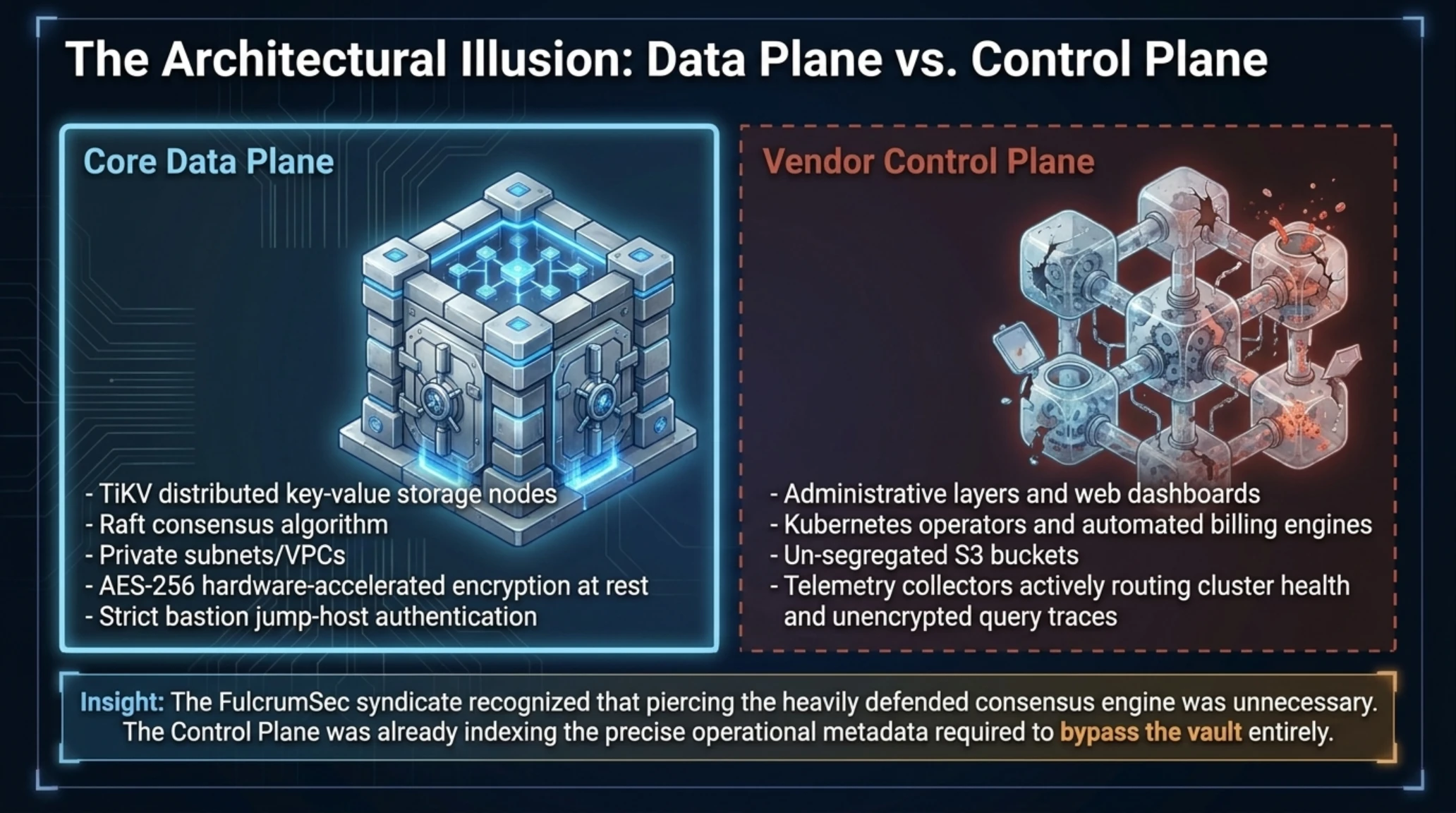
A pivotal technical distinction highlighted by early post-mortem audits is the boundary between the customer Data Plane and the vendor Control Plane. PingCAP emphasized that investigators found no forensic evidence of direct unauthorized penetration into production TiDB customer database storage engines (TiKV nodes). However, as this disaster painfully demonstrated, in modern distributed cloud systems, control plane operational metadata, query diagnostic traces, and administrative tokens represent a devastating proxy for raw database rows, granting attackers the cryptographic blueprint necessary to penetrate enterprise perimeters. When threat actors possess relational schema definitions and table constraints, reconstructing the functional logic of proprietary backend applications becomes an automated, trivial endeavor.
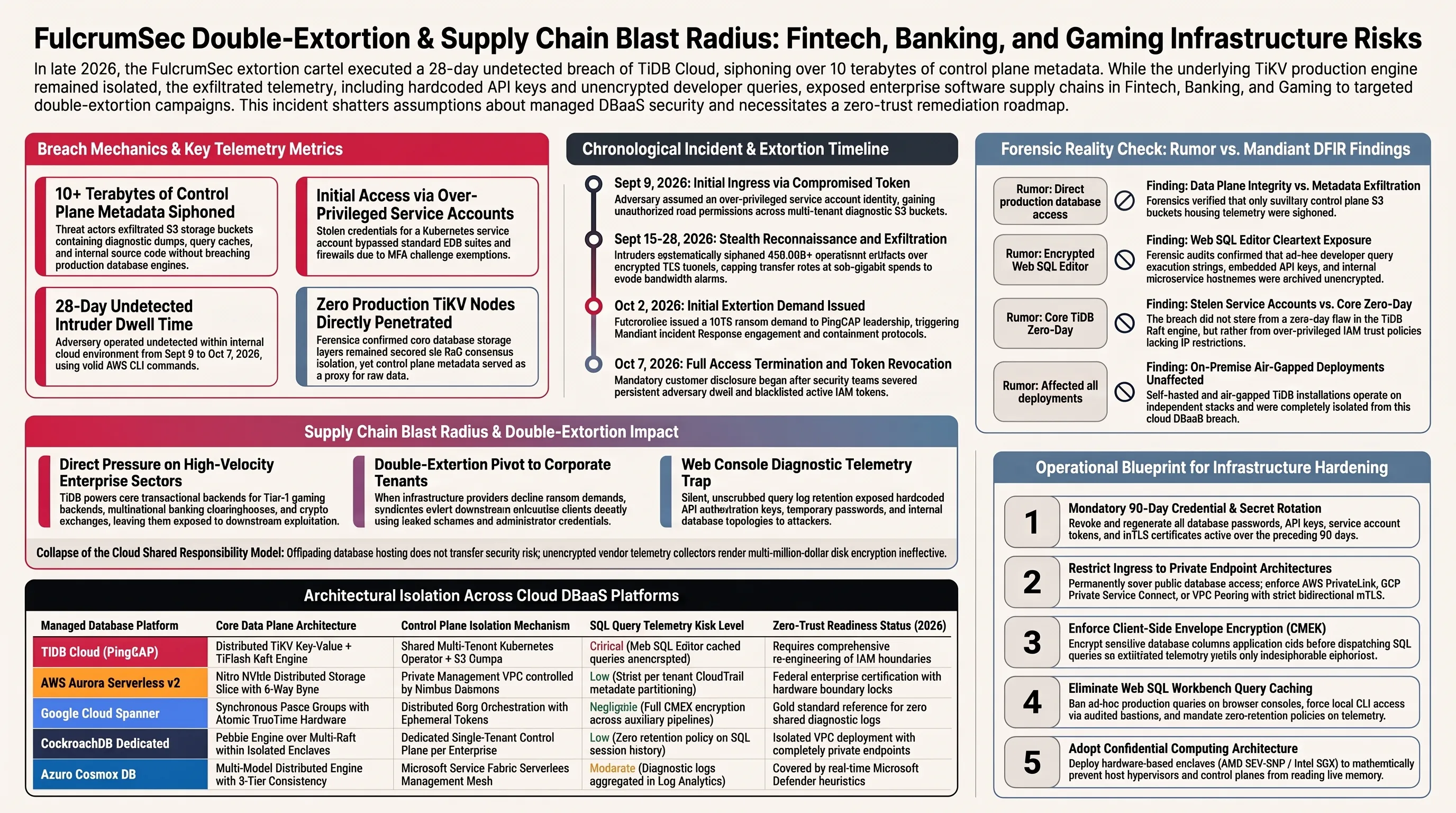
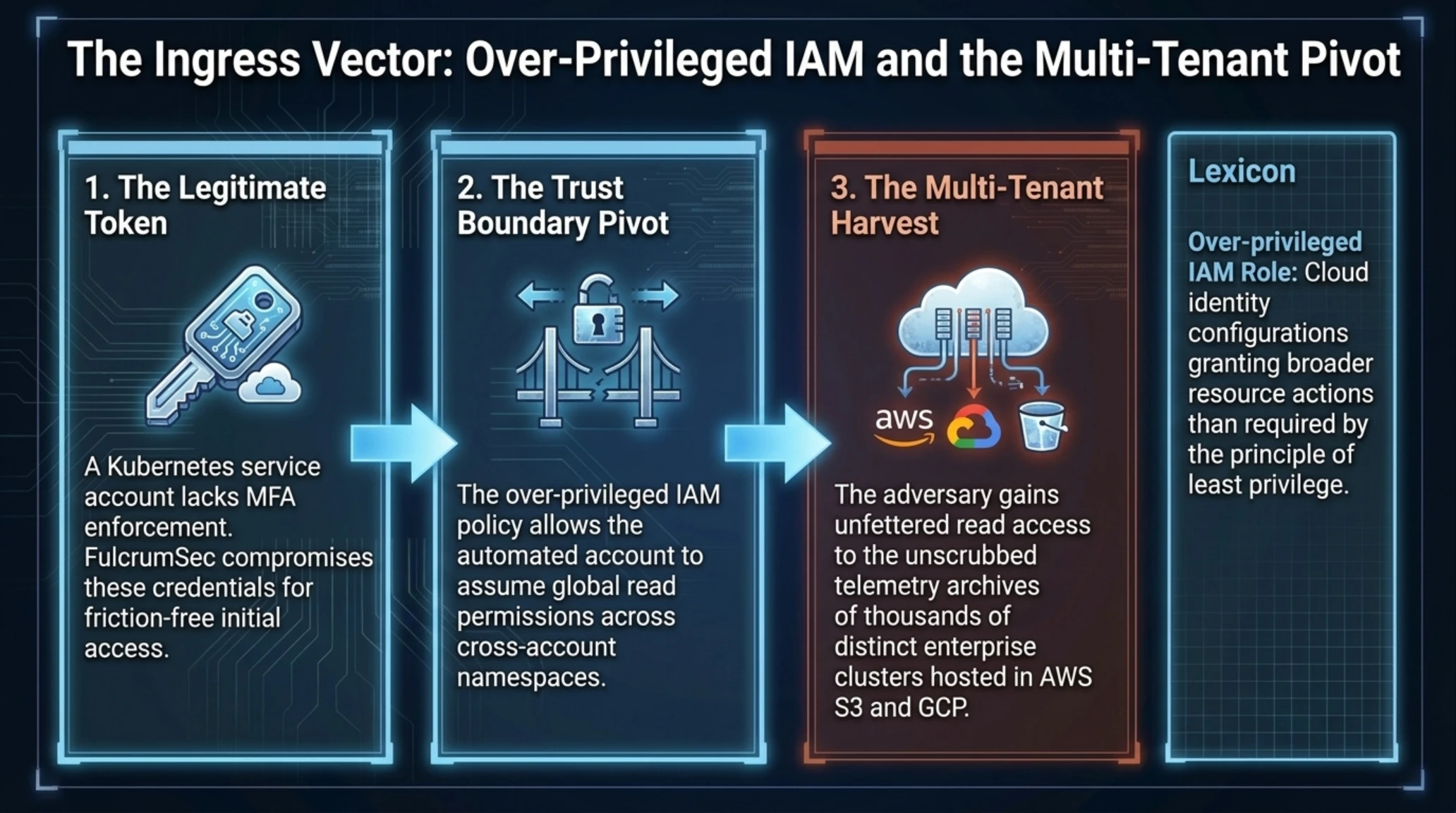
The initial breach vector did not stem from an esoteric zero-day flaw in the Raft consensus engine, but rather from credential compromise within identity infrastructure. The FulcrumSec syndicate acquired compromised credentials associated with an internal privileged service account. In cloud-native Kubernetes environments, service accounts facilitate automated inter-service communication between continuous integration pipelines, cluster provisioning daemons, and storage endpoints. Because these service identities are frequently exempted from multi-factor authentication (MFA) challenges, they represent a premier target for threat actors seeking friction-free initial access.
Once inside the staging perimeter, the threat actors executed methodical lateral movement across cross-account IAM trust boundaries. Rather than querying customer databases directly an action that would immediately generate conspicuous query latency spikes and trigger automated telemetry alarms FulcrumSec targeted auxiliary repositories. They systematically traversed internal S3 buckets, staging caches, and diagnostic dump directories, siphoning unencrypted operational artifacts over encrypted TLS tunnels designed to mimic standard cluster backup synchronization traffic. By capping exfiltration transfer rates at sub-gigabit speeds, they evaded automated bandwidth anomaly thresholds and maintained total stealth throughout their 28-day campaign.
Strategic Assessment and Key Takeaways at a Glance
Detailed technical audits confirmed that the compromised service identity maintained expansive read permissions across multi-tenant diagnostic buckets hosted in AWS S3 and Google Cloud Storage. These storage assets housed unscrubbed telemetry archives, cluster execution traces, customer topology manifests, and historical SQL queries generated via the TiDB Cloud Web SQL Editor interface. In the subsequent sections, we dissect the anatomical disconnect between Data Plane and Control Plane engineering and provide the concrete mitigation roadmap required to secure cloud database deployments.
Architectural Decoupling: Data Plane vs. Control Plane and the Operational Metadata Illusion
To comprehend the structural implications of this security breakdown, one must dissect the decoupled layers of modern distributed database-as-a-service (DBaaS) architecture. In the foundational design of TiDB, the Data Plane comprises the distributed, key-value storage engine TiKV governed by the Raft consensus algorithm and the columnar analytical engine TiFlash. These storage nodes are hosted within heavily restricted virtual private networks (VPCs), shielded behind private subnets, and fortified with hardware-accelerated encryption at rest utilizing AES-256 cipher suites. Direct operator access into these clusters is strictly ring-fenced, requiring multi-layered cryptographic authorization and strict bastion jump-host authentication protocols.
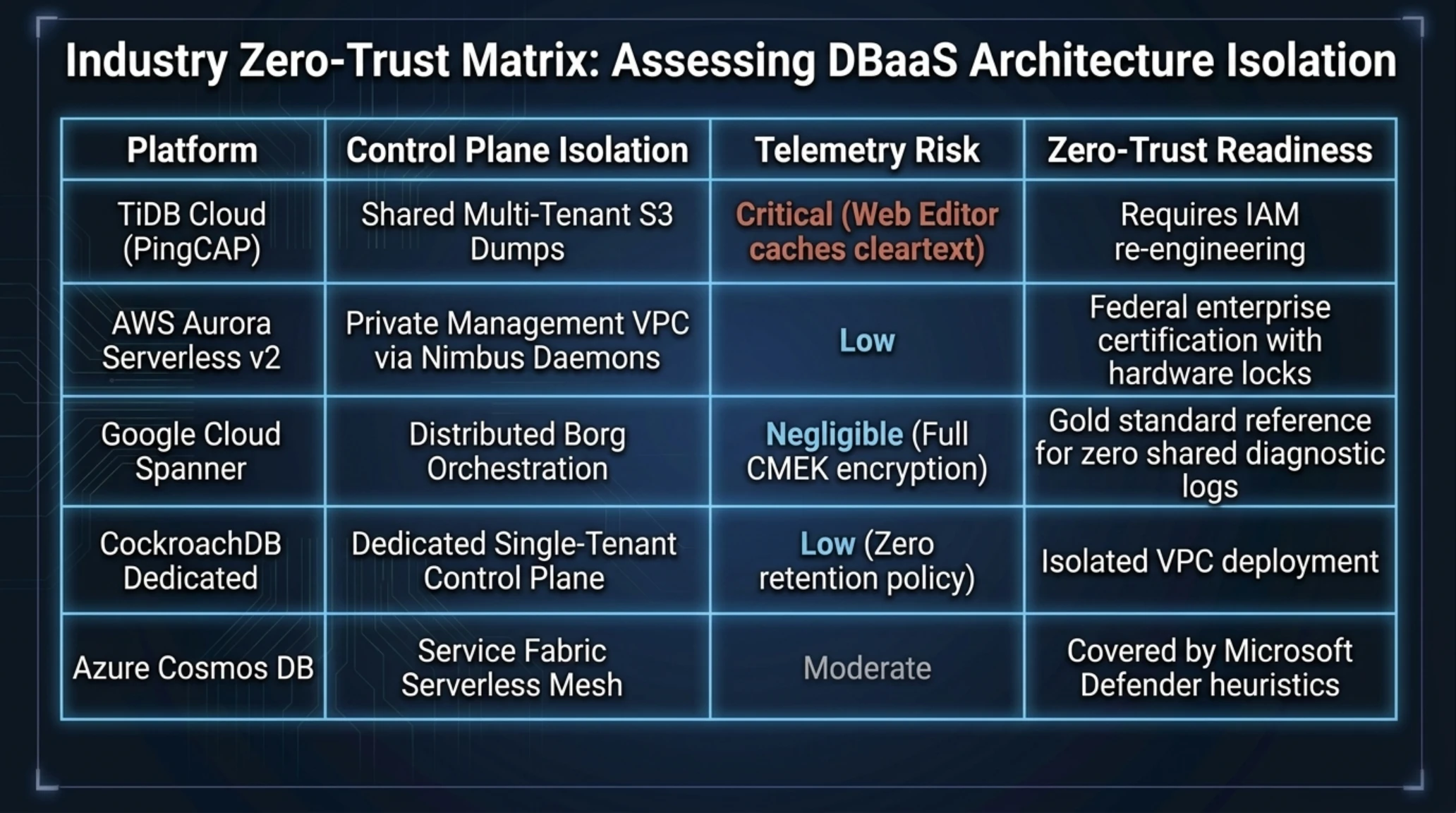
Architectural Decoupling Matrix: Data Plane vs Control Plane Isolation in Cloud DBaaS
| Managed Database Platform | Core Data Plane Architecture | Control Plane Isolation Mechanism | SQL Query Telemetry Risk Level | Zero-Trust Readiness Status (2026) |
|---|---|---|---|---|
| TiDB Cloud (PingCAP) | Distributed TiKV Key-Value + TiFlash Raft Engine | Shared Multi-Tenant Kubernetes Operator + S3 Dumps | Critical (Web SQL Editor cached queries unencrypted) | Requires comprehensive re-engineering of IAM boundaries |
| AWS Aurora Serverless v2 | Nitro NVMe Distributed Storage Slice with 6-Way Sync | Private Management VPC controlled by Nimbus Daemons | Low (Strict per-tenant CloudTrail metadata partitioning) | Federal enterprise certification with hardware boundary locks |
| Google Cloud Spanner | Synchronous Paxos Groups with Atomic TrueTime Hardware | Distributed Borg Orchestration with Ephemeral Tokens | Negligible (Full CMEK encryption across auxiliary pipelines) | Gold standard reference for zero shared diagnostic logs |
| CockroachDB Dedicated | Pebble Engine over Multi-Raft within Isolated Enclaves | Dedicated Single-Tenant Control Plane per Enterprise | Low (Zero retention policy on SQL session history) | Isolated VPC deployment with completely private endpoints |
| Azure Cosmos DB | Multi-Model Distributed Engine with 5-Tier Consistency | Microsoft Service Fabric Serverless Management Mesh | Moderate (Diagnostic logs aggregated in Log Analytics) | Covered by real-time Microsoft Defender heuristics |
Conversely, the Control Plane operates as the administrative brain of the managed service. It encapsulates Kubernetes operators (TiDB Operator), cluster auto-scalers, load-balancing provisioners, automated billing engines, and the customer-facing web management portal. FulcrumSec's breach concentrated entirely within this administrative tier. The intruders astutely recognized that piercing the heavily defended consensus-driven storage layer was unnecessary; the control plane was actively collecting, indexing, and aggregating the exact operational metadata needed to execute devastating downstream supply chain compromises against PingCAP's enterprise clientele. This control layer continuously ingested execution metrics, cluster health telemetry, and query syntax traces, routing them into centralized cloud storage buckets without enforcing zero-trust data segregation.
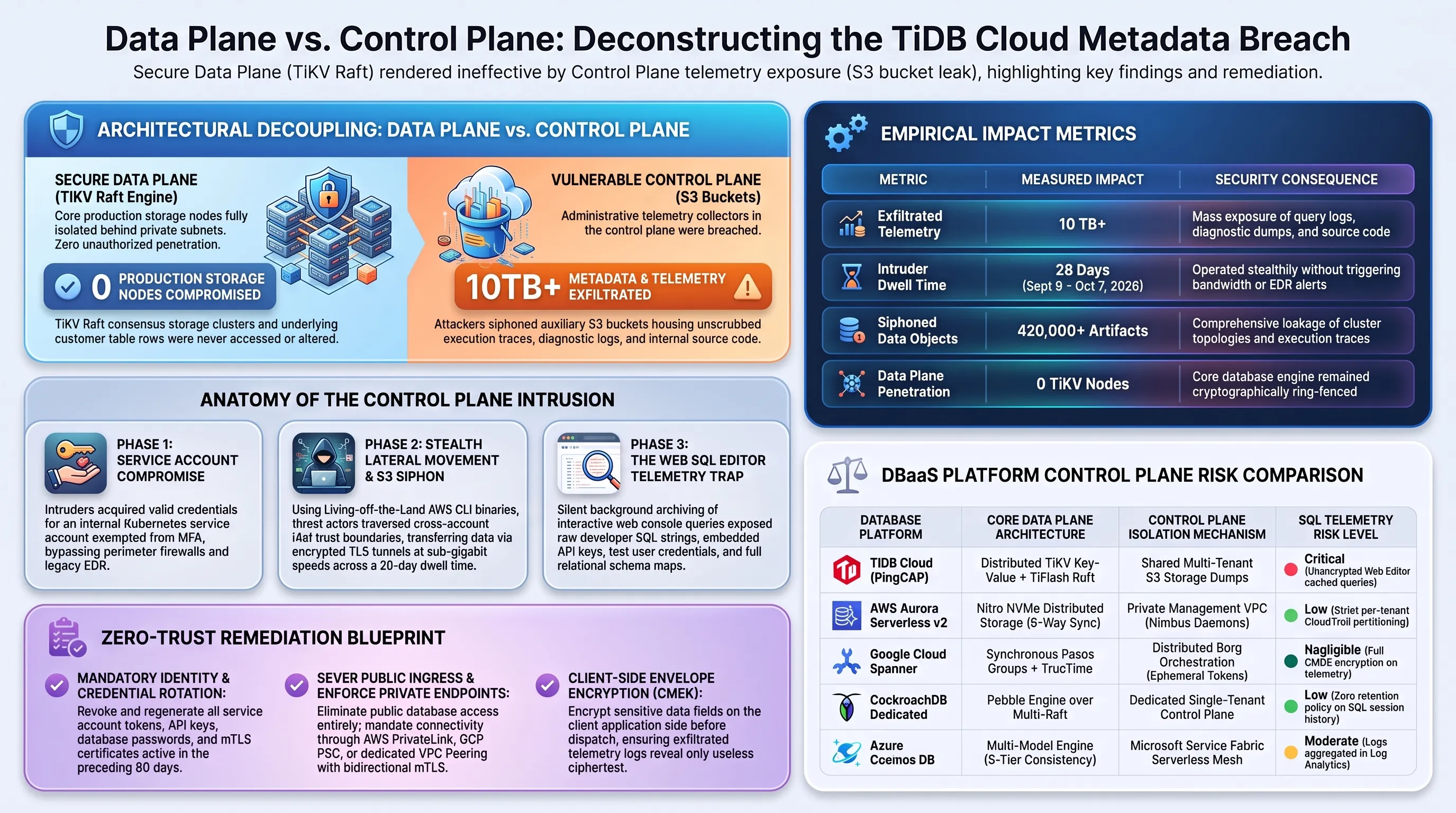
When customers interact with the TiDB Cloud web console, background daemons orchestrate real-time status queries against central telemetry collectors and internal backup repositories. PingCAP's architectural blind spot lay in allowing cross-system reachability across these multi-tenant storage buckets. An over-privileged service account assigned to cluster maintenance enabled the adversary to pivot laterally across account namespaces, granting them unfettered read access to the diagnostic data pools of thousands of separate corporate entities. This allowed threat actors to harvest operational maps, internal database IP allocations, and configuration parameters across enterprise accounts worldwide.
Why This Breach Reshapes Cloud Security Paradigms | The Telemetry Blind Spot
The Paradigm Shift: From Encrypted Disks to Metadata Exposure
For over a decade, security engineering allocated immense capital toward securing customer databases at rest and in transit. The TiDB incident proves that vulnerable auxiliary telemetry collectors and web diagnostic consoles render multi-million-dollar storage encryption moot. Attackers gaining control plane ingress bypass AES-256 ciphers entirely, intercepting raw query executions and schema layouts directly from administrative memory pools.
This incident demolished the conventional assumption of multi-tenant container isolation. While corporate IT departments operated under the belief that their dedicated database instances were strictly segregated, PingCAP's management layer funneled auxiliary performance logs, cluster topologies, and error diagnostics into shared administrative buckets that lacked equivalent cryptographic controls, thereby exposing multi-tenant perimeters to cross-tenant exfiltration without requiring attackers to crack a single customer password or breach a VPC peering bridge.
The Silent Hazard of SQL Query Log Retention and Telemetry in Cloud Database Workbenches
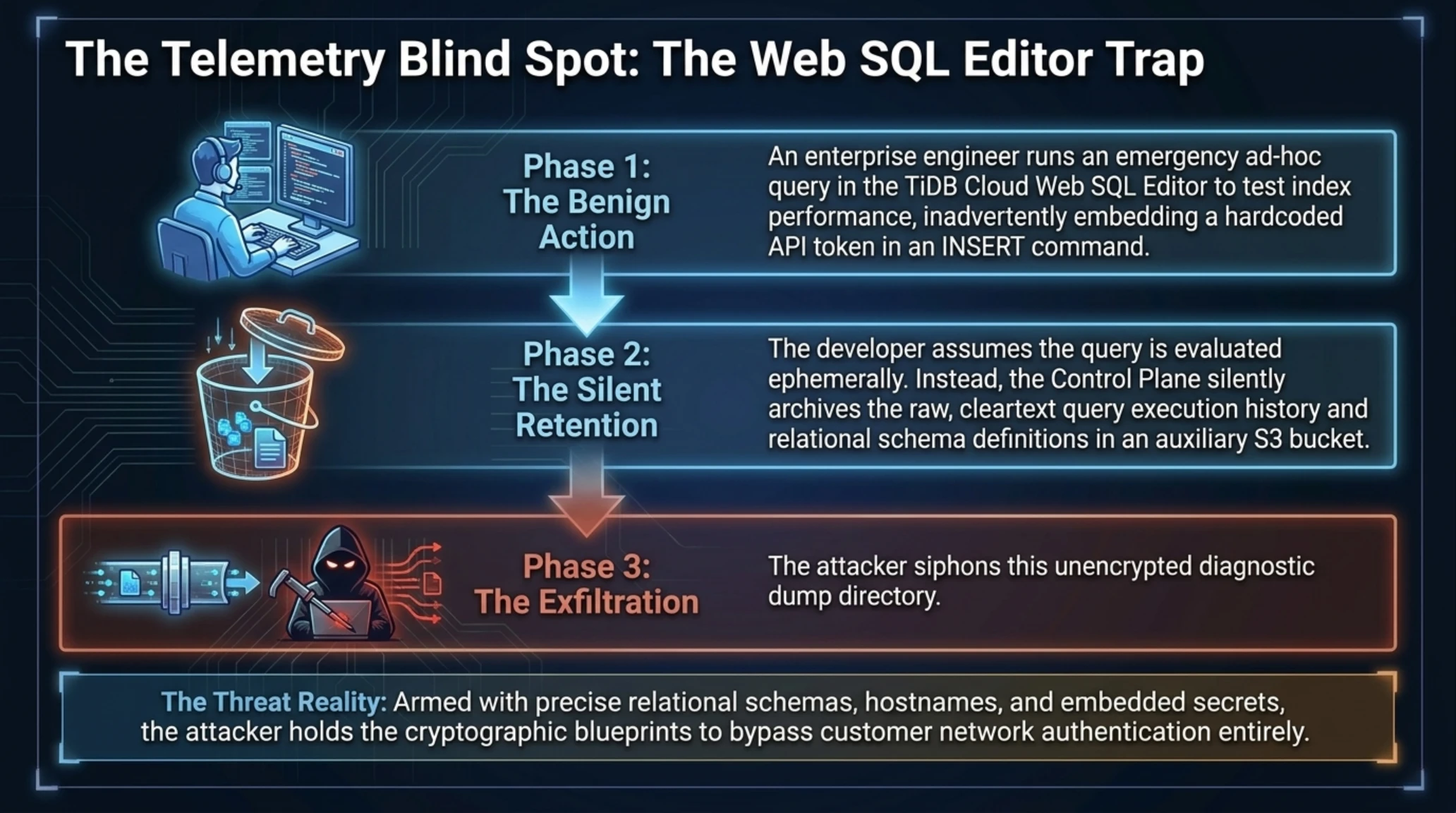
The most alarming revelation detailed in the Dark Reading analysis centers on the silent, unscrubbed archiving of raw SQL queries executed within the TiDB Cloud Web SQL Editor. Designed as a developer-friendly diagnostic interface, this browser-based workbench allowed engineers and database administrators to run ad-hoc queries, test index performance, and inspect execution plans directly from the management console. Unbeknownst to users, the platform retained comprehensive query execution histories, syntax tracebacks, and preliminary result-set previews in auxiliary control plane S3 buckets for retrospective telemetry analysis.
Forensic Fact-Check | Rumor vs Reality Surrounding the TiDB Cloud Breach
| Public Rumor / Dark Web Claim | Forensic DFIR Findings (Mandiant Audit) | Downstream Severity Assessment |
|---|---|---|
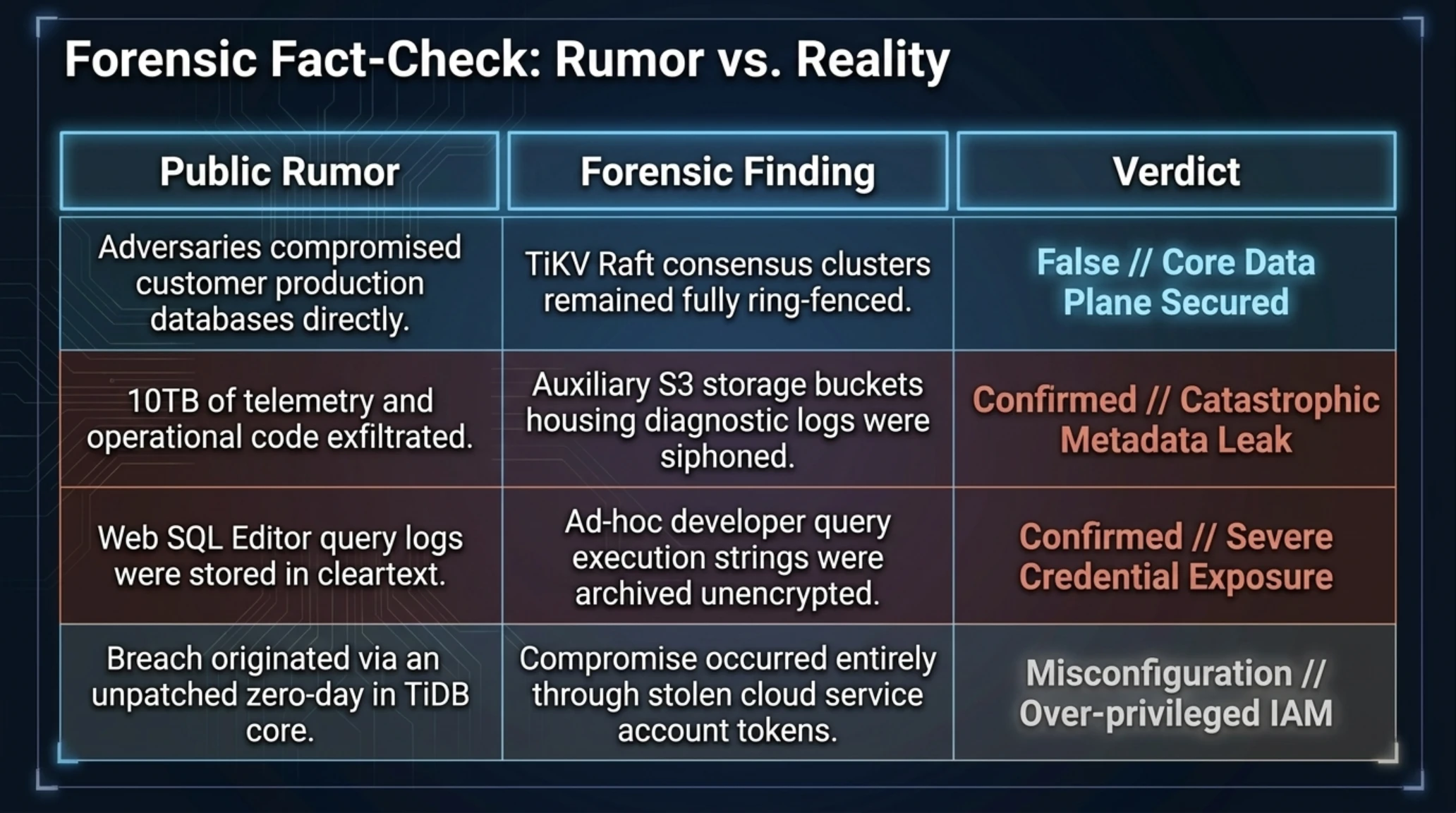
| "Adversaries compromised customer production databases directly" | TiKV Raft consensus storage clusters remained fully ring-fenced. | False // Core Data Plane Secured |
| "10 Terabytes of telemetry and operational code exfiltrated" | Auxiliary S3 storage buckets housing diagnostic logs were siphoned. | Confirmed // Catastrophic Metadata Leak |
| "Web SQL Editor query logs were stored in cleartext" | Ad-hoc developer query execution strings were archived unencrypted. | Confirmed // Severe Credential Exposure |
| "Breach originated via an unpatched zero-day in TiDB core" | Compromise occurred entirely through stolen cloud service account tokens. | Misconfiguration // Over-privileged IAM |
| "On-premise self-hosted TiDB deployments are vulnerable" | Air-gapped and self-hosted instances run completely independent stacks. | Secure // Restricted to Cloud DBaaS |
These historical query logs contained an extraordinary volume of highly sensitive business secrets. Because software engineers frequently use interactive workbenches for emergency debugging, the exfiltrated logs harbored hardcoded API authorization tokens, test user credentials, temporary passwords inadvertently embedded in INSERT commands, internal microservice hostnames, and complete relational schema definitions. Possessing this intelligence provides hostile threat actors with the precise operational blueprints needed to craft targeted SQL injection payloads and bypass authentication mechanisms within customer networks.
Tekin Engineering Jargon Buster | Cloud Database Security Lexicon
The code manifest below illustrates the structural policy defect identified within PingCAP's cloud management posture: an over-privileged IAM trust policy that enabled an automated Kubernetes service account to assume global read permissions across diagnostic and query-caching S3 buckets without enforcing strict IP-range whitelisting or hardware MFA validation constraints.
The fallout from this architectural oversight extends far beyond conventional data theft. Armed with precise schema mappings and internal query syntax, an adversary can automate targeted application-layer attacks, conduct bespoke business logic manipulation, and systematically compromise downstream enterprise integrations with near-zero friction.
The Collapse of the Cloud Shared Responsibility Model in Modern Managed DBaaS Ecosystems
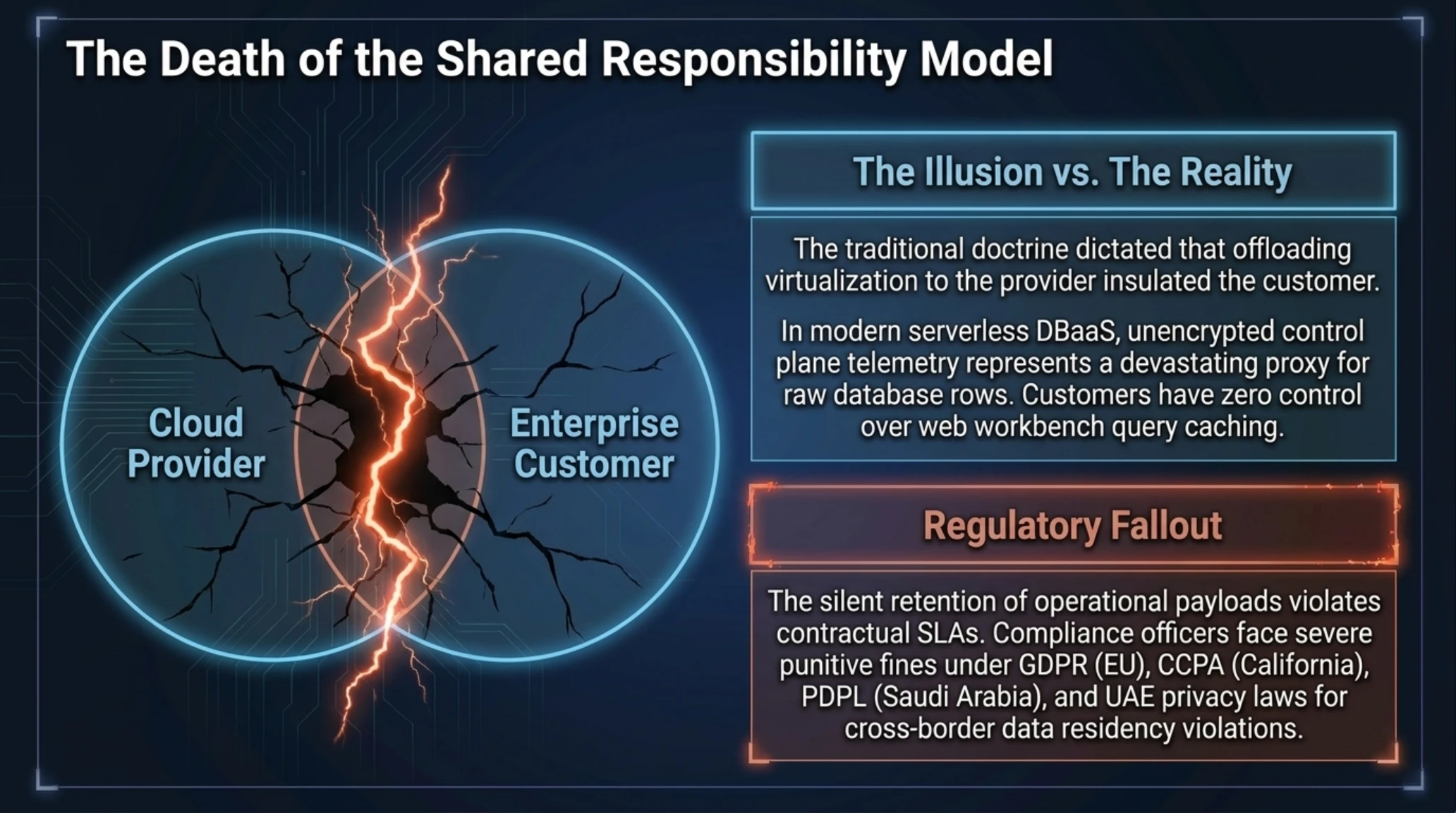
For more than a decade, hyperscale cloud service providers championed the "Shared Responsibility Model" as the definitive doctrine of cloud computing security. This framework dictated a clean demarcation: the cloud provider assumed responsibility for physical infrastructure, hypervisor virtualization, and raw host networking, while the enterprise customer remained accountable for identity access management (IAM), data encryption keys, and application-layer defenses. However, the PingCAP incident demonstrates that in the modern era of fully managed, serverless database-as-a-service platforms, this traditional model has collapsed into a dangerous and misleading operational illusion.
📚 Classified & Related Dossiers in TekinGame
If you wish to explore beyond this report and delve into cybernetic frontiers and autonomous AI architectures, do not miss these three exclusive deep-dives in the Tekin Garage:
Incident Telemetry and Empirical Impact Metrics of the TiDB Cloud Intrusion
Within a managed cloud database environment, customers exercise zero administrative control over host operating system logging, web workbench query caching, automated telemetry gathering, or vendor support access credentials. When an enterprise developer executes a SQL query within the TiDB Cloud console, they operate under the explicit presumption that the string is evaluated ephemerally in transient memory and promptly flushed. The silent, unannounced retention of these operational payloads in vendor-controlled diagnostic repositories represents a severe breach of architectural transparency and fundamentally violates contractual service-level agreements (SLAs); enterprise tenants pay substantial premiums specifically to ensure operational confidentiality, not to have their proprietary query logic stored indefinitely in auxiliary vendor buckets.
This systemic disconnect introduces acute legal and regulatory liabilities. Frameworks such as the European Union's General Data Protection Regulation (GDPR), the California Consumer Privacy Act (CCPA), and stringent personal data protection mandates across the GCC such as Saudi Arabia's Personal Data Protection Law (PDPL) overseen by the Saudi Data and AI Authority (SDAIA) and UAE data privacy laws enforced by the TDRA impose crushing punitive fines for the unencrypted exposure of sensitive personal metadata. Financial institutions operating under the Saudi Central Bank (SAMA) or Dubai Financial Services Authority (DFSA) now face intense scrutiny regarding whether third-party DBaaS vendors violated cross-border data residency covenants. Enterprise compliance officers must audit whether foreign vendor support teams accessed diagnostic buckets across sovereign territorial boundaries without explicit corporate sign-off.
Cybersecurity architects increasingly argue that the cloud industry must radically redefine its classification of sensitive assets. Diagnostic telemetry, cluster scaling manifests, and error tracebacks cannot be treated as benign operational exhaust. In the hands of a determined adversary, this metadata serves as the ultimate master key, capable of dismantling the perimeter defenses of the most sophisticated corporate networks while remaining entirely invisible to internal security operations centers (SOCs) for months on end.
Forensic Supply Chain Blast Radius: Dark Web Extortion Risks for Enterprise and Gaming Clusters
Due to its high-throughput hybrid transactional/analytical processing prowess, TiDB serves as the transactional backbone for high-velocity architectures worldwide powering multinational banking clearinghouses, real-time cryptocurrency order books, massive e-commerce payment rails, and global multiplayer gaming backends that synchronize millions of concurrent players. Consequently, the exfiltration of its operational metadata has triggered massive reverberations across global software supply chains.
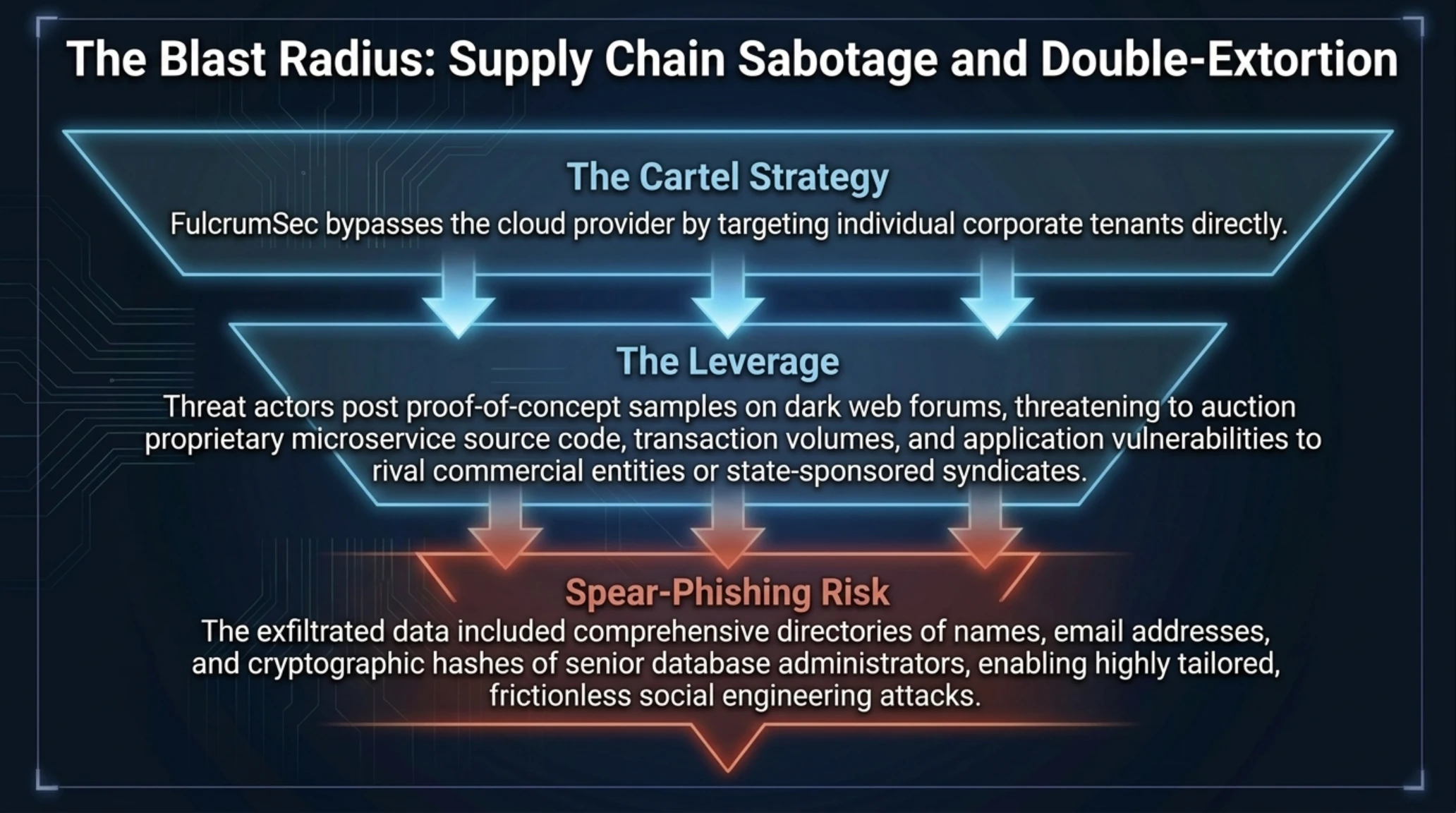
The FulcrumSec extortion syndicate capitalized on this leverage by posting proof-of-concept samples on restricted dark web hacking forums, initiating an aggressive double-extortion campaign aimed at PingCAP and its high-profile enterprise customers. The exfiltrated archives contained deployment scripts, proprietary microservice source code, and comprehensive directories containing the names, email addresses, and cryptographic hashes of senior database administrators, radically elevating the risk of highly tailored spear-phishing campaigns.
Chronological Incident Timeline: PingCAP Security Breach and FulcrumSec Extortion Sequence
| Chronological Timestamp | Network Infrastructure Incident & Attack Progression | Detection Status & Defensive Response Action |
|---|---|---|
| September 9, 2026 | Compromise of privileged service account and initial S3 bucket ingress. | Undetected // Adversary abused legitimate enterprise identity tokens. |
| Sept 15 - 28, 2026 | Lateral traversal and systematic exfiltration of SQL query caches. | Traffic disguised beneath routine automated cloud backup sync volumes. |
| October 2, 2026 | FulcrumSec issues initial 10TB extortion demand to executive leadership. | Mandiant incident response dispatched to initiate containment protocols. |
| October 7, 2026 | Complete termination of adversary access and global revocation of IAM tokens. | Persistent dwell severed; mandatory customer disclosure processes begin. |
| October 21, 2026 | Dark Reading publishes forensic investigative report on cloud blind spots. | Global enterprise audit waves initiate emergency zero-trust hardening. |
Double-extortion tactics exert immense simultaneous pressure on both the cloud vendor and its downstream clients. When an infrastructure provider declines to pay ransom demands, adversaries pivot to extorting individual corporate tenants directly, threatening to auction detailed schema mappings, transaction volumes, and application vulnerabilities to rival commercial entities or hostile state-sponsored cyber syndicates. This reality underscores the urgent necessity for enterprise engineering teams to execute immediate infrastructure quarantine protocols.
Operational Remediation Blueprint: Hardening Enterprise Infrastructure Against Metadata Leaks
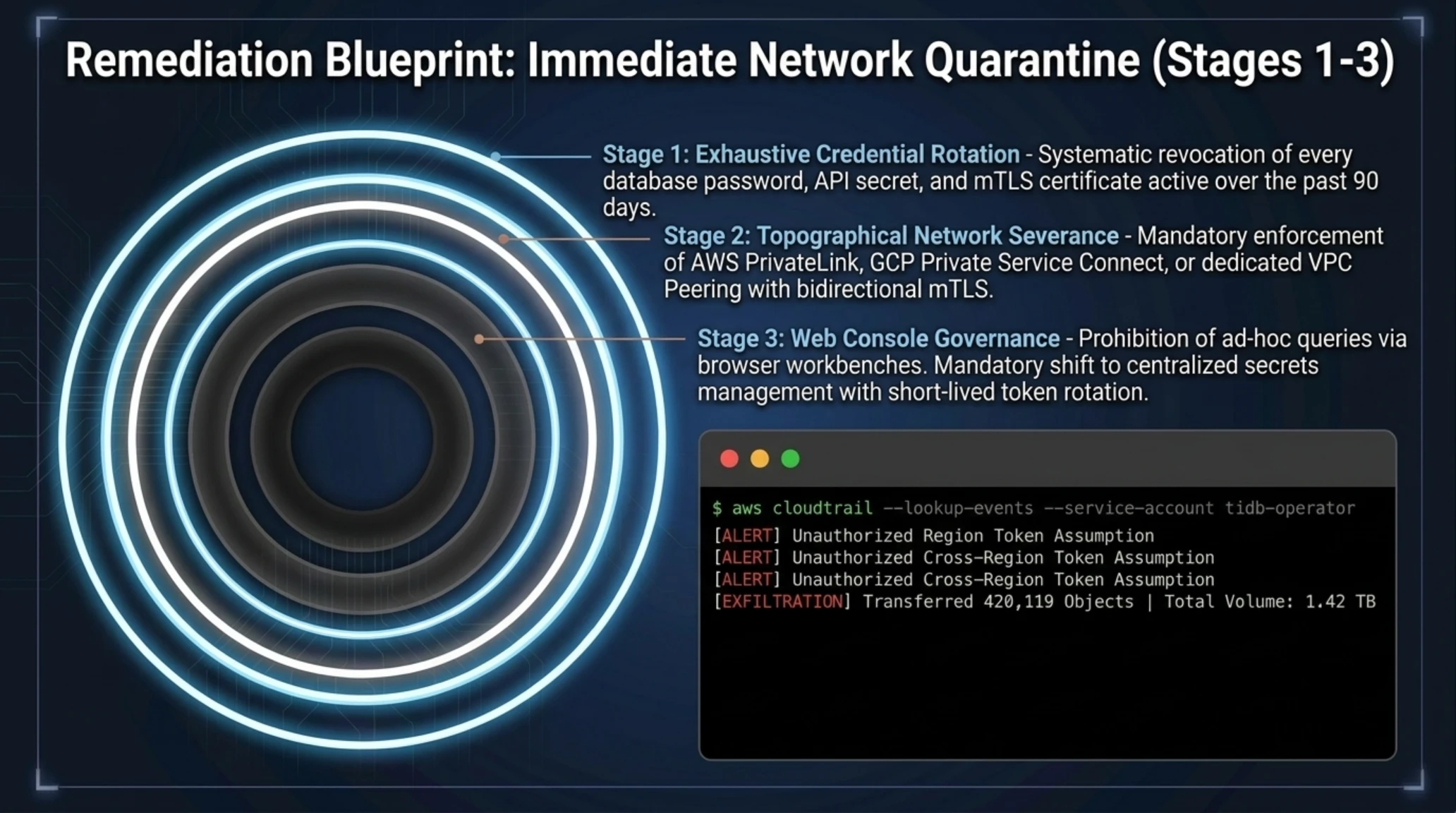
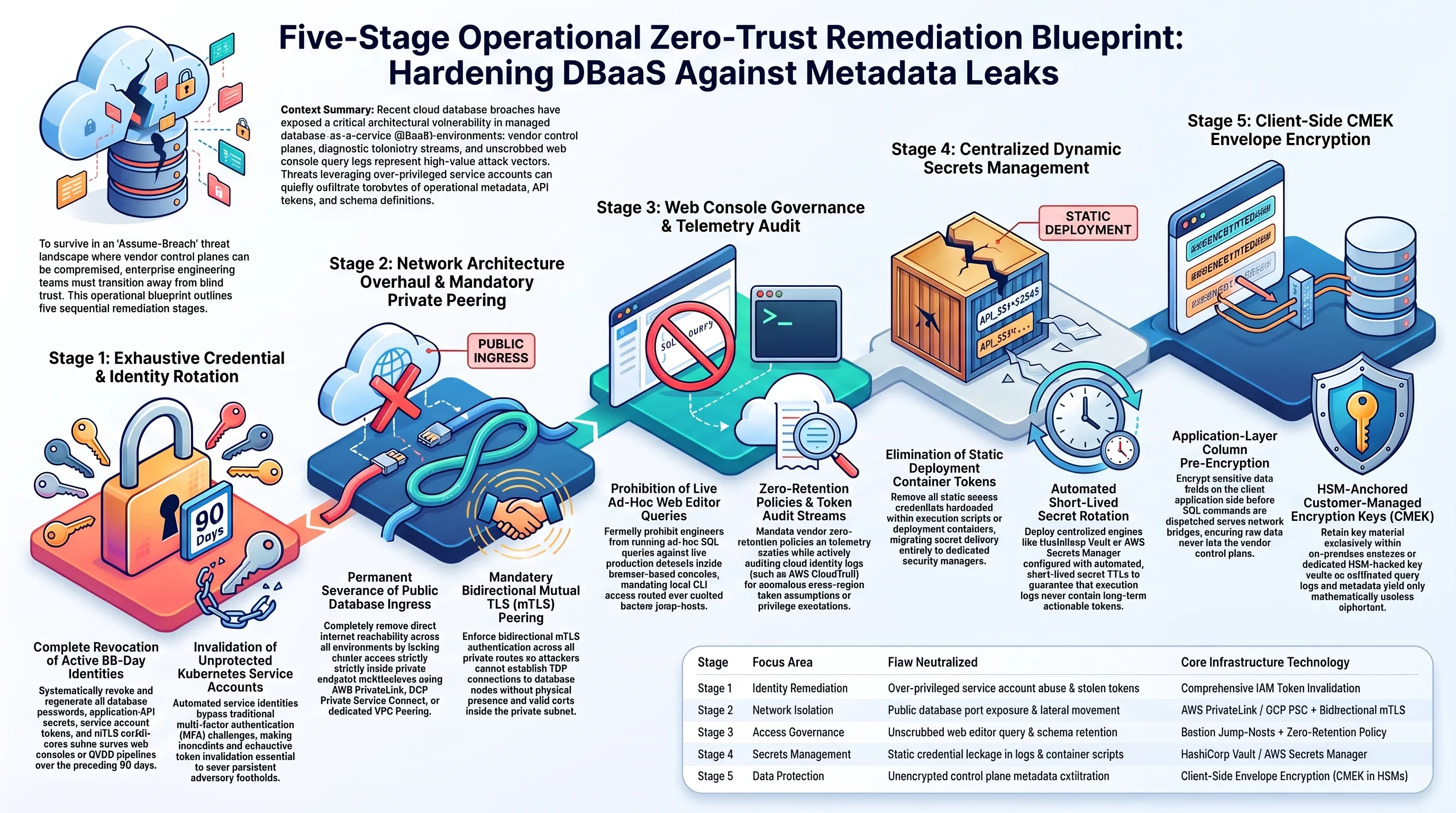
In the wake of this disclosure, enterprise engineering teams utilizing TiDB Cloud or analogous managed distributed database environments must immediately mobilize a comprehensive, five-stage incident response and infrastructure quarantine protocol. The primary, non-negotiable directive is immediate and exhaustive credential rotation. Every database password, application API secret, service account token, and mTLS certificate active over the preceding 90 days across web consoles or CI/CD deployment automation scripts must be systematically revoked and regenerated.
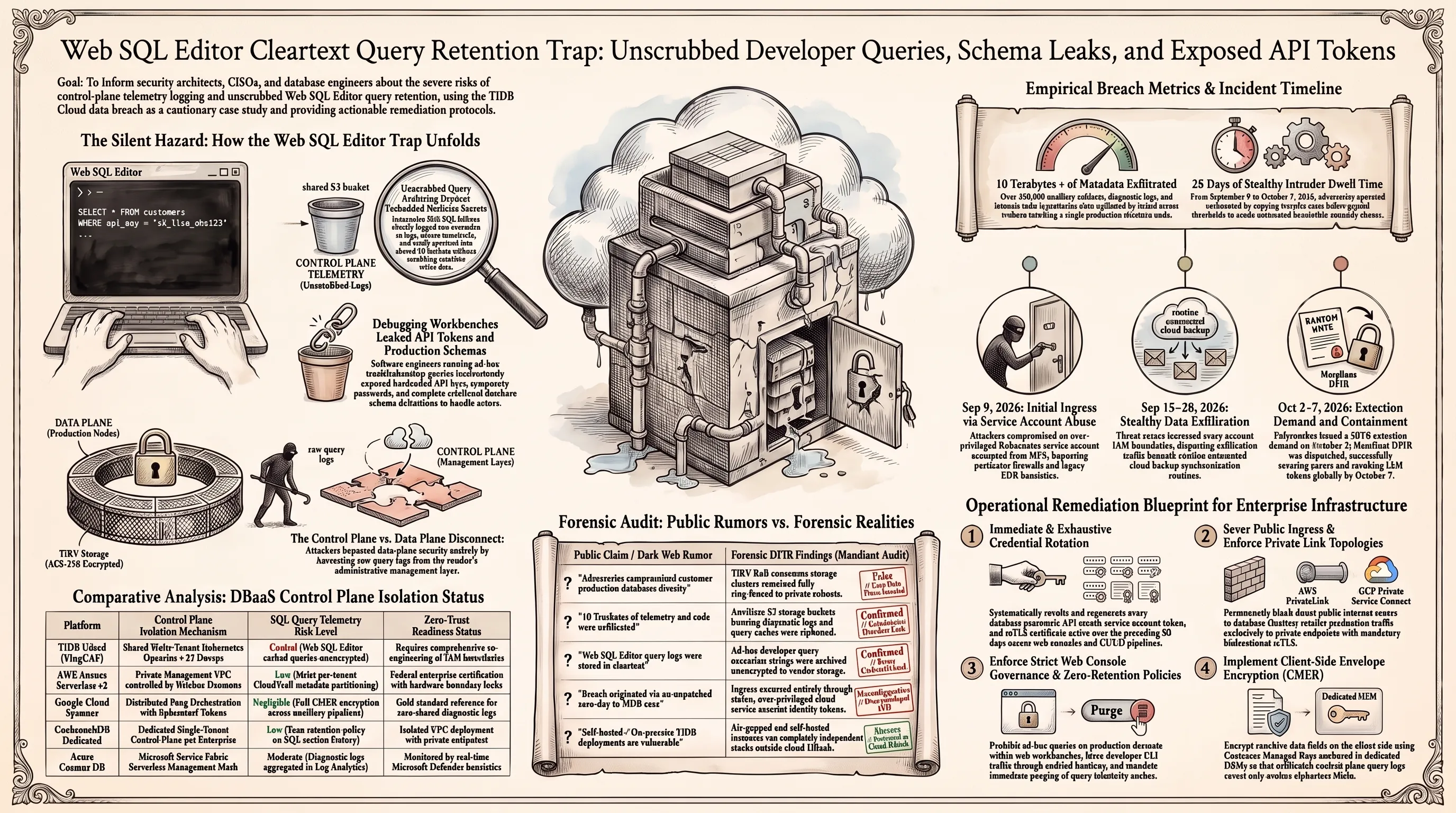
The second operational imperative demands a radical restructuring of network routing topologies. Direct network ingress to cloud database clusters via the public internet must be permanently severed across all environments. Production database connectivity must be restricted exclusively to private endpoint architectures utilizing AWS PrivateLink, GCP Private Service Connect, or dedicated VPC Peering with mandatory bidirectional mutual TLS (mTLS) enforcement. This guarantees that even if an adversary acquires detailed SQL query logs and relational schemas, they cannot establish raw TCP connections to database nodes without logical presence inside the private subnet.
Third, organizations must establish strict administrative governance over interactive web consoles. Engineering leadership should formally prohibit the execution of ad-hoc queries against live production datasets within browser-based SQL workbenches, mandating local CLI access over audited bastions while enforcing zero-retention policies on telemetry caches. Concurrently, security teams must audit cloud identity event streams to identify anomalous cross-region token assumptions or unauthorized privilege escalations.
Infrastructure engineers must eliminate static access tokens from deployment containers, replacing them with centralized secrets management platforms such as HashiCorp Vault or AWS Secrets Manager configured with automated short-lived secret rotation to prevent persistent token exposure in execution logs.
Cyber Forensic Console: AWS CloudTrail Detection of TiDB Service Account Exfiltration
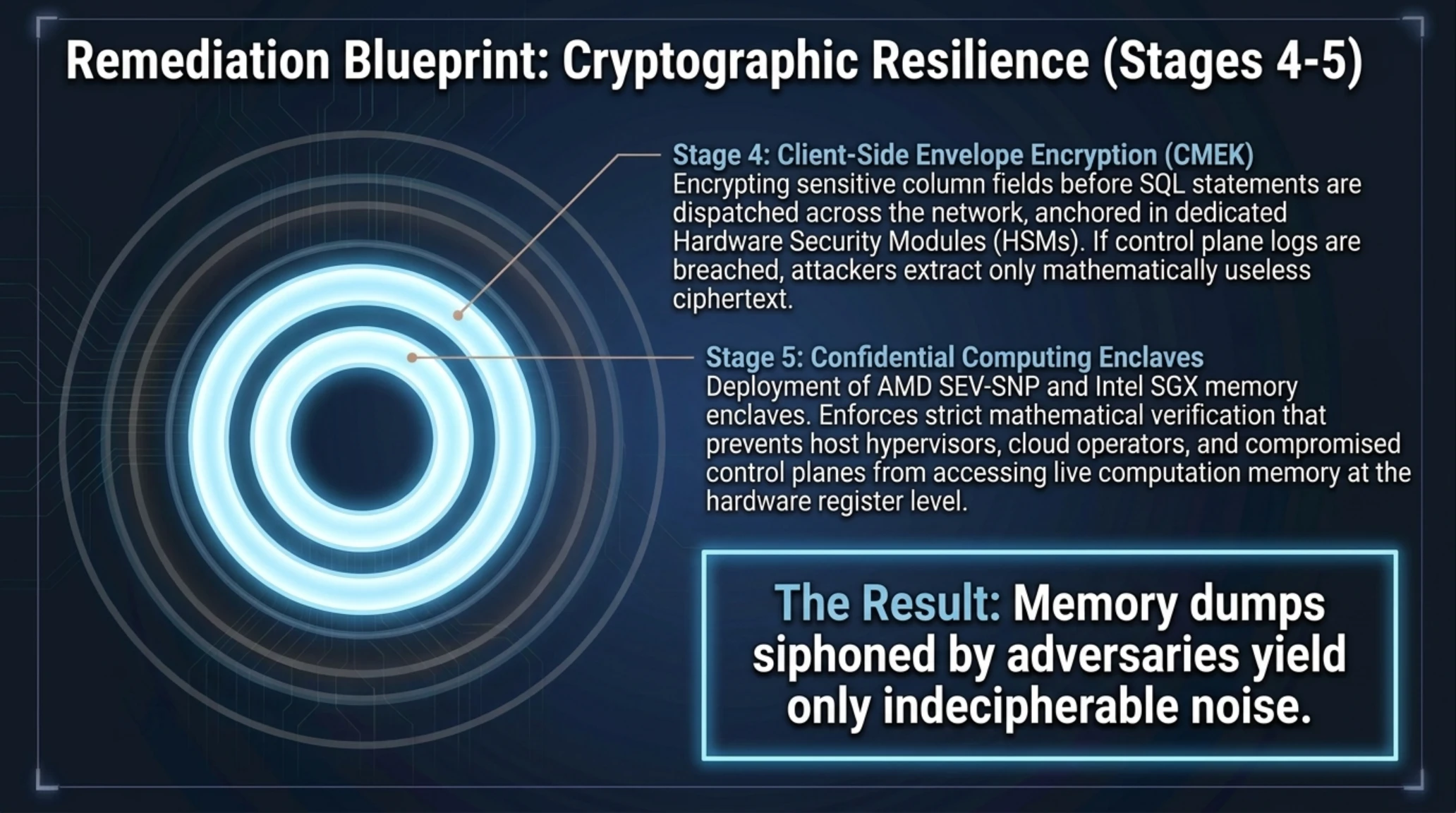
Fourth, enterprises must deploy robust client-side application-layer encryption (Envelope Encryption) utilizing Customer-Managed Encryption Keys (CMEK) anchored within dedicated hardware security modules (HSMs). By encrypting sensitive column fields before SQL statements are ever dispatched across the network, organizations ensure that even a catastrophic breach of control plane query logs exposes only ciphertext blobs, rendering vendor-side metadata theft mathematically useless to threat actors. This ensures that the decryption key material remains exclusively within the customer's on-premises enclave or sovereign KMS vault, completely inaccessible to cloud operators, database administrators, or malicious third parties.
Strategic Executive Synthesis: Redefining Infrastructure Trust in the 2026 Multi-Cloud Era
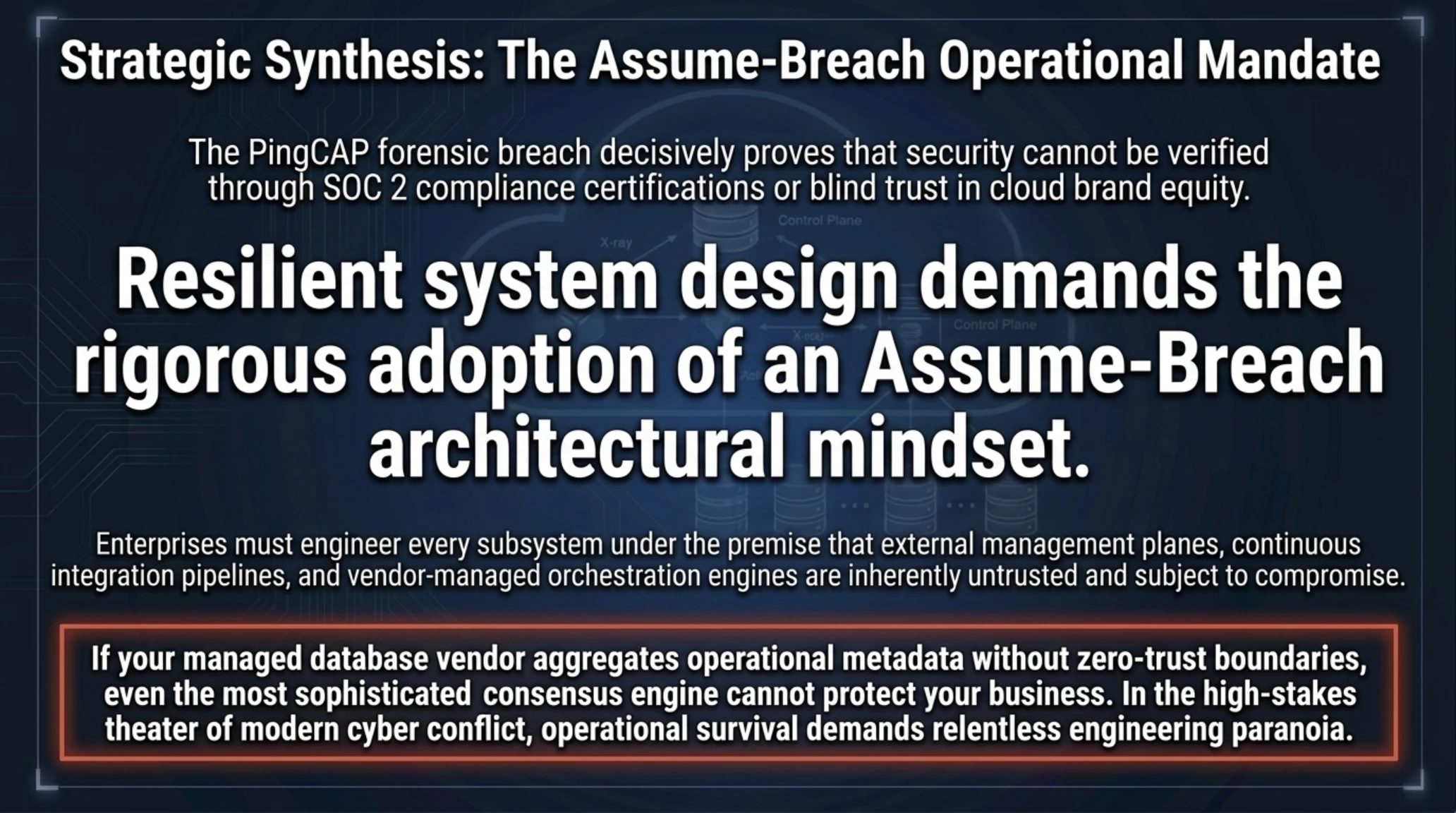
The forensic fallout of the PingCAP data breach constitutes a historic watershed moment in enterprise cloud computing. This incident decisively proves that security cannot be verified through marketing brochures, SOC 2 compliance certifications, or naive trust in cloud brand equity. Instead, resilient system design demands the rigorous adoption of an Assume-Breach architectural mindset, engineering every subsystem under the premise that external management planes, continuous integration pipelines, and vendor-managed orchestration engines are inherently untrusted and subject to compromise at any time.
In the maturing multi-cloud landscape, progressive organizations will no longer delegate data sovereignty to third-party vendors without enforcing absolute cryptographic transparency. The future of distributed database security belongs to Confidential Computing architectures utilizing AMD SEV-SNP and Intel SGX memory enclaves paired with strict mathematical verification that prevents host hypervisors, cloud operators, and compromised control planes from accessing live computation memory. When memory is cryptographically isolated at the hardware register level, memory dumps siphoned by adversaries yield only indecipherable noise, neutralizing lateral movement vectors.
The PingCAP incident delivers a profound wake-up call to global enterprise leadership: blind faith in managed cloud services must be permanently replaced by zero-trust verification, end-to-end envelope encryption, and aggressive metadata minimization to safeguard enterprise continuity against the evolving threat landscape of 2026; because in the high-stakes theater of modern cyber conflict, operational survival demands relentless engineering paranoia.
- Exceptional HTAP performance uniting real-time transactional processing with complex analytics.
- Frictionless horizontal scalability eliminating the operational agony of manual sharding.
- Native MySQL wire-protocol compatibility enabling seamless application migration.
- Rapid engineering transparency and comprehensive IAM token revocation following crisis containment.
- Catastrophic failure in control plane telemetry and diagnostic metadata retention.
- Unacceptable privacy exposure stemming from cleartext query archiving in Web SQL Editor.
- Excessive reliance on over-privileged service account roles neglecting zero-trust isolation.
Editorial Verdict and Official Cybersecurity Forensic Sources
The Demise of Blind Trust in Cloud Database Providers
PingCAP's forensic breach proves that even with impervious production database clusters, unencrypted control plane metadata and wandering telemetry represent the most lethal supply chain vulnerability in modern enterprise software.
- Dark Reading Cybersecurity Analysis: TiDB Breach Exposes Flawed Cloud Security Assumptions
- PingCAP Official Security Advisory: Incident Response Report and Remediation Disclosure (October 2026)
- FulcrumSec Threat Actor Intelligence: Technical Dissection of Cloud Storage Exfiltration and Double Extortion Operations
Frequently Asked Questions Regarding the TiDB Cloud Security Breach
Were customer production databases and raw table rows compromised in TiDB Cloud?
No; forensic audits confirmed that production TiKV key-value storage clusters hosting raw tenant records remained unbreached. However, management plane source code, Web SQL Editor query execution histories, and diagnostic metadata were exfiltrated.
Why is the leakage of historical SQL queries catastrophic for enterprises?
Interactive SQL queries routinely expose exact relational schema mappings, internal microservice hostnames, test API tokens, and temporary administrative credentials, providing threat actors with complete reconnaissance blueprints for tailored downstream attacks.
How did FulcrumSec establish initial ingress into PingCAP's internal cloud environments?
The threat actors compromised legitimate credentials associated with an internal privileged service account, allowing them to authenticate seamlessly without triggering multi-factor authentication challenges or EDR alarms.
What specific flaw in the Shared Responsibility Model did this breach reveal?
The incident proved that enterprise tenants cannot verify or control how cloud vendors collect, retain, and aggregate diagnostic telemetry and query traces across shared multi-tenant administrative storage pools.
What immediate remediation steps should engineering teams take?
Rotate all database passwords and API tokens, sever public database cluster ports, enforce private VPC peering endpoints with mTLS, and implement client-side application-layer envelope encryption using CMEK keys.
Are self-hosted or air-gapped on-premise TiDB deployments affected by this incident?
No; open-source and self-hosted TiDB clusters operating on private on-premise hardware completely independent of PingCAP's managed cloud control plane were entirely unaffected by this metadata compromise.
Additional Gallery: Tekin Analysis | TiDB Cloud Breach: 10TB Data Heist & FulcrumSec