Tekin Night | The Night Computers Came Alive: When AI Put Its Hands on the Keyboard
Good evening, Tekin Legion. Tonight, March 6, 2026, marks the precise moment the digital realm breached the physical one. Over the past 24 hours, OpenAI deployed a model capable of seizing direct control of your computer's interface, Microsoft radically abandoned the traditional plastic console business model, and France was crippled by the largest medical data heist in European history. Concurrently, Honor unveiled a smartphone that physically moves under AI command, Meta signed a staggering $60 billion alliance with AMD, and Apple launched an impossibly cheap MacBook utilizing leftover iPhone silicon.
We are witnessing what I classify as the "Physical Transformation of Artificial Intelligence." AI is no longer confined to sterile chatboxes or image generators; it is actively placing its digital hands on your mouse, embodying smartphone hardware, and systematically infiltrating the deepest infrastructure of global tech giants. Brew your strongest coffee, Commander. Tonight, we dissect the core of this revolution.
Strategic Evaluation & Key Takeaways at a Glance
1. GPT-5.4 and the Computer Use Era: When OpenAI Hijacks Your UI
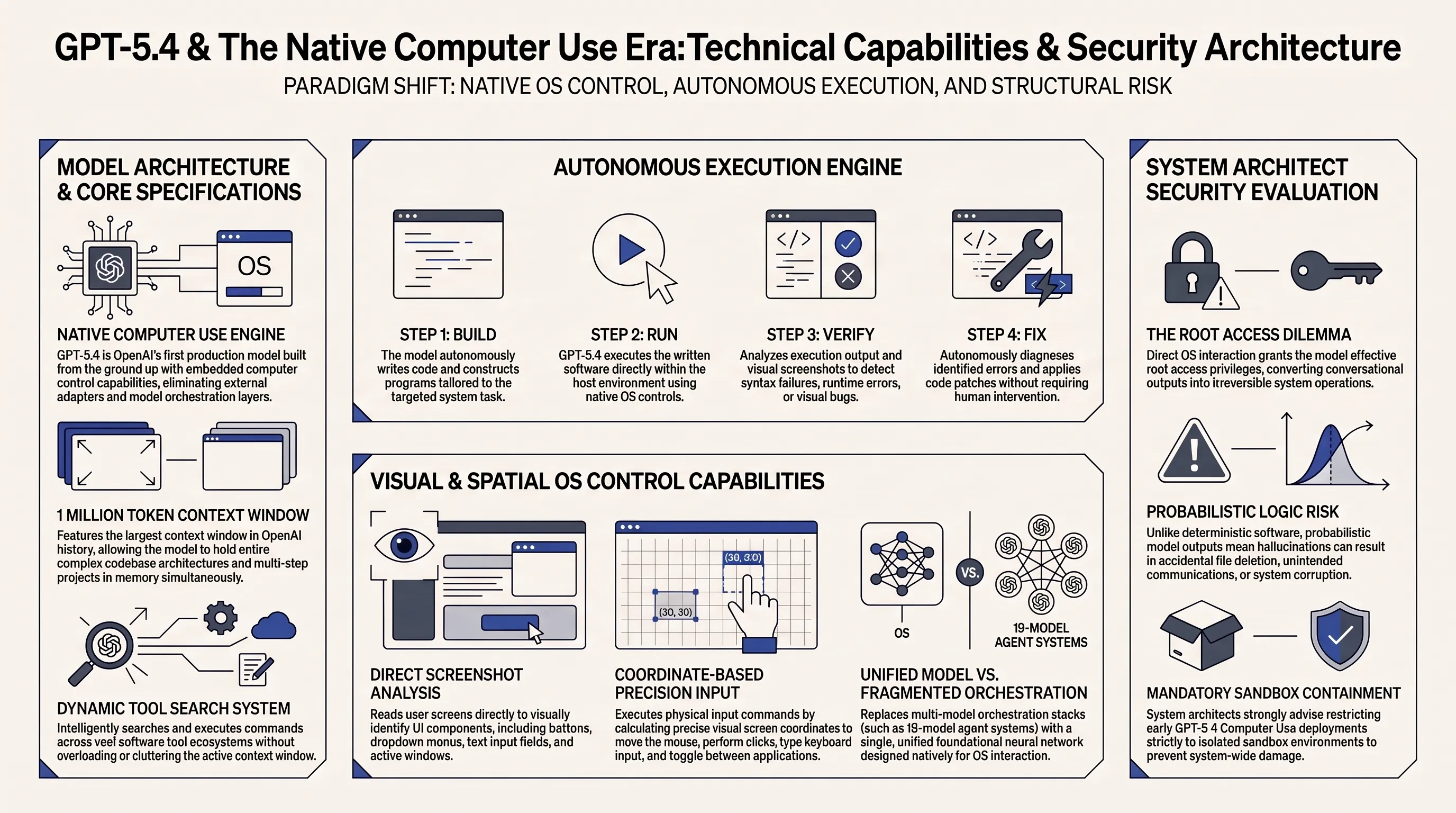
This morning, OpenAI detonated a massive payload: GPT-5.4, their first production model featuring native Computer Use capabilities. What does this entail? It means the AI model can visually perceive your exact screen output, seize control of the mouse cursor, actuate keystrokes, and navigate operating systems without requiring complex API hooks or third-party intermediary tools.
Prior to GPT-5.4, utilizing AI as a digital worker required fragmented orchestration tools like Perplexity Computer or Anthropic's isolated Claude Computer Use layer. OpenAI has now fundamentally baked this into the core architecture of their premier model. Armed with an unprecedented 1 Million Token Context Window, GPT-5.4 executes a fully autonomous Build-Run-Verify-Fix Loop: it writes an application, executes the code, visually identifies UI errors, and debugs its own work entirely without human supervision.
As a systems architect, I issue a stern warning: Computer Use is effectively handing a probabilistic algorithm Root Access. If the model hallucinates as we witnessed during the disastrous OpenClaw incident in November 2025 it possesses the physical capability to delete local files, transmit sensitive emails, and corrupt core system registries. Until robust, impenetrable guardrails are established, this technology must only be deployed within heavily restricted Sandbox environments.
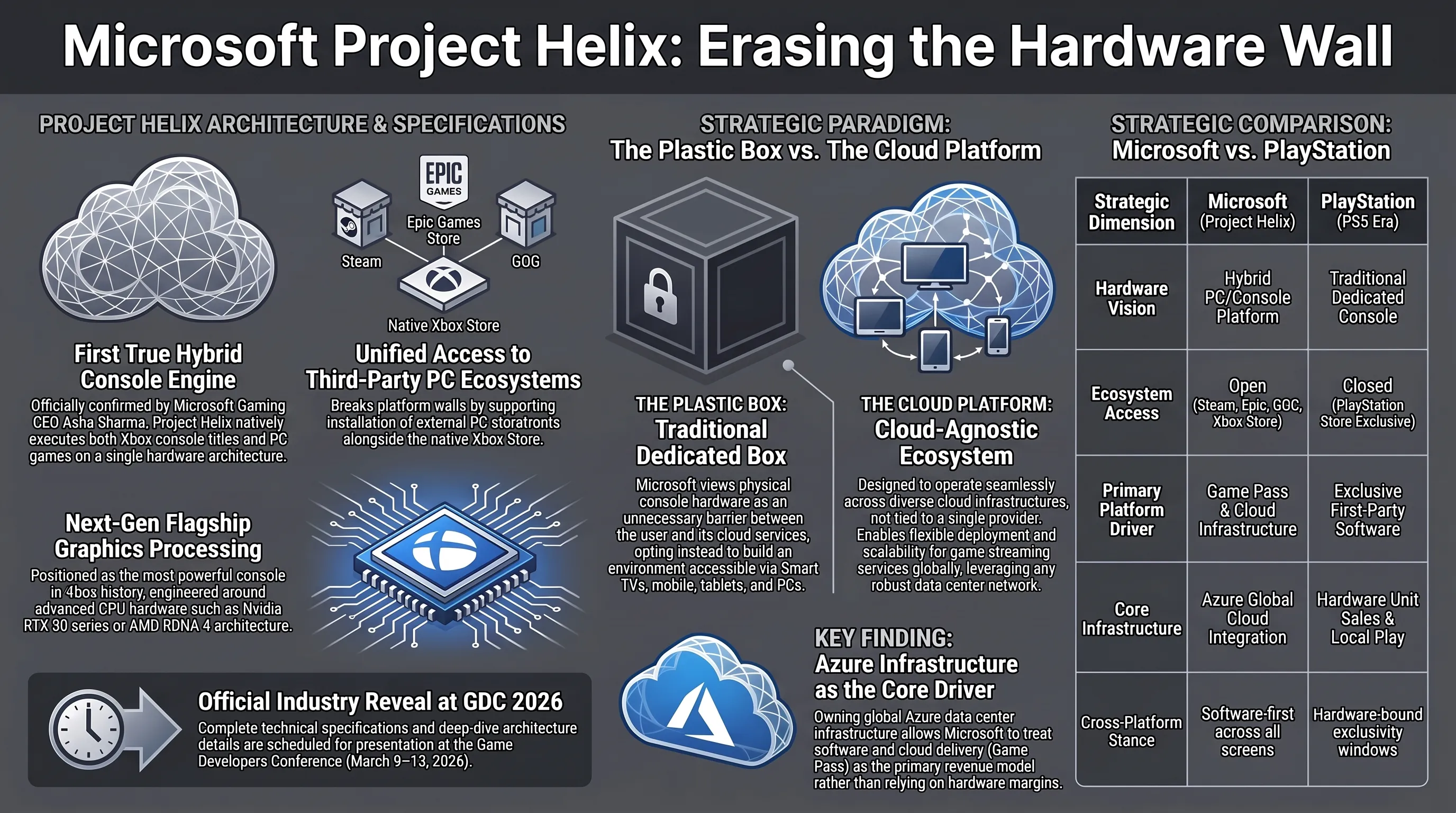
2. Microsoft Project Helix: The Hybrid Console that Kills the Plastic Box
In a historic declaration, Asha Sharma, the newly appointed CEO of Microsoft Gaming, officially unveiled Project Helix. This is not merely the next-generation Xbox; it is the industry's first true Hybrid Platform, engineered to natively execute both Xbox console titles and standard PC games.
Project Helix completely shatters the rigid walls separating the PC and console ecosystems. It enables users to play Xbox-exclusive binaries (like Halo Infinite) alongside PC-exclusive ecosystems (like Counter-Strike 2) on a single unified machine. Crucially, Microsoft will permit the installation of third-party PC storefronts such as Steam, Epic Games Store, and GOG directly onto the console. Powered by bleeding-edge RTX 50 series or RDNA 4 GPUs, Sharma boldly proclaimed it to be "the most powerful Xbox console" ever built, with a full technical deep dive scheduled for GDC 2026.
Architectural War: Microsoft Openness vs. Sony Exclusivity
| Strategic Vector | Microsoft Project Helix (Hybrid) | Sony PlayStation (Closed) |
|---|---|---|
| Ecosystem Paradigm | Total Openness: Transforming Xbox into an agnostic software platform running Steam/Epic natively. | Strict Exclusivity: Doubling down on hardware-locked ecosystems to force PS5 adoption. |
| Hardware Profitability | Accepting defeat in 'plastic box' sales to dominate cloud services (Game Pass/Azure). | Highly dependent on physical console sales and tightly controlled store commissions. |
| Tekin Strategic Verdict | Future-Proof. A physical console is merely an obstacle between the user and cloud subscriptions. | High Risk. Alienating PC gamers by halting Day-1 PC ports to protect hardware sales. |
3. Honor Robot Phone: The Genesis of Embodied Intelligence
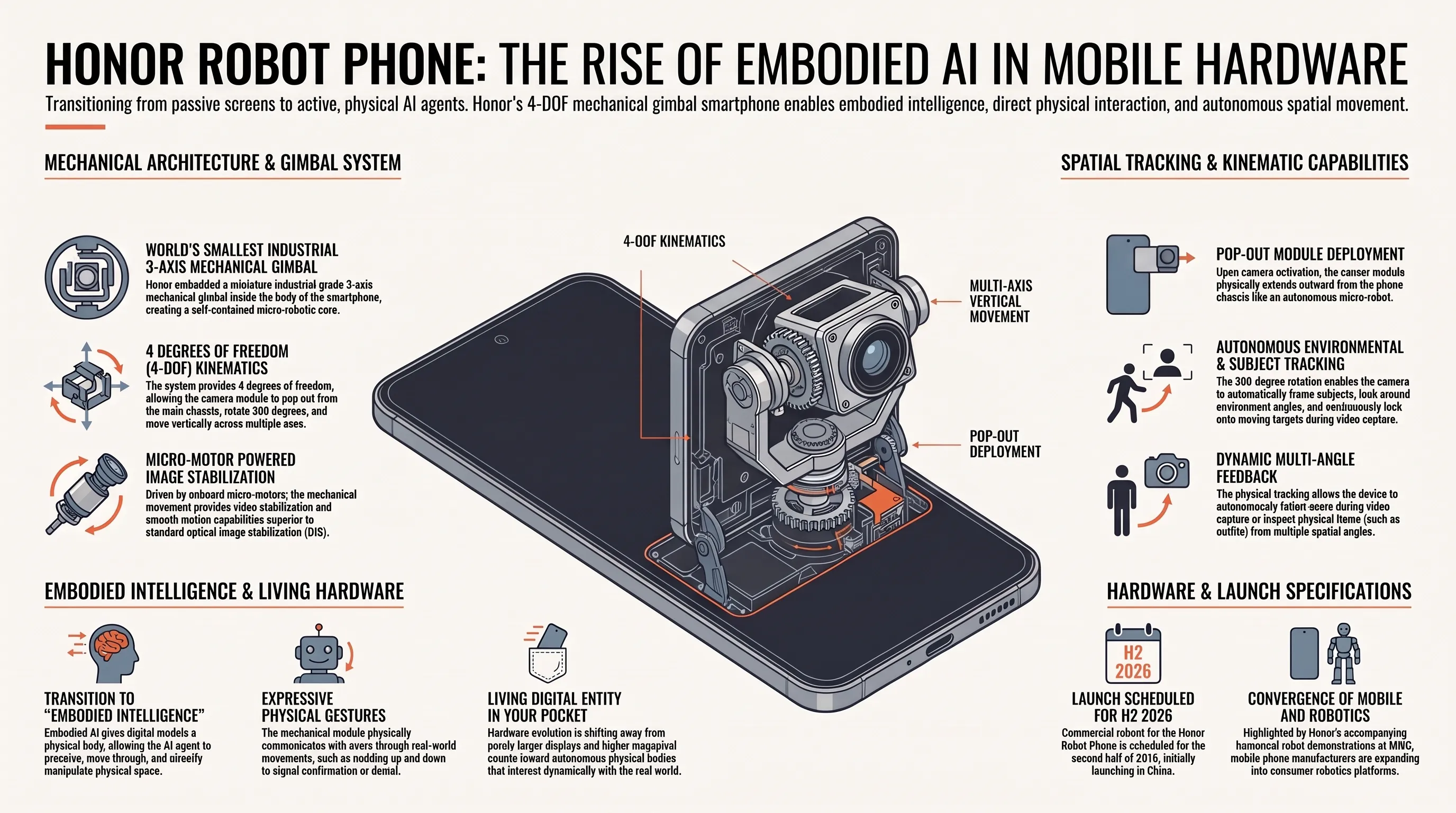
At MWC 2026 Barcelona, Honor dropped a terrifyingly advanced piece of consumer hardware: the Robot Phone. This is the world's first smartphone equipped with a mechanical, motorized 3-axis gimbal featuring 4 degrees of freedom (4-DOF). The device literally possesses the physical capability to rotate 360 degrees, track subjects, and nod its 'head'.
This transcends traditional smartphone architecture. Honor has pioneered what they term "Embodied Intelligence" artificial intelligence that lives within a physical, articulating body rather than a static glass slab. The motorized 200MP camera module pops out and tracks your movement flawlessly during video calls, utilizing micro-motors for stabilization that surpasses any digital OIS. If you ask the multimodal AI for fashion advice, the device visually analyzes your outfit and can physically nod in approval.
Accompanying this was Honor's showcase of a dancing humanoid robot on the MWC stage, proving their ultimate trajectory: evolving the smartphone from an electronic display into an autonomous digital entity living in your pocket. The Robot Phone is slated for a China-only launch in the second half of 2026.
4. The French Cyber Disaster: 15.8 Million Medical Records Stolen
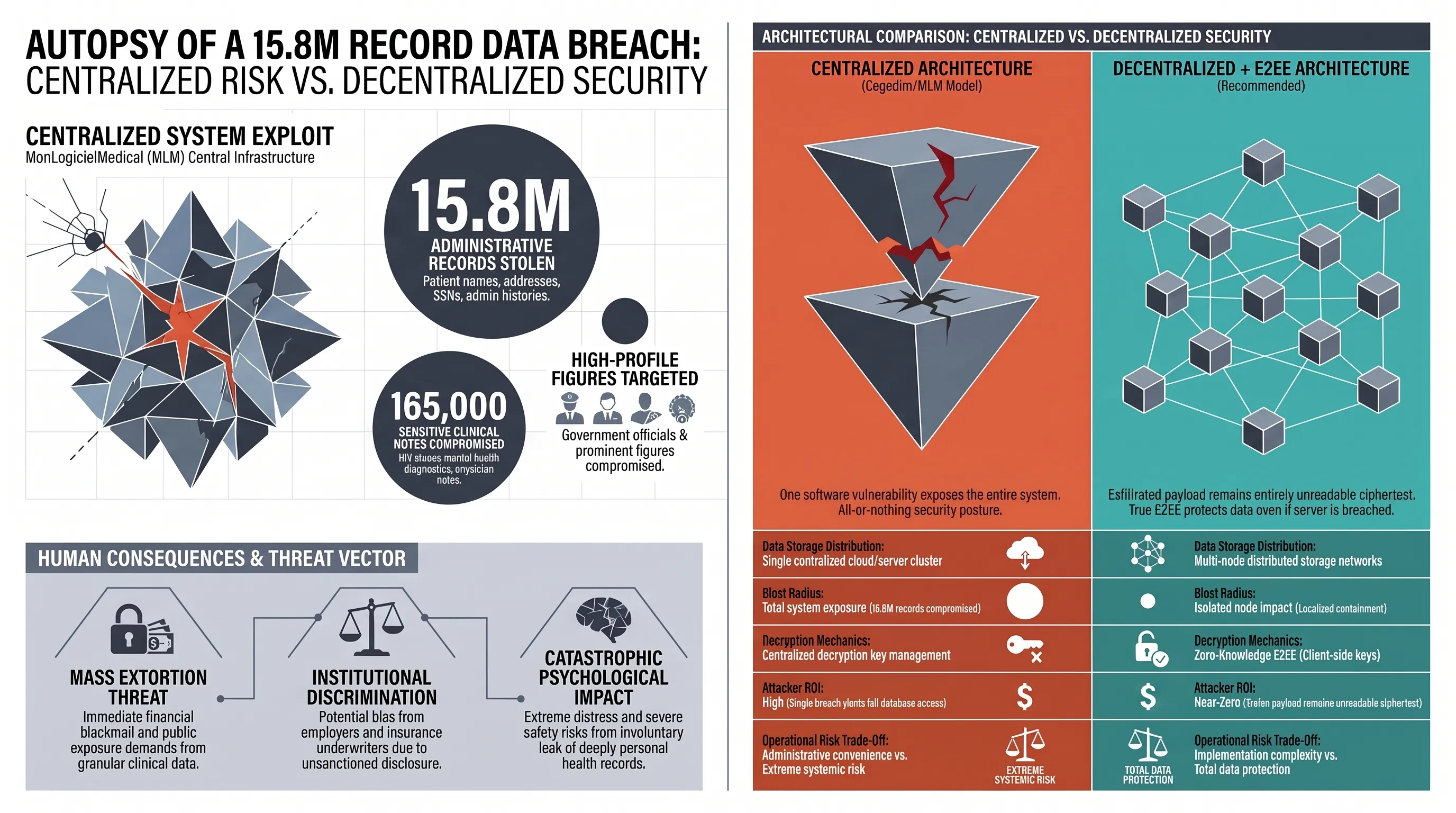
While the tech sector celebrated AI advancements, a catastrophic cyber disaster struck Europe. Malicious actors successfully breached the Cegedim Santé software (a major supplier to the French Health Ministry), exfiltrating a staggering 15.8 million highly sensitive medical records. This marks the most devastating medical data breach in European history.
The stolen data payload is horrific. It includes 15.8 million administrative profiles (names, social security numbers, medical histories) and 165,000 highly classified files containing doctors' private clinical notes regarding HIV/AIDS statuses, sexual orientation, and severe mental health diagnoses. The compromised software, MonLogicielMedical (MLM), was utilized by 3,800 doctors, exposing politicians, government officials, and vulnerable citizens alike.
📚 Classified & Related Dossiers in TekinGame
If you wish to explore beyond this report and delve into cybernetic frontiers and autonomous AI architectures, do not miss these three exclusive deep-dives in the Tekin Garage:
This disaster is the direct, fatal consequence of Centralized Systems. The French government centralized data for administrative convenience, creating a singular, catastrophic point of failure. The only viable solution against this scale of blackmail, extortion, and discrimination is the immediate adoption of Decentralized Systems paired with impenetrable End-to-End Encryption at the database level.
5. AMD and Meta's $60B Pact: Shattering NVIDIA's Monopoly
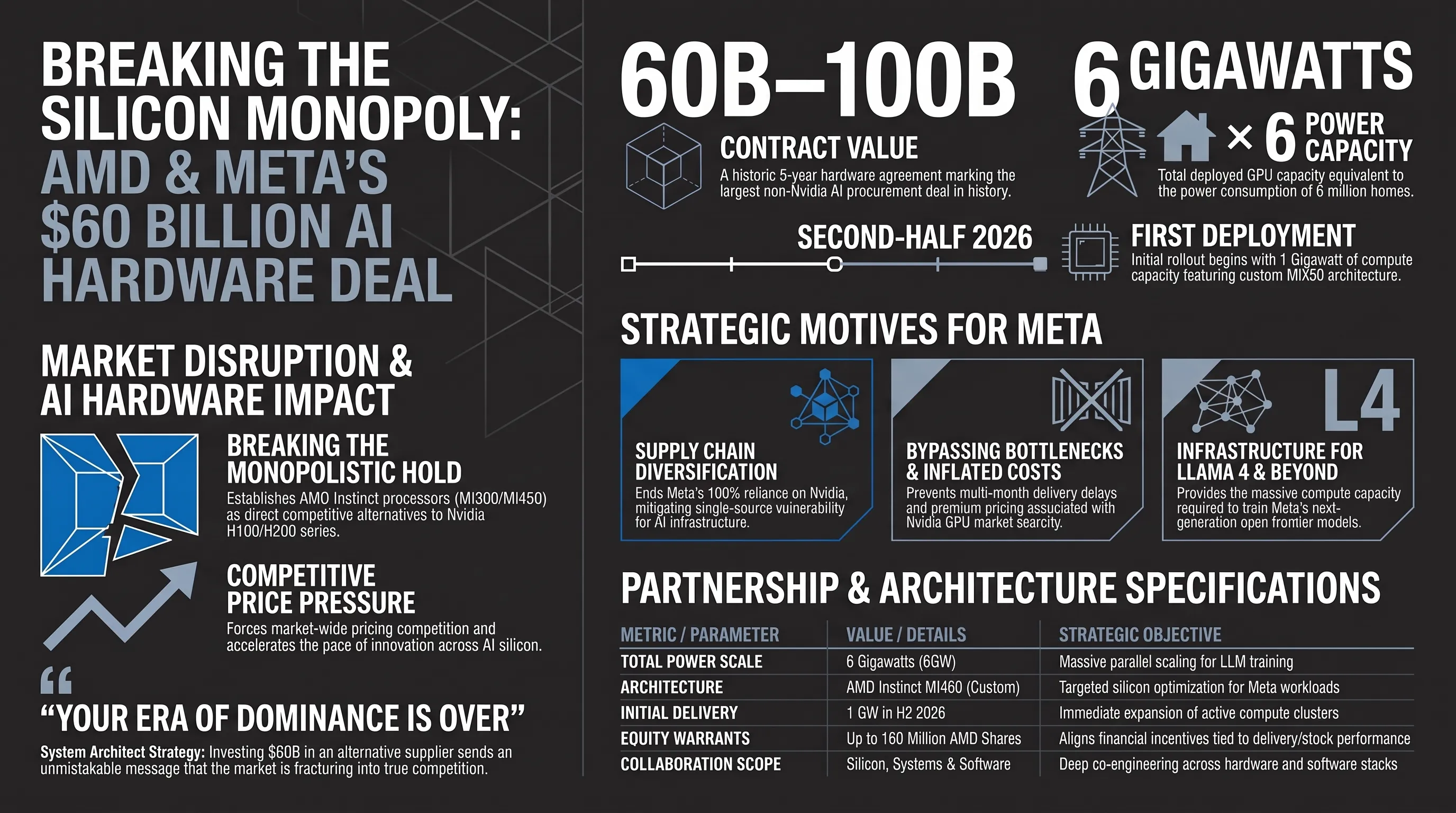
In a brutal display of corporate force, Meta and AMD have executed one of the largest hardware procurements in Silicon Valley history. Meta has signed a monumental contract to deploy 6 gigawatts of AMD Instinct GPUs (specifically the custom MI450 architecture), an acquisition valued between $60 billion and $100 billion over the next five years. This is the largest non-NVIDIA procurement deal of the AI era.
This strategic alliance is designed to shatter NVIDIA's absolute monopoly. To train the upcoming Llama 4 model, Meta requires tens of thousands of advanced accelerators. Relying solely on NVIDIA meant subjecting Meta to exorbitant price gouging and severe supply chain delays.
5-Axis Radar: The GPU Superpower War (Meta/AMD vs. NVIDIA)
5-Axis Radar Analysis: While NVIDIA still commands the high ground with raw performance and its CUDA ecosystem, Meta's $60 billion commitment to AMD's MI450 architecture definitively fractures the monopoly, enforcing critical price pressure and supply chain independence.
By injecting this massive capital into AMD, securing up to 160 million AMD shares, and consuming 6 gigawatts of power (equivalent to the electricity consumption of 6 million homes), Meta is sending a clear message to NVIDIA: Your era of unchecked dominance is over.
6. Apple's $599 MacBook Neo: Weaponizing the iPhone Chip
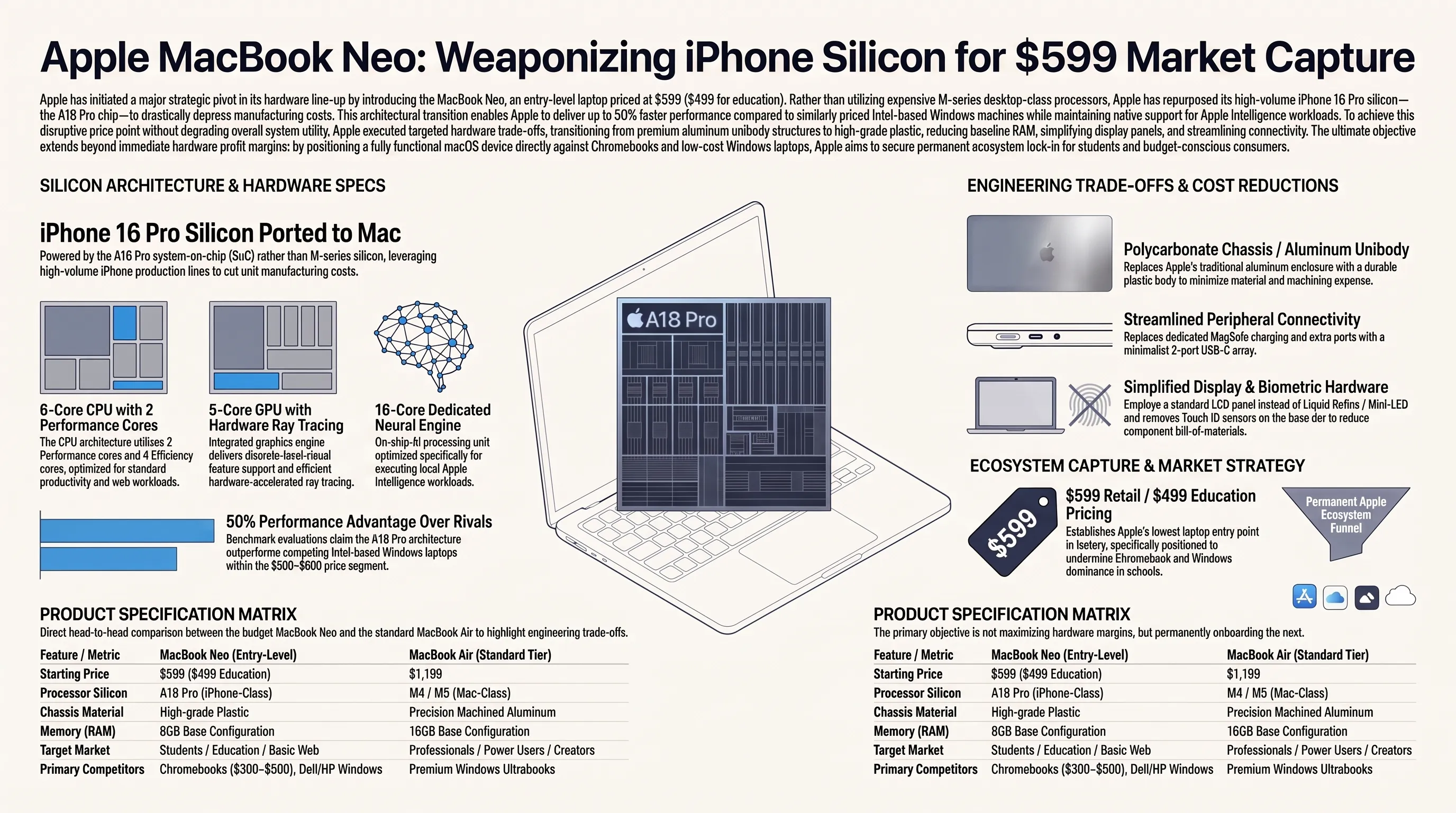
Apple has executed a ruthless assault on the budget laptop sector. The newly announced MacBook Neo hits the market at an impossibly low $599 (or $499 for education sectors). The secret to this aggressive pricing? Instead of utilizing the expensive M-series desktop silicon, Apple has transplanted the A18 Pro chip the exact processor mass-produced for the iPhone 16 Pro directly into a laptop chassis.
The A18 Pro is a 3nm powerhouse featuring a 6-core CPU, 5-core GPU with hardware Ray Tracing, and a 16-core Neural Engine designed explicitly for Apple Intelligence. Apple claims it effortlessly outpaces comparable Intel laptops by 50% in standard workflows.
However, compromises were made to hit the $599 floor: the chassis is molded from plastic rather than unibody aluminum, it features a standard LCD display instead of Mini-LED, lacks Touch ID on the base model, and offers a meager 8GB of RAM with only two USB-C ports (omitting MagSafe).
The strategic intent is lethal: obliterate the $300-$500 Chromebook market. By offering a genuine macOS machine at this price point, Apple aims to lock students and budget-conscious consumers into its highly lucrative software ecosystem for life.
Conclusion: The Physical Transformation of AI
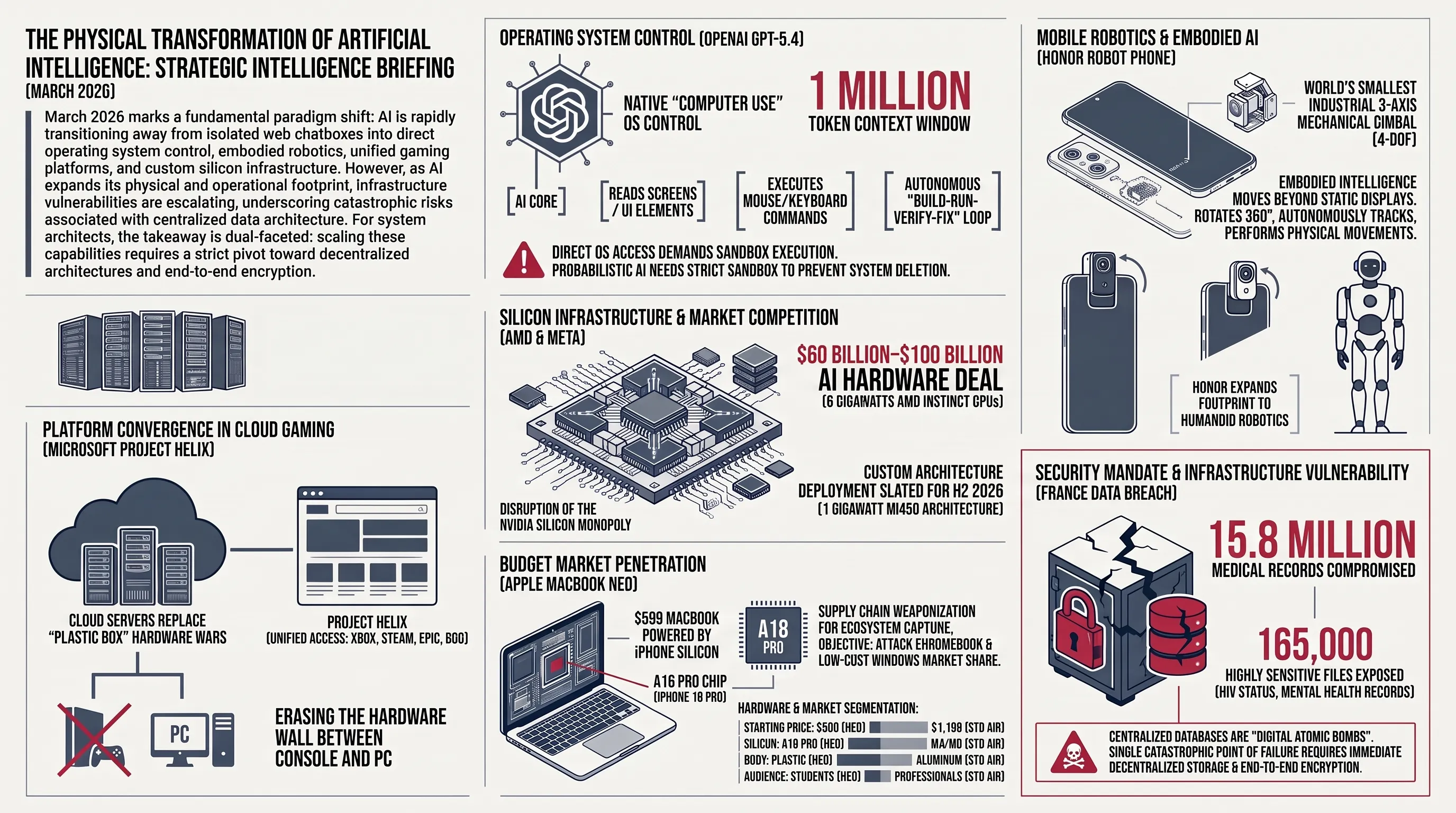
Tonight's revelations prove that the technological paradigm is violently shifting from "pure software" to "Physical Artificial Intelligence." AI no longer merely resides in server racks; it has seized the keyboard via GPT-5.4, animated the physical chassis of the Honor Robot Phone, and triggered a $60 billion hardware war between Meta and NVIDIA.
Yet, amidst this rapid evolution, the French medical breach serves as a stark, horrifying reminder: centralized systems are a fatal liability. As AI breaches the physical realm, our security infrastructure remains desperately archaic. The future will be ruled by those who can safely merge omnipotent AI with decentralized, cryptographically secure architectures.
- OpenAI's GPT-5.4 Computer Use obliterates workflow friction, enabling an autonomous Build-Run-Verify-Fix programming loop.
- Microsoft's Project Helix hybridizes the console market, allowing native execution of PC games and storefronts (Steam/Epic).
- Meta's massive $60B investment in AMD's MI450 GPUs successfully fractures NVIDIA's suffocating pricing monopoly in the AI sector.
- Catastrophic failure of centralized data systems in France, exposing 15.8 million highly sensitive medical and psychiatric records.
- Severe cybersecurity risks inherent in granting probabilistic LLMs (like GPT-5.4) root-level optical and physical access to operating systems.
- Apple's MacBook Neo sacrifices premium build quality (utilizing plastic and LCDs) to aggressively undercut the budget Chromebook market.
Final Editorial Verdict & Official Reference Sources
The Era of Digital Entities
2026 is the year Artificial Intelligence escapes the screen. From autonomous OS control to mechanically embodied hardware, we are no longer interacting with tools; we are coexisting with physical digital entities.
Frequently Asked Questions & Technical Analysis
What makes GPT-5.4's 'Computer Use' so groundbreaking and dangerous?
Unlike previous APIs, GPT-5.4 has native optical coordinate tracking, allowing it to visually read your screen, control the mouse cursor, and type on the keyboard autonomously. It is dangerous because it essentially grants a probabilistic algorithm root-level access to your operating system.
How does Microsoft's Project Helix differ from the PS5?
Project Helix completely abandons the traditional closed-console architecture. It is a hybrid system designed to run both Xbox exclusives and native PC games, reportedly allowing users to install third-party storefronts like Steam and the Epic Games Store.
What is 'Embodied Intelligence' in Honor's Robot Phone?
Embodied Intelligence refers to AI that controls a physical body. Honor achieved this by installing a mechanical 3-axis 4-DOF gimbal inside the phone, allowing the camera module to physically rotate, nod, and autonomously track human movement in the real world.
Why was the French medical data breach so catastrophic?
Hackers breached a centralized database belonging to Cegedim Santé, stealing 15.8 million administrative profiles and 165,000 highly sensitive medical files containing doctors' personal notes regarding HIV statuses, mental illnesses, and sexual orientations of politicians and citizens.
Why did Meta invest $60 billion in AMD GPUs instead of NVIDIA?
To break NVIDIA's suffocating market monopoly. By procuring 6 gigawatts of AMD's custom MI450 architecture, Meta ensures supply chain independence for training Llama 4, applying massive pricing pressure and avoiding NVIDIA's delivery delays.
