When a Nation Lost Its Property Records: The ANCPI Cyberattack
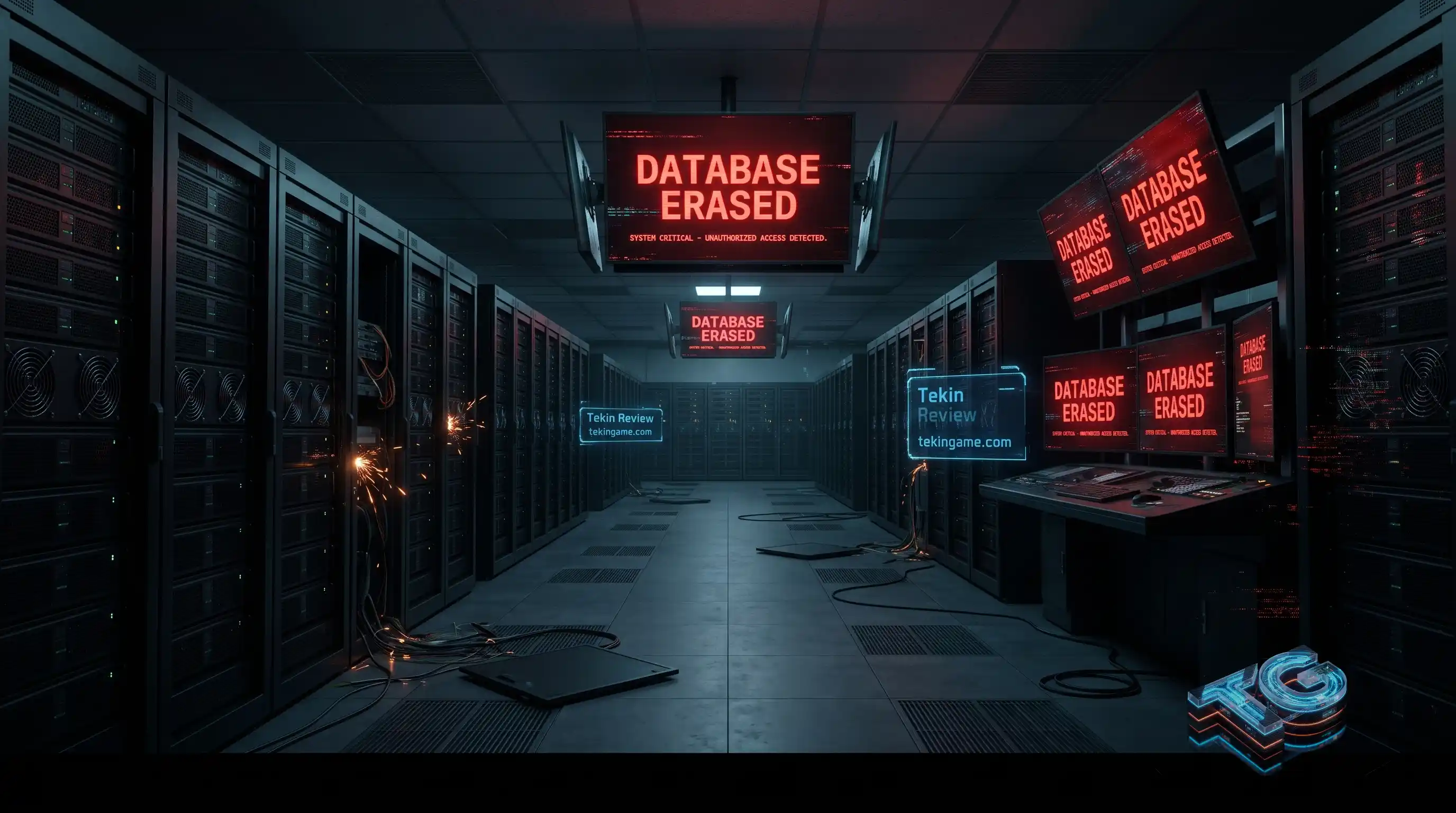
- 🎮Total Annihilation- ANCPI's entire database and online backups were deleted
- 🎧Market Paralysis- No real estate transactions possible across Romania
- 🚀Identified Perpetrator- Zakaria Mahdjoub from Oran, Algeria confirmed as attacker
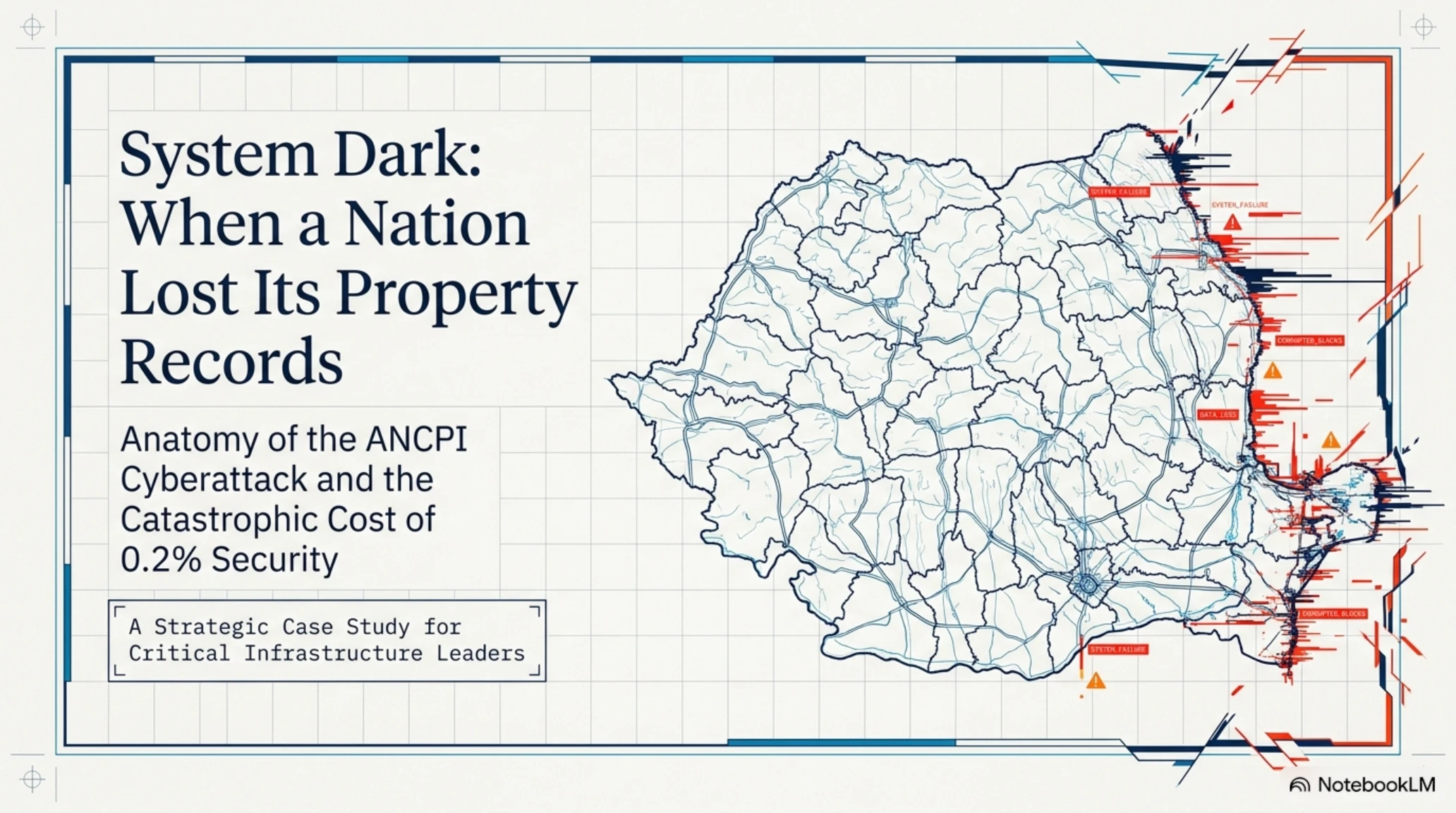
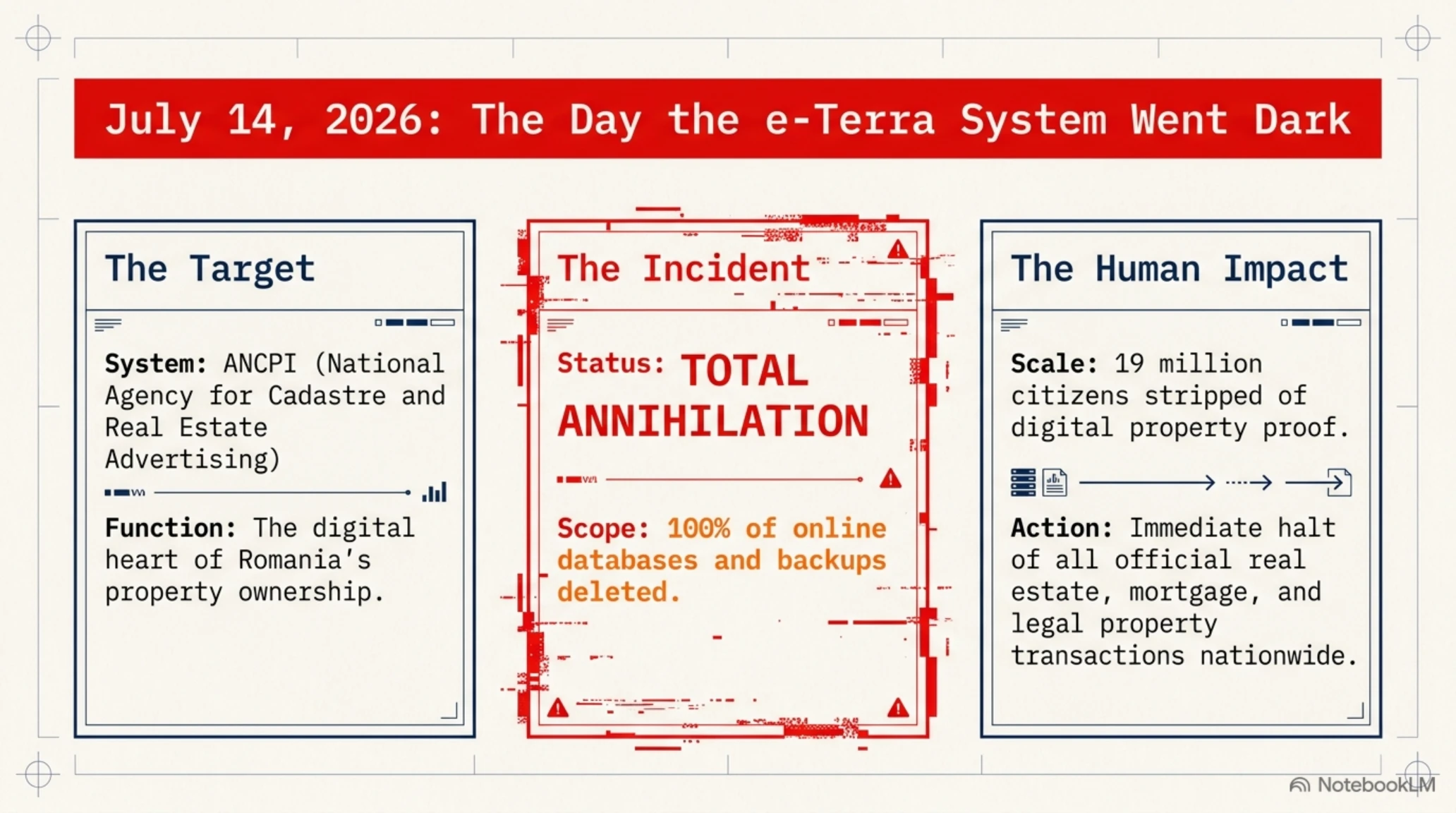
On July 14, 2026, one of the most catastrophic cybersecurity nightmares for a government became reality. Romania, a European nation of approximately 19 million people, suddenly discovered that its entire land registry and property registration system had been destroyed. This wasn't a simple data breach, nor a routine ransomware attack—it was the complete and deliberate deletion of all property ownership records across the entire country. Millions of citizens could no longer prove they owned their homes, land, or other real estate.
ANCPI: The Digital Heart of Romanian Property Ownership
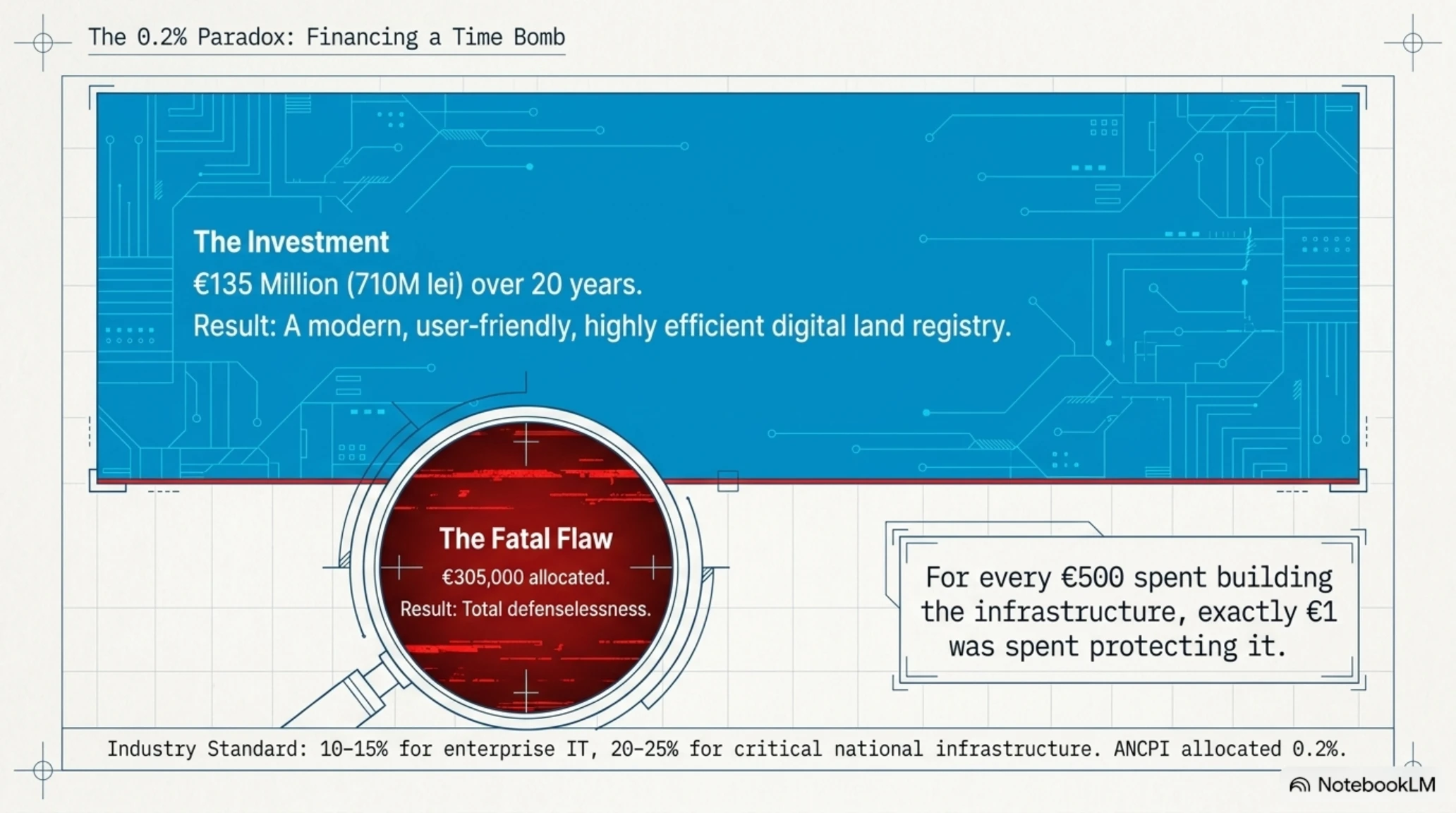
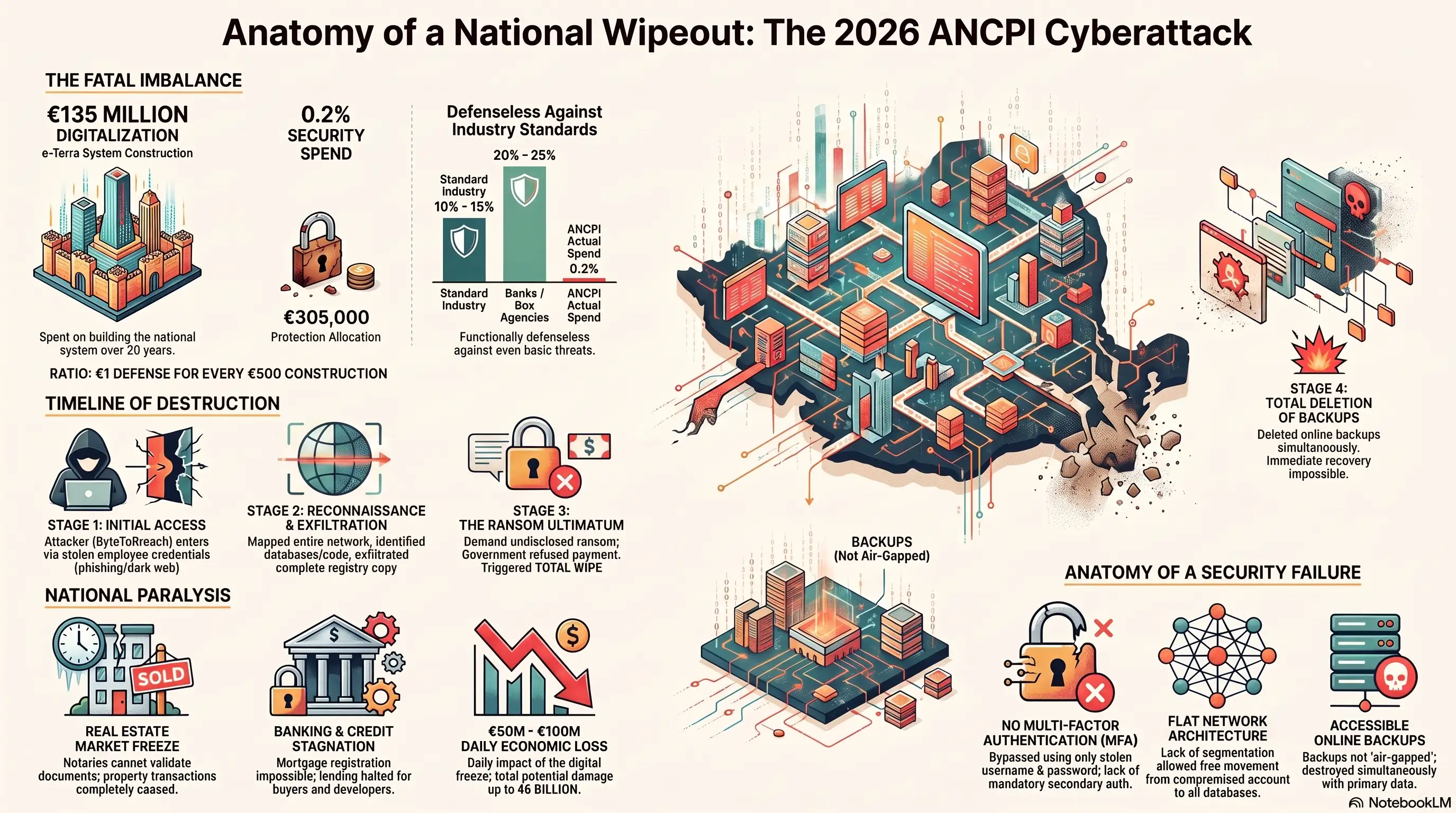
The National Agency for Cadastre and Real Estate Advertising, or ANCPI (Agenția Națională de Cadastru și Publicitate Imobiliară), is the institution responsible for managing all land registry records, property ownership information, cadastral maps, and geographical data in Romania. Over the past 20 years, this organization had invested more than 710 million Romanian lei (approximately €135 million) in digitalizing its systems.
Every day, hundreds of notaries, lawyers, cadastral specialists, and ordinary citizens relied on the e-Terra system—ANCPI's online platform—to obtain property certificates, register transactions, and verify the legal status of real estate. Without this system, no official property transaction could be completed in Romania. And on July 14, 2026, this system suddenly went dark.
Understanding Cadastre Systems
First Signs: "Technical Issue" or Something Worse?
Initially, ANCPI characterized the incident as a "major technical problem." The official statement made no mention of a cyberattack, only referring to "system disruptions." But within 24 hours, the horrifying truth emerged: this was a targeted, destructive attack.
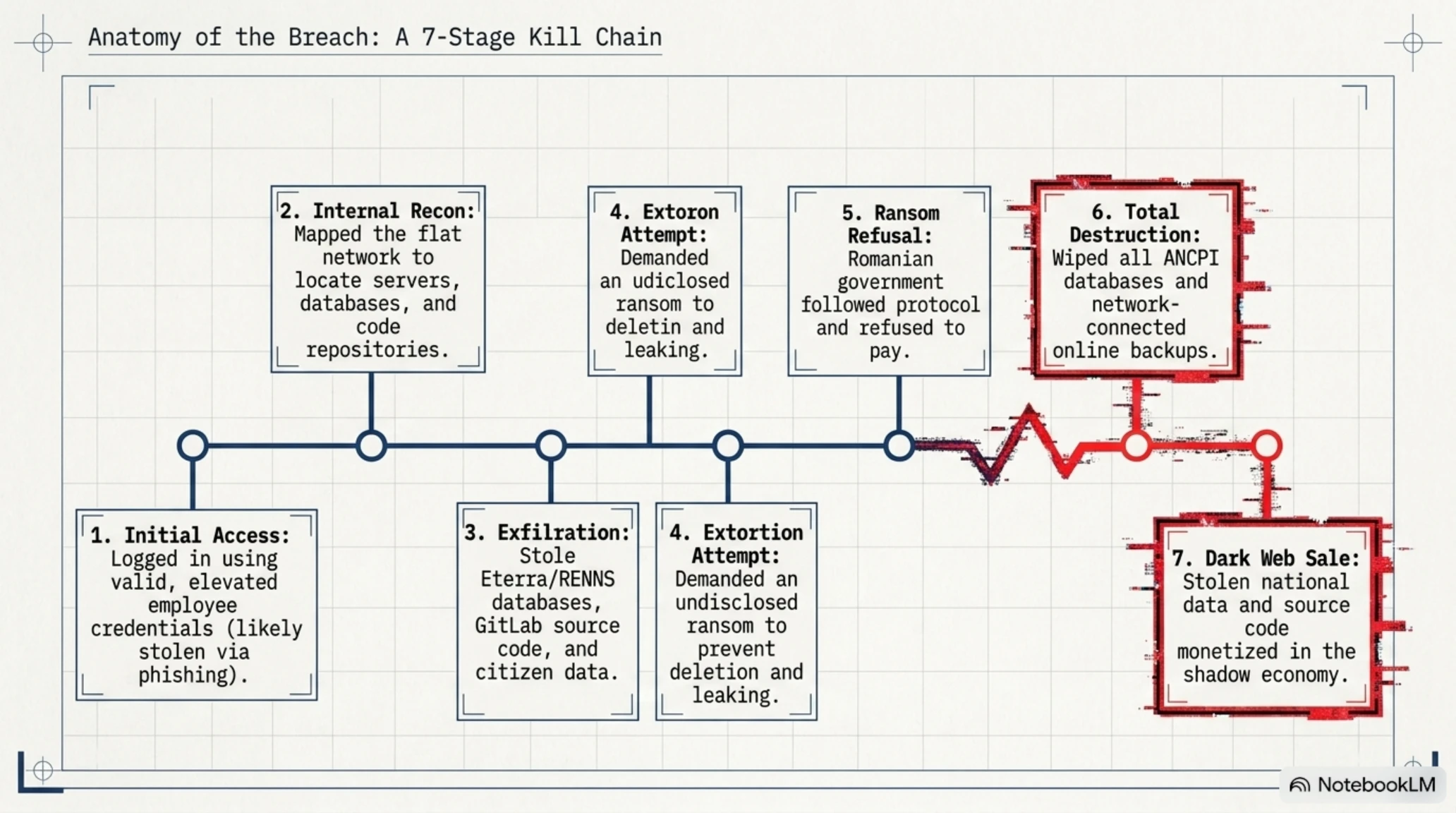
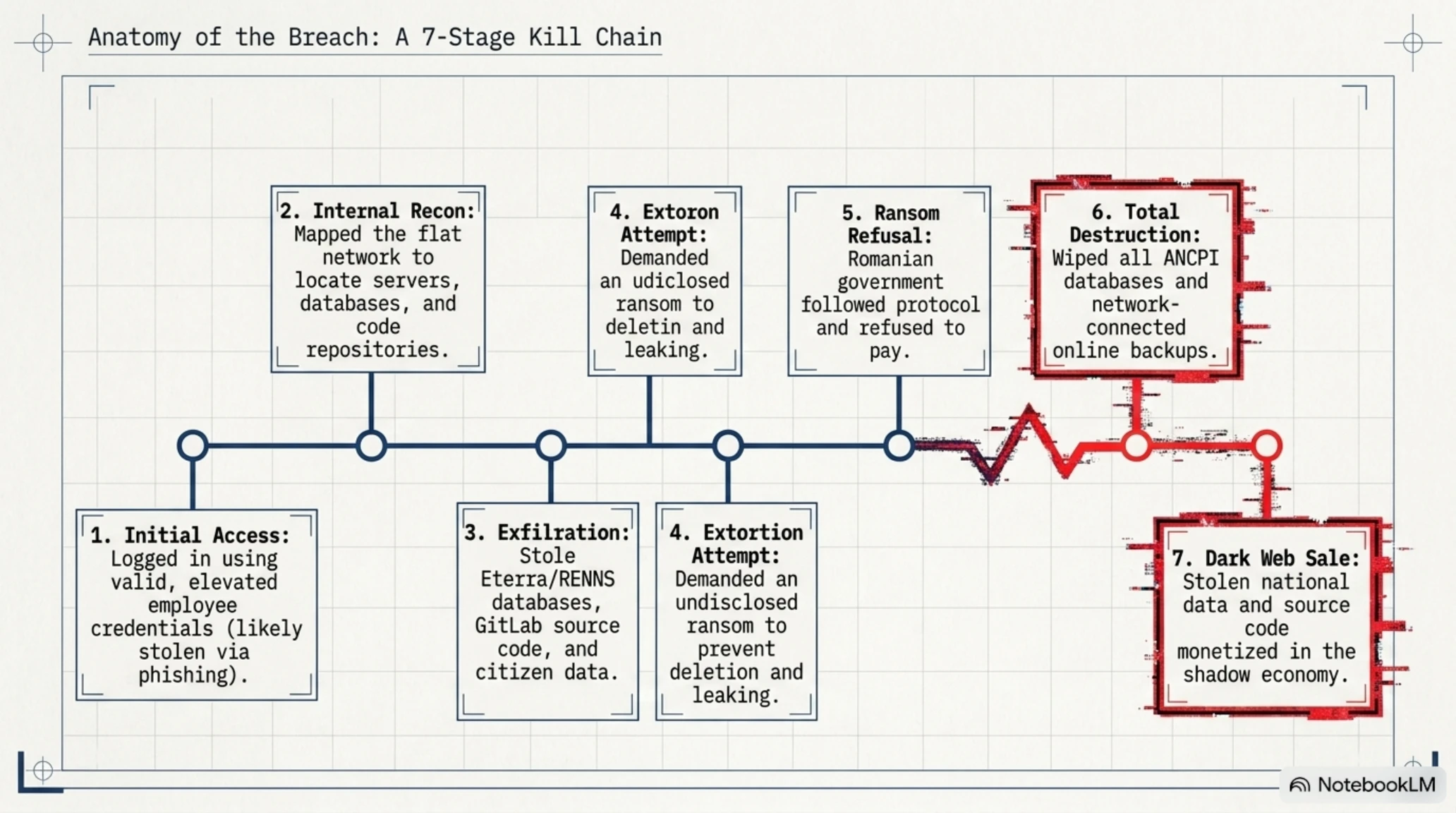
On July 15, 2026, an account on a dark web forum with the username ByteToBreach published a post titled "[RO] Thy arss shall be spanked, Romania! [ANCPI]". In this post, the hacker claimed to possess not only data on Romanian citizens from various ANCPI databases, but also a complete copy of GitLab servers containing the source code for all their systems—including Eterra and RENNS. He also mentioned his "little ransomware program."
ByteToBreach: The Algerian Hacker with a Distinguished Track Record
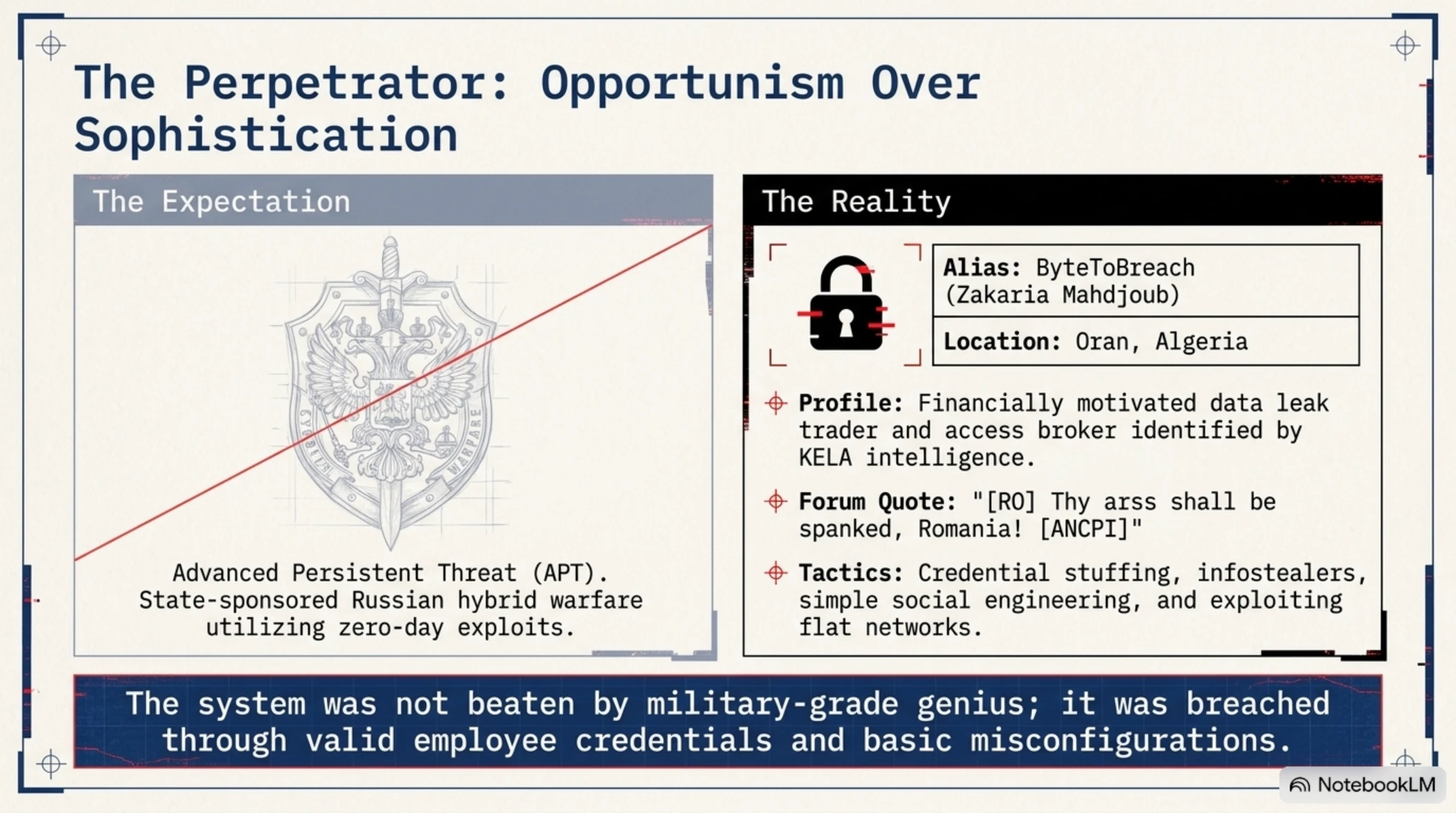
KELA, a cybersecurity company specializing in tracking dark web activities, quickly identified ByteToBreach. According to KELA's investigation, the hacker is Zakaria Mahdjoub, a resident of Oran, Algeria. He is a financially motivated data leak trader and access broker whose activities can be traced back at least to June 2025.
ByteToBreach has a history of attacking major corporations and government organizations. One of his most notable attacks was the breach of Sweden's e-government portal earlier in 2026. He has also targeted airlines, banks, and government agencies worldwide, selling their sensitive data on dark web forums.
His tactics include exploiting cloud and corporate infrastructure vulnerabilities, credential reuse obtained through phishing or infostealer malware, and leveraging misconfigured access points. In ANCPI's case, he gained network access using valid employee credentials—a clear indication of the organization's severe security weaknesses.
Attack Mechanism: How Did a Country Lose Its Property Records?
Based on published security analyses, the attack unfolded in several precise stages:
The ANCPI Attack Timeline
National Catastrophe: When a Country's Real Estate Market Stops
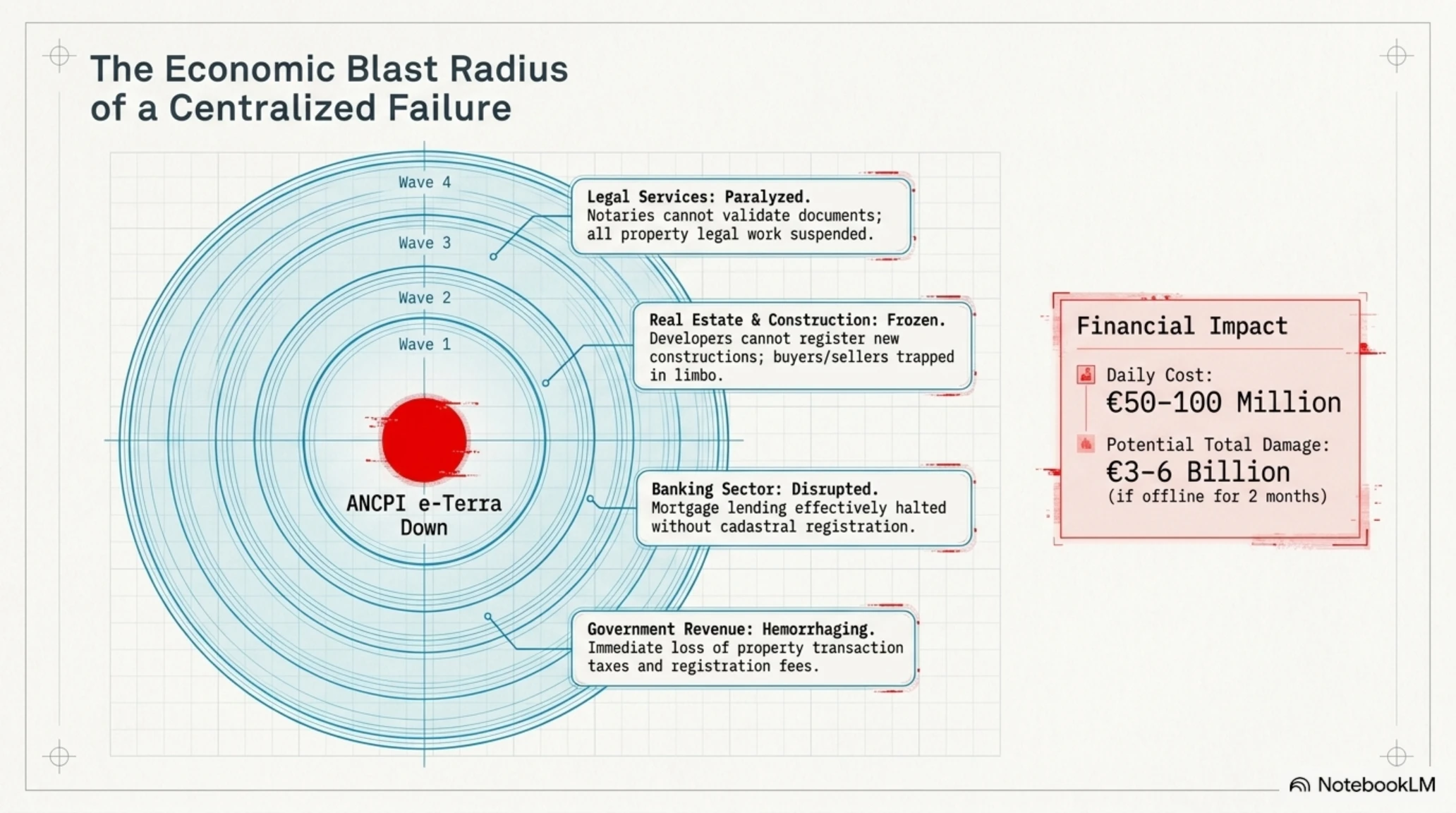
The consequences were immediate and devastating. The e-Terra system, the heart of all Romanian property transactions, completely ceased functioning. Without access to this system:
- Notaries cannot validate documents: Every official property transaction in Romania requires notarial validation, which necessitates verifying the property's legal status through e-Terra. Without this system, no validation is possible.
- Banks cannot register loans: Mortgage registration for housing loans requires cadastral system registration. The lending process completely halted.
- Buyers and sellers in limbo: Thousands of in-progress transactions suddenly stopped. People planning to buy or sell homes were trapped in legal uncertainty.
- No property certificates issued: Even for simple tasks like proving ownership for services or informal transactions, no documentation could be issued.
The attack's timing also appears deliberate. The incident occurred in the final days of a government program that guaranteed lower value-added tax rates for certain new homes. Many buyers were rushing to finalize transactions before the program ended, but the cyberattack eliminated that possibility.
The €135 Million Investment with 0.2% for Security
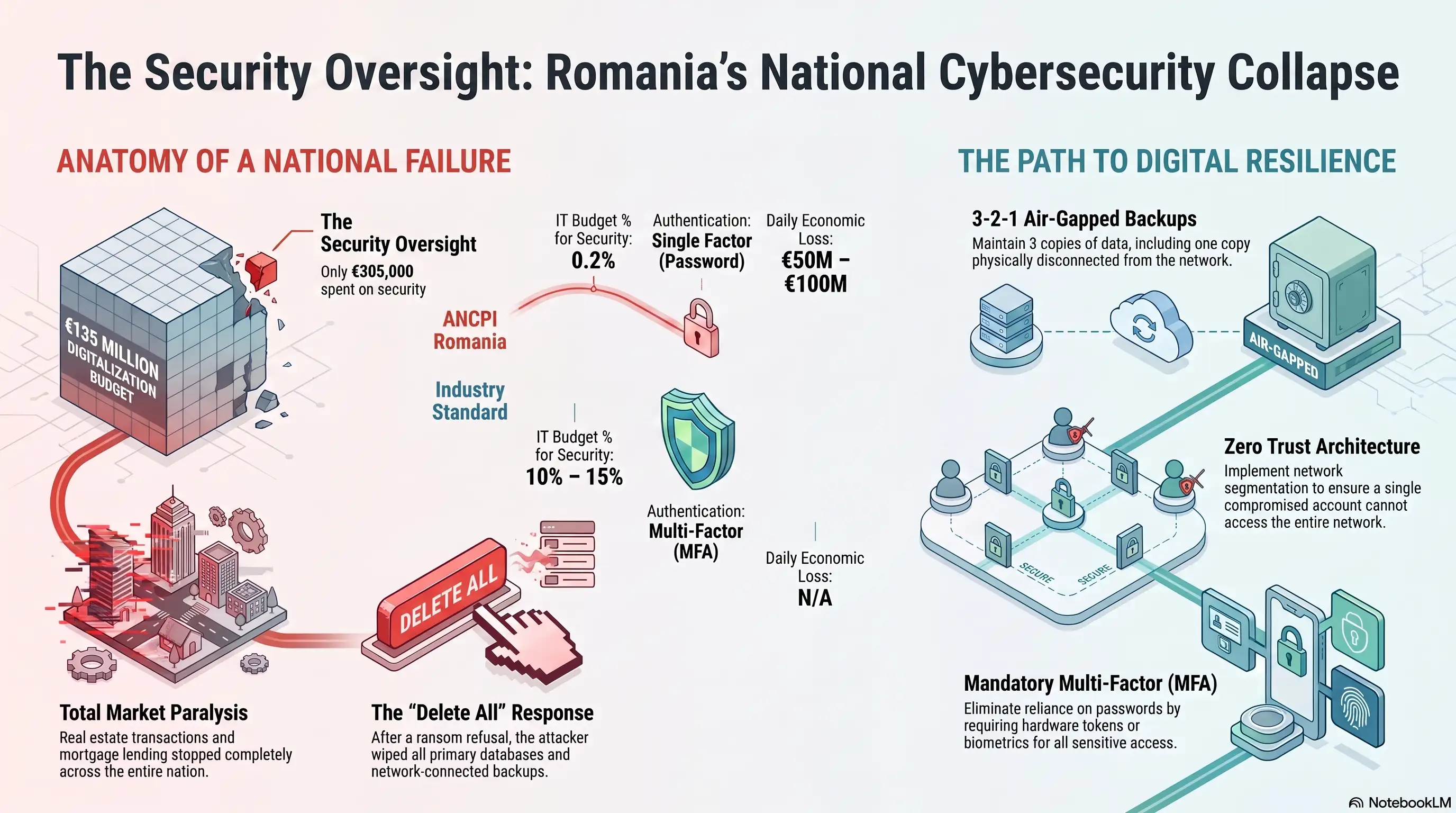
One of the most shocking aspects of this incident was the revelation of ANCPI's negligible cybersecurity investment. According to Ziarul Financiar newspaper, the organization had spent 710 million Romanian lei (approximately €135 million) on digitalization over the past 20 years. But from this enormous sum, only 0.2%—about 1.6 million lei (€305,000)—had been allocated to cybersecurity!
This means for every €500 spent building digital systems, only €1 was spent protecting them. This catastrophic ratio demonstrates that ANCPI and the Romanian government viewed security as an "optional expense" rather than a fundamental necessity.
By comparison, industry standards recommend allocating at least 10-15% of IT budgets to cybersecurity. Sensitive organizations like banks and government agencies invest even more—sometimes 20-25%. At 0.2%, ANCPI was essentially defenseless.
Security Investment Comparison
- Industry Standard: 10-15% of IT budget
- Financial Institutions: 20-25% of IT budget
- Government Critical Infrastructure: 15-20% of IT budget
- ANCPI Romania: 0.2% of IT budget ⚠️ (Critical)
Romanian Government Response: Between Denial and Reality
In the initial days, ANCPI's official position was confusing and contradictory. At first, the organization insisted this was merely a "technical problem" and that data remained secure. But on July 20, six days after the attack, ANCPI announced that technical and legal databases had not been affected—a statement in blatant contradiction with reports circulating on the dark web and the actual experience of users who couldn't access the system.
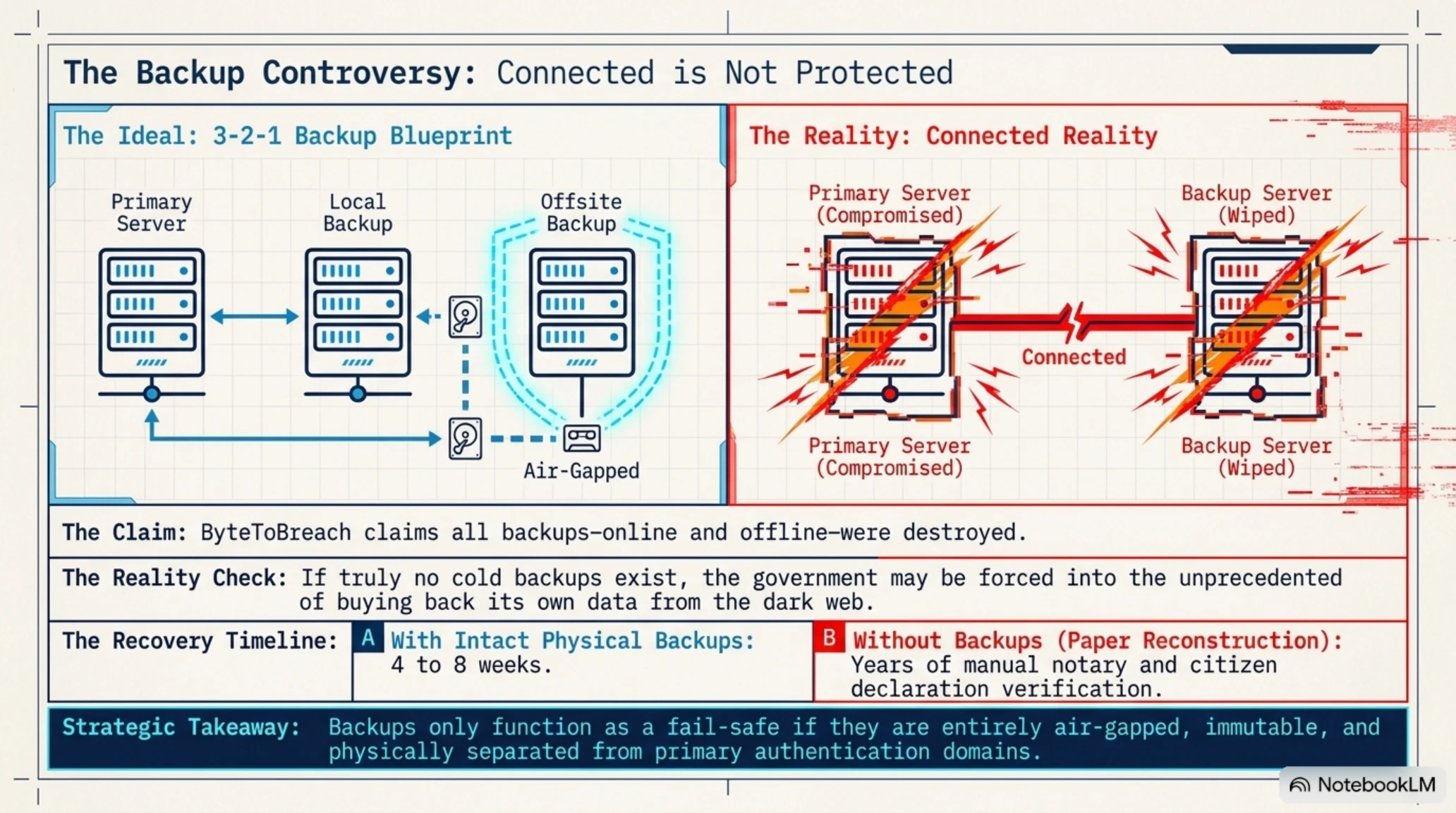
Romanian authorities were ultimately forced to acknowledge reality: this was a cyberattack, and systems needed to be rebuilt from scratch. But the crucial question remained: did offline backups exist?
The Offline Backup Controversy
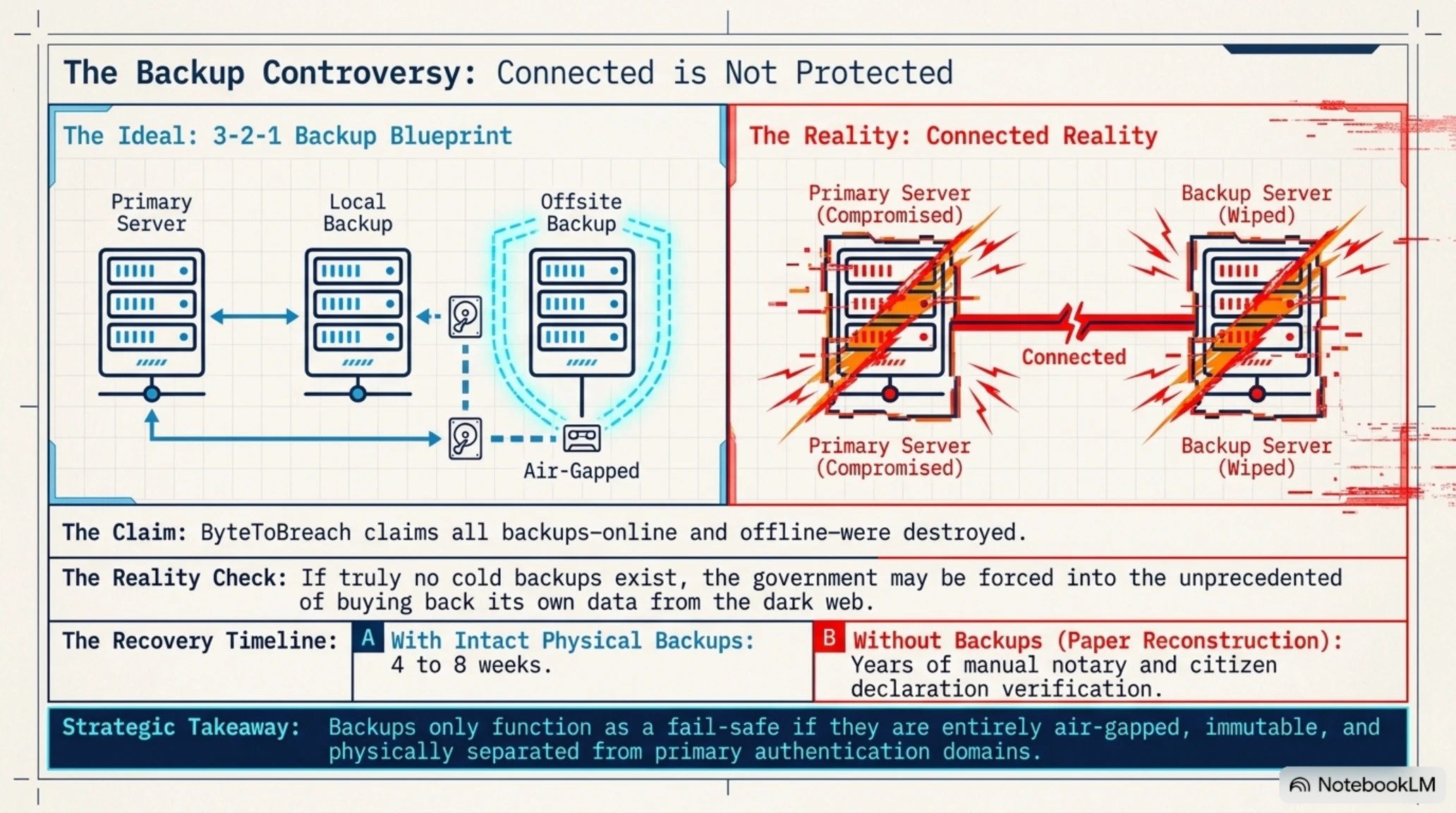
Romanian officials stated that "physical offline backups" are stored in separate, redundant locations and that this security architecture would enable gradual system recovery. However, this process would take weeks, possibly months.
Why ANCPI Was an Easy Target: Anatomy of a Security Failure
Examining the attack methodology and published statistics reveals several fundamental security weaknesses in ANCPI's infrastructure. These vulnerabilities didn't emerge suddenly—they were the result of years of systematic negligence in cybersecurity investment and policy.
Critical Weakness 1: No Multi-Factor Authentication (MFA)
The fact that ByteToBreach could access the entire network using stolen credentials indicates that ANCPI lacked mandatory MFA for privileged access. Modern security protocols require at least two authentication factors—something you know (password) and something you have (authenticator app, hardware token) or something you are (biometrics). ANCPI apparently relied solely on username-password combinations, making credential theft the only barrier between attackers and complete system access.
Critical Weakness 2: Network Segmentation Failure
A properly architected network separates critical systems into isolated segments with strict access controls between them. ByteToBreach's ability to map the entire network and access all databases from a single compromised account suggests ANCPI had little to no network segmentation. Once inside, the hacker had a "flat network" where everything was accessible.
Critical Weakness 3: Accessible Online Backups
Perhaps the most catastrophic failure: backup systems were accessible from the primary network. In proper backup architecture, critical backups should be air-gapped (physically disconnected) or protected by separate authentication systems. The hacker's ability to delete backups alongside primary data indicates they were stored on network-accessible systems—defeating the entire purpose of backups.
Critical Weakness 4: Absence of Security Monitoring
The attack likely took days or even weeks to execute fully—reconnaissance, data exfiltration, and final destruction don't happen instantaneously. The lack of detection suggests ANCPI had no Security Information and Event Management (SIEM) system or Security Operations Center (SOC) actively monitoring for suspicious activities. Massive data transfers and systematic database access should have triggered alerts.
Critical Weakness 5: Inadequate Employee Security Training
Credential theft typically occurs through phishing, infostealer malware, or social engineering. The successful compromise suggests employees lacked adequate training to recognize and report suspicious emails, links, or requests for credentials.
- €135 million invested in digitalization
- Modern, user-friendly e-Terra system
- Extensive online access for notaries and citizens
- Significant progress in digital mapping of national territory
- Centralized system for efficient transaction processing
- Only 0.2% of budget allocated to cybersecurity
- No Multi-Factor Authentication for sensitive access
- Online backups accessible from main network
- Insufficient employee security training
- No network segmentation for critical systems
- Inadequate backup encryption
- Absence of detection systems for suspicious activity
- No incident response plan
- Years of accumulated security debt
ByteToBreach's Tactics: Opportunistic, Not Sophisticated
It's crucial to understand that ByteToBreach is not a sophisticated state-sponsored hacker using zero-day exploits and advanced persistent threat (APT) techniques. He's an opportunistic cybercriminal who exploits basic security failures. His tactics include:
Infostealer Malware Distribution: Malware that steals credentials saved in browsers and applications. These credentials are later sold on dark web marketplaces or used directly for unauthorized access.
Credential Stuffing and Password Reuse: Many employees use the same password across multiple services. If one service experiences a breach, those credentials can be used to access corporate systems.
Exploitation of Misconfigurations: Many of his attacks exploit not complex vulnerabilities, but simple misconfigurations—open RDP access, cloud services without strong authentication, or backups accessible from the main network.
Basic Social Engineering: Phishing emails that impersonate internal IT services and ask employees to "verify" their passwords.
The ANCPI breach succeeded not because of ByteToBreach's brilliance, but because of ANCPI's profound negligence. A properly secured system would have stopped him at multiple layers: MFA would have made stolen credentials useless, network segmentation would have limited his access, monitoring systems would have detected suspicious activity, and air-gapped backups would have enabled rapid recovery.
Russia's Role? Conspiracy Theories vs. Evidence
In the immediate aftermath, some media outlets and European officials quickly pointed fingers at Russia. Romania, as a NATO member and strong Ukraine ally, seems like a logical target for Russian hybrid warfare. But what does the actual evidence say?
ByteToBreach, in interviews with Romanian media, explicitly stated his motivation was financial, not political. He's a cybercriminal with a long history of selling data on dark web forums, not a state actor. KELA confirmed that ByteToBreach is an independent, financially motivated operator active in underground forums.
Analysis: Was This a Political Attack?
- Clear financial motive: ByteToBreach first attempted extortion, then listed data for sale
- Criminal track record: He has attacked dozens of companies and organizations across different countries, not just political targets
- Lack of APT sophistication: The attack used simple methods like credential theft, not advanced state-sponsored techniques
- Exposed identity: States typically don't make their hackers easily identifiable
- Opportunistic targeting: ANCPI appears to have been targeted due to weak security, not geopolitical importance
📚 Classified & Related Dossiers in TekinGame
If you wish to explore beyond this report and delve into cybernetic frontiers and autonomous AI architectures, do not miss these three exclusive deep-dives in the Tekin Garage:
However, we cannot entirely dismiss the possibility of indirect state exploitation of such attacks. Even if ByteToBreach is an independent actor, the stolen information could be purchased by intelligence services and used for geopolitical purposes. This is a gray zone in modern cyber warfare.
Economic Impact: The Cost of Digital Paralysis
The financial damage from this attack extends far beyond ANCPI's reconstruction costs. Every day the system remains offline, hundreds of millions of euros in real estate transactions are delayed. The ripple effects touch multiple sectors:
Real Estate Market Freeze: Property developers cannot register new constructions. Existing projects are stalled. Investors cannot purchase land. The entire market is in suspended animation.
Banking Sector Disruption: Mortgage lending has effectively stopped. Banks cannot register liens on properties without cadastral system access. This affects not just home buyers, but also the broader credit market.
Construction Industry Slowdown: New building projects cannot proceed without proper land registration. Construction companies face project delays and financial losses.
Legal Services Paralysis: Notaries, lawyers, and legal professionals specializing in real estate law cannot provide services. Many face revenue loss and potential business closures.
Government Revenue Loss: Property transaction taxes, registration fees, and related government revenues have ceased. The treasury is losing millions daily.
Conservative estimates suggest the daily economic impact exceeds €50-100 million when accounting for delayed transactions, lost productivity, and downstream effects. If the system remains offline for two months, total economic damage could exceed €3-6 billion—far more than the ransom ByteToBreach originally demanded.
Dark Web Data Sales: The Shadow Economy of Stolen Information
After destroying ANCPI's systems, ByteToBreach listed the stolen data for sale on dark web forums. This data includes:
- Personal information of millions of Romanian citizens (names, addresses, national ID numbers)
- Complete property details (precise locations, dimensions, valuations)
- Complete source code for e-Terra and RENNS systems
- ANCPI employee information and their access levels
- GitLab codes and technical documentation
Potential buyers include: cybercriminals for identity fraud, intelligence organizations for strategic information, real estate companies for competitive intelligence, and even foreign governments for geopolitical purposes.
Long-Term Security Implications
International Lessons: Which Countries Are at Risk?
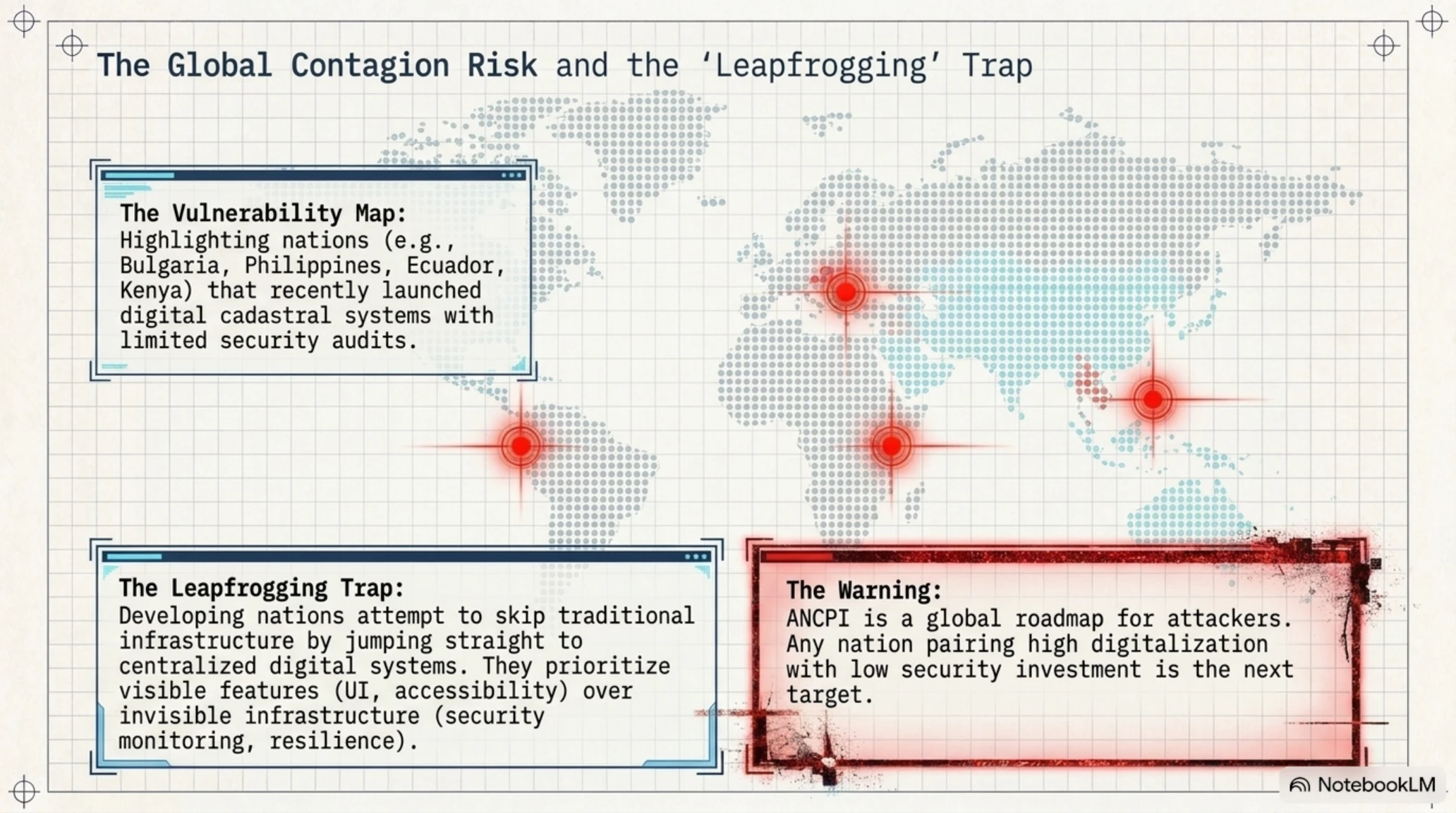
The ANCPI attack should not be viewed as an isolated Romanian incident—it's a global warning. Many countries, particularly in Eastern Europe, Asia, and Latin America, operate digital cadastral systems with similar or even weaker security levels.
Consider the broader implications: if a €135 million digital infrastructure investment can be destroyed because only 0.2% was allocated to security, how many other countries have similar vulnerabilities? The uncomfortable answer is: probably many.
Countries at High Risk
Eastern Europe: Bulgaria, Ukraine, Moldova, Serbia
Asia: Philippines, Indonesia, Vietnam, Pakistan, Bangladesh
Latin America: Ecuador, Bolivia, Paraguay, Honduras
Middle East: Iraq, Lebanon, Jordan
Africa: Kenya, Nigeria, Ghana
These countries should immediately review their cadastral system security and increase cybersecurity investment. The ANCPI incident provides a roadmap of what not to do.
Even developed nations aren't immune. Spain, Italy, and Greece have cadastral systems that, while more secure than ANCPI's, haven't undergone comprehensive security audits in years. The United States has a fragmented system with county-level registries, some of which use outdated technology with minimal security.
Prevention Strategies: How to Avoid This Catastrophe
Based on analysis of this incident, government and private organizations should immediately implement these measures:
1. Increase Cybersecurity Budget Allocation
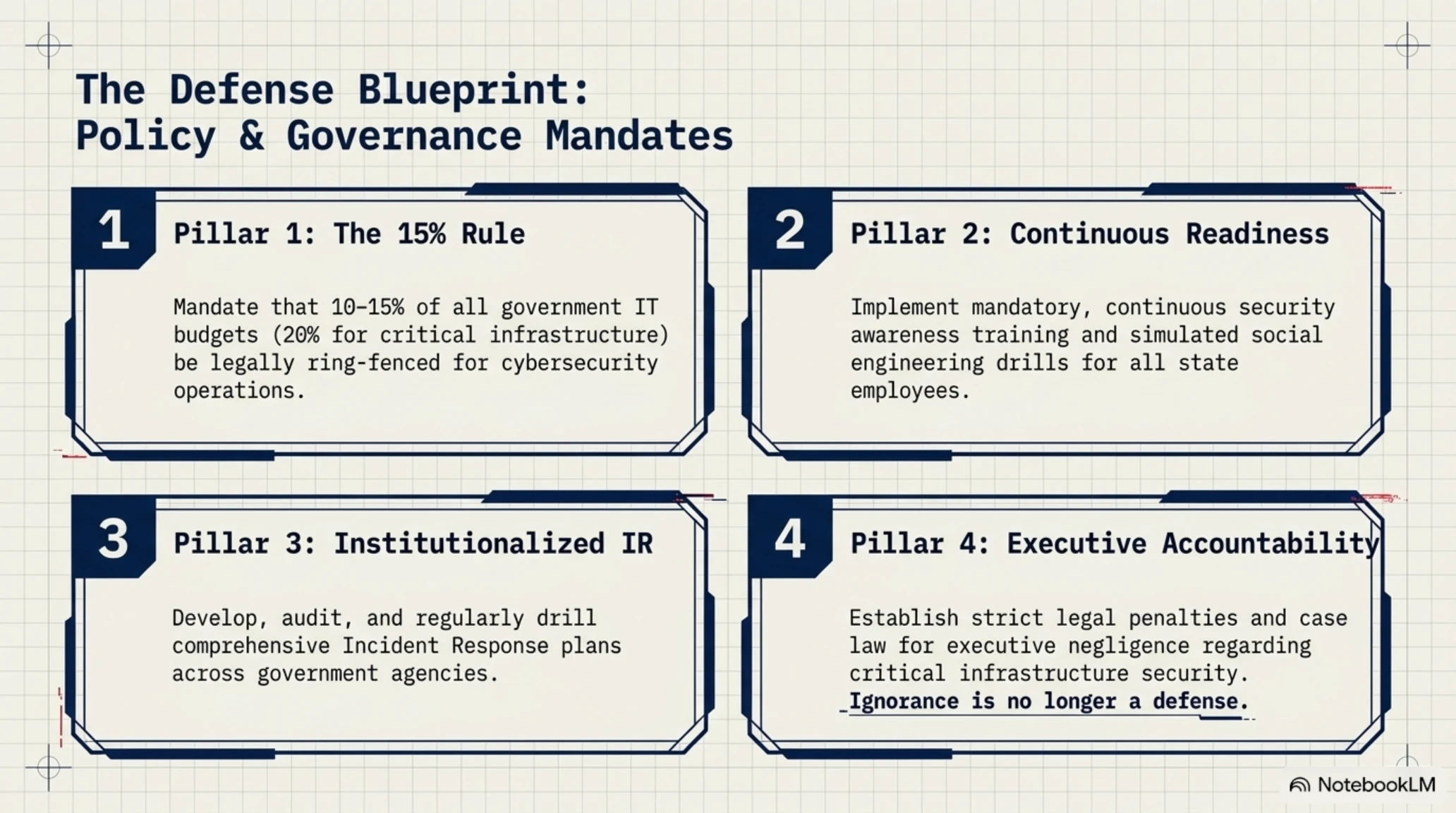
At minimum, 10-15% of IT budgets must be allocated to security, not 0.2%. This includes hiring security specialists, purchasing advanced tools, and maintaining continuous training programs. For critical infrastructure like land registries, 15-20% would be more appropriate.
2. Mandatory Multi-Factor Authentication (MFA)
Every access to sensitive systems must require at least two authentication methods—not just username and password. Hardware tokens (like YubiKeys) provide the strongest protection against credential theft.
3. Air-Gapped Backup Architecture
Critical backups must be physically disconnected from networks. If a hacker cannot access backups through the network, they cannot delete them. Implement the 3-2-1 backup rule: 3 copies of data, on 2 different media types, with 1 copy offsite and offline.
4. Zero Trust Architecture Implementation
No user or system should be trusted by default. Every access request must be verified, even if originating from inside the network. Implement micro-segmentation where different parts of the network are isolated from each other.
5. Continuous Employee Security Training
Most attacks begin with phishing and social engineering. Employees must be able to identify suspicious emails, links, and credential requests. Regular simulated phishing exercises help maintain awareness.
6. Comprehensive Incident Response Plan
Organizations must have a prepared plan for responding to cyberattacks. ANCPI apparently lacked such a plan, resulting in confused and delayed responses. A proper incident response plan includes: detection procedures, containment strategies, communication protocols, recovery processes, and post-incident analysis.
7. Data Encryption at Rest and in Transit
Even if a hacker accesses data, strong encryption can prevent its use or sale. All sensitive data should be encrypted both when stored and when transmitted across networks.
8. 24/7 Security Monitoring and SIEM
Security Information and Event Management systems must continuously monitor for suspicious activities. The ANCPI attack likely took days or weeks—adequate monitoring could have detected it early and prevented the worst damage.
Critical Infrastructure Cybersecurity Checklist
- Multi-Factor Authentication mandatory for all privileged access
- Air-gapped backups physically disconnected from network
- Network segmentation with isolated critical systems
- 24/7 Security Operations Center (SOC) monitoring
- Regular penetration testing by external security firms
- Incident response plan tested quarterly
- Employee security awareness training every 3 months
- Vulnerability scanning and patch management process
- Data encryption for all sensitive information
- Security budget at minimum 10% of total IT spending
Impact on Public Trust and Digital Democracy
Beyond economic and operational damage, this attack dealt a severe blow to public trust in government digital systems. Romanian citizens who had been encouraged for years to use online government services are now asking: is digitalization really safe?
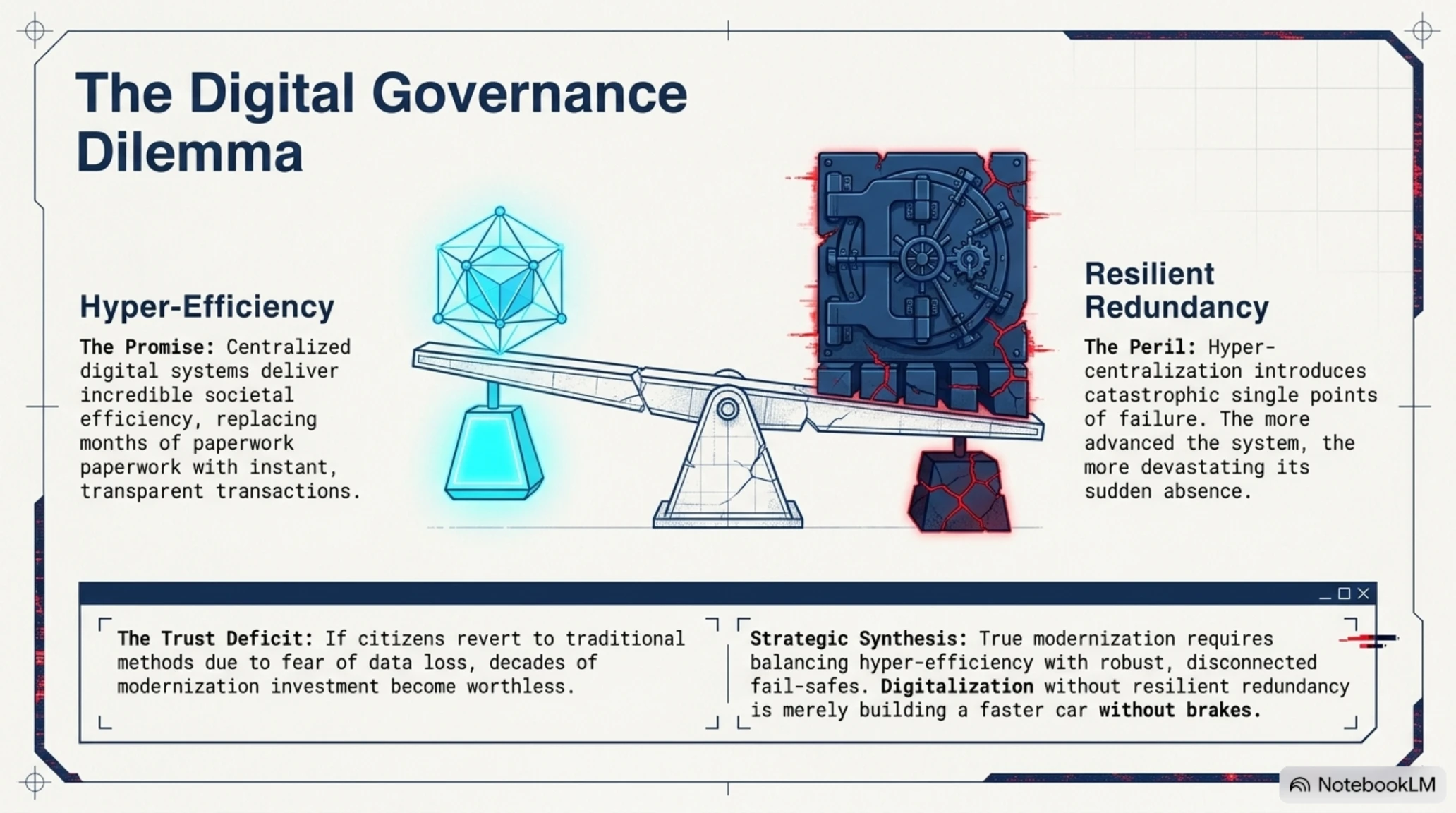
This erosion of trust could have long-term consequences. If citizens refuse to use digital government services and revert to traditional methods, decades of investment in modernization become worthless. Additionally, future governments may face resistance when trying to convince citizens to adopt new systems.
The ANCPI incident highlights a fundamental tension in digital governance: the efficiency benefits of centralized digital systems come with catastrophic single-point-of-failure risks. If everything is digital and connected, a single breach can paralyze an entire nation. Balancing digital efficiency with resilient redundancy is one of the great challenges of 21st-century governance.
EU and NATO Response: International Assistance
The European Union and NATO responded quickly. The EU Cybersecurity Agency (ENISA) deployed a team of security experts to assist ANCPI. NATO, recognizing Romania as a strategically important member on its eastern border, announced technical and intelligence support.
This incident also sparked discussion about the need for a "Cyber Marshall Plan" for Eastern Europe. Many countries in this region need financial and technical assistance to upgrade their cybersecurity, but limited budgets prevent this investment.
Some European officials proposed creating a shared cybersecurity infrastructure fund that would help vulnerable member states strengthen critical systems. The ANCPI disaster may become the catalyst for more comprehensive EU-wide digital security initiatives.
Comparison with Historical Attacks on National Infrastructure
The ANCPI attack ranks among the most damaging cyberattacks on national infrastructure in history. How does it compare to previous incidents?
Historic Attacks on National Infrastructure
WannaCry (2017): Ransomware that paralyzed the UK's NHS (National Health Service). Thousands of surgeries were canceled.
Colonial Pipeline (2021): Attack on US oil pipeline causing fuel shortages across the East Coast.
Costa Rica (2022): Conti ransomware attack on multiple ministries forcing government to declare national emergency.
Albania (2022): Massive cyberattack that shut down all government services for days.
Ukraine Power Grid (2015-2016): First confirmed cyberattack to cause power outages, affecting hundreds of thousands.
The ANCPI Romania attack (2026) now joins this list as one of the most destructive attacks on national infrastructure in history, notable for its complete data destruction rather than encryption.
What distinguishes the ANCPI attack from many previous incidents is the total destruction approach. NotPetya and WannaCry encrypted data, creating recovery possibilities. ByteToBreach went further—he deleted everything, including backups. This represents an escalation in cyberattack severity.
Current Status: Can Romania Recover?
As of this writing (July 21, 2026), one week after the attack, the e-Terra system remains offline and no property transactions are occurring in Romania. ANCPI announced it is completely rebuilding its IT infrastructure from scratch.
If offline backups truly exist and are intact, the recovery process could take 4-8 weeks. However, if backups are corrupted or incomplete, recovery could take months. In the worst-case scenario, ANCPI might need to reconstruct the database from old paper records, notarial documents, and citizen declarations—a process that could take years.
Economic losses continue accumulating. Each day the system remains offline, hundreds of millions of euros in real estate transactions are delayed. Banks cannot lend, construction companies cannot register new projects, and ordinary citizens are trapped in legal limbo.
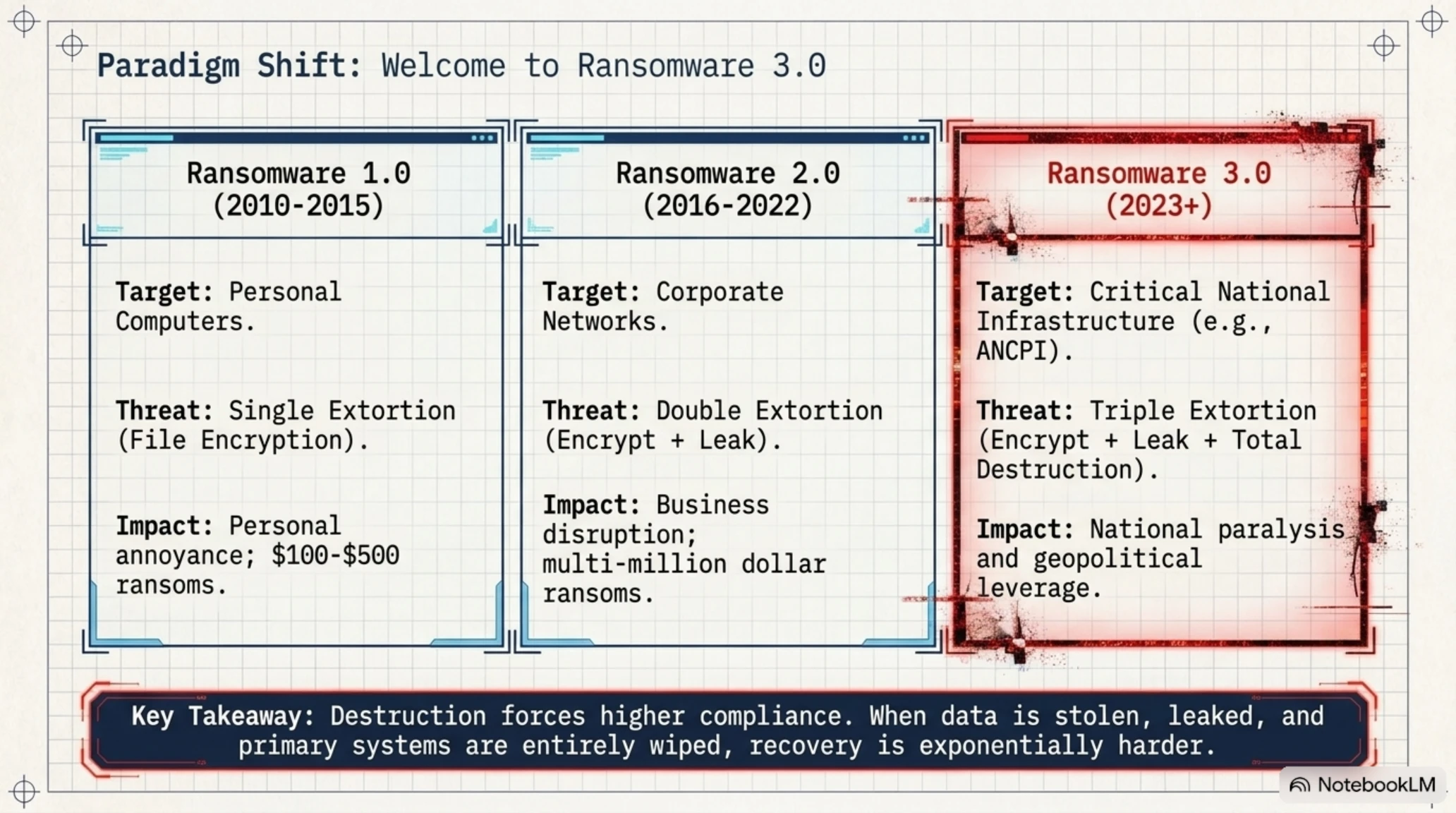
The Future of Ransomware: Welcome to Ransomware 3.0
The ANCPI attack represents an emerging trend in ransomware that can be termed "Ransomware 3.0":
Ransomware 1.0 (2010-2015): Encryption of individual files on personal computers. Small ransoms ($100-$500).
Ransomware 2.0 (2016-2022): Attacks on companies and organizations. Encryption of entire networks with data leak threats (double extortion). Million-dollar ransoms.
Ransomware 3.0 (2023-Present): Attacks on critical national infrastructure. Complete system destruction instead of mere encryption. Triple extortion threat: encryption + leak + destruction. Targeting government agencies with national-level consequences.
ByteToBreach represents this new generation: he didn't just encrypt data—he stole it, listed it for sale, and then destroyed the entire system. This level of destruction can paralyze entire nations.
Security researchers warn that Ransomware 3.0 tactics will likely become more common. Why? Because they're more effective at forcing payment. When a company's data is encrypted, they might have backups. But when data is stolen, leaked, and then systems are destroyed, recovery becomes exponentially more difficult and costly.
Accountability Question: Who Should Answer for This Disaster?
One critical question remains largely unanswered: who should be held accountable for this catastrophe? The ANCPI managers who allocated only 0.2% of the budget to security for 20 years? The Romanian government that failed to oversee this critical infrastructure? Or ByteToBreach who executed the attack?
In most countries, legal penalties for cybersecurity negligence in government organizations are either non-existent or extremely weak. This allows managers to make dangerous decisions without consequences. Romania has an opportunity to set a legal precedent by prosecuting and penalizing negligent officials, creating case law that other countries could follow.
The argument that "cybersecurity is complex" and "hindsight is 20/20" doesn't hold water here. Allocating 0.2% of budget to security wasn't an understandable oversight—it was systematic negligence over two decades. Industry standards, international recommendations, and basic common sense all indicated this was grossly insufficient.
Lessons for Developing Nations: The Digital Leap's Hidden Dangers
The ANCPI incident holds particular relevance for developing nations pursuing rapid digitalization. The promise of "leapfrogging" traditional infrastructure by jumping directly to digital systems is seductive. But Romania's experience reveals the hidden danger: digital leapfrogging without security investment creates catastrophic vulnerabilities.
Countries in Africa, Asia, and Latin America implementing digital land registry systems must learn from Romania's mistakes. The temptation to prioritize visible features (user interfaces, accessibility, speed) over invisible security infrastructure is strong—after all, citizens can see and appreciate a sleek website, but they don't notice security monitoring systems. However, as ANCPI discovered, neglecting the invisible infrastructure leads to total system failure.
Global Cadastral System Vulnerabilities
- Countries with digital land registries: 127
- Average security budget allocation: 3.2%
- Systems with air-gapped backups: 41%
- Mandatory MFA implementation: 28%
- 24/7 security monitoring: 35%
The Dark Web Economy: Understanding the Marketplace
ByteToBreach's sale of stolen ANCPI data illuminates the sophisticated dark web economy that underpins modern cybercrime. This isn't a chaotic black market—it's a structured ecosystem with specialized roles, reputation systems, and market dynamics.
Data Brokers: Individuals like ByteToBreach who steal and sell data. They build reputations on forums through successful transactions.
Access Brokers: Specialists who sell network access credentials rather than data. They break in, establish persistent access, and sell it to others.
Ransomware-as-a-Service (RaaS) Operators: Groups that develop ransomware and rent it to "affiliates" who execute attacks, splitting profits.
Money Laundering Services: Cryptocurrency mixing services and cash-out operations that convert illicit digital currency into usable funds.
Escrow Services: Trusted intermediaries who hold payment until goods (stolen data, malware, services) are delivered, reducing transaction risk.
The ANCPI data ByteToBreach is selling will likely attract diverse buyers: fraud rings seeking identity information, intelligence agencies wanting property ownership data, competitors of Romanian real estate companies, and potentially hostile state actors. This data remains valuable for years, if not decades.
Technical Deep Dive: How Systems Should Be Protected
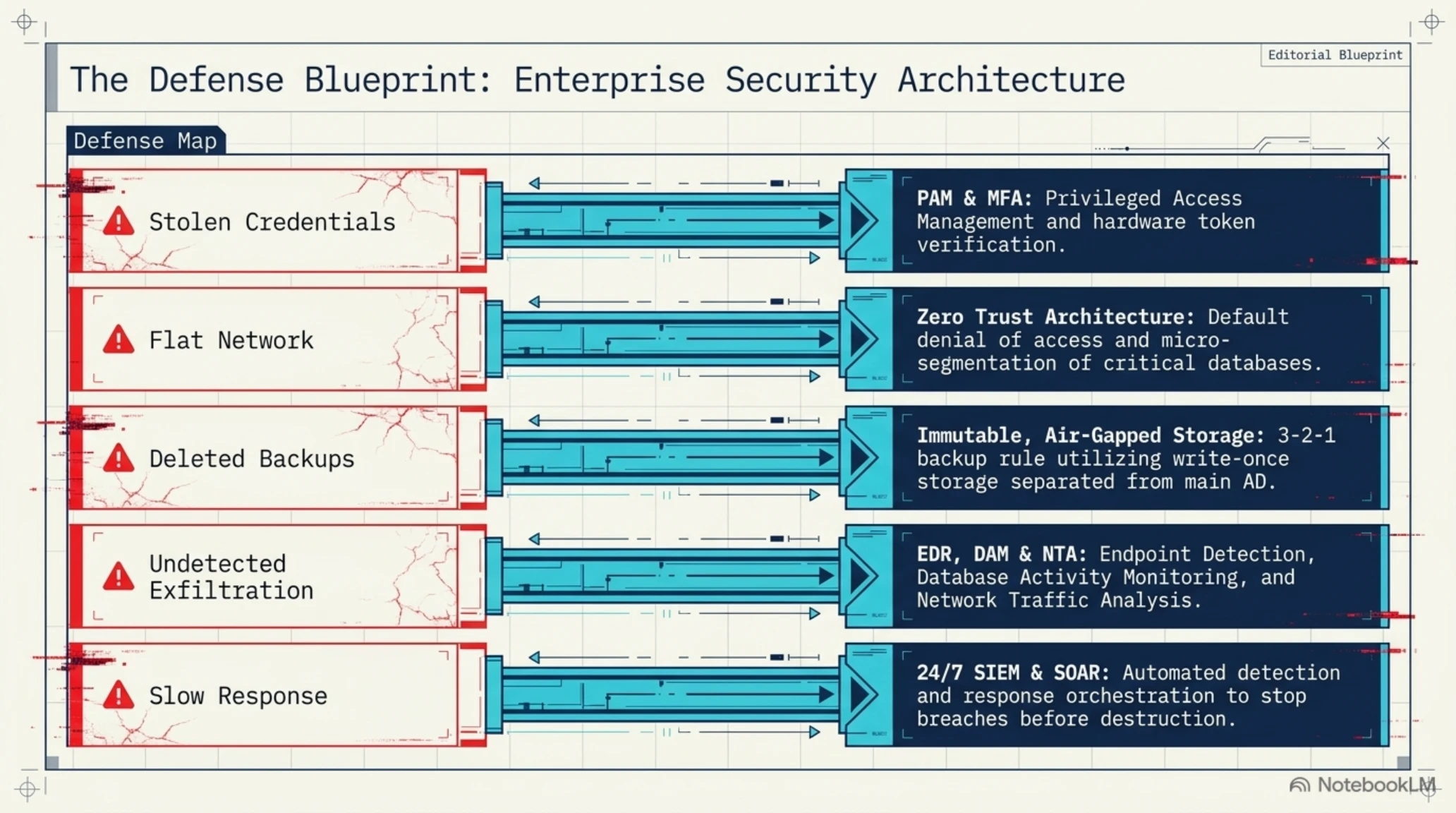
For technical readers, let's examine specific security controls that would have prevented or mitigated the ANCPI attack:
Privileged Access Management (PAM): Systems that require additional verification for high-privilege accounts, log all privileged actions, and can automatically revoke suspicious access.
Endpoint Detection and Response (EDR): Software on all computers that monitors for malicious behavior, not just known malware signatures. Would have detected infostealer malware used to compromise credentials.
Network Traffic Analysis (NTA): Systems that analyze network communications for unusual patterns, such as large data exfiltration or connections to known malicious infrastructure.
Database Activity Monitoring (DAM): Specialized monitoring for database queries and access patterns. Would have flagged unusual bulk data extraction.
Immutable Backups: Backup systems that prevent modification or deletion even by administrators. Uses technologies like write-once storage or blockchain-verified backup integrity.
Security Orchestration, Automation, and Response (SOAR): Automated systems that can detect, analyze, and respond to threats faster than human analysts, crucial for stopping attacks before maximum damage.
None of these technologies are exotic or experimental—they're standard security controls used by organizations worldwide. ANCPI's failure to implement them, despite a €135 million budget, is inexcusable.
Conclusion: A Wake-Up Call for Digital Governance
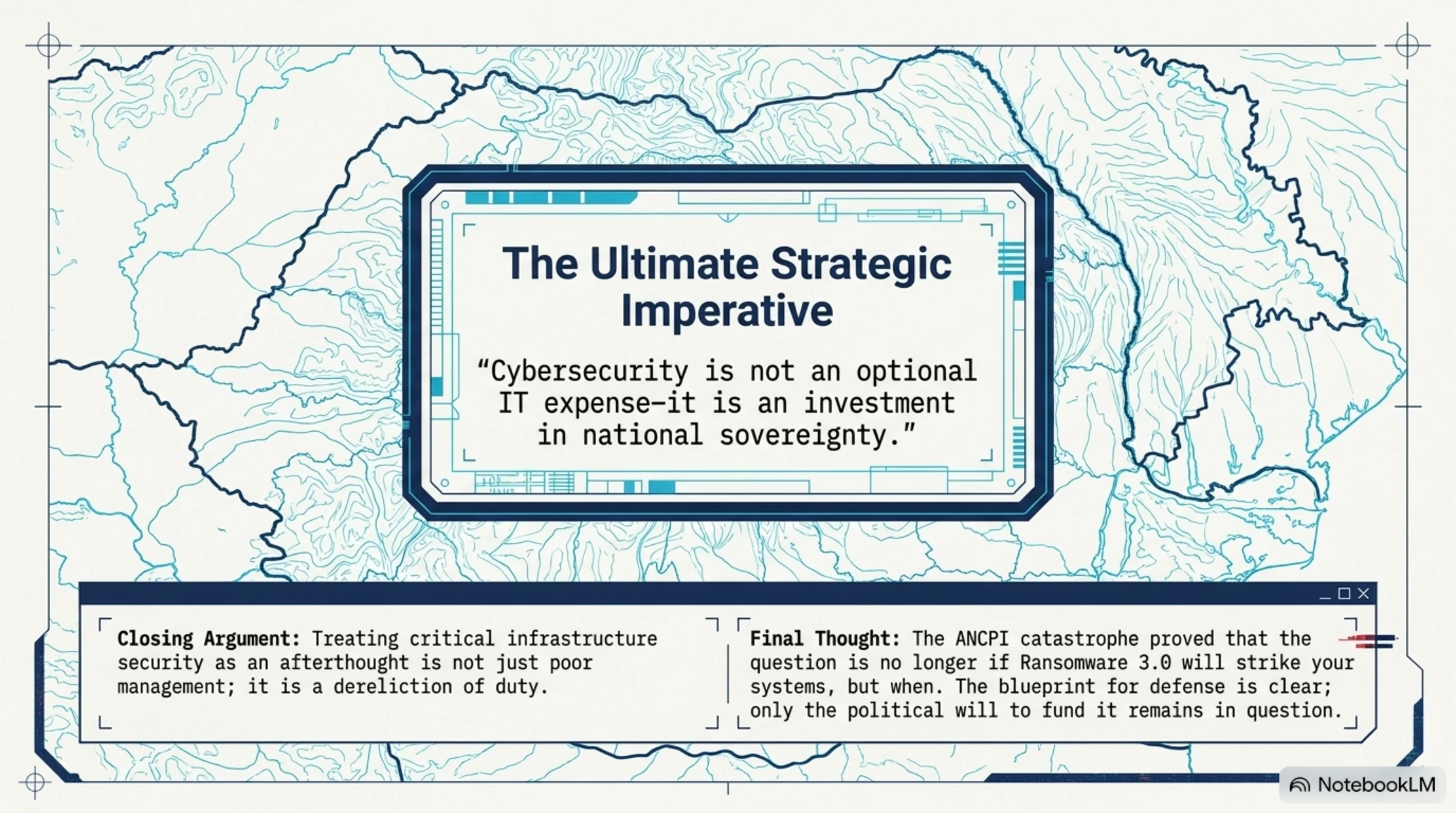
The destruction of Romania's land registry system represents more than a cybersecurity failure—it's a fundamental failure of digital governance. When a government invests €135 million in digitalization but only €305,000 in security, it demonstrates a profound misunderstanding of how digital systems work. Security isn't an add-on feature—it's the foundation upon which all digital services must be built.
The ANCPI incident should serve as a global wake-up call. Every government operating or planning critical digital infrastructure must immediately audit security investments, implement proven security controls, and allocate appropriate budgets. The cost of prevention, while substantial, is always a fraction of the cost of recovery—and that's assuming recovery is even possible.
For Romania, the path forward is painful but clear: rebuild systems with security as the top priority, prosecute those responsible for negligence, and regain public trust through transparency and demonstrable improvement. The property market will eventually recover, but the lessons from this disaster must not be forgotten.
For the rest of the world, the message is simple: learn from Romania's catastrophe, or risk repeating it.
Understanding the ANCPI Incident
Can property still be bought and sold in Romania?
No. Until the e-Terra system is restored, no official property transactions are possible. Notaries cannot validate documents and banks cannot register mortgages. Some informal transactions might occur but lack legal validity.
How long will recovery take?
If offline backups are intact, probably 4-8 weeks. If backups are damaged or incomplete, it could take months. Worst case, complete reconstruction from paper records could take years.
Will ByteToBreach be arrested?
Unlikely. He resides in Algeria, which has no extradition treaty with the EU. Even with identified identity, arrest and prosecution would be extremely difficult. Most international hackers are never apprehended.
Why didn't Romania pay the ransom?
Paying ransoms is not recommended because: 1) There's no guarantee of data recovery 2) Funds support criminal organizations 3) It encourages repeat attacks 4) It's illegal in some jurisdictions. However, in this specific case, the consequences of non-payment were catastrophic.
Could this happen in the United States?
Potentially, though the US has a fragmented system with county-level registries, making a single attack less devastating nationally. However, individual counties with poor security could experience similar incidents affecting local markets.
Is the stolen data still dangerous?
Yes. Personal information on millions of Romanian citizens, property details, and system source code can be used for identity fraud, targeted attacks, and intelligence gathering for years or decades.
Who is responsible for government system security?
In most countries, a Ministry of Communications or national cybersecurity agency sets standards, but implementation responsibility lies with each organization. ANCPI was directly responsible for its own system security.
Would cyber insurance cover these losses?
Probably not. Most cyber insurance policies exclude losses from obvious negligence like allocating only 0.2% of budget to security. Additionally, indirect damages like lost tax revenue, reconstruction costs, and public trust damage are typically uninsurable.
How can similar attacks be prevented in the future?
A combination of technical measures (MFA, air-gapped backups, network segmentation, encryption), organizational actions (increased security budgets, specialist hiring), cultural changes (employee training), and legal reforms (penalties for negligence) are all necessary. No single solution exists—cybersecurity is a multi-layered process.
Could this attack be replicated in other countries?
Absolutely. ByteToBreach and similar hackers now know that cadastral systems are high-value targets. Attacks on other countries with weak security should be expected in the near future. This is a global warning.
Sources and Further Reading
- Cybernews: Hacker deletes country's entire land registry database after failed extortion attempt
- Risky Business: Hacker wipes Romania's entire land registry database
- TBS News: Romania rebuilding land registry systems after cyberattack wipes database
- Rescana: Romania ANCPI Land Registry Wiped in Credential-Based Cyberattack
- Help Net Security: Romania's land registry hit by cyber attack, data allegedly for sale
- KELA Cyber: Unmasking ByteToBreach - A Deep Dive into a Persistent Data Leak Operator
- Romania Insider: Romania's real estate market still reeling from major cyberattack
- Heise: Romania - Cybercriminal deletes country's entire land registry database
- TVP World: Cyberattack freezes Romanian property sales
All sources verified as of the article publication date (July 21, 2026).
Additional Gallery: Tekin Review: The Romanian Cyber Paralysis & ANCPI Database Wipe