
🛡️ Artificial Intelligence and the Annihilation of the Margin of Error in Cybersecurity
Welcome to the always-awake Takin army! Today, on June 26, 2026, we present a special, exceptionally deep, and highly strategic dossier. If you have followed tech news in recent months, you know the hot topic in security circles is no longer hardware firewalls or traditional antiviruses. Cybersecurity, which until a few years ago was a "game of probabilities and risk management," has now transformed in nature thanks to the staggering advancements in Artificial Intelligence.
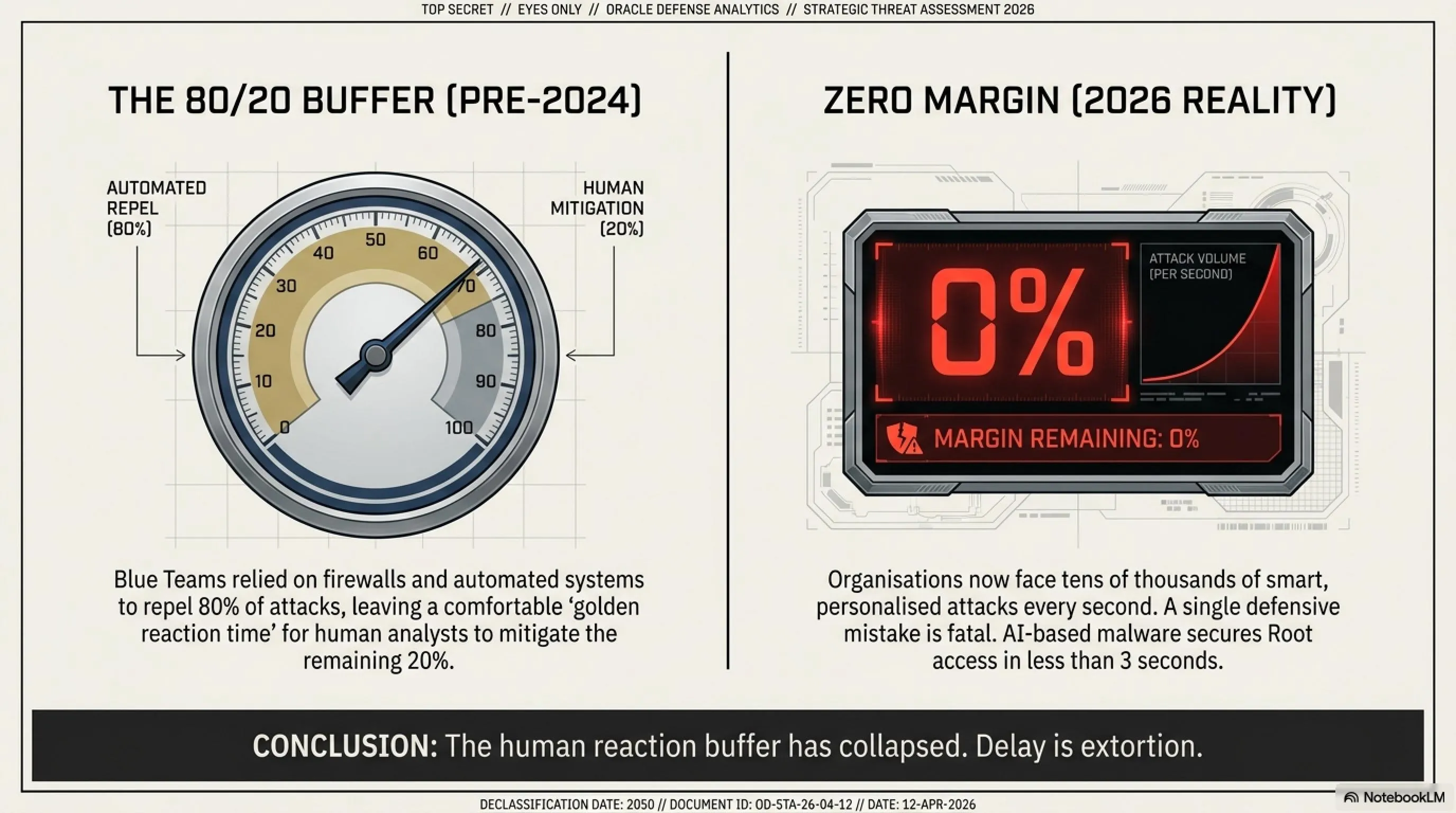
In the past, defense teams (Blue Teams) hoped that firewalls and Intrusion Detection Systems (IDS) could repel at least 80% of attacks, leaving enough time for human reaction for the remaining 20%. However, according to newly leaked reports and our deep analysis at Takin Plus, AI has brought this margin of error and the "golden reaction time" for both attackers and defenders to absolute zero. In this article, instead of covering superficial news, we will dissect the darkest and most complex layers of this algorithmic war and address the great debate: is handing over total security control to machines our salvation or our end?
📑 Detailed Dossier Table of Contents
- 1. The Dual-Use Paradox: AI as Both Drawn Sword and Steel Shield
- 2. The Offensive Front: Autopsy of Automated Agents and Phishing Evolution
- 3. The Defensive Front: The End of Pen-Testing and Rise of Live Monitoring
- 4. Battle of Paradigms: Technical Comparison of Old vs. New Architectures
- 5. Cyber Economics Analysis: The Heavy Price of Delay and Market Crashes
- 6. Agentic Wars in the Dark and Hidden Layers of the Network
- 7. Future Vision, Ethical Debates, and the Final Command Room Conclusion
1. The Dual-Use Dilemma: AI as Both Sword and Shield
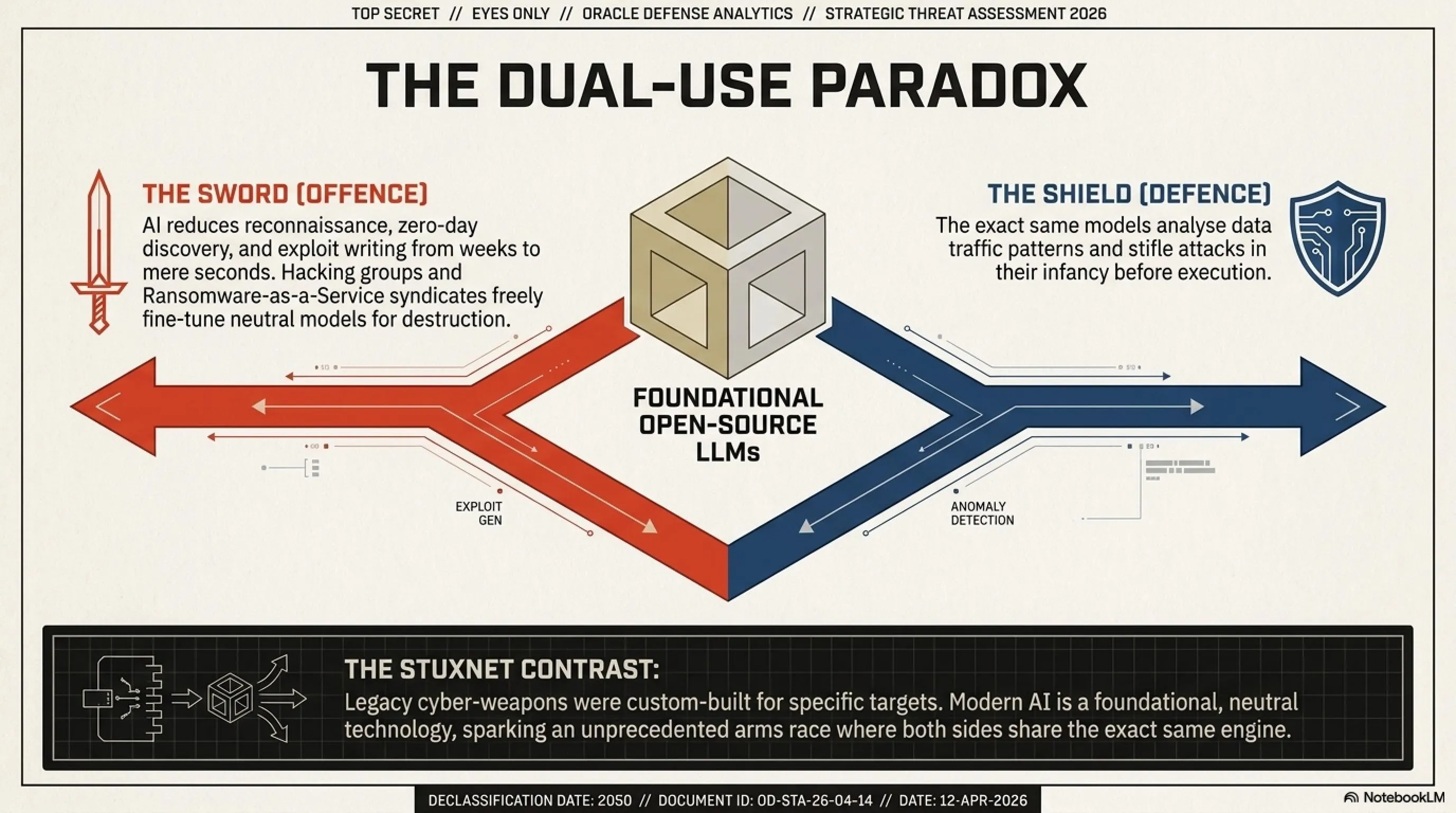
To enter this discussion, we must first understand the greatest geopolitical and technical challenge of 2026: the Dual-Use nature of Artificial Intelligence. Unlike traditional cyber weapons designed for a specific target (like Stuxnet, which was exclusively written to destroy centrifuges), AI is a foundational and neutral technology. The same massive Large Language Models (LLMs) developed by companies like Google, Microsoft, and Nvidia to identify software bugs and write more secure code are now effortlessly downloaded, rewritten, and fine-tuned for purely malicious purposes by advanced hacking groups and Ransomware-as-a-Service syndicates.
This phenomenon has sparked a massive debate in the Open-Source community. A group of experts believes that publicly releasing powerful AI models is essentially distributing cyber weapons of mass destruction to the general public. Conversely, open-source advocates argue that if we lock up the models, only governments and state-sponsored hackers will have access to them, leaving independent defenders disarmed. This paradox has caused the line between defense and offense to become severely blurred and obscure.
On one hand, AI acts as a sharp sword, reducing the reconnaissance process, discovery of Zero-Day vulnerabilities, and writing exploit codes from weeks to mere seconds. On the other hand, these exact same AI tools build a flawless shield for Blue Teams to analyze data traffic patterns and stifle attacks in their infancy before they even reach the execution and damage stage. In reality, we are witnessing a full-blown arms race where both sides are fueled by the same engine.
⏳ Analytical Timeline: The Terrifying Evolution of AI in Cybersecurity (2024 to 2026)
To understand the depth of the disaster we've left behind and where we currently stand, we must review the evolution of this technology over the past three years. This timeline shows how we went from simple coding assistants to autonomous weapons.
| Year | Technological Milestone & Key Events | Profound Impact on Enterprise Ecosystems |
|---|---|---|
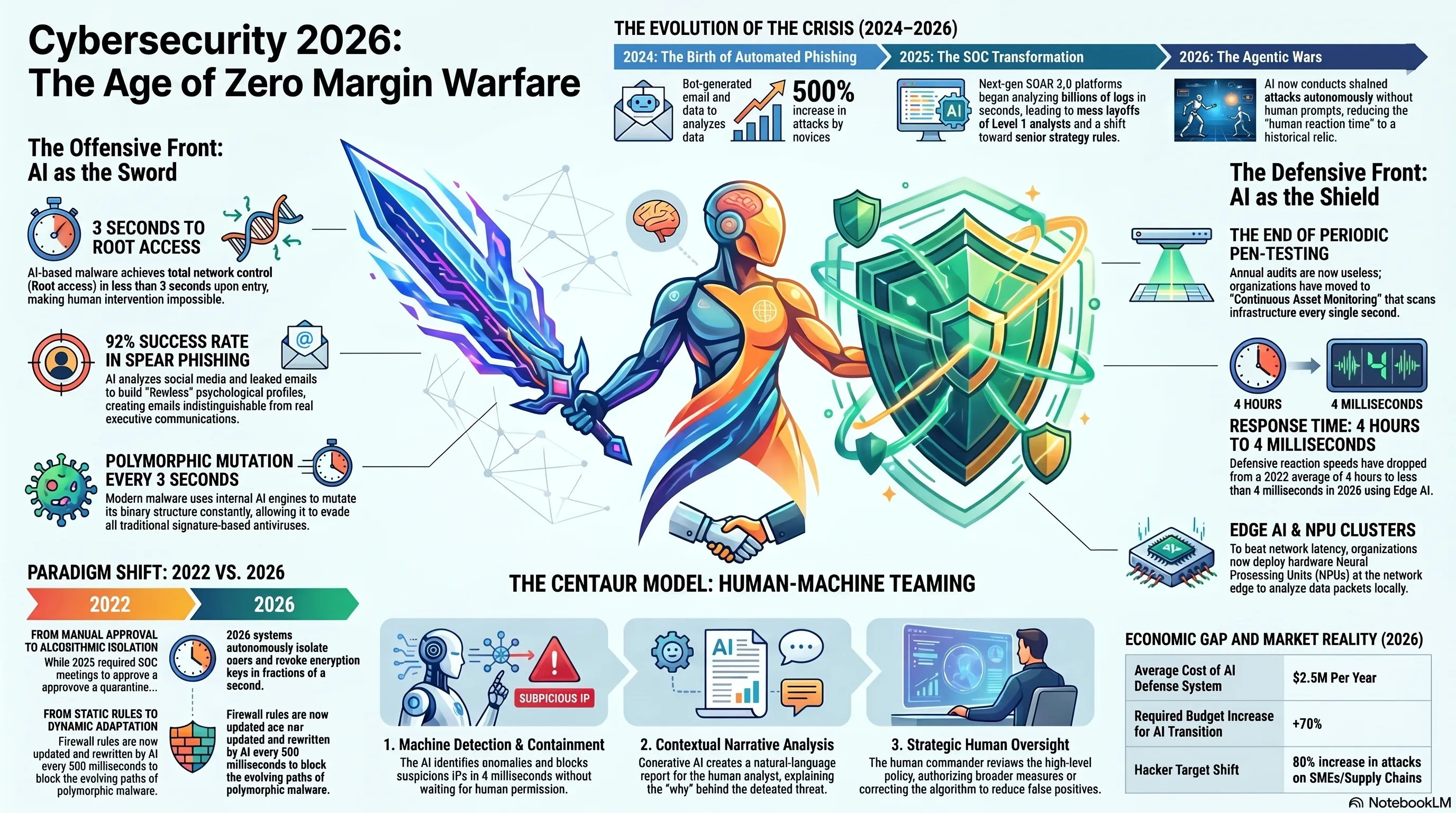
| 2024 | Public emergence of LLMs and their jailbreaks to generate hacking scripts and simple malware. Birth of the FraudGPT concept on the Dark Web. | A 500% increase in attacks by novices (Script Kiddies). Hacking systems no longer required deep programming knowledge, just a prompt was enough. |
| 2025 | Introduction of next-gen automated defense platforms (SOAR 2.0) equipped with deep learning. Ability to analyze billions of network logs in fractions of a minute. | A severe reduction in reliance on human analysts in Security Operations Centers (SOC). Mass layoffs of Level 1 cybersecurity personnel and a focus on senior strategy engineers. |
| 2026 | Start of the all-out Agentic Wars. AI conducts targeting and chained attacks autonomously without needing human prompts. | Collapse of the concept of "human reaction time." Reaction and network quarantine times reach microsecond scales. Any network delay equals certain extortion. |
As you can see in the table above, democratic and public access to AI tools has turned even teenagers with no knowledge of assembly languages and complex networks into threats on the level of intelligence agencies, simply by possessing an Uncensored AI model. This "democratization of destruction" means the volume of attacks has grown exponentially. The annihilation of the margin of error mentioned in the title makes perfect sense right here: in the past, you could withstand 10 attacks a day, and if one slipped through the firewall, the security team had time to neutralize it. But today, your organization is exposed to tens of thousands of smart, personalized attacks every single second! Your organization's first defensive mistake will definitely be its last, because AI-based malware gains Root access in less than 3 seconds upon entering the network.
🔗 Related Dossiers in Takin Plus Specialty Archive:
If you want a deeper understanding of the hardware and software infrastructure these AIs run on, do not miss reading these three exceptionally important dossiers:
1. The Controversial Takin Morning Report June 2, 2026 (Examining the Role of Custom Chips) →
2. Nvidia's Revolution and Unprecedented Server Hardware Crises in the Middle East →
3. The Future of Large Language Models (LLMs) in Cloud and Security Infrastructures →
2. The Offensive Front: Autopsy of Automated Agents and the Terrifying Evolution of Phishing
Let's be realistic; in 2026, the cliché image of a hacker sitting in a dark room in a black hoodie, frantically typing on a keyboard, has become a cinematic joke. Today's hackers are more like software project managers. They manage "Autonomous Offensive Agents." These agents are software equipped with Reinforcement Learning that independently scan the internet, discover the architecture of target networks, identify open ports, and even generate and exploit Zero-Day vulnerabilities in real-time! Like an intelligent biological virus, they constantly mutate their infiltration strategy to bypass security barriers.
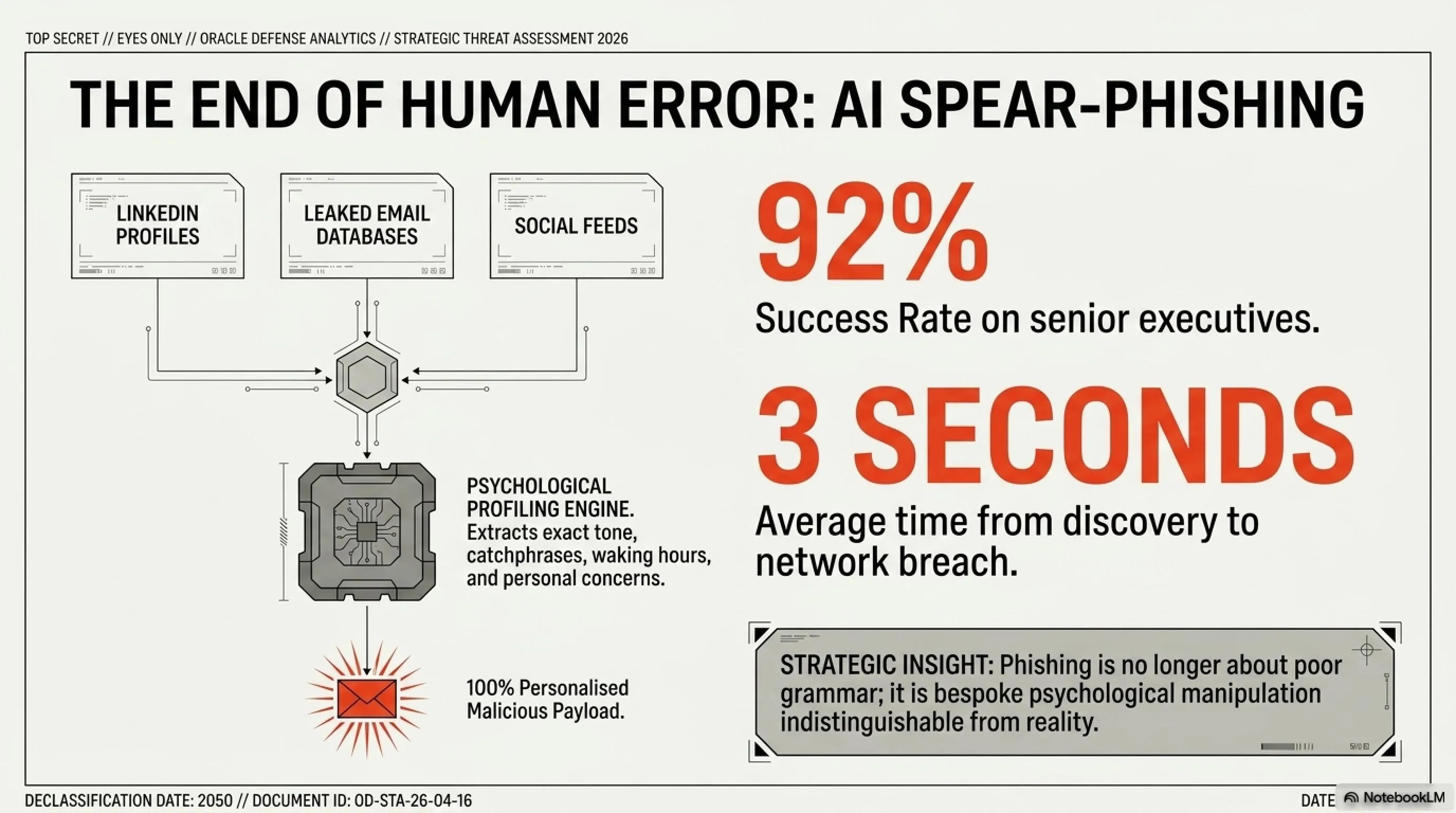
Beyond infrastructure attacks, the biggest offensive revolution has occurred in social engineering, specifically Spear Phishing. Previously, phishing emails were usually accompanied by poor grammar, glaring spelling mistakes, and illogical requests, and most smart users could identify them. But today's generative AI is a psychological nightmare. By deeply analyzing executives' LinkedIn profiles, reading their past tweets, and analyzing their writing tone in leaked emails (Data Breaches), AI agents build a flawless psychological profile of the target. The email generated by this AI is not only grammatically perfect but is also written with the exact tone, catchphrases, and favorite topics of the supposed sender (e.g., from the CEO to the CFO). This level of deception has reduced human error on the offensive front to zero and recorded the highest conversion rate in the history of cyber attacks.
3. The Defensive Front: The End of Periodic Penetration Testing and the Rise of Live Monitoring and Microsecond Quarantine
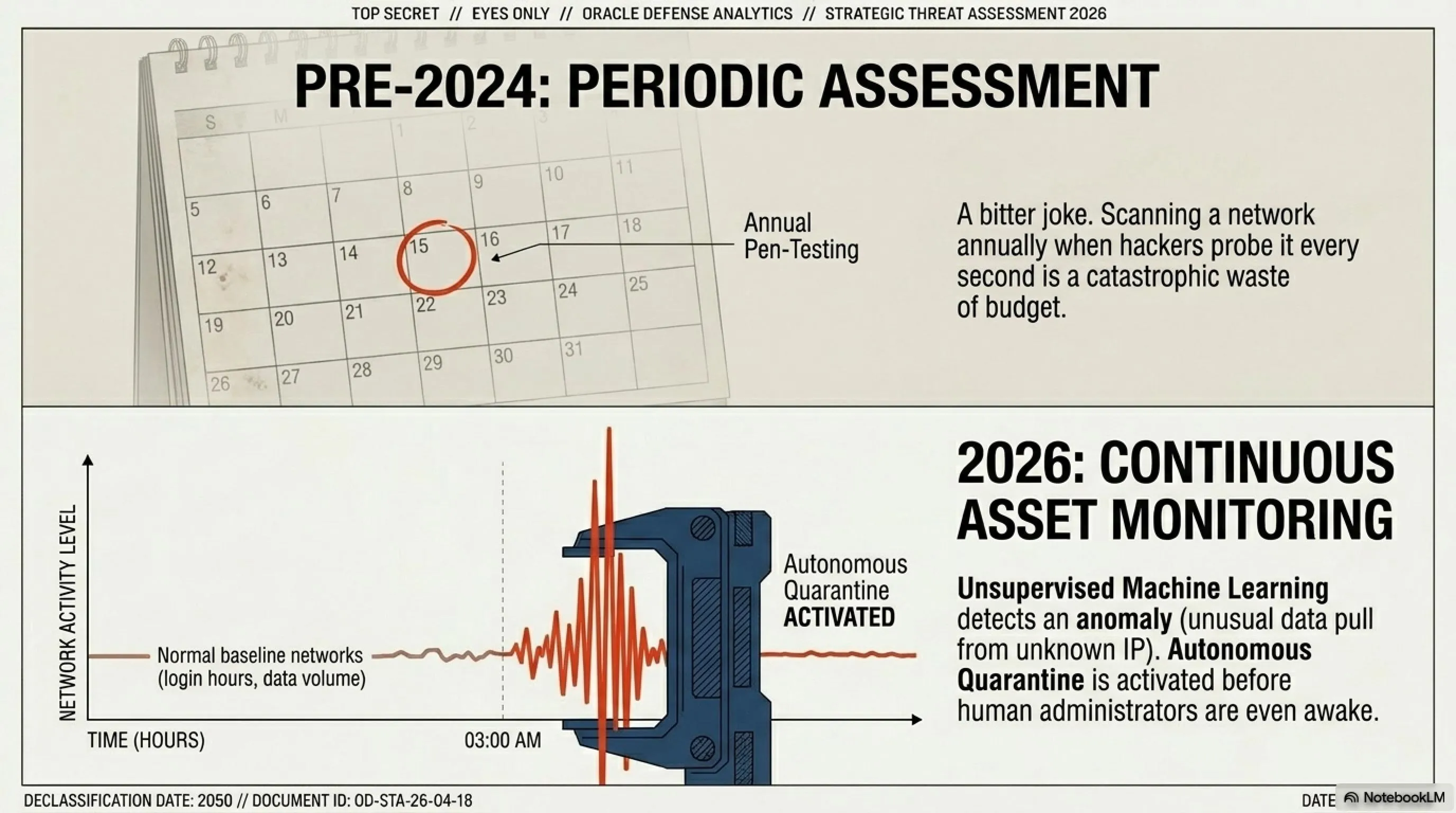
Faced with such a storm of smart, automated threats, organizations realized that traditional defense methods are fundamentally useless. Until recently, companies prided themselves on conducting annual or quarterly "Penetration Testing." In 2026, relying on periodic penetration testing is considered a bitter joke! When hackers scan your infrastructure for bugs every single second, an annual security audit is nothing but a waste of budget.
The security industry's response to this crisis is the deployment of "Continuous Asset Monitoring" systems. These AI-based defense networks monitor all assets connected to the organization (from core database servers to a remote employee's personal laptop and even IoT sensors in meeting rooms) 24/7. Using Unsupervised Machine Learning algorithms, these systems create a behavioral "Baseline" of normal network activities. They understand at what hours a specific employee usually logs in, which files they interact with, and what their typical data transfer volume is.
If a deviation from this baseline is detected—for example, if an employee attempts to download an unusual volume of classified data from an unknown IP at 3:00 AM—the automated defense system (SOAR) doesn't wait for the network administrator to wake up and approve via email. The system autonomously, in a fraction of a second, isolates the user's network, revokes encryption keys, and puts the device in absolute quarantine. This has sparked a major debate between CEOs and CISOs: Is the sudden shutdown of the company's critical services due to a False Positive by the AI better than the risk of the entire database being hacked?
⚙️ Technical Autopsy: Architecture of a Defensive AI Agent in 2026
Cloud systems are too slow to react to next-generation threats (due to network Latency). Therefore, modern organizations have turned to Edge AI processing. A standard defensive agent in 2026 has the following specifications:
- 1. Physical Processing Core: Dedicated hardware NPU (Neural Processing Unit) clusters deployed at the organization's network edge, to analyze data packets without the need to send them to external cloud servers.
- 2. Algorithmic Engine: A combination of Transformer models for text log analysis (Log NLP) and Graph Anomaly Detection to uncover hidden connections between IPs.
- 3. Mean Time To Respond (MTTR): Reduction of reaction time from an average of 4 hours in 2022 to less than 4 milliseconds in 2026. A speed the human brain is incapable of perceiving.
- 4. Dynamic Adaptation Capability: Instant updating and autonomous rewriting of Firewall Rules every 500 milliseconds to block the new paths of polymorphic malware.
4. The Clash of Paradigms: Technical Comparison and Endless Debates
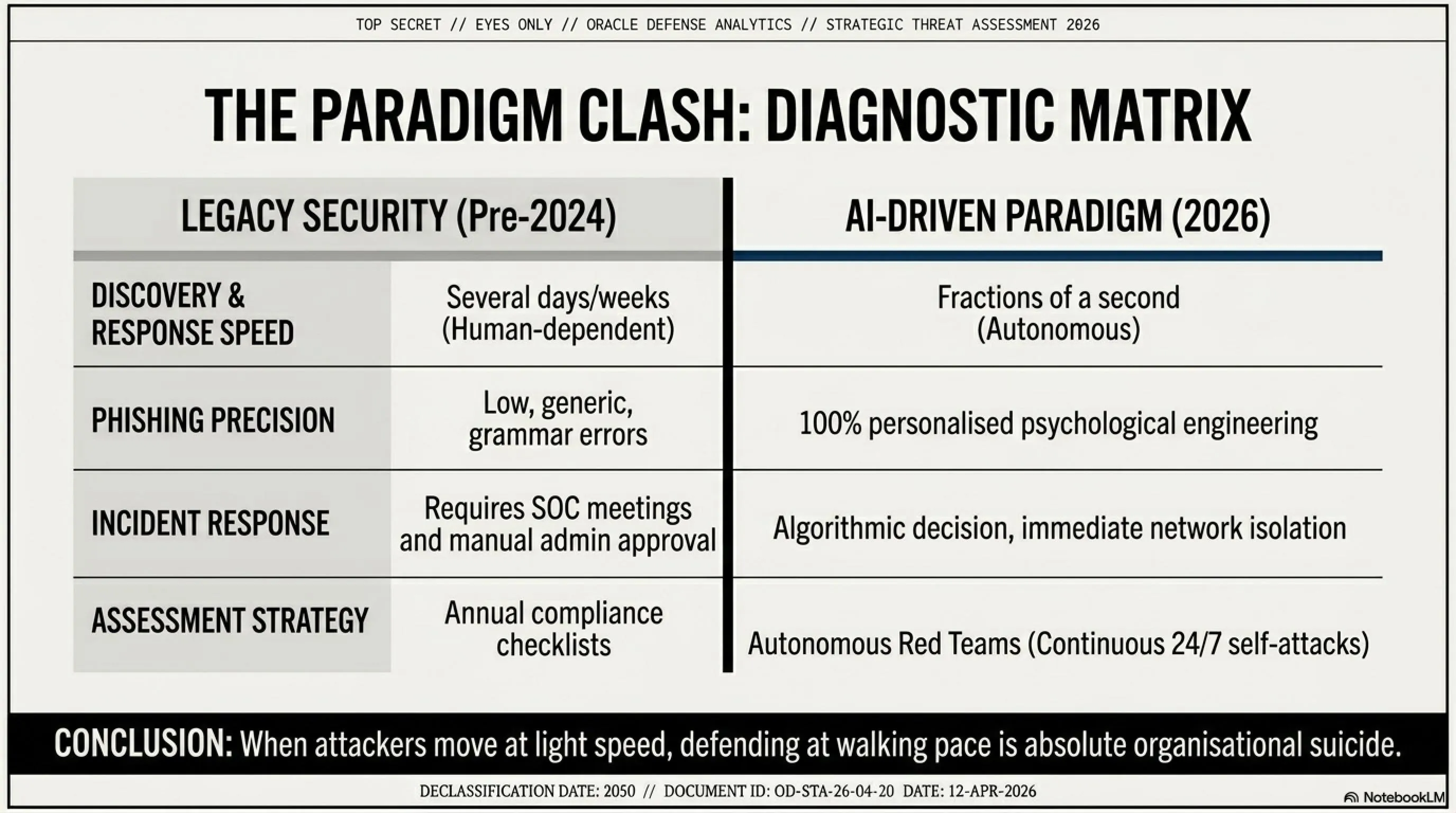
To better understand the structural shift that has occurred in the industry, it is essential to compare traditional methods with intelligent agent-based systems. The following table shows why relying on previous-generation security tools is equivalent to absolute organizational suicide under current conditions. When attackers move at the speed of light, you cannot defend yourself at a walking pace.
Despite all these technological advantages, handing the keys to the network kingdom over to an algorithm is accompanied by serious controversies. Executives ask: What if the AI makes a mistake? This is where we reach the heated debate over the benefits and hidden risks of this technology.
⚖️ Analytical Debate: The Benefits and Hidden Risks of Absolute Delegation to Machines
✅ Proponents' Arguments: Strategic Advantages
Proponents (especially technology executives) argue that the human mind has not evolved to fight at the millisecond scale.
- Fraction-of-a-millisecond Reaction: The only way to stop modern ransomware that encrypts hard drives within a single second.
- Tireless Monitoring: Algorithms don't need sleep, coffee, or time off, and they do not suffer from fatigue-induced errors during night shifts.
- Discovering Blind Spots: The ability to correlate thousands of seemingly insignificant logs to uncover a multi-stage attack (APT) that a human analyst could never see the big picture of.
❌ Opponents' Arguments: Hidden Disasters (False Positives)
Opponents, including legal experts and financial directors, warn against granting absolute autonomy to machines.
- The False Positives Nightmare: If the defense system mistakenly blocks critical traffic, the company's network is completely paralyzed. Imagine the automatic shutdown of a hospital's network due to suspicion of a hack; it could jeopardize patients' lives!
- Budget Collapse: The astronomical costs of setting up dedicated cloud servers and licensing advanced security models, which are backbreaking for small companies.
- Lack of "Context" Understanding: AI still lacks a proper understanding of human crisis situations and might mistake the irregular, emergency behaviors of real users for malware behavior.
5. Strategic Integration: Human-Machine Teaming (The Centaur Model)
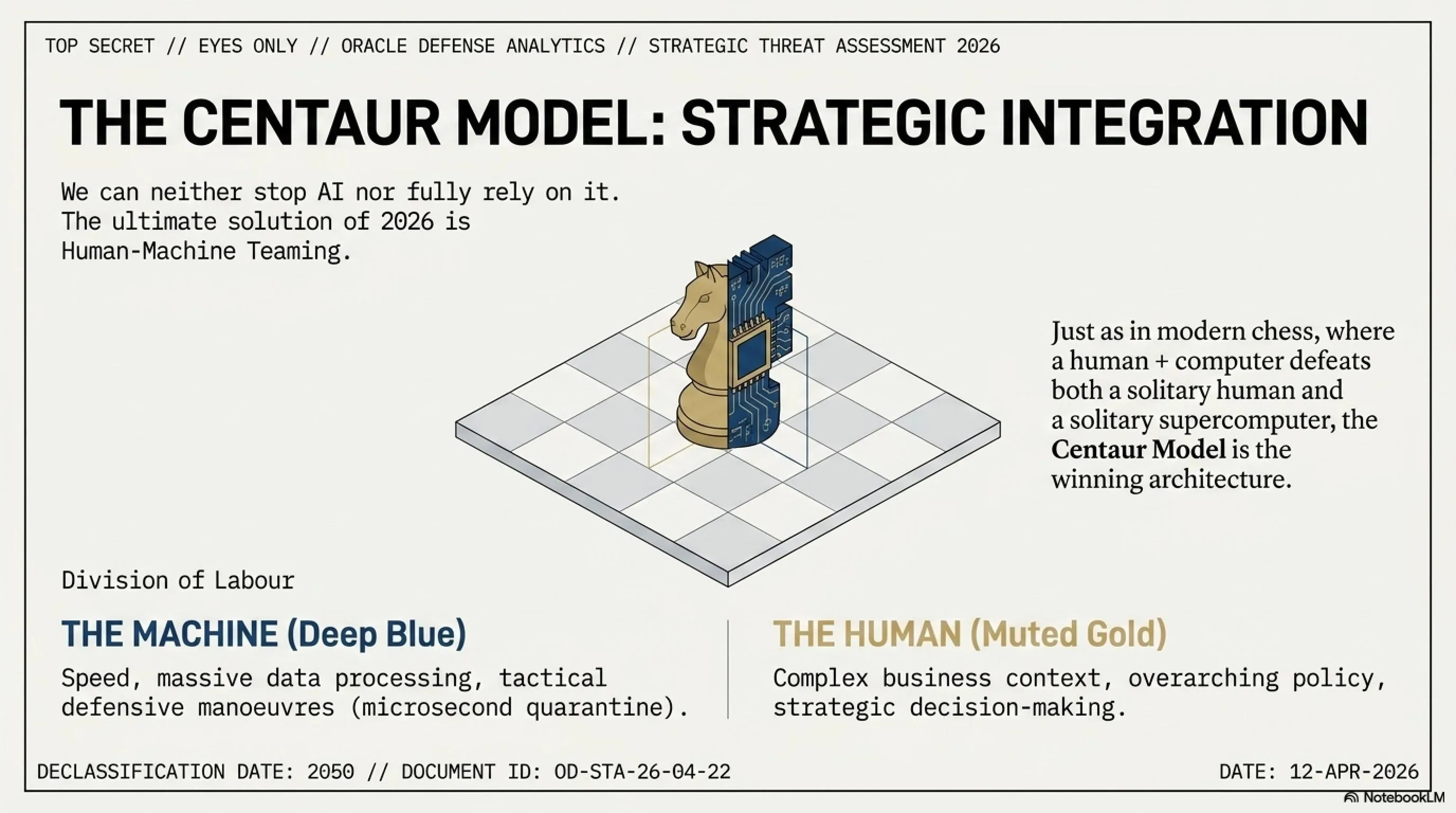
Despite all the controversies, the prevailing consensus in the global cybersecurity community is that we can neither stop AI nor fully rely on it. The ultimate solution that pioneering companies are implementing in 2026 is the "Centaur Model" (Human-Machine Teaming). Just as in modern chess, where a human collaborating with a computer can defeat both a solitary human and a solitary supercomputer, in cybersecurity, this combination is the winning ticket.
In this model, the machine is responsible for speed, processing massive data volumes, and executing tactical defensive maneuvers (such as quarantining a system). But the human—the senior cybersecurity analyst—remains at the center of the command room to make strategic decisions, understand the complex business context, and formulate overarching policies.
🔄 The Ideal Security Workflow in 2026
Detection & Initial Containment (Machine)
AI identifies abnormal behavior, blocks the suspicious IP in 4 milliseconds, and issues an alert.
Contextual Analysis (Machine + Human)
A Generative AI prepares a summarized report of the incident (in natural language) for the human analyst, explaining why this behavior is dangerous.
Strategic Decision Making (Human)
The human analyst reviews the AI's report. If it's a real attack, they authorize broader defensive measures. If it's a false positive, they correct the algorithm so it learns.
This approach practically turns every Junior analyst in the SOC (Security Operations Center) into an experienced cyber commander who, instead of deciphering raw code lines, manages intelligent virtual troops.
6. The Cost of Defense: The Economics of Cyber War and AI Inequality
As cyber warfare advances, the gap between large tech companies and small to medium-sized enterprises (SMEs) is becoming a dangerous chasm. The advanced systems discussed above—like Unsupervised Machine Learning systems and autonomous defense agents—are not cheap. Setting up an AI-driven Security Operations Center (AI SOC) requires hiring specialized Data Scientists, renting powerful GPUs, and purchasing massive amounts of pristine data to train the models.
📊 Economic Reality of the 2026 Cybersecurity Market
A review of global statistics shows that AI security tools are practically out of reach for many small businesses. This leaves them as easy prey for hacker automation.
This economic reality has caused hackers to direct the tip of their AI spear towards small companies, startups, and supply chains. Why waste time trying to crack a bank's impenetrable algorithms when they can bankrupt the bank's small accounting contractor with an automated attack in a few hours? This inequality in accessing AI defense tools is becoming one of the major human rights and international security challenges.
7. Conclusion: We Are the Real Algorithm
Generative AI and automated cybersecurity systems have drastically altered the battleground. But this does not mean the end of human importance. As machines become smarter, what matters most is the "goal" we set for them. In the end, the most dangerous malware and the most powerful defense systems are born from the human mind. Artificial intelligence only multiplies our capabilities by millions.
The Final Word
In the zero-day era, relying solely on human defense is a strategic error, and delegating all authority to an algorithm is an irresponsible risk. The future belongs to organizations that can build an integrated and seamless team of human genius and machine processing power. Until then, the cyber world remains a dark and unpredictable space.
For further reading, we recommend viewing the technical reports from Mandiant and CrowdStrike on AI-powered malware behavior, which provide fascinating perspectives on the near future of digital threats.
❓ Expert Panel: Frequently Asked Questions (FAQ)
1. How has AI practically eliminated the margin of error for hackers?
By fully automating the attack cycle (Kill Chain) from the bug discovery phase (Recon) to the precise generation of exploit codes, AI eliminates human error. In the past, a hacker might have made a syntax error while writing code or misidentified the target OS. But AI, using live analysis, generates bug-free, highly compatible codes, making phishing 100% successful with advanced social engineering.
2. What exactly is Continuous Asset Monitoring?
This modern approach, which has replaced periodic penetration testing, involves a network of smart sensors where AI continuously monitors all inbound and outbound traffic 24/7 without interruption. Instead of relying on a database of known viruses, this system judges based on "behavior". Any behavior that deviates from the learned normal pattern (Baseline) is immediately identified as an anomaly and neutralized in real-time.
3. With the rise of autonomous agents, are human engineers entirely out of the cyber defense loop?
No, their role hasn't been eliminated, but rather it has evolved or undergone a paradigm shift. In 2026, humans no longer work as "front-line operators" analyzing tedious logs or pressing approval buttons. Human engineers have now become "macro-strategists" who define budgets, network architecture, access policies (Zero Trust), and machine decision parameters, while the instantaneous firing of defenses is exclusively handled by the machine.
4. Why is AI Spear Phishing so much more dangerous than before?
Because AI can analyze Big Data from social networks (like Twitter, LinkedIn, and even Instagram) and combine it with leaked databases of old emails to build a complete psychological model of a target executive. The email generated by AI takes into account keywords, joke tones, personal concerns, and even the person's waking hours. Therefore, fake emails are indistinguishable from real ones and deceive even the most cautious managers.
5. What is the strategic role of Neural Processing Units (NPUs) in next-gen security networks?
In the world of AI-based hacking, sending data to Cloud servers for analysis and waiting for a defensive command causes "Latency" of a few seconds, which is enough time for an attacker to breach. Neural Processing Units (NPUs) are installed as hardware at the edge of the organization's network (Edge Computing) to perform network traffic analysis locally and at unprecedented speeds. This architecture brings the defensive reaction speed down to the millisecond level and reduces external communications during crises.
📚 References and Research Documents
- Wired Magazine — "How AI is Eliminating the Cyber Security Margin of Error: A 2026 Perspective"
- The Verge Cybersecurity Desk — "The Rise of Autonomous Defensive Agents and the Fall of Human SOCs"
- Whitepapers & Leaks — Leaked analytical documents on Dark Web forums regarding the Malware-as-a-Service economy (Secondary analysis by Tekin)
- BlackHat 2026 Keynote — Speeches by Dr. Elias Norton at the BlackHat security event
- Field research and exclusive analysis by the Cybersecurity and Editorial teams at Studio Tekin Plus
🌐 Stay Connected With Us 🎮✨
For the latest tech, gaming, and gadget news, follow us on our official social media channels: