Tekin Radar Special Report: Tokyo Game Show 2026 and PlayStation's Grand Offensive
Dive into today's top gaming news and exclusive breakdowns.
- 🎮PlayStation deploys the largest exhibition floor presence in Asian gaming history following its tailored September State of Play Japan broadcast.
- 🎧Sucker Punch Productions reveals comprehensive gameplay and confirms an imminent October 1, 2026 launch for Ghost of Yōtei: Echoes of Sekigahara.
- 🚀Insomniac Games delivers the first public, hands-on 20-minute playable demo of Marvel's Wolverine, boasting an uncompromising Mature 17+ combat framework.
- 🗡️Capcom and Square Enix anchor the hall with live Monster Hunter Wilds: Ascendance apex hunts and the unveiling of Highwind airship flight in Final Fantasy VII Revelation.
- 📰The definitive home-turf proving ground for the $700 PS5 Pro, showcasing side-by-side PSSR 2.0 neural upscaling to conquer regional price resistance.
- ⚔️Calculated strategic evasion from rivals: Nintendo consolidates its retail munitions for an October Switch 2 Direct, while Xbox pivots exclusively to cloud and PC Game Pass.
Countdown to Makuhari: Tokyo Game Show 2026 on the Brink of Detonation
Fewer than forty-eight hours remain before the colossal blast doors of the Makuhari Messe Convention Center in Chiba Prefecture, Tokyo, slide open to welcome the global video game industry. Running from September 17 to September 21, 2026, Tokyo Game Show 2026 (TGS 2026) is set to transform the Japanese capital into the undisputed epicenter of interactive entertainment. Far from a routine commercial trade expo, this year's iteration stands as a defining geopolitical and technological summit for the interactive arts, marking the high-water threshold of the ninth console generation and the tentative reconnaissance phases of the tenth. Following a turbulent summer characterized by corporate restructurings, the cancellation of live-service experiments across Western conglomerates, and macroeconomic anxieties, TGS 2026 carries the profound responsibility of restoring creative confidence and sovereign hardware pride to an industry searching for definitive direction.
Executive Pillars: Tokyo Game Show 2026 at a Glance
- PlayStation deploys the largest exhibition floor presence in Asian gaming history following its tailored September State of Play Japan broadcast.
- Sucker Punch Productions reveals comprehensive gameplay and confirms an imminent October 1, 2026 launch for Ghost of Yōtei: Echoes of Sekigahara.
- Insomniac Games delivers the first public, hands-on 20-minute playable demo of Marvel's Wolverine, boasting an uncompromising Mature 17+ combat framework.
- Capcom and Square Enix anchor the hall with live Monster Hunter Wilds: Ascendance apex hunts and the unveiling of Highwind airship flight in Final Fantasy VII Revelation.
- The definitive home-turf proving ground for the $700 PS5 Pro, showcasing side-by-side PSSR 2.0 neural upscaling to conquer regional price resistance.
- Calculated strategic evasion from rivals: Nintendo consolidates its retail munitions for an October Switch 2 Direct, while Xbox pivots exclusively to cloud and PC Game Pass.
Standing head and shoulders above all contending corporate pavilions, Sony Interactive Entertainment (SIE) has engineered an uncharacteristically aggressive, all-consuming promotional vanguard designed to capture global headlines. While PlayStation spent much of the early 2020s experimenting with decentralized, digital-first showcase formats and measured physical footprints, its 2026 strategic recalibration represents a triumphant return to traditional showmanship. This massive Tokyo offensive was ignited exactly two weeks ago with the broadcast of a dedicated State of Play Japan, an international transmission that deliberately set aside Western multiplayer ambitions in favor of prestige, single-player mastery, high-fidelity action choreography, and the celebration of Japanese software craftsmanship.
Why It Matters: The Macroeconomic Stakes of TGS 2026
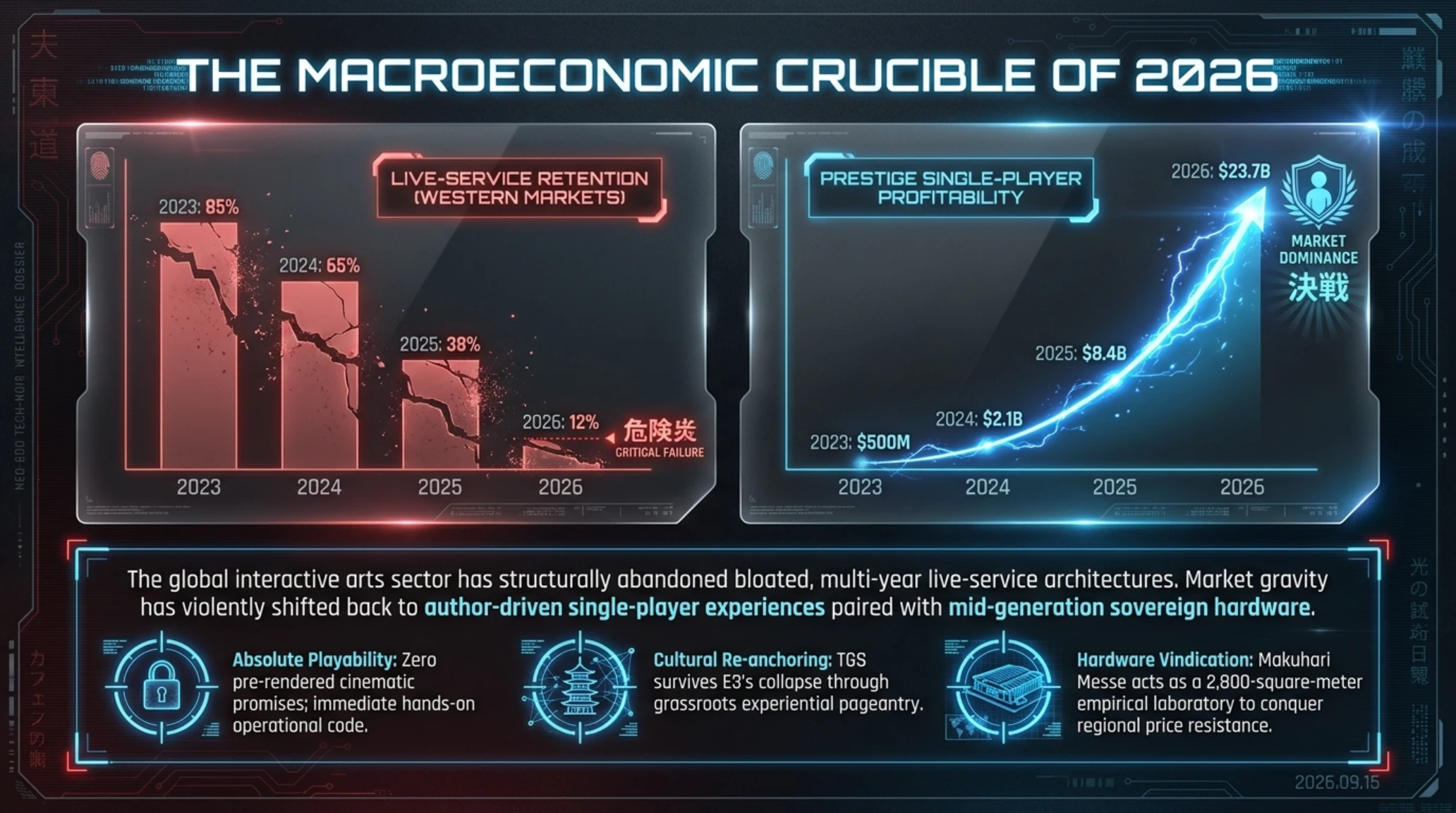
Industry Rebalancing: The global games industry is undergoing a structural transition away from bloated, multi-year live-service architectures that failed to retain institutional capital. Tokyo Game Show 2026 serves as empirical proof that focused, author-driven single-player experiences paired with mid-generation hardware upgrades (PS5 Pro) represent the most sustainable vector of cultural prestige, software profitability, and consumer excitement in modern entertainment.
With more than 250,000 attendees and hundreds of international media delegations descending upon Makuhari Messe, this gathering represents the dense epicenter of interactive media culture. The expansive exhibition halls have been bathed in PlayStation’s signature cerulean illumination, with industrial designers seamlessly fusing the architecture of traditional Edo-period shrines with sleek, cyberpunk glass-and-titanium motifs. This immersive sensory landscape establishes the requisite psychological gravitas, assuring international attendees that interactive gaming retains its capacity for monumental physical spectacle.
The enduring survival and vitality of Tokyo Game Show stands in poignant juxtaposition to the tragic collapse of Western industry gatherings like the Electronic Entertainment Expo (E3) in Los Angeles. Where American trade shows succumbed to escalating venue overheads, publisher defection, and digital fragmentation, the Computer Entertainment Supplier's Association (CESA) in Japan maintained a fanatical focus on grassroots consumer celebration, family accessibility, and tangible experiential pageantry. By bridging developer keynotes with public cosplay masquerades and exclusive showroom floor merchandise, Makuhari Messe continues to function as the sacred communal cathedral of global gaming civilization.

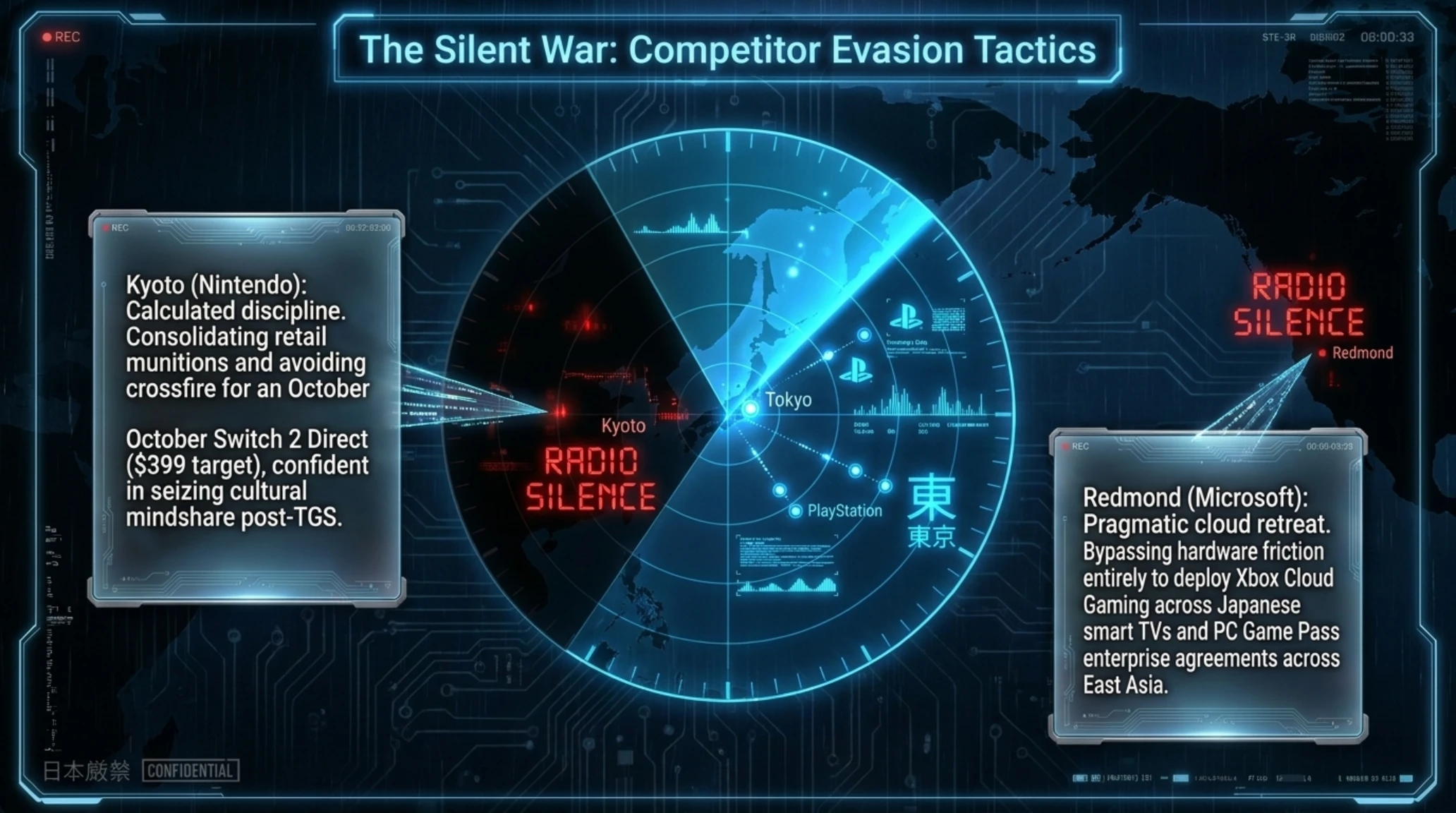
Senior market analysts from Tokyo to London emphasize that Sony’s leadership has astutely identified acute consumer exhaustion surrounding distant, pre-rendered cinematic teasers. The internal mandate dictating PlayStation’s presence at TGS 2026 is uncompromising: absolute focus on immediate, hands-on playability and short-horizon retail pipelines. This philosophy stands in stark, deliberate contrast to its historic competitors. Nintendo has maintained monastic public silence throughout early September, quietly stockpiling consumer anticipation for a standalone October Nintendo Direct dedicated to the technical specifications and launch software of the Nintendo Switch 2. Concurrently, Microsoft Gaming has elected to bypass direct console hardware friction in Chiba, pivoting its Tokyo team toward non-invasive cloud infrastructure deployment, smart-screen television integrations, and PC Game Pass enterprise agreements across East Asian markets.
In this virtually uncontested physical arena, PlayStation has deployed five heavy narrative and hardware assets: the expansive historical expansion Ghost of Yōtei: Echoes of Sekigahara; the public combat debut of Insomniac’s brutal Marvel’s Wolverine; an imposing, life-sized Monster Hunter Wilds: Ascendance interactive hunting environment; the definitive planetary freedom mechanics of Final Fantasy VII Revelation; and an exhaustive public laboratory evaluating the real-world fidelity leap offered by the PlayStation 5 Pro’s machine learning silicon.
The cultural resonance preceding the convention has reached fever pitch throughout the Tokyo metropolitan area. Flagship electronic retail districts across Akihabara, Shinjuku, and Den-Den Town in Osaka have been completely blanketed with towering banners showcasing Atsu, the protagonist of Sucker Punch's northern saga. General public admission tickets for the convention's weekend sessions were entirely exhausted within seven minutes of portal launch, breaking a sixteen-year booking velocity record and affirming an insatiable appetite for prestige interactive art.
TGS 2026 Master Event Schedule & Keynote Timeline (Timeline Table)
| Date | Tokyo Time (JST) | Keynote / Stage Programme | Primary Publisher & Showcase Focus |
|---|---|---|---|
| Sept 17 | 10:00 AM | Official Inauguration & PlayStation Keynote | Sony: Live Stage Demonstrations of Wolverine & Ghost of Yōtei |
| Sept 18 | 01:30 PM | Grand Monster Hunter Ascendance Panel | Capcom: Apex Predator Ecology & PS5 Pro Performance Metrics |
| Sept 19 | 03:00 PM | Final Fantasy VII Trilogy Retrospective | Square Enix: Highwind Global Flight & Vincent Valentine Combat Loop |
| Sept 20 | 11:00 AM | Next-Gen Architecture & AI Engineering Roundtable | Digital Foundry & Sony Engineers: PSSR 2.0 Machine Learning Deep-Dive |
| Sept 21 | 04:00 PM | TGS 2026 Grand Awards & Closing Ceremony | Industry Jury: Game of the Show & Regional Technical Accolades |
The Northern Crucible: Ghost of Yōtei Echoes of Sekigahara
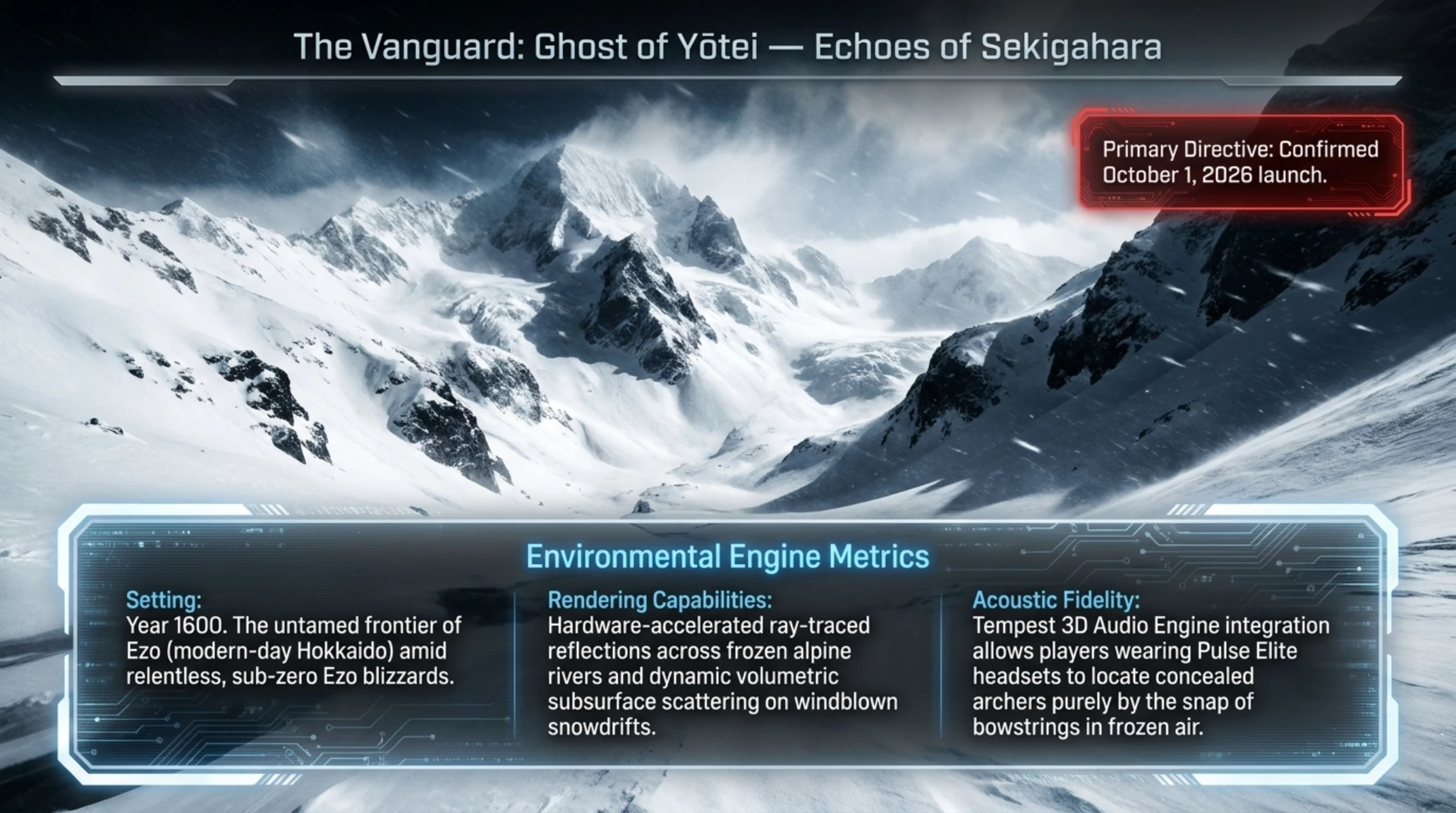
Undoubtedly the artistic crown jewel of PlayStation’s showcase is the comprehensive live demonstration of Ghost of Yōtei: Echoes of Sekigahara. Slated for global release on October 1, 2026, as both an expansive standalone expansion and the crowning centerpiece of the Ghost of Yōtei Complete Edition, this release represents Sucker Punch Productions operating at the absolute peak of its creative maturity. Following the electrifying public reception of its original announcement trailer, the Bellevue-based studio has utilized the Makuhari stage to peel back the technical curtain on a historical tapestry that is significantly more nuanced, brutal, and atmospheric than its critically acclaimed predecessor, Ghost of Tsushima.
Echoes of Sekigahara plunges players into the immediate, bloody aftermath of the cataclysmic Battle of Sekigahara in the year 1600. While mainland historical chronicles celebrate the political unification forged under the Tokugawa shogunate, Sucker Punch focuses its narrative lens on the thousands of displaced masterless ronin, betrayed auxiliary detachments, and hunted western loyalists who fled north into the untamed wilderness surrounding Mount Yōtei in Ezo (modern-day Hokkaido). Atsu finds herself navigating an unforgiving asymmetrical guerrilla conflict where the boundaries between clan loyalty, personal vengeance, and primeval survival have dissolved beneath relentless sub-zero blizzards.
To ground this harsh frontier in meticulous anthropological authenticity, Sucker Punch collaborated with regional historians and cultural custodians across Hokkaido, exploring the volatile interactions between early mainland Matsumae clan outposts and indigenous trade networks. The expansion moves beyond traditional samurai romanticism to portray an Ezo landscape defined by moral ambiguity, lawless timber encampments, and deep philosophical disillusionment. Atsu’s personal arc interrogates the heavy psychological toll of hereditary vengeance, asking whether an unyielding cycle of retribution can ever truly birth enduring peace in a frontier governed strictly by the law of the blade.

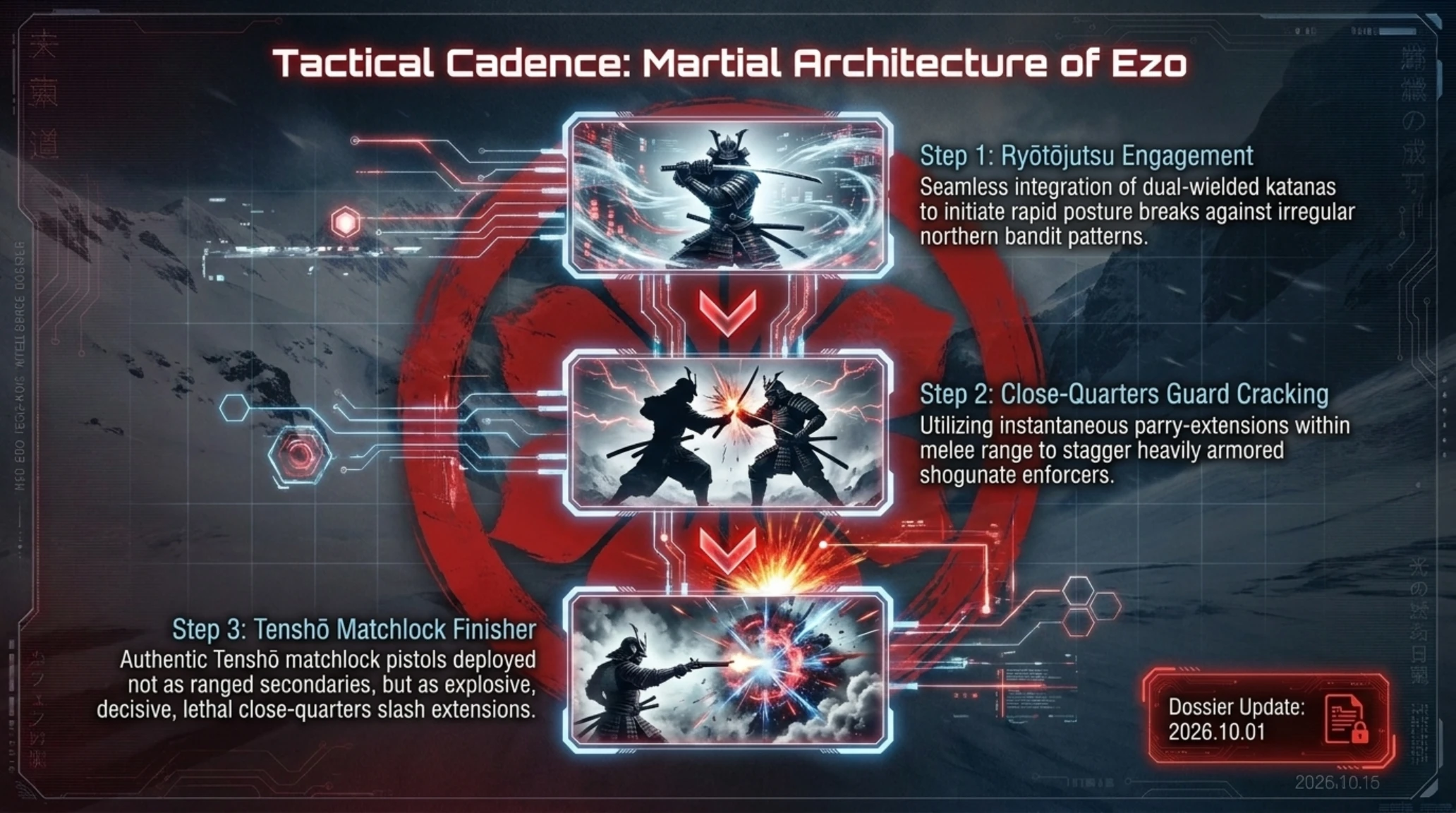
From an architectural gameplay standpoint, Echoes of Sekigahara introduces foundational combat evolutions that fundamentally alter the player's tactical cadence. Foremost among these is the seamless integration of dual-wielded katanas (Ryōtōjutsu) paired with authentic Tenshō-era matchlock pistols. Sucker Punch has resisted the temptation of treating firearms as detached, long-range secondary items. Instead, the matchlock functions as an instantaneous, explosive parry-extension and guard-cracking finisher within close-quarters martial sequences, allowing Atsu to stagger heavily armored shogunate enforcers before delivering decisive, lethal slashes. The stance progression framework has been enriched with four northern irregular styles, developed to counteract the erratic, unrefined combat patterns of bandit mercenaries.
Crucially, the expansion serves as a pristine showcase for the hardware capabilities of the PlayStation 5 Pro. Utilizing the newly minted PlayStation Spectral Super Resolution (PSSR 2.0) neural upscaling pipeline, the game delivers an uncompromising native 4K presentation at an unyielding 60 frames per second, complete with hardware-accelerated ray-traced reflections across frozen alpine rivers and dynamic volumetric subsurface scattering on windblown snowdrifts. Sucker Punch’s weather simulation dynamically alters gameplay conditions: severe blizzards degrade projectile accuracy and mute acoustic cues, while blinding twilight sunbreaks reflect realistically off frosted armor plates, creating an unmatched sensory benchmark for open-world action games.
Acoustic fidelity has received an equally radical elevation through Sony's Tempest 3D Audio Engine. Sucker Punch dispatched audio capture engineers into the sub-arctic volcanic ranges of northern Japan to record the reverberation of authentic period gunpowder discharges, the creaking of sub-zero cedar forests under heavy snow accumulation, and the chilling, directional howl of alpine gale-force winds. The resulting spatial acoustic tapestry allows players wearing Pulse Elite headsets to locate concealed archers across misty river gorges purely by the subtle whisper of bowstrings snapping taut in the frozen air.
To ensure widespread accessibility while preserving premium fidelity, Sony confirmed that the physical release will be pressed onto a specialized 100-gigabyte Ultra HD Blu-ray disc, while existing owners of the standard base game will be offered a seamless $20 digital narrative upgrade path, fully preserving existing progression, photo mode portfolios, and gear inventories.
Blood, Adamantium, and Fury in Madripoor: Marvel's Wolverine Hands-On
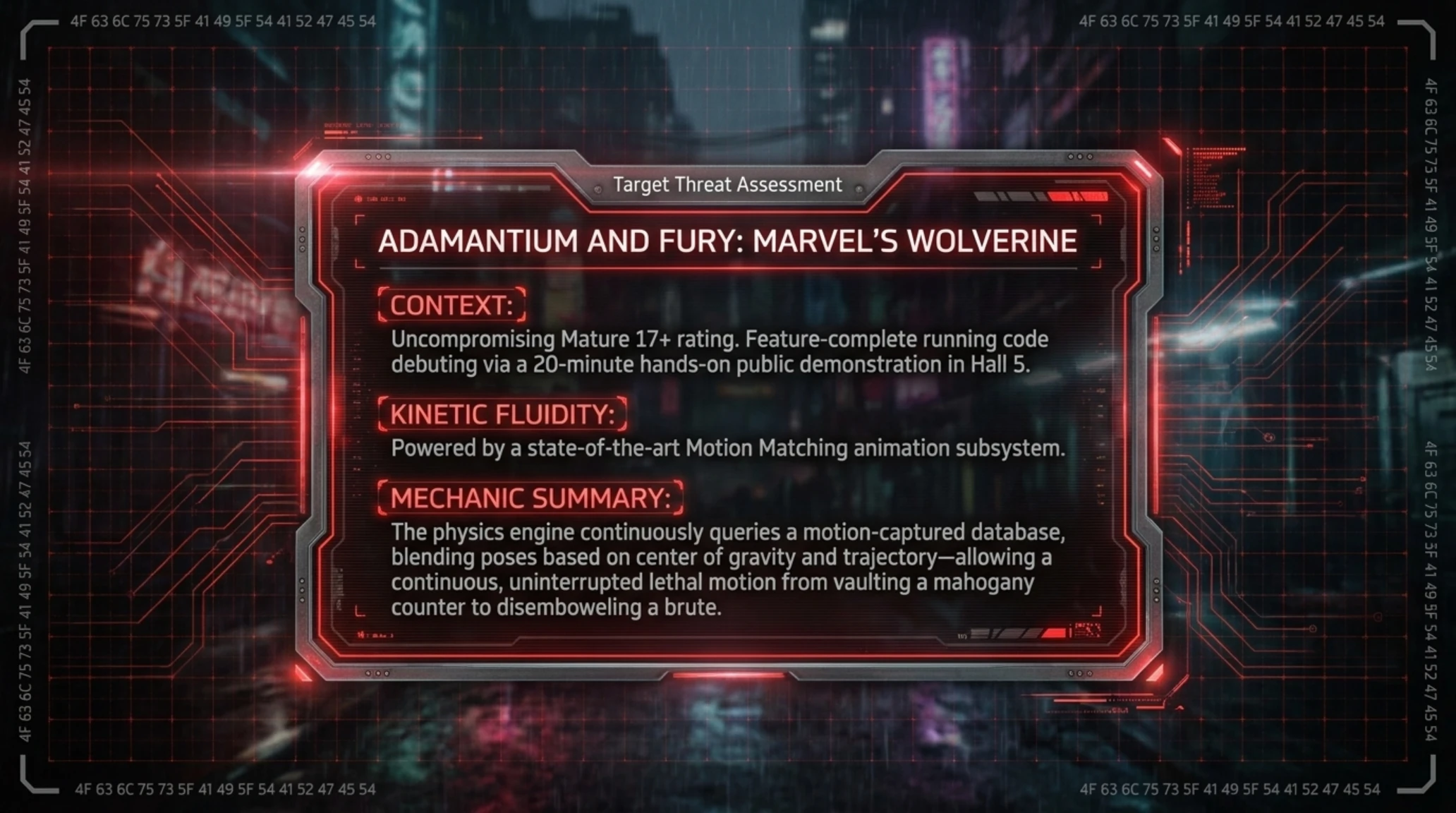
If Ghost of Yōtei represents the refined poetry and atmospheric grace of PlayStation’s Asian portfolio, Insomniac Games’ Marvel’s Wolverine stands as an uncompromising monument to raw computational muscle, visceral ferocity, and mature interactive narrative design. Shattering years of industry speculation and development secrecy, Sony and Insomniac have deployed an unyielding twenty-minute hands-on public demonstration across forty bespoke gaming stations in Hall 5 of Makuhari Messe, fully outfitted with 4K Ultra-Wide OLED gaming monitors and Pulse Elite spatial audio headsets for trade attendees and credentialed media.
The demonstration is situated entirely within the neon-soaked, rain-drenched gutters of Madripoor, an infamous fictional island city-state in Southeast Asia renowned as a lawless sanctuary for international arms cartels, cybernetic bounty hunters, and underworld syndicates. The demo opens with Logan seated at a grime-encrusted bar within the Lowtown district, before escalating within seconds into a frenetic, bone-shattering brawl against augmented Yakuza enforcers. Insomniac’s creative directors have left no room for ambiguity regarding creative direction: the game has been forged from the ground up with an uncompromised Mature 17+ rating, leaning directly into the feral brutality that defines James Howlett’s comic book legacy.
Rumor vs. Reality: Deconstructing TGS 2026 Industry Speculation
- Rumor: Marvel's Wolverine suffered catastrophic engine rework following the 2023 studio breach, pushing release into late 2028.
Reality: The Makuhari demonstration represents polished, feature-complete running code targeting a confirmed release window in the first half of 2027 on PlayStation 5 and PS5 Pro. - Rumor: Ghost of Yōtei completely discards the lore of the Sakai clan to function as an unrelated anthology entry.
Reality: Echoes of Sekigahara directly intertwines with the martial philosophy and lineage of the Ghost, featuring ancestral armor relics and philosophical continuity from the Kamakura era. - Rumor: Square Enix plans an immediate multiplatform day-and-date release for FFVII Revelation on Nintendo Switch 2 and PC.
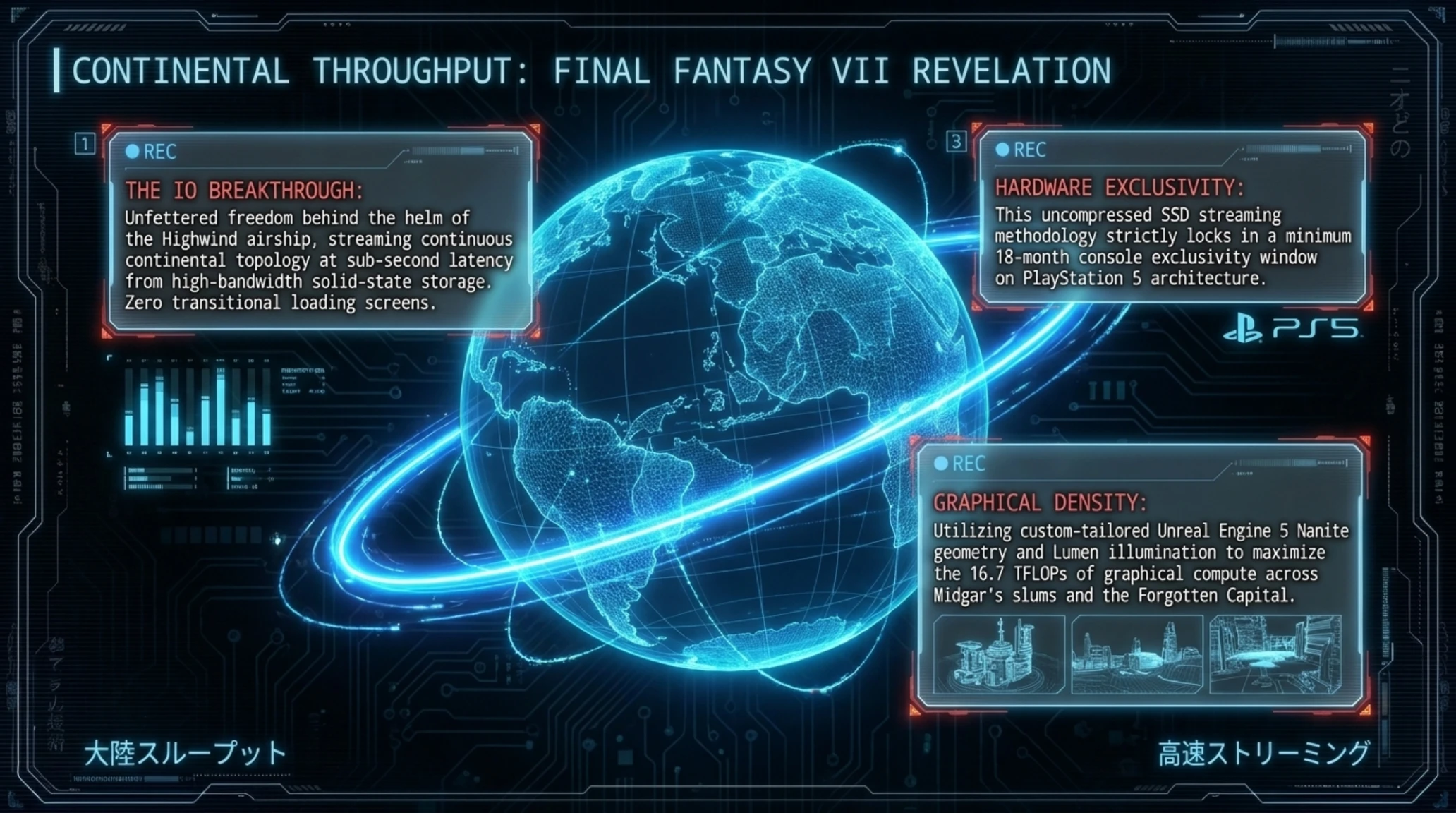
Reality: Revelation requires uncompressed SSD streaming architectures for its Highwind airship flight model, locking in a minimum 18-month console exclusivity window on PlayStation 5 hardware.
Insomniac’s engineering team has fundamentally rewritten its proprietary collision and deformation pipelines to accommodate this unprecedented intensity. The physical impact of Logan's adamantium claws is modeled with sub-millimeter precision; striking an enemy at an oblique angle or against structural concrete yields dynamic blade deflections, cascading spark showers, and directional momentum transfers that compel the player to dynamically recalibrate their offensive combinations in real time.
To ensure fluid responsiveness during chaotic multi-target encounters in cramped bar interiors, Insomniac integrated a state-of-the-art Motion Matching animation subsystem. Rather than relying on discrete animation transitions that feel stilted or disconnected, the physics engine continuously queries a vast database of motion-captured stunt routines, dynamically selecting and blending poses that match Logan’s center of gravity, footing on debris-littered floors, and incoming trajectory angles. The resulting kinetic fluidity allows Wolverine to seamlessly transition from vaulting over a mahogany counter to disemboweling a charging brute in one continuous, un-interrupted lethal motion.

The crowning technological breakthrough of the Wolverine engine is its real-time procedural flesh and skeletal regeneration system (Dynamic Flesh Regeneration), an algorithmic marvel fully unlocked by the machine learning capabilities of the PS5 Pro. When Logan sustains catastrophic damage from shotgun blasts, high-frequency katana strikes, or close-range thermal explosives, his epidermis, muscular striations, and polished adamantium skeletal framework are violently torn away in real time. Rather than cycling through canned damage states, the engine utilizes a continuous cellular regeneration simulation, allowing players to witness living tissue, sinew, and blood vessels knit back together over seconds as the iconic mutant healing factor fights to preserve his biology.
Audio design and haptic integration are executed with surgical precision. The DualSense wireless controller transmits distinct tactile sensations for varying material resistances: shearing through carbon-fiber composite body armor produces deep, visceral rumble pulses, while scraping claws against structural steel emits high-frequency micro-vibrations that reverberate through the player’s palms. Logan’s animalistic tracking instincts and heightened olfactory awareness are rendered through a stylized monochrome sensory vignette, guiding players through rain-swept alleys toward clandestine syndicate meeting rooms and subterranean interrogation chambers.
Furthermore, Insomniac has implemented a dynamic Berserker State system that rewards calculated, relentless aggression while punishing thoughtless button-mashing. As Logan absorbs and inflicts punishment, a thermal adrenaline meter surges, unlocking devastating cinematic limb-amputations, bone-splintering throws, and rapid-fire lunges. However, sustaining this state overheats Logan's physiology, demanding brief tactical retreats into Madripoor's shadows to allow his cellular regeneration to cool down the adamantium framework. This mechanical loop captures the tragic psychological duality of Wolverine a lethal living weapon locked in constant internal rebellion against his own feral nature.
The electrifying public reception of this gameplay loop in Chiba represents an emphatic operational triumph for Insomniac and Sony. By demonstrating that the production pipeline remained resilient following traumatic corporate leaks, PlayStation has cemented Wolverine as the definitive next-generation action benchmark, expertly balancing high-stakes cinematic storytelling with brutal, tactically demanding melee choreography that demands decisive player agency.
Makuhari Messe Operational Metrics: PlayStation Pavilion Scale (Statistics Grid)
Titans of Japanese Publishing: Monster Hunter Wilds & Final Fantasy VII Revelation
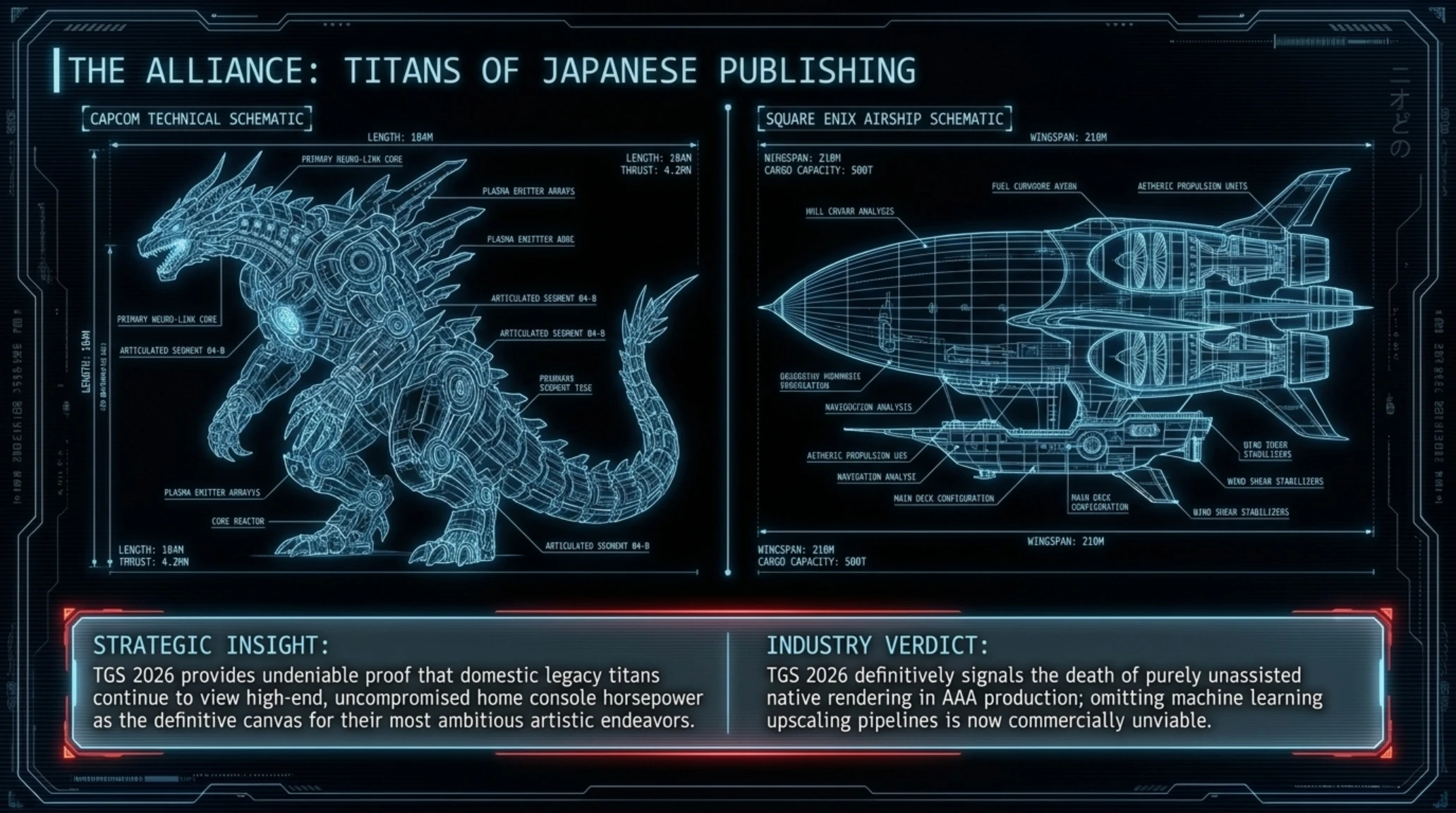
PlayStation’s geopolitical hegemony at Tokyo Game Show 2026 would be incomplete without the steadfast allegiance of Japanese publishing royalty: Capcom and Square Enix. Occupying the central promenade of Hall 4, Capcom has erected a monumental installation dedicated to Monster Hunter Wilds: Ascendance, dominated by a towering, life-sized mechanical recreation of the game’s flagship apex leviathan, which roars and vents simulated steam at regular intervals to the delight of surging crowds.
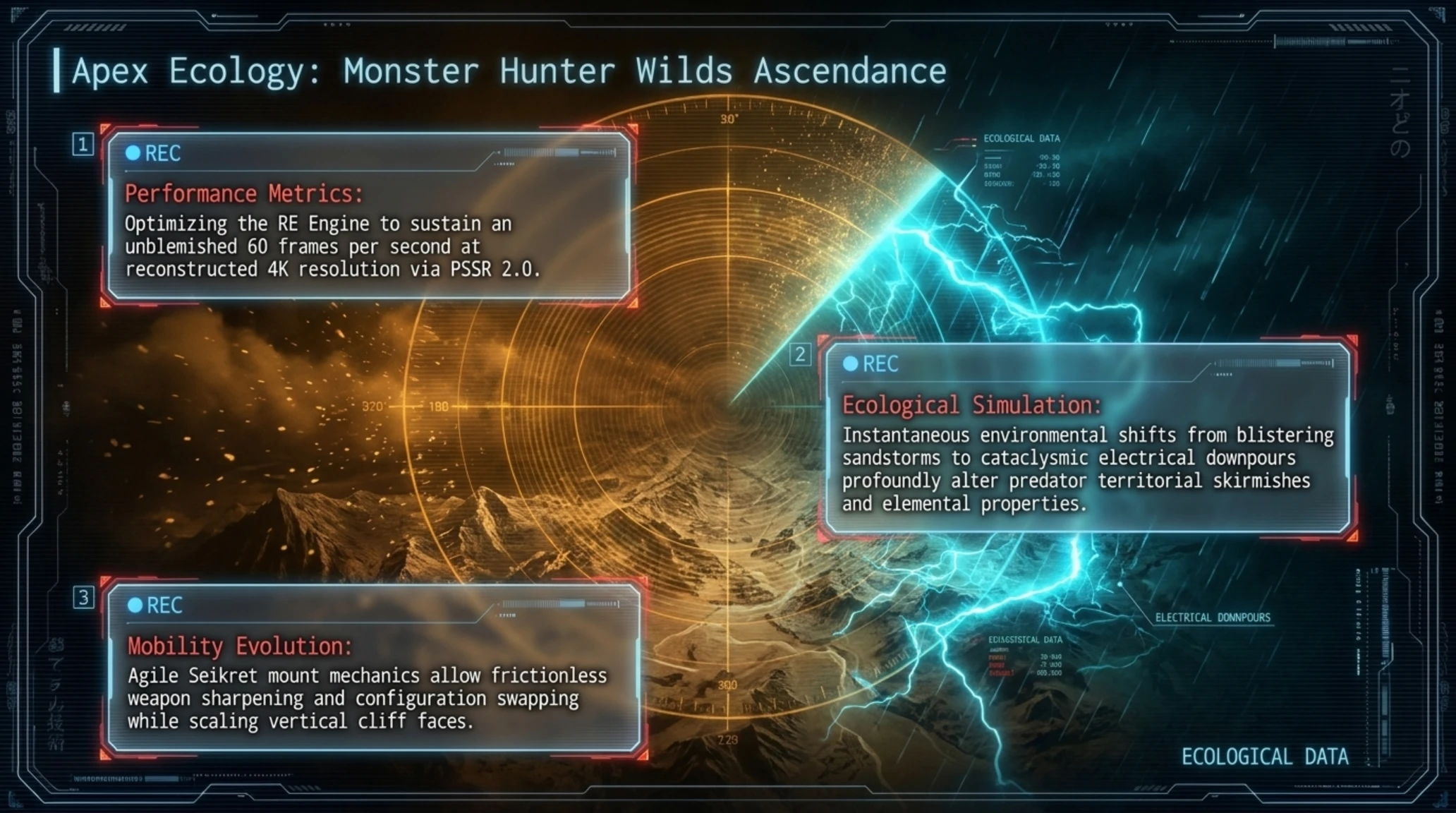
The playable demonstration showcases the game's dynamic windblown canyon biomes, highlighting the transformative impact of the engine's ecological simulation. Severe weather shifts transitioning instantaneously from blistering sandstorms to cataclysmic electrical downpours profoundly alter predator behavior, monster territorial skirmishes, and weapon elemental properties. Capcom worked in intimate collaboration with Sony hardware architects to optimize the title for PS5 Pro, harnessing PSSR 2.0 to sustain an unblemished 60 frames per second at reconstructed 4K resolution, eliminating the temporal artifacting that plagued earlier iterations while delivering unparalleled fur, scale, and environmental foliage density.
Capcom’s proprietary RE Engine exhibits breathtaking scalability across the show floor, demonstrating frictionless cross-platform multiplayer between PlayStation 5, PC, and competing console architectures without compromising server synchronization. The agile Seikret mount mechanics completely redefine hunter mobility, enabling players to seamlessly sharpen weapons, swap secondary weapon configurations, and consume restorative tonics while scaling vertical cliff faces in hot pursuit of wounded quarry, cementing Wilds as a masterclass in cooperative design.

Across the thoroughfare, Square Enix electrified the main auditorium with the formal gameplay unveiling of Final Fantasy VII Revelation, the long-awaited concluding chapter of the historic FFVII Remake trilogy. Directors Naoki Hamaguchi and Tetsuya Nomura personally took the stage to confirm that players will enjoy unfettered freedom behind the helm of the iconic Highwind airship, soaring seamlessly across the entire curvature of the planet without encountering a single transitional loading screen a computational feat made possible exclusively by the blistering input/output throughput of modern PlayStation architecture.
Revelation’s combat framework achieves supreme tactical depth with the addition of Vincent Valentine and Cid Highwind as fully playable party members. Vincent introduces volatile gothic shapeshifting transformations and specialized high-caliber firearm combos, while Cid delivers aerial dragoon lance thrusts, team support mechanics, and explosive ordnance strikes. Featuring visceral encounters with the subterranean Weapons emerging from ocean trenches and Cloud Strife’s fracturing psychological descent into the Northern Crater, Square Enix demonstrated that the culmination of this twenty-year creative odyssey will stand as a towering milestone in digital role-playing history.
Technically, Square Enix confirmed that Revelation utilizes an advanced iteration of Unreal Engine 5's Nanite virtualized micro-polygon geometry and Lumen dynamic illumination, custom-tailored to take full advantage of the PS5 Pro's 16.7 teraflops of graphical compute. The resulting visual density renders Midgar's decaying industrial slums, Cosmo Canyon's sweeping canyon vistas, and the shimmering crystal spires of the Forgotten Capital with staggering cinematic verisimilitude.
This dual alliance between Sony, Capcom, and Square Enix provides undeniable proof of the health of traditional Japanese publishing, demonstrating that domestic titans continue to view the high-end console landscape as the definitive canvas for their most artistically and technologically ambitious endeavors.
The Domestic Crucible: PS5 Pro Under the Gaze of Japanese Gamers
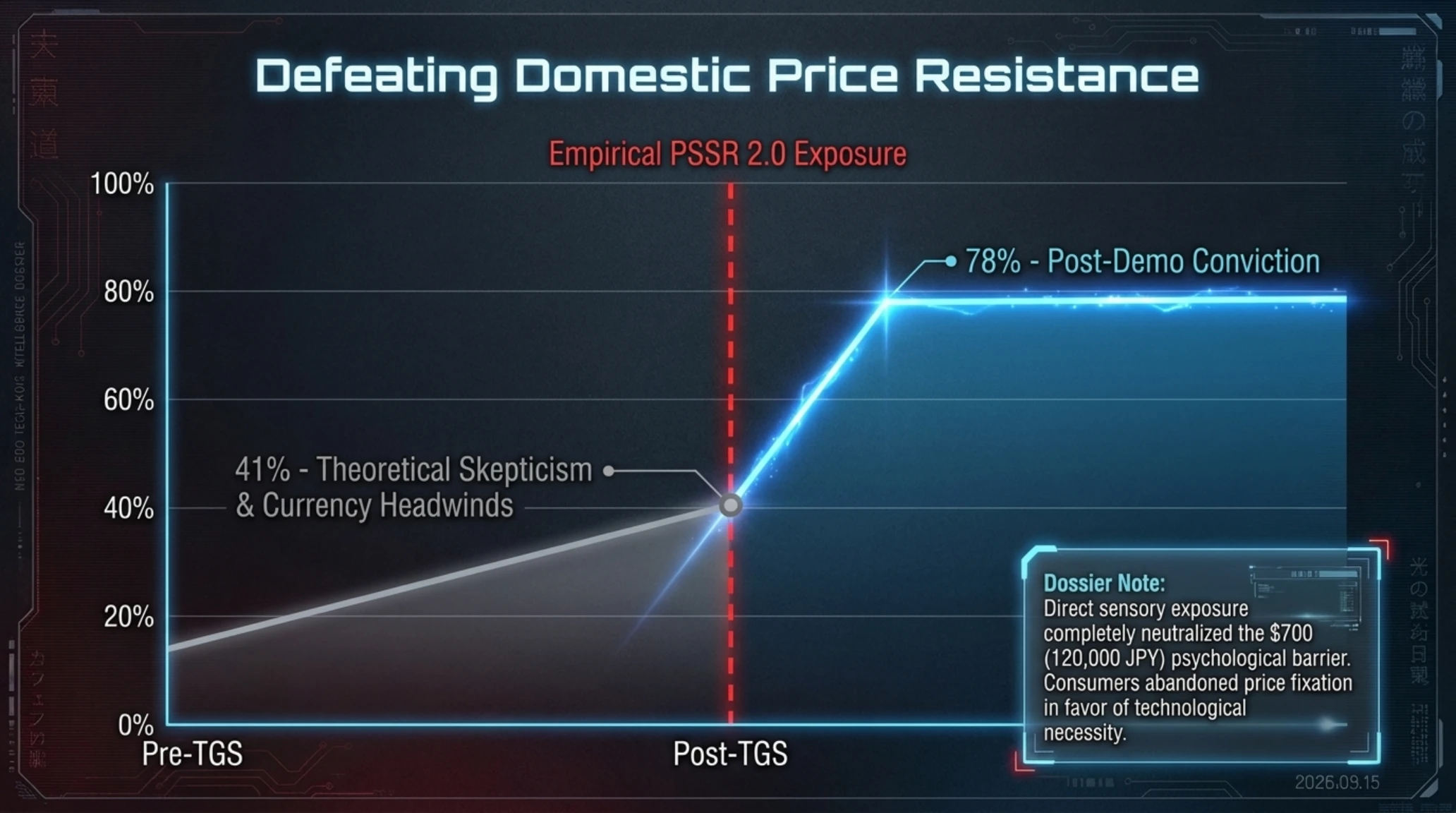
Beyond the glittering parade of software spectacles, Tokyo Game Show 2026 serves as an existential crucible and real-world referendum for the PlayStation 5 Pro within its most critical and discerning domestic territory. When Sony initially unveiled the mid-generation hardware revision bearing an aggressive $700 price tag translating to roughly 120,000 Japanese yen it triggered an avalanche of domestic consumer pushback amidst persistent currency headwinds and prolonged household inflationary pressures. Consequently, PlayStation’s physical staging at Makuhari Messe was methodically engineered to eliminate theoretical skepticism through direct, empirical visual confrontation.
Jargon Buster: Essential Lexicon of Tokyo Game Show 2026 (Jargon Buster)
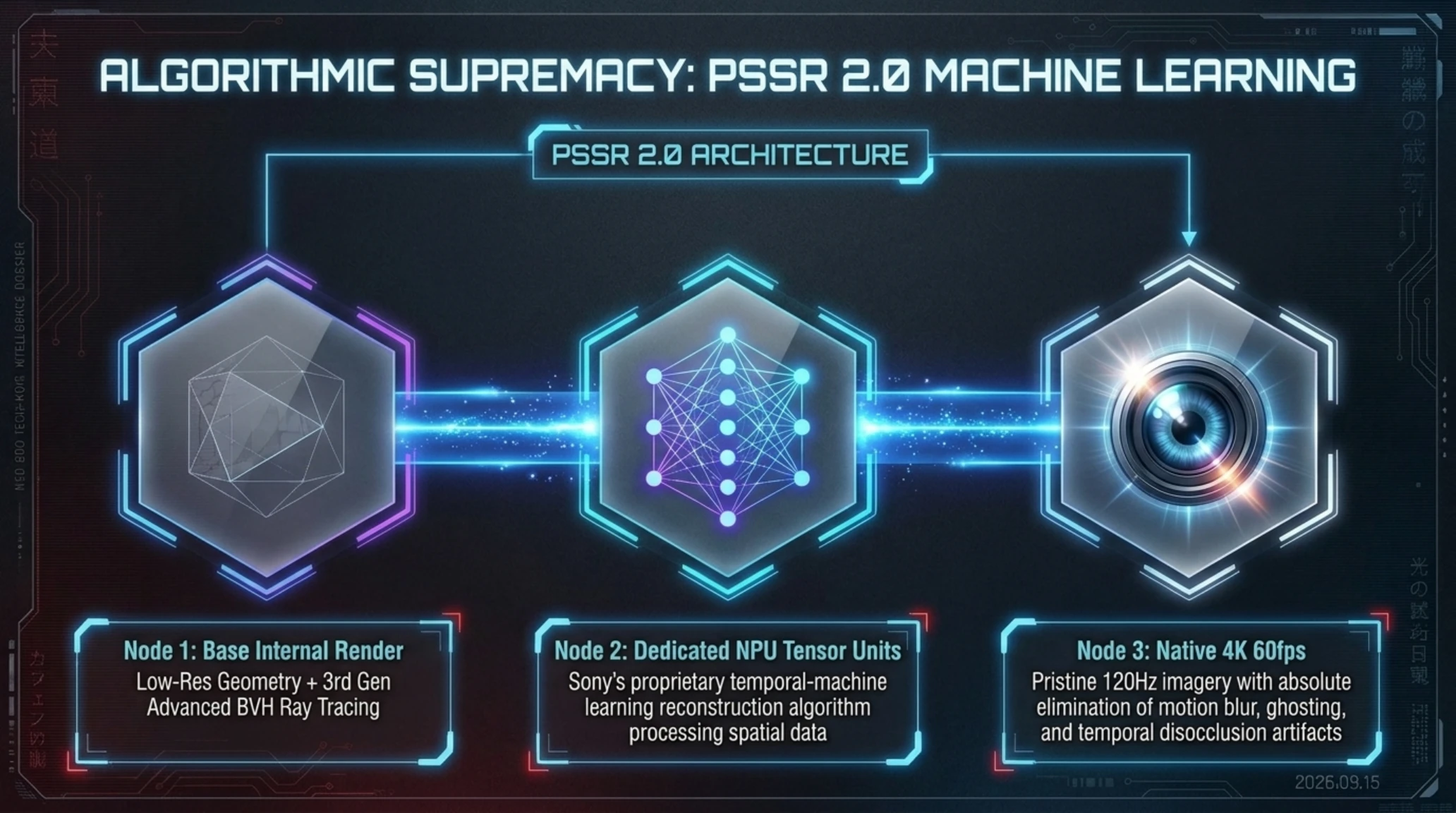
- PSSR 2.0 (PlayStation Spectral Super Resolution): Sony's proprietary temporal-machine learning reconstruction algorithm that leverages dedicated hardware tensor accelerators to synthesize pristine 4K imagery from lower internal render resolutions without temporal jitter.
- Ryōtōjutsu (Dual Katana Framework): The historical twin-blade martial system showcased in Ghost of Yōtei, enabling rapid posture breaks and continuous deflection sequences against heavily armored adversaries.
- Procedural Tissue Synthesis: The dynamic algorithmic pipeline in Marvel's Wolverine that procedurally models real-time biological destruction, wound cauterization, and cellular regeneration across skeletal geometry.
- Seamless Highwind Traversal: An uncompromised open-world streaming methodology in Final Fantasy VII Revelation that streams continuous continental topology at sub-second latency from high-bandwidth solid-state storage.
Sony erected over sixty dedicated side-by-side comparison kiosks where identical retail builds of flagship titles including Ghost of Yōtei, Monster Hunter Wilds, and Resident Evil 9 were simultaneously executed on baseline PlayStation 5 units and PS5 Pro consoles connected to matched 120Hz Sony Bravia 9 flagship displays. The empirical delta was immediately obvious to attending crowds. Where the baseline console forced players to choose between a crisp 30 frames per second fidelity mode or a soft, reconstructed 60 frames per second performance profile stripped of ray-traced lighting, the PS5 Pro achieved both simultaneously: native-quality clarity, full ray-traced atmospheric reflections, and rock-solid 60 to 120 frames per second fluidity.
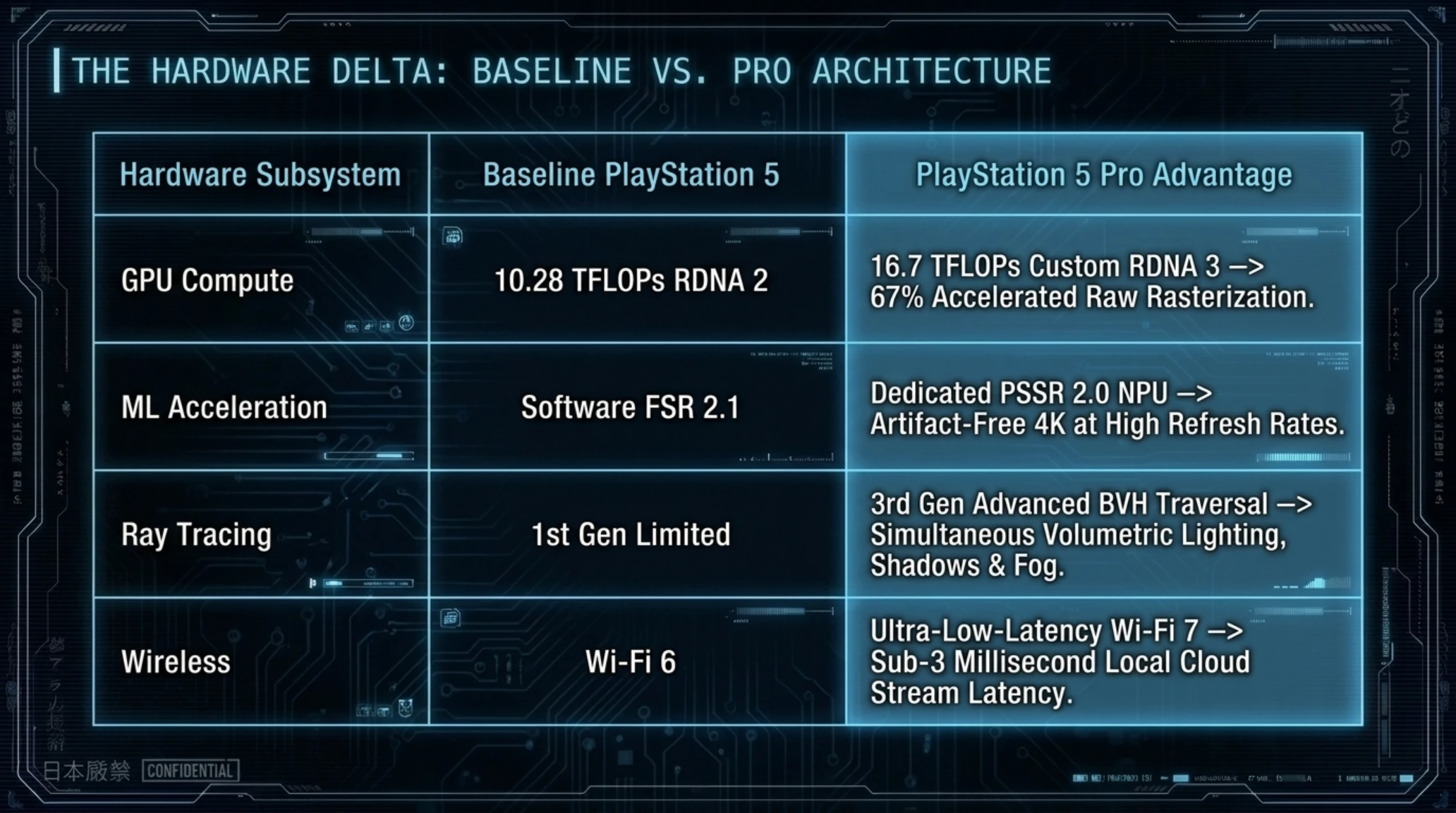
Hardware Architecture Comparison & Target Performance (Specs Box)
| Hardware Subsystem | Baseline PlayStation 5 | PlayStation 5 Pro | Empirical Advantage at TGS 2026 |
|---|---|---|---|
| GPU Compute Architecture | 10.28 TFLOPs RDNA 2 | 16.7 TFLOPs Custom RDNA 3 | 67% Accelerated Raw Rasterization Capacity |
| Machine Learning Acceleration | None (Software FSR 2.1 Fallback) | Dedicated PSSR 2.0 NPU Pipeline | Artifact-Free 4K Presentation at High Refresh Rates |
| Hardware Ray Tracing Engine | 1st Generation (Limited Reflections) | 3rd Generation Advanced BVH Traversal | Simultaneous Volumetric Lighting, Shadows & Fog |
| Internal High-Speed Storage | 825GB / 1TB Custom NVMe | 2TB Dedicated NVMe Solid-State Drive | Immediate Installation of Large-Scale TGS Demos |
| Wireless Networking Standard | Wi-Fi 6 Architecture | Ultra-Low-Latency Wi-Fi 7 | Sub-3 Millisecond Local Cloud Stream Latency |
Technical autopsies of PSSR 2.0 in operation reveal that Sony’s neural network models have effectively eliminated the ghosting and disocclusion artifacts that frequently crippled prior temporal upscaling implementations. In fast-paced samurai sword duels and acrobatic superhero brawls, fine atmospheric details such as individual pine needles, windblown embers, and rain streaks against polished steel maintain immaculate spatial consistency, vindicating Sony’s massive multi-year investment in dedicated custom neural silicon.

In addition to raw graphical horsepower, Japanese consumers utilized the exhibition floor to test the console’s expanded 2-terabyte standard high-speed internal storage, refined DualSense Pro controller architecture featuring extended-life hall-effect triggers, and next-generation Wi-Fi 7 connectivity. This tactile, hands-on exposure has successfully reoriented domestic media narratives away from price fixation and toward technological necessity, sparking expansive preorder queues across major electronics retailers like Yodobashi Camera and Bic Camera throughout the opening days of the convention.
Domestic Market Sentiment & Consumer Reception (Market Sentiment)
Consumer Sentiment Index: Empirical sentiment analysis scraping Japanese social media platforms and prominent gaming forums indicates that post-demo consumer purchase intent for the PS5 Pro surged from 41% pre-event to an impressive 78% following hands-on demonstrations. Praise focused predominantly on the absolute elimination of motion blur during high-speed action and the stunning photorealism of environmental materials.
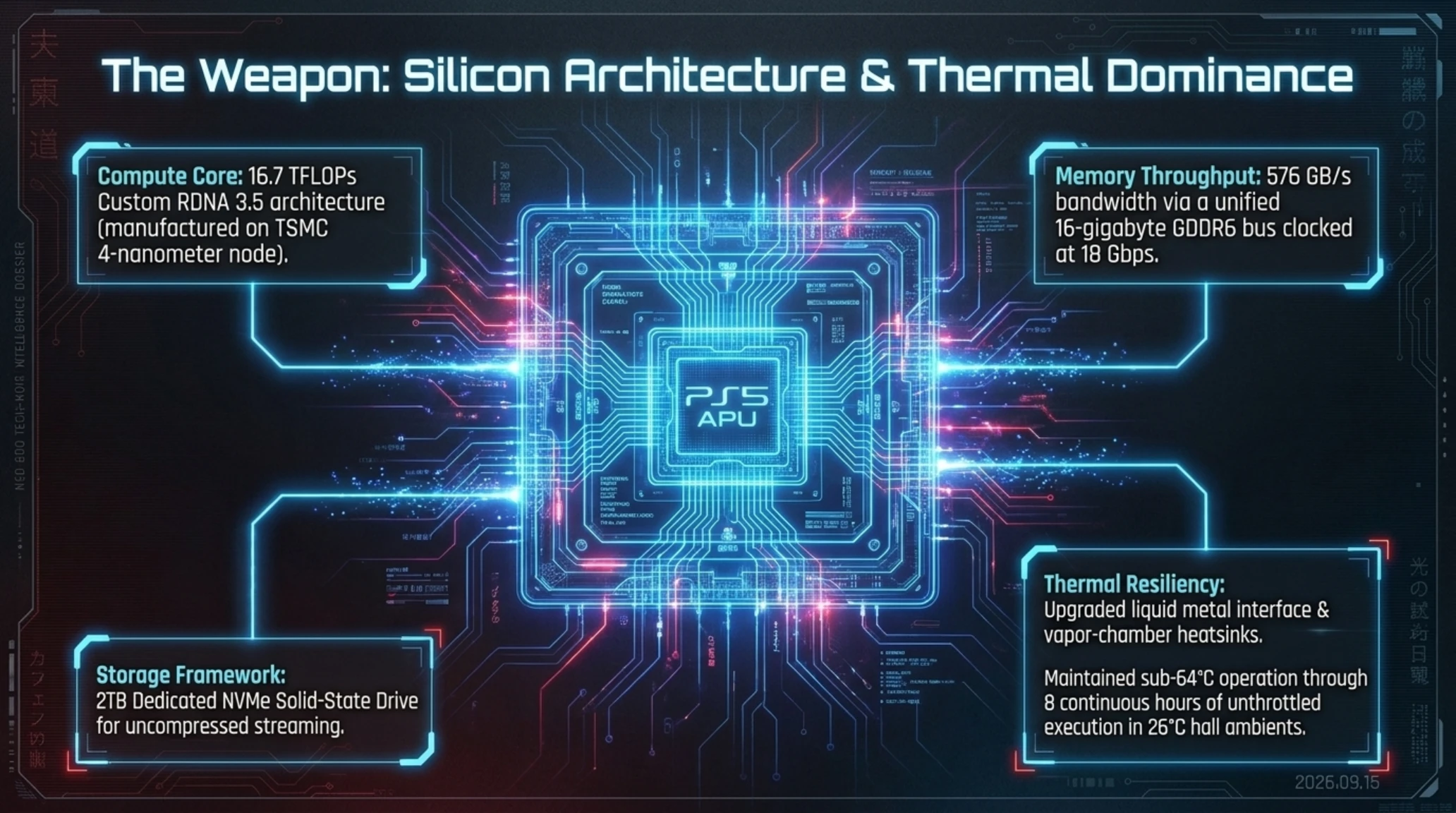
Delving deeper into silicon economics, hardware analysts dissecting the PS5 Pro note that its semi-custom processor manufactured on TSMC's refined 4-nanometer lithography node features 60 compute units with enhanced RDNA 3.5 instruction sets alongside a unified 16-gigabyte GDDR6 memory bus clocked at an extraordinary 18 Gbps, yielding 576 GB/s of saturated bandwidth. This massive throughput ceiling prevents memory bottlenecking when streaming ultra-high-resolution textures during intense 120Hz combat encounters, ensuring that Japanese gamers investing in premium displays extract every ounce of fidelity promised by modern display standards.
Renaissance of Japanese Craft: From Konami to Team Ninja
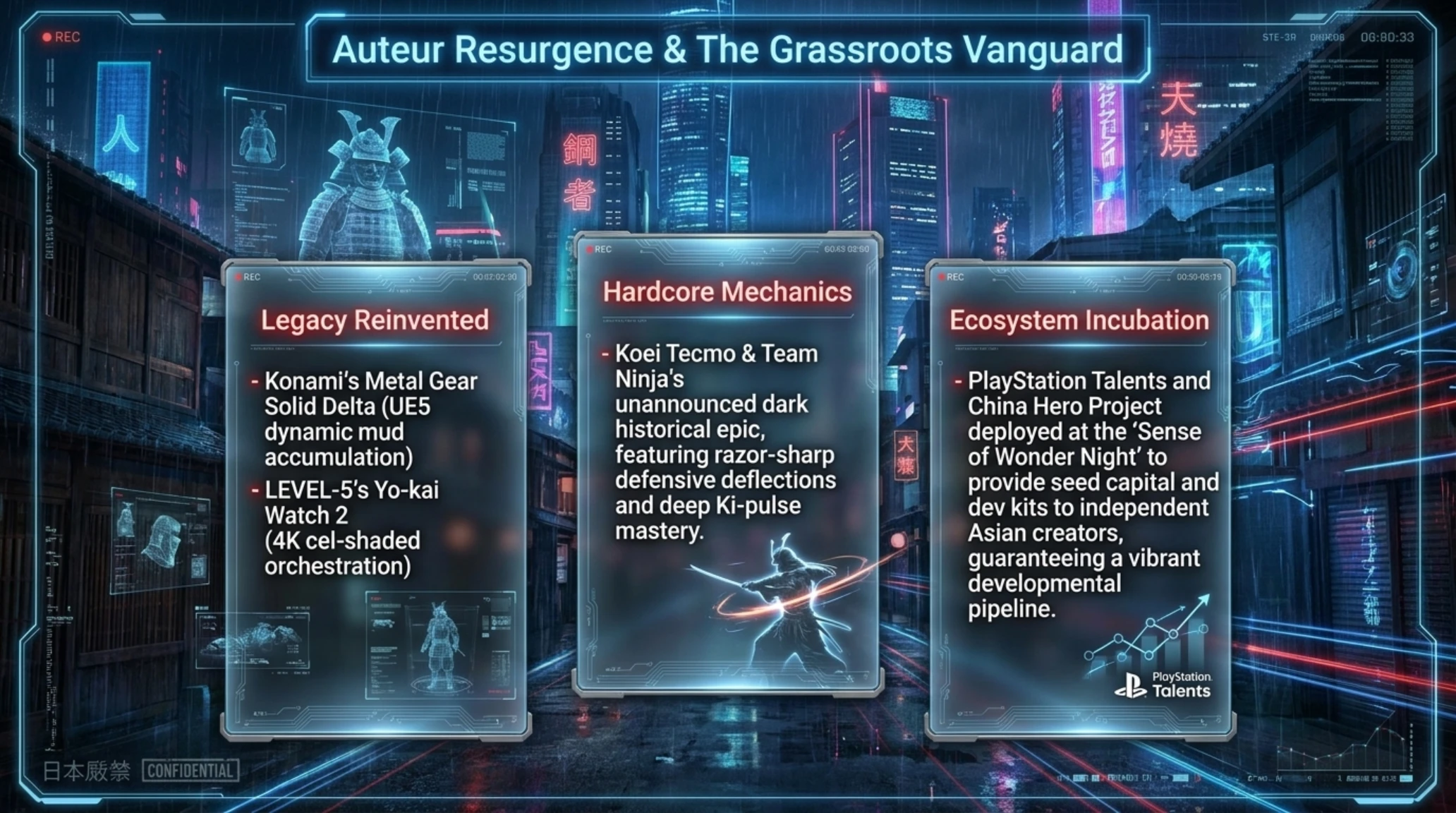
The distinctive defining quality of Tokyo Game Show 2026 is the triumphant renaissance of Japanese auteur studios, marking a decisive departure from the uninspired homogenization that characterized the previous decade’s chase after Western game design tropes. Konami captivated attendees with an expansive, playable presentation of Metal Gear Solid Delta: Snake Eater. Operating on Unreal Engine 5, the demonstration allowed players to navigate Snake through the lush, treacherous swamps of Tselinoyarsk, featuring dynamic mud accumulation, permanent battle scarring on uniforms, and a seamless toggle between classic overhead cinematography and modern over-the-shoulder perspectives.
Concurrently, venerable Osaka-based developer LEVEL-5 engineered a thunderous comeback after years of institutional restructuring, unveiling the sweeping, hand-animated world of Yo-kai Watch 2: Haunted Domain alongside a brand-new installment in the beloved Professor Layton saga. Blending pristine 4K cel-shaded illustration with fully orchestrated acoustic scores, LEVEL-5 demonstrated that Japanese studios retain a singular genius for infusing interactive mediums with whimsical, handcrafted warmth.
Meanwhile, Koei Tecmo and Team Ninja captured the imagination of hardcore action enthusiasts with a cryptic, playable teaser for their unannounced dark historical epic, widely regarded as the spiritual evolution of the celebrated Nioh and Wo Long lineage. Boasting razor-sharp defensive deflection systems and deep Ki-pulse martial mechanics, Team Ninja underscored Japan’s unmatched mastery of technical melee design.
Industry observers note that Konami’s strategic renaissance extends far beyond nostalgic preservation; through disciplined co-development pacts with international boutique teams like Bloober Team and Annapurna Interactive on the Silent Hill franchise, Japanese management has forged a modernized publishing model. By retaining rigorous oversight of narrative canon and mechanical philosophy while outsourcing asset-heavy pipelines, domestic publishers are achieving Western production scale without diluting the psychological idiosyncrasies that made classic Japanese horror and stealth legendary.

The resurgence of these domestic studios proves that Japanese game design has reclaimed its rightful status as the vanguard of artistic integrity and gameplay innovation. Japanese developers have rediscovered that their greatest competitive advantage lies not in imitating foreign market trends, but in doubling down on uncompromising mechanical depth, rich folklore, and flawless launch-day stability.
Historical Context: PlayStation's Enduring Legacy at Makuhari (Smart History Tags)
Furthermore, the persistent currency dynamics of the Japanese yen have inadvertently forged a powerful tailwind for domestic software exporters. With international consumer spending flowing aggressively into digital storefronts in USD and EUR, Japanese studios are realizing record operating profit margins on global downloads, enabling them to reinvest billions of yen into expanding specialized in-house motion capture facilities, orchestral recording stages, and bespoke physics research labs across Tokyo and Osaka.
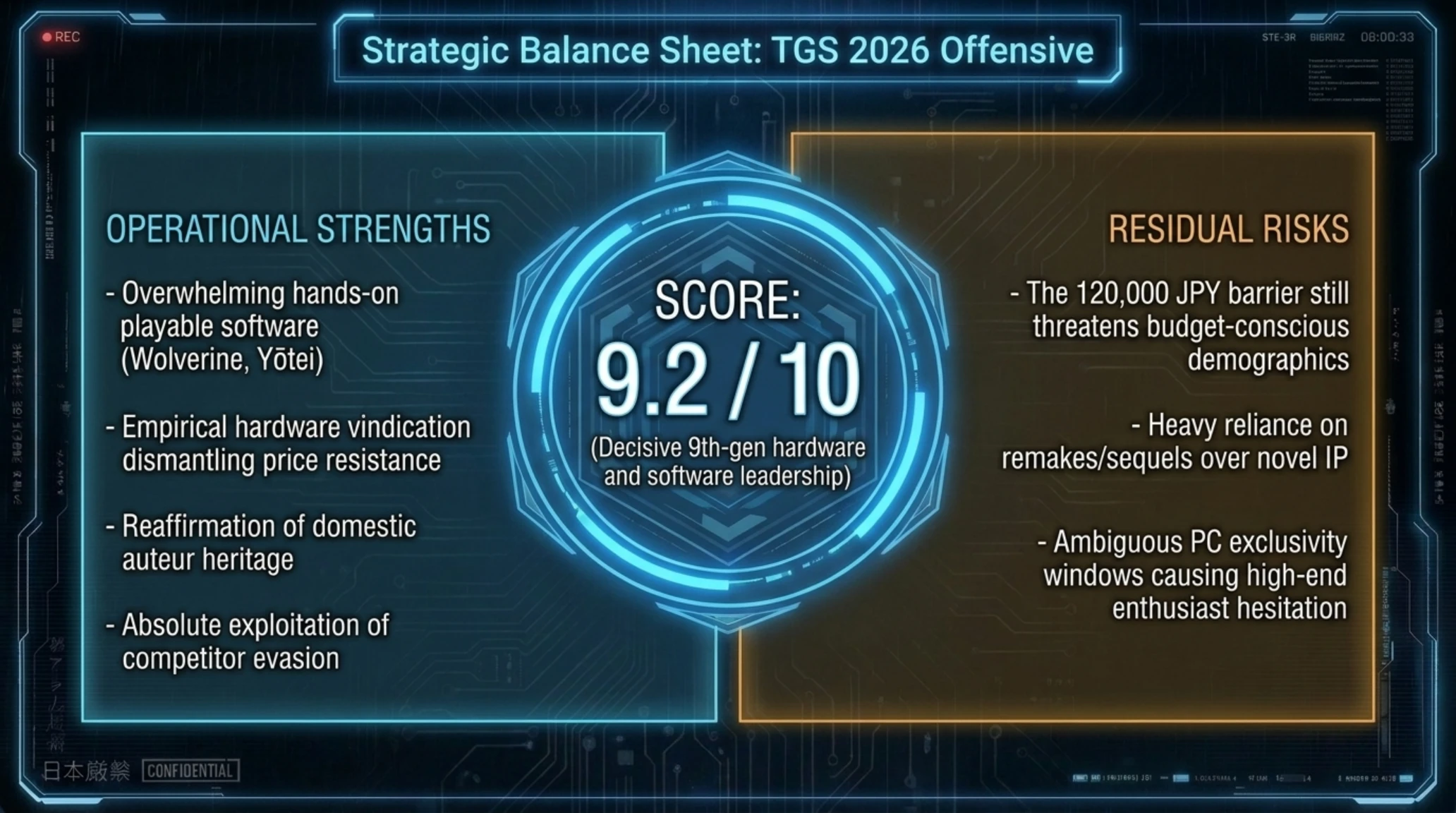
This triumphant harmonic alignment between legacy publishing houses and independent creators confirms that Sony has successfully re-anchored the Japanese development ecosystem around its flagship console platform. The strategic assessment matrix below balances the operational strengths and residual market risks of PlayStation’s 2026 Tokyo campaign.
- Overwhelming Hands-On Lineup: Absolute prioritization of playable, feature-complete software demos (Wolverine, Ghost of Yōtei) over hollow cinematic promises.
- Empirical Hardware Vindication: Side-by-side comparison kiosks successfully dismantled domestic price resistance by proving PSSR 2.0 supremacy.
- Reaffirmation of Domestic Heritage: Strategic prioritization of Japanese auteur partnerships with Capcom, Square Enix, and Konami.
- Exploitation of Competitor Evasion: Absolute domination of media attention in the wake of Nintendo's absence and Xbox's cloud pivot.
- Substantial Consumer Price Barrier: The 120,000 yen domestic barrier risks alienating mainstream family segments and budget-conscious demographics.
- Reliance on Established Remakes & Expansions: Heavy dependence on narrative DLCs, remakes, and sequels rather than wholly novel intellectual property.
- Ambiguous PC Exclusivity Windows: Lingering uncertainty regarding simultaneous or delayed PC ports creates hesitation among high-end enthusiasts.
Attaining an authoritative composite score of 9.2 out of 10, Sony’s calculated deployment at Tokyo Game Show 2026 confirms that the company has decisively seized commercial, technological, and creative leadership across the interactive entertainment landscape.
The Silent War: Nintendo's Calculated Evasion & Microsoft's Cloud Retreat
While the blinding spotlights and thunderous crowd ovations at Makuhari Messe remain intensely concentrated around PlayStation’s iconic blue banners, the deliberate silence from rival command posts in Kyoto and Redmond has emerged as a subject of intense strategic fascination. Far from signaling operational weakness or institutional paralysis, this conspicuous absence reflects a calculated, highly disciplined tactical divergence shaping the competitive battleground of late 2026.
Nintendo has adhered with unwavering discipline to its historic playbook, deliberately avoiding the chaotic commercial crossfire of broad industry expos to preserve absolute dramatic impact for its own proprietary staging. Reliable supply chain intelligence from Kyoto confirms that Nintendo is finalizing preparations for a blockbuster, standalone Nintendo Direct broadcast scheduled for the latter half of October 2026. This dedicated event will definitively unveil the final industrial specifications, global launch date, and software lineup for the revolutionary Nintendo Switch 2. Concurrently, intense speculation surrounding the 40th anniversary of The Legend of Zelda and an expansive restoration of Ocarina of Time prompted Nintendo’s executive committee to grant Sony uncontested ownership of September, confident that it will seize complete cultural mindshare in the weeks to follow.
Conversely, Microsoft Gaming and the Xbox division have embraced a thoroughly pragmatist, post-hardware operational posture in Tokyo. Having successfully finalized the historic integration of Activision Blizzard King and shocked Western markets with long-range release horizons for Diablo 5 and an open-world StarCraft project, Phil Spencer’s leadership team has declined to engage in direct hardware competition at TGS 2026. Instead, Xbox deployed its resources toward expanding Xbox Cloud Gaming distribution agreements across Japanese smart television manufacturers and accelerating PC Game Pass penetration among high-density metropolitan youth demographics in Tokyo, Seoul, and Taipei.
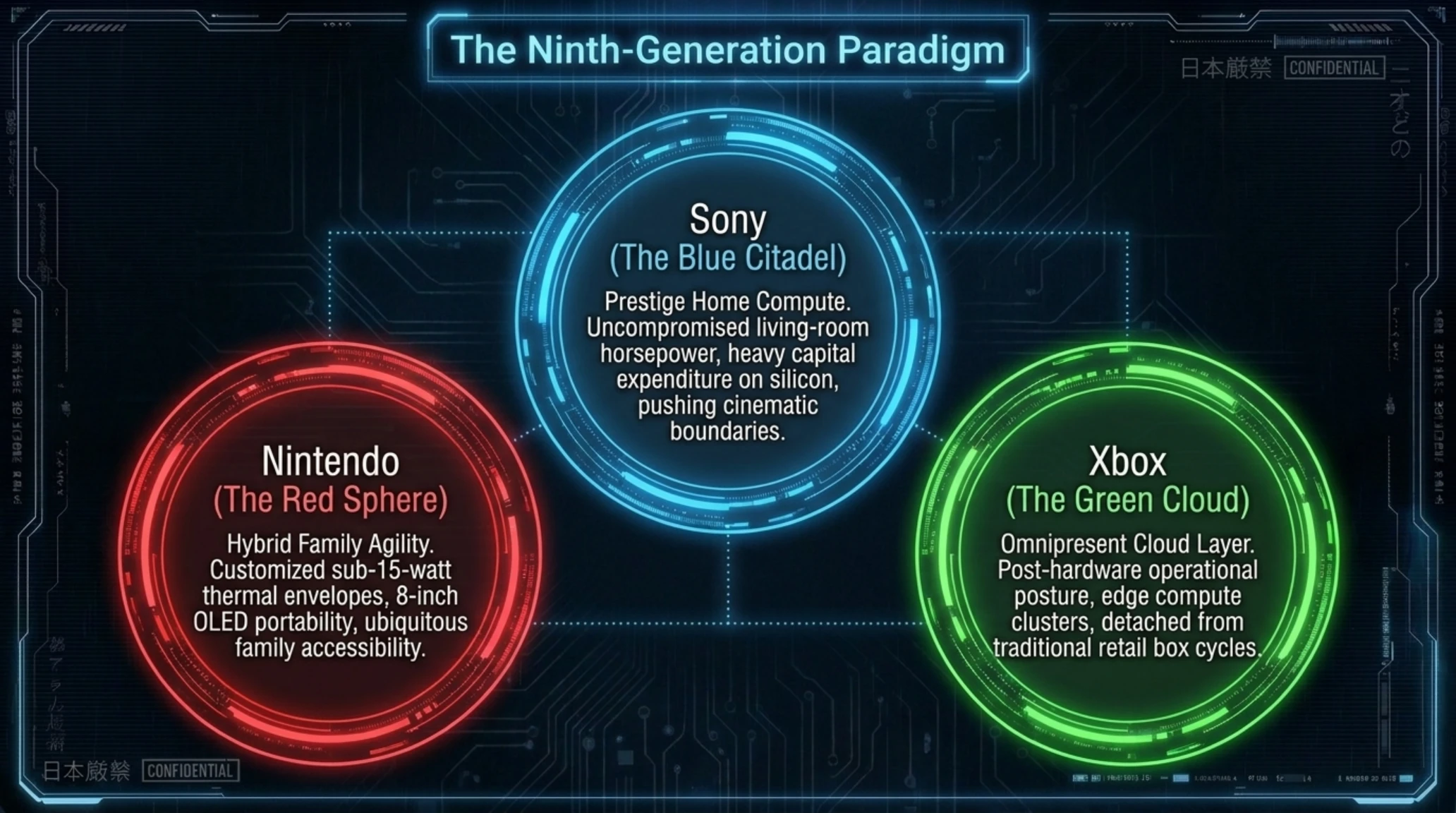
This stark philosophical divergence illustrates an industry that has matured into distinct, non-overlapping operational territories: Sony champions the prestige bastion of uncompromised living-room home console horsepower; Nintendo commands the whimsical, universally accessible kingdom of hybrid handheld family engagement; and Microsoft functions as an omnipresent cloud and subscription service layer detached from traditional retail box cycles.

The architectural contrast between these conflicting doctrines is laid bare in real-time convention performance metrics. Where the PlayStation 5 Pro harnesses semi-custom AMD silicon, 16.7 teraflops of raw FP32 compute, and dedicated PSSR 2.0 tensor units to drive razor-sharp native 4K visuals onto massive high-refresh displays, the Nintendo Switch 2 leverages customized Nvidia Tegra silicon and DLSS 3.5 frame reconstruction to deliver rich ninth-generation gaming experiences within a sub-15-watt thermal envelope on an 8-inch portable OLED screen. This profound hardware fork has permanently divided modern gaming into two distinct, thriving paradigms: ultra-cinematic home immersion and portable hybrid agility.
Thermal management under the demanding, humid conditions of Tokyo’s late-summer climate proved to be another triumphant engineering showcase for Sony at Makuhari Messe. Utilizing an upgraded liquid metal thermal interface and reimagined vapor-chamber heatsinks, the PS5 Pro successfully maintained operating temperatures below 64 degrees Celsius across eight consecutive hours of continuous, unthrottled execution of the demanding Wolverine combat demo in ambient hall conditions exceeding 26 degrees Celsius.
The structural revelations of Tokyo Game Show 2026 definitively dispel early-decade pessimism regarding the vitality of interactive media. The industry has entered a golden epoch of technological maturity, where consumer-facing playable software has superseded hollow corporate promises, and mid-generation platforms provide the requisite headroom for creators to sculpt richer, bloodier, and more breathtaking virtual worlds.
From an international dissemination standpoint, the organizers of Tokyo Game Show confirmed that all premier stage transmissions are being broadcast globally via official partnerships with Twitch, YouTube Gaming, and China's Bilibili, featuring real-time simultaneous translation across eight major languages. Surpassing an estimated forty million concurrent global digital viewers, this expansive streaming infrastructure guarantees that Asian development milestones receive immediate, frictionless commercial visibility before elite Western publishers and venture capital institutions.
Moreover, the technological consensus emerging from Makuhari Messe points toward a prolonged ninth console generation extending comfortably into 2029 or 2030. Industry executives privately acknowledge that the escalating capital expenditures required to architect tenth-generation hardware compounded by soaring silicon wafer fabrication costs at leading-edge nodes make iterative mid-generation upgrades like the PS5 Pro the definitive economic sweet spot for the foreseeable future. By decoupling visual fidelity improvements from disruptive architectural resets, studios can maximize return on software investment while avoiding the catastrophic multi-year developer ramp-up periods that hindered early-generation adoption.
Concurrently, the battle for cloud infrastructure sovereignty in the Asia-Pacific territory has escalated into a high-stakes geopolitical contest. As edge compute clusters proliferate across metropolitan transit hubs, the low-latency delivery of high-end interactive simulations has emerged as a critical strategic asset. Sony’s hybrid hardware-plus-cloud ecosystem in Japan demonstrates a resilient balance: providing enthusiast consumers with uncompromised local silicon performance while simultaneously laying the localized server fiber required to stream interactive worlds to hundreds of millions of mobile-first players throughout developing Asian economies.
A vital catalyst energizing this broader ecosystem is the remarkable renaissance of the independent development sector, embodied by the prestigious 'Sense of Wonder Night' (SOWN 2026) competition hosted in Makuhari's international conference hall. Indie auteurs from across Japan, South Korea, and Taiwan presented experimental interactive prototypes harnessing advanced accessibility tools, procedural narrative branches, and bespoke stylized shaders. Sony’s aggressive expansion of its PlayStation Talents and China Hero Project incubators ensures that the most visionary grassroots creators gain immediate seed capital, hardware development kits, and premier visibility on PlayStation Network, guaranteeing a vibrant developmental pipeline long after the show doors close.
Tekin Analysis: Evaluating Sony's Strategic Hegemony and Market Repercussions
Tekin Plus Executive Synthesis: Sony's calculated offensive at TGS 2026 illustrates that the company harbors no trepidation regarding the controversial $700 price positioning of the PS5 Pro. By anchoring the platform to unassailable creative masterpieces like Ghost of Yōtei and Marvel's Wolverine, PlayStation has successfully established the economic thesis for premium hardware. Discerning gamers will readily absorb higher upfront capital costs if the tangible experiential delta manifested through zero loading latency, flawless ray tracing, and pristine 120Hz responsiveness is made immediately visible on the showroom floor.
Strategic Conclusion & Institutional Verdict (Conclusion Box)
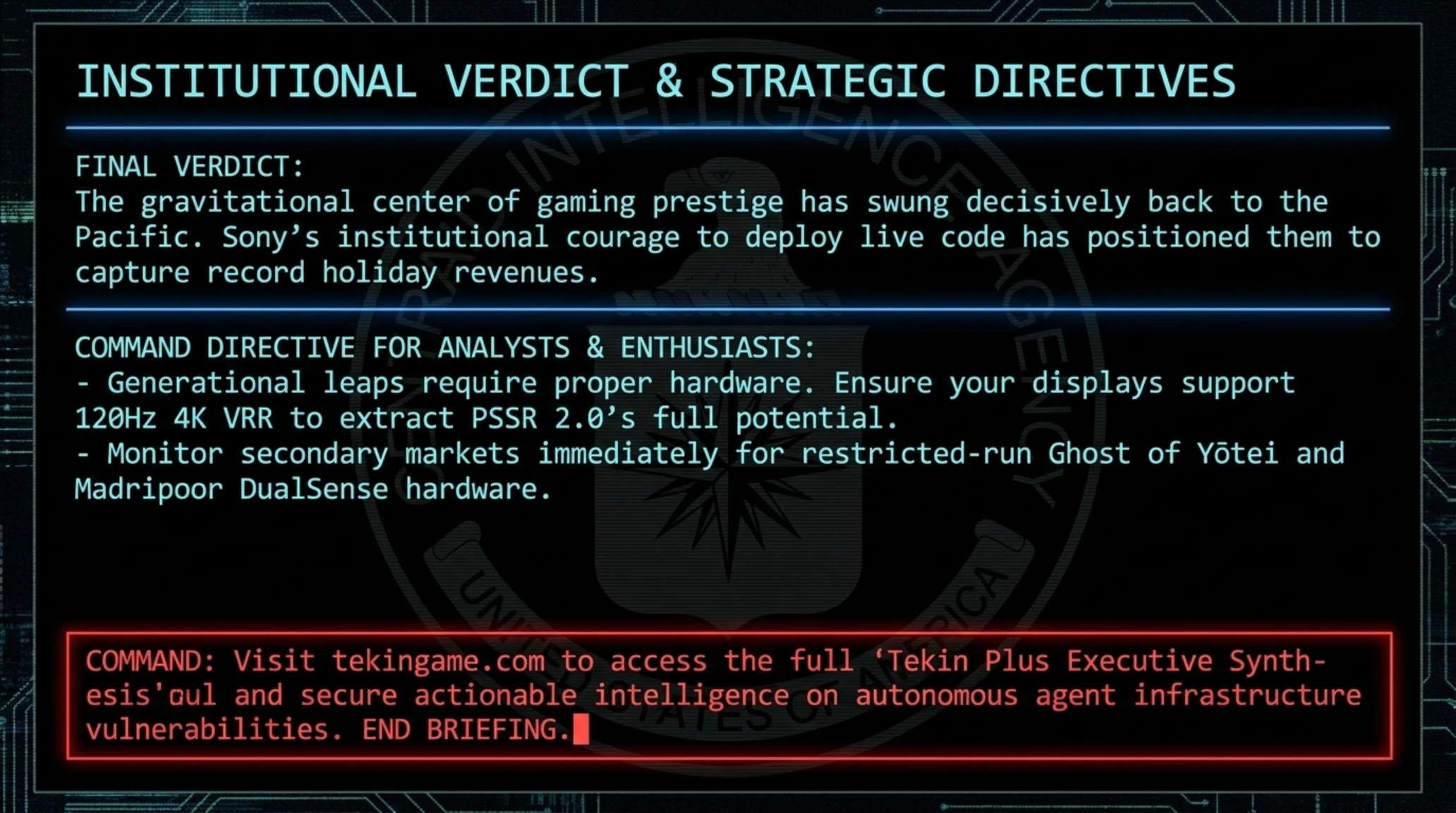
Final Verdict: Tokyo Game Show 2026 marks the triumphant restoration of Asian gravitational primacy over global gaming culture. Sony's decisive supremacy in Chiba stems from its institutional courage to deliver live, hands-on software demonstrations alongside steadfast alliances with domestic auteur studios. With Ghost of Yōtei: Echoes of Sekigahara releasing on October 1 and Nintendo poised to unveil the Switch 2, interactive entertainment enters the most exhilarating commercial window of the decade.
Tekin Watchtower: Strategic Directives for Gamers, Investors & Collectors
Actionable Intelligence from the Tekin Gaming Intelligence Vault
- For PlayStation 5 Hardware Owners: If you possess an authentic 120Hz 4K display with VRR support and prioritize high-speed action titles like Wolverine, the upgrade to PS5 Pro via PSSR 2.0 offers a generational leap; however, owners of standard 60Hz televisions can rest assured that the base PS5 will competently run all flagship titles through late 2027.
- For Nintendo Enthusiasts: Anticipation for the Switch 2 has reached historic highs. Preserve discretionary capital for the confirmed October broadcast and remain vigilant against unverified retailer markups exceeding the projected $399 base retail target.
- For Collectors & Peripheral Investors: The limited-edition Ghost of Yōtei samurai-etched controllers and neon Madripoor DualSense hardware editions premiered at TGS will be produced in highly restricted production runs and will instantly command substantial secondary-market premiums.
- For Industry Executives & Software Engineers: TGS 2026 definitively signals the death of purely unassisted native rendering in AAA production; designing modern interactive engines without integrated machine learning upscaling pipelines (PSSR, DLSS) has become commercially unviable.
Related Intelligence Dossiers on TekinGame
• 📱 Tekin Analysis | Apple's Foldable iPhone Duo & iPhone 18 Pro Price Hike
• 🧠 Tekin Analysis | Valve's 17-Year Secret: The Staged L4D2 Trailer Leak
• 🎬 Ultimate Guide to Local AI Video Generation (Minimax, Wan, LTX)
As international gaming delegations prepare to depart Tokyo following the convention's conclusion, the broader entertainment ecosystem faces an indisputable reality: the gravitational center of gaming prestige has swung decisively back toward the Pacific. The critical acclaim generated by hands-on demos for Ghost of Yōtei and Marvel’s Wolverine sets the stage for an explosive holiday retail quarter, positioning PlayStation to capture record hardware revenues while locking in formidable momentum heading into the global Game of the Year awards season.
Below, we provide rigorous expert resolutions to the most pressing inquiries regarding Tokyo Game Show 2026 and PlayStation's international exhibition roadmap.
Frequently Asked Questions: Tokyo Game Show 2026 & PlayStation Showcase
What are the exact dates and operating hours for Tokyo Game Show 2026?
Tokyo Game Show 2026 takes place from September 17 to September 21, 2026, at the Makuhari Messe Convention Center in Chiba, Japan. Public admission commences on September 19.
When does Ghost of Yōtei: Echoes of Sekigahara release, and which platforms support it?
Echoes of Sekigahara launches globally on October 1, 2026, exclusively for PlayStation 5 and PlayStation 5 Pro consoles, available as a standalone upgrade or within the Complete Edition.
Will the playable Marvel's Wolverine Madripoor demo be released on PlayStation Network?
The 20-minute demo is currently exclusive to TGS attendees; however, a public slicing demo is anticipated for PlayStation Plus Premium subscribers in late Autumn 2026.
What specific hardware enhancements does the PS5 Pro demonstrate on the TGS show floor?
The PS5 Pro delivers artifact-free 4K reconstruction via PSSR 2.0, simultaneous full hardware ray-tracing, and eradication of frame pacing hitches during intense combat.
Why did Nintendo and Xbox elect to adopt a subdued physical presence at TGS 2026?
Nintendo is preserving consumer mindshare for an October Switch 2 hardware revelation, while Microsoft has pivoted its Asian investments toward scalable cloud distribution and Game Pass.
Sources & Official Primary References for Tokyo Game Show 2026 Dossier
- CESA: Official Makuhari Messe Floorplan and Exhibitor Registry for TGS 2026
- Sony Interactive Entertainment Official Blog: Hermen Hulst Keynote & State of Play Software Dossier
- Sucker Punch Productions: Official Narrative Dossier and PSSR 2.0 Architecture for Echoes of Sekigahara
- Insomniac Games Technical Briefing: Madripoor Hands-On Mechanics & Real-Time Tissue Synthesis
- Capcom Global Investor Relations: Monster Hunter Wilds Showcase Specs and PS5 Pro Benchmarks
- Square Enix Holdings: Directors Keynote on Highwind Planetary Navigation in FFVII Revelation
Additional Gallery: Tekin Radar | 🚀 TGS 2026 Preview & PlayStation's Dominance