🌙 Tekin Night | Saturday, August 22, 2026: Take-Two Subpoenas Microsoft & Discord in GTA 6 Hunt, Microsoft Entra CVSS 10.0 Zero-Day & Apollo $700B Breach
Tekin Night's exclusive coverage of tonight's cyber and legal earthquakes. From Take-Two's federal manhunt for GTA 6 leakers to Microsoft's CVSS 10.0 zero-day, the Apollo breach, and $91M ETH staking.
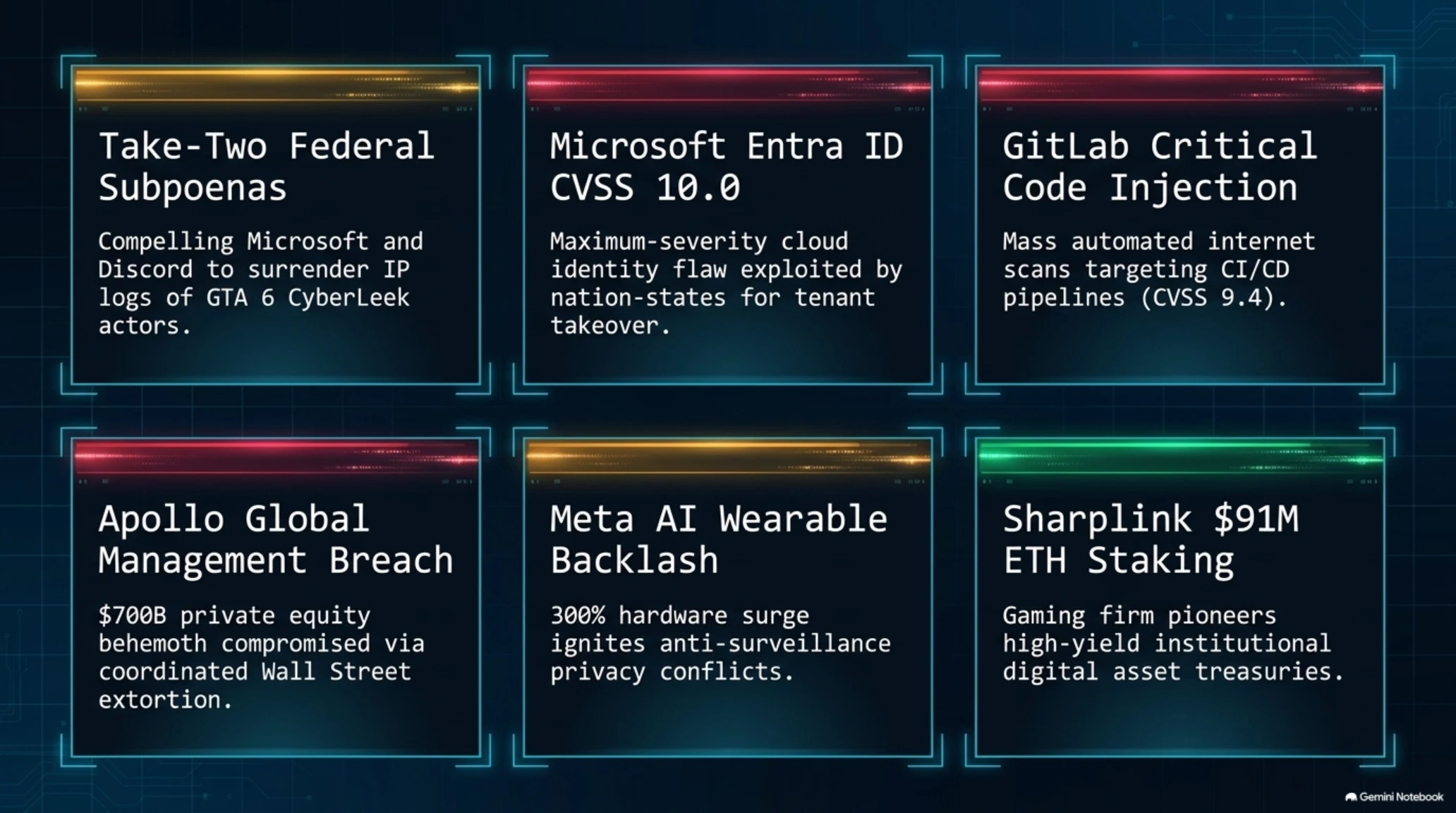
- 🎮Take-Two Federal DMCA Subpoenas- Court filings compel Microsoft and Discord to surrender IP logs, server records, and account metadata of GTA 6 CyberLeek actors
- 🎧Microsoft Entra ID Zero-Day (CVSS 10.0)- Maximum-severity cloud identity flaw CVE-2026-69836 exploited in the wild by nation-state actors for full tenant takeover
- 🚀GitLab Critical Code Injection (CVSS 9.4)- Automated threat actors launch mass internet scans targeting CVE-2026-19478 to poison CI/CD software pipelines
- 🗡️Apollo Global Management Data Breach- $700B private equity behemoth confirms cyber intrusion amid coordinated cyber extortion campaigns targeting Wall Street
- 📰Meta AI Smart Glasses Backlash- 300% surge in wearable hardware demand sparks regulatory investigations and the release of anti-surveillance sniffing apps
- ⚔️Sharplink $91M Institutional ETH Staking- Public gaming firm locks 39,319 ETH into validator pools, pioneering high-yield corporate digital asset treasuries
Good evening and welcome to the late-night editorial briefing for Saturday, August 22, 2026. As the global digital ecosystem concludes the opening day of the operational weekend, the intersection of cybersecurity, enterprise identity architecture, gaming intellectual property litigation, and macro institutional finance has reached unprecedented intensity. Across global server farms, corporate boardrooms, and federal courtrooms, an extraordinary confluence of strategic developments is reshaping the boundaries of software trust and capital allocation.
Leading international headlines tonight is the aggressive legal escalation by publishing titan Take-Two Interactive. Armed with federal DMCA Section 512(h) subpoenas filed in United States District Court, Take-Two and Rockstar Games are aggressively moving to unmask the pseudonymous threat actors operating under the moniker CyberLeek, following the unauthorized dissemination of internal playable development builds and physics demonstrations of the eagerly awaited blockbuster Grand Theft Auto VI.
Simultaneously, the global cybersecurity landscape is confronting a systemic shockwave. Microsoft has confirmed the active, in-the-wild exploitation of a maximum-severity vulnerability (CVSS 10.0) in its cornerstone identity platform, Microsoft Entra ID (formerly Azure Active Directory). This catastrophic zero-day flaw enables unauthenticated remote code execution and full cloud tenant compromise, exposing thousands of enterprise infrastructures before silent cloud-side mitigations could be universally deployed.
The defensive perimeter is further strained by mass automated exploitation campaigns targeting a critical code injection flaw in self-hosted GitLab instances (CVE-2026-19478), creating acute risks of software supply chain poisoning. On Wall Street, private equity titan Apollo Global Management commanding more than $700 billion in assets under management has formally acknowledged a sophisticated network intrusion. Meanwhile, the explosive 300% sales surge of Ray-Ban Meta AI smart glasses has ignited a fierce global regulatory backlash over covert public surveillance, and institutional crypto treasuries have reached historic milestones with Sharplink Gaming staking $91 million worth of Ethereum into validator nodes.
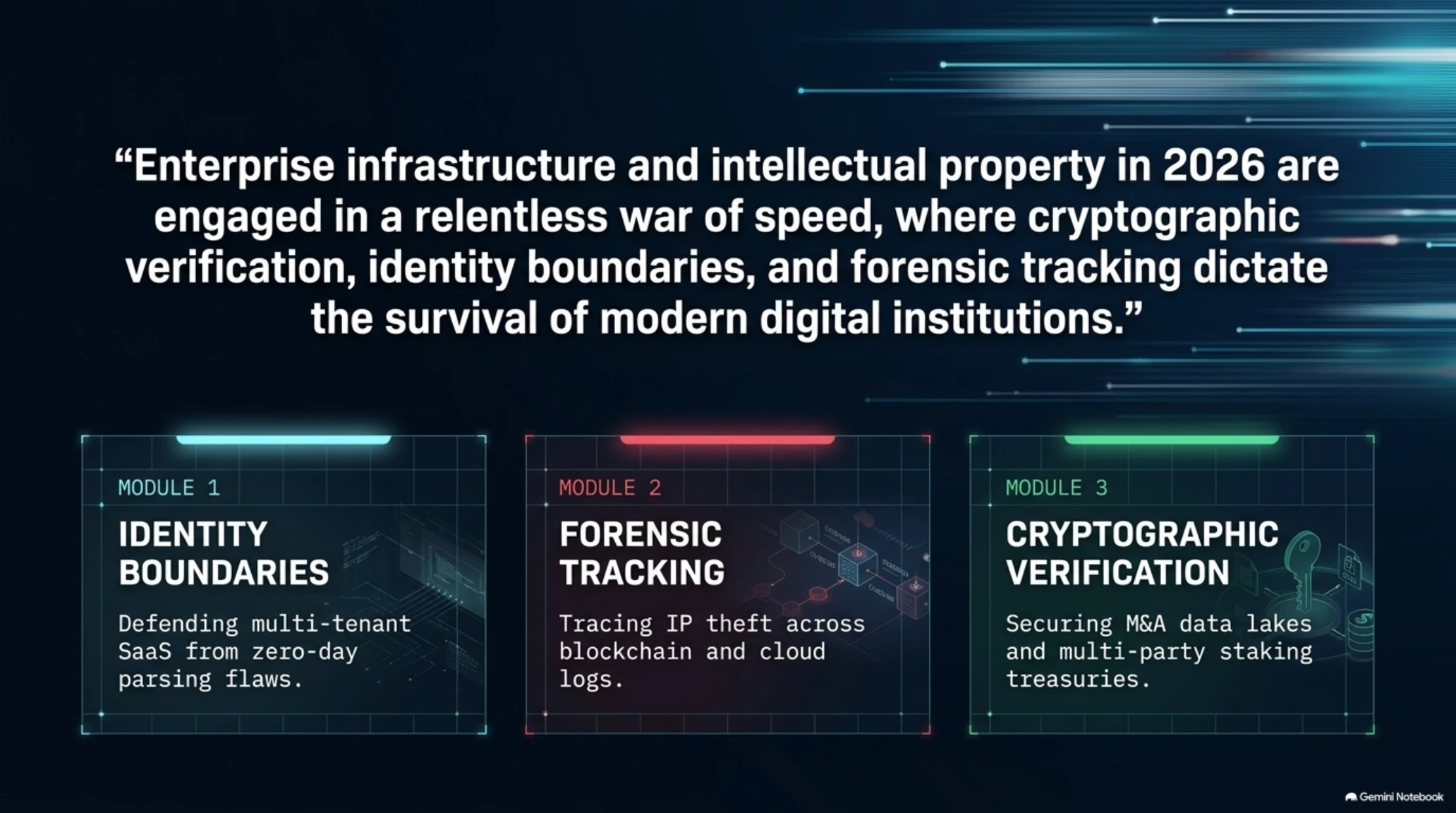
These concurrent developments illustrate that enterprise infrastructure and intellectual property in 2026 are engaged in a relentless war of speed, where cryptographic verification, identity boundaries, and forensic tracking dictate the survival of modern digital institutions.
Before examining the granular architectural mechanics, we review the core executive takeaways governing tonight's global intelligence briefing.
Strategic Executive Briefing: Saturday Night Intelligence Synthesis
- Federal court subpoenas compel Microsoft and Discord to disclose IP addresses, billing records, and server logs associated with CyberLeek leaks
- CVE-2026-69836 in Microsoft Entra ID allows unauthenticated attackers to forge SAML assertions and achieve Global Administrator privileges
- Security researchers at watchTowr document widespread automated scanning exploiting GitLab CVE-2026-19478 within 48 hours of public disclosure
- Apollo Global Management coordinates with federal agencies and forensic investigators following unauthorized access to confidential M&A deal pipelines
- Surveillance detection utilities such as Zuckoff leverage BLE beacon sniffing to counter covert video recording from Ray-Ban Meta AI frames
- Institutional digital asset treasuries pivot from passive Bitcoin holding toward active Ethereum staking yields generating 4.0% annualized revenue
To establish rigorous technical clarity across tonight's multidimensional briefing, consult the foundational industry reference glossary below.
Technical, Legal & Architectural Reference Matrix (Jargon Buster)
| Technical Term | Engineering & Statutory Definition | Operational Significance |
|---|---|---|
| DMCA 512(h) Subpoena | A specialized statutory mechanism under U.S. copyright law allowing rights holders to compel service providers to unmask alleged infringers without a formal lawsuit | The primary legal weapon deployed by Take-Two against Microsoft and Discord |
| Tenant-Level RCE | Remote code execution executed within the administrative core of a multi-tenant cloud identity provider | The devastating impact metric of the Microsoft Entra ID CVSS 10.0 zero-day |
| CI/CD Supply Chain Poisoning | Injecting malicious execution routines into automated build pipelines to compromise downstream compiled binaries | The primary exploitation danger surrounding the GitLab CVE-2026-19478 vulnerability |
| Institutional Validator Staking | Locking substantial native cryptocurrency reserves into proof-of-stake consensus engines via segregated custodian architectures | The treasury model utilized by Sharplink Gaming to monetize 39,319 ETH |
We begin tonight's exhaustive investigation with the high-stakes federal manhunt targeting the source of the GTA 6 development build leaks.
1. Federal Subpoenas and Digital Forensics; Take-Two Moves to Unmask GTA 6 CyberLeek Perpetrators via Microsoft and Discord Infrastructure
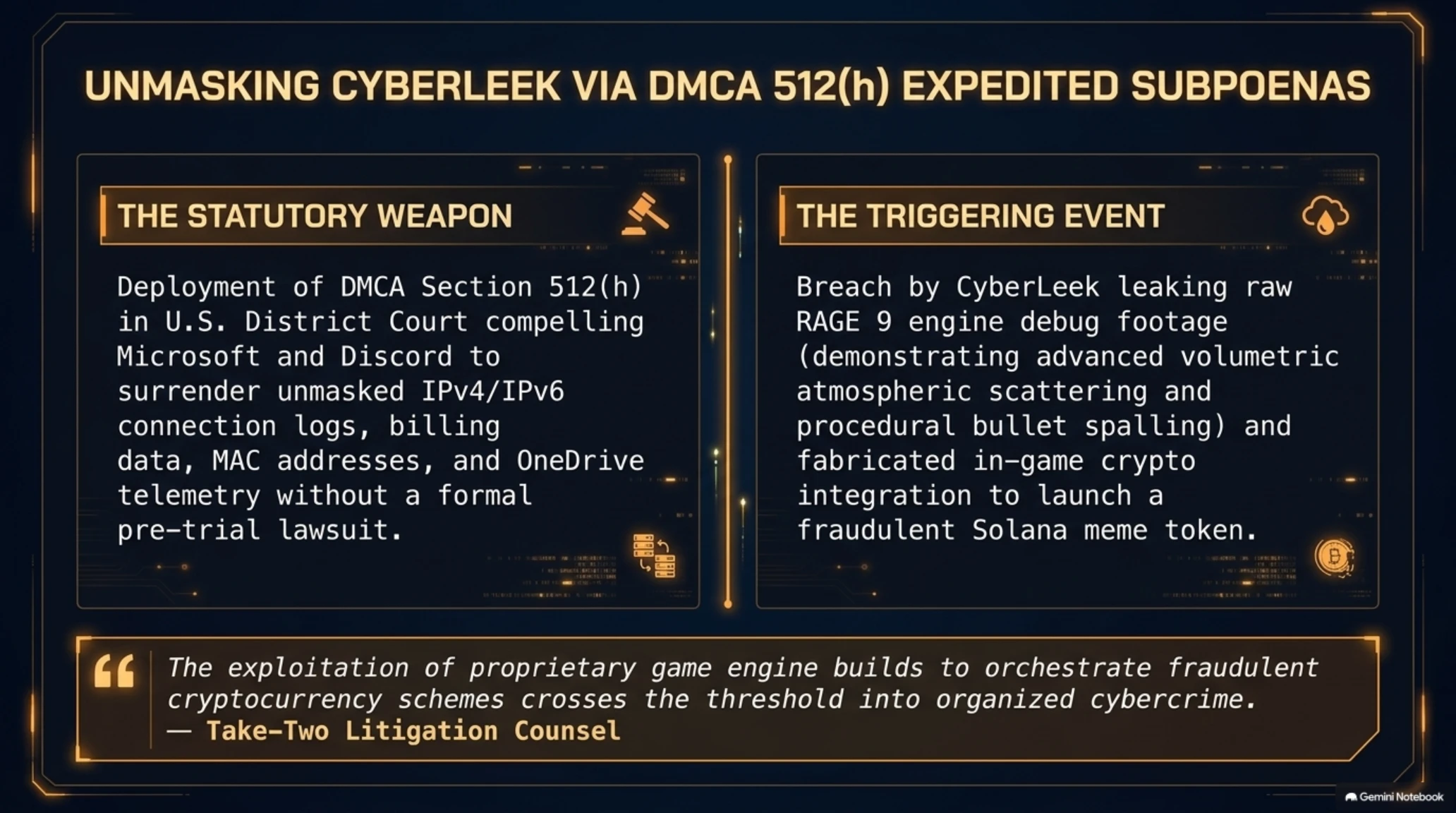
The ongoing operational crisis surrounding the unauthorized dissemination of confidential development assets for Grand Theft Auto VI has entered an aggressive, litigious federal phase. Publisher Take-Two Interactive, working in close concert with Rockstar Games and specialized cyber litigation counsel, has formally initiated legal proceedings in the United States District Court, securing expedited subpoenas under Section 512(h) of the Digital Millennium Copyright Act (DMCA) directed at technology conglomerates Microsoft Corporation and Discord Inc.
The sweeping court orders compel both service providers to immediately preserve and surrender comprehensive forensic records pertaining to the threat actor syndicate operating under the handle CyberLeek. The demanded evidentiary trove encompasses complete unmasked IPv4 and IPv6 connection logs, timestamped account creation telemetry, associated Microsoft OneDrive enterprise storage containers, Azure cloud hosting metadata, Discord voice channel session recordings, linked PayPal and credit card transaction billing data, and hardware MAC addresses tied to the dissemination channels.
The severity of Take-Two's legal offensive was catalyzed by the nature of the leaked materials. Over the preceding seventy-two hours, CyberLeek published high-resolution, uncompressed video captures demonstrating an internal playable debug build of GTA 6 running on PlayStation 5 Pro and Xbox Series X development kits. The footage showcased complex physics interactions, dynamic weapon wheel transitions, advanced material degradation when firing ballistic rounds into reinforced concrete, real-time vehicle refueling animations utilizing interactive fuel nozzles at Vice City service stations, and a responsive street basketball mini-game operating within the proprietary RAGE 9 engine.
Graphics rendering specialists analyzing the leaked telemetry noted that the RAGE 9 engine incorporates advanced volumetric atmospheric scattering, simulating the dynamic humidity and tropical storm fronts characteristic of the state of Leonida. The bullet impact physics demonstrated procedural spalling and stress fractures along masonry surfaces, confirming that the leak originated from an authentic mid-2025 milestone compiler branch rather than synthetic concept renders or CGI mockups.
However, the breach escalated into criminal financial fraud when the leakers attempted to monetize the frenzy. CyberLeek broadcasted fraudulent assertions claiming that GTA 6 would feature native decentralized finance mechanisms allowing in-game virtual currency to be directly redeemed for United States Dollars and spot cryptocurrency assets. Simultaneously, the threat actors deployed an unauthorized meme token on the Solana blockchain, enticing retail speculators into an orchestrated pump-and-dump liquidity trap.
On-chain forensic audits performed by blockchain analytics entities, including Lookonchain, confirmed that the liquidity pool deployment generated over $50,000 in illicit trading fee profits before liquidity was maliciously drained. This egregious monetization triggered immediate public condemnation from international consumer rights groups, including the Stop Killing Games (SKG) initiative led by Ross Scott, which vehemently denounced the threat actors for weaponizing gamer consumer sentiment to facilitate crypto extortion schemes.
Furthermore, digital rights litigators note that federal judges are increasingly willing to grant expedited discovery orders when intellectual property infringement intersects with consumer financial fraud. By linking unauthorized video hosting to fraudulent token generation events, Take-Two has positioned the CyberLeek syndicate within the purview of federal wire fraud statutes, fundamentally altering the risk calculus for individuals trafficking in leaked developmental builds.
The forensic and statutory pillars governing this federal action include:
- Direct targeting of enterprise Microsoft OneDrive links utilized to host multi-gigabyte 4K HEVC raw video captures
- Comprehensive subpoena demands served on Discord for private server membership registries, administrative chat logs, and IP access histories
- Coordination between Take-Two digital forensics investigators and the Federal Bureau of Investigation (FBI) Cyber Division to trace crypto exchange on-ramps
- Deployment of automated DMCA takedown algorithms targeting decentralized video indexing relays and Tor mirror endpoints
- Investigation into potential compromised third-party credentials within external quality assurance (QA) contracting firms
- Establishment of legal precedent regarding the rapid conversion of digital copyright infringement into federal wire fraud litigation
- Utilization of expedited 512(h) discovery mechanisms to circumvent lengthy pre-trial jurisdictional delays
Legal analysts anticipate that the forensic data compelled from Microsoft and Discord will rapidly erode the threat actors' operational security, leading to imminent sealed indictments in federal court.
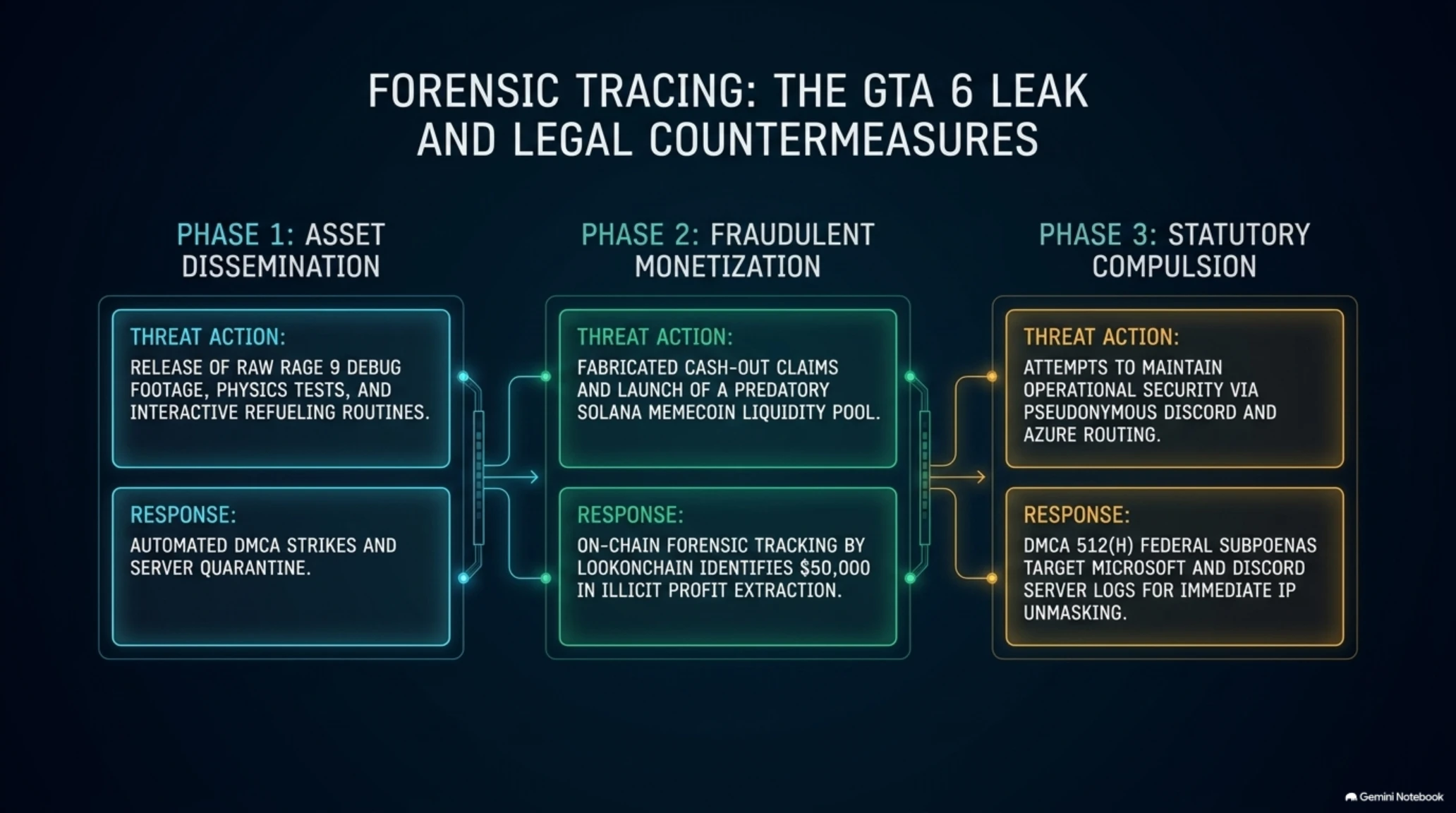
The conceptual visualization below depicts the digital forensic pursuit, tracking unmasked IP routing nodes and server access logs across enterprise cloud architectures:

Forensic Case Timeline: GTA 6 CyberLeek Infiltration & Legal Countermeasures
| Chronological Phase | Operational Incident / Threat Action | Regulatory & Judicial Response |
|---|---|---|
| Phase 1: Asset Dissemination | Release of raw RAGE 9 debug footage, physics rendering tests, and interactive refueling routines | Automated DMCA strikes and server quarantine |
| Phase 2: Fraudulent Monetization | Fabricated cash-out claims and launch of predatory Solana memecoin liquidity pool | On-chain forensic tracking by Lookonchain; $50K profit extraction identified |
| Phase 3: Statutory Compulsion | Filing of DMCA 512(h) federal subpoenas targeting Microsoft and Discord server logs | Judicial order compelling immediate surrender of IP telemetry and account records |
We transition now from intellectual property litigation to the most severe cloud identity emergency disclosed this year.
2. Catastrophic Cloud Identity Breach; Microsoft Entra ID Discloses Maximum Severity CVSS 10.0 Zero-Day Remote Code Execution (CVE-2026-69836)
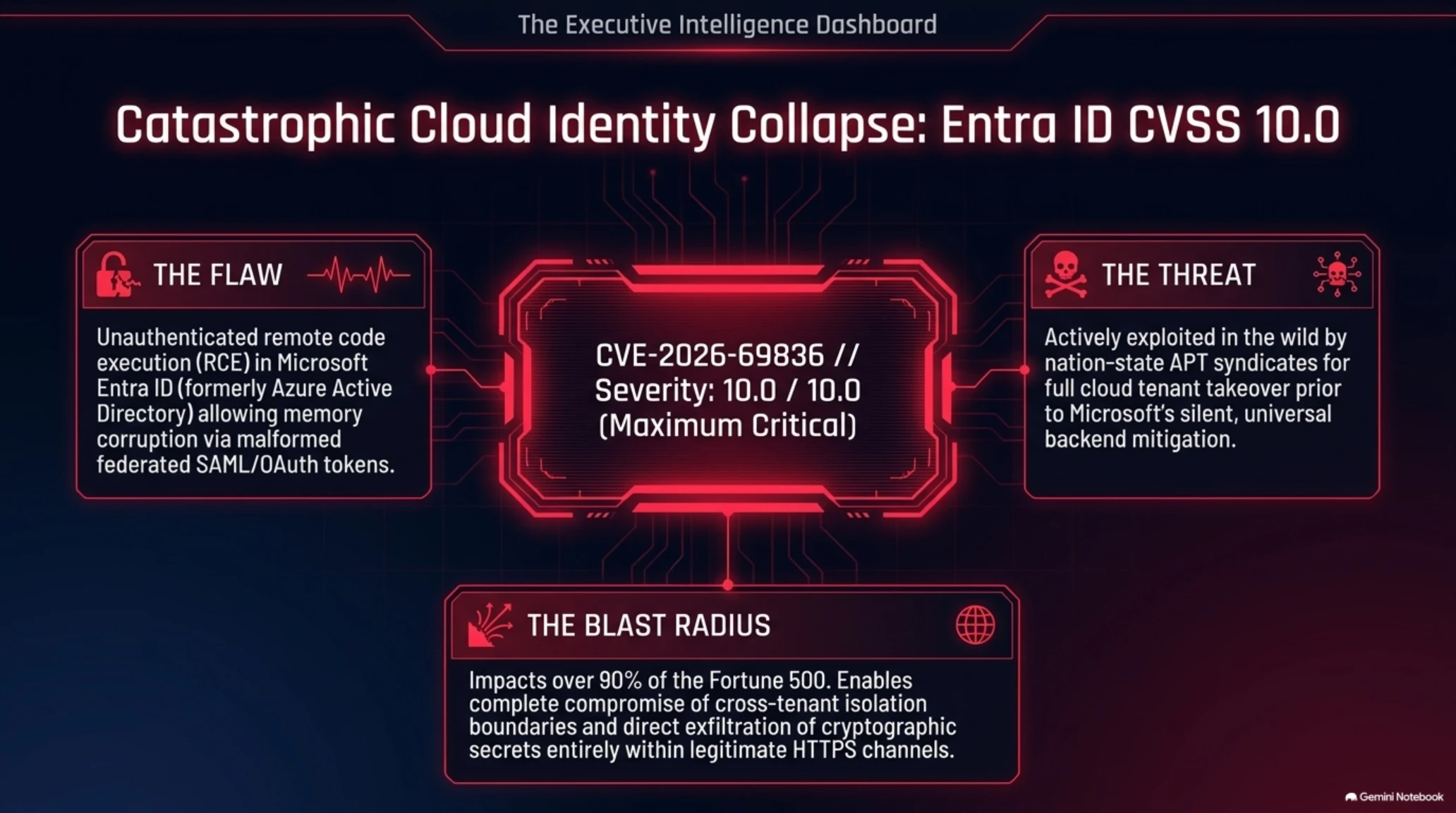
In what represents one of the most consequential cloud identity disclosures in modern computing history, Microsoft Corporation has issued an extraordinary security advisory confirming the active, in-the-wild exploitation of an unauthenticated remote code execution vulnerability assigned a flawless maximum severity score of 10.0 on the Common Vulnerability Scoring System (CVSS v3.1). Cataloged under the global identifier CVE-2026-69836, the vulnerability directly undermines the architectural integrity of Microsoft Entra ID (formerly Azure Active Directory), the foundational identity and access management (IAM) backbone powering authentication across the global enterprise landscape.
Microsoft Entra ID governs session authorization, directory federation, and multi-factor access protocols for more than ninety percent of the Fortune 500, critical defense industrial bases, international financial institutions, and civilian governmental ministries. Forensic architectural analysis reveals that the root flaw originated within the core microservices responsible for parsing and validating federated SAML 2.0 assertions and OAuth 2.0 bearer token exchanges within Microsoft's centralized identity processing clusters. By transmitting cryptographically malformed payloads to public authentication endpoints, remote threat actors could trigger an out-of-bounds memory corruption flaw within the identity engine, achieving arbitrary code execution within the identity plane itself.
The technical mechanics of this vulnerability represent an identity engineering nightmare. When an unauthenticated client initiates a federated single sign-on (SSO) handshake, the backend authentication router parses the incoming XML-based SAML response against trusted identity provider schemas. Due to an unsafe pointer arithmetic flaw during schema attribute deserialization, an attacker could supply an oversized, nested cryptographic assertion that overflows buffer boundaries in the parsing daemon. This memory corruption primitive allows the execution of arbitrary shellcode directly inside the high-privilege identity routing process, granting adversaries the ability to forge valid cryptographic token signing keys.
The Microsoft Threat Intelligence Center (MSTIC) confirmed that prior to public disclosure, sophisticated nation-state advanced persistent threat (APT) syndicates weaponized CVE-2026-69836 as a zero-day exploit in highly targeted cyber espionage operations against global defense contractors and sovereign cloud environments. The exploit primitive enabled attackers to mint cryptographically valid identity tokens imbued with Global Administrator privileges, allowing them to bypass all tenant-level Conditional Access Policies, hardware-bound Multi-Factor Authentication (MFA), and Privileged Identity Management (PIM) controls without generating corresponding localized event logs in customer SIEM platforms.
Because Entra ID operates as a hyperscale multi-tenant software-as-a-service (SaaS) architecture, Microsoft deployed hotfixes directly to its global cloud infrastructure clusters, confirming that no manual patch compilation is required by tenant administrators. Nevertheless, global cybersecurity authorities, including CISA and the UK National Cyber Security Centre (NCSC), have issued urgent directives mandating that enterprise security operations centers (SOCs) perform exhaustive retroactive audits. Organizations must urgently hunt for anomalous service principal registrations, unauthorized enterprise application consents, and modified credential mappings generated during the vulnerability window.
The critical architectural implications and operational vectors of CVE-2026-69836 include:
- Complete compromise of cross-tenant isolation boundaries, enabling lateral traversal between segregated corporate directory domains
- Arbitrary generation of persistent Golden SAML signing certificates, granting threat actors permanent backdoors into Microsoft 365, Exchange Online, and Azure workloads
- Complete evasion of perimeter network defenses due to attack traffic executing entirely within legitimate HTTPS identity verification channels
- Direct exfiltration of cryptographic secrets, tenant encryption keys, and proprietary enterprise data repositories
- Mandatory enterprise-wide revocation of administrative session tokens, active OAuth grants, and root directory credentials
- Elevation of cloud identity platforms to tier-zero critical infrastructure status requiring continuous automated cryptographic auditing
- Urgent requirement to audit all external federated identity trust relationships and cross-tenant synchronization policies
Security architects emphasize that CVE-2026-69836 illustrates the inherent systemic fragility of centralized cloud identity architectures, where a single parsing vulnerability can grant adversaries unfettered keys to the global corporate kingdom.
The technical video walkthrough below deconstructs the mechanics of token forgery in federated identity protocols and demonstrates advanced forensic auditing methodology for Entra ID directories:
Architectural Vulnerability Teardown: Microsoft Entra ID Zero-Day (CVE-2026-69836)
| Vulnerability Metric | Official Technical Specification |
|---|---|
| CVE Identifier | CVE-2026-69836 (Hyperscale Cloud Identity Plane Flaw) |
| CVSS v3.1 Base Score | 10.0 / 10.0 (Maximum Critical Severity: AV:N/AC:L/PR:N/UI:N/S:C/C:H/I:H/A:H) |
| Attack Mechanism | Memory corruption via malformed federated SAML/OAuth token verification routines |
| Attained Privilege Level | Unrestricted Global Administrator execution across targeted cloud tenant directories |
| Mitigation Status | Universal backend cloud remediation deployed by Microsoft; retroactive tenant auditing mandatory |
We transition now from cloud identity emergencies to an active supply chain crisis unfolding across open-source code repositories.
3. Mass Exploitation of Open-Source Repositories; Critical GitLab Code Injection Flaw (CVE-2026-19478) Threatens Global Software Supply Chains
Concurrent with the cloud identity crisis, global DevOps and cybersecurity teams are mobilizing to counter an intense, automated wave of cyber attacks targeting the open-source DevOps and version control platform GitLab. Researchers at leading vulnerability intelligence firm watchTowr disclosed that a critical security vulnerability designated CVE-2026-19478 (CVSS Score: 9.4 out of 10) has transitioned into active, widespread mass exploitation across the internet within mere hours of its public documentation.
Affecting both GitLab Community Edition (CE) and GitLab Enterprise Edition (EE) across self-hosted and cloud infrastructure instances, the flaw is classified as an unauthenticated code injection vulnerability. The defect resides within the underlying input validation routines governing GitLab's automated project export and import parsing engines, alongside its internal GraphQL data ingestion pipelines. Exploiting this condition allows a remote, unauthenticated attacker to inject arbitrary command strings, rewrite source code repositories, modify project metadata, or execute complete, permanent deletion of publicly accessible GitLab projects.
The engineering analysis conducted by watchTowr highlights a catastrophic flaw in how project archive tarballs are unpacked during automated import operations. When a repository export bundle is processed, file paths within the archive are parsed without adequate sanitization against directory traversal sequences and symbolic link manipulation. By embedding malicious symlinks pointing to internal configuration files and appending crafted Ruby execution payloads, an attacker can coerce the backend GitLab Workhorse proxy into executing arbitrary commands with the privileges of the underlying git system user.
Threat intelligence feeds and honeypot sensor networks have observed automated botnet clusters executing horizontal internet-wide scans, querying IPv4 address spaces to identify exposed, unpatched GitLab instances. The overarching peril of CVE-2026-19478 centers upon Software Supply Chain Poisoning. By abusing this flaw, adversaries can silently tamper with automated build scripts contained within .gitlab-ci.yml configurations, injecting malicious downstream payloads, secondary downloaders, or stealth backdoors directly into compiled production application packages distributed to millions of end users.
Additionally, threat telemetry reveals opportunistic cybercrime groups deploying automated cryptocurrency mining scripts and lateral network scanning tools directly onto compromised GitLab runner infrastructures. By harvesting sensitive CI/CD environment variables which frequently contain high-privilege AWS IAM keys, production database connection strings, and production API tokens attackers are converting compromised development servers into staging grounds for deeper enterprise intrusion.
The primary tactical imperatives and technical characteristics of CVE-2026-19478 include:
- Unauthenticated execution capability requiring zero prior account access, user interaction, or valid session cookies
- Ability to alter Git commit histories, creating fraudulent code signatures attributed to legitimate senior software architects
- Exfiltration of proprietary enterprise intellectual property, commercial source code, and cryptographic deployment certificates
- Immediate availability of vendor patches across GitLab versions 17.11.4, 18.0.2, and 18.1.1 requiring instantaneous deployment
- Mandatory recommendation to immediately isolate public-facing GitLab web interfaces behind Zero-Trust Network Access (ZTNA) gateways
- Urgent necessity to perform cryptographic hash audits on all software build artifacts compiled over the preceding ninety-six hours
- Systematic rotation of all deployment SSH keys, Docker registry credentials, and Kubernetes cluster access tokens
This escalating exploitation campaign underscores that source code management platforms represent primary operational targets for adversaries seeking broad-spectrum supply chain compromise.
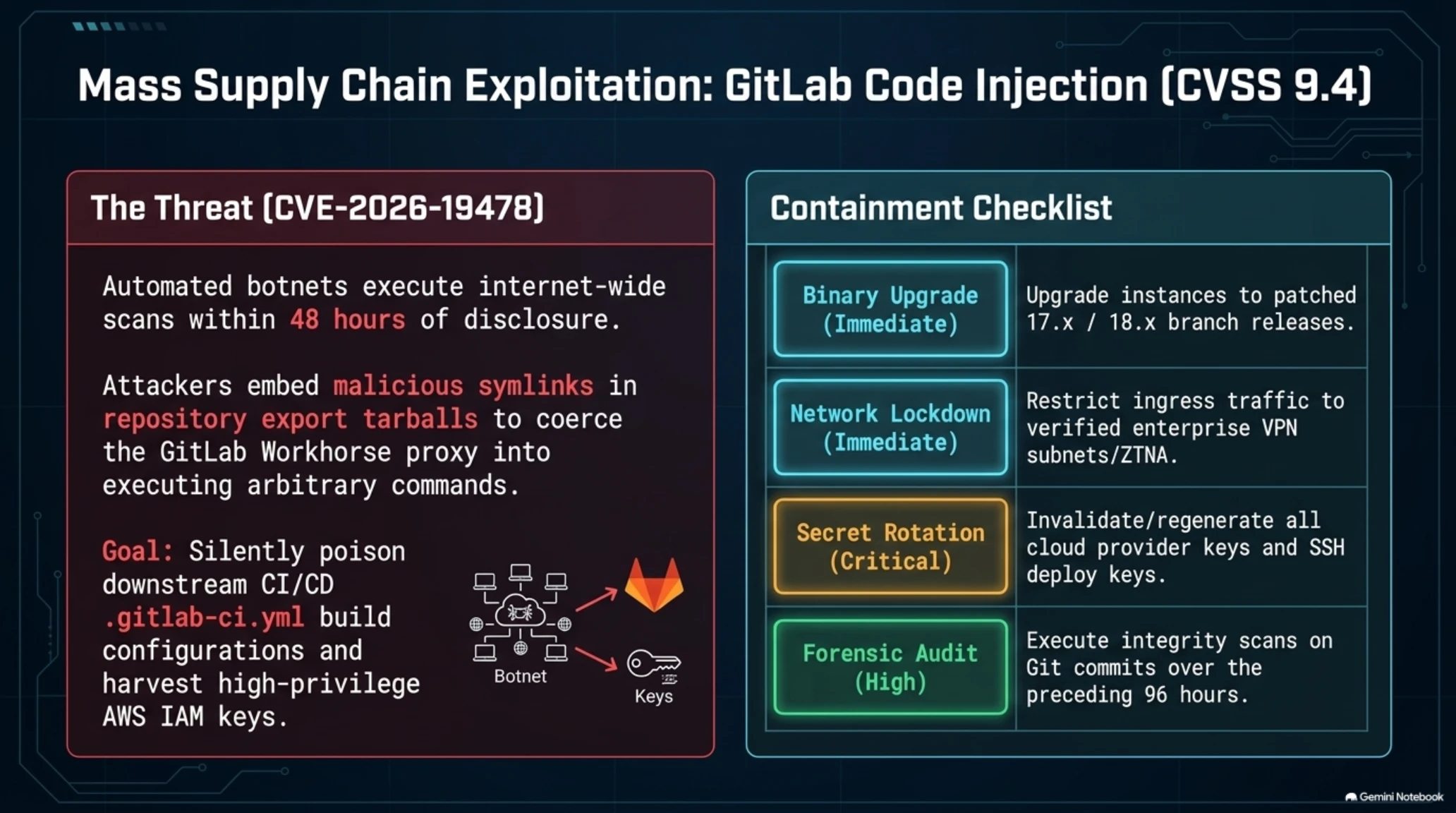
The conceptual rendering below illustrates the injection of unauthorized command sequences into automated CI/CD pipeline environments, highlighting the compromise of software release channels:

DevOps Incident Response Checklist: GitLab CVE-2026-19478 Containment
| Remediation Phase | Technical Action Item | Deployment Urgency |
|---|---|---|
| Binary Upgrade | Upgrade self-hosted GitLab CE/EE instances to patched 17.x / 18.x branch releases | Immediate (Under 2 Hours) |
| Secret Rotation | Invalidate and regenerate all cloud provider keys, tokens, and SSH deploy keys stored in CI/CD variables | Critical Priority |
| Network Perimeter Lockdown | Restrict GitLab ingress traffic exclusively to verified enterprise VPN subnets and trusted IP ranges | Immediate Priority |
| Forensic Repository Audit | Execute integrity scans across all Git commits and .gitlab-ci.yml files modified in the last 7 days | High Priority |
📚 Classified & Related Dossiers in TekinGame
If you wish to explore beyond this report and delve into cybernetic frontiers and autonomous AI architectures, do not miss these three exclusive deep-dives in the Tekin Garage:
We transition now from software supply chain emergencies to the epicenter of global financial dealmaking on Wall Street.
4. Breach at the Epicenter of Private Capital; $700B Asset Giant Apollo Global Management Confirms Cyber Incursion in Coordinated Financial Assault
In a major development sending shockwaves through the upper echelons of international finance, Apollo Global Management Inc., one of the world's preeminent alternative asset management and private equity conglomerates overseeing more than $700 billion in assets under management (AUM), has officially confirmed that its enterprise network infrastructure suffered an unauthorized cyber intrusion. The formal disclosure follows urgent investigative warnings published by Google Threat Intelligence and Mandiant, which documented an aggressive, highly orchestrated offensive by financially motivated cyber syndicates targeting elite Wall Street institutions.
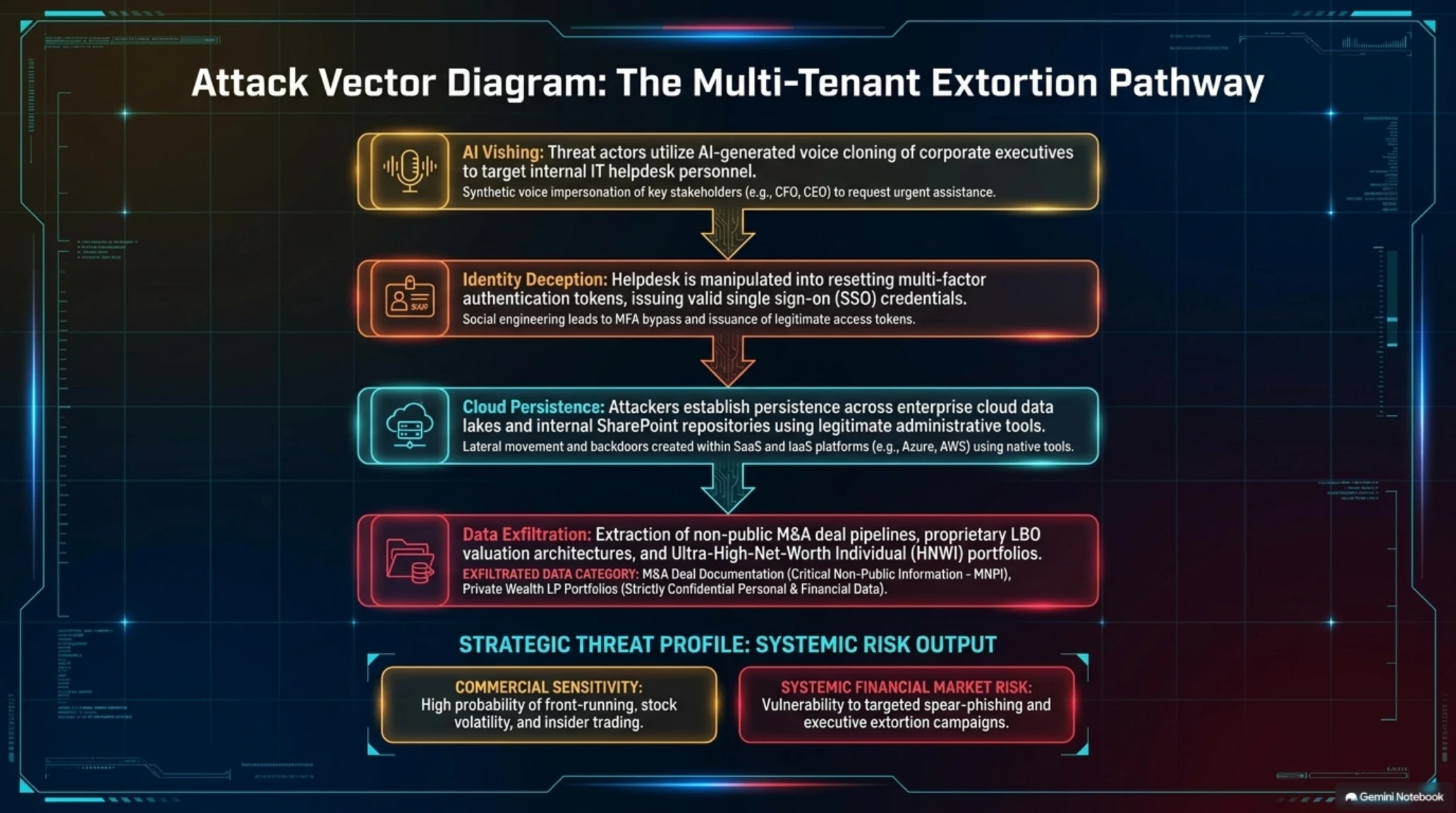
As initially reported by TechCrunch and verified through regulatory disclosures, the threat actors successfully breached Apollo's perimeter defenses by executing sophisticated social engineering and identity deception operations targeting internal IT helpdesk personnel. Utilizing voice phishing (vishing) campaigns combined with AI-generated voice cloning of corporate executives, the attackers manipulated helpdesk staff into resetting multi-factor authentication tokens and issuing valid single sign-on credentials. By compromising enterprise identity providers and gaining access to cloud collaboration platforms, internal SharePoint repositories, and centralized SaaS databases, the adversaries exfiltrated troves of hyper-confidential corporate documentation.
The stolen data assets encompass non-public mergers and acquisitions (M&A) deal pipelines, proprietary leveraged buyout (LBO) financial models, confidential non-disclosure agreements (NDAs), private credit underwriting metrics, and comprehensive demographic portfolios of ultra-high-net-worth individual (HNWI) limited partners. The exposure of pre-deal valuations and confidential restructuring strategies introduces profound systemic risks into public equity and debt markets, creating severe vulnerabilities related to unauthorized insider trading, corporate espionage, and extortion demands scaling into tens of millions of dollars.
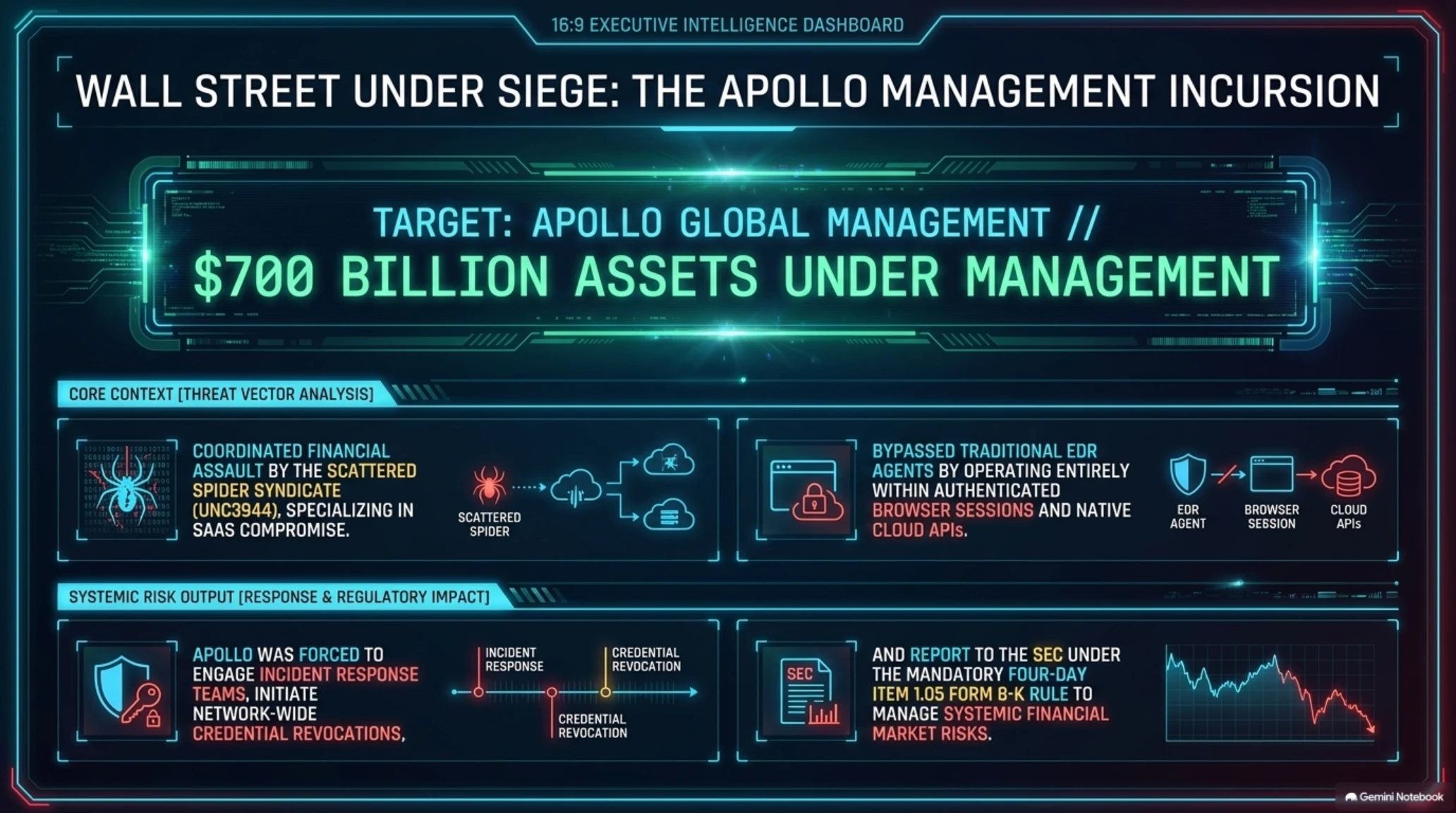
Financial sector threat analysts emphasize that the threat actors behind the intrusion demonstrate tradecraft aligned with the Scattered Spider syndicate (UNC3944). This cybercrime collective specializes in compromising software-as-a-service (SaaS) environments, circumventing traditional Endpoint Detection and Response (EDR) agents by executing purely within authenticated browser sessions and native cloud APIs. Once inside Apollo's environment, the threat actors established persistence across enterprise cloud data lakes, synchronizing bulk financial records to offsite staging servers using legitimate administrative tools.
The United States Securities and Exchange Commission (SEC) and the Department of Justice (DOJ) Cyber Unit have initiated active inquiries to evaluate Apollo's compliance with mandatory four-day material cyber incident reporting mandates under Item 1.05 of Form 8-K. Meanwhile, Apollo has engaged tier-one incident response and digital forensics teams to execute network-wide credential revocations, isolate compromised cloud tenants, and fortify its hybrid perimeter against secondary extortion vectors.
The critical financial and regulatory dimensions of the Apollo breach include:
- Targeting of confidential leveraged buyout underwriting data, creating significant exposure for dozens of corporate portfolio entities
- Compromise of multi-tenant enterprise data lakes, highlighting persistent security gaps within third-party cloud analytics platforms
- Heightened vulnerability of private credit and shadow banking ecosystems to targeted electronic eavesdropping and competitive intelligence theft
- Imposition of rigorous regulatory scrutiny by global financial authorities regarding third-party vendor risk management and access hygiene
- Potential market volatility surrounding active corporate acquisitions currently undergoing regulatory review or valuation negotiations
- Reaffirmation from Apollo executive leadership that core transaction processing, liquidity reserves, and client fund operations remain fully operational
- Mandatory implementation of hardware-bound FIDO2 security keys across all administrative and dealmaking personnel
This high-profile intrusion demonstrates that pre-deal financial intelligence represents the ultimate prize for modern cyber extortion syndicates seeking to maximize financial leverage against global capital allocators.
The conceptual rendering below depicts the digital compromise of Wall Street private equity databases and the forensic analysis of confidential financial deal pipelines:

Strategic Threat Profile: The Apollo Global Management Data Breach
| Exfiltrated Data Category | Commercial Sensitivity Level | Systemic Financial Market Risk |
|---|---|---|
| M&A Deal Documentation | Critical Non-Public Information (MNPI) | High probability of front-running, stock volatility, and insider trading |
| Private Wealth LP Portfolios | Strictly Confidential Personal & Financial Data | Vulnerability to targeted spear-phishing and executive extortion campaigns |
| LBO Valuation Architectures | Proprietary Institutional Trade Secret | Erosion of strategic bidding advantages across global corporate acquisitions |
We turn our focus now from high-stakes corporate espionage to the controversial frontiers of consumer wearable AI and public surveillance ethics.
5. The Wearable Surveillance Crisis; Ray-Ban Meta AI Smart Glasses Demand Surges 300%, Triggering Global Regulatory Storm and Anti-Spy Apps
The consumer electronics landscape has reached a defining ethical inflection point as commercial demand for Ray-Ban Meta Smart Glasses has experienced an unprecedented surge, recording a 300% year-over-year sales increase across global markets. As detailed in comprehensive investigations by Ars Technica, the transition of camera-equipped, multimodal artificial intelligence wearables from niche enthusiast hardware to mass-market consumer ubiquity has ignited an intense international confrontation over the destruction of public anonymity and the normalization of ambient surveillance.
Equipped with dual forward-facing optical sensors, directional spatial audio microphones, and seamless cloud connectivity to Meta's flagship multimodal AI models, the smart glasses allow wearers to record high-definition video, capture candid photography, and query visual intelligence engines via natural voice commands without drawing a smartphone from their pockets. While Meta integrated a hardware capture LED designed to illuminate during active recording, rigorous field testing has proven the safety mechanism largely ineffective in direct sunlight. Furthermore, modified hardware guides and online tutorials have proliferated, demonstrating how users can easily obscure or disable the LED indicator using opaque vinyl adhesives, dark permanent markers, or minor electrical modifications to achieve completely invisible filming.
The technical architecture of the device introduces complex privacy challenges. The forward-facing 12-megapixel ultra-wide camera stream is processed in real time by an onboard Qualcomm Snapdragon AR1 Gen 1 chipset, which compresses and transmits visual tokens across a Bluetooth 5.3 / Wi-Fi 6 wireless bridge to the paired smartphone. When a user issues a multimodal query such as asking the assistant to analyze a document, recognize an individual, or translate street signage visual keyframes are dispatched to Meta's hyperscale inference clusters. This architecture creates perpetual ambient data ingestion pipelines where bystander likenesses, vehicle license plates, and private conversations are ingested into cloud systems without explicit informed consent.
In response to escalating societal unease, open-source developers and privacy activists have deployed counter-surveillance tools, most notably the open-source mobile application Zuckoff. Utilizing Bluetooth Low Energy (BLE) radio interface scanning on modern smartphones, Zuckoff continuously monitors local electromagnetic spectrums for the unique advertising packet signatures and MAC address prefixes broadcasted by Ray-Ban Meta frames. Upon detecting active smart glasses within localized transmission range, the application delivers immediate haptic and visual alerts, informing nearby individuals that an active optical recording platform is operating in their vicinity.
Simultaneously, international regulatory bodies have launched sweeping administrative inquiries. The European Data Protection Board (EDPB), led by the Irish Data Protection Commission (DPC), has initiated formal investigations to evaluate whether Meta's ambient video and audio capture architectures violate fundamental provisions of the General Data Protection Regulation (GDPR), specifically Articles 6 and 9 regarding the non-consensual processing of biometric and facial identifiers in public environments. Similar inquiries have been opened by consumer protection authorities in the United States, Japan, and the United Kingdom amidst reports that Meta is actively testing real-time facial recognition and ambient conversational logging for upcoming firmware updates.
The core societal, legal, and engineering vectors defining this wearable privacy battle include:
- The near-total erosion of privacy expectations across public transportation, fitness facilities, corporate offices, and educational campuses
- Rapid proliferation of third-party firmware modifications designed to bypass hardware-level recording safeguards and capture audio without consent
- Strict prohibitions enacted by corporate enterprises, legal courts, financial trading floors, and testing facilities banning smart glasses on premises
- Technical limitations of BLE sniffing applications like Zuckoff in dense urban environments due to RF congestion and MAC address randomization
- Calls from European lawmakers to mandate tamper-evident, fail-closed optical sensors that permanently disable the camera if the LED is occluded
- Meta's deployment of firmware updates engineered to utilize ambient light sensors to detect physical obstruction of the recording indicator
- Debates surrounding the legal classification of ambient wearable video capture under wiretapping and voyeurism statutes
This controversy demonstrates that as artificial intelligence seamlessly integrates into personal eyewear, the friction between technological convenience and basic civil liberties will remain one of the primary regulatory battlegrounds of the modern era.
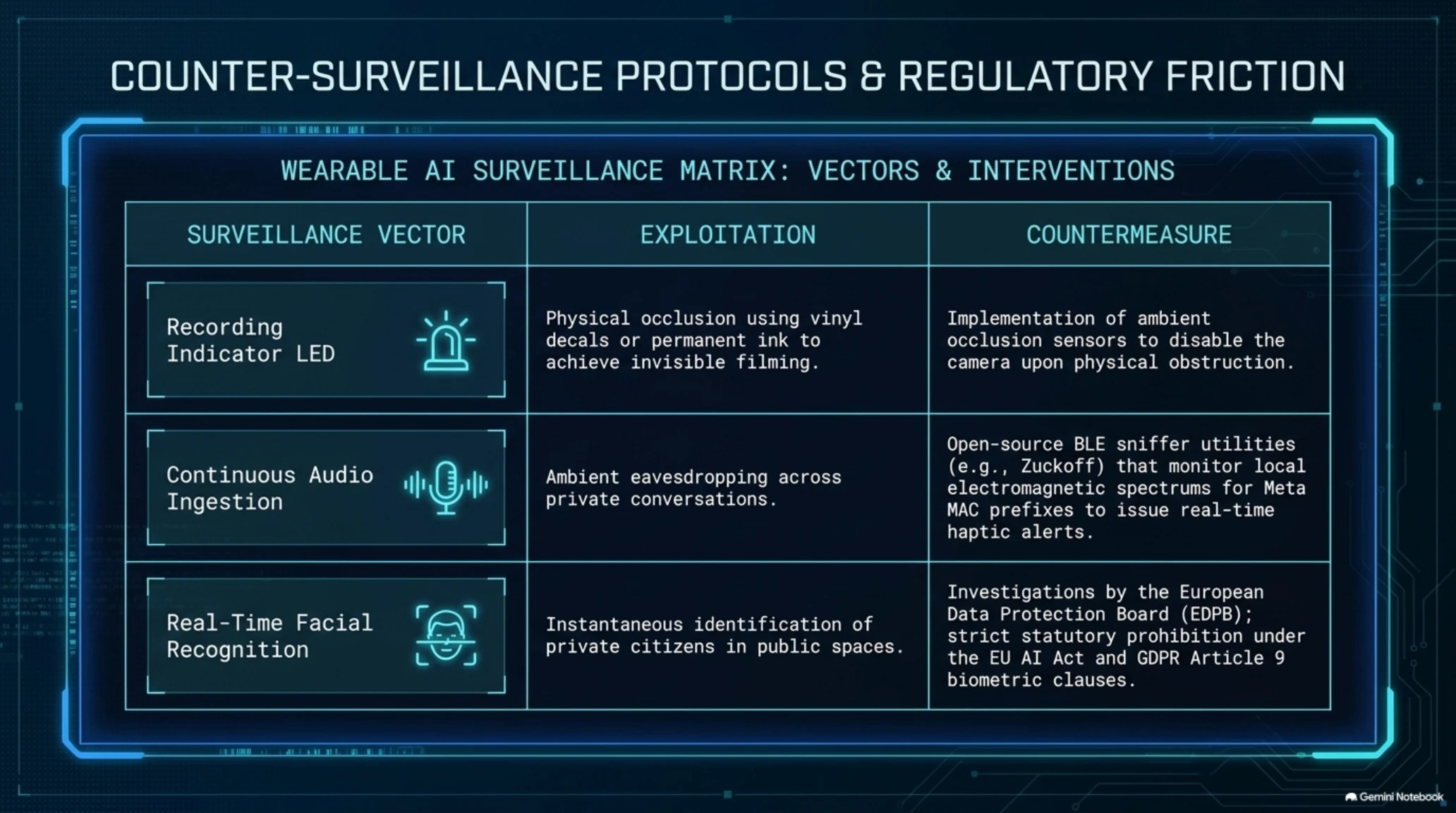
The conceptual rendering below visualizes the collision between ambient smart glasses optical scanning and real-time Bluetooth detection alerts deployed to protect pedestrian privacy:

Wearable AI Surveillance Matrix: Privacy Vectors & Regulatory Interventions
| Surveillance Vector | Exploitation / Abuse Scenario | Regulatory & Technical Countermeasure |
|---|---|---|
| Recording Indicator LED | Physical occlusion using vinyl decals or permanent ink | Implementation of ambient occlusion sensors to disable camera upon obstruction |
| Continuous Audio Ingestion | Ambient eavesdropping across private conversations | Deployment of localized BLE sniffer utilities (Zuckoff) to alert nearby individuals |
| Real-Time Facial Recognition | Instantaneous identification of private citizens in public | Strict statutory prohibition under EU AI Act and GDPR Article 9 biometric clauses |
We transition now to our final investigative pillar tonight: an institutional milestone in corporate digital asset treasury management.
6. The Corporate Yield Revolution; Sharplink Stakes $91 Million in Ethereum (39,319 ETH) as Wall Street Digital Treasuries Reach Unprecedented Profitability
In a landmark transaction reshaping corporate balance sheet architecture and digital asset treasury strategy, publicly traded entity Sharplink Gaming (listed on NASDAQ) has executed an extraordinary on-chain allocation, depositing and staking an additional 39,319 Ethereum (ETH) valued at approximately $91 million into institutional consensus validator pools. The transaction, initially flagged by on-chain tracking protocol Lookonchain, cements Sharplink's status alongside MicroStrategy as one of the world's most aggressive and innovative corporate digital asset allocators.
This capital deployment represents a foundational paradigm shift in corporate treasury management. Whereas the pioneering corporate Bitcoin playbook established by MicroStrategy centers on the passive, unencumbered accumulation of spot reserves as a non-productive store of value, Sharplink and modern corporate balance sheet architects are pivoting toward "productive digital capital." By committing native Ether to Ethereum's decentralized Proof-of-Stake (PoS) consensus layer, Sharplink secures an annualized, protocol-level cash flow yield ranging between 3.8% and 4.2% paid in native ETH. This recurring revenue stream flows directly into corporate financial statements without diluting the underlying principal or requiring speculative market trading.
The operational mechanics of enterprise staking involve sophisticated engineering workflows. Unlike retail staking pools which often pool assets through third-party smart contracts, Sharplink deployed dedicated, institutional-grade validator clusters. Each validator requires a deposit of exactly 32 ETH; consequently, this transaction activated over 1,228 distinct validator instances across distributed validator technology (DVT) networks. By leveraging Obol Network and SSV Network primitives, Sharplink splits validator private signing keys across multiple independent node operators, completely eliminating single points of failure, safeguarding against hardware offline penalties, and maximizing protocol uptime above 99.98%.
This historic staking batch coincides with a broader institutional renaissance across digital asset markets. With Bitcoin consolidating decisively in the $72,000 to $77,000 price range, corporate Bitcoin treasuries globally including holdings managed by Tesla, Tether, Block Inc., and major institutional mining operations have achieved historic net-positive balance sheet profitability. Furthermore, the universal adoption of updated Financial Accounting Standards Board (FASB) guidelines which permit public corporations to account for digital asset holdings at fair market value rather than treating them exclusively as impaired intangible assets has completely eliminated the regulatory friction previously inhibiting corporate chief financial officers (CFOs) from integrating digital assets into audited quarterly balance sheets.
To execute this massive staking deployment with zero operational compromise, Sharplink partnered with tier-one regulated institutional custodians, including Coinbase Custody and BitGo. The staking architecture utilizes cryptographically segregated validator nodes with multi-party computation (MPC) key management, guaranteeing that the company retains sovereign ownership of its private keys while insulating its reserves from slashing penalties or third-party exchange insolvency risks.
The strategic financial implications and industry metrics of Sharplink's $91 million staking maneuver include:
- Transformation of dormant corporate fiat reserves into productive digital assets yielding over 1,500 ETH in annual protocol rewards
- Establishment of Ethereum Proof-of-Stake as the definitive "internet-native risk-free rate" for enterprise treasury diversification
- Strengthening of global Ethereum network security, driving the total cumulative value of staked Ether past 34 million ETH
- Deployment of liquid staking tokens (LSTs) enabling institutional borrowing and liquidity management within enterprise DeFi protocols
- Substantial reduction of circulating liquid supply across spot exchanges, amplifying upward price pressure across macro market cycles
- Creation of a replicable corporate blueprint encouraging sovereign wealth funds and technology enterprises to monetize idle treasury capital
- Integration of MEV-Boost relays with strict ethical filtering to maximize block proposal tips while adhering to regulatory compliance frameworks
This transaction confirms that decentralized blockchain networks are no longer speculative fringes; they are functioning as foundational financial rails powering institutional enterprise yield generation.
The conceptual visualization below illustrates the routing of $91 million in corporate Ethereum reserves into institutional staking nodes, establishing automated yield pipelines:

The detailed technical analysis video below examines the economics of institutional Ethereum staking, validator slashing protection, and the corporate impact of FASB fair-value balance sheet accounting:
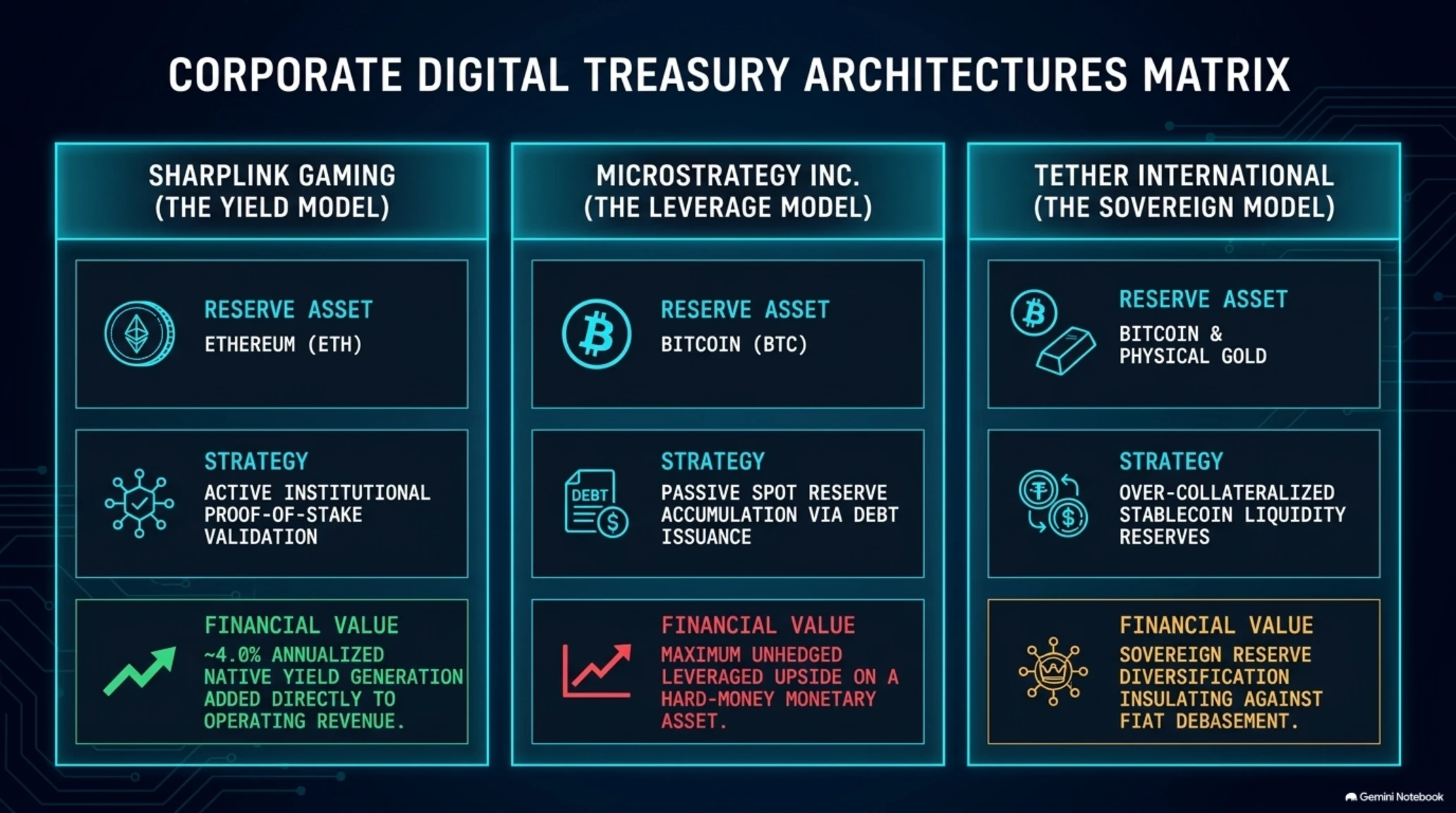
Comparative Analysis: Institutional Corporate Crypto Treasury Architectures
| Corporate Entity | Primary Reserve Asset | Treasury Strategy & Execution | Primary Strategic Financial Value |
|---|---|---|---|
| Sharplink Gaming | Ethereum (ETH) | Active Institutional Proof-of-Stake Validation | ~4.0% annualized native yield generation added to operating revenue |
| MicroStrategy Inc. | Bitcoin (BTC) | Passive Spot Reserve Accumulation via Debt Issuance | Maximum unhedged leveraged upside on hard-money monetary asset |
| Tether International | Bitcoin & Physical Gold | Over-Collateralized Stablecoin Liquidity Reserves | Sovereign reserve diversification insulating against fiat debasement |
The rendering below captures the synthesis of high-performance decentralized blockchain nodes operating seamlessly alongside Wall Street corporate financial institutions:

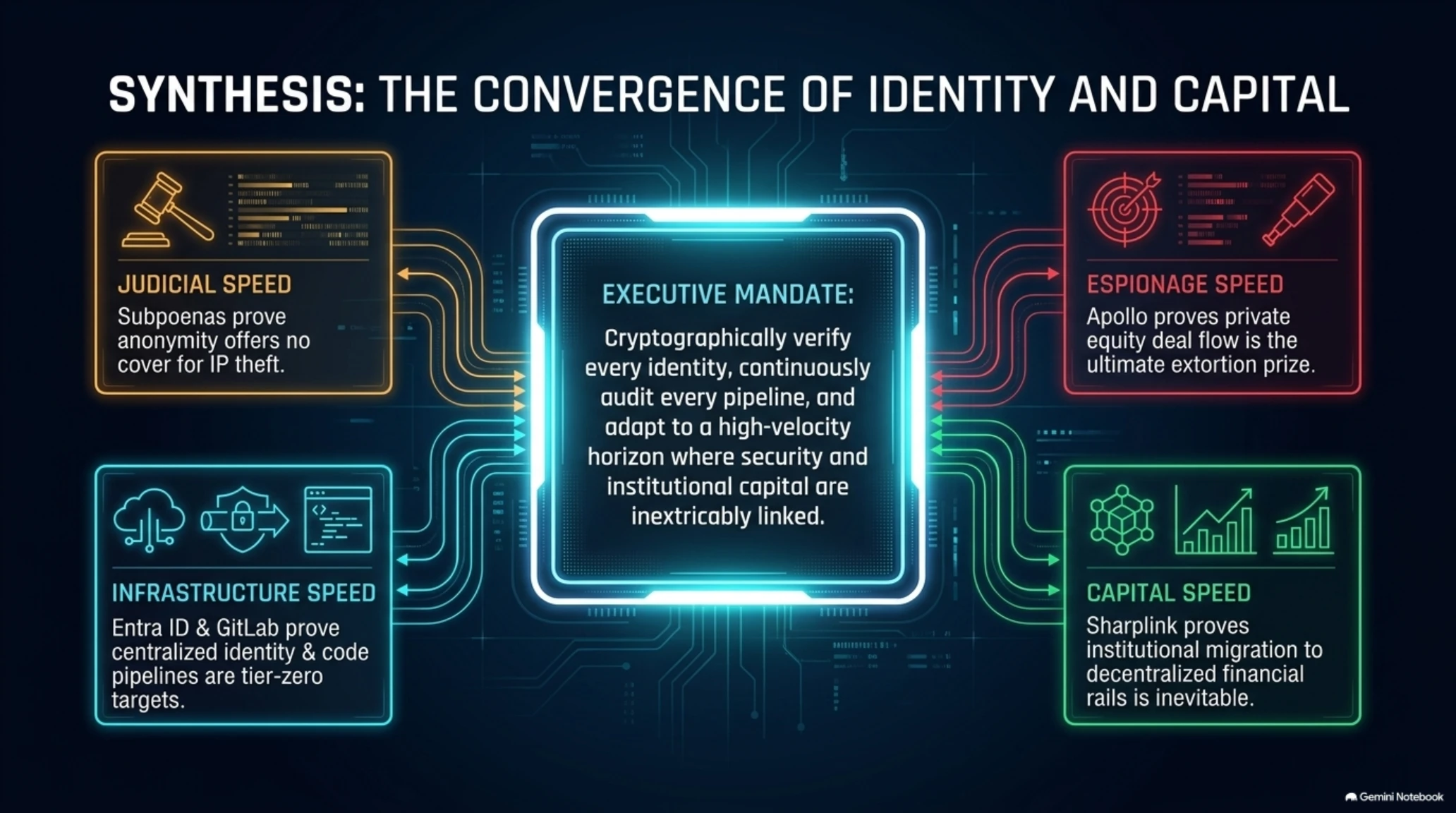
Late-Night Strategic Synthesis; A Saturday Defined by Judicial Warfare, Identity Crises and Capital Evolution
As the final hours of Saturday, August 22, 2026 draw to a close, the international technology landscape reflects a profound convergence of judicial enforcement, infrastructure fragility, and institutional capital evolution. The federal legal barrage launched by Take-Two against Microsoft and Discord firmly establishes that digital anonymity offers no protection when intellectual property theft crosses into organized cryptocurrency fraud.
In enterprise cybersecurity, the simultaneous disclosure of a flawless CVSS 10.0 remote code execution zero-day in Microsoft Entra ID and active mass exploitation of GitLab code injection flaws reinforces the reality that centralized identity planes and open-source software supply chains remain the premier targets of advanced persistent threats. Furthermore, the confirmed network intrusion at Apollo Global Management illustrates that private equity dealmakers must fortify their internal collaboration environments against sophisticated identity-centric espionage.
Concurrently, the intense privacy backlash and anti-surveillance tools emerging in response to exploding Meta AI smart glasses adoption highlight the deepening cultural friction surrounding pervasive wearable artificial intelligence. Finally, Sharplink's $91 million Ethereum staking transaction demonstrates the inevitable institutional migration toward productive, decentralized financial rails. As we look ahead to the forthcoming week, the imperative for digital enterprises is clear: cryptographically verify every identity, continuously audit every pipeline, and adapt to a high-velocity technological horizon where security and innovation are inextricably linked.
The strategic conceptual overview below synthesizes the core technological, legal, and financial battlegrounds that defined tonight's global intelligence briefing:

Related Industry Features on Tekin Game
• 🤖 Tekin Analysis | Unitree Robotics IPO & AI Prompt Injection Court Battles
• ☀️ Tekin Morning Aug 17, 2026 | Halo Prototype Leaks & The Massive PS5 Account Purge
• 🎭 Tekin Feature | Gamification of Intimacy: How Couples are Using VR & Gaming Tech
- Take-Two's aggressive federal legal action to unmask GTA 6 leakers and halt cryptocurrency fraud
- Microsoft's rapid cloud-level remediation of the catastrophic CVSS 10.0 Entra ID zero-day
- Sharplink Gaming's $91M Ethereum staking transaction setting a new standard for corporate treasuries
- The rapid development of counter-surveillance apps like Zuckoff to combat Meta AI privacy invasions
- Widespread automated exploitation of GitLab vulnerabilities threatening global CI/CD software pipelines
- Severe data breach at Apollo Global Management exposing highly confidential Wall Street M&A deal intelligence
Frequently Asked Questions & Comprehensive Technical Analysis (FAQ)
Why did Take-Two pursue federal DMCA Section 512(h) subpoenas against Microsoft and Discord rather than standard takedown notices?
Standard DMCA notices only remove infringing content from public view. Take-Two utilized Section 512(h) subpoenas because the CyberLeek actors engaged in criminal wire fraud by falsely claiming in-game GTA 6 funds could be redeemed for cash and launching a fraudulent Solana memecoin that extracted over $50,000 from victims. The federal subpoenas legally compel Microsoft and Discord to unmask the leakers by providing IP connection logs, associated OneDrive cloud containers, server membership records, and billing data to facilitate federal prosecution.
What made the Microsoft Entra ID zero-day (CVE-2026-69836) a maximum-severity CVSS 10.0 vulnerability?
CVE-2026-69836 received a flawless 10.0 score because it allowed unauthenticated remote attackers to send malformed SAML 2.0 and OAuth 2.0 assertions directly to Microsoft's cloud authentication endpoints. This enabled the arbitrary forging of Global Administrator claims across tenant boundaries, bypassing all Conditional Access Policies, hardware MFA, and Privileged Identity Management without requiring user interaction or generating localized SIEM alert logs.
How does GitLab vulnerability CVE-2026-19478 threaten global software supply chains?
The flaw is an unauthenticated code injection vulnerability within GitLab's project export/import and GraphQL ingestion engines. Attackers can remotely modify or overwrite public repositories, alter Git commit histories, and inject malicious build instructions into .gitlab-ci.yml pipelines. This allows automated build runners to compile backdoors directly into commercial software releases distributed downstream to thousands of customer organizations.
How does the mobile utility Zuckoff detect Ray-Ban Meta AI smart glasses in public environments?
Zuckoff operates by continuously scanning the local 2.4 GHz radio spectrum for proprietary Bluetooth Low Energy (BLE) advertising beacons, specific MAC address prefixes, and transmission UUIDs broadcasted exclusively by Ray-Ban Meta hardware. When these signals are detected within proximity, the app triggers haptic and visual notifications to warn nearby individuals of potential covert recording.
How does Sharplink Gaming's Ethereum staking strategy differ from traditional corporate Bitcoin treasury models?
Traditional corporate Bitcoin holders like MicroStrategy maintain a passive spot treasury focused entirely on capital appreciation as a non-yielding monetary asset. Sharplink's strategy utilizes Ethereum's Proof-of-Stake consensus mechanism by locking 39,319 ETH into validator nodes, generating a continuous, protocol-native yield of ~4.0% APR paid in Ether. This produces recurring operating cash flow while preserving full exposure to Ethereum's underlying price upside under FASB fair-value accounting rules.
Intelligence Sources & Investigative References
- Eurogamer: GTA 6 Playable Build Leaks
- Kotaku: Stop Killing Games Condemns CyberLeek
- TechCrunch: Apollo Global Management Cyber Incursion
- Ars Technica: Ray-Ban Meta AI Smart Glasses Surge
- CryptoSlate: Institutional Ethereum Staking Milestone
- Microsoft Security: Entra ID CVSS 10.0 Zero-Day
- GitLab: Critical Code Injection Flaw CVE-2026-19478
Additional Gallery: 🌙 Tekin Night | Saturday, August 22, 2026: Take-Two Subpoenas Microsoft & Discord in GTA 6 Hunt, Microsoft Entra CVSS 10.0 Zero-Day & Apollo $700B Breach