Tekin Night Intelligence Dossier: Historic Switch 2 Markdown & Linux AI Zero-Day
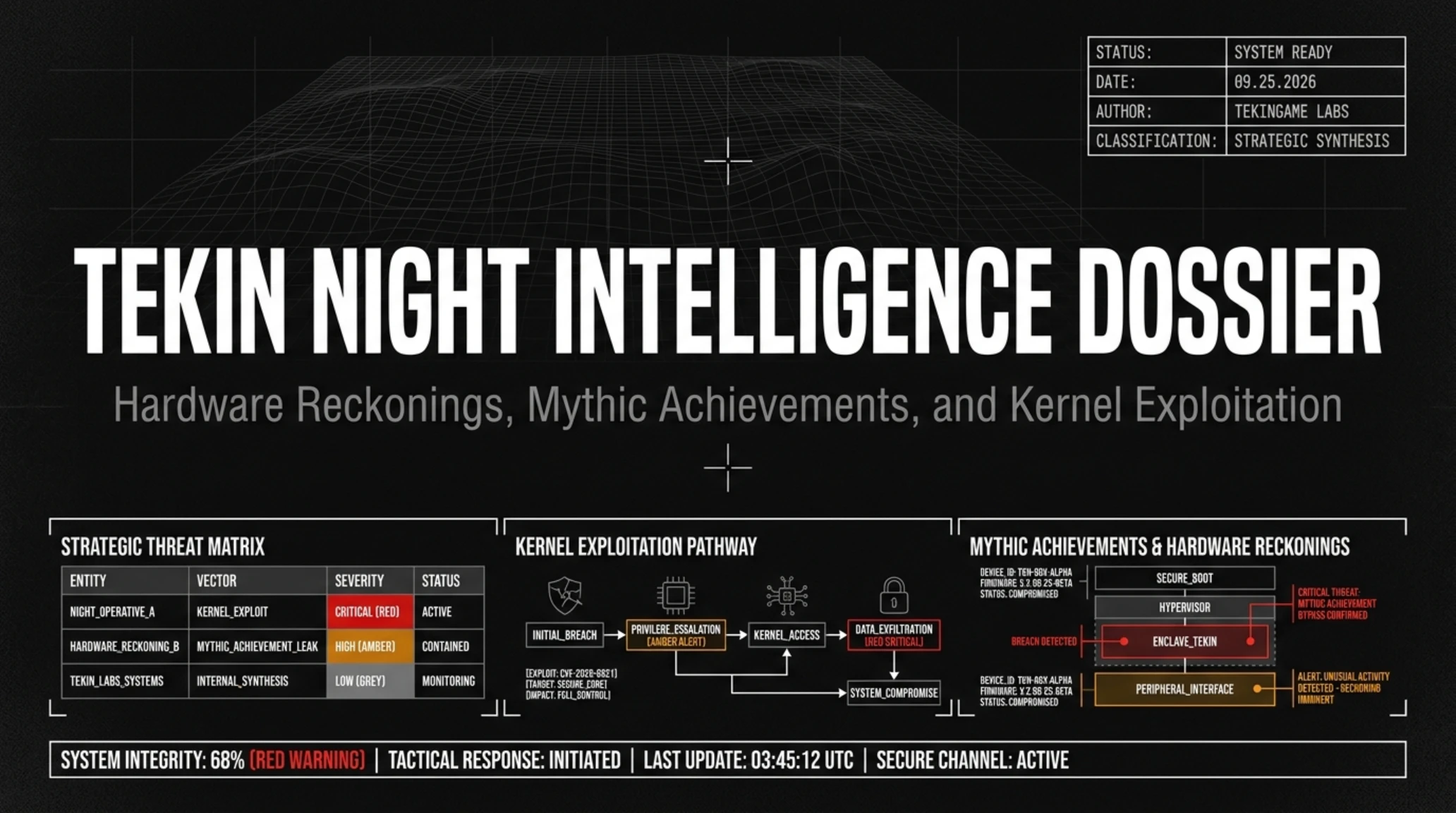
Tonight we dissect the historic UK Switch 2 price crash, Xbox Mythic trophies, Linux AI-discovered root exploits, and Google Cloud takeovers.
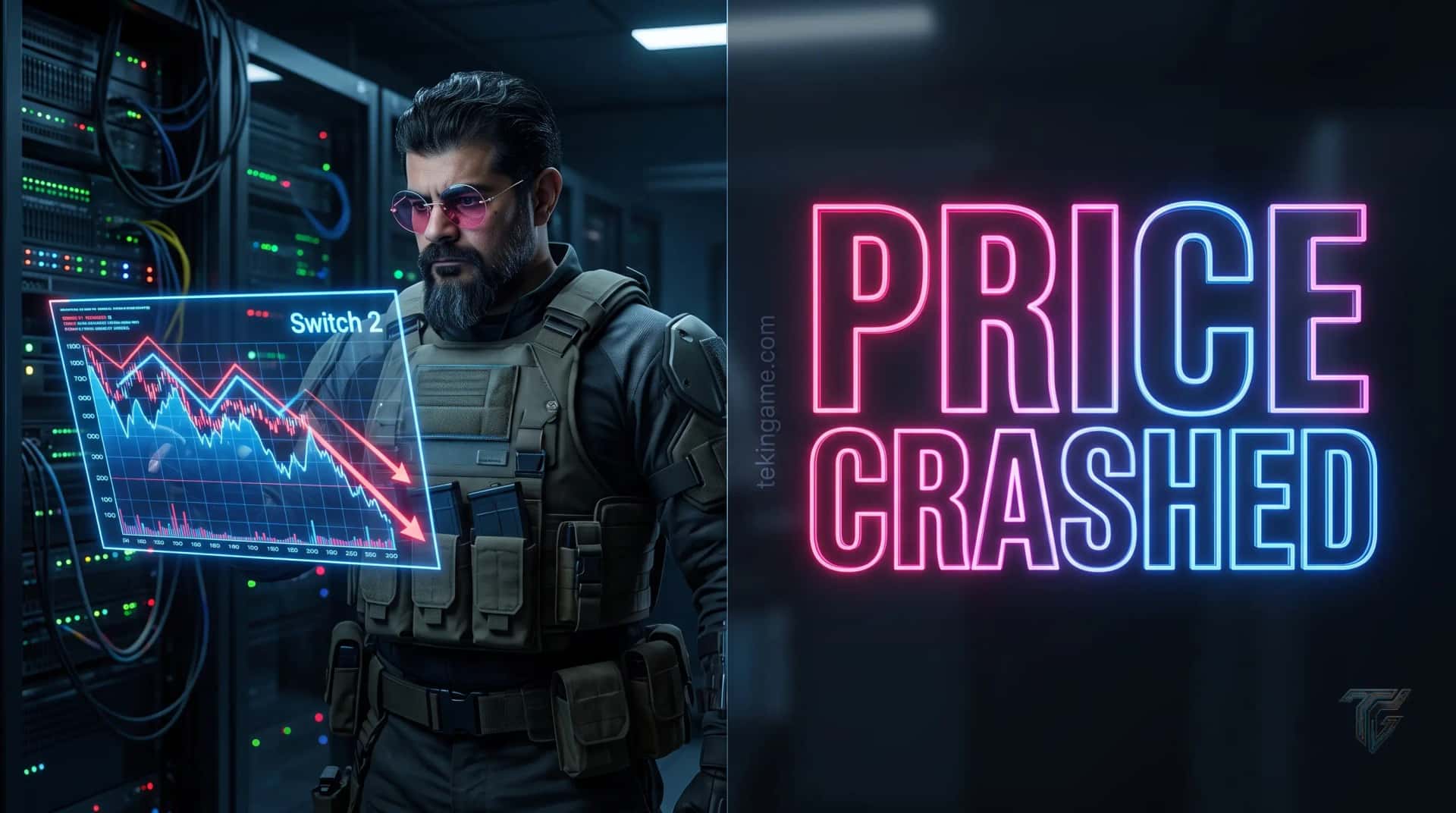
- 🎮Nintendo Switch 2 Drops to All-Time Record Low £354.99 in UK- Major UK retailers execute a surprise £65 flash markdown just weeks after official autumn price increases.
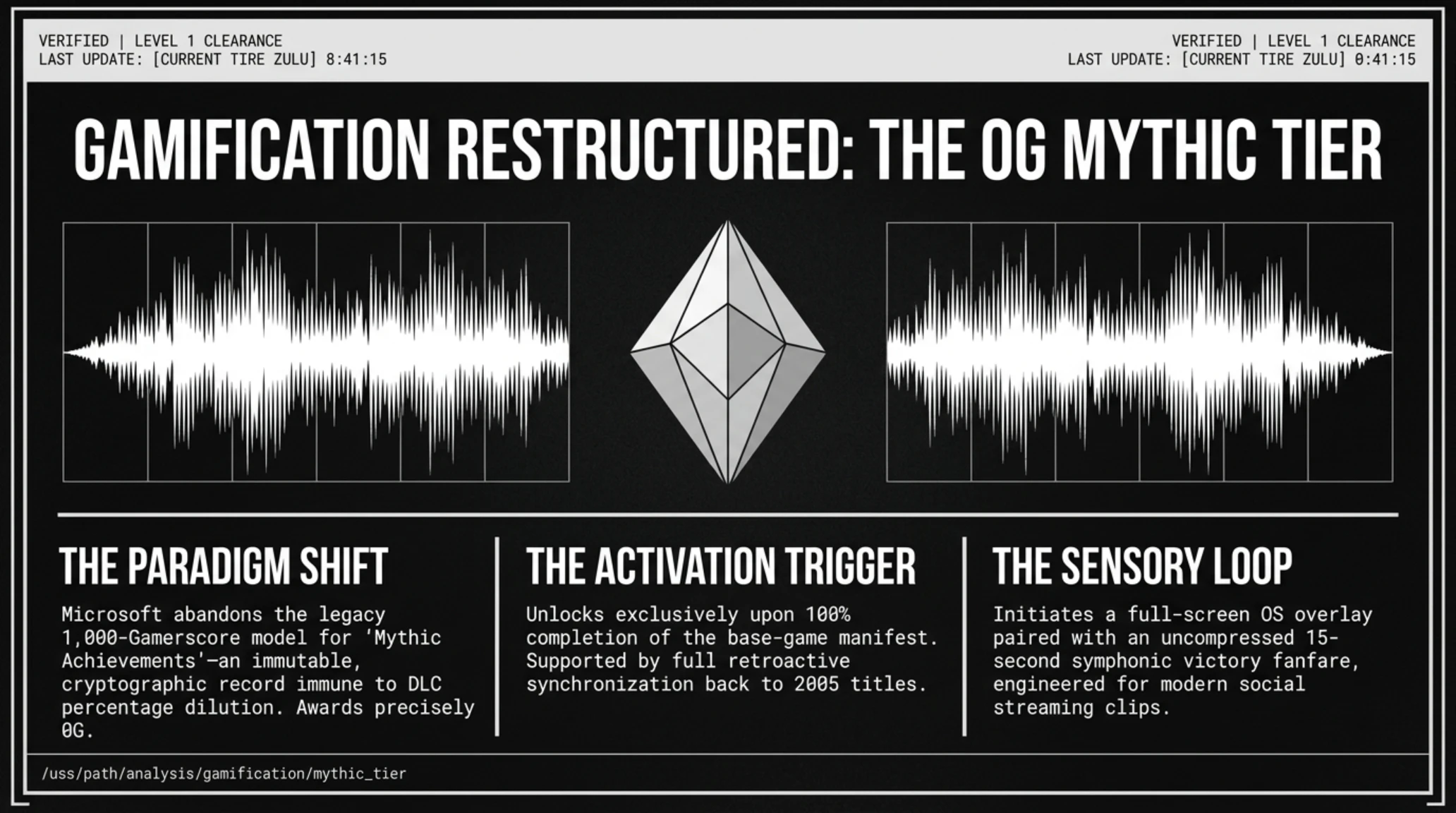
- 🎧Xbox Leaks 15-Second Victory Audio Fanfare for Mythic Achievements- Microsoft's long-awaited answer to PlayStation Platinum trophies surfaces in PC Insider clients with grand fanfare.
- 🚀Bethesda & id Software Abolish Quake Champions Microtransactions- Patch 1.31 removes battle passes, loot boxes, and virtual currencies, transforming the 8-year F2P title into a $9.99 Steam premium game.
- 🗡️Capcom & Meta Announce Phoenix Wright: Ace Attorney VR for 2027- Spatial courtroom drama brings 3D evidence manipulation, hand tracking, and vocal OBJECTION mechanics to Meta headsets.
- 📰DepthFirst AI Model Uncovers Linux Kernel Host-Root Container Escape- Autonomous reasoning model discovers CVE-2026-80521 Use-After-Free flaw in AF_UNIX sockets threatening Ubuntu LTS servers.
- ⚔️One Kubernetes YAML File Grants Full GCP Organization Takeover- Varonis Threat Labs reveals critical Confused Deputy privilege escalation in Google Cloud Config Connector.
Good evening, systems architects, cybersecurity operatives, game engine developers, and late-night technology strategists. As Friday, September 25, 2026, winds down into the quiet hours of the night, the digital world accelerates into a state of high-voltage transformation. The end of the work week offers an indispensable opportunity to turn down the ambient noise of daily enterprise operations, power on high-contrast workstation displays, pour a rich evening brew, and conduct a rigorous, 360-degree forensic examination of the structural shifts reshaping interactive entertainment and enterprise cloud infrastructure. Tonight’s edition of Tekin Night delivers an unfiltered, data-dense intelligence briefing curated specifically for those who analyze technological systems through first principles.
Late-Night Strategic Synthesis: What You Need to Know Before the Weekend
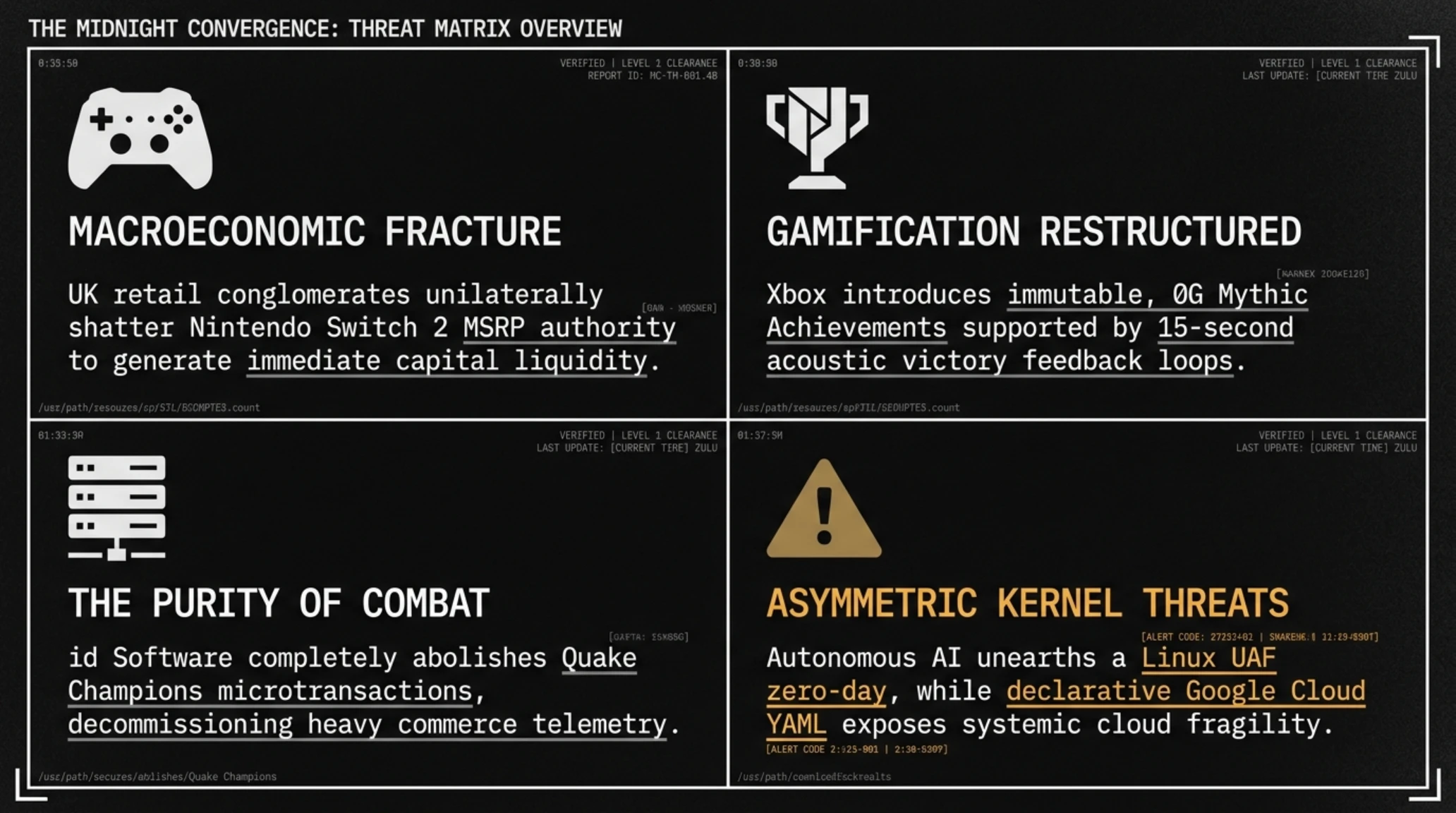
- Major UK retail chains ignited an unexpected price war, slashing the flagship Nintendo Switch 2 console to an unprecedented £354.99.
- Xbox platform engineers have built a dedicated Mythic Achievement tier celebrating 100% base-game completion with a 15-second orchestral victory theme.
- id Software eliminated the entire free-to-play monetization apparatus in Quake Champions, unlocking all 16 champions permanently for a single $9.99 purchase.
- Capcom partnered with Meta Reality Labs to port Phoenix Wright: Ace Attorney – Dual Destinies into fully immersive spatial VR with vocal input.
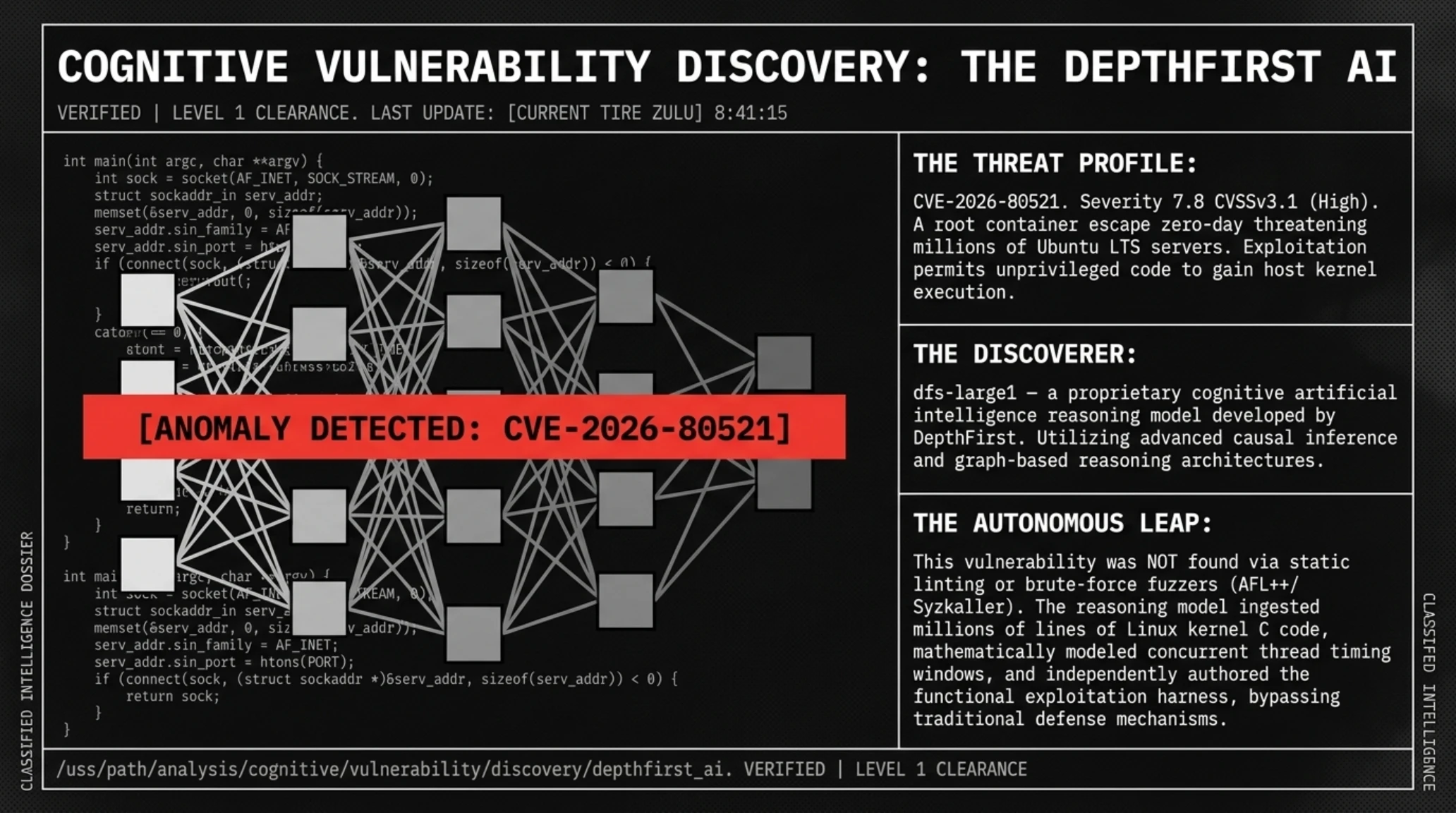
- A specialized artificial intelligence model named dfs-large1 autonomously unearthed a high-severity container escape zero-day in core Linux networking code.
- A subtle authorization flaw in Google Cloud's Kubernetes Config Connector allows low-privilege cluster tenants to claim Organization Administrator privileges.
The closing hours of this Friday have generated an extraordinary convergence of microeconomic maneuvering in the video game console market and high-severity architectural vulnerabilities across distributed operating systems. In the consumer hardware domain, European retail distributors have broken ranks with platform manufacturers, triggering an aggressive inventory clearance that has driven Nintendo's next-generation hybrid platform to historic price lows. Concurrently, Microsoft's gaming division has inadvertently exposed a twenty-year overhaul to its prestige gamification ecosystem, while legendary developer id Software has executed an ideological retreat from predatory live-service monetization. Simultaneously, the enterprise security perimeter faces unprecedented tremors: autonomous machine-learning models have begun unearthing weaponizable zero-day vulnerabilities in the monolithic Linux kernel, while declarative Kubernetes controllers in Google Cloud have exposed the fragility of multi-tenant cloud isolation.

Nintendo Switch 2 Drops to All-Time Record Low £354.99 in Surprise UK Retail Flash Sale Following Price Hikes
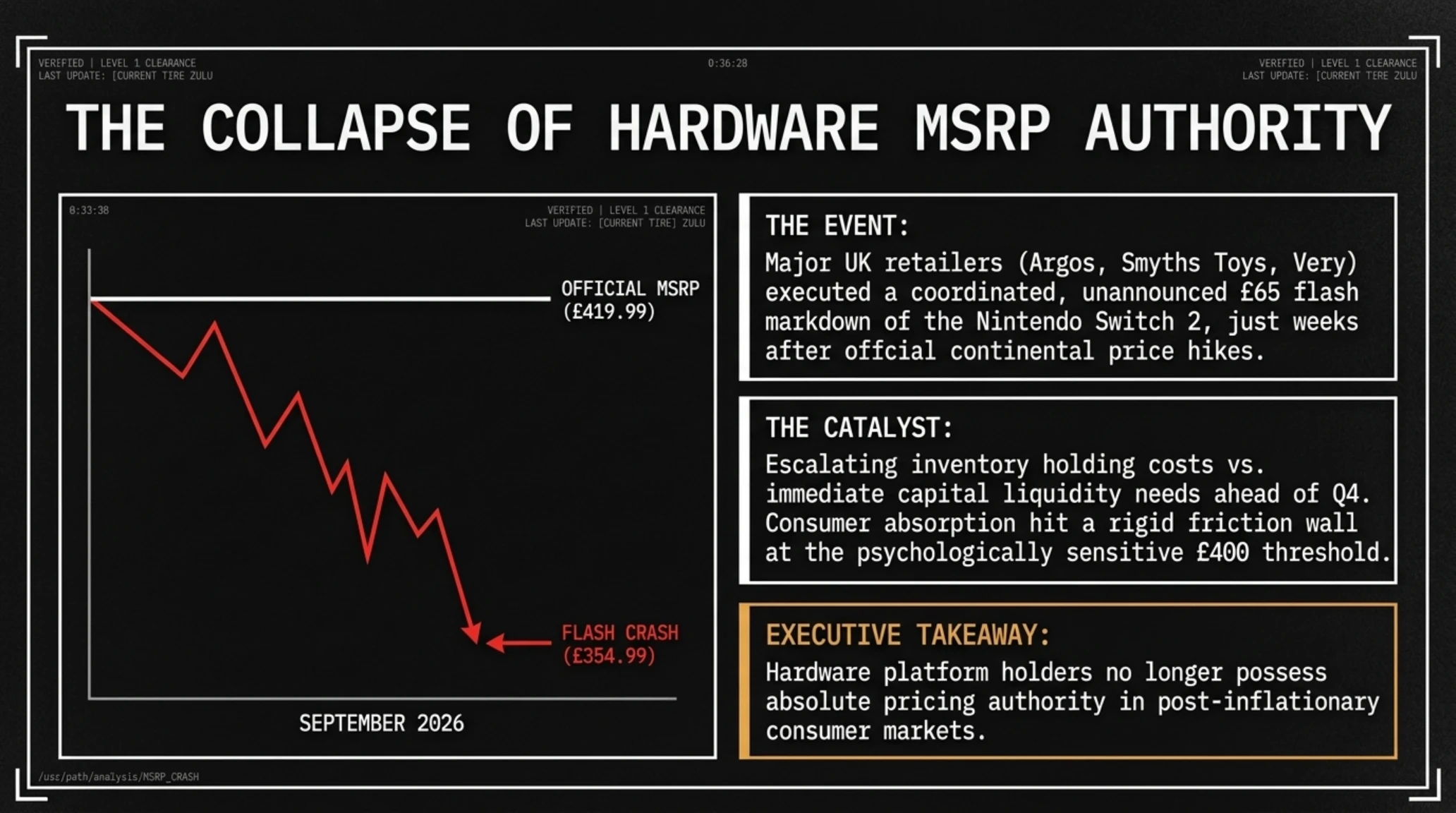
In a dramatic market inversion that has stunned consumer electronics analysts, major United Kingdom retail conglomerates led by Argos, Smyths Toys, and digital retail giant Very abruptly shattered the pricing baseline for Nintendo Switch 2. In a coordinated, unannounced flash promotional campaign initiated late Friday afternoon, distributors slashed the retail price of the flagship hybrid console down to £354.99. This reflects an extraordinary £65 discount from the official £419.99 manufacturer's suggested retail price (MSRP) established by Nintendo on September 1, 2026, marking the lowest recorded acquisition cost for the hardware since its commercial unveiling.
The macroeconomic backdrop of this pricing collapse underscores profound friction within retail distribution channels. Three weeks prior, Nintendo of Europe enacted continent-wide price increases, citing inflationary pressures across advanced semiconductor packaging, elevated freight tariffs, and escalating bill-of-materials costs associated with custom silicon wafers. However, enterprise retail telemetry reveals that consumer absorption rates hit an immediate friction wall once the unit crossed the psychologically sensitive £400 threshold. Confronted with mounting warehouse inventory holding costs ahead of the aggressive fourth-quarter holiday buying cycle, top-tier retailers elected to compress their gross hardware margins to near-zero levels, pairing the £354.99 hardware with £20 software bundle vouchers to liquidate stock and lock consumers into their respective retail ecosystems.
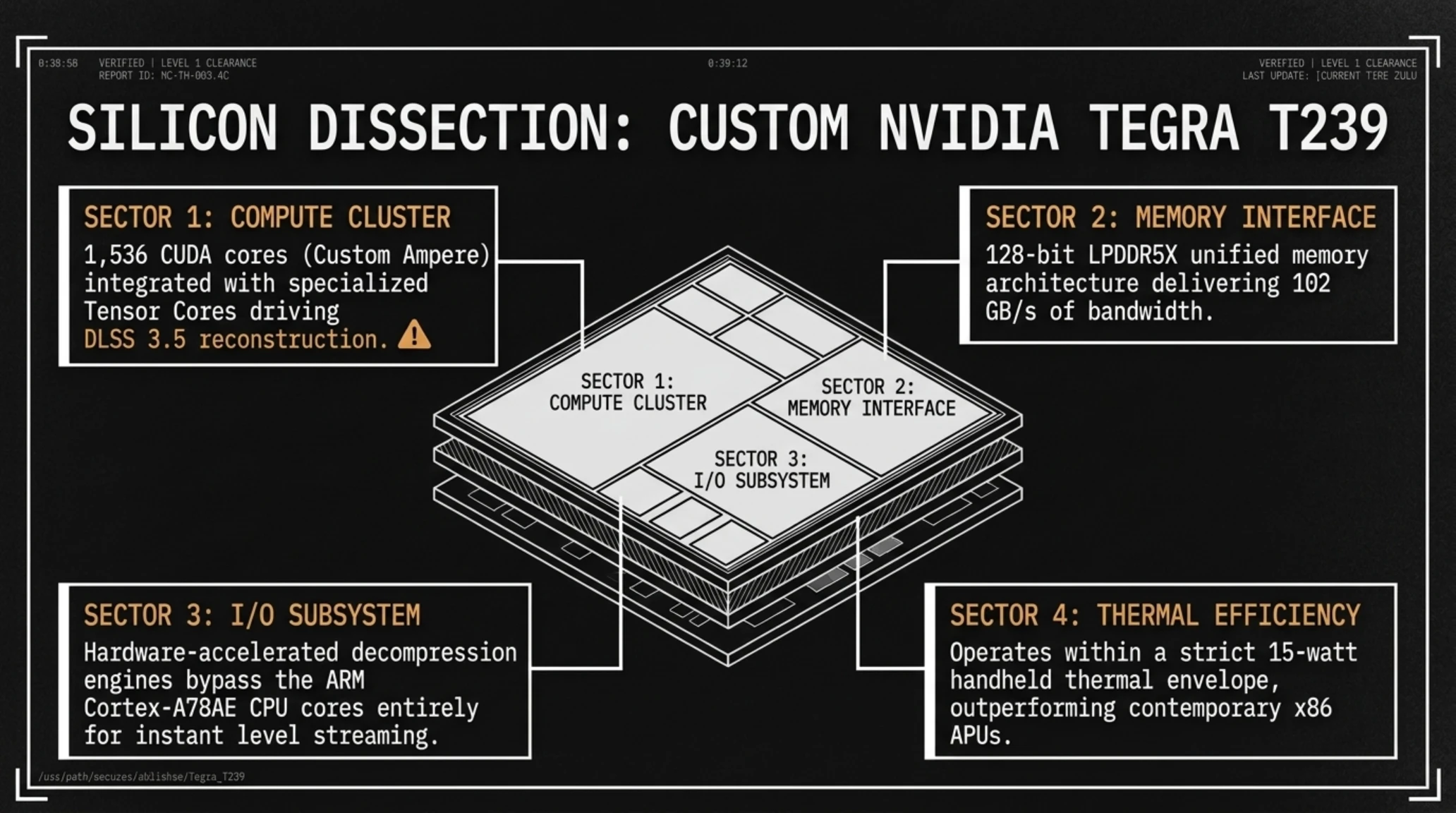
From an architectural standpoint, the Nintendo Switch 2 represents an immense generational leap over its predecessor. Powered by an enterprise-grade Nvidia Tegra silicon die integrating custom Ampere streaming multiprocessors, specialized Tensor Cores, and hardware-accelerated decompression engines, the unit delivers native support for Nvidia DLSS 3.5 deep-learning super-sampling. Digital Foundry benchmarking indicates that the platform achieves consistent 1440p to 4K reconstructed output in docked mode while maintaining a 15-watt handheld thermal envelope. For consumers acquiring the platform at £354.99, the price-to-compute ratio stands as the most compelling consumer hardware bargain of the current console cycle.
Micro-architectural teardowns of the custom Nvidia T239 processor reveal a dense, monolithic silicon layout featuring 1,536 CUDA cores paired with a dedicated 128-bit LPDDR5X unified memory interface delivering over 102 GB/s of bandwidth. Crucially, the integration of custom hardware decompression accelerators derived from Nvidia's enterprise GPU architectures allows asset decompression to bypass the ARM Cortex-A78AE CPU cores entirely. This design mirrors the high-throughput I/O sub-systems of the PlayStation 5 and Xbox Series X, enabling instant level streaming in modern open-world titles. In direct thermal and efficiency comparisons against contemporary x86 handhelds such as the AMD Z1 Extreme powering the Asus ROG Ally X and the custom Van Gogh APU in Valve's Steam Deck OLED the Switch 2 achieves superior ray-tracing throughput and reconstructed image stability while drawing less than half the active system wattage.
Quote: Christopher Dring (Head of Games B2B and Market Telemetry at GamesIndustry)
Telemetry recorded from digital storefronts indicates that initial retail allotments were exhausted in under three hours, causing transactional database throttling across multiple payment gateways. By strategically undercutting official digital channels, physical and omnichannel retailers have successfully asserted their structural indispensability in high-volume electronics distribution.
Xbox Leaks 15-Second Victory Audio Fanfare for New "Mythic Achievements" Microsoft's Long-Awaited Platinum Trophy Rival
While console hardware enthusiasts monitored retail inventory trackers, the global Xbox gaming community experienced an equally seismic revelation concerning the architecture of platform gamification. Deep binary analysis of the latest Microsoft PC Gaming Insider client and preview Xbox OS firmware builds conducted by systems analysts at TrueAchievements confirmed that Microsoft is preparing to deploy an exhaustive restructuring of its achievement infrastructure, headlined by the introduction of Mythic Achievements.
For more than two decades stretching back to the introduction of the 1,000-Gamerscore paradigm on the Xbox 360 in November 2005 Xbox players have lamented the absence of a unified, immutable capstone metric comparable to Sony PlayStation’s prestigious Platinum Trophy. In the legacy Xbox model, completing 100% of a title's base achievement roster was constantly undermined by the subsequent release of downloadable content (DLC) and seasonal updates, which instantly diluted the player's completion percentage from 100% down to 80% or lower. The newly discovered Mythic Achievement tier resolves this structural flaw by establishing an immutable, cryptographic record that unlocks exclusively upon the total completion of a game's base release achievement manifest.
Market Sentiment: Community Enthusiasm Meets the Zero-Gamerscore Paradigm
Beyond the visual prestige of the animated, multi-faceted crystal icon, the centerpiece of the leak is an uncompressed audio artifact: a 15-second symphonic victory fanfare engineered by Microsoft’s premier audio design studios. When a player triggers the final base achievement, the operating system initiates an immersive, full-screen graphical overlay accompanied by this crescendo, creating an unmistakable acoustic celebration of digital mastery. By integrating full retroactive parity, hundreds of thousands of veteran players will awaken upon launch to an instantly populated digital gallery honoring two decades of gameplay commitment.
Behavioral gaming psychologists emphasize that sensory feedback loops are fundamental to player retention and long-term brand affinity. By marrying a signature 15-second acoustic identity with an unassailable digital credential, Xbox is systematically retrofitting its platform architecture to match modern social streaming paradigms, where triumphant moments are instantly clipped and distributed across global media networks.

This architectural evolution serves as a powerful strategic countermeasure in the high-stakes battle for ecosystem mindshare, reinforcing the perceived value of Game Pass library engagement and assuring dedicated players that their accomplishments remain permanently enshrined across generations of hardware.
id Software & Bethesda Abolish Quake Champions Free-to-Play Economy; Reborn as $9.99 Premium Steam Title with Zero Microtransactions
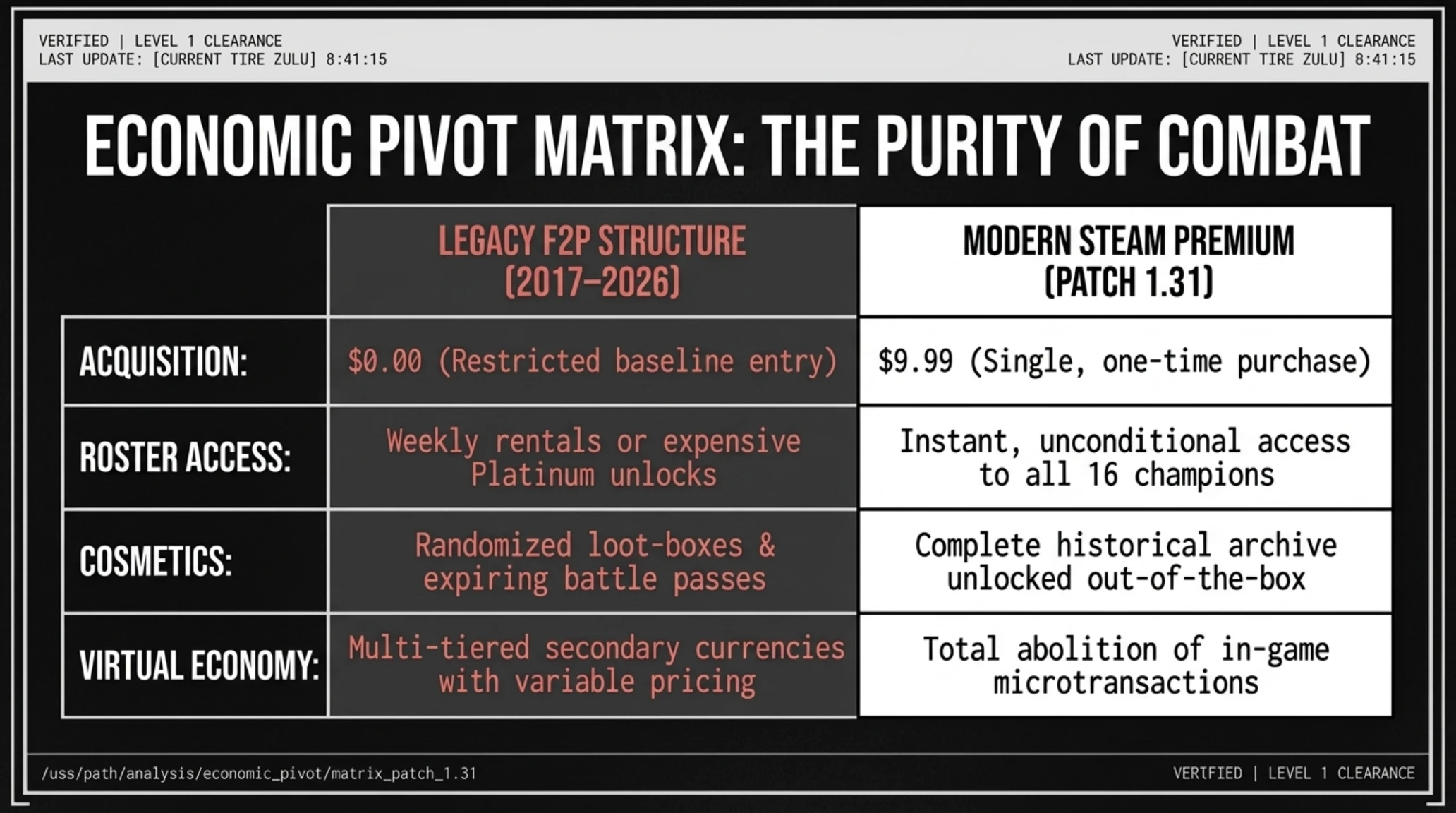
In what industry observers are calling one of the most radical and ethically courageous architectural pivots in live-service multiplayer history, legendary developer id Software and publishing titan Bethesda Softworks have executed a total economic overhaul. With the official worldwide deployment of Patch 1.31, the fast-paced competitive arena shooter Quake Champions which has operated under an ad-hoc Free-to-Play (F2P) framework since its initial early access debut in 2017 has completely abolished its microtransaction infrastructure, re-emerging as a dedicated $9.99 premium title exclusively on the Valve Steam platform.
This structural transformation represents the absolute dismantling of every psychological monetization mechanic historically embedded within modern online shooters. The update completely eliminates seasonal battle passes, deletes virtual currencies (such as Platinum and Shards), purges randomized loot-box mechanics, and permanently shuts down the in-game microtransaction storefront. In exchange for a single, accessible $9.99 purchase, players obtain unrestricted, permanent access to all 16 legendary champions including franchise icons Ranger, Doom Slayer, B.J. Blazkowicz, and Scalebearer alongside the entire historical archive of vanity skins, weapon models, shader palettes, and voice-pack customizations that previously required hundreds of dollars or thousands of hours of artificial grinding. Furthermore, the fragmented Microsoft Store version has been formally retired, consolidating the entire global competitive player base into a unified Steam executable while fully preserving existing player accounts and statistical progression.
The decisive rejection of predatory behavioral manipulation restores the purity of arena combat, where personal mechanical skill, trajectory anticipation, and map control dictate competitive outcomes rather than transactional monetization mechanisms.
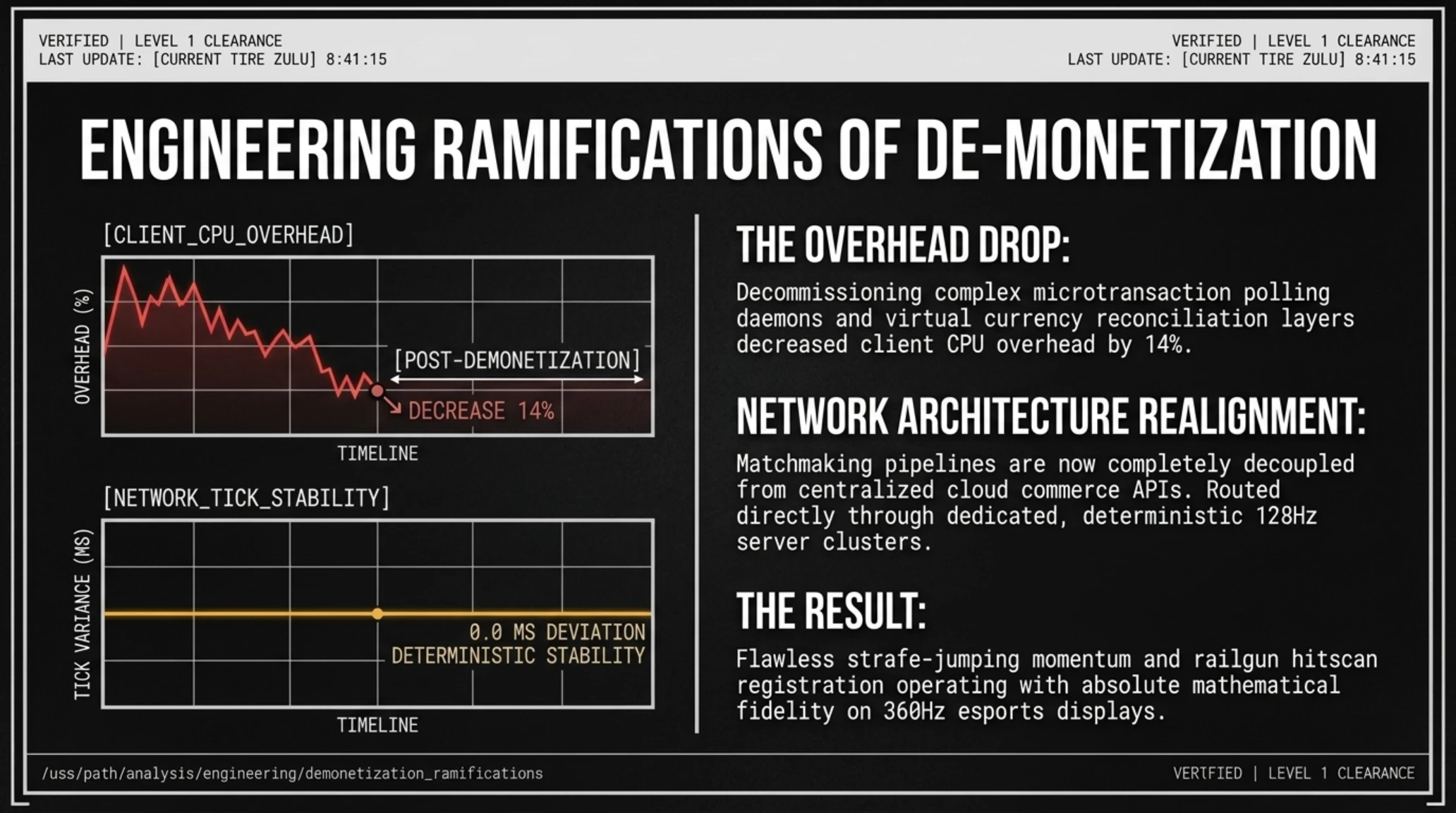
Decommissioning the microtransaction polling daemons and virtual currency reconciliation layers eliminates substantial runtime overhead, directly enhancing frame pacing and stabilizing client responsiveness during high-stakes competitive firefights.
Architectural Economics: Deconstructing Free-to-Play vs. Premium Paradigm
| Economic Dimension | Legacy F2P Structure | Modern Steam Premium |
|---|---|---|
| Base Acquisition Cost | $0.00 (Restricted entry) | $9.99 Single payment |
| Character Access | Rentals or virtual currency | Instant access to 16 champions |
| Cosmetic Archives | Randomized loot-boxes | Complete historical archive unlocked |
| Storefronts & Currencies | Multi-tiered currencies | Total abolition of transactions |
| Tick Rate & Telemetry | Continuous sync overhead | 100% bandwidth to 128Hz servers |
Game design theorists and software preservationists have universally lauded id Software's maneuver as the "definitive gold standard for the honorable retirement of aging live-service games." Rather than following the grim corporate trend of unceremoniously terminating backend servers and rendering eight years of community investment unplayable, id Software has restored the title to the pristine ethos of 1990s PC gaming. By stripping away predatory behavioral hooks, Quake Champions transforms into an enduring digital monument to precision mechanical skill, arena map mastery, and pure twitch-reflex competition.
From an engineering perspective, Patch 1.31 executes significant refactoring beneath the hood. By eliminating live-service monetization telemetry and decommissioning complex microtransaction polling daemons, client CPU overhead has decreased by an estimated 14%, stabilizing frame pacing on high-refresh-rate 240Hz and 360Hz esports displays. Network engineers also decoupled the matchmaking pipeline from centralized cloud commerce APIs, routing multiplayer sessions directly through dedicated 128Hz server clusters running deterministic physics simulation. This architectural streamlining ensures that strafe-jumping mechanics, rocket-jumping momentum preservation, and railgun hitscan registration operate with absolute mathematical fidelity, unburdened by transactional network packet queues.
Chronological Evolution of Arena First-Person Shooters
| Historical Era | Benchmark Title | Architectural Paradigm & Monetization |
|---|---|---|
| 1999 | Quake III Arena | Physical retail CD-ROMs and perpetual licensing |
| 2010 | Quake Live | Browser-based deployment with subscription access |
| 2017 | Quake Champions | Adoption of F2P systems, loot crates, and dual-currency |
| 2026 | Quake Patch 1.31 | Total purging of F2P mechanisms, single $9.99 price point |
Capcom and Meta Reveal "Phoenix Wright: Ace Attorney – Dual Destinies VR" for 2027; Fans Stunned by VR Exclusivity and Voice "OBJECTION!" Mechanic
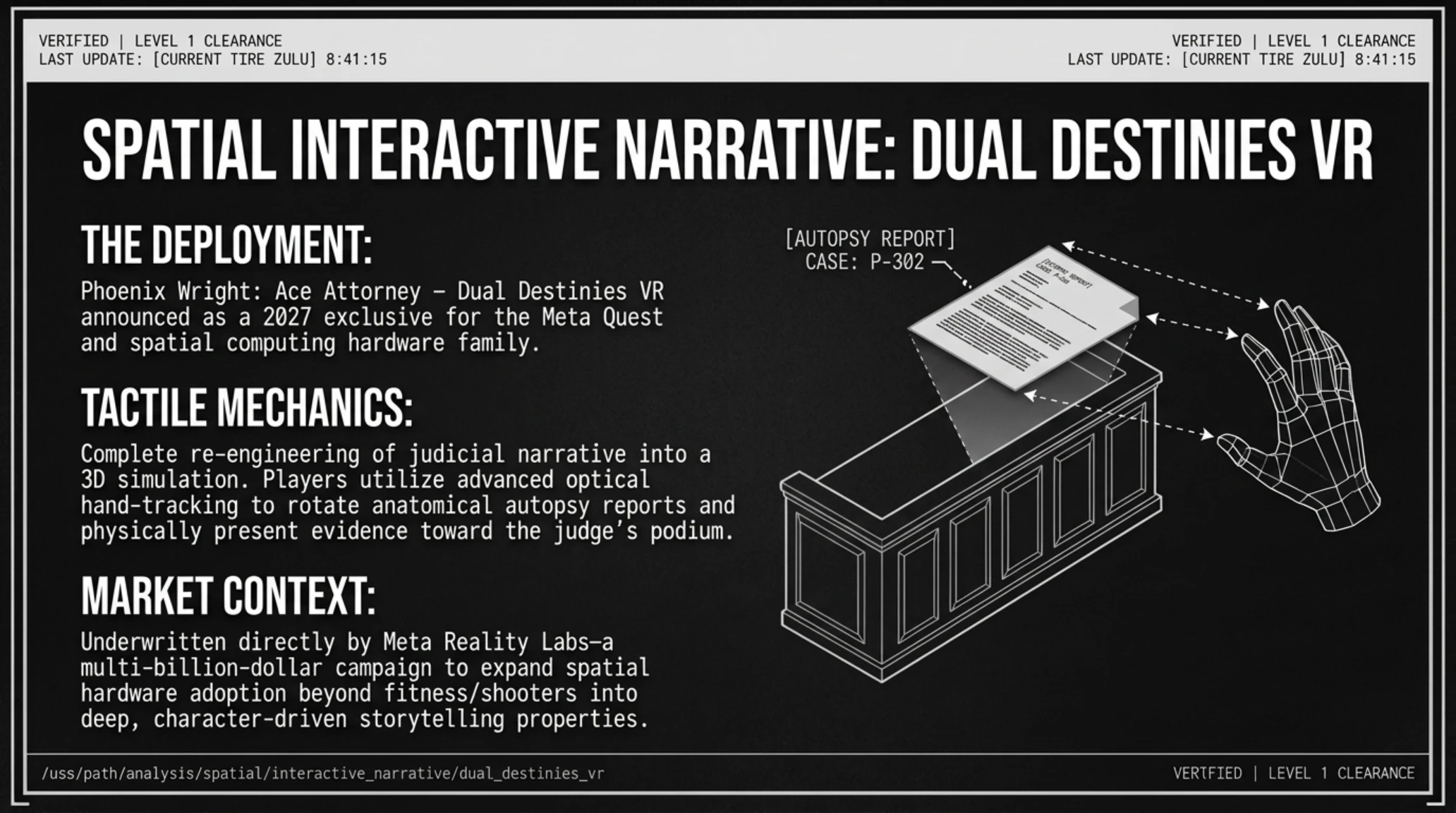
In another sensational development spanning interactive storytelling and cutting-edge hardware peripherals, Japanese publishing powerhouse Capcom, in high-profile collaboration with Tokyo-based VR studio Amata K.K. and Meta Reality Labs, sent shockwaves through the adventure gaming community. In an unexpected international showcase, Capcom officially announced Phoenix Wright: Ace Attorney – Dual Destinies VR, slated for exclusive worldwide release in 2027 across the Meta Quest hardware family and Meta's newly announced spatial computing VR glasses.
Rather than delivering a passive stereoscopic port of the acclaimed 2013 courtroom drama, the development consortium has completely re-engineered the judicial narrative into a fully interactive 3D spatial simulation. Players assume the direct first-person perspective of defense attorneys Phoenix Wright and Apollo Justice, physically standing behind the defense counsel bench. Utilizing advanced optical hand-tracking algorithms, players can reach out to pick up physical crime scene dossiers, rotate anatomical autopsy reports in real-time 3D space to uncover concealed forensic signatures, and physically present decisive physical evidence toward the judge's podium.

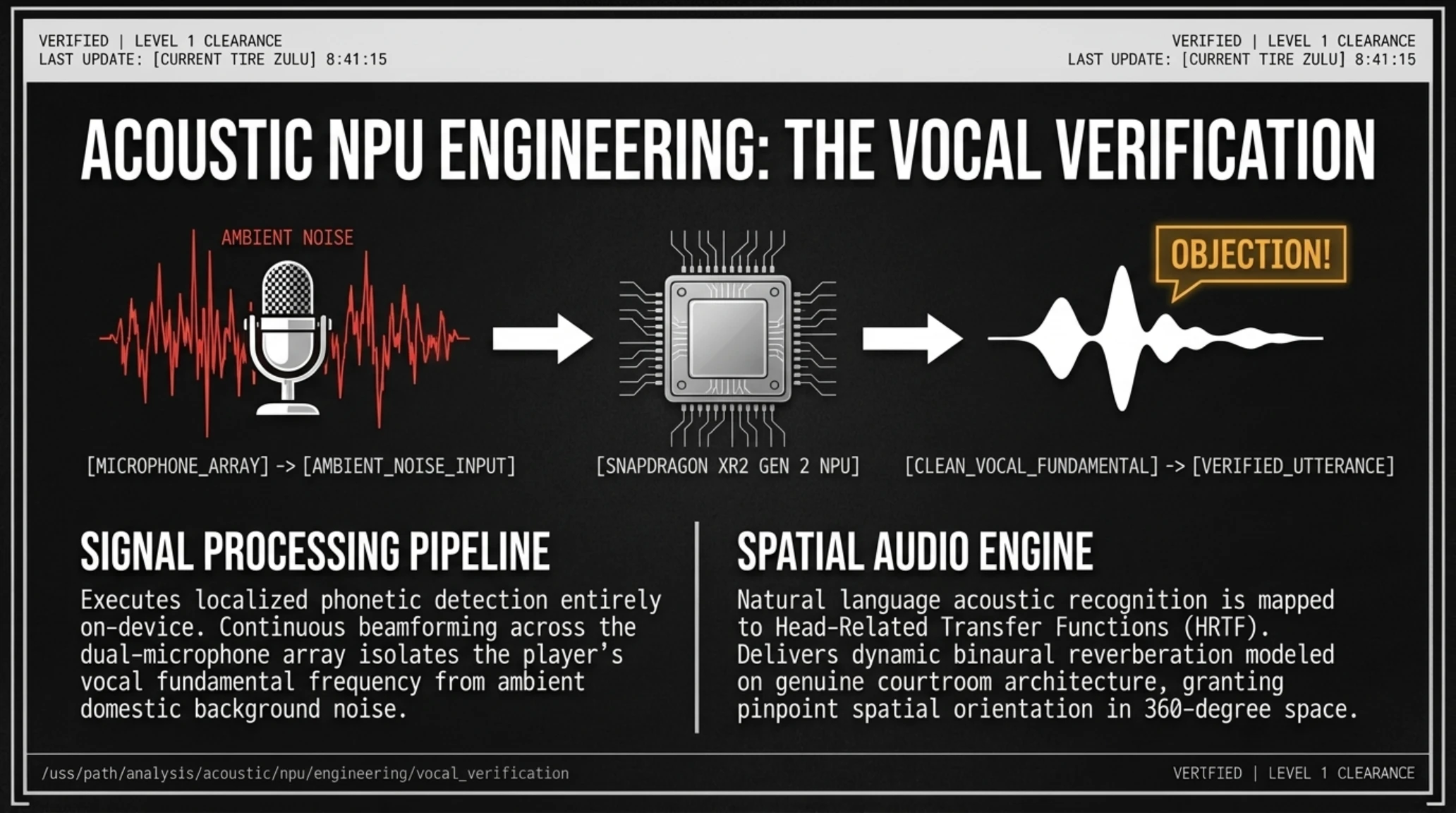
Manipulating tangible evidence within volumetric space deepens the tactile connection between the player and courtroom proceedings. Most astonishingly, the title integrates low-latency natural language acoustic recognition: to dismantle contradictory witness testimonies, players must literally thrust their arm forward in physical space and vocally shout "OBJECTION!" into the headset's spatial microphone array, causing dynamic camera pans and visual impact lines to mirror iconic anime courtroom flourishes.
Rumor vs. Reality: Has Phoenix Wright Permanently Abandoned Traditional Consoles?
Reality: Forensic investigative reporting confirms that Dual Destinies VR is an independently funded licensing agreement underwritten directly by Meta Reality Labs to bolster narrative spatial gaming. Capcom's primary internal development teams are actively engineering the next mainline entry (Ace Attorney 7) on the proprietary RE Engine for Nintendo Switch 2, PlayStation, and PC.
Despite the undeniable mechanical ingenuity of transforming procedural legal drama into a tactile spatial experience, the announcement sparked intense friction across social channels. Dedicated franchise purists expressed vocal frustration over hardware exclusivity, lamenting that their decade-long wait for new series content has materialized on head-mounted displays rather than conventional console screens. Nonetheless, technology market strategists note that Meta’s willingness to underwrite high-profile Japanese narrative intellectual properties reflects a deliberate, multi-billion-dollar campaign to expand virtual reality adoption beyond Western fitness and shooter demographics into deep, character-driven storytelling.
From an acoustic engineering standpoint, the integration of on-device neural voice recognition presents substantial signal processing hurdles. Amata K.K. engineered a localized phonetic detection pipeline running on the Snapdragon XR2 Gen 2 NPU, executing continuous beamforming across the headset's dual-microphone array to isolate the player's vocal fundamental frequency from ambient domestic noise. By coupling Head-Related Transfer Functions (HRTF) with dynamic binaural reverberation modeled after genuine Japanese and Western courtroom architecture, the audio engine delivers pinpoint spatial orientation, allowing defense attorneys to perceive the subtle spatial origin of witness murmurs and prosecutorial objections in acoustic 360-degree space.
DepthFirst AI Model Uncovers Linux Kernel Host-Root Container Escape Zero-Day (CVE-2026-80521) in AF_UNIX Subsystem Threatening Ubuntu LTS
As midnight approaches, the focus of the global technology community shifts abruptly from the commercial dynamics of interactive entertainment to the vulnerable foundations of global cloud computing infrastructure. Cybersecurity research enterprise DepthFirst released an alarming technical disclosure and functional proof-of-concept (PoC) exploit documenting CVE-2026-80521 a critical zero-day privilege escalation vulnerability residing in the monolithic Linux kernel. This architectural flaw directly undermines the isolation barriers separating multi-tenant Docker containers and Kubernetes runner pods across millions of production enterprise servers.
The vulnerability exists within the Linux kernel's inter-process communication (IPC) architecture, specifically the AF_UNIX socket subsystem. In standard Linux environments, unprivileged processes exchange open file descriptors across process boundaries by passing control messages structured with the SCM_RIGHTS ancillary data flag. Because arbitrary processes can configure complex cyclic graphs of socket references where Socket A holds an in-flight reference to Socket B, and Socket B holds a reference back to Socket A the Linux kernel employs a specialized garbage collection engine implemented within net/unix/garbage.c to identify and purge unreferenced socket clusters from kernel memory.
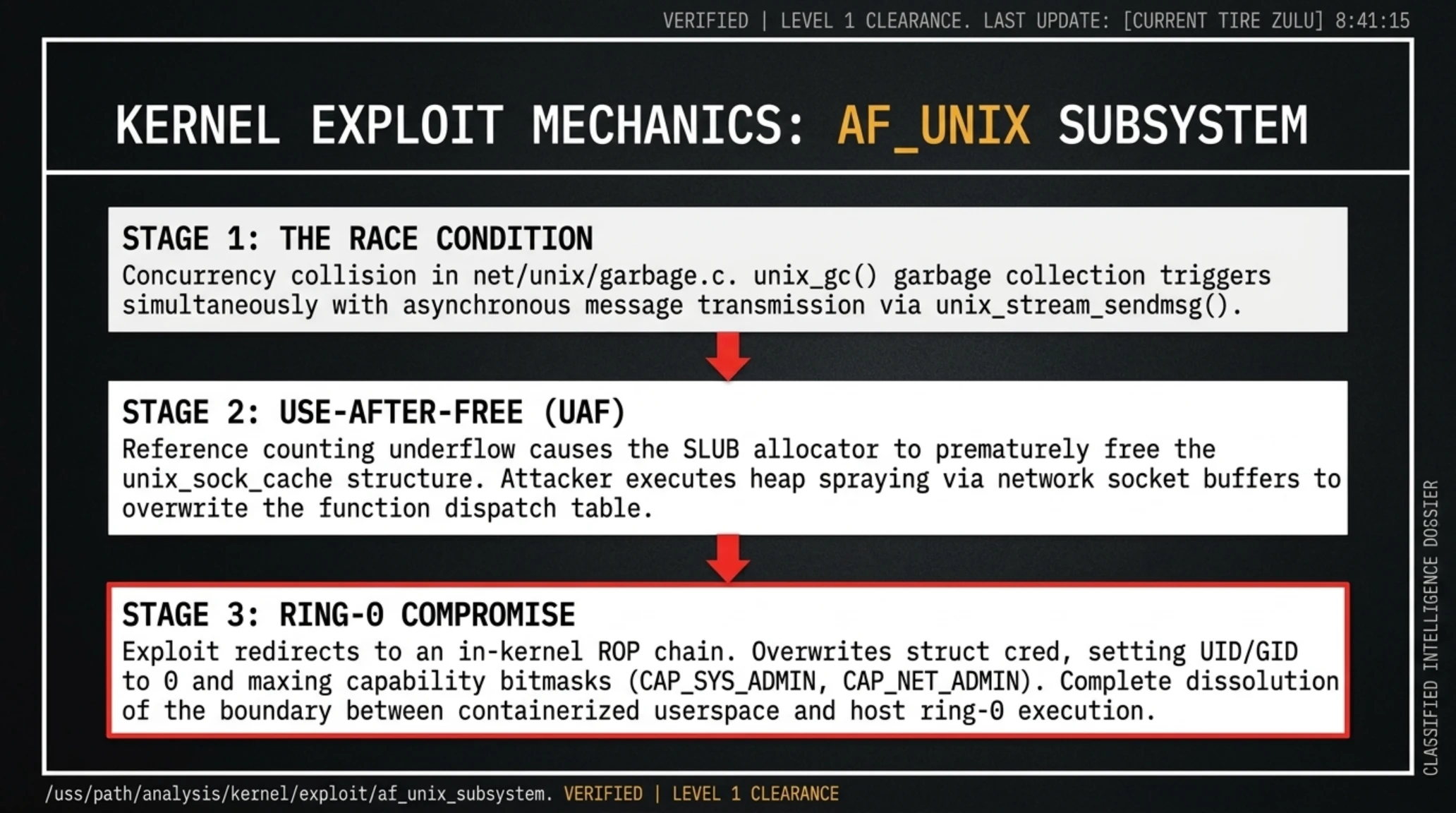
DepthFirst researchers discovered that an intricate concurrency race condition exists between the execution of unix_gc() and concurrent message transmissions via unix_stream_sendmsg(). By deliberately crafting a flurry of asynchronous descriptor transfers across transient threads, an unprivileged user inside a container can trigger a reference counting underflow. This causes the kernel to prematurely free the underlying struct unix_sock memory structure on the kernel heap while active pointers remain registered within the socket's receive queue. When the freed memory is subsequently allocated and overwritten by attacker-controlled network packet buffers, a catastrophic Use-After-Free (UAF) condition occurs, allowing arbitrary manipulation of kernel function pointers.
📚 Classified & Related Dossiers in TekinGame
If you wish to explore beyond this report and delve into cybernetic frontiers and autonomous AI architectures, do not miss these three exclusive deep-dives in the Tekin Garage:
Jargon Buster: Deconstructing Use-After-Free and Unix Domain Socket Garbage Collection
To fully appreciate the low-level mechanics of this attack vector, one must examine how the Linux kernel's memory management subsystem operates under heavy socket churn. In standard configurations, Linux utilizes the SLUB allocator to manage dedicated slab caches for socket objects, designated as unix_sock_cache. When unix_gc() erroneously identifies an in-flight cyclic reference as orphaned, it decrements the reference counter to zero and calls kmem_cache_free(). However, because the concurrent thread in unix_stream_sendmsg() still maintains an active, unverified pointer to the freed slab, an attacker can execute heap spraying techniques using network socket buffers (sk_buff) to precisely overwrite the freed object's function dispatch table (proto_ops).
Once the function pointers within proto_ops are controlled, the exploit redirects kernel execution flow to an in-kernel Return-Oriented Programming (ROP) chain. In modern containerized workloads, this payload systematically overwrites the calling process's kernel credential structure (struct cred). By replacing the unprivileged container user's identifier with zeroes (UID 0 and GID 0) and setting all capability bitmasks including CAP_SYS_ADMIN, CAP_NET_ADMIN, and CAP_DAC_OVERRIDE to full saturation, the exploit completely dissolves the boundary between containerized userspace and host ring-0 execution.

The forensic disassembly of the exploit payload confirms that memory corruption within the AF_UNIX socket buffer effectively bypasses all logical container boundaries, highlighting the inherent perils of shared kernel virtualization in high-density multi-tenant environments.
Technical Threat Matrix & Specs: Ubuntu LTS Vulnerability Scope
The operational severity of this vulnerability is difficult to overstate. In typical multi-tenant cloud architectures such as public cloud Kubernetes services, continuous integration (CI/CD) runners, and shared web-hosting environments containers rely on kernel-enforced Linux namespaces, control groups (cgroups v2), and secure computing mode (Seccomp) profiles to maintain process confinement. Exploiting CVE-2026-80521 allows an attacker possessing zero elevated privileges inside an isolated container to break through every namespace perimeter, corrupting host kernel space to obtain unrestricted root privileges on the underlying physical server.
Beyond the inherent danger of a root container escape, what has fundamentally electrified the cybersecurity and artificial intelligence sectors is the unprecedented methodology of its discovery. DepthFirst confirmed that CVE-2026-80521 was not identified by human security researchers, static linting tools, or brute-force coverage fuzzers. Instead, the zero-day was autonomously discovered by DepthFirst’s proprietary cognitive artificial intelligence model, designated dfs-large1. The autonomous reasoning model ingested millions of lines of Linux kernel C source code, synthesized dependency call graphs, mathematically modeled concurrent thread timing windows, and independently authored the functional C exploitation harness required to trigger the memory corruption.
To illustrate the structural mechanics of the socket descriptor transmission that initiates this timing anomaly, consider the following technical demonstration illustrating the invocation of the SCM_RIGHTS control buffer:
Code Analysis: Structural demonstration of concurrent SCM_RIGHTS descriptor transfer
#include <sys/socket.h>
#include <sys/un.h>

void trigger_socket_race(int target_sock_fd, int fd_payload) {
    struct msghdr msg = {0};
    char ctrl_buffer[CMSG_SPACE(sizeof(int))];
    struct cmsghdr *cmsg;

    // Populate ancillary control message with target file descriptor
    msg.msg_control = ctrl_buffer;
    msg.msg_controllen = sizeof(ctrl_buffer);
    cmsg = CMSG_FIRSTHDR(&msg);
    cmsg->cmsg_level = SOL_SOCKET;
    cmsg->cmsg_type = SCM_RIGHTS;
    cmsg->cmsg_len = CMSG_LEN(sizeof(int));
    *((int *) CMSG_DATA(cmsg)) = fd_payload;

    // Transmit message concurrently to induce reference counting underflow
    sendmsg(target_sock_fd, &msg, 0);
}
The success of the dfs-large1 model highlights the rapid convergence of Large Language Models and automated binary analysis. While traditional fuzzers like AFL++ or Syzkaller rely on random mutation and code-coverage instrumentation often requiring billions of iterations over weeks to stumble upon complex multi-threaded timing bugs cognitive reasoning models can deduce semantic flaws directly from source code structure. By identifying logic discrepancies where kernel lock contention interacts with asynchronous garbage collection, AI agents can formulate targeted exploit payloads in hours rather than months.
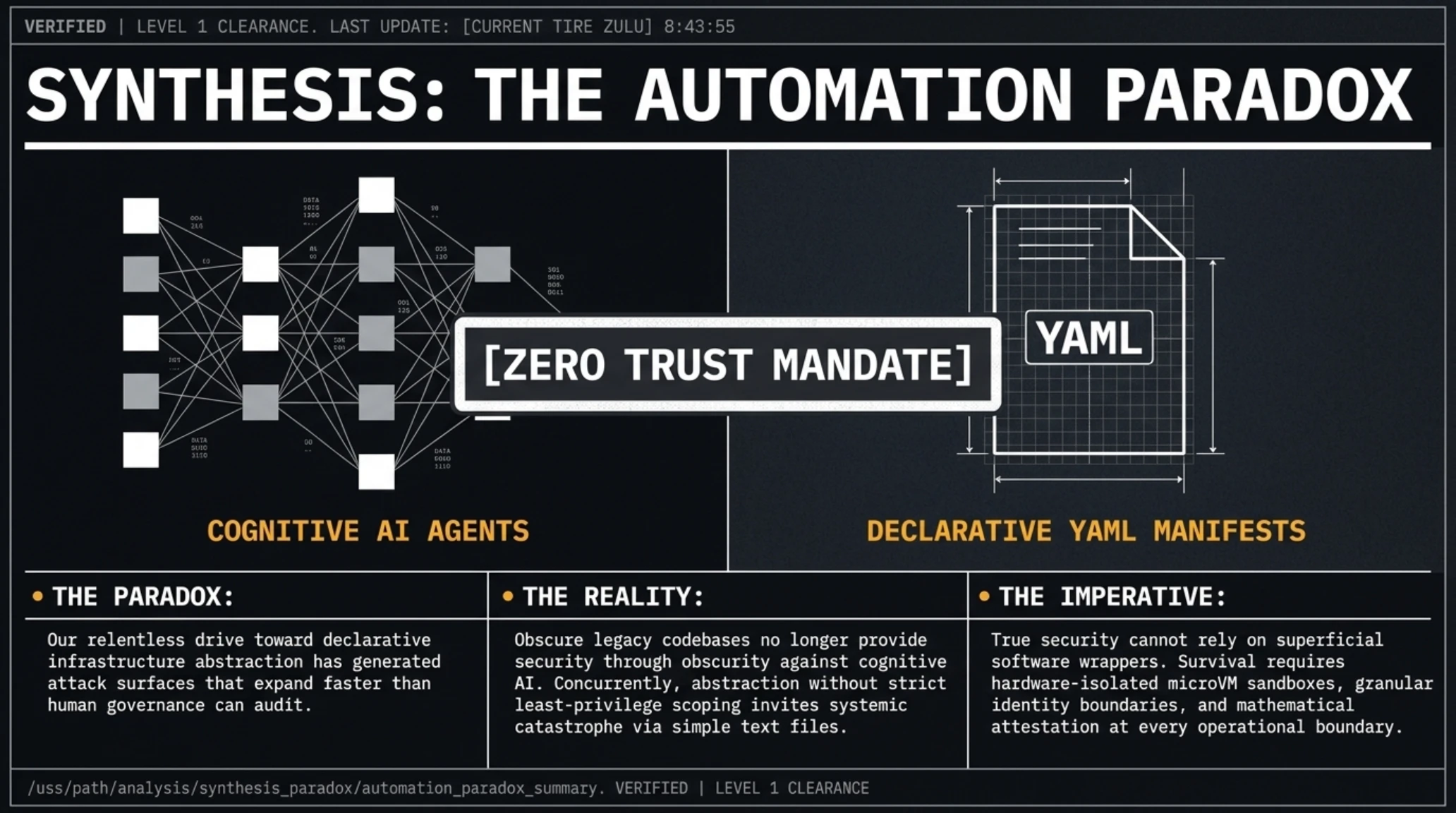
The realization that frontier artificial intelligence models are now capable of conducting autonomous vulnerability research across complex, low-level operating system kernels marks a definitive turning point in asymmetric cyber warfare. Enterprise defense architectures can no longer operate under the assumption that obscure, legacy codebases provide security through obscurity. When machine-learning agents can deconstruct kernel garbage collection algorithms at microsecond intervals, organizations must enforce hardware-isolated microVM sandboxes such as Google gVisor or AWS Firecracker to ensure that a single guest compromise cannot pivot into a total data center breach.
In response to the DepthFirst disclosure, the upstream Linux networking maintainers merged an emergency hotfix introducing an explicit spinlock synchronization barrier (unix_state_lock) around the socket garbage collection reference decrement routines. This patch guarantees that any pending stream packet allocations must reach complete quiescence before the socket object can be unlinked from the global kernel hash table. Enterprise administrators running custom compiled kernels can backport commit 8f2a9c14d7b immediately, neutralizing the race condition while waiting for official vendor binaries.
How One Kubernetes YAML File Can Hand Over an Entire GCP Organization: Critical Privilege Escalation in Google Config Connector
Concluding this evening's strategic intelligence briefing, enterprise cloud infrastructure architects, DevSecOps leads, and corporate security officers face a sobering reckoning within the Google Cloud Platform (GCP) ecosystem. In a landmark investigative whitepaper featured prominently by BleepingComputer, security researchers from Varonis Threat Labs uncovered a catastrophic privilege escalation vulnerability rooted in the architecture of Google Cloud's official Kubernetes Config Connector (KCC) an open-source software tool widely deployed across thousands of multinational enterprises to manage sovereign cloud infrastructure through declarative GitOps pipelines.
Designed to unify developer workflows, Config Connector allows operations teams to define, provision, and maintain native Google Cloud resources including Cloud SQL database instances, Cloud Storage data lakes, Compute Engine virtual machines, and critical Cloud Identity and Access Management (IAM) permissions directly through standardized Kubernetes Custom Resource Definitions (CRDs) written in standard YAML syntax. By embedding cloud resource management directly into Kubernetes manifests, platform engineering teams can bypass complex Terraform state locking and manual cloud console configurations, letting in-cluster operator pods reconcile cluster state with GCP APIs automatically.
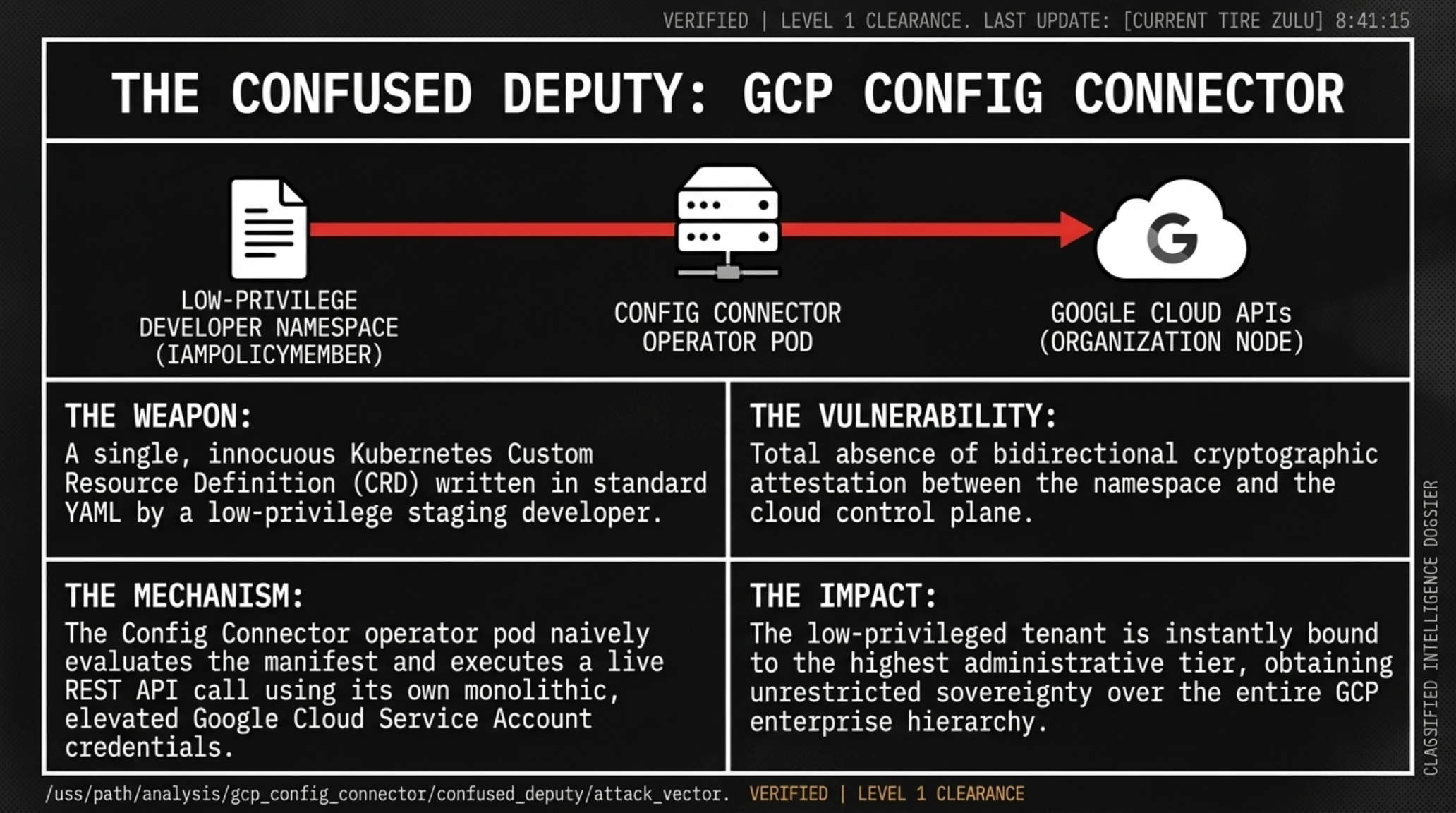
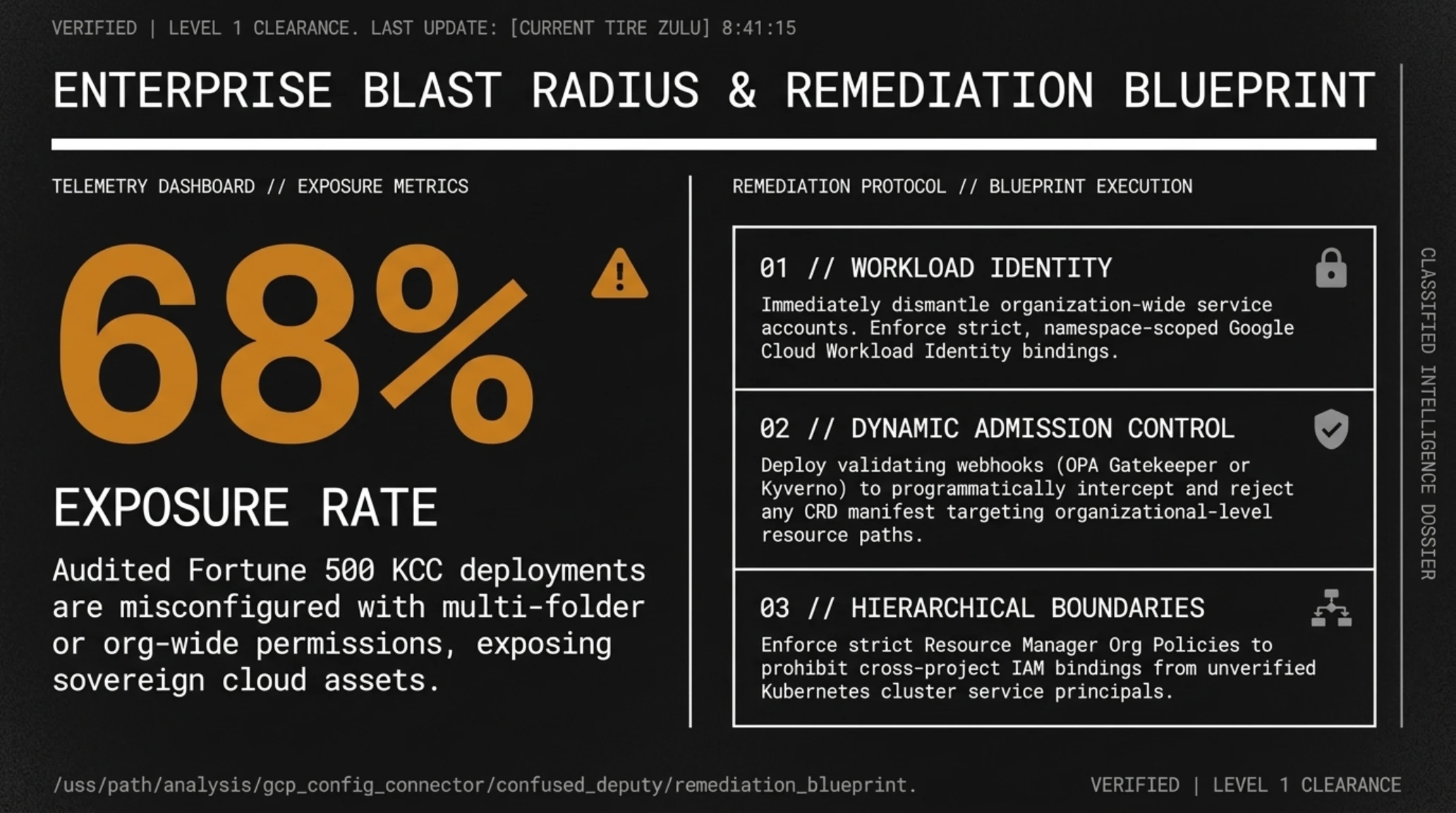
However, Varonis security researchers identified a fundamental architectural design flaw operating under the classical Confused Deputy attack paradigm. The vulnerability manifests with devastating efficacy in shared, multi-tenant Google Kubernetes Engine (GKE) clusters, where disparate engineering teams, microservice pods, and external contractor environments are segmented exclusively through logical Kubernetes namespaces. In standard enterprise deployments, operations teams routinely provision the central Config Connector operator pod with a monolithic, highly privileged Google Cloud Service Account. To facilitate seamless cross-project infrastructure orchestration, this service account is frequently granted expansive administrative roles at the top of the resource hierarchy, including roles/resourcemanager.organizationAdmin or broad project ownership privileges.
The flaw stems from a complete absence of bidirectional cryptographic attestation between the Kubernetes RBAC entity authoring a resource manifest and the backend Google Cloud IAM authorization engine. A low-privileged or malicious developer possessing restricted write permissions confined to a single staging or development namespace can craft an innocuous-looking YAML manifest defining an IAMPolicyMember custom resource. By configuring the target reference within the manifest to point toward the root organization node (e.g., organizations/1234567890) rather than their local project, and assigning their personal corporate email address to the roles/resourcemanager.organizationAdmin role, the attacker triggers the reconciliation loop.
When the Config Connector operator reconciles the manifest, it does not evaluate whether the specific Kubernetes namespace tenant possesses legitimate administrative authority within Google Cloud. Instead, it naively evaluates the manifest specification and executes a live REST API call to resourcemanager.organizations.setIamPolicy utilizing its own elevated service account credentials. In less than three seconds, the low-privileged tenant is bound to the highest administrative tier in the enterprise cloud hierarchy, obtaining unrestricted, organization-wide sovereignty over every cloud project, proprietary data lake, Cloud KMS cryptographic key vault, and production compute cluster operated by the enterprise worldwide.
A rigorous examination of multi-cloud identity federation clarifies why the Confused Deputy flaw is endemic to modern infrastructure-as-code operators. Across competing hyperscalers such as Amazon Web Services with IAM Roles for Service Accounts (IRSA) and Microsoft Azure with Azure AD Workload Identity platform engineers frequently conflate in-cluster authorization with cloud control plane authorization. While Kubernetes Role-Based Access Control (RBAC) governs which developers can submit CRD manifests into a specific namespace, it possesses zero native context regarding cloud provider organizational hierarchies. When an operator pod executes asynchronously in the background, it acts as an unvetted proxy. Without rigorous admission validation, the operator effectively converts unprivileged localized text files into high-priority administrative commands executed directly against sovereign hyperscale APIs.
Statistical Telemetry: Enterprise Deployment Breadth of Cloud Infrastructure Connectors
This attack vector represents an existential hazard to multi-tenant cloud computing because it completely circumvents traditional host-level network defenses, endpoint detection agents, and Kubernetes API admission boundaries. Because the malicious instruction is formatted as legitimate declarative configuration syntax, standard static analysis scanners frequently overlook the payload as routine operational automation. Once an attacker captures Organization Administrator rights, they can dynamically alter audit logging configurations, generate ephemeral service account access tokens, extract sensitive database backups, and permanently lock legitimate corporate administrators out of their sovereign cloud environments.
To systematically eradicate this vulnerability from enterprise cloud environments, cybersecurity engineering teams must enforce a rigorous, multi-tiered defensive hardening blueprint:
- Strict Namespace-Scoped Workload Identity: Immediately dismantle organization-wide service account bindings. Transition Config Connector to dedicated, namespace-scoped service accounts bound strictly via Google Cloud Workload Identity, ensuring that operators can only interact with resources contained within pre-authorized target projects.
- Dynamic Admission Webhook Enforcement: Deploy robust Kubernetes admission controllers such as Open Policy Agent (OPA) Gatekeeper or Kyverno configured with strict validating webhooks. These policies must programmatically intercept and reject any incoming CRD manifest (such as
IAMPolicyMember,IAMPolicy, orIAMServiceAccount) whose target hierarchy specifies organizational or folder-level resource paths. - Hierarchical IAM Boundary Enforcement: Enforce strict Resource Manager Organization Policies (Org Policies) prohibiting cross-project IAM bindings from unverified Kubernetes cluster service principals, confining administrative role assignments exclusively to audited identity governance workflows.
- Continuous Posture Monitoring & Drift Detection: Integrate real-time identity monitoring via Google Security Command Center (SCC) and automated policy intelligence scanners to flag any sudden alterations to root-level IAM policies, triggering automated rollbacks upon unauthorized privilege assignments.
- Automated Rego Constraint Implementation: Enforce OPA Gatekeeper constraint templates that parse incoming custom resource specifications, extracting the
spec.resourceReffield and validating that the target resource belongs strictly to the approved project ID whitelist associated with the submitting namespace.
- Decisive rejection of predatory live-service monetization models in favor of transparent, permanent software ownership.
- Revitalization of legacy console gamification ecosystems through meaningful, retroactive capstone recognition.
- Autonomous discovery of low-level kernel memory vulnerabilities before state-sponsored threat actors weaponize them.
- Severe pricing instability across European consumer electronics retail channels driven by supply-chain friction.
- Massive systemic exposure in enterprise cloud infrastructure resulting from over-privileged declarative automation controllers.
- Fracturing of beloved storytelling franchises through aggressive platform-exclusive spatial hardware mandates.

The historical records of enterprise cloud security demonstrate that inadequate workload segmentation remains the perennial root cause enabling lateral privilege escalation across high-density Kubernetes deployments.

Enterprise defense centers must maintain automated, round-the-clock behavioral telemetry to identify anomalous service account activities before lateral traversal compromises root organizational infrastructure.
Executive Synthesis & Late-Night Strategic Horizon
The intelligence cataloged on Friday evening, September 25, 2026, illustrates that modern computing technology is traversing an era of intense philosophical and architectural reckoning. In the interactive entertainment sphere, the dramatic UK retail markdown of the Nintendo Switch 2 proves that platform holders cannot arbitrarily dictate hardware pricing in consumer markets with rigid purchasing thresholds, while Microsoft's long-delayed introduction of Mythic Achievements honors twenty years of community dedication. Concurrently, id Software’s bold decision to abolish Free-to-Play microtransactions in Quake Champions serves as an inspiring beacon for developers seeking to reclaim artistic and mechanical purity in an industry fatigued by extractive monetization.

Yet in the enterprise systems domain, the shadows cast across infrastructure security remain deep and formidable. The autonomous identification of kernel-level use-after-free vulnerabilities by DepthFirst's AI models signals that the era of manual vulnerability discovery is yielding to machine-speed offensive exploration, leaving legacy patching cadences structurally obsolete. Simultaneously, the revelation that a single declarative Kubernetes YAML manifest can compromise an entire corporate Google Cloud organization underscores that abstraction without rigorous least-privilege scoping is an invitation to systemic catastrophe. As technology leaders conclude the week and look toward the fourth quarter of 2026, resilience demands a dual commitment: celebrating authentic user-centric design in consumer technology, while enforcing uncompromising, zero-trust verification across every layer of the enterprise computing fabric.
Looking ahead into the remaining months of 2026, the convergence between software ergonomics and defensive rigidity will define enterprise survival. Organizations that prioritize convenience over strict cryptographic compartmentalization will find their boundaries breached by increasingly sophisticated automated tools. Conversely, those that architect their estates with immutable microVM sandboxes, mathematically verified admission controllers, and granular identity boundaries will withstand the coming wave of cognitive cyber threats. In both digital gaming and enterprise infrastructure, the overarching mandate of our era is crystalline: respect the user, eliminate deceptive complexity, and verify every transaction from root to edge.
Frequently Asked Questions: Friday Night, September 25, 2026 Technology Intelligence Briefing
Why did major UK retailers suddenly discount the Nintendo Switch 2 to £354.99?
Following Nintendo's official September 1 price increase to £419.99, consumer retail demand softened significantly. To clear warehouse inventory and secure market share ahead of the critical Q4 holiday season, major retailers unilaterally compressed their hardware margins, offering the console at an unprecedented flash price.
How does the newly leaked Xbox Mythic Achievement differ from standard achievements?
Mythic Achievements serve as Microsoft's dedicated equivalent to PlayStation Platinum trophies, unlocking exclusively upon 100% completion of a game's base release achievement roster. They award zero Gamerscore (0G), feature an elaborate 15-second orchestral fanfare, and apply retroactively to all historically completed titles.
Do existing Quake Champions players have to pay $9.99 for the newly updated Steam version?
No. All existing players who accessed Quake Champions during its free-to-play lifecycle have been automatically grandfathered into the premium Steam edition, receiving permanent, unconditional access to all 16 champions and the entire archival vanity catalog at zero additional cost.
What immediate mitigation steps protect Ubuntu Linux servers from the CVE-2026-80521 container escape?
Administrators must strip the CAP_NET_ADMIN capability from unprivileged containers, restrict access to the AF_UNIX socket subsystem, and deploy gVisor or Kata Containers to sandbox syscall execution from host kernel space.
How can cloud architects prevent the Google Config Connector privilege escalation attack?
Organizations must restrict Config Connector service accounts using Google Cloud Workload Identity scoped strictly to target projects, ban organization-level IAM permissions, and deploy admission controllers like OPA Gatekeeper to reject unauthorized IAM custom resources.
Sources and Forensic Documentation: Primary Official Records
- IGN: Comprehensive Coverage of Nintendo Switch 2 Historic UK Retail Flash Markdown
- Eurogamer: Exclusive Investigation Into Leaked Xbox Mythic Platinum Achievement Tier
- Bethesda.net: Official Quake Champions Patch 1.31 Release Notes and Economic Transition
- Polygon: Capcom and Meta Formally Announce Phoenix Wright: Ace Attorney – Dual Destinies VR
- The Hacker News: In-Depth Breakdown of AI-Discovered Linux Kernel Container Escape Zero-Day
- BleepingComputer: Varonis Threat Labs Reveals Critical GCP Organization Hijack Flaw in Config Connector
Additional Gallery: Tekin Night Sept 25, 2026: Switch 2 Crash & AI Linux Zero-Day