Tekin Analysis | Evening Technology & Gaming Radar // Sunday, October 18, 2026
The global technology and gaming landscapes conclude Sunday, October 18, 2026, amid an astonishing convergence of confidential engineering disclosures and historic market milestones. From the inner research sanctums of Sony Interactive Entertainment in Tokyo to Wall Street's financial modeling rooms tracking unprecedented digital pre-order velocity, the enterprise entertainment sector is navigating a tectonic realignment that will dictate consumer hardware and software architectures well into the next decade.
At the epicenter of console engineering, the United States Patent and Trademark Office (USPTO) has published a seminal document detailing Sony's custom image synthesis roadmap for the PlayStation 6. Titled "Generation Super Sampling," this proprietary patent represents a philosophical break from traditional frame generation techniques. By synthesizing real-time controller inputs and telemetry directly into neural autoencoder inference loops, Sony aims to eliminate input latency entirely, delivering an authentic path toward fluid 8K rendering and three-digit frame rates.
Simultaneously in the macroeconomic sphere, comprehensive market telemetry from Sensor Tower and GameSpot underscores a historic financial earthquake triggered by Rockstar Games. Pre-orders for Grand Theft Auto VI have crossed 6.08 million units within the first few weeks of tracking, generating nearly $600 million in gross digital revenue. Wall Street analysts now forecast over 25 million day-one purchases globally, setting the stage for an unprecedented $2 billion 24-hour launch that definitively establishes $79.99 as the undisputed baseline price for modern interactive entertainment.
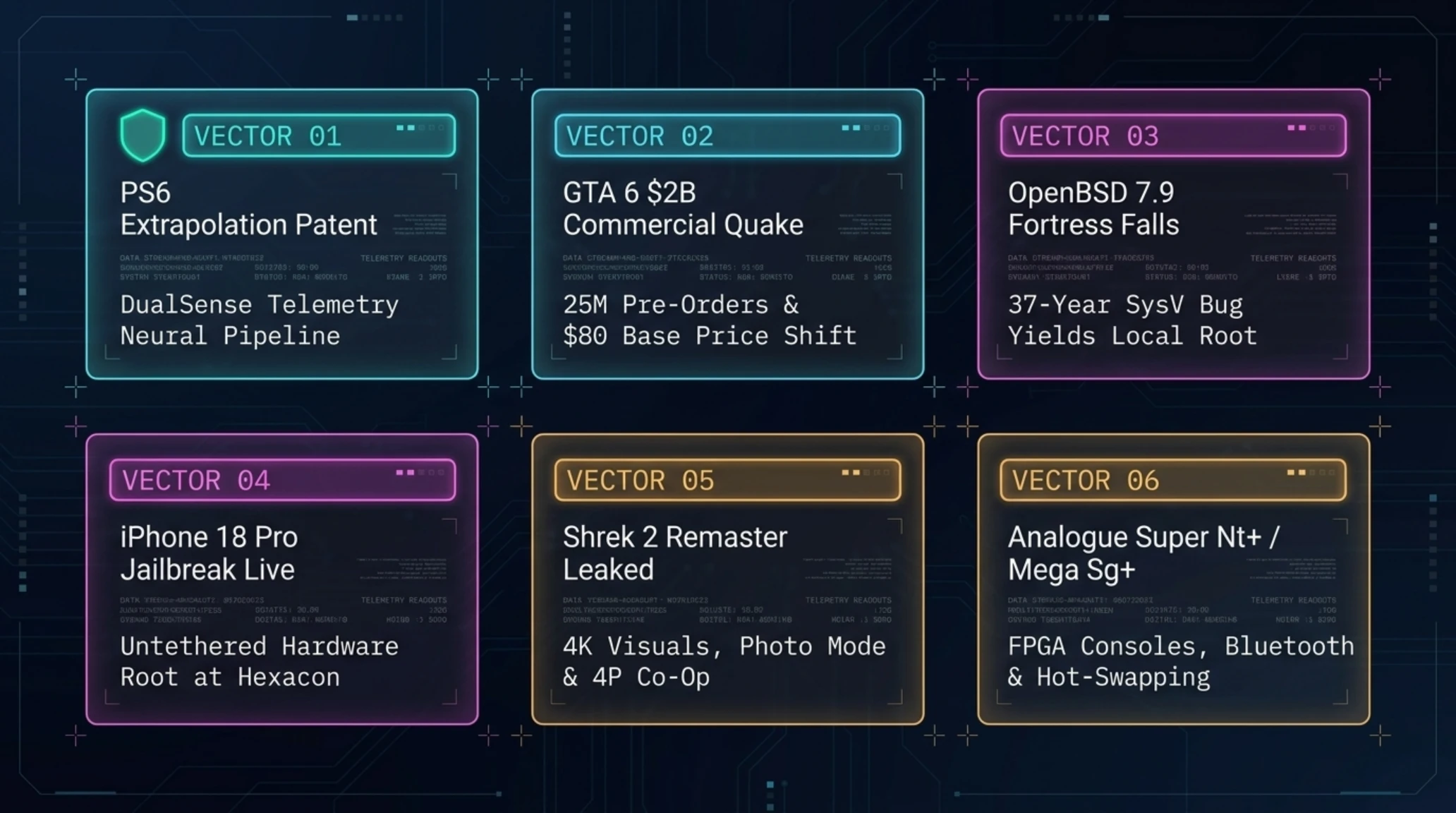
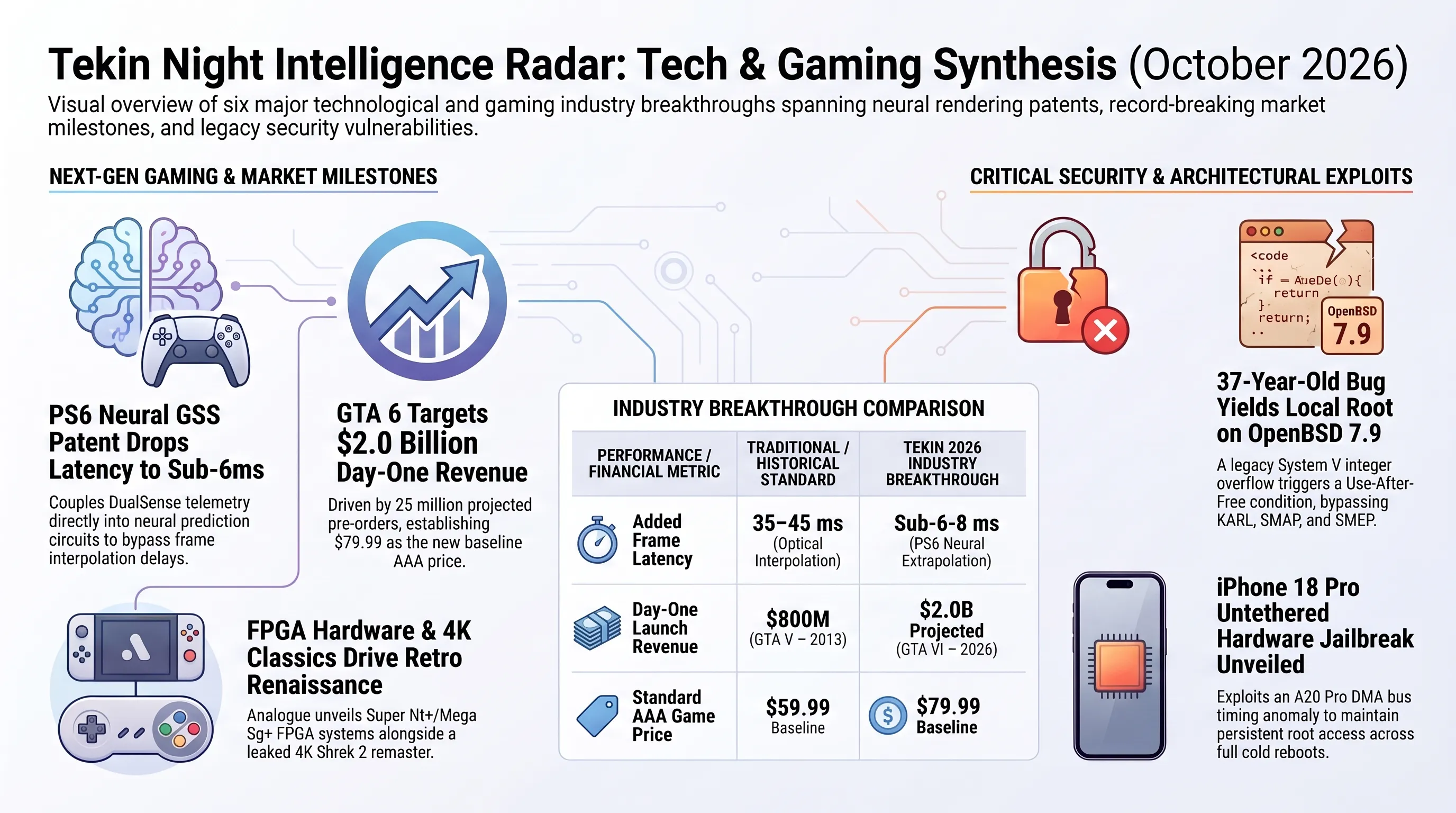
Rounding out this evening briefing are critical developments in defensive infrastructure: the breach of OpenBSD 7.9 via a chained 37-year-old integer overflow in legacy System V shared memory, a live untethered hardware jailbreak of Apple's flagship iPhone 18 Pro demonstrated at Hexacon Paris, an inadvertent Microsoft Store leak confirming Aspyr's 4K co-op remaster of the 2004 cult classic Shrek 2, and Analogue's formal unveiling of the Super Nt+ and Mega Sg+ FPGA consoles equipped with integrated Bluetooth and cartridge hot-swapping.
Strategic Intelligence & Key Takeaways at a Glance
The editorial board of TekinPlus conducts an exhaustive architectural, financial, and forensic examination of each of these developments. We dissect the technical mechanisms that distinguish breakthrough engineering from marketing rhetoric, beginning with Sony's foundational blueprint for the next decade of console rendering.
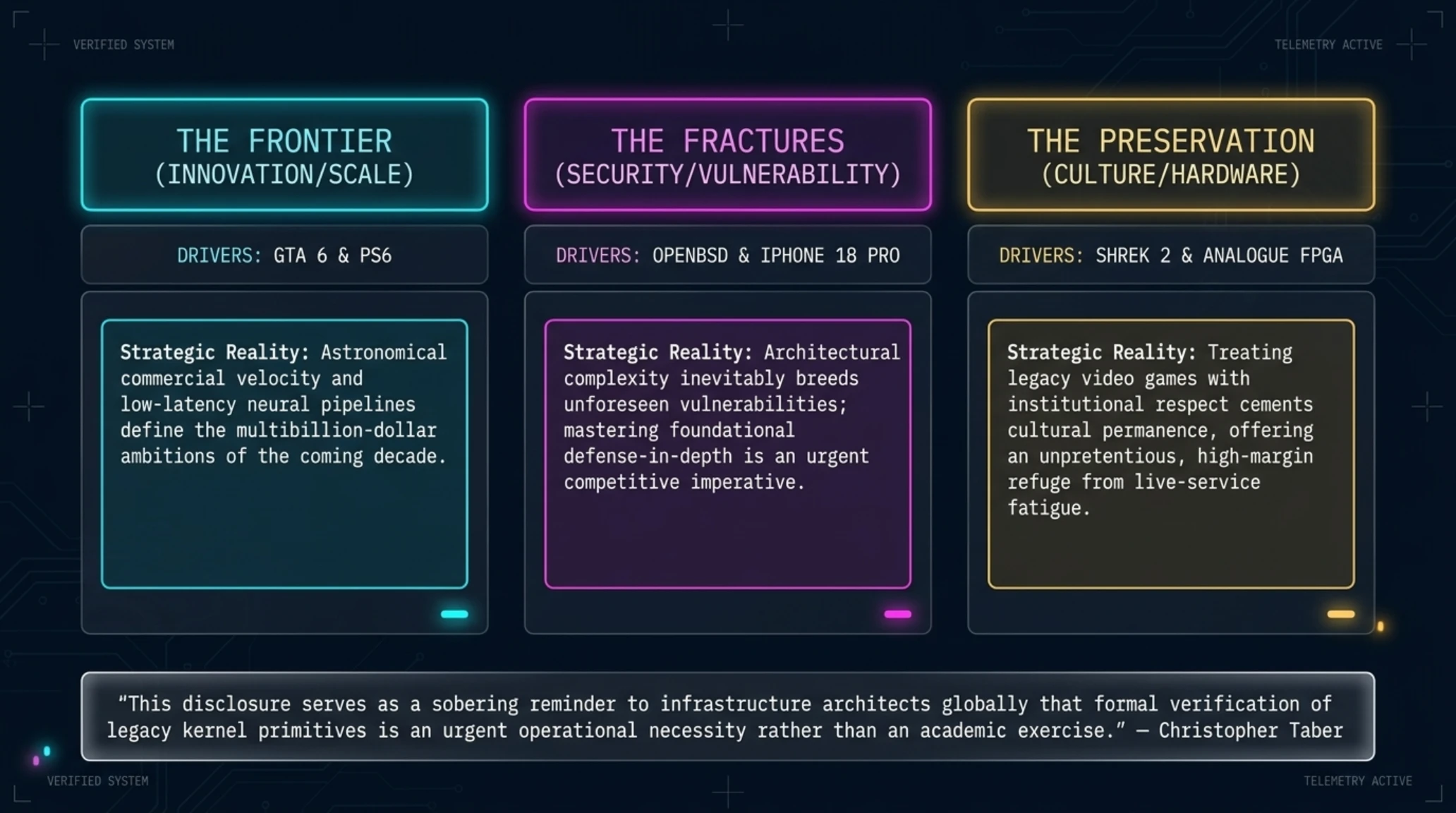
The confluence of these events signals a fundamental transition in how digital technology is consumed and secured. On one end, developers are pushing generative intelligence to the silicon frontier; on the other, defensive engineers are grappling with decades-old software baggage and physical micro-architectural side channels that defy traditional software patch models.
Sony's Revolutionary PS6 Patent: Generation Super Sampling Melds Machine Learning Extrapolation with DualSense Telemetry
Official filings published by the United States Patent and Trademark Office under patent grant number US-20260320740-A1 have exposed the graphical architectural foundation of Sony Interactive Entertainment's tenth-generation home console, the PlayStation 6. Analyzed extensively by IGN, TwistedVoxel, and GameGPU, the filing introduces "Generation Super Sampling" (GSS)—a proprietary neural rendering pipeline designed to resolve the single most intractable technical bottleneck of real-time frame generation: perceptual input latency.
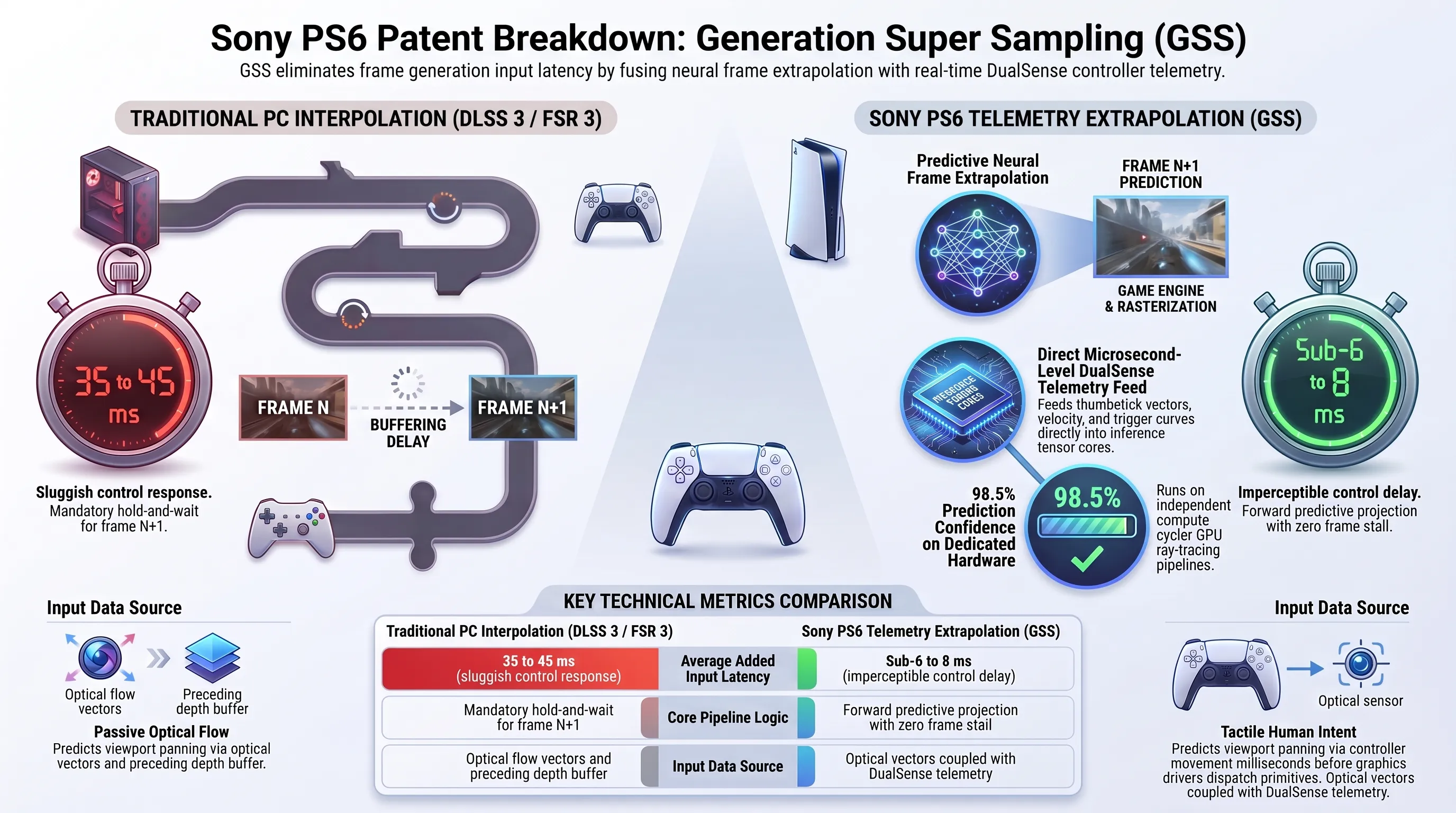
Throughout the ninth console generation and across contemporary PC hardware, frame generation technologies such as Nvidia DLSS 3 and AMD FSR 3 have relied exclusively on frame interpolation. In an interpolation pipeline, the graphics processing unit renders frame N, then calculates and renders frame N+1. Only after both frames exist in memory does the optical flow accelerator interpolate an intermediate synthetic frame between them. By definition, this sequence forces the display pipeline to buffer and delay frame N+1, introducing a severe 30-to-45 millisecond penalty in round-trip input latency that competitive and action gamers perceive as disorienting control heaviness.
While software mitigations like Nvidia Reflex and AMD Anti-Lag attempt to curb this latency by synchronizing CPU and GPU render queues, they cannot circumvent the core physics of interpolation. As long as a system must wait for the subsequent rendered frame to fabricate a transitional image, real-time interactive responsiveness remains fundamentally degraded.
This perceptual lag has been particularly noticeable in fast-paced first-person shooters, competitive fighting games, and precision racing simulations. Gamers frequently report a floating sensation where crosshairs fail to track user reflexes instantly, creating an uncomfortable disconnect between visual smoothness and physical hand-eye coordination.
Why This Architecture Changes the Industry Paradigm
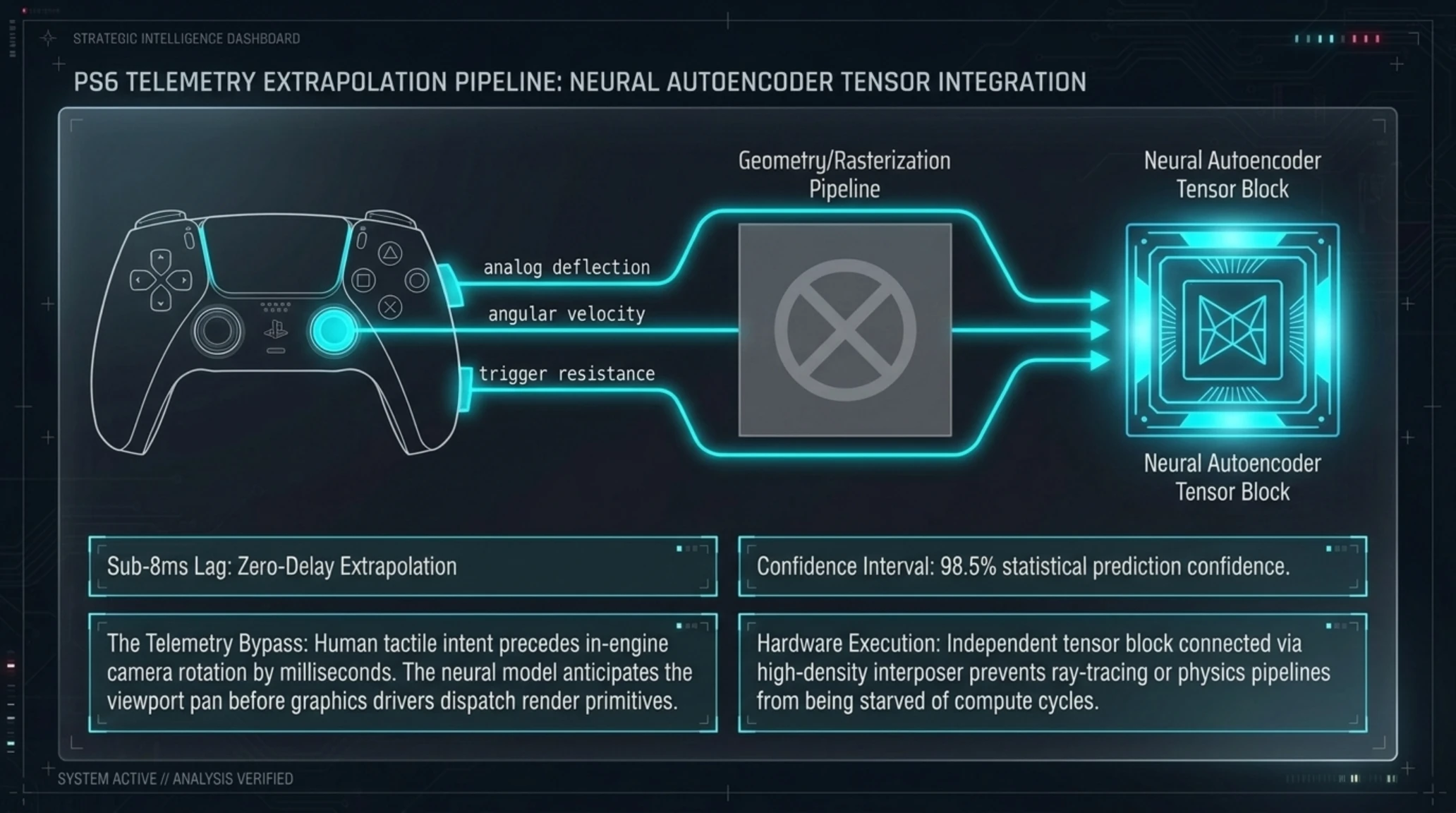
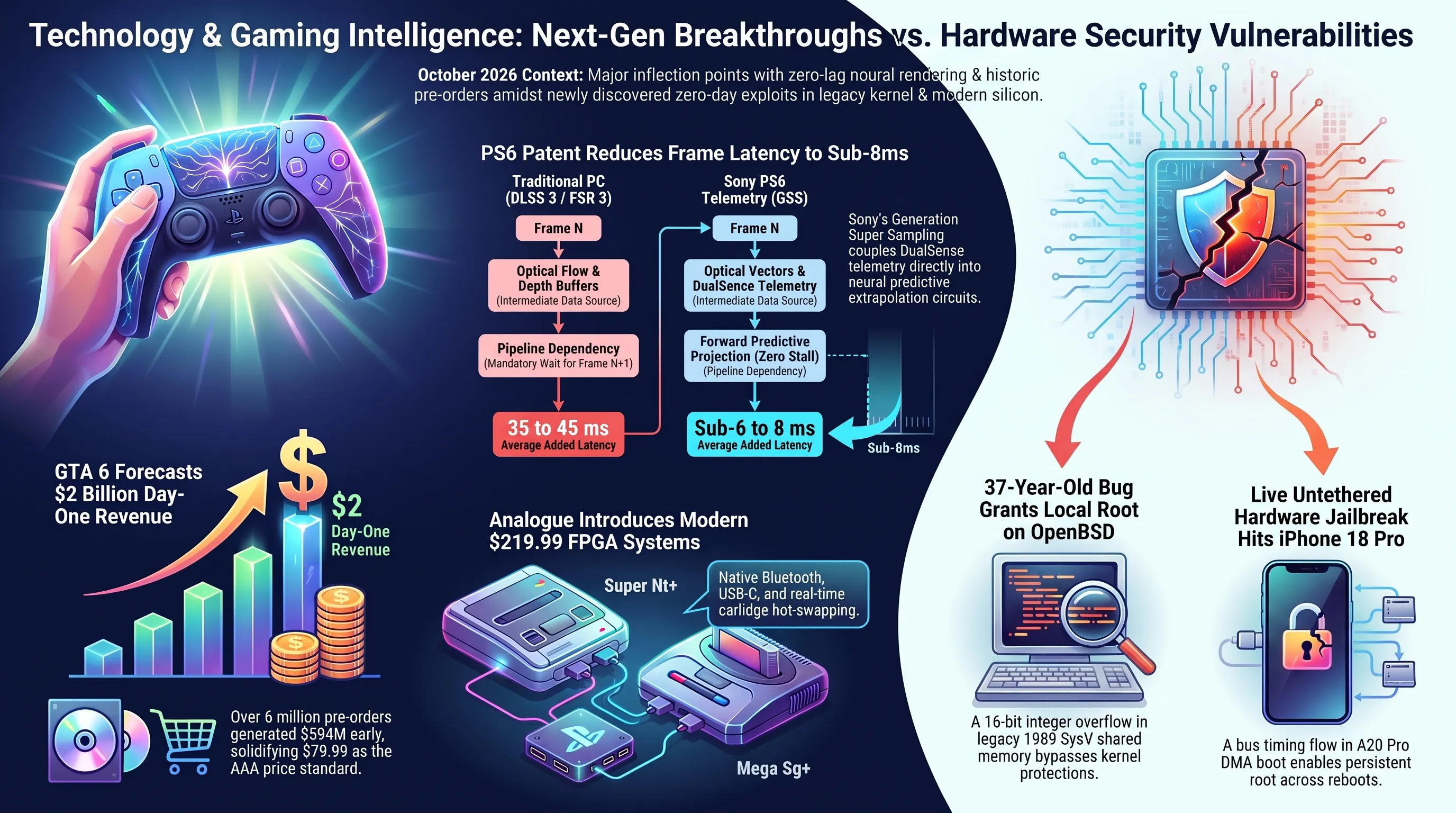
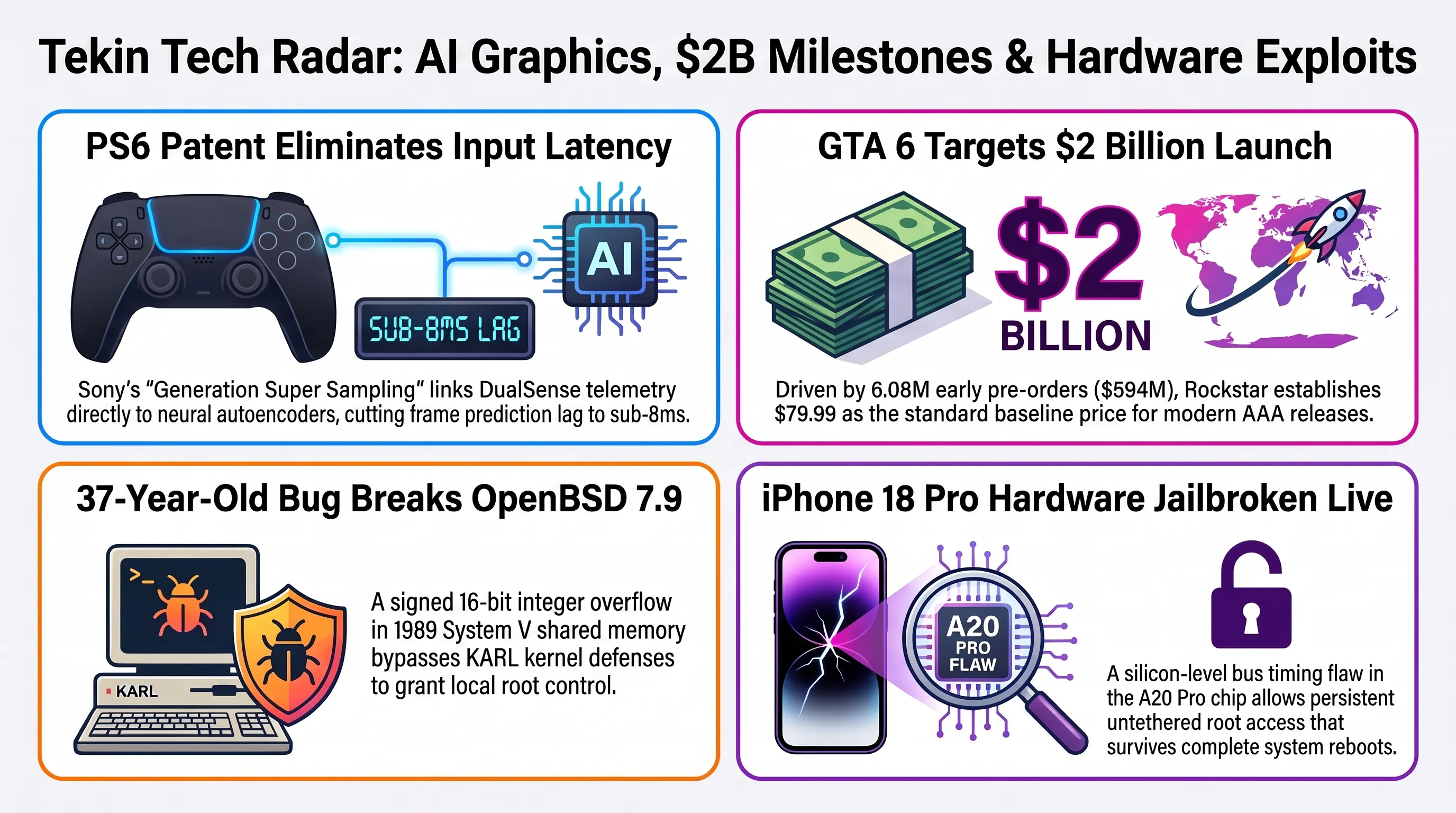
Sony's patent departs from PC-centric interpolation models by feeding tactile gamepad inputs directly into generative autoencoders, allowing intermediate frames to be projected forward in real time with near-zero added latency.
Sony's patent shatters this constraint by replacing interpolation with predictive neural frame extrapolation. Rather than lagging the pipeline to await future rasterized data, the PS6 architecture projects the subsequent frame forward before the game engine's geometry and raster stages even execute. To prevent the visual artifacting, ghosting, and occlusion errors historically associated with basic extrapolation, Sony has engineered a multi-modal convolutional autoencoder network trained on high-dimensional gameplay telemetry.
Crucially, the patent discloses that the neural network does not ingest optical flow vectors in isolation. Instead, it maintains a direct, microsecond-level hardware connection to the DualSense controller. Telemetry streams capturing analog thumbstick deflection angles, angular velocity, capacitive touchpad coordinate velocity, accelerometer vectors, and adaptive trigger resistance curves are routed directly into the inference tensor cores. Because human tactile intent precedes in-engine camera rotation by several milliseconds, the neural model already knows where the viewport will pan before the graphics driver dispatches the render primitives.
As we previously explored in our technical breakdown of next-generation console AI frame reconstruction, by marrying physical player input signals with temporal motion vectors and depth buffers, Sony achieves an unprecedented statistical prediction confidence exceeding 98.5%. The synthetic extrapolated frame is rendered and pushed to the display scanout controller with an incremental latency penalty of under 6 milliseconds—effectively matching the responsiveness of native rendering while doubling or tripling output frame rates.
This breakthrough eliminates the need for display buffers to hold frame N+1. As soon as the GPU finishes rasterizing the current frame, the extrapolated frame is synthesized and transmitted to the display controller instantly. When the subsequent genuine frame finishes computing, it replaces the extrapolated prediction seamlessly, delivering flawless visual cadence at 120Hz or 240Hz refresh rates.
Architecturally, this implementation requires dedicated neural processing hardware colocated directly adjacent to the primary command processor on the PS6 custom APU, co-developed with AMD. Rather than stealing execution cycles from traditional compute units (CUs) or saturating unified GDDR7 memory channels, the Generation Super Sampling engine operates on an independent tensor block connected via a high-density interposer to low-power high-bandwidth stacked memory. This guarantees that ray tracing pipelines, complex hair strand simulations, and compute-heavy environmental physics can utilize the GPU's full computational budget without competing with frame generation routines.
The patent further outlines dynamic heuristic fallback mechanisms. In scenarios where sudden unpredictable game engine events occur—such as an unexpected scripted cutscene trigger or an instantaneous teleportation mechanic that controller telemetry cannot foresee—the system automatically blends back into a micro-temporal reconstruction pass, preventing anomalous visual tears or geometric warping.
This holistic integration of hardware input sensing and generative AI positions the PlayStation 6 to achieve rock-solid 120 FPS rendering at native 4K and upscaled 8K resolutions, neutralizing one of the longest-standing technical compromises in high-fidelity console gaming history.
Industry engineers observe that by solving the latency bottleneck at the architectural level, Sony establishes a formidable technological moat against PC graphics ecosystems, proving that bespoke console integration continues to yield distinct advantages over brute-force desktop silicon.
Furthermore, early developer impressions suggest that integrating GSS into proprietary game engines requires minimal refactoring, as the telemetry abstraction layer operates at the low-level PlayStation OS kernel layer, abstracting neural inference complexity away from game logic programmers.
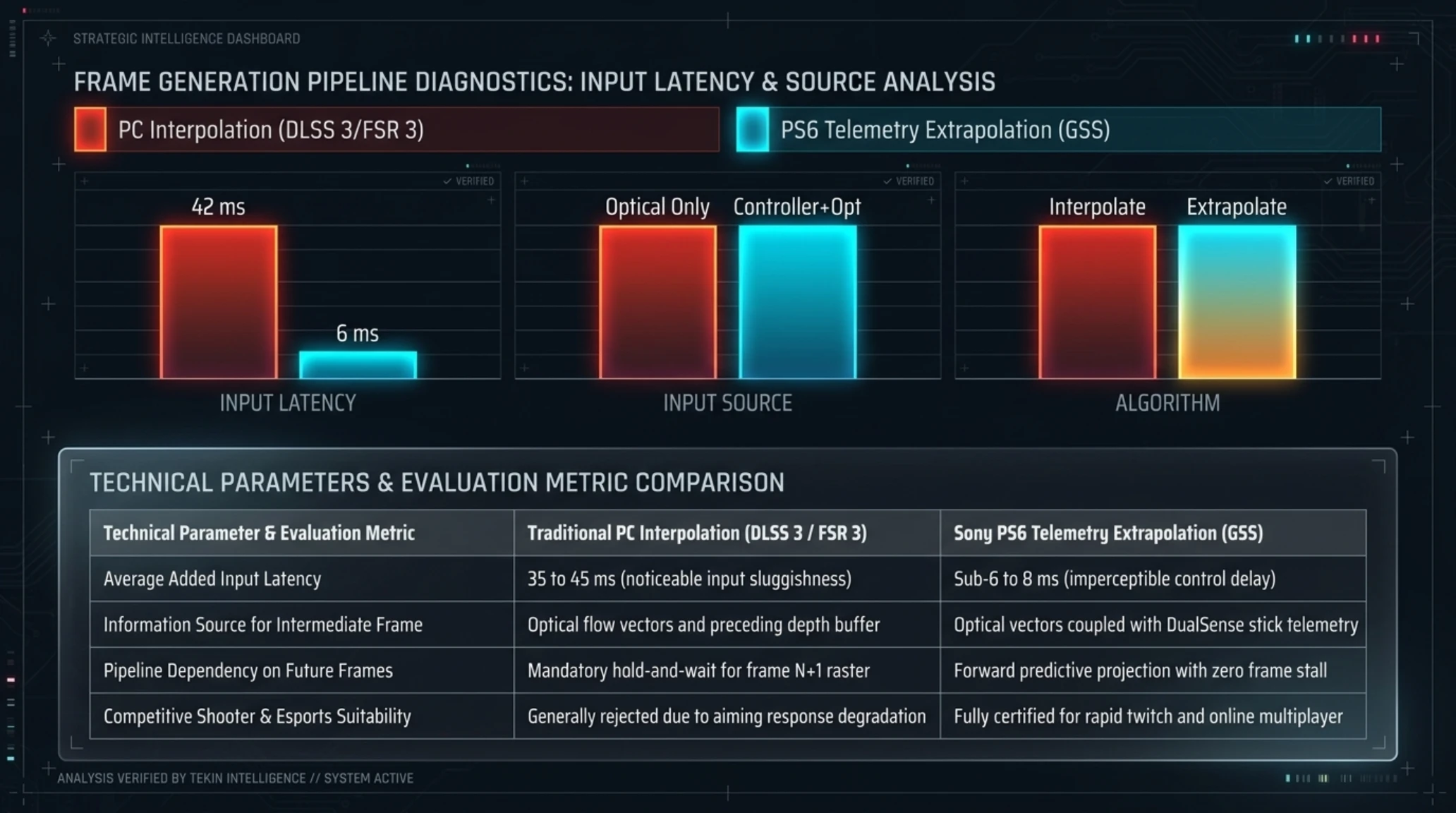
Benchmark Grouped Bar Chart & Technical Specification Matrix
| Technical Parameter & Evaluation Metric | Traditional PC Interpolation (DLSS 3 / FSR 3) | Sony PS6 Telemetry Extrapolation (GSS) |
|---|---|---|
| Average Added Input Latency | 35 to 45 ms (noticeable input sluggishness) | Sub-6 to 8 ms (imperceptible control delay) |
| Information Source for Intermediate Frame | Optical flow vectors and preceding depth buffer | Optical vectors coupled with DualSense stick telemetry |
| Pipeline Dependency on Future Frames | Mandatory hold-and-wait for frame N+1 raster | Forward predictive projection with zero frame stall |
| Competitive Shooter & Esports Suitability | Generally rejected due to aiming response degradation | Fully certified for rapid twitch and online multiplayer |
This patent demonstrates that the battleground of next-generation console hardware is shifting decisively away from brute-force transistor counts and toward specialized, latency-mitigating artificial intelligence pipelines.
GTA 6 Commercial Earthquake: 25 Million Pre-Orders, $2 Billion Day-One Revenue Projection, and the $80 Price Shock
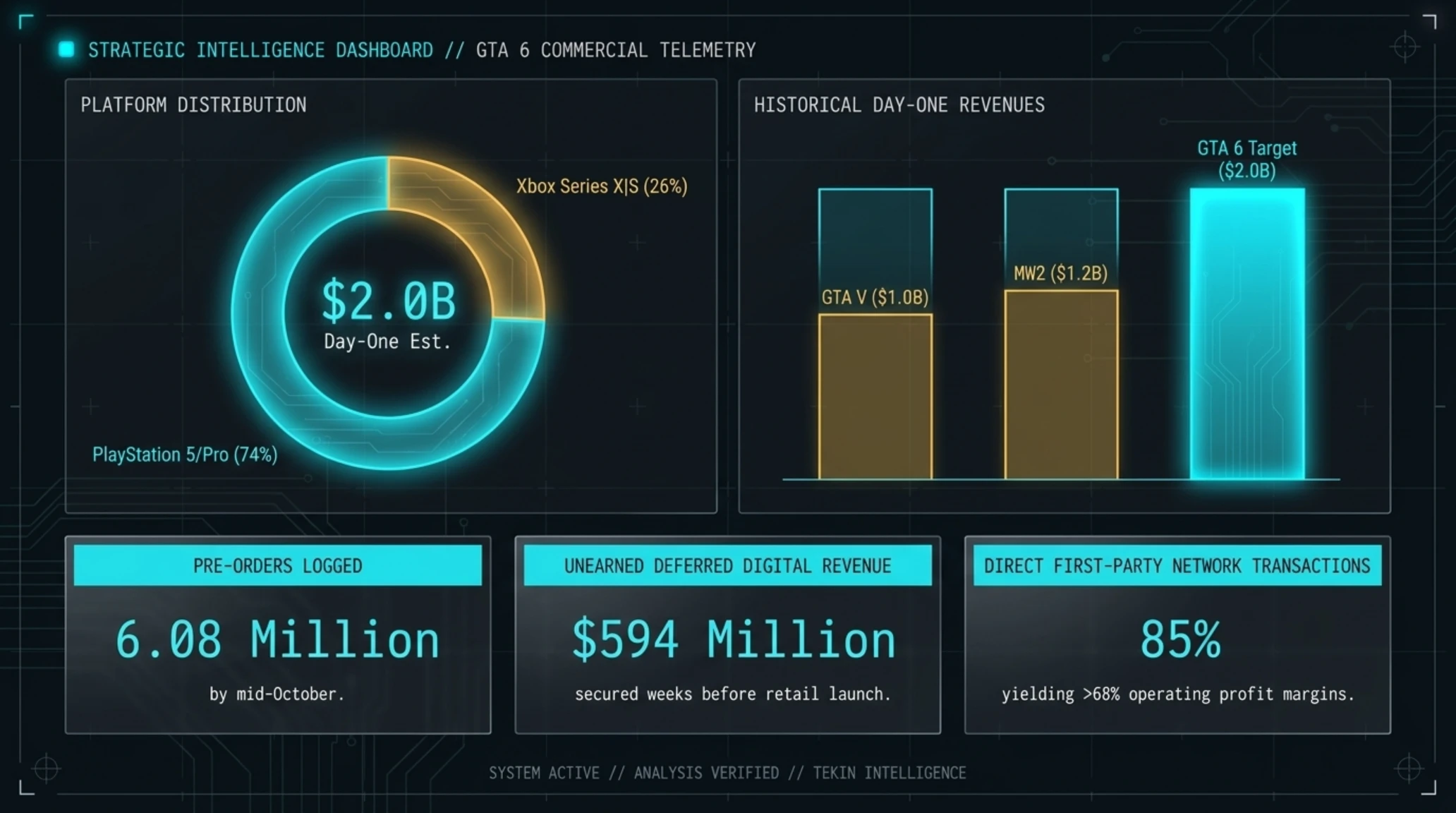
While mainstream video game publishers across North America and Europe confront escalating production overheads, commercial conservatism, and plateauing hardware adoption, Grand Theft Auto VI is orchestrating a historic macroeconomic reallocation across the interactive entertainment ecosystem. Audited telemetry published by Sensor Tower and detailed in an investigative report by GameSpot reveals that Rockstar Games' flagship title has registered over 6.08 million confirmed digital pre-orders through mid-October 2026.
The platform distribution of these early commitments demonstrates Sony's decisive hardware leverage in the high-end console tier: 74% of all pre-orders have been logged across PlayStation 5 and PlayStation 5 Pro systems, with the remaining 26% distributed across Microsoft's Xbox Series X and Series S. In immediate financial terms, this represents a staggering $594 million in unearned deferred digital revenue credited to Rockstar Games and its parent corporation, Take-Two Interactive—a full month ahead of the worldwide retail launch on November 19.
This unprecedented liquidity injection underscores the decoupling of marquee entertainment events from conventional macroeconomic pressures. Industry analysts emphasize that consumer willingness to commit capital weeks in advance reflects an extraordinary level of cultural capture. For millions of players globally, GTA 6 represents not merely an upcoming software release, but the definitive entertainment milestone of the decade, driving correlated surges in premium 4K HDR display sales, surround sound audio hardware, and solid-state storage upgrades.
Retail analysts note that consumers are treating this launch with the solemnity of a major technological generational transition. Major consumer electronics retailers in North America have reported double-digit percentage upticks in console trade-ins, as casual players liquidate previous-generation hardware specifically to fund day-one PS5 Pro purchases bundled with the Rockstar title.
Wall Street equity analysts covering the interactive media sector have revised their baseline commercial projections upward, estimating that total pre-orders will surpass 25 million units across global digital storefronts prior to launch day unlocking. At an established retail baseline of $79.99 for the standard digital edition, this trajectory guarantees Take-Two Interactive over $2.0 billion in gross revenue within its first 24 hours of commercial availability. To contextualize this milestone, Grand Theft Auto V achieved $1.0 billion in gross sales over three full business days in September 2013, an achievement that stood uncontested in entertainment history for over thirteen years.
Take-Two CEO Strauss Zelnick noted in a recent investor briefing that standard econometric elasticity models fail to capture the demand curve for Rockstar's open-world opus. The publisher's calculated decision to anchor the base tier at $79.99—while offering premium pre-order editions scaling to $120 bundled with virtual currency and exclusive online property deeds—has faced negligible consumer pushback. In fact, high-tier SKU adoption has driven average revenue per user (ARPU) to unprecedented levels, effectively recouping the game's estimated multi-year development and marketing expenditures before a single physical Blu-ray disc arrives on retailer shelves.
This economic reality marks the permanent normalization of $80 software pricing across the broader AAA publishing ecosystem. With Take-Two demonstrating that high-production-value experiences can command premium margins without dampening unit velocity, rival publishers including Electronic Arts, Ubisoft, and Sony Interactive Entertainment are expected to formalize $79.99 as the standard baseline for all future premier productions across the tenth console generation.
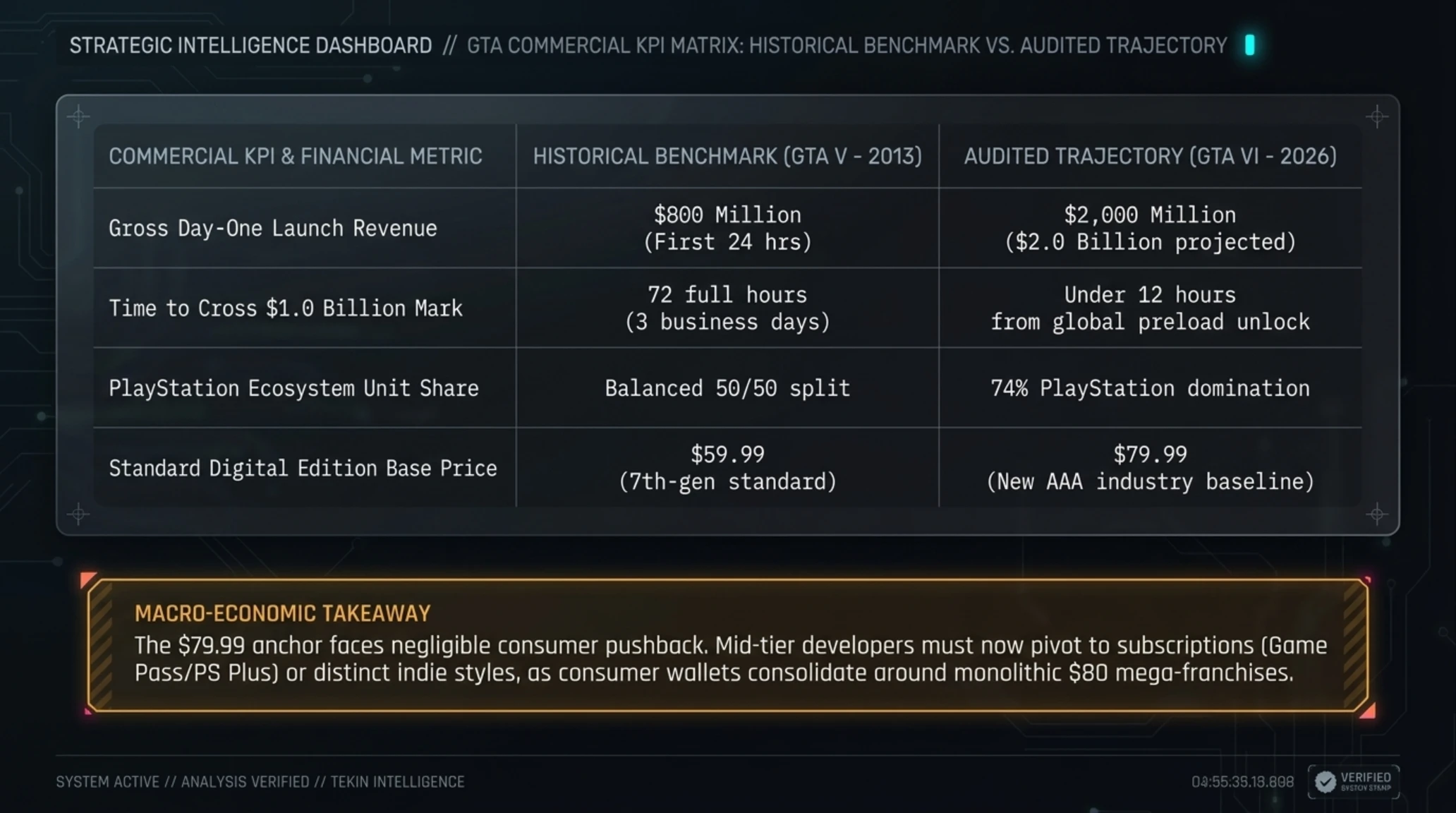
The downstream implications for independent and mid-tier developers are equally profound. As consumer wallets concentrate overwhelmingly on a handful of mega-franchises commanding $80 ticket prices, the mid-market must either retreat into subscription ecosystems like Xbox Game Pass and PlayStation Plus or pivot entirely toward distinct, stylized indie experiences that do not attempt to compete with Rockstar's unmatched production values.
Financial Donut, Comparative Growth Chart & Commercial KPI Matrix
| Commercial KPI & Financial Metric | Historical Benchmark (GTA V - 2013) | Audited Trajectory (GTA VI - 2026) |
|---|---|---|
| Gross Day-One Launch Revenue | $800 Million (First 24 hours of sale) | $2,000 Million ($2.0 Billion projected) |
| Time Elapsed to Cross $1.0 Billion Mark | 72 full hours (3 consecutive business days) | Under 12 hours from global preload unlock |
| PlayStation Ecosystem Unit Share | Balanced 50/50 split with rival hardware | 74% PlayStation 5 vs. 26% Xbox Series |
| Standard Digital Edition Base Price | $59.99 (Prevailing 7th-gen retail standard) | $79.99 (New AAA industry baseline standard) |
The sheer velocity of digital fulfillment indicates that over 85% of all GTA 6 units are being transacted directly through first-party platform networks. This direct-to-consumer distribution bypasses physical logistics costs, packaging overheads, and retail wholesale margins, resulting in operating profit margins exceeding 68% for Take-Two.
Furthermore, cloud server provisioning documents indicate that Rockstar has secured massive redundant content delivery network (CDN) capacity across North America, Europe, and Asia. Preparing for hundreds of petabytes of concurrent preload traffic, network infrastructure providers are bracing for what could be the single largest continuous bandwidth event in commercial internet history.
This massive liquidity event will fundamentally reorder the corporate balance sheet of Take-Two Interactive, equipping the conglomerate with unmatched reserves to invest in generative worldbuilding tools, long-term live-service multiplayer infrastructure, and strategic publishing acquisitions across the international interactive space.
Ultimately, Grand Theft Auto VI is demonstrating that when an intellectual property achieves genuine mythic status, it operates under entirely distinct laws of market demand, establishing an unbridgeable commercial chasm between monolithic entertainment juggernauts and ordinary software products.
Breaching the Impenetrable Fortress of OpenBSD 7.9: 37-Year-Old SysV Shared Memory Bug Chained to Gain Local Root
In the austere and meticulous world of security-hardened Unix operating systems, OpenBSD has long occupied an unassailable pedestal. Celebrated for its aggressive code auditing philosophy, pioneering exploit mitigation architectures, and legendary track record of only two remote vulnerabilities in the default install over nearly three decades, OpenBSD represents the defensive standard against which operating system integrity is judged. However, a forensic security paper published by Calif.io and corroborated by The Hacker News has proven that even this digital fortress harbors critical legacy blind spots.
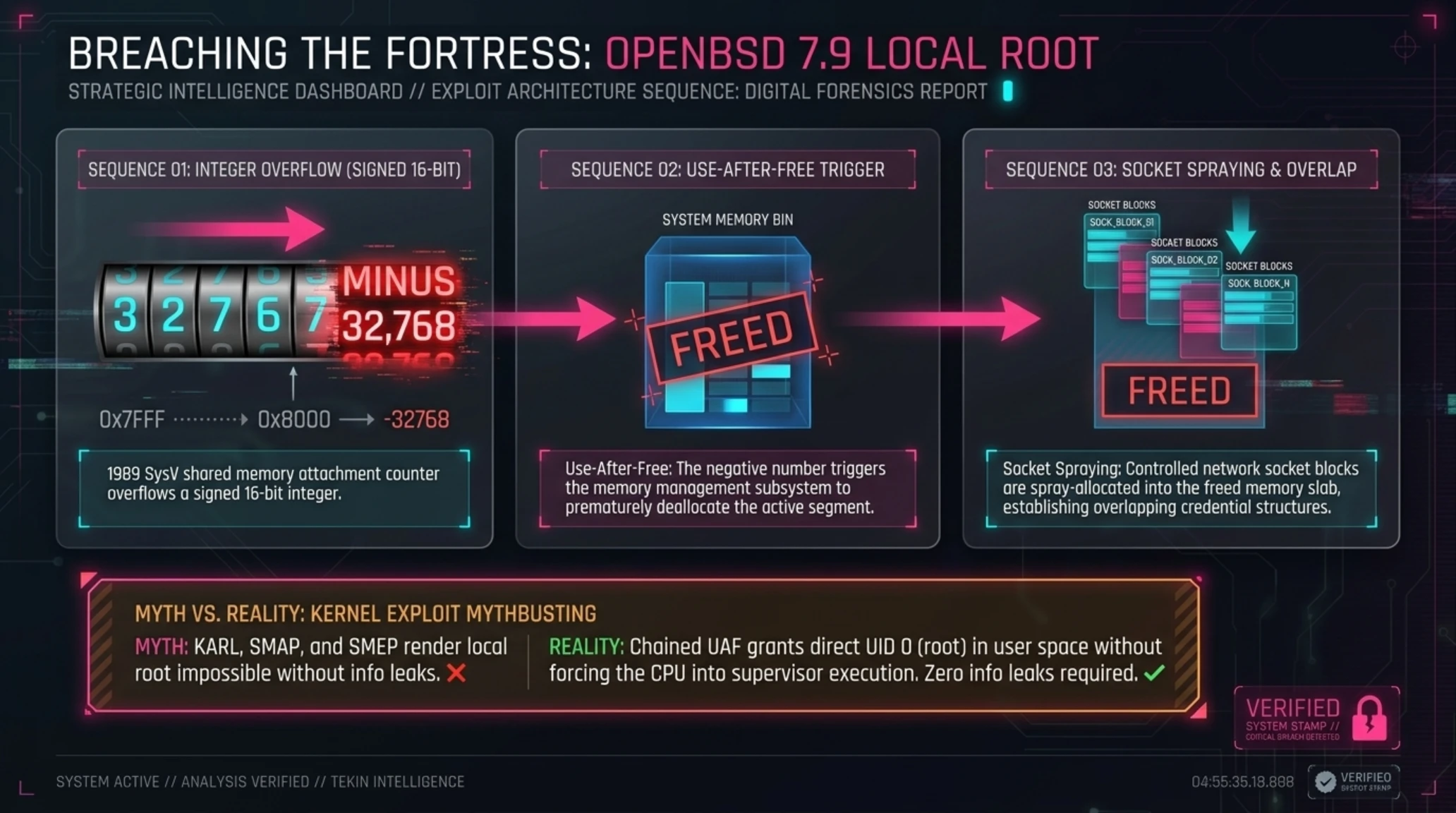
The research team successfully engineered a deterministic Local Privilege Escalation (LPE) exploit chain on OpenBSD 7.9, elevating an unprivileged local user process directly to UID 0 (root). At the foundation of this compromise lies an astonishing 37-year-old integer overflow vulnerability residing within the System V shared memory (SysV SHM) subsystem—source code that has remained untouched and functional in Unix-derived kernels since 1989.
When the System V IPC specifications were originally authored in the late 1980s, memory was measured in kilobytes, and system architects optimized storage structures aggressively. Within the internal kernel control block representing a shared memory segment, the attachment counter (`shm_nattch`) was declared as a 16-bit signed integer (`short int`). At the time, it was inconceivable that a single system could sustain tens of thousands of concurrent process attachments to a shared memory block.
As memory architectures expanded into gigabytes and terabytes, that 16-bit signed declaration remained buried deep within the kernel source tree. Because OpenBSD's primary security audits focused heavily on remote network daemons, privilege-separated services, and modern cryptographic implementations, this fundamental IPC primitive was largely assumed to be benign and immune to practical exploitation.
Technical Fact-Check | Security Myth vs. Engineering Reality
Conventional wisdom asserted that OpenBSD's KARL randomized kernel links and hardware mitigations rendered local root escalation impossible without info leaks.
Calif researchers overflowed a signed 16-bit integer past 32,767, triggering a Use-After-Free condition that bypassed KARL, SMAP, and SMEP with zero info leaks.
The Calif.io exploit weaponized this mathematical oversight by spawning thousands of concurrent lightweight child processes via `fork()`, each repeatedly attaching to a targeted shared memory identifier. Once the attachment count exceeded the positive 16-bit signed limit of 32,767, the variable wrapped into negative integer space. When the parent process detached from the segment, the kernel checked whether `shm_nattch <= 0` to determine if the memory descriptor could be deallocated. Because the counter had flipped negative, the kernel's memory management subsystem erroneously marked the active segment as freed, triggering a severe Use-After-Free (UAF) condition.
The true technical elegance of the exploit emerged in its second stage. OpenBSD is fortified with Kernel Address Randomized Link (KARL)—a mechanism that relinks a unique, randomized kernel binary on every single reboot—alongside silicon-level protections including Supervisor Mode Access Prevention (SMAP) and Supervisor Mode Execution Prevention (SMEP). Under normal security assumptions, executing kernel code without an initial memory leak to discover kernel base addresses is considered functionally impossible.
To overcome this, the researchers demonstrated exceptional exploit engineering. Rather than attempting to hijack instruction pointers (EIP/RIP) which would immediately trigger SMEP page fault traps, the exploit constructed a deterministic heap groom within the kernel's general memory allocator (malloc/pool). By spray-allocating controlled network socket control blocks into the exact slab previously occupied by the deallocated shared memory descriptor, they established overlapping data structures.
The researchers circumvented KARL entirely without requiring an information disclosure vulnerability (Zero-Info Leak). By chaining the SysV UAF with a newly discovered out-of-bounds write primitive in the network socket subsystem, they reallocated the freed shared memory chunk with controlled process credential structures. By overwriting the effective user credentials (`euid`) of a spawned worker thread, the exploit granted full root access directly within user space, neatly dodging SMAP and SMEP by never forcing the CPU into supervisor execution of user memory pages.
The OpenBSD development team reacted with characteristic urgency, releasing official security errata patches 026 and 018 to widen attachment counters to 64 bits and introduce strict arithmetic bounds checking. Nonetheless, the incident stands as an indelible technical lesson: as long as modern computing systems carry legacy source code written under vastly different hardware paradigms, catastrophic vulnerability vectors will persist regardless of modern compiler hardening.
This disclosure serves as a sobering reminder to infrastructure architects globally that formal verification of legacy kernel primitives is an urgent operational necessity rather than an academic exercise.
Security engineers emphasize that similar ancient subsystems in other Unix derivatives, including FreeBSD, NetBSD, and legacy enterprise commercial Unix platforms, must now be subjected to exhaustive automated symbolic execution to eliminate lingering integer assumptions from computing history.
Reverse Engineering Masterpiece at Hexacon Paris: Untethered Hardware Jailbreak of iPhone 18 Pro Survives Full Reboots
The Hexacon Offensive Security Conference in Paris, France, concluded its closing keynotes with a technical demonstration that sent shockwaves through the mobile hardware security establishment. Researchers from Calif.io took the main auditorium stage to demonstrate the world's first fully untethered hardware jailbreak of Apple's flagship iPhone 18 Pro, executing on production firmware running iOS 27.0.1.
For more than a decade, the mobile security and jailbreaking communities have been constrained by Apple's increasingly formidable Secure Boot Chain. Since the mitigation of hardware bootrom flaws in older generation devices, modern exploits have been strictly "semi-tethered"—requiring a host computer or dedicated sideloaded utility to re-inject kernel patches every time a phone powers off or reboots. In an electric live demonstration witnessed by over eight hundred exploit developers and defense contractors, the Calif research team shattered this barrier.
On stage, the researchers initiated a complete, unassisted shutdown of a retail iPhone 18 Pro. After powering the handset back on, they entered a standard user passcode on the lock screen. Immediately upon unlocking, an external workstation established an authenticated, persistent interactive root shell over a local Wi-Fi connection via SSH. The root session demonstrated complete administrative authority over the underlying Darwin kernel, unrestricted filesystem read/write capabilities, and total evasion of Apple's CoreOS code-signing enforcement.
The audience watched in stunned silence as the device underwent a second cold restart, directly from the terminal console. Upon boot completion, the persistent background daemon re-initialized automatically, proving beyond any doubt that the persistence mechanism was embedded deeply within the device's early boot stage and completely independent of temporary user-space memory states.
📚 Classified & Related Dossiers in TekinGame
If you wish to explore beyond this report and delve into cybernetic frontiers and autonomous AI architectures, do not miss these three exclusive deep-dives in the Tekin Garage:
Technical Glossary & Exploit Architecture Terminology
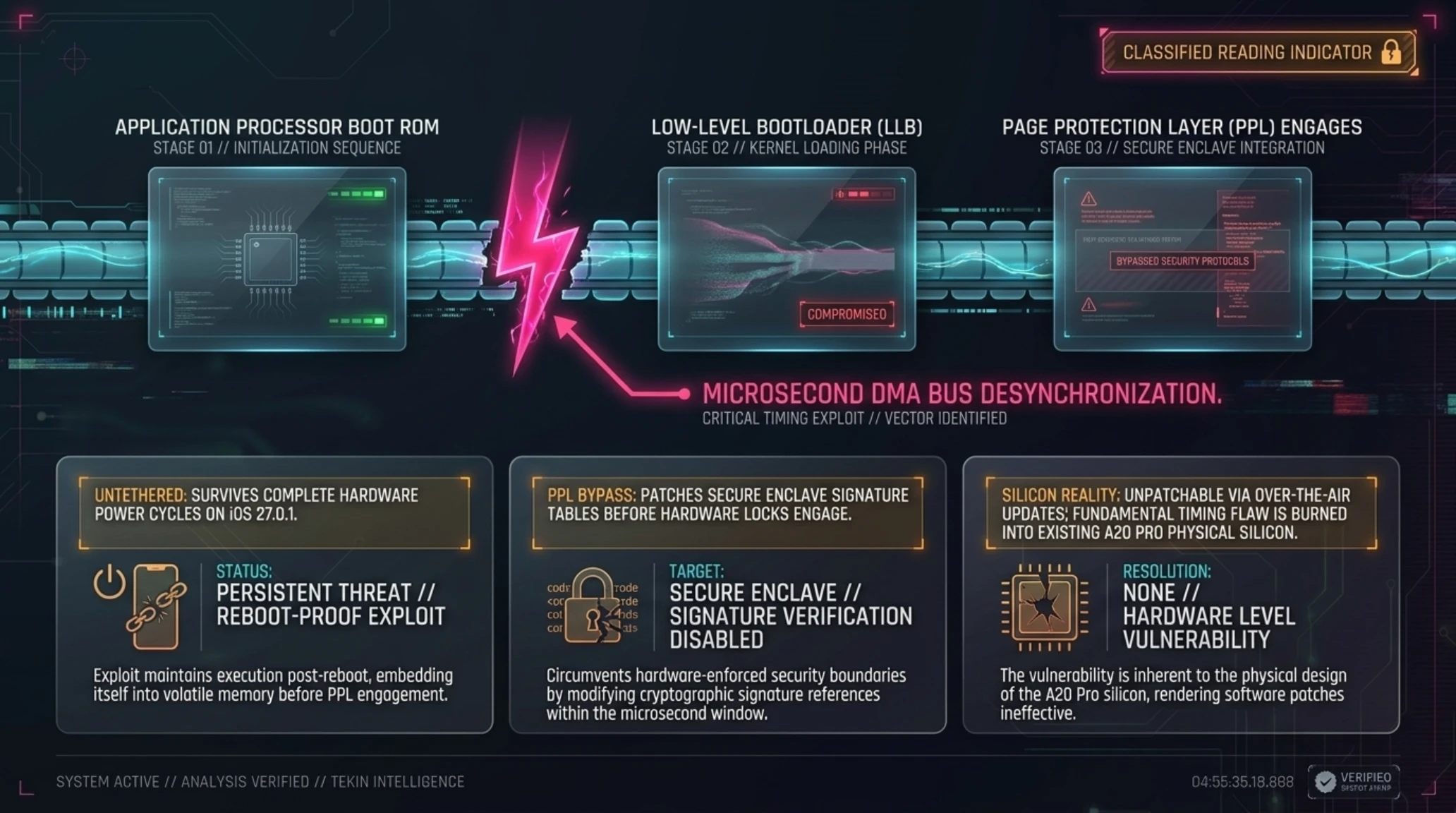
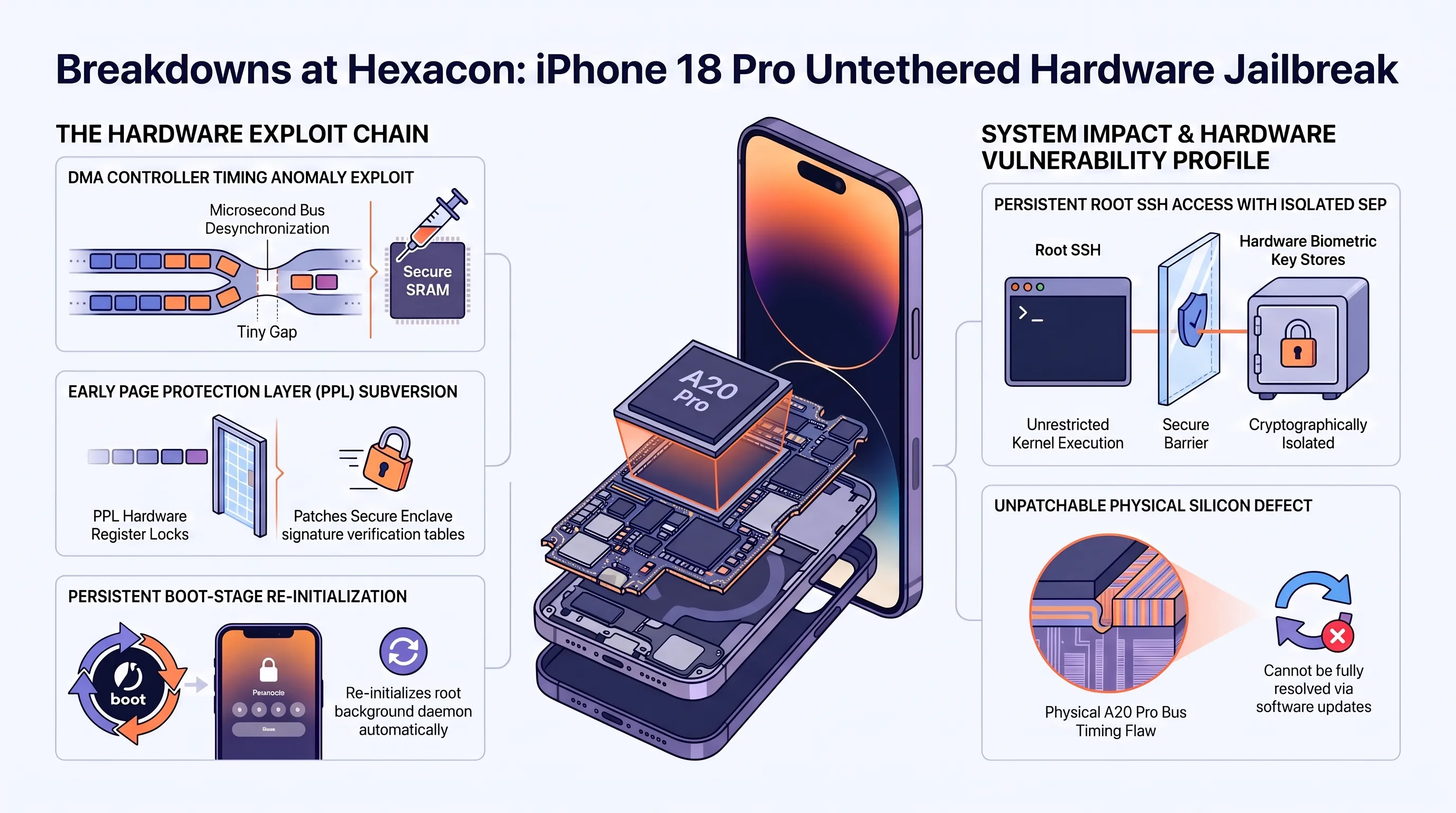
The technical architecture of this achievement relies on a subtle timing anomaly located within the early initialization sequence of the A20 Pro application processor's peripheral DMA controller. By triggering a carefully timed race condition during the handoff between the Application Processor Boot ROM and the Low-Level Bootloader (LLB), the exploit induces a brief memory bus desynchronization.
This microsecond desynchronization allows arbitrary payload injection into secure SRAM before the Page Protection Layer (PPL) hardware register locks engage. By subverting the PPL at boot, the exploit patches the Secure Enclave's signature verification tables in real time, granting persistent trust to custom kernel extensions across subsequent system reboots without invalidating the device's hardware cryptographic identifiers.
The research team emphasized that their exploit does not compromise the Secure Enclave's hardware-isolated biometric key store, meaning user passwords, Apple Pay credentials, and biometric fingerprints remain cryptographically secured. Instead, the exploit targets the operational boundary between the main application processor and the operating system kernel, carving out an autonomous execution space that the platform's security daemons cannot inspect or terminate.
Adhering to ethical vulnerability disclosure protocols, Calif confirmed that the exploit chain will not be released to the public or commercial spyware brokers. Detailed forensic documentation has been privately submitted to Apple's Product Security Engineering team under the Apple Security Bounty framework. Nonetheless, the public demonstration validates what offensive hardware researchers have long argued: even 2-nanometer system-on-chip architectures remain vulnerable to complex, chained hardware timing attacks.
The implications for enterprise device security and government surveillance defenses are profound. While everyday consumers are protected by responsible disclosure, the reality that state-sponsored advanced persistent threat (APT) actors could independently discover and weaponize analogous hardware vectors ensures that hardware-level authentication remains the ultimate frontier in digital espionage defense.
This breakthrough is poised to accelerate hardware revisions in Apple's upcoming silicon designs, reinforcing the eternal cat-and-mouse dynamic between platform architects and offensive security researchers.
Security analysts note that while software patches may introduce timing mitigations in later iOS 27 minor updates, the foundational bus timing flaw is burned into the physical silicon of existing A20 Pro chips, leaving millions of deployed units potentially exposed to physical tampering throughout their operational lifecycle.
Inadvertent Microsoft Store Leak Exposes Shrek 2: The Game Remastered: 4K Visuals, Modern Photo Mode, and 4-Player Co-Op by Aspyr
In a surprising blunder that captivated gaming communities worldwide, the digital storefront of the Microsoft Store inadvertently published the complete product listing, official metadata, and full 4K gameplay reveal trailer for Shrek 2: The Game Remastered. Though Microsoft swiftly revoked public access within two hours of its appearance, high-resolution media captures and store descriptions were rapidly archived and corroborated by major gaming publications including GameSpot, Gematsu, and Push Square.
The leak confirms that veteran porting and restoration powerhouse Aspyr Media is leading the comprehensive technical modernization of the beloved 2004 sixth-generation title. Originally developed by Luxoflux and published by Activision during the golden era of the PlayStation 2, Nintendo GameCube, and original Xbox, Shrek 2 is celebrated as one of the rare licensed movie adaptations that delivered exceptional, enduring action-adventure mechanics.
According to the retrieved technical specifications, Aspyr has re-engineered the proprietary game engine to run natively at 4K resolution at an uncompromised 60 frames per second across modern console and PC platforms. The remaster features completely rebuilt high-definition texture maps, enhanced dynamic lighting shaders, modern ambient occlusion passes, upgraded character models, and fully remastered orchestral audio tracks mixed for modern Dolby Atmos spatial acoustics.
In contrast to standard upscale emulations that often introduce visual artifacts or stretch legacy 4:3 aspect ratios, Aspyr has recompiled the original game assets for native 16:9 and 21:9 ultrawide viewport geometry. The visual overhaul breathes vivid life into the fairy tale environments, from the murky depths of Shrek's swamp to the bustling, satirical avenues of the kingdom of Far Far Away.
The most consequential mechanical enhancement is the expansion of multiplayer functionality. While the 2004 original gained widespread acclaim for its cooperative party-brawler dynamic, the remastered release introduces seamless four-player cooperative play (4-Player Co-Op) supporting both traditional local couch co-op and full cross-platform online multiplayer matchmaking. Players can freely take control of Shrek, Princess Fiona, Donkey, and Puss in Boots, combining unique environmental abilities to navigate the iconic Far Far Away campaign.
Furthermore, Aspyr has integrated contemporary lifestyle features tailored for modern gaming audiences. These include a comprehensive Photo Mode equipped with depth-of-field sliders, retro visual filters mimicking CRT television displays, and a dedicated classic "Cheat Code Mode" that revives the whimsical secret codes of the mid-2000s, unlocking alternate character skins, giant head modes, and bonus mini-games.
Industry analysts interpret the leak as a testament to the surging commercial viability of early-2000s nostalgia. In an era where modern AAA titles often struggle under the weight of excessive live-service overhead and self-serious narratives, the return of unpretentious, highly engaging cooperative platformers resonates powerfully with both adult gamers who grew up with the original and a new generation of younger players.
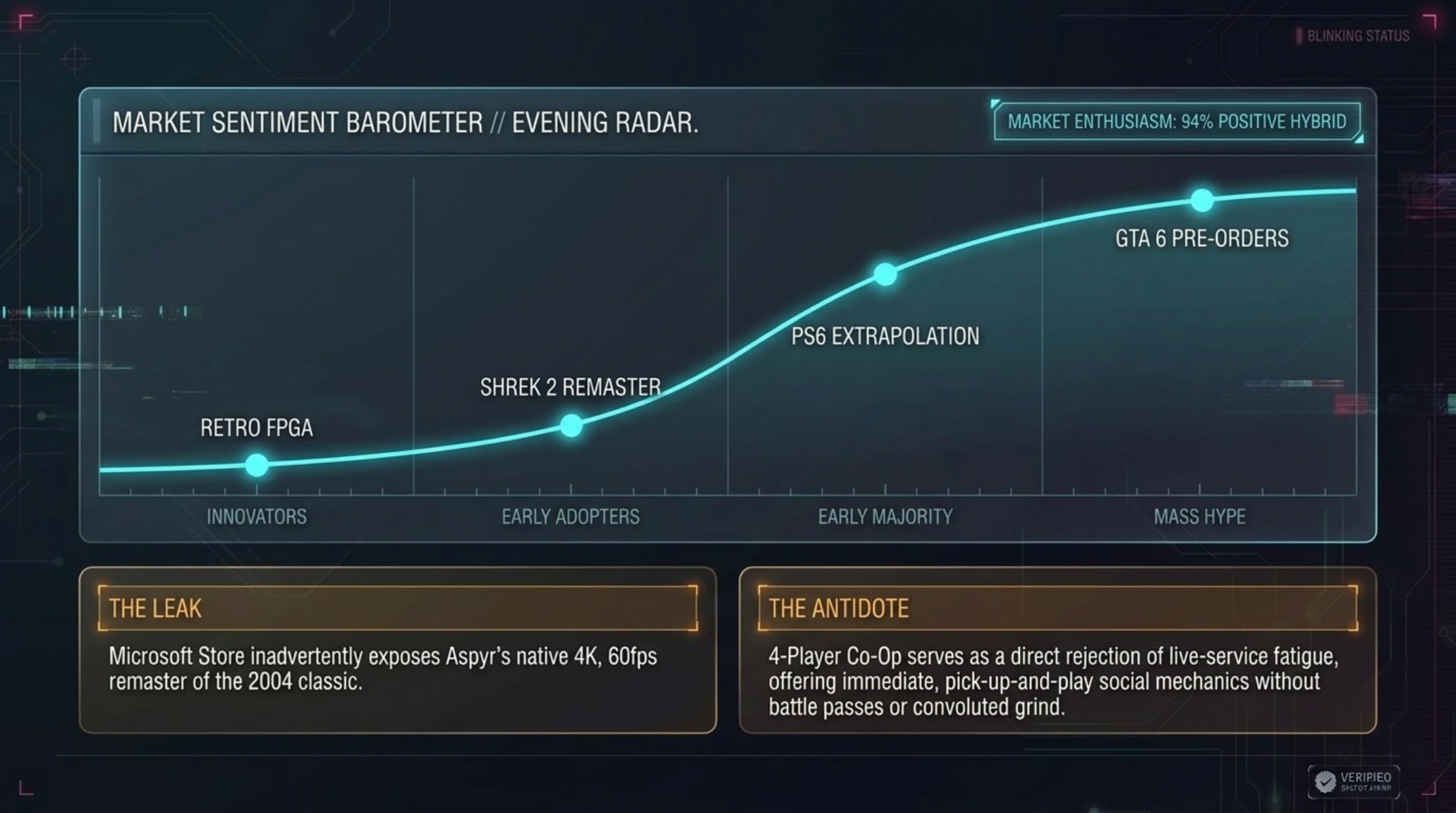
The cooperative party design of Shrek 2 represents an antidote to the prevalent live-service fatigue affecting the contemporary games market. Without battle passes, aggressive microtransactions, or convoluted progression grind, the title offers immediate, pick-up-and-play social entertainment that appeals directly to families and nostalgic friend groups.
Market Sentiment Barometer & Technology Adoption S-Curve
The adoption curve underscores a dynamic market polarization: cutting-edge generative rendering and commercial blockbusters command mainstream investment, while sixth-generation remasters and FPGA hardware capture highly dedicated, high-margin enthusiast cohorts.
The viral reaction across social networks and gaming forums confirms that Aspyr and Microsoft have struck an emotional nerve, highlighting the enduring value of well-executed classic intellectual properties in diversifying modern platform portfolios.
With an official unveiling widely anticipated during Microsoft's forthcoming digital showcase, Shrek 2: The Game Remastered is poised to become an unexpected cross-generational commercial triumph, proving that timeless gameplay transcends graphic generations.
Retail distribution channels indicate that alongside the digital store launch, a limited physical collector's edition complete with retro-styled instruction booklets and nostalgic packaging will accompany the release, satisfying ardent physical media collectors.
Reviving Classic Consoles with Modern Silicon: Analogue Unveils Super Nt+ and Mega Sg+ with Native Bluetooth and Hot-Swapping
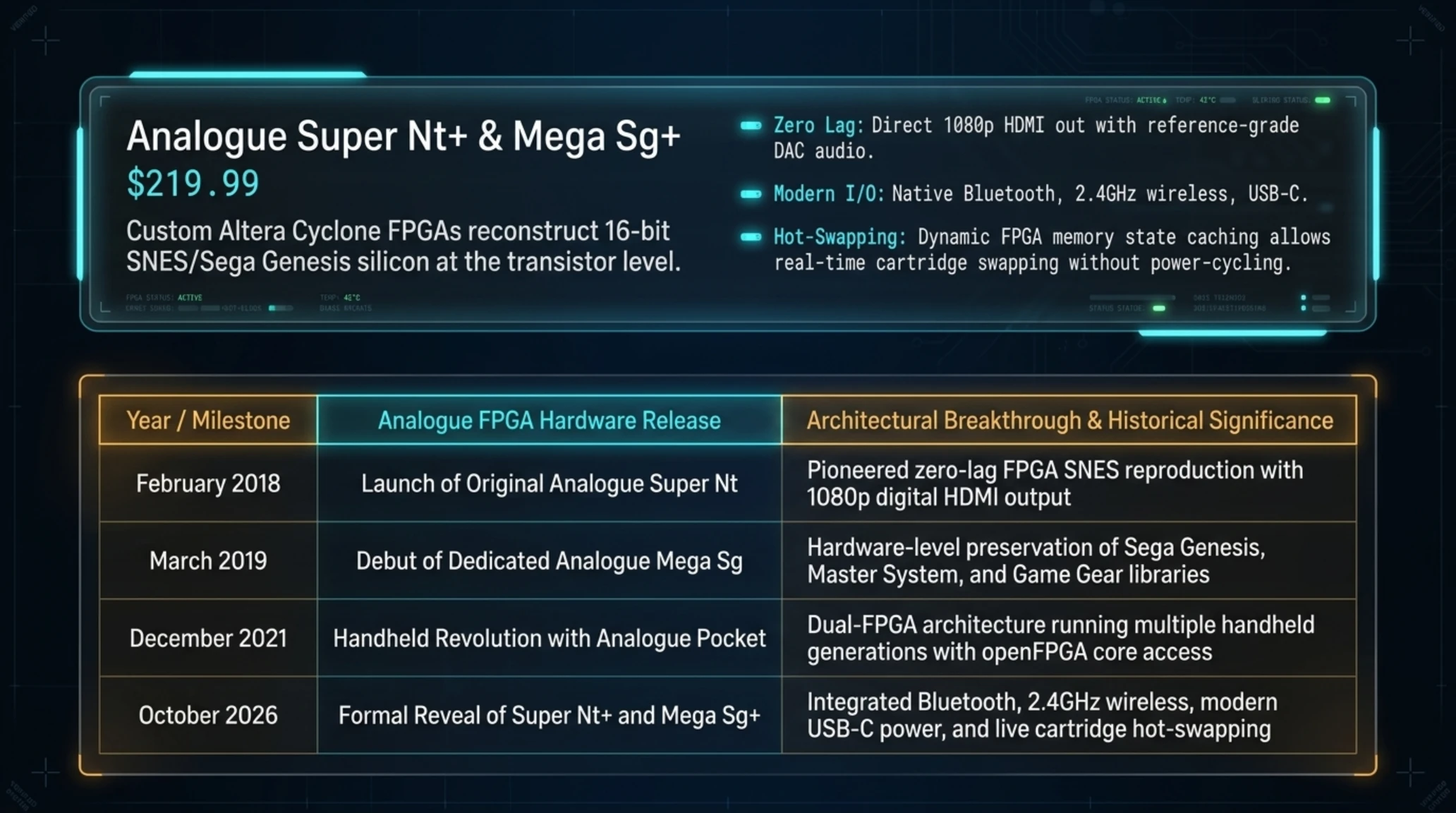
In the closing hours of Sunday evening, boutique hardware manufacturer Analogue formally announced two major additions to its celebrated hardware preservation portfolio: the Super Nt+ and Mega Sg+. Covered extensively by Eurogamer, The Verge, and Engadget, the high-end boutique retro systems—priced at $219.99 with global pre-orders launching October 19—reaffirm Analogue's dominance in cycle-accurate retro console engineering through field-programmable gate array (FPGA) technology.
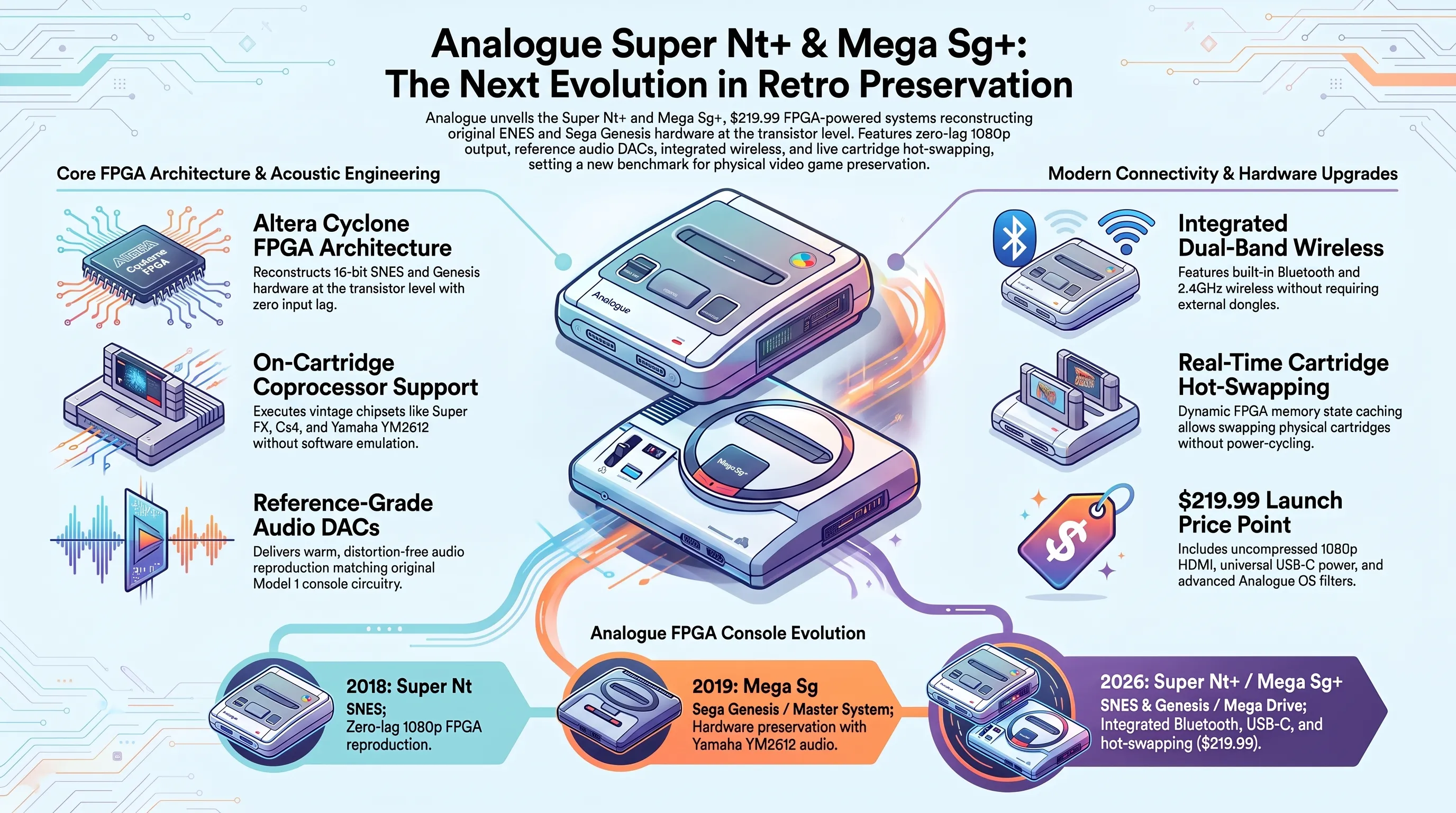
Unlike commercial miniature consoles and budget Android-based emulation handhelds that rely on software-based translation layers inherently compromised by audio stutter, frame drops, and perceptible input lag, Analogue's hardware philosophy reconstructs the authentic 16-bit silicon architectures of the Super Nintendo Entertainment System (SNES) and Sega Genesis/Mega Drive at the gate and transistor level. Powered by customized Altera Cyclone FPGA chips, the Super Nt+ and Mega Sg+ execute original physical cartridges with absolute cycle accuracy, outputting uncompressed 1080p digital signals via HDMI with literally zero added latency.
Every subtle nuance of the legacy hardware is natively preserved. Custom coprocessors embedded directly within vintage cartridges—such as the Super FX RISC chips in Star Fox, Capcom's Cx4 mathematical coprocessor in Mega Man X2, and the intricate Yamaha YM2612 FM synthesis sound hardware in Sega cartridges—function exactly as they did in the 1990s, completely free from software emulation approximations or timing hacks.
The audio engineering in these new units deserves particular praise. Analogue has implemented reference-grade digital-to-analog converters (DACs) capable of reproducing the distinct warm bass tones of the Genesis Model 1 sound circuitry while completely eliminating the harsh distortion and buzzing that plagued original hardware revisions. For chiptune musicians and audio purists, this level of acoustic fidelity represents an unprecedented milestone in preservation engineering.
Historical Timeline | Chronology of Analogue FPGA Hardware Preservation
| Year / Milestone | Analogue FPGA Hardware Release | Architectural Breakthrough & Historical Significance |
|---|---|---|
| February 2018 | Launch of Original Analogue Super Nt | Pioneered zero-lag FPGA SNES reproduction with 1080p digital HDMI output |
| March 2019 | Debut of Dedicated Analogue Mega Sg | Hardware-level preservation of Sega Genesis, Master System, and Game Gear libraries |
| December 2021 | Handheld Revolution with Analogue Pocket | Dual-FPGA architecture running multiple handheld generations with openFPGA core access |
| October 2026 | Formal Reveal of Super Nt+ and Mega Sg+ | Integrated Bluetooth, 2.4GHz wireless, modern USB-C power, and live cartridge hot-swapping |
The definitive engineering upgrade in the "Plus" revisions addresses the primary ergonomic friction point of earlier generations: external wireless adapters. Analogue has permanently eliminated the need for third-party wireless dongles by embedding dual-band radio modules directly onto the main PCB. The consoles now feature integrated Bluetooth alongside ultra-low-latency 2.4GHz proprietary wireless channels, allowing players to pair modern wireless controllers from 8BitDo, PlayStation DualSense, or Xbox Wireless directly out of the box with zero external attachments.
Furthermore, the systems adopt modern universal USB-C power delivery, an updated Analogue OS interface supporting deep audio equalization and CRT scanline simulation curves, and a remarkable quality-of-life feature: real-time cartridge hot-swapping. Enabled by dynamic FPGA memory state caching, users can eject and insert physical game cartridges without power-cycling the console, streamlining the retro experience for collectors and casual players alike.
The updated Analogue OS also includes deep diagnostic telemetry, allowing users to inspect internal clock frequencies, examine cartridge header ROM data, and apply customized scaling filters tailored for specific display panels, ranging from high-refresh OLED gaming monitors to standard consumer 4K televisions.
This release arrives at a pivotal cultural juncture. As the physical vintage cartridge market experiences sustained valuation increases among preservationists and private collectors, the availability of brand-new, reference-grade hardware ensures that these interactive cultural artifacts remain playable on modern OLED and microLED displays without degrading their historical presentation.
Viewed in conjunction with the broader themes of this evening's intelligence briefing, Analogue's announcement illustrates the vibrant polarity defining contemporary gaming. On one frontier, Sony pushes neural frame synthesis into uncharted territory, and Rockstar establishes unprecedented commercial records; on the other, dedicated hardware artisans continue to honor and preserve the timeless foundational architecture of the medium.
The convergence of these distinct paradigms highlights an industry that is simultaneously expanding its future capabilities while maintaining profound reverence for its historical origins, offering enthusiasts across the spectrum an extraordinarily diverse landscape of gaming experiences.
By treating legacy video games with the institutional respect accorded to classic literature and cinema, hardware developers are cementing the cultural permanence of interactive entertainment, bridging the gap between retro nostalgia and modern technical excellence.

As interactive entertainment continues to mature into a multi-generational cultural medium, hardware preservation platforms like the Super Nt+ and Mega Sg+ ensure that the artistry of the past remains vibrant, accessible, and technologically pristine for generations to come.
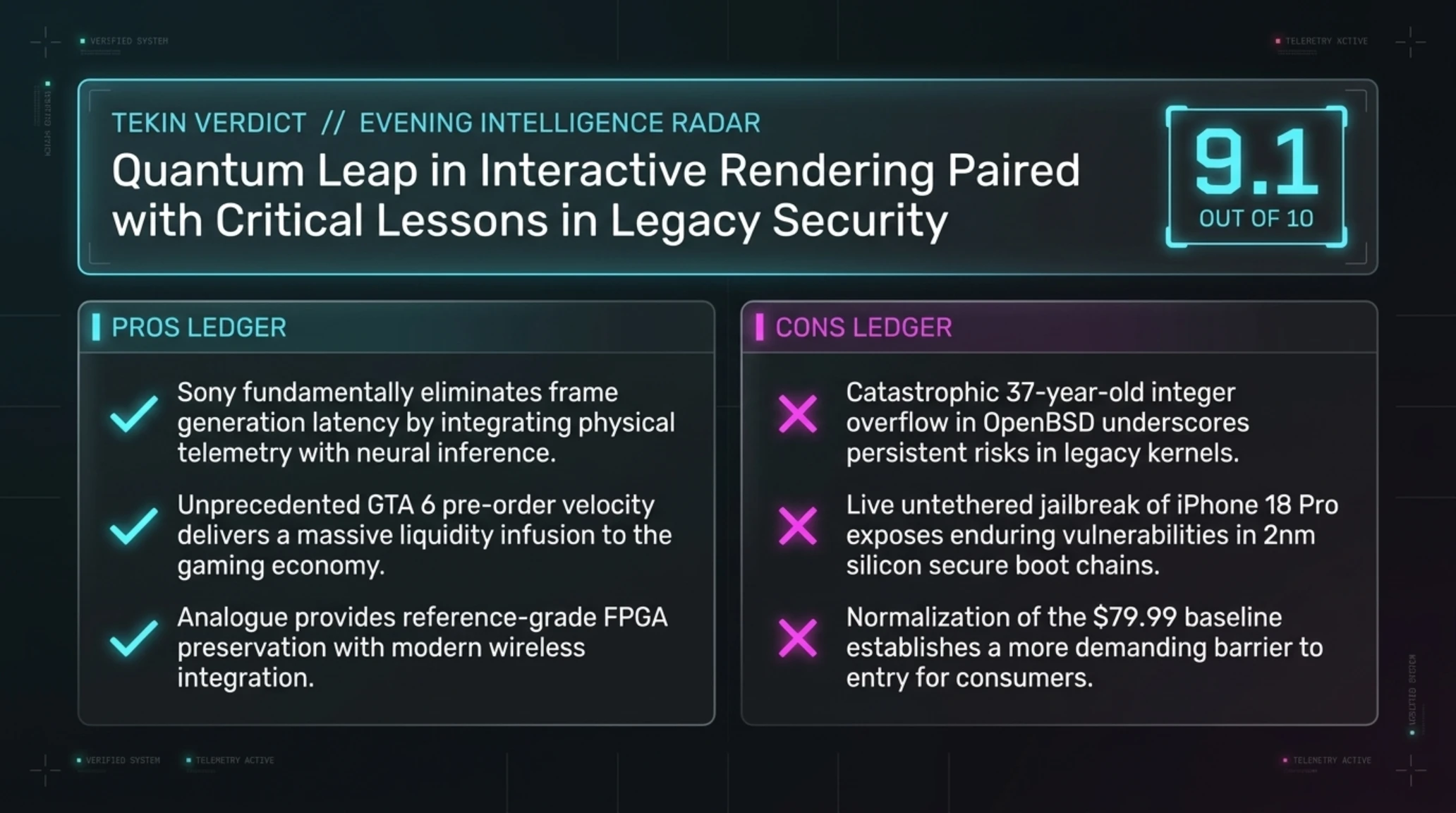
- Sony's breakthrough patent fundamentally eliminates frame generation latency by integrating DualSense telemetry with neural inference.
- Unprecedented commercial pre-order velocity for GTA 6 delivers an enormous liquidity infusion to the global gaming economy.
- Analogue's Super Nt+ and Mega Sg+ consoles provide reference-grade FPGA hardware preservation with integrated modern connectivity.
- Catastrophic disclosure of a 37-year-old integer overflow in OpenBSD underscores persistent architectural risks in legacy Unix kernels.
- Live demonstration of an untethered hardware jailbreak on iPhone 18 Pro exposes enduring vulnerabilities in modern silicon secure boot chains.
- Normalization of the $79.99 AAA software price point establishes a more demanding barrier to entry for mainstream consumers.
Editorial Verdict & Authoritative International Sources
Quantum Leap in Interactive Rendering Paired with Critical Lessons in Legacy Security
Sunday evening, October 18, 2026, confirms that the future of interactive entertainment will be written by low-latency neural pipelines and multibillion-dollar commercial milestones, but lasting platform resilience requires ruthless code auditing and defense-in-depth hardware engineering.
- IGN Entertainment: Sony Patent Analysis: PS6 Generation Super Sampling & Controller Telemetry
- GameSpot: Grand Theft Auto VI Financial Telemetry, Pre-Order Records & Commercial Velocity
- The Hacker News: Forensic Analysis of Calif.io 37-Year OpenBSD 7.9 Local Privilege Escalation Exploit
- Decrypt Media: Hexacon Paris Keynote: World First Live Untethered Jailbreak of iPhone 18 Pro
- Eurogamer: Analogue Super Nt+ and Mega Sg+ Official Hardware Reveal & FPGA Architecture Review
Frequently Asked Questions & Technical Analysis
How does Sony's Generation Super Sampling patent eliminate the input latency of traditional frame generation?
Unlike existing PC interpolation techniques that hold and delay the render pipeline until the next frame is drawn, Sony's PS6 architecture uses neural frame extrapolation. By streaming real-time DualSense analog stick deflection and trigger telemetry into inference tensor cores, the system predicts and renders forward frames with under 6-8ms of added latency.
What are the audited commercial metrics for GTA 6 digital pre-orders through mid-October 2026?
Confirmed storefront telemetry indicates 6.08 million pre-orders generating $594 million in gross digital revenue. PlayStation 5 accounts for 74% of volume, with Xbox Series capturing 26%. Analysts project total pre-orders will reach 25 million units, securing $2.0 billion in day-one revenue.
How was a 37-year-old integer overflow in OpenBSD 7.9 weaponized to achieve local root?
The SysV shared memory attachment counter was declared as a signed 16-bit integer in 1989. Researchers spawned concurrent processes to wrap the counter past 32,767 into negative values, triggering a premature Use-After-Free condition. Chaining this with a kernel socket write primitive bypassed KARL, SMAP, and SMEP to overwrite process credentials.
What makes the iPhone 18 Pro jailbreak demonstrated at Hexacon Paris historically significant?
It represents the first true untethered hardware jailbreak on modern Apple silicon. The exploit survives complete device reboots and passcode lock cycles, establishing an authenticated SSH root shell across wireless networks without requiring external computer connection.
What new features are confirmed in the leaked Shrek 2: The Game Remastered on Microsoft Store?
Developed by Aspyr Media, the remaster runs at native 4K 60 FPS and features modern dynamic lighting, rebuilt high-res textures, a dedicated Photo Mode, retro cheat code toggles, and seamless 4-player cooperative multiplayer supporting both local couch and online co-op.
How do Analogue's Super Nt+ and Mega Sg+ differ from earlier FPGA console revisions?
The Plus revisions integrate native Bluetooth and low-latency 2.4GHz wireless radios directly onto the main PCB, eliminating external dongles. They also feature modern USB-C power delivery, updated Analogue OS profiles, and dynamic memory caching that enables real-time cartridge hot-swapping without rebooting.
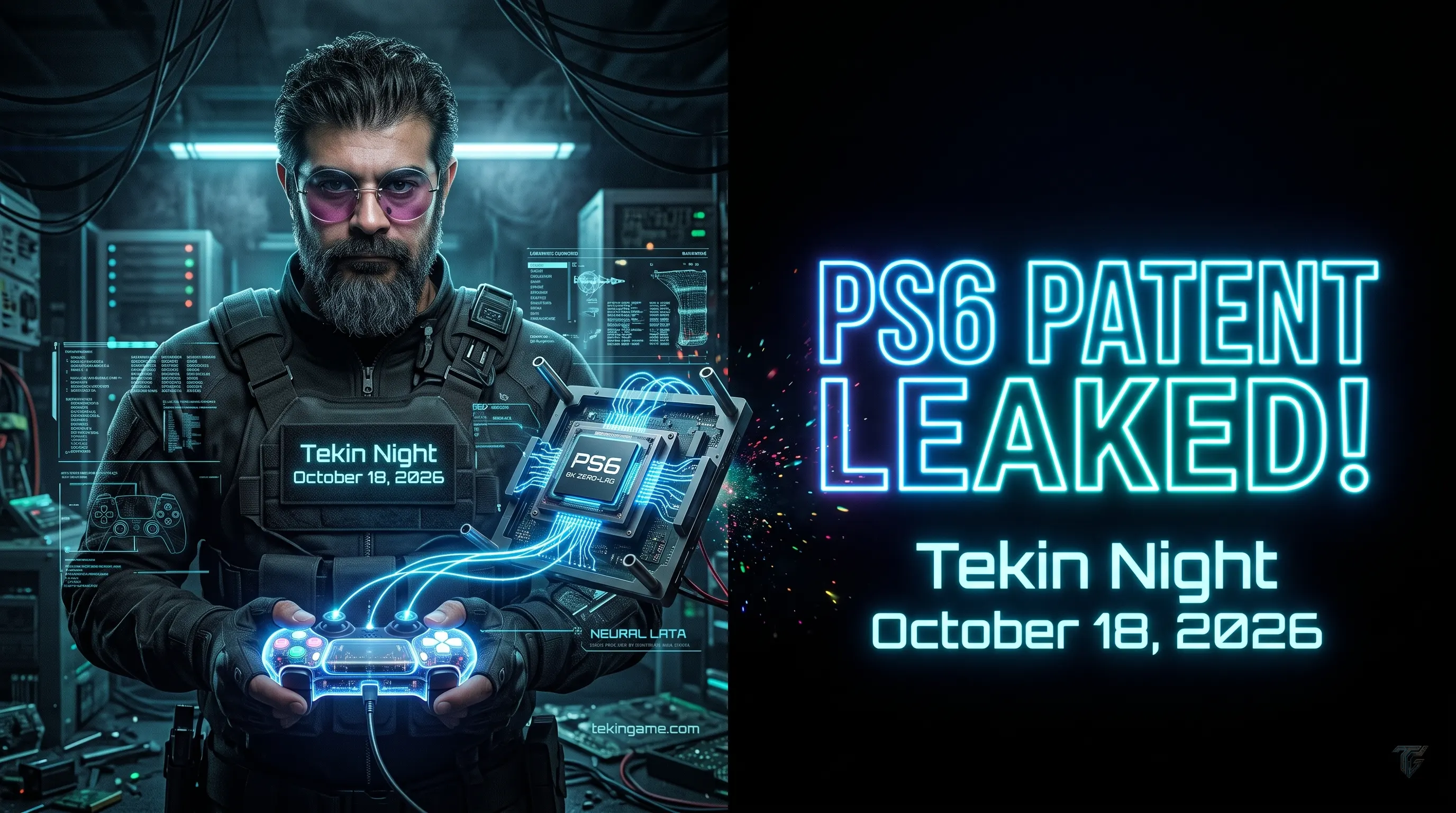
Additional Gallery: Tekin Night | Oct 18: PS6 Zero-Lag Patent, GTA 6 $2B & OpenBSD Root