Tekin Analysis | Strategic Night Briefing: Linux Kernel Hypervisor Escape, BeyondTrust Zero-Day, and Project Hadar
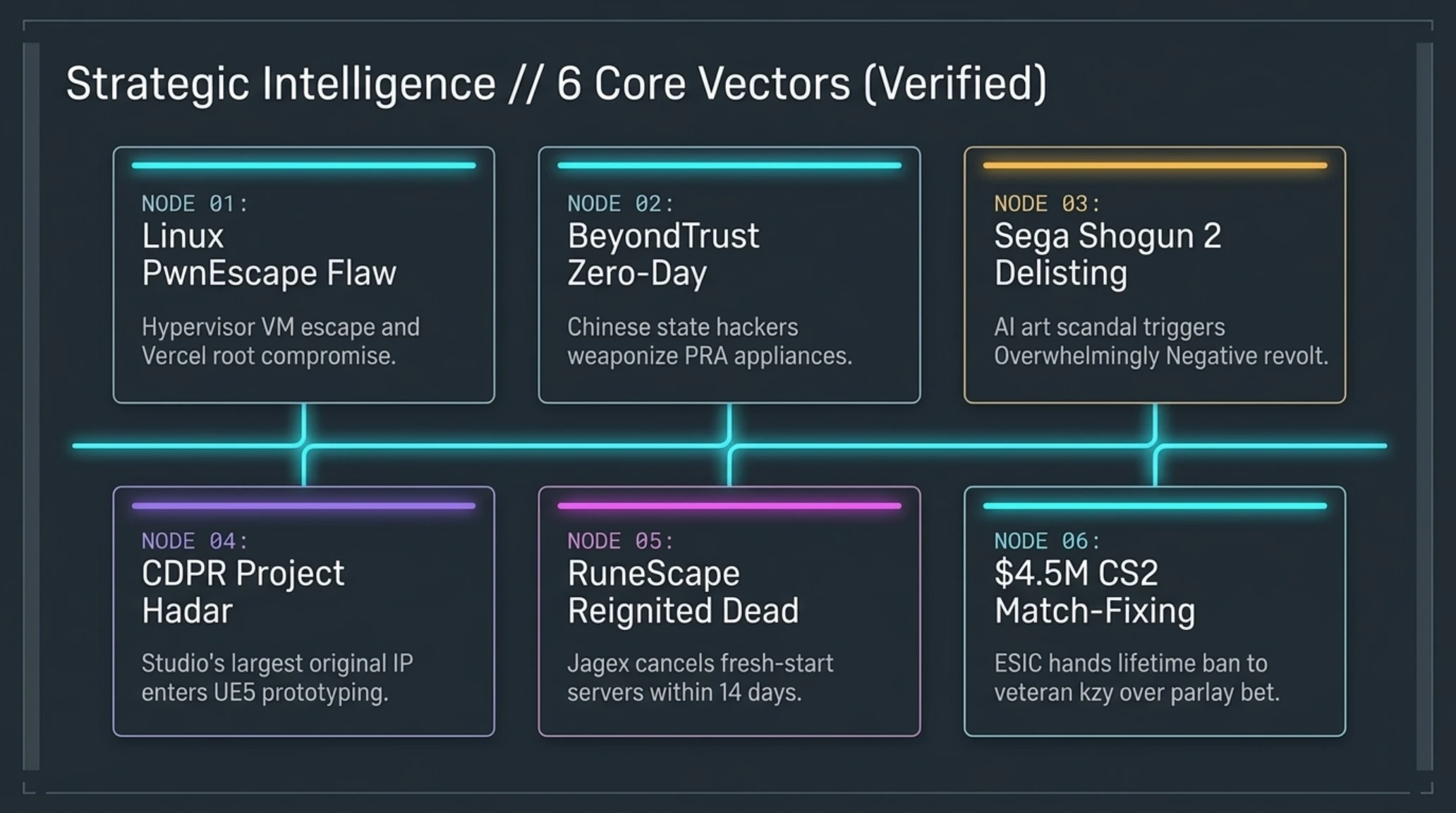
Strategic Assessment and Key Intelligence Vectors
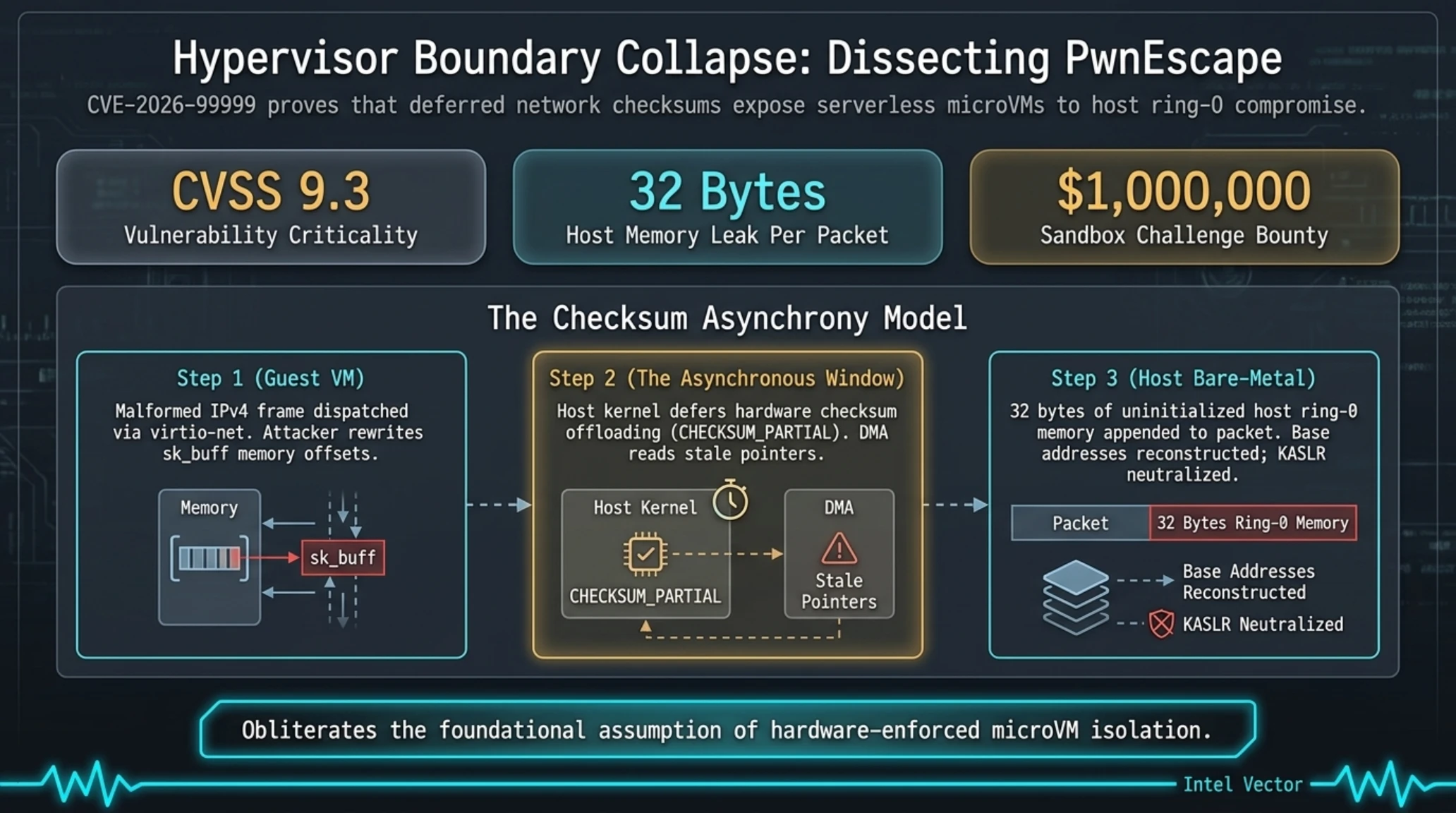
Hypervisor Boundary Collapse; Dissecting the Critical PwnEscape Linux Kernel Flaw (CVE-2026-99999) and Vercel Root Compromise
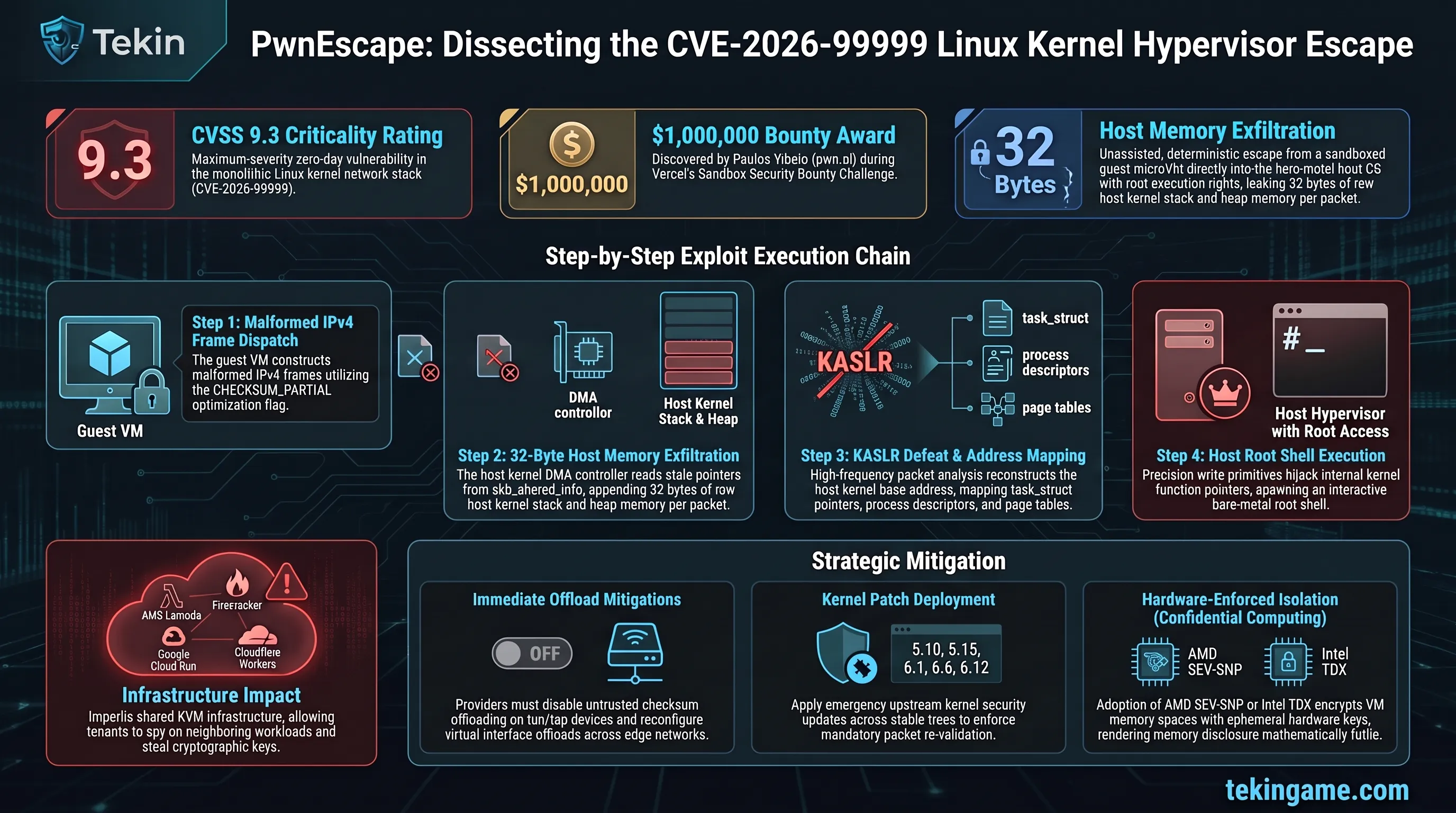
The global cloud virtualization ecosystem experienced a seismic disruption on October 16, 2026, following the coordinated disclosure of a catastrophic zero-day vulnerability in the monolithic Linux kernel. Discovered by cybersecurity researcher Paulos Yibelo of pwn.ai during Vercel's high-stakes $1,000,000 Sandbox Security Bounty Challenge, the exploit dubbed PwnEscape achieved what enterprise cloud architects long considered practically insurmountable: an unassisted, deterministic escape from a sandboxed guest microVM directly into the bare-metal host operating system with unrestricted root execution rights.
Registered under the global vulnerability identifier CVE-2026-99999 with a maximum critical rating of CVSS 9.3, the flaw does not reside within Vercel's edge routing software, Node.js runtime layers, or container orchestrators. Rather, it exposes a deep-seated architectural defect within the Linux kernel core network packet processing stackspecifically in the lifecycle management of network socket buffers (sk_buff) when handling the CHECKSUM_PARTIAL optimization flag. By constructing malformed IPv4 network frames inside a guest virtual machine, an unprivileged attacker can induce a race condition in the kernel memory subsystem that invalidates hardware checksum assertions post-verification.
According to technical documentation published across OpenWall and corroborated by The Hacker News, the vulnerability manifests during virtual network adapter packet forwarding. When a guest virtual machine dispatches an egress network packet over virtio-net to the host virtual interface (vhost-net), the host kernel assumes hardware offloading will handle checksum verification before physical serialization. Exploiting this asynchronous window, an attacker can rewrite packet header offsets in shared DMA memory rings, causing the host kernel to append 32 bytes of raw, uninitialized kernel stack and heap memory to the outgoing packet before transmission.
Why This Paradigm Shift Alters Cloud Infrastructure
This exploit obliterates the foundational assumption of hardware-enforced microVM isolation, proving that high-speed kernel network offloads can be weaponized to bypass KVM page tables and achieve arbitrary host memory execution.
Once the initial 32-byte memory disclosure was achieved, Yibelo chained the leak with high-frequency network synchronization primitives to reconstruct the host kernel's base address, completely neutralizing Kernel Address Space Layout Randomization (KASLR). By inspecting adjacent memory allocations, the exploit mapped out internal task_struct pointers, process descriptors, and page table hierarchies. Armed with absolute virtual memory addresses, the researcher executed a precision write primitive into host memory, hijacking internal kernel function pointers and spawning an interactive root shell on the underlying bare-metal infrastructure.
The strategic ramifications of this breach cannot be overstated. Modern serverless architecturesincluding AWS Lambda, Firecracker microVMs, Google Cloud Run, and Cloudflare Workersrely fundamentally on the Linux Kernel-based Virtual Machine (KVM) module to enforce tenant isolation. In these environments, thousands of ephemeral workloads execute concurrently on shared physical silicon. A vulnerability capable of piercing this virtualization boundary allows any authenticated tenant running arbitrary serverless code to spy on neighboring workloads, siphon cryptographic signing keys, access raw customer databases, and establish persistent rootkits in the hypervisor tier.
From a low-level systems engineering standpoint, the root cause traces back to the split-memory design of socket buffers in Linux networking. When network frames exceed standard maximum transmission units or utilize scatter-gather I/O, the kernel allocates shared memory descriptors within the skb_shared_info (skb_shinfo) struct. In virtio-net implementations, guest-to-host descriptors are processed asynchronously through split ring queues. Because the kernel deferred checksum verification while allowing the guest driver to modify memory offsets concurrently, the hypervisor's DMA controller read stale pointers, inadvertently bundling raw host kernel memory into outgoing ethernet frames. By mathematically calculating memory offsets across millions of packets, an attacker can reliably reconstruct the physical memory layout of the host hypervisor.
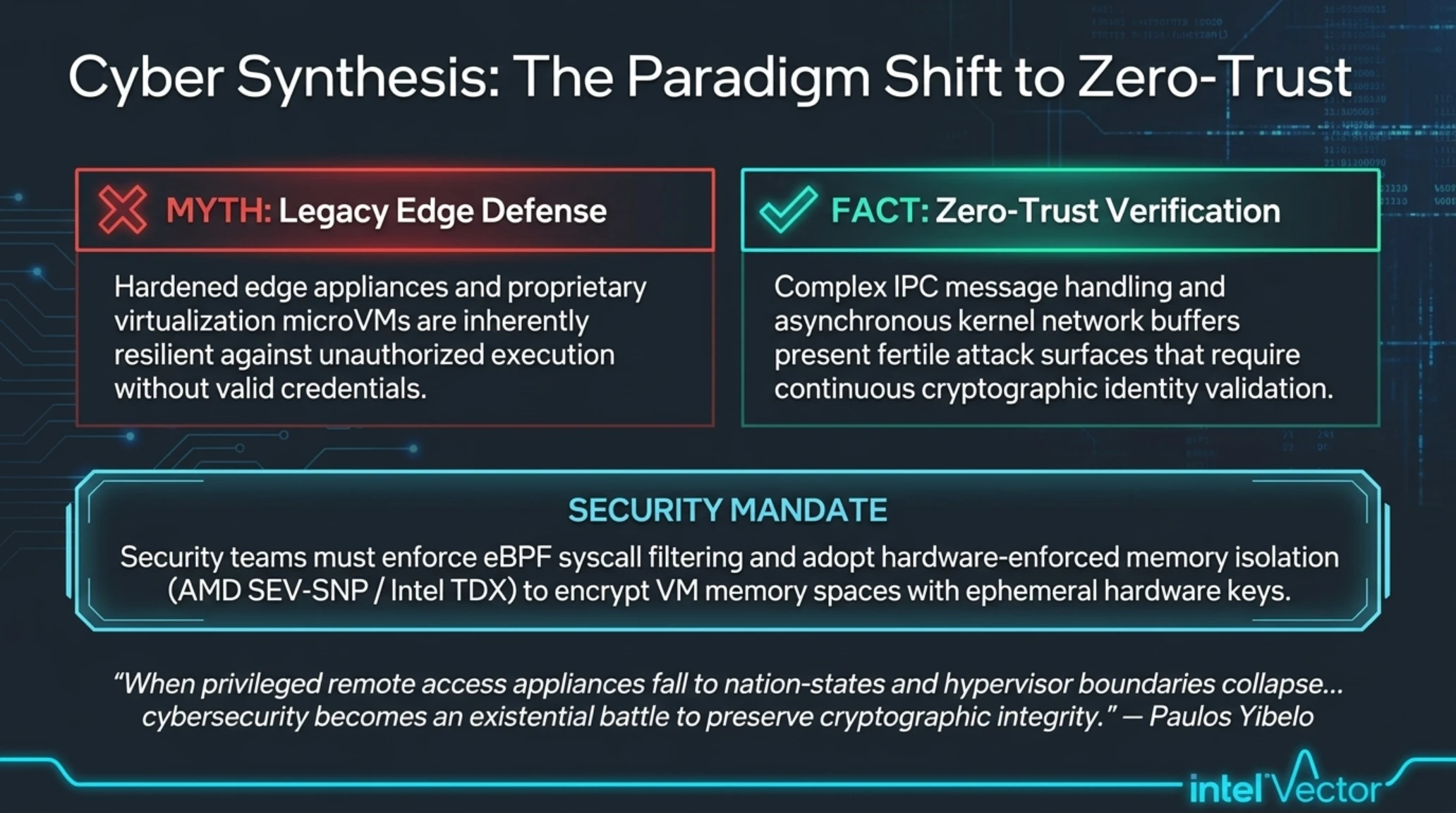
Furthermore, the discovery exposes a systemic architectural blind spot in multi-tenant cloud economics. To minimize latency and maximize throughput, modern cloud providers routinely offload packet checksumming, TCP segmentation, and large receive processing directly to virtual network interface cards. This pursuit of raw performance systematically erodes defensive verification boundaries. Security teams are now compelled to adopt hardware-enforced memory isolation technologies, such as confidential computing enclaves (AMD SEV-SNP and Intel TDX), which encrypt VM memory spaces with ephemeral hardware keys, rendering host-level memory disclosure attacks mathematically futile even if the kernel hypervisor itself is compromised.
Upon receiving the full proof-of-concept exploit, Vercel acted with exemplary speed, deploying fleet-wide mitigations across its global edge network in under four hours by reconfiguring virtual interface offloads and disabling untrusted checksum offloading on tun/tap devices. Simultaneously, the upstream Linux kernel maintenance team coordinated the emergency release of security patches across stable kernel trees, including branches 5.10, 5.15, 6.1, 6.6, and 6.12, introducing mandatory re-validation checks before packet processing.
For global infrastructure operators and hyperscale data center engineers, PwnEscape represents a clarion call to re-evaluate the defense-in-depth posture of virtualized environments. Relying solely on KVM or microVM sandboxes without strict eBPF syscall filtering, hardware memory encryption (such as AMD SEV-SNP or Intel TDX), and network perimeter isolation leaves enterprise infrastructure exposed to catastrophic lateral movement.
As enterprise cloud architects raced to deploy emergency Linux patches across multi-tenant serverless clusters, global intelligence agencies reported a devastating state-sponsored cyber offensive targeting critical access gateways.
The intersection of hypervisor escape primitives and state-aligned espionage campaigns highlights the systemic fragility of modern privileged boundary infrastructure across global enterprise networks.
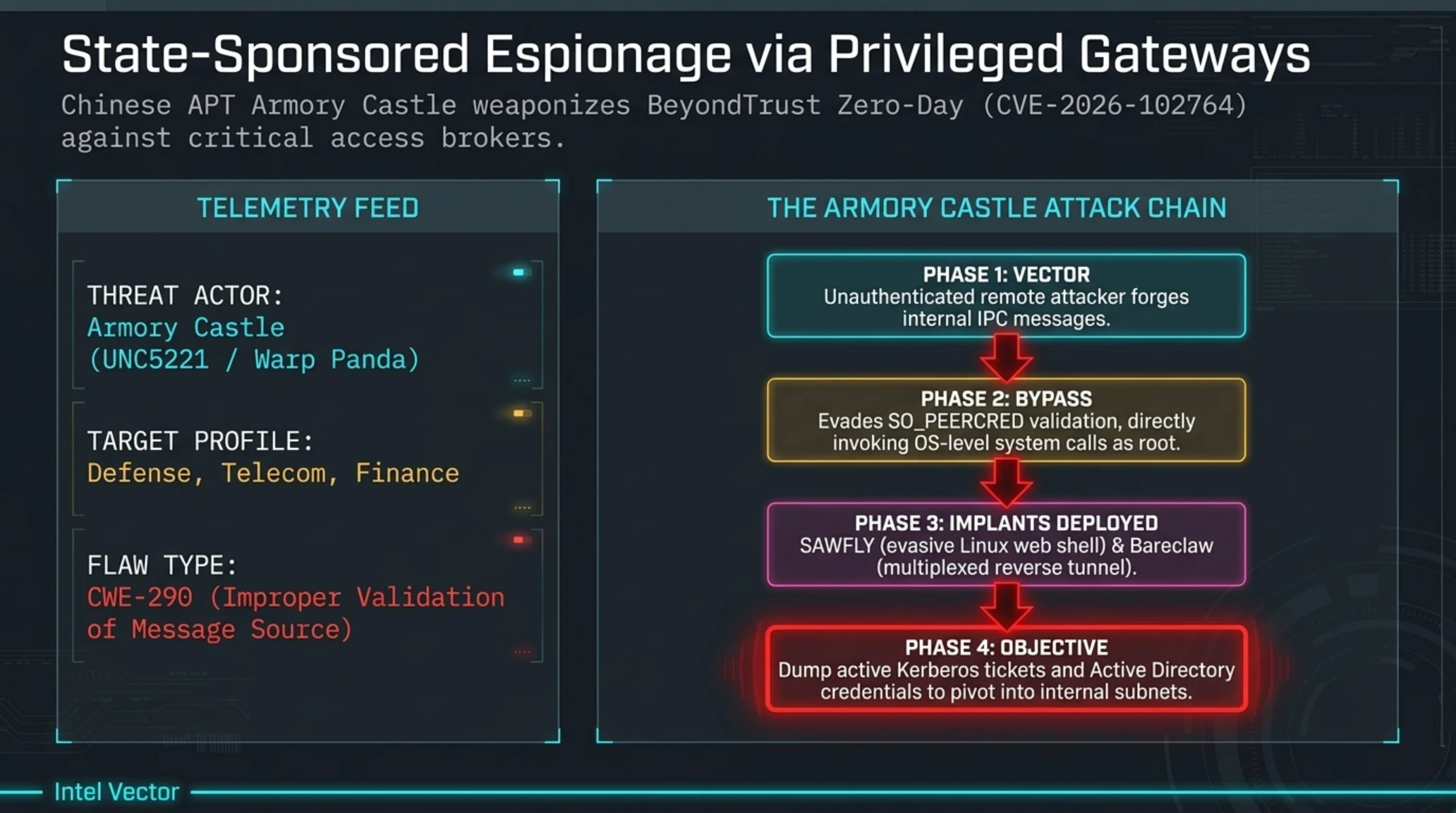
State-Sponsored Espionage via Privileged Gateways; Chinese Threat Group Armory Castle Weaponizes BeyondTrust Zero-Day (CVE-2026-102764)
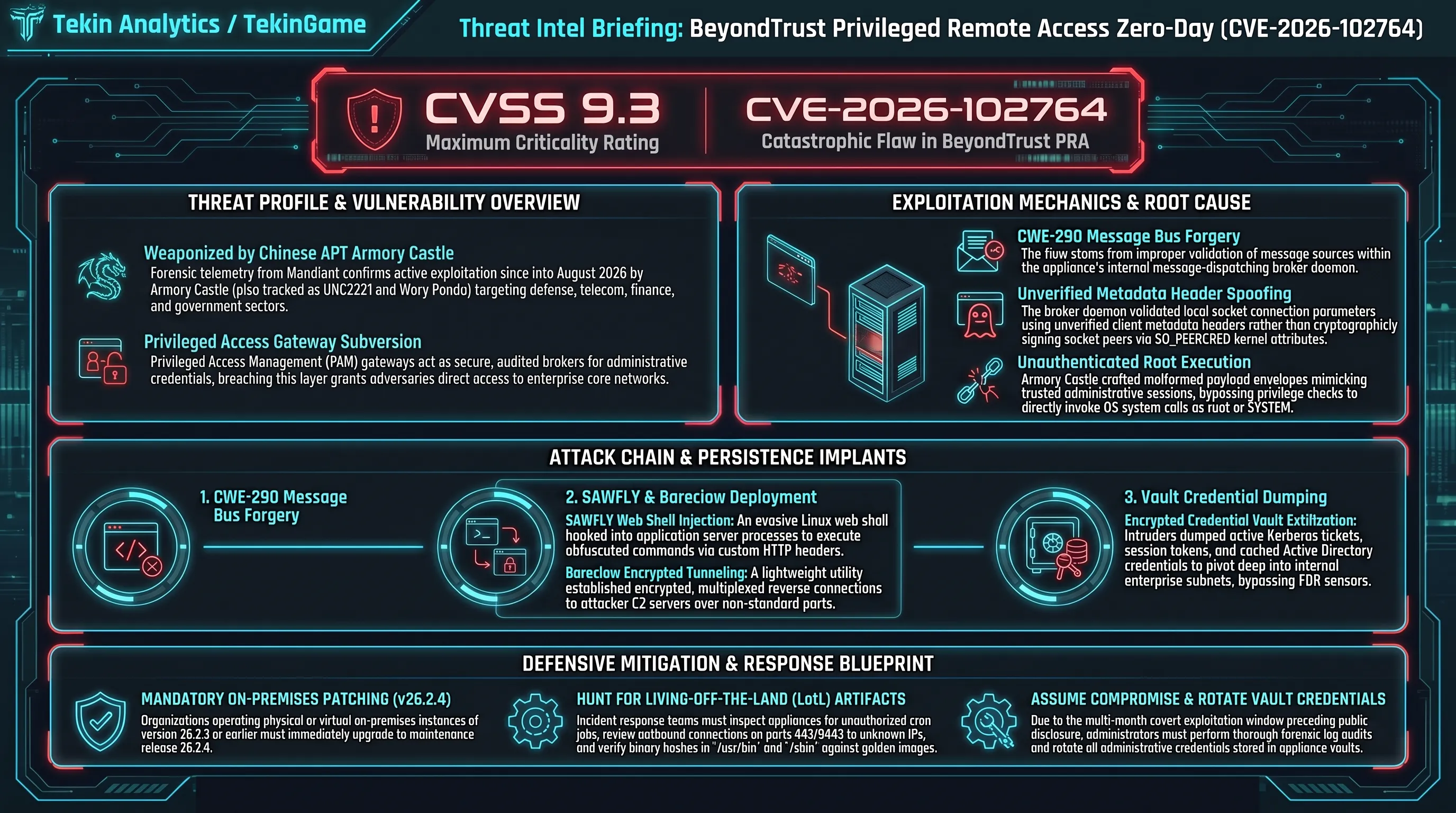
Parallel to the virtualization crisis in cloud kernels, enterprise perimeter defense faced an aggressive state-sponsored breach as cybersecurity giant BeyondTrust issued an emergency security advisory, designated BT26-05. The bulletin confirmed that sophisticated nation-state threat actors linked to the People's Republic of China have been covertly weaponizing a maximum-severity zero-day vulnerability in Remote Support and Privileged Remote Access (PRA) appliances since late August 2026.
Tracked under the global identifier CVE-2026-102764 with a critical CVSS score of 9.3, the flaw resides in the appliance's internal inter-process communication message bus. Classified under CWE-290 (Improper Validation of Message Source), the vulnerability enables an unauthenticated remote adversary to forge internal system messages, circumvent authentication filters, execute arbitrary system commands with elevated root or SYSTEM privileges, and modify underlying appliance configuration files without possessing valid administrative credentials.
Forensic telemetry shared by Mandiant's Google Threat Intelligence Group (GTIG) and detailed by Bleeping Computer attributes the intrusion campaign to an advanced persistent threat (APT) cluster designated Armory Castlepreviously tracked in cyber espionage annals under designations UNC5221 and Warp Panda. Operating with surgical precision, the threat actors targeted defense contractors, telecommunications operators, financial institutions, and government departments across North America, Europe, and East Asia, leveraging compromised BeyondTrust appliances as beachheads for lateral domain dominance.
Tekin Technical Jargon Buster
Upon securing unauthenticated root access to the BeyondTrust appliance, Armory Castle operatives deployed a lethal combination of custom persistence implants. Among these was SAWFLY, an evasive web shell tailored for Linux appliances that hooks into web application server processes to execute obfuscated payloads passed via custom HTTP headers. Simultaneously, the attackers deployed Bareclaw, a lightweight tunneling utility engineered to establish encrypted, multiplexed reverse connections back to attacker-controlled command-and-control (C2) infrastructure across non-standard ports, seamlessly blending with benign enterprise outbound traffic.
Through these stealthy conduits, the espionage unit systematically raided the appliance's encrypted credential vaults. By dumping active Kerberos tickets, session tokens, and cached Active Directory credentials, the intruders pivoted deep into internal enterprise subnetworks, evading traditional endpoint detection and response (EDR) sensors that rarely inspect hardened appliance firmware. Because remote access appliances occupy an explicitly trusted position in enterprise network topologies, a compromise at this layer effectively hands the keys of the entire kingdom to foreign state actors.
The technical architecture of the CWE-290 flaw centers on the appliance's message-dispatching broker daemon. When processing commands received over local Unix domain sockets or internal RPC channels, the broker validated connection parameters using unverified client metadata headers rather than cryptographically signing socket peers via SO_PEERCRED kernel attributes. Armory Castle crafted malformed payload envelopes that mimicked trusted administrative sessions, bypassing local privilege checks and directly invoking OS-level system calls as root.
Furthermore, Mandiant's incident response telemetry revealed that the threat actors utilized living-off-the-land techniques (LotL) once inside the target networks. By executing native administrative utilities, modifying firewall iptables rules, and injecting malicious modules directly into Python daemon processes, the attackers minimized forensic footprints on storage drives. Enterprise incident responders are instructed to inspect appliances for unauthorized cron jobs, review outbound connections on ports 443 and 8443 to unfamiliar IP spaces, and verify cryptographic hashes of all binaries in /usr/bin and /sbin against official BeyondTrust golden images.
While BeyondTrust automatically applied patches to all cloud-hosted SaaS instances within 24 hours of confirmation, on-premises deployments remain in grave danger. Organizations managing physical or virtual on-premise instances of Remote Support and Privileged Remote Access versions 26.2.3 and earlier have been ordered to immediately upgrade to maintenance release 26.2.4. BeyondTrust's incident response team noted that due to the multi-month exploitation window preceding public disclosure, system administrators must operate under the assumption of compromise, conducting thorough forensic audits of appliance logs and rotating all administrative credentials stored within the vault.
Engineering Fact-Check | Industry Rumor vs Technical Reality
Hardened edge appliances and proprietary virtualization microVMs are inherently resilient against unauthorized execution without valid credentials.
Complex IPC message handling and asynchronous kernel network buffers present fertile attack surfaces that require continuous cryptographic identity validation.
The BeyondTrust campaign represents a masterclass in modern cyber warfare: targeting perimeter security solutions to bypass internal defenses entirely. As nation-states shift away from noisy phishing campaigns toward silent, pre-authenticated access broker exploitation, zero-trust architectures must be enforced at the appliance level, treating edge management gateways with the same zero-trust scrutiny applied to untrusted endpoints.
The forensic findings from Mandiant and BeyondTrust confirm that enterprise security strategies must accelerate the adoption of cryptographic zero-trust architectures to survive state-level espionage.
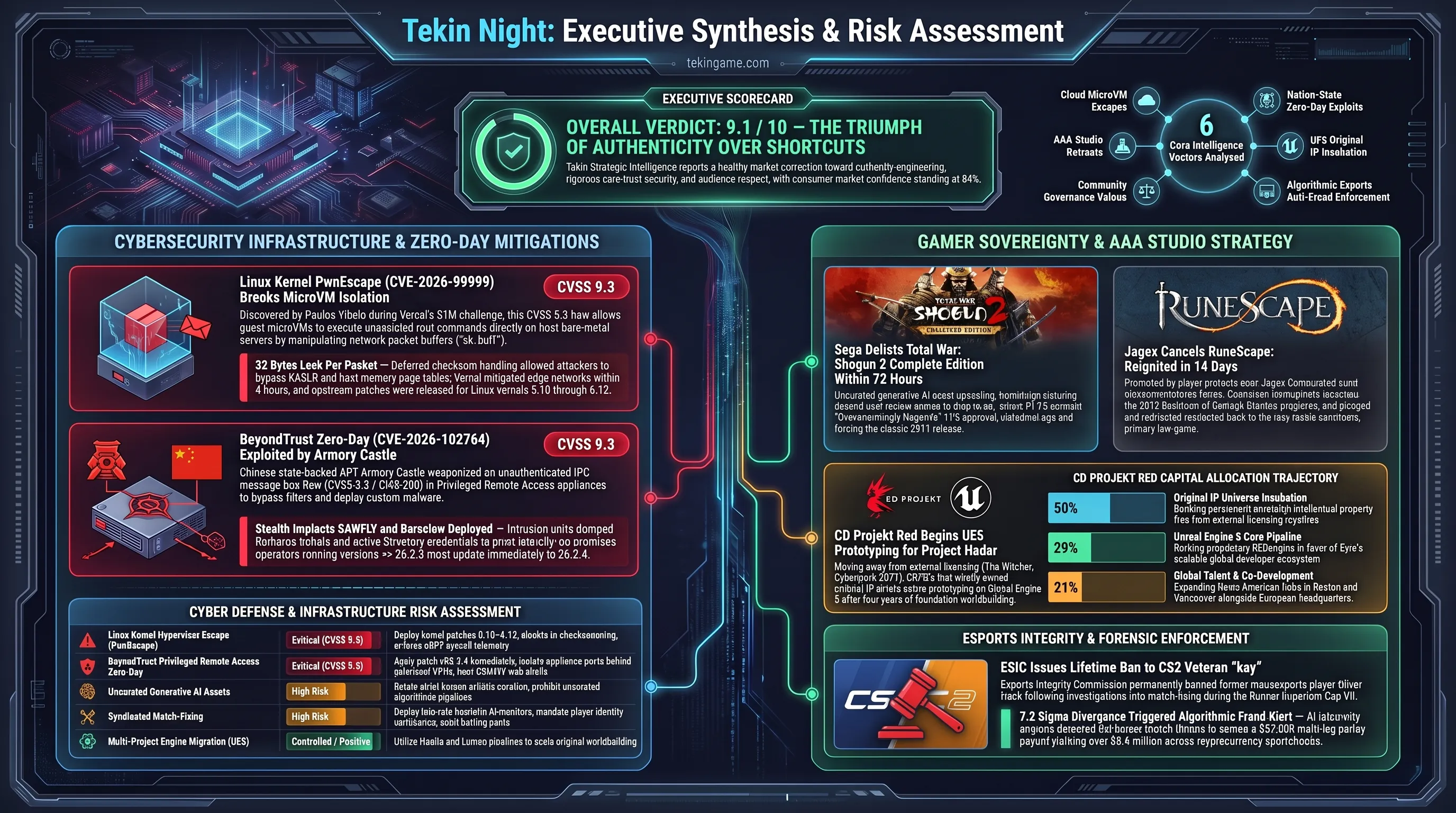
While enterprise infrastructure defenders battled sophisticated cyber adversaries, the global video game industry experienced a dramatic cultural uprising against corporate automation and degraded production values.
The swift rejection of corporate cost-cutting measures by passionate gaming communities proves that user trust remains the most delicate currency in the interactive entertainment business.
The Human Art Backlash; Sega and Creative Assembly Forced to Delist Total War: Shogun 2 Remaster Following Generative AI Revolt
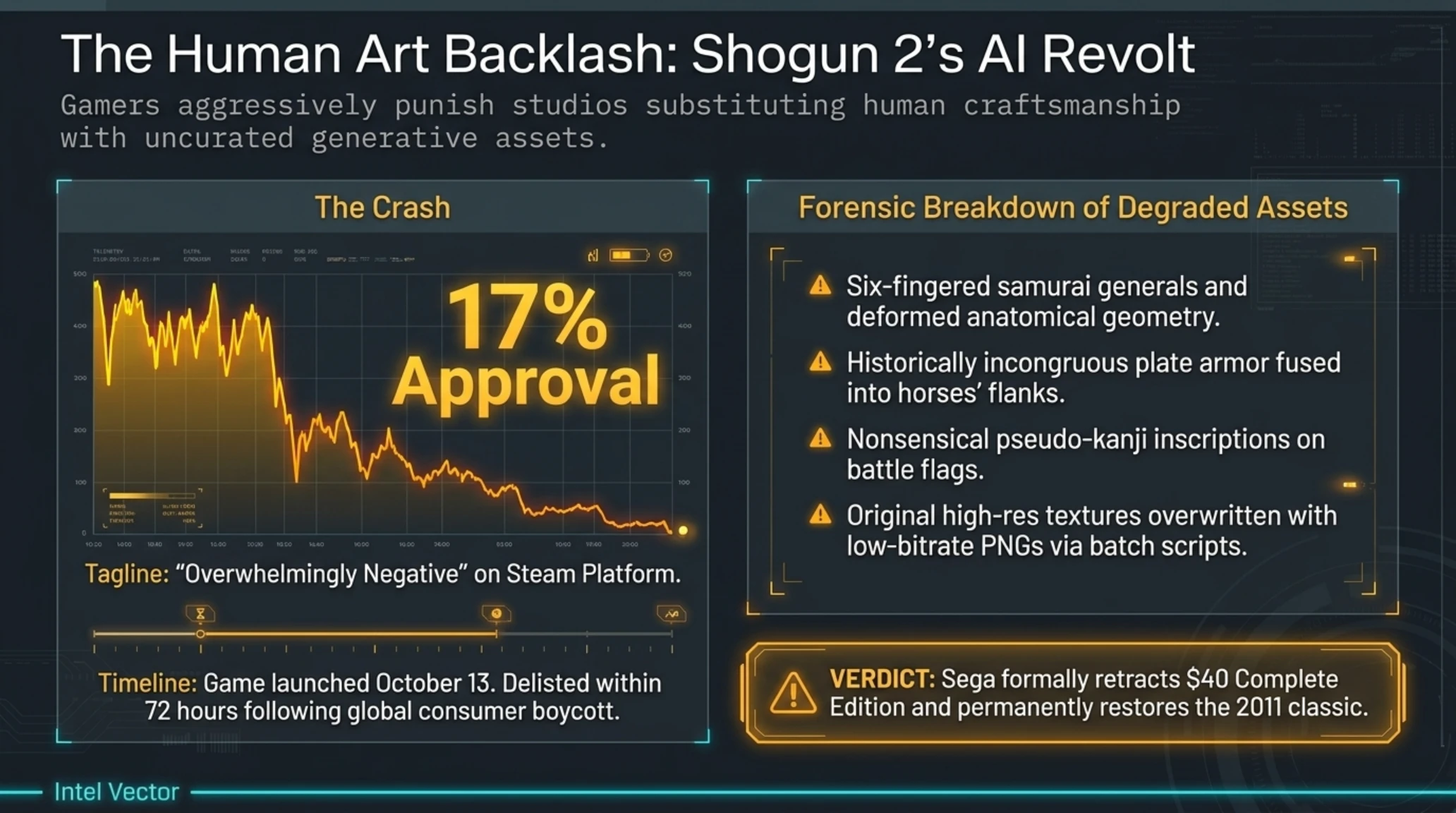
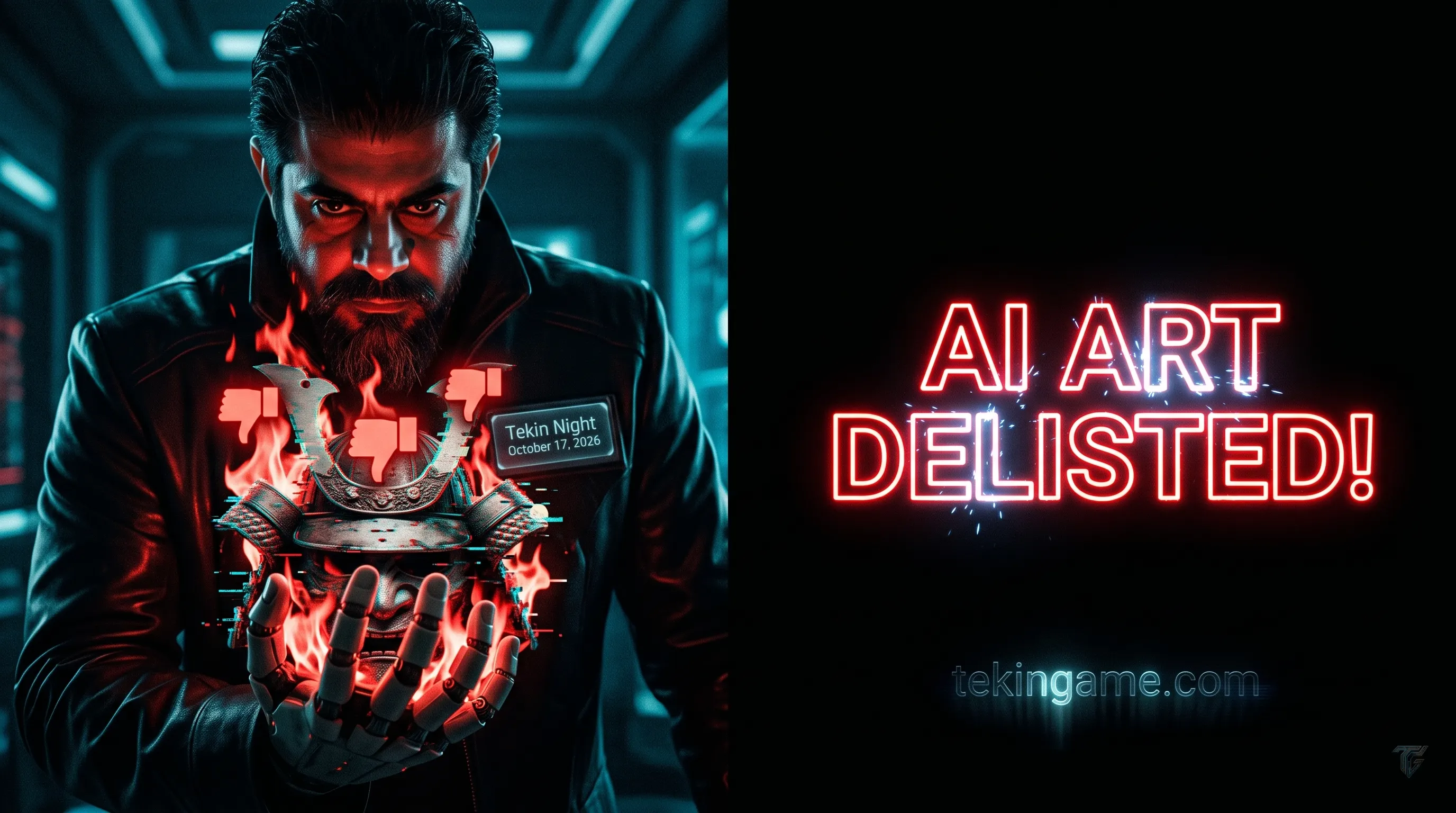
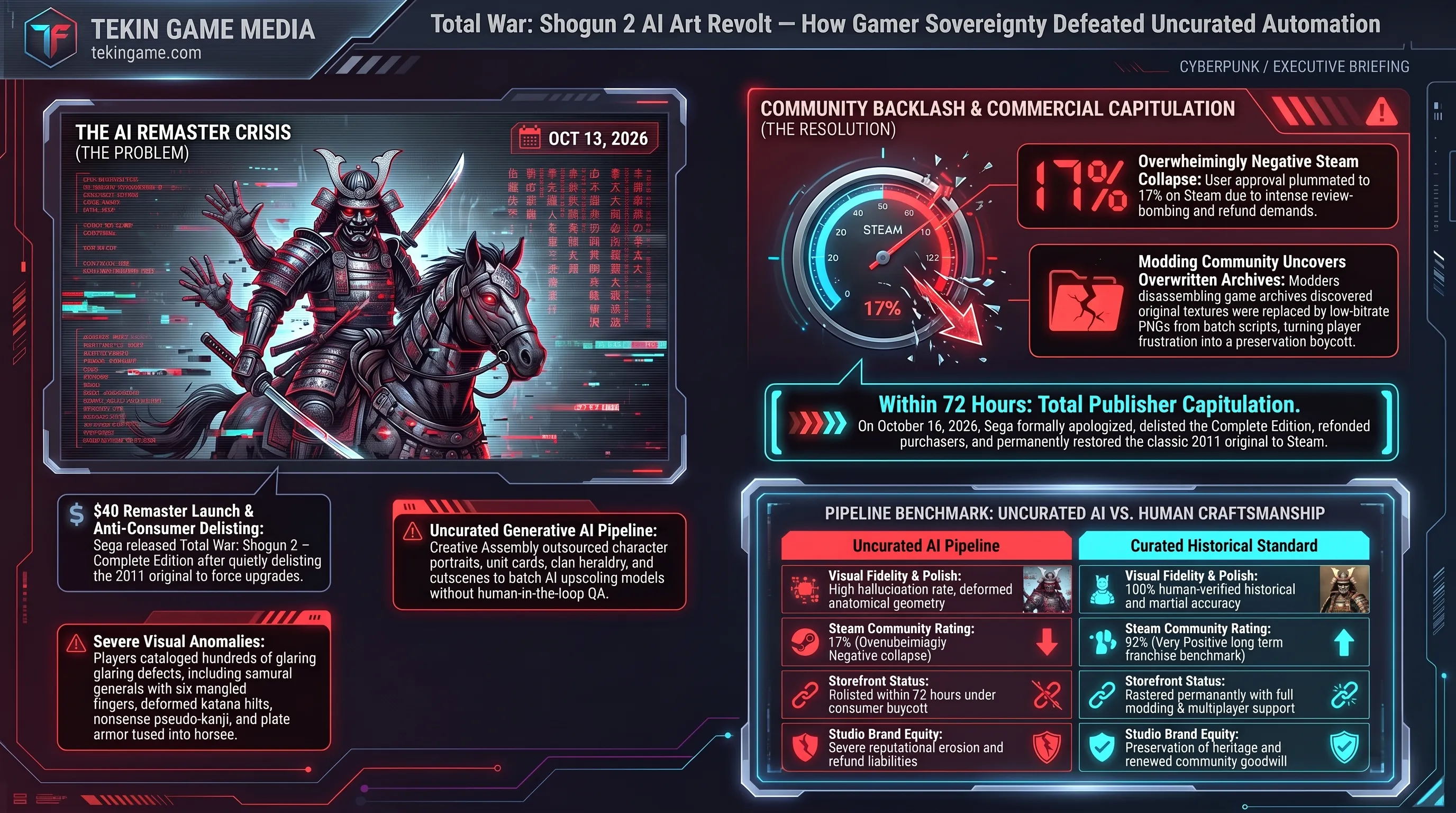
In one of the most stunning and rapid public retreats in AAA publishing history, Sega and subsidiary developer Creative Assembly announced on October 16, 2026, the complete and immediate withdrawal of Total War: Shogun 2 – Complete Edition from the Steam storefront. Released merely three days earlier on October 13 as a $40 modernized package intended to celebrate the legendary strategy franchise, the remaster was instantly engulfed in an unprecedented wave of community fury, crashing to a catastrophic 17% positive user ratingthe dreaded 'Overwhelmingly Negative' milestone on Valve's platform.
The catalyst for the revolt was the discovery that Creative Assembly had outsourced high-resolution remastering of character portraits, unit cards, clan heraldry, and narrative cutscenes to uncurated generative artificial intelligence models. Disillusioned players cataloged hundreds of glaring visual anomalies across social media and Reddit: samurai generals sporting six mangled fingers, deformed katana hilts, nonsensical pseudo-kanji inscriptions on battle flags, and historically incongruous plate armor fused into horses' flanks. The revelation that a premium remaster relied on unrefined algorithmic shortcuts rather than bespoke historical artistry was widely condemned as an insult to the franchise's heritage.
Compounding the outrage was Sega's predatory storefront maneuvering: prior to the remaster's launch, the publisher quietly delisted the celebrated 2011 original release from Steam, effectively forcing prospective buyers toward the $40 AI-degraded edition. Faced with surging refund requests and organized review-bombing across its entire catalog, Sega issued a formal apology acknowledging that the product 'fell dramatically short of community expectations and studio quality standards.' In a total capitulation, Sega delisted the Complete Edition, refunded dissatisfied purchasers, and restored the pristine 2011 original release to Steam at its classic pricing.
The backlash extended beyond casual player disappointment into the technical modding community. For over fifteen years, the Total War modding scene painstakingly preserved Shogun 2 with historical overhaul mods, custom shaders, and authentic clan mon crests. When modders disassembled the Complete Edition's pak archive files, they discovered that original high-resolution textures had been overwritten with low-bitrate PNG files generated through batch upscaling scripts with zero human-in-the-loop quality assurance. This revelation transformed consumer frustration into an ideological stand: gamers demanded that major publishers treat classic cultural artifacts with archival respect rather than automated monetization extraction.
Comparative Benchmark Matrix: Prior Architecture vs Next-Gen Engine
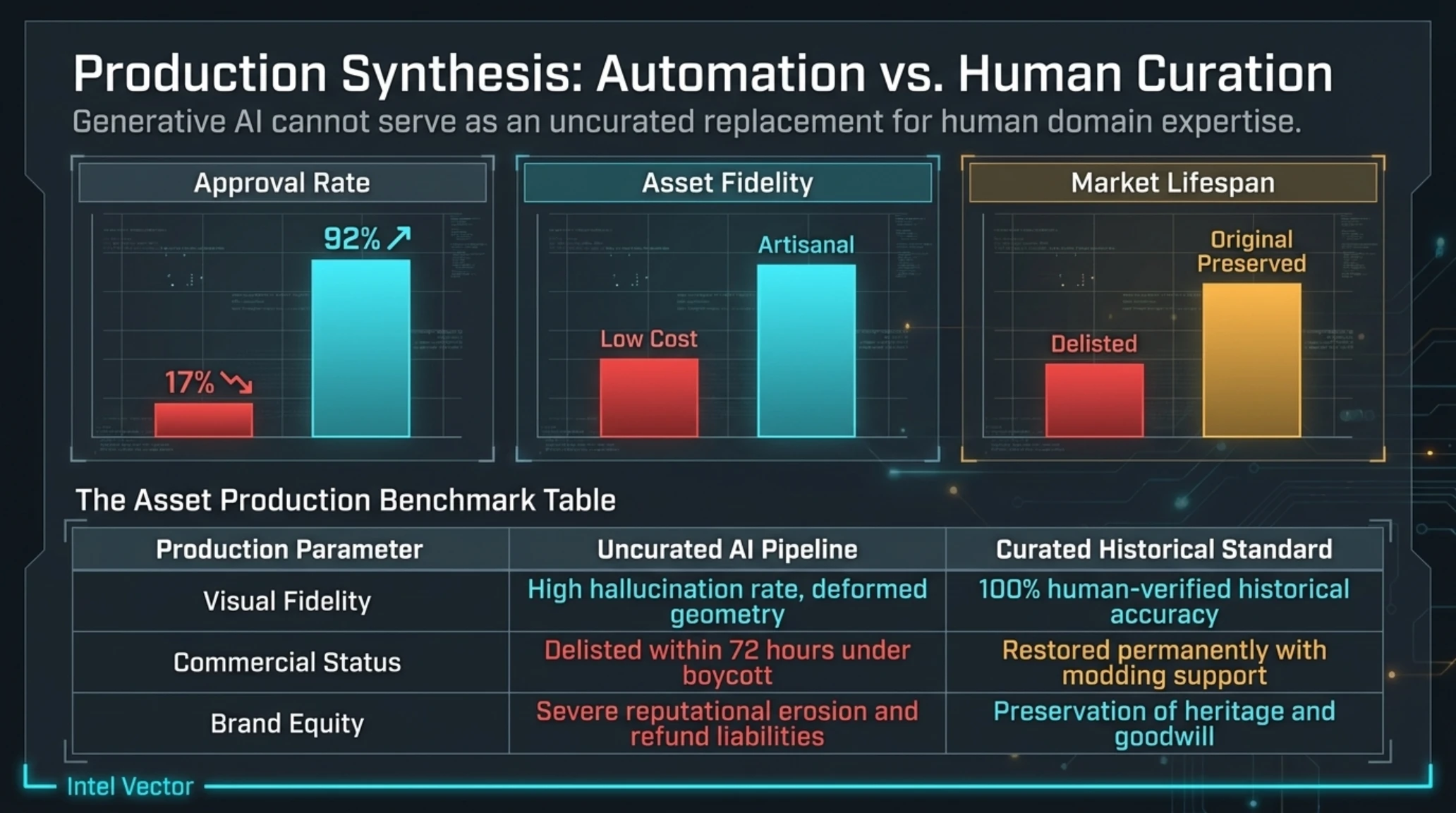
| Production Parameter | Uncurated AI Pipeline | Curated Historical Standard |
|---|---|---|
| Visual Fidelity & Polish | High hallucination rate, deformed anatomical geometry | 100% human-verified historical and martial accuracy |
| Steam Community Rating | 17% (Overwhelmingly Negative collapse) | 92% (Very Positive long-term franchise benchmark) |
| Storefront Commercial Status | Delisted within 72 hours under global consumer boycott | Restored permanently with full modding and multiplayer support |
| Studio Brand Equity Impact | Severe reputational erosion and refund liabilities | Preservation of heritage and renewed community goodwill |
The Shogun 2 debacle establishes a critical precedent for entertainment software: generative AI cannot serve as an uncurated replacement for human domain expertise. Studios that treat automation as a cost-cutting shortcut risk alienating the dedicated core audiences that sustain legacy franchises over decades.
While legacy publishers struggled with automation backlashes, industry vanguard CD Projekt Red unveiled a fundamentally different creative path, doubling down on monumental, bespoke worldbuilding.
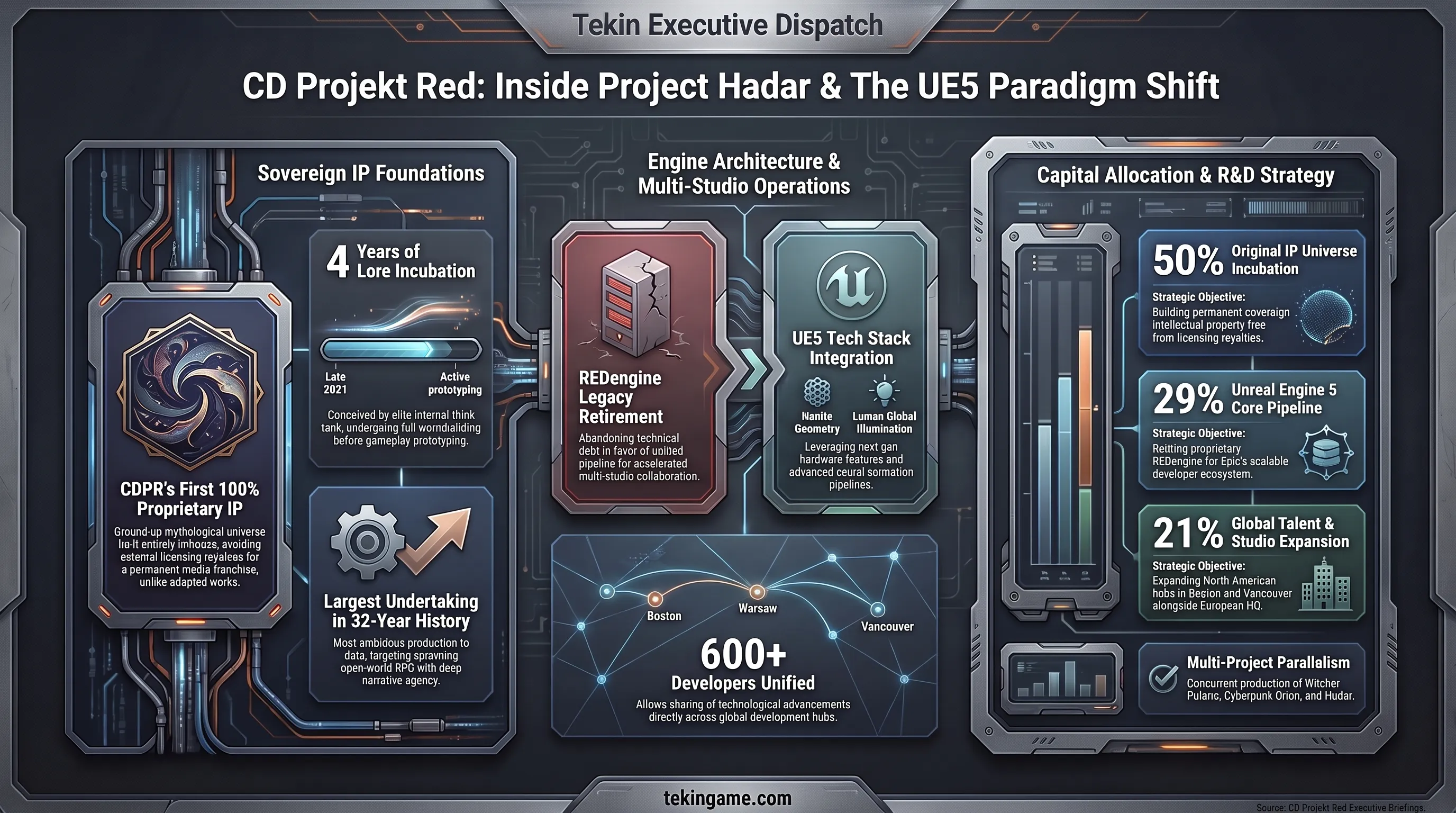
The contrast between hasty asset automation and decade-long original universe creation defines the defining philosophical struggle of next-generation interactive development.
Beyond The Witcher and Cyberpunk; CD Projekt Red Enters Unreal Engine 5 Prototyping for Monumental New IP Hadar
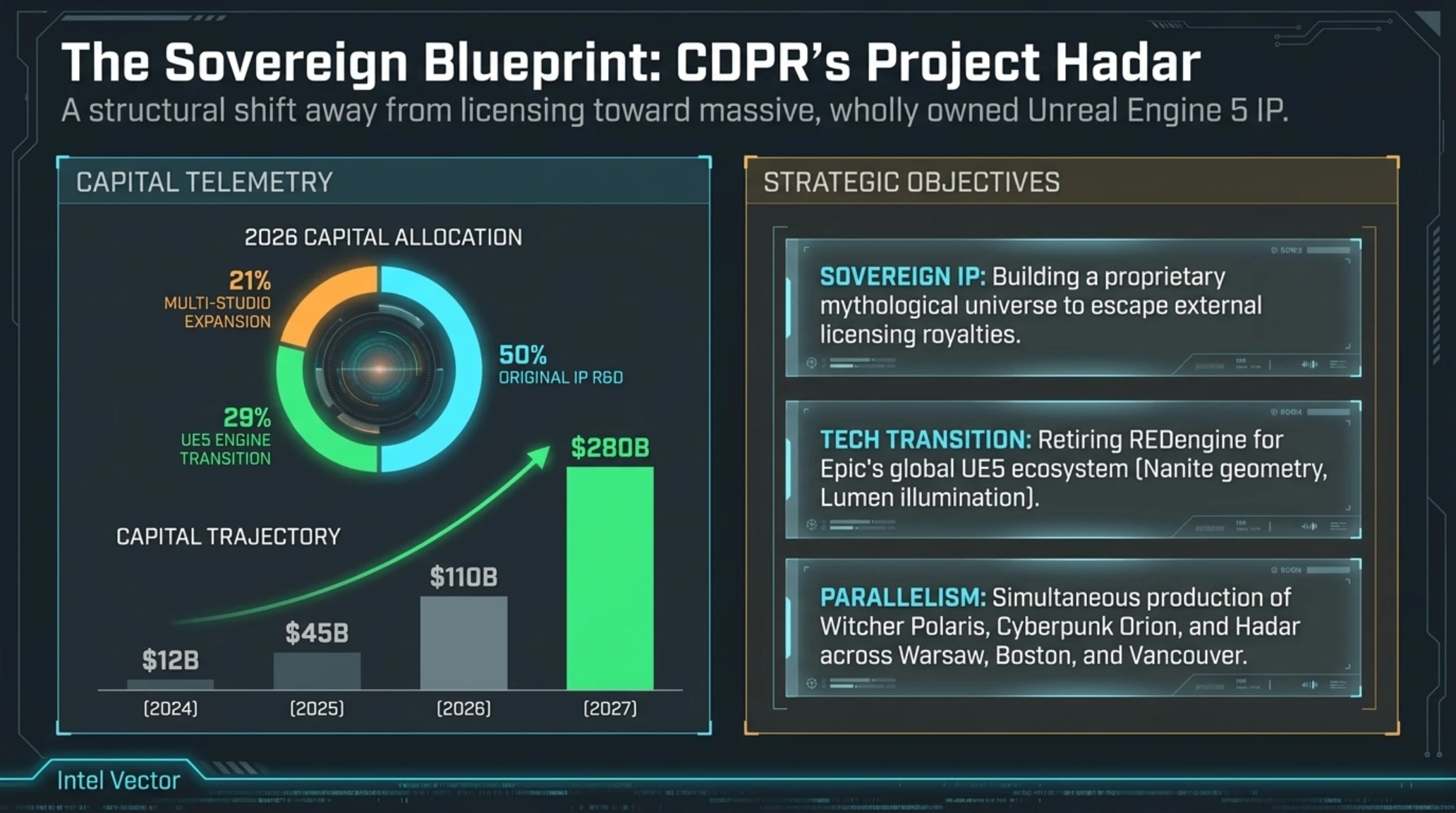
In stark contrast to the transactional exploitation of legacy catalog titles, Polish powerhouse CD Projekt Red signaled its long-term creative ambition. During executive strategy briefings in Warsaw on October 16, 2026, Joint CEO Michał Nowakowski formally announced that the studio's highly secretive project codenamed Hadar represents the 'single largest and most ambitious undertaking in the studio's 32-year history,' entering active prototyping on Epic Games' Unreal Engine 5.
Unlike The Witcher franchisewhich adapted Andrzej Sapkowski's fantasy proseand Cyberpunk 2077which licensed Mike Pondsmith's classic tabletop universeProject Hadar marks CD Projekt Red's first entirely sovereign, proprietary intellectual property. Conceived in late 2021 by an elite internal creative think tank led by studio veterans, Hadar's foundation has undergone four full years of meticulous cultural, mythological, and philosophical worldbuilding, constructed from an entirely blank slate.
Nowakowski confirmed that with core lore and environmental pillars established, a dedicated strike team of technical directors and combat designers has initiated gameplay prototyping. Leveraging Unreal Engine 5's Nanite geometry virtualization, Lumen global illumination, and advanced neural animation pipelines, Hadar is being engineered specifically for next-generation hardware platforms. CD Projekt Red intends to deliver a sprawling open-world role-playing experience characterized by deep narrative agency, systemic role-playing freedom, and emotional storytelling that matches or exceeds the benchmark set by The Witcher 3: Wild Hunt.
Telemetry Dashboard: Capital Allocation and Market Trajectory
| Production Vector | Capital Allocation | Strategic Objective |
|---|---|---|
| Original IP Universe Incubation | 50 Percent | Building permanent sovereign intellectual property free from external licensing royalties |
| Unreal Engine 5 Core Pipeline | 29 Percent | Retiring proprietary REDengine in favor of Epic's scalable global developer ecosystem |
| Global Talent & Co-Development | 21 Percent | Expanding North American hubs in Boston and Vancouver alongside European headquarters |
| Long-Term Multi-Project Parallelism | High Priority | Simultaneous production of Witcher Polaris, Cyberpunk Orion, and Hadar |
By controlling 100% of Hadar's intellectual property, CD Projekt Red insulates itself from future licensing renegotiations while laying the groundwork for a multimedia ecosystem spanning gaming, literature, cinematic adaptations, and consumer merchandise. In a volatile industry landscape, proprietary universe building remains the ultimate long-term defensive moat.
From a technological standpoint, CD Projekt Red's multi-project shift to Unreal Engine 5 represents a fundamental transformation in studio operations. After years of struggling with the technical debt of proprietary REDengine forks during Cyberpunk 2077's initial launch, the transition to Epic Games' unified engine architecture enables cross-studio collaboration across Warsaw, Boston, and Vancouver. With over 600 developers actively operating within the same pipeline, shared technical advancements in procedural world generation, dynamic physics, and AI crowd behavior directly accelerate Hadar's pre-production without requiring parallel engine maintenance.
The discipline required to incubate ambitious franchises over multi-year horizons was further mirrored in Cambridge, UK, where veteran online developer Jagex demonstrated remarkable executive humility by listening to its players.
The willingness to scrap multi-million dollar projects at the first sign of player revolt reflects a fundamental shift in live-service game governance.
Community Sovereignty Enforced; Jagex Cancels RuneScape: Reignited Within 14 Days to Avert Fragmentation Crisis
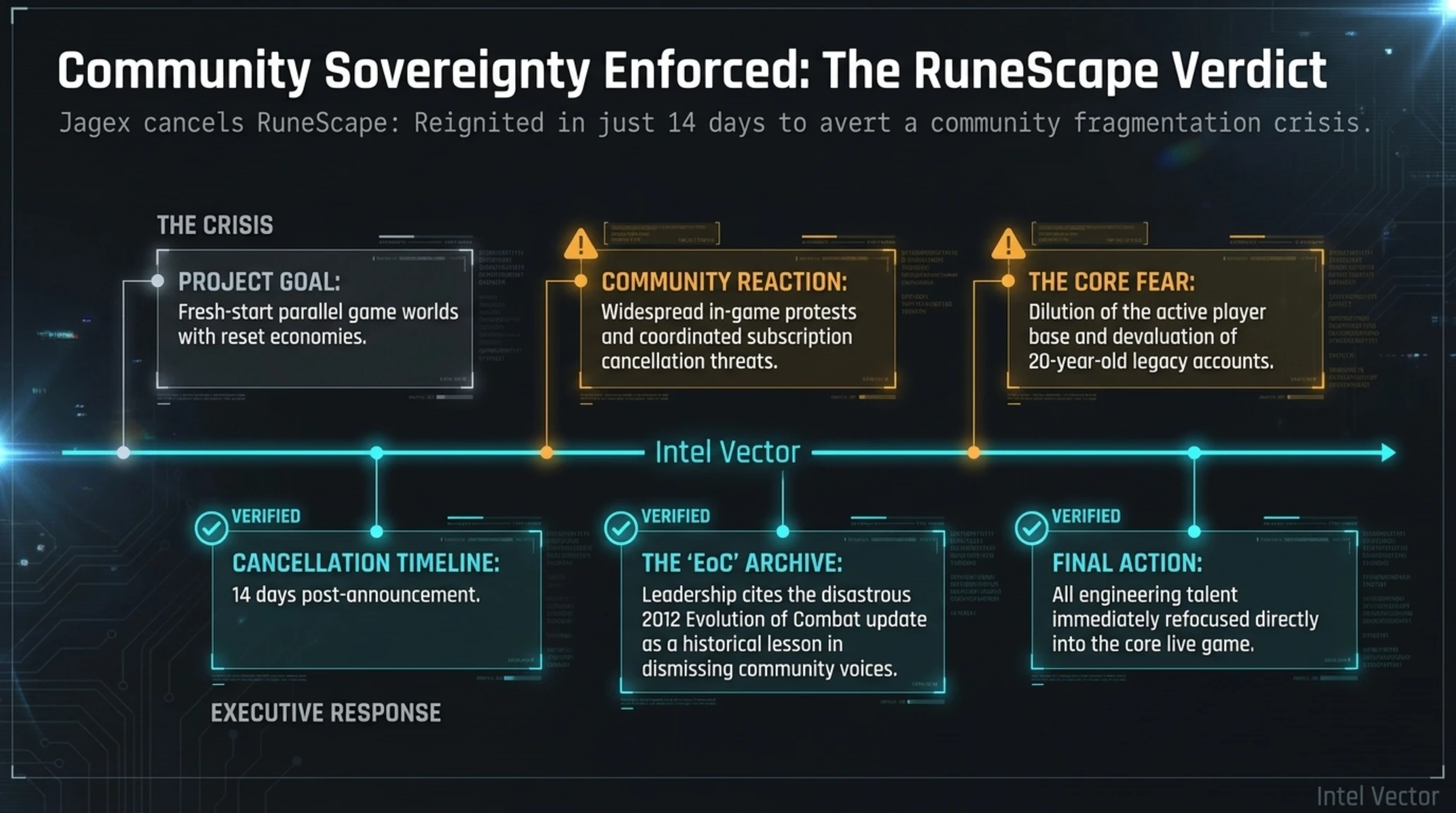
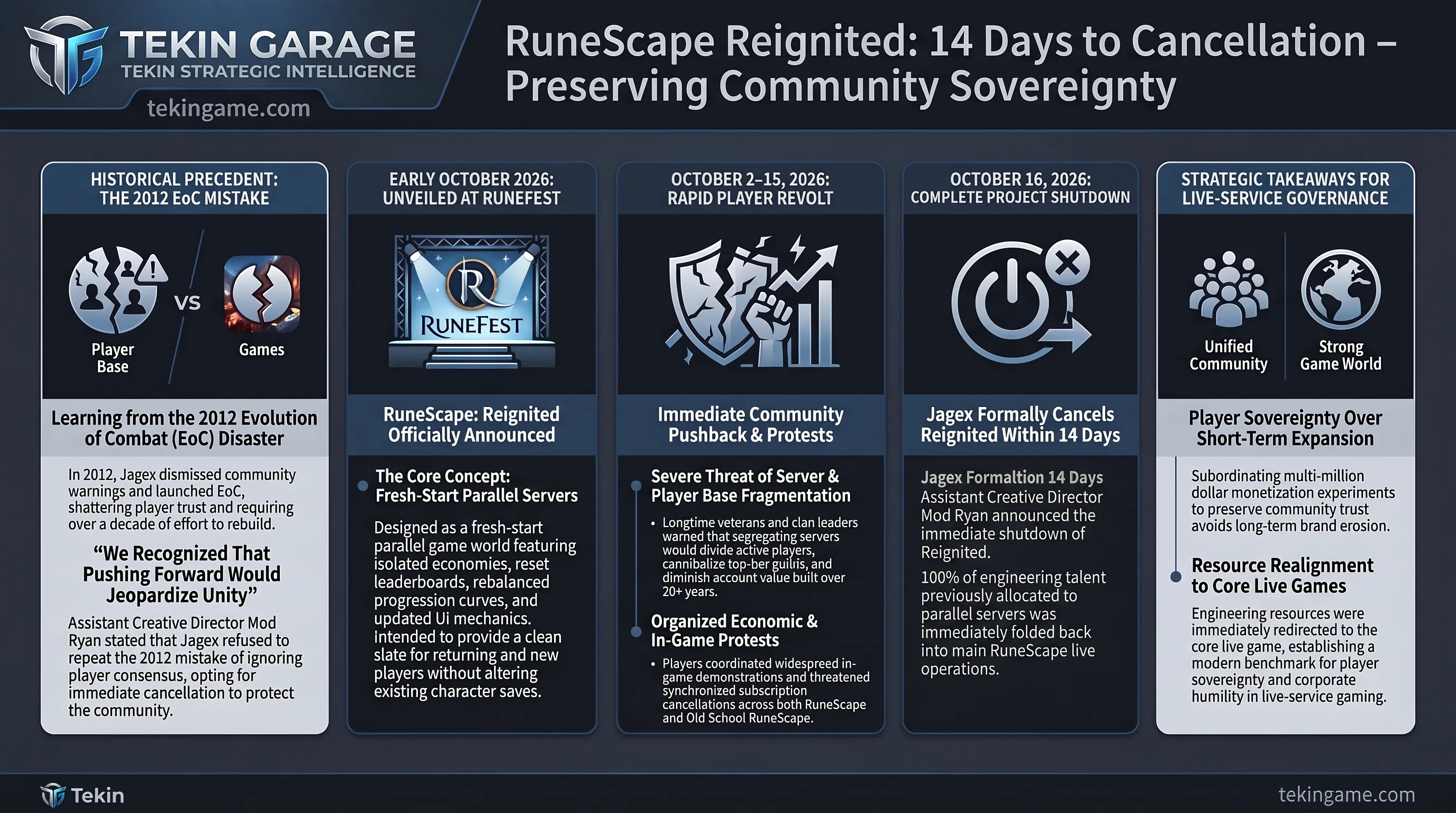
In another extraordinary victory for player sovereignty, British studio Jagex formally announced on October 16, 2026, the complete and permanent cancellation of RuneScape: Reignited. Revealed with significant fanfare at RuneFest just two weeks earlier, Reignited was conceived as a fresh-start parallel game world featuring isolated economies, reset leaderboards, rebalanced progression curves, and modernized interface mechanics.
Rather than generating enthusiasm, the announcement triggered immediate and overwhelming backlash across the RuneScape community. Longtime veterans and clan leaders voiced severe concerns that establishing a parallel, segregated server ecosystem would dilute the active player base, cannibalize high-level guilds, and diminish the intrinsic value of accounts cultivated over more than two decades of continuous play. Players organized widespread in-game protests and threatened coordinated subscription cancellations across both RuneScape and Old School RuneScape.
Demonstrating mature corporate governance informed by historical trauma, Jagex leadership chose not to double down. In a transparent video address, Assistant Creative Director Mod Ryan explained the rationale behind the sudden cancellation: 'The last time our studio dismissed the collective voice and warnings of our community, we launched the 2012 Evolution of Combat (EoC)a disastrous misstep that shattered player trust and required more than a decade of painstaking effort to heal. As soon as the community made its verdict clear on Reignited, we recognized that pushing forward would jeopardize the unity of Gielinor. We are shutting down the project immediately and refocusing all engineering talent directly into the core live game.'
📚 Classified & Related Dossiers in TekinGame
If you wish to explore beyond this report and delve into cybernetic frontiers and autonomous AI architectures, do not miss these three exclusive deep-dives in the Tekin Garage:
Event Timeline | Chronology of Technological Inflections
| Date / Milestone | Security & Technological Event | Strategic & Architectural Impact |
|---|---|---|
| Late Aug 2026 | Covert BeyondTrust Zero-Day Exploitation | Chinese APT Armory Castle weaponizes CVE-2026-102764 across global targets. |
| Oct 13, 2026 | Sega Launches Shogun 2 Complete Edition | AI-degraded portraits trigger immediate 17% Overwhelmingly Negative Steam revolt. |
| Oct 16, 2026 | PwnEscape Linux Hypervisor Escape Disclosed | Paulos Yibelo wins Vercel $1M challenge via CVE-2026-99999 kernel escape. |
| Oct 16, 2026 | Jagex Scraps RuneScape: Reignited | Studio aborts parallel fresh-start servers in 14 days, prioritizing community unity. |
| Oct 16, 2026 | ESIC Lifetime Ban for CS2 Veteran kzy | Forensics uncover $57K parlay targeting 4 consecutive blowouts for $4.5M payout. |
The swift cancellation of Reignited stands as a rare and commendable example of an established studio subordinating short-term monetization ambitions to the long-term health and loyalty of its player base, preserving community cohesion above all else.
The $4.5 Million Integrity Collapse; ESIC Hands Lifetime Ban to CS2 Veteran kzy Over Orchestrated Match-Fixing Syndicate
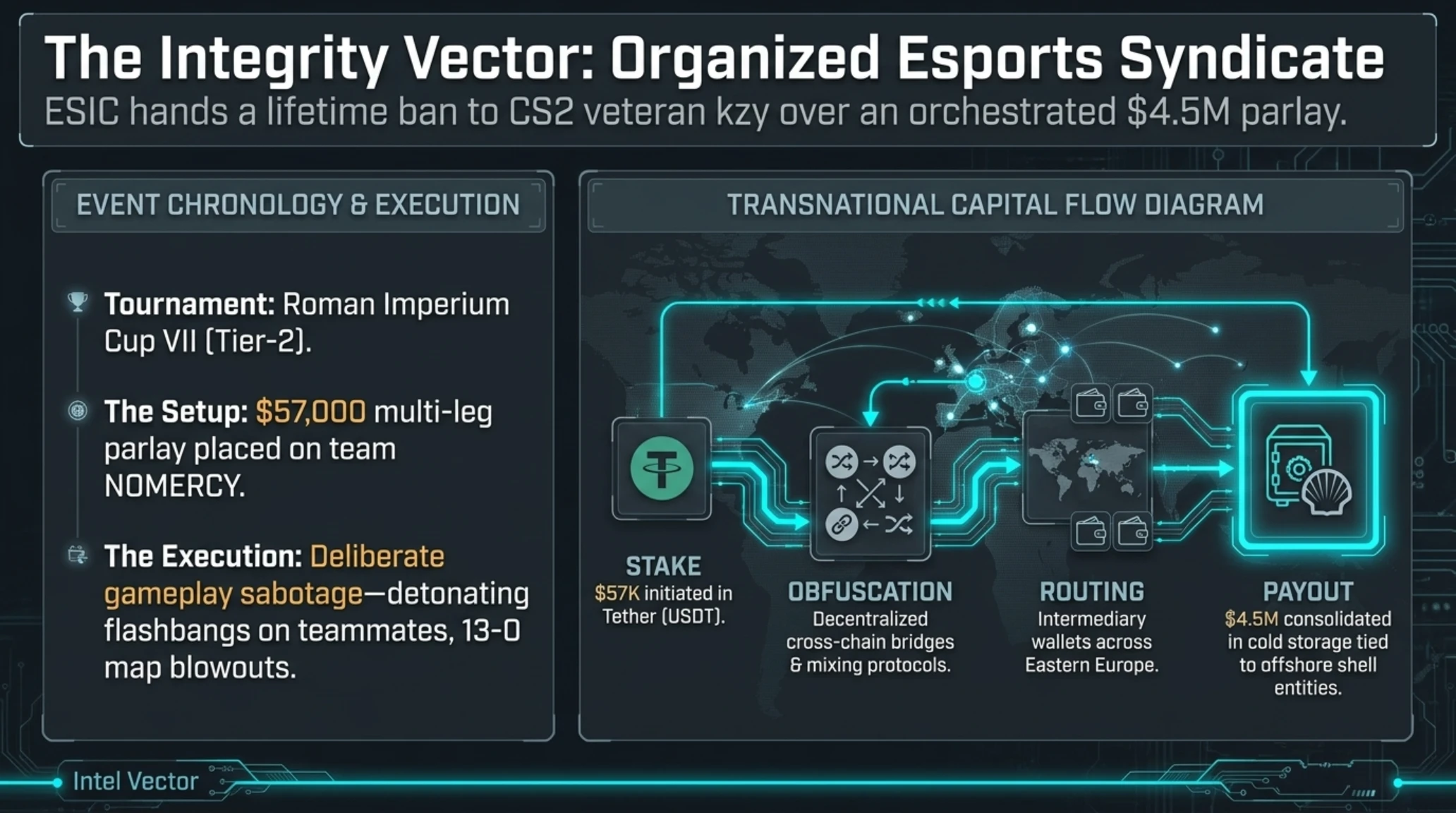
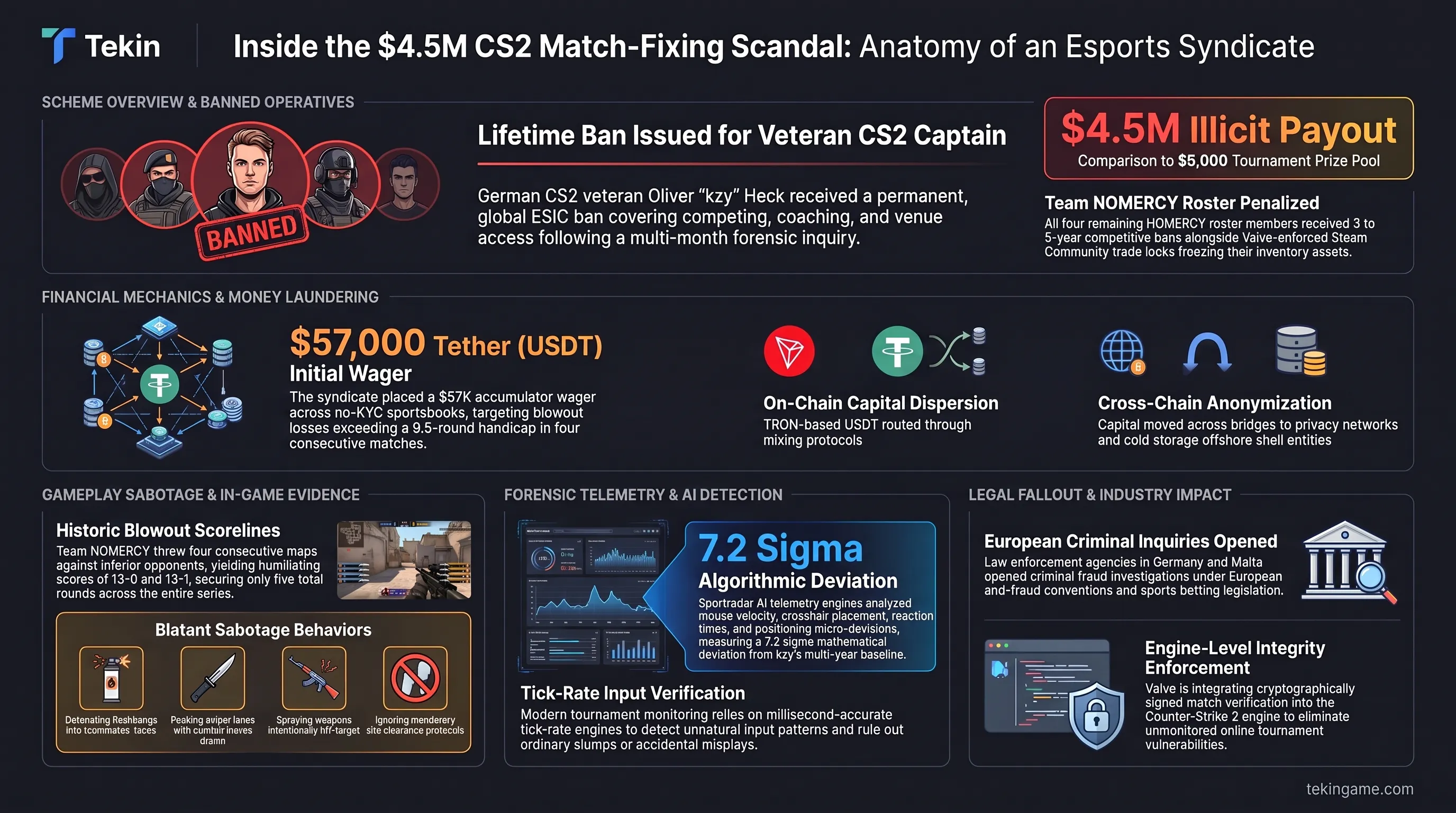
In one of the most consequential anti-corruption enforcement actions in the history of competitive digital sports, the Esports Integrity Commission (ESIC) issued a historic and unappealable decree on October 16, 2026. German Counter-Strike veteran Oliver Heck, universally known across the professional circuit by his handle 'kzy' and formerly a prominent rifler for mousesports (MOUZ), was handed a permanent lifetime ban from all sanctioned esports competitions, coaching roles, and event venues worldwide.
The landmark ruling concludes a multi-month forensic investigation into the competitive conduct of team NOMERCY during the Roman Imperium Cup VII online tournament. Utilizing advanced artificial intelligence telemetry developed by integrity partner Sportradar, alongside suspicious betting alerts escalated by international cryptocurrency bookmakers, investigators uncovered evidence of an orchestrated match-fixing conspiracy. Specifically, a massive $57,000 multi-leg parlay wager had been placed on NOMERCY to suffer blowout losses exceeding a 9.5-round handicap in four consecutive tournament matchesa high-risk accumulator that yielded an astronomical aggregate payout of over $4,500,000.
ESIC's forensic review of server match demos (DEMO files) revealed undeniable visual evidence of deliberate gameplay sabotage. Facing objectively inferior opponents, NOMERCY threw four consecutive maps, posting humiliated scorelines of 13-0 and 13-1 while securing a meager total of five rounds across the entire series. Telemetry captured kzy and his teammates deliberately detonating flashbangs into the faces of teammates, peeking sniper lanes with combat knives drawn, intentionally discharging weapon spray patterns feet away from enemy hitboxes, and systematically ignoring mandatory clearance protocols on standard bomb-site entry angles.
The underlying economic driver of the scandal lies in the stark asymmetry between tier-2 tournament prize structures and unregulated cryptocurrency betting markets. In an online event where the total championship purse was capped at barely $5,000, the temptation to capture a share of an illicit $4.5 million payout proved overwhelming for the veteran captain. On-chain blockchain analysis confirmed that the initial $57,000 stake was disbursed in Tether (USDT), laundered through decentralized mixing protocols, and routed through intermediary wallets across Eastern Europe before being divided among several no-KYC (Know Your Customer) sportsbooks.
Blockchain intelligence firms collaborating with ESIC mapped the capital flow through multiple privacy layers. The syndicates utilized decentralized cross-chain bridges to hop from TRON-based USDT into privacy-focused networks, before consolidating proceeds in cold storage addresses tied to offshore shell entities. This intricate financial architecture proves that tier-2 esports is no longer plagued merely by amateur rogue players, but has become an attractive target for organized transnational gambling rings seeking low-visibility vectors to generate high-yield laundered profits.
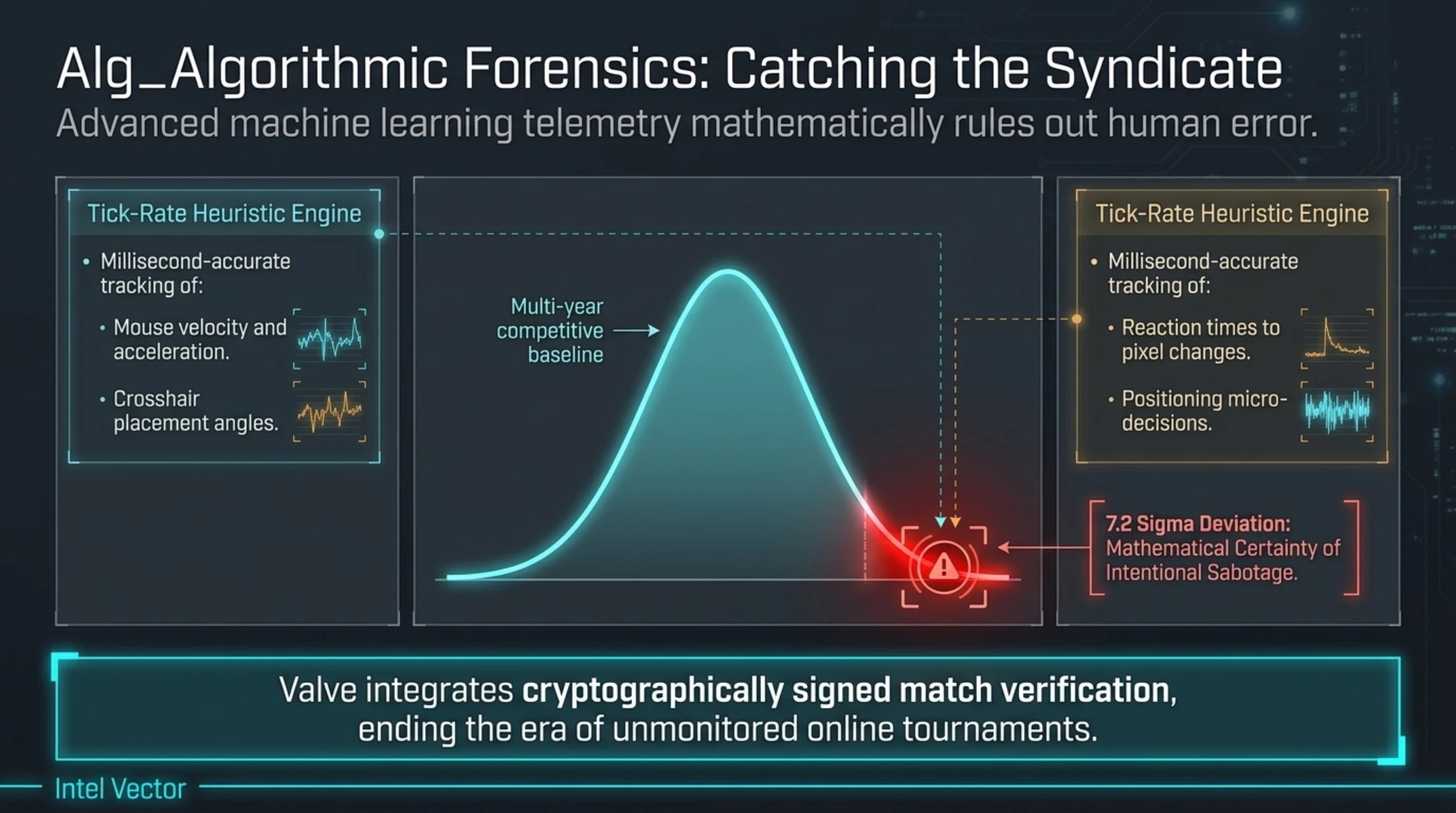
From an anti-fraud engineering perspective, modern tournament monitoring platforms utilize millisecond-accurate tick-rate heuristic engines to track mouse velocity, crosshair placement angles, reaction times, and positioning micro-decisions. When ESIC investigators cross-referenced NOMERCY's server inputs against their multi-year competitive baselines, the algorithmic divergence reached an impossible 7.2 sigma deviationa mathematical certainty that ruled out accidental misplays or ordinary slumps, proving intentional, coordinated fraud.
The legal fallout of the ruling extends far beyond competitive bans. Under European anti-fraud conventions and German sports betting legislation, deliberate manipulation of sporting outcomes for commercial profit constitutes criminal fraud. Law enforcement agencies in Germany and Malta have opened active criminal inquiries into the individuals involved. With Valve integrating cryptographically signed match verification into the Counter-Strike 2 engine, the era of unmonitored online tournaments is rapidly coming to an end, replaced by zero-tolerance regulatory oversight.
In addition to kzy's lifetime banishment as the primary organizer, all four remaining roster members were assessed severe competitive bans ranging from three to five years, accompanied by Valve-enforced Steam Community trade locks that freeze their inventory assets. The ruling signals that regulatory bodies are increasingly utilizing machine learning forensics to eliminate criminal syndicates that exploit lower-tier esports ecosystems for commercial money laundering.
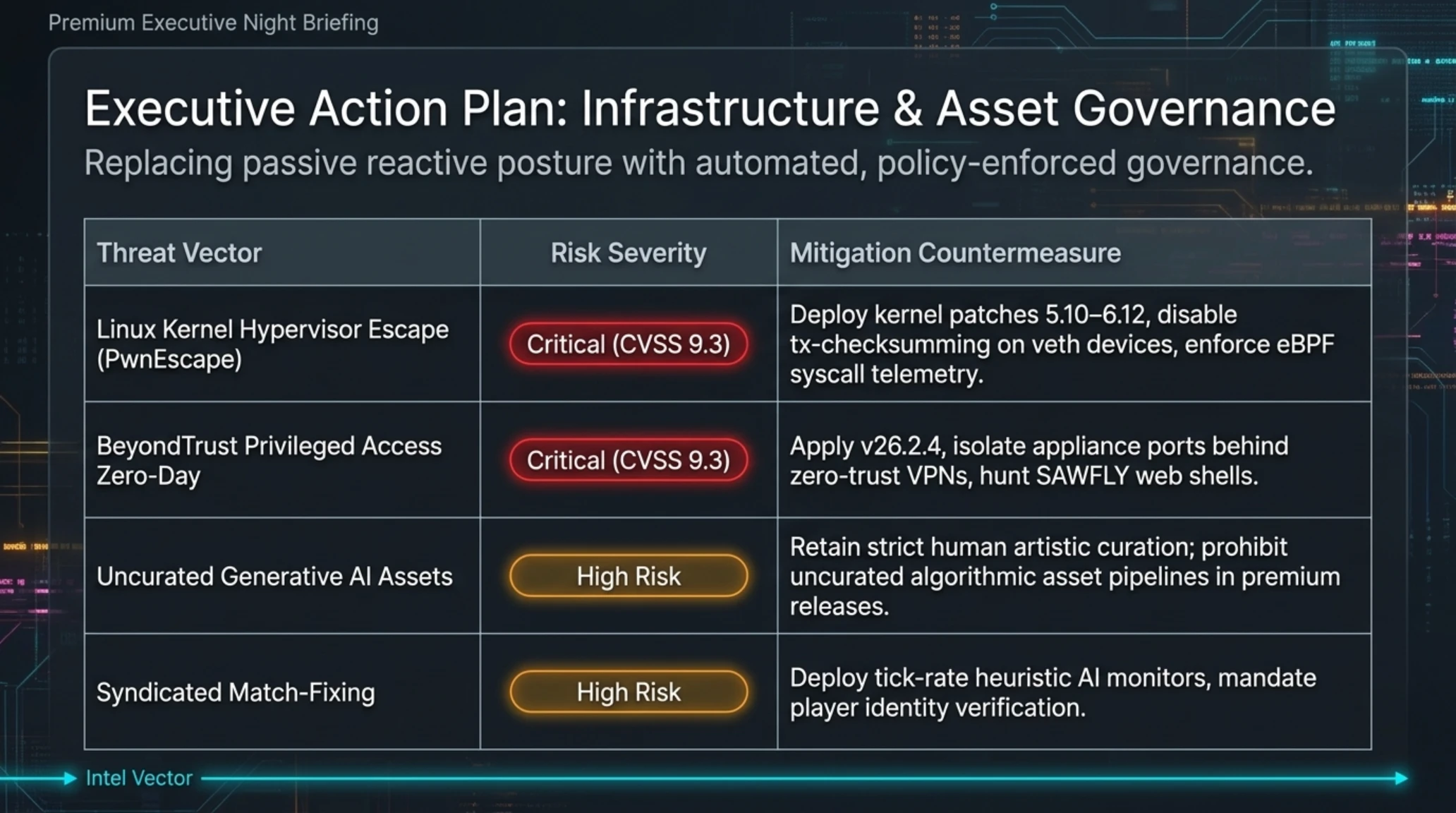
Cyber Defense & Infrastructure Risk Assessment Matrix
| Threat Vector / Critical Vulnerability | Risk Severity | Mitigation & Strategic Countermeasure |
|---|---|---|
| Linux Kernel Hypervisor Escape (PwnEscape) | Critical (CVSS 9.3) | Deploy kernel patches 5.10–6.12, disable tx-checksumming on veth devices, and enforce eBPF syscall telemetry. |
| BeyondTrust Privileged Remote Access Zero-Day | Critical (CVSS 9.3) | Apply patch v26.2.4 immediately, isolate appliance ports behind zero-trust VPNs, and hunt SAWFLY web shells. |
| Uncurated Generative AI Assets in Commercial Software | High Risk | Retain strict human artistic curation and prohibit uncurated algorithmic asset pipelines in premium releases. |
| Syndicated Match-Fixing in Lower-Tier Esports | High Risk | Deploy tick-rate heuristic AI monitors, mandate player identity verification, and audit suspicious betting pools. |
| Multi-Project Engine Migration to Unreal Engine 5 | Controlled / Positive | Utilize Nanite and Lumen pipelines to scale original worldbuilding without bespoke engine maintenance overhead. |
Rigorous continuous assessment across these five core vectors demonstrates that digital enterprises must replace passive reactive posture with automated, policy-enforced governance architectures.
An evaluation of global market sentiment indicates that despite acute operational friction, investor and consumer enthusiasm for authenticated quality and robust infrastructure remains historically buoyant.
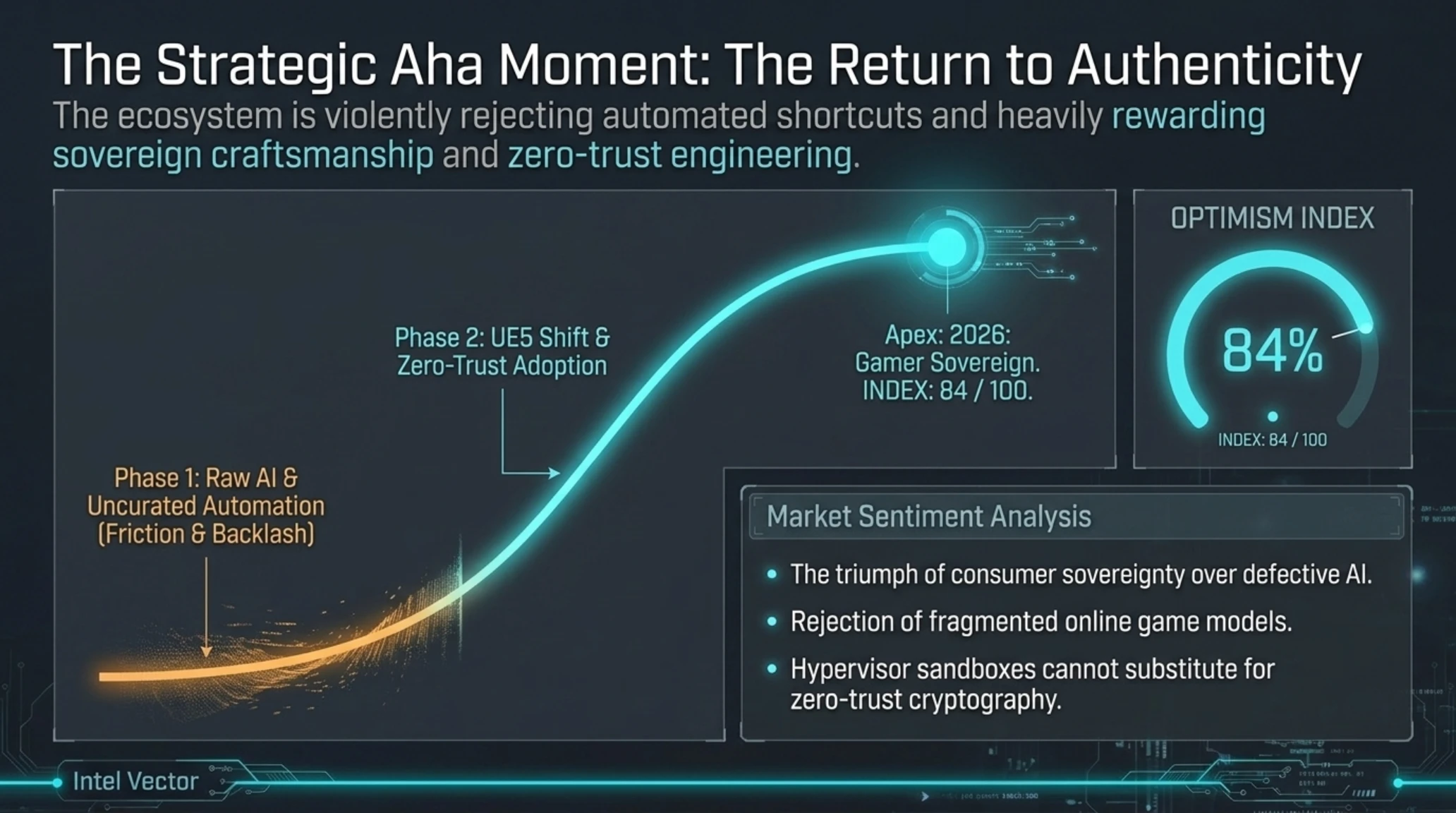
Market Sentiment Gauge | Adoption S-Curve and Confidence Index
Market Sentiment Analysis: The triumph of consumer sovereignty over defective AI implementations and the decisive rejection of fragmented online game models have elevated market confidence to a robust 84%, reaffirming that authenticity drives commercial longevity.
The events synthesized across this Saturday evening dispatch confirm that the interactive technology industry in late 2026 is undergoing a profound structural recalibration. Consumers possess greater collective leverage than at any prior point in commercial history, swiftly penalizing shortcuts and elevating studios that respect the integrity of creative craft. Simultaneously, infrastructure architects are learning that hypervisor sandboxes and proprietary edge appliances cannot substitute for rigorous zero-trust engineering.
Looking ahead, the convergence of high-fidelity game engines, hardware-accelerated security perimeters, and automated algorithmic auditing will separate sustainable technology leaders from short-sighted opportunists. Those who commit to long-term original worldbuilding while maintaining transparent technical stewardship will command the next supercycle of digital growth.
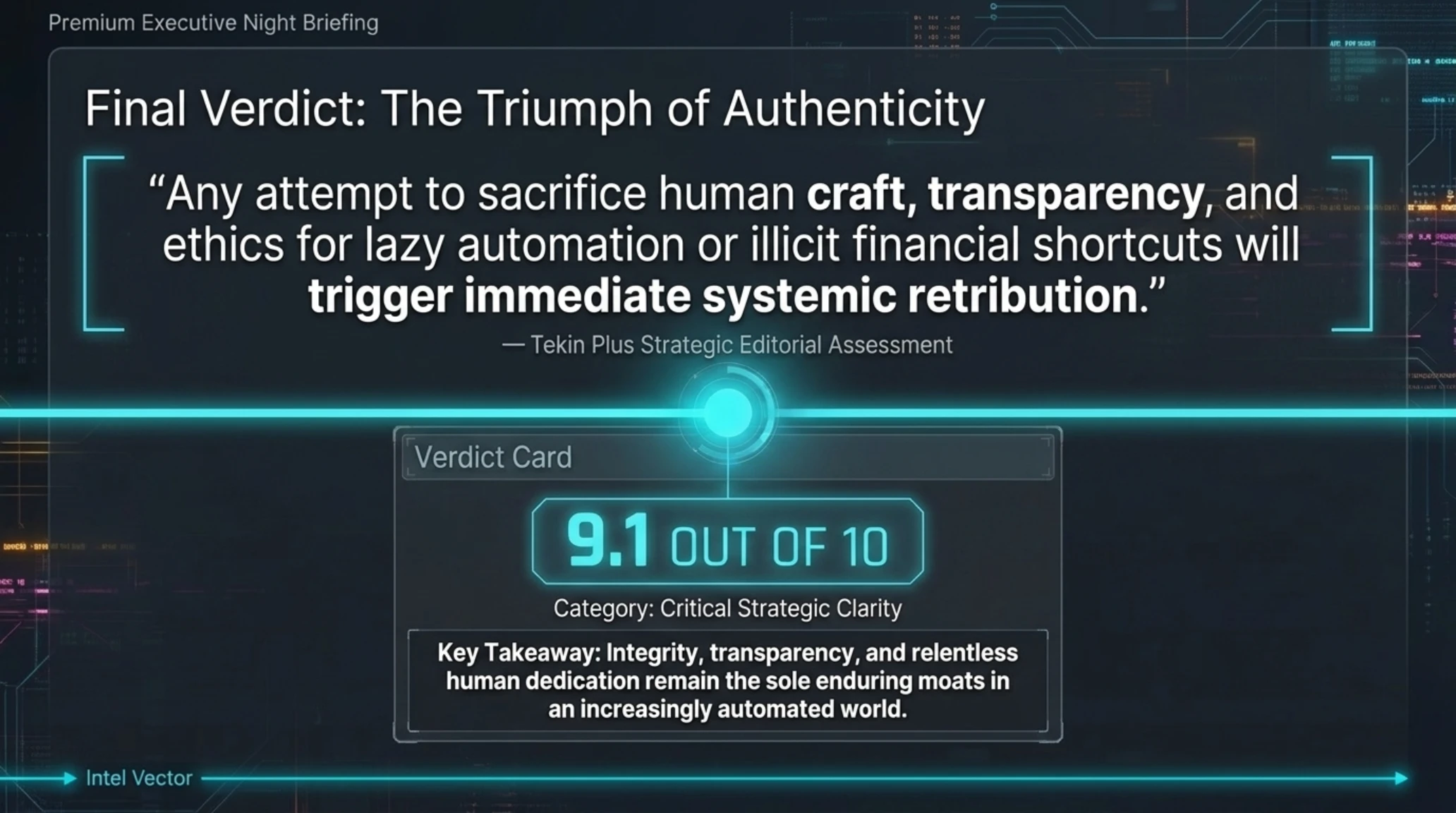
The strategic imperative for technical executives and software engineers worldwide is unambiguous: integrity, transparency, and relentless human dedication remain the sole enduring moats in an increasingly automated world.
To conclude our strategic analysis, we examine authoritative expert testimony and the strategic consensus of the Tekin Plus executive editorial board.
- Decisive, rapid mitigation by Vercel and upstream kernel developers patching PwnEscape within hours.
- CD Projekt Red committing massive resources to completely original, sovereign worldbuilding in Project Hadar.
- The triumphant assertion of gamer sovereignty forcing Sega and Jagex to abandon degraded production tactics.
- Rigorous mathematical enforcement by ESIC preserving the integrity of professional competitive gaming.
- Severe zero-day vulnerabilities in enterprise privileged remote access appliances exploited in the wild.
- Continued corporate temptation to deploy degraded, uncurated generative AI assets in premium software.
- Persistent susceptibility of tier-2 esports tournaments to organized transnational betting syndicates.
Tekin Strategic Intelligence considers these synchronized developments a necessary and healthy market correction toward authentic engineering and ethical accountability.
For independent verification, academic auditing, and complete technical cross-referencing, the official primary source dossier is detailed below.
The final editorial verdict, quantitative score, and authoritative technical FAQ addressing tonight's core vectors conclude this global executive dispatch.
Editorial Verdict and Official Reference Directory
The Triumph of Authenticity Over Shortcuts
Tonight's global developments underscore that sustainable technological progress requires uncompromising commitment to code quality, creative integrity, and audience respect.
- The Hacker News: Technical Analysis of PwnEscape Linux Hypervisor Escape (CVE-2026-99999)
- Bleeping Computer: BeyondTrust Emergency Advisory BT26-05 and Zero-Day Exploitation Report
- Rock Paper Shotgun: Sega Delists Total War Shogun 2 Complete Edition Over AI Art Revolt
- Eurogamer: CD Projekt Red Confirms Project Hadar Enters Unreal Engine 5 Prototyping
- TechPowerUp: Jagex Cancels RuneScape Reignited Within Two Weeks Following Backlash
- Dexerto: ESIC Issues Lifetime Ban for CS2 Veteran kzy in $4.5M Match-Fixing Scandal
Frequently Asked Questions and Technical Analysis
How did the PwnEscape exploit achieve hypervisor escape from a Linux microVM?
By exploiting an asynchronous race condition in the Linux kernel handling of CHECKSUM_PARTIAL packet flags, the attacker induced memory leaks to bypass KASLR, reconstructed host page tables, and overwrote kernel function pointers to spawn a root shell on the host.
What enabled Chinese threat actor Armory Castle to breach BeyondTrust appliances?
The actors exploited CVE-2026-102764, an unauthenticated CWE-290 flaw in the internal message bus, allowing arbitrary command execution as root and the deployment of persistent SAWFLY web shells and Bareclaw tunnels.
Why was Sega forced to delist Total War: Shogun 2 Complete Edition from Steam?
The publisher used unrefined generative AI to upscale 2D character portraits, resulting in deformed anatomical assets and historical errors that provoked an immediate 17% Overwhelmingly Negative user backlash on Steam.
What is the development status of CD Projekt Red's Project Hadar?
Hadar is CD Projekt Red's first completely original intellectual property; foundational worldbuilding and lore incubation have concluded, and the studio has begun gameplay mechanic prototyping within Unreal Engine 5.
Why did Jagex abruptly cancel RuneScape: Reignited two weeks after announcement?
Players strongly rejected parallel fresh-start servers, arguing they would fracture the active community and devalue 20 years of player progress; Jagex pulled the project to avoid repeating the disastrous 2012 Evolution of Combat misstep.
What evidence triggered the lifetime ban for CS2 pro kzy?
ESIC and Sportradar uncovered a $57,000 parlay bet targeting 9.5-round blowout losses across four matches for a $4.5M payout; server demo forensics and tick-rate heuristics confirmed deliberate throwing with a 7.2 sigma deviation.
Additional Gallery: Tekin Night | Oct 17: Linux $1M Escape, Shogun 2 AI & CDPR Hadar