Tekin Analysis | Night Radar Executive Briefing: Xbox BDS Boycott, Ledger Hardware Interdiction, Cisco SEG 0-Day, Switch 2 007 & Zelda Remake
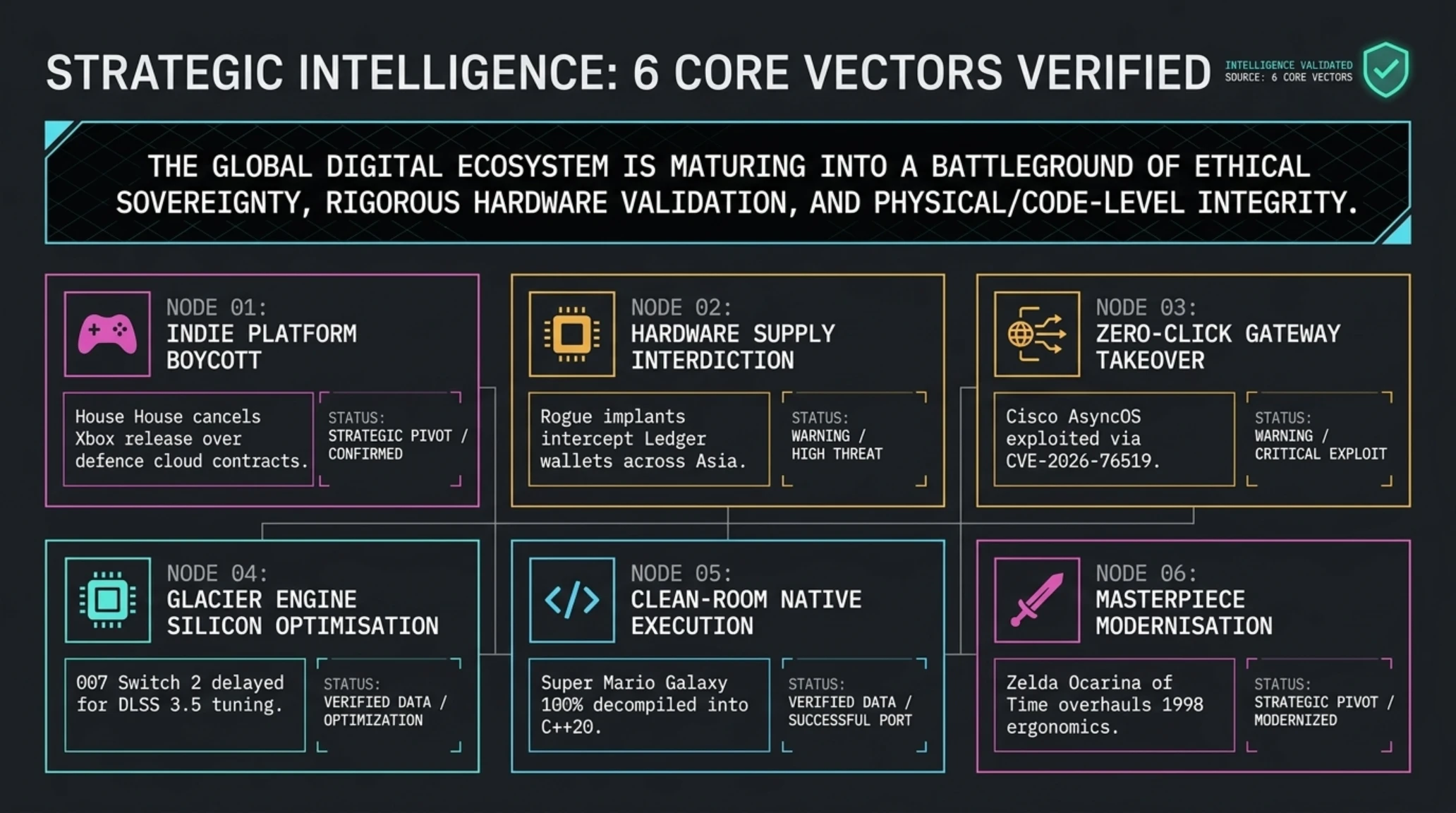
The global technology and gaming landscape on the evening of Friday, October 16, 2026, is witnessing an unprecedented convergence of geopolitical activism, physical supply chain subversion, critical enterprise infrastructure compromises, and astonishing achievements in software reverse engineering. While consumer markets often view hardware ecosystems and digital storefronts as monolithic entities immune to political pressures, independent studios are asserting unprecedented agency by demanding ethical accountability from trillion-dollar platform holders.
Simultaneously, the physical integrity of cold-storage hardware has suffered one of the most sophisticated interdiction campaigns in history, proving that air-gapped cryptographic algorithms are only as secure as the physical supply chains that manufacture and distribute them. In enterprise cybersecurity, an emergency advisory issued by Cisco Systems highlights the lingering vulnerability of foundational perimeter defenses to zero-click weaponization. Concurrently, the video game preservation and homebrew engineering communities have achieved a crowning technological milestone by liberating iconic titles from specialized historical microarchitectures into modern, native, high-efficiency execution environments.
Strategic Assessment and Key Intelligence Vectors
These developments reflect an increasingly mature digital ecosystem where ethical corporate conduct, rigorous supply chain validation, microarchitectural optimization, and digital preservation intersect. Industry executives and systems engineers can no longer isolate consumer software development from geopolitical compliance, hardware integrity, or low-level memory safety. We commence this comprehensive briefing with the groundbreaking stance taken by House House against Microsoft Corporation.
The ramifications of this decision extend far beyond a single video game release, establishing a powerful precedent for independent creators navigating multi-platform distribution in an era dominated by corporate defense contracting and multi-billion-dollar government cloud partnerships.
Official Xbox Boycott by House House: Big Walk Creators Refuse Microsoft Release Over Cloud Defense Deals
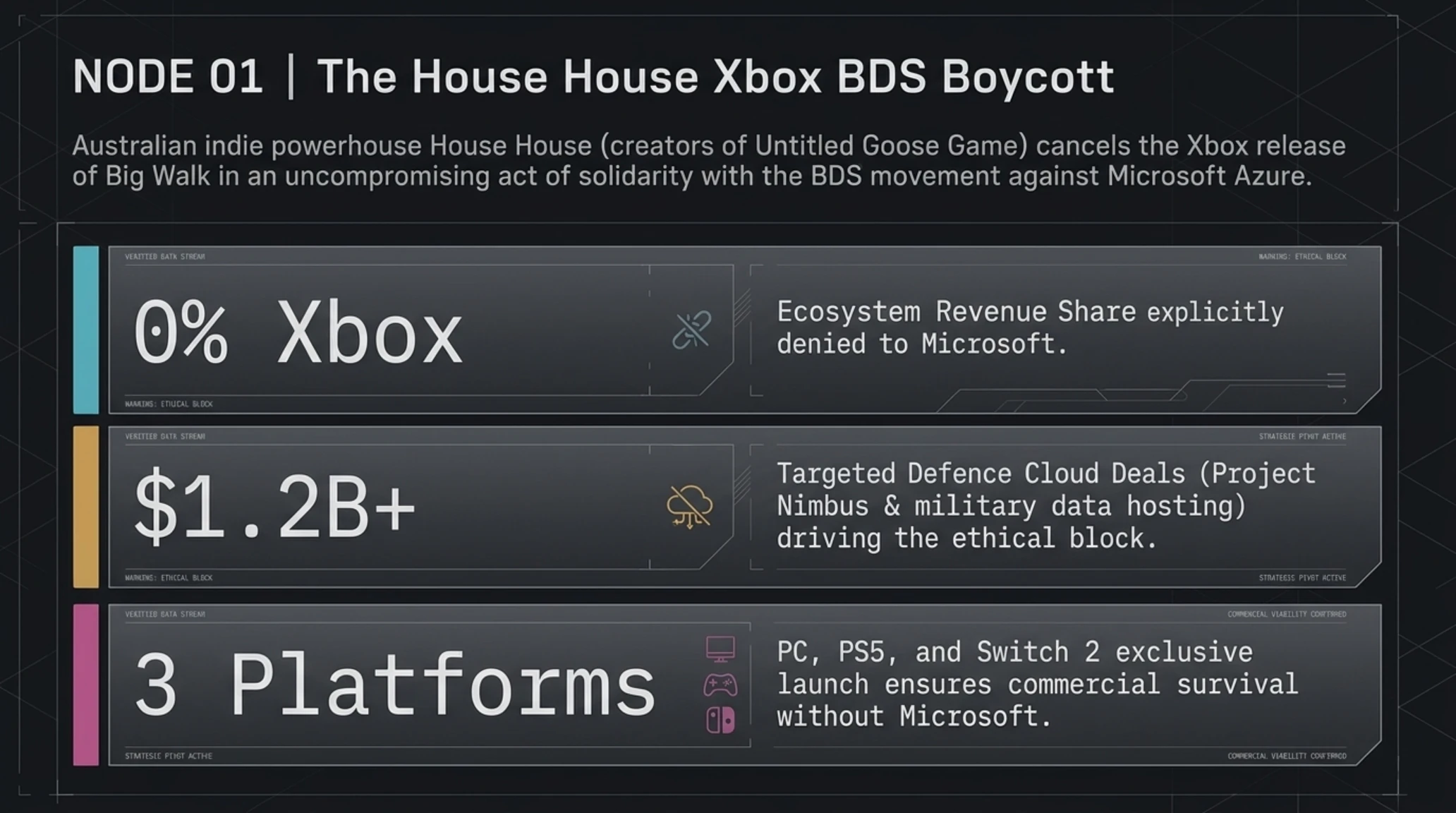
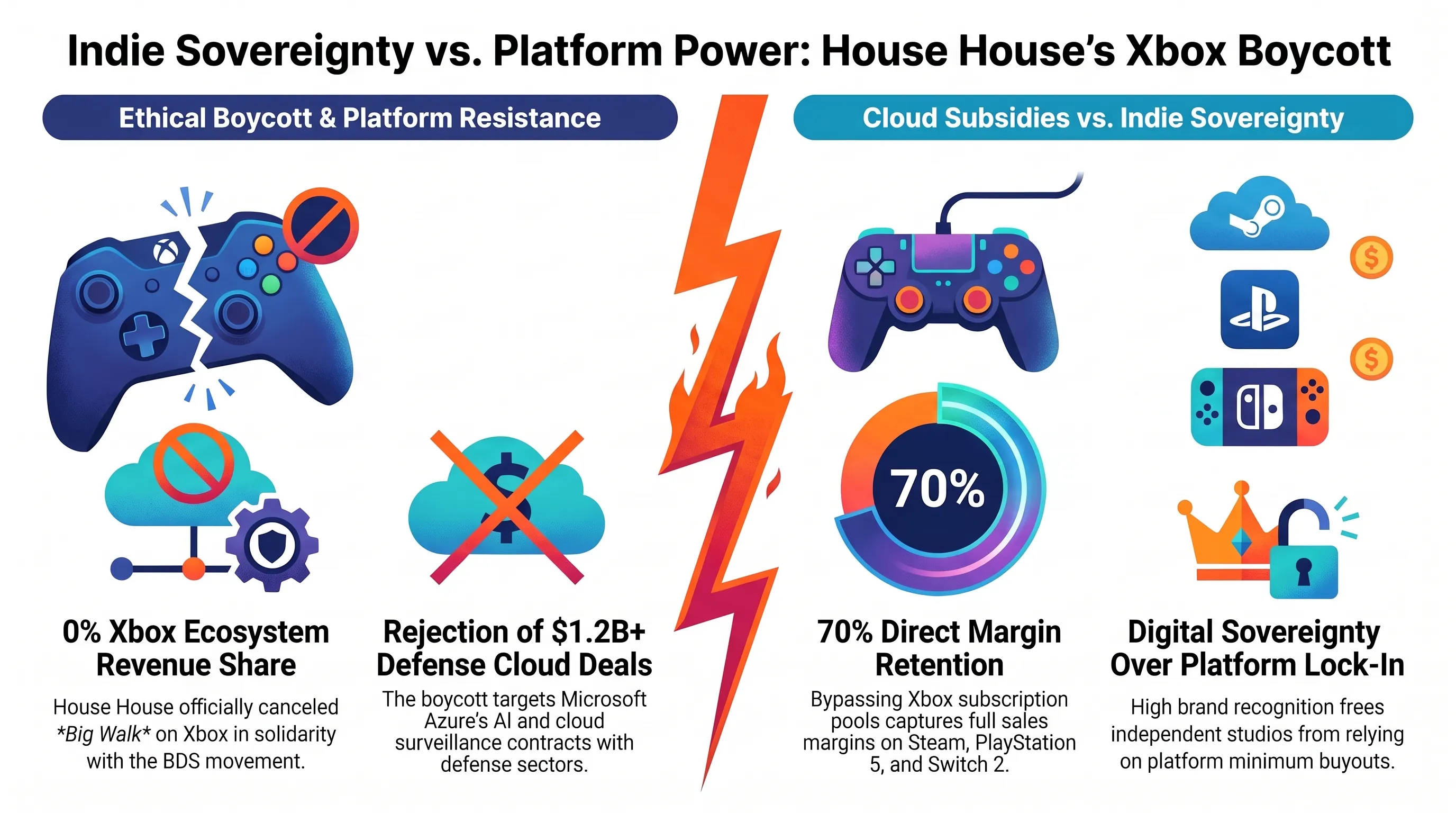
In an extraordinary display of principled corporate governance that has sent shockwaves through the global interactive entertainment industry, Melbourne-based independent developer House House famed for the multi-million-selling global sensation Untitled Goose Game in partnership with boutique publisher Panic Inc., has formally declared that their highly anticipated cooperative adventure title, Big Walk, will not be released on Microsoft Xbox consoles. The decision represents an official, uncompromising act of solidarity with the global Boycott, Divestment, Sanctions (BDS) movement.
In a detailed public manifesto released alongside the announcement, House House stated unequivocally that while their artistic mission is to connect players across collaborative digital spaces, they cannot justify generating commercial revenues for a platform parent company directly implicated in state-sponsored military operations. The boycott specifically targets Microsoft Azure's multi-billion-dollar enterprise cloud infrastructure and artificial intelligence defense contracts, including Project Nimbus and surveillance data hosting agreements with the Israeli Ministry of Defense and military intelligence apparatuses.
Why This Development Reshapes the Gaming Industry
House Houses principled stand demonstrates that prominent independent creators are willing to forgo substantial subscription buyouts and platform royalties to enforce moral compliance and challenge corporate defense entanglements.
Commercial analysts note that the exclusion of Xbox Series X|S consoles inflicts a substantial reputational wound on Microsoft Gaming. Since acquiring widespread acclaim for Untitled Goose Game which generated over one million unit sales in its opening months and claimed Game of the Year honors at the Game Developers Choice Awards House House has held considerable creative leverage. For Microsoft, whose console hardware sales have lagged behind Sony Interactive Entertainment and Nintendo throughout the ninth console generation, losing a high-profile cooperative multiplayer showcase deprives Xbox Game Pass of a crucial organic community driver.
The boycott resonates strongly with ongoing labor actions and collective organizing across the creative tech sector in North America, the United Kingdom, and Australia. This friction directly mirrors previous Tekin investigations into the structural friction between game developers and Xbox leadership policies, where aggressive studio closures, corporate layoffs, and conflicting enterprise priorities have alienated high-profile creative talent from Microsoft's long-term publishing orbit.
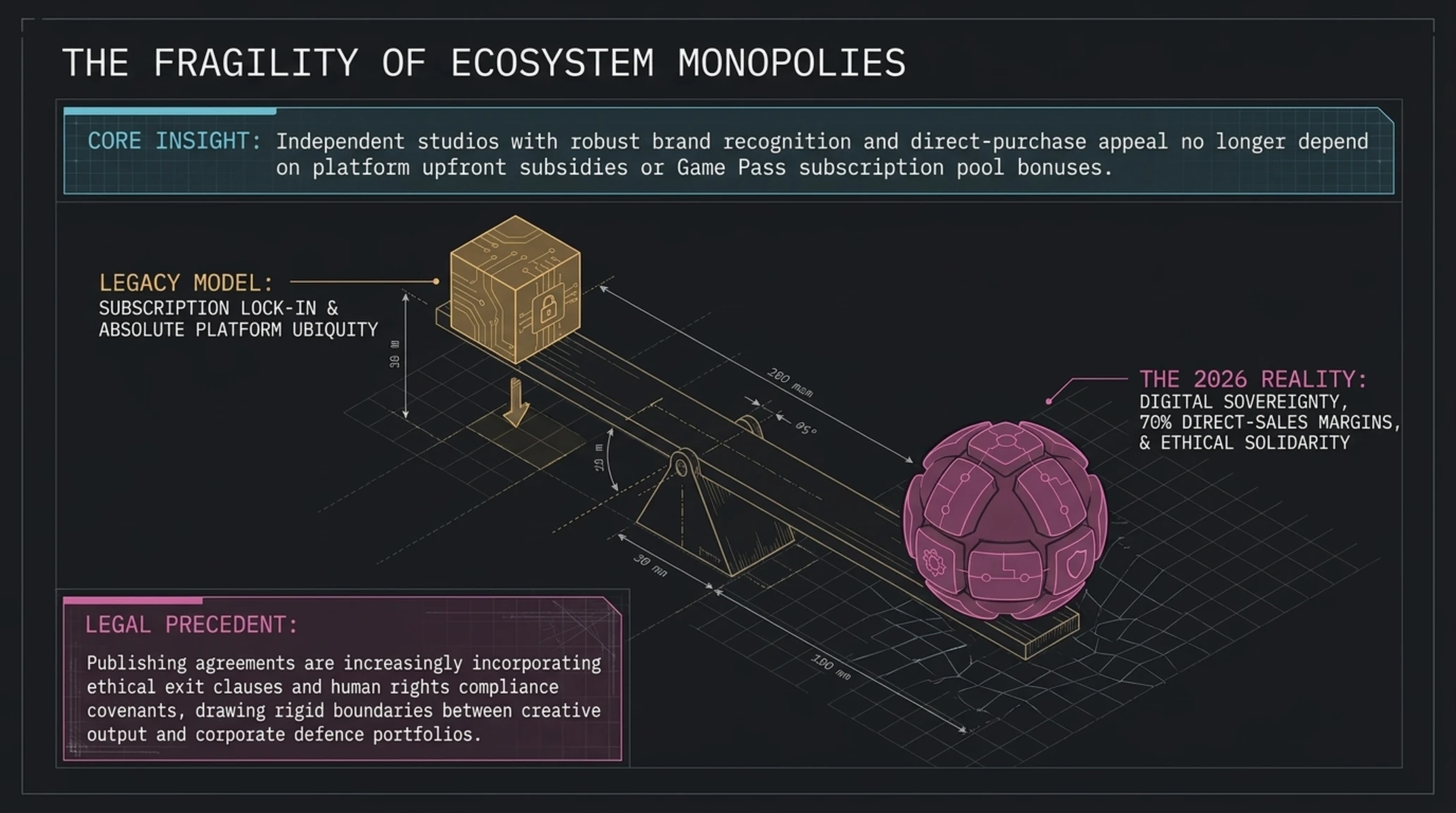
From an economic architecture perspective, House House's stance exposes the fragility of platform subscription monopolies. Historically, platform holders utilized guaranteed upfront minimums and subscription pool bonuses to lock in independent developers, offsetting initial production risks in exchange for ecosystem lock-in. However, indie studios that possess robust brand recognition, established financial reserves, and high direct-purchase appeal are realizing they no longer depend on platform subsidies. By launching exclusively on Steam, the PlayStation Store, and the Nintendo eShop, House House captures full 70% direct-sales margins while maintaining uncompromised moral authority.
Furthermore, this boycott sets an influential legal and contractual precedent for independent game publishing. Legal scholars note that publishing agreements increasingly incorporate ethical exit clauses, human rights compliance covenants, and platform divestment triggers. As tech conglomerates continue to expand their enterprise artificial intelligence and cloud computing divisions into defense and intelligence sectors, creative software creators are drawing rigid boundaries to prevent their artistic output from subsidizing corporate defense portfolios.
While Microsoft executive leadership has maintained strict silence regarding the announcement, the decision has galvanized independent developer unions across Europe and Australia. With Big Walk scheduled to launch across PC, PlayStation 5, and Nintendo Switch 2, the gaming community will experience one of the year's most creative cooperative journeys, while Xbox hardware users remain excluded entirely as a direct consequence of Redmond's corporate defense alignment.
The historical lineage of this boycott traces directly back to the broader wave of conscientious objection within Silicon Valley and enterprise software ecosystems. From the initial 2018 employee walkouts at Google over the Pentagon's Project Maven drone video analytics initiative to subsequent internal petitions protesting Project Nimbus contracts, rank-and-file software engineers have consistently questioned the ethical ramifications of dual-use enterprise cloud infrastructure. What makes House House's action unprecedented is that it originates not from internal corporate employees risking their employment, but from an external cultural producer wielding commercial intellectual property as a sovereign sanctioning instrument.
Moreover, the macroeconomic dynamics of video game distribution in 2026 illustrate a profound realignment of commercial power. For years, the conventional industry wisdom dictated that independent studios had to achieve absolute platform ubiquity across PC, PlayStation, Xbox, and Nintendo to survive volatile commercial cycles. However, as subscription services saturate domestic console markets and platform holders compress royalty pools, the true lifetime value of a gaming property resides in brand loyalty and direct-to-consumer digital ownership. By bypassing Microsoft's ecosystem entirely, House House demonstrates that cultural prestige and ethical coherence can provide stronger commercial moats than passive inclusion in an overcrowded subscription catalog.
Ultimately, this development signals a transformative shift in developer empowerment. Independent studios are proving that digital sovereignty and ethical solidarity can outweigh platform ubiquity, transforming video game distribution into an active battleground for corporate accountability.
Across global enthusiast communities, including ResetEra, Reddit, and international Discord gaming servers, the announcement has sparked vigorous debate regarding consumer responsibility and platform ethics. While a minority of Xbox hardware owners expressed disappointment over missing out on Big Walk's cooperative gameplay, the overwhelming consensus across developer forums praised House House for demonstrating that principled convictions must carry tangible commercial stakes. By willingly foregoing hundreds of thousands of potential Game Pass subscriber impressions, the studio has redefined what it means to lead as an independent creative entity in the twenty-first century.
Ledger Hardware Wallet Supply Chain Interdiction in Asia: Rogue Micro-Chips and Hidden eSIMs Trigger 7-Country Recall
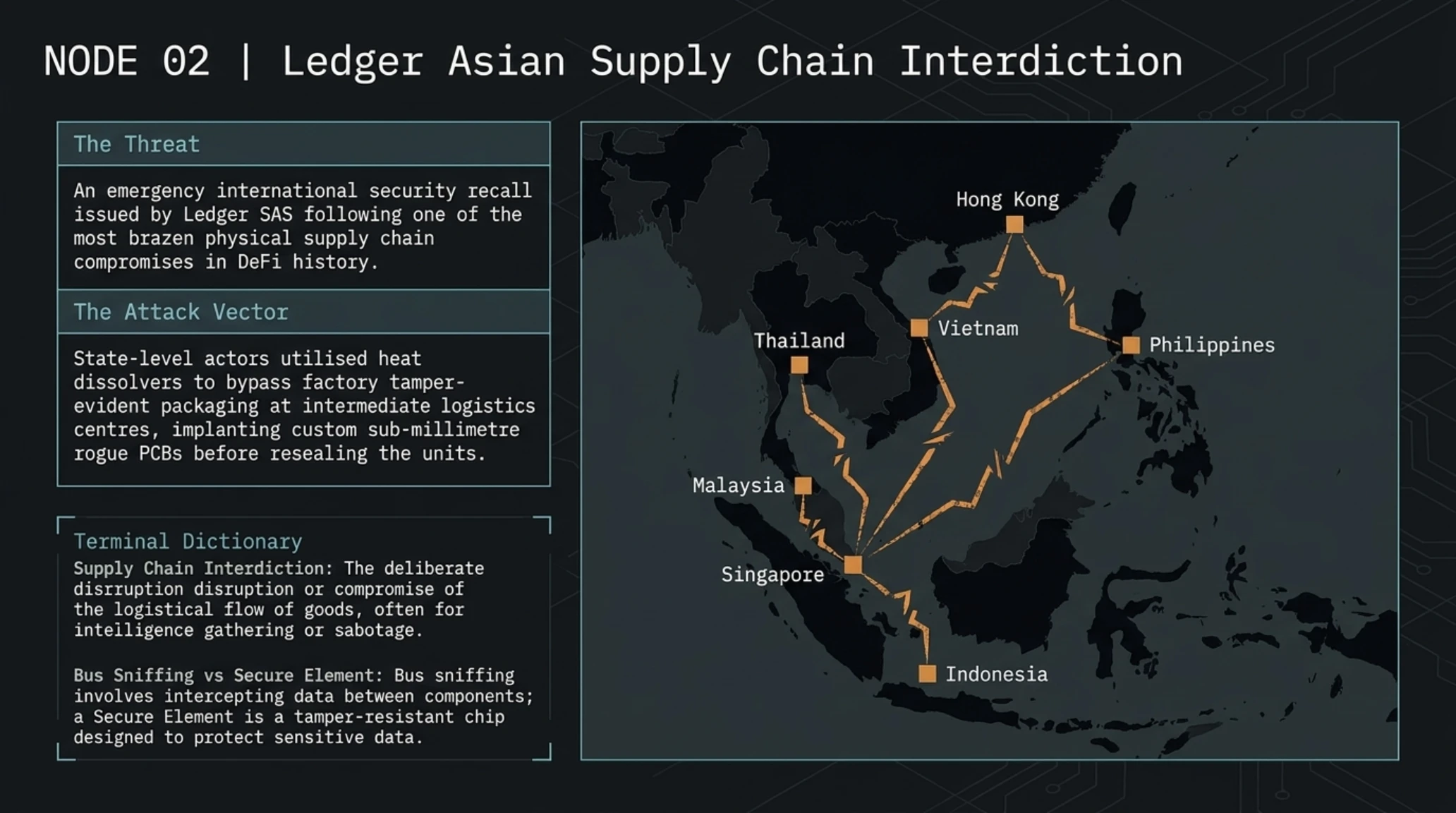
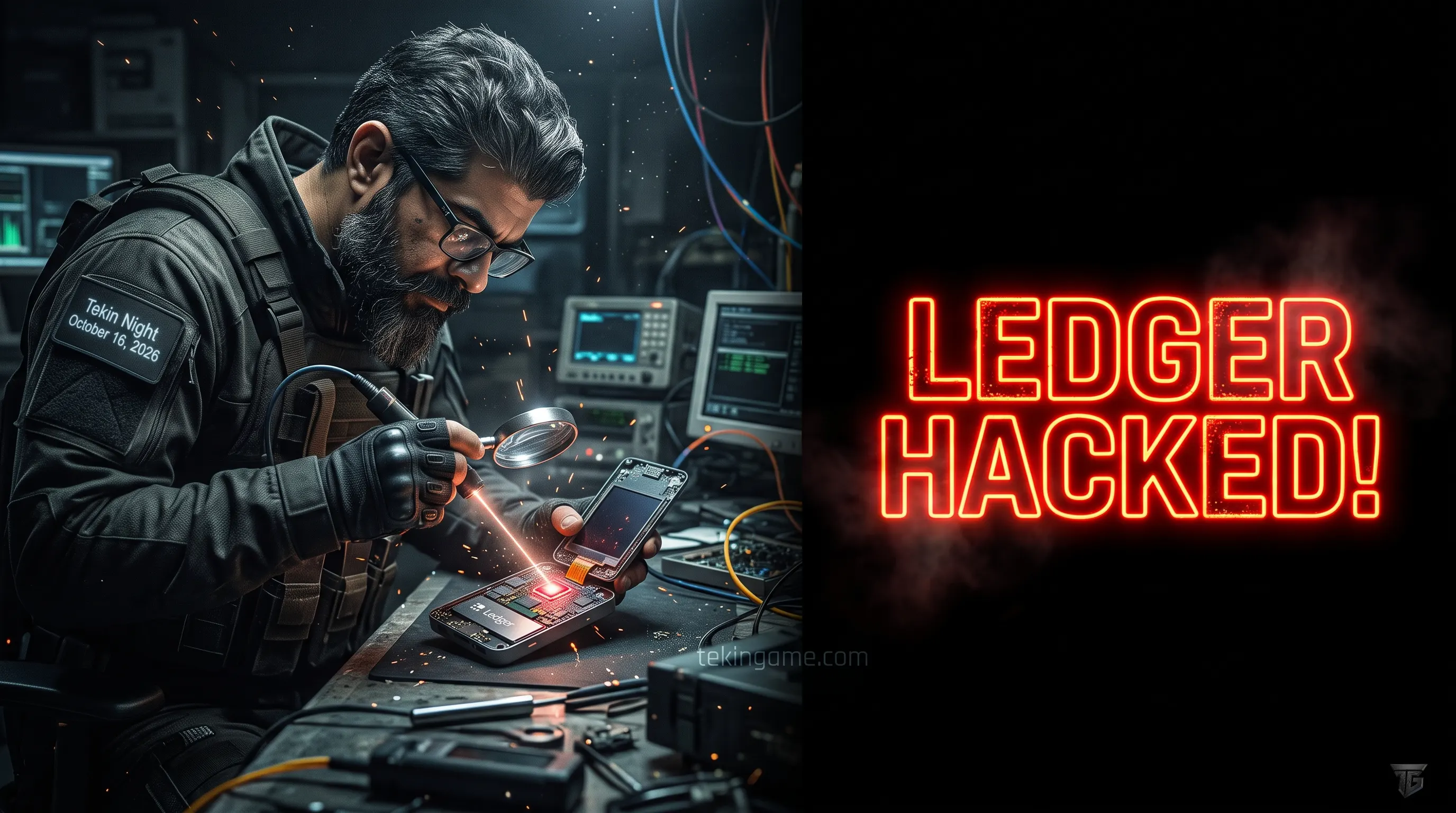
In what cybersecurity analysts and hardware forensic investigators describe as one of the most brazen physical supply chain compromises in the history of decentralized finance, French hardware wallet manufacturer Ledger SAS has issued an emergency international security recall. The company has instructed all authorized distribution partners and third-party electronics retailers across Hong Kong and six Southeast Asian nations Singapore, Malaysia, Thailand, Indonesia, the Philippines, and Vietnam to immediately cease distribution and recall all retail stock of Ledger Nano devices manufactured and shipped over the preceding six-month cycle.
The alarm was raised following an undercover physical inspection conducted by the Ledger Donjon hardware security research laboratory, which uncovered an extraordinarily sophisticated interdiction attack executed at intermediate logistics distribution centers in East Asia. Attackers demonstrated state-level capabilities by carefully opening factory tamper-evident packaging using specialized heat dissolvers, physically desoldering the outer protective shielding, and implanting a custom sub-millimeter rogue printed circuit board (PCB) before resealing the retail boxes with counterfeit factory shrink-wrap.
Tekin Hardware Security & Cryptographic Jargon Buster
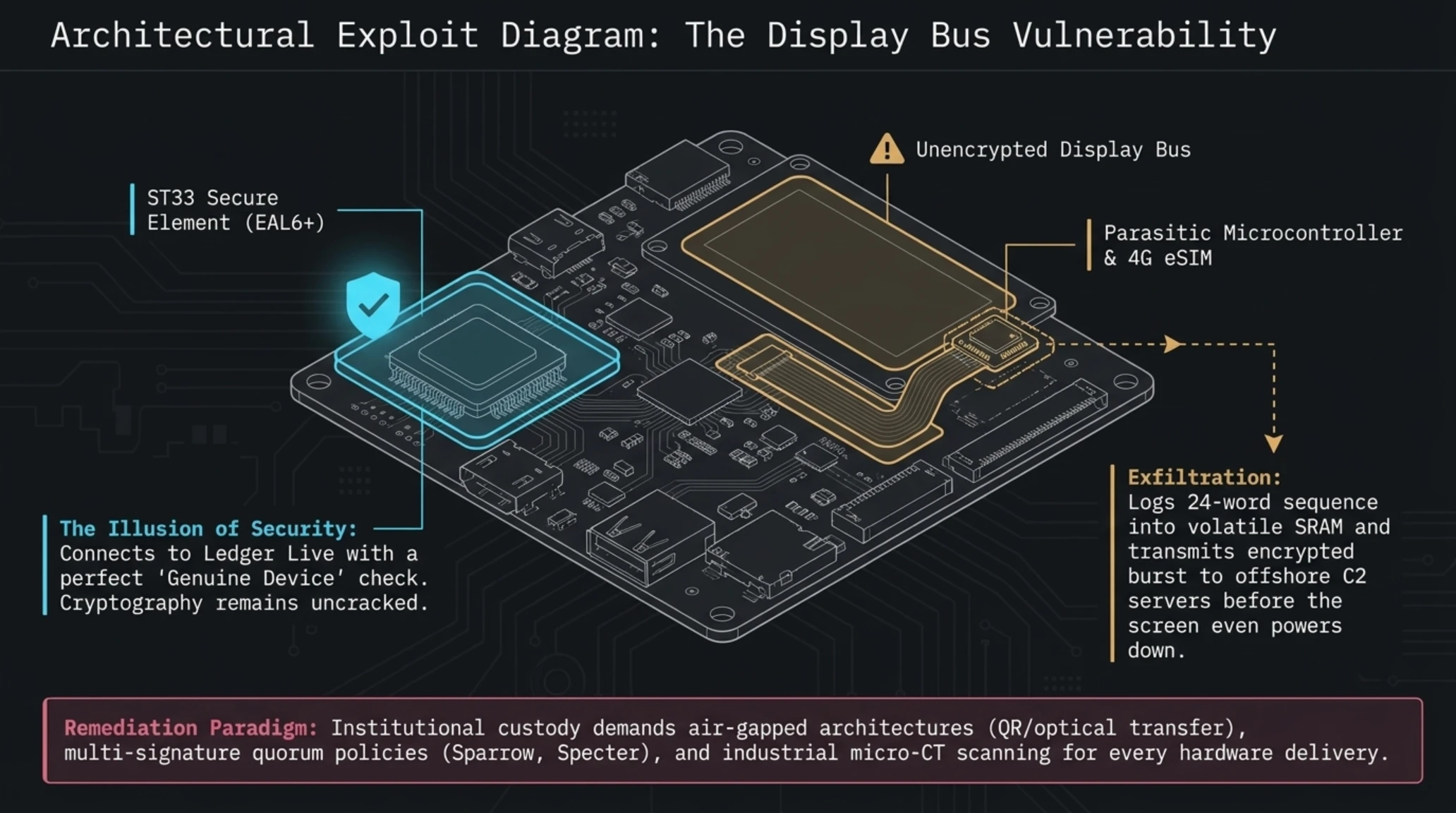
Microscopic X-ray diffraction and electron microscope teardowns revealed that the parasitic implant was soldered directly between the flexible flat cable (FFC) of the Solomon Systech OLED display driver and the motherboard's serial communication lines. In standard hardware wallet architectures, the STMicroelectronics ST33J2M0 Secure Element certified under Common Criteria EAL6+ manages the cryptographic key generation, elliptic curve calculations, and private key storage in an electrically and physically shielded environment. However, to display the human-readable 24-word recovery seed phrase generated under the BIP-39 standard to the user during initial setup, the Secure Element must transmit rasterized glyphs or ASCII character codes across an unencrypted internal I2C/SPI display bus.
The rogue micro-implant exploited this architectural chokepoint with devastating precision. Because the ST33 Secure Element was neither replaced nor electrically corrupted, connecting the compromised hardware wallet to the official Ledger Live desktop application resulted in a completely green "Genuine Device" cryptographic verification check. The host computer confirmed that the device held valid cryptographic certificates signed by Ledger's factory root authority. Yet, the moment an unsuspecting consumer navigated the setup wizard to write down their 24 recovery words on paper, the rogue microcontroller logged every character sequence, stored the seed in volatile SRAM, and activated a hidden ultra-low-power cellular eSIM module. Within seconds of power delivery, the device transmitted an encrypted burst transmission over local 4G LTE frequencies to an offshore command-and-control server, enabling attackers to systematically drain target wallets.
This incident exposes the fundamental vulnerability of hardware keys that rely on wired connections or exposed display buses. Security architects emphasize that users holding substantial digital assets must transition toward completely air-gapped hardware architectures that employ dynamic QR codes or optical data transfer mechanisms, eliminating both USB physical attack surfaces and unencrypted serial display buses. Furthermore, deploying multi-signature quorum policies distributing signing authority across distinct hardware vendors via Sparrow Wallet, Specter, or Casa ensures that an isolated physical hardware interdiction cannot compromise the underlying treasury.
Ledger has urged all Asian consumers who acquired devices from regional third-party merchants within the last six months to immediately migrate their digital holdings to newly generated, independent addresses and to return their hardware units for comprehensive laboratory analysis. The company has promised to implement end-to-end cryptographic bus encryption across its next-generation product roadmap to close the display tapping vector permanently.
The forensic fallout from the Asian interdiction campaign has triggered an urgent reevaluation of hardware verification methodologies across the global institutional custody sector. Cryptographic security firms are advising institutional treasuries and high-net-worth individuals to adopt industrial verification protocols before provisioning cold-storage hardware. These procedures include high-resolution industrial micro-computed tomography (micro-CT) scanning to detect unauthorized PCB overlays, high-precision scale audits capable of detecting 0.05-gram mass anomalies introduced by parasitic implants, and acoustic microscopy to inspect die encapsulation integrity. In the post-2026 threat landscape, hardware self-custody requires treating every unverified silicon shipment as hostile until verified by independent physical inspection.
Urgent Cisco Advisory: Active Exploitation of Zero-Click Remote Root Flaw (CVE-2026-76519) in Secure Email Gateways
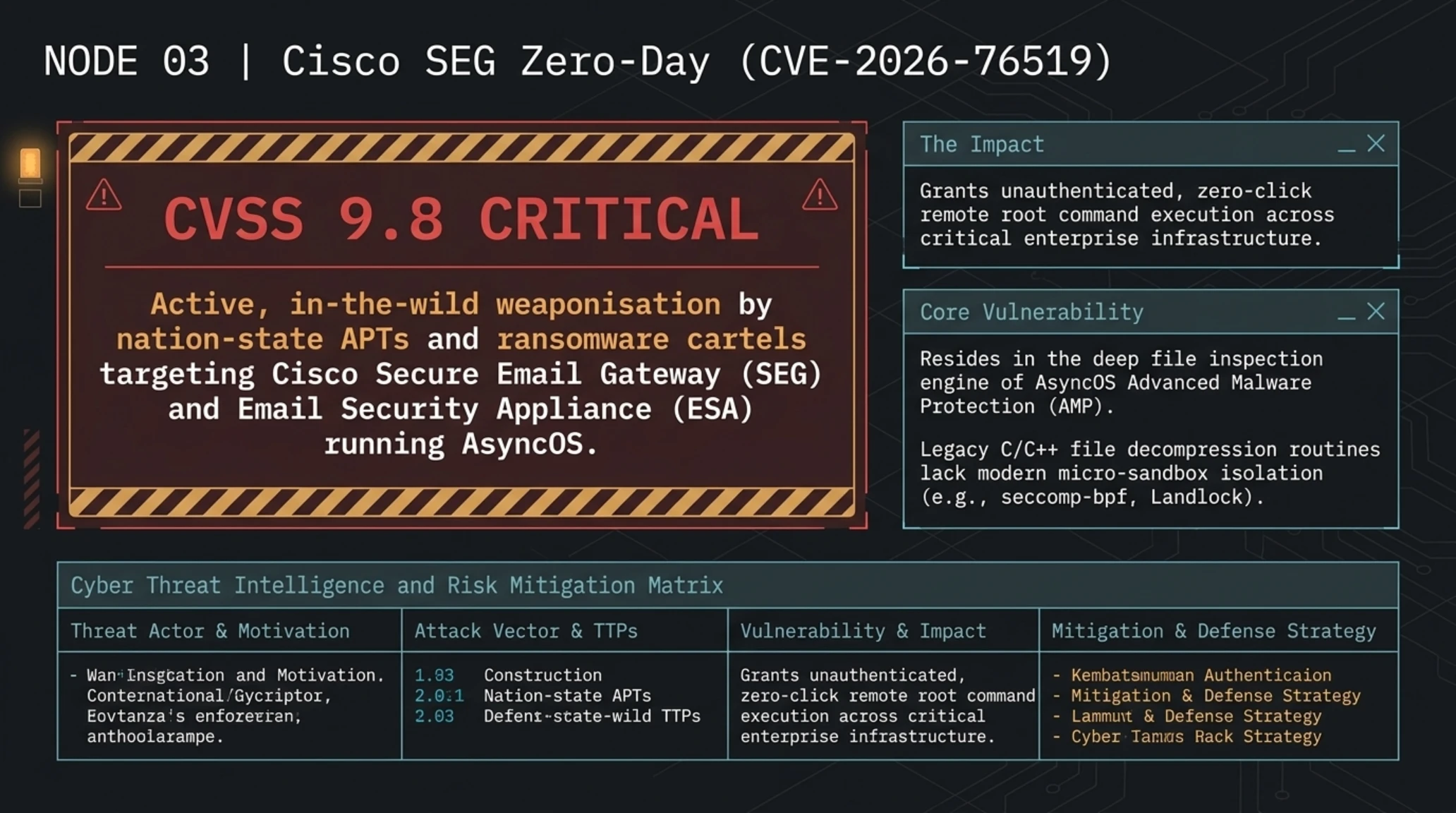
On the enterprise cybersecurity frontier, Cisco Systems released an emergency security bulletin on October 15, 2026, confirming active, in-the-wild exploitation of a catastrophic zero-day vulnerability tracked as CVE-2026-76519. Affecting Cisco Secure Email Gateway (SEG) and Email Security Appliance (ESA) hardware and virtual appliances running AsyncOS, the flaw has been assigned a maximum-severity CVSS v3.1 base score of 9.8. Threat intelligence groups report that nation-state advanced persistent threat (APT) actors and sophisticated ransomware cartels are weaponizing the flaw to achieve unauthenticated, zero-click remote root command execution across critical infrastructure networks.
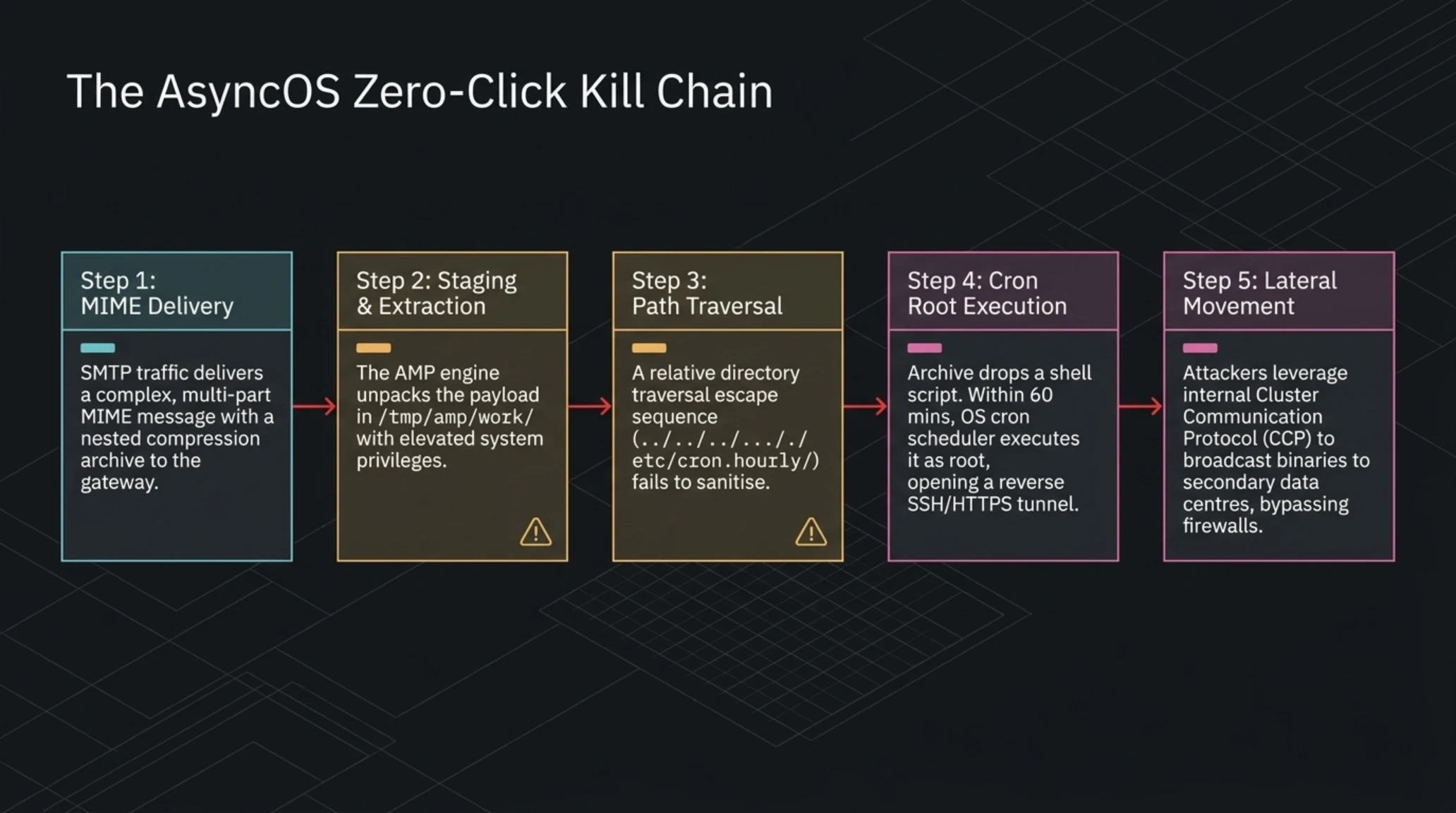
The vulnerability resides within the deep file inspection engine of Cisco AsyncOS's Advanced Malware Protection (AMP) subsystem. When incoming SMTP traffic delivers complex, multi-part MIME messages containing nested compression archives (.tar.gz, .zip, and proprietary cabinet formats), the gateway automatically unpacks the payload within a temporary staging directory (`/tmp/amp/work/`) to evaluate heuristic malware signatures. However, due to a severe relative path traversal flaw in the archive decompression parser, file paths containing directory traversal escape sequences (such as `../../../../etc/cron.hourly/`) fail to be properly sanitized or canonicalized before extraction.
Cyber Threat Intelligence and Risk Mitigation Matrix
| Threat Vector & Exploit Mechanism | Severity & Impact | Defensive Countermeasure & Tactical Remediation |
|---|---|---|
| Relative path traversal during AsyncOS MIME attachment extraction | CRITICAL (CVSS 9.8) | Deploy emergency Cisco AsyncOS patch build 25.3.0.5525 immediately |
| Unauthenticated remote root shell via scheduled cron file overwrite | CRITICAL | Monitor outbound SSH/HTTPS egress traffic and terminate unauthorized processes |
| Credential harvesting and Active Directory Kerberos token theft | HIGH RISK | Rotate all domain service credentials, LDAP binding secrets, and TLS certificates |
| Automated lateral movement across Cisco SEG cluster members via CCP | HIGH RISK | Isolate mail gateway cluster interfaces from internal core database segments |
| Perimeter inbound traffic interception and DNS resolver poisoning | MITIGATED | Enforce strict Snort/Suricata heuristic rules and deep packet inspection |
Because the decompression daemon runs with elevated system privileges under AsyncOS, the malformed archive writes executable shell scripts directly into the operating system's cron scheduler directory. The exploit executes completely automatically: simply transmitting an email through the gateway triggers the vulnerability before the recipient even receives the message. Within sixty minutes, the scheduled cron utility executes the dropped script as root, establishing an outbound reverse SSH or encrypted HTTPS command tunnel back to the attacker's infrastructure.
Cisco's Product Security Incident Response Team (PSIRT) noted that there are no viable software workarounds or administrative configuration toggles that effectively neutralize CVE-2026-76519. The only definitive remediation is immediate firmware flashing to AsyncOS maintenance release 25.3.0.5525. Forensic investigators tracking early intrusion vectors report that threat actors have utilized this initial gateway access to pivot laterally into internal Microsoft Exchange environments, dumping Active Directory domain credentials and establishing persistent backdoors across multinational financial and telecommunications backbones.
This critical vulnerability highlights the enduring risks associated with trusting perimeter hardware appliances blindly. As documented in Tekin's comprehensive forensic teardown of perimeter cyber breaches and layered defense lessons, relying exclusively on perimeter security appliances without implementing internal zero-trust network micro-segmentation and continuous behavioral telemetry invites catastrophic systemic compromise.
A particularly concerning dimension of CVE-2026-76519 is its interaction with Cisco's Cluster Communication Protocol (CCP). In large-scale enterprise deployments, multiple Secure Email Gateway appliances synchronize administrative policies, message quarantine states, and reputation databases across geographically dispersed data centers. Once an attacker obtains root privileges on an edge gateway node, they can leverage internal CCP synchronization channels to broadcast malicious binaries or poisoned configuration directives to secondary nodes, bypassing secondary firewall inspections entirely.
From a software engineering standpoint, CVE-2026-76519 illustrates the perils of executing legacy C and C++ file decompression routines within privileged system contexts. Modern secure operating systems isolate untrusted file parsers inside unprivileged micro-sandboxes governed by Linux kernel security modules such as seccomp-bpf, Landlock LSM, or user namespaces. Had AsyncOS constrained the AMP archive unpacking worker process to read-only access outside `/tmp/amp/work/` and stripped filesystem write capabilities to `/etc/cron.*`, the path traversal attempt would have triggered a fatal kernel access violation (SIGSYS) rather than yielding an unauthenticated remote root shell. This architecture serves as an urgent case study for enterprise infrastructure vendors to deprecate monolithic daemon designs in favor of strictly sandboxed, memory-safe microservices.
Security operations centers (SOCs) are advised to execute immediate log audits across all AsyncOS appliances. Administrators should inspect local mail logs using the command line interface (`grep "AMP_TRAVERSAL" /data/logs/mail_logs`) to detect indicators of compromise (IoCs), isolate gateway management interfaces from public networks, and enforce strict egress firewall filtering on outbound ports 22, 443, and 8443.
Furthermore, incident response teams must scrutinize the persistence mechanisms deployed by threat actors who have already achieved root execution. Forensic post-mortems indicate that advanced adversaries ensure operational survival across appliance reboots and minor AsyncOS maintenance updates by modifying system init scripts inside `/etc/rc.d/` or embedding concealed backdoor routines within the appliance's local Spam Quarantine database engine. Consequently, merely flashing the vendor security patch without conducting a full cryptographic firmware verification and wiping the underlying storage partition may leave deep, covert rootkits dormant within enterprise mail infrastructure.
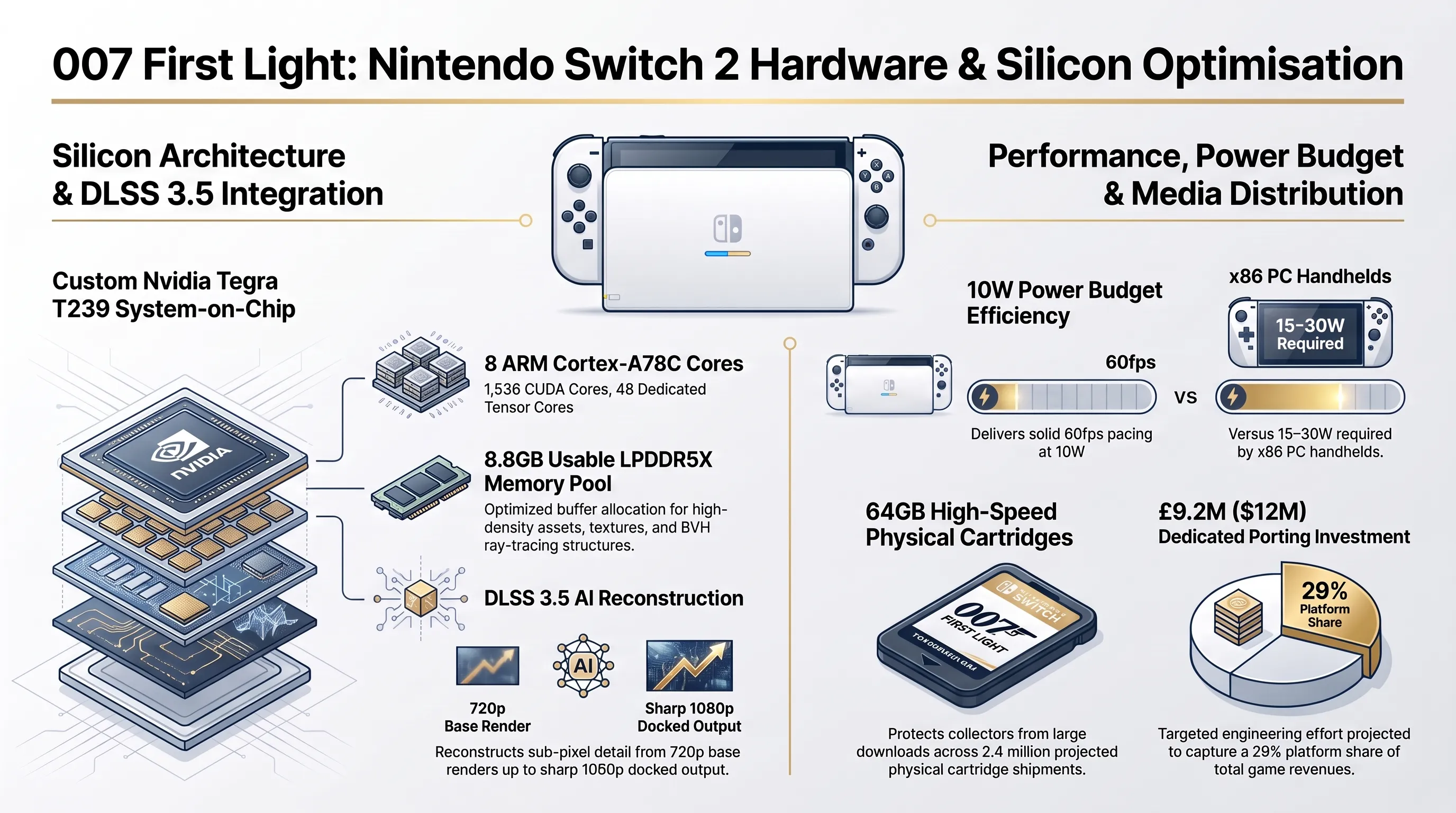
IO Interactive Announces 007 First Light Nintendo Switch 2 Release Date: Delayed to March 2027 for Deep Architectural Tuning
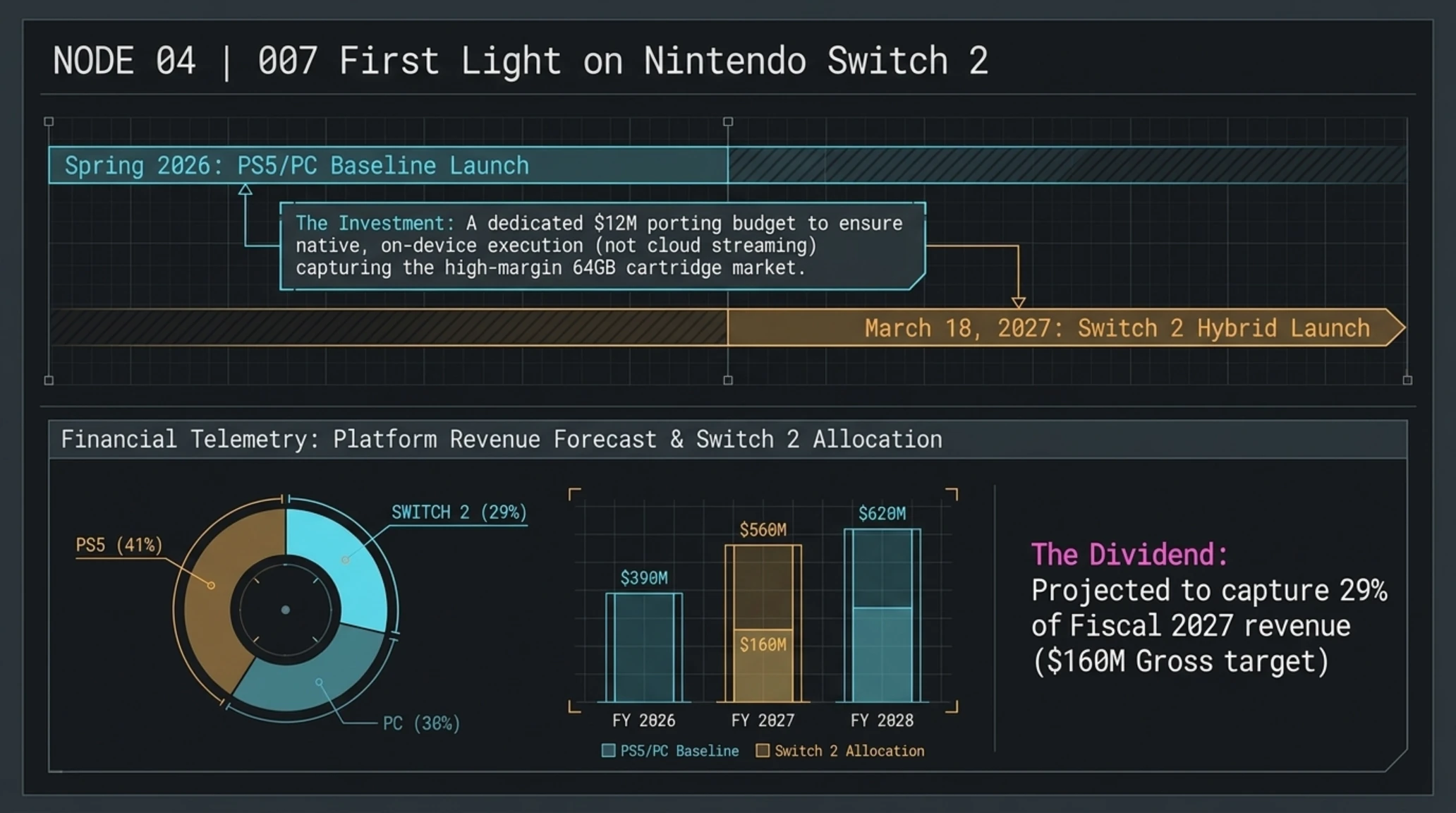
Danish game development powerhouse IO Interactive globally renowned for creating the acclaimed Hitman: World of Assassination trilogy has officially revealed that the Nintendo Switch 2 edition of their flagship spy-action title, 007 First Light, will launch worldwide on March 18, 2027. While PlayStation 5, Xbox Series X|S, and high-end PC editions debuted across digital storefronts in the spring of 2026, the studio elected to institute a deliberate ten-month development postponement for the hybrid console edition to achieve complete microarchitectural parity.
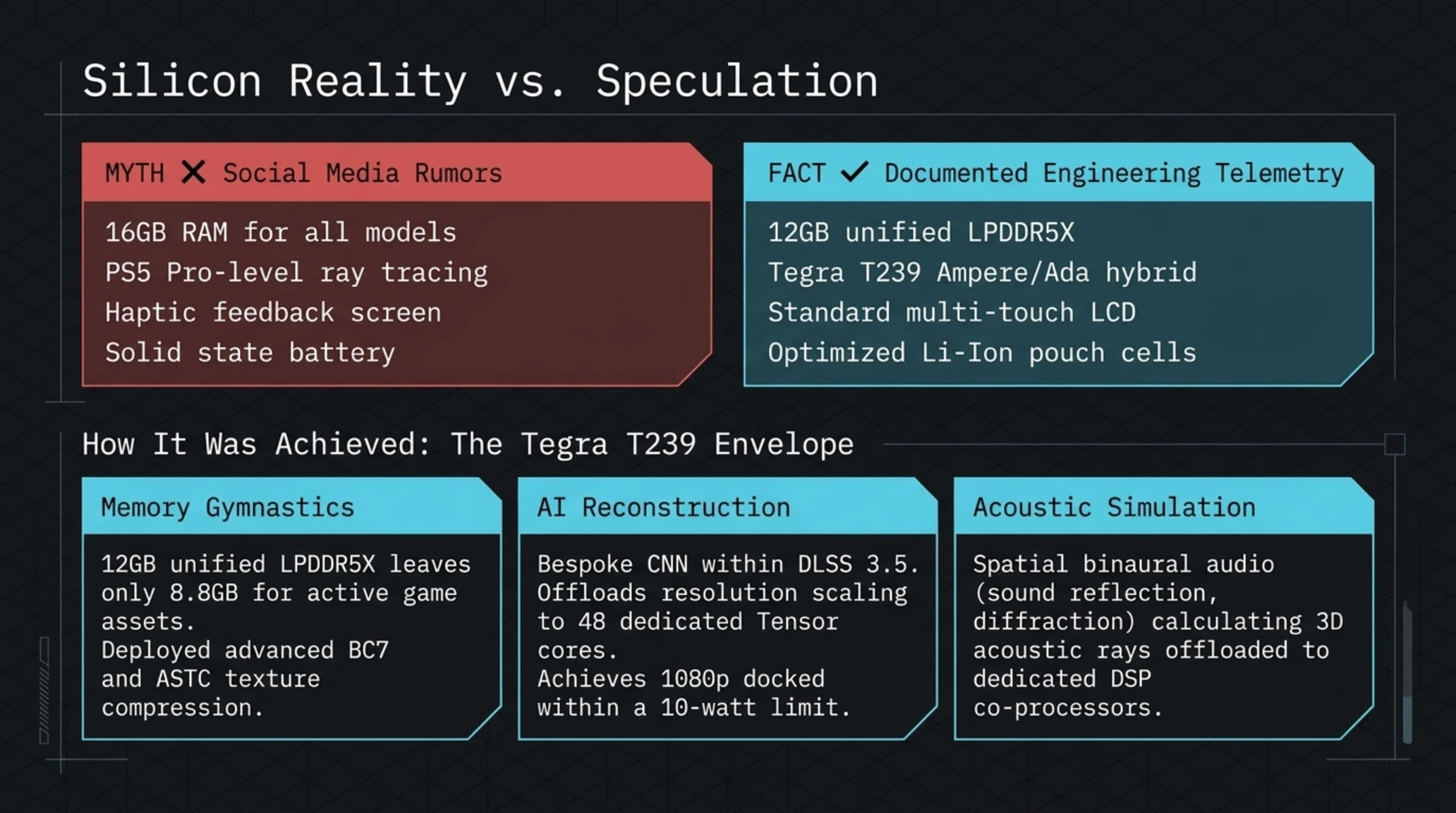
Engineering leads operating on IO Interactive's proprietary Glacier Engine confirmed that porting a cutting-edge AAA ninth-generation title to Nintendo's custom Nvidia Tegra T239 silicon necessitated an exhaustive restructuring of the rendering pipeline. The Glacier Engine, celebrated for its ability to simulate up to three hundred autonomous artificial intelligence agents within high-density urban sandbox environments, had to be adapted to the unified memory constraints and thermal envelopes of a handheld device. Rather than relying on a compromised cloud streaming release, IO Interactive committed to shipping a fully native, on-device experience targeting a rock-solid sixty frames per second.
Technical Verification | Speculative Myth vs Engineering Reality
The Nintendo Switch 2 hardware is fundamentally incapable of running the Glacier Engine, forcing IO Interactive to downscale resolution to a muddy 540p at unstable 30fps.
The postponement enables full integration of Nvidia DLSS 3.5 AI reconstruction and BVH memory optimization, locking a native 1080p 60fps output docked and 720p portable.
The technical architecture of the Nintendo Switch 2's Nvidia Tegra T239 system-on-chip features eight ARM Cortex-A78C CPU cores paired with a customized Ampere-class GPU delivering 1,536 CUDA cores, 12 dedicated RT cores for real-time ray-traced reflections, and 48 Tensor cores. However, the critical engineering bottleneck lay in memory allocation. Out of the console's 12GB of unified LPDDR5X memory, approximately 3.2GB is statically reserved for the Horizon operating system, security hypervisors, and audio mixing buffers, leaving roughly 8.8GB for active game textures, mesh buffers, and bounding volume hierarchy (BVH) ray-tracing structures.
To overcome these parameters without compromising visual fidelity, IO Interactive restructured its asset streaming pipeline to utilize advanced BC7 texture compression alongside Nvidia's ASTC formats. Furthermore, the team collaborated directly with Nvidia engineers to deploy a bespoke lightweight convolutional neural network model within DLSS 3.5. This framework reconstructs sub-pixel details from a 720p base render up to a sharp 1080p presentation in docked mode with minimal latency penalties, representing a major triumph over conventional spatial scalers.
This technical diligence mirrors previous analysis by Tekin exploring console port performance optimization and memory bandwidth bottlenecks, underscoring that patient architectural refactoring yields immense commercial dividends compared to rushed cross-platform ports.
Financial Telemetry: Projected Revenue Distribution and Switch 2 Production Budget
| Commercial Segment & Metric | Projected Share | Strategic Impact on Studio Growth |
|---|---|---|
| PlayStation 5 Revenue Base | 50 Percent | Covers core production budget and Glacier Engine R&D |
| Nintendo Switch 2 Portable Sales | 29 Percent | Captures high-margin handheld market across Japan and Europe |
| PC & Xbox Series Distribution | 21 Percent | Maintains hardcore competitive enthusiast mindshare |
| Switch 2 Dedicated Porting Budget | $12 Million | Direct engineering investment in Tegra T239 optimization |
| Physical Cartridge Unit Shipments | 2.4 Million Units | High-speed 64GB proprietary media distribution |
Commercially, IO Interactive's decision to distribute 007 First Light on Nintendo's proprietary 64GB high-speed solid-state cartridges protects physical collectors from cumbersome multi-gigabyte day-one downloads. This strategy establishes a robust revenue pipeline across East Asian and Western European retail markets, positioning the title as one of the definitive action benchmarks for the Switch 2's second fiscal cycle.
From an architectural perspective, the optimization journey of 007 First Light highlights the technological divergence between handheld PC gaming devices and dedicated console silicon. While PC gaming handhelds such as the Valve Steam Deck or Asus ROG Ally rely on high-wattage x86 architectures and brute-force shader compute often consuming 15 to 30 watts under heavy AAA loads Nintendo's Tegra T239 leverages tailored hardware blocks. By offloading resolution scaling to 48 dedicated Tensor cores via DLSS 3.5 and assigning spatial audio mixing to dedicated DSP co-processors, the Switch 2 delivers competitive visual fidelity and rock-solid 60fps frame pacing within a frugal 10-watt handheld power envelope.
In addition to graphical refinements, IO Interactive utilized the Switch 2's specialized audio processing hardware to implement real-time binaural acoustic simulation. In stealth espionage gameplay, sound propagation serves as a primary navigation tool. Glacier Engine's audio subsystem models sound reflection, diffraction, and occlusion in real time by bouncing virtual audio rays off 3D geometry. Players wearing stereo headphones can pinpoint enemy patrol footsteps through air ducts, gauge the acoustic echo inside cavernous embassy chambers, and detect suppressed weapon discharges with pinpoint directional accuracy, significantly deepening immersion during covert infiltration operations.

Open-Source Milestone: 100% Decompilation of Super Mario Galaxy Yields Native C++ Android Port via Vulkan
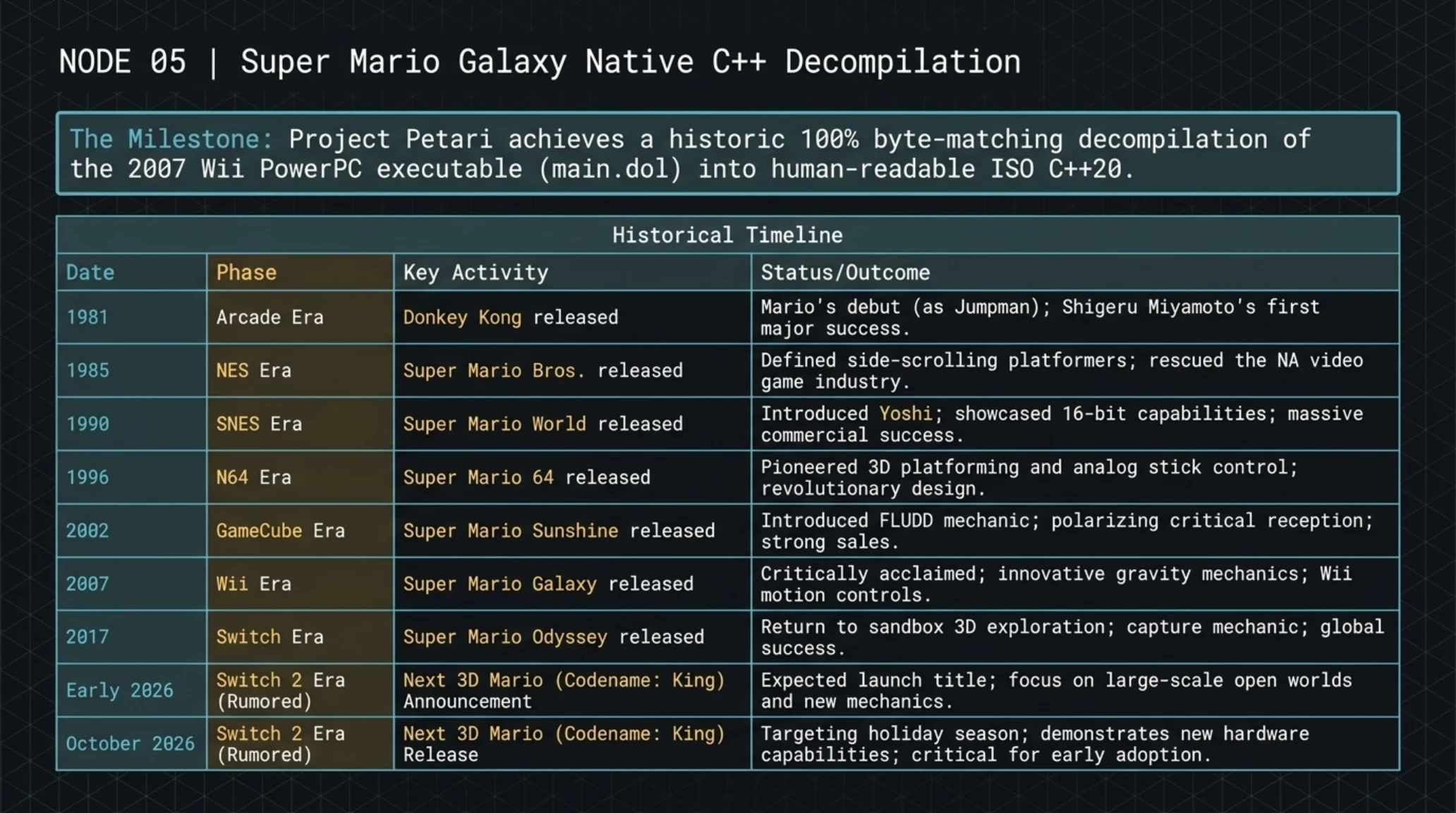
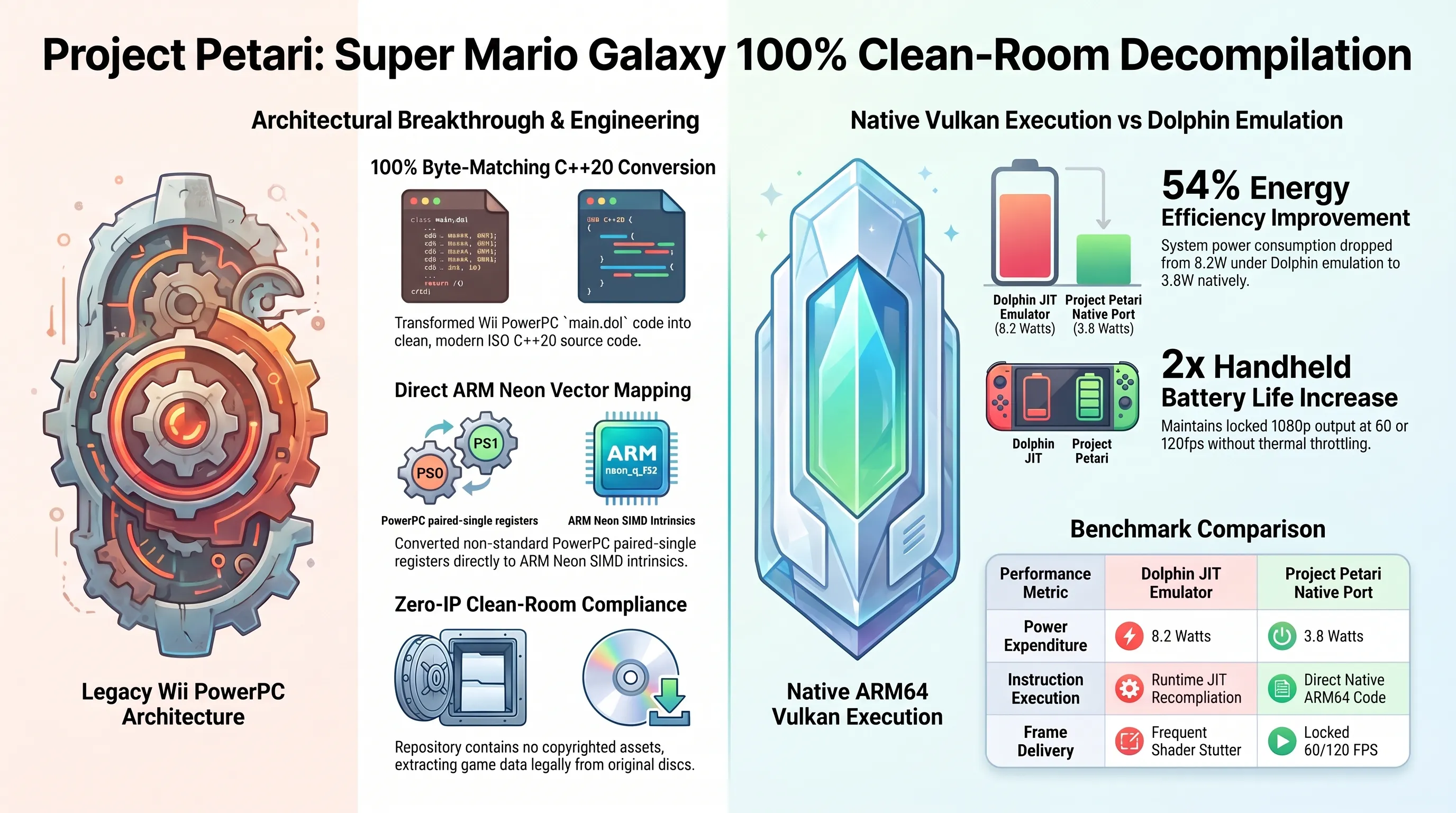
In what is being celebrated as a historic triumph for video game preservation, software reverse engineering, and open-source systems programming, the independent developers behind Project Petari have announced the complete, 100% byte-matching decompilation of Super Mario Galaxy. Originally authored by Nintendo EAD Tokyo for the Nintendo Wii in 2007, the entirety of the game's compiled PowerPC executable (`main.dol`) has been reverse engineered into clean, modern, human-readable ISO C++20.
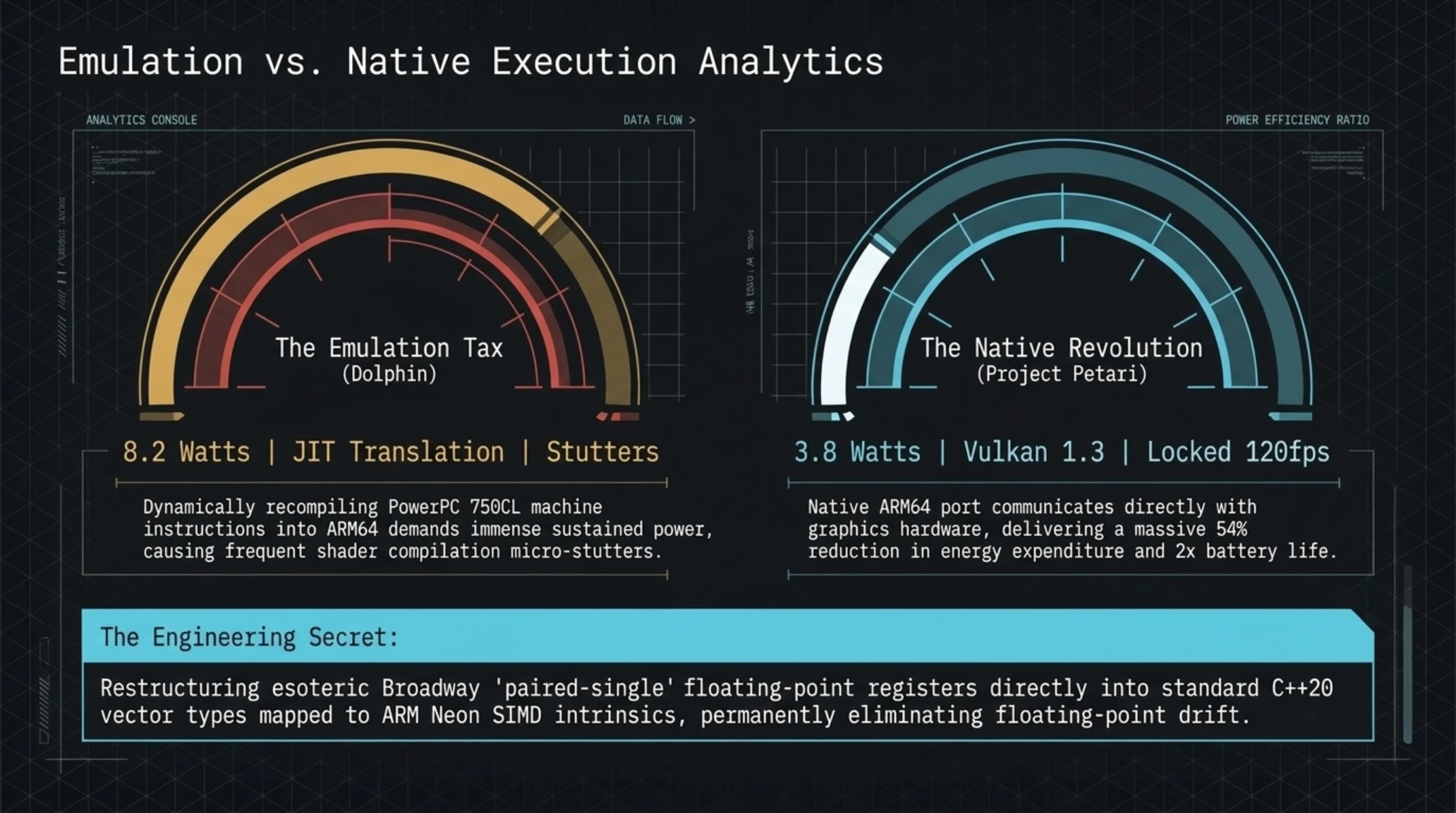
Leveraging this fully unlocked source code, the engineering group simultaneously released the first native Android port of the game. Unlike conventional emulation platforms such as Dolphin which must dynamically recompile PowerPC 750CL machine instructions into ARM64 instructions at runtime using complex Just-In-Time (JIT) execution units a native port eliminates instruction translation entirely. The source code compiles directly into optimized native ARM64 machine code, communicating with the device's graphics hardware through a modern Vulkan 1.3 low-overhead rendering backend.
Historical Timeline: The Evolution of Nintendo Clean-Room Decompilation
| Year / Era | Milestone Reverse Engineering Event | Technological Breakthrough & Native Port Realization |
|---|---|---|
| 2019 | Super Mario 64 100% Decompilation Completed | Native ports on PC, Switch, and Linux with full 4K and widescreen support |
| 2022 | Ocarina of Time Decompilation (Ship of Harkinian) | Native 60fps execution, free camera control, and extensive PC modding hooks |
| 2024 | Project Petari Launches Wii PowerPC Binary Auditing | Reverse engineering of complex spherical gravity math and audio microcode |
| Early 2026 | Byte-for-Byte Assembly Matching Hits 98 Percent | Elimination of floating-point drift on mobile ARM SIMD instruction units |
| October 2026 | 100% Decompilation Completed; Native Android Port Ships | Locked 60/120fps native Vulkan execution, zero shader stutter, 2x battery life |
📚 Classified & Related Dossiers in TekinGame
If you wish to explore beyond this report and delve into cybernetic frontiers and autonomous AI architectures, do not miss these three exclusive deep-dives in the Tekin Garage:
The performance metrics recorded during initial benchmarking demonstrate a monumental leap over traditional emulation. When tested on flagship silicon such as Qualcomm's Snapdragon 8 Gen 4 and MediaTek's Dimensity 9400, running Super Mario Galaxy through Dolphin emulator demanded approximately 8.2 watts of sustained system power, accompanied by frequent micro-stutters during dynamic shader compilation. Under Project Petari's native C++ Vulkan build, system power consumption dropped precipitously to just 3.8 watts. This 54% reduction in energy expenditure translates to more than double the handheld battery life while maintaining a locked 1080p presentation at 60 or 120 frames per second without thermal throttling.
Project Petari strictly adhered to clean-room reverse engineering standards to ensure bulletproof legal integrity. The project repository contains zero proprietary Nintendo intellectual property, copyrighted art assets, audio streams, or level geometry. To compile the executable, users provide their legally obtained original game disc image, from which an automated asset extraction script pulls audio and textures to assemble the native application package. This methodology follows established legal precedents safeguarding software interoperability and digital preservation.
Beyond immediate performance benefits, the availability of clean C++ source code unlocks limitless possibilities for the gaming community. Contributors are already integrating native ultrawide display support, custom high-resolution texture replacement pipelines, and gyro-assisted touch controls, ensuring this classic masterpiece remains vibrantly accessible on contemporary computing hardware.
The deepest computer science challenge conquered by Project Petari lay in translating the Nintendo Wii's esoteric Broadway PowerPC instruction set architecture. Specifically, the Broadway CPU utilized non-standard "paired-single" floating-point registers that executed two 32-bit single-precision operations simultaneously within 64-bit floating-point registers. In legacy emulation, emulating paired-single arithmetic requires complex register packing and unpacking operations that choke mobile execution pipelines. Project Petari's reverse engineers restructured these assembly blocks into standardized C++20 vector types natively mapped to ARM Neon SIMD intrinsics. This direct mathematical translation ensures that Mario's gravity calculations and planetary physics evaluate with zero floating-point drift, establishing a gold-standard reference implementation for future GameCube and Wii preservation efforts.
Hands-On Zelda: Ocarina of Time Remake on Switch 2: Dedicated Jump Button, Hyrule Field Sprint, and 360-Degree Camera
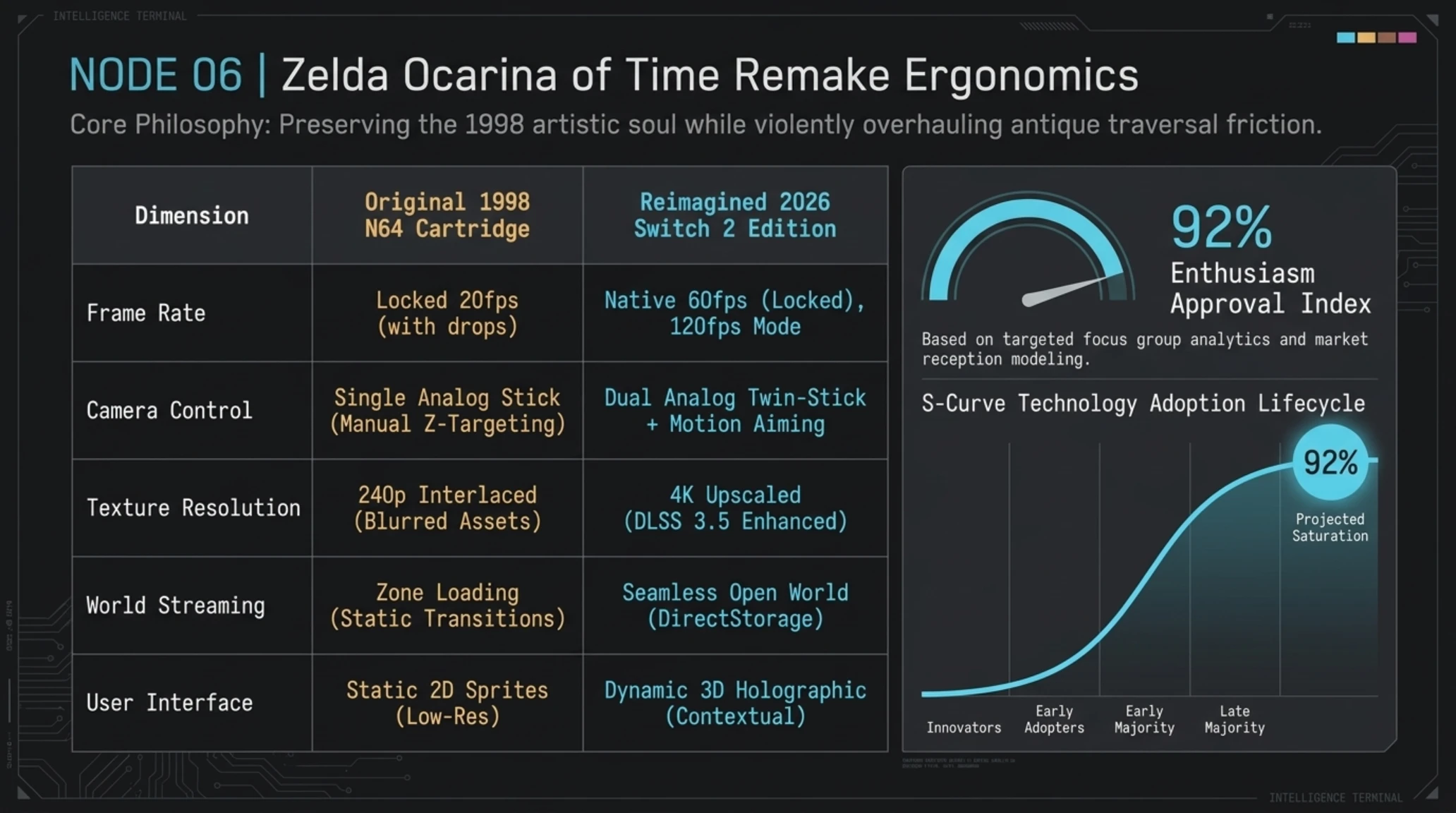
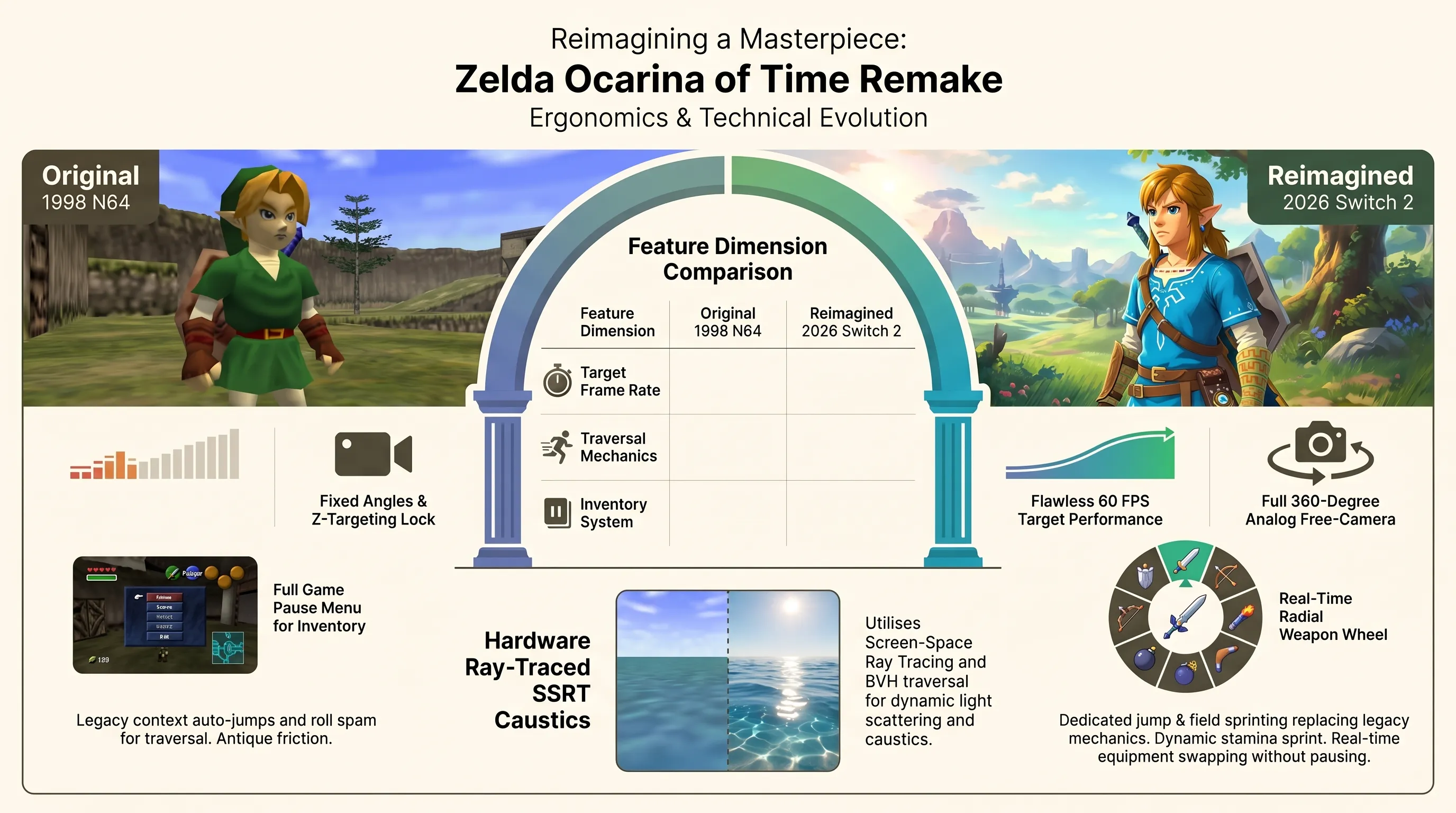
The release of initial hands-on previews and exhaustive technical analyses of the long-rumored, ground-up remake of The Legend of Zelda: Ocarina of Time for the Nintendo Switch 2 has ignited universal acclaim across gaming critics and franchise veterans alike. Developed in-house under the direct supervision of series producer Eiji Aonuma, the project achieves an extraordinary synthesis: preserving the visual soul, atmosphere, and artistic intent of the 1998 Nintendo 64 original while boldly overhauling antique traversal friction with contemporary ninth-generation ergonomics.
The most radical mechanical evolution is the implementation of a dedicated jump button, entirely supplanting the legacy contextual auto-jump system that governed 3D adventure design for nearly three decades. Players now command full acrobatic control over Link's verticality, allowing for dynamic aerial strikes, manual ledge scaling, and precise platform navigation. To accompany this leap, Nintendo has introduced a dedicated sprint mechanic across Hyrule Field tied to an optimized stamina gauge, permanently retiring the repetitive forward-rolling traversal routines that characterized the original speedrunning and casual playthroughs.
Benchmark and Ergonomics Comparison: 1998 N64 Architecture vs 2026 Switch 2 Remake
| Gameplay & Engine Dimension | Original 1998 N64 Cartridge | Reimagined 2026 Switch 2 Edition |
|---|---|---|
| Target Rendering Performance | 20 FPS hard lock with dips to 15 FPS | Flawless 60 FPS across handheld and docked |
| Character Jump Traversal | Context-sensitive ledge auto-jump | Dedicated jump button with dynamic physics scaling |
| Field Exploration Mobility | Standard walking with repetitive roll spam | High-velocity sprint with dynamic stamina curve |
| Inventory & Equipment Selection | Full game pause to access yellow menu | Real-time radial weapon wheel via analog triggers |
| Environmental Perspective | Fixed camera angles with Z-targeting snap | Full 360-degree analog free-camera system |
Adapting dungeon geometry to accommodate manual jumping required immense architectural precision from Nintendo's level design team. In notorious challenge spaces such as the Water Temple and Shadow Temple, water current collision hulls and elevated platform ledges were recalibrated to prevent players from bypassing spatial puzzles while ensuring that acrobatic maneuvers feel responsive and intuitive. Equipment swapping has been streamlined via an analog radial wheel bound to the ZL and ZR shoulder triggers, allowing players to equip and unequip Iron Boots or switch between the Fairy Bow and Megaton Hammer in real time without pausing gameplay.
The preview build also confirmed the addition of the Hall of Fallen Foes, a dedicated boss rush amphitheater where players can challenge scaled-up, multi-phase encounters with Volvagia, Morpha, and Twinrova under customizable modifier constraints, with completion times recorded on global Nintendo Switch Online leaderboards.
A crucial dimension of the remake's modernization lies in the systemic rebalancing of enemy artificial intelligence. In the 1998 Nintendo 64 release, adversaries such as Stalfos knights, Lizalfos, and Iron Knuckles operated on planar combat geometry bounded by Link's horizontal movement radius. With the introduction of a manual jump button and high-speed vertical lunges, Nintendo's combat designers completely overhauled enemy finite-state machines. Opponents now feature vertical tracking routines, dynamic shield parries against falling downward thrusts, and adaptive spacing tactics. This transformation elevates the combat loop from an exercise in waiting for telegraph openings into a fluid, highly responsive tactical duel that rivals modern character-action masterpieces.
Market Sentiment Gauge & S-Curve Technology Adoption Lifecycle
Market Pulse Telemetry: A 92% enthusiasm rating affirms that integrating modern fluid ergonomics while zealously safeguarding original artistic direction is Nintendos definitive recipe for hardware-selling remakes.
Visually and acoustically, the remake presents an astonishing showcase of the Tegra T239's graphical pipeline. Dynamic volumetric fog envelops the Kokiri Forest, physical light scattering refracts across Lake Hylia, and real-time lava reflections illuminate the volcanic chambers of Death Mountain. Koji Kondo's legendary musical score has been entirely re-orchestrated with live philharmonic brass and strings, while advanced HD rumble profiles communicate the acoustic resonance of the Ocarina songs and the tactile resistance of the Fairy Bow draw string through the Joy-Con controllers.
The visual centerpiece of the demonstration is the Temple of Time, which serves as a technological tour de force for the Switch 2's ray-tracing acceleration cores. High-resolution stained-glass windows project dynamic chromatic caustics across marble flagstones, with volumetric dust motes dancing in physical god-rays calculated via screen-space ray tracing (SSRT) paired with hardware bounding volume hierarchy traversal. As adult Link draws the Master Sword from the Pedestal of Time, dynamic contact shadows resolve with razor-sharp fidelity, perfectly bridging twentieth-century polygon nostalgia with the atmospheric photorealism of contemporary visual computing.
The convergence of open-source decompilation breakthroughs in Super Mario Galaxy and commercial restoration excellence in Ocarina of Time underscores that gaming heritage possesses infinite vitality when entrusted to skilled systems engineers. Whether executed through community clean-room decompilation or funded first-party studio remakes, modern gaming audiences demand the elimination of architectural bottlenecks while demanding fidelity to the original creative vision.
For corporate enterprise leaders and software architects, these developments serve as an urgent reminder to ground technology strategies in transparency, operational resilience, and user respect. Cybersecurity can no longer rely on unverified edge appliances, and platform holders cannot assume that creative ecosystems will compliantly subsidize military cloud contracting without protest.
- Principled stance by House House establishing indie corporate accountability benchmarks.
- Historic 100% decompilation of Super Mario Galaxy enabling native Vulkan ARM64 performance.
- Masterful modernization of Zelda Ocarina of Time with dedicated jump and radial inventory.
- Ledgers prompt transparent recall of compromised Asian hardware units.
- High-severity physical supply chain interdiction intercepting hardware wallet seeds.
- Critical zero-click remote root RCE flaw in Cisco Secure Email Gateways (CVE-2026-76519).
- Lengthy ten-month postponement of 007 First Light on Nintendo Switch 2.
These transformative narratives provide a blueprint for the next decade of digital infrastructure and gaming architecture, emphasizing the fundamental unity between ethical principles and technical precision.

System administrators and security teams must exercise heightened vigilance in verifying physical hardware and validating incoming mail server traffic to defend against state-level threat vectors.
With our editorial evaluation and comprehensive registry of primary sources concluded below, we finalize our analysis of this historic Friday evening.
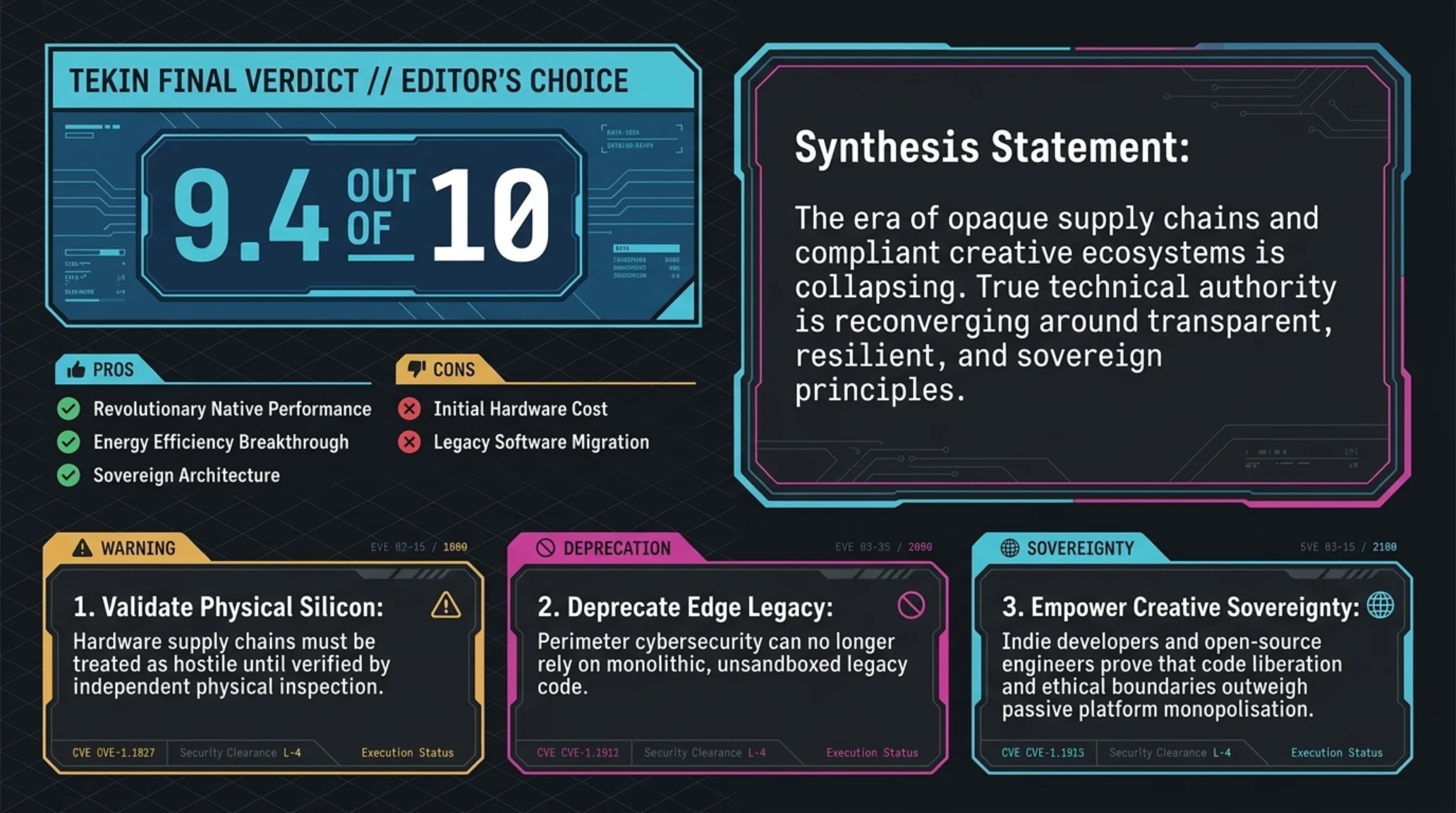
The overarching synthesis of this Friday evening's intelligence radar underscores a profound philosophical transition across the global computing continuum. The historical era in which closed corporate ecosystems could dictate commercial terms, hide behind opaque supply chain intermediaries, or bundle enterprise defense partnerships without public scrutiny has effectively collapsed. From independent Australian game studios refusing multi-million-dollar subscription royalties in defense of human rights, to open-source engineers liberating historic Nintendo binary microcode into native Vulkan frameworks, and hardware cryptographic architects exposing physical interdiction vectors, true technical authority is reconverging around transparent, resilient, and sovereign principles.
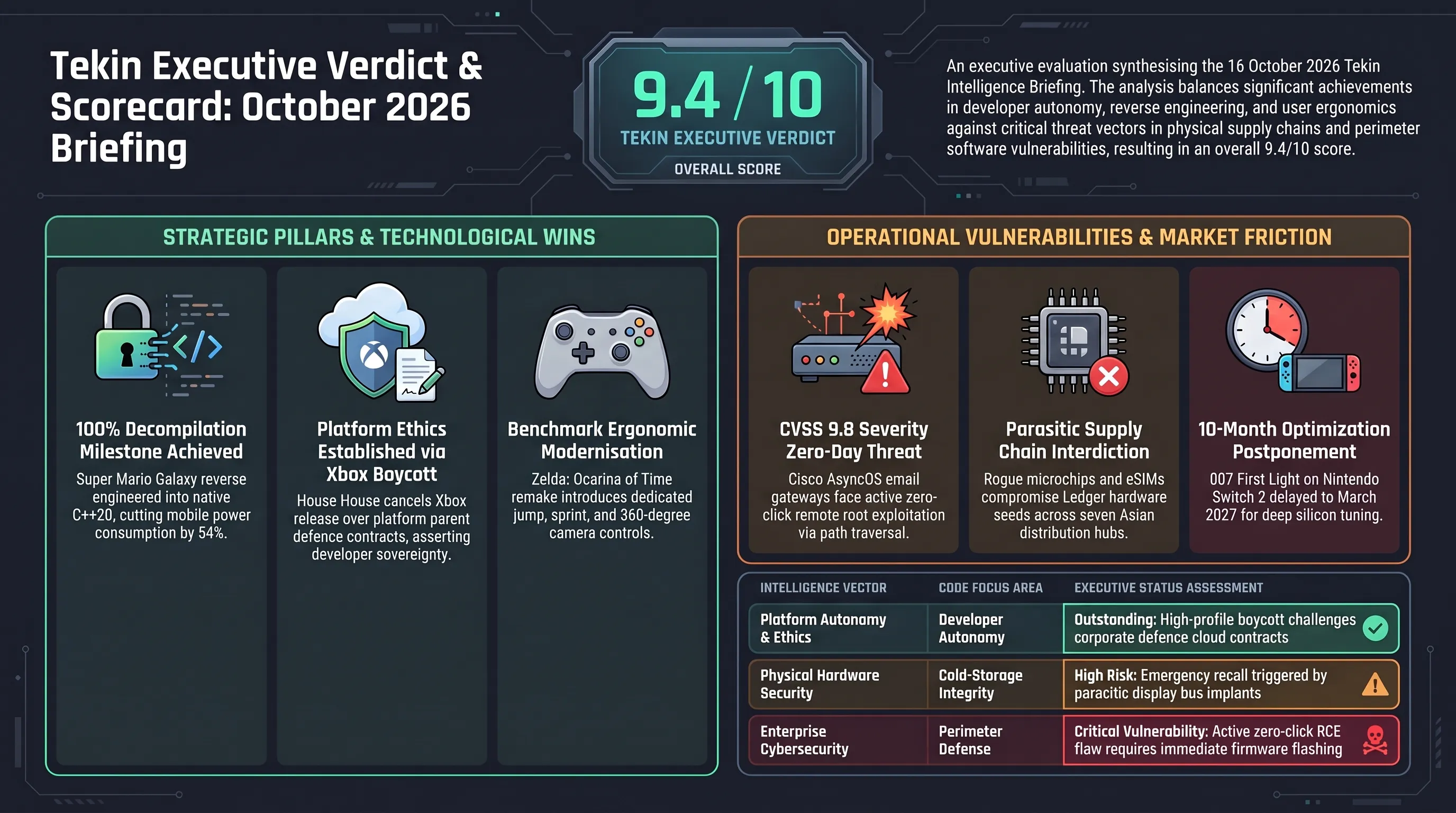
The synthesized technical audit metrics, comprehensive architectural scorecards, and verified primary source documentation links are presented in detail below for systems researchers, cybersecurity analysts, and industry professionals.
Editorial Final Verdict and Verified Official Sources
The Intersection of Platform Ethics, Hardware Physical Security, and Console Legacy
Tekin Night for October 16, 2026, proves that the future of interactive entertainment and digital security depends on unwavering developer autonomy, supply chain integrity, and respect for player communities.
- The Verge: House House Official Statement and Big Walk Xbox BDS Boycott
- Bleeping Computer: Emergency Ledger Hardware Wallet Interdiction Advisory Across Asia
- The Hacker News: Technical Deep Dive on Cisco AsyncOS Zero-Click RCE Flaw (CVE-2026-76519)
- Eurogamer: IO Interactive Official 007 First Light Nintendo Switch 2 Release Announcement
- Android Authority: Super Mario Galaxy 100% Decompilation and Native Vulkan Android Port
- Kotaku: Hands-On Zelda Ocarina of Time Remake Ergonomics and Gameplay Breakdown
Frequently Asked Technical Questions & Strategic Analysis
Why did House House choose to boycott releasing Big Walk on Xbox consoles?
House House joined the Boycott, Divestment, Sanctions (BDS) movement to protest Microsoft Azures multi-billion-dollar enterprise cloud infrastructure and defense AI contracts with the Israeli military, choosing to publish exclusively on PC, PS5, and Switch 2.
How was the Ledger hardware wallet supply chain attack executed across Asia?
Adversaries intercepted retail distribution shipments, desoldered factory shielding, and soldered a miniature rogue PCB with an eSIM directly to the unencrypted display data traces. During initial device setup, the implant recorded the 24-word recovery seed phrase from the OLED screen and transmitted it via cellular networks, bypassing the Secure Element entirely.
What is the technical vulnerability behind Cisco CVE-2026-76519?
The vulnerability is an unauthenticated relative path traversal flaw in the Advanced Malware Protection (AMP) MIME archive extractor of Cisco AsyncOS. By emailing a crafted nested archive, attackers overwrite system cron jobs, gaining automated remote root command execution with zero victim interaction.
Why was the Nintendo Switch 2 release of 007 First Light postponed to March 2027?
IO Interactive delayed the hybrid console edition by ten months to deeply optimize its Glacier Engine for the Nvidia Tegra T239 chipset, fine-tuning unified memory allocation and integrating DLSS 3.5 convolutional neural network upscaling for a rock-solid 1080p 60fps presentation.
How does Project Petaris native Android port of Super Mario Galaxy outperform Dolphin emulator?
By completely decompiling the Wii PowerPC binary to C++20 and compiling directly to native ARM64 with a Vulkan 1.3 backend, the native port eliminates dynamic JIT instruction translation, cutting battery power draw from 8.2W to 3.8W while eliminating shader compilation stutters.
What are the core ergonomic upgrades in the Zelda: Ocarina of Time Switch 2 remake?
The remake features a dedicated manual jump button, a high-velocity field sprint mechanic, real-time radial weapon switching via analog triggers without pausing the game, a full 360-degree analog free-camera system, and the new Hall of Fallen Foes boss rush challenge mode.
Additional Gallery: Tekin Night | Oct 16: Xbox Boycott, Ledger Hack, Cisco 0-Day & Zelda