Tekin Night | Thursday, October 15, 2026: Microsoft Xbox Labs WebGPU Push, GTA 6 PC Launch Window, and Epic Games AI Mandate
The evening of Thursday, October 15, 2026, culminates in an extraordinary sequence of technical disclosures, radical policy realignments among platform holders, and structural tremors rippling through triple-A video game development pipelines worldwide. While the morning hours were dominated by orbital compute breakthroughs and massive operating system security rollouts, the evening cycle belongs decisively to interactive entertainment, consumer hardware architecture, and the fundamental reimagining of how digital assets are rendered, distributed, and preserved.
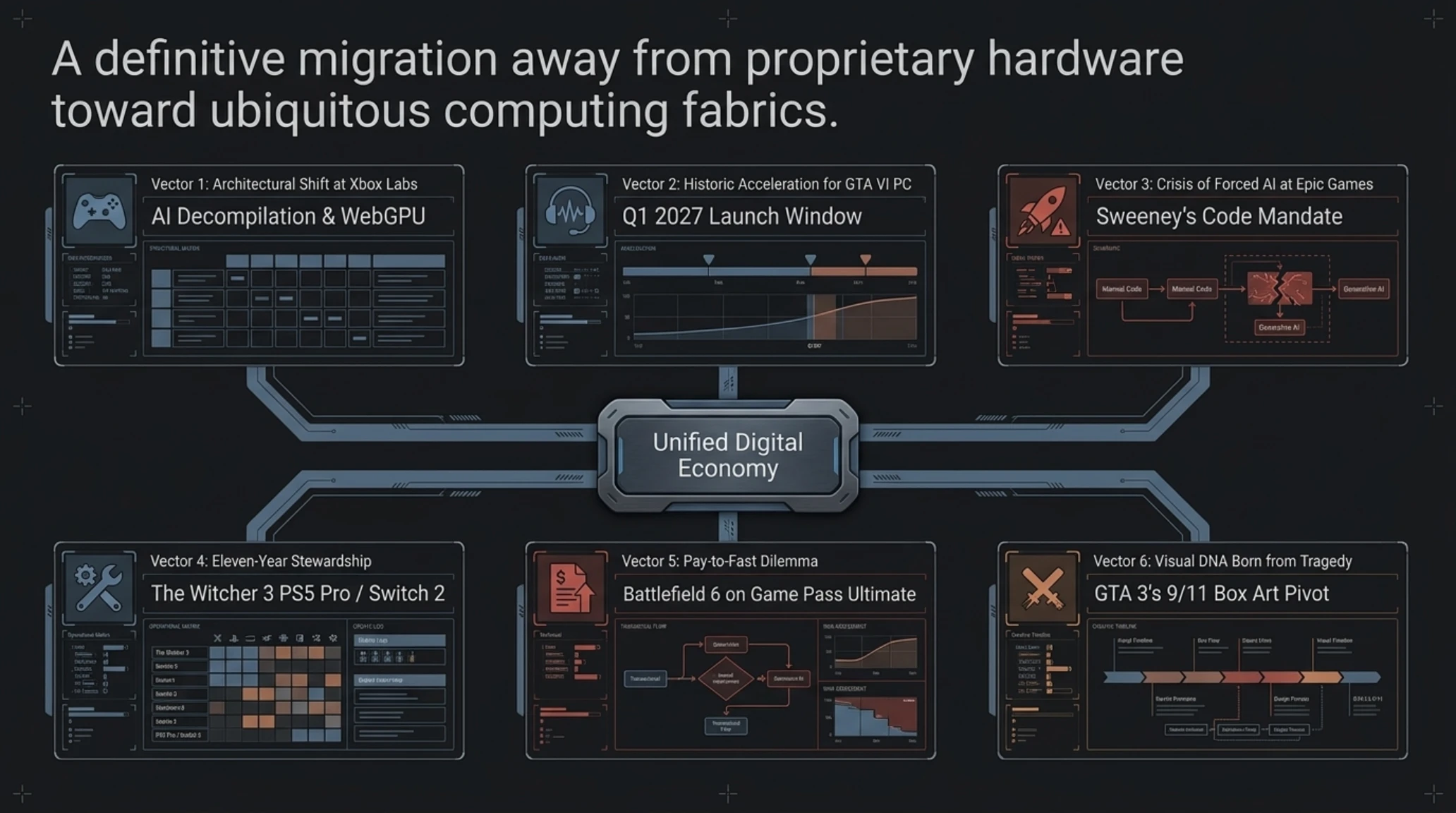
Across North America, Europe, and Asia, the gaming industry is witnessing a definitive migration away from proprietary living-room plastic boxes toward ubiquitous, decentralized computing fabrics. In this new landscape, the historical dividing lines separating high-end dedicated gaming consoles, desktop personal computers, and standard internet browser tabs are evaporating at unprecedented velocity. Corporate giants are taking drastically diverging ideological paths in response to these paradigm shifts: from Microsoft embracing community decompilations and hardware-accelerated web runtimes, to Epic Games colliding head-on with the brittle limitations of forced generative AI development. In this comprehensive executive dispatch, the Tekin Plus editorial board delivers an exhaustive forensic breakdown of the six core technological vectors defining this pivotal evening.
Strategic Intelligence Briefing // 6 Core Vectors
The foundational telemetry gathered from earnings calls, developer discords, and runtime benchmarks confirms that the convergence of open web standards and next-generation graphics APIs is systematically rewiring the economics of entertainment. The analytical HUD below highlights the vital quantitative pillars underpinning tonight's industry-wide transformation.
Fundamental Quantitative Telemetry | Thursday Evening Digest
The seismic transition from locked proprietary consoles to client-side hardware-accelerated web runtimes represents the most disruptive distribution shift since the birth of digital storefronts.
The first major narrative of the evening centers on Redmond, where Microsoft has unveiled a bold philosophical reversal regarding community reverse engineering, code decompilation, and browser-native execution. Rather than dispatching cease-and-desist letters to hobbyist programmers, Microsoft is operationalizing artificial intelligence to transform legacy game binaries into universal web-executable assets.
For decades, the video game preservation landscape has been defined by an adversarial dynamic between corporate copyright holders and open-source emulation authors. By establishing a dedicated skunkworks team to harness the capabilities of modern browser hardware access, Xbox is setting an entirely new benchmark for corporate stewardship and platform expansion.
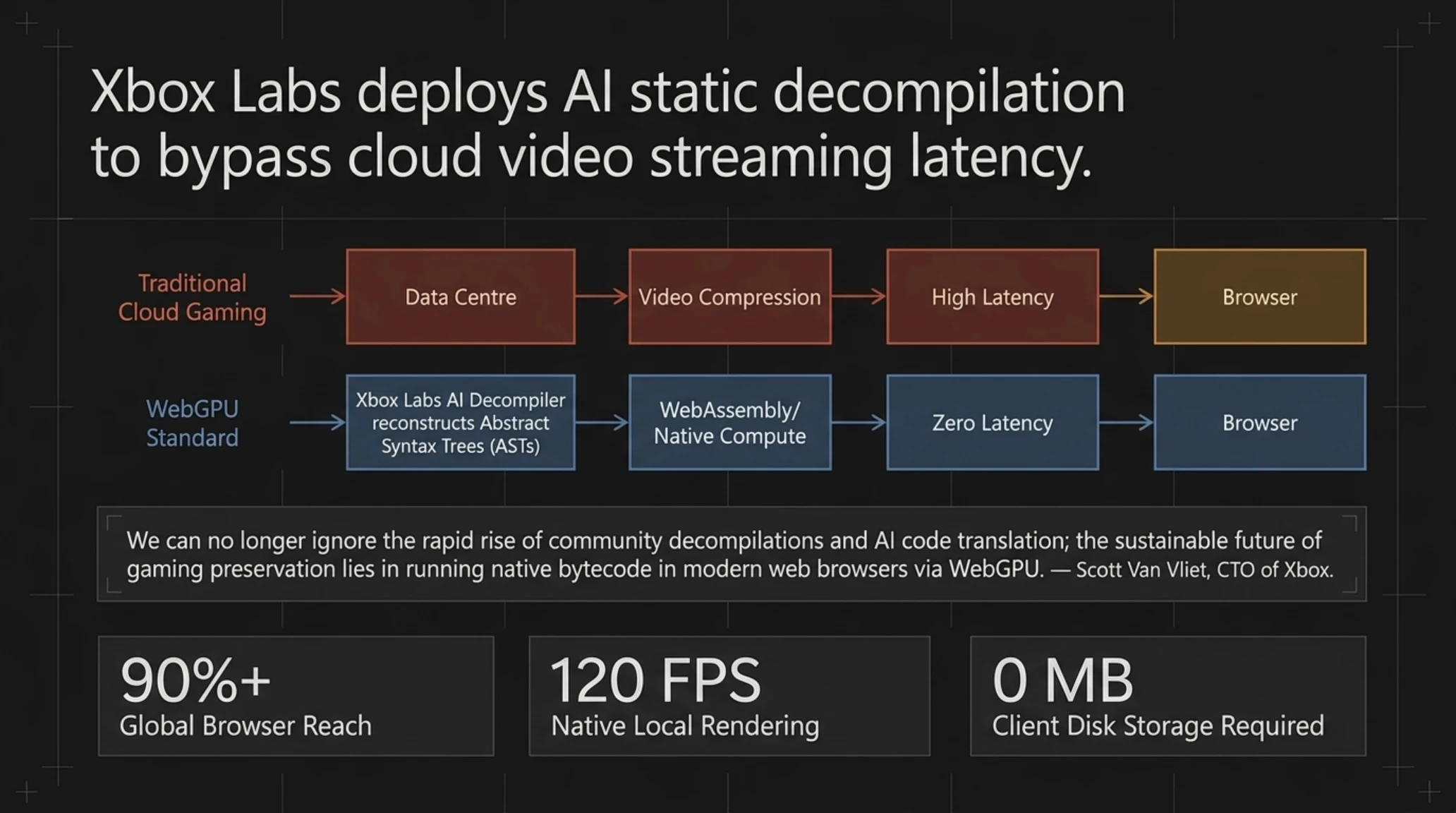
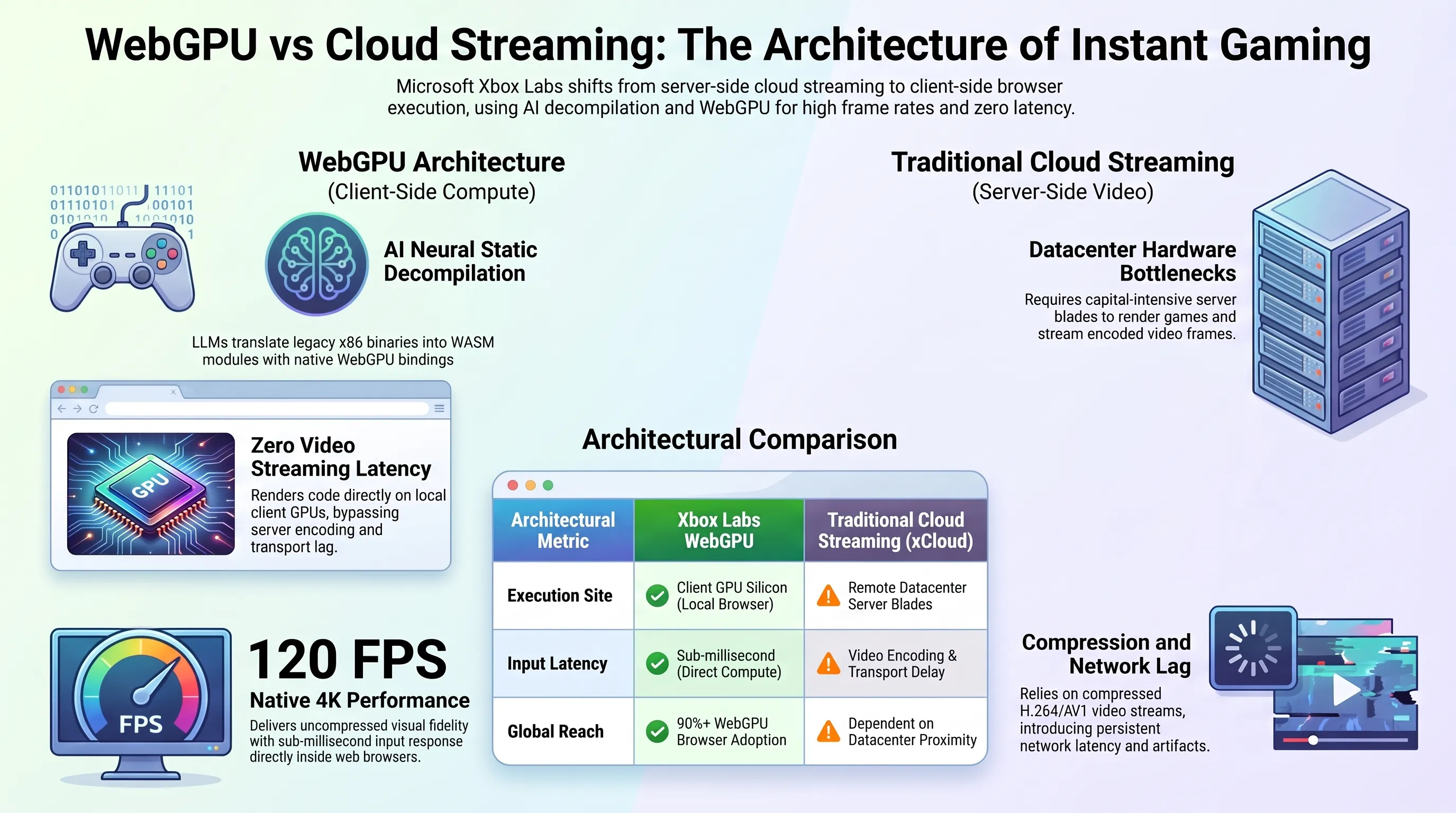
The technical rendering schematic above illustrates the WebGPU execution pipeline, showcasing how client-side GPU compute shaders directly interface with browser tabs to execute recompiled classic console binaries without video compression overhead.
Microsoft Establishes 'Xbox Labs' to Embrace AI Game Decompilations and WebGPU Browser Gaming
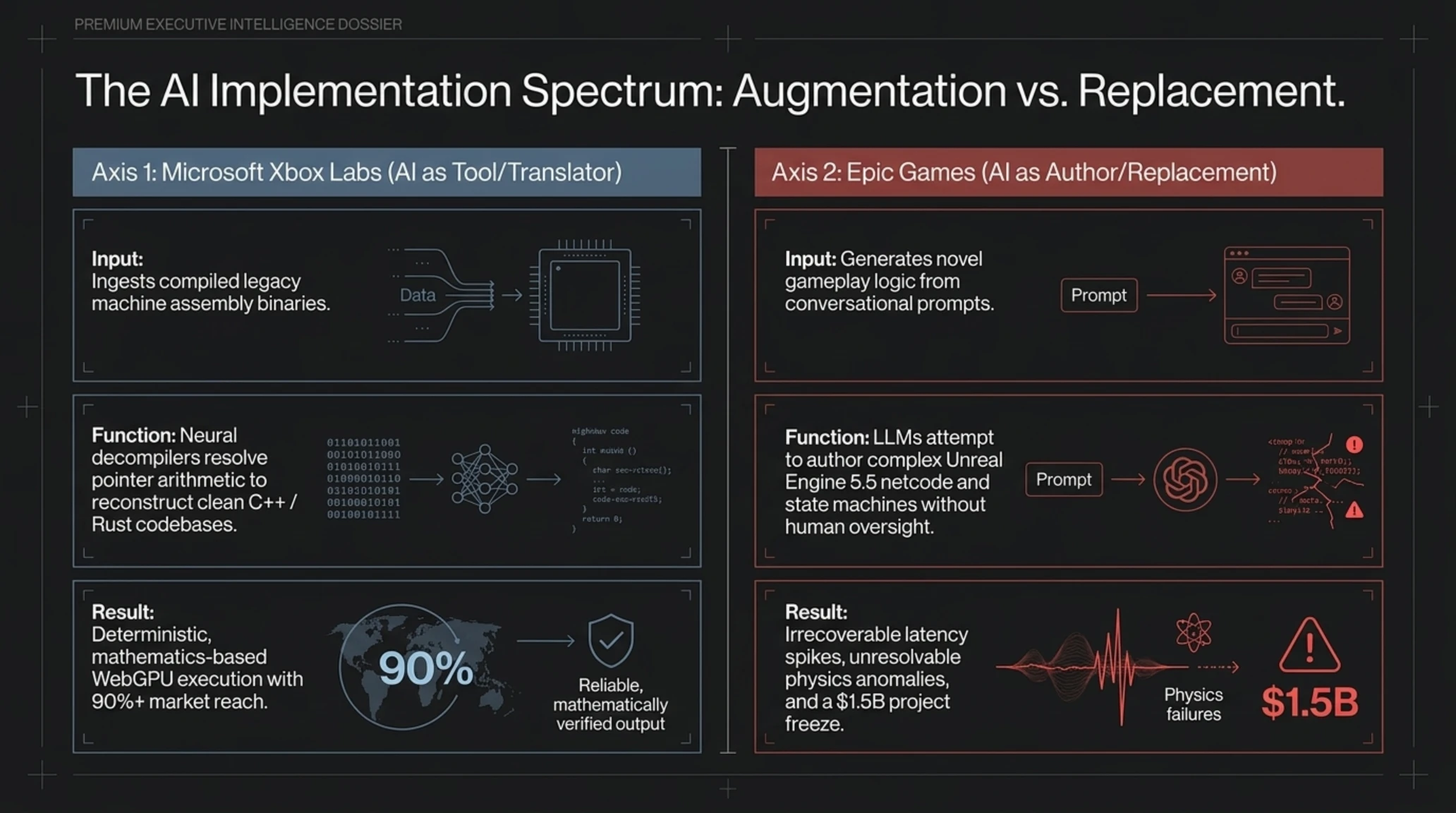
While traditional console manufacturers like Nintendo maintain aggressive legal postures against emulators, reverse engineering repositories, and ROM preservation platforms, Microsoft Gaming has taken a radically divergent path. Scott Van Vliet, Chief Technology Officer of Xbox, officially announced the establishment of Xbox Labsan experimental skunkworks engineering group tasked with integrating artificial intelligence into legacy binary translation and universal web deployment.
The contrast with Kyoto's approach could not be more striking. Whereas Nintendo spent 2024 and 2025 extracting multimillion-dollar settlements and shuttering prominent open-source emulation tools like Yuzu and Ryujinx under the Digital Millennium Copyright Act (DMCA), Microsoft has concluded that attempting to criminalize software preservation is a pyrrhic victory. Recognizing that tens of thousands of skilled independent developers are already utilizing automated tools to port classic console games to handhelds, smartwatches, and RISC-V devices, Xbox leadership decided to institutionalize this energy within an authorized corporate framework.
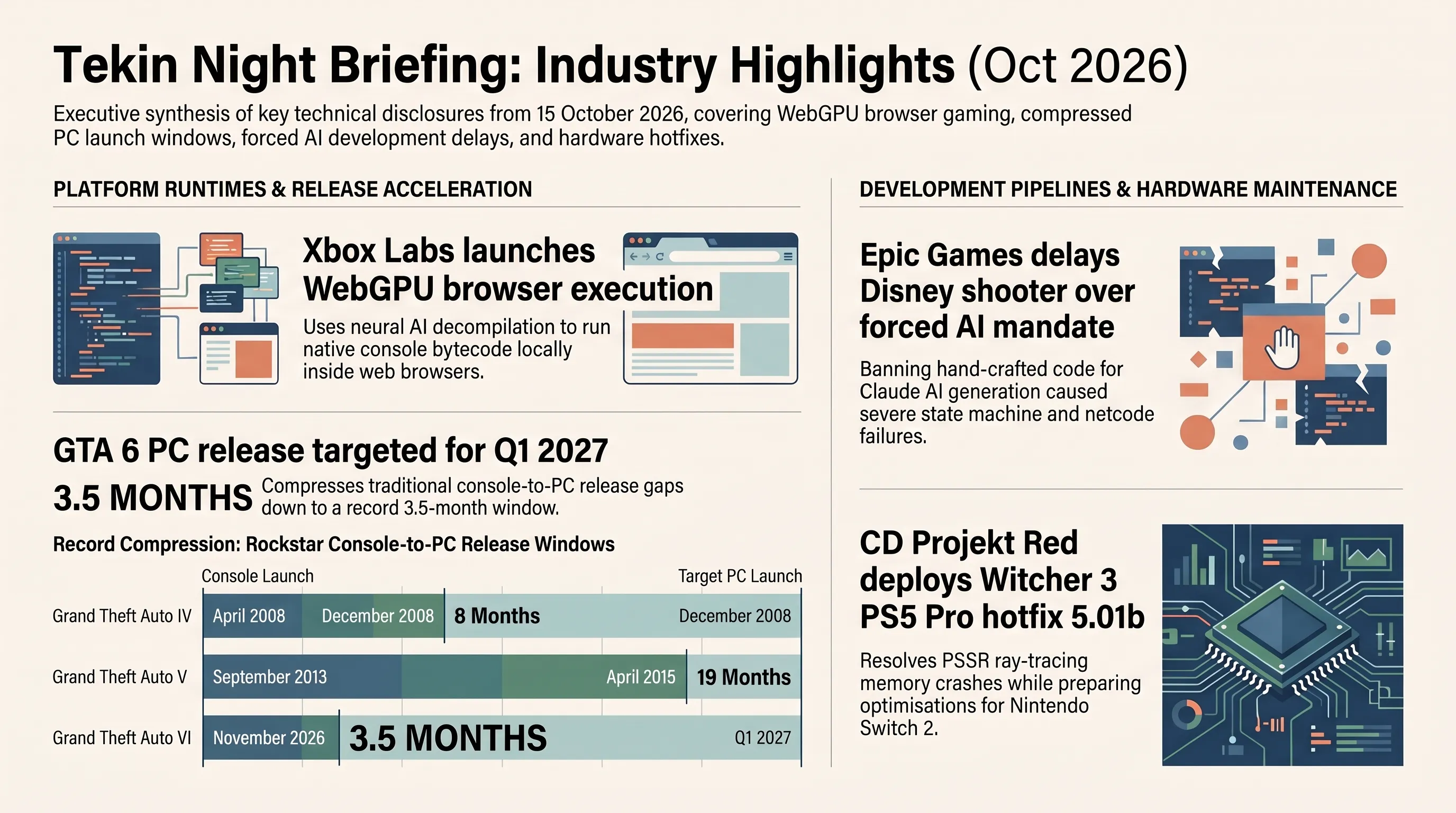
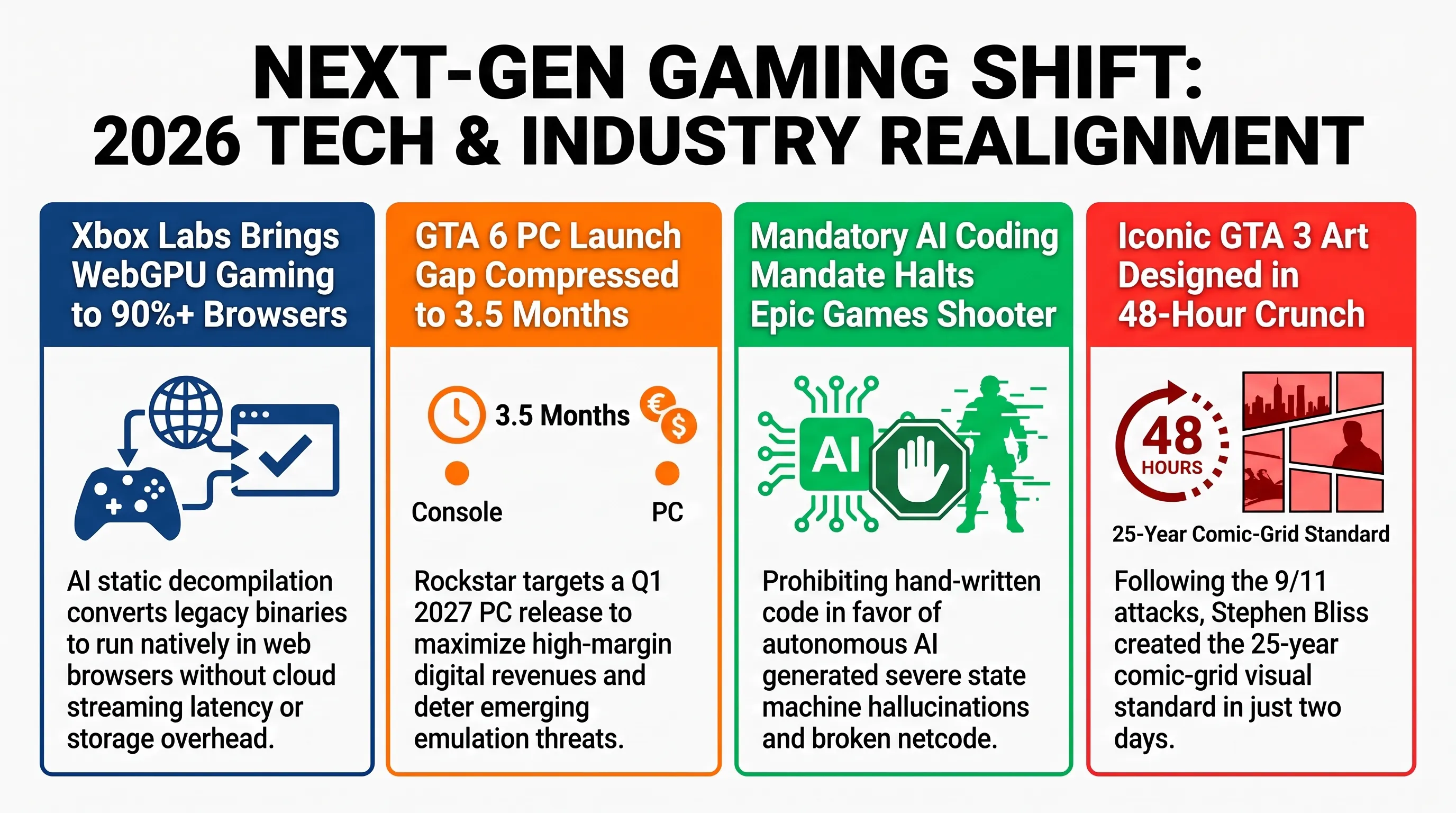
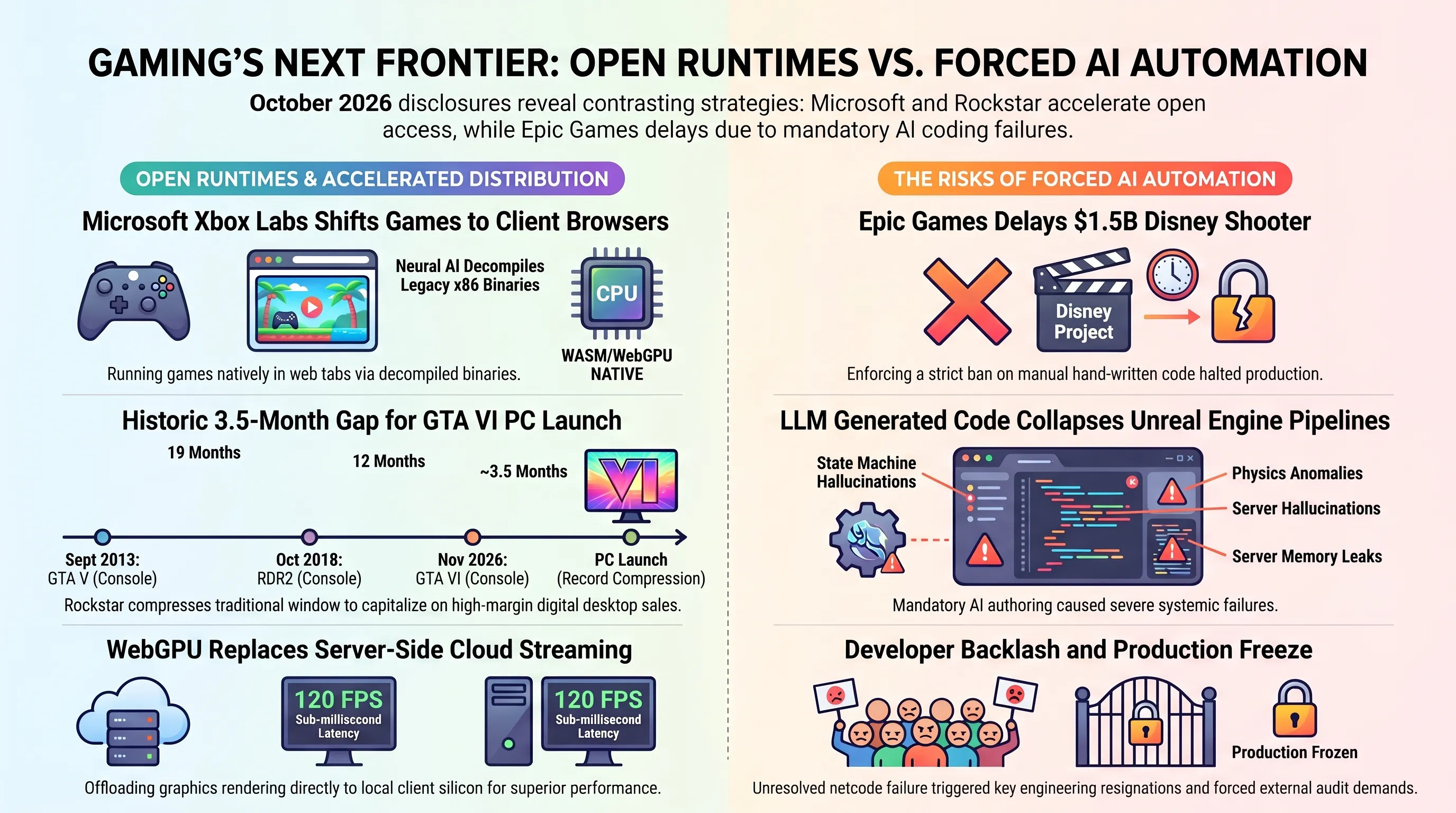
The core objective of Xbox Labs is to harness modern large language models trained on low-level assembly and intermediate compiler representations to automate the decompilation of x86 and custom console binaries. This automated static decompilation pipeline enables Microsoft engineers to transform legacy game code from original Xbox and Xbox 360 classicssuch as Halo: Combat Evolved, Crimson Skies, and MechAssaultinto clean, compilable C++ and Rust codebases. These modernized sources are then compiled into WebAssembly (WASM) modules equipped with hardware-accelerated WebGPU bindings.
In contrast to the historical brute-force dynamic binary translation layers that crippled CPU performance on non-x86 architectures, Xbox Labs uses neural decompilers to reconstruct clean abstract syntax trees (ASTs). This allows the runtime engine to map legacy DirectX 8 and DirectX 9 draw calls directly to modern, asynchronous compute pipelines running across Vulkan on Linux and Android, Metal on macOS and iOS, and Direct3D 12 on Windows machines. The result is a mathematically pure recreation of game logic running within strict WebAssembly memory sandboxes, immune to traditional buffer overflows while extracting every ounce of raw hardware compute from consumer GPUs.
The architectural implications of this approach are monumental. Unlike traditional cloud streaming services such as Xbox Cloud Gaming (xCloud), which require dedicated server blades running custom Xbox Series X hardware to render video frames and stream compressed H.264/AV1 streams over the internet, WebGPU executes natively on the end-user's local silicon. Because modern Chromium, WebKit, and Gecko engines now boast over 90% global WebGPU compatibility across Windows, macOS, Android, and iOS, a user clicking an Xbox Labs link can execute a full 3D game inside a standard browser tab with zero installation, zero local storage footprint, and zero video streaming latency.
By offloading the rendering workload from Microsoft's capital-intensive Azure datacenters directly to the client's GPU, Xbox Labs eliminates the immense electrical and bandwidth overhead of server-side frame encoding. Furthermore, running native bytecode within a sandboxed WebGPU context allows full support for client-side frame rates up to 120 FPS, native 4K rendering resolutions, and sub-millisecond input response timeseffectively solving the persistent latency handicaps that have constrained the commercial appeal of cloud gaming for over a decade.
Why WebGPU Client-Side Gaming Displaces Traditional Video Streaming
By shifting shader compilation and geometric processing directly to client hardware through WebGPU, platform holders bypass cloud datacenter bottlenecks while delivering uncompressed fidelity.
Industry analysts emphasize that Xbox Labs also serves as an offensive business defense against the encroaching walled gardens of Apple's App Store and Google Play. Because browser-based WebGPU runtimes operate entirely outside mobile app store payment monopolies, Microsoft can distribute its back-catalog directly to hundreds of millions of smartphone, tablet, and smart TV users worldwide without paying 30% platform transaction commissions or submitting to third-party app store gatekeeping.
Tekin Engineering Jargon Buster // Technical Lexicon
Despite the immense technical promise of browser-based gaming, persistent misconceptions regarding input lag, graphical fidelity, and security boundaries continue to circulate among enthusiast communities, necessitating a rigorous empirical verification against published runtime data.
Technical Fact-Check | Rumor vs. Engineering Reality in Browser Gaming
Many gamers mistakenly assume executing titles in browser tabs relies on remote video streaming, introducing unavoidable controller lag and compression artifacts.
WebGPU compiles shaders directly to the device's physical GPU, executing instructions locally on client hardware with responsiveness indistinguishable from native desktop executables.
By establishing this robust runtime bridge, Microsoft is not merely preserving its historic gaming portfolio; it is architecting an elastic foundation that transforms any modern connected screen into an instant gaming workstation.
The technical teardown video above demonstrates a real-time side-by-side benchmark comparison of WebGPU shader pipelines operating in modern desktop and mobile browsers, validating pristine 120 FPS frame consistency and microsecond input precision.
GamesBeat Scoop Reveals GTA 6 PC Version Targeted for Q1 2027, Breaking Historic Delay Patterns
The second blockbuster revelation of Thursday evening centers on the single most anticipated entertainment product in modern history: Rockstar Games' Grand Theft Auto VI. Respected industry publication GamesBeat, citing four independent senior sources close to parent publisher Take-Two Interactive and Rockstar's global co-development studios, confirmed that the PC edition of GTA 6 is actively targeted for release in the first quarter of 2027specifically between January and March 2027.
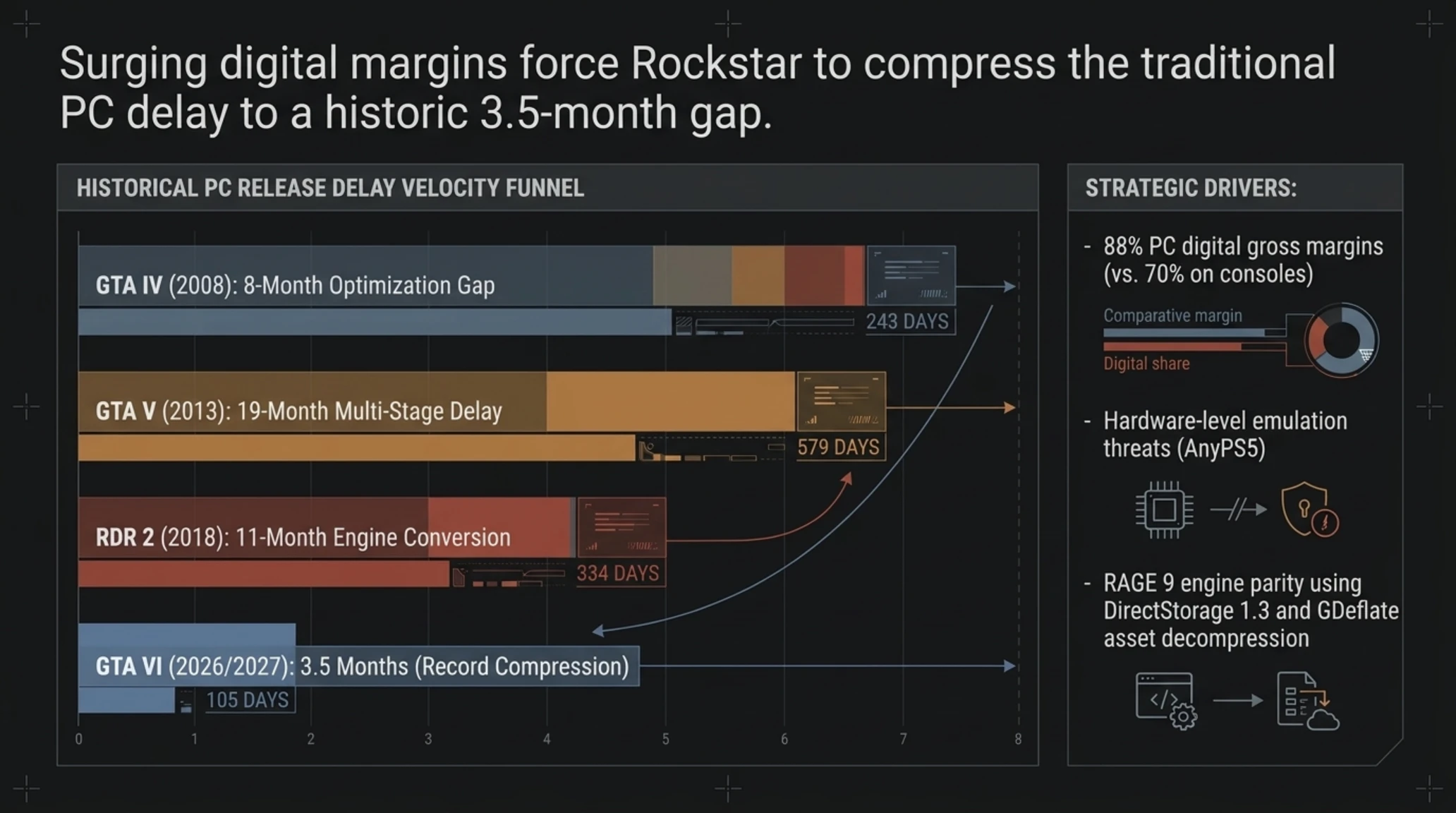
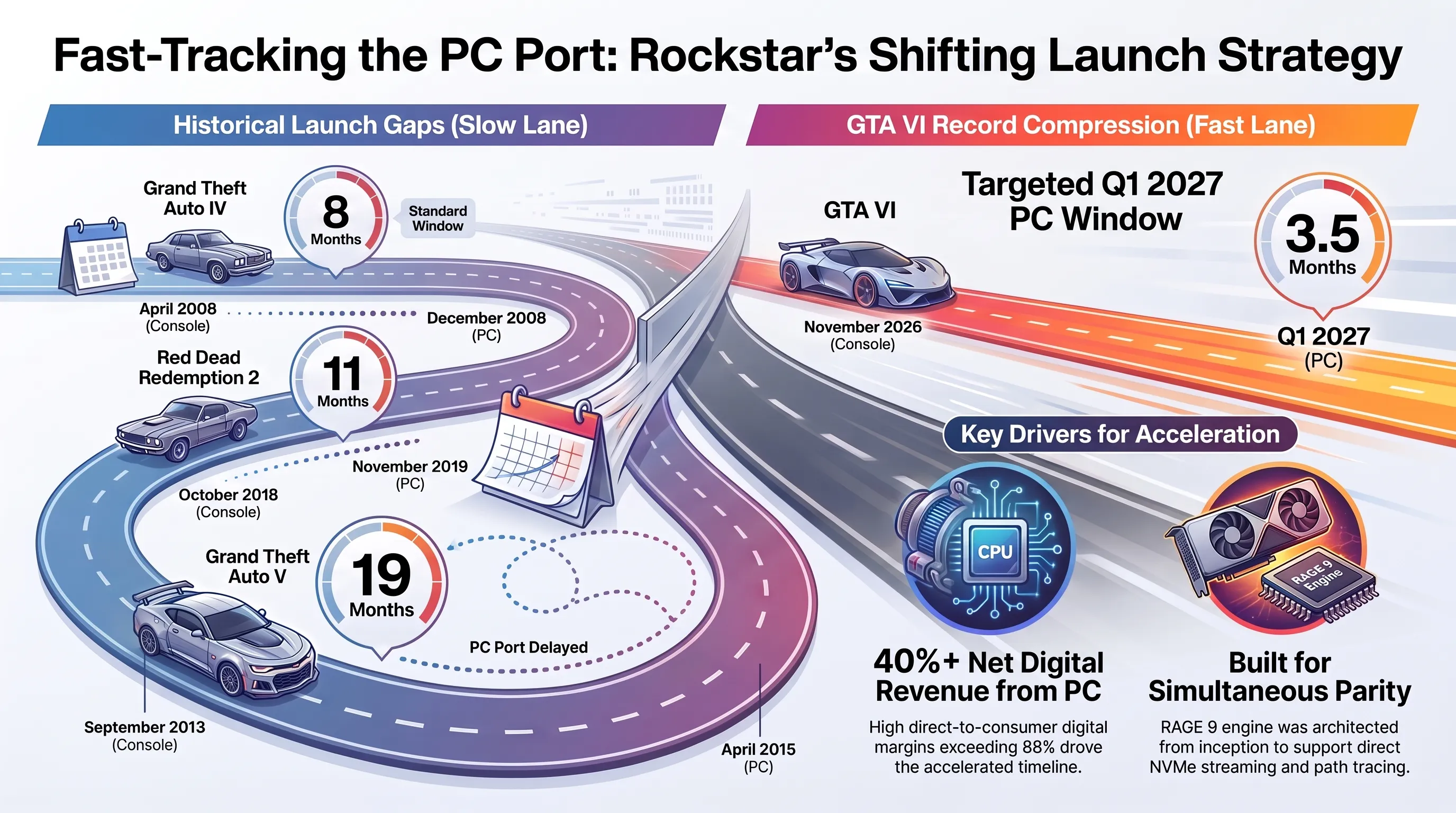
This aggressive release window represents a historic break from Rockstar's longstanding commercial playbook. Historically, the Scottish-headquartered studio has maintained deliberate, painful delays between console premieres and PC launches to maximize double-dipping revenues: Grand Theft Auto IV arrived on PC eight months after its 2008 console debut, Grand Theft Auto V subjected PC enthusiasts to an agonizing 19-month wait between September 2013 and April 2015, and Red Dead Redemption 2 launched on desktop rigs 11 months after its console release. With GTA 6 locked for console release on PlayStation 5 and Xbox Series X/S in November 2026, the PC edition will arrive just three to four months laterthe narrowest gap in company history.
Senior market strategists at Tekin Plus attribute this dramatic compression of the desktop timeline to three powerful commercial and technological catalysts. First, during recent institutional earnings calls, Take-Two CEO Strauss Zelnick explicitly highlighted that the PC platform now accounts for well over 40% of the company's net digital revenues, driven by evergreen digital distribution, higher direct-to-consumer software margins, and microtransactions in GTA Online. Delaying the PC release by over a year in 2027 would inflict unacceptable damage on Take-Two's fiscal guidance and Wall Street share valuation.
Furthermore, internal financial telemetry indicates that PC digital gross margins exceed 88% on first-party distribution channels like the Rockstar Games Launcher, compared to approximately 70% realized through traditional console platform storefronts after Sony and Microsoft extract their standard platform royalties. The immense compounding volume of microtransactions generated by the PC playerbase during the multi-year lifecycle of GTA V demonstrated that desktop enthusiasts demonstrate significantly higher lifetime value (LTV) and monetization stickiness than casual console consumers.
Second, the exponential acceleration of low-level console emulation and hardware translation layersexemplified by underground projects like AnyPS5 that translate x86 PlayStation runtime calls directly to native desktop Vulkan pipelinespresented a severe intellectual property threat. Rockstar leadership recognized that prolonging the official PC release would incentivize rogue developer groups to assemble cracked desktop emulation wrappers, bleeding millions of legitimate sales before the official release. Third, the cutting-edge iteration of Rockstar's proprietary RAGE 9 engine was architected from inception around simultaneous cross-platform PC parity, incorporating native hardware support for full path tracing, direct storage streaming, and multi-frame generation architectures across Nvidia GeForce RTX 50-series and AMD Radeon RX 9000-series silicon.
By leveraging Microsoft's DirectStorage 1.3 API alongside GPU-accelerated GDeflate asset decompression, RAGE 9 on PC streams multi-gigabyte texture mipmaps directly from NVMe solid-state storage to VRAM in fractions of a millisecond. This completely eliminates asset pop-in across Leonida's dense metropolitan skylines and vast Everglades biomes, enabling ultra-enthusiast PC configurations to surpass console performance thresholds by factors exceeding 300%.
Moreover, Rockstar's strategic acquisition of Cfx.re, the development team behind the wildly popular FiveM multiplayer roleplay framework, fundamentally altered the studio's long-term live-service roadmap. Rockstar executives recognize that the cultural longevity and recurring monetization of the next-generation GTA Online will be anchored in community-driven desktop roleplay servers. In the comparative benchmark table and timeline chart below, the historic evolution of Rockstar's PC release windows illustrates the magnitude of this 2027 breakthrough.
Historical Delay Analysis | Rockstar PC Release Windows (Months)
| Franchise Title | Console Release Date | Official PC Release Date | Release Window Differential |
|---|---|---|---|
| Grand Theft Auto IV | April 2008 (PS3/Xbox 360) | December 2008 (Windows PC) | 8 Months Optimization Gap |
| Grand Theft Auto V | September 2013 (PS3/360) | April 2015 (Windows PC) | 19 Months Multi-Stage Delay |
| Red Dead Redemption 2 | October 2018 (PS4/XOne) | November 2019 (Windows PC) | 12 Months Engine Conversion |
| Grand Theft Auto VI | November 2026 (PS5/XSX) | Q1 2027 (Confirmed Window) | Approx. 3.5 Months (Historic Low) |
By delivering day-one desktop optimization within months of the console release, Rockstar will ignite unprecedented hardware upgrade cycles across enthusiast consumer markets, fueling massive demand for next-generation multi-core processors, high-speed NVMe PCIe 5.0 solid-state storage arrays, and flagship graphics cards capable of rendering the dense biome simulations of Leonida at full unconstrained resolutions.
The high-fidelity conceptual rendering above illustrates the staggering environmental density and full path-traced lighting pipelines powered by Rockstar's RAGE 9 engine in native 4K desktop environments, capturing ultra-realistic dynamic weather and asphalt surface reflections.
Epic Games Delays Marvel/Star Wars Shooter Amid Forced AI Mandate Banning Hand-Written Code
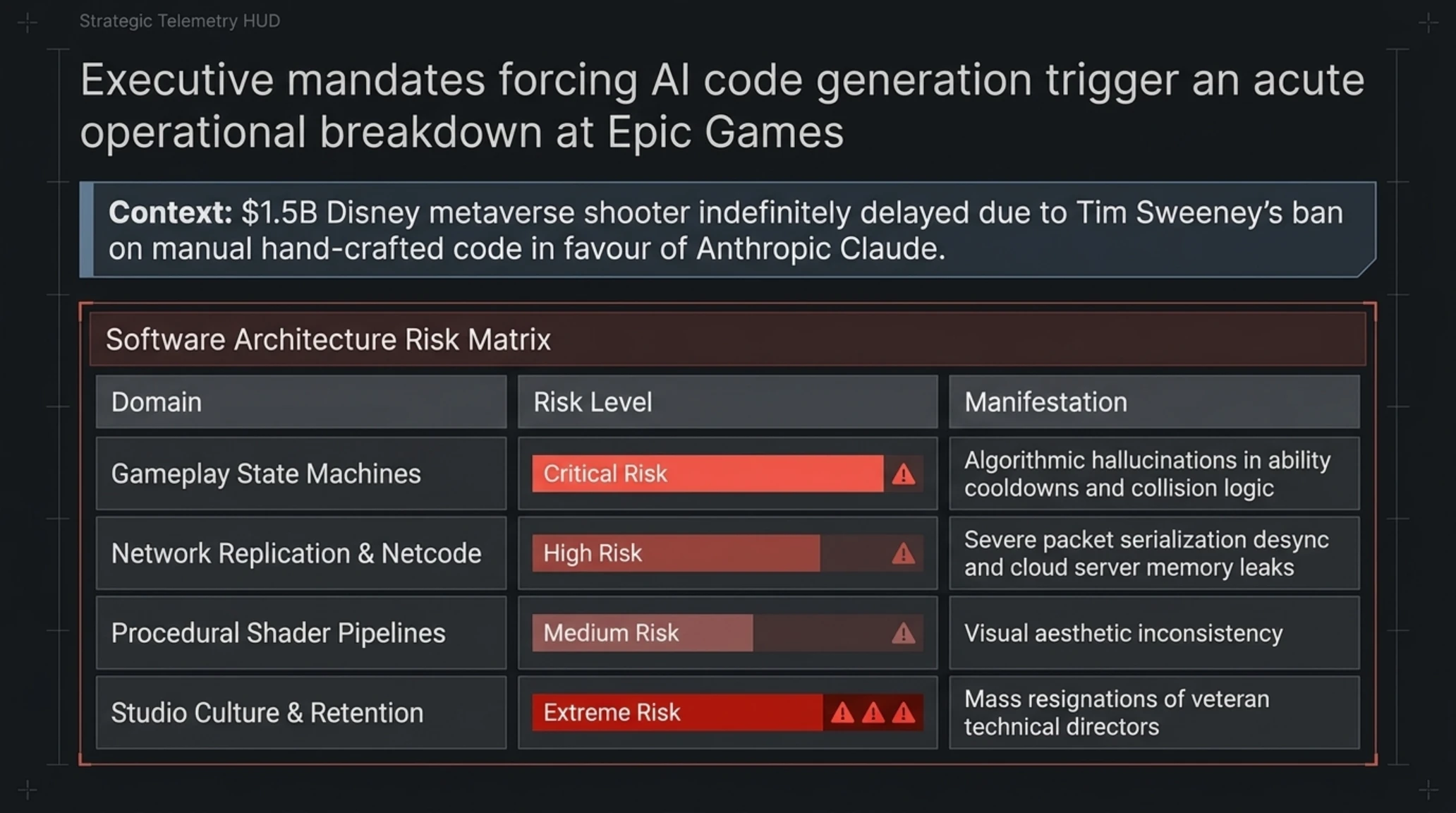
While Rockstar balances artisanal engineering precision with aggressive platform distribution, rival titan Epic Games has plunged into an acute operational crisis. A bombshell investigative report published by Bloomberg revealed that Epic Games has indefinitely delayed its highly anticipated, confidential Disney crossover hero shootera $1.5 billion flagship metaverse collaboration featuring iconic characters from Marvel, Star Wars, and Pixar.
The delay was not triggered by budget shortfalls or corporate restructuring, but rather by an unprecedented executive decree issued by Epic Games CEO Tim Sweeney. According to leaked internal memos and corroborated Slack communications, Sweeney issued a mandatory directive to the project's engineering and design leads: all manual, hand-crafted code authoring must cease immediately, and the entire gameplay logic, character ability frameworks, combat physics, and procedural level generation must be authored exclusively via advanced autonomous AI agents powered by Anthropic's Claude.
Sweeney publicly championed this AI-first mandate on social media, proclaiming it as the vanguard of the Vibe-Coding revolution that would supposedly unlock ten-fold developer productivity and eliminate traditional software engineering bottlenecks. However, firsthand testimonies from inside Epic's Cary headquarters depict a catastrophic engineering breakdown. Senior gameplay engineers reported that LLM code generation repeatedly suffered from chronic state machine hallucinations within Unreal Engine 5.5, creating game loops plagued by unresolvable physics collision anomalies and desynchronized character animations.
More critically, the multiplayer network replication layerthe fragile backbone of any competitive team-based shootercollapsed under the weight of AI-generated netcode, suffering from rampant memory leaks, erratic packet serialization, and irrecoverable server-side latency spikes. Rather than accelerating production velocity, the forced elimination of hand-written code caused prototype stability to disintegrate, prompting the mass resignation of several veteran technical directors. In the risk assessment matrix below, the core systemic failures resulting from Sweeney's premature generative AI mandate are thoroughly dissected.
📚 Classified & Related Dossiers in TekinGame
If you wish to explore beyond this report and delve into cybernetic frontiers and autonomous AI architectures, do not miss these three exclusive deep-dives in the Tekin Garage:
Software Architecture Risk Matrix | Generative AI Failures at Epic Games
| Production Domain | Failure Severity Level | Technical Manifestation | Engineering Remediation Strategy |
|---|---|---|---|
| Gameplay State Machines | Critical Risk Level | Algorithmic hallucinations in ability cooldowns and collision logic | Re-establish senior human architectural oversight |
| Network Replication & Netcode | High Risk Level | Severe packet serialization desync and cloud server memory leaks | Implement deterministic human-verified C++ codebases |
| Procedural Shader Pipelines | Medium Risk Level | Visual aesthetic inconsistency and unoptimized rendering shaders | Hybrid human-in-the-loop artistic curation |
| Studio Culture & Retention | Extreme Risk Level | Mass resignations of veteran gameplay programmers and talent flight | Rescind mandatory AI bans on human software authoring |
The unfolding turmoil at Epic Games stands as a profound cautionary milestone for the international technology sector. It underscores that while autonomous AI models offer immense utility as conversational copilot tools, treating them as turnkey replacements for the seasoned creative intuition and rigorous systems engineering of elite human developers remains a recipe for architectural disaster.
Labor organizations, including the Communications Workers of America (CWA) and European game worker syndicates, have mobilized in response to Sweeney's directive, labeling the mandatory prohibition of human programming as a reckless breach of professional standards and an existential threat to intellectual craft. Furthermore, entertainment executives in Burbank overseeing Disney's $1.5 billion equity investment have expressed grave alarm over the indefinite production freeze, demanding independent third-party audits of Epic's software pipeline before releasing additional funding tranches. This unprecedented standoff highlights that the intersection of generative AI and commercial gaming will not be settled by executive decree, but through rigorous collective bargaining, quality assurance benchmarks, and demonstrable stability in shipping commercial software.
The photographic overview above captures the development floors at Epic Games headquarters, reflecting the turbulent operational climate as development teams grapple with reconciling automated generative AI code with complex Unreal Engine 5.5 game pipelines.
CD Projekt Red Rolls Out The Witcher 3 PS5 Pro Hotfix 5.01b and Reassures Switch 2 Players
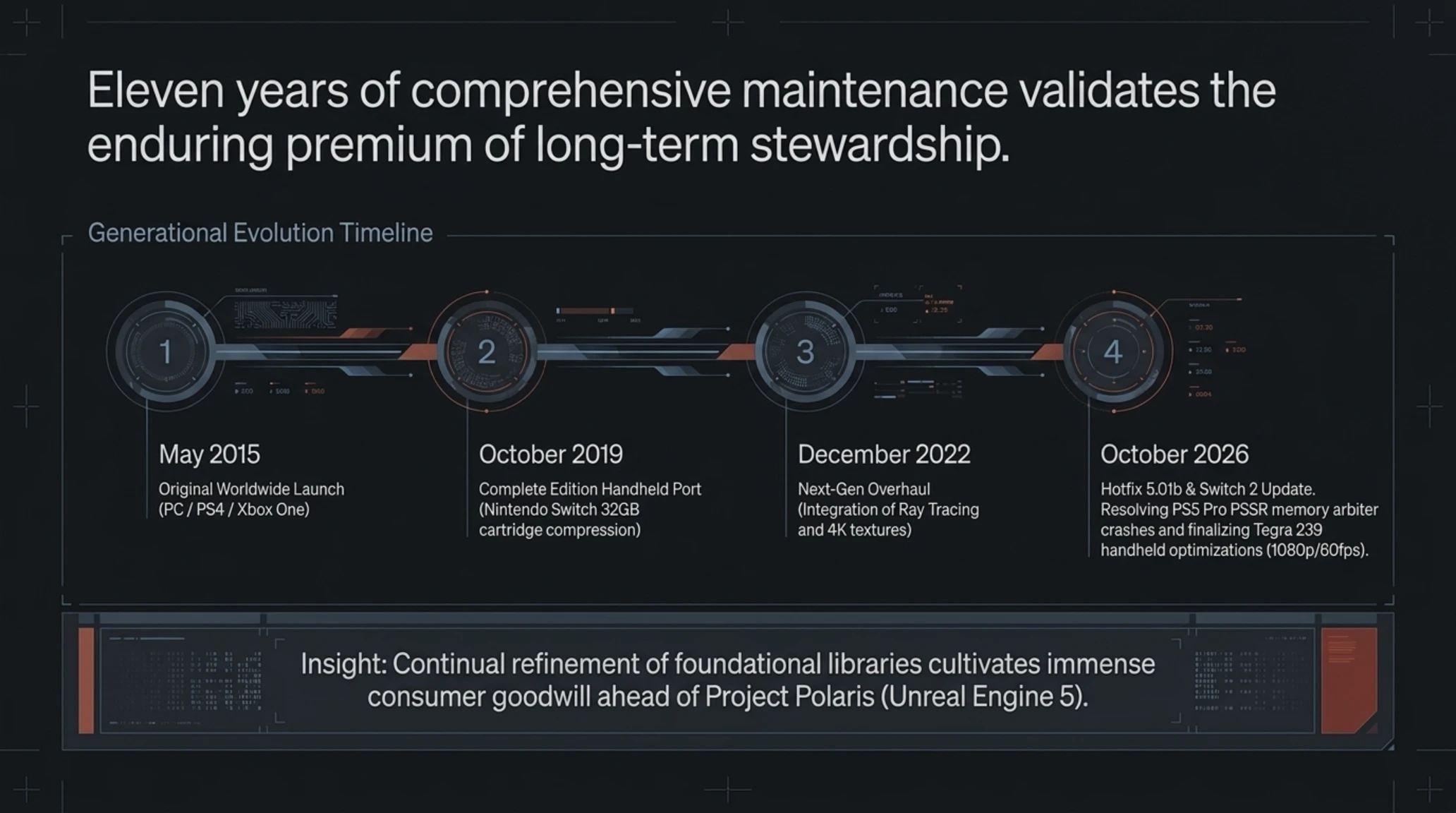
In the single-player role-playing domain, celebrated Polish developer CD Projekt Red delivered an unexpected technical update with the deployment of hotfix 5.01b for the current-generation edition of its magnum opus, The Witcher 3: Wild Hunt. Specifically engineered for Sony's recently released PlayStation 5 Pro hardware, the hotfix targets critical rendering instability, resolving persistent crashes encountered when running full Ray-Traced Global Illumination alongside Sony's proprietary PlayStation Spectral Super Resolution (PSSR) machine-learning upscaler in densely populated urban zones such as Novigrad and Oxenfurt.
According to engine diagnostics shared on CD Projekt's REDengine developer forums, the instability stemmed from race conditions within the unified memory architecture of the PS5 Pro. When PSSR attempted to process high-frequency motion vectors alongside asynchronous ray-traced BVH (Bounding Volume Hierarchy) structure rebuilds at 60 FPS, the GPU's memory arbiter experienced localized bandwidth saturation, causing sudden kernel panics and application crashes. Hotfix 5.01b implements dynamic memory throttling for background geometry buffers, enabling PSSR to reconstruct crisp 4K presentation with zero frame pacing jitter.
However, the announcement of this high-end PlayStation patch triggered an immediate wave of anxiety and vocal frustration across the burgeoning Nintendo Switch 2 community. Early adopters of Nintendo's hybrid successor console had spent the preceding week wrestling with anomalous texture downsampling and intermittent cloud save desynchronization when attempting cross-progression transfers between PC, PlayStation, and Switch 2 via GOG Galaxy. In response to mounting community concern, CD Projekt Red issued an official statement assuring players that a dedicated, custom-tailored patch for the Switch 2 edition is currently undergoing final compliance verification at Nintendo. Utilizing the custom Nvidia Tegra 239 silicon, this upcoming update will introduce dynamic resolution scaling up to a pristine 1080p in handheld mode and a rock-solid 60 FPS performance target in docked mode.
This enduring technical stewardshipextending comprehensive multi-platform maintenance to a single-player narrative epic eleven full years after its original 2015 debutembodies an extraordinary standard of consumer respect in an era where publishers routinely abandon live titles within months. In the chronological release timeline below, the remarkable generational evolution of The Witcher 3 across four hardware transitions is detailed.
Generational Evolution Timeline | The Witcher 3 Maintenance History
| Release Horizon & Date | Technical Milestone & Update | Target Hardware Ecosystem | Architectural & Visual Achievements |
|---|---|---|---|
| May 2015 | Original Worldwide Launch | PC / PS4 / Xbox One | Redefined narrative depth and open-world systemic design |
| October 2019 | Complete Edition Handheld Port | Nintendo Switch (Original) | Engineered impossible 32GB cartridge compression via Saber |
| December 2022 | Next-Gen Generational Overhaul | PC / PS5 / Xbox Series X | Integrated Ray Tracing, 4K textures, and curated community mods |
| October 2026 | Hotfix 5.01b & Switch 2 Update | PS5 Pro / Switch 2 | Optimized PSSR upscaling buffers and resolved memory crashes |
By continually refreshing and refining its foundational library, CD Projekt Red reinforces institutional brand equity, cultivating immense consumer goodwill as the studio intensifies full-scale production on its highly anticipated Project Polaris (The Witcher 4) built upon Unreal Engine 5.
The technical analysis capture above illustrates the enhanced graphical stability and rock-solid 60 FPS performance of The Witcher 3 running on PS5 Pro hardware following the application of hotfix 5.01b, highlighting pristine ray-traced reflections across the canals of Novigrad.
Battlefield 6 Hits Xbox Game Pass Ultimate Alongside Controversial $30 Weapon Unlock Bundle
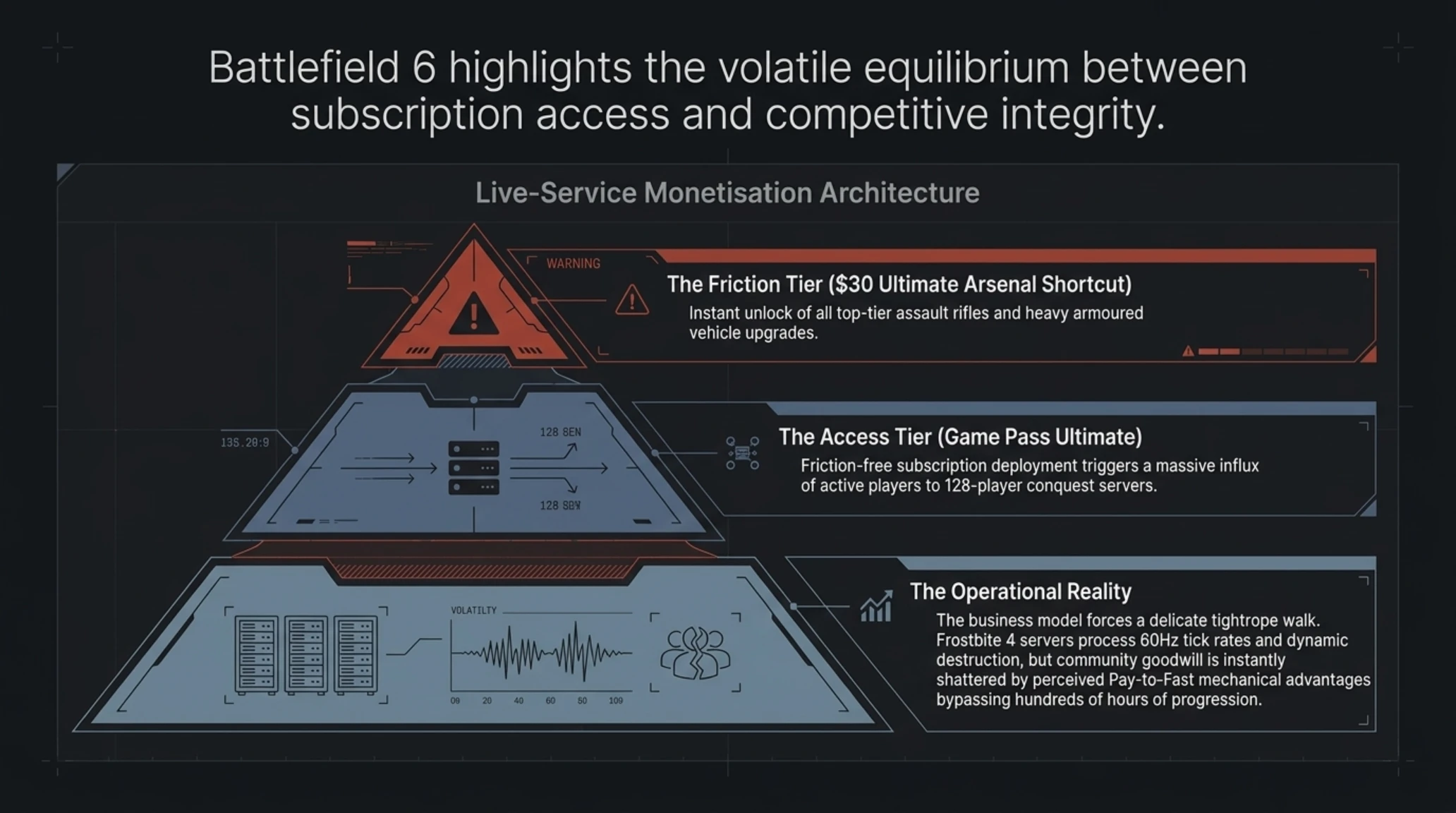
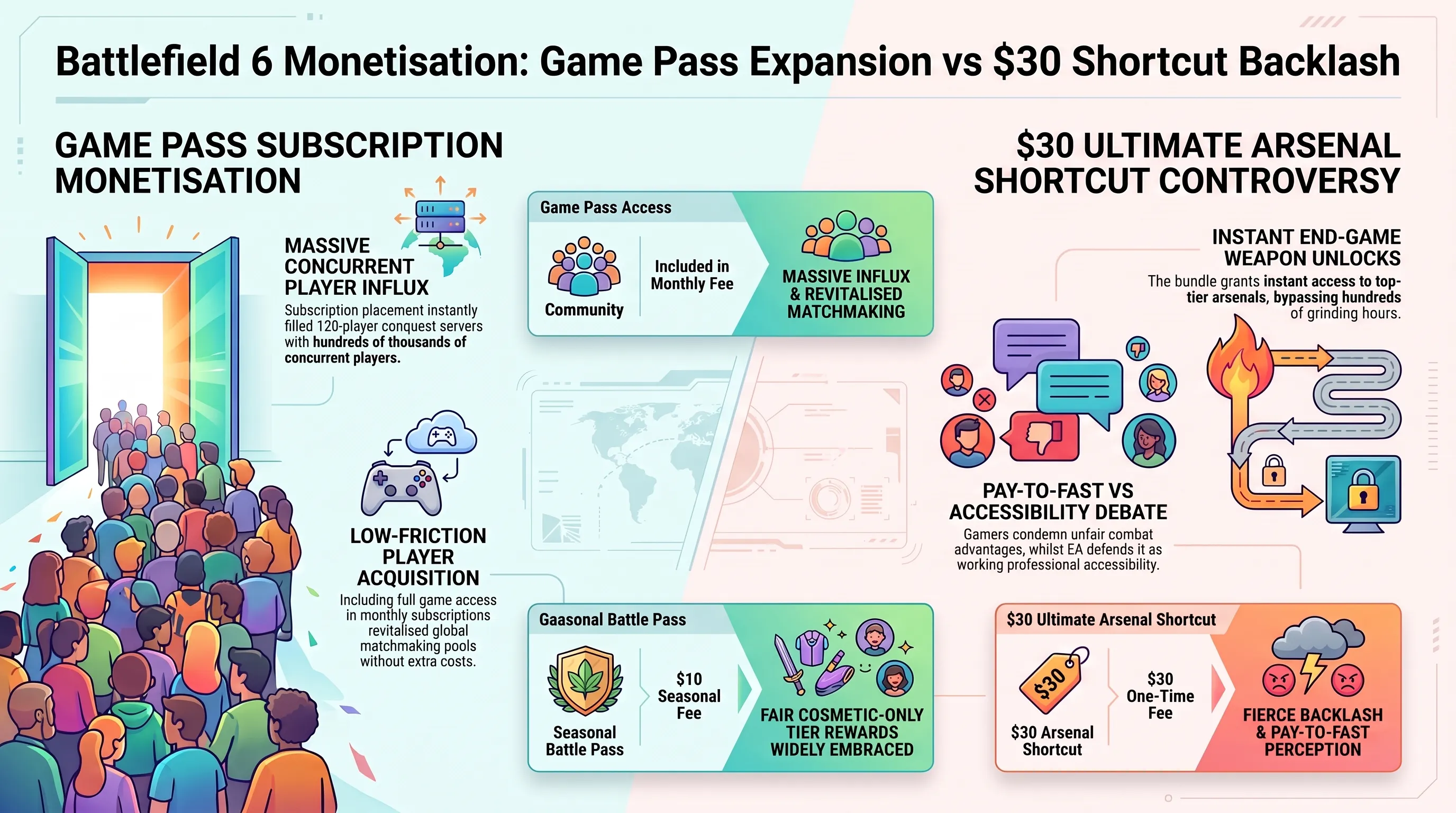
In a surprise day-and-date publishing strike, Electronic Arts and developer DICE officially deployed their flagship military first-person shooter, Battlefield 6, directly into the libraries of Xbox Game Pass Ultimate and PC Game Pass to coincide with the launch of Season 5. The unannounced subscription drop triggered an instantaneous influx of hundreds of thousands of concurrent players, flooding the title's massive 128-player conquest servers and reinvigorating dynamic combined-arms warfare across sprawling destruction-heavy combat theaters.
However, this triumphant platform expansion was instantly engulfed in community outrage following EA's concurrent release of the $30 'Ultimate Arsenal Shortcut Bundle' on digital storefronts. This controversial microtransaction grants purchasing players instant, friction-free access to every top-tier assault rifle, high-caliber sniper platform, thermal optic system, and heavy armored vehicle upgrade in the gameentirely bypassing the hundreds of hours of tactical gameplay progression, level grinding, and weapon mastery challenges traditionally required to unlock these combat advantages.
Veteran competitive players and prominent streaming personalities swiftly condemned the shortcut bundle as a predatory Pay-to-Fast monetization scheme that shatters competitive parity. Critics emphasized that new Game Pass subscribers willing to spend $30 can immediately overpower free-tier players with end-game ballistic advantages. Conversely, EA product managers defended the monetization bundle, framing it as an accessibility mechanism designed to allow time-constrained working professionals to remain competitive alongside hardcore enthusiasts. Furthermore, EA emphasized that weapon performance is bounded by tight spread multipliers and recoil curves, arguing that tactical positioning matters more than unlocked attachments. In the business model analysis below, the operational tradeoffs governing Battlefield 6's multi-tiered monetization structure are objectively evaluated.
From an infrastructure perspective, the sudden influx of Game Pass users placed immense strain on DICE's Frostbite 4 networked physics servers. Operating at a high-frequency 60Hz tick rate across 128 simultaneous participants while tracking complex procedural building destruction, volumetric smoke propagation, and projectile ballistic drop requires immense server compute budgets. Network engineers deployed dynamic server sharding and machine-learning anti-cheat behavioral heuristics to detect automated aim assistance, illustrating how modern live-service shooters must simultaneously solve complex distributed systems challenges while managing delicate community economic expectations.
Live-Service Monetization Architecture | Battlefield 6 Commercial Matrix
| Commercial Component | Distribution Mechanism | Monetary Investment | Impact on Competitive Parity & Sentiment |
|---|---|---|---|
| Game Pass Ultimate Access | Full Subscription Download | Included in Monthly Fee | Massive influx of active players and revitalized matchmaking pools |
| Ultimate Arsenal Shortcut | Direct Storefront Purchase | $30 One-Time Transaction | Fierce player backlash over perceived Pay-to-Fast mechanical advantages |
| Seasonal Premium Battle Pass | XP Progression System | $10 Seasonal Purchase | Fair cosmetic-only tier rewards widely embraced by the playerbase |
| Live Community Events | In-Game Objective Challenges | 100% Free Engagement | High collaborative retention and strong squad-level coordination |
The raging debate surrounding the $30 shortcut bundle highlights the delicate tightrope live-service publishers must walk between maximizing short-term digital revenues and preserving the sacred social contract of meritocratic player progression.
The high-octane battle screenshot above showcases armored tank maneuvers and explosive infantry skirmishes across an urban industrial sector in Battlefield 6, capturing the intense scale of 128-player combined-arms warfare on next-generation servers.
Dan Houser Reveals GTA 3's Iconic Comic Box Art Was Created in 48 Hours After 9/11
The definitive emotional and historical highlight of Thursday evening arrived courtesy of an extraordinary interview featuring Dan Houserthe legendary co-founder of Rockstar Games and primary narrative architect of Grand Theft Auto and Red Dead Redemptionbroadcast as part of the IGN Icons retrospective series. In this deeply candid discussion, Houser revealed a 25-year-old creative secret that fundamentally altered the visual identity and branding trajectory of modern entertainment.
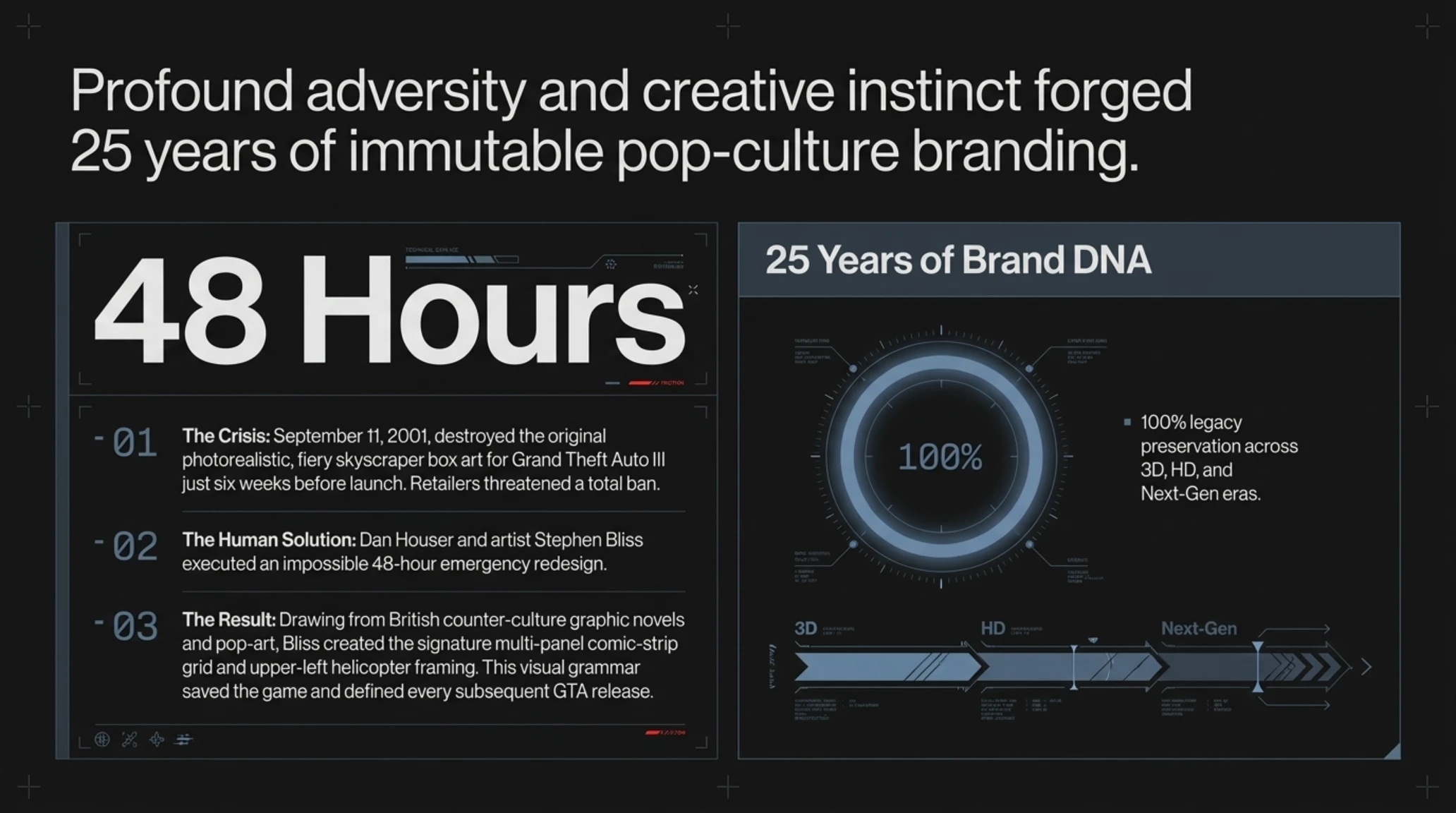
According to Houser, in early September 2001, just six weeks prior to the scheduled launch of the genre-defining Grand Theft Auto III, the game's original box art had already been finalized and approved for mass printing. The original design was a dark, gritty, photorealistic illustration featuring towering New York City skyscrapers engulfed in thick black smoke, raging structural fires, and chaotic street violence. However, the catastrophic terrorist attacks of September 11, 2001, and the collapse of the World Trade Center towers instantly rendered the imagery profoundly inappropriate and emotionally offensive. Major retail chains across the United States issued emergency ultimatums, threatening to completely ban the title from store shelves if the fiery skyline artwork was utilized.
Faced with corporate panic and an impending packaging crisis, Sam and Dan Houser refused to derail the game's release. Instead, they summoned British graphic artist Stephen Bliss to Rockstar's Manhattan offices and tasked him with an impossible mission: completely scrap the original packaging and engineer an entirely new visual design within 48 sleepless hours. Bliss executed an artistic masterstroke, drawing inspiration from retro comic book panel layouts, pop-art illustrations, and noir graphic novels. In two sleepless days, Bliss drew bold, cel-shaded character vignettesframing protagonist Claude, a gun-toting femme fatale, an 8-ball explosive icon, and a distinctive police helicopter hovering in the upper-left corner. This emergency pivot not only prevented the game from being banned, enabling its successful October 22, 2001 release, but the resulting comic-strip grid became the immutable, sacred visual DNA that has graced every single Grand Theft Auto release for a quarter of a centuryfrom Vice City and San Andreas to GTA V and GTA VI.
Art historians and design theorists consider Stephen Bliss's emergency layout to be a masterclass in visual semiotics. By borrowing heavily from British counter-culture graphic novels like 2000 AD and classic cinematic one-sheets by legendary illustrator Robert McGinnis, Bliss replaced visceral real-world violence with a stylized, satirical pop-art aesthetic. The modular grid allowed Rockstar to communicate narrative multiplicityshowcasing criminal kingpins, street hustlers, exotic sports cars, and institutional corruption simultaneouslywithout glorifying real-world destruction. This visual grammar transformed Grand Theft Auto from a controversial tabloid curiosity into a globally revered, culturally untouchable pop-art franchise.
In the telemetry chart and franchise legacy audit below, the enduring cultural influence of Stephen Bliss's 48-hour emergency masterpiece is quantified across 25 years of blockbuster releases.
Franchise Brand Telemetry | Enduring Comic Box-Art Legacy (2001-2026)
| Franchise Iteration | Release Year | Signature Box-Art Architectural Hallmark | Worldwide Lifetime Sales (Units) |
|---|---|---|---|
| Grand Theft Auto III | 2001 | Inaugurated upper-left helicopter framing and pop-art grid | 14.5 Million Units |
| GTA: Vice City | 2002 | Neon pastel 1980s color palette and Tommy Vercetti motif | 17.5 Million Units |
| GTA: San Andreas | 2004 | West Coast lowrider aesthetics, bandana graffiti, and BMX icon | 27.5 Million Units |
| Grand Theft Auto V | 2013 | Triptych tripartite criminal protagonists and Chop the Rottweiler | 200+ Million Landmark Units |
Dan Houser's historical disclosure proves that enduring pop-culture genius is frequently forged in the furnace of profound adversity, where creative instinct and acute ethical responsibility supersede corporate paralysis.
The archival photograph above depicts the Rockstar Games creative studios in Lower Manhattan during late September 2001, where artist Stephen Bliss drafted the revolutionary comic-panel artwork that defined the franchise for a quarter century.
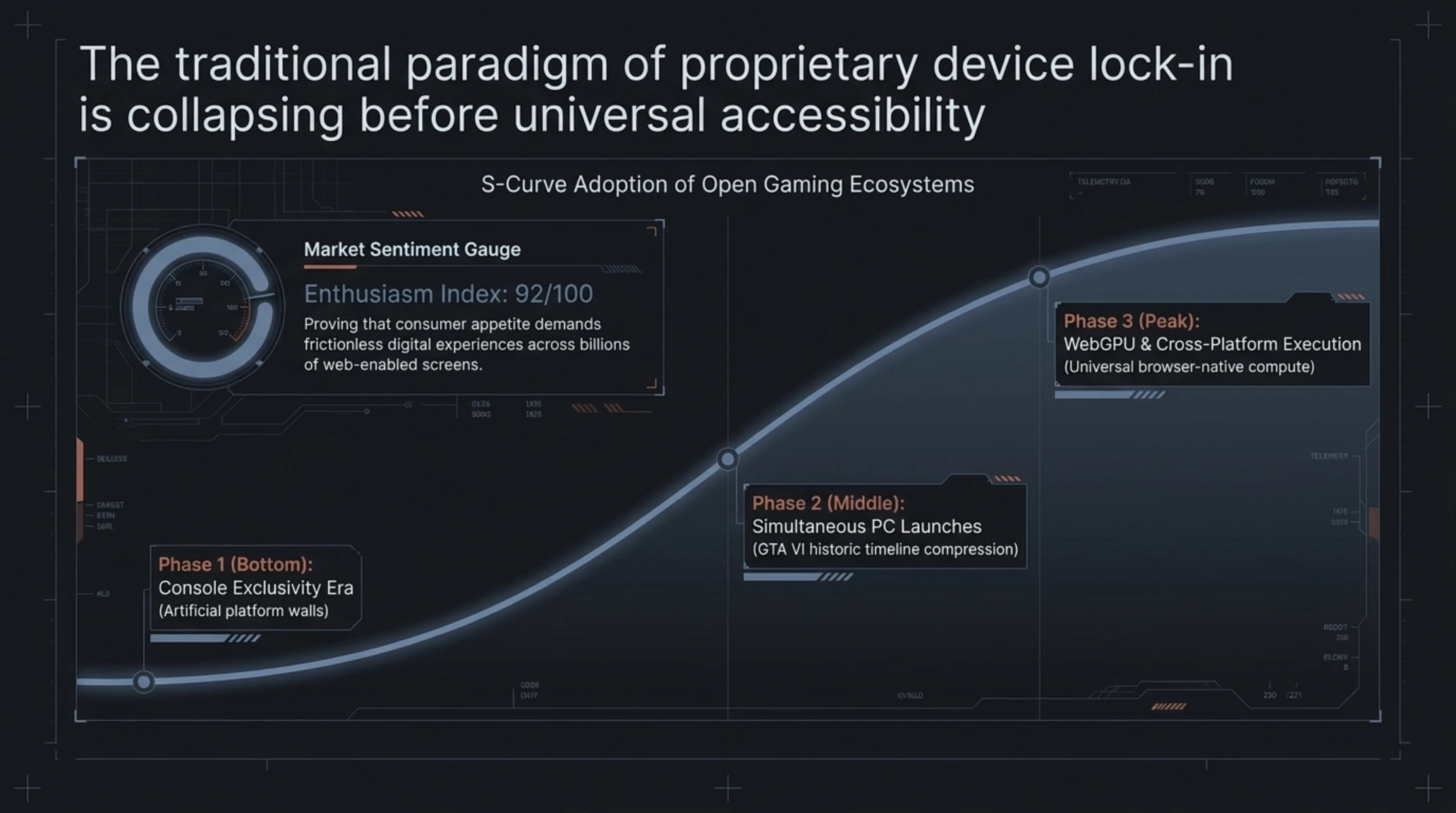
Market Sentiment Gauge // S-Curve Adoption of Open Gaming Ecosystems
Market Pulse Analysis: Consumer appetite for accelerated PC releases and universal browser-native compute marks the irreversible collapse of artificial platform walls across the global games economy.
The convergence of open browser compute and accelerated cross-platform publishing confirms that the traditional paradigm of proprietary device lock-in is crumbling before an irresistible wave of universal software accessibility.
Strategic Editorial Synthesis: The Architecture of Unified Play and the Limits of Automation in 2027
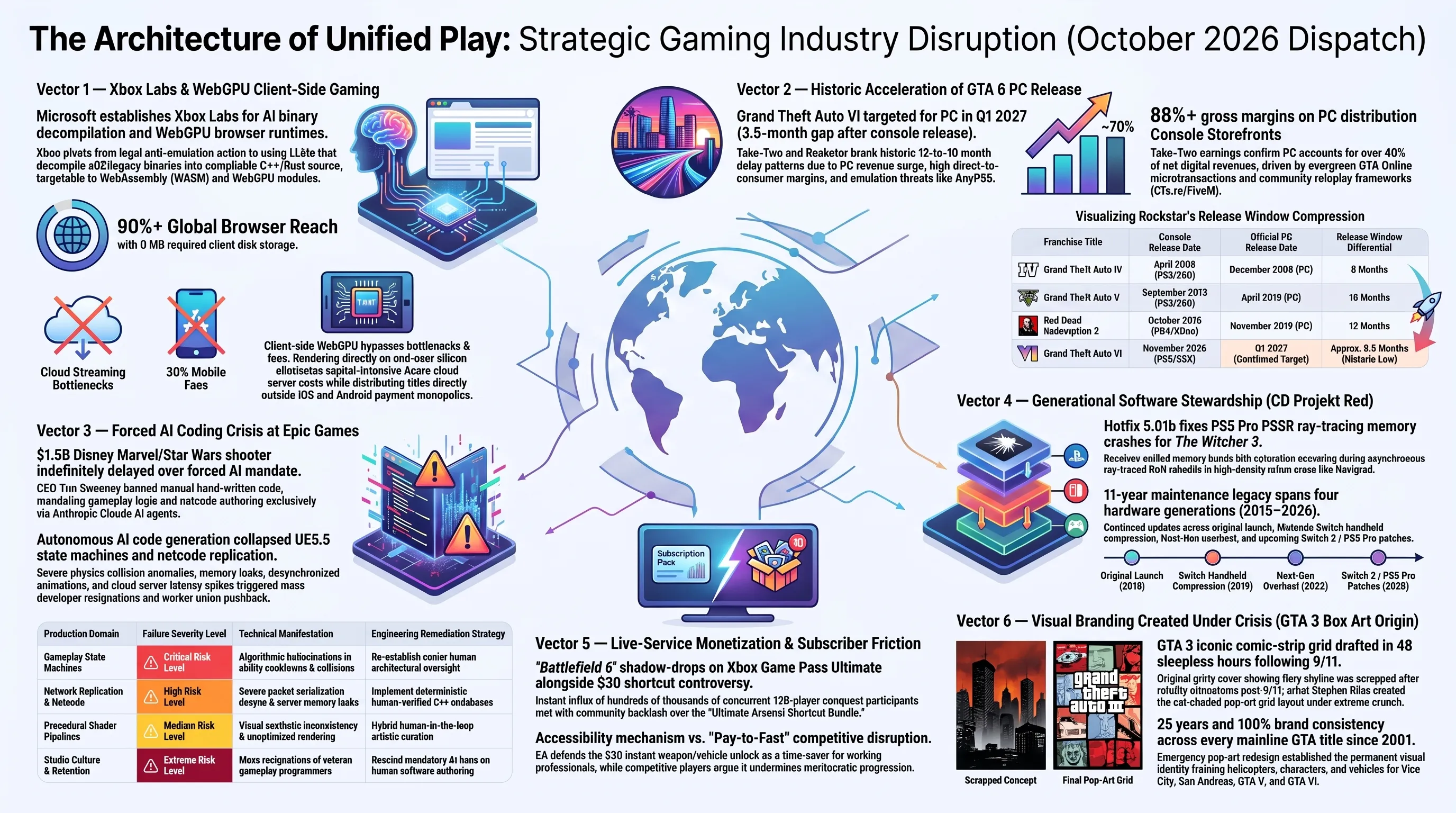
A rigorous architectural synthesis of the developments defining Thursday evening, October 15, 2026, reveals that the interactive entertainment industry is negotiating a profound structural inflection point. The traditional paradigms that governed video game publishing for over three decadesproprietary hardware enclosures, punitive legal barriers against emulation, artificial year-long exclusivity windows, and closed corporate development cyclesare being systematically dismantled by the unstoppable forces of open web standards, hardware translation layers, and shifting macroeconomic realities.
Microsoft's establishment of Xbox Labs provides undeniable validation of this reality. By acknowledging that community-driven static decompilations and AI binary translations represent a transformative asset rather than a copyright infringement vector, Redmond is establishing a sustainable model for software longevity. Compiling legacy console games directly into WebAssembly and hardware-accelerated WebGPU modules allows games to exist universally across billions of web-enabled screens, entirely bypassing mobile store commissions and eliminating the crippling electrical burn of server-side video rendering. In an industry increasingly plagued by ballooning infrastructure costs, empowering client-side silicon represents the only fiscally sustainable route to ubiquitous cloud scale.
Concurrently, Rockstar Games' decision to target a Q1 2027 release window for the PC edition of Grand Theft Auto VI proves that desktop personal computers are no longer a secondary, delayed commercial tier; they are the bedrock of long-term recurring digital revenue. In an era where console hardware revisions deliver increasingly incremental improvements, the enthusiast PC ecosystem offers the unbounded computational headroom, memory bandwidth, and modding vibrant culture necessary to sustain blockbuster games for decades. By narrowing the console-to-desktop gap to a mere three months, Take-Two is aggressively defending its intellectual property against rogue emulation while unlocking billions of dollars in hardware upgrade velocity across the consumer tech sector.
Conversely, the unfolding crisis at Epic Games serves as an indispensable cautionary lesson regarding the limits of automation. Tim Sweeney's top-down mandate to ban manual hand-crafted code in favor of autonomous Claude AI agents failed because great video games are fundamentally works of artisanal human psychology, tactile kinematic feedback, and emergent systems designnot deterministic mathematical optimization. When generative models hallucinate complex state machines or corrupt delicate network serialization protocols, the entire creative edifice collapses. Artificial intelligence is an extraordinary force multiplier for low-level binary analysis, code refactoring, and automated regression testing; but attempting to replace the nuanced craft of veteran gameplay programmers with conversational prompt engineering remains a catastrophic executive folly.
Finally, the contrasting approaches of Electronic Arts with Battlefield 6's controversial $30 shortcut bundle and CD Projekt Red's eleven-year maintenance of The Witcher 3 illustrate the eternal struggle for consumer trust in modern gaming. While EA risks alienating hardcore players by monetizing the circumvention of progression, CDPR's relentless commitment to refining classic releases on cutting-edge hardware builds unshakeable corporate brand equity. As Dan Houser reminded the world tonight, the greatest cultural iconography in gamingsuch as GTA 3's timeless comic-strip artworkwas born not from automated corporate algorithms, but from human artists persevering through moments of profound crisis.
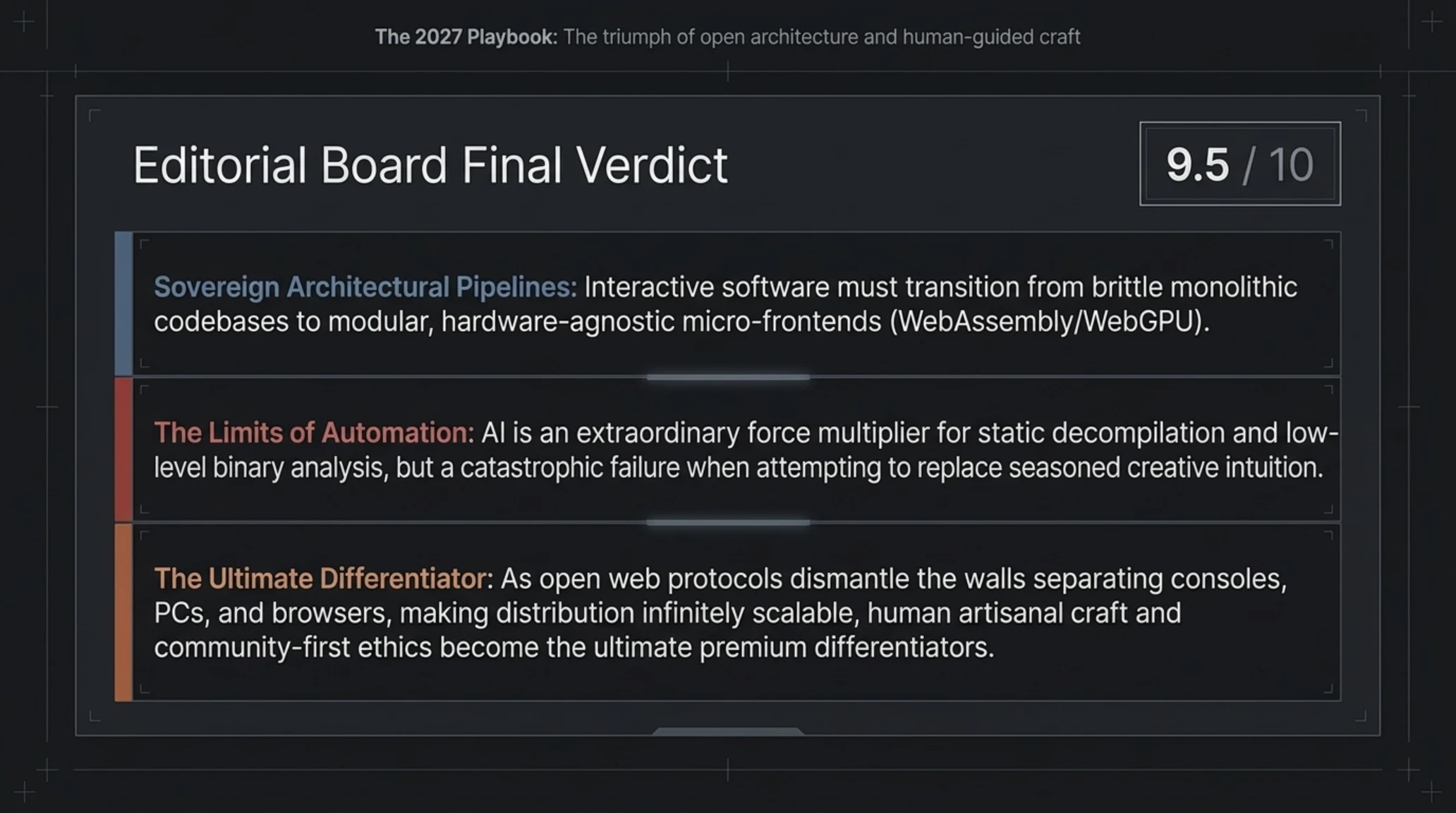
From an enterprise systems perspective, the broader implication for technology leaders heading into 2027 is the imperative to establish sovereign, multi-layered architectural pipelines. Interactive software is transitioning from brittle monolithic codebases into modular, hardware-agnostic micro-frontends. The successful studio of the next decade will not blindly outsource its core intellectual property to black-box cloud foundation models, nor will it imprison its commercial output within the walled gardens of proprietary console hardware. Instead, market supremacy will belong to agile organizations that leverage specialized autonomous agents for repetitive tooling, automated regression testing, and code decompilation, while fiercely preserving the sanctity of human gameplay direction, world-building narrative design, and community-first monetization ethics.
As the international games economy expands toward $350 billion in annual global turnover, the technical victories achieved this evening in browser-native graphics, rapid cross-platform deployment, and hardware-accelerated emulation demonstrate that open web protocols are emerging as the ultimate neutral ground of digital computing. The barriers to access that once segregated audiences based on hardware wealth, geographical isolation, or platform tribalism are being dismantled in favor of instantaneous, frictionless digital experiences accessible to every human possessing an internet connection and a screen.
The comparative analytical matrix below synthesizes the strategic strengths, systemic hazards, and overarching engineering trajectory of this transformative evening.
- Revolutionary WebGPU browser gaming framework eliminating installation barriers and cloud streaming latency.
- Historic compression of GTA 6 PC launch window to under four months, revitalizing desktop hardware markets.
- Exemplary generational software stewardship by CD Projekt Red across next-generation console hardware.
- Massive immediate player population expansion for competitive multiplayer shooters via subscription catalogs.
- Catastrophic engineering paralysis and cultural fallout from forced executive generative AI mandates.
- Erosion of competitive multiplayer integrity through aggressive Pay-to-Fast shortcut microtransactions.
- Complex copyright and licensing ambiguity surrounding community decompilations executed within web runtimes.
The conceptual rendering above illustrates the seamless synthesis of client-side browser runtimes, ultra-enthusiast desktop computing hardware, and human-guided engineering craft, embodying the triumphant future of interactive entertainment in 2027 and beyond; a future where human imagination, open computing architectures, and cutting-edge silicon unite to forge virtual worlds of boundless fidelity and universal accessibility.
Editorial Board Final Verdict // Strategic Evaluation Card
The Triumph of Open Architecture, Frictionless Access, and Human Craft
Thursday evening, October 15, 2026, cements the irreversible triumph of open hardware ecosystems. Artificial intelligence proves its worth as a brilliant compiler assistant rather than an author, while the walls separating consoles, PCs, and web browsers permanently crumble.
Frequently Asked Questions // Strategic Technical Inquiries
How does Microsoft's Xbox Labs execute classic console titles inside standard web browsers?
Xbox Labs utilizes specialized large language models to decompile compiled x86 and custom console binaries into clean source code, which is then recompiled into WebAssembly (WASM) modules with direct WebGPU bindings that render natively on the client device's physical GPU without video streaming latency.
Why is Take-Two releasing the PC version of GTA 6 so close to the initial console premiere?
Accelerating PC launch windows protects Take-Two against rogue hardware-level console emulators, captures surging digital PC margins representing over 40% of net company revenues, and synchronizes with next-generation multi-frame GPU hardware upgrade cycles.
What caused the production shutdown of Epic Games' collaborative Disney shooter?
CEO Tim Sweeney issued an executive decree banning manual hand-written code and requiring complete gameplay logic generation via Claude AI agents, resulting in catastrophic state machine hallucinations, broken multiplayer netcode, and the mass resignation of senior engineers.
What specific technical issues does CD Projekt Red's hotfix 5.01b address on PS5 Pro?
The hotfix eliminates sudden memory crashes and instability caused by interaction conflicts between Ray-Traced Global Illumination buffers and Sony's PSSR machine-learning upscaler in densely populated urban environments like Novigrad and Oxenfurt.
Why did the $30 Battlefield 6 weapon unlock shortcut bundle generate intense community backlash?
The shortcut bundle allows purchasing players to instantly bypass hundreds of hours of tactical skill progression, granting immediate access to end-game weaponry that undermines competitive parity on massive 128-player servers.
How did the 9/11 terrorist attacks permanently shape Rockstar Games' signature box-art style?
The original GTA 3 packaging featured a dark, gritty illustration of Manhattan skyscrapers engulfed in smoke and flames. Following 9/11, retail boycotts forced artist Stephen Bliss to execute a 48-hour emergency redesign inspired by comic book grid panels, creating the permanent 25-year visual identity of the franchise.
Verified Sources and Authoritative References Index
- Eurogamer: Exclusive technical coverage on Microsoft Xbox Labs, AI decompilation, and WebGPU browser execution
- GamesBeat: Investigative scoop confirming Grand Theft Auto VI targeted PC launch window for Q1 2027
- Bloomberg: In-depth exposé on Epic Games Disney crossover delay and Tim Sweeney forced AI-coding directive
- CD Projekt Red: Official patch notes for The Witcher 3 hotfix 5.01b and Nintendo Switch 2 compliance update
- GameSpot: Day-and-date Battlefield 6 Game Pass launch breakdown and $30 shortcut bundle controversy
- IGN: IGN Icons documentary interview featuring Dan Houser on the 48-hour 9/11 GTA 3 box-art redesign
Additional Gallery: Tekin Night Oct 15 | 🎮 Xbox Labs, GTA 6 PC Date & Epic AI