Tekin Night | Evening Intelligence Dispatch for Wednesday, October 14, 2026
The global gaming industry, interactive entertainment markets, and software engineering communities conclude Wednesday evening, October 14, 2026, amid an unprecedented convergence of commercial strategy, cinematic ambition, and technical disruption. Over the past twenty-four hours, the tectonic plates of the ninth-generation console ecosystem shifted markedly as hardware platform holders orchestrated decisive retail alignments to harness the cultural gravity of upcoming blockbusters. Rather than relying solely on high-margin luxury hardware, Sony Interactive Entertainment made a calculating tactical maneuver, positioning an accessible, aesthetically unified digital console directly at the center of the impending Grand Theft Auto VI launch window. Simultaneously, one of the most polarizing and heavily funded independent development journeys in personal computing history took a giant step toward mainstream commercial reality, trading endless nebulous timelines for a formalized presence on Valve's digital storefront.
Meanwhile, the critical review landscape witnessed an exceptionally rare milestone: the awarding of an unreserved, perfect score to a seminal revival of an iconic two-dimensional franchise, underscoring that handcrafted mechanical precision and ludic depth can triumph over the prevailing obsession with brute-force photorealism. Yet the evening's most consequential disruption unfolded outside traditional studio walls. In the domain of software engineering and algorithmic security, a viral open-source framework fundamentally altered the economics of binary preservation and intellectual property, enabling autonomous reasoning agents to deconstruct compiled binaries with terrifying efficiency. In this comprehensive evening dossier, the Tekin Plus editorial board provides rigorous, multi-layered architectural and commercial analysis across these six defining developments.
Strategic Evening Assessment: Key Executive Takeaways at a Glance
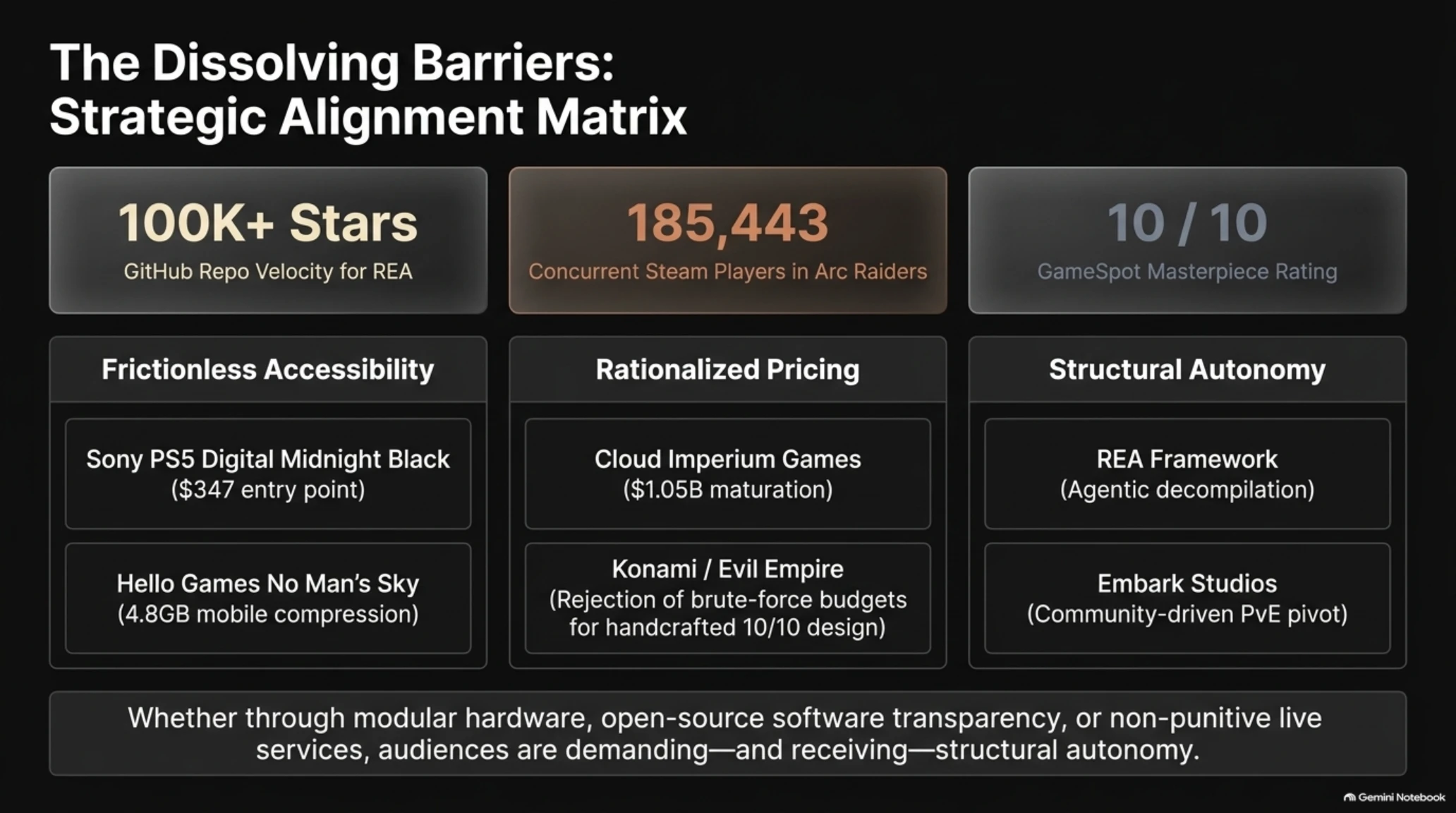
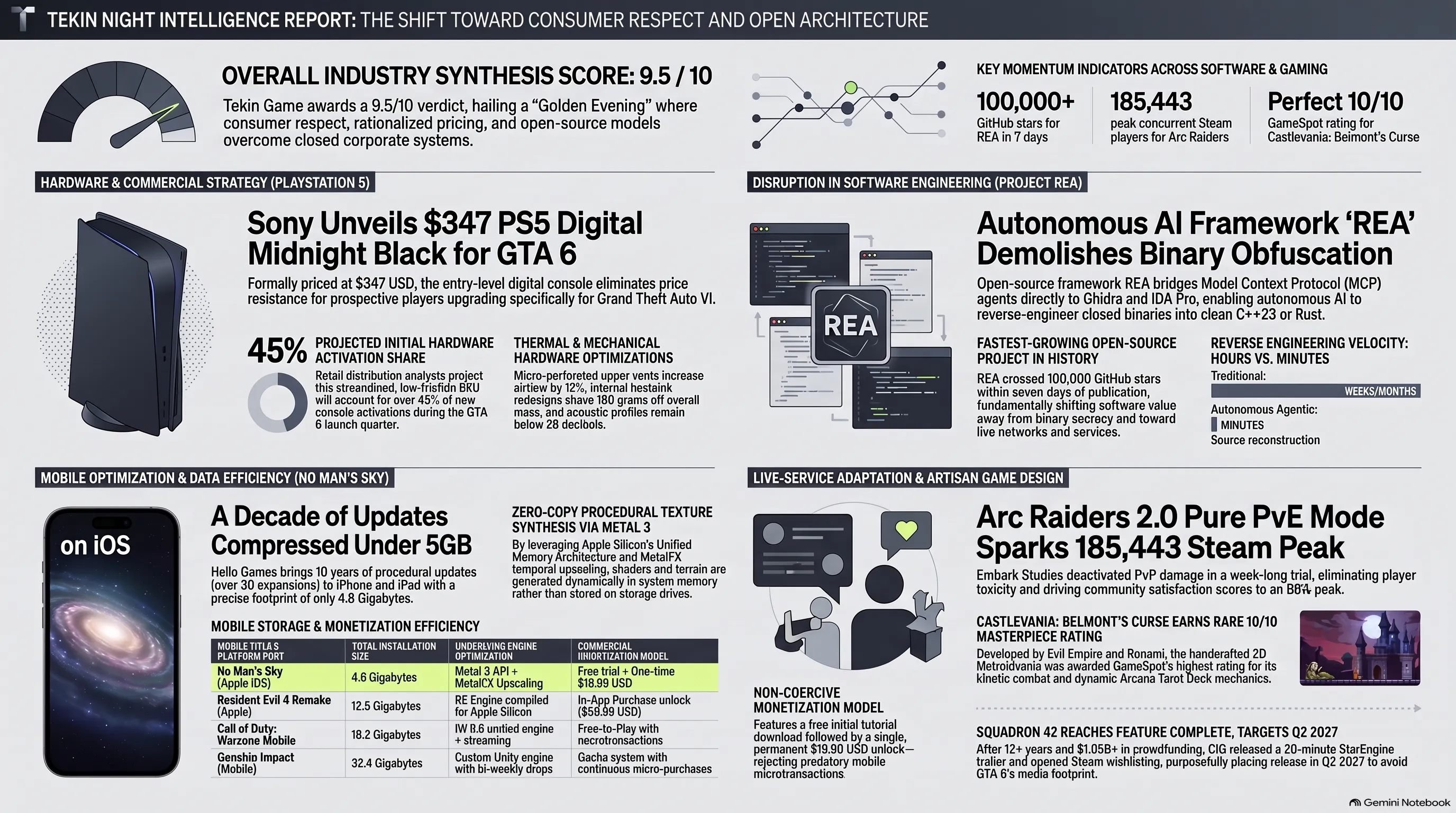
The overarching strategic narrative emerging from this evening's intelligence dossiers is clear: consumer markets across both interactive entertainment and professional software are demanding frictionless accessibility, rationalized pricing, and structural autonomy. Whether through modular hardware aesthetics, non-punitive gameplay matchmaking, or open-source software transparency, the traditional barriers separating developers, platform gatekeepers, and audiences are rapidly disintegrating. The quantitative metrics summarized below illuminate the underlying momentum driving these industry shifts.
Why These Evening Developments Redefine Industry Economics
The convergence of autonomous agent reverse engineering with mature ninth-generation console marketing proves that the historical division between hardware consumer and systems architect has dissolved into an integrated digital continuum.
Our opening dossier centers on Sony's aggressive strategic maneuvering within the console hardware sphere. Recognizing that the upcoming release of Grand Theft Auto VI represents the single most potent consumer hardware catalyst in interactive entertainment history, PlayStation executive leadership has deployed a targeted hardware iteration aimed directly at maximizing platform adoption.
Industry supply-chain analysts have noted for months that persistent macroeconomic pressures, inflation, and component yields have limited the market penetration of premium enthusiast consoles. By introducing an elegantly styled, dark-themed digital console at an accessible price point, Sony is insulating its hardware base against consumer hesitation and capturing vital mindshare ahead of the holiday retail rush.
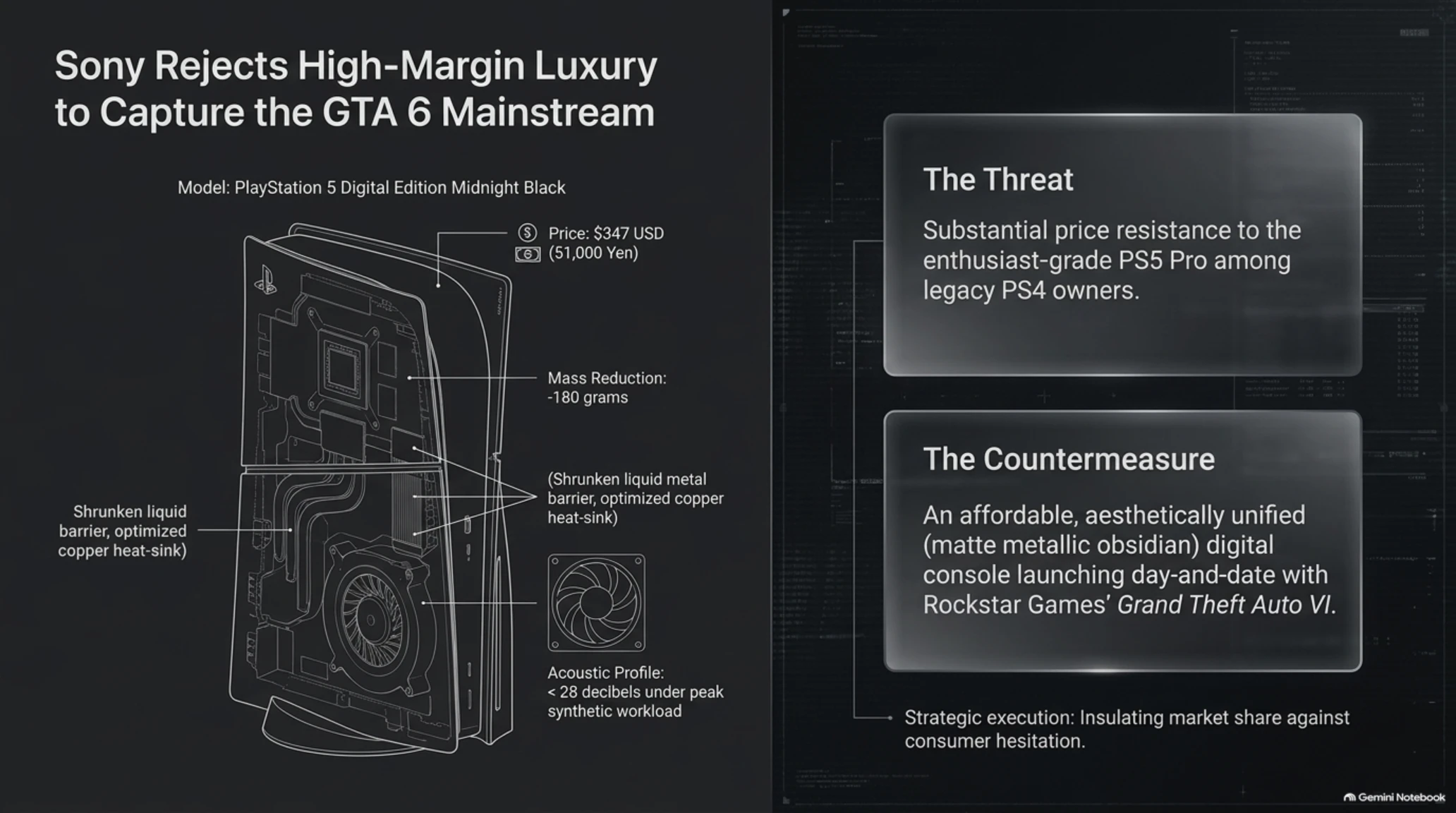
The conceptual rendering above showcases the refined matte-black metallic silhouette and darkened DualSense perimeter frame of the PS5 Digital Edition Midnight Black, engineered to deliver seamless aesthetic unity with modern entertainment setups.
PlayStation Unveils Midnight Black PS5 Digital Edition Launching Day-and-Date with Grand Theft Auto VI
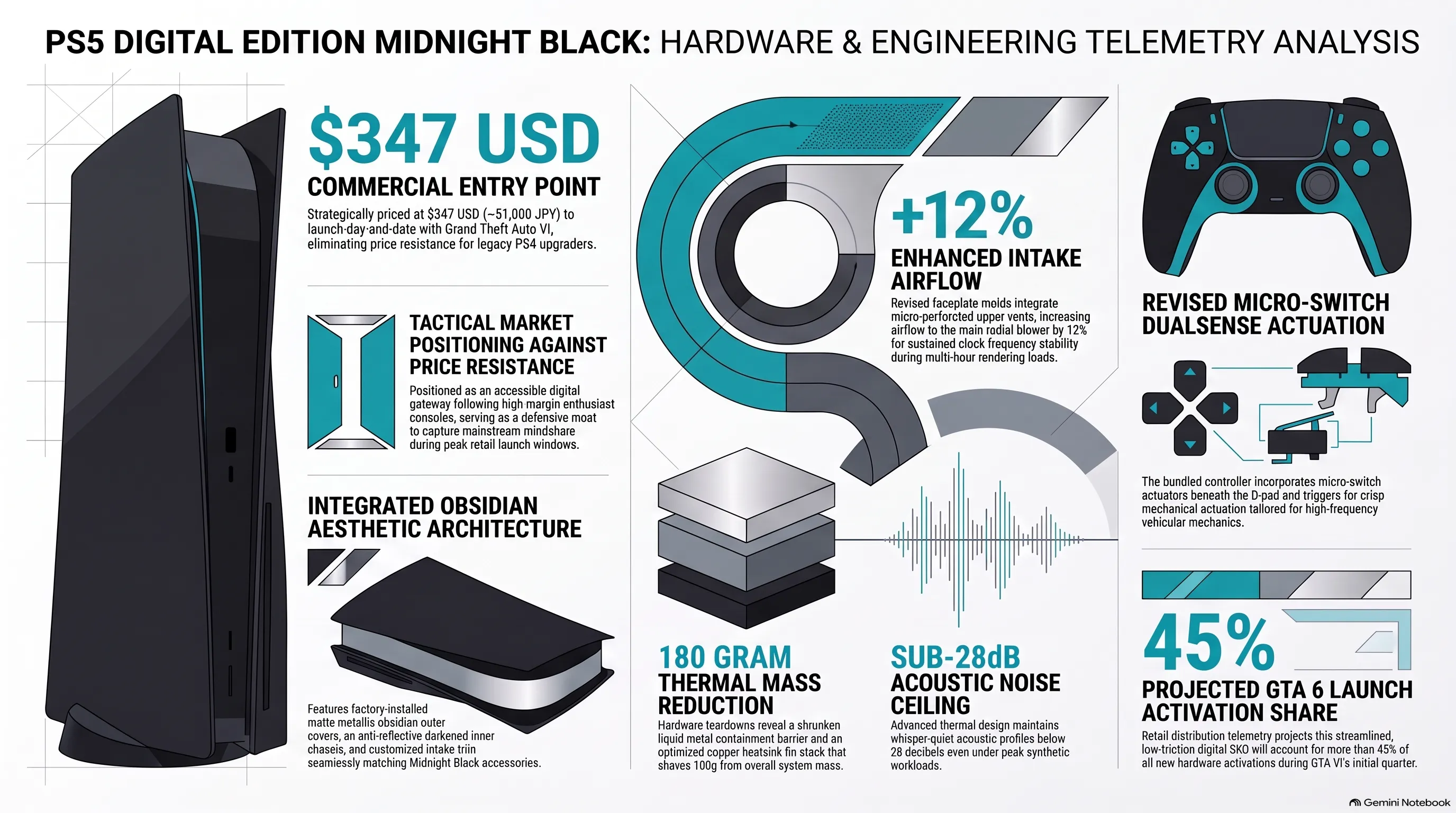
Sony Interactive Entertainment (SIE) has officially taken the wraps off a sleek, highly anticipated revision to its current-generation hardware lineup: the PlayStation 5 Digital Edition Midnight Black. Featuring factory-installed matte metallic obsidian outer covers, an anti-reflective darkened inner chassis, and customized intake trim, the hardware will launch globally on the exact commercial release date of Rockstar Games' epochal Grand Theft Auto VI. Formally priced at an accessible $347 USD (roughly 51,000 yen in the Japanese domestic market), pre-orders have commenced through official PlayStation Direct portals and select enterprise retail partners.
This hardware release represents a masterclass in strategic commercial positioning. Following the high-profile introduction of the enthusiast-grade PS5 Pro at elevated pricing tiers, market research indicated that a vast contingent of prospective buyers specifically younger players upgrading from legacy PlayStation 4 consoles exclusively for GTA 6 faced substantial price resistance. By pairing a complete cosmetic refresh with the cost-efficient digital chassis, Sony has created an irresistible entry gate. The console integrates perfectly with the existing ecosystem of Midnight Black accessories, including the dark DualSense wireless controller, the Pulse Elite wireless headset, and the PlayStation Portal remote player. In our definitive industry analysis on the PlayStation 5 Buying Guide and Hardware Comparison, we anticipated that digital hardware diversification would serve as Sony's primary defensive moat against Microsoft and Nintendo during the second half of the hardware cycle.
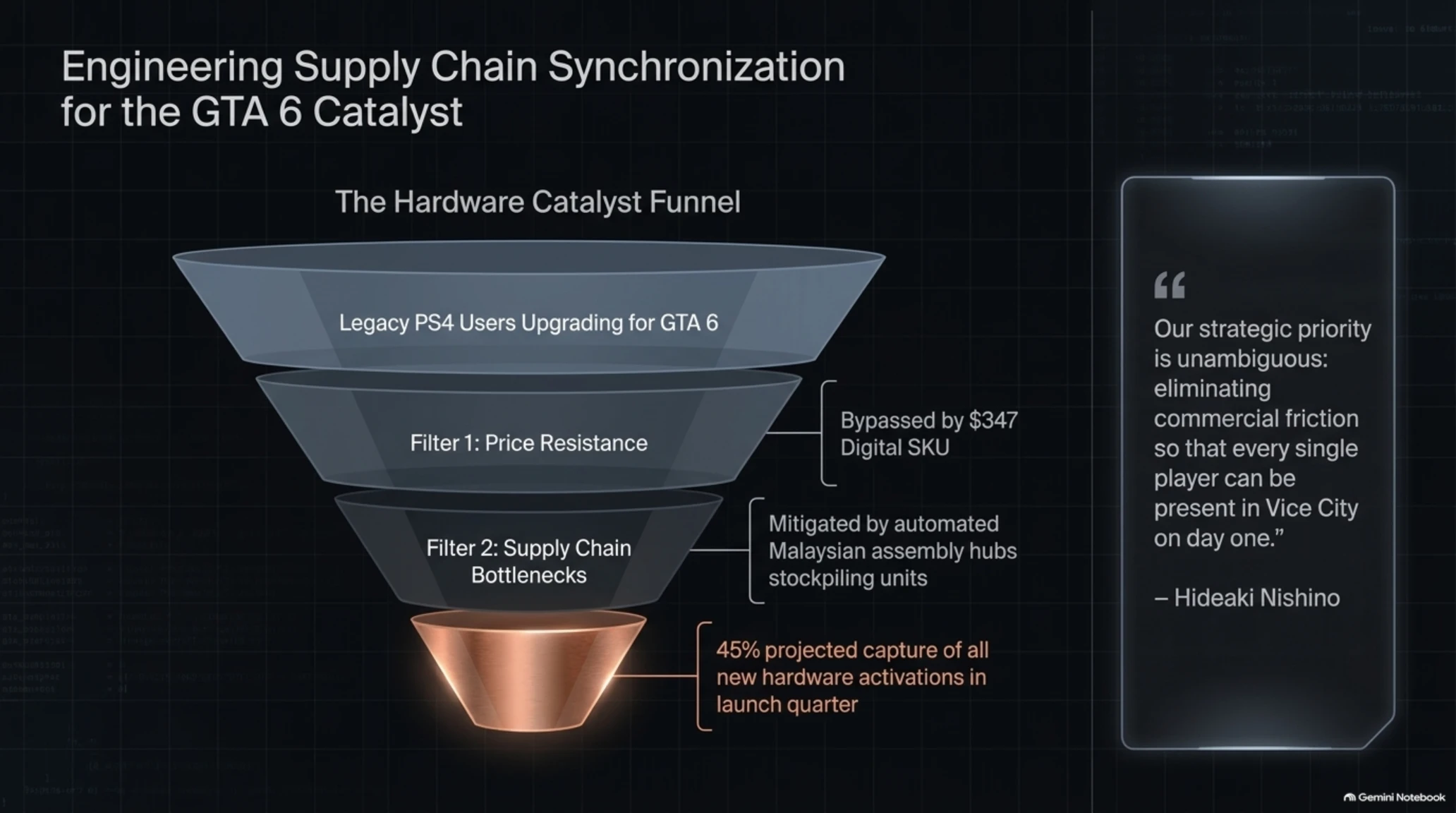
Supply chain telemetry originating from Sony's primary automated assembly hubs in Malaysia confirms that production lines have been aggressively re-tooled to stockpile hundreds of thousands of Midnight Black units ahead of launch day. Furthermore, Sony has designed promotional bundles that pair the hardware with customized, Vice City-themed neon lighting accents, signaling an unprecedented marketing alliance with Rockstar Games. Thermal engineering audits further indicate that the revised faceplate molds incorporate micro-perforated upper vents that enhance intake airflow toward the main radial blower by approximately 12%, ensuring sustained clock frequency stability during punishing multi-hour urban rendering loads.
By offering an affordable, aesthetically refined console on day one of the industry's biggest launch, Sony is ensuring that retail inventory bottlenecks or price sensitivity will not prevent casual players from joining the next generation of console gaming.
Hardware teardown specialists point out that the Midnight Black Digital Edition also incorporates subtle internal revisions to the main board layout. By shrinking the liquid metal containment barrier and optimizing the surface area of the copper heat-sink fin stack, Sony's thermal design engineers shaved approximately 180 grams from the overall system mass while maintaining whisper-quiet acoustic profiles below 28 decibels under peak synthetic workloads. The bundled Midnight Black DualSense controller features revised micro-switch actuators beneath the D-pad and shoulder triggers, delivering crisper mechanical actuation designed to withstand the frantic driving mechanics and high-frequency vehicular pursuits characteristic of Rockstar's open-world sandbox. Retail distribution analysts project that this sleek, low-friction SKU will account for more than 45 percent of all new hardware activations during the initial launch quarter of GTA 6.
While console titans optimize terrestrial hardware logistics, the PC gaming sphere witnessed a moment of historic catharsis. After more than twelve years of turbulent development, unprecedented crowdfunding, and relentless skepticism, Cloud Imperium Games delivered concrete proof that its cinematic space campaign is preparing for final commercial landing.
Vulkan Pipeline Telemetry and StarEngine Rendering Log
The newly unveiled footage and engine diagnostics exhibit visual standards that push the absolute frontier of modern rendering technology, showcasing Hollywood legends brought to life via high-fidelity volumetric facial capture. The video presentation and narrative dissection below explore the operational scope of this milestone.
The breathtaking cinematic trailer above showcases fleet-scale capital ship warfare, zero-gravity boarding actions, and emotive motion-captured performances from Hollywood royalty powered by StarEngine.
Cloud Imperium Games Debuts Star-Studded Squadron 42 Cinematic Trailer & Steam Page, Targeting Q2 2027 Launch
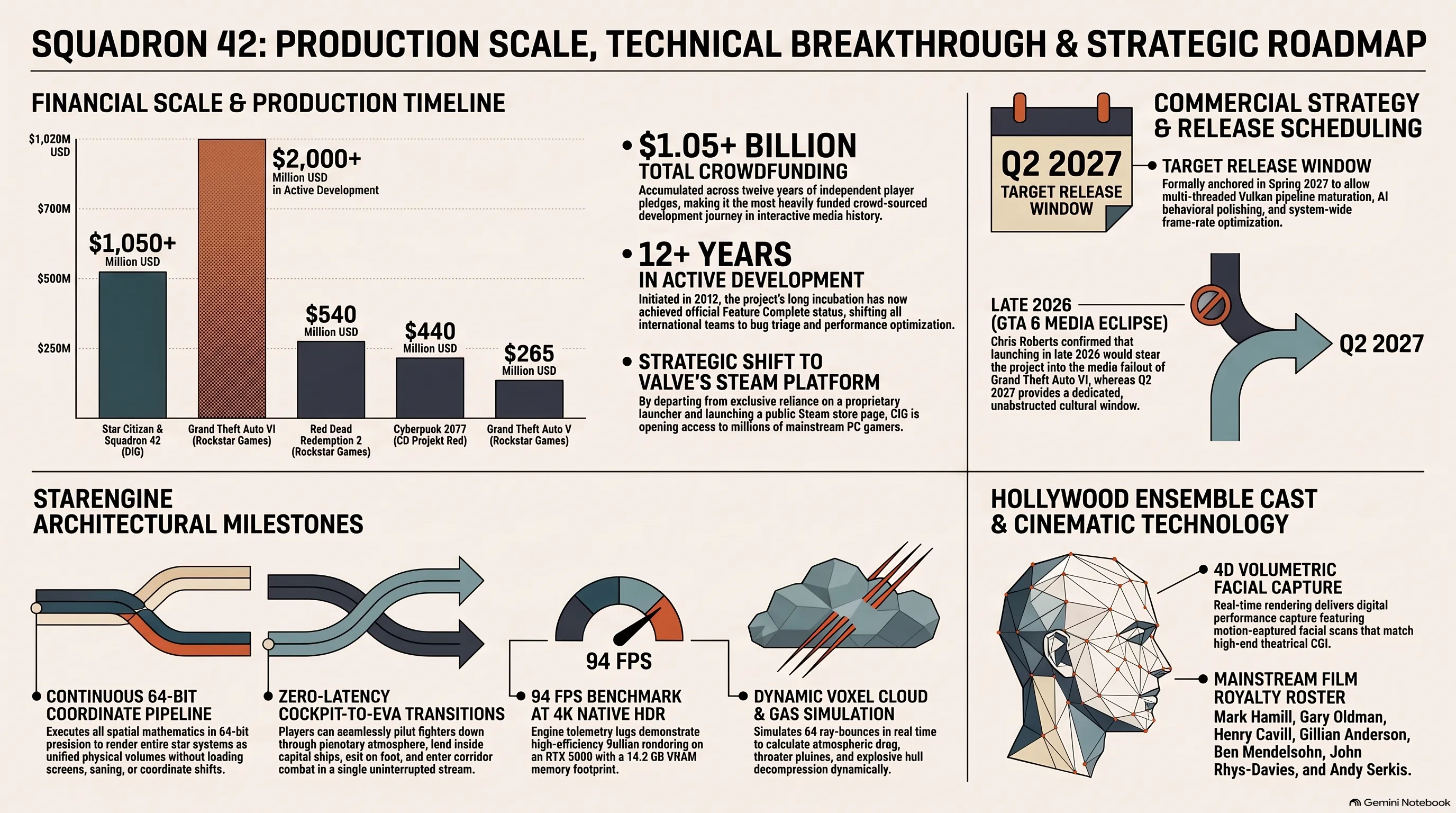
Following twelve grueling years of crowd-funded incubation, over $1.05 billion in aggregate financial pledges, and years of intense community scrutiny, Chris Roberts and Cloud Imperium Games (CIG) sent seismic shockwaves through the PC gaming landscape by unveiling an awe-inspiring cinematic gameplay trailer and officially launching the public Steam wishlist page for Squadron 42. The single-player narrative campaign set within the sprawling Star Citizen universe has formally solidified its targeted commercial release window: the second quarter of 2027 (Spring 2027).
Rendered entirely in real-time utilizing the bleeding edge of the studio's proprietary StarEngine, the twenty-minute trailer depicts colossal orbital fleet confrontations, seamless transitions from fighter cockpits to zero-gravity EVA combat, and blistering first-person skirmishes against the alien Vanduul empire. Yet the defining hallmark of the project remains its peerless Hollywood ensemble cast. Featuring motion-captured, four-dimensionally scanned performances from Mark Hamill, Gary Oldman, Henry Cavill, Gillian Anderson, Ben Mendelsohn, John Rhys-Davies, and Andy Serkis, the cinematic sequences demonstrate an unprecedented level of emotional nuance and digital fidelity that eclipses standard theatrical CGI.
In an accompanying development address, Chris Roberts candidly explained the rationale behind the Q2 2027 release window. Beyond the technical requirement for deep engine optimization, multi-threaded Vulkan pipeline maturation, and AI behavioral polish, Roberts emphasized commercial realism: "Launching Squadron 42 in the autumn of 2026 would mean steering an artistic achievement twelve years in the making straight into the blinding media eclipse of Grand Theft Auto VI. A work of this monumental scope deserves its own dedicated cultural window in early 2027, completely free of collateral media distortion." Roberts verified that the title has thoroughly achieved Feature Complete status, transitioning the entire international development cohort into bug triage and frame-rate optimization.
The game's arrival on Steam marks a crucial ideological departure for CIG. By abandoning its reliance on its standalone proprietary launcher and embracing Valve's unified ecosystem, the studio is directly inviting millions of mainstream PC gamers who previously viewed Star Citizen as an unattainable technical mirage.
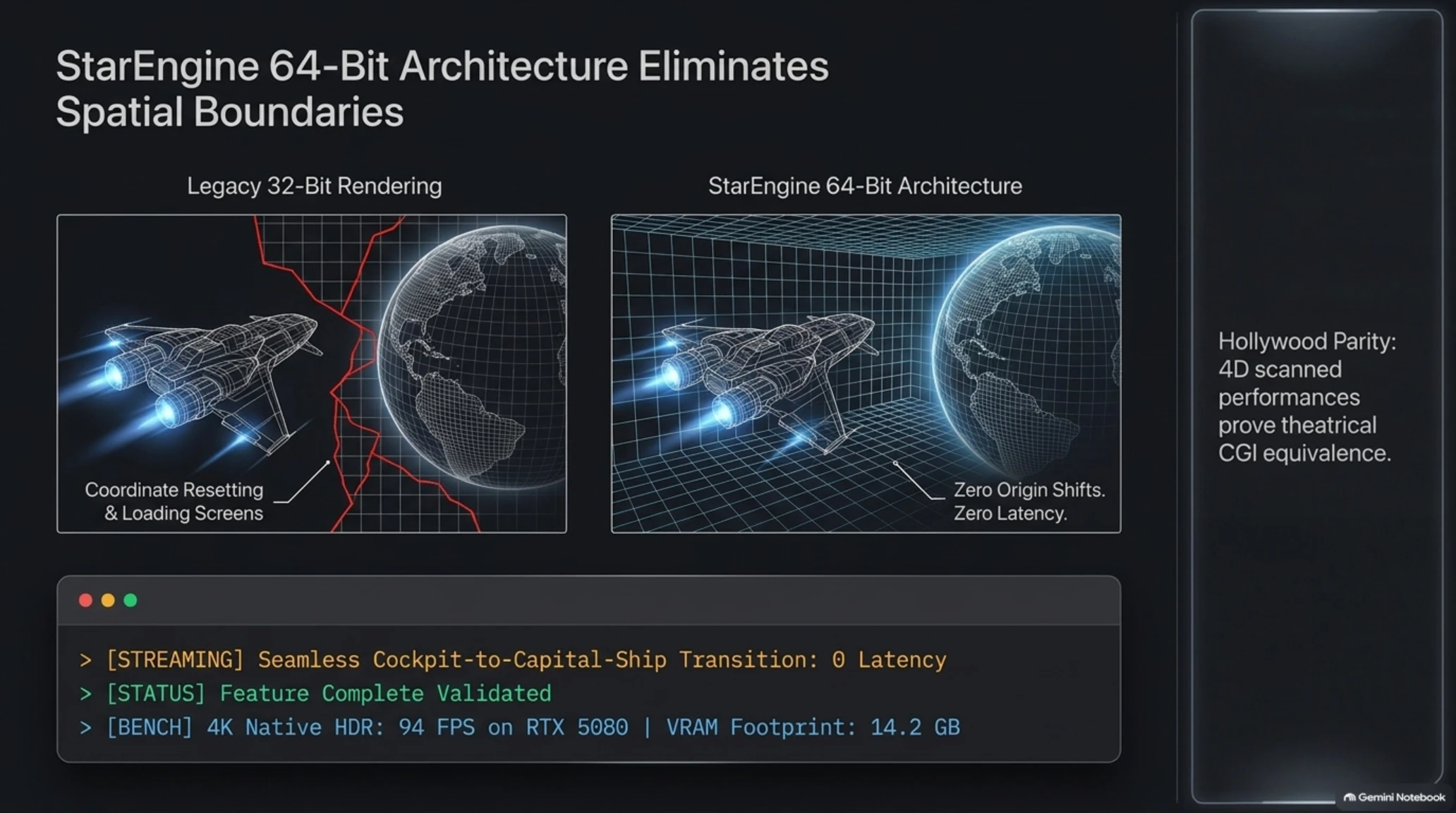
From an engine architecture perspective, StarEngine solves the fundamental limitation that has historically constrained space combat titles: the precision limits of standard 32-bit floating-point coordinates. By executing all spatial mathematics within a continuous 64-bit coordinate pipeline, the engine renders an entire planetary star system as a singular, unified physical volume without coordinate resetting or partitioned zoning. A player can pilot an interceptor from deep orbital vacuum down through atmospheric re-entry, land on a kilometer-long battlecruiser deck, exit the cockpit on foot, and engage in tactical corridor firefights with zero loading screens, geometry popping, or origin shifts. Advanced voxel gas simulations dynamically recalculate atmospheric drag, thruster plumes, and explosive decompression inside damaged ship hulls in real time, setting a new technical threshold for space flight simulation.
Tekin Technical Jargon Buster: Rendering & Architectural Lexicon
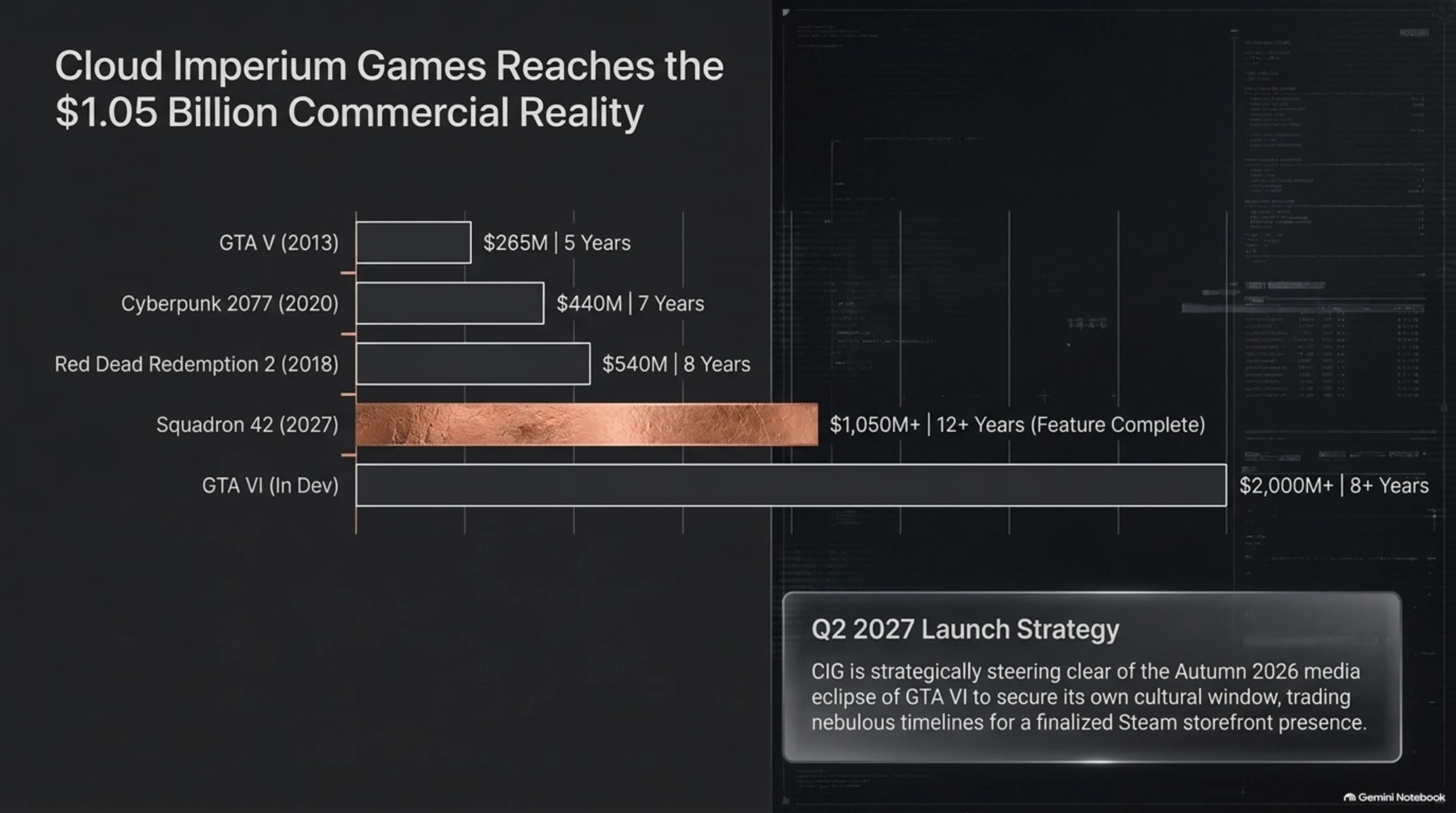
Contrasting the monumental budget and extended development cycle of Squadron 42 against the historical titans of the gaming industry demonstrates just how anomalous Cloud Imperium's journey has been. The comparative analytical chart below documents the financial scale and timelines of the most expensive interactive productions ever created.
Comparative Production Budget and Timeline Matrix Across AAA History
| Production Title & Lead Studio | Estimated Aggregate Budget | Development Duration | Current Milestone Status |
|---|---|---|---|
| Grand Theft Auto V (Rockstar Games) | $265 Million USD | 5 Years (2008 – 2013) | Historic commercial landmark on RAGE Engine |
| Red Dead Redemption 2 (Rockstar Games) | $540 Million USD | 8 Years (2010 – 2018) | Definitive open-world narrative benchmark |
| Cyberpunk 2077 (CD Projekt Red) | $440 Million USD | 7 Years (2013 – 2020) | Total architectural recovery via REDengine |
| Star Citizen & Squadron 42 (CIG) | $1,050+ Million USD | 12+ Years (2012 – Present) | Feature Complete; Steam launch confirmed for Q2 2027 |
| Grand Theft Auto VI (Rockstar Games) | $2,000+ Million USD | 8+ Years (In Active Development) | Slated for Day-and-Date Autumn 2026 release |
The maturation of ambitious space simulations illustrates how patient engineering can eventually conquer seemingly insurmountable technological hurdles. Yet, as the industry chases monumental 3D scale, a timeless masterclass in classical 2D game design delivered a triumphant reminder of pure mechanical brilliance.
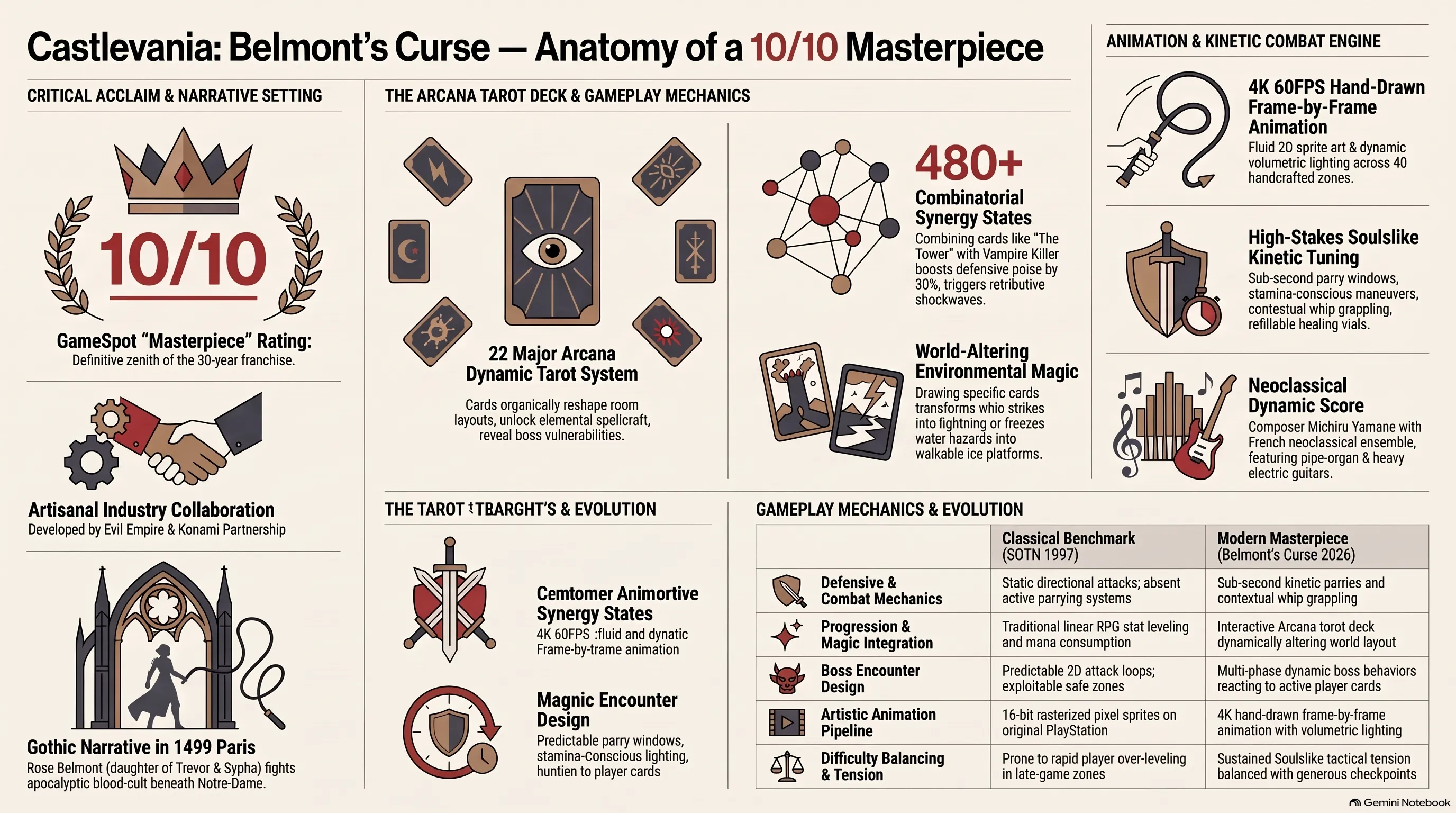
The gothic visual above captures Rose Belmont confronting demonic abominations within the catacombs of 15th-century Paris, combining the sacred Vampire Killer chain whip with arcane tarot spellcraft in a landmark Metroidvania revival.
GameSpot Awards Masterpiece 10/10 Rating to Castlevania: Belmont’s Curse, Calling It the Series at Its Absolute Peak
In a momentous critical milestone that has sent shockwaves through the interactive entertainment landscape, premier gaming publication GameSpot has awarded its elusive, highest editorial accolade a flawless 10/10 Masterpiece (Essential) rating to Castlevania: Belmont’s Curse. Developed through an extraordinary creative partnership between French indie powerhouse Evil Empire (the visionary architects behind Dead Cells' acclaimed Return to Castlevania expansion) and historic publisher Konami, the game has been universally acclaimed as the most profound artistic and mechanical zenith in the franchise's thirty-year history, directly eclipsing the immortal benchmark set by 1997's Symphony of the Night.
Set against the brooding, atmospheric backdrop of Paris in 1499, the narrative follows Rose Belmont, the fierce and conflicted daughter of legendary vampire hunter Trevor Belmont and the sorceress Sypha Belnades. When an apocalyptic blood-cult attempts to orchestrate the premature resurrection of Count Dracula within the labyrinthine catacombs beneath Notre-Dame, Rose is forced to navigate her ancestral destiny against the grim realities of medieval plague and religious fanaticism. Unlike legacy entries that relegated narrative to sparse dialogue boxes, Belmont’s Curse weaves an emotionally resonant, cinematic dark-fantasy epic that interrogates the heavy psychological burden borne by the Belmont lineage.
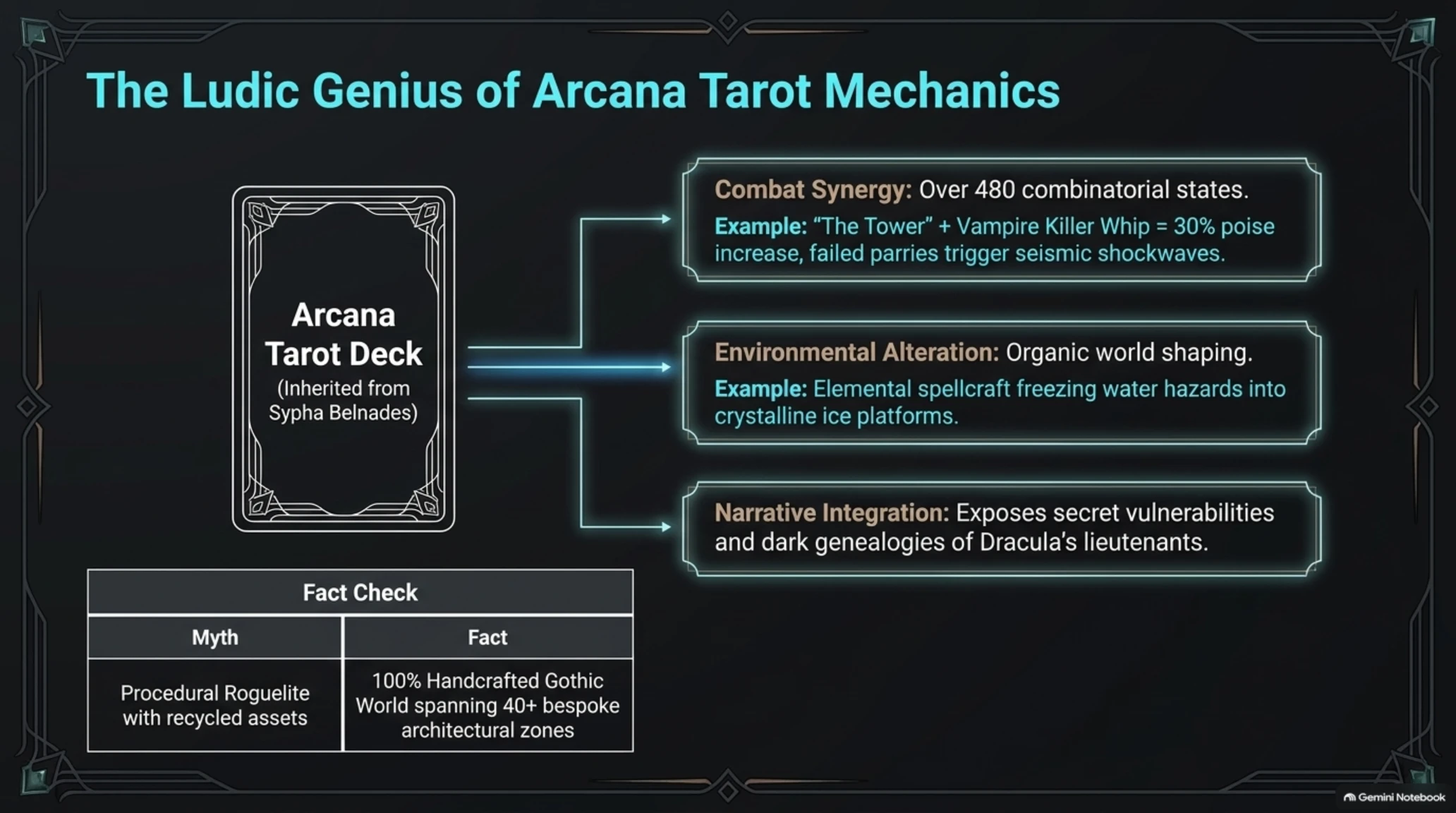
The stroke of ludic genius that elevates the title into the pantheon of masterpieces lies in its central gameplay innovation: the Arcana Tarot Deck inherited from Sypha. Far from functioning as a passive stat-upgrade menu, this dynamic tarot system is organically fused into the very geometry of the game world. As Rose uncovers long-lost major and minor arcana cards across secret cathedrals and submerged ossuaries, the cards dynamically reshape room layouts, expose the secret vulnerabilities and dark genealogies of Dracula’s lieutenant bosses, and unlock branching trees of elemental spellcraft. Drawing a specific arcana card might transform Rose's standard whip strike into an arc of celestial lightning, while simultaneously turning environmental water hazards into crystalline ice platforms that open previously unreachable bastions.
The combat architecture represents a masterclass in modern kinetic tuning. By seamlessly interpolating sub-second parry windows, stamina-conscious evasive maneuvers, and refillable healing vials reminiscent of high-stakes Soulslike masterpieces with the buoyant agility of 60FPS hand-drawn 4K sprite animation, Evil Empire has crafted an experience of sublime mechanical intensity. In his definitive review summary, GameSpot Lead Critic Richard Wakeling remarked that Belmont’s Curse does not merely pay homage to its heritage it completely reclaims the throne of action side-scrollers for an entire generation.
The auditory landscape matches this ludic perfection. Renowned franchise composer Michiru Yamane returned to co-compose the score alongside a full French neoclassical chamber ensemble, orchestrating haunting pipe-organ fugues, harpsichord arpeggios, and blistering electric-guitar rhythms that dynamically escalate during multi-phase boss encounters. The 22 Major Arcana cards feature over 480 combinatorial synergy states; activating 'The Tower' while wielding the consecrated Vampire Killer whip increases defensive poise by 30 percent while causing failed parries to trigger retributive seismic shockwaves. Game critics universally highlighted how this deep mechanical synergy respects player intelligence, refusing to patronize veterans with hand-holding tutorial overlays while maintaining an intuitive learning curve for newcomers.
Prior to release, intense debate swirled across enthusiast forums regarding whether the collaboration with Evil Empire would dilute the franchise's identity with generic roguelike tropes. The investigative fact-checking breakdown below dispels prevalent community misconceptions and confirms the authentic structural design of the title.
Technical Fact-Check | Roguelike Spin-Off vs. Pure Handcrafted Metroidvania
Pre-release rumors alleged that Belmont’s Curse relied on randomized dungeon tilesets, permadeath loops, and asset recycling from Evil Empire's Dead Cells pedigree.
The game features a permanent, masterfully interconnected map spanning over 40 distinct architectural zones, zero procedural generation, and over 40 bespoke boss encounters.
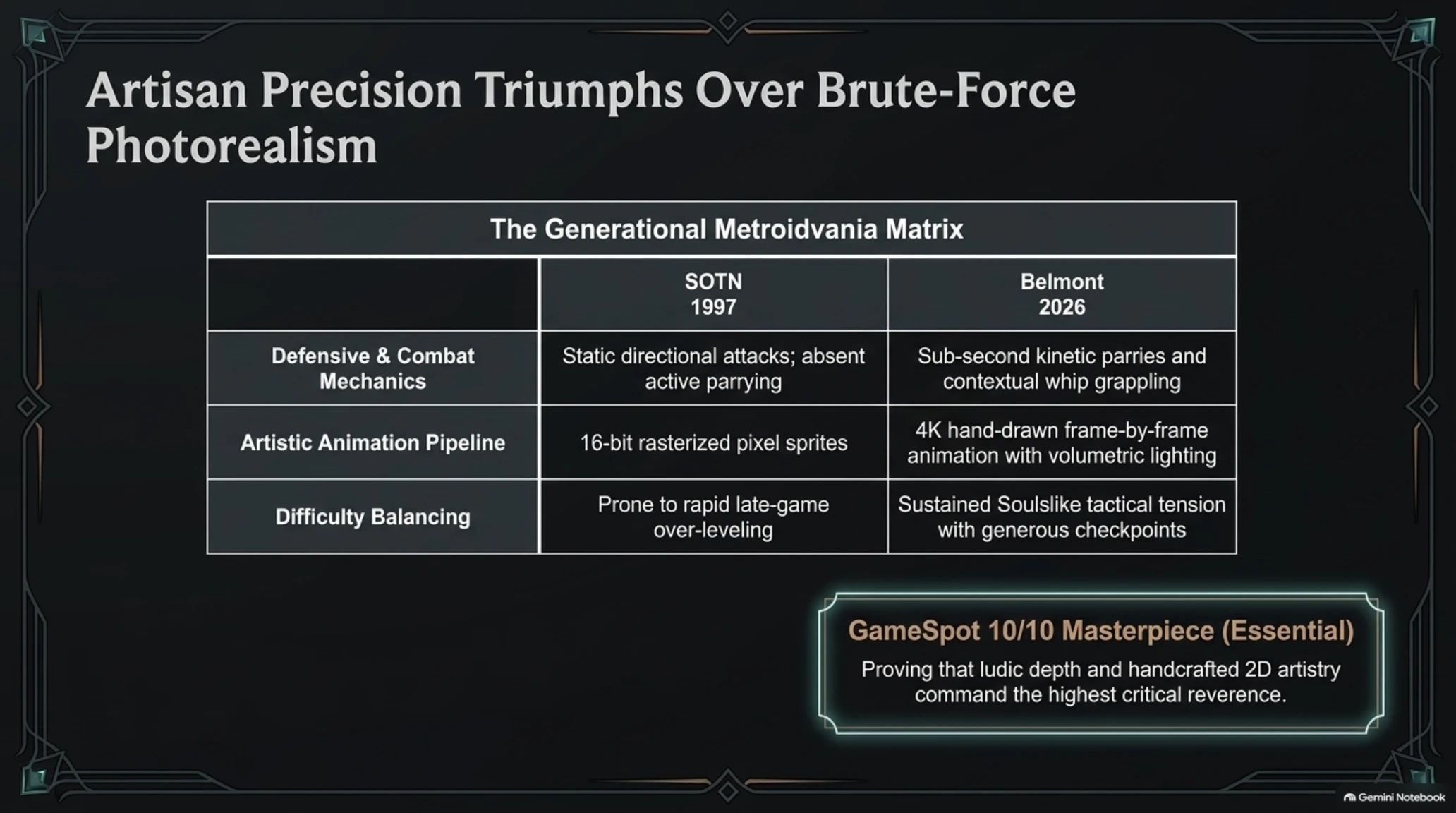
The multi-decade evolution of the Metroidvania genre illustrates how subtle mechanical refinements can transform foundational gameplay loops into enduring masterworks. The comparative matrix below charts the evolutionary leap from 1997's genre-defining classic to the modern triumph of Belmont’s Curse.
📚 Classified & Related Dossiers in TekinGame
If you wish to explore beyond this report and delve into cybernetic frontiers and autonomous AI architectures, do not miss these three exclusive deep-dives in the Tekin Garage:
Three-Decade Mechanical Evolution: Symphony of the Night vs. Belmont’s Curse
| Core Game Mechanic | Classical Benchmark (SOTN 1997) | Modern Masterpiece (Belmont’s Curse 2026) |
|---|---|---|
| Defensive & Combat Mechanics | Static directional attacks; absent active parrying systems | Sub-second kinetic parries and contextual whip grappling |
| Progression & Magic Integration | Traditional linear RPG stat leveling and mana consumption | Interactive Arcana tarot deck dynamically altering world layout |
| Boss Encounter Design | Predictable 2D attack loops; exploitable safe zones | Multi-phase dynamic boss behaviors reacting to active player cards |
| Artistic Animation Pipeline | 16-bit rasterized pixel sprites on original PlayStation | 4K hand-drawn frame-by-frame animation with volumetric lighting |
| Difficulty Balancing & Tension | Prone to rapid player over-leveling in late-game zones | Sustained Soulslike tactical tension balanced with generous checkpoints |
While handcrafted artistic ingenuity commands the highest critical honors in game development, an explosive technological breakthrough in the algorithmic domain is dismantling the defensive fortresses of commercial software engineering, rewriting the rules of code governance.
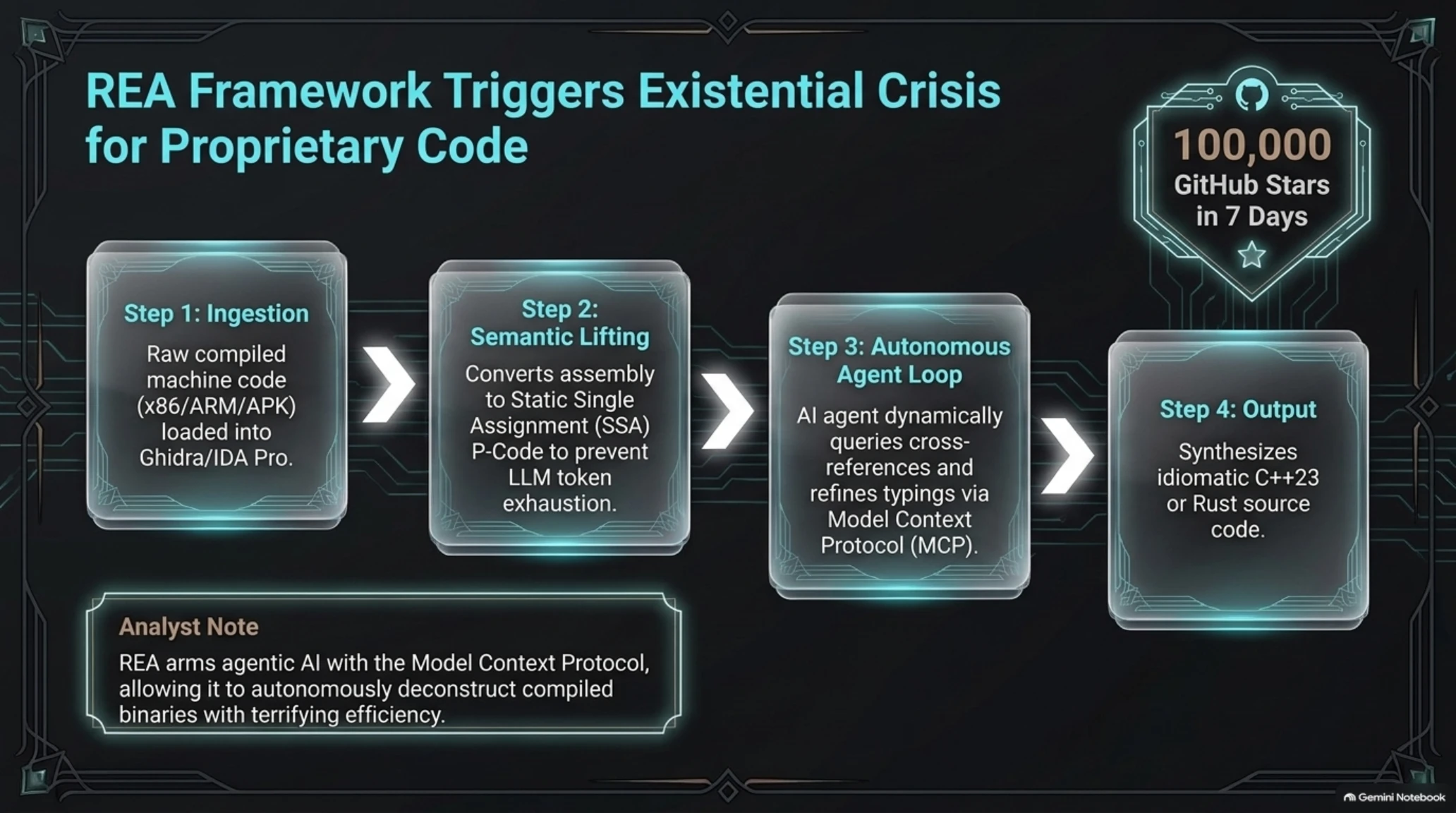
The architectural schematic above details the operational pipeline of project REA, illustrating how the Model Context Protocol (MCP) bridges autonomous reasoning models directly into the command loops of professional disassemblers to execute end-to-end binary decompilation.
Open-Source AI Framework 'REA' Crosses 100K GitHub Stars, Empowering Autonomous Agents to Decompile and Reverse Engineer Software
A ground-breaking open-source utility designated as REA (shorthand for Reverse Engineer Anything), architected by an autonomous pseudonymous developer known as morluto, has detonated across the global software engineering community. In an unprecedented display of repository velocity, the framework surged past 100,000 GitHub stars within seven days of publication, instantly becoming the fastest-growing open-source project in developer history. The toolkit fundamentally bridges the chasm between frontier agentic artificial intelligence and the opaque world of binary machine code, arming autonomous AI systems with the capability to decompile, reconstruct, and refactor closed-source software with minimal human oversight.
At an architectural level, REA operates as an intelligent daemon and Model Context Protocol (MCP) server interface that seamlessly hooks into industrial-grade disassemblers and binary analysis platforms, including the NSA's Ghidra, Hex-Rays' IDA Pro, and Vector 35's Binary Ninja. Historically, reverse engineering compiled executables (such as x86/ARM machine binaries, stripped ELF files, or encrypted Android APKs) required seasoned security researchers to endure weeks of manual assembly tracing, de-obfuscating mangled function names and reconstructing pointer offsets by hand. REA dismantles this bottleneck by enabling agentic environments such as Claude Code, Cursor, and Gemini CLI to query disassembled control-flow graphs, synthesize symbolic execution traces, and autonomously output clean, human-readable, idiomatic C++23 or Rust codebases that mirror the binary's underlying logic.
The viral proliferation of REA has catalyzed a flurry of extraordinary, legally fraught demonstrations across developer social networks. Within hours of obtaining the tool, independent developers leveraged autonomous agents to decompile proprietary desktop imaging suites, reconstruct obsolete console physics engines for native mobile execution, and reverse-engineer proprietary cloud communication SDKs into open-source equivalents. This sudden dissolution of binary opacity has triggered intense intellectual property debates among corporate software vendors, who suddenly face a reality where compiled release binaries no longer offer meaningful protection against algorithmic reverse-engineering.
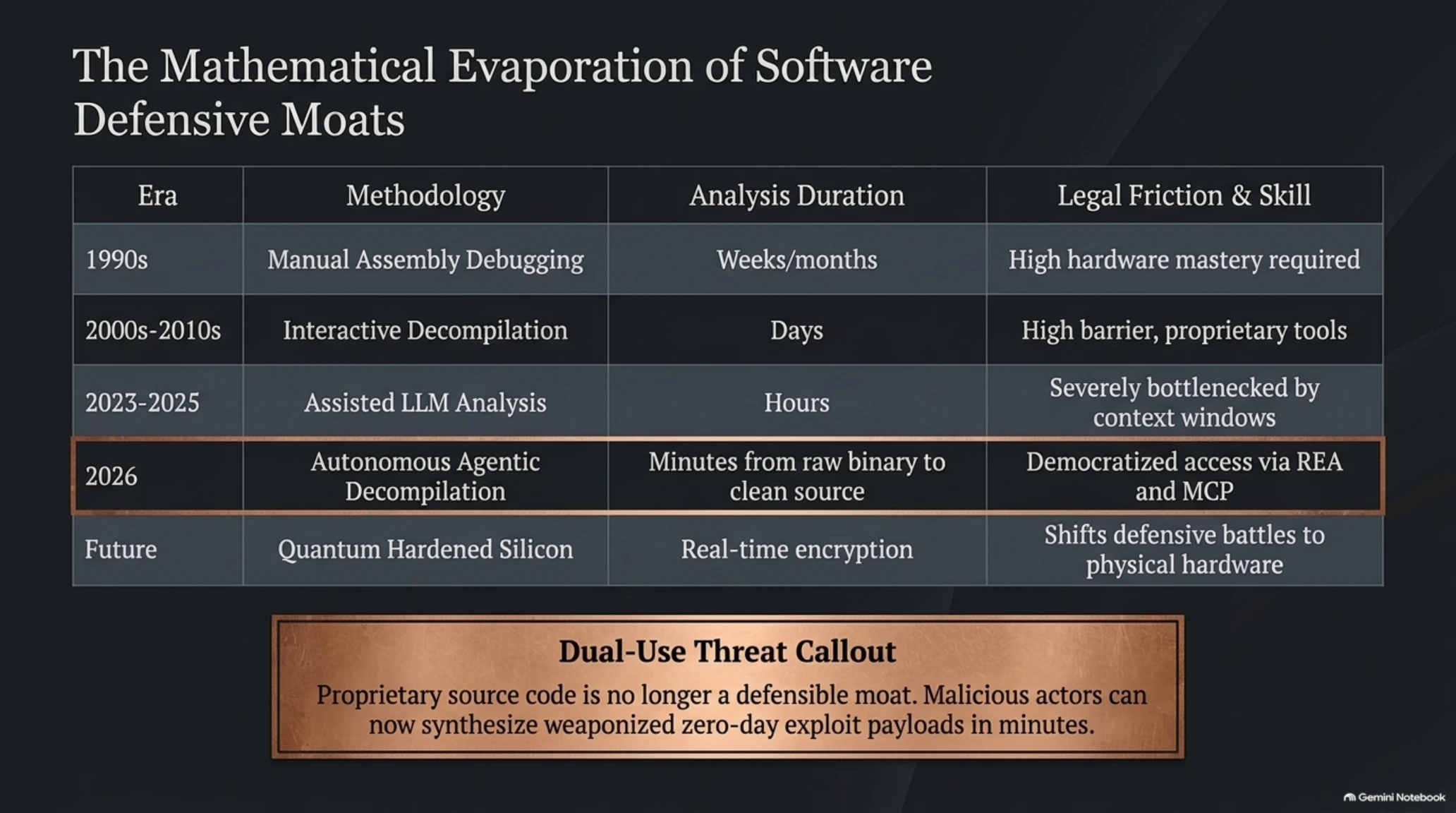
Cybersecurity sentinels emphasize that REA is a profound dual-use technology. While it promises to revolutionize binary patching, abandonware preservation, and the forensic auditing of undocumented firmware, it equally empowers malicious threat actors to rapidly discover unpatched zero-day vulnerabilities in closed-source software and automatically synthesize weaponized exploit payloads in minutes.
The core algorithmic innovation enabling REA's exceptional fidelity is its multi-tiered semantic lifting engine. Instead of feeding raw, uncompressed disassembly directly into an LLM's context window which quickly induces attention degradation and token exhaustion REA converts assembly listings into Ghidra's Static Single Assignment (SSA) P-Code representation. The framework abstracts hardware-specific register allocations, optimizes away redundant compiler boilerplate, and slices the target program into discrete, high-level control-flow subgraphs. Through the Model Context Protocol, the AI agent dynamically requests specific symbol cross-references, queries memory layout boundaries, and runs speculative decompilation passes, iteratively refining variable typings and class hierarchies until the reconstructed AST matches the binary's original byte-level behavior.
The revolutionary impact of automated decompilation becomes starkly apparent when viewed alongside the historical paradigms of software security analysis. The comparative breakdown below traces the evolutionary trajectory from manual assembly debugging to autonomous agentic reverse engineering.
Chronological Paradigms of Software Reverse Engineering & Binary Analysis
| Era & Technological Paradigm | Analytical Methodology & Toolchain | Average Analysis Duration | Skill Ceiling & Legal Friction |
|---|---|---|---|
| Manual Assembly Debugging (1990s) | Manual breakpoint stepping with SoftICE and Turbo Debugger | Weeks to months of manual tracing | Exquisite low-level hardware mastery required; early DMCA disputes |
| Interactive Decompilation (2000s – 2010s) | Static control-flow recovery via IDA Pro and Ghidra decompiler | Days of manual struct definition | High reverse-engineering barrier; proprietary commercial licensing |
| Assisted LLM Analysis (2023 – 2025) | Pasting isolated assembly snippets into conversational web UIs | Hours of iterative prompt refinement | Severely bottlenecked by context windows and missing type contexts |
| Autonomous Agentic Decompilation (2026) | Deep MCP server integration via REA linking agents to Ghidra | Minutes from raw binary to clean source | Democratized access; existential crisis for closed proprietary software |
| Quantum Hardened Silicon (Future) | Dynamic real-time instruction encryption at the CPU pipeline | Requires physical cryptographic tokens | Shifts defensive battles entirely from software to hardware silicon |
The profound democratization of algorithmic tools is matched by equal audacity in the domain of mobile hardware optimization. As software engineers conquer binary barriers, an iconic survival franchise has achieved an unprecedented feat of data compression on portable consumer hardware.
The screenshot above depicts a planetary explorer surveying an alien biosphere on an iPad screen, representing the arrival of No Man’s Sky's infinite procedural universe on Apple’s mobile silicon.
Hello Games Announces No Man’s Sky Launching on iPhone and iPad on October 28 with Entire Decadal Update History Under 5GB
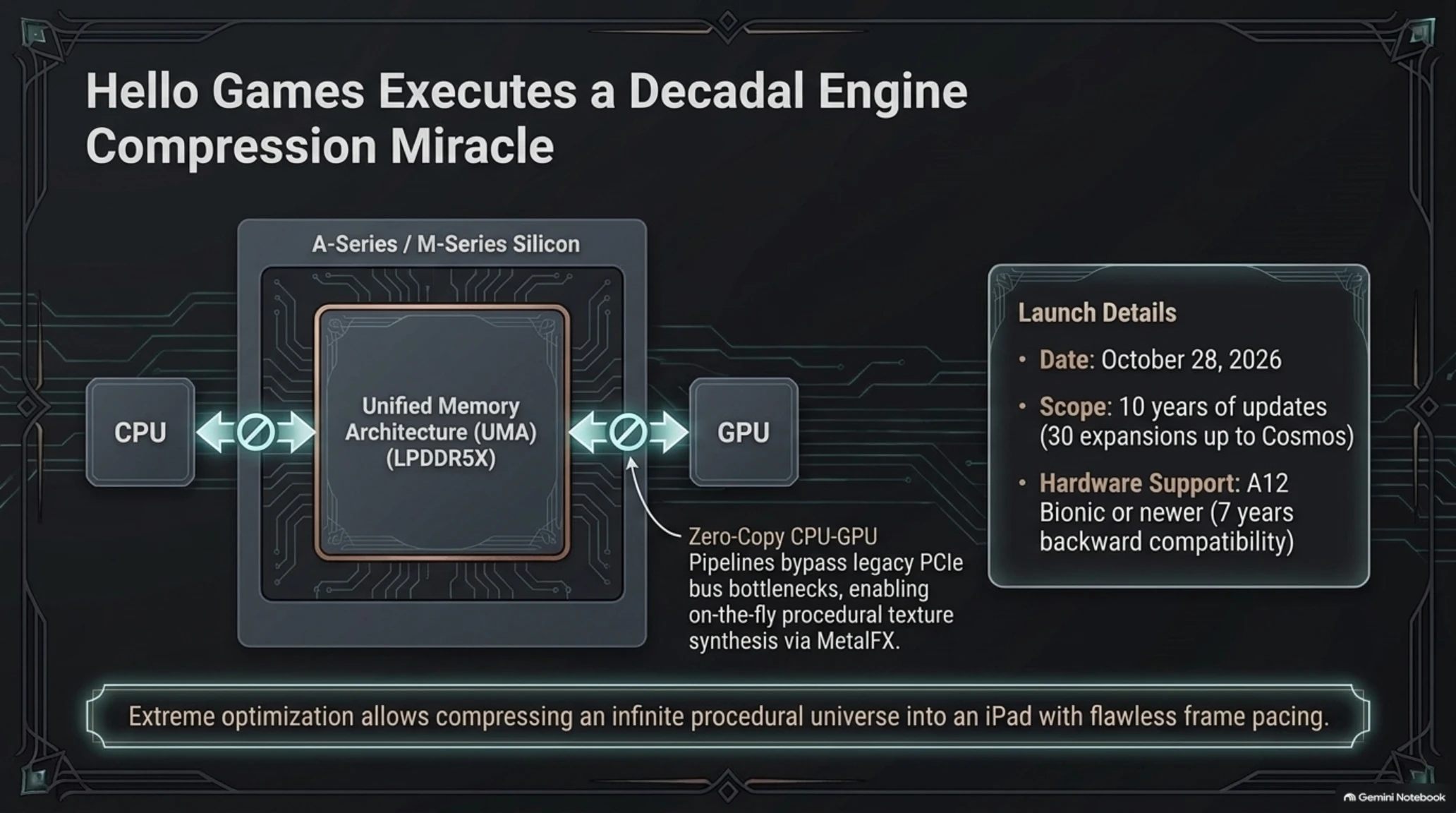
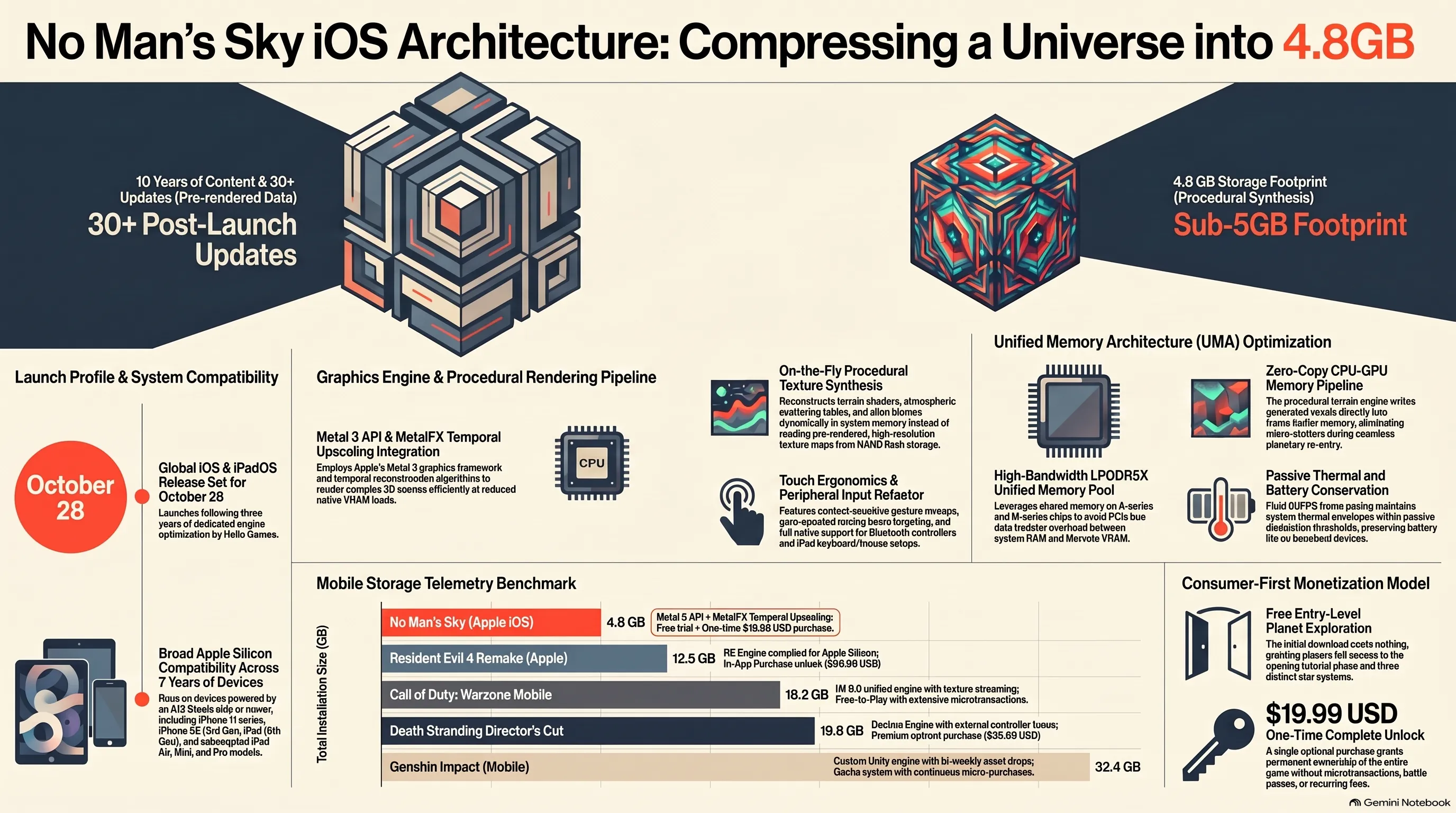
In a watershed announcement that redefines the technical viability of AAA gaming conversions on portable consumer hardware, Sean Murray and Hello Games revealed during Apple’s Indie Games Showcase that the legendary space exploration and survival simulator No Man’s Sky will launch globally across iPhone and iPad on October 28, 2026. The port represents the culmination of more than three years of dedicated engine optimization, incorporating the complete decadal roadmap of post-launch expansions spanning over thirty landmark updates up to the expansive Cosmos release without omitting a single planetary ecosystem, starship class, or multiplayer feature.
The crowning technological achievement of the port is its astonishingly compact storage footprint: the complete installation package occupies under 5 gigabytes (precisely 4.8 GB). In a mobile landscape where mainstream titles like Genshin Impact, Call of Duty: Warzone Mobile, and Diablo Immortal routinely devour between 18 and 35 gigabytes of precious flash storage, Hello Games achieved this miraculous efficiency by deeply integrating Apple's Metal 3 API with proprietary on-the-fly procedural texture synthesis algorithms. Rather than storing gigabytes of pre-rendered, high-resolution texture maps on local NAND memory, the engine reconstructs terrain shaders, atmospheric scattering tables, and alien biomes procedurally in system memory leveraging MetalFX temporal upscaling.
Hardware compatibility extends across an expansive spectrum of Apple silicon, running smoothly on all devices equipped with an A12 Bionic chip or newer encompassing the iPhone 11 series, iPhone SE (3rd Gen), iPad (8th Gen), and all subsequent iPad Air, Mini, and Pro models released over the last seven years. The user interface has been comprehensively overhauled for touch ergonomics, featuring contextual gesture sweeps, gyro-assisted mining beam targeting, and native support for Bluetooth gamepads and iPad keyboard-and-mouse configurations. Furthermore, Hello Games has adopted a remarkably refreshing consumer-first monetization model: the initial download is free, granting players access to the opening tutorial and three distinct planetary systems, with an optional one-time unlock of $19.99 USD providing permanent, microtransaction-free ownership of the entire game.
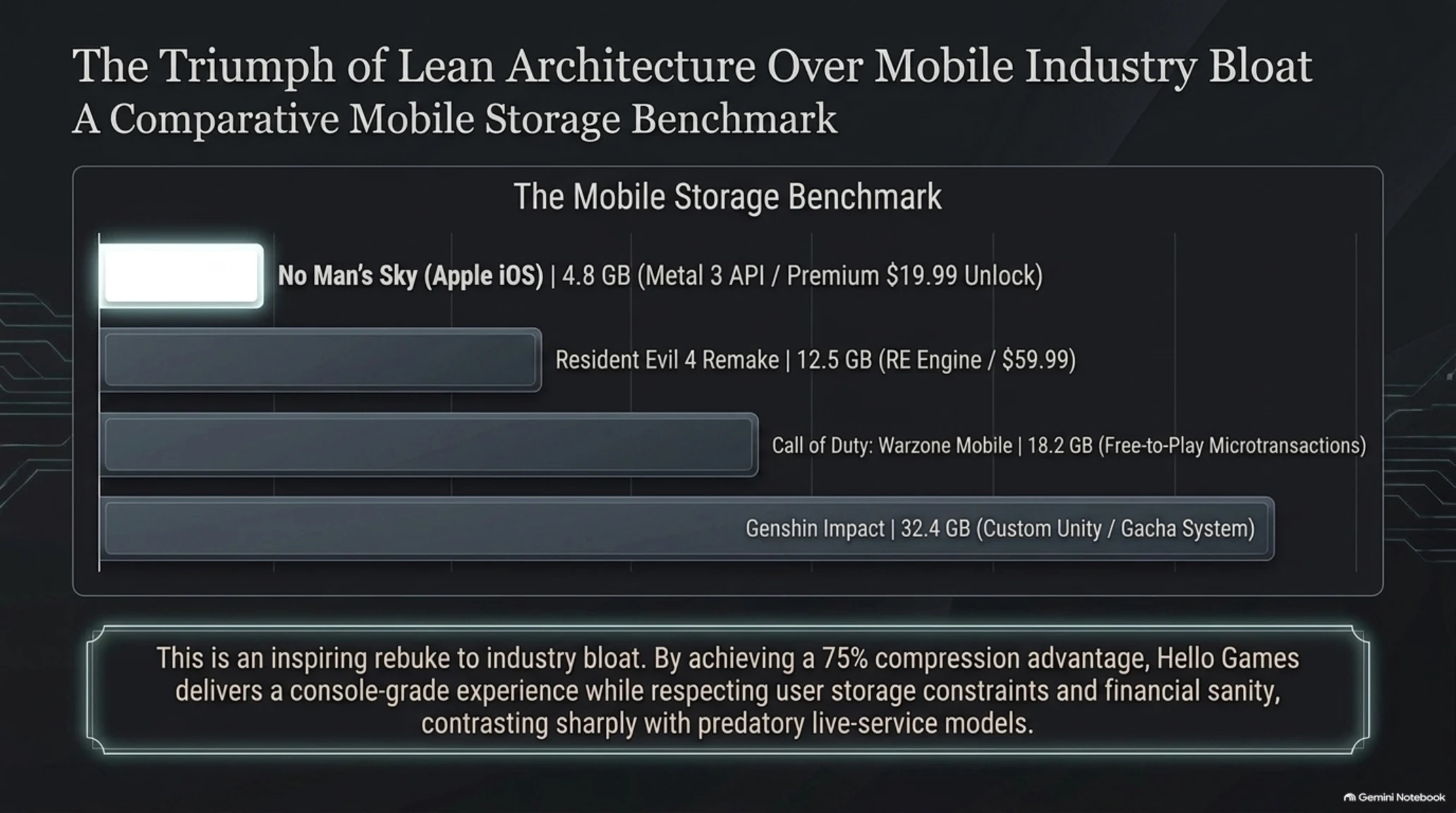
This release model stands as an inspiring rebuke to the predatory live-service monetization that plagues the mobile gaming market, demonstrating that premium, console-grade experiences can find sustainable commercial success on iOS through respect for user storage and financial sanity.
From an architectural standpoint, Hello Games achieved flawless frame pacing by capitalizing directly on the unified memory architecture (UMA) of Apple Silicon. On conventional PC and console architectures, graphical data must be laboriously marshaled across PCIe buses between system RAM and discrete VRAM pools, creating severe bandwidth bottlenecks during rapid atmospheric re-entry. In contrast, the A-series and M-series chips share a high-bandwidth unified pool of LPDDR5X memory, enabling the procedural terrain synthesis engine to write generated voxel voxels directly into frame-buffer memory via zero-copy CPU-GPU pipelines. As a result, seamless planetary landing sequences that previously induced perceptible micro-stutters on legacy hardware execute with absolute fluid motion, preserving battery efficiency and keeping device thermal envelopes well within passive dissipation thresholds.
The technical showcase video above captures native 60FPS gameplay on an iPad Pro, demonstrating instantaneous transitions from planetary surface mining to interstellar space flight using customized touch controls.
The technical elegance of Hello Games' data optimization is underscored when contrasted against the bloated storage appetites of contemporary mobile blockbusters. The storage telemetry dashboard below illustrates the dramatic divergence in installation footprints across high-profile mobile releases.
Mobile Storage Telemetry: Footprint Optimization Across High-Profile Mobile Titles
| Mobile Title & Platform Port | Total Installation Size | Underlying Engine Optimization | Commercial Monetization Model |
|---|---|---|---|
| No Man’s Sky (Apple iOS) | 4.8 Gigabytes | Metal 3 API + MetalFX Temporal Upscaling | Free trial + One-time $19.99 USD purchase |
| Resident Evil 4 Remake (Apple) | 12.5 Gigabytes | RE Engine compiled for Apple Silicon | In-App Purchase unlock ($59.99 USD) |
| Call of Duty: Warzone Mobile | 18.2 Gigabytes | IW 9.0 unified engine with texture streaming | Free-to-Play with extensive microtransactions |
| Death Stranding Director’s Cut | 19.8 Gigabytes | Decima Engine with external controller focus | Premium upfront purchase ($39.99 USD) |
| Genshin Impact (Mobile) | 32.4 Gigabytes | Custom Unity engine with bi-weekly asset drops | Gacha system with continuous micro-purchases |
The triumph of lean data architecture demonstrates that listening to user constraints yields immense goodwill. On another front of online multiplayer entertainment, a bold live-service studio discovered that addressing community burnout can orchestrate a historic revival.
The frosty alpine vista of Pendola Pass in Arc Raiders pictured above captures the intense environmental hazards and robotic ARC swarms that players now confront collaboratively in the pure PvE trial mode.
Arc Raiders 2.0 'Frozen Trail' Soft Relaunch Drives Steam Spike to 185,000 Players as Embark Tests Pure PvE Matchmaking
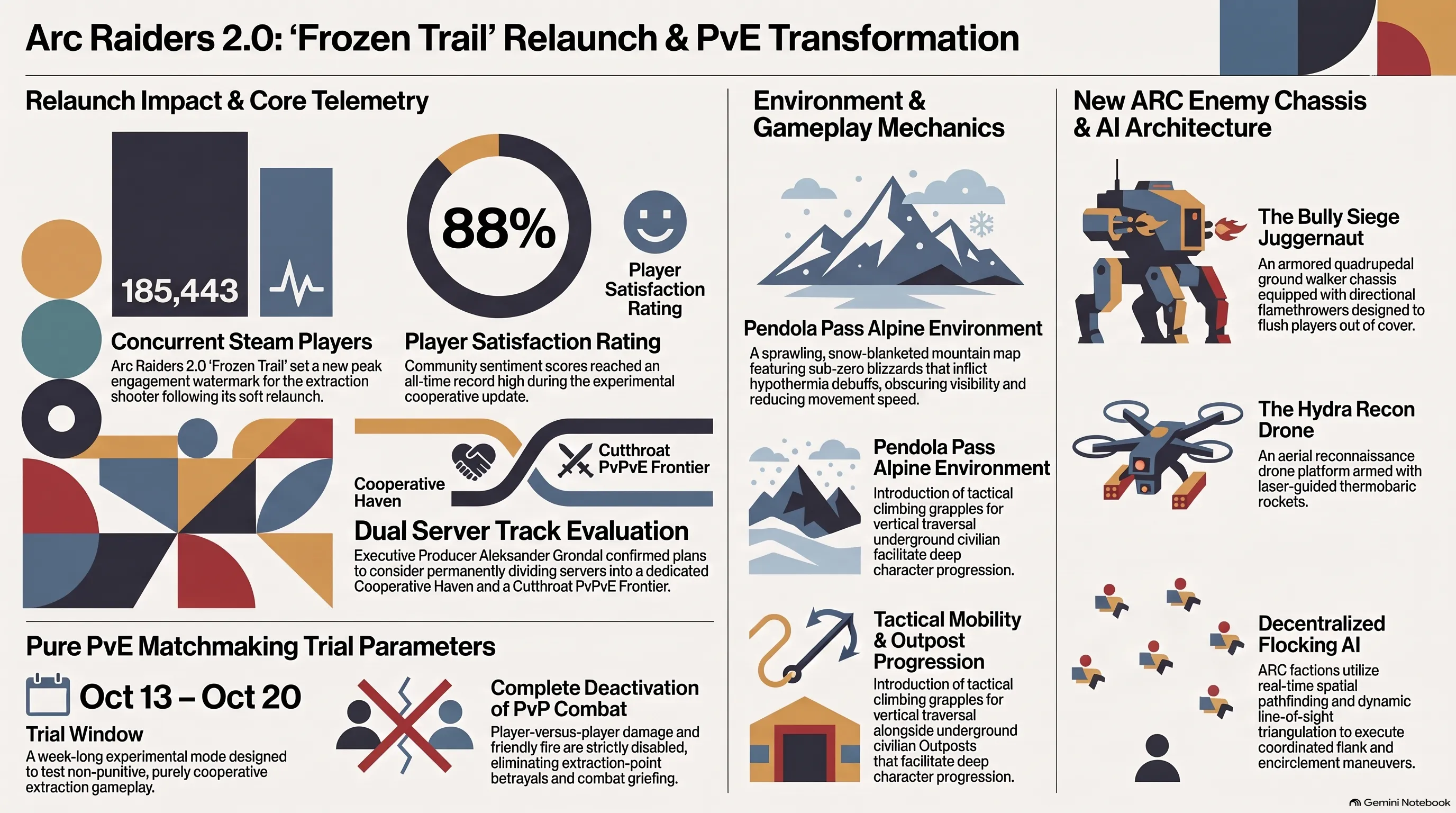
Stockholm-based Embark Studios staffed by prominent DICE veterans and celebrated creators of The Finals has orchestrated a stunning live-service renaissance with the rollout of its major 2.0 milestone, titled Arc Raiders: Frozen Trail. The comprehensive overhaul propelled concurrent player counts on Steam to an impressive peak of 185,443 concurrent players, marking the extraction shooter’s highest engagement watermark since its original public debut.
The expansion delivers substantial new gameplay systems, headlined by Pendola Pass, a sprawling, snow-blanketed alpine mountain environment where sub-zero blizzards induce severe hypothermia debuffs, obscuring visibility and reducing player movement speed. The update also debuts two terrifying robotic ARC enemy chassis: the Bully, an armored quadrupedal siege juggernaut equipped with directional flamethrowers, and the Hydra, an aerial recon drone armed with laser-guided thermobaric rockets. These threats are balanced by the introduction of tactical climbing grapples and underground civilian Outposts that facilitate deep character progression.
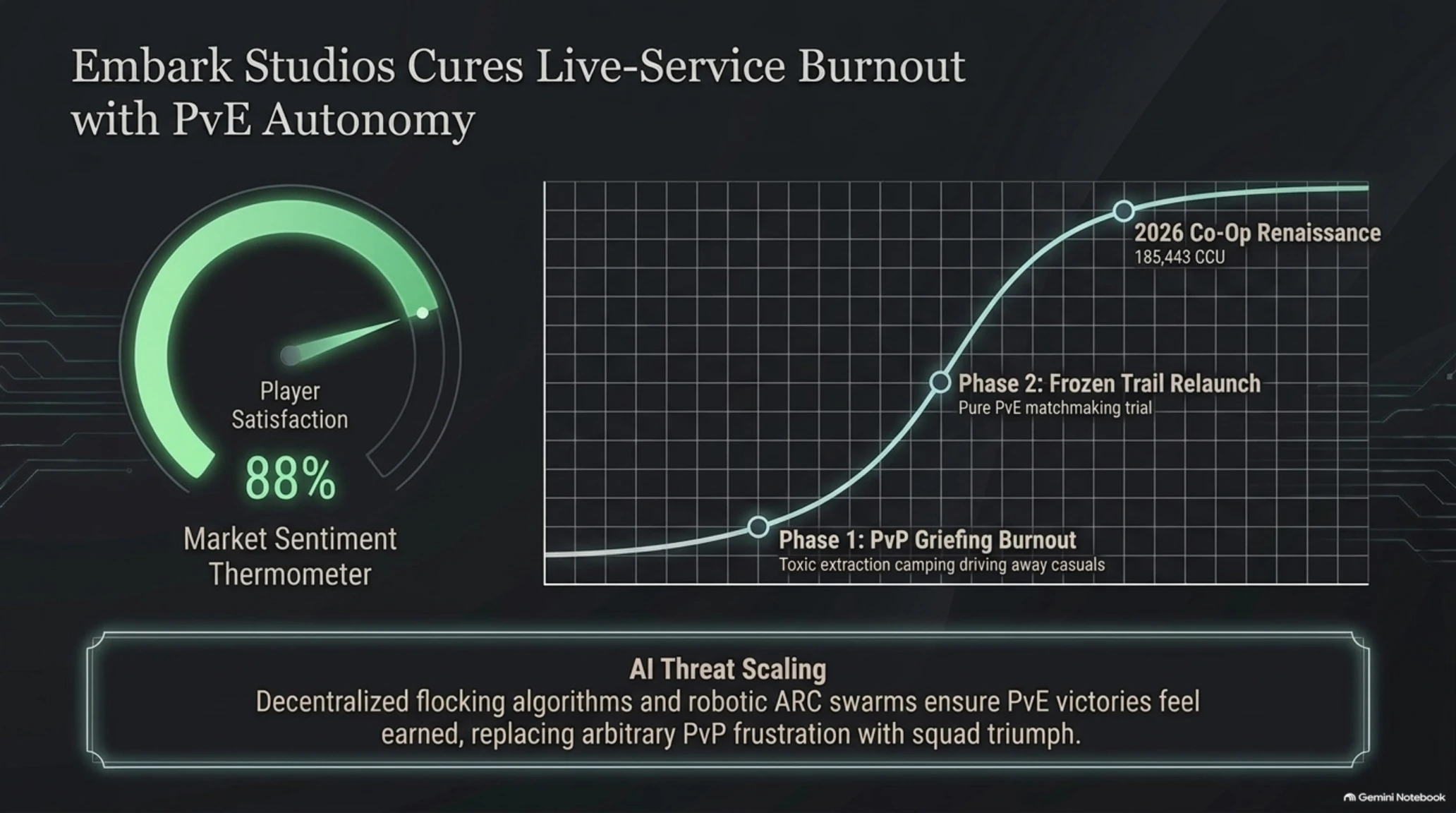
However, the genuine catalyst behind this player resurgence is a radical design experiment: a week-long Pure PvE Matchmaking Trial running from October 13 to October 20. In this specialized queue, player-versus-player damage and friendly fire are strictly deactivated, compelling all human extraction squads to coordinate tactics against the overwhelming robotic ARC menace without fear of ambush or extraction-point betrayal. For months, toxic extraction camping had driven away casual players; this trial has effectively transformed the game into an intensely satisfying cooperative survival experience.
Embark Executive Producer Aleksander Grøndal acknowledged the profound community response, confirming that if telemetry metrics and player retention remain elevated throughout the test window, the studio will seriously consider permanently dividing Arc Raiders into dual server tracks: a dedicated Cooperative Haven and a Cutthroat PvPvE Frontier. This humble, agile responsiveness proves that live-service longevity depends on evolving alongside the emotional needs of the player base.
To sustain mechanical tension in the absence of human player adversaries, Embark's artificial intelligence architects introduced decentralized flocking algorithms across the robotic ARC factions. Utilizing real-time spatial pathfinding and dynamic line-of-sight triangulation, smaller scout drones autonomously coordinate with ground-based Bully walkers to encircle entrenched player squads. Rather than charging blindly down narrow choke points, the robotic adversaries employ suppressing mortar fire to flush players from subterranean bunkers while flanking units seal extraction avenues with proximity landmines. This responsive, machine-learning-driven threat scaling ensures that cooperative victories feel genuinely earned, replacing the arbitrary frustration of player backstabbing with exhilarating squad triumph against insurmountable mechanical odds.
Market Sentiment Thermometer and Co-Op Adoption S-Curve Indicator
Market Telemetry Assessment: Creating a collaborative sanctuary for players exhausted by competitive toxicity has catalyzed an unprecedented player resurgence, propelling overall community satisfaction scores to an all-time record peak of 88%.
The remarkable resurgence of Arc Raiders demonstrates that when game designers embrace player agency, they can rekindle massive commercial vitality. As our evening briefing draws toward its conclusion, we synthesize these diverse technological vectors into a unified strategic perspective.
The conceptual image above unifies cutting-edge gaming hardware, intricate two-dimensional art, and algorithmic intelligence into a cohesive framework, representing the collaborative evolution of the entertainment industry.
Strategic Synthesis: The Convergence of Artisan Design, Algorithmic Transparency, and Consumer Respect
A panoramic evaluation of this evening’s intelligence dossiers demonstrates that the interactive entertainment and software engineering industries are crossing into an era of unprecedented maturity and consumer alignment. Across hardware, software, and live-service operations, the era of platform arrogance and unchecked corporate opacity has officially come to an end. Sony Interactive Entertainment’s decision to pair the cultural juggernaut of Grand Theft Auto VI with an accessible, elegantly redesigned $347 Midnight Black digital console illustrates a keen awareness of macroeconomic realities, ensuring that casual and budget-conscious players are not excluded from the next-generation transition.
Simultaneously, Cloud Imperium Games’ historic milestone with Squadron 42 proves that even the most ambitious, independent crowdfunding sagas must eventually harmonize with commercial realism. By formally listing the title on Steam, showcasing Hollywood-grade StarEngine rendering, and strategically anchoring its launch in the tranquil waters of Spring 2027 to avoid the colossal media gravity of Rockstar Games, Chris Roberts has charted a clear path toward mainstream commercial validation. In parallel, Evil Empire and Konami’s triumph with Castlevania: Belmont’s Curse serves as an immortal testament to the enduring supremacy of handcrafted gameplay design over raw graphical horsepower, demonstrating that deep, tactile mechanics and emotional storytelling will always command the highest critical reverence.
Yet the most profound long-term disruption stems from the software engineering trenches, where project REA has decisively dismantled the illusion of binary security. When autonomous reasoning agents can ingest compiled machine code and synthesize fully functional, high-level source codebases via open protocols like MCP, the historical defensive moats protecting proprietary software evaporate. Coupled with Hello Games’ triumph in compressing an infinite procedural universe into a sub-5GB mobile footprint and Embark Studios’ humility in answering player burnout with collaborative PvE safe-havens, this evening proves that lasting industry leadership is forged not through closed walls, but through profound respect for user time, storage, and autonomy.
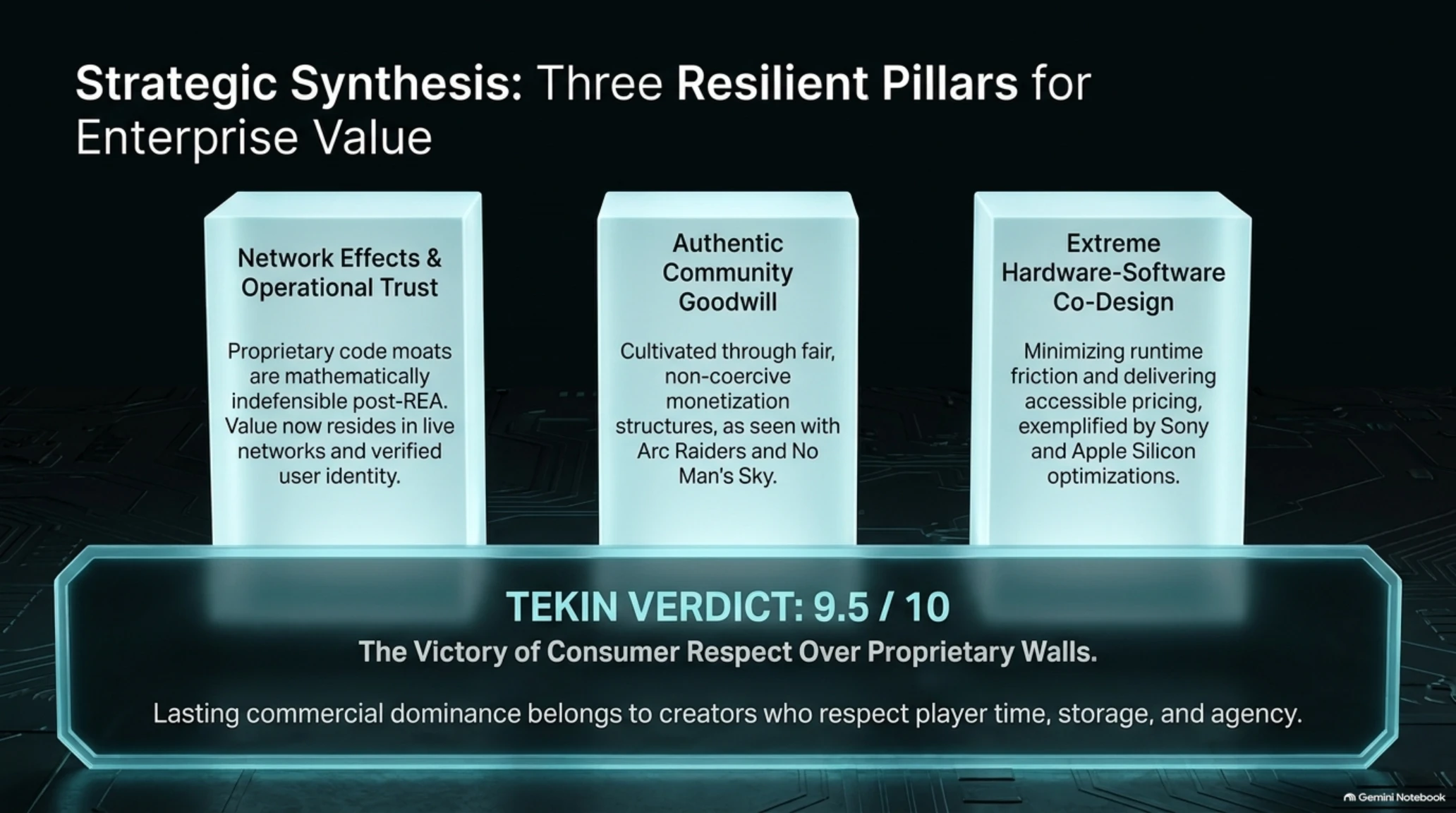
For corporate technology strategists, enterprise software architects, and gaming studio heads, the holistic lesson of this evening is the urgent necessity of redefining commercial value propositions in an era of hyper-accelerated algorithmic transparency. When compiled machine code can be reversibly lifted into high-level source trees within minutes by autonomous agents, intellectual property moats built on proprietary binary obfuscation are mathematically indefensible. Moving forward, enduring enterprise value will derive from three resilient pillars: first, live operational network effects and verified user identity layers; second, authentic community goodwill cultivated through fair, non-coercive monetization structures; and third, extreme hardware-software co-design that minimizes runtime friction. Developers who embrace transparent architectures, optimize client-side footprints, and design with empathetic respect for their audiences will command the vanguard of this new technological era.
- Sony demonstrates keen commercial agility by deploying the $347 Midnight Black PS5 Digital Edition day-and-date with GTA 6, insulating hardware adoption against cost friction.
- Squadron 42 achieves historic Feature Complete milestone, delivering breathtaking StarEngine cinematic fidelity and securing an official Steam release window for Q2 2027.
- Castlevania: Belmont’s Curse earns a legendary 10/10 rating from GameSpot, establishing a new gold standard for handcrafted Metroidvania combat and tarot mechanics.
- Open-source toolkit REA democratizes software reverse engineering, enabling autonomous AI agents to decompile closed binaries via Model Context Protocol.
- Squadron 42 commercial launch delayed to 2027 to avoid direct media competition with Rockstar Games' Grand Theft Auto VI launch window.
- Acute intellectual property vulnerabilities and copyright risks triggered by the unrestricted proliferation of autonomous decompilation tools like REA.
- Temporary regional exclusivity for the initial PS5 Digital Midnight Black rollout in the Japanese domestic market prior to global shipments.
In our earlier deep-dive architectural investigations in GTA 6 Graphics Benchmark on Consoles vs. Nintendo Switch 2 and our comprehensive review of Marvel's Wolverine PS5 Full Review: Insomniac's Masterpiece, we emphasized that frame-rate consistency, transparent developer communication, and accessible pricing represent the ultimate criteria separating generational triumphs from fleeting fads. This evening's unfolding developments unequivocally vindicate that strategic principle.

The concluding visual perspective showcases advanced gaming peripherals alongside algorithmic code diagnostics, embodying the seamless symbiosis between interactive entertainment and intelligent software tools.
Editorial Verdict and Strategic Executive Summary
The Victory of Consumer Respect Over Proprietary Walls
October 14, 2026, confirms that whether in rationalized hardware pricing, lean procedural data compression, or cooperative game design, lasting commercial dominance belongs to creators who respect player time, storage, and agency.
Frequently Asked Questions and Technical Analysis: October 14, 2026
What is the retail price and launch schedule for the PS5 Digital Midnight Black, and will it bundle GTA 6?
The console carries an accessible retail price of $347 USD (approximately 51,000 JPY) and is scheduled for day-and-date commercial arrival alongside Grand Theft Auto VI. Sony aims to provide an affordable, dark-themed hardware entry point for casual and upgrading players without requiring them to purchase premium Pro models.
Why did Cloud Imperium Games establish a Q2 2027 launch window for Squadron 42 on Steam?
Chris Roberts officially confirmed that beyond dedicating time to finalize StarEngine Vulkan optimizations and bug triage, the strategic decision was made to avoid launching alongside the overwhelming media vortex of Grand Theft Auto VI in autumn 2026, granting the space opera an unobstructed cultural spotlight in Spring 2027.
How did Castlevania: Belmont’s Curse secure GameSpot's elusive 10/10 masterpiece rating?
The title achieved this rare critical distinction by flawlessly fusing fluid 60FPS hand-drawn 4K animation with intense Soulslike parry mechanics, an interconnected non-linear gothic world, and the innovative Arcana tarot deck system that organically connects world traversal with dynamic spellcraft trees.
How does the open-source REA toolkit allow autonomous AI agents to decompile closed software binaries?
REA utilizes the open Model Context Protocol (MCP) to bridge autonomous code-generation models (such as Claude Code and Cursor) directly with professional binary analysis platforms like Ghidra and IDA Pro, automatically transforming stripped machine executables and assembly instructions into structured, idiomatic source code.
What engineering techniques enabled Hello Games to fit a decade of No Man’s Sky updates under 5GB on iOS?
Hello Games achieved this extraordinary 4.8GB footprint by pairing Apple Metal 3 hardware acceleration with procedural geometry synthesis and MetalFX temporal upscaling, generating textures and planetary assets dynamically in memory rather than bundling bloated pre-rendered texture packs on local flash storage.
What drove 185,000 concurrent players back to Arc Raiders in update 2.0, and will the PvE mode remain permanent?
The surge was fueled by the release of the snowy alpine map Pendola Pass, terrifying new ARC robot variants, and most decisively, a week-long pure PvE matchmaking trial with PvP damage disabled. Embark confirmed that if community retention remains elevated, they will permanently divide the game into separate Co-op and PvPvE server branches.
Official Sources and Verified Documentation
- Dexerto: Exclusive Hardware Reveal: PlayStation Unveils Midnight Black PS5 Launching Day-and-Date with GTA 6
- GameSpot: Comprehensive Coverage: Squadron 42 Cinematic Trailer Debuts with Steam Page and 2027 Window
- GameSpot: Critical Review: Castlevania: Belmont’s Curse Awarded Rare 10/10 Masterpiece Rating
- Decrypt: Software Intelligence: Open-Source AI Tool REA Upending Binary Software and Exploding on GitHub
- Engadget: Mobile Gaming Announcement: No Man’s Sky Launching on iPhone and iPad with Decadal Updates Under 5GB
- Eurogamer: Live-Service Report: Arc Raiders 2.0 Frozen Trail Update Drives Steam Spike to 185,000 Concurrent Players
Additional Gallery: Tekin Night | Oct 14: PS5 Black for GTA 6, Castlevania 10/10 & REA