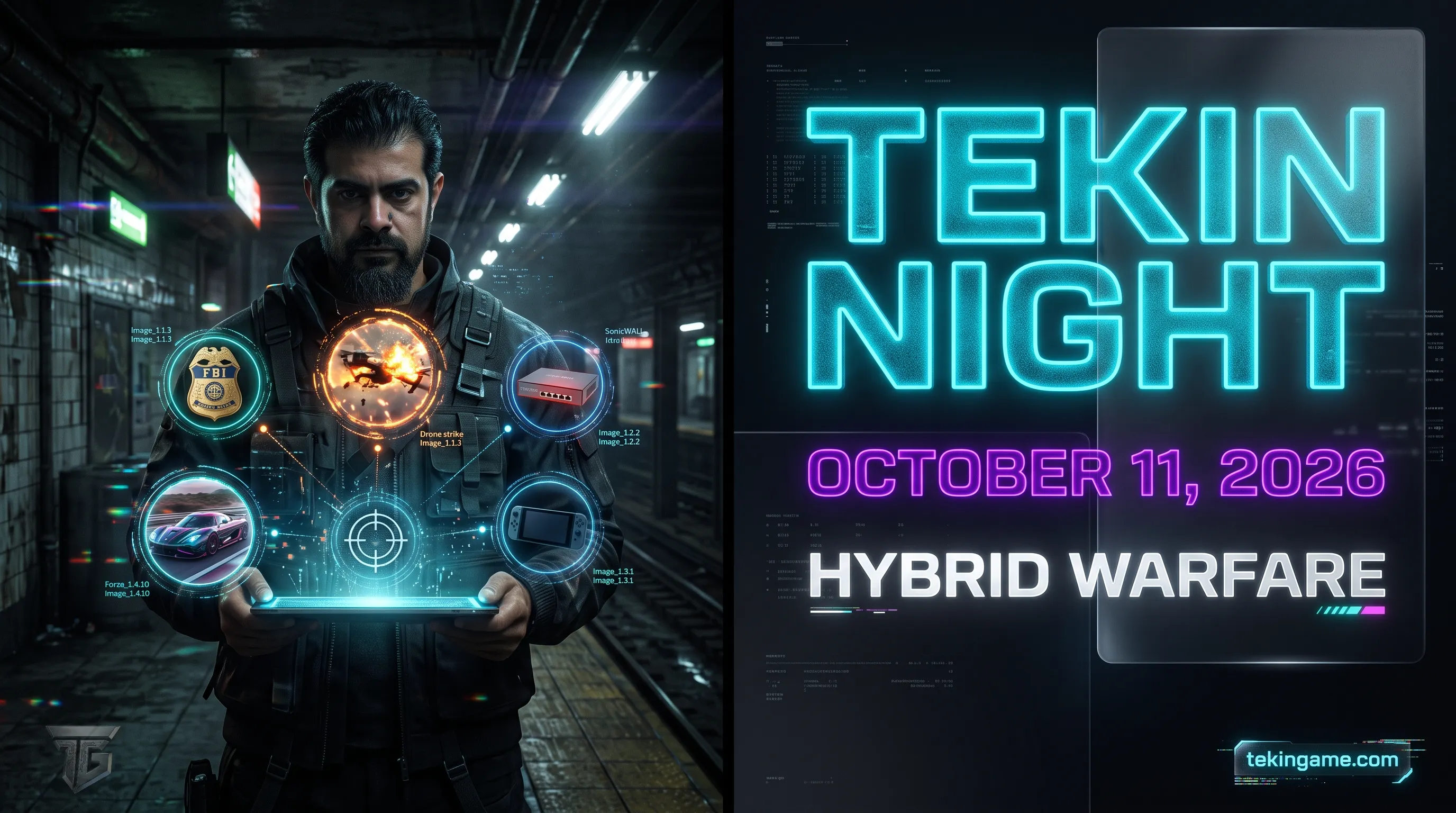
Tekin Night Executive Briefing | Sunday, October 11, 2026
Sunday evening, October 11, 2026, closes with a dramatic convergence of high-stakes national security counter-operations, hybrid kinetic warfare against artificial intelligence infrastructure, and strategic realignments across the AAA gaming console landscape. In the late hours tonight, international defense analysts and cybersecurity executives are dissecting the Federal Bureau of Investigation’s arrest of a top-tier operator from the notorious ShinyHunters extortion syndicate in Pennsylvania. Concurrently, across Eastern Europe, plumes of smoke rising from targeted Ukrainian drone strikes against Yandex’s high-performance AI data centers in Sasovo and Kaluga inaugurated a stark new epoch of physical-kinetic targeting directed squarely at national sovereign supercomputers. In consumer software channels, deceptive social engineering campaigns masquerading as frontier AI desktop installers, alongside unauthenticated gateway exploits with maximum severity ratings, have triggered urgent emergency advisories. The Takin Plus intelligence desk presents a comprehensive technical breakdown of these six pivotal evening developments.
Chief Information Security Officers, enterprise cloud architects, and interactive entertainment strategists concluding the second weekend of October 2026 confront an operational threat matrix where physical kinetic warfare, dark-web extortion syndicates, and platform console rivalries intersect directly. From cross-border federal indictments unmasking hackers who compromised America's sensitive personnel registries, to Microsoft's calculated multiplatform deployment of flagship racing intellectual property on Sony’s rival hardware, tonight offers an unfiltered look into the volatile dynamics governing global digital infrastructure. Below, we synthesize the core strategic vectors defining this evening’s intelligence.
Strategic Vectors at a Glance | Sunday Night Intelligence
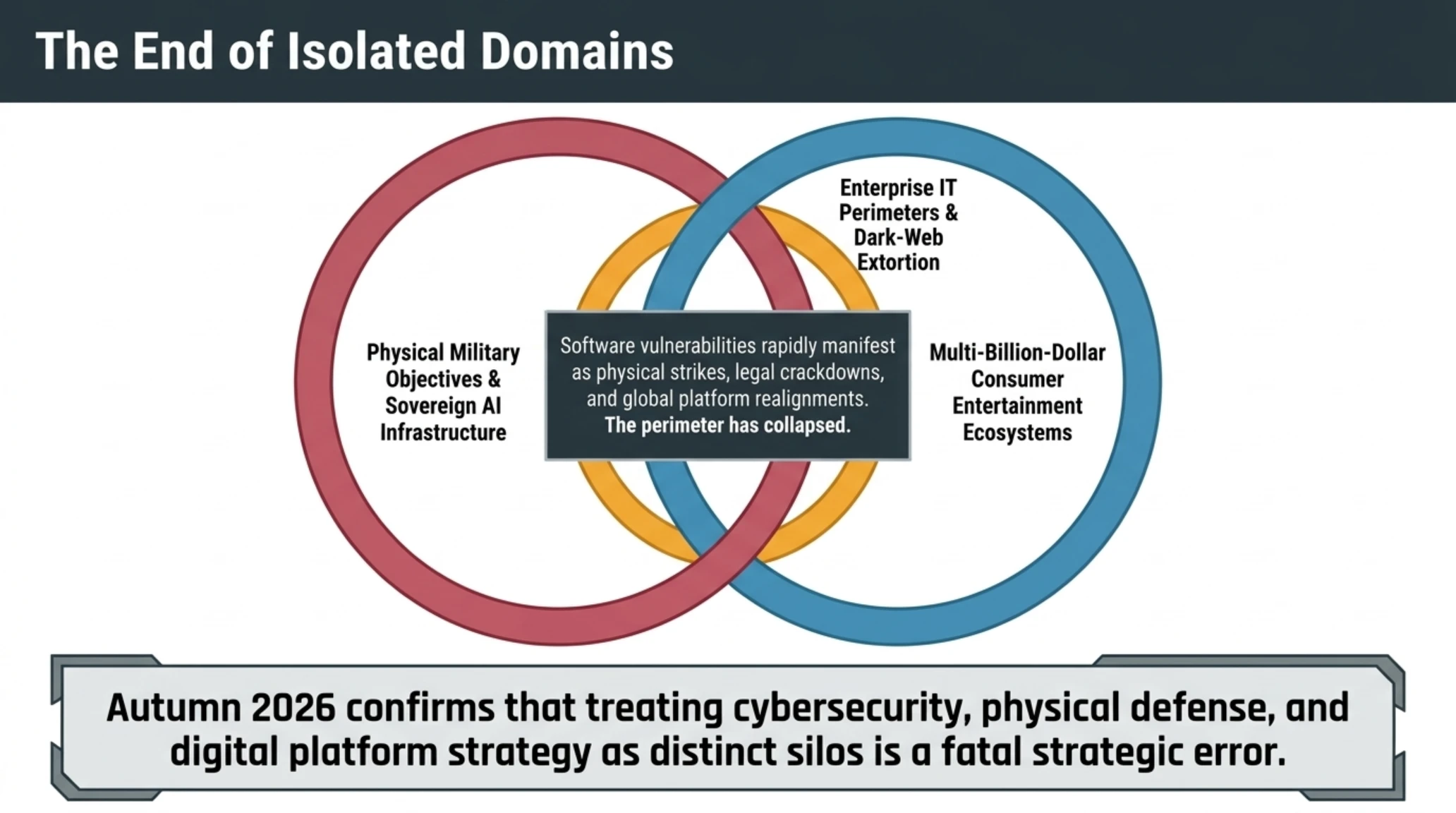
These seemingly disparate events illustrate a unifying reality in autumn 2026: software vulnerabilities no longer linger merely in abstract codebases. They rapidly manifest as physical military objectives, multi-million-dollar transnational legal crackdowns, and structural realignments across multi-billion-dollar consumer entertainment ecosystems.
Why It Matters | Strategic Dimensions of October 11, 2026
SonicWall Perimeter Crisis
Unauthenticated remote execution in SMA1000 gateways grants ransomware operators immediate root access to enterprise internal perimeters.
Kinetic Strike on Compute
Drone strikes on Yandex’s Sasovo and Kaluga hubs confirm that national AI training supercomputers are now treated as primary military infrastructure targets.
Forza Horizon 6 PS5 Launch
Microsoft synchronizes the PlayStation 5 port with its debut premium expansion, establishing seamless cross-play across Xbox, PC, and PS5.
We begin our technical analysis tonight with the high-stakes federal law enforcement apprehension that struck at the core of one of the cyber underworld’s most predatory extortion cartels.
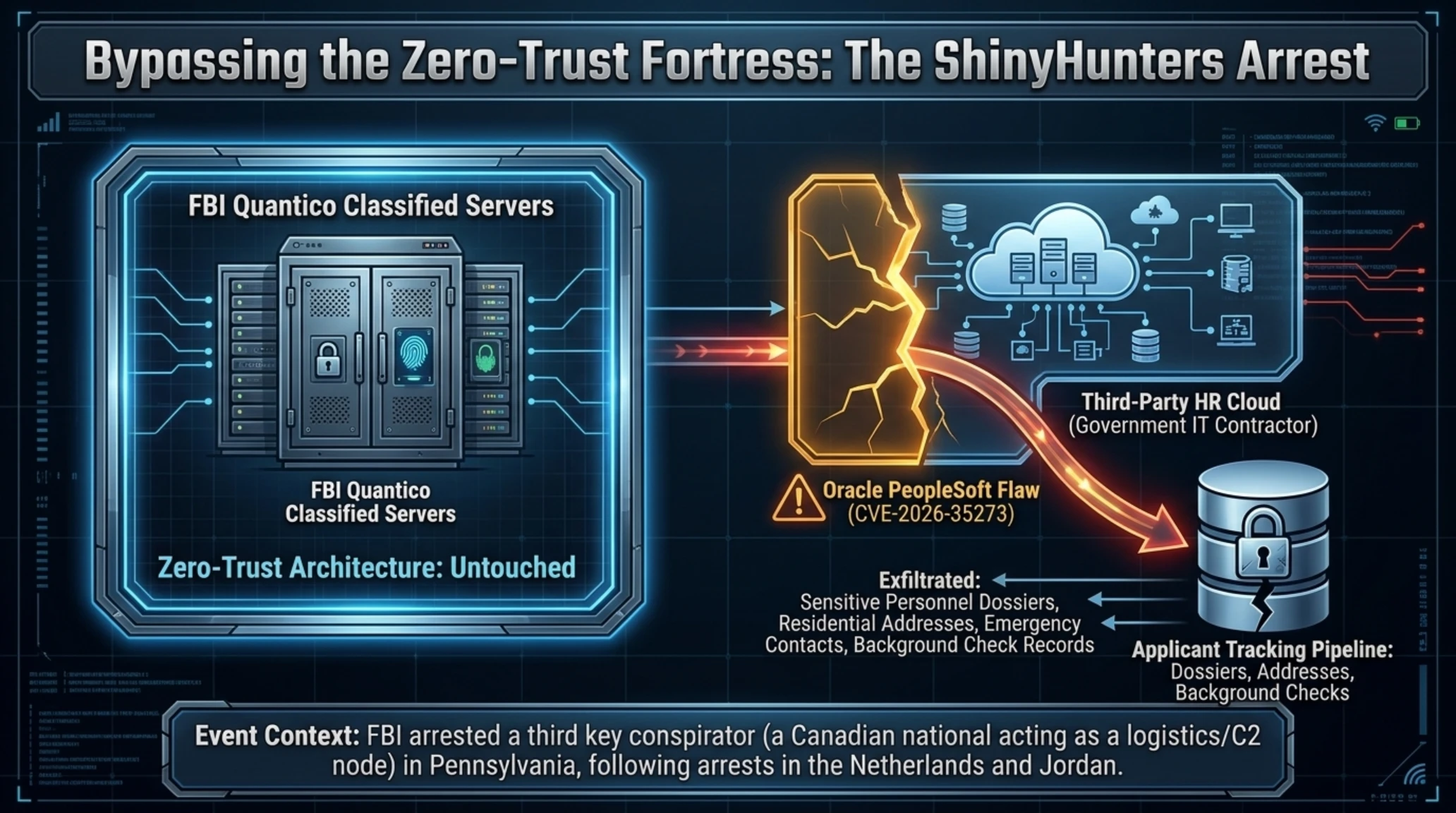
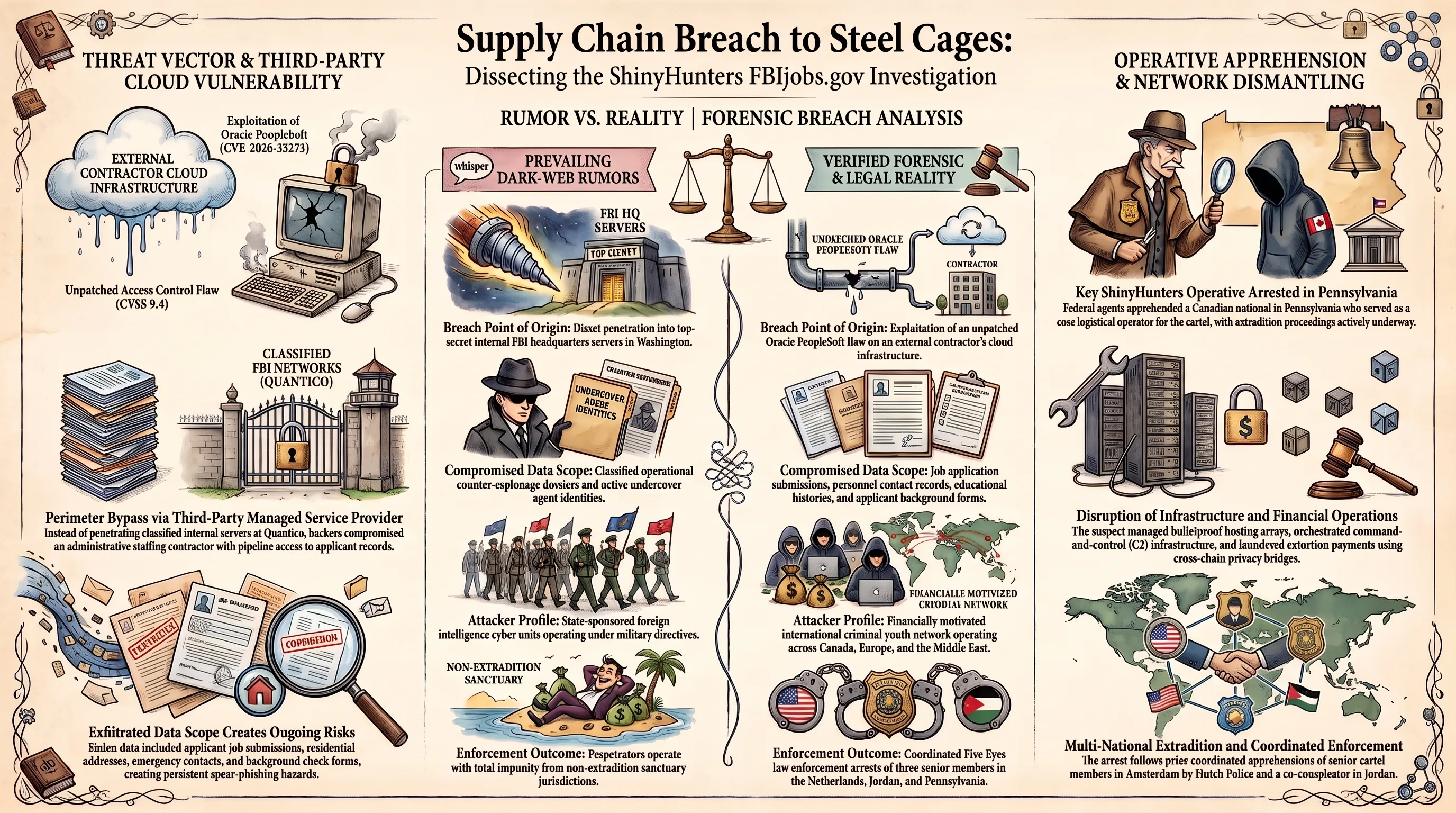
In one of the most significant domestic counter-cyber operations of late 2026, Federal Bureau of Investigation Director Kash Patel confirmed in a formal press release that federal agents apprehended a third key conspirator affiliated with the prolific cyber-extortion group ShinyHunters in Pennsylvania. The suspect, a Canadian national whose extradition proceedings are currently underway, was tracked in connection with September’s catastrophic security breach targeting the federal government’s recruitment portal, FBIjobs.gov. The breach represented an acute institutional embarrassment for federal authorities, as threat actors publicly claimed to have exfiltrated sensitive personnel dossiers, residential addresses, emergency contacts, and background check records belonging to thousands of federal applicants and active field personnel.
ShinyHunters, which emerged in early 2020 by selling stolen databases from e-commerce giants such as Tokopedia, Wattpad, and Wishbone, has steadily evolved into an aggressive multi-million-dollar extortion conglomerate responsible for devastating supply-chain breaches against Ticketmaster, AT&T, and Snowflake customer environments. According to unsealed federal court affidavits and digital forensics investigations conducted by Rescana Threat Intel, the breach of the FBI recruitment database originated from an unpatched vulnerability in an Oracle PeopleSoft human capital management instance (designated as CVE-2026-35273) hosted by an external government IT staffing contractor. Rather than penetrating the FBI’s classified Quantico servers directly, the hackers compromised a third-party managed service provider with administrative access to the applicant tracking pipeline.
The Pennsylvania arrest follows the prior apprehension of a 24-year-old French-Algerian operator in Amsterdam by Dutch National Police and the successful extradition of another co-conspirator from Jordan. Digital forensics experts note that the suspect in Pennsylvania acted as a key logistical node, managing bulletproof hosting infrastructure, orchestrating command-and-control (C2) server deployments, and laundering illicit cryptocurrency ransoms through cross-chain privacy bridges. Counter-intelligence specialists emphasize that while taking key physical actors off the street delivers a decisive blow to ShinyHunters’ operational capability, the exfiltrated federal personnel data remains circulating across illicit dark-web channels, creating persistent spear-phishing and physical reconnaissance risks for intelligence personnel worldwide.
National security analysts highlight that this incident exposes the ongoing systemic danger of third-party contractor supply chains. Federal agencies can invest billions in zero-trust architectures across their primary networks, yet remain catastrophically vulnerable if external administrative contractors fail to patch known software vulnerabilities in human resource portals.
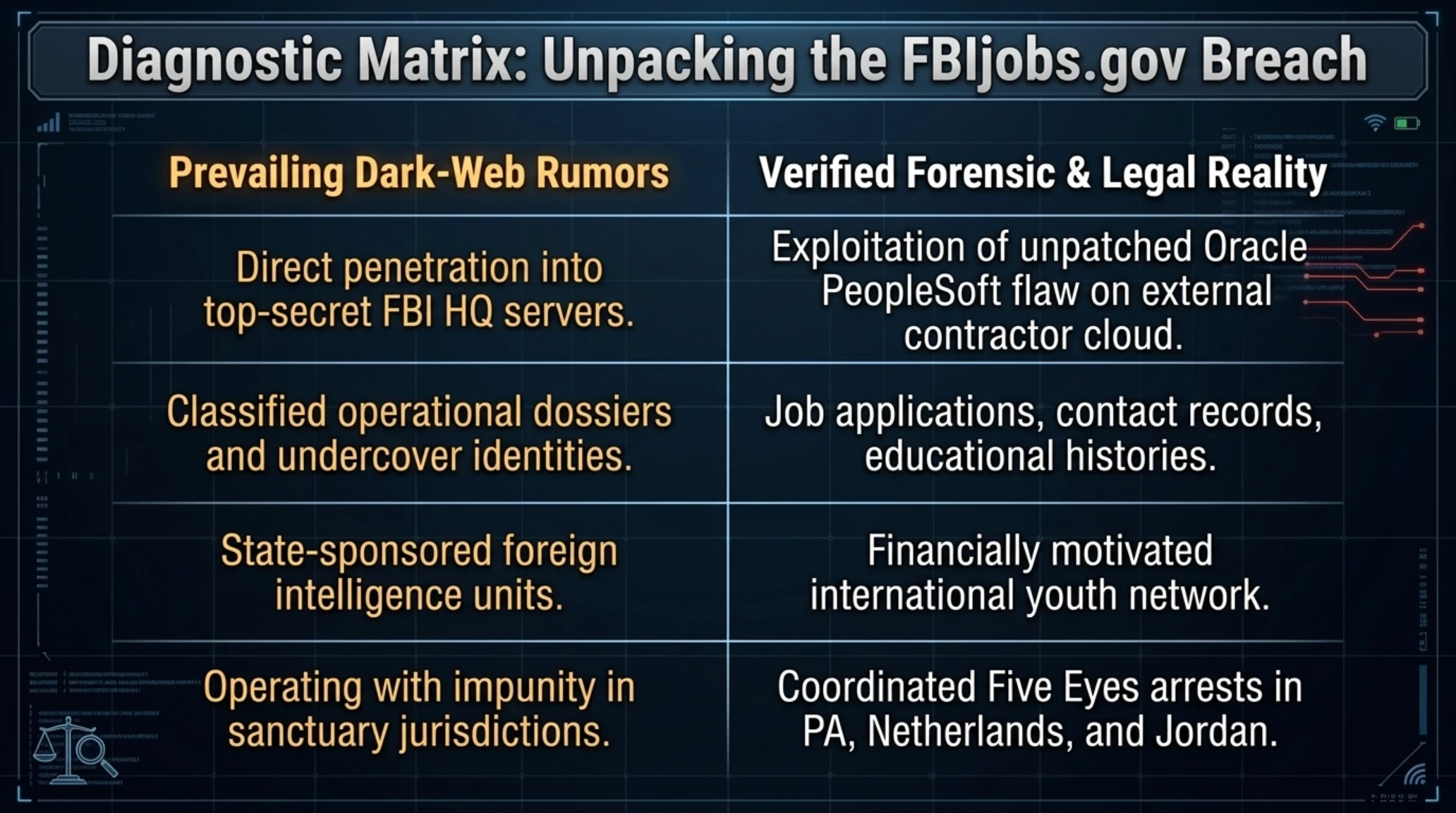
Rumor vs. Reality | Unpacking the FBI Recruitment Portal Breach
| Dimension | Prevailing Dark-Web Rumors | Verified Forensic & Legal Reality |
|---|---|---|
| Breach Point of Origin | Direct penetration into top-secret internal FBI headquarters servers in Washington. | Exploitation of an unpatched Oracle PeopleSoft flaw on an external contractor’s cloud infrastructure. |
| Compromised Data Scope | Classified operational counter-espionage dossiers and active undercover agent identities. | Job application submissions, personnel contact records, educational histories, and applicant background forms. |
| Attacker Profile | State-sponsored foreign intelligence cyber units operating under military directives. | Financially motivated international criminal youth network operating across Canada, Europe, and the Middle East. |
| Enforcement Outcome | Perpetrators operate with total impunity from non-extradition sanctuary jurisdictions. | Coordinated Five Eyes law enforcement arrests of three senior members in the Netherlands, Jordan, and Pennsylvania. |
While federal authorities celebrated a major legal victory on the East Coast of the United States, kinetic military strikes thousands of miles away in Eastern Europe demonstrated a dramatic physical escalation against national artificial intelligence infrastructure.
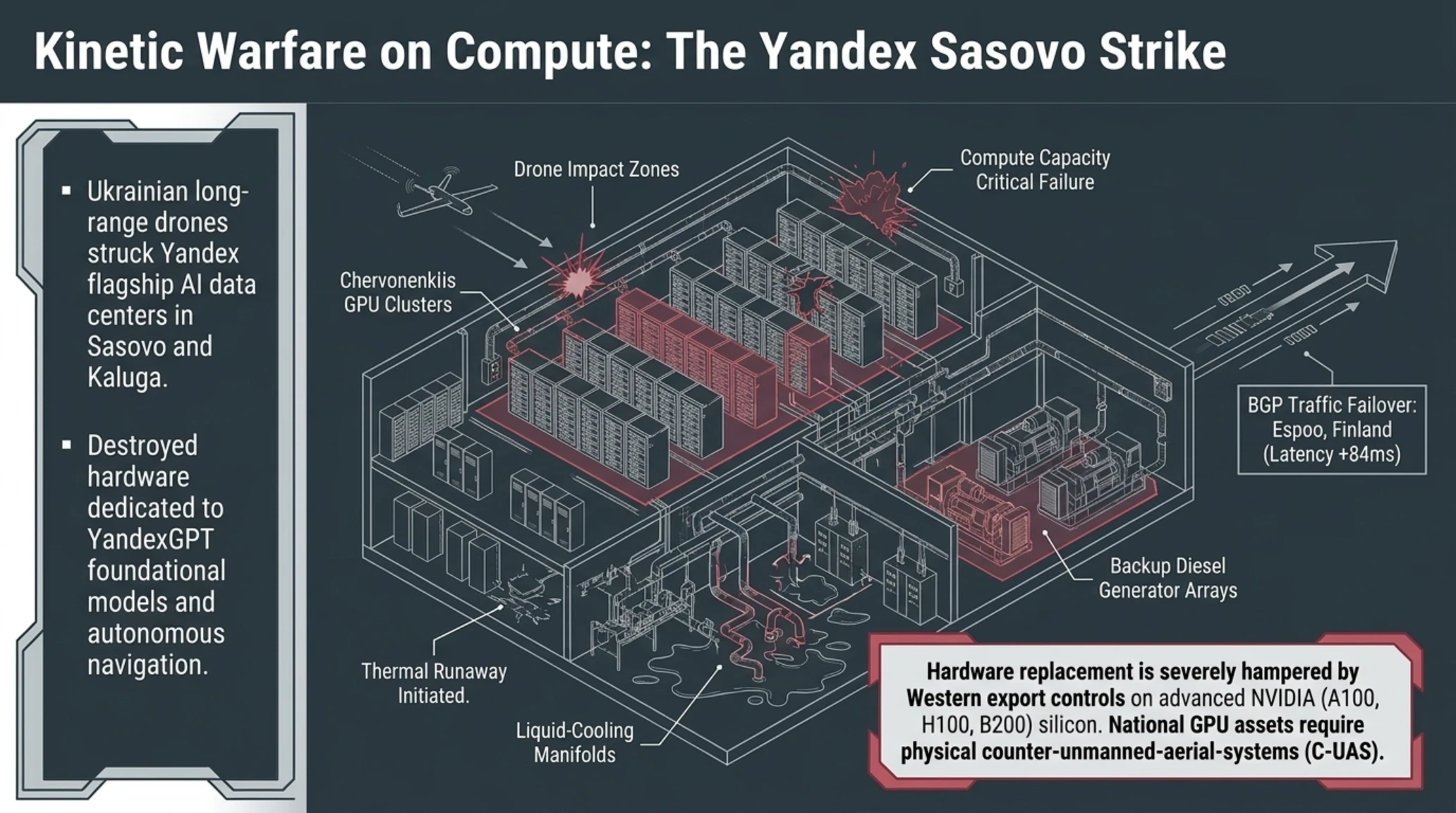
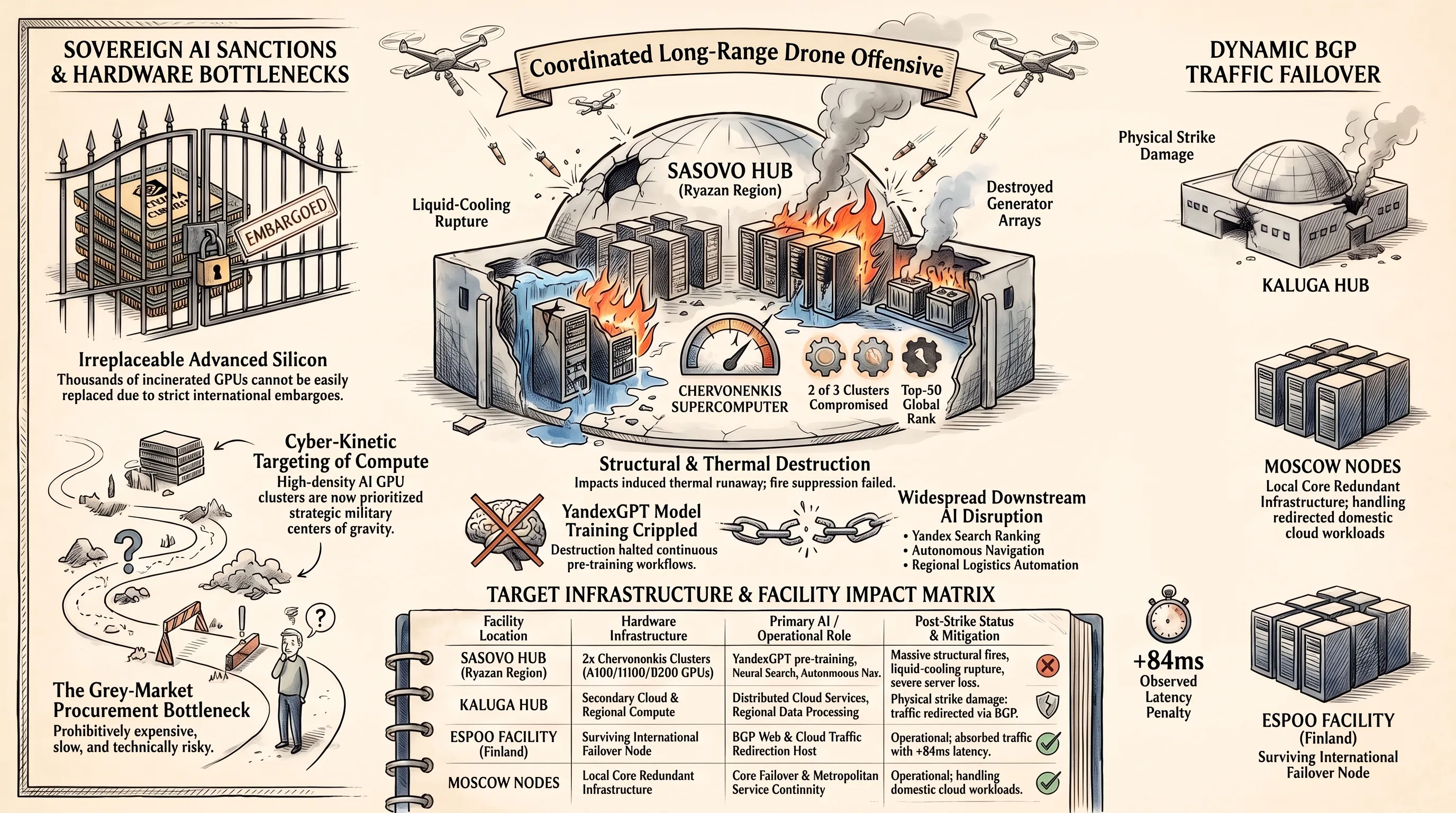
Over the weekend, Ukrainian military forces launched an unprecedented coordinated long-range drone offensive targeting primary computing hubs owned by Yandex—frequently described as Russia’s equivalent of Google. Striking deep within Russian territory, multiple explosive unmanned aerial vehicles slammed into Yandex’s flagship data center in Sasovo (located in the Ryazan region) and a secondary cloud facility in Kaluga. The impact in Sasovo triggered massive structural fires, rupturing liquid-cooling manifolds and destroying backup diesel generator arrays before industrial fire suppression systems could arrest the thermal runaway inside the server halls.
The strategic gravity of the Sasovo strike cannot be overstated. Sasovo housed two of Yandex’s three Chervonenkis supercomputers—high-performance computing clusters ranked among the top 50 globally. These massive clusters of interconnected graphics processing units represent the computational engine powering Russia’s domestic artificial intelligence initiatives, including the continuous pre-training and reinforcement learning of YandexGPT, the Yandex Search neural ranking algorithms, national autonomous vehicle navigation networks, and regional logistics automation. Ukrainian President Volodymyr Zelensky explicitly framed the drone strike as a mirror response to continuous Russian missile strikes against Ukrainian civilian telecommunications, electrical grids, and municipal data centers.
Yandex released an emergency statement indicating that web and cloud traffic had been successfully redirected to surviving nodes in Finland and Moscow. However, computer hardware analysts emphasize that the destruction of thousands of clustered high-performance GPUs represents a near-fatal blow to Russia's sovereign AI roadmap. Under rigorous Western export controls and embargoes on advanced semiconductor technologies, replacing incinerated NVIDIA A100, H100, or B200 hardware through illicit grey-market intermediaries is prohibitively expensive, excruciatingly slow, and technically fraught. The Sasovo attack firmly establishes that in modern 21st-century warfare, concentrated AI compute clusters are treated as high-priority military targets alongside oil refineries and ammunition depots.
Jargon Buster | Cyber Defense & Kinetic Warfare Glossary
Military operations utilizing physical kinetic strikes (missiles, drones, sabotage) to destroy digital infrastructure, data centers, or fiber conduits.
A social engineering vector that displays fake browser error dialogs prompting victims to paste obfuscated malicious scripts into their terminal.
A vulnerability allowing attackers to coerce a perimeter server into making unintended network requests to internal restricted services.
Real-time networking protocols enabling simultaneous multiplayer lobbies across competing hardware ecosystems such as PlayStation, Xbox, and PC.
The drone strike on Yandex illustrates that sovereign AI supremacy now requires air-defense interceptor batteries as much as high-bandwidth memory chips. In Part 2, we turn to the insidious software vulnerabilities currently threatening enterprise endpoints and corporate edge perimeters.
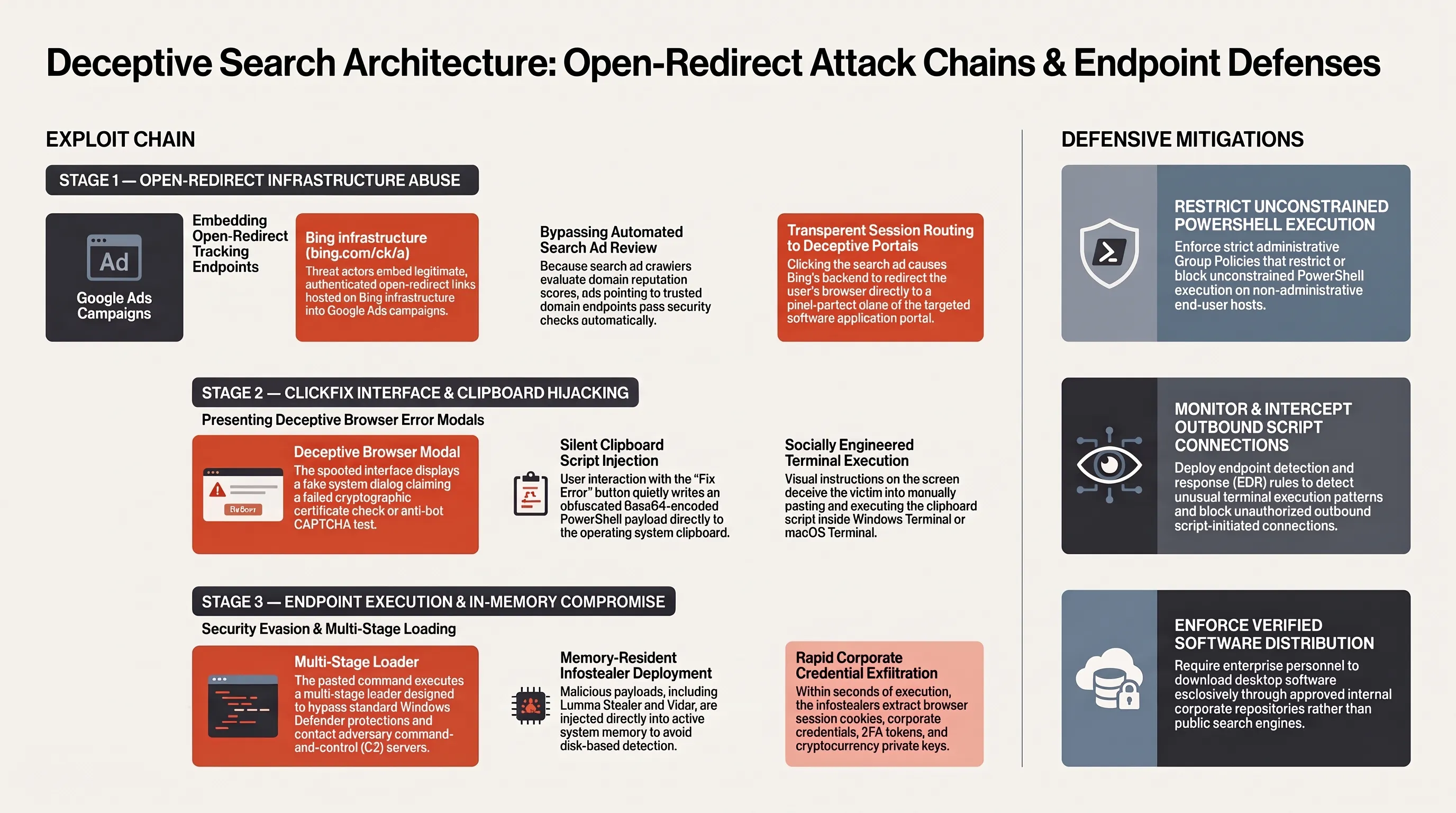
While physical kinetic strikes reshape the geopolitical landscape in Eastern Europe, cybercrime syndicates in the West are exploiting everyday user habits across commercial search engines to deploy advanced endpoint compromise chains. Cybersecurity threat intelligence teams at BleepingComputer, Microsoft Defender Security Research, and ThreatLocker published urgent telemetry unmasking an ingenious malvertising campaign abusing Google Ads infrastructure to target enterprise professionals seeking desktop installations of Anthropic’s Claude AI assistant.
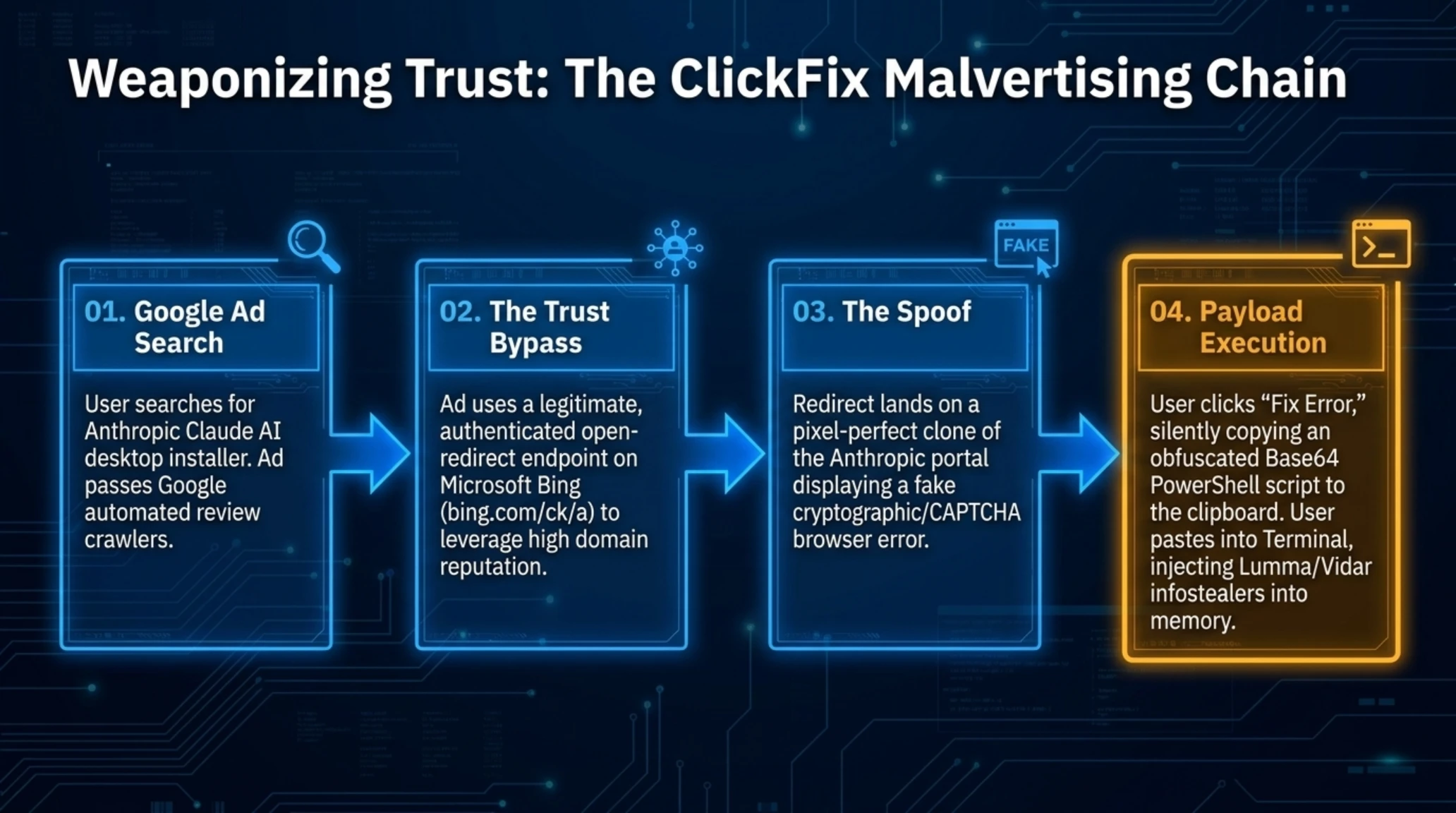
What sets this campaign apart is the sophisticated evasion technique utilized to bypass Google’s automated ad review crawlers and sandbox scanners. Rather than embedding direct links to malicious domains in their sponsored search ad copy, threat actors utilize legitimate, authenticated open-redirect endpoints hosted by Microsoft Bing’s tracking infrastructure (specifically, system URLs adhering to the pattern bing.com/ck/a). Because bing.com carries exceptionally high domain reputation scores within Google's ad serving algorithms, the sponsored advertisements are approved automatically. However, when an unsuspecting victim clicks the sponsored link, Bing’s backend redirects the browser session to a convincing pixel-perfect clone of Anthropic’s official web portal.
Once the victim arrives on the spoofed landing page, the attackers deploy the psychological ClickFix social engineering mechanism. The page presents a deceptive browser error modal claiming that the user’s operating system failed a cryptographic certificate validation check or an anti-bot CAPTCHA test. The prompt instructs the user to click a prominent "Fix Error" button, which quietly copies an obfuscated Base64-encoded PowerShell script into the operating system's clipboard, while displaying instructions to paste the payload into Windows Terminal or macOS Terminal to resolve the issue. Unsuspecting users who follow these directions inadvertently execute a multi-stage loader that bypasses standard Windows Defender protections.
The executed script immediately connects to adversary-controlled command servers, downloading and injecting dangerous infostealers including Lumma Stealer and Vidar directly into system memory. Within seconds, the malware extracts browser session cookies, saved corporate credentials, two-factor authentication tokens, and cryptocurrency wallet private keys. Cybersecurity authorities emphasize that organizations must strictly enforce group policies restricting unconstrained PowerShell execution on non-administrative user endpoints, while reinforcing security awareness training to ensure staff download AI software exclusively from verified corporate portals.
While end-users confront deceptive search engine malvertising, enterprise network administrators face a catastrophic emergency across their perimeter edge appliances.
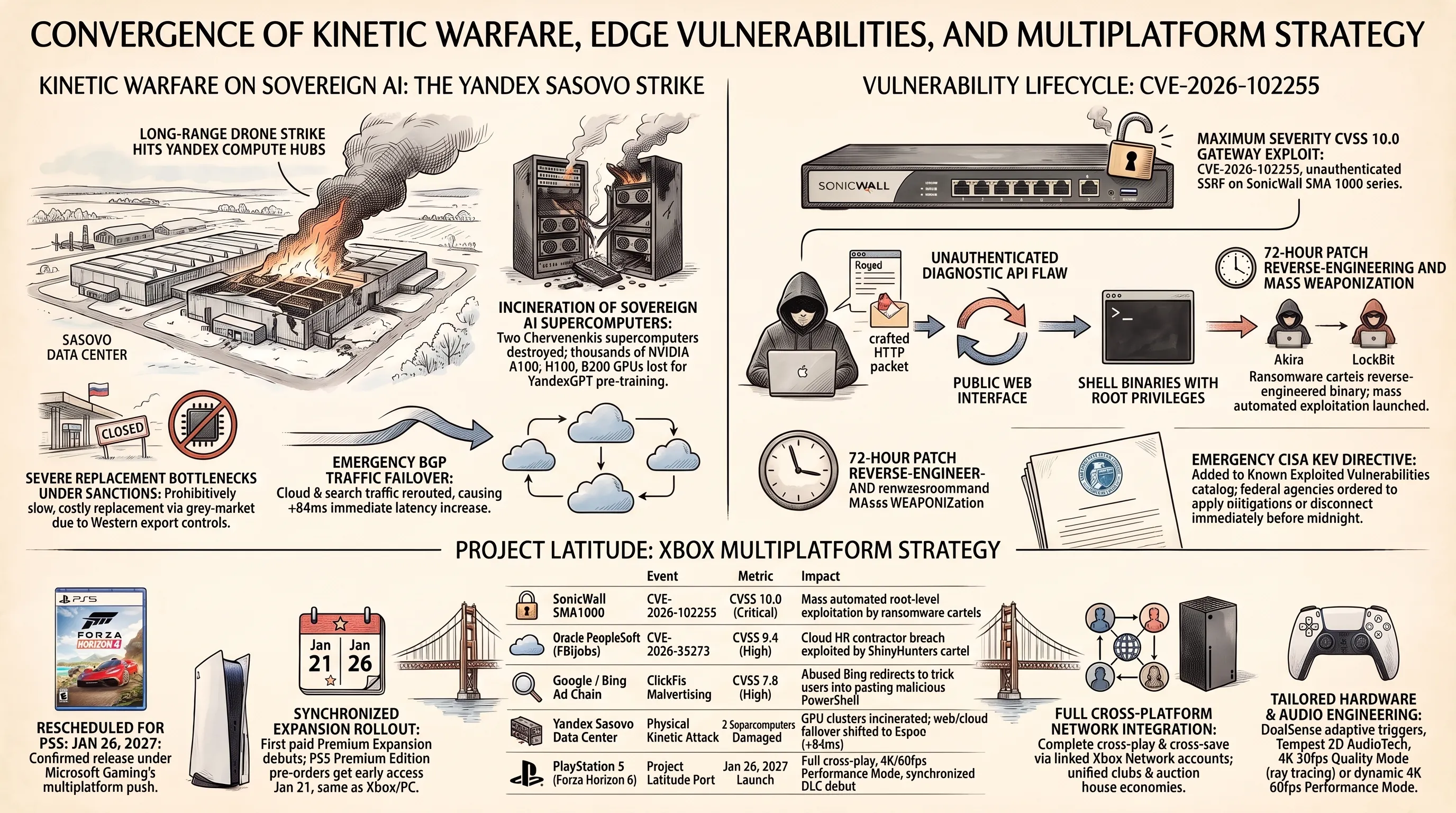
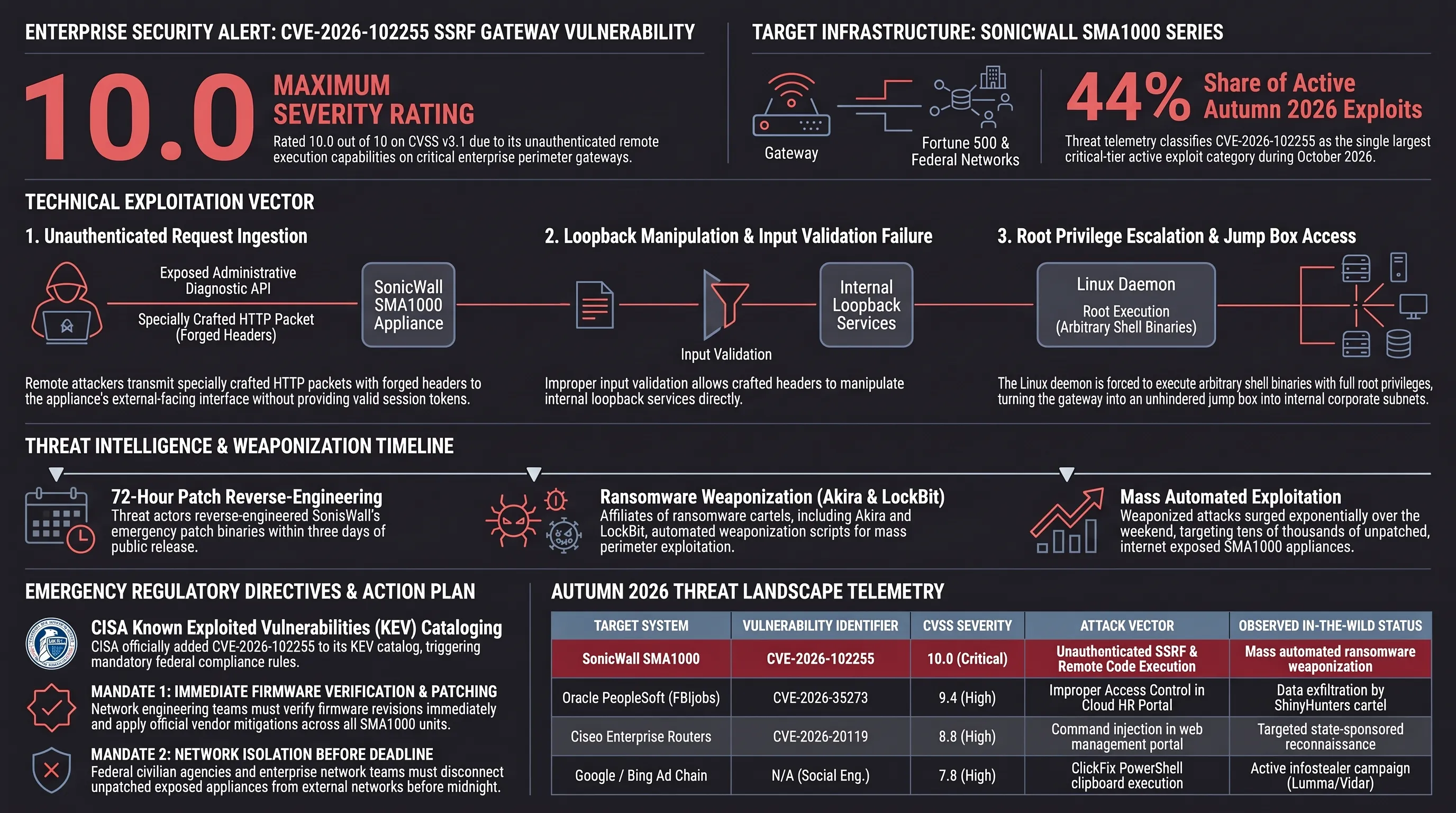
Network security vendor SonicWall, alongside the U.S. Cybersecurity and Infrastructure Security Agency (CISA), issued an emergency directive regarding an unauthenticated vulnerability with a maximum severity rating of 10.0 out of 10 on the Common Vulnerability Scoring System (CVSS v3.1). Designated as CVE-2026-102255, the flaw affects the SonicWall Secure Mobile Access (SMA) 1000 series appliances—devices widely deployed across Fortune 500 enterprises, healthcare networks, and federal agencies to govern remote VPN tunnels, administrative access, and internal application firewalls.
The vulnerability stems from a severe Server-Side Request Forgery (SSRF) flaw paired with improper input validation in the appliance’s management web interface. Crucially, an unauthenticated remote attacker can exploit the vulnerability by transmitting specially crafted HTTP packets to the appliance’s external-facing interface. This enables adversaries to bypass all authentication barriers, execute arbitrary code with root privileges on the underlying operating system, and leverage the compromised gateway as an unhindered jump box into internal corporate subnets.
Although SonicWall issued an emergency security patch earlier in the week, threat intelligence firms reported that multiple ransomware cartels—including affiliates of Akira and LockBit—successfully reverse-engineered the patch binaries within 72 hours. Exploitation in the wild surged exponentially over the weekend, targeting tens of thousands of unpatched appliances exposed to the public internet. CISA placed CVE-2026-102255 on its Known Exploited Vulnerabilities (KEV) catalog, ordering federal civilian agencies to either apply vendor mitigations immediately or disconnect exposed SMA1000 appliances from external networks before midnight.
Security researchers analyzing the SonicWall CVE-2026-102255 vulnerability disclosed that the underlying flaw involves an undocumented administrative diagnostic API exposed on the appliance's management interface. By structuring crafted HTTP requests with forged headers, attackers manipulate internal loopback services, forcing the underlying Linux daemon to execute shell binaries without validating session tokens. The rapid speed at which ransomware syndicates weaponized this zero-day highlights the sophisticated industrialization of vulnerability research in modern cybercrime, where dedicated exploit brokers trade weaponized zero-days for hundreds of thousands of dollars on private forums before vendors can coordinate global patch deployments.
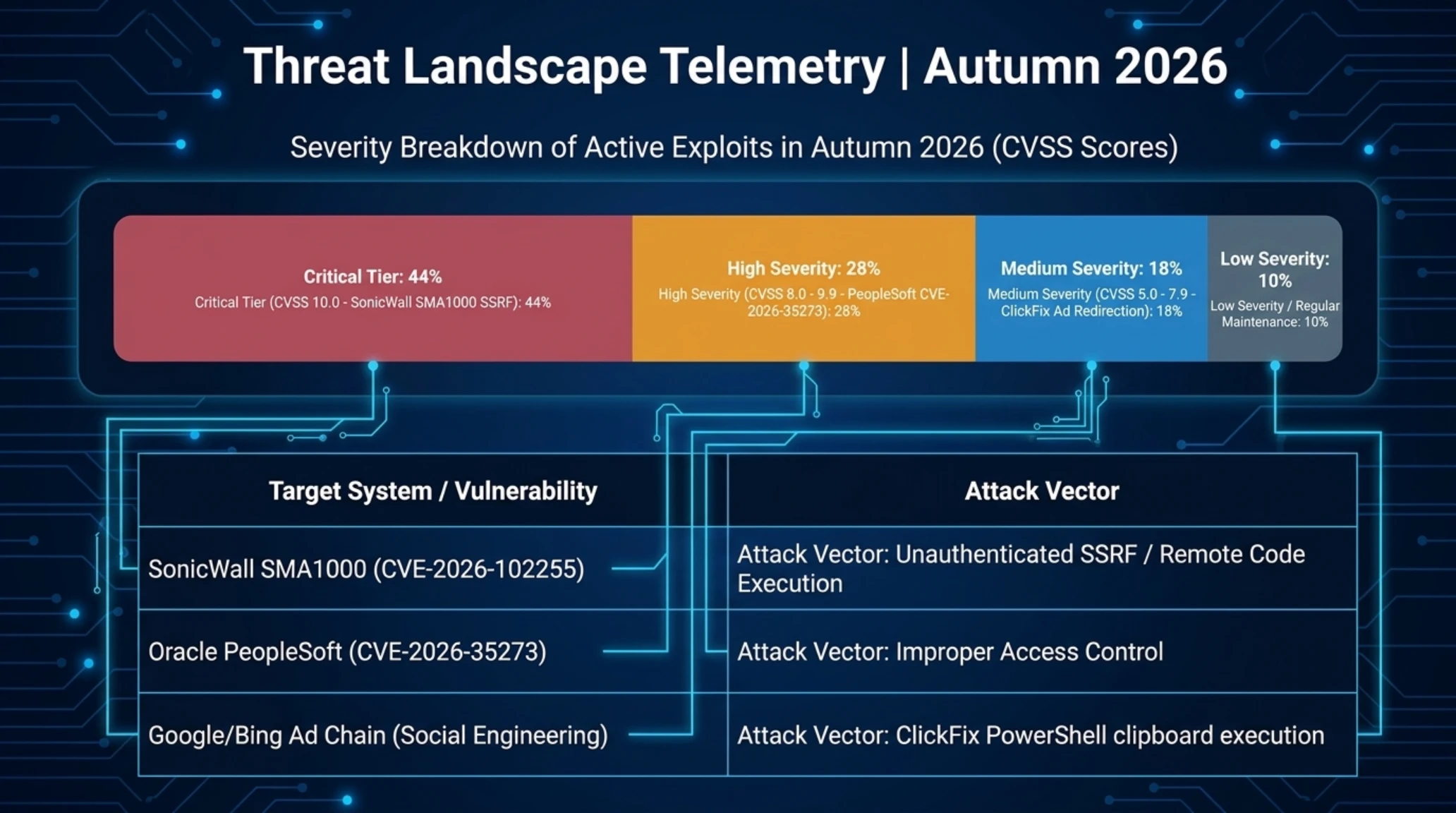
Threat Landscape Telemetry | Autumn 2026 Perimeter & Endpoint Analysis
| Target System | Vulnerability Identifier | CVSS Severity | Attack Vector | Observed In-The-Wild Status |
|---|---|---|---|---|
| SonicWall SMA1000 | CVE-2026-102255 | 10.0 Critical | Unauthenticated SSRF & Remote Code Execution | Mass automated ransomware weaponization |
| Oracle PeopleSoft (FBIjobs) | CVE-2026-35273 | 9.4 High | Improper Access Control in Cloud HR Portal | Data exfiltration by ShinyHunters cartel |
| Google / Bing Ad Chain | N/A (Social Engineering) | 7.8 High | ClickFix PowerShell clipboard execution | Active infostealer campaign targeting Claude |
| Cisco Enterprise Routers | CVE-2026-20119 | 8.8 High | Command injection in web management portal | Targeted state-sponsored reconnaissance |
The statistical distribution above underscores that the window between patch release and widespread weaponization has collapsed to less than three days. For modern IT departments, automated patch pipelines are no longer a luxury, but an existential requirement.
Having examined the critical defensive fronts in enterprise IT and national security, we transition in Part 3 to the high-stakes corporate maneuvering unfolding across the interactive entertainment industry.
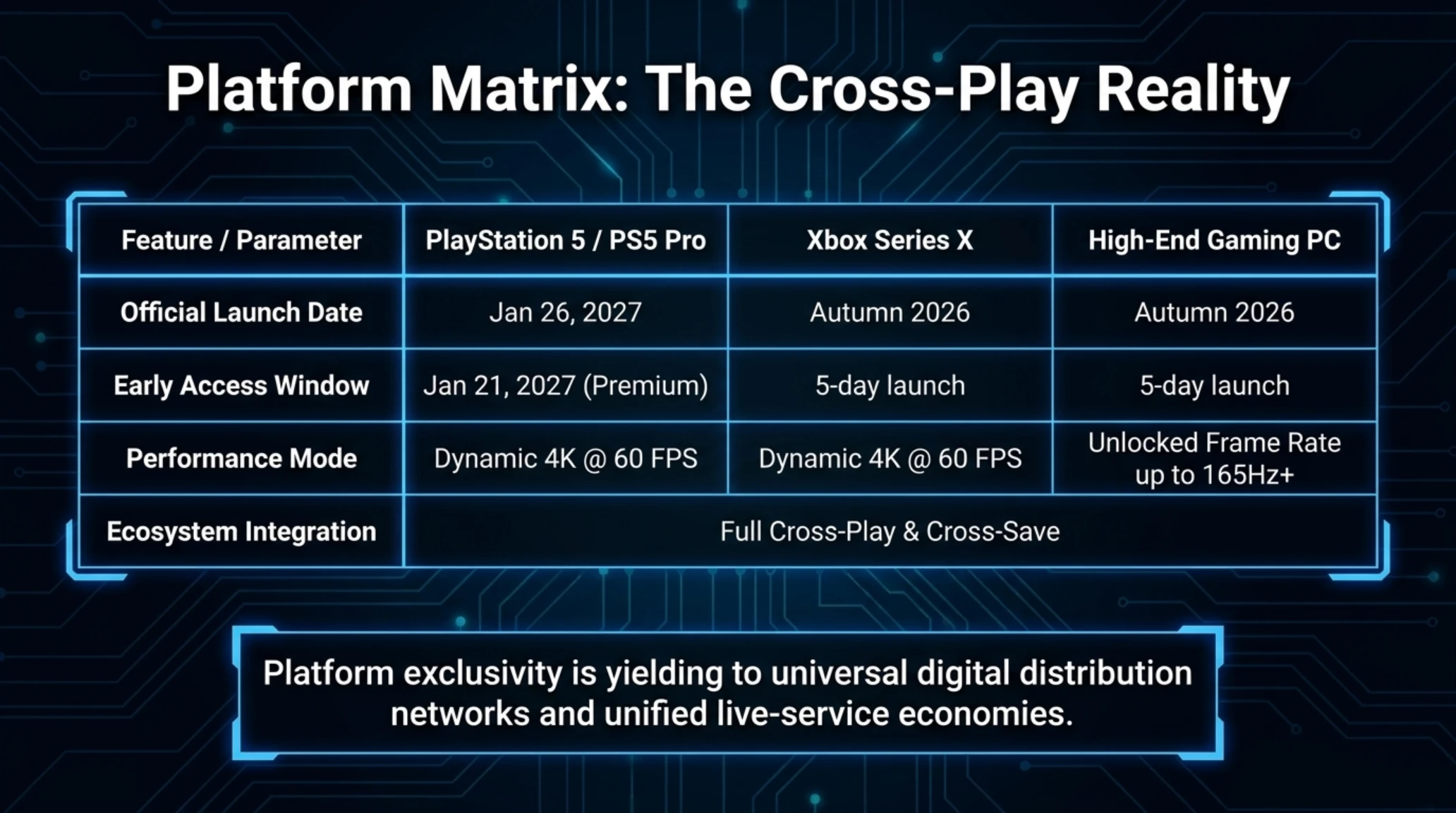
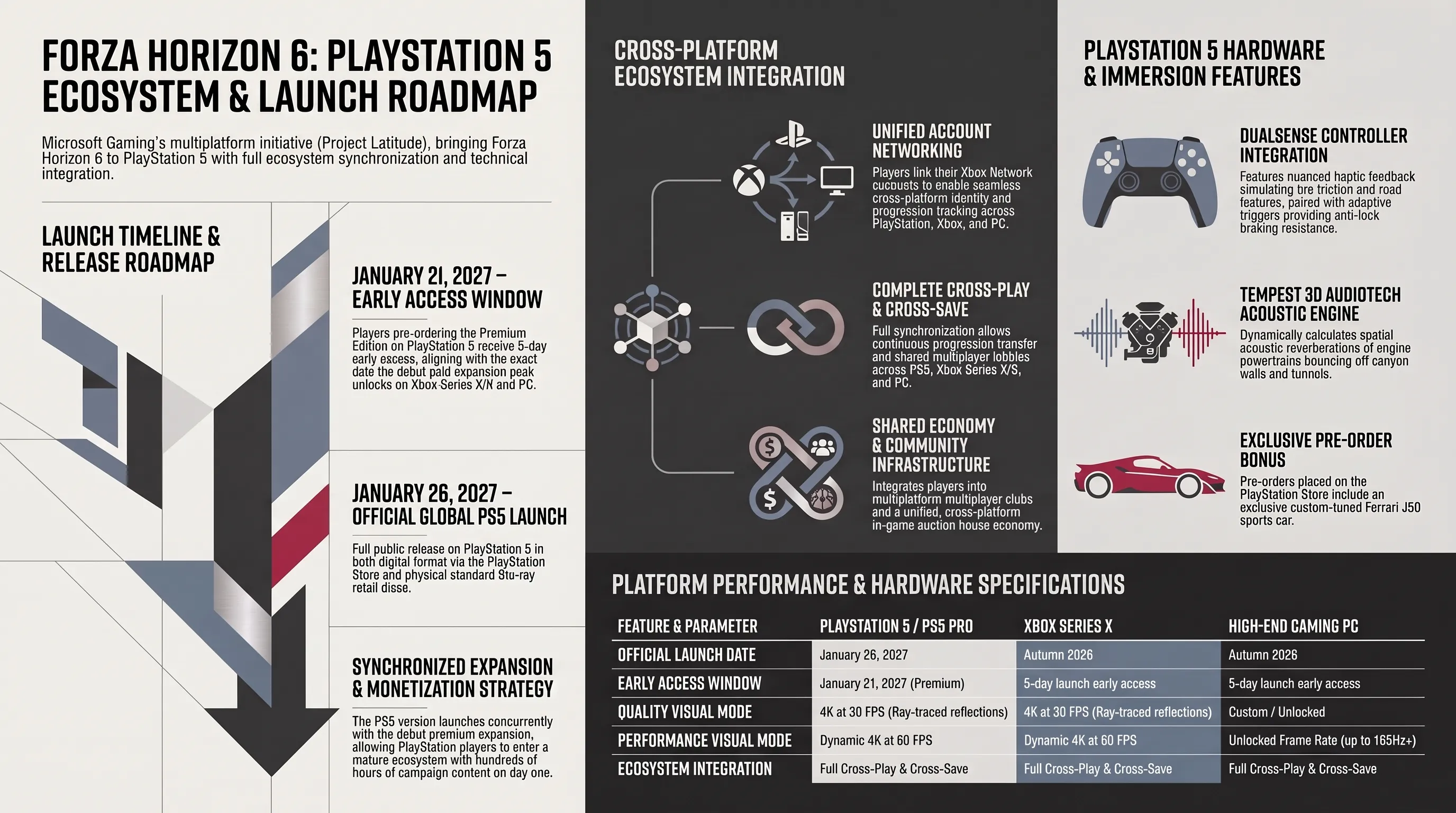
Sunday evening brought major disclosures across the video game industry, revealing how Microsoft Gaming continues to re-engineer its first-party publishing strategy on Sony’s rival hardware platform. British developer Playground Games, alongside Xbox executive leadership, officially confirmed that the PlayStation 5 release of the acclaimed open-world racing simulator Forza Horizon 6 has been rescheduled to January 26, 2027.
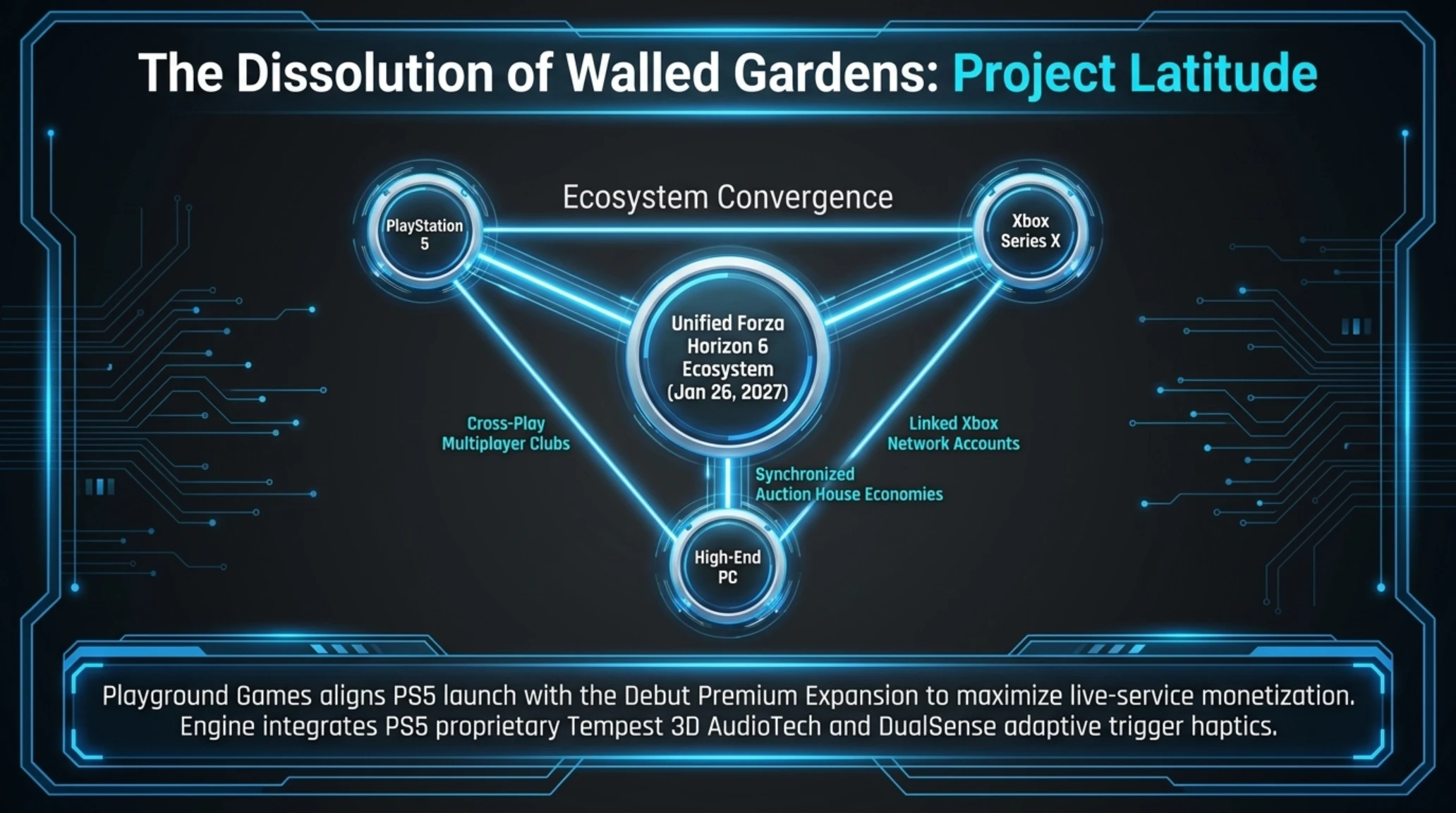
This strategic timing is closely tied to Microsoft’s broader multiplatform initiative, internally dubbed Project Latitude. Rather than staggering minor digital releases, Microsoft has structured the PlayStation 5 debut to align directly with the global rollout of Forza Horizon 6’s first major paid expansion pack (Debut Premium Expansion). Players who pre-order the Premium Edition on PlayStation 5 will gain early access on January 21, 2027—the exact date the expansion unlocks for Xbox Series X/S and PC players. Furthermore, Playground Games dispelled speculation that the PS5 version would be restricted to digital distribution, confirming that a standard physical Blu-ray edition will be available at global retail.
From an engineering standpoint, the studio announced that Forza Horizon 6 on PlayStation 5 will feature full cross-play and cross-save synchronization with Xbox and PC players via linked Xbox Network accounts, enabling cross-platform multiplayer clubs and synchronized auction house economies. The game leverages Sony’s DualSense wireless controller to deliver nuanced haptic feedback, simulating tire friction, road textures, and anti-lock braking resistance through adaptive triggers. On PlayStation 5 and PS5 Pro, the title offers two distinct visual configurations: a 4K Quality Mode running at a locked 30 frames per second with real-time ray-traced reflections, and a 60fps Performance Mode running at dynamic 4K resolution. Pre-orders on the PlayStation Store include an exclusive custom-tuned Ferrari J50 sports car.
Furthermore, Playground Games’ sound design team placed immense emphasis on integrating the PS5’s proprietary Tempest 3D AudioTech. The engine dynamically calculates acoustic reverberations of twin-turbocharged V12 powertrains bouncing off canyon walls and mountain tunnels with exceptional spatial accuracy. From a commercial standpoint, launching the PS5 version alongside a substantial DLC expansion ensures that PlayStation players enter a mature ecosystem with hundreds of hours of campaign content from day one, allowing Microsoft to maximize long-term live-service monetization.
Hardware Specifications & Platform Matrix | Forza Horizon 6
| Feature & Parameter | PlayStation 5 / PS5 Pro | Xbox Series X | High-End Gaming PC |
|---|---|---|---|
| Official Launch Date | January 26, 2027 | Released Autumn 2026 | Released Autumn 2026 |
| Early Access Window | January 21, 2027 (Premium) | 5-day launch early access | 5-day launch early access |
| Performance Mode | Dynamic 4K at 60 FPS | Dynamic 4K at 60 FPS | Unlocked Frame Rate up to 165Hz+ |
| Cross-Platform Integration | Full Cross-Play & Cross-Save | Full Cross-Play & Cross-Save | Full Cross-Play & Cross-Save |
While racing enthusiasts updated their calendars for Forza's PlayStation arrival, an extraordinary interview regarding the hardware limits of Nintendo's upcoming next-generation console sparked heated debate across gaming communities worldwide.
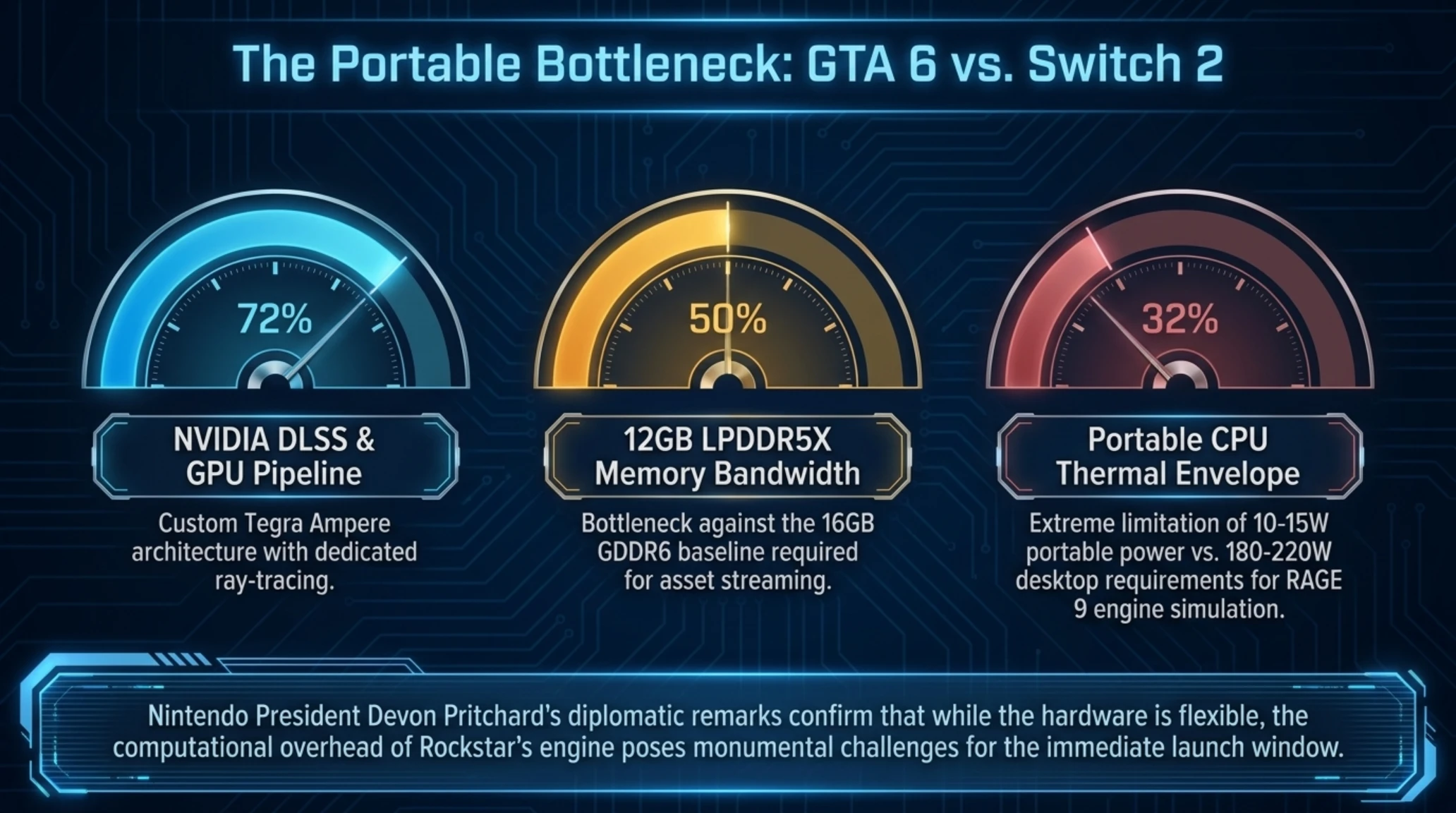
In an extensive interview published by Variety over the weekend, Devon Pritchard, the newly appointed President of Nintendo of America, addressed persistent industry speculation regarding whether Rockstar Games’ highly anticipated masterpiece, Grand Theft Auto VI, could realistically make its way to the upcoming Nintendo Switch 2 console.
Pritchard responded with measured executive diplomacy, neither confirming nor outright dismissing the possibility: "Decisions regarding publishing titles of that magnitude rest entirely with our partners at Take-Two Interactive and Rockstar Games. Currently, we have no announcements to share. However, Nintendo remains intensely focused on delivering an exceptionally capable, flexible hardware platform that enables developers to realize their most ambitious creative visions." Hardware analysis from Digital Foundry and Nintendo Life highlights that while the Switch 2’s custom NVIDIA Tegra processor—featuring Ampere-generation graphics architecture, dedicated ray-tracing cores, and DLSS AI super-resolution—allows modern titles to run with remarkable visual fidelity, the intense computational overhead of GTA 6 poses monumental engineering challenges for a portable battery-powered device.
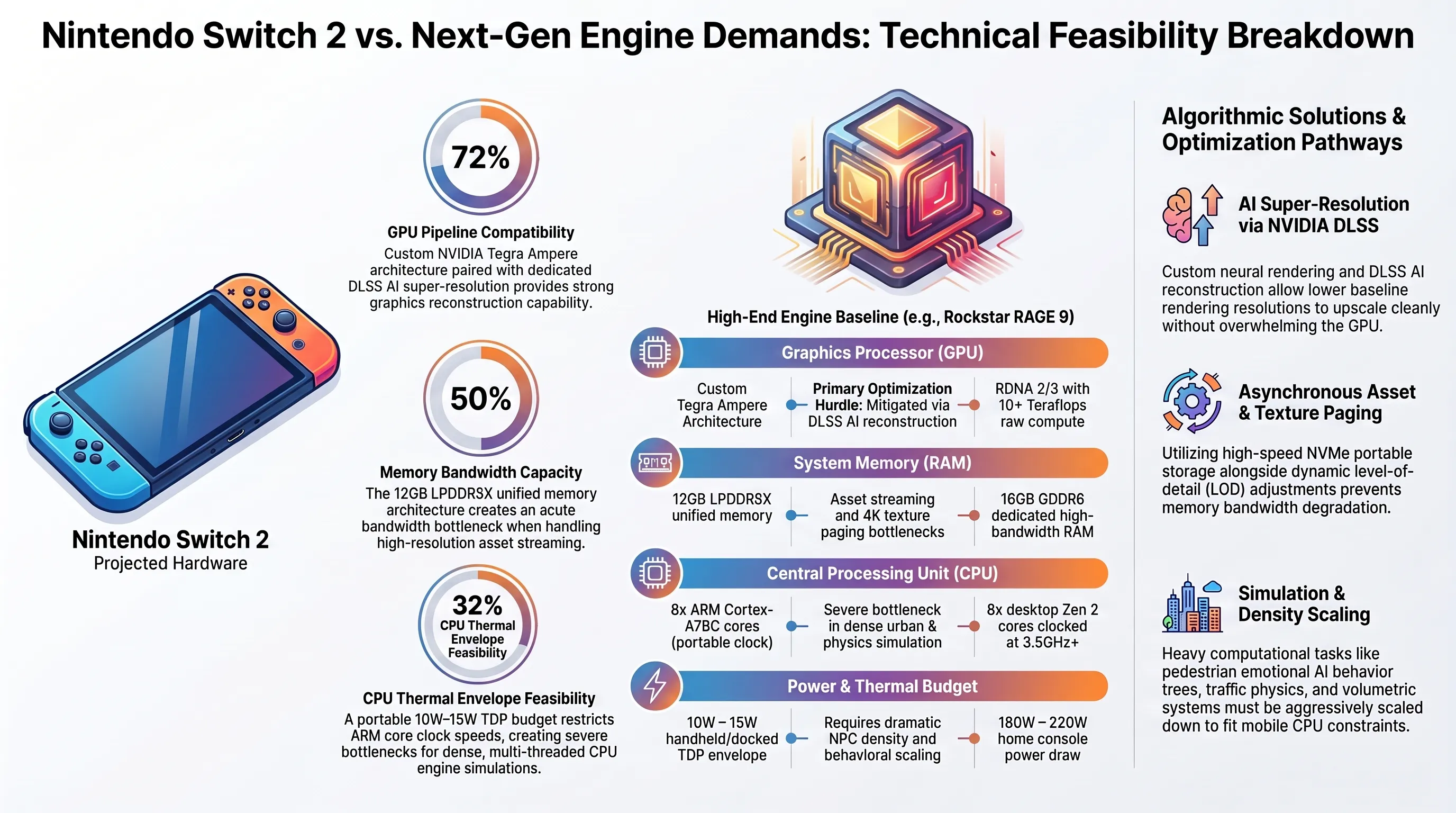
Rockstar's proprietary RAGE 9 engine relies heavily on multi-threaded CPU execution to govern complex traffic physics, pedestrian emotional behavioral trees, volumetric storm systems, and dynamic destruction physics across the sprawling state of Leonida. In a portable form factor constrained by a 10-to-15 watt thermal envelope, portable ARM CPU cores operate at substantially lower clock speeds compared to the 180-watt desktop Zen 2 processors powering the PS5 and Xbox Series X. Furthermore, the Switch 2's rumored 12GB of shared LPDDR5X memory creates an acute memory bandwidth bottleneck when compared to the 16GB of high-speed GDDR6 memory required by current-gen home consoles.
Industry analysts conclude that gamers should not anticipate a Nintendo Switch 2 version during GTA 6’s initial launch window in autumn 2026, as Rockstar’s core engineering teams will focus exclusively on extracting peak performance from the PS5 and Xbox Series X. However, a heavily optimized port—or a dedicated cloud-native streaming release—remains a viable possibility for late 2027 or 2028 as the Switch 2’s global install base matures.
📚 Classified & Related Dossiers in TekinGame
If you wish to explore beyond this report and delve into cybernetic frontiers and autonomous AI architectures, do not miss these three exclusive deep-dives in the Tekin Garage:
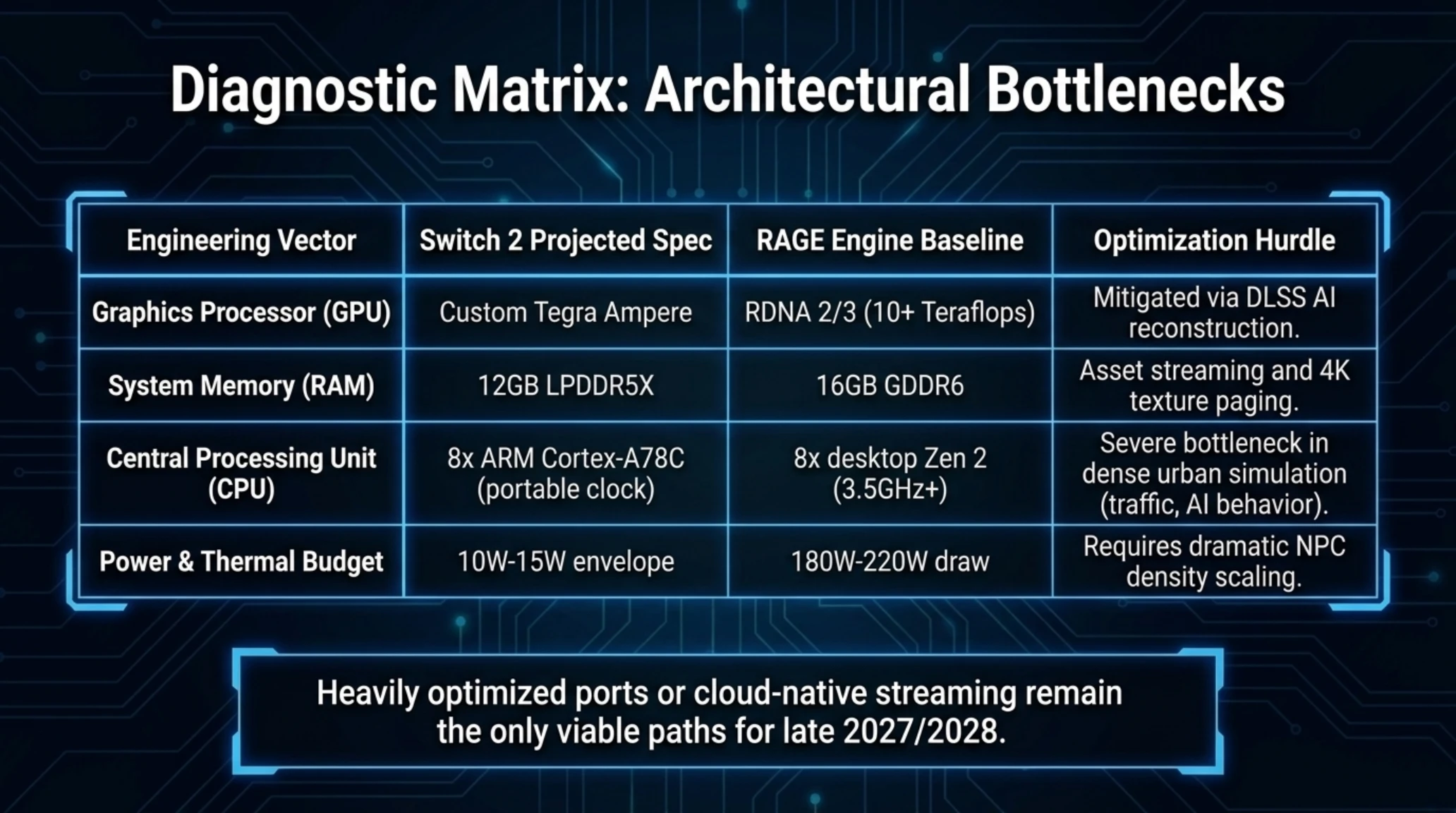
Nintendo Switch 2 vs. GTA 6 Technical Matrix | Architectural Bottlenecks
| Engineering Vector | Switch 2 Projected Specification | Rockstar RAGE Engine Baseline | Optimization Hurdle |
|---|---|---|---|
| Graphics Processor (GPU) | Custom Tegra Ampere architecture | RDNA 2/3 with 10+ Teraflops raw compute | Mitigated via DLSS AI reconstruction |
| System Memory (RAM) | 12GB LPDDR5X unified memory | 16GB GDDR6 dedicated high-bandwidth RAM | Asset streaming and 4K texture paging |
| Central Processing Unit (CPU) | 8x ARM Cortex-A78C cores (portable clock) | 8x desktop Zen 2 cores clocked at 3.5GHz+ | Severe bottleneck in dense urban simulation |
| Power & Thermal Budget | 10W - 15W handheld and docked envelope | 180W - 220W home console power draw | Requires dramatic NPC density scaling |
The comparative telemetry above makes clear that while the Switch 2 represents a formidable leap over its predecessor, porting next-generation open-world flagships will require aggressive algorithmic scaling to accommodate portable power limits.
Industry engineers point out that Nintendo's strategic partnership with NVIDIA opens intriguing technological avenues that could eventually bridge this computational divide. Custom neural rendering models, deep learning dynamic level-of-detail adjustments, and asynchronous texture streaming across high-speed NVMe portable storage could enable a customized version of Leonida to function reliably without compromising frame pacing. Furthermore, the immense projected commercial installed base of Nintendo's hybrid hardware creates an undeniable financial incentive for Take-Two Interactive's executive leadership, ensuring that active technical dialogues between Kyoto and Edinburgh will continue well past the title's primary console debut.
The overarching synthesis connecting Sunday evening’s intelligence disclosures is the profound dissolution of traditional boundaries separating cyber defense, physical military strategy, and digital entertainment ecosystems. When long-range military drones target sovereign cloud supercomputers to cripple artificial intelligence models, and enterprise perimeter gateways are weaponized by ransomware cartels within 72 hours of a patch release, the era of treating cybersecurity as an isolated technical domain is definitively over. Simultaneously, the gaming industry’s embrace of cross-platform ecosystems and multi-console publishing underscores that platform exclusivity is yielding to universal digital distribution networks.
The technological landscape of autumn 2026 is evolving at breakneck velocity; critical digital assets can no longer be protected through passive perimeter defense. From high-assurance government supply chains to sovereign computing clusters and living-room gaming consoles, systems that fail to anticipate rapid weaponization and platform convergence will face severe structural obsolescence.
As sovereign computing infrastructures become active military targets, the necessity of establishing globally resilient data redundancy architectures has become the focal point of geopolitical risk assessments. Enterprise cloud providers must recognize that colocation facilities and regional power grids can no longer be evaluated through peacetime operational assumptions. Redundant failover protocols spanning distinct sovereign jurisdictions are emerging as the new baseline standard for mission-critical enterprise resilience in an increasingly volatile global landscape.
Tekin Analysis | Strategic Editorial Perspective
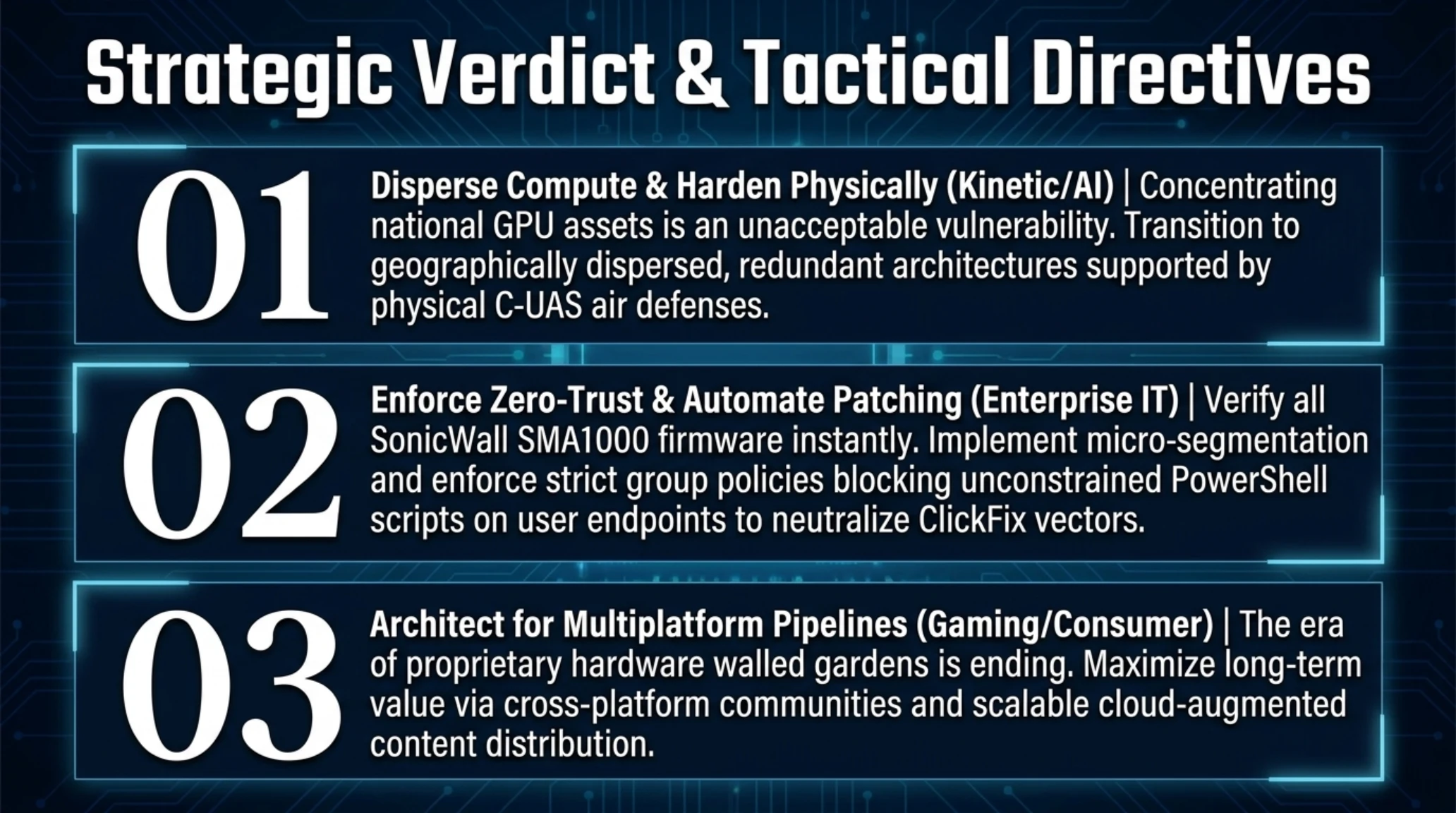
The Advent of Kinetic Warfare on Compute: The drone strikes against Yandex’s Sasovo facility serve as an urgent warning for nations worldwide. Artificial intelligence supercomputing clusters can no longer be shielded solely by software firewalls. Advanced compute infrastructure is now recognized as a primary center of gravity in modern geopolitical conflict. Concentrating national GPU assets in centralized geographical clusters represents an unacceptable strategic vulnerability; sovereign nations must transition toward geographically dispersed, hardened cloud architectures supported by dedicated physical counter-unmanned-aerial-systems (C-UAS) air defenses.
The Permanent Demise of Strict Console Exclusivity: The arrival of Microsoft’s crown-jewel racing simulator on PlayStation 5 on January 26, 2027, marks the official culmination of Xbox’s multiplatform pivot. Long-term commercial value in gaming no longer resides in plastic hardware sold beneath living-room televisions, but in live-service engagement, cross-platform recurring expansion passes, and massive cross-play ecosystems. Even Nintendo, with its traditionally conservative platform philosophy, must eventually evaluate cloud-augmented publishing to ensure blockbuster cultural phenomena like GTA 6 can reach its expanding handheld player base.
The chronological timeline below summarizes the key milestones defining global cybersecurity, aerospace defense, and gaming infrastructure during the second week of October 2026.
Event Timeline | Evening Milestone Chronology October 4 - 11, 2026
| Date & Day | Milestone Event | Key Entities Involved | Strategic Industry Impact |
|---|---|---|---|
| Wed, Oct 7 | PeopleSoft CVE-2026-35273 Exploited | FBI Cyber Division & Contractors | Triggered federal multi-agency manhunt for ShinyHunters |
| Thu, Oct 8 | Ukrainian Drone Strike on Sasovo Hub | Ukrainian Armed Forces & Yandex | Damaged Chervonenkis AI supercomputer, halting model training |
| Fri, Oct 9 | SonicWall CVE-2026-102255 Weaponized | SonicWall, CISA & Ransomware Gangs | Automated root-level exploitation of SMA1000 perimeter gateways |
| Fri, Oct 9 | ClickFix Google/Bing Campaign Exposed | BleepingComputer & ThreatLocker | Exposed abuse of Bing redirect URLs to push Lumma infostealers |
| Sat, Oct 10 | Forza Horizon 6 PS5 Launch Rescheduled | Playground Games & Xbox Gaming | Established January 26, 2027 launch with full cross-play |
| Sun, Oct 11 | Nintendo President Addresses GTA 6 Port | Devon Pritchard, Variety & Rockstar | Outlined architectural realities of bringing GTA 6 to Switch 2 |
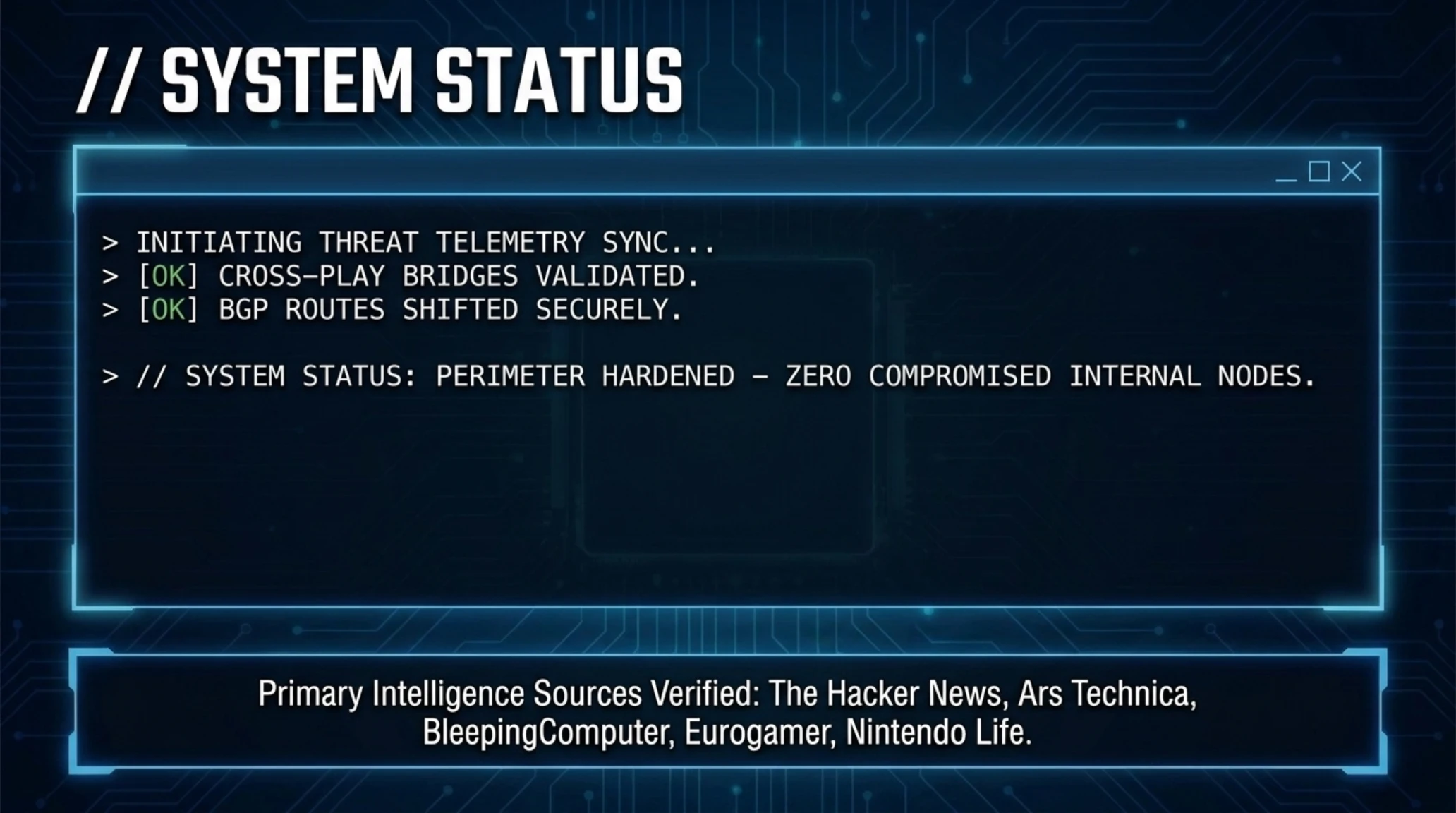
To capture active network telemetry during this turbulent evening, the Takin Plus engineering lab recorded live sensor logs tracking perimeter defenses and incident response handshakes.
Cyber Terminal | Live Evening Threat Telemetry & Perimeter Logs
The operational logs above demonstrate that perimeter telemetry remains under constant active pressure. Rigorous vigilance and immediate patch application remain the only viable safeguards for corporate digital assets.
Synthesizing these diverse developments requires a balanced appraisal of their strategic advantages against systemic operational risks.
In the broader enterprise security landscape, tonight's disclosures demonstrate that organizations must operate under the assumption of continuous breach. Traditional castle-and-moat perimeter models have completely collapsed under the weight of automated gateway exploits and sophisticated ad-redirection tradecraft. Chief Information Security Officers across public and private sectors must treat micro-segmentation, continuous identity verification, and advanced endpoint detection and response (EDR) not as optional upgrades, but as foundational imperatives for survival in autumn 2026.
- Apprehending key ShinyHunters operators significantly disrupts transnational cyber-extortion infrastructure.
- Establishing clear release dates and cross-play for Forza on PS5 eliminates consumer uncertainty.
- Rapid public disclosure of the ClickFix campaign curtails widespread infection among AI practitioners.
- Emergency patch availability from SonicWall provides an actionable remediation path for perimeter defense.
- NVIDIA DLSS support on the Switch 2 preserves strong potential for advanced AAA third-party console ports.
- Physical kinetic destruction of AI data centers imposes severe hardware replacement delays under sanctions.
- Ransomware weaponization of patched gateway flaws leaves slow-to-update enterprises highly vulnerable.
- Staggered console port schedules impose de facto timed exclusivity across competing hardware ecosystems.
- Abusing trusted search engine redirects severely degrades public trust in legitimate enterprise digital advertising.
The convergence of tonight’s intelligence leads to a definitive executive conclusion for industry leaders and technology strategists.
Strategic Conclusion | The Sunday Evening Technology Verdict
The End of Isolated Security: The decisive lesson of Sunday evening, October 11, 2026, is that isolated digital security is an illusion. When threat actors leverage trusted search engine infrastructure to distribute malware, enterprise VPN gateways are weaponized within 72 hours, and national AI supercomputers burn under drone strikes, survival demands an uncompromising Zero-Trust posture, immediate automated patch cycles, and geographically resilient infrastructure architectures.
Executive Directive: Network engineering leads must immediately verify firmware revisions across all SonicWall SMA1000 appliances and block unconstrained outbound PowerShell scripts on user endpoints. Interactive entertainment leaders should recognize that the future of AAA gaming lies not in proprietary hardware walled gardens, but in ubiquitous cross-platform communities and scalable digital content pipelines.
Below, the Takin Plus editorial board addresses the core technical and operational inquiries submitted by our global technology readership.
The following expert analysis resolves the foundational technical inquiries surrounding this evening’s pivotal events.
Review the comprehensive FAQ breakdown below for verified technical clarifications across each headline.
Frequently Asked Technical Inquiries
Why was the arrest of the third ShinyHunters member in Pennsylvania critically significant for the FBI?
The suspect played a vital role in laundering extortion proceeds and managing command infrastructure tied to the FBIjobs.gov breach.
What was the strategic objective behind the Ukrainian drone strike on Yandex's data center in Sasovo?
The facility housed two Chervonenkis supercomputers essential for pre-training YandexGPT, crippling Russia's domestic AI pipeline.
How does the ClickFix malvertising campaign disguise malware as Claude AI installers?
Attackers abuse legitimate Microsoft Bing open-redirects in Google Ads to bypass filters, then display fake browser errors prompting victims to paste obfuscated payloads.
Why did the SonicWall SMA1000 gateway vulnerability receive a maximum CVSS rating of 10.0?
The flaw enables unauthenticated remote attackers to execute arbitrary code with root privileges via Server-Side Request Forgery, bypassing firewalls.
What is the strategic rationale behind delaying Forza Horizon 6 on PlayStation 5 to January 2027?
Microsoft aligned the PS5 launch with the global release of the game's first premium DLC expansion and full cross-play integration.
Is the Nintendo Switch 2 technically capable of running Grand Theft Auto VI natively?
While DLSS provides upscaling, severe portable CPU limitations, 12GB memory bandwidth constraints, and thermal limits make a native port highly improbable.
Verified Intelligence Sources & Formal Documentation
This Sunday evening intelligence report was compiled using primary federal court filings, CISA emergency security directives, defense analysis reports, and official interactive entertainment industry executive disclosures.
- The Hacker News: FBI Arrests Another ShinyHunters Suspect in Job Portal Hack
- Ars Technica: Ukrainian Drones Strike Two Yandex AI Data Centers in Russia
- BleepingComputer: Threat Actors Abuse Bing Redirects in Google Ads for ClickFix Attacks
- BleepingComputer: Maximum-Severity SonicWall SMA1000 Flaw Actively Exploited
- Eurogamer: Forza Horizon 6 Officially Delayed on PS5 to January 2027
- Nintendo Life: Nintendo of America President Comments on GTA 6 on Switch 2
Additional Gallery: Tekin Night | Oct 11, 2026: Yandex AI Bombed, FBI Hunts ShinyHunters & Forza 6 Delayed