Tekin Analysis | Executive Briefing Sony Shuts Down Firewalk Studios, Red Dead Launches on PC, and GTA 6 Open Map
The closing hours of Friday, October 30, 2026, witness a profound reckoning across the global gaming and interactive entertainment landscape. Executive boardrooms in Tokyo, Los Angeles, and London are executing sweeping course corrections, stripping away speculative corporate distractions to refocus capital on narrative excellence, player agency, and technical craftsmanship. The collapse of artificial live-service mandates, juxtaposed against the enduring commercial vitality of masterfully preserved single-player epics, provides an incontrovertible blueprint for the interactive medium as it approaches the fiscal year 2027.
Strategic Vector Matrix Night Executive Takeaways
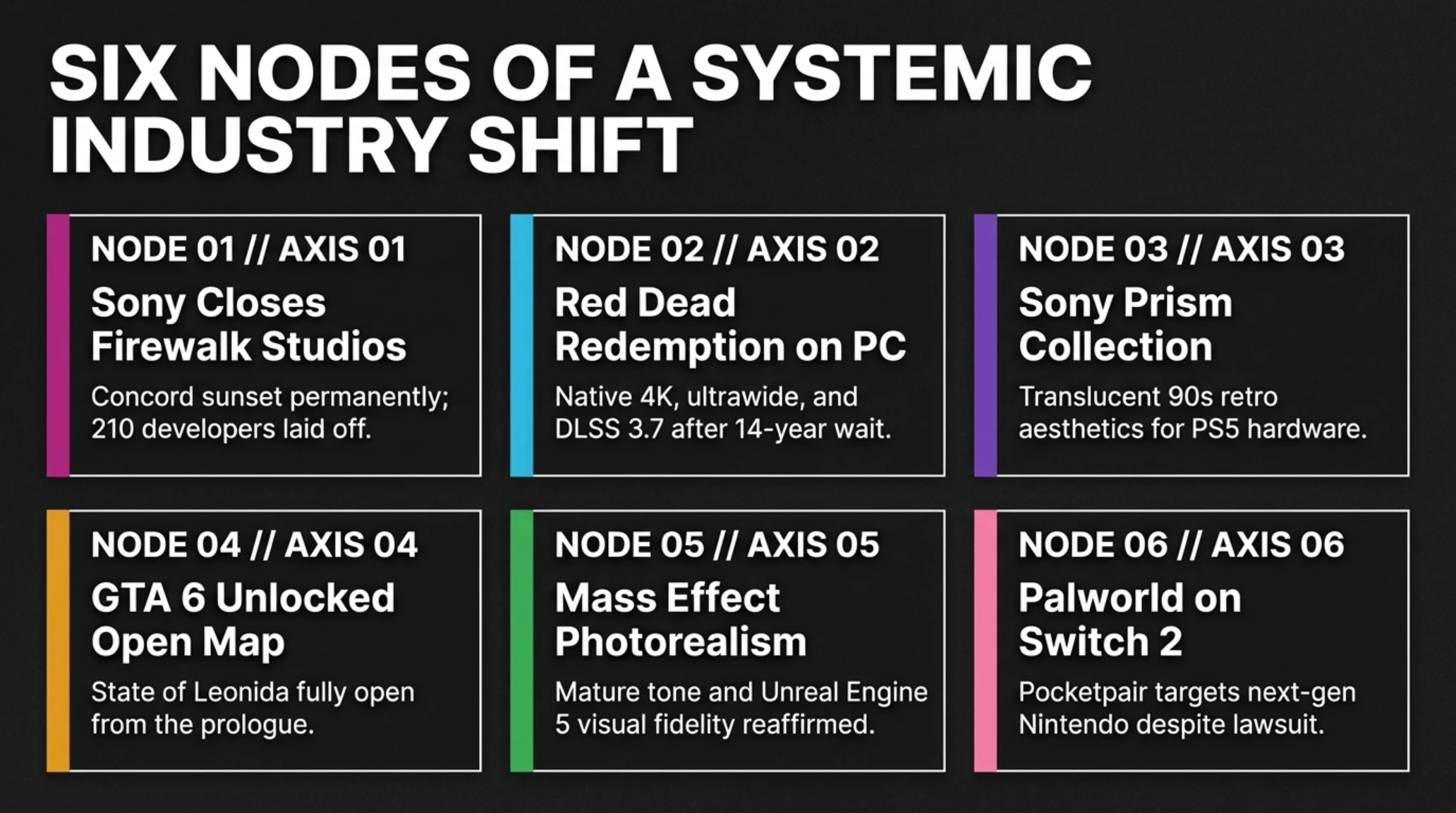
- Sony Interactive Entertainment officially shuts down Firewalk Studios and Neon Koi, permanently shelving the $200M Concord shooter and cutting 210 development positions.
- Rockstar Games formally launches the definitive PC version of Red Dead Redemption and Undead Nightmare after 14 years, introducing native 4K, 144Hz, ultrawide, and DLSS 3.7.
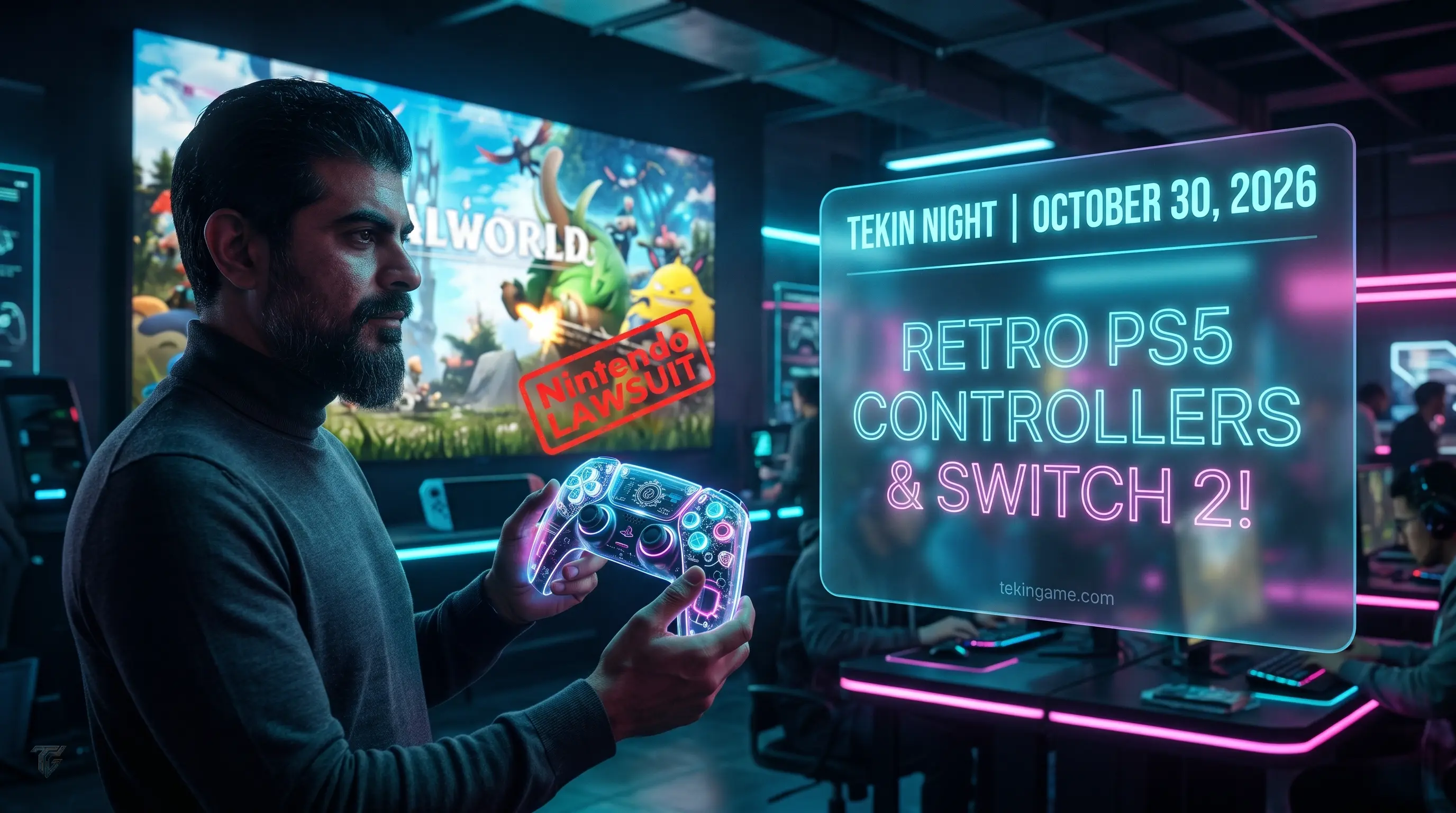
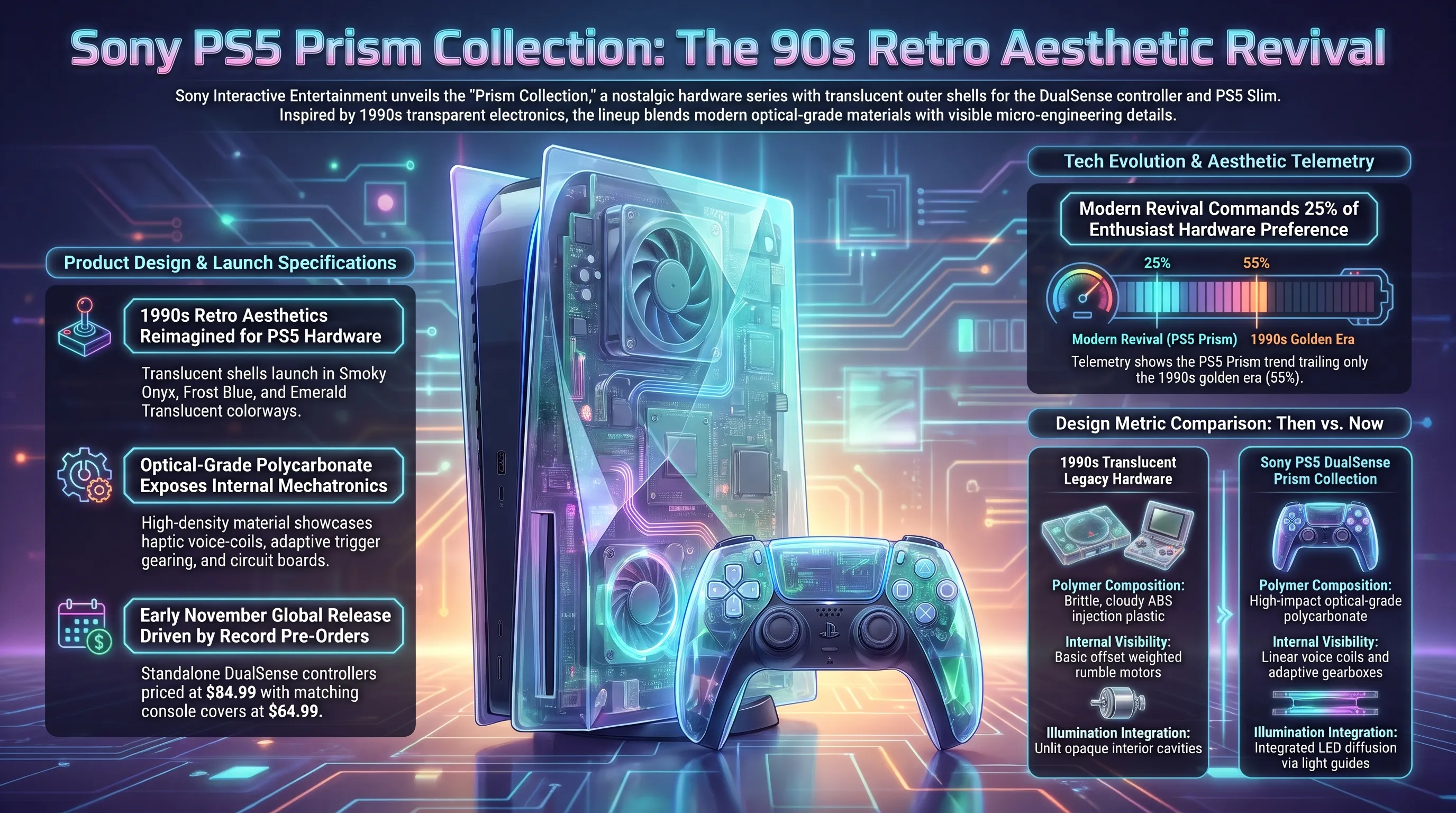
- Sony unveils the nostalgic translucent 'Prism Collection' of DualSense controllers and matching PS5 console covers, reigniting 1990s retro-tech industrial aesthetics.
- Rockstar confirms Grand Theft Auto VI will completely discard legacy artificial map barriers, granting unhindered access to the entire State of Leonida from the opening prologue.
- BioWare executive producer Michael Gamble forcefully reaffirms that the next Mass Effect will maintain a grounded, mature sci-fi tone with photorealistic Unreal Engine 5 visuals.
- Pocketpair CEO Takuro Mizobe confirms technical preparations for bringing Palworld to Nintendo Switch 2, despite aggressive patent litigation initiated by Nintendo and The Pokemon Company.
Axis 01 The PlayStation Live-Service Reckoning: Sony Permanently Sunsets Concord and Shuts Down Firewalk Studios and Neon Koi
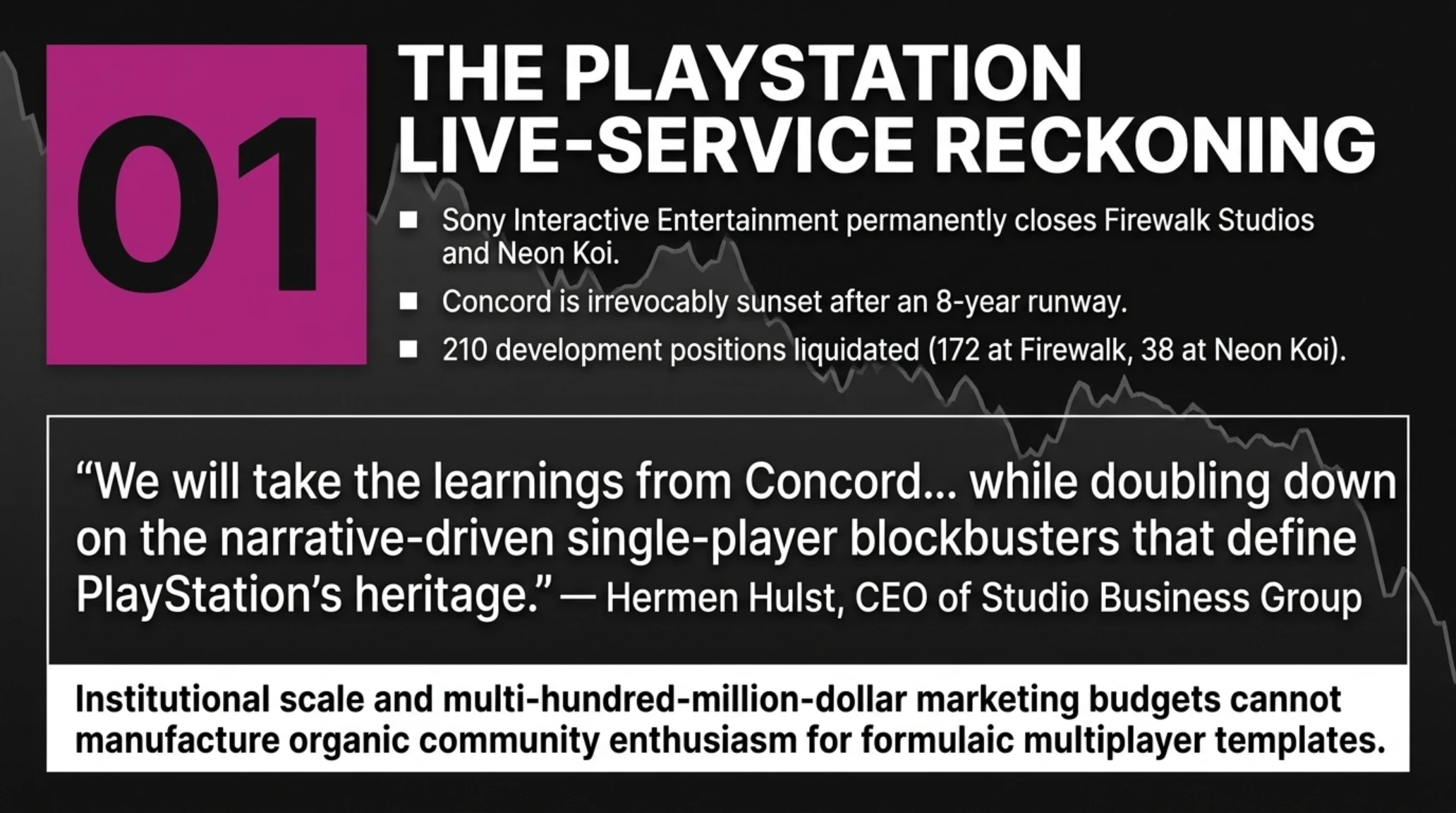
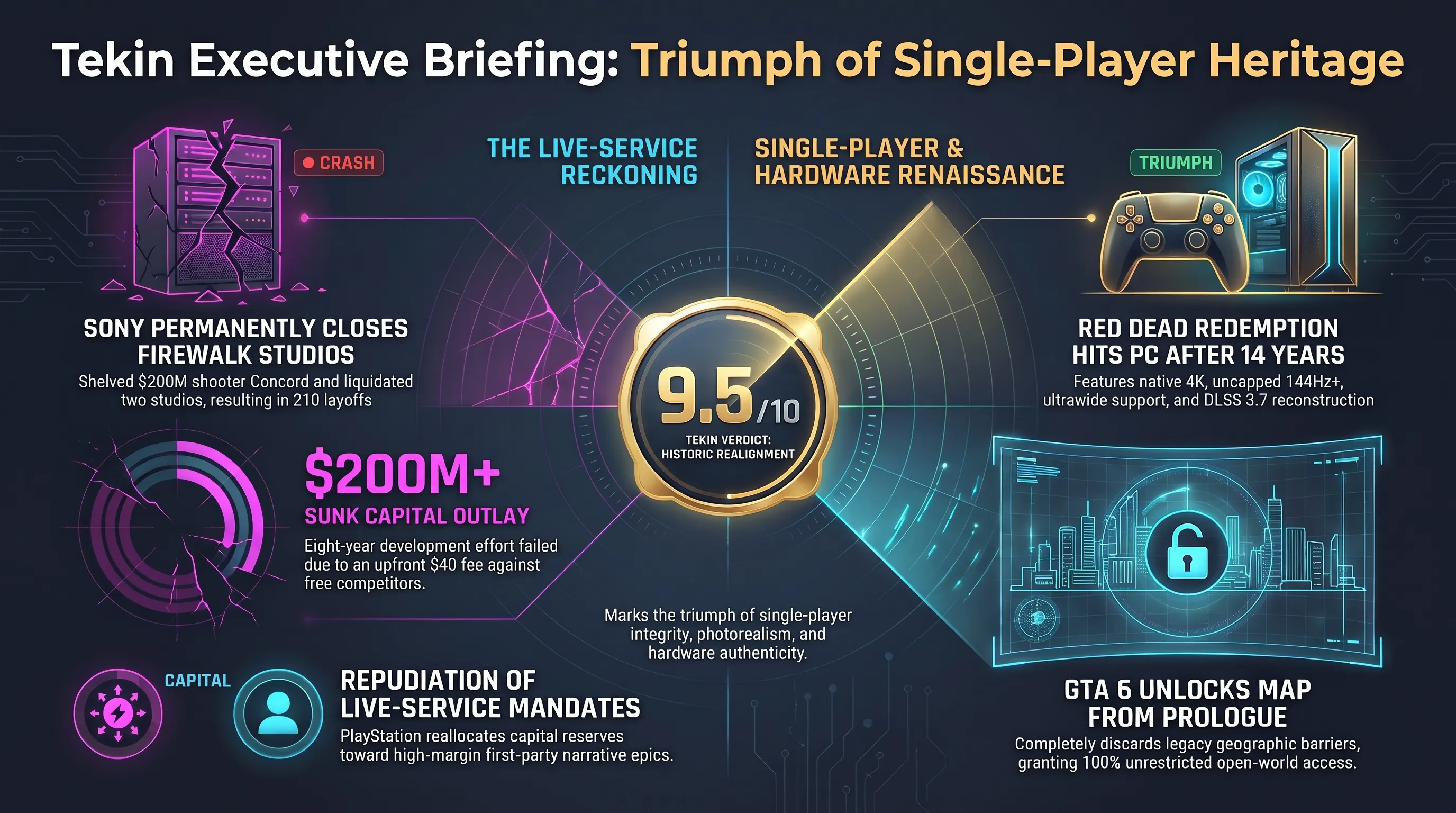
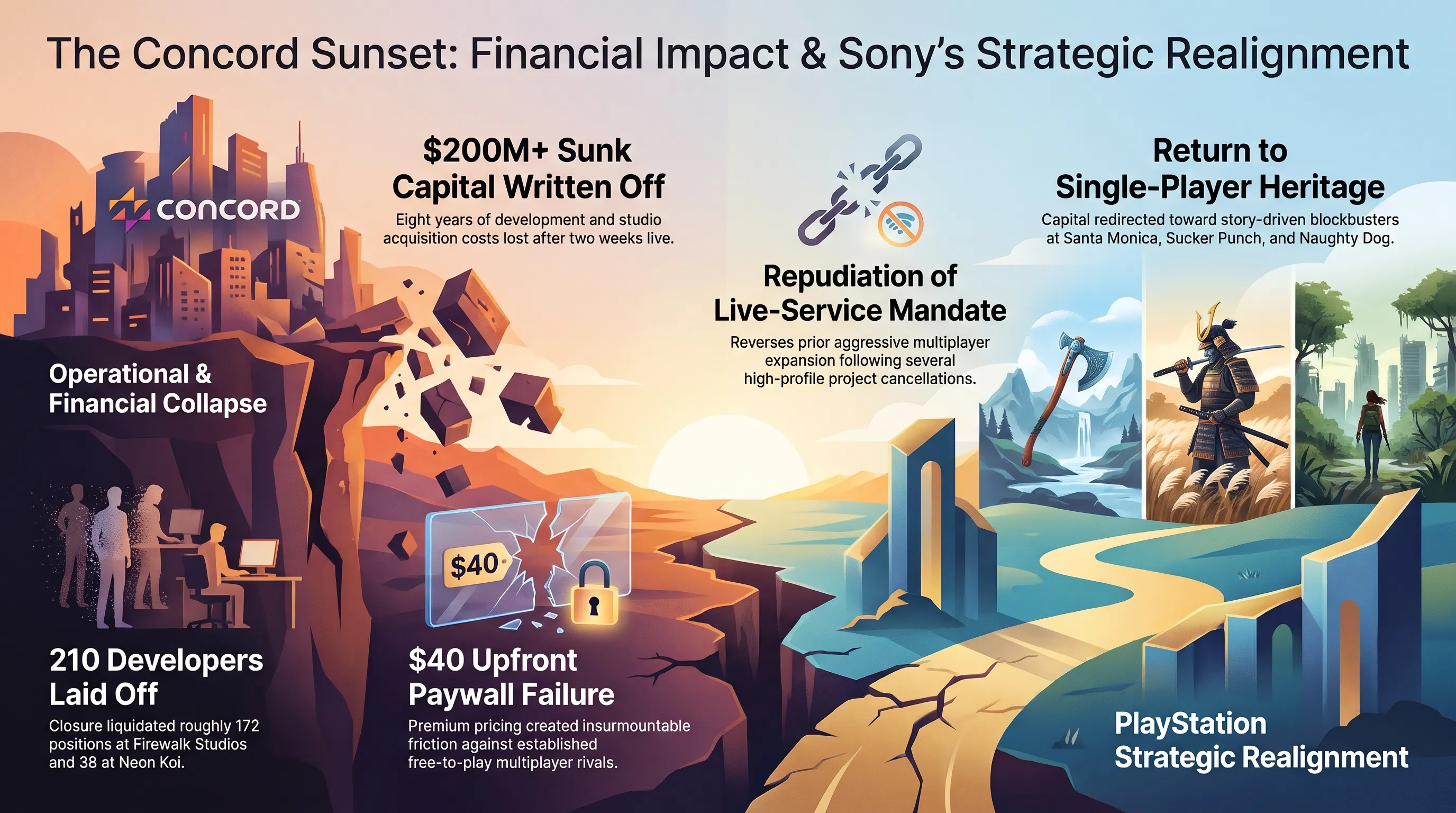
The corporate reckoning surrounding Sony Interactive Entertainment's (SIE) live-service expansion reached its definitive climax on the evening of October 30, 2026. In an internal memorandum distributed to global staff, Hermen Hulst, CEO of Studio Business Group at Sony, confirmed the immediate and permanent closure of Bellevue-based Firewalk Studios alongside mobile development outfit Neon Koi (formerly Savage Game Studios). The decision definitively sunsets the 5v5 hero shooter Concord a project that consumed over eight years of development, approximately $200 million in total production and studio acquisition expenditures, and survived barely two weeks on commercial storefronts before its servers were abruptly pulled offline in September.
The dual studio liquidation results in approximately 210 developers losing their employment (roughly 172 at Firewalk and 38 at Neon Koi). While Sony pledged to absorb select personnel into internal teams such as Bungie and Insomniac Games, the vast majority of staff face an increasingly hostile tech job market. The move marks an aggressive intervention orchestrated by Sony Group Corporation President and COO Hiroki Totoki, who has instituted stringent fiscal discipline across the PlayStation division. Hulst candidly conceded that Concord failed to secure an addressable audience in a saturated multiplayer marketplace dominated by free-to-play incumbents like Valorant and Overwatch 2, validating industry criticism that an upfront $40 paywall represented an insurmountable barrier to adoption.
Wall Street analysts and equity researchers have categorized the shutdown as a necessary surgical triage. Following the prior cancellation of Naughty Dog's standalone The Last of Us multiplayer project and the aggressive scaling back of six other unannounced live-service endeavors, PlayStation Studios has fundamentally repudiated the aggressive live-service pivot initiated under former CEO Jim Ryan. The remaining weight of Sony's multiplayer ambitions now falls almost entirely upon Bungie's upcoming extraction shooter Marathon, which itself remains under intense scrutiny to deliver commercial viability.
The strategic lesson reverberating across gaming conglomerates is unambiguous: institutional scale and multi-hundred-million-dollar marketing budgets cannot manufacture organic community enthusiasm for formulaic multiplayer templates. Moving forward, PlayStation Studios is redirecting its capital reserves toward prestige narrative tentpoles, accelerating development pipelines at Santa Monica Studio, Sucker Punch Productions (Ghost of Yotei), and Naughty Dog.
The collapse of Concord is not an isolated casualty, but part of a systemic industry-wide reckoning. Over the past twenty-four months, major Western publishers have suffered staggering financial impairments attempting to chase Fortnite-style live-service recurring revenues: Warner Bros. Discovery absorbed an estimated $200 million loss on Suicide Squad: Kill the Justice League, Square Enix shuttered Babylon's Fall, and Ubisoft has repeatedly restructured its multiplayer roadmap following the rapid decline of xDefiant. PlayStation's decisive termination of Firewalk reflects a growing consensus among institutional investors that the era of speculative multi-hundred-million-dollar live-service experimentation has reached an absolute structural dead end.
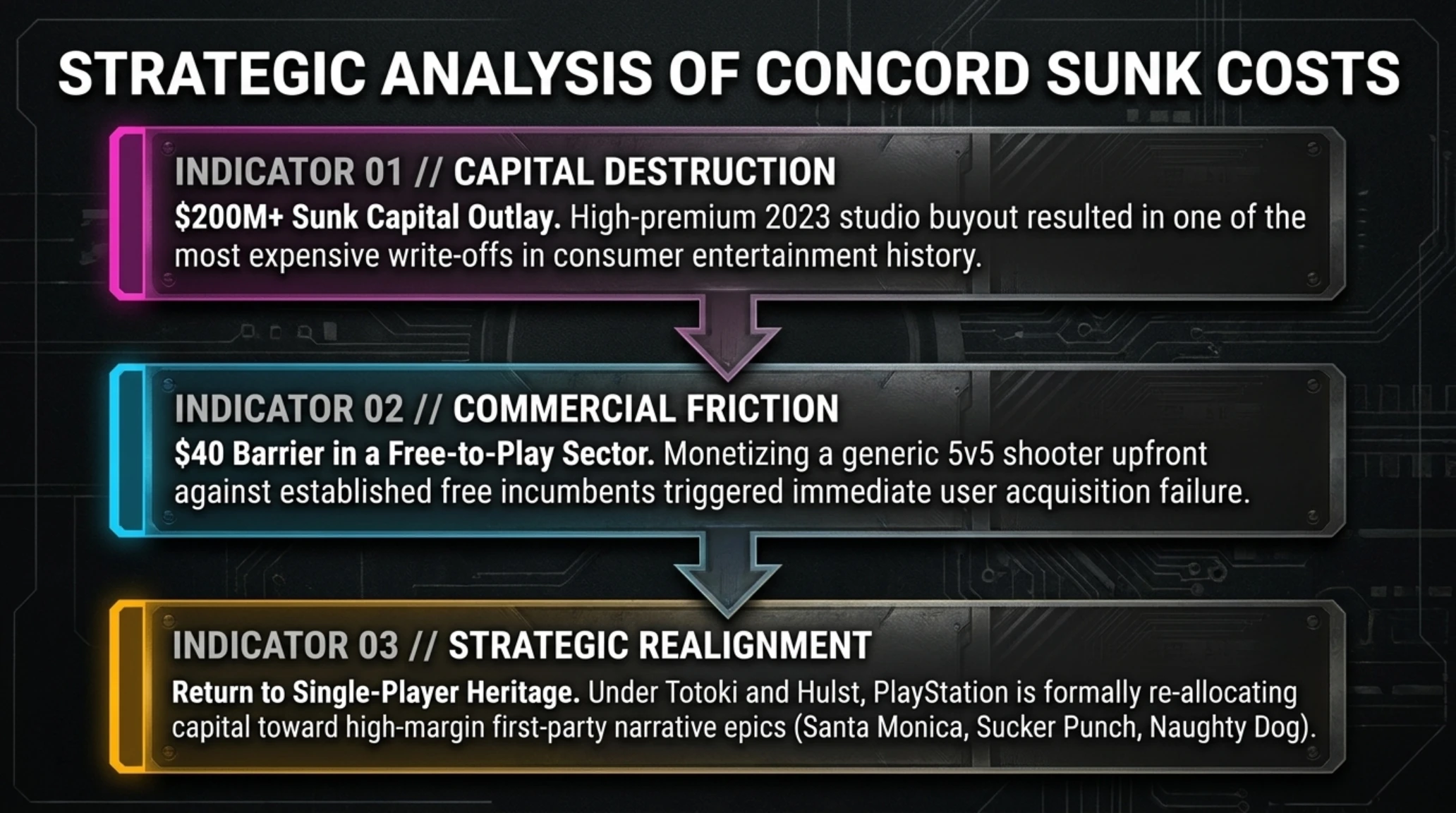
Why It Matters Strategic Analysis of Concord Sunk Costs
$200M+ Sunk Capital Outlay
An eight-year development runway combined with high-premium 2023 studio buyout resulted in one of the most expensive write-offs in consumer entertainment history.
$40 Barrier in a Free-to-Play Sector
Attempting to monetize a generic 5v5 shooter upfront against established free incumbents triggered immediate user acquisition failure.
Return to Single-Player Heritage
Under Totoki and Hulst, PlayStation is formally re-allocating capital toward high-margin first-party narrative epics that drive console ecosystem lock-in.
The shuttering of Firewalk serves as an indelible case study for modern entertainment conglomerates: forcing creative talent into pre-calculated corporate live-service frameworks without distinct mechanical identity invariably culminates in catastrophic capital impairment.
Market Speculation vs. Official Corporate Reality
Widespread speculation asserted that Sony pulled Concord offline merely to re-engineer its progression loops and re-release the title as a Free-to-Play experience in early 2027.
Hermen Hulst's corporate memorandum unequivocally confirmed the complete and irrevocable termination of Concord, with all related infrastructure dismantled and the studio dissolved.
As Sony closes the chapter on its most chastening live-service experiment, market dynamics pivot dramatically to celebrate the triumphant endurance of timeless, story-driven game design on modern computing hardware.
This seismic executive decision sets the stage for an extraordinary contrast in commercial fortune, as Rockstar Games demonstrates how an uncompromising commitment to narrative world-building can generate multi-decade economic returns.
Axis 02 The 14-Year PC Odyssey Fulfilled: Rockstar Games Officially Launches Red Dead Redemption with Native 4K and DLSS 3.7
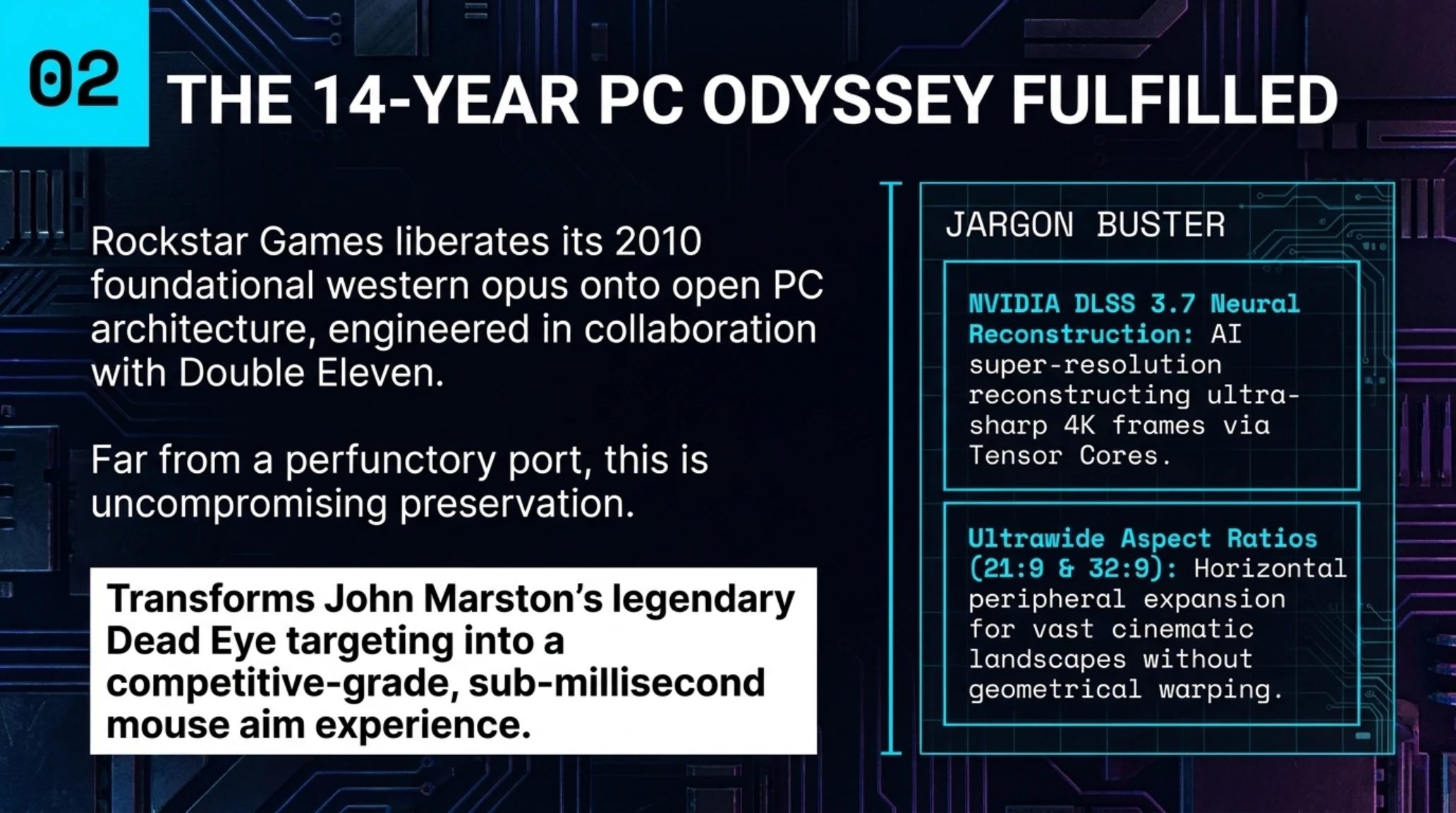
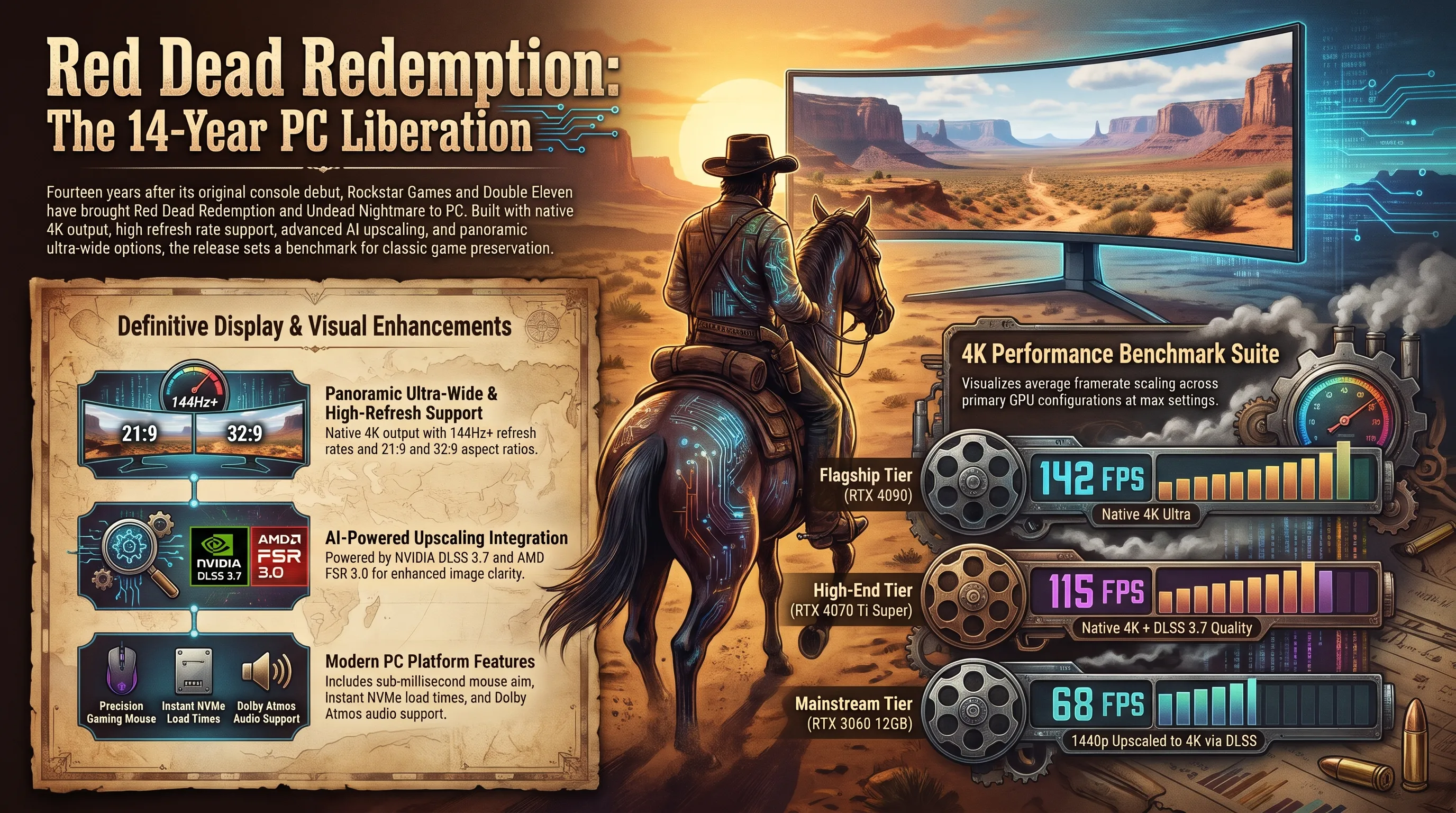
Following a grueling fourteen-year hiatus since its initial console debut in May 2010, Rockstar Games has officially liberated its foundational western opus, Red Dead Redemption, along with its acclaimed supernatural companion expansion, Undead Nightmare, onto the PC platform. Published across Steam, the Epic Games Store, and the proprietary Rockstar Games Launcher, this modernized release was developed in direct collaboration with veteran British studio Double Eleven. Far from a perfunctory legacy port, the release represents a meticulously optimized PC conversion engineered to exploit contemporary high-end gaming hardware while delivering uncompromising preservation of the original seventh-generation masterpiece.
The PC edition delivers comprehensive native 4K resolution support with uncapped refresh rates extending to 144Hz and beyond. Beyond accommodating expansive panoramic ultrawide (21:9) and super ultrawide (32:9) aspect ratios, the conversion incorporates an expansive graphic options menu: extended shadow cascade distances, contact-hardening ambient occlusion, adjustable anisotropic filtering, and granular draw-distance multipliers that render the sweeping vistas of New Austin and Nuevo Paraiso with razor-sharp clarity. The integration of modern AI reconstruction suites, specifically NVIDIA DLSS 3.7 and AMD FSR 3.0, guarantees exceptional frame pacing and image clarity across diverse hardware configurations, from desktop flagships down to handheld gaming PCs.
While the initial $49.99 pricing tier for a fourteen-year-old title sparked fervent debate across enthusiast forums, independent technical benchmarking conducted by Digital Foundry and Eurogamer reveals exemplary performance metrics. With near-instantaneous NVMe load times, responsive native mouse-and-keyboard precision, and flawless 120+ FPS stability, the PC conversion sets a premier standard for classic game preservation in the modern era.
Furthermore, the arrival of Red Dead Redemption on an open PC architecture has ignited widespread enthusiasm across the global modding community. Within hours of launch, community developers released high-resolution texture replacement packs, post-processing shader injectors, and experimental first-person camera mods across GitHub and Nexus Mods. Combined with native support for Dolby Atmos spatial audio, players can experience the chilling nighttime howls of wolves in Tall Trees and echoing revolver fire across sandstone canyons with unprecedented acoustic immersion.
Jargon Buster PC Gaming Hardware & Rendering Architecture
AI Super-Resolution & Optical Flow
Nvidia's deep learning model that samples lower-resolution inputs and reconstructs ultra-sharp 4K frames using Tensor Cores, substantially elevating framerates without visual degradation.
Horizontal Peripheral Expansion
Display standards that dramatically widen the horizontal field of view without geometrical warping, delivering an expansive cinematic perspective across vast open landscapes.
Comprehensive testing demonstrates that the combination of high-refresh framerates and sub-millisecond mouse aim transforms John Marston's legendary Dead Eye targeting mechanic into an impeccably responsive competitive-grade shooting experience.
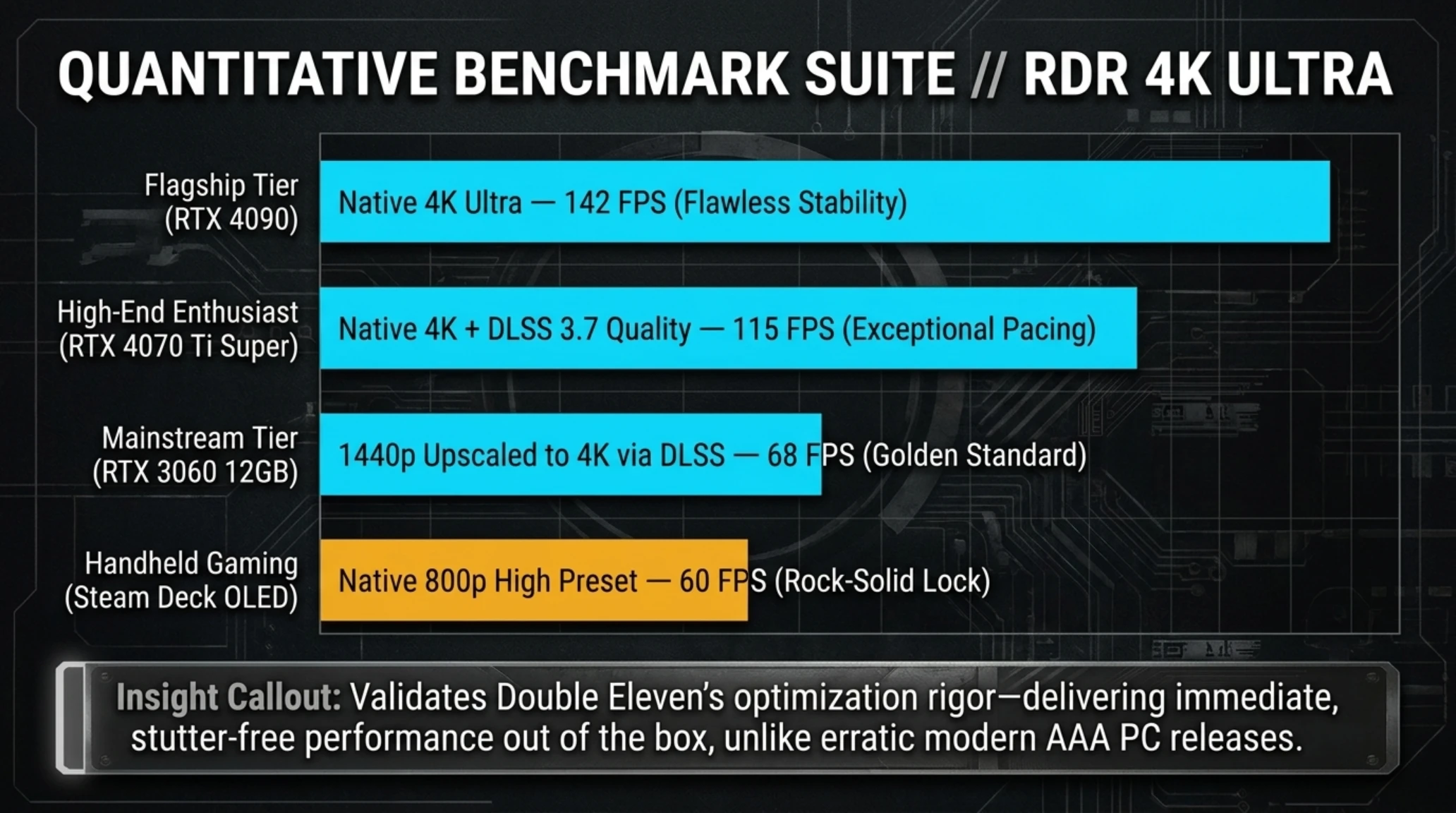
Quantitative Benchmark Suite Red Dead Redemption PC 4K Ultra Performance
Framerate Scaling Across GPU Tiers in 4K Max Settings (Higher is Superior)
| Hardware Benchmark Configuration | Target Resolution & Upscaling | Average Framerate (FPS) | 1% Percentile Lows (FPS) |
|---|---|---|---|
| Flagship Tier (RTX 4090 + Core i9-14900K) | Native 4K (3840x2160) Ultra | 142 FPS (Flawless Stability) | 118 FPS |
| High-End Enthusiast (RTX 4070 Ti Super) | Native 4K + DLSS 3.7 Quality | 115 FPS (Exceptional Pacing) | 94 FPS |
| Mainstream Tier (RTX 3060 12GB VRAM) | 1440p Upscaled to 4K via DLSS | 68 FPS (Golden Standard) | 55 FPS |
| Handheld Gaming (Steam Deck OLED) | Native 800p High Preset | 60 FPS (Rock-Solid Lock) | 51 FPS |
The benchmarking data validates Double Eleven's optimization rigor: unlike erratic PC releases that have plagued modern AAA launches, Red Dead Redemption delivers immediate, stutter-free performance straight out of the box.
The widescreen visual fidelity of the frontier wilderness underscores how modern GPU architectures can breathe magnificent life into historical gaming milestones.
For an exhaustive frame-by-frame latency analysis and graphical comparison between legacy console footage and the new PC build, review the technical teardown embedded below.
While software preservation thrives on open computing platforms, console hardware manufacturers are tapping into the profound emotional resonance of classic technology through inspired industrial design.
Axis 03 Nostalgic Industrial Design Revival: Sony Unveils the Translucent 'Prism Collection' DualSense and PS5 Covers
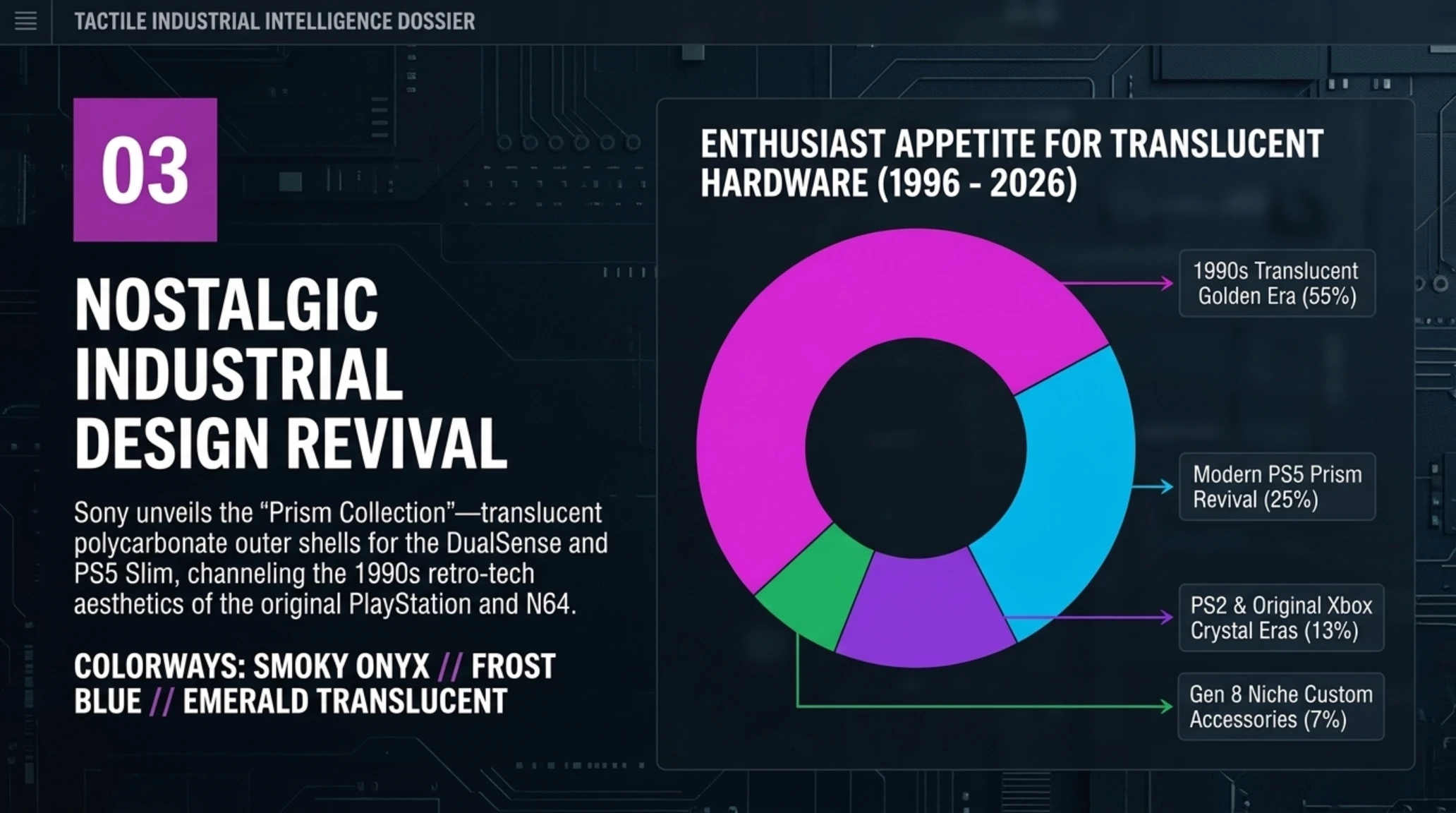
In a masterful convergence of contemporary engineering and 1990s retro-tech aesthetics, Sony Interactive Entertainment officially unveiled the 'Prism Collection' a premium hardware accessories lineup featuring translucent outer shells for the DualSense wireless controller and matching console covers for the PlayStation 5 Slim. Available in three captivating colorways Smoky Onyx, Frost Blue, and Emerald Translucent the collection deliberately channels the iconic transparent electronics craze popularized by the original PlayStation, Game Boy Color, and translucent Nintendo 64 consoles.
Constructed from high-density, scratch-resistant polycarbonate, the Prism shells grant players an intimate view into the DualSense's sophisticated internal mechatronics. The dual voice-coil linear actuators responsible for haptic feedback, the motorized gearing systems driving the adaptive triggers, internal antenna arrays, and multi-layered circuit boards are visible beneath a polished, semi-translucent veneer. When coupled with the internal light bars of the PS5 Slim, the matching console covers produce a diffuse, ambient glow that transforms the console from an austere white chassis into an arresting piece of nostalgic industrial art.
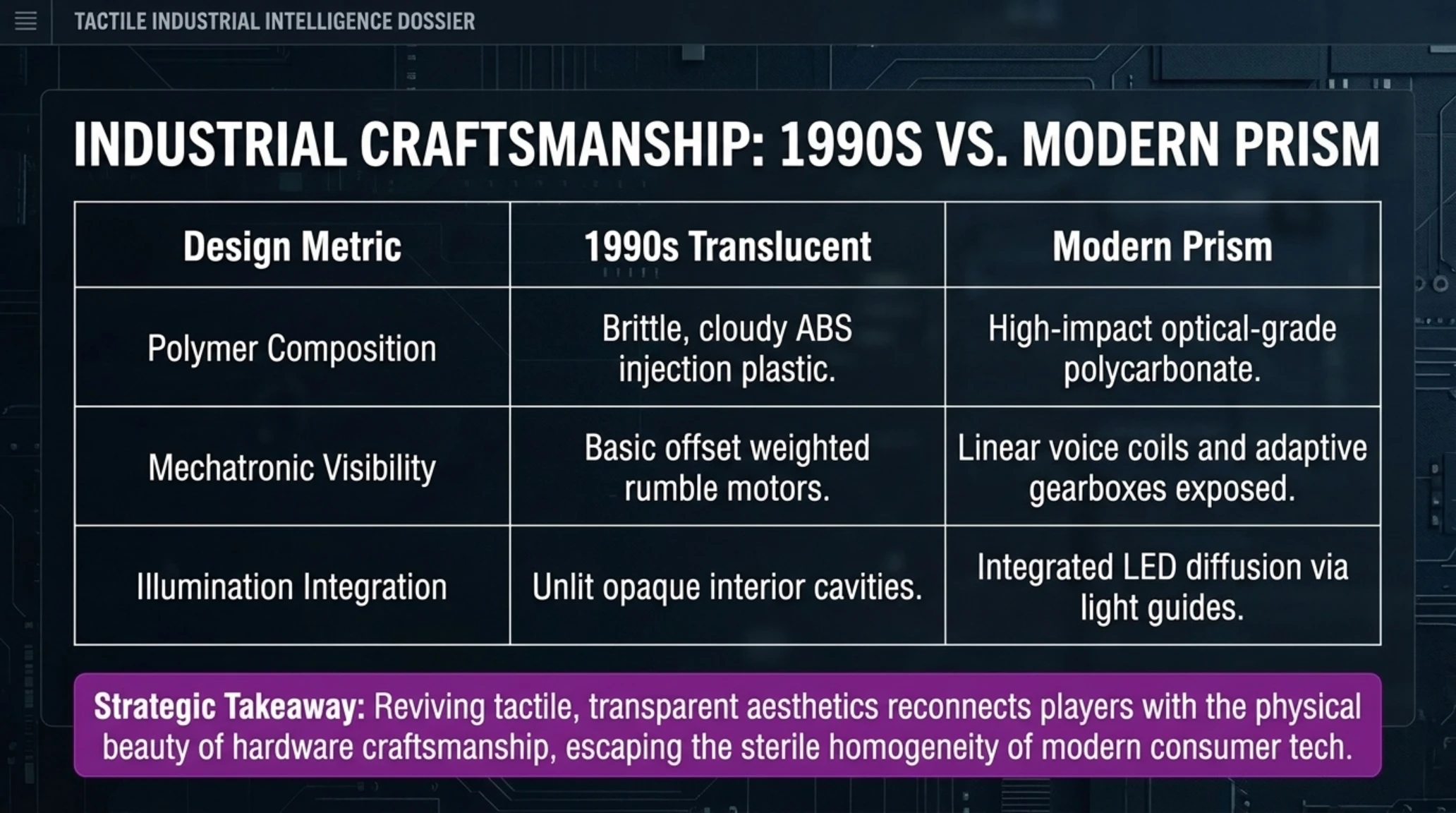
Slated to launch globally in early November with MSRPs set at $84.99 for controllers and $64.99 for console covers, the Prism Collection generated record pre-order engagement within hours of announcement. Industrial design analysts have praised the initiative, noting that modern consumer tech has grown sterile and homogenous; reviving tactile, transparent aesthetics reconnects players with the physical beauty of hardware craftsmanship.
Retro Aesthetic Telemetry Historical Consumer Preference for Transparent Tech
Enthusiast Appetite for Translucent Hardware Forms (1996 - 2026 Telemetry)
| Hardware Design Metric | 1990s Translucent Legacy Hardware | Sony PS5 DualSense Prism Collection | Performance & Durability Assessment |
|---|---|---|---|
| Polymer Composition & Rigidity | Brittle, cloudy ABS injection plastic | High-impact optical-grade polycarbonate | Superior resistance to stress cracks and sweat |
| Internal Mechatronic Visibility | Basic offset weighted rumble motors | Linear voice coils and adaptive gearboxes | Exquisite exhibition of micro-engineering |
| Illumination Integration | Unlit opaque interior cavities | Integrated LED diffusion via light guides | Luminous aesthetic in low-light environments |
| Market Positioning & Pricing | Budget mass-market peripheral | Premium limited collector's series | High collectibility and rapid pre-order sellout |
📚 Classified & Related Dossiers in TekinGame
If you wish to explore beyond this report and delve into cybernetic frontiers and autonomous AI architectures, do not miss these three exclusive deep-dives in the Tekin Garage:
The runaway enthusiasm greeting the Prism Collection demonstrates that gamers cherish tactile transparency, craving hardware that proudly celebrates its internal complexity rather than concealing it behind monochrome plastic.
Close-up inspection of the Emerald Translucent DualSense controller highlights the exquisite juxtaposition of cutting-edge force feedback motors and nostalgic 90s aesthetic styling.
Axis 04 Open-World Architectural Paradigm Shift: Rockstar Confirms GTA 6 Map Unlocks Early Without Narrative Gates
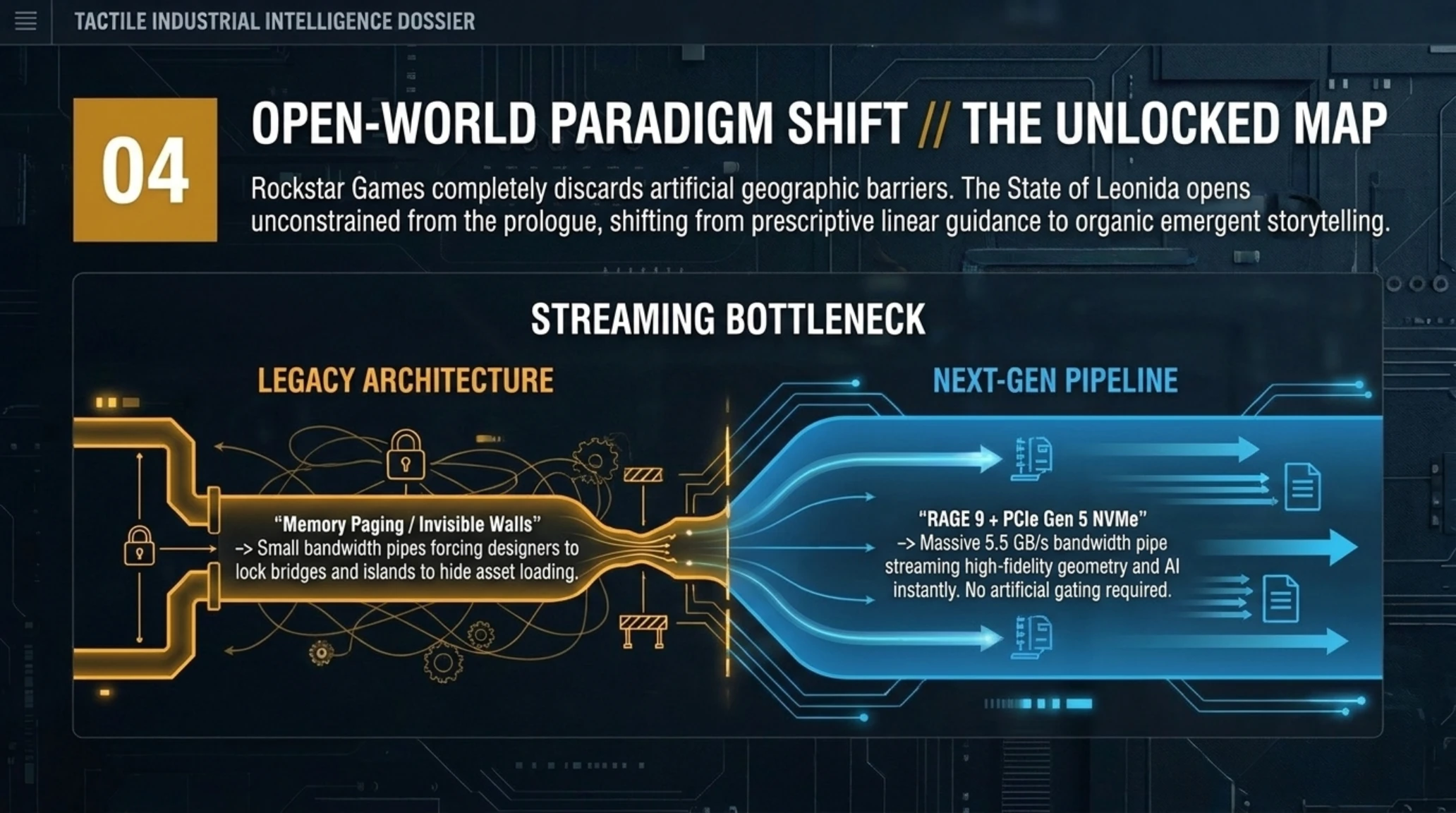
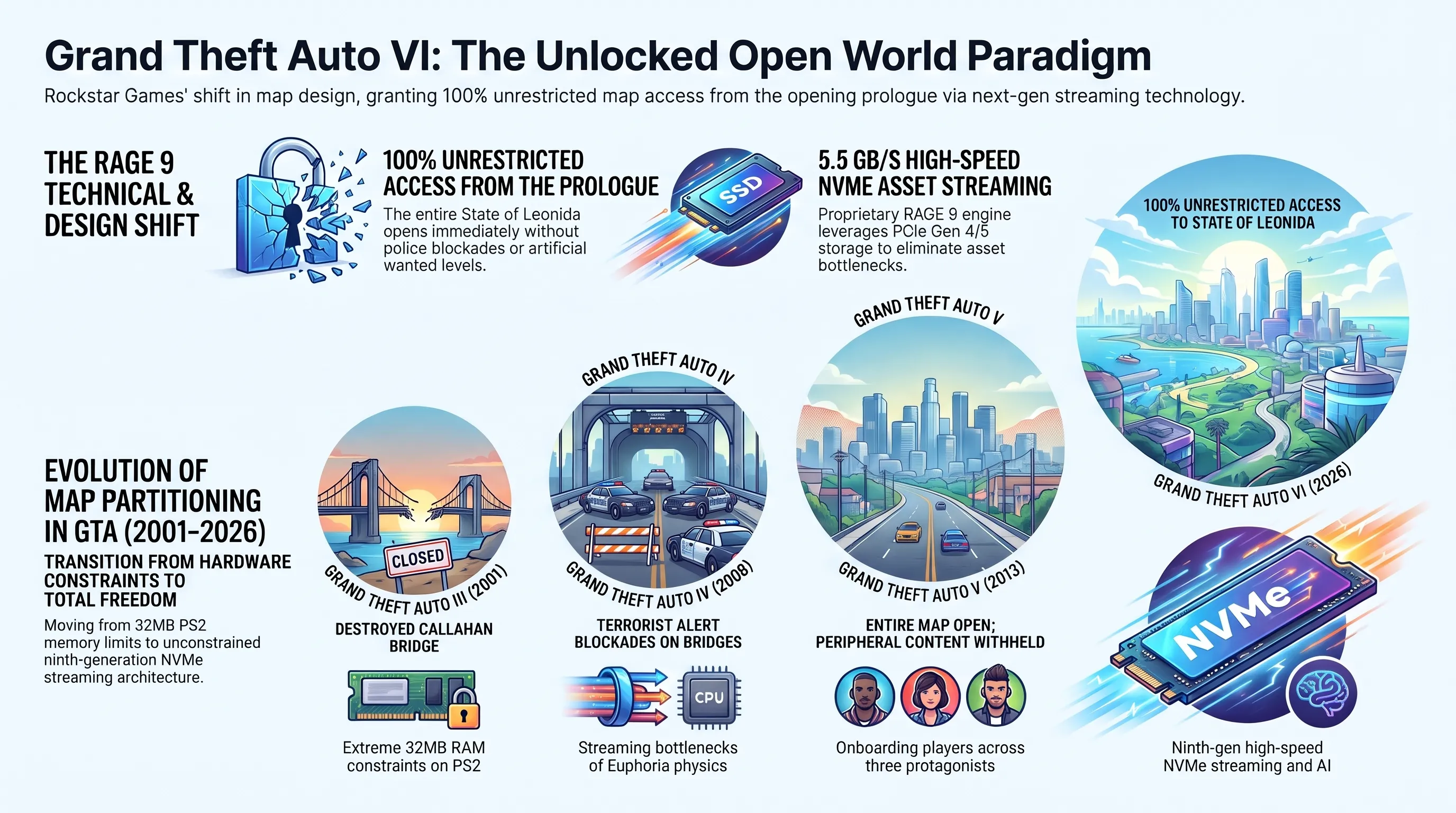
In a profound departure from decades of established open-world design conventions, Rockstar Games developers officially confirmed during technical media briefings that Grand Theft Auto VI will completely discard artificial geographic barriers. Unlike classic iterations in the franchise that imprisoned players behind police blockades, broken bridges, or hurricane warnings, the sprawling State of Leonida encompassing the neon metropolis of Vice City, the tangled waterways of Grassrivers, and the remote northern territories will open for unconstrained exploration immediately following the completion of the introductory narrative prologue.
This structural evolution marks Rockstar's transition from prescriptive linear guidance toward organic emergent storytelling. The engineering density of Leonida is unprecedented: complex ecosystem simulations, autonomous civilian AI routines, responsive wildlife behaviors, and thousands of interior spaces coalesce into a self-sustaining virtual society. Developers revealed that the world is so dynamically unpredictable that senior designers conducting playthroughs frequently encounter unscripted emergent events and environmental micro-narratives that were never formally coded into the mission design documents.
From an architectural standpoint, the elimination of map barriers is made possible by the custom asset streaming pipeline of the proprietary RAGE (Rockstar Advanced Game Engine) version 9. By leveraging the ultra-high bandwidth of ninth-generation PCIe Gen 4 and Gen 5 NVMe solid-state storage, RAGE dynamically streams high-fidelity geometry, volumetric lighting fields, and complex crowd behaviors at over 5.5 gigabytes per second. This eliminates legacy streaming bottlenecks that historically forced designers to keep players confined while high-resolution district assets were paged into system memory.
By eliminating invisible barriers and artificial wanted-level triggers, Rockstar empowers players to author their own journey with Lucia and Jason from the opening hours, establishing a new gold standard for player agency in ninth-generation interactive entertainment.
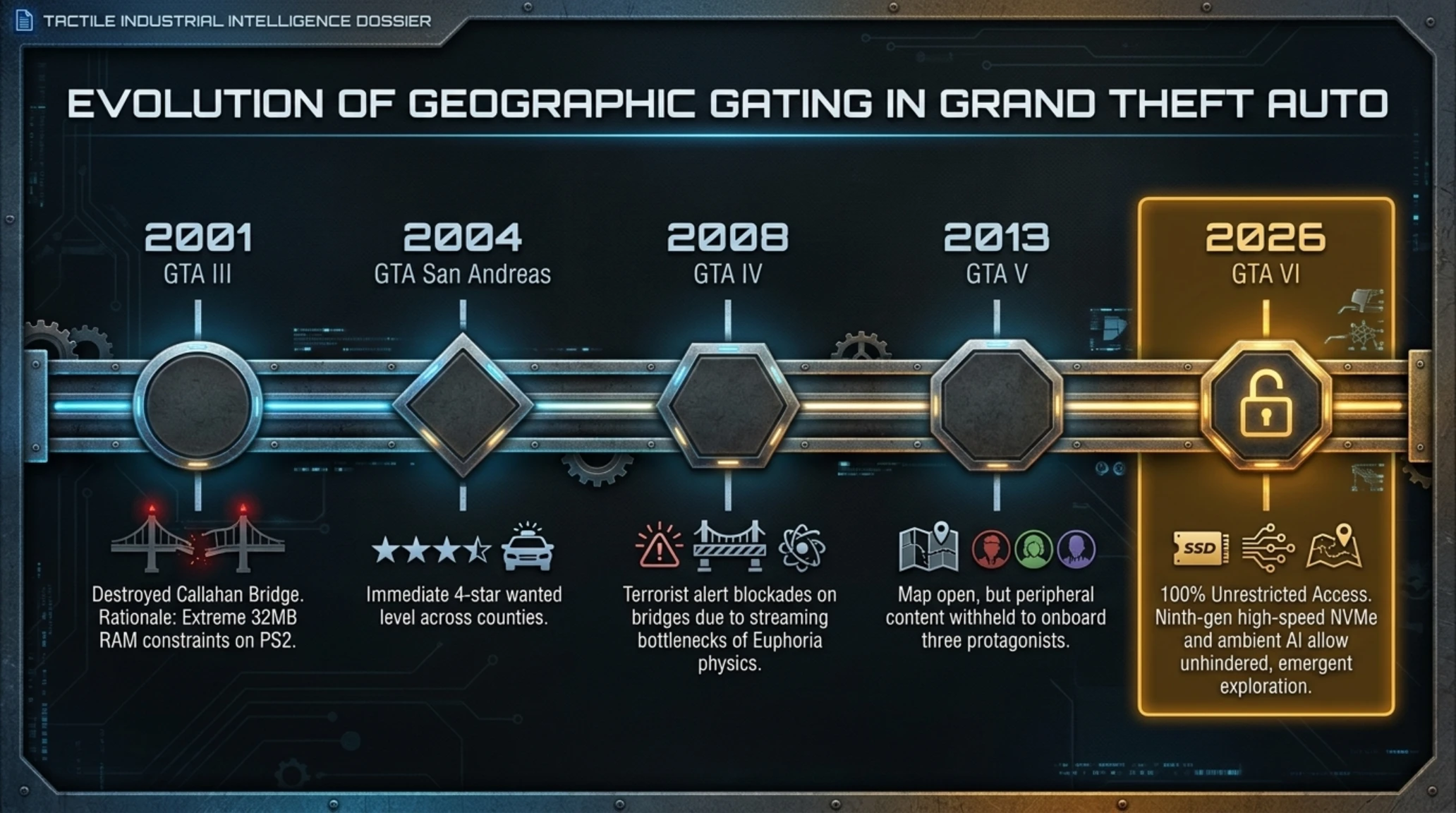
Timeline Table Evolution of Open-World Partitioning in the GTA Franchise
| Franchise Title & Generation | Geographic Gating Mechanism | Technical & Narrative Rationale | Player Exploration Philosophy |
|---|---|---|---|
| Grand Theft Auto III (2001) | Destroyed Callahan Bridge to Staunton | Extreme 32MB RAM constraints on PS2 | Enforced linear progression through islands |
| GTA: San Andreas (2004) | Immediate 4-star wanted level across counties | Narrative emphasis on local gang territory | Gradual, structured regional revelation |
| Grand Theft Auto IV (2008) | Terrorist alert blockades on bridges | Streaming bottlenecks of Euphoria physics | Step-by-step urban immersion in Liberty City |
| Grand Theft Auto V (2013) | Entire map open, but peripheral content withheld | Onboarding player to three protagonists | Gradual introduction to heist mechanics |
| Grand Theft Auto VI (2026) | 100% Unrestricted Access to State of Leonida | Ninth-gen high-speed NVMe streaming & AI | Unrestricted, non-linear emergent exploration |
This unrestricted architectural freedom underscores Rockstar's supreme confidence in its underlying ambient world simulation, ensuring every square mile of Leonida offers rewarding gameplay independent of main storyline progression.
Visual previews of Vice City's sun-drenched coastlines and murky wetland bayous illustrate how volumetric weather and autonomous wildlife render free exploration breathtakingly immersive.
Axis 05 Uncompromising Realism: Next Mass Effect Reaffirms Mature Sci-Fi Tone and Unreal Engine 5 Photorealism
Following the public debut of Dragon Age: The Veilguard and subsequent polarized discourse regarding its vibrant, stylized art direction, acute anxieties surfaced across the global role-playing community regarding the creative trajectory of the next Mass Effect installment (Mass Effect 5). Those concerns were decisively put to rest on October 30, 2026, through an unequivocal public declaration by BioWare executive producer and project director Michael Gamble.
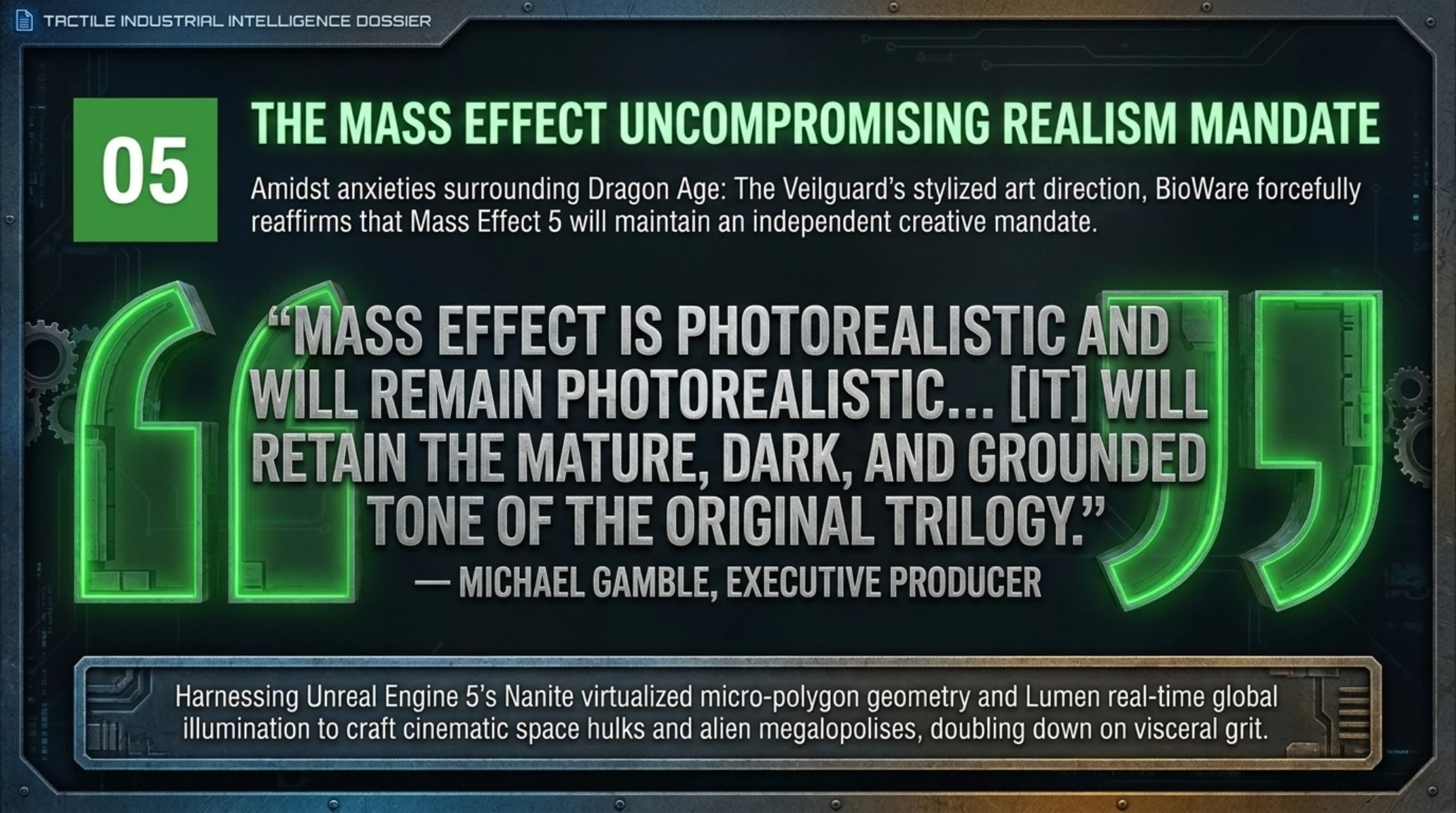
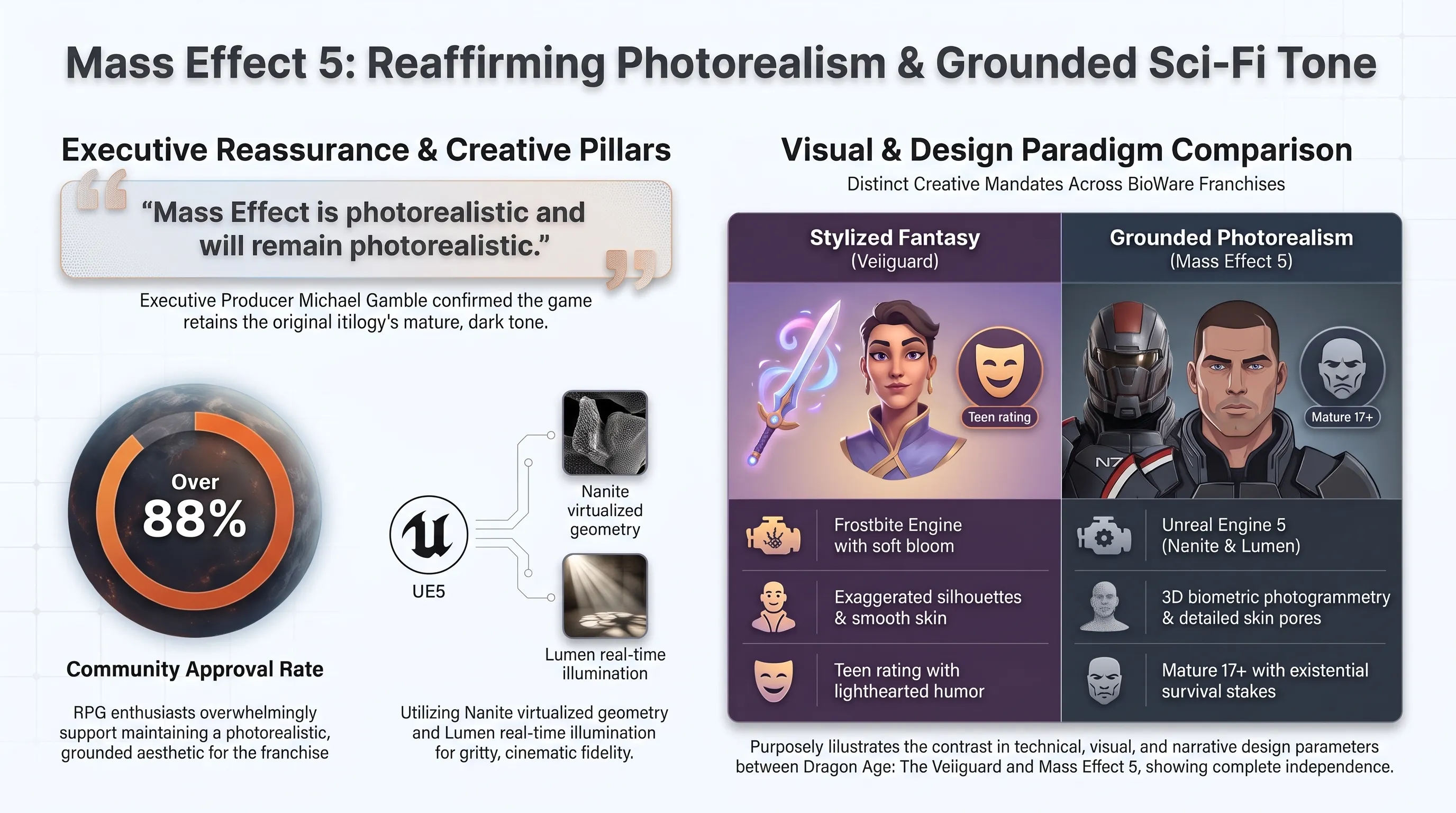
Responding directly to community inquiries on X (formerly Twitter), Gamble forcefully reaffirmed: "Mass Effect is photorealistic and will remain photorealistic for as long as I am running it. In terms of tone, Mass Effect will retain the mature, dark, and grounded tone of the original trilogy." This unambiguous commitment was met with widespread acclaim from veteran enthusiasts, confirming that the Mass Effect team operates under a distinct creative mandate completely independent of Dragon Age, channeling the full graphical power of Epic Games' Unreal Engine 5.
By harnessing UE5's groundbreaking Nanite virtualized micro-polygon geometry and Lumen real-time global illumination, BioWare is crafting abandoned space hulks, Reaper war zones, and alien megalopolises with cinematic fidelity. Rather than pursuing ephemeral cartoon aesthetics, the studio is doubling down on visceral grit, granular skin shaders, scarred combat armor, and high-stakes moral dilemmas that made the original Shepard saga a genre-defining triumph.
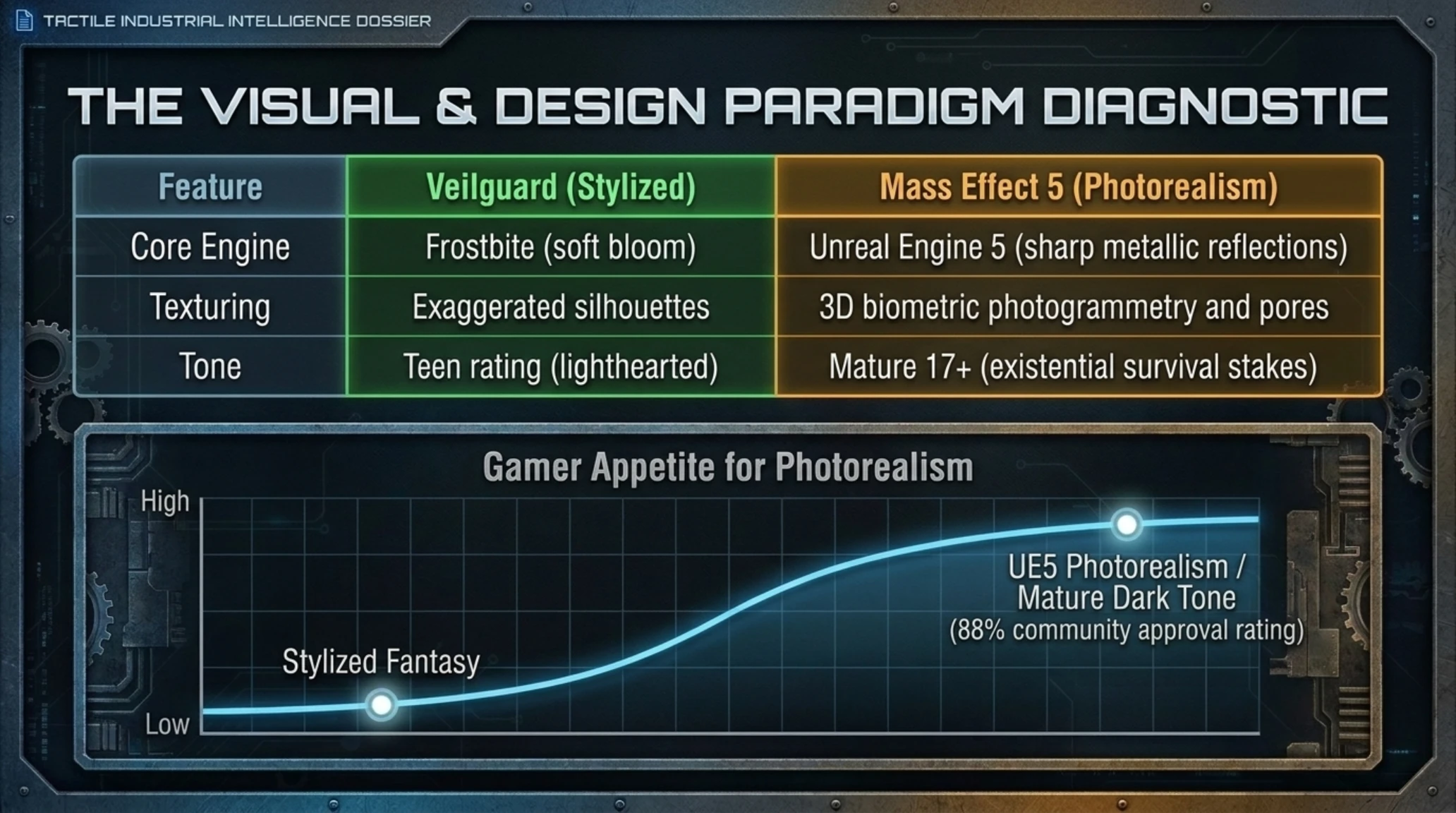
Sci-Fi RPG Market Sentiment Consumer Preference S-Curve for Visual Realism
Gamer Appetite for Photorealism in Space Opera RPGs (October 2026 Telemetry)
| Visual & Design Paradigm | Stylized Fantasy Aesthetic (Veilguard) | Grounded Photorealism (Mass Effect 5) | Strategic Franchise Impact |
|---|---|---|---|
| Core Engine & Shading Pipeline | Frostbite Engine with soft bloom | Unreal Engine 5 Nanite & Lumen | Razor-sharp metallic reflections and harsh shadows |
| Character Design & Texturing | Exaggerated silhouettes and smooth skin | 3D biometric photogrammetry and pores | Visceral visual representation of combat fatigue |
| Narrative Age Rating & Tone | Teen rating with lighthearted humor | Mature 17+ with existential survival stakes | Restoration of weighty, permanent moral consequences |
| Community Acceptance Rating | Polarized audience reception | Over 88% approval of Gamble's statement | Re-anchoring BioWare as premier mature sci-fi developer |
Gamble's commitment proves that premier role-playing studios are recognizing the vital necessity of preserving unique franchise identities, refusing to homogenize disparate intellectual properties under uniform corporate art styles.
Concept art depicting the battered visor of an N7 operative against a ruined cosmic skyline demonstrates Unreal Engine 5's unmatched capability to evoke poignant, mature sci-fi atmosphere.
Axis 06 The Tokyo Courtroom Confrontation: Pocketpair Prepares Palworld for Nintendo Switch 2 Despite Patent Lawsuit
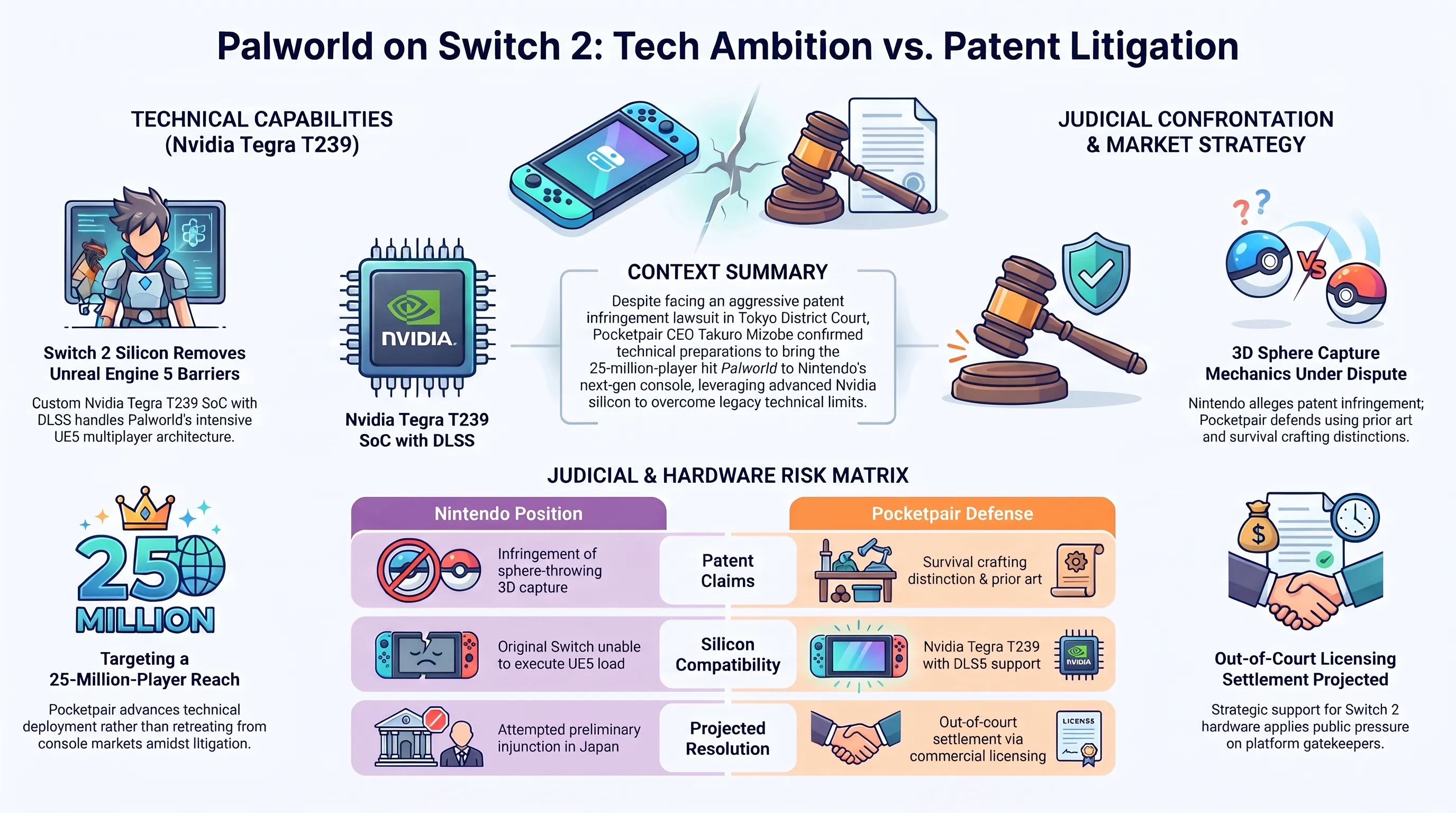
In the final major development of this evening's briefing, Japanese independent studio Pocketpair ignited industry-wide headlines following an exclusive interview published by Video Games Chronicle (VGC). Takuro Mizobe, CEO of Pocketpair, officially revealed that despite an aggressive patent infringement lawsuit filed in Tokyo District Court by Nintendo Co., Ltd. and The Pokemon Company, the studio is actively advancing technical preparations to port its viral monster-taming survival sensation, Palworld, to the unannounced Nintendo Switch 2.
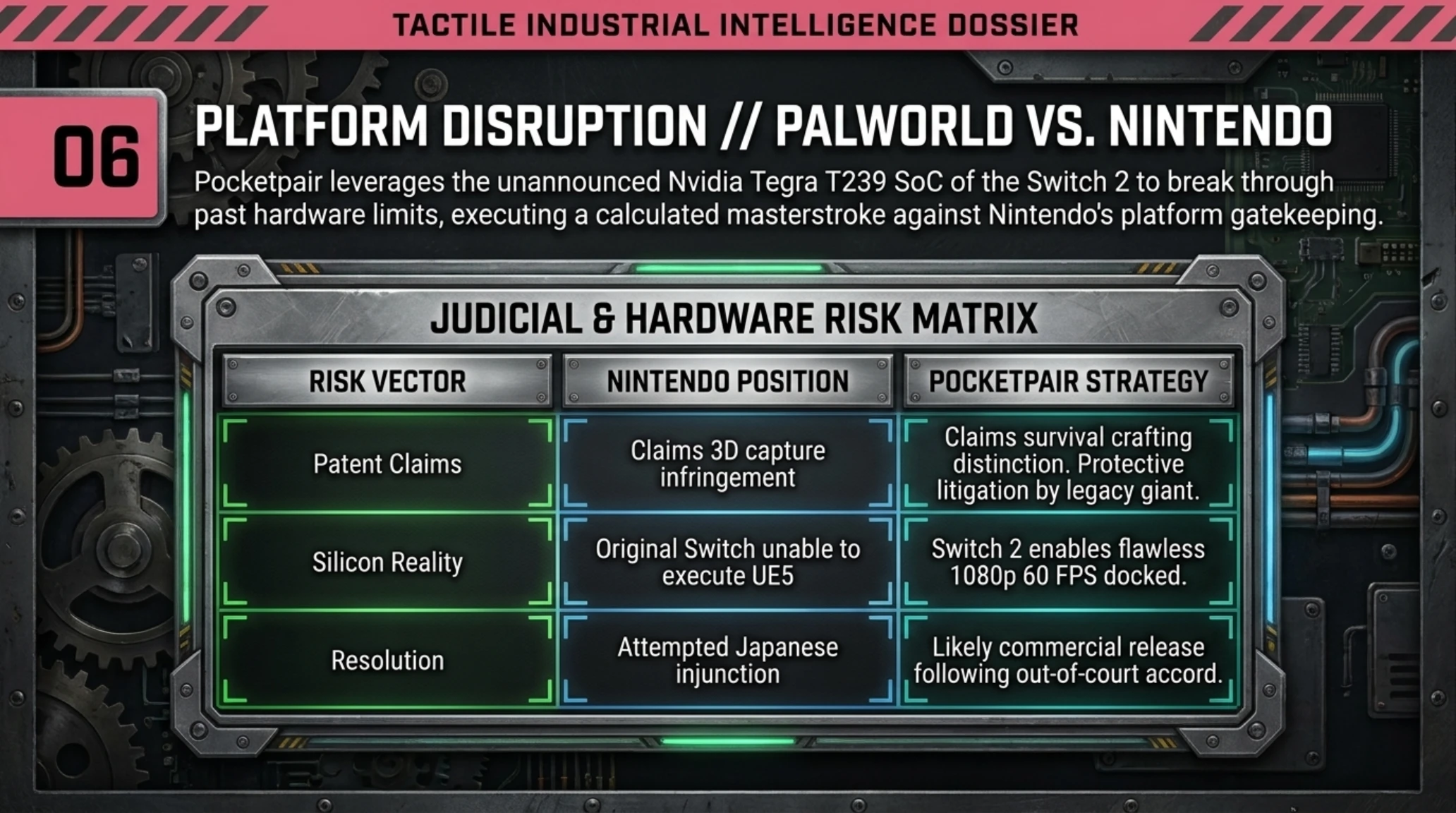
Mizobe lauded the next-generation Nintendo console as an "exceptional and transformative hardware platform" for independent developers, noting that while the severely aged mobile silicon of the original 2017 Switch could never run Palworld's intensive Unreal Engine 5 multiplayer architecture, the substantial architectural leap afforded by the Switch 2's custom Nvidia Tegra T239 SoC removes all prohibitive technical barriers. While Nintendo seeks court injunctions targeting gameplay mechanics such as throwing capture spheres in 3D space, Pocketpair's confident stance demonstrates that the 25-million-player sensation refuses to be intimidated out of the console market.
Industry legal analysts interpret Mizobe's public overture as a calculated masterstroke: by expressing enthusiastic support for Nintendo's upcoming hardware, Pocketpair applies public pressure on platform gatekeepers, framing Nintendo's litigation as an anti-competitive maneuver designed to deny its own player base access to a global gaming phenomenon.
Judicial & Hardware Risk Matrix Palworld Deployment on Nintendo Switch 2
| Evaluation Dimension | Nintendo & The Pokemon Company Position | Pocketpair (Palworld) Legal Defense | Tekin Gaming Strategic Analysis |
|---|---|---|---|
| Patent Claims in Tokyo Court | Infringement of sphere-throwing 3D capture patents | Survival crafting distinction & prior art | Protective litigation to delay rival franchise |
| Silicon Compatibility Vector | Original Switch unable to execute UE5 load | Nvidia Tegra T239 with DLSS support | Flawless 1080p 60 FPS docked feasibility |
| Multiplayer Network Architecture | Strict proprietary Nintendo Network restrictions | Cross-play server infrastructure established | Seamless integration with next-gen eShop |
| Probable Resolution Outcome | Attempted preliminary injunction in Japan | Settlement through commercial licensing | Commercial release following out-of-court accord |
For an in-depth legal breakdown of the specific patents contested in Tokyo District Court and their implications for future indie creature-collection titles, watch the comprehensive legal analysis linked below.
This high-stakes David-versus-Goliath struggle illustrates how hardware generational transitions inevitably disrupt platform monopolies, compelling legacy giants to adapt to agile competitors.
The collective trajectory of these six pivotal stories provides a comprehensive panorama of the interactive entertainment industry in late 2026, transitioning our analysis into an overarching executive synthesis.
Axis 07 The 2027 Interactive Horizon: The Live-Service Reckoning, Single-Player Renaissance, and Platform Hardware Convergence
A rigorous macro synthesis of this evening's developments demonstrates that the interactive entertainment industry is undergoing a painful but immensely rejuvenating realignment toward sustainable commercial foundations. In the first vector, the liquidation of Firewalk Studios and the permanent cancellation of Concord signal the unequivocal death of the 'manufactured live-service' corporate fantasy. Deploying hundreds of millions of dollars into formulaic multiplayer arenas without intrinsic mechanical distinction or passionate player advocacy is no longer viable. This painful write-off will accelerate the reallocation of corporate capital reserves toward immersive, auteur-driven single-player blockbusters that build enduring generational franchise equity.
In the second vector, the resounding commercial and critical triumph of Red Dead Redemption's arrival on PC after fourteen years reaffirms that authentic storytelling, meticulously authored characters, and evocative historical world-building possess timeless commercial longevity. Enhanced with 4K native rendering, DLSS 3.7 frame pacing, and panoramic ultrawide support, the title bridges the seventh and ninth console generations with effortless grace. Concurrently, the passionate consumer response greeting Sony's translucent Prism Collection proves that physical hardware aesthetics, when anchored in beloved retro heritage, command immense collector devotion in an increasingly ephemeral digital ecosystem.
In the third vector, Rockstar's radical commitment to unhindered exploration in Grand Theft Auto VI and BioWare's resolute defense of mature photorealism in Mass Effect 5 establish the technical standards of the impending 2027 fiscal cycle. Armed with next-generation solid-state streaming and Unreal Engine 5's revolutionary lighting paradigms, game creators are discarding artificial barriers in favor of living, organic simulation. The future of interactive entertainment belongs to studios that honor player agency, celebrate artistic integrity, and deliver experiences that resonate deeply across global audiences.
- Decisive termination of Sony's loss-making live-service misadventures, re-focusing capital on premier single-player narrative epics.
- Exemplary PC release of Red Dead Redemption featuring native 4K, ultrawide aspect ratios, and DLSS 3.7 AI reconstruction.
- Revolutionary open-world design paradigm in GTA 6, granting full access to the State of Leonida without artificial gates.
- BioWare's firm commitment to photorealistic Unreal Engine 5 visuals and a mature, dark sci-fi tone for the next Mass Effect.
- Tragic loss of over 210 veteran development jobs following the sudden closures of Firewalk Studios and Neon Koi.
- Debated $49.99 pricing tier for a classic seventh-generation title originally launched fourteen years ago.
- Continued aggressive patent litigation by Nintendo aimed at suppressing innovative independent titles like Palworld.
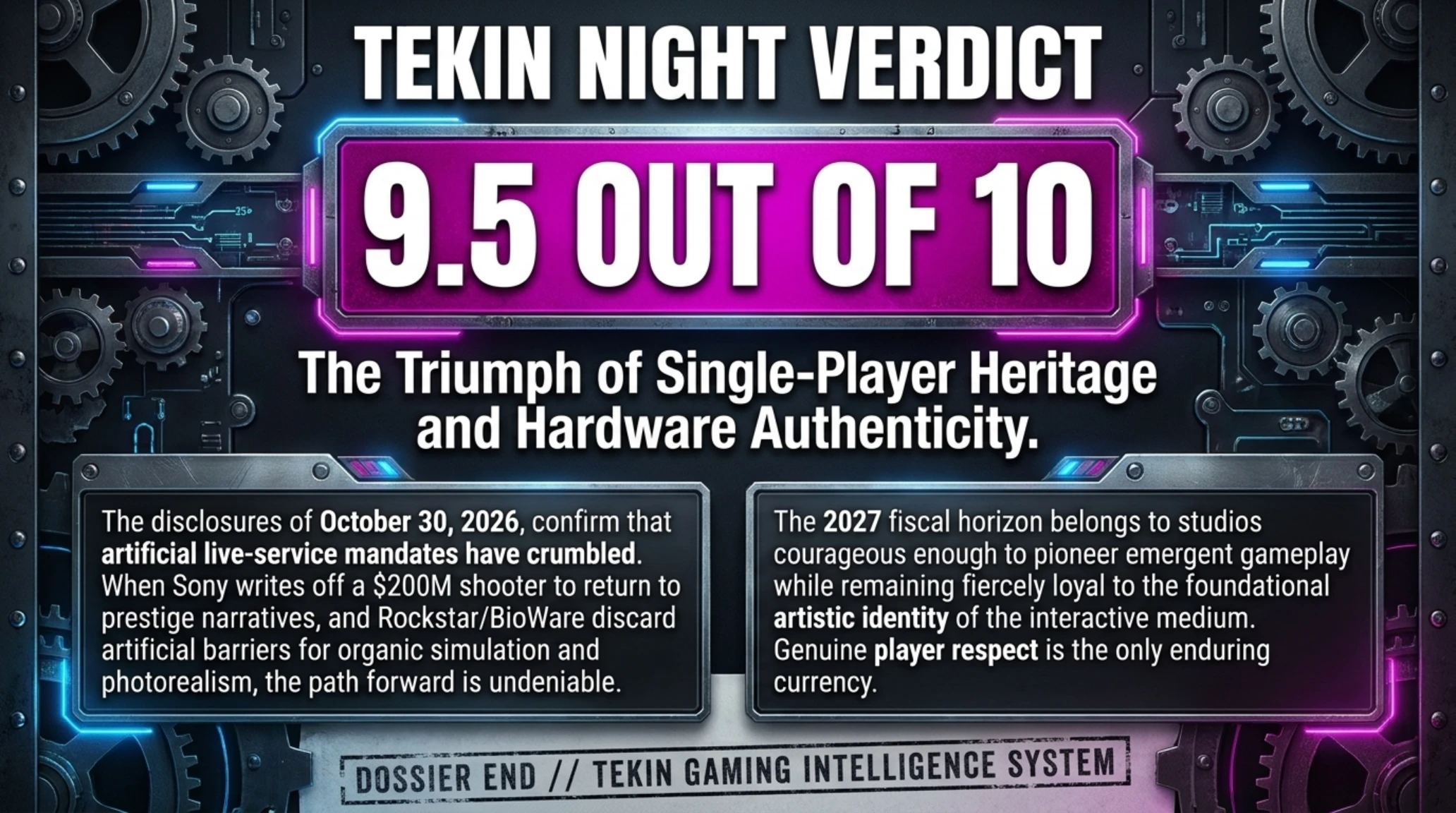
The geopolitical balance of power within the interactive entertainment industry in late 2026 is returning with undeniable force to its foundational roots: narrative craftsmanship, cutting-edge visual realism, and profound respect for the player's time and investment.
For game developers, corporate executives, and passionate players across the globe, the mandate of this historic evening is transparent: ninth-generation excellence will be measured by studios courageous enough to pioneer emergent gameplay while remaining fiercely loyal to the core artistic identity that forged the interactive medium.
Conclusion Box Editorial Verdict & Authoritative Gaming References
The Triumph of Single-Player Heritage and Hardware Authenticity
The disclosures of October 30, 2026, confirm that artificial live-service mandates have crumbled, allowing interactive entertainment to re-anchor itself around photorealism, emergent open-world agency, and tactile hardware design.
- GamesIndustry.biz: Exclusive coverage of Sony's closure of Firewalk Studios and Neon Koi
- Rockstar Games Newswire: Official release announcement for Red Dead Redemption and Undead Nightmare on PC
- IGN: Technical review of Red Dead PC port and preview report on GTA 6 unrestricted map design
- Eurogamer: In-depth interview with Pocketpair CEO Takuro Mizobe regarding Nintendo Switch 2 plans
- Video Games Chronicle (VGC): Analysis of Michael Gamble's statements on Mass Effect 5 photorealism and tone
- PlayStation Official Blog: Official unveiling of the retro translucent Prism Collection DualSense controllers
- Digital Foundry: Framerate stability and DLSS 3.7 benchmark analysis for Red Dead Redemption on modern PC hardware
Strategic Gaming FAQ & Technical Explanations
Why did Sony completely shut down Firewalk Studios instead of transitioning Concord to a Free-to-Play model?
Internal financial audits conducted by Sony Interactive Entertainment concluded that overhauling Concord's core progression, art assets, and netcode to support a competitive free-to-play ecosystem would require tens of millions in additional capital with minimal probability of user acquisition in an already saturated market. Sunsetting the project and writing off the sunk cost was determined to be the most fiscally responsible course of action.
What specific technological enhancements distinguish the new PC edition of Red Dead Redemption from previous console releases?
The PC edition introduces native 4K resolution support with uncapped framerates up to 144Hz, full compatibility with 21:9 ultrawide and 32:9 super ultrawide monitors, extended shadow cascade and draw distance settings, native mouse and keyboard controls, and modern AI reconstruction via NVIDIA DLSS 3.7 and AMD FSR 3.0.
What products are included in Sony's new translucent Prism Collection and what materials are used?
The Prism Collection features DualSense wireless controllers and matching PS5 Slim console covers available in three translucent colorways: Smoky Onyx, Frost Blue, and Emerald Translucent. They are manufactured from high-grade, scratch-resistant optical polycarbonate that proudly exhibits the interior haptic voice-coils and adaptive trigger mechanisms.
What are the gameplay ramifications of Rockstar opening the GTA 6 map from the beginning of the game?
By eliminating artificial roadblocks such as closed bridges or instant wanted levels, players can freely traverse the entire State of Leonida including Vice City, the Keys, and Grassrivers immediately after completing the prologue, fostering emergent non-linear exploration and unscripted world encounters from day one.
Why did Mass Effect director Michael Gamble explicitly confirm a photorealistic art style for the next installment?
Following player debate surrounding the colorful, stylized fantasy aesthetics of Dragon Age: The Veilguard, community members voiced concerns that Mass Effect 5 might adopt a similar cartoonish presentation. Gamble intervened to reassure fans that the next Mass Effect is utilizing Unreal Engine 5 to deliver a grounded, dark, and photorealistic space opera faithful to the original trilogy.
Why is Pocketpair interested in porting Palworld to the Nintendo Switch 2 despite ongoing legal battles with Nintendo?
While the original Switch lacked the processing and memory capacity to execute Palworld's intensive Unreal Engine 5 multiplayer environment, the upgraded Nvidia Tegra T239 silicon and DLSS capabilities of Switch 2 remove all technical bottlenecks. Pocketpair views the platform as an extraordinary market opportunity and is prepared to resolve patent disputes to deliver the game to Nintendo's vast player base.
Additional Gallery: Tekin Night Oct 30: Sony Shuts Firewalk, RDR1 on PC & GTA 6 Map