
🌙 Tekin Night June 8, 2026 — Gamers, Hackers & Confusing Strategies
Good evening, Tekin Gamers! While the world sleeps, we're wide awake with the hottest tech and gaming news. Tonight's lineup is electrifying: Xbox's confusing return to exclusivity, the AI controversy in game development, and a terrifying breach of FBI's surveillance network by Chinese state-sponsored hackers. Ready to dive in?
⚡ Tonight's Headlines:
🎮 Gears of War: E-Day — Xbox Exclusive Forever, No PS5 Release
🔄 Microsoft's Messy Strategy — Case-by-Case Decisions Confuse Everyone
⚙️ Clockwork Revolution — Second Major Xbox Exclusive Coming 2027
🎨 Crazy Taxi + AI — SEGA Sparks Debate on Generative Tools
🔐 FBI Hacked — Salt Typhoon Breaches U.S. Surveillance Network
💥 Worst Breaches of 2026 — 50M+ Records Leaked in April Alone
🕹️ Grab your energy drink — tonight we're going deep!
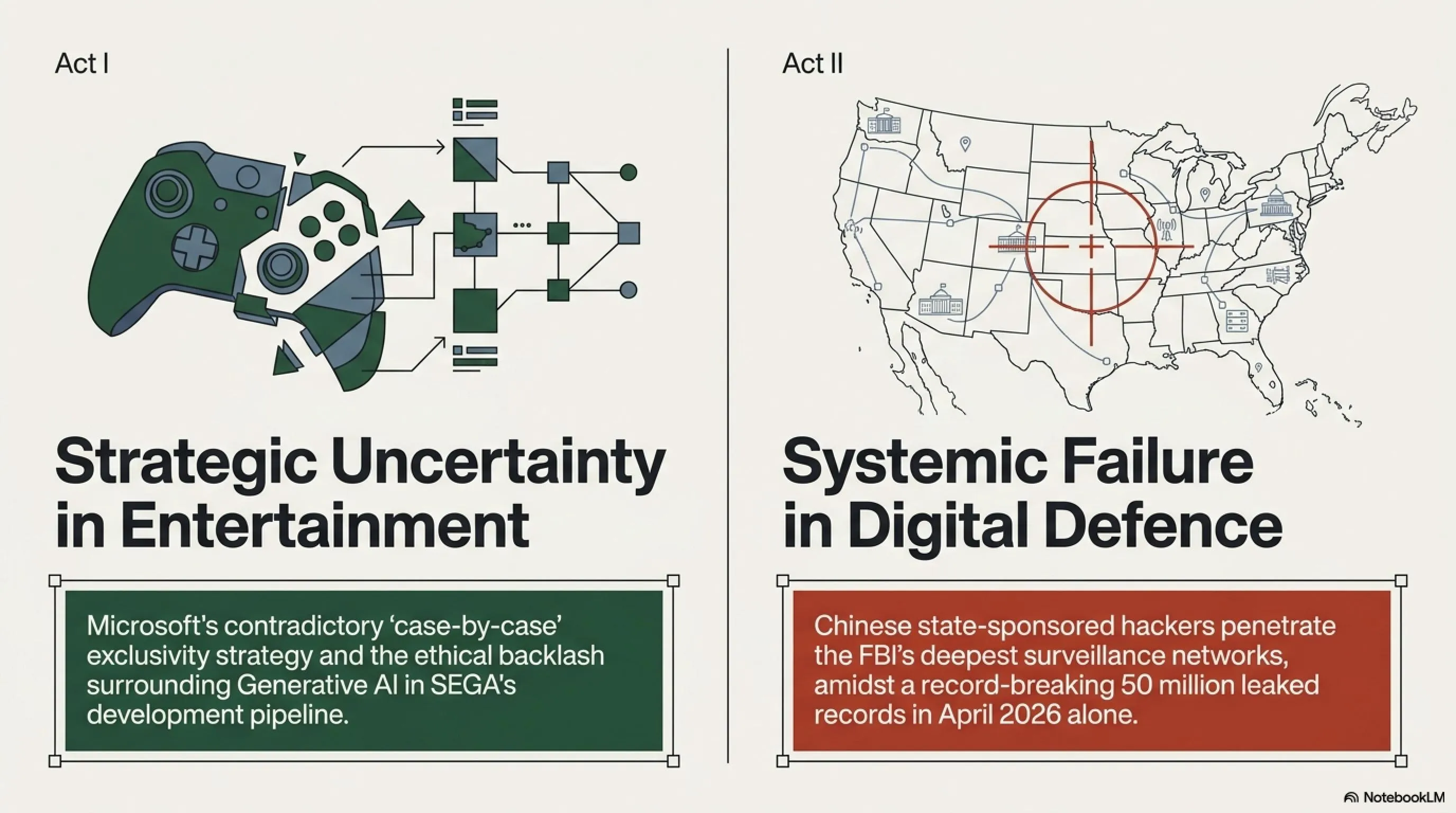
🎮 Xbox's Return to Exclusivity: Gears of War: E-Day Stays Console Exclusive
Sunday, June 7, 2026, marked a turning point for Xbox. During the Xbox Games Showcase 2026, Microsoft unveiled a major shift in strategy: Gears of War: E-Day will remain an Xbox console exclusive and will never launch on PlayStation 5.
This announcement comes after months of speculation and confusion. Earlier in 2026, Microsoft shocked the gaming world by bringing formerly exclusive titles like Hi-Fi Rush and Sea of Thieves to PS5, leading many to believe that Xbox was abandoning platform exclusivity altogether. However, at the Showcase, Asha Sharma — Xbox's new CEO appointed in February 2026 — delivered a clear message: "We want to give people a reason to buy an Xbox. Gears of War: E-Day and Clockwork Revolution will be Xbox console exclusives — not timed, but permanent."
This represents a dramatic pivot under Sharma's leadership. In an interview with Bloomberg News earlier this week, Sharma stated her ambitious goal: "We aim to make Xbox the number one gaming and entertainment company by 2030." A bold statement, especially considering Xbox's recent struggles against PlayStation and Nintendo. But can exclusives alone turn the tide?
📊 Gears of War: E-Day — Key Specifications
| Release Date | October 6, 2026 |
| Platform | Xbox Series X|S, PC (Windows) — Permanent Exclusive |
| Developer | The Coalition (Microsoft first-party studio) |
| Genre | Third-Person Shooter / Action |
| Story Timeline | 14 years before Gears 1 — Emergence Day (E-Day) |
| Main Character | Young Marcus Fenix + Dom Santiago |
| Game Pass | ✅ Day One on Game Pass Ultimate & PC Game Pass |
| Engine | Unreal Engine 5 |
Gears of War: E-Day is a prequel set 14 years before the original Gears of War. The game depicts Emergence Day — the catastrophic moment when the Locust Horde emerged from underground and launched a surprise attack on humanity, killing billions in a single day. You play as a younger Marcus Fenix, not yet the grizzled war hero of later games, but an idealistic soldier experiencing the apocalypse for the first time.
The gameplay trailer showcased at the event was intense: brutal close-quarters combat, visceral Locust encounters, and a dark, horror-tinged atmosphere reminiscent of the original trilogy. The Coalition emphasized that E-Day is "a return to the roots of Gears of War" — darker, more serious, and heavily focused on narrative and character development. Built on Unreal Engine 5, the game boasts stunning visuals, including advanced lighting, destruction physics, and photorealistic character models.
But what makes this exclusivity announcement so significant? Historically, Gears of War has been synonymous with Xbox — a flagship franchise that helped define the Xbox 360 era. However, in recent years, as Microsoft shifted toward a multiplatform approach, many fans feared Gears would eventually come to PlayStation. Sharma's decision to keep it exclusive is a deliberate move to restore Xbox's identity as a platform with unique, must-have games.
🧠 Tekin Analysis — Why This Exclusivity Matters
Gears of War: E-Day staying exclusive signals a strategic shift at Microsoft. After months of criticism for losing Xbox's identity as a platform with exclusive games, Asha Sharma has decided to reverse course. But will this strategy work? History shows that exclusives can drive console sales — look at what Sony achieved with The Last of Us, God of War, and Spider-Man. However, in today's era of Game Pass and cloud gaming, many argue that multiplatform releases generate more revenue. Microsoft is at a crossroads: return to exclusivity and risk losing multiplatform revenue, or continue the "Xbox everywhere" strategy and risk losing its core identity. The next 12 months will determine whether Sharma's bet pays off. If Gears of War: E-Day is a critical and commercial success, it could validate the exclusive model. If it underperforms, Microsoft may pivot yet again.
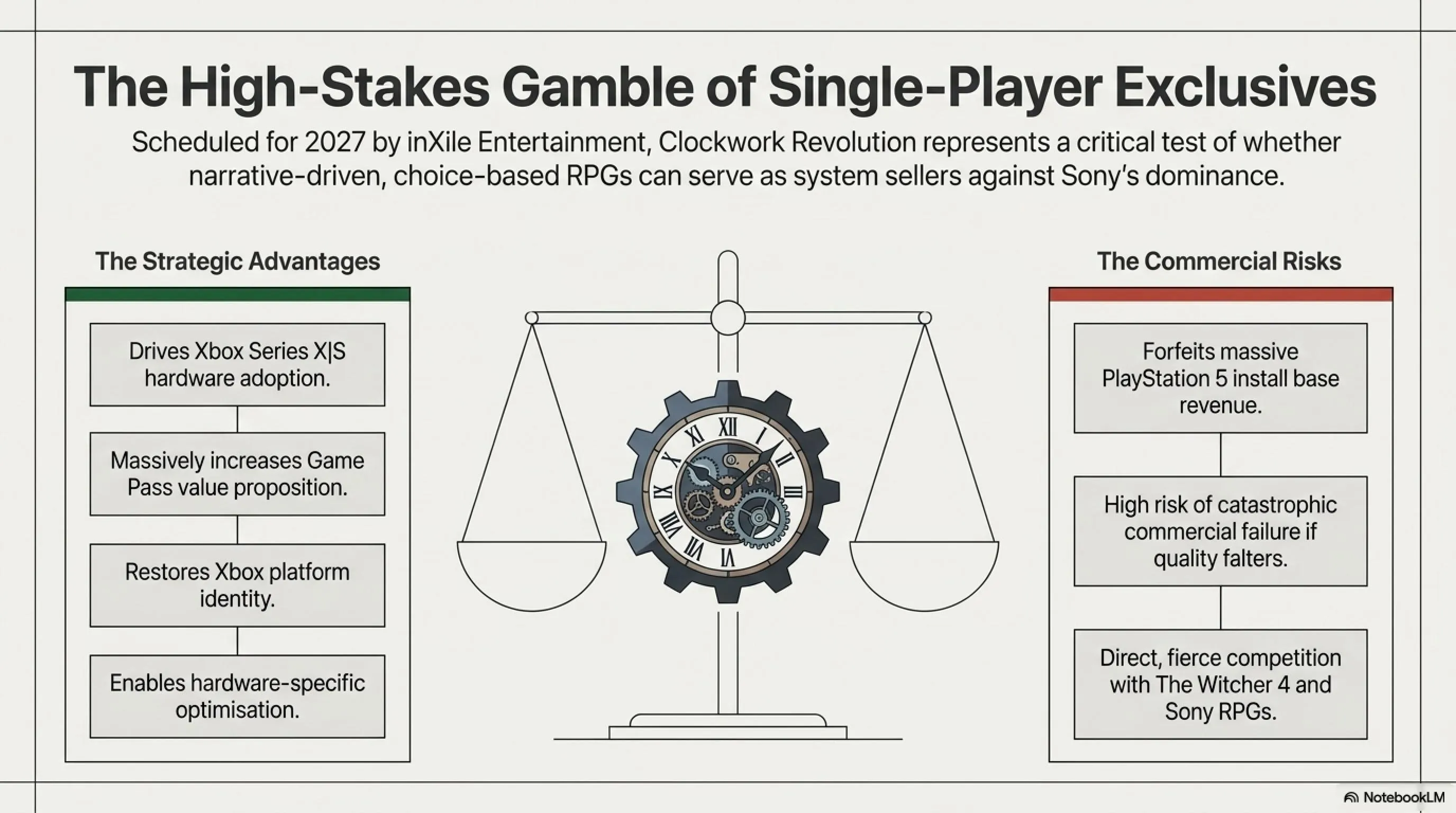
🔄 Microsoft's Confusing Strategy — Why Gamers Are Scratching Their Heads
If you thought Gears of War: E-Day being exclusive clarified Microsoft's strategy, think again. Shortly after the Showcase, Matt Booty — Xbox's Chief Content Officer — gave an interview to Gamertag Radio that created more confusion than clarity.
Booty explained: "We want to give people a reason to buy an Xbox, but that doesn't mean everything we make will be exclusive. Our big multiplayer and live-service games will continue to be multiplatform. For single-player narrative games, we'll evaluate each title case-by-case."
Translation? There is no clear rule. Some games will be exclusive, others won't, and there's no predictable pattern. Games like Halo Infinite and Fable, which were already announced for PS5, will still come to that platform. But new titles like Gears and Clockwork Revolution are staying exclusive. The problem? Gamers don't know what to expect.
⚠️ The Problem with "Case-by-Case" Strategy
When a company says "we'll decide each game individually," it creates several problems for gamers, developers, and the platform itself:
- Gamers don't know whether to buy an Xbox: If all games eventually come to PS5 anyway, why invest in Xbox hardware?
- Developers face uncertainty: Should we build for multiplatform from day one, or optimize for Xbox only?
- Weak messaging: People prefer clear rules over decisions based on management's mood.
- Loss of trust: Fans who bought Xbox for exclusives feel betrayed when games later go multiplatform.
Interestingly, Asha Sharma tweeted after the Showcase: "We want people to choose Xbox because of great games and experiences. That also means giving you something that was made for Xbox. Gears of War: E-Day and Clockwork Revolution will be Xbox console exclusives!" This message was positive, but it contradicted Booty's comments. One says everything is exclusive, the other says case-by-case. Which should we believe?
Adding to the confusion, Booty clarified that multiplayer and live-service games will always be multiplatform to maximize player populations. This makes business sense — games like Halo Infinite, Sea of Thieves, and Minecraft benefit from large cross-platform communities. But where does that leave single-player narrative games? Apparently, it depends on Microsoft's strategic goals at the time of release.
📌 Mid-Article Summary — Where Is Xbox Going?
Xbox's current strategy is a puzzle. On one hand, Asha Sharma wants to show a return to exclusives to please longtime Xbox fans. On the other, Matt Booty says multiplayer and live-service games will remain multiplatform. The result? Gamers don't know what to expect, and this could hurt Xbox. History shows that unclear strategies usually fail. Microsoft needs to pick a lane: either commit to exclusivity or embrace multiplatform fully. Trying to have it both ways will only breed confusion and distrust.
⚙️ Clockwork Revolution: Xbox's Second Major Exclusive for 2027
Alongside Gears of War, Microsoft announced another major exclusive: Clockwork Revolution — a steampunk sci-fi RPG developed by inXile Entertainment (the studio behind Wasteland 3).
First revealed in 2023, Clockwork Revolution re-emerged at the Showcase with a new trailer and a confirmed 2027 release window. Microsoft emphasized that this is a "permanent console exclusive" — meaning it will never come to PS5, not even years later.
🎮 What Is Clockwork Revolution?
Clockwork Revolution is a single-player RPG set in an alternate steampunk timeline where technology advanced based on steam power and clockwork mechanisms rather than electricity. You play as a time traveler who must explore different timelines, manipulate the past to change the future, and unravel a conspiracy that threatens the fabric of reality itself.
The game features a choice-driven narrative system where your decisions impact the story, along with action-based combat combining classic weapons and steampunk technology. inXile Entertainment (a Microsoft first-party studio) is building the game with Unreal Engine 5, aiming to create one of Xbox's biggest RPGs.
Why did Microsoft decide to keep Clockwork Revolution exclusive? The answer is strategic: narrative-driven RPGs are typically single-player experiences, and Microsoft wants to position these as console-selling exclusives. This mirrors Sony's strategy with Horizon and Ghost of Tsushima. But the question remains: will this approach work?
According to industry analysts, RPGs have become one of the most popular genres in recent years, driven by successes like Baldur's Gate 3, Starfield, and Cyberpunk 2077. If inXile can deliver a high-quality, choice-rich RPG with a compelling time-travel mechanic, Clockwork Revolution could become a system seller. However, the competition is fierce: Sony has Horizon 3 in development, CD Projekt Red is working on The Witcher 4, and Bethesda is preparing The Elder Scrolls VI. Clockwork Revolution will need to stand out in a crowded field.
✅ Advantages of Exclusivity
- Provides a reason to buy Xbox Series X|S
- Increases Game Pass value proposition
- Maintains Xbox identity as a platform with unique games
- Incentivizes studios to create high-budget titles
- Allows optimization specifically for Xbox hardware
❌ Disadvantages of Exclusivity
- Lost sales on PS5 (larger install base)
- Limits potential player base
- Higher risk of commercial failure
- Tougher competition with Sony's exclusives
- May alienate multiplatform gamers
Notably, Matt Booty clarified in his interview: "Single-player narrative games like Clockwork Revolution can remain exclusive because their primary purpose is to sell consoles. But multiplayer games like Sea of Thieves or Halo Infinite need to be on all platforms to maintain large communities." This logic makes sense, but the problem is that Sony has been executing this strategy far more successfully than Xbox. Sony's exclusives like The Last of Us Part II, God of War Ragnarök, and Spider-Man 2 have all been critical and commercial successes. Xbox needs Clockwork Revolution to reach that level of quality.
🧠 Tekin Analysis — Can Clockwork Revolution Succeed?
Clockwork Revolution is one of Xbox's most important upcoming titles. If it delivers high quality and can compete with The Witcher 4 or Sony's RPGs, it could validate Xbox's return to exclusivity. But if it fails, the backlash will be severe. Everything depends on execution. inXile Entertainment has a strong track record with Wasteland 3, but this is their first AAA RPG with a massive budget. The pressure is on. Microsoft is betting heavily on this strategy — if both Gears and Clockwork succeed, it could mark the beginning of Xbox's comeback. If they fail, Microsoft may pivot once again, and the "case-by-case" approach will be blamed for the confusion.
📌 Mid-Article Summary — Clockwork Revolution's Importance
Clockwork Revolution represents Xbox's bet on narrative-driven, single-player RPGs as console sellers. If the game is excellent and can compete with industry leaders, it could restore faith in Xbox exclusives. But if it underperforms, critics will argue that Microsoft should have released it multiplatform to recoup development costs. The next 12-18 months will be critical for Xbox's strategic direction.
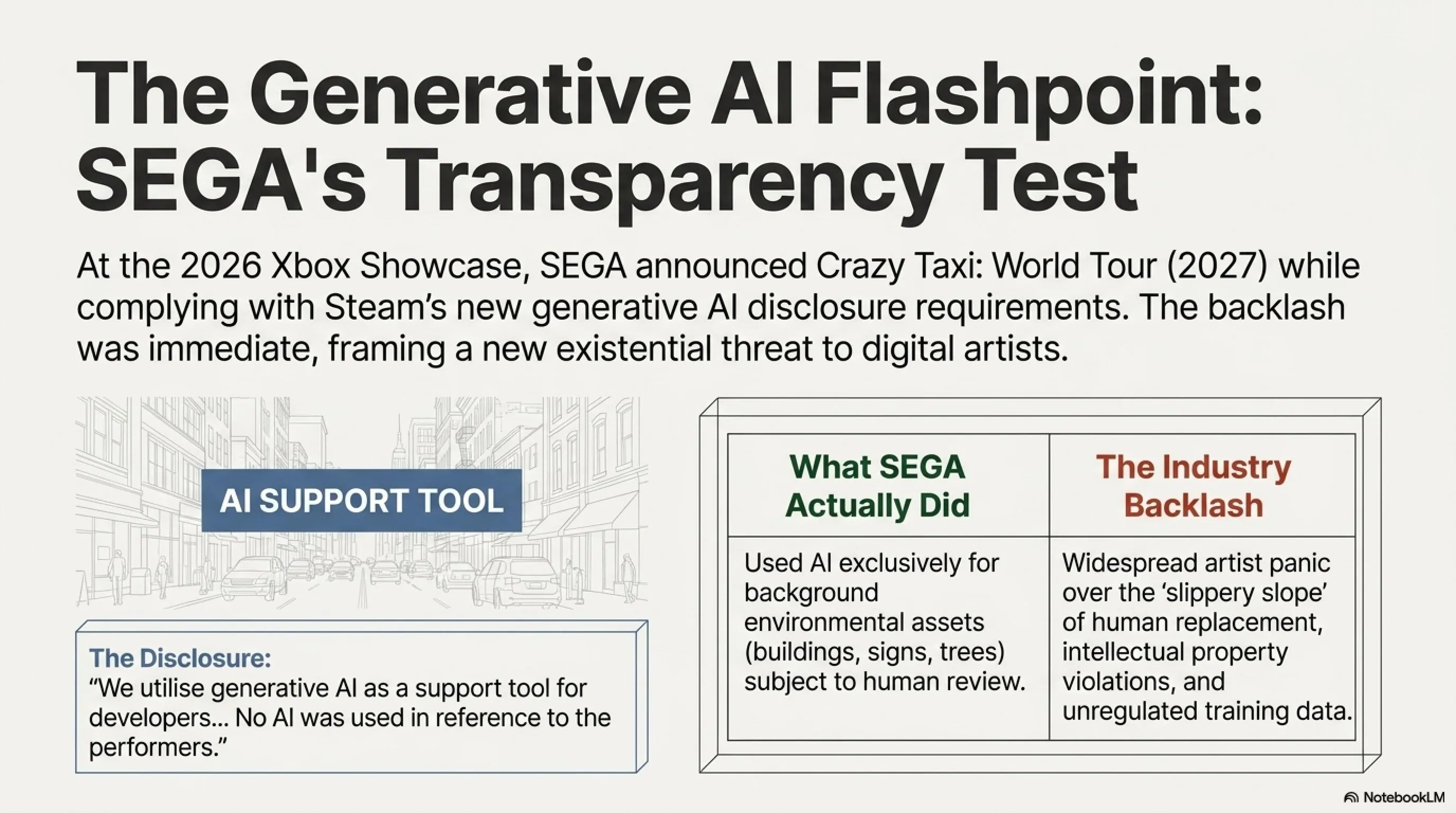
🎨 Crazy Taxi with AI — SEGA's Controversy and What It Means for Gaming
Now let's shift gears to a controversy that erupted at the same Xbox Showcase: SEGA unveiled Crazy Taxi: World Tour, scheduled for 2027, and immediately sparked outrage when its Steam page disclosed the use of "Generative AI" in development.
Steam requires developers to disclose when generative AI is used in game development. SEGA complied, stating: "At SEGA Corporation, we utilize generative AI as a support tool for developers, aiming to provide better content to our users and enable developers to focus more on creative tasks. We have used such generative AI support tools during development of Crazy Taxi: World Tour. No AI was used in reference to the performers in the game."
Predictably, gamers and artists immediately expressed concern. Twitter and Reddit exploded with criticism: "SEGA is using AI to replace artists!" and "I won't buy a game made with AI!" became common refrains.
🤖 What Did SEGA Actually Use AI For?
In a follow-up statement to Game Informer, SEGA clarified that generative AI was used specifically for "the development of background assets" — things like buildings, signs, trees, and other environmental elements. These assets are still "subject to review by the development team," meaning human artists approve and refine the AI-generated content before it goes into the game.
SEGA emphasized that no AI was used for character design, voice acting, or any performer-related work. The AI tools were strictly limited to background environmental art — the kind of repetitive, time-consuming work that doesn't require high artistic creativity.
So what does this mean in practical terms? SEGA used AI to generate background elements like buildings, billboards, and environmental clutter. When you're racing through Crazy Taxi at 100 mph, do you really care whether a random storefront sign was drawn by an artist or generated by AI? Probably not. But the controversy isn't really about this specific use case — it's about what it represents.
The concern is that this is the beginning of a trend. Today, AI is used for background assets. Tomorrow, maybe characters. The day after, entire games. And if that happens, what happens to the artists, animators, and designers who make games? This is the existential question facing the gaming industry — and the entertainment industry as a whole.
✅ Why Studios Use AI
- Saves time and development costs
- Allows artists to focus on important work
- Speeds up content creation
- Reduces repetitive, tedious tasks
- Can generate variations quickly
❌ Concerns About AI
- Loss of artistic jobs
- Lower artistic quality
- Intellectual property violations
- Beginning of human replacement trend
- Ethical concerns about training data
It's worth noting that SEGA's transparency here is commendable. Many studios are likely using AI tools behind the scenes but not disclosing it. By being upfront about it, SEGA has opened itself up to criticism — but also to a necessary industry conversation. Should AI be allowed in game development? If so, under what conditions? Should it be regulated? Should studios be required to disclose its use? These are questions the industry needs to answer sooner rather than later.
🧠 Tekin Analysis — Is Using AI in Games Wrong?
Short answer: it depends on how it's used. Using AI for repetitive, low-importance tasks like background assets is reasonable and can reduce development time and costs. But the concern is that this is a slippery slope. Today it's backgrounds, tomorrow it's characters, and eventually entire games could be AI-generated. The key is transparency, ethical use, and respect for human artists. SEGA did the right thing by disclosing its AI use and limiting it to specific tasks. But the industry needs clear guidelines: What uses of AI are acceptable? How should training data be sourced? Should artists be compensated when their work is used to train AI models? These are urgent questions that need answers. If the industry doesn't self-regulate, governments will step in — and that could lead to even more restrictive rules.
📌 Mid-Article Summary — The AI Debate Continues
Crazy Taxi: World Tour isn't the first game to use AI, but it's one of the first major releases to transparently disclose it. This transparency is positive — it's better to be upfront than hide AI use. But concerns remain about the long-term impact on artistic jobs and creative quality. Gamers will need to decide whether they're willing to accept AI-assisted games, and the industry needs to establish clear ethical guidelines before AI becomes ubiquitous.
🔐 FBI Surveillance Network Breached — Salt Typhoon's War on U.S. Law Enforcement
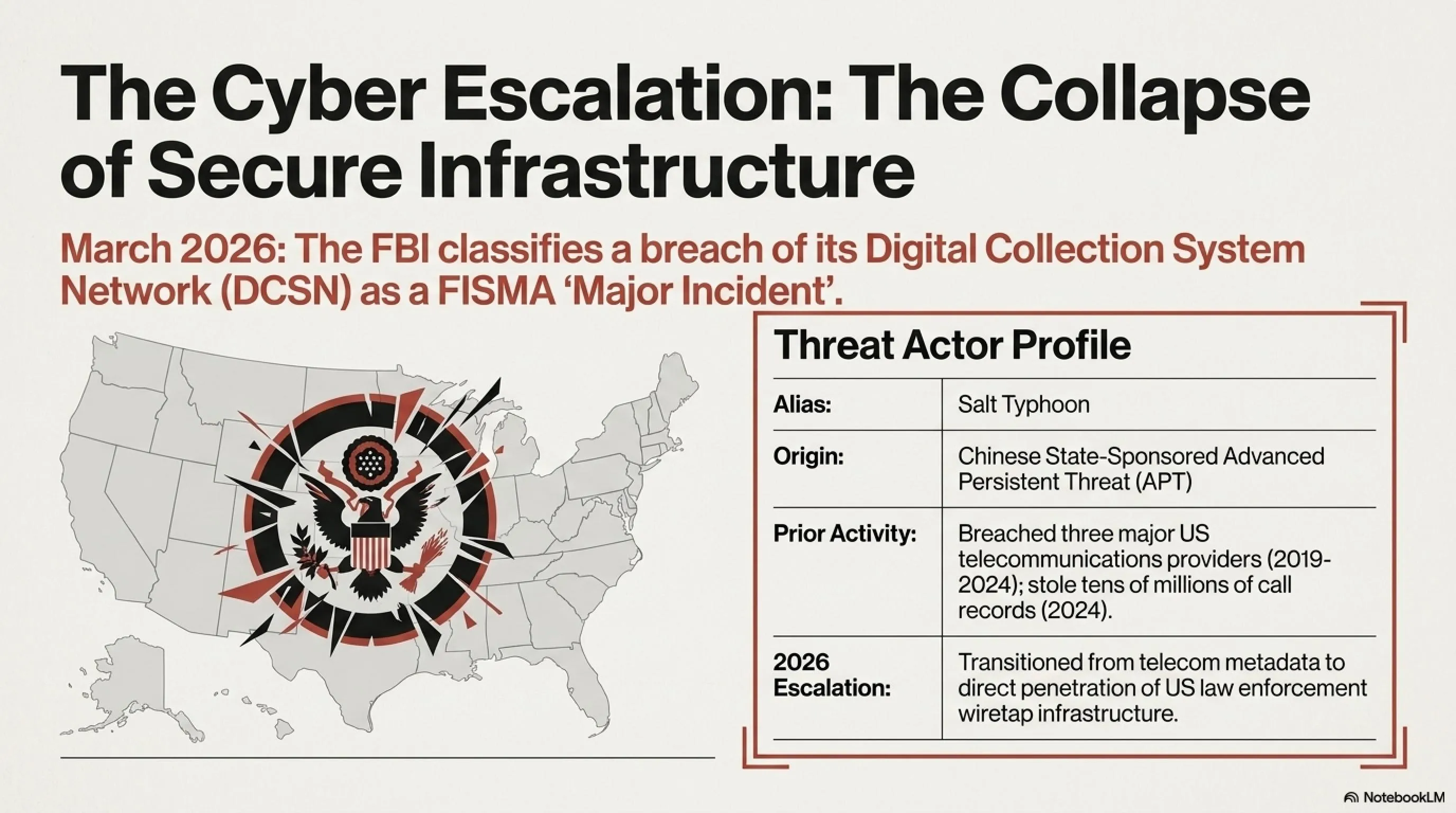
Now let's turn to one of the most alarming cybersecurity stories of 2026. In March of this year, the FBI announced that its internal surveillance network had been breached. This represents one of the worst security incidents in FBI history and raises serious questions about the security of U.S. critical infrastructure.
The compromised system is known as the Digital Collection System Network (DCSN), which contains extremely sensitive data:
- Pen Register Returns: Lists of phone numbers under FBI surveillance
- Trap and Trace Surveillance: Information about incoming calls to surveillance targets
- FISA Warrant Data: Details of Foreign Intelligence Surveillance Act warrants
- Personally Identifiable Information: PII of individuals under FBI investigation
The FBI classified this incident as a "major incident" under the Federal Information Security Management Act (FISMA) — the highest threat level, indicating serious risks to U.S. national security.
🕵️ The Prime Suspect: Salt Typhoon
The attack is attributed to Salt Typhoon — an Advanced Persistent Threat (APT) group backed by the Chinese government. This group has conducted highly sophisticated attacks on U.S. infrastructure in recent years:
- 2019-2024: Breached all three major U.S. telecommunications providers
- 2024: Stole call records of tens of millions of Americans
- 2026: Penetrated FBI's wiretap surveillance network
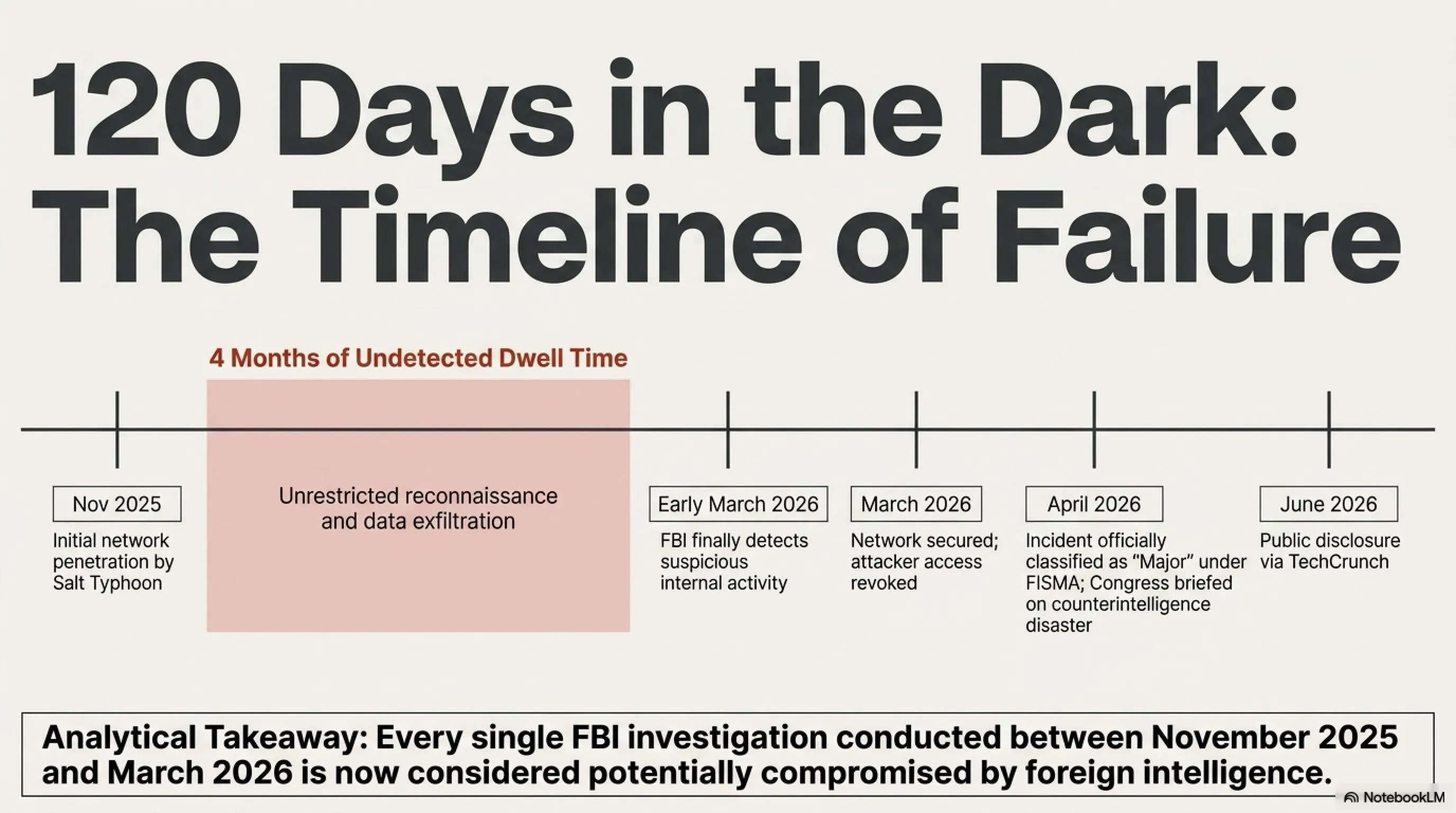
The most concerning aspect: Salt Typhoon was inside the FBI network for months before being detected. The FBI stated it identified suspicious activity in early March 2026, but the hackers likely had access from November 2025. That's at least four months of unrestricted access to highly classified surveillance data.
According to Security Boulevard's detailed analysis, this breach represents "a continuation of Salt Typhoon's systematic targeting of American law enforcement's surveillance capabilities." Between 2019 and 2024, the group compromised telecommunications infrastructure to access call metadata. The 2026 FBI breach takes this campaign to a new level — directly penetrating law enforcement's surveillance systems.
⚠️ Timeline of Salt Typhoon's FBI Attack
| November 2025 | Initial network penetration |
| December 2025 - February 2026 | Reconnaissance and data exfiltration |
| Early March 2026 | FBI detects suspicious activity |
| March 2026 | Network secured, attacker access revoked |
| April 2026 | FBI classifies incident as "major" under FISMA |
| June 2026 | Public disclosure and TechCrunch reporting |
But why is this breach so dangerous? Because Salt Typhoon now knows who the FBI is surveilling. This information could allow the Chinese government to protect its intelligence assets, evade FBI investigations, and even identify FBI informants. It's a counterintelligence nightmare.
Consider this scenario: the FBI is investigating a Chinese espionage network operating in the United States and has obtained court-authorized wiretaps on specific phone numbers. Salt Typhoon accesses the DCSN system and sees which numbers are under surveillance. They can then alert the Chinese government: "Hey, the FBI is listening to these phone numbers — tell your operatives to switch to different communication methods." This completely undermines the FBI's ability to conduct effective counterintelligence operations.
According to Politico's reporting in April 2026, when the breach was first disclosed to Congress, lawmakers were briefed that this represents "one of the most serious counterintelligence compromises in recent memory." The long-term damage could extend for years, as every FBI investigation conducted from November 2025 to March 2026 must now be considered potentially compromised.
🧠 Tekin Analysis — Why This Is a National Security Disaster
The FBI surveillance breach is a national security catastrophe. Imagine the FBI investigating a Chinese spy network in the U.S. and conducting wiretaps. Now Salt Typhoon can tell the Chinese government: "The FBI is listening to these phone numbers — warn your operatives." This means the FBI can no longer trust its surveillance capabilities. The long-term impact could last years: every FBI investigation from 2025-2026 is now suspect. Did Chinese intelligence become aware of those investigations? Probably yes. This also exposes a broader problem: if even the FBI can't protect its most sensitive systems, what about other agencies? The DHS? NSA? CIA? This breach should trigger a comprehensive security audit across all federal law enforcement and intelligence agencies.
💥 Worst Hacks and Breaches of 2026 — TechCrunch's Alarming Report
Now let's examine TechCrunch's comprehensive report on the worst data breaches of 2026, published June 7. The statistics are staggering and paint a grim picture of cybersecurity in 2026.
📊 2026 Breach Statistics (Through June)
50M+
Records leaked in April alone
25M+
Victims of Conduent ransomware
3,800
GitHub code repositories breached
1.8M
NYC Health breach victims
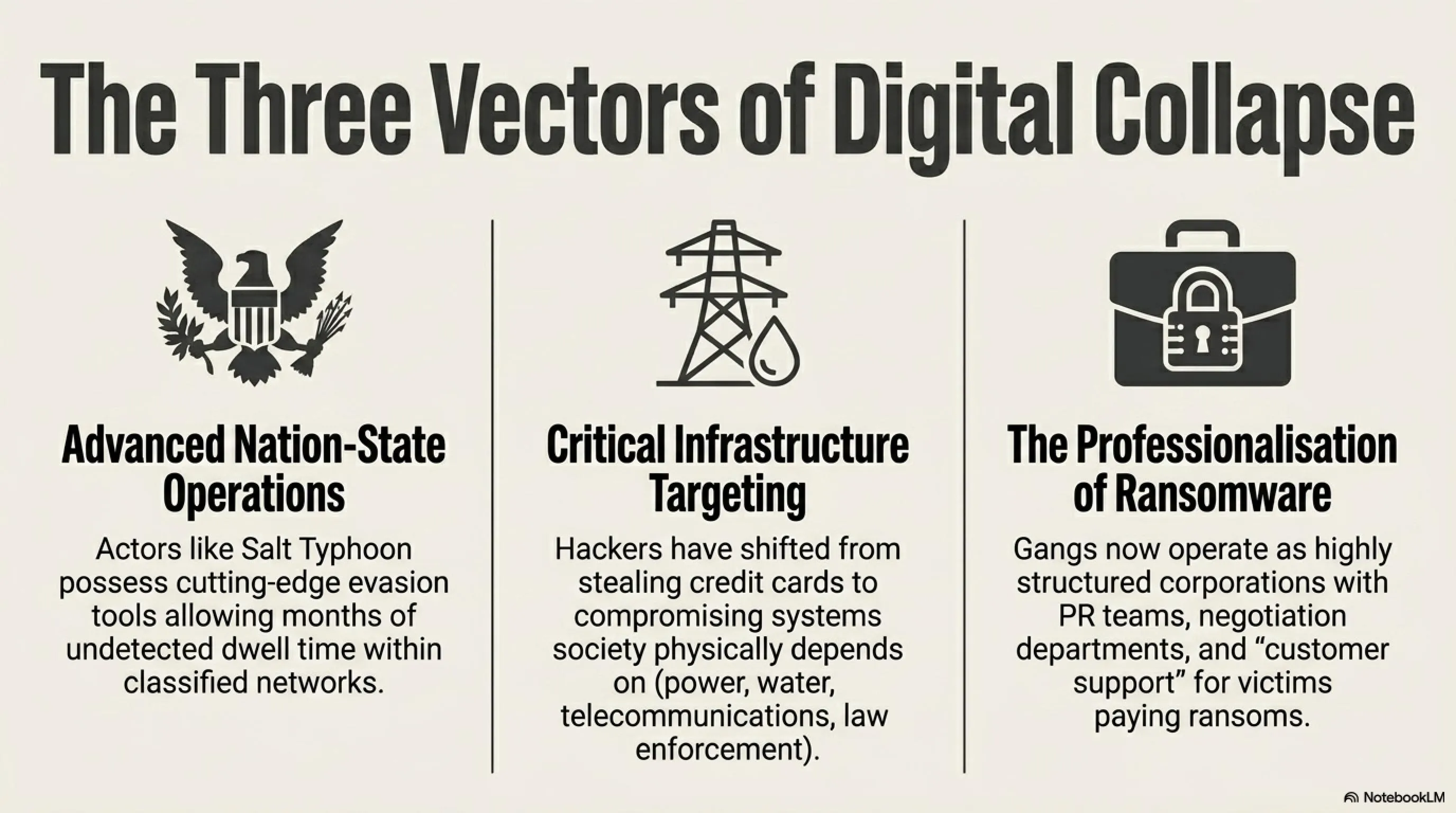
TechCrunch's report reveals that 2026 cyberattacks are fundamentally different from previous years. Hackers are no longer just stealing credit card data or personal information — they're targeting critical infrastructure like power grids, water systems, telecommunications networks, and government surveillance systems.
According to the report, the attacks are getting "bolder, more destructive, and harder to contain." Nation-state actors from China, Russia, North Korea, and Iran are conducting sophisticated campaigns that can persist for months undetected. Meanwhile, ransomware gangs have professionalized to the point where they operate like legitimate businesses — complete with customer support, negotiation departments, and even public relations teams.
🔥 Major Breaches of 2026 (Confirmed)
| Incident | Victims | Date |
| Conduent Ransomware Attack | 25+ million individuals | February 2026 |
| FBI Surveillance Breach | Classified data compromised | March 2026 |
| NYC Health + Hospitals | 1.8 million patients | February 2026 |
| GitHub Internal Repositories | 3,800 code repos | May 2026 |
| Instructure (Canvas LMS) | Millions of students | May 2026 |
| IBM Cover-up (Whistleblower) | Unknown (3 breaches) | June 2026 |
| 7-Eleven Customer Data | 185,000+ individuals | May 2026 |
One of the most disturbing revelations in TechCrunch's report involves a whistleblower from IBM who accused the tech giant of covering up three separate data breaches over the past decade by foreign governments. According to the whistleblower — a former IBM cybersecurity executive — IBM was hacked by nation-state actors and chose not to disclose the incidents. If true, this suggests that the actual number of breaches is far higher than public reporting indicates, as companies may be hiding incidents to avoid reputational damage and regulatory penalties.
TechCrunch's report also highlights the Conduent ransomware attack as one of the worst incidents of 2026. Conduent is a major government contractor that manages benefit programs for millions of Americans. When ransomware attackers breached its systems in February, they gained access to Social Security numbers, medical records, and financial information for over 25 million people. This breach alone affected more individuals than most breaches in an entire year.
🧠 Tekin Analysis — Why Is 2026 So Bad for Cybersecurity?
Three main factors make 2026 one of the worst years for data security:
- Nation-state hackers are more advanced: Groups like Salt Typhoon have cutting-edge tools that can remain undetected for months. They're patient, sophisticated, and well-funded.
- Critical infrastructure is now the primary target: It's no longer just about stealing credit cards. Hackers are targeting power grids, water systems, telecommunications, and law enforcement — infrastructure that societies depend on.
- Ransomware has professionalized: Ransomware gangs now operate like corporations, with specialized departments for negotiation, data exfiltration, and victim communication. Some even offer "customer support" to help victims pay ransoms.
The scariest part? We're only halfway through 2026. If the trend continues, this could be the worst year for cybersecurity in history.
📌 Mid-Article Summary — The Future of Cybersecurity
TechCrunch's report is a wake-up call: cybersecurity is no longer just a corporate issue — it's a national security and public safety issue. When hackers can breach the FBI, compromise power grids, and steal data from millions of people in a single attack, we have a systemic problem. Governments and companies must invest heavily in cybersecurity defenses, or the situation will only get worse. The next decade will determine whether we can secure our digital infrastructure — or whether cyber warfare becomes the new norm.
💡 Final Thoughts — A Night of Gaming Drama and Cybersecurity Nightmares
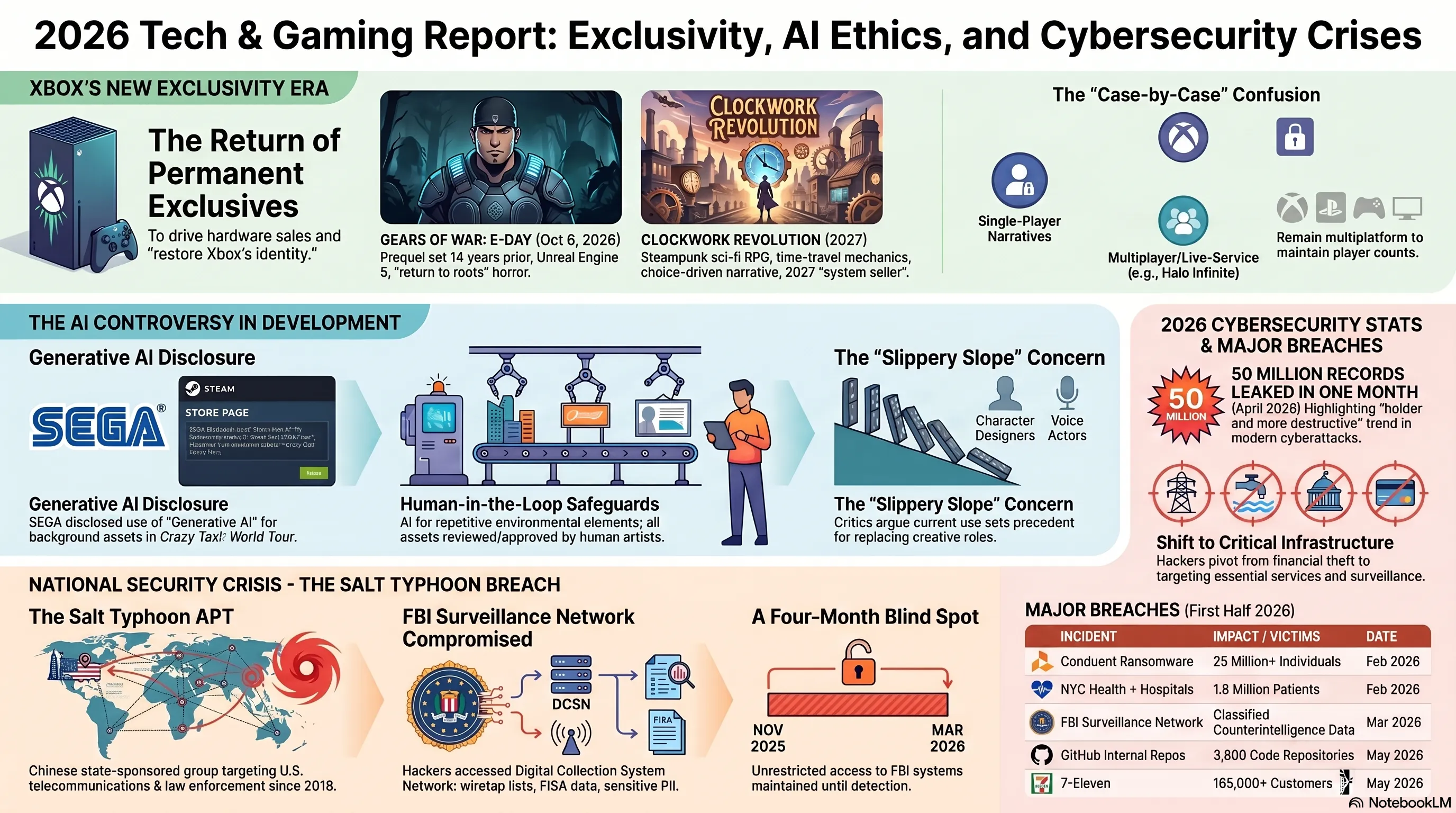
Tonight we witnessed major shifts in both gaming and cybersecurity. Microsoft's confusing exclusivity strategy showed that Xbox still doesn't know what it wants to be — a platform with must-have exclusives or an "Xbox everywhere" multiplatform service? Gears of War: E-Day and Clockwork Revolution staying exclusive is a bold move, but the lack of clear rules creates uncertainty. Gamers don't know whether to invest in Xbox hardware, and developers don't know how to plan their projects. Microsoft needs to pick a lane and commit. Meanwhile, SEGA's AI controversy with Crazy Taxi sparked an important industry conversation. Using AI for background assets is reasonable, but transparency and ethical guidelines are essential. The gaming industry needs to establish clear rules before AI becomes ubiquitous. And in cybersecurity, the FBI breach and TechCrunch's alarming report show that 2026 is shaping up to be one of the worst years for data security. When even the FBI can't protect its surveillance systems, we have a systemic problem. Good night, Tekin Gamers — see you tomorrow with more news!
❓ Frequently Asked Questions (FAQ)
Will Gears of War: E-Day really never come to PS5?
Yes, Microsoft officially confirmed that Gears of War: E-Day is a permanent console exclusive. Matt Booty stated: "These are not timed exclusives" — meaning it won't come to PS5 even years later. The game will only release on Xbox Series X|S and PC (Windows), and will be available on Game Pass on day one. Of course, Microsoft's plans have changed before, but as of June 2026, there is no plan to bring Gears to PlayStation.
What is Xbox's exclusivity strategy going forward?
Xbox's current strategy is confusing and inconsistent. Matt Booty explained that multiplayer and live-service games will remain multiplatform (like Halo Infinite and Sea of Thieves) to maximize player populations, but single-player narrative games will be decided case-by-case. This means there's no clear rule — each game is evaluated individually. Gears and Clockwork Revolution are exclusive, but Fable and Halo are coming to PS5. This lack of clarity frustrates gamers and creates uncertainty for developers.
Is using AI in game development wrong?
Short answer: it depends on how it's used. SEGA used AI only for background assets — buildings, signs, and environmental elements — which are repetitive tasks that don't require high creativity. This is reasonable and can save time and costs. However, concerns remain that this is the start of a trend: today backgrounds, tomorrow characters, eventually entire games. The key is transparency, ethical use, and respect for human artists. SEGA did the right thing by disclosing its AI use, but the industry needs clear guidelines on acceptable AI applications, training data sourcing, and artist compensation.
What data did Salt Typhoon steal from the FBI?
Salt Typhoon breached the FBI's Digital Collection System Network (DCSN), which contained highly sensitive data: Pen Register Returns (lists of surveilled phone numbers), Trap and Trace Surveillance (incoming call information), FISA Warrant Data (Foreign Intelligence Surveillance Act warrants), and personally identifiable information of FBI investigation targets. This data could help the Chinese government protect its intelligence assets and evade FBI surveillance. The FBI classified this as a "major incident" — the highest threat level under federal law.
Why is 2026 so bad for cybersecurity?
Three main reasons: First, nation-state hackers are more advanced with sophisticated tools that can remain undetected for months. Second, critical infrastructure has become the primary target — power grids, water systems, telecommunications, and law enforcement systems. Third, ransomware gangs have professionalized and now operate like legitimate businesses with negotiation departments and customer support. Through June 2026, over 50 million records were leaked in April alone — a staggering number. If the trend continues, 2026 could be the worst year for cybersecurity in history.
📚 Sources & References
- IGN — Gears of War: E-Day and Clockwork Revolution Are Not Timed Exclusives
- GameSpot — Xbox's Showcase Made Exclusivity More Confusing
- GameSpot — Xbox Clarifies Its Exclusivity Strategy Moving Forward
- GameSpot — Crazy Taxi: World Tour Uses Generative AI, SEGA Reveals
- Security Boulevard — FBI Surveillance Network Breached by Salt Typhoon
- TechCrunch — The Worst Hacks and Breaches of 2026 So Far
- Polygon — Gears of War: E-Day Gameplay Trailer and October Release Date Revealed
- Pure Xbox — Xbox Confirms Its Two New Console Exclusives Are Not Timed
- Politico — FBI Declares Chinese Hack of Surveillance System a Major Incident
🌐 Stay Connected With Us 🎮✨
For the latest tech, gaming, and gadget news, follow us on our official social media channels: