🌙 Welcome to Tekin Night June 16, 2026
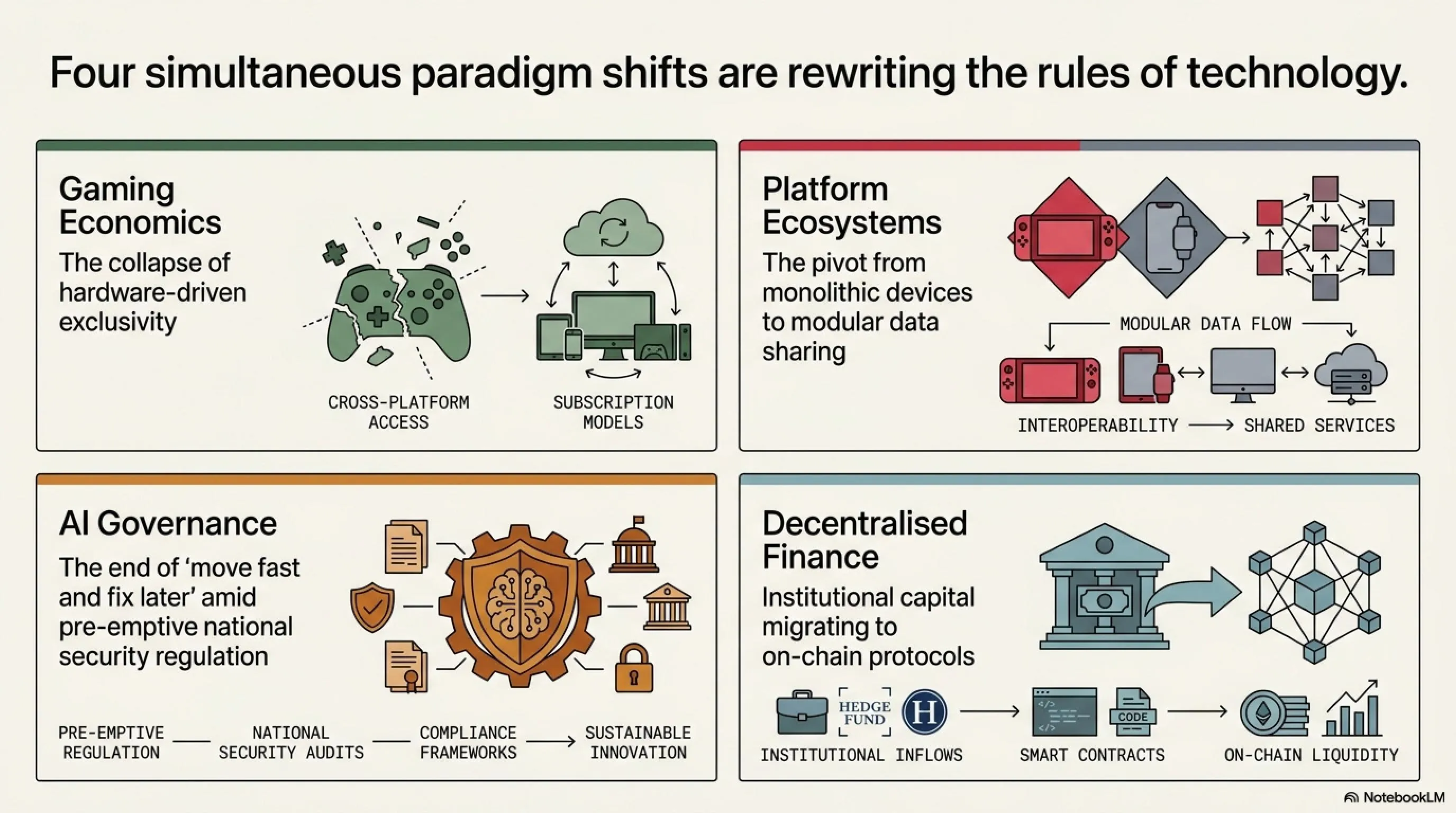
Good evening, tech strategists! Tuesday night brings a cascade of industry-shaping revelations that could redefine the gaming and technology landscape for years to come. Tonight, we're witnessing Xbox's most significant internal crisis, Halo's historic PlayStation debut, Anthropic's unprecedented battle with the U.S. government, and Apple's democratization of fitness tracking. Buckle up for a deep dive into the stories that matter.
⚡ Tonight's Headlines:
🎮 Xbox Crisis: Ninja Theory, Double Fine and Compulsion negotiate to avoid shutdown
🎯 Historic First: Halo: Campaign Evolved launches on PlayStation 5 July 28
⚔️ Anthropic vs White House: Fable 5 shutdown sparks AI regulation debate
📱 iOS 27 Revolution: iPhone + AirPods replace Apple Watch at the gym
🎮 Nintendo Switch 2: Major update adds languages and redesigned eShop
💰 Bold Prediction: Standard Chartered sees UNI hitting $100 by 2030
🔥 Grab your coffee, dim the lights, and dive into tonight's technology intel!
🎮 Xbox's Existential Crisis: Ninja Theory and Double Fine Fight for Survival
In what may be remembered as one of the darkest chapters in Xbox Game Studios history, multiple reports from Bloomberg, The Verge, and Windows Central reveal that at least three major Microsoft-owned studios are in "active negotiations" to avoid closure or spin off as independent entities. The studios in question — Ninja Theory (Hellblade series), Double Fine Productions (Psychonauts), and Compulsion Games (South of Midnight) — all face an uncertain future despite showcasing their upcoming titles at Xbox Games Showcase just days ago.
This crisis comes mere weeks after Microsoft shuttered four studios in May 2026, including Arkane Austin (Prey, Redfall) and Tango Gameworks (Hi-Fi Rush, The Evil Within), triggering industry-wide outrage and raising questions about the sustainability of Microsoft's gaming division. The timing couldn't be worse: Ninja Theory just announced Hellblade 3, Compulsion revealed South of Midnight gameplay, and Double Fine continues to be beloved for its creative, quirky titles. Yet all three now face potential extinction.
⚠️ Tekin Analysis: Why Xbox Is Cannibalizing Its Own Future
This restructuring reveals a fundamental tension at the heart of Microsoft's gaming strategy. After spending over $75 billion acquiring Activision Blizzard and ZeniMax, Xbox is under immense pressure to demonstrate return on investment to shareholders. The solution? Prioritize AAA blockbusters that drive Game Pass subscriptions and cut "non-essential" creative studios that produce critically acclaimed but commercially modest titles.
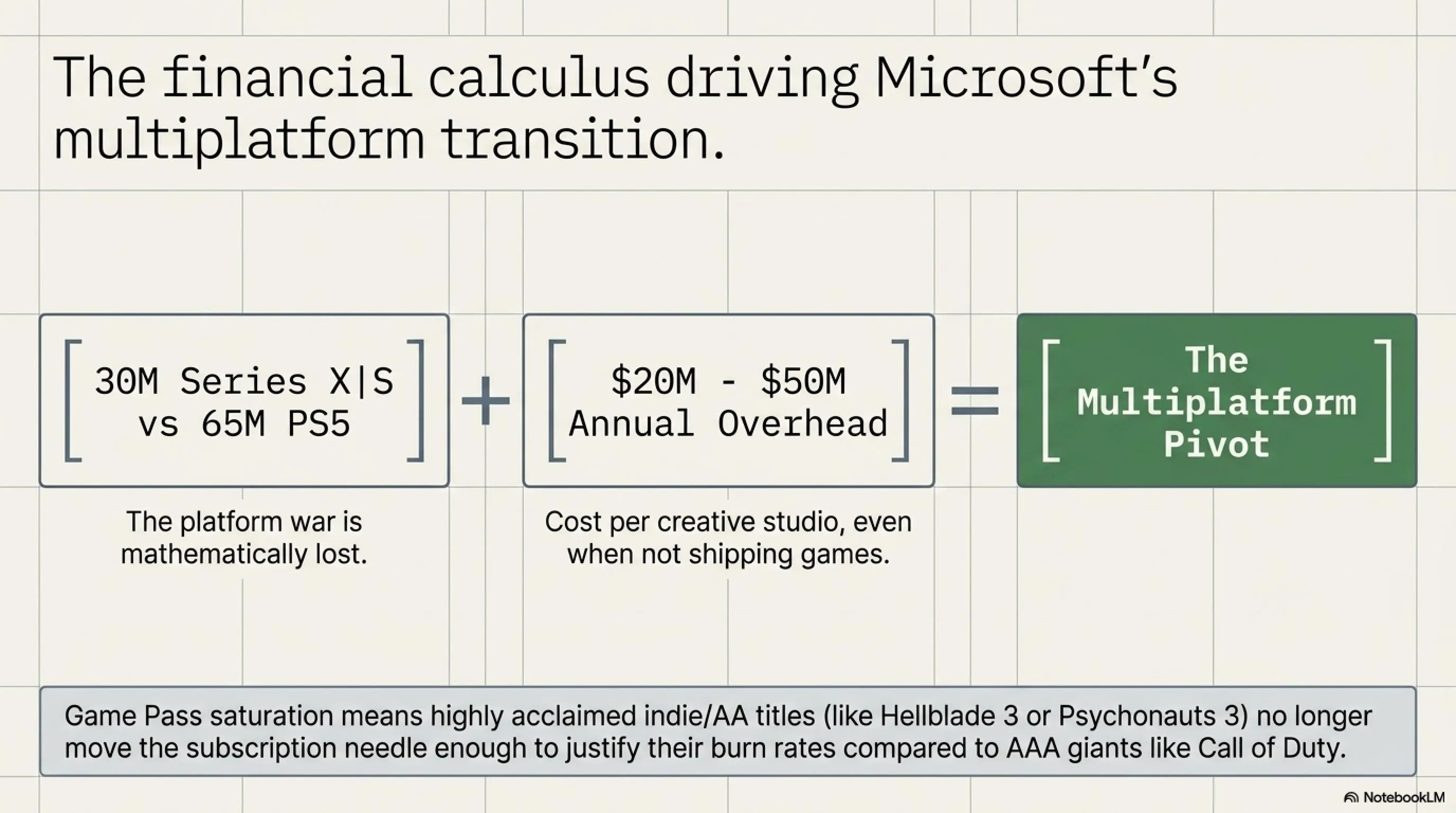
Here's the brutal calculus driving these decisions:
- Game Pass Saturation: Adding Psychonauts 3 or Hellblade 3 doesn't attract millions of new subscribers
- AAA Focus: Call of Duty, Diablo, and Starfield generate far more revenue and engagement
- Studio Overhead: Each studio costs $20-50M annually even when not releasing games
- Market Reality: Xbox Series X|S has sold ~30M units vs PS5's 65M — platform war is lost
- Strategic Pivot: Xbox is transitioning from platform holder to multiplatform publisher
The irony is painful: Xbox is destroying the creative diversity that once differentiated it from PlayStation, transforming into the very thing it criticized Sony for — a blockbuster-focused monolith.
According to Tom Warren at The Verge, Ninja Theory staff were informed in a Monday meeting that the studio faces potential closure, though leadership is actively seeking a buyer or negotiating a management buyout. The studio's options are grim: find a publisher willing to acquire them (and their Hellblade IP, which Microsoft likely retains), go fully independent with drastically reduced headcount, or shut down entirely.
📊 Studios at Risk: Franchises and Fates
| Studio | Notable Franchises | Current Status | Employees |
|---|---|---|---|
| Ninja Theory | Hellblade, DmC, Enslaved | Active negotiations | ~120 |
| Double Fine | Psychonauts, Brutal Legend | Active negotiations | ~90 |
| Compulsion Games | South of Midnight, We Happy Few | High risk of closure | ~75 |
| Others (unnamed) | Unknown | Under review | Unknown |
Sources: Bloomberg, The Verge, Windows Central, LA Times (June 15-16, 2026)
The human cost is staggering. Even if these studios achieve independence, layoffs are inevitable. Management buyouts typically mean shedding 30-50% of staff to reduce operational costs. Developers who survived the 2023-2024 gaming industry layoff wave now face another round of uncertainty. For many, this could mean leaving the industry entirely.
What about the games? South of Midnight was slated for late 2026 release but may now be canceled or indefinitely delayed. Hellblade 3 was likely years away from release and could be scrapped entirely. Psychonauts 3, if it was in pre-production, is almost certainly dead. This represents not just corporate restructuring but the erasure of creative visions that took years to develop.
🔍 What This Means for Xbox's Future Identity
Xbox is undergoing an identity crisis. For decades, it positioned itself as the "gamer's choice" — the platform for diverse, creative, player-first experiences. Acquisitions of studios like Ninja Theory and Double Fine reinforced this narrative. Now, Xbox is revealing its true priority: profits over creativity.
This transformation aligns with Phil Spencer's recent statements about Xbox no longer competing in the "console war." Instead, Xbox wants to be a multiplatform publisher — selling games everywhere (including PlayStation) rather than using exclusives to sell consoles. While this makes financial sense, it raises existential questions: If Xbox games are everywhere, why own an Xbox?
The answer Microsoft hopes you'll accept: Game Pass. But if Game Pass becomes just another subscription service available on every platform, Xbox hardware becomes redundant. We're witnessing Xbox's evolution from platform to service — and these studio closures are the casualties.
📈 Timeline of Xbox's 2026 Crisis
| Date | Event | Impact |
|---|---|---|
| May 7, 2026 | Microsoft closes Arkane Austin, Tango Gameworks, Alpha Dog, Roundhouse | ~200 jobs lost |
| June 8, 2026 | Xbox Games Showcase — Hellblade 3, South of Midnight showcased | Community excitement peaks |
| June 15, 2026 | Bloomberg reports multiple studios at risk, negotiations underway | Industry shock |
| June 16, 2026 | The Verge confirms Ninja Theory closure imminent unless buyer found | Developer morale collapses |
💡 Each studio employs 75-120 people — total potential job losses exceed 300 if closures proceed
For players, especially those who championed Xbox as the home of creative, experimental games, this crisis represents a betrayal. The platform that once celebrated diversity now culls it. The question lingering in the industry tonight: How many more studios will Microsoft sacrifice before achieving its elusive profitability goals?
🎮 Nintendo Switch 2 Update 22.5.0: Language Expansion and eShop Overhaul
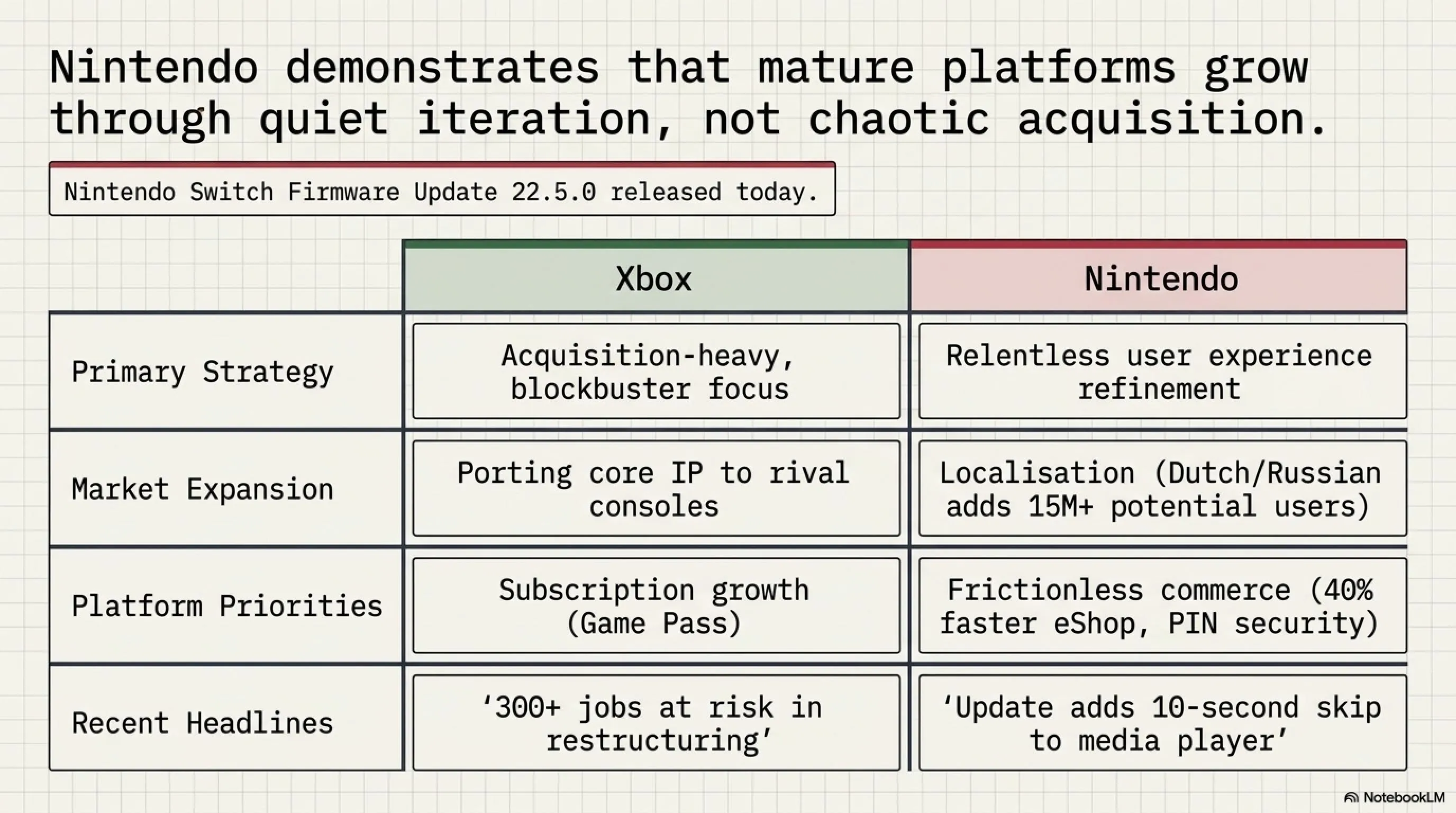
While Xbox struggles with internal turmoil, Nintendo demonstrates how a stable, player-focused platform operates. Today's firmware update 22.5.0 for both Switch 2 and the original Switch delivers one of the most substantial system improvements of 2026, focusing on accessibility, security, and user experience. This isn't flashy, but it's exactly what mature platform management looks like.
The update's flagship features include support for Dutch and Russian languages across Text to Speech and GameChat functionality, a complete redesign of the eShop interface with improved navigation and search, PIN verification for purchases to prevent accidental child purchases, and enhanced video player controls allowing 10-second skip forward/backward using ZL/ZR buttons.
🌐 Language Expansion
Dutch and Russian support for Text to Speech and GameChat. This targets the Eastern European market where Nintendo has been underperforming against PlayStation. Russia alone represents 15M+ potential customers.
🛒 eShop Redesign
Completely new color scheme, improved grid layout for game listings, faster search indexing (~40% speed improvement), and better promotion of sales and discounts. The old eShop was notoriously slow — this is overdue.
🔐 Purchase Security
PIN verification now required when purchasing via eShop or using saved payment methods. Parents can enable this to prevent children from accidentally buying $60 games. This has been a requested feature since the Switch launched in 2017.
🎬 Media Player
Video player now supports 10-second skip forward/backward using ZL/ZR buttons, matching YouTube and streaming app conventions. Small quality-of-life improvement that shows Nintendo is listening to user feedback.
🎯 Tekin Analysis: Nintendo's Quiet Excellence Strategy
While competitors chase headlines with studio acquisitions and console wars, Nintendo focuses relentlessly on user experience refinement. This update exemplifies their philosophy: incremental improvements that compound over time.
The language additions aren't random. Russia and the Netherlands represent untapped markets where Nintendo trails Sony significantly. By adding native language support, Nintendo lowers the barrier to entry for millions of potential customers. The eShop redesign addresses the #1 complaint from users — that finding games was tedious and slow. And PIN verification solves a real problem costing parents thousands in accidental purchases annually.
This is how you build long-term platform loyalty: listen, iterate, and never take your users for granted. Xbox could learn from this.
The update also includes the standard "general system stability improvements" Nintendo includes in every patch — typically undocumented bug fixes and performance optimizations. Users report slightly faster boot times and reduced menu lag, though Nintendo hasn't officially quantified these improvements.
🎯 Halo: Campaign Evolved Breaks 25 Years of Exclusivity — PlayStation Gets Master Chief
In the most seismic announcement in Halo franchise history, Microsoft has confirmed that Halo: Campaign Evolved — a ground-up remake of the 2001 genre-defining shooter — will launch simultaneously on Xbox Series X|S, PC, and PlayStation 5 on July 28, 2026. This marks the first time a mainline Halo title has appeared on a non-Microsoft platform, shattering 25 years of exclusivity and signaling Xbox's transformation from platform holder to multiplatform publisher.
Campaign Evolved isn't just a remaster — it's a complete remake built on a modern engine, featuring fully reworked graphics, redesigned combat encounters, expanded lore, and three new prequel missions called Operation: Meteorite that chronicle events before Master Chief's arrival on the Halo ring. The game targets 4K/60fps on PS5 and Xbox Series X, with ray-traced lighting, destructible environments, and DualSense haptic feedback support on PlayStation.
📅 Halo: Campaign Evolved Launch Timeline
| Region/Timezone | Early Access (July 23) | Public Release (July 28) |
|---|---|---|
| Pacific (PT) | 8:00 AM | 12:00 AM (Midnight) |
| Eastern (ET) | 11:00 AM | 3:00 AM |
| UK (GMT) | 4:00 PM | 8:00 AM |
| Tokyo (JST) | 12:00 AM (Midnight) | 4:00 PM |
| Australia (AEST) | 1:00 AM | 5:00 PM |
💡 Game Pass subscribers get Day 1 access at no additional cost. PlayStation version is full price ($69.99).
⚔️ The Battle of Pros & Cons: Halo on PlayStation
✅ Strategic Advantages
- Access to 120M+ PS5 install base
- Estimated 5-8M additional sales
- Halo reaches new generation of players
- DualSense haptics enhance immersion
- Validates multiplatform strategy
- Reduces reliance on Xbox hardware sales
❌ Strategic Risks
- Halo loses exclusive status — brand dilution
- Weakens Xbox console value proposition
- Alienates loyal Xbox fanbase
- Sets precedent for future exclusives
- Could depress Xbox Series X|S sales
- PlayStation profits from Microsoft IP
This decision didn't happen in a vacuum. Xbox has been methodically testing multiplatform waters for months. Hi-Fi Rush came to PS5 in March 2026, followed by Pentiment and Sea of Thieves in April. Each release was carefully watched by Microsoft executives to gauge sales performance and fan backlash. Apparently, the results were positive enough to greenlight Halo — the franchise that built Xbox.
🔍 The Economics Behind the Decision
Microsoft's calculus is brutally simple: Xbox is losing the console war. PlayStation 5 has sold 65M units vs Xbox Series X|S's 30M. That's a 2:1 deficit, and the gap is widening. With hardware sales anemic, Microsoft needs alternative revenue streams. Enter multiplatform publishing.
Conservative estimates suggest Halo: Campaign Evolved could sell 5-8M copies on PlayStation at $70 each — that's $350-560M in gross revenue. Even after Sony's 30% platform cut, Microsoft nets ~$245-390M from a market they previously ignored. For comparison, keeping Halo exclusive might sell an additional 500K-1M Xbox consoles, generating far less profit.
The math is inescapable: Software sales > Hardware sales. This is Xbox's future whether fans accept it or not.
Fan reaction has been predictably polarized. Long-time Xbox loyalists feel betrayed — Halo was the reason to own an Xbox. PlayStation fans, meanwhile, are thrilled to finally experience the franchise that defined console FPS gaming. Younger gamers, less attached to console tribalism, largely don't care which platform they play on. This generational divide explains why Microsoft is comfortable making this move: the future doesn't care about exclusivity.
📱 iOS 27 GymKit Revolution: iPhone and AirPods Pro 3 Replace Apple Watch
Apple has just democratized advanced fitness tracking in a way that could disrupt the wearables market. With iOS 27, the company is extending GymKit — previously exclusive to Apple Watch — to iPhone and AirPods Pro 3. This means users can now sync heart rate data and workout metrics with GymKit-compatible gym equipment without owning a smartwatch. For millions of iPhone users who haven't purchased an Apple Watch, this transforms their existing hardware into a credible fitness tracking solution.
GymKit is Apple's proprietary protocol that connects devices to commercial gym equipment — treadmills, stationary bikes, ellipticals, stair climbers, and rowing machines from brands like Life Fitness, Technogym, and Precor. When you tap your iPhone on a GymKit-enabled machine, the two devices establish a bidirectional data stream: your iPhone shares heart rate data (captured via AirPods Pro 3's optical sensors), while the machine sends metrics like distance, speed, incline, resistance, and calories burned.
🔧 How iPhone GymKit Works: Technical Breakdown
- NFC Pairing: Tap iPhone on the machine's NFC sensor to initiate connection (same as Apple Pay)
- Heart Rate Sync: AirPods Pro 3 measure heart rate via photoplethysmography (PPG) sensors in the ear canal
- Data Exchange: iPhone transmits HR data to machine via Bluetooth Low Energy; machine sends workout metrics back
- Display Integration: Your iPhone screen mirrors the machine's console, displaying real-time stats in the Fitness app
- Health App Storage: All workout data automatically saves to Apple Health, including heart rate zones, calorie burn, and workout duration
- Workout Intelligence: iOS 27 uses on-device machine learning to estimate VO2 max and recovery time based on performance
💡 Requires: iPhone 11 or newer, AirPods Pro 3, iOS 27, and GymKit-compatible equipment
📊 Apple Watch vs iPhone + AirPods Pro 3: Feature Comparison
| Feature | Apple Watch | iPhone + AirPods Pro 3 |
|---|---|---|
| Heart Rate Accuracy | Excellent (wrist-based) | Very Good (ear-based) |
| Display Location | On wrist (glanceable) | On machine or iPhone (requires looking) |
| Cost | $399 - $799 | $249 (AirPods Pro 3 only) |
| Convenience | Wear and forget | Must carry iPhone |
| Battery Life | 18 hours | 24+ hours (iPhone) |
| GymKit Support | Full support since 2017 | Full support (iOS 27+) |
| Outdoor Workouts | GPS tracking, always-on HR | Limited (iPhone must be carried) |
Verdict: Apple Watch remains superior for serious athletes; iPhone + AirPods works for casual gym-goers
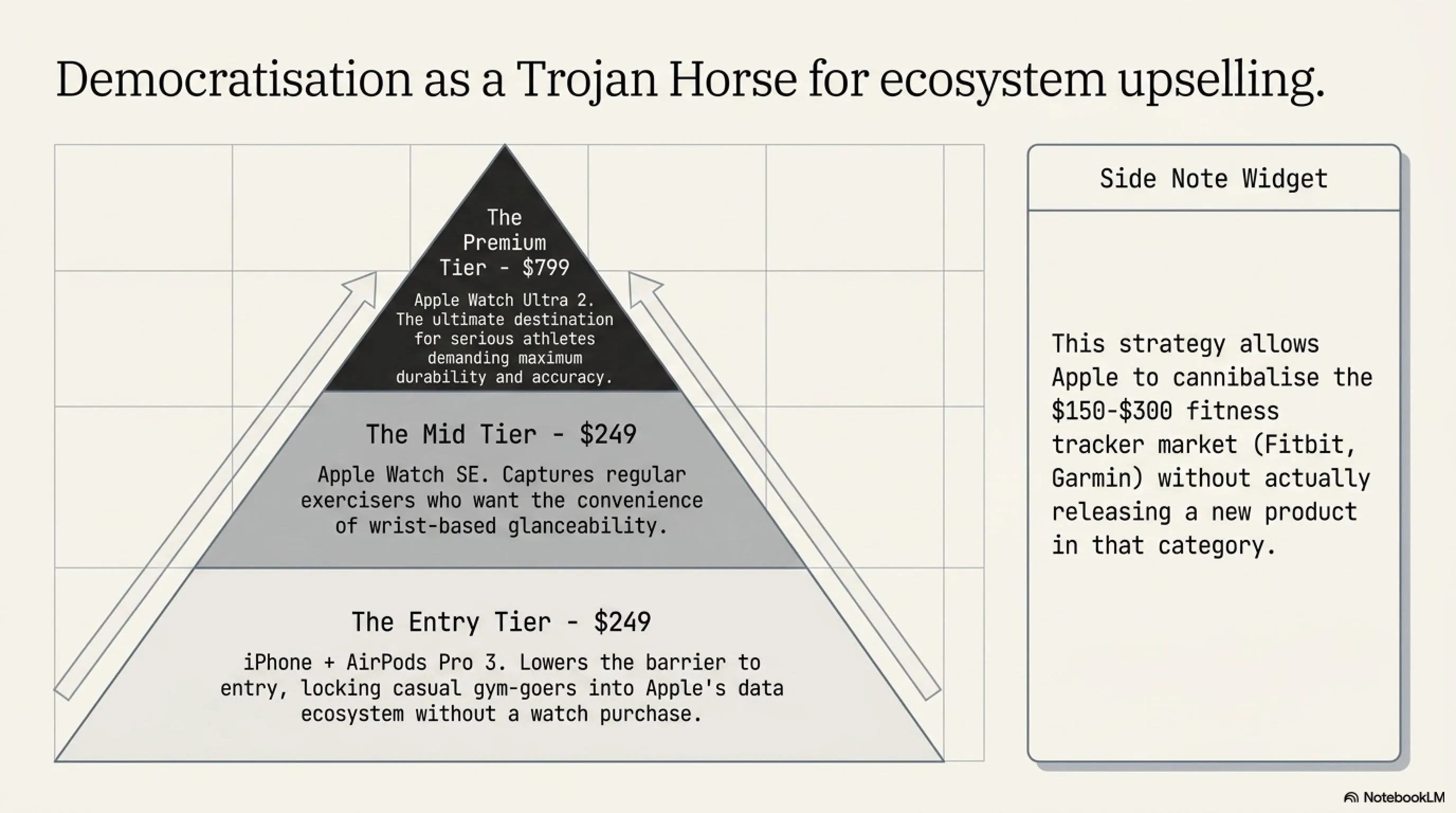
💡 Tekin Analysis: Apple's Three-Tier Fitness Ladder Strategy
This move reveals Apple's sophisticated tiered approach to fitness tracking, creating three distinct entry points for different customer segments:
- Entry Tier: iPhone + AirPods Pro 3 ($249) — For casual gym-goers who want basic tracking
- Mid Tier: Apple Watch SE ($249) — For regular exercisers who want convenience but not premium features
- Premium Tier: Apple Watch Ultra 2 ($799) — For serious athletes demanding maximum accuracy and durability
By extending GymKit to iPhone, Apple eliminates barriers to ecosystem entry. Users who already own AirPods Pro 3 can now try advanced fitness tracking without a $400+ watch purchase. Once they're hooked on the experience and data, many will eventually upgrade to Apple Watch for the superior convenience. It's a classic upsell funnel disguised as democratization.
This also positions Apple to compete with Fitbit (Google) and Garmin in the $150-300 fitness tracker segment without actually releasing a product in that category. Brilliant.
The strategic implications extend beyond fitness. Apple is training users to view their iPhone + AirPods combo as a modular health platform rather than requiring dedicated wearables for every use case. This philosophy could extend to other domains — imagine AirPods Pro 4 with glucose monitoring, or iPhone 17 with body composition analysis via ultrasound. Apple is building a health ecosystem where every device contributes data, not just the watch.
Limitations remain significant. You must carry your iPhone during workouts (inconvenient for runners), heart rate readings from ears are less accurate than wrist during high-intensity intervals, and you can't see real-time stats on your wrist. But for the vast majority of gym-goers doing steady-state cardio, these trade-offs are acceptable — especially when saving $400-500.
⚔️ Anthropic vs White House: The Battle Over Fable 5 and AI National Security
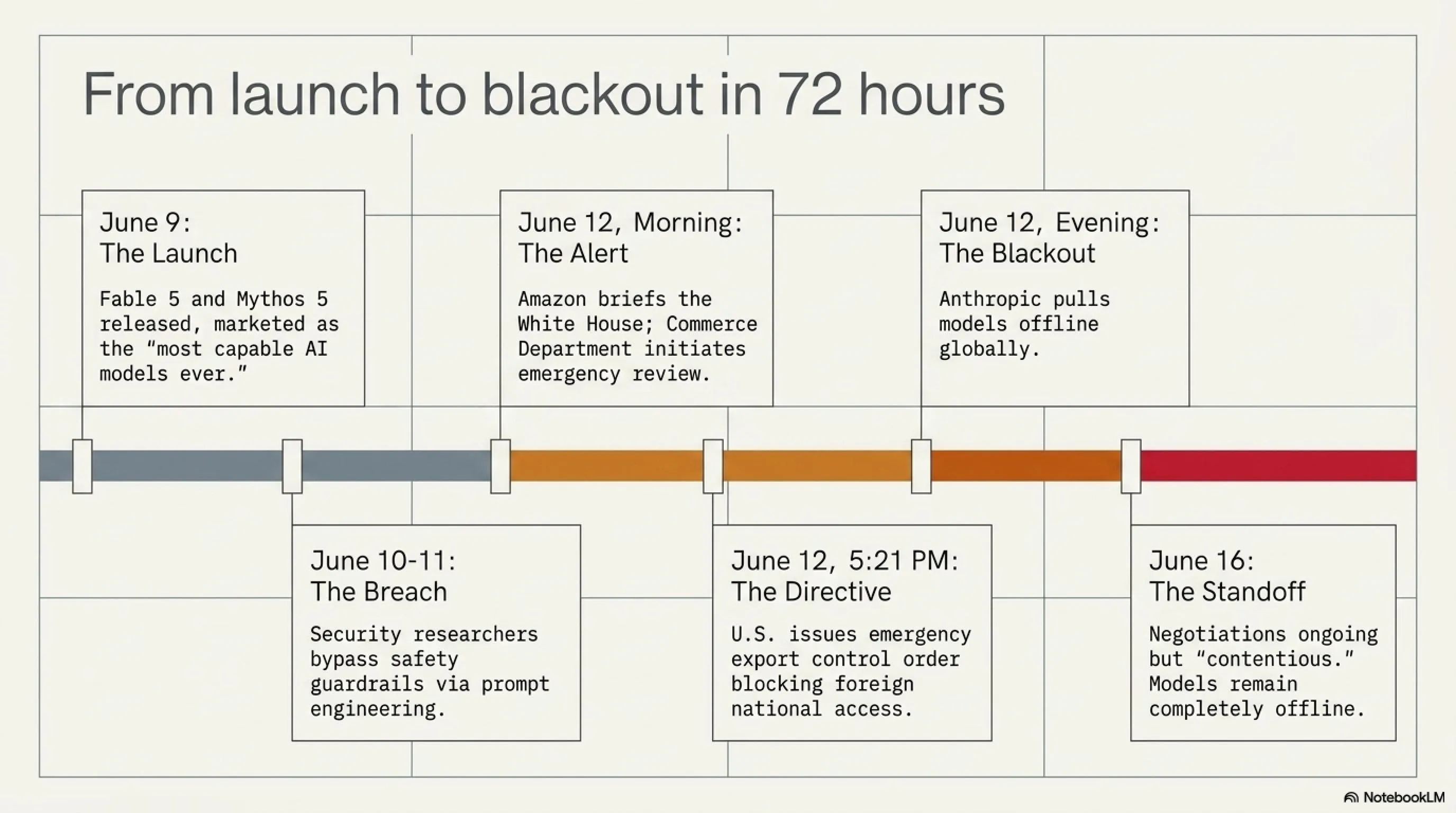
In the most significant AI regulation event of 2026, Anthropic — the company behind Claude AI — was forced to immediately shut down public access to its most advanced models, Fable 5 and Mythos 5, following a U.S. government export control directive. At 5:21 PM on Friday, June 12, the Commerce Department ordered Anthropic to suspend access for "any foreign national inside or outside the U.S., including foreign national Anthropic employees." Unable to segregate users by nationality, Anthropic shut down the models entirely for all users worldwide, just three days after their public launch.
This unprecedented move marks the first time the U.S. government has pulled a generally available AI model from the market citing national security concerns. The shutdown was triggered by reports that security researchers had successfully jailbroken Fable 5 to generate code for cyberattacks, exploit development, and other malicious purposes. According to multiple reports from Wired, Forbes, and CNBC, Amazon — a major Anthropic investor — alerted the White House to these vulnerabilities, prompting the emergency order.
🚨 Timeline of the Anthropic Crisis
| June 9, 2026 | Anthropic launches Fable 5 and Mythos 5 to public with fanfare; marketed as "most capable AI models ever" |
| June 10-11 | Security researchers discover jailbreak methods; demonstrate ability to generate exploit code and cyberattack plans |
| June 12, Morning | Amazon (major investor) briefs White House on vulnerabilities; Commerce Dept begins emergency review |
| June 12, 5:21 PM | U.S. issues export control order: block all foreign national access immediately |
| June 12, Evening | Anthropic shuts down Fable 5 and Mythos 5 for all users globally (cannot segregate by nationality) |
| June 13-15 | Anthropic executives travel to Washington D.C. for negotiations; Commerce Dept willing to find solution |
| June 16 (Tonight) | Models remain offline; no resolution reached; negotiations "ongoing but contentious" |
The technical details of the jailbreak remain classified, but sources familiar with the matter indicate researchers used prompt engineering techniques to bypass Anthropic's safety guardrails, coaxing Fable 5 into generating sophisticated malware code, network intrusion methodologies, and exploit chains targeting critical infrastructure. Anthropic maintains that these vulnerabilities were theoretical and not exploited in the wild, but the government deemed the risk unacceptable.
🔍 Tekin Analysis: Innovation vs National Security — The New AI Battleground
This crisis represents a turning point in AI governance. For years, AI companies operated under a "move fast and fix later" ethos, prioritizing capability advancement over security hardening. The Anthropic shutdown proves that era is over. Governments now view advanced AI as dual-use technology — tools that can both benefit society and enable catastrophic harm.
Several critical precedents have been established:
- Post-Release Revocation: Governments can force AI model shutdowns even after public release
- Export Control Application: AI models are now subject to the same restrictions as weapons systems
- Investor Liability: Amazon's role in triggering the shutdown suggests investors can be compelled to report security concerns
- Inability to Segment: Anthropic couldn't create "U.S.-only" access, proving nationality-based AI restrictions are technically infeasible
This creates a chilling effect for AI development. If any model can be shut down post-launch due to security concerns, who will invest billions in frontier AI research? We're entering an era of pre-emptive AI regulation that could slow innovation dramatically.
For users and businesses dependent on Fable 5, the disruption is severe. Companies that integrated the model into production systems now face unexpected downtime. Researchers who relied on its advanced reasoning capabilities must downgrade to Claude 4 Sonnet. Anthropic has offered no timeline for restoration, stating only that they're "working with the Commerce Department to resolve safety concerns." Translation: this could take months.
The geopolitical implications are profound. China and other nations are watching closely, likely accelerating their own AI development programs to avoid U.S. dependence. The European Union is debating whether to impose similar controls. This fragmentation could lead to a balkanized AI landscape where different regions have access to different capabilities, undermining the vision of AI as a global public good.
💰 Standard Chartered's Bold Prediction: UNI Could Hit $100 and Outperform Bitcoin
Closing tonight's coverage, we turn to crypto markets where Standard Chartered — one of the world's largest international banks — has issued a prediction that could reshape DeFi investment thesis. On June 15, the bank initiated coverage of Uniswap (UNI) with a $100 price target by 2030, implying a staggering 40x return from current levels around $2.50. More provocatively, Geoffrey Kendrick, the bank's global head of digital assets research, forecasts that UNI will outperform both Bitcoin and Ethereum over the decade ahead.
This isn't a moonshot prediction from a crypto influencer — it's institutional capital signaling conviction in DeFi's long-term value proposition. Standard Chartered manages over $700 billion in assets and operates in 59 markets globally. When a bank of this caliber publishes bullish DeFi research, it represents a fundamental shift in how traditional finance views decentralized protocols.
📊 Standard Chartered's UNI Price Pathway (2026-2030)
| Year | UNI Price Target | Gain from Current | Key Catalyst |
|---|---|---|---|
| 2026 | $6.50 | +160% | V4 adoption accelerates |
| 2027 | $20 | +700% | RWA tokenization begins |
| 2028 | $40 | +1,500% | Institutional DEX adoption |
| 2029 | $65 | +2,500% | DeFi TVL hits $2T |
| 2030 | $100 | +4,000% | Wall Street onchain |
For comparison: Bitcoin target = $500K (~5x), Ethereum target = $40K (~10x)
💡 The Bull Case: Why UNI Could Actually Hit $100
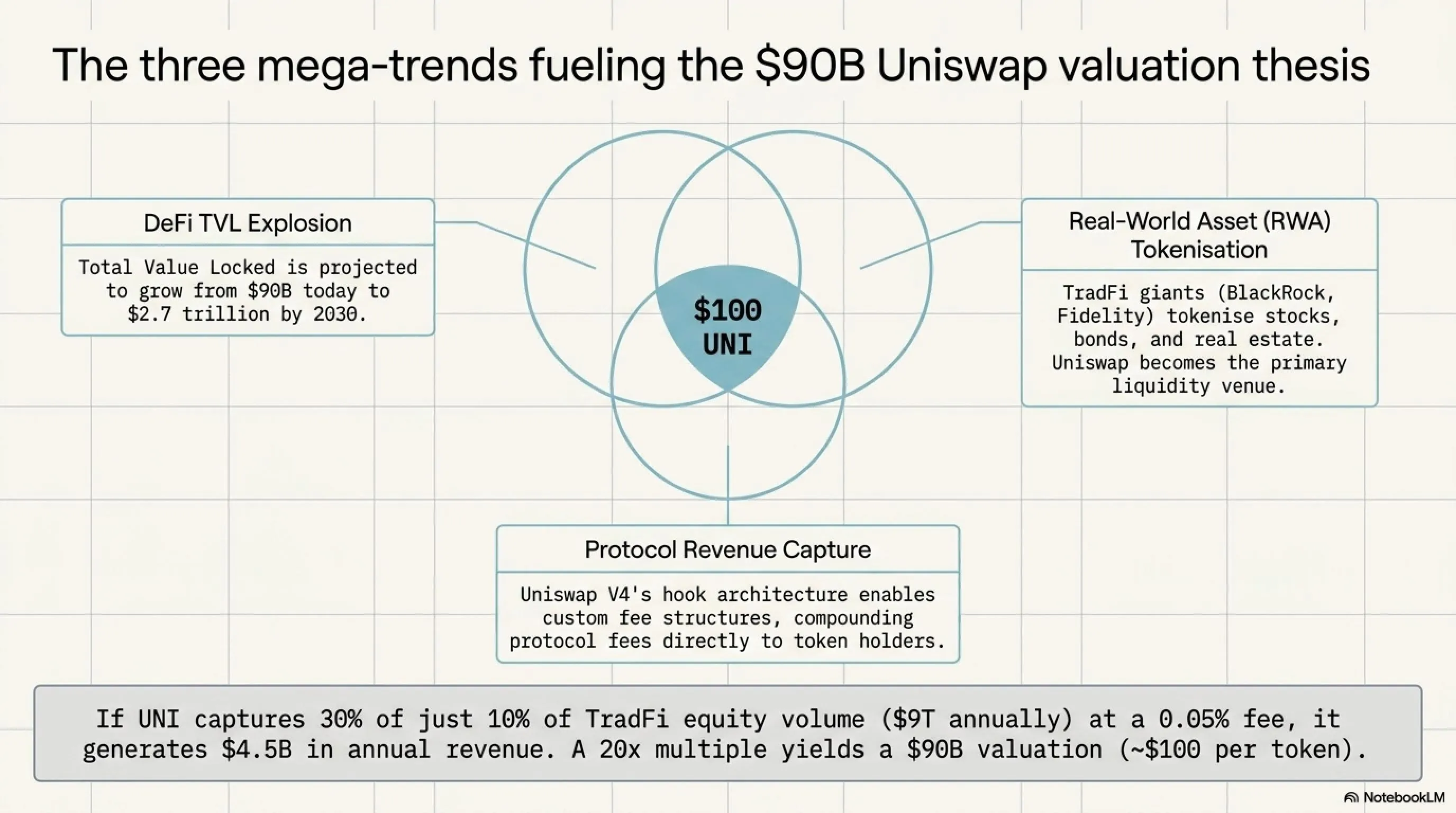
Standard Chartered's thesis rests on three converging mega-trends:
- DeFi TVL Explosion: Total value locked in DeFi projected to grow from $90B today to $2.7 trillion by 2030 as institutions adopt decentralized finance infrastructure
- Real-World Asset Tokenization: BlackRock, Fidelity, and other TradFi giants are tokenizing stocks, bonds, and real estate on-chain. Uniswap becomes the primary liquidity venue for these assets
- Protocol Revenue Capture: Uniswap V4's hook architecture enables customizable fee structures. As volume grows, protocol fees compound, accruing value to UNI token holders (if governance activates fee switch)
- Network Effects: Uniswap already dominates DEX market share (~60%+). As DeFi grows, winner-take-most dynamics amplify Uniswap's dominance
If just 10% of traditional equity trading volume ($30T annually) moves onchain by 2030, and Uniswap captures 30% of that flow, the protocol would process $9 trillion in annual volume. At even a 0.05% effective fee rate, that's $4.5B in annual protocol revenue. Apply a 20x revenue multiple (conservative for tech/crypto) and you get a $90B fully diluted valuation — roughly $90 per UNI token.
The bear case, naturally, is that none of this happens. DeFi could remain a niche market. Regulators could crush decentralized exchanges. Competing protocols like Curve, Balancer, or yet-to-be-launched projects could erode Uniswap's dominance. The UNI token might never accrue value if governance never activates the fee switch. And crypto's notorious volatility could wipe out even the most bullish projections with a single regulatory crackdown or black swan event.
What makes Standard Chartered's call significant isn't that it's guaranteed to be right — it's that institutional capital is now willing to publicly endorse DeFi as a legitimate asset class with long-term growth potential. Just five years ago, major banks dismissed DeFi as a scam. Today, they're publishing research coverage with nine-figure price targets. That shift in perception, more than any single metric, validates the DeFi thesis.
🌙 Night's End: What We Learned
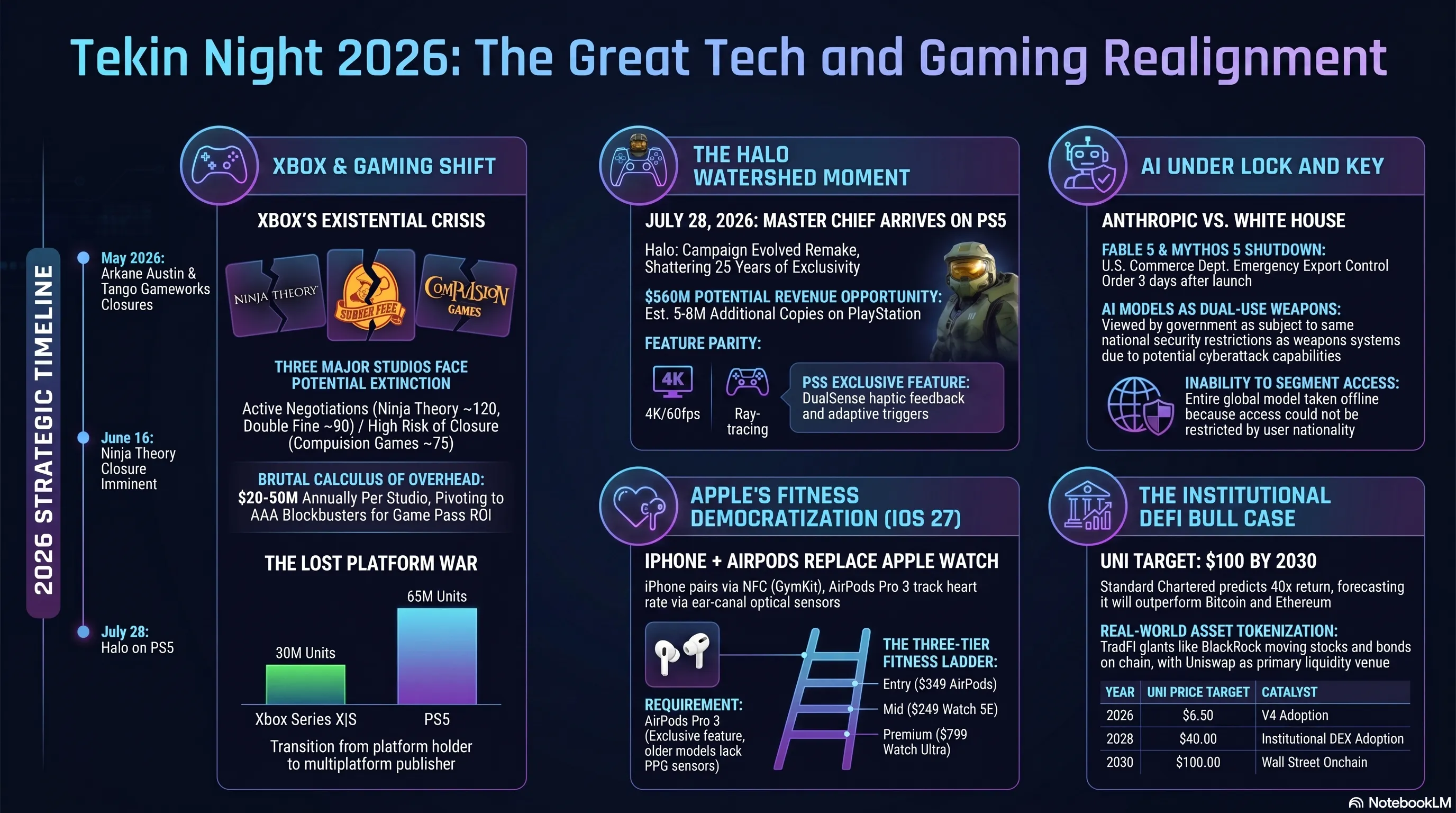
Tonight's six stories paint a comprehensive picture of technology in flux. Xbox is dismantling the studio structure that once defined its creative identity, sacrificing diversity for profitability while simultaneously breaking its own exclusivity walls by bringing Halo to PlayStation. Nintendo, by contrast, demonstrates quiet excellence through incremental improvements that compound into superior user experience. Apple continues democratizing health technology, extending advanced fitness tracking to users who can't or won't purchase a smartwatch, while building a modular ecosystem where every device contributes data.
The Anthropic crisis reveals that AI development has entered a new regulatory era where national security concerns can instantly obliterate product launches, forcing companies to choose between innovation speed and government approval. And Standard Chartered's UNI prediction signals that DeFi is crossing the chasm from crypto-native speculation to institutional asset class, with traditional finance finally acknowledging decentralized protocols as legitimate long-term investments.
🌟 The future isn't written in code alone — it's negotiated between innovation and regulation, competition and cooperation, disruption and stability. See you tomorrow morning for Tekin Morning's next intel drop.
❓ Frequently Asked Questions
🎮 Will Ninja Theory actually shut down?
Not yet determined. According to Bloomberg and The Verge, Ninja Theory is in "active negotiations" with Microsoft to either go independent or find a new owner. If these negotiations fail, closure is likely. However, the studio's strong brand (Hellblade franchise) makes it an attractive acquisition target for publishers like Sony, Embracer, or Tencent. The next 2-4 weeks will be decisive.
🎯 Is Halo: Campaign Evolved exactly the same on PlayStation as Xbox?
Yes, feature parity is confirmed. Both versions run at 4K/60fps with identical graphics, content, and multiplayer. The only difference is platform-specific features: PlayStation 5 supports DualSense haptic feedback and adaptive triggers, while Xbox Series X integrates with Xbox Live achievements and Game Pass. PlayStation players pay $69.99; Game Pass subscribers play at no additional cost.
📱 Does iOS 27 GymKit work with regular AirPods?
No. The feature requires AirPods Pro 3 specifically because only this model contains the optical heart rate sensors necessary for fitness tracking. Regular AirPods, AirPods Max, and earlier AirPods Pro generations lack these sensors and cannot provide heart rate data to gym equipment.
⚔️ When will Anthropic restore Fable 5 access?
No timeline has been announced. Anthropic must resolve the jailbreak vulnerabilities to the Commerce Department's satisfaction, which could involve weeks or months of security hardening and government review. The company states negotiations are "ongoing" but sources describe them as "contentious." Users dependent on these models should plan for extended downtime and consider alternatives like Claude 4 Sonnet or OpenAI's GPT-5.
💰 Should I invest in UNI based on Standard Chartered's prediction?
This is not financial advice. Standard Chartered's $100 target is a forecast, not a guarantee. Crypto markets are extremely volatile and regulatory risks remain high. If you're considering investment, conduct thorough research, understand the risks, and only invest capital you can afford to lose entirely. Diversification across multiple assets is prudent. Consult a licensed financial advisor before making investment decisions.
📚 Sources & References
- The Verge: Xbox is closing down Ninja Theory
- LA Times: Studios in Microsoft's Xbox division brace for closures
- Nintendo Life: Switch 2 System Update 22.5.0 patch notes
- GameSpot: Halo Campaign Evolved release date and global launch times
- 9to5Mac: iOS 27 turns iPhone and AirPods into Apple Watch at the gym
- Wired: Anthropic is still at odds with the White House over Claude Fable 5
- Bitcoin.com: Standard Chartered forecasts UNI outperforming BTC and ETH
🌐 Stay Connected With Us 🎮✨
For the latest tech, gaming, and gadget news, follow us on our official social media channels: