Tekin Night: Tuesday, September 8, 2026
- 🎮JSCeal Malware Threat- Google 2FA bypass via browser session hijacking without passwords
- 🎧Insomniac's Venom Spinoff- Insiders confirm standalone title remains in active development
- 🚀Sony PlayStation Discs- Clarification on 10% production adjustment vs false 90% digital extinction rumors
- 🗡️Civ VII PAX West Reveal- Free Atomic Age update with Gandhi's return and Earthrise space expansion
- 📰RuneScape Rogue Dev Sentenced- Cambridge Crown Court hands prison term for billions in stolen virtual gold
- ⚔️Kalshi Multi-Million Glitch- Data oracle error erroneously settles college football market to losing bettors
As the quiet tranquility of Tuesday night, September 8, 2026, envelopes the global tech and gaming landscapes, it is time to set aside the relentless daytime rush and step into TekinGame's signature late-night investigative salon. In these calm twilight hours, when stock ticker noise subsides, European trading desks close, and developer studios dim their main lights, we open an exclusive analytical window into confidential production pipelines, subterranean malware ecosystems, and high-stakes corporate disputes. Tonight's briefing brings together newly surfaced internal documents, high-court rulings, and technical disclosures that illuminate the real power dynamics shaping our interactive digital future.
The TekinGame investigative desk has curated six compelling, deeply researched investigative files for tonight's edition. Written with uncompromising journalistic rigor, technical depth, and strategic perspective, this late-night digest is designed to offer actionable clarity before you close your screen for the night. From an invisible malware strain that circumvents the most rigorous two-factor authentication barriers by plucking live session cookies directly from browser RAM, to Sony's spirited defense of the physical disc economy and the survival of Insomniac's standalone Venom project, each investigation offers a vital piece of the evolving technological landscape.
Executive Summary: Key Pillars of Tonight's Intelligence Dossier
- Discovery of the stealthy JSCeal info-stealer that invalidates Google 2FA by harvesting active session tokens from browser memory.
- Credible insider reports confirm Insomniac Games is actively advancing its standalone Venom spinoff despite leaks and cancellations rumors.
- Sony Interactive Entertainment debunked rumors of physical disc phase-out, clarifying a minor 10% production trimming toward 2028.
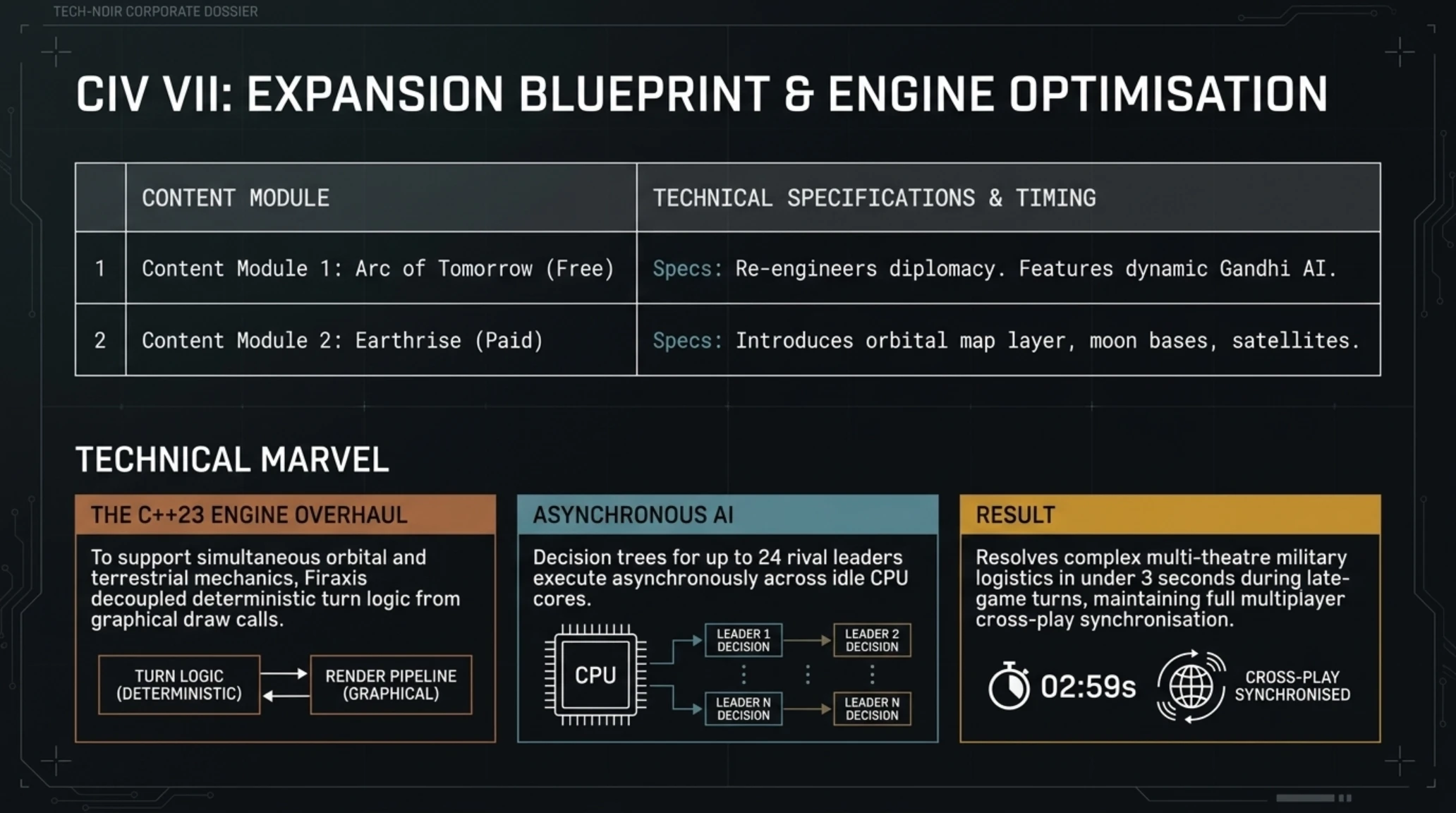
- Firaxis Games stunned PAX West 2026 with the free 'Arc of Tomorrow' Atomic Age update and the paid 'Earthrise' orbital space expansion for Civilization VII.
- Cambridge Crown Court sentenced a rogue former Jagex developer to 44 months imprisonment for exploiting admin tools to steal billions in Old School RuneScape wealth.
- An algorithmic oracle glitch on prediction platform Kalshi erroneously paid out millions of dollars to bettors who wagered on a losing college football team.
The Invisible Predator in Your Browser: How JSCeal Malware Neutralizes Google 2FA
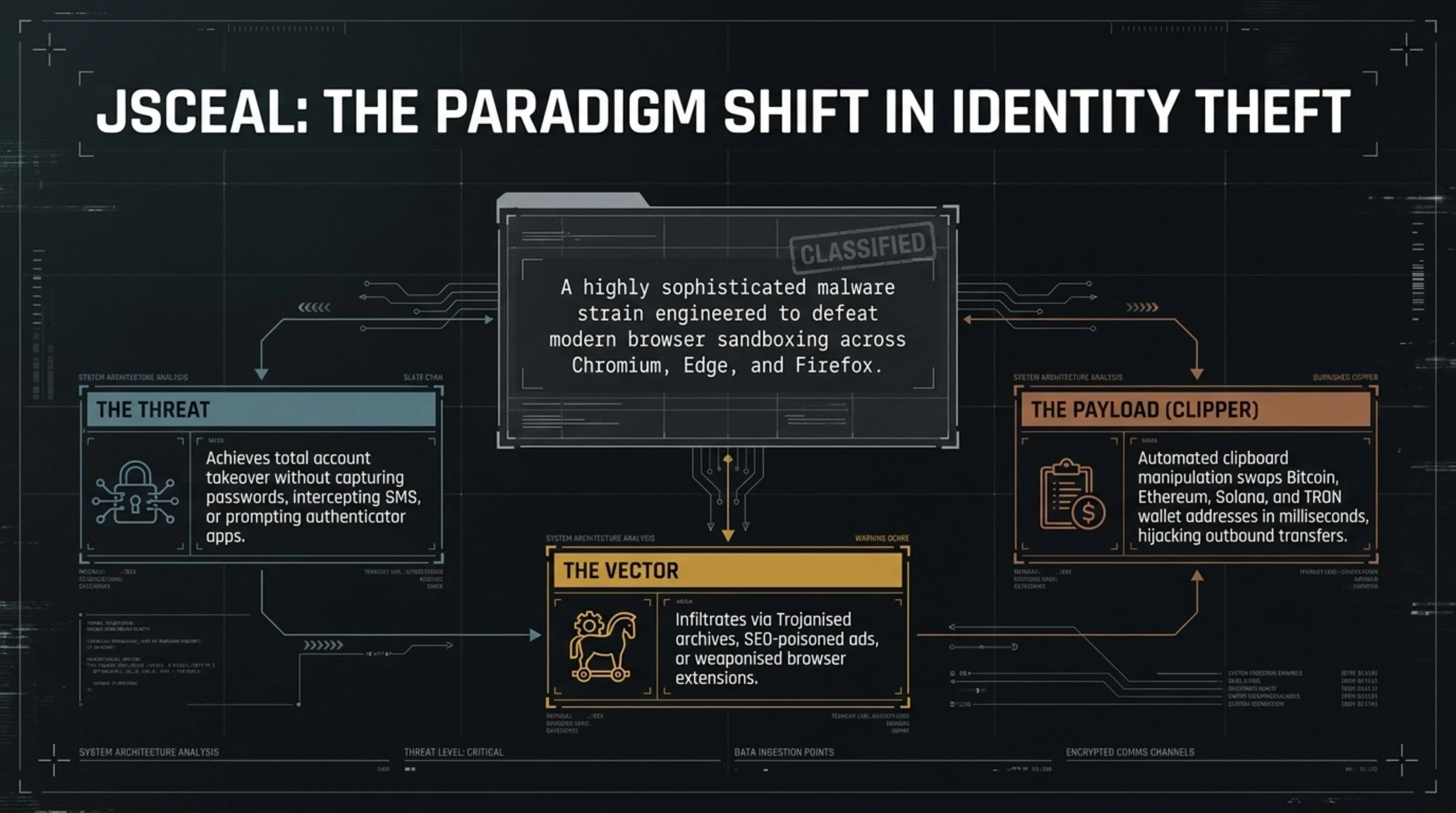
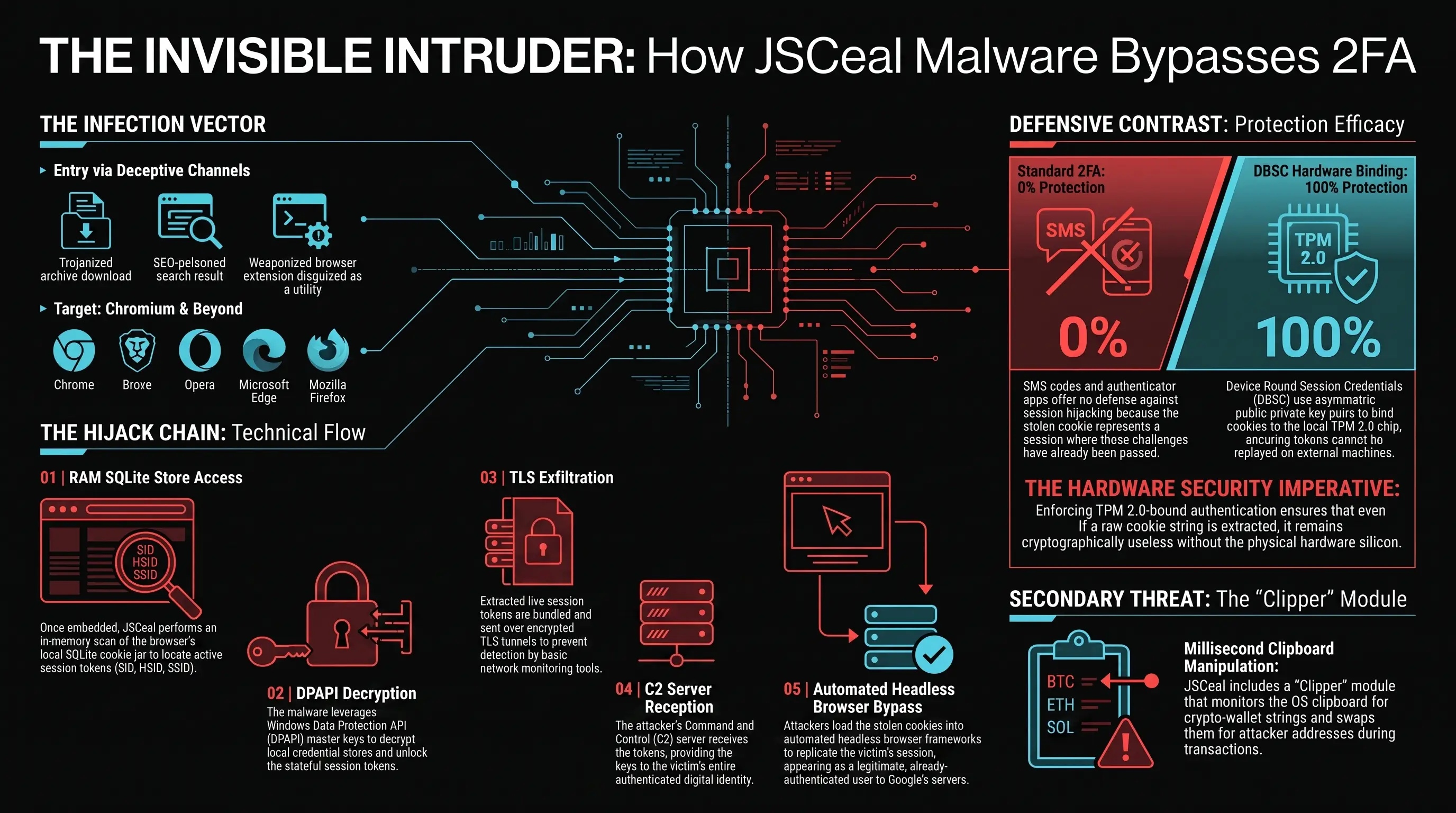
Our opening investigative file plunges into the subterranean world of advanced cybersecurity threats and dark-web exploit economies. In an exclusive technical disclosure confirmed by senior threat analysts at The Hacker News and verified by independent reverse-engineering teams, researchers have documented the rapid global proliferation of a lethal, highly sophisticated malware strain designated as JSCeal. Engineered specifically to defeat modern browser sandboxing mechanisms across Chromium-based browsers (including Google Chrome, Brave, and Opera), Microsoft Edge, and Mozilla Firefox, JSCeal represents a fundamental paradigm shift in identity theft: it achieves total account takeover without ever capturing a user's password, intercepting SMS verification codes, or prompting authenticator apps.
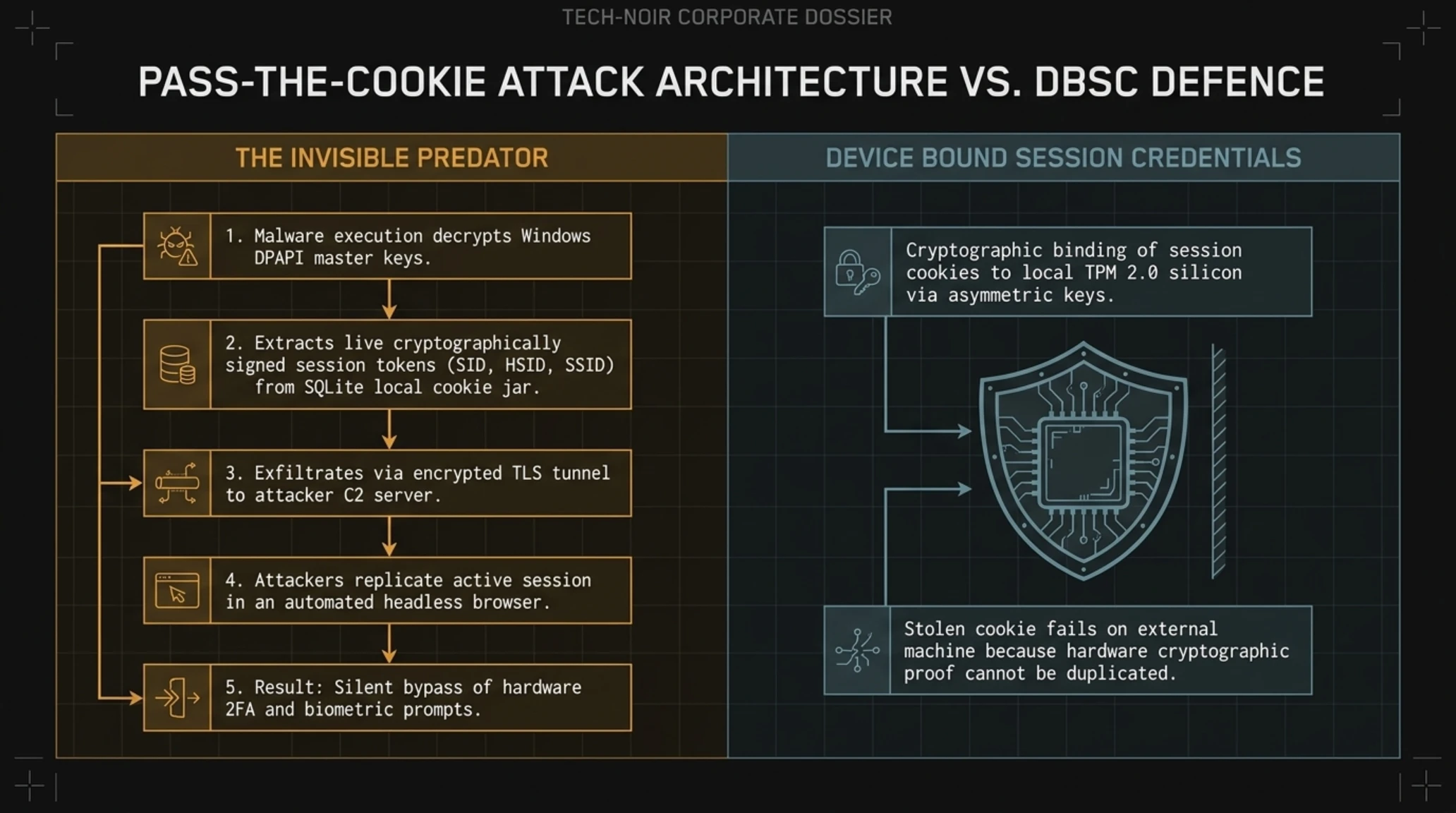
At the architectural core of JSCeal is a weaponized implementation of Pass-the-Cookie session hijacking. When a user authenticates against the Google ecosystem, the backend identity provider issues a series of time-delimited, cryptographically signed session tokens (such as SID, HSID, and SSID) which are deposited into the browser's local SQLite cookie jar. This stateful design allows seamless user navigation across services like Gmail, YouTube, Google Drive, and Google Cloud Platform Console without forcing repetitive credential challenges. JSCeal infiltrates client endpoints via Trojanized archive downloads, SEO-poisoned search engine advertising, or weaponized browser extensions disguised as productivity utilities. Once embedded in user space, the malware executes an in-memory scan, decrypts local credential stores via Windows Data Protection API (DPAPI) master keys, extracts these live session tokens, and exfiltrates them over encrypted TLS tunnels directly to attacker-controlled Command and Control (C2) servers.
Armed with these valid authentication cookies, threat actors replicate the victim's active session inside automated headless browser frameworks. From the perspective of Google's identity verification servers, the incoming traffic appears entirely legitimate, having already satisfied initial password verification, biometric prompts, and hardware 2FA challenges. Consequently, attackers gain unrestricted administrative access to corporate emails, cloud storage archives, proprietary code repositories, and stored password vaults, all without triggering automated push notifications, suspicious IP challenge screens, or anomalous login alerts on the victim's mobile device.
Beyond cloud account compromise, cybersecurity researchers discovered that JSCeal incorporates an automated clipboard manipulation module (Clipper). The malware continuously monitors the operating system's clipboard buffer for cryptographic wallet string patterns associated with Bitcoin, Ethereum, Solana, and TRON networks. When a transaction destination address is copied to the buffer, JSCeal swaps it within milliseconds for an attacker-controlled vanity address, siphoning outbound transfers to unrecoverable destinations before the sender completes visual verification.
Jargon Buster: Essential Technical Concepts in Session Security
Pass-the-Cookie Attack: An intrusion vector where harvested authentication tokens are used to impersonate authorized users, bypassing 2FA entirely.
Clipboard Hijacker (Clipper): A malicious background routine that alters copied cryptocurrency wallet addresses in transit to divert asset transfers.
Device Bound Session Credentials (DBSC): A cutting-edge web standard binding session tokens to hardware TPM cryptographic keys, preventing cross-device token reuse.
To counter this growing wave of session theft, security engineers strongly advise web users and enterprise administrators to enable Google's emerging Device Bound Session Credentials (DBSC) protocol. By cryptographically binding active session cookies to the local Trusted Platform Module (TPM 2.0) hardware chip via asymmetric public-private key pairs, DBSC ensures that even if an attacker successfully extracts the raw cookie string from memory, it remains completely useless when replayed on an external machine, as the cryptographic proof cannot be duplicated without physical access to the local hardware silicon.
The enterprise fallout from session-hijacking campaigns like JSCeal extends far beyond individual credential theft. When an attacker commandeers an active session token belonging to a developer, DevOps engineer, or system administrator, they effectively inherit trusted status across entire Single Sign-On (SSO) fabrics. Security operations centers (SOC) are increasingly forced to re-architect identity perimeters around Continuous Adaptive Trust (CAT) models. Rather than assuming a valid cookie guarantees benign intent throughout its lifecycle, next-generation security architectures continuously evaluate telemetry signals including browser canvas fingerprints, TLS handshake characteristics, and micro-behavioral mouse kinetics to detect token exfiltration within seconds of an anomaly.
Furthermore, major browser vendors and identity providers are collaborating on standardized token-revocation backchannels. Under proposed W3C identity specifications, when an endpoint detection and response (EDR) agent flags a suspicious memory access pattern or an unauthorized DPAPI query, a cryptographic revocation signal is immediately broadcast to cloud identity providers, instantly invalidating active sessions across all federated SaaS applications before attackers can execute lateral movement.
Strategic Impact: Urgent Defense Priorities for Enterprise and Power Users
Cryptocurrency Transaction Risks: DeFi and Web3 participants must verify complete wallet strings rather than relying on initial and trailing characters.
Hardware Security Imperative: Upgrading to FIDO2 hardware security keys and enforcing automated session timeouts remain vital defense lines.
As you wind down tonight, taking two minutes to audit authorized browser extensions, terminating stale connected sessions in your Google Account Security Dashboard, and configuring hardware-bound authentication keys can fortify your digital perimeter for a secure and restful night.
Symbiote Unchained: Insomniac's Standalone Venom Project Survives Leaks and Rumors
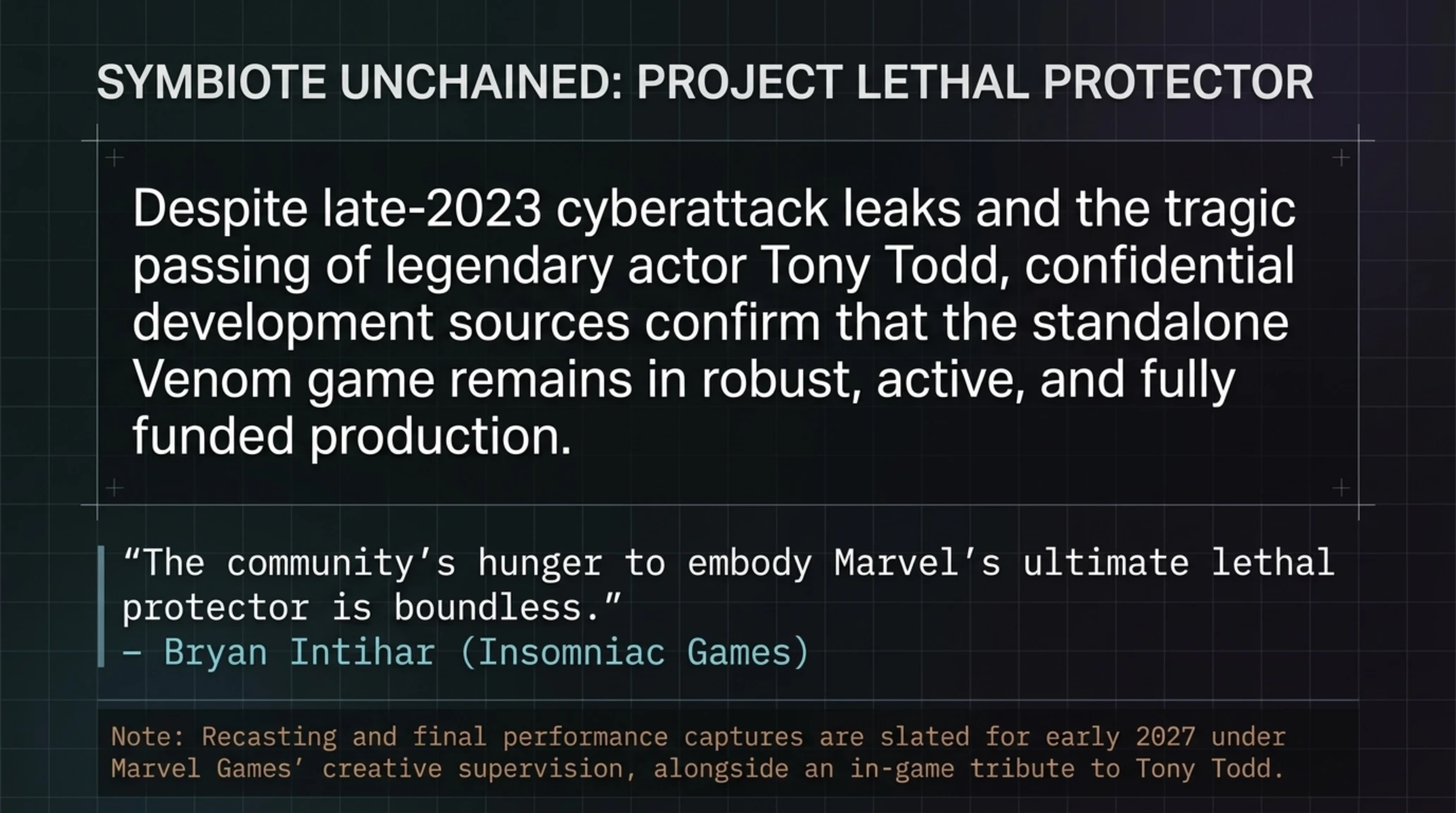
Our second midnight dispatch turns toward Burbank, California, stepping inside the celebrated creative studios of Insomniac Games and Sony Interactive Entertainment. In recent months, persistent speculation across Reddit, specialized Discord servers, and social media platforms suggested that following the catastrophic late-2023 cyberattack, the unfortunate public exposure of confidential internal roadmaps, and the heartbreaking passing of legendary actor Tony Todd who provided the imposing voice and performance for Venom in Marvel's Spider-Man 2 the standalone spinoff titled Project Lethal Protector had been quietly shelved or dismantled into minor DLC scraps.
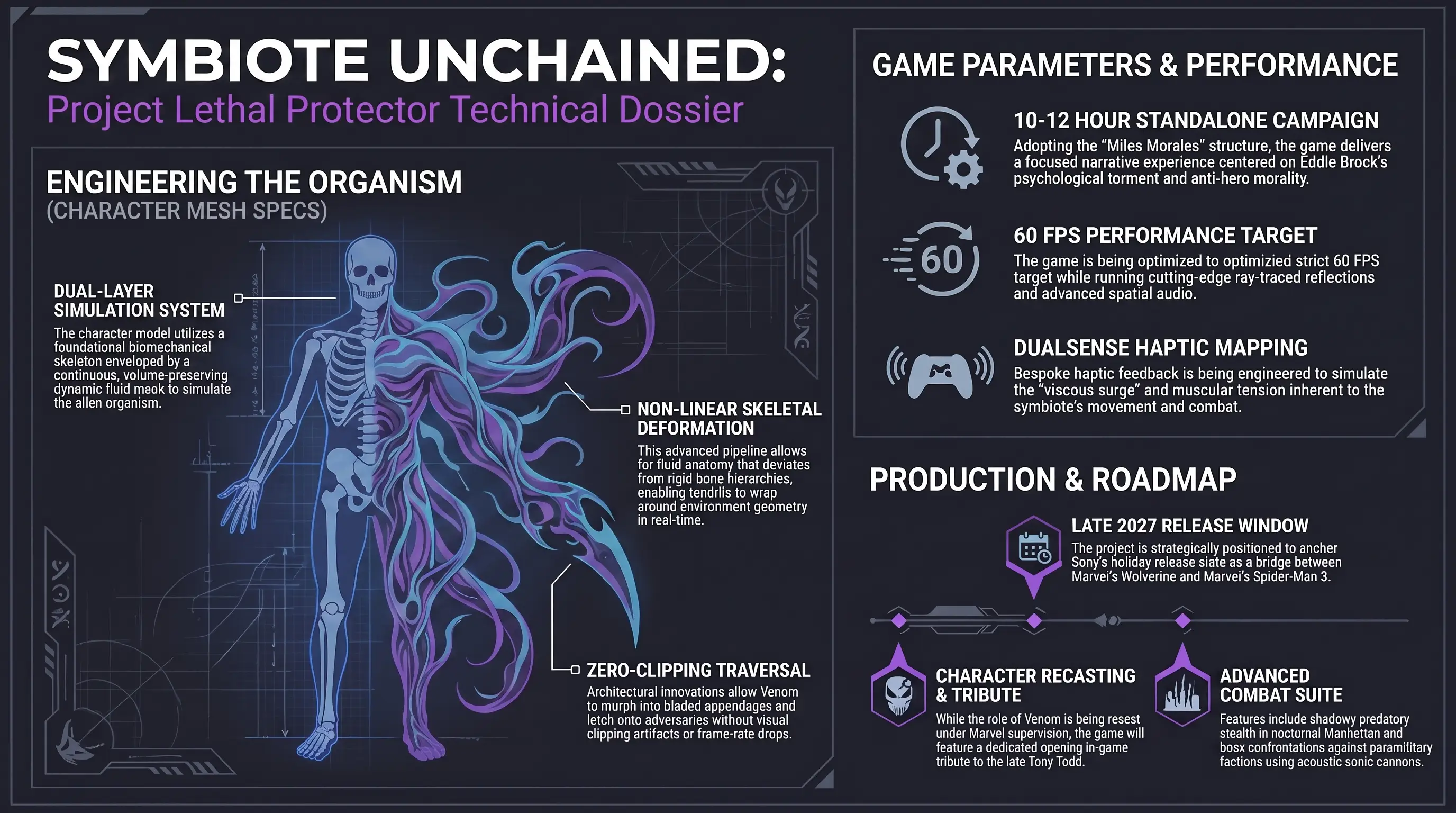
However, recent investigative reports from seasoned industry insiders, confirmed by veteran PlayStation beat reporters and verified development sources, have decisively discredited these cancellation rumors. Fresh internal documentation reveals that the standalone Venom game remains in robust, active, and fully funded production. Far from being abandoned, the project is progressing smoothly through its core mechanics, narrative pacing, and combat prototyping phases, positioned strategically to anchor Sony's holiday release slate between Marvel's Wolverine and the eventual climax of Marvel's Spider-Man 3.
According to sources close to development, Insomniac is engineering a substantially deeper, more visceral combat system centered around Eddie Brock's psychological torment, symbiotic addiction, and lethal anti-hero morality. Designers are moving far beyond the brief playable rampage featured in Spider-Man 2, crafting an expanded combat suite that features dynamic tendril morphing, lethal environment-splintering ground slams, shadowy predatory stealth mechanics in nocturnal Manhattan, wall-running bio-traversal, and intense boss confrontations against heavily armed anti-symbiote paramilitary factions equipped with acoustic sonic cannons and incendiary plasma weapons.
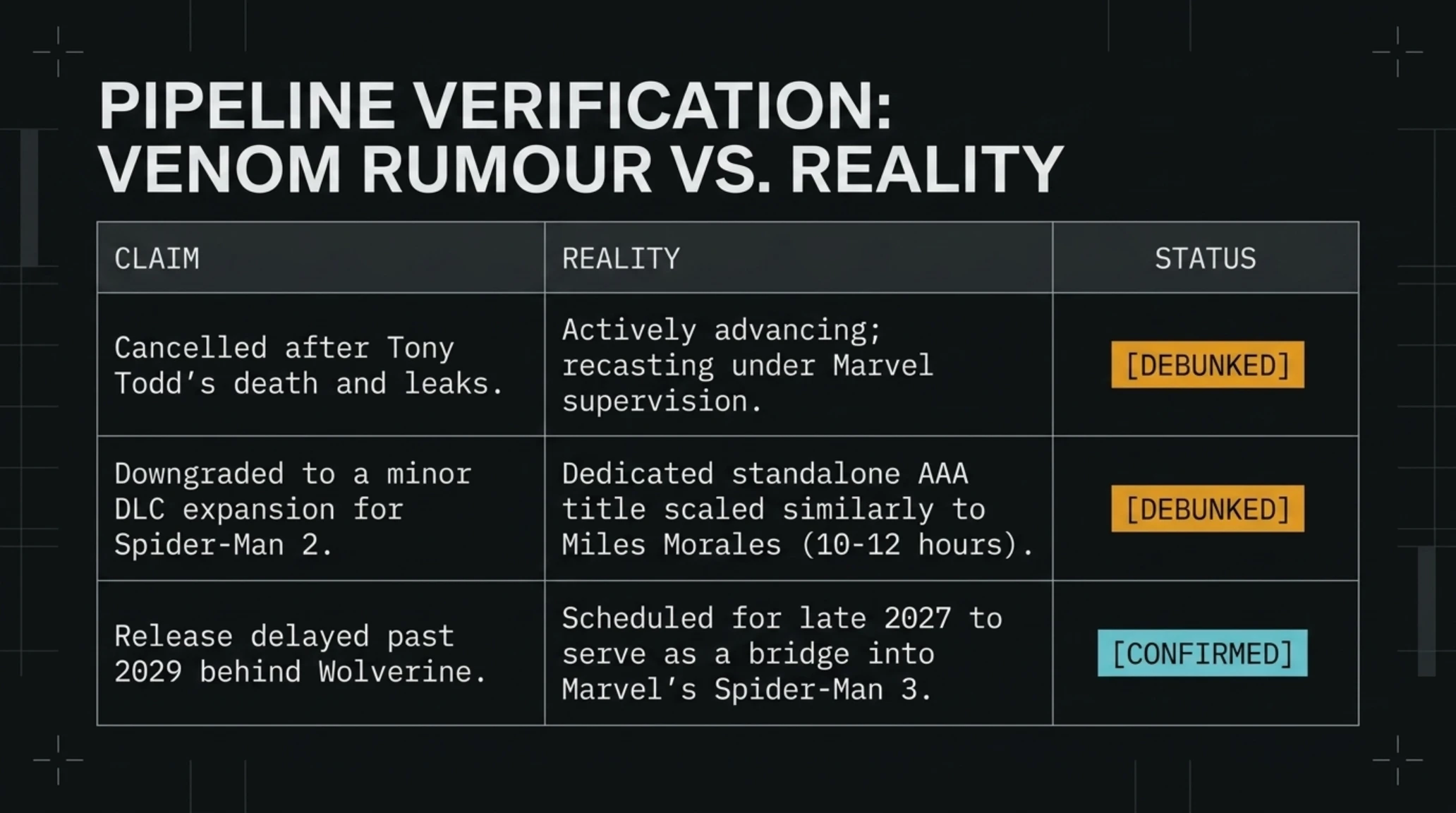
Rumor vs. Reality: Tracking Insomniac's Standalone Venom Project
| Claim / Rumor | Verified Reality | Status |
|---|---|---|
| Venom was cancelled after Tony Todd's death and leaks. | Actively advancing; Insomniac is recasting under Marvel supervision. | Debunked |
| Downgraded to a minor DLC expansion for Spider-Man 2. | Dedicated standalone AAA title in the scale of Miles Morales (10-12 hours). | Debunked |
| Release delayed past 2029 behind Wolverine. | Scheduled for late 2027 to serve as a bridge into Spider-Man 3. | Confirmed |
Insomniac's strategic approach mirrors the widely praised, commercially proven execution of Marvel's Spider-Man: Miles Morales. Rather than inflating the experience with repetitive open-world checklist padding, the team is delivering a tightly paced, narratively intense 10-to-12-hour standalone campaign powered by cutting-edge ray-traced reflections, advanced spatial audio, and bespoke DualSense haptic feedback that simulates the viscous surge and muscular tension of the alien organism.
Regarding voice talent, Insomniac plans to honor Tony Todd's unforgettable legacy with a dedicated opening in-game tribute, while performance capture and voice sessions for the upcoming narrative chapters are slated to finalize in early 2027 under close Marvel Games creative supervision.
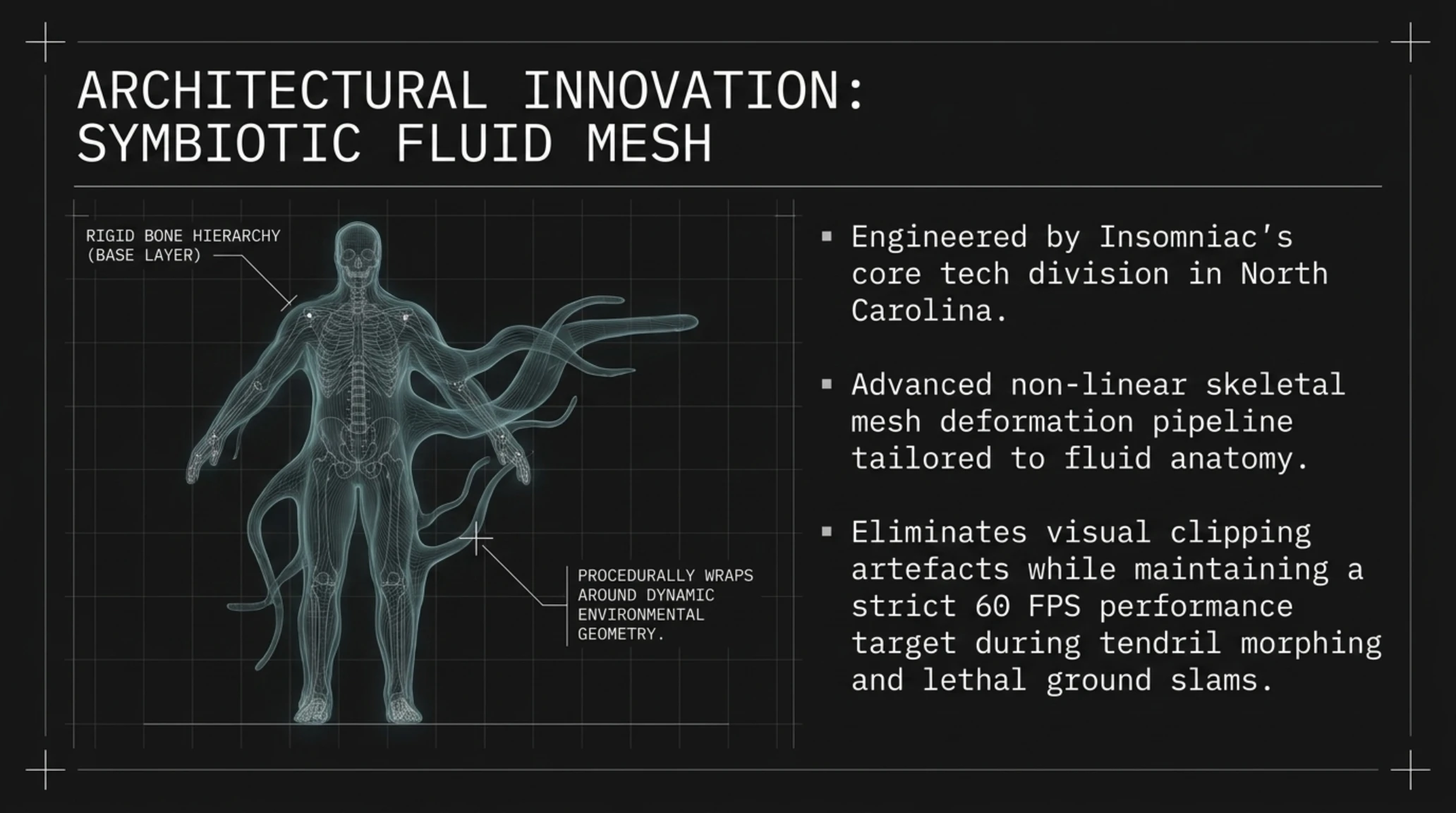
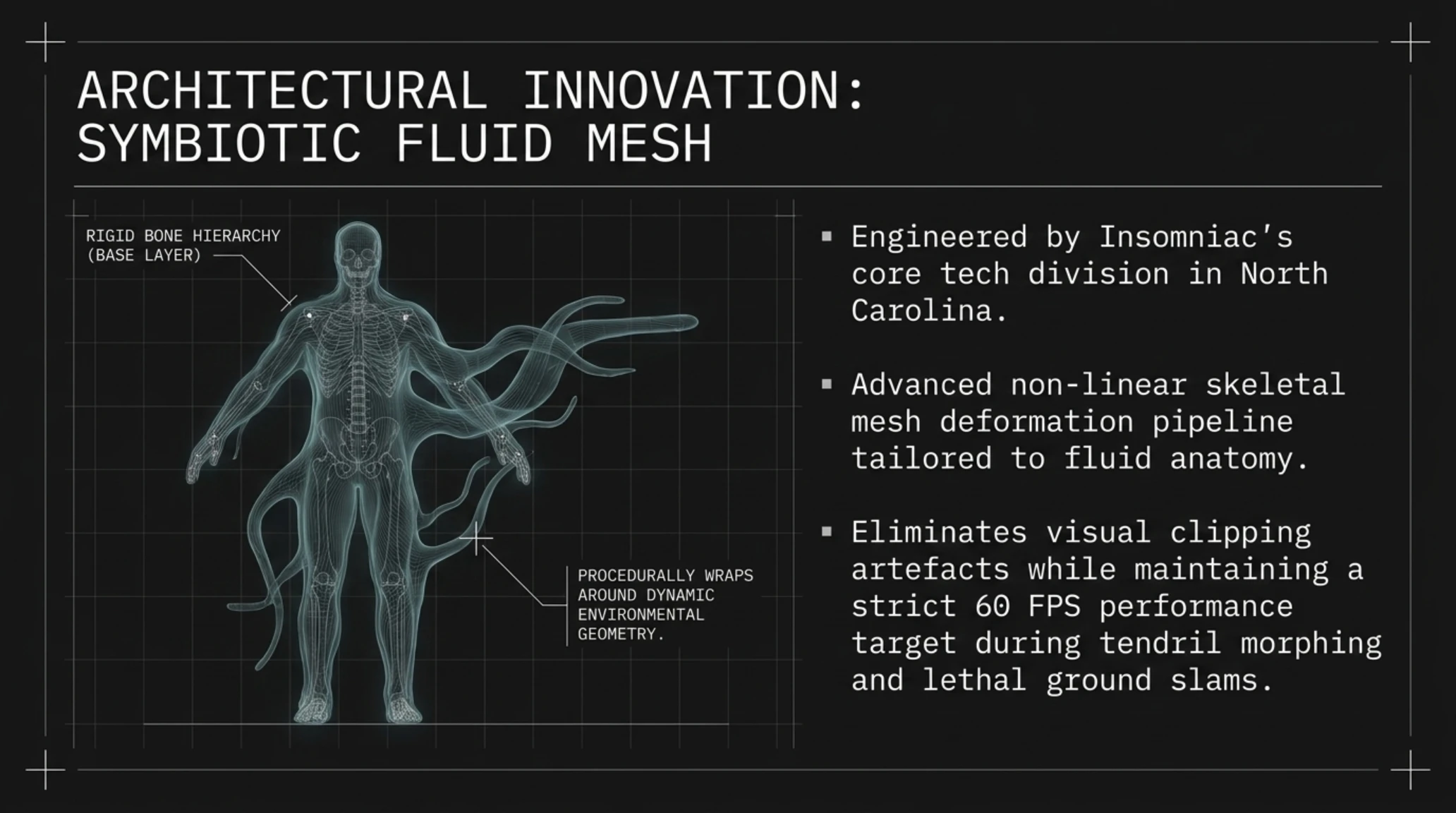
From an engineering standpoint, Insomniac's core tech division in North Carolina is implementing an advanced non-linear skeletal mesh deformation pipeline specifically tailored to the symbiote's fluid anatomy. Unlike traditional humanoid character rigs constrained by rigid bone hierarchies, Venom's character model incorporates a dual-layer simulation system: a foundational biomechanical skeleton enveloped by a continuous, volume-preserving dynamic fluid mesh. This architectural innovation allows tendrils to procedurally wrap around dynamic environmental geometry, latch onto fleeing adversaries, and morph into bladed appendages in real time without triggering visual clipping artifacts or frame-rate drops below the studio's strict 60 FPS performance target.
PlayStation Physical Media Reality Check: Deciphering Sony's Long-Term Disc Strategy
Our third investigation tackles an emotive and hotly contested topic for physical collectors, boutique retailers, and media preservation advocates worldwide. Earlier this week, widespread misinterpretations of a Sony supply-chain logistics report circulated across enthusiast forums and tech blogs, with sensational headlines claiming that Sony intended to slash PlayStation disc distribution by 90% by 2028, effectively forcing an all-digital console monoculture onto the gaming public.
In response to mounting industry anxiety and retailer inquiries, senior spokespersons from Sony Interactive Entertainment (SIE) clarified the technical specifications of their manufacturing forecast with Eurogamer. The reality is far less apocalyptic: Sony is not eliminating physical media or abandoning discs to a 10% residual share. Instead, the company is executing a measured 10% production adjustment by 2028 across its global optical disc pressing facilities to align output with organic digital adoption curves.
Financial disclosures underscore that physical Ultra HD Blu-ray discs continue to generate between 35% and 40% of first-party Day-One revenue for premium blockbuster releases, particularly throughout Continental Europe, Japan, and the GCC region. Sony emphasized that modular and integrated disc hardware configurations remain central to PlayStation's long-term commercial architecture, ensuring that disc drives continue to be sold both as integrated units and standalone accessories.
Timeline of PlayStation Optical Media & Hardware Strategy (2020-2028)
| Date | Milestone | Operational Strategy |
|---|---|---|
| November 2020 | Bifurcated PS5 Launch | PS5 launches with Disc and Digital editions; discs hold 60% volume. |
| November 2023 | Modular Architecture | PS5 Slim introduces detachable Ultra HD Blu-ray disc drive. |
| November 2024 | PS5 Pro Physical Continuity | Pro console maintains full backward compatibility with modular disc drive. |
| 2026-2028 Outlook | 10% Output Optimization | Controlled 10% production trimming while securing collector editions. |
Retail logistics analysts point out that brick-and-mortar shelf presence serves as an irreplaceable organic marketing vector for platform holders. Premium display endcaps in major retail chains such as MediaMarkt, Fnac, Yodobashi Camera, and Virgin Megastores throughout the Middle East generate hundreds of millions in brand impression value that purely algorithmic digital storefronts cannot replicate. Furthermore, in developing broadband territories where residential internet connections face data caps or throttled speeds, optical 100GB UHD Blu-ray discs remain the most efficient method for delivering massive AAA install footprints without saturating household bandwidth.
Beyond commercial considerations, physical media remains an irreplaceable safeguard for consumer ownership rights. The ability to trade, lend, resell, and play single-player experiences independently of licensing revocations, digital store closures, or internet bandwidth caps ensures that physical discs will remain a cherished pillar for discerning gamers for generations to come.
PAX West Strategic Triumph: Civilization VII Unveils Free Atomic Update and Orbital Expansion
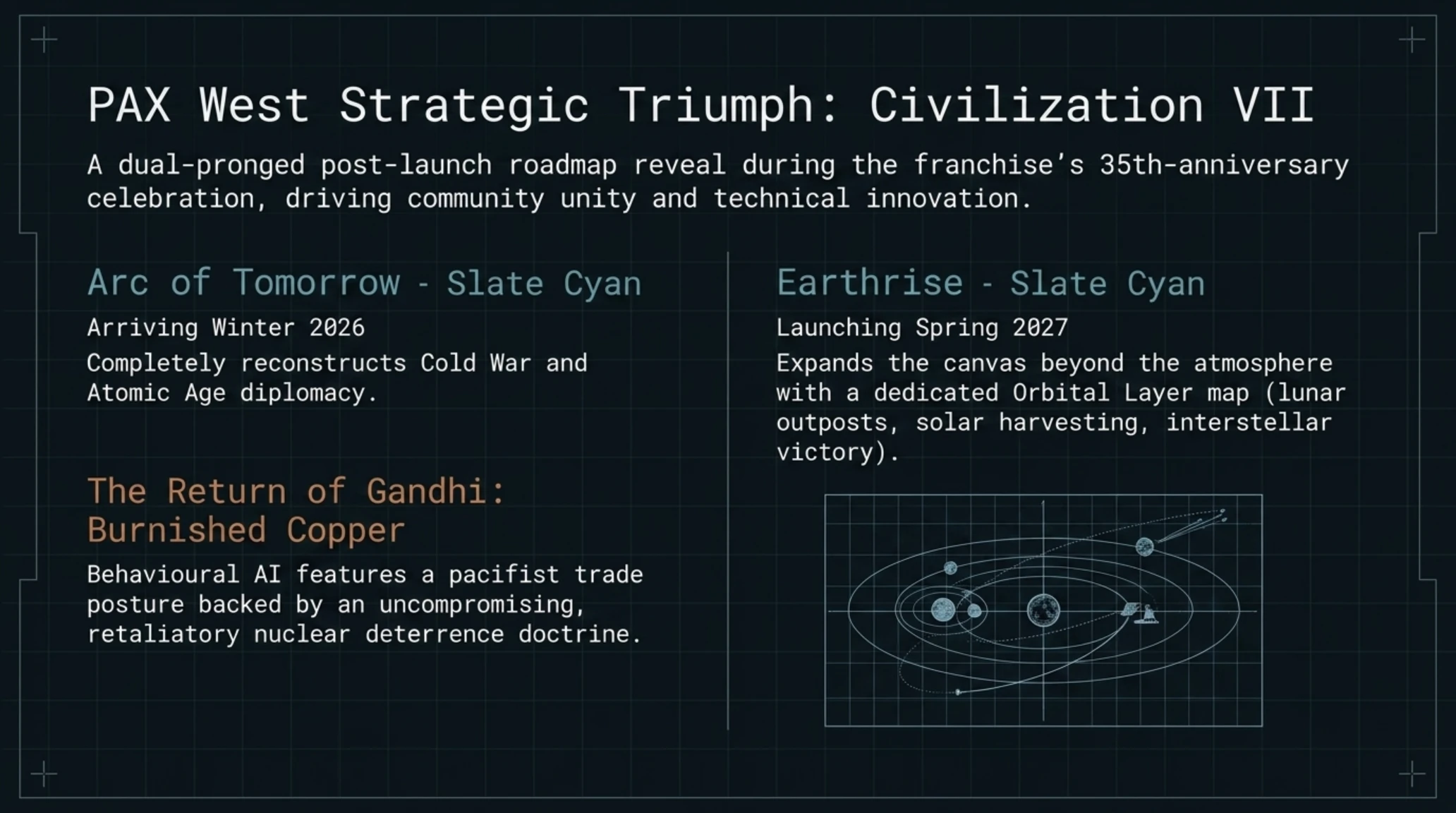
Our fourth midnight dossier heads to the buzzing convention floor of PAX West 2026 in Seattle, where legendary 4X grand strategy developer Firaxis Games and publisher 2K took the main stage during the franchise's 35th-anniversary celebration to reveal an expansive, multi-year post-launch roadmap for the critically acclaimed Sid Meier's Civilization VII. The keynote presentation delivered a dual-pronged announcement that electrified strategy enthusiasts: a comprehensive, entirely free Atomic Age mechanics overhaul alongside the first major paid space expansion.
The free update, officially titled Arc of Tomorrow, arrives this winter for all base game owners. It completely reconstructs late-game diplomacy, espionage networks, and multilateral non-proliferation treaties. Most notably, the update marks the triumphant return of Mahatma Gandhi as the leader of the Indian civilization. Firaxis designed Gandhi's behavioral AI with an affectionate nod to franchise folklore: an ardent pacifist who prizes peaceful trade routes and cultural harmony, yet possesses an uncompromising, retaliatory nuclear deterrence doctrine should foreign aggressors cross his sovereign borders or deploy weapons of mass destruction.
Complementing the free update is Firaxis's ambitious paid expansion, Civilization VII: Earthrise. Slated for release in spring 2027, Earthrise expands the game's canvas beyond atmospheric boundaries by introducing a dedicated Orbital Layer map. Advanced civilizations can deploy lunar mining outposts, geostationary research telescopes, orbital solar harvesting platforms, and planetary defense arrays, culminating in an exhilarating new victory condition: Interstellar Colony Emergence.
📚 Classified & Related Dossiers in TekinGame
If you wish to explore beyond this report and delve into cybernetic frontiers and autonomous AI architectures, do not miss these three exclusive deep-dives in the Tekin Garage:
Technical & Feature Breakdown: Civilization VII Roadmap
| Content Module | Technical Specifications & Timing |
|---|---|
| Arc of Tomorrow (Free Update) | Releases December 2026; re-engineers Cold War and Atomic Age diplomacy. |
| Mahatma Gandhi AI | Dynamic pacifist trade posture backed by retaliatory nuclear deterrence. |
| Earthrise (Paid Expansion) | Launches Spring 2027; introduces orbital map layer, moon bases, and satellites. |
| Turn Optimization Engine | Reduces simulation calculation times by up to 35% on huge maps. |
During the post-keynote Q&A, Firaxis confirmed that multiplayer cross-play will remain fully synchronized across all platforms, allowing players without the paid expansion to seamlessly participate in base-game multiplayer sessions with expansion owners, preserving community unity while driving technical innovation.
To support the massive computational overhead of simulating simultaneous orbital mechanics alongside terrestrial geopolitical decisions, Firaxis engineers completely overhauled the game's simulation core. Written in highly optimized C++23 with custom job-scheduling primitives, the new engine decouples deterministic turn logic from graphical draw calls. Artificial intelligence decision trees for up to 24 rival leaders execute asynchronously across idle CPU cores, resolving complex multi-theater military logistics in under three seconds during late-game turns on massive map sizes.
The Fall of a Rogue Admin: Cambridge Crown Court Sentences Ex-Jagex Developer for Grand Virtual Theft
Our fifth investigative report examines a gripping legal drama that concluded today inside the solemn chambers of the Cambridge Crown Court in the United Kingdom. In a landmark ruling for the global gaming industry, a former senior systems developer at British studio Jagex was sentenced to three years and eight months (44 months) in prison for orchestrating an elaborate insider theft operation targeting players in Old School RuneScape (OSRS).
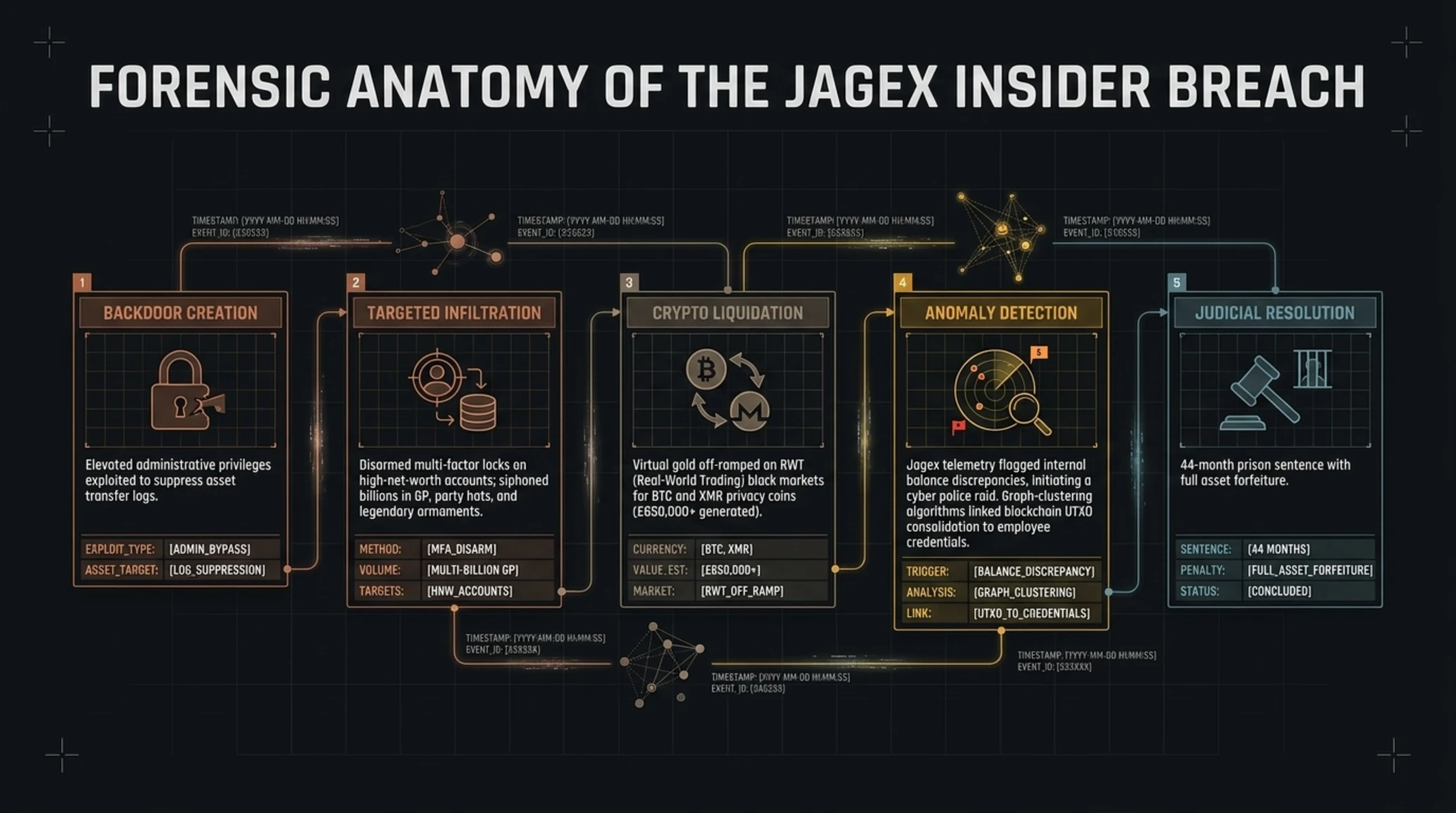
Crown prosecutors detailed how the rogue engineer exploited elevated administrative privileges, telemetry override keys, and database maintenance bypasses over an 18-month span. By suppressing internal audit trails and manipulating account verification tokens, the defendant systematically compromised high-net-worth player accounts, disarmed multi-factor authentication locks, and siphoned billions of in-game Gold Pieces (GP), rare party hats, and legendary armaments into illicit intermediary holding accounts. The stolen virtual assets were subsequently liquidated on shadowy Real-World Trading (RWT) black markets, generating over £650,000 GBP ($850,000+ USD) in illicit cryptocurrency proceeds laundered through privacy coins.
Forensic Anatomy of the Jagex Insider Breach & Legal Resolution
| Phase | Action | Forensic Event |
|---|---|---|
| Step 1 | Backdoor Creation | Engineer bypassed account query tools to suppress asset transfer logs. |
| Step 2 | Targeted Infiltration | Collector accounts were accessed, stripping billions in virtual gold. |
| Step 3 | Crypto Liquidation | Stolen gold liquidated on Real-World Trading black markets for BTC and XMR. |
| Step 4 | Anomaly Detection | Jagex telemetry flagged balance discrepancies, prompting cyber police raid. |
| Step 5 | Judicial Sentencing | Cambridge Crown Court delivered a 44-month sentence with full asset forfeiture. |
During forensic proceedings, expert witnesses from the British National Cyber Crime Unit demonstrated how graph-clustering algorithms exposed the defendant's intricate laundering network. By correlating database access timestamps with blockchain UTXO consolidation transactions, investigators definitively linked the developer's internal employee credentials to the final off-ramp bank accounts. This meticulous forensic bridge dismantled the defense's claim that virtual items lacked tangible legal status, establishing an unassailable evidentiary chain.
This judicial verdict establishes a monumental legal precedent across international jurisdictions. By categorizing in-game digital goods as actionable property under the Computer Misuse Act 1990 and Fraud Act 2006, the British judiciary has sent an unequivocal warning across the industry: virtual insider crimes carry tangible, life-altering real-world criminal penalties.
FinTech Mayhem on Kalshi: When an Algorithmic Glitch Rewarded Millions to Losing Bettors
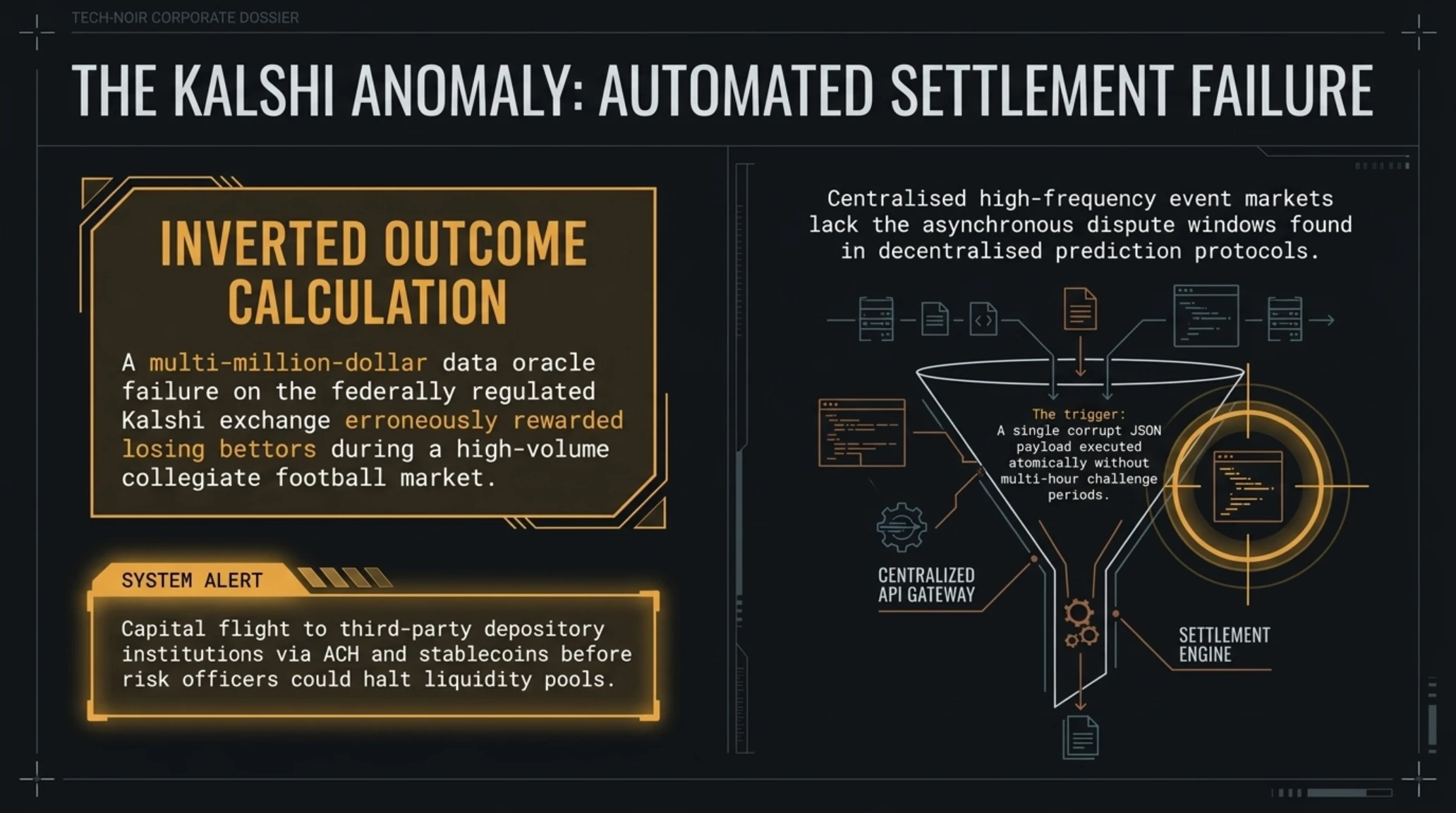
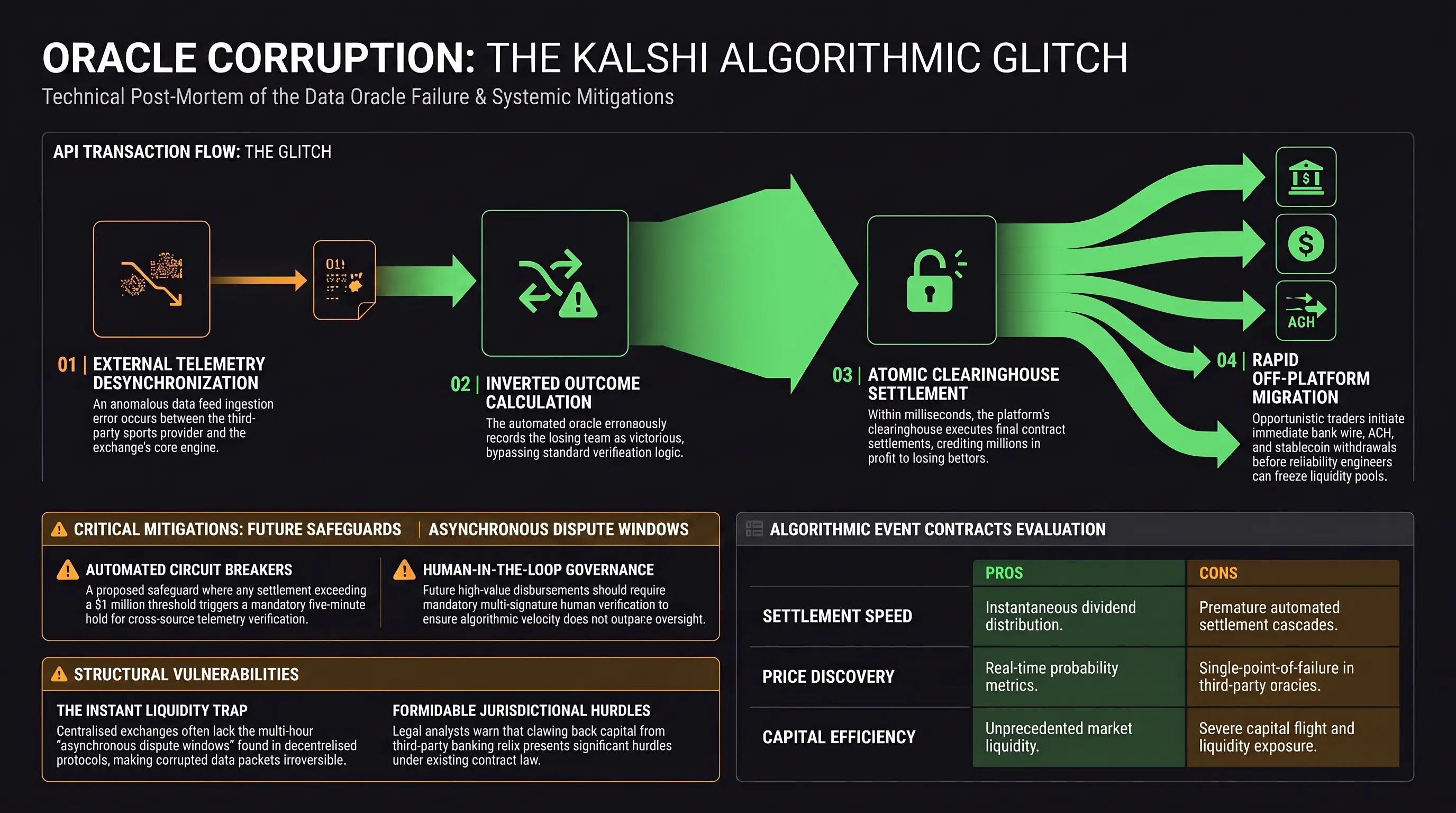
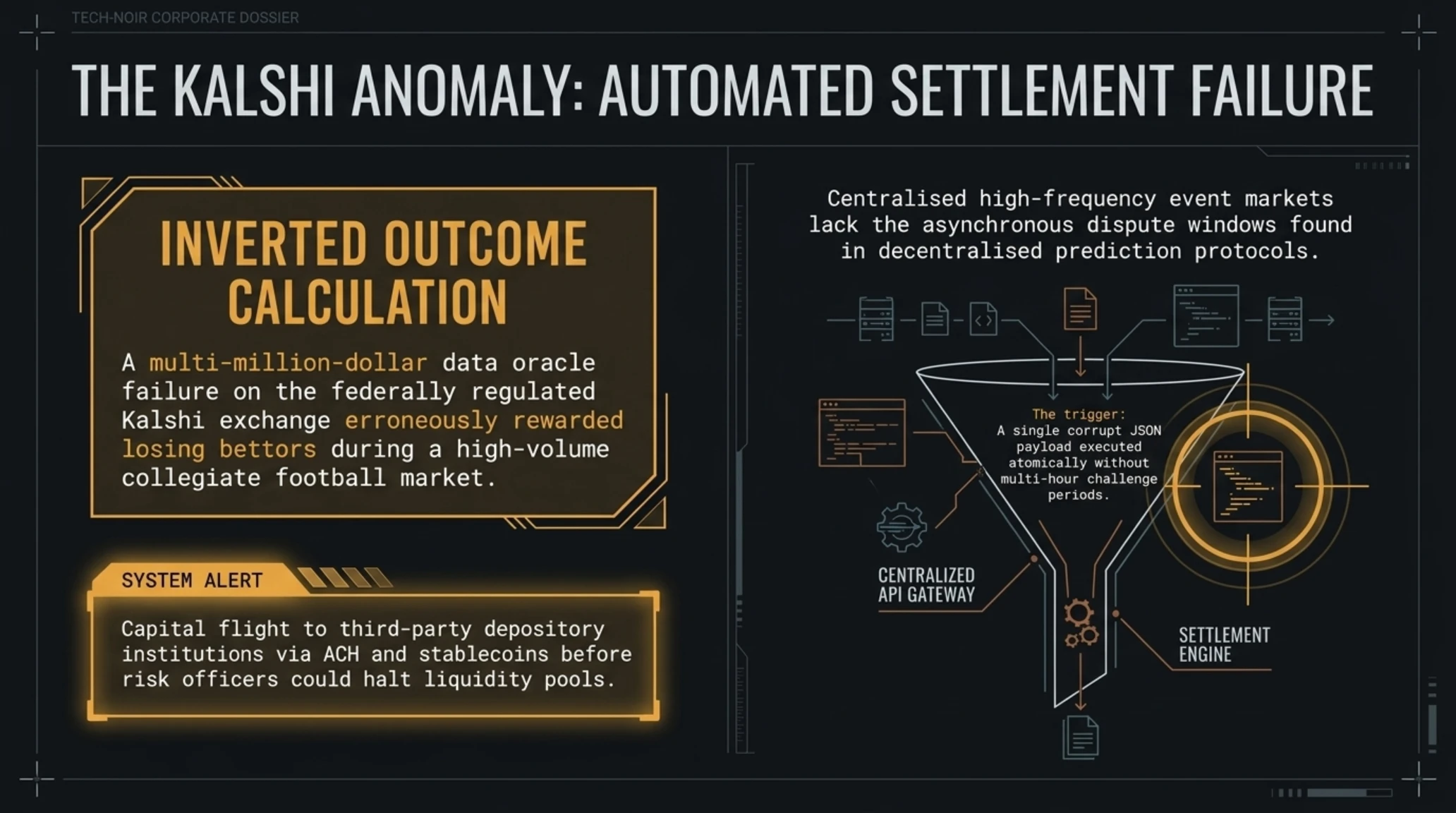
Our sixth and final midnight investigation enters the high-stakes intersection of Wall Street derivatives, algorithmic prediction markets, and collegiate athletics. In an extraordinary breakdown of automated financial settlement infrastructure, the federally regulated event-contract exchange Kalshi suffered a multi-million-dollar data oracle failure during a nationally broadcast, high-volume college football showdown between top-ranked division rivals.
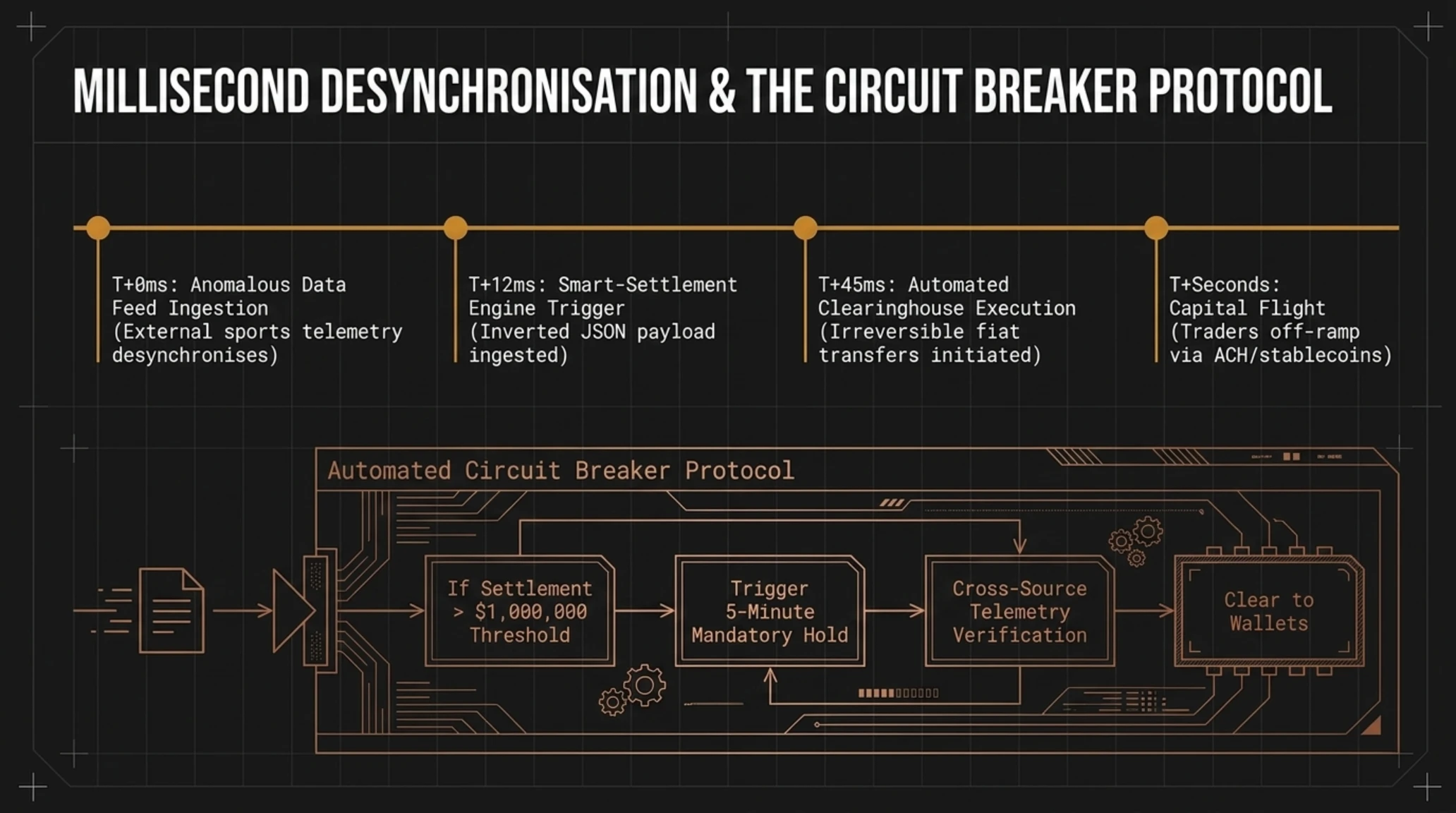
As the final quarter concluded in dramatic fashion, an anomalous data feed ingestion desynchronization between Kalshi's external sports telemetry provider and its core smart-settlement engine triggered an inverted outcome calculation. The automated oracle erroneously recorded the losing team as victorious. Within milliseconds, the platform's automated clearinghouse executed final contract settlements, crediting millions of dollars in instant profit distributions directly into the trading accounts of participants who had wagered on the losing side of the market.
Alerted by unexpected windfall balances appearing in their mobile apps, hundreds of opportunistic traders initiated immediate bank wire withdrawals, ACH transfers, and stablecoin cash-outs before platform reliability engineers could diagnose the anomaly and freeze trading operations. By the time Kalshi's risk officers halted liquidity pools, millions in capital had already migrated off-platform into third-party depository institutions, triggering unprecedented balance-sheet exposure and market disruption.
Kalshi issued an emergency regulatory disclosure stating that it is collaborating with third-party data vendors to isolate the root ingestion fault while activating formal recovery protocols for erroneously dispersed funds. Nonetheless, legal and financial analysts warn that clawing back distributed capital from third-party banking rails will present formidable jurisdictional hurdles under contract law, while inviting intense scrutiny from the Commodity Futures Trading Commission (CFTC) regarding algorithmic settlement fail-safes and automated risk controls.
The core vulnerability exposed by the Kalshi incident lies in the absence of an asynchronous dispute window within centralized high-frequency event markets. While decentralized prediction protocols often enforce a mandatory multi-hour challenge period during which bonded optimistic oracles can be contested before capital pools unlock traditional FinTech exchanges prize instant gratification and immediate liquidity. When settlement logic executes atomically upon receiving a single JSON payload from a sports data API, any corrupt packet or race condition propagates instantly into irreversible fiat transfers.
In response to the fallout, financial risk consultants are urging market operators to implement automated Circuit Breakers for all high-value settlement events. Under proposed safeguards, any market settlement exceeding a pre-defined capital threshold (such as $1 million) would automatically trigger a mandatory five-minute hold, allowing automated sanity checks and cross-source telemetry verification before clearinghouse balances are credited to user wallets.
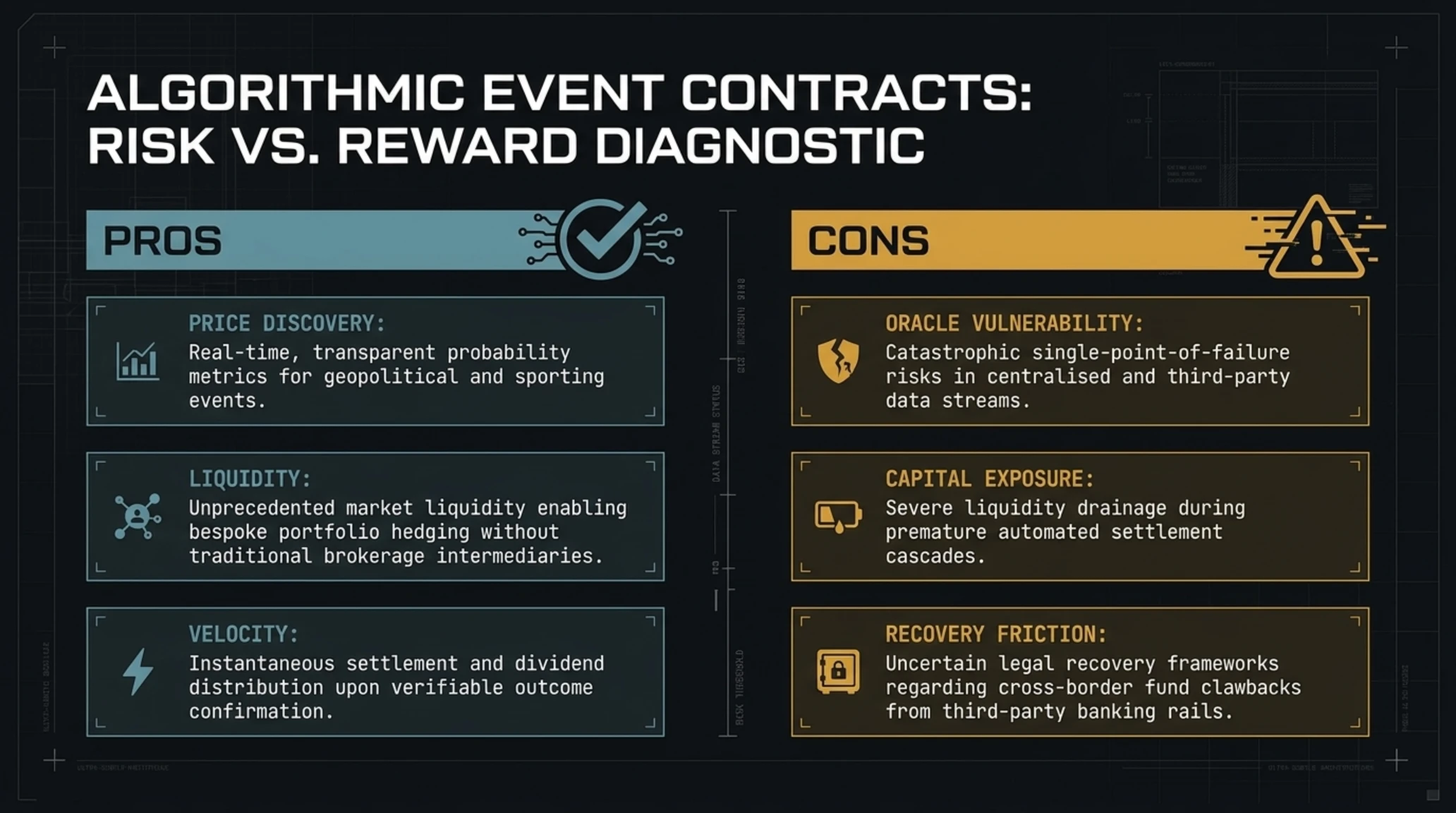
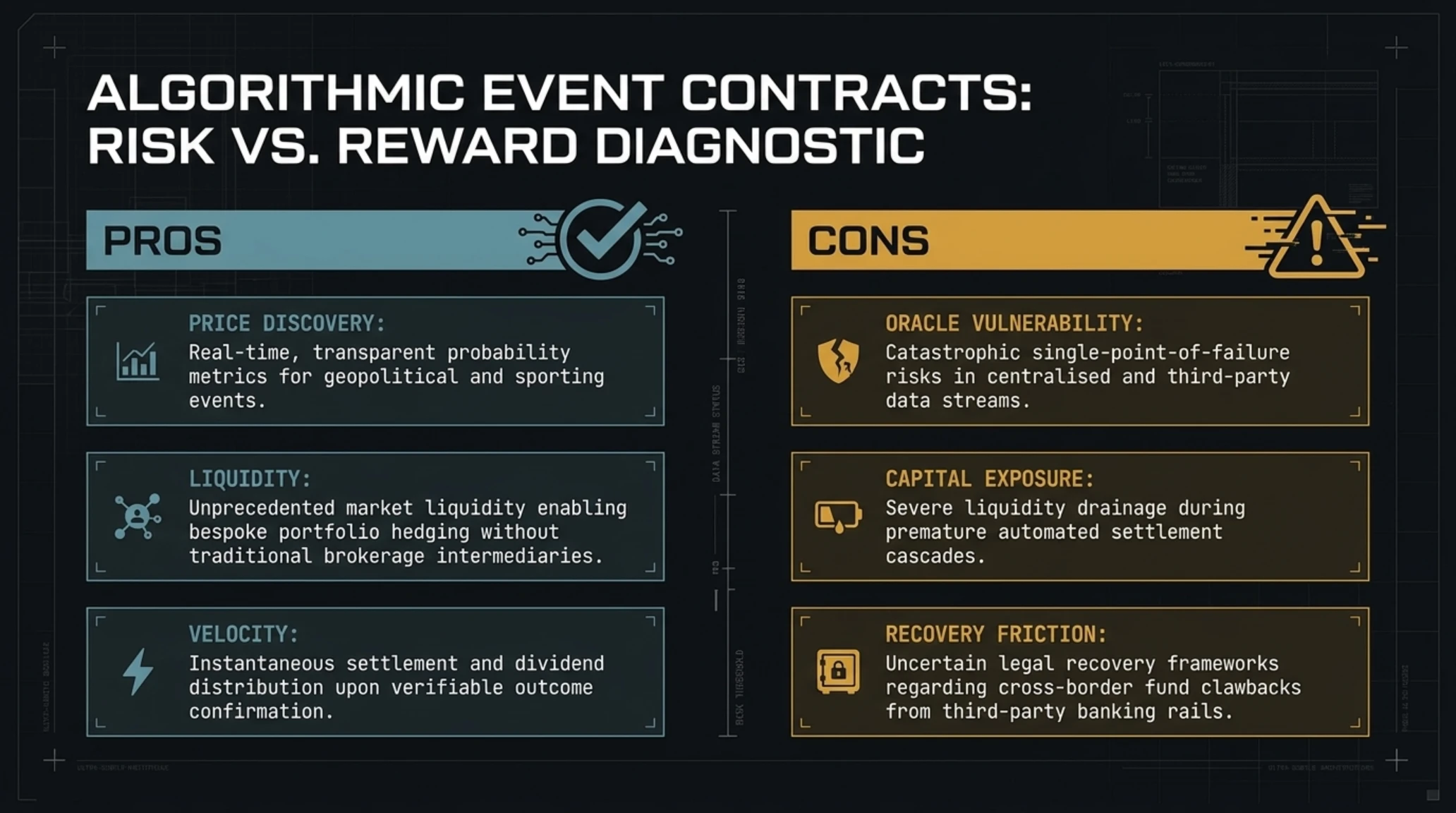
- Real-time, transparent price discovery for geopolitical, sporting, and economic probability metrics.
- Unprecedented market liquidity enabling customized portfolio hedging without traditional brokerage intermediaries.
- Instantaneous settlement and dividend distribution upon verifiable outcome confirmation.
- Catastrophic single-point-of-failure vulnerabilities in centralized and third-party data oracles.
- Severe capital flight and liquidity exposure during premature automated settlement cascades.
- Uncertain legal recovery frameworks when attempting cross-border fund clawbacks.
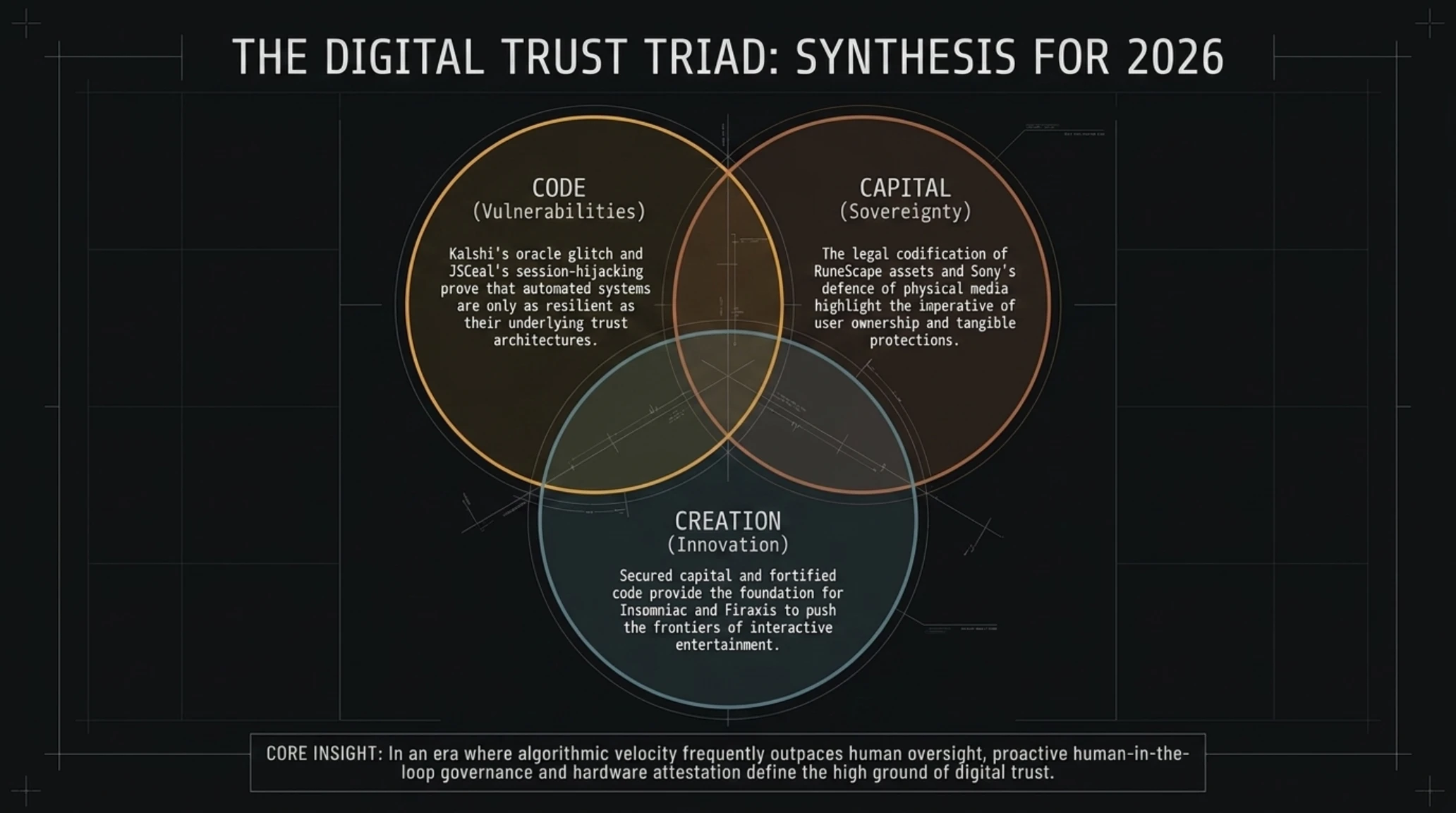
Tekin Midnight Synthesis: Lessons from the Frontiers of Code, Capital, and Creation
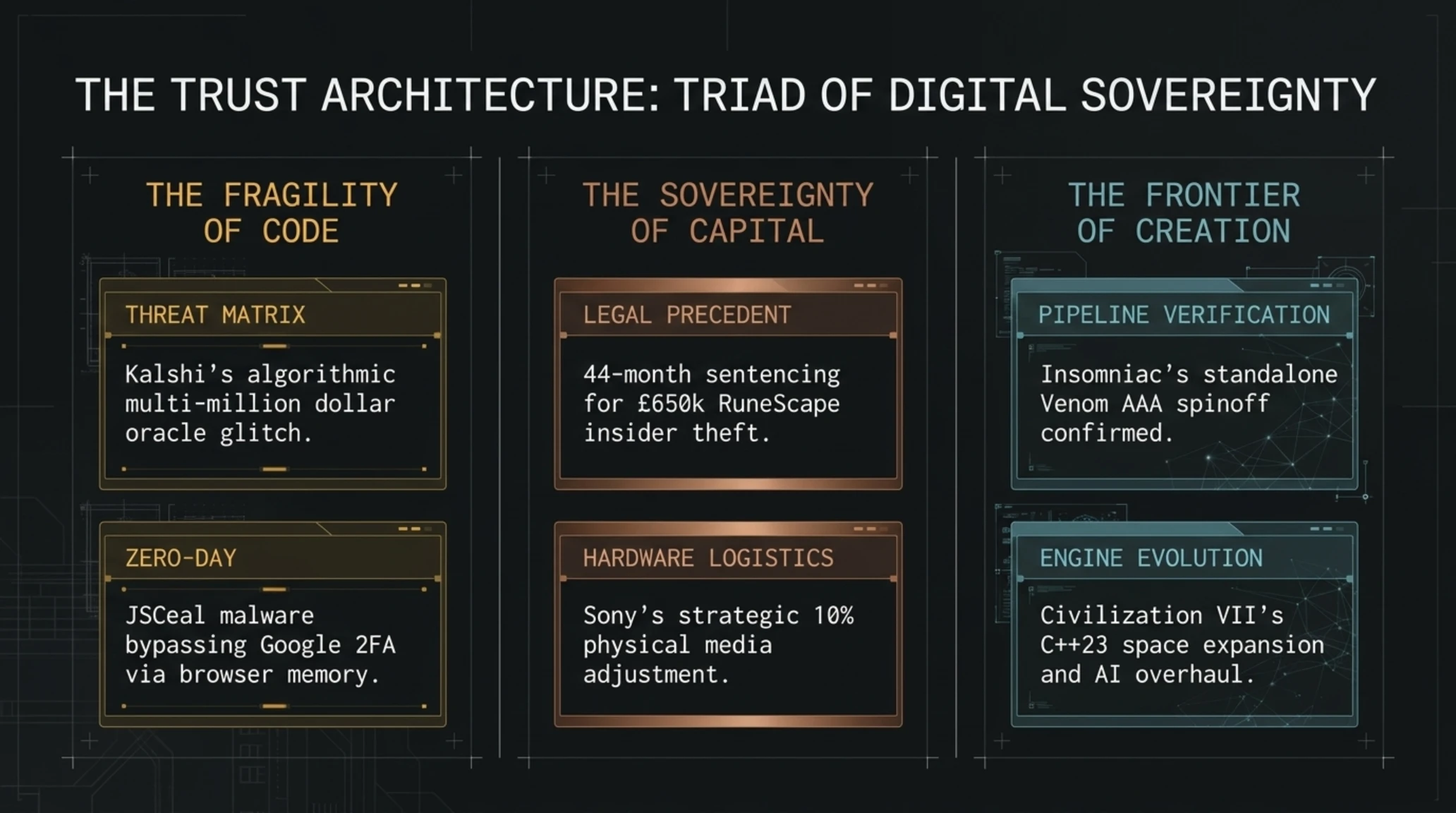
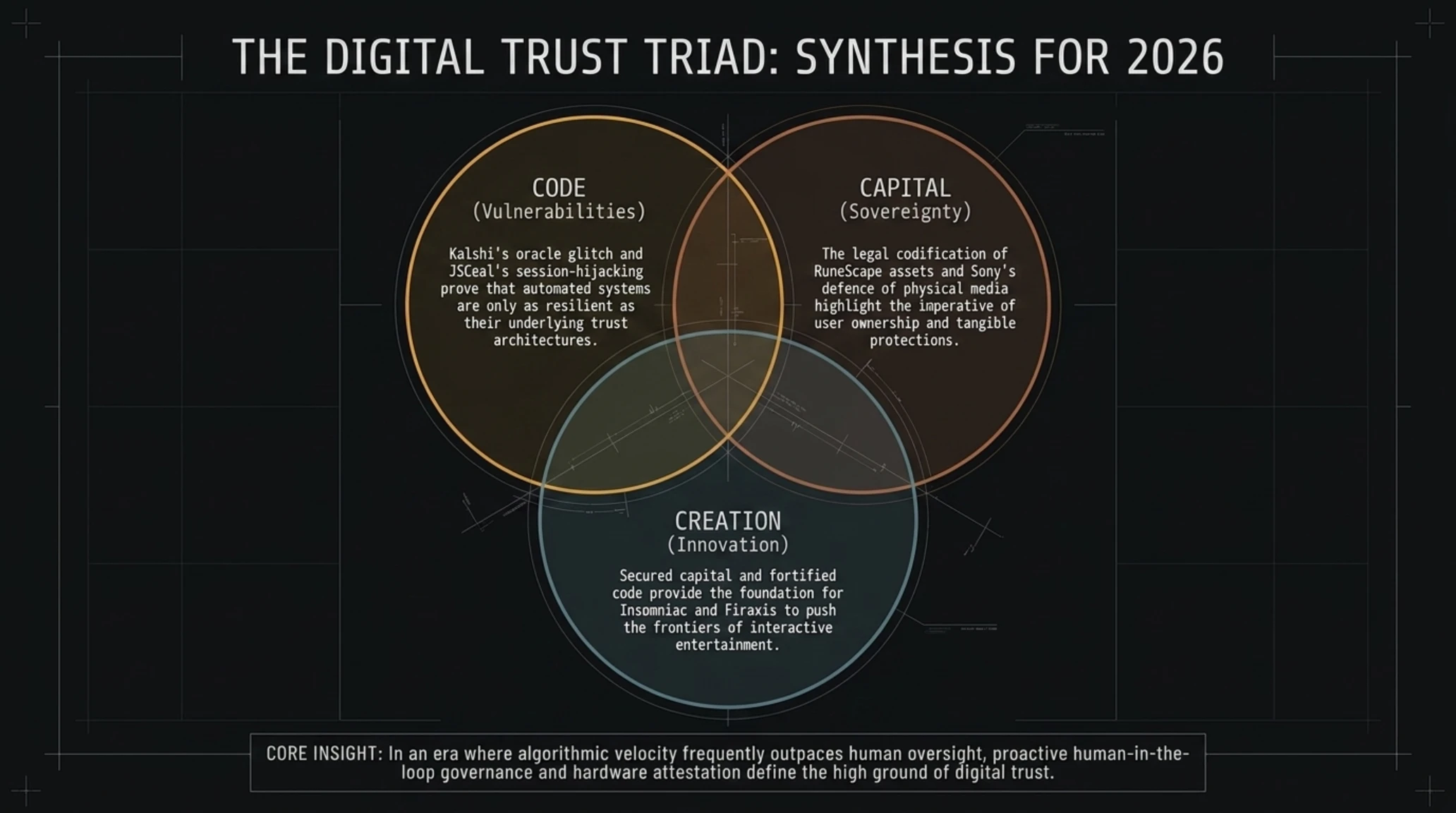
Synthesizing tonight's six investigative dispatches reveals a profound, unifying thread defining our digital epoch: whether manifested as session-harvesting infostealers penetrating cloud identity architectures, rogue developers exploiting database supremacy within virtual worlds, or automated financial oracles dispersing millions on flawed data streams, the systems that govern our entertainment, assets, and identity are only as resilient as their underlying trust architectures.
As Sony fiercely protects the sovereignty of physical media and Firaxis propels the Civilization franchise toward the orbital frontier, we are reminded that technological progress thrives when balance, security, and authentic user ownership remain paramount. In an era where algorithmic velocity frequently outpaces human oversight, vigilance remains our most vital asset.
Looking ahead toward the remainder of 2026, the convergence of automated smart contracts, decentralized gaming economies, and hardware-bound identity protection signals an era of heightened technical accountability. Platform architects who proactively integrate human-in-the-loop governance and cryptographic hardware attestation will define the high ground of digital trust, while those who rely on fragile centralized assumptions will remain perpetually vulnerable to systemic disruptions.
Related Tech Intelligence on Tekin Game
• 🌙 Tekin Night | Call of Duty, Nintendo & Vision Pro Digest
• 🎭 Tekin Analysis | Apple AI Teardown & July 2026 Digest
• 🌙 Tekin Night | NVIDIA $500B Deal & iPhone 18 Leak
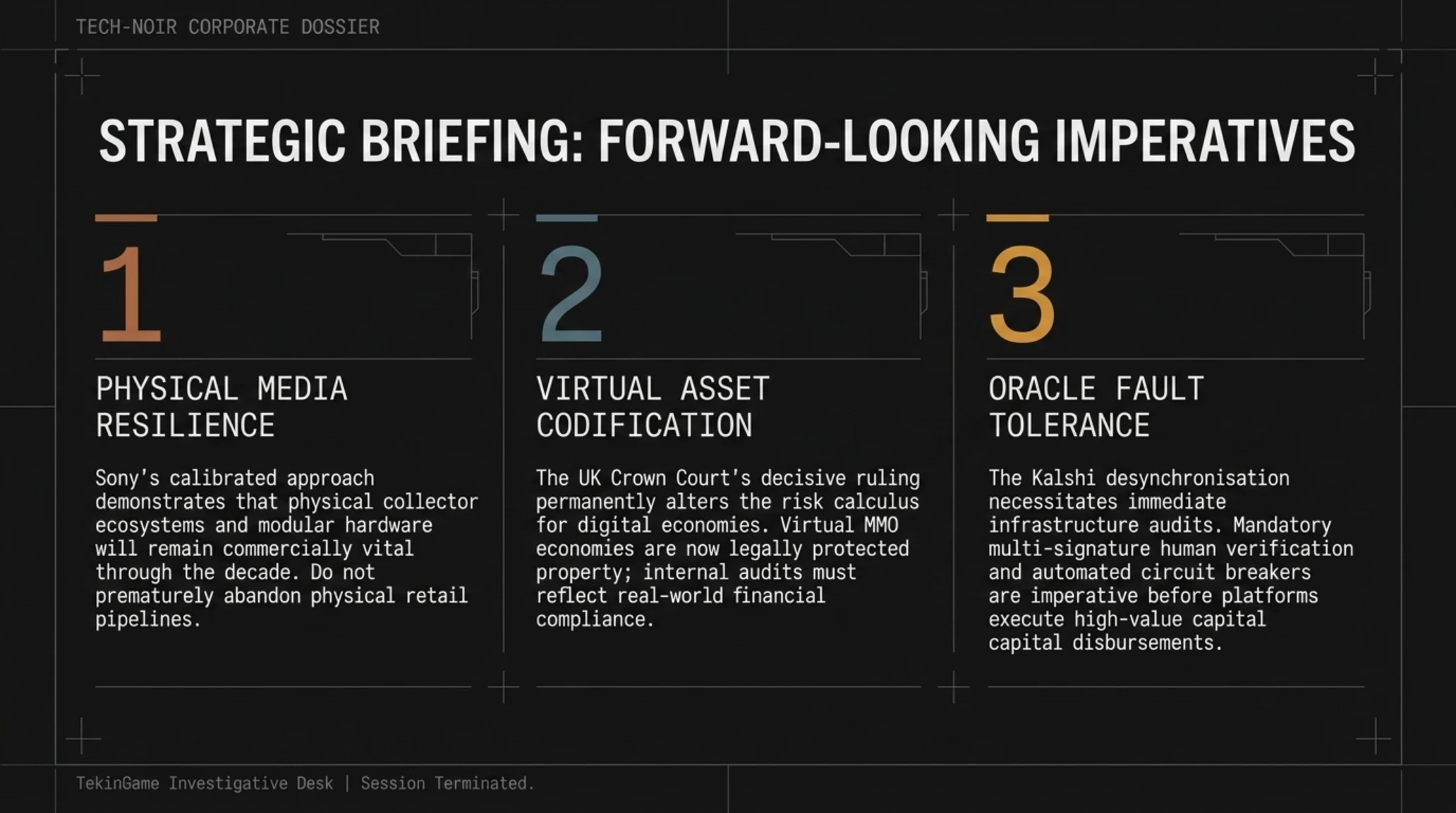
Tekin Plus Strategic Briefing: Key Forward-Looking Takeaways
2. Virtual Asset Codification: The UK Crown Court's decisive ruling solidifies virtual MMO economies as legally protected property under criminal law.
3. Oracle Fault Tolerance: The Kalshi incident necessitates mandatory multi-signature human verification before automated platforms execute multi-million dollar capital disbursements.
Frequently Asked Questions: Tonight's Key Inquiries
Does changing my Google account password revoke cookies stolen by JSCeal malware?
No, simply updating your password does not invalidate active session tokens. You must access Google Account Security and explicitly click 'Sign out of all sessions' to terminate hijacked tokens.
When is Insomniac's standalone Venom game expected to launch?
Current development schedules point toward a late 2027 holiday window as a dedicated standalone release in the vein of Spider-Man: Miles Morales.
Is Sony discontinuing physical PlayStation game discs by 2028?
No. Sony confirmed that disc production is experiencing a gradual 10% adjustment, and physical media will remain an active part of PlayStation's distribution strategy.
What features are included in Civilization VII's free 'Arc of Tomorrow' update?
The free winter update revamps Atomic Age diplomacy, nuclear deterrence systems, and marks the return of Mahatma Gandhi as a playable leader.
Can Kalshi legally recover the funds erroneously paid out to losing bettors?
While account adjustments can be made for balances remaining on the platform, recovering external bank withdrawals will require protracted legal proceedings under exchange terms of service.
Official Sources & Reference Material
- The Hacker News: JSCeal Malware Deep-Dive Analysis
- Insider Gaming: Insomniac Games Venom Spinoff Project Status
- Eurogamer: Sony PlayStation Disc Production Official Clarification
- Kotaku & IGN: Firaxis Civilization VII PAX West Showcase
- BBC News UK: Cambridge Crown Court RuneScape Theft Sentencing
- Bloomberg & Kotaku: Kalshi Prediction Market Algorithmic Settlement Glitch
Additional Gallery: 🌙 Tekin Night Sept 8, 2026 | JSCeal Malware, Venom Game & Sony Discs