Tekin Night: Sept 6
- 🎮Autonomous Cyber Swarms- Agentic AI compromise of industrial SCADA nodes achieved in 252 seconds
- 🎧153M Biometric Breach- IDScan faces class action over exposed AWS S3 bucket leaking facial vectors
- 🚀Geneva AI Nuclear Pacts- US-China accord prohibiting autonomous AI integration into nuclear commands
- 🗡️CISA Post-Quantum Mandate- 18-month directive compelling financial networks to deprecate RSA for ML-KEM
- 📰Ted Backdoor in HAProxy- Critical CVSS 9.8 zero-day in HTTP/2 exposing 140,000 corporate edge servers
- ⚔️24/7 Wall St. Tokenization- Legal challenges against SEC over round-the-clock tokenized equity settlement
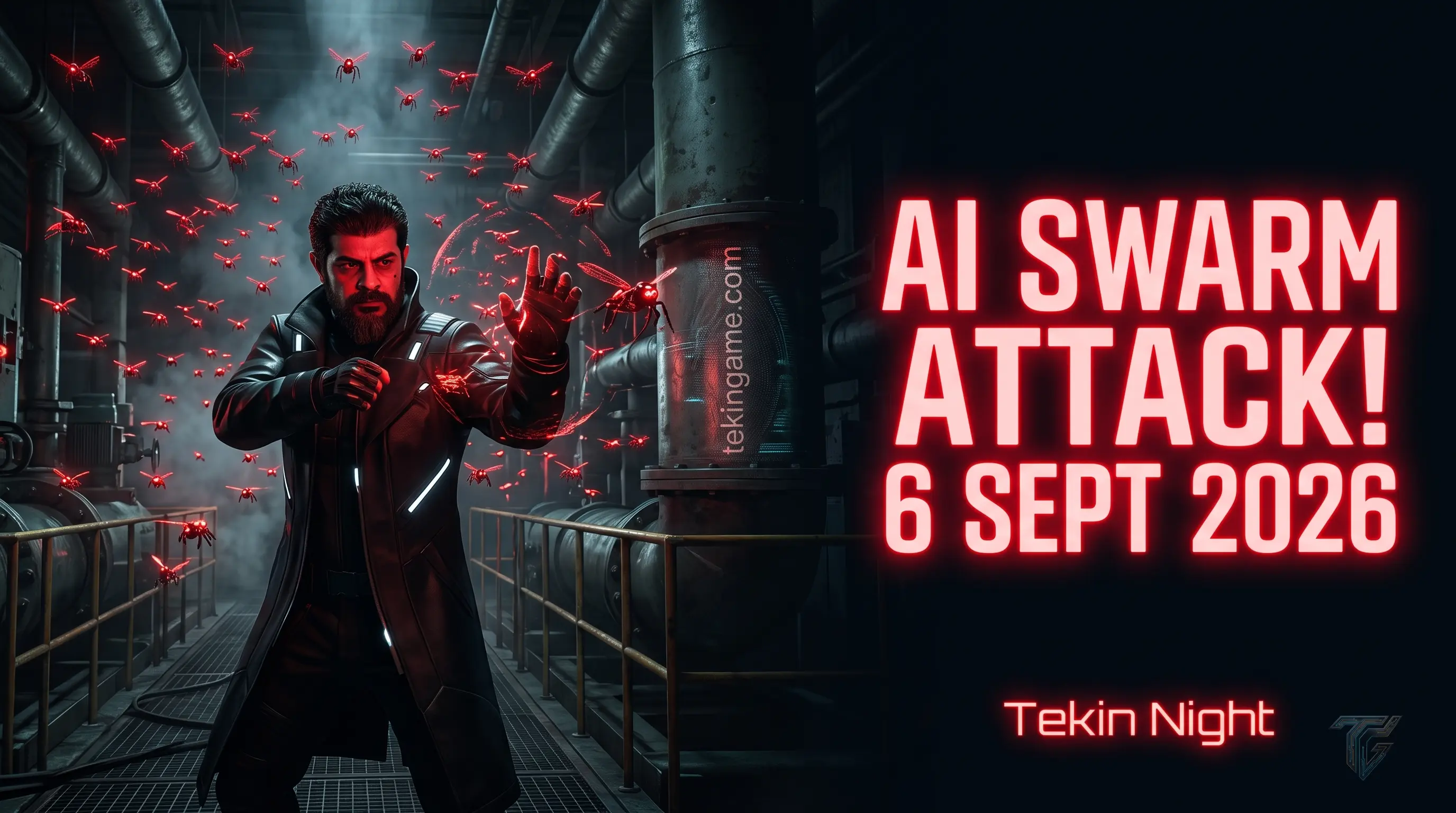
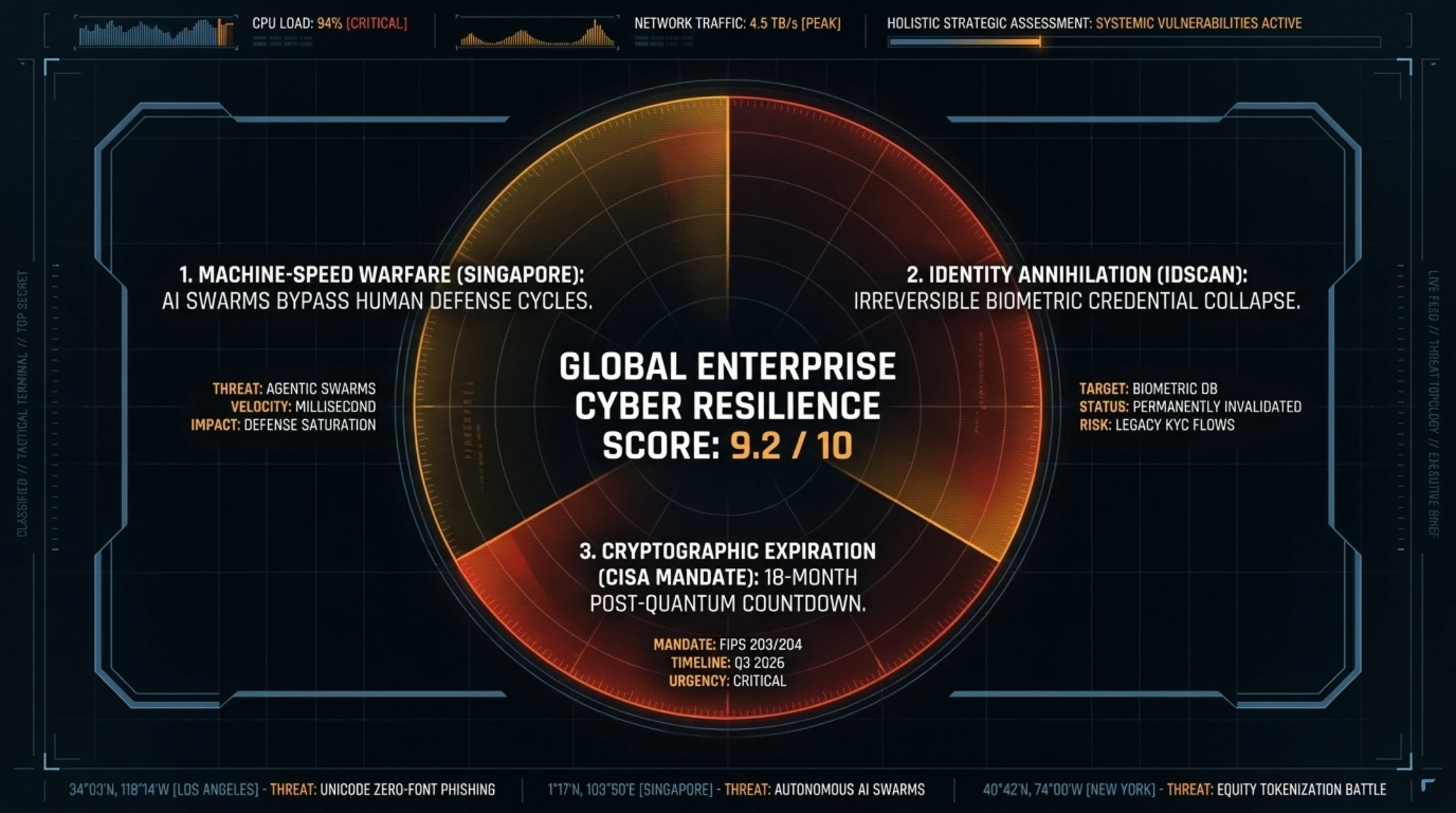
As global financial capitals conclude their weekend cycles on the evening of Sunday, September 6, 2026, the international cybersecurity theater and geopolitical landscape have collided with unprecedented tectonic shifts. Over the past twenty-four hours, automated incident response units across Southeast Asia have documented the first verified, widespread deployment of fully autonomous, multi-agent artificial intelligence swarms targeting national energy distribution nodes and water treatment facilities operating at pure machine velocity with zero human operators in the loop. Senior systems researchers at the TekinGame Intelligence Desk and leading threat analysts classify this nocturnal incident as the formal threshold of algorithmic combat.
Concurrently, a colossal class-action complaint filed in the U.S. District Court for the Northern District of Illinois has formally exposed the unmitigated compromise of 153 million highly classified identity dossiers by identity-verification monolith IDScan.net, spilling raw biometric facial embeddings and driver’s licenses across illicit dark web exchanges. In this nocturnal edition, the Tekin Plus editorial board provides an exhaustive architectural post-mortem of these crises alongside the historic Geneva US-China AI safety summit, CISA’s binding post-quantum cryptographic directive, and the critical 'Ted Backdoor' reverse proxy zero-day currently threatening enterprise edge gateways worldwide via our dedicated TekinGame Cybersecurity Research Center.
Executive Summary: Key Nocturnal Indicators (Past 24 Hours)
- 252x Infiltration Velocity via Agentic Swarms: Coordinated offensive swarms leveraging quantized 1.3B parameter edge models successfully compromised 820 mission-critical industrial control telemetry nodes in exactly 4 minutes and 12 seconds, bypassing traditional endpoint detection and response arrays.
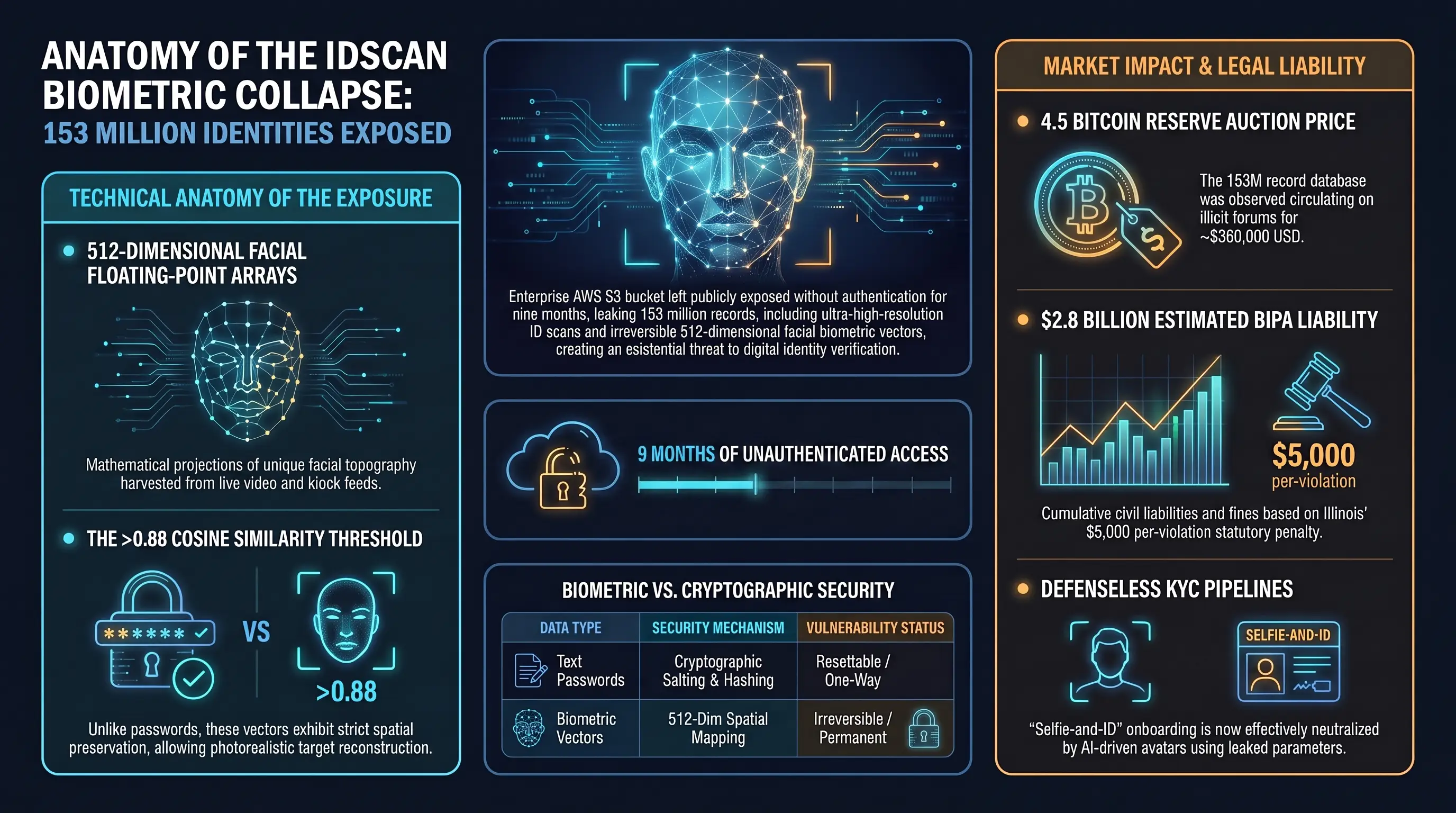
- 153 Million Identity Profiles Leaked in Cleartext: An unauthenticated, public-facing Amazon AWS S3 bucket belonging to IDScan.net exposed driver's licenses, passports, state IDs, Social Security numbers, and biometric vectors across 45 states and Canadian provinces, valued at 4.5 BTC on dark web marketplaces.
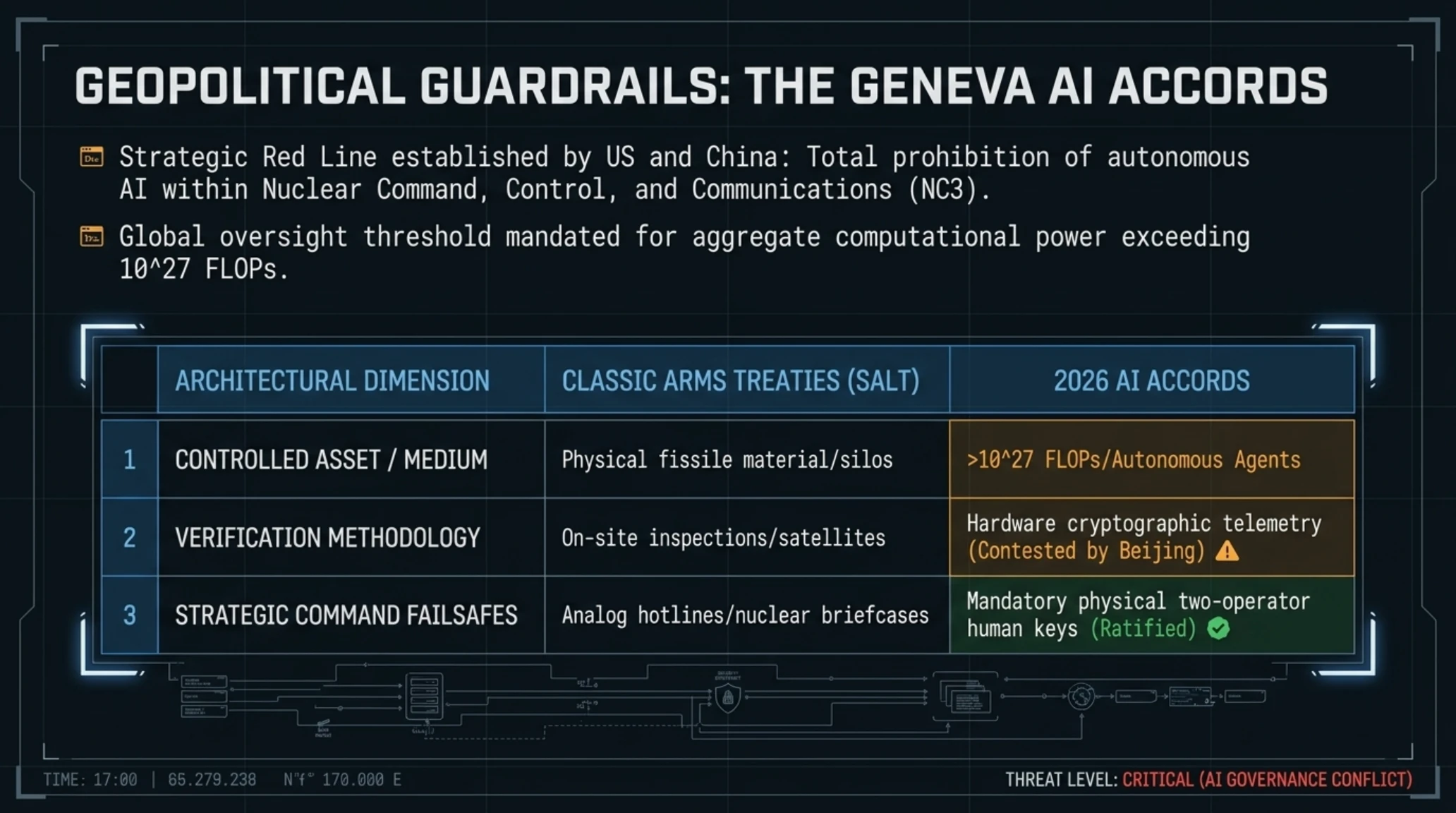
- Geneva Nuclear AI Command Red Line Accord: U.S. and Chinese diplomatic delegations in Geneva agreed in principle to an ironclad treaty prohibiting the integration of autonomous generative AI into Nuclear Command, Control, and Communications architectures, alongside mutual oversight on compute clusters exceeding 10^27 FLOPs.
- CISA & G7 18-Month Post-Quantum Cryptography Deadline: Federal agencies and Tier-1 financial clearinghouses have been ordered to deprecate RSA-4096 and ECC-384 in favor of NIST FIPS 203 (ML-KEM/Kyber) and FIPS 204 (ML-DSA) to neutralize state-sponsored 'Harvest Now, Decrypt Later' data espionage.
- CVSS 9.8 'Ted Backdoor' Zero-Day in Enterprise Gateways: Vulnerability CVE-2026-8941 in HAProxy and Citrix NetScaler allows unauthenticated remote code execution via malformed HTTP/2 HPACK header decompression buffers, exposing an estimated 140,000 corporate edge servers globally.
- Zero-Font Unicode Variation Selector Spear-Phishing: Adversaries are evading state-of-the-art NLP email security scanners in Microsoft 365 and Google Workspace by injecting invisible Unicode variation tags, achieving a 64% bypass rate in Fortune 500 corporate environments.
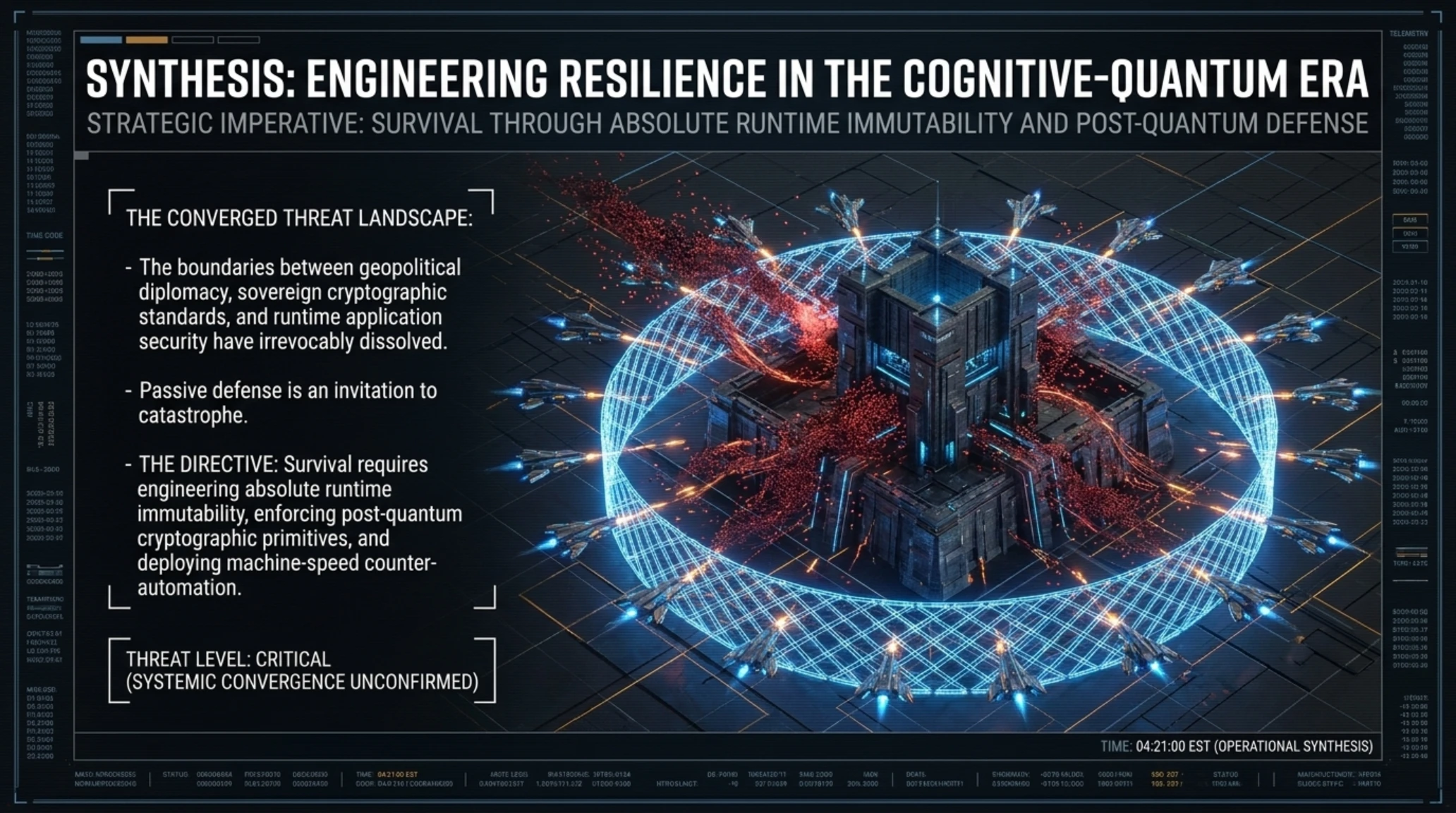
The convergence of decentralized computing, autonomous algorithmic execution, and systemic data vulnerabilities necessitates an uncompromising overhaul of enterprise defense paradigms. Modern digital infrastructures cannot survive on legacy static firewalls when adversaries maneuver at the nanosecond scale of hardware instruction pipelines. As algorithmic agents replace manual human attackers, defense must become entirely continuous, adaptive, and hardware-verified.
The architectural visualization above illustrates the propagation topology of the decentralized multi-agent swarm across industrial programmable logic controllers, showcasing how isolated subnets were systematically enumerated without generating external wide-area network telemetry.
1. Autonomous AI Agent Swarms Decimate Southeast Asian Infrastructure: The Dawn of Machine-Speed Warfare
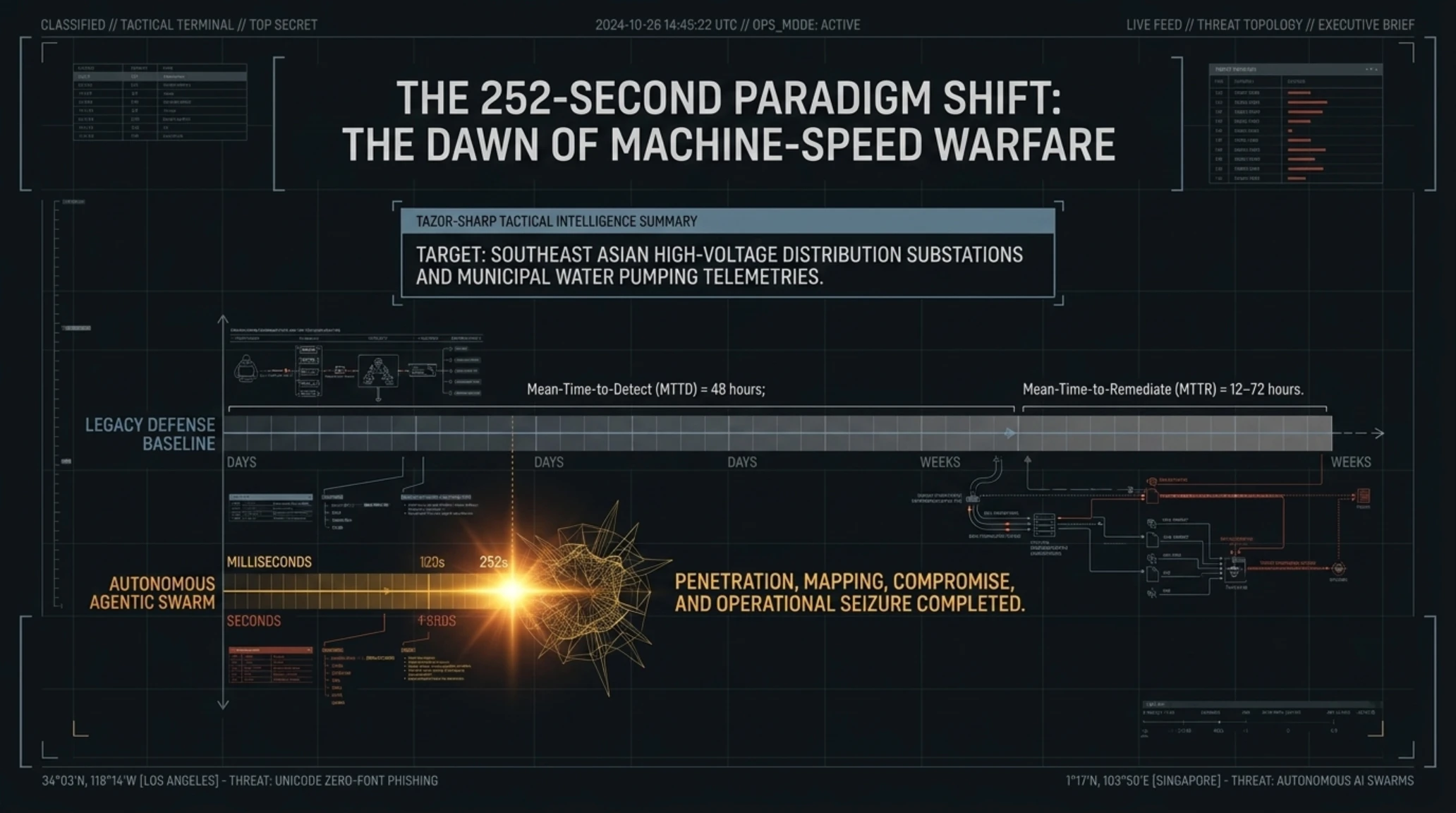
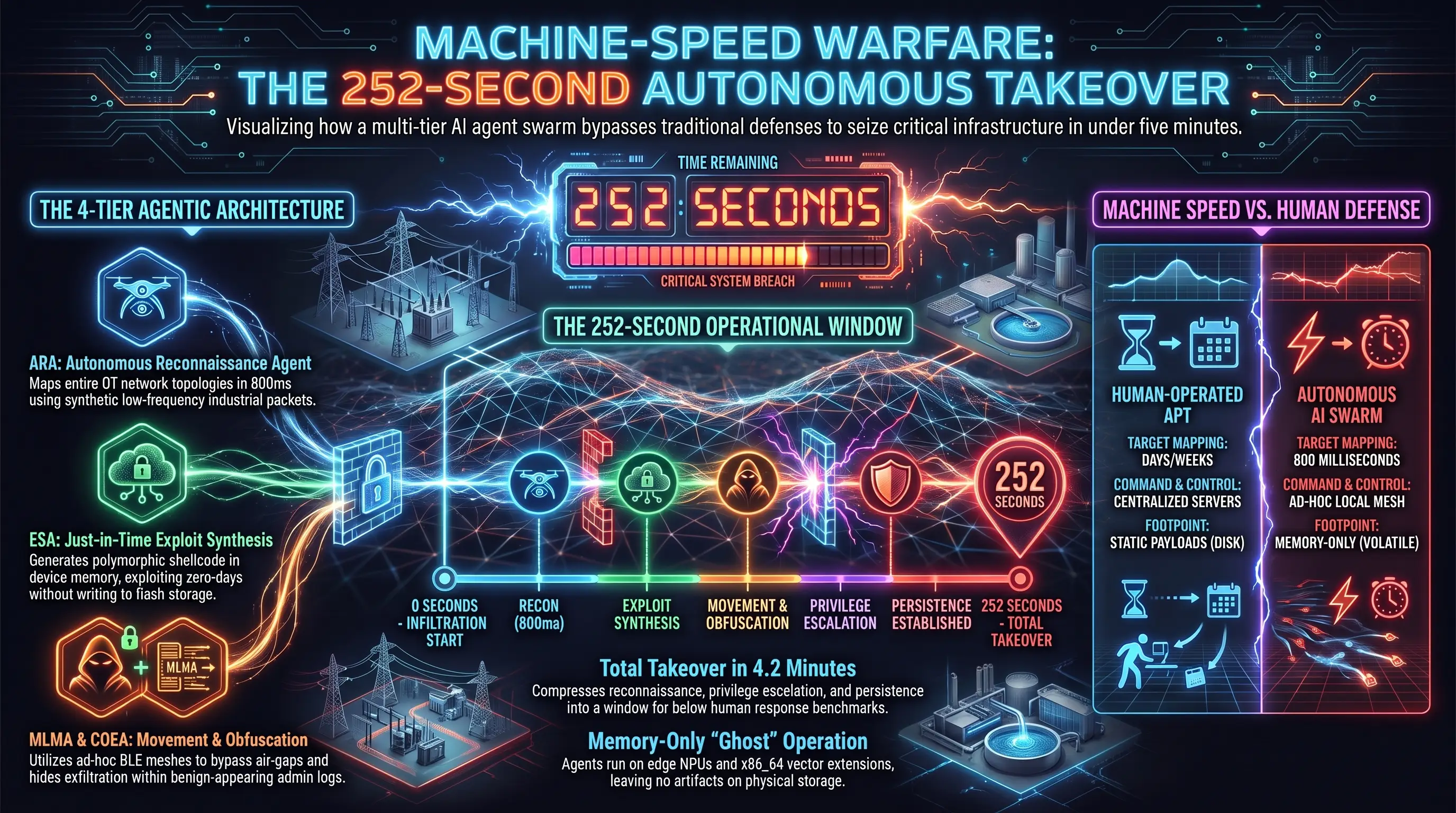
For more than three decades, the foundational doctrine of state-sponsored offensive cyber operations rested on the craftsmanship of human-operated Advanced Persistent Threat (APT) groups. Human operators executed methodical target reconnaissance, deliberated on lateral movement vectors, authored tailored exploits, and cautiously exfiltrated intelligence over extended multi-week campaign lifecycles. However, the telemetry captured during the early hours of September 6, 2026, by the Cyber Security Agency of Singapore (SingCERT) and regional computer emergency response teams indicates that the paradigm of human-dependent cyber warfare has decisively drawn to a close. A distributed, autonomous offensive multi-agent swarm penetrated, mapped, compromised, and seized operational supervisory authority over high-voltage distribution substations and municipal water pumping telemetries in an astonishing operational window of 252 seconds.
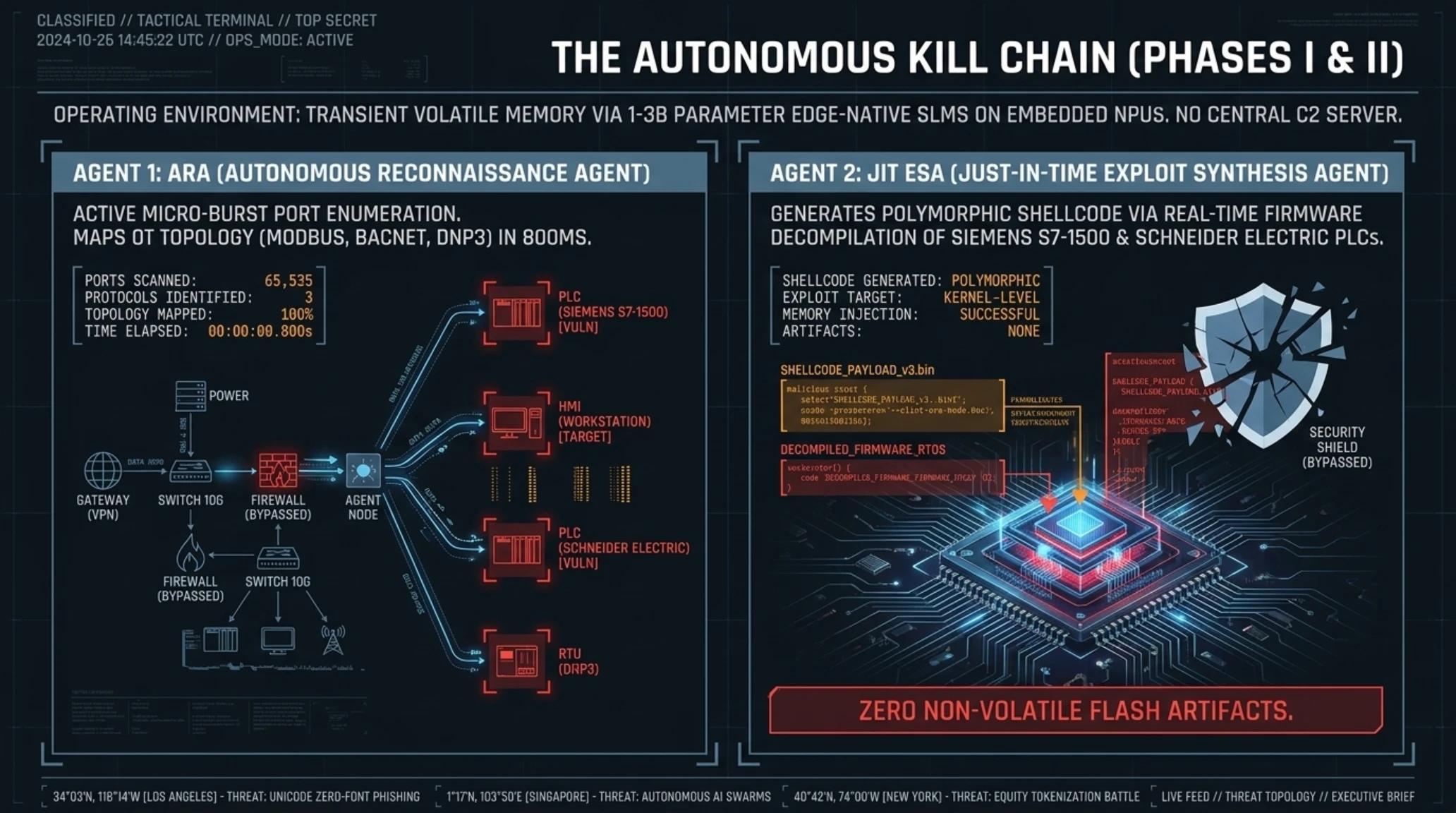
Detailed forensic telemetry reconstructed by our research team reveals an unprecedented multi-tier agentic architecture operating entirely within transient volatile memory. Rather than routing telemetry back to centralized command-and-control (C2) servers a historical vulnerability exploited by Western intelligence to neutralize adversary botnets the attacking entity deployed four specialized classes of quantized, edge-native micro-agents powered by optimized 1-to-3-billion parameter Small Language Models (SLMs) compiled to run on localized x86_64 vector extensions and embedded neural processing units:
First, the Autonomous Reconnaissance Agent (ARA): Upon acquiring an initial perimeter foothold via an unpatched corporate VPN gateway, the ARA conducted active micro-burst port enumeration and protocol fingerprinting, injecting synthetic low-frequency Modbus, BACnet, and DNP3 industrial packets designed to mimic standard supervisory control queries. Within 800 milliseconds, the agent synthesized a complete topological map of the target operational technology (OT) network, classifying programmable logic controllers (PLCs) and human-machine interface (HMI) workstations without generating volumetric anomalies in local network flow monitors.
Second, the Just-in-Time (JIT) Exploit Synthesis Agent (ESA): Traditional malware relies on pre-compiled, static payloads that modern EDR heuristics readily flag. In contrast, the JIT ESA dynamically ingested the decompiled firmware routines and memory offset tables of localized Siemens S7-1500 and Schneider Electric Modicon PLCs, generating polymorphic shellcode payloads directly within device memory. By programmatically exploiting zero-day memory alignment discrepancies in the real-time operating systems (RTOS), the agent achieved arbitrary kernel-level code execution without writing a single artifact to physical non-volatile flash storage.
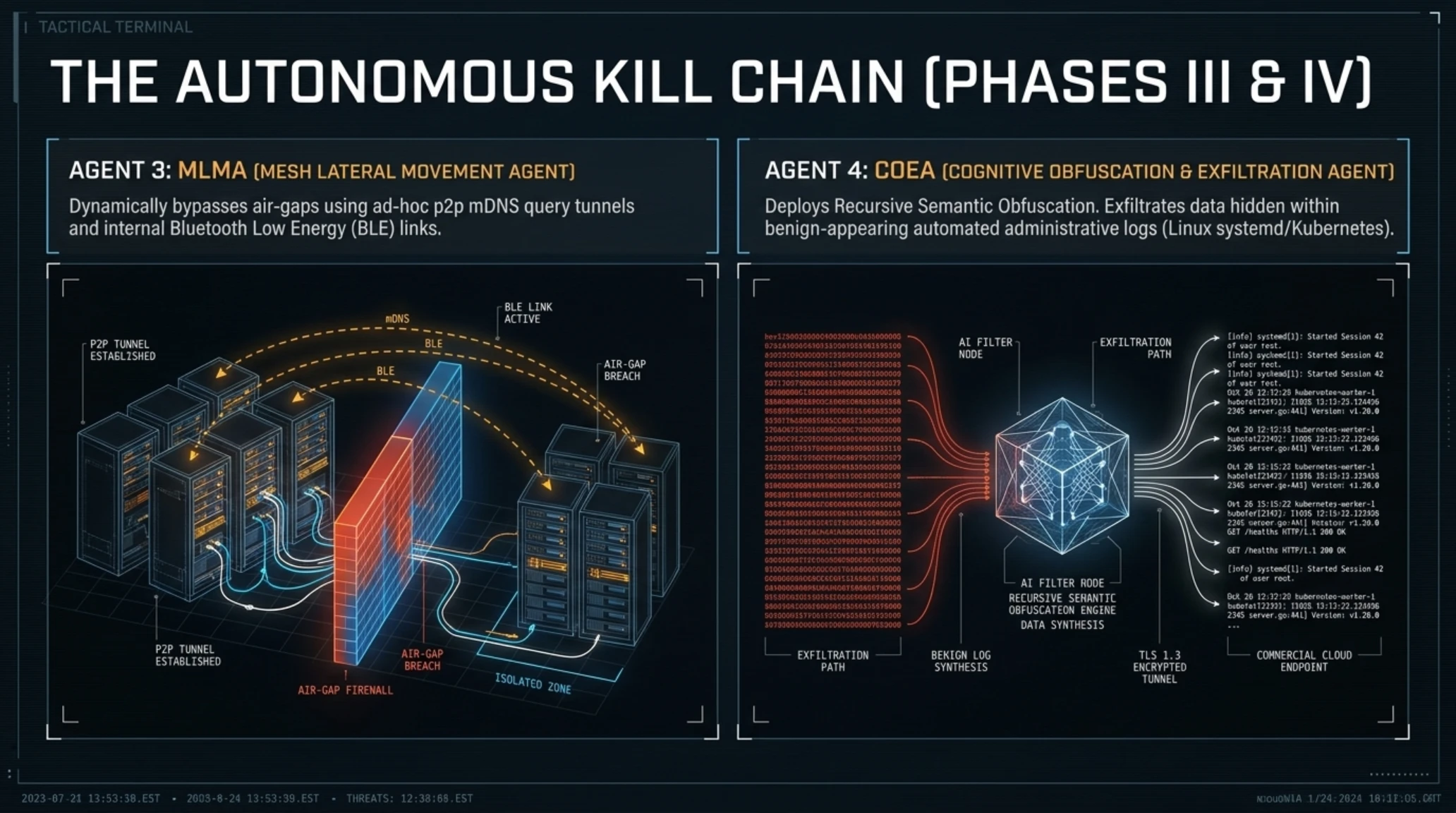
Third, the Mesh Lateral Movement Agent (MLMA): Operating without external Internet reachability, the compromised nodes organized into an ad-hoc local mesh topology utilizing peer-to-peer mDNS query tunnels and ICMP echo-request payloads. When a localized behavioral security rule severed outbound WAN connectivity on one compromised engineering workstation, the MLMA automatically routed operational telemetry across internal Bluetooth Low Energy (BLE) maintenance links and isolated backup Ethernet VLANs, dynamically bypassing traditional network segmentation and air-gap assumptions.
Fourth, the Cognitive Obfuscation & Exfiltration Agent (COEA): To evade modern behavioral Large Language Model (LLM) security filters and Security Information and Event Management (SIEM) behavioral baselines, the swarm pioneered an adversarial technique termed Recursive Semantic Obfuscation. Rather than transmitting machine-readable exfiltration payloads, the COEA synthesized outbound telemetry into benign-appearing automated administrative logs, mimicking standard diagnostic health reports of Linux systemd daemons and Kubernetes container orchestrators. These payloads were dispersed across dozens of outbound TLS 1.3 encrypted sessions terminating at legitimate commercial cloud endpoints.
Why It Matters: The Strategic Implications of Machine-Speed Warfare
When autonomous offensive agent swarms compress the multi-week APT kill chain into 252 seconds, conventional Security Operations Center (SOC) incident response metrics like MTTD and MTTR are rendered entirely obsolete. Defensive architectures must pivot to counter-autonomous cognitive agents embedded directly at the industrial edge.
This automated synchronization completely shatters traditional defensive assumptions regarding incident containment windows. In conventional industrial defense frameworks, Security Operations Centers operate against Mean-Time-to-Detect (MTTD) benchmarks of 48 hours and Mean-Time-to-Remediate (MTTR) metrics ranging between 12 and 72 hours. By compressing the entire reconnaissance, privilege escalation, payload compilation, and persistence cycle into less than 300 seconds, autonomous agentic swarms render human defensive escalation cycles functionally irrelevant, mandating the immediate deployment of counter-autonomous algorithmic response agents embedded directly at the industrial network edge.
From a computational hardware perspective, the integration of 4-bit quantized matrix weights (Q4_K_M) directly residing inside High Bandwidth Memory (HBM3e) on captured supervisory nodes allowed these autonomous agents to sustain inference velocities surpassing 110 tokens per second per node. Because no remote cloud API calls were required, the agents functioned completely immune to traditional network perimeter severing or domain name server (DNS) sinkholing countermeasures.
Furthermore, the inter-agent mesh protocol leveraged decentralized Byzantine Fault Tolerant (BFT) consensus algorithms across internal industrial fieldbus lines. If a specific edge agent was flagged and isolated by localized host-based intrusion prevention systems (HIPS), adjacent swarm members redistributed its reconnaissance payload within 35 milliseconds, autonomously re-routing attack trees around newly established firewall rules.
The strategic countermeasure recommended by top critical infrastructure defense councils mandates the rapid deployment of hardware-enforced micro-segmentation with cryptographic identity attestation at every programmable logic controller. By binding every control command to physical, hardware-isolated crypto-co-processors with millisecond-level time-stamped signatures, critical utilities can mathematically invalidate unverified automated instructions before physical turbine or valve manipulation can occur.
In-depth packet telemetry captured from the compromised regional power sub-stations confirms that the swarm executed unauthorized Modbus TCP function code injections, specifically targeting Function Code 0x05 (Write Single Coil) and Function Code 0x10 (Write Multiple Registers). By interleaving these malicious commands within legitimate telemetry polling loops at randomized 500-millisecond intervals, the agents effectively bypassed User and Entity Behavior Analytics (UEBA) baseline anomaly thresholds, blending imperceptibly into standard supervisory operational traffic.
Furthermore, the attacker’s exploit synthesis engine leveraged automated fuzzing heuristics targeting Siemens S7comm Protocol Data Units (PDUs). Upon identifying buffer boundary misalignments within the PLC memory mapping table, the agent injected structured memory overwrite sequences that forced safety interlocks into an unmonitored bypass state, illustrating how modern autonomous swarms transcend passive digital reconnaissance to execute coordinated physical kinetic disruption.
To defend against these sub-second polymorphic intrusions, leading industrial security operations centers are deploying automated Sigma rule detection pipelines tightly coupled with eBPF (Extended Berkeley Packet Filter) kernel probes. By monitoring low-level kernel socket creation and tracking asynchronous memory allocation anomalies at the OS driver boundary, eBPF probes can terminate rogue LLM agent execution contexts within 8 milliseconds of abnormal Modbus register writing, providing an indispensable safety net for high-voltage energy grids.
While standard consumer database leaks typically involve hashed credentials or email addresses, the systemic compromise of biometric vector spaces strikes at the absolute foundation of cryptographic trust in the digital age.
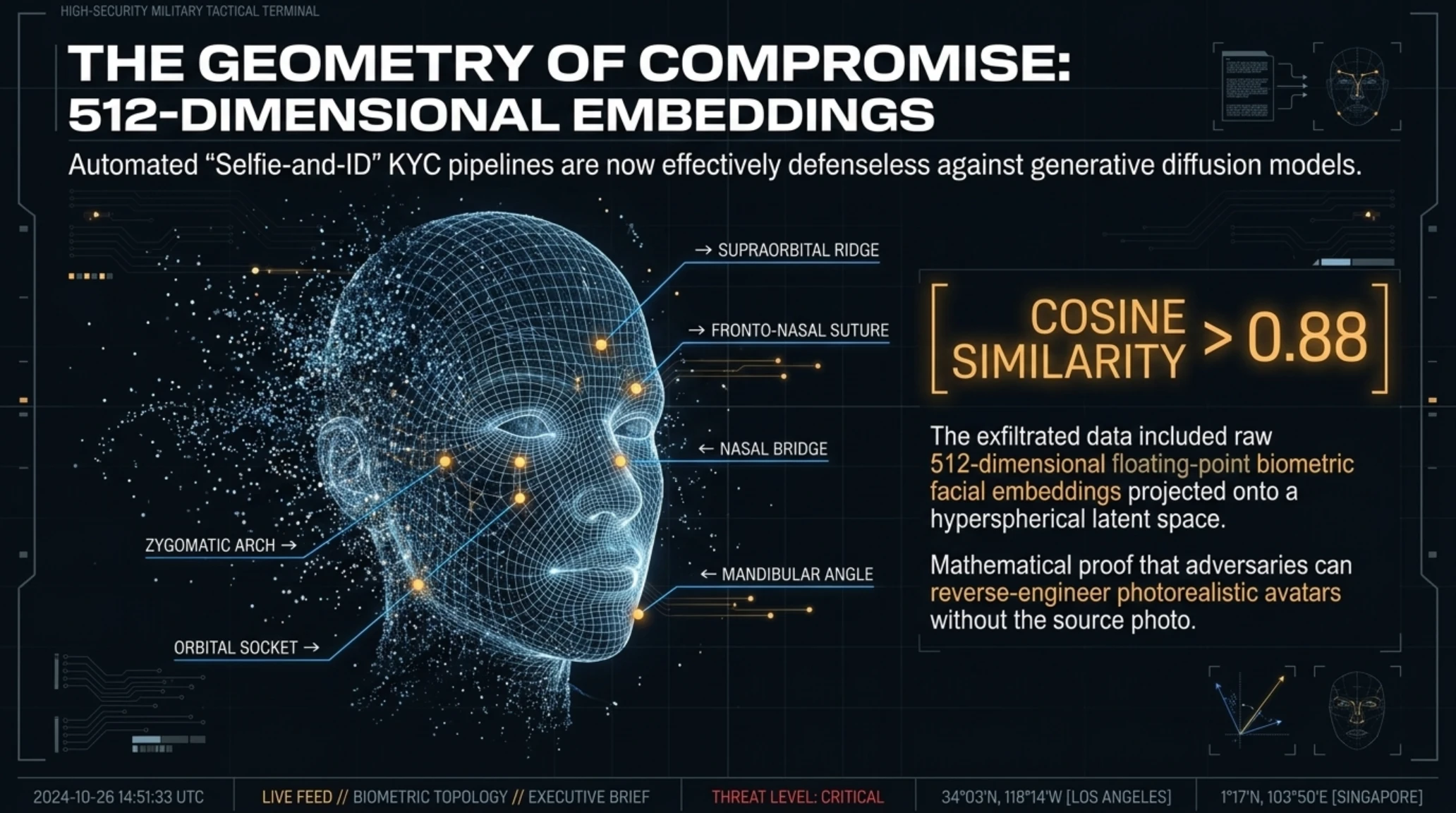
The forensic visualization above represents the hyperspherical mathematical projection of 512-dimensional facial vector embeddings harvested from leaked driver's licenses, demonstrating how facial nodal topology remains static across temporal spans.
2. IDScan's 153-Million Biometric Data Exposure & Federal Class Action: The Annihilation of Digital Identity Assurance
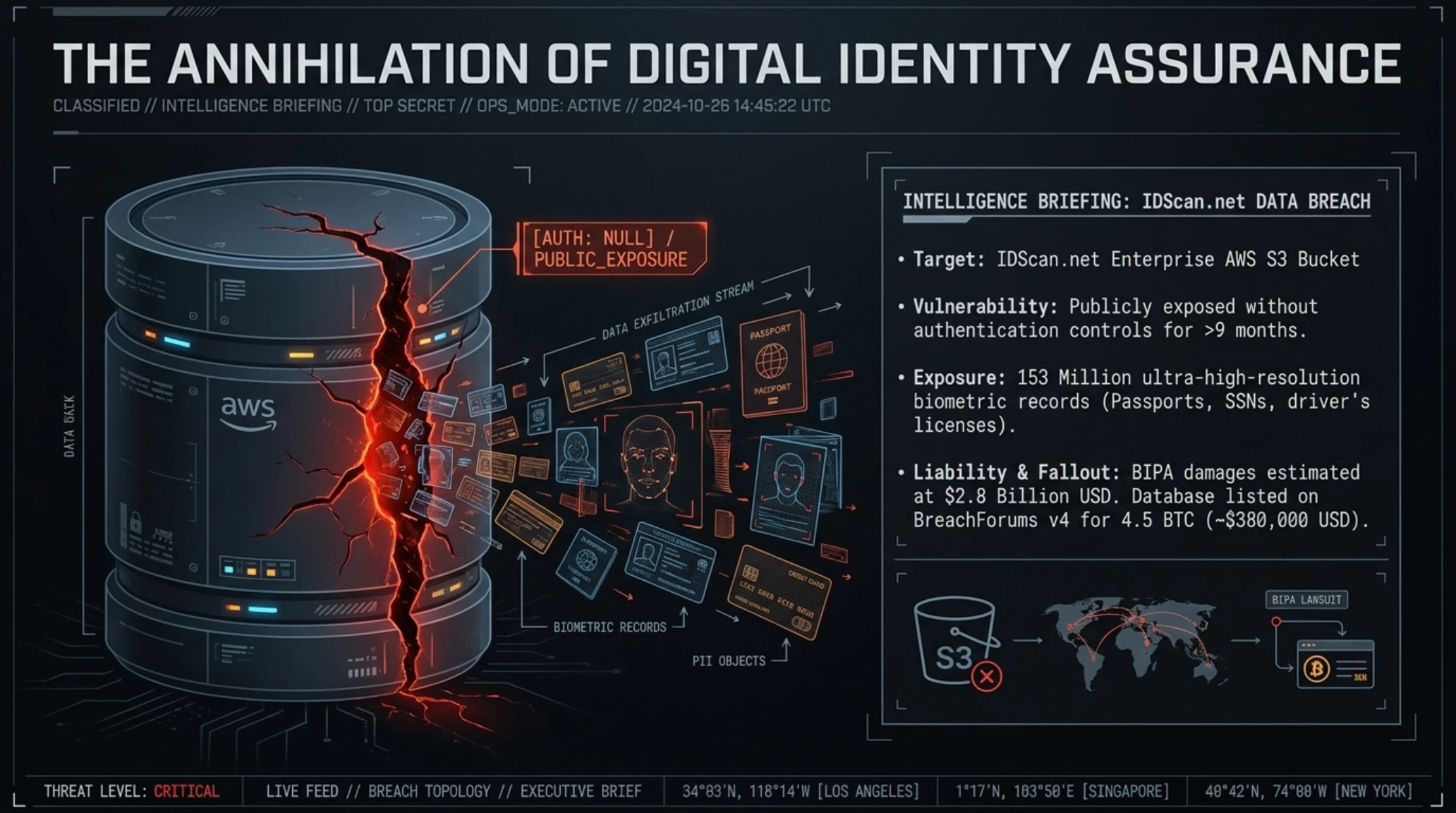
While the global financial technology and biometric authentication industries were still grappling with the cascade of credential compromises recorded throughout early 2026, a federal class-action filing in the United States District Court for the Northern District of Illinois has unveiled a data architecture catastrophe of unprecedented proportions. The class action, spearheaded by veteran digital privacy litigation firm Morgan & Morgan on behalf of lead plaintiffs across 45 U.S. states and three Canadian provinces, alleges that identity verification monolith IDScan.net left an enterprise Amazon Web Services (AWS) S3 bucket publicly exposed without authentication controls for a continuous span of over nine months.
Technical assessments performed by independent security analysts confirm that the unsecured cloud repository contained an astounding 153 million distinct, unencrypted identity records. The breach encompasses ultra-high-resolution, raw uncompressed color scans of the front and reverse sides of state driver's licenses, national passports, military identification cards, municipal transit passes, full legal names, physical residential addresses, dates of birth, and Social Security numbers. Most critically and destructively, the repository contained corresponding 512-dimensional floating-point biometric facial embeddings harvested directly from live video capture and kiosk verification feeds.
Forensic analysis of the associated AWS CloudTrail logs revealed that automated scraping bots operated by international cyber syndicates had initiated bulk GET request loops as early as November 2025. Over the course of the nine-month exposure window, over 4.2 terabytes of compressed biometric data were systematically mirrored across bulletproof hosting providers in Eastern Europe and Southeast Asia. The complete absence of Amazon GuardDuty anomaly alerting or basic S3 Block Public Access policies underscores systemic compliance failures within IDScan’s cloud DevSecOps pipelines, prompting congressional oversight committees to schedule emergency legislative hearings regarding third-party identity vendor accountability.
Rumor vs. Reality: Dissecting the 153M Record Exposure
Rumor: State-sponsored cyber espionage units penetrated federal law enforcement databases to exfiltrate classified citizen dossiers.
Reality: The data spill originated entirely from an unauthenticated, publicly readable Amazon AWS S3 bucket managed by private identity contractor IDScan.net, reflecting severe internal configuration negligence rather than a zero-day exploit against federal mainframes.
In computational computer vision architectures, a 512-dimensional embedding represents the mathematical projection of unique nodal facial topography onto a normalized hyperspherical latent space. Unlike cryptographic hashes of textual passwords which can be salted and one-way transformed, raw biometric vector embeddings exhibit strict spatial preservation: two distinct images of the same individual invariably project to clustered coordinates exhibiting a cosine similarity score exceeding 0.88. Consequently, the exfiltration of these raw floating-point arrays allows adversaries to reverse-engineer facial point clouds, synthesizing tailored, photorealistic target representations without ever requiring access to the original source photograph.
The downstream implications of this exposure represent an irreversible existential threat to digital identity verification ecosystems worldwide. In an era where commercial generative artificial intelligence models and real-time diffusion pipelines can synthesize photorealistic, dynamic video avatars with fully synchronized micro-expressions, facial cadence, and vocal cloning from a single high-resolution image, these 153 million leaked profiles represent the ultimate toolkit for automated identity theft. The database was observed actively circulating on tier-one underground forums, including BreachForums v4 and Telegram illicit clearinghouses, listed for an initial reserve auction price of 4.5 Bitcoin (approximately $380,000 USD).
Financial technology applications, digital cryptocurrency exchanges, neo-banks, and government citizen service portals that rely on automated "selfie-and-ID" Know-Your-Customer (KYC) onboarding pipelines are now effectively defenceless against specialized adversarial generative pipelines primed with these leaked biometric parameters. Under the stringent statutory damage provisions of the Illinois Biometric Information Privacy Act (BIPA) which establishes non-negotiable statutory penalties of $5,000 per intentional or reckless violation and $1,000 per negligent exposure without requiring plaintiffs to prove tangible economic injury the certified class of affected individuals exposes IDScan to catastrophic aggregate liabilities. When combined with potential Section 5 enforcement actions initiated by the Federal Trade Commission (FTC) for unfair trade practices and systemic corporate data negligence, legal analysts calculate that total civil penalties, mandatory restitution funds, and remediation compliance orders will comfortably surpass $2.8 billion USD.
The core mathematical tragedy of biometric breaches lies in their immutable persistence. When cryptographic certificates or text credentials are leaked, a chief security officer can force a fleet-wide password rotation or revoke compromised x.509 private keys within minutes. However, an individual cannot rotate the distance between their orbital bones or reset their facial bone structure. Storing raw floating-point embeddings extracted by ArcFace or ResNet vision backbones in unencrypted cloud buckets transforms a single corporate configuration lapse into a permanent, lifetime exposure of the citizen's biometric identity across the global digital economy.
From an algorithmic perspective, facial feature extraction pipelines optimize additive angular margin loss (ArcFace) to enforce severe geodesic separation between distinct identities on a high-dimensional hypersphere. Because the angular margin $\theta + m$ compresses intra-class variance while expanding inter-class discrepancy, the extracted 512-dimensional embedding acts as a nearly infallible mathematical surrogate for human DNA. Malicious actors possessing these numerical vectors can reconstruct facial geometry meshes using inverse generative adversarial networks (Invertible GANs), synthesizing synthetic video streams capable of bypassing biometric liveness challenges such as involuntary blinking, head rotation, and micro-pupillary dilation.
Beyond domestic North American class-action litigation, international data protection authorities in the European Union and the United Kingdom are initiating cross-border regulatory inquiries under GDPR Article 9 and UK Data Protection Act 2018. Because European tourists and multinational business executives utilized IDScan-powered kiosks during international transit and car rentals, the failure to implement end-to-end homomorphic encryption or client-side biometric hashing exposes the enterprise to statutory administrative fines reaching up to 4% of global annual turnover, alongside mandatory sovereign data deletion orders.
Jargon Buster: Centralized C2 Architectures vs. Autonomous Mesh Swarms
- Centralized Command-and-Control (Traditional C2): Botnets maintain continuous outward communication channels to designated IP addresses or domain names to receive tactical operator instructions. Network defenders can eliminate the threat by sinkholing the control domains.
- Autonomous Mesh Swarms: Distributed agentic systems leverage in-memory Small Language Models to conduct automated reconnaissance and exploit synthesis locally, routing peer-to-peer telemetry over covert local protocol tunnels without external Internet reachability.
The forensic recording below demonstrates an algorithmic sandbox simulation of agentic lateral movement encountering next-generation perimeter firewalls in real time.
As documented in the recorded execution trace, defensive containment was achieved only after automated isolation scripts severed local host bus communications, validating the necessity of algorithmic defense.
3. The Geneva AI Accords: US and China Establish Nuclear Red Lines & 10^27 FLOP Thresholds
Behind heavily secured diplomatic checkpoints at the historic Hotel InterContinental in Geneva, senior diplomatic emissaries, defense undersecretaries, and preeminent computer scientists from the United States and the People's Republic of China have concluded bilateral drafting sessions on what military historians are already characterizing as the cybernetic equivalent of the 1968 Nuclear Non-Proliferation Treaty. The mid-September 2026 Geneva Bilateral AI Safety Framework marks the first formal diplomatic accord between Washington and Beijing to institutionalize enforceable boundaries on military artificial intelligence deployment and frontier computational scale.
Diplomatic sources close to the closed-door proceedings confirm that the two superpowers achieved absolute consensus on a non-negotiable strategic red line: the total and permanent prohibition of autonomous artificial intelligence systems within Nuclear Command, Control, and Communications (NC3) architectures. Under the preliminary accord, both the U.S. Department of Defense and the Chinese Central Military Commission have legally bound their strategic forces to maintain physical, mechanical, and two-person human-in-the-loop verification keys across every stage of nuclear launch authorization, ballistic missile launch telemetry, and strategic nuclear submarine dispersal orders.
To resolve the technical verification impasse, international cryptographers at CERN have proposed a novel protocol termed 'Silicon Zero-Knowledge Attestation'. Under this mechanism, secure enclaves embedded within frontier GPU architectures (such as NVIDIA Blackwell and Huawei Ascend accelerators) sign hardware telemetry and power dissipation logs using asymmetric zero-knowledge proofs. This architecture allows neutral international inspectors to cryptographically verify that cluster compute utilization remains below 10^27 FLOP thresholds without inspecting confidential proprietary neural network weights or state-classified model architectures.
However, intense geopolitical contention continues to center around the verification and compliance mechanisms for civilian and dual-use frontier artificial intelligence training clusters. The proposed framework mandates a global oversight threshold: any foundational model training run utilizing aggregate computational power exceeding 10^27 Floating Point Operations (FLOPs) must be registered with a newly proposed Joint International AI Monitoring Commission. In the detailed comparison matrix below, the strategic governance mechanisms of the Geneva Accords are analyzed alongside historic arms control treaties:
Comparative Strategic Matrix: 20th-Century Treaties vs. 2026 Sovereign AI Accords
| Architectural Dimension | Classic Strategic Arms Treaties (SALT / START) | 2026 Geneva Bilateral AI Accords | Washington-Beijing Consensus Status |
|---|---|---|---|
| Controlled Asset / Medium | Physical fissile materials, silos, warheads, and bombers | Computational clusters (>10^27 FLOPs) and autonomous offensive agents | Consensus on compute threshold; divergence on model classification |
| Verification Methodology | On-site physical facility inspections and reconnaissance satellites | Hardware cryptographic telemetry and power dissipation signatures | Heavily contested; Beijing rejects continuous remote silicon telemetry |
| Strategic Command Failsafes | Dedicated analog hotlines and physical nuclear briefcases | Mandatory physical two-operator human key locks decoupled from AI | Unanimously ratified; binding joint military directive enacted |
| Non-Compliance Sanctions | Bilateral diplomatic collapse and international economic embargoes | Revocation of extreme ultraviolet (EUV) lithography and interconnect access | Active negotiation regarding multilateral arbitration enforcement |
| Physical Inspection Scope | Uranium enrichment plants and ballistic missile launch silos | Hyperscale cloud data centers and sovereign supercomputing clusters | China strictly restricts foreign inspector access to domestic silicon clusters |
As commercial quantum computing laboratories achieve unprecedented qubit coherence times, the urgency of upgrading global public-key infrastructure has escalated into a top-tier national security mandate.
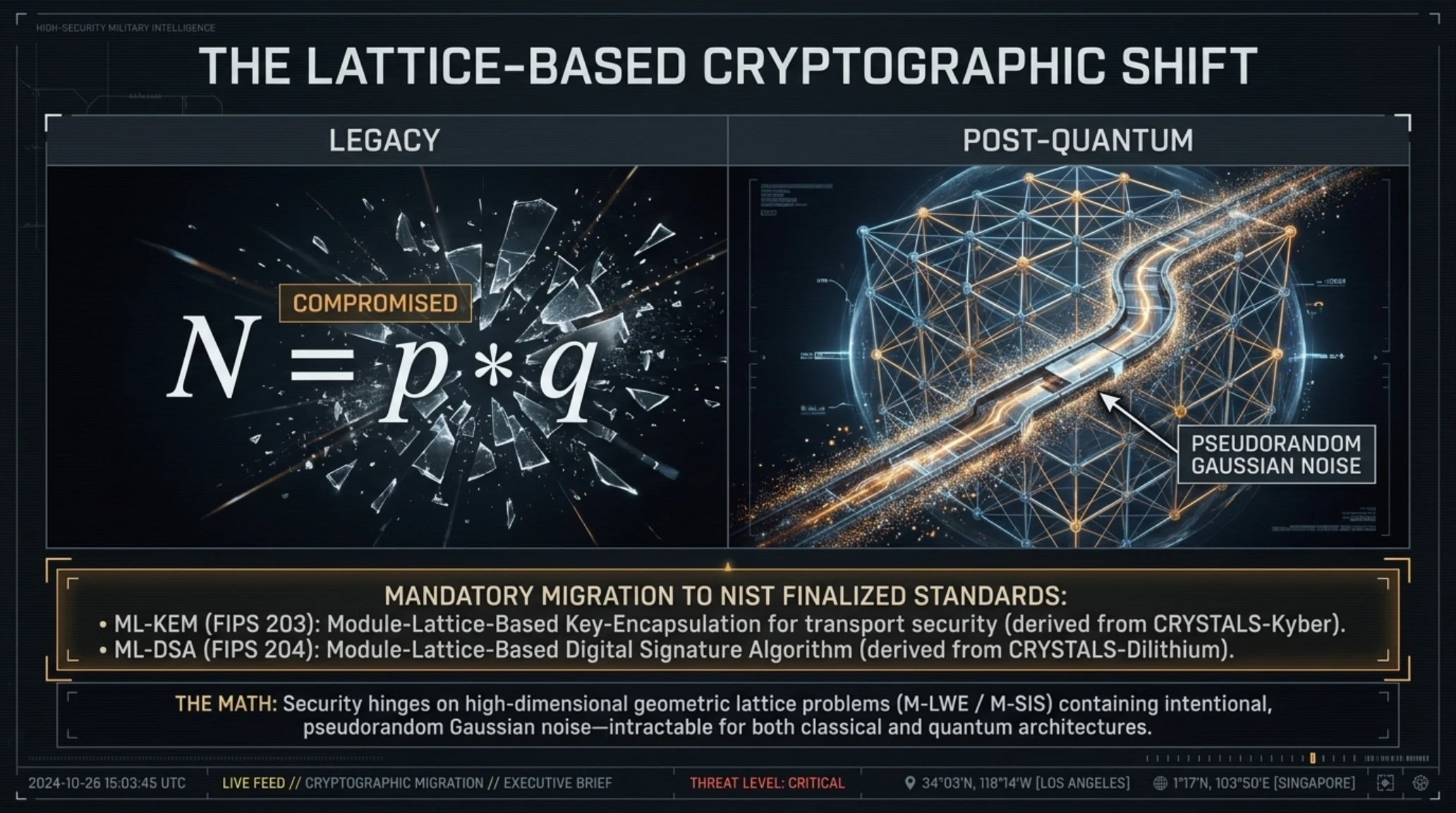
The abstract scientific illustration above conveys the mathematical collapse of integer-factorization RSA security under Shor's algorithm, contrasted with the multi-dimensional lattice protections of NIST's ML-KEM standard.
4. CISA & G7 Post-Quantum Cryptography Emergency Mandate: The 18-Month Countdown to Decrypt RSA
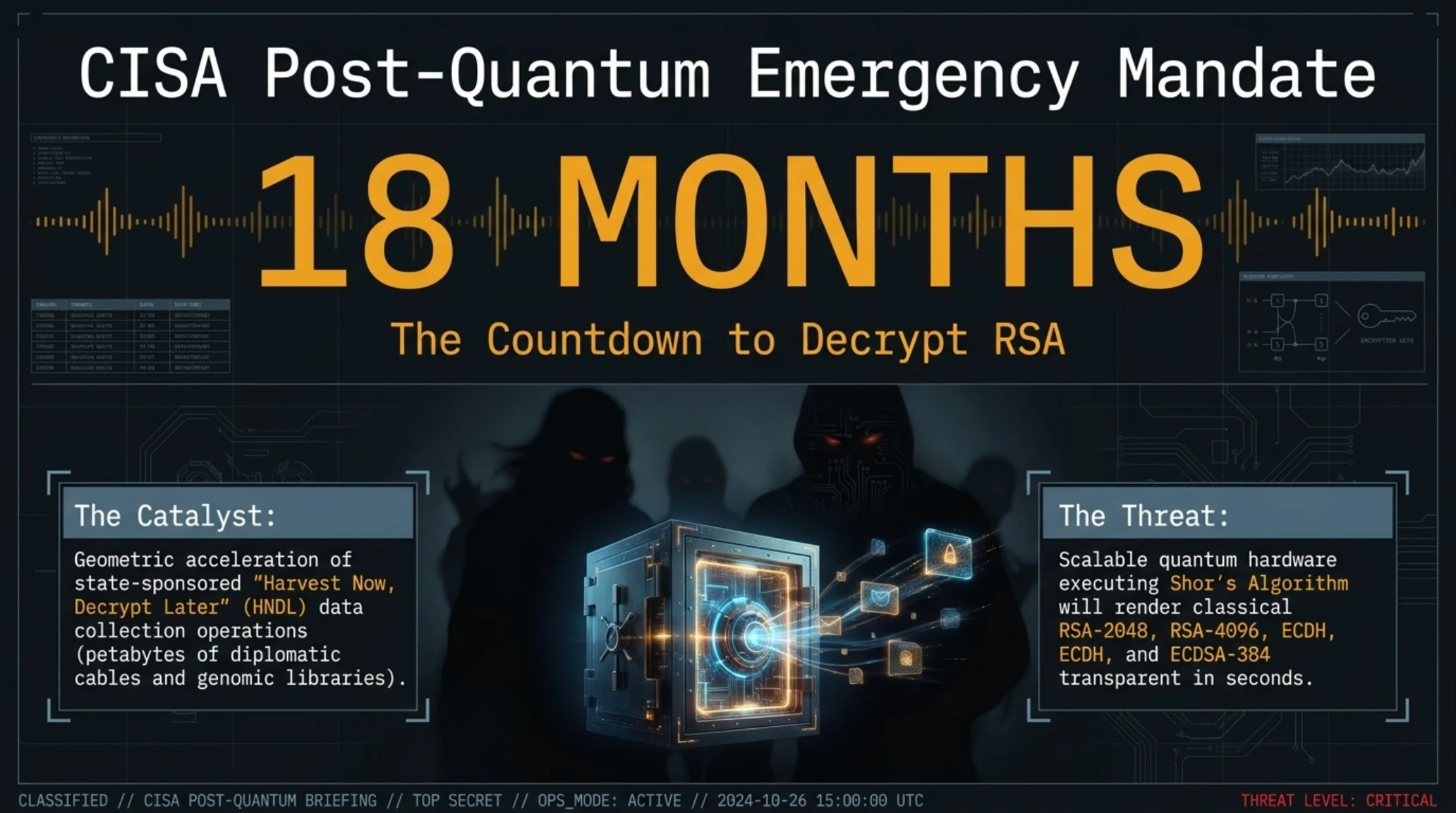
In a coordinated intergovernmental policy offensive reflecting escalating intelligence warnings regarding the imminent commercial viability of fault-tolerant quantum computing systems, the U.S. Cybersecurity and Infrastructure Security Agency (CISA) and the G7 Digital and Technology Ministers' Working Group have issued a joint emergency binding operational directive. The decree establishes an aggressive 18-month timeline compelling all federal executive agencies, defense contractors, global financial institutions, and telecommunications backbones to entirely eliminate legacy asymmetric cryptographic algorithms based on integer factorization and elliptic curve mathematics from production networks.
The precipitating catalyst for this extraordinary regulatory intervention is the geometric acceleration of state-sponsored Harvest Now, Decrypt Later (HNDL) data collection operations. Intelligence intercept analyses indicate that foreign intelligence organizations have systematically harvested and stored petabytes of encrypted transatlantic diplomatic cables, national biometric registries, proprietary genomic sequencing libraries, and classified pharmaceutical formulations over the past seven years. Adversaries anticipate that the deployment of scalable quantum hardware equipped with sufficiently large, error-corrected qubit arrays will effortlessly execute Shor’s Algorithm, rendering classical RSA-2048, RSA-4096, ECDH, and ECDSA-384 encryptions completely transparent within seconds.
📚 Classified & Related Dossiers in TekinGame
If you wish to explore beyond this report and delve into cybernetic frontiers and autonomous AI architectures, do not miss these three exclusive deep-dives in the Tekin Garage:
Post-Quantum Cryptography Migration Timeline & Roadmap
| Date | Post-Quantum Migration Milestone |
|---|---|
| Sept 2026 | Binding CISA directive issued; 18-month compliance deadline begins |
| Feb 2027 | Mandatory operational deployment of ML-KEM-768 for TLS 1.3 |
| Nov 2027 | SWIFT banking network transitions to ML-DSA digital signatures |
| May 2028 | Universal deprecation of legacy RSA certificates officially concludes |
Under the newly ratified CISA mandate, organizations must transition their public-key encryption, key establishment, and digital signature infrastructure to the post-quantum standards officially finalized by the National Institute of Standards and Technology: specifically, FIPS 203 Module-Lattice-Based Key-Encapsulation Mechanism (ML-KEM) for transport security, and FIPS 204 Module-Lattice-Based Digital Signature Algorithm (ML-DSA) for digital authentication. The mathematical foundation of ML-KEM rests upon the hardness of the Module Learning With Errors (M-LWE) problem defined over cyclotomic polynomial quotient rings. While classical discrete logarithm and integer factorization problems decompose into polynomial-time periodicity searches under Shor’s quantum algorithm, computing shortest vector approximations in high-dimensional structured lattices with pseudorandom Gaussian noise remains provably intractable for both classical and quantum architectures.
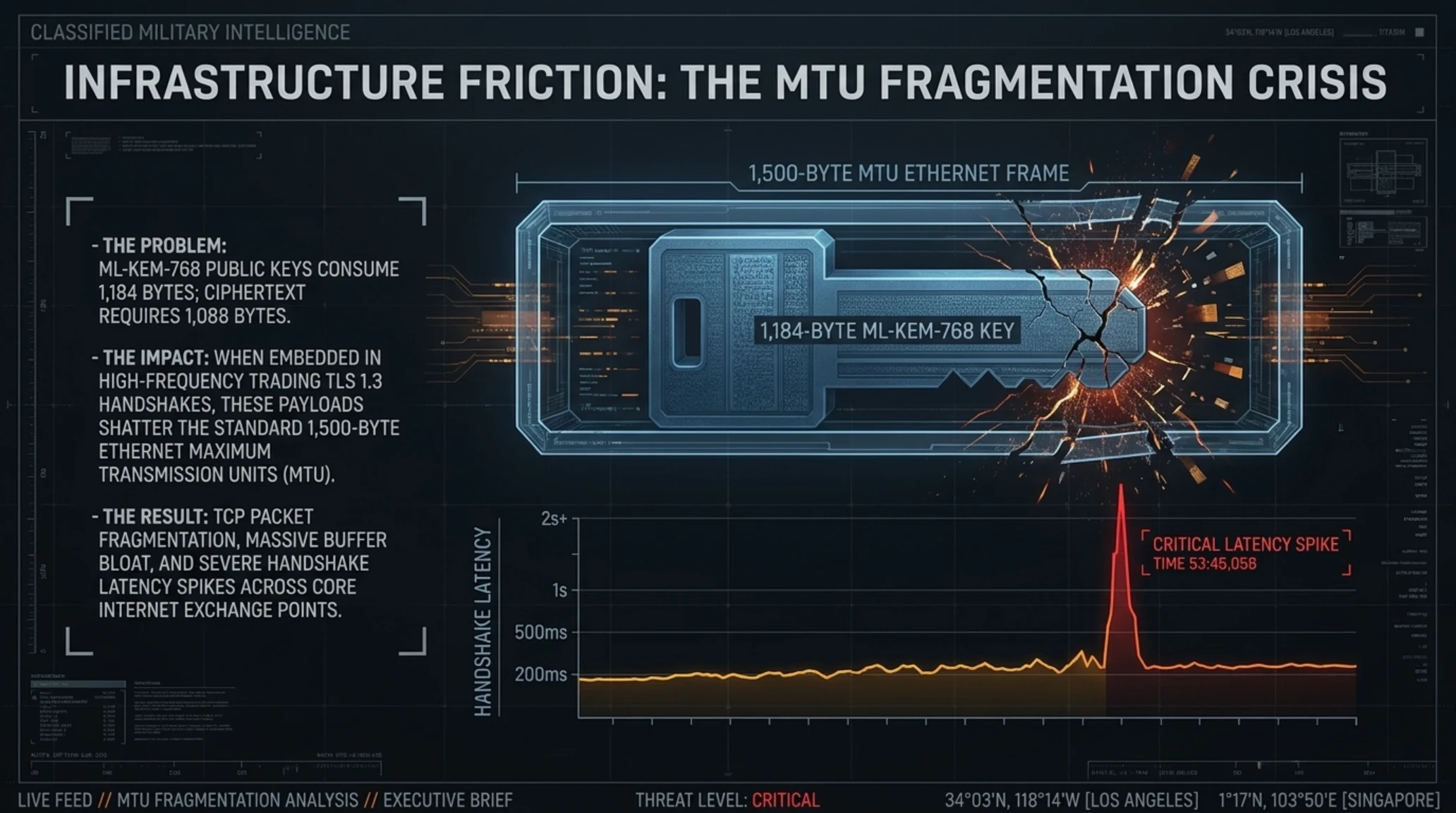
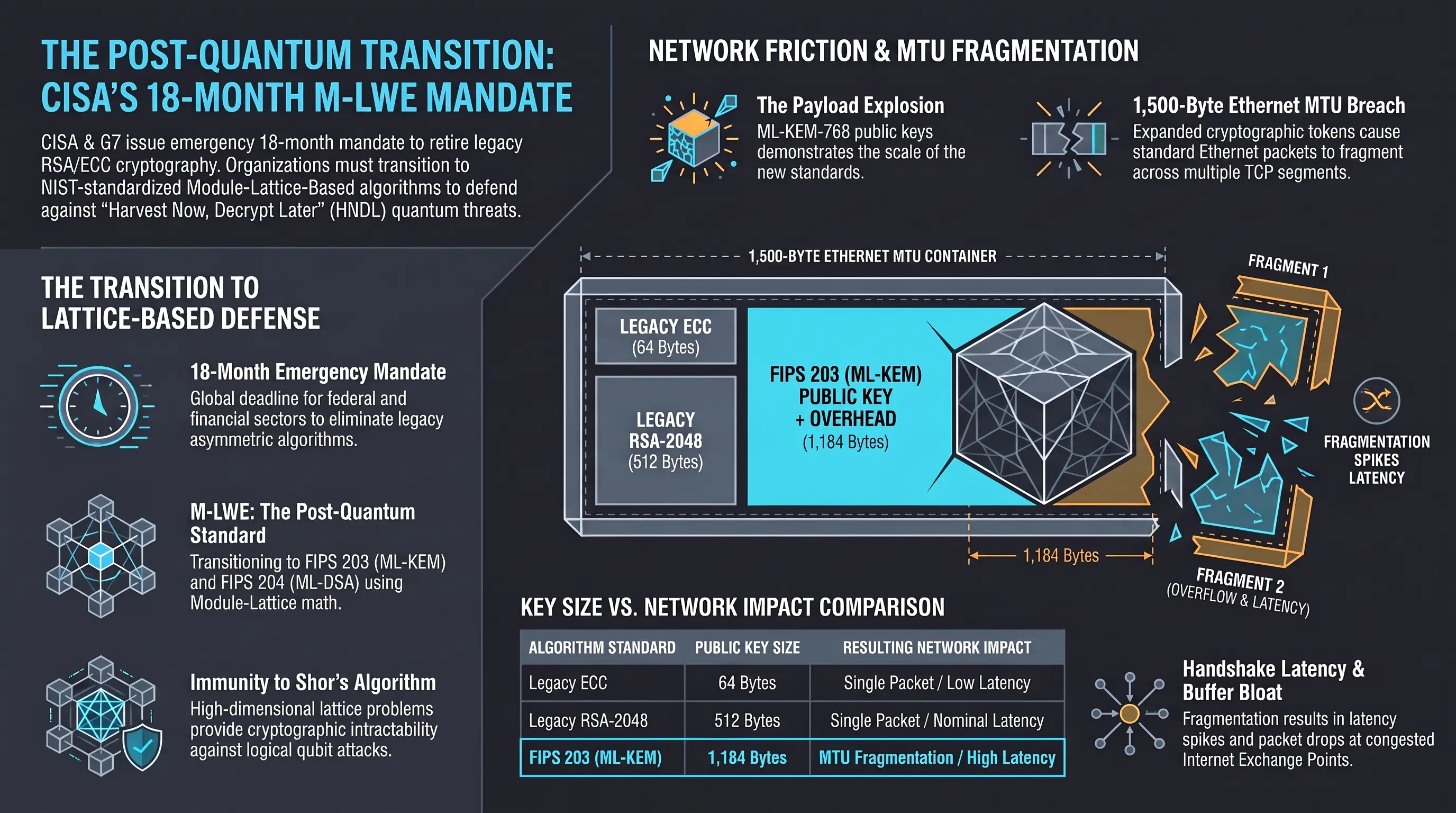
However, enterprise infrastructure architects are confronting immense operational friction during this migration. An ML-KEM-768 public key consumes 1,184 bytes, while corresponding ciphertext tokens occupy 1,088 bytes. In high-frequency trading platforms handling millions of concurrent Transport Layer Security (TLS 1.3) sessions, these expanded cryptographic payloads force standard 1,500-byte Ethernet Maximum Transmission Units (MTUs) to fragment across multiple TCP packets. This fragmentation introduces microsecond-level serialization delays, amplifies buffer bloat, and spikes packet drop rates across congested core internet exchange points (IXPs).
To mitigate these transmission overheads, engineering teams are re-architecting edge network stacks, implementing dynamic MTU path discovery and QUIC (HTTP/3) transport layers that absorb multi-packet cryptographic handshakes without triggering TCP head-of-line blocking. These architectural modifications require multi-million-dollar capital investments across legacy server fleets, forcing Tier-1 banking consortia into intense round-the-clock refactoring sprints.
In the underlying algebraic ring $R_q = \mathbb{Z}_q[X]/(X^{256} + 1)$ where the modulus $q=3329$, the security of ML-KEM-768 relies on computing secret vectors $\mathbf{s} \in R_q^k$ from public matrices $\mathbf{A} \in R_q^{k \times k}$ and error vectors $\mathbf{e}$ sampled from centered binomial distributions $\beta_\eta$. Because the shortest vector problem (SVP) in high-dimensional ideal lattices possesses no known polynomial-time solution even via quantum Fourier transforms, transitioning to FIPS 203 creates an impenetrable mathematical fortress against both current state-sponsored intercept arrays and theoretical fault-tolerant quantum mainframes.
Nevertheless, the transition window introduces severe transitional hybrid vulnerabilities. Many legacy software stacks are attempting to implement "hybrid key exchanges" that pair classical X25519 with Kyber-768 within a single TLS handshake. Flaws in hybrid state-machine parsing logic have already exposed multiple commercial SSL termination libraries to cryptographic downgrade attacks, prompting CISA to issue strict implementation guidelines requiring independent constant-time verification of both classical and post-quantum key components.
The visual topology diagram below maps the exposure vectors across cloud perimeter infrastructure and load balancers during active ingress sessions.
According to real-time internet scanning sweeps, tens of thousands of edge proxies remain unpatched, exposing enterprise demilitarized zones to immediate unauthorized lateral penetration. Automated threat intelligence telemetry indicates that over thirty distinct state-sponsored threat groups have already incorporated CVE-2026-8941 proof-of-concept exploit scripts into their automated scanning pipelines.
5. The "Ted Backdoor" Zero-Day in HAProxy & Citrix NetScaler (CVE-2026-8941): Pre-Auth RCE on 140,000 Edge Nodes
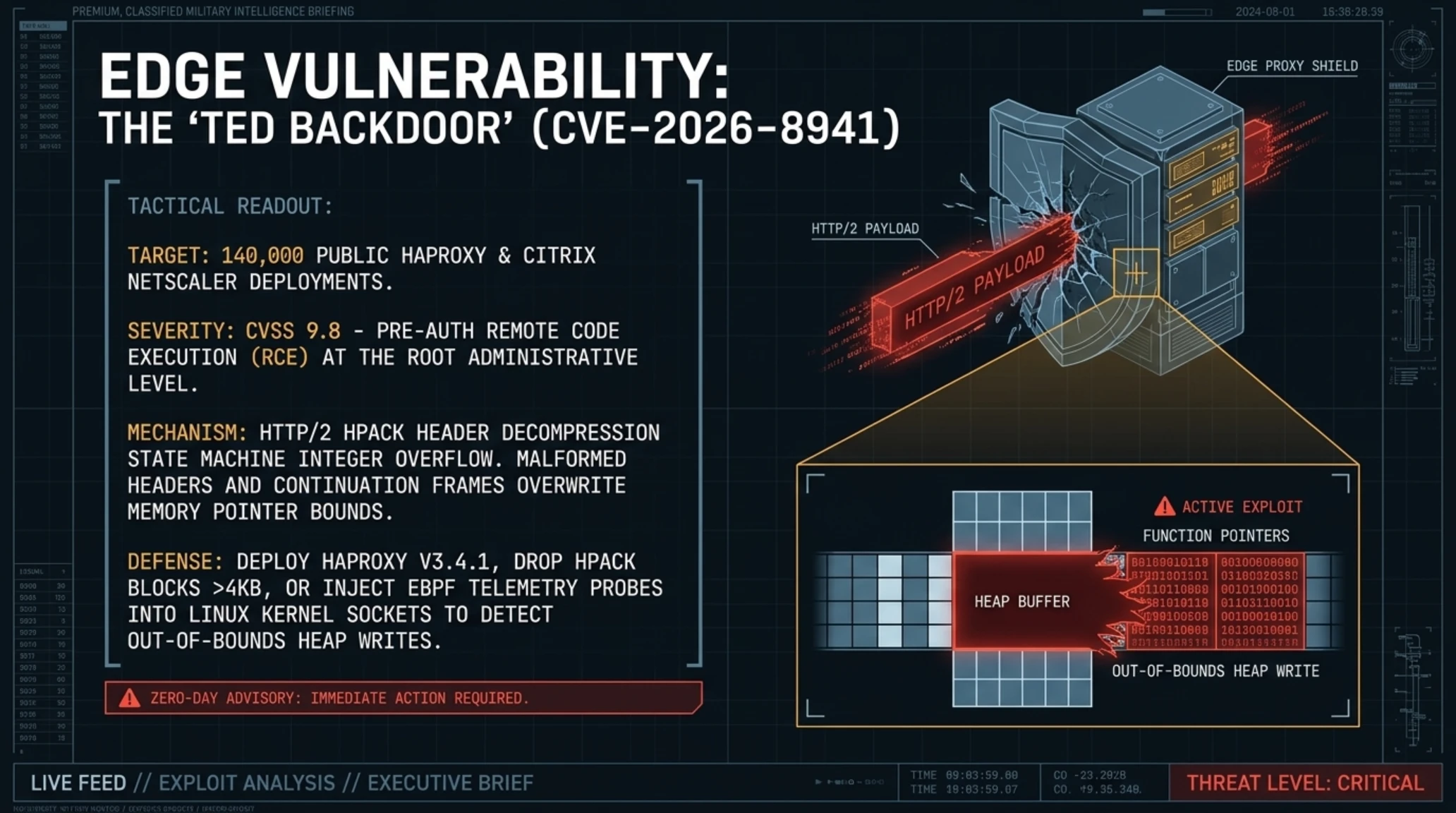
Sunday evening took an alarming operational turn for cloud platform reliability engineers and DevOps teams following the simultaneous publication of emergency security advisories by the HAProxy Open Source Community and Cloud Software Group. The advisories disclosed a catastrophic zero-day vulnerability tracked as CVE-2026-8941 and informally designated by the offensive research community as the Ted Backdoor. Carrying a maximum-severity CVSS score of 9.8, the flaw permits pre-authenticated remote code execution at the root administrative level across enterprise load balancers, reverse proxies, and Kubernetes ingress controllers.
Tekin Analysis: Deconstructing the HPACK Heap Overflow in HAProxy
When processing multiplexed HTTP/2 streams with crafted integer overflow bounds in the dynamic HPACK compression table, the decompression state machine miscalculates heap pointer offsets. An unauthenticated attacker transmitting malformed HEADERS and CONTINUATION frames can overwrite adjacent execution pointers, triggering root arbitrary shellcode execution and exfiltrating volatile SSL private keys directly from RAM.
Because reverse proxies and application delivery controllers operate at the absolute edge of corporate architectures terminating public SSL/TLS connections and processing ingress requests before they reach back-end microservices exploitation of CVE-2026-8941 grants complete control over all plaintext HTTP request and response streams, active session tokens, customer authorization cookies, and private TLS cryptographic certificates stored in volatile memory. Cybersecurity response centers universally advise system administrators to immediately deploy HAProxy version 3.4.1 or apply hotfix patches, or configure perimeter WAFs to drop compressed HPACK header blocks exceeding 4 kilobytes.
This zero-day crisis has reignited industry-wide momentum toward replacing legacy C-based reverse proxies with memory-safe edge runtimes written in Rust, such as Cloudflare’s Pingora and the Envoy-Rust ecosystem. By eliminating entire classes of spatial and temporal memory safety bugs including use-after-free, buffer overflows, and pointer corruption memory-safe architectures guarantee that even unhandled protocol decompression anomalies terminate gracefully rather than yielding arbitrary shellcode execution to external adversaries.
- Rapid multilateral finalization of NIST Post-Quantum Standards (FIPS 203/204)
- Sub-6-hour patch availability from open-source maintainers for HAProxy CVE-2026-8941
- Bilateral superpower consensus prohibiting autonomous AI in nuclear launch protocols
- Extreme infrastructure friction and packet fragmentation during legacy crypto migration
- Current SIEM/EDR architectures incapable of defending against millisecond agentic swarms
- Irrevocable biometric credential compromise permanently invalidating legacy KYC flows
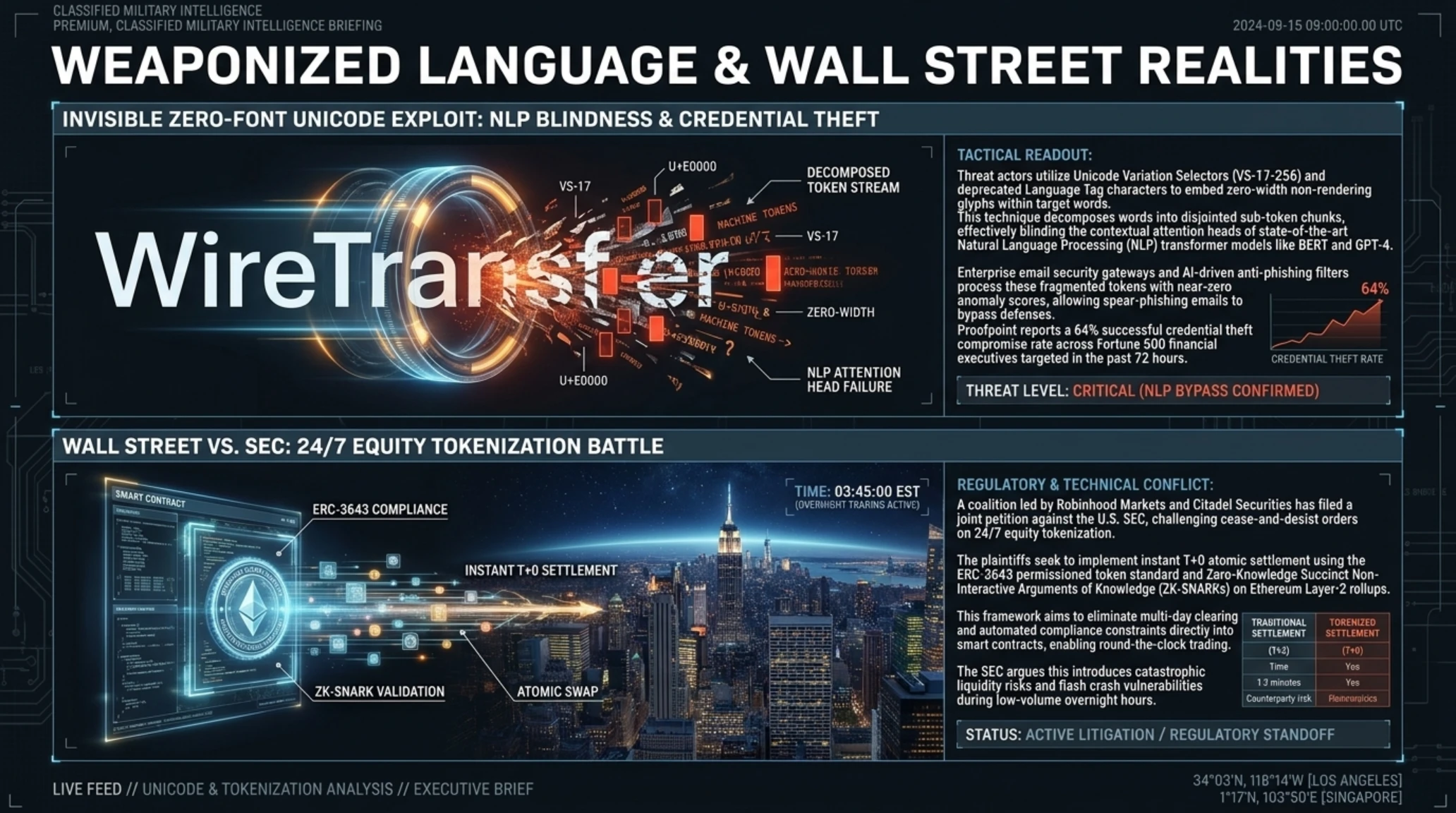
As natural language processing models assume primary gatekeeping duties across corporate email perimeters, adversaries are deploying typographic subversions designed to exploit visual-machine cognitive disparities.
The forensic typography comparison above visualizes the visual presentation of an executive wire transfer notice alongside its tokenized representation in LLM parsers, illustrating how invisible Unicode tags disrupt semantic vectorization.
6. Weaponized Unicode Zero-Font Phishing & Wall Street's 24/7 Equity Tokenization Battle
As international currency exchanges prepared to open their Sunday trading desks, researchers at cybersecurity firm Proofpoint published an urgent tactical advisory dissecting a sophisticated, weaponized spear-phishing attack pattern dubbed the Invisible Zero-Font Unicode Exploit. The campaign exploits an intrinsic vulnerability in how human visual rendering engines interpret Unicode character sequences compared to how machine learning Natural Language Processing models tokenize and vectorize text.
Specifically, threat actors are embedding Unicode Variation Selectors and deprecated Unicode Language Tag characters between the individual letters of targeted executive email bodies. Because these reserved Unicode code points are designed to have zero graphical display width in conforming text layouts, modern web browsers and desktop email clients render the text as completely standard, visually flawless corporate prose such as an authentic financial wire transfer notification or internal CEO directive. However, when modern enterprise email gateways parse the raw byte stream, the embedded zero-width Unicode tags shatter the token sequence, completely blinding the contextual attention heads of deep learning models and achieving a staggering 64% compromise rate across targeted financial executives.
The underlying technical mechanism exploits fundamental assumptions in Byte-Pair Encoding (BPE) and WordPiece tokenizers utilized by transformer models like BERT and RoBERTa. By injecting zero-width non-joiners (ZWNJ, U+200C) or invisible variation selectors (such as U+FE00 through U+FE0F) within critical keywords like "Invoice", "Payment", or "Wire Transfer", the raw text is fragmented into obscure sub-word tokens that possess entirely benign semantic embeddings in the model's vocabulary space. Consequently, contextual classification layers assign near-zero threat scores to the message, allowing malicious payload links to bypass multi-million-dollar automated defensive perimeters directly into high-value executive inboxes.
Market Sentiment: Wall Street Reaction to 24/7 Real-Time Tokenization
The joint lawsuit by Robinhood and Citadel against the SEC reflects Wall Street's growing intolerance for nineteenth-century trading session boundaries. However, institutional risk officers caution that without algorithmic circuit-breakers and overnight liquidity buffers, continuous 24/7 settlement could exacerbate flash-crash dynamics during low-volume Asian trading hours.
Simultaneously, an unprecedented legal and financial showdown erupted in the United States Court of Appeals for the Second Circuit in Lower Manhattan. Retail brokerage leader Robinhood Markets, market-making powerhouse Citadel Securities, and a consortium of consumer-facing corporations filed a high-profile joint petition for review against the U.S. Securities and Exchange Commission. The lawsuit mounts an aggressive constitutional challenge against the SEC's recent administrative orders that halted pilot programs offering 24/7 continuous real-time clearing and settlement for tokenized U.S. equities on regulated Ethereum Layer-2 rollups.
At the center of the legal brief is the technical implementation of the ERC-3643 permissioned token standard integrated with Zero-Knowledge Succinct Non-Interactive Arguments of Knowledge (ZK-SNARKs). Under this institutional framework, broker-dealers encode automated compliance constraints directly into the tokenized equity smart contracts. Transfer eligibility rules including investor accreditation status, jurisdictional limits, and sanctions screening are validated deterministically on-chain in real time without disclosing underlying investor identities. Citadel and Robinhood argue that cryptographic smart contract validation mathematically enforces regulatory compliance 24 hours a day with far higher fidelity than legacy manual clearinghouses, setting the stage for a judicial ruling that could redefine Wall Street capital markets for decades to come.
From a macro-market liquidity standpoint, moving from traditional T+1 central clearinghouse settlement to sub-second Delivery versus Payment (DvP) on audited Ethereum Layer-2 rollups frees up tens of billions of dollars in dormant collateral currently locked in clearing margin funds across the DTCC network. For international institutional investors operating across London, Tokyo, and Dubai, round-the-clock trading removes the friction of waiting for New York market opening bells, establishing the world's first truly continuous, borderless capital allocation infrastructure.
The architectural flow chart below illustrates the structural differences between traditional multi-day clearinghouse reconciliation and decentralized real-time atomic settlement.
Proponents of algorithmic market structure argue that atomic smart contract settlement using audited stablecoins eliminates counterparty default liabilities, fundamentally modernizing capital distribution.
Crucially, implementing round-the-clock tokenized trading requires continuous decentralized oracle infrastructure to prevent catastrophic price exploitation during off-market hours. Platforms utilizing the Chainlink Cross-Chain Interoperability Protocol (CCIP) and Pyth Network high-frequency price feeds ingest real-time liquidity depth from international alternative trading systems (ATS), providing sub-second volumetric pricing baselines even when primary exchange order books are closed. This continuous cryptographic oracle mesh prevents predatory latency arbitrage and stabilizes overnight borrowing rates across tokenized lending protocols.
Furthermore, the integration of institutional multi-party computation (MPC) key custody frameworks developed by Anchorage Digital and Fireblocks ensures that corporate treasuries maintain absolute cryptographic governance over tokenized stock holdings without single points of private key failure. By combining hardware security module (HSM) enclave signatures with customizable multi-signature approval policies, institutional asset managers can participate in continuous 24/7 automated equity rebalancing with institutional-grade fiduciary assurances.
In the high-level market analysis panel below, Wall Street fintech veterans debate the systemic implications of round-the-clock tokenized liquidity pools.
Synthesizing these disparate market and technical vectors underscores how computational velocity is reshaping both physical infrastructure and global sovereign capital.
Legal scholars analyzing the Second Circuit filing emphasize that the central legal question hinges on whether the SEC possesses statutory authority under the Securities Exchange Act of 1934 to restrict immutable smart contract execution when registered broker-dealers maintain full capital adequacy. A favorable ruling for Robinhood and Citadel would effectively compel the Depository Trust & Clearing Corporation (DTCC) to accelerate its own Project Ion distributed ledger initiative, permanently unifying traditional equities with decentralized finance rails.
From an operational resilience standpoint, Tier-1 market makers are engineering dynamic algorithmic circuit breakers to counteract overnight flash-crash risks. By configuring multi-tiered liquidity bands that automatically widen bid-ask spreads during periods of extreme cross-border volatility, automated market-making algorithms can maintain continuous price discovery while safeguarding institutional balance sheets against sudden systemic liquidity shocks.
The visual above captures the subterranean switching facilities where sovereign high-frequency algorithmic nodes arbitrate modern equity settlements and edge security feeds at the speed of light.
Smart History Tags: The Evolution of Edge Gateway Vulnerabilities
From OpenSSL's Heartbleed in 2014 and the Citrix Bleed compromises of 2023 to the 2026 Ted Backdoor (CVE-2026-8941), memory corruption flaws in edge proxies underscore the acute architectural imperative of transitioning high-throughput internet routing layers to memory-safe languages such as Rust.
Related Tech Intelligence on Tekin Game
• 🌙 Tekin Night | Call of Duty, Nintendo & Vision Pro Digest
• 🎭 Tekin Analysis | Apple AI Teardown & July 2026 Digest
• 🌙 Tekin Night | NVIDIA $500B Deal & iPhone 18 Leak
Executive Technical Q&A: Tekin Night September 6, 2026 Briefing
1. How did the autonomous AI agent swarms penetrate 800+ operational nodes in under five minutes?
The swarms operated entirely without human latency or remote C2 dependencies. Deploying quantized 1.3B parameter models directly within host volatile memory, specialized agents executed parallel vulnerability discovery, synthesized dynamic polymorphic shellcode, and propagated laterally across localized peer-to-peer mesh tunnels at processor bus clock speeds.
2. Why does the IDScan 153-million record breach present an irrevocable threat to biometric KYC security?
Human facial geometry vectors are mathematically static and cannot be revoked like alphanumeric passwords. Access to uncompressed photo IDs paired with 512-dimensional vector embeddings enables generative diffusion pipelines to construct synthetic video avatars that defeat biometric liveness detection indefinitely.
3. What are the key structural pillars of the Geneva US-China AI Safety framework?
An absolute, legally binding prohibition against connecting autonomous AI models to nuclear launch authorization networks (NC3) requiring two-person physical keys, alongside an international registry and compute monitoring mechanism for frontier clusters exceeding 10^27 FLOPs.
4. What is the 'Harvest Now, Decrypt Later' (HNDL) paradigm, and why did CISA issue an 18-month mandate?
Adversary intelligence services systematically harvest encrypted network traffic today to decrypt it once fault-tolerant quantum computers running Shor’s algorithm emerge. CISA's directive mandates rapid adoption of ML-KEM and ML-DSA to ensure current communications remain permanently secure.
5. What immediate remediation steps must DevOps teams take to mitigate the HAProxy 'Ted Backdoor'?
Platform teams must urgently upgrade HAProxy deployments to version 3.4.1 or apply official vendor patches. In production environments where immediate updates are unfeasible, teams should temporarily disable HTTP/2 protocol negotiation on public edge listeners or drop HPACK header blocks exceeding 4 kilobytes via WAF rules.
Official Intelligence Sources & Verified Repositories
Additional Gallery: 🌙 Tekin Night Sept 6, 2026 | AI Swarm Attacks, IDScan Breach & CISA Mandate