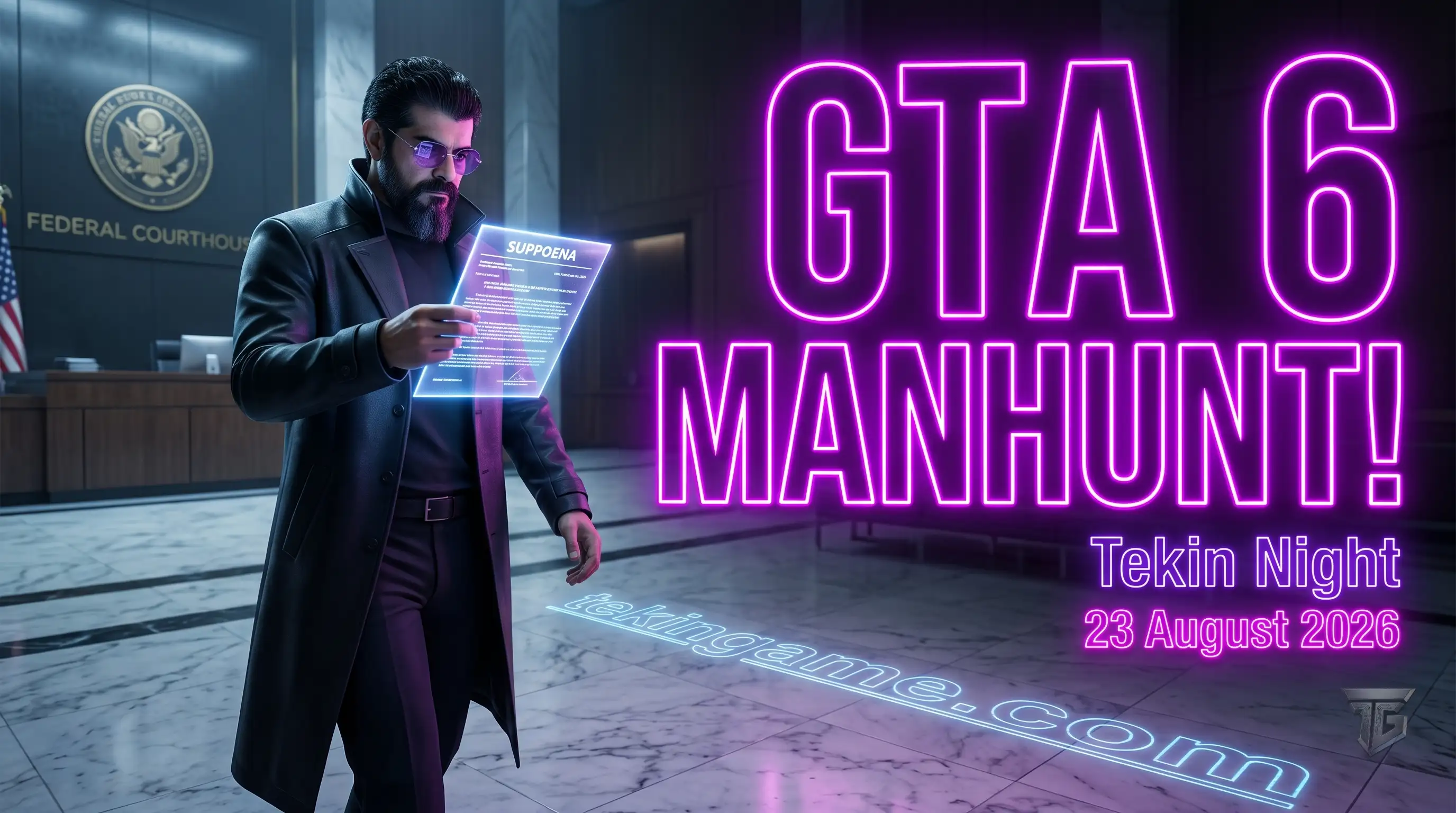
🌙 Tekin Night | Sunday, August 23, 2026: GTA 6 CyberLeek Hubs Nuked by Federal Court, Android Car Head Unit Botnets & Microsoft Entra ID CVSS 10.0 Zero-Day
Tekin Night's exclusive coverage of tonight's digital earthquakes. From federal subpoenas hunting GTA 6 leakers to Android car botnets, Microsoft Entra's CVSS 10.0 zero-day, and a massive crypto short-squeeze.
- 🎮GTA 6 CyberLeek Hubs Nuked- Federal court approves Take-Two subpoenas against Discord and Microsoft as Rockstar confirms August 27 Netflix reveal
- 🎧Android Vehicle Head Unit Botnet- Kaspersky discovers MoYu threat group compromising DoFun automotive consoles via OTA updates
- 🚀Microsoft Entra ID CVSS 10.0 Crisis- Urgent advisory warns of active in-the-wild exploitation of OAuth token forgery elevating attackers to Global Admin
- 🗡️NASA Swift Rescue Cancellation- LINK robotic anomalies force cancellation of Swift mission as NASA focuses on the Nancy Grace Roman launch
- 📰Double Fine Full IP Sovereignty- Tim Schafer secures total ownership of all intellectual properties including Psychonauts 2
- ⚔️Crypto Squeeze & X Stablecoin Payouts- Derivatives squeeze wipes out $480M in short positions as X Payments finalizes regulatory clearance
We close the evening of Sunday, August 23, 2026, with an exhaustive, multidimensional intelligence briefing analyzing high-stakes legal enforcement across the video game industry, the expanding frontier of automotive Internet of Things (IoT) malware, maximum-severity cloud identity hijacking vulnerabilities, deep space astrophysical observatories, and macroeconomic shifts in Web3 monetization.
Leading global headlines tonight, Take-Two Interactive achieved a decisive legal victory in the United States District Court for the Southern District of New York. A federal judge formally granted statutory DMCA subpoenas compelling Microsoft Corporation and Discord Inc. to surrender all identifying records, IP connection logs, and transaction data tied to the leak syndicate CyberLeek. Within hours of the filing, the primary distribution website of the leakers went completely dark. In a rare public display of platform solidarity, Scott Van Vliet, Chief Technology Officer at Xbox, issued a formal statement supporting Rockstar Games, while institutional reports from Bloomberg confirmed that Rockstar will maintain its scheduled global gameplay reveal on Netflix on August 27, 2026.
Concurrently, cybersecurity intelligence researchers at Kaspersky disclosed the discovery of the first organized automotive head unit malware campaign, tracking how threat actors compromised Android-powered in-vehicle infotainment consoles to establish distributed residential proxy botnets. Furthermore, enterprise cloud security reached a critical inflection point following Microsoft's emergency disclosure of an actively exploited, CVSS 10.0 maximum-severity flaw in Microsoft Entra ID (formerly Azure Active Directory). Complementing these investigations, NASA officially canceled the robotic rescue mission for the aging Swift observatory to prioritize the launch of the $3.2 billion Nancy Grace Roman Space Telescope, studio legend Double Fine Productions secured complete IP sovereignty after departing Xbox, and a massive derivatives short-squeeze triggered a powerful rally across digital asset markets.
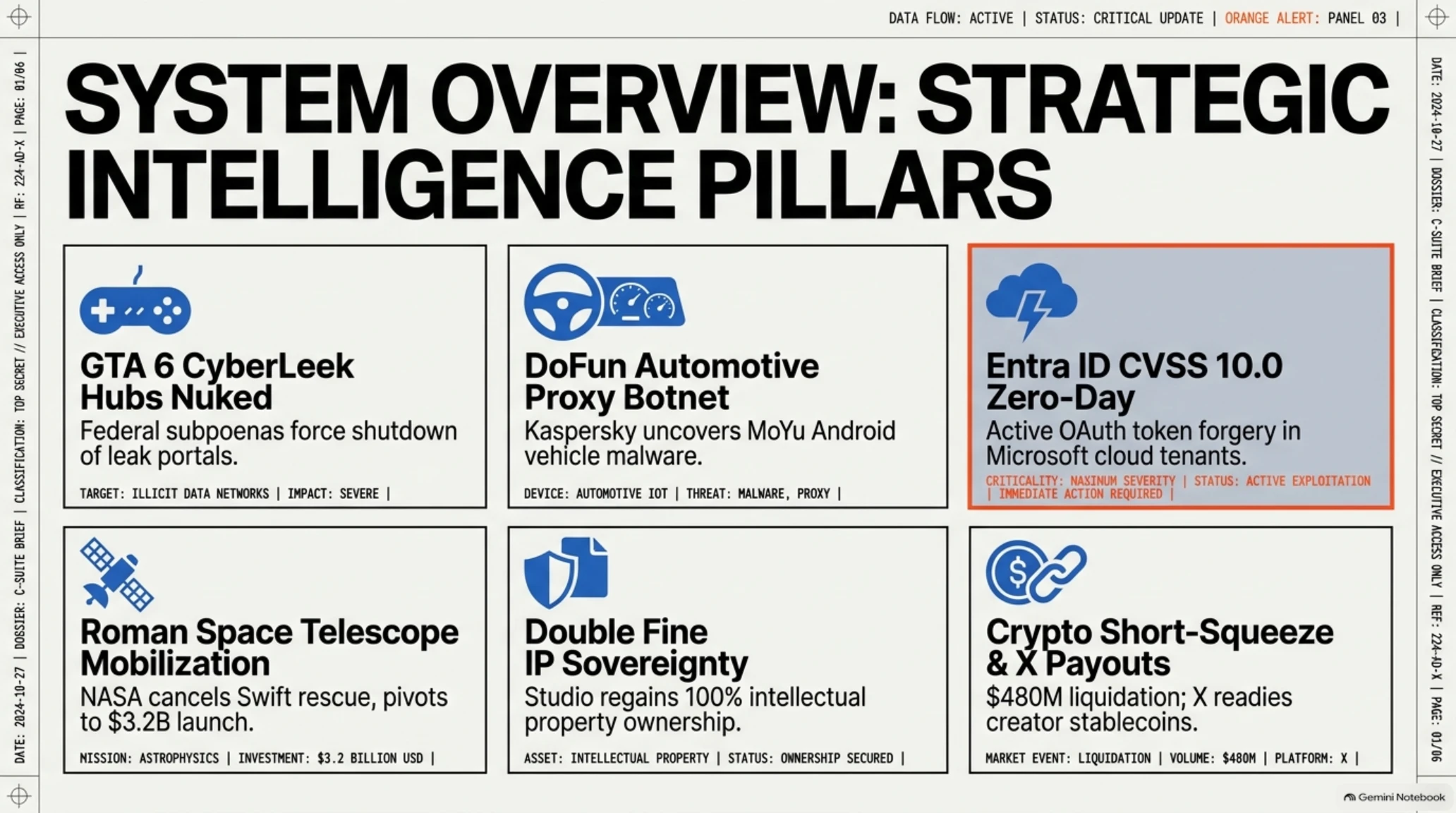
The executive matrix below summarizes the core technical, legal, and astrophysical takeaways of tonight's intelligence dossier:
Executive Summary of Sunday Night Intelligence Dossier
- Federal statutory subpoenas granted to Take-Two force the immediate shutdown of GTA 6 CyberLeek distribution portals
- Rockstar Games stands firm on its August 27 global gameplay broadcast on Netflix backed by official Xbox executive solidarity
- Kaspersky identifies MoYu automotive malware transforming DoFun Android vehicle consoles into stealth residential proxy nodes
- Microsoft issues maximum-severity CVSS 10.0 emergency alert for active OAuth token forgery in Microsoft Entra ID cloud tenants
- NASA terminates Swift satellite robotic capture mission due to LINK thruster failures, mobilizing for the Nancy Grace Roman launch
- Double Fine Productions regains 100% intellectual property ownership across all historical and future video game franchises
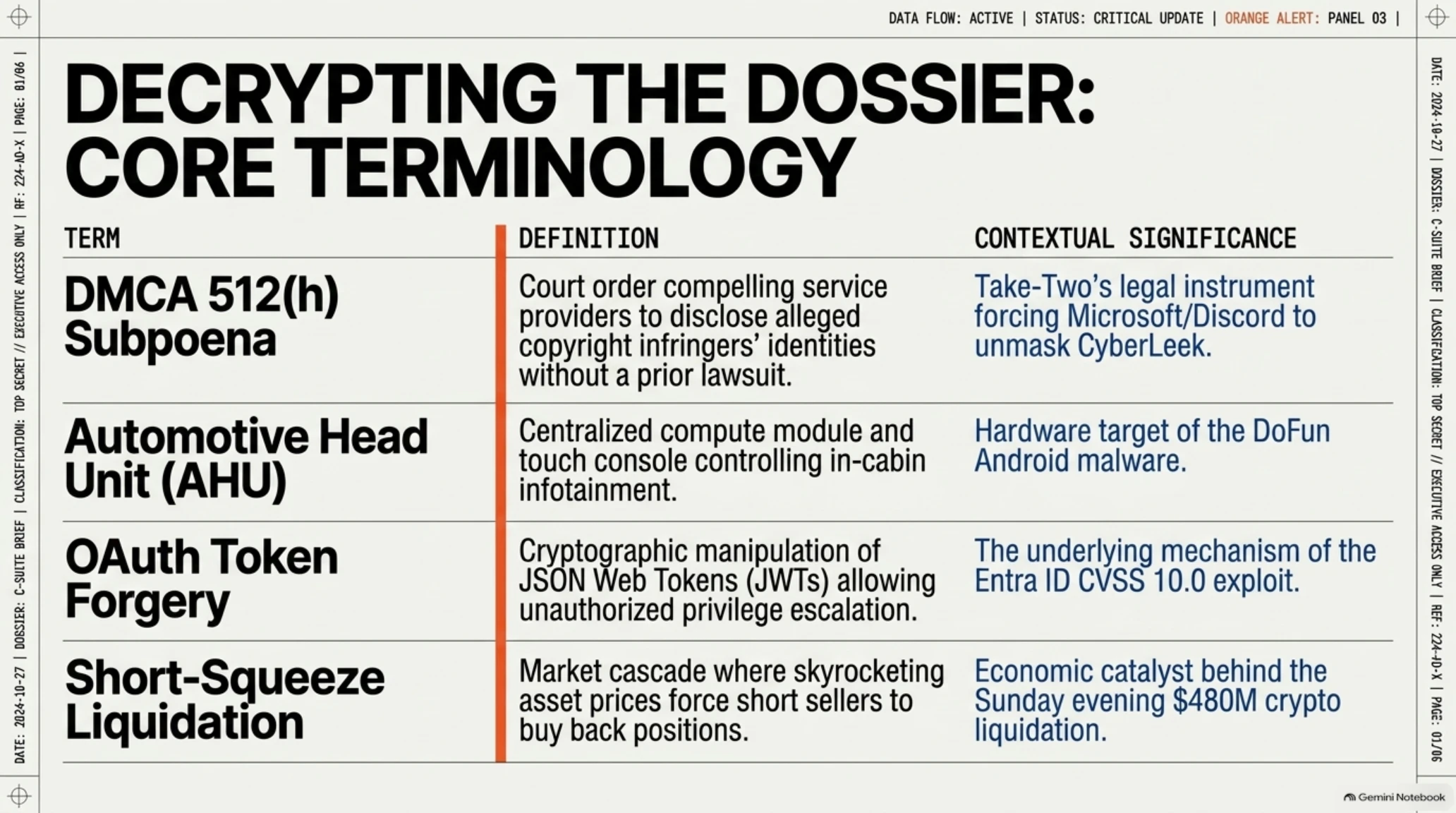
To establish rigorous clarity on the technical, legal, and cryptographic terminology referenced throughout this report, consult the specialized Jargon Buster below:
Technical, Legal & Cryptographic Jargon Buster
| Technical Term | Engineering & Statutory Definition | Contextual Significance in Tonight's Briefing |
|---|---|---|
| DMCA 512(h) Subpoena | A court order compelling service providers to disclose identity data of alleged copyright infringers without prior lawsuit filing | Take-Two's legal instrument forcing Microsoft and Discord to unmask CyberLeek operators |
| Automotive Head Unit (AHU) | The centralized compute module and touch console controlling in-cabin infotainment, navigation, and telematics | Hardware target of the DoFun Android malware discovered by Kaspersky |
| OAuth Token Forgery | Cryptographic manipulation of JSON Web Tokens (JWTs) allowing unauthorized privilege escalation without user credentials | The underlying mechanism of the CVSS 10.0 zero-day in Microsoft Entra ID |
| Short-Squeeze Liquidation | A market cascade where skyrocketing asset prices force short sellers to buy back positions, accelerating upward momentum | Economic catalyst behind the $480M crypto liquidation on Sunday evening |
We initiate our in-depth investigative coverage with the dramatic legal collapse of the GTA 6 leak apparatus in federal court.
1. The Legal Hammer Falls on CyberLeek; NY Federal Court Grants Sweeping Subpoenas as Xbox CTO and Rockstar Align for Netflix Reveal
In what marks the most decisive and legally aggressive counter-offensive against commercial game leaks in digital entertainment history, Take-Two Interactive Software has effectively dismantled the operational infrastructure of the notorious leak syndicate CyberLeek. According to unsealed court filings obtained from the United States District Court for the Southern District of New York and reported by Insider Gaming, Eurogamer, and Pure Xbox, a federal judge signed statutory DMCA 512(h) subpoenas compelling technology giants Microsoft and Discord to turn over comprehensive subscriber records.
The federal court order mandates the immediate disclosure of all names, physical addresses, telephone numbers, email accounts, IP connection logs, hardware MAC addresses, and associated payment vectors linked to specific Discord server administrators and Microsoft account holders. These entities had coordinated the unauthorized dissemination of internal Rockstar Games development artifacts, specifically early developer builds, unrendered physics simulations, and proprietary database schematics originating from an alleged May 2026 pre-alpha build.
The impact was instantaneous. Within hours of the legal filings reaching public dockets, the primary domain and mirror networks hosting the CyberLeek repository went completely offline, displaying generic DNS resolution errors. In a brief parting statement published on an encrypted backup channel, the administrators claimed they were ceasing all public distribution due to existential legal jeopardy.
The corporate response across the gaming industry was equally striking. In a remarkable demonstration of cross-platform solidarity, Scott Van Vliet, Chief Technology Officer at Xbox, issued a formal public statement condemning the theft of intellectual property. Van Vliet emphasized that unauthorized leaks inflict profound psychological and creative damage upon development teams who dedicate years of their lives to crafting interactive art. He reaffirmed that Microsoft is fully cooperating with Take-Two's investigative teams and federal authorities to protect the industry's creative integrity.
Furthermore, an investigative report published by Bloomberg revealed internal dynamics within Rockstar Games. While staff expressed deep frustration over the leak of unfinished production footage, studio leadership and parent company Take-Two resolved not to let bad actors dictate their marketing cadence. Rockstar officially confirmed that its highly anticipated official GTA 6 Gameplay Trailer will premiere globally on August 27, 2026, distributed through an exclusive partnership with Netflix alongside YouTube, delivering an authoritative, pristine showcase of the game's final visual fidelity.
The critical strategic and legal dimensions of this landmark enforcement action include:
- Federal court enforcement compelling Microsoft and Discord to unmask identity footprints and payment rails of leak operators
- Complete operational shutdown and DNS disconnection of primary CyberLeek web domains and associated distribution channels
- Unprecedented cross-industry solidarity demonstrated by Xbox CTO Scott Van Vliet supporting Rockstar's intellectual property defense
- Firm reaffirmation of the August 27 global gameplay broadcast premiere via Netflix and major digital streaming platforms
- Establishment of a formidable legal precedent deterring commercialized black-market trading of proprietary pre-release game builds
- Ongoing federal forensic auditing of Discord chat logs and server moderation records to identify secondary conspirators
The conceptual rendering below depicts the high-stakes intersection of federal legal enforcement, encrypted server datacenters, and the digital defense of Rockstar Games' intellectual property:
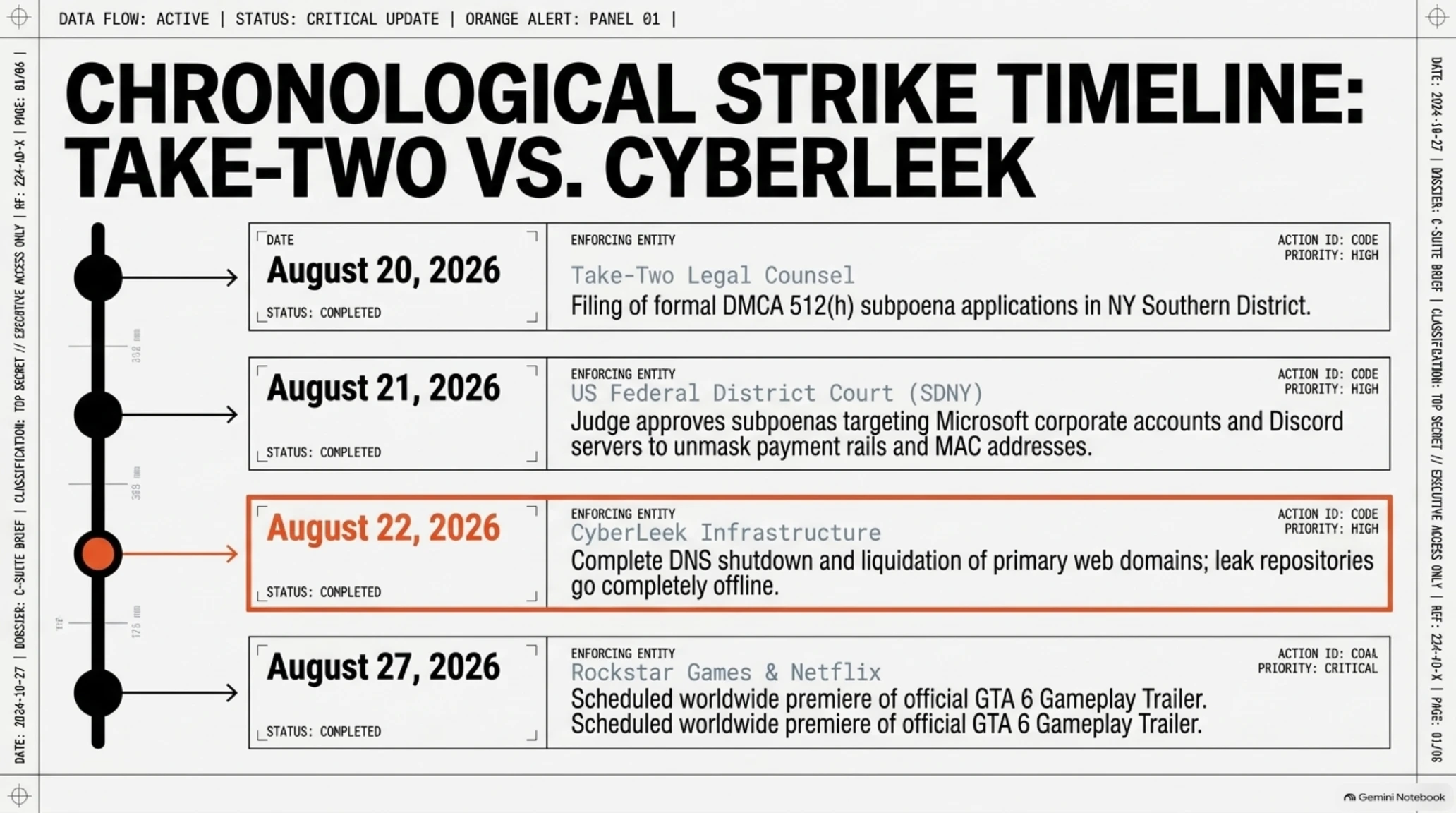
Chronological Legal Milestone Matrix: Take-Two Interactive vs. CyberLeek Syndicates
| Statutory Action Date | Enforcing Entity / Court | Judicial Order & Operational Impact |
|---|---|---|
| August 20, 2026 | Take-Two Legal Counsel | Filing of formal DMCA 512(h) subpoena applications in NY Southern District |
| August 21, 2026 | US Federal District Court (SDNY) | Judge approves subpoenas targeting Microsoft corporate accounts and Discord servers |
| August 22, 2026 | CyberLeek Infrastructure | Complete DNS shutdown and liquidation of primary web domains under legal pressure |
| August 27, 2026 | Rockstar Games & Netflix | Scheduled worldwide premiere of official GTA 6 Gameplay Trailer |
We turn our focus now from the legal battlegrounds of AAA gaming to an unprecedented cybersecurity revelation within the automotive industry.
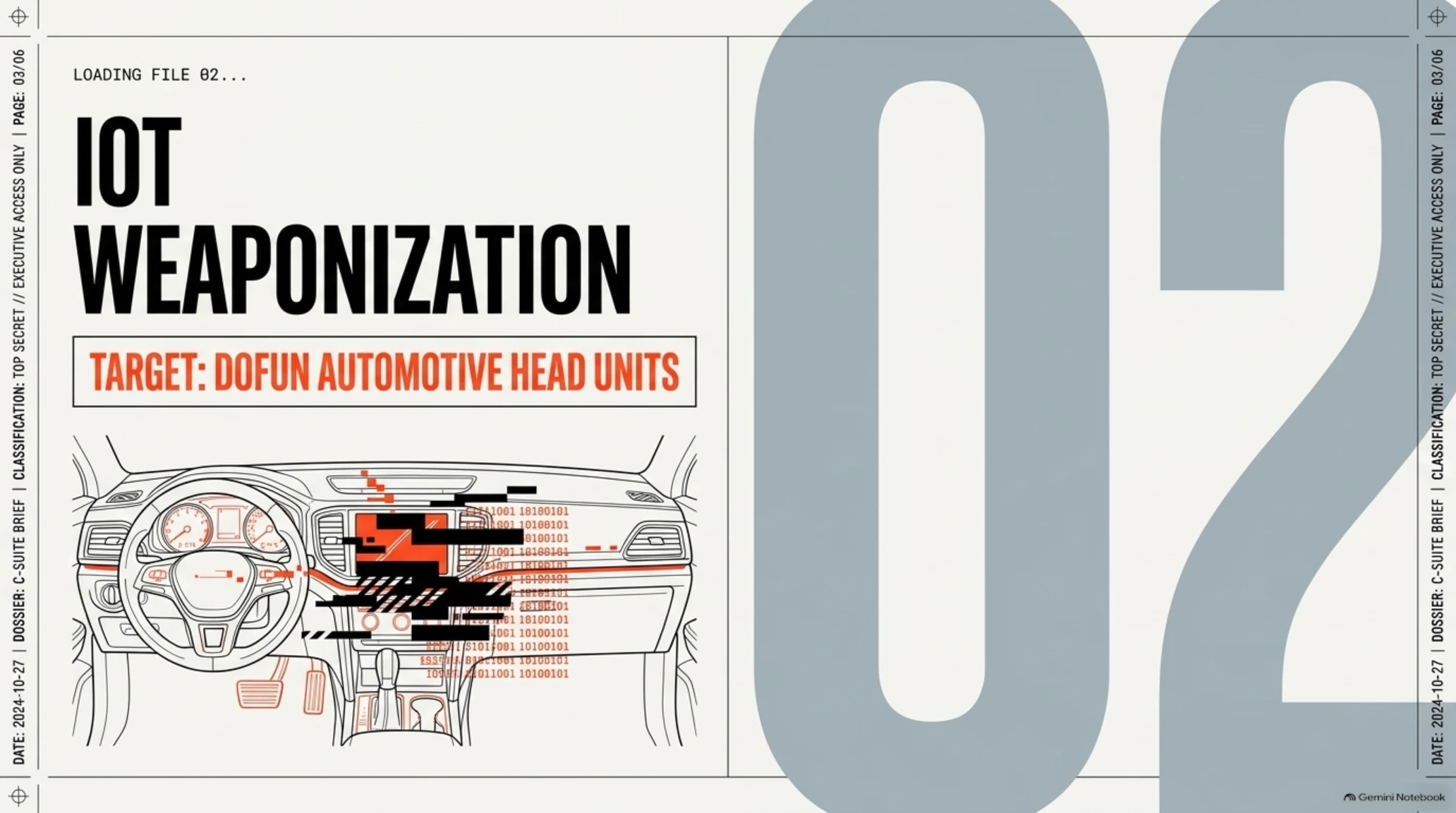
2. In-Cabin Cybersecurity Breach; Kaspersky Discloses First Automotive Head Unit Malware Hijacking Android Vehicles into Proxy Botnets
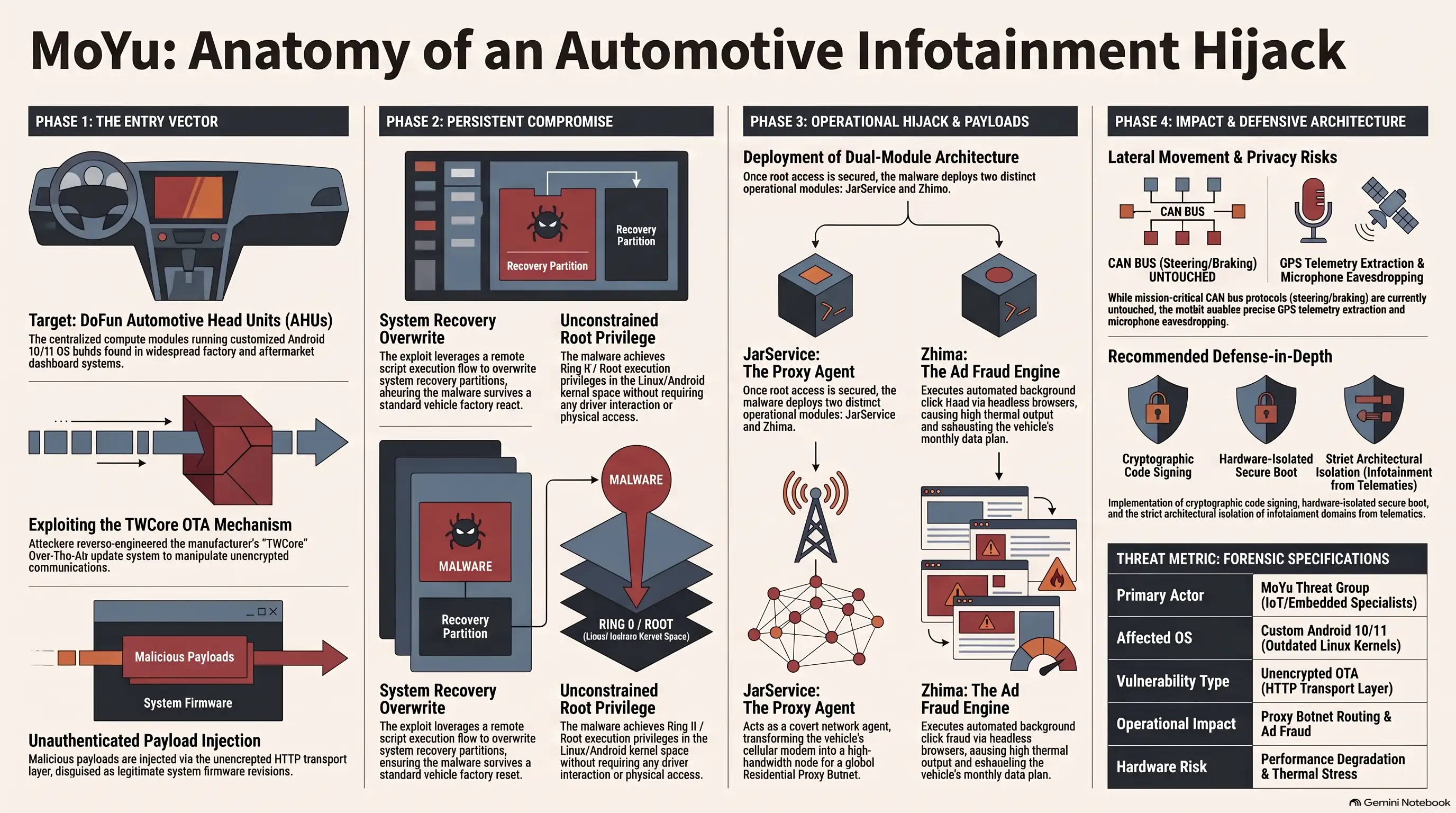
In a groundbreaking forensic disclosure marking the expansion of sophisticated cybercrime directly into the cockpits of modern transportation, telemetry researchers at Kaspersky, in collaboration with reports from The Hacker News and SC World, have documented the first large-scale, automated malware campaign specifically engineered to compromise Automotive Head Units (AHUs). The campaign, attributed to a Chinese-speaking threat actor tracked as MoYu, has weaponized hundreds of thousands of smart Android infotainment systems manufactured by Shenzhen-based automotive electronics supplier DoFun.
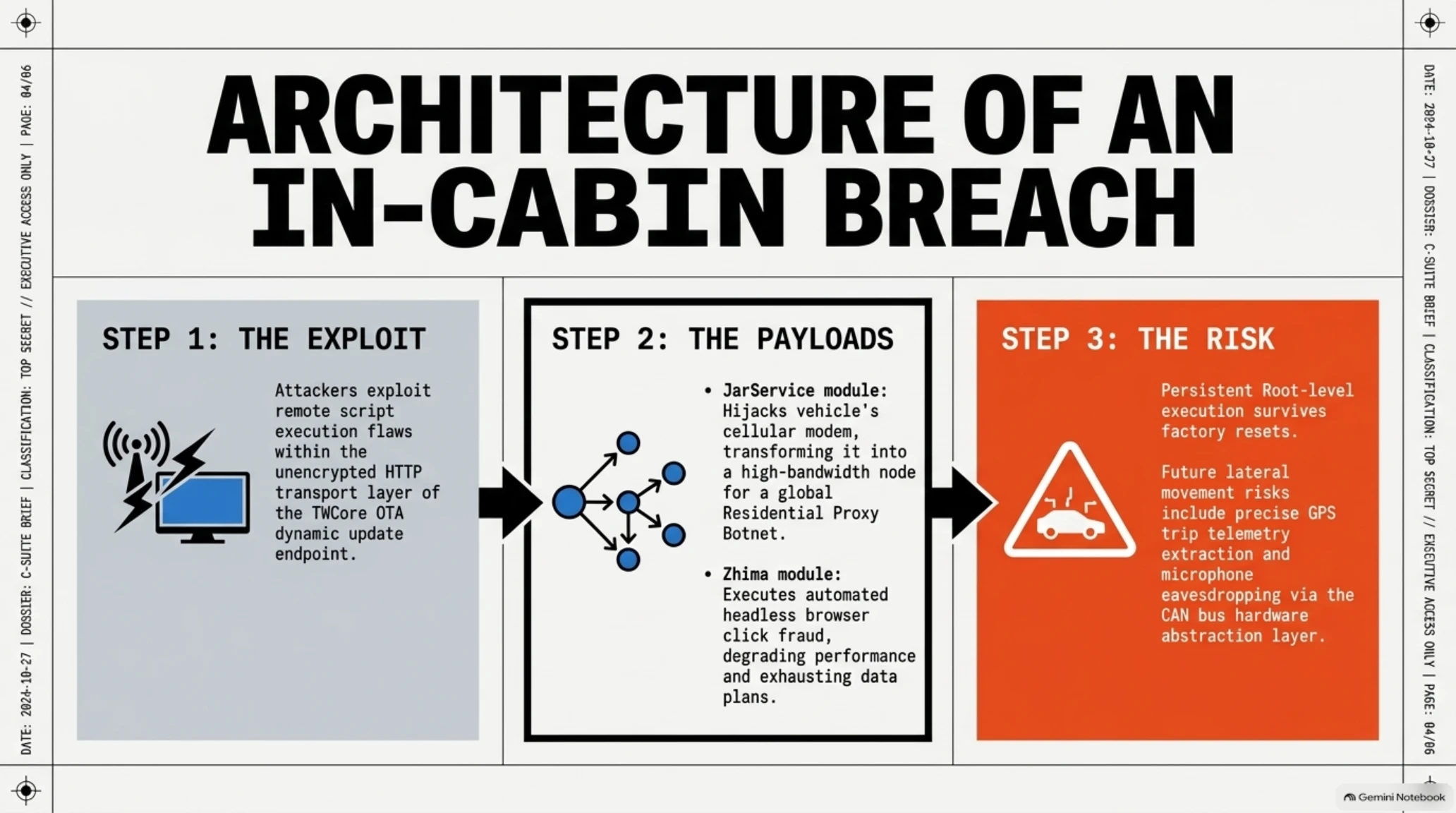
DoFun's Android-powered touch consoles are installed globally across both factory-integrated automotive assembly lines and widespread aftermarket dashboard retrofits. According to Kaspersky's deep binary analysis, the threat syndicate successfully reverse-engineered the manufacturer's built-in Over-The-Air (OTA) firmware update mechanism, known internally as TWCore. By manipulating unencrypted communications between the head unit and dynamic update endpoints, attackers injected malicious payloads disguised as legitimate system firmware revisions, obtaining persistent Root-level execution privileges on custom Android 10 and 11 distributions without requiring driver interaction or physical access.
The operational attack chain documented by Kaspersky highlights systemic vulnerabilities in modern smart transportation architectures. The targeted DoFun infotainment hardware operates on customized Android system images compiled with permissive SELinux configurations and outdated Linux kernel builds. Threat actors leveraged a remote script execution flaw within the unencrypted HTTP transport layer of the TWCore service to overwrite system recovery partitions, ensuring that malicious payloads persist even across standard vehicle factory resets.
Once established in the vehicle's onboard compute core, the malware deploys two primary operational modules: JarService and Zhima. The JarService module acts as a covert network agent, transforming the vehicle's connected cellular modem into a high-bandwidth node within a global Residential Proxy Botnet. Cybercriminals, ransomware cartels, and state-sponsored espionage actors route malicious web traffic through these moving automotive IP addresses to bypass geolocation firewalls, conduct ad-fraud laundering, and launch distributed denial-of-service (DDoS) campaigns under the guise of legitimate mobile consumer traffic.
Concurrently, the Zhima module executes automated background click fraud, constantly querying advertising networks via headless browser instances. This activity severely degrades dashboard performance, causes high thermal output across the center console, and rapidly exhausts the vehicle's monthly cellular telematics data plan.
Beyond network resource theft, forensic reverse engineers discovered that the malware queries the vehicle's hardware abstraction layer (HAL) to harvest diagnostic data. While Kaspersky confirmed that the malware does not currently manipulate Controller Area Network (CAN bus) protocols responsible for mission-critical driving mechanics such as steering or braking, automotive security experts warn that the presence of rootkits within in-cabin infotainment consoles creates alarming lateral movement risks, including the potential extraction of precise GPS trip telemetry and microphone eavesdropping.
The primary tactical characteristics and defense guidelines for automotive head unit malware include:
- Exploitation of unauthenticated OTA update channels within generic Android head units to achieve persistent Root privileges
- Weaponization of vehicle cellular data modems into decentralized residential proxy nodes for cybercrime laundering
- Severe degradation of in-cabin digital instrument clusters, navigation rendering, and battery efficiency due to continuous ad fraud
- Urgent recommendation for vehicle owners to disable third-party app installations and audit external USB flash drive connections
- Mandatory implementation of cryptographic code signing and hardware-isolated secure boot across automotive supply chains
- Architectural isolation of infotainment domains from telematics and CAN bus control modules via hardware firewalls
The technical video analysis below demonstrates the reverse-engineering of the TWCore OTA updater and maps the residential proxy routing architecture across connected vehicle networks:
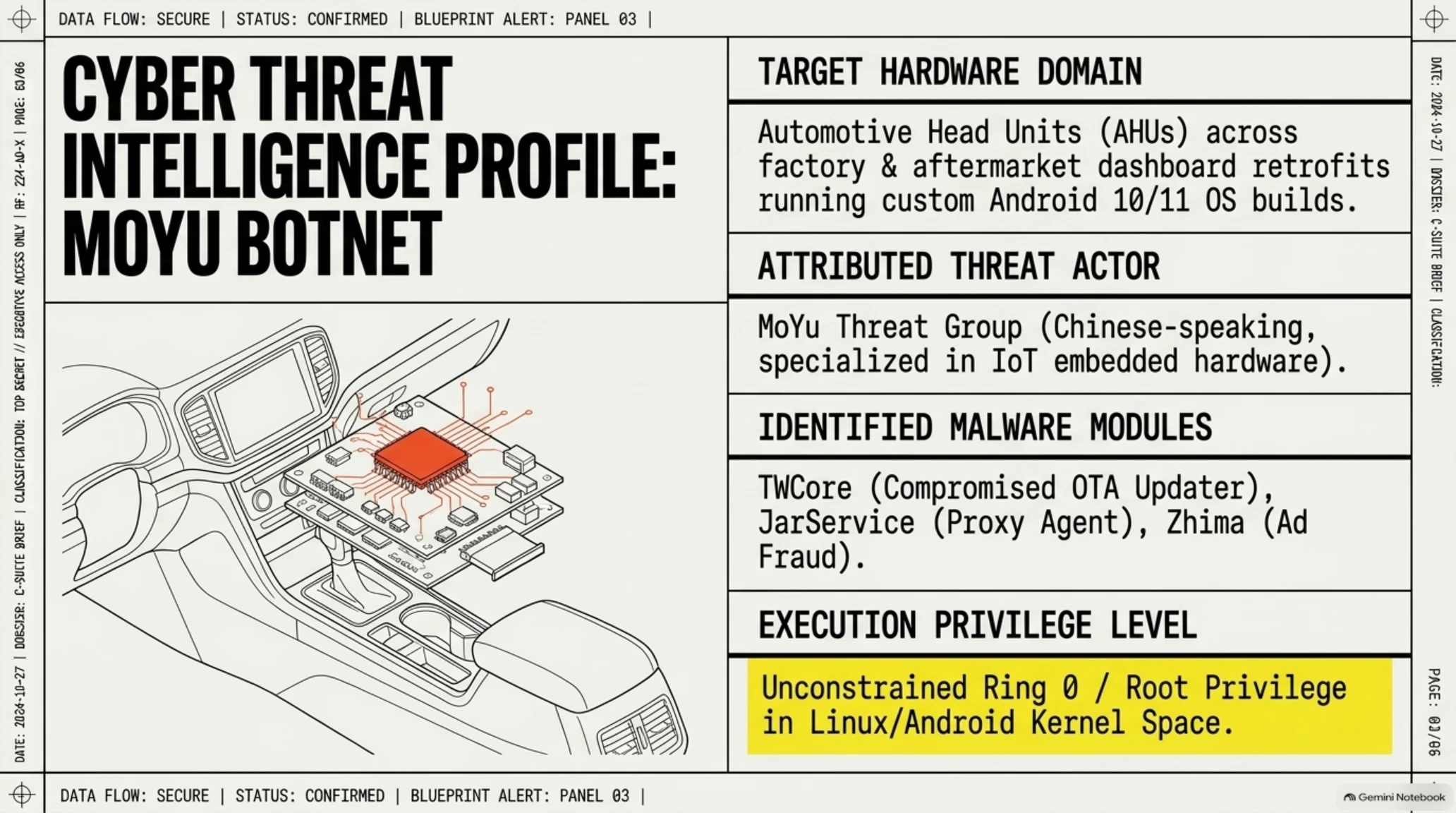
Automotive Cyber Threat Intelligence Profile: DoFun Android Head Unit Malware (Kaspersky)
| Threat Metric | Forensic Analysis & Technical Specification |
|---|---|
| Identified Malware Modules | TWCore (Compromised OTA Updater), JarService (Proxy Agent), Zhima (Ad Fraud) |
| Attributed Threat Actor | MoYu Threat Group (Specialized in IoT & Embedded Hardware Exploitation) |
| Target Hardware Domain | Automotive Head Units (AHUs) running customized Android 10/11 OS builds |
| Primary Operational Payload | Residential Proxy Botnet Routing & Automated Headless Advertising Fraud |
| Execution Privilege Level | Unconstrained Ring 0 / Root Privilege in Linux/Android Kernel Space |
We transition now from embedded automotive vulnerabilities to a maximum-severity cloud identity crisis unfolding across enterprise datacenters.
3. Emergency Cloud Advisory; Microsoft Warns of Critical CVSS 10.0 Entra ID Zero-Day Exploited in Corporate Tenant Takeovers
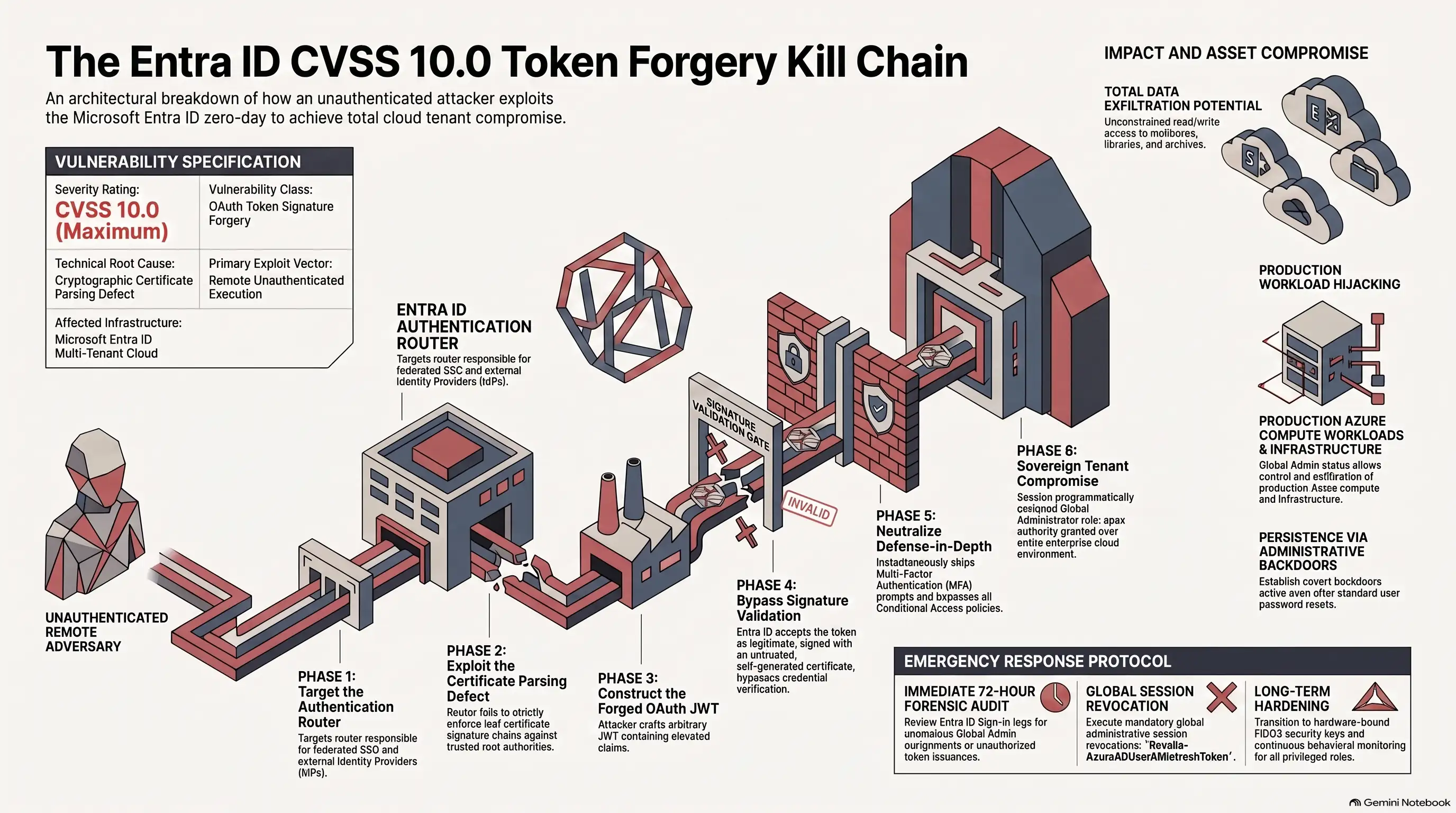
In an extraordinary security alert sent to millions of corporate systems administrators, cybersecurity incident response teams, and Fortune 500 enterprises, Microsoft Corporation has issued an emergency security bulletin warning of an actively exploited, maximum-severity flaw rated CVSS 10.0 in Microsoft Entra ID (formerly known as Azure Active Directory).
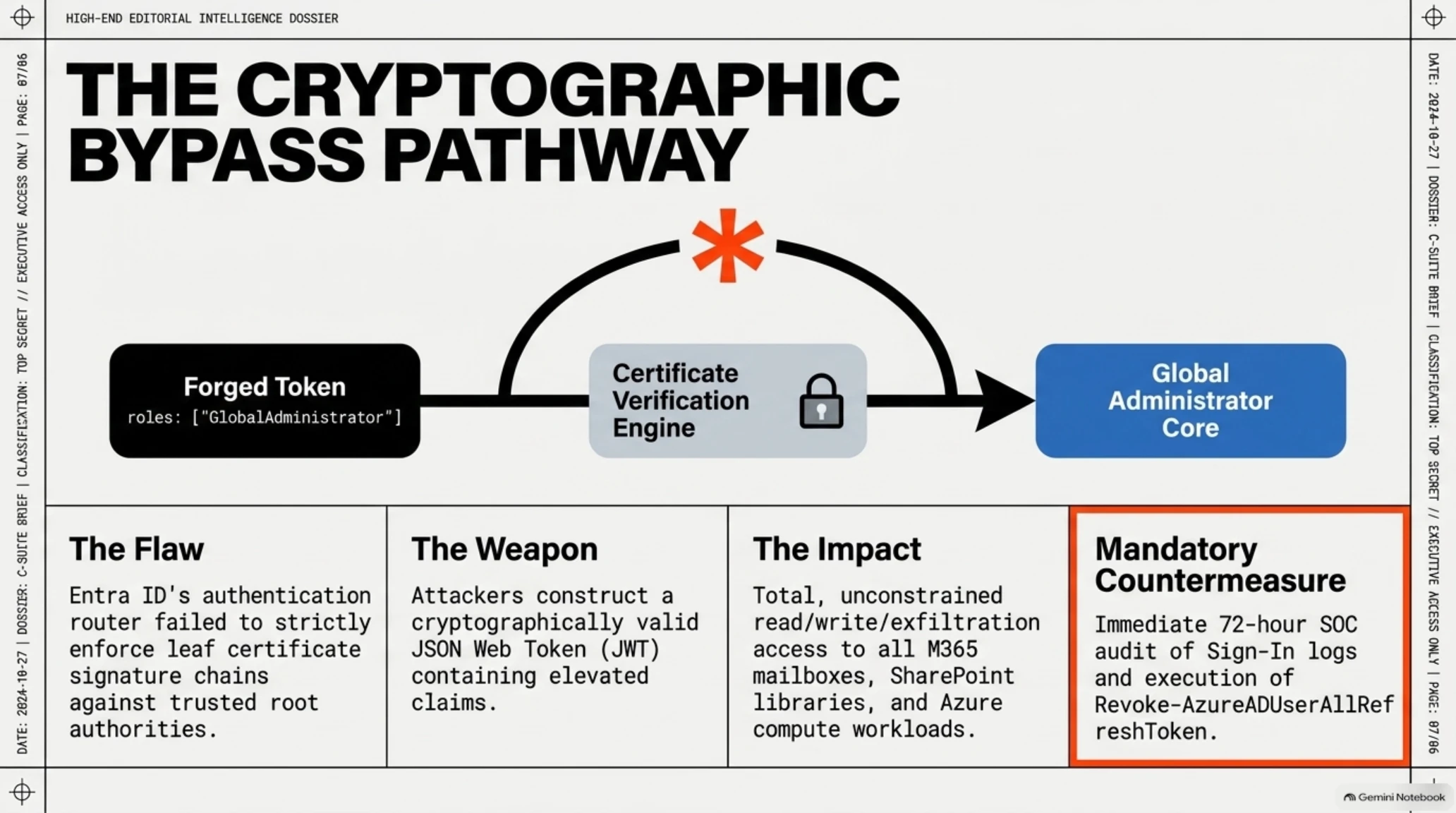
As exhaustively detailed in investigations by BleepingComputer and The Hacker News, the vulnerability represents the most catastrophic category of cloud authorization failures: OAuth Token Signature Forgery. Rooted in an architectural parsing error within the intermediate certificate verification engine across Microsoft's multi-tenant cloud authentication infrastructure, the flaw allows unauthenticated remote adversaries to construct and present cryptographically valid JSON Web Tokens (JWTs) without possessing legitimate corporate account credentials.
The technical root cause of the Entra ID flaw resides within the cryptographic validation sequence for external Identity Providers (IdPs) and federated Single Sign-On (SSO) realms. When processing incoming assertion claims, Entra ID's authentication router failed to strictly enforce leaf certificate signature chains against trusted root authorities. By constructing an arbitrary cryptographic token containing elevated claims (such as roles: ["GlobalAdministrator"]) and signing it with an untrusted, self-generated certificate that exploited the verification bypass, attackers could pass through the initial authentication boundary undetected.
The operational consequences of this exploit are total and immediate. By leveraging forged identity assertions, an external attacker can bypass all Conditional Access policies, skip Multi-Factor Authentication (MFA) prompts, and programmatically assign their session the role of Global Administrator—the sovereign apex authority within an enterprise cloud environment. From this vantage point, attackers gain unconstrained read, write, and exfiltration access to all Microsoft 365 Exchange Online mailboxes, confidential SharePoint document libraries, OneDrive archives, and production Azure compute workloads, while establishing covert administrative backdoors that survive standard password resets.
Microsoft deployed an emergency server-side mitigation across all global cloud regions to neutralize the underlying token parsing vulnerability. However, because advanced persistent threat (APT) groups had already identified and weaponized the zero-day prior to public disclosure, Microsoft has urgently instructed all enterprise Security Operations Centers (SOCs) to conduct immediate 72-hour forensic audits of their Entra ID Sign-In logs to identify unauthorized Global Admin role assignments and forged token issuances.
The core enterprise risk vectors and mandatory response protocols for the Entra ID vulnerability include:
- Maximum severity rating (CVSS 10.0) reflecting remote, zero-credential exploitability across public internet interfaces
- Complete cryptographic bypass of OAuth and OpenID Connect token validation frameworks
- Instantaneous privilege escalation to Global Administrator across corporate Microsoft 365 tenants
- Mandatory requirement for cloud security teams to execute global administrative session revocations (
Revoke-AzureADUserAllRefreshToken) - Rigorous auditing of Azure Role Assignments within the Entra ID Audit Logs for anomalous tenant modifications
- Urgent enforcement of hardware-bound FIDO2 security keys and continuous behavioral threat monitoring across privileged roles
The conceptual rendering below illustrates the digital subversion of enterprise cloud identity frameworks and the forensic detection of forged OAuth tokens within Microsoft Entra ID infrastructure:
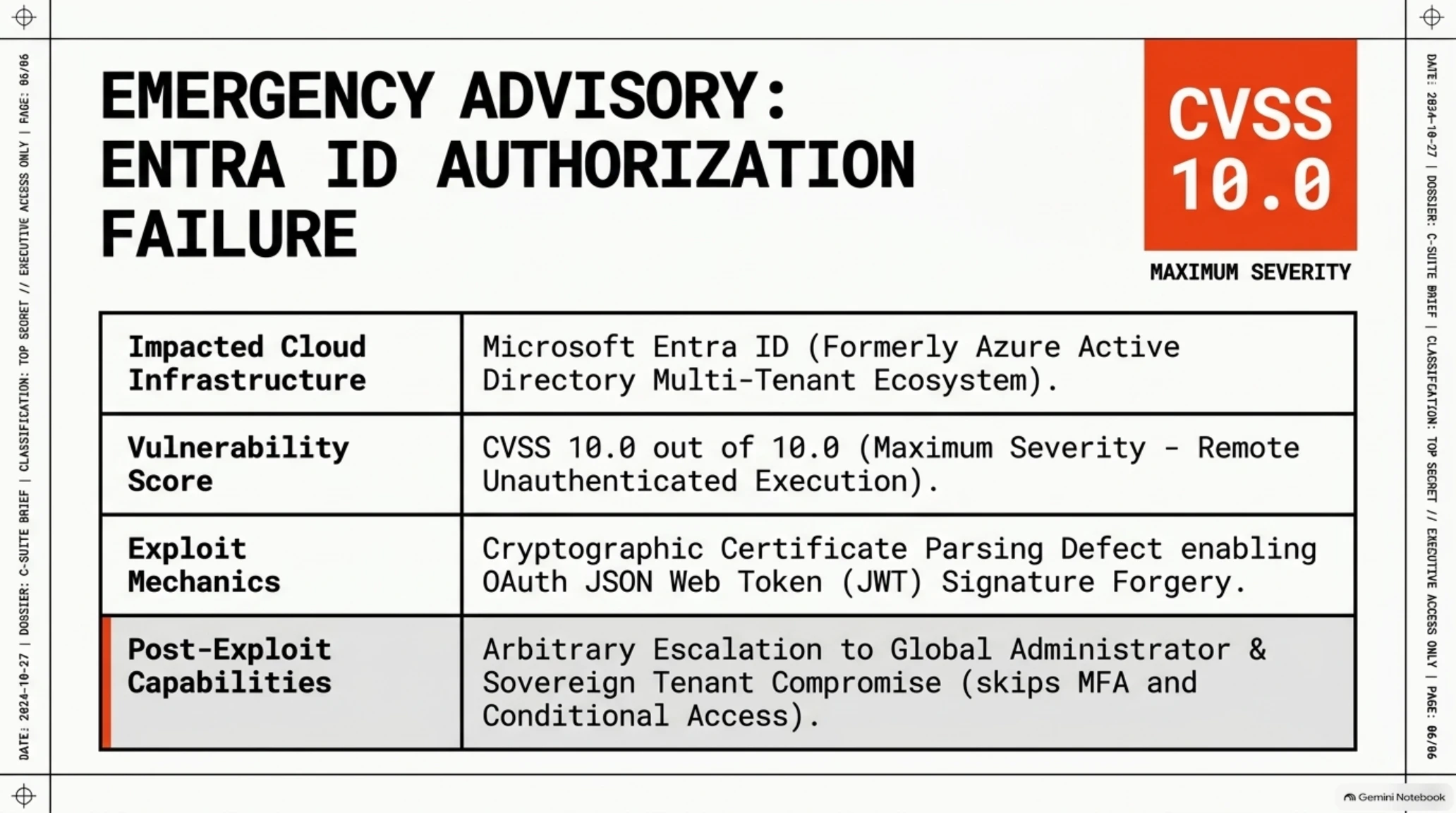
Vulnerability Technical Specification: Microsoft Entra ID CVSS 10.0 Token Forgery Zero-Day
| Vulnerability Characteristic | Technical Assessment & Impact Evaluation |
|---|---|
| Impacted Cloud Infrastructure | Microsoft Entra ID (Formerly Azure Active Directory Multi-Tenant Ecosystem) |
| Common Vulnerability Scoring (CVSS) | 10.0 out of 10.0 (Maximum Severity - Remote Unauthenticated Execution) |
| Exploit Vector & Mechanics | Cryptographic Certificate Parsing Defect Enabling OAuth JWT Signature Forgery |
| Post-Exploit Capabilities | Arbitrary Escalation to Global Administrator & Sovereign Tenant Compromise |
| Required Enterprise Countermeasure | Immediate 72-Hour Sign-In Log Audit & Revocation of Active Admin Refresh Tokens |
We transition now from cloud security governance to deep space astrophysics and major strategic shifts within NASA's observational fleet.
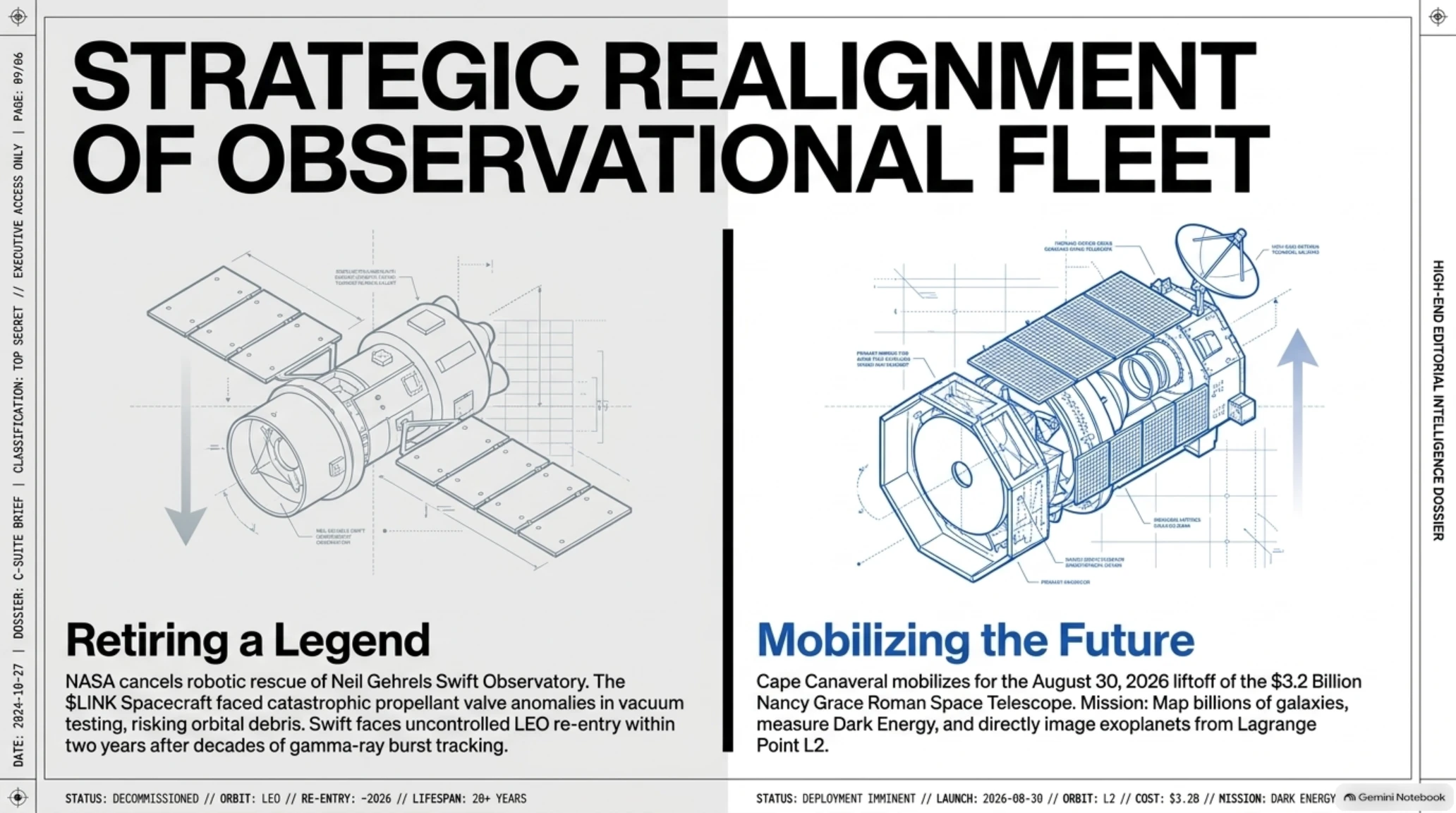
4. Retiring an Orbital Legend; NASA Cancels Swift Satellite Robotic Rescue to Mobilize for the $3.2 Billion Nancy Grace Roman Space Telescope
In a major realignment of observational astrophysics resources, the National Aeronautics and Space Administration (NASA) has formally made the difficult decision to cancel its high-profile robotic servicing mission intended to extend the operational life of the legendary Neil Gehrels Swift Observatory. As detailed in comprehensive coverage by Wired, Mashable, and Space.com, the agency concluded that escalating technical risks during ground testing of the automated rendezvous spacecraft outweighed the scientific value of continuing the salvage attempt.
Launched in November 2004, the Swift satellite revolutionized high-energy astrophysics by providing autonomous, rapid-response observations of gamma-ray bursts (GRBs)—the most violent cosmic explosions in the universe. Over more than two decades of continuous service, Swift cataloged thousands of celestial detonations, supermassive black hole tidal disruption events, and neutron star mergers. However, due to natural atmospheric drag in Low Earth Orbit (LEO) and the gradual depletion of its onboard hydrazine propellant, Swift has steadily lost orbital altitude, facing uncontrolled re-entry into Earth's atmosphere within the next two years.
NASA's ambitious salvage architecture centered upon the LINK Robotic Servicing Spacecraft, a specialized autonomous vehicle engineered to rendezvous with Swift in orbit, capture the satellite using robotic docking latches, and fire electric ion thrusters to boost the observatory into a stable parking orbit above 700 kilometers. However, during comprehensive environmental vacuum chamber testing at Goddard Space Flight Center, engineers detected persistent, catastrophic propellant valve anomalies and control guidance errors within LINK's primary propulsion matrix. Fearing that a docking failure could inadvertently shatter the satellite and create hazardous orbital debris, NASA leadership opted for an orderly, planned scientific decommissioning.
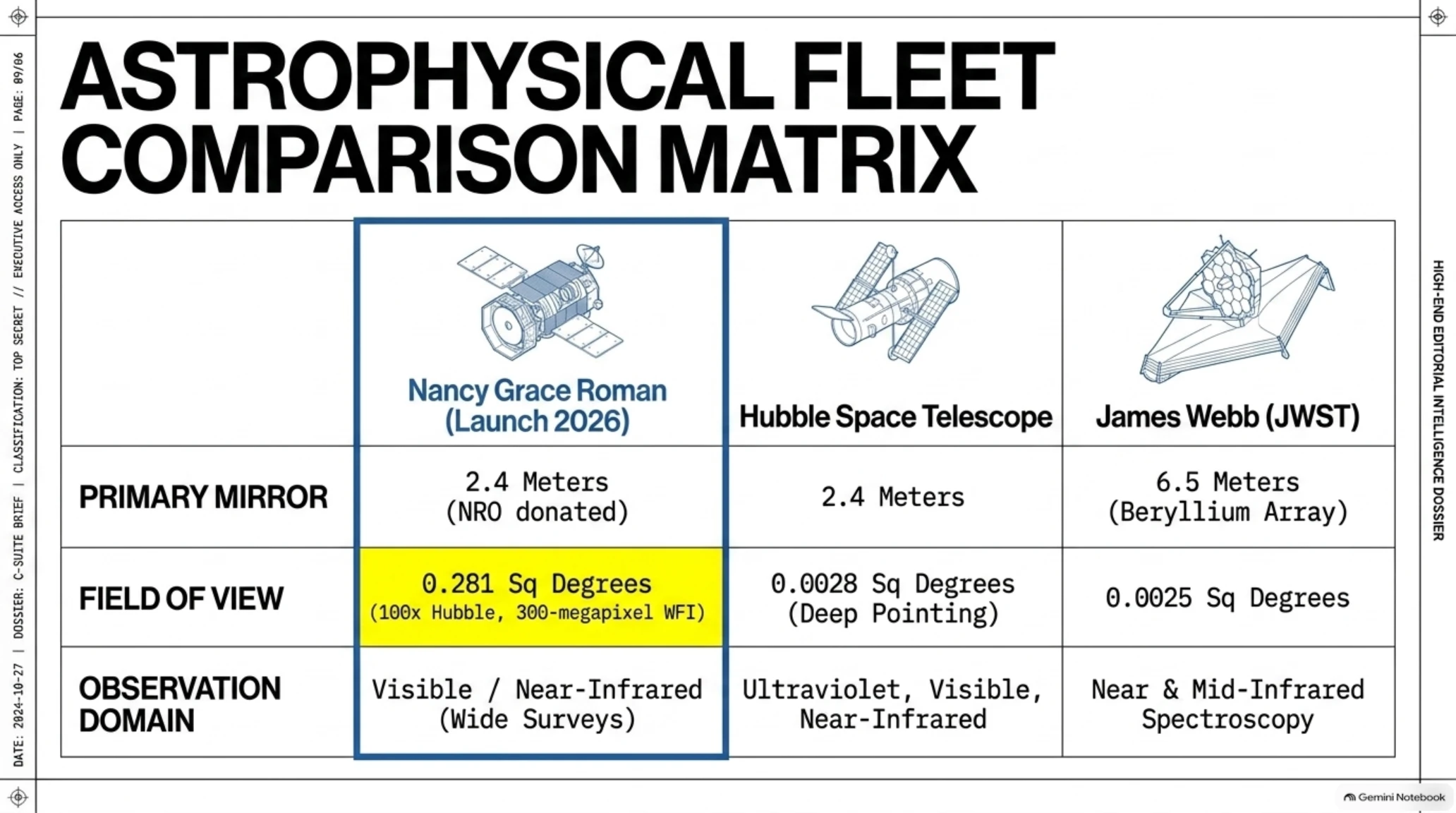
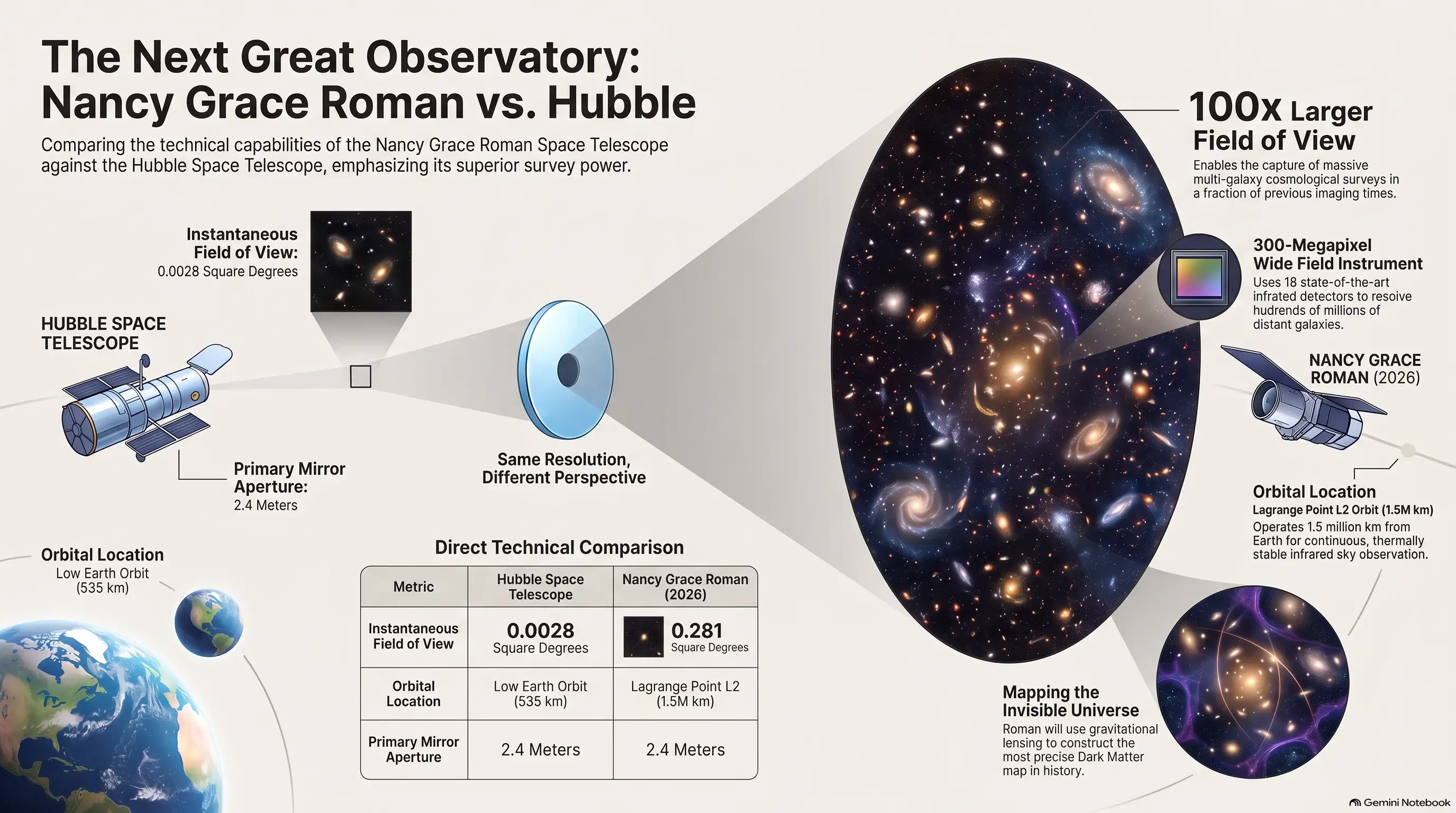
Simultaneously, NASA announced that all available launch integration teams at Cape Canaveral Space Force Station have been mobilized to support the imminent launch of humanity's next flagship astronomical instrument: the $3.2 billion Nancy Grace Roman Space Telescope, scheduled for liftoff on August 30, 2026. Equipped with a 2.4-meter primary mirror and a revolutionary 300-megapixel Wide Field Instrument (WFI), the Roman telescope possesses a panoramic field of view 100 times larger than that of the Hubble Space Telescope at comparable visual acuity.
The Wide Field Instrument (WFI) aboard the Roman Space Telescope utilizes an array of 18 state-of-the-art mercury-cadmium-telluride (HgCdTe) infrared detectors, delivering 300 megapixels of resolving power per exposure. Combined with its high-throughput optical assembly, Roman will execute the High Latitude Wide Area Survey, imaging hundreds of millions of galaxies across thousands of square degrees of sky. By measuring cosmic shear—subtle distortions in galaxy shapes caused by the gravitational lensing of intervening Dark Matter—astrophysicists will construct the most precise matter distribution map in history.
Operating from the Second Sun-Earth Lagrange Point (L2) 1.5 million kilometers from Earth, Roman will conduct unprecedented cosmological surveys, mapping billions of distant galaxies to measure the cosmic expansion rate driven by mysterious Dark Energy, testing General Relativity on universal scales, and utilizing an ultra-high-contrast Coronagraph instrument to directly image hundreds of temperate exoplanets.
The primary scientific capabilities and strategic significance of the Nancy Grace Roman Space Telescope include:
- A massive 2.4-meter primary mirror donated by the National Reconnaissance Office (NRO) delivering Hubble-grade resolution
- A panoramic 100x field of view enabling the capture of massive, multi-galaxy cosmological surveys in a fraction of previous imaging times
- Advanced Coronagraph Technology demonstrating extreme optical starlight suppression (1 part in 100 million) to image exoplanetary systems
- Precision cosmological mapping designed to unlock the fundamental physics governing Dark Matter and Dark Energy
- Orbital deployment to the thermally stable Sun-Earth Lagrange Point L2 to ensure continuous infrared sky observation
- Collaborative synergy with the James Webb Space Telescope (JWST) and ESA's Euclid observatory to generate the ultimate 3D cosmic atlas
The conceptual rendering below visualizes the Nancy Grace Roman Space Telescope deployed in deep space, capturing expansive panoramic views of the cosmic web at Lagrange Point L2:
📚 Classified & Related Dossiers in TekinGame
If you wish to explore beyond this report and delve into cybernetic frontiers and autonomous AI architectures, do not miss these three exclusive deep-dives in the Tekin Garage:
Astrophysical Fleet Comparison Matrix: Nancy Grace Roman vs. Hubble & James Webb
| Observatory Metric | Nancy Grace Roman (August 2026) | Hubble Space Telescope | James Webb Space Telescope (JWST) |
|---|---|---|---|
| Primary Mirror Aperture | 2.4 Meters (Panoramic Wide-Field) | 2.4 Meters (Narrow-Field Optical) | 6.5 Meters (Segmented Beryllium Array) |
| Instantaneous Field of View | 0.281 Square Degrees (100x Hubble) | 0.0028 Square Degrees (Deep Pointing) | 0.0025 Square Degrees (Ultra-Deep IR) |
| Primary Observation Domain | Visible & Near-Infrared (Wide Surveys) | Ultraviolet, Visible, Near-Infrared | Near-Infrared & Mid-Infrared Spectroscopy |
| Orbital Operating Location | Sun-Earth Lagrange Point L2 (1.5M km) | Low Earth Orbit LEO (535 km Altitude) | Sun-Earth Lagrange Point L2 (1.5M km) |
We transition now from deep space exploration to an inspiring triumph of artistic independence within the video game industry.
5. Creative Freedom Restored; Double Fine Secures 100% IP Ownership and Publishing Rights Following Xbox Split
In a historic development celebrated across the global independent development community, iconic game development powerhouse Double Fine Productions, guided by veteran designer and industry visionary Tim Schafer, has officially confirmed that it has secured 100 percent ownership of all intellectual property (IP) and commercial publishing rights across its entire historical catalog as part of its friendly separation from Microsoft's Xbox division.
As documented in investigative reporting by Eurogamer and Rock Paper Shotgun, Double Fine's acquisition by Microsoft in 2019 provided the financial stability and production headroom necessary to complete their universally acclaimed masterpiece, Psychonauts 2. However, following broader corporate restructuring and strategic realignment across Microsoft Gaming in 2026, Schafer and executive leadership successfully negotiated an amicable separation that transfers all trademark registries, publishing agreements, and digital distribution rights back to the independent studio.
The sovereign portfolio reclaimed by Double Fine includes monumental franchises such as Psychonauts (1 & 2), Brütal Legend, Broken Age, Costume Quest, Iron Brigade, and modern remastered editions of adventure classics including Grim Fandango and Day of the Tentacle.
Tim Schafer announced that Double Fine will operate henceforth as a fiercely independent, self-sovereign multiplatform studio. The team confirmed that several completely original, unannounced creative projects are currently in active development, engineered to launch simultaneously across PlayStation 5, Xbox Series X|S, PC, and the upcoming Nintendo Switch 2.
Industry analysts regard this transition as a blueprint for creative survival in the modern games industry, demonstrating that boutique, art-driven studios can maintain corporate agility and multiplatform accessibility while retaining total control over their creative heritage.
The strategic pillars and future trajectory of Double Fine Productions include:
- Total reclaim of all catalog revenues, royalties, and digital distribution rights across global PC and console storefronts
- Transition to an agile, multiplatform studio releasing original titles simultaneously across all hardware ecosystems
- Unconstrained creative independence to explore bold, unconventional game concepts without platform exclusivity mandates
- Continued multiplatform patch support, community updates, and potential remaster expansions for flagship titles like Psychonauts 2
- Reaffirmation of Double Fine's celebrated corporate culture prioritizing artistic expression, narrative humor, and humane development
The conceptual rendering below visualizes the triumphant return of Double Fine Productions to creative independence, surrounded by characters from the colorful Psychonauts universe:
Intellectual Property Sovereignty Matrix: Reclaimed Double Fine Portfolio
| Franchise / Game Title | Intellectual Property Ownership Status | Future Platform & Distribution Horizon |
|---|---|---|
| Psychonauts Franchise (1 & 2) | 100% Owned by Double Fine Productions | Multiplatform (PS5 / Xbox Series X / PC / Switch 2) |
| Brütal Legend & Iron Brigade | Complete Publishing & Trademark Rights Reclaimed | Digital Storefronts & Potential Next-Gen Remasters |
| Broken Age & Costume Quest | Fully Retained Studio IP Portfolio | Continuous Multiplatform Digital Availability |
| Unannounced New IP Projects | 100% Original Proprietary Concepts | Simultaneous Universal Launch Across All Platforms |
We transition now to our final investigative pillar tonight: a massive derivatives short-squeeze and the launch of creator stablecoin monetization on X.
6. Derivatives Flash Fire; Macro Crypto Short-Squeeze Liquidates $480M as Elon Musk's X Prepares Creator Stablecoin Payouts
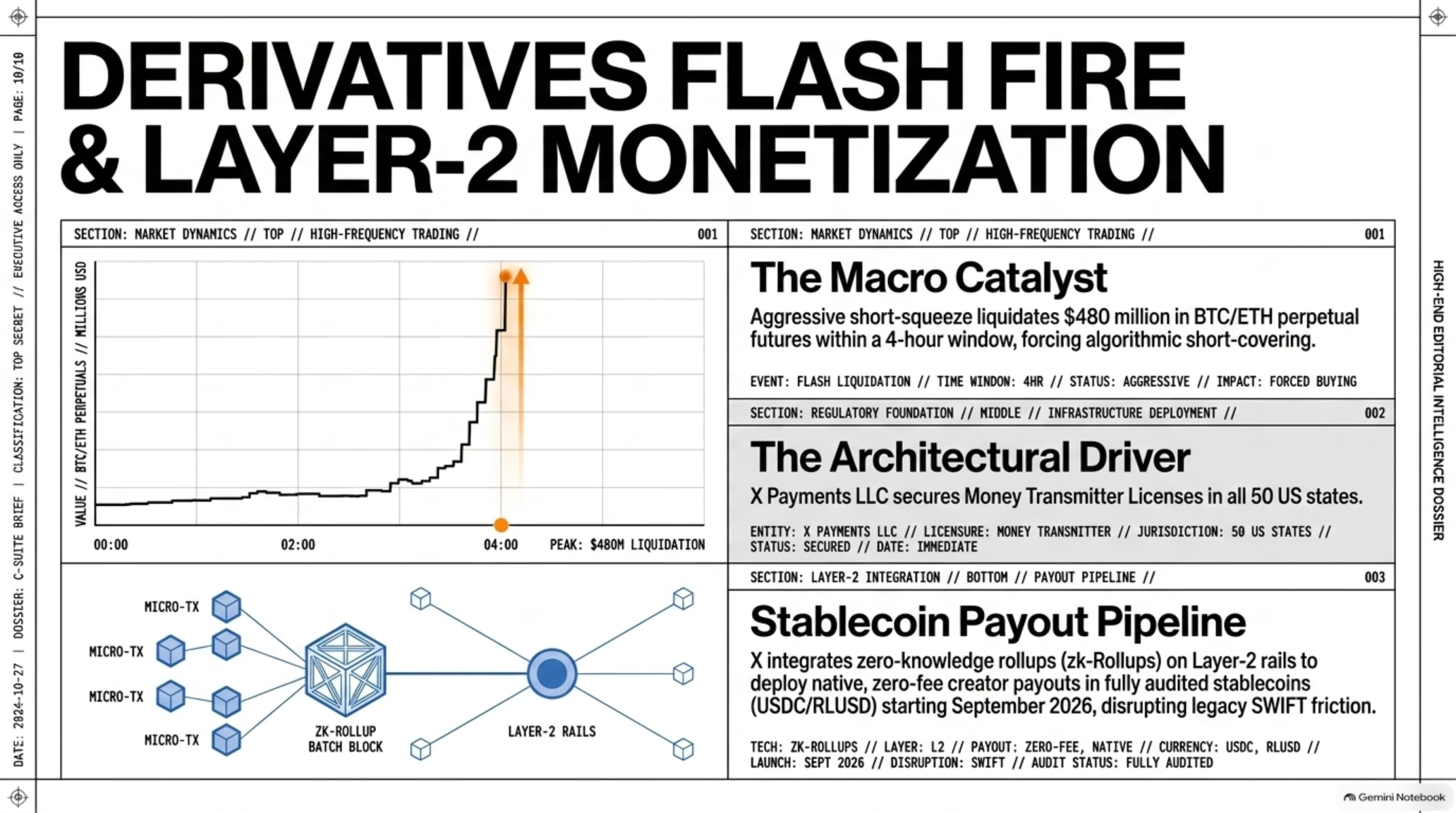
In the closing hours of international financial trading on Sunday, August 23, 2026, global digital asset markets experienced one of the most violent upward volatility cascades of the year. According to real-time derivatives telemetry aggregated by CoinDesk, Bloomberg, and Financial Times, an aggressive Short-Squeeze Event across Bitcoin (BTC) and Ether (ETH) perpetual futures contracts resulted in the forced liquidation of over $480 million in bearish short positions within a compressed four-hour window.
While algorithmic short-covering drove initial momentum past critical technical resistance thresholds, the macro catalyst fueling sustained institutional bid volume stemmed from regulatory filings concerning social platform X (formerly Twitter) under the leadership of Elon Musk. Institutional disclosures confirmed that X Payments LLC has successfully obtained statutory Money Transmitter Licenses (MTLs) across all 50 US states, completing the regulatory foundation required to launch its native financial settlement infrastructure.
According to technical architecture briefs, X is finalizing integration with high-throughput Layer-2 blockchain settlement rails to deploy native Stablecoin Payouts (featuring fully backed reserves such as USDC and compliant fiat-pegged tokens) directly to global content creators participating in the platform's Revenue Sharing program starting in late September 2026.
The settlement pipeline leverages zero-knowledge rollups (zk-Rollups) to aggregate thousands of off-chain creator micropayments into single, cryptographically verified on-chain batches. This architecture reduces per-transaction network fees to fractions of a cent while guaranteeing instant settlement finality. Creators will have the flexibility to hold funds within non-custodial smart contract wallets embedded directly within the X client, bridge assets across decentralized liquidity pools, or off-ramp seamlessly into local sovereign bank accounts via integrated regional payment partners.
This monetization architecture eliminates traditional cross-border banking friction, SWIFT transaction fees, and multi-day clearing delays, allowing creators in emerging markets to receive micro-settlements, tipping, and subscription revenues with near-zero overhead. Financial analysts project that this milestone represents the most significant real-world consumer bridge between Web2 audience networks and Web3 decentralized finance infrastructure, positioning X as a dominant contender in global digital micropayments.
The primary economic drivers and architectural implications of the crypto short-squeeze and X stablecoin rollout include:
- Forced liquidation of $480M+ in leveraged short contracts triggering parabolic upward momentum across major crypto assets
- Full 50-state US regulatory Money Transmitter License compliance achieved by X Payments LLC
- Direct integration of Layer-2 blockchain scaling protocols enabling instantaneous, zero-fee creator revenue settlement
- Disruption of legacy payment processing intermediaries (PayPal, Stripe) via decentralized stablecoin rails
- Substantial liquidity expansion across compliant stablecoin issuers and decentralized finance lending protocols
- Acceleration of Elon Musk's strategic vision transforming X into a comprehensive global "Everything App"
The conceptual rendering below visualizes the seamless integration of stablecoin digital wallets and real-time creator revenue settlement within the X platform interface:
Financial Architecture Blueprint: X Payments Stablecoin Monetization Pipeline
| Infrastructure Metric | Technical & Regulatory Specification |
|---|---|
| Supported Settlement Assets | Fully Audited, Compliant Stablecoins (USDC / RLUSD) & Sovereign Fiat |
| Blockchain Execution Layer | High-Throughput Layer-2 Ethereum Protocols with Sub-Second Finality |
| Regulatory Compliance Status | Money Transmitter Licenses (MTLs) Formally Secured in All 50 US States |
| Target Deployment Timeline | Global Rollout to Creator Revenue Sharing Program in September 2026 |
The technical video analysis below deconstructs the mechanics of the $480M crypto short-squeeze and evaluates the technical implementation of X Payments' stablecoin architecture:
Sunday Night Strategic Synthesis; Judicial Enforcement, Cloud Identity and the Frontiers of Technology
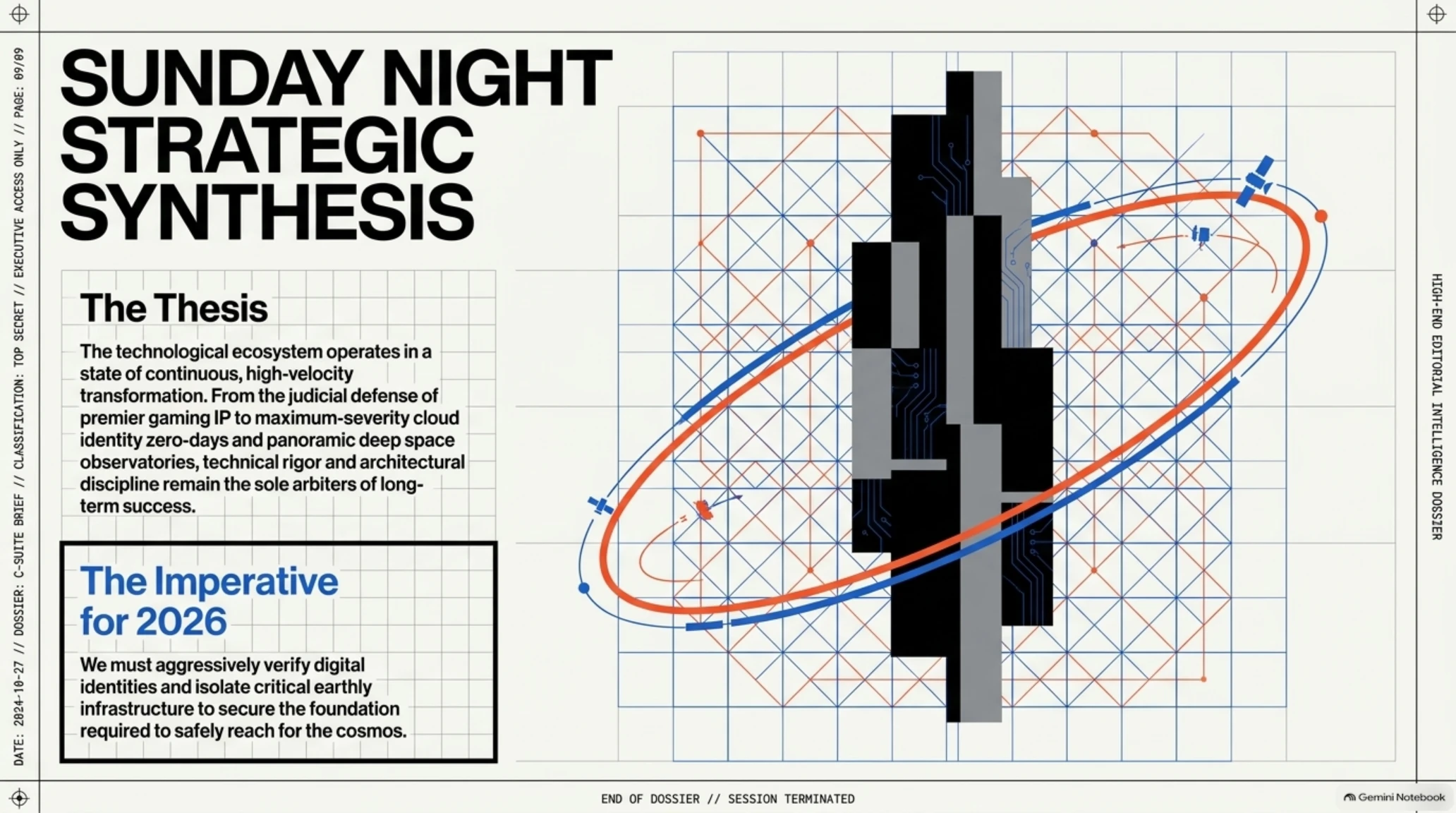
As we conclude our Sunday night intelligence briefing for August 23, 2026, the global technology landscape illustrates the profound convergence of legal enforcement, infrastructure resilience, and deep-space innovation. Take-Two's decisive federal court victory wiping out CyberLeek leak repositories, supported by public alignment from Xbox leadership, demonstrates that major gaming institutions have achieved mature, unified mechanisms to protect interactive art.
Concurrently, Kaspersky's discovery of DoFun Android head unit malware alongside Microsoft's emergency alert regarding the CVSS 10.0 Entra ID token forgery zero-day serves as a stark reminder that identity governance and firmware integrity remain paramount across connected vehicles and enterprise clouds alike. In the astrophysical domain, NASA's transition toward the launch of the $3.2 billion Nancy Grace Roman Space Telescope promises to revolutionize cosmic exploration, while Double Fine's full IP sovereignty and X's stablecoin creator payouts highlight that creative independence and financial decentralization are reshaping the digital economy. As the global tech industry enters the final week of August 2026, the imperative remains absolute: rigorously verify digital identities, isolate critical systems, and embrace an era of unprecedented technological velocity.
The conceptual rendering below illustrates the profound synthesis of orbital astrophysics, enterprise cloud security frameworks, and next-generation interactive computing platforms:
The final panoramic conceptual artwork below depicts the illuminated fortress of technology intelligence standing vigilant against the dark night sky of Sunday, August 23, 2026:
- Decisive judicial action effectively dismantling commercial leak rings and preserving AAA reveal integrity
- Full creative and commercial IP sovereignty reclaimed by celebrated indie studios like Double Fine
- Near-zero-fee global creator monetization achieved via compliant Layer-2 stablecoin infrastructure
- Catastrophic CVSS 10.0 identity federation vulnerabilities in enterprise cloud access backbones
- Proliferation of stealth proxy botnets into connected automotive Android head unit hardware
Essential Related Reading & Cyber Intelligence Archives
• ☀️ Tekin Morning August 22, 2026 | Leaked $899 Xbox Series X25 & Phantom Blade Zero Surge
• 🛡 Tekin Analysis | ThreatsDay Crisis: AI Exploits Target Siemens S7 & Sandbox Escapes
• 🤖 Tekin Versus | TrueForge Revolution: Open-Source AI Agents vs. Claude
Frequently Asked Questions & Comprehensive Technical Analysis (FAQ)
What were the immediate operational consequences of the federal subpoenas in the GTA 6 leak investigation?
The federal judge ordered Microsoft and Discord to surrender identifying subscriber data, IP connection logs, and payment records tied to CyberLeek servers under DMCA Section 512(h). This forced the immediate shutdown and DNS disconnection of CyberLeek's primary distribution websites, paving the way for criminal and civil prosecution.
How does the MoYu malware compromise Android-based automotive head units?
The malware exploits unencrypted Over-The-Air (OTA) firmware update channels in DoFun vehicle consoles, injecting the JarService and Zhima modules to gain persistent Root privileges. This turns the vehicle into a mobile residential proxy botnet node and generates fraudulent background ad-clicks that exhaust telematics data plans.
Why is the Microsoft Entra ID vulnerability assigned a maximum CVSS 10.0 severity score?
The vulnerability allows unauthenticated remote adversaries to forge valid OAuth JSON Web Token signatures due to a flaw in intermediate certificate verification. Attackers can instantly elevate their permissions to Global Administrator, granting complete control over enterprise Microsoft 365 tenants, Exchange mailboxes, and cloud storage.
Why did NASA cancel the Swift satellite robotic servicing mission, and what observatory takes priority?
Due to critical propulsion valve and guidance anomalies in the LINK robotic servicing spacecraft that risked colliding with and destroying the observatory, NASA cancelled the mission and focused all integration resources on the August 30 launch of the $3.2 billion Nancy Grace Roman Space Telescope, which features a 100x larger field of view than Hubble.
What rights did Double Fine Productions secure following its amicable separation from Xbox?
Double Fine secured 100% full ownership of all past intellectual property and publishing rights, including the Psychonauts franchise, Brütal Legend, and Broken Age. The studio will now operate as an independent multiplatform developer, launching future titles simultaneously across PS5, Xbox Series X, PC, and Nintendo Switch 2.
Verified Sources & Technical Documentation (Tekin Night August 23, 2026)
- Insider Gaming: Take-Two Subpoenas Over GTA 6 Leaks
- Eurogamer: Take-Two Legal Crusade Shuts Down CyberLeek
- The Hacker News: Android Car Malware Spreads Through Updaters
- BleepingComputer: Microsoft Warns of Max Severity Entra ID Flaw
- Wired: NASA Cancels Rescue Mission for Swift Telescope
- CoinDesk: Crypto Squeeze-Led Macro Rally & X Stablecoin
Additional Gallery: 🌙 Tekin Night August 23, 2026 | GTA 6 Leakers Hunted, Entra ID Zero-Day & Android Car Malware