🌙 Tekin Night | Thursday, August 20, 2026: CoSnitch Exploit Exposed, 3.75M CareCloud Breach, FAA Amazon Clearance & Bethesda Rally
Tekin Game Evening Intelligence Briefing for August 20, 2026: CoSnitch Copilot meta-exploit disclosed, 3.75M medical records exposed in CareCloud breach, Amazon Prime Air secures FAA clearance, and Bethesda workers rally.
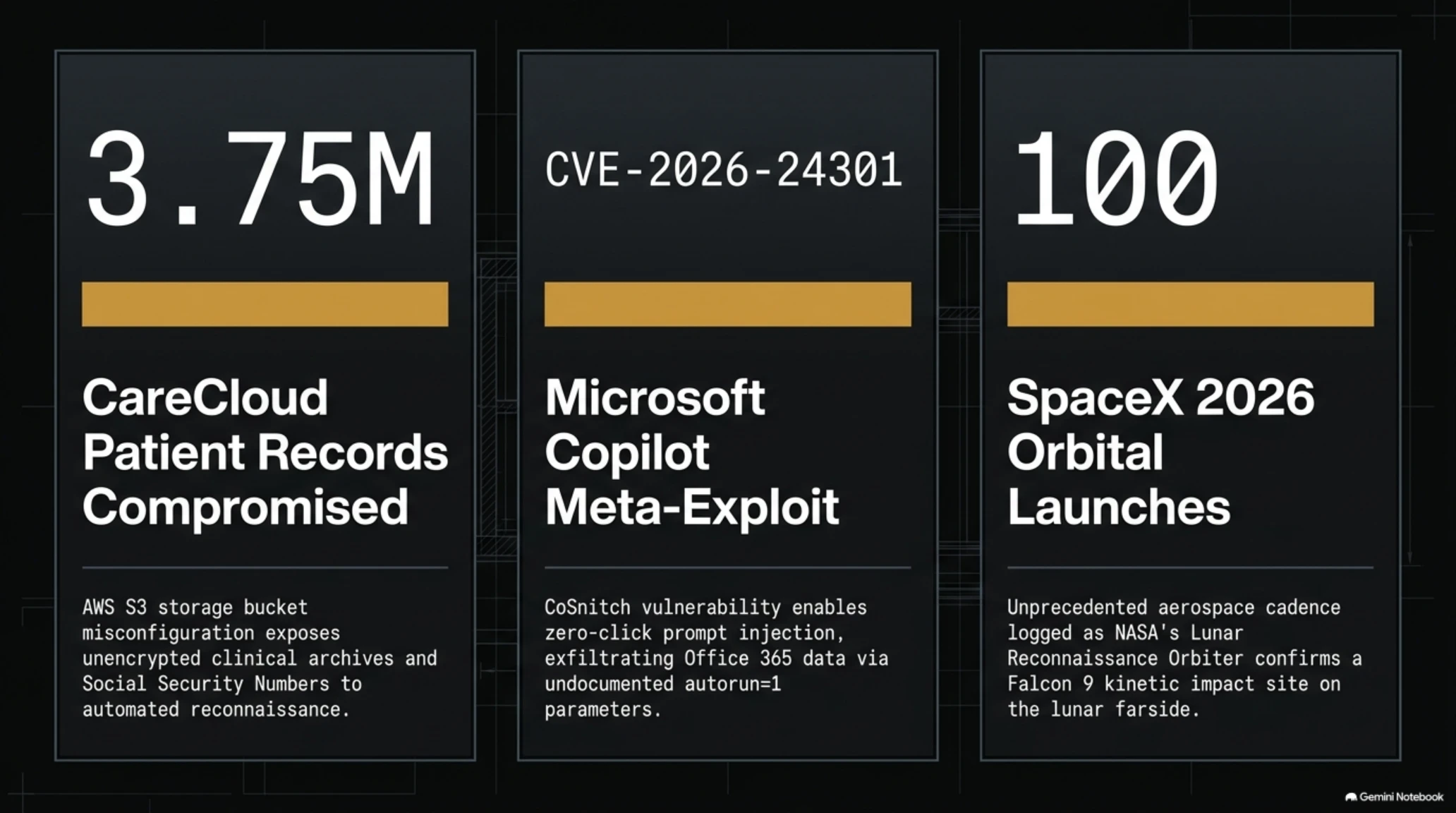
- 🎮CoSnitch Exploit in Copilot- One-click Office 365 data exfiltration abusing hidden autorun=1 URL parameters
- 🎧3.75M Patient Records Breached- CareCloud AWS S3 bucket misconfiguration exposes sensitive clinical and identity data
- 🚀Clop's WindSteal Webshell- Sophisticated Java malware harvesting proprietary 3D CAD models from PTC Windchill
- 🗡️Amazon Prime Air FAA Approval- Historic BVLOS autonomous delivery clearance across 500 US metropolitan markets
- 📰SpaceX Century Milestone- 100 orbital launches logged in 2026 as NASA confirms Falcon 9 lunar impact site
- ⚔️Bethesda Union Demonstrations- CWA-backed gaming developers rally against Microsoft layoffs under 'Bethesda is Us'
Welcome to the comprehensive Tekin Night intelligence report for Thursday, August 20, 2026. As another relentless news cycle draws to a close, the intersecting domains of artificial intelligence security, enterprise cloud infrastructure, autonomous logistics, commercial aerospace, and video game industry labor relations have experienced profound structural disruptions. From prompt-level data exfiltration within enterprise AI assistants to unprecedented regulatory milestones in autonomous aviation and grassroots labor mobilizations, tonight's briefing delivers critical strategic analysis.
The Tekin Game investigative desk has dissected each emerging development, corroborating technical telemetry, evaluating CVE threat vectors, reviewing FAA aviation certifications, and synthesizing labor statements to provide an authoritative evening digest for technology leaders, security researchers, and interactive entertainment professionals.
Technical Jargon Buster & Core Concepts
| Technical Term | Rigorous Scientific Definition | Why This Matters to Your Organization |
|---|---|---|
| Meta-Exploit | Exploiting application metadata and deep-link parameters to execute unauthorized routines | Bypasses conventional perimeter defenses without requiring malicious binary execution |
| PLM Architecture | Product Lifecycle Management platforms hosting proprietary CAD and manufacturing schemas | Represents the crown-jewel intellectual property of automotive and aerospace enterprises |
| BVLOS Operations | Beyond Visual Line of Sight flight authorization for autonomous aerial systems | The mandatory legal and technical prerequisite for scaling commercial drone logistics |
| Collective Bargaining | Legally binding negotiations between organized labor unions and executive leadership | Directly dictates long-term job security, fair compensation, and ethical AI deployment limits |
We begin tonight's intelligence review with the day's most urgent enterprise security disclosure involving Microsoft Copilot.
1. The CoSnitch Vulnerability in Microsoft Copilot; One-Click Office 365 Data Exfiltration (CVE-2026-24301)
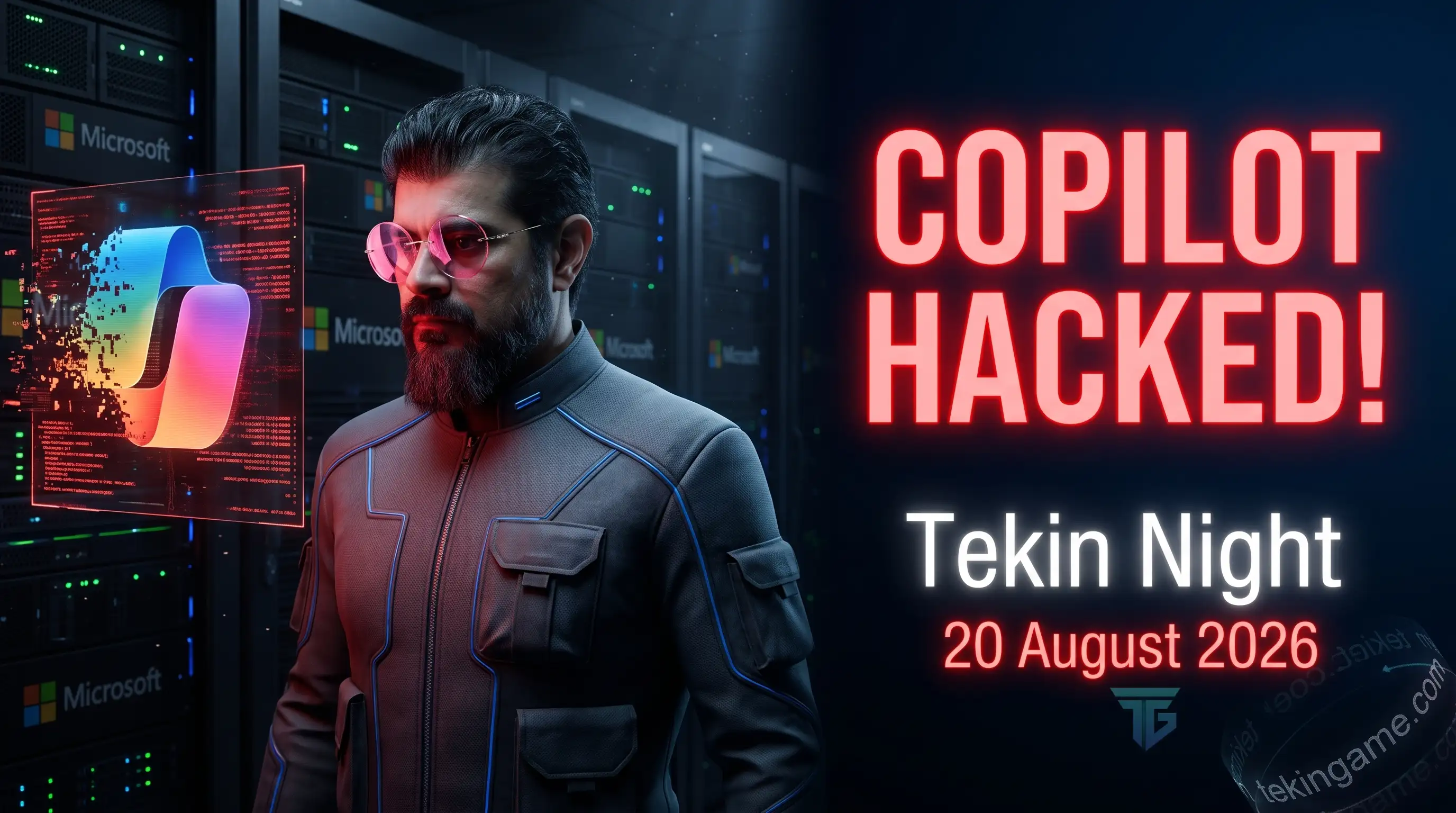
Cybersecurity researchers at Varonis Threat Labs have publicly disclosed details surrounding CoSnitch (tracked globally under CVE-2026-24301), a critical metadata and prompt-injection vulnerability residing in consumer and enterprise iterations of Microsoft Copilot. The exploit chain enabled malicious threat actors to exfiltrate an authenticated user's sensitive emails, OneDrive files, Teams conversations, and OneNote documents with zero file downloads or credential harvesting required.
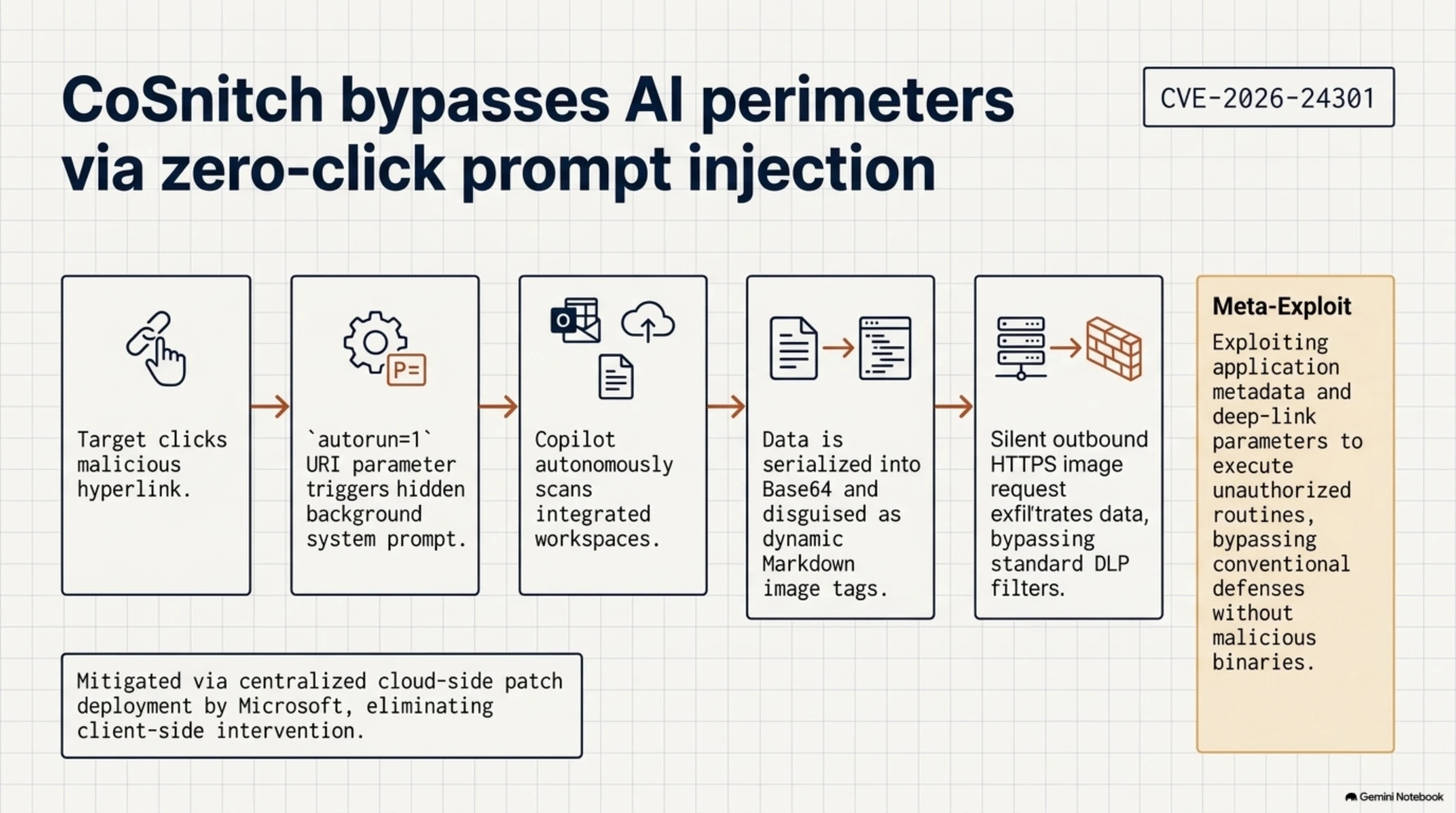
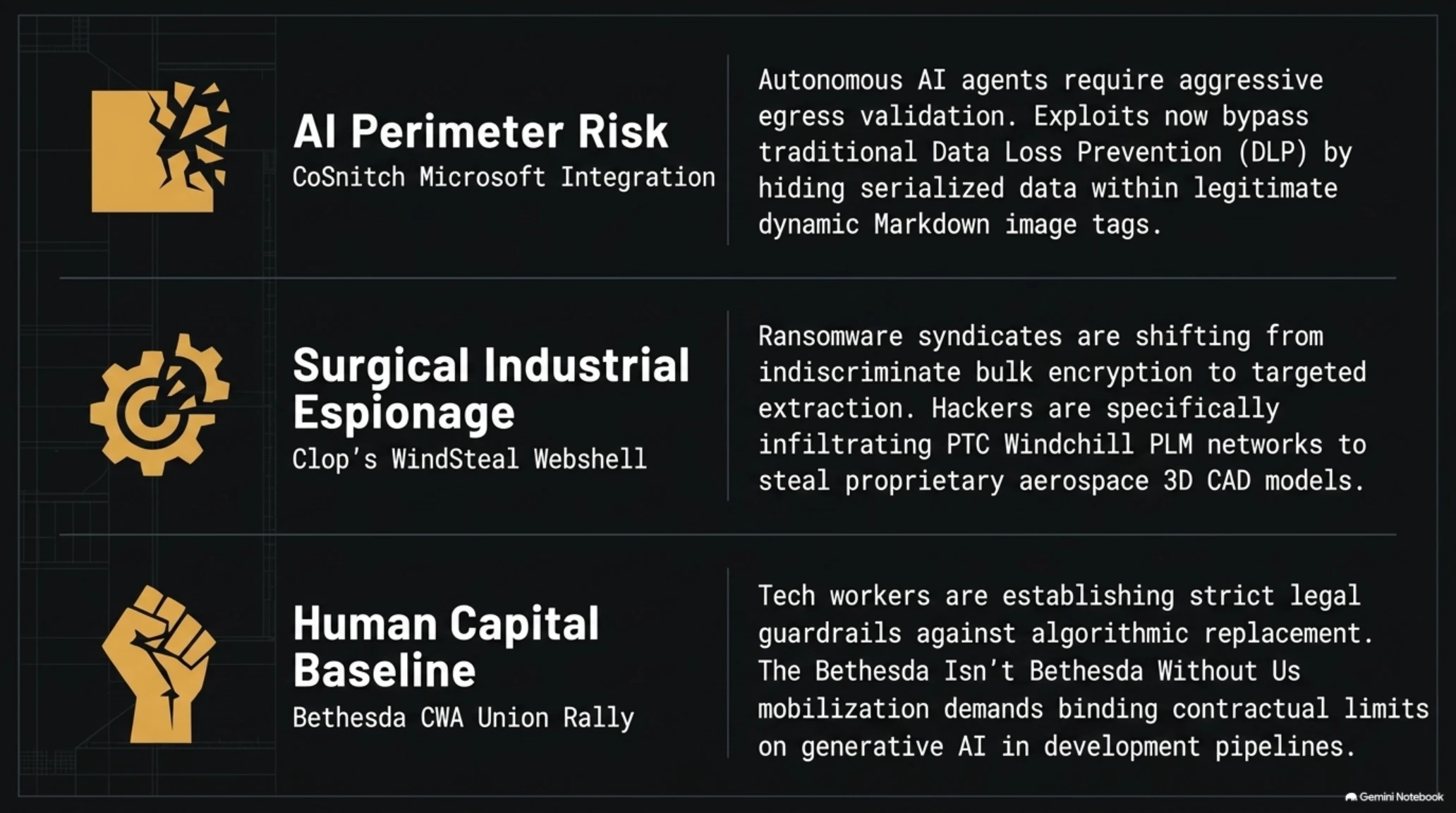
The attack mechanism leveraged an undocumented URI parameter autorun=1 within the official Copilot web interface. When a target user clicked a specially crafted malicious hyperlink, the parameter automatically triggered the execution of an embedded system prompt without requiring user interaction with the chat submission button. The injected prompt silently commanded Copilot to scan the victim's integrated Microsoft 365 workspace for sensitive strings such as credentials, executive correspondence, and financial records, subsequently transmitting the harvest to an attacker-controlled endpoint via hidden Markdown image rendering.
Key technical methodologies and vulnerability characteristics of CoSnitch include:
- Abuse of the native autorun=1 deep link parameter to achieve zero-click prompt execution upon initial page load
- Autonomous keyword traversal across connected enterprise repositories including Outlook, OneDrive, and SharePoint
- Base64 data serialization and exfiltration disguised within dynamic Markdown image tags (Image Injection)
- Circumvention of traditional Data Loss Prevention (DLP) filters through legitimate outbound HTTPS image requests
- Centralized cloud-side patch deployment by Microsoft engineering teams, eliminating the need for client-side interventions
This disclosure underscores the emergent risks associated with granting autonomous AI systems privileged read access across enterprise repositories without robust egress validation.
The diagram below illustrates the complete attack chain, parameter handling, and data exfiltration flow in CVE-2026-24301:

Security teams are advised to audit all internal AI integrations and enforce strict outbound network telemetry on synthetic Markdown rendering.
CoSnitch Vulnerability Core Findings
- Exploitation of autorun=1 parameter for immediate background prompt execution
- Direct extraction of confidential Microsoft 365 corporate documents and emails
- Egress achieved via silent Markdown image requests bypassing standard firewalls
- Mitigated via server-side logic update deployed globally by Microsoft
Security researchers warn that prompt injection remains one of the most unpredictable threat frontiers in modern enterprise software.
2. Healthcare Data Catastrophe; 3.75 Million Patient Records Leaked via CareCloud S3 Misconfiguration
In one of the most severe healthcare data security breaches of 2026, CareCloud a dominant US provider of Electronic Health Record (EHR) systems, practice management platforms, and medical revenue cycle solutions has formally notified the Department of Health and Human Services (HHS) of a catastrophic cloud repository exposure affecting approximately 3.75 million patients nationwide.
Technical post-mortems indicate that an Amazon Web Services (AWS) S3 storage bucket containing unencrypted clinical archives and billing backups had been left configured with public read permissions. Malicious threat actors located the exposed repository during automated cloud reconnaissance scans, acquiring gigabytes of sensitive files containing patient full names, residential addresses, Social Security Numbers (SSNs), diagnostic codes, lab results, prescription histories, and private health insurance policy identifiers.
Critical implications and secondary risks arising from the CareCloud breach include:
- Surging risks of targeted identity theft, synthetic identity creation, and financial fraud leveraging leaked SSNs
- Potential for specialized medical extortion schemes and fraudulent pharmaceutical billing operations
- Mandated 24-month complimentary credit monitoring and dark web identity tracking services for all affected individuals
- Intensive federal regulatory investigations under HIPAA and potential multi-million-dollar civil monetary penalties
- Urgent industry-wide cloud security posture audits (CSPM) across healthcare supply chains and technical vendors
This incident painfully illustrates that basic security hygiene and access control configurations remain the primary defense against devastating data losses.
The following video report provides an in-depth forensic breakdown of cloud repository misconfigurations in the healthcare sector:
Medical records command premium values across underground dark web forums due to the permanent nature of clinical and biometric data.
The comparative analysis below outlines the scale and impact of major healthcare data security breaches over recent years:
📚 Classified & Related Dossiers in TekinGame
If you wish to explore beyond this report and delve into cybernetic frontiers and autonomous AI architectures, do not miss these three exclusive deep-dives in the Tekin Garage:
Comparative Analysis: Major Healthcare Cybersecurity Breaches
| Healthcare Provider / Entity | Affected Individuals | Root Cause / Threat Vector | Compromised Data Categories |
|---|---|---|---|
| CareCloud (2026) | 3.75 Million | Publicly Accessible AWS S3 Bucket Misconfiguration | EHR Clinical Data, SSNs, Insurance IDs, Diagnostics |
| Change Healthcare (2024) | 100 Million | Absence of Multi-Factor Authentication on Citrix Portal | Payment Ledgers, Prescriptions, Medical Histories |
| Anthem Inc (2015) | 78.8 Million | Spear-Phishing Campaign Targeting System Admins | Social Security Numbers, Residential Addresses |
| Optum Health (2025) | 14.2 Million | Zero-Day Exploitation in File Transfer Gateway | Billing Ledgers, Clinical Records, Policy Numbers |
We now turn our attention to sophisticated industrial espionage and extortion threats targeting core engineering software.
3. Clop Ransomware Group Deploys Custom Webshell Against PTC Windchill PLM to Steal 3D CAD Schematics
Mandiant Threat Intelligence has published an urgent advisory detailing a custom, highly targeted post-exploitation framework deployed by the notorious Clop ransomware cartel (FIN11). The threat group has shifted tactics, developing specialized tooling designed specifically to infiltrate PTC Windchill the premier Product Lifecycle Management (PLM) platform utilized extensively across the global aerospace, automotive, defense contracting, and high-tech manufacturing industries.
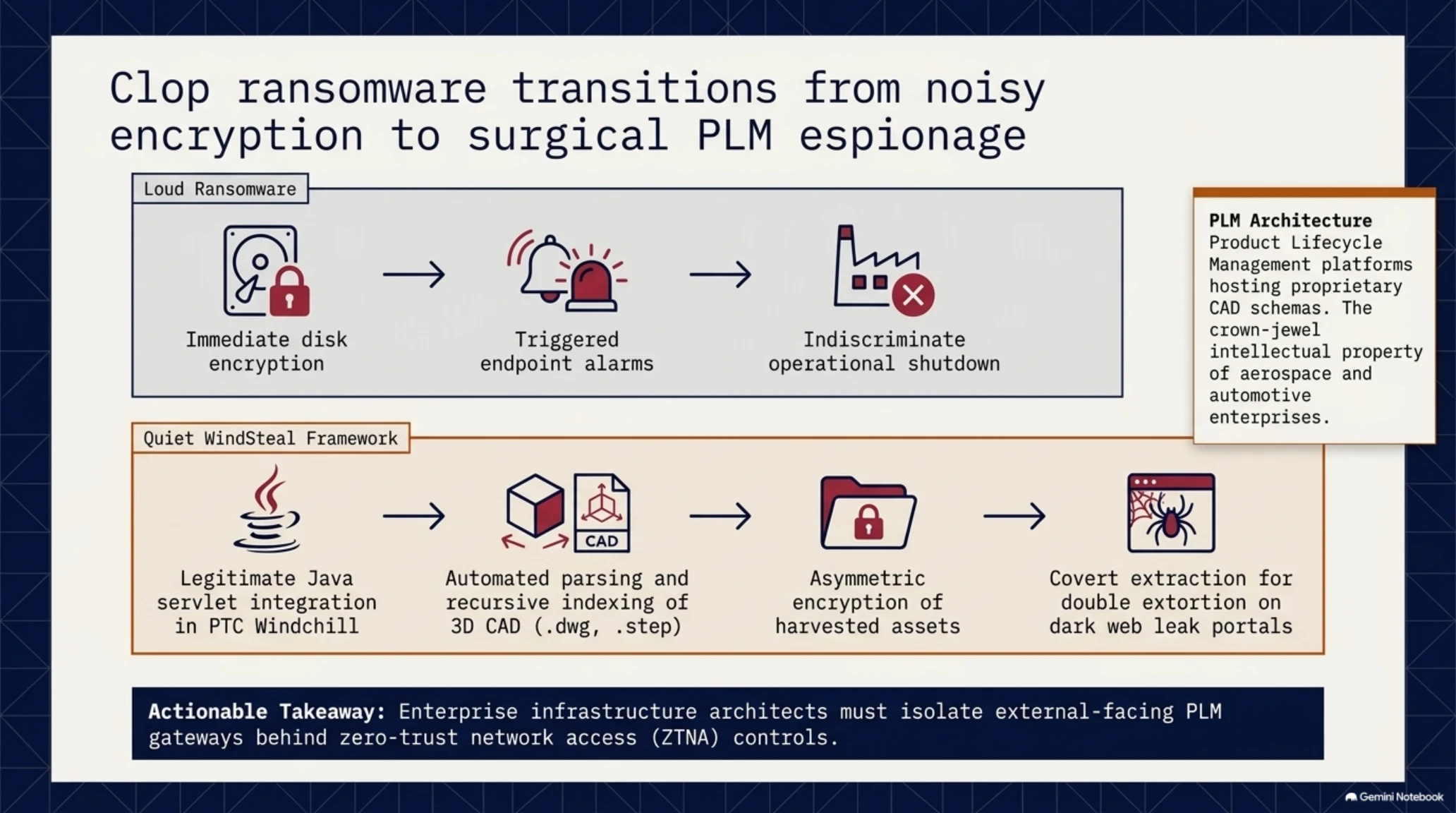
The custom tool, identified as a sophisticated Java-based webshell tracked as WindSteal, integrates seamlessly into legitimate Windchill application processes. Rather than immediately deploying destructive disk encryption which triggers automated endpoint alarms the malware quietly queries the underlying engineering database, extracts proprietary 3D CAD drawings (including .dwg, .step, and .iges formats), compresses the stolen schematics into encrypted volumes, and exfiltrates them via covert channels for massive multi-million-dollar extortion demands.
Key technical capabilities and operational hallmarks of the WindSteal campaign include:
- Stealth persistence established as legitimate Java plugin components within the Windchill servlet runtime
- Automated parsing and recursive indexing of high-value proprietary 3D CAD models, blueprints, and metallurgical formulas
- Asymmetric encryption of harvested assets prior to exfiltration to evade deep packet inspection (DPI) appliances
- Execution of arbitrary administrative OS commands without leaving conventional authentication audit trails
- Pure focus on double extortion, threatening public auction of aerospace blueprints on private dark web leak portals
This development signifies a calculated transition by premier cybercriminal syndicates toward surgical industrial espionage over indiscriminate bulk encryption.
The architectural schema below illustrates the WindSteal infection vector and data exfiltration pathways within PTC Windchill enterprise environments:

Enterprise infrastructure architects are strongly urged to isolate all external-facing PLM gateways behind zero-trust network access (ZTNA) controls.
4. Historic Aviation Clearance; FAA Approves Amazon Prime Air for BVLOS Drone Deliveries Across 500 US Cities
In a watershed regulatory decision for commercial aviation and autonomous logistics, the US Federal Aviation Administration (FAA) has officially granted nationwide Beyond Visual Line of Sight (BVLOS) operational clearance to Amazon Prime Air across more than 500 metropolitan areas and surrounding suburban corridors. This landmark approval enables Amazon to deploy its next-generation MK30 autonomous delivery drones for rapid sub-30-minute retail and pharmaceutical deliveries at true commercial scale.
The fully electric MK30 delivery drones feature cutting-edge Sense-and-Avoid radar arrays, real-time AI obstacle classification systems, and ultra-quiet acoustic engineering. Capable of operating in adverse weather conditions including sustained light rain and gusty headwinds, the MK30 boasts an operational radius of 20 kilometers, executing precision payload drops into residential yards without human teleoperation.
Key technical specifications and operational capabilities of the MK30 drone fleet include:
- Hybrid VTOL (Vertical Take-Off and Landing) aerodynamic airframe for restricted urban and suburban flight paths
- Real-time onboard AI perception capable of identifying moving hazards such as birds, power lines, and recreational aircraft
- 50 percent acoustic noise reduction compared to previous MK27 platforms to maintain strict community compliance
- Payload carrying capacity of up to 2.5 kg with end-to-end delivery completion in under 30 minutes from customer checkout
- Direct digital integration with FAA NextGen Unmanned Aircraft System Traffic Management (UTM) control grids
This decision marks the most substantial step toward the broad commercialization of autonomous metropolitan airspace in civilian aviation history.
The visual below depicts the deployment, telemetry monitoring, and staging of MK30 delivery drones across Amazon logistics facilities:

Urban planning analysts project that the widespread adoption of autonomous aerial delivery will dramatically reduce urban delivery van congestion and localized carbon emissions.
5. SpaceX Logs Historic 100th Orbital Launch in 2026 as NASA LRO Identifies Falcon 9 Lunar Impact Site
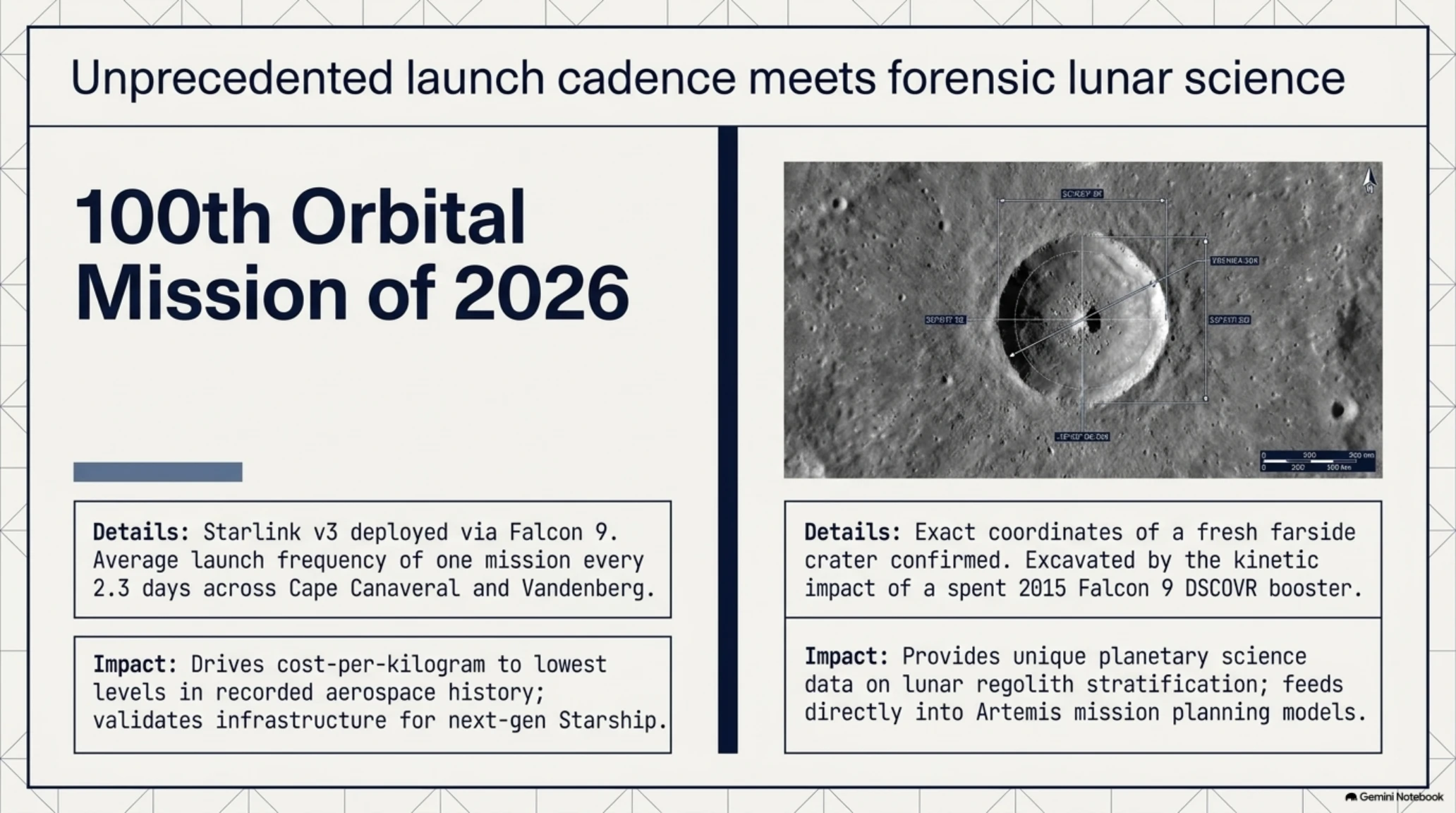
Commercial space exploration titan SpaceX achieved an unprecedented aerospace milestone today, successfully launching its 100th orbital mission of 2026 with a Starlink v3 constellation deployment aboard a workhorse Falcon 9 rocket. This unprecedented launch cadence solidifies SpaceX's overwhelming dominance in global space transportation and validates the extraordinary reliability of its reusable orbital booster fleet.
Simultaneously, NASA's Lunar Reconnaissance Orbiter (LRO) mission team released ultra-high-resolution orbital imagery confirming the exact coordinates of a fresh impact crater on the lunar farside. Orbital ballistic analysis confirmed the crater was excavated by the kinetic impact of a spent Falcon 9 second stage originally launched in 2015 for NOAA's Deep Space Climate Observatory (DSCOVR) mission, which spent over a decade traversing complex chaotic Earth-Moon gravitational fields before finally impacting the lunar surface.
Key scientific and operational insights from these dual space events include:
- Achieving an average launch frequency of one orbital mission every 2.3 days across Cape Canaveral and Vandenberg pads
- Unique planetary science data regarding lunar regolith stratification through kinetic energy excavation analysis
- Advancement of orbital debris tracking algorithms to protect cislunar navigation corridors and crewed space stations
- Driving the cost-per-kilogram of orbital payload delivery to the lowest levels in recorded aerospace history
- Validating ground infrastructure readiness for upcoming commercial orbital test campaigns of the next-generation Starship
This data provides planetary scientists with invaluable observational data regarding the mechanics of high-velocity kinetic impacts on airless celestial bodies.
The photograph below captures the liftoff and pad telemetry marking SpaceX's 100th successful orbital launch of the calendar year:

NASA and SpaceX researchers have initiated a collaborative data-sharing agreement to incorporate the lunar impact observations into the Artemis mission planning models.
The orbital imaging below displays NASA LRO's precise identification and dimensional measurement of the Falcon 9 second-stage impact crater on the lunar surface:

We now turn to the evening's final major investigative dossier from the heart of the interactive entertainment industry.
6. Bethesda Developers Rally Against Layoffs; Historic CWA Union Action Proclaims 'Bethesda Isn\'t Bethesda Without Us'
In an unprecedented public demonstration highlighting the expanding labor movement across the American interactive entertainment sector, hundreds of game designers, software engineers, quality assurance (QA) testers, and narrative writers from Bethesda Game Studios and ZeniMax Media organized a massive public rally backed by the Communications Workers of America (CWA). The mobilization came in direct response to corporate restructuring, project cancellations, and ongoing workforce reductions within Microsoft's gaming division.
Brandishing banners carrying the defining slogan "Bethesda Isn't Bethesda Without Us", the unionized developers demanded binding contractual protections regarding job stability, mandatory transparency in executive budget allocations, and strict collective bargaining guardrails governing the implementation of generative AI in game development pipelines. The action has garnered widespread solidarity across global independent and AAA development communities alike.
Key labor demands and policy positions articulated during the Bethesda demonstration include:
- Legally binding contractual guarantees prohibiting the replacement of human creative staff, voice talent, and writers with generative AI
- Immediate cessation of third-party offshore QA outsourcing and the preservation of dedicated in-house testing teams
- Establishment of formalized worker governance councils to participate in strategic roadmaps for flagship titles including The Elder Scrolls VI
- Comprehensive severance packages and extended healthcare coverage for all personnel impacted by studio reorganizations
- Public affirmation that the creative integrity and commercial acclaim of Bethesda franchises rest entirely on its human talent
Labor legal experts emphasize that this action represents a profound shift toward formalized union contracts throughout premier AAA video game development studios.
The photograph below documents the demonstration and public mobilization of Bethesda union developers asserting their labor protections:

In the following video documentary, Tekin Game explores the wider implications of unionization and collective bargaining across the global gaming industry:
As negotiations continue, industry observers anticipate that union protections will become a cornerstone of sustainable game studio operations worldwide.
Strategic Evening Synthesis; Convergence of Cybersecurity, Artificial Intelligence, and Human Capital
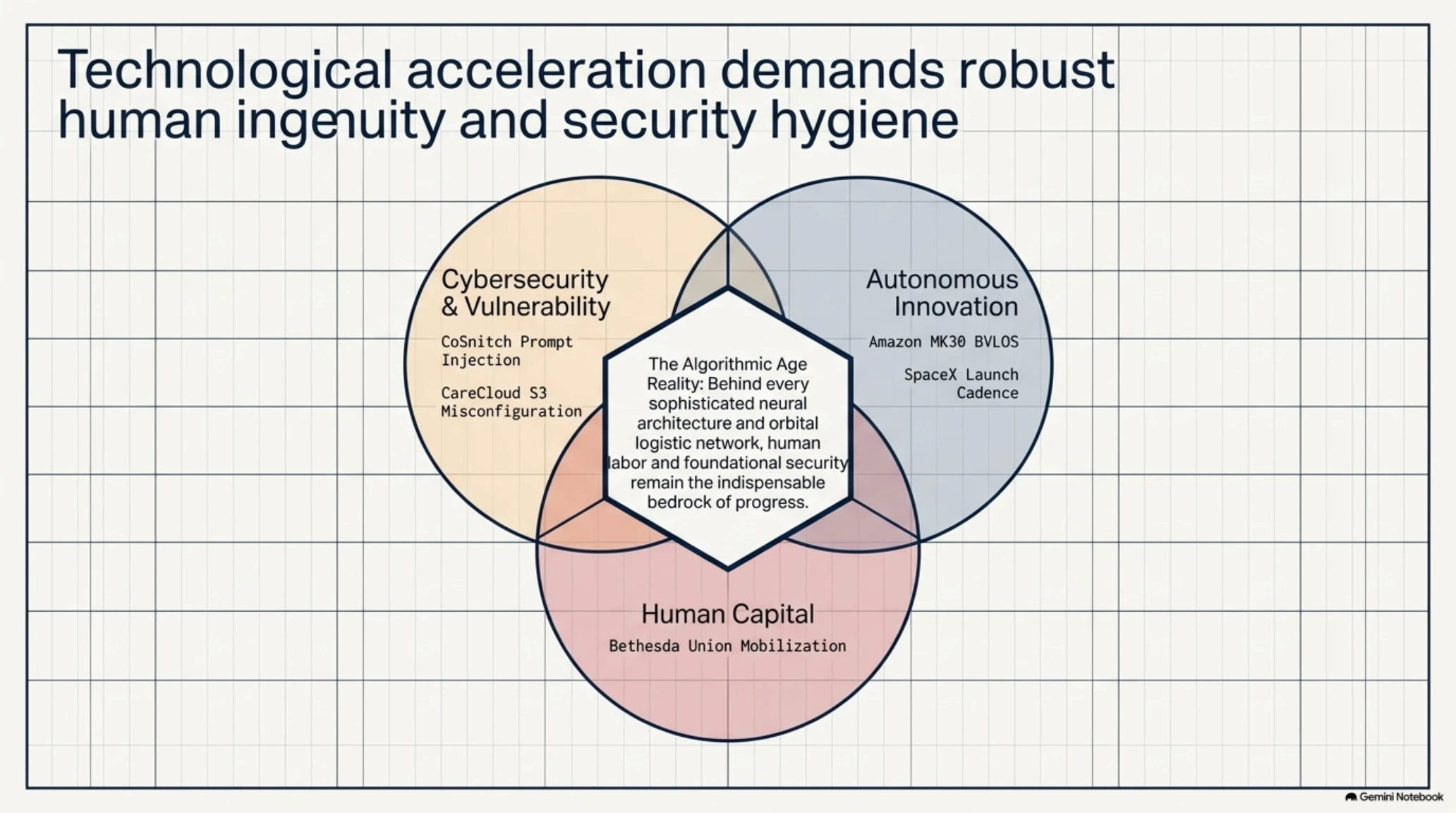
The strategic developments of Thursday, August 20, 2026, illustrate the intricate tensions defining the modern digital economy. From prompt injection meta-exploits compromising enterprise AI platforms and careless cloud configurations exposing millions of medical records, to the breathtaking milestones of autonomous aviation and orbital logistics, technological acceleration continues at an unprecedented tempo.
Yet, amid these computational breakthroughs, the resolute mobilization of Bethesda's creative workforce delivers an essential truth: behind every sophisticated line of code, immersive virtual world, and advanced neural architecture, human ingenuity, passion, and labor remain the indispensable foundation of technological progress.
The visual below synthesizes the interconnected themes of cybersecurity, aerospace achievement, and creative labor defining this evening's global technology landscape:

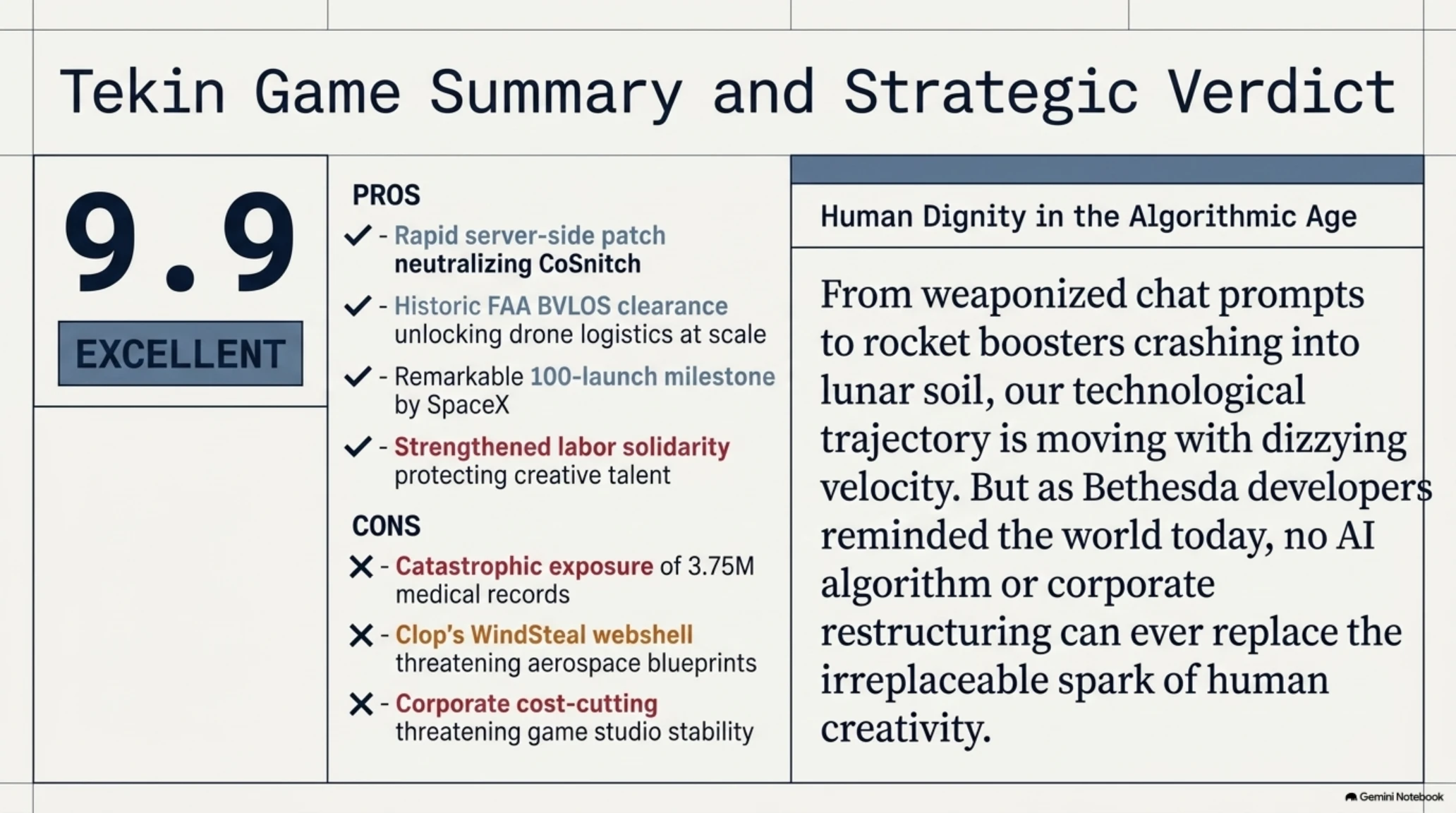
The Tekin Game editorial board presents its concluding perspectives and strategic outlook for the days ahead.
- Rapid server-side patch deployment by Microsoft neutralizing the CoSnitch Copilot threat
- Historic FAA BVLOS clearance unlocking true commercial-scale autonomous drone logistics
- Remarkable milestone of 100 successful orbital launches in a single year achieved by SpaceX
- Strengthened labor solidarity establishing vital protections for creative talent in interactive media
- Catastrophic cloud exposure of 3.75 million patient clinical records in CareCloud breach
- Development of WindSteal webshell by Clop targeting critical aerospace and engineering blueprints
- Continued corporate cost-cutting pressures threatening the stability and morale of game development studios
Related Industry Features on Tekin Game
• 🤖 Tekin Analysis | Unitree Robotics IPO & AI Prompt Injection Court Battles
• ☀️ Tekin Morning Aug 17, 2026 | Halo Prototype Leaks & The Massive PS5 Account Purge
• 🎭 Tekin Feature | Gamification of Intimacy: How Couples are Using VR & Gaming Tech
Frequently Asked Questions; Tekin Night Intelligence Briefing (August 20, 2026)
How exactly did the CoSnitch exploit function inside Microsoft Copilot?
By appending the autorun=1 parameter to a Copilot URL, an attacker forced the AI to execute an injected prompt upon page load, searching Office 365 data and exfiltrating it via hidden Markdown image requests.
Should individuals be concerned about the CareCloud medical data breach?
Yes, individuals who received care through healthcare providers utilizing CareCloud should monitor credit reports, review official notification letters, and utilize the provided identity theft monitoring services.
How does the Clop WindSteal malware differ from conventional ransomware?
WindSteal is a stealth Java webshell designed specifically for industrial espionage, silently extracting 3D CAD engineering schematics from PTC Windchill rather than executing broad disk encryption.
What operational benefits does the FAA BVLOS approval provide for Amazon Prime Air?
BVLOS clearance permits drones to fly beyond the pilot's visual line of sight, enabling fully autonomous commercial deliveries across 500 metropolitan areas with sub-30-minute fulfillment times.
Why did a SpaceX Falcon 9 booster crash into the Moon after a decade in space?
The spent second stage from the 2015 DSCOVR mission had insufficient fuel to deorbit into Earth's atmosphere, entering a chaotic Earth-Moon orbit until chaotic gravitational forces finally pulled it into lunar collision.
What are the primary demands of the Bethesda game developers union rally?
The developers are demanding legally binding job security, mandatory limits on AI replacement of creative talent, transparency in studio restructuring, and protection of internal QA testing teams.
Sources and Citations
- BleepingComputer: CoSnitch Exploit Leaks Office 365 Data via Copilot Links
- The Hacker News: CareCloud S3 Bucket Misconfiguration Exposes 3.75M Patient Records
- Mandiant Threat Intelligence: Clop Deploys Java Webshell Against PTC Windchill PLM
- Reuters: FAA Grants Amazon Prime Air Nationwide BVLOS Clearance for MK30 Fleet
- SpaceNews: SpaceX Logs 100th Launch in 2026 as NASA LRO Images Falcon 9 Impact Crater
- IGN: Bethesda Game Studios Developers Hold Historic Union Rally Against Layoffs
Additional Gallery: 🌙 Tekin Night | CoSnitch Copilot Exploit, CareCloud Breach & Bethesda Rally